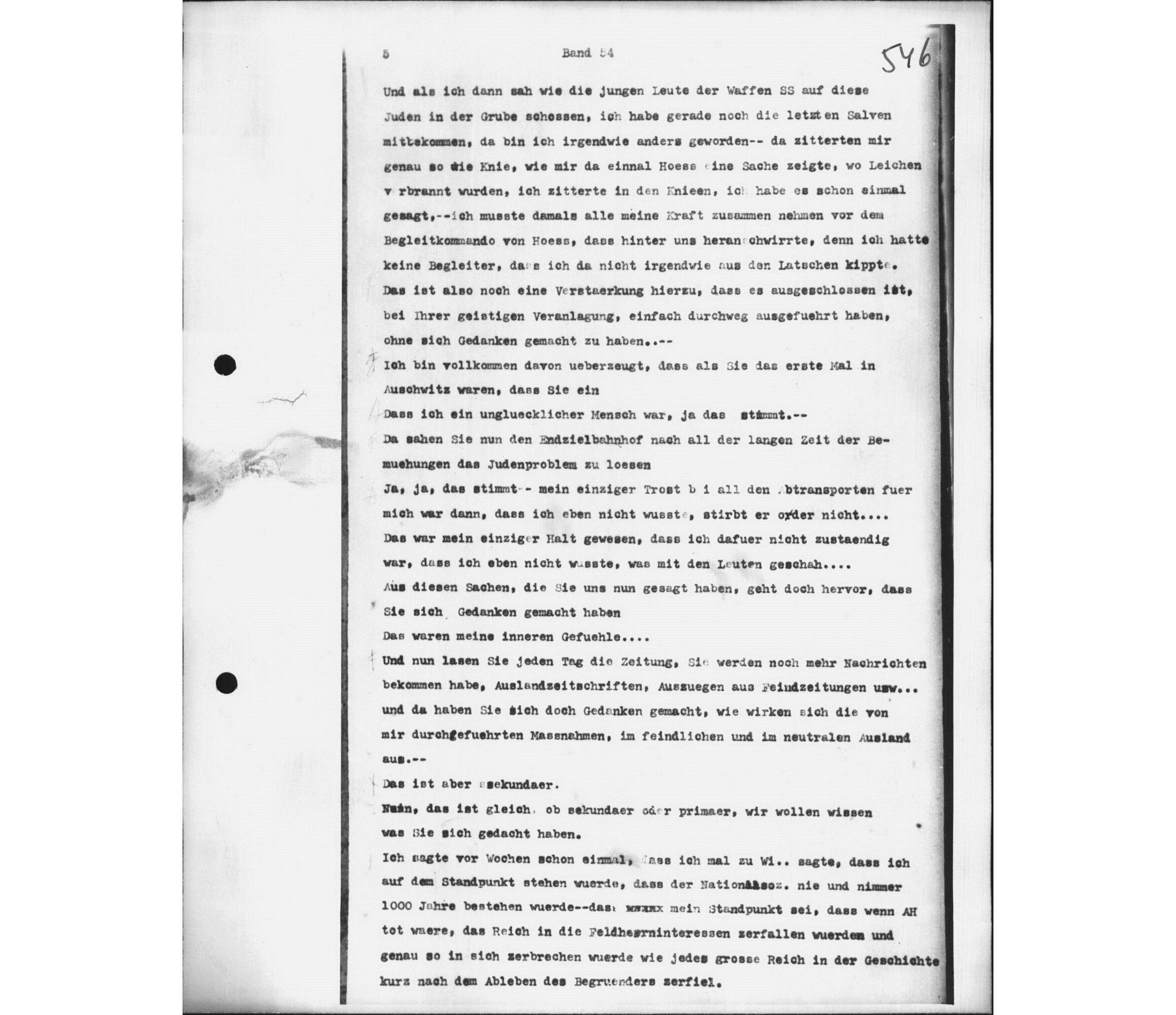
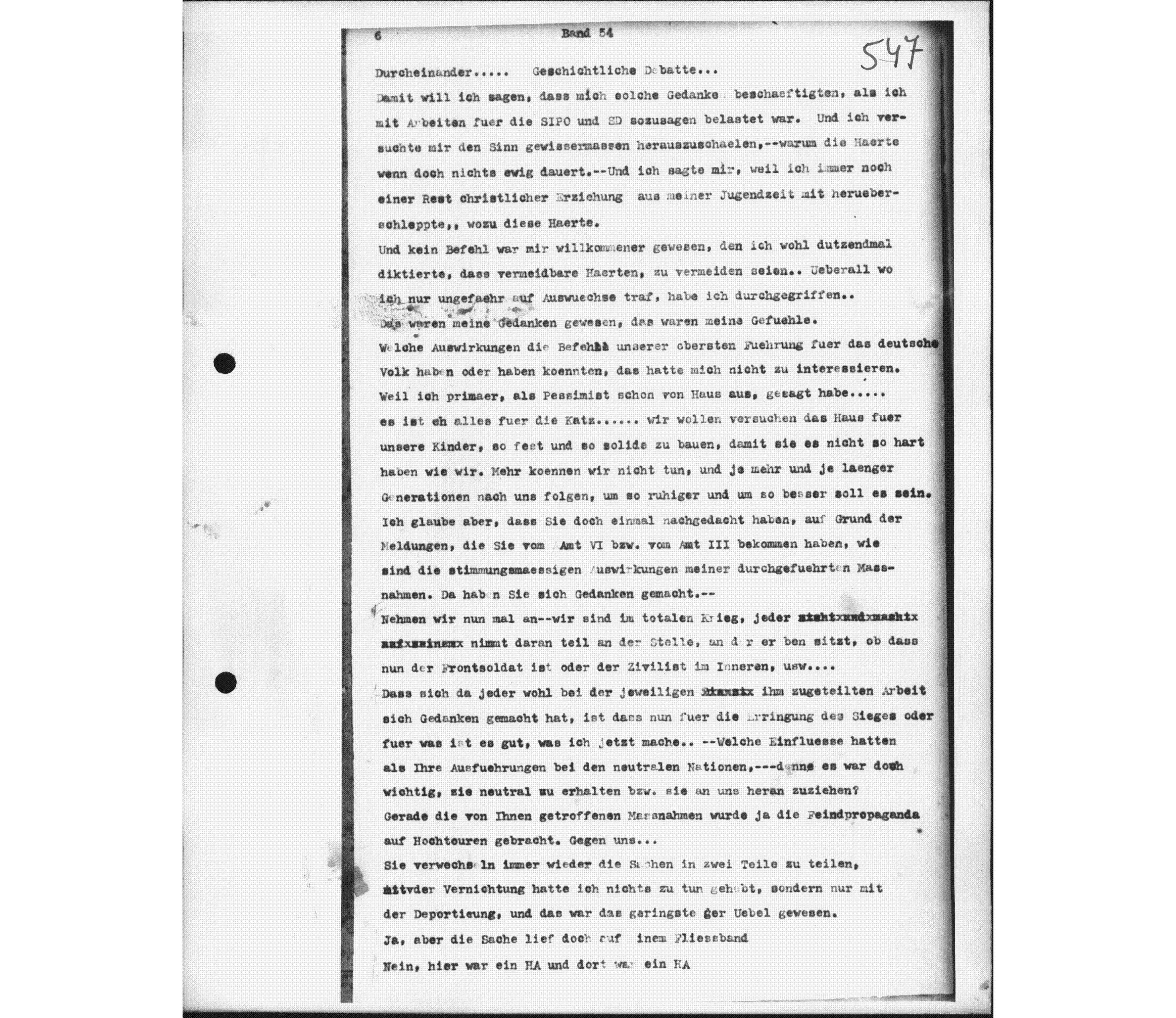
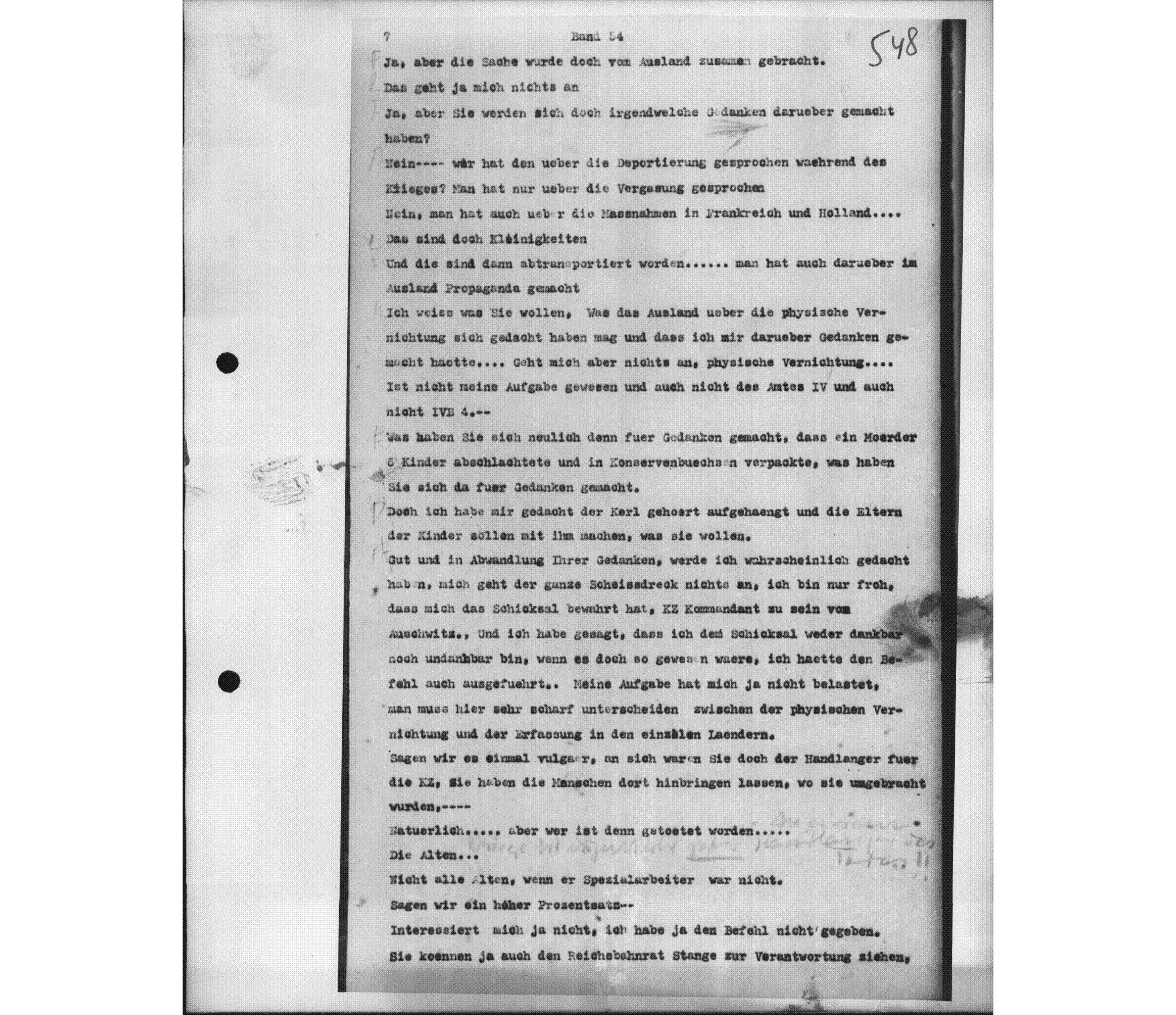
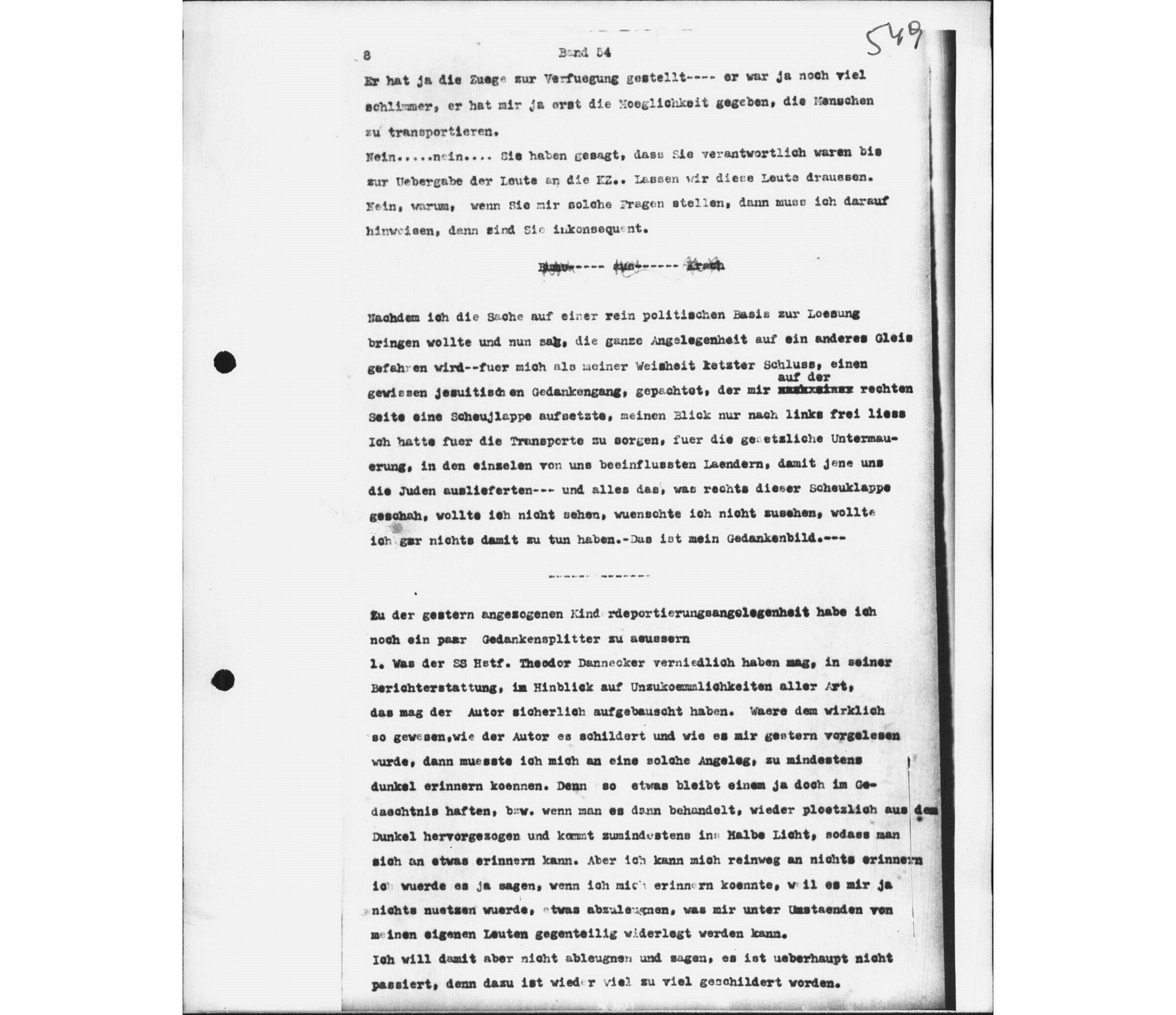
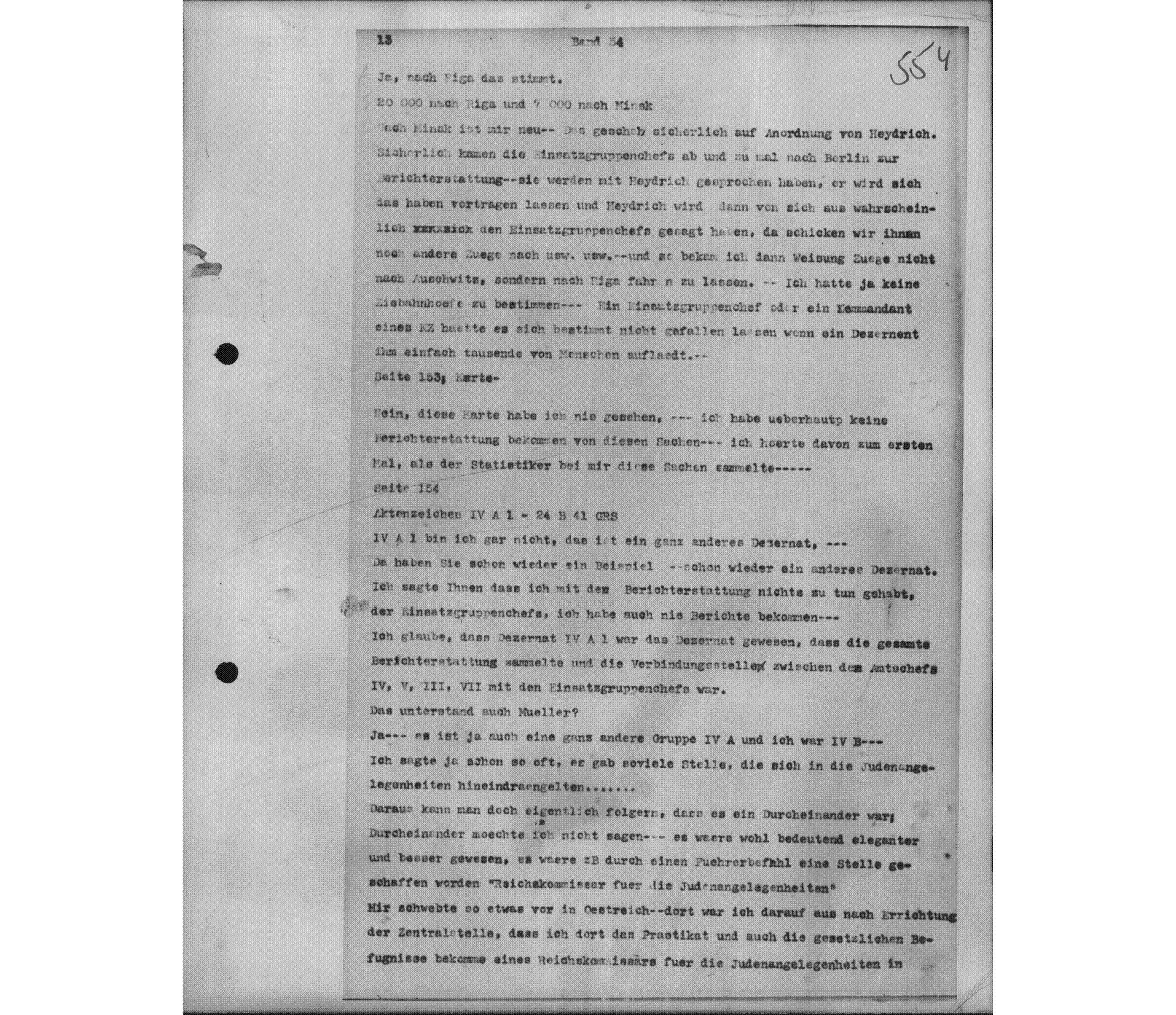
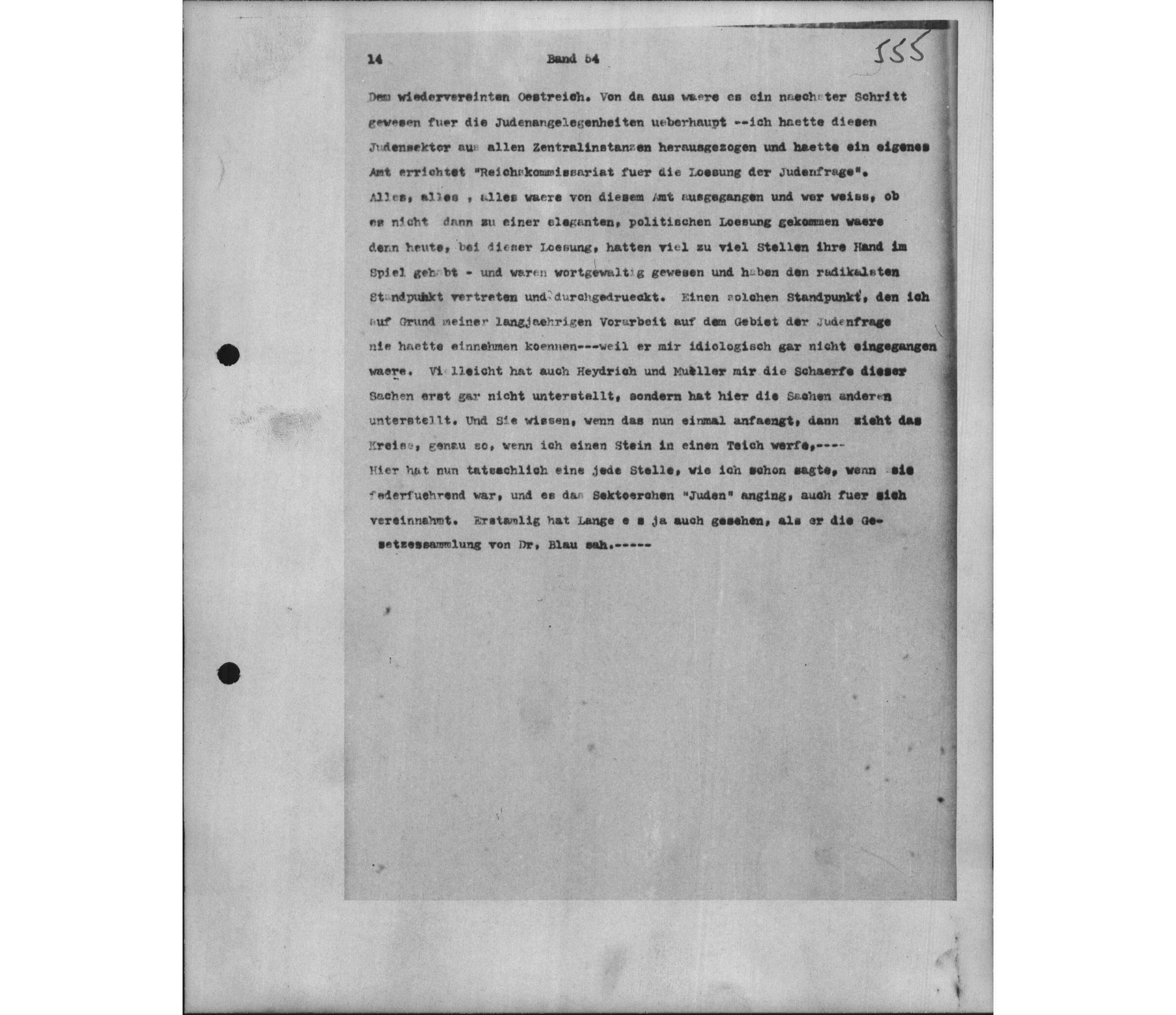
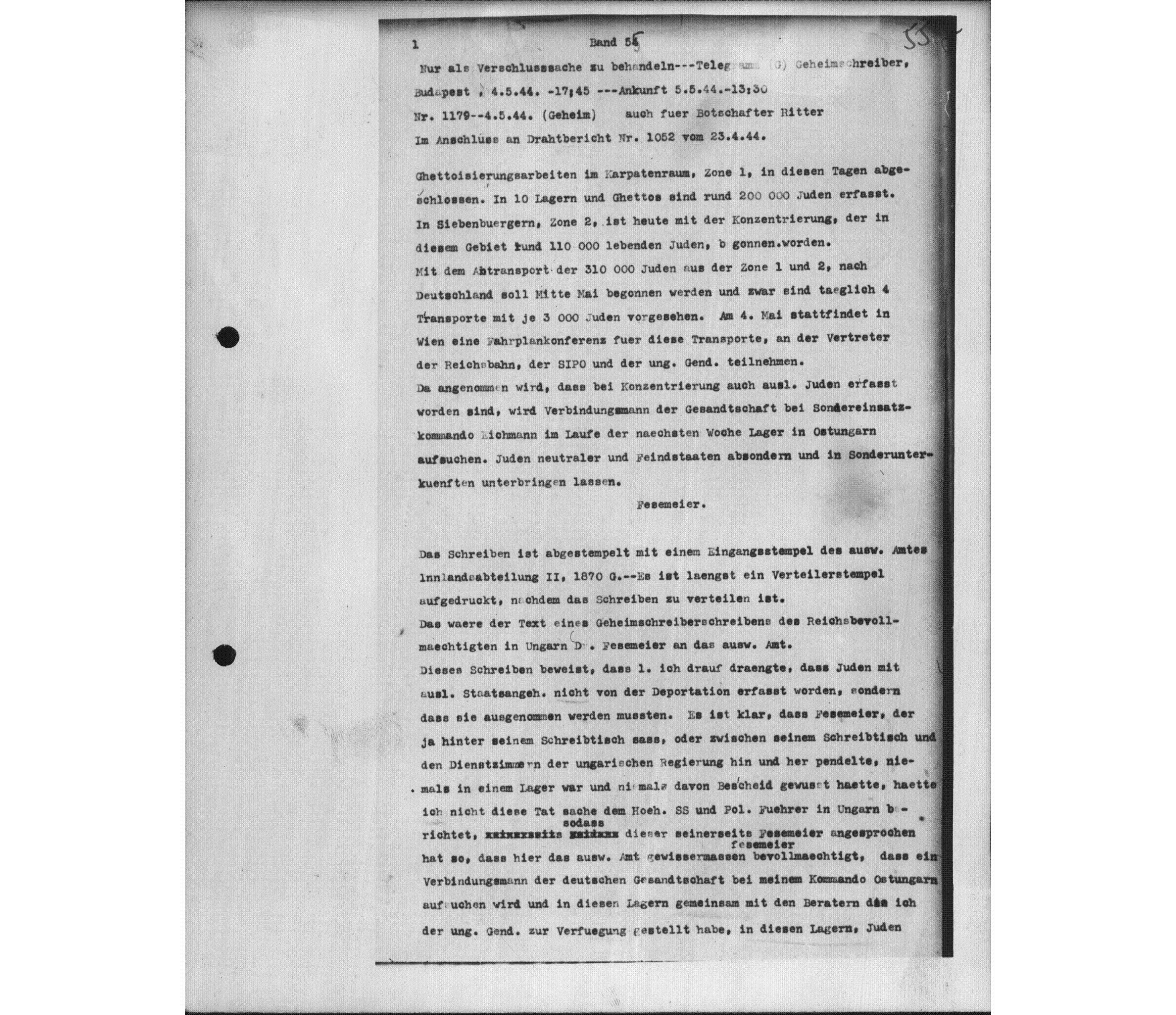
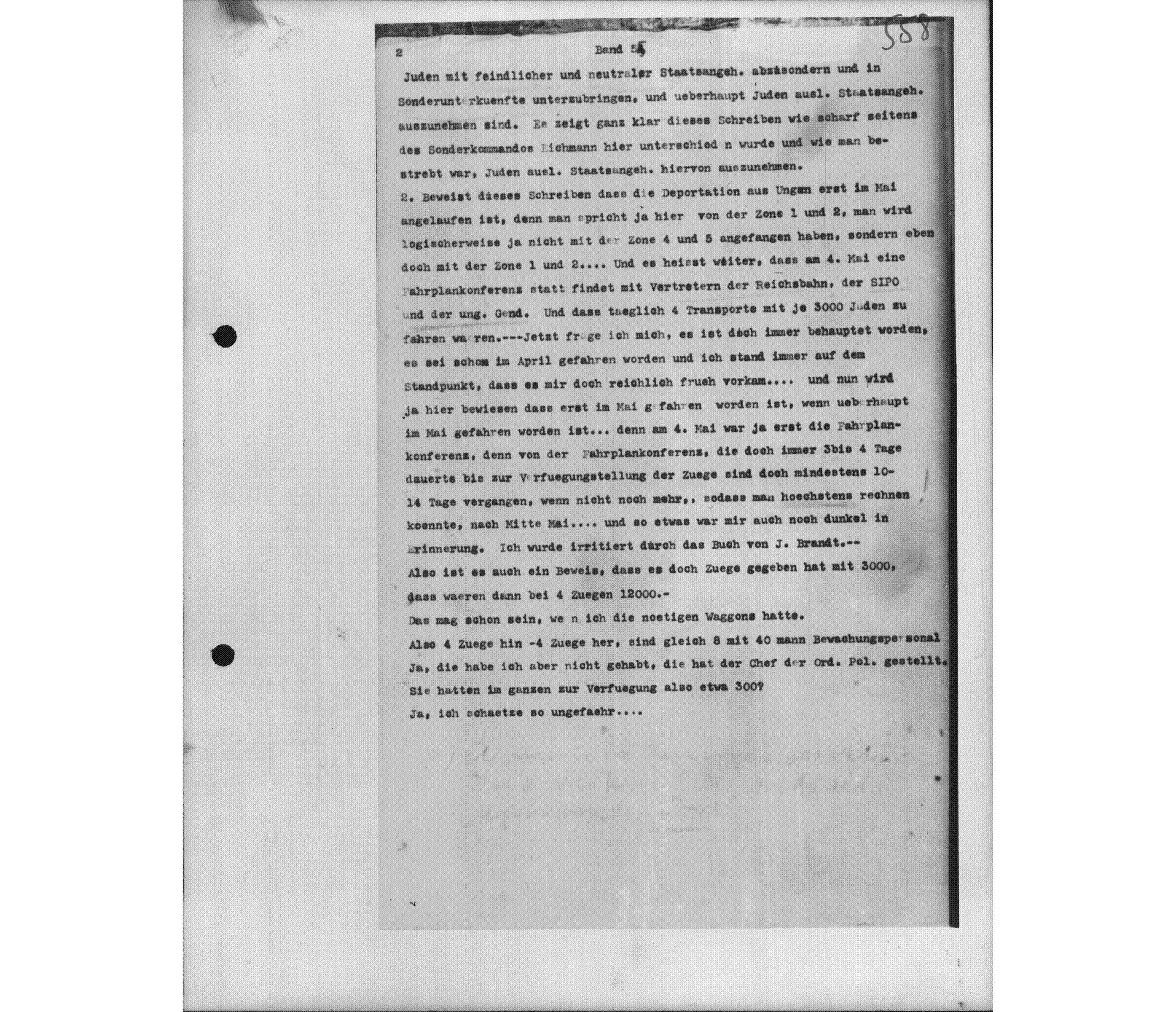
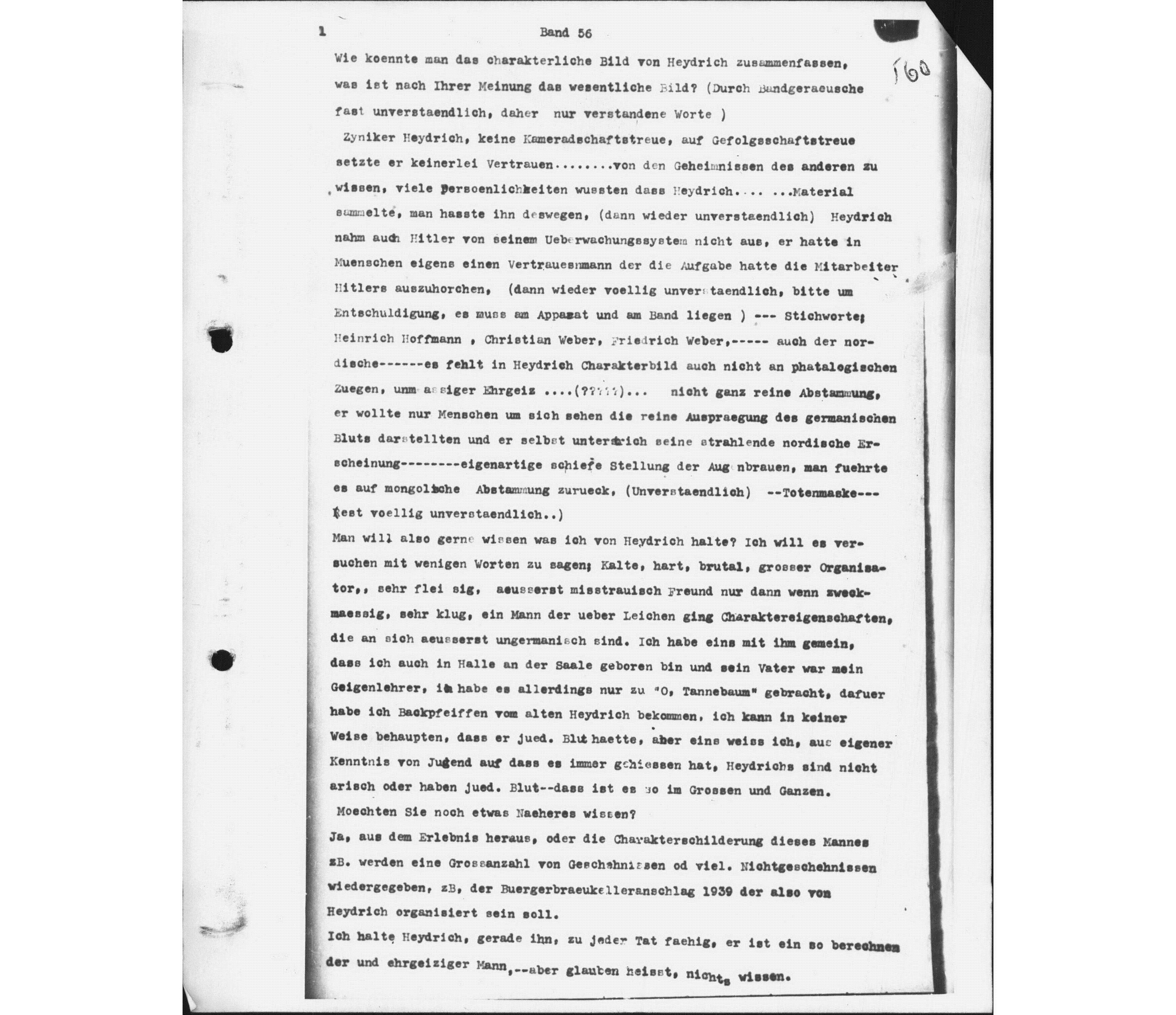
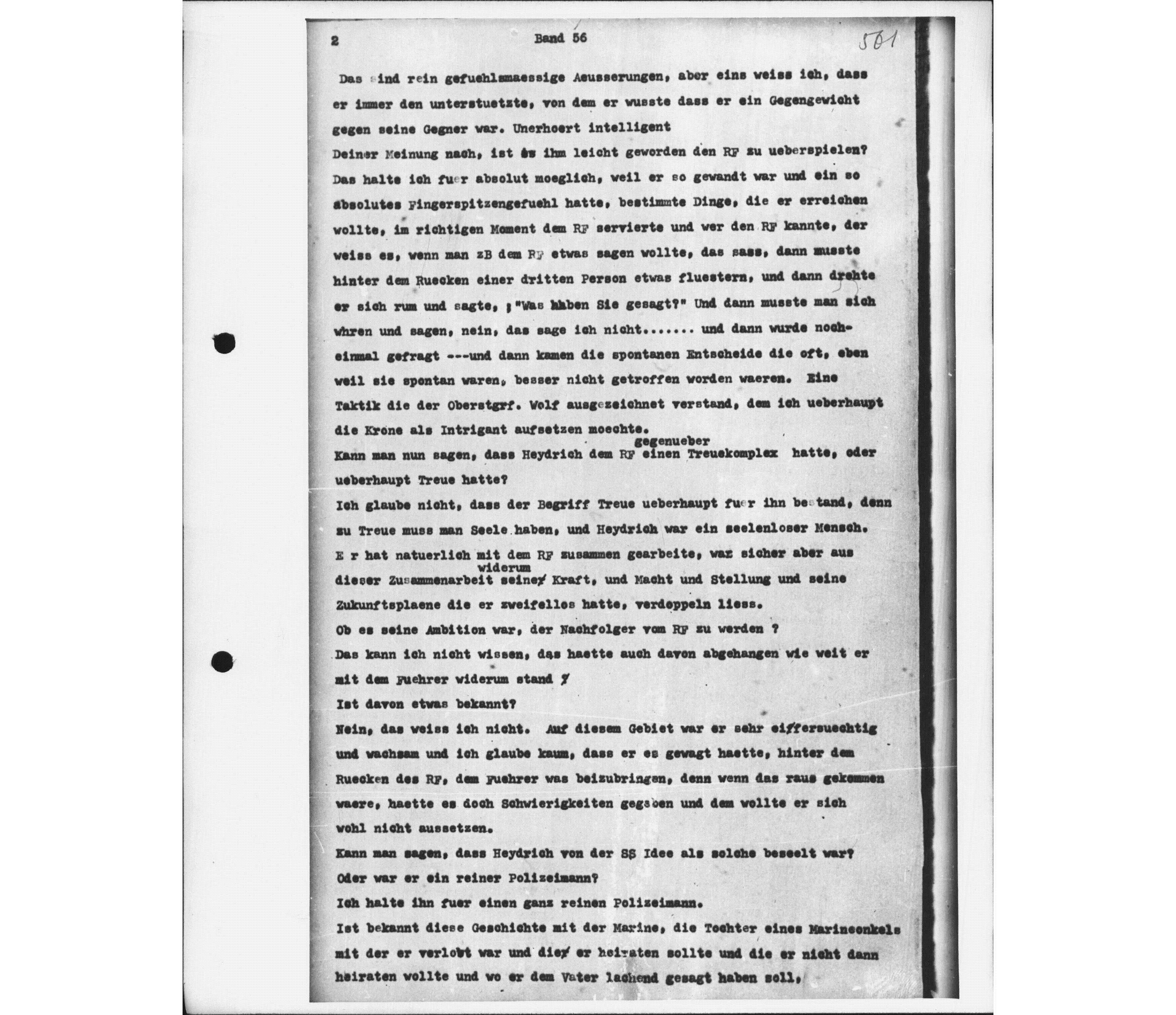
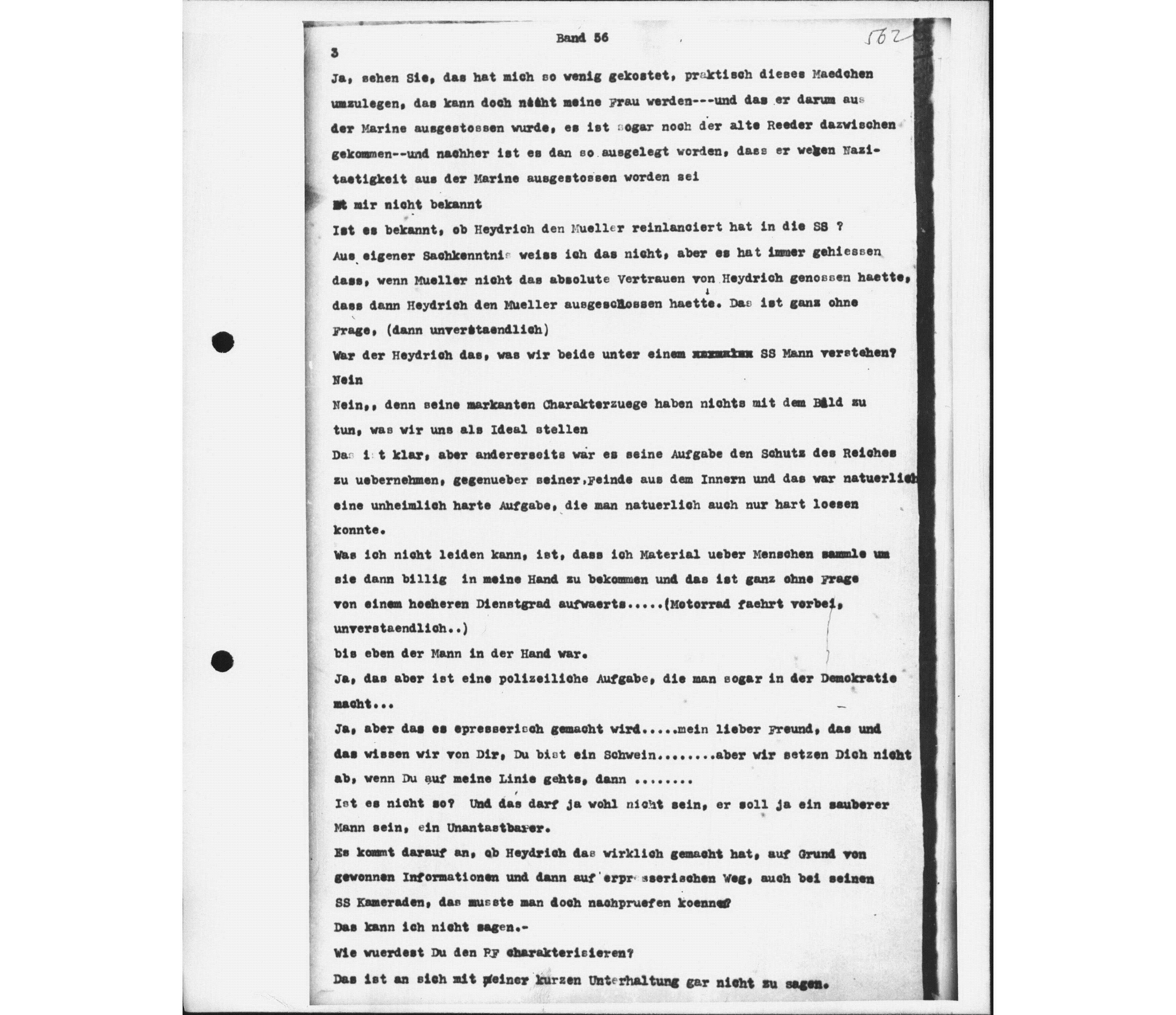
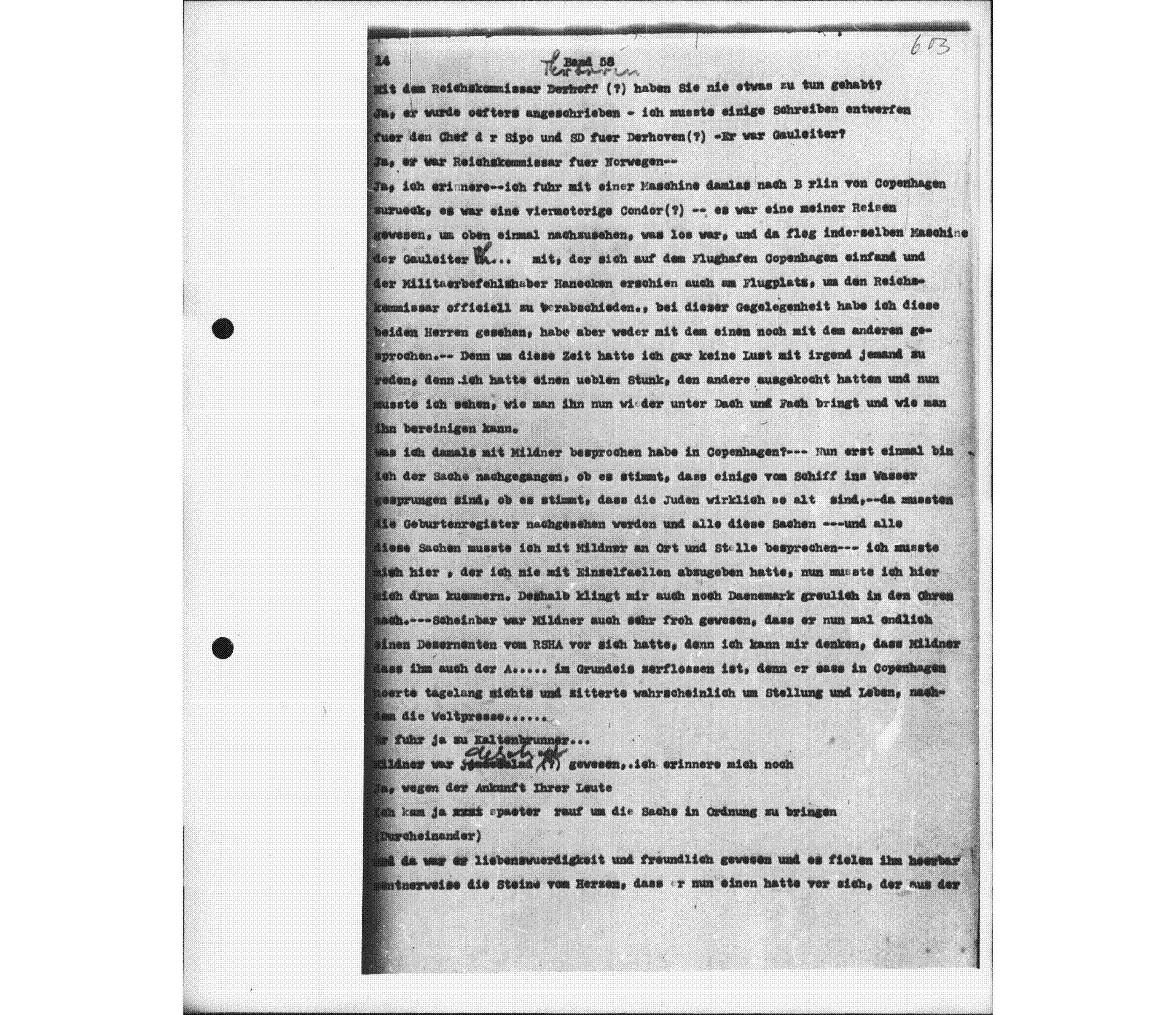
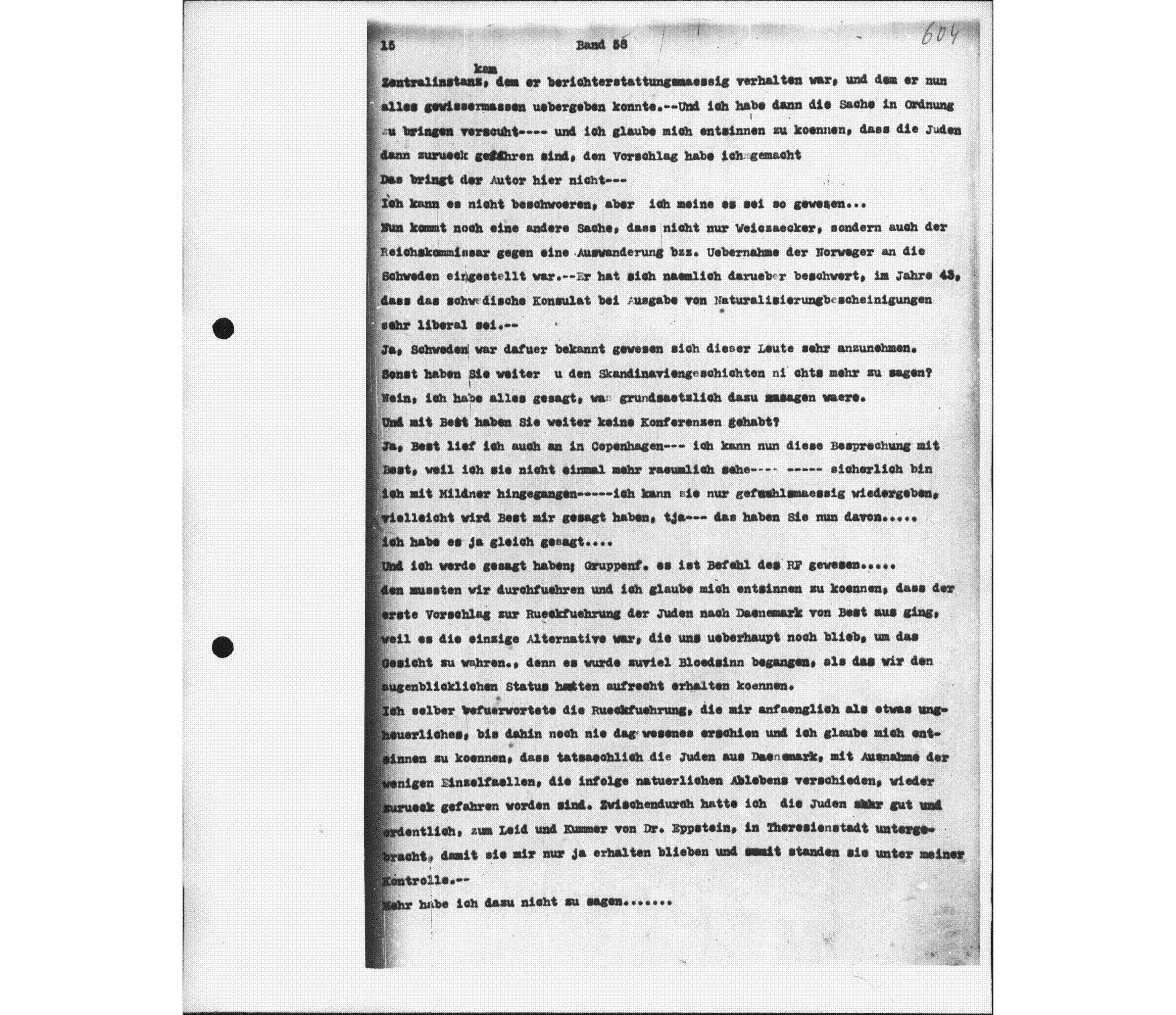
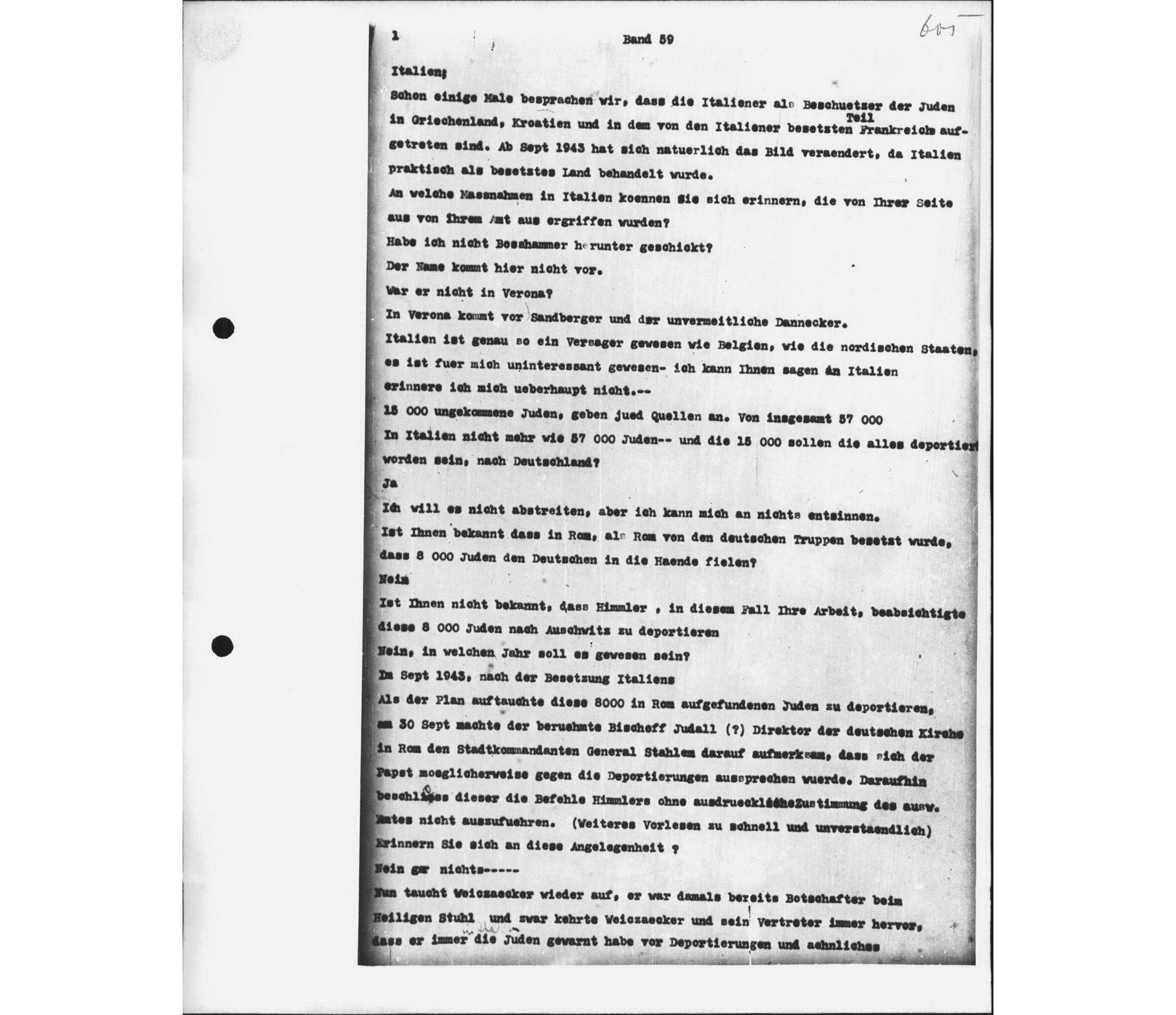
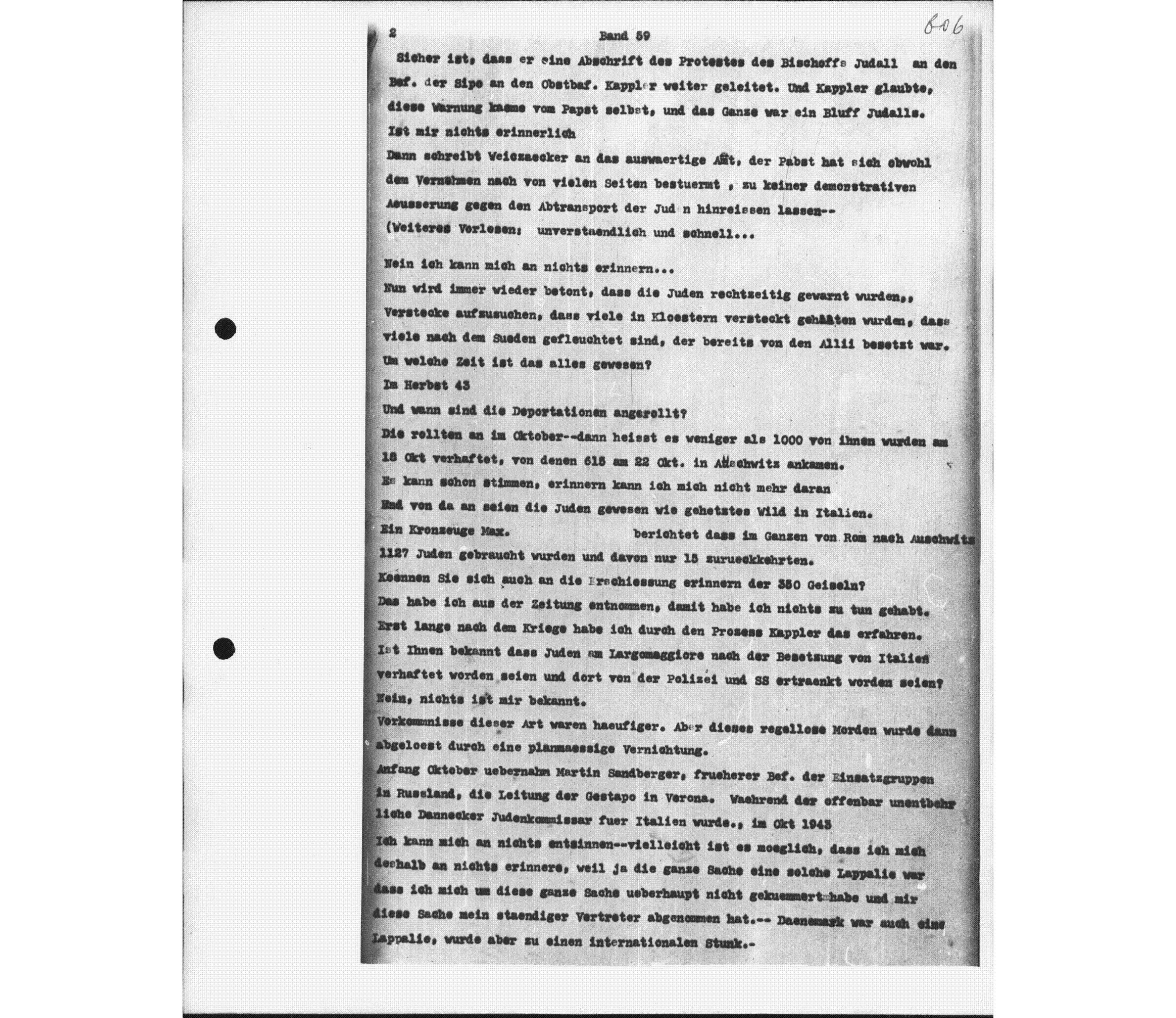
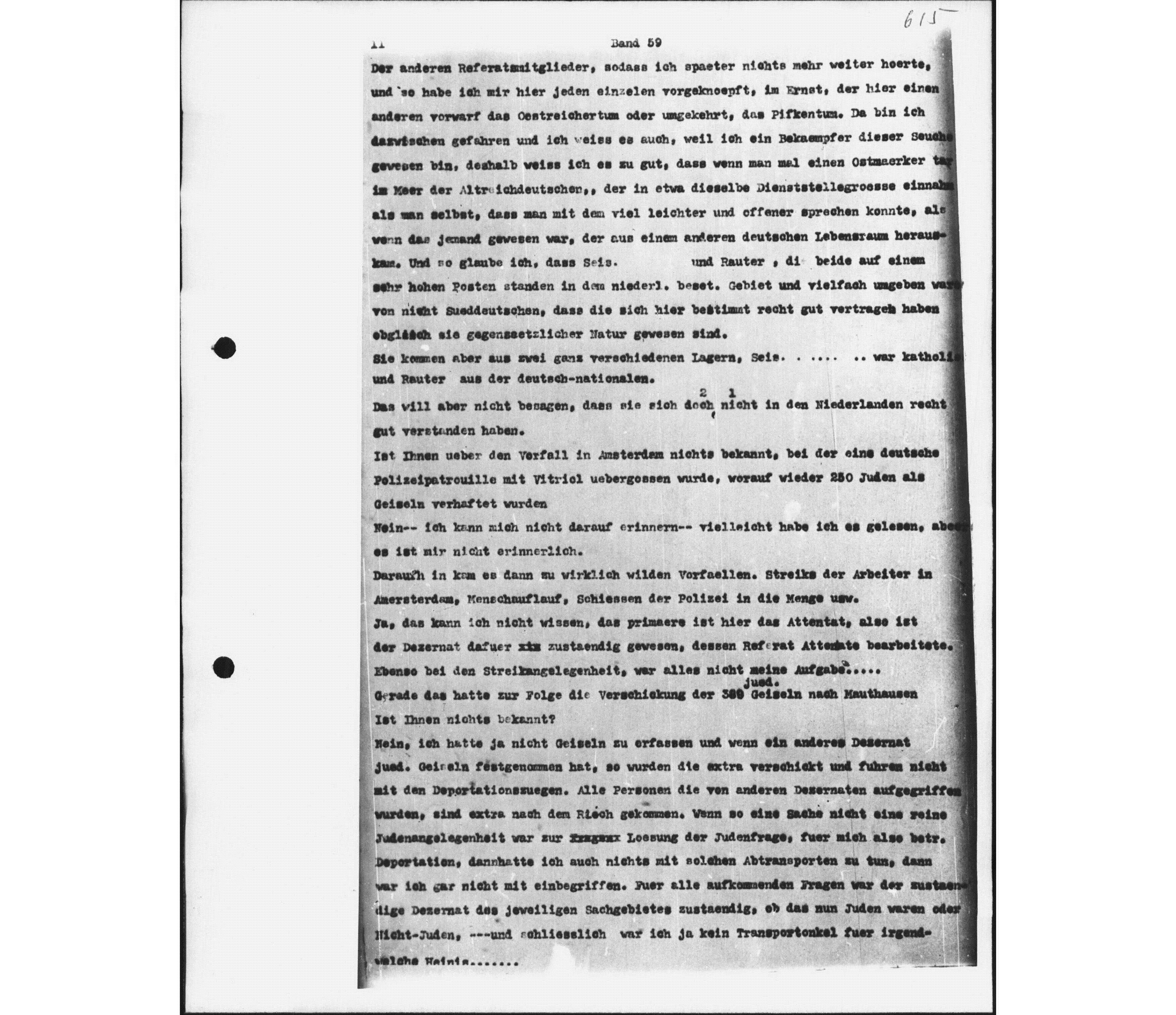
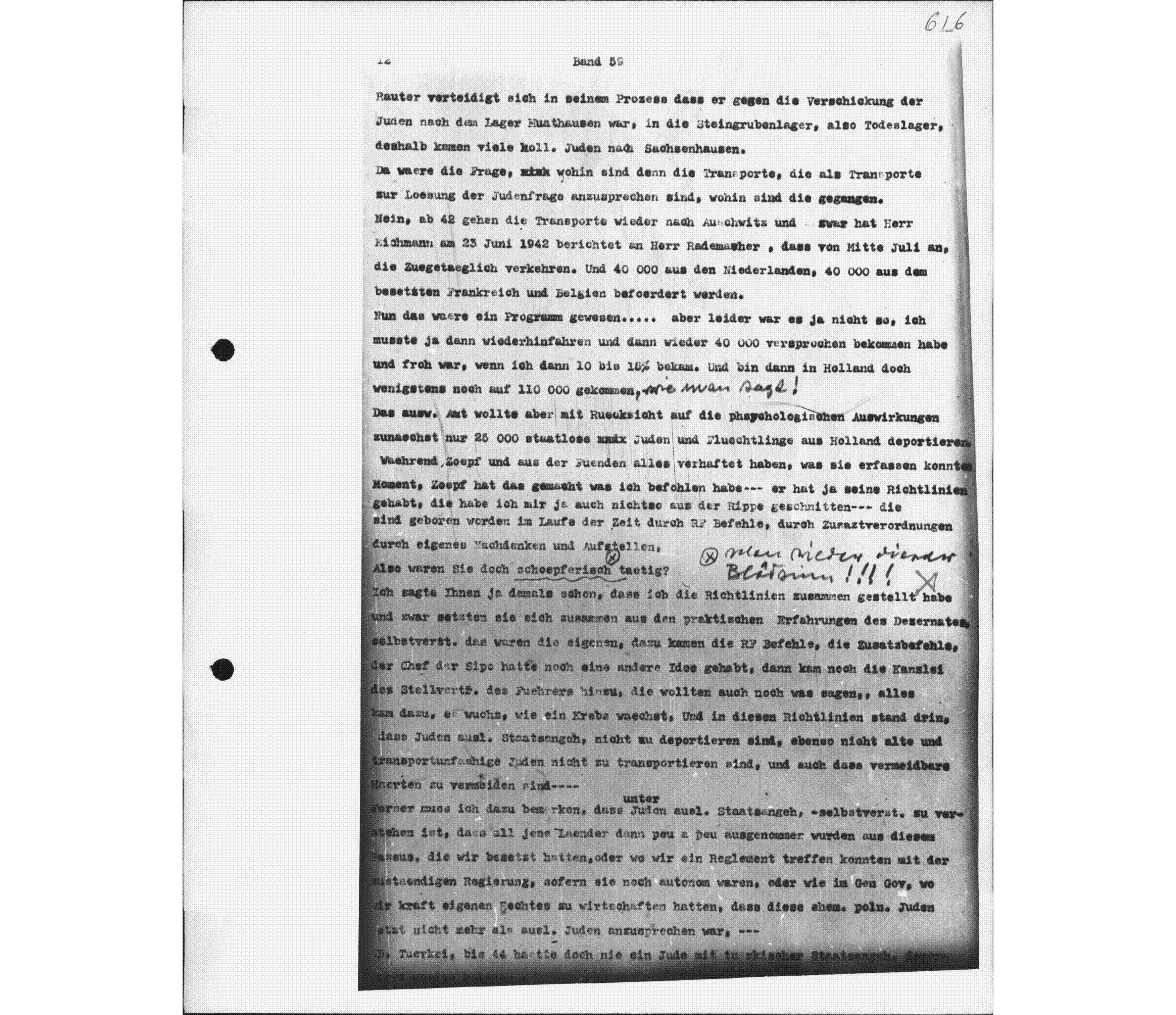
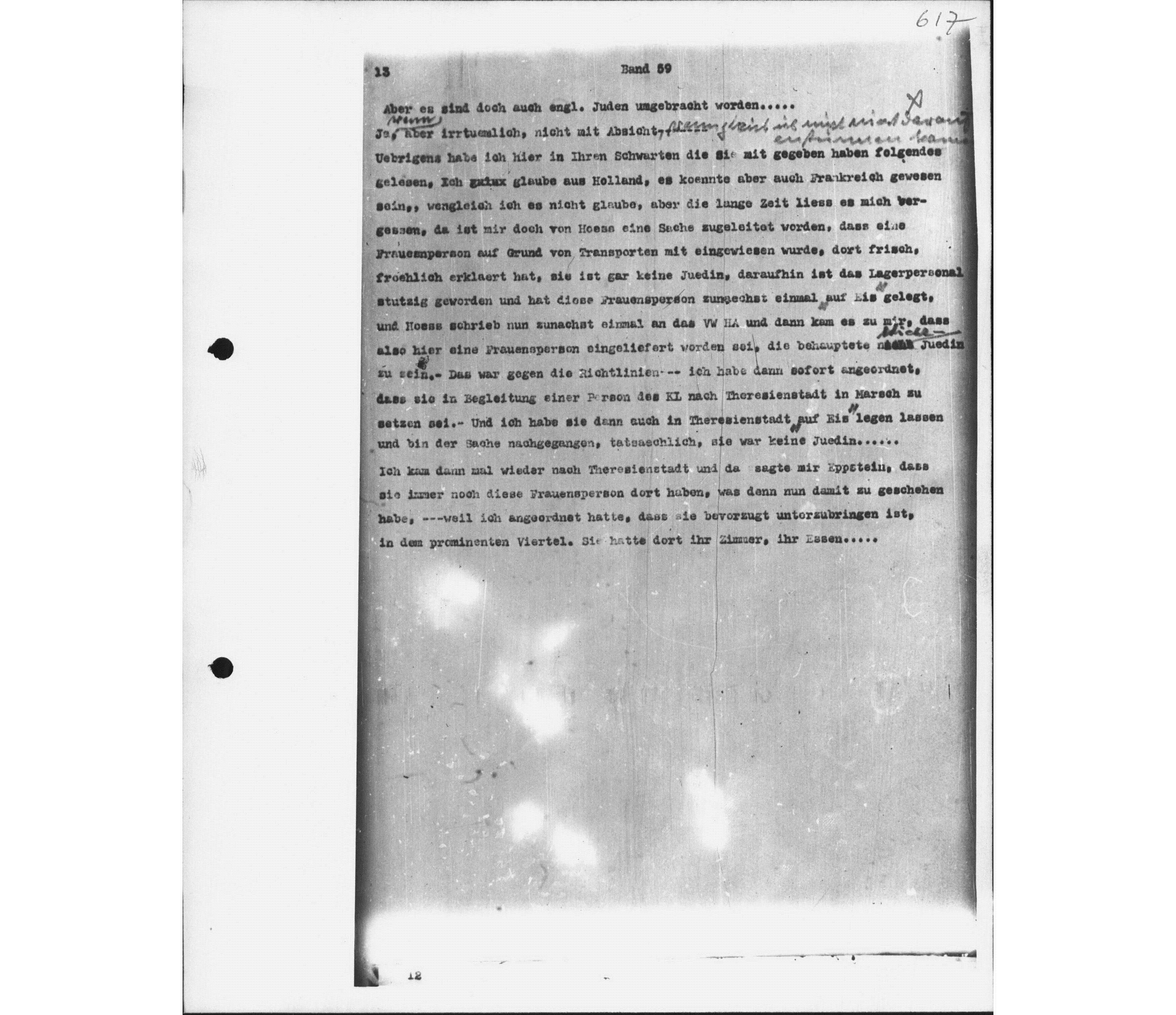
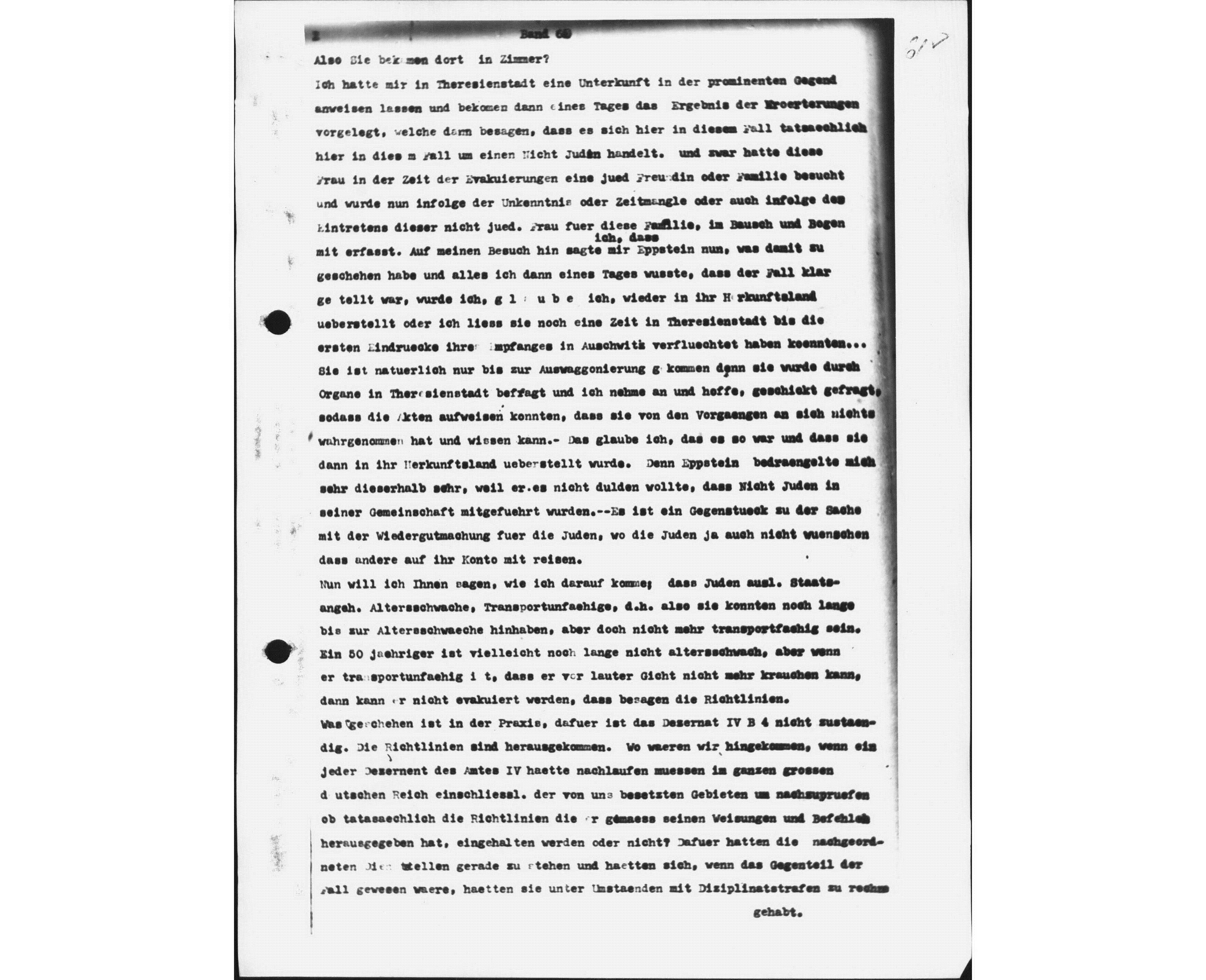
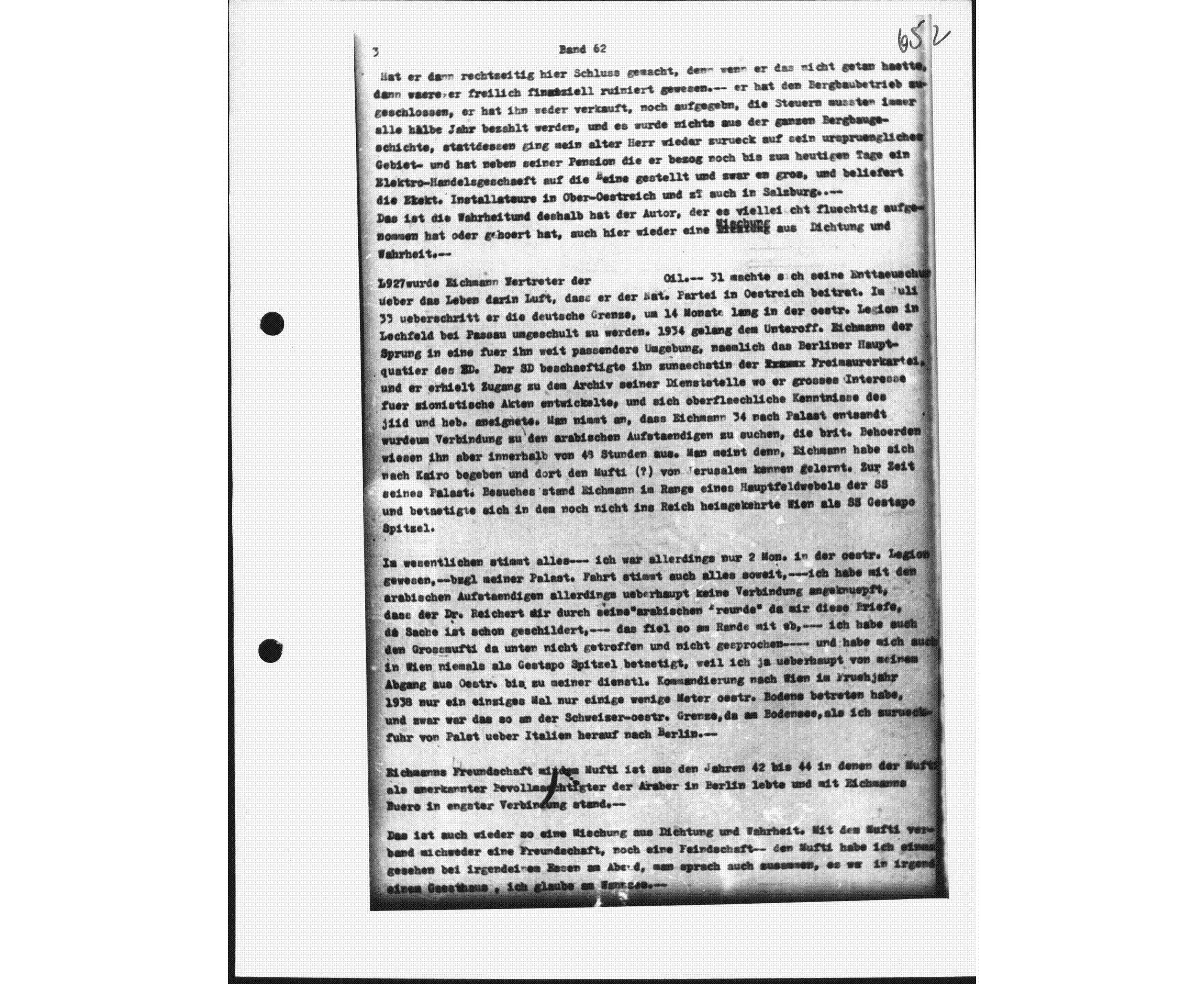
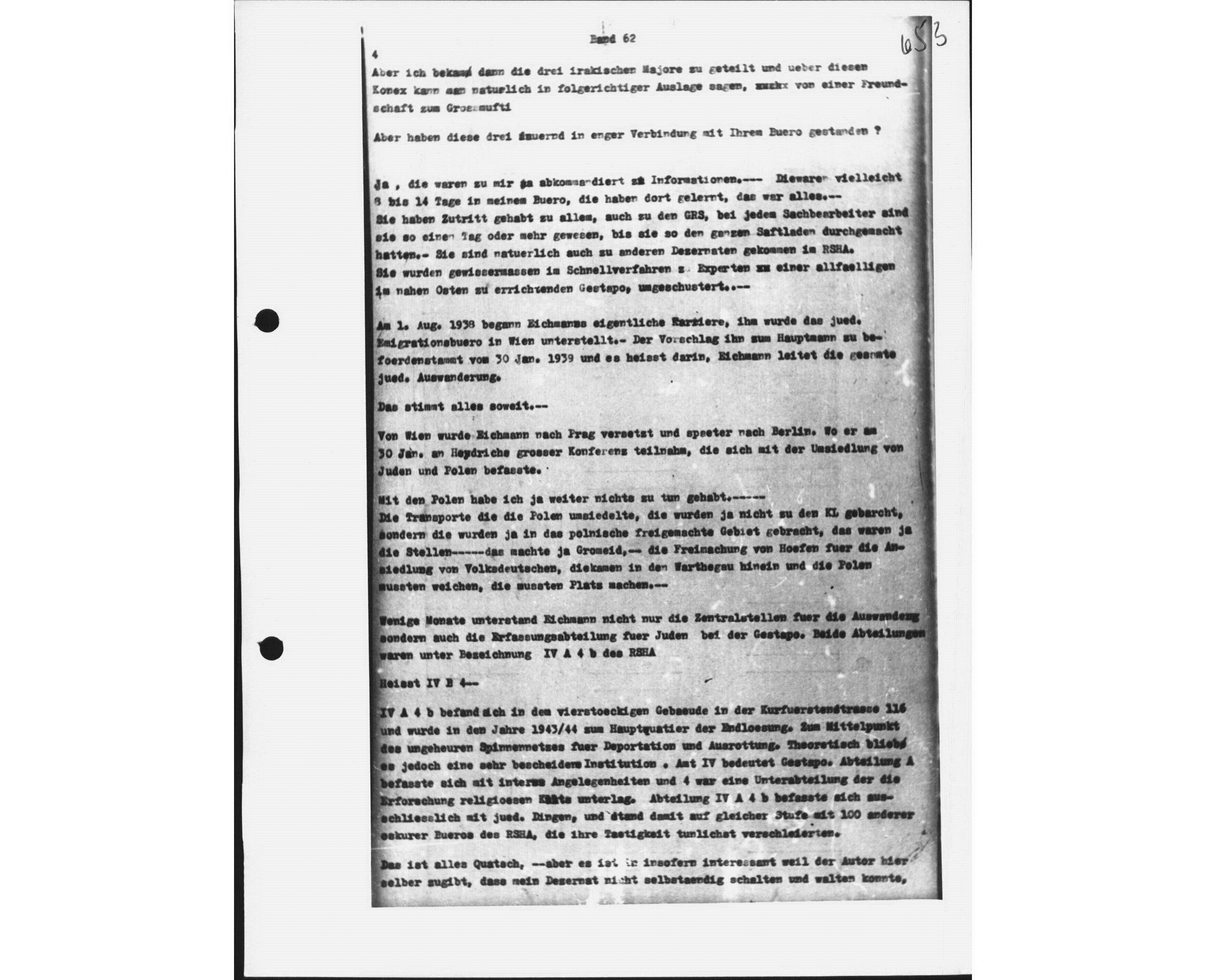
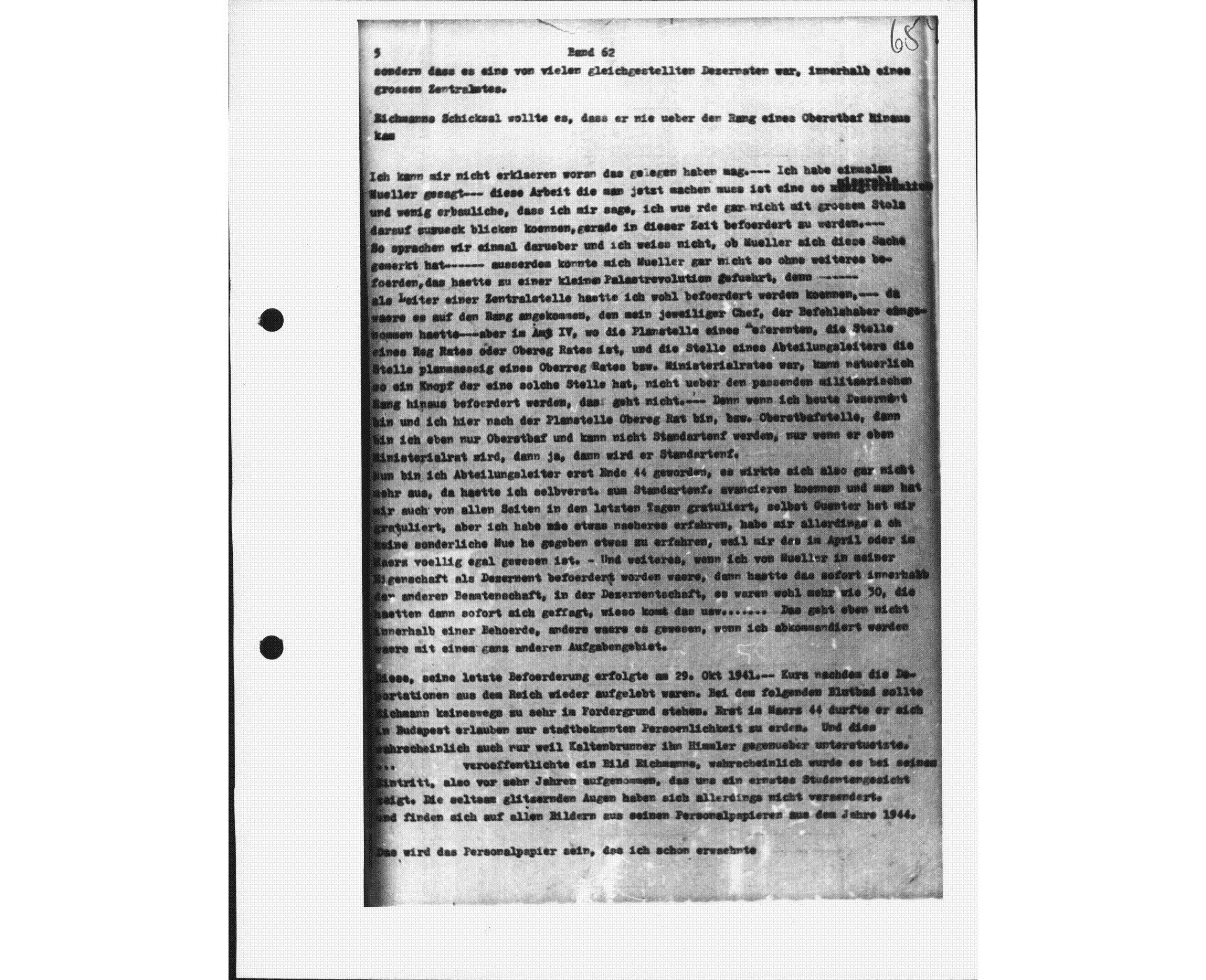
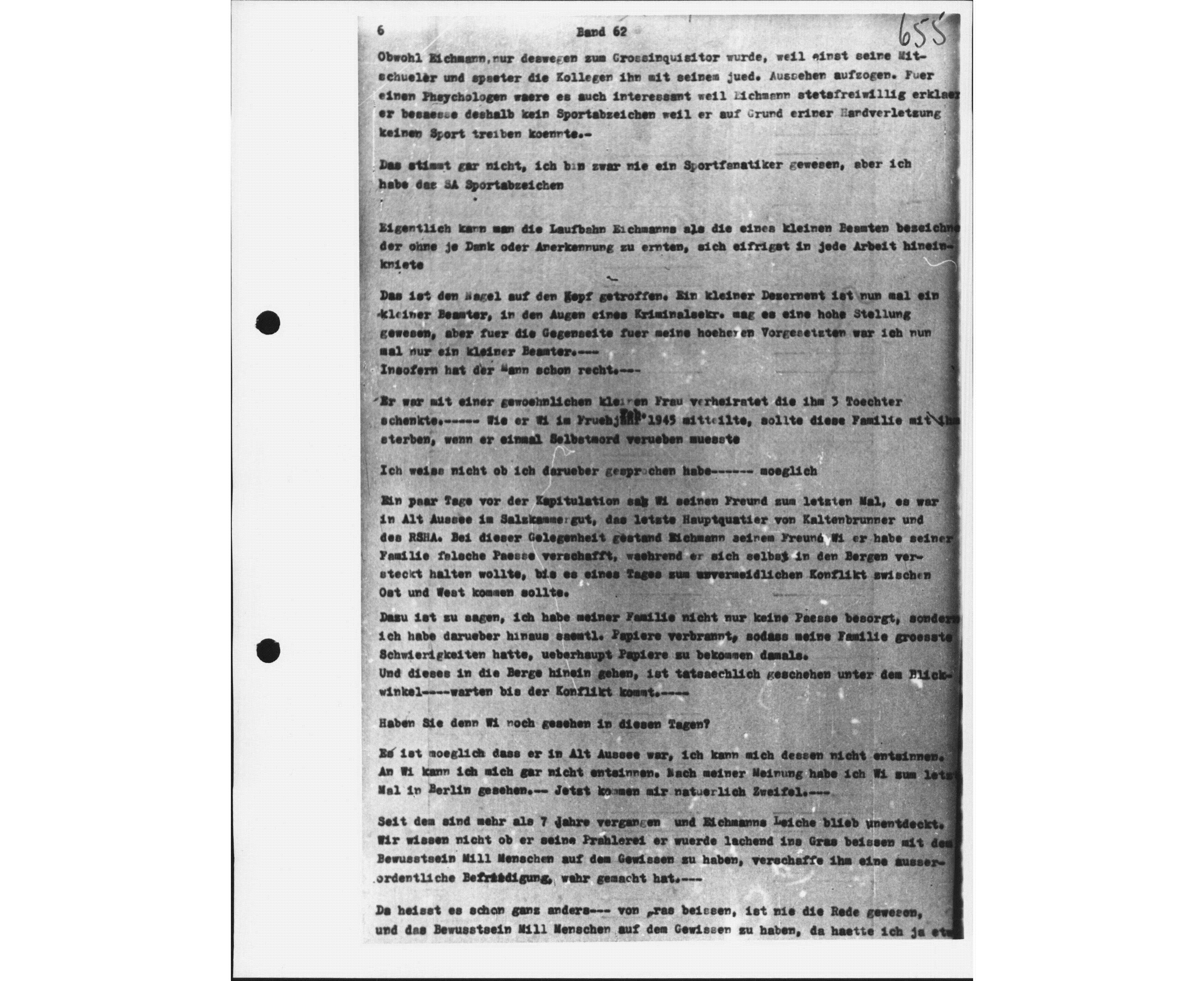
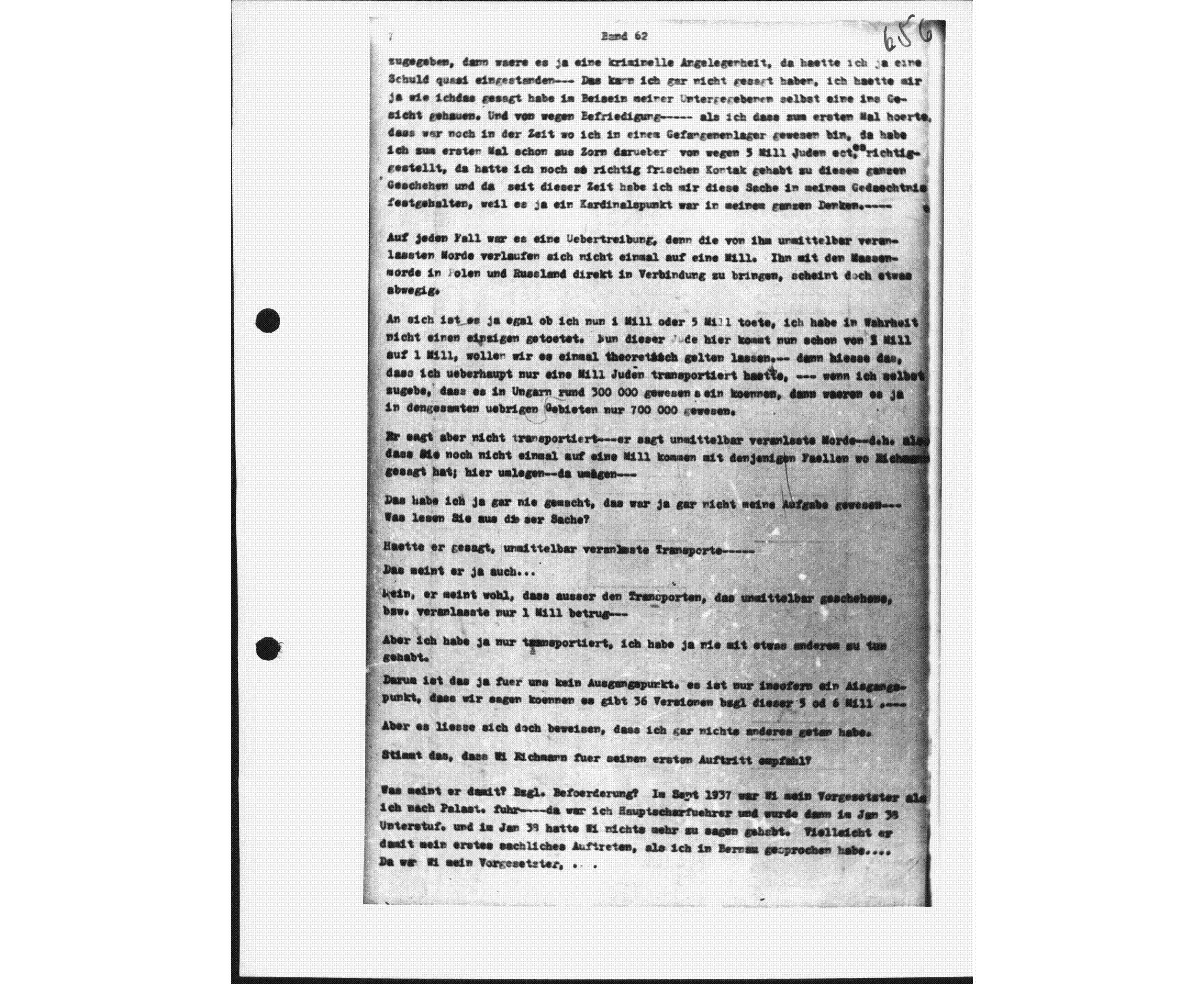
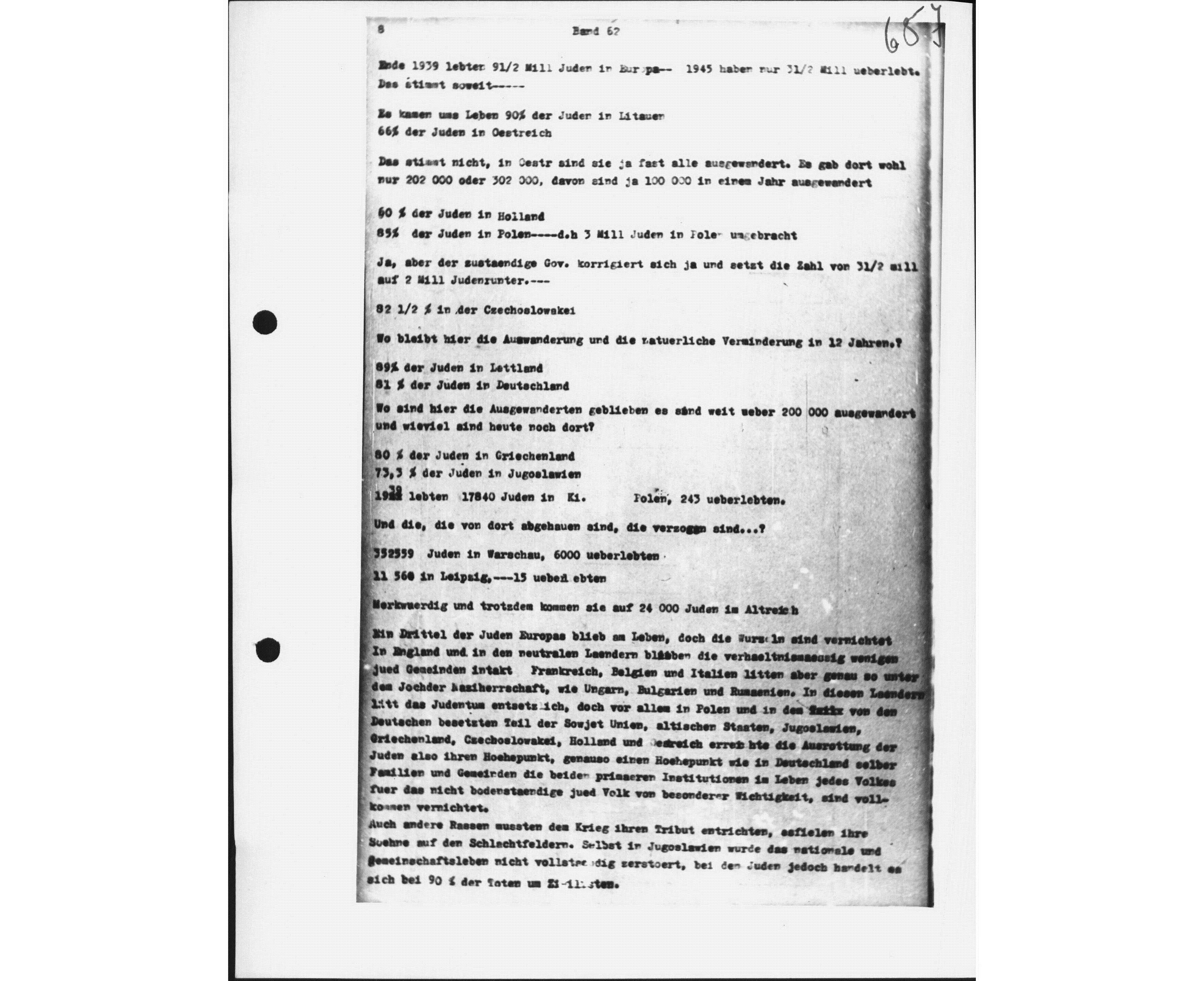
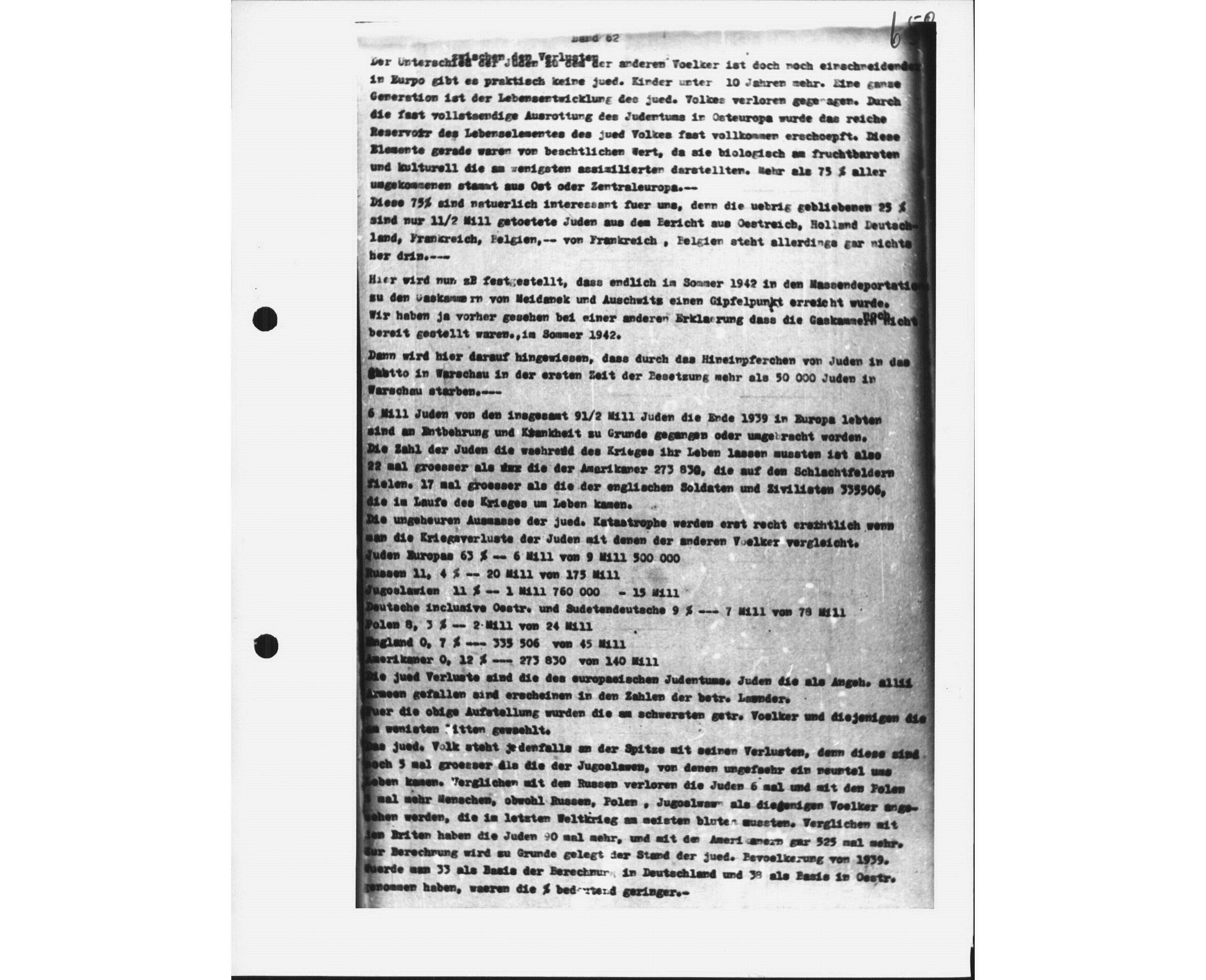
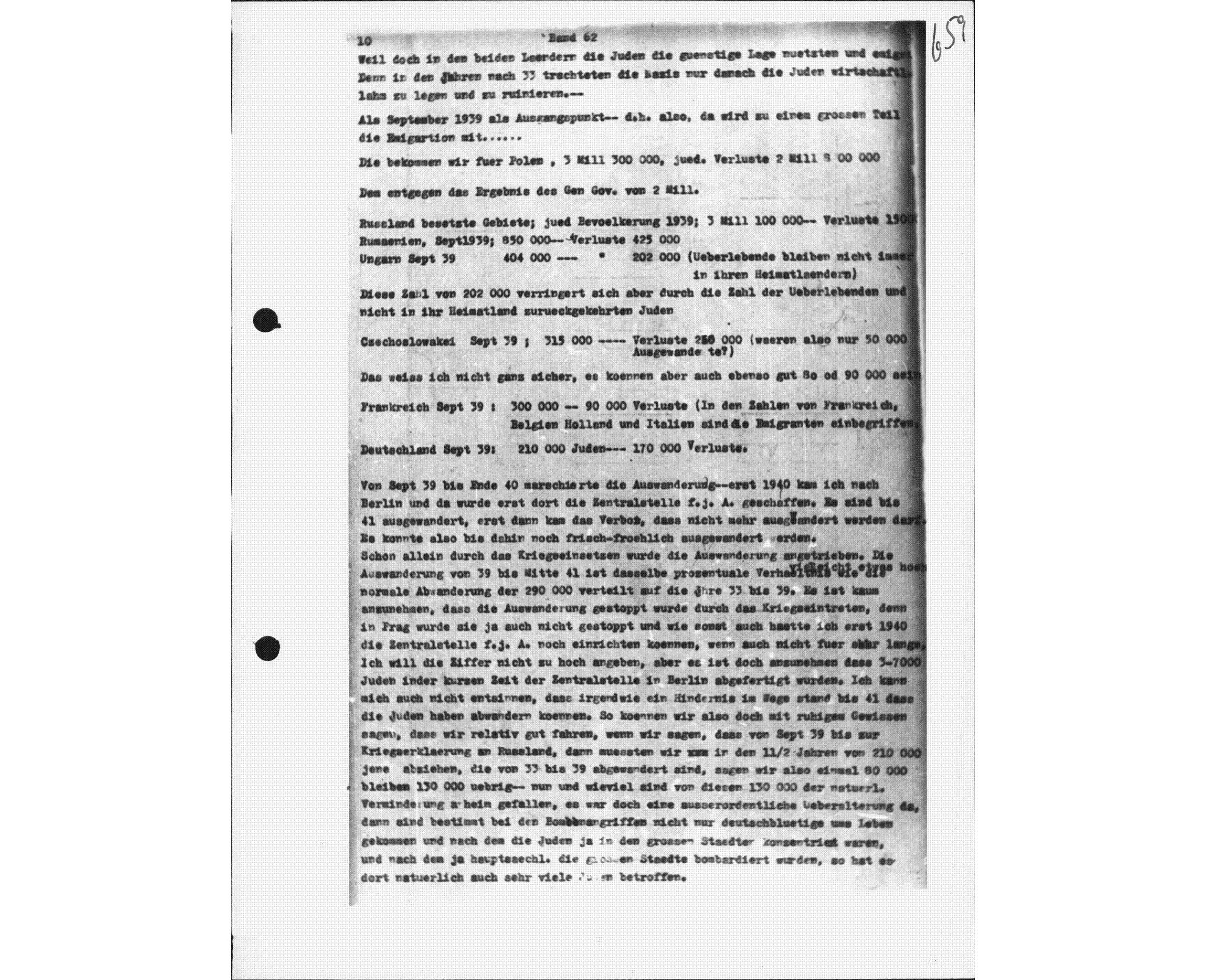
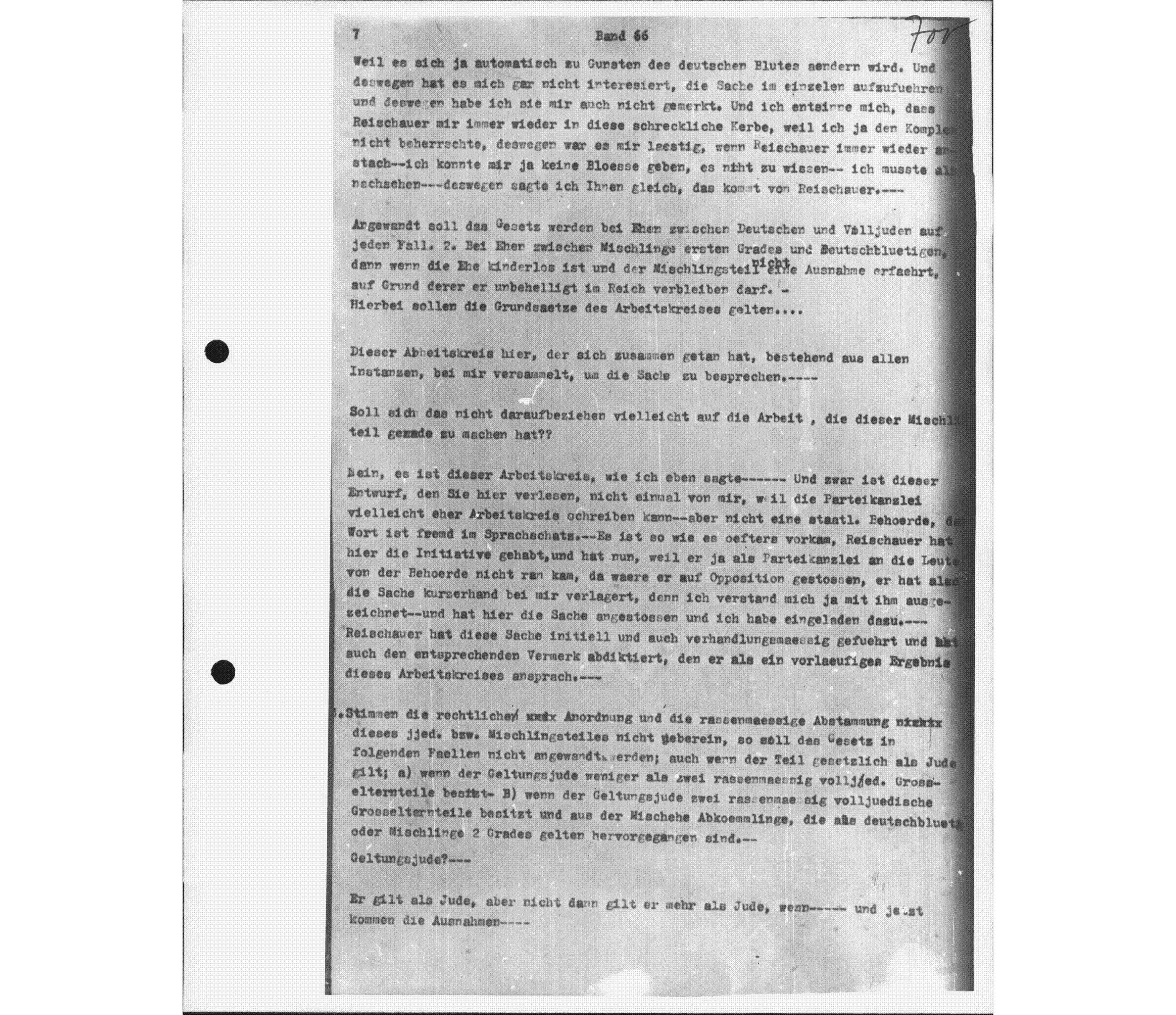
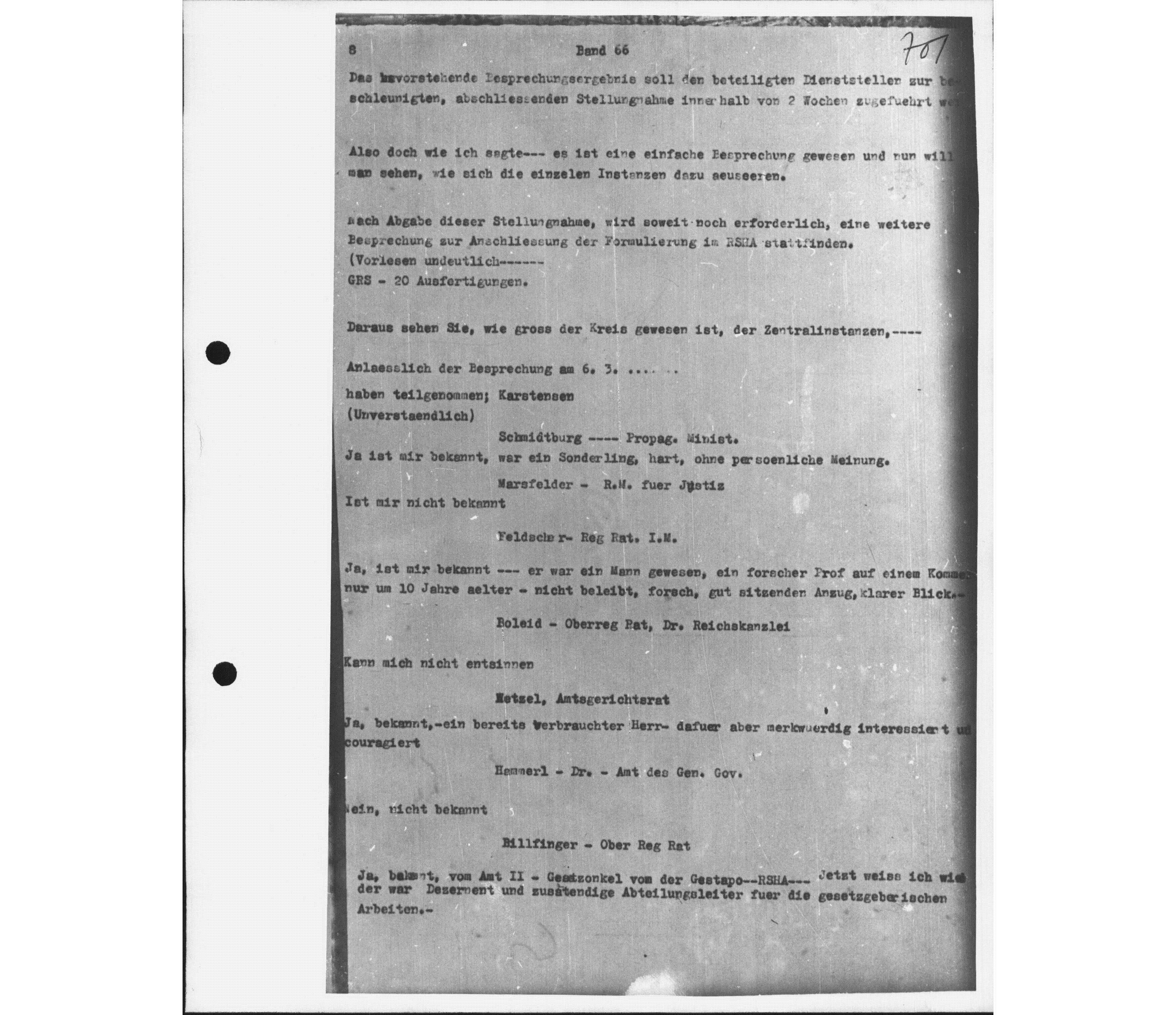
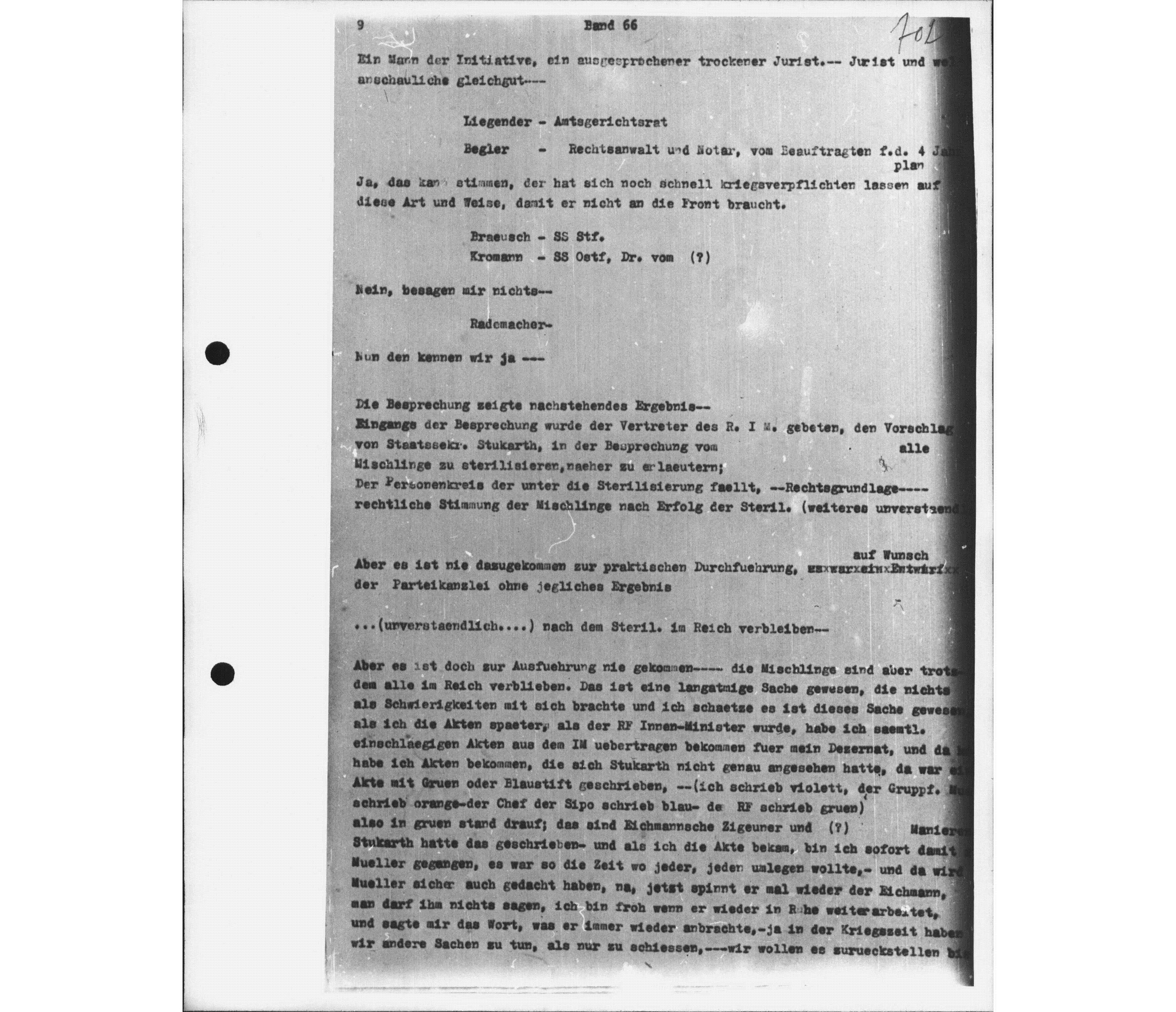
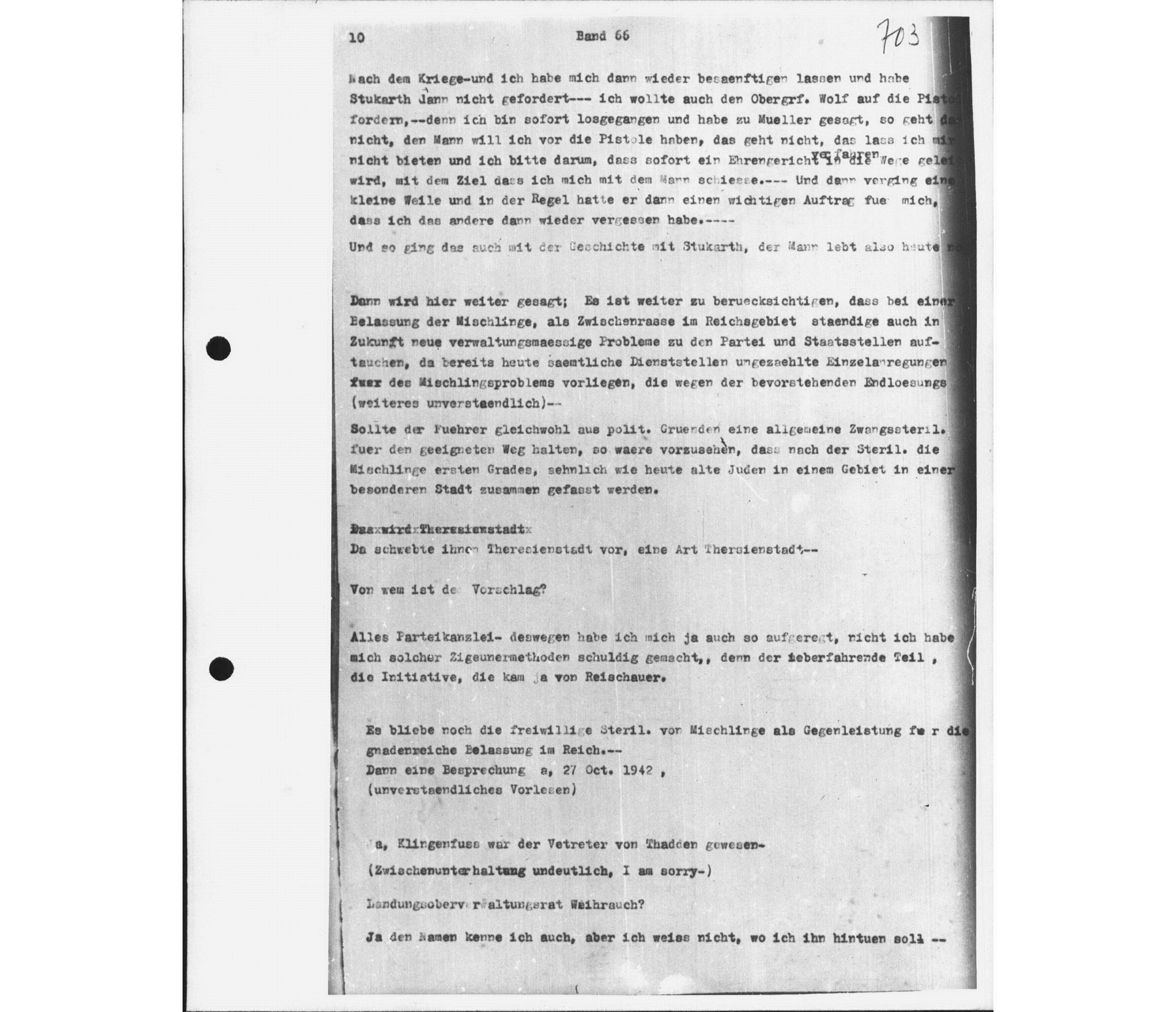
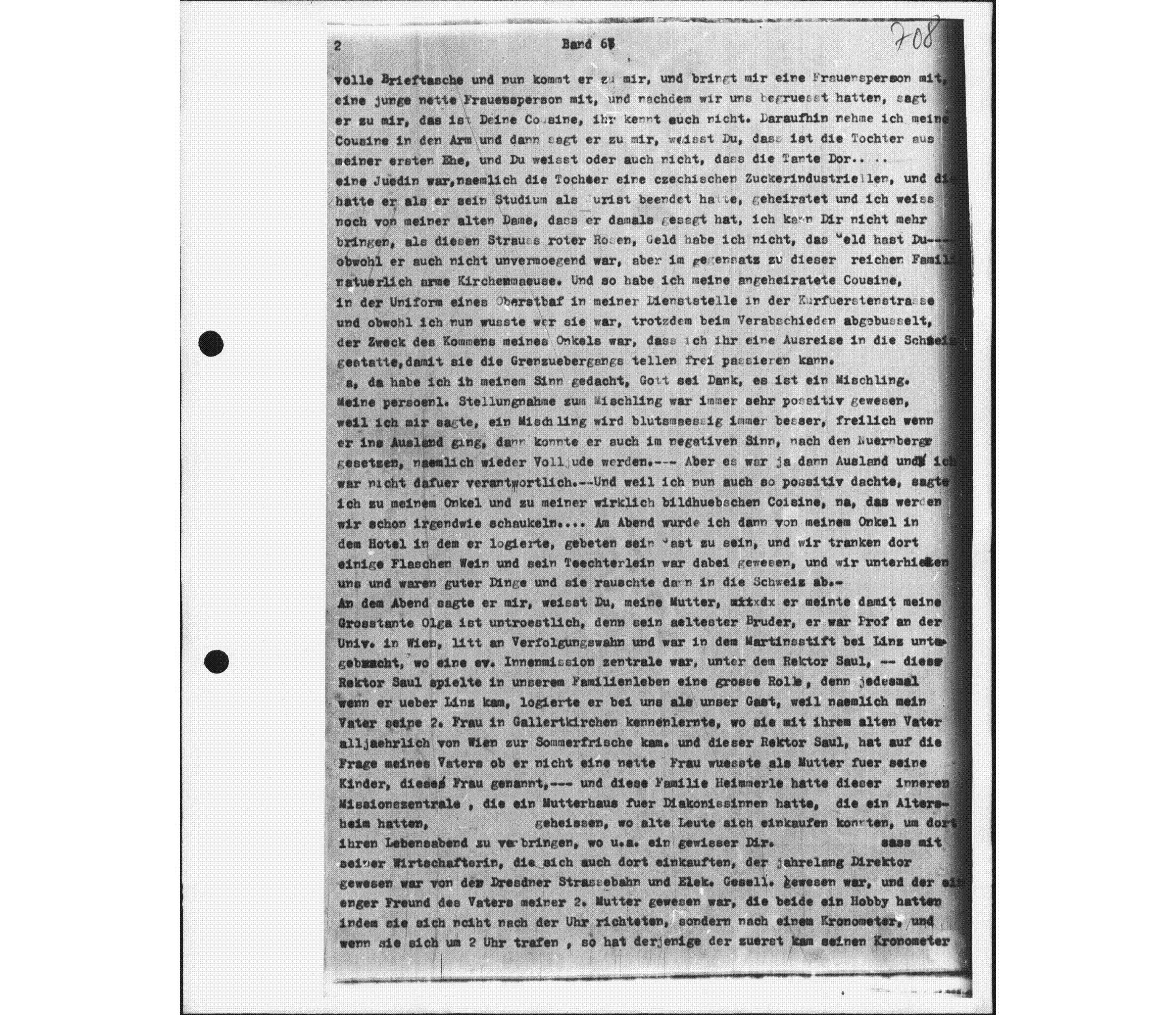
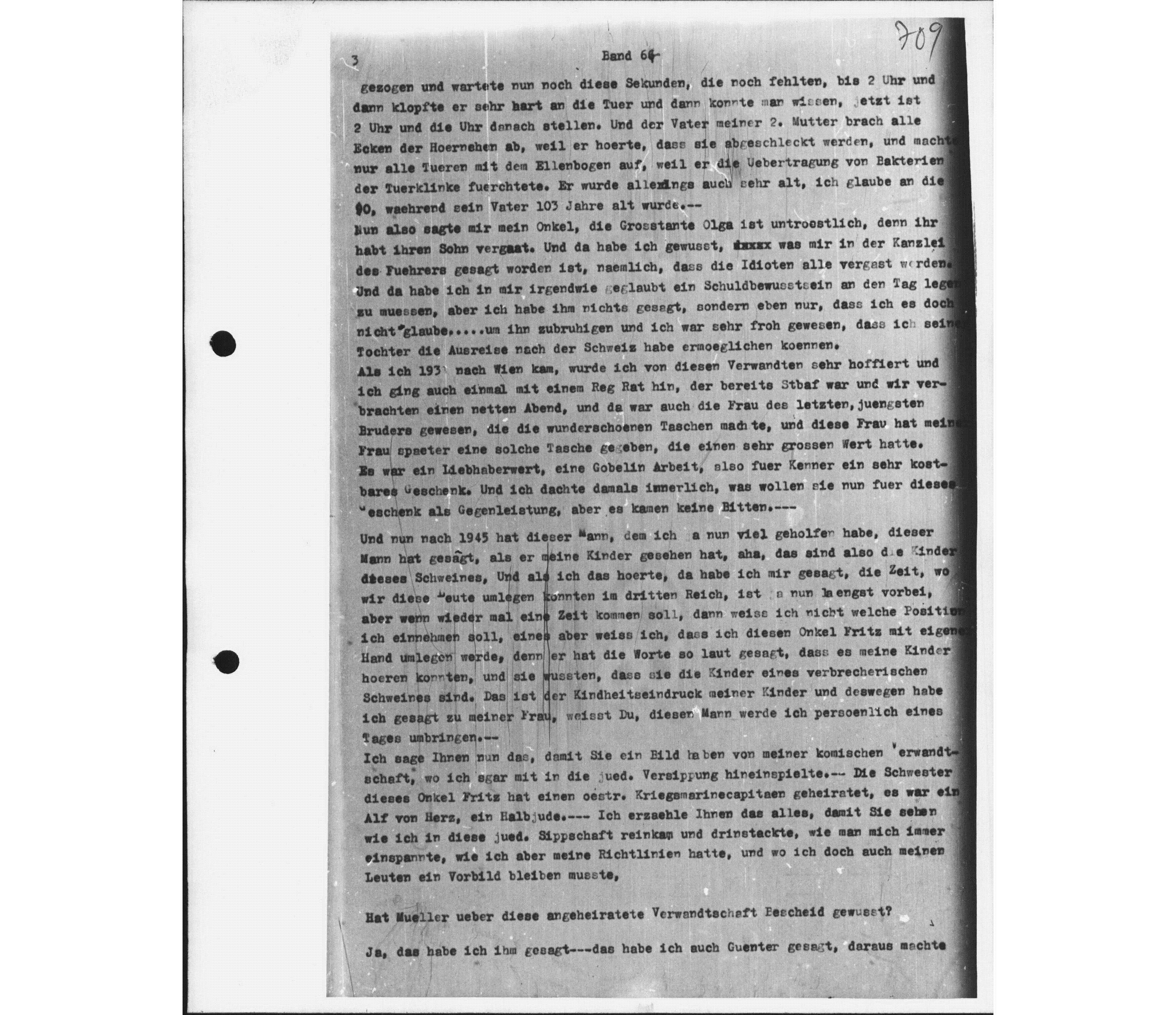
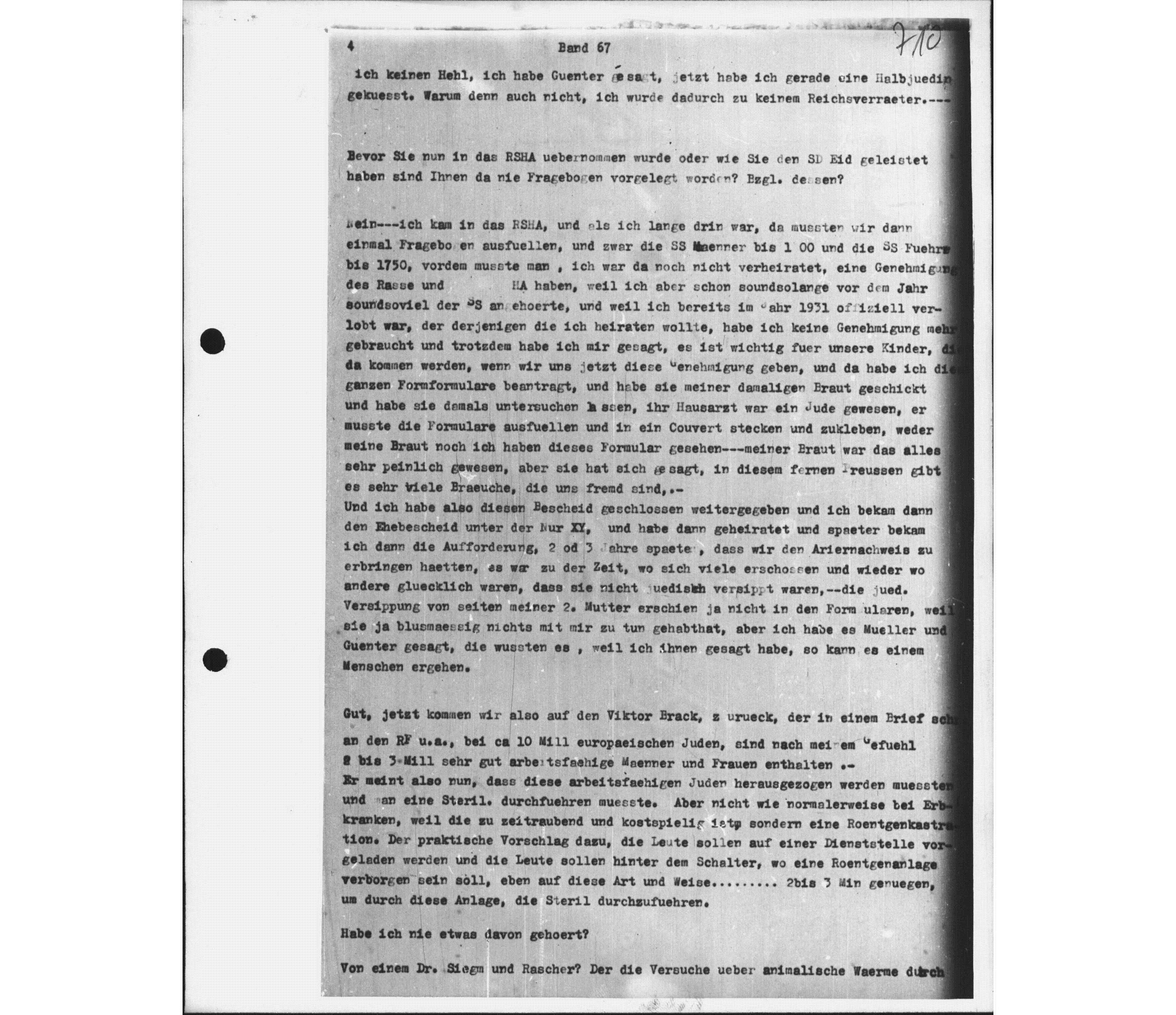
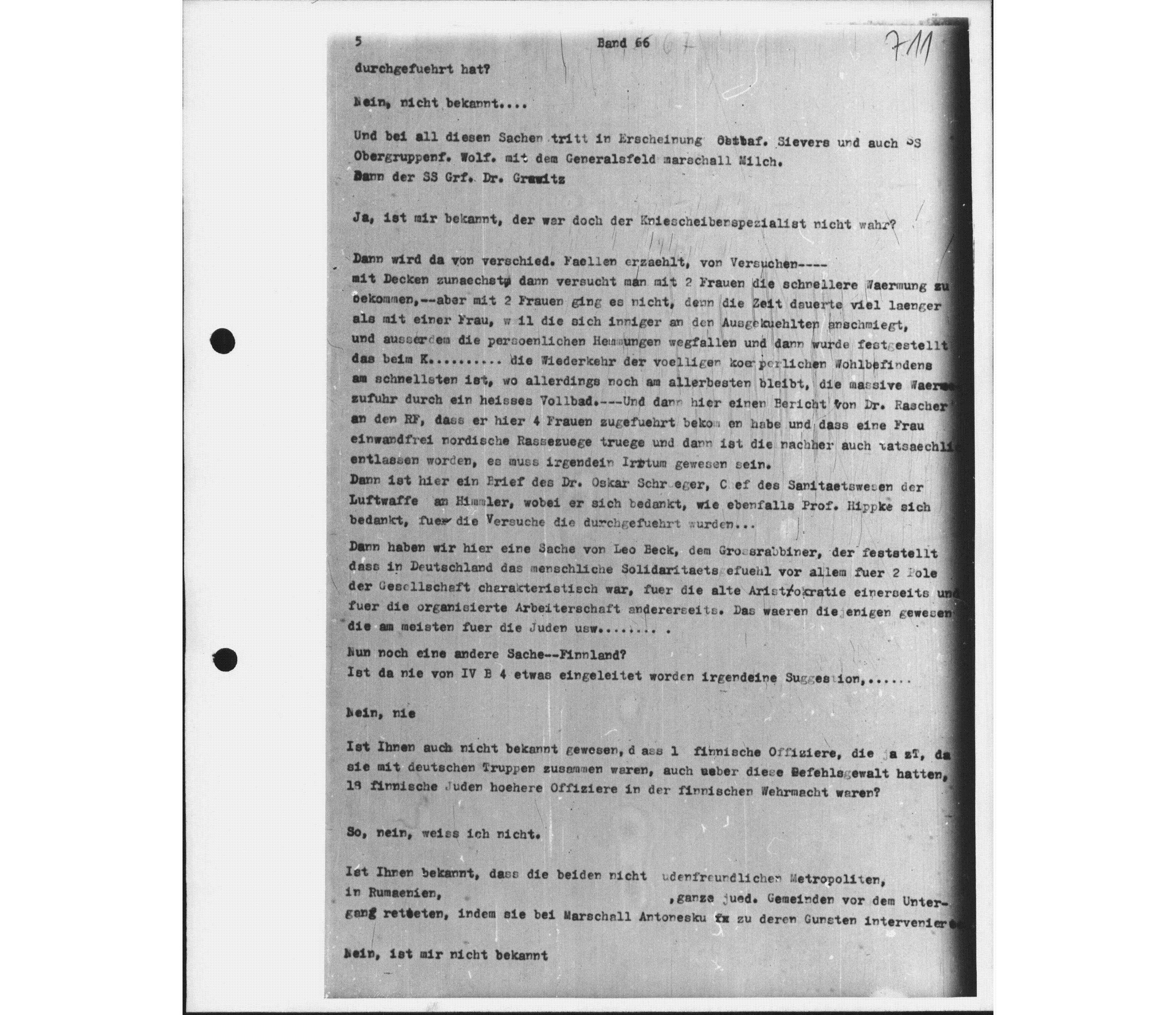
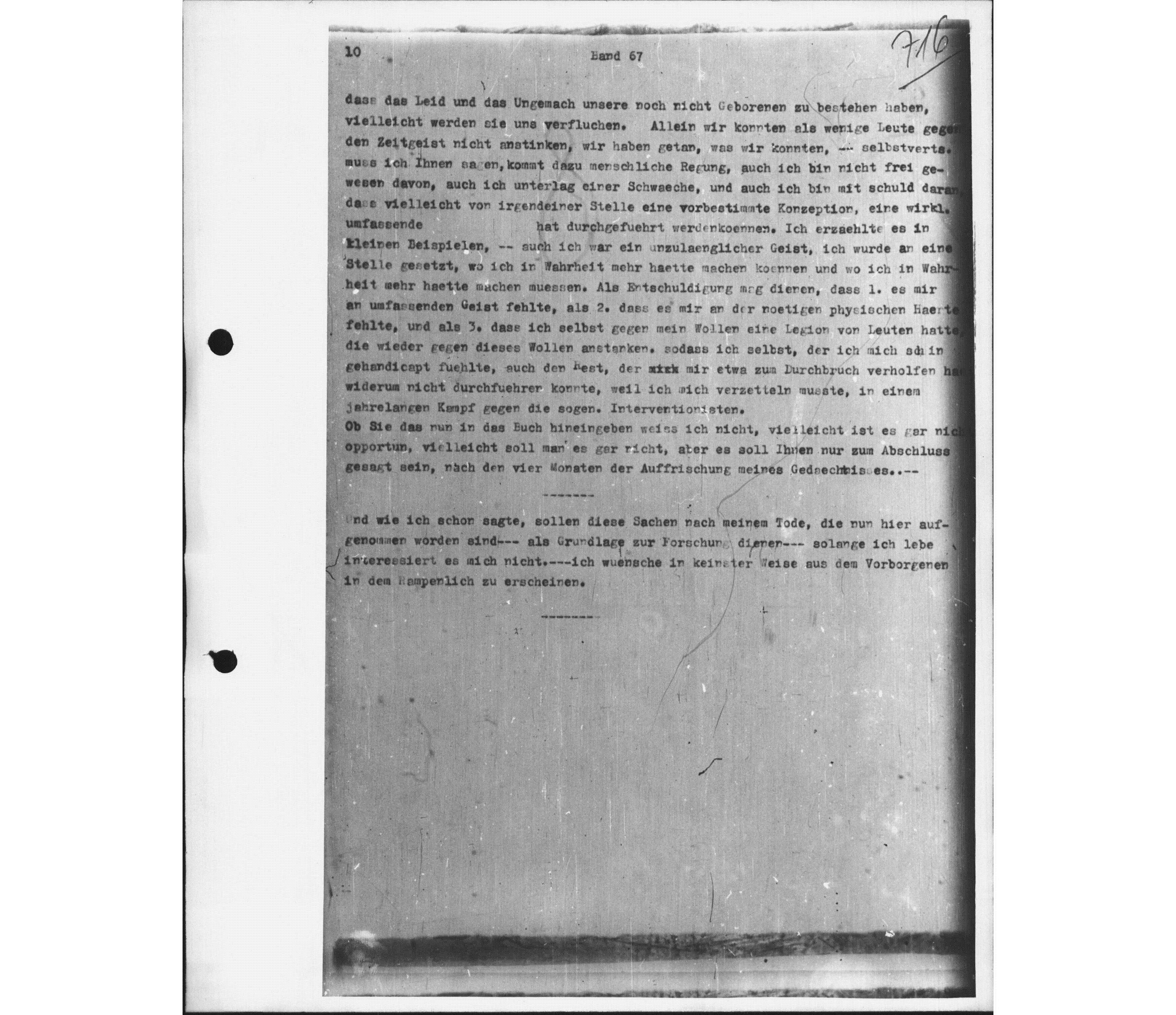
The German text under each scan is a model transcription of the typed page in that scan, and the English is a model translation of that German. Both are shown word for word, including every uncertainty marker. No page in this part has had a full human review. Verify any reading against the scan before quoting it.
Sheet 1
O.65 file 88 · 00001
This is scan 00001 of the Sassen transcript, O.65 file 88. The image is 3504 by 3544 pixels. Yad Vashem Archives, Jacob Robinson Collection O.65, file 88.
German transcription
[HW: 10623185]
[Hebrew: ארכיון יד ושם]
YAD VASHEM ARCHIVES
RECORD GROUP: O.65 [Hebrew: חטיבה :]
RECORD GROUP: [Hebrew: אוסף] [Hebrew: שם חטיבה :]
[Hebrew: יעקב רובינסון]
FILE NUMBER: [HW: 88] [Hebrew: מספר תיק :]
ORIGINAL FILE [Hebrew: סימול מקורי :]
NUMBER:
INVENTORY [Hebrew: מספר נכנסות :]
NUMBER:
NUMBER OF PAGES: [Hebrew: מספר עמודים :]
ITEM NUMBER: [Hebrew: מספר פריט :]
English translation
[HW: 10623185]
[Hebrew: Yad Vashem Archive]
YAD VASHEM ARCHIVES
RECORD GROUP: O.65 [Hebrew: Division:]
RECORD GROUP: [Hebrew: Collection] [Hebrew: Division name:]
[Hebrew: Jacob Robinson]
FILE NUMBER: [HW: 88] [Hebrew: File number:]
ORIGINAL FILE [Hebrew: Original mark/reference:]
NUMBER:
INVENTORY [Hebrew: Accession number:]
NUMBER:
NUMBER OF PAGES: [Hebrew: Number of pages:]
ITEM NUMBER: [Hebrew: Item number:]
Transcription note
This is not a transcript text page but a Yad Vashem Archives cover/catalog sheet, a bilingual Hebrew–English printed form. Record Group O.65 = the Jacob Robinson Collection (אוסף יעקב רובינסון). File number 88 and the top-right item number 10623185 are handwritten. All the value fields below FILE NUMBER (Original File Number, Inventory Number, Number of Pages, Item Number) are printed labels left blank. A short vertical ink line runs down the lower-left margin; faint diagonal pencil marks appear at right near the file-number row.
Who is speaking
The run divided no speaker turns on this page. It marks a page with no turn boundary, such as a continuous monologue, or a page whose own text can't settle the speaker. The rule was to leave the page unattributed rather than to name a speaker from position or alternation. Where the run gave a reason, it appears in the translation notes below.
Translation notes
- The Hebrew label rendered as 'Division:' (חטיבה) is a Yad Vashem archival-hierarchy term; 'record group' / 'division' / 'section' are all defensible English equivalents.
- The Hebrew סימול מקורי is rendered 'Original mark/reference' — סימול denotes an archival call-number/symbol; the exact English catalog term Yad Vashem uses may differ.
- The proper name יעקב רובינסון is rendered 'Jacob Robinson' (the jurist associated with the Eichmann trial documentation); the English transliteration could also be 'Yaakov Robinson'. This page is a Yad Vashem Archives archival cover/record sheet — a bilingual (English/Hebrew) cataloging form, not interview content. It carries no German prose and no dialogue. Handwritten entries: an accession/microfilm-style number [HW: 10623185] at top and a file number [HW: 88]. Filled values: RECORD GROUP = O.65; the collection is identified as the Jacob Robinson collection. Several fields (ORIGINAL FILE NUMBER, INVENTORY NUMBER, NUMBER OF PAGES, ITEM NUMBER) are blank. Because this is a cover sheet with no dialogue and no determinable speaker, speaker_turns is empty per the attribution rules.
Sheet 2
O.65 file 88 · 00002Band 53, page 1
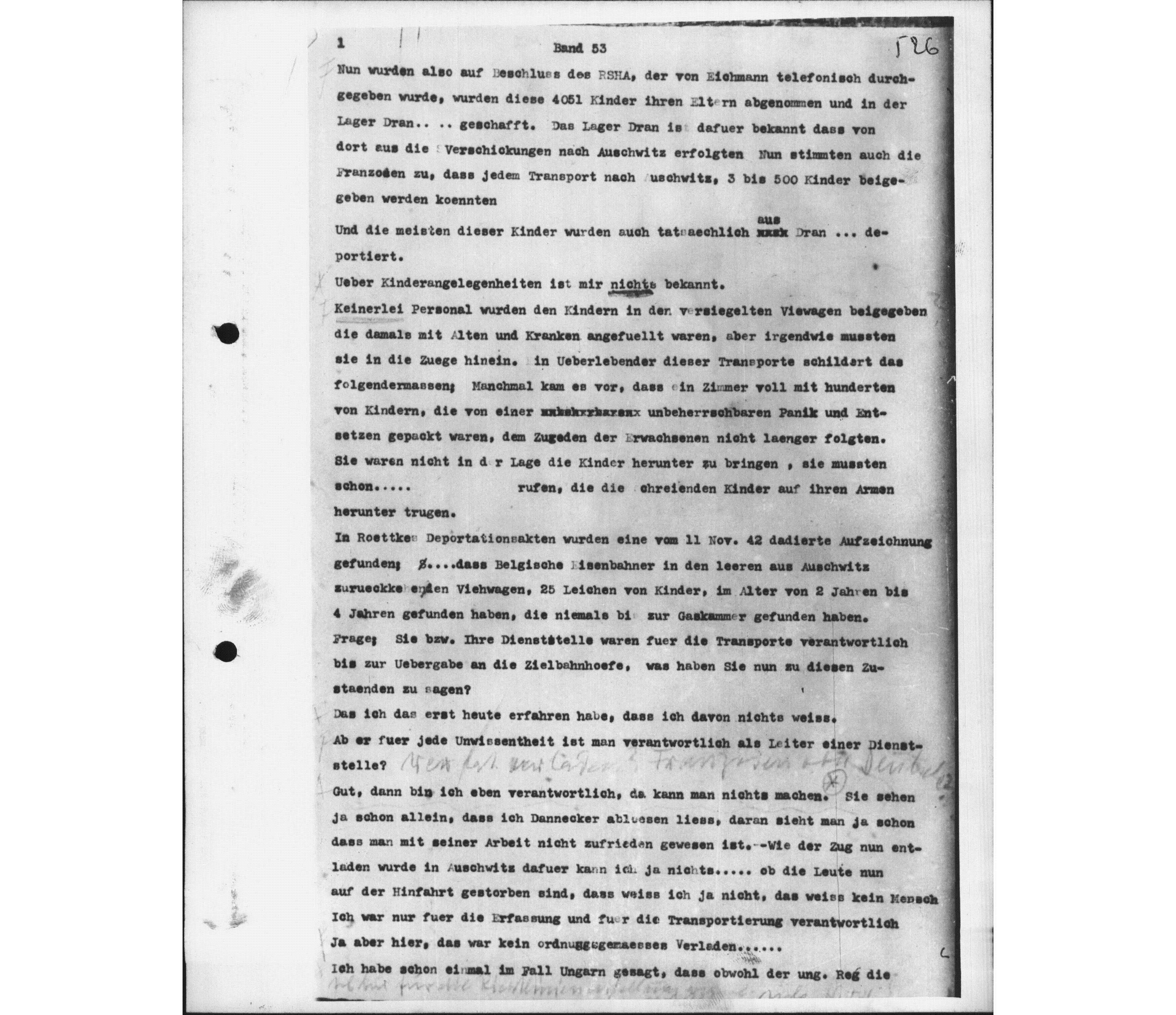
This is scan 00002 of the Sassen transcript, O.65 file 88. The image is 3504 by 3024 pixels. Yad Vashem Archives, Jacob Robinson Collection O.65, file 88.
German transcription
1 Band 53 [HW: 526]
Nun wurden also auf Beschluss des RSHA, der von Eichmann telefonisch durch-
gegeben wurde, wurden diese 4051 Kinder ihren Eltern abgenommen und in der
Lager Dran.. .. geschafft. Das Lager Dran ist dafuer bekannt dass von
dort aus die Verschickungen nach Auschwitz erfolgten Nun stimmten auch die
Franzosen zu, dass jedem Transport nach Auschwitz, 3 bis 500 Kinder beige-
geben werden koennten
Und die meisten dieser Kinder wurden auch tatsaechlich [DEL: xxxx][TS INS: aus] Dran ... de-
portiert.
Ueber Kinderangelegenheiten ist mir [HW: _]nichts[HW: _] bekannt.
Keinerlei Personal wurden den Kindern in den versiegelten Viewagen beigegeben
die damals mit Alten und Kranken angefuellt waren, aber irgendwie mussten
sie in die Zuege hinein. Ein Ueberlebender dieser Transporte schildert das
folgendermassen; Manchmal kam es vor, dass ein Zimmer voll mit hunderten
von Kindern, die von einer [DEL: unbeherrbarenx] unbeherrschbaren Panik und Ent-
setzen gepackt waren, dem Zugeden der Erwachsenen nicht laenger folgten.
Sie waren nicht in der Lage die Kinder herunter zu bringen , sie mussten
schon..... rufen, die die schreienden Kinder auf ihren Armen
herunter trugen.
In Roettkes Deportationsakten wurden eine vom 11 Nov. 42 dadierte Aufzeichnung
gefunden; 8....dass Belgische Eisenbahner in den leeren aus Auschwitz
zurueckkehenden Viewagen, 25 Leichen von Kinder, im Alter von 2 Jahren bis
4 Jahren gefunden haben, die niemals bis zur Gaskammer gefunden haben.
Frage; Sie bzw. Ihre Dienststelle waren fuer die Transporte verantwortlich
bis zur Uebergabe an die Zielbahnhoefe, was haben Sie nun zu diesen Zu-
staenden zu sagen?
Das ich das erst heute erfahren habe, dass ich davon nichts weiss.
Ab er fuer jede Unwissentheit ist man verantwortlich als Leiter einer Dienst-
stelle? [HW: [illegible] Cadem? Franzosen [illegible]] [HW: ⊗]
Gut, dann bin ich eben verantwortlich, da kann man nichts machen. Sie sehen
ja schon allein, dass ich Dannecker abloesen liess, daran sieht man ja schon
dass man mit seiner Arbeit nicht zufrieden gewesen ist.--Wie der Zug nun ent-
laden wurde in Auschwitz dafuer kann ich ja nichts..... ob die Leute nun
auf der Hinfahrt gestorben sind, dass weiss ich ja nicht, das weiss kein Mensch
Ich war nur fuer die Erfassung und fuer die Transportierung verantwortlich
Ja aber hier, das war kein ordnuggsgemaesses Verladen......
Ich habe schon einmal im Fall Ungarn gesagt, dass obwohl der ung. Reg die
[HW: [illegible]]
English translation
Band 53 [HW: 526]
Now, therefore, on the decision of the RSHA, which was transmitted by telephone by Eichmann, these 4051 children were taken from their parents and brought to the camp Dran.. .. . The camp Dran is known for the fact that from there the transports to Auschwitz took place. Now the French also agreed that 3 to 500 children could be added to each transport to Auschwitz.
And most of these children were in fact also deported [DEL: xxxx][TS INS: from] Dran ... .
About children's matters nothing is known to me [HW: _]nothing[HW: _].
No personnel of any kind were assigned to the children in the sealed freight cars [Viewagen] which at that time were filled with the old and the sick, but somehow they had to [get] into the trains. A survivor of these transports describes it as follows; Sometimes it happened that a room full of hundreds of children, who were seized by an [DEL: unbeherrbarenx] uncontrollable panic and terror, no longer followed the [pull/urging?] of the adults. They were not able to bring the children down, they had to already..... call [/summon], who carried the screaming children down in their arms.
In Roettke's deportation files a record dated 11 Nov. 42 was found; 8....that Belgian railway workers found, in the empty freight cars returning from Auschwitz, 25 corpses of children, aged from 2 years to 4 years, who never [got] as far as the gas chamber.
Question; You, or rather your office, were responsible for the transports up to the handover at the destination stations, what do you now have to say to these conditions?
That I only learned of it today, that I know nothing of it.
But for every ignorance one is responsible as the head of an office? [HW: [illegible] Cadem? Frenchmen [illegible]] [HW: ⊗]
Fine, then I am simply responsible, nothing can be done about it. You already see for yourself that I had Dannecker relieved, from that one already sees that one was not satisfied with his work.--How the train was now unloaded in Auschwitz, for that I can do nothing..... whether the people now died on the outward journey, that I do not know, no person knows that. I was only responsible for the registration [/apprehension] and for the transportation.
Yes but here, that was no orderly loading......
I have already said once in the Hungary case, that although the Hung. gov. [/the]
[HW: [illegible]]
Transcription note
Typescript carbon, Sassen-Eichmann interview, Band 53, typed page number "1" top-left. Handwritten folio "526" top-right (pencil/ink, could read 526 or 586). Center header "Band 53". Editorial marks: (1) In "tatsaechlich ... Dran" a typewritten "aus" is inserted above the line as a replacement for an x-struck word below it ([DEL: xxxx] rendered; the cancelled letters are overtyped and not confidently recoverable). (2) The word "nichts" in "ist mir nichts bekannt" is underlined by hand. (3) In "von einer ... unbeherrschbaren" a word is x-struck ("unbeherrbarenx"/overtype) immediately before the corrected "unbeherrschbaren". Left margin: a column of small handwritten pencil tick/slash marks appears beside many lines (not transcribed individually as they carry no lexical content). Two handwritten cursive lines are largely illegible: (a) the pencil line after "stelle?" — partly readable fragments include what may be "Cadem?" and "Franzosen"; (b) a cursive line running along the bottom edge under "...der ung. Reg die" is cut off and illegible. A circled/asterisk mark (⊗) sits in the right margin near the "stelle?" line. Physical condition: heavy show-through, ink blots/holes in left margin, a fingerprint smudge mid-left, faded strike on several characters. "8....dass" — the leading "8" may be a "§" symbol. "dadierte" and "ordnuggsgemaesses" retained as visibly typed (typos in original).
Who is speaking
The run assigned each English turn a speaker and stated the evidence for it. The turns can abridge or regroup the translation above, so read them as attribution, not as the page text.
Questioner
So then, on a decision of the RSHA which Eichmann passed on by telephone, these 4,051 children were taken from their parents and brought to the camp Dran [not typed]. The camp Dran is known for the fact that the shipments to Auschwitz went out from there. The French then also agreed that 3 to 500 children could be added to every transport to Auschwitz.
Questioner
And most of these children were in fact deported from Dran [not typed].
Eichmann
About matters concerning children I know nothing.
Questioner
No staff of any kind was put with the children in the sealed cattle cars, which at that time were filled with the old and the sick, but somehow they had to get into the trains. A survivor of these transports describes it this way. Sometimes it happened that a room full of hundreds of children, seized by an uncontrollable panic and horror, no longer obeyed the adults calling to them. They were not able to bring the children down, they had to call in [not typed], who carried the screaming children down in their arms.
Questioner
In Roettke's deportation files a note dated 11 November 1942 was found, saying that Belgian railwaymen found 25 bodies of children, aged 2 to 4 years, in the empty cattle cars coming back from Auschwitz, children who never got as far as the gas chamber. Question. You, or rather your office, were responsible for the transports up to the handover at the destination stations. What do you have to say now about these conditions?
Eichmann
That I have only learned of it today, that I know nothing about it.
Questioner
But one is responsible for every kind of ignorance as the head of an office?
Eichmann
Fine, then I am simply responsible, nothing can be done about that. You can see for yourself that I had Dannecker relieved. From that alone one can see that people were not satisfied with his work. How the train was then unloaded at Auschwitz, I cannot help that. Whether the people died on the way out, I do not know, nobody knows that. I was responsible only for the registration and for the transporting.
Questioner
Yes, but here, that was no orderly loading
Eichmann
I have already said once in the Hungarian case that although the Hungarian government the
Translation notes
- 'Viewagen' is an OCR corruption of 'Viehwagen' (cattle/freight cars); translated as 'freight cars' with that reading noted, but the source form is corrupt.
- 'dem Zugeden der Erwachsenen' is grammatically broken in the source; rendered as 'the [urging/pull] of the adults' — the intended noun (likely 'dem Zureden' = the urging/persuasion, or 'dem Zuge' = the pull) is uncertain.
- 'sie mussten schon..... rufen, die die schreienden Kinder auf ihren Armen herunter trugen' — the ellipsis omits the subject/object of 'rufen' (call/summon); who was called and the exact sense are indeterminate.
- '8....dass' and 'die niemals bis zur Gaskammer gefunden haben' are broken: the sentence likely intended 'die niemals bis zur Gaskammer gekommen sind' (who never reached the gas chamber); rendered as 'who never [got] as far as the gas chamber' but the verb is corrupt ('gefunden' = found is repeated erroneously).
- 'Erfassung' rendered as 'registration' but also carries the sense of 'apprehension/rounding-up/capture'; noted inline.
- 'dass obwohl der ung. Reg die' breaks off mid-clause at the page edge; 'die' is left as an incomplete article/relative and not completed.
- The handwritten margin note '[HW: [illegible] Cadem? Franzosen [illegible]]' is largely illegible; 'Cadem?' is a transcriber's uncertain reading and 'Franzosen' (Frenchmen) is the only confidently legible word. This is a continuous transcript page from Band 53 (marginal HW '526') dealing with the deportation of children from the Drancy camp ('Dran...', an OCR truncation of Drancy) to Auschwitz, referencing Dannecker and Roettke's (Röthke's) deportation files. The page contains NO explicit speaker labels except the single 'Frage;' (Question) marker; all other turn attributions rely on rule 2 (content-based unambiguity). The first-person denial-of-responsibility turns are attributed to Eichmann on the strength of their content (his IVB4/transport remit, having Dannecker relieved, the Hungary reference) matching his known role; the interviewer's challenges and the labeled 'Frage;' are attributed to Sassen as the questioner. Diplomatic markers preserved: [HW:], [DEL:], [TS INS:], [illegible], ellipses, broken grammar, and the truncated final line. 'Dran..'/'Dran ...' = Drancy; 'Viewagen' = Viehwagen; 'Roettke' = Röthke; 'ung. Reg' = ungarische Regierung (Hungarian government). No speaker identity is asserted beyond what the page's own content supports."
Sheet 3
O.65 file 88 · 00003Band 53, page 2
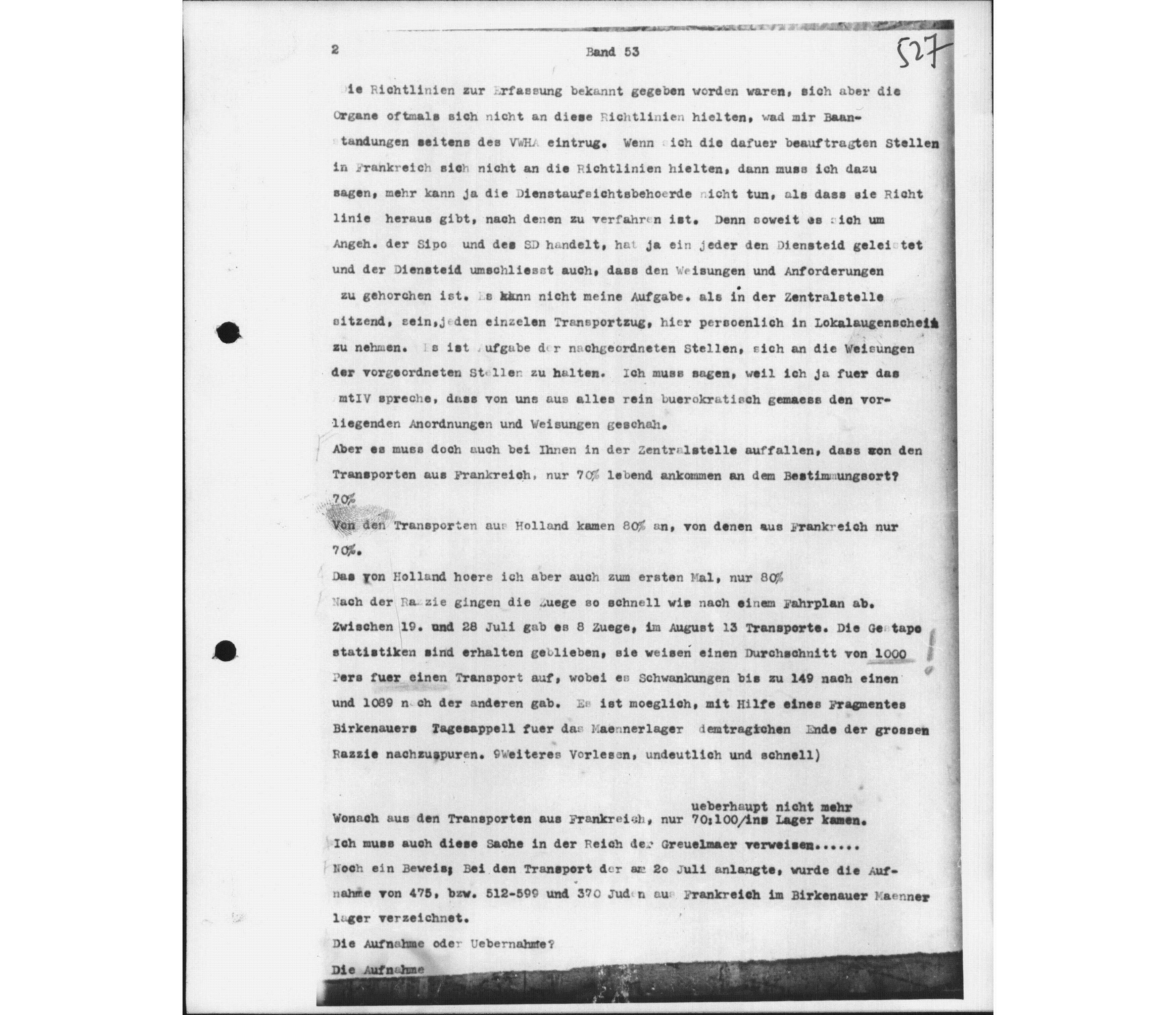
This is scan 00003 of the Sassen transcript, O.65 file 88. The image is 3504 by 3024 pixels. Yad Vashem Archives, Jacob Robinson Collection O.65, file 88.
German transcription
2 Band 53 [HW: 527]
Die Richtlinien zur Erfassung bekannt gegeben worden waren, sich aber die
Organe oftmals sich nicht an diese Richtlinien hielten, wad mir Baan-
standungen seitens des VWHA eintrug. Wenn sich die dafuer beauftragten Stellen
in Frankreich sich nicht an die Richtlinien hielten, dann muss ich dazu
sagen, mehr kann ja die Dienstaufsichtsbehoerde nicht tun, als dass sie Richt
linie heraus gibt, nach denen zu verfahren ist. Denn soweit es sich um
Angeh. der Sipo und des SD handelt, hat ja ein jeder den Diensteid geleistet
und der Diensteid umschliesst auch, dass den Weisungen und Anforderungen
zu gehorchen ist. Es kann nicht meine Aufgabe. als in der Zentralstelle
sitzend, sein,jeden einzelen Transportzug, hier persoenlich in Lokalaugenschein
zu nehmen. Es ist Aufgabe der nachgeordneten Stellen, sich an die Weisungen
der vorgeordneten Stellen zu halten. Ich muss sagen, weil ich ja fuer das
mtIV spreche, dass von uns aus alles rein buerokratisch gemaess den vor-
liegenden Anordnungen und Weisungen geschah.
Aber es muss doch auch bei Ihnen in der Zentralstelle auffallen, dass von den
Transporten aus Frankreich, nur 70% lebend ankommen an dem Bestimmungsort?
70%
Von den Transporten aus Holland kamen 80% an, von denen aus Frankreich nur
70%.
Das von Holland hoere ich aber auch zum ersten Mal, nur 80%
Nach der Razzie gingen die Zuege so schnell wie nach einem Fahrplan ab.
Zwischen 19. und 28 Juli gab es 8 Zuege, im August 13 Transporte. Die Gestape
statistiken sind erhalten geblieben, sie weisen einen Durchschnitt von 1000
Pers fuer einen Transport auf, wobei es Schwankungen bis zu 149 nach einen
und 1089 nach der anderen gab. Es ist moeglich, mit Hilfe eines Fragmentes
Birkenauers Tagesappell fuer das Maennerlager demtragichen Ende der grossen
Razzie nachzuspuren. 9Weiteres Vorlesen, undeutlich und schnell)
[TS INS: ueberhaupt nicht mehr]
Wonach aus den Transporten aus Frankreich, nur 70:100/ins Lager kamen.
Ich muss auch diese Sache in der Reich der Greuelmaer verweisen......
Noch ein Beweis; Bei den Transport der am 2o Juli anlangte, wurde die Auf-
nahme von 475, bzw. 512-599 und 370 Juden aus Frankreich im Birkenauer Maenner
lager verzeichnet.
Die Aufnahme oder Uebernahme?
Die Aufnahme
English translation
2 Volume 53 [HW: 527]
The guidelines for registration/apprehension had been made known, but the organs often did not adhere to these guidelines, wad [=which] brought me complaints on the part of the VWHA [sic]. If the offices commissioned for this in France did not adhere to the guidelines, then I must say to this, the supervisory authority can indeed do no more than issue a guideline according to which one is to proceed. For insofar as it concerns members of the Sipo and the SD, every single one has indeed sworn the service oath, and the service oath also encompasses that orders and requirements are to be obeyed. It cannot be my task, sitting in the central office, to personally take into ocular inspection here every single transport train. It is the task of the subordinate offices to adhere to the instructions of the superior offices. I must say, because I speak indeed for the Amt IV [Office IV], that from our side everything happened purely bureaucratically in accordance with the orders and instructions at hand.
But it must indeed also be noticed by you in the central office, that of the transports from France, only 70% arrive alive at the destination?
70%
Of the transports from Holland 80% arrived, of those from France only 70%.
But the [figure] from Holland I also hear for the first time, only 80%
After the raid the trains departed as fast as [if] according to a timetable. Between 19 and 28 July there were 8 trains, in August 13 transports. The Gestapo statistics have remained preserved, they show an average of 1000 persons for one transport, whereby there were fluctuations up to 149 toward the one and 1089 toward the other. It is possible, with the help of a fragment of Birkenau's daily roll-call for the men's camp, to trace the tragic end of the great raid. (Further reading aloud, indistinct and fast)
[TS INS: not at all any more]
According to which of the transports from France, only 70:100/ came into the camp.
I must also relegate this matter to the realm of atrocity-tales......
One more proof; At the transport that arrived on 20 July, the admission of 475, respectively 512-599 and 370 Jews from France was recorded in the Birkenau men's camp.
The admission or the taking-over?
The admission
Transcription note
Scan Part4/00003. Typewritten transcript page, faded/uneven typewriter impression; several word-initial capitals barely inked (e.g. "Die" line 1, "AmtIV" appears as "mtIV" line 13). Header: "2" (upper left), "Band 53" (center), "527" (upper right, handwritten in ink). "ueberhaupt nicht mehr" is typed above the line "Wonach aus den Transporten..." and slightly right; treated as a typewritten insertion whose intended anchor (near "70:100 ... Lager kamen") is uncertain. Left margin bears several short vertical/caret pen strokes (against lines beginning "Aber", "Von", "Birkenauers"-area, "Wonach", "Ich", "Noch") — non-textual reader marks, not transcribed. A faint fingerprint smudge sits left of the "70%" line. Two large ink/punch blots on the left edge and a curved ink mark plus underline of "1000" at right are physical marks, not text. Ambiguous readings kept as visibly typed: "wad" (for was), "Baanstandungen" (Beanstandungen), "einzelen", "demtragichen", "Gestape", "9Weiteres" (opening paren typed as 9), "2o" (20 with letter o), "70:100/ins", "in der Reich der Greuelmaer".
Who is speaking
The run assigned each English turn a speaker and stated the evidence for it. The turns can abridge or regroup the translation above, so read them as attribution, not as the page text.
Eichmann
[off the sheet] the guidelines for registration had been made known, but the authorities often did not keep to these guidelines, which brought me complaints from the WVHA. If the offices charged with it in France did not keep to the guidelines, then I have to say that a supervisory authority can do no more than issue guidelines to be followed. For as far as members of the Sipo and the SD are concerned, every one of them has sworn the service oath, and the service oath also takes in that instructions and demands are to be obeyed. It cannot be my task, sitting in the central office, to inspect every single transport train here in person on the spot. It is the task of the subordinate offices to keep to the instructions of the offices above them. I have to say, because I am speaking for Department IV, that on our side everything was done in a purely bureaucratic way, according to the orders and instructions on hand.
Questioner
But it must surely also strike you in the central office that of the transports from France only 70 percent arrive alive at the destination?
Eichmann
70 percent
Questioner
Of the transports from Holland 80 percent arrived, of those from France only 70 percent.
Eichmann
The figure for Holland I am also hearing for the first time, only 80 percent
Questioner
After the raid the trains left as promptly as if on a timetable. Between 19 and 28 July there were 8 trains, in August 13 transports. The Gestapo statistics have survived. They show an average of 1,000 persons for a transport, with variations down to 149 on the one side and up to 1,089 on the other. It is possible, with the help of a fragment of the Birkenau daily roll call for the men's camp, to trace the tragic end of the great raid.
Questioner
According to which, of the transports from France, only 70 out of 100 came into the camp.
Eichmann
I must consign this matter too to the realm of atrocity stories
Questioner
One more proof. With the transport that arrived on 20 July, the admission of 475, and of 512 to 599 and 370 Jews from France was recorded in the Birkenau men's camp.
Eichmann
The admission or the taking over?
Questioner
The admission
Translation notes
- 'Erfassung' rendered as 'registration/apprehension' — it can mean the recording/registration or the rounding-up/apprehension of persons; both senses are in play in a deportation context.
- 'VWHA' is likely an OCR error for 'WVHA' (SS Wirtschafts-Verwaltungshauptamt / Economic-Administrative Main Office); translated verbatim as the source's 'VWHA' without correcting.
- 'wad' in 'wad mir Baanstandungen ... eintrug' appears to be an OCR corruption of 'was' (which); 'Baanstandungen' is a corruption of 'Beanstandungen' (complaints/objections).
Sheet 4
O.65 file 88 · 00004Band 53, page 3
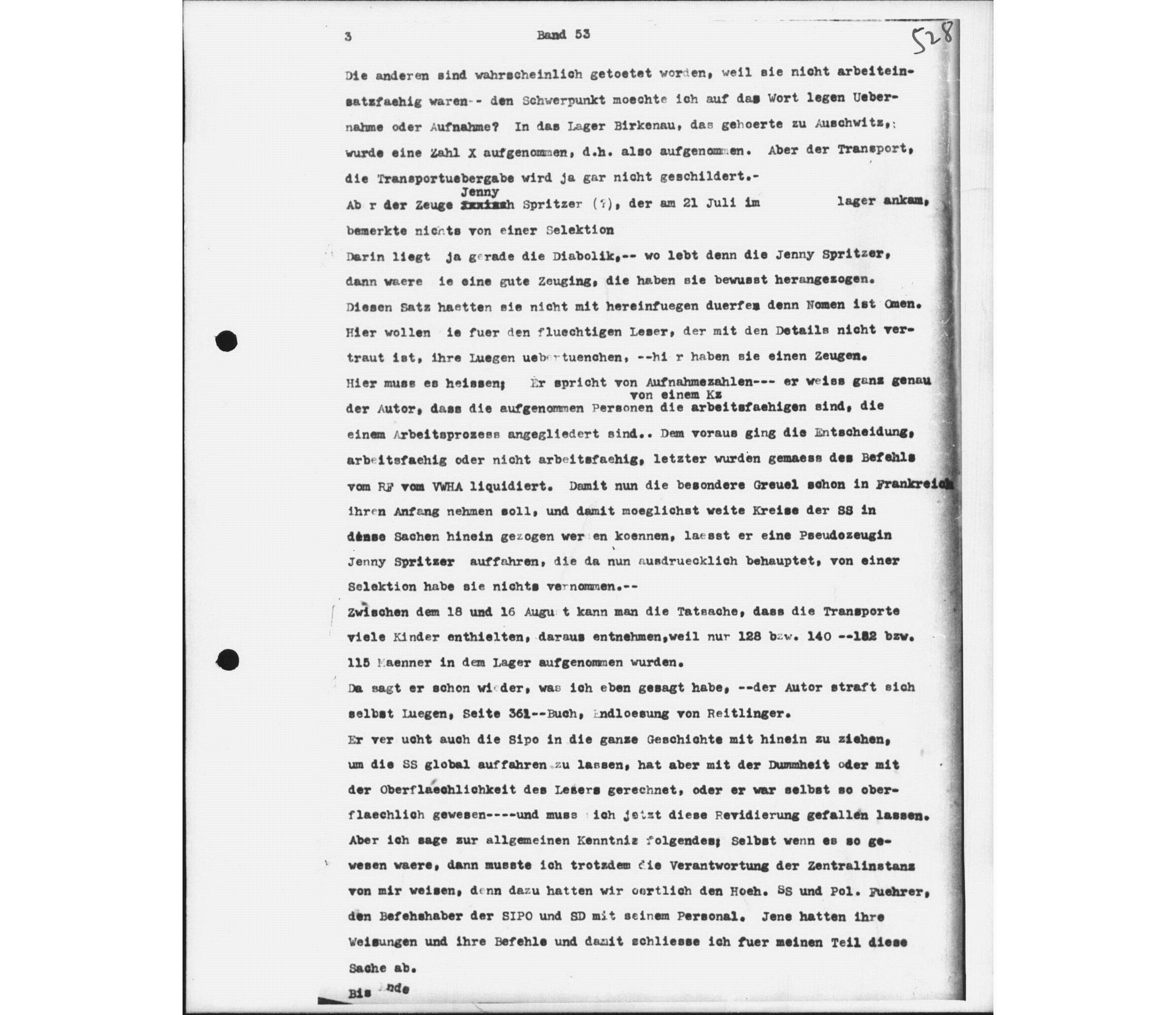
This is scan 00004 of the Sassen transcript, O.65 file 88. The image is 3504 by 3024 pixels. Yad Vashem Archives, Jacob Robinson Collection O.65, file 88.
German transcription
3 Band 53 [HW: 528]
Die anderen sind wahrscheinlich getoetet worden, weil sie nicht arbeitein-
satzfaehig waren-- den Schwerpunkt moechte ich auf das Wort legen Ueber-
nahme oder Aufnahme? In das Lager Birkenau, das gehoerte zu Auschwitz,
wurde eine Zahl X aufgenommen, d.h. also aufgenommen. Aber der Transport,
die Transportuebergabe wird ja gar nicht geschildert.-
Ab r der Zeuge [DEL: [illegible]] [HW: Jenny] Spritzer (?), der am 21 Juli im lager ankam,
bemerkte nichts von einer Selektion
Darin liegt ja gerade die Diabolik,-- wo lebt denn die Jenny Spritzer,
dann waere ie eine gute Zeuging, die haben sie bewusst herangezogen.
Diesen Satz haetten sie nicht mit hereinfuegen duerfem denn Nomen ist Omen.
Hier wollen ie fuer den fluechtigen Leser, der mit den Details nicht ver-
traut ist, ihre Luegen uebertuenchen, --hi r haben sie einen Zeugen.
Hier muss es heissen; Er spricht von Aufnahmezahlen--- er weiss ganz genau
[TS INS: von einem Kz]
der Autor, dass die aufgenommen Personen die arbeitsfaehigen sind, die
einem Arbeitsprozess angegliedert sind.. Dem voraus ging die Entscheidung,
arbeitsfaehig oder nicht arbeitsfaehig, letzter wurden gemaess des Befehls
vom RF vom VWHA liquidiert. Damit nun die besondere Greuel schon in Frankreich
ihren Anfang nehmen soll, und damit moeglichst weite Kreise der SS in
diese Sachen hinein gezogen wer en koennen, laesst er eine Pseudozeugin
Jenny Spritzer auffahren, die da nun ausdruecklich behauptet, von einer
Selektion habe sie nichts vernommen.--
Zwischen dem 18 und 16 Augu t kann man die Tatsache, dass die Transporte
viele Kinder enthielten, daraus entnehmen,weil nur 128 bzw. 140 --182 bzw.
115 Maenner in dem Lager aufgenommen wurden.
Da sagt er schon wieder, was ich eben gesagt habe, --der Autor straft sich
selbst Luegen, Seite 361--Buch, Endloesung von Reitlinger.
Er ver ucht auch die Sipo in die ganze Geschichte mit hinein zu ziehen,
um die SS global auffahren zu lassen, hat aber mit der Dummheit oder mit
der Oberflaechlichkeit des Lesers gerechnet, oder er war selbst so ober-
flaechlich gewesen----und muss ich jetzt diese Revidierung gefallen lassen.
Aber ich sage zur allgemeinen Kenntniz folgendes; Selbst wenn es so ge-
wesen waere, dann musste ich trotzdem die Verantwortung der Zentralinstanz
von mir weisen, denn dazu hatten wir oertlich den Hoeh. SS und Pol. Fuehrer,
den Befehshaber der SIPO und SD mit seinem Personal. Jene hatten ihre
Weisungen und ihre Befehle und damit schliesse ich fuer meinen Teil diese
Sache ab.
Bis [HW: nde]
English translation
3 Volume 53 [HW: 528]
The others were probably killed because they were not fit for labor deployment-- I would like to place the emphasis on the word take-over or admission? Into the camp Birkenau, that belonged to Auschwitz, a number X was admitted, i.e. thus admitted. But the transport, the transport hand-over is not depicted at all.-
But the witness [DEL: [illegible]] [HW: Jenny] Spritzer (?), who arrived at the camp on 21 July, noticed nothing of a selection
Therein lies precisely the diabolical thing,-- where then does the Jenny Spritzer live, then she would be a good witness, they deliberately brought her in. This sentence they should not have been allowed to insert along with it for nomen est omen. Here they want, for the fleeting reader who is not familiar with the details, to whitewash their lies, --here they have a witness. Here it must read; He speaks of admission-figures--- he knows quite exactly [TS INS: of a concentration camp] the author, that the admitted persons are the ones fit for labor, who are attached to a labor process.. This was preceded by the decision, fit for labor or not fit for labor, the latter were liquidated in accordance with the order from the RF from the VWHA. So that now the particular atrocity should already take its beginning in France, and so that as wide as possible circles of the SS can be drawn into these matters, he brings up a pseudo-witness Jenny Spritzer, who now expressly claims that she heard nothing of a selection.--
Between the 18th and 16th August one can gather the fact that the transports contained many children from this, because only 128 or 140 --182 or 115 men were admitted into the camp.
There he says once again what I just said, --the author gives himself the lie, page 361--book, Final Solution by Reitlinger. He also tries to drag the Sipo into the whole story, in order to let the SS appear globally, but has reckoned with the stupidity or with the superficiality of the reader, or he himself had been so superficial----and must I now put up with this revising. But I say for general knowledge the following; Even if it had been so, then I nonetheless had to reject the responsibility of the central authority from myself, for that we had locally the Higher SS and Pol. Leader, the Commander of the SIPO and SD with his personnel. Those had their instructions and their orders and with that I close this matter for my part.
Until [HW: end]
Transcription note
Single scanned page, Part4/00004 (file 00004.jpg), Band 53, page 3, folio 528 (handwritten top right). Typewritten transcript with typical worn/dropped characters (e.g., "Ab r", " ie", "hi r", "wer en", "Augu t", "ver ucht") preserved as visible. Two hole-punch/ink blots in left margin do not obscure text. One handwritten replacement: "Jenny" written above a struck-out overtyped word before "Spritzer" on line 6. One typewritten insertion "von einem Kz" appearing above the "der Autor" line (interlinear). Bottom line reads "Bis" with a handwritten continuation resembling "nde" (possibly "Bis Ende" catchword at page foot).
Who is speaking
The run assigned each English turn a speaker and stated the evidence for it. The turns can abridge or regroup the translation above, so read them as attribution, not as the page text. The run did not write the speaker field for this page; it was read back from the raw response.
Eichmann
The others were probably killed because they were not fit for labor deployment. I would like to put the weight on the word. Taking over or admission? Into the camp Birkenau, which belonged to Auschwitz, a number X was admitted, that is, admitted. But the transport, the handover of the transport, is not described at all.
Questioner
But the witness Jenny Spritzer, who arrived on 21 July at the [not typed] camp, noticed nothing of a selection
Eichmann
That is exactly where the diabolical thing lies. Where does this Jenny Spritzer live? Then she would be a good witness, they brought her in deliberately. They should not have put that sentence in, for the name says it all. Here they want to paper over their lies for the hasty reader who is not familiar with the details. Here they have a witness. Here it has to read, he speaks of admission figures, the author knows perfectly well that the persons admitted are the ones fit for work, who are attached to a work process. Before that came the decision, fit for work or not fit for work, and the latter were liquidated in accordance with the order of the Reichsführer, through the WVHA. So that the particular atrocity is supposed to have its beginning already in France, and so that the widest possible circles of the SS can be drawn into these matters, he brings on a pseudo witness, Jenny Spritzer, who now expressly claims that she heard nothing of a selection.
Questioner
Between 18 and 16 August one can gather from the fact that only 128 and 140, and 182 and 115 men were admitted to the camp, that the transports contained many children.
Eichmann
There he says again what I have just said. The author gives himself the lie, page 361 of the book, The Final Solution by Reitlinger. He also tries to draw the Sipo into the whole story, in order to bring the SS on in a sweeping way, but he counted on the stupidity or the superficiality of the reader, or he was himself that superficial, and now I have to put up with this revision. But I say the following for general information. Even if it had been so, I would still have had to reject the responsibility of the central authority, because for that we had the Higher SS and Police Leader locally, the commander of the Sipo and SD with his staff. Those men had their instructions and their orders, and with that I close this matter as far as I am concerned.
Translation notes
- 'Nomen est omen' rendered as-is (Latin idiom in the German: 'Nomen ist Omen'); the German plays on the witness's name but the sentence is elliptical and the intended sense of 'they should not have been allowed to insert' is grammatically broken in the original.
- 'muss ich jetzt diese Revidierung gefallen lassen' — translated as 'must I now put up with this revising'; the phrase 'sich etwas gefallen lassen' means 'to put up with / tolerate', and 'Revidierung' (revising/revision) is ambiguous in context.
- 'straft sich selbst Luegen' rendered idiomatically-literally as 'gives himself the lie' (i.e. contradicts/refutes himself).
- 'die haben sie bewusst herangezogen' — 'sie' is ambiguous between 'they' and formal 'you'; translated as 'they deliberately brought her in' following the surrounding third-person critique of the author, but a 2nd-person-plural reading ('you deliberately brought her in') is grammatically possible.
- The date range 'Zwischen dem 18 und 16 August' is internally contradictory (18 then 16) in the source; preserved as written.
- 'RF' (likely Reichsführer[-SS]) and 'VWHA' (likely WVHA, SS Wirtschafts-Verwaltungshauptamt) left as abbreviations as written; 'VWHA' may be an OCR/typing transposition of WVHA but is not silently corrected. This page is a single continuous first-person monologue with no explicit speaker labels, no question marks introducing an interviewer turn, and no turn boundary. The bolded/embedded lines (e.g. the Jenny Spritzer sentence, the date/figures sentence) are the speaker quoting or paraphrasing Reitlinger's text, which he then rebuts — they are not a separate participant's turn. Under the attribution rules, the entire page is attributed to E on content grounds (first-person disavowal of central-authority responsibility, insider command-structure knowledge), not on alternation. No Sassen question or third-participant turn is visible on this page. Markup preserved verbatim: [HW: 528], [HW: Jenny], [HW: end], [DEL: [illegible]], [TS INS: von einem Kz], the '(?)' uncertainty marker on 'Spritzer', and the broken/elliptical grammar and contradictory dates. The '3' and 'Band 53 / 528' header retained in english_literal. If this monologue is judged to be a single non-dialogue turn rather than dialogue, the single-turn attribution above is the appropriate representation; it is not invented conversation."
Sheet 5
O.65 file 88 · 00005Band 53, page 4
This is scan 00005 of the Sassen transcript, O.65 file 88. The image is 3504 by 3024 pixels. Yad Vashem Archives, Jacob Robinson Collection O.65, file 88.
German transcription
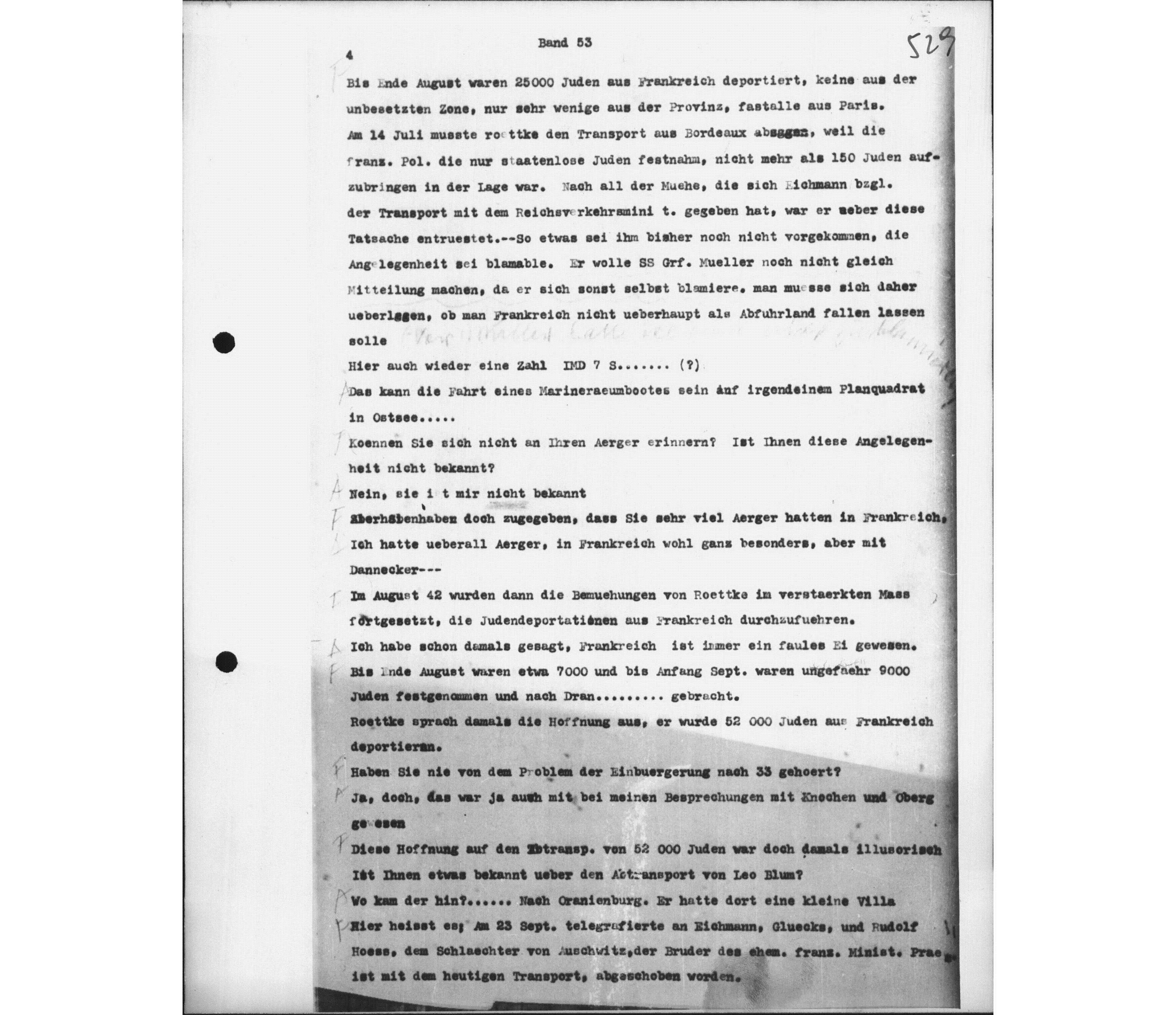
4 Band 53 [HW: 529]
Bis Ende August waren 25000 Juden aus Frankreich deportiert, keine aus der
unbesetzten Zone, nur sehr wenige aus der Provinz, fastalle aus Paris.
Am 14 Juli musste roettke den Transport aus Bordeaux absagen, weil die
franz. Pol. die nur staatenlose Juden festnahm, nicht mehr als 150 Juden auf-
zubringen in der Lage war. Nach all der Muehe, die sich Eichmann bzgl.
der Transport mit dem Reichsverkehrsmini t. gegeben hat, war er ueber diese
Tatsache entruestet.--So etwas sei ihm bisher noch nicht vorgekommen, die
Angelegenheit sei blamable. Er wolle SS Grf. Mueller noch nicht gleich
Mitteilung machen, da er sich sonst selbst blamiere. man muesse sich daher
ueberlegen, ob man Frankreich nicht ueberhaupt als Abfuhrland fallen lassen
solle [HW: [illegible]]
Hier auch wieder eine Zahl IMD 7 S....... (?)
Das kann die Fahrt eines Marineraeumbootes sein auf irgendeinem Planquadrat
in Ostsee.....
Koennen Sie sich nicht an Ihren Aerger erinnern? Ist Ihnen diese Angelegen-
heit nicht bekannt?
Nein, sie i t mir nicht bekannt
aberhaben doch zugegeben, dass Sie sehr viel Aerger hatten in Frankreich.
Ich hatte ueberall Aerger, in Frankreich wohl ganz besonders, aber mit
Dannecker---
Im August 42 wurden dann die Bemuehungen von Roettke im verstaerkten Mass
fortgesetzt, die Judendeportationen aus Frankreich durchzufuehren.
Ich habe schon damals gesagt, Frankreich ist immer ein faules Ei gewesen.
Bis Ende August waren etwa 7000 und bis Anfang Sept. waren ungefaehr 9000
Juden festgenommen und nach Dran......... gebracht.
Roettke sprach damals die Hoffnung aus, er wurde 52 000 Juden aus Frankreich
deportieren.
Haben Sie nie von dem Problem der Einbuergerung nach 33 gehoert?
Ja, doch, das war ja auch mit bei meinen Besprechungen mit Knochen und Oberg
gewesen
Diese Hoffnung auf den Abtransp. von 52 000 Juden war doch damals illusorisch
Ist Ihnen etwas bekannt ueber den Abtransport von Leo Blum?
Wo kam der hin?...... Nach Oranienburg. Er hatte dort eine kleine Villa
Hier heisst es; Am 23 Sept. telegrafierte an Eichmann, Gluecks, und Rudolf
Hoess, dem Schlaechter von Auschwitz,der Bruder des ehem. franz. Minist. Prae.
ist mit dem heutigen Transport, abgeschoben worden.
English translation
4 Band 53 [HW: 529]
Until the end of August 25000 Jews had been deported from France, none from the
unoccupied zone, only very few from the province, almost all from Paris.
On 14 July Roettke had to cancel the transport from Bordeaux, because the
French police, which arrested only stateless Jews, was not in a position to raise
more than 150 Jews. After all the trouble that Eichmann had taken regarding
the transport with the Reich Transport Ministry, he was indignant over this
fact.--Something like this had never happened to him before, the
matter was disgraceful. He did not yet want to make a report to SS Gruf. Mueller
right away, since otherwise he himself would be disgraced. one must therefore
consider whether France should not be dropped altogether as a country of removal
[HW: [illegible]]
Here again a number IMD 7 S....... (?)
That could be the voyage of a naval minesweeper on some grid square
in the Baltic Sea.....
Can you not remember your annoyance? Is this matter
not known to you?
No, it is not known to me
but you did admit that you had a great deal of trouble in France.
I had trouble everywhere, in France quite especially so, but with
Dannecker---
In August 42 the efforts of Roettke to carry out the Jew deportations
from France were then continued to an increased degree.
I said already back then, France has always been a rotten egg.
Until the end of August about 7000 and by the beginning of Sept. approximately 9000
Jews had been arrested and brought to Dran......... .
Roettke expressed the hope at that time that he would deport 52 000 Jews from France.
Have you never heard of the problem of naturalization after 33?
Yes, indeed, that was also among my discussions with Knochen and Oberg
This hope for the removal of 52 000 Jews was surely illusory at that time
Is anything known to you about the removal of Leo Blum?
Where did he go to?...... To Oranienburg. He had a small villa there
Here it says; On 23 Sept. telegraphed to Eichmann, Gluecks, and Rudolf
Hoess, the butcher of Auschwitz, that the brother of the former French Prime Minister
has been deported with today's transport.
Transcription note
Typewritten interview transcript page. Top-left typed page number "4"; centered heading "Band 53"; top-right handwritten folio "529". A faint cursive handwritten line runs to the right of/after the typed word "solle" spanning the width of the page — it is genuinely illegible in this scan, marked [HW: [illegible]]. The left margin carries a column of small faint pencil marks/letters (apparent speaker or turn indicators) beside many lines; they are too faint/ambiguous to read reliably and are not transcribed as text. The lower-right and lower portion of the page is affected by a dark exposure gradient/stain but the typed text there remains readable. Spelling/spacing anomalies preserved verbatim (e.g. "fastalle", "absagen"→appears "absagan", "Reichsverkehrsmini t.", "sie i t", "aberhaben", "wurde" for wuerde). Ellipsis dot counts approximated.
Who is speaking
The run assigned each English turn a speaker and stated the evidence for it. The turns can abridge or regroup the translation above, so read them as attribution, not as the page text.
Speaker not established
By the end of August 25,000 Jews had been deported from France, none from the unoccupied zone, only very few from the provinces, almost all from Paris. On 14 July Roettke had to cancel the transport from Bordeaux, because the French police, which was arresting only stateless Jews, was not able to produce more than 150 Jews. After all the effort Eichmann had put into the transports with the Reich Transport Ministry, he was outraged at this fact. Nothing like it had happened to him before, the affair was disgraceful. He did not want to report it to SS Gruppenfuehrer Mueller straight away, since he would only disgrace himself. One would therefore have to consider whether France should be dropped altogether as a country of removal.
Speaker not established
Here again a number, IMD 7 S [not typed] (?)
Speaker not established
That could be the run of a naval minesweeper on some grid square in the Baltic.
Questioner
Can you not remember your annoyance? Is this matter not known to you?
Eichmann
No, it is not known to me.
Questioner
But [blotted] have admitted that you had a great deal of annoyance in France.
Eichmann
I had annoyance everywhere, in France quite particularly, but with Dannecker
Speaker not established
In August 42 Roettke's efforts to carry out the deportations of Jews from France were then continued on an increased scale.
Eichmann
I said even then, France has always been a rotten egg.
Speaker not established
By the end of August about 7,000 and by the beginning of September roughly 9,000 Jews had been arrested and taken to Dran [not typed].
Speaker not established
Roettke expressed the hope at that time that he would deport 52,000 Jews from France.
Questioner
Have you never heard of the problem of the naturalizations after 33?
Eichmann
Yes, of course, that was also part of my discussions with Knochen and Oberg.
Questioner
This hope of removing 52,000 Jews was surely illusory at the time.
Questioner
Is anything known to you about the removal of Leo Blum?
Eichmann
Where did he go? To Oranienburg. He had a little villa there.
Speaker not established
Here it says: On 23 September [not typed] telegraphed to Eichmann, Gluecks and Rudolf Hoess, the butcher of Auschwitz, that the brother of the former French prime minister has been deported with today's transport.
Translation notes
- 'als Abfuhrland fallen lassen' — 'Abfuhrland' (lit. 'country of removal/carting-off') is a Nazi euphemism for a source country of deportations; rendered literally as 'country of removal'.
- 'Marineraeumbootes' translated as 'naval minesweeper' (Räumboot = R-boat / minesweeper); the surrounding sentence is itself an aside speculating about an OCR artifact ('IMD 7 S...'), so its referent is unclear.
- 'Planquadrat' rendered as 'grid square' (military map-grid square).
- 'Dran.........' is an incomplete/truncated place name in the source — almost certainly Drancy — but left as the incomplete form present in the German; not silently completed.
- 'Leo Blum' in the German is almost certainly Léon Blum (former French Prime Minister); the transcription reads 'Leo Blum' and is left as written.
- 'faules Ei' rendered idiomatically-literally as 'rotten egg' ('faul' = rotten/lazy); the German idiom means an unreliable/troublesome matter.
- 'blamable' / 'blamiere' rendered as 'disgraceful' / 'be disgraced'.
- The final sentence's grammar is broken in the German (an incomplete construction where 'telegrafierte an Eichmann...' lacks an explicit subject); the broken structure is preserved. This page (Band 53, HW 529) is a heavily mixed page: it interleaves read-aloud third-person source/document material (naming Eichmann and Roettke in the third person) with what reads as interview Q&A. Under the given attribution rules, no turn on this page carries an explicit speaker label or initial, so attribution must rest on each turn's own content being unambiguous on this page alone. While the alternating question/answer structure strongly suggests Sassen (interviewer) asking and Eichmann (respondent) answering — the questions address 'you' and several replies are first-person accounts of France deportation matters, discussions with Knochen/Oberg, etc. — this would be inferring speakers from alternation and narrative sense, which the rules forbid. The first-person 'I had trouble everywhere... but with Dannecker' and 'that was also among my discussions with Knochen and Oberg' are consistent with Eichmann but the page provides no label to confirm it, so all turns are marked UNCERTAIN. The third-person narrative blocks are read-aloud source material rather than either interlocutor's own speech. No turn was attributed to E or S to avoid a wrong attribution of an admission to the wrong man.
Sheet 6
O.65 file 88 · 00006
This is scan 00006 of the Sassen transcript, O.65 file 88. The image is 3504 by 3024 pixels. Yad Vashem Archives, Jacob Robinson Collection O.65, file 88.
German transcription
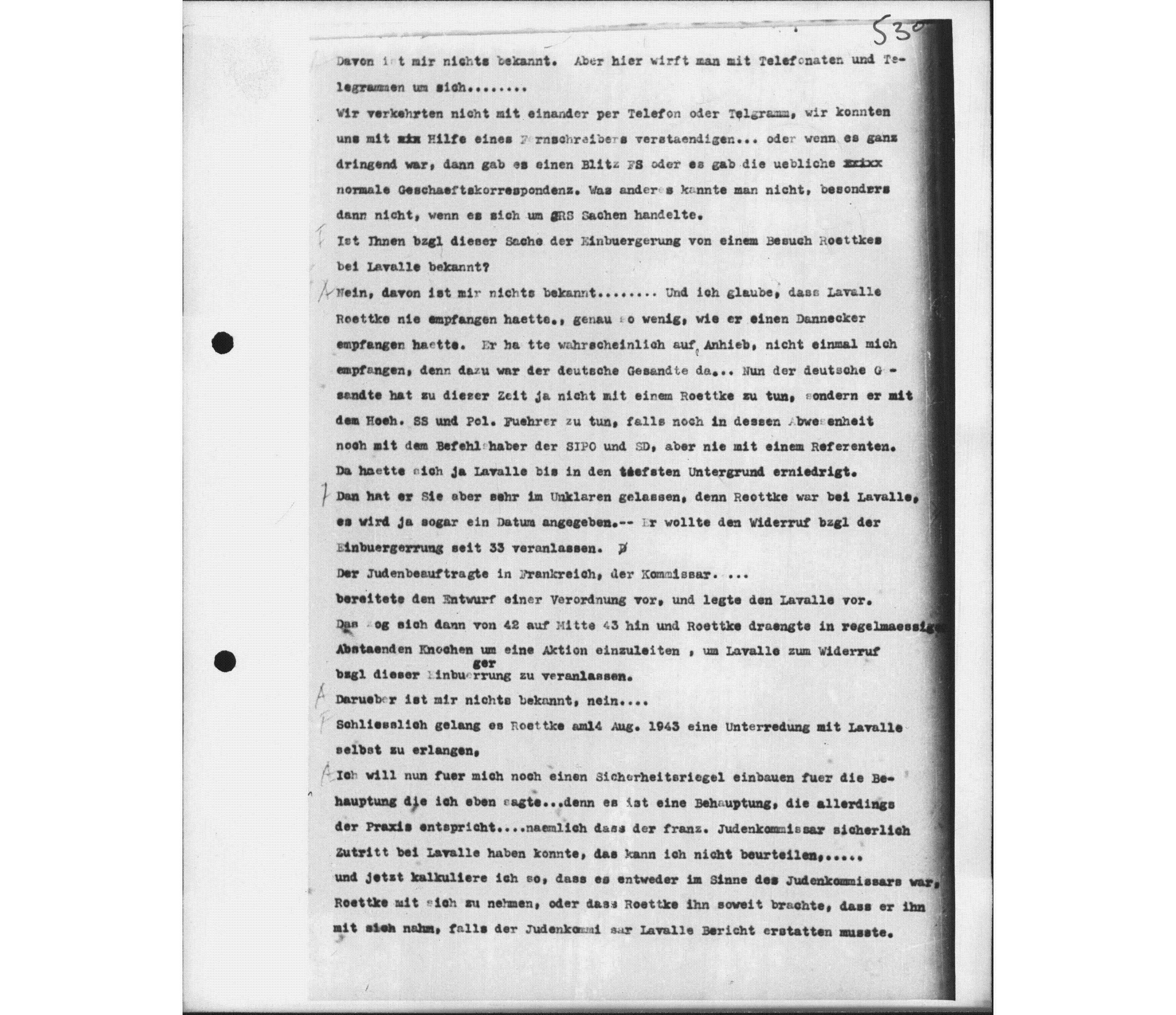
[HW: 530]
Davon ist mir nichts bekannt. Aber hier wirft man mit Telefonaten und Te-
legrammen um sich........
Wir verkehrten nicht mit einander per Telefon oder Telgramm, wir konnten
uns mit xix Hilfe eines Fernschreibers verstaendigen... oder wenn es ganz
dringend war, dann gab es einen Blitz FS oder es gab die uebliche xxixx
normale Geschaeftskorrespondenz. Was anderes kannte man nicht, besonders
dann nicht, wenn es sich um GRS Sachen handelte.
Ist Ihnen bzgl dieser Sache der Einbuergerung von einem Besuch Roettkes
bei Lavalle bekannt?
Nein, davon ist mir nichts bekannt........ Und ich glaube, dass Lavalle
Roettke nie empfangen haette., genau so wenig, wie er einen Dannecker
empfangen haette. Er ha tte wahrscheinlich auf Anhieb, nicht einmal mich
empfangen, denn dazu war der deutsche Gesandte da... Nun der deutsche Ge-
sandte hat zu dieser Zeit ja nicht mit einem Roettke zu tun, sondern er mit
dem Hoeh. SS und Pol. Fuehrer zu tun, falls noch in dessen Abwesenheit
noch mit dem Befehlshaber der SIPO und SD, aber nie mit einem Referenten.
Da haette sich ja Lavalle bis in den tiefsten Untergrund erniedrigt.
Dan hat er Sie aber sehr im Unklaren gelassen, denn Roettke war bei Lavalle,
es wird ja sogar ein Datum angegeben.-- Er wollte den Widerruf bzgl der
Einbuergerrung seit 33 veranlassen. [HW: [illegible]]
Der Judenbeauftragte in Frankreich, der Kommissar. ...
bereitete den Entwurf einer Verordnung vor, und legte den Lavalle vor.
Das zog sich dann von 42 auf Mitte 43 hin und Roettke draengte in regelmaessig [HW: ger]
Abstaenden Knochen um eine Aktion einzuleiten , um Lavalle zum Widerruf
bzgl dieser Einbuerrung zu veranlassen.
Darueber ist mir nichts bekannt, nein....
Schliesslich gelang es Roettke am14 Aug. 1943 eine Unterredung mit Lavalle
selbst zu erlangen,
Ich will nun fuer mich noch einen Sicherheitsriegel einbauen fuer die Be-
hauptung die ich eben sagte...denn es ist eine Behauptung, die allerdings
der Praxis entspricht....naemlich dass der franz. Judenkommissar sicherlich
Zutritt bei Lavalle haben konnte, das kann ich nicht beurteilen,.....
und jetzt kalkuliere ich so, dass es entweder im Sinne des Judenkommissars war,
Roettke mit sich zu nehmen, oder dass Roettke ihn soweit brachte, dass er ihn
mit sich nahm, falls der Judenkommi sar Lavalle Bericht erstatten musste.
English translation
[HW: 530]
Of that nothing is known to me. But here one throws around telephone calls and te-legrams........
We did not communicate with one another by telephone or telegram, we could reach an understanding with the xix help of a teleprinter... or when it was quite urgent, then there was a Blitz FS [flash telex] or there was the usual xxixx normal business correspondence. Anything else one did not know, especially not then, when it concerned GRS [secret Reich matters] affairs.
Is anything known to you regarding this matter of the naturalization about a visit of Röttke to Laval?
No, of that nothing is known to me........ And I believe that Laval would never have received Röttke., just as little as he would have received a Dannecker. He would probably, straight off, not even have received me, for the German envoy was there for that... Now the German envoy at this time does not have to deal with a Röttke, but rather he deals with the Higher SS and Police Leader, if in the latter's absence still with the Commander of the SIPO and SD, but never with a desk officer [Referent]. There Laval would indeed have lowered himself into the deepest underground.
But then he left you very much in the dark, for Röttke was with Laval, a date is even given.-- He wanted to bring about the revocation regarding the naturalization since [19]33. [HW: [illegible]]
The Jewish commissioner in France, the Commissar. ...
prepared the draft of an ordinance, and laid it before Laval.
This then dragged on from [19]42 into the middle of [19]43 and Röttke pressed Knochen at regular [HW: ger] intervals to initiate an action, in order to induce Laval to the revocation regarding this naturalization.
About that nothing is known to me, no....
Finally Röttke succeeded on 14 Aug. 1943 in obtaining a conversation with Laval himself,
I now want to build in for myself yet a safety-bolt for the assertion which I just made...for it is an assertion, which however corresponds to the practice....namely that the French Jewish commissar certainly could have access to Laval, that I cannot judge,.....
and now I calculate thus, that it was either in the interest of the Jewish commissar to take Röttke along with him, or that Röttke brought him so far that he took him along with him, in case the Jewish commissar had to render a report to Laval.
Transcription note
Single-column typewritten transcript page, carbon/photostat with faded left-edge characters. Handwritten folio "530" in ink at top right. The typed x-strings ("xix" line 4; "xxixx" line 5) are typewriter over-strike cancellations left in place and transcribed as seen. Handwritten "ger" above the line completes the typed "regelmaessig" (→ regelmaessiger) at the right edge of the line beginning "Das zog sich dann von 42..."; anchored adjacent to the base word per protocol. A small handwritten mark/symbol follows "veranlassen." after "seit 33"; not confidently readable, marked [HW: [illegible]]. Faint pencil speaker-turn ticks appear in the left margin at several question/answer boundaries but are individual strokes with no defensible letter reading, so not transcribed as text. Intra-word space preserved in "ha tte". Typos preserved verbatim: "Telgramm", "Dan" (for Dann), "Einbuergerrung"/"Einbuerrung", "am14", "Judenkommi sar".
Who is speaking
The run assigned each English turn a speaker and stated the evidence for it. The turns can abridge or regroup the translation above, so read them as attribution, not as the page text.
Eichmann
Nothing of that is known to me. But here people throw telephone calls and telegrams around.
Eichmann
We did not deal with one another by telephone or telegram, we could reach each other with the help of a teleprinter, or when it was really urgent there was a flash teleprinter message, or there was the usual normal business correspondence. Anything else was unknown, and especially not when secret Reich matters were involved.
Questioner
Regarding this matter of the naturalizations, do you know of a visit by Roettke to Laval?
Eichmann
No, nothing of that is known to me. And I believe that Laval would never have received Roettke, just as little as he would have received a Dannecker. He would probably not even have received me straight off, because the German envoy was there for that. Now the German envoy at that time does not deal with a Roettke, he deals with the Higher SS and Police Leader, and in his absence with the commander of the Sipo and SD, but never with a desk officer. Laval would have been lowering himself into the deepest basement.
Questioner
Then he left you very much in the dark, because Roettke was with Laval, a date is even given. He wanted to bring about the revocation of the naturalizations since 33.
Questioner
The commissioner for Jewish affairs in France, the commissar [not typed] prepared the draft of an ordinance and put it to Laval. That then dragged on from 42 into the middle of 43, and Roettke pressed Knochen at regular intervals to start an operation that would bring Laval to the revocation of these naturalizations.
Eichmann
About that nothing is known to me, no.
Questioner
Finally, on 14 August 1943, Roettke succeeded in obtaining a conversation with Laval himself.
Eichmann
I want to put in a safety bolt for myself on the assertion I have just made, because it is an assertion, though one that matches the practice. Whether the French commissioner for Jewish affairs could certainly get access to Laval, that I cannot judge. And now I reckon it this way, that it was either in the interest of the commissioner for Jewish affairs to take Roettke along with him, or that Roettke brought him to the point of taking him along, if the commissioner for Jewish affairs had to report to Laval.
Translation notes
- 'GRS Sachen' is expanded as 'secret Reich matters' (Geheime Reichssache); the abbreviation is not spelled out in the source and this expansion is inferential.
- 'Blitz FS' rendered as 'flash telex/teleprinter'; FS = Fernschreiben. The bracket gloss is interpretive, not in the German.
- 'Judenbeauftragte' vs 'Judenkommissar' — the source uses both 'Judenbeauftragte in Frankreich, der Kommissar' and later 'Judenkommissar'; translated as 'Jewish commissioner/the Commissar' and 'Jewish commissar' respectively, preserving the source's two wordings.
- 'bis in den tiefsten Untergrund erniedrigt' — literally 'lowered himself into the deepest underground'; the idiomatic sense ('degraded/debased himself utterly') is not smoothed, the literal rendering is kept.
- 'Sicherheitsriegel einbauen' rendered literally as 'build in a safety-bolt'; the intended metaphorical sense is 'add a safeguard/caveat'.
- 'Roettke draengte ... Knochen' — 'Knochen' is read as the surname Knochen (Helmut Knochen, BdS France) as object of 'pressed', i.e. Röttke pressed Knochen; the syntax is compressed and this reading is inferential. The page carries no explicit speaker labels or initials; attribution is made solely from turn content. The page is a Q&A exchange on the French naturalization-revocation file (Röttke, Laval, Knochen, the French Jewish Commissar). Turns attributed to S are the interviewer's confrontations with dated documentary facts ('a date is even given', '14 Aug. 1943'); turns attributed to E are first-person denials of knowledge and insider accounts of SS protocol/communications ('not even have received me', RSHA teleprinter practice). The final paragraph is reflective self-qualification of an earlier assertion; because the source gives no label and the reasoning voice could belong to either party on this page alone, it is left UNCERTAIN per the attribution rules. OCR uncertainty markers (xix, xxixx, [HW:...], [illegible]) are preserved. Years written '33/42/43' are rendered with bracketed century '[19]' but the source digits are kept. The trailing dangling clauses and mid-sentence breaks reflect the source's incomplete grammar and are not smoothed.
Sheet 7
O.65 file 88 · 00007Band 53, page 6
This is scan 00007 of the Sassen transcript, O.65 file 88. The image is 3504 by 3024 pixels. Yad Vashem Archives, Jacob Robinson Collection O.65, file 88.
German transcription
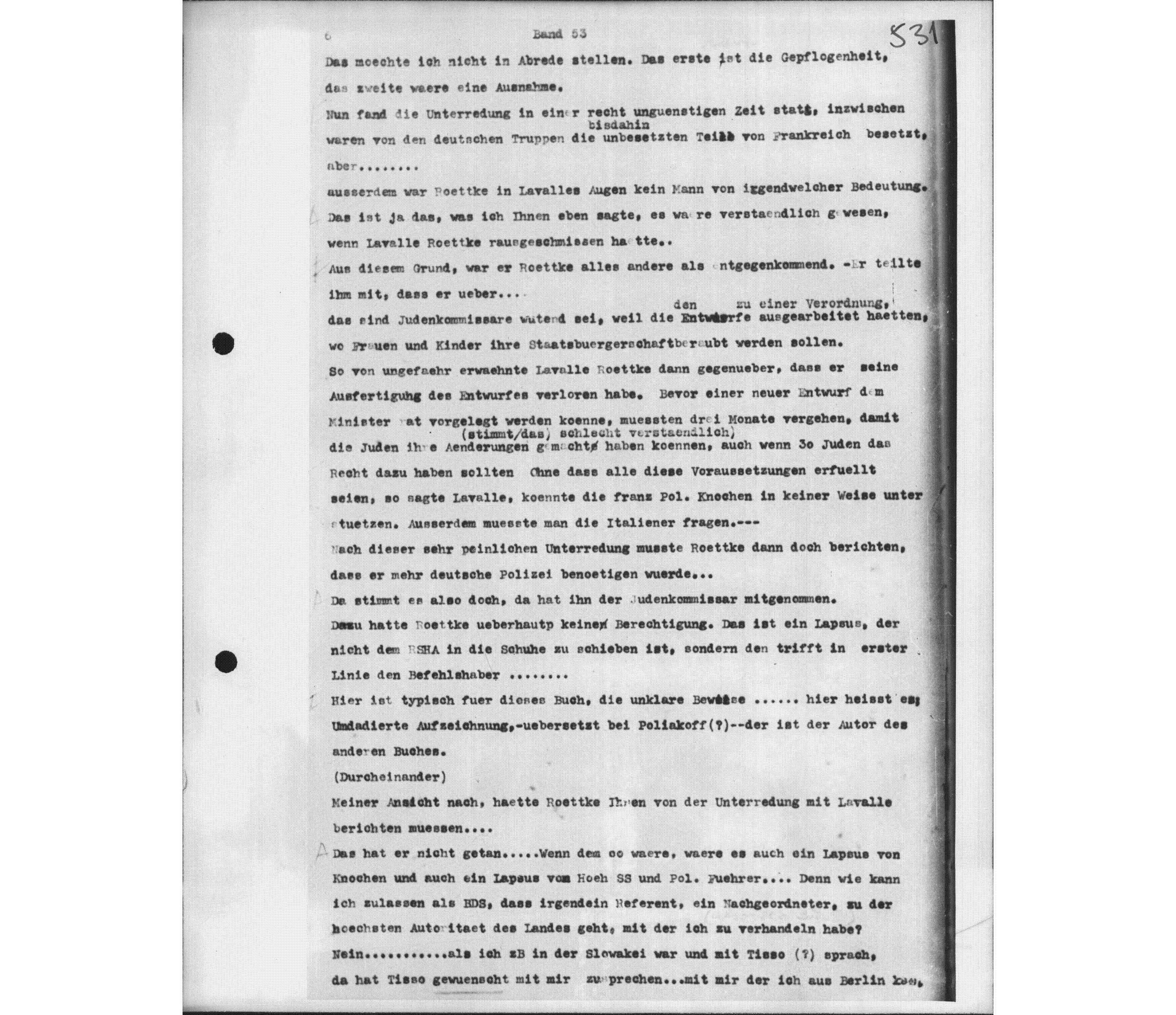
6 Band 53 [HW: 531]
Das moechte ich nicht in Abrede stellen. Das erste ist die Gepflogenheit,
das zweite waere eine Ausnahme.
Nun fand die Unterredung in einer recht unguenstigen Zeit statt, inzwischen
[TS INS: bisdahin]
waren von den deutschen Truppen die unbesetzten Teile von Frankreich besetzt,
aber........
ausserdem war Roettke in Lavalles Augen kein Mann von irgendwelcher Bedeutung.
Das ist ja das, was ich Ihnen eben sagte, es waere verstaendlich gewesen,
wenn Lavalle Roettke rausgeschmissen haette..
Aus diesem Grund, war er Roettke alles andere als entgegenkommend. -Er teilte
ihm mit, dass er ueber....
[TS INS: den zu einer Verordnung,]
das sind Judenkommissare wutend sei, weil die Entwuerfe ausgearbeitet haetten,
wo Frauen und Kinder ihre Staatsbuergerschaftberaubt werden sollen.
So von ungefaehr erwaehnte Lavalle Roettke dann gegenueber, dass er seine
Ausfertigung des Entwurfes verloren habe. Bevor einer neuer Entwurf dem
Minister rat vorgelegt werden koenne, muessten drei Monate vergehen, damit
[TS INS: (stimmt/das) schlecht verstaendlich)]
die Juden ihre Aenderungen gemachte haben koennen, auch wenn 3o Juden das
Recht dazu haben sollten Ohne dass alle diese Voraussetzungen erfuellt
seien, so sagte Lavalle, koennte die franz Pol. Knochen in keiner Weise unter
stuetzen. Ausserdem muesste man die Italiener fragen.---
Nach dieser sehr peinlichen Unterredung musste Roettke dann doch berichten,
dass er mehr deutsche Polizei benoetigen wuerde...
Da stimmt es also doch, da hat ihn der Judenkommissar mitgenommen.
Dazu hatte Roettke ueberhautp keine Berechtigung. Das ist ein Lapsus, der
nicht dem RSHA in die Schuhe zu schieben ist, sondern den trifft in erster
Linie den Befehlshaber ........
Hier ist typisch fuer dieses Buch, die unklare Bewaese ...... hier heisst es,
Umdadierte Aufzeichnung,-ueberetzt bei Poliakoff(?)--der ist der Autor des
anderen Buches.
(Durcheinander)
Meiner Ansicht nach, haette Roettke Ihnen von der Unterredung mit Lavalle
berichten muessen....
Das hat er nicht getan.....Wenn dem so waere, waere es auch ein Lapsus von
Knochen und auch ein Lapsus vom Hoeh SS und Pol. Fuehrer.... Denn wie kann
ich zulassen als BDS, dass irgendein Referent, ein Nachgeordneter, zu der
hoechsten Autoritaet des Landes geht, mit der ich zu verhandeln habe?
Nein.........als ich zB in der Slowakei war und mit Tisso (?) sprach,
da hat Tisso gewuenscht mit mir zuprechen...mit mir der ich aus Berlin kam,
English translation
6 Volume 53 [HW: 531]
I do not wish to dispute that. The first is the customary practice,
the second would be an exception.
Now the discussion took place at a really unfavorable time, in the meantime
[TS INS: up to then]
the unoccupied parts of France had been occupied by the German troops,
but........
besides, Roettke was in Lavalle's eyes no man of any importance.
That is exactly what I just told you, it would have been understandable,
if Lavalle had thrown Roettke out..
For this reason, he was anything but accommodating toward Roettke. -He informed
him that he over....
[TS INS: the about a decree,]
these are Jewish commissars was furious, because they had drawn up the drafts,
in which women and children were to be deprived of their citizenship.
So more or less Lavalle then mentioned to Roettke, that he had
lost his copy of the draft. Before a new draft could be
submitted to the council of ministers, three months would have to pass, so that
[TS INS: (correct/that) poorly legible)]
the Jews can have made their changes, even if 3o Jews should have
the right to do so Without all these preconditions being
fulfilled, so said Lavalle, the French pol. could in no way sup-
port Knochen. Besides one would have to ask the Italians.---
After this very embarrassing discussion Roettke then did have to report,
that he would need more German police...
So then it is true after all, so the Jewish commissar took him along.
For this Roettke had no authorization whatsoever. That is a lapse, which
is not to be blamed on the RSHA, but rather it falls in the first
place on the commander ........
Here is typical for this book, the unclear evidence ...... here it says,
Redated record,-translated by Poliakoff(?)--he is the author of the
other book.
(Confusion/muddle)
In my opinion, Roettke should have reported to you about the discussion with Lavalle....
He did not do that.....If that were so, it would also be a lapse of
Knochen and also a lapse of the Higher SS and Pol. Leader.... For how can
I permit as BDS, that any referent, a subordinate, goes to the
highest authority of the country, with which I have to negotiate?
No.........when for example I was in Slovakia and spoke with Tisso (?),
then Tisso wished to speak with me...with me who came from Berlin,
Transcription note
Header line: page number "6" at left, "Band 53" centered, handwritten "531" at upper right (marked [HW: 531]). Three typewritten interlinear insertions appear above the base lines: "bisdahin" (above "waren von den deutschen Truppen..."), "den zu einer Verordnung," (above "das sind Judenkommissare..."), and the editorial note "(stimmt/das) schlecht verstaendlich)" (above "die Juden ihre Aenderungen..."); these are rendered as [TS INS: ...] anchored at their nearest base line since they are typed additions rather than part of the running text. No struck-through text was identified. Several readings are impaired by faded/uneven ink strike but are legible: "Bewaese", "Umdadierte", "ueberetzt", "gemachte", "wutend" retained as visibly typed (apparent typos preserved). "Roettke" spelling consistent throughout. Numeral "3o" (with letter o) preserved as typed. Left margin has faint pencil paragraph tick marks (^/A shapes) next to several lines; these are not lexical text and are not transcribed as content.
Who is speaking
The run assigned each English turn a speaker and stated the evidence for it. The turns can abridge or regroup the translation above, so read them as attribution, not as the page text.
Eichmann
I would not want to deny that. The first is the usual practice, the second would be an exception.
Questioner
Now the conversation took place at a really unfavorable time. By then the German troops had occupied the unoccupied parts of France, but
Questioner
besides, in Laval's eyes Roettke was no man of any importance.
Eichmann
That is exactly what I told you just now, it would have been understandable if Laval had thrown Roettke out.
Questioner
For that reason he was anything but accommodating to Roettke. He told him that he was over
Questioner
that is, the commissioners for Jewish affairs, that he was furious because they had drawn up the drafts in which women and children were to be stripped of their citizenship. Laval then mentioned to Roettke more or less in passing that he had lost his own copy of the draft. Before a new draft could be put to the council of ministers, three months would have to pass so that the Jews could make their changes, even if 30 Jews should have the right to do so. Without all these conditions being met, Laval said, the French police could in no way support Knochen. Besides, the Italians would have to be asked.
Questioner
After this very embarrassing conversation Roettke did then have to report that he would need more German police.
Eichmann
So it is true after all, the commissioner for Jewish affairs took him along.
Eichmann
Roettke had no authorization for that whatever. That is a lapse which is not to be laid at the door of the RSHA. It falls in the first place on the commander [not typed]
Eichmann
What is typical of this book is the unclear [blotted] here it says, undated record, translated by Poliakoff (?), who is the author of the other book.
Questioner
In my opinion Roettke should have reported the conversation with Laval to you.
Eichmann
He did not do that. If that were so, it would also be a lapse by Knochen and a lapse by the Higher SS and Police Leader. For how, as commander of the Sipo and SD, can I allow some desk officer, a subordinate, to go to the highest authority in the country, the one I have to negotiate with? No. When for instance I was in Slovakia and spoke with Tiso (?), Tiso had asked to speak with me, with me who came from Berlin,
Translation notes
- 'Roettke' — reading of the surname as OCR'd (likely Röthke, the SD Judenreferent in Paris); left as spelled in the source.
- 'Lavalle' — as OCR'd; historically Pierre Laval; left as spelled in the source.
- 'Umdadierte Aufzeichnung' — 'Umdadierte' is not standard German; likely 'umdatierte' (redated/back-dated). Translated as 'Redated record' but the word is corrupt.
- 'Poliakoff(?)' — carries a source uncertainty marker; likely Léon Poliakov.
- 'Tisso (?)' — carries a source uncertainty marker; likely Jozef Tiso of Slovakia.
- 'Knochen' — SS officer Helmut Knochen (surname doubles as German for 'bones'); rendered as the name.
- 'BDS' — Befehlshaber der Sicherheitspolizei (Commander of the Security Police); left as the abbreviation.
- 'Referent' — SS/administrative term for a desk officer / specialist official; rendered as 'referent'.
- 'die franz Pol.' — abbreviated 'French pol.' (police); expansion inferred but abbreviation preserved.
- '3o Juden' — the 'o' appears to be a zero (30) but is written with a letter o in the source; preserved as '3o'.
- 'Das ist ja das, was ich Ihnen eben sagte' — could read either as 'That is exactly what I just told you' or 'That is just what I was telling you'; rendered literally. This is a mid-conversation page (Volume 53, p.6 / [HW:531]) of the 1957 Sassen transcript discussing the Röthke–Laval meeting in occupied France over deportation of Jewish women and children, and questions of jurisdiction/authorization (RSHA vs. local BDS/Knochen/Higher SS and Police Leader). The source carries NO explicit speaker labels or initials anywhere on the page — turns are separated only by line/paragraph breaks and by cues like 'what I just told you' and question marks. Two turns contain first-person SS-role content ('as BDS', 'when I was in Slovakia and spoke with Tisso') pointing toward Eichmann, and one turn defends the RSHA, but none carry an explicit label and none are individually conclusive on this page alone, so all dialogue turns are left UNCERTAIN except the '(Durcheinander)' stage-direction, marked OTHER. TS INS markers, ellipses, the OCR uncertainty '(...schlecht verstaendlich)', broken grammar ('the Jews can have made their changes'), and truncated fragments ('that he over....') are preserved. Note: the reference to 'BDS' negotiating with a head of state is historically loose (BDS is a police command role); preserved as written without resolving the apparent inconsistency.
Sheet 8
O.65 file 88 · 00008
This is scan 00008 of the Sassen transcript, O.65 file 88. The image is 3504 by 3024 pixels. Yad Vashem Archives, Jacob Robinson Collection O.65, file 88.
German transcription
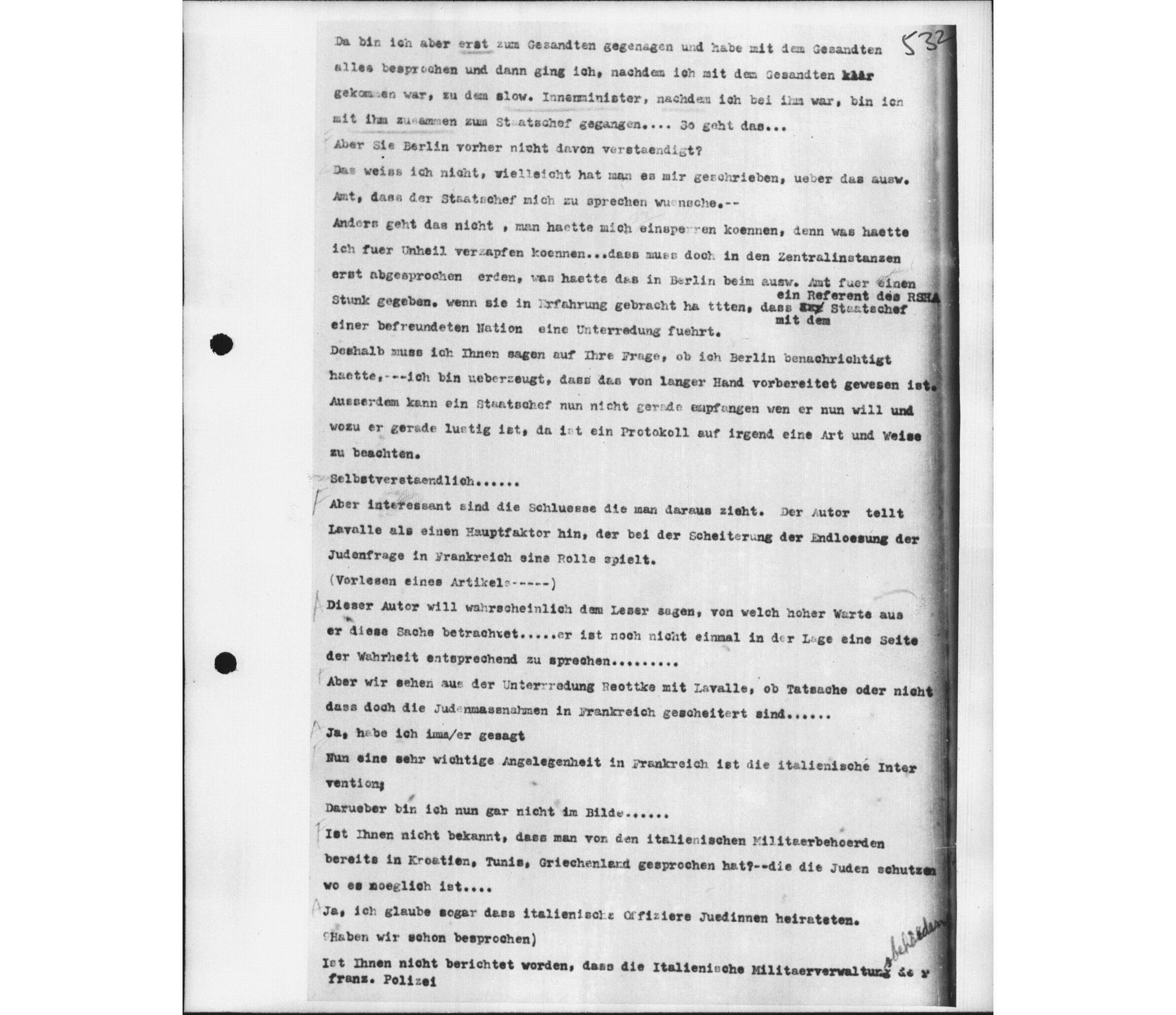
[HW: 532]
Da bin ich aber erst zum Gesandten gegenagen und habe mit dem Gesandten
alles besprochen und dann ging ich, nachdem ich mit dem Gesandten klar
gekommen war, zu dem slow. Innenminister, nachdem ich bei ihm war, bin ich
mit ihm zusammen zum Staatschef gegangen.... So geht das...
Aber Sie Berlin vorher nicht davon verstaendigt?
Das weiss ich nicht, vielleicht hat man es mir geschrieben, ueber das ausw.
Amt, dass der Staatschef mich zu sprechen wuensche.--
Anders geht das nicht , man haette mich einsperren koennen, denn was haette
ich fuer Unheil verzapfen koennen...dass muss doch in den Zentralinstanzen
erst abgesprochen erden, was haette das in Berlin beim ausw. Amt fuer einen
Stunk gegeben. wenn sie in Erfahrung gebracht ha ttten, dass [DEL: [illegible]] [TS INS: ein Referent des RSHA mit dem] Staatschef
einer befreundeten Nation eine Unterredung fuehrt.
Deshalb muss ich Ihnen sagen auf Ihre Frage, ob ich Berlin benachrichtigt
haette,---ich bin ueberzeugt, dass das von langer Hand vorbereitet gewesen ist.
Ausserdem kann ein Staatschef nun nicht gerade empfangen wen er nun will und
wozu er gerade lustig ist, da ist ein Protokoll auf irgend eine Art und Weise
zu beachten.
Selbstverstaendlich......
Aber interessant sind die Schluesse die man daraus zieht. Der Autor tellt
Lavalle als einen Hauptfaktor hin, der bei der Scheiterung der Endloesung der
Judenfrage in Frankreich eine Rolle spielt.
(Vorlesen eines Artikels-----)
Dieser Autor will wahrscheinlich dem Leser sagen, von welch hoher Warte aus
er diese Sache betrachtet.....er ist noch nicht einmal in der Lage eine Seite
der Wahrheit entsprechend zu sprechen.........
Aber wir sehen aus der Unterrredung Reottke mit Lavalle, ob Tatsache oder nicht
dass doch die Judenmassnahmen in Frankreich gescheitert sind......
Ja, habe ich imm/er gesagt
Nun eine sehr wichtige Angelegenheit in Frankreich ist die italienische Inter
vention;
Darueber bin ich nun gar nicht im Bilde......
Ist Ihnen nicht bekannt, dass man von den italienischen Militaerbehoerden
bereits in Kroatien, Tunis, Griechenland gesprochen hat?--die die Juden schutzen
wo es moeglich ist....
Ja, ich glaube sogar dass italienische Offiziere Juedinnen heirateten.
(Haben wir schon besprochen)
Ist Ihnen nicht berichtet worden, dass die Italienische Militaerverwaltung de r
franz. Polizei
[HW: [illegible]]
English translation
[HW: 532]
But there I first went to the envoy and discussed everything with the envoy and then I went, after I had come to an understanding with the envoy, to the Slov[ak] Interior Minister, after I was with him, I went together with him to the head of state.... So it goes...
But you [did] not inform Berlin of it beforehand?
That I do not know, perhaps they wrote to me, via the Foreign Office, that the head of state wished to speak with me.--
It cannot be done otherwise, they could have locked me up, for what mischief could I have caused...that must after all first be agreed in the central authorities, what a stink that would have caused in Berlin at the Foreign Office, if they had learned that [DEL: [illegible]] [TS INS: a desk officer of the RSHA is holding a] conversation [with the] head of state of a friendly nation.
Therefore I must tell you in answer to your question, whether I would have notified Berlin,---I am convinced that this had been prepared long in advance.
Besides, a head of state cannot exactly receive whomever he wants and whenever he just feels like it, there a protocol is to be observed in some way or another.
Of course......
But interesting are the conclusions one draws from it. The author p[or]trays Lavalle as a main factor who plays a role in the failure of the final solution of the Jewish question in France.
(Reading aloud of an article-----)
This author probably wants to tell the reader from what a lofty vantage point he views this matter.....he is not even in a position to speak one side of the truth correspondingly.........
But we see from the conversation Roettke with Lavalle, whether fact or not, that indeed the Jewish measures in France have failed......
Yes, I have alwa/ys said [so]
Now a very important matter in France is the Italian intervention;
About that I am really not at all in the picture......
Is it not known to you that the Italian military authorities have already spoken in Croatia, Tunis, Greece?--who protect the Jews where it is possible....
Yes, I even believe that Italian officers married Jewesses.
(We have already discussed this)
Has it not been reported to you that the Italian military administration [to] the French police
[HW: [illegible]]
Transcription note
Folio number "532" is handwritten in the top-right corner. On the line beginning "Stunk gegeben..." there is an interlinear typewritten insertion split above ("ein Referent des RSHA") and below ("mit dem") the base line; it inserts at "dass ... Staatschef", where a short overstruck word (illegible under the strike) originally stood — rendered [DEL: [illegible]] [TS INS: ein Referent des RSHA mit dem]. The word "klar" (line 2) is bold from an overtype correction. Various pencil caret/check marks appear in the left margin beside several lines (non-textual, not transcribed). A handwritten scrawl (a name?) sits in the lower-right margin near "(Haben wir schon besprochen)" — no defensible reading, marked [HW: [illegible]]. Line endings "de r" (last full line) run into the right margin. Typos preserved verbatim: "gegenagen", "slow." (for slowak.), "ha ttten", "tellt" (stellt), "Reottke", "Unterrredung", "imm/er", "schutzen".
Who is speaking
The run assigned each English turn a speaker and stated the evidence for it. The turns can abridge or regroup the translation above, so read them as attribution, not as the page text. The run did not write the speaker field for this page; it was read back from the raw response.
Eichmann
But there I first went to the envoy and discussed everything with the envoy, and then, once I had settled it with the envoy, I went to the Slovak interior minister, and after I had been with him I went with him together to the head of state. That is how it goes.
Questioner
But you did not inform Berlin of it beforehand?
Eichmann
I do not know that. Perhaps it was written to me through the Foreign Office that the head of state wished to speak to me.
Eichmann
It cannot be done any other way, they could have locked me up, for what harm might I have done. That has to be settled first at the central offices. What a stink it would have caused in Berlin at the Foreign Office if they had learned that a desk officer of the RSHA was holding a conversation with the head of state of a friendly nation.
Eichmann
So in answer to your question, whether I would have notified Berlin, I must tell you that I am convinced it had been prepared long in advance. Besides, a head of state cannot simply receive whoever he likes whenever he feels like it. A protocol has to be observed in one way or another.
Speaker not established
Of course.
Questioner
But the conclusions drawn from it are interesting. The author presents Laval as a main factor who plays a part in the failure of the final solution of the Jewish question in France.
Eichmann
This author probably wants to tell the reader from what a lofty vantage point he views the matter. He is not even in a position to state one side of the truth accurately.
Questioner
But we see from the conversation between Roettke and Laval, fact or not, that the measures against the Jews in France did fail.
Eichmann
Yes, I always said so.
Questioner
Now a very important matter in France is the Italian intervention.
Eichmann
About that I am not in the picture at all.
Questioner
Is it not known to you that people have already spoken of the Italian military authorities in Croatia, Tunis and Greece, who protect the Jews wherever it is possible?
Eichmann
Yes, I even believe that Italian officers married Jewish women.
Questioner
Has it not been reported to you that the Italian military administration [off the sheet] the French police
Translation notes
- 'gegenagen' is an OCR corruption; read as 'gegangen' (went/gone) — translated as 'went' but the exact verb form is uncertain.
- 'slow.' is an abbreviation, read as 'slowakischen' (Slovak) — rendered '[Slov(ak)]'.
- 'verzapfen' in 'Unheil verzapfen' is colloquial ('to cause/perpetrate mischief'); translated 'cause mischief' but the flavor is informal.
- 'Stunk' ('einen Stunk gegeben') is colloquial German for a row/fuss/trouble; rendered literally as 'stink'.
- 'Referent' rendered 'desk officer' (the standard RSHA-context sense); could also be 'official/reporting officer'.
- 'tellt' is an OCR truncation of 'stellt' (in 'stellt ... hin' = portrays/presents); translated 'portrays'.
- 'Lavalle' — the OCR spells the name 'Lavalle'; historically this is Pierre Laval. Preserved as written.
- 'Reottke'/'Roettke' — the name appears in two spellings on the page (both OCR variants); historically likely Heinz Röthke (SS official for Jewish affairs in France). Preserved as written in each instance.
- 'imm/er' contains a stray slash from the OCR/typescript; read as 'immer' (always).
- 'de r' / 'der' at the end is broken; the sentence trails off, so the grammatical relation of 'Italian military administration' to 'the French police' is incomplete — '[to]' is a tentative insertion of the missing preposition/verb.
- 'Judenmassnahmen' rendered 'Jewish measures' (measures against the Jews); literal compound preserved. This page (HW page number 532) is clearly dialogic — a running interview exchange — but carries NO explicit speaker labels or initials anywhere in the source. Attribution therefore rests entirely on internal content (rule 2) and, where that is insufficient, defaults to UNCERTAIN (rule 3). Two turns contain strong self-identifying content and are attributed with the most confidence: the long RSHA passage where the speaker calls himself 'a desk officer of the RSHA' (E), and the first-person diplomatic-mission narrative it answers (E). The interviewer's turns are attributed to S chiefly by discourse function — direct questions, introducing outside texts ('the author', '(Reading aloud of an article)'), raising new topics. Two short/critical turns ('Of course......' and the 'This author probably wants to tell the reader...' dismissal) are left UNCERTAIN because neither the label nor the content fixes the speaker on this page alone. The parenthetical stage directions '(Reading aloud of an article-----)', '(We have already discussed this)', and possibly '(Haben wir schon besprochen)' are transcriber/editorial insertions, not spoken turns; they are preserved inside english_literal but not emitted as separate speaker_turns. Historical note (not used to override the source): the names as OCR'd — 'Lavalle' and 'Reottke/Roettke' — most likely refer to Pierre Laval and Heinz Röthke in the context of the fate of Jews in occupied France; spellings preserved verbatim per the fidelity rules."
Sheet 9
O.65 file 88 · 00009Band 53, page 8
This is scan 00009 of the Sassen transcript, O.65 file 88. The image is 3504 by 3032 pixels. Yad Vashem Archives, Jacob Robinson Collection O.65, file 88.
German transcription
8 Band 53
Wenn sie Massnahmen gegen die Juden ergreifen wollten in der [DEL: frxx] ital.
besetzten Zone, in den Arm fiel, die Juden schuetzte? Wurde Ihnen nicht
berichtet? In Nizza. ..... .(?) [HW: 533][HW: F 34]
Ich kann mich heute nicht mehr daran erinnern.
Wurde Ihnen auch nicht berichtet, dass die Italiener die Versprechen
Massnahmen gegen die Juden zu unternehmen nicht gehalten haben, das
Gegenteil gemacht haben?
Aber wieviel Juden moegen schon dort gewesen? So aufnahmefaehig ist doch
diese Gegend gar nicht?
Ja, aber die Juden sind hingefluechtet, weil sie wussten die Italiener
werden sie schuetzen.
Jedenfalls ist es mir nicht nachhaltig im Gedachtnis haften geblieben.
Hier steht sogar, die Gestapo nahm an, dass die meisten Juden in das
von Italien besetzte Gebiet geflohen waren. Die Gestapo, wer ist das in
dem Fall?Eichmann?
Kann ebenso gut Knochen sein
Ist Ihnen der Namen Los.......der Chef der italienischen Polizei in den
besetzten Gebieten, bekannt?
Nein,
Da sind Sie aber schlecht unterrichtet ueber Faelle die dort voegekommen
sind?;
Vorlesen, undeutlich..... GeneralBastanini.......??? ergangene Befehle an
General Ambrosius, eindeutig und scharf.....
Dieses letzte Mannoever setzte Himmler eindeutig in Aufregung, dass er
Heinrich Mueller,....???
nach Rom schickte. Am 27. Maerz 43 erfuhr Mueller, dass Los.....
Italienische Polizeichef in der besetzten Zone in Suedfrankreich,
einige Tage vorher in die besetzte Zone gefahren sei aber Knochens
Nachfrage ueber. . ... war ergebnislos.
Am 6 April war Knochen so verzweifelt, dass er sichtelegrafisch nicht
nur an Eichmann sondern auch an Schellenberg wandte. Er habe von der [HW: [illegible]]
Gestapo in Marseille erfahren, dass die Juden geradezu in die [DEL: franz.]
Zone stroemten.
Wenn er das telegrafisch gemacht hat, kann ich das auch nicht wissen,
da ich ja Telegramme nie erhielt.
Aber man wird Ihnen doch berichtet haben muessen, dass die Juden
in die [DEL: fx] ital. Zone fluechteten, weil man sie dort vor den Zugriffen der
franz und deutschen Pol. schuetzte.
English translation
8 Volume 53
When they wanted to take measures against the Jews in the [DEL: frxx] Ital.
occupied zone, fell into the arm [i.e. stayed the hand], who protected the Jews? Were you not
reported to? In Nice. ..... .(?) [HW: 533][HW: F 34]
I can no longer remember that today.
Were you also not reported to, that the Italians did not keep the promises
to undertake measures against the Jews, that they did the
opposite?
But how many Jews may there already have been there? This region is surely not
so capable of taking [people] in at all?
Yes, but the Jews fled there, because they knew the Italians
will protect them.
In any case it has not remained lastingly fixed in my memory.
Here it even says, the Gestapo assumed that most Jews had fled into the
territory occupied by Italy. The Gestapo, who is that in
that case? Eichmann?
Can just as well be Knochen
Is the name Los.......the chief of the Italian police in the
occupied territories, known to you?
No,
But there you are poorly informed about cases that occurred there?;
Read aloud, indistinct..... GeneralBastanini.......??? orders issued to
General Ambrosius, unambiguous and sharp.....
This last maneuver clearly put Himmler into agitation, so that he
Heinrich Mueller,....???
sent to Rome. On 27 March 43 Mueller learned that Los.....
Italian police chief in the occupied zone in southern France,
had driven into the occupied zone a few days earlier but Knochen's
inquiry about. . ... was fruitless.
On 6 April Knochen was so desperate that he turned by telegraph not
only to Eichmann but also to Schellenberg. He had learned from the [HW: [illegible]]
Gestapo in Marseille that the Jews were positively streaming into the [DEL: franz.]
zone.
If he did that by telegraph, I cannot know that either,
since I indeed never received telegrams.
But they must surely have reported to you, that the Jews
fled into the [DEL: fx] Ital. zone, because there they were protected from the reach of the
French and German pol. [police].
Transcription note
Header: page number "8" at left, "Band 53" centered. Top-right handwritten annotations read approximately "533" and "F 34" (folio markings). A faint handwritten mark appears in the right margin near the "Schellenberg" line, illegible. "frxx" and "fx" near "ital." are struck/garbled typewritten strikeovers (abbreviation attempts), transcribed as visible. Several rows of typed periods and "???" represent gaps/undeciphered names in the base typescript (Los... = Lospinoso, not expanded per instructions). Diacritics rendered as typed (ae/ue/oe conventions and missing umlauts preserved, e.g. "Gedachtnis").
Who is speaking
The run assigned each English turn a speaker and stated the evidence for it. The turns can abridge or regroup the translation above, so read them as attribution, not as the page text.
Questioner
…when they wanted to take measures against the Jews in the [blotted] Italian-occupied zone, stepped in and protected the Jews? Were you not told about it? In Nice [not typed]
Eichmann
I can no longer remember it today.
Questioner
Were you also not told that the Italians did not keep their promise to take measures against the Jews, that they did the opposite?
Eichmann
But how many Jews can there have been there? That region can't hold all that many.
Questioner
Yes, but the Jews fled there, because they knew the Italians would protect them.
Eichmann
In any case it hasn't stayed with me in any lasting way.
Questioner
It even says here that the Gestapo assumed most of the Jews had fled into the territory occupied by Italy. The Gestapo, who is that in this case, Eichmann?
Eichmann
It could just as well be Knochen.
Questioner
Does the name Los [not typed], the head of the Italian police in the occupied territories, mean anything to you?
Eichmann
No.
Questioner
Then you are badly informed about the cases that occurred there.
Questioner
General Bastanini [too faint] orders issued to General Ambrosius, clear and sharp [not typed]
Questioner
This last maneuver put Himmler into such a state that he [too faint] sent Heinrich Mueller to Rome. On 27 March 43 Mueller learned that Los [not typed], the Italian police chief in the occupied zone in southern France, had driven into the occupied zone some days earlier, but Knochen's inquiry about [not typed] came to nothing.
Questioner
On 6 April Knochen was so desperate that he turned by telegram not only to Eichmann but also to Schellenberg. He had heard from the Gestapo in Marseille that the Jews were positively streaming into the [blotted] zone.
Eichmann
If he did that by telegram, I can't know about it either, since I never received telegrams.
Questioner
But someone must surely have reported to you that the Jews were fleeing into the [blotted] Italian zone, because they were protected there from the reach of the French and German police.
Translation notes
- "in den Arm fiel" is rendered literally as "fell into the arm"; the German idiom "jemandem in den Arm fallen" means to stay/restrain someone's hand. The sentence is grammatically broken (subject unclear), so the intended actor who "stayed the hand" is ambiguous.
- "aufnahmefaehig" translated as "capable of taking [people] in"; in context it means capacity to absorb/accommodate refugees, but the literal sense is "capable of reception/absorption."
- "Los......." is an incomplete/truncated surname in the source (partial name of the Italian police chief); left untranslated and truncated as in the German.
- "General Ambrosius" appears in the German; the historical figure is General Vittorio Ambrosio — but the source reads "Ambrosius" and is preserved verbatim.
- "Bastanini" (read aloud, marked uncertain with ???) likely refers to Giuseppe Bastianini; spelling preserved as in source.
- "nachhaltig im Gedaechtnis haften geblieben" rendered literally as "remained lastingly fixed in my memory"; "nachhaltig" here means enduringly/lastingly.
- "geradezu ... stroemten" translated "positively streaming"; "geradezu" as an intensifier ("downright/positively") is rendered but its exact force is interpretive.
- The final clause "weil man sie dort vor den Zugriffen der franz und deutschen Pol. schuetzte" — "Pol." is an abbreviation expanded to "police" in brackets; "Zugriffen" rendered "reach/grasp" (literally acts of seizure/apprehension). This page (Volume 53, p. 8) is a live interview exchange concerning the flight of Jews into the Italian-occupied zone of southern France, and correspondence between Knochen, Eichmann, Müller (Mueller), Schellenberg, and the reading-aloud of a source document. The German is heavily broken diplomatic transcription with OCR uncertainty markers (?, ???, ....., truncated names). No explicit speaker labels or initials appear anywhere on the page, so all attributions rest on turn content alone (attribution rule 2). Confident S turns are those posing direct questions to \"Ihnen/Sie\" or reading from a document while naming Eichmann in the third person (which excludes Eichmann as the speaker). Confident E turns are first-person memory/knowledge disclaimers answering those questions (\"I can no longer remember,\" \"I never received telegrams\"). Three turns are left UNCERTAIN because their content does not by itself fix the speaker: the \"how many Jews\" skeptical question, the \"Yes, but... " reply, and the terse \" The [HW: 533], [HW: F 34], and [HW: [illegible]] handwritten margin marks are archival/reference annotations, not speech, and are preserved in english_literal but excluded from speaker_turns. [DEL: ...] deletions (frxx, franz., fx) are preserved inline as struck source text.
Sheet 10
O.65 file 88 · 00010Band 53, page 9
This is scan 00010 of the Sassen transcript, O.65 file 88. The image is 3504 by 3032 pixels. Yad Vashem Archives, Jacob Robinson Collection O.65, file 88.
German transcription
9 Band 53 [HW: 535]
Diese Flucht der Juden war offentsichtlich von dem Direktor der franz-
ital. Bank finanziert. Los..... tauchte auf und verschwand wieder.
Mueller verlangte, dass er nach Berlin gebracht werden wuerde. Aber Los...
konnte erst im Mai aufgefunden werden, als Roettke von der Gestapo in
Marseille erfuhr, dass der ehem. Polizeichef von Bari, dass war Los....
gwesen frueher, in der Uniform eines Generals in der Villa in
lebe. Er war der Vorstand eines Kommissariats fuer jued. Angelegenheiten
und sein Gehilfe war Donardi, dieser Bankdirektor, Halbjude, wohnhaft, dort
und dort........
(Weiteres Vorlesen,.....
.....dass ungefaehr 50 000 Juden in der ital. besetzten Zone lebten .....
Deswegen wundert es mich sehr, dass Sie der Meinung waren, dass dort
nur sehr wenig Juden gelebt haben...?
Wie gross war denn diese Zone?
Die gesamten Altmarken,, die Stadt Nizza, mit 1/2 Mill Einwohner, mit
Umgebung, und Renopel(?).-
Da muessten ja, als die ital. Wehrmacht kapitulierte, diese Juden fuer
unseren Zugriff wieder da gewesen sein...
Ist Ihnen von der Angelegenheit sonst nichts in Erinnerung?
Nein..... aber ich glaube, dass da doch ziemlich uebertrieben wird...
Mit dichterischer Freiheit entsprechend ausgeschmueckt worden.
Das Etwas, dass da daran wahr sein mag, ist sicherlich vom Reichshorizont
ausgesehen, so kuemerlich, dass es gar nicht so Reichswichtig war, und mir
heute auch nicht mehr erinnerlich ist. Damit weil ich aber nicht sagen,
dass mir alle reichswichtigen Sachen heute noch in Erinnerung sind.
Sie schickten ja dann auch Anton Brunner nach Marseille, um grosse
Razzien auf die Juden zu machen
Wann?
Obwohl die deutsche Armee erst am 1.11. Nizza besetzten, hatte der Plan
die Juden aus M..... zurueckzubringen, keine grossen Fortschritte
gemacht, nur 2000 hatte man hingeschafft und der Rest konnte sich in den
Bergdoerfern verteilen..
Bzgl. Charakter von Roettke; Roettkes Erklaerungen erwiesen sich meist
als leere Drohungen. Brunner galng es nicht ohne Hilfe der franz Polizei
eine Razzia in Gang zu bringen. Die gesamte Judenregister wurden ver-
nichtet, als die Italiener sich zurueckzogen, sodass der gute Brunner
angewiesen war, auf der Strasse Jagd nach den Juden zu machen?????
English translation
9 Volume 53 [HW: 535]
This flight of the Jews was evidently financed by the director of the French-Italian bank. Los..... surfaced and disappeared again. Mueller demanded that he be brought to Berlin. But Los... could only be located in May, when Roettke learned from the Gestapo in Marseille that the former police chief of Bari, that had been Los.... earlier, was living in the uniform of a general in the villa in. He was the head of a commissariat for Jewish affairs and his assistant was Donardi, this bank director, half-Jew, resident, there and there........
(Further reading aloud,.....
.....that approximately 50,000 Jews lived in the Italian-occupied zone .....
That is why it surprises me very much that you were of the opinion that only very few Jews had lived there...?
How large then was this zone?
The entire Altmarken,, the city of Nice, with 1/2 million inhabitants, with surroundings, and Renopel(?).-
Then, when the Italian Wehrmacht capitulated, these Jews must have been available again for our access...
Do you otherwise remember nothing about the matter?
No..... but I believe that this is being rather exaggerated...
Embellished accordingly with poetic license.
The something that may be true about it is certainly, seen from the Reich horizon, so paltry that it was not at all Reich-important, and is also no longer memorable to me today. By that, however, I do not want to say that all Reich-important matters are still in my memory today.
You then also sent Anton Brunner to Marseille to carry out large raids on the Jews
When?
Although the German army only occupied Nice on 1.11., the plan to bring the Jews back from M..... had made no great progress, only 2000 had been transported there and the rest could disperse into the mountain villages..
Regarding the character of Roettke; Roettke's declarations proved mostly to be empty threats. Brunner did not succeed in getting a raid going without the help of the French police. The entire Jewish register was destroyed when the Italians withdrew, so that the good Brunner was directed to hunt for the Jews on the street?????
Transcription note
Typewritten transcript page, Part4/00010. Header line reads page number "9", centered "Band 53", and a handwritten folio number in the top-right corner read as "535" (the final digit is ambiguous, could be a flourished 5). The typewriter shows many light/uneven strikes (e.g. "offentsichtlich", "gwesen", "kuemerlich", "galng") which are preserved as visibly typed rather than corrected. In "wohnhaft" (line 8) there is a darker overstrike on the "h" area but a defensible reading is "wohnhaft"; left as typed. "Renopel(?)" and the "M....." abbreviation reproduce the typist's own parenthetical and elided text. No genuine later handwritten additions, typewritten insertions, or struck-through text are present in the body; the only handwriting is the corner folio number. Two hole-punch marks at left margin do not obscure text.
Who is speaking
The run assigned each English turn a speaker and stated the evidence for it. The turns can abridge or regroup the translation above, so read them as attribution, not as the page text.
Questioner
This flight of the Jews was evidently financed by the director of the French-Italian bank. Los [not typed] surfaced and disappeared again. Mueller demanded that he be brought to Berlin. But Los [not typed] could not be found until May, when Roettke learned from the Gestapo in Marseille that the former police chief of Bari, which is what Los [not typed] had been earlier, was living in the uniform of a general in the villa in [not typed]. He was the head of a commissariat for Jewish affairs, and his assistant was Donardi, that bank director, a half-Jew, living at such and such an address [not typed]
Questioner
[not typed] that about 50,000 Jews were living in the Italian-occupied zone [not typed] That is why it surprises me very much that you were of the opinion that only very few Jews lived there.
Eichmann
How large was this zone, then?
Questioner
The whole of the Alpes-Maritimes, the city of Nice with half a million inhabitants, with its surroundings, and Renopel [too faint]
Questioner
Then when the Italian army capitulated, those Jews must have been within our reach again.
Questioner
Do you remember nothing else about the matter?
Eichmann
No, but I think this is being considerably exaggerated. Embellished with a certain poetic license. Whatever may be true about it is certainly, seen from the horizon of the Reich, so slight that it was not at all important to the Reich, and I no longer remember it today either. By that I don't mean to say that I still remember everything of importance to the Reich.
Questioner
You then also sent Anton Brunner to Marseille, to carry out big raids on the Jews.
Eichmann
When?
Questioner
Although the German army only occupied Nice on 1 November, the plan to bring the Jews back from M [not typed] had made no great progress. Only 2,000 had been taken there, and the rest were able to scatter into the mountain villages.
Questioner
On Roettke's character. Roettke's declarations mostly proved to be empty threats. Brunner did not manage to get a raid going without the help of the French police. The whole Jewish registry was destroyed when the Italians pulled out, so that the good Brunner was reduced to hunting for Jews in the street.
Translation notes
- 'Altmarken' — meaning uncertain in context; rendered literally. It may be an OCR corruption (possibly 'Alpes-Maritimes', which would fit the Nice geography), but the German as given reads 'Altmarken' and is preserved rather than resolved.
- 'Renopel(?)' — the source itself marks this with '(?)'; likely a garbled place name (possibly 'Grenoble'), left untranslated/literal to preserve the source uncertainty.
- 'für unseren Zugriff wieder da gewesen sein' — 'available again for our access/grasp'; 'Zugriff' here in the deportation sense (seizure/access to persons), rendered as 'access'.
- 'Das Etwas, dass da daran wahr sein mag' — awkward German ('The something that may be true about it'); the doubled/ungrammatical 'dass' constructions in the source are preserved as broken grammar.
- 'Mit dichterischer Freiheit entsprechend ausgeschmueckt worden' — a sentence fragment ('Embellished accordingly with poetic license'), lacking a subject in the German; preserved as a fragment.
- 'Damit weil ich aber nicht sagen' — the German reads 'weil' (because) where sense requires 'will' (want to); translated as 'I do not want to say' following the evident intended meaning, but the source word is 'weil'.
- 'Los.....', 'M.....' — truncated/redacted names in the source, preserved as-is.
- 'gwesen' — OCR form of 'gewesen' (had been); '1/2 Mill' = half a million.
- The number '1.11.' (1 November) and figure '2000' are transcribed as in source; date format literal. This is a mid-conversation page (Band 53, HW: 535) of the 1957 Sassen interview concerning the fate of Jews in the Italian-occupied zone of France (Nice/Marseille) and the roles of Roettke, Brunner, and Mueller. The page mixes (a) read-aloud source material flagged by the parenthetical '(Weiteres Vorlesen' / '(Further reading aloud'), (b) interviewer questions, and (c) at least one clearly first-person respondent reply. Because the transcription carries NO explicit speaker labels or initials, attributions rest on content alone. The strongest attributions are: the memory-minimizing first-person passage ('No... I believe this is being exaggerated... no longer memorable to me... Reich horizon') = Eichmann (E), and the challenging 'you'-directed questions = Sassen (S). Several expository third-person paragraphs are most likely read-aloud source text and are left UNCERTAIN rather than forced into a dialogue turn. The lone 'When?' and the geographic-answer 'The entire Altmarken...' are genuinely ambiguous and could be either read material or spoken replies. Per the attribution rules, no admission has been forced onto Eichmann or Sassen where the page's own content does not compel it.
Sheet 11
O.65 file 88 · 00011Band 53, page 10
This is scan 00011 of the Sassen transcript, O.65 file 88. The image is 3504 by 3032 pixels. Yad Vashem Archives, Jacob Robinson Collection O.65, file 88.
German transcription
10 Band 53 [HW: 53b]
Ja, das weiss ich, das stimmt, daran entsinne ich mich noch...
Als Eichmann bald darauf mit der deutschen Armee in Nizza auftauchte,
war er ueber das geringe Ausmass der Beute sehr enttaeuscht--aber er-
kannte bald wo die Erklaerung dafuer lag.
Die waren in den Bergen....
Er erfuhr, dass sich 15 000 Juden in den Bergen aufhielten und zwar in den
Bergen von dem Fuerstentum Monaco.....
Ja, das stimmt, ich bin selber durch Monaco durchgefahren
Und was haben Sie dort veranlsst?
In Monaco selber konnte ich nichts machen .... tabu
Aber am 23. Sept erhielt der deutsche Konsul in Monaco vom ausw. Amt den
Auftrag der Sipo den Zutritt zu dem Fuerstentum. ..
Ja, das stimmt, aber es verlief negativ...
Aber der Konsul war nur in der Lage 1000 Juden zu finden, die dort schon
seit Jahren [DEL: xxxxx] igx ansaessig waren, aber Eichmann gab nicht nach
und verwies immer wieder darauf dass 10-15 000 Juden da sein muessten...
Ja, das stimmt
Im Juli 44 teilte der Konsul dem ausw. Amt mit, von Thadden, dass die
meisten der 1000 Juden, nach dem Eichmann auf den Plan getreten war,
in die Schweiz, nach Spanien....
entkommen waren. Uebrig bleiben 45 Juden, die alle unter besonderem
Schutz standen.
Ja, das stimmt alles, das hatte sich rumgesprochen und saemtliche Juden
sind sofort ab von Monaco...
Was halten Sie fu r die Gruende, dass die geplante Endloesung der Juden
in Frankreich so gescheitert [DEL: xx] ist?
2 Gruende;
1. die mangelnde Greesse von Dannecker. Die anderwaertige dienstliche
Inanspruchnahme Knochens.
2. Die Resistenz der Reg, Lavalle, die nach einem Anfangselan erlahmte,
vielleicht durch das Missgeschick unserer Waffen vorsichtiger wurde
und leiser trat.. Das sind meine Gruende.
Ist Ihnen zahlenmaessig etwas in Erinnerung, wieviel Juden deportiert
wurden?
Fingerspitzengefuehlsmaessig moechte ich die Zahl so auf 40 000 beschreiben
Aus dem Buero von Roettke ist eine Liste gefunden worden, und nach dieser
Liste gingen 45 Zuege ab.-Der Autor schaetzt die Zahl auf 65 000.
English translation
Yes, I know that, that is correct, I still remember that...
When Eichmann showed up in Nice shortly afterward with the German army, he was very disappointed about the small extent of the loot--but he soon recognized where the explanation for it lay.
They were in the mountains....
He learned that 15,000 Jews were staying in the mountains, and indeed in the mountains of the Principality of Monaco.....
Yes, that is correct, I myself drove through Monaco
And what did you arrange there?
In Monaco itself I could do nothing.... taboo
But on 23 Sept the German consul in Monaco received from the Foreign Office the order [to grant] the Sipo access to the Principality...
Yes, that is correct, but it went negatively...
But the consul was only in a position to find 1000 Jews who had already been resident there [DEL: xxxxx] igx for years, but Eichmann did not give in and pointed again and again to the fact that 10-15,000 Jews had to be there...
Yes, that is correct
In July 44 the consul informed the Foreign Office, von Thadden, that most of the 1000 Jews, after Eichmann had come onto the scene, into Switzerland, to Spain....
had escaped. Remaining are 45 Jews, who all stood under special protection.
Yes, that is all correct, that had got around and all the Jews are immediately off from Monaco...
What do you consider to be the reasons that the planned final solution of the Jews in France so failed [DEL: xx]?
2 reasons;
1. the lacking size [greatness] of Dannecker. The other official commandeering of Knochen.
2. The resistance of the government, Laval, which slackened after an initial élan, perhaps became more cautious through the misfortune of our weapons and trod more softly.. Those are my reasons.
Is anything in your memory numerically, how many Jews were deported?
By a feel of the fingertips [gut feeling] I would like to describe the number at around 40,000
From the office of Röttke a list has been found, and according to this list 45 trains departed.-The author estimates the number at 65,000.
Transcription note
Typewritten interview transcript page. Header: typed "10" (upper left), "Band 53" (center); handwritten "53b" in upper right corner (the "b" clearly hand-added). Two round hole-punch marks in left margin. Faint check/tick marks in left margin beside most lines (annotator marks, not text). Struck-over garble before "igx ansaessig" rendered as [DEL: xxxxx] — the typist overstruck characters; the following "igx" appears to be a further typing artifact but is left as visible. "veranlsst", "geplante Endloesung" reads "geplante Endloesung" (typed "gepkante"/"Indloesung" faintly — transcribed as visible best reading). "Greesse" (typed, likely for "Groesse"), "Knochens" (for Knochen), "Lavalle" (Laval), "Roettke" (Röthke) all preserved as typed. "[DEL: xx]" before "ist?" is an overstruck correction. Names Eichmann appear with faint first letter throughout; read as intended from context but strokes support "Eichmann".
Who is speaking
The run assigned each English turn a speaker and stated the evidence for it. The turns can abridge or regroup the translation above, so read them as attribution, not as the page text.
Eichmann
Yes, I know that, that's right, I still recall it.
Questioner
When Eichmann turned up in Nice with the German army soon afterwards, he was very disappointed at how small the haul was, but he soon recognized where the explanation lay.
Eichmann
They were in the mountains.
Questioner
He learned that 15,000 Jews were staying in the mountains, in the mountains of the principality of Monaco.
Eichmann
Yes, that's right, I drove through Monaco myself.
Questioner
And what did you arrange there?
Eichmann
In Monaco itself I could do nothing. Taboo.
Questioner
But on 23 September the German consul in Monaco received from the Foreign Office the instruction to get the Sipo access to the principality.
Eichmann
Yes, that's right, but it came to nothing.
Questioner
But the consul was only able to find 1,000 Jews, who had been resident there for years [blotted], yet Eichmann would not give way and kept pointing out that there must be 10,000 to 15,000 Jews there.
Eichmann
Yes, that's right.
Questioner
In July 44 the consul informed the Foreign Office, von Thadden, that most of the 1,000 Jews, after Eichmann had come on the scene, had escaped to Switzerland, to Spain. There remained 45 Jews, who were all under special protection.
Eichmann
Yes, that is all correct, word had got around and all the Jews left Monaco at once.
Questioner
What do you take to be the reasons that the planned final solution of the Jews in France failed so badly?
Eichmann
Two reasons. First, Dannecker's lack of stature. Knochen being taken up with other official duties. Second, the resistance of the Laval government, which slackened after an initial burst, and perhaps grew more cautious and trod more quietly because of the reverses suffered by our arms. Those are my reasons.
Questioner
Do you remember anything in figures, how many Jews were deported?
Eichmann
By feel I would put the number at around 40,000.
Questioner
A list was found in Roettke's office, and according to that list 45 trains departed. The author estimates the number at 65,000.
Translation notes
- 'Beute' rendered 'loot/booty'; in context it means the yield/haul of Jews to be seized, not literal plunder — translated literally as 'loot' to avoid resolving.
- 'Fingerspitzengefuehlsmaessig' has no clean English equivalent; rendered literally as 'by a feel of the fingertips' with '[gut feeling]' as gloss.
- 'die mangelnde Greesse von Dannecker' — 'Greesse' is likely a misspelling of 'Groesse' (size/greatness/stature); translated 'the lacking size [greatness]' preserving the ambiguity between physical stature and figurative greatness/competence.
- 'Reg, Lavalle' — 'Reg' = Regierung (government); 'Lavalle' is the French premier Pierre Laval (spelling doubled-l in source).
- 'leiser trat' rendered 'trod more softly' — idiomatic for becoming more restrained/quiet; kept literal.
- 'Roettke' — likely Heinz Röttke (Rothke), a name; spelling as in source.
- 'Der Autor schaetzt' — 'The author' is ambiguous (author of the list? of the interview/book?); left literal. Page header reads '10 Band 53 [HW: 53b]'. The transcription carries NO explicit speaker labels or initials anywhere on the page, so all attribution rests on content alone. Two textual signatures recur: (a) third-person narration about Eichmann ('Als Eichmann... auftauchte', 'Er erfuhr', 'Eichmann gab nicht nach') — these cannot be Eichmann speaking of himself and read as the interviewer/narrator, attributed 'S'; (b) direct second-person questions ('Und was haben Sie dort veranlasst?', 'Was halten Sie fuer die Gruende...', 'Ist Ihnen zahlenmaessig etwas in Erinnerung...') — interviewer prompts, attributed 'S'. The interleaved first-person confirmations and answers ('Ja, das stimmt, ich bin selber durch Monaco durchgefahren', 'In Monaco selber konnte ich nichts machen', 'Fingerspitzengefuehlsmaessig...') are the natural respondent turns and in an interview of Eichmann would be Eichmann — but this page carries no label and the content alone does not exclude another participant, so per the attribution rules they are left UNCERTAIN rather than assigned to Eichmann. This is deliberate: attributing these admissions to Eichmann without page-local evidence would be an evidentiary over-reach. OCR/transcription artifacts preserved verbatim: 'veranlsst', 'ausw. Amt', 'Sept', '[DEL: xxxxx] igx ansaessig', 'gescheitert [DEL: xx]', 'Greesse', 'Fuer' (line-split 'fu r'), 'rumgesprochen'. The '..../.....' ellipses of varying length are kept as trailing markers of the diplomatic transcription."
Sheet 12
O.65 file 88 · 00012Band 53, page 11
This is scan 00012 of the Sassen transcript, O.65 file 88. The image is 3504 by 3024 pixels. Yad Vashem Archives, Jacob Robinson Collection O.65, file 88.
German transcription
11 Band 53 [HW: 537]
Wenn also 75 Zuege abgegangen sein sollen und der Autor auf 65000 schliesst,
dann heisst das, dass es Zuege gegeben hat unter 1000. Und das es Zuege
gegeben haben soll, unter 1000, das will mir nicht so recht einleuchten.
Das moechte ich vom Fahrplantechn. Standpunkt aus nicht recht unter-
schreiben.-Er sagt also 65 000-ich 40 000, also sagen wir rund 50 000
Was war das Programm der Gestapo in Frankreich fuer die Aussiedlung
Der Sinn?
Das was ich jetzt sage, trifft nicht nur fuer Frankreich zu auch fuer die
anderen Laender, soweit Deutschland aus Sicherheitsgruenden Interesse hatte.
Der Jude war von der gesetzesmaessigen deutschen Reichsregierung als [DEL: [?Jude?]] [TS INS: Staats-feind]
proklamiert -Die Regierung musste ihre Gruende haben, warum sie diesen
Feind vordringlichst zu eleminieren x bestrebet war. Nun einmal der Befehl
zur Eleminierung eines Reichsfeindes gegeben ward, musste dieser Befehl auch
durchgefuehrt werden. Welche Gruende die Reichsregierung hatte, um in die-
sem Feind die Bedrohung des Volkes und Staates zu sehen, war Aufgabe
der Regierung gewesen, wir, als die Polizei hatten entsprechend zu ver-
fahren gehabt......
Davon haben wir schon so oft gesprochen.... mich interessiert Frankreich.
Koennen Sie zahlenmaessig nichts naeheres angeben?
Wenn ich Ihnen vorhin sagte, dass die Schuld auch auf unserer Seite lag,
dass das Ergebnis nicht erreicht wurde, als zweiten Punkt aber auch noch
die Resistenz nannte... so will ich Ihnen das noch erklaeren.
Je mehr Sie von der Mitte Europas nach Westen kommen, um so groesser ist
der Einfluss des asimil. eingestellten Juden, im Hinblick auf die uebrigen
jued. polit. Richtungen
Der franz. Buerger sieht in dem Juden, der sich, wenigstens aeusserlich
von allen jued. Bindungen losgesagt hat und nun als Buerger der Republik
lebte und wirkte, keinen Juden, keine Bedrohnis, keine Gefahr, keinen
Feind. Er sieht ihn, als seinesgleichen. Es ist sehr schwer in einem
[TS INS: dem Volk] solchen Land, in dem der asimil. eingestellte Teil, von uns als Feind
anerkannten [DEL: [?Feind?]] [TS INS: Juden] , ihn als [DEL: [?mit?]] seinen mit aergsten Feind, glaubhaft zu
machen, weil die Lebenspraxis ihm das Contaere sagt. So hat sicherlich
von Petain angefangen, ueber Lavalle bis zum letzten franz. Bauer,
oder bis zu de Bergen von.... es ihm gewissermassen zur
[TS INS: Verpflichtung gemacht] dass er diese fraguten, farnz Buerger, dem Zugriff der Bo......
entziehen musss.(Dieser Satz ist nicht ganz klar.....)
Da lag wieder eine Schwierigkeit
English translation
11 Volume 53 [HW: 537]
If, then, 75 trains are supposed to have departed, and the author concludes 65,000, then that means there must have been trains under 1,000. And that there are supposed to have been trains under 1,000, that does not quite make sense to me. From the timetable-technical standpoint I would not quite subscribe to that.—He says thus 65,000—I 40,000, so let us say roughly 50,000
What was the program of the Gestapo in France for the resettlement
The purpose?
What I am now saying does not apply only to France but also to the other countries, insofar as Germany had an interest for reasons of security. The Jew had been proclaimed by the lawful German Reich government as [DEL: [?Jew?]] [TS INS: enemy of the state]—The government must have had its reasons why it strove most urgently to eliminate x this enemy. Now, once the order for the elimination of an enemy of the Reich was given, this order also had to be carried out. What reasons the Reich government had, to see in this enemy the threat to the people and state, had been the task of the government; we, as the police, had to proceed accordingly......
We have spoken of that so often already.... France interests me. Can you give nothing more precise in terms of numbers?
If I told you earlier that the fault also lay on our side, that the result was not achieved, but as a second point also named the resistance... then I will explain that to you further.
The more you come from the middle of Europe toward the West, the greater is the influence of the assimilation-minded Jew, in regard to the remaining Jewish political tendencies
The French citizen sees in the Jew, who has, at least outwardly, renounced all Jewish ties and now lived and worked as a citizen of the Republic, no Jew, no menace, no danger, no enemy. He sees him as one of his own kind. It is very difficult in such a [TS INS: to the people] country, in which the assimilation-minded part, recognized by us as enemy [DEL: [?enemy?]] [TS INS: Jews], to make [him] credible as his most bitter enemy [DEL: [?with?]] his, because the practice of life tells him the contrary. Thus certainly, beginning from Petain, through Lavalle down to the last French peasant, or down to the mountains of.... it made it, so to speak, into an [TS INS: obligation made] that he must withdraw these [fraguten] French citizens from the grasp of the Bo...... (This sentence is not entirely clear.....)
There again lay a difficulty
Transcription note
Header: typed "11" (upper left), "Band 53" (center; band digits somewhat faint), and a handwritten "537" in ink at upper right corner (folio). Two file-punch holes at left margin (rendered as black dots), not text. Interlinear typewritten insertions present, all in the same typeface as the base text and marked [TS INS: ...]:
- "Staats-feind" typed in two half-rows above/across the end of the "Der Jude war..." line and the start of "proklamiert"; it replaces a short struck typewritten word after "als" (read tentatively as "Jude"). Rendered as [DEL: [?Jude?]] [TS INS: Staats-feind] with the insertion adjacent to the cancelled span; the physical "feind" fragment sitting above "proklamiert" is subsumed into the whole word.
- "dem Volk" typed above "solchen Land"; no visible strike on the base line, so treated as a non-replacing insertion anchored before "solchen Land".
- "Juden" typed above "anerkannten [struck word]"; the struck word (tentatively "Feind") is replaced, rendered [DEL: [?Feind?]] [TS INS: Juden].
- "Verpflichtung gemacht" typed at the left margin below the "...gewissermassen zur" line, completing "zur Verpflichtung gemacht"; rendered as a [TS INS:] anchored before "dass er diese fraguten". Struck-through single character "x" in "zu eleminieren x bestrebet war" left as literal "x" (a small crossed mark used inline). A second inline struck "mit" before "seinen mit aergsten Feind" marked [DEL: [?mit?]]. Uncertain/idiosyncratic base-text readings preserved verbatim as typed, without correction: "das es Zuege" (for dass), "au s"/"des s"/"dieser" broken by intra-word spaces from worn keys, "eleminieren"/"Eleminierung", "Bedrohnis", "Contaere", "Lavalle", "fraguten", "farnz Buerger", "Bo......" (broken word), "musss". "der sich," has a small stray mark after "sich" (possibly a slash); read as "sich,". Repeated trailing periods (e.g. "gehabt......", "von....", "klar.....") counted approximately. Because the whole page is typed prose with the corrections in the same typewriter, the [TS INS] insertions could alternatively be read as the original typist's same-session corrections rather than a later hand; markers applied per protocol for interlinear insertions.
Who is speaking
The run assigned each English turn a speaker and stated the evidence for it. The turns can abridge or regroup the translation above, so read them as attribution, not as the page text. The run did not write the speaker field for this page; it was read back from the raw response.
Eichmann
So if 75 trains are supposed to have departed and the author arrives at 65,000, then that means there were trains carrying under 1,000. And that there are supposed to have been trains under 1,000, that doesn't really make sense to me. From the standpoint of timetabling I wouldn't want to endorse that. So he says 65,000, I say 40,000, so let's say roughly 50,000.
Questioner
What was the Gestapo's program in France for the resettlement? The point of it?
Eichmann
What I am saying now applies not only to France but also to the other countries, insofar as Germany had an interest for reasons of security. The Jew had been proclaimed an enemy of the state by the lawful German government of the Reich. The government must have had its reasons why it sought to eliminate this enemy as a matter of priority. Once the order to eliminate an enemy of the Reich had been given, that order had to be carried out too. What grounds the government of the Reich had for seeing in this enemy a threat to the people and the state had been the government's business. We, as the police, had to act accordingly.
Questioner
We have spoken about that so often already. France is what interests me. Can you give nothing more definite in figures?
Eichmann
When I told you earlier that the fault also lay on our side, that the result was not achieved, but named the resistance as a second point, let me explain that further. The further you come from the middle of Europe towards the west, the greater is the influence of the Jew of assimilated outlook, as against the other Jewish political tendencies. The French citizen sees in the Jew, who had at least outwardly renounced all Jewish ties and now lived and worked as a citizen of the republic, no Jew, no menace, no danger, no enemy. He sees him as one of his own kind. It is very hard, in such a country, to make the assimilated part of the people, the Jews we recognized as an enemy, credible to him as his own worst enemy, because the practice of life tells him the contrary. So from Petain onwards, by way of Laval, down to the last French peasant, or as far as the mountains of [not typed], it made it a sort of duty for him that he should keep these [too faint] French citizens out of the reach of the [not typed].
Eichmann
There lay another difficulty
Translation notes
- 'Aussiedlung' rendered as 'resettlement' — the Nazi-euphemistic term for deportation; kept literal rather than glossed as 'deportation'.
- 'eleminieren'/'Eleminierung' (misspelled in source) translated literally as 'eliminate'/'elimination'; the intended sense (deportation vs. killing) is not resolved in the translation.
- 'x bestrebet war' — the stray 'x' before 'bestrebet' is preserved; 'bestrebet' is an archaic/broken form of 'bestrebt' (strove/endeavored).
- 'in dem der asimil. eingestellte Teil ... ihn als seinen mit aergsten Feind ... glaubhaft zu machen' is grammatically broken in the German; the English follows the fractured syntax and the object of 'to make credible' is not clearly stated.
- 'seinen mit aergsten Feind' — literally 'his most bitter enemy'; the position of 'mit' is anomalous and preserved as broken grammar.
- 'von....' after Petain/Lavalle ('bis zu de Bergen von....') breaks off; the trailing place-name is missing in the source and left as an ellipsis.
- 'fraguten' is not a standard German word (possibly a typo for 'braven'/'guten' or similar); left untranslated in brackets as [fraguten].
- 'dem Zugriff der Bo......' breaks off; 'Bo......' is incomplete (plausibly 'Bochen'/'Boches' or another word) and preserved as an incomplete word; not resolved.
- 'Verpflichtung gemacht' [TS INS] combined with the surrounding 'es ihm gewissermassen zur ... dass' yields a broken construction ('made it, so to speak, into an obligation ... that'); English preserves the awkwardness.
- 'de Bergen' — 'de' appears where standard German would have 'den'; preserved. This is page 11 of Band 53 (with a handwritten '537'), a continuous portion of the Sassen interview on the deportation of Jews from France. The page carries no explicit speaker labels or initials anywhere — all speaker attribution is inferred from content only (question vs. answer, first-person 'we, as the police' / 'our side' operational identification for the respondent). The opening train/number dispute at the top of the page is left UNCERTAIN because the 'I' vs 'the author' framing cannot be pinned to Sassen or Eichmann from this page alone and there is no preceding context. Diplomatic markers preserved verbatim: [HW: 537] header; [DEL: ...] deletions with [?...?] uncertain readings; [TS INS: ...] typescript insertions; the parenthetical editorial note '(Dieser Satz ist nicht ganz klar.....)' rendered '(This sentence is not entirely clear.....)'. Proper names kept as spelled in source: 'Petain' (Pétain), 'Lavalle' (Laval). Several broken/incomplete words ('fraguten', 'Bo......', trailing 'von....') left unresolved per instruction. The large blank gap in 'bis zu de Bergen von.... es ihm' is preserved as spacing."
Sheet 13
O.65 file 88 · 00013
This is scan 00013 of the Sassen transcript, O.65 file 88. The image is 3504 by 3024 pixels. Yad Vashem Archives, Jacob Robinson Collection O.65, file 88.
German transcription
12
Dass die franz. Polizei nur zoegernd und auderud mittat, liegt auf der-
selben Linie. Je weiter Sie nun nach dem Osten kommen, von der Mitte des
Reiches ausgesehen, um so bereitwilliger sind in der Regel die Leute
g wesen, so sagt es die Praxis,--hier diesen Para iten, wie man zu sagen
pflegte, auszustossen, weil die Gelegenheit guenstig war, sich hier davon
u befreien.. Eine einzige Ausnahme war , und zwar im suedoestlichen Teil,
Ungarn gewesen. In Ungarn war d r Teil der asimil. eingestellten Juden,
im V rgleich mit den anderen oestlichen Laendern, unverhaeltnismaessig gross
gewesen. Daher befuerchtete man auch seitens der deutschen Reichsregierung
dass in Ungarn aehnlcihes passieren koennte, wie dies im gesamten Westen
geschah. Frankreich ist nicht das einzige Beispiel, der Kampf in Holland
um die Juden ist genau so hart und zaeh gewesen, wenn auch nicht ganz so
aber im grossen und ganzen nicht durchschlagend. In Belgien genauso.
Als man in Ungarn anfing hatte man noch als Fanal, den Aufstand im
Warschauer Ghetto. Daher hat ich habe mir selbst Gedanken gemacht, als
ich nun nach jahrelanger Taetigkeit [DEL: inxdinxxxxx] hinter dem Schreibtisch,
in die rauhe Wirklichkeit der Praxis kam, daher hat der RF sich gesagt,
jetzt muss er selbst hinaus, um Ungarn zu loeffeln. Ungarn war sehr
schwer. Weil eben der asimil. eingestellte Jude mit dem Wirtsvolk dort
v rwachsen, verschwaegert, ver ippt war.......und weil es in einem solchem
Stadium wirklich sehr schwer ist, erst einmal die gesetzliche Untermauerung
durch zupauken und von da dann rueber zu klettern in die exekutive Durch-
fuehrung, wobei immer zu bedenken ist, dass es sich um souveraene oder
halbsouveraene Laender handelt, die ueb r ihre eigene Exekutive verfuegt,
u
die sich gar nicht oder nur sehr schw r von der Ocpationsmacht exekutiv
auch nu das leiseste einreden lassen. Und so geht dass nur in den ersten
Sekunden Stunden oder Wochen mit Elan.... und sind diese ersten Sekunden
verpasst, aaben sie nur noch mit einem waohsenden Widerstand zu rechnen
der ihnen ehr viel Kraft nimmt, die sie an sich auf die Erledigung ihrer
Sachen haett n konzentrieren muessen.--
Mit wieviel Juden in Frankreich haben Sie gerechnet?
Genau kann ich mich heute nicht mehr erinnern, aber ein Vielfaches von dem
was nicht nu erfasst, sondern was auch feststellbar errechnet wurde.
Ein Vielfaches, jedenfalls nie und nimmer 40-50000
Was sagen Sie zu der Zahl 300 000.
Ja, das moechte ich wohl annehmen. Denn soviel Juden auch von Frankreich
abgefahren wurden, so sind doch zumindestens in den Jahren von 1o39 bis
1940
English translation
12
That the French police cooperated only hesitantly and [auderud — uncertain, illegible OCR], lies along the same line. The further you now come toward the East, seen from the center of the Reich, the more willingly the people were as a rule, so practice says it,—to cast out this parasite here, as one used to say, because the opportunity was favorable to free oneself of it here.. A single exception was, and indeed in the southeastern part, Hungary. In Hungary the portion of assimilation-minded Jews was, in comparison with the other eastern countries, disproportionately large. Therefore one also feared on the part of the German Reich government that in Hungary something similar could happen as it happened throughout the entire West. France is not the only example, the fight in Holland over the Jews was just as hard and tough, even if not quite so [incomplete], but on the whole not decisive. In Belgium just the same. When one began in Hungary one still had as a beacon/signal the uprising in the Warsaw Ghetto. Therefore has — I have made my own thoughts, when I now after years of activity [DEL: inxdinxxxxx] behind the desk, came into the rough reality of practice, therefore the RF said to himself, now he himself must go out, to spoon out Hungary. Hungary was very difficult. Because precisely the assimilation-minded Jew was there grown together with, intermarried with, interrelated with the host people.......and because in such a stage it is really very difficult, first of all to hammer through the legal underpinning and from there then to climb over into the executive carrying-out, whereby it must always be considered that these are sovereign or half-sovereign countries, which dispose over their own executive,
u
that let themselves not at all or only very hardly be talked into even the slightest thing executively by the occupation power. And so that goes only in the first seconds hours or weeks with élan.... and once these first seconds are missed, they have only to reckon with a growing resistance which takes very much strength from them, which they should actually have had to concentrate on the settling of their affairs.—
With how many Jews in France did you reckon?
Exactly I can no longer remember today, but a multiple of that which was not only registered, but which was also determinably calculated. A multiple, in any case never ever 40-50000
What do you say to the number 300 000.
Yes, that I would well assume. For as many Jews as were driven off from France too, so are yet at least in the years from 1939 to
1940
Transcription note
Page number "12" typed top-left. Handwritten folio "938" top-right corner. Two hole-punch marks in left margin. Fingerprint/smudge marks in left margin. Several handwritten bracket/tick marks in the lower-left margin beside the Q&A lines (dialogue markers), not transcribable as text. A struck-through span appears after "Taetigkeit" — cancelled typewritten letters read approximately "inxdinxxxxx" and are marked [DEL:]; the strikeover is by overtyped x/i characters. A small handwritten "u" correction appears above "Ocpationsmacht"/"souveraene" line indicating intended letter. Faint carbon/offset ghosting throughout. Many characters faded due to weak carbon impression; readings preserve visible (often defective) forms rather than corrected spellings (e.g. "asimil.", "aehnlcihes", "Ocpationsmacht", "waohsenden", "1o39").
Who is speaking
The run assigned each English turn a speaker and stated the evidence for it. The turns can abridge or regroup the translation above, so read them as attribution, not as the page text.
Eichmann
That the French police took part only hesitantly and [too faint] lies along the same line. The further east you go, seen from the middle of the Reich, the more willing the people were as a rule, that is what practice says, to throw out this parasite here, as people used to say, because the opportunity was favorable to rid themselves of it. There was one single exception, in the southeastern part, and that was Hungary. In Hungary the proportion of assimilated Jews had been disproportionately large compared with the other eastern countries. So the German Reich government also feared that something similar could happen in Hungary as had happened across the whole West. France is not the only example. The fight in Holland over the Jews was just as hard and stubborn, even if not quite so [not typed] but on the whole it did not carry through. In Belgium the same. When they began in Hungary they still had the uprising in the Warsaw ghetto as a warning signal. So the RF said to himself, and I thought about it myself when after years of work [blotted] behind the desk I came into the rough reality of practice, that now he had to go out himself to scoop out Hungary. Hungary was very hard, because the assimilated Jew there was grown together with the host people, intermarried with it, related to it by marriage [not typed] and because at such a stage it is really very hard first to hammer through the legal foundation and then to climb over from there into executive implementation. You always have to bear in mind that these are sovereign or half-sovereign countries with their own executive, which will not be talked into even the slightest executive step by the occupying power, or only with great difficulty. And so it only goes with drive in the first seconds, hours or weeks, and once those first seconds are missed you have to reckon with a growing resistance that takes a great deal of the strength you should have been concentrating on getting your own business done.
Questioner
How many Jews in France did you reckon with?
Eichmann
I can no longer remember exactly today, but a multiple of what was not only registered but also calculated in a verifiable way. A multiple, in any case never ever 40 to 50,000.
Questioner
What do you say to the figure of 300,000?
Eichmann
Yes, I would well accept that. Because however many Jews were shipped out of France, at least in the years from 1939 to 1940
Translation notes
- 'auderud' in the first line is garbled OCR (likely a mangled adverb such as 'zaudernd' = 'hesitantly/dawdling', which would duplicate 'zoegernd'); left untranslated and flagged rather than resolved.
- 'Para iten' / 'Parasiten' — OCR gap; rendered 'parasite' on the assumption of 'Parasiten', but the exact word is uncertain.
- 'wie man zu sagen pflegte' rendered 'as one used to say'.
- 'als Fanal' rendered 'as a beacon/signal'; 'Fanal' carries the sense of a signal-fire or portent.
- 'um Ungarn zu loeffeln' — literally 'to spoon out Hungary'; an unusual idiom, kept literal.
- 'RF' expanded parenthetically as Reichsführer (i.e. Himmler) but the source gives only the abbreviation 'RF'.
- The deleted string [DEL: inxdinxxxxx] is illegible struck-through text; preserved as-is.
- 'feststellbar errechnet' rendered 'determinably calculated' — the phrase is awkward in German and the intended sense is not fully clear.
- '40-50000' and '300 000' and '1o39' (OCR 'o' for zero, i.e. 1939) preserved as written; the final '1940' stands alone on the last line as the sentence breaks off.
- 'zumindestens' is a non-standard blend of 'zumindest'/'mindestens'; rendered 'at least'. Page 12 of a continuous 1957 Buenos Aires interview transcript. The page opens mid-sentence (continuation of a prior monologue) and closes mid-sentence. The long opening block is a single continuous first-person statement by the respondent with no visible turn boundary; because the source carries no speaker labels and the opening block's speaker cannot be fixed with certainty from this page alone, it is marked UNCERTAIN despite its operational content. The lower half of the page contains a clear question–answer alternation (two short questions, each followed by a first-person statistical reply), which supports S/E attribution by the direct-question / answering-reply criterion. No explicit initials or labels appear anywhere on the page. A stray 'u' appears in the right margin between two lines (OCR of a marginal mark or correction) and is preserved in english_literal. The 'RF' reference (superior who decides to 'go out' to handle Hungary) points to Himmler as a third party spoken about, not a speaker on this page."
Sheet 14
O.65 file 88 · 00014Band 53, page 13
This is scan 00014 of the Sassen transcript, O.65 file 88. The image is 3504 by 3024 pixels. Yad Vashem Archives, Jacob Robinson Collection O.65, file 88.
German transcription
13 Band 53 [HW: 539]
Juden aus dem deutschen Reich getürmt und ausgewandert.......
Es heisst, dass die Gestapo bzgl. des Progr mmes vollkommen im Dunklen
gewesen sei---Sind denn die Leute mit Unterlagen dort hingekommen, oder
sind sie wirklich im Dunkeln getappt und mussten sie sich ihre Unterlagen
erst dort schaffen. Wie war denn das?
Im we entlichen ja, ohne Unterlagen. Die Anläufzeit war ja viel zu kurz
gewesen, in allen Laendern, wir mussten uns in der Regel an die jued.
Jahresbuecher halten und dann haben sie noch einen kleinen Prozentsatz
da u gegeben, die in den jued. Buechern nicht eingetragen waren, aber die
nach unseren Gesetzen auch als Juden galten, dann hatten man so ungefaehr
eine Zahl. Unser Anhaltspunkt waren die statistischen jued. Jahresbuecher
gewesen.
Also dann timmt die Behauptung, dass die Gestapo voellig im Dunkeln
gewesen sei....
Ja, in Frankreich jedenfalls, ja...
Also nochmal bzgl. der abtransportierten und vernichteten Juden....
Man hat also weniger als 65 000--davon sind nach dem Kriege 2 800 zurueck-
gekehrt,.-
Die in Roettkes Buero gefundene Liste vom 1. Juli 1944, sagt man dass es
75 Deport. Zuege gegeben habe. Gewoehnlich befoerdere ein aus 20 Waggons
be tehender Zug 1000 Juden, aber zahlreiche paetere Transporte waren viel
kleiner, die oben angegebene Ziff r ist zwar nicht abschliessend, duerfte
aber eher nach unten als noch oben zu korrigieren sein.
Ich sagte Ihnen 40 000 habe ich in meinem Gedaechtnis, so habe ich doch
nicht ganz unrecht.
Stimmt dass, dass man auf Grund der vorliegenden Schwi rigkeiten, mit
Hilfe der franz Pol. die Juden zahlenmaessig zu erfassen, zu registrieren,
zu konzentrieren....... dass man einfach jued. Waisenhaeuser etc....
hergenommen hat, um die Zahlensolls zu erfuellen?
Hat es nicht gegeben
Auf Grund eines Befehles zu einer grossen Razzia sind10000 Juden zu er-
zur beruehmten 16 Juli 42
fassen..... Razzia
Nein, nein, was ist das denn fuer ein Befehl,----sind zu erfassen -----
das kann doch nur ein unzulaenglicher Geist gegeben haben....
Sie haben ja zugegeben, dass Dannecker ein unzulaenglicher Geist war.
(Streit um Dannecker)
Nach den Dienstverpflichtungen spa ter hat man alle moeglichen Leute
bekommen, die gab es aber um diese Zeit noch nicht.-- [HW: [?Dannecker?]]
English translation
13 Volume 53 [HW: 539]
Jews fled and emigrated out of the German Reich.......
It is said that the Gestapo was completely in the dark regarding the programme---Did the people arrive there with documentation/records, or were they really groping in the dark and did they have to procure their documentation only there. How was that then?
Essentially yes, without documentation. The lead-in/start-up time had after all been much too short, in all countries, we had as a rule to keep to the Jewish yearbooks and then they also gave a small percentage there [in addition] who were not entered in the Jewish books, but who according to our laws also counted as Jews, then one had roughly a figure. Our reference point had been the statistical Jewish yearbooks.
So then the assertion is correct that the Gestapo had been completely in the dark....
Yes, in France at any rate, yes...
So once more regarding the deported and exterminated Jews....
One thus has less than 65,000--of these 2,800 returned after the war,.-
The list found in Röttke's office of 1 July 1944, they say that there were 75 deport[ation] trains. Usually a train consisting of 20 wagons transports 1000 Jews, but numerous later transports were much smaller, the figure given above is indeed not conclusive, but would rather be corrected downward than upward.
I told you 40,000 I have in my memory, so I am after all not entirely wrong.
Is that correct, that on account of the existing difficulties, of recording, registering, concentrating the Jews numerically with the help of the French pol[ice]....... that one simply took Jewish orphanages etc.... in order to fulfil the quota figures?
There was no such thing
On account of an order for a big raid, 10000 Jews are to be recorded..... [HW: to the famous 16 July 42] raid
No, no, what kind of order is that then,----are to be recorded-----that can only have been given by an inadequate mind....
You have after all admitted that Dannecker was an inadequate mind.
(dispute about Dannecker)
Later, according to the labor-service obligations [Dienstverpflichtungen], one got all sorts of people, but those did not yet exist around this time.-- [HW: [?Dannecker?]]
Transcription note
Scan: Part4_10623185/00014.jpg. Faded carbon-copy typescript with many dropped/partial glyphs (represented with intra-word spaces where the pixels give no defensible character, e.g. "Progr mmes", "we entlichen", "Ziff r", "Schwi rigkeiten", "be tehender", "spa ter"). Page number "13" upper left, centered heading "Band 53", handwritten "539" upper right (archival foliation). Two round hole-punch marks and dark thumb/ink smudges in left margin; small handwritten tick/caret marks appear in the left margin before several question lines (not transcribed as text). The lines "Hat es nicht gegeben", "Auf Grund eines Befehles ... zu er-", "zur beruehmten 16 Juli 42", "fassen..... Razzia" are crammed together as a dense typed block with tight interlinear spacing; "zur beruehmten 16 Juli 42" sits squeezed between the "zu er-"/"fassen" split word — plausibly a same-machine insertion but transcribed in visual reading order without an insertion marker since a later-layer origin cannot be confirmed from the pixels. "sind10000" written closed-up in the original. Faint cursive scrawl at lower right corner, tentatively "Dannecker". "getürmt", "Dunklen"/"Dunkeln", and umlaut-anomalous "Anläufzeit" transcribed as the strokes appear.
Who is speaking
The run assigned each English turn a speaker and stated the evidence for it. The turns can abridge or regroup the translation above, so read them as attribution, not as the page text.
Eichmann
Jews [blotted] out of the German Reich and emigrated
Questioner
It is said that the Gestapo was completely in the dark about the programme. Did the people arrive there with records, or were they really groping in the dark and had to get their records only once they were there? How was it?
Eichmann
Essentially yes, without records. The run-up time was far too short, in every country. As a rule we had to go by the Jewish yearbooks, and then they added a small percentage who were not entered in the Jewish books but who counted as Jews under our laws, and then you had roughly a figure. Our reference point was the statistical Jewish yearbooks.
Questioner
So the claim that the Gestapo was completely in the dark is correct
Eichmann
Yes, in France at any rate, yes.
Questioner
So once more about the Jews who were deported and destroyed. So there were fewer than 65,000, and of those 2,800 came back after the war.
Questioner
The list found in Roettke's office dated 1 July 1944, they say there were 75 deportation trains. Normally a train of 20 wagons carried 1,000 Jews, but many later transports were much smaller. The figure given above is not final, but it should be corrected downward rather than upward.
Eichmann
I told you I have 40,000 in my memory, so I am not entirely wrong after all.
Questioner
Is it correct that because of the difficulties in numerically recording, registering and concentrating the Jews with the help of the French police, they simply took Jewish orphanages and so on to meet the quota figures?
Eichmann
That did not happen.
Questioner
On the basis of an order for a big raid, 10,000 Jews are to be recorded [not typed] raid
Eichmann
No, no, what kind of an order is that, are to be recorded, only an inadequate mind can have given that.
Questioner
You have admitted that Dannecker was an inadequate mind.
Eichmann
Under the later labor-service obligations you got all sorts of people, but they did not exist yet at that time.
Translation notes
- 'Unterlagen' rendered as 'documentation/records' — it can mean supporting documents, records, or data/materials; the exact sense (identity papers vs. statistical source material) is not fixed by the page.
- 'Anlaufzeit' (OCR 'Anläufzeit') rendered 'lead-in/start-up time' — the ramp-up period before operations; wording chosen for literalness.
- 'da u gegeben' read as 'dazu gegeben' ('gave in addition / added'); the OCR gap makes this a reconstruction, though the sense ('a small further percentage') is fairly clear.
- 'Röttke' is the OCR form of the surname Röthke (Heinz Röthke); left as written in the German-derived form 'Röttke' in the literal text.
- 'Dienstverpflichtungen' rendered 'labor-service obligations' (compulsory labor/service assignments); the precise institutional referent is not specified on the page.
- The final clause 'die gab es aber um diese Zeit noch nicht' — 'those' (die) refers ambiguously to the 'all sorts of people' just mentioned; rendered literally without resolving the referent.
- 'im Dunkeln getappt' rendered idiomatically as 'groping in the dark' to match 'im Dunkeln gewesen' ('in the dark') in the same passage. Single page, Band 53, HW page number 539. This is a rapid question-and-answer exchange about the deportation and murder of Jews from France (Röttke = Heinz Röthke, SD/Judenreferat in Paris; Dannecker = Theodor Dannecker, Eichmann's representative in France; the "famous 16 July 42" raid = the Vél d'Hiv roundup). The transcript carries NO explicit speaker labels or initials anywhere on the page — attribution rests entirely on turn content. The page alternates between an interviewer pressing questions/reading from documents and a first-person respondent who recounts SS/IVB4 methodology ("we had to keep to the Jewish yearbooks", "our laws", "our reference point") and personal memory of figures ("I told you 40,000 I have in my memory"). That first-person operational voice is Eichmann's; the questioning/document-citing voice is Sassen's. Several turns are confidently attributable on content alone; a few short ones are genuinely ambiguous and left UNCERTAIN. "(Streit um Dannecker)" is a stage/editorial note, not a speaker turn, and is excluded from speaker_turns. OCR artifacts preserved: "we entlichen"=wesentlichen, "Progr mmes"=Programmes, "Anläufzeit"=Anlaufzeit, "da u"=dazu, "timmt"=stimmt, "Röttke"=Röthke, "be tehender"=bestehender, "paetere"=spätere, "Ziff r"=Ziffer, "Schwi rigkeiten"=Schwierigkeiten, "sind10000"=sind 10000. The "[HW: to the famous 16 July 42] raid" insertion is a handwritten interlinear note inside the raid-order sentence.
Sheet 15
O.65 file 88 · 00015Band 53, page 14
This is scan 00015 of the Sassen transcript, O.65 file 88. The image is 3504 by 3032 pixels. Yad Vashem Archives, Jacob Robinson Collection O.65, file 88.
German transcription
14 Band 53 [HW: 540]
Nochmals die Kinderangelegenheiten, hier schreibt Dr. Hoellers, der in
Drans... und in Auschwitz alles mit erlebt hatte,--dass im Juli 1944
[TS INS: die][DEL: das] Pariser Waisenhaus/ [TS INS: er] und das Rotschild Altersheim geleert wurden
Roettkes Akten enthalten einen Bericht dass sich schon frueher aehnliches
zugetragen hatte, am 6 April 44; (Vorlesung des Artikels......)
.....Abschubverfahren.--Nichts bekannt?
Also die Aktion in Frankreich ist gescheitert.-
Ja, gescheitert.
Der Autor streicht in diesem Zusammenhang die un (?)
Lavalles heraus.-
Mit Recht.....
Er schreibt; In Frankreich....(unverstaendlich .
den seine Landsleute nach dem Kriege als Verraeter erschossen haben.
(Weiteres Vorlesen.....
Mit anderen Worten--Asimil Juden, hier hat der Mann es natuerlich in ein
anderes Fahrwasser gegeben-ich sprach es nuechtern, sachlich aus.
Er schreibt, dass nur ein viertel der in Frankreich lebenden Juden der
Endloesung zugefuehrt wurden....
Der war ja gar kein Jude mehr, der war ja Franzose...
Aber das bedeutende ist ja, dass Lavalle der Grossmeister ist in dem
Sieg der Allii ueber die Deutschen ist. Lavalle hat dem Fuehrer Sand in die
Augen gestreut, er hat gemacht dies und jenes und Lavalle war ein ganz
schlauer franz Bauer, der nur an Frankreich dachte, die ganze Europaidee
war ihm schnuppe. Wir haben den Krieg verloren, als der Fuehrer Petain
die Hand drueckte.
Als die Parade auf der Champs d ... statt fand.
Nicht das allein, dieses krampfhafte Suchen Deutschland einer Freundschaft
dieses Sau-Frankreichs....
Buhlens, nicht Suchen..... Und 2. Duennkirchen.... das war eines der
Naegel die den Sarg zuklopften
Haben Sie bei allen Massnahmen, die Sie btr. der Judenfrage trafen,
nie an die stimmenmaessige Auswirkung im feindlichen und vor allen
Dingen im neutralen Ausland gedacht.?
Ich kann da nichts anderes denken, als wie kann ich den erhaltenen Be-
fehl, gut und schnellstmoeglich zur Ausfuehrung bringen
English translation
14 Volume 53 [HW: 540]
Once again the children's matters, here Dr. Hoellers writes, who had experienced everything in
Drans... and in Auschwitz,--that in July 1944
[TS INS: the][DEL: the] Paris orphanage/ [TS INS: he] and the Rothschild old-age home were emptied
Roettke's files contain a report that something similar had already occurred earlier,
on 6 April 44; (reading aloud of the article......)
.....deportation procedure.--Nothing known?
So the operation in France failed.-
Yes, failed.
The author brings out in this connection the un (?)
of Lavalle.-
Rightly so.....
He writes; In France....(unintelligible .
whom his countrymen shot as a traitor after the war.
(further reading aloud.....
In other words--assimilated Jews, here the man has of course put it into
another channel-I stated it soberly, matter-of-factly.
He writes that only a quarter of the Jews living in France were
brought to the Final Solution....
He was no longer a Jew at all, he was a Frenchman...
But the significant thing is that Lavalle is the grand master in the
victory of the Allies over the Germans. Lavalle threw sand in the Führer's
eyes, he did this and that and Lavalle was a very
cunning French peasant, who thought only of France, the whole European idea
was of no concern to him. We lost the war when the Führer shook Pétain's
hand.
When the parade on the Champs d ... took place.
Not that alone, this frantic seeking by Germany for a friendship
of this swine-France....
Wooing, not seeking..... And 2. Dunkirk.... that was one of the
nails that hammered the coffin shut
Did you, with all the measures you took regarding the Jewish question,
never think of the effect in terms of opinion abroad in enemy and above
all in neutral foreign countries.?
I can think nothing other than, how can I carry out the received
order well and as quickly as possible
Transcription note
Page-in-band number "14" at top-left; header "Band 53" centered. Handwritten "540" in ink at top-right corner (folio/archival number). Top of page has two typewritten interlinear insertions ("die" and "er") typed above the line; the first-word overtype-struck token reading as "das" is marked [DEL: das] with the inserted "die" adjacent, and "er" placed near the Waisenhaus/und anchor where it sits. The "/" after "Waisenhaus" is present in the base typescript. Several characters are faint/broken due to a large water/ink stain across the left-center of the page, but readings are defensible. Three punch holes visible along the left margin (no text lost).
Who is speaking
The run assigned each English turn a speaker and stated the evidence for it. The turns can abridge or regroup the translation above, so read them as attribution, not as the page text.
Questioner
The children's matters again. Dr. Hoellers writes here, who lived through it all in Drans [not typed] and in Auschwitz, that in July 1944 the Paris orphanage and the Rothschild old people's home were emptied. Roettke's files contain a report that something similar had happened earlier, on 6 April 44.
Questioner
[not typed] deportation procedure. Nothing known?
Questioner
So the operation in France failed.
Eichmann
Yes, failed.
Questioner
In this connection the author brings out the [not typed] of Laval.
Eichmann
Rightly so.
Questioner
He writes: In France [not typed]
Questioner
whom his countrymen shot as a traitor after the war.
Eichmann
In other words, assimilated Jews. Here the man has of course steered it into a different channel. I said it soberly and matter-of-factly.
Questioner
He writes that only a quarter of the Jews living in France were taken to the Final Solution.
Eichmann
He was no longer a Jew at all, he was a Frenchman.
Eichmann
But the important thing is that Laval is the grand master in the victory of the Allies over the Germans. Laval threw sand in the Fuehrer's eyes, he did this and that, and Laval was a very shrewd French peasant who thought only of France. The whole European idea meant nothing to him. We lost the war when the Fuehrer shook Petain's hand.
Questioner
When the parade took place on the Champs [not typed]
Eichmann
Not that alone. This desperate seeking by Germany for a friendship with this swinish France.
Questioner
Wooing, not seeking. And second, Dunkirk. That was one of the nails that closed the coffin.
Questioner
In all the measures you took on the Jewish question, did you never think about the effect on opinion abroad, in enemy countries and above all in neutral countries?
Eichmann
I can think of nothing other than how I can carry out the order I received well and as quickly as possible
Translation notes
- 'Dr. Hoellers' — surname per OCR; could be Hoellersmann or similar; rendered as written.
- 'Drans...' is an incomplete word in the source (likely 'Drancy', the French transit camp) but left incomplete as it appears; not silently completed.
- 'die un (?) Lavalles' — the noun after 'un' is missing/uncertain in the German (marked with '(?)'); the sentence 'The author brings out ... the un (?) of Lavalle' is left incomplete because the object noun is not legible/present.
- 'Asimil Juden' rendered 'assimilated Jews' — 'Asimil' is an abbreviated/incomplete form of 'assimiliert'; interpretation of the intended word.
- 'Lavalle' throughout is the OCR spelling; the historical figure is Pierre Laval, but the source spelling is preserved.
- 'Champs d ...' is incomplete in the source (likely 'Champs Élysées') but left incomplete as written.
- 'Buhlens' rendered 'Wooing' — 'buhlen' = to woo/court; the '-s' ending is grammatically irregular in the German and preserved in the reading.
- 'Endloesung zugefuehrt' rendered 'brought to the Final Solution' — literal; 'zufuehren' = to lead/bring to.
- 'stimmenmaessige Auswirkung' rendered 'effect in terms of opinion/voice' — 'Stimmen' can mean votes or voices/opinion; rendered as public-opinion effect.
- 'Roettke' / 'Roettkes' is the OCR spelling (historically Kurt/Heinz Röthke); source spelling preserved. This is a page of interview dialogue with NO explicit speaker labels or initials in the source. Per the attribution rules, no turn carries a source label (rule 1 unavailable), and no turn's content is unambiguous enough on this page alone to fix the speaker (rule 2). Accordingly all turns are marked UNCERTAIN per rule 3. Two turns are the clearest candidates for attribution and are noted as such in their basis without being resolved: the direct question 'Did you... never think of the effect...' reads as an interviewer (Sassen) turn, and the reply 'I can think nothing other than, how can I carry out the received order...' reads as a respondent (Eichmann) reply — but neither is fixed, because deliberately mis-attributing an admission (e.g. the order-execution reply) to Eichmann would be a serious evidentiary error if wrong. The page contains heavy document-reading ('reading aloud of the article'), which further blurs which words are spoken by which participant. Header line preserves 'Band 53' (Volume 53), page number 14, and the handwritten '540'. Diplomatic markers ([TS INS], [DEL], (?), (unintelligible), incomplete words) preserved in english_literal.
Sheet 16
O.65 file 88 · 00016Band 53, page 15
This is scan 00016 of the Sassen transcript, O.65 file 88. The image is 3504 by 3024 pixels. Yad Vashem Archives, Jacob Robinson Collection O.65, file 88.
German transcription
15 Band 53 [HW: 541]
Das meine ich jetzt nicht.-- Haben Sie nie bei Erhalt eines Befehles
sich Gedanken gemacht oder Bedenken gehabt....
Gut, man erhalet einen Befehl, und befolgt ihn auf Grund des Eides....
aber man macht sich doch Gedanken???
Es war ein Reichsfeind
Nein, ich meine nun die stimmungsmaessige Auswirkung der Massnahmen im
feindlichen und neutralen Ausland.... haben Sie nie daran gedacht?
Da koennen Sie ich nicht in meine Haut versetzen, dass koennen Sie nie,
weil Sie bis zum Schluss im SD gewesen sind...Aber wenn Sie heute in der
Exekutive sind dann interessiert Sie das gar nicht..
Also Sie haben sich keine Gedanken gemacht?
Nein, keinesfalls, es war mir voellig egal gewesen. Ich war in der Exe-
kutive gewesen, ich bekam einen Befehl und hatte den auszufuehren und ich
sagte Ihnen schon einmal, wenn ich meinen Vater haette verhaften muessen...
tja.... ich war in d r Exekutive drin.....
Ich glaube Sie missverstehen die Frage....
Sie sind doch nachrichtenmaessig oder SD ein bischen vorbelastet gewesen.
Ja, das bin
Nun ist das eine zweite Natur in einem Menschen, dass er wenn er nun solche
Exekutivmassnahmen trifft,....
Dazu muss ich noch sagen, dass wir geradezu zu berichten hatten, wie
wirken sich die Massnahmen auf die Juden stimmungsmaessig aus...aber wohl
genau o hat das Amt VI berichtet, was spricht das feindliche Ausland,
das neutrale Ausland.....wie wirkte es sich auf die Bevoelkerung aus....
Und diese Sachen wurden doch zumindestens nachrichtendienstlich an Sie
herangetragen, also haben Sie sich doch Gedanken machen muessen..
Informatorisch...
Also haben Sie sich doch Gedanken gemacht....
Persoenlich---gar nichts....Loesung...
Aber wenn es nun so war... in Schweden spricht man nun ueber die und die
Angelegenheit----in Auschwitz enden die Judentransporte in der und der .
Form.... da muessen Sie sich doch etwas dabei gedacht haben?........
[HW: [illegible]]
English translation
15 Volume 53 [HW: 541]
That is not what I mean now.-- Did you never, upon receiving an order,
give it thought or have reservations....
Fine, one receives an order, and follows it on the basis of the oath....
but one does give it some thought???
He was an enemy of the Reich
No, I now mean the effect on the mood [morale] of the measures in
enemy and neutral foreign countries.... did you never think about that?
There you cannot put yourself in my skin, that you can never [do],
because you were in the SD until the end...But if today you are in the
Executive then that does not interest you at all..
So you gave it no thought?
No, in no case, it was completely a matter of indifference to me. I had been in the Exe-
cutive, I received an order and had to carry it out and I
told you once already, if I had had to arrest my father...
well.... I was in the Executive.....
I believe you misunderstand the question....
You were, after all, in intelligence terms or [as] SD somewhat predisposed [pre-burdened].
Yes, that I am
Now it is a second nature in a person, that when he takes such
executive measures,....
To that I must further say, that we practically had to report, how
do the measures affect the Jews in terms of mood [morale]...but presumably
exactly [s]o did Amt VI [Office VI] report, what does the enemy foreign country say,
the neutral foreign country.....how did it affect the population....
And these matters were, after all, at least brought to you by intelligence,
so you did after all have to give it thought..
Informationally...
So you did after all give it thought....
Personally---nothing at all....Solution...
But if it was now so... in Sweden one now speaks about this and that
matter----in Auschwitz the Jewish transports end in this and that .
Form.... there you must have thought something in the process?........
[HW: [illegible]]
Transcription note
Typed page number "15" top-left; centered header "Band 53"; handwritten "541" top-right (folio). Page has several ink blots/stains (notably upper-center over "Erhalt"/"Sie" line, mid-left, and lower-right) that partially obscure letters but readings remain defensible. Faint illegible handwriting in bottom-left margin, marked [HW: [illegible]]. "d r" and "genau o" retain visible intra-word gaps from faded/dropped strokes. Two hole-punch dots visible in left margin (not text).
Who is speaking
The run assigned each English turn a speaker and stated the evidence for it. The turns can abridge or regroup the translation above, so read them as attribution, not as the page text. The run did not write the speaker field for this page; it was read back from the raw response.
Questioner
That is not what I mean. Did you never think about it or have doubts when you received an order?
Eichmann
All right, you receive an order and you follow it on the strength of the oath.
Questioner
But you do think about it, surely?
Eichmann
He was an enemy of the Reich.
Questioner
No, I mean the effect of the measures on the mood in enemy and neutral countries abroad. Did you never think about that?
Eichmann
You cannot put yourself in my skin there, you never can, because you were in the SD to the end. But if you are in the executive today then it does not interest you at all.
Questioner
So you gave it no thought?
Eichmann
No, in no case, it was completely a matter of indifference to me. I had been in the executive, I received an order and had to carry it out, and I told you once before, if I had had to arrest my own father, well, I was inside the executive.
Questioner
I think you are misunderstanding the question. In intelligence terms, or as SD, you were somewhat predisposed to it.
Eichmann
Yes, I am
Questioner
Now that becomes second nature in a person, so that when he takes such executive measures
Eichmann
On that I must also say that we practically had to report how the measures affected the mood of the Jews. But presumably Amt VI reported in just the same way on what the enemy countries were saying, what the neutral countries were saying, how it affected the population.
Questioner
And these matters were at least brought to you through the intelligence service, so you must have thought about them.
Eichmann
For information.
Questioner
So you did think about it after all.
Eichmann
Personally, nothing at all. Solution.
Questioner
But if it was like that, in Sweden they are talking about this and that matter, in Auschwitz the Jewish transports end in this and that way, then you must have thought something about it
Translation notes
- 'Reichsfeind' rendered 'enemy of the Reich'; standard.
- 'stimmungsmaessige Auswirkung' / 'stimmungsmaessig' rendered 'effect on the mood [morale]' — Stimmung here means mood/morale/sentiment; the exact intended nuance (public morale vs. sentiment) is not disambiguated by the source.
- 'in meine Haut versetzen' rendered literally 'put yourself in my skin' (idiom = put yourself in my position).
- 'Exekutive' rendered 'Executive' — refers to executive/enforcement branch; capitalized to preserve the source's technical usage; not translated as 'execution'.
- 'nachrichtenmaessig oder SD ein bischen vorbelastet' rendered 'in intelligence terms or [as] SD somewhat predisposed [pre-burdened]'; 'vorbelastet' carries a sense of prior burden/predisposition, ambiguous between neutral 'predisposed' and negative 'incriminated/pre-burdened'.
- 'geradezu zu berichten hatten' rendered 'practically had to report' — geradezu here read as 'practically/downright'.
- 'Amt VI' rendered 'Amt VI [Office VI]' — RSHA foreign intelligence office; left partly untranslated as a proper designation.
- 'Informatorisch' rendered 'Informationally' — meaning 'for information purposes only'; single-word fragment.
- 'Loesung' rendered 'Solution' — isolated fragment, context unclear (possibly a truncated word or reference to 'Endloesung'/final solution); not resolved.
- 'da muessen Sie sich doch etwas dabei gedacht haben' rendered 'there you must have thought something in the process' — 'sich etwas dabei denken' idiom = 'to mean/intend something by it'; kept literal. The page is a continuous Q&A exchange with no explicit speaker labels or initials anywhere in the source — attribution rests entirely on content (rule 2/3). Two turns depend partly on being replies to the preceding turn rather than on independently diagnostic content, but their first-person answering form supports the attribution; these are noted in their basis fields. The isolated fragment 'Es war ein Reichsfeind' ('He was an enemy of the Reich') is marked UNCERTAIN: it is a standalone interjection whose speaker cannot be fixed from this line alone. The header '15 / Band 53 / [HW: 541]' and trailing '[HW: [illegible]]' are archival/pagination marks, not dialogue. Broken grammar, incomplete words ('erhalet', 'in d r', 'genau o', 'ich' for 'mich'), OCR uncertainties, and ellipses have been preserved rather than silently corrected."
Sheet 17
O.65 file 88 · 00017Band 54, page 1
This is scan 00017 of the Sassen transcript, O.65 file 88. The image is 3504 by 3032 pixels. Yad Vashem Archives, Jacob Robinson Collection O.65, file 88.
German transcription
1 Band 54 542
Das ist doch nun eigentlich ein Bloedsinn was ich nun hier mache, sei
es auf Befehl oder von mir aus, wenn die Wirkung die ist, dass die neutralen
Laender gerade auf Grund dieser Massnahmen, gegen uns aufgehetzt und auf-
gehetzt werden koennen. Wir stehen in einem neutralen Krieg, und es ist
wichtig, dass die [DEL: xxx] wenigen Laender, die noch neutral sind, entweder
wirklich neutral bleiben oder zu uns kommen, uns helfen. Und ich muss
durch die Auslandnachrichten immer wieder hoeren, dass gerade auf Grund
dieser Massnahmen, die von mir durchgefuehrt werden, dass man immer mehr
gegen uns eingestellt wird und dass gerade diese Massnahmen die gegnerische
Propaganda zum Anlass nimmt um das dritte Reich in den Augen der noch
neutralen W lt herab zusetzen.
Nun waere ich an einer Stelle gesessen, wo ich haette frei entscheiden
koennen, haetten mich solche Meinungen der Weltoeffentlichkeit interessieren
muessen, ganz klar... Nachdem ich aber nicht den Vorzug hatte auf einem
solchen Posten zu sitzen, und nachdem ich nun Befehlsempfaenger gewesen
bin im wahrsten Sinne des Wortes, habe ich nicht danach zu fragen ge-
habt. Und ich sage es heute noch einmal----wo waeren wir hingekommen
wenn ein jeder Befehlsempfaenger sich gefragt haette, ob nun das was er
befohlen bekommen hat nun einen Sinn hat und wieweit sich fuer [DEL: [illegible]] [TS INS: das]
Deutschland auswirken koennte-- dann waere es ein S...stall gewesen und
wir haetten vielleicht nicht 6 Jahre gegen einen Feind durchstehen muessen
sondern wir haetten nach 1od2 Jahren kapitulieren muessen. Ich war in
ser Exekutive und habe Befehle bekommen und habe gehorcht.
Aber es handelt sich jetzt nicht um das Nachdenken oder N chtnachdenken,
Sie haben Ihren Befehl bekommen, Sie haben ihn auch ausgefuehrt und
wenn an dem nicht so gewesen waere, dann waeren wir eben in einen S...
stall hinein gekommen...
Aber die Frage ist eine andere.. ob Sie durch Ihre SD Vorbelastung nicht
zu Gedankengaengen gekommen sind, deren Rekonstru... uns im Augenblick
interessiert-- mit and. Worten, dass Sie gerade durch Ihre SD Ausbildung,
ohne das es aber die Ausfuehrung Ihrer erhaltenen Befehle beeinflusste,
ob Sie nicht doch so und so sich ueberlegt haben, das und das die Aktion,
im Ausland spricht man so und so---richtig nicht richtig...... nein,
man muss das anders machen..usw.
Sie haben ja gedacht---bei Ihrer Aufgabe, ohne Befehle..... siehe
Jued. Zentralstelle ----Mad. Plan......
English translation
Band 54 542
This is really actually a nonsense what I am doing here now, be it on orders or on my own initiative, if the effect is such that the neutral countries, precisely on the basis of these measures, can be incited and incited against us. We are in a neutral war, and it is important that the [DEL: xxx] few countries that are still neutral either really remain neutral or come over to us, help us. And I must through the foreign news hear again and again that precisely on the basis of these measures, which are carried out by me, that one is set more and more against us and that precisely these measures the enemy propaganda takes as an occasion in order to belittle the Third Reich in the eyes of the still neutral wo[r]ld.
Now had I been seated in a position where I could have decided freely, such opinions of the world public would have had to interest me, quite clearly... But after I did not have the privilege of sitting in such a post, and after I have now been a receiver of orders in the truest sense of the word, I did not have to ask about that. And I say it today once again----where would we have ended up if every receiver of orders had asked himself whether now that which he received as an order now has a sense and how far it could affect for [DEL: [illegible]] [TS INS: the] Germany-- then it would have been a s...stall [shithouse/pigsty] and we would perhaps not have had to hold out 6 years against an enemy but rather we would have had to capitulate after 1 or 2 years. I was in the executive [branch/apparatus] and got orders and obeyed.
But it is now not a matter of the thinking-over or n[o]t-thinking-over, You got your order, You also carried it out and if it had not been so, then we would have indeed gotten into a s...stall...
But the question is a different one.. whether You through Your SD prior-conditioning have not come to trains of thought whose reconstru... interests us at the moment-- with oth[er] words, that You precisely through Your SD training, without however it influencing the execution of Your received orders, whether You did not after all consider this way and that, this and that the action, abroad one speaks this way and that---right not right...... no, one must do it differently..etc.
You did indeed think---in Your task, without orders..... see Jew[ish] Central Office ----Mad[agascar] Plan......
Transcription note
Typescript page, Band 54, internal page number "1" top-left; header "Band 54" centered; handwritten "542" (archival foliation) top-right in ink. Uncertain / editorial readings:
- Line 1 "Bloedsinn": typed with an overstruck character between "Bloed" and "inn"; read as intended "Bloedsinn".
- Line 5 "[DEL: xxx]": a short struck/overtyped word (appears as x-overstrike) before "wenigen"; struck letters not recoverable, rendered [illegible] via xxx placeholder note.
- "das" over line 19: a small insertion sits above the line over the struck-out word following "fuer"; rendered as [TS INS: das] adjacent to the [DEL] it replaces. Whether it is typed or handwritten is not fully certain from the pixels; treated as typewritten insertion.
- The struck span after "fuer" ([DEL: [illegible]]) is an x/f overstrike blot; no defensible letter reading.
- "W lt" (line 11) and "N chtnachdenken" (line 24) and "ueberlegt" show dropped/faint characters ("Welt", "Nichtnachdenken"); transcribed as the visibly-printed glyphs (space where the character failed to strike).
- "1od2" (line 22): typed as "1od2" (i.e. "1 oder 2"); preserved literally.
- "richtig" (line 33) followed by a faint mark that may be a stray "t"/slash; left as "richtig".
- Faint handwritten/pen marks appear in the left margin near "Aber die Frage" (line 28) and a check-like mark near "koennte" (line 20); too indistinct to transcribe as text.
- Several white speckles/dots across the page are scan/dust artifacts, not text. Two large black dots at left edge are hole-punch/binding shadows.
Who is speaking
The run assigned each English turn a speaker and stated the evidence for it. The turns can abridge or regroup the translation above, so read them as attribution, not as the page text.
Eichmann
It's really nonsense, what I'm doing here now, whether on orders or on my own account, if the effect is that the neutral countries can be stirred up against us, again and again, precisely because of these measures. We're in a neutral war, and it matters that the few countries still neutral either stay genuinely neutral or come over to us and help us. And through the foreign news I have to hear over and over that precisely because of these measures, the ones being carried out by me, opinion is turning more and more against us, and that the enemy propaganda takes exactly these measures as its occasion to run the Third Reich down in the eyes of the world that is still neutral.
Eichmann
Now if I had been sitting in a position where I could have decided freely, such views of world opinion would have had to interest me, obviously. But since I didn't have the privilege of sitting in such a post, and since I was a receiver of orders in the truest sense of the word, it wasn't for me to ask. And I say it again today, where would we have ended up if every receiver of orders had asked himself whether what he'd been ordered to do made any sense and how far it might work out for Germany. Then it would have been a [not typed], and we might not have had to hold out six years against an enemy. We'd have had to capitulate after one or two years. I was in the executive branch, and I received orders, and I obeyed.
Questioner
But it isn't a question now of thinking or not thinking. You got your order, you also carried it out, and if that hadn't been so, we'd simply have landed in a [not typed].
Questioner
But the question is a different one. Whether, through your prior grounding in the SD, you didn't arrive at trains of thought whose reconstruction interests us at this moment. In other words, whether precisely through your SD training, without it affecting the execution of the orders you received, you didn't after all turn things over one way or another, that this and that is the operation, abroad they say such and such, right, not right, no, it has to be done differently, and so on.
Questioner
You did think, after all, in your work, without orders [off the sheet]
Translation notes
- 'neutralen Krieg' rendered literally as 'neutral war'; this is unusual phrasing and may be an error/OCR issue in the source for something like 'Krieg mit Neutralen' (war with regard to neutrals) — translated verbatim as written.
- 'S...stall' is a euphemistic self-censoring of a vulgar compound (most plausibly 'Saustall' = pigsty, or 'Scheißstall'); the source itself elides it, so it is left as 's...stall' with a bracketed gloss.
- 'Exekutive' translated as 'executive'; in context this denotes the executive/enforcement apparatus rather than a governmental executive branch — ambiguous.
- 'Vorbelastung' rendered as 'prior-conditioning'; it can also mean 'prior burden/predisposition/prior record' — chosen the neutral sense.
- 'Rekonstru...' is an incomplete word (Rekonstruktion / reconstruction) left truncated as in the source.
- 'auswirken koennte' with the object garbled ([DEL: [illegible]] [TS INS: das]) — translated as 'could affect ... Germany' following the typescript insertion 'das', but the deleted/illegible material is preserved. The page (Band 54, p.542) is a continuous stretch of interview dialogue with NO explicit speaker labels or initials anywhere in the source. Two distinct voices are discernible from content alone: (1) a first-person order-follower defending measures he carried out, and (2) an interlocutor who addresses him as 'Sie' (You) and probes his SD background, citing the Jewish Central Office and Madagascar Plan. The role split (respondent vs. questioner) is clear, but neither voice is tied to a named individual by any evidence on this page, so both turns are marked UNCERTAIN per the attribution rules — the questioner is plausibly Sassen and the respondent plausibly Eichmann given the corpus, but that inference rests on external context, not on this page. Structural features preserved: [DEL: xxx], [DEL: [illegible]], [TS INS: das], truncated words (W lt→wo[r]ld, N chtnachdenken→n[o]t-thinking-over, and→oth[er], Rekonstru..., Jued.→Jew[ish], Mad.→Mad[agascar]), the elided vulgarity 'S...stall', and the em-dash/ellipsis breaks. The turn boundary is placed at 'Aber es handelt sich jetzt nicht um das Nachdenken...' where the voice shifts from first-person self-defense to second-person ('Sie') interrogation."
Sheet 18
O.65 file 88 · 00018Band 54, page 2
This is scan 00018 of the Sassen transcript, O.65 file 88. The image is 3504 by 3024 pixels. Yad Vashem Archives, Jacob Robinson Collection O.65, file 88.
German transcription
Band 54
2 543
Da muss ich zurueck schalten auf das Jahr 1941, nur da habe ich gedacht.
Aber nicht fuer mich, dass muss ausdurecklich gesagt werden--- denn es
wa re fuer mich ehute ungeheuer einfach mich zu distanziren , indem ich
Ihnen heute eine Maerchen erzaehle, von all den frommen Wuensche die
ich hatte... Das tue ich nicht, das Recht habe ich nicht, denn ich habe
spaeter nicht mehr gedacht, da habe ich gedacht 1941.---
Die Affaere mit Mueller
Ja, wo ich da von Heydrich geschickt wurde-- da habe ich aber nicht/leise
gedacht, da habe ich laut gedacht---laut gedacht gegenueber Mueller,
gegenueber Guenter und wahrscheinlich auch gegenueber meinen Regierungs-
raeten.Naemlich ich dachte---und ich habe es widerholtest [DEL: gedacht][TS INS: sagt],
dieses ganze Problem auf politische Art zuloesen Und ich weiss nicht,
ob Sie sich das Richtige darunter vorstellen koennen, was ich unter
politisch r Loesung verstehe.--Darunter verstehe ich ein gewaltloses
Auseinandergehen, durch eine gesetzliche Verordnung, die zur Scheidung
des Gastes vom Wirtsvolk fuehrt, bzw. klaert. Das war mein ganzes Be-
streben gewesen und daher auch, aus diesem Gedanken heraus, entstand
ja bei mir die Idde der Zentrale fuer Jued. Auswand rung. Aus diesem
Gedanken heraus gebar ich ja dann die Sache in Lublin, den ganzen Distrikt
wollte ich haben--- aus diesem Gedanken heraus gebar ich ja dann
Theresienstadt, weil von mir abrupt ein Rat verlangt wurde----eine
Loesungsmoeglichkeit erhofft wurde, als sich Heydrich hier vor den Presse
fritzen vergaloppierte.-- Und aus dem Gedanken heraus waermte ich das
alte H rzerlsche Ei wieder auf mit Mad. und zwar so, dass ich mehrer
deutsche Zentralinstanzen mehrere Monate mit diesen Sachen heftigst be-
schaeftigte.-- Solange habe ich da gekaempft, habe ich gerungen und da
war ich, wenn Sie wollen, nicht einmal Nationalsozialist gewesen,
da war das Verhaeltnis zwischen den Juden und mir ein so verwaessertes und
ein so verschwommenes, dass sie zum Schluss nicht mehr sagen konnten,
ist es ein Jude oder ist es ein SS Fuehrer. Denn wir hokten ja beim
selben Arbeitsband in den Zentral stellen beieinander. Das war mein
Wollen, da dachte ich noch, da habe ich noch eine gewisse Initiative
entwickeln koennen, da habe ich auch noch Gedanken gebaeren koennen, die
dann auch wirklich in die Praxis verwirklicht werden konnten. Al s aber
das Kriegsgeschehen dann solche Ausmasse annahm, dass diesem buergerlich
normalen Trotz nicht mehr Folge geleistet werden konnte, hatte man von
English translation
There I must switch back to the year 1941, only there did I think. But not for me, that must be expressly said--- for it would be enormously easy for me today to distance myself, by telling you today a fairy tale, of all the pious wishes that I had... That I do not do, I do not have the right to, for I did not think any more later, there I thought 1941.---
The affair with Mueller
Yes, where I was sent there by Heydrich-- there I did not, however, think /quietly, there I thought aloud---thought aloud toward Mueller, toward Guenter and probably also toward my Regierungsraete [government councillors]. Namely I thought---and I have it most repeatedly [DEL: thought][TS INS: says], to solve this whole problem in a political way And I do not know whether you can imagine the right thing thereunder, what I understand under political solution.--Thereunder I understand a nonviolent going-apart, through a legal ordinance, which leads to, or rather clarifies, the separation of the guest from the host-people. That had been my whole endeavor and therefore also, out of this thought, there arose in me the idea of the Central Office for Jew. Emigration. Out of this thought I then gave birth to the matter in Lublin, the whole district I wanted to have--- out of this thought I then gave birth to Theresienstadt, because a counsel was abruptly demanded of me----a possibility of a solution was hoped for, when Heydrich here bolted before the press-Fritzen [press-hacks].-- And out of the thought I warmed up the old Herzl-ish egg again with Mad[agascar]. and indeed in such a way that I most vigorously occupied several German central authorities for several months with these matters.-- So long did I fight there, did I struggle and there I was, if you will, not even once a National Socialist, there the relationship between the Jews and me was such a watered-down and such a blurred one, that in the end they could no longer say, is it a Jew or is it an SS leader. For we did indeed crouch together at the same work-conveyor-belt in the central offices. That was my will, there I still thought, there I could still develop a certain initiative, there I could also still give birth to thoughts, which then also really could be realized into practice. But when the war-events then took on such dimensions, that this bourgeois-normal defiance could no longer be followed, one had from
Transcription note
Header "Band 54" centered; typed page number "2" top left; "543" is a handwritten folio number top right. On the line ending "widerholtest", the base word "gedacht" is struck over and a typewritten "sagt" is inserted above it (correction toward "gesagt"), rendered as [DEL: gedacht][TS INS: sagt]. The page has two punch-hole marks in the left margin. Numerous typographical irregularities in the base text (e.g. "ausdurecklich", "ehute", "distanziren", "Idde", "Auswand rung", "H rzerlsche", "hokten", "Al s") preserved as visible.
Who is speaking
The run assigned each English turn a speaker and stated the evidence for it. The turns can abridge or regroup the translation above, so read them as attribution, not as the page text.
Eichmann
For that I have to switch back to the year 1941. Only then did I think. But not for my own sake, that has to be said expressly, because it would be enormously easy for me today to distance myself by telling you a fairy tale about all the pious wishes I had. I don't do that, I have no right to it, because later I no longer thought. I thought in 1941.
Eichmann
Yes, when I was sent by Heydrich there, I didn't think quietly then, I thought out loud. Thought out loud in front of Mueller, in front of Guenter, and probably in front of my Regierungsraete as well. Namely I thought, and I said it repeatedly, that this whole problem should be solved in a political way. And I don't know whether you can picture the right thing by that, by what I understand as a political solution. By it I understand a separation without violence, through a legal ordinance that leads to the parting of the guest from the host people, or clarifies it. That had been my whole endeavor, and that's also why, out of this idea, the notion of the Central Office for Jewish Emigration came to me. Out of this idea I then gave birth to the business in Lublin. I wanted the whole district. Out of this idea I then gave birth to Theresienstadt, because a piece of advice was abruptly demanded of me, a possible solution was hoped for, when Heydrich overreached himself here in front of the press hacks. And out of that idea I warmed up the old Herzl egg again with Madagascar, in such a way that I kept several German central authorities intensely occupied with these matters for several months. That long I fought there, I wrestled, and there I wasn't even a National Socialist, if you like. There the relationship between the Jews and me was so watered down and so blurred that in the end they couldn't say any more whether it was a Jew or an SS officer. Because we squatted next to each other at the same work bench in the central offices. That was what I wanted. Then I still thought, then I could still develop a certain initiative, then I could still give birth to ideas that could then really be put into practice. But when the course of the war took on such dimensions that this ordinary civilian obstinacy could no longer be indulged, they decided otherwise from [off the sheet]
Translation notes
- 'gebar ich ja dann' rendered literally as 'I then gave birth to' — the verb gebären (to give birth) is used metaphorically for originating/conceiving an idea; the literal rendering is preserved.
- 'Presse fritzen' (broken across a line as 'Presse\nfritzen') is not standard German; rendered as 'press-Fritzen'/'press-hacks' — likely a pejorative coinage for journalists/press hacks. Meaning uncertain.
- 'vergaloppierte' rendered 'bolted' — sich vergaloppieren idiomatically means to overreach/blunder/get carried away; the literal horse-metaphor sense ('galloped off wrongly') is preserved loosely as 'bolted'.
- 'Herzlsche Ei' rendered 'Herzl-ish egg' — apparently an allusion to Theodor Herzl; the exact intended sense of 'egg' (Ei) is unclear (possibly 'the old Herzl idea/scheme').
- 'Arbeitsband' rendered 'work-conveyor-belt' (assembly-line band); could also mean a work-bond/tie. Rendered literally.
- 'buergerlich normalen Trotz' rendered 'bourgeois-normal defiance' — Trotz (defiance/obstinacy) in this context is awkward; meaning uncertain. Page header: 'Band 54', page number '2' and '543'. The German text carries several OCR-level irregularities preserved as-is: 'ausdurecklich' (for ausdrücklich), 'wa re' (spaced 'wäre'), 'ehute' (likely 'heute'), 'Maerchen' rendered 'a fairy tale' (German has 'eine Maerchen', gender error preserved by not flagging), 'distanziren' (older/variant spelling), 'zuloesen' (for zu lösen), 'politisch r' (spaced 'politischer'), 'Idde' (for Idee), 'Jued.' abbreviation, 'Auswand rung' (spaced 'Auswanderung'), 'Zentral stellen'/'Zentral stellen' spacing, 'hokten' (likely 'hockten', crouched), 'H rzerlsche' (spaced/garbled 'Herzlsche'), 'widerholtest' (for wiederholtes/wiederholt). The editorial markup [DEL: gedacht][TS INS: sagt] indicates 'gedacht' was deleted and 'sagt' was typescript-inserted; both preserved. '/leise' and '/gedacht' carry stray slash marks from the source, preserved. The page begins mid-sentence and ends mid-sentence ('hatte man von'), confirming it is a continuous monologue with no turn boundary. The line 'Die Affaere mit Mueller' appears to be a topic heading/marginal note within the same speaker's continuous speech rather than a separate turn. No explicit speaker labels appear anywhere on the page; attribution to Eichmann rests entirely on the first-person account of his own documented activities.
Sheet 19
O.65 file 88 · 00019Band 54, page 3
This is scan 00019 of the Sassen transcript, O.65 file 88. The image is 3504 by 3024 pixels. Yad Vashem Archives, Jacob Robinson Collection O.65, file 88.
German transcription
3 Band 54 [HW: 544]
Hoher Warte aus, anders entschieden. Ab dann bezog ich nur noch die
Befehle, d i e , ob sie mir passten oder nicht, gemaess meinem Diensteil
auszufuehren waren.-- Ich hatte nicht mehr zu denken gehabt, ---haette
ich denken wollen----oder haette ich mir die ganzen Sachen erst einmal in
Details haette ansehen wollen, vor allem fuer diese Sachen, fuer die die
SIPO und der SD, oder besser gesagt fuer die die Zentralinstanzen gar nicht
zustaendig waren,vielleicht waeren mir aus rein menschlichen Erwaegungen
andere Gedanken gekommen. Das ist moeglich...
Das ist eine andere Angelegenheit dass Sie den Befehl durchgefuehrt haben
Ich habe gesagt, ich habe die Sachen in zwei Teile unterteilt und mehr
kann ich dazu nicht Stellung nehmen. Ich hatte stur zu gehorchen....
Aber Sie haben doch die Meldungen bekommen wie sich die Massnahmen aus-
wirkten...
Interessierte mich ja gar nicht....
Aber Sie haben die Meldungen bekommen, sie haben sie gelesen und sie haben
sich was dabei gedacht
[DEL: [illegible]]/und das wollen wir jetzt wissen---- [HW: [illegible]]
Ich kann dazu nur sagen, dass ich mir wohl dabei gedacht habe, dass die
deutsche Reichsregierung recht hat.
Das haben Sie gedacht??
Selbstverstaendlich werde ich mir das gedacht haben.
Ich will ja nun nicht behaupten, dass ich Sie durch und durch kenne-----
aber ich kenne Ihre Denkmaschine-- bzw. wie Sie eine Sache auf sich zu
kommen lassen wie Sie sie verarbeiten und wie Sie sie wieder ausstossen.
Ich glaube zu einem gewissen Prozentsatz allerdings, aber der Glaube ist
[DEL: [illegible]] durch eine Art, auch vom
da, dass es Ihnen moeglich ist, [DEL: [illegible]] Egozentrischen eingegeben
einfach einen Vorhang runter zu lassen und zu sagen, da wird nicht gedacht,
ein reiner Willensakt, nada mas--- ein kleiner Prozentsatz nur-----
[HW: [illegible]] Nur Grossttteil aber meines vermeintlichen Kennens von Ihnen, sagt mir,
dass es ausgeschlossen ist, dass Sie sich im Laufe des Krieges, zumal
Ihnen und Ihnen so gar nicht liegendes illustra. Material gelegentlich,
sehr wenig , vorgesetzt wurde, (Reise im Auftrage von Mueller) dass Sie
sich bei Ihrer Arbeit, ich will nicht sagen jede Stunde, aber mindestens
einmal am Tage,dass Sie ploetzlich mit Ihren Gedanken weg waren, nicht
bei der Ausfuehrung eines bekommenen Befehls, sondern bei der Auswirkung,
ob das nun in menschlicher Hinsicht war oder politischeer usw....das kann
ich gar nicht unterscheiden, aber ich bin sicher davon, dass Sie sich, wie
wir hier das jetzt nennen, Gedanken gemacht haben.
English translation
high vantage point, decided otherwise. From then on I only received the orders which, whether they suited me or not, were to be carried out according to my part of the service.-- I no longer had to think, ---had I wanted to think----or had I wanted to first look at the whole matters in detail, above all for those matters for which the SIPO and the SD, or better said for which the central authorities were not competent at all, perhaps from purely human considerations other thoughts might have come to me. That is possible...
That is another matter, that you carried out the order.
I have said, I divided the matters into two parts and more than that I cannot take a position on. I had to obey doggedly....
But you did after all receive the reports on how the measures were taking effect...
That did not interest me at all....
But you received the reports, you read them and you thought something about them.
[DEL: [illegible]]/and that is what we now want to know---- [HW: [illegible]]
I can only say about that, that I probably did think to myself that the German Reich government is right.
You thought that??
Of course I will have thought that to myself.
I do not now want to claim that I know you through and through-----but I know your thinking machine-- or rather how you let a thing come at you, how you process it and how you expel it again. I do believe to a certain percentage however, but the belief is
[DEL: [illegible]] through a kind of, also from the
there, that it is possible for you, [DEL: [illegible]] Egocentric prompted
simply to let a curtain down and to say, there nothing is thought, a pure act of will, nada mas--- only a small percentage-----
[HW: [illegible]] But only the greater part of my supposed knowing of you tells me, that it is out of the question that you, during the course of the war, especially since illustra. material so very much not to your liking was occasionally, very little, put before you, (journey on the order of Mueller) that you, at your work, I will not say every hour, but at least once a day, that you were suddenly away with your thoughts, not at the carrying out of a received order, but at the effect, whether that was now in a human respect or political etc....that I cannot distinguish at all, but I am sure of it, that you, as we now call it here, made thoughts to yourself [i.e. reflected].
Transcription note
Scan Part4_10623185/00019.jpg. Typewritten interview transcript page. Header: "3" (page number, top left), "Band 54" (centered), and "544" in handwriting top right (archival foliation). Editorial features:
- Two typewritten x-overstrike cancellations render the underlying words illegible: (1) the cluster preceding "/und das wollen wir jetzt wissen" following the typed line "sich was dabei gedacht"; (2) the "xxxx" cluster before "durch eine Art, auch vom" (a typewritten insertion typed above the baseline); and (3) the cluster after "moeglich ist," before "Egozentrischen eingegeben". All three are typed over with x's and marked [DEL: [illegible]] as no defensible underlying reading survives.
- The lines "durch eine Art, auch vom" and the "Egozentrischen eingegeben" continuation are typewritten interlinear insertions; they are kept anchored at the nearest corresponding point in the base text.
- Right margin, beside "und das wollen wir jetzt wissen", carries cursive handwriting (two illegible words) — marked [HW: [illegible]].
- Left margin, beside "Nur Grossttteil", carries a small handwritten mark — marked [HW: [illegible]].
- Numerous short handwritten pen slashes/tick marks appear in the left margin against many paragraph-opening lines (speaker/turn markers); not individually transcribed as they bear no lexical content.
- "Grossttteil" transcribed with the visible triple-t typo as struck.
- Two round punch-holes (binding) are visible in the left margin and do not obscure text.
- Deviations preserved as visible: "Diensteil" (for Dienststelle), "politischeer", "illustra." (abbreviation), "Grossttteil". No corrections applied.
Who is speaking
The run assigned each English turn a speaker and stated the evidence for it. The turns can abridge or regroup the translation above, so read them as attribution, not as the page text.
Eichmann
on high. From then on I only drew the orders which, whether they suited me or not, were to be carried out in line with my duty. I no longer had any thinking to do. Had I wanted to think, or had I wanted to look at the whole business in detail first, above all at those matters for which the Sipo and the SD, or better said for which the central authorities, weren't competent at all, perhaps other thoughts would have come to me out of purely human considerations. That's possible.
Questioner
That's a different matter, that you carried the order out.
Eichmann
I've said it, I divided the business into two parts, and beyond that I can't take a position. I had to obey blindly.
Questioner
But you did get the reports on how the measures were working out.
Eichmann
That didn't interest me at all.
Questioner
But you got the reports, you read them and you thought something about them [blotted] and that's what we want to know now.
Eichmann
All I can say to that is that I probably thought to myself that the German Reich government was right.
Questioner
That's what you thought?
Eichmann
Of course I will have thought that to myself.
Questioner
I don't claim to know you through and through, but I know your thinking machine, that is, how you let a thing come at you, how you process it and how you put it out again. I do believe, to a certain percentage, but the belief is there, that it's possible for you, through a kind of, prompted also by the egocentric, simply to let a curtain down and to say, no thinking here, a pure act of will, nada mas. Only a small percentage.
Questioner
But the greater part of what I suppose myself to know of you tells me it's out of the question that in the course of the war, especially as illustrated material not at all to your taste was occasionally put in front of you, very little of it (a journey on Mueller's instructions), that in your work, I won't say every hour, but at least once a day, you were suddenly away with your thoughts, not on carrying out an order received, but on the effect of it, whether that was in a human respect or a political one and so on. I can't tell those apart at all, but I'm sure of it, that you did what we're calling here now thinking about it.
Translation notes
- 'Diensteil' rendered as 'part of the service' — likely a typo for 'Diensteid' (oath of service) or 'Dienstteil'; the frozen German reads 'Diensteil', translated literally.
- 'illustra. Material' — the German is an abbreviated/incomplete word ('illustra.'), left untranslated as 'illustra.'; most plausibly 'illustratives Material' (illustrative material) but not resolved.
- 'nada mas' (Spanish, 'nothing more') is preserved verbatim as in the source.
- The two [DEL: [illegible]] fragments interleaved with the sentence 'that it is possible for you...' — 'through a kind of, also from the / Egocentric prompted' — are a marginal/inserted broken phrase whose exact grammatical attachment is unclear; rendered literally in english_literal.
- 'Gedanken gemacht haben' rendered literally as 'made thoughts to yourself'; idiomatically means 'reflected / gave thought to it'.
- 'Grossttteil' (with OCR-doubled letters) read as 'Großteil' (greater part).
- 'sich was dabei gedacht' rendered 'thought something about them' — idiomatically 'had some thought/reservation about it'. This is page 3 of Band 54 (HW marginal note '544'), a continuous 1957 dialogue with no explicit speaker labels or initials in the source. Attribution is therefore made under rule 2 (content-based) from the internal evidence of the turns: alternating challenge/defence structure where one voice presses in the second person about received orders, reports, and thoughts (Sassen the interviewer), and the other answers in the first person defending forced obedience and disinterest (Eichmann the respondent). The opening line continues a monologue from the previous page ('high vantage point, decided otherwise'). No initials, dashes, or typographic markers separate turns in the frozen text; turn boundaries were inferred from person/voice shifts (2nd-person question vs 1st-person answer), which on this page are unambiguous, but this reliance on content rather than an explicit label is noted. The page carries editorial markers: [HW: 544] header, one [DEL:...]/insertion at the 'and that is what we now want to know' line with a marginal [HW: [illegible]], and interlinear [DEL: [illegible]] insertions around the 'Egozentrischen' phrase, all preserved."
Sheet 20
O.65 file 88 · 00020Band 54, page 4
This is scan 00020 of the Sassen transcript, O.65 file 88. The image is 3504 by 3024 pixels. Yad Vashem Archives, Jacob Robinson Collection O.65, file 88.
German transcription
4 Band 54 [HW: 545]
Wenn Sie darunter verstehen, Gedanken machen, wenn Sie mich an die
Reise von Mueller erinnern, das ich ein Gegner gewesen bin vom Toeten
, dann stimmt das, das habe ich ihm gesagt.
Aber das ist nicht der einzige Fall, diese Bilder die Sie damals gesehen
haben, bzw. diese Gedanken die Sie damals gehabt haben, bzw, diese
Bilder die Ihnen heute noch so lebendig vor Augen stehen, die sind auch
damals bei Ihnen geblieben
Da habe ich ja auch ge keinen Hehl daraus gemacht...
Ja aber gerade weil diese Bilder Sie so beeindruckt haben, bin ich
sicher dass in all den Kriegsjahren, bei der Ausuebung Ihres Dienstes,
bei der Durchfuehrung Ihrer Befehle--dass Sie des oefteren mit irgend-
welchen Gedanken [TS INS: eine] [DEL: [?seine?]] Sache damit in Verbindung brachten...
Ja, mein ineres Gefuehl, nicht meine Gedanken...
Ja aber das nenne ich auch Gedanken...
Ja. mein inneres Gefuehl,--das war ganz im Gegensatz zB zu meinem staen-
digen Vertreter gewesen--- [TS INS: Guenter] Guenter, war ein Mann von Eiseskaelte.... mit
dem ich all den 7 Jahren der Zusammenarbeit auch nicht nur einen Bruchteil
eines menschlichen Verhaeltnisses gehabt habe...er war o kalt, dass er
in meiner Abwesenheit einfach meine Leute töten liess.,
Aber wie konnten Sie einen solchen Mann an Ihrer Seite haben-- gut er war Ih
Ihnen zugeteilt, aber man kann doch inen solchen Mann abschieben im
Laufe der Zeit......
Er war ein ausgezeichneter Verwaltungsarbeiter.....
Gut, dann schicke ich ihn in die Verwaltung und lasse ihn nur Verwaltungs
arbeiten machen---
(Durcheinanderreden...)
Warum, der Mann hat seine Arbeit getan, nur als Mensch war er kalt
gewesen -
(Durcheinander.......)
???? wenn man Leiden verursacht, dass man selbst Leiden empfindet,
dann ist es gerecht fertigt.
Aber das sagte ich ja schon, das war bei mir so furchtbar, als ich das
das erste Mal sah,, dass ich dann zu Mueller hingging und ihm woertlich
sagte; so geht das nicht.... ich war entsetzt.---
Bei der Besichtigung dieser Panzergraeben--- ich erinnere mich noch, wie man
mir sagte;; hermetisch abgeschlossen-- wie da mir ein unbehagliches Gefuehl
ankam-----
English translation
4 Band 54 [HW: 545]
If you understand by that, to reflect, if you remind me of the
journey of Mueller, that I was an opponent of killing
, then that is correct, that I told him.
But that is not the only case, these images which you saw back then
, or rather these thoughts which you had back then, or rather, these
images which still stand so vividly before your eyes today, they also
stayed with you back then
I made no secret of that either...
Yes but precisely because these images impressed you so much, I am
sure that in all the war years, in the exercise of your duty,
in the carrying out of your orders--that you more often with some-
thing [TS INS: a] [DEL: [?its?]] thought brought the matter into connection therewith...
Yes, my inner feeling, not my thoughts...
Yes but that I also call thoughts...
Yes. my inner feeling,--that was quite in contrast for example to my per-
manent deputy--- [TS INS: Guenter] Guenter, was a man of ice-coldness.... with
whom in all the 7 years of the collaboration I did not have even one fraction
of a human relationship...he was o cold, that he
in my absence simply had my people killed.,
But how could you have such a man at your side-- fine he was assig
assigned to you, but one can after all push off such a man in the
course of time......
He was an excellent administrative worker.....
Fine, then I send him into the administration and let him only do administrative
work---
(Talking over one another...)
Why, the man did his work, only as a human being he was cold
been -
(Confusion.......)
???? when one causes suffering, that one oneself feels suffering,
then it is justified.
But that I already said, that was so terrible with me, when I
saw that the first time,, that I then went over to Mueller and said to him
literally; this cannot go on like this.... I was horrified.---
At the inspection of these anti-tank ditches--- I still remember, how one
told me;; hermetically sealed-- how there an uneasy feeling
came upon me-----
Transcription note
Header reads "Band 54"; typed page number "4" at top left; handwritten "545" at top right (archival folio). Left margin has several handwritten caret/tick marks flagging speaker turns; these carry no defensible text and are not transcribed. Two above-line insertions appear in the same typewriter face and are marked [TS INS:]: "eine" above the line completing "irgend-...eine" and "Guenter" above the line clarifying the name spelling. The overstruck/cancelled word between "Gedanken" and "Sache" is heavily overtyped; best-effort reading given as [DEL: [?seine?]]. "töten" carries an overtyped o-umlaut. Repeated period runs, doubled semicolons/commas, and "gerecht fertigt" (split spacing) preserved as typed.
Who is speaking
The run assigned each English turn a speaker and stated the evidence for it. The turns can abridge or regroup the translation above, so read them as attribution, not as the page text. The run did not write the speaker field for this page; it was read back from the raw response.
Eichmann
If by that you mean thinking about it, if you remind me of the journey from Mueller, that I was an opponent of the killing, then that's right, I told him so.
Questioner
But that isn't the only instance. These images you saw at the time, or these thoughts you had at the time, or these images that stand so vividly before your eyes even today, they stayed with you at the time as well.
Eichmann
I made no secret of it either.
Questioner
Yes, but precisely because these images made such an impression on you, I'm sure that in all the war years, in the exercise of your duty, in the carrying out of your orders, you more than once connected some thought or other with the business.
Eichmann
Yes, my inner feeling, not my thoughts.
Questioner
Yes, but I call that thoughts too.
Eichmann
Yes, my inner feeling. That was quite the opposite of my permanent deputy, for instance. Guenter was a man of ice-cold. In all the seven years of working together I never had even a fraction of a human relationship with him. He was so cold that in my absence he simply had my own people killed.
Questioner
But how could you have such a man at your side? All right, he was assigned to you, but you can push such a man off in the course of time.
Eichmann
He was an outstanding administrative worker.
Questioner
Fine, then I send him into the administration and let him do nothing but administrative work.
Questioner
Why, the man did his work, only as a human being he was cold.
Speaker not established
[not typed] when one causes suffering, that one feels suffering oneself, then it is justified.
Eichmann
But I said that already, it was so terrible for me when I saw it the first time that I then went to Mueller and told him word for word, this won't do. I was appalled.
Eichmann
At the inspection of those anti-tank ditches, I still remember how I was told, hermetically sealed off, how an uneasy feeling came over me [off the sheet]
Translation notes
- 'das ich ein Gegner gewesen bin vom Toeten' — 'das' is likely 'dass' (that); rendered 'that I was an opponent of killing'. The clause structure ('if you remind me... that I was an opponent') is broken in the German and preserved as broken.
- '[TS INS: eine] [DEL: [?seine?]] Sache' — the typed insertion 'eine' (a/one) and the deleted, OCR-uncertain 'seine' (its/his) are both preserved; the intended reading of 'Sache' (matter/thing) in context is uncertain.
- 'er war o kalt' — 'o' is almost certainly a typo for 'so' (so cold); left as 'o' to preserve the source, translated in context as 'o cold'.
- 'nur als Mensch war er kalt gewesen' — literally 'only as a human being he was cold been'; the German word order/tense ('war ... gewesen') is awkward and preserved literally.
- 'Panzergraeben' rendered 'anti-tank ditches' (Panzergraben = anti-tank ditch/trench); could also be read as tank trenches, but 'anti-tank ditch' is the standard sense.
- 'hermetisch abgeschlossen' rendered 'hermetically sealed'; 'abgeschlossen' can also mean 'closed off/locked'. Page header: "4 Band 54 [HW: 545]" — page 4 of Band (volume) 54, with a handwritten "545" in the margin. This is a continuous back-and-forth dialogue with NO explicit speaker labels or initials anywhere on the page. Per the attribution rules, every turn is marked UNCERTAIN because rule 1 (explicit label) does not apply and rule 2 (content unambiguous on this page alone) is not met for any turn — the alternation strongly suggests an interviewer (Sassen) questioning a respondent (Eichmann) about killing, his deputy Guenter, and Mueller, and the content is consistent with that, but no turn carries a self-identifying marker that fixes the speaker independent of alternation. Attributing the killing/Mueller/deputy admissions to Eichmann here would rest on alternation and narrative fit, which the rules forbid. The '(Durcheinanderreden...)' and '(Durcheinander...)' stage directions ('talking over one another' / 'confusion') indicate multiple simultaneous speakers, further blurring turn boundaries. Typewriter markers preserved: [TS INS: ...] insertions, [DEL: ...] deletion, [?...?] OCR-uncertain reading, and the '????' at the start of one turn. Numerous doubled punctuation marks (,, ;; ) and typos (ineres, inen, ge keinen, hingging, staendigen split, o kalt) are preserved as in the source.
Sheet 21
O.65 file 88 · 00021Band 54, page 5
This is scan 00021 of the Sassen transcript, O.65 file 88. The image is 3504 by 3024 pixels. Yad Vashem Archives, Jacob Robinson Collection O.65, file 88.
German transcription
5 Band 54 [HW: 546]
Und als ich dann sah wie die jungen Leute der Waffen SS auf diese
Juden in der Grube schossen, ich habe gerade noch die letzten Salven
mittbekommen, da bin ich irgendwie anders geworden-- da zitterten mir
genau so die Knie, wie mir da einnal Hoess eine Sache zeigte, wo Leichen
v rbrannt wurden, ich zitterte in den Knieen, ich habe es schon einmal
gesagt,--ich musste damals alle meine Kraft zusammen nehmen vor dem
Begleitkommando von Hoess, dass hinter uns heranschwirrte, denn ich hatte
keine Begleiter, dass ich da nicht irgendwie aus den Latschen kippte.
Das ist also noch eine Verstaerkung hierzu, dass es ausgeschlossen ist,
bei Ihrer geistigen Veranlagung, einfach durchweg ausgefuehrt haben,
ohne sich Gedanken gemacht zu haben..--
Ich bin vollkommen davon ueberzeugt, dass als Sie das erste Mal in
Auschwitz waren, dass Sie ein
Dass ich ein ungluecklicher Mensch war, ja das stimmt.--
Da sahen Sie nun den Endzielbahnhof nach all der langen Zeit der Be-
muehungen das Judenproblem zu loesen
Ja, ja, das stimmt-- mein einziger Trost b i all den Abtransporten fuer
mich war dann, dass ich eben nicht wusste, stirbt er oder nicht....
Das war mein einziger Halt gewesen, dass ich dafuer nicht zustaendig
war, dass ich eben nicht wusste, was mit den Leuten geschah....
Aus diesen Sachen, die Sie uns nun gesagt haben, geht doch hervor, dass
Sie sich Gedanken gemacht haben
Das waren meine inneren Gefuehle....
Und nun lasen Sie jeden Tag die Zeitung, Sie werden noch mehr Nachrichten
bekommen habe, Auslandzeitschriften, Auszuegen aus Feindzeitungen usw...
und da haben Sie sich doch Gedanken gemacht, wie wirken sich die von
mir durchgefuehrten Massnahmen, im feindlichen und im neutralen Ausland
aus.--
Das ist aber ssekundaer.
Nun, das ist gleich, ob sekundaer oder primaer, wir wollen wissen
was Sie sich gedacht haben.
Ich sagte vor Wochen schon einmal, dass ich mal zu Wi.. sagte, dass ich
auf dem Standpunkt stehen wuerde, dass der Nationalsoz. nie und nimmer
1000 Jahre bestehen wuerde--das: [DEL: xxxxxx] mein Standpunkt sei, dass wenn AH
tot waere, das Reich in die Feldherrninteressen zerfallen wuerden und
genau so in sich zerbrechen wuerde wie jedes grosse Reich in der Geschichte
kurz nach dem Ableben des Begruenders zerfiel.
English translation
And when I then saw how the young men of the Waffen SS were shooting at these Jews in the pit, I just caught the last salvos, then I somehow became different-- then my knees trembled exactly as they did once when Hoess showed me a thing where corpses were being burned, I trembled in the knees, I have said it once already,--I had to summon all my strength back then before Hoess's escort detachment that whirred along behind us, for I had no escorts, so that I would not somehow keel over out of my slippers there.
That is thus yet another reinforcement to this, that it is out of the question, with your mental disposition, to have simply carried [it] out throughout, without having made thoughts to yourself..--
I am completely convinced of it, that when you were in Auschwitz the first time, that you were a
That I was an unhappy man, yes that is correct.--
There you now saw the final-destination station after all the long time of the efforts to solve the Jewish problem
Yes, yes, that is correct-- my only consolation with all the deportations for me was then, that I precisely did not know, does he die or not....
That had been my only support, that I was not responsible for it, that I precisely did not know what happened to the people....
From these things, which you have now told us, it does emerge, that you have made thoughts to yourself
Those were my inner feelings....
And now you read the newspaper every day, you will have received still more news, foreign periodicals, excerpts from enemy newspapers etc... and so you did make thoughts to yourself, how do the measures carried out by me have effect, in the enemy and in the neutral foreign countries.--
But that is secondary.
Now, it is the same, whether secondary or primary, we want to know what you thought.
I said weeks ago already once, that I once said to Wi.. that I would take the standpoint, that National Soc. would never and ever exist for 1000 years--that: [DEL: xxxxxx] would be my standpoint, that if AH were dead, the Reich would fall apart into the interests of the military commanders and would break apart within itself exactly as every great empire in history disintegrated shortly after the passing of its founder.
Transcription note
Page header: printed "5" (top-left page number), "Band 54" centered, and handwritten "546" in top-right corner (folio stamp). Two punch holes on the left margin and a water/ink stain in the left-center of the page. Several typewriter faults visible (dropped/faint letters, e.g. "v rbrannt", "b i"). One struck-over span near "das:" before "mein Standpunkt" appears to be x-ed out typewritten characters, marked [DEL:]. Faint pencil check-marks/ticks appear in the left margin beside several lines but carry no legible text.
Who is speaking
The run assigned each English turn a speaker and stated the evidence for it. The turns can abridge or regroup the translation above, so read them as attribution, not as the page text.
Eichmann
And when I then saw how the young men of the Waffen SS were shooting at these Jews in the pit, I only caught the last volleys, something changed in me. My knees shook exactly the way they did when Hoess once showed me a thing where corpses were being burned. I trembled in the knees. I have said this before. I had to gather all my strength then, in front of Hoess's escort detail that was buzzing along behind us, because I had no escort of my own, so that I would not somehow keel over.
Questioner
So that is a further confirmation that it is out of the question, with your mental disposition, that you simply carried everything out straight through without having given it any thought.
Questioner
I am completely convinced that the first time you were in Auschwitz, that you were a
Eichmann
That I was an unhappy man, yes, that is true.
Questioner
So there you saw the final destination station, after all that long time of efforts to solve the Jewish problem
Eichmann
Yes, yes, that is true. My only comfort in all the deportations was that I simply did not know whether he dies or not. That was my only support, that I was not responsible for it, that I simply did not know what happened to the people.
Questioner
From these things you have now told us it does follow that you did give it thought
Eichmann
Those were my inner feelings.
Questioner
And now you read the newspaper every day, you will have received still more reports, foreign periodicals, extracts from enemy papers and so on, and there you did give thought to how the measures I carried out are taking effect in enemy and in neutral countries abroad.
Eichmann
But that is secondary.
Questioner
[blotted], it makes no difference whether secondary or primary, we want to know what you thought.
Eichmann
I said once already, weeks ago, that I once said to [not typed] that I took the position that National Socialism would never in a thousand years last a thousand years, that [blotted] was my position, that if AH were dead the Reich would break apart into the interests of the warlords and would collapse in itself exactly as every great empire in history fell apart shortly after the death of its founder.
Translation notes
- 'aus den Latschen kippte' is an idiom (literally 'tipped out of the slippers') meaning to faint/collapse; rendered literally as 'keel over out of my slippers' to preserve the register.
- 'Gedanken gemacht' rendered literally as 'made thoughts to yourself' rather than the idiomatic 'given it thought / reflected', to preserve the German construction; it recurs several times.
- 'Endzielbahnhof' rendered 'final-destination station' — a compound (Endziel = final goal/destination + Bahnhof = station); could also read as 'terminus of the final aim'.
- 'Wi..' is an abbreviated/truncated name in the source (someone the speaker addressed); left as 'Wi..' — identity not determinable from the page.
- 'AH' left as initials; in context this denotes Adolf Hitler but the source gives only the initials.
- 'Feldherrninteressen' rendered 'interests of the military commanders' (Feldherr = military commander/general); 'zerfallen ... in die Feldherrninteressen' could also mean disintegrate into rival factions of the generals.
- 'sekundaer'/'primaer' spelled 'ssekundaer'/'primaer' in source (typo 'ssekundaer' preserved in meaning as 'secondary'). Page header reads: '5 Band 54 [HW: 546]' — tape/volume 54, page-stamp 546 handwritten. The page is a continuous interview exchange with NO explicit speaker labels, initials, or dashes marking turns. Turn boundaries were inferred from grammatical person: second-person interrogative passages ('with your mental disposition', 'you were in Auschwitz', 'we want to know what you thought') are the interviewer (attributed S = Sassen), and the intervening first-person replies are the respondent. Because there are no source labels, every first-person reply is marked UNCERTAIN rather than attributed to Eichmann, per the attribution rules — the content (Höss showing corpse-burning, deportations, IVB4-adjacent experience, addressing 'Wi..', views on Hitler and the Reich) is strongly consistent with Eichmann, but consistency is not an explicit label. The interviewer turns are attributed to S because the interrogative second-person 'you/your' framing directed at the respondent is the interviewer's function in this transcript, and Sassen is the sole interviewer; a third participant cannot be excluded but nothing on the page indicates one. OCR artifacts preserved: 'v rbrannt' (verbrannt), 'mittbekommen', 'ssekundaer', 'b i' (bei), missing letters. The [DEL: xxxxxx] deletion after 'das:' is preserved as a struck-out illegible insertion in the German and carried into the translation.
Sheet 22
O.65 file 88 · 00022Band 54, page 6
This is scan 00022 of the Sassen transcript, O.65 file 88. The image is 3504 by 3032 pixels. Yad Vashem Archives, Jacob Robinson Collection O.65, file 88.
German transcription
6 Band 54 547
Durcheinander..... Geschichtliche Debatte...
Damit will ich sagen, dass mich solche Gedanken beschaeftigten, als ich
mit Arbeiten fuer die SIPO und SD sozusagen belastet war. Und ich ver-
suchte mir den Sinn gewissermassen herauszuschaelen,--warum die Haerte
wenn doch nichts ewig dauert.--Und ich sagte mir, weil ich immer noch
einer Rest christlicher Erziehung aus meiner Jugendzeit mit herueber-
schleppte,, wozu diese Haerte.
Und kein Befehl war mir willkommener gewesen, den ich wohl dutzendmal
diktierte, dass vermeidbare Haerten, zu vermeiden seien.. Ueberall wo
ich nur ungefaehr auf Auswuechse traf, habe ich durchgegriffen..
Das waren meine Gedanken gewesen, das waren meine Gefuehle.
Welche Auswirkungen die Befehle unserer obersten Fuehrung fuer das deutsche
Volk haben oder haben koennten, das hatte mich nicht zu interessieren.
Weil ich primaer, als Pessimist schon von Haus aus, gesagt habe.....
es ist eh alles fuer die Katz...... wir wollen versuchen das Haus fuer
unsere Kinder, so fest und so solide zu bauen, damit sie es nicht so hart
haben wie wir. Mehr koennen wir nicht tun, und je mehr und je laenger
Generationen nach uns folgen, um so ruhiger und um so besser soll es sein.
Ich glaube aber, dass Sie doch einmal nachgedacht haben, auf Grund der
Meldungen, die Sie vom Amt VI bzw. vom Amt III bekommen haben, wie
sind die stimmungsmaessigen Auswirkungen meiner durchgefuehrten Mass-
nahmen. Da haben Sie sich Gedanken gemacht.--
Nehmen wir nun mal an--wir sind im totalen Krieg, jeder [DEL: nichtxundxmachtx][DEL: aufxseinemx] nimmt daran teil an der Stelle, an der er ben sitzt, ob dass
nun der Frontsoldat ist oder der Zivilist im Inneren, usw....
Dass sich da jeder wohl bei der jeweiligen [DEL: xxxxxxx] ihm zugeteilten Arbeit
sich Gedanken gemacht hat, ist dass nun fuer die Erringung des Sieges oder
fuer was ist es gut, was ich jetzt mache.. --Welche Einfluesse hatten
als Ihre Ausfuehrungen bei den neutralen Nationen,---denn es war doch
wichtig, sie neutral zu erhalten bzw. sie an uns heran zuziehen?
Gerade die von Ihnen getroffenen Massnahmen wurde ja die Feindpropaganda
auf Hochtouren gebracht. Gegen uns...
Sie verwechseln immer wieder die Sachen in zwei Teile zu teilen,
mitvder Vernichtung hatte ich nichts zu tun gehabt, sondern nur mit
der Deportierung, und das war das geringste ger Uebel gewesen.
Ja, aber die Sache lief doch auf inem Fliessband
Nein, hier war ein HA und dort war ein HA
English translation
Confusion..... Historical debate...
By this I want to say that such thoughts occupied me when I was, so to speak, burdened with work for the SIPO and SD. And I tried to extract the meaning to a certain extent,--why the harshness if after all nothing lasts forever.--And I said to myself, because I still dragged along a remnant of Christian upbringing from my youth, what for this harshness.
And no order had been more welcome to me, which I dictated indeed dozens of times, that avoidable harshnesses were to be avoided.. Everywhere where I only approximately encountered excesses, I intervened firmly..
Those had been my thoughts, those had been my feelings.
What effects the orders of our supreme leadership have or could have for the German people, that did not have to interest me. Because I said primarily, being a pessimist already by nature.....
it is all for nothing anyway...... we want to try to build the house for our children so firm and so solid, so that they do not have it as hard as we. More we cannot do, and the more and the longer generations follow after us, the calmer and the better it should be.
But I believe that you did think about it at some point, on the basis of the reports which you received from Amt VI or from Amt III, what are the mood-related effects of my carried-out measures. There you gave it thought.--
Let us now assume--we are in total war, everyone [DEL: notxandxmakesx][DEL: onxhisx] takes part in it at the place at which he ben sits, whether that is now the front soldier or the civilian in the interior, etc....
That everyone there indeed with the respective [DEL: xxxxxxx] work allotted to him gave thought to it, is that now good for the attainment of victory or for what is it good, what I am doing now.. --What influences did then your executions/actions have among the neutral nations,---for it was after all important to keep them neutral or to draw them toward us?
Precisely through the measures taken by you the enemy propaganda was indeed brought to high speed. Against us...
You keep again and again confusing the things by dividing into two parts, with the extermination I had had nothing to do, but only with the deportation, and that had been the least of the evil.
Yes, but the matter ran after all on an assembly line
No, here was one HA and there was one HA
Transcription note
Page number "6" top-left, "Band 54" centered heading, "547" handwritten in ink top-right. Three typewritten strike-overs (rows of x's/overtyped characters) render cancelled words; their underlying text is not confidently recoverable, so cancelled spans are given as [DEL: ...] with the visible overstruck characters. "mitvder" and "ger Uebel" appear to be typing errors in the base text, transcribed as seen.
Who is speaking
The run assigned each English turn a speaker and stated the evidence for it. The turns can abridge or regroup the translation above, so read them as attribution, not as the page text.
Eichmann
By that I mean to say that such thoughts occupied me while I was burdened, so to speak, with work for the Sipo and the SD. And I tried to peel out the sense of it, why the harshness, when nothing lasts forever. And I said to myself, because I was still dragging along a remnant of Christian upbringing from my youth, what is this harshness for. And no order was ever more welcome to me, one I must have dictated dozens of times, than that avoidable harshness was to be avoided. Wherever I came anywhere near excesses, I stepped in. Those were my thoughts, those were my feelings. What effects the orders of our highest leadership had or could have for the German people was not for me to take an interest in. Because as a pessimist from the start I said, primarily, it is all for nothing anyway. We want to try to build the house for our children as firm and as solid as we can, so they will not have it as hard as we did. We cannot do more, and the more generations follow after us and the longer, the calmer and the better it should be.
Questioner
But I believe that you did think about it at some point, on the basis of the reports you received from Office VI and from Office III, about what the effects of the measures I carried out were on the public mood. There you did give it thought.
Eichmann
Let us assume now that we are in total war, everyone takes part in it in the place where he happens to sit, whether that is the front soldier or the civilian at home, and so on. That everyone gave thought, in the work assigned to him, to whether what I am doing now serves the winning of victory or what it is good for.
Questioner
What influence did your operations have on the neutral nations, since it was important to keep them neutral or to draw them over to us? It was precisely the measures taken by you that got enemy propaganda running at full speed. Against us.
Eichmann
You keep confusing the matter, which falls into two parts. I had nothing to do with the extermination, only with the deportation, and that was the least of the evils.
Questioner
Yes, but the thing ran on a conveyor belt
Eichmann
No, here there was one main office and there was another
Translation notes
- 'den ich wohl dutzendmal diktierte' — 'den' agrees with 'Befehl' (the order I dictated dozens of times); rendered accordingly.
- 'wozu diese Haerte' — rendered as 'what for this harshness' (i.e. 'to what end this harshness'); could also be 'why this harshness'.
- 'als Ihre Ausfuehrungen' — 'als' here reads as 'dann/damals' (then/at that time) misspelled or as filler; 'Ausfuehrungen' rendered 'executions/actions' as it can mean statements/remarks or carryings-out. Ambiguous; left with slash gloss.
- 'das geringste ger Uebel' — 'ger' appears to be a typo for 'der'; rendered 'the least of the evil'.
- 'auf inem Fliessband' — 'inem' rendered as 'einem' (an assembly line).
- 'HA' left untranslated; most plausibly abbreviates Hauptamt (main office/department), but not expanded in source, so preserved as HA. This is a continuous interview page (Band 54, p.547) with no explicit speaker labels or initials in the source. Attribution is inferred turn-by-turn from content: first-person accounts of SIPO/SD duties and the deportation-vs-extermination defense are Eichmann (E); direct challenges addressed to 'you'/'your measures' and the neutral-nations/enemy-propaganda probe are Sassen (S). One turn ('But I believe that you did think about it...') mixes second-person ('you received reports') with first-person ('my carried-out measures') and cannot be cleanly assigned on this page alone, so it is marked UNCERTAIN rather than guessed. Deletions [DEL: ...], the broken fragment 'he ben sits' (German 'er ben sitzt', likely truncated 'eben'), and typos ('ger', 'inem', 'mitvder') are preserved. 'HA' is left unexpanded per source."
Sheet 23
O.65 file 88 · 00023Band 54, page 7
This is scan 00023 of the Sassen transcript, O.65 file 88. The image is 3504 by 3024 pixels. Yad Vashem Archives, Jacob Robinson Collection O.65, file 88.
German transcription
7 Band 54 [HW: 548]
Ja, aber die Sache wurde doch vom Ausland zusamen gebracht.
Das geht ja mich nichts an
Ja, aber Sie werden sich doch irgendwelche Gedanken darueber gemacht
haben?
Nein---- wer hat den ueber die Deportierung gesprochen waehrend des
Krieges? Man hat nur ueber die Vergasung gesprochen
Nein, man hat auch ueber die Massnahmen in Frankreich und Holland....
Das sind doch Kleinigkeiten
Und die sind dann abtransportiert worden...... man hat auch darueber im
Ausland Propaganda gemacht
Ich weiss was Sie wollen, Was das Ausland ueber die physische Ver-
nichtung sich gedacht haben mag und dass ich mir darueber Gedanken ge-
macht haette.... Geht mich aber nichts an, physische Vernichtung....
Ist nicht meine Aufgabe gewesen und auch nicht des Amtes IV und auch
nicht IVB 4.--
Was haben Sie sich neulich denn fuer Gedanken gemacht, dass ein Moerder
6 Kinder abschlachtete und in Konservenbuechsen verpackte, was haben
Sie sich da fuer Gedanken gemacht.
Doch ich habe mir gedacht der Kerl gehoert aufgehaengt und die Eltern
der Kinder sollen mit ihm machen, was sie wollen.
Gut und in Abwandlung Ihrer Gedanken, werde ich wahrscheinlich gedacht
haben, mich geht der ganze Scheissdreck nichts an, ich bin nur froh,
dass mich das Schicksal bewahrt hat, KZ Kommandant zu sein vom
Auschwitz., Und ich habe gesagt, dass ich dem Schicksal weder dankbar
noch undankbar bin, wenn es doch so gewesen waere, ich haette den Be-
fehl auch ausgefuehrt.. Meine Aufgabe hat mich ja nicht belastet,
man muss hier sehr scharf unterscheiden zwischen der physischen Ver-
nichtung und der Erfassung in den einzelen Laendern.
Sagen wir es einmal vulgaer, an sich waren Sie doch der Handlanger fuer
die KZ, Sie haben die Menschen dort hinbringen lassen, wo sie umgebracht
wurden,----
Natuerlich..... aber wer ist denn getoetet worden..... [HW: [illegible]]
Die Alten... [HW: [illegible] Tat..!!]
Nicht alle Alten, wenn er Spezialarbeiter war nicht.
Sagen wir ein hoeher Prozentsatz--
Interessiert mich ja nicht, ich habe ja den Befehl nicht/gegeben.
Sie koennen ja auch den Reichsbahnrat Stange zur Verantwortung ziehen,
English translation
7 Band 54 [HW: 548]
Yes, but the matter was after all brought together from abroad.
That is none of my business
Yes, but you will surely have made some thoughts about it?
No---- who spoke about the deportation during the war? One spoke only about the gassing
No, one also spoke about the measures in France and Holland....
Those are trifles after all
And they were then transported away...... one also made propaganda about it abroad
I know what you want. What abroad may have thought about the physical extermination and that I would have made thoughts about it.... But it is none of my business, physical extermination.... Was not my task and also not of Office IV and also not IVB 4.--
What thoughts did you recently make then, that a murderer slaughtered 6 children and packed them into tin cans, what thoughts did you make about that.
Well I thought to myself the fellow belongs hanged and the parents of the children shall do with him what they want.
Good and in variation of your thoughts, I will probably have thought, the whole shitty muck is none of my business, I am only glad that fate has spared me from being KZ commandant of Auschwitz. And I said that I am neither grateful nor ungrateful to fate, if it had after all been so, I would have carried out the order too.. My task did not burden me after all, one must here distinguish very sharply between the physical extermination and the registration in the individual countries.
Let us say it once vulgarly, in itself you were after all the handyman for the KZ, you had the people brought there where they were killed,----
Naturally..... but who was then killed..... [HW: [illegible]]
The old ones... [HW: [illegible] deed..!!]
Not all old ones, if he was a special worker not.
Let us say a higher percentage--
Does not interest me after all, I did not give the order after all.
You can after all hold the Reichsbahnrat Stange to account too,
Transcription note
Typewritten interview transcript page, Band 54, page 7, with handwritten folio number "548" top right. Left margin contains small pencil speaker marks (F/A-type strokes) beside most paragraphs — too faint/ambiguous to transcribe reliably as letters. A wavy handwritten pencil annotation runs across the "Natuerlich..."/"Die Alten..." lines and into the right margin near a stain; it is largely illegible, ending with what may read "Tat..!!". "Auschwitz" and administrative refs (Amt IV, IVB 4) preserved verbatim including original typos (e.g. "zusamen", "einzelen", "hoeher", "wer hat den ueber"). Page metadata folio uses the handwritten "548".
Who is speaking
The run assigned each English turn a speaker and stated the evidence for it. The turns can abridge or regroup the translation above, so read them as attribution, not as the page text.
Questioner
Yes, but the thing was put together by foreign countries.
Eichmann
That is no concern of mine
Questioner
Yes, but you must have given it some thought?
Eichmann
No. Who talked about the deportation during the war? People only talked about the gassing
Questioner
No, people also talked about the measures in France and Holland.
Eichmann
Those are trifles
Questioner
And then they were carried off, and propaganda was made about that abroad as well
Eichmann
I know what you want. What foreign countries may have thought about the physical extermination, and that I would have given thought to it. But it is no concern of mine, physical extermination. It was not my task, and not the task of Office IV either, and not of IV B 4.
Questioner
What did you think the other day, when a murderer butchered [too faint] children and packed them into tin cans, what did you think then.
Eichmann
Well, I thought the fellow should be hanged and the parents of the children should do with him whatever they want.
Questioner
Good, and by the same turn of your thinking, I will probably have thought, the whole filthy business is no concern of mine, I am only glad that fate spared me from being camp commandant of Auschwitz.
Eichmann
And I said that I am neither grateful nor ungrateful to fate, because if it had been so, I would have carried out the order as well. My task did not weigh on me. One has to distinguish very sharply here between the physical extermination and the registration in the individual countries.
Questioner
Let us put it crudely for once, you were in fact the handyman for the concentration camps, you had the people brought to where they were killed.
Eichmann
Of course. But who was killed?
Questioner
The old ones.
Eichmann
Not all the old ones, not if he was a specialist worker.
Questioner
Let us say a higher percentage.
Eichmann
That does not interest me, I did not give the order. You can also call Reichsbahnrat Stange to account,
Translation notes
- The long turn beginning 'Good and in variation of your thoughts...' is genuinely ambiguous in attribution. Grammatically it is framed as the interviewer (Sassen) restating the interviewee's likely thoughts ('in variation of your thoughts, I will probably have thought...'), but its content — being spared as Auschwitz KZ commandant, 'I would have carried out the order too', and the sharp distinction between physical extermination and registration in individual countries — is Eichmann's characteristic self-justification. It may in the original be a single Eichmann monologue mis-segmented, or Sassen ventriloquizing Eichmann. Attribution recorded as S on the visible framing verb but flagged.
- 'zusamen gebracht' (sic, for 'zusammengebracht') translated 'brought together'; could mean 'assembled/put together' or 'fabricated' depending on context, which is not determinable here.
- 'Handlanger' translated 'handyman'; carries a pejorative 'henchman/accomplice' connotation not fully captured by the literal rendering.
- 'Erfassung' translated 'registration'; in this context means the administrative rounding-up/registering of persons, a broader sense than English 'registration'.
- '[HW: [illegible] Tat..!!]' — 'Tat' rendered 'deed'; the illegible preceding word and the exclamation marks make the intended sense uncertain.
- 'KZ' left untranslated (= Konzentrationslager, concentration camp).
- 'Reichsbahnrat Stange' — a title (Reich Railway Councillor) plus surname; left in source form as the title is a proper role-title. This is a mid-conversation page from a 1957 Buenos Aires interview transcript, alternating short Q&A between two speakers. The header "7 Band 54 [HW: 548]" is a volume/page reference. The page carries NO explicit speaker labels or initials — attribution below rests entirely on turn content per the on-page-content rule. The page reads as a rapid dialogue between an interviewer pressing on the interviewee's knowledge/responsibility and an interviewee deflecting ("none of my business"). One long turn contains a strong first-person self-account: distinguishing "physical extermination" from "registration in the individual countries," expressing being spared being "KZ commandant of Auschwitz," and stating "I would have carried out the order too" / "I did not give the order." "handyman for the KZ" "had the people brought there" "old ones" Preserved: broken grammar ("made thoughts"/"if he was a special worker not"), abrupt dashes, spelled-out ellipses of varying length, the vulgar register ("shitty muck"), and both [HW: [illegible]] markers. "KZ" and "Reichsbahnrat Stange" left as in source. Office IV / IVB4 = RSHA Amt IV, Referat IVB4 (Eichmann's section).
Sheet 24
O.65 file 88 · 00024Band 54, page 8
This is scan 00024 of the Sassen transcript, O.65 file 88. The image is 3504 by 3024 pixels. Yad Vashem Archives, Jacob Robinson Collection O.65, file 88.
German transcription
8 Band 54 [HW: 549]
Er hat ja die Zuege zur Verfuegung gestellt----- er war ja noch viel
schlimmer, er hat mir ja erst die Moeglichkeit gegeben, die Menschen
zu transportieren.
Nein.....nein.... Sie haben gesagt, dass Sie verantwortlich waren bis
zur Uebergabe der Leute an die KZ.. Lassen wir diese Leute draussen.
Nein, warum, wenn Sie mir solche Fragen stellen, dann muss ich darauf
hinweisen, dann sind Sie inkonsequent.
[DEL: Emma]----- [DEL: Anna]------ [DEL: Krach]
Nachdem ich die Sache auf einer rein politischen Basis zur Loesung
bringen wollte und nun sah, die ganze Angelegenheit auf ein anderes Gleis
gefahren wird--fuer mich als meiner Weisheit letzter Schluss, einen
[TS INS: auf der]
gewissen jesuitischen Gedankengang, gepachtet, der mir [DEL: [illegible]] rechten
Seite eine Scheujlappe aufsetzte, meinen Blick nur nach links frei liess
Ich hatte fuer die Transporte zu sorgen, fuer die gesetzliche Untermau-
erung, in den einzelen von uns beeinflussten Laendern, damit jene uns
die Juden auslieferten--- und alles das, was rechts dieser Scheuklappe
geschah, wollte ich nicht sehen, wuenschte ich nicht zusehen, wollte
ich gar nichts damit zu tun haben.-Das ist mein Gedankenbild.----
----- ------
Zu der gestern angezogenen Kinderdeportierungsangelegenheit habe ich
noch ein paar Gedankensplitter zu aeussern
1. Was der SS Hstf. Theodor Dannecker verniedlich haben mag, in seiner
Berichterstattung, im Hinblick auf Unzukoemmlichkeiten aller Art,
das mag der Autor sicherlich aufgebauscht haben. Waere dem wirklich
so gewesen,wie der Autor es schildert und wie es mir gestern vorgelesen
wurde, dann muesste ich mich an eine solche Angeleg, zu mindestens
dunkel erinnern koennen. Denn so etwas bleibt einem ja doch im Ge-
daechtnis haften, bzw. wenn man es dann behandelt, wieder ploetzlich aus dem
Dunkel hervorgezogen und kommt zumindestens ins Halbe Licht, sodass man
sich an etwas erinnern kann. Aber ich kann mich reinweg an nichts erinnern
ich wuerde es ja sagen, wenn ich mich erinnern koennte, weil es mir ja
nichts nuetzen wuerde, etwas abzuleugnen, was mir unter Umstaenden von
meinen eigenen Leuten gegenteilig widerlegt werden kann.
Ich will damit aber nicht ableugnen und sagen, es ist ueberhaupt nicht
passiert, denn dazu ist wieder viel zu viel geschildert worden.
English translation
8 Volume 54 [HW: 549]
He did after all place the trains at [our/my] disposal----- he was after all far
worse, he did after all first give me the possibility to transport
the people.
No.....no.... You said that you were responsible up
to the handing-over of the people to the concentration camps.. Let us leave these people out of it.
No, why, if you put such questions to me, then I must
point out, then you are inconsistent.
[DEL: Emma]----- [DEL: Anna]------ [DEL: Krach]
After I wanted to bring the matter to a solution on a purely political basis
and now saw that the whole affair is being
driven onto another track--for me, as my wisdom's final conclusion, a
[TS INS: onto the]
certain jesuitical train of thought, leased/appropriated, which put on me [DEL: [illegible]] the right
side a blinker/flap, left my gaze free only toward the left.
I had to see to the transports, to the legal underpin-
ning, in the individual countries influenced by us, so that those would deliver
the Jews to us--- and everything that happened to the right of this blinker,
I did not want to see, did not wish to look at, wanted
to have nothing at all to do with it.-That is my mental image.----
----- ------
To the child-deportation matter raised yesterday I have
still a few splinters of thought to express
1. What SS Hstf. Theodor Dannecker may have played down, in his
reporting, with regard to improprieties/shortcomings of all kinds,
that the author has surely inflated. Had it really
been so, as the author depicts it and as it was read aloud to me yesterday,
then I would have to be able to remember such a matter, at least
dimly. For something like that does after all stay stuck in one's mem-
ory, that is, when one then deals with it, again suddenly drawn out of the
darkness and comes at least into half-light, so that one
can remember something. But I can remember absolutely nothing,
I would indeed say it, if I could remember, because it would
be of no use to me to deny something that could under some circumstances be
refuted to the contrary by my own people.
But I do not thereby want to deny and say, it did not happen at
all, for far too much has again been described for that.
Transcription note
Page 8 of Band 54; "549" handwritten in ink top-right corner (archival folio number). Two-hole punch marks in left margin. A centered struck-through line between the first and second paragraphs contains three cancelled words separated by dashes; readings under the ink strike are uncertain — tentatively "Emma", "Anna", "Krach", each marked [DEL:] individually. A short typewritten insertion "auf der" appears above the line at "der mir ... rechten Seite"; the typewritten span it corrects is overtyped/struck (rendered [DEL: [illegible]]) and the insertion follows it. A dashed separator line ("----- ------") sits between the "Gedankenbild" paragraph and the "Kinderdeportierungsangelegenheit" paragraph. Text is the Eichmann monologue on transport responsibility and the Dannecker child-deportation report. Right edge shows a faint vertical crop/scan line; body text intact.
Who is speaking
The run assigned each English turn a speaker and stated the evidence for it. The turns can abridge or regroup the translation above, so read them as attribution, not as the page text.
Eichmann
He did after all put the trains at our disposal. He was much worse, he was the one who first gave me the possibility of transporting the people.
Questioner
No, no. You said that you were responsible up to the handing over of the people to the concentration camps. Let us leave these people out of it.
Eichmann
No, why? If you put such questions to me, then I have to point out that you are being inconsistent.
Eichmann
After I wanted to bring the matter to a solution on a purely political basis, and then saw the whole business being run onto a different track, for me, as my final piece of wisdom, a certain Jesuitical line of thought took hold, which put a blinker on my right side and left my view clear only to the left. I had to see to the transports, to the legal underpinning in the individual countries under our influence, so that they would hand the Jews over to us. And everything that happened to the right of that blinker I did not want to see, did not wish to look at, wanted to have nothing at all to do with. That is my picture of my own thinking.
Eichmann
On the matter of the deportation of children that was brought up yesterday, I have a few further scattered thoughts to express. One. Whatever SS Hauptsturmführer Theodor Dannecker may have played down in his reporting, with regard to improprieties of every kind, the author has surely blown up. If it had really been as the author describes it and as it was read out to me yesterday, then I would have to be able to remember such a matter at least dimly. Because something like that does stay in the memory, or else, when one deals with it again, it is suddenly pulled out of the dark again and comes at least into half light, so that one can remember something. But I can remember absolutely nothing. I would say so if I could remember, because it would do me no good to deny something that my own people could under certain circumstances refute.
Eichmann
But by that I do not mean to deny it and say it never happened at all, because far too much has been described for that.
Translation notes
- 'Er hat ja die Zuege zur Verfuegung gestellt' — 'zur Verfuegung gestellt' rendered as 'placed at [our/my] disposal'; the beneficiary is not specified in the German and is supplied in brackets.
- 'gepachtet' literally 'leased'/'rented' (as in holding a lease); here it modifies 'a certain jesuitical train of thought' and reads idiomatically as having 'appropriated'/'taken as one's own' that mode of thinking — both senses recorded rather than resolved.
- 'Scheuklappe'/'Scheujlappe' — the German OCR shows 'Scheujlappe' the first time (apparent OCR corruption of 'Scheuklappe', a horse's blinker) and 'Scheuklappe' the second; translated as 'blinker/flap' to preserve the ambiguity.
- 'meiner Weisheit letzter Schluss' — idiom '(the) last conclusion of my wisdom', i.e. the final/best conclusion I could reach; rendered literally as 'my wisdom's final conclusion'.
- 'Unzukoemmlichkeiten' — non-standard/OCR-variant form; read as 'Unzukömmlichkeiten' meaning improprieties/impropernesses/shortcomings; the exact intended word is uncertain.
- 'Gedankensplitter' rendered literally as 'splinters of thought' (i.e. fragmentary thoughts/remarks).
- 'verniedlich haben mag' — 'verniedlichen' = to make light of / play down / trivialize; the '-t' appears dropped in the OCR ('verniedlich' for 'verniedlicht'), preserved as 'may have played down'.
- 'Krach' in the deleted line [DEL: Krach] could be a surname or the common noun 'racket/quarrel'; left untranslated as it is struck out. This is page 8 of Band (Volume) 54, with a handwritten '549' at the top right. The page is a continuous stretch of interview transcript with no explicit speaker labels or initials anywhere on it. Per the attribution rules (which require an explicit label OR content that is unambiguous on this page alone), every turn is flagged UNCERTAIN even though the two long monologue blocks are strongly consistent with Eichmann as respondent (first-person account of transport/legal-underpinning duties matching IVB4; recollection of Dannecker's reporting 'read aloud to me yesterday'; reference to 'my own people'). The short middle exchange contains an interviewer-style challenge ('You said that you were responsible up to the handing-over to the KZ') immediately followed by a respondent-style protest ('you are inconsistent') with no visible turn boundary, so it may in fact be two speakers collapsed into one paragraph in the source. Diplomatic markers preserved: [HW: 549], [DEL: Emma]/[DEL: Anna]/[DEL: Krach] (struck names/words), [TS INS: auf der] typescript insertion, [DEL: [illegible]] deletion of illegible material, and the em-dash filler lines. OCR corruptions preserved and flagged rather than silently corrected: 'Scheujlappe' vs 'Scheuklappe', 'einzelen' (for 'einzelnen'), 'verniedlich' (for 'verniedlicht'), 'Unzukoemmlichkeiten'. 'KZ' translated as 'concentration camps' (Konzentrationslager). No attribution is made to Eichmann or Sassen by name because no page-internal explicit label supports it; a wrong attribution of these admissions would be an evidentiary error, so UNCERTAIN is returned throughout.
Sheet 25
O.65 file 88 · 00025Band 54, page 9
This is scan 00025 of the Sassen transcript, O.65 file 88. The image is 3504 by 3024 pixels. Yad Vashem Archives, Jacob Robinson Collection O.65, file 88.
German transcription
9 Band 54 [HW: 550]
Ich will damit sagen, dass da irgendetwas gewesen sein muss, aber es
kann nicht so fuerchterlich gewesen sein, sonst wuerde ich es mir ge-
merkt haben
2.Wenn es aber nun wirklich so schaurig hergegangen sein soll, wie es
der Autor schildert, dann muss ich feststellen, dass sich Dannecker,
sowohl als auch der Befehlshaber der SIPO und SD in Paris, als auch der
Hoeh. SS und Pol. Fuehrer, von den Franzosen haben fuer dumm verkaufen
lassen. Die ihnen, wie der Autor sagt, sogar die Waisenhaeuser ausge-
raeumt haben, die Kinder angepriesen haben, wie saures Bier.
Und auf diese Anpreisungen wa ren diese drei nun hereingefallen und haetten
gewissermassen zur Schadenfreude der franz Polizei, hier einen grossen
Teil evakuiert und deportiert, wo sie von vorneherein mit dem aller-
groessten Mitleid der Weltoeffentlichkeit haben rechnen koennen und dass
das
bei geschickteser Ausschlachtung zur Torpetierung von weiteren De-
portationsmoeglichkeiten gefuehrt haben muss und wo sie auch die Franzosen,
die bisher fuer eine Deportierung eingestellt waren, automatisch da-
gegen gestellt bekamen.
3.Dass das Aufnahmelager, in dem Fall, wie festgestellt wird, Auschitz,
die Waggons hat zurueckrollen lassen, sodass im Raum Belgien Jued Kinder-
leichen in den Waggons gefunden wurden, das muss ich in den Bereich der
ueblichen Kindergreuelmaerchen verweisen, die wir ja aus dem 1. Weltkrieg
kennen, die ja auch just aus diesem Raum stammen.......
Interessant ist noch in diesem Zusammenhang, dass der Zeuge ausser einer
Juedin als Zeugin niemanden nennen kann.
Dazu kommt noch, es muesste festgestellt werden.-- Ich glaube es gar nicht
dass die Zuege direkt abgefahren sind und direkt zu dem Bestimmungsort
die sind unterwegs ausgelastet worden, denn soviel ich mich erinnern kann,
sind die Leute vom Begleitpersonal immer mit regulaeren Zuegen zurueckgekom-
men.-- Ich moechte es nicht 100% behaupten, aber zu 99% dass die Zuege auf
den langen Strecken nie leer zurueck gefahren sind, dass die xxx irgendwo
im Umlauf waren und aus dem Umlauf wieder herausgezogen wurden...
Das muesste aber festgestellt werden, da ich nicht ganz sicher bin......
4. Sie haben doch soviel Dokumente und Papiere aufgefunden und nun frage ich
mich, wo sind die Dokumente geblieben, die die Kinderangelegenheiten be-
treffen, freilich Dokumente die glaubwuerdig sind.
Damit habe ich in dem Augenblick zu dieser Sache nichts mehr zu sagen.
English translation
9 Volume 54 [HW: 550]
I want to say by this that something must have happened there, but it cannot have been so terrible, otherwise I would have remembered it.
2. But if it really did proceed so gruesomely as the author depicts, then I must conclude that Dannecker, as well as the Commander of the SIPO and SD in Paris, as well as the Higher SS and Police Leader, let themselves be taken for fools by the French. Who, as the author says, even cleared out the orphanages for them, extolled the children like sour beer. And these three had now fallen for these extollings and had, so to speak to the malicious joy of the French police, evacuated and deported a large part here, where from the outset they could have reckoned with the very greatest sympathy of world public opinion, and that this, with more skillful exploitation, must have led to the torpedoing of further deportation possibilities, and where they also got the French, who up to then had been in favor of a deportation, automatically turned against it.
3. That the reception camp, in this case, as is established, Auschitz, let the wagons roll back, so that in the Belgium area Jewish children's corpses were found in the wagons, that I must relegate to the realm of the usual atrocity-tales-about-children, which we do indeed know from the 1st World War, which also just originate from this very area.......
Interesting in this connection is furthermore that the witness can name no one besides one Jewess as witness.
Added to this, it would have to be established.-- I do not believe it at all that the trains departed directly and directly to the destination, they were utilized/put to use en route, for as much as I can remember, the people of the escort personnel always came back with regular trains.-- I would not want to assert it 100%, but 99% that the trains never traveled back empty on the long stretches, that the xxx were somewhere in circulation and were pulled out of circulation again...
That would however have to be established, since I am not entirely sure......
4. You did find so many documents and papers, and now I ask myself, where have the documents gone that concern the children's matters, admittedly documents that are credible.
With that I have nothing more to say on this matter at this moment.
Transcription note
Typescript page, Band 54, page 9, with handwritten folio number "550" in top-right corner. The word "das" appears as a floating insertion above the line beginning "bei geschickteser". "xxx" in the line "dass die xxx irgendwo" appears to be typewritten struck-out characters (overtyped x's) and is transcribed literally as visible.
Who is speaking
The run assigned each English turn a speaker and stated the evidence for it. The turns can abridge or regroup the translation above, so read them as attribution, not as the page text.
Eichmann
I mean by that that something must have happened there, but it cannot have been so terrible, otherwise I would have remembered it
Eichmann
2. But if it really is supposed to have gone as gruesomely as the author describes, then I have to conclude that Dannecker, and likewise the Commander of the SIPO and SD in Paris, and the Higher SS and Police Leader, let themselves be made fools of by the French. Who, as the author says, even cleared out the orphanages for them, and touted the children like sour beer. And these three had now fallen for this touting and had, to the malicious satisfaction, so to speak, of the French police, evacuated and deported a large part of them here, where from the outset they could count on the very greatest sympathy of world opinion, and that with skillful exploitation this must have led to the torpedoing of further deportation possibilities, and where they also got the French, who up to then had been in favor of a deportation, automatically turned against it.
Eichmann
3. That the reception camp, in this case, as is established, Auschitz, sent the wagons rolling back, so that in the Belgian area Jewish children's corpses were found in the wagons, that I have to consign to the realm of the usual atrocity tales about children that we know from the First World War, which also come from just this area. What is also interesting in this connection is that the witness can name nobody as a witness apart from one Jewess. On top of that, it would have to be established. I do not believe at all that the trains went off directly and directly to the destination, they were loaded to capacity along the way, because as far as I can remember, the escort personnel always came back on regular trains. I would not want to claim it 100 percent, but 99 percent, that on the long stretches the trains never went back empty, that the [blotted] were in circulation somewhere and were pulled out of circulation again. That would have to be established, though, since I am not entirely sure.
Eichmann
4. You have found so many documents and papers, and now I ask myself, where have the documents gone that concern the children's matters, credible documents, of course. With that I have nothing more to say on this matter at the moment.
Translation notes
- "unterwegs ausgelastet worden" — literally "were utilized/loaded to capacity en route." "ausgelastet" (used to capacity / fully occupied) is ambiguous here; it could mean the trains were kept in use / filled with other loads on the return, but the exact intended sense is uncertain.
- "Torpetierung" is a misspelling of "Torpedierung" (torpedoing); translated as "torpedoing."
- "Auschitz" preserved as spelled in the German (a variant/misspelling of Auschwitz); not silently corrected.
- "wie saures Bier" — "like sour beer": the idiom "etwas anpreisen wie sauren Bier" means to hawk/tout something hard (that nobody wants); rendered literally as "extolled ... like sour beer."
- "die xxx" — the German contains literal "xxx" (a redaction or typist placeholder for an illegible/omitted word); preserved as xxx.
- "Kindergreuelmaerchen" rendered as "atrocity-tales-about-children"; a compound (children + atrocity + fairy-tales/legends) with no single English equivalent. This page is a continuous first-person monologue with no explicit speaker labels or initials. The numbered items (2., 3., 4.) are enumerated points within a single continuous argument, not turn boundaries between different speakers. The content is a sustained skeptical rebuttal of an author's account of child deportations from France (naming Dannecker, the BdS SIPO/SD Paris, the HSSPF), invoking first-hand recollection of deportation logistics ("as much as I can remember," escort personnel returning on regular trains) — consistent with a single speaker giving an account. There is no question-and-answer structure visible on this page and no attributable turn boundary. Per the attribution rules, because no explicit label is present and no internal boundary marks a change of speaker on this page alone, speaker_turns is left empty rather than inventing turns. While the RSHA/deportation subject matter and first-person logistical recollection are strongly consistent with Eichmann as the respondent, the instructions forbid attributing an admission to Eichmann to make the page read as conversation when the page's own content does not carry an explicit label or unambiguous single-speaker turn boundary; the whole page being one monologue means there are no turns to segment. The header "Band 54" and the [HW: 550] handwritten page/marginal number are transcribed at the top of english_literal.
Sheet 26
O.65 file 88 · 00026Band 54, page 10
This is scan 00026 of the Sassen transcript, O.65 file 88. The image is 3504 by 3024 pixels. Yad Vashem Archives, Jacob Robinson Collection O.65, file 88.
German transcription
10 Band 54 351
dass
Koennen Sie mir sagen, ob es stimmt, [DEL: mm][TS INS: dass] fuer die Gaskammern und Krema-
torienbauten die Verantwortung der Amtsgruppe C nachde, solche Bauten
von der Amtsgruppe D angefordert wurden
Innerhalb des VWHA, dass weiss ich nicht, darueber bin ich nicht im
Bilde
Seite137; Plan
Den sehe ich zum ersten Mal--Damit hatte das RSHA nichts zu tun.
Habe Sie je einmal von einem SS Ustf. Becker gehoert?
Nein---
Der war angesetzt mit einem Kommando fuer Vergasungswagen?
In welchem Raum?
Kiew..
Nein...
(Leises Vorlesen--
Ich hoere hier auch zum ersten Mal, dass oben im russ besetzten Gebiet
vergast worden ist, ich dachte immer, die haetten nur erschossen.
(Leises Vorlesen-von Kamerad Sassen--)
Ist denn nicht angegeben, wem die ganzen Sachen unterstanden?
Er schreibt das an den SS Ostbf. Rauf
Rauf--Prinz Albrecht Str. 8
Den Namen kenne ich-----
Fernschreiben aus Riga an das RSHA II D 3 a. GRS. btr. S-Waren.
Nun ich kenne diese Angelegenheit nicht, aber waere nun dieses Schreiben
dieses Dokument nicht vorhanden, dann wuerde selbstverst. alle Welt an-
nehmen, dass diese Sache auch das Dezernat gemacht hat, dass die Judenangeleg
bearbeitet hat.- Aber Sie sehen daraus, das es gar nicht stimmt.
Und so gab es noch , bzw. gibt es noch andere Sachen von denen ich tat-
saechlich nichts weiss, --Wir haben ueberhaupt mit dem ganzen techn. Kram
nichts zu tun gehabt----wir haben immer nur, wie ich schon so oft sagte,
die politische Loesung im Auge gehabt. Wie nun nicht so an dem war, sind
wir selbstverstaendlich auch mit eingeschaltet worden, IVB 4, aber nur
transportmaessig, erfassungsmaessig --das andere hat uns nicht angegangen,
und unsere Arbeit war erledigt gewesen an sich in dem wir die Fahrplaene
erstellen liessen--die mit dem Reichsverkehrminst gemeinsam erstellt
wurden,,nachdem ich dem Reichsverkehrminist. sagen konnte, wieviel
Zuege ich brauche, und das hat mir einmal die Stelle genannt, die die
English translation
10 Volume 54 351
that
Can you tell me whether it is true, [DEL: mm][TS INS: that] for the gas chambers and crema-
torium constructions the responsibility [lay with] Amtsgruppe C after, such constructions
were requested by Amtsgruppe D
Within the WVHA, that I do not know, about that I am not in
the picture
Page 137; Plan
That I am seeing for the first time--The RSHA had nothing to do with that.
Have you ever heard of an SS Ustf. Becker?
No---
He was assigned with a detachment for gassing vans?
In which area?
Kiev..
No...
(Quiet reading aloud--
I too am hearing here for the first time that up in the Russian-occupied territory
gassing was done, I always thought they had only shot.
(Quiet reading aloud-by comrade Sassen--)
Is it not then stated to whom all these things were subordinate?
He writes that to the SS Ostbf. Rauf
Rauf--Prinz Albrecht Str. 8
That name I know-----
Teletype from Riga to the RSHA II D 3 a. GRS. re. S-goods.
Now I do not know this matter, but were now this letter
this document not present, then of course all the world would
assume that this matter too was done by the section that handled
the Jewish affairs.- But you see from it, that it is not true at all.
And so there were still, or rather there still are other matters of which I actually
know nothing, --We had in general nothing to do with the whole technical
stuff----we always only had, as I have so often said,
the political solution in view. Since it was now not so with that, we
were of course also brought in as well, IVB 4, but only
with regard to transport, with regard to registration --the other did not concern us,
and our work was in itself finished once we had the timetables
drawn up--which were drawn up together with the Reich Transport Ministry,
after I could tell the Reich Transport Ministry how many
trains I needed, and that once named to me the office that the
Transcription note
Single-page OCR of Part4/00026. Header line: printed page number "10", centered "Band 54", handwritten folio "351" top-right. Line 1 contains a typewritten struck-out fragment (reads "mm"/"mh") with an inserted "dass" typed/written above the line as a correction — rendered as [DEL: mm][TS INS: dass] per replacement-adjacency protocol. Faint pencil/ink squiggles in the right margin (near "Raum?" and beside the "Gebiet" line) are non-textual marks and were not transcribed. Two round hole-punch marks along the left edge. "VWHA" appears as typed (likely for WVHA); preserved as written. Some letters faint/overstruck but readable in context.
Who is speaking
The run assigned each English turn a speaker and stated the evidence for it. The turns can abridge or regroup the translation above, so read them as attribution, not as the page text.
Questioner
Can you tell me whether it's true that the responsibility for the gas chambers and crematorium buildings lay with Amtsgruppe C, after such buildings were requested by Amtsgruppe D
Eichmann
Inside the VWHA, that I don't know, I'm not informed about that
Eichmann
I'm seeing that for the first time. The RSHA had nothing to do with it.
Questioner
Have you ever heard of an SS Ustf. Becker?
Eichmann
No.
Questioner
He was assigned to a detachment for gassing vans?
Eichmann
In which area?
Questioner
Kiev.
Eichmann
No.
Eichmann
I'm also hearing here for the first time that gassing was done up in the Russian-occupied territory, I always thought they had only shot people.
Questioner
Isn't it stated who all these things were subordinate to?
Questioner
He writes that to the SS Ostbf. Rauf
Questioner
Rauf, Prinz Albrecht Str. 8
Eichmann
I know the name.
Questioner
Teletype from Riga to the RSHA II D 3 a. GRS. concerning S-goods.
Eichmann
Now, I don't know this matter, but if this letter, this document, weren't there, then of course all the world would assume that this business was done by the section that handled Jewish affairs too. But you can see from it that it isn't true at all. And there were, or rather there still are, other things that I actually know nothing about. We had nothing at all to do with the whole technical business. We only ever had, as I've said so often, the political solution in view. When that wasn't the case, we were of course brought in as well, IV B 4, but only for transport, for registration. The rest didn't concern us, and our work was in fact finished once we had the timetables drawn up, which were drawn up jointly with the Reich Transport Ministry, after I could tell the Reich Transport Ministry how many trains I needed, and that once named to me the office that
Translation notes
- 'nachde,' (line: 'Verantwortung der Amtsgruppe C nachde, solche Bauten') is a truncated/garbled word, most likely 'nachdem' (after/whereas) but incomplete; rendered tentatively as 'after' — the intended sense (after / given that) is uncertain.
- The syntax of the opening question is broken ('the responsibility [lay with] Amtsgruppe C nachde, such constructions were requested by Amtsgruppe D'); a verb is missing so the exact logical relation between Amtsgruppe C and D is inferred, not stated.
- 'S-Waren' rendered literally as 'S-goods'; this is likely a coded/abbreviated term (possibly for gassing-related materiel) and its true referent is not made explicit on the page.
- 'SS Ostbf.' and 'SS Ustf.' are abbreviated ranks (Ostbf. likely Obersturmbannführer, Ustf. likely Untersturmführer) left abbreviated as in the source.
- The name 'Rauf' appears twice; historically the figure is likely Walther Rauff, but the source spells it 'Rauf' and this is preserved.
- 'Wie nun nicht so an dem war' is broken/idiomatic German; rendered as 'Since it was now not so with that' — the intended meaning is uncertain.
- 'GRS.' after 'II D 3 a.' is an unexpanded abbreviation of uncertain meaning, left as-is. This is a running interview/interrogation-style transcript page (Band 54, p. 351) built around documents being shown and read aloud to the respondent. The header '10 ... Band 54 ... 351' is a page/volume marker, not dialogue. Editorial transcription markers are preserved: [DEL: mm] (deleted 'mm') and [TS INS: dass] (typescript-inserted 'dass'), the marginal reference 'Seite137; Plan', and the two parenthetical stage directions '(Leises Vorlesen--' / '(Leises Vorlesen-von Kamerad Sassen--)' whose closing parentheses are absent in the source (preserved as-is). The page ends mid-sentence ('the office that the'). Speaker attribution: no explicit per-line speaker labels exist; the questions are attributed to S (Sassen, the interviewer) and the first-person disclaimers/IVB4 duty accounts to E (Eichmann) on content grounds, while short standalone fragments (place names, address notes, single 'No'/'In which area?') are left UNCERTAIN because the page alone cannot fix who spoke them. The parenthetical naming 'comrade Sassen' as doing the quiet reading is a stage note about who is reading a document, not necessarily who speaks the question that follows, so that turn is left UNCERTAIN. No admission was attributed to Eichmann beyond what his own first-person, IVB4-referential content supports."
Sheet 27
O.65 file 88 · 00027Band 54, page 11
This is scan 00027 of the Sassen transcript, O.65 file 88. The image is 3504 by 3024 pixels. Yad Vashem Archives, Jacob Robinson Collection O.65, file 88.
German transcription
11 Band 54 552
Erfassung durchfuehrte, die wurde ja nicht von mir durchgefuehrt, dazu
habe ich ja nie Personal gehabt, nie, und zum anderen wenn mir die
Aufnahmebahnhoefe genannt wurden vom VWHA .Ja, haette mein Dez ernat
aus 2000 Menschen bestanden, dann wa re es sicherlich unmoeglich fuer mich,
nachzuweisen, dass ich mit der Erfassung nichts zu tun gehabt habe.
Aber ich hatte ja nur Beamte gehabt und in Ungarn ein paar Leute als
Transportbegleitkommando. Wie die Transporte zusammengestellt wurden, wie
sie verpflegt wurden, dass hatte mich nicht zu interessieren, obgleich
ich hier Richtlinien als Anhaltspunkte fuer die ung. Gend. gegeben habe.
Ob sie sich danach richteten, kann ich nicht beurteilen, ich konnte ja
nichts unternehmen, es lag ja nicht in meiner Befehlsgewalt....
Und ich will Ihnen noch weiter sagen, auf Ihre Fragen, warum immer wieder
IVB 4 aufkreuzt--habe ich Ihnen schon erklaert---- aber hier in Wahrheit
haben Sie wieder ein Beispiel mehr, hier ist ein ganz neues Dezernat, dass
noch nie aufkreuzte,das wieder federfuehrend it und es ist wirklich so,
wie ich Ihnen gesagt habe--es ist wirklich nicht ein Abwimmeln von
irgendwelcher Verantwortung meinerseits gewesen... nein, es hat sich jeder
aber auch jeder in diese Sachen mit hineingemischt und hineingehangen
und jeder glaubt etwas dazu beitragen zumuessen zu der von der hohen
Fuehrung gewuenschte Arbeit. Sie haben sich ja direkt hineingedraangelt--
aber h e u t e wollen die alle nichts mehr davon wissen.
Heute bbaibt das Dezernat IV B 4, naemlich die Gestapo des Amtes 4
uebrig., alles andere drueckt sich und wirft gewissermassen die Unrat-
kuebel auf uns.
Bei naeherem Nachdenken sagt der Name Rauf nichts?
Nein, ich weiss, dass ich den Namen sehr oft gehoert habe--Inder Prinz-
Albrecht Str war das Gestapa und wohl auch das Amt II drin.
Die Fahrdienstleitung und Chef der SIPO und SD mit Adjutantur.--
Hausgefaengnis---Hausverwaltung.....
English translation
carried out the registration/recording, that was indeed not carried out by me, for that I never had personnel, never, and for another thing when the reception/arrival stations were named to me by the VWHA. Yes, had my section [Dezernat] consisted of 2000 people, then it would surely be impossible for me to prove that I had nothing to do with the registration. But I had indeed only officials [Beamte] and in Hungary a few people as transport-escort-detachment [Transportbegleitkommando]. How the transports were put together, how they were provisioned/fed, that was not for me to be interested in, although I here gave guidelines as points of reference for the Hung[arian] gend[armerie]. Whether they conducted themselves accordingly, I cannot judge, I could indeed undertake nothing, it did not lie within my command authority [Befehlsgewalt]....
And I want to tell you still further, to your questions, why again and again IVB 4 crops up—I have already explained to you—— but here in truth you have again one more example, here is a completely new section [Dezernat], that never yet cropped up, that again is in charge [federführend] and it really is so, as I told you—it really was not a fobbing-off/brushing-away [Abwimmeln] of any responsibility on my part... no, everyone but also everyone meddled and got mixed up in these matters and everyone believes he must contribute something to the work desired by the high leadership. They directly pushed/shoved themselves in—but t o d a y they all want to know nothing more about it.
Today the section IV B 4, namely the Gestapo of Office 4 [Amt 4], remains left over[.], everything else shirks/dodges and to a certain extent throws the refuse-buckets [Unratkübel] onto us.
On closer reflection the name Rauf says nothing?
No, I know that I have heard the name very often—In the Prinz-Albrecht Str[asse] that was the Gestapa and probably also Amt II in there.
The traffic-dispatch control [Fahrdienstleitung] and Chief of the SIPO and SD with adjutancy.—— House-prison [Hausgefängnis]——— House-administration [Hausverwaltung].....
Transcription note
Typewritten transcript page. Header: page number "11" upper left, "Band 54" centered, handwritten "552" (in ink) upper right corner. Two hole-punch marks at left margin. No struck-through text, no handwritten additions to the body text, no typewritten insertions. Various typos preserved as visible: "Dez ernat" (space), "wa re", "it" (for ist), "bbaibt" (for bleibt, with overstruck characters). Word "h e u t e" typed with spaced letters for emphasis. No stamps other than the folio number. Faint smudges/marks in lower right are not text.
Who is speaking
The run assigned each English turn a speaker and stated the evidence for it. The turns can abridge or regroup the translation above, so read them as attribution, not as the page text.
Eichmann
carried out the registration. That wasn't carried out by me, I never had the personnel for it, never, and for another thing when the reception stations were named to me by the VWHA. Yes, if my section had consisted of 2,000 people, then it would certainly be impossible for me to show that I had nothing to do with the registration. But I only had officials, and in Hungary a few men as a transport escort detachment. How the transports were put together, how they were fed, that was no concern of mine, although I gave guidelines here as reference points for the Hungarian gendarmerie. Whether they went by them I can't judge, I couldn't do anything, it wasn't within my authority to command. And I'll tell you something further, on your questions about why IV B 4 keeps turning up. I've already explained that to you. But here you have in truth one more example, here is a completely new section that has never turned up before, which again is the one in charge, and it really is as I told you. It really wasn't any brushing off of responsibility on my part. No, everybody, every single one of them, meddled and got mixed up in these things, and everybody thinks he has to contribute something to the work wanted by the high leadership. They pushed their way right in. But today none of them want to know anything about it any more. Today the section IV B 4, that is, the Gestapo of Amt IV, is what's left over. Everybody else dodges away and tips the slop buckets on us, so to speak.
Questioner
On closer reflection, does the name Rauf mean nothing?
Eichmann
No, I know that I heard the name very often. In the Prinz-Albrecht Str. that was the Gestapa and probably Amt II as well. The traffic dispatch office and the Chief of the SIPO and SD with his adjutant's staff. House prison. House administration.
Translation notes
- 'VWHA' is preserved as written; it is almost certainly an OCR/typing variant of WVHA (SS-Wirtschafts-Verwaltungshauptamt), but the source has 'VWHA' and this is not silently corrected.
- 'der Name Rauf' — the name is written 'Rauf'; historically this most likely refers to Walther Rauff, but the source spelling 'Rauf' is preserved and not expanded to 'Rauff'.
- 'Gestapa' is preserved as written (the abbreviation for Geheimes Staatspolizeiamt); not corrected to 'Gestapo'.
- 'federfuehrend' rendered 'in charge / lead-responsible'; the idiomatic sense is 'holding lead responsibility/drafting authority'.
- 'Unratkuebel auf uns [wirft]' rendered literally as 'throws the refuse-buckets onto us'; idiomatically 'dumps the filth/blame on us'. Header line reads: '11 Band 54 552' (volume 54, page 552). The page carries no explicit speaker labels or initials; attribution rests entirely on turn content. The bulk is a continuous first-person monologue by the respondent (Eichmann) defending section IV B 4 and disclaiming responsibility for registration and transport logistics in Hungary. Two short exchanges follow: a question ('the name Rauf says nothing?') and a first-person reply about the name and the Prinz-Albrecht-Strasse offices. Preserved OCR artifacts include: 'ernat' spacing in 'Dez ernat', 'wa re' for 'wäre', 'it' for 'ist' ('federfuehrend it'), 'zumuessen' fused, 'hineingedraangelt' with doubled vowel, 'bbaibt' for 'bleibt', 'Inder' fused for 'In der'. The final room-listing lines (Fahrdienstleitung, Hausgefängnis, Hausverwaltung) read as fragmentary/list-like and may be the speaker enumerating what was housed in the building; grouped with the preceding reply as no new turn boundary is marked. Emphasis spacing on 'h e u t e' (today) preserved as normal 'today' in the turn text but noted here."
Sheet 28
O.65 file 88 · 00028Band 54, page 12
This is scan 00028 of the Sassen transcript, O.65 file 88. The image is 3504 by 3024 pixels. Yad Vashem Archives, Jacob Robinson Collection O.65, file 88.
German transcription
12 [?Band 54?][HW: 553]
[HW: [?✓?]] Aus den baltischen Staaten, sind Ihnen da eigentlich Berichte zugekommen,
oder haben Sie zusammenfassende Taetigkeitsberichte mal zu Augen be-
kommen.
Soviel ich mich heute noch erinnern kann, hat es geheissen, dass die Sache
in den Baltischen Staaten an Ort und Stelle geloest worden ist.
Ich habe auch nie etwas damit zu tun gehabt.
[HW: [?✓?]] Von Lettland wird zB gesagt, im Jahre 1935 waren 93000 Juden da.
Als die Deutschen einmarschierten, gab es in Lettland noch 70 000 Juden
der Rest war mit den Bol schwisten gefluechtet. Die jued. Bolsch.
Herrschaft hatte 33000 Letten verschleppt und bis zum Okt 41 haben die
Sonderkommandos die hauptsaechlich aus Letten bestanden, 30 000 Juden exekutier
Ja, die haben dort oben ihre Sache selber erledigt.
In Litauen [DEL: [illegible]] [TS INS: Wagen(?)] im Jahre 1923 waren 153 000 Juden- 40 000 Litauer wurden
nach Sibirien geschickt und das waere auf die Vorarbeit der Juden zurueck-
zu fuehren--und 40 000 Juden wurden dann von den Litauern umgelegt
Die Revanche
Weiteres Vorlesen, bzgl. Litauen----in Einzelaktionen wurden insgesamt
136 000 Juden liquidiert.
Der Fuehrer der Einsatzgruppe A, der SS Brigadefuehrer Stahllecker, erwaehnt
u.a. dass schon in den ersten Stunden nach dem Einmarsch einheimische
antisemitische Kraefte zu P..(?) gegen die Juden veranlasst wurden .
Befehlsgemaess........ Vorlesen.....
...... die ersten Massnahmen von sich aus getroffen haben.----
[HW: F] Stahllecker hat Ihnen gegenueber davon nie erzaehlt?
[HW: A] Nein, ich habe ihn ja nie mehr getroffen--als er wegging als Einsatzgruppen-
chef habe ich ihn zum letzten Mal gesehen. Ich hatte nichts mehr mit ihm
zu tun gehabt.--
Dann spricht Stahllecker ueber den Raum, sagt, dass
damals weit ueber 400 000 Juden gezaehlt wurden, sicherlich zu niedrig
gegriffen diese Ziffer--Minsk hatte bei einer Einwohnerzahl vonm238000 -
100 000 Juden.--
19000 wurden als Partisannn und Verbrecher, in der Mehrzahl Juden erschossen.
Schaetzungsweise Angaben von der Wehrmacht bis Dez 41.
Dann wurden seit dem Dez. 40 aus dem Reich in kurzen Abstaenden Judentransp.
nach Riga, Minsk usw. gefuehrt.
English translation
12 [?Band 54?][HW: 553]
[HW: [?✓?]] From the Baltic states, did reports actually reach you there, or did you at some point get to see summary activity reports.
As far as I can still remember today, it was said that the matter in the Baltic states was solved on the spot.
I also never had anything to do with it.
[HW: [?✓?]] Of Latvia it is said for example, in the year 1935 there were 93000 Jews there. When the Germans marched in, there were still 70,000 Jews in Latvia, the rest had fled with the Bolshevists. The Jewish Bolshevist rule had deported 33000 Latvians and up to Oct 41 the special commandos, which consisted mainly of Latvians, executed 30,000 Jews.
Yes, up there they took care of their matter themselves.
In Lithuania [DEL: [illegible]] [TS INS: cars(?)] in the year 1923 there were 153,000 Jews— 40,000 Lithuanians were sent to Siberia and that is to be traced back to the preparatory work of the Jews—and 40,000 Jews were then killed by the Lithuanians.
The revenge.
Further reading aloud, regarding Lithuania——in individual actions a total of 136,000 Jews were liquidated.
The leader of the Einsatzgruppe A, the SS Brigadeführer Stahllecker, mentions among other things that already in the first hours after the marching-in native antisemitic forces were induced to P..(?) against the Jews.
As ordered........ reading aloud.....
...... took the first measures on their own initiative.——
[HW: F] Did Stahllecker never tell you about this?
[HW: A] No, I never met him again—when he left as Einsatzgruppen-chief I saw him for the last time. I had nothing more to do with him.—
Then Stahllecker speaks about the area, says that at that time well over 400,000 Jews were counted, this figure certainly set too low—Minsk had, with a population of 238000 - 100,000 Jews.—
19000 were shot as partisans and criminals, in the majority Jews.
Estimated figures from the Wehrmacht up to Dec 41.
Then since Dec. 40 from the Reich at short intervals Jew-transports were led to Riga, Minsk etc.
Transcription note
Typewritten transcript page from the Sassen-Eichmann interview; scan file Part4_10623185/00028.jpg. Top-left typed page number "12"; a faint centered header reads as "Band 54" but is low-contrast (transcribed uncertain). Top-right handwritten archival folio number "553". Left margin bears small pencil marks: two faint check/tick-like marks before the "Aus den baltischen Staaten" and "Von Lettland" lines (rendered [?✓?]), and single letter marks that read as "F" (before the Stahllecker question) and "A" (before the "Nein" answer), consistent with Frage/Antwort annotation. The word "Wagen(?)" is a typewritten insertion positioned above a row of x-overstrikes ("xxxxx") that cancel an illegible word after "In Litauen"; rendered as [DEL: [illegible]] [TS INS: Wagen(?)] per replacement protocol; the "(?)" is part of the typed text. "exekutier" runs off the right edge of the type area (line likely truncated). Preserved visible idiosyncrasies: intra-word space in "Bol schwisten", "vonm238000", triple-n "Partisannn", inconsistent spacing in number groups, and rows of repeated periods/hyphens. No stamps present.
Who is speaking
The run assigned each English turn a speaker and stated the evidence for it. The turns can abridge or regroup the translation above, so read them as attribution, not as the page text.
Questioner
From the Baltic states, did reports actually reach you, or did you at some point get to see summary activity reports.
Eichmann
As far as I can still remember today, it was said that the matter in the Baltic states was solved on the spot. I never had anything to do with it either.
Questioner
Of Latvia it's said, for instance, that in 1935 there were 93,000 Jews there. When the Germans marched in there were still 70,000 Jews in Latvia, the rest had fled with the Bolshevists. The Jewish Bolshevist rule had deported 33,000 Latvians, and up to Oct. 41 the special detachments, which consisted mainly of Latvians, executed 30,000 Jews
Eichmann
Yes, up there they settled their business themselves.
Questioner
In Lithuania [blotted] in the year 1923 there were 153,000 Jews. 40,000 Lithuanians were sent to Siberia and that is said to go back to the preparatory work of the Jews, and 40,000 Jews were then killed by the Lithuanians
Speaker not established
The revenge
Questioner
In individual actions a total of 136,000 Jews were liquidated.
Questioner
The leader of Einsatzgruppe A, SS Brigadefuehrer Stahllecker, mentions among other things that already in the first hours after the march-in, local antisemitic forces were induced to [not typed] against the Jews. As ordered
Questioner
took the first measures on their own initiative.
Questioner
Stahllecker never told you about this?
Eichmann
No, I never met him again. When he went off as head of the Einsatzgruppe I saw him for the last time. I had nothing more to do with him.
Questioner
Then Stahllecker speaks about the [not typed] area, says that well over 400,000 Jews were counted at the time, this figure certainly set too low. Minsk had 100,000 Jews out of a population of 238,000. 19,000 were shot as partisans and criminals, the majority of them Jews. Estimated figures from the Wehrmacht up to Dec. 41. Then from Dec. 40 onwards Jewish transports were run from the Reich to Riga, Minsk and so on at short intervals.
Translation notes
- "Sache ... an Ort und Stelle geloest worden ist" rendered "the matter was solved on the spot"; "geloest" (solved/resolved) is a euphemism whose intended sense (i.e. killing) is not made explicit in the German and has been left literal.
- "zu P..(?)" — the German word is truncated/uncertain in the source ("veranlasst wurden" = were induced/prompted to [P...]); the target of the induced action is left as the source's "P..(?)" and not resolved.
- "Die haben dort oben ihre Sache selber erledigt" rendered "up there they took care of their matter themselves"; "erledigt" is idiomatically ambiguous (dealt with / finished off) and left literal.
- "umgelegt" rendered "killed"; colloquial German for killing, translated with its plain sense.
- "Revanche" rendered "revenge"; could also read "retaliation/revenge-taking." Page header carries \"[?Band 54?]\" and \"[HW: 553]\" plus a leading \"12\" (transcript/page number), all preserved. The year \"1923\" for Lithuania (153,000 Jews) is almost certainly an OCR/typing error for 1923→likely another year, but the German as frozen reads 1923 and has been preserved verbatim; likewise \"1935\" for Latvia is left as written. \"Stahllecker\" is spelled with double-l in the source (historical figure is Franz Walter Stahlecker); preserved as transcribed. The [HW: F]/[HW: A] pair (Frage/Antwort = Question/Answer) are explicit handwritten speaker markers and give the two most confident attributions on the page. The three passages explicitly marked as document-reading (\"Weiteres Vorlesen\", \"Vorlesen\", \"Dann spricht Stahllecker\") carry no source label naming the reader; although the interviewer (Sassen) plausibly reads them, the page alone does not fix this, so they are left UNCERTAIN per the attribution rules. [TS INS: Wagen(?)] (\"cars\") is a typewritten insertion of uncertain relevance interrupting the Lithuania sentence and is preserved in place. Numbers preserved exactly as in the German including inconsistent spacing/thousands separators (e.g. \"93000\", \"70 000\", \"vonm238000\" left as the mangled \"238000\")."
Sheet 29
O.65 file 88 · 00029Band 54, page 13
This is scan 00029 of the Sassen transcript, O.65 file 88. The image is 3504 by 3024 pixels. Yad Vashem Archives, Jacob Robinson Collection O.65, file 88.
German transcription
13 Band 54 [HW: 554]
Ja, nach Riga das stimmt.
20 000 nach Riga und 7 000 nach Minsk
Nach Minsk ist mir neu-- Das geschah sicherlich auf Anordnung von Heydrich.
Sicherlich kamen die Einsatzgruppenchefs ab und zu mal nach Berlin zur
Berichterstattung--sie werden mit Heydrich gesprochen haben, er wird sich
das haben vortragen lassen und Heydrich wird dann von sich aus wahrschein-
lich kenxsich den Einsatzgruppenchefs gesagt haben, da schicken wir ihnen
noch andere Zuege nach usw. usw.--und so bekam ich dann Weisung Zuege nicht
nach Auschwitz, sondern nach Riga fahren zu lassen. -- Ich hatte ja keine
Eisenbahnhoefe zu bestimmen--- Ein Einsatzgruppenchef oder ein Kommandant
eines KZ haette es sich bestimmt nicht gefallen lassen wenn ein Dezernent
ihm einfach tausende von Menschen auflaedt.--
Seite 153; Karte-
Nein, diese Karte habe ich nie gesehen, --- ich habe ueberhaupt keine
Berichterstattung bekommen von diesen Sachen--- ich hoerte davon zum ersten
Mal, als der Statistiker bei mir diese Sachen sammelte-----
Seite 154
Aktenzeichen IV A 1 - 24 B 41 GRS
IV A 1 bin ich gar nicht, das ist ein ganz anderes Dezernat, ---
Da haben Sie schon wieder ein Beispiel --schon wieder ein anderes Dezernat.
Ich sagte Ihnen dass ich mit dem Berichterstattung nichts zu tun gehabt,
der Einsatzgruppenchefs, ich habe auch nie Berichte bekommen---
Ich glaube, dass Dezernat IV A 1 war das Dezernat gewesen, dass die gesamte
Berichterstattung sammelte und die Verbindungsstellex zwischen dem Amtschefs
IV, V, III, VII mit den Einsatzgruppenchefs war.
Das unterstand auch Mueller?
Ja--- es ist ja auch eine ganz andere Gruppe IV A und ich war IV B---
Ich sagte ja schon so oft, es gab soviele Stelle, die sich in die Judenange-
legenheiten hineindraengelten.......
Daraus kann man doch eigentlich folgern, dass es ein Durcheinander war;
Durcheinander moechte ich nicht sagen--- es waere wohl bedeutend eleganter
und besser gewesen, es waere zB durch einen Fuehrerbefehl eine Stelle ge-
schaffen worden "Reichskommissar fuer die Judenangelegenheiten"
Mir schwebte so etwas vor in Oestreich--dort war ich darauf aus nach Errichtung
der Zentralstelle, dass ich dort das Praktikat und auch die gesetzlichen Be-
fugnisse bekomme eines Reichskommissärs fuer die Judenangelegenheiten in
English translation
Yes, to Riga that is correct.
20,000 to Riga and 7,000 to Minsk
To Minsk is new to me-- That certainly happened on Heydrich's order. Certainly the Einsatzgruppen chiefs came to Berlin now and then to report--they will have spoken with Heydrich, he will have had it presented to him and Heydrich will then probably of his own accord have told the Einsatzgruppen chiefs, we will send them still more trains etc. etc.--and so I then got instructions to have trains run not to Auschwitz, but to Riga. -- I had no railway stations to determine--- A Einsatzgruppen chief or a commandant of a concentration camp would certainly not have put up with it if a desk officer simply dumps thousands of people on him.--
Page 153; map-
No, this map I have never seen, --- I got no reporting at all from these matters--- I heard of it for the first time when the statistician was collecting these things at my [office]-----
Page 154
File reference IV A 1 - 24 B 41 GRS
IV A 1 I am not at all, that is a completely different desk, ---
There you have another example again --again a different desk. I told you that I had nothing to do with the reporting, of the Einsatzgruppen chiefs, I also never got reports---
I believe that desk IV A 1 was the desk that collected the entire reporting and was the liaison office between the office chiefs IV, V, III, VII with the Einsatzgruppen chiefs.
That was also under Mueller?
Yes--- it is after all also a completely different group IV A and I was IV B---
I already said so often, there were so many offices that pushed their way into the Jewish affairs.......
From that one can actually infer that it was a muddle;
Muddle I would not want to say--- it would probably have been considerably more elegant and better, if for example through a Führer order an office had been created "Reich Commissioner for Jewish Affairs"
Something of the sort was in my mind in Austria--there I was intent, after the establishment of the Central Office, on my getting there the practicum and also the legal powers of a Reich Commissioner for Jewish Affairs in
Transcription note
Typewritten transcript page, Band 54, page 13 (typed top-left), with handwritten "554" in the upper-right corner (folio/archival numbering). Page is a degraded photostat with dark blots in the left margin (hole-punch/reinforcement marks) and a diagonal crease. Uncertain/ambiguous readings:
- "kenxsich" (line 5 of first block): this is a typewriter overtype/self-correction — an aborted word ("ken"/"kenx") followed by "sich". "x" "kenxsich" "Praktikat" "Praktikas/Prädikat" "Praktikat" "Reichskommissärs" "Reichskommissar" "Verbindungsstellex" "x" "Verbindungsstelle" "neu--" "bestimmen---" "sammelte-----" "hineindraengelten......." "IV B---" No struck-through spans requiring [DEL:] and no non-corner handwritten additions were found. The "Seite 153"/"Seite 154" and "Aktenzeichen" lines are part of the typed base text (interviewer references), not later insertions.
Who is speaking
The run assigned each English turn a speaker and stated the evidence for it. The turns can abridge or regroup the translation above, so read them as attribution, not as the page text.
Eichmann
Yes, to Riga, that is right.
Questioner
20,000 to Riga and 7,000 to Minsk.
Eichmann
Minsk is new to me. That certainly happened on Heydrich's orders. The heads of the Einsatzgruppen certainly came to Berlin from time to time to report. They will have spoken with Heydrich, he will have had it presented to him, and Heydrich will then probably have told the Einsatzgruppen chiefs on his own initiative, [blotted] we will send you further trains as well, and so on. And so I then received instructions to let trains run not to Auschwitz but to Riga. After all, I had no railway stations to designate. An Einsatzgruppe chief or the commandant of a concentration camp would certainly not have put up with a desk officer simply unloading thousands of people on him.
Eichmann
No, I never saw that map. I received no reports at all about these matters. I heard of it for the first time when the statistician was collecting these things at my office.
Eichmann
IV A 1 is not me at all, that is an entirely different section. There you have another example, yet another section. I told you that I had nothing to do with the reporting by the Einsatzgruppen chiefs, and I never received any reports either. I believe that section IV A 1 was the section that collected all the reporting and was the liaison office between the chiefs of Offices IV, V, III and VII and the Einsatzgruppen chiefs.
Questioner
Was that also under Mueller?
Eichmann
Yes. It is also an entirely different group, IV A, and I was IV B. I have said so often that there were so many offices that pushed their way into Jewish affairs.
Questioner
From that one can really conclude that it was a muddle.
Eichmann
I would not call it a muddle. It would surely have been considerably more elegant and better if, for example, an office had been created by a Fuehrer order, a "Reich Commissioner for Jewish Affairs". Something like that was in my mind in Austria. There, after the Central Office was set up, I was aiming to obtain the practical authority and also the legal powers of a Reich Commissioner for Jewish Affairs in
Translation notes
- 'bei mir diese Sachen sammelte' — rendered 'was collecting these things at my [office]'; 'bei mir' literally 'with me / at my place', the referent (his office) is supplied in brackets and is a translation inference.
- 'Praktikat' — an unusual/non-standard German word; rendered 'practicum'. Meaning uncertain; possibly a garbled or idiosyncratic term for practical authority/practice. The German is legible but the intended sense is unclear.
- 'Dezernent' rendered 'desk officer' and 'Dezernat' as 'desk'; these are RSHA administrative-unit terms (referat/section). 'Desk' is a conventional but approximate rendering.
- 'hineindraengelten' rendered 'pushed their way into'; conveys the sense of jostling/elbowing in.
- 'Karte' rendered 'map'; could also mean 'card' or 'chart' depending on the referenced exhibit, not determinable from the text. Header line reads '13 Band 54 [HW: 554]' — a page/band identifier, not dialogue. The transcription contains several document-reference lines ('Seite 153; Karte-', 'Seite 154', 'Aktenzeichen IV A 1 - 24 B 41 GRS') interleaved between spoken turns; these are exhibit citations, most plausibly voiced by the interviewer presenting documents, but carry no explicit speaker label and are left UNCERTAIN. OCR artifacts preserved: 'kenxsich' (garbled, near 'wahrscheinlich ... sich'), 'Verbindungsstellex' (stray x), 'Oestreich' (=Österreich/Austria). Speaker attributions of the long first-person passages to E rest on their explicit self-reference to his own RSHA desk (IVB), his transport-organizing role, and his Vienna Central Office biography — content-internal to this page. The two short questions/prompts attributed to S are attributed only because the immediately following turns answer them directly; without that answer-linkage they would be UNCERTAIN. The opening two lines ('Yes, to Riga...' and the '20,000/7,000' figures) are left UNCERTAIN because the transcription begins mid-exchange and neither line's content fixes its speaker.
Sheet 30
O.65 file 88 · 00030Band 54, page 14
This is scan 00030 of the Sassen transcript, O.65 file 88. The image is 3504 by 3024 pixels. Yad Vashem Archives, Jacob Robinson Collection O.65, file 88.
German transcription
14 Band 54 [HW: 555]
Dem wiedervereinten Oestreich. Von da aus waere es ein naechster Schritt
gewesen fuer die Judenangelegenheiten ueberhaupt --ich haette diesen
Judensektor aus allen Zentralinstanzen herausgezogen und haette ein eigenes
Amt errichtet "Reichskommissariat fuer die Loesung der Judenfrage".
Alles, alles , alles waere von diesem Amt ausgegangen und wer weiss, ob
es nicht dann zu einer eleganten, politischen Loesung gekommen waere
denn heute, bei dieser Loesung, hatten viel zu viel Stellen ihre Hand im
Spiel gehabt - und waren wortgewaltig gewesen und haben den radikalsten
Standpunkt vertreten und durchgedrueckt. Einen solchen Standpunkt, den ich
auf Grund meiner langjaehrigen Vorarbeit auf dem Gebiet der Judenfrage
nie haette einnehmen koennen---weil er mir idiologisch gar nicht eingegangen
waere. Vielleicht hat auch Heydrich und Mueller mir die Schaerfe dieser
Sachen erst gar nicht unterstellt, sondern hat hier die Sachen anderen
unterstellt. Und Sie wissen, wenn das nun einmal anfaengt, dann zieht das
Kreise, genau so, wenn ich einen Stein in einen Teich werfe,----
Hier hat nun tatsaechlich eine jede Stelle, wie ich schon sagte, wenn sie
federfuehrend war, und es das Sektoerchen "Juden" anging, auch fuer sich
vereinnahmt. Erstmalig hat Lange e s ja auch gesehen, als er die Ge-
setzessammlung von Dr, Blau sah.-----
English translation
To the reunited Austria. From there it would have been a next step for the Jewish affairs in general --I would have pulled this Jewish sector out of all central agencies and would have established a separate office "Reich Commissariat for the Solution of the Jewish Question". Everything, everything, everything would have proceeded from this office and who knows whether it would not then have come to an elegant, political solution, for today, with this solution, far too many agencies had had their hand in the game - and had been eloquent and had represented and pushed through the most radical standpoint. Such a standpoint, which I on the basis of my many years of preparatory work in the field of the Jewish question could never have adopted---because it would not at all have entered me ideologically. Perhaps Heydrich and Mueller also did not at all impute to me the severity of these things in the first place, but rather imputed the things here to others. And you know, once that begins, then it draws circles, exactly as when I throw a stone into a pond,----
Here now indeed every agency, as I already said, when it was in the lead, and it concerned the little sector "Jews", also appropriated [it] for itself. For the first time Lange too saw it, when he saw the collection of laws of Dr. Blau.-----
Transcription note
Header: typed page number "14" at top left, "Band 54" centered, handwritten "555" at top right (transcribed as [HW: 555]). Two punched binder holes in the left margin (one overlaid with a dark ink blot) plus a smudge/fingerprint at mid-left; no text obscured. Body is a single typewritten paragraph block with no cancellations, handwritten replacements, or typewritten insertions. Retained as typed: "idiologisch", "Oestreich", "Dr," (comma after Dr), and the intra-word space in "e s". Line 5 has "alles , alles" with a space before the comma. Trailing runs of hyphens preserved approximately (werfe,---- / koennen--- / sah.-----).
Who is speaking
The run assigned each English turn a speaker and stated the evidence for it. The turns can abridge or regroup the translation above, so read them as attribution, not as the page text.
Eichmann
the reunified Austria. From there the next step would have been Jewish affairs generally. I would have pulled this Jewish sector out of all the central authorities and set up an office of its own, a "Reich Commissariat for the Solution of the Jewish Question". Everything, everything, everything would have gone out from that office, and who knows whether it would not then have come to an elegant, political solution. Because today, with this solution, far too many offices had a hand in the game. They were loud in argument, took the most radical position and pushed it through. A position of that kind I could never have adopted, on the strength of my many years of preparatory work in the field of the Jewish question, because it would have been ideologically quite alien to me. Perhaps Heydrich and Mueller did not put the harsh side of these matters under me in the first place, but put those things under others here. And you know, once that starts, it spreads in circles, exactly as when I throw a stone into a pond. Here every office really did, as I have already said, take the thing over for itself when it held the lead and the little sector "Jews" was involved. Lange saw it that way too, the first time, when he saw Dr. Blau's collection of statutes.
Translation notes
- "waeren wortgewaltig gewesen" rendered as "had been eloquent"; wortgewaltig literally = powerful/forceful in words, could also be 'commanding in speech'.
- "das zieht Kreise" rendered literally as "it draws circles" (idiom: it spreads / has repercussions, like ripples); the stone-in-pond image that follows confirms the ripple sense but the literal wording is preserved.
- "vereinnahmt" rendered "appropriated [it] for itself"; the object is elided in the German and supplied in brackets.
- "idiologisch" (misspelling of ideologisch in the source) translated as "ideologically".
- The tense shift in the German (subjunctive 'waere' vs. pluperfect indicative 'hatten ... gehabt', 'waren ... gewesen') is preserved and reads as broken/inconsistent grammar in the original. Page 14, Band 54, with a handwritten \"555\" at the top. The page is a single continuous monologue with no explicit speaker labels or initials and no visible turn boundary. Attribution to Eichmann rests on internal content (first-person RSHA/IVB4-level planning, personal preparatory work on the Jewish question, personal knowledge of Heydrich, Mueller, Lange, and Dr. Blau) plus the direct address \"Und Sie wissen\" to an interlocutor. Because the whole page is one speaker with no turn change, a single speaker turn is emitted. \"Lange\" = Herbert Lange / SS officer context; \"Dr. Blau\" and the \"Gesetzessammlung\" (collection of laws) are named as in source. The em-dash strings (----) and repeated \"alles, alles, alles\" are preserved. OCR spacing artifacts (\"e s\", \"Dr,\") noted but not altered in meaning.
Sheet 31
O.65 file 88 · 00031Band 54
This is scan 00031 of the Sassen transcript, O.65 file 88. The image is 3504 by 2856 pixels. Yad Vashem Archives, Jacob Robinson Collection O.65, file 88.
German transcription
Band 54 (Apart)
Nachkontrollieren wann die [DEL: [illegible]] neuen Grossanlagen , Vergasungs
anlagen, in Auschwitz in Betrieb genommen wurde, um dementsprechend
die Kapazitaet berechnen zu koennen.
[HW: 55/6]
English translation
Volume 54 (Apart)
To check afterwards when the [DEL: [illegible]] new large installations, gassing
installations, in Auschwitz were put into operation, in order to be able to
calculate the capacity accordingly.
[HW: 55/6]
Transcription note
Sparse page: only a three-line typed paragraph at top plus header "Band 54 (Apart)". Rest of page is blank with heavy grey mottling, scanning artifacts, two punch holes at left, and a dark torn/exposed edge along the bottom. Handwritten "55/6" (could read 556) in ink at top right corner. A large looping ink scribble/doodle sits in the right margin below the header text. The cancelled word after "die" is a typed word overstruck with x-characters (appears as "g" followed by x-overtype), rendered [DEL: [illegible]] as no defensible base reading survives. "Vergasungs-/anlagen" is hyphenated across the line break (line ends "Vergasungs", next begins "anlagen"). Double space visible in "in Auschwitz". Final period after "koennen" partly obscured by the doodle but present.
Who is speaking
The run divided no speaker turns on this page. It marks a page with no turn boundary, such as a continuous monologue, or a page whose own text can't settle the speaker. The rule was to leave the page unattributed rather than to name a speaker from position or alternation. Where the run gave a reason, it appears in the translation notes below.
Translation notes
- "Nachkontrollieren" is rendered "to check afterwards"; it is an infinitive/note form ("to check up on afterwards"), not a finished sentence — the German has no subject and reads as an editorial reminder-to-self.
- "(Apart)" is preserved untranslated as it appears; it functions as an editorial/marginal label rather than translatable running text.
- "Grossanlagen" translated as "large installations/large-scale plants"; "Anlagen" could also be rendered "facilities" or "plants". This page carries no dialogue. It is an editorial/marginal note (labelled "(Apart)") — an instruction to verify afterwards when the new large-scale gassing installations at Auschwitz were put into operation so that capacity can be calculated accordingly. Because it is a standalone note with no speaker label, no direct question, and no first-person turn boundary, no speaker can be attributed on the basis of this page alone; per the attribution rules a page with no dialogue returns an empty speaker_turns array. The "[DEL: [illegible]]" deletion, the "(Apart)" label, and the handwritten "[HW: 55/6]" are all preserved. The broken/incomplete grammar of the German note (a bare infinitive construction) is preserved in the literal English.
Sheet 32
O.65 file 88 · 00032Band 5, page 1
This is scan 00032 of the Sassen transcript, O.65 file 88. The image is 3504 by 3024 pixels. Yad Vashem Archives, Jacob Robinson Collection O.65, file 88.
German transcription
1 Band 5[?5?][HW: 55]
Nur als Verschlusssache zu behandeln---Telegramm (G) Geheimschreiber,
Budapest , 4.5.44. -17;45 ---Ankunft 5.5.44.-13;30
Nr. 1179--4.5.44. (Geheim) auch fuer Botschafter Ritter
Im Anschluss an Drahtbericht Nr. 1052 vom 23.4.44.
Ghettoisierungsarbeiten im Karpatenraum, Zone 1, in diesen Tagen abge-
schlossen. In 10 Lagern und Ghettos sind rund 200 000 Juden erfasst.
In Siebenbuergern, Zone 2, ist heute mit der Konzentrierung, der in
diesem Gebiet rund 110 000 lebenden Juden, b gonnen.worden.
Mit dem Abtransport der 310 000 Juden aus der Zone 1 und 2, nach
Deutschland soll Mitte Mai begonnen werden und zwar sind taeglich 4
Transporte mit je 3 000 Juden vorgesehen. Am 4. Mai stattfindet in
Wien eine Fahrplankonferenz fuer diese Transporte, an der Vertreter
der Reichsbahn, der SIPO und der ung. Gend. teilnehmen.
Da angenommen wird, dass bei Konzentrierung auch ausl. Juden erfasst
worden sind, wird Verbindungsmann der Gesandtschaft bei Sondereinsatz-
kommando Eichmann im Laufe der naechsten Woche Lager in Ostungarn
aufsuchen. Juden neutraler und Feindstaaten absondern und in Sonderunter-
kuenften unterbringen lassen.
Fesemeier.
Das Schreiben ist abgestempelt mit einem Eingangsstempel des ausw. Amtes
Innlandsabteilung II, 1870 G.--Es ist laengst ein Verteilerstempel
aufgedruckt, nachdem das Schreiben zu verteilen ist.
Das waere der Text eines Geheimschreiberschreibens des Reichsbevoll-
maechtigten in Ungarn Dr. Fesemeier an das ausw. Amt.
Dieses Schreiben beweist, dass 1. ich drauf draengte, dass Juden mit
ausl. Staatsangeh. nicht von der Deportation erfasst worden, sondern
dass sie ausgenommen werden mussten. Es ist klar, dass Fesemeier, der
ja hinter seinem Schreibtisch sass, oder zwischen seinem Schreibtisch und
den Dienstzimmern der ungarischen Regierung hin und her pendelte, nie-
.mals in einem Lager war und niemals davon Bescheid gewusst haette, haette
ich nicht diese Tatsache dem Hoeh. SS und Pol. Fuehrer in Ungarn be-
richtet, [DEL: seinerseits] [DEL: [illegible]] [TS INS: sodass] dieser seinerseits Fesemeier angesprochen
[TS INS: fesemeier]
hat so, dass hier das ausw. Amt gewissermassen bevollmaechtigt, dass ein
Verbindungsmann der deutschen Gesandtschaft bei meinem Kommando Ostungarn
aufsuchen wird und in diesen Lagern gemeinsam mit den Beratern die ich
der ung. Gend. zur Verfuegung gestellt habe, in diesen Lagern, Juden
English translation
1 Volume 5[?5?][HW: 55]
To be treated only as a classified matter---Telegram (G) Cipher-teleprinter,
Budapest, 4.5.44. -17;45 ---Arrival 5.5.44.-13;30
No. 1179--4.5.44. (Secret) also for Ambassador Ritter
Further to wire report No. 1052 of 23.4.44.
Ghettoization works in the Carpathian region, Zone 1, completed in these days. In 10 camps and ghettos around 200,000 Jews have been registered. In Transylvania, Zone 2, the concentration of the roughly 110,000 Jews living in this area has been begun today. The deportation of the 310,000 Jews from Zone 1 and 2 to Germany is to be begun in mid-May, and specifically 4 transports of 3,000 Jews each are foreseen daily. On 4 May a timetable conference for these transports takes place in Vienna, in which representatives of the Reichsbahn, the SIPO and the Hungarian Gendarmerie participate. Since it is assumed that in the concentration foreign Jews too have been registered, the liaison man of the legation with the Special Operations Command Eichmann will in the course of the coming week visit camps in eastern Hungary. Separate out Jews of neutral and enemy states and have them accommodated in special quarters.
Fesemeier.
The letter is stamped with an incoming stamp of the Foreign Office, Domestic Department II, 1870 G.--A distribution stamp has long since been imprinted, according to which the letter is to be distributed.
That would be the text of a cipher-teleprinter letter of the Reich Plenipotentiary in Hungary Dr. Fesemeier to the Foreign Office.
This letter proves that 1. I pushed for the point that Jews with foreign nationality not be caught by the deportation, but rather that they had to be exempted. It is clear that Fesemeier, who after all sat behind his desk, or shuttled back and forth between his desk and the office rooms of the Hungarian government, was never in a camp and would never have known anything about it, had I not reported this fact to the Higher SS and Police Leader in Hungary, [DEL: on his part] [DEL: [illegible]] [TS INS: so that] he for his part addressed Fesemeier [TS INS: fesemeier] so that here the Foreign Office was, so to speak, authorized, that a liaison man of the German legation will visit my Command in eastern Hungary and, in these camps together with the advisers whom I placed at the disposal of the Hungarian Gendarmerie, in these camps, Jews
Transcription note
Single-page typescript reading of a quoted 4.5.44 Geheimschreiber telegram from Budapest (Fesemeier/Veesenmayer to the Auswaertiges Amt) followed by Eichmann's commentary. Header: page number "1" upper left, "Band 5" (final char possibly a handwritten/overtyped "5") centered, and a handwritten "55" with a curled mark upper right. Two large round punch/hole shadows in the left margin (not text). Faint smudges/fingerprints in the blank left area, no text. The main editorial crux is the correction near the bottom: after "richtet," two words are struck out with x-overstrikes (first partly readable as "seinerseits", second illegible), with the typed insertion "sodass" squeezed above the line and the typed insertion "fesemeier" squeezed below, between the "angesprochen" line and the "hat so, dass" line. "b gonnen.worden" "begonnen worden" "Innlandsabteilung" "Inlandsabteilung" ".mals" Times use semicolons (17;45, 13;30) as typed. The surname is typed "Fesemeier" throughout (historically Edmund Veesenmayer); transcribed as visible, not corrected.
Who is speaking
The run assigned each English turn a speaker and stated the evidence for it. The turns can abridge or regroup the translation above, so read them as attribution, not as the page text.
Eichmann
To be handled as a classified matter only. Telegram (G), cipher machine, Budapest, 4.5.44, 17:45. Received 5.5.44, 13:30. No. 1179, 4.5.44 (Secret), also for Ambassador Ritter. Following on from wire report No. 1052 of 23.4.44.
Eichmann
Ghettoization work in the Carpathian region, Zone 1, concluded in the last few days. Some 200,000 Jews have been registered in 10 camps and ghettos. In Transylvania, Zone 2, the concentration of the roughly 110,000 Jews living in this area was begun today. The removal of the 310,000 Jews from Zones 1 and 2 to Germany is to begin in mid-May, and 4 transports a day with 3,000 Jews each are planned. On 4 May a timetable conference for these transports is being held in Vienna, attended by representatives of the Reichsbahn, the Sipo and the Hungarian gendarmerie. Since it is assumed that foreign Jews were also registered during the concentration, the legation's liaison man at Sondereinsatzkommando Eichmann will visit camps in eastern Hungary in the course of next week. Jews of neutral and enemy states are to be separated out and placed in special quarters. Fesemeier.
Eichmann
The letter is stamped with an incoming stamp of the Foreign Office, Domestic Department II, 1870 G. A distribution stamp has long since been printed on it, according to which the letter is to be circulated. That would be the text of a cipher-machine letter from the Reich Plenipotentiary in Hungary, Dr. Fesemeier, to the Foreign Office.
Eichmann
This letter proves, first, that I pressed for Jews of foreign nationality not to be caught up in the deportation but to be exempted. It is clear that Fesemeier, who after all sat behind his desk, or shuttled back and forth between his desk and the offices of the Hungarian government, was never in a camp and would never have known anything about it, had I not reported this fact to the Higher SS and Police Leader in Hungary, [blotted] so that he for his part approached Fesemeier, so that the Foreign Office here in a sense authorized a liaison man of the German legation to visit my command in eastern Hungary and, in these camps, together with the advisers I had placed at the disposal of the Hungarian gendarmerie, in these camps, Jews
Translation notes
- 'erfasst' rendered as 'registered' / 'caught'/'captured' depending on context — in the telegram it means enumerated/registered; in the commentary 'nicht von der Deportation erfasst worden' is rendered 'not be caught by the deportation'. The German verb is the same but the sense shifts.
- 'Sondereinsatzkommando Eichmann' translated as 'Special Operations Command Eichmann'; this is a proper unit designation. Later 'meinem Kommando' rendered 'my Command'.
- 'Geheimschreiber' rendered 'cipher-teleprinter' (the Siemens T52 secure teleprinter); could also be read literally as 'secret writer/secretary'. Here the document context (telegram) supports the machine sense.
- The surname is spelled 'Fesemeier' throughout; the historical Reich Plenipotentiary in Hungary was Edmund Veesenmayer. The transcription's 'Fesemeier'/'Fesemeier' is preserved as written and not corrected.
- 'Innlandsabteilung II' = 'Domestic Department II' (Inland II of the Auswärtiges Amt); spelling 'Innlands-' preserved.
- The final sentence of the commentary is grammatically incomplete on this page ('in these camps, Jews') — it breaks off mid-clause. Preserved as-is.
- '[TS INS: sodass] ... [TS INS: fesemeier]' — the typed insertions and the deletions [DEL: seinerseits] [DEL: [illegible]] produce a doubled/awkward construction ('so that he for his part addressed Fesemeier ... so that'); the redundancy is preserved rather than smoothed. The page has two parts. (1) A quoted 1944 diplomatic telegram from the Reich Plenipotentiary in Hungary ('Fesemeier'/Veesenmayer) to the Foreign Office, signed 'Fesemeier', reporting ghettoization and planned deportation of 310,000 Hungarian Jews. This is read INTO the record — it is not a speaker turn; it is archival source material being presented. (2) Commentary in the first person analyzing that letter. There is no explicit speaker label in the source for this passage; the attribution rests on the unambiguous first-person claim of the Eichmann command. No question from Sassen appears on this page, so no S turn is emitted. Numbers preserved exactly (200,000 / 110,000 / 310,000 / 4 transports / 3,000 each / Nr. 1179 / Nr. 1052). Diplomatic OCR artifacts preserved: 'b gonnen.worden', 'nie-.mals', 'drauf', spacing anomalies. Header 'Band 5[?5?]' with [HW: 55] and the deletion/insertion markers in the last paragraph are retained verbatim in english_literal.
Sheet 33
O.65 file 88 · 00033Band 5, page 2
This is scan 00033 of the Sassen transcript, O.65 file 88. The image is 3504 by 3016 pixels. Yad Vashem Archives, Jacob Robinson Collection O.65, file 88.
German transcription
2 Band 5[?5?][HW: 558]
Juden mit feindlicher und neutraler Staatsangeh. abzusondern und in
Sonderunterkuenfte unterzubringen, und ueberhaupt Juden ausl. Staatsangeh.
auszunehmen sind. Es zeigt ganz klar dieses Schreiben wie scharf seitens
des Sonderkommandos Eichmann hier unterschieden wurde und wie man be-
strebt war, Juden ausl. Staatsangeh. hiervon auszunehmen.
2. Beweist dieses Schreiben dass die Deportation aus Ungarn erst im Mai
angelaufen ist, denn man spricht ja hier von der Zone 1 und 2, man wird
logischerweise ja nicht mit der Zone 4 und 5 angefangen haben, sondern eben
doch mit der Zone 1 und 2.... Und es heisst weiter, dass am 4. Mai eine
Fahrplankonferenz statt findet mit Vertretern der Reichsbahn, der SIPO
und der ung. Gend. Und dass taeglich 4 Transporte mit je 3000 Juden zu
fahren waren.----Jetzt frage ich mich, es ist doch immer behauptet worden,
es sei schom im April gefahren worden und ich stand immer auf dem
Standpunkt, dass es mir doch reichlich frueh vorkam.... und nun wird
ja hier bewiesen dass erst im Mai gefahren worden ist, wenn ueberhaupt
im Mai gefahren worden ist... denn am 4. Mai war ja erst die Fahrplan-
konferenz, denn von der Fahrplankonferenz, die doch immer 3bis 4 Tage
dauerte bis zur Verfuegungstellung der Zuege sind doch mindestens 10-
14 Tage vergangen, wenn nicht noch mehr,, sodass man hoechstens rechnen
koennte, nach Mitte Mai.... und so etwas war mir auch noch dunkel in
Erinnerung. Ich wurde irritiert durch das Buch von J. Brandt.--
Also ist es auch ein Beweis, dass es doch Zuege gegeben hat mit 3000,
dass waeren dann bei 4 Zuegen 12000.-
Das mag schon sein, wenn ich die noetigen Waggons hatte.
Also 4 Zuege hin -4 Zuege her, sind gleich 8 mit 40 mann Bewachungspersonal
Ja, die habe ich aber nicht gehabt, die hat der Chef der Ord. Pol. gestellt.
Sie hatten im ganzen zur Verfuegung also etwa 300?
Ja, ich schaetze so ungefaehr....
[HW: illegible]
English translation
to separate Jews of enemy and neutral nationality and to accommodate them in special quarters, and generally that Jews of foreign nationality are to be exempted. This letter shows quite clearly how sharply distinction was made here on the part of the Sonderkommando Eichmann and how efforts were made to exempt Jews of foreign nationality from this.
2. This letter proves that the deportation from Hungary only got underway in May, for one speaks here indeed of Zone 1 and 2; one will logically not have begun with Zone 4 and 5, but rather indeed with Zone 1 and 2.... And it says further that on 4 May a timetable conference takes place with representatives of the Reichsbahn, the SIPO and the Hungarian Gendarmerie. And that daily 4 transports with 3000 Jews each were to run.----Now I ask myself, it has always been claimed that they had already run in April and I always took the position that it did seem to me rather early.... and now it is proven here that they only ran in May, if they ran at all in May... for on 4 May the timetable conference was only [then held], for from the timetable conference, which after all always lasted 3 to 4 days, until the provision of the trains at least 10-14 days have passed, if not even more,, so that at most one could reckon, after mid-May.... and something like that was also still dim in my memory. I was irritated by the book of J. Brandt.--
So it is also a proof that there were indeed trains with 3000, that would then be with 4 trains 12000.-
That may well be, if I had the necessary wagons.
So 4 trains there - 4 trains back, equal 8 with 40 men guard personnel
Yes, but those I did not have, the Chief of the Ordnungspolizei provided those.
You had in all at your disposal then about 300?
Yes, I estimate roughly....
[HW: illegible]
Transcription note
Typed transcript page. Top-right handwritten folio "558". Page number "2" top-left; centered heading reads "Band 5" with a handwritten-looking overstrike/digit after the 5 (rendered [?5?]). Several faint lines of pencil handwriting appear at lower-center of the page but are too faint/degraded for any defensible reading; marked [HW: illegible]. Text is degraded olmOCR-era scan with light strikes causing dropped letters (e.g. "unterschieden" partly faint, "schom" for "schon" preserved as typed). Right margin has a faint slanted pen stroke near "10-".
Who is speaking
The run assigned each English turn a speaker and stated the evidence for it. The turns can abridge or regroup the translation above, so read them as attribution, not as the page text.
Eichmann
to separate out Jews of enemy and neutral nationality and to house them in special quarters, and that Jews of foreign nationality are in general to be exempted. This letter shows quite clearly how sharply the Sonderkommando Eichmann distinguished here, and how hard we tried to exempt Jews of foreign nationality from it. Second, this letter proves that the deportation from Hungary only got under way in May, because it speaks here of Zone 1 and 2, and logically nobody would have started with Zone 4 and 5, but rather with Zone 1 and 2. It goes on to say that a timetable conference takes place on 4 May with representatives of the Reichsbahn, the Sipo and the Hungarian gendarmerie, and that four transports with 3,000 Jews each were to run daily. Now I ask myself, it has always been claimed that trains ran as early as April, and I always took the view that this struck me as much too early. Now it is proved here that trains only ran in May, if they ran in May at all, because the timetable conference only took place on 4 May, and from the timetable conference, which always lasted three to four days, until the trains were actually made available, at least ten to fourteen days went by, if not more, so that at best one could reckon on after the middle of May. Something like that was still dimly in my memory too. I was misled by the book of J. Brandt.
Questioner
So it is also proof that there really were trains with 3,000, which at four trains would then be 12,000.
Eichmann
That may well be, if I had the necessary wagons.
Questioner
So four trains there and four trains back makes eight, with 40 men of guard personnel.
Eichmann
Yes, but I did not have those. The Chief of the Ordnungspolizei provided them.
Questioner
So altogether you had about 300 at your disposal?
Eichmann
Yes, I would estimate roughly that.
Translation notes
- 'J. Brandt' — likely a reference to Joel Brand (Hungarian Jewish rescue negotiator, 1944); the German spells it 'Brandt' with a 't', preserved as written; identification not asserted.
- 'angelaufen ist' rendered 'got underway / only got underway'; captures inchoative sense.
- 'Fahrplankonferenz' rendered 'timetable conference' (a railway scheduling conference).
- 'Chef der Ord. Pol.' expanded to 'Chief of the Ordnungspolizei' (Order Police); abbreviation in source.
- 'ung. Gend.' expanded to 'Hungarian Gendarmerie'; abbreviation in source.
- 'Verfuegungstellung der Zuege' rendered 'provision of the trains' (making the trains available).
- The clause 'denn am 4. Mai war ja erst die Fahrplankonferenz' is elliptical in German; rendered with a bracketed '[then held]' to complete the sense without adding content. This page runs continuous from a prior page (opens mid-sentence, 'to separate Jews...') and is a Q&A section with no explicit speaker labels or initials anywhere in the source. The top block is an extended first-person analysis of a document that refers to 'Sonderkommando Eichmann' in the third person and mentions being 'irritated by the book of J. Brandt' — this reads as the interviewer (Sassen) or another analyst, but is left UNCERTAIN because no label is present. The bottom exchange has a clear alternating question-and-answer structure (interviewer asks about train/guard numbers; respondent answers in the first person about wagons and the Chief of the Ordnungspolizei), which is consistent with Sassen questioning Eichmann. However, per the attribution rules, no turn carries an explicit label and no single turn's content on this page alone unambiguously fixes the speaker's identity (the alternation and logistics topic are strongly suggestive but not conclusive), so all turns are marked UNCERTAIN rather than guessed from alternation or narrative fit. Wrongly attributing the logistics admissions ('the Chief of the Ordnungspolizei provided those'; '300') to Eichmann would be a serious evidentiary error if incorrect, so UNCERTAIN is used deliberately. Header: page number '2', 'Band 5' (the second '5' bracketed with '?' as an OCR uncertainty), handwritten '558'. Trailing '[HW: illegible]' preserved.
Sheet 34
O.65 file 88 · 00034Band 56, page 1
This is scan 00034 of the Sassen transcript, O.65 file 88. The image is 3504 by 3024 pixels. Yad Vashem Archives, Jacob Robinson Collection O.65, file 88.
German transcription
1 Band 56 [HW: 160]
Wie koennte man das charakterliche Bild von Heydrich zusammenfassen,
was ist nach Ihrer Meinung das wesentliche Bild? (Durch Bandgeraeusche
fast unverstaendlich, daher nur verstandene Worte )
Zyniker Heydrich, keine Kameradschaftstreue, auf Gefolgsschaftstreue
setzte er keinerlei Vertrauen........von den Geheimnissen des anderen zu
wissen, viele Persoenlichkeiten wussten dass Heydrich.... ...Material
sammelte, man hasste ihn deswegen, (dann wieder unverstaendlich) Heydrich
nahm auch Hitler von seinem Ueberwachungssystem nicht aus, er hatte in
Muenschen eigens einen Vertrauesnmann der die Aufgabe hatte die Mitarbeiter
Hitlers auszuhorchen, (dann wieder voellig unverstaendlich, bitte um
Entschuldigung, es muss am Appazat und am Band liegen ) --- Stichworte;
Heinrich Hoffmann , Christian Weber, Friedrich Weber,----- auch der nor-
dische-------es fehlt in Heydrich Charakterbild auch nicht an phatalogischen
Zuegen, unmassiger Ehrgeiz ....(?????)... nicht ganz reine Abstammung,
er wollte nur Menschen um sich sehen die reine Auspraegung des germanischen
Bluts darstellten und er selbst unterstrich seine strahlende nordische Er-
scheinung--------eigenartige schiefe Stellung der Augenbrauen, man fuehrte
es auf mongolische Abstammung zurueck, (Unverstaendlich) --Totenmaske---
Rest voellig unverstaendlich..)
Man will also gerne wissen was ich von Heydrich halte? Ich will es ver-
suchen mit wenigen Worten zu sagen; Kalte, hart, brutal, grosser Organisa-
tor,, sehr flei sig, aeusserst misstrauisch Freund nur dann wenn zweck-
maessig, sehr klug, ein Mann der ueber Leichen ging Charaktereigenschaften,
die an sich aeusserst ungermanisch sind. Ich habe eins mit ihm gemein,
dass ich auch in Halle an der Saale geboren bin und sein Vater war mein
Geigenlehrer, ich habe es allerdings nur zu "O, Tannebaum" gebracht, dafuer
habe ich Backpfeiffen vom alten Heydrich bekommen, ich kann in keiner
Weise behaupten, dass er jued. Blut haette, aber eins weiss ich, aus eigener
Kenntnis von Jugend auf dass es immer geschiessen hat, Heydrichs sind nicht
arisch oder haben jued. Blut--dass ist es so im Grossen und Ganzen.
Moechten Sie noch etwas Naeheres wissen?
Ja, aus dem Erlebnis heraus, oder die Charakterschilderung dieses Mannes
zB. werden eine Grossanzahl von Geschehnissen od viel. Nichtgeschehnissen
wiedergegeben, zB, der Buergerbraeukelleranschlag 1939 der also von
Heydrich organisiert sein soll.
Ich halte Heydrich, gerade ihn, zu jeder Tat faehig, er ist ein so berechnen
der und ehrgeiziger Mann,--aber glauben heisst, nichts wissen.
English translation
Band 56 [HW: 160]
How could one summarize the character portrait of Heydrich, what is in your opinion the essential picture? (Almost incomprehensible due to tape noise, therefore only the understood words.)
Cynic Heydrich, no comradely loyalty, on the loyalty of followers he placed no trust whatsoever........to know the secrets of the other, many personalities knew that Heydrich.... ...collected material, one hated him for that, (then again incomprehensible) Heydrich did not even exempt Hitler from his surveillance system, he had in Munich specially a man of confidence whose task was to sound out Hitler's collaborators, (then again completely incomprehensible, I ask for forgiveness, it must be due to the apparatus and the tape) --- Keywords; Heinrich Hoffmann, Christian Weber, Friedrich Weber,----- also the Nordic-------there is also no lack in Heydrich's character portrait of pathological traits, immoderate ambition ....(?????)... not entirely pure descent, he wanted to see only people around him who represented pure expression of the Germanic blood and he himself underlined his radiant Nordic appearance--------peculiar slanting position of the eyebrows, one traced it back to Mongolian descent, (Incomprehensible) --death mask--- rest completely incomprehensible..)
So one would like to know what I think of Heydrich? I will try to say it in a few words; Cold, hard, brutal, great organizer,, very diligent, extremely mistrustful, friend only when expedient, very clever, a man who walked over corpses. Character traits which in themselves are extremely un-Germanic. I have one thing in common with him, that I too was born in Halle an der Saale and his father was my violin teacher, I admittedly only got as far as "O, Tannenbaum," for which I received slaps from old Heydrich, I cannot in any way claim that he had Jew[ish] blood, but one thing I know, from my own knowledge from youth on, that it was always said, Heydrichs are not Aryan or have Jew[ish] blood--that is how it is on the whole and in general.
Would you like to know something more detailed?
Yes, out of the experience, or the character depiction of this man for example a large number of events or perhaps non-events are rendered, for example, the Bürgerbräukeller attack of 1939 which is thus said to have been organized by Heydrich.
I consider Heydrich, precisely him, capable of any deed, he is such a calculating and ambitious man,--but to believe means to not know.
Transcription note
Typewritten page, generally legible. Header: typed "1" (page number, left), "Band 56" (center); handwritten "160" in ink at top right (folio). The parenthetical remarks about "unverstaendlich"/"Bandgeraeusche" are part of the typewritten base text (transcriber's notes about the tape recording). "(?????)" rendered as typed in the base text. A few uncertain OCR-level readings retained verbatim as visible: "Vertrauesnmann", "Appazat", "phatalogischen", "unmassiger", "flei sig", "Tannebaum", "geschiessen", "berechnen der" (broken across line). No struck-through text or later insertions detected other than the ink folio number.
Who is speaking
The run assigned each English turn a speaker and stated the evidence for it. The turns can abridge or regroup the translation above, so read them as attribution, not as the page text.
Questioner
How could one sum up Heydrich's character, what in your opinion is the essential picture?
Eichmann
So people would like to know what I think of Heydrich? I will try to say it in a few words. Cold, hard, brutal, a great organizer, very hardworking, extremely mistrustful, a friend only when it suited him, very shrewd, a man who walked over corpses. Character traits that in themselves are extremely un-Germanic. I have one thing in common with him, that I too was born in Halle an der Saale, and his father was my violin teacher. Admittedly I only got as far as "O Tannenbaum", and for that I got slaps from old Heydrich. I can in no way claim that he had Jewish blood, but one thing I do know, from my own knowledge from youth onward, that it was always said, the Heydrichs are not Aryan or have Jewish blood. That is roughly the whole of it.
Questioner
Would you like to know anything more precise?
Eichmann
Yes, out of the experience, or the character portrait of this man, a great number of events or perhaps non-events are recounted, for instance the Bürgerbräukeller attack of 1939, which is supposed to have been organized by Heydrich.
Eichmann
I consider Heydrich, him above all, capable of any deed. He is such a calculating and ambitious man. But to believe is not to know.
Translation notes
- "phatalogischen Zuegen" is a misspelling of "pathologischen Zügen"; rendered as "pathological traits."
- "Backpfeiffen" (misspelled Backpfeifen) rendered as "slaps" (slaps in the face); could also be "box on the ears."
- "aus dem Erlebnis heraus" rendered literally as "out of the experience"; the intended sense (from lived experience / from what was experienced) is somewhat unclear given the broken grammar.
- "od viel. Nichtgeschehnissen" expanded as "or perhaps non-events" ("od" = oder, "viel." = vielleicht); the abbreviations are interpreted, not resolved with certainty.
- "Bürgerbräukeller attack of 1939" refers to the Georg Elser bombing at the Bürgerbräukeller (Munich, 8 Nov 1939); retained as the literal 1939 attack reference in the German.
- "glauben heisst, nichts wissen" rendered "to believe means to not know"; the broken phrasing is preserved rather than smoothed to an idiom. The page opens with an interviewer's question, then a long passage almost entirely obscured by tape noise and interlaced with what appears to be a transcriber's/typist's parenthetical apology about the recording apparatus — this block's speaker cannot be fixed from the page alone and is marked UNCERTAIN. The subsequent turns form a clear Q&A: two short prompting questions (attributed S) alternating with first-person answers about Heydrich (attributed E as the respondent). Note a factual tension not resolved in the translation: the respondent claims to have been born in Halle an der Saale with Heydrich's father as his violin teacher, whereas Eichmann was born in Solingen — this contradiction is preserved, not corrected. No explicit speaker labels or initials appear in the source; attributions rest on question/answer structure and first-person content. OCR uncertainty markers ((?????), dashes, \"Incomprehensible\", \"rest completely incomprehensible\") are preserved verbatim in the literal translation. Misspellings in the German (Muenschen for München, phatalogischen, Backpfeiffen, Tannebaum, geschiessen[?], Vertrauesnmann) are read for sense but flagged where they affect meaning.
Sheet 35
O.65 file 88 · 00035Band 56, page 2
This is scan 00035 of the Sassen transcript, O.65 file 88. The image is 3504 by 3024 pixels. Yad Vashem Archives, Jacob Robinson Collection O.65, file 88.
German transcription
2 Band 56 [HW: 501]
Das sind rein gefuehlsmaessige Aeusserungen, aber eins weiss ich, dass
er immer den unterstuetzte, von dem er wusste dass er ein Gegengewicht
gegen seine Gegner war. Unerhoert intelligent
Deiner Meinung nach, ist es ihm leicht geworden den RF zu ueberspielen?
Das halte ich fuer absolut moeglich, weil er so gewandt war und ein so
absolutes Fingerspitzengefuehl hatte, bestimmte Dinge, die er erreichen
wollte, im richtigen Moment dem RF servierte und wer den RF kannte, der
weiss es, wenn man zB dem RF etwas sagen wollte, das sass, dann musste
hinter dem Ruecken einer dritten Person etwas fluestern, und dann drehte
er sich rum und sagte, ;"Was haben Sie gesagt?" Und dann musste man sich
whren und sagen, nein, das sage ich nicht....... und dann wurde noch-
einmal gefragt ---und dann kamen die spontanen Entscheide die oft, eben
weil sie spontan waren, besser nicht getroffen worden waeren. Eine
Taktik die der Oberstgrf. Wolf ausgezeichnet verstand, dem ich ueberhaupt
die Krone als Intrigant aufsetzen moechte.
[HW: gegenueber]
Kann man nun sagen, dass Heydrich dem RF einen Treuekomplex hatte, oder
ueberhaupt Treue hatte?
Ich glaube nicht, dass der Begriff Treue ueberhaupt fuer ihn bestand, denn
zu Treue muss man Seele haben, und Heydrich war ein seelenloser Mensch.
E r hat natuerlich mit dem RF zusammen gearbeite, was sicher aber aus
[HW: widerum]
dieser Zusammenarbeit seiner Kraft, und Macht und Stellung und seine
Zukunftsplaene die er zweifellos hatte, verdoppeln liess.
Ob es seine Ambition war, der Nachfolger vom RF zu werden ?
Das kann ich nicht wissen, das haette auch davon abgehangen wie weit er
mit dem Fuehrer widerum stand ?
Ist davon etwas bekannt?
Nein, das weiss ich nicht. Auf diesem Gebiet war er sehr eiffersuechtig
und wachsam und ich glaube kaum, dass er es gewagt haette, hinter dem
Ruecken des RF, dem Fuehrer was beizubringen, denn wenn das raus gekommen
waere, haette es doch Schwierigkeiten gegben und dem wollte er sich
wohl nicht aussetzen.
Kann man sagen, dass Heydrich von der SS Idee als solche beseelt war?
Oder war er ein reiner Polizeimann?
Ich halte ihn fuer einen ganz reinen Polizeimann.
Ist bekannt diese Geschichte mit der Marine, die Tochter eines Marineonkels
mit der er verlobt war und die er heiraten sollte und die er nicht dann
heiraten wollte und wo er dem Vater lachend gesagt haben soll,
English translation
2 Volume 56 [HW: 501]
Those are purely emotional expressions, but one thing I know, that he always supported the one of whom he knew that he was a counterweight against his opponents. Outrageously intelligent
In your opinion, was it easy for him to outmaneuver the RF?
That I consider absolutely possible, because he was so adroit and had such an absolute instinctive tact, [that he] served certain things, which he wanted to achieve, to the RF at the right moment, and whoever knew the RF, he knows it, if one for example wanted to tell the RF something, [something] that struck home, then one had to whisper something behind the back of a third person, and then he turned around and said, "What did you say?" And then one had to defend oneself and say, no, I'm not saying that....... and then one was asked once more ---and then came the spontaneous decisions which often, precisely because they were spontaneous, would better not have been made. A tactic that the Oberstgrf. Wolf understood excellently, on whom I would altogether like to place the crown as intriguer.
[HW: toward/vis-à-vis]
Can one now say that Heydrich had a loyalty complex toward the RF, or had loyalty at all?
I do not believe that the concept of loyalty existed for him at all, for to [have] loyalty one must have soul, and Heydrich was a soulless person. He did of course work together with the RF, which surely however out of
[HW: in turn/again]
this collaboration let his strength, and power and position and his future plans which he undoubtedly had, be doubled.
Whether it was his ambition to become the successor to the RF?
That I cannot know, that would also have depended on how far he in turn stood with the Führer?
Is anything known of that?
No, that I do not know. In this area he was very jealous and watchful and I hardly believe that he would have dared, behind the back of the RF, to teach the Führer something, for if that had come out, it would after all have given difficulties and he probably did not want to expose himself to that.
Can one say that Heydrich was inspired by the SS idea as such? Or was he a pure policeman?
I consider him a quite pure policeman.
Is this story known with the Navy, the daughter of a Navy uncle to whom he was engaged and whom he was supposed to marry and whom he then did not want to marry and where he is supposed to have said to the father laughingly,
Transcription note
Header: page number "2" left, "Band 56" centered, handwritten "501" top right. Two handwritten interlinear insertions: "gegenueber" above the Treuekomplex line, and "widerum" above "seiner Kraft". Both transcribed on their own lines above the relevant base text as they appear as later additions rather than replacements of struck text. Two hole-punch marks in left margin. Typos preserved verbatim: "gearbeite", "eiffersuechtig", "gegben", "whren". "die er" reads uncertainly in penultimate line but legible.
Who is speaking
The run assigned each English turn a speaker and stated the evidence for it. The turns can abridge or regroup the translation above, so read them as attribution, not as the page text.
Eichmann
Those are purely matters of feeling, but one thing I do know, that he always backed the man he knew to be a counterweight against his own opponents. Outrageously intelligent.
Questioner
In your view, was it easy for him to outplay the RF?
Eichmann
I consider that absolutely possible, because he was so adroit and had such an absolute instinct for the moment. Certain things he wanted to achieve he served up to the RF at the right moment, and anyone who knew the RF knows it. If you wanted to tell the RF something that would stick, you had to whisper it behind a third person's back, and then he would turn round and say, "What did you say?" And then you had to defend yourself and say, no, I am not saying that. And then you were asked a second time, and then came the spontaneous decisions that often, precisely because they were spontaneous, would have been better not taken. A tactic that Obergruppenführer Wolff understood outstandingly, and it is really he whom I would crown as the intriguer.
Questioner
Can one say now that Heydrich had a loyalty complex toward the RF, or had any loyalty at all?
Eichmann
I do not believe that the idea of loyalty existed for him at all, because for loyalty you must have a soul, and Heydrich was a soulless man. He did of course work together with the RF, but he certainly let that cooperation double his strength and his power and his position and the plans for the future that he undoubtedly had.
Questioner
Was it his ambition to become the successor to the RF?
Eichmann
That I cannot know. It would also have depended on how he in turn stood with the Führer.
Questioner
Is anything known about that?
Eichmann
No, I do not know. In that area he was very jealous and watchful, and I hardly believe he would have dared to work on the Führer behind the RF's back, because if that had come out it would have caused difficulties, and he probably did not want to expose himself to that.
Questioner
Can one say that Heydrich was inspired by the SS idea as such? Or was he a pure policeman?
Eichmann
I consider him an entirely pure policeman.
Questioner
Is that story known about the Navy, the daughter of a Navy uncle to whom he was engaged and whom he was supposed to marry, and whom he then did not want to marry, and where he is supposed to have said to the father, laughing,
Translation notes
- 'Fingerspitzengefuehl' rendered 'instinctive tact / instinct for the right touch'; no exact English equivalent — literally 'fingertip feeling'.
- 'das sass' rendered 'that struck home' (idiom for a remark that lands/hits its mark); alternatively could mean 'that was firmly in place'.
- The sentence 'Er hat natuerlich mit dem RF zusammen gearbeitet, was sicher aber aus dieser Zusammenarbeit seiner Kraft ... verdoppeln liess' has broken/incomplete grammar in the German (a missing element after 'aber'); the translation preserves the disjointed structure rather than smoothing it.
- 'Oberstgrf.' expanded contextually as an SS rank abbreviation (Obergruppenführer); left abbreviated as in source. 'Wolf' = Karl Wolff, though spelled with single 'f' in source.
- 'RF' left untranslated; it abbreviates 'Reichsführer[-SS]' (Himmler), not expanded per fidelity to the source's abbreviation.
- 'ihm ... den RF zu ueberspielen' rendered 'to outmaneuver/outplay the RF'; 'ueberspielen' can also mean 'to paper over' but 'outmaneuver' fits the intrigue context. This is a continuous Q&A interview page about Reinhard Heydrich, structured as short interviewer probes alternating with longer first-person answers. Attribution rests on the visible question/answer structure: each short interrogative turn ('In your opinion...', 'Can one now say...', 'Is anything known of that?', 'Or was he a pure policeman?') is an interviewer probe (Sassen), and each longer first-person evaluative reply answering it is the respondent (Eichmann). No explicit speaker labels appear in the source. The first line continues a prior answer from the preceding page; it is attributed to E because it is an evaluative statement immediately followed by an explicit question directed at the respondent. The page's own content (RF = Himmler, Wolff, Heydrich, Navy engagement anecdote) supports interviewer/respondent roles but does not carry initials, so attributions rest on rule 2 (unambiguous Q/A content), which the clear interrogative/answer contrast supports. OCR/HW markers preserved: [HW: 501] header, [HW: gegenueber], [HW: widerum]. Spelling artifacts in source preserved in reasoning: 'Unerhoert' (=unerhört), 'whren' (=wehren), 'gegben' (=gegeben), 'eiffersuechtig' (=eifersüchtig), 'Zukunftsplaene', single-f 'Wolf'. Final sentence breaks off mid-clause at page bottom; not completed."
Sheet 36
O.65 file 88 · 00036Band 56, page 3
This is scan 00036 of the Sassen transcript, O.65 file 88. The image is 3504 by 3024 pixels. Yad Vashem Archives, Jacob Robinson Collection O.65, file 88.
German transcription
3 Band 56 562
Ja, sehen Sie, das hat mich so wenig gekostet, praktisch dieses Maedchen
umzulegen, das kann doch nicht meine Frau werden---und das er darum aus
der Marine ausgestossen wurde, es ist sogar noch der alte Reeder dazwischen
gekommen--und nachher ist es dan so ausgelegt worden, dass er wegen Nazi-
taetigkeit aus der Marine ausgestossen worden sei
Mt mir nicht bekannt
Ist es bekannt, ob Heydrich den Mueller reinlanciert hat in die SS ?
Aus eigener Sachkenntnis weiss ich das nicht, aber es hat immer gehiessen
dass, wenn Mueller nicht das absolute Vertrauen von Heydrich genossen haette,
dass dann Heydrich den Mueller ausgeschlossen haette. Das ist ganz ohne
Frage, (dann unverstaendlich)
War der Heydrich das, was wir beide unter einem xxxxxxxx SS Mann verstehen?
Nein
Nein,, denn seine markanten Charakterzuege haben nichts mit dem Bild zu
tun, was wir uns als Ideal stellen
Das ist klar, aber andererseits war es seine Aufgabe den Schutz des Reiches
zu uebernehmen, gegenueber seiner,Feinde aus dem Innern und das war natuerlich
eine unheimlich harte Aufgabe, die man natuerlich auch nur hart loesen
konnte.
Was ich nicht leiden kann, ist, dass ich Material ueber Menschen sammle um
sie dann billig in meine Hand zu bekommen und das ist ganz ohne Frage
von einem hoeheren Dienstgrad aufwaerts.....(Motorrad faehrt vorbei,
unverstaendlich..)
bis eben der Mann in der Hand war.
Ja, das aber ist eine polizeiliche Aufgabe, die man sogar in der Demokratie
macht...
Ja, aber das es epresserisch gemacht wird.....mein lieber Freund, das und
das wissen wir von Dir, Du bist ein Schwein........aber wir setzen Dich nicht
ab, wenn Du auf meine Linie gehts, dann ........
Ist es nicht so? Und das darf ja wohl nicht sein, er soll ja ein sauberer
Mann sein, ein Unantastbarer.
Es kommt darauf an, ob Heydrich das wirklich gemacht hat, auf Grund von
gewonnen Informationen und dann auf erpresserischen Weg, auch bei seinen
SS Kameraden, das musste man doch nachpruefen koenne?
Das kann ich nicht sagen.-
Wie vuerdest Du den Pf charakterisieren?
Das ist an sich mit meiner kurzen Unterhaltung gar nicht zu sagen.
English translation
Yes, you see, it cost me so little, practically, to bump off this girl [literally: to knock over/kill this girl], she cannot become my wife after all---and that he was therefore expelled from the Navy, even the old shipowner got involved in it--and afterwards it was then interpreted in such a way that he was supposedly expelled from the Navy on account of Nazi activity
Not known to me
Is it known whether Heydrich maneuvered Mueller into the SS?
From my own expert knowledge I do not know that, but it was always said that, if Mueller had not enjoyed the absolute trust of Heydrich, that then Heydrich would have expelled Mueller. That is quite without question, (then unintelligible)
Was Heydrich that which we both understand by an xxxxxxxx SS man?
No
No, for his striking character traits have nothing to do with the image that we set for ourselves as an ideal
That is clear, but on the other hand it was his task to take over the protection of the Reich, against its enemies from within, and that was of course an uncannily hard task, which one could of course also only solve in a hard way.
What I cannot stand is that I collect material about people in order then to get them cheaply into my hand, and that is quite without question from a higher rank upward.....(motorcycle drives past, unintelligible..)
until the man was finally in hand.
Yes, but that is a police task, which one even carries out in a democracy...
Yes, but that it is done in a blackmailing way.....my dear friend, we know this and that about you, you are a swine........but we will not depose you, if you go along my line, then ........
Is it not so? And that surely must not be, he is supposed to be a clean man, an untouchable one.
It depends on whether Heydrich really did that, on the basis of obtained information and then by a blackmailing route, also with his SS comrades, one would have to be able to verify that, wouldn't one?
That I cannot say.-
How would you characterize Pf [Mueller? / abbreviated name]?
That is in itself not at all possible to say with my short conversation.
Transcription note
Typewritten transcript page. Header: page number "3" at left, "Band 56" centered, handwritten "562" (partly ambiguous, could read 562) at top right. Two hole-punch marks on left margin. Dark stain/damage along right edge. "Mt mir nicht bekannt" line begins with an overtyped/obscured letter (likely intended "Ist"/"Ist es"), transcribed as visible "Mt". The word "xxxxxxxx" before "SS Mann" is a struck-out/cancelled typed word rendered as repeated x's in the original. No handwritten additions to the body text other than the folio number.
Who is speaking
The run assigned each English turn a speaker and stated the evidence for it. The turns can abridge or regroup the translation above, so read them as attribution, not as the page text.
Questioner
Yes, you see, it cost me so little, practically, to bump off this girl, she cannot become my wife after all. And that he was expelled from the Navy for it, the old shipowner even got involved. And afterwards it was interpreted as if he had been thrown out of the Navy for Nazi activity.
Eichmann
[blotted] not known to me.
Questioner
Is it known whether Heydrich maneuvered Mueller into the SS?
Eichmann
From my own knowledge of the matter I do not know that, but it was always said that if Mueller had not enjoyed Heydrich's absolute confidence, then Heydrich would have thrown Mueller out. That is quite beyond question.
Questioner
Was Heydrich what the two of us understand by a [blotted] SS man?
Speaker not established
No.
Eichmann
No, because his marked character traits have nothing to do with the picture we set up as our ideal.
Questioner
That is clear, but on the other hand it was his task to take over the protection of the Reich against its enemies from within, and that was of course a terribly hard task, which of course could only be solved harshly.
Eichmann
What I cannot stand is that I collect material about people in order to get them cheaply into my hand, and that is quite beyond question from a certain rank upward.
Eichmann
until the man was finally in hand.
Questioner
Yes, but that is a police task, one that is carried out even in a democracy.
Eichmann
Yes, but that it is done by blackmail. My dear friend, we know this and that about you, you are a swine, but we will not remove you, if you go along my line, then…
Eichmann
Is it not so? And that surely must not be. He is supposed to be a clean man, an untouchable one.
Questioner
It depends on whether Heydrich really did that, on the basis of information he obtained and then by way of blackmail, including with his own SS comrades. Surely one would have to be able to check that?
Eichmann
That I cannot say.
Questioner
How would you characterize the RF?
Eichmann
In itself that cannot be said at all in the short conversation I had.
Translation notes
- 'umzulegen' translated as 'to bump off / knock over / kill' — colloquial German 'jemanden umlegen' means to kill; but in context of a girl who 'cannot become my wife', it could conceivably be idiomatic. The literal violent sense is preserved; exact intended meaning is uncertain.
- 'reinlanciert' rendered as 'maneuvered into / launched into' — 'jemanden lancieren' means to place/promote someone into a position; the exact nuance (recruited vs. installed) is uncertain.
- 'markanten Charakterzuege' rendered as 'striking character traits' — 'markant' can mean striking, distinctive, or pronounced.
- 'Pf' is an abbreviation of uncertain reference; possibly an initial or shorthand for a name (Mueller has been under discussion, but 'Pf' does not match). Left as 'Pf' with a bracketed note; identity uncertain.
- 'wie vuerdest Du den Pf charakterisieren' — 'vuerdest' is an OCR form of 'wuerdest' (would you); translated accordingly. This is a page of dialogue (Band 56, page 562) consisting of alternating short turns, but the transcription carries NO explicit speaker labels or initials anywhere. Although the page has a clear question-and-answer rhythm that superficially suggests Sassen (interviewer) posing questions and Eichmann answering, none of the turns contains content that uniquely identifies the speaker on this page alone — there is no first-person account of RSHA/IVB4 duties, no self-identification, and no label. Attributing the questions to Sassen and answers to Eichmann would be exactly the alternation-based guessing the rules forbid, so every turn is marked UNCERTAIN. Preserved OCR artifacts: 'Mt mir nicht bekannt' (likely 'Ist/Nicht mir nicht bekannt' — OCR-degraded), the xxxxxxxx deletion/redaction marker, 'vuerdest' (for 'wuerdest'), 'epresserisch' (for 'erpresserisch'), 'gehts' (for 'gehst'), and the parenthetical inaudibility markers '(dann unverstaendlich)' and '(Motorrad faehrt vorbei, unverstaendlich..)'. The header line reads '3 Band 56 562'. Broken/incomplete sentences and trailing dot-ellipses were preserved rather than smoothed.
Sheet 37
O.65 file 88 · 00037Band 56, page 4
This is scan 00037 of the Sassen transcript, O.65 file 88. The image is 3504 by 3024 pixels. Yad Vashem Archives, Jacob Robinson Collection O.65, file 88.
German transcription
4 Band 56 [HW: 563]
Doch ich moechte sagen; Ach, zwei Seelen wohnen -ach, in meiner Brust"....
Man muss ueberhaupt einmal wissen , wo er her kommt.
E r stammt aus Bayern, war Lehrer, daher immer die Sucht, Paedagoge zu sein,
hatte ungeheuren Ehrgeiz, konnte ungewoehnlich gutherzig und hilfsbereit,
ebenso aber auch [DEL: xxxxxx] ganz urploetzlich Entscheidungen beschliessen, die
gegen das Rechtsgefuehl gingen,ungemein fleissig, sehr grosser Organisator,
sehr schlechter Menschenkenner leider leicht empfaenglich fuer zum Munde re-
den.
Es gibt ein Dokument, d.h. eine Meldung von Pohl an den RF --und es war
ja eine sehr ehrende Angelegenheit, wenn man die Uhr des RF bekam---jetzt
schreibt Pohl am 29. Nov. 44 bzgl."Uhrenverteilung an Angeh. der WaffenSS"
An den Reichsfuehrer--Amtsgruppe D --Oranienburg.... ;
20 000 Taschenuhren........ Ich habe im Vorjahre die angefuehrte
Kontigenz der Waffen SS zur Verfuegung gestellt. Die Ausgaben dieser Gaben
erfolgt in Ihrem Namen an die wertesten und wuerdigsten Angeh. dieser Divi-
sion.....(Dann mal wieder undeutlich......)
bitte um Ihre Bestaetigung. Insgesamt befindet sich bei der Arbeitsgruppe D
zur Zeit in Reparatur.......
Ist das nun deutsch, bzw. SS maessig, einem Reichsfeind die Uhr abzunehmen,
sie wieder in Stand zu setzen und dann diese Uhr dem verdiensteten zu ueber-
geben?
Dazu kann ich sagen, das alte Testament, ist ein sehr kluges und lehrreiches
Buch, da wirst Du eine Stelle finden; Wehe einem Volk, in dem ein Knecht
zur Fuehrung oder aber eine Magd zur Koenigin gemacht wird..---
Und leider hat es in unseren Fuehrung an H..................(?) gemangelt
ein Feldwebel ist noch kein Kommandeur und an dieser Tatsache ist diese
kristallklare nationalistische Anschauung zum Schluss ausgeartet, der Kampf
der einzelen Reichsleiter, Reichsminister, Amtschefs einer gegen den anderen
und so haben sie ihre Kraefte gegenseitig vergeudet anstatt gemeinsam an
dem wirklichen Nationalismus an der alten Kampfidee zu arbeiten und sie zu
foerden, wieschliesslich einst vor 1933. Und natuerlich ist das gegen die
SS Idee gebrauchte Uhren aus den KZ wieder als Ehrengabe zu vergeben-----
einfach unmoeglich, so kann ich das nur begruenden....
Wie ist das nun moeglich, dass der RF, der bis in die Details pislich sein
konnte, der doch andererseits vom Ehtos des Wehrbauern erfuellt war,vom
Ethos des rassischen Gesunden und Empfindenten erfuellt war, der doch alles
darn setzte, auch seine Schulmeisterpaedagogig, irgendwie die Begriffe
English translation
4 Volume 56 [HW: 563]
But I would like to say; "Ah, two souls dwell — alas, in my breast"....
One must at all know, where he comes from.
He comes from Bavaria, was a teacher, hence always the mania to be a pedagogue,
had enormous ambition, could be unusually kind-hearted and helpful,
but likewise also [DEL: xxxxxx] quite suddenly resolve upon decisions, which
went against the sense of justice, uncommonly diligent, very great organizer,
very poor judge of people, unfortunately easily susceptible to speaking-to-the-mouth [i.e. sycophancy/telling people what they want to hear].
There is a document, that is, a report from Pohl to the RF [Reichsführer] — and it was
indeed a very honoring matter, when one got the watch of the RF — now
Pohl writes on 29 Nov. 44 concerning "Distribution of watches to members of the Waffen-SS."
To the Reichsführer — Amtsgruppe D [Office Group D] — Oranienburg....;
20,000 pocket-watches........ I have in the previous year made available the cited
quota [Kontigenz, sic] of the Waffen-SS. The issuing of these gifts
takes place in your name to the worthiest and most deserving members of this divi-
sion.....(Then again unclear [in the source]......)
request your confirmation. In total there is at the Arbeitsgruppe D [Work Group D]
at present in repair.......
Is that now German, or rather SS-like, to take the watch from an enemy of the Reich,
to put it back in working order and then to hand over this watch to the meritorious one?
To this I can say, the Old Testament, is a very clever and instructive
book, there you will find a passage; Woe to a people, in which a servant
is made into the leadership, or else a maidservant made into a queen..---
And unfortunately in our leadership there was a lack of H..................(?)
a sergeant is not yet a commander, and on this fact this
crystal-clear nationalistic outlook in the end degenerated, the struggle
of the individual Reichsleiter, Reich Ministers, office chiefs one against the other
and so they wasted their forces against one another instead of working together on
the real nationalism, on the old idea of struggle, and to
promote it, as ultimately once before 1933. And of course it is against the
SS idea to give out used watches from the concentration camps again as an honorary gift-----
simply impossible, thus I can only justify it....
How is that now possible, that the RF, who could be meticulous [pislich, sic; = peinlich] down to the details,
who on the other hand was filled with the ethos of the warrior-peasant [Wehrbauer], with the
ethos of the racially healthy and sentient [Empfindenten, sic], who indeed set everything
to it, also his schoolmaster-pedagogy, somehow the concepts
Transcription note
Struck-through span after "auch" is an over-typed correction (rendered [DEL: xxxxxx]) preceding "ganz urploetzlich". Handwritten "563" in top-right corner. "Band 56" is the centered header. Several typos preserved verbatim: "einzelen", "pislich", "Ehtos", "Empfindenten", "darn", "Schulmeisterpaedagogig", "wieschliesslich". The "(?)" after the row of dots following "H" is part of the typescript.
Who is speaking
The run assigned each English turn a speaker and stated the evidence for it. The turns can abridge or regroup the translation above, so read them as attribution, not as the page text.
Eichmann
But I would say: "Ah, two souls dwell, alas, in my breast." You really have to know first where he comes from.
Eichmann
He came from Bavaria, he was a teacher, hence the constant craving to be a pedagogue. He had enormous ambition. He could be unusually kind-hearted and helpful, but just as easily he could [blotted] decide things all of a sudden that went against any sense of justice. Uncommonly hard-working, a very great organizer, a very poor judge of men, and unfortunately an easy mark for anyone who told him what he wanted to hear.
Questioner
There is a document, that is, a report from Pohl to the Reichsführer. And it was a very honorable matter to receive the Reichsführer's watch. Now, on 29 November 1944, Pohl writes on the subject of "distribution of watches to members of the Waffen-SS." To the Reichsführer, Amtsgruppe D, Oranienburg. Twenty thousand pocket watches [not typed]. Last year I placed the stated quota at the disposal of the Waffen-SS. The issuing of these gifts takes place in your name, to the most valued and most worthy members of this division. Then it goes indistinct again. I request your confirmation. Altogether there are at present with Arbeitsgruppe D under repair [not typed].
Questioner
Now is that German, or SS-like, to take a watch off an enemy of the Reich, have it repaired, and then hand that watch to a man who has earned it?
Eichmann
To that I can say, the Old Testament is a very shrewd and instructive book. You will find a passage in it: Woe to a people in which a servant is made into a leader, or a maid is made a queen. And unfortunately our leadership lacked [not typed]. A sergeant is still not a commander, and it was on that fact that this crystal-clear nationalist outlook finally degenerated. The struggle of the individual Reichsleiter, Reich ministers and office chiefs, one against the other. And so they squandered their strength against each other instead of working together on real nationalism, on the old idea of the struggle, and furthering it, as they finally once did before 1933. And of course it is against the SS idea to hand out used watches from the concentration camps again as a gift of honor. Simply impossible. That is the only way I can explain it.
Questioner
Now how is it possible that the Reichsführer, who could be finicky down to the smallest detail, who on the other hand was filled with the ethos of the soldier-farmer, filled with the ethos of the racially healthy and sensitive man, who put everything into it, including his schoolmasterly pedagogy, somehow to get the ideas
Translation notes
- 'Sucht, Paedagoge zu sein' rendered 'mania to be a pedagogue'; Sucht can mean addiction/mania/craving — the pejorative sense is intended but the exact English weight is a judgment call.
- 'zum Munde reden' is an idiom (to flatter, to tell someone what they want to hear); translated literally as 'speaking-to-the-mouth' with a gloss, but no single English equivalent is certain.
- 'Kontigenz' (sic) is taken as 'Kontingent' (quota/allotment); this is an interpretation of an apparent misspelling.
- 'die wertesten und wuerdigsten' — 'wertesten' is unusual (cf. 'wertvollsten' most valuable); rendered 'worthiest' alongside 'most deserving', an approximation.
- The H..................(?) marks an illegible/uncertain word in the source; only the initial 'H' and the source's own (?) are preserved — the word is not recoverable.
- 'pislich' (sic) read as 'peinlich' (meticulous/scrupulous); the intended sense could also be 'painfully exact'.
- 'Empfindenten' (sic) read as 'Empfindenden' (sentient/feeling/sensitive); the exact adjective is uncertain.
- 'so kann ich das nur begruenden' is ambiguous — literally 'thus I can only justify/explain it'; here begruenden may mean 'account for/explain', not endorse, but the German is genuinely ambiguous.
- The final line 'irgendwie die Begriffe' is grammatically incomplete (sentence continues onto the next page); translated as the fragment it is. This page is a continuous first-person monologue with no explicit speaker labels, no initials, and no turn boundaries visible in the source. The speaker is characterizing a third person "he" (from Bavaria, former teacher) and separately discussing "der RF" (Reichsführer = Himmler) and quoting a Pohl document dated 29 Nov 1944 about redistributing confiscated watches. Per the attribution rules, content alone does not unambiguously fix the speaker on this page: the reflection could plausibly be Sassen or Eichmann, and there is no direct question, no explicit label, and no first-person account of RSHA/IVB4 duties to anchor it. Therefore speaker_turns is returned empty rather than inventing a turn or guessing. The header '4 / Band 56 / [HW: 563]' is a page/volume marker, not dialogue. Deletions ([DEL:]), the source's own '[unclear]' / '(?)' markers, sic spellings (Kontigenz, pislich, Empfindenten), and the incomplete trailing clause have all been preserved rather than silently resolved.
Sheet 38
O.65 file 88 · 00038Band 56, page 5
This is scan 00038 of the Sassen transcript, O.65 file 88. The image is 3504 by 3040 pixels. Yad Vashem Archives, Jacob Robinson Collection O.65, file 88.
German transcription
Band 56
5
[HW: 564]
DerReinheit und Treue usw. reinzukommen. Wie kann es nun mit dem in seinem
Kopf zuaammengereimt werden, dass er sich sagt, gut--die Uhren koennen wir
nicht wegwerfen, die verteile ich an meine bewaehrtesten Offiziere--wie
konnte er , als Mystiker, eine solche absolute Niedrigkeit begehen,-- wie
ist das zu verstehen--- und in dem selben Monat, gibt er Becher den Auftrag
ihm eine Goldkette mitzubringen --die wurde dann an seine Freundin geschenkt
die da gerade ein Kind bekam------Wie ist das zusammen zubringen.
Wohl einfach so, dass auch da innere Seelengroesse gefehlt hat, oder
Gefuehlslosigkeit---
Es ist fuer jeden anzunehmen, dass er sich sagte, unter dem Einfluss des
Krieges, dass man so ein Material einfach nicht wegwerfen kann.- Aber anderer
seits muss ich sagen, es ist einfach proletenhaft.
Ob das nicht auch verbunden ist mit der kleinschulmeisterlichen Eigenschaft--
ja nichts wegzuwerfen, alles ausnutzen, nichts vergeuden,--koennte es nicht
dassein?
Ja, natuerlich, Jedenfalls bringt es den RF in ein ganz anderes Licht und es
ist fast unmoeglich, wenigstens den Aussenstehenden, trotz solcher Sachen
ihnen klar zu machen, wie gross der RF war. Es ist sehr schwer.
Der Brief ist von Pohl an den RF? Ist er abgezeichnet?
Ja, er ist hier nur mit Wortlaut wiedergegeben.
Ja, und nun Glo....?
Glo.... war Gauleiter in Wien, er wurde abgesetzt, weil er selber in die
Schuhlaeden ging und die Preise kontrollierte und so in dem Stil..... Ich
kenne ihn nur, weil ich ihn dann im Reichstag gesehen habe, er war auch
Reichstagabgeordneter, sonst kenne ich ihn nicht weiter.--
Ja, aber er behauptet, dass der RF 1 oder 2 Mal in Auschwitz gewesen ist?
Und sich das ganze Lager von nach hinten angeguckt hat und dann gesagt hat,
das sind Schlachten, die brauchen unsere Kinder nicht mehr zu schlagen--
Im Jahre 1943-- Ist es ueberhaupt moeglich, dass der RF sich das von A-Z
angesehen hat?
Ja, ichhalte das absolut fuer moeglich, auch der getane Ausspruch....
Es ist so wohl doch moeglich anzunehmen, dass der RF zu der Loesung der
Judenfrage, doch weitgehendst mit Initiative eingegriffen hat, was mich aber
interessiert, sind es nun seine eigenen Ideen oder koennten sie auch von
Heydrich kommen?
Ja, das glaube ich auch, dass das suggeriert sein koennte----aber ob die
Uhrengeschichte ihm suggeriert wurde???-- Ich nehme von einem Fuehrer an
English translation
To get into [ideals of] purity and loyalty etc. Now how can it be reconciled in his head that he says to himself, well—we cannot throw the watches away, I will distribute them to my most proven officers—how could he, as a mystic, commit such an absolute baseness,—how is that to be understood——and in the same month, he gives Becher the order to bring him a gold chain—which was then given as a gift to his girlfriend who had just then had a child——How is that to be brought together.
Probably simply thus, that there too inner greatness of soul was lacking, or lack of feeling—
It is to be assumed by anyone that he said to himself, under the influence of the war, that one simply cannot throw away such material.—But on the other hand I must say, it is simply proletarian.
Whether that is not also connected with the petty-schoolmasterly quality—to throw nothing away at all, to make use of everything, to waste nothing,—could it not be that?
Yes, of course. In any case it puts the RF in an entirely different light and it is almost impossible, at least to the outsiders, in spite of such things to make clear to them how great the RF was. It is very difficult.
The letter is from Pohl to the RF? Is it initialled/signed off?
Yes, it is here only reproduced with [its] wording.
Yes, and now Glo....?
Glo.... was Gauleiter in Vienna, he was removed, because he himself went into the shoe shops and checked the prices and so on in that style..... I know him only because I then saw him in the Reichstag, he was also a Reichstag deputy, otherwise I do not know him any further.—
Yes, but he claims that the RF was 1 or 2 times in Auschwitz? And looked at the whole camp from the back and then said, those are battles/slaughters, which our children no longer need to fight/slay—
In the year 1943—Is it even possible that the RF looked at that from A to Z?
Yes, I hold that to be absolutely possible, also the utterance made....
It is thus probably possible after all to assume that the RF intervened, to a very great extent with initiative, in the solution of the Jewish question, but what interests me, are they now his own ideas or could they also come from Heydrich?
Yes, I too believe that, that it could be suggested——but whether the watch-story was suggested to him??? — I assume of a leader
Transcription note
Typewritten transcript page, Band 56, page "5" top-left, handwritten folio "564" top-right. Text is a Q&A/dialogue with no explicit speaker labels; questions and answers alternate. Some characters faint due to uneven typewriter inking (e.g. "Der Reinheit" typed as "DerReinheit"; "zuaammengereimt", "Reichstagabgeordneter", "ichhalte" reproduced as typed). No struck-through text, no marginalia beyond the folio number. "RF" abbreviation (Reichsführer) left unexpanded per instructions.
Who is speaking
The run assigned each English turn a speaker and stated the evidence for it. The turns can abridge or regroup the translation above, so read them as attribution, not as the page text.
Questioner
of purity and loyalty and so on into his head. Now how can it be squared in his mind that he tells himself, fine, we cannot throw the watches away, I will distribute them to my most proven officers. How could he, as a mystic, commit such an absolute baseness? How is that to be understood? And in the same month he gives Becher the order to bring him a gold chain, which was then given as a present to his girlfriend, who had just had a child. How is that to be put together?
Eichmann
Probably simply that inner greatness of soul was missing there too, or a lack of feeling.
Eichmann
Anyone can assume that he told himself, under the influence of the war, that you simply cannot throw such material away. But on the other hand I have to say, it is simply proletarian.
Questioner
Isn't that also bound up with the petty schoolmaster's streak, to throw nothing away at all, to use everything, to waste nothing? Couldn't that be it?
Eichmann
Yes, naturally. In any case it puts the Reichsführer in an entirely different light, and it is almost impossible, at least for outsiders, to make clear to them in spite of such things how great the Reichsführer was. It is very hard.
Questioner
The letter is from Pohl to the Reichsführer? Is it initialed?
Eichmann
Yes, it is reproduced here only as wording.
Questioner
Yes, and now Glo [not typed]?
Eichmann
Glo [not typed] was Gauleiter in Vienna. He was removed because he went into the shoe shops himself and checked the prices, that sort of thing. I know him only because I later saw him in the Reichstag. He was a Reichstag deputy as well. Otherwise I don't know him any further.
Questioner
Yes, but he claims the Reichsführer was in Auschwitz once or twice. And that he looked over the whole camp from the back and then said, those are slaughters our children will no longer have to carry out. In the year 1943. Is it even possible that the Reichsführer looked at it from A to Z?
Eichmann
Yes, I hold that to be absolutely possible, and the remark he made as well.
Questioner
So it is after all possible to assume that the Reichsführer intervened in the solution of the Jewish question very largely on his own initiative. But what interests me is whether these were his own ideas, or whether they could also have come from Heydrich.
Eichmann
Yes, I believe that too, that it could have been suggested to him. But whether the watch business was suggested to him? I assume of a leader
Translation notes
- 'Schlachten' is ambiguous: it can mean 'battles' or the act of 'slaughtering' (butchering animals); the verb 'schlagen' with 'Schlachten' plays on this, so 'those are battles/slaughters, which our children no longer need to fight/slay' preserves both readings — the intended sense is uncertain.
- 'abgezeichnet' rendered 'initialled/signed off' — it can mean formally initialled/approved or countersigned; the precise bureaucratic sense is uncertain.
- 'bewaehrtesten Offiziere' rendered 'most proven officers' — could also be 'most trusted/most reliable/most tried-and-true officers'.
- 'proletenhaft' rendered 'proletarian' — the pejorative colloquial sense is closer to 'lowbrow/uncouth/vulgar'; kept literal.
- 'kleinschulmeisterlichen Eigenschaft' rendered 'petty-schoolmasterly quality' — a coined compound; 'pedantic schoolmaster-ish trait' captures the sense.
- 'RF' expanded in notes as Reichsführer (Himmler) but left as 'RF' in the translation since the source uses the abbreviation; identity is contextual, not stated on this page.
- 'the utterance made' for 'der getane Ausspruch' is literal but awkward; sense is 'the statement that was made / the remark [attributed to him]'. Page header: 'Band 56', page number '5', and a handwritten '[HW: 564]'. 'RF' throughout = Reichsführer-SS (Heinrich Himmler); the source uses only the abbreviation. 'Becher' = Kurt Becher; 'Pohl' = Oswald Pohl (WVHA); 'Glo....' = truncated in source, almost certainly Odilo Globocnik (though the source also describes him as 'Gauleiter in Vienna' and a Reichstag deputy — the historical Globocnik was Gauleiter of Vienna 1938–39, so this fits, but the truncation is preserved verbatim). The source carries NO explicit speaker labels or initials anywhere on the page; it is a continuous run of paragraphs. Attribution therefore rests solely on per-turn content. The final sentence breaks off mid-clause ('I assume of a leader') at the page's end and is preserved incomplete.
Sheet 39
O.65 file 88 · 00039Band 56
This is scan 00039 of the Sassen transcript, O.65 file 88. The image is 3504 by 3024 pixels. Yad Vashem Archives, Jacob Robinson Collection O.65, file 88.
German transcription
Band 56
dass er sich soetwas nicht suggerieren laesst, dass er so jemand mit einer
solchen Idee rausschmeisst--
Was waere Deiner Ansicht nach eine Loesung gewesen fuer das Judenproblem?
Tja.....jedenfalls nicht die Loesung, die getroffen wurde, es tut mir sehr
leid, dass ich das sagen muss, es missfaellt mir und entspricht auch nicht
meiner innerer Ueberzeugung, dass man berechtigt ist, Massen in dieser Form
einfach aus der Welt zu schaffen, weil man der Ueberzeugung ist, weil diese
Massen schaedlich sind.
Aber welche Loesung dann?
Ich haette wohl zuerst einmal, so wie es auch [TS INS: urspruenglich] vor 1933 gefordert wurde
alle die Juden die [DEL: [illegible]] nach 1918 aus dem Osten eingewandert waren
unter strenger und starker Kontrolle, auch ihr Vermoegen, dass sie sich
unterdessen errafft hatten, aus welchen Quellen das stammte, haette ich
dann aus Deutschland rausgesetzt und ihnen das weggenommen, was sie unehrlich
erworben haben, das waere das Erste gewesen.
2. haette ich nicht gesattet, dass ein geringer Prozentsatz den die Juden
im Verhaeltnis zu den Deutschen Nicht Juden gab, dass dieser geringe Prozent-
satz eine so hohe Machtposition [TS INS: inne hatte], naemlich in Film, Zeitung, Banken, also
ueberall in den Schluesselstellungen, sondern haette nur gesattet, dass es
in prozenter Zahl gewesen waere.
Ja. man hat ja die jued. Auswanderung gefoerdert und da sind ja nur laecherl.
Zahlen zusammen gekommen, teilweise weil die ausl. Staaten sehr hohe Vor-
gelder verlangten, sehr schwierige Emigrationsbestimmungen nach Nordamerika,
Die oben vorgeschlagenen Massnahmen moegen fuer die Zeit vor dem Krieg
sein, aber im Zuge des ganzen Kriegsgeschehens kamen ja die Juden noch aus
den anderen Laendern hinzu und es steht wohl ausser Frage, dass die Juden
die treibende Kraft waren fuer den ganzen Widerstand, nicht militaerischer
Art, politischer Widerstand.--
Nun eine ganz offene Frage?
Wenn die Deutschen das Recht haben, ein jued. Volk zu vernichten, weil nach
ihrer Ansicht, die Juden ihre Feinde [DEL: xxx] sind, dann haben umgekehrt die
Juden auch das Recht auch die Nicht Juden umzubringen. Da ist klar. Also
nach meiner Ansicht, wenn einer den anderen als Feind betrachtet, ihn auch
zu bekaempfen.......Das ist eine primitive Loesung.
Meine Ansicht ist es auch---- ich aber habe auch die Meinung dass man einen
Morgenthau Plan, der Plan ist nicht verwirklicht aber er war auf dem
English translation
Band 56
that he does not let himself be suggested such a thing, that he throws out somebody with such an idea—
What would in your opinion have been a solution for the Jewish problem?
Well.....in any case not the solution that was taken, I am very sorry that I have to say this, it displeases me and also does not correspond to my inner conviction, that one is entitled to simply remove masses from the world in this form, because one is of the conviction, because these masses are harmful.
But which solution then?
I would probably first, just as it was also [TS INS: originally] demanded before 1933, have then set out of Germany all the Jews who [DEL: [illegible]] had immigrated from the East after 1918, under strict and strong control, also their assets, that they had grabbed for themselves in the meantime, from what sources it originated, and taken away from them what they had acquired dishonestly, that would have been the first.
2. I would not have allowed that a small percentage which the Jews had in relation to the German non-Jews, that this small percentage held [TS INS: had] such a high power position, namely in film, newspaper, banks, so everywhere in the key positions, but would only have allowed that it were in percentage number.
Yes. one did indeed promote the Jewish emigration and there only ridiculous figures came together, partly because the foreign states demanded very high advance monies, very difficult emigration provisions to North America,
The measures proposed above may be for the time before the war, but in the course of the whole war events the Jews from the other countries came in addition and it is probably beyond question that the Jews were the driving force for the whole resistance, not of military kind, political resistance.—
Now a completely open question?
If the Germans have the right to annihilate a Jewish people, because in their opinion, the Jews are their enemies [DEL: xxx], then conversely the Jews also have the right also to kill the non-Jews. That is clear. So in my opinion, if one regards the other as an enemy, also to combat him.......That is a primitive solution.
My opinion is it also—— but I also have the view that one a Morgenthau Plan, the plan is not realized but it was on the
Transcription note
Header centered: "Band 56". Top-left corner bears a small typed/inked mark (resembling "8" or a symbol), left of the header. Top-right corner has a handwritten page number "565" (reading uncertain) accompanied by a small check/tick mark; rendered in folio field. Two hole-punch marks along the left margin. The word "urspruenglich" is typed above the line between "auch" and "vor 1933" as an interlinear insertion (same typeface as base text) — marked [TS INS:] and anchored after "auch". The words "inne hatte" are typed above the line over "Machtposition" as an interlinear insertion — marked [TS INS:] and anchored after "Machtposition". In "alle die Juden die ... nach 1918", one word after "die" is overstruck/xxxx-cancelled and not legibly recoverable; rendered [DEL: [illegible]]. In "die Juden ihre Feinde ... sind", a short word (appears to be "xxx"/overstruck, possibly correcting "sind") is cancelled; rendered [DEL: xxx]. Faint scattered ink specks/foxing across the page do not carry text. Base text is a carbon typescript, somewhat faded on the left edge.
Who is speaking
The run assigned each English turn a speaker and stated the evidence for it. The turns can abridge or regroup the translation above, so read them as attribution, not as the page text.
Eichmann
that he does not let such a thing be suggested to him, that he throws anyone out who comes with such an idea.
Questioner
What in your view would have been a solution for the Jewish problem?
Eichmann
Well, in any case not the solution that was adopted. I am very sorry that I have to say this. It displeases me and it also does not match my inner conviction that anyone is entitled simply to remove masses of people from the world in this form, because he holds the conviction that these masses are harmful.
Questioner
But which solution then?
Eichmann
First of all I would probably have done what was originally demanded before 1933. All the Jews who [blotted] had immigrated from the East after 1918, under strict and firm control, and their property too, which they had grabbed for themselves in the meantime, whatever source it came from, I would then have put out of Germany and taken from them what they had acquired dishonestly. That would have been the first thing. Second, I would not have permitted the small percentage that the Jews made up in relation to the German non-Jews, I would not have permitted that small percentage to hold such a high position of power, namely in film, in the press, in the banks, everywhere in the key positions. I would have allowed it only in proportion to their numbers.
Eichmann
Yes, Jewish emigration was promoted, and only laughable numbers came of it, partly because the foreign states demanded very high advance payments, and there were very difficult emigration rules for North America.
Questioner
The measures proposed above may hold for the time before the war, but in the course of the whole war the Jews from the other countries came in on top of that, and it is surely beyond question that the Jews were the driving force behind the whole resistance, not of a military kind, political resistance.
Questioner
Now a completely open question. If the Germans have the right to annihilate a Jewish people because in their view the Jews are their enemies, then conversely the Jews also have the right to kill the non-Jews. That is clear. So in my view, if one man regards the other as an enemy, he has the right to fight him too. That is a primitive solution.
Eichmann
That is my view as well. But I also hold the opinion that a Morgenthau Plan, the plan was not carried out but it was on the
Translation notes
- 'gesattet' (appears twice) is not standard German; read here as a garbled/misspelled 'gestattet' (allowed/permitted), which fits the syntax ('nicht gesattet, dass...'), but this is an interpretive reading of a non-word.
- 'in prozenter Zahl' / 'in prozenter Zahl gewesen waere' is grammatically irregular; rendered literally as 'in percentage number' (i.e. only in proportionate numbers). Meaning is inferable but the phrasing is broken.
- 'inne hatte' (TS INS) rendered as 'held' with the insertion marked; the surrounding clause is awkward and the literal rendering preserves the broken grammar.
- The final sentence 'aber ich aber habe auch die Meinung dass man einen Morgenthau Plan...' has a duplicated 'aber' and no completed verb before the page cuts off; rendered literally, leaving the sentence incomplete. Editorial/OCR markers preserved: [TS INS: urspruenglich]='originally'; [DEL: [illegible]] and [DEL: xxx] deletions retained in place; [TS INS: inne hatte]='had/held'. 'Band 56' at the top is a volume/tape header, retained. The page opens mid-utterance (continuation from a prior page) and ends mid-sentence.\n\nSpeaker attribution: this page carries NO explicit speaker labels or initials. Attributions to S and E are made only where a turn's own content is unambiguous — direct interviewer questions ('in your opinion... solution', 'But which solution then?') for S, and first-person enumerated answers responding to those questions for E. Even these rest on the question/answer structure rather than an explicit label, so basis notes the inference. Turns whose speaker cannot be fixed from the page alone (the opening fragment, the emigration-figures comment, and the cut-off Morgenthau reply) are left UNCERTAIN rather than assigned by alternation. Note that the long 'open question' block combines interviewer framing with a provocative argument; it is attributed S on the framing evidence but this is not certain. No admission of operational RSHA/IVB4 duty appears on this page, so no attribution turns on that."
Sheet 40
O.65 file 88 · 00040Band 56, page 7
This is scan 00040 of the Sassen transcript, O.65 file 88. The image is 3504 by 3024 pixels. Yad Vashem Archives, Jacob Robinson Collection O.65, file 88.
German transcription
7 Band 56 [HW: 566]
besten Weg verwirklicht zu werden, dass man sich ge agt hat, wenn wir den
Krieg verlieren, dann werden die Juden ueber uns herfallen--also fangen wir
einmal an die Juden zu beseitigen, die Juden die im Reich sind irgendwie
unschaedlich zu machen, dazu dann noch der ganze Krieg---man hat die Juden
ja nun auch angepriesen wie saures Bier an allen Ecken und Enden,--keiner hat
sie abgenommen---in den allerletzten Kriegsmonaten hat Schweden und die
Schweiz etwas geamcht,--was war dann also fuer eine Loesung da?-----
Mir widerspricht es persoenlich, wehrlose Menschen und selbst wenn es mein
groesster Feind ist, wehrlose Menschen, die mir persoenlich gar nichts ge-
tan haben, nur eben durch ihre Geburt---nun einfach in einen Gasofen zu jagen
wenn einer ein Attentat begangen hat odgl. dann habe ich Verstaendnis wenn
einer im ersten Elan dazwischen schiesst, ---auch die Amerikaner in Dachau
haben da sie nichts anderes fanden mein Bild genommen und haben es an einen
Baum gehaengt und beschossen--das sind alles so erste Reaktionshandlungen
verstaendliche------- wenn man mich nach einer Loesung nun fragt?....
Ja, aber es ist doch wohl kaum als Loesung zubetrachten, wenn man die Juden,
eben Juden sein laesst, und alles beim alten bleibt, sie nur unter Kontrolle
haelt, dafuer haette man aber einen Kraefteaufwand gebraucht, der zahlen-
maessig.......
Ich habe mich einmal mit einem Juden unterhalten und mit seiner nicht-jued.
Frau. Und da hat seine Frau einmal vorher zu mir ge agt, Ja die Juden sind
hier in Argentinien wunderbar untergebracht, denn hier die sind auch Vivos,
und hier faellt der Jude gar nicht so auf. Aber den nordischen Laendern,
denen dieser Geschaeftssinn und die Anbetung des Geldes nicht so lag, die
wurden ja natuerlich von diesen intelligenten, fleissigen, auf den Schulen
strebsamen,ueberfluegelt, in den Geschaeften ueberfluegelt, zT. spielten
die Mittel keine Rolle, jedem G ld zu borgen, dann spaeter die Hoefe zwangs-
zuversteigern, m in den Besitz der Hoefe zu kommen, die dann wieder von den
eigenen Privat[DEL: xxxxx]Bank ueb rnommen wurden, das[DEL: xxxx] Bauern Selbstmord
gedanken trugen und ZT die Baeuerinnen sich das Leben nahmen, weil sie
von ihrer alten Scholle getrieben wurde in den Nachkriegsjahren 28/29, --
eben diese Haerte, diese Sucht nach Geld liegt dem nordischen Menschen nicht
Daraus entstand natuerlich der Hass und dann die Art, wenn der Jude in
Massen auftritt ungeheuer pampig sein kann....... man kann natuerlich so
vieles zur Entschuldigung der Massnahmen sagen....aber ich persoenlich
finde die Art ausgesprochen brutal, indem sie so einfach vergast wurden.
Das ist auch nicht ritterlich, selbst meinem Feind gegenueber.
English translation
7 Volume 56 [HW: 566]
best way to be realized, that one said to oneself, if we lose the war, then the Jews will fall upon us--so let us begin once to eliminate the Jews, to somehow render the Jews who are in the Reich harmless, and in addition to this then the whole war---one did indeed also tout the Jews around like sour beer at every corner and end,--nobody took them off [our hands]---in the very last months of the war Sweden and Switzerland did something,--so what kind of solution was there then?-----
It repels me personally, defenceless people and even if it is my greatest enemy, defenceless people who have done nothing at all to me personally, only just through their birth---now simply to drive [them] into a gas oven[.] if someone has committed an assassination attempt or the like, then I have understanding if someone in the first ardour shoots in between,---also the Americans in Dachau, since they found nothing else, took my picture and hung it on a tree and shot at it--these are all such first reaction-acts[,] understandable------- if one now asks me for a solution?....
Yes, but it can surely hardly be regarded as a solution, if one lets the Jews, just be Jews, and everything remains as of old, only holds them under control, but for that one would have needed an expenditure of forces, which numerically.......
I once conversed with a Jew and with his non-Jewish wife. And there his wife once said to me beforehand, Yes the Jews are wonderfully accommodated here in Argentina, because here they too are Vivos, and here the Jew does not stand out so much at all. But the Nordic countries, to whom this business sense and the worship of money did not so lie [came less naturally], they were of course outstripped by these intelligent, industrious, in the schools ambitious [ones], outstripped in business, in part the means played no role, to lend money to everyone, then later to compulsorily auction off the farmsteads, [in order] to come into possession of the farmsteads, which then again by the own private [DEL: xxxxx]Bank were taken over, that [DEL: xxxx] farmers carried thoughts of suicide and in part the farmwomen took their lives, because she was driven from her old soil [homestead] in the post-war years 28/29, --
just this hardness, this addiction to money does not lie with the Nordic person[.] From this arose of course the hatred and then the manner, when the Jew appears in masses [he] can be tremendously insolent....... one can of course say so much in excuse of the measures....but I personally find the manner outright brutal, in that they were simply gassed like that. That is also not chivalrous, even toward my enemy.
Transcription note
Typed header "Band 56" centered; typed "7" at top-left corner; handwritten folio number "566" at top-right. Two hole-punch marks at left margin (not text). The two struck-over spans in "Privat[DEL: xxxxx]Bank" and "das[DEL: xxxx]" are typewriter over-strike corrections (rows of x/m characters); the underlying intended letters are not defensibly recoverable, so the cancelled span is rendered with the visible over-strike characters inside [DEL: ...]. Numerous typos preserved verbatim: "ge agt" (twice, gap for gesagt), "geamcht" (gemacht), "Gasofen zu jagen", "zubetrachten", "ueb rnommen" (uebernommen), "G ld" (Geld). "Vivos" reads as typed. Right edge of several lines runs slightly off the scan (e.g. "hat", "Juden", "Kontrolle", "nicht") but final letters are legible.
Who is speaking
The run assigned each English turn a speaker and stated the evidence for it. The turns can abridge or regroup the translation above, so read them as attribution, not as the page text.
Eichmann
best way to being carried out, so people said to themselves, if we lose the war then the Jews will fall upon us. So let us begin to get rid of the Jews, to render the Jews who are in the Reich harmless somehow, and then on top of that the whole war. The Jews were touted around like sour beer at every corner and turn, and nobody would take them. In the very last months of the war Sweden and Switzerland did something. So what kind of solution was there then?
Eichmann
It goes against me personally, defenseless people, and even if it is my greatest enemy, defenseless people who have done nothing to me personally, only by their birth, simply to drive them into a gas oven. If someone has committed an assassination or the like, then I understand it when a man fires into the middle of it in the first rush of feeling. The Americans in Dachau too, since they found nothing else, took my picture and hung it on a tree and shot at it. Those are all first acts of reaction, understandable ones. But if I am now asked for a solution?
Questioner
Yes, but it can hardly be regarded as a solution to let the Jews just be Jews and leave everything as it was, only keeping them under control. That would have taken an expenditure of manpower which in numbers [not typed].
Eichmann
I once talked with a Jew and with his non-Jewish wife. And his wife had said to me beforehand, yes, the Jews are wonderfully settled here in Argentina, because here they are Vivos too, and here a Jew does not stand out at all. But the Nordic countries, who had no feeling for this business sense and this worship of money, were of course outstripped by these intelligent, industrious people who pushed themselves forward at school, outstripped in business. In part the means made no difference, lending money to anyone, then later forcing the farms to auction, in order to get possession of the farms, which were then taken over again by the family's own private [blotted] bank, so that [blotted] farmers carried thoughts of suicide and in part the farmers' wives took their own lives, because they were driven off their old soil in the postwar years of 1928 and 1929. That hardness, that craving for money, does not lie in the Nordic man.
Eichmann
Out of that came the hatred of course, and then the manner of it, when the Jew appears in masses he can be enormously insolent. Of course a great deal can be said in excuse of the measures. But I personally find the manner of it downright brutal, in that they were simply gassed like that. That is not chivalrous either, even toward my enemy.
Translation notes
- 'wie saures Bier ... anpreisen' rendered as 'touted around like sour beer' — a German idiom for aggressively offering something nobody wants; the literal 'sour beer' is preserved.
- 'keiner hat sie abgenommen' translated as 'nobody took them off [our hands]'; 'abnehmen' here means to take/relieve someone of something, i.e. no country would accept the Jews. Bracketed clarification added.
- 'Vivos' left untranslated — Spanish/River-Plate slang (clever, streetwise ones); the speaker uses the local word, so it is preserved verbatim.
- 'der ... nicht so lag' rendered 'did not so lie [came less naturally]' — 'liegen' idiomatically = to suit/come naturally to someone.
- 'alte Scholle' translated 'old soil'; 'Scholle' connotes ancestral homestead/land — bracketed as [homestead] where it first appears.
- 'in den Besitz der Hoefe zu kommen' — the German prefix 'm' at line start ('m in den Besitz') appears to be a truncated 'um' ('in order to'); translated as '[in order] to come into possession'.
- Number agreement contradiction in the source preserved: 'die Baeuerinnen' (plural farmwomen) but 'weil sie ... getrieben wurde' (singular 'she ... was driven'). Rendered literally as 'the farmwomen took their lives, because she was driven'.
- 'pampig' translated 'insolent'; colloquial for cheeky/snotty/insolent. The page is mid-conversation and shows at least three turn boundaries (a reflective monologue ending in a question about 'a solution'; an objection beginning 'Yes, but it can hardly be regarded as a solution'; and a further first-person passage). However, the source carries NO explicit speaker labels or initials anywhere on this page. Per the attribution rules, all three turns are marked UNCERTAIN because no turn's content is unambiguous on this page alone: the reflective/moral-positioning passages ('my picture' at Dachau; 'I personally find the manner brutal... not chivalrous even toward my enemy') are consistent with the respondent Eichmann, and the objection is consistent with the interviewer Sassen, but neither identification is forced by page-local evidence such as a label or a first-person RSHA/IVB4 account. Attributing the gassing-condemnation to Eichmann would be narratively plausible but is deliberately withheld as an evidentiary caution. The header reads 'Band 56' with a handwritten '566'. Several deletions [DEL: xxxxx] and OCR-typical spacing errors ('ge agt', 'geamcht', 'ueb rnommen', 'G ld') are preserved in the literal reading; the German uncertainties were carried through rather than silently corrected.
Sheet 41
O.65 file 88 · 00041Band 56, page 8
This is scan 00041 of the Sassen transcript, O.65 file 88. The image is 3504 by 3032 pixels. Yad Vashem Archives, Jacob Robinson Collection O.65, file 88.
German transcription
8 Band 56 / 567
Es ist ja auch immer wieder das einzige was uns vorgeworfen wird, die
Ausrotung von X Mill Juden in dieser Art.... Also ueber Recht wollen
wir nicht diskutieren, das ist vollkommen aus den Angeln gehoben
Was kann man sagen, zu dem Zeitpunkt an dem Heydrich erschossen wurde
und wo Kaltenbrunner an seine Stelle kam? Wer lag damals im Rennen
um an die Stelle von Heydrich zu kommen?
Ich bin ueber die Personallage zu dieser Zeit nicht im Bilde, da war
ich in Russland und habe also nichts persoenlich zur Kenntnis nehmen
koennen, aber da ich die meisten Herren sehr gut kannte die in diesem
Orchester mitspielten, glaube ich absolut an, dass es von bestimmten
Menschen offeriert worden ist, dort einen unfaehigen Menschen hinzu-
setzen und gar nicht wieder so einen Heydrich, der ja zu allem faehig
war, ein politischer Polizist.
Also [DEL: [illegible]] [HW: da bleibt] nur nach Heydrich,als Mann, den Kaltenbrunner prasen-
tiert, da bleibt also nur der Wolf uebrig (Es war in einem Schachtel--
satz gesprochen und unklar, Kamerad Sassen !)
Wolfs Absicht war es dabei, ein williges Instrument zu haben
Keine Konkurrenz, denn unter Heydrich hat er, und das war die einzige
wirkliche Konkurrenz fuer ihn--
Vielleicht ist damit auch in Verbindung zu bringen, dass Wolf sowieso
eine dunkle Gestalt ist---
Es wuerde mich sehr interessieren, warum er in keinen Nuernberger
Prozess hereingebracht worden ist? Ich komme immer wieder zu dem
selben Ergebnis und ich hoffe nicht, dass ich damit in einen reaktion-
aeren Verdacht komme, aber eine vollkommen Macht fordert eine innere
Bescheidenheit, kristallklare Sauberkeit und ich moechte fast sagen,
eine Demut und wenn ich mir nun mal so die Fuehrerschicht schlechthin
ansehe, sagen wir, die Gauleiter, Herrn Ru......(?) zB, es ist unmoegl
eine solchen Mann an die Spitze eines solchen grossen Gaues zu stellen
wie zB. die Provinz Sachsen-er mag ein guter Buestenhalterfabrikant
gewesen sein, aber kein Reichsstatthalter----da ist zB. der Dirigent
von den Dresdner Philharmoniker zu ihm gegangen und hat ihm gesagt;
Herr Reichsstatthalter ich brauche wie immer, so undsoviel Zuschuss
aus der Staatskasse, fuer mein Orchester,---Antwort; Wieso denn Zu-
schuss, bezahlen Sie das doch aus ihren Einnahmen-- Daraufhin sagte
ihm Kemp, ;Aber Herr Reichsst. wir sind doch eine Propaganda, eine
grosse Repraesentation, fuer Deutschland, wir spielen im Ausland......
Antwort: Hoeren Sie auf mit der Masr. wer Musik bestellt, soll sie
English translation
It is indeed always again the only thing that is reproached to us, the extermination of X million Jews in this manner.... So about law we do not want to discuss, that is completely lifted off its hinges
What can one say, about the point in time at which Heydrich was shot and where Kaltenbrunner came in his place? Who was in the running at that time to come into the place of Heydrich?
I am not in the picture about the personnel situation at this time, there I was in Russia and could thus take note of nothing personally, but since I knew most of the gentlemen very well who played along in this orchestra, I believe absolutely that it was offered by certain people, to put an incapable person there and not again such a Heydrich, who indeed was capable of everything, a political policeman.
So [DEL: [illegible]] [HW: there remains] only after Heydrich, as the man whom Kaltenbrunner presents, there remains thus only the Wolf left over (It was spoken in a nested-box sentence and unclear, Comrade Sassen !)
Wolf's intention thereby was, to have a willing instrument
No competition, for under Heydrich he has, and that was the only real competition for him--
Perhaps it can also be brought into connection with this, that Wolf is anyway a dark figure---
It would interest me very much, why he was not brought into any Nuremberg trial? I come always again to the same result and I hope not that I come thereby into a reactionary suspicion, but a complete power demands an inner modesty, crystal-clear cleanliness and I would almost say, a humility and when I now just look at the leadership stratum as such, let us say, the Gauleiter, Mr. Ru......(?) for example, it is impossible to place such a man at the head of such a large Gau as e.g. the province Saxony-he may have been a good brassiere manufacturer, but no Reichsstatthalter----there for example the conductor of the Dresden Philharmonic went to him and said to him; Mr. Reichsstatthalter I need as always, so-and-so much subsidy from the state treasury, for my orchestra,---Answer; Why then subsidy, pay that indeed out of your revenues-- Thereupon Kemp said to him, ;But Mr. Reichsst. we are indeed a propaganda, a great representation, for Germany, we play abroad...... Answer: Stop with the [Masr.] whoever orders music, shall [it]
Transcription note
Typescript page, faded carbon. Header: typed "8" (top-left), "Band 56" (centred), a handwritten slash/checkmark, and handwritten "567" (top-right, folio). Two-hole punch in left margin. Line 14 correction: the typewritten word(s) immediately after "Also" are struck/overtyped and no longer legibly recoverable ([DEL: [illegible]]); a later handwritten insertion "da bleibt" appears above this span and is treated as its replacement, hence [DEL: ...][HW: da bleibt].
"von X Mill Juden" — the character after "von" reads as a capital X (likely a placeholder for a numeral); transcribed as visible. The typeface renders several 's' glyphs ambiguously (they resemble 'a'); readings such as "Staatskasse", "Staatstheater/Reichsstatthalter", "sagen" follow the intended letterforms already supported by the strokes, not a re-spelling. Faded/overlapping punctuation (";", ",", "----", "......") reproduced approximately.
Who is speaking
The run assigned each English turn a speaker and stated the evidence for it. The turns can abridge or regroup the translation above, so read them as attribution, not as the page text.
Speaker not established
It really is always the same single thing we are reproached with, the extermination of X million Jews in this manner. So we don't want to argue about law, that has been lifted clean off its hinges.
Questioner
What can one say about the moment when Heydrich was shot and Kaltenbrunner took his place? Who was in the running then to step into Heydrich's position?
Eichmann
I'm not informed about the personnel situation at that time. I was in Russia then and so I couldn't take note of anything personally. But since I knew most of the gentlemen very well who played in that orchestra, I fully believe it was proposed by certain people to put an incompetent man in there and not another Heydrich, who after all was capable of anything, a political policeman. So [blotted] only after Heydrich, as the man Kaltenbrunner presents, that leaves only Wolff.
Eichmann
Wolff's intention in this was to have a willing instrument. No competition, because under Heydrich he had, and that was the only real competition for him
Speaker not established
Perhaps this can also be connected with the fact that Wolff is a dark figure anyway
Speaker not established
It would interest me very much why he was never brought into any Nuremberg trial. I keep coming to the same conclusion, and I hope I don't fall under suspicion of being a reactionary for it, but complete power demands an inner modesty, a crystal-clear cleanliness, and I would almost say a humility. And when I look at the leadership stratum as such, let's say the Gauleiter, Herr Ru [not typed] for example, it's impossible to put a man like that at the head of such a large Gau as the province of Saxony. He may have been a good brassiere manufacturer, but no Reichsstatthalter. There, for example, the conductor of the Dresden Philharmonic went to him and said, Herr Reichsstatthalter, I need as always such and such a subsidy from the state treasury for my orchestra. Answer, why a subsidy, pay for it out of your own receipts. Thereupon Kemp said to him, but Herr Reichsstatthalter, we are propaganda after all, a great representation for Germany, we play abroad. Answer, stop it with the fairy tale, whoever orders music should
Translation notes
- 'aus den Angeln gehoben' rendered literally as 'lifted off its hinges' (idiom = 'thrown into complete disorder / overturned'); literal form preserved.
- 'die in diesem Orchester mitspielten' translated literally as 'who played along in this orchestra' — 'orchestra' is metaphorical here (the circle of SS/officials), but the literal image is retained; the later Dresden Philharmonic passage is a literal orchestra.
- 'Schachtelsatz' rendered 'nested-box sentence' (a convoluted, deeply subordinated sentence); no exact English idiom, literal compound preserved.
- 'eine vollkommen Macht' — broken agreement in the German (adverbial 'vollkommen' where 'vollkommene Macht' would be grammatical); preserved and rendered 'a complete power'.
- 'Buestenhalterfabrikant' = 'brassiere manufacturer'; translation secure, deflating context left literal.
- 'sagte ihm Kemp' vs. earlier 'Dirigent von den Dresdner Philharmoniker' — unclear whether 'Kemp' names the conductor; left as-is.
- Final line 'Hoeren Sie auf mit der Masr.' — 'Masr.' is an unresolved abbreviation/OCR fragment (possibly 'Masse'/masses or a truncated word); rendered as bracketed '[Masr.]', not expanded.
- 'Ru......(?)' — a Gauleiter's name left truncated with an explicit uncertainty marker in the source; preserved unresolved. Band 56, sheet 8 / running no. 567 is a mid-conversation fragment beginning and ending mid-sentence. It carries NO explicit speaker labels or initials; attribution rests solely on internal content. Two turns are attributable on their own content: a direct succession question (S) and its first-person 'I was in Russia / I knew most of the gentlemen' reply (E). The remainder — the Wolf discussion, the leadership-quality monologue, and the Dresden Philharmonic/Reichsstatthalter anecdote — carries no question form, no self-identifying duty account, and no label, so it is left UNCERTAIN rather than guessed by alternation. The parenthetical 'Comrade Sassen!' is a transcriber's aside about garbled speech, not a spoken turn, and addresses Sassen in the third person; it does not fix who spoke the surrounding sentence. No admission is attributed to Eichmann beyond the one first-person reply whose content fixes it. [DEL:], [HW:], [illegible], and (?) markers are preserved verbatim in english_literal.
Sheet 42
O.65 file 88 · 00042Band 56, page 9
This is scan 00042 of the Sassen transcript, O.65 file 88. The image is 3504 by 3032 pixels. Yad Vashem Archives, Jacob Robinson Collection O.65, file 88.
German transcription
9 Band 56 [HW: 568]
auch bezahlen.------- Und das waren die Dresdner Philharmoniker
Und so gibt es noch viele Beispiele---allein schon die Frauen, wenn sie
sich in die Auto warfen, wie ein Spatz in die Pferdeaeppel.....Ich
habe gar nichts gegen eine gute Koechin, aber als Frau Reichsstatthalter
lehne ich sie dann doch ab...... eigenartigerweise kommen die Maenner in
einer gehobenen Stellung schneller zurecht, als die Frauen....
Und so kann ich Dir auf alles wie Du mich fragtest , wie dies oder das
moeglich gewesen sein kann, dass ich Dir nur antworten kann, dass eben di e
Klasse fehlte und das Fuehren und grosse Verantwortung tragen muss doch
irgendwie im Blut liegen, man kann nicht infach sagen, ab morgen bist
Du das und as, da kann er noch so fleissig sein, noch so tuechtig, noch
so genial, aber eines Tages wird er dann doch aus den Bahnen geworfen.
Dieses Wehrbauerntum, wunderbar, das Bauerngesetz von Daree wunderbar,
aber dann wurde nachher alles uebertrieben, alles fing dann auf einmal
an zu schwimmen----ploetzlich wurde in irgendeinem Gebiet in Russland von
irgend so einem Kommissar verboten, die Leichen zu kuessen, es ist seit
Jahrhunderten ein alter Brauch,---er verbot es weil er es fuer unhygienisch
hielt. weiteres Beispiel;
Herr Frauenfeld und Herr Reichsschulungsleiter Schmidt- der Fackelaufzug
[TS INS: mit][TS INS: weit r nach Osten]
von Soldaten, 100 Km. die Front, nur weil der Herr Schulungsleiter Schmidt
[TS INS: aus Muenchen]
mit Herrn Frauenfeld so zur Stadthalle fahren wollte-- ich funkte dann
dazwischen, mit der Drohung eine Meldung an obere Stellen zu machen, wenn
der Zauber nicht in 10 Minuten aufgeloest sei, und man kam klein und haes s-
lich meinem Befehl nach,
(Unverstaendlich die Geschichte mit den Ziegen, Abschaffung von Ziegen,
damit Wald wachsen kann, mitten im Krieg?? Wo ?? )
Weiteres Beispiel; Herr Koch kam mit Sonderzug. 14 Waggons, 8 davon hatte
Rosenberg, der Rest Herr Koch--Rosenberg war Reichskommissar fuer die be-
setzten Gebiete im Osten und Koch war fuer die Ukraine, sie zankten sich,
sie beschimpften sich, keiner ging hin wo der andere war.... Herr Koch
der frueher bekannterweise Fahrkarten geknipst hat--ich habe nichts da-
gegen,---aber es fehlte auch wieder die noetige Klasse---nichts gegen die
Fahrkartenschaffner, aber macht sie nicht zu Reichskommissaren
Beispiel; Herr von Kalian mit dem Reichsleiter;
K. war in Aachen, Kapellmeister, der Reichsl. ruft ihn an und sagt;
H.v.K. seien sie doch so freundlich, in ihrem Orchester wird doch ein
Trompeter gesucht, stellen Sie doch den sowieso ein, sie tun mir damit
English translation
also pay.------- And those were the Dresden Philharmonic.
And so there are still many examples---already just the women, when they
threw themselves into the cars, like a sparrow into the horse-droppings.....I
have nothing against a good cook, but as Frau Reichsstatthalter
I do then reject her after all...... oddly enough the men in
an elevated position cope more quickly than the women....
And so I can [answer] you on everything as you asked me, how this or that
could have been possible, that I can only answer you that precisely the
class was lacking, and leading and bearing great responsibility must after all
somehow lie in the blood, one cannot simply say, from tomorrow you are
this and that, there he can be ever so diligent, ever so capable, ever
so brilliant, but one day he will then after all be thrown out of the tracks.
This Wehrbauerntum [defense-peasantry], wonderful, the peasant-law of Daree [Darré] wonderful,
but then afterwards everything was exaggerated, everything then all at once began
to swim----suddenly in some region in Russia it was forbidden by
some commissar to kiss the corpses, it is for
centuries an old custom,---he forbade it because he held it to be unhygienic. Further example;
Herr Frauenfeld and Herr Reichsschulungsleiter [Reich Training Leader] Schmidt- the torchlight procession
[TS INS: with][TS INS: further to the East]
of soldiers, 100 km. [from] the front, only because the Herr Schulungsleiter [Training Leader] Schmidt
[TS INS: from Munich]
wanted to drive to the town hall thus with Herr Frauenfeld-- I then radioed/butted
in between, with the threat to make a report to higher authorities, if
the spectacle were not dissolved in 10 minutes, and one complied small and ugly
with my order,
(Unintelligible the story with the goats, abolition of goats,
so that forest can grow, in the middle of the war?? Where ?? )
Further example; Herr Koch came with a special train. 14 wagons, 8 of them had
Rosenberg, the rest Herr Koch--Rosenberg was Reichskommissar for the occupied
territories in the East and Koch was for the Ukraine, they quarreled,
they abused each other, neither went where the other was.... Herr Koch
who earlier, as is known, punched tickets--I have nothing
against it,---but again the necessary class was lacking---nothing against the
ticket-conductors, but do not make them Reichskommissars
Example; Herr von Kalian with the Reichsleiter;
K. was in Aachen, Kapellmeister [conductor], the Reichsl. calls him and says;
H.v.K. do be so kind, in your orchestra a
trumpeter is being sought, do just hire so-and-so, you would thereby do me a
Transcription note
Typewritten transcript page. Header: typed "9" at top left, "Band 56" centered, handwritten "568" at top right. The three interlinear crammed lines ("mit", "weit r nach Osten", "aus Muenchen") sit between the main typed lines in the Frauenfeld/Schmidt passage and are marked [TS INS: ...]; they appear to be same-typewriter squeezed-in additions, positioned as best as spacing allows. Word "haesslich" is broken across two lines as visible ("haes s-" / "lich"). Several faint/degraded letters and typos preserved verbatim (e.g. "di e", "infach", "und as", "verbot", "Reichsl."). No visible strike-throughs. Two punch holes at left margin; ink smudges/fingerprints on scan do not obscure additional text.
Who is speaking
The run assigned each English turn a speaker and stated the evidence for it. The turns can abridge or regroup the translation above, so read them as attribution, not as the page text.
Eichmann
pay for it too. And those were the Dresden Philharmonic. And there are many more examples like that. The women alone, the way they threw themselves into the cars like a sparrow into horse droppings. I have nothing against a good cook, but as Frau Reichsstatthalter I do turn her down. Oddly enough, men in an elevated position cope faster than the women do.
Eichmann
And so, on everything you asked me, on how this or that could have been possible, all I can answer you is that the class was simply missing. Leading and carrying great responsibility has to be in the blood somehow. You can't simply say, from tomorrow you are this and that. He can be as diligent as you like, as capable, as brilliant, but one day he'll be thrown off the rails anyway. This Wehrbauerntum, wonderful, Darre's peasant law, wonderful, but then afterwards everything was overdone, everything suddenly began to swim. Suddenly in some district in Russia some commissar or other forbade people to kiss the dead. It has been an old custom for centuries. He forbade it because he thought it unhygienic. Another example.
Eichmann
Herr Frauenfeld and Herr Reichsschulungsleiter Schmidt, the torchlight procession of soldiers, 100 km from the front, only because Herr Schulungsleiter Schmidt wanted to drive to the town hall with Herr Frauenfeld like that. I broke in by radio, with the threat of making a report to higher authorities if the whole show was not dissolved within 10 minutes, and they obeyed my order, small and ugly.
Eichmann
Another example. Herr Koch arrived with a special train. 14 carriages, 8 of them Rosenberg's, the rest Herr Koch's. Rosenberg was Reich Commissioner for the Occupied Eastern Territories and Koch was for the Ukraine. They quarreled, they insulted each other, neither would go where the other was. Herr Koch, who as everyone knows used to punch railway tickets. I have nothing against that, but again the necessary class was missing. Nothing against ticket conductors, but don't make them Reich Commissioners.
Eichmann
Example. Herr von Karajan with the Reichsleiter. K. was in Aachen, a conductor. The Reichsleiter rings him up and says, Herr von Karajan, be so kind, your orchestra is looking for a trumpeter, do take on so-and-so, you would be doing me
Translation notes
- 'Frau Reichsstatthalter' — the speaker seems to be contrasting a cook with the wife of a Reichsstatthalter (Reich Governor); translated literally, the sense is that a woman fit as a cook is not fit for the elevated social role.
- 'ich funkte dann dazwischen' — 'funken' literally means to radio/transmit; idiomatically 'to butt in/intervene'. Both senses given.
- 'man kam klein und haesslich meinem Befehl nach' — 'klein und haesslich' rendered literally as 'small and ugly', an idiom for complying meekly/humiliatedly.
- 'Daree' is almost certainly Richard Walther Darré (Reichsbauernführer, author of the Reichserbhofgesetz / hereditary farm law); left as spelled in the source.
- 'von Kalian' / 'H.v.K.' — name uncertain from OCR; possibly Herbert von Karajan given the Aachen Kapellmeister context, but the source spells it 'Kalian' and this is not resolved here. This page is a continuous first-person monologue with no explicit speaker labels, no question/answer boundary, and no turn markers. The header reads 'Band 56' with page numbers 9 and [HW: 568]. The content is a sustained complaint about incompetent Nazi officials lacking 'class' (Frauenfeld, Schmidt, Koch, Rosenberg), anecdotal and reminiscing in tone. Because no turn boundary or explicit label appears on this page and the speaker cannot be unambiguously determined from the page's own content alone, speaker_turns is returned empty per the attribution rules. The monologue does not contain first-person RSHA/IVB4 material that would identify Eichmann, nor an interviewer question that would identify Sassen. Several typewriter insertions [TS INS] and OCR artifacts (missing letters: 'infach'=einfach, 'as'=das, 'haess-lich' line-break) are preserved.
Sheet 43
O.65 file 88 · 00043Band 56
This is scan 00043 of the Sassen transcript, O.65 file 88. The image is 3504 by 3024 pixels. Yad Vashem Archives, Jacob Robinson Collection O.65, file 88.
German transcription
[?Band 56?][HW: 569]
einen persoenlichen Gefallen.--Gut, H.v.K. laesst ihn sich schicken zum
Vorblasen,-- der Trompeter kommt, blaest, dass die Fliegen von der Wand
fallen und H.v. K. kann ihn also nicht gebrauchen---- Kurze Zeit danach
wieder ein telefonischer Anruf des Reichsleiters,--bitte, H.v.K, stellen
sie diesen Mann ein, --darauf H.v.K. diesen Mann kann ich nicht einstellen,
der kann ja nicht blasen,---drauf hin sagt der Reichsleiter, aber er ist
doch ein alter Kaempfer, daraufhin wieder H.v.K., aber er soll ja bei
gar nicht kaempfen---- b l a s e n soll er.--
Ich erzaehle diese Geschichten, weil ich irgendwie da den räten Faden
sehe, die Schuld sehe---aber wenn man von schuldig ueberhaupt sprechen will
dann mag es vielleicht so gesagt sein; vor 33 wurde nur der Nationals.
der es aus innerer Ueberzeugung werden wollte--nach 33 haben sie sich alle
nach vorne gedraengt--dann aber wieder wurde gesagt das waren[DEL: [?xx?]] treue alte
Kaempfer, siehe Blaeser und Kaempfen ---infolge dessen wurden sie das
und das, Gauleiter etc......und dann konnten sie zwar kaempfen, aber
nicht mehr blasen.--- Sie konnten zwar blasen im Kampf gegen den Kommunismu
Marxismus, tapfer in den Saalschlachten,auf den Strassen- liessen sich
teils zum Krueppel schlagen, alles was Du willt, aber daher sind sie noch
lange nicht faehig nachher diese od jene Stellung einzunehmen und das
geht durch die ganze Linie durch---sonst haette es im Grunde genommen anders
ausgesehen, wenn es nicht doch im Grunde genommen kleine Leute gewesen
waeren, dann haette es auch nicht diesen Duellismus gegeben,zwischen den
Reichsleitern und den Reichsministern usw..-Beispiel; Herr v. Ribbentrop.--
Nun koennte es berechtigt sein, dass Du mir die Frage stellst, ob ich
diese Ueberzeugung schon immer hatte, schon damals und wenn ja, warum ich
dann ueberhaupt mit gemacht habe? Aber wir waren wohl der Ueberzeugung,
dass sich einmal dieses Wasser setzt und klar wird--es ist bedauerlicherw.
zu schnell gegangen, 33 an die Fuehrung--6 Jahre spaeter Krieg, damit ist
wohl alles gesagt----aber die Hoffnung dass das mal ausstirbt, sich ab-
setzt od wandelt, das war das, was uns alte Nationals. in unsrer Anschau-
ung, -Ueberbrueckung des Klassengeistes, Ueberbrueckung des Standesgeistes,
etc.etc.
doch an der Stange hielt, abgesehen davon war im Krieg gar keine Zeit
an all das zu denken....
Nun eine andere Frage, glaubst Du, dass die Loesung der Judenfrage, bzw.
der physische Vernichtungsbefehl als solcher dem RF sozusagen gelegen hat?
Oder dass es ihm innerlich doch zuwider gewesen ist?
English translation
[?Band 56?][HW: 569]
a personal favor.--Good, H.v.K. has him sent to blow [audition on trumpet],-- the trumpeter comes, blows, so that the flies fall off the wall, and H.v.K. thus cannot use him---- A short time later again a telephone call from the Reichsleiter,--please, H.v.K, take this man on, --to which H.v.K. this man I cannot take on, he can't blow at all,---upon which the Reichsleiter says, but he is an old fighter [alter Kämpfer], whereupon again H.v.K., but he isn't supposed to fight at all---- b l o w is what he's supposed to do.--
I tell these stories because I somehow see there the red thread, see the guilt---but if one wants to speak of guilty at all, then it may perhaps be put thus; before 33 only the National Soc. [became one] who wanted to become one out of inner conviction--after 33 they all pushed themselves to the front--but then again it was said those were[DEL: [?xx?]] loyal old fighters, see blowers and fighting ---as a consequence they became this and that, Gauleiter etc......and then they could indeed fight, but no longer blow.--- They could indeed blow in the fight against Communism, Marxism, brave in the hall-battles, on the streets- let themselves in part be beaten to a cripple, everything you like, but from that they are still not by a long way capable afterwards of taking up this or that position and that runs through the whole line---otherwise it would basically have looked different, if in the end they had not been small people [little people] after all, then there would also not have been this dualism, between the Reichsleiters and the Reichsministers etc..-Example; Herr v. Ribbentrop.--
Now it could be justified that you put the question to me whether I always had this conviction, already then, and if yes, why I then took part at all? But we were probably of the conviction that this water would one time settle and become clear--it went unfortunately too fast, 33 into the leadership--6 years later war, with that probably everything is said----but the hope that that would one day die out, settle itself off or change, that was what held us old National Soc. in our view, -bridging of the class-spirit, bridging of the estate-spirit [caste-spirit], etc.etc.
still to the pole [i.e. kept us on course], apart from that in the war there was no time at all to think of all that....
Now another question, do you believe that the solution of the Jewish question, or rather the physical extermination order as such, so to speak suited the RF [Reichsführer]? Or that it was nevertheless inwardly repugnant to him?
Transcription note
Header "Band 56" at top center is faint/partly cut and read with low confidence. Handwritten "569" in ink at top right (folio number). Page has a torn/darkened upper-right corner and two black punch-hole marks along the left margin, neither obscuring text. Line 10: "räten Faden" transcribed as visibly typed (idiom would be "roten Faden"). Line 14: after "das war" the word "waren" is followed by two overstruck/cancelled characters (illegible correction), rendered as [DEL: [?xx?]]. Right margin of several lines runs off the page edge; final visible letters ("Kommunismu", "anders") appear truncated as typed at the sheet edge. "od" (for "oder"), "Nationals." (abbreviation), "bedauerlicherw." and "usw." preserved as typed abbreviations. Right edge is slightly cropped/faded but all line-final words are legible.
Who is speaking
The run assigned each English turn a speaker and stated the evidence for it. The turns can abridge or regroup the translation above, so read them as attribution, not as the page text.
Eichmann
a personal favor. Good, von Karajan has him sent over to audition. The trumpeter comes, blows so hard the flies fall off the wall, and so von Karajan can't use him. A short time later another telephone call from the Reichsleiter. Please, Herr von Karajan, take this man on. To which von Karajan says, I can't take this man on, he can't play at all. Whereupon the Reichsleiter says, but he's an old fighter. Whereupon von Karajan again, but he isn't supposed to fight at all, he's supposed to blow.
Eichmann
I tell these stories because somewhere in them I see the thread running through, I see the guilt. But if one wants to speak of guilt at all, then perhaps it can be put this way. Before 33, a man became a National Socialist only if he wanted to out of inner conviction. After 33 they all pushed themselves to the front. But then it was said again, those were [blotted] loyal old fighters, see the blowing and the fighting. As a result they were made this and that, Gauleiter and so on, and then they could fight all right, but they could no longer blow. They could blow in the fight against communism [off the sheet], Marxism, brave in the hall battles, in the streets, some of them let themselves be beaten into cripples, anything you like, but that doesn't make them capable afterwards of taking up this or that post, and that runs right through the whole line. Otherwise it would basically have looked different. If they had not basically been small people, there would not have been this dualism either, between the Reichsleiter and the Reich ministers and so on. Example, Herr von Ribbentrop.
Eichmann
Now you might be entitled to put the question to me whether I always held this conviction, even back then, and if so, why I took part at all. But we were probably convinced that this water would settle one day and become clear. Unfortunately it went too fast, 33 into the leadership, 6 years later war, that probably says everything. But the hope that this would die out one day, settle or change, that was what kept us old National Socialists to the mark in our outlook, the bridging of the class spirit, the bridging of the caste spirit and so on. Apart from that, in the war there was no time at all to think about any of it.
Questioner
Now another question. Do you believe that the solution of the Jewish question, or rather the physical extermination order as such, suited the Reichsfuehrer, so to speak? Or that it was inwardly repugnant to him after all?
Translation notes
The page is a running text with a mid-page topic break. Attributing the monologue's admission of complicity to a named man on inference alone would be an evidentiary error, so both turns are left UNCERTAIN. [HW: 569] is a handwritten page number; [?Band 56?] a bracketed/uncertain volume marker. One deletion [DEL: [?xx?]] preserved. Ellipses and dash-runs are as in the source.
Sheet 44
O.65 file 88 · 00044Band 56, page 11
This is scan 00044 of the Sassen transcript, O.65 file 88. The image is 3504 by 3032 pixels. Yad Vashem Archives, Jacob Robinson Collection O.65, file 88.
German transcription
11 Band 56 [HW: 570]
Ja, das ist eigenartig, dass so etwas so geheim gehalten worden ist.--
Hast Du etwas davon gewusst? Von dieser Vergasung und Vernichtung.
Nein--aber wenn man andererseits wieder die Literatur liest, war
es doch gar nicht so geheim, denn zB. die Juden haben das gewusst-
die Juden haben zB zu bedeutenden deutschen Beamten gesagt--gesprochen
ueber die Vernichtungsmuehlen in Auschwitz--Teilweise konnte man wenn
etwas in Auschwitz auf Hochtouren lief, auf 5 bis 6 km konnte man sofort
einen identifizierenden Gestank feststellen und in der Auslandspresse
wurde es dauernd bekannt gegeben, nur wurde das auch schon vorher be-
kannt gegeben, bevor davon ueberhaupt die Rede war, deshalb ist es logisch
dass man sich da nicht soviel daran gelegen liess. Ich weiss zB. dass die
Einsatzkommandos im Osten, die teilweise von Waffen SS besetzt wurden
dass die zT. Massenexekutionen durchgefuehrt haben. Aber was ich zB von
damals noch weiss, von Kiew und von Lemberg, dass der Hschf. Soffner im
Kasino von Lemberg also solche Greuelgeschichten erzaehlte, wo ich noch
bei mir dachte, na, der gibt ja maechtig an---und bei Kiew wurden glaube
ich drei od vier tausend angegeben, aber das lief damals irgendwie alles
unter Partisanenbekaempfung usw.--aber damals war mir absolut auch nicht
bekannt, dass da auch Kinder umgelegt wurden usw.......aber es ist doch
anzunehmen, dass der Groesstteil von diesen Sachen nichts wusste.
Aber die Sache ist doch,so, diese Einsatzkommandos, [DEL: [?Heydrich?]] Ohlendorf
zB, unterstand doch dem Heydrich und ich halte es fuer absolut moeglich,
denn ich weiss dass der RF sehr warmherzig sein konnte, sehr hilfsbereit,
dass der Haupttreibende Heydrich war, ich halte es fuer moeglich, ich
kann es nicht beweisen......
(Rest unverstaendlich)
Noch etwas, was ich von seiten des RF nicht verstehe, dass er zB diese
KZ Waechter in SS Uniformen steckte, wie kann man einen Orden wie die SS
zu verwischen--- er steckte die Leute dann so einfach in die Uniformen und
sie gehoerten dann der Totenkopfstandarte an oder sonst der SS. Genause
die Beamte bei der Stapo und Kripo, es waren Polizeibeamte, heute waren
sie nichts, morgen hatten sie einen Rang,vielleicht Ostf. weil sie Ober-
regierungsraete waren... Aber das alles liegt in dem Ehrgeiz indem Macht-
breich, nehmen wir das SS Gericht, die SS Gerichtsbarkeit, um sie ganz
besonders in den H...... zu treten ----aber ordnungsgemaess gehoeren diese
Leute gar nichts zu der SS--
Aber so war Heydrich, sein Orden waren die Maenner die im Dienst des Reiche
standen.
English translation
Yes, that is strange, that something like this was kept so secret.--
Did you know anything about it? About this gassing and extermination.
No--but if on the other hand one reads the literature again, it
was really not so secret at all, for e.g. the Jews knew this-
the Jews for e.g. said to prominent German officials--spoke
about the extermination-mills in Auschwitz--Partly one could, when
something was running at full speed in Auschwitz, at 5 to 6 km one could immediately
detect an identifying stench, and in the foreign press
it was constantly made known, only it was also already made known beforehand,
before there was even any talk of it, therefore it is logical
that one did not attach so much importance to it. I know e.g. that the
Einsatzkommandos in the East, which were partly manned by Waffen SS,
that they in part carried out mass executions. But what I e.g. still
know from back then, from Kiev and from Lemberg, that the Hschf. [Hauptscharführer] Soffner in the
casino of Lemberg told such atrocity-stories, where I still
thought to myself, well, he really is boasting mightily---and at Kiev I believe
three or four thousand were given, but back then all that somehow ran
under partisan-combat etc.--but back then it was absolutely not
known to me either, that children were also being killed there etc.......but it is indeed
to be assumed that the greatest part of these people knew nothing.
But the thing is, so, these Einsatzkommandos, [DEL: [?Heydrich?]] Ohlendorf
for e.g., was after all subordinate to Heydrich, and I hold it for absolutely possible,
for I know that the RF [Reichsführer] could be very warm-hearted, very helpful,
that the main driving force was Heydrich, I hold it for possible, I
cannot prove it......
(Rest unintelligible)
Something else, which I do not understand on the part of the RF, that he e.g. put these
KZ [concentration camp] guards into SS uniforms, how can one blur an order [decoration/honor] like the SS
--- he then simply put the people into the uniforms and
they then belonged to the Totenkopfstandarte or otherwise to the SS. Just as
the officials at the Stapo and Kripo, they were police officials, today they were
nothing, tomorrow they had a rank, perhaps Ostf. [Obersturmführer] because they were Ober-
regierungsräte... But all that lies in the ambition, in the power-
sphere, take the SS court, the SS jurisdiction, in order to tread them quite
especially in the h...... ----but properly these
people do not belong to the SS at all--
But that was Heydrich, his order [decoration/honor] were the men who stood in the service of the Reich.
Transcription note
The struck-through word before "Ohlendorf" is overtyped with x's; a plausible underlying reading is "Heydrich" but it is genuinely uncertain, marked [DEL: [?Heydrich?]]. Top-right handwritten folio number reads "570". Header "Band 56" is typewritten centered; page number "11" typewritten top-left. Several typewritten periods runs preserved approximately. The line "Aber so war Heydrich..." continues to "standen." indented at bottom right.
Who is speaking
The run assigned each English turn a speaker and stated the evidence for it. The turns can abridge or regroup the translation above, so read them as attribution, not as the page text.
Questioner
Yes, it is strange that something like this was kept so secret. Did you know anything about it? About this gassing and extermination.
Eichmann
No. But then again, if you read the literature, it really wasn't so secret at all, because the Jews knew about it, for instance. The Jews spoke to prominent German officials, for instance, about the extermination mills in Auschwitz. In part, when something was running at full tilt in Auschwitz, you could pick up an identifying stench at 5 to 6 kilometers, and it was constantly being announced in the foreign press. Only it had also been announced beforehand, before there was any question of it at all, and that is why it is logical that people didn't attach so much importance to it. I know, for instance, that the Einsatzkommandos in the East, which were partly manned by Waffen SS, in part carried out mass executions. But what I still remember from back then, from Kiev and from Lemberg, is that Hauptscharfuehrer Soffner told atrocity stories like that in the casino at Lemberg, where I still thought to myself, well, he's boasting mightily. And at Kiev I believe three or four thousand were reported, but back then all of that somehow ran under the heading of fighting partisans and so on. But at that time I absolutely did not know either that children were being killed there too. Still, it must be assumed that most of these people knew nothing.
Eichmann
But the thing is, these Einsatzkommandos, [blotted] Ohlendorf for instance, were subordinate to Heydrich after all, and I consider it absolutely possible, because I know the Reichsfuehrer could be very warm-hearted, very ready to help, that the main driving force was Heydrich. I consider it possible, I can't prove it.
Eichmann
Something else I don't understand on the Reichsfuehrer's part is that he put these concentration camp guards into SS uniforms, for instance. How can one blur an order like the SS. He simply put the men into the uniforms and then they belonged to the Totenkopfstandarte or otherwise to the SS. The same with the officials at the Stapo and the Kripo. They were police officials. Today they were nothing, tomorrow they had a rank, perhaps Obersturmfuehrer, because they were Oberregierungsraete. But all of that lies in the ambition within the sphere of power. Take the SS court, the SS jurisdiction, in order to kick them right in the [not typed]. But properly speaking these people don't belong to the SS at all.
Eichmann
But that was Heydrich, his order was the men who stood in the service of the Reich.
Translation notes
- 'Orden' (in 'wie kann man einen Orden wie die SS zu verwischen' and 'sein Orden waren die Maenner') is ambiguous: it can mean a chivalric/military 'order' (a body of men bound by a code) or a 'decoration/medal'. Given 'sein Orden waren die Maenner die im Dienst des Reiches standen', the intended sense appears to be 'order' as a fellowship/body of men, but the second occurrence with 'verwischen' (blur/obliterate) is grammatically broken and the sense is uncertain; rendered 'order [decoration/honor]' to preserve both readings.
- 'um sie ganz besonders in den H...... zu treten' — the noun after 'in den H' is left incomplete/cut off in the source; the idiom is uncertain (possibly 'in den H[intern]' i.e. 'to kick them in the behind/subordinate them'), left untranslated as 'h......'.
- 'einen identifizierenden Gestank feststellen' rendered literally as 'detect an identifying stench'; 'identifizierenden' reads awkwardly and may mean 'identifiable/recognizable'.
- 'die zT. Massenexekutionen' — 'zT.' (zum Teil / in part) applied to executions; rendered 'in part carried out mass executions'.
- 'na, der gibt ja maechtig an' — colloquial 'angeben' = to boast/show off; rendered 'he really is boasting mightily'.
- 'Hschf. Soffner' — the surname 'Soffner' and the rank abbreviation 'Hschf.' (Hauptscharführer) are as transcribed; name spelling not verified. This page (Band 56, HW: 570) carries NO explicit speaker labels or initials anywhere in the source text. The page contains what reads as a short exchange (a strange-that-it-was-secret remark, then a direct question 'Did you know anything about it?', then a long first-person answer) followed by a continuous first-person monologue on Himmler (RF), Heydrich, the Einsatzkommandos, Ohlendorf, and SS/police ranks. Per the attribution rules, I did NOT emit speaker turns. Reasoning: (1) There are no explicit labels (rule 1 does not apply). (2) No single turn's own content makes the speaker unambiguous ON THIS PAGE ALONE (rule 2). The direct question 'Hast Du etwas davon gewusst?' is consistent with an interviewer but a bare question does not uniquely identify Sassen. The long reply is a first-person recollection of wartime rumors (Lemberg casino, Kiev figures) and opinions about Himmler/Heydrich — but nothing in it names RSHA/IVB4 duties or otherwise uniquely fixes it to Eichmann versus another SS participant in the room, and the reply's speaker recalls events as a bystander hearing atrocity-stories, not as their organizer. (3) The opening two lines ('Yes, that is strange...' / 'Did you know...?') and the answer 'No--' could plausibly be split across two people, but the boundaries and identities cannot be established from this page's own content without guessing from alternation, which the rules forbid. Attributing any of this — particularly the admissions/recollections about mass executions and knowledge of killings — to Eichmann or Sassen without an explicit label would be an unsupported evidentiary attribution. Therefore speaker_turns is empty. The dialogue structure (question/answer, then monologue) is real, but which named participant speaks each part is not determinable from this page alone. The [DEL: [?Heydrich?]] deletion (a struck-through, uncertainly-read 'Heydrich' replaced by 'Ohlendorf'), the (Rest unverstaendlich) marker, the incomplete 'H......', and the broken grammar have all been preserved in english_literal.
Sheet 45
O.65 file 88 · 00045Band 56, page 12
This is scan 00045 of the Sassen transcript, O.65 file 88. The image is 3504 by 3032 pixels. Yad Vashem Archives, Jacob Robinson Collection O.65, file 88.
German transcription
12 Band 56 [HW: 571]
Er war ein Idealist- von der militaerischen Seite das war die SS,
xxx dieidealistische Seite war weiter die allgemeine SS und dann kamen
die allgemeinen ........ Dienste. Diese Dienste wurden gemacht von
Leuten, waren auch von der SS, --und damit gab er einem jedem die Moeglich-
keit des Rueckzuges.....
Auch im Dienst des Reiches haben Leute sehr gut gestanden, die einen
Buckel hatten und schielten und 1,54 gross waren---und die wurden nicht
in die SS aufgenommen.
Glaubst Du nun dass dieser Vernichtungsbefehl dem RF gelegen kam? oder
meinst Du er hat sich kein Kopfzerbrechen darum gemacht.
(Unterbrechung)
Ja, aber man soll nicht etwas abreissen bevor man etwas besseres hat--
Und wenn man nun eine Religion ersetzen will, durch einen dickbaeuchigen
Ortsgruppenleiter...(unverstaendlich) .......
das machen die Huehner auf dem Hof.--
Was mich an der ganzen Geschichte interessiert haette, zu wissen aus
der persoenlichen Schau raus, die Gestalt von Heydrich so umrissen zu be-
kommen,, dass also die Aktion in Bezug auf Reichsfeinde, wohl an erster
Stelle die Juden eben auf diese Art geloest wurde, raffiniert, zT.
Gewalt angewandt wurde--aber das scheint mir doch wohl sehr schwierig zu
sein--andererseits glaube ich nicht, dass Heydrich etwas unternommen hat,
um nicht im grossen und ganzen gedeckt zu sein vom RF.
Nein, das ist klar, dafuer war er zu klug und vordraengen konnte er ja
auch nicht, irgendwo abgestimmt sein musste dass schon...
Heydrich war, gefuehrt von der richtigen Hand, ein sehr geeigneter und
tuechtiger Polizeichef
Nichts ist bekannt ueber irgendwelche Gegensaetze, die er mit Canaris
hatte?
Ja, das moegen die Goetter wissen, ob die frueher zusammen waren, oder
[TS INS: er]
ob frueher sogar von Canaris gemanaged worden ist und dann abgewimmelt
wurde, als er ungequem wurde, wie er seinerseits den Canaris abwimmeln
wollte, weil er zuviel gewusst--das alles wurde interessant aber unge-
klaert
Indizien liegen nicht vor?
Dieses Thema das wir hier besprechen, ist so breit--um das zu erschoepfen
muesste man viele Menschen die im Bilde waren haben, denn sehr raffiniert
war das xt ja aufgeteilt, was der eine nicht wusste, wusste der andere.
English translation
He was an idealist- from the military side that was the SS,
xxx the idealistic side was further the general SS and then came
the general ........ services. These services were performed by
people, were also of the SS, --and thereby he gave everyone the possibil-
ity of retreat.....
Also in the service of the Reich people have stood very well, who had a
hunchback and squinted and were 1.54 tall---and those were not
taken into the SS.
Do you now believe that this extermination order came at a convenient time for the RF? or
do you think he did not rack his brains about it.
(Interruption)
Yes, but one should not tear something down before one has something better--
And if one now wants to replace a religion, with a fat-bellied
local group leader...(unintelligible) .......
that is what the chickens do in the yard.--
What would have interested me in the whole story, to know from
the personal view out, to get the figure of Heydrich outlined in such a way,
that thus the action in regard to enemies of the Reich, indeed at first
place the Jews were solved just in this way, cunning, in part
force was applied--but that seems to me indeed very difficult to
be--on the other hand I do not believe that Heydrich undertook anything,
so as not by and large to be covered by the RF.
No, that is clear, for that he was too clever and push himself forward he could
also not, somewhere it had to be coordinated already...
Heydrich was, led by the right hand, a very suitable and
capable police chief
Nothing is known about any antagonisms that he had with Canaris?
Yes, that the gods may know, whether they were together earlier, or
[TS INS: he]
whether earlier he was even managed by Canaris and then brushed off
when he became inconvenient, as he for his part wanted to brush off Canaris,
because he had known too much--all that became interesting but un-
resolved
No indications are present?
This theme that we are discussing here, is so broad--to exhaust it
one would have to have many people who were in the picture, for very cunningly
it was xt indeed divided up, what the one did not know, the other knew.
Transcription note
Header reads "12 Band 56" with handwritten folio "571" top right. Line 2 begins with three typed x's ("xxx") functioning as a typescript strikeout/false start, transcribed literally as the visible characters; "dieidealistische" is typed as one word. The small "er" appearing above the line before "ob frueher" is a later insertion (appears typewritten) placed adjacent before that line. Rows of spaced periods/hyphens approximated in count. "war das xt ja aufgeteilt" contains an overtyped/uncertain cluster ("xt") transcribed as visible. Faint, low-contrast typescript throughout; readings of "Band 56" and "571" are confident but ink is faint.
Who is speaking
The run assigned each English turn a speaker and stated the evidence for it. The turns can abridge or regroup the translation above, so read them as attribution, not as the page text.
Eichmann
He was an idealist. On the military side that was the SS, and the idealistic side beyond that was the General SS, and then came the general [not typed] services. Those services were done by people who also came from the SS, and with that he gave every single man the possibility of falling back. People also stood very well in the service of the Reich who had a hunchback and squinted and were 1.54 tall, and those were not taken into the SS.
Questioner
Do you believe now that this extermination order came at a convenient moment for the Reichsführer? Or do you think he gave himself no headache about it?
Eichmann
Yes, but one should not tear something down before one has something better. And if one now wants to replace a religion with a fat-bellied local group leader [not typed] that is what the chickens do in the farmyard.
Questioner
What would have interested me in the whole story was to know, out of your personal view, to get the figure of Heydrich outlined in such a way that the operation with regard to enemies of the Reich, first of all the Jews, was solved in just this manner, cleverly, with force used in part. But that does seem to me very difficult. On the other hand I do not believe that Heydrich undertook anything without being covered on the whole by the Reichsführer.
Eichmann
No, that is clear. He was too clever for that, and he could not push himself forward either. It did have to be agreed somewhere.
Questioner
Heydrich was, guided by the right hand, a very suitable and capable police chief. Nothing is known about any conflicts he had with Canaris?
Eichmann
Yes, the gods may know whether they were together earlier, or whether he was even managed by Canaris earlier and then brushed off when he became inconvenient, the way he in turn wanted to brush Canaris off because he knew too much. All that was interesting but never cleared up.
Questioner
There is no evidence for it?
Eichmann
This subject we are discussing here is so broad. To exhaust it one would have to have many people who were in the picture, because it was divided up very cleverly. What the one did not know, the other knew.
Translation notes
- 'Rueckzuges' rendered 'retreat'; in context could carry the nuance of a way out / escape route rather than military retreat, but the literal word is 'retreat/withdrawal'.
- 'RF' left untranslated; it is an abbreviation, most plausibly 'Reichsführer(-SS)' (Himmler), but the transcription gives only the initials, so it is preserved as 'RF'.
- 'gedeckt zu sein vom RF' rendered 'to be covered by the RF' — 'gedeckt' here in the sense of backed/protected/authorized; the literal 'covered' is retained.
- 'gefuehrt von der richtigen Hand' rendered 'led by the right hand'; 'richtigen' = 'right/correct' (i.e. proper handling), not the right vs. left hand.
- 'abwimmeln' rendered 'brush off'; colloquial German for getting rid of / fending off someone.
- 'im Bilde waren' rendered 'were in the picture' (i.e. informed/in the know).
- 'xt' and 'xxx' are transcription artifacts/uncertainty markers preserved verbatim; 'xt' possibly a struck 'etwas' or noise, left as-is.
- '1,54' preserved as '1.54' (metres, height); the German decimal comma is converted only in notation, value unchanged. Page header: '12 Band 56 [HW: 571]' — page/volume markers, not dialogue. The page is a conversational exchange but carries NO explicit speaker labels or initials anywhere. All answering turns are left UNCERTAIN because nothing in their content (no first-person RSHA/IVB4 duty account, no self-identification) fixes the respondent as Eichmann on this page alone; the discussion of Heydrich/Himmler/Canaris does not establish who is speaking. The '[TS INS: er]' marks a typescript insertion of 'er' (he), preserved. 'RF' recurs and is preserved untranslated. The English_literal preserves broken grammar, ellipses (.....), dashes, (Interruption), (unintelligible), and the xxx/xt markers as in the German.
Sheet 46
O.65 file 88 · 00046
This is scan 00046 of the Sassen transcript, O.65 file 88. The image is 3504 by 3032 pixels. Yad Vashem Archives, Jacob Robinson Collection O.65, file 88.
German transcription
Und auch das gegenseitige Ausspielen war ja auch ein grosser Faktor [HW: 572]
es war halt doch ein bisschen sehr starke .........wirtschaft.
Da ist nichts zu aendern.....
Im allgemeinen die bestimmten Berufungen zu SS u Hoeh Pol Fuehrern in den
verschied Laendern, da hatte Heydrich nichts zu melden?
Wohl kaum, nun er konnte Einspruch erheben, er konnte Gegenmateriel bringen,
er konnte dagegen schiessen----wenn der Mann ihm sehr unangenehm gewesen
waere, dann haette er es wohl getan.... Aber im allgemeinen war er als
SS und Hoeh Pol. Fuehrer der Ranghoechste, er ging nicht zum Kommandeur der
SIPO, er ging zu ihm per oenlich--aber im Grunde genommen hatte jeder,
auch der Kommandeur der SIPO,der Kommandeur der Ordnungspolizei, der
Stapo und SD, ihren eigenen Dienttweg--aber der SS Hoeh.Pol. konnte wohl
man ein Wort einlegen, einen Vorschlag machen, aber irgendwelche Befehlsge-
walt hatte er nicht-- er nahm ja auch nicht an den Vorgaengen teil, denn
kamen ja dir kt vom Heydrich an den Befehlshaber der SIPO, die gingen ja
nicht durch sein Dienstzimmer--Es ist nun so, wie man glaubte, dass der
Hoeh SS u Pol F. ein kleiner Reichsfuehrer gewesen sei in seiner Dienst-
stelle, keine Spur, nur die allgemeine SS ging durch den Stabsfuehrer der
biden Oberabschnittsfuehrer,.....(unverstaendlich.
aber alle anderen nicht
Und wer machte den Vorschlag zur Ernennung eines SS Hoeh Pol F.?
Das machte der RF---wobei er Ruecksicht darauf nahm, in dem er Maenner
nahm die geschickt waren im Umgang mit den jeweiligen Reichsstatthaltern
und Gauleitern, die keine Schwierigkeiten ihm bereiteten, indem sie Stunk
machten in den einzelen Gebieten, die aber auch presaentativ waren, die
fleissig waren usw.....aber im Grunde genommen waren es keine Fachpolizisten
die waren ja ausnahmslos auch allgemeine SS...
Auch nachher bei den besetzten Gebieten war das der Fall?
Ja, da war das auch der Fall, natuerlich
Und die wurden Waffen SS Generaele nach dem 20. Juli, weil nach dem Datum
die Gefangenenlager des Heeres und zT auch andere Funktionen die das Heer
und die Wehrmacht einten, dem Hoeh. SS und Pol F. -sprich- zB Grpf. und
Generallt. der Waffen SS und Polizei, und nun wurden sie Waffen SS
Generallt. um nun einen vom Fuehrer ernannten Dienstgrad zu besitzen
um militaerische be stimmte umrissenen Aufgaben erfuellen zu koennen.
Ich zB. bin Generallt. der Waffen SS, aber rein militaerisch gesehen war
mein hoechster Dienstgrad Hauptmann, vielleicht Major, also wehrmachtsmaessig.
English translation
And also the mutual playing-off against each other was indeed also a great factor [HW: 572]
it was after all a bit of very strong .........economy.
There is nothing to change about that.....
In general the particular appointments to SS and Higher Pol[ice] Leaders in the
various countries, there Heydrich had nothing to say [in the matter]?
Hardly, well he could raise an objection, he could bring counter-material,
he could shoot against it----if the man had been very disagreeable to him,
then he would probably have done it.... But in general he was, as
SS and Higher Pol[ice] Leader, the highest in rank, he did not go to the Commander of the
SIPO, he went to him person[al]ly--but fundamentally everyone had,
including the Commander of the SIPO, the Commander of the Order Police, the
Stapo and SD, their own official channel--but the SS Higher Pol[ice] could indeed
put in a word, make a proposal, but any sort of command
authority he did not have-- he also did not take part in the proceedings, for
[they] came indeed dir[e]ctly from Heydrich to the Commander of the SIPO, these did
not go through his office--It is now so, as one believed, that the
Higher SS and Pol[ice] L[eader] had been a little Reichsführer in his official
post, no trace [of it], only the general SS went through the Chief of Staff of the
[b]oth Oberabschnitt leaders,.....(unintelligible.
but all the others not
And who made the proposal for the appointment of an SS Higher Pol[ice] L[eader]?
That the RF did---whereby he took into consideration [this], in that he took men
who were skilled in dealing with the respective Reichsstatthalter[s]
and Gauleiters, who caused him no difficulties, in that they made a stink
in the individual regions, but who were also presentable, who
were diligent etc.....but fundamentally they were not professional policemen
they were indeed without exception also general SS...
Later also in the occupied territories was that the case?
Yes, there that was also the case, naturally
And they became Waffen SS generals after the 20th of July, because after that date
the prisoner camps of the Army and in part also other functions which the Army
and the Wehrmacht [unified/held], [went to] the Higher SS and Pol[ice] L[eader] -that is- e.g. Grpf. and
Lieutenant General of the Waffen SS and Police, and now they became Waffen SS
Lieutenant General[s] in order now to possess a rank appointed by the Führer
in order to be able to fulfill [certain] outlined military tasks.
I e.g. am Lieutenant General of the Waffen SS, but seen purely militarily
my highest rank was Captain, perhaps Major, that is, in Wehrmacht terms.
Transcription note
Typewritten interview transcript page, single column. Handwritten page number "572" (rendered somewhat like "J72") in the upper right corner, transcribed as [HW: 572]. A small handwritten stroke resembling "1" appears below it in the right margin, too indistinct for a confident reading and not transcribed. Two hole-punch marks on the left margin. Page is a photographic copy with a dark shadow band along the left edge; some characters are faint but readable. The top-left shows a faint partial figure ("20" or similar) at the very top edge, too degraded to read reliably. Line breaks preserved as typed. Repeated periods approximated. "biden" and "einzelen" and "presaentativ" and "Dienttweg" and "oenlich" and "dir kt" preserved as visibly typed (apparent typos not corrected).
Who is speaking
The run assigned each English turn a speaker and stated the evidence for it. The turns can abridge or regroup the translation above, so read them as attribution, not as the page text.
Eichmann
And the playing off of one against the other was also a great factor. It really was a bit too strong a [not typed] economy. There is nothing to be changed about that.
Questioner
In general, on the particular appointments of Higher SS and Police Leaders in the various countries, Heydrich had no say?
Eichmann
Hardly. Well, he could raise an objection, he could bring counter-material, he could shoot against it. If the man had been very disagreeable to him, then he would probably have done it. But in general, as SS and Higher Police Leader, he was the highest in rank. He did not go to the commander of the Sipo, he went to him personally. But basically everyone, the commander of the Sipo too, the commander of the Order Police, the Stapo and the SD, had their own official channel. The Higher SS and Police Leader could well put in a word, make a proposal, but he had no command authority of any kind. He also took no part in the proceedings, because those came directly from Heydrich to the commander of the Sipo. They did not go through his office. It is like this, that people believed the Higher SS and Police Leader had been a little Reichsführer in his own office. Not a trace of it. Only the General SS went through the chief of staff of the two senior district leaders [not typed] but none of the others.
Questioner
And who made the proposal for the appointment of a Higher SS and Police Leader?
Eichmann
The Reichsführer did that, and in doing so he took care to take men who were skilled in dealing with the respective Reich governors and Gauleiters, who caused him no difficulties by making a stink in the individual territories, but who were also presentable, who were diligent and so on. But basically they were not professional policemen. Without exception they were also General SS.
Questioner
Was that the case afterwards in the occupied territories too?
Eichmann
Yes, that was the case there too, naturally.
Questioner
And they became Waffen SS generals after the 20th of July, because after that date the army's prisoner camps and in part other functions that the army and the Wehrmacht united were placed under the Higher SS and Police Leader, that is to say, for example, a Gruppenführer and lieutenant general of the Waffen SS and Police, and now they became Waffen SS lieutenant generals in order to hold a rank appointed by the Führer, so as to be able to carry out certain defined military tasks.
Eichmann
I, for example, am a lieutenant general of the Waffen SS, but seen purely militarily my highest rank was captain, perhaps major, that is in Wehrmacht terms.
Translation notes
- 'Und auch das gegenseitige Ausspielen' — 'Ausspielen' rendered 'playing-off against each other'; could also be 'exploiting/leveraging'. Context of institutional rivalry favours the played-off-against reading but is not certain.
- '.........wirtschaft.' — the compound is broken by an OCR ellipsis; the head noun (e.g. Vetternwirtschaft = nepotism/cronyism, or Misswirtschaft = mismanagement) is missing. Translated conservatively as '.........economy' preserving the gap; the intended word cannot be determined.
- 'er konnte dagegen schiessen' — literally 'he could shoot against it'; idiomatically 'he could oppose/fight it'. Kept literal to preserve the figurative German.
- 'per oenlich' — OCR-broken 'persönlich' (personally); translated 'person[al]ly' preserving the corruption.
- 'dir kt' — OCR-broken 'direkt' (directly); rendered 'dir[e]ctly'.
- 'die keine Schwierigkeiten ihm bereiteten, indem sie Stunk machten' — the German is internally contradictory: men who caused NO difficulties, 'in that they made a stink [Stunk]'. 'indem' (in that) normally introduces the means; here it produces a contradiction (no difficulties BY making a stink). Possibly the sense intended was 'without making a stink' or 'indem' is a slip for 'indem sie KEINEN Stunk machten'. Preserved literally without resolving.
- 'presaentativ' — OCR for 'präsentativ/repräsentativ' (presentable/representative); translated 'presentable'.
- 'die das Heer und die Wehrmacht einten' — 'einten' (from einen, to unify) is grammatically odd here; sense appears to be functions the Army/Wehrmacht held or that were consolidated. Rendered '[unified/held]' flagging the uncertainty.
- 'Grpf.' — abbreviation, most likely Gruppenführer; left abbreviated as in source.
- 'RF' — Reichsführer(-SS), i.e. Himmler; left as 'RF' per source abbreviation.
- The final passage's grammar is broken (no main-clause verb linking 'die Gefangenenlager... dem Hoeh. SS und Pol F.'); a verb such as 'unterstanden/gingen über' is implied. Bracketed '[went to]' supplies the missing sense while flagging it. This page is a continuous Q&A stretch about the SS/police command hierarchy (SS- und Höhere Polizeiführer, SIPO, SD, Ordnungspolizei) and the post-20-July-1944 conversion of HSSPF into Waffen-SS general ranks. Speaker turns are unlabeled in the source; attribution rests on question/answer structure alone. Sassen (S) is attributed to the interrogative turns; Eichmann (E) to the first-person insider answers, culminating in the self-referential rank statement ('I e.g. am Lieutenant General of the Waffen SS... my highest rank was Captain, perhaps Major'), which fits Eichmann's known Waffen-SS Obersturmbannführer standing versus low real military rank. Two turns are left UNCERTAIN: the opening fragment (no question boundary, no self-identifying content) and the long 'And they became Waffen SS generals after the 20th of July' passage, which reads partly as an interviewer's leading statement and partly flows into E's first-person continuation — it cannot be split confidently on this page alone. No explicit speaker labels or initials appear anywhere on the page. [HW: 572] is a handwritten page/marginal number preserved in place. Multiple OCR corruptions preserved: 'per oenlich', 'dir kt', 'biden', 'presaentativ', 'einten', and the broken '.........wirtschaft' compound.
Sheet 47
O.65 file 88 · 00047Band 56, page 14
This is scan 00047 of the Sassen transcript, O.65 file 88. The image is 3504 by 3024 pixels. Yad Vashem Archives, Jacob Robinson Collection O.65, file 88.
German transcription
14 Band 56 [HW: 573]
Ein Mann wie Hauser zB. der war ein wirklicher Generallt, oder Steiner,
wie Du sie nennen willst, militaerisch gesehen, waren das wirkliche
Soldatenoffiziere, die eben rangmaessig anstiegen.
Hast Du den Jungklaus gekannt?
Ja, was ist mit dem?
Der ist wegen Feigheit vorm Feind erschossen worden, erst degradiert und
erschossen, er war Hoeh.SS und Pol F. in Belgien
Und Rauter
Was ist mit dem?
Der ist von den Hollaender erschossen worden
English translation
14 Volume 56 [HW: 573]
A man like Hauser for example, he was a real lieutenant general, or Steiner,
whichever way you want to call them, seen militarily, those were real
soldier-officers, who simply rose by rank.
Did you know Jungklaus?
Yes, what about him?
He was shot for cowardice before the enemy, first demoted and
shot, he was Higher SS and Police Leader in Belgium
And Rauter
What about him?
He was shot by the Dutch
Transcription note
Header line: printed page number "14" at left, "Band 56" centered, and a handwritten "573" (folio) in the top-right corner. Two hole-punch marks in the left margin and darkroom/edge shadowing at the page borders; no marginalia or handwriting other than the folio number. "Generallt" and "anstiegen" transcribed as visibly typed. No struck-through or inserted text present on this page.
Who is speaking
The run assigned each English turn a speaker and stated the evidence for it. The turns can abridge or regroup the translation above, so read them as attribution, not as the page text.
Eichmann
A man like Hausser, for example, he was a real lieutenant general, or Steiner, whichever you want to name. Seen militarily, those were real soldier-officers who simply rose through the ranks.
Questioner
Did you know Jungklaus?
Eichmann
Yes, what about him?
Questioner
He was shot for cowardice before the enemy, first demoted and shot. He was Higher SS and Police Leader in Belgium.
Questioner
And Rauter.
Eichmann
What about him?
Questioner
He was shot by the Dutch.
Translation notes
- 'Generallt' is an abbreviated/broken form of 'Generalleutnant' (lieutenant general); rendered as 'lieutenant general' but the abbreviation is preserved in the German as an incomplete word.
- 'Hoeh.SS und Pol F.' is an abbreviation for 'Höherer SS- und Polizeiführer' (Higher SS and Police Leader); expanded in translation but the source uses the abbreviated form.
- 'Hauser' — the SS general is conventionally spelled 'Hausser' (Paul Hausser); the source's single-s spelling is preserved as transcribed and not corrected. This page is a rapid dialogue exchange discussing the fates of several Higher SS and Police Leaders (Jungklaus, Rauter) and comparisons to genuine soldier-officers (Hausser, Steiner). The source carries NO explicit speaker labels or initials — turns are separated only by line breaks/paragraphs. Per the attribution rules, every turn is marked UNCERTAIN: the content of each turn does not, on this page alone, unambiguously identify Sassen versus Eichmann versus another participant. The question/answer alternation is visible but attribution by alternation or narrative plausibility is explicitly disallowed. Header: '14 Band 56 [HW: 573]' is a page/volume identifier with a handwritten number, not dialogue. The exchange references Kurt Jungklaus/Kanstein and Hanns Albin Rauter (HSSPF in the Netherlands, executed 1949), consistent with a late-1957 discussion, but none of this fixes the speaker."
Sheet 48
O.65 file 88 · 00048Band 57, page 1
This is scan 00048 of the Sassen transcript, O.65 file 88. The image is 3504 by 3032 pixels. Yad Vashem Archives, Jacob Robinson Collection O.65, file 88.
German transcription
1 Band 57 [HW: 574]
Ihnen ist nie aufgefallen, dass Mueller ein Holzverarbeitendes Hobby hatte?
Nein--
(Unverstaendlich)
Luftschutzkeller habe ich nicht gemacht , ich habe nur den Entwurf gemacht,
er wollte urspruenglich nur so ein kleines Schutetzenloch,-- Ich habe einen kl[illegible]
Luftschutzbunker gemacht, wo e mit seiner Frau und seinen 2 Kinder Platz
haben konnte. Natuerlich mussten hier eng an eng die vier Personen stehen, ha[illegible]
ihn entsprechend armiert(?), habe mir den Zement abgezwackt, und habe es dann
die Leute machen lassen. Er war gerade gut gehaertet gewesen, da war wieder
ein fuerchterlicher Luftangriff auf Berlin gewesen, ein Volltreffer traf sein
Haus, dieses ist halb verpulvert worden, aber die Familie Muelle war im
Luftschutzbunker und hat diesen Angriff so glaenzend ueberstanden.
Und in seinem Haus waren Sie oefters?
Ja, einige Zeit sogar jeden Donnerstag mit ein paar meiner Kameraden.
Wir spielten dann auch Schach, die Partien verlor ich regelmaessig, habe
glaube ich, keine einzige je gewonnen. Und zwar hatte er folgende Taktik,
es bereitete ihm ein diabolisches Vergnuegen, mich am Anfang so ran gehen
zu lassen, dass ich zum Schluss siegessicher wurde, es war immer dasselbe,
ich habe mich immer wieder hineingaloppiert in die ganze Angelegenheit,
ich wurde siegessicher und auf einmal hat er mich gehabt, ich war matt gese[illegible]t
Nun muss ich sagen, ich bin ein Schachspieler, der frueher einmal als ich
noch juenger war, sehr gern und sehr viel gespielt habe,, aber dann so ab
24, 25 J. spielte ich im Jahr vielleicht eine Partei, vielleicht auch keine,
oder auf einmal gleic 30 Partien --- ich bin so ein Gelegenheitsschachspiele[r]
Ich kann Ihnen aber nicht sagen, ob Mueller nun ein eifriger Schachspieler
war, das weiss ich auch nicht. Aber er war ein kluger Schachspieler, und
dass heisst ja nun, dass ein solcher Mann ueber ein Konzentrations und
Planungsvermoegen und sich auch eine bestimmte Taktik zu eigen macht.
Und ein Schachspieler gibt im Spie[HW: 1]el, in der Regel das wieder, i[HW: 2]m Leben,
wie [HW: 1]er ist.....
(Unverstaendlich, das Band) Irgendeine Frage bzgl. Polen-Frank (?)
Ja, bei mir ist es schon sehr frueh gekommen, und zwar bei der
Affaere......[HW: ??? ?]
Also ist das Ende 39 schon gewesen.
Stallecker war Bef. d. Sipo und SD im Prot. bereits---Maerz 39-----
da hatten wir etliche Monate in Prag zu tun und in Boehmen und Maehren--
Polen hat uns den Krieg erklaert 39---der Krieg war aus Ende September
English translation
Band 57 [HW: 574]
It never struck you that Mueller had a wood-working hobby?
No--
(Unintelligible)
The air-raid cellar I did not make, I only made the design,
originally he only wanted such a small foxhole,-- I made a sma[illegible]
air-raid bunker, where he with his wife and his 2 children could have
room. Of course the four persons had to stand here tight against each other, ha[illegible]
armored(?) it accordingly, chiseled off some cement for myself, and then let
the people do it. It had just hardened well, when there was again
a terrible air raid on Berlin, a direct hit struck his
house, this was half blown to bits, but the Muelle family was in the
air-raid bunker and survived this raid so splendidly.
And you were in his house more often?
Yes, for some time even every Thursday with a few of my comrades.
We then also played chess, the games I lost regularly, I have
I believe, never won a single one. And indeed he had the following tactic,
it gave him a diabolical pleasure to let me go at it so at the beginning
that at the end I became sure of victory, it was always the same,
I galloped myself again and again into the whole affair,
I became sure of victory and all at once he had me, I was checkmate[illegible]
Now I must say, I am a chess player who earlier, when I was
still younger, played very gladly and very much, but then from about
24, 25 yrs. I played perhaps one game a year, perhaps also none,
or all at once 30 games at once --- I am such an occasional chess playe[r]
But I cannot tell you whether Mueller was now an avid chess player,
that I also do not know. But he was a clever chess player, and
that now means that such a man has a capacity for concentration and
planning and also makes a certain tactic his own.
And a chess player in the ga[HW: 1]me renders, as a rule, again, i[HW: 2]n life,
the way [HW: 1]he is.....
(Unintelligible, the tape) Some question regarding Poland-Fran[k] (?)
Yes, with me it came already very early, and indeed with the
affair......[HW: ??? ?]
So that was already at the end of '39.
Stallecker was Cmdr. of the Sipo and SD in the Prot. already---March '39-----
there we had several months of work in Prague and in Bohemia and Moravia--
Poland declared war on us '39---the war was over at the end of September
Transcription note
Header: printed page number "1" at top left, "Band 57" centered, handwritten "574" at top right (folio). Right edge of typewritten text is cut off/faded on several lines (marked [illegible] where a character or two is lost at the margin). Several small handwritten marks appear over the typed text near "Spiel/im Leben/wie er ist" (small digits 1 and 2 written above words) and a cluster of handwritten marks after "Affaere......" that resemble reversed-3 / question-mark shapes — rendered as uncertain HW. Punched holes in left margin. "armiert(?)" and "Polen-Frank (?)" question marks are part of the original typescript, not editorial. Page is a carbon/photocopy with uneven inking.
Who is speaking
The run assigned each English turn a speaker and stated the evidence for it. The turns can abridge or regroup the translation above, so read them as attribution, not as the page text.
Questioner
It never struck you that Müller had a woodworking hobby?
Eichmann
No.
Eichmann
I did not build the air-raid cellar, I only made the design. Originally he wanted just a small foxhole. I made a small [off the sheet] air-raid bunker where he could have room with his wife and his two children. Naturally the four people had to stand here packed close together, [off the sheet] reinforced it accordingly, filched the cement for myself, and then had the men do it. It had just hardened properly when there was another terrible air raid on Berlin. A direct hit struck his house, which was half blown to pieces, but the Müller family was in the air-raid bunker and came through that raid splendidly.
Questioner
And you were often in his house?
Eichmann
Yes, for a while even every Thursday with a few of my comrades. We also played chess then. I lost the games regularly, and I believe I never won a single one. He had the following tactic. It gave him a diabolical pleasure to let me come on so well at the start that by the end I became sure of winning. It was always the same. Again and again I galloped headlong into the whole business, I became sure of winning, and all at once he had me. I was checkmated. Now I must say, I am a chess player who once, when I was younger, played very gladly and very much, but then from about 24 or 25 years of age I played perhaps one game a year, perhaps none at all, or all at once 30 games straight off. I am that sort of occasional chess player. But I cannot tell you whether Müller was a keen chess player. I do not know that either. But he was a clever chess player, and that does mean that such a man has a capacity for concentration and for planning and also makes a certain tactic his own. And a chess player as a rule gives back in the game, in life, what he is.
Eichmann
Yes, with me it came very early, namely with the [not typed] affair
Questioner
So that was already the end of 39.
Eichmann
Stahlecker was already commander of the Sipo and SD in the Protectorate, March 39. We had several months' work in Prague there and in Bohemia and Moravia. Poland declared war on us in 39. The war was over at the end of September
Translation notes
- 'armiert(?)' is rendered 'armored(?)'; the source itself flags this word with (?). In context of reinforcing a concrete bunker it likely means 'reinforced/reinforced with rebar', but the literal military sense 'armored' is retained with the source's uncertainty marker.
- 'Schutetzenloch' (sic) is read as a misspelling of 'Schuetzenloch' and translated 'foxhole/rifle pit'; the OCR spelling is corrupt.
- 'Polen-Frank (?)' rendered 'Poland-Fran[k] (?)'; the '-Frank' element is ambiguous — it may refer to a person (e.g. Hans Frank / Governor-General) or be a truncated word; the source carries (?) and the word may be cut off.
- 'Stallecker' is translated as-is; this is very likely the SS officer Franz Walter Stahlecker (commonly spelled Stahlecker), but the source spelling 'Stallecker' is preserved rather than silently corrected.
- 'Bef. d. Sipo und SD' expanded to 'Cmdr. of the Sipo and SD' — 'Bef.' is read as 'Befehlshaber' (Commander); this expansion is inferred from the abbreviation.
- 'im Prot.' rendered 'in the Prot.'; 'Prot.' is read as 'Protektorat' (Protectorate of Bohemia and Moravia), an abbreviation expansion.
- 'ich habe mich immer wieder hineingaloppiert' translated literally 'I galloped myself again and again into it'; idiomatic sense is 'I repeatedly charged/rushed headlong in', but the literal image is preserved. The page is a continuous interview exchange with NO explicit speaker labels or initials in the source. Attribution is therefore based solely on turn content per the rules. The short second-person questions ('It never struck you...', 'And you were in his house more often?') are attributed to Sassen (S) as the interviewer, and the first-person narrative answers to Eichmann (E) as the respondent. Two turns are left UNCERTAIN: the transcriber's parenthetical annotation about the tape, and the bare dating statement 'So that was already at the end of '39.', which could be spoken by either party. The chronology in the final line is internally contradictory as transcribed ('Poland declared war on us '39' — historically Germany invaded Poland; 'the war was over at the end of September') and this contradiction is preserved, not corrected. Handwritten insertion markers [HW: 574], [HW: 1], [HW: 2], [HW: ??? ?] and [HW: 1] are retained in place. The header 'Band 57' with the handwritten '[HW: 574]' is preserved. Multiple OCR uncertainty markers ([illegible], (?), sic-style corrupt spellings like 'Schutetzenloch', 'Muelle', 'gese[illegible]t') are preserved and not silently resolved. The frozen file paths appended after the German were treated as environment/run metadata, not source text, and were not translated."
Sheet 49
O.65 file 88 · 00049Band 57, page 2
This is scan 00049 of the Sassen transcript, O.65 file 88. The image is 3504 by 3024 pixels. Yad Vashem Archives, Jacob Robinson Collection O.65, file 88.
German transcription
2 Band 57
Im Oktober habe ich dann mit Stahllecker diese Fahrt gemacht, um uns den Pla
auszusuchen - - ich fuhr mit Stahllecker in seinem Wagen den russischen Kor
ridor durch und da unterhielten wir uns noch mit einem Kommissar, ich
sehe den Mann noch vor mir, ein sehr hochgewachseher , breitschultriger Kerl
mit einer Lederjacke, als Uniform - - braune Lederjacke, und der stand dort
und leitete so gewissermassen den Kontrollposten am Eingang [TS INS: zum] des Korridor -
Der Korridor war etliche km lang, wohl 2o km, und unterwegs wurden wir von
Bevölkerung bestaunt ... in einem kleinen Dorf hatten wir eine Panne, irgend-
etwas war nicht in Ordnung, und es versammelten sich also um usn uns herum
hunderte von dieser kleinstädtischen Bevölkerung, also um diese Zeit war das
.... dann kam die Zusammenstellung der Transporte, aus Theresienstadt das M
rialu aus dem Mährischostraum die Handwerker, weil ich mir sagte, in diesem I
dustriegebiet habe ich die besten Handwerker, dann wurden sie nach ... es wa
bereits Winter gewesen, mit Schnee .... die Einriohtungsarbeiten haben mehrer
Wochen gedauert und im Anschluss an einer meiner Inspektionsreisen, wie weit
das nun gediehen ist, kam ich durch Krakau, und da sagte mir Streckenbach,
er mir einen guten Witz erzählen wolle, er war ein immer vergnügter Hamburger
und der Witz sei also, dass der Generalgcverneur angeordnet hätte, dass ich b
Betreten des Gen Gov eigenen Boden sofort von ihm zu verhaften wäre. Das mus
also gewesen sein, Ende 39 Anfang 40.
Ist Ihnen bekannt, dass am 12. Sep. 1940 das Ghetto von Warschau geschlossen
werden sollte.
Nein, das weiss ich nicht ....
Es ist interessant wie Frank am 22. April 1941 in Lublin sagt, wer kann von
uns, nachdem wir nun 2o Jahre im Kampf mit dem Juden stehen, verlangen, dass
wir noch irgendwelche Rücksiohten nehmen. Wenn heute die Juden in der Welt um
Mittleid bitten, so lässt uns das kalt.
Am 9. Sept. 1941 wird von Dr. Humel, Amtschef in Warschau, festgestellt, dass
die Gefahren des Fleckfiebers auch für die polnische Bevälkerung immer grösse
wird und dass der Fleckfieberstand im Ghetto 2 4o5 Fälle
gemeldet sind, dass der tatsächliche Stand aber viel höher sei usw. ....
Ausserdem hat man sehr viel an Fleckfieber erkrankte Polen festgestellt, und
dass es darum wichtig ist, die vollkommenne Abschliessung des Ghettos zu be-
treiben. Dann wird ein Befehl des .... gegeben , wo auf Juden auf der
Landstrasse geschossen werden darf, - - und d.h. im Grunde genommen ver -
hängung der Todesstrafe bei widerrechtlichen Verlassens des Ghettos.
War das bei den Ghettos überhaupt so, dass eine Schiesserlaubnis gegeben
wurde ¿
English translation
2 Volume 57
In October I then made this trip with Stahllecker, in order to pick out the [place/pla-] for us - - I rode with Stahllecker in his car through the Russian cor[ridor] and there we still talked with a Commissar, I can still see the man before me, a very tall, broad-shouldered fellow with a leather jacket, as uniform - - brown leather jacket, and he stood there and directed, so to speak, the control post at the entrance [TS INS: to] of the corridor - The corridor was several km long, probably 2o km, and along the way we were gawked at by [the] population ... in a small village we had a breakdown, something was not in order, and so hundreds of this small-town population gathered around us us, so at that time it was .... then came the assembling of the transports, from Theresienstadt the m[ate]ria[l], from the Moravian-Ostrau region the craftsmen, because I said to myself, in this in[dustrial] area I have the best craftsmen, then they were [taken] to ... it wa[s] already winter, with snow .... the setting-up works lasted sever[al] weeks and following one of my inspection trips, how far it had now progressed, I came through Krakow, and there Streckenbach said to me, [that] he wanted to tell me a good joke, he was an always cheerful Hamburger and the joke was thus, that the Governor-General had ordered that I, up[on] entering the Gen[eral] Gov[ernment]'s own soil, was immediately to be arrested by him. That mus[t] therefore have been, end of 39 beginning of 40.
Is it known to you that on 12 Sep. 1940 the ghetto of Warsaw was supposed to be closed.
No, that I do not know ....
It is interesting how Frank on 22 April 1941 in Lublin says, who among us can, after we have now stood 2o years in struggle with the Jew, demand that we still take any considerations. When today the Jews in the world beg for pity, that leaves us cold.
On 9 Sept. 1941 it is established by Dr. Humel, office chief in Warsaw, that the dangers of spotted fever [typhus] for the Polish population too are becoming ever great[er] and that the spotted-fever count in the ghetto [is] reported [as] 2 4o5 cases, that the actual count however is much higher etc. ....
Besides, one has established very many Poles ill with spotted fever, and that it is therefore important to press for the complete sealing-off of the ghetto. Then an order of the .... is given, where at Jews on the country road [it] may be shot, - - and that is, at bottom, the imposition of the death penalty for unlawful leaving of the ghetto.
Was that with the ghettos at all the case, that a permission to shoot was given ¿
Transcription note
Right edge of the page is cut off in the scan; several lines are truncated at the right margin (e.g. "den Pla", "russischen Kor", "das M", "rialu", "diesem I", "es wa", "mehrer", "dass ich b", "immer grösse"). These truncations reflect the visible text; no completion attempted. Top-right handwritten folio "575" (last digit ambiguous, could read as underlined). Header line: page number "2" at left, "Band 57" centered. "[TS INS: zum]" marks a small superscript typed insertion above the line at "Eingang...des Korridor". Final line ends with an inverted-question-mark-like typed glyph rendered as "¿". Numerous typos preserved verbatim (Stahllecker, hochgewachseher, usn, kleinstädtischen, Einriohtungsarbeiten, Generalgcverneur, Rücksiohten, Mittleid, Bevälkerung, vollkommenne, Humel). "2o", "4o5" use lowercase o for zero as typed.
Who is speaking
The run assigned each English turn a speaker and stated the evidence for it. The turns can abridge or regroup the translation above, so read them as attribution, not as the page text.
Eichmann
In October I made that trip with Stahlecker, to pick out the [off the sheet] for us. I drove with Stahlecker in his car through the Russian corridor, and there we talked for a while with a [not typed] commissar. I can still see the man in front of me, a very tall, broad-shouldered fellow in a leather jacket, as a uniform, a brown leather jacket, and he stood there and in a manner of speaking ran the checkpoint at the entrance to the corridor. The corridor was several km long, about 2o km, and along the way we were gawked at by the [off the sheet] population. In a small village we had a breakdown, something was not in order, and so hundreds of these small-town people gathered around us. That was about that time. Then came the assembling of the transports, from Theresienstadt the [off the sheet], from the Moravian Ostrava region the craftsmen, because I said to myself, in this [off the sheet] region I have the best craftsmen. Then they were sent to [not typed]. It was already winter, with snow. The setting-up work took several weeks, and following one of my inspection trips, to see how far it had come along, I came through Krakow, and there Streckenbach told me [off the sheet] he wanted to tell me a good joke, he was an always cheerful man from Hamburg, and the joke was that the Governor General had ordered that on setting foot on Gen Gov soil I was to be arrested by him at once. That must have been at the end of 39, beginning of 40.
Questioner
Are you aware that on 12 Sep. 1940 the Warsaw ghetto was to be closed.
Eichmann
No, I don't know that.
Questioner
It is interesting how Frank says in Lublin on 22 April 1941, who among us can demand, now that we have stood in struggle with the Jew for 2o years, that we still show any consideration. When the Jews in the world ask for pity today, that leaves us cold. On 9 Sept. 1941 Dr. Humel, head of office in Warsaw, records that the dangers of typhus are becoming ever greater for the Polish population too, and that 2 4o5 cases of typhus have been reported in the ghetto, but that the actual figure is much higher, and so on. Besides that, a great many Poles have been found to have caught typhus, and that it is therefore important to press for the complete sealing off of the ghetto. Then an order of the [not typed] is issued, allowing Jews on the highway to be shot, which basically means imposing the death penalty for unlawfully leaving the ghetto. Was it like that with the ghettos at all, that permission to shoot was given?
Translation notes
- 'Stahllecker' is the OCR spelling as given; the historical figure is Walter Stahlecker (SS-Brigadeführer, Einsatzgruppe A) — the doubled 'll' is preserved and not corrected.
- 'Fleckfieber' is rendered 'spotted fever'; in this WWII ghetto context it denotes epidemic typhus. Both readings are noted; the literal German compound is preserved as 'spotted fever [typhus]'.
- 'wo auf Juden auf der Landstrasse geschossen werden darf' is grammatically broken in the source (doubled 'auf'); translated literally as 'where at Jews on the country road [it] may be shot', preserving the awkward construction rather than smoothing to 'where Jews may be shot on the country road'.
- The number '2 4o5' contains an OCR 'o' for zero (2 405); rendered as '2 405' in the turns but the raw form preserved in english_literal.
- '20' appears as '2o' (letter o for zero) in the source for both the corridor length and the '20 years'; preserved as-is in english_literal.
- 'Humel' is the OCR spelling of the office chief's name; not corrected to any known standard spelling. Page header reads '2' and 'Band 57' (Volume 57). The page contains truncated line-ends throughout (right margin cut off: 'Pla', 'Kor', 'M rialu', 'I dustriegebiet', 'es wa', 'mehrer', etc.), preserved with bracketed reconstructions marked as such. [TS INS: zum] is a typescript insertion in the source and is preserved. The '¿' at the end is an inverted question mark as it appears in the source (typical of Buenos Aires typewriters), preserved verbatim. The dialogue is unlabeled; attribution rests on internal content — a first-person operational monologue (Eichmann's own deportation activity) alternating with document-citing questions (Sassen the interviewer). The doubled 'usn uns' and 'um usn uns herum' OCR artifacts are preserved. No third-participant (OTHER) turn is present on this page.
Sheet 50
O.65 file 88 · 00050Band 57, page 3
This is scan 00050 of the Sassen transcript, O.65 file 88. The image is 3504 by 3024 pixels. Yad Vashem Archives, Jacob Robinson Collection O.65, file 88.
German transcription
3 Band 57 [HW: 576]
Das weiss ich nicht, denn ich habe nie Ghettos kontrolliert. Das einzige
wo den Jude eine B nnmeile gesetzt war, bei mir in meinem Dienstbereich,
das war Theresienstadt gewesen. Aber da hatte die Grenz.Gend.keine rlaubnis
zu schiessen -- Aber Theresienstadt war ja auchnicht so abgschlossen, denn
mitten durch Theresienstadt fuehrte ja die grosse Auto strasse Dresden-Prag.
. Aber hier kommt zum Ausdruck, dass in Warschau trotz Hinzunahme einer
erst 45 Todesurteile faellen koennen. Von diesen waeren erst 8
vollstreckt worden, da ueber jeden einzelen Fall die Gnadenkommission in
Krakau die Entscheidung [DEL: faellen] treffen muesse. Weitere 600 Antraege auf
Verurteilung liegen vor. (Weiteres Vorlesen einfach unverstaendlich.......
Stichworte; Bzgl einer Rede von Frank vom......... (unverstaendlich )
Bewusst wird immer wieder versucht von Grausamkeit und Ha rte zu sprechen,
Mitleid wollen wir grundsaetzlich nur mit dem deutschen Volk haben,-------
die anderen haben mit uns auch kein Mitleid gehabt......
(Weiteres Vorlesen fast unverstaendlich--------
Also hieraus gehen nun einige Sachen hervor, dass ist vom 9. Sept. 41--
also 2 Monate nach Anfang des Ostfeldzuges,-- 2 Monate nach in Kraft treten,
d s Kommissarbefehler----er spricht weiter, dass er nun von schaetzungsweise
21/2 Mill Juden, die da waeren im Osten, in Polen, er jetzt auf 31/2 Mill
Juden gekommen ist, wahrscheinlich handelt es sich um Juden die da mehr und
mehr durchgesickert sind----- das wird ja auch von ju d. Seite [DEL: [illegible]] bekannt
gegeben--sodass Polen mehr und mehr ein Reservoir fuer Juden wurde,---- das
ist nicht unwichtig, fuer die nachherige Berech[HW: n]ung der angegebenen Zahlen
der Vernichteten,--andererseits muss aber auch eine grosse Abwanderung statt
gefunden haben der Juden nach der russ Seite.--
Sie sind ja wie Bienenschwaerme getuermt --und die Russen haben ihnen sofort
freien Durchgang gegeben, wenn sie ihnen eine Uhr gaben.....wenn ich nicht
irre hat mir das Murmelstein erzaehlt.
Haben Sie eine Ahnung in welcher Hoehe???
Ja, ich habe sie einmal geschaetzt,--100-200-250 000, in jeder Groessenordnung.
Das ist aber ein Fingerspitzengefuehl von uns gewesen, wir haben ja keine
Kontrolle gehabt, sie sind ja auf der ganzen breiten Linie rueber. Das war
damals gewesen, noch vor dem russ. Krieg.
Spaeter als das G n. Gov. mit den Judenmassnahmen anfing, dann koennen Sie sich
vorstellen, wenn schon vorher soviel abgehauen sind, nur weil es dort zu einer
English translation
3 Volume 57 [HW: 576]
That I do not know, for I never controlled ghettos. The only [place] where a [B]annmeile ["ban-mile"/prohibited zone] was set [for] the Jew, in my sphere of duty, that was Theresienstadt. But there the border-gendarmerie had no permission to shoot -- But Theresienstadt was also not so closed off, for right through the middle of Theresienstadt ran the great highway Dresden-Prague.
. But here it comes to expression, that in Warsaw despite the addition of a
[they] could only pass 45 death sentences [as yet]. Of these only 8 would have been carried out, since about each individual case the clemency commission in Krakow must [make] [DEL: pass] the decision. A further 600 applications for sentencing are pending. (Further reading simply unintelligible.......
Catchwords; Regarding a speech by Frank of the......... (unintelligible)
Consciously it is again and again attempted to speak of cruelty and harshness, we want on principle to have pity only with the German people,-------
the others also had no pity with us......
(Further reading almost unintelligible--------
So from this now several things emerge, that is from the 9th Sept. 41--
so 2 months after the beginning of the Eastern campaign,-- 2 months after the coming into force
of the commissar order----he speaks further, that he now from roughly
2 1/2 million Jews, who were there in the East, in Poland, has now arrived at 3 1/2 million
Jews, probably it is a matter of Jews who there more and
more seeped through----- that is also made known from Jewish side [DEL: [illegible]] --so that Poland more and more became a reservoir for Jews,---- that
is not unimportant, for the later calcula[HW: t]ion of the stated figures
of the exterminated,--on the other hand there must however also have taken place a great migration of the Jews to the Russian side.--
They are heaped up like swarms of bees --and the Russians gave them at once
free passage, if they gave them a watch.....if I am not
mistaken Murmelstein told me that.
Have you any idea in what magnitude???
Yes, I once estimated it,--100-200-250,000, in every order of magnitude.
But that was a fingertip-feeling of ours, we had after all no
control, they went over on the whole broad line. That was
then, still before the Russian war.
Later when the G[eneral] Gov[ernment] began with the Jewish measures, then you can
imagine, if already beforehand so many had cleared off, only because there [it came] to a
Transcription note
Typewritten transcript page, Band 57, printed page number "3", folio "576" handwritten top right. Two paragraphs of typescript. Editorial marks: (1) "die Entscheidung [DEL: faellen] treffen muesse" — a word (read as "faellen") overtyped/x-cancelled on the typewriter before "treffen". (2) "von ju d. Seite [DEL: [illegible]] bekannt" — a short word (~4 chars) cancelled by overstriking with x's; original letters not recoverable. (3) "nachherige Berech[HW: n]ung" — a small handwritten "n" inserted above the line correcting the mistyped "Berechung" to "Berechnung". Faded/broken typescript preserved verbatim: "B nnmeile" (Bannmeile), "Grenz.Gend.keine rlaubnis" (Erlaubnis, E dropped), "auchnicht", "abgschlossen", "einzelen", "d s Kommissarbefehler" (das, a faded), "Ha rte" (Haerte, spaced). Repeated periods/hyphens approximated as visible. Faint pencil/ink squiggle in the left margin near line 3 (by "das war Theresienstadt") not confidently legible; not transcribed. Two hole-punch marks at left. Dark scan artifacts along the right binding edge.
Who is speaking
The run assigned each English turn a speaker and stated the evidence for it. The turns can abridge or regroup the translation above, so read them as attribution, not as the page text.
Eichmann
I don't know that, because I never inspected ghettos. The only place where a restricted zone was set around the Jew, in my area of duty, that was Theresienstadt. But there the border police had no permission to shoot. And Theresienstadt was not so sealed off either, because the big Dresden-Prague motor road ran right through the middle of Theresienstadt.
Questioner
But here it comes out that in Warsaw, despite bringing in a [not typed], only 45 death sentences could be passed. Of those only 8 had been carried out, because the clemency commission in Krakow had to decide every single case. A further 600 applications for sentencing are pending.
Questioner
So a few things emerge from this. That is from 9 Sept. 41, so 2 months after the start of the eastern campaign, 2 months after the commissar order came into force. He goes on to say that from an estimated 2 1/2 million Jews who were said to be in the east, in Poland, he has now arrived at 3 1/2 million Jews. Probably these are Jews who have seeped through more and more. That is also made known from Jewish quarters, so that Poland became more and more a reservoir for Jews. That is not unimportant for the later calculation of the stated numbers of those destroyed. On the other hand there must also have been a large migration of Jews to the Russian side.
Eichmann
They piled up like swarms of bees, and the Russians gave them free passage at once if they gave them a watch. If I am not mistaken, Murmelstein told me that.
Questioner
Have you any idea on what scale?
Eichmann
Yes, I once estimated it, 100-200-250 000, in that order of magnitude. But that was guesswork on our part, we had no control at all, they went across along the whole broad line. That was back then, still before the Russian war. Later, when the Gen. Gov. began with the Jewish measures, then you can imagine, when so many had already cleared out beforehand, just because it came to a
Translation notes
- 'Bannmeile' (OCR 'B nnmeile') — rendered as 'ban-mile / prohibited zone'. The term historically denotes a legal boundary/exclusion zone; exact intended sense here is a restricted perimeter, but the precise nuance is uncertain.
- 'Grenz.Gend.' expanded to 'border-gendarmerie' (Grenzgendarmerie); abbreviation expansion is inferential.
- 'Fingerspitzengefuehl' translated literally as 'fingertip-feeling'; idiomatically 'intuition/gut feeling'. Kept literal per instructions.
- 'Kommissarbefehler' (OCR) read as 'Kommissarbefehl' (commissar order); the trailing '-er' is likely OCR noise or a case ending.
- 'G n. Gov.' expanded to 'General Government' (Generalgouvernement); expansion inferential.
- 'auf der ganzen breiten Linie rueber' rendered 'went over on the whole broad line' — meaning they crossed the border en masse; the elliptical German ('rueber' with implied verb) is preserved.
- The reflexive 'Sie sind ja wie Bienenschwaerme getuermt' rendered 'They are heaped up like swarms of bees'; 'getuermt' here likely means piled/massed, translation approximate.
- 'zu einer' at the page end is a sentence fragment cut off; the object is not on this page and is not supplied. This is a mid-conversation page from Band 57 (with HW marginal '576'). It contains what appears to be document-reading/commentary interleaved with a genuine question-and-answer exchange. The page carries NO explicit speaker labels or initials. Per the attribution rules, I have left all turns UNCERTAIN: although the content is strongly suggestive (a document-driven commentary and question fitting the interviewer Sassen; first-person 'sphere of duty over Theresienstadt' and estimate replies fitting Eichmann), none of these is made unambiguous by this page alone, and misattributing an admission (especially the Theresienstadt 'sphere of duty' statement and the estimate of Jews crossing to the Russian side) to the wrong man would be a serious evidentiary error. Structural OCR damage is heavy in the middle third (marked 'unintelligible' in the source itself). Preserved: [DEL:] deletions, [HW:] insertions, [illegible], the numeric fractions (2 1/2, 3 1/2 million), the sentence-turn dashes, and the cut-off final fragment. Did not resolve OCR gaps or complete the trailing sentence."
Sheet 51
O.65 file 88 · 00051Band 57, page 00051
This is scan 00051 of the Sassen transcript, O.65 file 88. The image is 3504 by 3024 pixels. Yad Vashem Archives, Jacob Robinson Collection O.65, file 88.
German transcription
Band 57 [HW: 577]
oertlichen Konzentrierung kam oder zu einer Ghettoisierung,,wieviel Juden
dann in das russ Gebiet abgwandert sind, wo sie jetzt nun Druck dahinter
verspuerten. Naemlich als die physische Vernichtung anfing....
Moment, dann waeren sie ja in russ Gebiet, bzw. in die Einflusszone der
Einsatzkommandos, also vom Regen in die Traufe.....wenn sie nun in unbesetztes
russ Gebiet gelangen wollten, dann haetten sie hinter der Wehrmacht an (?)
(Wort unverstaendlich)
Nein , in dem Zeitraum vorher, es waren doch fast 2 Jahre Zeit gewesen,
bis Juni 41, was ich Ihnen sage mit den 2oo oder 250 000, das ist die Zeit
gewesen Nisko a/ sa...(??) also kurz nach dem Polenfeldzug. Also Ende 39
bis Mitte 41, da war die Zahl gewesen, die ich irgendwie genannt bekam.
Ich glaube, wir haben sie sogar in unserer Statistik gefuehrt. Und ich
glaube wir haben da die Zahl 100 000 aufgestellt, wir wollten sie nicht so
hoch aufstellen, das war sicherer. Was nun von Anfang 1940, als die 2000
Facharbeiter unter [DEL: [?Nob-lsteins?]] [HW: [?Murmel?]] Leitung in Nisko a/S. waren, bis zum Ausbruch
des russ. Krieges, also Juni 1941, mehr als ein Jahr spaeter, was da die
Grenze gewechselt hat, dass weiss ich nicht --denn der Druck werde ja immer
Staerker, der Jude konnte sich ja ungefaehr ausrechnen was da noch kommt.
Er, Frank, aber spricht von einem Zuwachs der Juden---er weist gar nicht
daraufhin dass Juden nach dem russ Gebiet abgewandert sind. Nun koennte es
dafuer 2 Erklaerungen geben, dass er es seinerseits als ein Mango ansieht,
dass Juden durchgeschluepft sind,,
Ja, aus seinem Grenzbereich...
Ja, aber dann wurde ich sagen er war doch nicht verantwortlich, es war doch
nicht das Gen. Gov.
Ja, aber es war doch alles sein Bereich, es oblag doch alles seiner Ent-
scheidung, er war doch der Hoheitstraeger gewesen.
Aber nach der D-Linie, war das nicht eine Angelegenheit der Wehrmacht.
Wehrmacht, ja, ganz richtig... aber ich glaube wir hatten um diese Zeit keine
Grenztruppen,---ab r der Gen Gov hatte doch in Krakau so etwas aehnliches
wie einen [HW: [?Wehrmacht?]] [DEL: Befehlshaber] gehabt, (?)---er konnte ja nichts machen, es war ja
kein Krieg, ohne Genehmigung der Gen Gov. Behoerde-- Sie sehen schon daraus
dass er sich einen Deut darum kuemmerte, er hatte ja Befehl gegeben einen
Angeh, des RSHA, einen Referenten im hoeheren Dienst zu verhaften,-- man
sieht daraus diese Selbstherrlichkeit.... Frank hatte so eine Art, wie soll
ich sagen--- so einen beginnenden Diktatorenwahn--Greessenwahn----mich da
so einfach zu verhaften...obwohl es nur einen Einzelfall darstellt.--Er
protzte gerne, im Gegensatz zu dem [HW: K.H.] Frank in B.u.M. der ein ausserordentlich
English translation
Band 57 [HW: 577]
local concentration came about, or to a ghettoization, how many Jews then migrated into Russian territory, where they now felt pressure behind [them]. Namely when the physical extermination began....
One moment, then they would after all be in Russian territory, or rather in the zone of influence of the Einsatzkommandos, so out of the frying pan into the fire.....if they now wanted to get into unoccupied Russian territory, then they would have had to [go] behind the Wehrmacht (?)
(word unintelligible)
No, in the period before, there had after all been almost 2 years' time, up to June 41; what I am telling you with the 200 or 250,000, that was the time [of] Nisko a/ Sa...(??) so shortly after the Polish campaign. So end of 39 to mid-41, that was the number that I somehow got named. I believe we even carried it in our statistics. And I believe we set up the number 100,000 there, we did not want to set it so high, that was safer. What now from the beginning of 1940, when the 2000 skilled workers were under [DEL: [?Nob-lstein's?]] [HW: [?Murmel?]] direction in Nisko a/S., up to the outbreak of the Russian war, so June 1941, more than a year later, what there crossed the border, that I do not know --for the pressure did after all become ever stronger, the Jew could after all roughly calculate for himself what still was coming. He, Frank, however, speaks of an increase of the Jews---he does not point at all to [the fact] that Jews migrated into the Russian territory. Now there could be 2 explanations for this, that he for his part regards it as a shortcoming that Jews slipped through,,
Yes, out of his border area...
Yes, but then I would say he was after all not responsible, it was after all not the General Government.
Yes, but it was after all all his area, everything was after all subject to his decision, he was after all the bearer of sovereignty.
But after the D-Line, was that not a matter of the Wehrmacht.
Wehrmacht, yes, quite right... but I believe we had no border troops at this time,---but the General Government did after all have in Cracow something similar to a [HW: [?Wehrmacht?]] [DEL: commander], (?)---he could not do anything after all, it was after all not war, without permission of the General Government authority-- You already see from that that he did not care a jot about it, he had after all given orders to arrest a member of the RSHA, a Referent in the senior service,-- one sees from that this self-imperiousness.... Frank had a manner, how shall I say--- such an incipient dictator-mania--megalomania----to arrest me there just like that...although it represents only an individual case.--He liked to show off, in contrast to the [HW: K.H.] Frank in B.u.M. who was an extraordinarily
Transcription note
Single scan Part4/00051 transcribed. Header "Band 57" centered; a faint handwritten mark (resembling "A" or "4") sits at upper left of the header line, and a handwritten folio number reading "577" (could be "$77") at upper right — recorded as folio. Two punched holes and dark ink blots down the left margin do not obscure text. Handwritten interventions: (1) a cursive word (read tentatively [?Murmel?]) written above a struck typewritten name in "unter ...steins Leitung"; the struck typewritten base is only partly legible, read tentatively [?Nob-lsteins?] — both uncertain. (2) The word "Befehlshaber" in "wie einen Befehlshaber gehabt" is underlined/struck with an insertion caret and a cursive word written above, read tentatively [?Wehrmacht?]; placement of the HW insertion relative to the struck word is approximate. (3) "K.H." written by hand above "Frank" in the final line. A small handwritten "4" appears above the line "Ja, aber dann wurde ich sagen..." (not transcribed in-line as it is a marginal/caret mark). Typewriter frequently drops the leading letter of a line (e.g. "verspuerten"→"erspuerten", "Einflusszone"→"influsszone", "Einsatzkommandos"→"insatzkommandos", "Ende"→"nde") owing to a faint left edge; readings restored where the intended letter is determinable from spacing, otherwise left as printed. "abgwandert", "Mango", "Greessenwahn", double commas ",," retained as visibly typed.
Who is speaking
The run assigned each English turn a speaker and stated the evidence for it. The turns can abridge or regroup the translation above, so read them as attribution, not as the page text.
Eichmann
local concentration or to a ghettoization, how many Jews then migrated into Russian territory, where they now felt pressure behind them. Namely when the physical destruction began.
Questioner
One moment, then they would have been in Russian territory, or rather in the zone of influence of the Einsatzkommandos, so out of the frying pan into the fire. If they now wanted to reach unoccupied Russian territory, then they would have had to [not typed] behind the Wehrmacht
Eichmann
No, in the period before that, there had been almost 2 years, up to June 41. What I am telling you about the 2oo or 250 000, that was the time of Nisko on the San, so shortly after the Polish campaign. So end of 39 to the middle of 41, that was when the figure was that I got told somehow. I believe we even carried it in our statistics. And I believe we put the figure there at 100 000, we didn't want to set it so high, that was safer. As for what crossed the border from the beginning of 1940, when the 2000 skilled workers were at Nisko on the San under the direction of [blotted], up to the outbreak of the Russian war, so June 1941, more than a year later, I don't know that, because the pressure kept getting stronger, the Jew could work out roughly what was still to come.
Questioner
He, Frank, speaks though of an increase in the Jews. He gives no indication at all that Jews had migrated to Russian territory. Now there could be 2 explanations for that, that for his part he sees it as a shortcoming that Jews slipped through.
Eichmann
Yes, out of his border area.
Questioner
Yes, but then I would say he was not responsible after all, it was not the Gen. Gov. after all.
Eichmann
Yes, but it was all his area after all, everything was subject to his decision, he was the sovereign authority after all.
Questioner
But beyond the D-Line, was that not a matter for the Wehrmacht.
Eichmann
Wehrmacht, yes, quite right. But I believe we had no border troops at that time. But the Gen Gov did have something similar in Krakow, like a [blotted]. He could do nothing, there was no war, without the approval of the Gen Gov authority. You can see from that that he cared not a jot about it, he had after all given an order to arrest a member of the RSHA, a desk officer in the senior service. You see this high-handedness from that. Frank had a sort of, how shall I say, a beginning megalomania, delusion of grandeur, to have me arrested just like that, although it is only a single case. He liked to show off, in contrast to the Frank in B.u.M., who was an extraordinarily
Translation notes
- 'wo sie jetzt nun Druck dahinter verspuerten' — rendered 'where they now felt pressure behind [them]'; the syntax is broken and 'dahinter' (behind it/them) is ambiguous.
- 'dann haetten sie hinter der Wehrmacht an (?)' — the sentence is incomplete and the source marks the following word 'unintelligible'; 'behind the Wehrmacht [go] (?)' is a tentative completion of the fragment.
- 'Nisko a/ sa...(??)' and 'Nisko a/S.' — 'a/S' = 'an der San' (Nisko on the San river); left as in source. The '(??)' is an OCR uncertainty preserved.
- '[DEL: [?Nob-lsteins?]] [HW: [?Murmel?]] Leitung' — the deleted name is uncertain OCR ('Nob-lstein'?) and the handwritten replacement ('Murmel'?) is also uncertain; translated as '[?Nob-lstein's?] / [?Murmel?] direction' preserving both markers.
- 'Mango' in the German is almost certainly a typo/OCR error for 'Manko' (shortcoming/deficit); translated as 'shortcoming' but the source spelling is anomalous.
- 'D-Linie' — left literally as 'D-Line'; its referent (a demarcation line, possibly the demarcation line between German and Soviet zones) is not specified on this page.
- 'so etwas aehnliches wie einen [HW: [?Wehrmacht?]] [DEL: Befehlshaber]' — 'something similar to a [HW: Wehrmacht?][DEL: commander]'; the handwritten insertion and the deleted 'Befehlshaber' both carry uncertainty markers.
- 'Selbstherrlichkeit' rendered 'self-imperiousness' (arbitrary high-handedness / autocratic self-importance); no single English word captures it exactly.
- 'beginnenden Diktatorenwahn--Greessenwahn' — 'incipient dictator-mania--megalomania'; 'Greessenwahn' is an OCR corruption of 'Größenwahn' (megalomania).
- 'der Frank in B.u.M.' — 'B.u.M.' = 'Böhmen und Mähren' (Bohemia and Moravia); the [HW: K.H.] refers to Karl Hermann Frank, distinguished from Hans Frank of the General Government. The sentence is cut off mid-word ('extraordinarily') at the page bottom. This page is a continuous stretch of dialogue with NO explicit speaker labels or initials anywhere in the source. It is a mid-conversation fragment (opens mid-sentence, closes mid-sentence). Several turns contain first-person insider material (deportation statistics, 'we carried it in our statistics', the personal arrest by Frank, RSHA membership) that in the broader Sassen corpus is Eichmann's — but the instructions forbid inferring from alternation, position, or narrative sense, and no turn on THIS page carries a label or an unambiguous self-identification of the RSHA/IVB4 role tied to the speaking voice. The dialogue plainly alternates between two argumentative positions (one defending, one probing Frank's responsibility), but which physical speaker holds which turn cannot be fixed from this page's content, so all turns are marked UNCERTAIN rather than risk a wrong attribution of an admission. 'Frank' appears in two distinct senses: Hans Frank (General Government) and, at the very end, K.H. (Karl Hermann) Frank in Bohemia and Moravia — the handwritten 'K.H.' disambiguates them.
Sheet 52
O.65 file 88 · 00052Band 57, page 8
This is scan 00052 of the Sassen transcript, O.65 file 88. The image is 3504 by 3024 pixels. Yad Vashem Archives, Jacob Robinson Collection O.65, file 88.
German transcription
[HW: 8] Band 57 [HW: 578]
be cheidener Mensch war. Der nicht zu Uebertreibungen neigte, wortkarg war--
er, dieser Frank, redegewaltig, sich gerne ins Rampenlicht stellend,
Ich glaube Streckenbach erzaehlte mir dass, wenn der Polenfrank loszog,
von seiner Dienststelle nach Hause oder so, dass war eine gewaltige Auto-
karavane gewesen, mit Sirenen und Polizei, tec--quasi so wenn sich ein
Orientalischer Fuerst auf Reisen begibt.--Wenn ihm 21/2 Mill Juden zu wenig
waren, gab er ohne weiteres noch 1 Mill dazu, das Judenproblem wurde ja
vom Fuehrer in jeder Rede aufgegriffen und in jener Zeit draengte ja alles
dazu irgendetwas zu der Loesung beizutragen.....Lesen Sie einmal die Sammlung
von Dr. Blau, da sieht man, wie sich jeder hineindraengte, wie jeder auch
glaubte, dies und jenes fuer sich gepachtet zu haben.....
Man sieht es auch daraus, dass Frank mir das Betreten verbot und selbst die
Sache machen wollte.-- er sah in mir offensichtlich eine Konkurrenz.
Haette er das RSHA von Ende 39 bis 41 schalten und walten lassen,
haette er den Plan, den ich aufstellte und fuer den ich die Genehmigung meiner
Vorgesetzten hatte, durchfuehren lassen, dann hatte Frank ja gar nichts mit
zu tun gehabt, denn waere die ganze Frage im Gen. Gov. voellig unblutig
geloest worden-- Er haette mir ja nur den Distrikt Lublin geben brauchen,
und ich hatte das ja mit den Juden besprochen, Murmelstein war damals
begeistert -----ich musste damals ja erst klein anfangen--haette ich damals
gleich die Stadt Radom 2) verlangt, ich haette [DEL: [?sie?]] nie bekommen, denn es musste
ja erst von der poln. Bevoelkerung geraeumt werden. Nun da ich mich aber
in Nisko a/s festgesett hatte, es war ein kleiner Judenstaat im Werden--
genau so wie ich auch in Wien mit der Zentralstelle klein anfing, auf
einmal aber wollten sie auch ueberall die Zentralstellen haben,---Nisko
war ein kleines Doerfchen, und ich glaube den Juden stand eine Bannmeile von [HW: (nad. nicht alle ?!!)]
10 km zu 10 km zu...das hatte ich mir einfach alles genommen.D.Juden waren
mit Pferden versehen, ich hatte einen jued. Tierarzt dort,-- ie hatten also
auch Tiere gehabt, ich sagte auch zu Murmelstein, hier muessen sie auch
reiten lernen und nicht nur am Schreibtisch sitzen...Murmelstein ist da zum
ersten Mal auf einen Gaul --ich bin selbst auch geritten, mit Fahrzeugen
konnte man nicht viel machen---Murmelstein kroch aufs Pferd und sass dort
wie ein Fettfleck--ich sagte ihm damals, na, Murmelstein, wie ist das Leben
auf dem Ruecken eines Pferdes? Nun, er war nicht erbaut----
Aber warum schildere ich das alles?---- Waere es ein kleines Gelaende ge-
wesen, dann ha tten sie ja keine Pferde gebarucht, nun es war ein Gelaende
gwesen von 10 km zu 10 km im Umkreis-- Das war der Anfang gewesen----
Und ich sage noch einmal, es wa re voellig unblutig alles geschehen...
English translation
[HW: 8] Band 57 [HW: 578]
...a modest man was. Who did not tend toward exaggerations, was taciturn--
he, this Frank, eloquent, gladly putting himself into the limelight,
I believe Streckenbach told me that, when the Poland-Frank set off,
from his office to go home or so, that was a mighty motorcade, with sirens and police, etc--just as when an
Oriental prince sets off on a journey.--If 2 1/2 million Jews were too few for him,
he readily added another 1 million on top, the Jewish problem was indeed
taken up by the Führer in every speech and in that time everything was pressing
to contribute something or other to the solution.....Read once the collection
by Dr. Blau, there one sees how everyone pushed his way in, how everyone also
believed to have this and that leased for himself.....
One sees it also from the fact that Frank forbade me entry and wanted to do the
matter himself.-- he evidently saw in me a competition/rival.
Had he let the RSHA rule and dispose from the end of '39 to '41,
had he let the plan that I drew up and for which I had the authorization of my
superiors be carried out, then Frank would have had nothing at all
to do with it, for the whole question in the Gen. Gov. would have been solved
completely bloodlessly-- He would have only needed to give me the District Lublin,
and I had indeed discussed this with the Jews, Murmelstein was at that time
enthusiastic-----I had after all to begin small at that time--had I at that time
demanded right away the city of Radom 2), I would [DEL: [?it?]] never have gotten it, for it had
after all first to be cleared of the Polish population. Now since I had, however,
established myself firmly in Nisko a/s, it was a small Jewish state in the making--
exactly just as I also began small in Vienna with the Central Office, but all
at once they wanted to have the Central Offices everywhere too,---Nisko
was a small little village, and I believe the Jews were entitled to a prohibited zone of [HW: (approx. not all ?!!)]
10 km by 10 km to...that I had simply taken all for myself. The Jews were
provided with horses, I had a Jewish veterinarian there,-- they had thus
also had animals, I said also to Murmelstein, here they must also
learn to ride and not only sit at the desk...Murmelstein got there for the
first time onto a nag --I myself also rode, with vehicles
one could not do much---Murmelstein crawled onto the horse and sat there
like a grease-stain--I said to him at that time, well, Murmelstein, how is life
on the back of a horse? Well, he was not delighted----
But why do I describe all this?---- Had it been a small piece of terrain,
then they would not have needed horses, well it was a piece of terrain
of 10 km by 10 km in circumference-- That had been the beginning----
And I say once more, it would have all happened completely bloodlessly...
Transcription note
Single-page typewritten transcript, Part4/00052. Printed header centered "Band 57"; a handwritten "8" at top-left margin and a handwritten folio number "578" at top-right (both read with moderate confidence). Numerous hand-drawn underlines appear beneath words/phrases (e.g. Konkurrenz; Haette; haette; dann; denn; voellig unblutig geloest worden; Distrikt Lublin; kleiner; im Werden; Anfang; final line "voellig unblutig alles geschehen") — these are annotation marks, not text, so not transcribed as glyphs. A cursive marginal note sits in the right margin beside the "Bannmeile von / 10 km zu 10 km" lines, tentatively read as "(nad. nicht alle ?!!)" with an accompanying hand-drawn caret/arrow; reading is uncertain, marked [HW: ... ?!!]. In the "ich haette ... nie bekommen" line a short word is struck through between "haette" and "nie"; a defensible reading of the cancelled glyphs is uncertain, marked [DEL: [?sie?]]. Various typos preserved verbatim (festgesett, gebarucht, gwesen, "wa re", "ha tten", "tec--quasi"). Left edge of scan shows a dark punch-hole shadow; a few line-initial characters are faint but readable.
Who is speaking
The run assigned each English turn a speaker and stated the evidence for it. The turns can abridge or regroup the translation above, so read them as attribution, not as the page text.
Eichmann
modest man. Who did not incline to exaggeration, was sparing with words. He, this Frank, was a powerful speaker, liked putting himself in the limelight. I believe Streckenbach told me that when the Poland Frank set off, from his office to home or wherever, it was an enormous motorcade, with sirens and police, and so on, rather like an oriental prince setting out on a journey. If 2 1/2 million Jews were too few for him, he added another 1 million without further ado. The Jewish problem was taken up by the Fuehrer in every speech, and in those days everything pressed towards contributing something to the solution. Just read the collection by Dr. Blau, there you see how everyone pushed his way in, how everyone also believed he had this and that as his own preserve. You see it too from the fact that Frank forbade me to set foot there and wanted to handle the matter himself. He obviously saw a competitor in me. If he had let the RSHA operate freely from the end of 39 to 41, if he had let the plan be carried out that I drew up and for which I had my superiors' approval, then Frank would have had nothing at all to do with it, for the whole question in the Gen. Gov. would have been solved completely bloodlessly. He would only have had to give me the Lublin district, and I had discussed that with the Jews, Murmelstein was enthusiastic at the time. I had to start small then. If I had asked straight away for the city of Radom [unclear], I would never have got it, because it first had to be cleared of the Polish population. But now that I had established myself at Nisko on the San, it was a small Jewish state in the making, just as I also started small in Vienna with the Central Office, but all at once they wanted the central offices everywhere too. Nisko was a little village, and I believe the Jews were entitled to a restricted zone of 10 km by 10 km. I simply took all that for myself. The Jews were provided with horses, I had a Jewish veterinarian there, so they had animals too. I also said to Murmelstein, here they must learn to ride and not just sit at a desk. Murmelstein got on a nag there for the first time. I rode myself too, there was not much to be done with vehicles. Murmelstein crawled onto the horse and sat there like a grease spot. I said to him then, well, Murmelstein, how is life on the back of a horse? Well, he was not delighted. But let me say why I am describing all this. If it had been a small piece of ground, then they would not have needed horses. Well, it was a piece of ground of 10 km by 10 km round about. That was the beginning. And I say once again, it would all have happened completely bloodlessly.
Translation notes
- 'schalten und walten lassen' rendered as 'rule and dispose' / manage freely — idiomatic; the pair means to act with a completely free hand.
- 'gepachtet zu haben' translated literally as 'leased for himself' — the idiom 'etwas für sich gepachtet haben' means to claim a monopoly / act as if one had exclusive rights to something.
- 'Bannmeile' rendered as 'prohibited zone' — a legally cordoned/exclusion zone; the specific administrative sense here is uncertain.
- 'wie ein Fettfleck' rendered literally as 'like a grease-stain' — a derogatory image of sitting slumped/formless on the horse; exact intended nuance uncertain.
- 'nicht erbaut' rendered as 'not delighted' — idiom 'nicht erbaut sein' = not pleased/not thrilled.
- 'Nisko a/s' — 'a/s' likely abbreviates 'an dem San' (Nisko on the San river); left as in source.
- The trailing '...' after 'Bannmeile von 10 km zu 10 km zu...' and the later '10 km zu 10 km' suggest an unfinished/garbled clause; preserved as-is. The page is a continuous first-person monologue by Eichmann with no dialogue turn boundary; therefore one speaker turn only. The page opens mid-sentence ('be cheidener Mensch war' = '...a modest man was'), so the first clause is a fragment continuing from a prior page describing (by contrast to Frank) some other, modest, taciturn man. OCR artifacts preserved without correction: 'be cheidener' (bescheidener), 'tec' (etc.), 'festgesett' (festgesetzt), 'gebarucht' (gebraucht), 'gwesen' (gewesen), 'ha tten'/'ha tte'/'wa re'/'geloest'/'Loesung' spacing and umlaut-as-'ae/ue/oe' conventions of the diplomatic transcription. 'ie hatten' at 'ie hatten also auch Tiere' is an OCR fragment of 'sie' (they). The marginal footnote markers '2)' after Radom is preserved. Header carries 'Band 57' and handwritten page markers [HW: 8] and [HW: 578]. Handwritten marginal note [HW: (nad. nicht alle ?!!)] rendered as an uncertain annotation ('nad.' unresolved, possibly 'nämlich'/an abbreviation; preserved literally as much as possible). The [DEL: [?sie?]] deletion (a struck 'sie'='it/them') is preserved as a deletion marker in english_literal.
Sheet 53
O.65 file 88 · 00053Band 57, page 6
This is scan 00053 of the Sassen transcript, O.65 file 88. The image is 3504 by 3032 pixels. Yad Vashem Archives, Jacob Robinson Collection O.65, file 88.
German transcription
Denn es sollte ein autonomer Judenstaat werden im Distrikt Lublin.
Wie wir nun die Juden beschaeftigt haetten, auch darueber habe ich mir Gedaken
gemacht--- auch das geht nicht von heute auf morgen, ich kan nicht auf einmal
1 Mill oder 2 Mill. oder 500 000 Juden in Tranporten dorthin bringen, da
verrecken sie mir oder ich habe nichts als Seuchen....Nein, Nisko a/S, da
waren die raten Fachleute, dort sollten Baraken gebaut werden, das sollte
ein Stuetzpunkt werden, da sollte eine Industrie entstehen,--daher auch erst
die Facharbeiter, dann haette man auch Hilfsarbeiter benoetigt, aber es waere
dann so gewachsen, wie auch unsre Gross KL, die wuchsen ja auch zu 100 000 und
ahr und da war frueher auch nichts dagewesen.--nur sollte es ja kein KL
werden, sondern ein autonomer Judenstaat, der im Distrikt Lublin,xxxxxxxxxx
[HW: [?unter dem?]] [DEL: wie] [HW: [?als?]] Prot. fuer das [?Deutsche?] Reich. Das sollte eine Endloesung der Judenfrage
sein.-- Und so kann ich heute den Polenfrank nicht frei sprechen, dass er
ueberhaupt der Initiator ist, fuer diese gewaltige Judenvernichtung in seinem
Gen Gov, die er ja mit seinen Befehlen und mit seinen Leuten angesetzt hat...
Zufolge seiner Kurzsichtigkeit und zufolge seiner krampfhaften Angst, dass
jemand in seinem Befehlsbereich ueberhaupt herum fummeln koennte......
Das ist die Wahrheit.
Wenn nun Leute aus dem xxxxxx Gen Gov kamen und nach Osten, nach dem russ
besetzten Gebiet sich absetzten, dan schluepften sie doch durch einen Sperr-
riegel, wem unterstand nun der Sperriegel, dem OKW oder einer Zentralstelle
fuer Grenzpol. Art in Berlin, oder dem Polenfrank?
Wann hat das Amt IV, die Grenzpolizei bekommen?
Vor dem Kriege
Gut, spielt weiter keine Rolle--aber ich war mehrmals an der D-Linie und
man darf sich nicht vorstellen, dass es ein hermetisch abgeschlossenes Gebiet
war,--man hat hier und da mal ein paar Heinis stehen gehabt an den Haupt-
uebergangsstellen, und dann haben Sie 10 oder 20 km ueberhaupt nichts gesehen
weder vom Russen, noch von irgend jemand anderem.- ZB. Nisko a/S, da war eine
kleine Wehrmachteinheit gewesen, als ich dort hinauf kam
Es liegt viel weiter westlicher
Ja, aber dort konnte man ja hinein kommen in das russ Gebiet ueber den San (?)
es war nicht so hermetisch abgeschlossen---
Aber die Frage bleibt--war Polenfrank dafuer verantwortlich, dann hatte er
Grund ueberhaupt nicht davon zu reden, oder war er nicht zustaendig?
Ich meine er war zustaendig, denn es war ja sein Hoheitsbereich gewesen....
Es war ja kein Krieg. Es war ja auch der Reichsprot. zustaendig gewesen, fuer
seine Prot. Grenzen, damit nicht alles aus dem Reich hinein kommt um das
English translation
For it was to become an autonomous Jewish state in the District of Lublin.
How we would then have employed the Jews, about that too I have given thought--- that too does not happen from today to tomorrow, I cannot at once bring 1 mill. or 2 mill. or 500,000 Jews there in transports, there they perish on me or I have nothing but epidemics....No, Nisko on the S[an], there were the ra[?]te[?] specialists, barracks were to be built there, that was to become a base of support, an industry was to arise there,--therefore first the skilled workers, then one would also have needed auxiliary/unskilled workers, but it would then have grown, like also our big KL [concentration camps], those grew indeed to 100,000 and [more] and there earlier too there had been nothing.--only it was indeed not to become a KL, but rather an autonomous Jewish state, that in the District of Lublin,xxxxxxxxxx [HW: [?under the?]] [DEL: like] [HW: [?as?]] Prot. for the [?German?] Reich. That was to be a Final Solution of the Jewish question.-- And so I cannot today acquit Poland-Frank, that he is at all the initiator, for this enormous extermination of Jews in his Gen[eral] Gov[ernment], which he indeed set in motion with his orders and with his people... In consequence of his short-sightedness and in consequence of his convulsive fear that anyone in his area of command could at all meddle around......
That is the truth.
If now people came out of the xxxxxx Gen Gov and toward the East, toward the Russian-occupied territory withdrew, then they slipped through a barrier-bar[rier], to whom was the barrier then subordinate, to the OKW or to a central office for border-pol[ice] matters in Berlin, or to Poland-Frank?
When did Amt IV [Department IV] receive the border police?
Before the war
Good, plays no further role--but I was several times at the D-Line and one may not imagine that it was a hermetically sealed-off territory,--one has here and there had a couple of fellows standing at the main crossing points, and then you saw nothing at all for 10 or 20 km neither of the Russian, nor of anyone else.- E.g. Nisko on the S[an], there had been a small Wehrmacht unit, when I came up there
It lies much farther west
Yes, but there one could indeed come into the Russian territory across the San (?) it was not so hermetically sealed-off---
But the question remains--was Poland-Frank responsible for it, then he had reason not to speak of it at all, or was he not competent/responsible?
I mean he was competent/responsible, for it had indeed been his sovereign domain....
It was indeed no war. Indeed the Reich Prot[ector] too had been responsible, for his Prot[ectorate] borders, so that not everything comes in out of the Reich in order to
Transcription note
Header line: "6" (top left, page number within band), "Band 57" (centered, with a stray slash mark after it), and a handwritten folio number top right read as "579" (last digit uncertain, could be 578). Line 12 carries the clearest editorial intervention: the typed word "wie" appears struck through, and there are two lines of cursive handwriting in the left margin (upper reading tentatively "unter dem", lower tentatively "als") that seem to revise the phrase — both handwritten words are genuinely uncertain. "Deutsche" in that line also carries a small handwritten correction mark. Several typewritten cancellations by overtyped x's appear at the end of line 11 ("Lublin,xxxxxxxxxx") and in line 19 ("aus dem xxxxxx Gen Gov"); the underlying text is not recoverable, so the visible x-strings are reproduced. Faded left-margin letters cause some words to appear truncated: line 10 "ahr" is likely "mehr" (m cut off), and "waren" in line 6 has a faded initial. Line 6 "raten" (possibly "ersten") is faded/uncertain. "San (?)" in line 32 has the "(?)" typed on the page by the transcriber. Underlining (typed) appears under portions of lines 1, 16 ("seiner" twice), and 18 ("Das ist die Wahrheit."); not separately marked. Standard OCR-preserved typos kept verbatim: "Gedaken", "kan", "Tranporten", "unsre", "dan", "Sperriegel", "Baraken".
Who is speaking
The run assigned each English turn a speaker and stated the evidence for it. The turns can abridge or regroup the translation above, so read them as attribution, not as the page text.
Eichmann
For it was to become an autonomous Jewish state in the District of Lublin. How we would then have employed the Jews, I thought about that too. That does not happen overnight either. I can't bring 1 million or 2 million or 500,000 Jews there in transports all at once, they'd die on me or I'd have nothing but epidemics. No, Nisko on the San, that's where the [not typed] specialists were, barracks were to be built there, it was to become a base, an industry was to grow up there. That's why the skilled workers came first, then you would have needed unskilled labor too, but it would have grown the way our big concentration camps grew, they grew to 100,000 and more and there had been nothing there before either. Only it wasn't to become a concentration camp, but an autonomous Jewish state, that one in the District of Lublin, [blotted] as a Protectorate for the German Reich. That was to be a final solution of the Jewish question. And so today I can't clear Poland-Frank of being the initiator at all of this enormous destruction of Jews in his General Government, which he set in motion with his orders and with his people. Because of his short-sightedness and because of his frantic fear that anyone at all might meddle in his area of command. That is the truth.
Questioner
Now when people came out of the General Government and made off eastward, into the Russian-occupied territory, they slipped through a barrier. Who was the barrier under, the OKW or a central office for border-police matters in Berlin, or Poland-Frank?
Questioner
When did Department IV get the border police?
Eichmann
Before the war
Speaker not established
Fine, it doesn't matter further. But I was at the demarcation line several times and you mustn't imagine it was a hermetically sealed territory. Here and there you had a couple of fellows standing at the main crossing points, and then for 10 or 20 kilometers you saw nothing at all, neither of the Russians nor of anyone else. Nisko on the San, for instance, there had been a small Wehrmacht unit there when I came up.
Speaker not established
It lies much further west
Speaker not established
Yes, but you could get into the Russian territory there across the San, it wasn't sealed off so hermetically
Questioner
But the question remains. Was Poland-Frank responsible for it, in which case he had reason not to talk about it at all, or was he not the competent authority?
Eichmann
I think he was competent, because it was his sovereign territory. There was no war on. The Reich Protector was competent too, for his Protectorate borders, so that not everything would come in from the Reich to
Translation notes
- 'die raten Fachleute' — 'raten' is not a standard German word here (likely OCR corruption of e.g. 'ersten'/'richtigen' or a fragment); rendered literally as 'ra[?]te[?] specialists' and left unresolved.
- 'Prot.' is abbreviated in the source and expands ambiguously — could be 'Protektorat' (Protectorate) or 'Protektor' (Protector). Rendered as 'Prot.' The later 'Reichsprot.' likewise reads as Reich Protector/Protectorate.
- 'zustaendig' translated as 'competent/responsible' — the German covers both 'having jurisdiction/authority' and 'being responsible'; the exact sense is context-dependent.
- 'Polenfrank' rendered literally as 'Poland-Frank' — a compound epithet for Hans Frank, Governor-General of occupied Poland; not a standard term.
- 'ein paar Heinis' — colloquial/pejorative 'Heinis' rendered as 'fellows'; the derogatory tone is approximated.
- 'D-Linie' translated 'D-Line' — most plausibly the Demarcation Line between German- and Soviet-occupied Poland, but the abbreviation is not expanded in the source.
- The bracketed [HW: [?under the?]] / [DEL: like] / [HW: [?als?/as?]] insertion around 'Prot. fuer das [?Deutsche?] Reich' is fragmentary; the intended reading of the clause is unclear and left as marked.
- 'und ahr' after '100 000' appears corrupt (possibly 'und mehr' = 'and more'); rendered as '[more]' with the uncertainty flagged. This page is a continuous frozen transcript with no visible speaker labels, initials, or attribution marks anywhere in the supplied German. Although the content strongly suggests an interview dynamic — extended first-person monologue about the Nisko/Lublin autonomous-Jewish-state plan and Hans Frank's culpability (interviewee), interrupted by jurisdictional questions ('When did Amt IV receive the border police?', 'was Poland-Frank responsible...') and a geographic correction ('It lies much farther west') — none of these turns carries an explicit label. Per the attribution rules, questioning function and alternation alone do not license attributing turns to Sassen (S) or Eichmann (E), so every turn is marked UNCERTAIN. The monologue content is consistent with Eichmann and the questions with Sassen, but this cannot be established from the page alone. Turn boundaries are inferred from the short interjected lines that break the monologue (a question followed by a one-line answer 'Before the war'; the 'It lies much farther west' correction and its reply); these boundaries are visible in the text even where speaker identity is not. The final turn ends mid-sentence ('...in order to'), continuing onto the next page. Original OCR artifacts (xxxxxxxxxx strikeouts, HW/DEL insertion markers, the (?) uncertainty marks, 'a/S' for an-der-San) are preserved in english_literal.
Sheet 54
O.65 file 88 · 00054Band 57, page 7
This is scan 00054 of the Sassen transcript, O.65 file 88. The image is 3504 by 3040 pixels. Yad Vashem Archives, Jacob Robinson Collection O.65, file 88.
German transcription
7 Band 57 [HW: [?540?]]
[HW: [illegible]]
Prot. aufkaufen kann, deswegen hat es ja auch die Durchlass-Scheine gegeben
und alle diese Maetzchen. Da war der Reichsprot. zustaendig gewesen, natuerlich
hat er das in engster Zusammenarbeit mit dem Reichswirtschaftsminist. ausge-
arbeite, denn beide konnten kein Interesse daran haben.
Dann wird im Okt,17, 1941,-in einer Regierungssitzung gesprochen ueber folgende
Angelegenheit,; Die Stadt Lublin zaehlte 1939 rund 40 000 Juden, es sind davon
im Laufeder Zeit ungefaehr 12 000 ausgesiedelt worden, aber fast dieselbe
Anzahl ist bis heute wieder zugewandert
Aus dem flachen Hinterland..
Wenn er da sagt, "ausgesiedelt"--ist das Globocnizz, Okt. 1941
Das ist moeglich, jedenfalls ist das eine Gen. Gov. eigene Massnahme gewesen.
Und es heisst weiter, dass die eingewanderten Juden im hohen Masse Kretze
und andere Krankheiten mit sich brachten, daher Traeger dieser Seuchen.
Eine Klaerung der Judenfrage wird es erst dann sein, wenn der volle Abtransp.
aller Juden bewerkstelligt sein kann.
Wenn nun der Polenfrank glaubte seine Juden in die russ besetzten Gebieten
abschieben zu koennen, dann ist er da auf staerkstem Widersatnd gestossen,
beim Reichskommissar Rosenberg fuer die russ besetzten Gebieten---Keiner
nahm vom anderen die Juden an, was soll er damit... Daher auch dieser drastische
Ausdruck "liquidiert sie selbst".... Das hat nicht das RSHA, das hat das Amt
Rosenberg gesagt, dem er sie aufhaengen wollte.. Ich schaetze dass Heydrich
den Polenfrank glatt abblitzen lassen--mach' deinen Kram selber.
Dann in einer Polizeisitzung am 18 Juni 1942--wird gesprochen ueber das
Problem der Judenaussiedlung in Krakau-- Fuer die Durchfuehrung einer solchen
Aktion sei die Stellung von [DEL: xxxxx] ausreichenden Transportzuegen notwendig.
Trotzdem fuer die naechsten 14 Tage eine Zugsperre verordnet sei, habe er in
den Verhandlungen mit Praes. erreicht, dass fuer den Abtransp. von
Juden ab und zu Zuege bereit gestellt werden. Nach Ablauf der Sperrfrist muesse
die Judenaktion verstaerkt durchgefuehrt werden.--
Es sit vielleicht insofern interess[DEL: ixxxx][TS INS: ant], dass auch selbet bei der Selbstherr-
lichkeit des Gen. Gov. doch die Zustaendigkeit der Transportheinis not-
wendig war
Ja,--- man glaubt es mit vielleicht gar nicht, wenn ich so schildere welche
Schwierigkeiten ich mit dem Reichswirtschaftsminist. hatte---- es ist nicht so
einfach gewesen, wenn da irgend ein wildgewordener Gauleiter ploetzlich
100 000 Juden evakuieren wollte------nein, da muessten erst einmal die Zuege
gestellt werden. Es war ja selbet eine Zentralinstanz, das Reichsverk. Minist
und wenn die gesagt haben, nein, und haben sich auf anderweitige Befehle
English translation
7 Volume 57 [HW: [?540?]]
[HW: [illegible]]
Prot[ectorate] can buy up, that is also why there were the transit-passes
and all these tricks. There the Reich Prot[ector] had been responsible, of course
he worked this out in closest cooperation with the Reich Economics Minist[ry], for
both could have no interest in it.
Then on Oct. 17, 1941, in a government session there is talk about the following
matter: The city of Lublin numbered around 40,000 Jews in 1939, of these
in the course of time about 12,000 have been resettled, but almost the same
number has by today immigrated again
From the flat hinterland..
When he says there, "resettled"—is that Globocnizz, Oct. 1941
That is possible, in any case that was a Gen[eral] Gov[ernment] own measure.
And it goes on that the immigrated Jews to a high degree brought scabies
and other diseases with them, therefore carriers of these epidemics.
A clarification of the Jewish question will only be [achieved] when the full transport-away
of all Jews can be accomplished.
If now the Poland-Frank believed he could deport his Jews into the Russ[ian] occupied territories,
then he ran there into the strongest resistance,
at the Reich Commissar Rosenberg for the Russ[ian] occupied territories---Nobody
took the Jews off the other, what is he to do with them... Hence also this drastic
expression "liquidate them yourself".... That was not the RSHA, that was the Office
[of] Rosenberg [that] said [it], on whom he wanted to hang them.. I estimate that Heydrich
let the Poland-Frank get flatly rebuffed--do your own stuff yourself.
Then in a police session on 18 June 1942--there is talk about the
problem of the Jewish resettlement in Kraków-- For the carrying-out of such an
action the provision of [DEL: xxxxx] sufficient transport-trains is necessary.
Although for the next 14 days a train-embargo is ordered, he had in
the negotiations with Pres[ident]. achieved, that for the transport-away of
Jews now and then trains are made ready. After expiry of the embargo-period the
Jew-action must be carried out reinforced.--
It is perhaps insofar interes[DEL: ixxxx][TS INS: ting], that also even with the self-glory[/absolutism]
of the Gen[eral] Gov[ernment] the competence of the transport-fellows was
necessary
Yes,--- one perhaps does not even believe it, when I describe like this what
difficulties I had with the Reich Economics Minist[ry]---- it was not so
simple, when some Gauleiter gone wild suddenly
wanted to evacuate 100,000 Jews------no, there first the trains had to
be provided. It was itself indeed a central authority, the Reich Transport Minist[ry]
and when they said, no, and referred to other orders
Transcription note
Header: page number "7" at upper left, "Band 57" centered, a handwritten number at upper right read tentatively as 540 (faint, could be 580). Faint handwritten proofreading-type marks sit in the top margin near the header (rendered as [HW: [illegible]]); a defensible reading is not possible. On the line "Aktion sei die Stellung von ... ausreichenden Transportzuegen" a short word is cancelled by typed-over x's (rendered [DEL: xxxxx]). On the "interess-" line the word ending was x'd out and the correction "ant" was typewritten above the line; rendered as [DEL: ixxxx][TS INS: ant]. A gap of blank space appears in the "den Verhandlungen mit Praes." line before "erreicht". The typescript is faint/degraded throughout; slashed zeros appear in "100 000". Idiosyncratic spellings ("selbet", "Laufeder", "Widersatnd", "Globocnizz", "arbeite") preserved as visible.
Who is speaking
The run assigned each English turn a speaker and stated the evidence for it. The turns can abridge or regroup the translation above, so read them as attribution, not as the page text.
Eichmann
buy up the Protectorate, that's also why there were the transit permits and all those tricks. There the Reich Protector was competent, and of course he worked that out in the closest cooperation with the Reich Economics Ministry, because neither of them could have an interest in it.
Questioner
Then on Oct. 17, 1941, at a government session, the following matter is discussed. The city of Lublin counted around 40,000 Jews in 1939. About 12,000 of them have been resettled in the course of time, but almost the same number has moved in again by today
Speaker not established
From the flat hinterland
Questioner
When he says "resettled" there, is that Globocnik, Oct. 1941
Eichmann
That's possible. In any case that was a measure of the General Government's own.
Questioner
And it goes on to say that the Jews who moved in brought scabies and other diseases with them to a high degree, and were therefore carriers of these epidemics. There will only be a clarification of the Jewish question when the full transport away of all Jews can be carried out.
Eichmann
If Poland-Frank believed he could push his Jews off into the Russian-occupied territories, then he ran into the strongest resistance there, from Reich Commissar Rosenberg for the Russian-occupied territories. Nobody would take the Jews off anybody else, what is he supposed to do with them. Hence that drastic expression too, "liquidate them yourselves". That wasn't the RSHA, that was the Rosenberg office that said it, the office he wanted to hang them on. I reckon Heydrich let Poland-Frank be turned down flat. Do your own dirty work.
Questioner
Then at a police session on 18 June 1942 there is discussion of the problem of the resettlement of Jews in Kraków. For carrying out such an action the provision of sufficient transport trains is necessary. Although a train embargo has been ordered for the next 14 days, he has achieved in the negotiations with President [not typed] that trains will be made available from time to time for the transport away of Jews. After the embargo period expires the Jewish action must be carried out on a stronger scale.
Questioner
It is perhaps interesting to this extent, that even with the General Government's high-handedness the transport people still had to be brought in
Eichmann
Yes, you probably wouldn't even believe it when I describe the difficulties I had with the Reich Economics Ministry. It wasn't so simple when some Gauleiter who had gone wild suddenly wanted to evacuate 100,000 Jews. No, first the trains had to be provided. It was a central authority itself, the Reich Transport Ministry, and when they said no, and pointed to other orders
Translation notes
- 'Prot.' is abbreviated and ambiguous: expanded as 'Protectorate' / 'Reich Protector' from context (Protectorate of Bohemia-Moravia), but the source only gives 'Prot.'
- 'Maetzchen' (Mätzchen) = 'antics/tricks/silly maneuvers'; rendered 'tricks'.
- 'Globocnizz' is a garbled proper name, almost certainly Odilo Globocnik; left as the source's garbled form 'Globocnizz'.
- 'Kretze' (Krätze) = scabies; the OCR spelling is nonstandard, translation 'scabies' assumed.
- 'Polenfrank' rendered literally 'Poland-Frank' (Hans Frank, Governor-General); the compound is the source's own.
- 'liquidiert sie selbst' translated as imperative 'liquidate them yourself'; could also be read 3rd person 'liquidates them himself' — ambiguous without more context.
- 'dem er sie aufhaengen wollte' = 'on whom he wanted to hang them' (i.e., pin the responsibility on); idiomatic 'hang [the blame/burden] on'.
- 'Transportheinis' is colloquial/derogatory ('transport guys/fellows'); tone approximated.
- 'Selbstherrlichkeit' = 'self-glorification / high-handedness / absolutism'; both senses noted.
- 'Praes.' followed by blank space — a President/office name is omitted in the source (left as 'Pres[ident].' with the gap preserved).
- 'interess[DEL: ixxxx][TS INS: ant]' reconstructed as 'interessant' = 'interesting'; the deleted garble and typed insertion preserved as markers.
- 'abblitzen lassen' = 'let [someone] be rebuffed/get the brush-off'; 'flatly rebuffed' chosen.
- 'wildgewordener Gauleiter' = 'a Gauleiter gone wild/run amok'.
- The header '[HW: [?540?]]' digits are uncertain (marked with ? in source). 1957 Buenos Aires interview transcript. The page has no explicit speaker labels/initials anywhere. Speaker turns are inferred only where content is unambiguous on this page; the majority is a continuous narrative that cannot be safely partitioned. Retained OCR artifacts: [HW:], [DEL:], [TS INS:], truncated/garbled words (Maetzchen, Globocnizz, Kretze, interess[DEL]...). "Prot." expanded ambiguously as Protectorate/Protector depending on context. "Polenfrank" = Hans Frank (Governor-General of occupied Poland); rendered literally as "Poland-Frank" since the German writes it as a compound. "Transportheinis"/"Transportheinis" is slang ("transport fellows/guys"). "Selbstherrlichkeit" rendered with both senses. Diplomatic/broken grammar and misspellings (ausgearbeite, zaehlte, Widersatnd, sit) preserved in the sense of the translation. Page number line "7 Band 57 [HW: 540?]" is a running header.
Sheet 55
O.65 file 88 · 00055Band 57, page 8
This is scan 00055 of the Sassen transcript, O.65 file 88. The image is 3504 by 3032 pixels. Yad Vashem Archives, Jacob Robinson Collection O.65, file 88.
German transcription
8 Band 57 [HW: 581]
oder Sperren, da konnte man gar nichts machen. Man konnte nur eines machen,
sie solange treten oder belaestigen, bis man dann ein paar Zuege, die nur
ein Bruchteil von dem waren, was man brauchte, bekommen hatte.
Haben Sie denn auch im allgemeinen mit solchen Sperren zu tun gehabt?
Ja,--das kann der Hstf. Novak bezeugen, wie dieser kleine Mann bedraengelt
wurde von mir, er soll Transp. Zuege beschaffen, denn man bedraengelte mich
ja auch von oben und dem Novak wurde ein stures Nein entgegen gesetzt vom [HW: [DEL: [?wenigstens?]]]
R.V.M.-Da musste ich mich oft mit einschalten, auch Guenter, damit wir etwas
erreichen
Nahmen diese Zugsperren einen laengeren Zeitraum ein?
Ja, oft 4,6,8 Wochen
3 oder 4 Monate nicht?
Nein, innerhalb von 3 od 4 Monate habe ich dann doch etwas bekommen
aber nicht immer die volle Zahl der Zuege-----das kam vor---- einmal erinnere
ich mich, da bekam ich ueberhaupt nichts mehr und resignierte--- gut, sagte
ich mir, dann muss es Heydrich eben selber machen, und habe eine Vorlage ge-
macht, mit welchem Erfolg, dass weiss ich heute nicht mehr.
Haben Sie eine Ahnung was fuer ein Durchschnitt von Sperren im Laufe eines
Jahres verhaengt worden, waren 1, oder 2 oder 5 oder 8 Sperren?
Nein, einen Durchschnittssatz kann ich Ihnen nicht sagen. Mit Beginn des
Russlandfeldzuges, da war die Zeit des fast reibungslosen zur Verfuegungstellung
[DEL: [?stellenden?]] [TS INS: von] rollenden Materials des R.V.A., die waren mehr negativ entschieden
worden, solche Anfragen, als positiv
Kann man sagen, dass jede groessere Offensive fuer Ihr Amt eine Zugsperre
bedeutete?
Ja, das kann man sagen--was aber nicht ganz so heissen sollte, dass ich nicht
doch ab und an 2 bis 3 Zuege bekommen konnte.
Sie werden vor der Westoffensive keine Zuege bekommen haben
Nein
Sie werden als die Sache Norwegen, Daenemark anrollte auch keine bekommen habe
Ja, auch Schwierigkeiten
Also im Jahre 1940, weitgehenst im Jahre 1940 werden Sie keine Zuege bekommen
haben, also Mai, Juni, Juli, bis Abschluss des Frankreichfeldzuges?
Nein
Dann unmittelbar danach?
So unmittelbar danach nicht----Es waren da noch die Verpflegungszuege, bis
ich mich da einhackte und sagte, die Zuege fahren voll hin, mit Verpflegungs-
nachschub, mit Munition und allen moeglichen Geraeten, und mit Soldaten,
English translation
or blocks/stoppages, there one could do nothing at all. One could only do one thing, keep pressing or pestering them until one had then obtained a few trains, which were only a fraction of what one needed.
Did you in general also have to deal with such blocks?
Yes,--that the Hstf. Novak can attest, how this little man was pressed by me, he was to procure transport trains, for I was after all also being pressed from above, and Novak was met with a stubborn No from the [HW: [DEL: [?at least?]]] R.V.M.--There I often had to intervene myself, Guenter too, so that we achieved something
Did these train-blocks take up a longer period of time?
Yes, often 4,6,8 weeks
Not 3 or 4 months?
No, within 3 or 4 months I did then after all get something
but not always the full number of trains-----that happened---- once I remember, there I got nothing at all anymore and resigned--- good, I said to myself, then Heydrich must just do it himself, and made a submission/proposal, with what success, that I don't know anymore today.
Do you have any idea what sort of average of blocks in the course of a year was imposed, were there 1, or 2 or 5 or 8 blocks?
No, an average figure I cannot tell you. With the beginning of the Russia campaign, that was the time of the almost frictionless making-available [DEL: [?providing?]] [TS INS: of] rolling stock/material of the R.V.A., those were more negatively decided, such inquiries, than positively
Can one say that every larger offensive meant a train-block for your office?
Yes, one can say that--which however should not quite mean that I could not after all now and then get 2 to 3 trains.
You will not have gotten trains before the Western offensive
No
You will, when the Norway, Denmark matter got rolling, also not have gotten any
Yes, difficulties too
So in the year 1940, largely in the year 1940 you will not have gotten trains, that is May, June, July, until the conclusion of the France campaign?
No
Then immediately after that?
Not so immediately after that----There were still the provisioning trains then, until I hacked in there and said, the trains run there full, with provisioning-supply, with munition and all possible equipment, and with soldiers,
Transcription note
Header reads "Band 57"; page number "8" at top left; handwritten folio "581" (could read "58l") at top right. Two editorial interventions: (1) a struck-through handwritten word above the line ending "...entgegen gesetzt vom", tentatively read as "wenigstens" but genuinely uncertain — transcribed as [HW: [DEL: [?wenigstens?]]]. (2) In the "Russlandfeldzuges" paragraph, the first word of the line beginning "...rollenden Materials des R.V.A." is x'd/struck out (tentatively "stellenden") with a typed "von" inserted above it; rendered as [DEL: [?stellenden?]] [TS INS: von]. Long runs of typed hyphens preserved approximately (e.g. "das kam vor----", "resignierte---"). Three hole-punch marks in left margin. Faded/light typeface throughout but text legible.
Who is speaking
The run assigned each English turn a speaker and stated the evidence for it. The turns can abridge or regroup the translation above, so read them as attribution, not as the page text.
Eichmann
or embargoes, there was nothing at all you could do. There was only one thing you could do, keep kicking them or pestering them until you got a couple of trains, which were only a fraction of what you needed.
Questioner
Did you generally have to do with such embargoes yourself?
Eichmann
Yes, Hauptsturmführer Novak can testify to how that little man was pressed by me, he was to procure transport trains, because I was being pressed from above as well, and Novak was met with a flat no from the Reich Transport Ministry. I often had to step in myself, Günther too, so that we got somewhere
Questioner
Did these train embargoes take up a longer period?
Eichmann
Yes, often 4, 6, 8 weeks
Questioner
Not 3 or 4 months?
Eichmann
No, within 3 or 4 months I did get something after all, but not always the full number of trains. That happened. I remember once when I got nothing at all any more and gave up. Fine, I said to myself, then Heydrich will have to do it himself, and I put up a submission. What came of it I no longer know today.
Questioner
Do you have any idea what sort of average of embargoes was imposed in the course of a year, was it 1, or 2 or 5 or 8 embargoes?
Eichmann
No, I can't give you an average figure. With the beginning of the Russian campaign, that was the time when the rolling stock of the Reich Railway was made available almost without friction, and such requests were decided more often against than in favor
Questioner
Can one say that every larger offensive meant a train embargo for your office?
Eichmann
Yes, you can say that, though it shouldn't quite mean that I couldn't still get 2 or 3 trains now and then.
Questioner
You won't have got any trains before the western offensive
Eichmann
No
Questioner
You won't have got any when the Norway and Denmark business got going either
Eichmann
Yes, difficulties there too
Questioner
So in 1940, for most of 1940 you won't have got any trains, that is May, June, July, up to the end of the campaign in France?
Eichmann
No
Questioner
Then straight afterwards?
Eichmann
Not so straight afterwards. There were still the supply trains then, until I butted in and said, the trains go out full, with food supplies, with ammunition and every sort of equipment, and with soldiers,
Translation notes
- 'treten' rendered as 'pressing/kicking' — literally 'to kick/tread'; here idiomatically 'to keep pressing/prodding', but the harsher literal 'kick' is possible.
- 'Vorlage gemacht' rendered as 'made a submission/proposal' — could be a formal document submission or a proposal; the exact bureaucratic sense is not certain.
- R.V.M. and R.V.A. are given as OCR abbreviations; likely Reichsverkehrsministerium (Reich Transport Ministry) and a related transport authority, but this is not stated on the page and is left unexpanded.
- 'einhackte'/'einhackte... einhackte' rendered literally as 'hacked in' — colloquial for forcefully intervening/butting in; the literal image is retained.
- 'stures Nein' rendered 'stubborn No' — 'stur' can also be 'obstinate/rigid'.
- 'Zugsperre'/'Sperren' rendered as 'train-block(s)'/'block(s)/stoppage(s)' — refers to embargoes/holds on rail transport; exact institutional term uncertain. Header reads "8 | Band 57 | [HW: 581]" — page 8 of Band (volume) 57, with handwritten 581. The page is a continuous Q&A interview with no explicit speaker labels or initials in the source. Attribution rests on turn content: short direct questions/assertions about rail transport are attributed to the interviewer (Sassen, S); first-person answers describing procuring transport trains, pressing Novak, dealing with Heydrich and the R.V.M./R.V.A., and running 'your office' are attributed to the respondent (Eichmann, E), consistent with his role organising deportation transport. The first line ('or blocks/stoppages...') continues a turn from the previous page and is left out of speaker_turns as its boundary is not on this page; it is a continuation of an E-type monologue but begins mid-sentence. [HW:], [DEL:], [TS INS:], and [?...?] markers preserved from the source. 'Guenter' = Günther, an aide. Novak = Franz Novak, Eichmann's transport specialist (Hauptsturmführer, 'Hstf.').
Sheet 56
O.65 file 88 · 00056Band 57, page 9
This is scan 00056 of the Sassen transcript, O.65 file 88. The image is 3504 by 3024 pixels. Yad Vashem Archives, Jacob Robinson Collection O.65, file 88.
German transcription
9 Band 57 582
Die muessen doch leer zurueck kommen--ja, sagte mir Novak dann, das ist so,
er hatte es von Stange gehoert, die werden gleich wieder in Russland beladen
und zwar war das so mit Honig, sie hatten keine Gefaesse, der stand dort in
Badewannen, wurden dann in Faesser verladen und aufgeladen--aus Russland
brachten die Zuege alles moegliche mit an Futtergetreide usw......die kamen
,alle beladen zurueck.
Aber wieso konnte Sie interessieren, leer fahrende Zuege die aus Russland
kommen?
Nun, die haette ich irgendwo im Reich ansetzen koennen, wo ich Evakuierungs-
massnahmen hatte--Denn die Evakuierungen [DEL: ixxRxixhx] die drehten sich doch im
Reich nur von irgendeiner Stelle nach Auschwitz, --oder. ....da haette ich
sie brauchen koennen.....
Jezt sind wir also damit gekommen, tief ins Jahr 1940 herein,-Westfeldzug,
dann waren die Vorbereitungen fuer den Sprung nach England, die werden dann
definitiv aufgegeben im Sept., also ist es schon moeglich, dass Sie Sept,
Okt Nov Dez 1940 normal haben fahren koennen- Aber da fuhren Sie ja relativ
wenig, nur aus dem Reich
Ja
Dann sind Sie Anfang 1941 dazu uebergegangen, auch Juden aus anderen Laendern
zu transportieren-da kam aber im April 1941 der Balkanfeldzug?
Den glaube ich habe ich nicht recht gespuert....
Aber ich habe [DEL: nichts mehr] [HW: [?nur weniger etwas?]] bekommen nach dem [HW: ^] Beginn des Russlandfeldzuges.
Fuer das Unternehmen Barbarossa wurden ja gewaltige Munitions und Material-
Sachen Monate vorher nach Ostpreussen rauf gebracht in die die Waelder......
soviel ich mich erinnern kann, -- da bekam ich ueberhaupt nichts.
Dann haben Sie wahrscheinlich vom Mai-Juni 41 bis nach den ersten grossen
Doppelschlachten ueberhaupt nichts bekommen haben?
Nein, [HW: [?ich glaube wenigstens.?]]
Hat das wohl das ganze Jahr 41 ueberdauert, dass Sie keine Transp. bekamen?
Nein, ein ganzes Jahr, nein, das glaube ich nicht
Also ab Mai evtl bis Ende des Jahres?
Ja, gegen Ende des Jahres doch ab und zu mal wieder etwas, das koennte schon
sein--
Dann sagt Frank am 2 Augm43; Bei uns stehen die Dinge ganz klar, wenn da einer
fragt, was wird mit der NSDAP werden--- die NSDAP wird die Juden bestimmt
ueberleben--hier haben wir mit 31/2 Mill Juden begonnen, von ihnen sind nur
noch wenige . vorhanden.
English translation
They must after all come back empty--yes, Novak told me then, that is how it is, he had heard it from Stange, they will immediately be loaded again in Russia, and indeed it was so with honey, they had no vessels, it stood there in bathtubs, were then loaded into barrels and loaded up--from Russia the trains brought back all sorts of things, fodder grain etc......they all came back loaded.
But how could empty-running trains coming from Russia interest you?
Well, those I could have put to use somewhere in the Reich, where I had evacuation measures--Because the evacuations [DEL: ixxRxixhx] they after all revolved within the Reich only from some place or other to Auschwitz, --or.....there I could have used them.....
Now we have thus come, deep into the year 1940,-Western campaign, then there were the preparations for the leap over to England, those are then definitively abandoned in Sept., so it is indeed possible that you Sept, Oct Nov Dec 1940 could have run normally- But there you drove relatively little, only out of the Reich
Yes
Then at the beginning of 1941 you went over to also transporting Jews from other countries-but then in April 1941 came the Balkan campaign?
That I believe I did not really feel....
But I received [DEL: nothing more] [HW: [?only somewhat less?]] after the [HW: ^] beginning of the Russian campaign. For the operation Barbarossa, tremendous ammunition and materiel things were after all brought up to East Prussia months beforehand into the forests......as far as I can remember, -- there I received nothing at all.
Then you probably from May-June 41 until after the first great double battles received nothing at all?
No, [HW: [?I believe at least.?]]
Did this perhaps last out the whole year 41, that you received no transp.?
No, a whole year, no, that I do not believe
So from May possibly until the end of the year?
Yes, toward the end of the year now and then something again after all, that could well be--
Then Frank says on 2 Aug 43; With us the things stand quite clearly, if someone there asks, what will become of the NSDAP--- the NSDAP will certainly outlive the Jews--here we began with 3 1/2 mill Jews, of them are only a few still present.
Transcription note
Typewritten interview page, Band 57, page 9; handwritten folio "582" top right. Two handwritten editorial interventions: (1) on the "Aber ich habe ... bekommen" line the typed "nichts mehr" is struck through with a parenthetical handwritten replacement above reading approximately "nur weniger etwas" (uncertain), plus a caret mark before "Beginn"; (2) after typed "Nein," a handwritten phrase read approximately as "ich glaube wenigstens." (uncertain), with a check/caret mark to its right. The struck-over garbled string after "Evakuierungen" (overtyped correction, reads roughly "ixxRxixhx") is marked [DEL:]. Several typos preserved verbatim (Jezt, Augm43, gebracht spacing). Ellipses/period runs approximated. Left margin has two punch holes and faint pencil marks; top-left page number "9", center header "Band 57".
Who is speaking
The run assigned each English turn a speaker and stated the evidence for it. The turns can abridge or regroup the translation above, so read them as attribution, not as the page text.
Eichmann
They have to come back empty, surely. Yes, Novak told me then, that's how it is, he had heard it from Stange, they get loaded up again in Russia straight away. And it was like that with honey, they had no containers, it stood there in bathtubs, was then loaded into barrels and put on board. The trains brought back all sorts of things from Russia, fodder grain and so on. They all came back loaded.
Questioner
But why would empty trains coming back from Russia interest you?
Eichmann
Well, I could have put those to use somewhere in the Reich, where I had evacuation measures. Because the evacuations inside the Reich only ran from some place or other to Auschwitz, or. That's where I could have used them.
Questioner
So now we have got as far as deep into 1940, the western campaign, then there were the preparations for the leap across to England, which are then given up for good in September. So it's quite possible that you could run normally in September, October, November, December 1940. But you were running relatively little then, only out of the Reich
Eichmann
Yes
Questioner
Then at the beginning of 1941 you went over to transporting Jews from other countries too. But then in April 1941 came the Balkan campaign?
Eichmann
I don't think I really felt that one.
Eichmann
But I got nothing more after the beginning of the Russian campaign. For Operation Barbarossa enormous quantities of ammunition and materiel were brought up to East Prussia months in advance, into the forests. As far as I can remember, I got nothing at all then.
Questioner
Then you probably got nothing at all from May or June 41 until after the first great double battles?
Eichmann
No
Questioner
Did that last out the whole of 41, that you got no transports?
Eichmann
No, a whole year, no, I don't think so
Questioner
So from May possibly to the end of the year?
Eichmann
Yes, toward the end of the year there was something again now and then, that could well be
Questioner
Then Frank says on 2 Aug. 43, with us things stand quite clearly. If somebody asks what will become of the NSDAP, the NSDAP will certainly outlive the Jews. Here we began with 3 1/2 million Jews, and of them only a few [not typed] are left.
Translation notes
- 'die drehten sich doch im Reich nur von irgendeiner Stelle nach Auschwitz' — rendered 'they revolved within the Reich only from some place or other to Auschwitz'; 'drehten sich' literally 'turned/revolved', the intended sense is that the evacuation transports only ran from one point to Auschwitz.
- 'Doppelschlachten' rendered 'double battles' (a literal calque of the German term for the great encirclement battles of 1941, e.g. Vyazma-Bryansk); no smoother idiomatic English equivalent was substituted.
- 'die werden gleich wieder in Russland beladen' — 'gleich' rendered 'immediately'; could also mean 'right away/soon'.
- '2 Augm43' in the German is an OCR-garbled date; read as '2 Aug 43' but the garbling is preserved in awareness — see notes.
- 'ansetzen koennen' rendered 'could have put to use'; 'ansetzen' here in the sense of deploying/scheduling the trains. Page header: '9 / Band 57 / 582' (page 9, volume/tape 57, sheet 582). The page is a continuous Q&A exchange with no explicit speaker labels or initials in the source. Attribution rests entirely on turn content: questions addressed to 'Sie' (you) that probe and frame chronology are Sassen the interviewer; first-person narrations of transport/evacuation duties naming subordinates (Novak, Stange) and describing deportations to Auschwitz are Eichmann the respondent. Because no explicit labels exist, the S/E attributions carry residual risk, but the interrogative-vs-first-person-account pattern is clear and consistent on this page. Uncertainty markers preserved: [DEL: ixxRxixhx] (a struck-out fragment, likely a false start of 'Reich' or similar — left as-is), [DEL: nichts mehr]/[HW: [?only somewhat less?]] (typed 'nothing more' deleted, handwritten insertion of an uncertain phrase replacing it, materially changing the meaning from 'nothing more' to 'only somewhat less'), the [HW: ^] caret marking an insertion point, and [HW: [?I believe at least.?]] (an uncertain handwritten hedge). The '[HW: [?...?]]' brackets indicate the transcriber was uncertain of the handwriting reading itself; that uncertainty is preserved. The final turn's date '2 Augm43' is OCR-corrupted and read as 2 August 1943; the '3 1/2 mill' figure ('3 1/2 million Jews') and the large gap before 'vorhanden.' (present) in the source are preserved. The Frank quoted is presumably Hans Frank, Governor-General of occupied Poland, but the page does not identify him further; no such inference is placed in english_literal.
Sheet 57
O.65 file 88 · 00057Band 57, page 10
This is scan 00057 of the Sassen transcript, O.65 file 88. The image is 3504 by 3032 pixels. Yad Vashem Archives, Jacob Robinson Collection O.65, file 88.
German transcription
10 Band 57 [HW: 585]
Alles ist, sagen wir einmal ausgewandert--
Das ist eine schoene Umschreibung....
Er gibt aber am 2 Aug. 43 an, dass 31/2 Mill Juden......
Das ist eine Angabe, da wollte er Erfolg melden--
Dann am 4. Maerz 44 sagte er,in Krakau, dass war nun die militaerische Lage
[TS INS: Wehleidiger da und dort]
nicht sehr schoen....Wenn nun einer mit Traenen in den Augen den Juden nach
trauert und sagt, ist das nicht grauenhaft, was den Juden gemacht worden ist,
dann mussman den Betreffenden fragen ob er heute noch derselben Meinung ist.
Wenn wir heute die 2 Mill Juden in voller Aktivitaet und die wenigen Maenner
und Frauen im Lande haetten, wuerden wir nicht mehr Herr der Lage sein.
Die Juden sind eine Rasse die ausgetilgt werden muss, wo immer wir nur einen
erwischen, geht es mit ihm zu Ende.
Da ist er auf einmal von 31/2 Mill auf 2 Mill
Das passt dazu wie ich schon sagte, Erfolg melden, immer nach oben frisieren.
Beide Sachen sind gesagt worden in einer Versammlung von Reichsredner.
Es konnte nie genug nach oben frisiert werden.....
[TS INS: Haupt]
Dann wird hier gesagt anlaesslich eines Bildes vom Eingang des Ghettos in
Krakau, das sollte ein Musterghetto werden.--
Das war am 20 Maerz 1941--die Gaskammern in Belsec, Meidanek, Auschwitz und
andere funktionierten noch nicht.-- Am 13 Maerz 1943, wurde auch das Muster-
ghetto liquidiert.--
Der Reichsminister fuer die besetzten Ostgebiete richtet sich am 31. Okt.41
Seite 190- an den Reichskommissar Ostland in Riga und sagt;
Kann ein Reichskommissar Ostland Judenexekutionen untersagen?
Ja, freilich, --es ist mir nicht klar, wer das im RSHA gesagt haben koennte,
2. ist fuer die besetzten russ. Gebieten der Reichskommissar zustaendig ge-
wesen und die einzelen Kommissare und es hat ja niemand in den Gebieten
schalten und walten koennen, ohne dass der Gebietskommissar seine Zustimmung
gab. Hat er ein Veto eingelegt, konnte ja nichts unternommen werden.
Es kann sich hier um die Arbeit eine Einzeleinsatzgruppe gehandelt haben der
Sipo und des SD oder ein Einsatzkommando, dass einer Einsatzgruppe unter-
stand. Und wenn die nun dort die Sache oertlich bereinigen wollten, gemaess
eines RF Befehl, es muss ein allgemeiner Befehl gewesen sein, dann wird sich
dieser Einsatzgruppenchef in Berlin beschwert haben. Der Einsatzgruppenchef
ist aber nicht das Referat IV B 4 angelaufen, sondern allenfalls Mueller
angegangen, aber doch in der Regel den Chef der Sipo und des SD angegangen.
English translation
10 Volume 57 [HW: 585]
Everything is, let us say, emigrated--
That is a nice paraphrase....
But on 2 Aug. 43 he states that 3 1/2 mill. Jews......
That is a statement, there he wanted to report success--
Then on 4 March 44 he said, in Krakow, that the military situation was now
[TS INS: Whiners here and there]
not very nice....When now someone with tears in his eyes mourns for the Jews
and says, is it not dreadful, what has been done to the Jews,
then one must ask the person concerned whether he is still of the same opinion today.
If we today had the 2 mill. Jews in full activity and the few men
and women in the country, we would no longer be master of the situation.
The Jews are a race that must be exterminated, wherever we catch only one,
it comes to an end with him.
There he is suddenly from 3 1/2 mill. to 2 mill.
That fits with it as I already said, report success, always dress up upward.
Both things were said in an assembly of Reich speakers.
It could never be dressed up upward enough.....
[TS INS: Haupt]
Then here it is said on the occasion of a picture of the entrance of the Ghetto in
Krakow, that was supposed to become a model ghetto.--
That was on 20 March 1941--the gas chambers in Belzec, Majdanek, Auschwitz and
others were not yet functioning.-- On 13 March 1943, the model
ghetto was also liquidated.--
The Reich Minister for the occupied Eastern Territories addresses himself on 31 Oct. 41
Page 190- to the Reich Commissioner Ostland in Riga and says;
Can a Reich Commissioner Ostland prohibit Jew-executions?
Yes, indeed,--it is not clear to me, who in the RSHA could have said that,
2. for the occupied Russ. territories the Reich Commissioner was responsible
and the individual commissioners and no one in the territories could
manage and govern without the district commissioner giving his consent.
If he lodged a veto, then nothing could be undertaken.
It may here have been the work of a single Einsatzgruppe of the
Sipo and the SD or an Einsatzkommando, that was subordinate to an
Einsatzgruppe. And if they now wanted to settle the matter locally there, pursuant to
an RF order, it must have been a general order, then this
Einsatzgruppe chief will have complained in Berlin. But the Einsatzgruppe chief
did not approach the section IV B 4, but at most approached Mueller,
but as a rule approached the Chief of the Sipo and the SD.
Transcription note
Header: page number "10" at left, "Band 57" centered. Top-right corner bears a handwritten/stamped number read as "585" (uncertain, partly rotated). Two above-line insertions ("Wehleidiger da und dort" over the line beginning "nicht sehr schoen"; "Haupt" over "Eingang") appear in the same typewriter face and are marked [TS INS: ...]; neither cancels underlying text — they are interlinear additions to be read with "Haupteingang". A round ink/punch blot appears twice in the left margin (over the binding-hole area). The scan is faded on the right edge but all lines remain legible. "31/2" transcribed as typed (fraction 3 1/2). Folio number "585" is uncertain.
Who is speaking
The run assigned each English turn a speaker and stated the evidence for it. The turns can abridge or regroup the translation above, so read them as attribution, not as the page text.
Eichmann
Everything was, let's say, emigrated.
Questioner
That's a fine way of putting it.
Questioner
But on 2 August 43 he states that 3 1/2 million Jews [not typed]
Eichmann
That's a figure where he wanted to report a success.
Questioner
Then on 4 March 44 he said, in Krakow, that the military situation was not very good now. When someone mourns after the Jews with tears in his eyes and says, isn't it dreadful what has been done to the Jews, then you have to ask that person whether he still holds the same opinion today. If we had the 2 million Jews in full activity today, and the few men and women in the country, we would no longer be masters of the situation. The Jews are a race that must be wiped out; wherever we catch even one of them, that is the end of him.
Questioner
There he suddenly goes from 3 1/2 million down to 2 million.
Eichmann
That fits with what I already said, reporting success, always dressing the figures up for those above.
Questioner
Both things were said at a gathering of Reich speakers.
Eichmann
The figures could never be dressed up enough for those above.
Questioner
Then it is said here, on the occasion of a picture of the entrance to the ghetto in Krakow, that it was to become a model ghetto.
Eichmann
That was on 20 March 1941. The gas chambers at Belzec, Majdanek, Auschwitz and elsewhere were not yet working. On 13 March 1943 the model ghetto was liquidated as well.
Questioner
On 31 October 41 the Reich Minister for the Occupied Eastern Territories writes to the Reich Commissioner for the Ostland in Riga and says:
Questioner
Can a Reich Commissioner for the Ostland forbid executions of Jews?
Eichmann
Yes, certainly. It isn't clear to me who in the RSHA could have said that. Second, the Reich Commissioner was responsible for the occupied Russian territories, and the individual commissioners, and nobody in those territories could do as he pleased without the district commissioner giving his consent. If he entered a veto, nothing could be undertaken. This may have been the work of a single task group of the Security Police and the SD, or a task detachment subordinate to a task group. And if they wanted to settle the matter locally there, in accordance with an order of the Reichsführer, it must have been a general order, then this task group chief will have complained in Berlin. But the task group chief did not approach Department IV B 4; at most he approached Müller, though as a rule he approached the Chief of the Security Police and the SD.
Translation notes
- 'ausgewandert' rendered literally as 'emigrated'; in context it is a euphemism (deportation/killing) that the next line flags as 'a nice paraphrase', but the translation preserves the literal verb.
- 'nach oben frisieren' translated literally as 'dress up upward'; idiomatically means to falsify/inflate figures upward toward superiors. Kept literal per instruction.
- 'Reichsredner' translated as 'Reich speakers' (official Nazi party propaganda orators); left literal.
- 'RF Befehl' expanded as 'RF order'; 'RF' most plausibly abbreviates Reichsführer(-SS) but the source gives only the initials, so left as 'RF'.
- 'Wehleidiger' (TS insertion) translated as 'Whiners'; the word denotes self-pitying/whining persons — 'here and there' preserves 'da und dort'.
- 'Haupt' (TS insertion) left as the bare fragment 'Haupt' (head/main-, possibly start of a name or compound); untranslatable in isolation.
- 'schalten und walten' rendered 'manage and govern'; a fixed idiom meaning to do as one pleases / act freely.
- The 585 in [HW:] and 190 (page reference) preserved as digits; the '2.' before 'for the occupied Russ. territories' preserved as an enumeration marker as in source. This page is a mid-conversation transcript (Band 57, p.10; HW 585) consisting of document-analysis dialogue: short euphemism-commentary exchanges followed by two longer turns. The final long turn's content (insider knowledge of RSHA reporting chains, 'section IV B 4', Mueller, Einsatzgruppen) strongly fits Eichmann, but because attribution rests on content inference rather than a label and the instruction reserves E for unambiguous cases, I left it UNCERTAIN while documenting the Eichmann-consistent evidence in its basis. The bracketed cited speech (4 March 44 Krakow: 'The Jews are a race that must be exterminated...') is a quotation being read aloud from a source document, not necessarily the reader's own words. Two typescript insertions [TS INS: Wehleidiger da und dort] and [TS INS: Haupt] are preserved in place; 'Haupt' is a bare fragment. Structural markers (2 Aug 43, 4 March 44, 20 March 1941, 13 March 1943, 31 Oct 41, page 190, 3 1/2 mill / 2 mill, IV B 4) preserved verbatim. The abbreviation 'RF' was not expanded."
Sheet 58
O.65 file 88 · 00058Band 67, page 11
This is scan 00058 of the Sassen transcript, O.65 file 88. The image is 3504 by 3024 pixels. Yad Vashem Archives, Jacob Robinson Collection O.65, file 88.
German transcription
11 Band 67 [HW: 584]
Hier wird er seine Schwierigkeiten und auch seine Erfolge vorgetragen haben.
Und so mag das stimmen, dass er sich beschwerdefuehrend an das RSHA wendete,
und das RSHA dann dem Reichskommissar fuer die besetzten russ. Gebiete eben
seine Verwunderung zum Ausdruck brachte oder etwa so in dieser Form.......
Aber aus dieser Sache heraus, sieht man ohne Zweifel, dass, ab einem gewissen
Zeitpunkt zumindestens, als die Truppen nicht mehr militaerische Aktionen
hatte, sondern als mehr die Zivilverwaltung eintrat, dass hier nicht mehr
geschaltet und g waltet werden konnte, auch nicht von seiten der Sipo, wie man
das allgemein manchmal glaubt.--
15 Tage spaeter antwortet dieser Kommissar;
Berichterstatter Reg Rat Trampedach (?);
Ich habe die wilden Judenexekuticnen in Libau untersagt, weil sie in der Art
ihrer Durchfuehrung nicht zu verantworten waren. Ich bitte mich zu unter-
richten, ob Ihre Anfrage als dahingehende Weisung aufzufassen ist, dass alle
Juden im Ostland liquidiert werden sollen? Soll dieses ohne Ruecksicht auf
Alter, Geschlecht und Wirtschaft geschehen? Selbstverst. ist die Reinigung
des Ostlands von Juden eine dringliche Aufgabe, ab r die Loesung muss mit den
Notwendigkeiten der Kriegswirtschaft in Einklang gebracht werden.--
Weder [DEL: xxx][HW: aus den] Anordnungen zur Judenfrage in der braunen Mappe, noch aus anderen
Erlassen, konnte ich bisher eine solche Weisung entnehmen.
Die braune Mappe muss eine Anordnung des Reichskommissars fuer die be-
setzten russ Gebiete an seine nachgeordneten Dienststellen sein
Das hat mit uns nichts zu tun, ich kenne keine braune Mappe.
Dann wird darauf geanwortet, am, 18 Dez 41 vom Reichsminist. f.d. besetzten
Ostgebiete;
In der Judenfrage duerfte inzwischen durch muendl. Besprechungen Klarheit
geschaffen sein. Wirtschaftl. Belange sollen bei der R gelung des Problems
grundsaetzlich unberuecksichtigt bleiben. Im uebrigen wird gebeten, auftauchende
Fragen unmittelbar mit dem Hoeh. SS und Pol. Fuehrer zu bereden.-----
Das ist also ein klarer Beweis dass vom Okt bis zum 18 Dez 41 das RSHA bei
Rosenberg vorgestossen hat, und das der Reichskommissar Ostland angewiesen
wird--da ist der Hoeh. SS und Pol. Fuehrer zustaendig.-- Also wird hiermit
die Exekutivgewalt des Reichskommissars absolut eingeschraenkt und es wird
die des Hoeh. SS und Pol Fuehrer dafuer erweitert.
Nein, der Hoeh SS und Pol Fuehrer ist dem Reichskommissar ja zugeteilt,---
Er kann ja nichts machen ohne die Genehmigung des Reichskommissars fuer die
besetzten Gebiete.-Es koennte ja Krueger im Gen Gov, nichts machen
wenn er nicht den Ermaechtigungsbescheid vom Gen, Governeur hatte.
English translation
11 Volume 67 [HW: 584]
Here he will have presented his difficulties and also his successes.
And so it may be correct that he turned complainingly to the RSHA,
and the RSHA then expressed to the Reich Commissar for the occupied Russ[ian] territories precisely
its astonishment or something roughly in this form.......
But out of this matter, one sees without doubt that, from a certain
point in time at least, when the troops no longer had military actions,
but rather when more the civil administration set in, that here one could no longer
operate and govern, not even on the part of the Sipo, as one
generally sometimes believes.--
15 days later this Commissar answers;
Reporter Reg[ierungs]Rat Trampedach (?);
I have forbidden the wild Jewish executions in Libau, because in the manner
of their execution they were not to be justified. I ask to be in-
formed whether your inquiry is to be understood as a directive to the effect that all
Jews in the Ostland are to be liquidated? Should this happen without regard to
age, sex and economy? Self-evid[ently] the cleansing
of the Ostland of Jews is an urgent task, b[u]t the solution must be brought into harmony
with the necessities of the war economy.--
Neither [DEL: xxx][HW: from the] orders on the Jewish question in the brown folder, nor from other
decrees, could I so far derive such a directive.
The brown folder must be an order of the Reich Commissar for the oc-
cupied Russ[ian] territories to his subordinate offices
That has nothing to do with us, I know no brown folder.
Then a reply is made to it, on, 18 Dec 41 by the Reich Minist[ry] f[or] the occupied
Eastern territories;
In the Jewish question clarity should meanwhile have been
created through oral discussions. Economic interests are, in the regulation of the problem,
to remain fundamentally disregarded. For the rest it is requested that arising
questions be discussed directly with the Higher SS and Pol[ice] Leader.-----
That is thus a clear proof that from Oct until 18 Dec 41 the RSHA had
pushed forward at Rosenberg, and that the Reich Commissar Ostland is
instructed--there the Higher SS and Pol[ice] Leader is competent.-- Thus herewith
the executive power of the Reich Commissar is absolutely restricted and it is
that of the Higher SS and Pol[ice] Leader for that expanded.
No, the Higher SS and Pol[ice] Leader is indeed assigned to the Reich Commissar,---
He can indeed do nothing without the authorization of the Reich Commissar for the
occupied territories.-Krüger in the Gen[eral] Gov[ernment] could indeed do nothing
if he did not have the authorization decree from the Gen[eral] Governor.
Transcription note
Scan Part4/00058. Header: "11" (top-left page number), "Band 67" (top-center; second digit could read 5 or 6, transcribed as 67), and a handwritten number top-right read as "584" (uncertain; possibly begins with a flourish/J-like stroke). The mid-page line beginning "Weder ..." carries a typed cancellation ("xxx", overtyped x's) with a handwritten insertion "aus den" written above it; rendered as [DEL: xxx][HW: aus den] per replacement protocol. Preserved several visible intra-word gaps from typing errors: "g waltet" (gewaltet), "ab r" (aber), "R gelung" (Regelung). Repeated period/hyphen runs preserved approximately. Two hole-punch marks in left margin; a fingerprint/smudge in left-center margin — no text there.
Who is speaking
The run assigned each English turn a speaker and stated the evidence for it. The turns can abridge or regroup the translation above, so read them as attribution, not as the page text.
Eichmann
Here he will have set out his difficulties and his successes as well. And so it may be right that he turned to the RSHA with a complaint, and that the RSHA then expressed its surprise to the Reich Commissioner for the occupied Russian territories, or something in that form. But from this affair one sees without doubt that, from a certain point at least, when the troops no longer had military operations but the civil administration took over more, that here nobody could do as he pleased any longer, not even on the part of the Security Police, as people sometimes generally believe.
Questioner
Fifteen days later this commissioner answers.
Questioner
I have forbidden the wild executions of Jews in Libau because the manner in which they were carried out could not be justified. I ask to be informed whether your inquiry is to be understood as a directive that all Jews in the Ostland are to be liquidated. Is this to happen without regard to age, sex and economic considerations? It goes without saying that cleansing the Ostland of Jews is an urgent task, but the solution must be brought into line with the needs of the war economy. Neither from the ordinances on the Jewish question in the brown folder, nor from other decrees, have I so far been able to derive such a directive.
Eichmann
The brown folder must be an ordinance from the Reich Commissioner for the occupied Russian territories to the offices under him.
Eichmann
That has nothing to do with us. I know of no brown folder.
Questioner
Then a reply comes to that, on 18 December 41, from the Reich Ministry for the Occupied Eastern Territories:
Questioner
Clarity on the Jewish question should meanwhile have been created through oral discussions. Economic interests are to remain fundamentally disregarded in settling the problem. For the rest, you are asked to discuss questions that come up directly with the Higher SS and Police Leader.
Questioner
So that is clear proof that from October until 18 December 41 the RSHA pressed its case with Rosenberg, and that the Reich Commissioner for the Ostland is instructed that the Higher SS and Police Leader is the responsible authority. So the executive power of the Reich Commissioner is thereby restricted absolutely, and that of the Higher SS and Police Leader is widened in its place.
Eichmann
No, the Higher SS and Police Leader is attached to the Reich Commissioner. He can't do anything without the approval of the Reich Commissioner for the occupied [not typed] territories. Krüger in the General Government couldn't do anything either if he didn't have the authorization from the Governor General.
Translation notes
- 'geschaltet und g waltet werden konnte' — 'g waltet' is a broken/OCR-damaged form of 'gewaltet' (from schalten und walten, an idiom = 'to operate and govern / do as one pleases'); rendered literally as 'operate and govern' but the idiomatic sense is 'act freely / have a free hand'.
- 'Reg Rat Trampedach (?)' — the (?) is a source uncertainty marker on the name/title; 'Reg Rat' abbreviates 'Regierungsrat' (government councillor); Trampedach's name and role carry the original's uncertainty.
- 'Judenexekuticnen' — OCR-damaged for 'Judenexekutionen' (Jewish executions); translated as intended but the source spelling is corrupt.
- 'ab r' appears twice as an OCR truncation of 'aber' (but); rendered 'b[u]t' / 'but' accordingly.
- 'R gelung' = 'Regelung' (regulation); 'Belange' rendered 'interests/concerns'.
- 'zugeteilt' rendered 'assigned/attached to' — could also mean 'subordinated to' in this administrative context; left literal.
- 'Ermaechtigungsbescheid' rendered 'authorization decree' — literally an official notification/decision granting authorization. This page (Band 67, HW 584) is transcript prose mixing narration/paraphrase of documents (an exchange between the RSHA, the Reich Commissar Ostland, Regierungsrat Trampedach, and the Reich Ministry for the Occupied Eastern Territories, dated Oct–18 Dec 1941, concerning the Libau executions and the 'brown folder') with argumentative commentary. The source carries NO explicit speaker labels or initials anywhere on the page. The header '11 Band 67' and the transcript document (Trampedach's quoted letter, the 18 Dec 41 ministry reply) are read/quoted material, not clearly-attributable spoken turns. Two short lines ('That has nothing to do with us, I know no brown folder.' and the closing 'No, the Higher SS and Pol Leader is indeed assigned...') read as interjected replies and could be Eichmann, but nothing on this page alone makes the attribution unambiguous — there is no label, no first-person RSHA/IVB4 self-identification, and the analytical voice reading the documents could belong to either Sassen or Eichmann. Per the attribution rules, speaker cannot be determined from this page's own content, so speaker_turns is returned empty rather than guessing from alternation or narrative fit. Wrongly assigning the 'I know no brown folder' denial to Eichmann would be a serious evidentiary error, so it is left unattributed.
Sheet 59
O.65 file 88 · 00059Band 57, page 12
This is scan 00059 of the Sassen transcript, O.65 file 88. The image is 3504 by 3024 pixels. Yad Vashem Archives, Jacob Robinson Collection O.65, file 88.
German transcription
12 Band 57 [HW: 197]
Der Reichskommissar Ostland schreibt am 18 Juni 43; an den Reichsminist. fuer
die besetzten Ostgebiete; Vom Generalkommissar Kube..
Ja, der ermordet wurde---durch eine Bombe die ihm sein russ dienstbarer
Geist unters Bett gelegt hatte.
Vom Generalkommissar Kube sind die beigefuegten Geheimberichte eingegangen
die ganz besondere Beachtung verdienen.- Dass die Juden sonder behandelt werden
bedarf keiner weiteren Eroerterung--dass aber Dinge vorkommen, wie sie in den
Berichten des Generalkommissars vom 1. Juni, vorgetragen werden, erscheint
kaum glaubhaft,--was ist dagegen kafue(?) [HW: Katyn] -man stelle sich nur einmal vor,
solche Vorkommnisse wuerden auf der Gegenseite bekannt und dort ausgeschlachtet.
Wahrscheinlich wuerde eine solche Proppaganda nur deshalb wirkungslos bleiben,
weil Hoerer und Leser nicht bereit waeren, derselben Glauben zu schenken.
Davon haben Sie keine Ahnung?
Nein
Dann ist hier ein Schreine; Seite 193
Der Botschafter Abbets.........
Im Auftrag ---- Best
Bekannt ist mir nichts davon, aber ich koennte mir ungefaehr zusammenreimen
wie es gewesen sein mag--- Entweder hat das ausw. Amt von sich aus geschaltet
und Abbets angewiesen, oder das RSHA ist an das Ausw. Amt herangetreten,
dass nun mehr in grundsaetzlicher Hinsicht die Sache zu beleuchten sei,
nach welchen die Entjudung Frankreichs in den besetzten Ge-
bieten durchgefuehrt werden koenne. Daraufhin wird das ausw. Amt Abbets ange-
schrieben haben und wird ihm diese Punkte, die Sie eben anzogen, zur Bearbei-
tung uebetragen haben.-Seinerseits hat nun Abbets die Sache weitergegeben an
die zustaendige Stelle, an die Militaerverwaltung in Paris.
Dann ist hier an den Beauftragten [DEL: und][TS INS: des] Chef der Sipo und SD fuer Frankreich
und Belgien, Dienststelle Paris, zu Haenden, Hstf. Dannecker;
Betr; Emigrantenauswanderung von Spanien nach Amerika
Anliegend werden abschriftlich zwei dem ausw. Amt uebermittelte vertrauliche
Berichte des deutschen Generalkonsulats in Casablanca--Schreiben vom 25.3.
und 8.6. 42- uur Kenntnisnahme uebersandt. Den darin geschilderten Zustaenden
ist auch von dort aus, Beachtung zu zuwenden und im Rahmen des moeglichen
entgegen zu treten. Damit eine derartige Auswanderung unterbunden wird.
Das hat IVB 4 geschrieben an Dannecker, war hat es unterschrieben? Sur?
mein Reg Rat.---Was kann das nun sein, es ist ohne Vorgang, es ist eine
neue Sache.
English translation
12 Volume 57 [HW: 197]
The Reich Commissioner Ostland writes on 18 June 43; to the Reich Minister for
the Occupied Eastern Territories; From the General Commissioner Kube..
Yes, the one who was murdered---by a bomb that his Russian menial
spirit had placed under his bed.
From the General Commissioner Kube the enclosed secret reports have arrived
which deserve quite special attention.- That the Jews are treated specially
requires no further discussion--but that things occur, such as are
presented in the reports of the General Commissioner of 1 June, appears
scarcely credible,--what against it is kafue(?) [HW: Katyn] -one need only imagine,
such occurrences would become known on the opposing side and there be exploited.
Probably such propaganda would remain ineffective only for the reason,
because listeners and readers would not be prepared to lend it belief.
Of this you have no idea?
No
Then here is a shrine [Schreine]; Page 193
The Ambassador Abbets.........
By order ---- Best
Nothing of this is known to me, but I could roughly piece together
how it may have been--- Either the Foreign Office acted on its own initiative
and instructed Abbets, or the RSHA approached the Foreign Office,
that now more in a fundamental respect the matter was to be illuminated,
according to which the de-Jewification of France in the occupied ter-
ritories could be carried out. Thereupon the Foreign Office will have written to
Abbets and will have transferred to him these points, which you just drew upon, for
processing.-For his part Abbets has now passed the matter on to
the competent office, to the Military Administration in Paris.
Then here to the Deputy [DEL: and][TS INS: of the] Chief of the Sipo and SD for France
and Belgium, Office Paris, to the attention of, Hstf. Dannecker;
Re; Emigrant emigration from Spain to America
Enclosed are transmitted as copies two confidential reports conveyed to the Foreign Office
of the German Consulate General in Casablanca--letters of 25.3.
and 8.6. 42- uur [for] information sent. To the conditions described therein
attention is also to be turned from there and within the scope of the possible
to be countered. So that such an emigration is prevented.
That was written by IVB 4 to Dannecker, who signed it? Sur?
my Reg[ierungs]rat.---What can this now be, it is without precedent, it is a
new matter.
Transcription note
Typewritten transcript page, Band 57, page number "12" top left, folio "197" handwritten top right (reading uncertain). Handwritten "Katyn" inserted above the typed "kafue(?)" — appears to gloss/correct that word, so anchored adjacent to it. On the "Beauftragten" line a typed "des" appears above a struck word; rendered the base struck span as [DEL: und] with [TS INS: des] following. "Proppaganda", "Schreine", "uebetragen", "uur", "war" (for "wer"), "Sur?", "Abbets" reproduced as typed without correction. "193" is underlined in the original. Small asterisk-like marks appear in the left margin at a couple of lines; not transcribed as text.
Who is speaking
The run assigned each English turn a speaker and stated the evidence for it. The turns can abridge or regroup the translation above, so read them as attribution, not as the page text.
Questioner
The Reich Commissioner for the Ostland writes on 18 June 43 to the Reich Ministry for the Occupied Eastern Territories: From General Commissioner Kube.
Eichmann
Yes, the one who was murdered, by a bomb that his Russian servant had placed under his bed.
Questioner
The attached secret reports have come in from General Commissioner Kube, and they deserve quite particular attention. That the Jews are given special treatment needs no further discussion, but that things occur such as those set out in the General Commissioner's reports of 1 June scarcely seems credible. What is [not typed] against that? One need only imagine such occurrences becoming known on the other side and being exploited there. Such propaganda would probably remain without effect only because listeners and readers would not be prepared to believe it.
Questioner
You know nothing about that?
Eichmann
No.
Questioner
Then there is a letter here. Page 193.
Questioner
Ambassador Abetz [not typed]
Eichmann
I know nothing about it, but I could piece together roughly how it may have been. Either the Foreign Office acted on its own and instructed Abetz, or the RSHA approached the Foreign Office to say that the matter should now be examined on a question of principle, according to which [not typed] the de-Jewing of France in the occupied territories could be carried out. Thereupon the Foreign Office will have written to Abetz and will have passed these points, the ones you have just raised, to him for handling. For his part Abetz then passed the matter on to the responsible office, the military administration in Paris.
Questioner
Then there is one here to the Commissioner of the Chief of the Security Police and the SD for France and Belgium, Paris office, for the attention of Hauptsturmführer Dannecker.
Questioner
Subject: emigration of emigrants from Spain to America. Enclosed are copies of two confidential reports of the German Consulate General in Casablanca, letters of 25.3. and 8.6.42, transmitted to the Foreign Office, sent for your information. The conditions described in them are to be given attention from there as well, and to be countered so far as possible, so that emigration of that kind is stopped.
Questioner
IV B 4 wrote that to Dannecker. Who signed it? Suhr?
Eichmann
My Regierungsrat. Now what can this be? There is no earlier file on it, it is a new matter.
Translation notes
- 'russ dienstbarer Geist' rendered literally as 'Russian menial spirit' (dienstbarer Geist = servant/factotum/'household spirit'); the phrase describes a Russian servant/agent of Kube's who allegedly planted the bomb, but the literal wording is preserved.
- 'Schreine' translated literally as 'shrine' — but in context 'Dann ist hier ein Schreine; Seite 193' almost certainly intends 'Schreiben' (a letter/document); the German is grammatically anomalous (ein Schreine) and likely a transcription/OCR error for 'Schreiben'. Literal rendering kept per instructions; flagged here.
- 'Entjudung' rendered 'de-Jewification' — a Nazi bureaucratic term for the removal/expulsion of Jews; no neutral English equivalent, translated calque-style.
- 'uur Kenntnisnahme' — 'uur' is not standard German; almost certainly OCR corruption of 'zur' (zur Kenntnisnahme = 'for information/for your information'). Translated as '[for] information' with the corruption preserved as 'uur'.
- 'was ist dagegen kafue(?)' — 'kafue' is marked uncertain in the source with a handwritten gloss [HW: Katyn]; the intended reading is likely a comparison to the Katyn massacre ('what is [that] against Katyn'), but the base OCR token is preserved.
- 'Sur?' at the end of the 'who signed it?' line is unclear — possibly an OCR fragment (perhaps for a name or 'sein'?); left as-is.
- 'Best' at the signature line: rendered as the name 'Best' (Werner Best), but could be an abbreviation; ambiguous.
- 'Abbets' is the recurring spelling in the source for the diplomat (historically Otto Abetz, German ambassador in Paris); spelling preserved as in source. This page (Band 57, HW page 197) is an interview session in which documents are read aloud and commented on. The dialogue structure is a recurring pattern of: interviewer reads/presents an archival document → poses a question → respondent answers or comments. There are NO explicit speaker labels or initials anywhere on the page, so all attributions rest on content/role reasoning (rule 2) and are marked accordingly. Attribution rationale: The document-reading turns (presenting letters from the Reichskommissar Ostland, Ambassador Abetz, and the IVB4 letter to Dannecker) are assigned to Sassen (S) as the interviewer who presents documents for reaction — this is the consistent interview mechanic, but note it is an inference, not an explicit label. The 'Of this you have no idea?' / 'No' pair is a clear question/answer boundary (S then E). The long first-person procedural reconstruction of RSHA/Foreign Office/Abetz handling of the 'de-Jewification of France' is attributed to Eichmann (E) on the strength of its insider procedural knowledge and its address to the interviewer ('these points, which you just drew upon'). The closing 'my Regierungsrat' answering 'who signed it?' identifies the speaker's own IVB4 subordinate — consistent with Eichmann, whose office was IVB4. The 'Yes, the one who was murdered...' aside about Kube's assassination is left UNCERTAIN: it is an interjection whose speaker cannot be fixed from this page's content alone. It could plausibly be Sassen (supplying context) or Eichmann (recognizing the name). Historical note: the content concerns Wilhelm Kube (General Commissioner for White Ruthenia, assassinated by a bomb 22 Sept 1943), the RSHA/Foreign Office coordination of deportations from France via Otto Abetz and Theodor Dannecker, and the Casablanca consulate reports on Jewish emigration via Spain — but per instructions no text beyond the page was added.
Sheet 60
O.65 file 88 · 00060Band 57
This is scan 00060 of the Sassen transcript, O.65 file 88. The image is 3504 by 3024 pixels. Yad Vashem Archives, Jacob Robinson Collection O.65, file 88.
German transcription
Band 57
Es kann zwei Dinge haben; 1. die Auswanderung war verboten--oder 2. es war
eine vermoegensrechtliche Angelegenh it, dass die Juden bei dieser Gelegen-
heit sehr viel vermoegensrechtl. Sachen mitschleppten---weil es mir merk-
wuerdig ist, dass Sur die Sache behandelt hat und unterschreibt.
Was mich interessiert--im Grunde genommen war es Ihnen doch egal wie die
Juden wegkamen---
Um welche Zeit?
Am 10 Juli 1942--
Ich hatte doch den Befehl des RF Auswanderung verboten, um diese Zeit war er
ja noch nicht gelockert, das kam doch erst spaeter, als im zunehmenden Masse
die Conyensationsgeschaefte ueberhaupt nahmen mit den Juden. Mit Beginn
des Russlandfeldzuges hatte der RF ein stur02 Auswanderungsverbot erlassen,
und es wurde auch stur eingehalten..... dieses Datum erscheint mir ein bischen
verfrücht.
Wer ist das?
Das ist der Beglaubigungsstempel meiner Behoerde--des RSHA im RMI-dann
Hoheitszeichen und darunter Chef der Sipo und SD. Das ist der Begleaubigungs-
stempel XX dieses Schreibens der von einer Kanzleiangestellte hier be-
glaubigt worden ist, weiter nichts.
Koennen Sie die Unterschrift lesen?
Nicht richtig, jedenfalls einer meiner Polizeiangestellten--
Was heisst im Auftrag Sur? in Ihrem Auftrag?
Nein, im Auftrag des RSHA
Ist Ihnen nicht bekannt um wieviel Zahlen es sich gehandelt hat bei der Aus-
wanderung von Juden nach Casablanca usw...?
Nein, das koennen nur ganz wenige gewesen sein, das ist nicht sehr bedeutsam
und ist auch jeder Zeit nach zuweisen. Das sind kleine Sachen gewesen.
Aber wieso, es sind unheimlich viele, tausend und abertausend......
Aber es dreht sich doch um Juden spanischer Staatsangeh, wieso?...
Nein---- die Auswanderung ueber Spanien nach Amerika.......
Das ist was anderes......ja, das ist die illegale Auswanderung, das ist das
Tuermen, wie ich schon sagte, als in jedem land indem nun Massnahmen anfingen
tuermte alles sofort ueber die gruene Grenze-----ja, das sind gewaltige
Summen.
Ist Ihnen denn nun zahlenmaessig etwas bekannt?
Ja, soviel ich weiss hat der Statistiker der bei mir gearbeitet hat so
ungefaehr errechnet, die illegale Abwanderung und die war doch ein fest-
stehender Posten gewesen in unserer Rechnung.
English translation
Band 57
It can be one of two things; 1. emigration was forbidden--or 2. it was a property-law matter, that the Jews on this occasion dragged along very many property-law things---because it is strange to me that Sur handled the matter and signs.
What interests me--basically it was all the same to you anyway how the Jews got away---
Around what time?
On 10 July 1942--
But I had the order of the RF [Reichsführer] emigration forbidden, around this time it was indeed not yet relaxed, that only came later, when to an increasing degree the compensation deals [Conyensationsgeschaefte] were taken up at all with the Jews. With the beginning of the Russian campaign the RF had issued a stubborn [stur02] emigration ban, and it was also stubbornly adhered to..... this date seems to me a bit premature [verfrücht].
Who is that?
That is the authentication stamp of my authority--of the RSHA in the RMI--then sovereign emblem and beneath it Chief of the Sipo and SD. That is the authentication stamp XX of this letter which has been authenticated here by an office clerk, nothing further.
Can you read the signature?
Not properly, in any case one of my police employees--
What does "by order [im Auftrag] Sur" mean? By your order?
No, by order of the RSHA
Is it not known to you what numbers were involved in the emigration of Jews to Casablanca etc...?
No, that can only have been very few, that is not very significant and is also traceable at any time. Those were small matters.
But how, there are terribly many, thousand and abertausend [thousand upon thousand]......
But it is about Jews of Spanish nationality, how?...
No---- the emigration via Spain to America.......
That is something else......yes, that is the illegal emigration, that is the bolting [Tuermen], as I already said, when in every country in which measures now began everything immediately bolted over the green border [i.e. across the frontier]-----yes, those are enormous sums.
Is anything then now known to you numerically?
Yes, as far as I know the statistician who worked with me calculated approximately, the illegal migration and it was indeed a fixed item in our accounting.
Transcription note
Header "Band 57" typed at top center. Top-right corner bears a handwritten folio-like mark, read as "58" (possibly "58 o" or "580"). The word rendered "stur02" mid-page appears to be a typewriter overstrike on "stur" (an intended "stures"); transcribed as visible. "XX" after "stempel" represents two struck-over/overtyped characters (appear as SS-like or crossed marks). Faint handwritten squiggles/pen marks appear near the left of some mid-page lines but carry no legible text. The name "Sur" recurs as typed. Image is a low-contrast negative-like scan; readings of faded characters given as best defensible per pixels.
Who is speaking
The run assigned each English turn a speaker and stated the evidence for it. The turns can abridge or regroup the translation above, so read them as attribution, not as the page text.
Eichmann
It can be one of two things. First, emigration was forbidden, or second, it was a matter of property rights, that the Jews dragged a great deal of property with them on this occasion, because it strikes me as odd that Suhr handled the matter and signed it.
Questioner
What interests me is that basically it was all the same to you how the Jews got away.
Eichmann
At what time?
Questioner
On 10 July 1942.
Eichmann
But I had the Reichsführer's order forbidding emigration. Around that time it had not yet been eased; that only came later, when the compensation deals with the Jews grew in scale. At the start of the Russian campaign the Reichsführer had issued a rigid ban on emigration, and it was kept to rigidly. This date seems to me a little too early.
Questioner
What is this?
Eichmann
That is the certifying stamp of my authority, of the RSHA in the Reich Ministry of the Interior, then the national emblem and beneath it Chief of the Security Police and the SD. That is the certifying stamp [blotted] of this letter, which was certified here by a clerk, nothing more.
Questioner
Can you read the signature?
Eichmann
Not properly. In any case one of my police staff.
Questioner
What does by order of Suhr mean? By your order?
Eichmann
No, by order of the RSHA.
Questioner
Do you not know what figures were involved in the emigration of Jews to Casablanca and so on?
Eichmann
No, those can only have been very few. It is not very significant and can be checked at any time. Those were small matters.
Questioner
But how so? There are tremendous numbers, thousands upon thousands.
Eichmann
But this is about Jews of Spanish nationality. How so?
Questioner
No, the emigration by way of Spain to America.
Eichmann
That is something else. Yes, that is the illegal emigration, that is the bolting. As I said before, in every country where measures began, everyone bolted at once across the green border. Yes, those are enormous numbers.
Questioner
Do you now know anything in figures?
Eichmann
Yes, so far as I know the statistician who worked for me worked out roughly the illegal migration, and that was a fixed item in our accounting.
Translation notes
- 'Conyensationsgeschaefte' is a garbled OCR form; rendered as 'compensation deals' on the assumption of 'Kompensationsgeschäfte' (barter/compensation transactions), but the exact word is uncertain and the OCR string is preserved.
- 'stur02' contains a stray OCR token '02'; translated as 'stubborn' (stur) with the numerals preserved as an artifact.
- 'verfrücht' is likely 'verfrüht' (premature); translated as 'premature' but the spelling as transcribed is non-standard.
- 'Tuermen' / 'tuermte' translated as 'bolting' / 'bolted' (colloquial türmen = to flee/abscond); the sense is fleeing across the border but the register is idiomatic.
- 'abertausend' left partly in German ('thousand upon thousand') because it forms an idiom with the preceding 'tausend'.
- 'RMI' expanded contextually to Reichsministerium des Innern (Reich Ministry of the Interior) is not spelled out in the source; only the abbreviation appears.
- 'Sur' appears twice as a proper name or abbreviation of uncertain reference; left untranslated. This is a running interview exchange (Band 57) with no explicit speaker labels or initials in the source. Attribution rests entirely on content: turns that give first-person accounts of RSHA/IVB4 duties, the Reichsführer's emigration ban, 'my authority', 'my police employees', and 'the statistician who worked with me' are attributed to Eichmann (E); turns that pose direct questions, analyze the document, or challenge the respondent's answers are attributed to Sassen (S). Several short interjecting fragments ('Around what time?', 'On 10 July 1942', 'But it is about Jews of Spanish nationality, how?', 'No---- the emigration via Spain to America') are left UNCERTAIN because their content does not fix the speaker on this page alone and I did not want to guess from alternation. OCR uncertainty markers (XX, stur02, Conyensationsgeschaefte, verfrücht) are preserved in english_literal rather than silently resolved. 'XX' in the stamp description is an OCR gap/redaction preserved as-is."
Sheet 61
O.65 file 88 · 00061Band 57, page 14
This is scan 00061 of the Sassen transcript, O.65 file 88. The image is 3504 by 3024 pixels. Yad Vashem Archives, Jacob Robinson Collection O.65, file 88.
German transcription
14 Band 57 [HW: 587]
Aber das geht aus seinem Bericht nicht hervor....
Haben Sie ihn denn gut studirt?
Haben Sie denn keine bestimmten Ziffern gehabt?
Freilich haben wir Ziffern gehabt ueber die ill egale Abwanderung
Ja, aber ich meine nun hier speziell.....
Es sind tausende, es sind zehntausende gewesen, jetzt keine Juden, die aus
Holland Belgien, Frankreich, gerade durch das unbesetzte Frankreich, nach
Spanien und nach Portugal gekommen sind und nach Nordafrika......
Ein Teil ist dann nach England, nach Amerika usw..... also wenn das schon
der Fall war bei Leuten die politisch gegen die Deutschen eingestellt
waren und das sind vielleicht zehntausend, dann braucht man sich doch gar
nicht zu wundern, dass es auch zehntausend, vielleicht sogar hunderttausend
Juden gewesen sind--
Ja, das stimmt doch auch.....
denn ich weiss aus persoenlicher Erfahrung, Juden die ich geka nt habe, die im
[HW: 2 2] Kinobetrieb drin sassen und die sind einfach nach dem unbesetzten Frankreich,
das ist schon sehr frueh gewesen, 1941,..
Ich sagte Ihnen ja schon von Ungarn, ich habe nichts dagegen getan, um diese
illegale Abwanderung zu unterbinden,--was da ueber Rumaenien abgehauen ist
das ist ja [DEL: [?eine?]] Legion.....
Aber hat eaus der damaligen Zeit nicht irgendeine Ziffer vorgelegen?
Wir haben sie geschaetzt, --habe ich sie denn nicht in die eine Sache, die
ich statistisch aufstellte nicht mit herein genommen?-- Irgendwo ist mir
bekannt die geschaetzte Zahl der illegal Abgewanderten... Diese Schaetzungs-
zahl wurde nicht so ohne weiteres nur ueber den Daumen gepeilt, die wurde
errechnet irgendwie---es war eine sehr hohe Zahl gewesen, die illegale Ab-
wanderung nach Uebersee ---
Ziffernmaessig???
Haben Sie nicht meinen handschriftlichen Bericht zur Hand mit der Aufstellung?
Nun diese Zahl der illegal Abgewanderten, a; mit dem Ziel des Verbleibs
auf dem europaeischen Festland und der abgesprungenen nach dem ueberseeischen
Festland, die beschaeftigt uns ja noch sehr rege, bei der Zusammenstellung
der Statistik-- wir kommen automatisch noch darauf....
Haben Sie irgendwann einmal gehoert von einer Anstalt Hadamar?
Nein,
Im Mai 1943 sollen dort Mischlinge, Halbjuden, alles Kinder untergebracht
worden sein.
English translation
14 Volume 57 [HW: 587]
But that does not emerge from his report....
Did you then study it well?
Did you then have no definite figures?
Certainly we had figures about the ill egal emigration
Yes, but I mean now here specifically.....
There were thousands, there were tens of thousands, now not Jews, who from
Holland Belgium, France, precisely through unoccupied France, to
Spain and to Portugal came and to North Africa......
A part then went to England, to America etc..... so if that was already
the case with people who were politically disposed against the Germans
and those are perhaps ten thousand, then one need not
be surprised at all that it was also ten thousand, perhaps even a hundred thousand
Jews--
Yes, that is also correct.....
for I know from personal experience, Jews whom I have kn own, who were
[HW: 2 2] in the cinema business and they simply [went] to unoccupied France,
that was already very early, 1941,..
I already told you about Hungary, I did nothing against it, to prevent this
illegal emigration,--what fled out there via Romania
that is [DEL: [?a?]] legion.....
But was there not some figure available from that time then?
We estimated them, --did I then not include them in the one thing, which
I set up statistically?-- Somewhere is known to me
the estimated number of the illegally emigrated... This estimation-
number was not just simply guessed off the cuff, it was
calculated somehow---it had been a very high number, the illegal emi-
gration overseas ---
In figures???
Do you not have my handwritten report to hand with the tabulation?
Now this number of the illegally emigrated, a; with the aim of remaining
on the European mainland and of those who jumped off to the overseas
mainland, that still occupies us very actively, in the compilation
of the statistics-- we come to it automatically still....
Have you ever at some point heard of an institution Hadamar?
No,
In May 1943 there are supposed to have been housed there Mischlinge, half-Jews, all children
.
Transcription note
Typescript page, single column, faded carbon-copy typewriting on a stained/spotted sheet with two punch holes at left margin. Header: typed "14" (page number, left) and "Band 57" (center); handwritten "587" in pencil/ink at top right (folio). Line breaks preserved as they appear. Numerous typewriter faults preserved verbatim: "studirt", "ill egale" (intra-word space), "geka nt" (intra-word gap for "gekannt"), "eaus" (for "aus"), "hohe" typed "hohe", "a;" after "Abgewanderten". Handwritten marginal note in left margin beside the "Kinobetrieb" line: two figures resembling "2" "2" with a wavy underline extending under "Kinobetrieb" — transcribed [HW: 2 2]. Line "das ist ja ... Legion" contains a short typewritten word struck through with a horizontal ink/pen line before "Legion"; the cancelled word is obscured, plausibly "eine" — rendered [DEL: [?eine?]]. Repeated trailing periods/dashes approximated in count. No stamps or signatures present.
Who is speaking
The run assigned each English turn a speaker and stated the evidence for it. The turns can abridge or regroup the translation above, so read them as attribution, not as the page text.
Questioner
But that doesn't come out of his report.
Questioner
Did you study it carefully?
Questioner
Didn't you have any definite figures?
Eichmann
Of course we had figures on the illegal emigration.
Questioner
Yes, but I mean here specifically.
Eichmann
There were thousands, there were tens of thousands, not Jews now, who came out of Holland, Belgium, France, precisely through unoccupied France, into Spain and into Portugal, and into North Africa. Some of them then went on to England, to America and so on. So if that was already the case with people who were politically set against the Germans, and that's perhaps ten thousand, then there's no reason at all to be surprised that it was also ten thousand, perhaps even a hundred thousand Jews.
Questioner
Yes, that's right too.
Eichmann
Because I know from personal experience, Jews I knew who were in the cinema business, and they simply went to unoccupied France. That was very early on, 1941.
Eichmann
I already told you about Hungary. I did nothing to stop this illegal emigration. What got away over Romania, that's [blotted] legion.
Questioner
But wasn't there some figure available from that time?
Eichmann
We estimated it. Didn't I include it in the one thing I drew up statistically? The estimated number of those who emigrated illegally is known to me somewhere. That estimated figure wasn't just guessed at off the cuff, it was calculated somehow. It was a very high number, the illegal emigration overseas.
Questioner
In figures?
Eichmann
Don't you have my handwritten report to hand, with the tabulation?
Eichmann
Now this number of those who emigrated illegally, [not typed] with the aim of staying on the European mainland, and of those who got away to the overseas mainland, that still keeps us very busy in putting the statistics together. We'll come to it automatically.
Questioner
Have you ever heard of an institution called Hadamar?
Eichmann
No.
Questioner
In May 1943 Mischlinge, half-Jews, all of them children, are supposed to have been housed there.
Translation notes
- 'ill egal' and 'illegale' render German 'illegal' (illegal/unlawful). The interviewees use it to mean clandestine/unauthorized emigration; 'illegal emigration' is the literal reading.
- 'die aus Holland ... gekommen sind' — 'now not Jews' renders 'jetzt keine Juden' literally; the sense appears to be an interjection ('not Jews now [i.e. at that point]' or 'now, not Jews [but others]'), which is ambiguous. Preserved literally.
- 'was da ueber Rumaenien abgehauen ist / das ist ja [DEL: [?a?]] legion' — 'abgehauen' is colloquial for 'fled/cleared out'; 'Legion' used idiomatically ('they are legion / countless'). Rendered literally. The deleted word after 'ja' is an uncertain '[?eine?]' (a/an), preserved as a deletion.
- 'Kinobetrieb' translated as 'cinema business' (movie-theater trade); could also mean 'the running of cinemas.'
- 'die sind einfach nach dem unbesetzten Frankreich' has no finite verb of motion in the German; '[went]' is supplied in brackets to mark the elided verb; the ellipsis is in the original.
- 'abgesprungenen nach dem ueberseeischen Festland' — 'abgesprungen' literally 'jumped off/bailed out'; rendered 'jumped off to the overseas mainland' to preserve the imagery; sense is those who departed/broke away for overseas.
- 'a;' after 'Abgewanderten' is an apparent stray character or start of an aside in the source; left as-is.
- 'Anstalt Hadamar' rendered 'institution Hadamar' — Anstalt = institution/asylum; Hadamar was a euthanasia killing facility, but no such gloss is in the German, so only the literal 'institution' is given.
- 'Mischlinge' left untranslated (Nazi racial-classification term for persons of mixed 'Jewish'/'Aryan' descent); 'Halbjuden' rendered 'half-Jews' literally. This is a continuous back-and-forth dialogue about clandestine Jewish emigration figures and, at the end, the Hadamar institution. The German transcription carries NO explicit speaker labels or initials anywhere on the page. Per the attribution rules, absent labels, a turn is attributed only when its own content makes the speaker unambiguous on this page alone. Several first-person statements (compiling the statistics, 'my handwritten report,' 'I did nothing to prevent this illegal emigration,' the Hungary reference) are strongly consistent with the RSHA/IVB4 respondent (Eichmann), and several questions are consistent with the interviewer (Sassen) — but nothing on the page fixes these identities beyond narrative inference/alternation, which the rules forbid as a basis. Note also the account 'Jews whom I have known who were in the cinema business ... 1941' reads more like an interviewer's personal recollection than the respondent's, but this too is not certain from the page alone. Header line: '14 | Band 57 | [HW: 587]'. Handwritten '[HW: 2 2]' appears mid-line before 'Kinobetrieb'. One deletion '[DEL: [?a?]]' preserved. Trailing 'worden sein.' completes the final sentence ('...are supposed to have been housed there')."
Sheet 62
O.65 file 88 · 00062Band 57, page 13
This is scan 00062 of the Sassen transcript, O.65 file 88. The image is 3504 by 3032 pixels. Yad Vashem Archives, Jacob Robinson Collection O.65, file 88.
German transcription
13 Band 57 [HW: 578]
Wo, in welchem Land? Wer schreibt das?
Eine Oberschwester--fast alle Kinder waren gesund, nur einige hatten Haut
ausschlaege, die Kinder wurden alle durch Injektionen getoetet.
Juden? Halbjuden? ----- Das weiss ich nicht..
14 Band 57
English translation
13 Volume 57 [HW: 578]
Where, in which country? Who writes that?
A head nurse--almost all children were healthy, only some had skin
rashes, the children were all killed by injections.
Jews? Half-Jews? ----- That I do not know..
14 Volume 57
Transcription note
Heavily foxed/stained page with only four typed lines at top. Top-left page number "13" (typewriter renders it looking like "1S"). Header reads "Band 57" (the tens digit is ambiguous between 5 and 6 due to staining, read as 57). Top-right corner bears a handwritten pagination number, read as "578" in cursive (uncertain; could be "588"). Bottom-of-page footer repeats "14" (left) and "Band 57" (center) below the frame edge. The line "die Kinder wurden.alle" shows a stray period/comma between "wurden" and "alle" on the typescript; transcribed as a space per visible glyph ambiguity. Large brown moisture stains and two hole-punch marks at left margin do not obscure text.
Who is speaking
The run assigned each English turn a speaker and stated the evidence for it. The turns can abridge or regroup the translation above, so read them as attribution, not as the page text.
Questioner
Where, in which country? Who writes that?
Questioner
A head nurse. Almost all the children were healthy, only a few had skin rashes. The children were all killed by injections.
Questioner
Jews? Half-Jews?
Eichmann
That I don't know.
Translation notes
- 'Oberschwester' rendered as 'head nurse' (also 'senior nurse' / 'matron'); the term is legible but the English equivalent is a choice.
- 'Hautausschlaege' (Hautausschläge) rendered 'skin rashes'; the word is split across the line break in the source (Haut / ausschlaege) and is here joined.
- The final line 'Jews? Half-Jews? ----- Das weiss ich nicht..' appears to combine a question and a reply separated by dashes; whether these are two speakers or one is not marked in the source. This is a short fragment. '13 Band 57 [HW: 578]' and '14 Band 57' are page/volume headers (Band = volume/tape), preserved verbatim; the '[HW: 578]' is a handwritten annotation carried from the source. The content is a terse Q&A concerning the killing of children by injection, relayed via a written account ascribed to a head nurse. The dashes ('-----') and doubled period ('..') are preserved from the source as-is. No explicit speaker labels appear anywhere on the page. Although this is a Sassen–Eichmann interview and the interviewer-style questions ('Wo, in welchem Land? Wer schreibt das?') plausibly belong to Sassen with Eichmann answering, nothing on this page alone fixes the attribution — no labels, no first-person RSHA/IVB4 self-identification — so all turns are left UNCERTAIN per the attribution rules rather than guessed from alternation or narrative plausibility. Attributing the admission that 'the children were all killed by injections' to a specific man on inference alone would be an evidentiary error."}
Sheet 63
O.65 file 88 · 00063Band 58
This is scan 00063 of the Sassen transcript, O.65 file 88. The image is 3504 by 3024 pixels. Yad Vashem Archives, Jacob Robinson Collection O.65, file 88.
German transcription
Band 58
Bitte nachzusuchen zeitlicher Zusammenhang zwischen Evakuierung
Norwegen und Evakuierung Daenemark
[HW: Calvinisch an H.B.][HW: / Helvetische Bekenntniss.][HW: S][HW: 589]
English translation
Band [Tape/Volume] 58
Please to investigate temporal connection between evacuation
Norway and evacuation Denmark
[HW: Calvinist to H.B.][HW: / Helvetic Confession.][HW: S][HW: 589]
Transcription note
Page is largely a sparse title/note leaf, heavily degraded with dark scan borders top and bottom. Typewritten base text: "Band 58" heading, then two lines of an instruction/note ("Bitte nachzusuchen zeitlicher Zusammenhang zwischen Evakuierung / Norwegen und Evakuierung Daenemark"). The typed word rendered here as "nachzusuchen" is smudged; the z is partly obscured but the intended/visible reading is nachzusuchen. Large cursive handwriting in the middle: first line reads "Calvinisch an H.B." (H.B. = Helvetisches Bekenntnis), second line preceded by a slash "Helvetische Bekenntniss." — both handwritten additions unrelated to a cancellation, anchored near center. Handwritten folio number top-right reads "589" (last digit uncertain, could be a stylized flourish). A separate handwritten "S" appears at lower right. Faint show-through and stains present but no additional legible text. No struck-through typewritten text identified.
Who is speaking
The run divided no speaker turns on this page. It marks a page with no turn boundary, such as a continuous monologue, or a page whose own text can't settle the speaker. The rule was to leave the page unattributed rather than to name a speaker from position or alternation. Where the run gave a reason, it appears in the translation notes below.
Translation notes
- 'Band 58' translated as 'Tape/Volume 58' — 'Band' denotes a tape reel or volume in this archive; kept the German-loan reading in brackets.
- 'Bitte nachzusuchen' is broken/telegraphic infinitive construction ('Please to investigate/look up'); the terse instruction phrasing is preserved rather than smoothed to 'Please investigate'.
- 'H.B.' in the handwritten note is an abbreviation left unexpanded; the following handwritten line 'Helvetische Bekenntniss' (Helvetic Confession) suggests H.B. may stand for 'Helvetisches Bekenntnis', but this is not certain from the page.
- 'Bekenntniss' spelled with double-s (archaic/nonstandard orthography) in the source; rendered as 'Confession' (in the religious/creedal sense).
- The standalone [HW: S] and [HW: 589] are an initial/mark and a number with no surrounding context; not translated beyond transcription. This page is a cover/index or archival routing sheet for a tape reel ('Band 58'), not interview dialogue. It consists of a research/filing instruction ('Please investigate temporal connection between evacuation Norway and evacuation Denmark') plus four handwritten marginal annotations concerning Calvinist/Helvetic Confession references, an initial 'S', and a number '589'. There are no speaker turns, questions, or first-person accounts on the page. Per the attribution rules, a cover/index page carrying no dialogue returns an empty speaker_turns array. The handwritten 'S' is a bare mark and cannot be reliably read as a Sassen speaker label for any turn, since there is no turn text attached to it.
Sheet 64
O.65 file 88 · 00064Band 58, page 1
This is scan 00064 of the Sassen transcript, O.65 file 88. The image is 3504 by 3024 pixels. Yad Vashem Archives, Jacob Robinson Collection O.65, file 88.
German transcription
1 Band 58 [HW: 590]
Als ich aus Ungarn zurueckkam, um diese Zeit, fand ich ein Schreiben des
Personal HA vor oder war es vom Fuehrungs HA gewesen, jedenfalls nicht vom
RSHA, es kam also wohl vom Personal HA, nicht wahr.....
Also dieses Schreiben lag nun vor, es war an alle SS Fuehrer ausgeschickt
worden, und als Anlage waren 5 od 6 od 8 Bogen in Grossformat mit vorge-
druckten Fragen, es koenen ungefaehr 5 0 bis 60 Fragen gewesen sein. Und
hier in diesem Schreiben hiess es nun, dass der angesprochene Fuehrer wohl
erstaunt sei, um diese Zeit des hohen Krieges, mit einer solchen Sache ange-
gangen zu werden, in einem Zeitpunkt wo doch laut Befehl der Reichsfuehrung
wirklich nur kriegswichtige Arbeiten zu absolvieren sind und alles andere bis
nach Kriegsende hinten angestellt zu bleiben hat--- Aber es hiess dann weiter,
der RF habe sich von der ungeheuren Wichtigkeit ueberzeugt und aus Gruenden
die nun einzeln angefuehrt worden sind, die mir heute aber nicht mehr erinnerl.
sind, ist es unumgaenglich wichtig, dass der einzele angesprochene Fuehrer
diese Fragen genau beantwortet und sie zu einem Zeitpunkt, der angegeben war,
auf dem Dienstweg zurueck schickt.
Mit mir werden wohl viele andere SS Fuehrer bei Erhalt dieses Schreibens,
dieses erst einmal in der ersten Aufwallung des Zornes in eine Schreibtisch
ecke hineingefeuert haben, aber man war so gewoehnt, dass Befehl, Befehl ist
noch dazu bei einer terminisierten Angelegenheit, dass man sich dann diesen
Kram nach einigen Tagen hervorhalte und sich dann an die Ausfuellung machte.
Auf diesem Fragebogen war nun alles ausgefuehrt, von der Geburt an, Stand der
Eltern, Kinderanzahl, verheiratet, Familien, Befoerderungsdaten, Verleihung
des Totenkopfringes des RF, Dolch, SS Degen, Arbeitsverwendung, Kommandierungen
Auslandsreisen--kurz und gut,es war in diesem Fragebogen alles angefuehrt,
sodass der ausfuellende SS Mann von der Wiege bis zum Datum der Ausfuellung
quasi nackt und bloss dastand.....
Aber wie erklaert man sich das nun alles.....
Schon damals dachte man ueber die Merkwuerdigkeit der Sache nach,--aber es
blieb einem ja kaum Zeit und ausserdem es kam ja von dem eigenen Verband----
nachher allerdings dachte ich, als ich hoerte, dass die Feindseite ueber
das gesamte Leben jedes einzelen SS Fuehrers, bestens und wahrheitsgemaess
unterrichtet war, da kamen mir Bedenken und ich sagte mir, dass hier bei der
Erstellung des Fragebogens sich zweifelsohne, das Gegenteil muesste erst be-
wiesen werden, aber man kann es wohl kaum beweisen, dass hier, bei Aufstellung
des Fragebogens sich hier die aufstellende Dienstelle der SS, ich muss es
leider sagen, sich zweifelsohne von Feindhand hat leiten lassen.
English translation
Band 58 [HW: 590]
When I came back from Hungary, around this time, I found a letter from the Personnel Head Office [Personal HA], or was it from the Leadership Head Office [Fuehrungs HA], in any case not from the RSHA, so it probably came from the Personnel HA, is that not so.....
So this letter now lay before [me], it had been sent out to all SS leaders [officers], and as an enclosure there were 5 or 6 or 8 sheets in large format with pre-printed questions, they may have been about 50 to 60 questions. And here in this letter it now said that the leader [officer] addressed would probably be astonished, at this time of the high [intense] war, to be approached with such a matter, at a point in time when, according to the order of the Reich Leadership, really only work important to the war is to be carried out and everything else is to remain deferred [put at the back] until after the end of the war--- But it then said further, the RF [Reichsfuehrer] had convinced himself of the tremendous importance and for reasons which have now been listed individually, but which I can no longer remember today, it is unavoidably important that the individual leader [officer] addressed answer these questions exactly and send them back through official channels at a point in time which was given.
Along with me many other SS leaders [officers] will probably, upon receipt of this letter, have first of all, in the first surge of anger, fired this into a corner of a desk, but one was so accustomed [to the fact] that order is order, moreover in a matter set to a deadline, that one then took this stuff back out after a few days and set about filling it in.
On this questionnaire everything was now laid out, from birth onward, standing [status] of the parents, number of children, married, families [family details], promotion dates, award of the Death's-Head Ring of the RF, dagger, SS sword, work employment [assignment], commandeerings [postings], foreign travels--in short and good [in short], everything was listed in this questionnaire, so that the SS man filling it out stood there, from the cradle to the date of filling out, so to speak naked and bare.....
But how does one now explain all this to oneself.....
Already at that time one thought about the strangeness of the matter,--but one hardly had any time and besides it came from one's own organization [unit]----afterwards, however, I thought, when I heard that the enemy side was informed in the best and most truthful way about the entire life of each individual SS leader [officer], then misgivings came to me and I said to myself that here, in the preparation of the questionnaire, without doubt—the opposite would first have to be proven, but one can hardly prove it—that here, in the drawing up of the questionnaire, the drawing-up office [Dienststelle] of the SS, I must unfortunately say it, without doubt let itself be guided by enemy hand.
Transcription note
Page number "1" typed top-left; "Band 58" centered header; "590" handwritten top-right in ink. No strike-throughs or typewritten insertions detected; the only handwritten element is the folio number. Text is a continuous first-person narrative with no speaker labels. Several typos preserved verbatim (e.g. "koenen", "5 0", "erinnerl.", "einzele", "einzelen", "Dienstelle"). Two punch holes on left margin do not obscure text.
Who is speaking
The run assigned each English turn a speaker and stated the evidence for it. The turns can abridge or regroup the translation above, so read them as attribution, not as the page text.
Eichmann
When I came back from Hungary, around that time, I found a letter from the Personnel Head Office, or was it from the Leadership Head Office. In any case not from the RSHA, so it probably came from the Personnel Head Office, didn't it.
Eichmann
So this letter was now in front of me. It had been sent out to all SS leaders, and enclosed were 5 or 6 or 8 sheets in large format with printed questions. There may have been about 50 to 60 questions. And in this letter it said that the officer being approached would no doubt be astonished to be bothered with such a thing at this time of intense war, at a moment when, by order of the Reich leadership, really only work important to the war was to be carried out and everything else had to wait until the war was over. But it went on to say that the Reichsführer had satisfied himself of the enormous importance of it, and for reasons that were listed one by one, which I can no longer remember today, it was absolutely essential that each officer approached answer these questions exactly and send them back through official channels by a stated date.
Eichmann
Along with me, plenty of other SS leaders will have thrown the thing into a corner of a desk in the first flush of anger when they got it. But one was so used to an order being an order, all the more so with a deadline attached, that after a few days one took the stuff out again and set about filling it in.
Eichmann
On this questionnaire everything was set out, from birth onward, the parents' standing, number of children, married, family, promotion dates, award of the Reichsführer's death's-head ring, dagger, SS sword, work assignment, postings, foreign travel. In short, everything was listed in this questionnaire, so that the SS man filling it in stood there from the cradle to the day he filled it in, naked and bare, so to speak.
Questioner
But how does one explain all that?
Eichmann
Even then one thought about how odd the thing was, but there was hardly any time, and besides it came from one's own organization. Afterwards, though, when I heard that the enemy side was informed about the whole life of every single SS officer, thoroughly and accurately, I began to have misgivings, and I said to myself that in drawing up this questionnaire, without a doubt, and the opposite would have to be proved first, though one can hardly prove it, that here, in drawing up the questionnaire, the SS office that drew it up, I have to say it unfortunately, without a doubt let itself be guided by enemy hands.
Translation notes
- 'Personal HA' and 'Fuehrungs HA' rendered as Personnel Head Office and Leadership Head Office (SS-Personalhauptamt / SS-Führungshauptamt); left with the German abbreviations noted since the speaker is himself uncertain which office sent the letter.
- 'Zeit des hohen Krieges' translated literally as 'time of the high war'; the intended sense is likely 'height/intensity of the war', but the literal phrasing is preserved.
- 'RF' expanded as 'Reichsfuehrer' (i.e. Himmler) — the abbreviation is unexpanded in the source; this is the standard reading but the expansion is inferred.
- 'Stand der Eltern' rendered as 'standing [status] of the parents' — could mean social/occupational standing; kept literal.
- 'Kommandierungen' rendered 'commandeerings [postings]' — the German means official assignments/detachments to duty.
- 'kurz und gut' is an idiom ('in short'); rendered literally with the idiomatic sense bracketed.
- 'Dienststelle' rendered 'office'; source OCR reads 'Dienstelle' (single-s), preserved as a legible-but-misspelled form in the German, translated by intended meaning. This page (Band 58, HW page number 590) is a continuous first-person monologue by a single speaker recounting receipt of an SS personnel questionnaire on returning from Hungary near the end of the war, and his later suspicion that its design was influenced by 'enemy hand.' There are no explicit speaker labels, no direct questions, and no turn boundaries on the page. The content is consistent with an Eichmann-type first-person SS account (return from Hungary; familiarity with SS insignia such as the Death's-Head Ring), but nothing on this page alone carries an explicit attribution or an unambiguous self-identifying marker (e.g. IVB4/RSHA duties, name), so per the attribution rules no speaker turn is asserted and speaker_turns is left empty. The rhetorical questions ('But how does one now explain all this to oneself.....') are internal to the monologue, not addressed to a second party, and do not create turn boundaries. Broken grammar, run-on constructions, and trailing ellipses of the diplomatic source are preserved. OCR typos preserved in reading: 'koenen' (koennen), 'erinnerl.' (erinnerlich, abbreviated in source), 'einzele/einzelen' (einzelne/einzelnen), 'Dienstelle' (Dienststelle), '5 0' spacing in the question-count figure.
Sheet 65
O.65 file 88 · 00065Band 58, page 2
This is scan 00065 of the Sassen transcript, O.65 file 88. The image is 3504 by 3040 pixels. Yad Vashem Archives, Jacob Robinson Collection O.65, file 88.
German transcription
2 Band 58 [HW: 581]
Es gibt nichts anderes, denn wir haben ganz anderes, sehr wichtige Dinge,
gemaess dem Befehl, alles nichts kriegswichtig hinten anzustellen, auch
hinten angestellt --Das war Papierverschwendung, das war Verschwendung von
Personal die ja die Sachen nun bearbeiten mussten--und es war ein Diebstahl
an der Zeit eines jeden SS Fuehrers.-
Sie meinen, dass nun ein hoeherer Fuehrer nun dem RF......
Nur so kann es gewesen sein, dass ein hoher Dienstgrad der Reichsfuehrung
dem RF diese Sache plausible gemacht hat, wie weiss ich nicht,---vielleicht
dass die Akten der SS Fuehrer durch Bombenangriff verloren gegangen seien, etc.
und der RF hat sich dann einlullen lassen..... ich kann es mir beim besten
Willen nicht anders vorstellen--und ich sage Ihnen ganz offen und frei, als
persoenliche Annahme von mir--- als ich das hoerte, dass das alles so wohl-
behalten dem Feind in die Haende gefallen sei, da dachte ich in meinem Sinn,
man musste doch einmal nachforschen, ob nicht auch die Taetovi rung der Blut-
gruppe der SS Leute, von [DEL: einer][HW: langer] Hand vorbereitet, nicht irgendwie suggeriert
worden ist.--
Das moechte ich bezweifeln, obwohl ich selb r aus igener Erfahrung weiss,
dass dem RF im April 1945 vorgeschlagen wurde,in einer Schnellaktion saemtl.
100 000 KZ Insassen taetovieren zu lassen, um damit eine gewisse Verwirrung
zuerreichen, damit nicht jeder SS Mann sofort daran wiedererkannt werden kann.
Und das der RF persoenlich das abgelehnt hat--er wollte sich derartigen Triks
nicht bedienen
(Kommentare, durcheinander gesprochen bzgl dieser Fragebogen---)
-------
Massnahmen gegen die Juden in Belgien;
Am 10 Mai 1940, d.h. also bei der Besetzung Belgiens, durch die deutsche Wehr
macht, lebten in Belgien 85 000 Juden. Und die meisten in den Staedten Ant-
werpen oder Bruessel, am 28. Okt. verfuegt n die Besatzungstruppen die Regist
der Juden. Ist Ihnen das erinnrlich
Nein--- aber es wird so gemacht worden sein.
Ist Ihnen bekannt, dass eine hoehere Zahl wie 42 000 Juden nicht festzustellen
war, obwohl 85 000 Juden in Belgien waren.
Weil sie gefluechtet sind---- ich wollte Ihnen schon zu Anfang sagen, in
Belgien haben wir keinen Erfolg gehabt.
Ja, das mag wohl stimmen, sie sind gefluechtet--- aber es heisst hier, dass es
einem Grossteil gelang, sich der Regist. zu entziehen -
English translation
2 Volume 58 [HW: 581]
There is nothing else, for we have quite other, very important things, in accordance with the order, to put everything not important to the war effort at the back, [these] were also put at the back --That was a waste of paper, that was a waste of personnel who now had to work on the matters--and it was a theft of the time of every SS leader.-
You mean that now a higher leader now [made this plausible] to the RF......
Only so can it have been, that a high rank of the Reich leadership made this matter plausible to the RF, how I do not know,---perhaps that the files of the SS leaders had been lost through a bombing raid, etc. and the RF then let himself be lulled..... I cannot with the best will imagine it otherwise--and I tell you quite openly and freely, as a personal assumption of mine--- when I heard that, that it had all fallen so well-preserved into the enemy's hands, then I thought in my mind, one really ought to investigate once whether the tattooing of the blood group of the SS men, prepared by [DEL: a][HW: long] hand, had not somehow been suggested.--
That I would like to doubt, although I myself know from my own experience that in April 1945 it was proposed to the RF, in a swift action, to have all 100,000 concentration camp inmates tattooed, in order thereby to achieve a certain confusion, so that not every SS man could be immediately recognized again by it. And that the RF personally rejected this--he did not want to make use of such tricks
(Comments, spoken confusedly/over one another regarding these questionnaires---)
-------
Measures against the Jews in Belgium;
On 10 May 1940, i.e. thus at the occupation of Belgium by the German Wehrmacht, there lived in Belgium 85,000 Jews. And most in the cities of Antwerp or Brussels, on 28 Oct. the occupation troops ordered the registr[ation] of the Jews. Is that recollectable to you [do you recall that]
No--- but it will have been done so.
Is it known to you that a higher number than 42,000 Jews could not be ascertained, although there were 85,000 Jews in Belgium.
Because they fled---- I wanted to tell you already at the beginning, in Belgium we had no success.
Yes, that may well be correct, they fled--- but it says here that a large part managed to evade the registr[ation] -
Transcription note
Typewriter transcript page. Header: printed "2" (page number, top left), "Band 58" (center), and a handwritten folio number top right read as "581" (middle digit overwritten/ambiguous, [HW: 581]). Two punch holes in left margin (blank). One editorial handwritten correction: the typed "einer" in "von einer Hand vorbereitet" is struck through and replaced by handwritten "langer" above the line, rendered as [DEL: einer][HW: langer]. Several typewriter faults preserved verbatim: faded/dropped letters ("selb r", "aus igener", "verfuegt n", "erinnrlich"), intra-word spacing "Taetovi rung", spellings "plausible", "Triks", "zuerreichen". Numerals preserved (1945, 100 000, 85 000, 42 000, 28.). A small ink smudge/mark appears at lower right of the page.
Who is speaking
The run assigned each English turn a speaker and stated the evidence for it. The turns can abridge or regroup the translation above, so read them as attribution, not as the page text.
Eichmann
There is nothing else, because we had quite different, very important things, and under the order to put everything not essential to the war effort at the back of the queue, those got put at the back too. It was a waste of paper, it was a waste of the staff who then had to work the things through, and it was a theft of every SS officer's time.
Questioner
You mean that a more senior officer then went to the Reichsführer
Eichmann
It can only have happened that some high rank in the Reich leadership made this business sound plausible to the Reichsführer. How, I don't know. Perhaps that the files of the SS officers had been lost in an air raid, and so on, and the Reichsführer let himself be lulled. With the best will in the world I can't picture it any other way. And I tell you quite openly and freely, as a personal assumption of mine, when I heard that all of it had fallen into enemy hands in such good order, I thought to myself that one really ought to look into whether the tattooing of the blood group of the SS men, prepared by one hand, wasn't somehow suggested as well.
Speaker not established
That I would doubt, although I know from my own experience that in April 1945 it was proposed to the Reichsführer that in a rapid operation all 100,000 concentration camp inmates be tattooed, so as to create a certain confusion, so that not every SS man could be recognized by it at once. And that the Reichsführer personally refused. He didn't want to use tricks of that sort.
Questioner
Measures against the Jews in Belgium. On 10 May 1940, that is at the occupation of Belgium by the German Wehrmacht, 85,000 Jews were living in Belgium, most of them in the cities of Antwerp or Brussels. On 28 October the occupying troops ordered the registration of the Jews. Do you remember that
Eichmann
No, but it will have been done that way.
Questioner
Are you aware that no higher figure than 42,000 Jews could be established, although there were 85,000 Jews in Belgium.
Eichmann
Because they had fled. I wanted to tell you right at the start, in Belgium we had no success.
Questioner
Yes, that may well be right, they fled. But it says here that a large part of them managed to evade the registration
Translation notes
- 'dem RF' is left as 'the RF' (an abbreviation, most plausibly Reichsführer / Reichsführer-SS Himmler); the source uses the bare abbreviation and it is not spelled out, so the referent is preserved rather than resolved.
- 'plausible gemacht hat' / the truncated 'nun dem RF......' in the S turn: the verb is implied by the following E turn ('plausible gemacht hat'); rendered '[made this plausible]' in brackets to mark the reconstruction of the trailing-off sentence.
- 'einlullen lassen' rendered 'let himself be lulled' (lulled into complacency / talked round); the exact nuance (deceived vs. soothed) is not fully determinable.
- 'von [DEL: einer][HW: langer] Hand vorbereitet' — the idiom 'von langer Hand vorbereitet' means 'prepared long in advance'; here rendered literally as 'prepared by long hand' to preserve the deletion/insertion; the intended idiomatic sense is 'long premeditated / prepared well in advance.'
- 'suggeriert worden ist' rendered 'had been suggested' (in the sense of insinuated / planted as an idea); could carry the stronger sense of 'induced/implanted', which is not resolved.
- 'Triks' (sic, for 'Tricks') translated 'tricks'; spelling preserved implicitly as an OCR/orthographic variant. Page header reads 'Band 58' with handwritten '581'. The page is continuous dialogue with no explicit speaker labels or initials anywhere — attribution rests entirely on turn content (questions vs. first-person perpetrator answers). Turns are separated in the German only by line breaks and topic shifts; I segmented on those question/answer boundaries. The tattooing paragraph beginning 'Das moechte ich bezweifeln' opens by contradicting the prior speaker and asserts direct first-person experience of an April 1945 proposal; because the source gives no label and the content alone does not fix whether this is Sassen, Eichmann, or a third participant, it is marked UNCERTAIN rather than guessed. OCR artifacts preserved: 'verfuegt n' (for 'verfügten'), 'Regist' / 'Regist.' (truncated 'Registrierung/Registration'), 'erinnrlich' (for 'erinnerlich'), 'selb r aus igener Erfahrung' (for 'selber aus eigener Erfahrung'), 'zuerreichen' (for 'zu erreichen'), 'Wehr macht' split across a line. Bracketed English insertions mark where German words are truncated or an idiom required a gloss; none add content not present in the German. 'RF' throughout is the source abbreviation, not expanded."
Sheet 66
O.65 file 88 · 00066Band 58, page 3
This is scan 00066 of the Sassen transcript, O.65 file 88. The image is 3504 by 3032 pixels. Yad Vashem Archives, Jacob Robinson Collection O.65, file 88.
German transcription
3 Band 58 [HW: 592]
Nun spielt eine grosse Rolle der Militaergouverneur, General von Falkenhausen
und der Zivilgouverneur, Ekhardt Reeder.
Ja, das weiss ich, an den musste ich ein paar mal schreiben im Auftrag von
Heydrich.
Falkenhausen ist ja bekannt, 20. Juli Mann---
Ja,
Reeder hat immer versucht, sich gegen die Eingriffe der Sipo zu behaupten,
haben Sie irgendwelche kongrete Faelle in Erinnerung?
Nein, nicht direkt, ich kann das nur deswegen sagen, weil ich einige Male im
Auftrag von Heydrich ihm einen Briefentwurf fuer Reeder fertig machen musste.
Wo er hier versuchte, die [DEL: [illegible]] Klagen, die er von den oertlichen Stellen
der Sipo in Belgien hoerte, in irgendeiner Form klar zu stellen und die Sipe
Belange vorwaerts zu treiben.
Ist Ihnen in Erinnerung, dass Reeder und Falkenhausen sich immer geweigert
haben, den Judenstern einzufuehren?
An dieses Detail kann ich mich nicht entsinnen, aber es waere durchaus moegl.
Reeder und Falkenhausen verfolgten eine Politik die daraus ausging die
belgische oeffentliche Meinung zu gewinnen--aber sie hatten dabei keine Be-
denken, jued. Auslaender und jued. Fluechtlinge preis zu geben. Und so
sei Belgien das erste occupierte Land [HW: westl] gewesen, aus dem jued. Fluechtlinge de-
portiert wurden und zwar 82 poln. jued. Familie aus Antwerpen repartiiert,
und spaeter eine weit groessere Zahl aus Polen stammenden Juden, im Feb und
Maerz 42, um in der Textilindustrie von Mo... . beschaeftigt zu werden.
Darueb r ist mir auch nicht bekannt, aber moegl. waere es schon...
Erinnern Sie sich wie das Judenlager hiess in Belgien? Marling?
Nein, ist mir nicht in Erinnerung.
Die Deportierungszuege die ab 4 Aug 42 aus Marlin nach Auschwitz abgingen
waren fuer eine Massenverschickung der Juden ohne Unterschied der Staatsbur-
gerschaft bestimmt.--Und zwar ist das ausgekluegelt worden von Eichmanns Amt
Das kann ich nicht glauben...
Das sich sogar spaeter beim ausw. Amt beschwert hat, dass sseine Auftrage nict
richtig erfuellt wurden. - Infolgedessen paraphierten Lutter und Rademacher
am 2 [DEL: [illegible]] Dez einen scharfen an, Werner Balken, den Vertreter des ausw. Amtes
bei Falkenhausen gerichteten Protest, der sich darauf bezog, dass die boden-
staemmigen Belg. Juden [DEL: [illegible]] nicht erfasst worden waren
Ja, jetzt verstehe ich, ich hatte mich dagegen gestemmt, dass man mir Aus-
laender schickte und keine belg. Juden...Denn die Juden ausl. Staatsaengeh,
die mussten ja laut der
English translation
3 Volume 58 [HW: 592]
Now a large role is played by the military governor, General von Falkenhausen and the civil governor, Ekhardt Reeder.
Yes, that I know, I had to write to him a few times on the orders of Heydrich.
Falkenhausen is well known, of course, 20 July man---
Yes,
Reeder always tried to assert himself against the interventions of the Sipo, do you recall any concrete cases?
No, not directly, I can only say this because I several times had to prepare, on the orders of Heydrich, a draft letter for Reeder for him. Where he here tried to clarify in some form the [DEL: [illegible]] complaints that he heard from the local offices of the Sipo in Belgium, and to push forward the Sipo interests.
Do you recall that Reeder and Falkenhausen always refused to introduce the Jewish star?
This detail I cannot recall, but it would be quite possible. Reeder and Falkenhausen pursued a policy which proceeded from [the aim of] winning over Belgian public opinion--but they had no scruples in this about giving up Jewish foreigners and Jewish refugees. And so Belgium is said to have been the first occupied country [HW: western] from which Jewish refugees were deported, and indeed 82 Polish Jewish famil[ies] from Antwerp repatriated, and later a far greater number of Jews originating from Poland, in Feb and March 42, to be employed in the textile industry of Mo... .
About that I am also not informed, but it would indeed be possible...
Do you remember what the Jewish camp was called in Belgium? Marling?
No, it is not in my memory.
The deportation trains which departed from 4 Aug 42 from Marlin to Auschwitz were intended for a mass dispatch of the Jews without distinction of citizenship.--And indeed this was worked out/devised by Eichmann's office.
That I cannot believe...
Which even later complained to the Foreign Office that its orders were not being carried out correctly. - As a consequence Lutter and Rademacher paraphed/initialed on the 2 [DEL: [illegible]] Dec a sharp [protest] to, directed at Werner Balken, the representative of the Foreign Office at Falkenhausen, a protest, which referred to the fact that the native-born Belgian Jews [DEL: [illegible]] had not been registered/apprehended.
Yes, now I understand, I had resisted/opposed that one sent me foreigners and no Belgian Jews...For the Jews of foreign citizenship, those had after all according to the
Transcription note
Typewritten transcript page, Band 58, page number "3" top-left. Handwritten folio number top-right read as "592" (slanted, [HW: 592], somewhat uncertain — could read "5g2"). Handwritten insertion "westl" (abbrev. for westlich) written above the line over "occupierte Land gewesen"; anchored after "Land". Several overtyped/struck words rendered [DEL: [illegible]]: the word before "Klagen" (line "Wo er hier versuchte..."), the word after "am 2" before "Dez", and the word after "Belg. Juden". Two handwritten emphasis underlines present but not deletions, so text transcribed normally: "ohne" (in "ohne Unterschied") and the full line "Das kann ich nicht glauben..." are underlined by hand. Preserved visible typos as printed: "kongrete", "Sipe" (for Sipo), "klatr"/"klar", "Darueb r" (intra-word space), "sseine", "nict", "gebe" spelled "geben". Marginal caret/check marks (pen) appear in left and right margins beside several question lines; ink transfer/show-through visible. Two hole-punch marks in left margin.
Who is speaking
The run assigned each English turn a speaker and stated the evidence for it. The turns can abridge or regroup the translation above, so read them as attribution, not as the page text.
Questioner
Now a large part is played by the military governor, General von Falkenhausen, and the civil governor, Ekhardt Reeder.
Eichmann
Yes, I know about him, I had to write to him a few times on Heydrich's instructions.
Questioner
Falkenhausen is well known, of course, a 20 July man
Eichmann
Yes,
Questioner
Reeder always tried to hold his own against the encroachments of the Sipo. Do you remember any concrete cases?
Eichmann
No, not directly. I can only say it because on Heydrich's instructions I had to prepare a draft letter for Reeder a few times, in which he tried to settle in some form the [blotted] complaints he heard from the local Sipo offices in Belgium, and to push the Sipo interests forward.
Questioner
Do you remember that Reeder and Falkenhausen always refused to introduce the Jewish star?
Eichmann
That detail I can't recall, but it would be entirely possible.
Questioner
Reeder and Falkenhausen followed a policy aimed at winning over Belgian public opinion, but in doing so they had no scruples about giving up Jewish foreigners and Jewish refugees. And so Belgium is said to have been the first occupied country from which Jewish refugees were deported, namely 82 Polish Jewish families repatriated from Antwerp, and later a far larger number of Jews originating from Poland, in February and March 42, to be employed in the textile industry of Mo [not typed]
Eichmann
About that I'm also not informed, but it would certainly be possible
Questioner
Do you remember what the Jewish camp in Belgium was called? Marling?
Eichmann
No, I don't recall it.
Questioner
The deportation trains that left Marlin for Auschwitz from 4 August 42 were intended for a mass dispatch of the Jews without distinction of citizenship. And it was worked out by Eichmann's office
Eichmann
That I cannot believe
Questioner
Which even complained later to the Foreign Office that its orders were not being carried out properly. As a result Luther and Rademacher initialled on 2 [blotted] December a sharp protest addressed to Werner Balken, the representative of the Foreign Office with Falkenhausen, which related to the fact that the native Belgian Jews had [blotted] not been registered
Eichmann
Yes, now I understand. I had set myself against being sent foreigners and no Belgian Jews. Because the Jews of foreign citizenship, under the
Translation notes
- '82 poln. jued. Familie aus Antwerpen repartiiert' — 'Familie' is singular in the German but numeral '82' implies plural 'families'; rendered 'famil[ies]' to flag the number/grammar mismatch. 'repartiiert' is non-standard; likely 'repatriated' (repatriiert) or possibly 'deported/dispersed'; translated as 'repatriated' with uncertainty.
- 'ausgekluegelt worden von Eichmanns Amt' — 'ausgekluegelt' rendered 'worked out/devised'; connotes 'ingeniously contrived,' not captured fully by a single English word.
- 'einen scharfen an, Werner Balken ... gerichteten Protest' — the German is broken ('einen scharfen an,' with 'an' dangling); the noun 'Protest' appears later; rendered 'a sharp [protest] ... directed at Werner Balken' preserving the disrupted syntax with a bracketed insertion.
- 'bodenstaemmigen Belg. Juden ... nicht erfasst worden waren' — 'erfasst' can mean 'registered/recorded' or 'apprehended/seized'; rendered 'registered/apprehended' since context (deportation) leaves it ambiguous.
- 'Mo... .' — place name broken off/illegible in source (likely Malines/Mechelen given the Belgian textile context), left as 'Mo...' without completion.
- 'Marling?' vs 'Marlin' — the camp name is given two spellings in the source (Marling in the question, Marlin in the later statement); both preserved verbatim without harmonization (historically the Mechelen/Malines camp).
- 'ich hatte mich dagegen gestemmt, dass man mir Auslaender schickte' — 'gestemmt' rendered 'resisted/opposed'; the impersonal 'man' rendered 'one'.
- 'Werner Balken' — surname uncertain in source (possibly a garbled rendering of the actual Foreign Office representative's name); preserved verbatim. This page carries NO explicit speaker labels or initials — attribution rests entirely on content. The page is a clear Q&A dialogue between an interviewer posing documentary-based questions about the deportation of Jews from Belgium (Falkenhausen, Reeder, the Mechelen/Malines camp, the Foreign Office protest) and a respondent giving first-person accounts of RSHA duties under Heydrich. Two content signals are decisive for direction: (1) the line 'this was worked out/devised by Eichmann's office' names Eichmann in the THIRD person, so that speaker is not Eichmann → interviewer (S); the immediately following 'That I cannot believe...' is Eichmann's (E) first-person denial. (2) Multiple first-person accounts of writing letters 'on the orders of Heydrich' and resisting the shipment of foreign vs. Belgian Jews are consistent only with the respondent (E). One short turn ('About that I am also not informed...') is left UNCERTAIN because the surrounding turn already contained the detailed assertions, leaving the boundary and speaker unclear on this page alone. The final turn breaks off mid-sentence at the page bottom; only text present on this page is included.
Sheet 67
O.65 file 88 · 00067
This is scan 00067 of the Sassen transcript, O.65 file 88. The image is 3504 by 3024 pixels. Yad Vashem Archives, Jacob Robinson Collection O.65, file 88.
German transcription
4 [illegible][HW: 593]
Richtlinien sowieso ausgenommen werden, die durften ja gar nicht deportiert
werden, es sei natuerlich ,"dass. .
Nein, Sie verstehen das falsch, es wurden deportiert, Fluechtlinge und
staatenlose Juden--aber belgische Juden nicht und dagegen hat das Amt Eichmann
protestiert.
Na, selbstverst.--wenn sie mir nur staatenlose Juden schicken oder nur Juden
mit ausl. Staatsangeh. aber nur insoweit dass naemlich die Staatsbusrgerschaft
sich auf Laender erstreckte, die wir besetzt hatten und wo wir mit den einzelen
Regierungen sowieso ein Uebereinkommen hatten oder es sich um Laender drehte
aus dem Osten, also aus Polen, die konnten selbstverst. deportiert werden, die
waren nicht ausgenommen von der Deportation.--Natuerlich hat mich das nun ge-
a rgert, wenn man mir nur solche Juden schickte, denn mein Befehl lautete ja,
Belgien judenfrei zu machen nach den erteilten Richtlinien, also ist das Vor-
gehen von Falkenhausen und Reeder geradezu contraer zu dem Befehl des RF ge-
wesen, also musste ich dagegen angehen, also musste ich hier das ausw. Amt
bemuehen, also hat dann das ausw. Amt wie hier beschrieben, in Belgien interv-
niert. Ich moechte keinesfalls in Abrede stellen, dass der Werdegang und Weg
auch so war.
Hier wird nun erklaert, dass zum ersten Mal am 3. Aug 1943 bodenstaemmige,
belgische Juden im Lager Auschwitz eingetroffen seien. Bis dahin hat es nur
eine einzige Massenrazzia in Belgien gegeben. Am 3. Sept wurden einige hundert
[TS INS: aus Antwerpen]
belgische Juden in Moebelwagen aus ihrem Heimen nach der Kaserne...(?)
in Marlin geschafft. Daraufhin intervinierte die Koenigin und der Kardinal
van Roy (?) und Reeder ordnete wieder die Freilassung dieser belgischen Juden
an.-- Der Versuch einer Massenrazzia wurde daraufhin nicht mehr wiederhelt.
Das mag sein....
Weitere previligierte Gruppen, 1800, wurden im Jahre 1944 nach Theresienstadt,
Bergen Belsen und anderen deutschen Lagern gebracht.
Das ist mir nicht mehr bekannt, 1944--das brauche ich gar nicht mehr zu
wissen, weil ich ja einen Grossteil des Jahres gar nicht mehr amtierte in Berlin
Ist Ihnen bekannt, dass die belgische Bevoelkerung den Juden sehr geholfen hat?
Ja--- Einzelfaelle sind mir nicht mehr bekannt, aber mir ist noch in Erinnerung
das die belgische Bevoelkerung sehr auf Seiten der Juden gestanden hat.
Jedenfalls in dem gegen Reeder und Falkenhausen gefuehrten und 1951 abge-
schlossenen Prozess nahm das Bruessler Gericht die Schuld der Beiden an den
Deportationen von 25 000 Juden als erwiesen an, hielt sie aber fuer die spaeteren
Torturen und Ermordungen nicht fuer verantwortlich.
English translation
4 [illegible][HW: 593]
guidelines are excepted in any case, they were not even allowed to be deported, it being of course "that. .
No, you understand that wrongly, they were deported, refugees and stateless Jews--but Belgian Jews not, and against that the Eichmann office protested.
Well, of course.--if they send me only stateless Jews or only Jews with foreign citizenship but only insofar as namely the citizenship extended to countries that we had occupied and where we had an agreement with the individual governments anyway or where it concerned countries from the East, so from Poland, those could of course be deported, they were not excepted from the deportation.--Of course it now annoyed me when one sent me only such Jews, for my order was indeed to make Belgium free of Jews according to the issued guidelines, so the action of Falkenhausen and Reeder was downright contrary to the order of the RF, so I had to move against it, so I had to trouble the Foreign Office here, so then the Foreign Office, as described here, intervened in Belgium. I would in no case wish to deny that the development and course was also so.
Here it is now explained, that for the first time on 3 Aug 1943 native-born, Belgian Jews arrived at the Auschwitz camp. Until then there had been only a single mass raid in Belgium. On 3 Sept several hundred [TS INS: from Antwerp] Belgian Jews were transported in furniture vans from their homes to the barracks...(?) in Marlin. Thereupon the Queen and the Cardinal van Roy (?) intervened and Reeder again ordered the release of these Belgian Jews.-- The attempt at a mass raid was thereupon no longer repeated.
That may be....
Further privileged groups, 1800, were in the year 1944 brought to Theresienstadt, Bergen Belsen and other German camps.
That is no longer known to me, 1944--that I do not even need to know any more, because for a large part of the year I was no longer in office in Berlin.
Is it known to you that the Belgian population helped the Jews very much?
Yes--- Individual cases are no longer known to me, but I still remember that the Belgian population stood very much on the side of the Jews.
In any case, in the trial conducted against Reeder and Falkenhausen and concluded in 1951, the Brussels court took the guilt of the two in the deportations of 25,000 Jews as proven, but did not hold them responsible for the later tortures and murders.
Transcription note
Typewritten transcript page. Top-left typed page number "4"; top-center a smudged illegible mark; top-right handwritten folio "593". The phrase "aus Antwerpen" appears as a smaller inserted line above "belgische Juden in Moebelwagen"; marked [TS INS:] as it appears typewritten rather than handwritten, positioned as an above-line insertion. Several question marks "(?)" are part of the original typescript. Underline strokes appear under "selbstverst." and under a few other words but are not separate text. Diplomatic transcription preserves original spelling/typos (e.g. "Staatsbusrgerschaft", "wiederhelt", "Heimen", "amtierte").
Who is speaking
The run assigned each English turn a speaker and stated the evidence for it. The turns can abridge or regroup the translation above, so read them as attribution, not as the page text.
Eichmann
guidelines had to be exempted anyway, they weren't allowed to be deported at all, unless of course that
Questioner
No, you understand that wrongly. Refugees and stateless Jews were deported, but Belgian Jews were not, and the Eichmann office protested against that.
Eichmann
Well, obviously. If they send me only stateless Jews or only Jews with foreign citizenship, but only so far as that citizenship extended to countries we had occupied and where we had an agreement with the individual governments anyway, or where it was a matter of countries from the east, that is from Poland, those could obviously be deported, they were not exempt from deportation. Naturally it annoyed me when I was sent only such Jews, because my order was to make Belgium free of Jews according to the guidelines issued. So the conduct of Falkenhausen and Reeder was directly contrary to the Reichsführer's order, so I had to act against it, so I had to call in the Foreign Office, and then the Foreign Office intervened in Belgium as described here. I would in no way dispute that the course and the path were like that.
Questioner
Here it is stated that native Belgian Jews arrived at the Auschwitz camp for the first time on 3 August 1943. Until then there had been only one single mass raid in Belgium. On 3 September several hundred Belgian Jews were taken in furniture vans from their homes to the barracks [not typed] at Marlin. The Queen and Cardinal van Roy then intervened, and Reeder ordered the release of these Belgian Jews again. The attempt at a mass raid was not repeated after that.
Eichmann
That may be
Questioner
Further privileged groups, 1,800, were taken in 1944 to Theresienstadt, Bergen Belsen and other German camps.
Eichmann
That I no longer know about. 1944, I don't need to know that at all any more, because for a large part of that year I was no longer serving in Berlin
Questioner
Are you aware that the Belgian population helped the Jews a great deal?
Eichmann
Yes. Individual cases I no longer know, but I still remember that the Belgian population stood very much on the side of the Jews.
Questioner
In any case, in the trial against Reeder and Falkenhausen that concluded in 1951, the Brussels court took the guilt of the two of them in the deportation of 25,000 Jews as proven, but did not hold them responsible for the later tortures and killings.
Translation notes
- 'selbstverst.' is an abbreviation of 'selbstverständlich' (of course / naturally); rendered as 'of course' in both occurrences.
- 'RF' rendered literally as 'RF'; in context this abbreviates 'Reichsführer' (Reichsführer-SS, i.e. Himmler), but the German gives only the initials, so the expansion is not made in the literal text.
- 'ausw. Amt' = 'auswärtiges Amt', rendered 'Foreign Office'.
- 'ausl. Staatsangeh.' = 'ausländische Staatsangehörigkeit', rendered 'foreign citizenship'.
- 'Kaserne...(?)' — the source marks the target of the transport as uncertain; 'barracks' with the source's own '(?)' preserved.
- 'in Marlin' — place name as written; likely a corruption of 'Mechelen/Malines' (the Dossin barracks in Mechelen were the Belgian transit camp), but the German reads 'Marlin' and is left as written.
- 'van Roy (?)' — the name carries the source's own uncertainty marker; the Belgian primate at the time was Cardinal van Roey, but the transcription reads 'van Roy (?)' and is preserved.
- 'bodenstaemmige' rendered 'native-born'; literally 'rooted in the soil / indigenous', here contrasting native Belgian Jews with stateless/foreign ones. Page 4 (with a handwritten '593' at top right and an [illegible] mark in the header). The page is a continuous dialogue but carries NO explicit speaker labels or initials anywhere — attribution is inferred entirely from content. Turns attributed 'E' rest on first-person accounts of the speaker's own deportation authority and RSHA tenure (holding 'my order', being 'no longer in office in Berlin' in 1944). Turns attributed 'S' rest on the interviewer functions: correcting the other party in the second person, referring to 'the Eichmann office' in the third person, posing a direct question, and reading out documentary facts/dates/figures to the respondent. The opening fragment is left UNCERTAIN because it continues from the prior page and its bare content ('guidelines... not allowed to be deported') does not identify a speaker on this page alone. Per the attribution rules, none of these turns carry an explicit label, so all 'S'/'E' attributions are content-based, not label-based; a reader wanting label-certainty should treat them as reasoned inferences. Structural/OCR features preserved: header '[illegible]' and '[HW: 593]'; '[TS INS: aus Antwerp]' typed insertion; the source's own '(?)' uncertainty markers on 'Kaserne', 'Marlin' region and 'van Roy'; the em-dash run-ons and the 1957 orthography (e.g. 'staatenlose', 'previligierte', 'intervinierte', 'wiederhelt') which are non-standard/misspelled in the original and translated by their evident meaning.
Sheet 68
O.65 file 88 · 00068
This is scan 00068 of the Sassen transcript, O.65 file 88. The image is 3504 by 3024 pixels. Yad Vashem Archives, Jacob Robinson Collection O.65, file 88.
German transcription
[HW: 594]
Ja, weiter ueber Belgien wird nicht mehr gesagt und Ihnen ist auch nichts
in Erinnerung?
Mich wuerde interessieren wie der Mann hiess der Sipo?
Steht ueberhaupt nicht drin...
Dann wird wohl keiner unten gewesen sein, es war ein sehr magere Sache in
Belgien--- das einzige positive woich mich noch erinnern kann, ist, dass ich
wiederholtest Briefe an Reeder schreiben musste fuer Heydrich, die dieser
den unterschrieben hat. [HW: [illegible]]
Nun kommen wir zu einem Land, dass trotz deutscher Besatzung, seine Monarchie,
seine Neutralitaet und seine Verfassung beibehielt.-Daenemark;
Hier war der Widerstand gegen den Druck Himmlers und der SS zu 90% erfolgreich
war.
Das stimmt auch.
Im Jahre 1942 berichtet die amerikanische Presse, dass der Koenig von Daenemark
mit seinem Thronverzicht gedroht habe im Falledass von deutscher Seite die
Nuernberger Gesetze eingefuehrt werden wuerden
Ist mir nicht bekannt--
Hier wird behauptet dass Rademacher als Spitzel fuer die SS in dem diplom.
Corps diente
Das stimmt auf keinen Fall, in keinster Weise. Rademacher kommt aus der
Diplomatenlaufbahn, er war, glaube ich, Legitationsrat 1. Kl......
Der erste deutsche Gesandte hiess Cecil von Rendefink--
Mit dem habe ich nie etwas zu tun gehabt.----
Auf Grund dieser Erfahrung mit dem Koenig gab Rademacher dem die Weisung
eine passende Gelegenheit zu finden, daraufhin zu weisen, dass es klug waere,
wenn Daenemark sich rechtzeitig darauf einstellt, das spatestens am Kriegsende
eine europaeische Regelung der Judenfrage erfolgt waere.
Ist Ihnen bekannt, dass der Koenig Christian im Jahre 1942, den Judenstern ein-
fuehren wollte--erk[?laa?]erte habe, er werde als erster den Judenstern tragen?
Nein, ist mir nicht bekannt.
Erinnern Sie sich dass Himmler, als man mit den normalen Massnahmen mit denen
man in allen Laendern Erfolg hatte, nicht durch drang, im Sept 42 dem Gestapo
Chef Heinrich Mueller befahl, die Namen von Juden in einer Liste von Kommunisten
und daenischen Widerstandsfuehrern aufzunehmen, die er zu verhaften beabsichtige
Das ist mir voellig neu- -habe ich nie gehoert-- hatte auch nichts damit zu tun
Aber woher hat der Autor diese Sachen?
Das ist mir voellig neu....
English translation
[HW: 594]
Yes, nothing more is said about Belgium and you also have nothing in your memory?
I would be interested in what the man was called, the Sipo?
It isn't in there at all...
Then probably no one was down there, it was a very meager affair in Belgium--- the only positive thing I can still remember is that I repeatedly had to write letters to Reeder for Heydrich, which the latter signed. [HW: [illegible]]
Now we come to a country that, despite German occupation, retained its monarchy, its neutrality and its constitution.-Denmark;
Here the resistance against the pressure of Himmler and the SS was 90% successful.
That is also correct.
In the year 1942 the American press reports that the King of Denmark had threatened to abdicate his throne in the event that the Nuremberg Laws were to be introduced from the German side
That is not known to me--
Here it is claimed that Rademacher served as an informer for the SS in the diplomatic Corps
That is by no means correct, in no way. Rademacher comes from the diplomatic career [track], he was, I believe, Legation Councillor 1st Class......
The first German envoy was called Cecil von Rendefink--
I never had anything to do with him.----
On the basis of this experience with the King, Rademacher gave [the] instruction to find a suitable opportunity to point out that it would be wise if Denmark prepared itself in good time [for the fact] that at the latest at the war's end a European regulation of the Jewish question would have taken place.
Is it known to you that King Christian in the year 1942 wanted to introduce the Jewish star--had decl[?are?]d he would be the first to wear the Jewish star?
No, that is not known to me.
Do you remember that Himmler, when he did not get through with the normal measures with which one had success in all countries, in Sept 42 ordered the Gestapo Chief Heinrich Mueller to include the names of Jews in a list of communists and Danish resistance leaders whom he intended to arrest
That is completely new to me- -I never heard [of it]-- also had nothing to do with it
But where did the author get these things?
That is completely new to me....
Transcription note
Handwritten page number "594" top right. A handwritten signature (illegible cursive, possibly a name) appears to the right of the line "den unterschrieben hat." — anchored there and marked [HW: [illegible]]. Two hand-drawn brackets/carets frame the opening block from "Ja, weiter" down to "den unterschrieben hat." (a "<" at the start and a ">" at the end), marking off the Belgium passage; not transcribable as text. Line "fuehren wollte--erk[?laa?]erte" shows overtyped/struck characters that are hard to resolve. Various typos preserved verbatim (woich, Falledass, Legitationsrat, spatestens).
Who is speaking
The run assigned each English turn a speaker and stated the evidence for it. The turns can abridge or regroup the translation above, so read them as attribution, not as the page text.
Questioner
Yes, nothing further is said about Belgium, and you don't remember anything either?
Eichmann
I'd be interested to know what the man from the Sipo was called.
Questioner
It isn't in here at all
Eichmann
Then there probably wasn't anyone down there. It was a very thin affair in Belgium. The only positive thing I can still remember is that I repeatedly had to write letters to Reeder for Heydrich, which he then signed.
Questioner
Now we come to a country that kept its monarchy, its neutrality and its constitution despite German occupation. Denmark. Here the resistance against the pressure of Himmler and the SS was 90% successful.
Eichmann
That's true as well.
Questioner
In 1942 the American press reported that the King of Denmark had threatened to abdicate if the Nuremberg Laws were introduced by the German side
Eichmann
That I don't know about
Questioner
Here it is claimed that Rademacher served as an informer for the SS in the diplomatic corps
Eichmann
That is not correct in any case, in no way at all. Rademacher comes from the diplomatic career, he was, I believe, a legation counsellor first class
Questioner
The first German envoy was called Cecil von Rendefink
Eichmann
I never had anything to do with him.
Questioner
On the basis of this experience with the King, Rademacher gave him the instruction to find a suitable opportunity to point out that it would be wise if Denmark prepared itself in good time for a European settlement of the Jewish question at the end of the war at the latest.
Questioner
Are you aware that in 1942 King Christian, when the Jewish star was to be introduced, declared that he would be the first to wear the Jewish star?
Eichmann
No, I don't know about that.
Questioner
Do you remember that Himmler, when he wasn't getting through with the normal measures that had worked in every country, ordered the Gestapo chief Heinrich Müller in September 42 to include the names of Jews in a list of communists and Danish resistance leaders whom he intended to arrest
Eichmann
That is completely new to me. I never heard it. I also had nothing to do with it
Speaker not established
But where did the author get these things?
Eichmann
That is completely new to me
Translation notes
- 'Sipo' = Sicherheitspolizei (Security Police); rendered as the abbreviation 'Sipo' as in the source rather than expanded.
- 'ein sehr magere Sache' has grammatical mismatch in the German (should be 'eine sehr magere Sache'); translated as 'a very meager affair', preserving the sense but the article/adjective disagreement is not reproducible in English.
- 'Legitationsrat 1. Kl.' is an OCR misspelling of 'Legationsrat 1. Klasse'; translated as 'Legation Councillor 1st Class'; the '......' trailing dots are preserved.
- 'Cecil von Rendefink' — the name as transcribed; the historical first German envoy to Denmark was Cecil von Renthe-Fink, so this may be an OCR/transcription corruption of that name, but the German-as-given is retained.
- 'daraufhin zu weisen' rendered as 'to point out'; the phrasing is somewhat compressed in the German.
- 'erk[?laa?]erte habe' contains a bracketed OCR uncertainty; rendered as 'had decl[?are?]d' to preserve the uncertain reading of 'erklaert habe'.
- 'die er zu verhaften beabsichtige' — subjunctive 'beabsichtige' rendered as 'whom he intended to arrest'; the clause lacks final punctuation in the source, preserved as run-on. This page is clearly a Q&A interview segment: the interviewer poses framing statements and direct questions, and the respondent answers in the first person, repeatedly denying knowledge or involvement. Per the task's speaker-inference rules, most turns are attributed on content: interviewer turns show framing/question form ('Now we come to a country...', 'Is it known to you...', 'Do you remember...', 'Here it is claimed...'), and respondent turns show first-person denials and insider recollections (letters to Reeder for Heydrich; Rademacher's career details). Two short early turns ('I would be interested in what the man was called, the Sipo?' and 'It isn't in there at all...') are left UNCERTAIN because their content does not by itself fix the speaker — either party could plausibly say them, and there is no explicit label on this page. No explicit speaker labels or initials appear anywhere in the source text; the only bracketed markers are the [HW: 594] header page-number and the [HW: [illegible]] handwritten annotation after the Heydrich-letters turn. Structure and broken grammar (missing articles, run-on sentences, trailing dots) preserved. Historical note (not folded into the translation): 'Rendefink' likely = Renthe-Fink and 'Sipo' = Sicherheitspolizei, flagged in translation_uncertainties rather than silently corrected.
Sheet 69
O.65 file 88 · 00069Band 58, page 6
This is scan 00069 of the Sassen transcript, O.65 file 88. The image is 3504 by 3032 pixels. Yad Vashem Archives, Jacob Robinson Collection O.65, file 88.
German transcription
Der Nachfolger von Rendefink war der beruehmte K.W. Best;
Haben Sie mit ihm zu tun gehabt?
Ja, unter Best hat der RF oder Heydrich, verlangt, dass die Juden daenischer
Staatsangeh. nach dem Reichsgebiet zu bringen sind. Das ist nun Hin und Her
gegangen, mit der Folge, dass ueber die Dienststelle des Bef. der Sipo und SD
Dr. Rudolf Mildner, --ich habe ihn einmal besucht in Kopenhagen---sind glaube
ich dann 2 000 oder 1500 daenische Juden abgefahren worden.
Jetzt sind bei dieser Ueberfahrt glaube ich auch einige Juden ins Wasser ge-
sprungen und haben Selbstmord veruebt.Der Dampfer kam an, wohin sie zuerst ge-
gangen sind, weiss ich nicht,
In der Zahl haben Siesich geirrt, auf dem Dampfer waren nur 202 Juden----
Nur 202? moegl.--jedenfalls habe ich dann diese Juden in Theresienstadt unter-
bringen muessen auf Befehl des RF. Und dann forderte man von Daenemark die Juden
wieder zurueck --ich fuhr dann einmal nach Kopenhagen um dort die Sache mit dem
Bef. der Sipo und SD zu beoertern, damit ich hier Mueller und Heydrich einen
entsprechenden muendl. Bericht erstatten kann, damit die weitere Marschroute
festgelegt wird und als ich nun zurueckkam, war es ungefaehr so gewesen, dass
diese Juden wieder zurueck geschickt werden mussten. Es sind infolge natuerl.
Ablebens einige Leute gestorben, aber wenige und dann die eben die von Bord ins
Wasser gesprungen sind.
Hier wird erklaert, dass Himmler erwartete, dass er auf K.W. Best rechnen koenne,
weil.der frueher Angeh. der geheimen Staatspol war--aber Best, der die Gestapo
verlassen ahtte, um Heydrichs Faengen zu entgehen, war durch den Tod seines
aergsten Feindes [DEL: fxxx] von den Befuerchtungen fuer seine Laufbahn befreit.
Ich hoerte das schon einmal, dass war hoehere Politik,gewesen, da schaute ich
nicht durch, ich konnte es mir nicht zusammen reimen,--
Der Autor dieses Buches verteidigt Best sehr.
Das glaube ich schon,--er greift Heydrich an natuerlich...
Einmal schreibt er---Best wuenschte als Reichsbevollm. in einem halbneutralen
Land ein ruhiges Leben zu fuehren--darum war der Bericht, den er Ribbentrop
im Jahre 1943 [HW: Jan] zugehen liess, recht tapfer.-- Best schlug vor, (Vorlesen zu schnell
Ja, in Daenemark gab es ja keine Judenfrage, wer dem RF den Floh ins Ohr ge-
setzt hat, Daenemark zu entjuden, muss ein uebler Ratgeber gewesen sein, denn
diese paar Juden in Daenemark, die mit der Lupe gesucht werden mussten, die
haben der deutschen Reg mehr Scherereien und Kopfzerbrechen verursacht, als
we n das tausendfache davon weggefahren waere.
Es gab im Ganzen 6 500 Juden in Daenemark--
English translation
Rendefink's successor was the famous K.W. Best;
Did you have dealings with him?
Yes, under Best the RF, or Heydrich, demanded that the Jews of Danish nationality were to be brought to the Reich territory. This then went back and forth, with the result that via the office of the Commander of the Sipo and SD Dr. Rudolf Mildner, --I visited him once in Copenhagen--- I think then 2,000 or 1,500 Danish Jews were shipped off.
Now during this crossing I think also some Jews jumped into the water and committed suicide. The steamer arrived, where they first went, I do not know,
You were mistaken in the number, on the steamer there were only 202 Jews----
Only 202? possibly--in any case I then had to accommodate these Jews in Theresienstadt on the order of the RF. And then one demanded the Jews back again from Denmark --I then travelled once to Copenhagen in order to discuss the matter there with the Commander of the Sipo and SD, so that I here could render Mueller and Heydrich a corresponding oral report, so that the further course of march is determined, and when I now came back, it had been approximately so, that these Jews had to be sent back again. As a consequence of natural death some people died, but few, and then those precisely who jumped from board into the water.
Here it is stated that Himmler expected that he could count on K.W. Best, because he was earlier a member of the secret State Police--but Best, who had left the Gestapo in order to escape Heydrich's clutches, was freed by the death of his bitterest enemy [DEL: fxxx] from the apprehensions for his career.
I heard that once already, that was higher politics, there I did not see through it, I could not make sense of it,--
The author of this book defends Best very much.
That I do believe,--he attacks Heydrich of course...
At one point he writes---Best wished, as Reich Plenipotentiary in a semi-neutral country, to lead a quiet life--therefore the report which he had sent to Ribbentrop in the year 1943 [HW: Jan] was quite brave.-- Best proposed, (reading aloud too fast
Yes, in Denmark there was indeed no Jewish question, whoever put the flea in the RF's ear to de-Jew Denmark must have been a bad advisor, for those few Jews in Denmark, who had to be searched for with a magnifying glass, they caused the German government more trouble and headache than if a thousandfold of that had been taken away.
There were in total 6,500 Jews in Denmark--
Transcription note
Header line: page number "6" at left, "Band 58" centered. Handwritten folio "595" at top right corner. The struck-through word after "aergsten Feindes" is a typewritten cancellation over-typed with x's, rendered here as [DEL: fxxx] — no defensible base reading survives. Handwritten "Jan" appears above the typewritten "im Jahre 1943" line, anchored there as [HW: Jan]. Note "Siesich" and "beoertern" and "ahtte" and "we n" and "Reg" retained as typed. Faint pencil marks/dots in right margin not transcribed as text.
Who is speaking
The run assigned each English turn a speaker and stated the evidence for it. The turns can abridge or regroup the translation above, so read them as attribution, not as the page text.
Questioner
Rendefink's successor was the famous K. W. Best. Did you have dealings with him?
Eichmann
Yes, under Best the Reichsfuehrer, or Heydrich, demanded that the Jews of Danish citizenship be brought into Reich territory. That went back and forth, with the result that through the office of the Commander of the Security Police and SD, Dr. Rudolf Mildner, and I visited him once in Copenhagen, I believe 2,000 or 1,500 Danish Jews were then shipped out. Now on this crossing I believe a few Jews also jumped into the water and killed themselves. The steamer arrived, but where they went first I don't know.
Questioner
You have the number wrong. There were only 202 Jews on the steamer.
Eichmann
Only 202? Possibly. In any case I then had to house these Jews in Theresienstadt on the Reichsfuehrer's orders. And then Denmark demanded the Jews back again. I traveled to Copenhagen once to discuss the matter there with the Commander of the Security Police and SD, so that I could give Mueller and Heydrich a proper oral report here and the next line of march could be settled. When I got back it was more or less the case that these Jews had to be sent back again. A few people died of natural causes, but only a few, and then of course the ones who jumped from the deck into the water.
Questioner
It is explained here that Himmler expected he could count on K. W. Best, because Best had earlier belonged to the Secret State Police. But Best, who had left the Gestapo to escape Heydrich's clutches, was freed from his fears for his career by the death of his worst enemy [blotted].
Eichmann
I heard that once before. That was higher politics. I couldn't see through it, I couldn't make sense of it.
Questioner
The author of this book defends Best a great deal.
Eichmann
I can well believe it. He attacks Heydrich, naturally.
Questioner
At one point he writes that Best wished to lead a quiet life as Reich Plenipotentiary in a half-neutral country, and that this was why the report he sent to Ribbentrop in January 1943 was quite bold. Best proposed [off the sheet]
Eichmann
Yes, in Denmark there was no Jewish question at all. Whoever put the flea in the Reichsfuehrer's ear about de-Jewing Denmark must have been a bad adviser, because these few Jews in Denmark, who had to be hunted for with a magnifying glass, caused the German government more trouble and headaches than if a thousand times that many had been shipped away.
Questioner
There were 6,500 Jews in Denmark altogether
Translation notes
- 'RF' is left as-is (abbreviation for Reichsführer, i.e. Himmler); expanded interpretively only in a speaker basis, not in english_literal.
- 'ins Wasser gesprungen' rendered 'jumped into the water'; whether this means overboard from the vessel or at the dock is not specified.
- 'die weitere Marschroute festgelegt wird' rendered 'the further course of march is determined'; 'Marschroute' is figurative here (the policy's further course), rendered literally.
- 'den Floh ins Ohr gesetzt hat' rendered literally as 'put the flea in the ear' (idiom: to plant an idea/notion).
- 'entjuden' rendered 'de-Jew'; a Nazi-era coinage with no neutral English equivalent, kept literal.
- 'recht tapfer' rendered 'quite brave'; could also carry an ironic sense in context, left literal.
- 'Rendefink' spelling preserved as OCR'd (likely 'Renthe-Fink', Cecil von Renthe-Fink), not corrected. The page is a continuous interview exchange about the deportation of Danish Jews. No explicit speaker labels or initials appear in the source; all attributions rest on content (direct questions and external-source reading vs. first-person RSHA/IVB4 operational accounts). The [DEL: fxxx] deletion, [HW: Jan] handwritten insertion, the trailing '(reading aloud too fast' stage-note, and the number correction '202' are all preserved. The final two lines (the 'flea in the ear'/de-Jewing opinion and the '6,500 Jews' figure) are set off after a paragraph gap and carry no unambiguous first-person duty marker; although narratively they read like a continuation, per the attribution rules they are marked UNCERTAIN rather than guessed. The number figures (2,000/1,500, 202, 6,500) and names (Best, Mildner, Mueller, Heydrich, Himmler, Ribbentrop, Theresienstadt) are preserved verbatim. 'K.W. Best' = Werner Best; the initials as OCR'd are kept.
Sheet 70
O.65 file 88 · 00070Band 58, page 7
This is scan 00070 of the Sassen transcript, O.65 file 88. The image is 3504 by 3032 pixels. Yad Vashem Archives, Jacob Robinson Collection O.65, file 88.
German transcription
7 Band 58 [HW: 596]
Ich sage ja, es gab keine Judenfrage in Daenemark...
Es gab 1 350 Fluechtlinge aus Deutschalnd... die von der daenischen Reg. bis-
her geschaetzt wurden.--Nun machte Best den Vorschlag, wenn man diesen Fluecht-
lingen die deutsche Staatsangeh, wieder zurueckgebe, dass dann die Daenen den
Schutz nicht mehr ausueben koennten--aber Best, der ein ausgezeichneter Jurist
war wus te bestimmte dass das auf Grund der deutschen Gesetze nichtmoeglich war.
Nein, das ging nicht,---jetzt geht es wieder, ich las neulich in der Zeitung,
dass all jene Juden, die durch mein Dezernat die deutsche Staatsangeh. ver-
loren haben, nun den Antrag stellen koennen, zur Wiedererlangung der deutschen
Staatsangeh. weil naemlich inzwischen in Westdeutschland ein Gesetz heraus-
gekommen ist, das diese juristische Repßatriierung ermoeglicht. Das geht aber
auch nicht in Bausch und Bogen, da muss ein individueller Antrag gestellt
werden, um dann auch individuell die Einverleibung in den deutschen Koerper
vergenommen wird.---Jetzt erst nach so langer Zeit nach dem Krieg ist es moegl.
Aber ich sagte schon zu Daenemark; 1. hatte es keine Judenfrage vorliegen gehabt,
2. Von uns nie beabsichtigt hier hineinzustechen 3.Wer dem RF diese Sache
inspirierte, war ein schlechter Ratgeber--ich darf unterstellen, dass dieser
Ratgeber entweder aus Dummheit oder aus Vorsatz gehandelt hat. 5. Moegl. ist
allerdings auch, dass der RF von sich aus darauf gekommen ist. Aus einer Un-
kenntnis heraus, dass in Daenemark nun wirklich nur ein paar kuemmerliche tausend
Juden da waren.....
Und so sehr ich mich pruefe, ob und inwieweit ich vielleicht hier eine Initiative
rolle gespielt haette, muss ich hier negativ beantworten, schon allein aus dem
Grunde, weil ich bei dem ungeheuren Knatsch, der aus dieser Sache entstand,
ich unweigerlich von irgendeiner Stelle sei es Amtschef 4, sei es der Chef der
Sipo und SD, sei es der RF, eineß Fuerchterlichen auf den Hut verpasst be-
kommen haette,weil ich schliesslich der kleinst Dienstgrad war, der an dem
ganzen Brocken mitgegessen habe. Es waere sehr billig gewesen, mir hier so
ine aufs Dach zu verpassen, aber weil ich so ganz abseits stand, von jeglicher
nitialzuendung, hat man das nicht tun koennen, und damit habe ich die Inaktivi-
aet meines Dezernates auf diesem Gebiet reichlich bewiesen.
atuerlich als der grundsaetzliche Befehl , die Weisung gegeben ward, da habe
ch mich eingeschaltet, da musste ich die Sache bearbeiten.
un wartete auf ein Ereignis, auf Grund dessen, man etwas schaerfer gegen die
denangelegenheiten vorgehen konnte, und dieses Ereignis waren Unruhen die
rvorgerufen wurden durch einen Streik der Hafenarbeiter in Odensee.
English translation
Band 58 [HW: 596]
I do say, there was no Jewish question in Denmark...
There were 1,350 refugees from Germany... who up to now were being protected [OCR: "geschaetzt" = estimated/valued, but sense requires "geschuetzt" = protected] by the Danish government.--Now Best made the proposal that if one gave these refugees back the German citizenship, then the Danes could no longer exercise the protection--but Best, who was an outstanding jurist, knew for certain that this was not possible under German law.
No, that did not work,---now it works again, I recently read in the newspaper that all those Jews who lost the German citizenship through my department can now file the application for the regaining of the German citizenship, because in the meantime in West Germany a law has come out that makes this juridical repatriation possible. But that does not go through wholesale either, there an individual application must be filed, so that then the incorporation into the German body [corpus] is also carried out individually.---Only now, after such a long time after the war, is it possible.
But I already said as to Denmark: 1. it had had no Jewish question present, 2. Never intended by us to stick in here [intervene here] 3. Whoever inspired the RF [Reichsführer] with this matter was a bad adviser--I may assume that this adviser acted either out of stupidity or out of intent. 5. Possible, however, is also that the RF came upon it of his own accord. Out of an ignorance, that in Denmark there really were only a few miserable thousand Jews....
And however much I examine myself, whether and to what extent I perhaps played an initiative role here, I must answer this in the negative, for the sole reason that, given the enormous quarrel/mess that arose out of this matter, I would inevitably have gotten a terrible one on the hat [i.e. gotten a terrible rap over the head] from some office, be it Amtschef 4 [head of Office 4], be it the chief of the Sipo and SD, be it the RF, because I was after all the smallest rank [service grade] who ate along at the whole chunk. It would have been very cheap to give me one on the roof here [i.e. to rap me over the head], but because I stood so entirely off to the side, from every initial ignition [instigation], one could not do that, and thereby I have amply proved the inactivity of my department in this field.
Naturally when the fundamental order, the directive was given, then I switched myself in [got involved], then I had to work on the matter.
Now [one] waited for an event, on the basis of which one could proceed somewhat more sharply against the Je[wish] affairs, and this event was disturbances/unrest which were caused by a strike of the harbor workers in Odense.
Transcription note
Typewritten transcript page. Top-left typed page number "7", centered header "Band 58", handwritten folio "596" top-right. The left margin of the lower third of the page is cut off/lost at the scan edge, so several lines begin with truncated words (e.g. "atuerlich" for Natuerlich, "ch mich" for ich mich, "un wartete", "denangelegenheiten" for Judenangelegenheiten, "rvorgerufen" for hervorgerufen); transcribed exactly as visible. "Repßatriierung" shows an ß-like inserted stroke in "Repatriierung"; "eineß" likewise ambiguous — transcribed as seen. No handwritten insertions, deletions, or strike-throughs in the body. Two black hole-punch marks in left margin.
Who is speaking
The run assigned each English turn a speaker and stated the evidence for it. The turns can abridge or regroup the translation above, so read them as attribution, not as the page text.
Eichmann
I'm saying there was no Jewish question in Denmark.
Questioner
There were 1,350 refugees from Germany, who up to then had been protected by the Danish government. Now Best made the proposal that if German citizenship were given back to these refugees, the Danes would no longer be able to exercise that protection. But Best, who was an excellent lawyer, knew for certain that this was not possible under German law.
Eichmann
No, that didn't work. Now it works again. I read in the paper the other day that all those Jews who lost German citizenship through my department can now apply to get German citizenship back, because in the meantime a law has come out in West Germany that makes this legal repatriation possible. But that doesn't happen wholesale either. An individual application has to be made, so that the incorporation into the German body is also carried out individually. Only now, so long after the war, is it possible. But I already said about Denmark: first, it had no Jewish question at all. Second, we never intended to poke into it. Third, whoever inspired the Reichsfuehrer in this business was a bad adviser, and I may assume that this adviser acted either out of stupidity or on purpose. Fifth, it is also possible that the Reichsfuehrer came to it on his own, out of ignorance that in Denmark there really were only a few miserable thousand Jews. And however hard I examine myself as to whether and how far I might have played an initiating role here, I have to answer in the negative, if only because with the tremendous mess that came out of this business I would inevitably have caught something dreadful over the head from some office or other, whether the head of Office IV, or the Chief of the Security Police and SD, or the Reichsfuehrer, since I was after all the lowest rank who ate along at this whole lump. It would have been very cheap to give me one over the roof here, but because I stood so completely apart from any spark of ignition, they weren't able to do it, and with that I have amply proved how inactive my department was in this field. Naturally, once the basic order was given, the instruction, I came in on it, then I had to work the matter.
Questioner
They waited for an event on the strength of which one could move somewhat more sharply against the Jewish affairs, and this event was unrest brought on by a strike of the dock workers in Odense.
Translation notes
- 'geschaetzt' literally means 'estimated' or 'valued/esteemed'; context (Danish protection of refugees so they could not be given German citizenship) strongly implies the intended word was 'geschuetzt' = 'protected'. Translated as 'protected' with the literal reading flagged.
- 'in den deutschen Koerper' rendered 'into the German body' — an unusual phrase; 'Koerper' here reads as 'corpus/body politic' but is left literal.
- 'auf den Hut verpasst bekommen' and 'ine aufs Dach zu verpassen' are German idioms for being reprimanded/hit ('to get one over the head/roof'); rendered literally with the idiomatic sense bracketed.
- 'Initialzuendung' (reconstructed from 'nitialzuendung' with line-start dropped letters) = 'initial ignition', figuratively 'instigation/triggering'; both given.
- The enumerated list jumps from '3.' to '5.', skipping '4.' — preserved as in the source; whether item 4 was omitted or is an OCR artifact is unclear.
- 'Odensee' — the Danish city is Odense; the German text has an extra 'e'. Rendered 'Odense'.
- 'Knatsch' (colloquial) = quarrel/squabble/mess; both senses given.
- 'eineß Fuerchterlichen' has an anomalous ß and genitive form; read as 'einen fürchterlichen' (a terrible one). Several lines near the bottom of the page begin with dropped initial letters, evidently OCR loss of the left margin: 'ine' (=eine), 'nitialzuendung' (=Initialzuendung), 'aet' (=Inaktivitaet, split across lines as 'Inaktivi-/aet'), 'atuerlich' (=Natuerlich), 'ch' (=ich), 'un' (=Nun), 'denangelegenheiten' (=Judenangelegenheiten), 'rvorgerufen' (=hervorgerufen). These reconstructions are noted rather than silently corrected. The page carries no explicit speaker labels or initials; it reads as a single continuous first-person monologue whose content (my department revoking Jews' citizenship, RSHA offices, own rank) is unambiguously Eichmann's, so it is attributed to E as one turn. There is no visible interviewer question or second speaker on this page. Header reads page '7', 'Band 58', with handwritten '596'. Typos preserved in reading: 'Staatsangeh.' (abbrev. Staatsangehörigkeit), 'Repßatriierung', 'nichtmoeglich', 'wus te' (=wusste), 'vergenommen' (=vorgenommen), 'all jene' (=alle jene)."
Sheet 71
O.65 file 88 · 00071
This is scan 00071 of the Sassen transcript, O.65 file 88. The image is 3504 by 3032 pixels. Yad Vashem Archives, Jacob Robinson Collection O.65, file 88.
German transcription
[HW: 597]
Und zwar ausgeloest wurde die Sache durch die Schwed. Reg. den in Norwegen
stationierten Soldaten das Recht zur Benuetzung der schwedischen Bahnen (?)
weiterzugeben (Naechster Satz unverstaendlich.....)
Es gab Unruhen und Verhaftungen und am 9 Aug drohte der daenische Ministerpraes.
mit dem Ruecktritt falls die daensichen Gerichte gegen die Verhafteten ein Straf
verfahren eroeffnen muessten. Daraufhin wurde ein Standrecht verkuendet...
und daraufhin sprengte die daenische Widerstandsbewegung die deutsch-besetzte,
Vorum (?) Halle in die Luft. Daraufhin verstaerkte sich der Streik, sodass am
naechsten Tag alle daenischen Schiffswerken streikten. Daraufhin trat die Reg-
(?) zurueck und General Hanecken verkuendigte das Standrecht fuer
ganz Daenemark. Die daenischen Regierungsgescha fte wurden dann praktisch nun
mehr von den Ministerialdirektoren wahr genommen. in Vertretung der Minister.
Nun dachte Best dass das eine guenstige Gelegenheit fuer die Deportationen sei,
und verlangte am 8. Sept Polizeiverstaerkung und Hilfe von der Wehrmacht
Sind Sie ueber alle diese Sachen informiert, kennen oder erinnern Sie sich an
etwas....
Nein, es ist ja schliessl.auch zu bedeutungslos gewes n diese Sache, als dass
mmmx es mich um jene Zeit sehr interessiert haette, geschweige denn dass ich
heute noch irgendeine Rueckerinnerung aufzubringen in der Lage waere.
Am 18 Sept kam Rolf Guenter mit einer Abordnung von und Eichmanns
Amt in Copenhagen an. Der Befehlshaber der Sipo in Copenhagen SS Stadf. Rudolf
Mildner erkannte sofort was fuer Absichten bestanden, die dann ihm zur Last
gelegt worden xxxxxxx waeren, er flog nach Berlin, um Kaltenbrunner zu bewegen,
die Leute zurueck zu rufen, hatte damit aber keinen Erfolg. Best versuchte in
der Zwischenzeit sich nach beiden Seiten zu decken. Er [TS INS: ver-]sprach Swe.
an dem Abend an dem die Razzia stattfand, den Wunsch des Koenigs weiterzuleiten,
dass die Juden in Daenemark interniert werden moegen.
Ja, Guenter ist nach Copenhagen gefahren und hat dort irgendeine Aktion in die
Wege geleitet--was und wie das weiss ich auch nicht--ich glaube er hat den
Transport auf die Beine gebracht, schreibt das nicht der Autor ?
Es wurde transportiert und zwar hat man erklaert, mmn soll die Soldaten auslasser
die interniert waren und dafuer die Juden einsperren,. um den daenischen
Soldaten zu zeigen, sie seien nicht der Feind, sondern der Feind seien die Juden
Ausserdem wurde vorgeschlagen, fuer jeden Sabotageakt sollen 50 bis 100 Juden
deportiert werden.. Schliesslich versicherte Best Ribbentrop, dass die De-
portationen sofort beginnen wuerden, sobald der Dampfer Wartheland in Copenhagen
eintreffe. und er beschwert sich ueber den Mangel von Hilfe von Hanecken,
Ja, es muessen schon allerhand Geschuetze aufgefahren sein, um die paar
English translation
[HW: 597]
And in fact the matter was triggered by the Swedish government passing on to the soldiers stationed in Norway the right to use the Swedish railways (?) (Next sentence unintelligible.....)
There were disturbances and arrests and on 9 Aug the Danish Prime Minister threatened to resign if the Danish courts should have to open criminal proceedings against those arrested. Thereupon a martial law was proclaimed...
and thereupon the Danish resistance movement blew the German-occupied, Vorum (?) hall into the air. Thereupon the strike intensified, so that on the next day all Danish shipyards were on strike. Thereupon the government (?) resigned and General Hanecken proclaimed martial law for all of Denmark. The Danish governmental affairs were then practically now conducted by the ministerial directors, in representation of the ministers.
Now Best thought that this was a favorable opportunity for the deportations, and on 8 Sept demanded police reinforcement and help from the Wehrmacht
Are you informed about all these matters, do you know or do you remember something....
No, it was after all ultimately too insignificant, this matter, for it to have interested me very much at that time, let alone that I would today still be in a position to bring up any recollection.
On 18 Sept Rolf Guenter arrived in Copenhagen with a delegation from and Eichmann's office. The commander of the Sipo in Copenhagen, SS Stadf. Rudolf Mildner immediately recognized what intentions existed, which would then have been laid to his charge, he flew to Berlin, in order to persuade Kaltenbrunner to call the people back, but had no success with that. Best in the meantime tried to cover himself toward both sides. He [TS INS: pro-]mised Swe. on the evening on which the raid took place, to pass on the wish of the King, that the Jews in Denmark might be interned.
Yes, Guenter travelled to Copenhagen and set in motion some action there--what and how, that I also do not know--I believe he got the transport onto its feet, does the author not write that?
There was transporting and in fact it was declared, one should let out the soldiers who were interned and in return lock up the Jews, in order to show the Danish soldiers, they were not the enemy, but rather the enemy were the Jews. Besides it was proposed, for every act of sabotage 50 to 100 Jews should be deported.. Finally Best assured Ribbentrop that the deportations would begin immediately, as soon as the steamer Wartheland arrived in Copenhagen. and he complains about the lack of help from Hanecken,
Yes, quite a lot of artillery must indeed have been brought up, in order to [get] the few
Transcription note
Handwritten page number "597" top right corner. Typewritten insertion "ver-" appears above the line at "Er sprach Swe."; rendered as [TS INS: ver-] anchored before "sprach". Two blank gaps left in the typescript (after "Abordnung von" and the "(?)" line start) preserved with spacing. "xxxxxxx" and "mmmx"/"mmn" are the typist's own struck/mistyped characters in the base text, transcribed as-is. Several "(?)" marks are part of the original typescript (transcriber's own uncertainty notes), not editorial additions. Two black punch-hole marks in left margin; scan is faded/high-contrast but text largely legible.
Who is speaking
The run assigned each English turn a speaker and stated the evidence for it. The turns can abridge or regroup the translation above, so read them as attribution, not as the page text.
Questioner
The thing was set off by the Swedish government passing on to the soldiers stationed in Norway the right to use the Swedish railways. [not typed] There was unrest and there were arrests, and on August 9 the Danish prime minister threatened to resign if the Danish courts had to open criminal proceedings against those arrested. Martial law was then declared, and after that the Danish resistance movement blew up the German-occupied Vorum hall. The strike then grew stronger, so that the next day all the Danish shipyards were on strike. Then the government [not typed] resigned and General Hanneken declared martial law for all of Denmark. Danish government business was then in practice carried on by the ministerial directors, standing in for the ministers. Now Best thought this was a favorable opportunity for the deportations, and on September 8 he asked for police reinforcements and help from the Wehrmacht. Are you informed about all these matters, do you know or remember anything?
Eichmann
No, this business was finally too unimportant for it to have interested me much at the time, let alone for me to be able to bring up any recollection of it today.
Questioner
On September 18 Rolf Guenther arrived in Copenhagen with a delegation from [not typed] and Eichmann's office. The Commander of the Security Police in Copenhagen, SS-Standartenfuehrer Rudolf Mildner, saw at once what the intentions were and that they would then be laid at his door. He flew to Berlin to get Kaltenbrunner to call the people back, but had no success with it. In the meantime Best tried to cover himself on both sides. On the evening the raid took place he promised Swe. to pass on the King's wish that the Jews in Denmark be interned.
Eichmann
Yes, Guenther went to Copenhagen and set some sort of operation in motion there. What it was and how, I don't know either. I believe he got the transport on its feet. Doesn't the author write that?
Questioner
There was a transport, and it was explained that the soldiers who had been interned should be let out and the Jews locked up instead, to show the Danish soldiers that they were not the enemy but that the Jews were the enemy. It was also proposed that for every act of sabotage 50 to 100 Jews should be deported. Finally Best assured Ribbentrop that the deportations would begin as soon as the steamer Wartheland arrived in Copenhagen, and he complains about the lack of help from Hanneken.
Eichmann
Yes, they must have brought up quite a lot of guns to get those few
Translation notes
- 'Vorum (?) Halle' — 'Vorum' is unresolved (source carries a (?) marker); rendered as a proper-noun placeholder 'Vorum (?) hall'. Could be a place name or corrupted word.
- 'Schwed. Reg.' expanded as 'Swedish government' (Regierung); abbreviation in source.
- 'das Recht zur Benuetzung der schwedischen Bahnen weiterzugeben' — the syntactic subject/object relation is unclear in the German; the sentence structure is broken, so 'passing on to the soldiers... the right to use the Swedish railways' is an interpretive reconstruction. Source marks (?) here.
- 'Standrecht' rendered as 'martial law' / 'summary jurisdiction'; translated as 'martial law' but Standrecht more specifically denotes summary court-martial law.
- 'General Hanecken' — surname likely 'von Hanneken' (Hermann von Hanneken); source spells 'Hanecken', preserved as written.
- 'SS Stadf.' — abbreviated rank, likely SS-Standartenführer; left abbreviated as in source.
- 'Er [TS INS: pro-]sprach Swe.' — the German 'versprach' is split with a typescript insertion [TS INS: ver-]; 'Swe.' is an abbreviation (possibly 'Sweden'/'Schweden' or a name), left as 'Swe.' Its referent is unclear.
- 'schreibt das nicht der Autor?' rendered 'does the author not write that?' — 'der Autor' refers to an unnamed author/source being discussed.
- Final sentence 'um die paar' is cut off; '[get]' is a bracketed supplied verb to make the fragment readable — no verb is present in the German.
- 'Rolf Guenter' / 'Guenter' — likely Rolf Günther; spelling preserved as in source. Page carries handwritten number [HW: 597]. It is an interview transcript with alternating source-narration and first-person replies. Two turns are attributed with reasonable confidence based on their own content: an 'No... too insignificant... I would... bring up any recollection' first-person disclaimer answering a direct question (attributed E), and 'that I also do not know... I believe he got the transport onto its feet, does the author not write that?' (attributed E). The narration turns that read source material and question the respondent, and one that refers to 'Eichmann's office' in the third person, are attributed to the interviewer S. The final two segments (the 'transporting was declared...' historical summary and the truncated 'Yes, quite a lot of artillery...') carry no explicit label and their content does not disambiguate speaker from this page alone, so they are left UNCERTAIN rather than forced into the alternation. Source contains OCR uncertainty markers (?), an unintelligible-sentence note, xxxx deletions, [TS INS: ] insertion, and struck 'mmn/mmmx' typing artifacts, all preserved. No explicit speaker labels/initials appear anywhere on the page; all attributions rest on content, and none of the Danish deportation admissions are attributed to Eichmann beyond his own explicitly first-person disclaimers of knowledge."
Sheet 72
O.65 file 88 · 00072
This is scan 00072 of the Sassen transcript, O.65 file 88. The image is 3504 by 3024 pixels. Yad Vashem Archives, Jacob Robinson Collection O.65, file 88.
German transcription
9 [HW: 598]
Juden aus Daenemark zu bekommen
Ist Ihnen nicht bekannt, dass man sogar den Gruppenfuehrer Berger nach Daene-
mark schicken wollte um die Sache durch zufuehren
Nein-- ist mir nicht bekannt.-- Es scheint eine Stelle da gewesen zu sein,
die ein ganz besonderes Interesse daran hatte, dass dies paar Juden aus
Daenemark transportiert werden.
Berger war doch gearde der Onkel mit dem Gedanken Gross Germanisches Reich...
ob der nicht daraufkam, dass man die ganzen Skandinavischen Laender nordisch-
germanisch machen sollte?
Moeglich, das es von da kam...
Den die Idee, Gross Germanisches Reich, ist von Berger.....
Irgendeine St lle muss da gewesen sein, denn wir selber lachten ja ueber die
gewaltige Kraftanstrengung die notwendig war fuer die paar Juden, die dann
obendrein wieder zurueck geschickte wurden. Aber wir, mein Dezernat, wir
wuschen unsere Haende in Unschuld, denn wir taten nichts anderes als zu
transportieren , Befehl ist Befehl, und wieder zurueck transportieren gemaess
Befehl.
Nun diese Razzia hatte folgenden Nicht-Erfolg;284 Juden wurden festgenommen,
davon wurden 50 wieder freigelassen, als previligierte Juden, und nur 202
Juden wurden auf diesen Dampfer Wartheland gebracht.. Gelegentliche Festnahmen
erhoehten diese Zahl auf 470 aber mehr als 6000 Volljuden und 1376 Halbjuden
wurden ueber die Grenze nach Schweden geschmuggelt.
Nun das war ja immer die Reaktion auf unser Auftreten....
Weniger erfolgreich war Best in seinen Bemuehungen einige daenische Juden aus
den Faengen von Eichmanns Amt zu entreissen --das war zB. eine 102 Jahre alte
Juedin -und da hat Best beantragt--sie kam nach Theresienstadt---man moege
doch zur Hebung der Stimmung diese Frau frei geben und zurueckschicken.--
Ja, ich entsinne und das wurde auch gemacht
Nein, wurde nicht gemacht......hier heisst es in einem Bericht....(unverstaendl
gesprochen......-
vom 25. Okt; dass das RSHA ihn absolut missbillige, weil es unter den Juden den
Eindruck von Schwaeche machen muesse, wenn einige von ihnen nach Copenhagen
zurueck gebracht wurden.
Aber sie sind doch alle wieder zurueck gegeben warden......
In diesem Buch steht davon nichts.....
Aber ich haette mich dafuer kreuzigen lassen, dass diese paar daenischen Juden
wieder zurueckmarschieren mussten...
English translation
to get Jews out of Denmark
Is it not known to you that they even wanted to send Gruppenführer Berger to Denmark to carry the matter out
No-- it is not known to me.-- There seems to have been an office that had a quite special interest in these few Jews being transported out of Denmark.
But Berger was precisely the fellow with the idea of a Greater Germanic Reich... whether he did not hit upon the idea that all the Scandinavian countries ought to be made Nordic-Germanic?
Possible, that it came from there...
For the idea, Greater Germanic Reich, is from Berger.....
Some office must have been there, for we ourselves laughed at the enormous exertion of force that was necessary for the few Jews, who then on top of that were sent back again. But we, my department, we washed our hands in innocence, for we did nothing other than to transport, an order is an order, and to transport back again according to order.
Now this raid had the following non-success; 284 Jews were arrested, of these 50 were released again, as privileged Jews, and only 202 Jews were brought onto this steamer Wartheland.. Occasional arrests raised this number to 470 but more than 6000 full Jews and 1376 half Jews were smuggled across the border into Sweden.
Now that was always the reaction to our appearance....
Less successful was Best in his efforts to wrest some Danish Jews from the clutches of Eichmann's office --that was e.g. a 102-year-old Jewess -and there Best applied--she came to Theresienstadt---that one should indeed, for the raising of the mood, release this woman and send her back.--
Yes, I recall and that was also done
No, was not done......here it says in a report....(spoken unintelligibly......-
of the 25th Oct; that the RSHA absolutely disapproved of it, because it must make the impression of weakness among the Jews if some of them were brought back to Copenhagen.
But they were all given back again......
In this book there is nothing about that.....
But I would have let myself be crucified for it, that these few Danish Jews had to march back again...
Transcription note
Typewritten transcript page, single column. Top-left typed page number "9"; top-right handwritten folio "598" (rendered [HW: 598]). Center-top has a faint typed/stamped mark (partly visible, illegible) between the page numbers. The phrases "Befehl ist Befehl," and "wieder zurueck transportieren gemaess Befehl." are underlined by hand (ink underscores), plus a heavier hand-mark/underline beneath "Befehl." at the start of the following line; these are emphasis marks, no text added or cancelled, so no [DEL]/[HW] markers applied. Two file-punch holes in left margin (over blank area). Typewriter idiosyncrasies preserved verbatim: "gearde", "St lle" (dropped e), "previligierte", "geschickte", "warden" (for worden), "das es" (for dass). "Amt" in "Eichmanns Amt" reads with a possible typo overstrike but is legible.
Who is speaking
The run assigned each English turn a speaker and stated the evidence for it. The turns can abridge or regroup the translation above, so read them as attribution, not as the page text.
Eichmann
Jews out of Denmark
Questioner
Aren't you aware that they even wanted to send Gruppenfuehrer Berger to Denmark to carry the thing through?
Eichmann
No, I'm not aware of that. There seems to have been some office that had a quite particular interest in getting these few Jews transported out of Denmark.
Questioner
Berger was just the fellow with the idea of a Greater Germanic Reich. Might he not have hit on the idea that all the Scandinavian countries should be made Nordic-Germanic?
Eichmann
Possible, that it came from there.
Questioner
Because the idea of a Greater Germanic Reich comes from Berger.
Eichmann
There must have been some office, because we ourselves laughed at the enormous effort that was needed for those few Jews, who were then sent back again on top of it. But we, my department, we washed our hands in innocence, because we did nothing other than transport, orders are orders, and transport back again according to orders.
Questioner
Now this raid had the following non-success. 284 Jews were arrested, of whom 50 were released again as privileged Jews, and only 202 Jews were brought onto this steamer Wartheland. Occasional arrests raised this number to 470, but more than 6,000 full Jews and 1,376 half Jews were smuggled across the border into Sweden.
Eichmann
Well, that was always the reaction to our appearance.
Questioner
Best was less successful in his efforts to wrest a few Danish Jews from the clutches of Eichmann's office. There was, for example, a 102-year-old Jewish woman, and Best applied, after she had come to Theresienstadt, that this woman be released and sent back to lift the mood.
Eichmann
Yes, I recall it, and that was done.
Questioner
No, it wasn't done. It says here in a report [not typed] of October 25, that the RSHA absolutely disapproved of it, because it would make an impression of weakness among the Jews if some of them were brought back to Copenhagen.
Eichmann
But they were all given back again.
Questioner
There's nothing about that in this book.
Eichmann
But I would have let myself be crucified for it, that these few Danish Jews had to march back again
Translation notes
- 'Onkel' in 'Berger war doch gerade der Onkel mit dem Gedanken' is literally 'the uncle'; here it is colloquial/idiomatic ('the fellow / the one'). Rendered 'the fellow'; the exact colloquial force is uncertain.
- 'wir wuschen unsere Haende in Unschuld' is the idiom 'washed our hands in innocence' (to disclaim guilt); rendered literally.
- 'non-success' renders the German 'Nicht-Erfolg', an unusual coinage; kept literal rather than smoothing to 'failure'.
- 'privileged Jews' renders 'previligierte Juden' (OCR misspelling of 'privilegierte'); category term.
- 'zur Hebung der Stimmung' rendered 'for the raising of the mood' — could mean 'to improve morale/mood'; kept literal.
- 'wrest ... from the clutches' renders 'aus den Faengen ... zu entreissen'; 'Faengen' = clutches/jaws. Header line reads '9' with a handwritten '[HW: 598]' at right, both preserved as page markers and not translated as content. The opening line 'to get Jews out of Denmark' is a sentence fragment continuing from the previous page. The page is a rapid back-and-forth interrogation over the deportation/return of Danish Jews. Several turns lack explicit speaker labels; attribution follows first-person markers ('is not known to me', 'my department/mein Dezernat', 'I recall', 'I would have let myself be crucified') for the respondent, and document-confrontation/question moves for the interviewer, but a block of statistical recitation and third-person narration ('Eichmann's office') is left UNCERTAIN because the reader could be either party. OCR artifacts preserved: 'gearde' (gerade), 'St lle' (Stelle), 'daraufkam' spacing, 'geschickte'/'transportierte' verb-form slips, 'warden' (worden), 'previligierte' (privilegierte), 'Copenhagen' (English spelling in the German), 'unverstaendl' (truncated 'unverständlich'). No [illegible] markers, deletions, or insertions other than the '(spoken unintelligibly)' parenthetical, which is preserved. A key evidentiary contradiction on this page: one speaker asserts the woman/Jews were sent back ('that was also done' / 'all given back again' / would 'let myself be crucified'), immediately countered by the other citing a report and book that say otherwise — this contradiction is preserved and not resolved.
Sheet 73
O.65 file 88 · 00073Band 58, page 10
This is scan 00073 of the Sassen transcript, O.65 file 88. The image is 3504 by 3032 pixels. Yad Vashem Archives, Jacob Robinson Collection O.65, file 88.
German transcription
10 Band 58 [HW: 599]
Aber sie sind doch zurueckgekommen--ich weiss doch noch wie ich mich geaergert
habe, ueber diesen Trottel, der diese Alten ueberhaupt auf die Reise geschickt
hat....
Das war wohl die Aktion Guenters gewesen?
Ist ja egal, auch w nn es Guenter war, ist ihm genauso auf die Finger geklopft
worden, denn da entsinne ich mich noch ganz genau, an die Schweinerei und die
Anpfiffe die es gegeben hat, diese alten Saecke ueberhaupt auf die Reise zu
schicken. Im Hinblick Daenemark haben wir uns nichts als blamiert und ich war
immer dagegen in ein Land einen Stachel hinein zusetzen wegen nichts und wieder
nichts, es lohnt sich ja gar nicht, wegen ein paar tausend Juden, die man an
einer Hand abzaehlen kann.
[TS INS: in Berlin]
Erinnern Sie sich dass der schw dische Gesandte darum gebeten hat, dass Schweden
wenigstens die Kinder uebernehmen duerfe.
Ist mir nicht bekannt, aber es laege absolut in der Natur der damaligen Interven
tion.
Es wurde natuerlich abgelehnt. Und zwar vom ausw. Amt...
Spaeter kamen dann alle diese daenischen deportierten Juden nach Theresienstadt
Ja, das weiss ich noch, sehr zum Verdruss von Eppstein
Und sonst wissen Sie nichts mehr ueber Daenemark
Nein....ich kann mich nur auch noch heute ueber die Trotteligkeit aergern,
damals diese alten Saecke zu deportieren.. .
Aber nun heute gesagt im summasumariumwo gehobelt wird, fallen Spaene.---
Aber ich muss trotzdem dem noch unterstellen, dass ich nicht sicher bin, dass
Guenter diese Aktion mit den Alten getroffen hat, vielleicht war es doch ein
anderer Trottel gewesen.....
Ueber Norwegen ist Ihnen da noch etwas erinnerlich?
Da weiss ich praktisch noch weniger wie ueber Daenemark
Ist Ihnen bekannt, dass es eine Judenaufnahmelager gab bei Berg bei D onsberg?
Nein---Norwegen ist ein schwarzes Tuch, da weiss ich gar nichts....
Ist Ihnen nicht erinnerlich, dass in Norwegen saemtl deutsche Judenmassnahmen
durchgefuehrt worden sind, --
Wieviel Juden gab es denn?
In Oslo 1 700, es gab sehr wenig.....
Man muss schon entschuldigen, wenn ich mich schon oft nur sehr vag e an 20 000
oder 30 000 Juden erinnern kann, dass ich mich dann an 1000 oder 2000 Juden wohl
gar nicht mehr erinnere....
Ist Ihnen der Name Korherr bekannt?
English translation
10 Volume 58 [HW: 599]
But they did come back after all--I still remember how I got annoyed, about that idiot who sent these old people on the journey at all....
That was probably Guenter's operation?
It doesn't matter, even if it was Guenter, he got his knuckles rapped just the same, because there I still remember quite exactly, the mess and the dressings-down that there were, to send these old sacks on the journey at all. With regard to Denmark we did nothing but make fools of ourselves and I was always against setting a thorn into a country for nothing at all, it isn't even worth it, for the sake of a few thousand Jews, that one can count on one hand.
[TS INS: in Berlin]
Do you remember that the Swedish envoy asked that Sweden be at least permitted to take over the children.
That is not known to me, but it would lie absolutely in the nature of the intervention of that time.
It was naturally rejected. And indeed by the Foreign Office...
Later then all these Danish deported Jews came to Theresienstadt
Yes, that I still know, very much to the annoyance of Eppstein
And otherwise you know nothing more about Denmark
No....I can only still today get annoyed about the idiocy, of deporting these old sacks back then...
But now, said today in the sum-summation, where planing is done, shavings fall.---
But I must nevertheless still suppose, that I am not sure, that Guenter carried out this operation with the old people, perhaps it was after all another idiot.....
About Norway is anything still remembered by you there?
There I know practically even less than about Denmark
Is it known to you, that there was a Jew reception camp near Berg near Donsberg?
No---Norway is a black cloth, there I know nothing at all....
Is it not remembered by you, that in Norway all German Jew measures were carried out, --
How many Jews were there then?
In Oslo 1,700, there were very few.....
One must indeed excuse me, when I often can only remember very vaguely 20,000 or 30,000 Jews, that I then probably no longer remember 1000 or 2000 Jews at all....
Is the name Korherr known to you?
Transcription note
Typewritten transcript page, Band 58, page 10, handwritten folio 599 top-right. The words "in Berlin" appear typed above the line beginning "Erinnern Sie sich..." as a later insertion, marked [TS INS: in Berlin]. Left margin shows two hole-punches and ink/water staining along the lower-left edge (no text affected). Several faint/broken characters (e.g. "w nn" for "wenn", "Reise" with faint 'e') preserved as visible. Scan is a low-contrast photostat.
Who is speaking
The run assigned each English turn a speaker and stated the evidence for it. The turns can abridge or regroup the translation above, so read them as attribution, not as the page text.
Eichmann
But they did come back after all. I still remember how angry I was about that idiot who sent these old people on the journey at all.
Questioner
That was probably Guenter's operation?
Eichmann
It doesn't matter, even if it was Guenter, he got his knuckles rapped just the same, because I still remember quite exactly the filthy mess and the dressings-down there were over sending these old sacks on the journey at all. With regard to Denmark we did nothing but disgrace ourselves, and I was always against sticking a thorn into a country for nothing whatever. It isn't worth it at all, over a couple of thousand Jews you can count on one hand.
Questioner
Do you remember that the Swedish envoy asked that Sweden be allowed to take at least the children?
Eichmann
That is not known to me, but it would lie absolutely in the nature of the intervention of that time.
Questioner
It was naturally rejected. And indeed by the Foreign Office.
Questioner
Later all these deported Danish Jews came to Theresienstadt.
Eichmann
Yes, I still know that, much to Eppstein's annoyance.
Questioner
And otherwise you know nothing more about Denmark.
Eichmann
No. Even today I can still be annoyed at the idiocy of deporting those old sacks back then.
Eichmann
But said today, in the sum of it all, where planing is done, shavings fall.
Eichmann
But I must nevertheless add that I am not certain Guenter carried out this operation with the old people. Perhaps it was another idiot after all.
Questioner
Is there anything else you remember about Norway?
Eichmann
There I know practically even less than about Denmark.
Questioner
Are you aware that there was a Jewish reception camp at Berg near D onsberg [not typed]?
Eichmann
No. Norway is a black cloth, I know nothing at all about it.
Questioner
Do you not recall that in Norway all German measures against Jews were carried out?
Eichmann
How many Jews were there?
Questioner
In Oslo 1,700, there were very few.
Eichmann
You must excuse me if, when I can often remember 20,000 or 30,000 Jews only very vaguely, I then no longer remember 1,000 or 2,000 Jews at all.
Questioner
Is the name Korherr known to you?
Translation notes
- 'auf die Finger geklopft worden' rendered literally as 'got his knuckles rapped' (idiom: was reprimanded/disciplined).
- 'diese alten Saecke' rendered literally as 'these old sacks' — a coarse/derogatory colloquialism for old people; retained literally rather than softened.
- 'einen Stachel hinein zusetzen' rendered 'setting a thorn into (a country)' — figurative; sense is provoking or creating a source of irritation/friction.
- 'im summasumarium' is a Latinate colloquialism ('all in all / in sum'); rendered here as 'in the sum-summation' to preserve the odd form; the following clause 'wo gehobelt wird, fallen Spaene' is the German proverb 'where planing is done, shavings fall' (i.e. you can't make an omelette without breaking eggs).
- 'Norwegen ist ein schwarzes Tuch' rendered literally 'Norway is a black cloth' — idiomatic sense: a blank/void, something he has no memory of.
- 'Donsberg' near 'Berg' — place name uncertain in the source; the historical camp was Berg near Tønsberg, but the OCR reads 'Donsberg' and is preserved as written.
- 'How many Jews were there then?' and 'In Oslo 1,700, there were very few' — the speaker direction (who asks, who answers) is not determinable from the page alone. Header line: page/sequence '10', 'Band 58' (Volume 58), and [HW: 599] handwritten, all preserved. '[TS INS: in Berlin]' is a typescript insertion left in place at its position in the source. The page is a continuous Q&A dialogue on the Denmark and Norway deportations. Attribution follows the interview structure: second-person questions ('Do you remember...', 'Is it known to you...', 'Is the name X known to you?') are the interviewer Sassen; first-person answers grounded in the deporting apparatus ('we', internal reprimands, personal-memory disclaimers, the Eppstein detail) are Eichmann. Turns that are bare questions, isolated figures, or a detached proverb with no self-identifying content were left UNCERTAIN rather than assigned by alternation. The opening two lines ('But they did come back...' / 'That was probably Guenter's operation?') mid-exchange could not be pinned to a single speaker from this page alone and are marked UNCERTAIN, even though the annoyance-at-old-people theme recurs in clearly-Eichmann turns below. OCR artifacts preserved: 'w nn' (wenn), 'schw dische' (schwedische), 'ausw. Amt' (auswärtiges Amt), 'saemtl' (sämtliche), 'D onsberg', 'vag e' (vage), spacing irregularities.
Sheet 74
O.65 file 88 · 00074Band 58, page 11
This is scan 00074 of the Sassen transcript, O.65 file 88. The image is 3504 by 3032 pixels. Yad Vashem Archives, Jacob Robinson Collection O.65, file 88.
German transcription
11 Band 58 [HW: 600]
Denn ueber die Judenangelegenheiten berichtete ein Dr. Korherr an Himmler?
Wenn das nicht der Statistiker gewesen ist?...... nein....
Einen anderen Korherr habe ich nicht gehabt
Bei einer allgemeinen Razzia wurden nur 725 Juden ueberhaupt entdeckt [DEL: [illegible]]
und diese Razzia wurde hauptsaechlich von den Angehoerigen der Qu. . Part[?ei?]
durchgefuehrt. --
Ja, vielleicht ist es doch der Staistiker?------
Ja, dass kann nur der Statistiker sein.....
Ist Ihnen erinnerlich, dass ein Transport statt fand mit dem Dampfer " Donau"
des Norddeutschen Lloyd von Belgen nach einem deutschen Hafen mit dem Bestimmungs
ort Auschwitz.
Nein, ist mir gar nicht mehr in Erinnerung.
Eine zweite Gruppe wurde[?n?] dann im Maerz 19 43 deportiert. Nur 43 aus Norwegen
[TS INS: nach Auschwits]
deportierte Juden haben den Krieg ueberlebt.
Ich will damit nicht sagen, wenn ich mich nicht erinnere, dass ich es fuer nicht
wahr halte, nein, ich entsinne mich nicht mehr daran. Genau so wie ich es nicht
begreifen kann, dass man hier ueberhaupt in diese Laender eingegriffen hat.....
Ist Ihnen nichts bekannt von den Verhandlungen, auch im Falle Norwegen, von
den Antraegen der schwedischen Regierung, dass sie bereit sei, die norwegischen
Juden aufzunehmen?
Nein, ich kann mich an diese nordischen Sachen nicht mehr erinnern, ich muss [DEL: sie]
nur verurteilen, dass da ueberhaupt hineingestochen wurde.
Interessant ist auch, dass gerade die Antraege der schwedischen Regierung Herr
Weiszaecker abgelehnt [TS INS: hat] und darueber noch an Ribbentrop berichtet hat und erk[?]laert
hat, so einen Plan habe keine Aussicht.
Weiszaecker, der vom 20 Juli----nun liegt ganz in der Linie......
---------
Dieser schwedische Vorschlag, nun Juden aufzunehmen, der muss Ihnen doch irgend
wie bekannt sein---es muesste doch weil es Ihrem urspruenglichen Wunschbild ent-
sprach bzgl. der Auswanderung, und nun die vielen Schwiergkeiten mit den Aufnahme
laender da waren--- es muesste doch Ihrem Wunsch entsprochen haben und Sie
muessten sich doch daran inneren?
Ja, aber nun war die Zahl so gering gewesen,
Ja, aber es geht um diese Sache--- und ich kann mir gut vorstellen, weil es ja
gearde Ihrem urspruenglichen Wunschbild entsprach, dass Sie sich an diese Sache
noch erinnern werden, weil ja gerade in der damaligen Zeit wo ueberhaupt mit
keiner Regierung etwas zu machen wa[e]re,
English translation
11 Volume 58 [HW: 600]
For it was a Dr. Korherr who reported to Himmler on the Jewish matters?
If that was not the statistician?...... no....
I did not have another Korherr
In a general raid only 725 Jews were discovered at all [DEL: [illegible]]
and this raid was carried out mainly by the members of the Qu. . Part[?y?]
carried out. --
Yes, perhaps it is the statistician after all?------
Yes, that can only be the statistician.....
Do you recall that a transport took place with the steamer "Donau"
of the Norddeutscher Lloyd from Belgium to a German port with the destination
Auschwitz.
No, I no longer remember it at all.
A second group was[?] then deported in March 19 43. Only 43 from Norway
[TS INS: to Auschwits]
deported Jews survived the war.
I do not mean to say by this, when I do not remember, that I hold it to be untrue,
no, I no longer recall it. Just as I cannot
comprehend that one intervened in these countries at all.....
Is nothing known to you of the negotiations, also in the case of Norway, of
the requests of the Swedish government that it was willing to take in the Norwegian
Jews?
No, I can no longer remember these Nordic matters, I must only
condemn that there was any meddling in there at all.
Interesting too is that it was precisely the requests of the Swedish government that Herr
Weiszaecker rejected [TS INS: has] and reported about it to Ribbentrop and de[?]clared
that such a plan had no prospect.
Weiszaecker, who [was] of the 20th of July----now lies entirely in line......
---------
This Swedish proposal, now to take in Jews, must surely be somehow
known to you---it would have to, because it corresponded to your original ideal wish
regarding emigration, and now the many difficulties with the receiving
countries were there--- it would have had to correspond to your wish and you
would surely have to remember it?
Yes, but now the number had been so small,
Yes, but it is about this matter--- and I can well imagine, because it precisely
corresponded to your original ideal wish, that you will still remember this matter,
because precisely in that period when nothing at all could be done with
any government,
Transcription note
Typewritten interview transcript page, Band 58, typed page number "11" top-left, handwritten folio "600" top-right. Uncertain/ambiguous readings:
- Line 4: a short word after "entdeckt" is typed-over/struck (overstruck with characters); no defensible reading, rendered [DEL: [illegible]].
- Line 5: after "der Qu. ." a large space then a word cut/faded at the right margin reading "Part" — likely an abbreviation ("Partei"?), rendered "Part[?ei?]".
- "Eine zweite Gruppe wurde[?n?]": trailing stroke on "wurde" possibly an added "n".
- "nach Auschwits": squeezed typewritten insertion between the "Norwegen" line and "deportierte Juden" line; treated as TS insertion.
- "hat": small typewritten word above the line at "abgelehnt"; treated as TS insertion anchored after "abgelehnt".
- "erk[?]laert": an overstruck/garbled character within the word "erklaert".
- "wa[e]re" at foot of page: an umlaut/e appears cramped. Struck-through base text preserved: "[DEL: sie]" after "ich muss". The image was clear enough that speaker turns are unmarked in the original (no dashes/indentation distinguishing interviewer vs. respondent); transcribed line-for-line as typed. No stamps or additional marginalia present besides the handwritten folio number.
Who is speaking
The run assigned each English turn a speaker and stated the evidence for it. The turns can abridge or regroup the translation above, so read them as attribution, not as the page text.
Questioner
Because a Dr. Korherr reported on Jewish matters to Himmler?
Eichmann
Unless that was the statistician? No.
Eichmann
Another Korherr I did not have.
Questioner
In a general raid only 725 Jews were discovered at all [blotted], and this raid was carried out mainly by members of the Qu. [not typed] Part [off the sheet].
Eichmann
Yes, perhaps it is the statistician after all?
Eichmann
Yes, that can only be the statistician.
Questioner
Do you recall that a transport took place with the steamer Donau of the Norddeutscher Lloyd from Belgen to a German port with the destination Auschwitz?
Eichmann
No, I have no memory of that at all.
Questioner
A second group was then deported in March 1943. Only 43 Jews deported from Norway survived the war.
Eichmann
I do not mean to say, when I do not remember, that I hold it to be untrue. No, I simply do not recall it any more. Just as I cannot grasp that anyone interfered in these countries at all.
Questioner
Do you know nothing of the negotiations, in the Norwegian case too, about the applications of the Swedish government stating that it was prepared to take in the Norwegian Jews?
Eichmann
No, I can no longer remember these Nordic matters. I can only condemn that anyone poked into them at all.
Questioner
It is also interesting that Herr Weizsaecker rejected precisely these applications of the Swedish government, and reported on it to Ribbentrop besides, and declared that such a plan had no prospect.
Eichmann
Weizsaecker, the man of the 20th of July. Now that lies entirely along the line.
Questioner
This Swedish proposal to take in Jews must surely be known to you somehow. It must have matched your original picture of what you wanted regarding emigration, and now there were the many difficulties with the receiving countries. It must have suited your wish, and you must surely remember it?
Eichmann
Yes, but the number was so small.
Questioner
Yes, but it is about this matter. And I can well imagine, because it matched your original picture of what you wanted, that you will remember this matter, because precisely in that period, when nothing at all could be done with any government,
Translation notes
- 'Qu.' is an unexpanded abbreviation in the source; rendered untranslated. 'Part[?ei?]' is marked uncertain in the German (Part[?y?]) and may be 'Partei' (party) or another word.
- The German is grammatically broken with a doubled verb: 'durchgefuehrt ... durchgefuehrt' ('carried out ... carried out'); preserved as-is.
- 'Weiszaecker, der vom 20 Juli' is elliptical; '[was] of the 20th of July' is a literal rendering of an incomplete clause (likely alluding to the 20 July 1944 plot); the intended predicate is missing in the German.
- 'nun liegt ganz in der Linie' is a fragment lacking an explicit subject; 'now lies entirely in line' is literal but the referent is ambiguous.
- 'erk[?]laert' and 'de[?]clared' carry an OCR uncertainty marker in the source.
- 'Donau' spelling and 'Auschwits'/'Auschwitz' variant spellings preserved from source.
- 'inneren' in 'sich doch daran inneren' appears to be a misspelling of 'erinnern' (to remember); translated as 'remember' following the evident sense but the German is anomalous. This is a continuous interrogation/interview exchange (question-and-answer) on the subject of the deportation of Norwegian/Scandinavian Jews, the Korherr statistical reports, the steamer 'Donau', and Swedish/Weizsäcker diplomatic overtures. The page has no explicit speaker labels or initials anywhere. Attribution of the S/E turns rests on structural evidence internal to this page: turns phrased as direct questions or as second-person pressing about 'your original wish' and supplying documentary facts are attributed to the interviewer (Sassen); first-person replies of recollection/non-recollection answering those questions are attributed to the respondent (Eichmann). Turns that are neither clearly a question nor a first-person recollection — the '725 Jews' raid statement, the two 'statistician' musings, and the fragmentary Weizsäcker/20-July aside — are left UNCERTAIN because the speaker cannot be fixed from this page's content alone. The header reads 'Band 58' with a handwritten '600' and the page number '11'. Several OCR uncertainty markers, deletions [DEL], and typescript insertions [TS INS] are preserved. The final turn ends mid-sentence ('...with any government,'), continuing onto the next page."
Sheet 75
O.65 file 88 · 00075Band 58, page 12
This is scan 00075 of the Sassen transcript, O.65 file 88. The image is 3504 by 3024 pixels. Yad Vashem Archives, Jacob Robinson Collection O.65, file 88.
German transcription
12 Band 58 [HW: 601]
dass nun dieser Vorschlag quasi wie so eine Blume in der Wueste gewesen sein
muss in Ihrem Auge,, das war 1943
Selbst wenn an dem so wa re, es bestand ja um diese Zeit das Verbot des RF,
es waere doch gar nicht moeglich gewesen.....
Ja aber das RF Verbot war nun auch so, dass nicht doch....... sehen Sie Fall Ungar
und ich meine mich dunkel erinnern zu koennen, dass Sie doch mal darueber zu
mir gesprochen haben und dass [DEL: xkxx] es Ihnen doch damals ziemlich klar war und
dass gerade diese Intervention von Weiczaecker gewesen war, der die damaligen
Bemuehungen, die an und fuer sich von Ihrem Amt unterstuetzt wurden,also rest-
los in die Quere schoss. Und dass dann Ihr Amt nicht einen Krieg anfangen wollte
mit dem allmaechtigen [TS INS: Unter-]Staatsekr. Also in dem Sinn ich an etwas zu erinnern,
waere nicht uninteressant.
Sie meinen, dass Weiczaecker sich dagegen stemmte, dass Juden aus Norwegen nach
Schweden abmarschierten...auch gegen die daenische Juden, die Schweden aufnehmen
wollte.....gegen all das hat sich Weiczaecker gestemmt?
Ja, der Auter schreibt hier; im Uebereinstimmen mit seinem sonstigen Verhalten
lehnte es Weiczaecker ab, die Frage ueberhaupt zu besprechen.
Weil wir sonst auch einige Faelle haben wo Weiczaecker immer gegen die Juden war
Im Fall Italien sehen wir dann, dass er etwas anderes gemacht hat.....
Also Weiczaecker war dagegen....also somit gegen unsere Intensionen -- gut man
kann es so formulieren... Uns war es ja im Augenblick egal wo sie hinkamen,
wir hatten Norwegen frei zu machen, wenn sie also in das neutrale Schweden ab-
marschieren, waere es uns ja recht gewesen.---Wenn sie ein paar Jahre vorher
schon gegangen waeren, waeren wir ja froh gewesen, oder haette Schweden ein
paar Jahre vorher schon uns 30 od 40 000 abnehmen koennen, waeren wir ja froh
gewesen, wir haetten sogar noch bezahlt dafuer.
Also koennte man hier schon sagen, dass Weiczaecker, --wenn das stimmt dass
diese Juden von Norwegen nach Auschwitz gekommen sind, was ich ja nicht weiss,
wenn das also [DEL: xixxtx]stimmt,dann wird bestimmt ein Teil davon den Krieg nicht
ueberlebt haben, vielleicht auch alle,-- aber jedenfalls haette sich hier dann
Weiczaecker zum Moerder der Juden aufgespielt. Denn wir haetten sie freigelassen
Das meinten Sie? --Das stimmt.---
Das erste Mal, als die Anfrage von Schweden kam, die Kinder aufnehmen zu duerfen,
hat sich Stenkraft (?) dagegen gestellt...
Warum?
(Vorlesen, schnell und undeutlich die Antwort auf den Antrag der schwedischen
Regierung)
English translation
12 Volume 58 [HW: 601]
that now this proposal must have been quasi like a flower in the desert in your eye,, that was 1943
Even if it were so, there existed after all at this time the prohibition of the RF, it would after all not have been possible at all.....
Yes but the RF prohibition was now also such that not nevertheless....... you see the Hungarian case and I think I can dimly remember that you did speak to me about it once and that [DEL: xkxx] it was after all rather clear to you at that time and that precisely this intervention of Weizsäcker was the one who shot the efforts of that time, which in and of themselves were supported by your office, thus completely across (thwarted them). And that then your office did not want to start a war with the almighty [TS INS: Under-]State Secretary. So in that sense to remind me of something would not be uninteresting.
You mean that Weizsäcker resisted the Jews from Norway marching off to Sweden...also against the Danish Jews, whom Sweden wanted to take in.....against all that Weizsäcker resisted?
Yes, the author writes here; in accordance with his otherwise usual conduct Weizsäcker declined to discuss the question at all.
Because we otherwise also have some cases where Weizsäcker was always against the Jews. In the case of Italy we see then that he did something else.....
So Weizsäcker was against it....thus therefore against our intentions -- good, one can formulate it that way... To us it was at the moment indifferent where they got to, we had to make Norway free, if they thus march off into neutral Sweden, it would after all have been fine with us.---If they had already gone a couple of years earlier, we would after all have been glad, or had Sweden been able to take 30 or 40,000 off our hands a couple of years earlier, we would after all have been glad, we would even have paid for it besides.
So one could indeed say here that Weizsäcker, --if it is true that these Jews from Norway came to Auschwitz, which I do not know, if it thus [DEL: xixxtx] is true, then a part of them will certainly not have survived the war, perhaps also all,-- but in any case here then Weizsäcker would have set himself up as the murderer of the Jews. For we would have released them. That is what you meant? --That is right.---
The first time, when the inquiry came from Sweden, to be allowed to take in the children, Stenkraft (?) set himself against it...
Why?
(Reading aloud, quick and indistinct, the answer to the application of the Swedish government)
Transcription note
Typed transcript page, Band 58, typed page number "12" top-left, handwritten folio "601" top-right (in ink). Two round hole-punch marks in left margin. Header center reads "Band 58" (final digit slightly ambiguous, read as 58). Line 11 has a typewritten insertion "Unter-" typed above the baseline immediately before "Staatsekr." to form "Unterstaatsekr."; rendered as [TS INS: Unter-]Staatsekr. Two typewriter strike-over corrections (overtyped x-clusters) rendered as [DEL: xkxx] (line 7, before "es Ihnen") and [DEL: xixxtx] (line 29, fused into "stimmt"); the underlying original characters are obscured by the overtyping. The "(?)" after "Stenkraft" is part of the original typewritten text (transcriber's own uncertainty note), not an editorial mark. "Weiczaecker" spelled thus throughout (for Weizsäcker). "so wa re" retains its intra-word space as typed. Column alignment/tab spacing in the header approximated.
Who is speaking
The run assigned each English turn a speaker and stated the evidence for it. The turns can abridge or regroup the translation above, so read them as attribution, not as the page text.
Questioner
that this proposal must have been like a flower in the desert in your eyes. That was 1943.
Eichmann
Even if that were so, at that time the ban of the Reichsfuehrer stood. It would not have been possible at all.
Questioner
Yes, but the Reichsfuehrer ban was also such that not entirely. Look at the Hungarian case [off the sheet], and I seem to remember dimly that you did speak to me about it once, and that it was quite clear to you at the time, and that it was precisely this intervention by Weizsaecker that shot right across the efforts which your own office supported. And that your office then did not want to start a war with the all-powerful Under Secretary of State. So in that sense, for me to remember something would not be uninteresting.
Questioner
You mean that Weizsaecker set himself against Jews marching out of Norway to Sweden, and against the Danish Jews too, whom Sweden wanted to take in. Against all that Weizsaecker set himself?
Questioner
Yes, the author writes here: in agreement with his conduct otherwise, Weizsaecker refused to discuss the question at all.
Questioner
Because we have some other cases too where Weizsaecker was always against the Jews. In the Italian case we then see that he did something different.
Eichmann
So Weizsaecker was against it, and so against our intentions. Good, one can put it that way. It was all the same to us at that moment where they went. We had to make Norway free. If they marched off into neutral Sweden, that would have suited us. If they had gone a few years earlier we would have been glad, or if Sweden could have taken 30 or 40,000 off our hands a few years earlier we would have been glad. We would even have paid for it.
Questioner
So one could already say here that Weizsaecker, if it is true that these Jews came from Norway to Auschwitz, which I do not know, if that is true [blotted], then certainly a part of them will not have survived the war, perhaps all of them. But in any case Weizsaecker would then have set himself up here as the murderer of the Jews. For we would have let them go.
Questioner
That is what you meant? That is right.
Questioner
The first time the enquiry came from Sweden asking to be allowed to take the children, Stenkraft set himself against it.
Questioner
Why?
Translation notes
- "wie so eine Blume in der Wueste" rendered literally "like a flower in the desert"; idiomatic force uncertain.
- "in die Quere schoss" is an unusual construction; translated as "shot ... across" with gloss "(thwarted them)" — the intended sense is that Weizsäcker's intervention crossed/frustrated the efforts.
- "restlos" rendered "completely"; the hyphenated line-break "rest-los" in the source is joined.
- "[TS INS: Unter-]Staatsekr." translated as "[TS INS: Under-]State Secretary"; "Staatsekr." is abbreviated in the German (Staatssekretär), so the noun itself is abbreviated in the source.
- "Also in dem Sinn ich an etwas zu erinnern" is grammatically broken in the German (missing verb/pronoun agreement); translated as "So in that sense to remind me of something" preserving the incompleteness.
- "Stenkraft (?)" — the name is marked uncertain in the source with (?); preserved. It is unclear whether this is a person's name or a mis-transcription.
- "der Auter" (line: "Ja, der Auter schreibt hier") appears to be a misspelling of "der Autor" (the author); translated as "the author" but the OCR/typing form is non-standard.
- "aufnehmen wollte" / "aufzunehmen" — "take in" chosen consistently for admitting refugees.
- "sich ... aufgespielt" rendered "set himself up as"; connotation of posturing preserved.
- Semicolon after "schreibt hier;" preserved as in source (non-standard punctuation). This is a page of running interview dialogue with NO explicit speaker labels or initials anywhere in the source — turn boundaries were inferred from line grouping and content. Per the attribution rules, only turns whose own content makes the speaker unambiguous are labelled S or E; the rest are UNCERTAIN. The two turns labelled E rest on strong internal evidence: sustained first-person operational voice of the deportation apparatus (\"our intentions,\" \"we had to make Norway free,\" \"take 30 or 40,000 off our hands,\" \"we would even have paid for it,\" \"we would have released them\"). This is the perpetrator-side \"we\" characteristic of Eichmann, not the interviewer. These are evidentiarily significant admissions and are attributed only because the first-person content is decisive. Turns labelled S rest on interrogator stance: direct clarifying questions (\"You mean that...?\", \"Why?\"), addressing the interlocutor in the second person (\"in your eye,\" \"you did speak to me,\" \"your office\"), and reading aloud from source material (\"the author writes here\"). These are weaker than the E attributions — an explicit label would be preferred — so treat them as content-based inferences, not certainties. Two segments are structurally difficult: \"Das meinten Sie? --Das stimmt.---\" almost certainly contains a question by one party and a one-word confirmation by the other on the same line; I could not cleanly split it and flagged the confirmation's speaker as uncertain within that turn's basis. The final parenthetical is a transcriber's stage direction, not speech, and is marked OTHER. No text was added or completed beyond what is present in the German. Deletion markers [DEL: ...], the typescript insertion [TS INS: ...], the handwritten [HW: 601], the header \"Band 58 / 12\", and the ellipses/dashes were all preserved.
Sheet 76
O.65 file 88 · 00076
This is scan 00076 of the Sassen transcript, O.65 file 88. The image is 3504 by 3024 pixels. Yad Vashem Archives, Jacob Robinson Collection O.65, file 88.
German transcription
[?20?] Band [?30?][HW: 602]
Nun eine andere Sache; es ist doch bis jetzt aus unserem Studium hervor ge-
gangen, dass die Erfassung der Juden im Reichsgebiet,in saemtl. besetzten
Gebieten und deren Abtransport, auch nur das einzige und exklusive Arbeitsgebiet
Ihres Amtes war
Erfassung und Transport? Nein, das stimmt nicht ganz ---die Erfassung war in
sehr vielen Laendern nicht meine Aufgabe.
Sie meinen das Zusammenfuehren--ja das stimmt, da haben Sie recht....
Ich meine jetzt Transport...
Aber das hat doch mit Erfassung nichts zu tun--- die Deportation, der Transport
Das war ausschliessl. Ihr Gebiet?....
Jawohl.. [HW: [illegible]]
Norwegen gehoerte zum besetzten Gebiet, -Sie werden nicht jeden Tag Leute transp
haben mit einem Schiff?
Nein, also war das schon eine ausserordentliche Sache, die irgendwie aus dem
normalen Dienstkram fiel, da muessten Sie sich doch erinnern koennen?
[DEL: [illegible]] An Daenemark ja, weil mir da so ein paar [DEL: [?Akte?]] [HW: [illegible]] ins Wasser ge-
sprungen sind.....An Norwegen kann ich mich nicht entsinnen, wenn Schweden sie
aufgenommen haette, wir sie mit Handkuss abgegeben haetten. Wenn dagegen ge-
schossen wurde, so sicherlich nur deshalb um uns weitere Schwierigkeiten zu be-
reiten.
Wie sieht die Sache zwischen Norwegen und Daenemark zeitlich aus, was wurde
zuerst gemacht--
Die liefen ungefaehr zur selben Zeit..
Das kann nicht sein, ist den kein Datum genannt wann ZB die"Donau"abging
Die fuhr am 26 Nov. 1942
Nun wenn die Daenen vor den Norwegern gefahren sein sollten- dann wird sich
Weiczaecker ins Faeustchen gelacht haben und sich gesagt haben, nun mache ich ihnen
dieselbe Schweinerei mit den Norwegern--denn unglaublich waren die Schwierigkeiten
gewesen mit den daenischen Juden- man kann es wohl kaum glauben, dass die paar
OO Juden aus Daenemark uns mehr zu schaffen machten, als die ganze ungar. Evak.
a aber der Status war ein ganz anderer mit der daenischen Regierung....
t, ich sagte schon x-mal, ich weiss nicht werder Unglucksmensch gewesen kann
r diesen Vespennest anstiess, dass uns in keinster Weise zahlenmaessig interes-
ierte, denn in den skandinavischen Staaten gab es nie eine Judenfrage.---
d wenn nun noch die Norweger nach den Daenen kamen, dann hat hier Weiczaecker
in [HW: [illegible]]aschspiel in groesster Vollendung durchspielen koennen und dann haut es
nau hin dass er die Uebernahme der Juden aus Norwegen an Schweden sabotierte
uns neuerliche Schwierigkeiten zu bereiten. nichts anderes
English translation
[?20?] Volume [?30?][HW: 602]
Now another matter; up to now it has indeed emerged from our study that the registration of the Jews in the Reich territory, in all occupied territories, and their transport away, was also the only and exclusive field of work of your office
Registration and transport? No, that is not entirely correct ---the registration was in very many countries not my task.
You mean the bringing-together--yes, that is correct, there you are right....
I mean now transport...
But that has nothing to do with registration--- the deportation, the transport
That was exclusively your area?....
Yes indeed.. [HW: [illegible]]
Norway belonged to the occupied territory, -you will not have transp[orted] people every day with a ship?
No, so that was indeed an extraordinary matter, which somehow fell out of the normal routine duty-business, there you ought surely to be able to remember?
[DEL: [illegible]] Of Denmark yes, because there a couple of [DEL: [?files?]] [HW: [illegible]] jumped into the water for me.....Of Norway I cannot recall, if Sweden had taken them in, we would have handed them over with a hand-kiss. If, on the contrary, there was shooting, then surely only for the purpose of preparing further difficulties for us.
How does the matter look between Norway and Denmark in terms of time, what was done first--
They ran approximately at the same time..
That cannot be, is then no date named, when, for example, the "Donau" departed
It sailed on 26 Nov. 1942
Now if the Danes were to have sailed before the Norwegians- then Weizsäcker will have laughed into his little fist and said to himself, now I do the same swinishness to them with the Norwegians--for unbelievable had been the difficulties with the Danish Jews- one can hardly believe it, that the few OO Jews from Denmark gave us more trouble than the whole Hungarian evac[uation]
[a] but the status was an entirely different one with the Danish government....
[t], I said already x-times, I do not know who the unlucky person can have been [who] bumped into this wasps' nest, that in no way interested us numerically, for in the Scandinavian states there was never a Jewish question.---
[and] if now the Norwegians came after the Danes, then here Weizsäcker was able to play through a [HW: [illegible]]sh-play in greatest perfection and then it fits exactly that he sabotaged the takeover of the Jews from Norway to Sweden [in order] to prepare fresh difficulties for us. nothing else
Transcription note
Faded carbon-copy typescript, second/carbon copy with weak left margin; the lower-left portion of many lines is cut off or fallen outside the ink zone, so lines 30-38 begin with partial words (e.g. "OO Juden", "a aber", "t, ich", "r diesen", "d wenn", "nau hin", "uns"). Header: printed running head center is faint ("Band" + a partly legible number read tentatively as 30); a handwritten folio number "602" appears top right; a faint number (tentatively "20") is at top left. Handwriting: a long cursive interlinear note follows "Jawohl.." on line 11 — genuinely illegible. On the "An Daenemark" line a typed word (read tentatively as "Akte") appears struck and carries an illegible handwritten correction above it; the line's opening word is a typed strikeover (x-cancelled) that yields no defensible reading. On the last block, "in [illegible]aschspiel" has handwriting overlaid on the typed word (likely intended "Taschenspiel"), left as visible fragments. Spelling of proper name appears as "Weiczaecker" (for Weizsäcker) throughout, preserved as typed. Repeated-period and hyphen runs preserved approximately.
Who is speaking
The run assigned each English turn a speaker and stated the evidence for it. The turns can abridge or regroup the translation above, so read them as attribution, not as the page text.
Questioner
Now another matter. Up to now it has emerged from our study that the registration of the Jews in the Reich territory and in all occupied territories, and their transport away, was the sole and exclusive field of work of your office.
Eichmann
Registration and transport? No, that is not quite right. In very many countries the registration was not my task.
Questioner
You mean the bringing together. Yes, that is right, there you are correct.
Eichmann
I mean transport now.
Questioner
But that has nothing to do with registration. The deportation, the transport.
Questioner
That was exclusively your field?
Eichmann
Yes indeed.
Questioner
Norway belonged to the occupied territory. You will not have transported people by ship every day?
Questioner
No, so that was already an extraordinary matter, something that fell outside the normal daily business. You ought to be able to remember that?
Eichmann
[blotted] Denmark yes, because a couple of old people jumped into the water on me there. Norway I cannot recall. If Sweden had taken them in, we would have handed them over gladly. If there was shooting against it, then surely only in order to make further difficulties for us.
Questioner
How does the matter between Norway and Denmark look in time, what was done first?
Eichmann
They ran at roughly the same time.
Questioner
That cannot be. Is no date given for when the Donau sailed, for instance?
Questioner
She sailed on 26 November 1942.
Eichmann
Now if the Danes sailed before the Norwegians, then Weizsaecker will have laughed up his sleeve and said to himself, now I will play the same filthy trick on them with the Norwegians. For the difficulties with the Danish Jews were unbelievable. One can hardly believe that the few [off the sheet] hundred Jews from Denmark caused us more trouble than the whole Hungarian evacuation.
Speaker not established
[off the sheet] but the status was quite different with the Danish government.
Eichmann
[off the sheet] I have said it many times, I do not know who the unlucky fellow can have been who bumped into this wasps' nest, which did not interest us in the slightest in terms of numbers, because in the Scandinavian states there was never a Jewish question.
Eichmann
[off the sheet] and if the Norwegians came after the Danes, then Weizsaecker was able to play his [handwriting] game here to the greatest perfection, and then it fits exactly that he sabotaged the taking over of the Jews from Norway by Sweden, in order to make fresh difficulties for us. Nothing else
Translation notes
- 'Erfassung' rendered as 'registration' but denotes the census/identification and recording of Jews; 'Zusammenfuehren' rendered 'bringing-together' (concentration/assembly of persons) — both are technical terms whose precise English equivalent is contextual.
- 'mir da so ein paar [DEL: [?Akte?]] ins Wasser gesprungen sind' is idiomatically opaque; literally 'a couple of [files?] jumped into the water for me.' The deleted word is OCR-uncertain ([?Akte?] = 'files'/'records'), and the intended meaning (people jumped into the water? files were lost?) cannot be resolved from the German.
- 'mit Handkuss abgegeben haetten' rendered literally as 'handed over with a hand-kiss' — idiom meaning 'would have gladly/readily handed over'.
- 'ins Faeustchen gelacht' rendered 'laughed into his little fist' — German idiom for laughing gleefully/secretly to oneself.
- 'Schweinerei' rendered 'swinishness' — colloquial for a dirty/mean trick or filthy business.
- 'OO Juden' — 'OO' is unexplained in the source (possibly a placeholder, figure, or OCR artifact); left verbatim.
- '[HW: [illegible]]aschspiel' / '[HW: [illegible]]sh-play': the compound noun's first element is handwritten and illegible; the visible ending '-aschspiel'/'-schspiel' cannot be resolved (possibly 'Waschspiel', 'Taschenspiel'/sleight-of-hand, or similar).
- Several line-initial single letters ('a', 't', 'd') appear to be OCR artifacts or fragments of German words split at line breaks; rendered as bracketed fragments, not translated into English words.
- 'Dienstkram' rendered 'routine duty-business' — colloquial diminutive for routine official work.
- Speaker attribution across the final block (Weizsäcker theorizing) is genuinely ambiguous: the diplomatic-history framing could be the interviewer's, while the first-person 'I said already x-times...us...' could be the respondent's; left UNCERTAIN rather than guessed. Page header carries a partial page/band designation ([?20?] Band [?30?]) and a handwritten '602', consistent with a Sassen transcript leaf. The page is a clear Q&A exchange for its upper two-thirds — a series of second-person challenges answered by first-person accounts of RSHA/deportation duties (registration vs. transport scope, the 'Donau' departure of 26 Nov. 1942, Danish vs. Norwegian deportations, Weizsäcker) — but carries NO explicit speaker labels or initials anywhere. Attributions in the upper exchange rest on internal cues: second-person questions ('your office', 'your area', 'you will not have transported', 'you ought to remember') = interviewer (S); first-person accounts of official duty and recollection ('was not my task', 'I cannot recall', 'we would have handed them over', 'It sailed on 26 Nov. 1942') = respondent (E). The lower third degrades into an OCR run-on with stray line-initial letters (a/t/d) and lost turn boundaries; because the interpretive Weizsäcker passage could belong to either interlocutor and the boundaries are corrupted, those turns are left UNCERTAIN per the attribution rules rather than forced into an alternating pattern. This is an evidentially sensitive page (admissions about deportation operations); UNCERTAIN is preferred over any guess that would attribute an operational admission to the wrong man.
Sheet 77
O.65 file 88 · 00077Band 58, page 14
This is scan 00077 of the Sassen transcript, O.65 file 88. The image is 3504 by 3024 pixels. Yad Vashem Archives, Jacob Robinson Collection O.65, file 88.
German transcription
14 Band 58 [HW: 603][HW: Terboven]
Mit dem Reichskommissar Derhoff (?) haben Sie nie etwas zu tun gehabt?
Ja, er wurde oefters angeschrieben - ich musste einige Schreiben entwerfen
fuer den Chef d r Sipo und SD fuer Derhoven(?) -Er war Gauleiter?
Ja, er war Reichskommissar fuer Norwegen--
Ja, ich erinnere--ich fuhr mit einer Maschine damlas nach B rlin von Copenhagen
zurueck, es war eine viermotorige Condor(?) -- es war eine meiner Reisen
gewesen, um oben einmal nachzusehen, was los war, und da flog inderselben Maschine
der Gauleiter T.... mit, der sich auf dem Flughafen Copenhagen einfand und
der Militaerbefehlshaber Hanecken erschien auch am Flugplats, um den Reichs-
kommissar offiziell zu verabschieden., bei dieser Gegelegenheit habe ich diese
beiden Herren gesehen, habe aber weder mit dem einen noch mit dem anderen ge-
sprochen.-- Denn um diese Zeit hatte ich gar keine Lust mit irgend jemand zu
reden, denn ich hatte einen ueblen Stunk, den andere ausgekocht hatten und nun
musste ich sehen, wie man ihn nun wieder unter Dach und Fach bringt und wie man
ihn bereinigen kann.
Was ich damals mit Mildner besprochen habe in Copenhagen?--- Nun erst einmal bin
ich der Sache nachgegangen, ob es stimmt, dass einige vom Schiff ins Wasser
gesprungen sind, ob es stimmt, dass die Juden wirklich so alt sind,--da mussten
die Geburtenregister nachgesehen werden und alle diese Sachen ---und alle
diese Sachen musste ich mit Mildner an Ort und Stelle besprechen--- ich musste
mich hier , der ich nie mit Einzelfaellen abzugeben hatte, nun musste ich hier
mich drum kuemmern. Deshalb klingt mir auch noch Daenemark greulich in den Ohren
nach.---Scheinbar war Mildner auch sehr froh gewesen, dass er nun mal endlich
einen Desernenten vom RSHA vor sich hatte, denn ich kann mir denken, dass Mildner
dass ihm auch der A..... im Grundeis zerflossen ist, denn er sass in Copenhagen
hoerte tagelang nichts und zitterte wahrscheinlich um Stellung und Leben, nach-
dem die Weltpresse......
Er fuhr ja zu Kaltenbrunner...
Mildner war [DEL: [?jedenfalls?]] [HW: [?abgesetzt?]] (?) gewesen,..ich erinnere mich noch
Ja, wegen der Ankunft Ihrer Leute
Ich kam ja [DEL: xxxx] spaeter rauf um die Sache in Ordnung zu bringen
(Durcheinander)
und da war er liebenswuerdigkeit und freundlich gewesen und es fielen ihm heerbar
zentnerweise die Steine vom Herzen, dass er nun einen hatte vor sich, der aus der
English translation
14 Volume 58 [HW: 603][HW: Terboven]
With the Reich Commissar Derhoff (?) you never had anything to do?
Yes, he was written to often - I had to draft several letters for the Chief of the Sipo and SD for Derhoven(?) - He was Gauleiter?
Yes, he was Reich Commissar for Norway--
Yes, I remember--I flew with an aircraft back then to Berlin from Copenhagen, it was a four-engine Condor(?) -- it was one of my trips, to look up above [/go up and take a look] once at what was going on, and there flew in the same aircraft the Gauleiter T.... along, who turned up at the Copenhagen airport and the Military Commander Hanecken also appeared at the airfield, in order to officially bid farewell to the Reich Commissar, on this occasion I saw these two gentlemen, but spoke with neither the one nor the other.-- For at this time I had no desire at all to talk with anyone, for I had a nasty mess/stink [Stunk], which others had cooked up and now I had to see how to bring it back under roof and cover [i.e. set it in order] and how to clean it up.
What I discussed with Mildner back then in Copenhagen?--- Now, first of all I went into the matter, whether it is true that several jumped from the ship into the water, whether it is true that the Jews really are so old,--there the birth registers had to be checked and all these things ---and all these things I had to discuss with Mildner on the spot--- I had to, here, I who never had to deal with individual cases, now I had to concern myself here with it. That is why Denmark still rings horribly in my ears afterwards.---Apparently Mildner had also been very glad that he now finally had a referent/desk-officer [Dezernenten] from the RSHA before him, for I can imagine that Mildner, that for him too the A..... melted into ground-ice [i.e. was terrified / it "melted in ground-ice", idiom for extreme fear], for he sat in Copenhagen heard nothing for days and probably trembled for position and life, after the world press......
He drove/went indeed to Kaltenbrunner...
Mildner had [DEL: [?in any case?]] [HW: [?been dismissed/removed?]] (?) been,..I still remember
Yes, because of the arrival of your people
I came indeed [DEL: xxxx] up later to put the matter in order
(Confusion/commotion)
and there he had been amiability and friendly and there fell from him tremendously hundredweights of stones from the heart [i.e. a great weight fell from his heart], that he now had one before him, who came from the
Transcription note
Header: typed "14" (top-left, page-in-band), typed "Band 58" (center), handwritten "603" (top-right, folio). Handwritten annotation "Terboven" below "Band 58" — evidently identifying the Reichskommissar für Norwegen discussed as "Derhoff/Derhoven(?)" in the typed text (historically Josef Terboven); left as [HW: Terboven] anchored at header, not a replacement. The "(?)" marks after Derhoff, Derhoven, Condor are typed on the page. "der Gauleiter T...." — the name trails into typed ellipsis; leading letter uncertain, rendered [?T?]-style as visible "T....". Near "Mildner war ... gewesen": a typed word (best read [?jedenfalls?]) is struck through with a handwritten replacement above it (best read [?abgesetzt?]); a typed "(?)" follows. Rendered per replacement-adjacency protocol. "Ich kam ja xxxx spaeter": a typed word cancelled by over-typed x's, rendered [DEL: xxxx]. Visible typewriter/OCR-preserved misspellings retained verbatim (damlas, inderselben, Flugplats, Gegelegenheit, Desernenten, heerbar, liebenswuerdigkeit). Two hole-punch marks in left margin; no other stamps.
Who is speaking
The run assigned each English turn a speaker and stated the evidence for it. The turns can abridge or regroup the translation above, so read them as attribution, not as the page text.
Questioner
You never had anything to do with Reich Commissioner [too faint]?
Eichmann
Yes, he was written to fairly often. I had to draft a few letters for the Chief of the Security Police and the SD, addressed to [too faint].
Questioner
He was a Gauleiter?
Eichmann
Yes, he was Reich Commissioner for Norway.
Eichmann
Yes, I remember. I flew back from Copenhagen to Berlin at the time, it was a four-engined Condor, I think. It was one of my trips up there to have a look at what was going on, and travelling in the same aircraft was Gauleiter [blotted], who turned up at the Copenhagen airport, and the military commander Hanecken appeared at the airfield as well, to see the Reich Commissioner off officially. On that occasion I saw these two gentlemen, but I spoke with neither the one nor the other. Because at that time I had no wish at all to talk to anybody, since I had a nasty stink on my hands that other people had cooked up, and now I had to work out how to get it settled and cleared up again.
Eichmann
What did I discuss with Mildner in Copenhagen at the time? Well, first of all I looked into whether it was true that some of them had jumped from the ship into the water, whether it was true that the Jews really were that old. The birth registers had to be checked, and all these things, and all these things I had to discuss with Mildner on the spot. I, who never had to deal with individual cases, now had to concern myself with this here. That is why Denmark still rings horribly in my ears afterwards. Apparently Mildner was also very glad that he finally had a desk officer from the Reich Security Main Office in front of him, because I can imagine that Mildner, that his [not typed] had melted away under him too, since he was sitting in Copenhagen hearing nothing for days on end and probably trembling for his position and his life, after the world press
Questioner
He did go to see Kaltenbrunner.
Eichmann
Mildner had been [blotted]. I still remember
Questioner
Yes, because of the arrival of your people.
Eichmann
I did come up later to put the matter in order.
Eichmann
and he had been amiable and friendly, and the stones fell from his heart by the hundredweight, that he now had someone in front of him who came from the
Translation notes
- 'nachsehen, was los war' rendered 'to look up above once at what was going on' — 'oben' (above/up there, i.e. Berlin/headquarters) is ambiguous between literal and figurative.
- 'Stunk' translated as 'nasty mess/stink' — colloquial for a conflict/row/trouble; the exact register is hard to fix in English.
- 'unter Dach und Fach bringen' rendered literally as 'bring it back under roof and cover'; the idiom means to settle/finalize a matter.
- 'der A..... im Grundeis zerflossen ist' — the elided word (A.....) and the idiom 'im Grundeis zerfließen/gehen' (to be paralysed with fear) are uncertain; a common vulgar form is 'der Arsch ging ihm im Grundeis'. Rendered literally as 'the A..... melted into ground-ice'.
- 'Desernenten' (misspelling of 'Dezernenten') rendered as 'referent/desk-officer'.
- 'die Steine vom Herzen ... zentnerweise' rendered literally as 'hundredweights of stones from the heart'; standard idiom is 'a stone/weight fell from his heart'.
- 'Er fuhr ja zu Kaltenbrunner' — 'fuhr' rendered 'drove/went'; could be literal travel or general 'went'.
- The final turn ends mid-sentence ('who came from the') — the page cuts off; no completion supplied. This is a continuous interview page with question/answer turn boundaries but NO explicit speaker labels or initials in the source. Attribution rests on content: interrogatives addressed in the second person are attributed to the interviewer (Sassen, S); sustained first-person accounts of RSHA/Sipo-SD duties, the Copenhagen-Berlin trip, and the Denmark deportation crisis are attributed to the respondent (Eichmann, E). Two short interjections ('He drove indeed to Kaltenbrunner...' and 'Yes, because of the arrival of your people') are marked UNCERTAIN: the second uses 'your people' (Ihrer Leute), implying the speaker is addressing the person whose people they are, which is ambiguous on this page alone. OCR uncertainty markers (?), [HW:], [DEL:], and (Durcheinander) are preserved. 'T....' at the airport is left as-is (likely Terboven, per the HW annotation at top, but the OCR truncates the name). Names Derhoff/Derhoven, Hanecken (Hanneken), and the elided 'A.....' are preserved as transcribed. The header numbers (14, Band 58, 603) and marginal [HW: Terboven] are transcribed but are not dialogue.
Sheet 78
O.65 file 88 · 00078Band 58, page 15
This is scan 00078 of the Sassen transcript, O.65 file 88. The image is 3504 by 3024 pixels. Yad Vashem Archives, Jacob Robinson Collection O.65, file 88.
German transcription
15 Band 58 604
kam
Zentralinstanz, dem er berichterstattungmaessig verhalten war, und dem er nun
alles gewissermassen uebergeben konnte.--Und ich habe dann die Sache in Ordnung
zu bringen versucht---- und ich glaube mich entsinnen zu koennen, dass die Juden
dann zurueck gefahren sind, den Vorschlag habe ich gemacht
Das bringt der Autor hier nicht---
Ich kann es nicht beschwoeren, aber ich meine es sei so gewesen...
Nun kommt noch eine andere Sache, dass nicht nur Weiczaecker, sondern auch der
Reichskommissar gegen eine Auswanderung bzz. Uebernahme der Norweger an die
Schweden eingestellt war.--Er hat sich naemlich darueber beschwert, im Jahre 43,
dass das schwedische Konsulat bei Ausgabe von Naturalisierungbescheinigungen
sehr liberal sei.--
Ja, Schweden war dafuer bekannt gewesen sich dieser Leute sehr anzunehmen.
Sonst haben Sie weiter u den Skandinaviengeschichten ni chts mehr zu sagen?
Nein, ich habe alles gesagt, was grundsaetzlich dazu zusagen waere.
Und mit Best haben Sie weiter keine Konferenzen gehabt?
Ja, Best lief ich auch an in Copenhagen--- ich kann nun diese Besprechung mit
Best, weil ich sie nicht einmal mehr raeumlich sehe---- ----- sicherlich bin
ich mit Mildner hingegangen-----ich kann sie nur gefuehlsmaessig wiedergeben,
vielleicht wird Best mir gesagt haben, tja--- das haben Sie nun davon.....
ich habe es ja gleich gesagt....
Und ich verde gesagt haben; Gruppenf. es ist Befehl des RF gewesen.....
den mussten wir durchfuehren und ich glaube mich entsinnen zu koennen, dass der
erste Vorschlag zur Rueckfuehrung der Juden nach Daenemark von Best aus ging,
weil es die einzige Alternative war, die uns ueberhaupt noch blieb, um das
Gesicht zu wahren., denn es wurde zuviel Bloedsinn begangen, als das wir den
augenblicklichen Status hatten aufrecht erhalten koennen.
Ich selber befuerwortete die Rueckfuehrung, die mir anfaenglich als etwas ung-
heuerliches, bis dahin noch nie dagewesenes erschien und ich glaube mich ent-
sinnen zu koennen, dass tatsaechlich die Juden aus Daenemark, mit Ausnahme der
wenigen Einzelfaellen, die infolge natuerlichen Ablebens verschieden, wieder
zurueck gefahren worden sind. Zwischendurch hatte ich die Juden sehr gut und
ordentlich, zum Leid und Kummer von Dr. Eppstein, in Theresienstadt unterge-
bracht, damit sie mir nur ja erhalten blieben und somit standen sie unter meiner
Kontrolle.--
Mehr habe ich dazu nicht zu sagen.......
English translation
15 Volume 58 604
came
central authority, to which he was bound in terms of reporting, and to which he now
could hand over everything, so to speak.--And I then tried to put the matter in order---- and I believe I can recall that the Jews
then were driven back, the proposal I made
The author does not bring that here---
I cannot swear to it, but I mean it was so...
Now comes yet another matter, that not only Weiczaecker, but also the
Reich Commissar was disposed against an emigration resp. taking over of the Norwegians to the
Swedes.--He namely complained about it, in the year 43,
that the Swedish consulate in issuing naturalization certificates
was very liberal.--
Yes, Sweden had been known for taking up these people very much.
Otherwise you have nothing further to say about the Scandinavia stories?
No, I have said everything that fundamentally would be to say about it.
And with Best you had no further conferences?
Yes, Best I also ran into in Copenhagen--- I can now this discussion with
Best, because I do not even see it spatially anymore---- ----- certainly am
I gone there with Mildner-----I can render it only by feeling,
perhaps Best will have said to me, well--- that is what you now have of it.....
I did say it right away....
And I will have said; Gruppenf. it was order of the RF.....
we had to carry it out and I believe I can recall, that the
first proposal for the return of the Jews to Denmark went out from Best,
because it was the only alternative that remained to us at all, to save
face, for too much nonsense was committed, than that we the
momentary status could have maintained.
I myself advocated the return, which appeared to me initially as something mon-
strous, until then never before existing and I believe I can re-
call, that indeed the Jews from Denmark, with the exception of the
few individual cases, who by natural decease died, again were
driven back. In between I had housed the Jews very well and
properly, to the sorrow and grief of Dr. Eppstein, in Theresienstadt,
so that they would just be preserved to me and thus they stood under my
control.--
More I have not to say about it.......
Transcription note
Faded, high-contrast carbon typescript. Top-left page number "15"; centered header "Band 58" (could read 56, but 58 favored); "604" in ink at top right (handwritten folio). The word "kam" appears in small type indented above the first body line — treated as a typewritten catchword/insertion; it matches the body typeface so not marked as HW. Numerous struck/overtyped characters within the carbon (e.g. "ich gemacht" run-together, "zusagen" overtype, "als das", "verde") preserved as visibly typed. No pen-and-ink corrections to the body text; only the folio number is handwritten.
Who is speaking
The run assigned each English turn a speaker and stated the evidence for it. The turns can abridge or regroup the translation above, so read them as attribution, not as the page text.
Eichmann
central authority, to which he was answerable in his reporting, and to which he could now hand over everything, so to speak. And I then tried to put the matter in order, and I believe I can recall that the Jews then travelled back. I made that proposal.
Questioner
The author does not give that here.
Eichmann
I cannot swear to it, but I think that is how it was.
Questioner
Now there is another matter, that not only Weizsaecker but also the Reich Commissioner was opposed to emigration, or to the Swedes taking over the Norwegians. In 1943 he complained that the Swedish consulate was very liberal in issuing naturalization certificates.
Eichmann
Yes, Sweden was known for taking these people very much under its wing.
Questioner
Otherwise you have nothing further to say about the Scandinavian business?
Eichmann
No, I have said everything there is to say about it in principle.
Questioner
And you had no further conferences with Best?
Eichmann
Yes, I called on Best too in Copenhagen. I cannot now place this conversation with Best, because I cannot even see the room any more. Certainly I went there with Mildner. I can only give it back as a feeling. Best will perhaps have said to me, well, now see what you have got out of it, I said so right away.
Eichmann
And I will have said, Gruppenfuehrer, it was an order of the Reichsfuehrer, we had to carry it out. And I believe I can recall that the first proposal to bring the Jews back to Denmark came from Best, because it was the only alternative still left to us to save face, since too much nonsense had been committed for us to have been able to maintain the situation as it stood.
Eichmann
I myself supported the return, which at first struck me as something monstrous, something that had never happened before. And I believe I can recall that the Jews from Denmark, apart from the few individual cases who died of natural causes, actually were taken back again. In the meantime I had housed the Jews very well and properly in Theresienstadt, to the sorrow and distress of Dr. Eppstein, so that they would be preserved for me and would therefore stand under my control.
Eichmann
I have nothing more to say about it.
Translation notes
- "bzz." is an OCR-garbled abbreviation; rendered as "resp." (bezw./beziehungsweise, 'respectively/or') by context, but the source token is corrupt.
- "ich kann nun diese Besprechung mit Best, weil ich sie nicht einmal mehr raeumlich sehe" is a broken/incomplete sentence — a verb appears to be missing after "diese Besprechung" (e.g. 'nicht mehr rekonstruieren' or similar). Translated literally with the gap preserved ("I can now this discussion with Best..."), not smoothed.
- "ich verde gesagt haben" contains an OCR error for "werde" (I will have said); translated as "I will have said."
- "Gruppenf." abbreviates the SS rank Gruppenführer (a form of address here); left abbreviated.
- "RF" expands to Reichsführer(-SS); rendered as "RF" to preserve the source abbreviation.
- "die infolge natuerlichen Ablebens verschieden" — "verschieden" here reads as a truncated/misspelled "verschieden [sind]" = 'died/deceased'; translated as "died," but the grammar is broken in the source.
- "ordentlich" rendered as "properly"; could also read "in an orderly manner." This is Band 58, page 604 — a continuous interview transcript with no explicit speaker labels or initials in the source. Attribution therefore rests on content alone (attribution rule 2). Two direct second-person questions (\"Otherwise you have nothing further to say...\", \"And with Best you had no further conferences?\") are attributable to the interviewer Sassen (S), and their immediate first-person replies to the respondent Eichmann (E), whose long final answer is a first-person account of RSHA/deportation operational duties (order of the RF, return of Danish Jews, housing Jews in Theresienstadt \"under my control\"). The top-of-page fragment begins mid-sentence (catchword \"kam\"/\"came\" carried over from the prior page) and the four short exchanges before the first clear question are left UNCERTAIN because no label appears and their content does not by itself fix the speaker — several could plausibly be either the interviewer commenting on the source (\"the author\") or the respondent recalling. The English preserves the broken grammar, dashes (--), ellipses, and incomplete constructions of the frozen source without smoothing; \"Weiczaecker\" retains the source's misspelling of Weizsäcker.
Sheet 79
O.65 file 88 · 00079Band 59, page 1
This is scan 00079 of the Sassen transcript, O.65 file 88. The image is 3504 by 3024 pixels. Yad Vashem Archives, Jacob Robinson Collection O.65, file 88.
German transcription
1 Band 59 [HW: 605]
Italien;
Schon einige Male besprachen wir, dass die Italiener als Beschuetzer der Juden
[TS INS: Teil]
in Griechenland, Kroatien und in dem von den Italiener besetzten Frankreich auf-
getreten sind. Ab Sept 1943 hat sich natuerlich das Bild veraendert, da Italien
praktisch als besetztes Land behandelt wurde.
An welche Massnahmen in Italien koennen sie sich erinnern, die von Ihrer Seite
aus von ihrem Amt aus ergriffen wurden?
Habe ich nicht Bosshammer herunter geschickt?
Der Name kommt hier nicht vor.
War er nicht in Verona?
In Verona kommt vor Sandberger und der unvermeitliche Dannecker.
Italien ist genau so ein Versager gewesen wie Belgien, wie die nordischen Staaten,
es ist fuer mich uninteressant gewesen- ich kann Ihnen sagen an Italien
erinnere ich mich ueberhaupt nicht.--
15 000 ungekommene Juden, geben Jued Quellen an. Von insgesamt 57 000
In Italien nicht mehr wie 57 000 Juden-- und die 15 000 sollen die alles deportiert
worden sein, nach Deutschland?
Ja
Ich will es nicht abstreiten, aber ich kann mich an nichts entsinnen.
Ist Ihnen bekannt dass in Rom, als Rom von den deutschen Truppen besetzt wurde,
dass 8 000 Juden den Deutschen in die Haende fielen?
Nein
Ist Ihnen nicht bekannt, dass Himmler , in diesem Fall Ihre Arbeit, beabsichtigte
diese 8 000 Juden nach Auschwitz zu deportieren
Nein, in welchen Jahr soll es gewesen sein?
Im Sept 1943, nach der Besetzung Italiens
Als der Plan auftauchte diese 8000 in Rom aufgefundenen Juden zu deportieren,
am 30 Sept machte der beruehmte Bischoff Judall (?) Direktor der deutschen Kirche
in Rom den Stadtkommandanten General Stahlem darauf aufmerksam, dass sich der
Papst moeglicherweise gegen die Deportierungen aussprechen wuerde. Daraufhin
beschloss dieser die Befehle Himmlers ohne ausdrueckliche Zustimmung des ausw.
Amtes nicht auszufuehren. (Weiteres Vorlesen zu schnell und unverstaendlich)
Erinnern Sie sich an diese Angelegenheit ?
Nein gar nichts-----
Nun taucht Weiczaecker wieder auf, er war damals bereits Botschafter beim
Heiligen Stuhl und zwar kehrte Weiczaecker und sein Vertreter immer hervor,
dass er immer die Juden gewarnt habe vor Deportierungen und aehnliches
English translation
Band 59 [HW: 605]
Italy;
Several times already we discussed that the Italians appeared as protectors of the Jews [TS INS: Part] in Greece, Croatia and in the France occupied by the Italians. From Sept 1943 the picture naturally changed, since Italy was practically treated as an occupied country.
Which measures in Italy can you recall that were undertaken from your side, from your office?
Didn't I send Bosshammer down?
The name does not appear here.
Wasn't he in Verona?
In Verona there appear Sandberger and the unavoidable Dannecker.
Italy was just as much a failure as Belgium, as the Nordic states, it was uninteresting for me — I can tell you, of Italy I remember nothing at all.--
15,000 Jews who perished, Jewish sources state. Out of a total of 57,000
In Italy no more than 57,000 Jews-- and the 15,000 are all supposed to have been deported, to Germany?
Yes
I don't want to deny it, but I can recall nothing.
Is it known to you that in Rome, when Rome was occupied by the German troops, that 8,000 Jews fell into the hands of the Germans?
No
Is it not known to you that Himmler, in this case your work, intended to deport these 8,000 Jews to Auschwitz
No, in which year is it supposed to have been?
In Sept 1943, after the occupation of Italy
When the plan emerged to deport these 8000 Jews found in Rome, on 30 Sept the famous Bishop Judall (?), director of the German church in Rome, drew the attention of the city commandant General Stahlem to the fact that the Pope would possibly speak out against the deportations. Thereupon the latter resolved not to carry out Himmler's orders without express consent of the Foreign Office. (Further reading aloud too fast and unintelligible)
Do you remember this matter?
No, nothing at all-----
Now Weiczaecker turns up again, he was at that time already ambassador to the Holy See and indeed Weiczaecker and his deputy always emphasized that he had always warned the Jews of deportations and similar
Transcription note
Scan Part4/00079. Header: typed page number "1" (top left), centered "Band 59", handwritten folio "605" (top right, uncertain — could read 601/605). Line 2 carries a typewritten insertion "Teil" positioned above the base line near "besetzten Frankreich"; marked [TS INS:]. "Bischoff Judall (?)" — the "(?)" is typed in the original, not an editorial mark. "beschloss" and "ausdrueckliche" show overtyping/heavy strike in the image but the reading is defensible. No handwritten replacements of cancelled spans present; only the folio number and a few faint pencil ticks in margins are non-typed. The document is a Q&A interview transcript with unattributed alternating speakers, left unmerged per instructions.
Who is speaking
The run assigned each English turn a speaker and stated the evidence for it. The turns can abridge or regroup the translation above, so read them as attribution, not as the page text.
Questioner
We have discussed several times that the Italians acted as protectors of the Jews in Greece, Croatia and in the part of France occupied by the Italians. From September 1943 the picture naturally changed, since Italy was in practice treated as an occupied country.
Questioner
What measures in Italy can you remember that were taken from your side, from your office?
Eichmann
Did I not send Bosshammer down there?
Questioner
The name does not appear here.
Eichmann
Was he not in Verona?
Questioner
In Verona what comes up is Sandberger and the unavoidable Dannecker.
Eichmann
Italy was just as much a failure as Belgium, as the Nordic states. It was of no interest to me. I can tell you that I remember nothing whatever about Italy.
Questioner
Jewish sources give 15,000 Jews who perished, out of 57,000 in all. In Italy no more than 57,000 Jews, and the 15,000 are supposed to have all been deported, to Germany?
Speaker not established
Yes
Eichmann
I will not deny it, but I cannot recall anything.
Questioner
Are you aware that in Rome, when Rome was occupied by German troops, 8,000 Jews fell into German hands?
Eichmann
No
Questioner
Are you not aware that Himmler, in this case your work, intended to deport these 8,000 Jews to Auschwitz?
Eichmann
No, what year is it supposed to have been?
Questioner
In September 1943, after the occupation of Italy.
Questioner
When the plan came up to deport these 8,000 Jews found in Rome, on 30 September the well-known Bishop [too faint], director of the German church in Rome, drew the attention of the city commandant General Stahlem to the fact that the Pope might possibly speak out against the deportations. Whereupon the latter decided not to carry out Himmler's orders without the express agreement of the Foreign Office.
Questioner
Do you remember this matter?
Eichmann
No, nothing at all.
Questioner
Now Weizsaecker turns up again. He was by then already ambassador to the Holy See, and Weizsaecker and his deputy always stressed that he had always warned the Jews about deportations and the like
Translation notes
- 'ungekommene Juden' rendered as 'Jews who perished' — 'umgekommene' (perished/died) is almost certainly the intended word; the source's 'ungekommene' appears to be a typo/OCR corruption, so the German itself is ambiguous.
- 'geben Jued Quellen an' — 'Jued' is an abbreviation for 'jüdische' (Jewish), translated as 'Jewish sources state'.
- 'der unvermeitliche Dannecker' — 'unvermeitliche' is a misspelling of 'unvermeidliche' (unavoidable/inevitable); rendered as 'unavoidable'.
- 'Bischoff Judall (?)' — the surname carries the source's own (?) uncertainty marker; retained.
- 'General Stahlem' — surname as written; likely Stahel (the historical Rome city commandant), but preserved as transcribed.
- 'Weiczaecker' — spelling as written; historically Weizsäcker; retained as transcribed.
- 'auswärtigen Amtes' abbreviated 'ausw. Amtes' translated as 'Foreign Office'. This is a 1957 Buenos Aires interview page (Band 59, HW: 605) on the topic of Italy. The source carries NO explicit speaker labels or initials; attribution is by content only. The page is a clear question-and-answer exchange: interviewer statements read from source documents and posing direct questions (attributed S/Sassen), and short first-person denials/recollections about deportation matters (attributed E/Eichmann). One turn ('I don't want to deny it, but I can recall nothing') is left UNCERTAIN because, while its self-disclaiming content fits the respondent, its boundary relative to the surrounding 'Yes' answer cannot be fixed from this page alone. The '[TS INS: Teil]' typescript insertion (=Part) was placed inline. '[HW: 605]' is a handwritten page/folio number in the header.
Sheet 80
O.65 file 88 · 00080Band 59, page 2
This is scan 00080 of the Sassen transcript, O.65 file 88. The image is 3504 by 3032 pixels. Yad Vashem Archives, Jacob Robinson Collection O.65, file 88.
German transcription
2 Band 59
Sicher ist, dass er eine Abschrift des Protestes des Bischoffs Judall an den
Bef. der Sipe an den Obstbaf. Kappler weiter geleitet. Und Kappler glaubte,
diese Warnung kaeme vom Papst selbst, und das Ganze war ein Bluff Judalls.
Ist mir nichts erinnerlich
Dann schreibt Weiczaecker an das auswaertige Amt, der Pabst hat sich obwohl
dem Vernehmen nach von vielen Seiten bestuermt , zu keiner demonstrativen
Aeusserung gegen den Abtransport der Jud n hinreissen lassen--
(Weiteres Vorlesen; unverstaendlich und schnell...
Nein ich kann mich an nichts erinnern...
Nun wird immer wieder betont, dass die Juden rechtseitig gewarnt wurden,,
Verstecke aufzusuchen, dass viele in Kloestern versteckt gehaaten wurden, dass
viele nach dem Sueden gefleuchtet sind, der bereits von den Allii besetzt war.
Um welche Zeit ist das alles gewesen?
Im Herbst 43
Und wann sind die Deportationen angerollt?
Die rollten an im Oktober--dann heisst es weniger als 1000 von ihnen wurden am
18 Okt verhaftet, von denen 615 am 22 Okt. in Auschwitz ankamen.
Es kann schon stimmen, erinnern kann ich mich nicht mehr daran
Und von da an seien die Juden gewesen wie gehetstes Wild in Italien.
Ein Kronzeuge Max. berichtet dass im Ganzen von Rom nach Auschwitz
1127 Juden gebraucht wurden und davon nur 15 zurueckkehrten.
Koennen Sie sich auch an die Erschiessung erinnern der 350 Geiseln?
Das habe ich aus der Zeitung entnommen, damit habe ich nichts zu tun gehabt.
Erst lange nach dem Kriege habe ich durch den Prozess Kappler das erfahren.
Ist Ihnen bekannt dass Juden am Largomaggiore nach der Besetzung von Italien
verhaftet worden seien und dort von der Polizei und SS ertraenkt worden seien?
Nein, nichts ist mir bekannt.
Vorkommnisse dieser Art waren haeufiger. Aber dieses regellose Morden wurde dann
abgeloest durch eine planmaessige Vernichtung.
Anfang Oktober uebernahm Martin Sandberger, frueherer Bef. der Einsatzgruppen
in Russland, die Leitung der Gestapo in Verona. Waehrend der offenbar unentbehr
liche Dannecker Judenkommissar fuer Italien wurde., im Okt 1943
Ich kann mich an nichts entsinnen--vielleicht ist es moeglich, dass ich mich
deshalb an nichts erinnere, weil ja die ganze Sache eine solche Lappalie war
dass ich mich um diese ganze Sache ueberhaupt nicht gekuemmert habe und mir
diese Sache mein staendiger Vertreter abgenommen hat.-- Daenemark war auch eine
Lappalie, wurde aber zu einen internationalen Stunk.-
English translation
Certain is that he forwarded a copy of the protest of Bishop Judall to the Commander of the Sipo to Obstbaf. [Obersturmbannführer] Kappler. And Kappler believed this warning came from the Pope himself, and the whole thing was a bluff of Judall's.
Nothing is recollectable to me.
Then Weizsäcker writes to the Foreign Office, the Pope has, although according to report pressed from many sides, not let himself be carried away into any demonstrative utterance against the deportation of the Jews--
(Further reading aloud; unintelligible and fast...
No, I cannot remember anything...
Now it is emphasized again and again that the Jews were warned in time to seek out hiding places, that many were kept hidden in monasteries, that many fled to the South, which was already occupied by the Alli[es].
At what time was all this?
In the autumn of 43.
And when did the deportations get rolling?
They got rolling in October--then it says fewer than 1000 of them were arrested on the 18th of Oct, of whom 615 arrived in Auschwitz on the 22nd of Oct.
It may well be correct, I can no longer remember it.
And from then on the Jews were said to be like hunted game in Italy.
A key witness Max. [surname omitted] reports that in total from Rome to Auschwitz 1127 Jews were used [gebraucht] and of them only 15 returned.
Can you also remember the shooting of the 350 hostages?
That I took from the newspaper, I had nothing to do with it. Only long after the war did I learn that through the Kappler trial.
Is it known to you that Jews were arrested at the Largo Maggiore [Lago Maggiore] after the occupation of Italy and were drowned there by the police and SS?
No, nothing is known to me.
Occurrences of this kind were more frequent. But this irregular murdering was then superseded by a systematic extermination.
At the beginning of October Martin Sandberger, former Commander of the Einsatzgruppen in Russia, took over the leadership of the Gestapo in Verona. While the apparently indispensable Dannecker became Jewish Commissar for Italy, in Oct 1943.
I can recall nothing--perhaps it is possible that I therefore remember nothing, because indeed the whole thing was such a trifle that I did not concern myself at all with this whole matter and my permanent deputy took this matter off my hands.-- Denmark was also a trifle, but became an international stink.-
Transcription note
Typewritten transcript page, Band 59, printed page number "2" top-left, handwritten folio "806" top-right. No cancellations or handwritten insertions in the body. Faded/degraded typescript; several typos preserved verbatim (e.g. "Judall/Judalls", "Weiczaecker", "Pabst", "rechtseitig", "gehaaten", "gefleuchtet", "Allii", "gehetstes", "Sipe", "Obstbaf"). Gap after "Ein Kronzeuge Max." reflects a wide typewritten space before "berichtet". "Jud n" retains an intra-word gap as typed.
Who is speaking
The run assigned each English turn a speaker and stated the evidence for it. The turns can abridge or regroup the translation above, so read them as attribution, not as the page text.
Questioner
What is certain is that he passed a copy of Bishop Judall's protest to the commander of the Security Police, to Obersturmbannfuehrer Kappler. And Kappler believed this warning came from the Pope himself, and the whole thing was a bluff by Judall.
Eichmann
I recall nothing of that.
Questioner
Then Weizsaecker writes to the Foreign Office that the Pope, although by all accounts pressed from many sides, had not let himself be carried away into any demonstrative statement against the deportation of the Jews.
Eichmann
No, I cannot remember anything.
Questioner
Now it is stressed again and again that the Jews were warned in good time to look for hiding places, that many were kept hidden in monasteries, that many fled to the south, which was already occupied by the Allies.
Eichmann
At what time was all this?
Questioner
In the autumn of 1943.
Eichmann
And when did the deportations start rolling?
Questioner
They started rolling in October. Then it says fewer than 1,000 of them were arrested on 18 October, of whom 615 arrived in Auschwitz on 22 October.
Eichmann
That may well be right, I cannot remember it any more.
Questioner
And from then on the Jews were said to be like hunted game in Italy. A chief witness, Max [not typed], reports that altogether 1,127 Jews were brought from Rome to Auschwitz and that only 15 of them returned.
Questioner
Can you also remember the shooting of the 350 hostages?
Eichmann
I got that from the newspaper, I had nothing to do with it. Only long after the war did I learn of it through the Kappler trial.
Questioner
Are you aware that after the occupation of Italy Jews were arrested at Lago Maggiore and drowned there by the police and the SS?
Eichmann
No, I know nothing of it.
Questioner
Occurrences of this kind were rather frequent. But this irregular murdering was then replaced by a systematic extermination. At the beginning of October Martin Sandberger, formerly commander of the Einsatzgruppen in Russia, took over the direction of the Gestapo in Verona, while the apparently indispensable Dannecker became Jewish commissioner for Italy, in October 1943.
Eichmann
I cannot recall anything. Perhaps it is possible that I remember nothing about it because the whole business was such a trifle that I did not concern myself with the whole thing at all, and my permanent deputy took this matter off my hands. Denmark was a trifle too, but it turned into an international stink.
Translation notes
- 'Judall' (Bishop's name) is an OCR-uncertain proper name; rendered verbatim. Its correct historical form is not resolved here.
- 'Obstbaf.' is a garbled abbreviation, most plausibly 'Obersturmbannführer' (Kappler's rank), but the source form is corrupt; translated as the literal token with the expansion noted.
- 'gebraucht' (literally 'used/needed') in 'were used from Rome to Auschwitz' is odd German; it may be an OCR error for 'gebracht' (brought/transported), which fits the context, but the frozen text reads 'gebraucht' and is translated literally as 'used'.
- 'Alli' is an incomplete word, presumably 'Alliierten' (Allies); rendered as 'Alli[es]' preserving the truncation.
- 'Largomaggiore' most plausibly refers to Lago Maggiore; kept literal with a bracketed note.
- 'Max.' followed by whitespace indicates an omitted or unreadable surname in the source; left as 'Max.' with the omission noted.
- 'Stunk' rendered as 'stink' (colloquial: uproar/trouble); the literal 'stink' is retained rather than smoothed to 'scandal'.
- 'Weiczaecker'/'Weiczaecker' OCR spelling normalized in translation to Weizsäcker; the source spelling is a variant. This is page 2 of Band 59, a Q&A section on the deportation of Jews from Rome/Italy in autumn 1943. The page has clear alternation between interviewer-style turns (document summaries, citations of witnesses and figures, direct questions) and short first-person denials/answers. All interviewer-side turns (questions, document readings, historical narration) are marked UNCERTAIN because, although they are consistent with Sassen's interviewer function, the page carries NO explicit speaker labels or initials, and rule 2 requires the content alone to make the speaker unambiguous — a question could in principle be posed by another participant. The bare-date answer 'In the autumn of 43' is left UNCERTAIN because a short factual date is not self-evidently the respondent versus the interviewer supplying it. No admission has been attributed to a speaker merely to make the page read as a conversation. Historical content (Kappler, Weizsäcker, Sandberger, Dannecker, the 1127/615/350 figures) is preserved literally; OCR uncertainties in names and truncated words are flagged, not silently resolved."
Sheet 81
O.65 file 88 · 00081Band 59, page 3
This is scan 00081 of the Sassen transcript, O.65 file 88. The image is 3504 by 3024 pixels. Yad Vashem Archives, Jacob Robinson Collection O.65, file 88.
German transcription
3 Band 59 607
Nun Lappalie ist vielleicht nicht richtig, denn Transporte rollten nach Au-
schwits, 10 000 sind allein festgestellt worden
Na ja, es war doch eine Lappalie gewesen, so wird es auch sein, weil ich mich
an so gar nichts entsinnen kann, die kleinen Sachen nahm Guenter mir alle ab.
Hier heisst es von einem Transport--- ein Transport den Eichmann moeglicherw.
selbst organisierte, demzufolge er damals in Norditalien war?
Nein, ich war nie unten-- nie, nie.
Es wird hier behauptet von 600 Juden, einige von ihnen aus Tripolis, wurden
am 22 Feb 44 deportiert und von diesen ueberlebten nur 126 Maenner und Frauen
die Selektionen in Birkenau und von diesem Transport wird behauptet, dass er
moeglicherw. von Eichmann selbst organisiert wurde.
Nein, Feb 44 da sass ich im Wald 60 od 80 Km ostwaerts von Berlin
Ich war in Italien gewesen Ostern 1939 privat- und bin dann erst wieder in
Italien gewesen 1950 und bin 1937 durch Italien gefahren als ich von Agypten h[m]
Ist Ihnen das Lager ein Begriff,dort wurden die italienischen
Juden konzentriert, als zweites Lager beo Bozen?
Nein, nichts...... Nur 1945 war ich am Brenner gewesen, aber auf der oestr.Seit[e]
Die Transporte aus Gris(?) gingen nach Mauthausen, 1944
Ich muss Ihnen sagen, dass ich kaum entsinne und aber auch das ich im Jahre 194[4]
kaum amtierte als Regerent--
Hat man Ihnen berichtet, dass Judentransporte zurueck gehen mussten, weil sie
wegen den allii Bombenangriffen den Brenner nicht passieren konnten?
Nein, davon weiss ich nichts...
Haben Sie mit der Loesung der Judenfrage in T iest su tun gehabt?
Nein, auch damit habe ich nichts zu tun gehabt.
1944 amtierte ich ja kaum, mein staendiger Vertreter hatte ja dies alles su tun,
nicht ich deswegen bin ich ueber alle diese Dinge gar nicht orientiart.
Ausserdem war Guenter gar nicht verhalten, mir alles su berichten, weil er ja
soweiso von mir keine Entscheidung verlangen darf.
Und [?Globoenisa?] hat Sie irgendwie angegangen als Hoeh SS Pol Fuehrer in Triest?
Nein, nie--mit mir hat er keinen Schriftwechsel gefuehrt, vielleicht mit IV B 4
mag sein, aber ich weiss von nichts...
Und in Rom mit Kappler
Nein, auch nicht, ich weiss nur, dass Kappler ein wichtiger Mann fuer Mueller
war, -wie warum wieso, dass weiss ich nicht-ich hoerte nur immer wieder den
Namen Kappler.-
Gut dann wollen wir abschliessen---
English translation
3 Band 59 607
Now a triviality is perhaps not right, because transports rolled to Auschwitz, 10,000 alone have been established
Oh well, it was after all a triviality, so it will be too, because I can remember absolutely nothing at all about it, Guenter took all the small matters off my hands.
Here it says of one transport--- a transport that Eichmann possibl[y] organized himself, according to which he was in Northern Italy at the time?
No, I was never down there-- never, never.
It is claimed here of 600 Jews, some of them from Tripoli, [they] were deported on 22 Feb 44 and of these only 126 men and women survived the selections in Birkenau and of this transport it is claimed that it was possibl[y] organized by Eichmann himself.
No, Feb 44 there I was sitting in the woods 60 or 80 km eastward of Berlin
I had been in Italy at Easter 1939 privately- and then was only again in Italy in 1950 and drove through Italy in 1937 when I [came] from Egypt h[m]
Is the camp a concept to you, there the Italian Jews were concentrated, as a second camp near Bozen?
No, nothing...... Only in 1945 was I at the Brenner, but on the Austrian side
The transports from Gris(?) went to Mauthausen, 1944
I must tell you that I hardly recall and but also that in the year 194[4] I hardly officiated as regent [Regerent]--
Has one reported to you that Jew-transports had to go back, because they could not pass the Brenner on account of the Alli[ed] bombing raids?
No, of this I know nothing...
Did you have to do with the solution of the Jewish question in T[r]iest?
No, with that too I had nothing to do.
In 1944 I hardly officiated after all, my permanent deputy had after all to do all this, not I therefore I am not oriented at all about all these things.
Besides Guenter was not at all obliged to report everything to me, because he anyway may not require any decision from me.
And did [?Globocnik?] approach you in any way as Higher SS Pol[ice] Leader in Trieste?
No, never--with me he conducted no correspondence, perhaps with IV B 4 may be, but I know of nothing...
And in Rome with Kappler
No, that neither, I only know that Kappler was an important man for Mueller, -how why wherefore, that I do not know-I only heard again and again the name Kappler.-
Good, then we want to conclude---
Transcription note
Single-page typewritten Q&A transcript. Header row: printed page number "3" (top left), centered heading "Band 59", and handwritten folio number "607" (top right, ink). Two punched binding holes at left margin. The right edge of the sheet is trimmed/out of frame, cutting off the ends of several lines: "von Agypten h[m]" (line 14, likely continued word lost), "oestr.Seit[e]" (line 17), "im Jahre 194[4]" (line 19), and "mit IV B 4" (line 31, the numeral partly cropped). Large intra-line gaps (produced by the original typist's tabbing/spacing) preserved in the "Ist Ihnen das Lager ... ein Begriff" and "als zweites Lager ... beo Bozen?" lines. "Gris(?)" on the Mauthausen line contains a parenthetical question mark typed by the original typist expressing their own uncertainty — reproduced verbatim, not an editorial mark. The place name at line 30 (referring to Globocnik) is typed indistinctly and read as [?Globoenisa?]. Numerous original typing errors retained verbatim (e.g. "Auschwits"→"schwits", "su" for "zu", "orientiart", "Regerent", "soweiso", "allii", "beo", "amtierte"). No handwritten additions, insertions, or struck-through text in the body — the only manuscript element is the folio number "607".
Who is speaking
The run assigned each English turn a speaker and stated the evidence for it. The turns can abridge or regroup the translation above, so read them as attribution, not as the page text.
Questioner
Now, a trifle is perhaps not the right word, because transports rolled to Auschwitz. Ten thousand alone have been established.
Eichmann
Oh well, it was a trifle after all, and so it will be, because I can remember nothing at all about it. Guenter took all the small matters off my hands.
Questioner
Here it says of one transport, a transport that Eichmann possibly organized himself, from which it follows that he was in northern Italy at the time?
Eichmann
No, I was never down there. Never, never.
Questioner
It is claimed here that 600 Jews, some of them from Tripoli, were deported on 22 February 1944, and that of these only 126 men and women survived the selections at Birkenau. And of this transport it is claimed that it was possibly organized by Eichmann himself.
Eichmann
No. February 1944, that was when I was sitting in the woods 60 or 80 kilometers east of Berlin. I had been in Italy privately at Easter 1939, and then I was not in Italy again until 1950, and I drove through Italy in 1937 when I came back from Egypt [off the sheet]
Questioner
Does the camp [not typed] mean anything to you, where the Italian Jews were concentrated, and as a second camp [not typed] near Bozen?
Eichmann
No, nothing. Only in 1945 was I at the Brenner, but on the Austrian side [off the sheet]
Questioner
The transports from Gris went to Mauthausen, 1944.
Eichmann
I must tell you that I hardly recall it, and also that in the year 194 [off the sheet] I was hardly acting as head of the section.
Questioner
Were you told that Jewish transports had to turn back because they could not pass the Brenner on account of the Allied bombing raids?
Eichmann
No, I know nothing of that.
Questioner
Did you have anything to do with the solution of the Jewish question in Trieste?
Eichmann
No, I had nothing to do with that either. In 1944 I was hardly acting at all. My permanent deputy had to do all of this, not I, and that is why I am not informed about any of these things. Besides, Guenter was not obliged to report everything to me, since in any case he was not permitted to ask a decision of me.
Questioner
And did Globocnik approach you in any way as Higher SS and Police Leader in Trieste?
Eichmann
No, never. He conducted no correspondence with me. Perhaps with IV B 4, that may be, but I know nothing of it.
Questioner
And in Rome with Kappler.
Eichmann
No, that neither. I only know that Kappler was an important man for Mueller. How, why, for what reason, that I do not know. I only kept hearing the name Kappler.
Questioner
Good, then let us conclude.
Translation notes
- 'Regerent' is not standard German; rendered as 'regent' but likely an OCR/typo error for 'Referent' (desk officer/specialist), which would fit Eichmann's role better; preserved the odd form and flagged here.
- 'T iest' / 'T iest su tun' — 'Triest' (Trieste) with a broken word; also 'su' appears repeatedly where standard German would be 'zu' (to) — rendered per intended meaning but the source is corrupted (su tun = zu tun = 'to do with').
- 'Gris(?)' carries a source uncertainty marker; the place name is unresolved — possibly Gries (a district of Bozen/Bolzano). Left as 'Gris(?)'.
- '[?Globoenisa?]' rendered as [?Globocnik?] — the bracketed uncertain OCR reading most plausibly refers to Odilo Globocnik, Higher SS and Police Leader; but the source spelling 'Globoenisa' is garbled and this identification is inferential.
- 'h[m]' at the end of the 1937 Italy sentence is a truncated/incomplete word ('h...') with a partial letter; meaning undetermined — possibly 'herkam' (came from) or 'heimkam' (came home). Left untranslated as h[m].
- 'Hoeh SS Pol Fuehrer' expanded to 'Higher SS Pol[ice] Leader' (Höherer SS- und Polizeiführer); abbreviations in source.
- 'moeglicherw.' abbreviates 'möglicherweise' (possibly); rendered 'possibl[y]' to mark the abbreviation.
- 'allii' abbreviates 'alliierten' (Allied); rendered 'Alli[ed]'. This is a continuous Q&A interview page (Band 59, p. 607) with no explicit speaker labels or initials in the source — attribution rests entirely on content. The pattern is clear on this page: turns that read from documents / pose questions referring to 'Eichmann' in the third person are the interviewer (Sassen, S); turns that answer in the first person, deny involvement, and speak of his own subordinates (Guenter/Günther), office (IV B 4), and superior (Mueller/Müller) are the respondent (Eichmann, E). The header '3 / Band 59 / 607' is page/volume metadata, not speech, and is excluded from speaker_turns. The content throughout is Eichmann denying knowledge of and involvement in the 1944 Italy/Trieste deportations — an evidentiary denial, preserved as stated without smoothing.
Sheet 82
O.65 file 88 · 00082Band 69, page 4
This is scan 00082 of the Sassen transcript, O.65 file 88. The image is 3504 by 3024 pixels. Yad Vashem Archives, Jacob Robinson Collection O.65, file 88.
German transcription
4 Band 69
Koennen Sie uns ueber die Massnahmen die gegen die Juden in Holland unt rnommen
wurden, etwas sagen?
In Holland hatten wir als Befehlshaber der Sipo und SD den SS Brigf. Harstfer.
Dann war in DenHaag ein Reg Rat Zoepf, der mit Harstner einen sehr engen persoenl
Konex hatte. Irgendwie wurde dann auf einer hoeheren Ebene bestimmt, dass dieser
Reg Rat Zoepf,, in Holland die Judenangelegenheiten zu bearbeiten haette,
und sich dieser halb mit dem zustaendigen Referat des RSHA ins Benehmen zu setzen
habe
Bab es nicht auch noch einen Mitarbeiter aus der Fuenden?
Ja, ich entsinne mich, aus der Fuenden, ich glaube es war der Vertreter von
Zoepf,--er war ein sehr einfaeltiger Bursche und mit keinerlei Geistesgaben auch
nur in etwa begnadet...--Zoepf lernte ich nun irgendwie kennen, sei es dass er zum
RSHA kam und sich dort vorstellte,als.der bestellte Judenreferent in den be-
setzten niederlaendischen Gebieten, er war jedenfalls da und er bezog seine Richt-
linien von meinem Dezernat.
Nachdem Harstner zeitlich sehr in Anspruch genommen war, durch das Funkspiel,
dass er mit England trieb, und daraus als Resultat doch eine gewisse zahlenmaessig
Sicherstellung hatte von abgesprungenen feindlichen Fallschirmagenten, dadurch
hatte Harstner wenig Zeit sich persoenlich fuer die Loesung der Judenfrage mit-
einzusetzen.Zoepf hatte also ziemlich freie Hand und ich weiss dass Zoepf oftmals
selbst an den Reichskommissar fuer die beset. niederl. Gebiete Seising [HW: [?meist?]]
herantrat und auch an den dortigen Wirtschaftsminist. Fischboeck. Zoepf hatte
aber auch holl. Organe die mit Ex- Gewalt ausgestattet waren an der Hand.
Zoepf war ein ausserordentlich weicher Mann, den nur eines auszeichnete, seinen
Beamteneifer,seine Beamtenpuenktlichkeit und seine Beamtentreue.
Zoepf hatte [DEL: xxx] in der Zeit seines Alleinschaltens mehr Schwierigkeiten als
praktische Resultate zeitigen koennen,-- Es wurden Zahlenkontigente vereinbart,
die in der Groessenordnung zwischen 20 bis 50 000 lagen, der praktische Endeffekt
war in der Regel nicht einmal 10% gewesen. Ich selbber musste an die 5 bis 6mal
nach DenHaag fahren, um hier immer wieder ueber Zoepf und ueber den Bef. die
Sachen anzukurbeln, und ihnen das Rueckgrat staerken, und sie dergestalt wieder
auf die Stellen zu hetzen, die [DEL: xxx] fuer die legislative Untermauerung und fuer
die Ex-Anordnungen zustaendig waren, [DEL: x]
Und kaum war wieder eine Zahl von 20 bis 40 000 abgehandelt, so konnte ich mit
Sicherheit feststellen, dass in Wirklichkeit nur 10 -15% abtransportiert werden.
So zog sich dass eine lange Zeit hin---um die paar tausend Juden von Holland
abzutransportieren.--
English translation
4 Volume 69
Can you tell us something about the measures that were undertaken against the Jews in Holland?
In Holland we had as Commander of the Sipo and SD the SS-Brigade[führer] Harster. Then in The Hague there was a Government Councillor [Regierungsrat] Zoepf, who had a very close personal connection with Harster. Somehow it was then determined at a higher level that this Government Councillor Zoepf was to handle the Jewish affairs in Holland, and that he for this reason was to enter into communication with the responsible section of the RSHA.
Was there not also another co-worker from the Fünden?
Yes, I recall, from the Fünden, I believe it was the deputy of Zoepf,--he was a very simple-minded fellow and not in the least gifted with any intellectual talents...--I now somehow came to know Zoepf, be it that he came to the RSHA and introduced himself there, as the appointed Jewish affairs officer [Judenreferent] in the occupied Dutch territories, in any case he was there and he obtained his guidelines from my department.
After Harster was very much taken up in terms of time, through the radio-game [Funkspiel] that he ran with England, and had as a result a certain numerical securing of dropped enemy parachute agents, through this Harster had little time to involve himself personally in the solution of the Jewish question. Zoepf thus had rather a free hand and I know that Zoepf often himself approached the Reich Commissioner for the occupied Dutch territories Seyss[-Inquart] [HW: [?meist?]] and also the economics minister there Fischböck. But Zoepf also had Dutch organs at hand that were equipped with executive power [Ex-Gewalt].
Zoepf was an extraordinarily soft man, whom only one thing distinguished, his official's zeal, his official's punctuality and his official's loyalty.
Zoepf had [DEL: xxx] in the time of his acting alone been able to produce more difficulties than practical results,-- Numerical contingents were agreed upon, which lay in the order of magnitude between 20 to 50,000, the practical end effect was as a rule not even 10% [of that]. I myself had to travel to The Hague some 5 to 6 times, in order here again and again to get the matters going through Zoepf and through the Commander, and to strengthen their backbone, and in this way again to spur them on to the offices that [DEL: xxx] were responsible for the legislative underpinning and for the executive orders [Ex-Anordnungen], [DEL: x]
And scarcely was a number of 20 to 40,000 dealt with again, then I could establish with certainty that in reality only 10-15% are transported away. Thus this dragged on for a long time---in order to transport away the few thousand Jews from Holland.--
Transcription note
Top-left typed page number "4"; centered header "Band 69" (could read 59/69). Top-right handwritten folio "608". Handwritten insertion after "Seising" reads approximately "[?meist?]" — genuinely uncertain cursive. Several typed cancellations shown as struck "xxx" clusters rendered [DEL: xxx]. Some words show typewriter irregularities (e.g. "unt rnommen", "Bab", "selbber", "dass" for "das"), preserved as visible.
Who is speaking
The run assigned each English turn a speaker and stated the evidence for it. The turns can abridge or regroup the translation above, so read them as attribution, not as the page text.
Questioner
Can you tell us something about the measures that were taken against the Jews in Holland?
Eichmann
In Holland we had SS-Brigadefuehrer Harster as Commander of the Sipo and SD. Then in The Hague there was a Regierungsrat, Zoepf, who had a very close personal connection with Harster. Somehow it was then decided at a higher level that this Regierungsrat Zoepf was to handle Jewish matters in Holland, and that for this purpose he was to consult with the responsible section of the RSHA.
Questioner
Was there not another colleague as well, Aus der Fuenden?
Eichmann
Yes, I remember, Aus der Fuenden. I believe he was Zoepf's deputy. He was a very simple fellow, and not blessed with intellectual gifts even in the slightest. I came to know Zoepf somehow, whether it was that he came to the RSHA and introduced himself there as the appointed adviser on Jewish affairs in the occupied Netherlands territories. At any rate he was there, and he drew his directives from my section.
Eichmann
Since Harster's time was very much taken up by the radio game he was running with England, and by the resulting number of enemy parachute agents he had secured after they dropped, Harster had little time to commit himself personally to the solution of the Jewish question. So Zoepf had a fairly free hand, and I know that Zoepf often went directly to the Reich Commissioner for the occupied Netherlands territories, Seising, and also to the economics minister there, Fischboeck. But Zoepf also had Dutch bodies at his disposal that were furnished with executive powers.
Eichmann
Zoepf was an extraordinarily soft man, distinguished by one thing only: his official zeal, his official punctuality and his official loyalty. In the period when he was acting alone, Zoepf produced more difficulties than practical results. Numerical quotas were agreed on, in the order of 20,000 to 50,000, and the practical end result was as a rule not even 10 percent. I myself had to travel to The Hague some five or six times, to keep pushing matters along through Zoepf and through the Commander, and to stiffen their backbones, and in that way to set them again on the offices that were responsible for the legislative underpinning and for the executive orders.
Eichmann
And no sooner had a figure of 20,000 to 40,000 been settled than I could establish with certainty that in reality only 10 to 15 percent were being transported away. So it dragged on a long time, to transport away the few thousand Jews from Holland.
Translation notes
The page is a clean Q&A interview format with no explicit speaker labels or initials. Attribution rests on content: two short interrogatives (interviewer = Sassen, coded S) alternate with extended first-person accounts of RSHA/Judenreferat administration and deportation-quota work ('my department', 'I myself had to travel to The Hague') that only the RSHA insider Eichmann could give (coded E). Per the rules I did not rely on alternation alone; each attribution is supported by the turn's own content. The page header reads '4 Band 69'. Multiple OCR/spelling instabilities in proper names (Harster, Seising/Seyss-Inquart, Fischböck, 'Fuenden') are preserved and flagged rather than corrected. Deletion markers [DEL: xxx], the handwritten insertion [HW: [?meist?]], em-dashes, and the broken/run-on grammar of the original are retained.
Sheet 83
O.65 file 88 · 00083Band 59, page 5
This is scan 00083 of the Sassen transcript, O.65 file 88. The image is 3504 by 3024 pixels. Yad Vashem Archives, Jacob Robinson Collection O.65, file 88.
German transcription
5 Band 59 [HW: 609]
Es wurden 110 000 Juden von 140 000 Juden insgesamt aus Holland abtransportier[t]
Doch soviel, 110 000 Juden--- nun ich sagte ja, ich musste 5 bis 6 mal nach De[n]
Haag um die Sache immer wieder anzukurbeln. So hattes also doch Erfolg.-------
Nun ich sagte Ihnen schon, meine Bemuehungen in Holland die Interventionen zu
sabotieren, die erstreckten sich von der bis zur Todesverachtung ..(?) [HW: [?vertilgte?]]
[HW: MT] jued. Reichstafel(?) bis zu dem maechtigen, in dem alten verstaubten, aber so[n]
recht ordentlichem und buergerlichen Hotel De[HW: [?Indes, m der Wehr?]] ,bis zu Fahrten
nach Amsterdam, wo Zoepf kraft seiner Vollmachten seines Chefs, naemlich des
Bef. d. Sipo u SD, dort einen Dezernenten hatte, der dem Kommandeur der Sipo
entrissen ward, ein Hstf, Name ist mir entfallen, es war ein sehr schlauer und
sehr erfahrener Kriminalist gewesen, der Zoepf um vieles voraus war und der auc[h]
fuer mich , fuer meine damaligen Augen auch der richtige Mann fuer Amsterdam
gewesen ist, der den richtigen Augenblick erfasste und auch die richtigen polis.
Massnahmen in die Wege leitete, und auch die richtigen Erfolge hatte. [HW: X]
Lages war es...
Ja, richtig, Lages, so hiess er.....-Hstf. Lages---- [HW: Krim. Kom. od. Rat]
Abschliessend kann ich feststellen, dass der BDS immer groesste Dienstbereit-
schaft an den Tag legte, dass der Reg Rat Zoepf ihm in nichts nachstand,
und dass der Mann der den Schwerpunkt des jued. Lebens in Holland, naemlich
Amsterdam, kontrollierte, immer auch in meinen Augen, der richtige Mann gewesen
war. Nun aber Zoepf einmal, und das lag in seiner Eigenschaft die Gesetzesmaessi[g]
Untermauerung fuer Holland erarbeitet hat, sie auf dem Instanzenweg, mit vielen
Schwierigkeiten durchgepaukt hat, dass Zoepf ab dem Augenblick nicht mehr der
geeignete Mann war, weil ihn die Praxis mied, er konnte wohl die legislativen
Angelegenheiten,durchziehen, er konnte Verhandlungen relativ ordentlich fuehren,
aber ein Mann der Praxis war er nicht und deshalb habe ich ihm alsbald einen
ganzen Rattenschwanz sozusagen von entbehrlichen , freigewordenen Judenberater
raufgeschickt. Als solche sind mir in Erinnerung, der Leiter der Z.f.J. A. ,
den Hstf Brunner, ich glaube auch den Hstf Burger,.... [HW: alle diese wurden]
Aus der Fuenden? [HW: X][HW: vom Bdt.S. unterstellt,][HW: (Zoepf)]
Ja, ich gaaube den habe ich auch geschickt---- der kommt nicht aus der Dienststell[e]
von Harstner--- eines Tages sagte mir Mueller, ich solle aus der Fuenden unter-
bringen. Aus der Fuenden hatte bei mir seinen Schnellkurs gemacht, in dem er
durch seamtl. Sachgebiete lief --und dann schickte ich ihn als Unterstuetzung
und als Atlatus rauf zu Zoepf, weil Zoepf sowieso schon jammerte ueber Personal-
schwierigkeiten.--
Auch Novak war mal eine Zeit in DenHaag gewesen.
English translation
5 Volume 59 [HW: 609]
110,000 Jews out of 140,000 Jews in total were transported away from Holland.
But so many, 110,000 Jews--- well I did say, I had to go 5 to 6 times to The
Hague to keep getting the matter going again. So it did have success.-------
Now I already told you, my efforts in Holland to sabotage the interventions,
they extended from the to the point of contempt for death ..(?) [HW: [?exterminated?]]
[HW: MT] Jew. Reich-board(?) up to the mighty, in the old dusty, but qui[te]
proper and bourgeois Hotel De[HW: [?Indes, at the guard?]] , down to trips
to Amsterdam, where Zoepf by virtue of his authority of his chief, namely the
Cmdr. of the Sipo and SD, had a case officer there, who was wrested from the
Commander of the Sipo, an Hstf, the name has slipped from me, he had been a very shrewd and
very experienced criminalist, who was far ahead of Zoepf and who als[o]
for me, for my eyes at the time was also the right man for Amsterdam
had been, who grasped the right moment and also set the right pol.
measures in motion, and also had the right successes. [HW: X]
It was Lages...
Yes, right, Lages, that's what he was called.....-Hstf. Lages---- [HW: Crim. Comm. or Councillor]
In conclusion I can establish that the BDS always displayed the greatest readiness
to serve, that the Gov. Councillor Zoepf was in no way inferior to him,
and that the man who controlled the focal point of Jew. life in Holland, namely
Amsterdam, always in my eyes as well, had been the right man.
But now once Zoepf, and that lay in his capacity, worked out the statutory
underpinning for Holland, pushed it through the official channels, with many
difficulties, that from that moment Zoepf was no longer the
suitable man, because practice avoided him, he could indeed carry through the legislative
matters, he could conduct negotiations relatively properly,
but a man of practice he was not and therefore I soon sent up to him a
whole rat's tail so to speak of dispensable, freed-up Jewish advisers.
As such I recall, the head of the Z.f.J.A. ,
the Hstf Brunner, I believe also the Hstf Burger,.... [HW: all these were]
Aus der Fünden? [HW: X][HW: subordinated to the Bdt.S.,][HW: (Zoepf)]
Yes, I belieeve I sent him too---- he does not come from the office
of Harstner--- one day Mueller told me, I should place Aus der Fünden.
Aus der Fünden had done his crash course with me, in which he
ran through all the subject areas --and then I sent him up as support
and as adlatus to Zoepf, because Zoepf was already whining anyway about personnel
difficulties.--
Novak too had been in The Hague for a time.
Transcription note
Typewritten transcript page, Band 59, typed page number "5" top left, handwritten folio "609" top right. Right edge of the text block is cut off/obscured by a dark scan shadow; several line-final letters are reconstructed in brackets where the typewriting runs into the damaged margin (e.g. abtransportier[t], De[n], auc[h], Gesetzesmaessi[g], Dienststell[e]). Multiple cursive handwritten marginal annotations in dark ink are present and difficult to read: an uncertain word after "Todesverachtung" read as [?vertilgte?]; "MT" in the left margin; an uncertain insertion after "Hotel De" read as [?Indes, m der Wehr?]; an "X" mark right of "Erfolge hatte."; "Krim. Kom. od. Rat" right of the Lages line; "alle diese wurden / vom Bdt.S. unterstellt, / (Zoepf)" with an "X" in the lower right, keyed to the Brunner/Burger passage. Handwritten readings marked uncertain where strokes do not permit a confident reading.
Who is speaking
The run assigned each English turn a speaker and stated the evidence for it. The turns can abridge or regroup the translation above, so read them as attribution, not as the page text.
Questioner
110,000 Jews out of 140,000 Jews altogether were transported away from Holland [off the sheet]
Eichmann
That many, though, 110,000 Jews. Well, I did say that I had to go to The Hague five or six times to keep pushing the matter along. So it did have its success after all.
Eichmann
Now I already told you, my efforts in Holland to sabotage the interventions extended from the [not typed] to the point of contempt for death [handwriting] Jewish [blotted] all the way to the mighty, in the old dusty but quite proper and respectable Hotel De [handwriting], and to journeys to Amsterdam, where Zoepf, by virtue of the powers of his chief, namely the Commander of the Sipo and SD, had a case officer there who had been wrested from the Commander of the Sipo. A Hauptsturmfuehrer, his name escapes me. He had been a very clever and very experienced detective, who was far ahead of Zoepf, and who to me, to my eyes at that time, was also the right man for Amsterdam, who grasped the right moment and set the right police measures in motion, and who also had the right successes.
Questioner
It was Lages.
Eichmann
Yes, right, Lages, that is what he was called. Hauptsturmfuehrer Lages.
Eichmann
In conclusion I can state that the BDS always showed the greatest readiness to serve, that Regierungsrat Zoepf was in no way behind him, and that the man who controlled the center of Jewish life in Holland, namely Amsterdam, was in my eyes always the right man as well. But once Zoepf had, and this lay in his character, worked out the legal underpinning for Holland and forced it through the official channels with many difficulties, from that moment on Zoepf was no longer the suitable man, because practice avoided him. He could carry legislative matters through, he could conduct negotiations reasonably well, but a man of practice he was not. And so I soon sent him up a whole string, so to speak, of dispensable advisers on Jewish affairs who had become available. Of these I remember the head of the Central Office for Jewish Emigration, Hauptsturmfuehrer Brunner, and I believe Hauptsturmfuehrer Burger as well.
Questioner
Aus der Fuenden?
Eichmann
Yes, I believe I sent him too. He does not come from Harster's office. One day Mueller told me I should place Aus der Fuenden somewhere. Aus der Fuenden had done his crash course with me, running through all the subject areas, and then I sent him up to Zoepf as support and as an aide, because Zoepf was already complaining about staffing difficulties in any case.
Eichmann
Novak was in The Hague for a time as well.
Translation notes
- 'von der bis zur Todesverachtung' is broken/incomplete German — 'von der' is missing its noun (the phrase breaks off after 'from the'). Rendered literally as 'from the to the point of contempt for death'; the intended sense is unrecoverable from this text.
- 'jued. Reichstafel(?)' carries a source uncertainty marker. Rendered 'Jew. Reich-board(?)'; 'Reichstafel' is not a standard term and the meaning is unclear — possibly a garbled institution name.
- 'Hotel De[HW: [?Indes, m der Wehr?]]' — the hotel name is interrupted by an uncertain handwritten insertion. The historical Hotel des Indes in The Hague is a plausible referent but is NOT asserted here; the HW reading itself is marked uncertain.
- 'Bef. d. Sipo u SD' expanded as 'Cmdr. (Befehlshaber) of the Sipo and SD'; abbreviation left recognizable.
- 'BDS' left untranslated (Befehlshaber der Sicherheitspolizei und des SD); rendered as the acronym.
- 'Rattenschwanz' translated literally as 'rat's tail' (idiomatically 'a whole string/series of'); literal form retained per instruction.
- 'Atlatus' in the German is a misspelling of 'Adlatus' (assistant/aide); translated 'adlatus'.
- 'Z.f.J.A.' left as the acronym (likely Zentralstelle für jüdische Auswanderung); not expanded because the source gives only initials.
- 'Aus der Fünden' treated as a personal surname (der Judenberater Aus der Fünden); the source spells it 'Fuenden'. Not translated as common nouns.
- 'Harstner' (spelled 'Harstner' in source) — proper name of an office/person, uncertain; left as written.
- The German 'gaaube' and 'belieeve' equivalents: source has misspellings 'gaaube' (glaube) and doubled letters; the broken spelling ('belieeve') is preserved to reflect the OCR/typescript state.
- Multiple [HW:] handwritten annotations (MT, X, the Zoepf/Bdt.S. marginal note) are editorial marginalia, not spoken text; their placement relative to the typed lines is approximate as in the source. This page (Band 59, stamped [HW: 609]) is a continuous first-person account of the Holland deportation operations and personnel (Zoepf, Lages, Brunner, Burger, Aus der Fünden, Novak), consistent with Eichmann as respondent. There are NO explicit speaker labels or initials in the source. The long narrative passages are attributed 'E' on content grounds: sustained first-person description of IVB4/RSHA control over the Holland apparatus, direct-report relationships ('Mueller told me'), and the sabotage-of-interventions framing that recurs in Eichmann's Sassen testimony. Two short interjections ('It was Lages...' and 'Aus der Fünden?') are left UNCERTAIN: they read as prompts that could come from Sassen or another participant, but nothing on this page fixes the speaker, so no attribution to S is asserted. Historical figures named: Wilhelm Zoepf, Willy Lages, Alois Brunner, Anton Burger, Ferdinand aus der Fünden, Franz Novak — all match known SS/RSHA Holland personnel, corroborating the Eichmann attribution but NOT used as the basis, which rests on the page's own first-person content. Broken grammar ('von der bis zur'), OCR uncertainty markers ('(?)'), line-break truncations ([t], [n], [g] etc.), and handwritten marginalia are all preserved. No admission has been attributed to Sassen; the two ambiguous prompts are left UNCERTAIN rather than guessed as the interviewer.
Sheet 84
O.65 file 88 · 00084Band 59, page 610
This is scan 00084 of the Sassen transcript, O.65 file 88. The image is 3504 by 3032 pixels. Yad Vashem Archives, Jacob Robinson Collection O.65, file 88.
German transcription
[?Band 59?][HW: 610]
Nun aus diesem Massenangebot das ich dort hinaufschickte, wobei ich mich an der
ein od anderen nicht festhalten moechte, und ich moechte auch hier Novak und [illegible]
Bosshammer verstehen,--
Bosshammer hat 1945 in Italien einige Deportationen durchgefuehrt
Also war Bosshammer doch in Italien, dann kann er auch kaum in Holland gewesen
sein, habe ich mich doch recht erinn rt.
Nunist dieses Spiel oben so gespielt worden dass Zoepf, nachdem ich Ver-
staerkung schickte, nur noch die Wege zu ebenen hatte zur Erledigung der theo-
retischen Angelegenheiten und zwar ueber seinen BDS zu den einzelen Sachbearbei-
tern, des Reichskommissars f.d. beset. niederl. Gebiete, und zum Hoeh. SS und
Pol. Fuehrer in diesem Gebiet Rauter.
Ich entsinnem ich noch sehr deutlich als die Schwierigkeiten mal wieder sehr
gross waren, und von holl. Seite aus Schwierigkeiten gemacht wurden, aber es ist
nicht zuoft vorgekommen, [DEL: [illegible]] vielmehr Schwierigkeiten hatten wir von den eigenen
deutschen Wirtschaftsstellen. weil sie einen handicap von dem holl. Wirtschafts-
soll befuerchteten, und ich weiss bestimmt, dass ich einmal, wenn nicht sogar
zweimal mit Har tner bei Rauter war, und Rauter im Auftrag meines Chefs einen
Vortrag halten musste. Der Vortrag hatte zum Thema, dass die Geduld des RSHA
sich nunmehr der Erschoepfung naehere, wir alles getan haetten,personaltechn.
nunmehr alles ausgeglichen sei und nunmehr mit Rasanz verlangt wuerde, dass
endlich die Loesung der Frage in dem beset. niederl. Raum geloest wird.
Und ich werde wohl ein Spezialprogramm gahbt haben fuer Rauter, das ich ihm
uebergeben habe,, punktmaessig gegliedert, sodass er nur nach den einzelen
Punkten zu verfahren brauchte, um seine entsprechenden Anordnungen zu verteilen,
[DEL: [illegible]] [TS INS: falls] er die entsprechenden Vollmachten noch nicht gehabt hat, sich die
einzelen Vollmachten zu besorgen, um den einzelen Punkten, die ich ihm anfuehrte
nachzukommen. Rauter war ein sehr ordentlicher, netter Mensch, wir verstanden
uns sehr gut,er war der,,Zweite der Leute die den steyrischen (?) Heimatschutz
aufstellten,im Gegensatz zu Starmberg [HW: FürstStarhem[berg]] in Oestreich, der Erste hiess Dr. [?Reismann?][HW: Pfrimer]
der an sich aus der Heimat Wehr heraustrat, um den Heimatschutz aufzustellen in
Oestreich und Rauter war sein Nebengeordneter, sein militaerischer Berater,
aus dem Heimatschutz, [TS INS: nationalen] im Gegensatz zu der christl. sozial. Heimwehr , wurden
diese Fuehrer zum Heimatschutz von der SS uebernommen, und so avansierte Rauter
zur SS.
Rauter trat ja schon im Jahr 32 der Partei bei [HW: ✗ ist von Dr. [?Langer?]!!]
Dieser ganze Laden "Heimatschutz" war ja national gewesen. Die Heimwehr hatte
ja dieselbe Entwicklung und Gestaltung durchgemacht, wie sie einige Zeit vorher
die deutsch-oestr. Frontk. Vereinig. durchmachte,
English translation
[?Band 59?][HW: 610]
Now out of this mass offering that I sent up there, whereby I do not want to hold fast to the one or the other, and I would also like here to understand Novak and [illegible] Bosshammer,--
Bosshammer carried out some deportations in Italy in 1945
So Bosshammer was in Italy after all, then he can hardly have been in Holland either, if I have remembered correctly.
Now this game was played up top in such a way that Zoepf, after I sent reinforcement, only still had to level the paths for the settlement of the theoretical matters, and namely via his BDS to the individual case-officers, of the Reich Commissioner for the occupied Netherlands territories, and to the Higher SS and Police Leader in this territory, Rauter.
I still remember very clearly when the difficulties were once again very great, and difficulties were made from the Dutch side, but it did not occur too often, [DEL: [illegible]] rather we had difficulties from our own German economic offices, because they feared a handicap to the Dutch economic quota, and I know for certain that I was once, if not even twice, with Har[t]ner at Rauter's, and Rauter had to give a lecture on the orders of my chief. The lecture had as its theme, that the patience of the RSHA was now nearing exhaustion, that we had done everything, in personnel-technical terms everything was now balanced out, and that now with vehemence it was demanded that finally the solution of the question in the occupied Netherlands space be solved.
And I will probably have had a special program for Rauter, which I handed over to him, articulated point by point, so that he only needed to proceed according to the individual points, in order to distribute his corresponding orders, [DEL: [illegible]] [TS INS: in case] he had not yet had the corresponding powers of authority, to procure for himself the individual powers of authority, in order to comply with the individual points that I cited to him. Rauter was a very orderly, nice person, we understood each other very well, he was the "second" of the people who set up the Styrian (?) Heimatschutz, in contrast to Starmberg [HW: Fürst Starhem[berg]] in Austria, the first was called Dr. [?Reismann?][HW: Pfrimer] who himself stepped out of the Heimwehr, in order to set up the Heimatschutz in Austria, and Rauter was his subordinate, his military advisor, out of the Heimatschutz, [TS INS: national] in contrast to the Christian-social Heimwehr, these leaders were taken over into the Heimatschutz by the SS, and thus Rauter advanced to the SS.
Rauter joined the party already in the year 32 [HW: ✗ is from Dr. [?Langer?]!!]
This whole outfit "Heimatschutz" had after all been national. The Heimwehr had after all gone through the same development and formation as the German-Austrian Front-fighters' Association had gone through some time before,
Transcription note
Degraded, faded typescript with right margin fading into a dark scan edge; several line-ends partly lost to that darkening. Header center reads faintly "Band 59" (uncertain). Top-right handwritten page number "610". Two hole-punch marks and an ink blot in left margin (no text). Handwritten marginal/interlinear corrections in cursive: "FürstStarhemberg" above "Starmberg"; "Pfrimer" to the right correcting the typed name after "Dr." (typed name partly obscured, read tentatively as "Reismann"); the typed insertion "nationalen" above the line before "im Gegensatz zu der christl. sozial. Heimwehr"; the typed insertion "falls" above the x'd-out word beginning the "...er die entsprechenden Vollmachten..." line. Bottom line has a wavy underline under "trat ja schon" and a cursive annotation beginning with an X-mark, read tentatively as "ist von Dr. Langer!!". The typed "(?)" after "steyrischen" is present in the original typescript, not an editorial mark. Two words appear x'd out (cancellations) rendered as [DEL: [illegible]] where the underlying letters are not defensibly recoverable.
Who is speaking
The run assigned each English turn a speaker and stated the evidence for it. The turns can abridge or regroup the translation above, so read them as attribution, not as the page text.
Eichmann
Now, out of this mass on offer that I sent up there, I would not want to hold to one or another of them, and here too I would like to include Novak and [off the sheet] Bosshammer.
Questioner
Bosshammer carried out some deportations in Italy in 1945.
Eichmann
So Bosshammer was in Italy after all. Then he can hardly have been in Holland as well, so I did remember rightly.
Eichmann
Now the game up there was played in such a way that Zoepf, after I sent reinforcements, had only to smooth the paths for settling the theoretical matters, by way of his BDS to the individual desk officers of the Reich Commissioner for the occupied Netherlands territories, and to the Higher SS and Police Leader in that territory, Rauter.
Eichmann
I still remember very clearly how the difficulties were once again very great, and difficulties were being made from the Dutch side, but that did not happen too often. We had far more difficulties from our own German economic offices, because they feared a handicap to the Dutch economic quota. And I know for certain that once, if not indeed twice, I was with Harster at Rauter's, and had to give an address to Rauter on the instructions of my chief. The address had as its theme that the patience of the RSHA was now nearing exhaustion, that we had done everything, that everything had now been settled in terms of personnel, and that it was now demanded with urgency that the solution of the question in the occupied Netherlands area finally be solved.
Eichmann
And I will probably have had a special program for Rauter, which I handed over to him, broken down point by point, so that he needed only to proceed according to the individual points in order to distribute his corresponding orders, and, if he did not yet have the corresponding powers, to obtain the individual powers so as to comply with the individual points I set out for him. Rauter was a very decent, pleasant person. We got on very well. He was the second of the people who set up the Styrian Heimatschutz, in contrast to [blotted] in Austria. The first was called Dr. [blotted], who had originally left the Heimwehr in order to set up the Heimatschutz in Austria, and Rauter was his subordinate, his military adviser. Out of the national Heimatschutz, in contrast to the Christian Social Heimwehr, these leaders were taken over into the SS, and so Rauter advanced into the SS.
Questioner
Rauter joined the party as early as 1932.
Eichmann
This whole outfit, the Heimatschutz, was national. The Heimwehr had gone through the same development and shaping as the German-Austrian front fighters' association had gone through some time earlier,
Translation notes
- 'Massenangebot' rendered literally as 'mass offering'; the intended sense (a large pool of candidate personnel offered/put forward) is uncertain from this page alone.
- 'die Wege zu ebenen hatte' translated as 'had to level the paths'; 'ebenen' is likely 'ebnen' (to smooth/level), read as an idiom for clearing the way.
- 'theoretischen Angelegenheiten' rendered 'theoretical matters'; meaning in context is unclear.
- 'BDS' left untranslated (Befehlshaber der Sicherheitspolizei / commander of the Security Police); expanded meaning not stated on the page.
- 'Wirtschaftssoll' rendered 'economic quota' (soll = target/quota); the exact administrative sense is uncertain.
- 'mit Rasanz verlangt wuerde' translated 'with vehemence it was demanded'; 'Rasanz' (speed/impetus/vehemence) sense chosen contextually.
- 'die Loesung der Frage ... geloest wird' preserves the redundant German ('the solution of the question ... be solved').
- 'Har tner' (Hartner?) is a personnel name with an internal space in the source; spelling uncertain.
- 'Zweite'/'Erste' rendered 'second'/'first' (i.e. second and first in command/founding); the intended ranking sense is inferred.
- 'steyrischen (?)' — the source itself marks this reading uncertain (Styrian); preserved.
- 'Nebengeordneter' rendered 'subordinate'; the word literally suggests 'co-ordinate/adjacent-ranked', so 'subordinate' may over-specify.
- 'Frontk. Vereinig.' expanded as 'Front-fighters' Association' (Frontkämpfervereinigung); expansion inferred from abbreviation. The page is a continuous first-person monologue with no explicit speaker labels, initials, or visible turn boundaries. Several handwritten marginal annotations appear to be a later editor's corrections rather than speech: [HW: 610] (page/folio number), [HW: Fürst Starhem[berg]] correcting the typed 'Starmberg', [HW: Pfrimer] correcting/glossing the typed 'Dr. [?Reismann?]', and [HW: ✗ is from Dr. [?Langer?]!!] marking the claim about Rauter's 1932 party entry as wrong and attributing the correction to a Dr. Langer(?). These HW notes are editorial marginalia, not a separate speaker turn, so I did not emit them as an OTHER turn. The header [?Band 59?] is a volume marker. Note the factual tension the marginalia flags: the typescript says Rauter joined the party in 1932, and the handwritten annotation contests this — preserved, not resolved."
Sheet 85
O.65 file 88 · 00085
This is scan 00085 of the Sassen transcript, O.65 file 88. The image is 3504 by 3016 pixels. Yad Vashem Archives, Jacob Robinson Collection O.65, file 88.
German transcription
[HW: 611]
Ich habe diese kleine Abschwenkung angefuehrt um zu erklaeren, warum ich mich
mit Rauter eben so gut verstand. Ich kam aus Linz , er [DEL: [illegible]] war Steyr, so [HW: [illegible]]
war schon von Haus aus das gute Verhaeltnis da, weil man mal ganz froh war
wenn man in Mundart hat sprechen [DEL: [illegible]] [HW: koennen], man hat sich nicht gefuehlt, dass [HW: so]
sehr vorsichtig sein muss und auf jedes Wort aufpassen muss, so konnte man
sich auch in einer Konferenz die Verhandlung etwas leichter machen, und ich mich
so auch noch erinnern kann, dass die Verhandlungen mit Rauter [DEL: [illegible]] sehr
ordentlich und auch sehr erfolgreich waren.
Dann bin ich nach meinen Verhandlungen wieder zurueckgefahren und habe mich
wie eine Spinne ins Netz verkrochen und habe die Dinge erwartet, die da kommen
sollten, bin mit den Zahlen, die man mir nannte abmarschiert, habe mir in
Berlin Novak vorgeknoepft, habe ihm die Zahlen an den Kopf geschmissen, habe
ihn zum R.V.M. verjagt und seine Aufgabe war es nun innerhalb der Zeit die ich
vereinbart hatte, die noetigen Zuege zu bekommen,, den Fahrplan zu erstellen
und dann mussten ja die Zuege rollen. Und sie rollten und es gab viele, viele
Schwierigkeiten, wo si dann ploetzlich abrupt unterbrochen wurden, ich dann
wieder den Fahrplan umstossen musste, sehr zum Leidwesen des RVM , denn sie
mussten ja nicht nur d i e s e Fahrplanordnung in irgendeiner Form zusammen-
stellen, sondern damit hing ja ein ganzer Rattenschwanz von anderen Fahrplan
konferenzne und Fahrplanordnungen, sodass sie ihr ganzes Gebilde, dass nun auf
diesen ganzen Zugturnus abgestellt war, wan wieder umlegen mussten.
Das war in Holland oder bei Holland sehr, sehr oft der Fall gewesen.
Sie sind also im Ganzen 2 od 3 mal bei Rauter gew sen?
Einmal bestimmt, vielleicht 2 vielleicht auch 3 mal, ich weiss es nicht,
Aber nur auf seiner Dienststelle?
Ja, nur auf seiner Dienststelle
Und Sie haben bei Rauter nie festgestellt, dass er doch eine gewisse Maessigung
diese Evakuierungsprogrammes wuenschte?
Sicherlich, denn Rauter war eine der Stellen gewesen, die gewisse Bedenken
hatten und wenn ich mit Harstner zu Rauter ging,, so galt es nicht hier einen
Freundschaftsbesuch zu machen, sondern hier diese Bedenken zu zerstreuen.
Erinnern Sie sich noch an die Art der Bedenken die er geaeussert hat.
Es war nun in diesem Land sehr schwierig Juden mit holl. Staatsangeh. zu de-
portieren, der Hollaender kennt keinen Juden mit holl Staatsangeh, er kennt einen
Hollaender, oder er kennt einen der kein Hollaneder ist. Und wenn da nun ein
Hollaender ist, so machtder andere Hollaender Schwierigkeiten wenn eine andere
Nation diesem Hollaender an den Wagen fahren will.
English translation
[HW: 611]
I have brought up this little digression in order to explain why I got along so well with Rauter precisely. I came from Linz, he [DEL: [illegible]] was Steyr, so [HW: [illegible]] the good relationship was there already from the outset, because one was quite glad when one could speak [DEL: [illegible]] [HW: be able] in dialect, one did not feel that [HW: one] must be so very careful and watch every word, so one could also make the negotiation somewhat easier in a conference, and I can also still remember that the negotiations with Rauter [DEL: [illegible]] were very proper and also very successful.
Then, after my negotiations, I drove back again and crept [away] like a spider into the web and awaited the things that were supposed to come, marched off with the figures that were named to me, took Novak to task in Berlin, threw the figures at his head, chased him off to the R.V.M., and his task was now, within the time that I had agreed upon, to obtain the necessary trains, to draw up the timetable, and then the trains had to roll. And they rolled and there were many, many difficulties, where they [sic: si] were then suddenly abruptly interrupted, [and] I then had to overturn the timetable again, much to the distress of the RVM, for they had not only to put together t h i s timetable arrangement in some form, but rather a whole rat's tail of other timetable conferences [sic: konferenzne] and timetable arrangements hung on this, so that they had to rearrange their whole structure again, which was now set to this whole train cycle.
That was the case very, very often in Holland or near Holland.
So you were in all 2 or 3 times at Rauter's?
Once for certain, perhaps 2 perhaps also 3 times, I don't know it.
But only at his office?
Yes, only at his office.
And with Rauter you never established that he did after all wish a certain moderation of this evacuation program?
Certainly, for Rauter had been one of the offices that had certain misgivings, and when I went with Harstner to Rauter, it was not a matter here of making a friendship visit, but rather of dispelling these misgivings here.
Do you still remember the nature of the misgivings that he expressed.
It was now very difficult in this country to deport Jews with Dutch citizenship, the Dutchman knows no Jew with Dutch citizenship, he knows a Dutchman, or he knows one who is not a Dutchman. And when there is now a Dutchman, then the other Dutchman makes difficulties if another nation wants to go after this Dutchman [idiom: drive at his cart].
Transcription note
Single-page typescript from the Sassen-Eichmann interview. Handwritten folio "611" in ink at top right. Three overtyped/x-struck cancellations in the base text rendered as [DEL: [illegible]]: (1) after "er" before "war Steyr"; (2) after "sprechen" (replaced by HW "koennen" written above); (3) after "Verhandlungen mit Rauter" before "sehr". Two handwritten interlinear additions above line 4: "koennen" (replacing the struck word after "sprechen") and "so" (inserted after "gefuehlt, dass"). A short handwritten mark/initials appears in the right margin at the end of the "Steyr, so" line, rendered [HW: [illegible]]. Right edge of the page is darkened by shadow/scan artifact; a few line ends run into it but remain legible. Two hole-punch marks in left margin. Doubled commas (",,") preserved as typed. Spaced-out emphasis "d i e s e" preserved. Various typewriter irregularities preserved verbatim (e.g. "gew sen", "wan", "machtder", "Hollaneder", "konferenzne").
Who is speaking
The run assigned each English turn a speaker and stated the evidence for it. The turns can abridge or regroup the translation above, so read them as attribution, not as the page text.
Eichmann
I brought up this little digression to explain why Rauter and I got along so well. I came from Linz, he [blotted] was Steyr, so the good relationship was there from the start, because for once you were quite glad when you could speak in dialect. You didn't feel you had to be so very careful and watch every word, so in a conference you could also make the negotiation a little easier for yourself, and as far as I can still remember, the negotiations with Rauter [blotted] were very proper and also very successful.
Eichmann
Then after my negotiations I drove back again and crawled away like a spider into its web and waited for the things that were supposed to come. I marched off with the figures they gave me, took Novak in hand in Berlin, threw the figures at his head, chased him off to the Reich Transport Ministry, and his job was now to get the necessary trains within the time I had agreed, to draw up the timetable, and then the trains had to roll. And they rolled, and there were many, many difficulties, where they were then suddenly broken off abruptly, and I then had to overturn the timetable again, much to the sorrow of the Reich Transport Ministry, because they had to put together not only this one timetable order in some form, but hanging on it was a whole string of other timetable conferences and timetable orders, so that they had to rearrange their whole structure, which was now geared to this entire train cycle.
Eichmann
That was very, very often the case in Holland or around Holland.
Questioner
So altogether you were at Rauter's two or three times?
Eichmann
Once for certain, perhaps twice, perhaps three times as well, I don't know.
Questioner
But only at his office?
Eichmann
Yes, only at his office.
Questioner
And you never found with Rauter that he did want a certain moderation of this evacuation program?
Eichmann
Certainly, because Rauter was one of the offices that had certain misgivings, and when I went to Rauter with Harstner, it was not a matter of paying a friendly visit here, but of dispelling these misgivings.
Questioner
Do you still remember the kind of misgivings he expressed.
Eichmann
It was now very difficult in this country to deport Jews with Dutch citizenship. The Dutchman knows no Jew with Dutch citizenship, he knows a Dutchman, or he knows someone who is not a Dutchman. And if there is a Dutchman, then the other Dutchman makes difficulties when another nation wants to go after that Dutchman.
Translation notes
- 'wan wieder umlegen mussten' — 'wan' is an apparent typo for 'wieder' (repeated) or is spurious; translated as 'had to rearrange ... again'.
- 'an den Wagen fahren' rendered as 'go after' — it is a German idiom ('jemandem an den Karren/Wagen fahren' = to attack/pick on someone); the literal image is 'drive at his cart', noted inline.
- 'sich wie eine Spinne ins Netz verkrochen' — 'verkriechen' means to crawl/hide away; rendered 'crept away like a spider into the web', though the more natural image would be a spider *in* its web awaiting prey.
- 'Harstner' — proper name as OCR'd; possibly a mis-transcription of another name; preserved as-is. The page carries no explicit speaker labels or initials; it is a continuous Q&A block. Attribution rests on content: the long narrative and the substantive replies are first-person operational accounts of RSHA/IVB4 deportation logistics (directing Novak, RVM train timetables, negotiating with Rauter), which are unambiguously Eichmann's role, while the short interposed questions are interviewer probes consistent with Sassen. All questions answer/are answered in a coherent Q-A-Q-A structure driven by content, not merely by alternation. Preserved OCR anomalies: 'si' for 'sie', 'konferenzne' for 'konferenzen', 'gew sen' for 'gewesen', 'machtder' run-together, 'Hollaneder'/'Hollaender' variants, 'od' abbreviation, doubled comma. [DEL: [illegible]] deletions and [HW: ...] handwritten insertions retained in english_literal.
Sheet 86
O.65 file 88 · 00086
This is scan 00086 of the Sassen transcript, O.65 file 88. The image is 3504 by 3024 pixels. Yad Vashem Archives, Jacob Robinson Collection O.65, file 88.
German transcription
Aber Sie haben doch auch Juden holl. Staatsangeh, deportiert---
Ja, natuerlich, aber dagegen straeubte man sich doch anfangs.
Und Rauter straeubte sich auch dagegen?
Raut r als Mensch wohl nicht, aber er hatte doch auch mit holl. Polizei zu tun,
und scheinbar hat er dort die Resistenz sehr verspuert.
Erinnern Sie sich nicht mehr, wie er nun seine einzelen Bedenken zum Ausdruck
brachte oder wie......
Nein im einzelen nicht mehr
Oder dass er von der polit. Lage oder einer polit. Grossplanung sprach?
Nein, ich kann mich nicht entsinnen.
Hier in einem Brief wird behauptet, er schrieb ihn an Himmler; dass er niemals
zulassen wuerde, dass ein Deportationszug ausf[DEL: xxxxxx][HW: iele] "der Weg ist weg". [HW: 2/1][HW: Jan. 44]
Genau so wie er in einer Rede SS Fuehrer gegenueber erklaerte; " ich will
gern im Himmel mit meiner Seele dafuer buessen fuer das was ich hier gegen die
Juden verbrochen habe, wer die Bedeutung des Judentums als Volk und als Ra[DEL: sxx][HW: sse]
erkannt hat, kann nicht anders handeln als wir ."
Bitte, ich sagte ausdruecklich---- nicht als Mensch,sondern hur Bedenken geaeuss
hat, weil er offenbar mit der holl. Poliz. rechnen musste, und dort ja auch
die Sachen klar sehen musste. Undich sagte, dass ich bei Rauter Bedenken zer-
streuen musste.
Aber wieso mussten Sie Bedenken azgl. der holl Polz. zerstreuen?
Ausfuehrlicher Befehl des RF , das genuegte.
Ist Ihnen nicht baknnt ob Rauter und Kaltenbrunner ein besonders enges freund-
schaftl. Verhaeltnis hatten.
Ist mir nicht bekannt, aber auch nichts gegenteiliges.
Ich kan mich nicht entsinnen, dass ich aufpassen musste, bei Schreiben an Rauter
Ist Ihnen bekannt, dass in Holland nach osteuropaeischen Muster ein Juden[HW: aeltestenrat?]
geschaffen wurde?
Ja, ist mir bekannt
Und dass die Juden zusammen gefasst wurden?
Das hat Zoepf alles veranlsst, im Ghetto in Amsterdam wurden sie zusammen gefasst
Oder was sonst fuer Lager hat man dort gemacht? Haben Sie was von Torfstechlager
gehoert?
Das weiss ich nicht-----Es kann ja sein, dass der jued. Aeltestenrat selbst dies
Torfstechlager angelegt hat, genau wie diese Reichsvereinig. in Deutschland oder
der Aeltestenrat in Theresienstadt verschied. Arbeitsluger gruendete.
Ich glaube nicht, dass die Sipo sich mit Torfstecjlagern abgegeben hat.
English translation
But you did also deport Jews of Dutch nationality---
Yes, of course, but at first there was resistance against that.
And Rauter also resisted it?
Rauter as a person probably not, but he did also have to deal with Dutch police, and apparently he strongly sensed the Resistance there.
Do you no longer remember how he then expressed his individual objections or how......
No, not in detail anymore.
Or that he spoke of the political situation or of some large-scale political planning?
No, I cannot recall.
Here in a letter it is claimed, he wrote it to Himmler; that he would never allow that a deportation train fal[DEL: xxxxxx][HW: l] "the road is gone/lost". [HW: 2/1][HW: Jan. 44]
Exactly as he declared in a speech before SS leaders; "I will gladly atone in Heaven with my soul for that which I have committed here against the Jews, whoever has recognized the significance of Jewry as a people and as a ra[DEL: sxx][HW: ce] cannot act otherwise than we did."
Please, I said expressly---- not as a person, but only expressed objections, because he evidently had to reckon with the Dutch police, and there indeed also had to see things clearly. And I said that with Rauter I had to dispel objections.
But why did you have to dispel objections regarding the Dutch police?
Detailed order of the RF [Reichsführer], that was sufficient.
Is it not known to you whether Rauter and Kaltenbrunner had a particularly close friendly relationship.
It is not known to me, but nothing to the contrary either.
I cannot recall that I had to be careful, in writing to Rauter
Is it known to you that in Holland a Jewish [HW: Council of Elders?] was created after the Eastern European model?
Yes, it is known to me
And that the Jews were rounded up/concentrated?
Zoepf arranged all that, in the ghetto in Amsterdam they were concentrated
Or what other kind of camps did one make there? Have you heard anything of a peat-cutting camp?
That I do not know-----It may well be that the Jewish Council of Elders itself set up this peat-cutting camp, just as this Reich Association in Germany or the Council of Elders in Theresienstadt founded various labor camps.
I do not believe that the Sipo [Security Police] concerned itself with peat-cutting camps.
Transcription note
Page number "612" handwritten top-right. Several handwritten marginal/interlinear additions: "iele", "sse" and "2/1"/"Jan. 44" annotations. Handwriting after "Juden" at right edge partly cut off, plausibly "aeltestenrat" — marked uncertain. Typewritten overstrikes (xxx sequences) marked as [DEL: ...] where the original text was cancelled by overtyping.
Who is speaking
The run assigned each English turn a speaker and stated the evidence for it. The turns can abridge or regroup the translation above, so read them as attribution, not as the page text.
Questioner
But you did deport Jews with Dutch citizenship after all
Eichmann
Yes, naturally, but people did resist that at first.
Questioner
And Rauter resisted it too?
Eichmann
Rauter as a person probably not, but he did also have to deal with the Dutch police, and apparently he felt the resistance there very strongly.
Questioner
Don't you remember any more how he expressed his individual misgivings, or how
Eichmann
No, not in detail any more.
Questioner
Or that he spoke of the political situation or of some large political plan?
Eichmann
No, I can't recall it.
Questioner
Here in a letter it is claimed, he wrote it to Himmler, that he would never allow a deportation train to be cancelled, "the way is gone". Exactly as he declared in a speech to SS leaders, "I will gladly atone in heaven with my soul for what I have done here against the Jews. Whoever has recognized the significance of Jewry as a people and as a race cannot act otherwise than we do."
Eichmann
Please, I said expressly, not as a person, but that he only voiced misgivings, because he obviously had to reckon with the Dutch police, and had to see things clearly there. And I said that I had to dispel misgivings with Rauter.
Questioner
But why did you have to dispel misgivings regarding the Dutch police?
Eichmann
A detailed order from the Reichsführer, that was enough.
Questioner
Isn't it known to you whether Rauter and Kaltenbrunner had a particularly close friendly relationship.
Eichmann
It isn't known to me, but nor is anything to the contrary. I can't recall that I had to be careful when writing to Rauter.
Questioner
Is it known to you that in Holland a Jewish [off the sheet] was created on the East European model?
Eichmann
Yes, that is known to me.
Questioner
And that the Jews were concentrated?
Eichmann
Zoepf arranged all that. They were concentrated in the ghetto in Amsterdam.
Questioner
Or what other kind of camps were made there? Have you heard anything about peat-cutting camps?
Eichmann
I don't know that. It may well be that the Jewish Council of Elders set up these peat-cutting camps itself, just as the Reich Association in Germany or the Council of Elders in Theresienstadt founded various labor camps. I don't think the Security Police concerned itself with peat-cutting camps.
Translation notes
- 'der Weg ist weg' is idiomatically unclear in this deportation-train context; rendered literally as 'the road is gone/lost'. It may be an OCR-corrupted or elliptical fragment of the quoted letter; the intended sense (e.g. 'the way out is gone' / a train that has departed cannot be recalled) cannot be determined from the page.
- 'zusammen gefasst' rendered as 'rounded up/concentrated'; German 'zusammenfassen' here means gathered/assembled/concentrated rather than 'summarized', but the exact administrative nuance is not certain.
- 'Torfstechlager' translated as 'peat-cutting camp' (Torf = peat, stechen = to cut/dig); the specific historical camp referred to is not identifiable from this page.
- The bracketed [HW: iele] completing 'ausf...' is read as forming 'ausfiele' (subjunctive of ausfallen, 'fall out'/'fail to run'); translated as 'fal[l]' but the full verb sense ('that a deportation train should fail to run/be cancelled') is inferred.
- 'RF' expanded as Reichsführer(-SS) and 'Sipo' as Sicherheitspolizei (Security Police); these are standard abbreviations but the expansions are editorial.
- The final line 'in writing to Rauter' (bei Schreiben an Rauter) ends without terminal punctuation and reads as an incomplete thought in the source. This is continuous interview dialogue with no explicit speaker labels or initials in the source. Attribution is therefore made under rule 2 (content-based), using the interviewer-vs-respondent structure: question-form turns that probe the respondent's actions, cite external documents, or press for recollection are attributed to Sassen (S); first-person turns recounting RSHA/deportation duties, Rauter dealings, Zoepf, the Reich Association, Theresienstadt, and Sipo are attributed to Eichmann (E). No third participant is evident on this page. Formatting/OCR features preserved: [DEL: ...] deletions with handwritten [HW: ...] corrections (ausf[DEL:]→[HW: iele]; Ra[DEL: sxx]→[HW: sse]='Rasse'/race); marginal handwritten notes [HW: 2/1] and [HW: Jan. 44]; the uncertain handwritten insertion [HW: aeltestenrat?] with its question mark preserved as [HW: Council of Elders?]. Original typos in the German (e.g. 'Raut r', 'einzelen', 'geaeuss', 'Undich', 'azgl.', 'baknnt', 'veranlsst', 'Arbeitsluger', 'Torfstecjlagern', 'hur' for 'nur') indicate degraded typescript; their sense is carried into English but not reproduced as English misspellings. Two consecutive Eichmann turns appear where the respondent continues without an intervening question ('It is not known to me...' then 'I cannot recall that I had to be careful, in writing to Rauter'); I kept them as separate turns but did not insert an invented Sassen prompt between them. Content note: the quoted Rauter passage ('I will gladly atone in Heaven...') is presented within Sassen's turn as text he is reading from documentary evidence, i.e. a quotation, not the speaker's own admission; the atonement statement is Rauter's alleged words as quoted, not Sassen's.
Sheet 87
O.65 file 88 · 00087Band 59, page 9
This is scan 00087 of the Sassen transcript, O.65 file 88. The image is 3504 by 3024 pixels. Yad Vashem Archives, Jacob Robinson Collection O.65, file 88.
German transcription
9 Band 59 [HW: 613]
Nein, von den Juden selber ist es nicht ausgegangen, denn es steht hier,
gleich von Anbeginn riefen diese Grausamkeiten mehr als bloss passiven Symphatie
von seiten der m............. .......Bevoelkerung her.
Wissen Sie etwas von der Razzia im haetreischen Judenviertel in Amsterdam
am 9. Feb 1941?
Nein, wird eine lokale Massnahme gewesen sein
Das muss Ihnen aber bakannt sein, denn nach dieser Razzia ist der erste Juden
transport aus Holland abgerollte, aber da wurde von den Eisenbahner gestreikt,
Sie sollten wohl 10 oder 12 Zuege bekommen.
Nein, ist mir nichts bekannt.
Es heisst dass die Dokarbeiter den Juden zur Hilfe kamen von den Inseln
Kaltenburg, Wittenburg und Osterburg,--dabei wurde ein gewisser Henry...
ein holl. Poliz. verwundet und starb spaeter Und dieses Begraebnis wurde zu
weiteren Unruhen benuetzt.
Tut mir leid, aber ich kann mich an nichts erinnern.....
Ist Ihnen nicht bekannt, dass nach diesen Vorfaellen, auf Befehl Himmler 400
Geiseln festgenommen wurden, Juden?
Nein, ist mir nichts bekannt.---
Wahrscheinlich war mein Dezernat dafuer gar nicht zustaendig, wir hatten ja nur
die Deportationen aber wir hatten nichts mit evtl. Sabotagen zu tun, dafuer gab
es ein anderes Dezernat. Auch fuer die Erfassung von Geiseln....
Ich erinner mich nur noch an die Geschichte mit der Berliner Ausstellung, wie da
festgestellt worden ist, dass Juden dran waren, da hat mir Mueller aufgetragen
ich habe Berlin, Wien und Prag mitzuteilen, dass die Leiter herkommen sollen,
und da wurde ihnen von Mueller eroeffnet, auf Befehl des RF, da an der Geschicht
an der Sabotage in der Berliner Ausstellung seien Juden beteiligt ggwesen, dass
6 oder 8 Juden als ... ......
Ja, haben Sie schon erzaehlt.
Haben Sie einmal Schwiergk. mit Seis... gehabt?
Ich nicht, aber die Leute vom BDS---Schwierigk. kann man nicht sagen, diese
Herrschaften Seis..... ..., [HW: ⊗] Fischboeck usw. sie waren aj an sich primaer bereit
all das zu tun, was das Reich verlangte--in der Beziehung waren sie unantastbar.
Aber die Leute haben nun ihre Missionen zu erfuellen gehabt und da spielt ein
Zahnraedchen in das andere. Erlauben sie nun und geben sie nun auf Anhieb saemtl
Juden frei, dann fallen ihnen einige Zahnraeder aus und die Maschine laeuft nich
mehr so und sie haben Schwierigkeiten. Also sind diese Leute verhalten, ruhig,
langsam, Zug um Zug, so wie es ihnen in ihren wirtschaftspolit. oder polit.
Intensionen genehm erscheint, einzubauen. [HW: ⊗ Er lebt noch !!!!][HW: X]
English translation
No, it did not originate from the Jews themselves, for it says here,
right from the very beginning these atrocities called forth more than merely passive sympathy
on the part of the m............. .......population.
Do you know anything about the raid in the [haetreisch — unclear] Jewish quarter in Amsterdam
on 9 Feb 1941?
No, it will have been a local measure.
But that must be known to you, for after this raid the first Jew[ish]
transport out of Holland rolled off, but then the railwaymen went on strike,
you were supposed to get 10 or 12 trains.
No, nothing is known to me of that.
It is said that the dock-workers came to the aid of the Jews from the islands
Kattenburg, Wittenburg and Oosterburg,--in the process a certain Henry...
a Dutch policeman was wounded and died later. And this funeral was used for
further unrest.
I am sorry, but I can remember nothing.....
Is it not known to you that after these incidents, on Himmler's order 400
hostages were arrested, Jews?
No, nothing is known to me.---
Probably my section was not even responsible for that, for we only had
the deportations but we had nothing to do with possible sabotage acts, for that there was
another section. Also for the seizure of hostages....
I only still remember the story with the Berlin exhibition, how it was
established there that Jews were involved [lit. "were on it"], then Mueller charged me
that I was to inform Berlin, Vienna and Prague that the heads should come here,
and then it was disclosed to them by Mueller, on order of the RF [Reichsführer], that in this affair
in the sabotage at the Berlin exhibition Jews had been involved, that
6 or 8 Jews as ... ......
Yes, you have already told that.
Did you once have difficulties with Seis... ?
Not I, but the people from the BDS---difficulties one cannot say, these
gentlemen Seis..... ..., [HW: ⊗] Fischboeck etc. they were indeed in themselves primarily willing
to do all that which the Reich demanded--in that respect they were beyond reproach.
But the people now had their missions to fulfil and there one
little cogwheel plays into the other. If you now permit and now release all the
Jews at one stroke, then some cogwheels fall out for them and the machine no longer runs
so [well] and they have difficulties. So these people are held back, calm,
slow, step by step, so as it seems agreeable to them in their economic-political or political
intentions, to build in. [HW: ⊗ He is still alive !!!!][HW: X]
Transcription note
Typed Q&A page (interviewer questions in bold-typed lines alternate with answers). Header: typed "9" at upper left, "Band 59" centered; handwritten "613" in upper-right corner (archival foliation). "Fischboeck" is underlined by hand; a hand-drawn circled X (⊗) sits above the line just before it and again at the start of the bottom marginal note. Bottom margin has a handwritten note "Er lebt noch !!!!" and a separate handwritten X at far right. Word "haetreischen" (l.4) is a garbled typo for something like "hebraeischen" but transcribed as visibly typed. "aj" in "sie waren aj an sich" transcribed as typed. Right edge of several lines is faint/cut where the page curls; final letters of some lines (Symphatie/Symp..., Amsterdam, aufgetragen, Geschicht, saemtl, nich) are truncated on the scan but read as given from visible strokes.
Who is speaking
The run assigned each English turn a speaker and stated the evidence for it. The turns can abridge or regroup the translation above, so read them as attribution, not as the page text.
Questioner
No, it did not come from the Jews themselves, because it says here, from the very beginning these atrocities called forth more than merely passive sympathy on the part of the [not typed] population.
Questioner
Do you know anything about the raid in the old Jewish quarter in Amsterdam on 9 February 1941?
Eichmann
No, it will have been a local measure.
Questioner
But that must be known to you, because after this raid the first Jewish transport rolled out of Holland, but then the railwaymen went on strike. You were supposed to get ten or twelve trains.
Eichmann
No, nothing of that is known to me.
Questioner
It says that the dock workers came to the Jews' aid from the islands Kattenburg, Wittenburg and Oostenburg, and in the course of it a certain Henry [not typed], a Dutch policeman, was wounded and died later. And this funeral was used for further unrest.
Eichmann
I'm sorry, but I can't remember anything.
Questioner
Isn't it known to you that after these incidents, on Himmler's order, 400 hostages were arrested, Jews?
Eichmann
No, nothing of that is known to me. Probably my section wasn't responsible for that at all. We only had the deportations, but we had nothing to do with any sabotage. There was another section for that. Also for the seizing of hostages. I only still remember the business with the Berlin exhibition, how it was established that Jews were involved in it. Then Müller instructed me that I was to inform Berlin, Vienna and Prague that the heads should come here, and then Müller disclosed to them, on the Reichsführer's order, that Jews had been involved in the business, in the sabotage at the Berlin exhibition, that six or eight Jews as [not typed]
Questioner
Yes, you have told that already.
Questioner
Did you ever have difficulties with Seys [not typed]?
Eichmann
Not I, but the people from the Commander of the Security Police. Difficulties you can't call it. These gentlemen Seys [not typed], Fischböck and so on, they were in principle primarily ready to do everything the Reich demanded. In that respect they were beyond reproach. But these people now had their missions to fulfill, and there one little cogwheel meshes with the next. If they now permit and release all the Jews straight away, then a few cogwheels drop out and the machine no longer runs so well and they have difficulties. So these people are restrained, calm, slow, step by step, building it in as it seems suitable to them in their economic-political or political intentions.
Translation notes
- 'haetreischen' (German: 'haetreischen Judenviertel') is not a standard German word; likely a garbled adjective for the old Jewish quarter of Amsterdam. Left transliterated/marked as unclear rather than resolved.
- 'Dokarbeiter' translated as 'dock-workers' (from Dutch/German 'Dok-Arbeiter'); the compound is non-standard German but the meaning is clear from context (Amsterdam dock/February strike).
- Island names 'Kaltenburg, Wittenburg und Osterburg' rendered as the historically attested Amsterdam islands Kattenburg, Wittenburg and Oosterburg; the German spellings are corrupt. This is an interpretive correction — the source spellings are Kaltenburg/Wittenburg/Osterburg.
- 'RF' expanded as 'Reichsführer' (Himmler) — standard abbreviation in this context, but the source gives only the initials 'RF'.
- 'Seis...' (truncated, appears twice) is almost certainly Seyss-Inquart (Reich Commissioner for the occupied Netherlands), but the name is cut off in the source and left as-is.
- 'einzubauen' (lit. 'to build in / to integrate') at the end of the machine-metaphor sentence is rendered literally; the intended sense is 'to phase/integrate [the release] in gradually', but the German syntax is broken and clipped.
- 'sie waren aj an sich primaer bereit' — 'aj' is an OCR error (likely 'ja'), rendered as 'indeed'; 'primaer' rendered 'primarily'.
- 'Zug um Zug' rendered 'step by step' (idiom); literal is 'move by move / draw by draw'. Page header: '9 Band 59 [HW: 613]' — page/volume markers, not dialogue; excluded from turns. The page is an interrogation-style exchange about the February 1941 Amsterdam raid, the dockworkers' strike, the 400 Jewish hostages arrested on Himmler's order, and the Berlin exhibition (Baum Group) sabotage affair. The opening turn ('No, it did not originate...') is left UNCERTAIN because although it reads as the interviewer citing a document, its content does not by itself fix the speaker on this page. Two handwritten marginal marks are preserved: [HW: ⊗] next to the Seyss/Fischboeck names, and the striking marginal note [HW: ⊗ Er lebt noch !!!!] ('He is still alive!!!!') plus a final [HW: X], apparently annotator commentary on a named person still living in 1957. Ellipses and dashes reproduce OCR-preserved trailing dots and em-dashes in the source; several names are truncated in the original (Henry..., Seis..., Seis.....).
Sheet 88
O.65 file 88 · 00088Band 59, page 10
This is scan 00088 of the Sassen transcript, O.65 file 88. The image is 3504 by 3032 pixels. Yad Vashem Archives, Jacob Robinson Collection O.65, file 88.
German transcription
10 Band 59
Um die Ungeduld der Sipo, sie trieb ja der Befehl des RF, diese Ungeduld in
etwa zu zuegeln, ohne dabei beim RF das Gesicht zu verlieren, war ihre Kunst.
Es verlor kein Fischboeck das Gesicht, und auch kein Seis ...
Haben Sie mit Sei in. ... auch oefters verhandelt?
Nein, nie, nicht ein einziges Mal. auch nicht mit Fi schboeck, allerdings den
kannte ich von Oestr. her, hatte aber nichts mehr mit ihm zu tun.
Und mit Schmidt, Beauftr. der Parteikanzlei. in Holland.
Ja, mit Schmid hatte ich zu tun gehabt, ab r wo und wie weiss ich nicht mehr.
Ab r er hatte als solcher in den Judenangelegenheiten nichts zu machen?
Nein----ich habe meine Hebel ansetzt beim BDS oder wenn das nicht [HW: ge] genuegt hat,
bei Rauter, ueber Rauter hinaus eigentlich nie, brauchte ich nicht.
Hier heisst es, dass Seis. und Rauter zu der Geiselfestnehmung Stellung
genommen haben, und beide haben erklaert, dass es politisch unklug sei.
Aber ich habe doch mit den Geiselfestnahmen nichts zu tun gehabt, es doch ein
anderes Dezernat---- x-mal schon gesagt.---
Was sagen Sie zu den Charakterisierung von Rauter ( im Gefaengnis nach 45 )
Man weist auf einen Mann mit stark betonten, aber beruflich beschraenkten
Ehrbegriffen, der kein unangenhmes Wesen hatte, aber ausgesprochen dumm und ein
Gewaltanbeter war.;
Ausgesprochen dumm moechte ich ihn nicht bezeichnen-- Rauter war ein Befehlsem-
faenger, hat allerdings nur den Befehl des RF ausgefuehrt, den anerkannte er als
seinen Vorgesetzten. Ich sagte ja schon, es genuegte wenn ich ihm nachweisen
konnte, der RF hat befohlen,das zerstreute saemtl. Bedenken bei ihm und das gab
ihm auch die Kraft ueber die [DEL: Wirkung][HW: Huerden] der Bedenken eines Reichskommissars hinweg-
zugaloppieren, um den Reichskommissar ueber diese Huerden hinweg mitzureissen.
Das glaube ich, um so sicherer, da Seis und Rauter sich sicher persoenl.
recht gut aussprechen konnten
Nein, es waren zwei verschied. Charaktere.....
Aber beide sind aus der Ostmark und beide Ostmarker auf sehr hohem Posten
sind auf dem Inselchen allein geschwommen in dem sogen. Meer der Pifken, wie man
es sagt. Ich sage das deswegen, weil ich ja auch [HW: [illegible]] Oestreicher bin, und weil ich
auf meiner Dienststelle, zT. Ostmaerker hatte und zT. Altreich Personal hatte,
da kam es oftmals zu Reibereien zwischen den Ostmaerker und den sogen. Pifken,
besonders meine Assesoren und Reg. Raete mussten da sticheln,---Wunsche weniger,
ihm war das alles ziemlich egal, Surr nicht, Surr war ein ausgesprochener
(fast moecht ich sagen uebler Typ)des Pifkes...Bosshammer weniger, er war Rhein-
laender, er hat sich am Anfang durch seine grosse Schnauze unliebsam bemerkbar
gemacht.....erst spaeter durch die Musizierabende [illegible] an die Sympathie
English translation
To curb somewhat the impatience of the Sipo — it was driven by the order of the RF [Reichsführer] — this impatience, without thereby losing face before the RF, was her/your art [Kunst].
No Fischboeck lost face, and neither did any Seis...
Did you also negotiate more often with Sei[ss-Inquart]...?
No, never, not a single time. Not with Fischboeck either, though I knew him from Austria [Oestr.], but I no longer had anything to do with him.
And with Schmidt, representative [Beauftr.] of the Party Chancellery in Holland.
Yes, I had had dealings with Schmid[t], but where and how I no longer know. But as such he had nothing to do in Jewish affairs?
No—— I applied my levers at the BDS or, when that did not [HW: ge]suffice, at Rauter; beyond Rauter, actually never, I did not need to.
Here it says that Seis[s] and Rauter took a position on the taking of hostages, and both declared that it was politically unwise.
But I had nothing to do with the hostage-takings, that was after all another section [Dezernat]—— said x-times already.——
What do you say to the characterization of Rauter (in prison after '45)? One points to a man with strongly emphasized but professionally limited notions of honor, who had no unpleasant nature, but was decidedly stupid and a worshipper of force [Gewaltanbeter].;
I would not want to describe him as decidedly stupid—— Rauter was an order-receiver [Befehlsempfaenger], carried out, however, only the order of the RF, whom he recognized as his superior. I already said, it sufficed if I could prove to him, the RF has ordered [it], that dispersed all his reservations and that also gave him the strength to gallop past the [DEL: effect][HW: hurdles] of the reservations of a Reich Commissioner, in order to sweep the Reich Commissioner along past these hurdles.
That I believe, all the more surely, since Seis[s] and Rauter could surely talk things out with each other quite well personally.
No, they were two different characters.....
But both are from the Ostmark [Austria] and both Ostmarkers in very high posts were swimming alone on the little island in the so-called Sea of the Pifken [derogatory for Prussians/Germans of the Old Reich], as one says. I say that because I too am [HW: [illegible]] an Austrian, and because at my office [Dienststelle] I had partly Ostmarkers and partly Old Reich [Altreich] personnel, there it often came to frictions between the Ostmarkers and the so-called Pifken, especially my assessors [Assessoren] and government councillors [Reg. Raete] had to needle [each other] there,——Wunsche less, to him it was all rather indifferent, Surr not, Surr was a decided (I would almost say a nasty type) of the Pifke...Bosshammer less, he was a Rhinelander, at the beginning he made himself unpleasantly noticeable through his big mouth [grosse Schnauze].....only later, through the music evenings [Musizierabende] [illegible], [he came] into [my/their] sympathy
Transcription note
Typed transcript page; header reads "10 Band 59"; folio "614" handwritten in ink top right corner. Two clear handwritten emendations: "ge" written above the base line before "genuegt", and "Huerden" written above the struck-through typed word "Wirkung" (a replacement, output as [DEL: Wirkung][HW: Huerden]). A small handwritten mark sits above the line near "Oestreicher bin" that admits no confident reading (marked [HW: [illegible]]); an accompanying stray mark appears at the start of the following line. Blank gaps left in the type after "Sei in.", "dass Seis." and "da Seis" are preserved as spacing (names apparently left open). Original typos/spacings preserved verbatim: "Fi schboeck", "ab r"/"Ab r" (faded aber), "unangenhmes", "Assesoren", "zu den Charakterisierung". The final line is heavily faded/degraded at the page foot; one word before "an die Sympathie" is illegible and the line likely continues beyond the visible scan edge.
Who is speaking
The run assigned each English turn a speaker and stated the evidence for it. The turns can abridge or regroup the translation above, so read them as attribution, not as the page text.
Eichmann
To curb the impatience of the Security Police somewhat, driven as it was by the Reichsführer's order, without losing face with the Reichsführer in the process, that was their art. No Fischböck lost face, and no Seys [not typed] either.
Questioner
Did you also negotiate with Seys [not typed] more often?
Eichmann
No, never, not a single time. Not with Fischböck either, though I knew him from Austria, but I had nothing more to do with him.
Questioner
And with Schmidt, the Party Chancellery representative in Holland.
Eichmann
Yes, I had dealings with Schmid, but where and how I no longer know.
Questioner
But as such he had nothing to do in Jewish matters?
Eichmann
No, I applied my levers at the Commander of the Security Police, or when that wasn't enough, at Rauter. Beyond Rauter really never, I didn't need to.
Questioner
Here it says that Seys [not typed] and Rauter took a position on the hostage arrests, and both declared that it was politically unwise.
Eichmann
But I had nothing to do with the hostage arrests. It was another section, I've said so many times over.
Questioner
What do you say to the characterization of Rauter, in prison after 1945. It points to a man with strongly stressed but professionally limited notions of honor, who had no disagreeable nature, but was outright stupid and a worshipper of force.
Eichmann
Outright stupid is not how I would describe him. Rauter was a receiver of orders, though he only carried out the Reichsführer's order, whom he recognized as his superior. I said already, it was enough if I could prove to him that the Reichsführer had ordered it. That dispelled all his misgivings, and it also gave him the strength to gallop over the hurdles of a Reich Commissioner's misgivings, in order to carry the Reich Commissioner over these hurdles with him.
Questioner
That I believe, all the more surely, since Seys [not typed] and Rauter could certainly talk things out personally quite well.
Eichmann
No, they were two different characters.
Speaker not established
But both are from the Ostmark, and both Ostmarkers in very high posts were swimming alone on the little island in the so-called sea of Pifken, as people say. I say that because I am an Austrian myself, and because at my office I partly had Ostmarkers and partly had Altreich personnel. There were often frictions between the Ostmarkers and the so-called Pifken. My assessors and government councillors in particular had to needle. Wunsche less so, it was all fairly indifferent to him. Surr not, Surr was an outright, I would almost say nasty type of the Pifke. Boßhammer less so, he was a Rhinelander. At the start he made himself unpleasantly noticeable through his big mouth, only later through the music evenings did he win the [off the sheet]
Translation notes
- 'war ihre Kunst' — 'ihre' is ambiguous between 'her' (feminine referent, possibly 'die Sipo') and formal 'your'; rendered as 'her/your art'.
- 'zu zuegeln' (for 'zu zügeln') = to curb/rein in; translated 'to curb'.
- 'Beauftr.' expanded as 'representative/plenipotentiary' (Beauftragter); left as 'representative'.
- 'Pifken' (also 'Piefke') is a derogatory Austrian term for Prussians / Germans of the Old Reich; kept transliterated with a gloss.
- 'ueber die Huerden ... hinwegzugaloppieren' and 'mitzureissen' rendered fairly literally ('gallop past', 'sweep along'); the doubled 'past these hurdles' reflects the German's own repetition.
- Final clause '...an die Sympathie' is grammatically incomplete in the source (trails off with an [illegible]); '[he came] into sympathy' supplies a bracketed verb to make it readable but the German has no verb here.
- 'stark betonten, aber beruflich beschraenkten Ehrbegriffen' — 'Ehrbegriffe' rendered 'notions of honor'.
- 'Gewaltanbeter' = literally 'worshipper of force/violence'. This is p.10 of Band 59, a Q&A interview page with NO explicit speaker labels or initials in the source — no colons, dashes, or names marking turns. Attribution is therefore based on rule 2 (content) where content is unambiguous, and rule 3 (UNCERTAIN) otherwise. The strongest anchors are: direct second-person questions and 'Here it says'/'What do you say' framings (interviewer = Sassen, S), and first-person accounts of the respondent's own office, staff, and working methods in Jewish affairs / the RSHA chain (Eichmann, E). Two turns are left UNCERTAIN: the opening reflective fragment (no self-identifying content, and it may be a mid-sentence continuation) and the bare 'No, they were two different characters' contradiction. The 'That I believe...' turn is attributed to S only tentatively (inferred from the contradiction that follows) and its basis flags this as inferential. Diplomatic markers preserved: [HW: ge], [HW: hurdles], [DEL: effect]→[HW: Huerden] deletion/insertion, [HW: [illegible]], [illegible], the truncated 'Sei...' / 'Seis...' name fragments, 'Oestr.' abbreviation, and the incomplete final sentence. OCR-uncertain name forms (Sei/Seis for Seyss-Inquart, Schmid/Schmidt, Fischboeck) preserved as written rather than silently normalized. Note the paths listed after the German are a directory listing of OCR JSON artifacts, not part of the page to translate.
Sheet 89
O.65 file 88 · 00089Band 59, page 11
This is scan 00089 of the Sassen transcript, O.65 file 88. The image is 3504 by 3024 pixels. Yad Vashem Archives, Jacob Robinson Collection O.65, file 88.
German transcription
11 Band 59 [HW: 615]
Der anderen Referatsmitglieder, sodass ich spaeter nichts mehr weiter hoerte,
und so habe ich mir hier jeden einzelen vorgeknoepft, im Ernst, der hier einen
anderen vorwarf das Oestreichertum oder umgekehrt, das Pifkentum. Da bin ich
dazwischen gefahren und ich weiss es auch, weil ich ein Bekaempfer dieser Seuche
gewesen bin, deshalb weiss ich es zu gut, dass wenn man mal einen Ostmaerker tar
im Meer der Altreichdeutschen,, der in etwa dieselbe Dienststellegroesse einnahm
als man selbst, dass man mit dem viel leichter und offener sprechen konnte, als
wenn das jemand gewesen war, der aus einem anderen deutschen Lebensraum heraus-
kam. Und so glaube ich, dass Seis. und Rauter , di beide auf einem
sehr hohen Posten standen in dem niederl. beset. Gebiet und vielfach umgeben war
von nicht Sueddeutschen, dass die sich hier bestimmt recht gut vertragen haben
obglaech sie gegenssetzlicher Natur gewesen sind.
Sie kommen aber aus zwei ganz verschiedenen Lagern, Seis. . .... .. war katholi
und Rauter aus der deutsch-nationalen.
Das will aber nicht besagen, dass sie sich [HW: 2 1] doch nicht in den Niederlanden recht
gut verstanden haben.
Ist Ihnen ueber den Verfall in Amsterdam nichts bekannt, bei der eine deutsche
Polizeipatrouille mit Vitriol uebergossen wurde, worauf wieder 250 Juden als
Geiseln verhaftet wurden
Nein-- ich kann mich nicht darauf erinnern-- vielleicht habe ich es gelesen, aber
es ist mir nicht erinnerlich.
Darauf in kam es dann zu wirklich wilden Vorfaellen. Streiks der Arbeiter in
Amersterdam, Menschauflauf, Schiessen der Polizei in die Menge usw.
Ja, das kann ich nicht wissen, das primaere ist hier das Attentat, also ist
der Dezernat dafuer xix zustaendig gewesen, dessen Referat Attentate bearbeitete.
Ebenso bei den Streikangelegenheit, war alles nicht meine Aufgabe.....
Gerade das hatte zur Folge die Verschickung der [TS INS: jued.] 300 Geiseln nach Mauthausen
Ist Ihnen nichts bekannt?
Nein, ich hatte ja nicht Geiseln zu erfassen und wenn ein anderes Dezernat
jued. Geiseln festgenommen hat, so wurden die extra verschickt und fuhren nicht
mit den Deportationszuegen. Alle Personen die von anderen Dezernaten aufgegriffen
wurden, sind extra nach dem Riech gekommen. Wenn so eine Sache nicht eine reine
Judenangelegenheit war zur Fragmax Loesung der Judenfrage, fuer mich also betr.
Deportatien, dannhatte ich auch nichts mit solchen Abtransporten zu tun, dann
war ich gar nicht mit einbegriffen. Fuer alle aufkommenden Fragen war der zustaen-
dige Dezernat des jeweiligen Sachgebietes zustaendig, ob das nun Juden waren oder
Nicht-Juden, ---und schliesslich war ich ja kein Transportonkel fuer irgend-
welche Meinis.......
English translation
Of the other section members, so that I later heard nothing further, and so here I took each individual to task, in earnest, whoever here reproached another with the Austrian-ness or the reverse, the Pifke-ness [derogatory term for Prussians/Reich-Germans]. There I intervened and I also know it, because I was a fighter against this plague, therefore I know it too well, that when one once [took/put] an Ostmark man [Austrian] in the sea of the Old-Reich Germans, who occupied roughly the same size of official position as oneself, that one could speak with him much more easily and openly than if it had been someone who came out of a different German living-space [Lebensraum]. And so I believe that Seyss[-Inquart] and Rauter, who both stood in a very high post in the Netherlands occupied territory and were often surrounded by non-South-Germans, that they certainly got along quite well here although they were of opposite natures.
But they come from two entirely different camps, Seyss[-Inquart] . . ..... .. was Catholic and Rauter from the German-national.
But that does not mean that they [HW: 2 1] did not nevertheless get along quite well in the Netherlands.
Is nothing known to you about the incident [Verfall] in Amsterdam, in which a German police patrol was doused with vitriol, whereupon again 250 Jews were arrested as hostages?
No-- I cannot remember it-- perhaps I read it, but it is not recalled by me.
Thereupon it then came to really wild incidents. Strikes of the workers in Amsterdam, throngs of people, shooting of the police into the crowd, etc.
Yes, that I cannot know, the primary thing here is the attentat [assassination attempt], so the desk [Dezernat] for that was xix responsible, whose section handled attentats. Likewise in the strike matter, all was not my task.....
Precisely that had as its consequence the sending of the [TS INS: Jewish] 300 hostages to Mauthausen. Is nothing known to you?
No, I did not have hostages to register, and if another desk [Dezernat] arrested Jewish hostages, then they were sent off extra and did not travel with the deportation trains. All persons who were seized by other desks were brought extra to the Reich. When such a matter was not a pure Jewish affair for the [Fragmax] solution of the Jewish question, thus for me concerning deportation, then I also had nothing to do with such removals/transports-off, then I was not at all included. For all arising questions the responsible desk of the respective subject area was responsible, whether that were now Jews or non-Jews, ---and finally I was indeed no "transport-uncle" [transport-man] for any [Meinis]......
Transcription note
Scan Part4/00089. Typewritten interview transcript page, single column, moderate contrast with right-edge fade and a diagonal light streak; two punch-hole reinforcement dots in the left margin. Header line reads "11 Band 59"; a handwritten folio "615" appears top right in pencil/ink. Editorial marks:
- [HW: 615] top-right folio, handwritten.
- [HW: 2 1] small handwritten numerals above "sich ... doch nicht" — apparent transposition/ordering marks over the base line; anchored at their position.
- [TS INS: jued.] small typed abbreviation set above the base line over "300 Geiseln" (abbrev. of juedischen); rendered as a typewritten insertion before "300". Font matches the base typewriter, so treated as [TS INS] rather than [HW]. Uncertain/garbled base-text readings preserved verbatim (not corrected): "einzelen", "Ostmaerker tar", "obglaech", "gegenssetzlicher", "di beide", "Darauf in kam" (possibly intended "Daraufhin"), "dafuer xix zustaendig" (xix = overtyped/struck typed characters left as visible), "zur Fragmax Loesung" (overtyped garble left as visible), "Riech" (for Reich), "Deportatien", "dannhatte", "Meinis.......". Ellipses/period runs approximated in count. "Seis. . .... .." and "Seis. und Rauter" retain the spaced dot runs / gap as typed. Right-margin words partly cut by fade but legible: "Seuche", "tar", "katholi(sch)" cut to "katholi", "war" — transcribed as visibly present.
Who is speaking
The run assigned each English turn a speaker and stated the evidence for it. The turns can abridge or regroup the translation above, so read them as attribution, not as the page text.
Eichmann
of the other section members, so that later I heard nothing more about it, and so I took each one of them to task here, in all seriousness, whoever here reproached another with being Austrian or, the other way round, with being a Pifke. I stepped in between them, and I know it too, because I was a fighter against this plague, so I know it all too well, that when one had an Ostmark man [off the sheet] in the sea of Old Reich Germans, one who held roughly the same size of post as oneself, one could speak with him far more easily and openly than if it had been someone who came out of a different German living space. And so I believe that Seis. [not typed] and Rauter, who both stood in a very high post in the Netherlands occupied territory and were largely surrounded by non-South-Germans, got on quite well together here, although they were of opposite natures.
Questioner
But they come from two entirely different camps. Seis. [not typed] was Catholic and Rauter came from the German-national one.
Eichmann
That does not mean, though, that they did not get on well together in the Netherlands after all.
Questioner
Do you know nothing about the incident in Amsterdam, in which a German police patrol was doused with vitriol, whereupon 250 Jews were again arrested as hostages
Eichmann
No, I cannot remember that. Perhaps I read it, but it is not something I recall.
Questioner
After that it came to really wild incidents. Strikes by the workers in Amsterdam, crowds gathering, police firing into the crowd, and so on.
Eichmann
Yes, that I cannot know. The primary thing here is the attack, so the desk responsible for that was the one whose section handled attacks. The same with the strike business, none of that was my task.
Questioner
That is precisely what led to the dispatch of the [blotted] Jewish hostages to Mauthausen. Do you know nothing about it?
Eichmann
No, I did not have hostages to register, and when another desk arrested Jewish hostages, they were sent off separately and did not travel with the deportation trains. All persons picked up by other desks came to the Reich separately. If a matter was not purely a Jewish affair for the solution of the Jewish question, and therefore for me a matter of deportation, then I had nothing to do with such removals either, then I was not involved at all. For all questions that came up, the responsible desk for the particular subject area was responsible, whether they were Jews or non-Jews. And in the end I was no transport uncle for any
Translation notes
- 'Pifkentum' — 'Pifke' is Austrian slang for a Prussian/Reich-German (often derogatory); rendered as 'Pifke-ness'. No exact English equivalent.
- 'Ostmaerker' / 'Ostmark man' — 'Ostmark' was the Nazi-era term for annexed Austria; rendered literally as 'Ostmark man' (an Austrian).
- 'einen Ostmaerker tar' — 'tar' appears to be a garbled/incomplete verb (likely 'tat' = 'did/put' or 'nahm' = 'took'). Translated tentatively as 'took/put'; underlying German is corrupt.
- 'Verfall in Amsterdam' — 'Verfall' literally = 'decay/decline/lapse', but context (police patrol, vitriol, hostages) suggests 'Vorfall' (incident/occurrence) was intended. Rendered as 'incident [Verfall]' preserving the anomaly.
- 'Dezernat' vs 'Referat' — both rendered as 'desk'/'section' respectively; these are RSHA organizational units. 'Dezernat' left as 'desk [Dezernat]' where relevant.
- 'xix zustaendig gewesen' — 'xix' is an intrusion/typo (possibly struck-through or a keyboard artifact) preserved verbatim before 'was responsible'.
- 'Fragmax Loesung' — 'Fragmax' is a corrupt/garbled token, apparently a mangling of 'Frage' (question) merged with something; the phrase seems to intend 'Loesung der Judenfrage' (solution of the Jewish question). Left as '[Fragmax]'.
- 'Transportonkel' — literally 'transport-uncle', an idiomatic self-deprecating term meaning something like 'transport-man' or 'the fellow who runs the transports'. Rendered literally with gloss.
- 'Meinis' — final word is garbled/incomplete and untranslatable as given; left as '[Meinis]'.
- 'obglaech' — misspelling of 'obgleich' (although); translated as 'although'.
- 'Riech' — misspelling of 'Reich'; translated as 'Reich'.
- 'Amersterdam' / 'Menschauflauf' — OCR/typo variants of 'Amsterdam' and 'Menschenauflauf' (throng of people); translated per intended sense. This is a mid-conversation interview page (Band 59, HW marginal number 615) with no explicit speaker labels or initials anywhere in the source. Attribution therefore rests entirely on internal content per rule 2. Two clear question/answer boundaries are visible: 'Ist Ihnen ueber den Verfall in Amsterdam nichts bekannt' → 'Nein-- ich kann mich nicht darauf erinnern', and 'Ist Ihnen nichts bekannt?' → 'Nein, ich hatte ja nicht Geiseln zu erfassen'. The second-person probing questions ('Is nothing known to you...') are attributed to the interviewer (S), and the first-person denials/explanations of RSHA desk responsibilities and deportation remit to the respondent (E), consistent with the Sassen/Eichmann roles — Eichmann's disclaimer that hostages, attentats, and strikes 'were not my task' and that he was 'no transport-uncle,' framed against his own remit for 'the solution of the Jewish question,' is characteristic self-exculpatory Eichmann material. The opening three paragraphs (about Austrians vs. Reich-Germans, Seyss-Inquart and Rauter getting along) carry no question boundary and no first-person marker tying them uniquely to either man on this page; the middle short paragraph ('But they come from two entirely different camps...') could be an interjection by a third party or a continuation — left UNCERTAIN rather than forced into alternation. The [TS INS: jued.] marks a typescript insertion of 'jued.' (Jewish) before '300 Geiseln'. Several OCR/typing corruptions (tar, xix, Fragmax, Meinis, Verfall, Riech) preserved with uncertainty flags rather than silently corrected. Named figures: Arthur Seyss-Inquart (Reichskommissar for the occupied Netherlands) and Hanns Albin Rauter (Höherer SS- und Polizeiführer in the Netherlands). The events referenced correspond to the February 1941 Amsterdam events preceding the February strike and the deportation of hostages to Mauthausen.
Sheet 90
O.65 file 88 · 00090Band 59, page 12
This is scan 00090 of the Sassen transcript, O.65 file 88. The image is 3504 by 3024 pixels. Yad Vashem Archives, Jacob Robinson Collection O.65, file 88.
German transcription
12 Band 59 616
Rauter verteidigt sich in seinem Prozess dass er gegen die Verschickung der
Juden nach dem Lager Muathausen war, in die Steingrubenlager, also Todeslager,
deshalb kamen viele holl. Juden nach Sachsenhausen.
Da waere die Frage, [DEL: [illegible]] wohin sind denn die Transporte, die als Transporte
zur Loesung der Judenfrage anzusprechen sind, wohin sind die gegangen.
Nein, ab 42 gehen die Transporte wieder nach Auschwitz und - zwar hat Herr
Eichmann am 23 Juni 1942 berichtet an Herr Rademasher , dass von Mitte Juli an,
die Zuegetaeglich verkehren. Und 40 000 aus den Niederlanden, 40 000 aus dem
besetzten Frankreich und Belgien befoerdert werden.
Nun das waere ein Programm gewesen..... aber leider war es ja nicht so, ich
musste ja dann wiederhinfahren und dann wieder 40 000 versprochen bekommen habe
und froh war, wenn ich dann 10 bis 15% bekam. Und bin dann in Holland doch
wenigstens noch auf 110 000 gekommen, [HW: wie man sagt!]
Das ausw. Amt wollte aber mit Ruecksicht auf die phsychologischen Auswirkungen
zunaechst nur 25 000 staatlose [DEL: [illegible]] Juden und Fluechtlinge aus Holland deportieren.
Waehrend Zoepf und aus der Fuenden alles verhaftet haben, was sie erfassen konnten
Moment, Zoepf hat das gemacht was ich befohlen habe--- er hat ja seine Richtlinien
gehabt, die habe ich mir ja auch nichtso aus der Rippe geschnitten--- die
sind geboren worden im Laufe der Zeit durch RF Befehle, durch Zusaztverordnungen
durch eigenes Nachdenken und Aufstellen. [HW: ⊗]
Also waren Sie doch schoepferisch taetig? [HW: ⊗ [?nun wieder dieser?] Blödsinn !!! X]
Ich sagte Ihnen ja damals schon, dass ich die Richtlinien zusammen gestellt habe
und zwar setzten sie sich zusammen aus den praktischen Erfahrungen des Dezernates,
selbstverst. das waren die eigenen, dazu kamen die RF Befehle, die Zusatzbefehle,
der Chef der Sipo hatte noch eine andere Idee gehabt, dann kam noch die Kanzlei
des Stellvertr. des Fuehrers hinzu, die wollten auch noch was sagen,, alles
kam dazu, es wuchs, wie ein Krebs waechst, Und in diesen Richtlinien stand drin,
dass Juden ausl. Staatsangeh, nicht zu deportieren sind, ebenso nicht alte und
transportunfaehige Juden nicht zu transportieren sind, und auch dass vermeidbare
Haerten zu vermeiden sind----
unter
Ferner muss ich dazu bemerken, dass Juden ausl. Staatsangeh, -selbstverst. zu ver-
stehen ist, dass all jene Laender dann peu a peu ausgenommen wurden aus diesem
Passus, die wir besetzt hatten, oder wo wir ein Reglement treffen konnten mit der
zustaendigen Regierung, sofern sie noch autonom waren, oder wie im Gen Gov, wo
wir kraft eigenen Rechtes zu wirtschaften hatten, dass diese ehem. poln. Juden
[?etat?] nicht mehr als ausl. Juden anzusprechen war, ---
[?z.B.?] Tuerkei, bis 44 haette doch nie ein Jude mit tuerkischer Staatsangeh, [illegible][illegible]
English translation
12 Volume 59 616
Rauter defends himself in his trial that he was against the deportation of the Jews to the Mauthausen camp, into the stone-quarry camps, that is, death camps, this is why many Dutch Jews came to Sachsenhausen.
Now the question would be, [DEL: [illegible]] where then did the transports go, those which are to be addressed as transports for the solution of the Jewish question, where did they go.
No, from 42 on the transports go again to Auschwitz and — indeed Herr Eichmann reported on 23 June 1942 to Herr Rademacher, that from mid-July on, the trains run daily. And 40,000 from the Netherlands, 40,000 from occupied France and Belgium are to be transported.
Now that would have been a program..... but unfortunately it was not so, I then had to travel there again and then again got 40,000 promised and was glad if I then got 10 to 15%. And then in Holland did after all at least still reach 110,000, [HW: as they say!]
But the Foreign Office wanted, out of consideration for the psychological effects, at first only to deport 25,000 stateless [DEL: [illegible]] Jews and refugees from Holland.
While Zoepf and aus der Fünden arrested everything they could get hold of
One moment, Zoepf did what I ordered--- he indeed had his guidelines, those I did not just cut out of my rib either--- they were born in the course of time through RF orders, through supplementary decrees, through my own reflecting and drafting. [HW: ⊗]
So you were creatively active after all? [HW: ⊗ [?once again this?] nonsense !!! X]
I told you back then already, that I compiled the guidelines, and indeed they were composed of the practical experiences of the section, of course those were the own ones, to that came the RF orders, the supplementary orders, the Chief of the Sipo had had yet another idea, then there came in addition the Chancellery of the Deputy of the Führer, they too wanted to say something,, everything came to it, it grew, as a cancer grows, And in these guidelines it stood, that Jews of foreign nationality are not to be deported, likewise not old and transport-unfit Jews are not to be transported, and also that avoidable hardships are to be avoided----
among
Furthermore I must remark on this, that Jews of foreign nationality —of course it is to be understood, that all those countries were then peu à peu excepted from this passage, which we had occupied, or where we could reach an arrangement with the competent government, insofar as they were still autonomous, or as in the Gen[eral] Gov[ernment], where we had to administer by virtue of our own right, that these former Polish Jews [?état?] were no longer to be addressed as foreign Jews, ---
[?e.g.?] Turkey, up to 44 no Jew with Turkish nationality would ever have [illegible][illegible]
Transcription note
Typewritten transcript page, faded/darkened toward the lower third. Header: "12" (left), "Band 59" (center) — the final digit could plausibly read "G"; folio "616" handwritten top right. Handwritten elements: (1) "wie man sagt!" in ink at end of the "110 000 gekommen," line; (2) a circled-X symbol (⊗) added in ink after "Aufstellen." and repeated as the lead of a marginal annotation to the right of the "schoepferisch taetig?" line, reading approximately "⊗ nun wieder dieser Blödsinn !!!" followed by a large X — reading is uncertain (marked [?...?]). Two apparent typed overstrike deletions (line "Da waere die Frage," and line "25 000 staatlose ... Juden") are illegible as struck-through characters; rendered [DEL: [illegible]].
"unter" appears typed and centered above the "Ferner muss ich..." line, likely an insertion. The bottom two lines are severely faded from the scan's dark band; the "z.B. Tuerkei..." line trails into illegibility and a final cut-off line at the page edge is not recoverable ([illegible]).
Who is speaking
The run assigned each English turn a speaker and stated the evidence for it. The turns can abridge or regroup the translation above, so read them as attribution, not as the page text.
Questioner
Rauter defended himself at his trial by saying that he was against sending the Jews to the Mauthausen camp, into the quarry camps, that is to say death camps, and that this is why many Dutch Jews went to Sachsenhausen.
Questioner
Then the question would be, where did the transports actually go, the ones that are to be described as transports for the solution of the Jewish question. Where did they go.
Questioner
No, from 42 on the transports go to Auschwitz again, and Mr. Eichmann reported to Mr. Rademacher on 23 June 1942 that from the middle of July the trains would run daily, and that 40,000 from the Netherlands and 40,000 from occupied France and Belgium would be moved.
Eichmann
Now that would have been a program, but unfortunately it was not so. I then had to go back there again and get another 40,000 promised to me, and I was glad when I then got 10 to 15 percent. And in Holland I did at least still reach 110,000.
Eichmann
The Foreign Office, however, wanted at first, out of regard for the psychological effects, to deport only 25,000 stateless Jews and refugees from Holland.
Questioner
Whereas Zoepf and aus der Fuenden arrested everything they could lay hands on
Eichmann
One moment. Zoepf did what I had ordered. He had his guidelines, and I did not cut those out of my rib either. They came into being in the course of time through orders of the Reichsfuehrer, through supplementary decrees, and through my own thinking and drafting.
Questioner
So you were creatively active after all?
Eichmann
I told you back then already that I put the guidelines together, and indeed they were made up of the practical experience of the desk. Naturally those were our own. To that came the orders of the Reichsfuehrer, the supplementary orders. The Chief of the Security Police had had yet another idea, then the Chancellery of the Deputy of the Fuehrer came along as well, they also wanted to say something. Everything was added to it, it grew the way a cancer grows. And these guidelines stated that Jews of foreign nationality were not to be deported, and likewise that old and transport-unfit Jews were not to be transported, and also that avoidable hardships were to be avoided.
Eichmann
Further I must remark on this that Jews under foreign nationality is naturally to be understood in the sense that all those countries were then gradually excepted from this clause which we had occupied, or where we could reach an arrangement with the competent government, insofar as they were still autonomous, or as in the General Government, where we had the right to administer by our own authority, so that these former Polish Jews could no longer be described as foreign Jews.
Eichmann
Turkey, for example. Up to 44 a Jew with Turkish nationality would never have been [off the sheet]
Translation notes
- 'Rauter' is Hanns Albin Rauter (HSSPF Netherlands); 'Steingrubenlager' rendered 'stone-quarry camps' (Mauthausen was a quarry camp).
- 'anzusprechen sind' / 'anzusprechen war' translated as 'to be addressed as' / 'to be spoken of as' — bureaucratic idiom meaning 'to be classified/counted as'; kept literal.
- 'aus der Fünden' — treated as the surname of an SS officer (aus der Fünten, deportation official at Amsterdam); OCR spelling 'Fuenden' retained as read, name not silently corrected.
- 'nicht so aus der Rippe geschnitten' — German idiom; rendered literally 'did not just cut out of my rib' (= did not invent them out of nothing / conjure them up).
- 'RF Befehle' expanded implicitly as 'RF orders' (RF = Reichsführer[-SS], Himmler) but left as 'RF' since the source does not spell it out.
- 'wie ein Krebs waechst' = 'as a cancer grows' — 'Krebs' is cancer here; kept literal.
- 'peu à peu' left in French as in the source ('little by little').
- '[?état?]' — bracketed uncertain OCR token in the German ('etat'); left untranslated and flagged as uncertain; possible mis-OCR, meaning unclear in context.
- 'Gen Gov' expanded to 'Gen[eral] Gov[ernment]' (Generalgouvernement, occupied Poland); abbreviation preserved.
- The final two lines are cut off ('[illegible]'); the Turkey sentence is incomplete and its verb is lost. Header line reads 'Volume 59' with page/frame numbers 12 and 616. The page is mid-conversation: an interviewer's third-person exposition/citation of documents alternating with Eichmann's first-person operational testimony. Attributions to E rest on unambiguous first-person perpetrator content (negotiating deportation quotas, ordering Zoepf, drafting the guidelines). The single short question 'So you were creatively active after all?' is attributed to S as a leading interviewer challenge, supported by the adjacent handwritten marginal reaction. Two exposition blocks that merely frame/cite (opening Rauter/transport passage and the Foreign-Office/Zoepf passage) are left UNCERTAIN: they read as interviewer setup but carry no explicit label and reference 'Herr Eichmann' in the third person, so per the attribution rules they are not assigned. The handwritten marginalia (⊗ symbols, 'nonsense !!!', X) appear to be a later annotator's or the respondent's angry marginal commentary rather than spoken dialogue and are preserved as [HW: …] in place, not turned into turns. Numbers (23 June 1942, 40,000 / 40,000, 10–15%, 110,000, 25,000, years 42/44/59, page 616) preserved exactly as in the source.
Sheet 91
O.65 file 88 · 00091Band 59, page 13
This is scan 00091 of the Sassen transcript, O.65 file 88. The image is 3504 by 3024 pixels. Yad Vashem Archives, Jacob Robinson Collection O.65, file 88.
German transcription
13 Band 59 [HW: 617]
Aber es sind doch auch engl. Juden umgebracht worden..... [HW: X]
Ja, aber irrtuemlich, nicht mit Absicht, [HW: [DEL: gleichzeitig][?ich mich nicht daran?][?erinnern kann?]]
[HW: wenn]
Uebrigens habe ich hier in Ihren Schwarten die Sie mit gegeben haben folgendes
gelesen, Ich gxixx glaube aus Holland, es koennte aber auch Frankreich gewesen
sein,, wenngleich ich es nicht glaube, aber die lange Zeit liess es mich ver-
gessen, da ist mir doch von Hoess eine Sache zugeleitet worden, dass eine
Frauensperson auf Grund von Transporten mit eingewiesen wurde, dort frisch,
froehlich erklaert hat, sie ist gar keine Juedin, daraufhin ist das Lagerpersonal
stutzig geworden und hat diese Frauensperson zunaechst einmal auf Eis gelegt,
und Hoess schrieb nun zunaechst einmal an das VW HA und dann kam es zu mir, dass
also hier eine Frauensperson eingeliefert worden sei, die behauptete nichtxx Juedin
zu sein.- Das war gegen die Richtlinien.-- ich habe dann sofort angeordnet,
dass sie in Begleitung einer Person des KL nach Theresienstadt in Marsch zu
setzen sei.- Und ich habe sie dann auch in Theresienstadt auf Eis legen lassen
und bin der Sache nachgegangen, tatsaechlich, sie war keine Juedin......
Ich kam dann mal wieder nach Theresienstadt und da sagte mir Eppstein, dass
sie immer noch diese Frauensperson dort haben, was denn nun damit zu geschehen
habe, ---weil ich angeordnet hatte, dass sie bevorzugt unterzubringen ist,
in dem prominenten Viertel. Sie hatte dort ihr Zimmer, ihr Essen.....
12
English translation
13 Volume 59 [HW: 617]
But English Jews were indeed also killed..... [HW: X]
Yes, but by mistake, not with intent, [HW: [DEL: at the same time][?that I?][?cannot remember?]]
[HW: if/when]
By the way, I read the following here in your tomes that you gave me along, I
believe from Holland, but it could also have been France, although I
do not believe it, but the long time made me for-
get it, there a matter was passed to me by Hoess, that a
female person was admitted on the basis of transports, and there freshly,
cheerfully declared she is not a Jewess at all, whereupon the camp personnel became
suspicious and first of all put this female person on ice,
and Hoess now first of all wrote to the VWHA and then it came to me, that
so here a female person had been delivered, who claimed [she was] not a Jewess
to be.- That was against the guidelines.-- I then immediately ordered,
that she was to be set in march to Theresienstadt in the company of a person of the
KL [concentration camp].- And I then also had her put on ice in Theresienstadt
and pursued the matter, indeed, she was not a Jewess......
I then came to Theresienstadt again once and there Eppstein told me, that
they still have this female person there, what then was now to happen with it,
---because I had ordered that she is to be accommodated preferentially,
in the prominent quarter. She had her room there, her food.....
12
Transcription note
Single scan Part4/00091 (file 00091.jpg in Part4_10623185). Typed base text is a faint carbon; lower half of page is blank with light-leak/water staining. Header: typed "13" (page in band, upper left), "Band 59" (centered), handwritten "617" (upper right, ink foliation). Typed "12" at bottom left is a separate lower foliation. Handwritten marginalia in ink (Eichmann-hand corrections): an "X"/caret reference mark at upper right; a cursive addition running from after "nicht mit Absicht," into the upper-right margin — best read as "[DEL: gleichzeitig] ich mich nicht daran erinnern kann" but the pen is very faint and the reading is uncertain (marked [?...?]). A small handwritten "wenn" sits below the start of the "Ja" line. Several small handwritten insertion/caret marks (resembling "#") appear above the line over "auf Eis gelegt", "auf Eis legen", and near "die behauptete ... Juedin" and "zu mir"; these are proof-marks too small to resolve into words and are not transcribed as text. Typewriter self-corrections retained as visibly typed: "gxixx" before "glaube" (typing error over-struck, not cancelled) and "nichtxx" before "Juedin" (over-typed strike-out of a typed word). "VW HA" reads as spaced; likely intended WVHA but transcribed as visible. Uncertain/over-struck spans left as typed per diplomatic protocol rather than corrected.
Who is speaking
The run assigned each English turn a speaker and stated the evidence for it. The turns can abridge or regroup the translation above, so read them as attribution, not as the page text.
Questioner
But English Jews were killed too.
Eichmann
Yes, but by mistake, not on purpose.
Eichmann
Incidentally, I have read the following here in those tomes of yours that you gave me. I believe from Holland, though it could also have been France, even if I do not think so, but the long time has made me forget. A matter was passed to me by Hoess, that a female person had been committed on the strength of transports and had declared there, cheerfully and brightly, that she was no Jewess at all. At that the camp staff grew suspicious and first of all put this female person on ice, and Hoess then wrote first to the Economic and Administrative Main Office and then it came to me, that a female person had been delivered here who claimed [blotted] to be a Jewess. That was against the guidelines. I then immediately ordered that she was to be sent off to Theresienstadt in the company of a person from the concentration camp. And I then had her put on ice in Theresienstadt as well and looked into the matter. Indeed, she was no Jewess.
Eichmann
I came to Theresienstadt again at some point and there Eppstein told me that they still had this female person there, and what was now to happen with her, because I had ordered that she was to be given preferential housing, in the prominent quarter. She had her room there, her food.
Translation notes
- The handwritten insertion after 'not with intent' — [DEL: gleichzeitig][?ich mich nicht daran?][?erinnern kann?] — is fragmentary; reconstructed as '...that I cannot remember (it)' with 'at the same time' deleted, but the syntax is broken and the reading is marked uncertain in the source.
- 'wenn' [HW] rendered 'if/when'; standalone, so the intended sense (conditional vs. temporal) cannot be determined.
- 'Schwarten' translated as 'tomes' (colloquial/pejorative German for thick heavy books/volumes); could also connote 'old dusty books' — the exact register is not fully captured.
- 'VW HA' rendered as 'VWHA'; historically this is the WVHA (SS-Wirtschafts-Verwaltungshauptamt / SS Economic-Administrative Main Office). The source reads 'VW HA' — preserved as written; whether this is an OCR/typing transposition of 'WVHA' is uncertain.
- 'auf Eis gelegt' / 'auf Eis legen lassen' rendered literally as 'put on ice' / 'had put on ice', i.e. held/set aside; the idiomatic sense (to hold pending) is intended.
- 'in Marsch zu setzen sei' rendered literally 'was to be set in march to'; means 'was to be dispatched/sent to'. Header line reads '13 Band 59 [HW: 617]' (page/item 13, Volume 59, handwritten 617). A trailing '12' appears at the foot of the page (a second pagination). The page opens mid-conversation with two short exchanged lines (an objection about English Jews being killed, and a qualified reply) before a long monologue. The two opening lines form a question/objection and reply pair, but neither the source nor the page content alone fixes which line belongs to Sassen and which to Eichmann, so both are left UNCERTAIN rather than guessed by alternation. The long monologue is attributable to Eichmann (E) on internal evidence: first-person exercise of administrative authority over Theresienstadt (ordering deportation, preferential accommodation, dealing with camp head Eppstein) and case-routing from Hoess via the WVHA 'to me.' 'Hoess' = Rudolf Höss (Auschwitz commandant); 'Eppstein' = Paul Eppstein (Theresienstadt Judenältester); 'Theresienstadt' preserved; 'KL' = Konzentrationslager (concentration camp). No text was added or completed; broken grammar, dashes, ellipses, deletions and HW markers preserved as in source.
Sheet 92
O.65 file 88 · 00092Band 68, page 2
This is scan 00092 of the Sassen transcript, O.65 file 88. The image is 3504 by 2848 pixels. Yad Vashem Archives, Jacob Robinson Collection O.65, file 88.
German transcription
2 Band 68
Also Sie bekamen dort in Zimmer?
Ich hatte mir in Theresienstadt eine Unterkunft in der prominenten Gegend
anweisen lassen und bekomen dann eines Tages das Ergebnis der Kroerterungen
vorgelegt, welche dann besagen, dass es sich hier in diesem Fall tatsaechlich
hier in diesm Fall um einen Nicht Juden handelt. und zwar hatte diese
Frau in der Zeit der Evakuierungen eine jued Freundin oder Familie besucht
und wurde nun infolge der Unkenntnis oder Zeitmangle oder auch infolge des
Eintretens dieser nicht jued. Frau fuer diese Familie, im Bausch und Bogen
[TS INS: ich, dass]
mit erfasst. Auf meinen Besuch hin sagte mir Eppstein nun, was damit zu
geschehen habe und alles ich dann eines Tages wusste, dass der Fall klar
ge tellt war, wurde ich, g l a u b e ich, wieder in ihr Herkunftsland
ueberstellt oder ich liess sie noch eine Zeit in Theresienstadt bis die
ersten Eindruecke ihres Empfanges in Auschwitz verfluechtet haben koennten...
Sie ist natuerlich nur bis zur Auswaggonierung gekommen denn sie wurde durch
Organe in Theresienstadt beffagt und ich nehme an und hoffe, geschickt gefragt,
sodass die Akten aufweisen konnten, dass sie von den Vorgaengen an sich nichts
wahrgenommen hat und wissen kann.- Das glaube ich, das es so war und dass sie
dann in ihr Herkunftsland ueberstellt wurde. Denn Eppstein bedraengelte mich
sehr dieserhalb sehr, weil er.es nicht dulden wollte, dass Nicht Juden in
seiner Gemeinschaft mitgefuehrt wurden.--Es ist ein Gegenstueck zu der Sache
mit der Wiedergutmachung fuer die Juden, wo die Juden ja auch nicht wuenschen
dass andere auf ihr Konto mit reisen.
Nun will ich Ihnen sagen, wie ich darauf komme; dass Juden ausl. Staats-
angeh. Altersschwache, Transportunfaehige, d.h. also sie konnten noch lange
bis zur Altersschwaeche hinhaben, aber doch nicht mehr transportfaehig sein.
Ein 50 jaehriger ist vielleicht noch lange nicht altersschwach, aber wenn
er transportunfaehig i t, dass er vor lauter Gicht nicht mehr krauchen kann,
dann kann er nicht evakuiert werden, dass besagen die Richtlinien.
Was geschehen ist in der Praxis, dafuer ist das Dezernat IV B 4 nicht zustaen-
dig. Die Richtlinien sind herausgekommen. Wo waeren wir hingekommen, wenn ein
Jeder Dezernent des Amtes IV haette nachlaufen muessen im ganzen grossen
d utschen Reich einschliessl. der von uns besetzten Gebieten um nachzupruefen
ob tatsaechlich die Richtlinien die er gemaess seinen Weisungen und Befehleh
herausgegeben hat, eingehalten werden oder nicht? Dafuer hatten die nachgeord-
neten Dien tellen gerade zu stehen und haetten sich, wenn das Gegenteil der
Fall gewesen waere, haetten sie unter Umstaenden mit Diziplinatstrafen zu rechn
gehabt.
English translation
2 Volume 68
So you got a room there?
I had had lodging assigned to me in Theresienstadt in the prominent area
and then one day received the result of the deliberations
presented to me, which then state that in this case it actually was
a matter here in this case of a non-Jew. And indeed this
woman had, during the time of the evacuations, visited a Jewish friend or family
and was now, as a result of ignorance or lack of time or also as a result of the
stepping-in of this non-Jewish woman for this family, lumped in wholesale
[TS INS: I, that]
caught up along with them. Upon my visit Eppstein now told me what was to
happen with it, and everything I then one day knew, that the case was clearly
established, I was, I b e l i e v e, transferred back to her country of origin
or I left her still a while in Theresienstadt until the
first impressions of her reception in Auschwitz might have evaporated...
She of course only got as far as the loading-out into wagons, for she was, through
organs in Theresienstadt, questioned and I assume and hope, questioned skilfully,
so that the files could show that she of the proceedings had as such perceived nothing
and can know. — That I believe, that it was so, and that she
then was transferred to her country of origin. For Eppstein pressed me
very much about this very much, because he did not want to tolerate that non-Jews were
carried along in his community. — It is a counterpart to the matter
of the restitution for the Jews, where the Jews too indeed do not wish
that others travel along on their account.
Now I want to tell you how I come to this; that Jews of foreign nationality,
those infirm with age, unfit for transport, i.e. so they could still have a long time
until age-infirmity, but nonetheless no longer be transportable.
A 50-year-old is perhaps still far from age-infirm, but if
he is unfit for transport, that from sheer gout he can no longer crawl,
then he cannot be evacuated, that state the guidelines.
What happened in practice, for that Department IV B 4 is not responsible.
The guidelines came out. Where would we have come to, if
every desk-officer of Office IV had had to run after throughout the whole great
German Reich including the territories occupied by us in order to check
whether the guidelines that he in accordance with his instructions and orders
had issued are actually being observed or not? For that the subordinate
offices had precisely to answer, and would, if the opposite had been
the case, have had under certain circumstances to reckon with disciplinary penalties.
Transcription note
Single-page typewritten transcript from the 1957 Sassen-Eichmann interview. Header: page number "2" at upper left, "Band 68" centered (the second digit is smudged, likely 8 but could be 9). A handwritten folio-like mark appears top right, illegible. A short typewritten insertion "ich, dass" is centered above the line beginning "mit erfasst." — transcribed as [TS INS:] anchored at that point. Two hole-punch ink blots on the left margin. Typographic peculiarities preserved verbatim: "bekomen", "Kroerterungen", "diesm", "Zeitmangle", "beffagt", "krauchen", "d utschen", "Diziplinatstrafen", spaced-out emphasis "g l a u b e" and "ge tellt", "Dien tellen", truncated "rechn" at line end continued by "gehabt." No struck-through text or later handwriting affecting the base text.
Who is speaking
The run assigned each English turn a speaker and stated the evidence for it. The turns can abridge or regroup the translation above, so read them as attribution, not as the page text.
Questioner
So you got a room there?
Eichmann
I had had quarters assigned to me in Theresienstadt in the prominent district, and one day I was shown the result of the inquiries, which then stated that in this case it really was a matter of a non-Jew. This woman had visited a Jewish friend or family during the time of the evacuations and was then swept up wholesale, through ignorance or lack of time, or also because this non-Jewish woman had stood up for this family. On the occasion of my visit Eppstein asked me what was to be done about it, and when I knew one day that the case had been cleared up, I was, I believe, transferred back to her country of origin, or I left her in Theresienstadt for a while longer until the first impressions of her reception in Auschwitz might have faded. She got no further than being unloaded from the wagons, of course, since she was questioned by officials in Theresienstadt, and I assume, and hope, questioned skillfully, so that the files could show that she had noticed and could know nothing of the proceedings as such. I believe that is how it was and that she was then transferred back to her country of origin. For Eppstein pressed me very hard about it, because he would not tolerate non-Jews being carried along in his community. It is a counterpart to the business with the compensation for the Jews, where the Jews likewise do not wish others to travel on their account.
Eichmann
Now I will tell you how I come to this. That Jews of foreign nationality, the aged, the transport-unfit, that is to say they could still have a long time before old age, but still not be fit for transport any more. A fifty-year-old is perhaps not yet anywhere near aged, but if he is unfit for transport, if he cannot crawl any more for sheer gout, then he cannot be evacuated. That is what the guidelines state.
Eichmann
What happened in practice is not the responsibility of desk IV B 4. The guidelines came out. Where would we have got to if every desk officer of Office IV had had to run around the whole great German Reich, including the territories we had occupied, checking whether the guidelines he had issued in accordance with his instructions and orders were in fact being kept or not? The subordinate offices had to answer for that, and if the opposite had been the case they would have had to reckon under certain circumstances with disciplinary punishments.
Translation notes
- 'Kroerterungen' is an OCR corruption of 'Erörterungen' (deliberations/discussions); translated as 'deliberations' on that reading, but the corrupted form leaves it uncertain.
- 'Auswaggonierung' rendered as 'loading-out into wagons' (i.e. being loaded onto rail transport); it is a non-standard/coined term and the exact nuance is uncertain.
- 'krauchen' (a colloquial/dialectal variant of 'kriechen', to crawl/creep) rendered 'crawl'; the intended sense of 'from sheer gout he can no longer krauchen' is plausibly 'can no longer get about', but this is a judgment.
- 'im Bausch und Bogen' rendered 'wholesale/lumped in'; the idiom means 'lock, stock and barrel / indiscriminately'.
- The [TS INS: ich, dass] insertion interrupts the clause 'im Bausch und Bogen mit erfasst'; its grammatical placement is unclear and it is left in place rather than integrated.
- 'sie konnten noch lange bis zur Altersschwaeche hinhaben' is grammatically broken; 'they could still have a long time until age-infirmity' is a best-effort literal rendering of an incomplete construction. The page carries no explicit speaker labels or initials; segmentation rests on content alone. The opening one-line question ('So you got a room there?') is attributed to Sassen (S) as the interviewer's prompt, and the long first-person monologue to Eichmann (E) on the strength of its first-person ownership of Department IV B 4 / Office IV and direct dealings with Eppstein — both distinctively Eichmann's. The header reads 'Band 68' (Volume 68) with page number '2'. Several OCR-level corruptions are preserved verbatim in the German and flagged: 'bekomen', 'Kroerterungen', 'diesm', 'Zeitmangle', 'ge tellt', 'beffagt', 'bedraengelte ... sehr ... sehr' (doubled 'sehr'), 'd utschen', 'Dien tellen', 'i t', 'Befehleh', 'Diziplinatstrafen'. The doubled 'sehr' and 'in diesem Fall ... hier in diesm Fall' repetition are retained as in the source (broken grammar / redundancy not smoothed). Grammatical breaks in the original (e.g. 'wahrgenommen hat und wissen kann', 'sie konnten noch lange bis zur Altersschwaeche hinhaben') are preserved rather than repaired.
Sheet 93
O.65 file 88 · 00093Band 60, page 2
This is scan 00093 of the Sassen transcript, O.65 file 88. The image is 3504 by 2848 pixels. Yad Vashem Archives, Jacob Robinson Collection O.65, file 88.
German transcription
2 Band 60 [HW: 619]
Bei den Ausfaellen wo ich persoenlich hinzu kam, sorgte ich fuer die B -
strafung zumindest machte ich Meldung davon, denn solche Faelle waren in
den Richtlinien nicht vorgesehen (Beispiel Troestel, -Jude mit abgebranntem
Bart, --usw. sind schon erwaehnt.-)
Gab es eine Zweigstelle fuer die Zentrale der jued. Auswanderung in Holland?
Ja, ich glaube, und zwar habe ich den Dr, Jako..... rauf geschickt nach
Holland--der sollte oben dasselbe aufziehen und es wurde auch aufgezogen
und es nannte sich auch glaube ich mal eine Zeitlang Zentralstelle fuer
jued. Auswanderung, wurde aber nichts, weil es nicht funktionierte.
Es glauben naemlich die Leute, es la sst sich eine Z.f.J. A. in Wien
praktiziert, in Prag mit Ach und Krach druchgedrueckt..... irgend an einem
anderen Punkt einfach Abziehbildmaessig nachmachen.Das ging nicht.-- Das
Wort spricht sich leicht aus, aber es ist ungeheuer schwer,-- es war in
Wien eine Ausnahme, es hat Aufsehen erregt, ich wurde wie ein kleiner Minister
praes. [HW: auf Anhieb] angesprochen,------- was uns in Wien mit einer ungeheuren Rasanz
mit einem quasi Ueberfahren gelungen war, das nachdem es gelungen war, nicht
mehr rueckgaengig gemacht werden konnte,haben wir nocheinmal mit derselben
Rasanz und jetzt noch unterstuetzt durch [DEL: [illegible]] den Chef des RSHA, Heydrich,
weil er nun jetzt auch seine Person mithereinschmeissen konnte, weil er ja
in Wien schon die Praxis kannte, bis dahin hat er sich die ganze Sache aus
der Ferne angesehen, das mussten Stallecker und ich alleine machen,--und da
ging es in Prag auch noch einmal, obwohl er da noch lange nicht stellvertr.
Reichsprot. war. In Berlin ging es dann nicht mehr, da weigerten sich
die Zentralinstanzen, denn sie unterstellten ihr ganzes Personal, aber
nicht allein das, das Personelle waere nicht so wichtig gewesen, nein, ihre
ganzen Befugnisse gaben sie der Gewalt der Polizei,--das ging nicht.---
Al[DEL: [illegible]]so sie alles witterten so von Wien, denn am Anfang dachten sie vielleicht
anders darueber---- als sie nun ploetzlich hoerten, der Eichmann gibt dem
Wirtschaftsonkel seine Wuensche---- oder an der Devisenhandelsstelle, dem
Leiter der Devisenhandelsstele sage ich habe hier, das und das und das,
ich habe 200 000 Dollar, und ich brauche 2 Mill Mark, und zwar sofort....
ich bekam sie ja denn auch, einmal sogar einen Wechselkurs bis zu 20 Mark
fuer einen Dollar, das war das Hoechste gewesen und da fiel [DEL: [illegible]] der
[HW: von] den Leuten
Groschen und ich bekam eins auf die Nuss bis mich meine Leute deckten, meine
Vorgesetsten.....Das sind aber nun Eingriffe in die elementarsten und
fundamentalsten Befugnisse dieser Zentralinstanzen und das hatten sie natuerl
English translation
2 Volume 60 [HW: 619]
In the excesses where I personally came upon [them], I saw to the pu-
nishment, at least I made a report of it, for such cases were not
provided for in the guidelines (example Troestel, --Jew with burned-off
beard, --etc. have already been mentioned.-)
Was there a branch office for the Central Office for Jewish emigration in Holland?
Yes, I believe [so], namely I sent Dr. Jako..... up to
Holland--he was to set up the same thing up there and it was in fact set up
and it also called itself, I believe, for a while, Central Office for
Jewish emigration, but it came to nothing, because it did not function.
For the people believe, namely, that a Z.f.J.A. as practiced in Vienna,
pushed through in Prague with great difficulty..... [could] simply
at some other point be copied off decal-fashion. That did not work.-- The
word is easily spoken, but it is enormously hard,-- it was in
Vienna an exception, it caused a stir, I was addressed like a little minister
pres. [HW: at first go],------- what had succeeded for us in Vienna with an enormous impetuosity
with a quasi running-over, that after it had succeeded, could not
be reversed any more, we did once more with the same
impetuosity and now additionally supported by [DEL: [illegible]] the chief of the RSHA, Heydrich,
because he now could also throw his own person in as well, because he
already knew the practice in Vienna, until then he had watched the whole thing
from afar, that Stallecker and I had to do alone,--and there
it worked in Prague too once more, although he was there by no means yet deputy
Reich Protector. In Berlin then it no longer worked, there
the central authorities refused, for they subordinated their whole personnel, but
not that alone, the personnel matter would not have been so important, no, their
whole powers they gave to the authority of the police,--that did not work.---
So they scented everything so from Vienna, for at the beginning they perhaps thought
differently about it---- when they now suddenly heard, Eichmann grants the
economics-uncle his wishes---- or at the foreign-exchange trading office, to the
head of the foreign-exchange trading office I say I have here, this and that and that,
I have 200,000 dollars, and I need 2 million marks, and indeed at once....
I did in fact get them then too, once even an exchange rate up to 20 marks
for one dollar, that had been the highest and then [DEL: [illegible]] the
[HW: to] the people
the penny dropped and I got one on the nut until my people covered me, my
superiors.....But these are now interventions into the most elementary and
fundamental powers of these central authorities and that they naturally [ha]d
Transcription note
Typed page number "2" top-left; centered header "Band 60"; handwritten folio number in top-right corner read as [HW: 619] (final digit slightly ambiguous). Two hole-punch marks in left margin. Handwritten insertion "auf Anhieb" appears above the line "praes. angesprochen" (anchored after "praes." as it modifies "Ministerpraes. ... angesprochen"). A struck typewritten cluster appears after "durch" (overstrike, illegible; likely a false start of "den"). "Also" at line 27 has an overstruck character rendered [DEL: [illegible]] within the word. Near the bottom, "da fiel [struck] der" contains a heavily overstruck typed word (illegible) and a handwritten insertion "von den Leuten" sits above the following word "Groschen"; anchored at its nearest physical position. Original typos preserved: "druchgedrueckt", "Devisenhandelsstele", "Vorgesetsten", "es la sst" (intra-word space), "Es glauben naemlich" (double space). Overstrikes within some words (e.g., "Es glauben" first word had an overtyped character) left as best legible reading. Last line runs off/abbreviated as "natuerl".
Who is speaking
The run assigned each English turn a speaker and stated the evidence for it. The turns can abridge or regroup the translation above, so read them as attribution, not as the page text.
Eichmann
In the cases of misconduct where I came upon them personally, I saw to the punishment, or at least I reported it, because such cases were not provided for in the guidelines. The Troestel example, the Jew with the burnt-off beard and so on, have already been mentioned.
Questioner
Was there a branch office of the Central Office for Jewish Emigration in Holland?
Eichmann
Yes, I believe so. I sent Dr. Jako [not typed] up to Holland. He was to set up the same thing up there, and it was set up, and for a while I think it even called itself the Central Office for Jewish Emigration. But nothing came of it, because it didn't work. People believe you can simply copy a Central Office for Jewish Emigration like a transfer picture at some other place, the way it was practiced in Vienna and forced through in Prague with great difficulty. That didn't work. The word is easy to say, but it is enormously hard. Vienna was an exception, it caused a stir, I was addressed like a small minister-president. What we had brought off in Vienna at breakneck speed, running people over, so to speak, and what once it had succeeded could no longer be undone, we brought off once more with the same speed, now supported as well by [blotted] the chief of the RSHA, Heydrich, because now he could throw his own person into it too, because he already knew the practice in Vienna. Until then he had watched the whole thing from a distance. Stahlecker and I had to do that alone. And so it worked in Prague one more time, although he was still far from being deputy Reich Protector then. In Berlin it no longer worked. There the central authorities refused, because they were putting their entire staff under us. But not only that. The personnel side would not have been so important. No, they were handing all their powers over to the authority of the police. That didn't work. [blotted] So they got wind of everything from Vienna, because at the beginning they perhaps thought differently about it. When they suddenly heard that Eichmann gives the economics fellow his wishes, or at the foreign exchange office, that I tell the head of the foreign exchange office, I have this and this and this here, I have 200,000 dollars, and I need 2 million marks, and at once. And I did get them, once even at an exchange rate of up to 20 marks to a dollar, that was the highest there had been. And that was when the penny dropped [blotted] with the people, and I got a knock on the head until my own people covered for me, my superiors. But these are encroachments on the most elementary and fundamental powers of these central authorities, and that they naturally had [off the sheet]
Translation notes
- 'Bei den Ausfaellen' translated as 'In the excesses'; 'Ausfälle' can mean outbursts, excesses, sorties, or attacks — 'excesses' chosen from context of Jews being mistreated, but the sense is not certain.
- 'wo ich persoenlich hinzu kam' rendered '[where] I personally came upon [them]' — 'hinzukommen' = to come upon / arrive at a scene; object supplied in brackets.
- 'Dr. Jako.....' is truncated in the source; the full name is not recoverable from the page (possibly Jagusch or similar).
- 'quasi Ueberfahren' rendered 'quasi running-over'; 'überfahren' here figuratively = steamrollering/overrunning opposition — kept literal.
- 'Wirtschaftsonkel' rendered literally as 'economics-uncle'; a colloquial/derisive term for an economics official whose exact referent is unclear.
- 'da fiel der Groschen' rendered 'the penny dropped' (idiom: they suddenly understood); the OCR has '[HW: von] den Leuten' interleaved, read as 'der Groschen ... [von/bei] den Leuten' = the penny dropped for/among the people.
- 'ich bekam eins auf die Nuss' rendered 'I got one on the nut' — idiom for getting hit/reprimanded; kept literal.
- 'Stallecker' likely OCR for Stahlecker (Franz Walter Stahlecker); left as spelled in source.
- Final word 'natuerl' is cut off (natürlich); the sentence and page end incomplete — '[ha]d' supplies the truncated verb 'hatten'.
- 'auf Anhieb' [HW] rendered 'at first go' (at the first attempt); placement within the sentence about being addressed 'like a little minister president' is per the source's handwritten insertion. The page carries a "2", "Band 60" (Volume 60), and "[HW: 619]" header. The body is a continuous first-person account by a single speaker embedded in what is otherwise an interview transcript. One line — "Gab es eine Zweigstelle fuer die Zentrale der jued. Auswanderung in Holland?" ("Was there a branch office for the Central Office for Jewish emigration in Holland?") — is a direct question and stands out as a distinct interviewer turn. The remainder is a first-person account of setting up Central Offices for Jewish emigration in Vienna/Prague, dealings with Heydrich (chief of the RSHA), Stahlecker ("Stallecker"), and foreign-exchange transactions — content consistent with Eichmann's own duties. Names as OCR'd: "Jako....." (truncated, likely Jagusch or similar — left as-is), "Troestel", "Stallecker" (likely Stahlecker), "Heydrich". "Devisenhandelsstelle" = foreign-exchange trading office. Idioms preserved literally: "eins auf die Nuss" (one on the nut = got hit), "der Groschen fiel" (the penny dropped). "Wirtschaftsonkel" rendered literally as "economics-uncle". The final line is cut off mid-word ("natuerl" = "natürl[ich]", naturally) and mid-sentence; the page ends without completing the thought.
Sheet 94
O.65 file 88 · 00094
This is scan 00094 of the Sassen transcript, O.65 file 88. The image is 3504 by 2856 pixels. Yad Vashem Archives, Jacob Robinson Collection O.65, file 88.
German transcription
nicht erwartet gehabt, dass die Polizei hier nun ihre eigenen Regi ter
rauszieht
Der Leiter fuer die Z.f.J. A. in Holland war (?)
Ja, das kann stimmen. Jako...... hat sie jedenfalls eingeleitet oben----
ich glaube wir hatten sogar eine Verwaltung und Verwertungsstelle gehabt
oben, aber aus dieser Zentralstelle ist dann genauso wenig etwas richtiges
geworden, wie auch die in Berlin, denn wo ich auch immer in Berlin aufkreuzte,
ich fand aengstliche Gesichter vor in den Zentralinstanzen, aber keiner
traute sich noch etwas zu machen, ich wurde hoeflich und zuvorkommend be-
handelt, aber man fuerchtete und mied mich, wie ein Kind das Feuer.--
Selbst ich in Berlin und in DenHaag haben wir keine anderen Erfahrungen ge-
macht.
Ist Ihnen bekannt, dass bzgl der Deportierung von Juden mit hollandischer
Staatsbuergerschaft, das RSHA eine Verordnung wuenschte, derzufolge die Juden
in dem Augenblick, indem sie die [DEL: [illegible]] Grenze ueberschritten, ihre
holl ndische Staatsbuergerschaft verliren.
Ja mir ist da etwas dunkel in Erinnerung--- es war ein Entgegenkommen von
uns gewesen, dass die Hollaender frei machen sollte, von etwaigen [DEL: [illegible]]
Gewissensbissen, aber ich kann heute nun nicht mehr sagen ob diese Idee nun
von mir kam.... oder vom ausw. Amt?
Nein, das ausw. Amt war dagegen, es hat sich sofort dagegen gestellt und wies
daraufhin, dass in diesem Fall Schweden aufhoeren wuerde, die Interessen
deutscher Bu rger in holl. Kolonien, zB. in [DEL: [illegible]] zu
vertreten, ausserdem kam zur selben Zeit dauernd die Nachrichten von dem
Tod der holl. Juden aus Nordhaus n , und in diesem Fall mischte sich Schweden
ein.
Ja, das stimmt...... aber vielleicht ist es Reich auer gewesen, der den Vor-
schlag gemacht hat--aber mir ist es bekannt......
Die Gestapo hat dann eine andere Loesung gefunden und zwar im Zusammenhang
mit der Ausstellung der Totenscheine, die gebuendelt ankamen nach Holland
ploetzlich ueber den Tod dieser Geisel
Aber nicht ueber uns.....der Geisel, das geht mein Dezernat nichts an---ueber
mich sind auch keine Totenscheine gegangen
Nun gab das ausw. Amt der Gestapo den guten Rat, man moege ueberhaupt keine
Totenscheine mehr ausstellen, man moege ueberhaupt von dem Unterbringungsort
keine Mitteilung verlauten lassen nach aussen hin, damit die Schweden [?kriez?]
English translation
not have expected, that the police here would now pull out their own registers
The head for the Z.f.J.A. [Central Office for Jewish Emigration] in Holland was (?)
Yes, that may be correct. Jako...... at any rate initiated it up there----
I believe we had even had an administration and utilization office
up there, but out of this Central Office then just as little of anything proper
came, as also the one in Berlin, for wherever I ever turned up in Berlin,
I found anxious faces before me in the central authorities, but no one
still dared to do anything, I was treated politely and obligingly, but
one feared and avoided me, like a child [fears] the fire.--
Even I in Berlin and in The Hague, we made no other experiences.
Is it known to you, that with regard to the deportation of Jews with Dutch
citizenship, the RSHA wished for an ordinance, according to which the Jews
at the moment in which they crossed the [DEL: [illegible]] border, would lose their
Dutch citizenship.
Yes, something is dimly in my memory there--- it was an accommodation on
our part, that was supposed to free the Dutch, from any [DEL: [illegible]]
pangs of conscience, but I can now no longer say today whether this idea
came from me.... or from the Foreign Office?
No, the Foreign Office was against it, it immediately opposed it and pointed
out, that in this case Sweden would cease to represent the interests
of German citizens in Dutch colonies, e.g. in [DEL: [illegible]] to
represent, besides at the same time the news kept coming continually of the
death of the Dutch Jews from Nordhaus[e]n, and in this case Sweden
interfered.
Yes, that is correct...... but perhaps it was Reich[m]auer who made the
proposal--but it is known to me......
The Gestapo then found another solution and namely in connection
with the issuing of the death certificates, which arrived bundled in Holland
suddenly about the death of these hostages
But not through us.....the hostage, that does not concern my desk [Dezernat]---through
me no death certificates went either
Now the Foreign Office gave the Gestapo the good advice, that one should not
issue any death certificates at all anymore, one should not let out any
notification at all about the place of accommodation to the outside, so that the Swedes [?kriez?]
Transcription note
Folio number "628" is handwritten in the top-right corner. Two round hole-punch marks are visible in the left margin. There is a dark ink/smudge band at the bottom of the page below the final typed line (illegible). Several words carry overtyped/x-struck cancellations that are illegible in the pixels; these are marked [DEL: [illegible]] at their positions: after "sie die" before "Grenze"; after "etwaigen" at line end before "Gewissensbissen"; and after "zB. in" (large gap) before "zu". "verliren" is transcribed as seen (expected "verlieren"). "Reich auer" is transcribed with the visible intra-word space; it may be a proper name but the reading is uncertain from the strokes. The final line runs into the bottom edge of the page; last word marked [?kriez?]. First letter of "Der Leiter" line is faint but legible.
Who is speaking
The run assigned each English turn a speaker and stated the evidence for it. The turns can abridge or regroup the translation above, so read them as attribution, not as the page text.
Eichmann
not expected, that the police would now pull out its own registers here.
Questioner
The head of the Central Office for Jewish Emigration in Holland was [not typed]
Eichmann
Yes, that may be right. Jako [not typed] started it up there in any case. I believe we even had an administration and realization office up there. But just as little came of that central office as of the one in Berlin, because wherever I turned up in Berlin, I found frightened faces in the central authorities, and nobody dared do anything anymore. I was treated politely and obligingly, but people feared me and avoided me the way a child avoids fire. Even so, in Berlin and in The Hague we had no different experiences.
Questioner
Are you aware that with regard to the deportation of Jews with Dutch citizenship, the RSHA wanted a regulation under which the Jews would lose their Dutch citizenship the moment they crossed the [blotted] border?
Eichmann
Yes, I have some dim memory of that. It was an accommodation on our part, meant to free the Dutch of any [blotted] pangs of conscience. But today I can no longer say whether this idea came from me or from the Foreign Office.
Questioner
No, the Foreign Office was against it, it opposed it at once and pointed out that in that case Sweden would stop representing the interests of German citizens in the Dutch colonies, for instance in [not typed][blotted]. Besides, at the same time the reports kept coming in about the death of the Dutch Jews from Nordhausen, and in that case Sweden intervened.
Eichmann
Yes, that's right. But perhaps it was Rei [blotted] auer who made the proposal. It is known to me.
Questioner
The Gestapo then found another solution, in connection with the issuing of the death certificates, which suddenly arrived in Holland in bundles, about the death of these hostages.
Eichmann
But not through us. The hostages are no concern of my section. No death certificates went through me either.
Questioner
Then the Foreign Office gave the Gestapo the good advice that no death certificates should be issued at all anymore, and that nothing at all should be let out about the place of accommodation, so that the Swedes [off the sheet]
Translation notes
- 'Verwaltung und Verwertungsstelle' rendered 'administration and utilization office' — 'Verwertung' (utilization/exploitation, i.e. liquidation of seized assets) has a euphemistic bureaucratic sense not fully captured in English.
- 'Dezernat' translated as 'desk' — it is a specialized administrative unit/section; 'desk' or 'department/section' are all approximations.
- 'Nordhaus[e]n' — the German reads 'Nordhaus n' with a gap; likely the place-name Nordhausen (associated with the Mittelbau-Dora camp), but the source is broken and not certain.
- 'Reich[m]auer' — the German 'Reich auer' has an illegible gap; the surname cannot be reconstructed with confidence (could be Rademacher, a Foreign Office official on Jewish affairs, but that is speculation, not supported by the letters shown).
- The 'so that the Swedes [?kriez?]' clause is cut off and the final marked-uncertain word [?kriez?] is untranslatable as written.
- 'holl. Kolonien' rendered 'Dutch colonies' — meaning is clear but the surrounding clause about Swedish representation of German interests is grammatically broken. This page is mid-conversation interview dialogue with no explicit speaker labels or initials in the source. Attributions rest on turn logic and self-identifying content only. Several OCR corruptions ('Jako......', 'Reich auer', 'Nordhaus n', trailing '[?kriez?]') are preserved and flagged; none was silently resolved. Bracketed expansions like [Central Office for Jewish Emigration], [fears], [e], [m] are my additions and are marked as such.
Sheet 95
O.65 file 88 · 00095Band 60
This is scan 00095 of the Sassen transcript, O.65 file 88. The image is 3504 by 2848 pixels. Yad Vashem Archives, Jacob Robinson Collection O.65, file 88.
German transcription
Band 60 [HW: 621]
Moeglichkeiten haben, sich einzumischen.. Habe Sie darueber nichts
g hoert?
Nein..
Haben Sie von dem Judenlager Ogreben (????) gehoert?
Nein,
Westerburg?
Ja, Westerburg ist mir bekannt-----unter welcher Kontrolle stand es
deutscher oder hollaendischer?
Das w iss ich im Moment nicht ---geht nicht [DEL: [illegible]] hieraus hervor...
Westerburg hat nun die Rolle bekommen als Sammelstation fuer die Gaskammern
von Auschwitz, fuer die..... (Vorlesen undeutlich......
Eichmann hatte die Wahrheit gesprochen
Jeden Tag ging entw der ein Zug aus Frankreich oder aus Holland ab
Bin nicht umsonst sooft nach Paris und Denhaag gefahren, es musste ja
was passieren--
Ab Mitte August gab es dann Schwierigkeiten, nachdem die Juden drauf ge-
kommen sind, um welche Verschiekungen es sich handelt....
So, nun das merkwuerdige ist ja, dass die meisten hollaendischen Juden
noch leben
Ja aber bei weitem nicht, es hat 140 000 gegeben und davon sind 110 000
verschwunden....
Aber die sind doch noch woanders hingegangen, die sind doch nicht alle
getoetet worden
Zwischengespraech......
Die er Herr Reitlinger ist kein sehr genauer Herr......
Er spricht ja nur von dem hier wieviel Juden heute noch in Holland sind,
35 000.
Aber man kann doch nicht sagen, dass 110 000 getoetet worden sind----
Nein, es sind 80 000 getoetet worden
Wer sagt das, die Juden?
Nein, dass ist die Ziffer die man daraus ableiten kann, von dem was vor-
handen war, bei diesen 140 000 werden gar nicht die 50000 gerechnet mit
deutscheer Staatsangeh. die nach Holland gekommen sind nach 36...
Die zaehlen ja sowieso nicht....
Aber dann hat man die Zahl genommen,vonn denjenigen die in Holland noch
waren, geblieeben sind, von denen die nach Holland zurueckgekehrt sind,
und von denen die ill gal, denn es ist aj alles eine illegale Emigration
English translation
Band 60 [HW: 621]
possibilities to interfere.. Have you heard nothing about it?
No..
Have you heard of the Jewish camp Ogreben (????)?
No,
Westerburg?
Yes, Westerburg is known to me-----under what control was it,
German or Dutch?
That I do not know at the moment ---does not follow [DEL: [illegible]] from here...
Westerburg then received the role as collection station for the gas chambers
of Auschwitz, for the..... (reading out indistinct......
Eichmann had spoken the truth
Every day a train departed either from France or from Holland
Have not driven to Paris and The Hague so often for nothing, something
did have to happen--
From mid-August there were then difficulties, after the Jews had figured
out what deportations it was about....
So, now the strange thing is that most Dutch Jews
are still alive
Yes but by far not, there were 140,000 and of those 110,000
have disappeared....
But they did go somewhere else after all, they were surely not all
killed
Interjection......
The Mr. Reitlinger is not a very precise gentleman......
He speaks only of this here, how many Jews are still in Holland today,
35,000.
But one cannot say that 110,000 were killed----
No, 80,000 were killed
Who says that, the Jews?
No, that is the figure one can derive from it, from what was
on hand, in these 140,000 the 50,000 with
German citizenship who came to Holland after 36 are not counted at all...
Those don't count anyway....
But then one took the number, of those who were still in Holland,
have remained, of those who returned to Holland,
and of those who [came] illegally, for it is after all all an illegal emigration
Transcription note
Header reads "Band 60" with a small stray mark (possibly a "b" or "6") at the far left margin. Handwritten folio number in the top-right corner reads "621" (last digit slightly ambiguous). The line "Das w iss ich im Moment nicht ---geht nicht ... hieraus hervor..." contains an overtyped/struck-out word rendered illegible by the typing-over; marked [DEL: [illegible]]. Two large black ink/hole blots appear in the left margin (no text loss). Bottom-left corner has a dark scan artifact. The "(????)" after "Ogreben" and "(Vorlesen undeutlich......" are part of the original typescript. No later handwritten insertions in the body; the only handwriting is the folio number. Page image is Part4/00095.jpg.
Who is speaking
The run assigned each English turn a speaker and stated the evidence for it. The turns can abridge or regroup the translation above, so read them as attribution, not as the page text.
Questioner
would have any chance of interfering. Have you heard nothing about that?
Eichmann
No.
Questioner
Have you heard of the Jewish camp Ogreben [not typed]?
Eichmann
No.
Questioner
Westerburg?
Eichmann
Yes, Westerburg is known to me.
Questioner
Under whose control was it, German or Dutch?
Eichmann
I don't know that at the moment. It doesn't emerge [blotted] from this.
Questioner
Westerburg then got the role of collection point for the gas chambers of Auschwitz, for the [not typed]
Eichmann
Every day a train left either from France or from Holland. I didn't travel to Paris and The Hague so often for nothing, something did have to happen.
Questioner
From the middle of August there were difficulties, once the Jews had worked out what kind of transports these were.
Speaker not established
So, now the strange thing is that most Dutch Jews are still alive.
Speaker not established
Yes, but nowhere near. There were 140,000 and of those 110,000 disappeared.
Speaker not established
But they went somewhere else, they weren't all killed.
Speaker not established
This Mr. Reitlinger is not a very accurate gentleman.
Questioner
He only speaks here of how many Jews are still in Holland today, 35,000.
Speaker not established
But you can't say that 110,000 were killed.
Speaker not established
No, 80,000 were killed.
Speaker not established
Who says that, the Jews?
Speaker not established
No, that is the figure you can derive from it, from what was there. In these 140,000 the 50,000 with German citizenship who came to Holland after 36 are not counted at all.
Speaker not established
Those don't count anyway.
Questioner
But then they took the number of those who were still in Holland, who stayed, of those who returned to Holland, and of those who came illegally, because the whole thing is an illegal emigration
Translation notes
- 'Ogreben (????)' — the camp name is flagged uncertain in the German with four question marks; carried over as an uncertain proper name (no confident identification made).
- 'Westerburg' — rendered as written; the intended camp is very likely Westerbork (the Dutch transit camp), but the German reads 'Westerburg' throughout and is preserved verbatim rather than silently corrected.
- 'Habe Sie darueber nichts gehoert?' is grammatically irregular in the German ('Habe Sie' rather than 'Haben Sie'); translated as the intended 'Have you heard nothing about it?' but the broken form is noted.
- 'Vorlesen undeutlich' rendered as 'reading out indistinct' — a stage direction indicating something was being read aloud unclearly; exact sense ('the reading-aloud was indistinct') is inferred.
- 'geht nicht ... hieraus hervor' translated as 'does not follow from here'; could also mean 'does not emerge / is not apparent from this [document]'.
- 'Verschiekungen' (OCR for 'Verschickungen') = deportations/dispatches; translated as 'deportations'.
- 'nach 36' translated literally as 'after 36' (i.e. after 1936); the year is abbreviated in the source.
- 'ill gal' / 'aj' / 'geblieeben' / 'vonn' / 'deutscheer' are OCR-broken spellings ('illegal', 'ja', 'geblieben', 'von', 'deutscher'); translated per intended words with the corruption noted rather than reproduced.
- The final sentence is grammatically incomplete in the German (a dangling 'of those who illegally...' with no main verb); the incompleteness is preserved, with '[came]' bracketed as an inserted implied verb. The German text carries NO explicit speaker labels or initials anywhere on the page — it is a run of unmarked short turns in a rapid question-and-answer exchange, plus one narrator/editorial line ("Eichmann had spoken the truth") and two stage-direction lines ("Interjection", "reading out indistinct"). Almost none of these turns meet that bar. The questions ("Have you heard of...?", "Westerburg?", "Who says that, the Jews?") are natural interviewer probes and the short "No/Yes" answers are natural respondent replies, which would tempt an S/E alternation — but that is exactly the alternation-based guessing the rules forbid, and the page contains a third-person narrator line and an "Interjection" marker showing more than two voices are active, so I cannot safely assume a clean two-party alternation. The line "Eichmann had spoken the truth" is a third-person editorial/narrator statement about Eichmann, so it is not Eichmann's own turn and not clearly Sassen's spoken turn either. The demographic argument about Dutch Jewish numbers (140,000 / 110,000 / 80,000 / 35,000, Reitlinger, German-citizenship Jews after 1936) is source-critical discussion that could be spoken by Sassen, Eichmann, or another participant — nothing in the content ties it to one man.
Sheet 96
O.65 file 88 · 00096
This is scan 00096 of the Sassen transcript, O.65 file 88. The image is 3504 by 2856 pixels. Yad Vashem Archives, Jacob Robinson Collection O.65, file 88.
German transcription
gewesen....
Gut, dann sollen sie nicht die Sicherheitspol befragen, da sollen sie
andere Stellen befragen
Ist Ihnen bekannt, dass Ende des Jahres 14 500 Angestellte beim Judenrat
waren?
Ja, das ist schon moeglich
Die waren naemlich geschuetzt vor der Deportierung, wurden aber dann von der
G stapo auf 13 000 heruntergesetzt
!Moeglich, --halb Amsterdam war ja juedi che eamte--da sehen Sie die Toleranz
der Sipo.
Die Torfstecher sind auch ausgenommen worden und deren Familienangeh.
waren 30 000 Menschen.--
Die sind auch ausgenommen worden...Da haben Sie s----- da ist gewettert worde
gegen die Torfstechlager,jetzt wird festgestellt, nachdem hier uebel her-
gezogen wird ueber die g nze Deportierung, dass die Arbeiter in den Torf-
stechlager und die Angeh, von den Deportierungsmassnahmen ausgenommen
waren. Also frage ich mich, war es wirklich so furchtbar,???
Diese Torfstecjlager sind ja Arbeitslager gewesen und sind von den De-
porti rung massnahmen ausgenommen gewesen.
Aber welches Lager kann es denn gewesen sein---
Westerburg ist ein Torfstechlager gewesen....
Und die Sipo hat sie noch geschuetzt diese Leute
Ja, die Angehoerige ind vorlaeufig von den Deportierungsmassnahmen aus-
genommen worden
(Durcheinnder)
Am 10 Juli chrieb Rauter an Mueller dass die Zusammenfassung der Juden
ihnen die allergroessten Kopfzerbrechen machen....
Ja natuerl. das hoerte ich zwar nicht, ab r von den uebrigen Schwierigkeiten
Er erklaerte dass man 3 Zuege pro Woche brauche, zwecks Deportierung der
Juden--er schlug dann vor, die Juden fuer vogelfrei zu erklaeren, nach dem
15 Okt. konnten die Juden nicht nur von Angeh. der Polizei, sondern auch von
Angeh. der Wehrmacht und der Partei in Haft genommen werden.
Nach welchem 15 Okt, in welchem Jahr
1 43 ----- diese Massnahmen hatte nur beschraenkten Erfolg--- das Auskaemmen
der Arbeitslager ergab nicht 30 000 sondern nur 17 000 und Ende des Jahre
betrug die Gesamtzahl der aus den Niederlanden deportierten Juden, 38 606,
Ende 1943---- Also waeren im Jahr 44, in der Invasion usw. soll dann der
English translation
been....
Good, then they should not question the security police, they should question other offices
Are you aware that at the end of the year there were 14,500 employees at the Jewish Council?
Yes, that is quite possible
They were namely protected from deportation, but were then reduced from the Ge stapo to 13,000
Possible, --half of Amsterdam was Jewi h [Jewish] offi ials [officials]--there you see the tolerance of the Sipo.
The peat-cutters were also exempted and their family members were 30,000 people.--
They were also exempted...There you have i----- there was ranting against the peat-cutting camps, now it is being established, after there is nasty carping here about the whole deportation, that the workers in the peat-cutting camps and the family members were exempted from the deportation measures. So I ask myself, was it really so terrible,???
These peat-cutting camps were indeed labor camps and were exempted from the deportation measures.
But which camp can it have been then---
Westerburg was a peat-cutting camp....
And the Sipo even protected them, these people
Yes, the family members [wer]e for the time being exempted from the deportation measures
(Confusion / cross-talk)
On 10 July Rauter wrote to Mueller that the rounding-up of the Jews was causing them the very greatest headaches....
Yes of course, I did not hear that, but of the remaining difficulties
He declared that one needed 3 trains per week, for the purpose of deporting the Jews--he then proposed to declare the Jews outlawed [vogelfrei], after the 15 Oct. the Jews could be taken into custody not only by members of the police, but also by members of the Wehrmacht and the Party.
After which 15 Oct, in which year
1 43 ----- these measures had only limited success--- the combing-out of the labor camps yielded not 30,000 but only 17,000 and at the end of the year the total number of Jews deported from the Netherlands amounted to 38,606, end of 1943---- So in the year 44, in the invasion etc. then the [text ends]
Transcription note
Handwritten folio number "622" in ink at top right corner. Two black hole-punch marks along the left margin (photographic reproduction artifacts). Text is a faded/degraded typewritten carbon copy; several characters are dropped or faint at line beginnings (e.g. leading letters of "Ende", "Gestapo", "Sipo", "Die"), transcribed as visible. "Torfstecjlager" and "Durcheinnder" reflect visible typewriter errors preserved as printed.
Who is speaking
The run assigned each English turn a speaker and stated the evidence for it. The turns can abridge or regroup the translation above, so read them as attribution, not as the page text.
Questioner
been.
Eichmann
Fine, then they shouldn't question the security police, they should question other offices.
Questioner
Are you aware that at the end of the year there were 14,500 employees at the Jewish Council?
Eichmann
Yes, that is quite possible.
Questioner
They were protected from deportation, but were then cut back by the Gestapo to 13,000.
Eichmann
Possible. Half of Amsterdam was Jewish officials. There you see the tolerance of the Security Police.
Questioner
The peat cutters were also exempted, and with their family members they came to 30,000 people.
Eichmann
They were exempted too. There you have it [not typed]. There was a great outcry against the peat-cutting camps, and now it turns out, after the whole deportation is being run down here, that the workers in the peat-cutting camps and their relatives were exempted from the deportation measures. So I ask myself, was it really so terrible?
Eichmann
These peat-cutting camps were labor camps and were exempted from the deportation measures.
Questioner
But which camp can it have been?
Eichmann
Westerburg was a peat-cutting camp.
Questioner
And the Security Police even protected these people.
Eichmann
Yes, the relatives were for the time being exempted from the deportation measures.
Questioner
On 10 July Rauter wrote to Mueller that pulling the Jews together was causing them the very greatest headaches.
Eichmann
Yes, of course. I didn't hear that, but I did hear of the other difficulties.
Questioner
He explained that three trains a week were needed for the deportation of the Jews. He then proposed declaring the Jews outlaws. After 15 October the Jews could be taken into custody not only by members of the police, but also by members of the Wehrmacht and of the Party.
Eichmann
After which 15 October, in which year?
Questioner
1943. These measures had only limited success. Combing out the labor camps produced not 30,000 but only 17,000, and at the end of the year the total number of Jews deported from the Netherlands was 38,606, at the end of 1943. So in the year 44, in the invasion and so on, then the
Translation notes
- 'vogelfrei' rendered as 'outlawed'; it literally means declared free as a bird / stripped of legal protection, historically 'outlaw'. The specific legal sense may be stronger than plain 'outlawed'.
- 'Auskaemmen' rendered as 'combing-out'; the sense is a systematic search-and-removal sweep of the labor camps.
- 'gewettert worden' rendered 'there was ranting'; wettern conveys railing/inveighing loudly against something.
- 'uebel her-gezogen wird' rendered 'nasty carping'; the idiom 'ueber jemanden herziehen' means to disparage/badmouth, here about the deportation.
- 'Kopfzerbrechen' rendered 'headaches' (lit. 'head-breaking / trouble/puzzlement').
- 'Durcheinander' (OCR: 'Durcheinnder') rendered '(Confusion / cross-talk)' — a stage direction for overlapping/simultaneous speech.
- 'Zusammenfassung der Juden' rendered 'rounding-up of the Jews'; in this context Zusammenfassung means the concentration/assembling of the Jews rather than a written 'summary'. The page is heavily OCR-degraded with truncated words (e.g. 'Sicherheitspol', 'G stapo', 'Sipo'/'Sicherheitspolizei', 'juedi che eamte'=juedische Beamte, 'Familienangeh.'=Familienangehoerige, 'Torfstecjlager'=Torfstechlager, 'Durcheinnder'=Durcheinander, 'nach dem'/'nachdem') and lacks any explicit speaker labels or initials anywhere. The interview is a rapid question-and-answer exchange with at least one '(Durcheinander)' overlap marker, indicating multiple participants. Per the attribution rules, I could not find explicit labels, and no single turn's content unambiguously identifies Sassen or Eichmann on this page alone (the subject matter — Netherlands deportations, Rauter, Mueller, Judenrat, peat-cutting/labor camps, deportation statistics — is discussed by both interviewer and respondent and does not by itself fix the speaker). Alternation and narrative plausibility strongly suggest an interviewer/respondent pattern, but the rules forbid attributing on that basis, so all substantive turns are marked UNCERTAIN and the overlap marker is marked OTHER. Notably the argumentative/apologetic turns (defending that exemptions existed, questioning whether it was 'really so terrible') and the first-person 'I did not hear that' are the kind of statements that would be evidentially significant if attributed to Eichmann, which is precisely why I have left them UNCERTAIN rather than guess. Numbers preserved verbatim: 14,500; 13,000; 30,000; 17,000; 38,606; dates 10 July, 15 Oct, 1943/44. '1 43' in the source is read as '1943' but the spacing/OCR is uncertain (recorded as such).
Sheet 97
O.65 file 88 · 00097Band 60, page 7
This is scan 00097 of the Sassen transcript, O.65 file 88. The image is 3504 by 2856 pixels. Yad Vashem Archives, Jacob Robinson Collection O.65, file 88.
German transcription
7 Band 60 [HW: 624]
Aber ich weiss dass vor einiger Zeit einmal von den Judenschutzmassnahmen
gesprochen wurde, wo auch u.a. B. in Holland auch der Beauftragte fuer
den 4 Jahresplan seine Emissaere ausschen liess-- hier Edelsteinhaendler,
Antiquitaetenhaendler, Kunstgemaeldehaendler ausfindig macht , die dann
hier sofort ihren Schutzpass bekamen --unter diese Rubrik zaehlt das,
wenn das natuerlich hier der Reichsmarschall macht, der hier so seinen
Passionen nachging, so darf man sich eben nicht wundern, dass Huns und
Kins hier aus diesem Topf heraus holte fuer seine persoenlichen oder
dienstlichen Belange, das mag dahin gestellt sein,und das es eben sehr
schwer war, hier zu beurteilen, was ist recht und was ist unrecht, im
Sinne des nationalsozialistischen Wollens. Ich schnitt dieses Thema schon
vor Wochen und Monaten an, weil mir dieses hollaendische Beispiel bekannt war
Mussten Sie Juden aus dem Westen nach Auschwitz senden, die dort fuer das
neu errichtete B.- Werk arbeiten mussten?
Wofuer sie arbeiten mussten, das interessierte mich gar nicht
Haben Sie von diesem Buna (?) Werk nie gehoert?
Ja, schon, das war wohl ein Werk da mit den von Heinkel,aber ich musste
meine Transporte dahin liefern an die Orte, die mir das V&W HA verschrieb.
Wozu sie das V&W HA brauchte, das stand in keiner Akte und das ging mich
auch nichts an.....
Auf Grund der Schwierigkeiten hat naemlich Harster die Maiqiote die auf
12 000 festgesetzt war, auf 8 000 herunter gesetzt.--
Ja, man hatte schon Schwierigkeiten.....
Man musste dann freigestellte previliierte Juden herausnehmen und so bekam
man dann die 8 000 zusammen.
So, das glaube ich aber kaum....
Ja. man die Liste der Freigestellten durchgekaemmt und behauptet zuerst nur
6000 gehabt zu haben.
Ja, unter Previligierten meinen Sie nun Freigestellte......wenn ich sage
previligiert zu diesen Juden , da meine ich"previligiert" (mit Gaensefuesschen
wenn ich previligiert meine, so meine ich das nach den Gesetzen---das sind
2 verschiedene Begriffe. Das was d i e previligiert nennen, ist weil sie
u.k. gest llt sind, weil ie etwas herausgebracht haben sagen wir mal in
irgendeiner Groesse, sagen wir mal Reichshorizont, so wurde es ja auch
herausgegeben--dadurch wurden sie dann in die previligierte Stufe erhoben.
English translation
7 Band 60 [HW: 624]
But I know that some time ago there was once talk of the Jew-protection measures, where also among other things e.g. in Holland also the Commissioner for the Four-Year Plan had his emissaries sent out -- here he tracks down dealers in precious stones, dealers in antiquities, dealers in art paintings, who then here immediately received their protection-pass -- under this rubric that counts, if of course here the Reich Marshal does it, who here so pursued his passions, then one may indeed not be surprised that Huns and Kins here fished out of this pot for his personal or official concerns, that may be left open, and that it was indeed very hard, here to judge, what is right and what is wrong, in the sense of the National Socialist willing. I broached this theme already weeks and months ago, because this Dutch example was known to me
Did you have to send Jews from the West to Auschwitz, who had to work there for the newly erected B.-Works?
What they had to work for, that did not interest me at all
Did you never hear of this Buna (?) Works?
Yes, indeed, that was probably a works there with the ones from Heinkel, but I had to deliver my transports there to the places that the V&W HA prescribed to me. What the V&W HA needed them for, that stood in no file and that was also none of my concern.....
On account of the difficulties Harster namely lowered the Maiqiote which had been fixed at 12,000, down to 8,000.--
Yes, one already had difficulties.....
One then had to take out exempted privileged Jews and thus one then got the 8,000 together.
So, but that I hardly believe....
Yes, one combed through the list of the exempted and claimed at first to have had only 6000.
Yes, by privileged you now mean exempted......when I say privileged with regard to these Jews, there I mean "privileged" (with quotation marks) when I mean privileged, then I mean it according to the laws---those are 2 different concepts. That which t h e y call privileged is because they are made u.k. [indispensable], because they brought something out let us say in some size, let us say Reich-horizon, thus it was indeed also issued -- through this they were then raised into the privileged rank.
Transcription note
Target resolved to Part4/00097 per the isolated working directory (Part4_00097). Header line: printed "7" at upper left, "Band 60" centered. Upper-right margin bears a handwritten folio number read as 624 (last digit uncertain; possibly a slash after). Two large round hole-punch/binding blots appear in the left margin (no text). "zu diesen Juden" is underlined in the base typescript. "d i e" is letter-spaced in the typescript for emphasis. "(?)" after "Buna" is part of the original typewritten text (transcriber's uncertainty note in the source). Faded/degraded strike-like ink obscures parts of "Heinkel" but no defensible cancellation span is present. Uncertain OCR-level readings retained as visibly typed: "ausschen", "Maiqiote", "previliierte", "gest llt", "ie" (for sie) — all reproduced as they appear rather than corrected. Right-edge line-ends slightly cropped/faded but legible.
Who is speaking
The run assigned each English turn a speaker and stated the evidence for it. The turns can abridge or regroup the translation above, so read them as attribution, not as the page text.
Eichmann
But I know that some time ago there was talk about the Jewish protection measures, where among other things in Holland the Commissioner for the Four Year Plan also sent his emissaries out. Here they tracked down gem dealers, antique dealers, art painting dealers, who then received their protective pass at once here. That falls under this heading. If of course it is the Reich Marshal doing it here, who pursued his passions like this, then one must not be surprised that any Tom, Dick and Harry helped himself out of this pot here for his personal or official interests. That can be left open. And it was simply very hard to judge here what is right and what is wrong in the sense of National Socialist intent. I raised this subject weeks and months ago already, because this Dutch example was known to me.
Questioner
Did you have to send Jews from the West to Auschwitz, who had to work there for the newly built B. works?
Eichmann
What they had to work for did not interest me in the slightest.
Questioner
Have you never heard of this Bun [blotted] works?
Eichmann
Yes, I have. That was presumably a works there with the ones belonging to Hein [blotted]. But I had to deliver my transports there to the places the WVHA prescribed for me. What the WVHA needed them for was in no file, and it was none of my business either.
Questioner
Because of the difficulties, Harster in fact reduced the May quota, which had been set at 12,000, down to 8,000.
Eichmann
Yes, there were difficulties already.
Questioner
One then had to take out exempted, privileged Jews, and that is how the 8,000 were brought together.
Eichmann
Really, I doubt that.
Questioner
Yes, the list of the exempted was combed through, and at first they claimed to have had only 6,000.
Eichmann
Yes, by privileged you now mean exempted. When I say privileged about these Jews, I mean it in quotation marks, with [off the sheet]. When I say privileged, I mean it according to the laws. Those are two different concepts. What they call privileged is because they are classified as indispensable, because they produced something, let us say, of some size, let us say on a Reich scale, since it was published that way too. That is how they were then raised into the privileged category.
Translation notes
- 'Huns und Kins' is preserved literally; it is not standard German and its meaning is unclear — possibly OCR corruption or a colloquial/dialectal expression meaning roughly 'Tom, Dick and Harry' / 'everyone'. Not resolved.
- 'Maiqiote' is preserved as written; it appears to be an OCR corruption, most likely of 'Quote' (quota). Translated in context as 'quota' would resolve the uncertainty, so it is kept verbatim in the literal text with the caveat noted here.
- 'Buna (?) Werk' — the (?) is a source uncertainty marker retained. Buna refers to the synthetic-rubber works at Auschwitz-Monowitz (IG Farben). 'B.-Werk' earlier likely abbreviates the same (Buna) but is left as 'B.-Works'.
- '4 Jahresplan' / 'Beauftragte fuer den 4 Jahresplan' rendered 'Commissioner for the Four-Year Plan' (Göring's office); 'Reichsmarschall' = Reich Marshal (Göring).
- 'u.k. gestellt' rendered 'made u.k.', with '[indispensable]' gloss added in brackets — 'u.k.' = 'unabkömmlich', meaning exempt from military service as indispensable. The gloss is editorial and flagged here.
- 'V&W HA' preserved verbatim; likely 'Verwaltungs- und Wirtschaftshauptamt' (SS-WVHA / an administrative-economic main office), but not spelled out in the source, so not expanded.
- 'Reichshorizont' rendered literally as 'Reich-horizon'; the intended sense (something published/recognized at Reich level) is inferable but the word is kept literal.
- 'ausschen liess' rendered as 'had ... sent out' assuming OCR of 'ausschicken liess'; the German as written ('ausschen') is not a standard verb and may be corrupted.
- 'previligiert/previligierte' is a consistent misspelling of 'privilegiert' (privileged) in the source; rendered 'privileged' throughout with the source spelling variance noted.
- 'Judenschutzmassnahmen' rendered 'Jew-protection measures' literally; refers to measures protecting certain Jews (exemptions/protection passes), not measures for protection against Jews. This page (Band 60, HW 624, printed page 7) is a Q&A stretch of the interview: a discursive opening monologue on Four-Year-Plan/Göring corruption in confiscating Jewish valuables, followed by an alternating exchange about deporting Western Jews to Auschwitz for the Buna works, the Dutch deportation quota (Harster lowering it from 12,000 to 8,000), and a disagreement over the meaning of 'privileged'/'exempted' Jews. The source carries NO explicit speaker labels or initials anywhere on the page — turns are separated only by line/paragraph breaks. The questions ('Mussten Sie...', 'Haben Sie... nie gehoert?') strongly fit the interviewer (Sassen) and the transport replies fit Eichmann, but because there is no label and no content that fixes identity beyond alternation/narrative-fit, every turn is marked UNCERTAIN in accordance with the rule that UNCERTAIN is the correct answer over guessing from alternation or plausibility. Assigning the transport/deportation admissions to Eichmann on this page would rest only on inference from the interview roles, which the rules forbid. Several OCR corruptions preserved verbatim: 'Huns und Kins', 'Maiqiote', 'ausschen', 'previligiert', 'V&W HA'. Spacing artifacts like 'd i e' and 'gest llt'/'ie' preserved in spirit via the literal rendering.
Sheet 98
O.65 file 88 · 00098Band 60, page 3
This is scan 00098 of the Sassen transcript, O.65 file 88. The image is 3504 by 2848 pixels. Yad Vashem Archives, Jacob Robinson Collection O.65, file 88.
German transcription
Band 60
s waren in Wahrheit keine Previligierten vor dem Gesetz.
Von Anfang Mai rollten dann wieder woechentliche Transporte von 2 000 Juden.
Und zwar gingen die nicht nach Auschwitz, sondern nach So.
haben Sie von diesem KL etwa gehoert?
Eigentlich ist es mir nicht mehr so in Erinnerung.
Denn in Auschwitz waren die Krematorien durch die Verschickungen aus Berlin
und Sa. vol besetzt.
So?---
Und die Insassen von diesem KL So... wurden fast alle umgebracht
es gab keine Ueberlebende... nur 16 Frauen und 3 Maenner kamen nach dem
Krieg von dort zurueck.
So.. war in Polen und diese Zuege kamen alle aus Westerburg an.
Also ist Westerburg geraeumt worden?
Von Raeumung steht hier nichts, es heisst hier nur, es verliess jeden
Dienstag ein Zug Westerburg. Und kam am Freitag an der abgelegenen Stelle in
So..... an, 110 Km von Lublin.
Also Globocnizz, aber ich habe nie.....
An manchen Dienstagen gingen 2 Zuege ab, auf diese Weise erreichten insge-
samt 34 313 Juden aus Holland das geheime Todeslager am Ufer des...(?)
Wie genau...
Nun diese Ziffern...... Westerburg war von deutscher Seite sehr genau
erfasst......nun es wurden auch von deutscher Seite sehr viele Juden re-
klamiert und war als sogen. freigestellte Juden, Volksjuden.......
die Wehrmacht verlangte Leute, die Wirtschaft, ...... es gab in der Reg.
Partei in der hollaendischen , die Juden waren, (dass 13 alte Parteige-
nossen die Erlaubnis hatten, den Judenstern nicht zu tragen), ebenso
[DEL: ein] Bildersachverstaendiger, ein Olympiasieger..
Der Bild rrachverstaendiger geht auf Kosten von H. Goering....
dann verlangte ein deutscher Olympiasieger und der Schwiegersohn eines
frueheren koeniglicher Bibliothekars.-Ausserdem verlangte der Dr.
Nalmeier von deutschen Kommissariat fuer Justizdass 370 Mitglieder der
Amsterdamer-portugiesischen jued. Gemeinschaft, die keine Beruehrungspunkten
mit den Ostjuden hatten, abgesondert in einem Internierungslager kamen
und hatte mit seinem Verlangen Erfolg. Zum Unterschied der groessten
am Balkan befindlichen sa./..... Gemeinde in Saloniki die restlos
vernichtet wurde.
English translation
Band 60
s were in truth no privileged ones before the law.
From the beginning of May then weekly transports of 2,000 Jews rolled again.
And indeed these went not to Auschwitz, but to So.
have you heard of this KL [concentration camp] perhaps?
Actually it is no longer so in my memory.
For in Auschwitz the crematoria were through the shipments from Berlin
and Sa. full occupied.
So?---
And the inmates of this KL So... were almost all killed
there were no survivors... only 16 women and 3 men came back after the
war from there.
So.. was in Poland and these trains all arrived from Westerburg.
So Westerburg was cleared out?
Of clearing-out nothing stands here, it says here only, there left every
Tuesday a train Westerburg. And arrived on Friday at the remote place in
So..... , 110 km from Lublin.
So Globocnizz, but I have never.....
On some Tuesdays 2 trains departed, in this way there reached alto-
gether 34,313 Jews from Holland the secret death camp on the bank of the...(?)
How exactly...
Now these figures...... Westerburg was from the German side very precisely
recorded......now there were also from the German side very many Jews re-
claimed and indeed as so-called exempted Jews, Volksjuden [ethnic/people's Jews].......
the Wehrmacht demanded people, the economy, ...... there were in the gov.
party in the Dutch, who were Jews, (that 13 old party com-
rades had the permission not to wear the Jewish star), likewise
[DEL: a] a picture-expert, an Olympic victor..
The picture-expert goes at the expense of Mr. Goering....
then a German Olympic victor demanded and the son-in-law of a
former royal librarian.-Besides the Dr.
Nalmeier of the German Commissariat for Justice demanded that 370 members of the
Amsterdam-Portuguese Jewish community, who had no points of contact
with the Eastern Jews, come segregated in an internment camp
and had success with his demand. In distinction from the largest
sa./..... community located in the Balkans in Salonika which was
utterly destroyed.
Transcription note
Scan Part4/00098 (file 00098.jpg). Centered printed header "Band 60"; faint typed page number "3" at top left; handwritten "624" (cursive, possibly "627") at top right. Two round black hole-punch marks in left margin (rows near "So.." and "Partei in der hollaendischen"). Typescript is a carbon/faded impression with many broken glyphs and dropped initial letters (e.g. leading "s"/"haben"/"Krieg" whose first characters are very light). Line 27: the base text begins with a typed "ein" struck/overtyped immediately before "Bildersachverstaendiger" — marked [DEL: ein]; reading of the cancelled span is legible but faint. "Volksjuden" typed as "Volkajuden"-like; "zu tragen" appears as "su tragen" in impression; several place/name spellings preserved as typed (Westerburg for Westerbork, Globocnizz, Nalmeier, Saloniki). Row "am Balkan befindlichen sa./....." contains a handwritten diagonal stroke/mark over the ellipsis area — transcribed as visible "sa./.....". Large ellipsis/period runs and irregular intra-line spacing (gaps mid-line) preserved approximately. Right edge shows a dark vertical scan/binding shadow but no text is lost there.
Who is speaking
The run assigned each English turn a speaker and stated the evidence for it. The turns can abridge or regroup the translation above, so read them as attribution, not as the page text.
Eichmann
They were in truth not privileged before the law.
Questioner
From the beginning of May weekly transports of 2,000 Jews were rolling again. And in fact they did not go to Auschwitz, but to So. [not typed]. Have you perhaps heard of this camp?
Eichmann
Actually I no longer remember it that well.
Questioner
Because in Auschwitz the crematoria were fully occupied by the shipments from Berlin and Sa. [not typed].
Eichmann
Really?
Questioner
And the inmates of this camp So. [not typed] were almost all killed. There were no survivors. Only 16 women and 3 men came back from there after the war. So. [not typed] was in Poland, and these trains all arrived from Westerburg.
Eichmann
So Westerburg was cleared?
Questioner
Nothing here says anything about clearing. It only says here that a train left Westerburg every Tuesday. And on Friday it arrived at the remote place in So. [not typed], 110 kilometers from Lublin.
Eichmann
So Globocnik, but I never…
Questioner
On some Tuesdays two trains went off. In this way a total of 34,313 Jews from Holland reached the secret death camp on the bank of the [not typed].
Eichmann
How exactly…
Questioner
Well, these figures. Westerburg was recorded very precisely from the German side. Now, a great many Jews were also claimed back from the German side, and indeed as so-called exempted Jews, ethnic Jews. The Wehrmacht demanded people, the economy did. There were people in the government, in the Dutch party, who were Jews. Thirteen old party members had permission not to wear the Jewish star. Likewise a picture expert and an Olympic champion.
Eichmann
The picture expert goes on Goering's account.
Questioner
Then a German Olympic champion demanded it, and the son-in-law of a former royal librarian. Besides that, Dr. [too faint]almeier of the German commissariat for justice demanded that 370 members of the Amsterdam Portuguese Jewish community, who had no points of contact with the eastern Jews, be put separately into an internment camp, and he succeeded with his demand. In contrast to the largest community in the Balkans, the [handwriting] community in Salonika, which was wiped out completely.
Translation notes
- 'KL' rendered as 'concentration camp' (Konzentrationslager); the source uses only the abbreviation 'KL', preserved.
- 'Volksjuden' left untranslated with a gloss; no precise English equivalent — literally 'people's/ethnic Jews', a Nazi-era administrative category.
- 'freigestellte Juden' rendered 'exempted Jews'; could also be 'released/deferred Jews' depending on the administrative sense.
- 'Bildersachverstaendiger' / 'Bild rrachverstaendiger' (OCR-garbled second occurrence) rendered 'picture-expert' (art/painting expert); exact term uncertain.
- 'Reg. Partei in der hollaendischen' is grammatically broken ('gov. party in the Dutch'); the intended noun after 'hollaendischen' is missing — translation preserves the fragment rather than resolving it.
- 'reklamiert' rendered 'reclaimed' in the sense of 'claimed back / requested exemption for'; German administrative usage.
- 'am Ufer des...(?)' — the source itself marks the object with (?); 'on the bank of the...' left open.
- 'Nalmeier' — proper name, spelling uncertain in source; left as printed.
- 'Globocnizz' — evidently the SS official Globocnik; source spelling preserved. This page is 'Band 60' (Tape 60). It reads as a dialogue between an interlocutor reading figures from a document (about Dutch deportations via Westerbork — here spelled 'Westerburg' — to Sobibór, here abbreviated 'So.'/'So...') and a respondent who appeals to memory. However, the source carries NO explicit speaker labels or initials anywhere on the page. The alternation between questions and answers is visible, but per the attribution rules I cannot assign 'S' or 'E' from alternation or narrative sense alone, and no turn contains self-identifying content (e.g. a first-person account of RSHA/IVB4 duties) that fixes the individual. All turns are therefore marked UNCERTAIN. Notable OCR/source features preserved: 'So', 'Sa', 'So...', 'So.....' as truncated place-name stubs (Sobibór); repeated ellipses and blank runs; '[DEL: a]' deletion; the '(?)' uncertainty marker in the German itself; garbled 'Bild rrachverstaendiger'; and broken grammar in the 'Reg. Partei' clause. 'KL So' = Sobibór; the '16 women and 3 men' survivor figure and '34,313 Jews from Holland' figure, '110 km from Lublin', and 'Globocnizz' (Globocnik) are all as in the source. Place name 'Westerburg' is almost certainly the transcriber's rendering of Westerbork but is left verbatim.
Sheet 99
O.65 file 88 · 00099Band 60
This is scan 00099 of the Sassen transcript, O.65 file 88. The image is 3504 by 2848 pixels. Yad Vashem Archives, Jacob Robinson Collection O.65, file 88.
German transcription
Band 60 [HW: 628]
Das kann mir ja gar nicht alles in Erinne rung sein, es interessierte mich
ja gar nicht....
......... die Diamantenabschleifer.....
Ja, ja....weiss ich------ wenn ich heute in Amsterdam war oder in DeHaag oder
umgekehrt, Zoepf war bei mir gewesen, so interessierte mich bloss zu
wissen, 1. habt ihr Schwiergkeiten ? Wenn ja, welche
2. Wieviel Einheiten bekomme ich, in welcher Zeit? --Fuer oertl.Schwierigk.
war ich ja nicht zustaendig, ich hatte ja in Holland nicht zu tun gehabt.
Wenn nun eine solche portug. Gemeinde ausgenommen werden soll, aus grund-
saetzlichen Ueberlegungen,dann......
Da waren die Richtlinien gewesen, nach denen musste verfahren werden...
Es waren keine Richtlinien da fuer die die vernichtet werden sollen und fuer
die die frei gestellt werden sollen...
Natuerlich waren in Holland die Richtlinien da, aber natuerlich wurden die
in den Richtlinien nicht erwaehnt, selbstverst. nicht, es wurde grundsaetzl.
nicht erwaehnt.....
Dann aber ist doch die ganze Sache konfus.....wenn ich dort vernichte und
dort wieder freistelle....
Natuerlich ist es konfus....aber in den Richtlinien habe ich ja nicht
[TS INS: Horizonten]
herausgegeben, dass nach jued. Moll. erkannt wird, sondern nur nach
Gruenden des Verdienstes dem Reich gegenueber und nach der Wahrung des
Gesichtes vor der Weltoeffentlichkeit.....
Aber hier sind rassische Gruende maassgebend.
Jued-rassische Gruende- was geht mich der Unterschied zwischen
(?)an bei den Deportationen, natuerlich habe ich es gewusst, aber
es geht mich ja nichts an, es interessiert mich ja gar nicht......
Warum sind die aber in Saloniki vernichtet worden und die andern ausgenommen
worden...
Das sage ich ja doch, dazu sind die oertl. Stellen zu fragen. Das geht
[HW: [?Moell.?]]
die Zentralinstanzen an, wir haben uns um diesen Kleinkram nicht gekuemmert
wen sas dort, wen sie dort ausgenommen haben, es interessierte uns nicht.
Wenn nicht zufaelligerweise Goering ueber uns seine Bilderjuden dirigiert
hab n wollte oder irgendwelche Spitzensteinschleiferjuden, es handelte
sich da um eine Gruppe, die irgendeinen Stein geschliffen hat, den Namen
hab ich vergessen von diesem komischen Stein,...das weiss ich noch....
English translation
Volume 60 [HW: 628]
That cannot all be in my memory, it did not interest me
at all....
......... the diamond grinders.....
Yes, yes....I know------ when I was in Amsterdam today or in The Hague or
vice versa, Zoepf had been at my place, so it only interested me to
know, 1. do you have difficulties? If yes, which
2. How many units do I get, in what time? --For local difficulties
I was not responsible after all, I did not have anything to do in Holland after all.
If now such a Portuguese community is to be excepted, out of fundamental
considerations, then......
There the guidelines had been there, according to those it had to be proceeded...
There were no guidelines there for those who are to be exterminated and for
those who are to be exempted...
Of course in Holland the guidelines were there, but of course they were
not mentioned in the guidelines, self-evidently not, it was fundamentally
not mentioned.....
But then the whole thing is confused.....if I exterminate there and
there again exempt....
Of course it is confused....but in the guidelines I did not
[TS INS: horizons]
issue that recognition should be by Jewish Moll., but only by
grounds of merit toward the Reich and by the preservation of
face before the world public.....
But here racial grounds are decisive.
Jewish-racial grounds- what does the difference concern me between
(?)an in the deportations, of course I knew it, but
it does not concern me at all, it does not interest me at all......
But why were they exterminated in Salonika and the others excepted...
That is exactly what I am saying, for that the local offices are to be asked. That concerns
[HW: [?Moell.?]]
the central instances, we did not bother ourselves about this small stuff
whom they seated there, whom they excepted there, it did not interest us.
If not by chance Goering wanted to direct his picture-Jews over us
or some kind of top gem-cutter-Jews, it was
a matter of a group that ground some kind of stone, the name
I have forgotten of this odd stone,...that I still know....
Transcription note
Header "Band 60" centered; handwritten folio "628" (possibly "62/8") top right. Two hole-punch marks in left margin (non-textual). "Horizonten" appears as a centered typewritten insertion above the line "herausgegeben, dass nach jued. Moll. erkannt wird" — marked [TS INS]. A cursive handwritten insertion above "die Zentralinstanzen an" read as uncertain "Moell." Base text is a worn/faint typescript; first letters of many words print faintly (e.g. Erinnerung shown "Erinne rung", Einheiten shown "Inheiten") — determinable readings given while preserving a visible intra-word space in line 1. "(?)an" in the Deportationen line is a literal typewritten fragment, not an uncertainty marker. Line-final ellipses/dash runs approximated in length.
Who is speaking
The run assigned each English turn a speaker and stated the evidence for it. The turns can abridge or regroup the translation above, so read them as attribution, not as the page text.
Eichmann
I cannot possibly remember all of that. It did not interest me in the slightest.
Questioner
[not typed] the diamond polishers.
Eichmann
Yes, yes, I know. When I was in Amsterdam today, or in The Hague, or the other way round, when Zoepf had been with me, then it only interested me to know, first, do you have difficulties, and if so, which ones. Second, how many units do I get, and in what time. I was not responsible for local difficulties. I had nothing to do in Holland.
Questioner
If such a Portuguese community is now to be exempted, on grounds of principle, then…
Eichmann
The guidelines were there, and one had to proceed according to them.
Questioner
There were no guidelines for those who were to be destroyed and for those who were to be exempted.
Eichmann
Of course the guidelines were there in Holland, but of course those were not mentioned in the guidelines. Naturally not. On principle it was not mentioned.
Questioner
But then the whole thing is confused. If I destroy over there and exempt again over there…
Eichmann
Of course it is confused. But in the guidelines I did not issue that recognition goes by Jewish [blotted], but only by grounds of merit toward the Reich and by keeping face before world opinion.
Questioner
But racial grounds are decisive here.
Eichmann
Jewish racial grounds. What is the difference to me between [not typed] in the deportations. Of course I knew about it, but it is none of my business, it does not interest me in the slightest.
Questioner
But why were they destroyed in Salonika and the others exempted?
Eichmann
That is exactly what I am saying. The local offices are the ones to ask about that. That concerns the central authorities. We did not bother with this small stuff. Who sat there, whom they exempted there, it did not interest us. Unless by chance Goering wanted to direct his picture Jews through us, or some top stone polisher Jews. That was a group that polished some kind of stone. I have forgotten the name of this odd stone. That much I still know.
Translation notes
Moll. erkannt wird' — 'Moll.' is an unexpanded abbreviation; I could not determine what it stands for, so 'Jewish Moll.' is left as-is. Possibly a garbled/abbreviated term.
- 'Wahrung des Gesichtes vor der Weltoeffentlichkeit' rendered 'preservation of face before the world public' — i.e. saving face internationally; kept literal.
- 'Kleinkram' rendered 'small stuff' — colloquial for petty details/trivia.
- 'wen sas dort' rendered 'whom they seated there' — 'sas' appears to be a typo; read tentatively as 'sassen' (seated/were sitting); uncertain. This page is a continuous unlabeled dialogue with no explicit speaker initials or labels anywhere. Per the attribution rules, alternation and narrative plausibility are NOT valid bases, so every turn is marked UNCERTAIN even though the content strongly suggests a two-party exchange in which the respondent (giving first-person accounts of deportation logistics, RSHA central-office duties, issuing guidelines, and Goering routing exemption cases) is Eichmann and the questioner is Sassen. Preserved: broken grammar, ellipses (....), em-dash strings (------), the interruption dashes, incomplete words ('Erinne rung', 'DeHaag', 'hab n', 'Moll.'), the parenthetical uncertainty '(?)an', markers [HW: 628], [TS INS: Horizonten], and [HW: [?Moell.?]]. Note: '[TS INS: Horizonten]' (typescript insertion 'Horizonten' = 'horizons') appears mid-sentence and its intended placement in the sentence is unclear; I placed it where it occurs in the source. The header 'Band 60' with '[HW: 628]' is a volume/page marker, not dialogue.
Sheet 100
O.65 file 88 · 00100Band 60, page 20
This is scan 00100 of the Sassen transcript, O.65 file 88. The image is 3504 by 2848 pixels. Yad Vashem Archives, Jacob Robinson Collection O.65, file 88.
German transcription
20 Band 60 [HW: 627]
Aber sonst ging das die Nachgeordneten an, nicht die Zentralinstanzen,
des HSS, die Klassifikation durchzuguehren...mit Ausnahme des Gen Gov und
den besetzten russ Gebieten, dort nicht, dort wurden ja meine Richtlinien
sowieso nicht anerkannt und auch nicht danach verfahren...
Nun Moment mal, diese portug. Gemeinde.... der Herr vom auswaertigen Amt
hat doch nichts zu bestimmen....
Waren es Juden mit portug. Staatsangeh. ?
Nein....
Oder war es nur geistige Ausrichtung...
Nein, Herkunft Portugal
Dann hatte das ausw. Amt nichts zu bestimmen
Nein, es war ja auch das deutsche Kommissariat fuer Justiz----
Aber bueno, der kann dass doch auch nicht bestimmen....
Nein, der kann das auch nicht bestimmen
Also muss IV B 4 doch grundsa tzlich seine Zustimmung dazu gegeben haben?
Nein, das war ja der Mann von Justiz in Holland gewesen...
Der hat das verlangt....
Dann war es Harstner [DEL: [?gagaba?]] gewesen, das war dann nicht meine Aufgabe.
Und Harstner konnte das machen ohne......
Ja, selbstvest, er hatte seine Richtlinien.... Wenn Harstner es ihm zuge-
billigt hat, dann geht mich die Sache nichts an....
Soviel ich Harstner kenne, hat der den Fall nach Berlin gebracht, durch
Fernschreiben, davon bin ich 100% ueberzeugt.
Wenn er nicht die Richtlinien gehabt haette, ......das unterstellt...... das
mss jeder machen
Was heisst Richtlinien.......es handelt sich da doch um se .... . Juden....
Also stand es nicht drin.... muss evakuiert werden...
Aber sie sind nicht evakuiert worden....
Dann hat Harstner es aus eigenem Ermessen gemacht...
Der hat in Berlin angefragt, davon bin ich ueberzeugt....
Ich nicht, wenn er mich gefragt ha tte,haette ich ihm kein [?Placet?] gegeben,
es stand nicht in den Richtlinien.
Ja, das ist es ja, es ist doch unmoeglich, dass der Bef. d. Sipe sich sagt,
ja das leuchtet mir ein, das sind andere , die haben mit dem Ost Judentum
nichts zu tun, also die werden wir mal ausnehmen
English translation
20 Volume 60 [HW: 627]
But otherwise that concerned the subordinate offices, not the central authorities, of the HSS, to carry out the classification...with the exception of the Gen Gov [General Government] and the occupied Russ[ian] territories, not there, there my guidelines were not recognized anyway and also not proceeded according to...
Now just a moment, this Portug[uese] community.... the gentleman from the Foreign Office has nothing to determine after all....
Were they Jews with Portug[uese] citizenship?
No....
Or was it only spiritual orientation...
No, origin Portugal
Then the For[eign] Office had nothing to determine
No, it was also the German Commissariat for Justice----
But bueno, he can't determine that either....
No, he can't determine that either
So IV B 4 must fundamentally have given its consent to it then?
No, that was the man from Justice in Holland....
He demanded that....
Then it was Harstner [DEL: [?gagaba?]], that was then not my task.
And Harstner could do that without......
Yes, of course, he had his guidelines.... If Harstner granted it to him, then the matter is none of my business....
As far as I know Harstner, he brought the case to Berlin, by teleprinter, of that I am 100% convinced.
If he had not had the guidelines, ......that supposes...... that everyone must do
What does guidelines mean.......it's a matter there of [se ....] Jews....
So it wasn't in there.... must be evacuated...
But they were not evacuated....
Then Harstner did it at his own discretion...
He inquired in Berlin, of that I am convinced....
I am not, if he had asked me, I would not have given him any [?Placet?], it was not in the guidelines.
Yes, that is just it, it is impossible after all that the Cmdr. of the Sipo [Security Police] says to himself, yes that makes sense to me, those are others, they have nothing to do with the Eastern Jewry, so we will just make an exception of them
Transcription note
Typescript page, heavily faded/inconsistent ink. Header "Band 60" centered; typed page number "20" top left; handwritten "627" top right (folio). Three-hole punch marks and ink blots on left margin and mid-right do not obscure text. "Dann war es Harstner [DEL: [?gagaba?]] gewesen" "gewesen" "kein [?Placet?] gegeben" "Placet" The recurring name is transcribed as visible "Harstner" (historically likely Harster, but preserved as typed). "des HSS" abbreviation uncertain but read as typed. Spanish "bueno" appears verbatim in the German text. Reading follows visible-text protocol; no translation applied.
Who is speaking
The run assigned each English turn a speaker and stated the evidence for it. The turns can abridge or regroup the translation above, so read them as attribution, not as the page text.
Eichmann
But otherwise that was the business of the subordinate offices, not the central authorities, of the Higher SS and Police Leader, to carry out the classification. With the exception of the General Government and the occupied Russian territories. Not there. There my guidelines were not recognized anyway, and they were not followed either.
Eichmann
Now just a moment, this Portuguese community. The gentleman from the Foreign Office has nothing to decide.
Eichmann
Were they Jews with Portuguese citizenship?
Questioner
No.
Eichmann
Or was it only a spiritual orientation?
Questioner
No, origin in Portugal.
Eichmann
Then the Foreign Office had nothing to decide.
Questioner
No, it was also the German commissariat for justice.
Eichmann
But bueno, he cannot decide that either.
Questioner
No, he cannot decide that either.
Questioner
So IV B 4 must have given its approval to it in principle?
Eichmann
No, that was the man from justice in Holland.
Questioner
He demanded it.
Eichmann
Then it was Harstner [blotted]. That was then not my task.
Questioner
And Harstner could do that without…
Eichmann
Yes, of course, he had his guidelines. If Harstner granted it to him, then the matter is none of my business.
Questioner
As far as I know Harstner, he brought the case to Berlin by teleprinter. I am 100 percent convinced of that.
Eichmann
If he had not had the guidelines, assuming that, everyone has to do that.
Questioner
What does guidelines mean. It is a matter of se [not typed] Jews.
Eichmann
So it did not say in there that they must be evacuated.
Questioner
But they were not evacuated.
Eichmann
Then Harstner did it at his own discretion.
Questioner
He asked in Berlin. I am convinced of that.
Eichmann
I am not. If he had asked me, I would have given him no [handwriting]. It did not stand in the guidelines.
Questioner
Yes, that is just it. It is impossible that the commander of the Security Police says to himself, yes, I see the point, those are different people, they have nothing to do with eastern Jewry, so we will exempt them.
Translation notes
- 'HSS' is transcribed as-is; it is an unexpanded acronym in the source (possibly an OCR variant of 'RSHA' or a genuine 'HSS'/HSSPF reference) and has been left unexpanded.
- 'Gen Gov' rendered as 'Gen Gov [General Government]' — the standard expansion of Generalgouvernement, but the source is abbreviated.
- 'bueno' is Spanish for 'well/okay' and is left untranslated as a foreign interjection in the German source; it signals a Buenos Aires speaking context.
- '[?Placet?]' — the Latin 'placet' (approval/assent) is marked uncertain in the source; 'I would not have given him any Placet' means 'I would not have given him my approval'.
- 'IV B 4' is Eichmann's RSHA department designation; on this page it is referred to in the third person ('IV B 4 must have given its consent'), which the translation preserves without resolving who is speaking.
- 'se .... .' before 'Juden' is a fragmentary/broken word in the source ('es handelt sich da doch um se .... Juden'); left as [se ....] rather than completed.
- 'Sipe' in 'Bef. d. Sipe' is read as 'Sipo' (Sicherheitspolizei / Security Police); the source spelling 'Sipe' is likely an OCR variant of 'Sipo', flagged here rather than silently corrected.
- 'Harstner' is a proper name taken verbatim from the source; spelling not independently verified.
- '[DEL: [?gagaba?]]' is a deleted, illegible token in the source following 'Harstner'; preserved as a deletion with the uncertain reading. This page is a continuous back-and-forth dialogue with NO explicit speaker labels or initials anywhere in the source. Per the attribution rules, every turn is marked UNCERTAIN because no turn's content fixes its speaker unambiguously on this page alone. Several turns carry first-person distancing language ('my guidelines', 'not my task', 'none of my business', 'if he had asked me...my Placet') that is thematically consistent with the interviewed RSHA/IV B 4 official (Eichmann), and other turns are third-person questions about IV B 4 consistent with the interviewer — but the page provides no label to confirm the alternation, and the rules forbid attributing from alternation, position, or narrative sense. The topic is the classification and (non-)evacuation of a Portuguese-origin Jewish community in the occupied Netherlands, and whether the RSHA (IV B 4) or a local Dutch justice official ('Harstner') / German Commissariat for Justice had authority to grant an exemption. Broken grammar, trailing ellipses, the fragmentary 'se ....' before 'Juden', and the deleted illegible token after 'Harstner' are all preserved. Page header: '20 Band 60 [HW: 627]'.
Sheet 101
O.65 file 88 · 00101Band 60, page 11
This is scan 00101 of the Sassen transcript, O.65 file 88. The image is 3504 by 2856 pixels. Yad Vashem Archives, Jacob Robinson Collection O.65, file 88.
German transcription
11 Band 60 [HW: 628]
er musste sich aber an Berlin richten und wenn er das getan hat, dann
an IV B 4--
Kann er ja mach n wie er will, mich interessiert, hast Du Schwierigkeiten,
wenn ja, wo----und wieviel bekomme ich von Dir, und wann, -- nichts anderes
hat mich interessi rt---- die Richtlinien hatte er ja. Ist aber etwas
so wie diese Sache mit den Gemeinden, das nicht vorgesehen ist.....
Dann muss er bei Ihnen rueckfragen
Nein, brauch' er ja gar nicht.....wo kaemen wir ja hin in Berlin wenn jeder
wegen jedem Rattenschwanz, w gen jedem Kohn oder Kuhn, der irgendeiner
monarchistischen Partei zugehoert und irgendeinen Leopoldsorden von
Buxtehude verpasst bekommen hat....und es steht ja drin, Inhaber mit
Tapferkeitsauszeichen sind auszunehmen.... wo u ind die Richtlinien denn
da.???
Einver tanden, von dem Augenblick ab, wo die Leute deporti rt gewesen wa ren,
aber sie sind ausgenommen worden.....
Hat Harstner eben gesagt; Stell'n wir sie zurueck.....wir haben ja genuegend
andere.....
Aber er hat gar nicht genuegend andere gehabt, es war ja gerade diese
Schwierigkeiten, soviel Leute aufzubringen, weil soviel beschuetzt waren.
Er hat mir ja auch nie die volle Zahl geliefert, wenn er mir 40 000 gesagt
hat, war ich schon froh, 2 000 zu bekommen. das habe ich ja gewusst aus
Erfahrung...wenn ich 40 000 mit ihm abgehandelt hatte, dann war ich froh
gewesen, wenn er mir 5 oder 8 000 schickte.-- Gut..
Und dann bin ich wieder hingefahren und habe wieder abgehandelt.....
Es war in Holland immer wieder eine Zahl von 4 gewesen, ueberhaupt die
Zahl von 40 000 verfolgt mich durch alle Laendern, immer wieder komt
die Zahl 40 000.---- Es kommt mir beinahe so vor---- die Leute sind ja
nun auch zusammen gekommen, der Dannecker , der Zoepf und sie werden mit-
einander gesprochen haben, nun was habt ihr gemeldet?---40 000, ja auch
40 000 u w...... sie haben mich ja immer avisiert durch Fernschreiben,
nicht immer, aber meistens, und sie werden wohl eine Besprechung anberaumt
haben mit dem Harstner und was sagen wir nun dem [HW: ⑥] ichmann, wenn er kommt?
Das haette ich auch getan, das ist klar und sie werden sich wohl unter-
einander geei igt haben auf 40 000.-------Natuerlich wusste ich schon,
aus der Praxis, wenn ie mir eine Hausnummer nannten, wieviel ich bekam..
English translation
11 Band 60 [HW: 628]
but he had to address himself to Berlin, and when he did that, then
to IV B 4--
He can of course do as he likes, what interests me is, do you have difficulties,
if so, where----and how much do I get from you, and when, -- nothing else
interested me---- he had the guidelines after all. But it is something
like this matter with the communities, that is not provided for.....
Then he has to inquire back with you
No, he doesn't need to at all.....where would we end up in Berlin if everyone
for every rat's-tail, for every Kohn or Kuhn, who belongs to some
monarchist party and has been given some Leopold order from
Buxtehude....and it does say in there, holders with
bravery decorations are to be exempted.... where are the guidelines then
there.???
Agreed, from the moment on, when the people had been deported,
but they were exempted.....
Harstner just said; Let's put them back.....we have enough
others.....
But he did not have enough others at all, it was precisely these
difficulties, to raise so many people, because so many were protected.
He also never delivered me the full number, when he told me 40,000
I was already glad to get 2,000. that I knew from
experience...when I had negotiated 40,000 with him, then I was glad
when he sent me 5 or 8,000.-- Good..
And then I drove there again and negotiated again.....
In Holland it was always again a number of 4, in general the
number of 40,000 pursues me through all the countries, again and again comes
the number 40,000.---- It almost seems to me---- the people did
now also come together, Dannecker, Zoepf and they will have
spoken with one another, well what did you report?---40,000, yes also
40,000 e.w...... they always advised me by teleprinter,
not always, but mostly, and they will probably have scheduled a discussion
with Harstner and what do we now say to [HW: ⑥]ichmann, when he comes?
That I would also have done, that is clear and they will probably have agreed
among themselves on 40,000.-------Naturally I already knew,
from practice, when they named me a house-number, how much I would get..
Transcription note
Typed page with header "11 Band 60" and a handwritten "628" (folio) in the top-right corner. Two black hole-punch/registration dots appear in the left margin (non-textual). Near the bottom, the word "ichmann" (Eichmann, initial E obscured) is underlined by hand and carries a handwritten circled numeral "6" (⑥) above it; I placed the [HW: ⑥] marker adjacent to that word. Faded/broken glyphs due to weak typewriter strike were transcribed as visibly present (e.g. "mach n", "interessi rt", "w gen", "wo u ind", "deporti rt", "wa ren", "geei igt", "wenn ie"). No struck-through typewritten spans or later typewritten insertions observed. "komt" appears as typed (single m).
Who is speaking
The run assigned each English turn a speaker and stated the evidence for it. The turns can abridge or regroup the translation above, so read them as attribution, not as the page text.
Eichmann
but he had to turn to Berlin, and if he did that, then to IV B 4
Eichmann
He can do as he likes. What interested me was, do you have difficulties, and if so, where, and how much do I get from you, and when. Nothing else interested me. He had the guidelines, after all. But if there is something like this business with the communities, something that isn't provided for
Questioner
Then he has to check back with you
Eichmann
No, he doesn't need to at all. Where would we end up in Berlin if everyone came running over every trifle, over every Kohn or Kuhn who belongs to some monarchist party and got handed some Order of Leopold from Buxtehude. And it says so right in there, holders of bravery decorations are to be exempted. So where are the guidelines then?
Questioner
Agreed, from the moment the people had been deported, but they were exempted
Questioner
Harstner just said, let's put them back, we have enough others
Eichmann
But he didn't have enough others at all. That was exactly the difficulty, raising that many people, because so many were protected. He never delivered me the full number either. When he told me 40,000 I was already glad to get 2,000. I knew that from experience. If I had negotiated 40,000 with him, then I was glad when he sent me 5,000 or 8,000. Fine.
Eichmann
And then I drove out there again and negotiated again
Eichmann
In Holland it was always a figure of 4 again. The number 40,000 follows me through all the countries, again and again the figure 40,000 comes up. It almost seems to me that the people did get together, Dannecker and Zoepf, and they will have talked to one another, well, what did you report? 40,000, yes, 40,000 as well. They always notified me by teleprinter, not always, but mostly, and they will have arranged a meeting with Harstner and asked, what do we tell [blotted]ichmann now when he comes? I would have done the same, that's clear, and they will have agreed among themselves on 40,000. Of course I already knew from practice, when they gave me a made-up figure, how much I would actually get..
Translation notes
- 'Rattenschwanz' rendered literally as 'rat's-tail'; idiomatically means 'a trivial/endless string of complications'.
- 'Leopoldsorden von Buxtehude' — 'Leopold order from Buxtehude'; Buxtehude is used idiomatically for 'some far-off / middle-of-nowhere place', not necessarily a literal geographic origin of the decoration.
- 'eine Zahl von 4' rendered literally as 'a number of 4'; the German is elliptical/broken and its intended sense (possibly 40,000, given the surrounding text) is unclear.
- '40 000 u w' / 'auch 40 000 u.w.' — 'u.w.' expanded tentatively as 'e.w.' (und weiter / und so weiter, 'and so on'); the OCR string is ambiguous.
- 'Hausnummer' rendered literally as 'house-number'; colloquially means 'a ballpark/approximate figure'. The page is a continuous run of interview dialogue with NO explicit speaker initials or labels anywhere in the source; the only marginal annotations are the [HW: 628] page number and the handwritten circled marker before '[HW: ⑥]ichmann'. Turn boundaries are inferable from paragraph breaks and the question/answer shape, but attribution to S vs E cannot be fixed from the page's own content per the attribution rules. Content strongly concerns first-person deportation-number negotiation (consistent with Eichmann) and the reference 'what do we now say to Eichmann, when he comes?' — but because that phrase is reported/hypothetical and no explicit label is present, all turns are left UNCERTAIN rather than attributed. Names 'Harstner', 'Dannecker', 'Zoepf', 'Kohn/Kuhn' preserved verbatim. 'Harstner' may be an OCR/spelling variant but is transcribed as given. The circled ⑥ handwritten marker adjacent to 'ichmann' (Eichmann) is preserved as [HW: ⑥].
Sheet 102
O.65 file 88 · 00102Band 60, page 12
This is scan 00102 of the Sassen transcript, O.65 file 88. The image is 3504 by 2856 pixels. Yad Vashem Archives, Jacob Robinson Collection O.65, file 88.
German transcription
Band 60
12 [HW: 628]
Natuerlich habe [DEL: xir] ich mir dann nicht aus der Erfahrung heraus den
Fahrplan erstellen lassen, fuer 4 0 000, -wenn sie wirklich 40 000 zz
schickten, lass ich inen Zusatzfahrplan erstellen. Ein Zusatzfahrplan
fuer 30 000 zu einem rollenden Unternehmen von 10 000 war leichter zu
erstellen,al wie ein Fahrplan fuer 5 000..-- Verstehen Sie das?
Ja, da haengt man ein paar Wagen an...
Das weiss ich nicht, dafuer bin ich zu wenig fahrplantechn. unterrichtet,
das geht irgendwie besser reisetechn. oder verkehrstechn. raus, es waren
ja Gueterwagen gewesen, und es war das Prinzip, dass kein Wagen leer
fahren durfte.--- Aber ine Sache neu hineinzubauen in die bereits bestehende
Fahrplaenen, das ist glaube ich das Schwere gewesen...
Zwischenfrage unverstaendlich....(unbekannte Stimme, neu----)
Ich habe dazu folgendes zu sagen, ich habe einmal ein Leitheft erstellt,
im SD, und da habe ich die Geschichte des jued. Volkes geschildert und
da kam ich denn dazu und sagte, nach der Zerstoerung Jerusalems wurden
die Juden durch die Roemer vertrieben. Ein Teil bewegte sich ueber nord-
afrikanisches Kuestengebiet, kam dann nach Spanien, wurde dort von Isabella
der Katholischen und Franz von Aragonien vertrieben, in erhalb eines
Vierteljahres, von denen ging ein Teil dann rueber nach Westeuropa, kam
auch bis nach Deutschland h rein und ein Teil gingrueber spaeter dann
ueber England bis nach Amerika, die sogen. O.[HW: [illegible]] Emigration, so wird
sie ja auch genannt von den Juden. Der andere Teil [DEL: ging nun rueber ueber] [HW: [illegible]]
die Turklaender und setzte sich fest in unserem [DEL: demaligen Gebieten,] [HW: [illegible]]
[DEL: ober] europaeisches Russland, Polen, baltische Staaten usw....Dort wo ie
sich ahauptsaechlich mit handwerklichen Scherzen amusierten, wo der Kinder-
reichtum ein ungeheuer war, wo sie kaempfen mussten mit der Natur, [HW: [illegible]] gegen
[DEL: die Unbilden] [HW: [illegible]] der menschlichen Umgebung, [HW: [illegible]] zogen sich die Juden zusammen und
krampften sich an die Ueberlieferungen [DEL: des geistigen Fuehrer.] [HW: [illegible]] Dort haben
sie auch die Orthodoxie verwurzelt [DEL: bekommen.][HW: erhalten.] Dort wurden die talmud.-[HW: [illegible]]
Schulen gegruendet,dort wurde der [HW: [illegible]] gelehrt,und die jued.
Kleinstkinder mit dem Wissen verschiedener Sprachen ausgeruestet, nicht
nur mit der Sprache des augenblicklichen Volkes, sei es russisch, polnisch
odgl....sondern englisch, franz. deutsch, und hauptsaechlich deutsch,
denn Deutschland war das erste Gebiet, was sie ansprangen, nach Breslau
kamen, Breslau nahm sie zuerst auf.
English translation
Band 60
12 [HW: 628]
Naturally [DEL: xir] I did not then have the timetable drawn up out of experience, for 40 000 — if they really sent 40 000 [zz] I have a supplementary timetable drawn up for them. A supplementary timetable for 30 000 to an already-rolling operation of 10 000 was easier to draw up than a timetable for 5 000..-- Do you understand that?
Yes, then one attaches a few wagons...
That I do not know, on that I am too little instructed in timetable-technical [matters], it somehow works out better travel-technically or traffic-technically, they were after all freight wagons, and it was the principle that no wagon was permitted to run empty.--- But to build one thing anew into the already-existing timetables, that I believe was the hard part...
Interjected question unintelligible....(unknown voice, new----)
On this I have the following to say, I once drew up an instructional booklet, in the SD, and there I portrayed the history of the Jewish people and there I came then to it and said, after the destruction of Jerusalem the Jews were driven out by the Romans. One part moved across the North African coastal region, then came to Spain, was there driven out by Isabella the Catholic and Franz of Aragon, within a quarter-year, of whom one part then went over to Western Europe, came also as far as into Germany, and one part went over later then via England as far as America, the so-called O.[HW: [illegible]] emigration, so it is indeed also called by the Jews. The other part [DEL: now went over across] [HW: [illegible]] the Turk-lands and settled firmly in our [DEL: then-Territories,] [HW: [illegible]] [DEL: upper] European Russia, Poland, Baltic states etc....There where they amused themselves mainly with handicraft jests, where the wealth of children was an enormous [thing], where they had to struggle with nature, [HW: [illegible]] against [DEL: the hardships] [HW: [illegible]] of the human surroundings, [HW: [illegible]] the Jews drew themselves together and clung to the traditions [DEL: of the spiritual leader.] [HW: [illegible]] There they also got the orthodoxy rooted [DEL: given.][HW: obtained/received.] There the Talmudic-[HW: [illegible]] schools were founded, there the [HW: [illegible]] was taught, and the Jewish smallest-children equipped with the knowledge of various languages, not only with the language of the momentary people, be it Russian, Polish or the like....but English, French, German, and mainly German, for Germany was the first region that they leapt at, came to Breslau, Breslau took them in first.
Transcription note
Scan: Part4_10623185/00102.jpg (target Part4/00102). Typewriter page, faded/light ribbon in places causing dropped letters (e.g. "Natuerlich", "ine Sache", "wo ie" show gaps in the print). Header "Band 60" centered; typed page number "12" top-left; large handwritten archival number top-right read as 628 (could be 629). Two large black hole-punch/register dots on left margin. The lower third of the page (roughly from "die sogen. O." onward) carries extensive interlinear cursive handwriting in a different hand editing the base text; most of this handwriting is genuinely illegible in this scan and is marked [HW: [illegible]] adjacent to the typed spans it appears to correct. Several typed spans appear struck through by hand (lines 22-24, 27-28) and are enclosed in [DEL: ...]; where handwriting seems to replace a struck span it is placed immediately after per protocol. One legible handwritten replacement read as "erhalten" over struck "bekommen"; the reading "talmud.-" trailing handwriting and "wurde der [illegible] gelehrt" insertion could not be resolved. "[DEL: xir]" in line 1 is an x-overtyped cancellation of a mistyped word. Numerals preserved as typed including the anomalous spacing "4 0 000" and trailing "zz". A short vertical pen mark sits in the lower right margin.
Who is speaking
The run assigned each English turn a speaker and stated the evidence for it. The turns can abridge or regroup the translation above, so read them as attribution, not as the page text.
Eichmann
Naturally I did not then have the timetable drawn up for 40,000 on the strength of experience. If they really sent 40,000, I would have a supplementary timetable drawn up. A supplementary timetable for 30,000 added to an operation of 10,000 already rolling was easier to draw up than a timetable for 5,000. Do you understand that?
Questioner
Yes, you hang on a few more wagons
Eichmann
I don't know about that, I know too little about timetable technique. It works out better in travel or traffic terms. They were freight wagons, and the principle was that no wagon was allowed to run empty. But building something new into the timetables that already existed, that I think was the hard part
Eichmann
I have this to say about it. I once drew up an instruction booklet in the SD, and in it I described the history of the Jewish people, and I came to it and said that after the destruction of Jerusalem the Jews were driven out by the Romans. One part moved across the North African coastal region, then came to Spain, and was driven out from there by Isabella the Catholic and Franz of Aragon within a quarter of a year. Of those, one part then went over to Western Europe and came as far as into Germany, and one part went over later by way of England to America, the so-called [not typed] emigration, as the Jews themselves call it. The other part went over through the Turkic lands and settled in our former territories, European Russia, Poland, the Baltic states and so on. There they amused themselves mainly with craft work, where the number of children was enormous, where they had to struggle with nature, against the hardships of the human surroundings. The Jews drew together and clung to the traditions of their spiritual leaders. There they also had orthodoxy take root. There the Talmudic schools were founded, there the [not typed] was taught, and the smallest Jewish children were equipped with the knowledge of several languages, not only the language of the people they were living among, whether Russian or Polish or the like, but English, French and German, and mainly German, because Germany was the first territory they made for. They came to Breslau, and Breslau took them in first.
Translation notes
- 'zz' after '40 000' is an untranslated stray/OCR token retained verbatim in the German; its meaning is unclear and it is not rendered into English beyond bracketing '[zz]'.
- 'lass ich inen Zusatzfahrplan erstellen' is grammatically broken (present-tense 'lass ich' amid past narration, 'inen' for 'ihnen'); rendered literally as 'I have a supplementary timetable drawn up for them' but the tense/agreement is anomalous in the source.
- 'handwerklichen Scherzen' translated literally as 'handicraft jests' — 'Scherzen' (jests) is very likely an OCR/transcription corruption of 'Sachen' (things/matters) or similar, but the German as frozen reads 'Scherzen', so the literal (odd) reading is preserved.
- 'Franz von Aragonien' rendered 'Franz of Aragon' — historically this is Ferdinand of Aragon; the source names 'Franz', which is preserved rather than corrected.
- 'O.[HW: [illegible]] Emigration' — the abbreviation 'O.' followed by an illegible handwritten insertion cannot be expanded; left as-is.
- 'die Turklaender' rendered 'the Turk-lands' (i.e. Turkish/Ottoman lands); spelling is nonstandard in the source.
- 'der [HW: [illegible]] gelehrt' — the noun taught (likely 'Talmud' or similar) is an illegible handwritten insertion; left blank/marked.
- 'erhalten.' as a [HW:] correction over deleted 'bekommen.' — rendered 'obtained/received'; which sense intended is uncertain. This is a continuous interview page (Band 60, page 12, stamped [HW: 628]) with no explicit speaker labels or initials anywhere in the source. Attribution therefore rests on turn content alone (rule 2) and the one explicit in-text stage direction '(unbekannte Stimme, neu----)'. The two long first-person monologues are attributed to Eichmann (E) on the strength of first-person claims to RSHA/IVB4-type transport/timetable organisation and personal authorship of an SD instructional booklet — both consistent with the respondent's role. The short 'Yes, then one attaches a few wagons...' interjection is left UNCERTAIN: it carries no label and its content does not identify the speaker; it could be Sassen prompting or another participant, and attributing it by alternation would violate the rules. The '(unknown voice, new)' interjection is marked OTHER per the source's own parenthetical. Numerous OCR/typo anomalies (xir→ich, zz, inen, Scherzen, Franz von Aragonien, Turklaender) are preserved literally; deletions [DEL:], handwritten insertions [HW:], and [illegible] markers are carried through into english_literal without silent resolution."
Sheet 103
O.65 file 88 · 00103Band 60, page 13
This is scan 00103 of the Sassen transcript, O.65 file 88. The image is 3504 by 2848 pixels. Yad Vashem Archives, Jacob Robinson Collection O.65, file 88.
German transcription
13 Band 60 [HW: 62]
heraus kam dann spaeter das jidd, nicht hebraeisch und nicht deutsch, aber
in heb. Lettern niedergeschrieben, ganze Tageszeitungen sind entstanden.
Waehrend der Westjude der S[?efarde?], der kam in eine Gegend herein die
kulturell weitaus hoeher stand, als der Osten. Denn was im Osten einmal
hoeher stand, sagen wir einmal die Religion der Turkvoelker, war ja um jene
Zeit schon zum Niedergang verurteilt.
Sie kamen nach Frankreich und lernten dort das sogen. feine Leben
assim. al bald und hatten gar kein Verlangen irgendwie nach religioeser
Betaetigung, noch forcierter religioeser Betaetigung,--wie ihre Rasse-
brueder im Osten, sondern versuchten aufzugehen. im Wirtsvolk. Die Se
sind an sich die Bruttotype im Aufgehen eines [HW: unter] Wirtsvolkes. Sagen Sie
mal einem vornehmen sef[illegible] Juden, er sei ein Jude, er sagt Ihnen
ich bin ein Spanier oder ich bin spanischer Abkunft. Das koennen Sie
hoeren, aber nicht Jude....
Aber Moment mal, ein Grossteil
Ein Grossteil gibt es nicht....
Unter den Rabbis---
Ja, ja nennen Sie mir den [HW: [?5?]] Spinoza, das ist eien Ausnahme, der wird auch
zur Genuege genannt und mit Ausnahme von ein paar kleinen Nebenrabbis,
immer wieder als Hauptrabbi rausgestellt
Wo doch Spinoza gerade von den Rabbis ausgestossen wurde.....
Das sind ebensolche Ausnahmen, wie ich Ihnen sage, als Gegenstueck, dass
Sie bei den A[DEL: [illegible]] [HW: [?2?]] [HW: [?Sefardimus?]] eine, jene Juden vorfinden, bei denen Sie im
ersten Augenblick gar nicht sagen koennen, sie haben einen Juden vor sich,
sondern einen germanischen Edelabkoemmling. Das sind die Scheiche mit
blauen Augen, Sommersprossen und roten Haaren. Die haben sich dort mit der
bodenstaemmigen Bevoelkerung vermengt und vermischt und im Laufe der
Hunderten von Jahren ist dieser Typ heraus gekommen. Kennen Sie diesen
Typ?
Ja, ja
Sie haben dann da oben noch Reste von [HW: [illegible]] Chasaren, das sind an sich ur-
spruenglich keine Juden, sondern das sind [HW: [?asiat.?]] oestl. Bevoelkerung, die sich
zum Judentum bekannt hat, natuerlich heute, noch so vielen Jahren, zaehlen
sie zu den Juden,--sofern sie sich nicht mit jued. Blut gemischt haben
sind sie an sich keine Juden...--logisch gesehen, nach den Nuernberger-
gesetzen aber selbstverst.
English translation
out of it then later came the Yiddish, not Hebrew and not German, but
written down in Hebrew letters, entire daily newspapers came into being.
Whereas the Western Jew, the S[?ephard?], he came into a region that
culturally stood far higher than the East. For what once stood higher in the East, let us say the religion of the Turkic peoples, was already at that
time condemned to decline.
They came to France and there learned the so-called fine life,
assim[ilated] soon enough and had no desire whatsoever for any kind of religious
activity, nor for any more forced religious activity,—like their race-
brothers in the East, but rather tried to merge into the host people. The Se[phardim]
are in themselves the prime type in the merging into a [HW: among] host people. Just tell
a distinguished Sef[illegible] Jew that he is a Jew, he tells you
I am a Spaniard or I am of Spanish descent. That you can
hear, but not Jew....
But just a moment, a large part
There is no large part....
Among the rabbis—
Yes, yes, name me the [HW: [?5?]] Spinoza, that is an exception, he is also
named quite sufficiently and, with the exception of a few small side-rabbis,
again and again put forward as the chief rabbi
When Spinoza was precisely cast out by the rabbis.....
Those are just such exceptions, as I tell you, as a counterpart, that
among the A[DEL: [illegible]] [HW: [?2?]] [HW: [?Sephardism?]] you find one, those Jews with whom you at the
first moment cannot say at all, you have a Jew before you,
but rather a Germanic noble descendant. Those are the sheikhs with
blue eyes, freckles and red hair. They have there mingled and mixed with the
native population and in the course of the
hundreds of years this type has come out. Do you know this
type?
Yes, yes
You then have up there still remnants of [HW: [illegible]] Khazars, those are in themselves origin-
ally not Jews, but rather those are [HW: [?Asiatic?]] eastern population who
professed Judaism, of course today, after so many years, they count
among the Jews,—insofar as they have not mixed with Jewish blood
they are in themselves not Jews...—logically seen, but according to the Nuremberg
laws of course [they are].
Transcription note
Typescript is faint/uneven; many letters are broken but legible in context. Header: "13" top-left (page in band), "Band 60" centered, handwritten "62" top-right (folio) with an adjacent circular ink mark/stamp partly obscuring it. Line 3: word after "der Westjude der S" is smudged/overtyped — read tentatively as [?Sefarde?]. Line 11: cursive "unter" inserted above the typed "eines Wirtsvolkes"; anchored after "eines". Line 12: "sef..." overtyped and illegible before "Juden". Line 18: a large handwritten figure (appears "5") above "den Spinoza"; uncertain. Line 22-23: typed word after "bei den A" is struck through; a handwritten "2" sits above it and a handwritten word (read tentatively "Sefardimus") is written below the struck span — rendered as [DEL: ...] followed by the handwritten additions. Line 31: illegible cursive above "Chasaren". Line 32: cursive above "sind oestl." read tentatively as [?asiat.?]. Bottom-left of the text block has two round hole-punch marks (image artifacts, not text). Horizontal rule at foot of page below last line.
Who is speaking
The run assigned each English turn a speaker and stated the evidence for it. The turns can abridge or regroup the translation above, so read them as attribution, not as the page text.
Eichmann
out of that came Yiddish later on, not Hebrew and not German, but written down in Hebrew letters. Whole daily newspapers grew out of it. Whereas the Western Jew, the S [too faint], he came into a region that stood culturally far higher than the East. Because what once stood higher in the East, let us say the religion of the Turkic peoples, was already condemned to decline by that time.
Eichmann
They came to France and learned the so-called fine life there, assimilated soon enough and had no desire at all for religious activity of any kind, still less for forced religious activity, unlike their racial brothers in the East. Instead they tried to disappear into the host people. The Sephardim are in themselves the prime type for merging into a host people. Just tell a distinguished Sef [blotted] Jew that he is a Jew, and he tells you, I am a Spaniard, or I am of Spanish descent. That you will hear, but not Jew
Questioner
But just a moment, a large part
Eichmann
There is no large part
Questioner
Among the rabbis
Eichmann
Yes, yes, name me Spinoza. That is one exception, and he gets named often enough, and apart from a few minor side rabbis he is put forward as the chief rabbi again and again
Questioner
When Spinoza was precisely the one the rabbis cast out
Eichmann
Those are exactly the same kind of exception. As I am telling you, the counterpart is that among the [blotted] you find those Jews where at first glance you cannot say at all that you have a Jew in front of you, but rather a noble Germanic descendant. Those are the sheikhs with blue eyes, freckles and red hair. They mingled and mixed there with the native population, and over hundreds of years this type came out. Do you know this type?
Questioner
Yes, yes
Eichmann
Up there you also still have remnants of Khazars. Those are originally not Jews at all, they are an eastern population that professed Judaism. Of course today, after so many years, they count among the Jews. As far as they have not mixed with Jewish blood they are in themselves not Jews, looked at logically, but under the Nuremberg laws they are, as a matter of course.
Translation notes
- 'S[?efarde?]' rendered 'S[?ephard?]' — the German shows an OCR-uncertain word for a Sephardic Jew; the singular/typology sense is inferred but the exact word is uncertain in the source.
- 'assim. al bald' rendered 'assim[ilated] soon enough' — 'assim.' is an abbreviation and 'al bald' is likely a garbled 'alsbald' (soon/forthwith); the reading is uncertain.
- 'Bruttotype' rendered 'prime type' — literal 'gross/prime type'; sense uncertain, may mean the archetypal or most pronounced type.
- 'sef[illegible] Juden' rendered 'Sef[illegible] Jew' — adjective (likely 'sefardischen'/Sephardic) is illegible in the source.
- 'die Se' at line end rendered 'The Se[phardim]' — the word is cut off ('Se'); completion to Sephardim is inferred and marked.
- 'Scheiche' rendered 'sheikhs' — literal reading; in context the writer appears to mean a blue-eyed/red-haired physical type, so the intended sense of 'Scheiche' is unclear.
- '[HW: [?Sefardimus?]]' rendered 'Sephardism' — handwritten and OCR-uncertain; the coinage/reading is doubtful.
- 'nach den Nuernbergergesetzen aber selbstverst.' rendered 'but according to the Nuremberg laws of course [they are]' — 'selbstverst.' is an abbreviation for 'selbstverständlich' (of course/self-evidently); the elided predicate ('they are [Jews]') is supplied in brackets and is an inference. This is Band 60, page 13 (with a handwritten '62'). The page is an unbroken discussion of Jewish ethnography/typology (Sephardim, Ashkenazim, assimilation in France, Khazars, the Nuremberg laws) containing several short interruptions and rebuttals. There are NO explicit speaker labels or initials anywhere on the page. The text has a clear structure of a lecturing/expository voice interrupted by a skeptical interlocutor (the 'But just a moment' / 'When Spinoza was precisely cast out by the rabbis' interjections), so turn boundaries are visible. However, nothing on this page alone identifies which voice is Sassen and which is Eichmann — neither the lecture content nor the interjections contain a self-identifying marker (no first-person RSHA/IVB4 account, no explicit label, no direct 'you asked me' framing). Per the attribution rules, all turns are therefore marked UNCERTAIN rather than guessed from alternation or narrative plausibility. Assigning the antisemitic typological lecture to either man specifically would be an unsupported evidentiary attribution. Deletion/insertion/handwriting markers ([HW:], [DEL:], [illegible]) are preserved in place. The trailing '[they are]' after 'Nuremberg laws' is a bracketed inference to render the elliptical 'selbstverst.'; the German asserts the ellipsis but leaves the predicate unwritten.
Sheet 104
O.65 file 88 · 00104Band 60, page 14
This is scan 00104 of the Sassen transcript, O.65 file 88. The image is 3504 by 2840 pixels. Yad Vashem Archives, Jacob Robinson Collection O.65, file 88.
German transcription
14 Band 60 634
Obwohl das nicht stimmt, da stimmt das Gesetz nicht, denn das gerade Ge-
setz will ja nach dem Blut gehen.-
Aber das waere hier wohl doch ein Irrtum, denn gerade bei diesem Judentum
ist es ja der Geist der bestimmt.
Ja, aber es ist ein Blutschutzgesetz und der Geist bestimmt ja nicht das
Blut.-- und ich habe ja nur das als Beweis gebracht, [DEL: [illegible]] [TS INS: das Gegen tueck]
gegen die Behauptung das der Se.... ... . Jude, nicht der brutale Typ der
assim. sei....., [HW: [illegible]]
Ist Ihnen von einem jued. Einfluss etwas bekannt, der diese Heraus chaelung
der se........, liberaler Juden befuerwortet habe?
Nein,--aber ich kann nur sagen, dass der Storfer in Wien mir gesagt hat
eines Tages; Herr Oberstuf. ..... er brachte mir ein Buch, das hat sein
ehem. [DEL: Divisionschef] [HW: [?Kommandant?]] heraus gegeben, ein oestr. Feldmarschall und Generallt.
Sowieso, und blaettert er so um und zeigt mir eine Fotografie,--Storfer
in der Uniform eines Major in der K.K. Ungar. Oestr. Armee, natuerlich ein
Major der Versorgungstruppen, aber immerhin er war dekoriert mit allerhand
Orden schneidig sah er aus,---ja und da sagte er mir, Herr Oberstf., ich bin
"Westjude, ich bin assim. eingestellt, ich will von Judentum nichts wissen.
Und tatsaechlich ist Storfer lange lange Zeit von Loewenherz torpediert
und abgelehnt worden. Nur weil [DEL: Loewenherz][HW: Storfer] diesen Dr. Neumann mitbrachte,
den beruehmten Chirurgen, er war schwerhoerig...... ich entsinne mich noch
einer Debatte, als ich da irgendwie einen Mann ansprach, einen Juden,
und da sagte ich zum Neumann, ; "ja der Sack ist ja schon abgehauen----"
Und da sagt er zum Storfer gewandt; bitte was hat der Herr eben gesagt?
und da sagt der Storfer, der Herr Oberstf. hat gesagt, dass ein [HW: Herr] Sack schon
abgehauen ist..... Mir ist es noch in Erinnerung, weil wir so lachen mussten.
Das war Storfer und auch dieser Satz charakterisiert den Storfer..Das war
der Herr Kommerzialrat, der sich leisten konnte sich diesen Titel zu kaufen,
der nichts wissen wollte von dem dreckigen, stinkigen Ostjuden, der geradezu
beleidigt gewesen waere, haette man ihn mit diesem ganzen Pack in einem
Atemzug genannt. Trotzdem hat er sehr ordentlich und fleissig fuer das Juden-
tum gearbeitet, [HW: [illegible]] obwohl er zweifellos von Loewenherz und seinen Leuten ent-
sprechend konfirmiert worden ward.
Der beste Beweis dafuer ist das Buch von Chaim Waizmann ueber die Gruendung
von Israel, wo er ja eigentlich in der uebelsten Form ueber das Westjudentum
schreibt.
English translation
Although that is not correct, the law is not correct there, because precisely this law does want to go by the blood.—
But that would surely be an error here, because precisely with this Jewry it is the spirit that determines.
Yes, but it is a blood-protection law and the spirit does not determine the blood.—— and I have indeed only brought that as proof, [DEL: [illegible]] [TS INS: the counter-piece]
against the assertion that the Se.... ... . Jew, not the brutal type, is the assim[ilated] one....., [HW: [illegible]]
Is any Jewish influence known to you that advocated this singling-out of the se........, liberal Jews?
No,—but I can only say that the Storfer in Vienna told me one day; Herr Oberstuf[ührer] ..... he brought me a book, that was published by his former [DEL: division chief] [HW: [?commandant?]], an Austrian field marshal and lieutenant general.
Anyway, and he leafs through it like that and shows me a photograph,—Storfer in the uniform of a major in the I[mperial and] R[oyal] Hungarian Austrian Army, of course a major of the supply troops, but still he was decorated with all sorts of medals, dashing he looked,—-yes and then he said to me, Herr Oberstf[ührer], I am a "Western Jew, I am assim[ilation]-minded, I want to know nothing of Jewry.
And in fact Storfer was for a long long time torpedoed and rejected by Loewenherz. Only because [DEL: Loewenherz][HW: Storfer] brought along this Dr. Neumann, the famous surgeon, he was hard of hearing...... I still recall a debate, when I somehow addressed a man, a Jew, and then I said to Neumann,; "yes the fellow has already cleared off——"
And then he says, turning to Storfer; excuse me, what did the gentleman just say? and then Storfer says, the Herr Oberstf[ührer] said that a [HW: Herr] Sack [/sack/fellow] has already cleared off..... It is still in my memory, because we had to laugh so much. That was Storfer and this sentence too characterizes the Storfer..That was the Herr Kommerzialrat, who could afford to buy himself this title, who wanted to know nothing of the dirty, stinking Eastern Jew, who would have been positively insulted, had one named him in the same breath with this whole pack. Nevertheless he worked very properly and diligently for Jewry, [HW: [illegible]] although he was doubtless correspondingly confirmed by Loewenherz and his people.
The best proof of that is the book by Chaim Waizmann about the founding of Israel, where he actually writes about Western Jewry in the vilest form.
Transcription note
Heavily faded carbon/ribbon typescript; many words read through worn ribbon impressions. Top-left page number reads "14" (first digit faint, possibly "24"); top-right archival folio stamp reads "634" (partly overwritten/struck). Several handwritten and typed corrections: an inserted "das Gegen tueck" (=Gegenstück) above a struck illegible overtype in line 6; a cursive replacement above struck "Divisionschef" (tentatively "Kommandant"); a cursive "Storfer" replacing struck "Loewenherz"; a small "Herr" written above "Sack" (non-replacement, no visible cancellation); illegible cursive marginal/interlinear notes near lines 8 and after "gearbeitet,". Elision dot-runs ("Se.... ...", "se........") are typed in the original transcript, not editorial. Faded dropped letters were read to their determinable words (e.g. "und", "Nur", "Mir", "mir", "Orden", "Neumann"). "Waizmann"/"Claim" and "Generallt." left as typed.
Who is speaking
The run assigned each English turn a speaker and stated the evidence for it. The turns can abridge or regroup the translation above, so read them as attribution, not as the page text.
Eichmann
Although that isn't right, the law isn't right there, because that very law wants to go by the blood.
Questioner
But that would surely be a mistake here, because with this Jewry in particular it is the spirit that decides.
Eichmann
Yes, but it is a blood protection law, and the spirit does not decide the blood. And I only brought that up as proof, [blotted] against the assertion that the Se [not typed] Jew, and not the assimilated one, is the brutal type
Questioner
Do you know of any Jewish influence that argued for singling out the Se [not typed], the liberal Jews?
Eichmann
No, but I can only say that Storfer in Vienna told me one day, Herr Obersturmführer [not typed]. He brought me a book that his former divisional chief had published, an Austrian field marshal and lieutenant general, whatever his name was, and he leafs through it and shows me a photograph. Storfer in the uniform of a major in the Imperial and Royal Hungarian Austrian army, a major of the supply troops of course, but decorated with all sorts of medals all the same, and he looked dashing. And then he said to me, Herr Oberstf., I am a Western Jew, I take the assimilated view, I want nothing to do with Jewry. And in fact Storfer was torpedoed and turned down by Loewenherz for a long, long time. Only because Loewenherz brought along this Dr. Neumann, the famous surgeon, who was hard of hearing. I still remember a debate, when I spoke to a man somehow, a Jew, and I said to Neumann, yes, the fellow has already cleared off. And then he says, turning to Storfer, excuse me, what did the gentleman just say? And Storfer says, the Herr Oberstf. said that a Herr Sack has already cleared off. I still remember it because we had to laugh so much. That was Storfer, and that sentence too is characteristic of Storfer. That was the Herr Kommerzialrat who could afford to buy himself the title, who wanted nothing to do with the dirty, stinking Eastern Jew, who would have been positively insulted if anyone had named him in the same breath as that whole pack. All the same he worked very properly and diligently for Jewry, although he was doubtless confirmed accordingly by Loewenherz and his people.
Eichmann
The best proof of that is Chaim Weizmann's book on the founding of Israel, where he actually writes about Western Jewry in the foulest terms.
Translation notes
- 'Se....' and 'se........' are truncated/abbreviated words in the source (likely 'sephardische'/'Sephardic' vs an 'assimilated' contrast, but not written out) — left as the truncated stem in translation.
- 'K.K.' rendered as 'Imperial and Royal' (kaiserlich-königlich), the standard Austro-Hungarian designation; the source gives only the abbreviation.
- 'Sack' is a pun: literally 'sack/bag', colloquially a coarse epithet for a person ('fellow/bastard'). The joke turns on Neumann mishearing it as the surname 'Sack' (hence the [HW: Herr] insertion, 'Herr Sack'). Rendered ambiguously to preserve the wordplay.
- 'abgehauen' translated as 'cleared off / made off'; colloquial for having left/fled.
- 'Kommerzialrat' left untranslated (an Austrian honorary commercial-councillor title).
- 'konfirmiert' translated literally as 'confirmed'; the intended sense here is unclear (possibly 'endorsed'/'vouched for' or 'informed against'), so kept literal.
- 'Divisionschef' (deleted) vs handwritten '[?Kommandant?]' — the handwritten replacement is itself marked uncertain in the source.
- 'Waizmann' spelling as in source (Chaim Weizmann). Header line reads '14 Band 60 634' (transcript page 14, Volume 60, running number 634). The page opens and closes mid-conversation; it is a continuous fragment with no explicit speaker labels or initials anywhere. Turn boundaries are inferred from question/answer content and paragraph shifts only, so all turns are marked UNCERTAIN per the attribution rules. The long central passage is a first-person monologue that most plausibly belongs to Eichmann (addressed as 'Herr Oberstführer', recounting personal dealings with the Vienna Jewish functionaries Storfer and Loewenherz), but no explicit label is present, so it is not attributed. Diplomatic markers preserved verbatim: [DEL:], [TS INS:], [HW:], [illegible], and the em-dash/ellipsis clusters. 'Loewenherz' = Josef Löwenherz; 'Storfer' = Berthold Storfer; both real figures of the Vienna Jewish community under Nazi administration."
Sheet 105
O.65 file 88 · 00105Band 60, page 15
This is scan 00105 of the Sassen transcript, O.65 file 88. The image is 3504 by 2848 pixels. Yad Vashem Archives, Jacob Robinson Collection O.65, file 88.
German transcription
15 Band 60 [HW: 637]
d.h. nimmt das deutsche Judentum nicht fuer vollwertig, sondern nur das
Ostjudentum.....
Weil sie ja zum grossen Teil bestrebt waren, ihr Judentum zu vergessen
und sich als Deutsche zu tarnen. Und das war auch die grosse Gefahr fuer
uns, deshalb habe ich ja gesagt---Zionisten alles erlauben, warum die
Orthodoxie verbieten--nein, denen wir auf den Schwanz treten muessen, das
sind die assim. eingestellten Juden, die schaden uns. das ist die Gefahr.
Und die assim. eingestellten Juden wurden verworfen von der Orthodoxie und
vom Zionismus....
Aber ich glaube es ist gelungen die Juden wieder restlos zusammen zufuehren.
Ja, ueber uns sie zusammen zu fuehren....
Was waere mit dem Judentum passiert, wenn es jene Lauheit an den Tag gelegt
haette, wie etwa der Indio in Suedamerika? Was ist der Indianer, der
Indio hat einmal das ganze Gebiet sein genannt---grosse Kulturreiche haben
sie gehabt---- durch ein paar Spanier, spaeter kamen andere hinzu, haben
sie sich unterjochen lassen, haben sich zurueckdraengen lassen-- heute sind
sie absolviert [HW: [?assimiliert?]] im Suedamerikanischen Raum, leben genau wie der Italiener,
der Spanier --- kurz, sie haben keine Bedeutung mehr.
Der Jude waere bestimmt zur Bedeutungslosigkeit verurteilt worden, waere
es ihm nicht gelungen, hier geistige Zentren zu haben, besonders im Osten.
Durch Jahrhunderte hatte die Orthodoxie nicht die Ghettoisierung ge-
predigt, die freiwillige Ghettoisierung zuerst, waere es schon in den
fruehesten Zeiten des Mittelalters zu einer Aufloesung gekommen.
So haben sie sich wie die Schwaben im Suedostraum an der militaer[?ischen?]
Grenze, die wir [DEL: gebildet haben,] [HW: [?hinter?]] seit Maria Theresia, [DEL: haben sich in Doerfer] [HW: [?geschlossen wohnen?]]
zusammen gefunden und die Kinder sprechen heute noch fast noch das origi-
nal schwaebische, als wenn sie in ihrer Heimat aufgewachsen waeren....
Dort sind die Kinder hineingepresst worden in die Talmud[DEL: [illegible]] Schule n,
und haben ihre Sachen gelehrt bekommen. Sind auch nach dem Westen abge-
sondert worden spaeter, weil die Kolonien gar zu zahlreich waren und die
Kinder nicht ernaehrt werden konnten, und was sind sie geworden(auf Grund
ihres Gehirntrainings seit fruehester Jugend, wo unsere Kinder noch mit
Puppen spielten,))Aerzte Recht anwaelte und sonstiges Zeug und wenn er
Kaufmann war, bestimmt dann nicht der Schlechteste.---
Und nun durch die forcierte Abwanderung nach dem Westen, die immer wieder
English translation
15 Volume 60 [HW: 637]
i.e. does not consider German Jewry as fully valid, but only Eastern Jewry.....
Because they were to a large extent striving to forget their Jewishness
and to disguise themselves as Germans. And that was also the great danger for
us, that is why I said---allow the Zionists everything, why forbid
the Orthodoxy--no, the ones whose tail we have to step on, those
are the assim.[ilation]-minded Jews, they harm us. that is the danger.
And the assim.[ilation]-minded Jews were rejected by the Orthodoxy and
by Zionism....
But I believe it has succeeded in bringing the Jews back together again completely.
Yes, through us to bring them together....
What would have happened to Jewry if it had displayed that lukewarmness
as, say, the Indio in South America? What is the Indian, the
Indio once called the whole territory his own---great cultural empires they
have had---- through a few Spaniards, later others came in addition, they
let themselves be subjugated, let themselves be pushed back-- today they are
absolved [HW: [?assimilated?]] in the South American space, live exactly like the Italian,
the Spaniard --- in short, they have no significance anymore.
The Jew would certainly have been condemned to insignificance, had
he not succeeded in having intellectual centers here, especially in the East.
Through centuries the Orthodoxy had not preached ghettoization,
the voluntary ghettoization at first, a dissolution would already
have come about in the earliest times of the Middle Ages.
Thus they came together like the Swabians in the Southeastern space at the military[?y?]
border, which we [DEL: have formed,] [HW: [?behind?]] since Maria Theresa, [DEL: have in villages] [HW: [?live closed off?]]
gathered together and the children still speak today almost still the origi-
nal Swabian, as if they had grown up in their homeland....
There the children were pressed into the Talmud[DEL: [illegible]] schools,
and got their things taught to them. Were also later separated off
toward the West, because the colonies were far too numerous and the
children could not be fed, and what did they become(on the basis of
their brain training since earliest youth, when our children still
played with dolls,))doctors, lawyers and other stuff and if he was
a merchant, then certainly not the worst.---
And now through the forced migration toward the West, which again and again
Transcription note
Heavily faded/light typescript with a bleed-through/offset ghost; most typed lines are still determinable and rendered as faded-but-readable text. Two hole-punch marks in the left margin (no text loss). A long ink rule runs across the bottom of the page (footer separator). Page number top-left reads "15" (could conceivably be "13"; ink faint). Top-right folio is a handwritten pencil numeral read as "637" (last digit uncertain). Handwritten/struck corrections in the central block (lines ~24–25 around "militaerischen Grenze ... Maria Theresia") are the least legible on the page. The typed "gebildet haben," and "haben sich in Doerfer" carry visible strike-through; superscript handwriting is present but only partially decipherable — rendered as [?hinter?] and [?geschlossen wohnen?]. The word ending "militaer-" is overwritten by a caret/scribble; ending marked [?ischen?]. Handwriting above typed "absolviert" (context suggests an intended "assimiliert") is placed adjacent as [HW: [?assimiliert?]]; the typed word itself is not clearly cancelled. In "Talmud... Schule n," a short struck/handwritten mark sits between "Talmud" and "Schule" with a handwritten underline under "Talmud"; the struck element is not legibly resolvable ([illegible]). Under the reader-interpretation fidelity standard, obvious faded-typo letters (e.g. "hireigepresstv orden" → "hineingepresst worden") were completed to the determinable word; genuinely ambiguous handwriting was left in [?...?].
Who is speaking
The run assigned each English turn a speaker and stated the evidence for it. The turns can abridge or regroup the translation above, so read them as attribution, not as the page text.
Eichmann
that is, he does not take German Jewry as fully valid, but only Eastern Jewry.
Eichmann
Because for the most part they were trying to forget their Jewishness and to disguise themselves as Germans. And that was also the great danger for us, which is why I said: allow the Zionists everything, why forbid the Orthodox. No, the ones we have to step on the tail of are the assimilationist-minded Jews, they harm us, that is the danger. And the assimilationist-minded Jews were rejected by Orthodoxy and by Zionism.
Speaker not established
But I believe it has succeeded in bringing the Jews completely back together again.
Speaker not established
Yes, in bringing them together over us.
Eichmann
What would have happened to Jewry if it had shown the lukewarmness that, say, the Indian in South America showed? What is the Indian. The Indian once called the whole territory his own. They had great cultural empires. Through a few Spaniards, and later others came along, they let themselves be subjugated, let themselves be pushed back. Today they are absorbed [blotted] into the South American region, they live exactly like the Italian, the Spaniard. In short, they have no importance any more.
Eichmann
The Jew would certainly have been condemned to insignificance if he had not managed to have spiritual centers here, especially in the East. If through the centuries Orthodoxy had not preached ghettoization, voluntary ghettoization first of all, a dissolution would already have come about in the earliest times of the Middle Ages.
Eichmann
So they came together like the Swabians in the southeastern region on the military frontier which [blotted] since Maria Theresa, [handwriting], and the children today still speak almost the original Swabian, as if they had grown up in their homeland.
Eichmann
There the children were pressed into the Talmud [blotted] schools, and had their subjects taught to them. Later they were also separated off toward the West, because the colonies were far too numerous and the children could not be fed, and what did they become (on the strength of their brain training from earliest youth, when our children were still playing with dolls) doctors, lawyers and other such stuff, and if he was a merchant, then certainly not the worst one.
Eichmann
And now through the forced migration to the West, which again and again
Translation notes
- "absolviert" is literally "absolved/completed/graduated"; the [HW: assimiliert?] insertion suggests the intended sense was "assimilated." "absolved" "denen wir auf den Schwanz treten muessen" "the ones we have to step on the tail of" "clamp down on" "die freiwillige Ghettoisierung zuerst" "had the Orthodoxy through centuries NOT preached ghettoization... a dissolution would have come about," The German double-negative/conditional is grammatically incomplete and its logic is preserved as-is rather than smoothed.
- The line with [DEL: gebildet haben,] / [HW: hinter?] / [DEL: haben sich in Doerfer] / [HW: geschlossen wohnen?] is heavily edited with deletions and uncertain handwritten insertions; the resulting English ("which we have formed, behind since Maria Theresa, have in villages live closed off") is deliberately ungrammatical to preserve the broken, revised source.
- "absolviert" alternatively could be a mistranscription; not resolved. This is page 15 of Band 60, bearing a handwritten \"637\" (likely a running archival pagination). The text is a continuous monologue with no speaker label, initial, or turn boundary visible on the page. It begins mid-thought (\"d.h.\" / \"i.e.\") and ends mid-sentence (\"die immer wieder\" / \"which again and again\"), confirming it is an interior fragment of a longer discourse. Per the attribution rules, because there is no explicit label and the content does not unambiguously identify the speaker from this page alone, the single monologue is emitted as one UNCERTAIN turn rather than attributed to Eichmann or Sassen. In this Sassen transcript such extended monologues on Jewry, Zionism and Orthodoxy are frequently Eichmann's, but that inference relies on surrounding pages, not this one, so it is not asserted here. "))\" "become(\" "assim.\"
Sheet 106
O.65 file 88 · 00106Band 60, page 16
This is scan 00106 of the Sassen transcript, O.65 file 88. The image is 3504 by 2848 pixels. Yad Vashem Archives, Jacob Robinson Collection O.65, file 88.
German transcription
16 Band 60 [HW: 633]
neue nach ich zog---dass wenn ein Dr. Loewenherz, geboren in Lemberg,
wenn der nach Wien kam und hier zum Dr. jur. promob. und hier
ein hoher B amter der isr. Kultusgemeinde war, was er sonst noch fuer eine
escha ftigung hatte, weiss ich nicht, spaeter Amtsdirektor gewesen ist,
der hat sich im Laufe seiner Karriere, die bestimmt 30 Jahre gedauert hat,
bestimmt noch irgend andere Verwandschaftsmitglieder nachkommen lassen.
So haben es auch noch andere gemacht und sofern sie nicht bei der jued.polit
Arbeite verblieben haben sie sich zum Teil assim. Welch fuerchterlicher
Gedanke fuer einen jued. polit. Fuehrer. Verlorenes Blut und soviel Blut
hatten sie um jene Zeit nicht zu verlieren.--
Jetzt drohte ihnen nach der Machtergreifung ein Unheil, ein solches
Unheil, wie sie es kannten, aus der Z it des Mittelalters, denn man hatte
ihnen ja den Kampf angesagt und nun galt es sich dagegen zu wappnen und
also haben sie es versucht,--vielleicht stimmt die These, dass sie es
versucht haben, durch den dummen deutschen Michel, der an sich g ruendlich
und umfassend zu denken vermag,aber nicht tief genug zu denken vermag.
Versucht ihn zu kaufen und haben ueber ein momentanes Leid, ihren Bestand
gerettet, indem sie durch das momentane Leid das Mitleid der gesamten
Welt auf ihrer Seite haben. und dadurch saemtliche materiellen Vorzuege.
Vorteile die sich die schlaue geitige Fuehrung der Orthedoxie sich sowiese
schon durch 2 000 Jahre hindurch immer hat abbuchen koennen [DEL: durch][TS INS: ueber] das
Christentum.-
Was verstehen Sie unter dem Begriff Austauschjuden?
Austauschjuden?--der Begriff bestand, das w iss ich, und zwar ist er
gepraegt worden von ausw. Amt.
Ja, wo geplant wurde, Juden auszutauschen gegen Deutsche-- Ist Ihnen da
irgendetwas erinne lich, hat man da etwas geplant?
Ja, ich kann mich da so dunkel erinnern, in Zusammenhang mit Austausch
von Kindern mit England, gegen wehrfaehige, deutsche Maenner, ---- aber
wer das nun geboren hat.....ob das der Reischauer war oder der RF,
das kann ich nicht mehr sag n. Aber fest steht, dass tatsaechlich etwas
bestand, Kinder gegen wehrfaehige, deutsche Maenner , gegen deutsches
Blut, dass sich in englischen Haenden befand, dafuer zu geben.--
Das waren so die ersten Austauschplanungen...
Aber es gab ja nicht viel Austauschjuden-----aber haben Sie ein Frl.
Schlottke gekannt?
English translation
16 Volume 60 [HW: 633]
new after I drew---that when a Dr. Loewenherz, born in Lemberg,
when he came to Vienna and here obtained the doctorate in law [Dr. jur. promob. (promoviert)] and here
was a high official of the Isr[aelite] Religious Community, what other kind of
occupation he had, I do not know, later was Office Director,
he, in the course of his career, which certainly lasted 30 years,
certainly had still some other relatives sent for/brought over.
Others did it likewise too and insofar as they did not remain in the Jew[ish]-polit[ical]
work they in part assimil[ated]. What a dreadful
thought for a Jew[ish] polit[ical] leader. Lost blood and so much blood
they did not have to lose around that time.--
Now, after the seizure of power, a calamity threatened them, such a
calamity as they knew it, from the time of the Middle Ages, for one had
after all declared war on them and now it was a matter of arming themselves against it and
so they attempted it,--perhaps the thesis is correct, that they
attempted it, by means of the dumb German Michel, who as such is capable of thinking thoroughly
and comprehensively, but not capable of thinking deeply enough.
Attempted to buy him and, over a momentary suffering, saved their
existence, in that by means of the momentary suffering they have the pity of the whole
world on their side. and thereby all the material advantages.
Advantages which the clever spiritual leadership of Orthodoxy has in any case
already been able to book/charge off for itself over 2,000 years [DEL: through][TS INS: over] the
Christianity.-
What do you understand by the term exchange-Jews [Austauschjuden]?
Exchange-Jews?--the term existed, that I know, and indeed it was
coined by the Foreign Office.
Yes, where it was planned to exchange Jews against Germans-- Is there
anything recollectable to you, did one plan something there?
Yes, I can so dimly remember that, in connection with the exchange
of children with England, against able-bodied, German men, ---- but
who now gave birth to it.....whether that was Reischauer or the RF,
that I can no longer say. But it is established, that actually something
existed, children against able-bodied, German men, against German
blood, that was in English hands, to give for that.--
Those were, so, the first exchange plans...
But there were not many exchange-Jews-----but did you know a Miss
Schlottke?
Transcription note
Typewritten transcript page, 1957 Sassen-Eichmann interview. Header: printed "16" (upper left), "Band 60" (center), and handwritten "633" (upper right, ink). Page shows heavy vertical smudging/shadow along the left binding edge and two punch holes at left margin; several characters faded or weak at line-starts (e.g. "B amter" for "Beamter", "escha ftigung" for "Beschaeftigung", "Z it" for "Zeit", "w iss" for "weiss", "sag n" for "sagen") transcribed as visibly rendered. Near the end of line "...immer hat abbuchen koennen ... das": a struck-through typed word (read as "durch", uncertain) is cancelled and a typed insertion "ueber" appears above it; rendered as [DEL: durch][TS INS: ueber] per replacement-adjacency protocol. Spellings preserved verbatim without correction: "Verwandschaftsmitglieder", "geitige" (for "geistige"), "Orthedoxie", "sowiese", "promob." (abbrev.), "assim." (abbrev.), "RF" and "Reischauer" as read. No other handwriting besides the folio number. Scan file: Part4/00106.
Who is speaking
The run assigned each English turn a speaker and stated the evidence for it. The turns can abridge or regroup the translation above, so read them as attribution, not as the page text.
Eichmann
new ones I drew after me. That when a Dr. Loewenherz, born in Lemberg, when he came to Vienna and took his doctorate in law here [not typed] and was a high official of the Jewish religious community here, what other occupation he had I do not know, later he was office director, in the course of his career, which certainly lasted 30 years, he certainly had other relatives brought after him as well. Others did the same, and insofar as they did not remain in Jewish political work they partly assimilated. What a dreadful thought for a Jewish political leader. Lost blood, and they did not have so much blood to lose at that time.
Eichmann
Now, after the seizure of power, a calamity threatened them, a calamity such as they knew from the time of the Middle Ages, for war had been declared on them and now it was a matter of arming themselves against it, and so they tried. Perhaps the thesis is right that they tried it through the stupid German Michel, who in himself can think thoroughly and comprehensively, but cannot think deeply enough. They tried to buy him and, over a momentary suffering, they saved their existence, in that through the momentary suffering they have the pity of the whole world on their side. And with it all the material advantages. Advantages that the clever intellectual leadership of Orthodoxy has in any case always been able to book to itself through 2,000 years, by way of Christianity.
Questioner
What do you understand by the term exchange Jews?
Eichmann
Exchange Jews? The term existed, that I know, and it was in fact coined by the Foreign Office.
Questioner
Yes, where it was planned to exchange Jews for Germans. Do you recall anything about that, was anything planned there?
Eichmann
Yes, I can remember it so dimly, in connection with an exchange of children with England for German men fit for military service. But who fathered that, whether it was Reischauer or the Reichsfuehrer, I can no longer say. But it is established that something really did exist, children for German men fit for military service, for German blood that was in English hands, to be given for that.
Eichmann
Those were the first exchange plans.
Questioner
But there were not many exchange Jews. But did you know a Miss Schlottke?
Translation notes
- 'promob.' is an OCR-truncated abbreviation for 'promoviert' (obtained a doctorate / was awarded the degree); rendered as 'obtained the doctorate in law' but the exact German form is uncertain.
- 'nachkommen lassen' rendered as 'had ... sent for / brought over' (i.e. arranged for relatives to follow/immigrate); could also read literally as 'had ... come after'. Context (career, relatives) favors the immigration sense.
- 'abbuchen koennen ... ueber das Christentum' is idiomatically opaque; rendered literally as 'been able to book/charge off for itself ... over Christianity'. The intended sense (debit/extract from, or at the expense of, Christianity) is uncertain.
- 'wer das nun geboren hat' translated literally as 'who now gave birth to it', used figuratively for 'who originated/conceived it'; the literal German is odd and preserved as such.
- 'der RF' expanded as an abbreviation, most plausibly 'Reichsführer(-SS)' (Himmler), but the referent is not spelled out on the page and is left as 'the RF'.
- 'Reischauer' is a proper name as OCR'd; spelling not verifiable from the page (could be Reichsauer or similar).
- 'geitige' (in 'schlaue geitige Fuehrung') read as a misspelling/OCR error for 'geistige' (spiritual/intellectual); translated accordingly but the source spelling is corrupt. Single OCR page: header '16 Band 60 [HW: 633]'. The page opens mid-sentence ('neue nach ich zog---') carrying over from a previous page — the first block is a continuous monologue in an essayistic, antisemitic-conspiracist register about Jewish community leaders (Dr. Loewenherz of the Vienna Israelite Religious Community), assimilation, the 'German Michel', and Orthodoxy vs. Christianity. I left this whole opening block UNCERTAIN: it carries no explicit label and its content does not, on this page alone, identify the speaker; it could be either the respondent's own reflection or the interviewer's framing.\n\nThe lower half is a clear Q&A exchange about the term 'Austauschjuden' (exchange-Jews) and plans to exchange Jewish children (with England) for able-bodied German men. OCR corruption preserved where present: 'B amter'→official, 'isr.'→Isr[aelite], 'escha ftigung'→occupation (Beschäftigung), 'Z it'→time (Zeit), 'g ruendlich'→thoroughly (gründlich), 'sag n'→say (sagen), 'erinne lich'→recollectable (erinnerlich), 'geitige'→spiritual (geistige), 'Orthedoxie'→Orthodoxy, 'sowiese'→in any case (sowieso). Broken/incomplete grammar and the dash-omission markers (---, --, .....) preserved.
Sheet 107
O.65 file 88 · 00107Band 60, page 17
This is scan 00107 of the Sassen transcript, O.65 file 88. The image is 3504 by 2856 pixels. Yad Vashem Archives, Jacob Robinson Collection O.65, file 88.
German transcription
Band 60
17 [HW: 638]
Schlettke?
Das war die Sekretaerin von Zoepf.--die hat eine Liste erstellt von
298 auf britischem Boden geborenen Juden--die sollten auf die Liste der..
Austauschjuden kommen, dabei wurde aber festgestellt dass 96 davon bereits
vergast wurden, das sind die einzigen britischen Staatsbuerger die vergast
wurden.
Britisch? Wo wurden sie geboren?
Die hatten die britische Staatsbuergerschaft und noch eine andere.
Die haben die britische Staatsbuergerschaft gekauft....
Sie sind jedenfalls hier auf diese Liste gestellt worden als britische
Staatsbuerger und sollten als Austauschjuden gelten.... Ist Ihnen nichts
davon bekannt?
Ist mir nicht in Erinnerung, dass hatte mir auch Zoepf gar nicht berichtet,
denn er hat sie ja selber deportiert. [HW: Gegen die [?Rückkindern?]!!!]
Dann wurde eine neue Liste erstellt, mit 400 in Holland lebenden Juden.
Die auch auf britischem Schutz Anspruch hatten.
Ist mir auch nichts bekannt...
Nun sollte eine grosse Sammelaktion von Juden, die als Austauschjuden
genommen werden sollten, stattfinden.
Ist Ihnen nichts davon bekannt, dass 30 000 Austauschjuden aus den allii
Laendern [?zu?] der Sowjetunion eingeschlossen, gefunden werden sollten?
Nein... ich kann mich an nichts entsinnen--es mag sein dass der RF einmal
die Sache persoenlich vertreten hat, aber mir ist davon amtlich nichts bekann
Kaltenbrunner war sogar soweit gegangen, dem Leiter der Sipo in Russland
zu befehlen,in den Ghettos passende Juden auszusuchen.
Nein, mir ist nichts bekannt,---in welchem Jahr, 1943----der RF wird das
dem Kaltenbrunner gesagt haben und K. hat dann seine Gruppenchefs ange-
schrieben--das sind die Sachen die ich nicht weiss, die liefen nicht ueber
mein Dezernat....
[TS INS: Honduras]
Ist Ihnen ein Begriff die [DEL: [?Honduras?]] und die Paraguayjuden?
Nun die Honduras und die Paraguayjuden sind mir kein Begriff, aber ich will
folgendes dazu sagen, ich weiss was das heisst--- das sind Juden die haben
von irgendeinen Botschaftsangeh. oder Gesandtschaftsangeh gegen Geld,
haben sie einen Reisepass bekommen oder eine Staatsangeh. bekommen, die sie
zum Angehoerigen des Landes machten, dem sie gerade die in die
hohle Hand spielten...
English translation
Band 60
17 [HW: 638]
Schlettke?
That was the secretary of Zoepf.--she compiled a list of
298 Jews born on British soil--they were supposed to go on the list of the..
exchange Jews, but in this it was established that 96 of them had already
been gassed, those are the only British citizens who were
gassed.
British? Where were they born?
They had British citizenship and yet another one.
They bought the British citizenship....
In any case they were placed here on this list as British
citizens and were supposed to count as exchange Jews.... Is nothing
of this known to you?
I don't recall it, that also wasn't reported to me at all by Zoepf,
for he himself deported them. [HW: Against the [?return-children?]!!!]
Then a new list was compiled, with 400 Jews living in Holland.
Who also had a claim to British protection.
That too is not known to me...
Now a large collective action of Jews, who were supposed to be
taken as exchange Jews, was to take place.
Is nothing of this known to you, that 30,000 exchange Jews from the alli[ed]
countries [?to?] the Soviet Union enclosed, were to be found?
No... I can recall nothing--it may be that the RF at one point
represented the matter personally, but of that nothing is officially known to me.
Kaltenbrunner had even gone so far as to order the head of the Sipo in Russia
to select suitable Jews in the ghettos.
No, nothing is known to me,---in which year, 1943----the RF will have said that
to Kaltenbrunner and K. then wrote to his group chiefs--
those are the things that I don't know, they did not run through
my department (Dezernat)....
[TS INS: Honduras]
Is the [DEL: [?Honduras?]] and the Paraguay Jews a concept to you?
Now the Honduras and the Paraguay Jews are no concept to me, but I want
to say the following about it, I know what that means--- those are Jews who have
from some embassy member or legation member for money,
obtained a passport or obtained a citizenship, which made them
into a national of the country, into whose [gap] hollow hand
they just played...
Transcription note
Single scan Part4/00107 transcribed. Typewriter base text is faded/degraded but largely legible. Header "Band 60" centered, typed page number "17" top-left, handwritten "638" top-right. One clear later handwritten marginal insertion in cursive after "...selber deportiert." reading approximately "Gegen die Rückkindern!!!" — the noun is genuinely uncertain (marked [?Rückkindern?]). A typewritten insertion "Honduras" appears above the line "Ist Ihnen ein Begriff die ... und die Paraguayjuden?", where the corresponding base-text word is overtyped/struck (read as [?Honduras?]) and placed in [DEL:]. Small uncertain handwriting above "Staatsangeh. bekommen" line not confidently legible; not marked. Final line has a blank gap before "in die" (left as spaces). Several typewriter typos preserved verbatim (e.g. "allii", "Britisch?" as "Britisch", overtyped small word before "der Sowjetunion").
Who is speaking
The run assigned each English turn a speaker and stated the evidence for it. The turns can abridge or regroup the translation above, so read them as attribution, not as the page text.
Questioner
Schlottke?
Questioner
That was Zoepf's secretary. She drew up a list of 298 Jews born on British soil. They were to go onto the list of exchange Jews, but in doing so it was established that 96 of them had already been gassed. Those are the only British citizens who were gassed.
Eichmann
British? Where were they born?
Questioner
They had British citizenship and another one as well.
Eichmann
They bought the British citizenship.
Questioner
In any case they were put here on this list as British citizens and were to count as exchange Jews. Do you know nothing about that?
Eichmann
It is not in my memory. Zoepf did not report that to me at all either, because he deported them himself.
Questioner
Then a new list was drawn up, with 400 Jews living in Holland. Who also had a claim to British protection.
Eichmann
I know nothing about that either.
Questioner
Now a large collection operation was to take place, of Jews who were to be taken as exchange Jews. Do you know nothing about the fact that 30,000 exchange Jews were to be found in the Allied countries, the Soviet Union included?
Eichmann
No, I cannot recall anything. It may be that the Reichsfuehrer once handled the matter personally, but officially nothing about it is known to me.
Questioner
Kaltenbrunner had even gone so far as to order the head of the Security Police in Russia to pick out suitable Jews in the ghettos.
Eichmann
No, nothing is known to me. In what year, 1943. The Reichsfuehrer will have said that to Kaltenbrunner, and Kaltenbrunner then wrote to his group chiefs. Those are the things I do not know, they did not go through my section.
Questioner
Does the term Honduras and the Paraguay Jews mean anything to you?
Eichmann
Now, the Honduras and the Paraguay Jews mean nothing to me, but I will say the following about it, I know what that means. Those are Jews who got a passport or a citizenship from some embassy official or legation official for money, which made them a national of the country whose [not typed] they had just slipped into the hollow hand.
Translation notes
- 'Austauschjuden' rendered literally as 'exchange Jews' (Jews held for prisoner/internee exchange); no interpretive expansion added.
- [HW: Gegen die [?Rückkindern?]!!!] — the handwritten word is marked uncertain in the source; 'Rückkindern' is not standard German. Rendered tentatively as '[?return-children?]'; the intended word is undetermined.
- 'die allii Laendern' is an incomplete word in the source (truncated 'alliierten'); translated as 'the alli[ed] countries' preserving the truncation.
- 'aus den allii Laendern [?zu?] der Sowjetunion eingeschlossen' is grammatically broken; literal rendering 'from the alli[ed] countries [?to?] the Soviet Union enclosed' preserves the disordered syntax without repairing it.
- 'RF' left as-is (abbreviation for Reichsführer, i.e. Himmler); not silently expanded in the literal text beyond a parenthetical note.
- 'Sipo' = Sicherheitspolizei (Security Police); left untranslated as in source.
- 'Dezernat' (administrative department/section within an agency) glossed parenthetically; no single English equivalent.
- Final sentence 'dem sie gerade die [gap] in die hohle Hand spielten' contains a mid-line gap in the source; 'in die hohle Hand spielen' is an idiom (to play into someone's hands / slip surreptitiously). Rendered literally as 'played ... into whose hollow hand' preserving both the idiom's literal wording and the gap.
- 'kein Begriff sein' rendered literally as 'is no concept to me' / 'a concept to you'; idiomatically means 'means nothing to me / is unfamiliar to me'.
- [TS INS: Honduras] and [DEL: [?Honduras?]] markers preserved: a typewritten insertion 'Honduras' and a deleted uncertain 'Honduras' in the question line are both retained as marked. This is dialogue-bearing interview material (Band 60, sheet 17, HW page number 638). It reads as a Q&A: short questions/prompts followed by first-person denials and factual accounts of deportation administration. Attribution: The source carries NO explicit speaker labels or initials anywhere on the page. "E" "did not run through my department (Dezernat)" "reported to me by Zoepf" "officially known to me" These are the respondent's characteristic replies and are consistent with Eichmann. "UNCERTAIN" "S" Although these read as interviewer prompts and would narratively be Sassen, the transcript is a group conversation in which other participants also pose questions and lay out documentary facts; nothing on this page alone distinguishes Sassen from another questioner. "S" The opening one-word "Schlettke?" "S" On reflection the safer reading is that it is a prompt answered by the respondent. Because its content ("Schlettke?") does not itself fix the speaker, a reviewer may prefer UNCERTAIN here; I left it as S given it functions as the interviewer's cue that the respondent answers, but flag it as low-confidence. The handwritten annotations [HW: 638] (page number) and [HW: Gegen die [?Rückkindern?]!!!] are marginal/interlinear notes, not spoken turns; I kept the 638 as a page marker and the second as an in-line HW marker attached to the respondent's turn where it appears, without treating it as speech.
Sheet 108
O.65 file 88 · 00108Band 60, page 18
This is scan 00108 of the Sassen transcript, O.65 file 88. The image is 3504 by 2848 pixels. Yad Vashem Archives, Jacob Robinson Collection O.65, file 88.
German transcription
18 Band 60 [HW: 635]
Sie wussten selbstverst.. wenn sie so einen U. . verwiesen,
sie mussten aufgenommen werden. Nur zum Schluss als mir die Sache aufstand
habe ich 1. von diesen Stellen, die am fluessigsten liefen, aber welche
Laender das im einzelen waren, ka n ich mich nicht ent innen,habe das
ausw. Amt angeschrieben und habe verlangt, dass diese Missionschefs unter-
richtet werden, dass ku nftig diese Sachen nicht mehr akzeptiert werden,
und welche Repressalien das ausw. Amt gegen ie unternommen hat, das
weiss ich nicht mehr,- -ausserdem haben wir uns dann bei Beachtung
die er vorgezeigten Dokumente nicht mehr der Muehe befleissigt,der man
sich vielleicht sonst befleissigt ha tte, denn sie zaehlten fuer uns als
Staatenlose, oder als Juden deutscher, ungar. oder sonstiger Staatsangeh.
In Ungarn sagte mir einmal der L.R. ganz klipp und klar, wer ein Dokument
hat, von irgendeinem Land, ab einem bestimten Datum, ist Jude ungar.
Staatsangeh. besonderes
Himmler ordnete dann Eichmann an, ein Lag r fuer die naatzlichen, w nn
auch nicht echten Auslaender zu finden.
Was??? Ein solches Lager muesste ich doch kennen.....
Effidevit- von Thadden -?
Von Thadden, den haben ie wahrscheinlich verhoert zur Sache....
Aber es bestand ein olches Lager--
Aber nicht bei mir....
.....(unverstaendlich.....) Bergen Belsen.....(?) und 367 Juden mit
optnischen Passen wurden aus Saloniki dort hingebracht - --
Ja, das ist richtig, aber ich habe kein Lager errichten muessen, das
hat der RF sicher dem Pohl gesagt und Pohl hat sie in irgendeinem KL
zusammen gefasst, indem Fall also Bergen Belsen--aber ich selber hatte
kein solches Lager, ich hatte nur Theresienstadt.--
Von Anbeginn waren die Absichten die man mit Bergen Belsen hatte,
verworren und unbestimmt, am 9.Nov. 43 schrieb Ustf. Novak aus Eichmanns
Amt an Zoepf, dass nur die Juden die auf der Austauschliste waeren,
Juden mit Verwandten in Palast, Honduras und Paraguayjuden gebraucht
werden sollten-- Und es war Ihr Amt doch befasst mit der Angelegenheit.
Nun ja gut, aber es ist nie entstanden das Lager, ich habe keinen Auf-
trag gehabt...
Aber was hat der Novak damit zu tun gehabt? Er war doch fu r den Transp.
da.--
English translation
18 Band 60 [HW: 635]
You knew of course.. when they referred such a U.. [in]that way, they had to be admitted. Only at the end when the matter came up for me, I 1. of these offices, which ran most fluidly, but which countries these were in detail, I can not re member, wrote to the For[eign] Office and demanded that these mission chiefs be informed that in future these matters would no longer be accepted, and what reprisals the For[eign] Office undertook against th[em], that I no longer know,- -besides, we then, in observing the documents presented by th[em], no longer took the pains that one might otherwise have taken, for they counted for us as stateless persons, or as Jews of German, Hungar[ian] or other citizenship. In Hungary the L.R. once told me quite plainly and clearly, whoever has a document, from any country, from a certain date on, is a Jew of Hungar[ian] citizenship. special
Himmler then ordered Eichmann to find a camp for the ad[ditional?], even if not genuine, foreigners.
What??? Such a camp I would surely have to know about.....
Affidavit- from Thadden -?
Von Thadden, him th[ey] probably interrogated on the matter....
But such a camp existed--
But not with me....
.....(unintelligible.....) Bergen Belsen.....(?) and 367 Jews with opt[ional?] passports were brought there from Salonika - --
Yes, that is correct, but I did not have to erect any camp, that the RF surely told Pohl and Pohl assembled them in some KL [concentration camp], in the case then Bergen Belsen--but I myself had no such camp, I had only Theresienstadt.--
From the very beginning the intentions one had with Bergen Belsen were confused and indefinite, on 9 Nov. 43 Ustf. Novak from Eichmann's office wrote to Zoepf that only the Jews who were on the exchange list, Jews with relatives in Palest[ine], Honduras and Paraguay Jews should be used-- And it was your office that was indeed concerned with the matter.
Well yes fine, but the camp never came into being, I had no order...
But what did Novak have to do with it? He was after all there for the transp[ort].--
Transcription note
Faded, low-contrast typewritten carbon page; many characters gap-worn. Header "18" (upper left), "Band 60" (center); "635" handwritten in ink upper right. The word "besonderes" is a floating typewritten word centered above the "Himmler ordnete..." line, evidently an interlinear insertion pertaining to "ein ... Lag r" ("ein besonderes Lager"); transcribed on its own at its physical location. First line's "verwiesen," is right-aligned far to the right of the line. A small mark/dash precedes "Effidevit- von Thadden -?". Reading "naatzlichen" (in "fuer die naatzlichen, w nn auch nicht echten Auslaender") is uncertain due to fading. Preserved as-typed misspellings/spacings (e.g. "Effidevit", "optnischen", "Passen", "einzelen", "bestimten", "indem Fall", "ka n", "ent innen", "Lag r", "w nn", "fu r").
Who is speaking
The run assigned each English turn a speaker and stated the evidence for it. The turns can abridge or regroup the translation above, so read them as attribution, not as the page text.
Eichmann
They knew of course, when they referred to such a [not typed], they had to be accepted. Only at the end, when the matter got on top of me, I wrote to the Foreign Office, first about those offices that were running most freely, but which countries those were individually I cannot recall, and I demanded that these heads of mission be instructed that in future these things would no longer be accepted. And what reprisals the Foreign Office took against them I no longer know. Besides, in examining the documents presented to us we no longer took the trouble that one might otherwise have taken, because for us they counted as stateless, or as Jews of German, Hungarian or other citizenship. In Hungary the Legation Counsellor once told me quite plainly that whoever has a document from any country from a certain date on is a Jew of Hungarian citizenship.
Questioner
Himmler then ordered Eichmann to find a special camp for the additional, if not genuine, foreigners.
Eichmann
What? I would surely have to know of such a camp.
Questioner
Affidavit of von Thadden.
Eichmann
Von Thadden, you have probably questioned him on the matter.
Questioner
But such a camp did exist.
Eichmann
But not with me.
Questioner
Bergen Belsen, and 367 Jews with [too faint] passports were [blotted] brought there from Salonika.
Eichmann
Yes, that is right, but I did not have to set up any camp. The Reichsfuehrer will certainly have told Pohl, and Pohl brought them together in some concentration camp, in that case Bergen Belsen. But I myself had no such camp, I only had Theresienstadt.
Questioner
From the outset the intentions that were held for Bergen Belsen were confused and undetermined. On 9 November 1943 Untersturmfuehrer Novak of Eichmann's office wrote to Zoepf that only the Jews who were on the exchange list, Jews with relatives in Palestine, Honduras and Paraguay Jews, were to be used. And your office was involved in the matter after all.
Eichmann
Well, all right, but the camp never came into being, I had no instruction.
Questioner
But what did Novak have to do with it? He was there for transport.
Translation notes
- 'einen U..' — abbreviation truncated in the source; rendered '[a] U..' without expansion. Its referent (possibly a person or document type) is unknown.
- 'die naatzlichen' — apparent OCR corruption; read tentatively as 'zusätzlichen' (additional) and rendered 'ad[ditional?]', but the reading is uncertain.
- 'L.R.' — left as 'L.R.' (likely Legationsrat, a Foreign Office rank), not expanded.
- 'RF' — left as 'RF' (likely Reichsführer[-SS], i.e. Himmler); not expanded in translation.
- 'KL' — expanded as 'concentration camp' (Konzentrationslager) in brackets; abbreviation only in source.
- 'optnischen Passen' — OCR-corrupt; tentatively read as 'optischen'/'optischen Pässen' or possibly 'optischen' for a document class; rendered 'opt[ional?] passports' with uncertainty. The intended word is unclear.
- 'ent innen' / 'ka n' / 'ku nftig' / 'befleissigt' etc. show OCR spacing corruption; translated per the reconstructed intended words.
- 'Palast' — rendered 'Palest[ine]'; source reads 'Palast' which is OCR-corrupt for 'Palästina'.
- The single word 'besonderes' ('special') is stranded at the end of the citizenship paragraph in the source and its syntactic connection is unclear; preserved as a standalone fragment. This page is a mix of interview dialogue and inserted third-person narrative/documentary summary (the 'Himmler then ordered Eichmann...' sentence and the '9 Nov. 43 Ustf. Novak...' passage refer to Eichmann in the third person, so they are editorial/source text framing, not first-person interview turns). Turns that merely supply documentary facts or short contradicting assertions with no explicit label are marked UNCERTAIN rather than guessed as the interviewer. Two turns are attributed to S (Sassen) because they refer to Eichmann in the third person while directly addressing the respondent as 'your office' or posing a direct question — evidence internal to the turn. No explicit speaker labels or initials are present anywhere on the page; all attributions rest on turn content per rule 2, and UNCERTAIN is used wherever content alone is insufficient. The '[HW: 635]' at the top is a handwritten page/archive number; 'Band 60' and '18' are the volume and page number.
Sheet 109
O.65 file 88 · 00109Band 60, page 19
This is scan 00109 of the Sassen transcript, O.65 file 88. The image is 3504 by 2848 pixels. Yad Vashem Archives, Jacob Robinson Collection O.65, file 88.
German transcription
19 Band 60 [HW: 636]
Nun ja, wenn Guenter als sein Vorgesetzter ihm gesagt hat, einen Brief
aufzusetzen, weil Guenter keine Zeit hatte, und so hat eben Novak dieses
Schreiben gemacht---Novak war ja Sachgebietsbearbeiter---- s war ja nicht
so dass der Sachgebietsarbeiter eine Sache behandelte A-Z, oder nur A-K
dass er dann nicht einmal auf Anweisung seines Vorgesetzten, einen Fall
behandeln konnte mit Y. Selbstverstaendlich muss er ihn bearbeiten,
wenn er die Weisung bekommt.
In Wirklichkeit kamen aber dann ganz andere Kategorien herein, die
Diamantenbearbeiter, die Traeger des deutschen eisernen Kreuzes, Halbjuden,
Ja, damit wir ganz sicher gingen, damit sie nicht vergast wurden......
damit ihnen kein L id geschieht.....
Von den beruehmten Diamantenschleifer das weiss ich noch....die mussten
abgesondert werden, damit ihnen ja nichts passiert.---
English translation
19 Volume 60 [HW: 636]
Well now, when Guenter as his superior told him to draft a letter, because Guenter had no time, and so Novak just made this letter---Novak was after all a subject-area case-worker---- t was after all not so that the subject-area worker handled a matter A-Z, or only A-K, that he then could not even, on the instruction of his superior, handle a case with Y. Naturally he must process it, if he receives the directive.
In reality, however, then entirely other categories came in, the diamond-workers, the bearers of the German Iron Cross, half-Jews, Yes, so that we went entirely safe, so that they were not gassed......so that no h rm happens to them.....
Of the famous diamond-cutters, that I still know....they had to be separated out, so that indeed nothing happens to them.---
Transcription note
Scan Part4/00109 (file 00109.jpg). Typed header: page number "19" at top left, "Band 60" centered. Top-right handwritten folio number reads "636". A faint rotated pencil/type mark ("51"-like) sits just right of the "19" but is too indistinct for a confident reading, so it is omitted. Only the upper portion of the page carries text; the lower two-thirds is blank with scanning scratches and a small stray ink squiggle near center-bottom (non-textual, not transcribed). Line 3: after the dashes the word begins with a dropped/faint capital, appearing as " s war ja nicht" (likely "Es" but only "s" is legibly struck on paper); preserved as printed. Line 4: "Sachgebietsarbeiter" (note base text alternates with "Sachgebietsbearbeiter" on line 3) preserved verbatim. Line 11: intra-word space preserved in "kein L id" (intended "Leid"). Double space preserved in "wir ganz". Repeated periods/hyphens counts approximated as visible. No handwritten corrections, insertions, or strike-throughs in the body text.
Who is speaking
The run assigned each English turn a speaker and stated the evidence for it. The turns can abridge or regroup the translation above, so read them as attribution, not as the page text.
Eichmann
Well now, if Guenter as his superior told him to draft a letter, because Guenter had no time, then Novak simply wrote that letter. Novak was after all a desk officer for his subject area. It was not the case that a desk officer handled a matter from A to Z, or only from A to K, and that he could then not even handle a case starting with Y on the instruction of his superior. Of course he has to work on it if he gets the instruction.
Eichmann
In reality, though, quite different categories came in: the diamond workers, the holders of the German Iron Cross, half-Jews. Yes, so that we would be quite safe, so that they would not be gassed, so that no harm would come to them. I still remember the famous diamond cutters. They had to be kept separate so that nothing would happen to them.
Translation notes
- 'Sachgebietsbearbeiter' / 'Sachgebietsarbeiter' rendered as 'subject-area case-worker' / 'subject-area worker' — the two German spellings (with and without '-bearbeiter') are preserved as distinct in the source; standard RSHA usage is 'Sachbearbeiter' (desk officer / case officer). The A-Z / A-K / Y references appear to be an analogy about alphabetical division of casework responsibility.
- 'damit wir ganz sicher gingen' translated literally as 'so that we went entirely safe' — idiomatically 'so that we were entirely certain / to be on the safe side'; the literal rendering is retained but the idiomatic sense is likely intended.
- 'Traeger des deutschen eisernen Kreuzes' = 'bearers of the German Iron Cross' (Iron Cross decoration holders). Page header: '19', 'Band 60' (Volume 60), and a handwritten '[HW: 636]'. OCR-uncertain fragments preserved: 's war ja nicht' (leading letter dropped, evidently 'es war ja nicht' / 'it was after all not'); 'kein L id geschieht' (gap in 'Leid' — 'no harm/sorrow happens'), preserved as 'no h rm happens'. Ellipses (......, .....) and em-dashes (---) preserved as in source. The passage is a single continuous monologue with no visible turn boundary or speaker label, so speaker_turns carries one UNCERTAIN block rather than an invented S/E exchange. The 'wir' ('we') suggests an insider recounting the exemption/selection process, consistent with Eichmann, but this is inference from narrative sense — which the attribution rules forbid as a basis — so it is not used to attribute.
Sheet 110
O.65 file 88 · 00110Band 61
This is scan 00110 of the Sassen transcript, O.65 file 88. The image is 3504 by 2848 pixels. Yad Vashem Archives, Jacob Robinson Collection O.65, file 88.
German transcription
[HW: 637]
Extrablatt Band 61
Die Tatsache, dass im Aug 1943 aus dem Distrikt Sosnowitz--- es ist also genau
festzustellenin welchem Abstand Sosnowitz von Auschwitz liegt---dass in diesem
Distrikt Sosnowitz noch eine Aktion durchgefsehrt wurde, um dort noch ansaessige
Judenzusammeln um nach Auschwitz zu transportieren--- ist auf geschickte Art und
Weise indirekt zu verwenden, wenn es darauf ankommt die Beweisfuehrung zu stellen
dass die Transportschwiigkeiten die von feindlicher Seite angegeben Zahl von vorne-
herein unmoeglich macht-- und dass das ein erwaehnendes Beispiel waere, um die
bestehenden Schwierigkeiten zuillustrieren, dass man also noch im Aug 43 noch auf
relativ kurzem Abstand von Auschwitz---
etwameiner Schaetzung nach 15 - 20 Km----
dass man die Juden aus dieser Entfernung noch nichterfasst hatte, weil das alles
nur eine Frage von Transportschwierigkeiten gewesen ist.
[HW: [?Bitte zu ergänzen?]:]
[HW: 1. kein [?Affenhitze?] -]
[HW: ([?kein?] Ventilator)]
[HW: 2. [?Maschinenwälzer?]]
[HW: [?klemmte?]]
[HW: [?Reparaturen?] -]
English translation
[HW: 637]
Special sheet Volume 61
The fact that in Aug 1943 from the District of Sosnowitz--- it can therefore be determined exactly at what distance Sosnowitz lies from Auschwitz---that in this District of Sosnowitz yet another Aktion was carried out, in order to collect there still-resident Jews to be transported to Auschwitz--- is to be used in a clever way indirectly, when it comes to mounting the demonstration/argument that the transport difficulties make the number given by the enemy side impossible from the outset-- and that this would be a worth-mentioning example, to illustrate the existing difficulties, that one therefore still in Aug 43 still at a relatively short distance from Auschwitz---
approximately by my estimate 15 - 20 km----
that one had not yet apprehended the Jews from this distance, because that was all only a question of transport difficulties.
[HW: [?Please to supplement/complete?]:]
[HW: 1. no [?stifling heat / "monkey heat"?] -]
[HW: ([?no?] ventilator/fan)]
[HW: 2. [?machine roller / "machine turner"?]]
[HW: [?jammed / stuck?]]
[HW: [?repairs?] -]
Transcription note
Typed base text is a legible carbon/photostat with a vertical streaking artifact but reads clearly; transcribed verbatim including typos (durchgefsehrt, festzustellenin, Transportschwiigkeiten, Judenzusammeln, zuillustrieren, etwameiner). Heading "Extrablatt Band 61" centered at top; "637" is a handwritten folio number top-right. The lower half of the page carries six lines of very faint pencil/graphite handwriting that is largely washed out and partially obscured by scan mottling; every handwritten word is marked [?...?] as genuinely uncertain — readings (Bitte zu ergänzen / kein Affenhitze / kein Ventilator / Maschinenwälzer / klemmte / Reparaturen) are best-effort from faint strokes and should not be trusted without a higher-resolution or enhanced image. No struck-through typewritten spans; a darkened overstrike before "die Juden" was read as "man".
Who is speaking
The run assigned each English turn a speaker and stated the evidence for it. The turns can abridge or regroup the translation above, so read them as attribution, not as the page text.
Speaker not established
The fact that in August 1943 an operation was still carried out in the district of Sosnowitz, to collect the Jews still resident there and transport them to Auschwitz, and it is exactly determinable what distance Sosnowitz lies from Auschwitz, is to be used in a clever way, indirectly, when it comes to making the argument that the transport difficulties make the figure given by the enemy side impossible from the outset. It would be a worthwhile example to illustrate the difficulties that existed, that as late as August 1943 there were still, at a relatively short distance from Auschwitz, by my estimate some 15 to 20 kilometers, that [blotted] had still not caught the Jews at that distance, because all of it was only a question of transport difficulties.
Translation notes
- 'Extrablatt' rendered as 'Special sheet'; it can also mean 'extra edition/insert' — here it is a section/annotation heading for Volume 61 rather than a newspaper extra.
- 'Beweisfuehrung zu stellen' — 'Beweisführung' is the presentation of proof / line of argument; 'die Beweisführung stellen' is not idiomatic standard German, so 'to mount the demonstration/argument' is a best reading.
- 'die Transportschwiigkeiten' is a garbled/OCR-corrupted form of 'Transportschwierigkeiten' (transport difficulties); translated as such but the spelling is corrupt in the source.
- 'durchgefsehrt' is a corrupted form of 'durchgeführt' (carried out); translated accordingly.
- The handwritten note '[?Affenhitze?]' — if 'Affenhitze', it is a colloquial term for extreme/stifling heat ('monkey heat'); reading is uncertain.
- '[?Maschinenwälzer?]' has no standard meaning; literally something like 'machine roller/turner'; reading and sense both uncertain.
- The handwritten list at the bottom appears to be editorial notes/reminders ('Please to supplement') rather than transcribed speech. This page is an editorial/annotation sheet ('Extrablatt Band 61') — a third-party commentary or working note about how a factual point (the Aug 1943 Sosnowitz Aktion and its short distance to Auschwitz) could be used argumentatively regarding transport difficulties and enemy-cited numbers. It is written in an analytic, editorial third-person register ('is to be used in a clever way indirectly...'), not as first-person testimony and not as interviewer-question / respondent-answer dialogue. There is no explicit speaker label, initial, or turn boundary anywhere on the page, and the content does not make any single speaker (S, E, or OTHER) unambiguous from this page alone. Per the attribution rules, a page with no dialogue and no determinable speaker must return an empty speaker_turns array; I have not invented turns. The bottom [HW: ...] block is a handwritten list of points to be supplemented (apparent editorial reminders about heat, no ventilator, a machine part jamming, repairs), preserved with uncertainty markers as in the source.
Sheet 111
O.65 file 88 · 00111Band 61, page 1
This is scan 00111 of the Sassen transcript, O.65 file 88. The image is 3504 by 2848 pixels. Yad Vashem Archives, Jacob Robinson Collection O.65, file 88.
German transcription
1 Band 61 [HW: 638]
Wissen Sie was das gewesen sein kann? Hadamar, weil es heisst Geisteskranke
weil es eine Anstalt gewesen ist----- da entsinne ich mich folgendes, wie hat der
Chef der Kanzlei des Stellvertreters des Fuehrers geheissen ?
Ich meinen SA Brigadef. der Kanzlei des Fuehrers und dieser hat die administrativ
Arbeiten gefuehrt zur Verrichtung von Idioten in Idiotenheimen. Sein Vor-
gesetzter war irgendein Hauptamtsleiter oder so etwas aehnliches, --- und von
dieser Stelle aus wurden diese Vernichtungen durchgefuehrt. Damit hatte das
RSHA nichts zu tun.--Die haben ihre Aerzte gehabt in den Anstalten und haben auch
die Verlagerungen vorgenommen usw.--
Der Name Greiser, Reichsstatthalter im Reichsgau Wartheland.--
Ja, ist mir bekannt. Ich kenne ihn nicht persoenlich, es ist hohe Vrogesetzte
von [?Cmeid?] gewesen --- und nicht das ich wuesste hatte ich dienstlich mit ihm
zu tun.
Der schreibt; Am 1. Mai 42, dass die von Heydrich genehmigte Aktion der Sonder-
behandlung von rund 100 000 Juden in diesem Gebiet in den naechsten 2 od 3 Monate
abgeschlossen werden kann. Er bittet um die Genehmigung mit dem eingearbeitenden
Sonderkommando in Anschluss an die Aktion den Gau von einer Gefahr befreien zu
duerfen, die mit jeder Woche katastrophalere Formen annimmt. Es befinden sich
im Gau bis jest 230 000 TBC Kranke poln. Volkszugehoerigk. Die Zahl der mit
offener TBC behandelte Polen wird auf 35 000 geschaetzt. Deutsche die vollkommen
gesund in den Warthegau gekommen sind, werden angesteckt. Besonders besteht die
Ansteckungsgefahr bei den deutschen Kindern. Eine ganze Reihe namhafter Maenner
auch aus der Polizei sind in der letzten Zeit angesteckt worden, und fallen durch
die notwendig gewordenen Behandlung fuer den Kriegseinsatz aus. Die effektiv
immer groesserwerdenden Gefahrenmomente sind auch vom Stellvertr. des Reichs-
gesundheitsfaehrers Prof. Dr. Blomer, sowie auch vom Fuehrer des Roentgensturmbann
Standartenf. Dr. Prof. Hohlfelder erkannt worden. Wenngleich auch mkkxx im Altreic
mit entsprechenden Massnahmen gegenueber dieser Volkspest nicht durchgegriffen
werden kann, glaube ich es doch verantworten zu koennen, Ihnen vorschlagen zu
koennen innerhalb des Warthegaus die Faelle der offenen TBC des poln. Volkstums
ausmerzen zu lassen. Selbstverst. duerfte nur derjenige Pole einer solchen Aktion
unterstelltwerden, bei dem amtsaerstlich nicht nur die offene TBC, sondern auch
deren Unheilbarkeit bescheinigt und festgestellt worden ist.-----
Bei der Dringlichkeit dieses Vorhabens bitte ich moeglichst schnell um ihre
grundsaetzliche Genehmigung....... (Das ging an den RF...)
Dazu habe ich folgendes zu sagen; Das war der Reichsgau Wartheland, das war die
Stelle und zwar der Ort hiess so aehnlich wie Kulm--- da wurde ich runtergeschickt
von Mueller und als ich dort hin kam, da sah ich etwas, was ich bisher noch nicht
gesehen hatte, und zwar diese hermitisch abgeschlossenen Lastwagen. wo sie die
Juden hineintaten und durch die Auspuffgase toeteten, das war dort wo ich durch
das Gucklochsehen sollte-----
ALs diese Sache abgeschlossen war, da entsinne ich mich, dass Reg Rat Daeumling
der das [?Polkmreferat?] leitete im RSHA, dass der befasst war mit dieser TBG Geschich
der kranken Polen. Wie das nun ausgegangen ist, das kann ich nicht sagen und ob
English translation
Band 61 [HW: 638]
Do you know what that could have been? Hadamar, because it says mentally ill, because it was an institution----- there I remember the following, what was the name of the Chief of the Chancellery of the Deputy of the Führer?
I mean SA Brigade Leader of the Chancellery of the Führer and this one led the administrative work for the killing of idiots in idiot-homes. His superior was some Main Office Leader or something similar, --- and from this office these exterminations were carried out. The RSHA had nothing to do with that.--They had their doctors in the institutions and also carried out the relocations etc.--
The name Greiser, Reich Governor in the Reichsgau Wartheland.--
Yes, is known to me. I do not know him personally, he was a high superior of [?Cmeid?] --- and not that I would know did I have official dealings with him.
He writes; On 1 May 42, that the action approved by Heydrich of the special treatment of about 100,000 Jews in this area can be completed in the next 2 or 3 months. He requests the approval to be permitted, with the trained-in special commando in connection with the action, to free the Gau from a danger that takes on more catastrophic forms with every week. There are in the Gau up to now 230,000 TBC-sick persons of Polish nationality. The number of Poles treated with open TBC is estimated at 35,000. Germans who came into the Warthegau completely healthy are being infected. The danger of infection exists especially with the German children. A whole series of notable men also from the police have in recent time been infected, and drop out for the war effort due to the treatment that has become necessary. The effectively ever-growing danger moments have also been recognized by the Deputy of the Reich Health Führer Prof. Dr. Blomer, as well as by the Führer of the Röntgen-Sturmbann Standarten-Leader Dr. Prof. Hohlfelder. Even though also [mkkxx] in the Altreich the corresponding measures against this national plague cannot be pushed through, I nevertheless believe I can take responsibility to propose to you to have the cases of open TBC of the Polish nationality eliminated within the Warthegau. Of course only that Pole may be subjected to such an action for whom officially-medically not only the open TBC, but also its incurability has been certified and established.-----
Given the urgency of this undertaking I request as quickly as possible your fundamental approval....... (That went to the RF...)
To that I have the following to say; That was the Reichsgau Wartheland, that was the place and indeed the town was called something similar to Kulm--- there I was sent down by Müller and when I got there, I saw something I had not seen before until then, namely these hermetically sealed trucks. where they put the Jews in and killed them through the exhaust gases, that was there where I was supposed to look through the peephole-----
When this matter was concluded, I remember that Government Councillor Däumling who led the [?Polkmreferat?] in the RSHA, that he was concerned with this TBG business of the sick Poles. How this then came out, that I cannot say and whether
Transcription note
Scan Part4/00111. Faded, high-contrast typescript with vertical roller streaks; left margin has two hole-punches. Header line: typed "1" upper-left, "Band 61" centered, handwritten "638" upper-right (marked [HW:]). Uncertain readings: line "von [?Cmeid?] gewesen" (proper name, dropout at start of word); "das [?Polkmreferat?] leitete" (likely intended Polenreferat but visible glyphs are ambiguous). Line "Wenngleich auch mkkxx im Altreic" contains an overtyped/cancelled cluster rendered literally as it appears (typed x-overstrike). Several typographic oddities preserved verbatim: "Vrogesetzte", "bis jest", "gesundheitsfaehrers", "hermitisch", "unterstelltwerden", "amtsaerstlich", "TBG" vs "TBC", and right-edge truncations ("administrativ", "Roentgensturmbann", "Altreic", "Geschich") where text runs off the scanned page edge.
Who is speaking
The run assigned each English turn a speaker and stated the evidence for it. The turns can abridge or regroup the translation above, so read them as attribution, not as the page text.
Eichmann
Do you know what that can have been? Hadamar, because it says mentally ill, because it was an institution. On that I remember the following. What was the name of the head of the Chancellery of the Deputy of the Fuehrer? I mean the SA Brigadefuehrer of the Chancellery of the Fuehrer, and he conducted the administrative work for the killing of idiots in idiot homes. His superior was some Hauptamtsleiter or something similar, and these exterminations were carried out from that office. The RSHA had nothing to do with it. They had their own doctors in the institutions and also carried out the transfers and so on.
Questioner
The name Greiser, Reichsstatthalter in the Reichsgau Wartheland.
Eichmann
Yes, that is known to me. I do not know him personally. He was a high superior of C[too faint]eid, and not that I know of did I have any official dealings with him.
Questioner
He writes, on 1 May 1942, that the operation of special treatment of around 100,000 Jews in this area, approved by Heydrich, can be completed in the next two or three months. He asks for permission, with the special commando that has been worked in, to be allowed to free the Gau, following that operation, of a danger that takes on more catastrophic forms every week. There are in the Gau up to now 230,000 tubercular patients of Polish nationality. The number of Poles being treated for open tuberculosis is estimated at 35,000. Germans who came into the Warthegau completely healthy are being infected. The danger of infection exists particularly for the German children. A whole series of prominent men, including from the police, have been infected recently, and are lost to the war effort through the treatment that has become necessary. The effectively ever-growing danger has also been recognized by the deputy Reich Health Leader Prof. Dr. Blo[too faint]er, and by the leader of the X-ray Sturmbann, Standartenfuehrer Dr. Prof. Hohlfelder. Although even [blotted] in the Altreich no decisive action can be taken with appropriate measures against this plague of the people, I believe I can still take the responsibility of proposing to you that within the Warthegau the cases of open tuberculosis among the Polish people be eradicated. Naturally only that Pole should be made subject to such an operation for whom not only the open tuberculosis but also its incurability has been certified and established by an official medical examination. Given the urgency of this undertaking I ask for your approval in principle as quickly as possible.
Questioner
That went to the Reichsfuehrer.
Eichmann
On that I have the following to say. That was the Reichsgau Wartheland, that was the place, and the town was called something like Kulm. I was sent down there by Mueller, and when I got there I saw something I had not seen before, namely these hermetically sealed trucks, where they put the Jews in and killed them with the exhaust gases. That was where I was supposed to look through the peephole. When this business was finished, I remember that Regierungsrat Daeumling, who ran the [blotted] desk in the RSHA, was the one who dealt with this tuberculosis business of the sick Poles. How it turned out I cannot say, and whether
Translation notes
- 'Sonderbehandlung' rendered literally as 'special treatment' (Nazi euphemism for killing); left literal, not glossed, per fidelity rule.
- 'Verrichtung von Idioten in Idiotenheimen' — 'Verrichtung' literally means 'performing/execution (of a task)'; here in the killing context rendered as 'killing of idiots in idiot-homes', but 'Verrichtung' could also be read as the performing/dispatch of the task; the euphemistic period vocabulary ('idiots', 'idiot-homes') is preserved literally.
- 'eingearbeitenden Sonderkommando' — 'eingearbeitet' rendered 'trained-in / worked-in (experienced)' special commando; exact nuance uncertain.
- 'Gefahrenmomente' rendered 'danger moments' (factors/aspects of danger); literal rendering may read awkwardly.
- 'Reichsgesundheitsführer' — OCR reads 'Reichsgesundheitsfaehrers'; rendered 'Reich Health Führer'.
- 'ausmerzen zu lassen' rendered 'to have ... eliminated/eradicated'; 'ausmerzen' is a strong exterminatory verb, kept literal.
- 'grundsaetzliche Genehmigung' rendered 'fundamental/basic (in-principle) approval'.
- 'hermitisch abgeschlossenen' (sic, for 'hermetisch') rendered 'hermetically sealed'.
- 'TBG Geschich' at line end is truncated in the source ('TBC Geschichte' = 'TBC business/story'); rendered 'TBG business' preserving the OCR letter 'G' and the cut-off word. The page carries no explicit speaker labels or initials; it is a continuous interview transcript with turn boundaries marked only by content and blank lines. Attributions to 'E' rest on first-person accounts of RSHA/IVB4-adjacent duties, of being dispatched by Müller, and of witnessing the gas trucks — content unambiguous for Eichmann on this page. The two short name-prompts ('The name Greiser...') and the read-aloud Greiser letter ('He writes;') are the interviewer's/reader's material, plausibly Sassen, but no explicit label makes the reader identifiable from this page alone, so they are marked UNCERTAIN per the attribution rules rather than assigned to S. OCR uncertainty markers preserved: [HW: 638], [?Cmeid?], [?Polkmreferat?], [mkkxx] (garbled), the truncated 'TBG Geschich'. Broken grammar, dashes, and ellipses from the source are preserved. 'Band 61' is the volume/tape header. Placenames: 'Kulm' likely refers to Kulmhof/Chełmno, but the text says 'something similar to Kulm' — left as written, not resolved.
Sheet 112
O.65 file 88 · 00112Band 61, page 2
This is scan 00112 of the Sassen transcript, O.65 file 88. The image is 3504 by 2856 pixels. Yad Vashem Archives, Jacob Robinson Collection O.65, file 88.
German transcription
2 Band 61 [HW: 639]
das nur genehmigt wurde und gemacht wurde.....Ich war ja dafuer nicht zustaendig
gewesen, auch nicht fuer die Behandlung der Juden im Warthegau, das war ein Befehl
der von xxxxx oben kam, die Wagen sind in Berlin dafuer gemacht worden,--aber
davon hatte ich keine Ahnung gehabt im RSHA.--davon hat man uns nichts gesagt,
erst untenhabe ich sie gesehen als sie im Einsatz waren.-----Mueller hat es schon
viel fruehergewusst, aber ich wurde nicht damit befasst.---
Und vondern anderen Sache ist mir nichts weiter bekannt, nur eben dass sie vorge-
legen hat.---
Aber Sie sehen aus dem Brief, dass dieser wieder eine deutliche Bestaetigung ist
dafuer, was ich schon soft gesagt habe. Man glaubt immer das Dezernat muss immer
initiativ anfaenglich und ursaechlich auf den Plan getreten sein, und ich sage nur
so war es nicht, da haben sich irgendwelche Reichsleiter und Fuehrer getroffen
bei gemeinsamen Essen, Besprechung, Dienstbesprechungen, bei Vortraegen, bei Dienst-
reisen wo diese Leute zusammen kamen, da wurden diesen Sachen [HW: unter] mit den Herrn direkt
ausgemacht. Auch dieses Schreiben ist ein solches Beispiel, wie diese Sachen
enternous ausgemacht wurden, und wie der RF entweder etwas befohlen hat oder ablehnend
entschieden hat, und wie dann dieser Mann der darum anfrug, nun in seinem Zustaendig-
keitsbrreich alles selbstherrlich anordnete und alles was er in seinem Zustaendig-
keitsbereich verfuegbar hatte und er es fuer opportun haelt, dafuer ansetzte.-
Das Dezernat des RSHA wurde einfach uebergangen, und wurdewenn es hoch kam, nur vor
eine vollendete Tatsache gestellt, wo sie nichts mehr aendern konnten, wo sie sich
nur sagen konnten, na ja, das verstoesst mal wieder gegen diesen Erlass oder gegen
diese Verordnung, nun ja, es ist wieder ein neuer Befehl gegeben, nun muessen wir
es eben so einbauen..... Das ist das was ich schon sooft sagte, dieser Kuddelmuddel,
wo wir im RSHA ueberhaupt nur erkennen konnten, wenn wir eine schriftliche Handhabe
in den Akten aufzufi den hatten.--
Jezt hier etwas vom VWHA Amt D II; Vom 9 Maerz 43- Oranienburg-Abtransport von
jued. Ruestungsarbeitern. Am 5 und 7 Maerz trafen folgende jued Haeftlingstransporte
ein; Transport aus Berlin, Eingang 5 Maerz, 1128 Juden, zum Arbeitseinsatz gelangten
329 Maenner und96 Frauen. Sonderbehandlung 151 Maenner und 592 Frauen und Kinder.-
Transport aus Breslau, 5 Maerz-14 05 Juden-- Arbeitseinsatz 406 Maenner und 190
Frauen, -Sonderbehandlung 125 Maenner und 634 Frauen und Kinder.-
Transport aus Berlin, - 7 Maerz- - 690 einschliessl. 25 Schutzhaeftlinge--Arbeits-
einsatz 153 Maenner, 25 Schutzhaeftlinge, 65 Frauen---Sonderbehandlung 30 Maenner
417 Frauen und Kinder.--
Ist Ihnen bekannt, dass in Oranienburg auch Sonderbehandlungen durchgefuehrt wurden?
Ja, ich hoere es jetzt zum ersten Mal, -- moeglich?? -- nun das war wohl in jedem
KL moeglich gewesen. Es gab in Oranienburg keine Gaskammern, aber vielleicht haben
sie sieerschossen, ich weiss es nicht.-- Ich kenne mich im VWHA nicht aus, es ist
kein Aktenkram, es ist kein Bezug da, gar nichts, es waere ja moeglich, dass 43 die
Amtsgruppe D ihren Dienstsitz in Oranienburg gehabt hat, denn der Grf. Gluecks, der
Inspekt fuer das KL Wesen, sass mit seiner Dienststelle im KL. Oranienburg. Er war
nicht in Berlin "unter den Eichen"--- der war in Oranienburg.
Manmuss auch nicht unbedingt annehmen, dass diese Transporte nach Oranienburg kamen.
Es kann gut moeglich sein, dass die Amtsgruppe D ihren Sits dort hatte----
English translation
2 Volume 61 [HW: 639]
that this was only approved and done.....I was not responsible for it, nor for the treatment of the Jews in the Warthegau, that was an order that came from xxxxx above, the vans were made for it in Berlin,--but I had no idea about that in the RSHA.--we were told nothing of it, only down there did I see them when they were in use.-----Mueller knew about it much earlier, but I was not concerned with it.---
And of the other matter nothing further is known to me, only just that it existed.---
But you see from the letter that this is again a clear confirmation of what I have already said so often. One always believes the section [Dezernat] must always have stepped onto the scene initiatively at the beginning and causally, and I only say it was not so, some Reichsleiter and Führer met at joint meals, discussions, official meetings, at lectures, on official trips where these people came together, there these matters were [HW: among] arranged directly with the gentlemen. This letter too is such an example of how these things were arranged entre nous, and how the RF either ordered something or decided in the negative, and how then this man who inquired about it now, in his area of responsibility, ordered everything high-handedly and set to it everything that he had available in his area of responsibility and that he holds to be opportune.- The section [Dezernat] of the RSHA was simply bypassed, and was, if it came up at all, only placed before an accomplished fact, where they could change nothing more, where they could only say to themselves, well, this violates once again against this decree or against this ordinance, well then, a new order has been given again, now we just have to build it in that way..... That is what I said so often, this muddle [Kuddelmuddel], where we in the RSHA could only recognize anything at all if we had a written handle to find in the files.--
Now here something from the VWHA Amt D II; from 9 March 43- Oranienburg-transport-away of Jewish armaments workers. On 5 and 7 March the following Jewish prisoner transports arrived; Transport from Berlin, arrival 5 March, 1128 Jews, 329 men and 96 women were put to labor deployment. Special treatment 151 men and 592 women and children.- Transport from Breslau, 5 March-14 05 Jews-- labor deployment 406 men and 190 women, -Special treatment 125 men and 634 women and children.- Transport from Berlin, - 7 March- - 690 including 25 protective-custody prisoners--labor deployment 153 men, 25 protective-custody prisoners, 65 women---Special treatment 30 men 417 women and children.--
Is it known to you that special treatments were also carried out in Oranienburg?
Yes, I am hearing it now for the first time, -- possible?? -- well that was probably possible in every concentration camp. There were no gas chambers in Oranienburg, but perhaps they shot them, I do not know.-- I am not familiar with the VWHA, it is not paperwork [of mine], there is no connection, nothing at all, it would indeed be possible that in 43 the Office Group D had its official seat in Oranienburg, for Gruppenführer Gluecks, the inspector for the concentration camp system, sat with his office in the concentration camp Oranienburg. He was not in Berlin "unter den Eichen"--- he was in Oranienburg. One also need not necessarily assume that these transports came to Oranienburg. It may well be possible that Office Group D had its seat there----
Transcription note
Typewritten transcript page, carbon-faded, three-hole-punched left margin. Header line: printed "2" (top left), "Band 61" (centered), handwritten "639" (top right, marked [HW:]). One interlinear handwritten addition "unter" appears above the base line between "Sachen" and "mit den Herrn"; anchored [HW: unter] at that point (not a struck-through replacement — the base typewritten line remains intact). "xxxxx" in line 3 is typed strike-over cancellation of a word, transcribed as the literal typed x's. Numerous typewritten spacing/typo artifacts preserved verbatim (e.g. "und96", "wurdewenn", "Manmuss", "sieerschossen", "aufzufi den", "14 05", "Jezt", "soft"). No visible struck-through [DEL:] spans. Faint vertical scanning/streak damage across right-center of page did not obscure any full word.
Who is speaking
The run assigned each English turn a speaker and stated the evidence for it. The turns can abridge or regroup the translation above, so read them as attribution, not as the page text.
Eichmann
it was only approved and carried out. I was not responsible for it, nor for the treatment of the Jews in the Warthegau. That was an order that came from [blotted] above. The trucks were built for it in Berlin, but I had no idea of that in the RSHA. We were told nothing about it. Only down there did I see them, when they were in use. Mueller had known about it much earlier, but I was not involved. And of the other matter I know nothing further, only that it had come up.
Eichmann
But you see from the letter that this is again a clear confirmation of what I have said so often. People always think the section must always have stepped in first, on its own initiative and as the cause. And I only say it was not like that. Some Reichsleiter and Fuehrer met at shared meals, at discussions, at official meetings, at lectures, on official trips, wherever these people came together, and these matters were settled with the gentlemen directly. This letter too is such an example of how these things were settled between them, and how the Reichsfuehrer either ordered something or decided against it, and how then this man who had asked about it now ordered everything in his own area of responsibility as he pleased, and put to it everything he had available in his area of responsibility and thought expedient. The RSHA section was simply passed over, and at most it was presented with an accomplished fact, where they could change nothing more, where they could only say to themselves, well, that violates this decree again or that regulation, well, another order has been given, now we just have to build it in that way. That is what I have said so often, this muddle, which we in the RSHA could only recognize at all if we found something written to go on in the files.
Questioner
Now here is something from the WVHA, Amt D II, of 9 March 1943, Oranienburg, removal of Jewish armaments workers. On 5 and 7 March the following transports of Jewish prisoners arrived. Transport from Berlin, arrival 5 March, 1,128 Jews. 329 men and 96 women went to labor deployment. Special treatment, 151 men and 592 women and children. Transport from Breslau, 5 March, 1,405 Jews. Labor deployment 406 men and 190 women. Special treatment 125 men and 634 women and children. Transport from Berlin, 7 March, 690 including 25 protective-custody prisoners. Labor deployment 153 men, 25 protective-custody prisoners, 65 women. Special treatment 30 men, 417 women and children.
Questioner
Do you know that special treatments were also carried out in Oranienburg?
Eichmann
Yes, I am hearing it now for the first time. Possible? Well, that was probably possible in every concentration camp. There were no gas chambers in Oranienburg, but perhaps they shot them, I do not know. I do not know my way around the WVHA. There is no paperwork, there is no reference, nothing at all. It would be possible that in 1943 Amtsgruppe D had its office in Oranienburg, because Gruppenfuehrer Gluecks, the inspector for the concentration camp system, sat with his office in the Oranienburg camp. He was not in Berlin "unter den Eichen". He was in Oranienburg. One also does not necessarily have to assume that these transports came to Oranienburg. It may well be that Amtsgruppe D had its seat there
Translation notes
- 'entenous' / 'enternous' in the German is a phonetic rendering of French 'entre nous' (between ourselves/among ourselves); translated as 'entre nous' but the OCR form is corrupted.
- 'RF' is expanded here as 'Reichsführer' (i.e. Himmler) only by context; the German gives the abbreviation 'RF' alone and it is left as 'RF' in the translation.
- 'VWHA' as transcribed is almost certainly a corruption/variant of 'WVHA' (SS-Wirtschafts-Verwaltungshauptamt); preserved as written 'VWHA' rather than silently corrected.
- 'Grf.' / 'Inspekt' are abbreviations; rendered as 'Gruppenführer' and 'inspector' respectively, an expansion of abbreviated German.
- 'es ist kein Aktenkram' rendered 'it is not paperwork [of mine]' — the '[of mine]' is an interpretive gloss of an elliptical clause; the German does not contain an explicit possessive.
- The Breslau figure '14 05' is transcribed with an internal space; read as 1405 Jews but preserved as spaced in the literal. The page is a mid-conversation transcript fragment (page 2, Band 61, HW marginal 639) with no explicit speaker labels. Attribution rests entirely on content. The two opening monologue blocks are attributed to Eichmann on the strength of first-person RSHA/Warthegau/Mueller material matching his established self-exculpatory testimony, and are treated as one continuous speaker across the paragraph break ('what I have already said so often'). The document-reading and the following question are left UNCERTAIN: although both fit the interviewer's role, the page carries no label and the acts (reading an archival document aloud, asking a direct question) cannot be pinned to Sassen versus another participant from this page alone. The final answer is attributed to Eichmann as a first-person reply directly answering the Oranienburg question. Numerous OCR corruptions preserved as-is: 'xxxxx' (struck/redacted), 'Jezt', 'Manmuss', 'sieerschossen', 'Zustaendigkeitsbrreich', 'und96', 'sooft'/'soft', 'wurdewenn', 'vondern', 'untenhabe', 'fruehergewusst', 'aufzufi den', 'Sits'/'Dienstsitz'. 'Sonderbehandlung' rendered literally as 'special treatment' (Nazi euphemism for killing) without gloss, per no-editorializing instruction.
Sheet 113
O.65 file 88 · 00113Band 61, page 3
This is scan 00113 of the Sassen transcript, O.65 file 88. The image is 3504 by 2848 pixels. Yad Vashem Archives, Jacob Robinson Collection O.65, file 88.
German transcription
3 Band 61 [HW: 640]
Denn von Sonderbehandlungen in Oranienburh hoere ich zum ersten Mal. Vielleicht
die Transporte wo anders hingegangen, moeglich............
Und die Transporte, die 43 noch durchgefuehrt wurden, wurden die noch von
Ihrem Dezernat gemacht?
Ja, sicherlich, wenn sie aus dem Reichsgebiet kamen, selbverst. Es liefen um die
Zeit noch Transporte---- wir haben auch noch 44 in Berlin Juden gelebt, aber sie
wurden dann nicht mehrabtransportiert.-
Wann wurde so das Letzte aus dem Reichsgebiet abgefuehrt?
Ich weiss nicht ob noch viele 44 abtransportiert wurden, ich war ja damals nicht
mehr in Berlin-- es zog sich ja ueber die ganze Zeit hinweg.--
Aber das hier ist mal wieder ein Beweis-- nicht wie die Juden so schoen schreiben
sie wurden nach Auschwits gefahren und vergast------hier sieht man mal wieder
wie ausgesiebt wurde, die Haelfte blieb immeram Leben.
No, no, wir haben ausgerechnet dass die Aufnahmec pazitaet rund sich um die
250 000 (...--wenn aber da im ganzen 2 Mill angekommen sind--
Das bestreite ich ja.......
Oder war ..t Mill oder nur 1 Mill.....und wenn die Capazitaet nur 250 000 oder
300 000 war, was besagt dann doch dass die anderen....
Ja, aber wo weisst denn, dass die in Auschwits verblieben sind? Die arbeitsfaehigen
Kraefte hat die Amtsgruppe D, Inspekt. fuer das KL Wesen, innerhalb der KL ver-
teilt. Es ja schon gut moeglich, dass ein Transport der nach Auschwits kam, dort
wieder rausgezogen wurde, das unterstand ja dem VW HA.-----
Habe fuer diese Transportzuge von KL zu KL hatten Sie das auch zur Aufgabe?
Nein, das war die Aufgabe dann vom VWHA, die mussten dafer sorgen--- sie mussten
sich ja auch um Verpflegungszuege kuemmern kxx ect.-----
Hier ein Bericht von dem SS Grf. und Generallt der Polizei Katzmann;
Mit Wirkung von 23 Juni 43 saemtl Judenwohnbezirke aufgeloest werden kon ten
Der Distrikt Galizien ist somit, bis auf die Juden die sich unter der Kontrolle
der SS in[?] [?und Pol. Fuehrer?] befinden, judenfrei.--- Die noch einzel aufgegriffenen Juden wer[den]
von der Ordnungpolizei oder eingesetzten Gend. sonder behandelt. Bis zum 27 Juni
43 waren insgesamt 434 329 Juden ausgesiedelt.--
Heisst das erledigt?
Der hat sie zu Globocnizz gefahren, denn im Gen Gov gab es nur einen SS und Pol und
das war Globocnizz.- Die haben ja ihren eigenen Fahrplan gehabt [TS INS: aus dem Gen Gov / in den Gen Gov nach]
den Lagern des Globocnizz. Dieses hier ist nicht extra zu berechnen, das geht
zu Globocnizz.- Ausgesiedelt heisst, weg, ab, in die Orte vom SS und Pol. Fuehrer
In dem Fall fuer Katzmann heisst es nicht getoetet, heisst es wirklich ausgesiedel[t]
Sonst haetteer auch geschriebn, wurden sonderbehandelt.-- Diese wurden aus seinem
Distrikt ausgesiedelt. Es ist natuerlich jezt sehr leicht, dass der Wegener diese
Summe von einer 1/2 Mill dazu schlaegt was Globocnizz sagt, in Wahrheit ist diese
English translation
3 Volume 61 [HW: 640]
For of special treatments in Oranienburh [sic] I am hearing for the first time. Perhaps the transports went somewhere else, possible............
And the transports that were still carried out in [19]43, were those still done by your department?
Yes, certainly, if they came from the Reich territory, of course. Around that time transports were still running---- we also still had Jews living in Berlin in [19]44, but they were then not transported away any more.-
When was, then, the last one transported out of the Reich territory?
I do not know whether many were still transported away in [19]44, I was no longer in Berlin at that time-- it dragged on across the whole time.--
But this here is once again a proof-- not the way the Jews so nicely write, they were driven to Auschwitz and gassed------here one sees once again how it was sieved out, half always stayed alive.
No, no, we have calculated that the intake capacity was around some 250 000 (...--but if there in total 2 mill. arrived--
That I do dispute.......
Or was ..t mill. or only 1 mill.....and if the capacity was only 250 000 or 300 000, does that not then say that the others....
Yes, but where does one know [how do you know] that they remained in Auschwitz? The able-bodied labour forces were distributed by Office Group D, Inspect[orate] for the KL [concentration camp] system, within the KL. It is indeed quite possible that a transport that came to Auschwitz was pulled out again there, that came under the VW HA.-----
Had [sic] for these transport trains from KL to KL, did you also have that as a task?
No, that was then the task of the VWHA, they had to take care of that--- they also had to concern themselves with provisioning trains kxx etc.-----
Here a report from the SS Grf. [Gruppenführer] and Lieutenant General of the Police Katzmann;
With effect from 23 June 43 all Jewish residential districts could be dissolved.
The District of Galicia is thereby, apart from the Jews who are under the control of the SS in[?] [?and Pol. Leader?], free of Jews.--- The still individually apprehended Jews are given special treatment by the Order Police or the deployed Gend[armerie]. By 27 June 43 a total of 434 329 Jews had been resettled.--
Does that mean finished off?
He drove them to Globocnizz [Globocnik], for in the Gen[eral] Gov[ernment] there was only one SS and Pol[ice] and that was Globocnizz.- They indeed had their own timetable [TS INS: out of the Gen Gov / into the Gen Gov to] the camps of Globocnizz. This here is not to be counted separately, that goes to Globocnizz.- Resettled means, away, off, to the places of the SS and Pol. Leader.
In the case for Katzmann it does not mean killed, it means really resettled.
Otherwise he would also have written, were given special treatment.-- These were resettled out of his district. It is of course now very easy for that Wegener to add this sum of a 1/2 mill. to what Globocnizz says, in truth this is
Transcription note
Faded, high-contrast typescript with heavy show-through and two hole-punch marks in the left margin. Header line reads "3" (top-left, page number within band), "Band 61" (centred), and a handwritten "640" (top-right folio stamp). A small stacked typewritten insertion sits above "Fahrplan gehabt" at the end of that line; it is partly illegible but appears to read "aus dem Gen Gov" / "in den Gen Gov nach" — transcribed as [TS INS] with the reservation that it may be a superscript correction rather than a separate insertion. Several word-endings run off the right edge (e.g. "ver-/teilt", "wer[den]", "ausgesiedel[t]"). Uncertain readings in the Galizien/Katzmann report block ("der SS in ... und Pol. Fuehrer") are marked with [?]. Visible original spellings retained: "Oranienburh", "Auschwits", "Globocnizz", "immeram", "haetteer", "geschriebn", "jezt", "dafer", "mehrabtransportiert", "Aufnahmec pazitaet". No struck-through text observed. Row of stray keystrokes "kxx" retained before "ect."
Who is speaking
The run assigned each English turn a speaker and stated the evidence for it. The turns can abridge or regroup the translation above, so read them as attribution, not as the page text.
Eichmann
Because this is the first I hear of special treatments in Oranienburg. Perhaps the transports went somewhere else, possible [not typed]
Questioner
And the transports that were still carried out in 43, were those still done by your department?
Eichmann
Yes, certainly, if they came from the Reich territory, of course. Transports were still running around that time. We still had Jews living in Berlin in 44, but they were no longer deported.
Questioner
When was the last group taken out of the Reich territory?
Eichmann
I don't know whether many were still deported in 44. I wasn't in Berlin any more by then. It dragged on across the whole period. But here again is a proof. Not the way the Jews write it so nicely, that they were driven to Auschwitz and gassed. Here you see once more how they were sifted out. Half of them always stayed alive.
Questioner
No, no, we have calculated that the intake capacity was somewhere around 250,000 [blotted] but if 2 million arrived there in all
Eichmann
That's what I dispute.
Questioner
Or was it [blotted] million or only 1 million, and if the capacity was only 250,000 or 300,000, doesn't that mean the others
Eichmann
Yes, but who says they stayed in Auschwitz? Amtsgruppe D, the Inspectorate for the concentration camp system, distributed the able-bodied labor among the camps. It's quite possible that a transport which arrived at Auschwitz was pulled out again there. That came under the VWHA.
Questioner
And these transport trains from camp to camp, was that your job too?
Eichmann
No, that was the job of the VWHA. They had to see to it. They also had to take care of the supply trains and so on.
Questioner
Here is a report from SS-Gruppenführer and Lieutenant General of Police Katzmann. With effect from 23 June 43 all Jewish residential districts could be dissolved. The district of Galicia is therefore free of Jews, apart from the Jews who are under the control of the SS [blotted] The Jews still picked up individually are given special treatment by the Order Police or by the gendarmerie deployed. By 27 June 43 a total of 434,329 Jews had been resettled. Does that mean finished off?
Eichmann
He drove them to Globocnik, because in the General Government there was only one SS and Police leader and that was Globocnik. They had their own timetable [blotted] to Globocnik's camps. This here isn't to be counted separately, it goes to Globocnik. Resettled means away, off, to the places of the SS and Police leader. In Katzmann's case it doesn't mean killed, it really means resettled. Otherwise he would also have written, they were given special treatment. These were resettled out of his district. Of course it's very easy now for Wegener to add this half million to what Globocnik says. In truth this
Translation notes
- 'Sonderbehandlungen' rendered as 'special treatments' — a Nazi euphemism whose intended referent (killing) is contested within the very text; kept literal rather than glossed.
- 'ausgesiebt / wie ausgesiebt wurde' rendered 'sieved out / how it was sieved out'; the sense is selection/filtering of transports, but the literal image is preserved.
- 'kxx' left untranslated — appears to be an OCR/typing artifact within 'Verpflegungszuege kuemmern kxx ect.' and has no determinable meaning.
- 'ausgesiedelt / ausgesiedelt heisst, weg, ab' rendered 'resettled / resettled means, away, off' — the passage turns on the disputed meaning of this term (euphemism vs. literal relocation); translation kept neutral-literal.
- 'erledigt' in 'Heisst das erledigt?' rendered 'finished off'; 'erledigt' can also mean merely 'dealt with/completed', and the ambiguity is the point of the exchange.
- 'VW HA' / 'VWHA' translated as-is; historically the SS-WVHA (Wirtschafts-Verwaltungshauptamt / Economic-Administrative Main Office). The transcription's 'VW' ordering is preserved verbatim.
- 'Globocnizz' preserved as spelled; refers to Odilo Globocnik (SSPF Lublin). Spelling not normalized.
- 'Wegener' — proper name preserved as transcribed; referent not determinable from the page.
- 'Habe fuer diese Transportzuge...' — the sentence opens with 'Habe' (Had/Have), grammatically broken; rendered '[sic]' with literal 'Had' to preserve the incomplete/ungrammatical construction. Page header reads '3 | Band 61 | [HW: 640]'. The page is a running Q&A exchange with no explicit speaker initials/labels in the source; all attribution is inferred from turn content per rule 2, and marked UNCERTAIN where content alone does not fix the speaker (rule 3). The dialogue clearly alternates between a challenger/interviewer confronting the respondent with documents and figures (Katzmann report, capacity calculations) and a respondent giving detailed insider accounts of the deportation/camp administration (RSHA department, Amtsgruppe D, VWHA/WVHA, Globocnik). Where the challenger's arithmetic-on-Auschwitz turns ('we have calculated', 'that I dispute', 'or was 2 mill.') could belong to Sassen or another participant, and the respondent's identity as Eichmann is not printed on the page, I did NOT force S/E labels for those and marked them UNCERTAIN.
Sheet 114
O.65 file 88 · 00114
This is scan 00114 of the Sassen transcript, O.65 file 88. The image is 3504 by 2848 pixels. Yad Vashem Archives, Jacob Robinson Collection O.65, file 88.
German transcription
[HW: 641][illegible][illegible]
Das ist hier ein Bericht von dem Kreishauptmann Ka.......und der spricht ueber die
Umsiedlung der Juden aus Ri.. nach So ..... Distrikt Lublin
Ich teile hiermit........ (schnelles Vorlesen....
Ja, da ging alles hin zum Globocrizz....
Unddann wird von dem Vernichtungslager So gesagt, dass da 250 000 Juden
vergast worden sind
Das weiss ich nicht, dass ist eine Sache zu Globocrizz Rechnung.----
Dann hier eine Sache von Litzmannstadt; Personalstelle in Haus- Gefahrenzulage fuer
die bei den Sonderaktionen Eingesetzten.----
(Verlesen des Schreiens....
Wenn der hier nun sagt Sonderaktion [DEL: [illegible]]eingesetzte Leute der Ghettoverwaltung,
Litzmannstadt 42, ist das Erledigung?
Nein----
Aber washeisst Sonderaktion?
Dass Beamte aus dem staedtischen Verwaltungskoerper Litzmannstadt sind nun heraus-
gezogen worden undhaben einen Sonderauftrag innerhalb ihrer Stadtverwaltung, inner
halbdes Ghettos Litzmannstadt durchzufuehren gehabt--
Wieso denn Gefahrenzulage
Weil sie doch im Ghetto sind und sie vielleicht von irgendeinem wildgewordenen Juden
totgeschlagen werden koennen, ausserdem haben sie ja uch Fleckfieberfaelle dort
gehabt.---- [illegible] Dieser Mann Bi........ war der Chef der Stadtverwaltung, des Magist-
ratesvon Litzmannstadt gewesen.- Das Ghetto lag ja mitten in der Stadt, es war
nur durch Mauern abgetrennt und der Buergermeister von Litzmannstadt war ja auch
fuer alles Geschehen im Ghetto mit verantwortlich, fuer seine uebrige Bevoelkerung
dass keine Seuchen raus kamen, dass ueberhaupt keine Seuchen auftraten, das ganze
Hygienische usw...... die staedtischen Strassenbahn linien sind durchs Ghetto ge-
fahren...
Ido in Schlesien?
Inspekteur der Ordnungspolizei.--
(Unterhaltung undeutlich......
Sosnowitz
Sosnowitz--war Reichsgebiet, dort haben sie durchgekaemmt, verladen und weggefahren
die haben sie nach Auschwitz gefahren, ---- wenn es auch 43 war, wir haben noch dauer
Transporte gehabt, das ging nicht alles so von heute auf morgen schlagartig wie der
Laie sich das so vorstellt und auch die gehaessige Feindseite es schreiben mag,
aber es ist nicht wahr, so eine Sache ist in Kriegszeiten von soviel Faktoren ab-
haengig, der Streit allein schon in den eigenen Reihen, dies alles klar zu sehen
ist fastunmoeglich gewesen, aber man musste doch eine gewisse Linie ziehen,--
allein schon der Kampf um die Transportzuege, mein Hstf hatte Jahr aus, Jahr ein
English translation
[HW: 641][illegible][illegible]
This here is a report from the Kreishauptmann [district captain] Ka....... and he speaks about the resettlement of the Jews from Ri.. to So ..... District Lublin
I herewith inform........ (rapid reading aloud....
Yes, everything went there to Globocrizz [Globocnik?]....
And then it is said of the extermination camp So that 250,000 Jews were gassed there
That I do not know, that is a matter for Globocrizz's [Globocnik's?] account.----
Then here a matter concerning Litzmannstadt; personnel office in-house — hazard allowance for those deployed in the special operations.----
(Reading aloud of the writing [letter]....
When he here now says special operation [DEL: [illegible]] deployed people of the ghetto administration, Litzmannstadt 42, is that settled/completed?
No----
But what does special operation mean?
That officials from the municipal administrative body of Litzmannstadt were now drawn out and had a special assignment to carry out within their city administration, within the ghetto of Litzmannstadt--
Why then a hazard allowance
Because they are indeed in the ghetto and they can perhaps be beaten to death by some Jew who has run wild, besides they did also have cases of spotted fever [typhus] there.---- [illegible] This man Bi........ had been the head of the city administration, of the magistracy of Litzmannstadt.- The ghetto lay right in the middle of the city, it was only separated off by walls and the mayor of Litzmannstadt was indeed also co-responsible for everything that happened in the ghetto, for his remaining population that no epidemics came out, that no epidemics arose at all, the whole hygienic [matter] etc...... the municipal tramway lines ran through the ghetto...
Ido [IdO?] in Silesia?
Inspector of the Ordnungspolizei [Order Police].--
(Conversation indistinct......
Sosnowitz
Sosnowitz--was Reich territory, there they combed through, loaded up and carried away, they drove them to Auschwitz, ---- even if it was [19]43, we still had continuous transports, it did not all happen so suddenly overnight as the layman imagines it and as the malicious enemy side may write it, but it is not true, such a thing in wartime is dependent on so many factors, the strife alone within one's own ranks, to see all this clearly was almost impossible, but one had to draw a certain line,-- the struggle over the transport trains alone, my Hstf [Hauptsturmführer] had, year in, year out
Transcription note
Heavily faded/degraded carbon-copy typescript with strong vertical banding and vertical scratches; three punched holes at left margin. Handwritten page number "641" (last digit uncertain, possibly overwritten) at top right. The two topmost lines are almost entirely faded and illegible. Several places-names left with trailing dots/gaps in the original (Ka......., Ri.., So ....., So [blank], Bi........). "Globocrizz" is the visible typing of the name (Globocnik), rendered as seen; appears twice. Before "eingesetzte" there is an overtyped/x-struck span, underlying text illegible, marked [DEL: [illegible]]. Before "Dieser Mann" there is an overtyped blob (possibly a struck character or paragraph mark), marked [illegible]. Other visible idiosyncrasies preserved as typed: "undhaben", "halbdes", "ratesvon", "ja uch", "fastunmoeglich", "Schreiens" (for Schreibens). "Hstf" = Hauptsturmführer abbreviation, left unexpanded.
Who is speaking
The run assigned each English turn a speaker and stated the evidence for it. The turns can abridge or regroup the translation above, so read them as attribution, not as the page text.
Questioner
This here is a report from the Kreishauptmann Ka [not typed] and he speaks about the resettlement of the Jews from Ri [not typed] to So [not typed] district of Lublin. I hereby inform you [not typed]
Eichmann
Yes, it all went there to Globocnik.
Questioner
And then it says of the extermination camp So [not typed] that 250,000 Jews were gassed there
Eichmann
I don't know about that, that is a matter for Globocnik's account.
Questioner
Then here a matter from Litzmannstadt. Personnel office in-house, hazard bonus for those deployed on the special actions.
Questioner
When he says here special action, deployed people of the ghetto administration, Litzmannstadt 42, does that mean finishing off?
Eichmann
No.
Questioner
But what does special action mean?
Eichmann
That officials from the municipal administrative body of Litzmannstadt were now pulled out and had a special assignment to carry out within their own city administration, inside the Litzmannstadt ghetto.
Questioner
Then why a hazard bonus?
Eichmann
Because they are in the ghetto after all, and they might be beaten to death by some Jew who had run wild. Besides, they also had cases of typhus there. This man Bi [not typed] had been the head of the city administration, of the municipal authority of Litzmannstadt. The ghetto lay right in the middle of the city, it was separated only by walls, and the mayor of Litzmannstadt was also jointly responsible for everything that happened in the ghetto, for the sake of the rest of his population, so that no epidemics got out, so that no epidemics arose at all, the whole sanitary side and so on. The municipal streetcar lines ran through the ghetto.
Questioner
IdO in Silesia?
Eichmann
Inspector of the Order Police.
Eichmann
Sosnowitz was Reich territory. There they combed through, loaded up and drove away. They drove them to Auschwitz. Even if it was 43, we still had transports running continuously. It didn't all happen overnight in one stroke, the way the layman imagines it and the way the spiteful enemy side may write it. But it isn't true. A thing like that in wartime depends on so many factors. The quarrel within our own ranks alone. To see all of this clearly was almost impossible, but a certain line still had to be drawn. The fight over the transport trains alone. Year in, year out my Hauptsturmführer had
Translation notes
- 'Globocrizz' — almost certainly a garbled OCR/phonetic rendering of Globocnik (Odilo Globocnik, SSPF Lublin); translated as-is with a bracketed suggestion, not silently corrected.
- 'Ri..' and 'So..' — truncated/redacted place names in the source. In District Lublin context 'So..' could be Sobibor (extermination camp) and 'Ri..' possibly Rzeszów/Reichshof; left truncated because the source does not give the full names.
- 'Ka.......' and 'Bi........' — truncated proper names (a Kreishauptmann and the head of the Łódź city administration respectively); no name is asserted.
- 'Personalstelle in Haus- Gefahrenzulage' — the OCR line is broken; rendered as 'personnel office in-house — hazard allowance', but the exact grammatical relation is uncertain.
- 'Erledigung?' — translated 'is that settled/completed?'; could also mean 'is that dealt with/disposed of?' in an administrative sense.
- 'Ido' / 'IdO' — read as the abbreviation Inspekteur der Ordnungspolizei, which the following line glosses; capitalization in the source ('Ido') is ambiguous.
- 'Schreiens' in the source ('Verlesen des Schreiens') is likely a typo for 'Schreibens' (the writing/letter); translated as 'the writing [letter]'.
- 'wildgewordenen Juden' — rendered literally 'a Jew who has run wild'; this is the speaker's own derogatory phrasing, preserved without softening.
- 'Hstf' — expanded to Hauptsturmführer (SS rank); the sentence breaks off and is not completed on this page.
- The date '42' after 'Litzmannstadt' and '43' are read as years (1942, 1943) but appear as bare digits in the source. This is a mid-conversation interview page with an explicit question-and-answer structure typical of the Sassen sessions, but the source carries NO speaker labels or initials. Attribution below rests entirely on the content of each turn: short questions about documents Sassen has brought vs. substantive first-person answers about ghetto/deportation administration. The page opens with an interviewer reading from a document (a Kreishauptmann's report on Jewish resettlement Rzeszów→Sobibor/Bełżec?, District Lublin) — this framing of "here is a report... he speaks about..." and "rapid reading aloud" matches Sassen presenting evidence. The respondent deflects the Sobibor gassing figure onto "Globocrizz" (almost certainly a garbled rendering of Globocnik, SS-Gruppenführer Odilo Globocnik, SSPF Lublin). "Globocrizz" is preserved verbatim from the German OCR rather than silently corrected. Place names: "Litzmannstadt" = the German name for Łódź; the ghetto details (city administration, mayor co-responsible, tram lines through the ghetto, typhus) are accurate to the Łódź ghetto. "Sosnowitz" = Sosnowiec (Eastern Upper Silesia, annexed Reich territory), deportations to Auschwitz. "Ido"/"IdO" = Inspekteur der Ordnungspolizei (glossed in the next line). "Ri.." and "So..." are truncated/redacted place names in the source (Ri.. possibly Rzeszów/Reichshof; So.. possibly Sobibor) — left as-is. Truncated/uncertain proper names preserved: "Ka......." (Kreishauptmann), "Bi........" (head of Łódź city administration — historically Werner Ventzki or the earlier mayor, but the source gives only "Bi..", so no name is asserted). "Hstf" = Hauptsturmführer, an SS rank; the sentence breaks off mid-page ("year in, year out") and is not completed. The identity of the respondent is not established from THIS page alone — no first-person claim of RSHA/IVB4 authorship appears; the speaker actually distances himself ("that is a matter for Globocnik's account").
Sheet 115
O.65 file 88 · 00115Band 61
This is scan 00115 of the Sassen transcript, O.65 file 88. The image is 3504 by 2848 pixels. Yad Vashem Archives, Jacob Robinson Collection O.65, file 88.
German transcription
Extrablatt----
Hier haben wir einen Bericht vom Generalfeldmarschall von Reichenau,10 Okt 41;
Wobei festgestellt worden ist, dass das wesentlichste Zieldes Feldzuges gegen
das jued. Bolschw. System ist, die voellige Zerschlagung der Machtmittel und die
Ausrottung desmk asiatischen Einflusses in europaeischen Kulturkreis.
Der deutsche Soldat im Ostraum ist nicht nur ein Kaempfer nach den Regeln der Krieg
kunst sondern auch Traeger einer unerbittlich voelkischen Idee und der Raecher fuer
alle Bestialitaeten die deutschem und artverwandten Volkstum zugefuegt worden sind.
Deshalb mussder Soldat fuer die Notwendigkeit der harten aber gerechten Suehne am
jued. Untermenschentumvolles Verstaendnis haben.
Ein Berichtem Generalfeldmarschall von Manstein, von 20. Nov 41;
Das Judentum bildet den Mittelsmann [DEL: [illegible]] [HW: zwischen] dem Feind im Ruecken und den noch kaemp
den Resten der roten Wehrmacht undder roten Fuehrung. Er haelt staerker als in Eur
alle Schluesselpunkte der politischen Fuehrung und Verwaltung des Handels und des
Handwerks besetst und [HW: bildet] weiter die Zelle fuer alle Unruhen und moeglichen Er-
hebungen. Das jued-bolschw. System muss ein fuer allemalausgerottet werden.
Nie wieder darf es in unseren europaeischen Lebensraum eingreifen.
Diese beiden Berichte bestaetigen ja nun auch ihr Einverstaendnis zu den Massnahmen
obwohl damit nicht gesagt ist, dasssie mit den Vergasungen einverstanden waren.----
Nun es ist ja auch nicht alles vergast worden.
Ein Bild S. 209 aus Dachau--
Welches war da westlich vom eisernen Vorhang gelegene Vernichtungslager?
Bergen-Belsen? Nein-------- getoetet worden ist in jedem KL und wer ins KL eingelief
worden istund dort nun nuchstirbt,normal stirbt, der wurde natuerlich als ein Opfer
des KL System betrachtet und wenn sie rechnen die KL westl. des eisenen Vorhangs
haben 12 Jahre porlo me es ghalten--und da stirbt allerhand weg, auch voellig natuer
Dadurch hattensie ja auch in Bergen Belsen die hohe Todeszahl--nberes war deshalb k
Vernichtungslager gewesen. Mir istur nur bekannt, als das einzig westlichste Auschw
Unddann das eine Art fliegende Kommando-weil mir kein anderer Ausdruck einfaellt
undwir im Dezernat ja auch nichts damit zu tun hatten, das war im Warthegau gewesen
das lag ja nun auchwestlicher als Auschwitz. Und dann die Sachen bei Globocnizz im
General Gov.-etwas anderes habe ich nie gehoert.----
Diese Sache hier in Dachau ich weis nicht------ aber man doch gesagt, dass sie irgen
wo die Bombenopfer aufgeladen haben,--das KL Oranienburg hatte doch auch sehr viele
Bombenangriffe und da sind auch sehr viele Haeftlingegetoetet worden.-
Man hat ja auch den Film gedreht die "Todesmuehlen" den sich jeder deutsche Soldat [HW: die allii Reg.]
den sie aufgreifen kon ten, ansehen musste, um sich dann hier z sagen, solche Besti
taeten hat unser Fuehrer begangen--- welche Verbrecherreg.------
Spaeter hat sich dann herausgestellt, so sagen nordamerik. Senatoren, dass sie hier
Band 61
Summe in der Globocnizz? Summe schon drin--- soviel kann ich dazu sagen aus
English translation
Extra sheet----
Here we have a report from Field Marshal von Reichenau, 10 Oct 41;
Wherein it has been established that the most essential aim of the campaign against
the Jew. Bolshev. system is the complete smashing of the instruments of power and the
extermination of the [DEL/OCR: "desmk"?] Asiatic influence in the European cultural sphere.
The German soldier in the Eastern space is not only a fighter according to the rules of the art of war
but also the bearer of an inexorable völkisch [racial-national] idea and the avenger for
all the bestialities that have been inflicted on German and kindred nationhood.
Therefore the soldier must have full understanding for the necessity of the harsh but just atonement upon
the Jew. sub-humanity.
A report [OCR: "Berichtem"] Field Marshal von Manstein, of 20 Nov 41;
Jewry forms the middleman [DEL: [illegible]] [HW: between] the enemy in the rear and the still fight-
ing remnants of the Red Wehrmacht and the Red leadership. He holds, more strongly than in Eur[ope],
all the key points of the political leadership and administration of trade and of the
handicraft occupied and [HW: forms] further the cell for all unrest and possible up-
risings. The Jew.-Bolshev. system must be exterminated once and for all.
Never again may it intervene in our European living-space.
These two reports do now also confirm your agreement with the measures
although it is not thereby said that you were in agreement with the gassings.----
Well, not everything was gassed either.
A picture p. 209 from Dachau--
Which was the extermination camp situated west of the Iron Curtain there?
Bergen-Belsen? No-------- killing was done in every conc. camp and whoever was delivered [OCR: "eingelief(ert)"] into the conc. camp
and now dies there [OCR: "nuch"/"noch"?], dies normally, he was of course regarded as a victim
of the conc. camp system, and if you reckon, the conc. camps west of the Iron Curtain
have [OCR garbled: "12 Jahre porlo me es ghalten"] held [them?] for 12 years--and there a great deal dies off, also entirely natur[ally]
Thereby you also had in Bergen-Belsen the high death figure--[OCR garbled: "nberes"] it was therefore n[o]
extermination camp. To me only Auschw[itz] is known as the single westernmost one.
And then that a kind of flying commando--because no other expression occurs to me
and we in the section had also nothing to do with it, that had been in the Warthegau
that lay now also more to the west than Auschwitz. And then the matters at Globocnizz [Globocnik] in the
General Gov.--anything else I have never heard.----
This matter here in Dachau I don't know------ but one has indeed said that they somewhere [OCR: "irgen(dwo)"]
had loaded up the bomb victims,--the conc. camp Oranienburg did indeed also have very many
bombing raids and there also very many prisoners were killed.-
One did also make the film "The Death Mills" ["Todesmühlen"] which every German soldier [HW: the alli[ed] gov.]
that they could pick up had to watch, in order then to say here, such bestial-
ities our Führer committed--- what a criminal gov.------
Later it then turned out, so say North American senators, that they here
Volume 61
Sum in Globocnizz [Globocnik]? Sum already in it--- that much I can say to it out of
Transcription note
Heavily degraded, high-contrast scan with pervasive fading and typewriter overstrikes; many words read from faint impressions. Top-right handwritten folio reads "64" with an additional stroke/mark (possibly "642" or an underline); recorded as "64". Two-hole punch at left margin. Footer center reads "Band 61". Two later handwritten insertions in the Manstein quotation: "zwischen" written above an overstruck typed span after "Mittelsmann" (rendered [DEL: [illegible]] [HW: zwischen]), and "bildet" written near "Handwerks besetst und ... weiter" (rendered [HW: bildet]; unclear whether it replaces a struck typed word). A handwritten insertion "die allii Reg." (i.e. "die alliierte Reg[ierung]") sits above the "Todesmuehlen" line; anchored there. The final line ("Summe in der Globocnizz? ...") is very faint and appears to be bleed/continuation text at the bottom edge below "Band 61"; transcribed as visible. Numerous words are run together or split by the original typing (e.g. "Zieldes", "mussder", "dasssie", "istund", "hattensie", "istur", "Unddann", "undwir", "auchwestlicher", "kon ten", "z sagen", "Haeftlingegetoetet") and are preserved as they appear. "porlo me es ghalten" is genuinely garbled typing, transcribed literally. Line-ending cutoffs (e.g. "Krieg[s]", "Eur[opa]", "eingelief[ert]", "Auschw[itz]", "irgen[d]", "Besti[a...]") reflect words running off the darkened right edge.
Who is speaking
The run assigned each English turn a speaker and stated the evidence for it. The turns can abridge or regroup the translation above, so read them as attribution, not as the page text.
Questioner
Here we have a report from Field Marshal von Reichenau, 10 Oct 41. In it it is established that the most essential aim of the campaign against the Jewish Bolshevik system is the complete smashing of its instruments of power and the extermination of the Asiatic influence in the European cultural sphere. The German soldier in the eastern area is not only a fighter according to the rules of the art of war but also the bearer of an inexorable racial idea and the avenger of all the bestialities inflicted on German and kindred peoples. That is why the soldier must have full understanding for the necessity of the harsh but just atonement upon Jewish subhumanity.
Questioner
A report from Field Marshal von Manstein, of 20 Nov 41. Jewry forms the go-between [blotted] the enemy in the rear and the still fighting remnants of the Red Army and the Red leadership. More strongly than in Europe it holds all the key positions of political leadership and administration, of trade and of the crafts, and it [blotted] further the cell for all unrest and possible risings. The Jewish Bolshevik system must be exterminated once and for all. Never again may it intrude into our European living space.
Questioner
These two reports do confirm your agreement with the measures, although that does not say you agreed with the gassings.
Eichmann
Well, not everything was gassed either.
Questioner
A picture, page 209, from Dachau. Which was the extermination camp lying west of the Iron Curtain there? Bergen-Belsen?
Eichmann
No. Killing was done in every concentration camp, and whoever was delivered into a camp and then died there, died normally, was of course counted as a victim of the camp system. And if you reckon that the camps west of the Iron Curtain were kept going for 12 years, then a good many die off, quite naturally too. That is also why they had the high death figure in Bergen-Belsen, but it was not an extermination camp for that reason. The only westernmost one I know of is Auschwitz. And then that sort of flying commando, because no other expression occurs to me, and in the department we had nothing to do with it either. That was in the Warthegau, which lay further west than Auschwitz. And then the things at Globocnik's in the General Government. I have never heard of anything else.
Eichmann
This matter here in Dachau, I don't know. But it has been said that they loaded up the bomb victims somewhere. The Oranienburg camp also had a great many air raids and a great many prisoners were killed there too. They also made the film "Todesmühlen", which every German soldier they could pick up had to watch, so that he would then say to himself, our Führer committed such bestialities, what a criminal government. Later it turned out, so North American senators say, that here they
Translation notes
- 'Ausrottung desmk asiatischen Einflusses' — 'desmk' is an OCR corruption of 'des' (possibly 'des' with a stray 'mk'); translated as 'of the ... Asiatic influence' assuming 'des asiatischen Einflusses'.
- 'nun nuchstirbt, normal stirbt' — 'nuch' is likely 'noch' (still) or a typo; rendered as 'now dies there ... dies normally', flagging 'nuch' as uncertain.
- '12 Jahre porlo me es ghalten' — badly OCR-garbled; the sense appears to be that the western camps existed/were operated for 12 years; 'porlo me es ghalten' cannot be reliably reconstructed and is left flagged with 'held' as a tentative reading of 'ghalten'=gehalten.
- 'nberes war deshalb k[ein] Vernichtungslager gewesen' — 'nberes' is garbled (possibly 'aber es'); rendered '[OCR garbled] it was therefore no extermination camp' with 'k' expanded tentatively to 'kein'.
- 'Mir istur nur bekannt, als das einzig westlichste Auschw[itz]' — 'istur' likely 'ist nur'; rendered 'To me only Auschwitz is known as the single westernmost one'; the syntax is broken in the original and preserved.
- 'die "Todesmuehlen"' — 'Die Todesmühlen' (Death Mills), the 1945 U.S./Allied documentary; the [HW: die allii Reg.] insertion ('the allied government/regime') appears to be an interlinear clarifying note tying the film to the Allied administration.
- 'Globocnizz' — transcriber's spelling; identified as Globocnik (Odilo Globocnik). Whether the double-z is in the original hand or an OCR artifact is uncertain; spelling preserved.
- 'porlo me es' contains what may be Spanish/mixed-language OCR noise ('por lo menos' = 'at least'?), given the Buenos Aires setting; too uncertain to assert — flagged only.
- The final line 'that they here' (dass sie hier) is cut off at the page boundary; the sentence is incomplete. This page is transcribed material from Sassen's 1957 Buenos Aires interview sessions. It opens with two quoted wartime military orders (Reichenau order of 10 Oct 1941, Manstein order of 20 Nov 1941) being read/presented, then moves into dialogue about extermination camps west of the Iron Curtain, the "Todesmühlen" (Death Mills) film, and Globocnik. Numerous OCR-corrupted stretches remain in the physical-conditions/death-figures passage ("12 Jahre porlo me es ghalten", "nberes", "nuchstirbt") and are preserved literally with reconstruction candidates flagged, not silently resolved. "Globocnizz" is the transcriber's spelling of Globocnik (Odilo Globocnik, SS commander in the Lublin district / Aktion Reinhard). "Band 61" (Volume 61) and "Extrablatt" (Extra sheet) are structural/archival marginalia. The turn boundaries in the lower half are inferred from content shifts (a questioner posing questions vs. a first-person respondent describing his section's non-involvement), but the page carries NO explicit speaker labels or initials anywhere, so most attributions are held UNCERTAIN per the attribution rules.
Sheet 116
O.65 file 88 · 00116Band 61, page 8
This is scan 00116 of the Sassen transcript, O.65 file 88. The image is 3504 by 2848 pixels. Yad Vashem Archives, Jacob Robinson Collection O.65, file 88.
German transcription
8 Band 61 [HW: 643]
Die Leichen nordamerikanischer Bombenangriffe genommen haben, und die getoeten
Haeftlinge undauch nicht nur Haeftlinge genommen haben und auf einen Haufen ge-
worfen haben--- das haben die Nazis gemacht.----In Wahrheit sind es die Opfer
derallii Bomberangriffe gewesen.
Welches war aber das Vernichtungslager westl des eisernen Vorhangs, da war eins da
Nein, das muesste ich ja wissen,ich haette sie ja nicht nach Auschwits zu fahren
brauchen---Bergen Belsen war nur ein KL.- ebenso Buchenwald und Dachau-----
Ich willaber damit nicht sagen, dass das [?VuHA?] in den einzelen KL nicht getoetet
haette- ZB die 6 Juden aus der Reichsvereinig f.J.i.D.aus berlin, die durch die
Kripo erfasst wurdenwegender Sache in der Ausstellung-- die wurden nach Oranienbur
geschaffen und dort erschossen.-- Das hat Mueller ihnen ja gesagt.--
Das KL Stutthof war also kein Vernichtungslager ---Ich sehe da nun ein Bild von ei
Besuchdes RF--- den Lagerkommandanten Pauli haben Sie nicht gekannt?
Nein, ich habe diese Leuteueberhaupt nicht gekannt, nie gesehen.
Jetztsehe ich hiereinen stehen, ein Obstf. und der hat das LD Zeichen?
Ein jedes KL hat einen Kommissar gehabt, das muss ein Angeh. der Gestapo gewesen
seinund zwar deroertl Gestapo und dieser Mann der nun im KL sass der hat gewisser-
massen die Koordinierung unter sich gehabt zwischen der Kommandatur und der oertl
Stapo Leit--der hatte die [?Verms alien?], die Haftueberpruefungstermine und alles die
ganzen Sachen hatte er zu bearbeiten-- aber das hat ein jedes KL gehabt.--
Dergehoerte zum SD?
Nichtzum SD -- der gehoertezum HA Sipo.
Aberwieso hat er das LD drauf.---
Ich bin jaauch beider geheimenxSxx Gestapo gewesen und habe meine SD Raute getragen
einjeder der im am HA Chef der Sipo und SD war, ob das reg. Raete waren oder Ober-
Reg Raete, oder ob das letzte Kriminalassistentanwaerter war, die haben die SD Raute
getragen.
Aber die anderen haben es hier nicht?
Ja, die anderen sind auch alles Leute von der Waffen SS.-- Und die anderen hatten
die Toterkoepfe gehabt---- man sieht es nur nicht so gut---- undder eine war der
Kriminalkommissar--- das sieht man schon an der typischen Haltung eines Pensionist
Alle stehen stramm und gerade waehrend der RF die Front abschreitet und dieser
Mann hat die typische Schreibtischfigur.....
Haben Sie einmal ein Heft fuer die O-Pol heraus geben muessen ueber die Rassenpleit
Ich nein--- ich habe mit Rassenpolitik nichts zu tun gehabt.----
Wer war das--- ein Heft ueber Rassenpolitik nur fuer Gebrauch innerhalb der O-Pol.?
April, Mai, Juni 43 Herausgegeben von Chef der Ord-Pol-Gruppe Walte[illegible]
English translation
8 Volume 61 [HW: 643]
The corpses have taken from North American bombing raids, and have taken the killed prisoners and also not only prisoners and thrown [them] onto a heap--- that the Nazis did.----In truth they were the victims of the alli[ed] bombing raids.
But which was the extermination camp west of the Iron Curtain, there was one there
No, I would have to know that, I would not have needed to drive them to Auschwitz then---Bergen Belsen was only a KL [concentration camp].- likewise Buchenwald and Dachau-----
But I do not thereby want to say that the [?VuHA?] did not kill in the individual KL- e.g. the 6 Jews from the Reich Association f[or] J[ews] i[n] G[ermany] from Berlin, who were seized by the Kripo [criminal police] because of the matter in the exhibition-- they were brought to Oranienbur[g] and shot there.-- Mueller told them that, after all.--
So the KL Stutthof was not an extermination camp ---I now see a picture there of a visit of the RF [Reichsführer]--- the camp commandant Pauli you did not know?
No, I did not know these people at all, never saw [them].
Now I see one standing here, an Obstf. [Obersturmführer] and he has the LD sign [insignia]?
Every KL had a commissar, that must have been a member of the Gestapo and indeed of the local Gestapo and this man who now sat in the KL had, in a manner of speaking, the coordination under him between the commandant's office and the local Stapo [State Police] leadership--he had the [?Verms alien?], the detention-review appointments and all the whole matters he had to process-- but every KL had that.--
He belonged to the SD?
Not to the SD -- he belonged to the HA Sipo [Main Office Security Police].
But how does he have the LD on it.---
I too was in the secret St[ate] Gestapo and wore my SD lozenge every one who was at the HA Chief of the Sipo and SD, whether they were reg[ierungs] Räte [government councillors] or Ober-Reg[ierungs] Räte, or whether that was the lowest criminal-assistant-candidate, they wore the SD lozenge.
But the others do not have it here?
Yes, the others are also all people of the Waffen SS.-- And the others had the death's-heads---- one just doesn't see it so well---- and the one was the criminal commissar--- one can see it already from the typical bearing of a pensioner
All stand at attention and straight while the RF walks the front and this man has the typical desk figure.....
Did you once have to issue a booklet for the O-Pol about the racial matter [?Rassenpleit?]
I no--- I had nothing to do with racial policy.----
Who was that--- a booklet about racial policy only for use within the O-Pol.?
April, May, June 43 Issued by Chief of the Ord-Pol-Group Walte[illegible]
Transcription note
Severely faded/low-contrast typewritten carbon page; many letters lost to fading. Header reads "8" (left), "Band 61" (center, typed "Ba.d 61"), and handwritten "643" (top right, pencil). Right margin is trimmed/cut so several line-ends are truncated (e.g. "Vorhangs, da war eins da"; "Bild von ei[nem]"; "Oranienbur[g]"; "Pensionist[en]"; "Rassenpleit[e/politik]"). Two hole-punch marks on left margin. Uncertain readings marked: "[?VuHA?]" (possibly RSHA/V.HA); "[?Verms alien?]" (illegible cluster). "LD" appears twice for what contextually is likely the SD rune diamond but is typed as visible. Bottom line is very dark/bleached; only partly legible, trailing name obscured (marked [illegible]).
Who is speaking
The run assigned each English turn a speaker and stated the evidence for it. The turns can abridge or regroup the translation above, so read them as attribution, not as the page text.
Eichmann
took the corpses of North American air raids, and took the killed prisoners and not only prisoners, and threw them on a heap. The Nazis did that. In truth they are the victims of the Allied bomber raids.
Questioner
But which was the extermination camp west of the Iron Curtain, there was one there
Eichmann
No, I would have to know that, I wouldn't have needed to drive them to Auschwitz. Bergen-Belsen was only a concentration camp, and so were Buchenwald and Dachau. But I don't mean to say by that that the [too faint] didn't kill in the individual camps. For instance the 6 Jews from the Reich Association of Jews in Germany, from Berlin, who were caught by the criminal police over the business at the exhibition. They were taken to Oranienburg and shot there. Müller told you that.
Questioner
So Stutthof camp was not an extermination camp. Now I see a picture here of a visit by the Reichsführer. You didn't know the camp commandant Pauli?
Eichmann
No, I didn't know these people at all, never saw them.
Questioner
Now I see one standing here, an Obersturmführer, and he has the SD insignia?
Eichmann
Every camp had a commissar, that must have been a member of the Gestapo, and specifically of the local Gestapo. And this man who sat in the camp had the coordination in his hands, so to speak, between the commandant's office and the local Stapo headquarters. He had the [too faint], the detention review dates and all those things to deal with. But every camp had that.
Questioner
Did he belong to the SD?
Eichmann
Not to the SD, he belonged to the Head Office of the Security Police.
Questioner
But then why does he have the SD insignia on?
Eichmann
I was in the secret Gestapo myself and wore my SD diamond. Everyone who was in the Head Office of the Chief of the Security Police and SD, whether they were government councillors or senior government councillors, or whether it was the lowest trainee criminal assistant, they all wore the SD diamond.
Questioner
But the others don't have it here?
Eichmann
Yes, the others are all Waffen-SS men too. And the others had the death's heads. You just can't see it very well. And the one was the criminal commissar. You can tell that from the typical bearing of a pensioner. They all stand stiff and straight while the Reichsführer walks down the front, and this man has the typical desk figure.
Questioner
Did you ever have to issue a booklet for the Order Police about race [off the sheet]
Eichmann
Me, no. I had nothing to do with racial policy.
Questioner
Who was that? A booklet about racial policy only for use within the Order Police. April, May, June 43, issued by the Chief of the Order Police, Gruppe Walte [off the sheet]
Translation notes
- 'VuHA' is an OCR-uncertain abbreviation (marked [?VuHA?] in source); the intended office is unclear (possibly WVHA, the SS Economic-Administrative Main Office), so it is left as-is rather than expanded.
- '[?Verms alien?]' is OCR-garbled and untranslatable as written; possibly a term like 'Vermögen' (assets) or an administrative duty, but this is not determinable — left bracketed.
- 'Rassenpleit' at the end of the question about the booklet is uncertain; it may be a garbling of 'Rassenpolitik' (racial policy) or 'Rassenpleite' — rendered as 'the racial matter' with the source token preserved.
- 'LD Zeichen' / 'LD' (the insignia the respondent is asked about) is not an established standard abbreviation; translated literally as 'LD sign/insignia' without resolving what LD stands for.
- 'SD Raute' translated as 'SD lozenge' (the diamond-shaped SD sleeve diamond); 'Raute' = rhombus/lozenge/diamond.
- 'HA Sipo' / 'HA Chef der Sipo und SD' expanded as 'Main Office' (Hauptamt) but the exact phrasing 'HA Chef der Sipo und SD' is grammatically loose in the source ('who was at the HA Chief of the Sipo and SD'), preserved as broken.
- 'O-Pol' and 'Ord-Pol' / 'Ord-Pol-Gruppe' refer to the Ordnungspolizei (Order Police); left abbreviated as in source.
- Opening sentence is grammatically broken and lacks a clear subject ('The corpses have taken...'); preserved as-is per instruction not to smooth. This is an unlabeled Q&A page: no initials or explicit speaker markers appear anywhere. All question-turns are left UNCERTAIN: although they read as Sassen's interviewer questions, on this page alone their attribution would rest on alternation and narrative fit, which the rules forbid. The top turn is a mid-thought continuation from a prior page and is left UNCERTAIN. No 'S' or 'OTHER' attribution could be made without guessing. Abbreviations (KL, RF, Sipo, SD, HA, O-Pol, Kripo, Stapo, Räte) preserved and glossed in brackets. OCR-garbled tokens left bracketed and flagged.
Sheet 117
O.65 file 88 · 00117
This is scan 00117 of the Sassen transcript, O.65 file 88. The image is 3504 by 2848 pixels. Yad Vashem Archives, Jacob Robinson Collection O.65, file 88.
German transcription
7 Ia [illegible][HW: 644]
Dashat der Chef der Ord-Pol in eigener Zustaendi[illegible]
Kennen Sie das Heft?
Nein.-- es kam von meinem Amt "Weltanschauliche Erziehung" [illegible]
Bei der Rede vom RF am 16 Okt 43 in Posen?
War ich nicht zugegen.
Bei einer Rede am 17 Sept 1940 in Metz
Auch nicht.- Ich war nur in Breslau zugegen
[HW: Ist]
Im August 1940 bei einer Rede--- wo wird nicht a[?ndrer?]----
Nein.------ Die Breslauer Rede war sehr spaet, da waren schon heftige Bombenangriffe
auf Berlin-- ich dachte mir schon es ist gut zu sein mal von Berlin wegzukommen fuer
ein paar Tage------ es koennte ungefaehr so Ende 43 gewesen sein.---
Ein Dr. Wetzel im Ostminist?
Ja, ist mir bekannt,.ueber den habe ich mich oft geaergert.---
Wetzel schreibt im April 1942; Der von Abel evtl [DEL: [?vorschlag?]] [HW: vorgeschlagene Weg] das Russentum zu liqui-
dieren, abgesehen davon dass die Durchfuehrung kaum moeglich ist, auch aus wirtsch.
polit. Gruenden , kommt nicht in Betracht--Unter diesen Umstaenden muessen verschied.
Wege gegangen werden, um mit dem Russenproblem fertig zu werden. Die sollen [DEL: xxxx] im
Folgenden.kurz aufgezeichnet werden; -Auf jeden Fall kann eine vollkommene Vernichtung
des Russentums nicht in unserem Interesse liegen, da wir selbst keineswegs in der
Lag sind, die Luecke mit unseren Menschen auszufuellen.
Und zwar hat Herr Wetzel Stellungnahme und Gedanken im Generalplan Ost des RFSS
verfasst am 17 April 1942; und hat sich in diesen Noten ziemlich kritisch ueber den
Ostplan des allmaechtigen RF SS ausgelassen.
Stimmt, ich sagte ja schon ich habe mich ueber Wetzel sehr oft geargert. Mit dem
Russentum habe ich ja nichts zu tun gehabt. Er hat uns nur ueberall reingefunkt.---
Sie haben nur keine Ahnung ob er nun--- denn er leitete ja die Rassenabteilung
Judenfrage des Ostministeriums-- Sie haben mit Ihm keinen weiteren Kontakt gehabt?
Nein, nein.-
Dann weiter---- Der RF sagt, "Von Euch werden die meisten wissen, was es heisst, wenn
100 Leichen beisammen liegen, oderwenn 500 oder 1000 daliegen. Dies durchgehalten
zu haben, und abgesehen von menschlichen Schwaechen, dabei anstaendig geblieben
zu sein, das hat uns hart gemacht. Dies ist ein niemals geschriebenes und niemals
zuschreibendes Ruhmesblatt unserer Geschichte..---"
Nun sagter weiter; --Bei der [DEL: xxxxxxxxx] Inangriffnahme der allgemeinen ......... [illegible]
Aucherbbiologische Probleme mussten beruecksichtigt werden. In verschied. Land-
stricherzog man Juenglinge und Maedchen mit blauen Augen und annehmbarer Statur
heraus.
English translation
7 Ia [illegible][HW: 644]
Did the Chief of the Ord[er]-Pol[ice] in his own jurisdi[illegible]
Do you know this booklet?
No.-- it came from my office "Ideological Education" [illegible]
At the speech by the RF on 16 Oct 43 in Posen?
I was not present.
At a speech on 17 Sept 1940 in Metz
Not there either.- I was only present in Breslau
[HW: Is]
In August 1940 at a speech--- where is not o[?ther?]----
No.------ The Breslau speech was very late, there were already heavy bombing raids
on Berlin-- I already thought to myself it is good to get away from Berlin for
a few days------ it could have been approximately around the end of 43.---
A Dr. Wetzel in the East Minist[ry]?
Yes, I know him,.I was often annoyed about him.---
Wetzel writes in April 1942; The way of liquidating the Russiandom possibly [DEL: [?proposed?]] [HW: proposed by Abel], apart from the fact that the implementation is hardly possible, also for econom.
polit. reasons, is out of the question--Under these circumstances various
paths must be taken, in order to deal with the Russian problem. These shall [DEL: xxxx] be
briefly outlined.in the following; -In any case a complete annihilation
of the Russiandom cannot be in our interest, since we ourselves are by no means in the
positio[n] to fill the gap with our people.
And indeed Herr Wetzel drafted a position and thoughts in the General Plan East of the RFSS
on 17 April 1942; and in these notes expressed himself rather critically about the
East plan of the all-powerful RF SS.
Correct, I already said I was very often annoyed about Wetzel. With the
Russiandom I had nothing to do. He only interfered with us everywhere.---
You just have no idea whether he now--- for he did after all lead the Race Department
Jewish Question of the East Ministry-- you had no further contact with him?
No, no.-
Then further---- The RF says, "Most of you will know what it means, when
100 corpses lie together, or when 500 or 1000 lie there. To have endured this,
and, apart from human weaknesses, to have remained decent
in doing so, that has made us hard. This is a never written and never
to-be-written page of glory of our history..---"
Now he says further; --At the [DEL: xxxxxxxxx] undertaking of the general ......... [illegible]
Also hereditary-biological problems had to be taken into consideration. In various strips of
land one selected out youths and girls with blue eyes and acceptable
stature.
Transcription note
Heavily degraded scan: right margin and lower-right quadrant suffer from staining/light-burn, making line ends and faint characters unreliable. Reader-interpretation standard applied (faded ink read, determinable words completed) per current governing convention. Header: typed "7" at top-left (page number in this run); centered typed header is too faint to resolve (looks like "Ia" + a numeral/letter) — marked [illegible]. "644" at top-right is a handwritten (ink) folio number. Deletion/insertion notes: In the "Wetzel schreibt im April 1942" line, a typewritten word (uncertain, possibly "vorschlag") is struck; a handwritten superscript "vorgeschlagene Weg" appears above it and is rendered as the adjacent replacement — reconstructing "Der von Abel evtl. vorgeschlagene Weg, das Russentum zu liquidieren", which fits the sense. Two typewritten x-overstrike cancellations rendered as [DEL: xxxx] ("Die sollen xxxx im") and [DEL: xxxxxxxxx] ("Bei der xxxxxxxxx Inangriffnahme") — these are literal typed x-strings used to cancel, not placeholders. The small "Ist" above the "Im August 1940" line appears to be a later added insertion; hand vs. type is ambiguous — tentatively marked [HW: Ist]. Several visible OCR-style/typing oddities preserved verbatim: "Dashat", "oderwenn", "Aucherbbiologische", "stricherzog", "sagter", "Ostminist", "Lag sind" (for "Lage sind"), double spaces where present. Bottom line "heraus." is partly clipped by the page-bottom crop but readable.
Who is speaking
The run assigned each English turn a speaker and stated the evidence for it. The turns can abridge or regroup the translation above, so read them as attribution, not as the page text.
Eichmann
The Chief of the Order Police did that under his own authority [too faint]
Questioner
Do you know the booklet?
Eichmann
No. It came from my office, "Ideological Education" [too faint]
Questioner
What about the Reichsfuehrer's speech of 16 October 43 in Posen?
Eichmann
I was not present.
Questioner
At a speech on 17 September 1940 in Metz?
Eichmann
Not there either. I was only present in Breslau.
Questioner
In August 1940, at a speech, where is it not [too faint]
Eichmann
No. The Breslau speech was very late. There were already heavy bombing raids on Berlin. I thought to myself that it would be good to get away from Berlin for a few days. It must have been around the end of 43.
Questioner
A Dr. Wetzel in the Eastern Ministry?
Eichmann
Yes, I know of him. I was often annoyed about him.
Questioner
Wetzel writes in April 1942: the course [blotted] proposed by Abel, to liquidate the Russian people, quite apart from the fact that carrying it out is hardly possible, also for economic and political reasons, is not to be considered. Under these circumstances various routes must be taken to deal with the Russian problem. These are to be set down briefly in what follows. In any case, a complete annihilation of the Russian people cannot lie in our interest, since we ourselves are in no position to fill the gap with our own people.
Questioner
Herr Wetzel drew up this opinion and these thoughts on the Reichsfuehrer SS's General Plan East on 17 April 1942, and in these notes he was fairly critical of the Eastern plan of the all-powerful Reichsfuehrer SS.
Eichmann
That is right. I already said that I was very often annoyed about Wetzel. I had nothing to do with the Russian people. He only interfered with us everywhere.
Questioner
You simply have no idea whether he now, because he ran the racial department, Jewish question, of the Eastern Ministry. You had no further contact with him?
Eichmann
No, no.
Questioner
Then further. The Reichsfuehrer says, "Most of you will know what it means when 100 corpses lie together, or when 500 or 1000 lie there. To have gone through this and, apart from human weaknesses, to have remained decent in the process, that has made us hard. This is a page of glory in our history that has never been written and never shall be written."
Questioner
Now he says further, in taking up the general [blotted][not typed] Hereditary-biological problems also had to be taken into account. In various districts, youths and girls with blue eyes and acceptable build were picked out
Translation notes
- 'Russentum' rendered literally as 'Russiandom'; it denotes the Russian people/nation collectively. 'liquidieren'/'Vernichtung' translated as 'liquidate'/'annihilation'.
- 'Ord-Pol' expanded as 'Ord[er]-Pol[ice]' (Ordnungspolizei); the first line is an incomplete, illegible German phrase and the English 'Did the Chief... in his own jurisdi[illegible]' preserves the broken grammar.
- 'Weltanschauliche Erziehung' rendered as 'Ideological Education' (lit. 'worldview education / education in worldview').
- 'RF' / 'RFSS' / 'RF SS' left as-is; refers to the Reichsführer-SS (Himmler). 'Ostminist' expanded to 'East Minist[ry]' (Ostministerium).
- 'reingefunkt' (colloquial: interfered/butted in) rendered as 'interfered with us'; exact tone is idiomatic and uncertain.
- 'Ruhmesblatt' rendered 'page of glory'; the doubled period and '---' after 'history..---' preserved from source.
- 'Auch nicht.- Ich war nur in Breslau zugegen' — 'Not there either' supplies the elliptical German negation.
- The Wetzel memorandum quotation contains a deletion [DEL] and a [HW: vorgeschlagene Weg] insertion; 'The way ... possibly proposed by Abel' reconstructs the intended reading while preserving the deletion/insertion markers.
- 'annehmbarer Statur' rendered 'acceptable stature'; could also read 'passable/tolerable build'. This page carries NO explicit speaker labels or initials — attribution rests entirely on internal content. The page has a clear Q&A structure: short interrogatives (some second-person: 'you had no further contact') alternate with first-person replies ('my office', 'I was not present', 'I know him', 'I had nothing to do'). Per the interview roles supplied, Sassen is the interviewer and Eichmann the respondent, so questions/expositions are marked S and first-person answers E. Where a turn is the interviewer reading aloud a quoted document (the Wetzel memo; the Himmler Posen-speech quotations 'The RF says...' and 'Now he says further...'), it is attributed to S as exposition/quotation — NOT to E as a first-person admission — because the words are quoted, not the respondent's own account. The very first broken line ('Did the Chief of the Ord-Pol in his own jurisdi[illegible]') is left UNCERTAIN: it is fragmentary and its speaker/addressee cannot be fixed from the page alone. Note the historically important content: the Himmler Posen-speech passage about 100/500/1000 corpses is being READ TO the respondent by the interviewer here — it is not an admission spoken by Eichmann. Several structural [illegible]/[DEL]/[HW] markers preserved verbatim in english_literal."
Sheet 118
O.65 file 88 · 00118Band 61, page 8
This is scan 00118 of the Sassen transcript, O.65 file 88. The image is 3504 by 2856 pixels. Yad Vashem Archives, Jacob Robinson Collection O.65, file 88.
German transcription
8 , Band 61 [HW: 645]
Aus der Vernichtung.---Ist Ihnen das bekannt?
Von Juden? das weiss ich nicht--- aber ich glaube das hie hat nichts mit Juden
zu tun, sondern ich glaube, dass der RF hier anspielt auf die Vorhaben des Lebens
borns.---Und zwar hatte der Lebensborn im Osten irgendwelche Zuchtwiesen--
Nein-- das hier bezieht sich auf Juden.-
Nun, dann ist eseine Sacheaus der Praxis und damit habe ich nichts zu tun gehabt.
Kennen Sie ein Buechlein da von RF herausgegeben wurde vom HA 8Der Untermensch"?
Nein.---Aber dazu will ich folgendes sagen. Ich habe mich, als ichdie befohlene
Fahrt nach Bialistok und Minsk machte, dran gegeben und habe ein kleines Buechlei
geschrieben, das hatte etwa 100 Schreibmaschinenseiten--es war betitelt "Die End-
loesung der Judenfrage" ich habe mit dem Chef des Verlages, der Verlag hatte eine
[TS INS: Nordland Verlag]
bordischen Namen, eine Unterredung mit dem Verlagsleiter gehabt--- gut, er liess
es sofort drucken und zwar 50 000 Stueck fuer die Schulung.-- Da bin ich zu
Heydrich gegangen und habe ihm das gesagt, bis dahin hatte ich alles alleine ge-
macht, ich habe ihm dann gesagt, das Manuskript ist fertig und habe ihm vorge-
schlagen, dassdieses Buch, das ich waka waehrend der Dienstzeit erarbeitete,
herausgegeben vom Chefder Sipo und SD Reinhardt Heydrich.-- Das hat ihm sehr ge-
schmeichelt und er hats den Vorschlag sofort zustimmend beantwortet.-
Und ich habe die Sache fertig gemacht, ich habe schon den Probeabdruck in den Han
gehabt und habe bzglder Korrekturfragen das Gasemit einem Vermerk an Heydrich ge
denn dazmusste er nun unterschreiben, denn es sollte doch miteinem Namen raus gehen
und da hat eresszurueckgestellt und gesagt, er haette im Augenblick Bedenken, er
muesste sichdas xxx noch ueberlegen.-- Dann kamen die Misserfolge in Russland und
die Sache verschwand..---
Das enthieltjede einzelen Evakuierungstransport, neben den allgemeinen und grund
snetzlichen Dingen und es ganzes Kapitel Statistk.-- Ich habe das Manuskript
nochlange Zeit in meinem Schreibtisch gehabt und habe es dann selbst vernichtet,
der befehl erging, samtl. Akten zu vernichten.- Das war ir den letzten Ja-Tagen
Alle haben den Befehl bekommen ,alle in den Zentralinstansen--und manche haben sich
vielleicht nicht so darach gerichtet, dass dann doch so manches auffindbar war.--
Am 15 Maerz 1939.--
Aber wasbesagt das, das besagt an sich, dass wir gar keinen Hehl draus machten
der Arbeit der Sipo und SD, --
Aber es ist nicht erschienen.----
Dann nachdem der Russlandfeldzug usw.----Prinzipiell lag sein Einverstaendnis vor
er fuehlte sich a sehr geschmeichelt, dassich das gewissermassen fuer ihn ausge-
arbeitet haette.
Aber in dieser Schrift wurde nichtueber Vernichtungsmassnahmen gesprochen?
Nein, daswusste ich ja nicht.---
Am 15 Maerz 1939 marschieren die Deutschen in Prag ein.--- Eine ungeheure Menge
wurdender Gestapo ausgeliefert und genossen nicht einmal das Minimum an gesetzl.
Schutz, dessen die deutschen Juden doch immerhin noch teilweise teilhaftig waren
English translation
8 , Volume 61 [HW: 645]
From the extermination.---Is that known to you?
Of Jews? that I do not know--- but I believe this here has nothing to do with Jews, but rather I believe that the RF here is alluding to the projects of the Lebensborn.---Namely the Lebensborn had some breeding-grounds in the East--
No-- this here refers to Jews.-
Well, then it is a matter from practice and with that I have had nothing to do.
Do you know a little booklet that was published by RF by the HA "The Subhuman"?
No.---But to that I want to say the following. When I made the ordered trip to Bialystok and Minsk, I set to it and wrote a little booklet, that had about 100 typewriter pages--it was titled "The Final Solution of the Jewish Question" I had, with the head of the publishing house, the publisher had a
[TS INS: Nordland Verlag]
nordic name, a discussion with the publishing director--- good, he had it printed at once and namely 50,000 copies for the training.-- Then I went to Heydrich and told him that, up to then I had done everything alone, I then told him, the manuscript is finished and proposed to him, that this book, which I waka worked out during duty time, published by the head of the Sipo and SD Reinhardt Heydrich.-- That flattered him very much and he answered the proposal at once in agreement.-
And I finished the thing, I already had the proof-print in [the] hand[s] and had regarding the correction-questions the matter with a note to Heydrich [given], for that he now had to sign, for it was after all supposed to go out with a name and there he set it back and said, he had at the moment reservations, he would have to consider the xxx further.-- Then came the failures in Russia and the thing vanished..---
That contained each single evacuation-transport, alongside the general and fundamental things and a whole chapter statistics.-- I had the manuscript still for a long time in my desk and then destroyed it myself, the order went out, to destroy all files.- That was in the last Ja-days All received the order, all in the central instances--and some perhaps did not so comply with it, so that then after all much was findable.--
On 15 March 1939.--
But what does that say, that says in itself, that we made no secret at all of it the work of the Sipo and SD, --
But it did not appear.----
Then after the Russian campaign etc.----In principle his agreement was present he felt himself very flattered, that I had in a manner worked it out for him.
But in this writing there was no talk about extermination-measures?
No, that I did not know.---
On 15 March 1939 the Germans march into Prague.--- An enormous number were delivered to the Gestapo and did not even enjoy the minimum of legal protection, which the German Jews after all still partly partook of
Transcription note
Faint carbon-copy typescript, heavily degraded and unevenly exposed; right margin is cropped so several lines run off the edge (text after the visible edge could not be captured). Header reads "8 , Band 61" with a handwritten "645" in the top-right corner. "Nordland Verlag" appears as an interlinear insertion above the line beginning "bordischen Namen" and is marked [TS INS: ...] as it appears to be typewritten; its base-text placement is approximate. Numerous typos preserved verbatim (e.g. "eseine", "Sacheaus", "ichdie", "dassdieses", "waka", "Chefder", "Gasemit", "dazmusste", "eresszurueckgestellt", "sichdas xxx", "enthieltjede", "snetzlichen", "Statistk", "nochlange", "samtl.", "ir", "Zentralinstansen", "darach", "wasbesagt", "dassich", "nichtueber", "daswusste", "wurdender"). The "xxx" in "sichdas xxx noch ueberlegen" is genuinely present as typed x-characters (a struck/filler mark), not an OCR placeholder. No visible strike-throughs or handwritten cancellations detected other than the header folio number.
Who is speaking
The run assigned each English turn a speaker and stated the evidence for it. The turns can abridge or regroup the translation above, so read them as attribution, not as the page text.
Questioner
out of the destruction. Do you know about that?
Eichmann
About Jews? I don't know that. But I believe this has nothing to do with Jews. Rather I believe the Reichsfuehrer is alluding here to the projects of the Lebensborn. The Lebensborn did have some sort of breeding stations in the East.
Questioner
No, this refers to Jews.
Eichmann
Well, then it is a matter of practice and I had nothing to do with that.
Questioner
Do you know a booklet that was issued by the Reichsfuehrer through the Main Office, "Der Untermensch"?
Eichmann
No. But I want to say the following about that. When I made the ordered trip to Bialystok and Minsk, I applied myself to it and wrote a small booklet. It ran to about 100 typewritten pages. It was titled "The Final Solution of the Jewish Question". I had a talk with the head of the publishing house, the house had a Nordic name, a discussion with the publishing director. Good, he had it printed at once, 50,000 copies for the training. Then I went to Heydrich and told him about it. Up to then I had done everything alone. I then told him the manuscript was finished and proposed to him that this book, which I worked out during duty hours, be issued by the Chief of the Security Police and SD, Reinhardt Heydrich. That flattered him very much and he answered the proposal at once with his agreement.
Eichmann
And I finished the job. I already had the proof copy in my hand [off the sheet] and, on account of the correction queries, had the [off the sheet] with a note to Heydrich [off the sheet] because now he had to sign it, since it was after all to go out under a name. And then he put it aside and said he had misgivings at the moment, he had to think it over again [blotted]. Then came the failures in Russia and [off the sheet] the matter disappeared.
Eichmann
It contained every single evacuation transport, alongside the general and fundamental [too faint] matters, and a whole chapter of statistics. I kept the manuscript in my desk for a long time and then destroyed it myself [off the sheet] the order came to destroy all files. That was in the last [too faint] days. Everyone got the order, everyone in the central offices, and some perhaps did not follow it so closely, so that a good deal did turn up after all.
Questioner
On 15 March 1939.
Questioner
But what does that say, it says in itself that we made no secret at all [off the sheet] of the work of the Security Police and SD.
Questioner
But it did not appear.
Eichmann
Then, after the Russian campaign and so on. In principle his agreement was there [off the sheet] He felt very flattered that I had worked it out for him, so to speak.
Questioner
But this publication did not speak about measures of destruction?
Eichmann
No, I did not know about that.
Questioner
On 15 March 1939 the Germans march into Prague. An enormous number [off the sheet] were handed over to the Gestapo and did not enjoy even the minimum of legal protection which the German Jews at least still partly had a share in
Translation notes
- 'Zuchtwiesen' rendered 'breeding-grounds'; literally 'breeding-meadows/pastures.' The intended meaning (Lebensborn breeding facilities in the East) is inferred; the compound is unusual.
- 'HA' left untranslated as an abbreviation (likely 'Hauptamt'/main office); expansion not certain from the text.
- 'RF' left as the abbreviation in the source (commonly 'Reichsführer', i.e. Himmler); not expanded because the source does not spell it out.
- 'die befohlene Fahrt' rendered 'the ordered trip'; could also be 'the commanded journey.'
- 'bordischen Namen' translated via the [TS INS: Nordland Verlag] insertion as 'nordic name'; 'bordischen' is not standard German and appears to be a garbled 'nordischen.'
- 'das Gasemit einem Vermerk an Heydrich ge' is garbled/incomplete; rendered tentatively as 'the matter with a note to Heydrich [given]', with the verb reconstructed as an implied 'gab/gegeben'. The word 'Gase' (='gases') may be OCR corruption of 'Sache' (='matter') and is NOT confidently 'gases'.
- 'in den Han' is an incomplete word rendered '[the] hand[s]' (likely 'Händen'); bracketed to mark the incompleteness.
- 'in den letzten Ja-Tagen' rendered 'in the last Ja-days'; 'Ja-' is an incomplete/garbled word, possibly 'Januar-' (January) or 'Jahres-' (year's); left unresolved.
- 'grundsnetzlichen' rendered 'fundamental' (reading 'grundsätzlichen'); the OCR form is garbled.
- 'in einer manner' / 'gewissermassen' rendered 'in a manner'; could be 'so to speak' / 'to a certain extent.'
- 'Prinzipiell lag sein Einverstaendnis vor' rendered 'In principle his agreement was present'; 'lag...vor' literally 'lay before/existed.'
This page is mid-conversation and opens and closes on inherited fragments ('From the extermination.---' and the Prague passage), so several turn boundaries and referents depend on adjacent pages not supplied. The source carries NO explicit speaker labels or initials — every attribution rests on internal content. The remaining short interjections, date fragments, first-person-plural argumentation, and the Heydrich-agreement recap were left UNCERTAIN rather than assigned by alternation. The 'we made no secret...the work of the Sipo and SD' and 'his agreement...worked it out for him' turns are plausibly Eichmann but not fixable from this page alone. The text contains substantial OCR corruption ('waka', 'Gasemit', 'grundsnetzlichen', 'Ja-Tagen', run-together words); these were preserved and flagged rather than silently corrected. [HW: 645] is a handwritten page/archival number preserved from the header.
Sheet 119
O.65 file 88 · 00119Band 61, page 9
This is scan 00119 of the Sassen transcript, O.65 file 88. The image is 3504 by 2856 pixels. Yad Vashem Archives, Jacob Robinson Collection O.65, file 88.
German transcription
9 Band 61 [HW: 646]
Hieraus ergab sich zwangsweise eine Massenemigration, wie sie selbst Oestr. nicht
erlebt hatte. Innehalb von 6 Monaten verliessen 35 000 Juden das Protekt.
Durch die Zentralstelle f. J. A.
Ja, nicht absolut zwangsweise---- sie wollten ja, sie draengelten sich ja, sie
standen ja Schlangedafuer.----
Die Deutschen bestimmten prag-jued. Gemeindeverwaltung zum Sprachrohr aller Juden
in der Czchoslowakei. Es handelten sich um 32 Gemeinden
Ja, Edelstein und Weimann habe ich bestellt.
Im Altreich selbst hat estel Zeit in Anspruchgenommen bevor so eine Zentralisierung
erreicht war
Ja, wir haben uns hier viel Muehe und Arbeit ersparen koennen, weil wir das fertig-
gewordene Produkt des Altreichs bloss noch zu kopieren hatten, und die gesamte
Entwicklungszeitnicht sehr durch zu machen hatten.
Am 26 Juli 1939 errichtete ein [DEL: gewixrx] gewisser Hauptmann Eichmann [HW: in Prag] die Filiale
des6 Monte alten Zentralbueros fuer jued. Auswanderung. Trots Georings Gegebefehl
von 24. Jan. gehoertedieser Hauptmann Eichmann Heydrichs Sicherheitsdie st an,
Das ist alles ein wirres Trauszeug, da kann man keine richtige Stellung nehmen, ohne
nichtalles neu zu schildern.----
Im Maerz1939 war durch die Judenflucht aus Oestreich und dem Sudetengau, die Anzahl
der Juden in den Prager Gemeinden auf 129 000 angeschwollen. L939 am Vorabend der
ersten Massendeportation nach Polen belief sich die Zahl auf etwa 90 000 Koepfe.
Das stimmt nicht, im gesamten boemisch-maehrischen Raum hatten wir 100 000 juden
gehabt undnichtmehr.
Die jued. Gemeinde hatte taeglich einen gewissen Prozentsatz von Juden fuer De-
portationen namhaft zu machen
Neindas stimmt nicht, zu Deportationen namhaft zu machen, sie erhielt genau dieselbe
Aufgabe wie sie Loewenherz erhielt, wie auch spaeter Eppstein, taeglich Soundsoviel
Juden zu stellen zur Auswanderung. Alle Moeglichkeiten sind zu erschoepfen, wenn
Auslandsreisen notwendigwaren, wenn sie....... sie hatten es hier sehr leicht in
der Frage fuer die Juden, ich habe Loewenherz mit eingebaut, ebenso Eppstein,
und sie haben sich hier weitgehendst anlehnen koennen an die Erfahrungen an die
Leute zur Beschaffung von Auslandsgenehmigungen. Das war aber keine Deportation,
daswar Auswanderung. Und die Juden selber wollten ja weg.--
Wurde die verlangte Quote nicht erreicht undvor allen Dingen die verlangte Kopf-
steuer nicht entrichtet,drohte die Gestapo mit dem KL.
Alles Bloedsinn.-----
Die Aermsten der jued. Gemeinde fanden sich daher als erste fuer die Auswanderung.
English translation
9 Volume 61 [HW: 646]
From this there necessarily resulted a mass emigration such as even Austria had not experienced. Within 6 months 35,000 Jews left the Protectorate. Through the Central Office for J[ewish] E[migration].
Yes, not absolutely by force---- they wanted [to], you see, they pushed/jostled themselves, you see, they stood in a queue for it.----
The Germans designated the Prague-Jewish community administration as the mouthpiece of all Jews in the Czechoslovakia. It was a matter of 32 communities.
Yes, Edelstein and Weimann I ordered/summoned.
In the Altreich [Old Reich] itself it took time before such a centralization was achieved.
Yes, here we were able to save ourselves much trouble and work, because we merely still had to copy the finished product of the Altreich, and did not have to go through the entire development period very [much].
On 26 July 1939 a [DEL: cert.x.] certain Captain Eichmann [HW: in Prague] established the branch of the 6-month-old Central Bureau for Jewish Emigration. Despite Göring's counter-order of 24 Jan., this Captain Eichmann belonged to Heydrich's Security Service.
That is all a confused muddle-stuff, one cannot take a proper position on it, without narrating everything anew.----
In March 1939, through the flight of Jews from Austria and the Sudetengau, the number of Jews in the Prague communities had swollen to 129,000. [1]939 on the eve of the first mass deportation to Poland the number amounted to about 90,000 heads.
That is not correct, in the entire Bohemian-Moravian area we had had 100,000 Jews and not more.
The Jewish community had daily to name a certain percentage of Jews for deportations.
No that is not correct, to name for deportations, it received exactly the same task as Loewenherz received, as also later Eppstein, daily to furnish so-and-so-many Jews for emigration. All possibilities are to be exhausted, when foreign travel was necessary, when they....... they had it very easy here in the question for the Jews, I built in Loewenherz [with], likewise Eppstein, and they were here able to lean extensively on the experiences on the people for the procurement of foreign permits. But that was not a deportation, that was emigration. And the Jews themselves wanted to get away, you see.--
If the demanded quota was not reached and above all the demanded head-tax not paid, the Gestapo threatened with the concentration camp.
All nonsense.-----
The poorest of the Jewish community therefore came forward first for the emigration.
Transcription note
Single-page OCR of Part4/00119 (Band 61, typed page number 9, handwritten archival folio 646 top right). Dark, high-contrast scan; two round file-punch holes in left margin. Header reads "Band 61" (the "a" is faint). A handwritten curved arrow/mark descends from the right of the second paragraph ("standen ja Schlangedafuer.") toward the "Die Deutschen" line; treated as a linking mark, not text. In the "Am 26 Juli 1939" paragraph a short word before "gewisser" is x-struck (rendered [DEL: gewixrx]; the overtyped strokes are only partly legible) and a handwritten "in Prag" is inserted above the line after "Eichmann" (placed adjacent as [HW: in Prag]). Uncertain typed reading: "hat estel Zeit" (letters run together; possibly intended "hat es viel Zeit" but transcribed as visible). "Innehalb", "Czchoslowakei", "des6 Monte", "Trots Georings", "Sicherheitsdie st", "Trauszeug", "weitgehendst", "undnichtmehr", "daswar", "undvor" etc. preserved as visibly typed (spacing/spelling irregularities not corrected). "L939" retained as visibly typed for the second 1939. Ellipsis after "wenn sie" is 7 typed periods. Final line at page foot is faint but legible.
Who is speaking
The run assigned each English turn a speaker and stated the evidence for it. The turns can abridge or regroup the translation above, so read them as attribution, not as the page text.
Questioner
This necessarily produced a mass emigration such as even Austria had not experienced. Within 6 months 35,000 Jews left the Protectorate, through the Central Office for Jewish Emigration.
Eichmann
Yes, not absolutely by compulsion. They wanted to go, they were pushing to get in, they stood in queues for it.
Questioner
The Germans designated the Prague Jewish community administration as the mouthpiece of all Jews in Czechoslovakia. It was a matter of 32 communities.
Eichmann
Yes, I summoned Edelstein and Weimann.
Questioner
In the Old Reich itself it took a good deal of time before such a centralization was achieved.
Eichmann
Yes, we were able to save ourselves a lot of trouble and work here, because we only had to copy the finished product of the Old Reich, and did not have to go through the whole period of development.
Questioner
On 26 July 1939 a certain [blotted] Captain Eichmann set up the branch in Prague of the 6-month-old Central Office for Jewish Emigration. Despite Goering's counter-order of 24 January, this Captain Eichmann belonged to Heydrich's Security Service.
Eichmann
That is all a confused mess of nonsense. One cannot take a proper position on it without describing the whole thing afresh.
Questioner
In March 1939, through the flight of Jews from Austria and the Sudetenland, the number of Jews in the Prague communities had swollen to 129,000. In 1939, on the eve of the first mass deportation to Poland, the figure stood at about 90,000 souls.
Eichmann
That is not right. In the whole Bohemian-Moravian area we had 100,000 Jews and no more.
Questioner
The Jewish community had to name a certain percentage of Jews each day for deportations.
Eichmann
No, that is not right, to name for deportations. It received exactly the same task as Loewenherz received, and later Eppstein as well, to produce so and so many Jews each day for emigration. All possibilities were to be exhausted, when trips abroad were necessary, when they [not typed] They had it very easy here in the matter of the Jews. I built Loewenherz in, and Eppstein as well, and they were able to lean here to the greatest extent on the experience, on the people for obtaining foreign permits. But that was not deportation, that was emigration. And the Jews themselves wanted to get out.
Questioner
If the demanded quota was not reached, and above all if the demanded head tax was not paid, the Gestapo threatened the concentration camp.
Eichmann
All nonsense.
Questioner
The poorest of the Jewish community therefore came forward first for the emigration
Translation notes
- 'sie draengelten sich' translated as 'they pushed/jostled themselves' — could also be 'they crowded/thronged'; the reflexive here conveys eagerly pressing forward.
- 'bestellt' rendered 'ordered/summoned' — can mean 'summoned/appointed' (called in) or 'ordered'; in context of naming community leaders, 'summoned/appointed' is likely, but the exact sense is uncertain.
- 'die gesamte Entwicklungszeit nicht sehr durch zu machen hatten' translated literally as 'did not have to go through the entire development period very [much]' — the German phrasing is broken/elliptical (the intended sense is roughly 'did not have to work through the entire development period'); 'sehr' ('very') sits awkwardly and its function is uncertain.
- 'ich habe Loewenherz mit eingebaut' rendered 'I built in Loewenherz [with]' — 'einbauen' here means to incorporate/install (Loewenherz) into the apparatus; 'mit' ('along with / as well') is preserved literally.
- 'sie haben sich hier weitgehendst anlehnen koennen an die Erfahrungen an die Leute' is grammatically broken (doubled 'an die'); translated literally as 'able to lean extensively on the experiences on the people', preserving the broken construction — intended sense is likely 'lean on the experiences of the people'.
- 'Trauszeug' in 'wirres Trauszeug' is not a standard word; read as a variant/OCR form of 'Zeug' ('stuff') with 'Trau-' (possibly 'traurig'/'durcheinander'); rendered 'muddle-stuff' — uncertain.
- 'namhaft zu machen' rendered 'to name' (i.e. to designate/nominate); standard bureaucratic sense 'to specify by name' is intended. The page has no explicit speaker labels or initials anywhere; it is a set of alternating blocks with no printed 'S:'/'E:' markers. The structure is a read-in source narrative (third-person statements of historical fact about the Prague/Protectorate emigration apparatus, including one that refers to 'a certain Captain Eichmann' in the third person) interleaved with a first-person voice that repeatedly contests it ('Das stimmt nicht', 'Alles Bloedsinn', 'Das ist alles ein wirres Trauszeug'). The read-in narrative blocks I labeled OTHER rather than S: the standard interview pattern would make the interviewer (Sassen) the one reading these in, but nothing on this page alone (no label, no question form, no first-person interviewer content) proves the reader is Sassen rather than a third party or quoted document, so per the attribution rules I did not assert S. The block referring to 'a certain Captain Eichmann' in the third person specifically cannot be Eichmann speaking of himself, confirming these blocks are a separate voice from the E corrective turns. 'Oestr.' = Österreich (Austria); 'Protekt.' = Protektorat; 'Zentralstelle f. J. A.' = Central Office for Jewish Emigration (Auswanderung); 'Altreich' left in German with gloss; 'KL' = Konzentrationslager (concentration camp). Broken grammar, elisions (.......), deletion [DEL: gewixrx], handwritten insertions [HW: 646], [HW: in Prag], and the '646' page/frame marker are preserved. The 'L939' OCR form (L for 1) is preserved as '[1]939' to flag the digit uncertainty.
Sheet 120
O.65 file 88 · 00120Band 61, page 10
This is scan 00120 of the Sassen transcript, O.65 file 88. The image is 3504 by 2856 pixels. Yad Vashem Archives, Jacob Robinson Collection O.65, file 88.
German transcription
Nein, die Reichen die noch Besitz hatten mussten die Abwa derung bzw. die
Finanzierung fuer die Abwanderung der Armen tragen, so war mein Grundsatz.
Nicht nur in Boehmenund Maehren, sondern auch in Ostreich und in Deutschland.
Das war nicht mehr wie recht undbillig und das haben wir die jued. Leiter
immer sehr hoch angerechnet, dass ich ein zwangsweise soziales Verstaendnis er-
zwungen hatte bei den Juden, das kannten sie vorher nicht.----
[HW: angeblichen]
1000 Juden wurdenmit Einreisevisa fuer Suedamerika oder engl. Einreisegenehmigun
und fuer Palast einfachauf deutsche Schiffe verfrachtet und mussten sich oft ende
Wochen auf Schiffen auf dem Meer herumtreiben.--
Ja, das ist da Maer von diesen Geisterschiff......
Ja, es wird hier gesagt, dass Sie diesen Leuten angebliche Visas gaben.
Das ist nicht meine Arbeit gewesen, ich habe nie in meinem Leben einem einzi gen
Juden ein Visum gegeben, daswar die Arbeit der jued.polit. Funktionaere gewesen,
diese Visas aufz treiben.--Ichhabe ihnen nur versprochen, dass wenn es Geld kostet
ich ihnendann die Mark entsprechendabwerte--weiter gar nichts.
Hatten Sie eine Aussiedlung von etwa 70 000 Juden im Jahr vor?
Daskann ich nicht sagen, ich habe mir zweifellos denselben Mass-Stab zu eigen ge-
macht, den ich in Wien erzielte, naemlich in einen Jahr bis zu 100 000 Juden zur
Auswanderung zu bringen--ich habe mir gesagt, wenn es so in Wien ging, wird es
auch im Prot. gehen, noch val leichter weil ich mir ja die Erfahrungen der israel.
Kultusgemeinde in Wien 100% dienstbar machen und habe auch des oefteren den Besuch
von Loewenherz nach Prag angeordnet, damit er der jued. Administrative in Prag sein
Erfahrungen mitteilen kann. Ich habe auch Loewenherz nach Berlin kommen lassen,
damit er den Eppstein beraet----obwohl es Loewenherz gar nicht so angenehm war,
die Fruechte seiner Bemuehungen und seine Erfahrungen ueberall hinzutragen, ebenso
waren auch Eppstein nichtrecht, ein Loewenherz nun ploetzlich als Ratgeber haben
zumuessen.---- [DEL: [?Barx?]] Die Tatsache jedefalls war die, dass Berlin und Prag durch
die Erfahrungen in Wien nur Vorteile hatten und viele ich dadurch weniger Schwieri
keiten. Auf diesem Gebiet, in diese Afgabe habe ich mich nun wirklich sehr hinein-
gekniet so dass ich diese Arbeit nicht so schnellvergessen habe und ich es zu keinen
Unrichtigkeitenoder Unkorrektheiten kommen lassen kann.
Haben Sie Dr. Kafka gekannt, Vorsitzender der Jued. Gemeinde in Prag?
Ja,- wasist damit.
Er soll darauf hingewiese haben, dass das gesperrte Vermoegender Juden eine derart
Massenauswanderung unmoeglich macht
Das istleicht moeglich, dann werde ich die Sperren irgendwie aufgelockert haben.
Ichhabe allesgetan um da finanziellen Voraussetzungen zu schaffen, was das jued.
organis. Leben, was das jued. polit. Leben, was das jued. Gemeindeleben braucht
a) um nicht der Kriminalitaet anheim zu fallen
b) um den eigenen Verwaltungsapparat zu finanzieren
c) umdie Auswanderung finanziell sicher zu stellen.
English translation
No, the rich ones who still had property had to bear the emigration or rather the financing for the emigration of the poor, that was my principle. Not only in Bohemia and Moravia, but also in Austria and in Germany. That was no more than right and fair and we [/the] jew. leaders always credited [it to] me very highly, that I had compulsorily enforced a social understanding among the Jews, that they had not known before.----
[HW: alleged]
1000 Jews were shipped off simply onto German ships with entry visas for South America or engl. entry permit[s] and for Palest[ine], and often had to drift around [for] end[less] weeks on ships on the sea.--
Yes, that is the fairy-tale/legend of that ghost ship......
Yes, it is said here that you gave these people alleged visas.
That was not my work, I have never in my life given a single Jew a visa, that was the work of the jew. polit. functionaries, to procure these visas.--I only promised them that if it costs money I would then devalue the Mark for them accordingly--nothing further at all.
Did you intend an emigration/resettlement of about 70,000 Jews per year?
That I cannot say, I undoubtedly adopted the same standard/measure for myself that I achieved in Vienna, namely to bring up to 100,000 Jews to emigration in one year--I said to myself, if it worked so [well] in Vienna, it will also work in the Prot[ectorate], even much easier because I could make the experience[s] of the israel. Kultusgemeinde [religious community] in Vienna 100% serviceable [to me] and I also several times ordered the visit of Loewenherz to Prague, so that he could impart his experiences to the jew. administrative [staff] in Prague. I also had Loewenherz come to Berlin, so that he could advise Eppstein----although it was not so pleasant at all for Loewenherz to carry the fruits of his efforts and his experiences everywhere, likewise it was also not quite right [/agreeable] to Eppstein, to now suddenly have to have a Loewenherz as advisor.---- [DEL: [?Barx?]] The fact in any case was, that Berlin and Prague had only advantages from the experiences in Vienna and [that] I [had] many [/thereby fewer] difficult[ies] as a result. In this area, into this task I have now really dug myself in [/thrown myself] very [much] so that I have not forgotten this work so quickly and I cannot let it come to any inaccuracies or incorrectnesses.
Did you know Dr. Kafka, chairman of the Jew. community in Prague?
Yes,- what about it.
He is said to have pointed out that the blocked property of the Jews makes such a mass emigration impossible
That is easily possible, then I will have somehow loosened the blocks. I did everything to create the financial preconditions, [for] what the jew. organis[ational] life, what the jew. polit. life, what the jew. community life needs
a) so as not to fall prey to criminality
b) to finance its own administrative apparatus
c) to secure the emigration financially.
Transcription note
Header: printed page number "10" at top left, "Band 61" centered, handwritten "647" at top right (folio). The page is a faint, low-contrast typewritten carbon; many characters are broken/dropped (e.g. initial letters faded on "Nein", "Nicht", "Meer", "Berlin", "Geisterschiff" typed with missing initial glyphs). A handwritten "angeblichen" is inserted above the "1000 Juden" line and rendered [HW:]. A short typewritten word (read as "Barx"/"Berx", uncertain) is struck over before "Die Tatsache jedefalls" and marked [DEL: [?Barx?]]. Numerous run-together words ("Boehmenund", "wurdenmit", "einfachauf", "daswar", "Ichhabe", "Daskann", "istleicht", "Ichhabe allesgetan", "umdie") and intra-word spaces ("Abwa derung", "einzi gen") preserved as visible. Repeated period/hyphen runs approximated.
Who is speaking
The run assigned each English turn a speaker and stated the evidence for it. The turns can abridge or regroup the translation above, so read them as attribution, not as the page text.
Eichmann
No, the rich ones who still had property had to bear the emigration, that is to say the financing of the emigration of the poor. That was my principle. Not only in Bohemia and Moravia, but also in Austria and in Germany. That was no more than fair and reasonable, and the Jewish leaders always gave us great credit for it, that I had forced through a compulsory social understanding among the Jews, which they had not known before.
Questioner
1000 Jews were shipped off on German ships with entry visas for South America, or English entry permits and for Palestine [off the sheet] and often had to drift about on ships at sea for [off the sheet] weeks.
Eichmann
Yes, that is the tale about these ghost ships [not typed]
Questioner
Yes, it is said here that you gave these people alleged visas.
Eichmann
That was not my work. I never in my life gave a single Jew a visa. That was the work of the Jewish political functionaries, to get hold of these visas. I only promised them that if it cost money I would then devalue the mark accordingly for them. Nothing more.
Questioner
Did you plan a resettlement of about 70,000 Jews in the year?
Eichmann
I cannot say that. I doubtless took over the same standard I achieved in Vienna, namely to bring up to 100,000 Jews to emigration in one year. I said to myself that if it worked like that in Vienna it would work in the Protectorate too, still much more easily, because I could make the experience of the Israelite religious community in Vienna 100 percent serviceable to me. And I also ordered Loewenherz to visit Prague several times, so that he could pass on his experience to the Jewish administration in Prague. I also had Loewenherz come to Berlin so that he could advise Eppstein, although it was not at all pleasant for Loewenherz to carry the fruits of his efforts and his experience everywhere, and it likewise did not suit Eppstein to have to have a Loewenherz suddenly as an adviser. [blotted] The fact in any case was that Berlin and Prague had nothing but advantages from the experience in Vienna, and that I had fewer difficulties because of it. In this field, in this task, I really did throw myself into it, so that I have not forgotten this work so quickly and cannot let it come to any inaccuracies or improprieties.
Questioner
Did you know Dr. Kafka, chairman of the Jewish community in Prague?
Eichmann
Yes. What about it.
Questioner
He is supposed to have pointed out that the blocked property of the Jews made such a mass emigration impossible.
Eichmann
That is quite possible. Then I will have loosened the blocks somehow. I did everything to create the financial conditions for what Jewish organized life, what Jewish political life, what Jewish community life needs: a) so as not to fall into criminality, b) to finance their own administrative apparatus, c) to secure the financing of the emigration.
Translation notes
- 'das haben wir die jued. Leiter immer sehr hoch angerechnet' — grammatically broken; 'wir' (we) sits oddly with 'die jued. Leiter' (the jew. leaders). Read either as 'we, the jewish leaders, always credited me' or 'the jewish leaders always credited us/me'. Translated as 'we [/the] jew. leaders credited [it to] me' preserving the ambiguity.
- 'mit Einreisevisa fuer Suedamerika oder engl. Einreisegenehmigun' — 'Einreisegenehmigun' is truncated in the source (incomplete word); rendered 'entry permit[s]'.
- 'fuer Palast' — almost certainly abbreviation/truncation for Palästina (Palestine); translated 'Palest[ine]' but the source literally reads 'Palast' (which alone would mean 'palace').
- 'oft ende Wochen' — 'ende' appears truncated from 'endlose' (endless); rendered 'end[less] weeks'.
- 'das Maer' — 'Mär/Märe' = fairy-tale, legend, tall tale; rendered 'fairy-tale/legend'.
- 'noch val leichter' — 'val' appears to be an OCR error for 'viel' (much); translated 'much easier'.
- 'viele ich dadurch weniger Schwieri keiten' — broken/incomplete: 'viele' (many) conflicts with 'weniger Schwierigkeiten' (fewer difficulties); 'Schwierigkeiten' is also split ('Schwieri keiten'). The intended sense is plausibly 'I thereby had fewer difficulties'. Rendered preserving both readings as 'I [had] many [/thereby fewer] difficult[ies]'.
- 'in diese Afgabe habe ich mich...sehr hineingekniet' — 'Afgabe' = Aufgabe (task); 'sich hineinknien' idiomatically 'to throw/apply oneself deeply into'. Rendered 'dug myself in [/thrown myself]'.
- '[DEL: [?Barx?]]' — a deleted word rendered uncertain in the source ('Barx?'); preserved as a deletion with the reading uncertainty intact.
- 'nicht mehr wie recht undbillig' — dialectal/broken for 'nicht mehr als recht und billig' (no more than right and fair); rendered accordingly. "This page is clearly a Q&A interview segment. The content supports the interviewer/respondent structure: short second-person questions ('Did you intend...', 'Did you know...', 'it is said here that you gave...') alternate with long first-person answers describing emigration administration in Vienna/Prague/Berlin (ordering Loewenherz's visits, adopting the Vienna 100,000/year standard, devaluing the Mark). The source carries NO explicit speaker labels or initials on this page — attribution rests on content: first-person operational accounts of running Jewish emigration match Eichmann (E); second-person confrontations citing external sources ('it is said here', 'He is said to have') match Sassen the interviewer (S). One turn is left UNCERTAIN: 'Yes, that is the fairy-tale of that ghost ship' — the dismissive framing could belong to either speaker and cannot be resolved from this page. The '1000 Juden...' block with the [HW: alleged] marginal note is attributed to S provisionally because it clusters with the explicit 'it is said here that you gave...' Sassen line, but flagged in uncertainties since the source gives no label; a strict reading could leave it UNCERTAIN too. The '70,000 Jews per year' figure and '100,000...in one year' are preserved exactly. The [HW: angeblichen]/[HW: alleged] handwritten marginal insertion and the [DEL:] deletion are preserved. Names (Loewenherz, Eppstein, Kafka), the israel. Kultusgemeinde Vienna, and the Protectorate references are historically consistent with the Vienna/Prague/Berlin Jewish-emigration apparatus."
Sheet 121
O.65 file 88 · 00121Band 61, page 11
This is scan 00121 of the Sassen transcript, O.65 file 88. The image is 3504 by 2856 pixels. Yad Vashem Archives, Jacob Robinson Collection O.65, file 88.
German transcription
[HW: 648]
11 Band 61
Siesollen dann gedroht haben, als er auf das gesperrte Vermoegen hinwies, 300
Juden aufzugreifen um sienach Dachau und Merkelsgruen zuschicken...
Merkelsgruen, das hoere ich zum ersten Mal, Suppengruen gibt es wohl.
Das sind Sachen die sind alle erlogenund erstunken.
Hatten Sie einen Plan die Erfassung der Juden strassenweis zu machen?
Das war Sache der jued. Administration gewesen, aber nicht meine Sache-----
Daswar miregal, siehatter groesste Freizuegigkeit gehabt.
Waere nicht 5 Wochen spaeterder Krieg ausgebrochen, haette Eichmann seine Drohung
zweifelloswahr gemacht
Jetzt schwaecht er schon ab, der Herr Suppengruen.---
Schon im Okt. 1939 hatten 35 000 Juden das Land verlassen. Aber die Prager jued.
Gemeinde war trotzdem wieder von 35425 auf 46170 Mitglieder angewachsen.---
Weil 9 000 Juden zwangsweise aus kleineren Staedten nach Prag evakiert wurden!
Ja, das stimmt. Das Hinterland wurde frei gemacht, es war ja auch viel besser sie
kamenunter die Obhuteiner jued. Zentralinstanz
Ist Ihnen bekant dass heydrichim Grunde genommen gegen Ghettos eingestellt war.
Dasmus ich eigentlichverneins weil er ja meinen Vorschlag mit Theresienstadt mit
Feuerund Flamme aufgriff, es war doch eine Ghettoisierung , es war doch ein Bereich
wo nur Juden sich aufhalten konnten.
Heydrichs Ziel war erreicht--- d.h. Prag wurde durch seine Uebrbevoelkerung zu
einem Gefahrenherd fuer Epedemien.. Der naechste Weg fuehrte unweigerlich zu
Massendeportationen wenn fuerdiese erst Raum geschaffen sein wird.--
Nein, dieser Weg zu Massendeportationen war ueberhaupt noch nicht zu ahnen ge-
wesen, es ging um die forcierte Auswanderung.Indem ich naemlich das Hinterland
entjuden liess und die Leute nach Prag abziehen liess in das Vacum, das sich dort
bildete, durch die inzwischen zur [?Auswarderung Bekommenen?]-----wenn vorher 50 000
Platz hatten 20 000 sindausgewandert, also hatte ich doch ein Vacum von 20 000
und da konnte ich nun die Provinzen freimachen und reinstecken. Hier standen sie
unter der Kotrolle der jued. Funktionaere die mein Vertrauen genossen.Sie sind
finanziell betreut worden, sie fielen der Kriminalitaet nicht so leicht anheim,
und sie sind hier in das Fluidum der Auswanderungsphsychose hineingeraten.
Im Hinterland wo sie vielleicht x tschechische freunde hatten waeren sie vielleich
nie auf die Auswanderungsidee verfallen----hier aber kam er vielleicht auf die Idee
und mag seine Bekannte und Verwandte angeschrieben haben im Ausland und hier mag
es vielleicht 100 Faelle gegeben haben, die sich auf diese Art selbst eine Aus-
wanderungsmoeglichkeit verschafft haben.--
Nach dem Prager und Wiener Muster wurden in den Staedten Polen und Russlands
ebenfalls jued. Verwaltungsraete gegruendet, die in den Jahren 41 bis 43 alle
Gemeindemitglieder zu registrieren, auf einen Sammelplatz zu vereinen und dann
endlich zu Hinrichtungen oder zu Todeslager zu leitenhatten, um ihnen dann eines
Tages selbst zu folgen.
English translation
[HW: 648]
11 Volume 61
You are then supposed to have threatened, when he pointed to the blocked assets, to seize 300 Jews in order to send them to Dachau and Merkelsgruen...
Merkelsgruen, I am hearing that for the first time, Suppengruen [soup-green] there is probably. These are things that are all fabricated and made up out of thin air.
Did you have a plan to carry out the registration of the Jews street by street?
That was the affair of the Jewish administration, but not my affair----- That was all the same to me, they had the greatest freedom of movement.
Had the war not broken out 5 weeks later, Eichmann would without doubt have made his threat come true
Now he is already softening it, Mr. Suppengruen.---
Already in Oct. 1939 35,000 Jews had left the country. But the Prague Jewish community had nevertheless again grown from 35,425 to 46,170 members.--- Because 9,000 Jews were forcibly evacuated from smaller towns to Prague!
Yes, that is correct. The hinterland was made free, it was indeed also much better [that] they came under the care of a Jewish central authority
Is it known to you that Heydrich was fundamentally opposed to ghettos.
That I must actually deny because he took up my proposal with Theresienstadt with fire and flame, it was after all a ghettoization, it was after all an area where only Jews could reside.
Heydrich's goal was achieved--- i.e. Prague became through its overpopulation a source of danger for epidemics.. The next path led inevitably to mass deportations once room shall first have been created for these.--
No, this path to mass deportations was not at all yet to be anticipated, it was about the forced emigration. Namely by my having the hinterland de-Jewed and letting the people withdraw to Prague into the vacuum that formed itself there, through those meanwhile [?come to emigration?]-----if previously 50,000 had room 20,000 have emigrated, so I did after all have a vacuum of 20,000 and there I could now make the provinces free and stuff [them] in. Here they stood under the control of the Jewish functionaries who enjoyed my trust. They were looked after financially, they did not so easily fall prey to criminality, and they got here into the fluidum of the emigration-psychosis. In the hinterland where they perhaps had x Czech friends they would perhaps never have hit upon the emigration idea----but here he perhaps came upon the idea and may have written to his acquaintances and relatives abroad and here there may perhaps have been 100 cases who in this way procured for themselves an emigration possibility.--
After the Prague and Vienna pattern, in the cities of Poland and Russia likewise Jewish administrative councils were founded, which in the years 41 to 43 had to register all community members, to unite [them] at a collection place and then finally to lead [them] to executions or to death camps, in order themselves then one day to follow them.
Transcription note
Faded, low-contrast carbon/photostat typescript; many words run together as typed (Siesollen, sienach, Daswar, siehatter, kamenunter, Obhuteiner, heydrichim, Feuerund, fuerdiese, sindausgewandert, leitenhatten) and are transcribed as visible. The typewriter's 'z' images very faintly and often reads 's'-like (e.g. zu, zuschicken, zwangsweise); rendered per determinable reading. Header center reads "Band 61" (B faint, could read L). Top-right handwritten archival number read as 648 (could be b48). Uncertain spans: "Uebrbevoelkerung" (as typed, for Ueberbevoelkerung); "Epedemien.." with two periods; garbled phrase "zur Auswarderung Bekommenen" marked uncertain; "100 Faelle" F faint; "Das sind Sachen" (Dasstd/Dassind ambiguous). "gewesen"/"gehabt" show very faint leading g. Punctuation preserved including space before comma in "Ghettoisierung ,". Numerals verified: 300, 1939, 35 000, 35425, 46170, 9 000, 50 000, 20 000, 100, 41, 43.
Who is speaking
The run assigned each English turn a speaker and stated the evidence for it. The turns can abridge or regroup the translation above, so read them as attribution, not as the page text.
Questioner
You are then supposed to have threatened, when he pointed to the blocked assets, to seize 300 Jews and send them to Dachau and Merkelsgruen.
Eichmann
Merkelsgruen, that's the first I've heard of it. Suppengruen exists, I suppose. These are things that are all made up out of whole cloth.
Questioner
Did you have a plan to carry out the registration of the Jews street by street?
Eichmann
That was the business of the Jewish administration, not my business. It made no difference to me, they had the greatest freedom of movement.
Questioner
Had the war not broken out five weeks later, Eichmann would undoubtedly have made good on his threat.
Eichmann
Now he's already backing off, Herr Suppengruen.
Questioner
Already by October 1939, 35,000 Jews had left the country. But the Prague Jewish community had grown again anyway, from 35,425 to 46,170 members. Because 9,000 Jews were forcibly evacuated from smaller towns to Prague!
Eichmann
Yes, that's right. The hinterland was cleared, and it was also much better that they came under the care of a central Jewish authority.
Questioner
Are you aware that Heydrich was basically opposed to ghettos?
Eichmann
I really have to deny that, because he seized on my Theresienstadt proposal with fire and flame. It was ghettoization after all, it was after all an area where only Jews could stay.
Questioner
Heydrich's aim was achieved. That is, Prague became a danger spot for epidemics through its overpopulation. The next step led inevitably to mass deportations, once room had first been created for them.
Eichmann
No, this road to mass deportations could not be foreseen at all, it was about forced emigration. By having the hinterland cleared of Jews and letting the people move off to Prague into the vacuum that was forming there through those who had emigrated in the meantime. If 50,000 had room before and 20,000 emigrated, then I did have a vacuum of 20,000, and now I could clear the provinces and put them in. Here they stood under the control of the Jewish functionaries who enjoyed my confidence. They were looked after financially, they did not fall so easily into criminality, and here they got into the fluid of the emigration psychosis. In the hinterland, where they perhaps had any number of Czech friends, they would perhaps never have hit on the idea of emigrating. But here he perhaps hit on the idea and may have written to his acquaintances and relatives abroad, and here there may perhaps have been 100 cases who in this way obtained a chance to emigrate for themselves.
Questioner
Following the Prague and Vienna pattern, Jewish administrative councils were likewise founded in the towns of Poland and Russia, which in the years 41 to 43 had to register all community members, gather them at an assembly point and then finally lead them to executions or to death camps, in order themselves to follow them one day.
Translation notes
- "Suppengruen gibt es wohl" — rendered "Suppengruen [soup-green] there is probably." The respondent is playing on the invented place-name "Merkelsgruen" (~‑grün = green) by substituting "Suppengrün" (soup-greens/pot herbs), a mocking pun implying the name is nonsense. Kept literal; the punning force is not fully carried in English.
- "erlogen und erstunken" — the German idiom is "erstunken und erlogen" ("a stinking lie / made up out of thin air"). Rendered "fabricated and made up out of thin air"; exact idiomatic weight is approximate.
- "durch die inzwischen zur [?Auswarderung Bekommenen?]" — OCR-uncertain phrase (bracketed with ?). "Auswarderung" appears to be a typo for "Auswanderung" (emigration) and "Bekommenen" is unclear; a plausible intended sense is "those who had meanwhile obtained/come to emigration," but this is not determinable. Preserved as an uncertainty marker.
- "reinstecken" — rendered "stuff [them] in"; colloquial/crude, meaning to put/pack people in. Object supplied in brackets.
- "Fluidum der Auswanderungspsychose" (OCR: "Auswanderungsphsychose") — "fluidum" kept as a Latinate loan (aura/atmosphere/medium); "emigration-psychosis" is literal. "phsychose" is an OCR misspelling of Psychose.
- "Freizuegigkeit" — rendered "freedom of movement"; can also mean liberality/latitude generally.
- "eines Tages selbst zu folgen" — "themselves then one day to follow them"; the referent "them" (the community members led to execution/death camps) is supplied for clarity; the German leaves the object implicit. This page is a mixed transcript: interviewer questions (second-person), first-person respondent replies, AND an interleaved third-person narrative/commentary voice (the passages about \"Eichmann,\" statistics, \"Heydrich's goal,\" and the Poland/Russia councils). That third-person voice speaks OF Eichmann and Heydrich in the third person and therefore is neither the respondent recounting himself nor an identifiable interviewer utterance; it may be an author's/editor's interpolated commentary or read-aloud text. "my proposal,\" "functionaries who enjoyed my trust,\" "Now he is already softening it, Mr. Suppengruen\" "Suppengruen\" Flagged here rather than silently resolved.\n\nThe page header shows a handwritten \"648\" and printed \"11 / Band 61\" (Volume 61); \"11\" appears to be a page or item number. Dashes (---, -----) in the source are preserved as em/hyphen runs to retain the diplomatic punctuation.\n\nRun/file listing supplied in the prompt is context for the broader OCR corpus and not part of the page to be translated; it was not translated."
Sheet 122
O.65 file 88 · 00122Band 61, page 12
This is scan 00122 of the Sassen transcript, O.65 file 88. The image is 3504 by 2856 pixels. Yad Vashem Archives, Jacob Robinson Collection O.65, file 88.
German transcription
12 Band 61 [HW: 649]
Ist Ihnen davon was bekannt?-- Von diesen Verwaltungsraeten in Polen und Russla
Nein, aberes ist durchaus denkbar, dass die Gen Govbehoerden, die zivilen Stelle
als auch die poliz. Stellen sich der Praxis weitgehendst bedienten, um einmal ein
Konzentrierung vorzunehmen
Jetzt--dieses Einschalten der jued. Gemeinden usw. darf als alleinige Erfindung
Heydrichsangesehen werden.--
Ja, wenn sie es so wollen, es war immerhin mein Chef gewesen, ja im Prinzip ja,
aber die.Initialzuendung bevor Heydrich sich das zum Prinzip machte, bevor er
esgenehmigte,, war an sich geboren worden zwischen [?Sturfer?], Dr. Loewenherz,
undmeiner Wenigkeit, andem Tage,an dem ich Loewenherz sagte, hier haben
sie Bleistift und Papier , gehen sie in ihre Zelle z rueck und uebelegen sie sie
alles, wir sprechen uns morgen wieder. Und da hat mir Loewenherz ein
Aktionsprogramm ausgearbeitet und das gefiel mir ausserordentlich-- und da habe
ichmirgesagt, gut der Mann wird die Judenangelegenheit in Oestr, leiter und lenke
(Ist schon erzaehlt worden----------)
Es war an einem Nachmittag gewesen, ichliess Loewenherz kommen,er log mich lang u
breit, so glaubte ich es wenigstens, und habe ihm eine geknallt.
Wieso log er?
Ichweiss es heute nicht mehr, ich habe ihn erst lang und breit ausgesfragt,--
ueber alles moegliche aus seinem frueheren Leben und auf seine Antworten denn,
knallte ich ihm eine.--
Dann habe ich ihm erzaehlt, das hier nun eine Reorganis. erfolgen muesse, alles
waere eingesperrt, alles waere erlaubt usw.... die Auswanderungsgeschichten,
Und ich unterhielt mich mit ihm, Stunden, nach der Ohrfeig und dann habe ich ihm
Papier und Bleistift in die Hand gedrueckt und habe ihm gesagt, so, Loewenherz
gehen se zurueck, denken sie mal darueber nach, wie sie sich diese Sachen vorstell
Ich stelle mir vor, diese Reorganis. muss bestehen aus Wiedererstarkung der
zionistischen Organis. -Richtung Auswanderung-- assimil. Juden interessiert mich,
die gesamt israel. Kultusgemeindein Wien soll der Traeger des ganzen jued. -
polit. Lebens in der Ostmark sein.--
Daswaren Punkte die ich mir zusammenarbeitete, bevor ich mit Loewenherz zu-
sammen traf.--Und so sagte ich zu Loewenherz, amchen sie sich ihre eigenen
Gedanken und gebn Sie mir ein Aktionsprogramm, wie sie sich das nun vorstellen.
Denn siesollender Traeger der Arbeit sein, sie nicht allein, aber sie brauchen
ihren Apparat dazu.--
Und da hater mir nun bis ins kleinste alles ganz genau geschildert und aufgezeichn
Unddah abeh ich mirgesagt, der Mann ist nicht richtig---- und Konzentrierung in
Wien, der Wasserkopf von Oestr. da muessen die Juden zusammen kommen. Und Loewenhe
war der geeignete Mann, die Leute hattengewaltigen Respekt vor ihm und ich habe
diesen Respekt noch untermauert--- ich habe meinen Ordonanzen Anweisung gegeben
ebenso den Wachen, dass Loewenherz in meinem Vorzimmer nie alsnerg als unbedingt
noetigar, zuwarten habe, dass ichdas nicht wuensche, dass er moeglichst schnell
Zutrittzu mir haben soll, es sei denn ich haette eine wirklich wichtige Besprechu
English translation
12 Volume 61 [HW: 649]
Is anything about that known to you?-- About these administrative councils [Verwaltungsräte] in Poland and Russia
No, but it is entirely conceivable that the Gen[eral] Gov[ernment] authorities, the civilian offices as well as the police offices made extensive use of the practice, in order to once undertake a concentration
Now--this bringing-in of the Jew[ish] communities etc. may be regarded as the sole invention of Heydrich.--
Yes, if you want it that way, he was after all my chief, yes in principle yes, but the.initial ignition, before Heydrich made that into a principle, before he approved it,, was as such born between [?Sturfer?], Dr. Löwenherz, and my humble self, on the day on which I said to Löwenherz, here you have pencil and paper, go back to your cell and think over everything, we will speak again tomorrow. And then Löwenherz worked out for me an action program and that pleased me exceedingly-- and then I said to myself, good, this man will lead and direct the Jewish matter in Austr[ia]
(Has already been told----------)
It had been on an afternoon, I had Löwenherz brought, he lied to me at length and broadly, so I at least believed, and I gave him one [a slap].
How did he lie?
I do not know it today anymore, I first questioned him at length and broadly,-- about all sorts of things from his earlier life and at his answers then, I gave him one [a slap].--
Then I told him, that here now a reorganiz[ation] must take place, everything would be locked up, everything would be permitted etc.... the emigration stories,
And I conversed with him, for hours, after the box on the ear and then I pressed paper and pencil into his hand and said to him, so, Löwenherz go back, think it over, how you picture these things to yourself
I picture to myself, this reorganiz[ation] must consist of a re-strengthening of the Zionist organiz[ation] -toward emigration-- assimil[ated] Jews interest me, the entire Israel[ite] Religious Community [Kultusgemeinde] in Vienna shall be the bearer of the whole Jewish-political life in the Ostmark.--
Those were points that I worked out together for myself, before I met with Löwenherz.--And so I said to Löwenherz, make your own thoughts and give me an action program, how you now picture that to yourself.
For you are to be the bearer of the work, you not alone, but you need your apparatus for it.--
And then he now described and drew up everything for me quite exactly down to the smallest detail
And then I said to myself, the man is not right [not in his right mind]---- and concentration in Vienna, the water-head [hydrocephalus/oversized capital] of Austr[ia], there the Jews must come together. And Löwenherz was the suitable man, the people had enormous respect for him and I have underpinned this respect further--- I gave instructions to my orderlies as well as to the guards, that Löwenherz in my antechamber should never have to wait longer than absolutely necessary, that I do not wish that, that he should have access to me as quickly as possible, unless I had a really important discussion
Transcription note
Heavily degraded, high-contrast/washed-out carbon typescript with the right margin physically cut off, so the last few characters of many lines run off the page and are unrecoverable (e.g. "Russla[nd]", "Stelle[n]", "vorstell[en]", "Loewenhe[rz]", "Besprechu[ng]"). Header reads "12" (left, page in band), a stamp/typed "Band 61" (center — partly obscured, first letter uncertain), and handwritten "649" top right (folio). Two hole-punch marks in the left margin. Uncertain reading "[?Sturfer?]" for the name preceding "Dr. Loewenherz" — the letters are ambiguous but a name is clearly intended. Numerous original typos preserved verbatim (esgenehmigte, uebelegen, ausgesfragt, amchen, hater, Unddah abeh, alsnerg, noetigar, Zutrittzu, Kultusgemeindein, siesollender, Daswaren, ichmirgesagt, Heydrichsangesehen). No struck-through text or later typewritten insertions were identifiable; the only handwriting is the folio number. Doubled comma after "esgenehmigte,," preserved.
Who is speaking
The run assigned each English turn a speaker and stated the evidence for it. The turns can abridge or regroup the translation above, so read them as attribution, not as the page text.
Questioner
Do you know anything about that? About these administrative councils in Poland and Russia.
Eichmann
No, but it is entirely conceivable that the General Government authorities, the civil offices as well as the police offices, made extensive use of the practice, in order to carry out a concentration for one thing.
Questioner
Now, this bringing in of the Jewish communities and so on may be regarded as Heydrich's invention alone.
Eichmann
Yes, if you want it that way. He was after all my chief, yes, in principle yes. But the initial spark, before Heydrich made it a principle, before he approved it, was in itself born between [blotted], Dr. Loewenherz and my humble self, on the day I said to Loewenherz, here you have pencil and paper, go back to your cell and think it all over, we'll talk again tomorrow. And then Loewenherz worked out a program of action for me and I liked it exceptionally, and then I said to myself, good, this man will lead and direct the Jewish matter in Austria.
Eichmann
It had been in the afternoon, I had Loewenherz brought in, he lied to me at great length, or so at least I believed, and I gave him a slap.
Questioner
How did he lie?
Eichmann
I no longer know today. I first questioned him at great length about all sorts of things from his earlier life, and on his answers I let him have one. Then I told him that a reorganization had to take place here now, everything was locked up, everything was permitted and so on, the emigration business. And I talked with him for hours after the box on the ear, and then I pressed paper and pencil into his hand and said to him, right, Loewenherz, go back, think it over, how you picture these things to yourself. My idea is that this reorganization must consist of a renewed strengthening of the Zionist organizations, in the direction of emigration. Assimilated Jews interest me. The whole Israelite religious community in Vienna is to be the vehicle of the entire Jewish political life in the Ostmark. Those were the points I worked out for myself before I met with Loewenherz. And so I said to Loewenherz, do your own thinking and give me a program of action, how you now picture it. Because you are to be the vehicle of the work, not you alone, but you need your apparatus for it. And then he described and set down everything for me in the smallest detail. And then I said to myself, this man is not right. And concentration in Vienna, the hydrocephalus of Austria, that is where the Jews must come together. And Loewenherz was the suitable man, the people had enormous respect for him, and I reinforced this respect further. I gave instructions to my orderlies and likewise to the guards that Loewenherz was never to wait longer in my anteroom than absolutely necessary, that I did not wish it, that he should have access to me as quickly as possible, unless I had a really important meeting
Translation notes
- '[?Sturfer?]' is marked uncertain in the source (a proper name, possibly a garbled surname); rendered verbatim, not resolved.
- 'ich habe ihm eine geknallt' / 'knallte ich ihm eine' is idiomatic for striking someone; translated literally as 'I gave him one [a slap]' with the sense bracketed. 'Ohrfeige' later rendered 'box on the ear'.
- 'Wasserkopf von Oestr.' literally 'water-head [hydrocephalus] of Austria' — a pejorative image for an oversized capital (Vienna); the literal rendering is kept with a gloss.
- 'der Mann ist nicht richtig' is ambiguous — could mean 'the man is not right [in the head]' or 'something is not right about the man'; rendered literally.
- 'Traeger' translated 'bearer'; in context it means the responsible carrier/vehicle of the organization's work.
- 'Initialzuendung' rendered 'initial ignition' (initial spark/detonation); literal.
- 'Kultusgemeinde' rendered 'Religious Community'; refers specifically to the Israelitische Kultusgemeinde (Jewish Community organization).
- The subject of 'log mich lang und breit' (whether Löwenherz genuinely lied or Eichmann merely believed so) is preserved with the source's hedge 'so I at least believed'. This page (Band 61, p.12, [HW:649]) is a continuous first-person account by the respondent of establishing the Vienna Central Office for Jewish Emigration and his handling of Dr. Josef Löwenherz, interrupted by short interviewer questions. The narrated conduct (calling Heydrich 'my chief', directing the Vienna Jewish emigration apparatus, summoning and striking Löwenherz, instructing his own orderlies and guards) is Eichmann's documented biography, which is the basis for attributing the long turns to E and the probing questions to S. The parenthetical '(Ist schon erzaehlt worden)' is treated as an editorial/stage note, left UNCERTAIN as to speaker. Numerous OCR artifacts in the German (run-together words like 'aberes', 'Heydrichsangesehen', 'undmeiner', missing letters) were read through where the word is determinable but not silently corrected in meaning; the uncertain name '[?Sturfer?]' is preserved. The trailing sentence is grammatically incomplete in the source ('...eine wirklich wichtige Besprechu') and is left incomplete."
Sheet 123
O.65 file 88 · 00123Band 62, page 1
This is scan 00123 of the Sassen transcript, O.65 file 88. The image is 3504 by 2840 pixels. Yad Vashem Archives, Jacob Robinson Collection O.65, file 88.
German transcription
1 Band 62 [HW: 658]
Dass hat nun die Stellung von Loewenherz sehr gehoben , dass die anderen Juden
gesehen haben, wie schnell er bei Ihnen Zutritt erhielt und wie er ueberhaupt
von Ihnen in jeder Art und Weise Unterstuetz ng bekam?
Nicht nur gehoben, es war von mir bezweckt gewesen, denn Loewenherz verfuegte
dann ueber 400 jued. Angestellte und Beamte.-- Ich sage ausdruecklich Beamte,
denn ich habe ihnen die Matrikelfuehrung ueberlassen, das ist die oeffentlich
Geburts-und Sterberegisterfuehrung. Er hatte seinen regulaeren Standesbeamten
gehabt, all das wurde unangetastet gelassen. Er hatte dieselben Rechte und Pflicht
wie ein von Staate bestallter Standesbeamte. Dadurch, das Loewenherz bei mir
gewissermassen bevorzugten Zutritt hatte, hob Loewenherz' Stellung in aller
Augen, auch in denen, die ihn jued-politisch anfeindeten, dergestalt dass sie es
nicht wagten gegen den Direktor der jued. israel. Kultusgemeinde in Wien auch
nur beschwerdefuehrend entgegen zu treten. Weil sie eben sahen, das dieser Mann
quasi persona grata war bei dem Hoechst Beauftragten des Chefs der Sipo,-sprich
Gestapowar.--- Und hier hatte Loewenherz ein Boudoir wie es wohl kaum ein
Boudior auf diesem Gebiet gegeben hat, [TS INS: im Hinblick auf] wie bei einen Menschen der bei einer Be-
hoerde vorspricht.- Mir ist kein Fall bekannt seit 1945 wo mir eine solche Frei-
suegigkeit und Freimut zukam, wenn ich auf irgendeiner Behoerde vorsprechen musste
Man darf Eichmann trots allem nur als ein initiativenlosen, willenloses, aus-
fuehrendes Organ Heydrichs ansehen.-
Nun initiativenlos und willenlos will ich nicht gerade akzeptieren, da straeubt
sich irgendwie mein Inneres dagegen, ---- aber Werkzeug Heydrichs selbstveret.
Ich war ja sein Untergebener gewesen. Nun die Sache ist ja nun es, dass ich meine
Befehle und Weisungen bezog auf der einen Seite und auf der anderen Seite ja meine
Fahneneid undmeine Dienstverpflichtung hatte und hier zu gehorchen hatte.---
Wenn ein jued. Schreiberling hier schreibt, willenlos oder gefuegiges Werkzeug,
dann ist das etwas, was nur in den Gehirnen kranker Menschen existiert, aber nicht
soldatisch behafteter Menschen. Ich hatte zu gehorchen gehabt, in dem Masse in dem
ich gehorchen [?mardax?] lernte, konnte ich auch meine Nachgeordneten befehlen. Ich
konnte von ihnen genau deselben Gehorsam verlangen, wie ich ihn pflichtschuldigst
meinen Vorgesetzten gab.Wenn man das Kadavergehorsam nennt, soll man es ruhig
tun, den durch Kadavergehorsam wurde Preussen gross.
Eichmann brachte seine Lehrzeit im Zentralauswanderungsbuero der jued. Gemeinde
in Prag hinter sich.
Das ist verkehrt, da war ich nicht mehr Lehrbub, da war ich scho Meister. Lehrbub
war ich in den Jahren 1935/36 --- da lernte ich sogar hebreisch--- heute kann ich
kaum noch etwas, nur vielleicht eine jiid. Zeitung, wenn sie grosse Letter hat,
undch auch einen guten Tag habe- in etwa sinngemaess die Ueberschriften bekannt
geben---Als ich dann nach Palast. fuhr, war ich bereits Geselle gewesen.
Und als ich zurueckkam, wurde ich zum Meister gemacht.
English translation
Band 62 [HW: 658]
That has now raised the position of Loewenherz very much, that the other Jews have seen how quickly he obtained access to you and how he received support from you in every kind of way?
Not only raised, it had been intended by me, for Loewenherz then had at his disposal over 400 Jewish employees and officials.-- I say expressly officials, for I left the register-keeping to them, that is the public register of births and deaths. He had his regular registrar, all that was left untouched. He had the same rights and duties as a registrar appointed by the State. Through the fact that Loewenherz had, so to speak, preferential access with me, Loewenherz's position was raised in the eyes of all, also in those of the ones who were hostile to him Jewish-politically, in such a manner that they did not dare to come forward even merely with a complaint against the director of the Jewish Israelite Religious Community in Vienna. Because they simply saw that this man was quasi persona grata with the highest deputy of the Chief of the Sipo,--that is to say Gestapo.--- And here Loewenherz had a boudoir such as there has hardly been a boudoir in this field, [TS INS: with regard to] as with a person who calls at an authority.- No case is known to me since 1945 where such freedom of movement and frankness came to me, when I had to call at any authority.
One must, in spite of everything, regard Eichmann only as an initiative-less, will-less, executing organ of Heydrich.-
Now initiative-less and will-less I do not want exactly to accept, there my inner self somehow bristles against it, ---- but tool of Heydrich of course. I had after all been his subordinate. Now the thing is now that I drew my orders and directives on the one side and on the other side had after all my oath to the flag and my duty of service and had here to obey.--- If a Jewish scribbler here writes, will-less or pliant tool, then that is something that exists only in the brains of sick people, but not of soldierly-marked people. I had had to obey, in the measure in which I learned to obey [?mardax?], I could also command my subordinates. I could demand of them exactly the same obedience as I dutifully gave to my superiors. If one calls that cadaver-obedience, one may calmly do so, for through cadaver-obedience Prussia became great.
Eichmann had put his apprenticeship at the Central Emigration Office of the Jewish Community in Prague behind him.
That is wrong, there I was no longer an apprentice-lad, there I was already a master. Apprentice-lad I was in the years 1935/36 --- there I even learned Hebrew--- today I can hardly do anything anymore, only perhaps a Jewish newspaper, if it has large letters, and if I also have a good day- roughly in accordance with the sense make known the headlines---When I then went to Palest[ine], I had already been a journeyman. And when I came back, I was made a master.
Transcription note
Single scan Part4/00123. Typescript carbon, moderately faded with heavy background mottling; two punch holes at left margin. Header typed "1" (page in band) at upper left, "Band 62" centered; handwritten folio "658" (could read 650) at upper right. Base text is a Q&A exchange; no speaker labels present. One typewritten interlinear insertion "im Hinblick auf" appears above the line following "gegeben hat," — marked [TS INS:] and placed at its anchor point. "[?mardax?]" is an uncertain reading in "ich gehorchen mardax lernte"; strokes do not resolve cleanly. Preserved visible non-standard forms verbatim: "Unterstuetz ng", "das" (for dass) in two places, "undmeine", "undch", "scho", "hebreisch", "jiid.", "deselben", "selbstveret.", "Gestapowar.", "Boudior". No struck-through text; no marginalia beyond the folio number.
Who is speaking
The run assigned each English turn a speaker and stated the evidence for it. The turns can abridge or regroup the translation above, so read them as attribution, not as the page text.
Questioner
That greatly raised Loewenherz's standing, that the other Jews saw how quickly he got access to you and how he received support from you in every way?
Eichmann
Not only raised it, it was intended by me, because Loewenherz then had 400 Jewish employees and officials at his disposal. I say officials expressly, because I left the register-keeping to them, that is the public keeping of the birth and death registers. He had his regular registrar, all that was left untouched. He had the same rights and duties as a registrar appointed by the state. Because Loewenherz had, so to speak, preferential access to me, Loewenherz's standing rose in everyone's eyes, including those of the people who opposed him in Jewish politics, to such a degree that they did not dare to come out against the director of the Jewish Israelite religious community in Vienna even so much as with a complaint. Because they saw that this man was quasi persona grata with the highest deputy of the chief of the Security Police, that is to say the Gestapo. And here Loewenherz had a boudoir such as there can hardly have been in this field, with regard to a person who calls at an authority. I know of no case since 1945 where such freedom of movement and frankness came to me when I had to call at some authority.
Questioner
In spite of everything, Eichmann may only be regarded as an organ of Heydrich's without initiative, without will, merely carrying out orders.
Eichmann
Now, without initiative and without will I will not exactly accept, something inside me rebels against that. But Heydrich's tool, of course. I had after all been his subordinate. Now, the thing is that on the one hand I drew my orders and instructions, and on the other hand I had my oath to the flag and my duty of service and had to obey here. When some Jewish scribbler writes here, will-less or pliant tool, then that is something that exists only in the brains of sick people, but not of people with a soldierly bent. I had to obey. In the measure in which I learned to obey, I could also give orders to my subordinates. I could demand of them exactly the same obedience as I gave dutifully to my superiors. If one calls that cadaver obedience, one may calmly do so, for through cadaver obedience Prussia became great.
Questioner
Eichmann completed his apprenticeship at the central emigration office of the Jewish community in Prague.
Eichmann
That is wrong. There I was no longer an apprentice, there I was already a master. I was an apprentice in the years 1935 and 1936. Back then I even learned Hebrew. Today I can hardly do anything, only perhaps a Jewish newspaper, if it has large type and I am having a good day, and give the headlines roughly by their sense. When I then went to Palestine, I had already become a journeyman. And when I came back, I was made a master.
Translation notes
- 'initiativenlos' rendered 'initiative-less' — coined to preserve the German negation; standard English would be 'lacking initiative'.
- 'soldatisch behafteter Menschen' rendered literally 'soldierly-marked people'; 'behaftet' (afflicted/marked with) is awkward here and the intended sense is roughly 'people imbued with a soldierly character'.
- 'Kadavergehorsam' rendered literally 'cadaver-obedience'; the idiomatic English is 'blind/slavish obedience', but the literal compound is preserved.
- 'Freizuegigkeit' (OCR: 'Freisuegigkeit') rendered 'freedom of movement'; can also mean 'liberality/latitude' in this context.
- 'Boudoir' left as 'boudoir'; the German uses the French loanword, apparently ironically/metaphorically for a private reception space — intended sense unclear.
- The [TS INS: im Hinblick auf] insertion ('with regard to') sits mid-sentence and does not grammatically integrate cleanly; the resulting clause about the boudoir is broken in the source and its translation is correspondingly awkward.
- 'in etwa sinngemaess die Ueberschriften bekannt geben' rendered 'roughly in accordance with the sense make known the headlines'; the phrasing is elliptical (understood: 'I can roughly give the gist of the headlines'). The page is a running Q&A interview transcript with no explicit speaker labels or initials in the source. Attribution rests entirely on content: second-person direct questions and third-person propositions about Eichmann are the prompts; first-person accounts of Eichmann's own role (directing Loewenherz, being Heydrich's subordinate, his own apprenticeship/Palestine biography) are unmistakably Eichmann. OCR uncertainties preserved: [HW: 658] header marginalia, [TS INS: im Hinblick auf] typescript insertion, and [?mardax?] (an apparently corrupt token in 'in dem Masse in dem ich gehorchen [?mardax?] lernte' — likely a garbled word, possibly a name or 'mordax'-like intrusion; left as marked). 'Palast.' is an abbreviation for Palästina (Palestine), expanded as 'Palest[ine]' to signal the source abbreviation. Broken grammar and dashes retained. No third distinct participant (OTHER) is identifiable on this page."
Sheet 124
O.65 file 88 · 00124Band 62, page 2
This is scan 00124 of the Sassen transcript, O.65 file 88. The image is 3504 by 2864 pixels. Yad Vashem Archives, Jacob Robinson Collection O.65, file 88.
German transcription
2 [HW: Band 62][HW: 651]
Merkwuerdigerweise scheint die Gegenseite immer noch in Unsicherheit zu ver-
kehren, welche Stellung Sie zuletzt bei der SS einnahmen. Und man spricht auch
ueber die Akten des AA Deutschland III, woraus zu entnehmen ist, dass die
Funktionen des Judeninquisitors weder geheim noch autographisch waren. Letzters
ist natuerlich nicht uninteressant. Durch das Auffinden seiner Personalpapiere,
die sich im SS Hauptbuero befanden, wurden die Legenden ueber Eichmann bereits
wesentlich erschuettert. Geruechte wollenwissen dass er in der .....
ebenso will man wissen, dass Eichmann als Jude nach dem Krieg nach Palast zurueck-
gekehrt sei. Wenn die Wahrheit auch noch so prosaisch ist, diese Geruechte wollen
nicht schweigen.-- Dann steht hier weiter, dass Sie ursprunglich in Elberfeld
waren, dann mit der Familie nach Linz zogen, Ihr Vater Leiter eines elekt. -
techn. Installationsbetrieb war, und ----Eichmann wuchs dort in aermlichsten
Verhaeltnissen auf, --- nahm dort den Dialekt an und hatte eine grosse Vorliebe
zum Reiten.-- Er sollteseinem Vater in dem Beruf folgen und genoss auch eine
dementsprechende Ausbildung --deshalb er auch in seinen Civilpapieren als "Ingnieur"
bezeichnet wird
Niemals----
1925 musste er sein techn. Studium aufgeben-weil sein Vater durch die Inflation
ruiniert wurde
Soweit stimmt alles--- kurz gesagt--- urspruenglich kamen wir aus Westdeutschland,
die AEG hat damals, soviel ich weiss einen hoeheren Betrag als Anleihe der damaligen
Linzer Strassenbahn Ekektrizitaetsgesellschaft gegeben und mit dieser Anleihe kam
mein alter Herr nach Linz gewissermassen als Vertrauensmann der AEG Union.--mein
alter Herr war ja damals auch schon in Westdeutschland in den Elektrizitaetsgesell.
an fuehrender Stelle taetig gewesen und da wurde er Kaufmaennischer Direktor
der Linzer Strassenbahn [HW: und] Elekt. Gesellschaft--also nicht Leiter wie es hier heisst
eines ekt-techn. Installationsbetrieb,---- das war eine Gesellschaft mit rund
2000 Arbeitnehmeer und die hatten eben die Stromversorgung der Linz und den Betrieb
der Strassenbahn. Ich habe mich nie als Ingnieur ausgegeben weil ich keiner bin,
aber ich habe Maschinenbaustudim betrieben, aber nicht bis zum Ende. Etwa um 1925
herum habe ich das Studium dann aufgegeben, und durch die allgemeine.. (unverstaendl
.... mein alter Herr hatte sich eben pensionieren lassen und hatte eine Bergbau
betrieb bei Salzburg aufgemacht, am Nordabhang des Unterberg,.und hatte im
.. eine Muehlenbauanstalt, und hatte sich in Salzburg [DEL: xxxx] mit 50 % be-
teiligt an einem Maschinenbaubetrieb, die inder Hauptsache die kleinen Lokomotiven
anfertigte fuer Industriezwecke. Waehrend sich der eine [DEL: xxxxxxxxxx] Teilhaber, wo
mein Vater das Geld hineinsteckte, irgendwie vertan hat und sich danach an einem
Strick aufgehaengt hat, und die andere Sache, der Maehlenbaubetrieb ist durch die
allgemeine Wirtschaftslage von selbst kaputt gegangen, und ich baute in dem Berg-
baubetrieb mit einem Steiger, den mein Vater angestellt hatte, da baute ich eine
Schwelofenanlage um den dort gewonnen Oelschiefer durch fraktionierte Destilatione
in die einzele zu zerlegen bei den verschied Temperaturen und es
konnte theoretisch alles dort gemacht werden von Schwerprodukten bis zum Leichtben
zin und als Abfallprodukte, die Teerprodukte, und als die Bemuehungen richtig im
Gang war und nachdem mein alter Herr hier sehr viel Geld hineingesteckt hatte,
English translation
2 [HW: Band 62][HW: 651]
Curiously, the other side still seems to be operating in uncertainty as to which position you last held in the SS. And there is also talk about the files of the AA [Auswärtiges Amt / Foreign Office] Deutschland III, from which it can be gathered that the functions of the Jew-inquisitor were neither secret nor autographic. The latter is naturally not uninteresting. Through the discovery of his personal papers, which were located in the SS main office, the legends about Eichmann have already been substantially shaken. Rumors claim to know that he in the ..... likewise it is claimed to be known that Eichmann as a Jew returned after the war to Palast [Palestine?]. However prosaic the truth may be, these rumors will not fall silent.-- Then it further states here that you were originally in Elberfeld, then moved with the family to Linz, your father was head of an elect[rical]-technical installation business, and ----Eichmann grew up there in the most impoverished circumstances, --- took on the dialect there and had a great fondness for riding.-- He was supposed to follow his father in the profession and also received a corresponding training --that is why he is also designated as "Engineer" in his civil papers
Never----
In 1925 he had to give up his technical studies-because his father was ruined by the inflation
So far all is correct--- put briefly--- originally we came from West Germany, the AEG at that time, as far as I know, gave a rather large sum as a loan to the then Linz Tramway Electricity Company, and with this loan my old man [father] came to Linz in a sense as a man of confidence [trustee] of the AEG Union.--my old man had indeed at that time already been active in West Germany in the electricity companies in a leading position and so he became commercial director of the Linz Tramway [HW: and] Elect. Company--so not head as it says here of an el[e]ct-technical installation business,---- that was a company with around 2000 employees and they had precisely the electricity supply of Linz and the operation of the tramway. I never gave myself out as an engineer because I am not one, but I pursued mechanical-engineering studies, but not to the end. Around about 1925 I then gave up the studies, and through the general.. (unintelligible) .... my old man had just had himself pensioned off and had opened a mining operation near Salzburg, on the north slope of the Unterberg,.and had in the .. a mill-building establishment [millwright works], and had in Salzburg [DEL: xxxx] taken a 50% stake in a machine-building operation, which in the main manufactured the small locomotives for industrial purposes. While the one [DEL: xxxxxxxxxx] partner, into whom my father put the money, somehow squandered it and afterwards hanged himself on a rope, and the other matter, the mill-building operation, went to ruin of itself through the general economic situation, and I built up in the mining operation, with a foreman [Steiger, mine overseer] whom my father had employed, there I built a low-temperature-carbonization furnace plant [Schwelofen] to break down the oil shale obtained there by fractional distillation into the individual [ ] at the various temperatures and theoretically everything could be done there from heavy products down to light benzine and as waste products, the tar products, and when the efforts were properly under way and after my old man had put a great deal of money into this here,
Transcription note
Single scan Part4/00124 (Part4_10623185/00124.jpg). Typewritten transcript page, heavily degraded on right margin with fading/streaking. Top of page: typed page number "2" at upper left; "Band 62" centered (appears handwritten in block letters); "651" at upper right in handwriting. One handwritten insertion "und" above the line between "Strassenbahn" and "Elekt." A few short struck/x-ed spans (typewritten x-strings used to cancel) rendered as [DEL: xxxx] where a run of x's overtypes text; exact cancelled underlying words not recoverable. Numerous original typing peculiarities preserved verbatim (e.g., "wollenwissen", "sollteseinem", "Ingnieur", "Ekektrizitaetsgesellschaft", "Arbeitnehmeer", "Maschinenbaustudim", "Destilatione", "Leichtben zin", "Maehlenbaubetrieb"). Several trailing/broken words at the right edge are cut or faint but read as given. Blank-gap spacing within lines (e.g., before "zu zerlegen") preserved approximately.
Who is speaking
The run assigned each English turn a speaker and stated the evidence for it. The turns can abridge or regroup the translation above, so read them as attribution, not as the page text.
Questioner
Oddly enough, the other side still seems to be in uncertainty about what position you last held in the SS. And there is also talk about the files of the Foreign Office, Germany III, from which it emerges that the functions of the Jewish inquisitor were neither secret nor autographic. The latter is of course not uninteresting. Through the discovery of his personnel papers, which were in the SS main office, the legends about Eichmann have already been substantially shaken. Rumor will have it that he is in the [not typed]
Questioner
Likewise it is claimed that Eichmann returned to Palestine as a Jew after the war. However prosaic the truth may be, these rumors refuse to fall silent. Then it says further here that you were originally in Elberfeld, then moved with the family to Linz, that your father was the head of an electrical engineering installation business, and that Eichmann grew up there in the poorest circumstances, took on the dialect there and had a great fondness for riding. He was to follow his father in that occupation and received a corresponding training, which is why he is described in his civil papers as an engineer.
Eichmann
Never.
Questioner
In 1925 he had to give up his technical studies because his father was ruined by the inflation.
Eichmann
So far it is all correct. Put briefly, we originally came from western Germany. As far as I know, the AEG at that time gave a fairly large sum as a loan to the Linz tramway and electricity company, and with this loan my old man came to Linz, in a manner of speaking as the trusted man of the AEG Union. My old man had already been active at a senior level in the electricity companies in western Germany at that time, and so he became commercial director of the Linz tramway and electricity company. So not the head, as it says here, of an electrical engineering installation business. That was a company with around 2,000 employees, and they had the power supply of Linz and the running of the tramway. I never gave myself out as an engineer, because I am not one, but I did study mechanical engineering, only not to the end. Around 1925 I then gave up the studies, and through the general [off the sheet]
Eichmann
My old man had just had himself pensioned off and had opened a mining operation near Salzburg, on the north slope of the Untersberg, and had in the [not typed] a mill construction works, and had taken a 50 percent share in Salzburg in a machine building business, which chiefly made the small locomotives for industrial purposes. Whereas the one partner, into whose business my father put the money, somehow squandered it and afterwards hanged himself on a rope, and the other thing, the mill construction business, went to pieces of its own accord through the general economic situation. And in the mining business, together with a foreman my father had taken on, I built a low temperature carbonization plant to break down the oil shale won there by fractional distillation into the separate [not typed] at the various temperatures, and theoretically everything could be made there, from heavy products to light petrol, and as waste products the tar products. And when the efforts were properly under way, and after my old man had put a great deal of money into it,
Translation notes
- "Judeninquisitor" rendered as "Jew-inquisitor" — a source coinage; kept literal.
- "autographisch" rendered literally as "autographic"; sense in context (of a function being "secret nor autographic") is unclear and may be an OCR/typing artifact for another word.
- "nach Palast zurueckgekehrt" — "Palast" literally means "palace"; contextually almost certainly a truncation/error for "Palästina" (Palestine). Marked [Palast?] and not silently corrected.
- "Vertrauensmann" rendered "man of confidence / trustee"; could also be "trusted representative/agent."
- "Steiger" rendered "foreman"; specifically a mining overseer/pit foreman.
- "Schwelofenanlage" rendered "low-temperature-carbonization furnace plant" (Schwelen = low-temperature carbonization/smouldering distillation); technical term.
- "Muehlenbauanstalt" rendered "mill-building establishment / millwright works"; exact business type uncertain.
- "Leichtbenzin" (OCR: "Leichtben zin") rendered "light benzine/gasoline."
- AEG Union / "AEG-Union" left as-is; corporate name. This is a dialogue page. An interlocutor reads aloud from an external dossier/file about Eichmann (mixing second-person address \"you\" with third-person \"Eichmann\"/\"he\"), and the respondent corrects it with a detailed first-person family history. The corrective monologue is confidently attributable to Eichmann (E) on the content of this page alone (personal biography, first person, explicit correction of the read-out claims). The reader's turns are marked UNCERTAIN: there is no explicit speaker label, and while Sassen is the interviewer, the instructions forbid inferring the reader's identity from role/alternation, and a third participant reading from the file cannot be excluded from this page's own content. \"Never----\" is a brief interruption whose speaker likewise cannot be pinned down. The source has no explicit speaker initials/labels anywhere on the page. OCR uncertainty markers preserved: (unverstaendl / unintelligible), the ellipsis gaps (\"in der .....\", \"in die einzele ... zu zerlegen\", \"hatte im .. eine\"), [DEL: xxxx] deletions, [HW: ...] handwritten insertions, and the header stamps [HW: Band 62][HW: 651]. \"Band 62\" corresponds to the run label in the surrounding batch.
Sheet 125
O.65 file 88 · 00125Band 62, page 3
This is scan 00125 of the Sassen transcript, O.65 file 88. The image is 3504 by 2864 pixels. Yad Vashem Archives, Jacob Robinson Collection O.65, file 88.
German transcription
3 Band 62 [HW: 652]
Hat er dann rechtzeitig hier Schluss gemacht, denn wenn er das nicht getan haette,
dann waere, er freilich finanziell ruiniert gewesen.-- er hat den Bergbaubetrieb au-
geschlossen, er hat ihn weder verkauft, noch aufgegebn, die Steuern mussten immer
alle halbe Jahr bezahlt werden, und es wurde nichts aus der ganzen Bergbauge-
schichte, stattdessen ging mein alter Herr wieder zurueck auf sein urspruengliches
Gebiet- und hat neben seiner Pension die er bezog noch bis zum heutigen Tage ein
Elektro-Handelsgeschaeft auf die Beine gestellt und zwar en gros, und beliefert
die Ekekt. Installateure in Ober-Oestreich und zT auch in Salzburg..--
Das ist die Wahrheitund deshalb hat der Autor, der es vielleicht fluechtig aufge-
nommen hat oder gehoert hat, auch hier wieder eine [DEL: [?Miechung?]] [HW: Mischung] aus Dichtung und
Wahrheit.--
L927wurde Eichmann Vertreter der Oil.-- 31 machte sich seine Enttaeuschun
ueber das Leben darin Luft, dass er der Nat. Partei in Oestreich beitrat. Im Juli
33 ueberschritt er die deutsche Grenze, um 14 Monate lang in der oestr. Legion in
Lechfeld bei Passau umgeschult zu werden. 1934 gelang dem Unteroff. Eichmann der
Sprung in eine fuer ihn weit passendere Umgebung, naemlich das Berliner Haupt-
quatier des SD. Der SD beschaeftigte ihn zunaechstin der [DEL: Er[illegible]] Freimaurerkartei,
und er erhielt Zugang zu dem Archiv seiner Dienststelle wo er grosses Interesse
fuer zionistische Akten entwickelte, und sich oberflaechliche Kenntnisse des
jiid und heb. aneignete. Man nimmt an, dass Eichmann 34 nach Palast entsandt
wurdeum Verbindung zu den arabischen Aufstaendigen zu suchen, die brit. Behoerden
wiesen ihn aber innerhalb von 48 Stunden aus. Man meint denn, Eichmann habe sich
nach Kairo begeben und dort den Mufti (?) von Jerusalem kennen gelernt. Zur Zeit
seines Palast. Besuches stand Eichmann im Range eines Hauptfeldwebels der SS
und betaetigte sich in dem noch nicht ins Reich heimgekehrte Wien als SS Gestapo
Spitzel.
Im wesentlichen stimmt alles--- ich war allerdings nur 2 Mon. in der oestr. Legion
gewesen,--bzgl meiner Palast. Fahrt stimmt auch alles soweit,---ich habe mit den
arabischen Aufstaenden allerdings ueberhaupt keine Verbindung angeknuepft,
dass der Dr. Reichert mir durch seine"arabischen "reunde" da mir diese Briefe,
da Sache ist schon geschildert,-- das fiel so am Rande mit ab,--- ich habe auch
den Grossmufti da unten nicht getroffen und nicht gesprochen---- und habe mich auch
in Wien niemals als Gestapo Spitzel betaetigt, weil ich ja ueberhaupt von meinem
Abgang aus Oestr. bis zu meiner dienstl. Kommandierung nach Wien im Fruehjahr
1938 nur ein einziges Mal nur einige wenige Meter oestr. Bodens betreten habe,
und zwar war das so an der Schweizer-oestr. Grenze, da am Bodensee, als ich zurueck-
fuhr von Palast ueber Italien herauf nach Berlin.--
Eichmanns Freundschaft mitdem Mufti ist aus den Jahren 42 bis 44 in denen der Mufti
als anerkannter Bevollmaechtigter der Araber in Berlin lebte und mit Eichmanns
Buero in engster Verbindung stand.--
Das ist auch wieder so eine Mischung aus Dichtung und Wahrheit. Mit dem Mufti ver-
band michweder eine Freundschaft, noch eine Feindschaft-- den Mufti habe ich einmal
gesehen bei irgendeinem Essen am Abend, man sprach auch zusammen, es war in irgend
einem Gasthaus , ich glaube am Wannsee.--
English translation
3 Volume 62 [HW: 652]
Did he then stop in time here, for if he had not done that, then he would of course have been financially ruined.-- he shut down the mining operation, he neither sold it nor gave it up, the taxes always had to be paid every half year, and nothing came of the whole mining business, instead my old man went back again to his original field- and alongside the pension that he drew he has, to this very day, set up an electrical trading business on its feet, and indeed wholesale, and supplies the elect[rical] installers in Upper Austria and in part also in Salzburg..--
That is the truth, and therefore the author, who perhaps took it up hastily or heard it, here again also [a] [DEL: [?mixture?]] [HW: mixture] of fiction and truth.--
[19]27 Eichmann became a representative of the Oil.-- [in] 31 his disappointment with life vented itself in that he joined the Nat[ional] Party in Austria. In July 33 he crossed the German border, in order to be retrained for 14 months long in the Austr[ian] Legion at Lechfeld near Passau. In 1934 the non-com[missioned] officer Eichmann succeeded in the leap into an environment far more suitable for him, namely the Berlin headquarters of the SD. The SD employed him at first in the [DEL: Er[illegible]] Freemasonry card-index, and he obtained access to the archive of his office where he developed great interest in Zionist files, and acquired superficial knowledge of Yidd[ish] and Heb[rew]. It is assumed that Eichmann was sent to Palest[ine] in [19]34 in order to seek connection with the Arab insurgents, but the Brit[ish] authorities expelled him within 48 hours. It is then thought that Eichmann betook himself to Cairo and there got to know the Mufti (?) of Jerusalem. At the time of his Palest[ine] visit Eichmann stood in the rank of a Hauptfeldwebel [master sergeant] of the SS and was active in Vienna, which had not yet returned home into the Reich, as an SS Gestapo informer.
In essence everything is correct--- I had however been only 2 months in the Austr[ian] Legion,--regarding my Palest[ine] journey everything is also correct as far as it goes,---I did however not establish any connection at all with the Arab insurgents, that Dr. Reichert [gave] me through his "Arab friends" there [gave] me these letters, since [the] matter has already been described,-- that fell off there so on the side [incidentally],--- I also did not meet and did not speak with the Grand Mufti down there---- and also never was active in Vienna as a Gestapo informer, because from my departure from Austria until my official assignment to Vienna in the spring of 1938 I set foot on Austr[ian] soil only a single time [for] only a few meters, and indeed that was so at the Swiss-Austr[ian] border, there at Lake Constance, when I traveled back from Palest[ine] up via Italy to Berlin.--
Eichmann's friendship with the Mufti is from the years 42 to 44 in which the Mufti lived in Berlin as the recognized plenipotentiary of the Arabs and stood in closest connection with Eichmann's office.--
That is again also such a mixture of fiction and truth. With the Mufti neither a friendship nor an enmity bound me-- I saw the Mufti once at some dinner in the evening, one also spoke together, it was in some inn, I believe at the Wannsee.--
Transcription note
Faint, high-contrast carbon/photostat page; many typewriter typos preserved verbatim (e.g. "aufgegebn", "Wahrheitund", "zunaechstin", "wurdeum", "quatier", "michweder", "mitdem"). Top-left "3" is the page number within the band; "Band 62" is the running heading; "652" at top right is a handwritten folio/archival number. Second paragraph opens with a typed line where a firm name is left blank/spaced before "Oil.--"; "L927" is transcribed as it appears (likely intended 1927). Right margin is slightly cropped: line "...seine Enttaeuschun" and last words of the Mufti-friendship line ("Mufti", "einmal") run to/beyond the edge but are read as given. Line 10: a struck typewritten word (best guess "Miechung") is corrected by a handwritten "Mischung" above it. Freemason-card line contains a typed x-ed-out cancellation beginning "Er" that is otherwise illegible. Stray pen strokes/slashes appear over "reunde" (Reichert line) and over "Buero in engster" — treated as non-textual marks, not letters. "Ekekt." (line 8) is preserved as visibly typed though evidently intended "Elekt.". Two punched binder holes in left margin.
Who is speaking
The run assigned each English turn a speaker and stated the evidence for it. The turns can abridge or regroup the translation above, so read them as attribution, not as the page text.
Eichmann
Did he then stop here in time, because if he hadn't, he would of course have been ruined financially. He shut down the mining operation. He neither sold it nor gave it up, the taxes still had to be paid every six months, and nothing came of the whole mining business. Instead my old man went back to his original field, and alongside the pension he drew he built up an electrical wholesale business, which he still runs today. He supplies the electrical fitters in Upper Austria and partly in Salzburg as well.
Eichmann
That is the truth, and so the author, who may have picked it up in passing or heard it somewhere, has again given us a mixture of fiction and truth here.
Questioner
In 1927 Eichmann became a representative of the [not typed] Oil. In 1931 his disappointment with life found an outlet in his joining the National Party in Austria. In July 1933 he crossed the German border to be retrained for fourteen months in the Austrian Legion at Lechfeld near Passau. In 1934 non-commissioned officer Eichmann managed the leap into a far more fitting environment for him, the Berlin headquarters of the SD. The SD first employed him on the [blotted] Freemason card index, and he gained access to the archive of his office, where he developed a great interest in Zionist files and picked up a superficial knowledge of Yiddish and Hebrew. It is assumed that in 1934 Eichmann was sent to Palestine to seek contact with the Arab insurgents, but the British authorities expelled him within 48 hours. It is then thought that Eichmann went to Cairo and there made the acquaintance of the Mufti of Jerusalem. At the time of his Palestine visit Eichmann held the rank of an SS master sergeant, and in Vienna, not yet returned to the Reich, he worked as an SS Gestapo informer.
Eichmann
Essentially it is all correct. I was, however, only two months in the Austrian Legion. As for my Palestine trip, that is all correct as far as it goes. But I established no contact whatever with the Arab insurgents. That Dr. Reichert, through his "Arab friends," gave me those letters, that matter has already been described. It came up only incidentally. I also did not meet the Grand Mufti down there and did not speak with him. And I never worked as a Gestapo informer in Vienna either, because from my departure from Austria until my official posting to Vienna in the spring of 1938 I set foot on Austrian soil only one single time, and then only for a few meters. That was at the Swiss-Austrian border, at Lake Constance, when I was travelling back from Palestine up through Italy to Berlin.
Questioner
Eichmann's friendship with the Mufti dates from the years 1942 to 1944, when the Mufti lived in Berlin as the recognized plenipotentiary of the Arabs and stood in the closest contact with Eichmann's office.
Eichmann
That again is such a mixture of fiction and truth. Neither friendship nor enmity bound me to the Mufti. I saw the Mufti once at some dinner in the evening, we did speak together, it was in some inn, I believe at the Wannsee.
Translation notes
- 'ging mein alter Herr wieder zurueck' — 'mein alter Herr' is a colloquial German term for 'my father'; rendered literally as 'my old man' but it unambiguously means his father in this context.
- 'Hauptfeldwebel' rendered as 'master sergeant' — this was the source text's asserted (and by Eichmann's own account elsewhere contested) rank designation; translation of the rank term itself is approximate.
- 'dass der Dr. Reichert mir durch seine "arabischen Freunde" da mir diese Briefe' — the German sentence is grammatically broken/incomplete (verb missing; 'mir' repeated); '[gave]' is supplied in brackets only to make the fragment readable and is NOT present in the German. The literal fragment lacks a verb.
- 'das fiel so am Rande mit ab' — idiomatic; rendered 'that fell off there so on the side'; means roughly 'that came about incidentally / as a by-product'.
- 'Bevollmaechtigter' rendered 'plenipotentiary' — could also be 'authorized representative/agent'. This page is not a straightforward Q&A dialogue. Its structure is: an unnamed printed source (a book or magazine article about Eichmann's biography) is being read/quoted, and Eichmann responds to each quoted passage with a first-person correction, repeatedly using the phrase 'a mixture of fiction and truth' ('Mischung aus Dichtung und Wahrheit'). No explicit speaker labels or initials appear anywhere on the page. Attribution reasoning: The three first-person passages are attributed to E (Eichmann) because their content is self-referential rebuttal of claims made about Eichmann personally (his father's business, his Legion service, his Palestine trip, his relationship with the Mufti) — 'I had only been 2 months in the Legion', 'I set foot on Austrian soil only once', 'With the Mufti neither friendship nor enmity bound me'. These are the corrections of the man the source text is about. The two third-person passages ('27 Eichmann became...', 'Eichmann's friendship with the Mufti...') are marked UNCERTAIN rather than assigned to Sassen: they are quoted printed source text, hedged with 'it is assumed'/'it is thought', not a spoken interview turn. Whether Sassen read them aloud, they were pre-printed on the page, or another participant recited them cannot be determined from this page alone. OCR/source markers preserved: [HW: 652] header annotation; [DEL: [?Mischung?]] [HW: Mischung] deletion+handwritten correction; [DEL: Er[illegible]] deletion with illegible fragment; '(?)' uncertainty marker after 'Mufti'; run-together words in the source ('Wahrheitund', 'ihn zunaechstin', 'wurdeum', 'mitdem', 'michweder') were separated in translation for readability but flagged here. 'Ekekt.' / 'Elekt.' and 'jiid' (=jüd., Jewish/Yiddish) are OCR spellings in the source. Year abbreviations ('L927'=1927, '31', '33', '34', '42 bis 44') preserved as written; 'L927' appears to be an OCR error for '1927'.
Sheet 126
O.65 file 88 · 00126Band 62, page 4
This is scan 00126 of the Sassen transcript, O.65 file 88. The image is 3504 by 2848 pixels. Yad Vashem Archives, Jacob Robinson Collection O.65, file 88.
German transcription
Band 62
4
[HW: 653]
Aber ich bekam dann die drei irakischen Majore zu geteilt und ueber diesen
Konex kann man natuerlich in folgerichtiger Auslage sagen, [DEL: [illegible]] von einer Freund-
schaft zum Grossmufti
Aber haben diese drei aeuernd in enger Verbindung mit Ihrem Buero gestanden ?
Ja , die waren zu mir ja abkommandiert zu Informationen.--- Diewaren vielleicht
8 bis 14 Tage in meinem Buero, die haben dort gelernt, das war alles.--
Sie haben Zutritt gehabt zu allem, auch zu den GRS, bei jedem Sachbearbeiter sind
sie so einen Tag oder mehr gewesen, bis sie so den ganzen Saftladen durchgemacht
hatten.- Sie sind natuerlich auch zu anderen Dezernaten gekommen im RSHA.
Sie wurden gewissermassen im Schnellverfahren z. Experten zu einer allfaelligen
im nahen Osten zu errichtenden Gestapo, umgeschustert.--
Am 1. Aug. 1938 begann Eichmanns eigentliche Karriere, ihm wurde das jued.
Emigrationsbuero in Wien unterstellt.- Der Vorschlag ihn zum Hauptmann zu be-
foerdenstammt vom 30 Jan. 1939 und es heisst darin, Eichmann leitet die gesamte
jued. Auswanderung.
Das stimmt alles soweit.--
Von Wien wurde Eichmann nach Prag versetzt und speeter nach Berlin. Wo er am
30 Jan. an Heydrichs grosser Konferenz teilnahm, die sich mit der Umsiedlung von
Juden und Polen befasste.
Mit den Polen habe ich ja weiter nichts zu tun gehabt.-----
Die Transporte die die Polen umsiedelte, die wurden ja nicht zu den KL gebarcht,
sondern die wurden ja in das polnische freigemachte Gebiet gebracht, das waren ja
die Stellen------das machte ja Gromeid,-- die Freimachung von Hoefen fuer die An-
siedlung von Volksdeutschen, diekamen in den Warthegau hinein und die Polen
mussten weichen, die mussten Platz machen.--
Wenige Monate unterstand Eichmann nicht nur die Zentralstellen fuer die Auswandeng
sondern auch die Erfassungsabteilung fuer Juden bei der Gestapo. Beide Abteilungen
waren unter Bezeichnung IV A 4 b des RSHA
Heisst IV B 4--
IV A 4 b befand sich in dem vierstoeckigen Gebaeude in der Kurfuerstenstrasse 116
und wurde in den Jahre 1943/44 zum Hauptquatier der Endloesung. Zum Mittelpunkt
des ungeheuren Spinnennetzes fuer Deportation und Ausrottung. Theoretisch blieb
es jedoch eine sehr bescheidene Institution . Amt IV bedeutet Gestapo. Abteilung A
befasste sich mit interne Angelegenheiten und 4 war eine Unterabteilung der die
Erforschung religioesen Kaelte unterlag. Abteilung IV A 4 b befasste sich aus-
schliesslich mit jued. Dingen, und stand damit auf gleicher Stufe mit 100 anderer
eskurer Bueros des RSHA, die ihre Taetigkeit tunlichst verschleierten.
Das ist alles Quatsch, --aber es ist in insofern interessant weil der Autor hier
selber zugibt, dass mein Dezernat nicht selbstaendig schalten und walten konnte,
English translation
Band 62
4
[HW: 653]
But I was then assigned the three Iraqi majors, and via this connection one can of course say, in logically consistent laying-out, [DEL: [illegible]] of a friendship with the Grand Mufti
But did these three stand in constant close connection with your office?
Yes, they were seconded to me for information.--- They were perhaps 8 to 14 days in my office, they learned there, that was all.--
They had access to everything, also to the GRS, with every desk-officer they were like a day or more, until they had thus gone through the whole junk-shop.- They naturally also came to other departments in the RSHA. They were, so to speak, in a rush-procedure retooled into experts for a Gestapo to be established, if the case should arise, in the Near East.--
On 1 Aug. 1938 Eichmann's actual career began, the Jewish emigration office in Vienna was placed under him.- The proposal to promote him to Captain dates from 30 Jan. 1939 and it says therein, Eichmann directs the entire Jewish emigration.
That is all correct as far as it goes.--
From Vienna Eichmann was transferred to Prague and later to Berlin. Where he on 30 Jan. took part in Heydrich's great conference, which dealt with the resettlement of Jews and Poles.
With the Poles I had nothing further to do.-----
The transports that resettled the Poles, those were not brought to the KL [concentration camps], but rather they were brought into the vacated Polish territory, those were the places------that was done by Gromeid,-- the vacating of farms for the settlement of ethnic Germans [Volksdeutsche], they came into the Warthegau and the Poles had to give way, they had to make room.--
For few months there was subordinate to Eichmann not only the central offices for emigration but also the registration department for Jews at the Gestapo. Both departments were under the designation IV A 4 b of the RSHA
It's called IV B 4--
IV A 4 b was located in the four-storey building at Kurfürstenstrasse 116 and became in the years 1943/44 the headquarters of the Final Solution. The center point of the monstrous spider's web for deportation and extermination. Theoretically, however, it remained a very modest institution. Amt IV means Gestapo. Department A dealt with internal affairs and 4 was a sub-department that was subject to the investigation of religious coldness. Department IV A 4 b dealt exclusively with Jewish matters, and thereby stood on the same level as 100 other obscure offices of the RSHA, which concealed their activity as much as possible.
That is all nonsense, --but it is interesting insofar as the author here himself admits that my department could not act and operate independently,
Transcription note
Typewritten interview transcript page, faded/uneven ink on right margin. Header "Band 62" centered; typed page number "4" top left; handwritten "653" top right (folio). In line 2, a typed word after "sagen," was cancelled by overtyping x-characters (roughly "xxgkx"), rendered as [DEL: [illegible]] since no underlying reading is defensible. "aeuernd" (line 4) is the visible glyph cluster and is not a standard word (possibly intended "dauernd"), transcribed as seen. Several joined words ("Diewaren", "diekamen", "foerdenstammt") preserved as typed without inserting spaces. Numerous typewriter idiosyncrasies (z/zu overtypes, missing spaces, spelling like "speeter", "gebarcht", "Hauptquatier", "eskurer") preserved verbatim. No handwritten marginalia or stamps other than the folio number.
Who is speaking
The run assigned each English turn a speaker and stated the evidence for it. The turns can abridge or regroup the translation above, so read them as attribution, not as the page text.
Eichmann
But I was then assigned the three Iraqi majors, and on the strength of that connection one can of course say, in a logical presentation, [blotted] of a friendship with the Grand Mufti
Questioner
But were these three constantly in close contact with your office?
Eichmann
Yes, they were seconded to me for briefing. They were perhaps eight to fourteen days in my office, they learned there, that was all. They had access to everything, including the GRS, they spent a day or more with each desk officer until they had worked their way through the whole shop. They naturally went to other sections in the RSHA as well. They were, so to speak, cobbled together by a crash course into experts for a Gestapo that might one day be set up in the Near East.
Questioner
On 1 August 1938 Eichmann's real career began. The Jewish emigration office in Vienna was placed under him. The proposal to promote him to captain dates from 30 January 1939, and it states that Eichmann directs the entire Jewish emigration.
Eichmann
That is all correct as far as it goes.
Questioner
From Vienna Eichmann was transferred to Prague and later to Berlin, where on 30 January he took part in Heydrich's great conference, which dealt with the resettlement of Jews and Poles.
Eichmann
I had nothing further to do with the Poles. The transports that resettled the Poles were not taken to the concentration camps, they were taken into the cleared Polish territory. Those were the places. Gromeid did that, the clearing of farms for the settlement of ethnic Germans, who came into the Warthegau, and the Poles had to give way, they had to make room.
Questioner
Within a few months Eichmann had under him not only the central offices for emigration but also the registration department for Jews at the Gestapo. Both departments were under the designation IV A 4 b of the RSHA.
Eichmann
It is IV B 4.
Questioner
IV A 4 b was housed in the four-storey building at Kurfuerstenstrasse 116 and in the years 1943/44 became the headquarters of the Final Solution, the center of the monstrous spider's web for deportation and extermination. In theory, though, it remained a very modest institution. Amt IV means Gestapo. Department A dealt with internal matters, and 4 was a subsection responsible for the study of religious [blotted]. Department IV A 4 b dealt exclusively with Jewish matters and stood on the same level as a hundred other obscure offices of the RSHA, which concealed their activity as far as they could.
Eichmann
That is all nonsense, but it is interesting in so far as the author here himself concedes that my section could not act and govern independently,
Translation notes
- 'folgerichtiger Auslage': rendered 'logically consistent laying-out'; 'Auslage' is ambiguous (display / disbursement / laying-out) and the phrase is idiomatically odd in the source.
- 'Konex' translated as 'connection' (Latinate 'nexus/connection'); the German word is non-standard and may be an OCR rendering.
- 'GRS' left untranslated — an abbreviation not expanded in the source; referent unknown.
- 'den ganzen Saftladen': idiom rendered 'the whole junk-shop' (pejorative slang for a disorderly outfit); could also be 'the whole shebang/racket'.
- 'umgeschustert' rendered 'retooled' (lit. 'recobbled/botched into'); carries a pejorative/makeshift connotation not fully captured.
- 'Gromeid' left as-is — appears to be a proper name (likely a garbled personal or office name, possibly OCR error); not translated.
- 'Erforschung religioesen Kaelte': rendered literally 'investigation of religious coldness'; this is almost certainly a corruption of a real department description (cf. 'religiöse Feinde'/religious enemies) but preserved as written per the source.
- 'eskurer Bueros': 'eskurer' is not a standard German word; rendered 'obscure' by inference from context (likely OCR corruption of 'obskurer'); flagged.
- 'befoerdenstammt' appears as a run-together OCR string ('befördern' + 'stammt'); translated as 'to promote ... dates from'.
- 'Amt IV' / 'Abteilung A' left partly in German conventions (Amt = Office/Department); rendered contextually. This is a page of interview dialogue interleaved with passages read aloud from a book/author (third-person biographical text naming 'Eichmann'), to which the respondent reacts in the first person. I segmented the read-aloud third-person passages as OTHER (a quoted external text, not one of the two interlocutors speaking in their own voice), since they are neither the interviewer's questions nor first-person testimony. The opening fragment about the Iraqi majors and the Grand Mufti is a mid-answer continuation whose speaker cannot be fixed from this page alone, so it is UNCERTAIN. The one clear interviewer question ('did these three stand in close connection with your office?') is attributed to Sassen. First-person replies containing detailed RSHA/deportation operational knowledge and corrections of the author's text (IV B 4, 'my department') are attributed to Eichmann. Header 'Band 62', page number '4', and '[HW: 653]' preserved verbatim. OCR corruption is heavy in this page (Konex, Gromeid, eskurer, religiöse Kälte, umgeschustert); uncertainties preserved rather than resolved. Note the document's own internal contradiction over the department name: the read text says 'IV A 4 b', the respondent corrects to 'IV B 4' — both preserved."
Sheet 127
O.65 file 88 · 00127Band 62, page 5
This is scan 00127 of the Sassen transcript, O.65 file 88. The image is 3504 by 2848 pixels. Yad Vashem Archives, Jacob Robinson Collection O.65, file 88.
German transcription
5 Band 62 [HW: 65]
sondern dass es eine von vielen gleichgestellten Dezernaten war, innerhalb eines
grossen Zentralamtes.
Eichmanns Schicksal wollte es, dass er nie ueber den Rang eines Oberstbaf hinaus
kam
Ich kann mir nicht erklaeren woran das gelegen haben mag.--- Ich habe einmal zu
Mueller gesagt--- diese Arbeit die man jetzt machen muss ist eine so [?missgroelige?]
und wenig erbauliche, dass ich mir sage, ich vue rde gar nicht mit grossem Stolz
darauf zurueck blicken koennen, gerade in dieser Zeit befoerdert zu werden.---
So sprachen wir einmal darueber und ich weiss nicht, ob Mueller sich diese Sache
gemerkt hat------ ausserdem konnte mich Mueller gar nicht so ohne weiteres be-
foerden, das haette zu einer kleinen Palastrevolution gefuehrt, denn ------
als Leiter einer Zentralstelle haette ich wohl befoerdert werden koennen,--- da
waere es auf den Rang angekommen, den mein jeweiliger Chef, der Befehlshaber einge-
nommen haette---aber im Amt IV, wo die Planstelle eines "eferenten, die Stelle
eines Reg Rates oder Obereg Rates ist, und die Stelle eines Abteilungsleiters die
Stelle planmaessig eines Oberreg Rates bzw. Ministerialrates war, kann natuerlich
so ein Knopf der eine solche Stelle hat, nicht ueber den passenden militaerischen
Rang hinaus befoerdert werden, das geht nicht.--- Denn wenn ich heute Dezernent
bin und ich hier nach der Planstelle Obereg Rat bin, bzw. Oberstbafstelle, dann
bin ich eben nur Oberstbaf und kann nicht Standartenf werden, nur wenn er eben
Ministerialrat wird, dann ja, dann wird er Standartenf.
Nun bin ich Abteilungsleiter erst Ende 44 geworden, es wirkte sich also gar nicht
mehr aus, da haette ich selbverst. zum Standartenf. avancieren koennen und man hat
mir auch von allen Seiten in den letzten Tagen gratuliert, selbst Guenter hat mir
gratuliert, aber ich habe nie etwas naeheres erfahren, habe mir allerdings a ch
keine sonderliche Mue he gegeben etwas zu erfahren, weil mir das im April oder im
Maerz voellig egal gewesen ist. - Und weiteres, wenn ich von Mueller in meiner
Eigenschaft als Dezernent befoerdert worden waere, dann haette das sofort innerhalb
der anderen Beamtenschaft, in der Dezernentschaft, es waren wohl mehr wie 30, die
haetten dann sofort sich gefragt, wieso komt das usw...... Das geht eben nicht
innerhalb einer Behoerde, anders waere es gewesen, wenn ich abkommandiert worden
waere mit einem ganz anderen Aufgabengebiet.
Diese, seine letzte Befoerderung erfolgte am 29. Okt 1941.--- Kurz nachdem die De-
portationen aus dem Reich wieder aufgelebt waren. Bei dem folgenden Blutbad sollte
Eichmann keineswegs zu sehr im Vordergrund stehen. Erst im Maerz 44 durfte er sich
in Budapest erlauben zur stadtbekannten Persoenlichkeit zu erden. Und dies
wahrscheinlich auch nur weil Kaltenbrunner ihn Himmler gegenueber unterstuetzte.
... veroeffentlichte ein Bild Eichmanns, wahrscheinlich wurde es bei seinem
Eintritt, also vor sehr Jahren aufgenommen, das uns ein ernstes Studentengesicht
zeigt. Die seltsam glitzernden Augen haben sich allerdings nicht veraendert.
und finden sich auf allen Bildern aus seinen Personalpapieren aus dem Jahre 1944.
Das wird das Personalpapier sein, das ich schon erwaehnte
English translation
5 Band 62 [HW: 65]
but rather that it was one of many equally-ranked sub-departments [Dezernate], within a large central office.
Eichmann's fate had it that he never rose beyond the rank of an Oberstbaf [Obersturmbannführer]
I cannot explain to myself what the reason for this may have been.--- I once said to Mueller--- this work that one now has to do is such a [?ill-favoured/distasteful?] and so little edifying [one], that I say to myself, I would not be able to look back on it with great pride, to be promoted precisely in this period.--- Thus we once spoke about it and I do not know whether Mueller took note of this matter------ besides, Mueller could not just simply promote me, that would have led to a small palace revolution, for ------ as leader of a central office [Zentralstelle] I could probably have been promoted,--- there it would have depended on the rank that my respective chief, the commander, would have held---but in Amt IV [Office IV], where the established post [Planstelle] of a referent [Referent, department officer] is the post of a Reg[ierungs] Rat [Government Councillor] or Obereg[ierungs] Rat [Senior Government Councillor], and the post of a division leader [Abteilungsleiter] was by establishment the post of a Oberreg[ierungs] Rat respectively Ministerialrat [Ministerial Councillor], naturally such a fellow [Knopf] who has such a post cannot be promoted beyond the fitting military rank, that is not possible.--- For if I today am a Dezernent [department head] and I am here by the established post an Obereg Rat, respectively Oberstbaf post, then I am just only Oberstbaf and cannot become Standartenf[ührer], only when he becomes Ministerialrat, then yes, then he becomes Standartenf[ührer].
Now I only became division leader [Abteilungsleiter] at the end of '44, so it did not take effect any more, there I could of course have advanced to Standartenf[ührer] and I was also congratulated from all sides in the last days, even Guenter congratulated me, but I never learned anything more precise, though I also took no particular trouble to learn anything, because in April or in March it was completely indifferent to me. - And further, if I had been promoted by Mueller in my capacity as Dezernent, then that would immediately within the other officialdom, in the body of Dezernenten, there were probably more than 30, they would then immediately have asked themselves, how does that come about etc...... That just is not possible within an authority [Behörde], it would have been otherwise if I had been detached [abkommandiert] with a wholly different field of tasks.
This, his last promotion took place on 29 Oct 1941.--- Shortly after the deportations from the Reich had revived again. In the following bloodbath Eichmann was by no means to stand too much in the foreground. Only in March '44 was he permitted to allow himself in Budapest to become a personality known throughout the city. And this probably also only because Kaltenbrunner supported him vis-à-vis Himmler.
... published a picture of Eichmann, probably it was taken at his entry, that is many years ago, which shows us an earnest student's face. The strangely glittering eyes, however, have not changed. and are found on all pictures from his personnel papers from the year 1944.
That will be the personnel paper that I already mentioned
Transcription note
Typewritten transcript page, heavily faded carbon with bleed-through. Header: page number "5" at left, "Band 62" centered; handwritten folio "65" at top right corner. On the second line of the first body paragraph an overtyped/inserted adjective sits above the base line after "eine so " — the strokes are garbled by overstrike and I could not resolve it with confidence; rendered as [?missgroelige?]. Preserved visible peculiarities without correction: "vue rde", "a ch", "Mue he" (intra-word spaces), "komt", "zu erden" (apparently for "werden"), "vor sehr Jahren" (apparently for "vielen"), "be-/foerden" line break, and the "eines \"eferenten" reading where the R appears rendered as a raised quote-like mark. Repeated hyphen and period runs approximated as visible. No struck-through or handwritten replacements other than the folio number were identified.
Who is speaking
The run assigned each English turn a speaker and stated the evidence for it. The turns can abridge or regroup the translation above, so read them as attribution, not as the page text.
Eichmann
but that it was one of many equally ranked sections within a large central office.
Questioner
Eichmann's fate had it that he never rose beyond the rank of Obersturmbannfuehrer
Eichmann
I can't explain what that may have been down to. I once said to Mueller that the work one has to do now is such a [blotted] and unedifying one that I say to myself I wouldn't be able to look back on it with any great pride, having been promoted precisely in this period. That is how we spoke about it once, and I don't know whether Mueller took note of it. Besides, Mueller couldn't simply promote me just like that, it would have led to a small palace revolution, because as head of a central office I could well have been promoted. There it would have depended on the rank held by my respective chief, the commander. But in Amt IV, where the established post of a desk officer is the post of a government councillor or senior government councillor, and the post of a department head was by establishment that of a senior government councillor or ministerial councillor, then naturally some fellow holding such a post can't be promoted beyond the matching military rank. That doesn't work. Because if I am a section head today and I am here by establishment a senior government councillor, that is an Obersturmbannfuehrer post, then I am simply an Obersturmbannfuehrer and can't become a Standartenfuehrer. Only if he becomes a ministerial councillor, then yes, then he becomes a Standartenfuehrer. Now I only became a department head at the end of 1944, so it no longer had any effect. There I could of course have advanced to Standartenfuehrer, and people congratulated me from all sides in those last days, even Guenter congratulated me, but I never learned anything more definite. I also took no particular trouble to find out, because in April or in March it was completely all the same to me. And further, if I had been promoted by Mueller in my capacity as section head, then at once, within the rest of the officialdom, within the body of section heads, there were probably more than thirty of them, they would immediately have asked themselves how does that come about, and so on. That simply doesn't work within an authority. It would have been different if I had been posted away with a quite different field of duties.
Questioner
This, his last promotion, came on 29 October 1941, shortly after the deportations from the Reich had revived. In the bloodbath that followed, Eichmann was by no means to stand too much in the foreground. Only in March 1944 was he permitted in Budapest to become a figure known throughout the city, and this probably only because Kaltenbrunner supported him against Himmler. [not typed] published a picture of Eichmann, probably taken on his entry, that is many years before, showing us a serious student's face. The strangely glittering eyes have not changed, however, and are found in all the pictures from his personnel papers of the year 1944.
Eichmann
That will be the personnel paper I already mentioned
Translation notes
- 'missgroelige' is not a standard German word and is marked [?...?] in the source; rendered tentatively as 'ill-favoured/distasteful' (possibly a garbled 'missvergnügliche', 'missmutige', or 'unerquickliche'). The intended word is uncertain.
- 'Knopf' literally = 'button'; here used colloquially/pejoratively, rendered 'fellow'. The exact colloquial force is uncertain.
- Rank/office abbreviations (Oberstbaf = Obersturmbannführer; Reg Rat, Obereg Rat, Oberreg Rat, Ministerialrat; Standartenf = Standartenführer) are expanded in brackets; expansions are inferred from standard usage but the source uses only the abbreviations.
- 'zur stadtbekannten Persoenlichkeit zu erden' — 'erden' appears to be a truncation/typo for 'werden' (to become); translated as 'to become', but the source form is defective.
- 'vor sehr Jahren' is grammatically incomplete in the source (likely 'vor sehr vielen Jahren' = 'many years ago'); rendered 'many years ago' but a word appears omitted. This page mixes two registers: first-person interview testimony (the long passage about promotion, Mueller, Amt IV, and the fragment 'That will be the personnel paper...') and third-person editorial/narratorial prose about Eichmann ('Eichmann's fate had it...', 'his last promotion took place on 29 Oct 1941...', the photo description). The editorial passages are written *about* Eichmann in the third person and cannot be S or E dialogue turns; they are attributed OTHER (an editor/narrator whose identity is not fixed on this page). The header '5 Band 62 [HW: 65]' is a folio/volume marker, not speech. No explicit speaker initials/labels appear anywhere on the page, so all attributions rest on content. The long central testimony is attributed E on the strength of its first-person account of holding the Dezernent post in Amt IV and becoming Abteilungsleiter at end of 1944 — details matching Eichmann's own RSHA role. Several OCR/transcription defects preserved: 'missgroelige' (marked uncertain in source), 'erden' for 'werden', 'vor sehr Jahren' (omitted word), and the paragraph break after the long testimony is preserved. The '...' ellipsis before 'published a picture' marks an omission/illegible run in the source and is left as-is.
Sheet 128
O.65 file 88 · 00128Band 62, page 6
This is scan 00128 of the Sassen transcript, O.65 file 88. The image is 3504 by 2856 pixels. Yad Vashem Archives, Jacob Robinson Collection O.65, file 88.
German transcription
6 Band 62 [HW: 655]
Obwohl Eichmann,nur deswegen zum Grossinquisitor wurde, weil einst seine Mit-
schueler und spaeter die Kollegen ihn mit seinem jued. Aussehen aufzogen. Fuer
einen Pschologen waere es auch interessant weil Eichmann stetsfreiwillig erklaer
er besaesse deshalb kein Sportabzeichen weil er auf Grund einer Handverletzung
keinen Sport treiben koennte.-
Das stimmt gar nicht, ich bin zwar nie ein Sportfanatiker gewesen, aber ich
habe das SA Sportabzeichen
Eigentlich kann man die Laufbahn Eichmanns als die eines kleinen Beamten bezeichne
der ohne je Dank oder Anerkennung zu ernten, sich eifrigst in jede Arbeit hineiu-
kniete
Das ist den Nagel auf den Kopf getroffen. Ein kleiner Desernent ist nun mal ein
kleiner Beamter, in den Augen eines Kriminalsekr. mag es eine hohe Stellung
gewesen, aber fuer die Gegenseite fuer meine hoeheren Vorgesetzten war ich nun
mal nur ein kleiner Beamter.----
Insofern hat der Mann schon recht.----
Er war mit einer gewoehnlichen kleinen Frau verheiratet die ihm 3 Toechter
schenkte.----- Wie er Wi im Fruehjahr [TS INS: [illegible]] 1945 mitteilte, sollte diese Familie mit ihm
sterben, wenn er einmal Selbstmord verueben muesste
Ich weiss nicht ob ich darueber gesprochen habe------ moeglich
Ein paar Tage vor der Kapitulation sah Wi seinen Freund zum letzten Mal, es war
in Alt Aussee im Salzkammergut, das letzte Hauptquatier von Kaltenbrunner und
des RSHA. Bei dieser Gelegenheit gestand Eichmann seinem Freund Wi er habe seiner
Familie falsche Paesse verschafft, waehrend er sich selbst in den Bergen ver-
steckt halten wollte, bis es eines Tages zum unvermeidlichen Konflikt zwischen
Ost und West kommen sollte.
Dazu ist zu sagen, ich habe meiner Familie nicht nur keine Paesse besorgt, sonder
ich habe darueber hinaus saemtl. Papiere verbrannt, sodass meine Familie groesste
Schwierigkeiten hatte, ueberhaupt Papiere zu bekommen damals.
Und dieses in die Berge hinein gehen, ist tatsaechlich geschehen unter dem Blick-
winkel----warten bis der Konflikt kommt.----
Haben Sie denn Wi noch gesehen in diesen Tagen?
Es ist moeglich dass er in Alt Aussee war, ich kann mich dessen nicht entsinnen.
An Wi kann ich mich gar nicht entsinnen. Nach meiner Meinung habe ich Wi zum letzt
Mal in Berlin gesehen.-- Jetzt kommen mir natuerlich Zweifel.----
Seit dem sind mehr als 7 Jahre vergangen und Eichmanns Leiche blieb unentdeckt.
Wir wissen nicht ob er seine Prahlerei er wuerde lachend ins Gras beissen mit dem
Bewusstsein Mill Menschen auf dem Gewissen zu haben, verschaffe ihm eine ausser-
ordentliche Befriedigung, wahr gemacht hat.----
Da heisst es schon ganz anders--- von „ras beissen, ist nie die Rede gewesen,
und das Bewusstsein Mill Menschen auf dem Gewissen zu haben, da haette ich ja etw
English translation
6 Volume 62 [HW: 655]
Although Eichmann became the Grand Inquisitor only because his fellow pupils once, and later his colleagues, teased him about his Jew[ish] appearance. For a psychologist it would also be interesting because Eichmann always voluntarily declar[ed] he possessed no sports badge because on account of a hand injury he could not do any sport.-
That is not true at all, I was indeed never a sports fanatic, but I do have the SA Sports Badge
Actually one can describe Eichmann's career as that of a minor official who, without ever reaping thanks or recognition, most eagerly buried himself in every piece of work
That has hit the nail on the head. A minor Dezernent is after all a minor official; in the eyes of a Kriminalsekr[etär] it may have been a high position, but for the opposing side, for my higher superiors, I was after all only a minor official.----
In that respect the man is quite right.----
He was married to an ordinary little woman who presented him with 3 daughters.----- As he informed Wi in the spring [TS INS: [illegible]] 1945, this family was to die with him, if he should ever have to commit suicide
I do not know whether I have spoken about this------ possible
A few days before the capitulation Wi saw his friend for the last time, it was in Alt Aussee in the Salzkammergut, the last headquarters of Kaltenbrunner and of the RSHA. On this occasion Eichmann confessed to his friend Wi that he had procured false passports for his family, while he himself wanted to keep himself hidden in the mountains, until one day the inevitable conflict between East and West should come.
To this it is to be said, I not only procured no passports for my family, but rather I moreover burned all papers, so that my family had the greatest difficulties even getting papers at all back then.
And this going into the mountains actually happened under the perspective----wait until the conflict comes.----
Did you actually still see Wi in these days?
It is possible that he was in Alt Aussee, I cannot recall it. Of Wi I cannot recall at all. In my opinion I saw Wi for the last time in Berlin.-- Now of course doubts come to me.----
Since then more than 7 years have passed and Eichmann's corpse remained undiscovered. We do not know whether he made true his boasting that he would laughing bite the grass [i.e. die] with the consciousness of having mill[ion] people on his conscience, [that this] would afford him an extraordinary satisfaction.----
There it reads quite differently--- of "[g]ras biting, there was never any talk, and the consciousness of having mill[ion] people on my conscience, there I would indeed [have] someth[ing]
Transcription note
Typed transcript page, moderately degraded/low-contrast scan; two punch holes in left margin. Header: "6" (top-left typed page number), "Band 62" (centre), and "655" handwritten top-right (folio). Right margin is cropped, truncating the last word(s) of several lines: "erklaer" (l.3, likely erklaerte), "bezeichne" (bezeichnen), "sonder" (sondern), "letzt" (letzten), and final line "etw" (etwas). Preserved visible typos/idiosyncrasies as typed: "Pschologen", "stetsfreiwillig", "hineiu-", "Desernent", "Hauptquatier", "Mill" (abbrev. for Millionen), and low opening quote in "„ras" (for Gras). Above "Fruehjahr" in the Er-war paragraph there is a superimposed/overtyped cluster that could not be reliably read; marked [TS INS: [illegible]]. No struck-through spans or handwritten replacements found in the body; only the folio number is handwritten. Speaker turns are unlabelled in the original and were not inferred.
Who is speaking
The run assigned each English turn a speaker and stated the evidence for it. The turns can abridge or regroup the translation above, so read them as attribution, not as the page text.
Questioner
Although Eichmann became the Grand Inquisitor only because his schoolmates, and later his colleagues, teased him about his Jewish appearance. For a psychologist it would also be interesting that Eichmann always volunteered the explanation that he held no sports badge because a hand injury prevented him from taking part in sport.
Eichmann
That is quite wrong. I was never a sports fanatic, it's true, but I do have the SA sports badge
Questioner
One can really describe Eichmann's career as that of a minor official who, without ever reaping thanks or recognition, threw himself with the greatest zeal into every task
Eichmann
That hits the nail on the head. A small section head is simply a minor official. In the eyes of a detective secretary it may have been a high position, but for the other side, for my higher superiors, I was simply a minor official. To that extent the man is quite right.
Questioner
He was married to an ordinary little woman who bore him three daughters. As he told Wi in the spring of 1945, this family was to die with him if he ever had to commit suicide
Eichmann
I don't know whether I spoke about that. Possibly.
Questioner
A few days before the capitulation Wi saw his friend for the last time. It was at Alt Aussee in the Salzkammergut, the last headquarters of Kaltenbrunner and of the RSHA. On that occasion Eichmann confessed to his friend Wi that he had obtained false passports for his family, while he himself meant to keep hidden in the mountains until the day the unavoidable conflict between East and West should come.
Eichmann
On that it must be said that I not only got my family no passports, I went further and burned all their papers, so that my family had the greatest difficulty getting any papers at all at the time. And this going off into the mountains did in fact happen, with a view to waiting until the conflict comes.
Questioner
Did you actually see Wi again in those days?
Eichmann
It is possible that he was at Alt Aussee, I can't recall it. I can't recall Wi at all. In my view I saw Wi for the last time in Berlin. Now of course doubts come to me.
Questioner
More than seven years have passed since then, and Eichmann's body has never been found. We don't know whether he made good his boast that he would go to his grave laughing with the knowledge of having millions of people on his conscience, and that this gave him an extraordinary satisfaction.
Eichmann
There it reads quite differently. Of going to my grave there was never any talk, and as for the knowledge of having millions of people on my conscience, there I would have [off the sheet]
Translation notes
- 'zum Grossinquisitor wurde' — rendered 'became the Grand Inquisitor'; the metaphor is preserved literally. The sentence is a grammatical fragment beginning 'Obwohl' (Although) with no main clause, preserved as-is.
- 'Dezernent' left untranslated (a desk/section officer responsible for a specific area of business); 'Kriminalsekr.' = Kriminalsekretär (criminal secretary, a police rank), abbreviated in source.
- 'ins Gras beissen' is an idiom meaning 'to die'/'to bite the dust'; translated literally as 'bite the grass' with a bracketed gloss.
- 'Mill Menschen' — 'Mill' is an abbreviation, most likely for 'Millionen' (millions); rendered 'mill[ion]' to preserve the truncation without resolving the exact number/plurality.
- 'ras beissen' in the final paragraph appears to be a truncation of 'Grasbeissen'/'ins Gras beissen' with a dropped/OCR-lost leading letter; rendered '[g]ras biting'.
- Final line is cut off mid-sentence ('da haette ich ja etw'); 'etw' likely 'etwas' (something), rendered 'someth[ing]'.
- 'schenkte' (of the wife who 'presented him with 3 daughters') is idiomatic German for bearing children; translated literally as 'presented him with'. The page interleaves two registers: (1) a third-person narrative/manuscript profile of Eichmann written by or attributed to 'Wi' (Sassen's in-text designation — 'Wi' consistently refers to Sassen/the author-friend), and (2) Eichmann's spoken first-person responses rebutting or confirming each narrative claim. The narrative paragraphs are NOT dialogue turns and are excluded from speaker_turns; only the interjected first-person replies and the one direct question are segmented. No explicit speaker labels or initials appear in the source — attribution rests entirely on first-person content (own rank, own family, own memory, own alleged statements) and one direct second-person question. The single 'Did you still see Wi...?' question is attributed to S because it is an interviewer's question posed to the respondent about Wi; if 'Wi' were a third party asking, this would be less certain, but the manuscript context frames Wi as the author/Sassen. [TS INS: [illegible]] insertion and [HW: 655] header preserved. Header 'Band 62' = Volume 62. The material is grim (references to millions killed) and is handled as historical evidence per task framing."
Sheet 129
O.65 file 88 · 00129Band 62, page 7
This is scan 00129 of the Sassen transcript, O.65 file 88. The image is 3504 by 2864 pixels. Yad Vashem Archives, Jacob Robinson Collection O.65, file 88.
German transcription
7 Band 62 [HW: 656]
zugegeben, dann waere es ja eine kriminelle Angelegenheit, da haette ich ja eine
Schuld quasi eingestanden--- Das kann ich gar nicht gesagt haben, ich haette mir
ja wie ichdas gesagt habe im Beisein meiner Untergegebenen selbst eine ins Ge-
sicht gehauen. Und von wegen Befriedigung----- als ich dass zum ersten Mal hoerte,
dass war noch in der Zeit wo ich in einem Gefangenenlager gewesen bin, da habe
ich zum ersten Mal schon aus Zorn darueber von wegen 5 Mill Juden ect,"richtig-
gestellt, da hatte ich noch sö richtig frischen Kontak gehabt zu diesem ganzen
Geschehen und da seit dieser Zeit habe ich mir diese Sache in meinem Gedaechtnis
festgehalten, weil es ja ein Kardinalpunkt war in meinem ganzen Denken.----
Auf jeden Fall war es eine Uebertreibung, denn die von ihm unmittelbar veran-
lassten Morde verlaufen sich nicht einmal auf eine Mill. Ihn mit den Massen-
morde in Polen und Russland direkt in Verbindung zu bringen, scheint doch etwas
abwegig.
An sich ist es ja egal ob ich nun 1 Mill oder 5 Mill toete, ich habe in Wahrheit
nicht einen einzigen getoetet. Nun dieser Jude hier kommt nun schon von 1 Mill
auf 1 Mill, wollen wir es einmal theoretisch gelten lassen.-- dann hiesse das,
dass ich ueberhaupt nur eine Mill Juden transportiert haette, --- wenn ich selbst
zugebe, dass es in Ungarn rund 300 000 gewesen sein koennen, dann waeren es ja
in dengesamten uebrigen Gebieten nur 700 000 gewesen.
Er sagt aber nicht transportiert---er sagt unmittelbar veranlasste Morde--d.h. also
dass Sie noch nicht einmal auf eine Mill kommen mit denjenigen Faellen wo Eichmann
gesagt hat; hier umlegen--da umägen---
Das habe ich ja gar nie gemacht, das war ja gar nicht meine Aufgabe gewesen---
Was lesen Sie aus dieser Sache?
Haette er gesagt, unmittelbar veranlasste Transporte-----
Das meint er ja auch...
Nein, er meint wohl, dass ausser den Transporten, das unmittelbar geschehene,
bzw. veranlasste nur 1 Mill betrug---
Aber ich habe ja nur transportiert, ich habe ja nie mit etwas anderem zu tun
gehabt.
Darum ist das ja fuer uns kein Ausgangspurkt. es ist nur insofern ein Ausgangs-
punkt, dass wir sagen koennen es gibt 36 Versionen bzgl dieser 5 od 6 Mill .---
Aber es liesse sich doch beweisen, dass ich gar nichts anderes getan habe.
Stimmt das, dass Wi Eichmann fuer seinen ersten Auftritt empfahl?
Was meint er damit? Bzgl. Befoerderung? Im Sept 1937 war Wi mein Vorgesetzter als
ich nach Palast. fuhr----da war ich Hauptscharfuehrer und wurde dann im Jan 38
Unterstuf. und im Jan 39 hatte Wi nichts mehr zu sagen gehabt. Vielleicht er
damit mein erstes sachliches Auftreten, als ich in Bernau gesprochen habe....
Da war Wi mein Vorgesetzter, ...
English translation
7 Band 62 [HW: 656]
admitted, then it would indeed be a criminal matter, then I would quasi have confessed a guilt--- I cannot have said that at all, I would, the way I have said it in the presence of my subordinates, have hit myself right in the face. And as for satisfaction----- when I heard that for the first time, that was still in the time when I was in a prisoner camp, there I already for the first time out of anger about it regarding 5 mill. Jews etc.," corrected [it], there I still had had such a really fresh contact with this whole happening and there since that time I have retained this matter in my memory, because it was indeed a cardinal point in my entire thinking.----
In any case it was an exaggeration, for the murders directly instigated by him do not even run up to one mill. To bring him into direct connection with the mass murders in Poland and Russia seems somewhat off-track after all.
In itself it is indeed all the same whether I now kill 1 mill or 5 mill, in truth I have not killed a single one. Now this Jew here now already comes down from 1 mill to 1 mill, let us for once let it hold theoretically.-- then that would mean that I would have transported altogether only one mill Jews, --- if I myself admit that in Hungary it can have been around 300 000, then it would indeed in all the remaining territories have been only 700 000.
But he does not say transported---he says directly instigated murders--i.e. thus that you do not even come to one mill with those cases where Eichmann said; here bump off--there bump off---
That I indeed never did at all, that was indeed not at all my task---
What do you read out of this matter?
Had he said, directly instigated transports-----
That is indeed what he means too...
No, he probably means that apart from the transports, what happened directly, respectively was instigated, only amounted to 1 mill---
But I have indeed only transported, I have indeed never had to do with anything else.
That is why this is indeed no starting point for us. it is only insofar a starting point that we can say there are 36 versions regarding these 5 or 6 mill.---
But it could surely be proven that I did nothing else at all.
Is it correct that Wi recommended Eichmann for his first appearance?
What does he mean by that? Regarding promotion? In Sept 1937 Wi was my superior when I went to Palest.----there I was Hauptscharführer and then became in Jan 38 Unterstuf. and in Jan 39 Wi no longer had anything to say. Perhaps he [means] by that my first substantive appearance, when I spoke in Bernau.... There Wi was my superior, ...
Transcription note
Typescript page, Band 62, page number "7" top-left, "Band 62" centered header. Handwritten "656" in ink top-right corner (rendered [HW: 656]). Two-hole punch marks at left margin (mid and lower). After "5 Mill Juden ect," on the sixth text line there appear to be two small superscript apostrophe/quotation-like marks typed above the comma before "richtig-"; rendered as ect," but the exact mark is ambiguous. "sö" in line "noch sö richtig frischen Kontak" retains the visible diaeresis-like mark. "umägen" and "dengesamten" transcribed as visibly typed (apparent typos in source). No struck-through text or handwritten insertions in the body; no stamps or signatures.
Who is speaking
The run assigned each English turn a speaker and stated the evidence for it. The turns can abridge or regroup the translation above, so read them as attribution, not as the page text.
Eichmann
…admitted, then it would be a criminal matter, then I would have as good as confessed guilt. I cannot have said that at all. The way I said it, in the presence of my subordinates, I would have hit myself right in the face. And as for satisfaction, when I first heard that, it was still while I was in a prisoner-of-war camp, and there, out of anger, I put right for the first time this business about 5 million Jews and so on. At that point I still had really fresh contact with the whole business, and since that time I have held on to this matter in my memory, because it was a cardinal point in my whole thinking.
Questioner
In any case it was an exaggeration, because the murders he directly instigated do not even add up to a million. To connect him directly with the mass murders in Poland and Russia does seem rather far-fetched.
Eichmann
In itself it makes no difference whether I kill 1 million or 5 million, since in truth I have not killed a single one. Now this Jew here already comes down from 5 million to 1 million. Let us allow it for the sake of argument. Then that would mean I transported only one million Jews altogether. If I myself admit that in Hungary it may have been around 300,000, then in all the remaining territories it would have been only 700,000.
Questioner
But he does not say transported. He says directly instigated murders. That is, you do not even reach a million with those cases where Eichmann said: bump this one off here, bump that one off there.
Eichmann
I never did that at all, that was not my job.
Questioner
What do you read out of this?
Eichmann
If he had said directly instigated transports…
Questioner
That is what he means.
Speaker not established
No, he probably means that apart from the transports, what happened directly, or was directly instigated, came to only 1 million.
Eichmann
But I only transported. I never had anything to do with anything else.
Questioner
That is why this is no starting point for us. It is a starting point only insofar as we can say there are 36 versions of these 5 or 6 million.
Eichmann
But it could surely be proved that I did nothing else.
Questioner
Is it right that Wi recommended Eichmann for his first appearance?
Eichmann
What does he mean by that? Promotion? In September 1937 Wi was my superior when I went to Palestine. I was a Hauptscharfuehrer then and became an Unterstuf. in January 38, and by January 39 Wi no longer had any say. Perhaps he means my first appearance on a subject, when I spoke at Bernau. Wi was my superior then…
Translation notes
- 'umlegen' / 'umägen' — the source reads 'hier umlegen--da umägen'; 'umlegen' is German slang for 'to kill/bump off,' rendered as 'bump off.' 'umägen' appears to be an OCR corruption of a repeated 'umlegen' (or 'umlegen'/'umbringen'); translated as 'bump off' to mirror the parallel phrasing but the second word is corrupt in the source.
- 'kommt nun schon von 1 Mill auf 1 Mill' — the source repeats '1 Mill' where context (a reduction from a larger figure) suggests the first number may be an OCR/typing error for '5 Mill' or a higher figure. Translated verbatim as '1 mill to 1 mill'; the intended arithmetic is unclear.
- 'Auftritt' / 'Auftreten' — rendered as 'appearance'; in context it could mean a public/professional 'appearance,' 'debut,' or 'performance/first showing.' 'für seinen ersten Auftritt empfahl' translated as 'recommended for his first appearance,' but the sense (a career debut vs. a specific event) is uncertain.
- 'Wi' — an abbreviation for a person's name (a superior); left as 'Wi' verbatim, identity not expanded.
- 'Palast.' — abbreviation expanded as 'Palest.' (Palestine); the abbreviation is truncated in the source.
- 'sachliches Auftreten' — rendered 'substantive appearance'; 'sachlich' could also be 'factual/objective/professional,' the precise nuance is uncertain. The page is header-marked '7 / Band 62 / [HW: 656]' and is a continuous dialogue between two speakers with NO explicit speaker labels or initials in the source. Attribution rests entirely on content. Turns containing first-person self-defense about the transport role, prisoner-camp memory, 'my subordinates,' 'my task,' and the detailed SS-career/Wi/Palestine/Bernau biography are attributed to Eichmann (E), since only Eichmann can be the first-person subject of his own RSHA/transport duties and career on this page. The interleaved turns that discuss 'Eichmann' or 'him' in the third person, interpret the source document ('he means'), pose questions, or say 'for us' are the interlocutor's; while the interviewer is Sassen, the source gives no explicit label and these turns cannot be pinned to Sassen specifically versus another participant from this page alone, so they are marked UNCERTAIN per the attribution rules. Broken grammar, dashes, quotation-mark placement, and abbreviations preserved. OCR artifacts ('umägen', 'ichdas', 'dengesamten', 'sö', 'Kontak', 'ect', 'Ausgangspurkt', 'Befoerderung') were read through where the intended word is clear and flagged where not.
Sheet 130
O.65 file 88 · 00130Band 62, page 8
This is scan 00130 of the Sassen transcript, O.65 file 88. The image is 3504 by 2856 pixels. Yad Vashem Archives, Jacob Robinson Collection O.65, file 88.
German transcription
8 Band 62 [HW: 65]
Ende 1939 lebten 91/2 Mill Juden in Europa-- 1945 haben nur 31/2 Mill ueberlebt.
Das stimmt soweit-----
Es kamen ums Leben 90% der Juden in Litauen
66% der Juden in Oestreich
Das stimmt nicht, in Oestr sind sie ja fast alle ausgewandert. Es gab dort wohl
nur 202 000 oder 302 000, davon sind ja 100 000 in einem Jahr ausgewandert
60 % der Juden in Holland
85% der Juden in Polen-----d.h 3 Mill Juden in Polen umgebracht
Ja, aber der zustaendige Gov. korrigiert sich ja und setzt die Zahl von 31/2 mill
auf 2 Mill Judenrunter.---
82 1/2 % in der Czechoslowakei
Wo bleibt hier die Auswanderung und die natuerliche Verminderung in 12 Jahren.?
89% der Juden in Lettland
81 % der Juden in Deutschland
Wo sind hier die Ausgewanderten geblieben es sind weit ueber 200 000 ausgewandert
und wieviel sind heute noch dort?
80 % der Juden in Griechenland
73,3 % der Juden in Jugoslawien
19[TS INS: 39]22 lebten 17840 Juden in Ki. Polen, 243 ueberlebten.
Und die, die von dort abgehauen sind, die verzogen sind...?
352559 Juden in Warschau, 6000 ueberlebten
11 560 in Leipzig,---15 ueberlebten
Merkwuerdig und trotzdem kommen sie auf 24 000 Juden im Altreich
Ein Drittel der Juden Europas blieb am Leben, doch die Wurzeln sind vernichtet
In England und in den neutralen Laendern blieben die verhaeltnismaessig wenigen
jued Gemeinden intakt Frankreich, Belgien und Italien litten aber genau so unter
dem Joch der Naziherrschaft, wie Ungarn, Bulgarien und Rumaenien. In diesen Laendern
litt das Judentum entsetzlich, doch vor allem in Polen und in dem [DEL: [?Bezirk?]] von den
Deutschen besetzten Teil der Sowjet Union, altischen Staaten, Jugoslawien,
Griechenland, Czechoslowakei, Holland und Oesreich erreichte die Ausrottung der
Juden also ihren Hoehepunkt, genauso einen Hoehepunkt wie in Deutschland selber
Familien und Gemeinden die beiden primaeren Institutionen im Leben jedes Volkes
fuer das nicht bodenstaendige jued Volk von besonderer Wichtigkeit, sind voll-
kommen vernichtet.
Auch andere Rassen mussten dem Krieg ihren Tribut entrichten, esfielen ihre
Soehne auf den Schlachtfeldern. Selbst in Jugoslawien wurde das nationale und
Gemeinschaftsleben nicht vollstaendig zerstoert, bei den Juden jedoch handelt es
sich bei 90 % der Toten um Zi-il-.sten.
English translation
8 Volume 62 [HW: 65]
At the end of 1939 there lived 9 1/2 million Jews in Europe-- 1945 only 3 1/2 million survived.
That is correct so far-----
There perished 90% of the Jews in Lithuania
66% of the Jews in Austria
That is not correct, in Austria they nearly all emigrated. There were probably
only 202,000 or 302,000 there, of whom indeed 100,000 emigrated in one year
60% of the Jews in Holland
85% of the Jews in Poland-----i.e. 3 million Jews killed in Poland
Yes, but the responsible Gov[ernor] corrects himself and sets the figure of 3 1/2 million
down to 2 million Jews.---
82 1/2% in Czechoslovakia
Where here is the emigration and the natural decrease over 12 years?
89% of the Jews in Latvia
81% of the Jews in Germany
Where here have the emigrated ones gone, it is far over 200,000 who emigrated
and how many are still there today?
80% of the Jews in Greece
73.3% of the Jews in Yugoslavia
19[TS INS: 39]22 there lived 17,840 Jews in Ki. Poland, 243 survived.
And those who cleared out from there, who moved away...?
352,559 Jews in Warsaw, 6,000 survived
11,560 in Leipzig,---15 survived
Strange and nevertheless they arrive at 24,000 Jews in the Altreich [Old Reich]
One third of the Jews of Europe remained alive, but the roots are destroyed
In England and in the neutral countries the comparatively few
Jewish communities remained intact. France, Belgium and Italy however suffered just as much under
the yoke of the Nazi rule, as Hungary, Bulgaria and Romania. In these countries
Jewry suffered terribly, but above all in Poland and in the [DEL: [?district?]] part of the
Soviet Union occupied by the Germans, [B]altic states, Yugoslavia,
Greece, Czechoslovakia, Holland and Austria the extermination of the
Jews thus reached its peak, just as much a peak as in Germany itself
Families and communities the two primary institutions in the life of every people
for the non-native [non-rooted] Jewish people of particular importance, are com-
pletely destroyed.
Other races too had to pay their tribute to the war, their
sons fell on the battlefields. Even in Yugoslavia the national and
communal life was not completely destroyed, with the Jews however it is
a matter with 90% of the dead of civilians.
Transcription note
Scan: Part4_10623185/00130.jpg (target Part4/00130). Faded, low-contrast typescript with typewriter grime; some characters degraded but readable. Header: printed page number "8" top-left, "Band 62" centered, handwritten folio number "65" top-right. Uncertain readings: (1) the year in "19[TS INS: 39]22 lebten 17840 Juden in Ki." — base appears typed "1922" with a small "39" typed above the final two digits; rendered as a typewritten insertion but genuinely ambiguous. (2) "in dem [DEL: [?Bezirk?]] von den" — a single word appears struck/overtyped after "in dem"; reading uncertain. (3) Final word "Zi-il-.sten" transcribed as visible (broken/degraded, likely intended "Zivilisten"). Other apparent typos left verbatim per diplomatic protocol (e.g. "Judenrunter", "esfielen", "Oesreich", "altischen", "Naziherrschaft" run together as "Joch der Naziherrschaft"). No later handwriting other than the folio number; no stamps.
Who is speaking
The run assigned each English turn a speaker and stated the evidence for it. The turns can abridge or regroup the translation above, so read them as attribution, not as the page text.
Questioner
At the end of 1939, 9 1/2 million Jews lived in Europe. In 1945 only 3 1/2 million had survived.
Eichmann
That is right so far.
Questioner
90 per cent of the Jews in Lithuania lost their lives. 66 per cent of the Jews in Austria.
Eichmann
That is not right. In Austria almost all of them emigrated. There were probably only 202,000 or 302,000 there, and 100,000 of those emigrated in a single year.
Questioner
60 per cent of the Jews in Holland. 85 per cent of the Jews in Poland, that is, 3 million Jews killed in Poland.
Eichmann
Yes, but the responsible Governor corrects himself and brings the figure down from 3 1/2 million to 2 million Jews.
Questioner
82 1/2 per cent in Czechoslovakia.
Eichmann
Where does the emigration come in here, and the natural decrease over 12 years?
Questioner
89 per cent of the Jews in Latvia. 81 per cent of the Jews in Germany.
Eichmann
Where have the emigrants gone here? Well over 200,000 emigrated, and how many are still there today?
Questioner
80 per cent of the Jews in Greece. 73.3 per cent of the Jews in Yugoslavia. In 19[blotted], 17,840 Jews lived in Ki[not typed], Poland. 243 survived.
Eichmann
And the ones who cleared out from there, who moved away?
Questioner
352,559 Jews in Warsaw. 6,000 survived. 11,560 in Leipzig. 15 survived.
Eichmann
Strange, and even so they arrive at 24,000 Jews in the Altreich.
Questioner
One third of the Jews of Europe stayed alive, but the roots are destroyed. In England and in the neutral countries the relatively few Jewish communities stayed intact. France, Belgium and Italy suffered just as much under the yoke of Nazi rule as Hungary, Bulgaria and Romania. In these countries Jewry suffered terribly, but above all in Poland and in the [blotted] of the part of the Soviet Union occupied by the Germans. In the Baltic states, Yugoslavia, Greece, Czechoslovakia, Holland and Austria the extermination of the Jews reached its high point, just as much a high point as in Germany itself. Families and communities, the two primary institutions in the life of every people, and of particular importance for a Jewish people that is not rooted in the soil, are completely destroyed. Other races too had to pay their tribute to the war, and their sons fell on the battlefields. Even in Yugoslavia national and communal life was not completely destroyed, but among the Jews 90 per cent of the dead are civilians.
Translation notes
- 'Ki.' before 'Polen' is an unresolved abbreviation; translated literally as 'Ki.' — its expansion (a place or region) is unknown.
- '19[TS INS: 39]22' — the base year appears to be 1922 with an inserted '39'; the intended year is ambiguous (1922 vs 1939). Translated as-is.
- 'der zustaendige Gov.' — 'Gov.' abbreviates 'Gouverneur' (Governor) or possibly 'Government'; rendered 'Gov[ernor]'.
- 'nicht bodenstaendig' rendered 'non-native/non-rooted'; the sense is 'lacking rooted/settled territory', hard to render literally.
- '[DEL: [?Bezirk?]]' — the deleted word is itself an uncertain OCR reading of 'Bezirk' (district); kept as an uncertain, deleted insertion.
- 'altischen Staaten' — read as truncated 'baltischen Staaten' (Baltic states); the leading 'b' is missing in the source.
- The final clause 'handelt es sich bei 90% der Toten um Zivilisten' is grammatically incomplete/garbled in the source ('Zi-il-.sten'); rendered 'it is a matter with 90% of the dead of civilians', preserving the broken grammar. This page is a debate/annotation exchange: it presents a set of statistical claims about Jewish deaths per country (evidently quoted or read out from a source), each followed by an objection or challenge. The commentary voice repeatedly disputes the figures — invoking emigration, natural decrease over 12 years, and revised governor figures — which is the characteristic register of a challenge to published Holocaust death statistics. This objecting/minimizing voice is not labeled and cannot be assigned to Sassen or Eichmann by name from this page alone. OCR/source uncertainties preserved: "[HW: 65]" alternate page number; "31/2" etc. rendered as fractions (3 1/2); "202 000 oder 302 000" both figures kept; "19[TS INS: 39]22" — an inserted "39" typed over/into "1922", ambiguous whether the year is 1922 or 1939; "Ki." abbreviation before "Polen" left as "Ki." (possibly a place/region abbreviation, unresolved); "[DEL: [?Bezirk?]]" a deleted, itself-uncertain word "Bezirk" (district); "altischen Staaten" — OCR-truncated "[b]altischen Staaten" (Baltic states), rendered "[B]altic states"; "Oesreich" typo for Oesterreich (Austria); "Zi-il-.sten" broken/hyphenated spelling of "Zivilisten" (civilians); "esfielen" run-together "es fielen". The block from "One third of the Jews of Europe..." to the end reads as a continuous quoted passage (a source being read or cited), not dialogue. No explicit speaker labels or initials appear anywhere on this page. Per attribution rules, all turns are UNCERTAIN.
Sheet 131
O.65 file 88 · 00131Band 62
This is scan 00131 of the Sassen transcript, O.65 file 88. The image is 3504 by 2848 pixels. Yad Vashem Archives, Jacob Robinson Collection O.65, file 88.
German transcription
Band 62
Fragen den Verlusten
Der Unterschied der Juden zu den der anderen Voelker ist doch noch einschneidender
in Eurpo gibt es praktisch keine jued. Kinder unter 10 Jahren mehr. Eine ganze
Generation ist der Lebensentwicklung des jued. Volkes verloren gegangen. Durch
die fast vollstaendige Ausrottung des Judentums in Osteuropa wurde das reiche
Reservoir des Lebenselementes des jued Volkes fast vollkommen erschoepft. Diese
Elemente gerade waren von beachtlichen Wert, da sie biologisch am fruchtbaren
und kulturell die am wenigsten assimilierten darstellten. Mehr als 75 % aller
umgekommenen stammt aus Ost oder Zentraleuropa.--
Diese 75% sind natuerlich interessant fuer uns, denn die uebrig gebliebenen 25 %
sind nur 11/2 Mill getoetete Juden aus dem Bericht aus Oestreich, Holland Deutsch-
land, Frankreich, Belgien,-- von Frankreich , Belgien steht allerdings gar nichts
her drin.---
Hier wird nun zB festgestellt, dass endlich im Sommer 1942 in den Massendeportati
zu den Gaskammern von Meidanek und Auschwits einen Gipfelpunkt erreicht wurde.
Wir haben ja vorher gesehen bei einer anderen Erklaerung dass die Gaskammern [TS INS: noch] nicht
bereit gestellt waren.,im Sommer 1942.
Dann wird hier darauf hingewiesen, dass durch das Hineinpferchen von Juden in das
Ghetto in Warschau in der ersten Zeit der Besetzung mehr als 50 000 Juden in
Warschau starben.---
6 Mill Juden von den insgesamt 91/2 Mill Juden die Ende 1939 in Europa lebten
sind an Entbehrung und Krankheit zu Grunde gegangen oder umgebracht worden.
Die Zahl der Juden die waehrend des Krieges ihr Leben lassen mussten ist also
22 mal groesser als nur die der Amerikaner 273 830, die auf den Schlachtfeldern
fielen. 17 mal groesser als die der englischen Soldaten und Zivilisten 335506,
die im Laufe des Krieges um Leben kamen.
Die ungeheuren Ausmasse der jued. Katastrophe werden erst recht erzichtlich wenn
man die Kriegsverluste der Juden mit denen der anderen Voelker vergleicht.
Juden Europas 63 % -- 6 Mill von 9 Mill 500 000
Russen 11, 4 % -- 20 Mill von 175 Mill
Jugoslawien 11 % -- 1 Mill 760 000 - 15 Mill
Deutsche inclusive Oestr. und Sudetendeutsche 9 % --- 7 Mill von 78 Mill
Polen 8, 3 % -- 2 Mill von 24 Mill
England 0, 7 % --- 335 506 von 45 Mill
Amerikaner 0, 12 % --- 273 830 von 140 Mill
Die jued Verluste sind die des europaeischen Judentums. Juden die als Angeh. allii
Armeen gefallen sind erscheinen in den Zahlen der betr. Laender.
fuer die obige Aufstellung wurden die am schwersten getr. Voelker und diejenigen die
am wenigsten litten gewaehlt.
Das jued. Volk steht jedenfalls an der Spitze mit seinen Verlusten, denn diese sind
noch 3 mal groesser als die der Jugoslawen, von denen ungefaehr ein reurtel ums
Leben kamen. Verglichen mit den Russen verloren die Juden 6 mal und mit den Polen
3 mal mehr Menschen, obwohl Russen, Polen , Jugoslawen als diejenigen Voelker ange-
sehen werden, die im letzten Weltkrieg am meisten bluten mussten. Verglichen mit
den Briten haben die Juden 90 mal mehr, und mit den Amerikanern gar 525 mal mehr.
zur Berechnung wird zu Grunde gelegt der Stand der jued. Bevoelkerung von 1939.
Wuerde man 33 als Basis der Berechnung in Deutschland und 38 als Basis in Oestr.
genommen haben, waeren die % bedeutend geringer.-
English translation
Band 62
Questions the losses
The difference of the Jews compared to those of the other peoples is indeed still more drastic. In Europe there are practically no more Jew[ish] children under 10 years of age. An entire generation has been lost to the life-development of the Jew[ish] people. Through the almost complete extermination of Jewry in Eastern Europe the rich reservoir of the life-element of the Jew[ish] people was almost completely exhausted. These elements precisely were of considerable value, since they biologically represented the most fertile and culturally the least assimilated. More than 75% of all who perished originate from Eastern or Central Europe.--
These 75% are naturally interesting for us, for the remaining 25% are only 1½ mill. killed Jews from the report from Austria, Holland, Germany, France, Belgium,-- of France, Belgium however there is nothing at all in here.---
Here it is now, e.g., established that finally in the summer of 1942 in the mass deportati[ons] a culmination point was reached at the gas chambers of Meidanek and Auschwits. We have indeed seen before, in another statement, that the gas chambers were [TS INS: still] not made ready, in the summer of 1942.
Then it is pointed out here that through the penning-in of Jews into the ghetto in Warsaw in the first period of the occupation more than 50 000 Jews died in Warsaw.---
6 mill. Jews of the total 9½ mill. Jews who lived in Europe at the end of 1939 perished from deprivation and illness or were killed. The number of the Jews who had to give up their lives during the war is thus 22 times greater than only that of the Americans 273 830 who fell on the battlefields. 17 times greater than that of the English soldiers and civilians 335506 who lost their lives in the course of the war.
The enormous dimensions of the Jew[ish] catastrophe become truly evident [erzichtlich — for ersichtlich, "evident"] only when one compares the war losses of the Jews with those of the other peoples.
Jews of Europe 63% -- 6 mill. of 9 mill. 500 000
Russians 11.4% -- 20 mill. of 175 mill.
Yugoslavia 11% -- 1 mill. 760 000 - 15 mill.
Germans including Austr[ians] and Sudeten Germans 9% --- 7 mill. of 78 mill.
Poles 8.3% -- 2 mill. of 24 mill.
England 0.7% --- 335 506 of 45 mill.
Americans 0.12% --- 273 830 of 140 mill.
The Jew[ish] losses are those of European Jewry. Jews who fell as member[s] of alli[ed] armies appear in the figures of the respective countries.
For the above tabulation the most heavily struck peoples and those who suffered least were chosen.
The Jew[ish] people stands in any case at the top with its losses, for these are still 3 times greater than those of the Yugoslavs, of whom approximately a quarter [reurtel — for Viertel, "quarter"] lost their lives. Compared with the Russians the Jews lost 6 times and with the Poles 3 times more people, although Russians, Poles, Yugoslavs are regarded as those peoples who had to bleed the most in the last world war. Compared with the British the Jews have [lost] 90 times more, and with the Americans even 525 times more.
For the calculation the state of the Jew[ish] population of 1939 is taken as the basis. Had one taken 33 as the basis of the calculation in Germany and 38 as the basis in Austr[ia], the % would be significantly smaller.-
Transcription note
Faded carbon-copy typescript, single page, entirely typewritten body text. Top-center header "Band 62". A heading "Fragen den Verlusten" sits at the top overlapping the first body line; both are typed. Handwritten "658" (folio/page number) in the upper-right corner. Two file-punch holes at left margin. The word "noch" is typed above the line (small superscript) between "Gaskammern" and "nicht" on the line "...dass die Gaskammern nicht" — rendered as [TS INS: noch] at that position. Line "in den Massendeportati" is cut off at the right edge. No struck-through text or handwritten corrections in the body. Several visible typos/misspellings preserved as seen: "Eurpo", "erzichtlich", "reurtel", "Schwits" spelling "Auschwits", "Meidanek". Percentage sign renders as "%"/"§"-like glyph in original; transcribed as %.
Who is speaking
The run assigned each English turn a speaker and stated the evidence for it. The turns can abridge or regroup the translation above, so read them as attribution, not as the page text.
Questioner
The difference between the losses of the Jews and [blotted] those of the other peoples is even more drastic. In Europe there are practically no Jewish children under 10 years old left. A whole generation has been lost to the development of Jewish life. Through the almost complete extermination of Jewry in Eastern Europe, the rich reservoir of the life-element of the Jewish people was almost completely exhausted. Those elements in particular were of considerable value, since biologically they were the most fertile and culturally the least assimilated. More than 75 per cent of all who perished came from Eastern or Central Europe.
Eichmann
These 75 per cent are of course interesting for us, because the remaining 25 per cent are only 1 1/2 million killed Jews, from the report, out of Austria, Holland, Germany, France and Belgium. About France and Belgium, though, there is nothing in here at all.
Eichmann
Here it is stated, for instance, that in the summer of 1942 the mass deportations to the gas chambers of Meidanek and Auschwits finally reached a peak. We saw earlier, in another statement, that the gas chambers were not ready in the summer of 1942.
Eichmann
Then it is pointed out here that through the penning-in of Jews into the ghetto in Warsaw, more than 50,000 Jews died in Warsaw in the first period of the occupation.
Questioner
6 million Jews out of the 9 1/2 million Jews altogether who lived in Europe at the end of 1939 died of privation and illness or were killed. The number of Jews who had to give up their lives during the war is therefore 22 times greater than that of the Americans alone, 273,830, who fell on the battlefields. It is 17 times greater than that of the English soldiers and civilians, 335,506, who lost their lives in the course of the war. The enormous scale of the Jewish catastrophe becomes fully clear only when the war losses of the Jews are compared with those of the other peoples. Jews of Europe 63 per cent, 6 million out of 9 million 500,000. Russians 11.4 per cent, 20 million out of 175 million. Yugoslavia 11 per cent, 1 million 760,000 out of 15 million. Germans including Austrians and Sudeten Germans 9 per cent, 7 million out of 78 million. Poles 8.3 per cent, 2 million out of 24 million. England 0.7 per cent, 335,506 out of 45 million. Americans 0.12 per cent, 273,830 out of 140 million. The Jewish losses are those of European Jewry. Jews who fell as members of allied armies appear in the figures of the countries concerned. For the table above, the peoples hit hardest and those who suffered least were chosen. The Jewish people stands at the top with its losses in any case, because these are 3 times greater than those of the Yugoslavs, of whom about a quarter lost their lives. Compared with the Russians the Jews lost 6 times more people, and compared with the Poles 3 times more, although Russians, Poles and Yugoslavs are regarded as the peoples who had to bleed most in the last world war. Compared with the British the Jews lost 90 times more, and compared with the Americans 525 times more. The basis for the calculation is the state of the Jewish population in 1939. If 33 had been taken as the basis for the calculation in Germany and 38 as the basis in Austria, the percentages would be considerably lower.
Translation notes
- 'Fragen den Verlusten' (line 2, under 'Band 62') is grammatically broken; rendered literally as 'Questions the losses'. It may be a heading/topic label ('Questions [regarding] the losses') rather than a sentence; the dative-looking 'den' is unresolved and I have not silently corrected it.
- 'erzichtlich' is not a standard German word; read as a typo for 'ersichtlich' ('evident/apparent') and translated accordingly, but the OCR form is preserved in the literal.
- 'reurtel' (in 'ungefaehr ein reurtel ums Leben kamen') is not a German word; read as a garbling of 'Viertel' ('a quarter'), which fits the surrounding comparison ('3 times greater than the Yugoslavs'), but this is an inference from context.
- 'Massendeportati' is a truncated/incomplete word; translated as 'mass deportati[ons]' with the completion bracketed.
- 'Meidanek' is rendered as written; it corresponds to Majdanek. 'Auschwits' is rendered as written (Auschwitz). Spellings left as in the source.
- '525 mal mehr' — the verb is elided in the German ('mit den Amerikanern gar 525 mal mehr'); '[lost]' supplied in brackets to carry the omitted verb from the parallel prior clause.
- The figure line 'Jews of Europe 63% -- 6 mill. of 9 mill. 500 000' uses the source's spacing; '9 mill. 500 000' means 9,500,000 (i.e. 9½ million), consistent with the earlier '9½ mill.'
The page is a continuous single-voice monologue: the speaker is reading from and paraphrasing a statistical report/document on Jewish wartime losses (note 'aus dem Bericht' — 'from the report' — and repeated 'hier wird festgestellt / darauf hingewiesen' — 'here it is established / pointed out'). There are no speaker labels, initials, question-and-answer boundaries, or turn markers anywhere on the page. The material is expository statistics and demographic tables, not dialogue. Per the attribution rules, a continuous monologue with no turn boundary and no on-page evidence of who is speaking must return an empty speaker_turns array rather than invented turns. The first-person plural 'für uns' ('for us') is not sufficient to identify a specific speaker on this page alone. The [TS INS: noch] marker (a typescript insertion of 'still/yet') is preserved in the literal. Numbers and figures were prioritized for fidelity per the OCR standard; the demographic table is transcribed exactly as spaced in the source. Truncated/garbled words (Massendeportati, erzichtlich, reurtel) preserved with bracketed reader-completions where determinable, and flagged in translation_uncertainties rather than silently corrected.
Sheet 132
O.65 file 88 · 00132Band 62, page 10
This is scan 00132 of the Sassen transcript, O.65 file 88. The image is 3504 by 2848 pixels. Yad Vashem Archives, Jacob Robinson Collection O.65, file 88.
German transcription
10 'Band 62 [HW: 659]
Weil doch in den beiden Laendern die Juden die guenstige Lage nuetzten und e[?aign?]
Denn in den Jahren nach 33 trachteten die Nazis nur danach die Juden wirtschaftl.
lahm zu legen und zu ruinieren.--
Als September 1939 als Ausgangspunkt-- d.h. also, da wird zu einem grossen Teil
die Emigartion mit......
Die bekommen wir fuer Polen , 3 Mill 300 000, jued. Verluste 2 Mill 8 00 000
Dem entgegen das Ergebnis des Gen Gov. von 2 Mill.
Russland besetzte Gebiete; jued Bevoelkerung 1939; 3 Mill 100 000-- Verluste 1500[?0?]
Rumaenien, Sept1939; 850 000--Verluste 425 000
Ungarn Sept 39 404 000 --- * 202 000 (Ueberlebende bleiben nicht immer
in ihren Heimatlaendern)
Diese Zahl von 202 000 verringert sich aber durch die Zahl der Ueberlebenden und
nicht in ihr Heimatland zurueckgekehrten Juden
Czechoslowakei Sept 39 ; 515 000 ---- Verluste 250 000 (waeren also nur 50 000
Ausgewande te?)
Das weiss ich nicht ganz sicher, es koennen aber auch ebenso gut 80 od 90 000 sein
Frankreich Sept 39 : 300 000 -- 90 000 Verluste (In den Zahlen von Frankreich,
Belgien Holland und Italien sind die Emigranten einbegriffen.
Deutschland Sept 39: 210 000 Juden--- 170 000 Verluste.
Von Sept 39 bis Ende 40 marschierte die Auswanderug--erst 1940 kam ich nach
Berlin und da wurde erst dort die Zentralstelle f.j. A. geschaffen. Es sind bis
41 ausgewandert, erst dann kam das Verbot, dass nicht mehr ausgewandert werden darf.
Es konnte also bis dahin noch frisch-froehlich ausgewandert werden.
Schon allein durch das Kriegseinsetzen wurde die Auswanderung angetrieben. Die
Auswanderung von 39 bis Mitte 41 ist dasselbe prozentuale Verhaeltnis wie die [TS INS: vielleicht etwas hoch]
normale Abwanderung der 290 000 verteilt auf die Jhre 33 bis 39. Es ist kaum
anzunehmen, dass die Auswanderung gestoppt wurde durch das Kriegseintreten, denn
in Prag wurde sie ja auch nicht gestoppt und wie sonst auch haette ich erst 1940
die Zentralstelle f.j. A. noch einrichten koennen, wenn auch nicht fuer sehr lange.
Ich will die Ziffer nicht zu hoch angeben, aber es ist doch anzunehmen dass 5-7000
Juden inder kurzen Zeit der Zentralstelle in Berlin abgefertigt wurden. Ich kann
mich auch nicht entsinnen, dass irgendwie ein Hindernis im Wege stand bis 41 dass
die Juden haben abwandern koennen. So koennen wir also doch mit ruhigem Gewissen
sagen, dass wir relativ gut fahren, wenn wir sagen, dass von Sept 39 bis zur
Kriegserklaerung an Russland, dann muessten wir xxx in den 11/2 Jahren von 210 000
jene abziehen, die von 33 bis 39 abgewandert sind, sagen wir also einmal 60 000
bleiben 130 000 uebrig-- nun und wieviel sind von diesen 130 000 der naturl.
Verminderung a heim gefallen, es war doch eine ausserordentliche Ueberalterung da,
dann sind bestimmt bei den Bombbnangriffen nicht nur deutschbluetige ums Leben
gekommen und nach dem die Juden ja in den grossen Staedter konzentriert waren,
und nach dem ja hauptsaechl. die grossen Staedte bombardiert wurden, so hat es
dort natuerlich auch sehr viele Juden betroffen.
English translation
10 'Volume 62 [HW: 659]
Because after all in the two countries the Jews took advantage of the favorable situation and e[?aign?]
For in the years after 33 the Nazis strove only to cripple the Jews economically
and to ruin [them].--
When September 1939 as starting point-- i.e. that is, there to a large part
the emigration with......
We get for Poland, 3 million 300,000, Jewish losses 2 million 8[0]0,000
Against this the result of the Gen[eral] Gov[ernment] of 2 million.
Russia occupied territories; Jewish population 1939; 3 million 100,000-- losses 1500[?0?]
Romania, Sept 1939; 850,000--losses 425,000
Hungary Sept 39 404,000 --- * 202,000 (Survivors do not always remain
in their home countries)
This figure of 202,000 is however reduced by the number of the survivors and
Jews who did not return to their home country
Czechoslovakia Sept 39; 515,000 ---- losses 250,000 (there would thus be only 50,000
emigrated?)
That I do not know quite for certain, but it could just as well also be 80 or 90,000
France Sept 39: 300,000 -- 90,000 losses (In the figures for France,
Belgium Holland and Italy the emigrants are included.
Germany Sept 39: 210,000 Jews--- 170,000 losses.
From Sept 39 until end of 40 the emigration marched on--only in 1940 did I come to
Berlin and only there was then the Central Office for J[ewish] E[migration] created. There were up to
41 emigrated, only then came the prohibition that no more emigration is permitted.
So up until then it was still possible to emigrate cheerful and merry.
Already by the outbreak of war alone the emigration was driven on. The
emigration from 39 until mid-41 is the same percentage ratio as the [TS INS: perhaps somewhat high]
normal outmigration of the 290,000 distributed over the years 33 to 39. It can hardly
be assumed that the emigration was stopped by the entry into war, for
in Prague it was after all also not stopped and how else could I have even set up
the Central Office for J[ewish] E[migration] only in 1940, even if not for very long.
I do not want to give the figure too high, but it is nonetheless to be assumed that 5-7000
Jews were processed in the short time of the Central Office in Berlin. I also cannot
recall that any kind of obstacle stood in the way up until 41 that
the Jews were able to migrate out. So we can thus indeed with a calm conscience
say that we do relatively well if we say that from Sept 39 until the
declaration of war on Russia, then we would have to xxx in the 1 1/2 years subtract from 210,000
those who migrated out from 33 to 39, so let us say once 60,000
[there] remain 130,000 left-- now and how many of these 130,000 fell prey to the natural
diminution, there was after all an extraordinary over-aging present,
then certainly in the bombing raids not only German-blooded [people] lost
their lives and since the Jews were after all concentrated in the large cities,
and since after all mainly the large cities were bombarded, so it
naturally also affected very many Jews there.
Transcription note
Typewritten transcript page, Band 62, page 10, with handwritten folio "659" top right. Right margin of several lines is cut off/faded: line 1 ends in an illegible/cut word transcribed as e[?aign?]; the Russland "Verluste 1500[?0?]" figure runs off the right edge. The superscript "vielleicht etwas hoch" is a typed insertion overtyped above the line "Verhaeltnis wie die" and is marked [TS INS: ...]. "xxx" in "muessten wir xxx in den" is a literal run of typed x-characters (typewriter cancellation) and is transcribed as visible. Various original typos preserved: "Emigartion", "Auswanderug", "Bombbnangriffen", "Staedter", "Jhre", "a heim". Image is low-contrast/degraded photostat.
Who is speaking
The run assigned each English turn a speaker and stated the evidence for it. The turns can abridge or regroup the translation above, so read them as attribution, not as the page text.
Eichmann
Because in both those countries the Jews made use of the favourable situation and [off the sheet]. In the years after 33 the Nazis were only out to cripple the Jews economically and to ruin them.
Questioner
Taking September 1939 as the starting point, that means that to a large extent the emigration is [not typed]
Questioner
For Poland we get 3 million 300,000, Jewish losses 2 million 800,000.
Eichmann
Against that, the figure from the General Government of 2 million.
Questioner
Russia, occupied territories. Jewish population 1939, 3 million 100,000. Losses 1500[off the sheet]. Romania, September 1939, 850,000. Losses 425,000. Hungary September 39, 404,000, and 202,000.
Eichmann
This figure of 202,000 is reduced, though, by the number of survivors who did not return to their home country.
Questioner
Czechoslovakia, September 39, 515,000. Losses 250,000. So there would be only 50,000 who emigrated?
Eichmann
I do not know that quite for certain, but it could just as well be 80 or 90,000.
Questioner
France September 39, 300,000, 90,000 losses. Germany September 39, 210,000 Jews, 170,000 losses.
Eichmann
From September 39 until the end of 40 the emigration marched on. I only came to Berlin in 1940, and the Central Office for Jewish Emigration was only set up there then. Jews emigrated up to 41, and only then came the ban saying no more emigration was allowed. So up to that point people could still emigrate freely and cheerfully. The outbreak of war alone drove the emigration on. The emigration from 39 to the middle of 41 is the same proportion as the [blotted] normal outward migration of the 290,000 spread over the years 33 to 39. It can hardly be assumed that the emigration was stopped by the entry into the war, because in Prague it was not stopped either, and how else could I have set up the Central Office for Jewish Emigration only in 1940, even if not for very long. I do not want to put the figure too high, but it is fair to assume that 5 to 7,000 Jews were processed in the short life of the Central Office in Berlin. Nor can I recall that any obstacle stood in the way, up to 41, of the Jews being able to migrate out. So we can say with a clear conscience that we do reasonably well if we say that from September 39 to the declaration of war on Russia, in those 1 1/2 years we would have to subtract from the 210,000 those who migrated out from 33 to 39. Say 60,000, which leaves 130,000. And now, how many of those 130,000 fell to natural decrease? There was an extraordinary amount of over-aging there. And in the bombing raids it was certainly not only people of German blood who lost their lives, and since the Jews were concentrated in the big cities, and since it was mainly the big cities that were bombed, a great many Jews were of course hit there too.
Translation notes
- 'e[?aign?]' at the end of the first prose line is a truncated/uncertain OCR fragment; left untranslated. It may be the start of a German word (e.g. 'eigneten' / 'e[igneten sich an]') but this cannot be determined from the page.
- 'Emigartion' is an OCR typo for 'Emigration' (emigration); translated as 'emigration'.
- '2 Mill 8 00 000' for Poland losses: the spacing suggests 2,800,000 but the OCR gap makes the exact digit uncertain; rendered as '2 million 8[0]0,000'.
- 'Verluste 1500[?0?]' for Russia is truncated/uncertain in the OCR; the intended figure (likely 1,500,000) cannot be confirmed from the page.
- 'Zentralstelle f.j. A.' expanded as 'Central Office for Jewish Emigration' (Zentralstelle fuer juedische Auswanderung); the abbreviation is expanded interpretively.
- 'Gen Gov.' rendered as 'Gen[eral] Gov[ernment]' (Generalgouvernement).
- 'frisch-froehlich' translated literally as 'cheerful and merry'; idiomatic sense is roughly 'freely/blithely'.
- 'a heim gefallen' (OCR: 'a heim gefallen') read as 'anheimgefallen' = 'fell prey to'; the split spacing is preserved in reading.
- 'Ueberalterung' rendered 'over-aging' (an aged population skew); no smoother idiom substituted.
- 'xxx' in the long paragraph is preserved as an illegible/struck placeholder in the source; kept as 'xxx'.
- The '290,000' vs the '210,000' German figure for Germany's Jewish population appear inconsistent within the passage; this internal contradiction is preserved, not reconciled.
- '*' in the Hungary line stands in for a repeated 'Verluste' (losses) column header; kept as the symbol's implied meaning. This page is a continuous first-person analytical monologue: statistical tables of Jewish population and "losses" by country (Sept 1939 baselines) followed by an extended argument about emigration figures 1939–41 and the "natural diminution" of the remaining population. The first-person voice claims direct responsibility for coming to Berlin in 1940 and setting up the "Zentralstelle fuer juedische Auswanderung" (Central Office for Jewish Emigration) — biographically consistent with Eichmann — but the page carries NO explicit speaker label, no question, and no visible turn boundary. Per the attribution rules, content that merely 'fits' Eichmann is not sufficient without an on-page label or an unambiguous turn boundary; the monologue could equally be Sassen paraphrasing/reading figures. speaker_turns is therefore returned empty rather than attributing this admission to a specific man. The '[HW: 659]' is a handwritten page/folio number. '[TS INS: ...]' preserves a typewritten insertion. Broken grammar, run-on table lines, and OCR truncations have been preserved rather than smoothed.
Sheet 133
O.65 file 88 · 00133Band 63, page 1
This is scan 00133 of the Sassen transcript, O.65 file 88. The image is 3504 by 2840 pixels. Yad Vashem Archives, Jacob Robinson Collection O.65, file 88.
German transcription
1 Band 63 [HW: [illegible]]
Wir hatten Berlin gehabt und zwar sagten wir , wir muessten von der Zahl
21o 000 noch die Ausgwanderten dazu nehmen von September 1939 bis Mitte
1941 und die Zahl der natuerlichen V rminderung und die Zahl der durch
feindlichen Bombenangriff getoeteten Juden, die man ja ungefaehr errechnen
koennte im Prezentsatz im Vergleich zur Gesamtbevoelkerung in den grossen
Staedten des Reiches, so dass wir in e+ 2 einen Anhaltspunkt haetten und
nicht so ueber den Daumen peilen mues: -
So damit haetten wir also Deutschland und damit kommen wir auf Litauen,
15o 000 -- 135 000 -- Holland 150 000 --- 90 000 ---
Holland 150 000 und 90 000 sind jued Verluste?
Aber in diesen Zahlen sind die Emigranten einbegriffen--aber das ist unmoeg-
lich zu errechnen.-- Von den 40 000 auch wieder Ueberlebende waren.......
Belgien 90 000 jued Bevoelkerung, September 1939,--40 000 Verluste
Griechenland 75000 September 39 -60 000 Verluste
Jugoslawien 75 000 September 39 - 55 000 Verluste
Oestreich 60 000 September 39 - 40 000 Verluste
Man muss vom Altreich und Oestreich die Kontigente abziehen die nach
Theresienstadt gekommen sind.-[DEL: Dort waren 10 000 Juden.--] [HW: [illegible]]
Die urspruengliche Anzahl von Juden in Oestreich waren 220 000 .--
220 000, die Differenz auf 60 000 sind durch die Z.f.J.A. ausgewandert,
von diesen 60 000 waere abzuziehen die Zahl der natuerlichen Verminderung,
vom September 39 bis zum Kriegsschluss,--aber auch in Oestreich trifft zu,
genau wie in Deutschland die enorme Ueberalterung. Auch einen Prozentsatz
abziehen von den Bombenangriffen Getroffenen, ferner auch die illegale Ab-
wanderung beachten, die ueberaus gross gewesen ist--
Es werden hier angegeben 40 000 -- sind seit dem Sept 39 aus Oestreich
noch welche emigriert?
Natuerlich, als ich 1940 in Berlin war, fuehrte Brunner die Z.f.J. A. in
Wien. Von Sept. 39 bis Mitte 41 arbeitete die Zentralstelle f.J.A. weiter.
Nun muessen wir in Wien eine Ausnahme machen, in Wien muessen Sie folgendes
abziehen, es ist zwar zu unseren Ungunsten, aber wir muessen es trotzdem
machen; Sie sagten in Wien sind ausgewandert von 220 000,- die Differenz [TS INS: bis Sept 39]
zu 60 000, das sind 160 000 --- nun habe ich aber innerhalb eines einzigen
Kalenderjahres 100 000 abgefahren,, diese Rasanz blieb nicht beibehalten,
wenn er also schreibt, im Fruehjahr 1938 war ich drueben gewesen, im Sept
38 so etwa fing die Z.f.J. A. an zu arbeiten, und im Sommer 39 waren es
100 000 gewesen, da ging es etwa langsamer, da muessen wir um die Sache
English translation
Band 63 [HW: [illegible]]
We had had Berlin, and specifically we said, we would have to add to the number 21o 000 also the emigrated ones from September 1939 until mid-1941 and the number of the natural diminution and the number of the Jews killed by enemy bombing raids, which one could indeed approximately calculate in the percentage in comparison to the total population in the large cities of the Reich, so that we would have in e+2 a point of reference and would not have to estimate so much by the thumb --
So with that we would thus have Germany and with that we come to Lithuania, 15o 000 -- 135 000 -- Holland 150 000 --- 90 000 ---
Holland 150 000 and 90 000 are Jewish losses?
But in these numbers the emigrants are included -- but that is impossible to calculate. -- Of the 40 000 there were also again survivors.......
Belgium 90 000 Jewish population, September 1939, -- 40 000 losses
Greece 75000 September 39 - 60 000 losses
Yugoslavia 75 000 September 39 - 55 000 losses
Austria 60 000 September 39 - 40 000 losses
One must subtract from the Altreich [Old Reich] and Austria the contingents that came to Theresienstadt. -- [DEL: There were 10 000 Jews there. --] [HW: [illegible]]
The original number of Jews in Austria was 220 000. --
220 000, the difference to 60 000 emigrated through the Z.f.J.A. [Central Office for Jewish Emigration], from these 60 000 there would be to subtract the number of the natural diminution, from September 39 until the end of the war, -- but also in Austria there applies, exactly as in Germany, the enormous over-ageing. Also subtract a percentage of those affected by the bombing raids, furthermore also observe the illegal out-migration, which has been exceedingly large --
There are given here 40 000 -- have any still emigrated from Austria since September 39?
Naturally, when I was in Berlin in 1940, Brunner ran the Z.f.J.A. in Vienna. From September 39 until mid-41 the Zentralstelle f.J.A. [Central Office for Jewish Emigration] continued to work.
Now we must make an exception in Vienna, in Vienna you must subtract the following, it is admittedly to our disadvantage, but we must do it nonetheless; you said in Vienna emigrated of 220 000, — the difference [TS INS: until Sept 39] to 60 000, that is 160 000 --- now however I had within one single calendar year sent off 100 000, this rapid pace was not maintained, so if he writes, in the spring of 1938 I had been over there, in September 38 the Z.f.J.A. approximately began to work, and in the summer of 39 it had been 100 000, then it went somewhat more slowly, there we must — around the matter
Transcription note
Typewritten transcript page, "1 / Band 63" header. Page has hole-punch marks (left margin) and toner/dirt smudges. Top-right corner is torn/blackened with an illegible handwritten folio-type mark. Mid-page (line "Theresienstadt gekommen sind.") the phrase "Dort waren 10 000 Juden.--" is underlined/struck by a hand-drawn line, and there is a block of illegible cursive handwritten marginalia extending into the right margin (approx. "E[?] [illegible] ... Literatur noch [illegible]"). The "bis Sept 39" is a later typewritten insertion positioned above the "machen; Sie sagten..." line. Several typewriter strike/overtype degradations ("e+ 2", "V rminderung") preserved as visible.
Who is speaking
The run assigned each English turn a speaker and stated the evidence for it. The turns can abridge or regroup the translation above, so read them as attribution, not as the page text.
Eichmann
We had covered Berlin, and we said that from the figure of 210,000 we still had to add those who emigrated from September 1939 to the middle of 1941, and the figure for the natural decrease, and the figure for the Jews killed by enemy bombing, which after all could be worked out roughly as a percentage against the total population in the large cities of the Reich, so that we would have [blotted] something to go on and would not have to guess so much by rule of thumb [not typed]
Eichmann
Right, so that gives us Germany, and that brings us to Lithuania, 150,000 and 135,000. Holland, 150,000 and 90,000.
Questioner
Holland, 150,000 and 90,000 are Jewish losses?
Eichmann
But the emigrants are included in these figures, and that is impossible to calculate. Of the 40,000 there were survivors again [not typed]
Questioner
Belgium, 90,000 Jewish population, September 1939, 40,000 losses. Greece, 75,000, September 39, 60,000 losses. Yugoslavia, 75,000, September 39, 55,000 losses. Austria, 60,000, September 39, 40,000 losses.
Eichmann
From the Altreich and Austria one has to subtract the contingents that went to Theresienstadt. [blotted]
Eichmann
The original number of Jews in Austria was 220,000. Out of the 220,000, the difference down to 60,000 emigrated through the Central Office for Jewish Emigration. From these 60,000 one would have to subtract the figure for the natural decrease from September 39 to the end of the war. But Austria has the same thing as Germany, the enormous ageing of the population. Also subtract a percentage for those hit by the bombing raids, and take note as well of the illegal departures, which were extremely large.
Questioner
The figure given here is 40,000. Have any more emigrated from Austria since September 39?
Eichmann
Of course. When I was in Berlin in 1940, Brunner ran the Central Office for Jewish Emigration in Vienna. From September 39 to the middle of 41 the Central Office for Jewish Emigration went on working.
Eichmann
Now we have to make an exception for Vienna. For Vienna you have to subtract the following. It does tell against us, but we have to do it all the same. You said that in Vienna 220,000 emigrated, the difference down to 60,000, that is 160,000. But I moved 100,000 out within a single calendar year, and that pace was not kept up. So if he writes that in the spring of 1938 I had been over there, and around September 38 the Central Office for Jewish Emigration started work, and by the summer of 39 it was 100,000, then it went rather more slowly, and to be fair about it we have to
Translation notes
- "in e+ 2" is opaque in the source; rendered literally as "in e+2". It may be an OCR corruption of a phrase (e.g. "so" / "damit") and its intended meaning is uncertain.
- "ueber den Daumen peilen" is an idiom (to estimate roughly / by rule of thumb); rendered literally as "estimate by the thumb" to preserve the phrasing.
- "Z.f.J.A." / "Zentralstelle f.J.A." expanded as "Central Office for Jewish Emigration" (Zentralstelle für jüdische Auswanderung); the abbreviation is not spelled out in the source and the expansion is inferred.
- "natuerliche Verminderung" rendered "natural diminution" (i.e. deaths from natural causes); wording chosen to stay literal.
- "Rasanz" rendered "rapid pace"; the noun connotes speed/impetus and the English is an approximation.
- "abgefahren" rendered "sent off" (in context, deported/dispatched); the verb is colloquial and its precise force is uncertain.
- The final clause "da muessen wir um die Sache" is grammatically incomplete at the page break; "around the matter" is a literal fragment and the sentence continues onto the next page. This page is a continuous dialogue on Jewish population and loss statistics by country (Germany, Lithuania, Holland, Belgium, Greece, Yugoslavia, Austria), part of a larger reckoning. The source carries NO explicit speaker labels or initials anywhere on the page — only the running transcript text plus editorial markers ([HW:], [DEL:], [TS INS:], [illegible]). Although the alternation of questions and statistical answers reads as a Sassen/Eichmann exchange, and the final block's first-person \"I had within one single calendar year sent off 100 000\" and Vienna emigration detail fit Eichmann, none of these carry an explicit marker; alternation and narrative fit are explicitly disallowed as a basis. Markers preserved verbatim: [HW: [illegible]] (header and after the deletion), the struck line [DEL: There were 10 000 Jews there. --], the typescript insertion [TS INS: bis Sept 39] rendered as [TS INS: until Sept 39], and the numeric OCR oddities \"21o 000\" / \"15o 000\" (letter o for zero) retained. The \"e+ 2\" token is left literal. Paragraph/line structure preserved. The leading \"1\" and \"Band 63\" are the page/band header.
Sheet 134
O.65 file 88 · 00134Band 63, page 2
This is scan 00134 of the Sassen transcript, O.65 file 88. The image is 3504 by 2848 pixels. Yad Vashem Archives, Jacob Robinson Collection O.65, file 88.
German transcription
2 Band 63 [HW: 6061]
gerecht zu machen einen.......... wir brauchteh es nicht zu beke nen, das
sage ich nur jetzt, es entspricht der Wahrheit, die Verzoegerung mag
etwa 10 % gewesen sein, aber nicht mehr...... Und weil nun vom Sept 39 bis
Juni 41 nochmal 11/2 Jahr Zeit blieben, also noch einmal so etwa die Zeit-
spanne die frueher wir hatten, (Es ist so unzusammenhaengend gesprochen,
dauernd aendern sich die Saetze in eine andere Form.........
Wenn es mit einer solchen Rasanz weiter gegangen waere, dann waere Ende
40 [DEL: [illegible]] alles durch Auswanderung liquidiert worden. Es war aber
nicht so, es sind ja einige Transporte gefahren, aber das Gros von Oestreich
ist ausgewandert.
Haben Sie in Erinnerung, wieviel Transp. gefahren wurden ?
Aus Oestreich ganz wenig
Italien 52 000 September 39 ---15 000 jued. Verluste
Bulgarien 50 000 September 39 --- 7000 jued. Verluste
Verschiedenes Daenemark, Norwegen, Luxemburg, Danzig , Estland, --20 000
September 39--6000 Verluste
Man muss die natuerliche Verminderung mit einziehen und die Verluste
durch die Kriegeinwirkungen.
Nun kommt man also von 91/2 Mill Gesamtzahl der jued Bevoelkerung auf
8 301 000 jued. Bevoelkerung 1939.--
Jued. Verluste 5 978 000 ---- 72% jued. Verluste
Juden Lettlands, Litauen, Polen und Czechoslowakei den hoechsten Geburten-
stand in ihrer etwa 4 000 000 Gesamtbevoelkerung aufzuweisen haben.
Die wenigst assim. Juden--die jued. total Verluste dieser Laender betragen
85 % .- 100 000 Juden aus Boehmen und Mähren abziehen, die einen geringeren
Geburtenstand und einen hoeheren Grad assim. Juden aufzuweisen hatten,,
so bleibt in den genannten Laendern eine jued. Bevoelkerung von 3 750 000
In welchen Laendern?
Polen, Lettland, Litauen
Und warum nicht Czechoslowakei?
Hatte einen hoeheren Grad Assim. Juden
An einer anderen Stelle schreibt er 31/2Mill Juden in Gen. Gov?
Das ist aber ungefaehr die Haelfte gewesen von Polen, das Gen. Gov.
[TS INS: Mill]
Wenn also in ganz Polen 31/2 Juden waren,davon war dann eine bestimmt
Prozentsatz X im Gen. Gov...,der andere Prozentsatz, X 2, war im russ.
besetzten Gebiet egwesen--wir muessen also nun mit der 31/2 Mill Ziffer
rechnen, dadurch kommen wir auf die genaue Zahl fuer das Gen. Gov.
English translation
2 Volume 63 [HW: 6061]
to make just a.......... we did not need to admit it, I only say that now, it corresponds to the truth, the delay may have been about 10 %, but no more...... And because now from Sept 39 until June 41 another 1 1/2 year of time remained, so once again about the time-span that we had earlier, (It is spoken so incoherently, the sentences constantly change into another form.........
If it had continued with such a rapidity, then by the end of 40 [DEL: [illegible]] everything would have been liquidated through emigration. But it was not so, indeed a few transports did run, but the bulk of Austria emigrated.
Do you have it in memory how many transports were run?
Out of Austria very few
Italy 52 000 September 39 ---15 000 Jewish losses
Bulgaria 50 000 September 39 --- 7000 Jewish losses
Various Denmark, Norway, Luxembourg, Danzig, Estonia, --20 000
September 39--6000 losses
One must draw in the natural diminution and the losses through the effects of the war.
Now one arrives thus from 9 1/2 Mill total number of the Jewish population at
8 301 000 Jewish population 1939.--
Jewish losses 5 978 000 ---- 72% Jewish losses
Jews of Latvia, Lithuania, Poland and Czechoslovakia have to show the highest birth-rate in their approximately 4 000 000 total population.
The least assimilated Jews--the Jewish total losses of these countries amount to 85 %.- subtract 100 000 Jews from Bohemia and Moravia, who had a lower birth-rate and a higher degree of assimilated Jews to show,
thus there remains in the named countries a Jewish population of 3 750 000
In which countries?
Poland, Latvia, Lithuania
And why not Czechoslovakia?
Had a higher degree of assimilated Jews
At another place he writes 3 1/2 Mill Jews in Gen. Gov?
But that was approximately the half of Poland, the Gen. Gov.
[TS INS: Mill]
So if in all Poland there were 3 1/2 Jews, of that then a certain percentage X was in the Gen. Gov..., the other percentage, X 2, had been in the Russian occupied territory--we must thus now reckon with the 3 1/2 Mill figure, thereby we arrive at the exact number for the Gen. Gov.
Transcription note
Image: Part4/00134 (file 00134.jpg in Part4_10623185), typewritten transcript page. Header: printed page number "2" at upper left, "Band 63" centered, and a handwritten folio number at upper right read as "6061" (uncertain, could be 6069). Three punch holes down the left margin. Line 8 contains a mistyped word cancelled by overstrike ("x"/overtype); the underlying letters are not confidently recoverable, rendered [DEL: [illegible]]. A typewritten "Mill" appears inserted above the line beginning "Wenn also in ganz Polen 31/2 Juden..." clarifying "31/2 Mill", marked [TS INS: Mill]. Preserved visible idiosyncrasies: "brauchteh", intra-word space "beke nen", "egwesen", double comma "hatten,,", umlaut "Mähren", spellings "Czechoslowakei", "Oestreich", "Kriegeinwirkungen". Last line 35 ("...eine bestimmt") appears cut/faded at the right edge; transcribed as visible. Faint mark before "ganz wenig" (line "Aus Oestreich ganz wenig") not transcribed as a character. No genuine later handwriting other than the folio number.
Who is speaking
The run assigned each English turn a speaker and stated the evidence for it. The turns can abridge or regroup the translation above, so read them as attribution, not as the page text.
Eichmann
be fair about it we have to [not typed] We did not need to admit it. I only say it now, it corresponds to the truth. The delay may have been about 10 percent, but no more. And because from September 39 to June 41 another year and a half was left, so once again roughly the same span of time we had earlier,
Eichmann
If it had gone on at that pace, then by the end of 40 [blotted] everything would have been liquidated through emigration. But it was not like that. Some transports did run, but the bulk of Austria emigrated.
Questioner
Do you remember how many transports were run?
Eichmann
From Austria very few.
Questioner
Italy, 52,000, September 39, 15,000 Jewish losses. Bulgaria, 50,000, September 39, 7,000 Jewish losses. Various, Denmark, Norway, Luxembourg, Danzig, Estonia, 20,000, September 39, 6,000 losses.
Eichmann
One has to bring in the natural decrease as well, and the losses through the effects of the war.
Questioner
So from a total figure of 9 and a half million Jewish population one arrives at a Jewish population of 8,301,000 in 1939. Jewish losses 5,978,000, 72 percent Jewish losses.
Questioner
The Jews of Latvia, Lithuania, Poland and Czechoslovakia have the highest birth rate in their total population of about 4,000,000. The least assimilated Jews. The total Jewish losses of these countries come to 85 percent. Subtract 100,000 Jews from Bohemia and Moravia, who had a lower birth rate and a higher degree of assimilation, and there remains in these countries a Jewish population of 3,750,000.
Questioner
In which countries?
Eichmann
Poland, Latvia, Lithuania.
Questioner
And why not Czechoslovakia?
Eichmann
It had a higher degree of assimilated Jews.
Questioner
In another place he writes 3 and a half million Jews in the General Government?
Eichmann
But that was roughly half of Poland, the General Government.
Eichmann
So if in all of Poland there were 3 and a half million Jews, then a certain percentage X was in the General Government, and the other percentage, X 2, was in the Russian occupied territory. So we now have to reckon with the figure of 3 and a half million, and that gets us to the exact figure for the General Government.
Translation notes
- 'gerecht zu machen einen..........' is an incomplete sentence fragment carried over from the previous page; rendered as 'to make just a..........' but the object/construction is truncated and the intended meaning is unclear.
- 'Rasanz' rendered as 'rapidity'; it connotes rapid pace/impetus and could also be 'speed' or 'momentum'.
- 'natuerliche Verminderung' rendered as 'natural diminution' (natural decrease/reduction in population), a demographic term.
- 'Wenn also in ganz Polen 31/2 Juden waren' — the German literally reads '3 1/2 Jews' with no explicit 'Mill'; a [TS INS: Mill] marker appears separately above this line, so whether 'Mill(ion)' belongs here is a transcription question preserved rather than resolved.
- 'Italien 52 000' with '15 000 jued. Verluste' etc.: the layout is tabular and the syntactic relationship between the country totals, the 'September 39' dates, and the 'losses' figures is ambiguous in the source; rendered line-for-line without imposing a relationship.
- 'einziehen' in 'mit einziehen' rendered as 'draw in' (i.e. take into account/factor in); literal sense preserved. This is an interior page of the interview (opens mid-sentence, 'gerecht zu machen einen..........', carried over from a prior page; header reads 'Band 63' with [HW: 6061] and page number 2). The text alternates between first-person expository testimony and a series of short questions and answers, which reads as an interview exchange, but the source carries NO explicit speaker labels or initials anywhere on the page. Per the attribution rules, alternation and narrative plausibility are not sufficient grounds, so all interview turns are marked UNCERTAIN rather than assigned to Sassen (S) or Eichmann (E), even though the questioner-role turns are consistent with Sassen and the statistical/expository testimony with Eichmann. The one non-UNCERTAIN turn is the parenthetical '(Es ist so unzusammenhaengend gesprochen...)', an editorial/transcriber aside in the third person, marked OTHER. Diplomatic markers preserved: [HW: 6061], [DEL: [illegible]], [TS INS: Mill], the '.........' ellipses, '--' dashes, and the broken/incomplete grammar of the opening fragment. The statistical passages appear to be figures read from or paraphrasing a written source (note 'schreibt er' — 'he writes'), which is one reason the speaker of the figure-recitation cannot be fixed from this page alone. Note the number '31/2' is used throughout for '3 1/2'; '11/2' for '1 1/2'; '91/2' for '9 1/2' — preserved as fraction values.
Sheet 135
O.65 file 88 · 00135Band 63, page 3
This is scan 00135 of the Sassen transcript, O.65 file 88. The image is 3504 by 2856 pixels. Yad Vashem Archives, Jacob Robinson Collection O.65, file 88.
German transcription
3 Band 63 [HW: 662]
Mit Polen, mit der Zahl 31/2 Mill wird jongliert---- demnach koennten
sich also im G en. Gov. X 1 2 Mill befunden haben, und im russ Besetzten
[HW: [illegible]] Gebiet X 2 11/2 Mill. Juden. Wir nehmen also an, dass diese Zahl stimmen
moege, wieviel setzt er nun hier fuer Lettland und Litauen ein?
250 000
Gut gehen wir von dieser Ziffer ab, da haben wir einen Anhaltspunkt,
da kamme also fur das Gen. Gov. eine Zahl von 2 Mill in Frage---und was
ist nun mit diesen 2 Mill geschehen, da muesste man ja nun an sich [?Globocnik?]
fragen---es sind bestimmt nicht alle getoetet worden, denn es leben ja
so und soviele davon----es sind eine Meneg zum Russen rueber gegangen----
dann durch Partisanen, allein Warschau muessen wir als Partisanenkampf
rechnen--wieviel waren denn in Warschau
500 000
Und davon sind uebrig geblieben 6 000---selbst da sind aßo 6 000 uebrig
geblieben in and. Worten --die 500 000 allein sind schon Partisanengeschichte,
oder sind sie gergast oder getoetet worden? Durch [?Strepstruppen?]
Der hat ja genau angegeben was er getoetet hat--und diese Ziffern sind
von niemanden angezweifelt worden
Von den 56 065 insgesamt erfasseen Juden sind ca. 7000 im Zuge der Grossaktion
im jued. Wohnsektor selbst vernichtet--durch Transport nach D 2 wurden
6 929 Juden vernichtet,sodass insgesamt 13 929 Juden vernichtet wurden,
von den [DEL: [illegible]] [HW: Zahl] 56 065 sind schaetzungsweise 5 - 6000 Juden durch Sprengungen
und Feuer vernichtet worden
Also gut, von der Zahl 3 750 000 koennen wir 11/2 Mill Juden auf jeden Fall
einmal abziehen, die sind schon im besetzten russ Gebiet gewesen, weniger
der Bandenkaempfe, weniger der illegal zum Russen uebergewechselten Juden,
weniger der Juden dux die uebrig geblieben sind,allein in Warschau 6 000
dann kommen man auf eine Zahl die bedeutend niederer ist als 2 Mill. Wobei
doch das Gen. Gov. die ausschlagebend grosse Ziffer ist, wo alles andere
in den europ. Laendern, doch relativ kleine Zahlen sind.
Die zwei grossen Posten sind im Grunde genommen Polen und Russland.
3 Mill und 2 Mill. jued. Bevoelkerung. In Russland werden angegeben 2 100 000
Und im Gen. Gov. 2 Mill [HW: (3 Mill : 4,1 Mill ? ? ?)][HW: ↙]
Aber das kann ja kein Mensch kontrollieren, in Nuernberg haben sie angegeben
Ohlendorf, und das ist auch angenommen, dass er mit den Einsatzkommandos ver-
nichtet hat 90 000 Juden, aber hier wird angegeben, fuer Russland, sind un
English translation
3 Band 63 [HW: 662]
With Poland, with the number 3 1/2 mill. one juggles---- accordingly then there could have been in the Gen[eral] Gov[ernment] X 1 2 mill., and in the Russian occupied [HW: [illegible]] territory X 2 1 1/2 mill. Jews. So we assume that this number may be correct, how many does he now put in here for Latvia and Lithuania?
250 000
Good, let us proceed from this figure, there we have a point of reference, then for the Gen. Gov. a number of 2 mill. would come into question---and what has now happened with these 2 mill., there one would really have to ask [?Globocnik?] himself---they were certainly not all killed, for so and so many of them are still living----a lot of them went over to the Russians----then through partisans, Warsaw alone we must reckon as partisan combat--how many then were there in Warsaw
500 000
And of those there remained 6 000---even there thus 6 000 remained in oth[er] words --the 500 000 alone are already a partisan matter, or were they gassed or killed? Through [?assault troops?]
He indeed indicated precisely what he killed--and these figures have been doubted by no one
Of the 56 065 Jews recorded in total, ca. 7000 were destroyed in the course of the large-scale action in the Jewish residential sector itself--through transport to D 2, 6 929 Jews were destroyed, so that in total 13 929 Jews were destroyed, of the [DEL: [illegible]] [HW: number] 56 065, an estimated 5 - 6000 Jews were destroyed through demolitions and fire
So then, from the number 3 750 000 we can in any case deduct 1 1/2 mill. Jews once, they were already in the occupied Russian territory, less the band-fighting [engagements], less the Jews illegally crossed over to the Russians, less the Jews who [?] remained, in Warsaw alone 6 000, then one arrives at a number that is considerably lower than 2 mill. Whereby yet the Gen. Gov. is the decisively large figure, where everything else in the European countries are yet relatively small numbers.
The two large items are basically Poland and Russia.
3 mill. and 2 mill. Jewish population. In Russia 2 100 000 are given
And in the Gen. Gov. 2 mill. [HW: (3 mill : 4,1 mill ? ? ?)][HW: ↙]
But no person can indeed check this, in Nuremberg they gave, Ohlendorf, and it is also assumed, that he with the Einsatzkommandos de-stroyed 90 000 Jews, but here it is given, for Russia, are un[?]
Transcription note
Scan: Part4_10623185/00135.jpg. Header line: typed page number "3" (left), "Band 63" (center); handwritten "662" (large, top-right corner, folio/archive number). Handwritten pencil emphasis underlines (not text) appear beneath: "2 11/2 Mill" (line 3), "Meneg" (Menge, mid-page), and "Partisanen". These are marginal markings preserved only as underlining of the base typescript; no separate text. "[HW: Zahl]" is a handwritten word inserted above a short struck/overtyped typewritten token at the start of the line "von den ... 56 065"; the cancelled token is illegible under the overstrike, rendered [DEL: [illegible]] [HW: Zahl]. Bottom handwritten annotation after "Und im Gen. Gov. 2 Mill": a parenthetical in ink "(3 Mill : 4,1 Mill ? ? ?)" followed by a large handwritten checkmark/arrow-like stroke in the lower right (rendered [HW: ↙] as an approximation of the mark, which is a sweeping diagonal stroke, not a legible glyph). Uncertain readings marked: [?Globocnik?] (visible letters degraded, name Globocnik intended); [?Strepstruppen?] (final word of "Durch ..." line, ambiguous). The mark at the far left of the "Gebiet" line is a small handwritten stray mark of no defensible reading → [HW: [illegible]]. Preserved visible typos/spellings verbatim: "31/2", "11/2" (spacing as typed), "G en. Gov." (space in Gen.), "kamme", "fur", "aßo", "Meneg", "gergast", "erfasseen", "ausschlagebend", "dux" (in "der Juden dux die"), "Wobei" (i partly clipped). Final typewritten line is cut at the right/bottom edge; ends "...fuer Russland, sind un" (word truncated by page edge). Right margin of several lines runs off the scan (e.g. "Grossaktion", "2 100 000").
Who is speaking
The run assigned each English turn a speaker and stated the evidence for it. The turns can abridge or regroup the translation above, so read them as attribution, not as the page text.
Questioner
With Poland, the figure of 3 and a half million is being juggled. On that basis X 1 could have been 2 million in the General Government, and in the Russian occupied territory X 2, one and a half million Jews. So we assume that this figure may be right. How much does he put down here for Latvia and Lithuania?
Eichmann
250,000.
Questioner
Good, let us start from that figure, there we have something to go on. That would give a figure of 2 million for the General Government. And what has now happened to these 2 million? One would really have to ask Globocnik about that. Certainly not all of them were killed, since so and so many of them are alive. A lot of them went over to the Russians. Then through partisans. Warsaw alone we have to count as partisan fighting. How many were there in Warsaw?
Eichmann
500,000.
Questioner
And of those, 6,000 were left. Even there 6,000 were left, in other words the 500,000 alone are already a partisan matter. Or were they gassed or killed? By [unclear] troops?
Eichmann
He gave an exact account of what he killed, and those figures have been doubted by nobody.
Questioner
Of the 56,065 Jews caught altogether, about 7,000 were destroyed in the course of the major operation in the Jewish residential sector itself. Through transport to D 2, 6,929 Jews were destroyed, so that 13,929 Jews were destroyed altogether. Of the [blotted] 56,065, an estimated 5,000 to 6,000 Jews were destroyed by demolition and fire.
Eichmann
All right then, from the figure of 3,750,000 we can subtract one and a half million Jews in any case, who were already in the occupied Russian territory. Less the partisan fighting, less the Jews who crossed over illegally to the Russians, less the Jews who were left over, in Warsaw alone 6,000. Then one arrives at a figure considerably lower than 2 million. And the General Government is the decisive large figure, where everything else in the European countries is a relatively small number.
Eichmann
The two big items are basically Poland and Russia. 3 million and 2 million Jewish population. For Russia the figure given is 2,100,000, and for the General Government 2 million.
Eichmann
But no one can check that. At Nuremberg they gave, Ohlendorf, and it is also accepted, that with the Einsatzkommandos he destroyed 90,000 Jews. But here the figure given for Russia is that there were
Translation notes
- 'jongliert' rendered as 'one juggles' (impersonal); the German uses passive/impersonal 'wird jongliert' — 'is juggled with' — meaning the figure of 3 1/2 million for Poland is being manipulated/played with loosely.
- 'X 1' and 'X 2' are literal transcription artifacts (possibly enumeration markers or multiplication placeholders); rendered verbatim, meaning uncertain.
- '[?Globocnik?]' — uncertain OCR reading, translated as the proper name but flagged in source; refers plausibly to Odilo Globocnik.
- '[?Strepstruppen?]' — non-standard German; translated as '[?assault troops?]' (as if Sturmtruppen), but the source form is corrupt and the intended word is uncertain.
- 'weniger der Bandenkaempfe' rendered 'less the band-fighting [engagements]'; 'Banden' (bands/gangs) is Nazi-era terminology for partisans — literal 'band-fights' retained rather than smoothed to 'partisans'.
- 'dux' in 'der Juden dux die uebrig geblieben sind' is corrupt (likely intended 'die'); translated as '[?]' placeholder, the clause read as 'the Jews who remained'.
- 'im jued. Wohnsektor' — 'Wohnsektor' rendered 'residential sector'; this passage echoes the Stroop Report language on the Warsaw ghetto.
- 'kamme'/'kommen man' are broken/misspelled verb forms in the source (for 'käme'/'kommt man'); translated per evident sense without correcting the grammar into fluent English.
- 'vernichtet' translated as 'destroyed' throughout (its literal sense); in this context it denotes 'exterminated/killed', but the literal word is retained. This page is a continuous analytical discussion of Jewish population and death-toll figures (Poland, General Government, occupied Russian territory, Latvia/Lithuania, Warsaw ghetto, Ohlendorf/Einsatzkommandos at Nuremberg). The frozen transcription carries NO explicit speaker labels or initials anywhere on the page. The isolated numeric lines ('250 000', '500 000') read as interjected answers to the surrounding questions ('how many does he put in for Latvia and Lithuania?', 'how many were there in Warsaw'), but there is no visible marker identifying who asks or who answers, and I will not attribute turns by alternation or narrative inference. The block quoting the 56 065 / 13 929 figures is verbatim Stroop-Report-style reporting language and could be either speaker reading/citing a document. Per the attribution rules, no turn on this page can be pinned to S, E, or a specific OTHER on the page's own content alone, so speaker_turns is returned empty rather than inventing a conversation. Attributing any of these death-toll statements to Eichmann or Sassen without a visible label would be an unsupported evidentiary attribution.
Sheet 136
O.65 file 88 · 00136Band 63, page 4
This is scan 00136 of the Sassen transcript, O.65 file 88. The image is 3504 by 2848 pixels. Yad Vashem Archives, Jacob Robinson Collection O.65, file 88.
German transcription
4 Band 63 [HW: 603]
Umgebracht worden 1 500 000 --kann kein Mensch kontrollieren.
Die Sachschaeden des jued. Volkes in den von den Nazis besetzten Gebiete
belaeuft sich vorsichtigen Schaetzungen nach auf ungefaehr 8 500 Mill Dollar
Dann auf Grund einer amtlichen [DEL: [?Ermittelung?]] [HW: Untersuchung] koennen wir feststellen, dass die
Juden im Hitlereuropa ungefaehr i Mill Handelsunternehmen, Industrie und
handwerkliche Betriebe einbuessten----
Nun kommen wir zu einer grund saetzlichen Angelegenheit, ich will hier nicht
den Antisemitismus verteidigen, das Wort ist so wieso mir nicht sympathisch,
aber wollen wir es mal im internen Gebrauch ruhig belassen, denn es soll ja
zur Information dienen; Warum hat ueberhaupt die national. Reichsregierung
waehrend ihrer Kampfzeit in ihr Programm die Judenfrage aufgenommen?---Das
ist ein Kernpunkt ----- es kam der jued. Bevoelkerung im Prozentsatz zu der
anderen Bevoelkerung ein so hoher, ueberspitzt hoher Anteil an den Wirtschafts
gueter zu gute, dass hier die Feindschaft zwischen dem nicht jued. Teil, also
dem Wirtsvolk und dem Gastvolk, dem jued. Teil, hier im Laufe der Zeit jene
Ausmasse annahm, die zu dieser Explosion fuehrte, nachdem die Fuehrung des
Wirtsvolks bestrebt war, diese Sache auf eine ordentliche, normale Basis
zurueckzufuehren.--Man fragt sich , warum bei der Bevoelkerung diese Feind-
schaft, aber bewaist es sich, er hat es verstanden, alles mit Brutalitaet udn
Gewalt an sich zu reissen und den anderen darben zu lassen---
Hier geben die Juden ja es selber zu, es ist ein zweischneidiges Schwert
fuer sie--- auf der einen Seite bekommen sie eine anstaendige Entschaedigung
und Wiedergutmachung, aber auf der anderen Seite geben sie selber zu welche
enorme Bereicherung sich hier das jued Volk in dem Wirtsvolk angeeignet hat.
Bericht von Po. [HW: [illegible]] 6 Mill sind statistisch und dokumentarisch
bestaetigt.-- Dieser Artikel ist geschrieben, auf Grund einer Anfrage der
ev. Kirche in Deutschland, mit Bezug auf die Judenmorde in dritten Reich.
Die Kirche moechte zuverlaessiges Material haben, damit die Pfarrschaft in den
Stand gesetzt wird, Fragen zu begegnen, die aus den Gemeinden an sie heran-
treten.Das ist vom Jahre 1951.---- Gezeichnet von einem Harlin........
Nun sagt Po... ..; Wie kommt man ueberhaupt auf eine Zahl von 6 Mill?
Wenn wir als Initiator dieser Ziffer den internationalen Gerichtshof in
Nuernberg ansehen, so duerften wir uns darin kaum taeuschen -- Wir finden dort
zB. dass Adolf Eichmann, der von Hitler mit der Ausrottung beauftragt war,
selbst zu gab, den Tod von 6 Mill Juden heraufbeschworen zu haben, von welchen
4 Mill in den KZ umkamen--diese Zahl wird zwar nicht belegt, sieht man jedoch
[HW: Wahnsinn!!!!!]
English translation
Band 63 [HW: 603]
Killed 1,500,000 --no human being can verify.
The material damages of the Jewish people in the areas occupied by the Nazis
amount, according to cautious estimates, to approximately 8,500 Mill[ion] Dollars
Then on the basis of an official [DEL: [?investigation?]] [HW: investigation] we can establish that the
Jews in Hitler-Europe forfeited approximately 1 Mill[ion] commercial enterprises, industrial and
handicraft businesses----
Now we come to a fundamental matter, I do not want here to
defend antisemitism, the word is in any case not congenial to me,
but let us calmly leave it for internal use, for it is indeed supposed
to serve for information; Why did the national[.] Reich government at all
during its time of struggle take up the Jewish question in its program?---That
is a core point ----- there fell to the Jewish population, in the percentage relative to the
other population, such a high, exaggeratedly high share of the economic
goods, that here the enmity between the non-Jewish part, that is
the host people and the guest people, the Jewish part, here in the course of time took on those
proportions which led to this explosion, after the leadership of the
host people strove to bring this matter back onto a proper, normal basis
.--One asks oneself, why among the population this enmity,
but it proves itself, he understood how to seize everything with brutality and
force and to let the others suffer want---
Here the Jews themselves indeed admit it, it is a double-edged sword
for them--- on the one hand they receive a decent compensation
and reparation, but on the other hand they themselves admit what
enormous enrichment the Jewish people has here appropriated for itself within the host people.
Report by Po. [HW: [illegible]] 6 Mill[ion] are statistically and documentarily
confirmed.-- This article is written, on the basis of an inquiry of the
Protestant Church in Germany, with reference to the Jew-murders in the Third Reich.
The Church would like to have reliable material, so that the pastorate is put in the
position to meet questions that come to them from the congregations.
That is from the year 1951.---- Signed by a Harlin........
Now Po... ..says; How does one arrive at all at a figure of 6 Mill[ion]?
If we regard as the initiator of this figure the international court of justice in
Nuremberg, then we could hardly be mistaken in that -- We find there
e.g. that Adolf Eichmann, who was charged by Hitler with the extermination,
himself admitted having brought about the death of 6 Mill[ion] Jews, of whom
4 Mill[ion] perished in the concentration camps--this figure is indeed not substantiated, however one sees
[HW: Madness!!!!!]
Transcription note
Typewritten page, Band 63, page 4, with handwritten folio "603" top-right. Handwritten marginal/interlinear additions: "Untersuchung" written above a struck typewritten word (read as [?Ermittelung?]) as a replacement; an illegible handwritten scrawl inserted in the "Bericht von Po." line above/among the typed text; and a large emphatic "Wahnsinn!!!!!" written by hand across the bottom margin, accompanied by a large X/flourish. Several passages are underlined by hand (e.g. "so hoher", "ueberspitzt", "jene", "Explosion", "an sich zu reissen und den anderen darben", "Tod von 6 Mill Juden ... von welchen 4 Mill", "6 Mill sind statistisch und dokumentarisch"); underlining not separately marked per protocol. Preserved visible typos: "udn" (for und), "bewaist", "i Mill" (lowercase i for 1). The handwriting near "Bericht von Po." could not be reliably read from the pixels and is marked [illegible].
Who is speaking
The run assigned each English turn a speaker and stated the evidence for it. The turns can abridge or regroup the translation above, so read them as attribution, not as the page text.
Eichmann
killed, 1,500,000. No one can check that.
Questioner
The material damage to the Jewish people in the territories occupied by the Nazis comes, on cautious estimates, to about 8,500 million dollars. Then on the basis of an official [blotted] investigation we can establish that the Jews in Hitler's Europe lost about 1 million trading firms, industrial concerns and craft businesses.
Eichmann
Now we come to a matter of principle. I do not want to defend antisemitism here, I do not like the word anyway, but let us leave it be for internal use, since this is meant to serve as information. Why did the National Socialist Reich government take the Jewish question into its program at all during its years of struggle? That is a central point. The Jewish population had a share of the economic goods so high, so excessively high, in proportion to the rest of the population, that the hostility between the non Jewish part, that is the host people, and the guest people, the Jewish part, took on over time the dimensions that led to this explosion, after the leadership of the host people had tried to bring the matter back to a proper, normal basis. One asks oneself why there was this hostility among the population, but it proves itself, he understood how to seize everything with brutality and force and to let the others go without.
Eichmann
Here the Jews admit it themselves. It is a two edged sword for them. On the one hand they get a decent compensation and restitution, but on the other hand they themselves admit what enormous enrichment the Jewish people took for itself here within the host people.
Questioner
Report by Po [not typed] 6 million are confirmed statistically and documentarily. This article was written on the basis of an enquiry from the Protestant Church in Germany, with reference to the murders of Jews in the Third Reich. The Church would like reliable material, so that the clergy are put in a position to meet questions that come to them from the congregations. That is from the year 1951. Signed by a Harlin [not typed]
Questioner
Now Po [not typed] says, how does one arrive at a figure of 6 million at all? If we regard the International Military Tribunal at Nuremberg as the originator of this figure, we can hardly be mistaken. There we find for example that Adolf Eichmann, who was charged by Hitler with the extermination, admitted himself to having brought about the death of 6 million Jews, of whom 4 million perished in the concentration camps. This figure is not in fact documented, but if one looks at
Translation notes
- 'bewaist es sich' is garbled German (OCR/typing corruption of something like 'beweist es sich' = 'it proves itself' or 'weist es sich' ); the translation 'but it proves itself' is a best guess and the intended meaning is uncertain.
- 'darben zu lassen' rendered 'to let (the others) suffer want / starve'; 'darben' is archaic and the sense could range from deprivation to starvation.
- 'einbuessten' rendered 'forfeited/lost'; could also be 'were deprived of'.
- 'heraufbeschworen' rendered 'brought about / conjured up'; carries a connotation of 'provoked/caused'.
- The trailing 'sieht man jedoch' ('however one sees') is cut off mid-sentence at the page bottom; its object is not present on this page.
- 'Po.' / 'Po...' is an abbreviation of uncertain reference (possibly a name or source); left untranslated.
- '8 500 Mill Dollar' — the digit grouping ('8 500' = 8,500 million) is preserved as written; whether this is 8.5 billion is an interpretation. This page carries no explicit speaker labels or initials anywhere in the German. It reads as continuous discursive prose: a running argument about economic damages and the origins of the "Jewish question," followed by a passage that summarizes and quotes a 1951 church document ("Report by Po.", signed "Harlin"), including the rhetorical question "How does one arrive at a figure of 6 Mill?" and the reference to Eichmann's Nuremberg admission. There is no turn boundary, no question-and-answer structure attributable to two distinct interlocutors from the page's own content, and no first-person duty account. The reference to "Adolf Eichmann" is in the third person (quoting the external report), which does NOT identify the speaker as Eichmann; a speaker quoting a document about Eichmann could be Sassen, Eichmann reading aloud, or another participant. Per the attribution rules, nothing on this page alone makes any speaker unambiguous, so speaker_turns is left empty rather than inventing turns. The [HW: Wahnsinn!!!!!] ('Madness!!!!!') is a handwritten marginal annotation, likely a reader's/participant's reaction, not attributable dialogue. The [HW: 603] at top and [HW: Untersuchung] mid-page are preserved as handwritten insertions; the [DEL: [?Ermittelung?]] marks a deleted, uncertain word ('investigation/inquiry') replaced by the handwritten 'Untersuchung'.
Sheet 137
O.65 file 88 · 00137Band 63, page 5
This is scan 00137 of the Sassen transcript, O.65 file 88. The image is 3504 by 2856 pixels. Yad Vashem Archives, Jacob Robinson Collection O.65, file 88.
German transcription
5 Band 63 [HW: 664]
die Gerichtsprotokolle ein, muss man dabei feststellen, dass sich das
Gericht auf 2 Zeugenaussagen bezog, die Zahl sozusagen aus zweiter Hand
[TS INS: der SS Leute]
erhielt und zwar die Aussagen von Wilhem Hoettel und Dieter Wi....
Beide waren gute Freunde Eichmanns und Wi einer seiner engsten Mitarbeiter
sie versichern diese Zahl von Eichmann selbst zu wissen. Vom Standpunkt
ernsthafter, historischer Kritik liesse sich wohl hier einwenden, dass
eine so vage Quelle lediglich als Vermutung angesehen werden kann.Doch
ist der Text; " Eichmann selbst gab zu"...... schon vorsichtig genug.
2.--Ein Dokument, dass erst nach dem Urteilsspruch in den Archiven des
3. Reiches entdeckt wurden, bestaetigt jedoch, die angenommene Zahl nicht
nur, sondern betrachtet sie sogar als mindest Zahl. Bei dem betr. Dokument
handelt es sich um einen statistischen Bericht ueber die Endloesung der
Judenfrage welcher Anfang 43 durch die statistische Aufsicht im dritten
Reich auf Befehl Himmlers erstellt wurde. Diese Bilanz der Endloesung
traegt das Datum 31.12. 42. Es ist eine durchaus ernstzunehmende Arbeit von
Berufsstatistikern, die zu folgendem Resultat gelangten; Bei der Bilanz
des europ. Judentums( muesste sich der Abgang in Europa demzufolge bereits
auf 4 Mill belaufen. Groessere Gemeinde existieren nur noch in Russland.
in Ungarn etwa 750 000--(hier wird angegeben jued. Bevoelkerung Sept 39
404 000)--in Rumaenien 300 000 und ohne Zeifel auch in Frankreich. Wenn
man die jued. Abwanderung und auch den Sterblichkeitshoechstsats und dabei
aber auch gewisse Fehler beruecksichtigt, die [DEL: [illegible]] vielleicht in der
genauen Beurteilung durch das Hin und Her der jued. Bevoelkerung hervor-
gerufen werden und unvermeidlich sind,so kann man doch den Abgang der Juden
in Europa zwischen 1937 und 1943 auf 41/2 Mill festsetzen.. Diese Zahl
schliesst jued. Todesfaelle in den Ostgebieten nur teilweise ein, waehrend
der Abgang in uebrigen Russland und im Frontgebiet ueberhaupt nicht be-
ruecksichtigt ist. Wenn wir lesen, einschliessl. der Abwanderung belaeuft
sich der Abgang auf 41/2 Mill, so ist das ebenso klar, als wenn im Bericht
steht, die Abwanderung nicht eingeschlossen, handelt es sich um 4 Mill
Abgang. Man darf dabei nicht vergessen, dass die mit den Fragen sich be-
[TS INS: en]schaeftigten Statistikern es vorzogen, eine etwas verschleierte Ausdrucks-
weise zu verwenden. Die genannten Zahlen beziehen sich auf den 31. Sept.
1942 (Sept hat aber nur 30 Tage........) und gelten keinesfalls fuer die
uebrigen in Russland und an der Front eingetretenen Todesfaellen.
Zu jenen Zeiten war das ungar. Judentum auch noch voellig unbehelligt,
English translation
5 Volume 63 [HW: 664]
the court protocols, one must note thereby that the court referred to 2 witness statements, obtained the number so to speak second-hand
[TS INS: of the SS people]
namely the statements of Wilhem Hoettel and Dieter Wi.... Both were good friends of Eichmann and Wi one of his closest collaborators; they assure that they know this number from Eichmann himself. From the standpoint of serious, historical criticism it could well be objected here that such a vague source can be regarded merely as a supposition. Yet the text; "Eichmann himself admitted"...... is already cautious enough.
2.--A document, that was discovered only after the pronouncement of the verdict in the archives of the 3rd Reich, however confirms the assumed number not only, but even regards it as a minimum number. The document in question is a statistical report on the Final Solution of the Jewish question which was drawn up at the beginning of 43 by the statistical supervision in the third Reich on Himmler's order. This balance of the Final Solution bears the date 31.12. 42. It is a thoroughly serious work by professional statisticians, who arrived at the following result; In the balance of European Jewry( the departure in Europe would accordingly already amount to 4 million. Larger communities exist only still in Russia. in Hungary about 750 000--(here is given Jewish population Sept 39 404 000)--in Romania 300 000 and without doubt also in France. If one takes into account the Jewish emigration and also the highest mortality rate and thereby but also certain errors, that [DEL: [illegible]] are perhaps called forth in the exact assessment by the back and forth of the Jewish population and are unavoidable, then one can indeed set the departure of the Jews in Europe between 1937 and 1943 at 4 1/2 million.. This number includes Jewish deaths in the Eastern territories only partially, while the departure in the rest of Russia and in the front area is not taken into account at all. If we read, including the emigration the departure amounts to 4 1/2 million, then that is just as clear, as when in the report it stands, the emigration not included, it is a matter of 4 million departure. One must not forget thereby, that the statisticians occupied with the questions preferred to use a somewhat veiled manner of expression. The named numbers refer to the 31 Sept. 1942 (but Sept has only 30 days........) and by no means apply to the other deaths occurred in Russia and at the front. At those times the Hungarian Jewry was also still completely unmolested,
Transcription note
Faded, low-contrast carbon/photostat typescript; many readings recovered from partial strokes. Header: printed page number "5" top-left, "Band 63" centred, and a handwritten folio number top-right read as "664" (last digit ambiguous, could be "669"). The line "sie versichern diese Zahl von Eichmann selbst zu wissen. Vom Standpunkt" is underscored by a continuous hand-drawn line running the full width of the line (emphasis underline; no marker exists in the scheme for it). "der SS Leute" is a short typed insertion floating above the line beginning "erhielt und zwar..."; marked [TS INS: der SS Leute]. A short typed "en" floats above the word "schaeftigten"; marked [TS INS: en] adjacent to that word. One typed word after "die" (before "vielleicht in der") is struck over with overtyped characters and not defensibly recoverable; marked [DEL: [illegible]]. Typewriter idiosyncrasies preserved verbatim (e.g. "Wilhem", "Zeifel", "Sterblichkeitshoechstsats", "31. Sept.", "sats"). Two punched binding holes at the left margin do not obscure text. "Wi" is the truncated surname "Wi...." left incomplete in the original.
Who is speaking
The run assigned each English turn a speaker and stated the evidence for it. The turns can abridge or regroup the translation above, so read them as attribution, not as the page text.
Speaker not established
the court records, one has to note that the court relied on 2 witness statements, receiving the figure at second hand, so to speak, [blotted] namely the statements of Wilhelm Hoettel and Dieter Wi [not typed]. Both were good friends of Eichmann's, and Wi one of his closest colleagues. They assure us they know this figure from Eichmann himself. From the standpoint of serious historical criticism one could well object here that so vague a source can only be regarded as a supposition. But the text, "Eichmann himself admitted" [not typed], is already cautious enough.
Speaker not established
2. A document discovered in the archives of the Third Reich only after the verdict does, however, not merely confirm the assumed figure but even treats it as a minimum. The document in question is a statistical report on the final solution of the Jewish question, drawn up at the beginning of 43 by the statistical supervision in the Third Reich on Himmler's orders. This balance sheet of the final solution carries the date 31.12.42. It is thoroughly serious work by professional statisticians, who arrived at the following result. On the balance of European Jewry, the loss in Europe would accordingly already amount to 4 million. Larger communities still exist only in Russia, in Hungary about 750,000 (here the Jewish population of Sept 39 is given as 404,000), in Romania 300,000 and without doubt also in France. If one takes into account Jewish emigration and also the maximum mortality rate, and along with that certain errors as well, which [blotted] may arise in the exact assessment through the back and forth movement of the Jewish population and are unavoidable, then one can still put the loss of the Jews in Europe between 1937 and 1943 at 4 1/2 million. This figure includes Jewish deaths in the eastern territories only in part, while the loss in the rest of Russia and in the front area is not taken into account at all. When we read that, emigration included, the loss amounts to 4 1/2 million, that is just as clear as when the report states that, emigration not included, it is a matter of 4 million lost. One must not forget in this connection that the statisticians occupied with these questions preferred to use a somewhat veiled manner of expression. The figures named refer to 31 Sept. 1942 (September, however, has only 30 days) and in no case cover the other deaths that occurred in Russia and at the front. At that time Hungarian Jewry was also still entirely untouched,
Translation notes
- 'statistische Aufsicht' rendered literally as 'statistical supervision'; the intended sense is likely a statistical office/inspectorate, but the German gives no more specific institutional term.
- 'Abgang' translated as 'departure' throughout; in this statistical context it is a euphemism (the text itself flags 'a somewhat veiled manner of expression'), but the literal 'departure/reduction' is preserved rather than resolved to 'deaths' or 'losses'.
- 'Sterblichkeitshoechstsats' (sic, for -satz) rendered 'highest mortality rate'; the compound is an OCR-garbled form and its exact intended meaning (maximum mortality figure vs. peak rate) is not certain.
- 'Dieter Wi....' and 'Wi' are truncated in the source; the person is almost certainly Dieter Wisliceny, but the name is left incomplete as written and not silently completed.
- 'Wilhem Hoettel' spelling preserved as in source (for Wilhelm Höttl).
- The internal date contradiction ('31. Sept.' / 'but Sept has only 30 days') and the '31.12.42' vs. 'beginning of 43' dating are preserved as written, not reconciled. This page is continuous analytical/expository prose examining documentary evidence for the six-million figure (the Höttl and Wisliceny testimonies cited at the Nuremberg-era trial, and the Korherr-style statistical report dated 31.12.42). It is written commentary, not transcribed dialogue: there are no speaker labels, initials, questions, or first-person accounts. Per the attribution rules, no turns can be assigned from this page's own content, so speaker_turns is empty. The 'Eichmann himself admitted' phrase is quoted here as text under discussion, not spoken by Eichmann. The page header reads '5 Band 63 [HW: 664]'. Two typewriter insertions ([TS INS: der SS Leute] and [TS INS: en]) and one deletion ([DEL: [illegible]]) are preserved. Several numeric/date inconsistencies (31 Sept, 31.12.42 vs. early 43, the 4M/4.5M figures) are left unreconciled as they appear.
Sheet 138
O.65 file 88 · 00138Band 63, page 6
This is scan 00138 of the Sassen transcript, O.65 file 88. The image is 3504 by 2864 pixels. Yad Vashem Archives, Jacob Robinson Collection O.65, file 88.
German transcription
6 Band 63 [HW: 66]
Vaehrend deutschen Dokumenten zufolge vom April bis Juli 1944 allein
430 000 Juden nach Auschwitz deportiert wurden. (Also sind wir hier schon
auf 430 000 jued. Verluste)
Damals existierten auch in besetzten Polen, noch dicht bevoelkerte Ghettos
und riesige Arbeitslager.-Dann jedoch wurde in den beiden folgenden Jahren
in ganz Europa auf die Juden Jagd gemacht.-
Die Glaubwuerdigkeit dieses Dokumentes duerfte ausser Zweifel stehen und
deshalb stellt es eine gewisse Grundlage da, nach der man mit ziemlicher
Bestimmtheit sagen darf, dass sich die Zahl der vernichteten Juden auf
5 bis 7 Mill belaeuft.--
Dazu kommt, dass dieser Statistiker der diese Arbeiten zum grossen Teil auf
meiner Dienststelle durchfuehrte,selbst durch Fernschreiben oder [HW: durch] Besuche
die Zahl bei den oertlichen Stellen festgestellt hat und es ist ein ausser-
ordentlich wichtiger Einwand, wenn ich Ihnen sage, dass eine jede Stelle
um jene Zeit gerne die Zahl nach oben frisierte, und zwar die Zahl der in
seinem Gebiet befindlichen Juden, und auch die Zahl der in irgendeiner Form
behandelten Juden, wobei damit nicht gesagt sei, dass es sich vielleicht um
behandelte, tote Juden handelt,.... nein ueberhaupt so behandelte Juden--
aber die Zahl wurde halt immer nach oben frisiert.
Nun 2 Absaetze weiter:------
Nur die kraeftigsten Maenner hatten Aussicht am Leben zu bleiben.-Zieht man
noch all dieses in Betracht, so ist das absolut moeglich, dass sich die
tatsaechlichen Verluste des Judentums von 1933 bis 1945 auf 6 Mill belaufen.
Auch berufsmaessige [HW: [?wirklichen?]] Statistiker stehen auf diesem Standpunkt.
(Kommentar durcheinander.....) [HW: eben nicht 25 Millionen ??][HW: X]
....und er sagt ueber diesen Bericht, der hervorragende Statistiker
Jakob Les[?st?]szynski, dieser Statistiker hatte eine andere Methode, indem er die
entsprechende Kopfzahl der jued Bevoelkerung vor dem Kriege mit der nach
dem Kriege verglich und dann gelangte auf dieser Basis in seinem Studium
Bilanz der Ausrottung, New York 1946, zu gleichen Endsumme, naemlich 6 Mill
Verluste. Um ganz genau zu sein, gibt L.... die Zahl 5 978 000 an.
Er sagt aber nicht dabei, dass L... selber sagt, die Ueberlebenden blieben
nicht immer in ihren Heimatlaendern. In den Zahlen von Frankreich, Belgien
Holland und Italien sind die Emigranten mit einbegriffen, usw......
Dazu kommt, dass ich den Ziffer , die bzgl. Ungarn zum Beispiel angegeben
sind, dass ich diesen Ziffern mehr Glauben schenken koennte, weil es sich
um Ziffern handelt, die irgendwie festgelegt waren, zu einem Zeitpunkt
English translation
6 Volume 63 [HW: 66]
Whereas according to German documents from April to July 1944 alone 430,000 Jews were deported to Auschwitz. (So here we are already at 430,000 Jew. losses)
At that time there also existed in occupied Poland still densely populated ghettos and enormous labor camps.-But then in the two following years throughout all of Europe the Jews were hunted.-
The credibility of this document should be beyond doubt and therefore it represents a certain basis, according to which one may say with fair certainty that the number of exterminated Jews amounts to 5 to 7 mill.--
Added to this is that this statistician who carried out these works for the most part at my office, himself by telegram or [HW: by] visits ascertained the number at the local offices and it is an extraordinarily important objection when I tell you that every office at that time gladly inflated the number upward, namely the number of the Jews located in its area, and also the number of the Jews treated in some form, whereby it is thereby not said that it perhaps concerns treated, dead Jews,.... no, in general Jews treated in such a way--but the number was just always inflated upward.
Now 2 paragraphs further:------
Only the strongest men had prospect of remaining alive.-If one takes all of this further into consideration, then it is absolutely possible that the actual losses of Jewry from 1933 to 1945 amount to 6 mill. Professional [HW: [?real?]] statisticians too take this standpoint.
(Commentary jumbled.....) [HW: precisely not 25 million ??][HW: X]
....and he says about this report, the outstanding statistician Jakob Les[?st?]szynski, this statistician had a different method, in that he compared the corresponding head-count of the Jew. population before the war with that after the war and then arrived on this basis in his study Balance of the Extermination, New York 1946, at the same final sum, namely 6 mill. losses. To be quite precise, L.... gives the number 5,978,000.
But he does not say thereby, that L... himself says, the survivors did not always remain in their home countries. In the figures for France, Belgium, Holland and Italy the emigrants are included, etc......
Added to this is that I could lend more credence to the figures which are given regarding Hungary for example, that I could lend more credence to these figures, because it concerns figures that were somehow fixed, at a point in time
Transcription note
Typewritten page, Band 63, page number "6" top-left, handwritten folio "66" top-right. The typescript uses "ss" for ß throughout and umlaut-vowel+e spellings (e.g. "belaeuft"), preserved as visible. Several handwritten marginalia/corrections in ink: (1) an inserted "durch" above the line "selbst durch Fernschreiben oder Besuche"; (2) a cursive word above "Auch berufsmaessige ... Statistiker" that appears to correct/replace part of that phrase — read tentatively as "wirklichen", genuinely uncertain; (3) a large cursive marginal comment to the right of "(Kommentar durcheinander.....)" read as "eben nicht 25 Millionen ??" with a separate "X" mark below — both uncertain; (4) a small handwritten "ti" above the name line. The surname "Les...szynski" (likely the demographer Jacob Lestschinsky) is typed unclearly and partly retouched; transcribed as visible with an uncertainty marker. The figure "6 Mill" in "...auf 6 Mill belaufen." carries a heavy dark ink underline/bar in the original; left as typed since the digits remain legible. No text was omitted; struck-through/overwritten spans could not be cleanly isolated without higher-resolution crops, so ambiguous ink is flagged rather than forced into [DEL:]/[HW:] pairs.
Who is speaking
The run assigned each English turn a speaker and stated the evidence for it. The turns can abridge or regroup the translation above, so read them as attribution, not as the page text.
Speaker not established
whereas according to German documents 430,000 Jews were deported to Auschwitz from April to July 1944 alone. (So we are already at 430,000 Jewish losses here.) At that time there were still densely populated ghettos and enormous labor camps in occupied Poland. But then in the two following years the Jews were hunted throughout the whole of Europe. The credibility of this document should be beyond doubt, and it therefore provides a certain basis on which one may say with fair certainty that the number of Jews destroyed amounts to 5 to 7 million.
Eichmann
Added to that is the fact that this statistician, who carried out much of this work at my office, himself established the figure with the local offices by teleprinter or through visits, and it is an extraordinarily important objection when I tell you that every office at that time was glad to doctor the figure upward, namely the number of Jews in its area, and also the number of Jews treated in one form or another, by which it is not said that these may have been treated, dead Jews, no, simply Jews treated in that way. But the figure was always doctored upward.
Speaker not established
Now 2 paragraphs further on. Only the strongest men had any prospect of staying alive. If one takes all this into account as well, then it is absolutely possible that the actual losses of Jewry from 1933 to 1945 amount to 6 million. Professional [blotted] statisticians also take this view.
Speaker not established
and he says about this report, the outstanding statistician Jakob Les [too faint] zynski, this statistician had a different method, in that he compared the corresponding head count of the Jewish population before the war with the one after the war, and then arrived on this basis, in his study Balance Sheet of the Extermination, New York 1946, at the same final total, namely 6 million losses. To be quite exact, L gives the figure 5,978,000.
Eichmann
But he does not add that L himself says the survivors did not always stay in their home countries. In the figures for France, Belgium, Holland and Italy the emigrants are included, and so on. Added to that is the fact that the figures given for Hungary, for example, that I could give these figures more credence, because they are figures that were somehow fixed at a time
Translation notes
- 'frisierte' (frisieren) rendered as 'inflated/doctored upward'; literally 'to dress up / touch up' figures — the colloquial sense is to manipulate a number, here clearly upward, but the exact register is hard to convey.
- 'behandelten Juden' rendered literally as 'treated Jews'; the euphemistic sense (killed) is hinted at by the text itself ('dead Jews') but the German is deliberately ambiguous and is preserved as such.
- 'Bilanz der Ausrottung' rendered 'Balance of the Extermination' as a book title (Lestschinski/Leszczynski, New York 1946); the exact published title is not verified from this page.
- The statistician's surname 'Les[?st?]szynski' is OCR-uncertain (likely Jacob Lestschinsky); preserved with the source's uncertainty marker.
- 'berufsmaessige Statistiker' rendered 'professional statisticians'; the [HW: [?real?]] insertion ([?wirklichen?]) is preserved as an uncertain handwritten interlineation. The page is a continuous exposition/monologue that quotes and critiques a document estimating Jewish losses (5-7 million / 6 million), citing a statistician working at 'my office' and the demographer Lestschinsky's 'Balance of the Extermination' (New York 1946, figure 5,978,000). The first-person references ('meiner Dienststelle', 'wenn ich Ihnen sage') indicate a single primary speaker addressing a listener, and the RSHA-office context is consistent with Eichmann — but no explicit speaker label appears on this page and no self-identifying duty statement makes the speaker unambiguous from this page alone, so turns are marked UNCERTAIN rather than attributed. The bracketed '(Kommentar durcheinander.....)' marks jumbled/overlapping commentary and the handwritten '[HW: eben nicht 25 Millionen ??]' and '[HW: X]' are marginal annotations, not clearly attributable turns; they are not emitted as speaker turns. The text runs off the bottom of the page mid-sentence ('at a point in time'), preserved incomplete. No text was added or completed beyond what is present in the German.
Sheet 139
O.65 file 88 · 00139Band 63, page 7
This is scan 00139 of the Sassen transcript, O.65 file 88. The image is 3504 by 2864 pixels. Yad Vashem Archives, Jacob Robinson Collection O.65, file 88.
German transcription
7 Band 63 [HW: 666]
Wo wir dieses Land ueberhaupt noch nicht betreten haben. Das wurde hier
ohne jegliches Resentiment festgelegt----waehrenddem als wir dann nach
Ungarn, da hat selbstverst. der Staatssekr. Dr. L.E. subjektiv von sich
aus eine sehr nach oben gefaerbte Ziffer angegeben, um damit die ausser-
ordentliche Wichtigkeit und Dringlichkeit zu untermauern und zu unter-
streichen. Eine Summe die wahrscheinlich nie existiert hat. Diese Summe
hier, 1939, die ist hier selbstverst. viel glaubwuerdiger.
Und so ist das wohl in allen Faellen passiert und so hat sich Ko.....
falscher Zahlen bedient, fuer die er aber nichts kann, denn er bekam diese
falschen Zahlen.
Noch eine Frage--handelt es sich hier um diesen Bericht, dem ihn der Autor
bekommen haben will, oder von dem er wissen will, um den Originalbericht?
Dasselbe kann nicht stimmen, denn der Originalbeircht wurde v e r n i c htet.
Die Doppel, die davon blieben, sind auch vernichtet worden, weil sie in
meiner Dienststelle waren. Hat sich Ko.... vielleicht selbst Aufzeichnungen
gemacht oder wurde Ko.... gehoert zu dieser Sache??? Wie ist der Bericht
her??? Und hat Ko.. diese Sache wider gegeben, dann ist hier schon eine
Fehlerquelle gegeben, denn die Wiedergabe ist dann mindestens von 1942
auf 43 Anfang, bis nach dem Kriegsgeschehen.
Den Originalbericht von Ko... hat man gefunden im Amt des RF.
Im Amt des RF.... ist eine Fotokopie da? Ich wuerde ihn wiedererkennen,
wenn er hier waere......
Auf diese vorgelesenen Sachen haben Sie kein Komentar?
Ja, es ist auf Anhieb sehr schwer zusagen, ausserdem bin ich kein Statiker [TS INS: ti]
Aber vielleicht hierauf; Wenn man sich einer anderen Schaetzungsmethode
bedienen will, kann man die einzelen Zahlen der verschiedenen Ausrottungs-
orte zusammenzaehlen. Es gilt also die Summe der Ausgerotteten in den Todes
lagern, Belsec, Treblinka,So... und Auschwitz, zusammenzu-
zaehlen und die kaotischen Ausrottungsaktionen unter freiem Himmel die in
der Sowjetunion durchgefuehrt wurden dazu zurechnen. Nach solcher sehr
genauer Untersuchung erstellte die polnische Kommission fuer Kriegsver-
brechen in den Jahren 45/46 in den vier erst genannten Lager nachfolgenden
Gesamtsummen; Belsec, 600 000, So 250 000, Treblinka 700 000,
Hel.. 300 000,zusammen 1 850 000.Hinsichtlich des entsetzlichen
Lagere Auschwitz bezifferte dessen Kommandant Rudolf Hoess,die Zahl der
vergasten Juden mit 2 1/2 Mill Juden. Ueber die kaotischen Ausrottungen
English translation
Where we have not even entered this country at all yet. That was established here without any resentment----whereas when we then [went] to Hungary, there of course the State Secretary Dr. L.E. subjectively of his own accord gave a figure colored very much upward, in order thereby to underpin and underscore the extraordinary importance and urgency. A sum that probably never existed. This sum here, 1939, that is here of course much more credible.
And so this probably happened in all cases and so Ko..... made use of false numbers, for which however he cannot be [blamed], for he received these false numbers.
One more question--is it a matter here of this report which the author claims to have received, or of which he wants to know, [is it] about the original report? The same cannot be correct, for the original report was d e s t r o y e d. The duplicates that remained of it were also destroyed, because they were in my office. Did Ko.... perhaps make notes himself, or was Ko.... consulted/heard on this matter??? How does the report come about??? And [if] Ko.. reproduced this matter, then here already a source of error is given, for the reproduction is then at least from 1942 to the beginning of [19]43, up until after the events of the war.
The original report of Ko... was found in the office of the RF. In the office of the RF.... is there a photocopy? I would recognize it again if it were here......
On these things read out [to you] you have no comment? Yes, it is very hard to say offhand, besides I am no statistician [TS INS: ti]. But perhaps to this; If one wants to make use of another method of estimation, one can add up the individual numbers of the various extermination sites. It is thus a matter of adding up the sum of those exterminated in the death camps, Belzec, Treblinka, So... and Auschwitz, and adding to that the chaotic extermination actions under the open sky that were carried out in the Soviet Union. After such very exact investigation the Polish Commission for War Crimes established in the years 45/46 in the four first-named camps the following total sums; Belzec, 600,000, So 250,000, Treblinka 700,000, Hel.. 300,000, together 1,850,000. With regard to the terrible camp Auschwitz its commandant Rudolf Höss put the number of gassed Jews at 2 1/2 million Jews. About the chaotic exterminations
Transcription note
Scan Part4/00139. Dark/mottled typescript, generally legible. Header line: typed page number "7" at left, "Band 63" centered, handwritten "666" at upper right. A superscript "ti" appears typed above the end of the "Statiker" line, apparently a correction toward "Statistiker"; transcribed as [TS INS: ti] adjacent to that word. Numeric summary values preserved with their internal spacing as typed (e.g. "600 000", "1 850 000", "2 1/2 Mill"). Multiple runs of spaced periods (e.g. "Ko.....", "RF....") and gaps in the number columns retained approximately. Two round hole-punch marks in the left margin (non-text). Names abbreviated in original (Ko..., Dr. L.E., RF.) left unexpanded per instructions.
Who is speaking
The run assigned each English turn a speaker and stated the evidence for it. The turns can abridge or regroup the translation above, so read them as attribution, not as the page text.
Eichmann
when we had not yet set foot in that country at all. That was fixed here without any resentment, whereas when we then went to Hungary, State Secretary Dr. L.E. of course gave, subjectively and on his own account, a figure colored very much upward, in order to underpin and underline the extraordinary importance and urgency of the matter. A total that probably never existed. This total here, 1939, is of course far more credible. And that is probably what happened in every case, and that is how Ko [not typed] came to use false figures, for which he can do nothing, since he was given these false figures.
Questioner
One more question. Is it a matter here of this report that the author claims to have received, or of which he wants to know, of the original report?
Eichmann
That cannot be right, because the original report was destroyed. The duplicates that remained of it were also destroyed, because they were at my office. Did Ko [not typed] perhaps make notes himself, or was Ko [not typed] consulted on this matter? How did the report come about? And if Ko [not typed] reproduced this material, then there is already a source of error here, because the reproduction then runs at least from 1942 to the beginning of 43, right up to after the end of the war.
Questioner
The original report by Ko [not typed] was found in the office of the RF.
Eichmann
Is there a photocopy at the office of the RF [not typed]? I would recognize it if it were here.
Questioner
You have no comment on the things read out to you?
Eichmann
Yes, it is very hard to say offhand, and besides I am no statistician. But perhaps this.
Eichmann
If one wants to use a different method of estimation, one can add up the individual figures for the various extermination sites. That means adding together the total of those exterminated in the death camps, Belzec, Treblinka, So [not typed] and Auschwitz, and adding to that the chaotic extermination operations in the open air that were carried out in the Soviet Union. After such very exact investigation the Polish commission for war crimes established in the years 45/46 the following totals for the four camps first named. Belzec 600,000, So [not typed] 250,000, Treblinka 700,000, Hel [not typed] 300,000, together 1,850,000. As regards the appalling camp Auschwitz, its commandant Rudolf Hoess put the number of Jews gassed at 2 1/2 million Jews. About the chaotic exterminations
Translation notes
- 'fuer die er aber nichts kann' rendered as 'for which however he cannot be [blamed]' — the idiom 'nichts dafuer koennen' means 'to be not at fault / not responsible'; the bracketed word is supplied for the idiom, not present verbatim.
- 'gehoert zu dieser Sache' translated as 'consulted/heard on this matter' — 'gehoert' (heard) here likely means questioned/interviewed on the matter, but could also read more literally as 'belonged to this matter'; ambiguous.
- 'Staticker [TS INS: ti]' — the German 'Statiker' (structural engineer) with a typewriter-inserted 'ti' appears intended as 'Statistiker' (statistician); translated as 'statistician' to reflect the corrected reading, but the base OCR word literally reads 'Statiker'.
- 'So...' appears twice as a truncated camp name (with figures 250,000) — most plausibly Sobibor, but the source truncates it, so left as 'So...'.
- 'Hel..' with 300,000 is a truncated camp name — possibly Chelmno (Kulmhof), but truncated in source and not resolved.
- 'Wie ist der Bericht her???' rendered 'How does the report come about???' — 'her' construction is elliptical; could mean 'where does the report come from / how did it originate'.
- 'RF' rendered as an abbreviation left unexpanded — most plausibly 'Reichsführer[-SS]' (Himmler), but not spelled out in the source; kept as 'RF'. This is page 7 of Band 63 [HW: 666]. The page is a continuous stretch of discussion about the provenance and reliability of extermination figures and a report attributed to 'Ko....' (a truncated name), followed by a recitation of Polish War Crimes Commission totals and Höss's Auschwitz figure. There are no explicit speaker labels or initials anywhere on the page. Turn boundaries are inferable from question/answer shifts (e.g. 'One more question--', 'you have no comment?', 'Yes, it is very hard to say offhand'), but who speaks each turn is not determinable from this page's own content with certainty. Per the attribution rules, all turns are left UNCERTAIN: the first-person 'in my office' where original reports were destroyed strongly evokes Eichmann's RSHA role and the 'One more question / you have no comment?' framing evokes Sassen the interviewer, but neither is fixed by an explicit label, and attribution by alternation alone is disallowed. Names/abbreviations preserved as truncated in source: Ko...., L.E., RF, So..., Hel.... Diplomatic markers preserved: the [HW: 666] header stamp, the [TS INS: ti] typewriter insertion, the spaced-out emphasis in 'v e r n i c h t e t' (destroyed) and 'Fehlerquelle', and original OCR spellings/typos (Beircht, kaotischen, Komentar, zusagen, einzelen, Lagere). The figures are transcribed exactly as given (Belzec 600,000; So 250,000; Treblinka 700,000; Hel.. 300,000; total 1,850,000; Höss 2 1/2 million).
Sheet 140
O.65 file 88 · 00140Band 63, page 8
This is scan 00140 of the Sassen transcript, O.65 file 88. The image is 3504 by 2864 pixels. Yad Vashem Archives, Jacob Robinson Collection O.65, file 88.
German transcription
8 Band 63 667
sind Statistiken nur bruchweise vorhanden und Berichten der Einsatz-
gruppen der SS zu entnehmen, die mit derartigen Aufgaben betraut waren
und dabei ihre Berichte nach Berlin schicken mussten. Bei der letzt-
genannten Methode gelangt zu einer Gesamtsumme von 5 300 000. ohne hierbei
die Todesfaelle durch Hunger,Krankheit und so weiter in den grossen Ghettos
[TS INS: bzw. losen]
Polen und in den zahlreichen ueber ganz Europa verteilten Arbeitslagern
in Betracht zu ziehen. Das Lager Meidanek haben wir bei unseren Berechnungen
gaenzlich ausser Acht gelassen, weil es kein ausgesprochenes Vernichtungs-
lager im eigentlichen Sinne des Wortes war.
(Meidanek wird sonst ueberall angegeben als das grosse Vernichtungslager)
Ich kan ja dazu nichts sagen, ich habe diese Sachen ja nicht gefuehrt.
Aber sie haben ja die Berichte nach Berlin gegeben,
Aber bestimmt schoen frisiert...
Sicherlich, und zwar wird die Ko.... verlangt haben, wahrscheinlich.
[HW: Ich habe nie solche Berichte in meinen Händen gehabt. Sie werden im [?VK-Referat?] gewesen sein? Möglich, dass Müller sie kannte. An mein Dezernat kamen sie nicht. Ich kann mich jeden- falls nicht daran erinnern.]
English translation
8 Volume 63 667
statistics are only available in fragments and can be gathered from reports of the Einsatz-
groups of the SS, which were entrusted with such tasks
and thereby had to send their reports to Berlin. With the last-
mentioned method one arrives at a total sum of 5,300,000. without here
taking into account the deaths from hunger, illness, and so on in the large ghettos
[TS INS: or rather scattered]
of Poland and in the numerous labor camps distributed all over Europe.
The camp Meidanek we have entirely left out of our calculations,
because it was not a pronounced extermination
camp in the actual sense of the word.
(Meidanek is otherwise everywhere given as the great extermination camp)
I can say nothing about it, I did not run these matters after all.
But you did give the reports to Berlin,
But certainly nicely dressed up...
Certainly, and namely the Ko.... will have demanded it, probably.
[HW: I never had such reports in my hands. They will have been in the [?VK-department?]? Possible that Müller knew them. To my section they did not come. I cannot in any case remember it.]
Transcription note
Scan: Part4_10623185/00140.jpg. Typewritten upper portion followed by a large handwritten addition (dark ink, cursive) filling the middle of the page; lower half is blank/mottled. Top-left typed page number "8"; centered header "Band 63"; top-right handwritten folio "667". An interlinear typed insertion "bzw. losen" sits above the line beginning "Polen und..." (marked [TS INS:]). Typewriter faults preserved verbatim: "Berichten der Einsatz-" (line 1), "Methode gelangt zu einer" (no subject), "Ich kan ja" (single n), "schoen frisiert". "Meidanek" spelled thus for Majdanek. In the handwriting, the words "nie solche" appear underlined and "VK-Referat" also underlined; "VK-Referat" reading is uncertain ([?...?]). Handwriting does not replace any cancellation, so it is anchored after the final typed line. Faint show-through of text from the reverse leaf is visible in the lower half but bears no independently legible content.
Who is speaking
The run assigned each English turn a speaker and stated the evidence for it. The turns can abridge or regroup the translation above, so read them as attribution, not as the page text.
Eichmann
statistics exist only in fragments and have to be taken from reports of the Einsatzgruppen of the SS, which were charged with such tasks and had to send their reports to Berlin. The last-named method arrives at a total of 5,300,000, without taking into account the deaths from hunger, illness and so on in the large ghettos of Poland and in the numerous labor camps spread over the whole of Europe. We left the camp Meidanek entirely out of our calculations, because it was not a declared extermination camp in the proper sense of the word.
Questioner
(Meidanek is otherwise given everywhere as the great extermination camp.)
Eichmann
I can say nothing about that, I did not run these matters.
Questioner
But you did give the reports to Berlin.
Questioner
But certainly nicely doctored.
Eichmann
Certainly, and the Ko [not typed] will have demanded it, probably.
Translation notes
- 'bruchweise' rendered as 'in fragments' (piecemeal/fragmentarily); nonstandard form, meaning is clear.
- 'Einsatzgruppen der SS' left as 'Einsatz-groups of the SS' following the German; standard historical term is 'Einsatzgruppen'.
- 'Meidanek' is the spelling in the source (the camp is Majdanek); preserved verbatim, not corrected.
- 'frisiert' translated as 'dressed up' — colloquially 'doctored/embellished/touched up' (of reports); the sardonic sense is 'nicely doctored'.
- 'die Ko....' is truncated in the source; rendered as 'the Ko....'. Likely an abbreviation left incomplete (e.g. a command/'Kommando' or 'Kommandostelle'), but not resolved.
- 'Dezernat' translated as 'section'; a specific administrative/departmental unit. 'Referat' in the [?VK-Referat?] marker translated as 'department'.
- '[?VK-Referat?]' — the transcription marks both the reading of 'VK' and 'Referat' as uncertain; preserved as uncertain, meaning of 'VK' not resolved. The page is mid-conversation (running header '8 ... Volume 63 ... 667' and text that continues from a prior page). It contains a clear turn-taking exchange but carries NO explicit speaker labels or initials anywhere. Per the attribution rules, alternation and narrative plausibility are not sufficient grounds. Although the content strongly suggests an interviewer (Sassen) pressing an interviewee (Eichmann) who disclaims running the killing operations and having handled the reports — including a first-person reference to 'my Dezernat' and to Müller — none of these turns can be pinned unambiguously to a named speaker on the basis of THIS page alone, so all are marked UNCERTAIN rather than risk misattributing an admission. The [TS INS: bzw. losen] is a typescript insertion (interlinear); rendered '[or rather scattered]' and attached where marked. The final [HW: ...] block is a handwritten marginal/insertion note. Attributing the 'my section / Müller' admission to Eichmann here would be the exact serious evidentiary error the instructions warn against without a page-local label, so it is left UNCERTAIN."
Sheet 141
O.65 file 88 · 00141
This is scan 00141 of the Sassen transcript, O.65 file 88. The image is 3504 by 2856 pixels. Yad Vashem Archives, Jacob Robinson Collection O.65, file 88.
German transcription
[?Band 04?][HW: 668]
Walter Hagen hat ein gutes Auftreten, ist ueberintelligent, jedoch von einem
wahnsinnigen Ehrgeiz besessen, skrupellos in der Bestrebungen zur Erreichung seiner
Ziele, und eifersuchtig auf jegliche Konkurrenz. Man hatte mit ihm immer das Gefuehl
dass er seine Arbeit nicht umder Sache willen macht, sondern nur um seine eigene
Person in den Vordergrundzu schieben, um Karriere zu machen. Von seiner Vergangen
heit weiss man nur soviel dasser auf der Univ. in Wien Philosophie studierte,
dabei soll er dem Spannkreis (?) sehr nahe gestanden haben, aber darueber schreibt
er inseinem Buch sehr eingehend. Er wurde auch auf Grund seiner Beziehungen, die
waehrend seiner Univ. Zeit hatte [DEL: [illegible]] wegen dieser schraegen Beziehungen ange-
feindet. Unter schraegen Beziehungen versteht man Beziehungen [DEL: ik] zu Leuten, die
in keinster Weise auf unserer weltanschaulichen Linie standen.
Politischwar er in der sogen. illegalen Zeit bereits in Oesr. in der SS taetig,
und vor allem arbeitete er im illegalen Nachrichtendienst. Nach der Machtueber nahme
trater dem SD in Wien bei, und kam dann erst in die Abteilung III und dann spaeter
in die Abteilung Vl, die sich in die Abteilung Auslandsnachrichtendienst wandelte.
Auch hier fiel wieder auf dass er sich mit Leuten um gab, zwar nicht [DEL: als] hauptamt-
licher Mitarbeiter, aber sogen. Vertrauensleute, die in keinster Weise auf unserer
polit. Linie lagen.
Jeder Nachrichtenmann muss mit solchen Leuten arbeiten, das liegt in der Sache, dass
man mit Menschen zusammen arbeiten muss, die eben uaf Grund ihrer Abstammung, reli-
gioeser und sonstiger Einstellung eben in Gegnerkreisen gut sassen, aber man darf
die Meldungen dieser Leute nicht als bare Muenze nehmen, man sie erwaegen, beurteil
und sich dann selbst ein Urteil daraus bilden. Hoettel nahm die Meinung der Leute
im allgemeinen als bare Muenze und meldete das so in vielen Faellen als Tatsache
weiter, und [DEL: [illegible]] setzte sich oft meinen seinen Vorgesetzten schwer aus-
einander und hatte deswegen auch Schwierigkeiten. Er unterschied nicht zwischen
Menschen die man als Agenten benuetzt und sogen. Vertrauensleuten, d.h. Menschen
denen man wirklich ein Vertrauen schenken kann. Er uebernahm Vorschlaege polit.
Natur die solche Leute brauchten und gab sie weiter. Ein weiterer Fehler Hoettel
war es, dass er disziplinlos war insofern dass er auf Grund seines Ehrgeizes immer
direkte Verbindungen nach Berlin zum RSHA suchte und seine Vorgesetzten in Wien
ueberging. Er hatte auchdiesbzgl. die groessten Schwierigkeiten. Und, gerade war es
gefaehrlich bei Hoettel der diese Meldungen von Leuten die in keiner Weise auf
unserer Linie lagen direkt nach Berlin weite gab, und dadurch das Bild was man nach
Berlin geben wollte, falsch darstellte.
Auf Grund dieses Verhalten von Hoettel wurde gegen ihn ein Verfahren eingeleitet
vonseinem damaligen Dienststellenleiter. So wie ich erfuhr hat dieser Dienststellen
leiter auch von seinem Vorgaenger dasselbe erfahren und dieser war auch nahe daran
gewesen ein Verfahren gegen Hoettel einzuleiten, wurde nur vorher zu einem Einsatz
kommando einberufen, es war der SS Stbaf. Polte. (Dieser wurde nach dem Krieg in
Belgrad aufgehangen)
Die hauptamtlichen Mitarbeiter die H. sich aussuchte waren ausgesprochen schlechter
Durchschnitt, ich nehme an, dass er keine Leute von Format oder hoeh. Niveau nahm
da er Angst hatte, das sie in vielleicht in geistiger Hinsicht ueberrundeten, dass er
dadurch nicht so leicht Karriere machen koennte. Er nahm alte Kameraden aus der
Kampfzeit, die wohl als ille ale Kaempfer in der Kampfzeit sehr tuechtig esren,
und ihren Mann gestanden habe, sowei ich sie kenne, waren es ordentl. Leute,
English translation
[?Band 04?][HW: 668]
Walter Hagen has a good bearing, is over-intelligent, but possessed by an insane ambition, unscrupulous in his efforts to achieve his goals, and jealous of any competition. One always had the feeling with him that he does his work not for the sake of the cause, but only in order to push his own person into the foreground, in order to make a career. Of his past one knows only this much, that he studied philosophy at the University in Vienna, in doing so he is said to have stood very close to the Spann circle (?), but about this he writes very thoroughly in his book. He was also, on account of his relationships which he had during his University time [DEL: [illegible]] on account of these off-kilter relationships, attacked/made an enemy of. By off-kilter relationships one understands relationships [DEL: ik] to people who in no way stood on our ideological line.
Politically he was already active in the SS in the so-called illegal period in Austria, and above all he worked in the illegal intelligence service. After the seizure of power he joined the SD in Vienna, and then first came into Department III and then later into Department VI, which transformed into the Foreign Intelligence Service department. Here too it again became conspicuous that he surrounded himself with people, admittedly not [DEL: as] full-time collaborators, but so-called confidential agents, who in no way lay on our political line.
Every intelligence man must work with such people, that lies in the nature of the thing, that one must work together with people who, precisely on account of their descent, religious and other disposition, precisely sat well in enemy circles, but one must not take the reports of these people as ready coin, one must weigh them, judge and then form one's own judgment from it. Höttel took the opinion of the people in general as ready coin and passed this on in many cases as fact, and [DEL: [illegible]] often had serious disputes with my his superiors and had difficulties because of it. He did not distinguish between people whom one uses as agents and so-called confidential agents, that is, people to whom one can really grant trust. He took over proposals of a political nature which such people needed and passed them on. A further error of Höttel's was that he was undisciplined insofar as, on account of his ambition, he always sought direct connections to Berlin to the RSHA and bypassed his superiors in Vienna. He also had the greatest difficulties in this regard. And, it was precisely dangerous with Höttel who passed these reports from people who in no way lay on our line directly on to Berlin, and thereby falsely represented the picture that one wanted to give to Berlin.
On account of this conduct of Höttel's, a proceeding was initiated against him by his then office-post leader. As I learned, this office-post leader also learned the same thing from his predecessor and this one had also been close to initiating a proceeding against Höttel, was only beforehand called up to a deployment commando (Einsatzkommando), it was SS-Stbaf. Polte. (This one was hanged in Belgrade after the war)
The full-time collaborators whom H. picked out for himself were a decidedly poor average, I assume that he took no people of stature or higher level since he was afraid that they might perhaps outdo him in intellectual respect, that thereby he could not so easily make a career. He took old comrades from the fighting period, who indeed as illegal fighters in the fighting period were very capable, and had stood their man, as far as I know them, they were decent people,
Transcription note
Single-page OCR of Part4/00141 (Sassen-Eichmann interview transcript). Handwritten folio number "668" at top right. Faint typed header at top center read tentatively as "Band 04" but genuinely uncertain, marked [?Band 04?]. Two typewriter x-strike overtypes (after "hatte" on the "waehrend seiner Univ. Zeit" line, and after "weiter, und" further down) are cancelled and illegible; rendered as [DEL: [illegible]]. Short cancelled fragments "ik" and "als" are legible under their strike-overs and rendered in [DEL: ...]. Text is a heavy, low-contrast carbon/photocopy with many typographical errors preserved verbatim (e.g. "umder", "Vordergrundzu", "inseinem", "trater", "uaf", "esren", "sowei", "auchdiesbzgl", "vonseinem"). No later handwriting other than the folio number; no stamps. Page appears to continue from a previous page (opening indented paragraph) and ends mid-sentence with a trailing comma.
Who is speaking
The run assigned each English turn a speaker and stated the evidence for it. The turns can abridge or regroup the translation above, so read them as attribution, not as the page text.
Eichmann
Walter Hagen has a good manner and is over-intelligent, but he is possessed by an insane ambition, unscrupulous in his efforts to reach his goals, and jealous of any competition. With him you always had the feeling that he did not do his work for the sake of the cause, but only to push his own person into the foreground, to make a career. Of his past one knows only this much, that he studied philosophy at the university in Vienna, and that he is said to have stood very close to the Spann circle, but he writes about that in great detail in his book. He was also attacked, on account of the connections he had during his university years [blotted], because of these crooked connections. By crooked connections one means connections [blotted] to people who in no way stood on our ideological line.
Eichmann
Politically he was already active in the SS in Austria in the so-called illegal period, and above all he worked in the illegal intelligence service. After the seizure of power he joined the SD in Vienna, and then first went into Department III and later into Department VI, which turned into the Foreign Intelligence Department. Here too it was noticed again that he surrounded himself with people, not as full-time staff, admittedly, but so-called men of confidence, who in no way lay on our political line.
Eichmann
Every intelligence man has to work with such people. That lies in the nature of the thing, that one has to work together with people who, precisely because of their descent, their religious and other attitudes, sat well inside enemy circles. But one must not take these people's reports at face value. One should weigh them, judge them, and then form one's own opinion from them. Hoettel generally took these people's opinions at face value and passed them on in many cases as fact, and [blotted] he often fell out badly with his superiors, and had difficulties because of it. He did not distinguish between people one uses as agents and so-called men of confidence, that is, people in whom one can really place trust. He took over proposals of a political nature that such people needed and passed them on. A further fault of Hoettel's was that he was undisciplined, in that his ambition made him always seek direct connections to Berlin, to the Reich Security Main Office, going over the heads of his superiors in Vienna. He had the greatest difficulties over that too. And it was precisely dangerous with Hoettel that he passed these reports from people who in no way lay on our line straight on to Berlin, and thereby presented the picture that one wanted to give Berlin falsely.
Eichmann
Because of this conduct of Hoettel's, proceedings were opened against him by the head of his office at the time. As I heard it, this office head had also learned the same thing from his predecessor, and that man too had been close to opening proceedings against Hoettel, only he was called up beforehand to an operational commando. It was SS-Sturmbannfuehrer Polte. He was hanged in Belgrade after the war.
Eichmann
The full-time staff that H. picked out for himself were a decidedly poor average. I assume that he took no people of stature or of a higher level because he was afraid they might outstrip him intellectually, and that he could then not make a career so easily. He took old comrades from the years of struggle, who as illegal fighters in those years were very capable and stood their ground. As far as I know them, they were decent people,
Translation notes
- 'Spannkreis (?)' — the (?) is in the source; rendered 'Spann circle (?)', referring to the circle around the Austrian philosopher Othmar Spann. The uncertainty marker is preserved.
- 'schraege Beziehungen' rendered literally as 'off-kilter/slanted relationships'; the text itself glosses the term as relationships to ideologically nonconforming people.
- 'Walter Hagen' is a pseudonym; the text later names the same figure 'Höttel'/'Hoettel' (Wilhelm Höttel), so the passage treats Hagen and Höttel as the same person, but this identity is asserted by the source, not by the translator.
- 'setzte sich oft meinen seinen Vorgesetzten schwer auseinander' — the German contains a doubled/corrected pronoun 'meinen seinen' (my/his); preserved as 'my his' in the translation.
- 'Einsatzkommando' rendered 'deployment commando'; left with the German term in parentheses.
- 'Stbaf.' = Sturmbannführer (SS rank abbreviation), preserved as the abbreviation 'Stbaf.'
- 'ihren Mann gestanden habe' rendered idiomatically 'had stood their man' (i.e. proved themselves); the German 'habe' is singular where plural 'haben' would be expected — a grammatical irregularity preserved by not smoothing. This page is a continuous third-person character description of Wilhelm Höttel (writing under the pseudonym 'Walter Hagen'), delivered as an uninterrupted monologue. There is no dialogue, no question, and no explicit speaker label or initial anywhere on the page. The [HW: 668] is a handwritten page/folio number in the header; [?Band 04?] is an uncertain volume/tape marker. Because the page carries a single continuous monologue with no visible turn boundary and no attribution evidence internal to the page, no speaker turns can be safely attributed — speaker_turns is returned empty per the attribution rules. The content (an insider critique of an SD/RSHA intelligence colleague, with first-person references to 'our ideological/political line' and 'his superiors') is consistent with an SS insider narrator but does not on this page alone identify that narrator as Eichmann rather than Sassen or another participant. The DEL/illegible markers, the '[DEL: ik]' fragment, and the doubled pronoun 'meinen seinen' are preserved verbatim. Numerous OCR-level word joins in the source (e.g. 'umder', 'dasser', 'inseinem', 'trater', 'auchdiesbzgl', 'esren' for 'waren', 'ille ale' for 'illegale') were read through to the intended word where legible and translated accordingly, without silently correcting the underlying German which remains broken.
Sheet 142
O.65 file 88 · 00142Band 64, page 142
This is scan 00142 of the Sassen transcript, O.65 file 88. The image is 3504 by 2856 pixels. Yad Vashem Archives, Jacob Robinson Collection O.65, file 88.
German transcription
Bard 64 [HW: 609]
Und dann nahm er noch einige Volksdeutsche aus dem Balkan, die ueber die dortigen
Zustaende Bescheid wussten, aberauch unter diesen Leuten , soviel mir bekannt ist,
waren keine Menschen von Format.
Nun dieser Verfahren erwirkte, dass er einmal abberufen wurde und als gewoehnlicher
Mann zur Waffen SS versetzt wurde, dort trat er in eine Kriegsberichtercomp. ein,
die ganze Angelegenheit des Verfahrens verlief im Sande und zwar, soviel mir
erinnerlich ist, durch den Tod Heydrichs.
Zu Kaltenbrunner hatte er bereits Beziehungen aus der Kampfzeit in Oestr., insbe-
sondere aber zu einem SS Stbaf. Wanneck, der im Amt VI Dienst tat, und der war
mit Kaltenbrunner sehr gut bekannt und befreundet, und an den hielt sich nun
Hoettel und sowohl auch Wanneck an Hoettel. Denn Wanneck war in geistiger Hinsicht
ausgesprochen schlechter Durchschnitt, waehrend Hoettel wie ich schon betonte, ueb-
intelligent war, und so brauchtenun Wanneck den Geist Hoettels, waehrend dieser
wieder die guten Beziehungen Wannecks zu Kaltenbrunner brauchte. Und so waren
die beiden ein nicht zu trennendes Zweigespann, die auch bis zum Schluss zusammen
blieben.
Hoettel machte sich dann bei Kaltenbrunner lieb Kind, und um so mehr muss man es
heute betonen , dass Hoettel es war, der von Kaltenbrunner gefoerdert wurde, befoer-
dert wurde, sehr, sehr gut behandelt wurde die ganze Zeit, dass gerade Hoettel
in Nuernberg einer der Kronzeugen gegen Kaltenbrunner war.
Das wirft auch so ein bezeichnendes Licht auf den Charakter von Hoettel.
Hoettel kam ja, nachdem Kaltenbrunner Chef der Sipo wurde, in das RSHA, Amt VI
Ref. E, Referatsleiter war Wanneck, und er war sein Vertreter. Die Dienststelle
verlagerte ja spaeter nach Wien und Ende des Kriegs ja nach Alt Aussee.
Nach dem Krieg traf ich einige Leute aus der Dienststelle Hoettels, die mir alles
erzaehlten, H. haette grosse Mengen Geld und Devisen gehabt, waehrend sie nun ohne
jede Mittel durch die Gegend irren muessten und sich vor den Allii verstecken
muessten, es war in allem ein grosser Hass gegen Hoettel zu vermerken.
Haben Sie irgendwelche Beweise durch die laut gewordenen Anschuldigungen, dass er
auch schon damals in anderen Diensten arbeitete?
Nein, das kann ich nicht sagen und ich glaube es auch nicht. Denn in seinem Buch
schreibt er, bzw. der Autor ueber ihn, "er hat seinen Posten nicht verlassen und
seinen Eid nicht gebrochen, er versuchte soweit es ihm seine Position ermoeglichte
fuer das deutsche Volk, fuer seine Heimat, einenwenn auch bescheidenen Betrag zur
Abkuerzung des sinn und aussichtslosen [TS INS: gewordenen] Krieges zu leisten. Dabei hat er sein Leben
riskiert".------
Das ist eine Sache, ich wuesste nun nicht wo H. sein Leben riskiert haben soll,
jeder hat seinen Dienst getan wo er hingesetzt wurde. Ausserdem ist in dem Buch
offen gelassen, hat er nun sein Leben riskiert im Widerstand oder hat er es riskiert
in der Abkuerzung,[TS INS: oder]um den Krieg zu gewinnen.
Ich kann nur sagen, dass er einer der ergebensten Diener von Kaltenbrunner war, ein
Schmeichler war usw.------- Er hat mit schraegen Leuten verkehrt, und das wird er
heute nun so bezeichnen, dass er mit denen gesprochen hat um da oder dort eine
Loesung zu finden, der Kriegkann so nicht gut ausgehen, --- und das heisst heute,
er hat sein Leben eingesetzt, denn wenn man auf solche Gespraeche gekommen waere,
waere ihm wahrscheinlich etwas passiert. So ist das sicher gemeint.</german_diplomatic>
</invoke>
English translation
Bard 64 [HW: 609]
And then he took on a few more ethnic Germans from the Balkans who knew about the conditions there, but also among these people, as far as I know, there were no persons of stature.
Now this procedure brought it about that he was recalled at one point and transferred as an ordinary man to the Waffen SS, there he joined a war-correspondent company, the whole matter of the procedure petered out and indeed, as far as I recall, through the death of Heydrich.
To Kaltenbrunner he already had connections from the time of struggle in Austria, but in particular to an SS Stbaf. [Sturmbannführer] Wanneck, who served in Amt VI, and he was very well acquainted and friendly with Kaltenbrunner, and to him Hoettel now held fast, and Wanneck likewise to Hoettel. For Wanneck was, intellectually speaking, decidedly a poor average, whereas Hoettel, as I have already stressed, was over-intelligent, and so now Wanneck needed Hoettel's mind, while the latter in turn needed Wanneck's good connections to Kaltenbrunner. And so the two were an inseparable team, who also stayed together until the end.
Hoettel then made himself the darling with Kaltenbrunner, and all the more must one emphasize it today, that it was Hoettel who was promoted by Kaltenbrunner, was advanced, was treated very, very well the whole time, that it was precisely Hoettel in Nuremberg who was one of the crown witnesses against Kaltenbrunner.
That too throws such a characteristic light on the character of Hoettel.
Hoettel came, after all, after Kaltenbrunner became chief of the Sipo, into the RSHA, Amt VI Ref. E, section head was Wanneck, and he was his deputy. The office relocated, after all, later to Vienna and at the end of the war, after all, to Alt Aussee.
After the war I met a few people from Hoettel's office, who told me everything, H. is said to have had large amounts of money and foreign currency, whereas they now had to wander through the region without any means and had to hide from the Allies, in everything a great hatred against Hoettel was to be noted.
Do you have any proofs through the accusations that became loud, that even back then he was already working in other services?
No, that I cannot say and I also do not believe it. For in his book he writes, or rather the author about him, "he did not leave his post and did not break his oath, he tried, as far as his position enabled him, for the German people, for his homeland, to render a — though modest — contribution to the shortening of the war that had become senseless and hopeless [TS INS: become]. In doing so he risked his life."------
That is one thing, I would now not know where H. is supposed to have risked his life, everyone did his duty where he was placed. Besides, in the book it is left open, did he now risk his life in the resistance or did he risk it in the shortening, [TS INS: or] in order to win the war.
I can only say that he was one of the most devoted servants of Kaltenbrunner, was a flatterer etc.------- He associated with shady people, and this he will today then describe in such a way that he spoke with them in order to find a solution here or there, the war cannot turn out well this way, --- and that means today, he staked his life, for if such conversations had come to light, something would probably have happened to him. That is surely how it is meant.
Transcription note
Header typed "Bard 64" (for "Band 64"). Handwritten folio number top right read as [HW: 609] (digit uncertain; could be 669). Two typewritten interlinear insertions rendered as [TS INS: ...]: "gewordenen" above the line before "Krieges", and "oder" between "Abkuerzung," and "um". Two punch holes in left margin; right edge shadowed but legible. Original orthography preserved (aberauch, brauchtenun, einenwenn, Kriegkann).
Who is speaking
The run assigned each English turn a speaker and stated the evidence for it. The turns can abridge or regroup the translation above, so read them as attribution, not as the page text.
Eichmann
and then he took on a few ethnic Germans from the Balkans who knew about conditions down there, but among these people too, as far as I know, there were no men of stature.
Eichmann
Now these proceedings brought it about that he was recalled once and transferred to the Waffen-SS as an ordinary man. There he joined a war reporters' company. The whole affair of the proceedings ran into the sand, and that was, as far as I remember, through Heydrich's death.
Eichmann
To Kaltenbrunner he already had connections from the years of struggle in Austria, but in particular to an SS-Sturmbannfuehrer Wanneck, who served in Office VI, and he was very well acquainted with Kaltenbrunner and a friend of his, and now Hoettel attached himself to him, and Wanneck likewise to Hoettel. For Wanneck was intellectually a decidedly poor average, whereas Hoettel, as I have already stressed, was over-intelligent, and so Wanneck needed Hoettel's mind, while Hoettel in turn needed Wanneck's good relations with Kaltenbrunner. And so the two were an inseparable pair, and they stayed together to the very end.
Eichmann
Hoettel then made himself the favorite with Kaltenbrunner, and one has to stress it all the more today, that Hoettel was the man whom Kaltenbrunner supported and promoted and treated very, very well the whole time, and that it was precisely Hoettel who was one of the chief witnesses against Kaltenbrunner in Nuremberg. That too throws a telling light on Hoettel's character.
Eichmann
After Kaltenbrunner became chief of the Security Police, Hoettel came into the Reich Security Main Office, Office VI, Section E. Wanneck was the section head and he was his deputy. The office was moved later to Vienna and at the end of the war to Alt Aussee.
Eichmann
After the war I met a few people from Hoettel's office, who told me everything. H. was supposed to have had large sums of money and foreign currency, while they now had to wander about the countryside without any means at all and had to hide from the Allies. In all of it a great hatred of Hoettel was to be noticed.
Questioner
Do you have any proof, from the accusations that have been voiced, that even at that time he was already working in other services?
Eichmann
No, that I cannot say, and I do not believe it either. For in his book he writes, or rather the author writes about him, "he did not leave his post and did not break his oath. As far as his position allowed him, he tried to make a contribution, however modest, for the German people, for his homeland, toward shortening a war that had become senseless and hopeless. In doing so he risked his life." That is one thing. Now I would not know where H. is supposed to have risked his life. Everyone did his duty where he was put. Besides, the book leaves it open whether he risked his life in the resistance, or whether he risked it in shortening the war, or in winning it.
Eichmann
I can only say that he was one of Kaltenbrunner's most devoted servants, a flatterer and so on. He consorted with crooked people, and that is what he will now describe today by saying that he talked with them in order to find a solution here or there, that the war could not end well this way. And today that means he staked his life, because if such conversations had come out, something would probably have happened to him. That is surely how it is meant.
Translation notes
- 'Bard 64' / '[HW: 609]' are a header/marker line ('Bard' likely a shorthand or catalogue label); not translated, reproduced verbatim.
- 'SS Stbaf.' expanded parenthetically as Sturmbannführer (standard abbreviation), but the source gives only the abbreviation 'Stbaf.'
- 'ueb-intelligent' is broken across a line ('ueb-' / 'intelligent'); rendered 'over-intelligent' (überintelligent). The 'ueb-' hyphenation is a line-break artifact.
- 'einenwenn auch bescheidenen Betrag' has run-together words ('einen wenn auch bescheidenen'); rendered 'a — though modest — contribution'.
- 'brauchtenun' run together = 'brauchte nun' ('now needed').
- 'lieb Kind machen' idiom rendered 'made himself the darling / ingratiated himself'; literal 'dear child'.
- 'die Allii' = 'die Alliierten' (the Allies); abbreviated/truncated in source.
- The [TS INS: gewordenen] insertion sits inside the quoted book passage: 'des sinn und aussichtslosen gewordenen Krieges' — rendered as 'the war that had become senseless and hopeless [TS INS: become]'; placement of the marker preserved.
- 'schraege Leute' rendered 'shady people'; could also be 'crooked/dubious people'.
- 'Kronzeugen' rendered 'crown witnesses' (chief prosecution witnesses). This page is a continuous account about Hoettel (Wilhelm Höttl), Wanneck, and Kaltenbrunner, followed by one interviewer question and one answer. Although the structure (narrative monologue → direct 'Do you have any proofs...?' question → 'No...' answer) matches the interview pattern where Sassen questions and the respondent answers, the page carries NO explicit speaker labels or initials. Per the attribution rules, position and alternation are not sufficient grounds; the narrating voice's identity cannot be fixed from this page's content alone (the first-person account is about Hoettel, not a self-identifying RSHA/IVB4 duty statement), so all three turns are marked UNCERTAIN. The '[HW: 609]' is a handwritten page/reference number; 'Bard 64' is a header line. Two typescript insertions [TS INS: gewordenen] and [TS INS: oder] are preserved in place. Dashes/strike sequences (------, ---, .------) preserved as emphasis/pause marks in the source.
Sheet 143
O.65 file 88 · 00143Band 64
This is scan 00143 of the Sassen transcript, O.65 file 88. The image is 3504 by 2856 pixels. Yad Vashem Archives, Jacob Robinson Collection O.65, file 88.
German transcription
Band 64 [HW: 670]
Dass er sein Leben im Widerstand eingesetzt haette, davon ist ja nun sch on gar
nichts bekannt, und sein Leben hat er so auch nicht eingesetzt, denn als die
anderen Dienststellen der Sipo , SD, Kriminalpoliz. letztere betont, den Befehl
bekamen in Wien su verbleiben, den Wien sollte Festung werden, so wie Breslau,
gerade um diese Zeit wurde die Dienststelle Hoettels nach Alt Aussee versetzt.
Gut, das geschah mit Genehmigung der [DEL: Dienststellex] zustaendigen Vorgesetzten.
Im laufe seiner Arbeiten ist er swangslaeufig,[TS INS: in] Im Gegensatz su seinen hoechsten
Vorgesetzten, und von dem verfolgten Kurs geraten. Kaltenbrunner kann in keiner
Weise gemeint sein.Mit Heydrich ja, denn mit Heydrich lief ja auch damals das
Verfahren von seiner Dienststelle gegen ihn. Mit Schellenberg stand er sich immer,
da hat er sich durch indirekte Berichterstattung gut gestellt.
Auch diese Angelegenheit ist eine Luege soweit sie Schellenberg und Kaltenbrunner
betrifft. Auch in diesem Buch wird Schellenberg immer sehr gut beurteilt.
Sonst weiss ich im Moment nicht su sagen.
Und ueber das Verfahren haben Sie da naehere Punkte?
Ja, nun dass er eben mit schraegen Leuten verkehrte und sich auch von ihnen be-
einflussen liess. Und dass er sich dissiplinlos benahm, indem er seine Dienst-
stellenleiter staendig umging.
-----
Ich habe festgestellt, dass dieses Buch "Walter Hagen" sich offentsichtlich um
ein Pseudonym handelt, und swar um Hoettel.
Dazu habe ich 1. festsustellen, dass dieser Hagen mit dem ich su tun hatte,
Herbert Hagen geheissen hatte, ----nun habe ich aber durch die vielen Jahre den
Namen vielleicht vergessen und statt Herbert Hagen, Walter Hagen angenommen habe.
Ausserdem nahm ich an, dass dieser Hagen , mit dem ich die Orientreise machte,
der auch mal vpruebergehend mein Vorgesetzter war, dass dieser Hagen nun wohl in-
swischen von Amt VII sum Amt VI uebergewechselt hat. Aber das stimmt ja nun
nicht.-----
2. Bezgl der jued. Versippung, meines Vorgesetzten, dem Chef der Sipo und SD,
Reinhardt Heydrich--- wenn der Autor dieses Buches sich besieht auf die Aussage
eines Baeckermeisters aus einem Orte X, der da Kenntnis haette von einem Grabstein
der da einen Namen "Sarah Heydrich" traegt, und er daraus schloss, dass Heydrich
sumindest Halbjude gewesen sein muss, weil naemlich nachdem Kenntseichenswang
sich die Juden jued Vornamen anlegen mussten, und swar die weibl. Personen den
Namen Sarah, es gab also nach deutschen Begriffen keinen Menschen der Nicht-Jude
ist und den Namen Sarah traegt..--- Nun muss ich aber dasu sagen, dass in allen
Laendern, wo fromme Protestanten und auch Katholiken lebten, mit Vorliebe biblische
Vornamen genommen wurden. Der Name Sarah bedeutet somit eigentlich gar nichts.
Es war ein geistiger Irrlaeufer von Streicher und Konsorten wenn sie in irgendeinem
Vornamen dieser Art schon den Juden witterten.
Aber wie erklaert man sich aber dass man die Geburtsregister aus dem Jahre 1904
in der Geburtsstadt Heydrich ploetzlich nicht mehr vorfand?
Das kann ich Ihnen sagen, um jene Zeit galt in Deutschland derjenige, der mit
English translation
Band 64 [HW: 670]
That he had risked his life in the resistance, of that now nothing at all is known, and he did not risk his life in that way either, for when the other offices of the Sipo, SD, criminal police, [emphasis on] the latter, received the order to remain in Vienna, for Vienna was to become a fortress, just like Breslau, precisely at this time Hoettel's office was transferred to Alt Aussee. Well, that happened with the approval of the [DEL: officex] competent superiors. In the course of his work he inevitably came, [TS INS: in] in opposition to his highest superiors, and into [conflict] with the course being pursued. Kaltenbrunner can in no way be meant. With Heydrich yes, for with Heydrich the proceedings from his office against him were also underway at that time. With Schellenberg he always got along well, there he positioned himself well through indirect reporting. This matter too is a lie insofar as it concerns Schellenberg and Kaltenbrunner. In this book too Schellenberg is always judged very favourably. Otherwise I do not know what to say at the moment.
And about the proceedings, do you have there any more specific points?
Yes, well that he consorted precisely with shady people and also let himself be influenced by them. And that he behaved in an undisciplined manner, in that he constantly went around his office heads.
-----
I have established that this book "Walter Hagen" evidently involves a pseudonym, namely Hoettel. To this I have 1. to establish, that this Hagen with whom I had to do, had been called Herbert Hagen, ---- now however through the many years I have perhaps forgotten the name and instead of Herbert Hagen, assumed Walter Hagen. Besides I assumed that this Hagen, with whom I made the Orient journey, who was also temporarily my superior, that this Hagen now had probably in the meantime crossed over from Office VII to Office VI. But that is now not correct.-----
2. Regarding the Jewish kinship-by-marriage of my superior, the chief of the Sipo and SD, Reinhardt Heydrich--- if the author of this book relies on the statement of a master baker from a place X, who had knowledge of a gravestone which bears a name "Sarah Heydrich," and concluded from this that Heydrich must at least have been a half-Jew, because namely after the marking-compulsion the Jews had to give themselves Jewish first names, and namely the female persons the name Sarah, there was thus according to German concepts no person who is a non-Jew and bears the name Sarah..--- Now however I must say to this, that in all countries where devout Protestants and also Catholics lived, biblical first names were taken by preference. The name Sarah therefore actually means nothing at all. It was a mental stray of Streicher and consorts if in any first name of this kind they already scented the Jew.
But how does one explain then that the birth registers from the year 1904 in Heydrich's city of birth were suddenly no longer to be found?
That I can tell you, around that time in Germany the one who with
Transcription note
Typewritten transcript page, header "Band 64" centered top; handwritten "670" upper right corner. Two hole-punch marks along left margin. This typewriter consistently substitutes "s" for etymological "z" in many words (e.g. su=zu, swar=zwar, swischen=zwischen, swangslaeufig, dissiplinlos, sumindest, Kenntseichenswang, besieht, dasu, festsustellen); these are transcribed as visibly typed per instructions. Line 6: a typewritten word (apparently "Dienststelle" overtyped/cancelled with x-strikeover) precedes "zustaendigen" — rendered [DEL: Dienststellex]. Line 7: a small superscript typewritten "in" is inserted above the line after "swangslaeufig," — rendered [TS INS: in]. "sch on gar" retains a visible intra-word space. "vpruebergehend" typed as shown. Image is a degraded/high-contrast photostat; s/z distinction is inherently ambiguous at this resolution and represents best reading of the strokes.
Who is speaking
The run assigned each English turn a speaker and stated the evidence for it. The turns can abridge or regroup the translation above, so read them as attribution, not as the page text.
Eichmann
That he staked his life in the resistance, nothing at all is known of that, and he did not stake his life in that way either. For when the other offices of the Security Police, the SD and the criminal police, and I stress the last of these, received the order to remain in Vienna, because Vienna was to become a fortress like Breslau, it was precisely at that time that Hoettel's office was moved to Alt Aussee. Very well, that was done with the approval of the [blotted] responsible superiors.
Eichmann
In the course of his work he inevitably came into opposition to his highest superiors and to the course they were following. Kaltenbrunner cannot be meant in any way. Heydrich yes, because with Heydrich the proceedings brought against him by his office were running at the time. With Schellenberg he always stood well. There he had put himself in good standing through indirect reporting. This matter too is a lie so far as it concerns Schellenberg and Kaltenbrunner. In this book as well Schellenberg is always judged very favorably. Otherwise I cannot say anything at the moment.
Questioner
And about the proceedings, do you have closer details there?
Eichmann
Yes, just that he consorted with crooked people and let himself be influenced by them. And that he behaved without discipline, in that he constantly went around his office heads.
Eichmann
I have established that this book "Walter Hagen" is obviously a pseudonym, and indeed for Hoettel. On that I have first to establish that this Hagen with whom I had dealings was called Herbert Hagen. Now it may be that over the many years I have forgotten the name and have assumed Walter Hagen instead of Herbert Hagen. Besides, I assumed that this Hagen, with whom I made the journey to the Orient, and who was also for a time my superior, that this Hagen had by now transferred from Office VII to Office VI. But that is not right.
Eichmann
Second, concerning the Jewish kinship of my superior, the chief of the Security Police and the SD, Reinhardt Heydrich. When the author of this book relies on the statement of a master baker from some place X, who is said to have known of a gravestone bearing the name "Sarah Heydrich", and concluded from it that Heydrich must have been at least a half Jew, because after the marking order the Jews had to take Jewish first names, the female persons the name Sarah, so that by German notions there was no person who is not a Jew and bears the name Sarah. Now I have to say to that, that in all countries where devout Protestants and also Catholics lived, biblical first names were taken by preference. The name Sarah therefore means nothing at all. It was an intellectual blunder by Streicher and his sort if they already scented the Jew in any first name of that kind.
Questioner
But how does one explain that the birth registers from the year 1904 were suddenly no longer to be found in Heydrich's birth town?
Eichmann
I can tell you that. Around that time, in Germany, anyone who was
Translation notes
- 'jued. Versippung' rendered as 'Jewish kinship-by-marriage'; Versippung denotes being related by marriage/clan-ties, sometimes used pejoratively in Nazi racial vocabulary — a looser rendering could be 'Jewish family connection' or 'Jewish blood-tie', and the precise nuance is uncertain.
- 'Kennzeichenzwang' (OCR 'Kenntseichenswang') rendered 'marking-compulsion' — refers to the compulsory adoption of identifying Jewish names/markers; the exact term is reconstructed from a garbled OCR form.
- 'geistiger Irrlaeufer' rendered 'mental stray' — literally an idea/thing that has gone astray; the intended sense ('mental aberration' or 'stray notion') is uncertain.
- 'schraegen Leuten' / 'schiefen'—rendered 'shady people'; 'schraeg' here connotes crooked/dubious associates, exact register uncertain.
- 'und von dem verfolgten Kurs geraten' rendered 'and into [conflict] with the course being pursued' — the German is grammatically broken (a verb/object appears missing after 'geraten'); the bracketed word supplies presumed sense and is not literally present.
- 'Reinhardt Heydrich' spelled with -dt in the source; historically Reinhard Heydrich. Preserved as written. This is a continuous-monologue-plus-interview page from Band 64 (HW marginal number 670). The page contains what read as alternating question/answer exchanges (two short interviewer-style questions, each followed by a substantive first-person reply from an SD-insider respondent), plus a horizontal-rule-separated block. Per the interview context, Sassen is the interviewer and Eichmann the respondent, and the content (Orient journey with Hagen, Heydrich as 'my superior', discussion of Hoettel's book) is highly consistent with Eichmann answering Sassen. However, the frozen page carries NO explicit speaker labels or initials anywhere. Following the attribution rules, no turn's content is unambiguously self-identifying on this page alone (e.g. no explicit 'I, Eichmann' or first-person RSHA/IVB4 duty statement), so all turns are marked UNCERTAIN rather than guessing from alternation. The final turn is cut off mid-sentence at the page bottom. Several OCR-garbled German forms (Kenntseichenswang, dissiplinlos, su/sum for zu/zum, swangslaeufig, swar) reflect the typescript's systematic s/z substitution; these were read through to the intended German. Diplomatic markers [HW:], [DEL:], [TS INS:], the ----- rule, and the em-dash strings are preserved.
Sheet 144
O.65 file 88 · 00144Band 64, page 4
This is scan 00144 of the Sassen transcript, O.65 file 88. The image is 3504 by 2856 pixels. Yad Vashem Archives, Jacob Robinson Collection O.65, file 88.
German transcription
4 Band 64 [HW: (179]
Sarah oder Isaak behaftet war, durch seine Vorfahren, als jued. Abkoemmling.
Es liegt in der Natur der Dinge, und ich muss sagen, dass ich es wahrscheinlich
auch so gemacht haette. Ein Beispiel, wenn meine leider sehr frueh verstorbene
Mutter den Namen Sarah getragen haette und das auf ihrem Grabstein in meiner
Heimatgemeinde verzeichnet gewesen waere, und ich in den Jahren in den Kampf um
Grossdeutschland gestanden bin, dann haette ich genauso wie es Heydrich gemacht
haben wird, irgendeinem meiner Getreuen gesagt,-hoer' mal, es ist so und so und es
stimmt nicht, aber um allfaelligen Schwierigkeiten aus dem Weg zu gehen, werde
ich im stillen Einverstaendnis meiner Mutter ihren Grabstein absetzten lassen,
und werde einen neuen aufsetzen lassen.-- Sei so gut und mache die Sache, die
Menschen verstehen das nicht, das weisst du, sie wollen es vielleicht auch nicht
verstehen, aber wir wollen esstillschweigend ins Gerade bringen.----
Und so wird es mit Heydrich gewesen sein.----
Hier schreibt der Autor, dass Heydrich sogar Material ueber den Fuehrer gesammelt
haette,--dazu habe ich zu bemerken,--- ich selbst habe auf Weisung meines Amtschef
die Diaetkoechin des Fuehrers abstammungsmaessig beleuchtet ---und ich kam dann zu
dem Ergebnis dass sie im Sinne der Nuernbergergesetzgebung als 32tel Juedin an-
zusprechen ist. Diese Akte ist von Mueler in Verwahr genommen worden, sie wurde
als GRS behandelt und sie wurde von mir persoenlich behandelt, und nur ein einigen
kleinen Faellen habe ich meine Reg. Raete nur in etwa eingeschaltet, weil ich es
allein nicht machen konnte.--
Nun schreibt der Autor, Heydrich nahm auch Hitler von seinem Ueberwachungssystem
nicht aus.----- Nun wenn ein Mann wie Heydrich gezwungen wird, vor der Oeffentlich
keit eine solche Sache zu berichtigen, mit guten Gewissen zweifelsohne, dann ist es
verstaendlich dass dieser Mann sich sagt, ich habe es vor meinem Gewissen zu ver-
antworten und auch verantwortet. Das stimmt nicht, was die Leute sagen.
Aber um allen Moeglichkeiten entgegen treten zu koennen, werde ich jetzt einmal meine
Umgebung beleuchten. Es kann auch aus dieser Begebenheit heraus durchaus moeglich
sein, dass ich die Weisung bekam die Diaetkoechin von Hitler zu beleuchten und siehe
da, sie war 32 tel Juedin. Sicherlich als die Sache dann kund wurde, wird sich
Heydrich sehr gefreut haben und wird sich gesagt haben, nun sieh mal an.......
jetzt soll mir noch einer kommen, meine Grossmutter hiess wohl Sarah, aber die war
Katholikin gewesen,mein Urgrossvaterwar Katholik, sie haben die biblischen Namen
als Vornamen genommen,denn sie waren in ihrem Horizont so beschraenkt durch die
allsonntaeglichen Kirchengaenge, dass sie andere Vornamen gar nicht mehr kannten.
Wie denn haette sonst dieser "Viertel Jude" Heydrich eine ostfriesische Bauerntochte
der Insel Vehmagen geheiratet---ganz gleich wie man sie beurteilt, ein Binnendeutsch
kann ja einen Insulaner gar nicht beurteilen, genau so nicht umgekehrt,--
Friesen bleiben Friesen.----
Haben Sie die Frau gekannt?
Ja, Lina Heydrich hiess sie-- Sie war eine sehr, hellblonde Frau, Friesin eben,
echt blond---- ein Typ, im Gegensatz zu den mir sonst bekannten nordischen -dinarisch
Typen, die ich gerne mochte, - im Gegensatz dazu sagte mir diese Frau gar nichts,
weil sie mir zu kalt war, zu entfernt, als Weib------ als Mensch haette sie eine gut
English translation
[HW: (179] 4 Band 64
...was afflicted with Sarah or Isaak, through his forebears, as a Jewish descendant. It lies in the nature of things, and I must say that I probably would have done it that way too. An example: if my mother — who unfortunately died very early — had borne the name Sarah and that had been recorded on her gravestone in my home community, and I in those years had been standing in the fight for Greater Germany, then I would have, just as Heydrich will have done, said to some one of my faithful ones — "listen, it is thus and so and it is not correct, but in order to get out of the way of any possible difficulties, I will, with the silent agreement of my mother, have her gravestone taken down, and will have a new one put up.— Be so good and do the thing, people do not understand that, you know that, perhaps they also do not want to understand it, but we want to bring it quietly into order.——"
And so it will have been with Heydrich.——
Here the author writes that Heydrich even is supposed to have collected material about the Führer,—to that I have to remark,—— I myself have, on the instruction of my office chief, examined the Führer's diet-cook with regard to her descent ——and I then came to the result that she is, in the sense of the Nuremberg legislation, to be addressed as a 32nd-part Jewess. This file was taken into safekeeping by Müller [Mueler], it was treated as GRS and it was handled by me personally, and only in a few small cases did I involve my government councillors [Reg. Räte] somewhat, because I could not do it alone.—
Now the author writes, Heydrich did not exempt Hitler either from his surveillance system.————— Now if a man like Heydrich is compelled to correct such a thing before the public, with a good conscience without doubt, then it is understandable that this man says to himself, I have to answer for it before my conscience and have also answered for it. That is not correct, what people say. But in order to be able to counter all possibilities, I will now for once examine my surroundings. It can, out of this occurrence, also be entirely possible that I received the instruction to examine Hitler's diet-cook and lo and behold, she was a 32nd-part Jewess. Certainly, when the matter then became known, Heydrich will have been very pleased and will have said to himself, now look at that....... now let someone else come to me, my grandmother was indeed called Sarah, but she had been a Catholic, my great-grandfather was a Catholic, they took the biblical names as first names, for they were so limited in their horizon by the every-Sunday church-goings that they no longer even knew any other first names. For how else would this "quarter Jew" Heydrich have married an East Frisian peasant-daughter of the island of Vehmagen [Vehmagen]—— no matter how one judges her, an inland-German cannot judge an islander at all, just as not the other way around,— Frisians remain Frisians.——
Did you know the woman?
Yes, Lina Heydrich she was called—— She was a very, light-blonde woman, a Frisian indeed, genuinely blonde——— a type, in contrast to the otherwise-known-to-me Nordic-dinaric [-dinarisch] types, whom I liked, — in contrast to that this woman said nothing to me at all, because she was too cold for me, too distant, as a woman—————— as a human being she would have [a] good
Transcription note
Faded carbon-copy typescript, generally legible. Header line: page number "4" at left, "Band 64" centered, and a handwritten folio marking at top right read as "(179" (transcribed as [HW: (179]).
Right margin: several lines run into the page edge and are truncated by the scan crop: line "...ostfriesische Bauerntochte[r]", "...ein Binnendeutsch[er]", "nordischen -dinarisch[en]", and the final line "...haette sie eine gut[e]" — visible text transcribed as-is without supplying the cut-off letters.
Preserved apparent typing anomalies as visible: "absetzten" (for absetzen), "esstillschweigend" (es stillschweigend run together), "nur ein einigen kleinen Faellen", "Katholikin gewesen,mein Urgrossvaterwar Katholik," (missing/absent spaces), "als Vornamen genommen,denn". "Mueler" (single-e spelling of Müller) transcribed as seen. "32tel" (line 17) vs "32 tel" (line 30) both as written.
Three hole-punch marks along the left margin; no marginalia or stamps present. No struck-through or inserted text detected on this page.
Who is speaking
The run assigned each English turn a speaker and stated the evidence for it. The turns can abridge or regroup the translation above, so read them as attribution, not as the page text.
Eichmann
burdened with Sarah or Isaak through his forebears counted as of Jewish descent. It lies in the nature of things, and I have to say that I would probably have done it the same way. To take an example, if my mother, who unfortunately died very early, had borne the name Sarah, and that had been recorded on her gravestone in my home parish, and I had stood through those years in the fight for a Greater Germany, then I would have done exactly what Heydrich will have done. I would have said to one of my faithful men, listen, it is like this and this and it is not true, but to avoid any difficulties I will have my mother's gravestone taken down, with her quiet agreement, and have a new one put up. Be so good and see to the matter. People do not understand that, you know it, perhaps they do not even want to understand it, but we want to put it straight in silence. And that is how it will have been with Heydrich.
Eichmann
Here the author writes that Heydrich even collected material on the Fuehrer. On that I have to remark that I myself, on the instruction of my office chief, examined the descent of the Fuehrer's diet cook, and I came to the conclusion that in the sense of the Nuremberg legislation she is to be described as a thirty-second part Jewish. This file was taken into safekeeping by Mueller. It was handled as a top secret Reich matter and it was handled by me personally, and only in a few small cases did I bring in my government councillors to any degree, because I could not do it alone.
Eichmann
Now the author writes that Heydrich did not exempt Hitler either from his surveillance system. Well, when a man like Heydrich is forced to put such a thing right before the public, with a good conscience beyond doubt, then it is understandable that this man says to himself, I have to answer for it before my conscience and I have answered for it. What people say is not true. But so as to be able to meet every possibility, I will now examine my own surroundings for once. It is entirely possible that it was out of this occurrence that I received the instruction to examine Hitler's diet cook, and lo and behold, she was a thirty-second part Jewish. Certainly, when the matter then became known, Heydrich will have been very pleased and will have said to himself, well now, look at that. Let anyone come to me now. My grandmother was indeed called Sarah, but she was a Catholic. My great-grandfather was a Catholic. They took the biblical names as first names, because their horizon was so narrowed by going to church every Sunday that they no longer knew any other first names at all.
Eichmann
How else would this "quarter Jew" Heydrich have married an East Frisian farmer's daughter from the island of Vehmagen? However one judges her, a German from the interior cannot judge an islander at all, and just as little the other way round. Frisians remain Frisians.
Questioner
Did you know the woman?
Eichmann
Yes, she was called Lina Heydrich. She was a very fair-blonde woman, a Frisian, genuinely blonde, a type quite unlike the Nordic and Dinaric types I otherwise knew and was fond of. In contrast to those, this woman meant nothing at all to me, because she was too cold for me, too distant, as a woman. As a person she would have made a good
Translation notes
- 'GRS' is left untranslated — it is an abbreviation (likely a classification/handling marker, possibly 'Geheime Reichssache' rendered GRS in the source) whose exact expansion is not given on the page.
- 'Reg. Raete' rendered 'government councillors (Reg. Räte)' — abbreviation for 'Regierungsräte', a civil-service rank; kept close to literal.
- 'Diaetkoechin' rendered 'diet-cook' (a cook preparing special/dietary meals); no single idiomatic English equivalent.
- '32tel Juedin' / '32 tel Juedin' rendered '32nd-part Jewess' (one thirty-second Jewish by descent); the fraction is preserved literally.
- 'nordische -dinarisch Typen' rendered 'Nordic-dinaric types'; the hyphenation/fragmentation in the source ('-dinarisch') is preserved, referring to Nordic and Dinaric racial 'types'.
- 'die Insel Vehmagen' — place name 'Vehmagen' preserved as written; may be an OCR/transcription rendering of an East Frisian island name (no standard island of this exact spelling is verified). Page header: '4', 'Band 64', and a handwritten '[HW: (179]' (a page/folio number in parentheses, opening bracket not closed). The page is mid-document: it opens mid-sentence ('...was afflicted with Sarah or Isaak') and ends mid-sentence ('as a human being she would have [a] good'). The bulk is a continuous first-person monologue by the interviewee (Eichmann) discussing the ancestry claims about Heydrich in a book by an unnamed author, and his own official investigation of Hitler's diet-cook's descent. A single one-line interpolated question ('Did you know the woman?') by the interviewer breaks the monologue and is answered directly, giving a clear turn boundary. OCR/source oddities preserved verbatim: 'Mueler' (for Müller), 'esstillschweigend' (run-together words), 'Urgrossvaterwar' (missing space), 'Bauerntochte' (truncated, likely 'Bauerntochter'), doubled/varying dash runs. No text was completed or smoothed; the truncated final clause is left incomplete."
Sheet 145
O.65 file 88 · 00145Band 64, page 5
This is scan 00145 of the Sassen transcript, O.65 file 88. The image is 3504 by 2864 pixels. Yad Vashem Archives, Jacob Robinson Collection O.65, file 88.
German transcription
5 Band 64 [HW: 672]
Mutter sein koennen, denn sie nahm teil an allen Kameradschaftsabenden,-sie nahm
teil an den Kaminaufenthalter, als eine gute Hausmutter, als eine gute Mutter ihre
Kinder, als eine gute Frau ihres Mannes. So sah ich Lina Heydrich------
Der Autor schreibt: Pathalogische Elemente lassen sich wohl auch im Verhaeltnis
Heydrichs zuseiner Frau nachweisen. Sie, eine Lehrerstochter von der Ostseeinsel
Vehmagen mag mit dem Typ jener boesen ehrgeizgepeitschten Weibern aus den Er-
zaehlungen der Edda vergleichbar sein. Sie [DEL: xxt] stachelte den an sich schon reich
vorhandenen Ehrgeiz ihres Mannes an und trieb ihn unguldig vorwaerts
(Weiteres Vorlesen, wie immer schnell und undeutlich von Herrn Lange----)
Dann bin ich der Phsychoanalytiker; Wenn auch nur ein halb intuellekter Ost-
maerker, und ich nehme mir die Freiheit das zu sagen, weil ich mich zu diesen
selben Kreis zaehle,ein halber und scheinbar kuemmerlicher Intwellektueller
hat nun in einer ueblen Stunde mit einer ueblen spitzen Feder eine Sache gegen den
von ihm gehassten Pifke geschrieben. Das ist das, was mir so in meinem Amtsseite
das Blut in den Kopf treiben liess, wenn sich ein Ostmaerker mit einem Norddeut
auf meiner Dienststelle deswehen in der Wolle hatte, weil sie verschied. Landes-
herkunft waren.--- Das ist wieder eines der ueblen Resultate [DEL: xxxxxxxx] die aus
diesem Komplex kommen und Hoettel ist diesem Komplex verfallen.
Ist Ihnen etwas bekannt, dass Heydrich entdeckt hat, dass der Fushrer der deutsch
Arbeitsfront, Dr. Robert Ley, nichtarisch war.--?
Nein, das haette i c h gewusst, dem haette i c h nachforschen muessen, denn
wenn ich schon die "Diaetkoechin" von Hitler, die ja seine Braut war, beleuchten
musste, denn haette man mich suchmit dieser Aufgabe beordert wenn es um einen
Robert Leygk gegangenwaere.
Selbst seinen unmittelb. Chef, Himmler, verschonte Heydrich mit seiner Ahnenforsch
nicht. (Weiteres Lesen zu schnell, unverstaendlich. . . .
zu betreuen hatte.----
Wenn an dem so gewesen sei sollte, dann waere diese Akte nie und nimmer in einem
subalternen Panzerschrank gelegen, sondern sie waere selbstverst. bis an die hoechst
Stellegekommen, naemlich andas RSHA, und die fuerdis[HW: ge]Stapo Leit in Muenchen zu-
staendige Instanz, Amt IV des Gestapa und hier wieder an den zustaendigen Dezernent
naemlich IV B 4, naemlich ich.------Das sage ich Ihnen als einziger Beweis und diese
Beweis kann nicht umgestossen werden.-- Nein, dann war der Zeuge falsch.-----
Wenn es der Adjutant von Heydrich gewesen sein soll------ Gscheidler oder Neumann----
nein, damit wurde ja die Adjutantstelle in den Himmel hinein gehoben werden, dann
haetten wir ja zum Adjutanten gehen koennen und nicht zum Chef der Sipo.----
Nein, so ging das nicht, eine sowichtige Sache, wird nicht auf einer subalternen
Dienststelle aufbewahrt.
[HW: )]
English translation
could be mother, for she took part in all the comradeship evenings,—she took part in the fireside gatherings, as a good housemother, as a good mother [to] her children, as a good wife [to] her husband. Thus I saw Lina Heydrich------
The author writes: Pathological elements can probably also be demonstrated in Heydrich's relationship to his wife. She, a schoolteacher's daughter from the Baltic island Vehmagen, may be comparable to the type of those evil ambition-lashed women from the tales of the Edda. She [DEL: xxt] goaded on the already richly present ambition of her husband and drove him on impatiently
(Further reading aloud, as always fast and indistinct by Herr Lange----)
Then I am the psychoanalyst; Even if only a half-intellectual Ostmärker [East-marcher/Austrian], and I take the liberty of saying that because I count myself among this same circle, a half and apparently paltry intellectual has now in a foul hour with a foul sharp pen written a thing against the Piefke [derogatory for a Prussian/North-German] hated by him. That is what so made the blood rush to my head in my office side [Amtsseite?], when an Ostmärker on my duty station was at loggerheads with a North-Germ[an] over this, because they were of different regional origin.--- That is again one of the foul results [DEL: xxxxxxxx] that come out of this complex, and Höttel has fallen prey to this complex.
Is anything known to you, that Heydrich discovered that the leader of the German Labor Front, Dr. Robert Ley, was non-Aryan.--?
No, that I would have known, that I would have had to investigate, for if I already had to shed light on the "diet-cook" of Hitler, who was indeed his bride, then one would have ordered me [to search] with this task if it had been a matter of a Robert Ley[gk].
Even his immediate chief, Himmler, Heydrich did not spare with his ancestry-research. (Further reading too fast, unintelligible. . . .
had to look after.----
If it should have been so, then this file would never and never have lain in a subaltern armored cabinet [safe], but rather it would as a matter of course have come up to the highest office, namely to the RSHA, and the instance responsible for the [HW: ge]Stapo Leit[stelle] in Munich, Amt IV [Department IV] of the Gestapa and here again to the responsible desk-officer [Dezernent], namely IV B 4, namely me.------That I tell you as the only proof and this proof cannot be overturned.-- No, then the witness was false.-----If it is supposed to have been Heydrich's adjutant------ Gscheidler or Neumann----no, thereby the adjutant post would be lifted up into the heavens, then we could indeed have gone to the adjutant and not to the Chief of the Sipo.----No, it did not go like that, such an important matter is not kept at a subaltern duty station.
Transcription note
Typescript carbon copy, moderately faded with speckling; two round punch-hole marks in left margin. Right edge of the text block is trimmed/faded so several line-ending words run off (e.g. "Norddeut[schen]", "deutsch[en]", "Ahnenforsch[ung]", "Dezernent[en]", "hoechst[e]", "diese[n]") — only the visible portions are transcribed. Two typed overstrike cancellations rendered in [DEL: ...] using the literal x-characters as they appear ("Sie xxt stachelte"; "Resultate xxxxxxxx die aus"); underlying text beneath the x-strikes is not recoverable. A small superscript "ge" is inserted above the line between "fuerdis" and "Stapo" (apparently to form "Gestapo"); marked [HW: ge] though it may be a typed insertion — its exact medium is uncertain. "Band 64" and folio "672" (top right, handwritten in ink). Retained visible orthographic/typographic anomalies verbatim (Phsychoanalytiker, intuellekter, Intwellektueller, unguldig, deswehen, Amtsseite, suchmit, Leygk, gegangenwaere, Fushrer, sowichtige, Stellegekommen, andas, Gscheidler). A small handwritten mark resembling ")" sits at the bottom-center of the text block, marked [HW: )].
Who is speaking
The run assigned each English turn a speaker and stated the evidence for it. The turns can abridge or regroup the translation above, so read them as attribution, not as the page text.
Eichmann
mother she could have been, for she took part in all the comradeship evenings. She took part in the fireside gatherings, as a good housemother, as a good mother to her children, as a good wife to her husband. That is how I saw Lina Heydrich.
Questioner
The author writes: Pathological elements can probably also be shown in Heydrich's relation to his wife. She, a schoolteacher's daughter from the Baltic island of Vehmagen, may be comparable to the type of those evil, ambition-driven women out of the tales of the Edda. She [blotted] spurred on the ambition of her husband, already richly present in him, and drove him forward impatiently.
Eichmann
Then I am the psychoanalyst. Even if only a half-intellectual Ostmaerker, and I take the liberty of saying that because I count myself in this same circle, a half and apparently paltry intellectual has now in a foul hour, with a foul sharp pen, written a thing against the Piefke he hates. That is what made the blood rise to my head in my office, when an Ostmaerker at my duty station was at loggerheads with a North German [off the sheet] because they were of different regional origin. That is again one of the foul results [blotted] that come out of this complex, and Hoettel has fallen prey to this complex.
Questioner
Is anything known to you that Heydrich discovered that the leader of the German [off the sheet] Labor Front, Dr. Robert Ley, was non-Aryan?
Eichmann
No, that I would have known, that I would have had to look into, because if I already had to check the descent of Hitler's "diet cook", who was after all his bride, then they would have ordered me onto that task too if it had been a matter of a Robert Ley.
Questioner
Even his immediate chief, Himmler, Heydrich did not spare from his ancestry research.
Speaker not established
[too faint] had to look after.
Eichmann
If that is how it was, then this file would never in the world have lain in a subordinate safe. It would as a matter of course have gone up to the highest [off the sheet] office, namely to the RSHA, and to the body responsible for the Gestapo regional headquarters in Munich, Amt IV of the Gestapa, and here again to the responsible desk officer, namely IV B 4, namely me. That I tell you as the one proof, and this proof cannot be overturned. No, then the witness was false. If it is supposed to have been Heydrich's adjutant, Gscheidler or Neumann, no, that would lift the adjutant's post right up into the heavens. Then we could have gone to the adjutant and not to the Chief of the Sipo. No, it did not work like that. So important a matter is not kept at a subordinate duty station.
Translation notes
- 'Mutter sein koennen' opens mid-sentence ('could be mother'); the subject/antecedent is not on this page, so the fragment is rendered as-is.
- 'Vehmagen' as the name of a Baltic island is likely an OCR corruption of a real place name; preserved verbatim rather than corrected.
- 'Amtsseite' ('office side') is unusual German; possibly an error for 'Amtszeit' (term of office) or 'Amtsstube' (office room). Translated literally as written; meaning uncertain.
- 'unguldig' is not standard German; read as 'ungeduldig' (impatiently) but could be a corruption of 'unguelaufig' or another word. Rendered 'impatiently' with low confidence.
- 'Piefke'/'Pifke' — derogatory term used (esp. by Austrians) for a Prussian or North German; kept and glossed.
- 'Ostmaerker' — an inhabitant of the 'Ostmark' (Nazi term for annexed Austria); rendered 'Ostmärker [East-marcher/Austrian]'.
- 'intuellekter' / 'Intwellektueller' — OCR-corrupted spellings of 'intellektuell'/'Intellektueller'; translated as 'intellectual'.
- 'Robert Leygk' / 'Robert Le y' — the surname 'Ley' with a trailing 'gk' that appears to be OCR noise; the historical figure is Robert Ley.
- 'suchmit' / 'such mit' in 'haette man mich suchmit dieser Aufgabe beordert' appears garbled; read as 'auch mit'/'zu suchen mit' → rendered '[to search] with this task'. Uncertain.
- 'Phsychoanalytiker' — OCR of 'Psychoanalytiker' (psychoanalyst).
- 'fuerdis[HW: ge]Stapo Leit' — reconstructed as 'für die Gestapo-Leit[stelle]' (for the Gestapo regional headquarters) with the handwritten 'ge' completing 'Gestapo'; the truncated 'Leit' is expanded to 'Leitstelle' only tentatively.
- 'Gscheidler' — a proper name, possibly OCR-corrupted; preserved as written.
- 'so wichtige' written 'sowichtige'; 'hoechste Stelle' written 'hoechst Stelle' — abbreviated/run-together diplomatic forms preserved in sense.
- 'Der Autor schreibt' and the quoted passages are being read aloud FROM a book (Höttel's work is implied by the reference to Höttel), not the speakers' own words; the speaker turns reflect who is reading, not authorship of the quoted text. This is page 5 of Band 64 (handwritten '672'). It is a passage of continuous discussion in which a book about Heydrich is being read aloud (the parentheticals identify 'Herr Lange' as one reader) and interspersed with commentary and a question-and-answer exchange. No explicit speaker labels/initials appear in the transcription. The interview convention (Sassen interviews Eichmann, with other participants) makes the Q ('Is anything known to you...Robert Ley...?') read as the interviewer and the A as Eichmann, and the closing monologue about IV B 4 ('namely me') strongly fits Eichmann — but per the attribution rules, absent explicit labels these are left UNCERTAIN rather than asserted, since attribution would rest on alternation and external biography. The single strongest page-internal cue is the first-person 'IV B 4, namely me,' which matches Eichmann's known Referat; it is flagged but not used to override the no-guessing rule. 'Herr Lange' is a third participant (reader), a candidate OTHER, but he is named only in stage-directions, not as the author of dialogue turns. Structural markers (DEL, HW, dashes, ellipses, illegible/too-fast reading notes) are preserved."
Sheet 146
O.65 file 88 · 00146Band 64, page 6
This is scan 00146 of the Sassen transcript, O.65 file 88. The image is 3504 by 2848 pixels. Yad Vashem Archives, Jacob Robinson Collection O.65, file 88.
German transcription
6 Band 64 [HW: 673]
Es ist ja nicht von der Aufbewahrung die Rede, sondern von der Quelle;
und das ist der Adjutant Heydrichs
Nein, das gibt es nicht, ein Adjutant hat mit sachlicher Dingen ueberhaupt nichts
zu tun. Das kann sich ein jued. Autoraus den zehn Finger saugen, dass kann ein
wuester Schreibling behaupten, aber ein Adjutant hat mit sachlichen Dingen auf
der ganzen Welt nichts zutun.
Dasstimmt nicht, Dr. Neumann hatte mit verschied. sachlichen Arbeiten zu tun.
Nein, es ist kein Sachbearbeitergewesen--
Ja, aber er wusste Bescheid......
Ja, dasweiss ich, ein Adjutant weiss alles, aber er ist kein Sachbearbeiter und
in seinem Besist befinden sich keine Akten und Unterlagen.
Es wird ja auch gar nicht behauptet, dass er die Sachen im Besits hatte, er hat
sie aber bearbeitet und erbehauptet [?einmalx?] dbzgl. den Fall Ley, dann einen Ein-
bruchsversuch in die Kanzlei des obersten Parteirichters um die nicht-arische
Abstammung Leysufeststellen und drittes die Angelegenheit mit Himmler.
Aber ohne jede Akte? Esist kein aktenmaessiger Beweis vorhanden?
Auf Grund von Informationen des Adjutanten Heydrichs hat der Autor das geschrieben.
Es wird auch ineinselen Faellen gesagt, wo die Unterlagen sind - und swar einmal
ueber die Nachforschung ueber Hitler und swar in dem Fall Billy
und swar war dass die Tochter seiner Stiefschwester, die er geliebt hat und die
Selbstmord gegangen hat, die mit Mauris, einem alten Kaempfer, der auch jued.
Abstammung war, ein Verhaeltnis hatte und sie beging darauf Selbstmord. Etc......
Unterlagen? Unterlagen?
Ja, die Untsrlagen die bei de Stapo Leit Muenschen sind, ist dieser Vorfall ueber
den jued. Viehhaendler Himmler.
Ja, nun aber, solche Unterlagen [?fuxrx?] ueber einen jued. Viehhaendler Himmler
odgl. die haetten doch nie bei der Stapo Leit in Muenchen liegen koennen und duerfen
Die haetten ja gar nichts anderes gekannt, als diese Akte abzustossen und abzuwim-
meln nach oben.----- Hier koennen wir den Autor festnageln an das Kreuz an das er
hingehoert
Ja, ich nehme auch an, dass Himmler diese Akte sicher an sich genommen haette.
Ja, das meine ich--- sonst waere ich wirklich ein kompletter Trottel gewesen in
all den 11 Jahren, in denen ich amtierte. Wenn ich schon eine "Eva Braun" zur Be-
arbeitung bekam, dann haette ich auch eine solche Sache gehabt, wenn sie schon
eine Stapo Leit Muenchen hatte, dann haette ich sie zumindesters auch gehabt.
English translation
6 Volume 64 [HW: 673]
It is not a question of the safekeeping, but of the source; and that is Heydrich's adjutant.
No, that does not exist, an adjutant has nothing whatsoever to do with substantive matters. A Jew[ish] author can suck that out of his ten fingers, a wild scribbler can claim that, but an adjutant in the whole world has nothing to do with substantive matters.
That is not right, Dr. Neumann had to do with various substantive tasks.
No, he was not a desk-officer/case-handler [Sachbearbeiter]--
Yes, but he was in the know......
Yes, that I know, an adjutant knows everything, but he is not a case-handler [Sachbearbeiter] and in his possession there are no files and documents.
It is also not at all claimed that he had the things in [his] possession, but he did process them and he claims [?once?] concerning the Ley case, then an attempted break-in into the chancellery of the supreme Party judge in order to establish Ley's non-Aryan descent, and thirdly the matter with Himmler.
But without any file? There is no documentary/file-based proof present?
On the basis of information from Heydrich's adjutant the author wrote that. It is also said in [individual/some] cases where the documents are - and namely once about the investigation about Hitler and namely in the Billy case and namely it was that the daughter of his stepsister, whom he loved and who committed suicide, who had a relationship with Mauris, an old fighter [Kämpfer/veteran Party member], who was also of Jew[ish] descent, and thereupon she committed suicide. Etc......
Documents? Documents?
Yes, the documents that are at the Stapo Leit[stelle] Munich, is this incident about the Jew[ish] cattle-dealer Himmler.
Yes, now but, such documents [?about?] a Jew[ish] cattle-dealer Himmler or the like, those could never have lain and been permitted to lie at the Stapo Leit[stelle] in Munich. They would have known nothing other than to get rid of this file and to pass it off/pass it up to above.----- Here we can nail the author to the cross to which he belongs.
Yes, I also assume that Himmler would surely have taken this file to himself.
Yes, that is what I mean--- otherwise I would really have been a complete fool in all the 11 years in which I was in office. If I already received an "Eva Braun" for processing, then I would also have had such a matter; if a Stapo Leit[stelle] Munich already had it, then I would at least have had it too.
Transcription note
Typewritten transcript page, faded/uneven inking throughout; heavy z/s and letter substitutions preserved as typed (e.g. "swar", "Besist", "Besits", "Muenschen", "Untsrlagen"). Header line: typed "6" (top left), centered "Band 64", and handwritten "673" in ink at top right (recorded as folio). Two round hole-punches in the left margin (not text). A small vertical ink stroke sits at the right end of the second line ("...Heydrichs |"); left untranscribed as an indeterminate mark. Two clusters of x-overstruck typing at "erbehauptet [?einmalx?]" and "solche Unterlagen [?fuxrx?]" appear to be typist corrections/cancellations; the underlying letters cannot be resolved with certainty from the pixels, so each is given a best-effort uncertain reading rather than a [DEL:] span, since it is unclear whether a full word was cancelled. "Autoraus", "Dasstimmt", "Esist", "dasweiss", "ineinselen", "Sachbearbeitergewesen", "Leysufeststellen", "zutun" preserved as merged/typed. "Billy" (Fall) and "Mauris" read as printed. A short horizontal line/dash and a stray dot appear in the right margin near the "hingehoert" line; treated as non-textual page marks.
Who is speaking
The run assigned each English turn a speaker and stated the evidence for it. The turns can abridge or regroup the translation above, so read them as attribution, not as the page text.
Questioner
It is not the safekeeping that is at issue, but the source, and that is Heydrich's adjutant.
Eichmann
No, there is no such thing. An adjutant has nothing whatever to do with substantive matters. A Jewish author can suck that out of his ten fingers, a wild scribbler can claim it, but an adjutant anywhere in the world has nothing to do with substantive matters.
Speaker not established
That is not right. Dr. Neumann did have to do with various substantive tasks.
Speaker not established
No, he was not a desk officer.
Speaker not established
Yes, but he was in the know.
Eichmann
Yes, that I know. An adjutant knows everything, but he is not a desk officer, and there are no files and no documents in his possession.
Questioner
It is not being claimed at all that he had the things in his possession. He did work on them, and he claims [blotted] with regard to the Ley case, then an attempted break-in into the chancellery of the supreme Party judge in order to establish Ley's non-Aryan descent, and thirdly the matter with Himmler.
Eichmann
But without any file at all? There is no documentary proof?
Questioner
The author wrote it on the basis of information from Heydrich's adjutant. In individual cases it is also said where the documents are, once about the investigation into Hitler, and in the Billy case, and that was the daughter of his stepsister, whom he loved and who took her own life, who had a relationship with Mauris, an old fighter who was also of Jewish descent, and she then took her own life.
Speaker not established
Documents? Documents?
Questioner
Yes, the documents that are at the Stapo regional headquarters in Munich, that is this incident about the Jewish cattle dealer Himmler.
Eichmann
Yes, but now, such documents [blotted] about a Jewish cattle dealer Himmler and the like, those could never have lain at the Stapo regional headquarters in Munich, and never have been allowed to. They would have known nothing else to do but push this file off and pass it upward. Here we can nail the author to the cross where he belongs.
Speaker not established
Yes, I also assume that Himmler would surely have taken this file to himself.
Eichmann
Yes, that is what I mean. Otherwise I would really have been a complete fool in all the 11 years in which I held office. If I already got an "Eva Braun" to work on, then I would have had such a matter too. If a Stapo regional headquarters in Munich already had it, then I would at least have had it as well.
Translation notes
- 'die Quelle' rendered 'the source'; in context it means the source of an author's claims (a book/manuscript being discussed).
- 'Sachbearbeiter' rendered 'desk-officer/case-handler'; it denotes the official responsible for substantive handling of a matter, contrasted here with an 'Adjutant' (personal aide).
- 'aus den zehn Finger saugen' is the idiom 'to suck out of one's ten fingers' = to fabricate/invent; kept literal.
- 'wuester Schreibling' rendered 'wild scribbler'; 'Schreibling' is a pejorative for a hack writer.
- 'erbehauptet [?einmalx?]' — the German carries an OCR uncertainty marker '[?einmalx?]'; rendered '[?once?]', preserving the uncertainty.
- 'obersten Parteirichters' = 'supreme Party judge' (the NSDAP's Oberster Parteirichter, Walter Buch); rendered literally.
- 'in einselen Faellen' (garbled 'ineinselen') read as 'in einzelnen Fällen' = 'in individual/some cases'.
- 'Billy' — proper name given as-is; unclear referent, possibly an OCR rendering of a name (cf. Geli Raubal narrative that follows); not resolved.
- 'Mauris' — proper name as written; likely refers to Emil Maurice; kept verbatim, not corrected.
- 'alter Kaempfer' = 'old fighter', an 'Alter Kämpfer' being an early/veteran Nazi Party member; rendered literally.
- 'Stapo Leit Muenchen/Muenschen' = 'Staatspolizeileitstelle München' (Munich State Police headquarters); abbreviated in source, expanded in brackets.
- '[?fuxrx?]' OCR-uncertain word rendered '[?about?]' from likely 'für/über'; uncertainty preserved.
- 'abzustossen und abzuwimmeln nach oben' rendered 'to get rid of ... and to pass it off/pass it up to above'; 'abwimmeln' = to fob off/brush off, here toward higher authority.
- 'an das Kreuz an das er hingehoert' rendered 'to the cross to which he belongs' — a violent rhetorical figure; kept literal.
- The whole page is an unlabeled argument; the historical anecdotes (Geli Raubal/Emil Maurice suicide narrative attributed to Hitler's stepsister's daughter; the 'Jewish cattle-dealer Himmler' rumor) are as stated in the source and not corrected for historical accuracy. The German page carries NO explicit speaker labels or initials — no names, dashes-with-initials, or attributions in the source text. It is a rapid alternating dispute about whether an author's claims (sourced to 'Heydrich's adjutant') rest on real files. Per the attribution rules, alternation and narrative plausibility are NOT valid bases, so every turn is marked UNCERTAIN despite strong contextual hints (e.g. the antisemitic 'Jewish author/scribbler' register and the final '11 years in office / received matters for processing' first-person claim both point toward Eichmann, and the probing 'without any file?' question toward Sassen). The final turn's '11 years in office' is the strongest candidate for Eichmann but I left it UNCERTAIN rather than risk misattributing an admission. english_literal preserves paragraph breaks matching the source, the [HW: 673] handwritten marginal number, OCR uncertainty markers, and the em-dashes/ellipses as written. The trailing file paths in the prompt are a directory listing and are not part of the page; they were not translated.
Sheet 147
O.65 file 88 · 00147Band 64, page 7
This is scan 00147 of the Sassen transcript, O.65 file 88. The image is 3504 by 2856 pixels. Yad Vashem Archives, Jacob Robinson Collection O.65, file 88.
German transcription
7 Band 64 [HW: 674]
Schondeswegen weil sie der Stapo Leitsteller Leiter abgewimmelt haette, da
kenne ich meine Leute nur zu genau.
Aber ich frage mich, was bezweckt der Autor damit, dass er seine ehem. Vorge-
setzten nun so in die Gosse, so in den Dreck zieht, --- er hat jahrelang mit
ihnen gelebt, seinen Sold bezogen----- er haette doch weggehen koennen, wenn er
es gewollt haette.------
Er wollte ja Karriere machen...
Ja, aber es aergert mich---- er ist ja nicht gezwungen worden dabei zu bleiben.--
Es ist aber schon so wie ich sagte, er ist ein Ostmaerker und er versucht nun
auf diese Art und Weise gegen die Norddeutschen anzusticken.---- Ich kenne diese
Leute zu gut.--
-----------
(Vielen Dank, aber ich wusste bereits dass das Band die Nummer 64 hat.--- )
----------
Nun bzgl. Zeugenaussagen, gibt es da einiges interessantes.----
ZB. hier eine Aussage von einem Prof. fuer Biologie an der Med. Fak. in Strass-
burg, Mark Klein;
Der sagt zB, dass der Transport, abgesehen von der Stimmung, unter relativ
guten Bedingungen, fast ohne Verluste statt fand. Juden Deportationstransport aus
Frankreich--
Also wieder einmal ein Beweis fuer meine Behauptungen, dass Richtlinien bestanden
undwenn man sich danach hielt, alles in Ordnung verlief.----
Andererseits gibt er an, dass er einige chronische Faelle in seinem Waggon hatte
und Altersschwache,-das spricht natuerlich nun dagegen
Das waere also ein Parallelfall zu dem Dr. Blau, der nicht deportiert wurde weil
er krank war---und hier ein jued. Arzt, der die Transporte begleitete und nun
so urteilt.----Wenn das im Jahr 44 war, um wieviel ordentlicher muessen dann die
Zuege frueher gefahren sein, wo doch viel mehr Ruhe noch war.
[TS INS: SS]
Dann spricht er ueber einen Lagerarzt Dr. Roge;
Kenne ich nicht.----
Dann Juli 1944 war der Mann in der Apotheke mit dem Sortieren von Prothesen be-
schaeftigt, und sah durch den Firmenstempel, dass eben diese ganzen Sachen fast
ausnahmslos aus Ungarn kamen ---Juli 1944 Auschwitz
Das heisst also, dass Juden mit Prothesen eingeliefert wurden?
Ja--Arme-Beine-Haende- Korsetts-orthopaedische Schuhe.----
English translation
7 Volume 64 [HW: 674]
Precisely because he would have fended off the Stapo control-post leader ["Leitsteller Leiter"], for I know my people only too well.
But I ask myself, what does the author intend by it, that he now drags his former superiors so into the gutter, so into the muck, --- he lived with them for years, drew his pay----- he could after all have gone away, if he had wanted to.------
He wanted to make a career, after all...
Yes, but it annoys me---- he was not after all forced to stay on with it.--
But it is indeed as I said, he is an Ostmärker [Austrian] and he now tries in this way to stir up against the North Germans.---- I know these people too well.--
-----------
(Many thanks, but I already knew that the tape has the number 64.--- )
----------
Now regarding witness statements, there is some interesting material there.----
E.g. here a statement from a Prof. of Biology at the Med. Faculty in Strasbourg, Mark Klein;
He says e.g. that the transport, apart from the mood, took place under relatively good conditions, almost without losses. Jewish deportation transport from France--
So once again a proof for my assertions, that guidelines existed and when one adhered to them, everything proceeded in order.----
On the other hand he states that he had some chronic cases in his wagon and infirmity of age,-that of course now speaks against it
That would then be a parallel case to the Dr. Blau, who was not deported because he was ill---and here a Jewish physician, who accompanied the transports and now judges thus.----If that was in the year 44, by how much more orderly must then the trains have run earlier, where there was after all much more calm still.
[TS INS: SS]
Then he speaks about a camp physician Dr. Roge;
I don't know him.----
Then July 1944 the man was in the pharmacy occupied with the sorting of prostheses, and saw by the company stamp, that precisely these whole things almost without exception came from Hungary ---July 1944 Auschwitz
That means then, that Jews were delivered/admitted with prostheses?
Yes--arms-legs-hands- corsets-orthopedic shoes.----
Transcription note
Header line: printed page number "7" at left, "Band 64" centered, and a handwritten folio "674" in the top-right corner. The scan is faded/degraded on the right margin. Between the paragraph ending "...viel mehr Ruhe noch war." and "Dann spricht er ueber einen Lagerarzt Dr. Roge;", a small "SS" appears set above the line over the word "Lagerarzt"; read as a typewritten superscript insertion and marked [TS INS: SS]. Two hole-punch marks (black dots) appear in the left margin. "undwenn" and "statt fand" transcribed as visibly typed. Runs of dashes and periods preserved approximately.
Who is speaking
The run assigned each English turn a speaker and stated the evidence for it. The turns can abridge or regroup the translation above, so read them as attribution, not as the page text.
Eichmann
Precisely for that reason, because the head of the Stapo regional headquarters would have brushed her off. I know my people only too well.
Eichmann
But I ask myself, what does the author intend by dragging his former superiors into the gutter like that, into the muck like that. He lived with them for years, drew his pay. He could have gone away, if he had wanted to.
Questioner
He wanted to make a career, after all.
Eichmann
Yes, but it annoys me. He was not forced to stay with it. But it is as I said, he is an Ostmaerker and he is now trying in this way to stir things up against the North Germans. I know these people too well.
Questioner
Now with regard to witness statements, there is some interesting material there. For example, here a statement by a professor of biology at the medical faculty in Strasbourg, Mark Klein. He says for instance that the transport, apart from the mood, took place under relatively good conditions, almost without losses. A Jewish deportation transport from France.
Eichmann
So once again a proof for my assertions, that guidelines existed and that when one kept to them, everything went in order.
Questioner
On the other hand he states that he had some chronic cases in his wagon, and people frail with age. That of course speaks against it.
Eichmann
That would then be a parallel case to Dr. Blau, who was not deported because he was ill. And here a Jewish physician who accompanied the transports and now judges it this way. If that was in the year 44, how much more orderly must the trains have run earlier, when there was still far more calm.
Questioner
Then he speaks about an SS camp doctor, Dr. Roge.
Eichmann
I don't know him.
Questioner
Then in July 1944 the man was in the pharmacy occupied with sorting prostheses, and saw from the maker's stamp that these things almost without exception came from Hungary. July 1944, Auschwitz.
Eichmann
That means, then, that Jews were delivered with prostheses?
- 'Stapo Leitsteller Leiter' rendered as 'Stapo control-post leader'; 'Leitstelle' is a Gestapo regional headquarters/control center. The doubled 'Leitsteller Leiter' is awkward in the German and may reflect OCR or transcription roughness; the exact title is uncertain.
- 'gegen die Norddeutschen anzusticken' — 'ansticken' is not standard German; rendered as 'to stir up against the North Germans' by inference (possibly for 'anzusticheln'/'aufzuwiegeln'/'anzustacheln'). The precise verb is uncertain.
- 'Ostmärker' translated as '[Austrian]' (Ostmark = the Nazi-era term for annexed Austria); the bracketed gloss is interpretive.
- 'Mark Klein' — the biologist's name is as transcribed; spelling not independently verified here.
- 'Dr. Roge' — name as transcribed; could be Rohde or similar; not verified.
- 'eingeliefert' rendered as 'delivered/admitted'; in a camp/hospital context it can mean 'admitted/committed', ambiguous between the two senses.
- 'abgewimmelt haette' rendered 'would have fended off'; 'abwimmeln' colloquially = to brush off/get rid of someone.
- 'Prothesen' rendered 'prostheses' (artificial limbs), consistent with the following 'arms-legs-hands-corsets-orthopedic shoes.'
This page is running commentary on documentary/witness material (a book manuscript and witness statements, incl. Mark Klein of Strasbourg). It reads as a two-person exchange in places (a presenter reading source material vs. a respondent commenting), but the frozen transcription carries NO explicit speaker labels or initials anywhere on the page. Several turns are thematically consistent with the known Sassen-circle dynamic — one man presenting evidence and reading documents (Sassen-like), another defending the deportation system with first-person claims of 'my assertions' that guidelines existed and were followed (Eichmann-like) — but this cannot be established from this page's own content without a label, so all turns are marked UNCERTAIN. The parenthetical '(Many thanks... tape number 64)' appears to be an editorial/transcriber aside rather than dialogue. Markup preserved: [HW: 674] handwritten header annotation; [TS INS: SS] typescript insertion. Dashes and broken clauses preserved as in the source. The header line '7 Band 64 [HW: 674]' is a page/tape header, not dialogue, and is excluded from speaker_turns."
Sheet 148
O.65 file 88 · 00148Band 64
This is scan 00148 of the Sassen transcript, O.65 file 88. The image is 3504 by 2856 pixels. Yad Vashem Archives, Jacob Robinson Collection O.65, file 88.
German transcription
Band 64 [HW: 675]
Das verstehe ich nicht---- aber es war ja so dass Ungarn ja auch den 1. Weltkrieg
mitgemacht hat und dass wir in Ungarn ja gar nicht bestimmten wer abtransportiert
wird, das war ja die Aufgabe der ung. Gend. gewesen.-- Unsere Bestimmungen waren
ja Kriegsteilnehmer usw. sind vom Transport auszunehmen. Nur vielleicht hatte
die ung. Gend nicht solche Bestimmungen.----
Gehoerte zu Auschwitz auch ein Lager Birkenau?
Ja, ich glaube dort waren die Heinkelwerke untergebracht, aber ich bin nicht sicher.
Dann erzaehlt er von einem Juden, der Henker gewesen sein soll in Theresienstadt
und der ihm erzaehlte ueber Hinrichtungen in Theresienstadt.
Das ist aber erlogen--- ichkann mich nicht erinnern dass es in Theresienstadt einen
Henker gegeben haben soll----Es sind nach dem grosser Knatsch, den mir Guenter in
Theresienstadt gemacht hatte, indem er ein paar Juden haengen liess, ja in der
Theresienstadt ueberhaupt keine Juden getoetet worden, das lag ja gar nicht im Sinn
der Loesung, die fuer Theresienstadt geschaffen wurde,---
Dannschreibt er weiter von Vergasungen und Verbrennungen in Birkenau und weiter
von einer grossen Aktion am 1. Okt 1944, die Tausenden das Leben kostete.----
Aber um diese Zeit bestand ja schon der RF Stopbefehl.----
Dannsagt er Auschwits 1 war ein Hoellenlager, obwohl das Leben ertraeglich war
fuer die Ueberlebenden, und dies trotz der Zustaende, der er dann nachher beschreibt
----
Ein SS Hstf. Weber? ein SS Ustf. Muench?
Nein,ich kenne ueberhaupt keinen von diesen Leuten ausser Hoess
Dann spricht er weiter ueber die ersten Penicillinversuche in Auschwits--- dann
weiter--- dassxfuerxdiexx---- ausserdem war so ein Laboratorium fuer die SS ein
sicherer Drückposten, an dem sieden Kriegsgeschehen fern und den Kriegsgefahren
fern, ein leichtes Leben fuehren konnten, waehrend es doch an den verschied.
Fronten recht lebhaft und gefaehrlich zu ging. Zahl und Vielseitigkeit der vor-
zunehmenden Untersuchungen wurden unwahrscheinlich aufgebauscht.--
Der schwarze Punkt in diesem Laboratorium war lediglich die Reinigung nach dieser
Prozedur und die leidige Abnahme (d.h. Kontrolle durch den Unterf. nachher ob es
auch sauber ---)
Er schildert auch einen Kommandoring und er schildert wie das nun taeglich vor
sich ging morgens- begann das Orchester Marschmusik zu spielen, der Ausmarsch aus
dem Lager zu den verschied. Arbeitsstellen begann, in diesem Schauspiel tausende
von Haeftlingen jeden Morgen abmarschieren zu sehen, liegt eine gewisse Grosse
tragischer...........
Der Morgenmarsch war beruhigend und gesund, besonders wenn an schoenen Wintertagen
der Rauhreif in der Sonne brannte.
English translation
Band 64 [HW: 675]
That I do not understand---- but it was indeed so that Hungary too took part in the 1st World War and that we in Hungary did not at all determine who is transported away, that was indeed the task of the Hung. Gend. [gendarmerie] that had been.-- Our regulations were indeed that war participants etc. are to be exempted from the transport. Only perhaps the Hung. Gend did not have such regulations.----
Did a camp Birkenau also belong to Auschwitz?
Yes, I believe the Heinkel works were housed there, but I am not sure.
Then he tells of a Jew who is supposed to have been an executioner in Theresienstadt and who told him about executions in Theresienstadt.
But that is a lie--- I cannot remember that there is supposed to have been an executioner in Theresienstadt----After the big row that Günter had made for me in Theresienstadt, in that he had a few Jews hanged, indeed in Theresienstadt no Jews at all were killed, that did not lie at all in the sense of the solution that was created for Theresienstadt,---
Then he writes further of gassings and burnings in Birkenau and further of a big Aktion [action] on 1 Oct 1944, which cost thousands their lives.----
But around this time the RF [Reichsführer] stop-order already existed.----
Then he says Auschwitz 1 was a hell-camp, although life was bearable for the survivors, and this despite the conditions that he then afterward describes ----
An SS Hstf. [Hauptsturmführer] Weber? an SS Ustf. [Untersturmführer] Münch?
No, I do not know any of these people at all except Höss
Then he speaks further about the first penicillin experiments in Auschwitz--- then further--- that for the [xfuerxdiexx ---] besides, such a laboratory was for the SS a safe cushy post [Drückposten], at which they, far from the war events and far from the war dangers, could lead an easy life, while it nevertheless went quite lively and dangerous at the various fronts. Number and variety of the investigations to be undertaken were improbably inflated.--
The black point in this laboratory was merely the cleaning after this procedure and the tiresome acceptance/inspection (i.e. control by the Unterf. [Unterführer] afterward whether it was also clean ---)
He also depicts a Kommandoring [command ring] and he depicts how this now proceeded daily in the mornings- the orchestra began to play march music, the march-out from the camp to the various work-places began, in this spectacle to see thousands of prisoners marching off every morning, there lies a certain greatness [Größe] more tragic...........
The morning march was calming and healthy, especially when on beautiful winter days the hoarfrost burned in the sun.
Transcription note
Centered typed header "Band 64" at top. Handwritten "675" in ink at top right corner is the folio/page number. Two round hole-punch marks along the left margin (typical binding). Faint stray ink marks: a short slash to the right of the "Nein,ich kenne..." line and a small diagonal stroke near the "kostete." line; treated as incidental, not transcribed as content. The string "dassxfuerxdiexx" is a typewriter overtype/x-cancellation (visible base beneath appears to read "dass fuer die"); transcribed literally as the visible x-struck characters. Several words at the right edge are faint/partly cut off but read with confidence from context and pixels. "Drückposten" and "sicherer" show ü/vowel forms as typed. Ink is uneven (light strikes) throughout the upper block but legible.
Who is speaking
The run assigned each English turn a speaker and stated the evidence for it. The turns can abridge or regroup the translation above, so read them as attribution, not as the page text.
Eichmann
That I do not understand. But it was the case that Hungary too had gone through the First World War, and that in Hungary we did not determine at all who was transported away. That was the job of the Hungarian gendarmerie. Our regulations were that war veterans and so on were to be exempted from the transport. Only perhaps the Hungarian gendarmerie did not have such regulations.
Questioner
Did a camp Birkenau also belong to Auschwitz?
Eichmann
Yes, I believe the Heinkel works were housed there, but I am not sure.
Questioner
Then he tells of a Jew who is supposed to have been an executioner in Theresienstadt, and who told him about executions in Theresienstadt.
Eichmann
But that is a lie. I cannot remember that there is supposed to have been an executioner in Theresienstadt. After the big row Guenter made for me in Theresienstadt, when he had a few Jews hanged, no Jews at all were killed in Theresienstadt, that did not lie in the sense of the solution that was created for Theresienstadt.
Questioner
Then he writes further of gassings and burnings in Birkenau, and further of a big operation on 1 October 1944 that cost thousands their lives.
Eichmann
But by that time the RF stop order was already in force.
Questioner
Then he says Auschwitz 1 was a hell camp, although life was bearable for the survivors, and this in spite of the conditions he goes on to describe afterward.
Questioner
An SS Hauptsturmfuehrer Weber? An SS Untersturmfuehrer Muench?
Eichmann
No, I do not know any of these people at all except Hoess.
Questioner
Then he speaks further about the first penicillin experiments in Auschwitz, then further [blotted] besides, such a laboratory was a safe billet for the SS, at which they could lead an easy life far from the war and far from the dangers of the war, while things were going lively and dangerously enough at the various fronts. The number and range of the examinations to be carried out were blown up out of all proportion. The black spot in this laboratory was only the cleaning after this procedure and the tiresome inspection, that is, the check by the Unterfuehrer afterward as to whether it was clean. He also describes a command ring, and he describes how it went daily. In the morning the orchestra began to play marching music, the march out of the camp to the various work sites began, and in this spectacle of seeing thousands of prisoners march off every morning there lies a certain greatness, tragic [not typed]
Questioner
The morning march was calming and healthy, especially when on fine winter days the hoarfrost burned in the sun.
Translation notes
- 'Drückposten' rendered as 'cushy post' / 'safe soft posting' — a colloquial military term for a shirker's safe assignment; the literal sense is preserved but the register is idiomatic.
- 'die leidige Abnahme (d.h. Kontrolle durch den Unterf. nachher ob es auch sauber ---)' — 'Abnahme' can mean formal acceptance/sign-off or removal/collection; the parenthetical gloss ('control ... whether it was also clean') supports 'acceptance-inspection', but the noun is ambiguous and the sentence is truncated ('---').
- 'in diesem Schauspiel tausende von Häftlingen jeden Morgen abmarschieren zu sehen, liegt eine gewisse Größe tragischer...' — grammar is broken/incomplete; 'liegt eine gewisse Größe tragischer' most plausibly means 'there lies a certain greatness, [something] more tragic' but the sentence trails off ('...........') and the intended construction cannot be fully recovered.
- 'RF Stopbefehl' expanded as 'Reichsführer stop-order' (Himmler's order halting the gassings); 'RF' is an abbreviation and the expansion is inferred from context, not spelled out in the source. This page is a hybrid: it interleaves the transcriptionist's third-person paraphrase of a source/book being discussed ('Then he tells...', 'Then he writes...', 'Then he says...', 'Then he speaks further...') with Eichmann's first-person spoken replies. The narrator/paraphrase passages (beginning 'Then he tells of a Jew...', 'Then he writes further of gassings...', 'Then he says Auschwitz 1 was...', and the entire closing block from 'Then he speaks further about the first penicillin experiments...' onward describing the laboratory, the Kommandoring, and the morning march) are NOT dialogue turns by S or E — they are the transcript's own narration of what a third party ('he', an author/informant) reported, and are deliberately excluded from speaker_turns. The 'he' in these passages is a written source under discussion, not a present third participant, so it is not coded OTHER.\n\nNo explicit speaker labels or initials appear anywhere on the page. Every turn coded 'E' is attributed on content grounds (first-person insider knowledge of deportation regulations, IVB4/RSHA matters, named subordinate Günther, the Reichsführer stop-order, personal acquaintance with Höss) and every turn coded 'S' is a bare question/name-prompt to the respondent. Per the attribution rules this is content-based (rule 2) rather than label-based (rule 1); a reader wanting stricter caution could treat the E/S alternation as UNCERTAIN, but each turn's content is individually consistent with the coded speaker on this page alone.\n\n'ichkann', 'Dannschreibt', 'Dannsagt', 'Auschwits', 'dassxfuerxdiexx', 'sieden' etc. are run-together / corrupted OCR forms in the source and have been read through to the evident words without silently 'fixing' the underlying uncertainty (flagged here and, where meaning is affected, in translation_uncertainties). 'Günter' in the source is the subordinate normally spelled Günther. 'Auschwits' = Auschwitz.
Sheet 149
O.65 file 88 · 00149Band 64, page 9
This is scan 00149 of the Sassen transcript, O.65 file 88. The image is 3504 by 2856 pixels. Yad Vashem Archives, Jacob Robinson Collection O.65, file 88.
German transcription
9 Band 64 676
Dann der kritische Moment beim Abendapell, -- da erlebte ich eirige Hinrichtigen
durch den Strang, am eindruckvollsten war die Hinrichtung von 4 poln. Patrioten
im Dez.44, die vor dem funkelnden Weihnachtsbaum mitten im Lager stattfand.
Dann spricht er ueber Fussball, Baseball, Wasser-Sport, Kabarettvorstellungen,
Filmvorfuehrungen, Konzerte
Ja das ist es ja was ich Ihnen schon sagte, dass selbst der Hamburger Oberbuerger-
meister damals geschrieben hat, dass selbst die Rationen in den KL kalorienmaessig
reicher gewesen sind, als das was die Allii den Deutschen kurz nach 45 zukommen
liessen.
Dann spricht er weiter ueber die ausgebreitete Bibliothek in Auschwits, die den
Haeftlingen zur Verfuegung stand, genau so wie sie auch Bescheid wussten ueber die
verschied. Ereignissen an den Fronten, deutsche und ausl. Radiouebertragungen die
sie hatten,
Dann dass in Buchenwald die Heeresberichte oeffentlich uebertragen wurden und im
ganzen Lager zu hoeren waren. Man hoerte sie ueber Politik reden, manche zeigten
sogar das Vorruecken der Allii auf einer Landkarte an, usw.......
Am 1. Jan 1945 verliessen sie das Lager Auschwits.
Dannweiter ueber [DEL: dax] die Angeberei des Denuziantentums, -- wie sie manchmal [DEL: einmal]
einen Denuzianten, der mit Recht oder Unrecht einer Rache der ganzen Gemeinschaft
ausgeliefert wurde, lynchten.--
Dann haben wir hier von einem Assisten der Chirug. Klinik in Strassburg ueber
Auschwits II Birkenau einen Bericht, worin er spricht ueber die Lagerbevoelkerung
Zusammensetzung aus dem ganzen [DEL: [?beherrschten?]] [HW: besetzten] Europa, aus Norwegen, Belgien, Holland
Frankreich, Italien, Jugoslawien, Griechenland, Czechoslowakei, Rumaenien, Polen
Russland und Ungarn. Natzweiler scheint fuer Anatomie und sonstige Zwecke be-
sonders verwendet worden sein.-- In Birkenau brannten Tag und Nacht die 6 Krema-
torien, doch sie genuegten dem Anstura im Sommer 1944 aus Ungarn nicht mehr,
und so wurden die Leichen mitten im Birkenwald in einer grossen Grube verbrannt.
Das ganze Zigeunerlager 4 000 Maenner Frauen und Kinder wurden in einer Augustnacht
in die Gaskammern geschickt. Die Methode schien vollkommen, ein schmaler Schienen
strang lief bis an die Gaskammern heran, und auf dieser konnte nun der ganze
Transport, der in Dransi (?) oder Budapest eingeladen war direkt an der Hin-
richtungsstelle ausgeladen werden. Die Verschleppten hatten an einer SS Kommission
vorueber zu marschieren und dann liessen die SS Leute die zum Tode Verurteilten
ein paar Schritte vortreten und schon waren sie dort angelangt, wo man sie ver-
gaste. Dank diesem System kamen die Koerper ohne Zeitverlust in die Oefen. Im
Juli 1944 erreicht man die Rekordzahl von 22000 Einaescherungen pro Tag. --
Das Sonderkommando aus Haeftlingen bestehend revoltierten im Sommer 44, weil die
Haeftlinge aus verschied. Anzeichen schlossen, dass nun auch sie geopfert werden
sollten. Sie weigerten sich ihren Block zu ve lassen und steckten sogar einen Teil
der Gaskammern in Brabd, aber aus allen Himmelsrichtungen tauchten die Maschinen-
gewehre und Maschinenpistolen der SS auf, und legte diesen Aufstand im Hand um Drehn
Die beiden Aerzte des Sonderkommandos versuchten sich umzubringen, einer starb, der
andere konnte gerettet werden, [HW: und][DEL: --das] sagt im Luenburger Prozess als Zeuge aus.
English translation
9 Volume 64 676
Then the critical moment at evening roll-call, -- there I witnessed several executions
by the rope, most impressive was the execution of 4 Polish patriots
in Dec. 44, which took place before the sparkling Christmas tree in the middle of the camp.
Then he speaks about football, baseball, water sports, cabaret performances,
film screenings, concerts
Yes, that is precisely what I already told you, that even the Hamburg Chief Mayor
wrote back then, that even the rations in the concentration camps were, in caloric terms,
richer than what the Allies let the Germans have shortly after 45.
Then he speaks further about the extensive library in Auschwitz, which was at the
prisoners' disposal, just as they were also informed about the
various events at the fronts, German and foreign radio transmissions that
they had,
Then that in Buchenwald the army reports were publicly transmitted and could be heard
throughout the whole camp. One heard them talking about politics, some even
indicated the advance of the Allies on a map, etc.......
On Jan. 1, 1945 they left the camp Auschwitz.
Then further about [DEL: the] the informing of the denunciation system, -- how they sometimes [DEL: once]
lynched a denouncer who, rightly or wrongly, was delivered up to a revenge of the whole
community.--
Then we have here from an assistant of the Surgical Clinic in Strasbourg about
Auschwitz II Birkenau a report, in which he speaks about the camp population
composition from all of [DEL: [?ruled?]] [HW: occupied] Europe, from Norway, Belgium, Holland
France, Italy, Yugoslavia, Greece, Czechoslovakia, Romania, Poland
Russia and Hungary. Natzweiler seems to have been especially used for anatomy and other purposes.-- In Birkenau the 6 crematoria burned day and night,
yet they no longer sufficed for the onrush in the summer of 1944 from Hungary,
and so the corpses were burned in the middle of the birch forest in a large pit.
The whole Gypsy camp of 4,000 men, women and children were sent into the gas chambers
in one August night. The method seemed perfect, a narrow rail
track ran right up to the gas chambers, and on this now the whole
transport, which had been loaded in Drancy (?) or Budapest, could be unloaded directly at the
execution site. The deported had to march past an SS commission
and then the SS men let those condemned to death
step forward a few steps and already they had arrived there, where one
gassed them. Thanks to this system the bodies came without loss of time into the ovens. In
July 1944 one reaches the record number of 22,000 cremations per day. --
The Special Commando consisting of prisoners revolted in the summer of 44, because the
prisoners concluded from various signs that now they too were to be sacrificed.
They refused to leave their block and even set a part
of the gas chambers on fire, but from all directions of the sky the machine
guns and submachine guns of the SS appeared, and put down this uprising in a twinkling of an eye.
The two physicians of the Special Commando tried to kill themselves, one died, the
other could be saved, [HW: and][DEL: --that] testifies in the Lüneburg trial as a witness.
Transcription note
Typescript page, Band 64, page number "9" upper-left, "Band 64" centered header, handwritten folio "676" upper-right. Two hole-punches in left margin (over blank areas, no text lost). Faded/blurry carbon typescript throughout; many typewriter errors preserved as visible (e.g. "eirige Hinrichtigen", "Auschwits", "Allii", "Anstura", "Brabd", "ve lassen"). Editorial marks: (1) l.18 "ueber dax die" — "dax" struck through [DEL]. (2) l.18 end "manchmal einmal" — "einmal" struck through [DEL]. (3) l.23 a longer typed word struck through with handwritten "besetzten" written above it as replacement; struck typed word uncertain, read as [?beherrschten?]. (4) final line: handwritten "und" inserted above line as replacement for struck typed "--das". Uncertain readings: "Dransi (?)" — the "(?)" appears to be part of the original typescript (transcriber's own query about the place name, likely Drancy). "beherrschten" (struck word l.23) genuinely uncertain. "revoltierten" (l.38) blurred, best defensible reading. Final line "im Hand um Drehn" = spaced "im Handumdrehn"; capital could read H or B, read as Hand on stroke evidence and sense; line appears to run to right edge and may be truncated (no final "nieder"/punctuation visible).
Who is speaking
The run assigned each English turn a speaker and stated the evidence for it. The turns can abridge or regroup the translation above, so read them as attribution, not as the page text.
Questioner
Then the critical moment at evening roll call. There I saw several hangings. The most striking was the execution of four Polish patriots in December 1944, which took place in front of the glittering Christmas tree in the middle of the camp.
Eichmann
Yes, that's exactly what I already told you. Even the Hamburg mayor wrote at the time that the rations in the concentration camps were richer in calories than what the Allies let the Germans have shortly after 1945.
Questioner
Then he speaks further about the extensive library at Auschwitz that was available to the prisoners, and about how well informed they were on events at the fronts, from German and foreign radio broadcasts they had. Then that at Buchenwald the army reports were broadcast openly and could be heard throughout the camp. You could hear them talking politics, and some even marked the Allied advance on a map. On January 1, 1945 they left the Auschwitz camp. Then further about the boasting of the informer system, and how they sometimes lynched an informer who, rightly or wrongly, was handed over to the revenge of the whole community. Then we have here a report from an assistant at the surgical clinic in Strasbourg on Auschwitz II Birkenau, in which he speaks about the makeup of the camp population, drawn from all of [blotted] Europe, from Norway, Belgium, Holland, France, Italy, Yugoslavia, Greece, Czechoslovakia, Romania, Poland, Russia and Hungary. Natzweiler seems to have been used particularly for anatomy and other purposes. At Birkenau the six crematoria burned day and night, yet they were no longer enough for the rush from Hungary in the summer of 1944, and so the bodies were burned in a large pit in the middle of the birch wood. The whole Gypsy camp, four thousand men, women and children, was sent to the gas chambers in a single August night. The method seemed perfect. A narrow rail track ran right up to the gas chambers, and on it the whole transport, loaded at Drancy or Budapest, could be unloaded directly at the killing site. The deportees had to march past an SS commission, and then the SS men had those condemned to death step forward a few paces, and they had already arrived at the place where they were gassed. Thanks to this system the bodies reached the ovens without any loss of time. In July 1944 the record figure of 22,000 cremations a day was reached. The Sonderkommando made up of prisoners revolted in the summer of 1944, because the prisoners concluded from various signs that now they too were to be sacrificed. They refused to leave their block and even set part of the gas chambers on fire, but the machine guns and submachine guns of the SS appeared from every direction and put the rising down in a moment. The two doctors of the Sonderkommando tried to kill themselves. One died, the other could be saved, [blotted] testifies as a witness at the Lüneburg trial.
Translation notes
- 'kritische Moment' rendered as 'critical moment'; in context (roll-call, executions) it may carry the sense of a tense/decisive moment rather than 'critical' in the evaluative sense — preserved literally.
- 'Hinrichtigen' is a misspelling of 'Hinrichtungen' (executions); translated as 'executions'.
- 'Angeberei des Denuziantentums' rendered as 'the informing of the denunciation system' — 'Angeberei' can mean boasting/showing-off or informing/tale-telling; here the denunciation context favors 'informing/tale-bearing', but the boasting sense is possible. 'Denuziantentum' (misspelled for Denunziantentum) = the practice/system of denunciation.
- 'Assisten' (misspelling of Assistent) rendered as 'assistant' — likely a medical assistant/junior physician at the clinic.
- 'Dransi (?)' with the source's own question mark almost certainly refers to Drancy (the transit camp near Paris); rendered 'Drancy (?)' preserving the source uncertainty marker.
- 'im Hand um Drehn' rendered idiomatically as 'in a twinkling of an eye' — the German is a corrupted/phonetic form of 'im Handumdrehen' (in the turn of a hand / instantly).
- 'legte diesen Aufstand ... nieder' — the verb 'legte' appears singular ('legte ... um Drehn') while subject is plural ('die Maschinengewehre'); grammatical number mismatch preserved as best possible; rendered 'put down'.
- 'sagt ... aus' (present tense) rendered 'testifies' — the subject of this final verb is unclear in the German (the rescued physician is the most plausible referent, but the sentence is broken with the [HW: und] and [DEL: --das]); the referent is not made explicit. This page is a continuous third-person narrative summary/paraphrase, evidently the interviewer/transcriber recounting the content of a book or report about the concentration camps (repeated 'Dann spricht er ueber...' = 'Then he speaks about...', and 'Dann haben wir hier von einem Assisten... einen Bericht' = 'Then we have here a report from an assistant...'). The 'er' being summarized is a third party (an author/witness), not identified on this page as Sassen or Eichmann. There is exactly one paragraph in first person / direct speech: 'Ja das ist es ja was ich Ihnen schon sagte...' ('Yes, that is precisely what I already told you...'). This is a first-person utterance addressed to a second person ('Ihnen'), but the page carries NO explicit speaker label, and its content (a claim about Hamburg mayor's statement on KL caloric rations vs. post-45 Allied rations) does not on its own uniquely identify the speaker as Sassen or Eichmann. The bulk of the page is not dialogue at all but narration. Header line '9 Band 64 676' is a page/volume/sequence header, preserved verbatim. Preserved: [DEL: dax], [DEL: einmal], [DEL: [?beherrschten?]], [HW: besetzten], [DEL: --das], [HW: und]. The OCR misspellings (Hinrichtigen, Auschwits, Allii, Denuziantentum, Brabd, Luenburg, Chirug, Anstura, ve lassen) were not silently corrected in meaning; standard forms noted in translation_uncertainties where relevant.
Sheet 150
O.65 file 88 · 00150Band 64, page 10
This is scan 00150 of the Sassen transcript, O.65 file 88. The image is 3504 by 2856 pixels. Yad Vashem Archives, Jacob Robinson Collection O.65, file 88.
German transcription
10 Band 64 [HW: 677]
Hieraus kann man also schliessen, dass vor den Budapester Transporte sehr viele
gleich dort hinkamen.
Und bei 22 0000 Einaescherungen pro Tag, dass [DEL: [illegible]] waeren dann nach Hoess' Aus-
sagen von 2 1/2 Mill die in Auschwitz umgebracht worden sind, 100 Tage.-
Nun ich kalkuliere so, dass das nun einzele Rekordzahler waren, --er schreibt ja
auch einmal von 4000 in einer Nacht, also haben sie da eine Nacht dazu gebraucht.
Man weiss ja auch nie wie man den Leuten Glauben schenken darf--- und ich bin
heute froh, dass ich solche Sachen nie gesehen habe, dass ich damit nichts zu tun
hatte, denn es wuerde mir sicherlich seelisch nachhaengen. Aber ich bedaure es
nur im Augenblick, dass ich es doch nicht gesehen habe, denn dann koennte ich mir
doch eine ganze andere Rechnung selbst zu Grunde[DEL: lg] legen. ich koennte aus eigener
Erfahrung sprechen.--
Hier steht nun weiter, dass es im Lager mit dem dauernden herrschenden Terror und
der drohenden Gefahr einer Selektion fuer Birkenau, nicht mehr Selbstmorde gegeben
hat, ist sonderbar.
Das ist ja auch merkwuerdig, wo doch am laufenden Bande vernichtet wurde, dass sich
die Leute nicht selber das Leben genommen haben.
Gut, es wird ja nicht immer so gewesen sein mit den Vernichtungen.---
Dann weiter; beim Heranruecken der russ Armee zerstoerten die SS Gaskammern und
Krematorien, das war im Herbst 1944---
Da liegt ein Widerspruch in den beiden Aussagen, der eine spricht vom "Herbst 44
mit laufenden Vernichtungen und der andere, das im Herbst 44 alles an Gaskammern
etc. vernichtet--- nur mit Ausnahme [DEL: [illegible]][TS INS: von] letzten 6 Krematorien, dass erst im Jan 45
vernichtet wurde.
Dann zur Zeit des Warschauer Aufstandes kamen oft 30 bis 50 Personen an, die
sofort erschossen und verbrannt wurden.
Welche Verbindungen hatten wir nach der Aussenwelt?--- in Birkenau durften die
Arier den Buchstaben nach einmal im Monat an ihre Familie schreiben und einmal
ein Paket oder Briefe empfangen--- im Sommer 44 erhielten wir, Juden, wenige
Briefe.
Am 18 Jan[TS INS: 45] wurde das ganze Lager verlegt nach Mauthausen und Buchenwald.
Die unentgeltliche Arbeitskraft wurde bis zur Erschoepfung ausgegeudet, und
frueher oder spaeter folgte die vollkommene Vernichtung. Unter sadistischer
Scheinheiligkeit wurde jedes Verbrechen begangen. 4-5 Mill Opfer [DEL: [illegible]][TS INS: erlebten] in
Birkenau die vollstaendige Entwertung der Menschlichkeit. Von all diesen
Menschen bleibt nichts, nicht einmal ihren Namen.--- Denn ein paar Stunden vor
Aufloesung des Lagers setzten die SS die grossen Kohlenvorraete in Brand und
zerstoerten so alle Karteien und Krankenberichte, auch von denen, die nun auch
weiter unbekannt bleiben. Von dem gigantischen Ausmass dieser Verbrechen sollte
kein Zeuge ueber bleiben, es sei denn diese die von der SS evakuiert wurden nach
Buchenwald und Mauthausen. Doch das schnelle Vorruecken der Allii Truppen
English translation
10 Volume 64 [HW: 677]
From this one can therefore conclude that before the Budapest transports very many arrived directly there.
And at 22,0000 cremations per day, that [DEL: [illegible]] would then, according to Höss's statements, of 2 1/2 million who were killed in Auschwitz, [be] 100 days.-
Now I calculate it thus, that these were now individual record figures, --he also writes once of 4000 in one night, so there they needed one night for it.
One also never knows how far one may give the people credence--- and I am glad today that I never saw such things, that I had nothing to do with it, for it would surely weigh on me spiritually [remain with me in the soul]. But I only regret at the moment that I did after all not see it, for then I could indeed lay quite a different reckoning as a basis for myself. I could speak from my own experience.--
Here it now further stands, that in the camp with the constant prevailing terror and the looming danger of a selection for Birkenau, there were no more suicides, is strange.
That is indeed also remarkable, where extermination was going on at the running conveyor belt [assembly-line pace], that the people did not take their own lives.
Well, it will not always have been like that with the exterminations.---
Then further; upon the advance of the Russian Army the SS destroyed gas chambers and crematoria, that was in autumn 1944---
There lies a contradiction in the two statements, the one speaks of "autumn 44 with ongoing exterminations" and the other, that in autumn 44 everything of gas chambers etc. [was] destroyed--- only with the exception [DEL: [illegible]][TS INS: of] the last 6 crematoria, that only in January 45 were destroyed.
Then at the time of the Warsaw uprising there often arrived 30 to 50 persons, who were immediately shot and burned.
What connections did we have to the outside world?--- in Birkenau the Aryans were, according to the letter [of the rule / literally], allowed to write to their family once a month and once to receive a package or letters--- in the summer of 44 we, Jews, received few letters.
On 18 January[TS INS: 45] the whole camp was relocated to Mauthausen and Buchenwald.
The unpaid labor force was exploited [squeezed out] to the point of exhaustion, and sooner or later the complete extermination followed. Under sadistic hypocrisy [sanctimoniousness] every crime was committed. 4-5 million victims [DEL: [illegible]][TS INS: experienced] in Birkenau the complete devaluation of humanity. Of all these people nothing remains, not even their names.--- For a few hours before the dissolution of the camp the SS set the great coal stocks on fire and thus destroyed all the card-indexes and medical records [sick-reports], also of those who now also further remain unknown. Of the gigantic scale of these crimes no witness was to remain over, unless it be those who were evacuated by the SS to Buchenwald and Mauthausen. But the rapid advance of the Allied troops
Transcription note
Header: printed page number "10" at upper left, "Band 64" centered; handwritten "677" at upper right corner (blue/pencil). Two round black hole-punch marks in left margin. Uncertain / editorial spots:
- Line 3: after "dass" there is a typewritten strikeover (row of overstruck characters, appears like "kmxtix") that I could not resolve; rendered [DEL: [illegible]].
- "zu Grunde[DEL: lg] legen": after "Grunde" two characters ("lg") appear overstruck/cancelled before "legen".
- "vom \"Herbst 44" / "im Herbst 44": the initial H of "Herbst" prints very faintly in both instances; the first is preceded by a clear opening quotation mark. Read as "Herbst" (faded but determinable).
- "nur mit Ausnahme [DEL: [illegible]][TS INS: von] letzten 6 Krematorien": there is a small superscript typed "von" above the line and an overstruck cluster on the baseline (possibly a cancelled "der"); could not confirm the cancelled word.
- "Am 18 Jan[TS INS: 45]": small superscript "45" typed above/after "Jan"; the day reads "18" (could be misprinted "1S").
- "4-5 Mill Opfer [DEL: [illegible]][TS INS: erlebten] in": a struck-over cluster on the baseline with a small typed "erlebten" inserted above the line; the surviving word "in" follows.
- Preserved apparent typewriter idiosyncrasies without correction: "22 0000", "einzele", "Rekordzahler", "ausgegeudet", "Allii" (abbrev. Alliierten). "Kohlenvorraete" read as best fit for a faint word (could be "Kohlerverraete").
- Long dash runs (--- and .-- and .---) approximated per visible count.
Who is speaking
The run assigned each English turn a speaker and stated the evidence for it. The turns can abridge or regroup the translation above, so read them as attribution, not as the page text.
Questioner
From this you can conclude that a great many arrived there directly before the Budapest transports. And at 22,000 cremations a day, that [blotted] would then be 100 days for the two and a half million who, according to Höss's statements, were killed at Auschwitz.
Eichmann
Now, my calculation is that these were individual record figures. He also writes at one point of 4,000 in one night, so there they needed a night for it. You never know how far you may believe people. And I'm glad today that I never saw such things, that I had nothing to do with it, because it would surely weigh on my soul. But at this moment I only regret that I didn't see it after all, because then I could base a quite different reckoning on my own account. I could speak from my own experience.
Questioner
It says further here that in the camp, with the constant reigning terror and the looming danger of a selection for Birkenau, there were no more suicides. That's odd.
Speaker not established
That is remarkable too, that with extermination going on as if on a conveyor belt, the people didn't take their own lives.
Eichmann
Well, it won't always have been like that with the exterminations.
Questioner
Then further, on the approach of the Russian army the SS destroyed gas chambers and crematoria, that was in the autumn of 1944. There's a contradiction in the two statements. One speaks of the autumn of 1944 with exterminations still running, and the other that in the autumn of 1944 everything in the way of gas chambers was destroyed, with the exception only of the [blotted] last six crematoria, which were destroyed only in January 1945. Then, at the time of the Warsaw rising, 30 to 50 people often arrived who were shot and burned at once. What connections did we have to the outside world? At Birkenau the Aryans were allowed by the letter of the rule to write to their family once a month and to receive one parcel or letters. In the summer of 1944 we Jews received few letters. On January 18, 1945 the whole camp was moved to Mauthausen and Buchenwald. The unpaid labor was squeezed out to exhaustion, and sooner or later complete destruction followed. Every crime was committed under a sadistic hypocrisy. Four to five million victims [blotted] at Birkenau the complete devaluation of humanity. Of all these people nothing remains, not even their names. A few hours before the camp was broken up the SS set the great coal stocks on fire and so destroyed all the card files and medical records, including those of the people who now stay unknown as well. Of the gigantic scale of these crimes no witness was to be left over, except those the SS evacuated to Buchenwald and Mauthausen. But the rapid advance of the Allied troops
Translation notes
- '22 0000 Einaescherungen pro Tag' — the German figure itself is malformed (extra digit / spacing: '22 0000'); rendered literally as '22,0000'. The intended number is uncertain in the source and I have not silently corrected it.
- 'ausgegeudet' is a non-standard/OCR-corrupt form; read as 'ausgebeutet/ausgeb(l)utet' (exploited / squeezed out). Rendered as 'exploited [squeezed out]'; the exact verb is uncertain.
- 'nach Hoess' Aussagen von 2 1/2 Mill ... 100 Tage' — the German syntax is broken/telegraphic; the reckoning (2.5 million ÷ 22,000/day ≈ 100 days) is reconstructed only to the extent the fragmentary German supports it, without smoothing.
- 'die Arier den Buchstaben nach' — 'den Buchstaben nach' rendered as 'according to the letter [of the rule] / literally'; the intended sense (per the letter of the regulation) is inferable but not certain.
- 'seelisch nachhaengen' rendered as 'weigh on me spiritually / remain with me in the soul' — idiom, exact register uncertain.
- 'Selbstmorde gegeben hat, ist sonderbar' — the German itself is grammatically broken (a subordinate clause left dangling into 'ist sonderbar'); preserved as broken.
- 'Allii Truppen' = Allied troops (OCR-truncated 'Alliierte'). This page is a continuous reflective monologue: a speaker reads from and comments on a written source about Auschwitz/Birkenau (Höss's statements, camp conditions, the Warsaw uprising, evacuation to Mauthausen/Buchenwald, and a survivor-style account of the camp's dissolution). There is no explicit speaker label, initial, or attribution mark anywhere on the page. The text mixes (a) first-person commentary on a document ('Now I calculate...', 'I am glad today that I never saw such things') and (b) quoted/paraphrased passages evidently drawn from the source being read (the first-person '4-5 million victims ... we, Jews, received few letters ... On 18 January the whole camp was relocated'), whose 'we/I' belongs to the quoted survivor testimony, not to the person speaking in the room. Because there is no turn boundary and no per-page evidence identifying who is speaking, no attribution to Sassen or Eichmann can be made from this page alone. Per the attribution rules, speaker_turns is left empty rather than inventing a dialogue. The passage runs on to the next page ('But the rapid advance of the Allied troops' is cut off mid-sentence). [HW: 677] is a handwritten page/archive number; '10' and 'Band 64' are the printed page number and volume header.
Sheet 151
O.65 file 88 · 00151Band 64, page 11
This is scan 00151 of the Sassen transcript, O.65 file 88. The image is 3504 by 2856 pixels. Yad Vashem Archives, Jacob Robinson Collection O.65, file 88.
German transcription
11 Band 64 [HW: 678]
Und die Unordnung der deutschen Kriegsmaschine ermoeglichten das Ueberleben Einzeln
Molwitz?
Nein, mir unbekannt
Das scheint auch zu Birkenau dazu gehoert zu haben, --- es bestand aus Molwitz und
26 Nebenlager, die im Kreis von 100 km in der Runde lagen.
Also nun muss ich meine angegebene 1/4 Mill doch noch hoeher hinauf setzen.---
Der Schreiber spricht hier von Mill in Birkenau, es muss also ein grosses Lager
gewesen sein, aber Auschwitz ist auch noch da und etzt hoere ich noch Molwitz(?)
und dazu gehoerten 26 Aussenlager--das ist ja ein riesiger Raum gewesen, ----
Nun muss ich also bitten meine Zahl 250 000 als nicht gegeben betrachten, weil
unter diesen Umstaenden die Zahl selbst viel hoeher liegt.
Das koennte aber auch heissen, dass man haette doch viel mehr vernichten koennen
aledie Zahl von 250 000 als [TS INS: eine total] capazitaet zur Aufnahme. ---
Nein--- sagen wir mal es sind [TS INS: 2 Mill][?230x000?] nach Auschwitz und wenn dies nur die Auf-
nahmefaehigkeit war, 250 000 ---dann muss ja der Rest 1 3/4 Mill vernichtet worden
sein. Nein, der Aufnahmefaktor war ein weitaus grosseerer gewesen. Sodass die
Zahl von 13/4 Mill die ich jetzt nur einmal angenommen habe, dadurch runter ge-
druckt wird.
Ja, herunter gedrueckt, aber von der anderen Seite heraufgesetzt, was eventuell
vernichtet worden ist.- Das heisst also, wenn man ein Lager hat mit der Capasitaet
von 250 000, so heisst dass, dass sie 250 000 umbringen muessen, um wieder neue
aufnehmen zu koennen. Wenn man aber ein Lager hat mit der Capasitaet von einer
Mill, da muessen sie schon 1 Mill vernichten, um wieder neue aufnehmen zu koennen.
Aber es kommt ja nun darauf an, wieviel ueberhaupt reingefahren worden sind und
2 Mill sind nie reingefahren worden.
Von diesem Lager Molwitz, wird nun als Lagerkommandant angegeben Hstf. Schwarz.
Ist mir unbekannt
Hier sagtx man, die Machtbefugnis eines SS Oberstf. ist bestimmt dieser eines
Obersten oder gar eines "enerals der Wehrmacht gleichzusetzen.
(Dann weiteres Vorlesenbzgl der SS Rangstufen unddderen Aufgaben im Lager....
Dann sagter hier Kammerchef, Standartenf. und ein Chef der polit. Abteilung
(Gestapo im Lager) das ist alsoder Mann von dem wir annahmen, auf Grund des SD
Abzeichens--
Ja, von der oertl. Stapo -----
Dann weiter- die meisten SS Leute sind bestechlich in der Gier nach Devisen,
Schmuck oder Fuellfederhalter der Ankoemmlinge.
English translation
11 Volume 64 [HW: 678]
And the disorder of the German war machine made possible the survival of individual
Molwitz?
No, unknown to me
That seems also to have belonged to Birkenau, --- it consisted of Molwitz and
26 subcamps, which lay in a circle of 100 km around.
So now I must set my stated 1/4 million yet higher still.---
The writer here speaks of million in Birkenau, it must therefore have been a large camp,
but Auschwitz is also still there and now I hear yet Molwitz(?)
and to it belonged 26 outer camps--that was indeed an enormous space, ----
Now I must therefore ask [that] my number 250,000 be regarded as not given, because
under these circumstances the number itself lies much higher.
But that could also mean, that one could yet have destroyed many more
[since?] the number of 250,000 as [TS INS: a total] capacity for reception. ---
No--- let us say it is [TS INS: 2 million][?230x000?] to Auschwitz and if this were only the recep-
tion capacity, 250,000 ---then the rest 1 3/4 million must indeed have been destroyed.
No, the reception factor was a far greater one. So that the
number of 1 3/4 million which I have now only once assumed, is thereby pressed
down.
Yes, pressed down, but from the other side raised up, [as to] what possibly
has been destroyed.- That means therefore, if one has a camp with the capacity
of 250,000, then that means, that they must kill 250,000, in order to be able to
take in new ones again. But if one has a camp with the capacity of one
million, then they must already destroy 1 million, in order to be able to take in new ones again.
But it depends now indeed on how many were driven in at all and
2 million were never driven in.
Of this camp Molwitz, there is now given as camp commandant Hstf. Schwarz.
Unknown to me
Here one says, the authority of an SS Oberstf. is definitely to be equated with that of a
colonel or even a "eneral [general] of the Wehrmacht.
(Then further reading concerning the SS ranks and their duties in the camp....
Then he says here chamber chief, Standartenf. and a chief of the polit. department
(Gestapo in the camp) that is therefore the man of whom we assumed, on the basis of the SD
insignia--
Yes, of the local Stapo -----
Then further- most SS people are corruptible in the greed for foreign currency,
jewelry or fountain pens of the arrivals.
Transcription note
Scan Part4/00151. Two later small-type insertions sit above the base line: "eine total" over "als capazitaet" and "2 Mill" over a garbled number in the "Nein--- sagen wir mal es sind ..." line; both rendered as [TS INS:] and anchored adjacent to the point they modify. The base number under "2 Mill" is overtyped/struck and reads uncertainly as roughly "230x000" (marked [?230x000?]). Superscript/raised typewriter letters occur in "\"enerals" (Generals), "im Lager", and "auf Grund" — transcribed as the visible glyphs. Top-right handwritten folio "678" in ink. Page is faded/washed on the right and lower half but text remains legible. No struck-through (DEL) spans present; the corrections here are additive insertions, not cancellations.
Who is speaking
The run assigned each English turn a speaker and stated the evidence for it. The turns can abridge or regroup the translation above, so read them as attribution, not as the page text.
Questioner
and the disorder of the German war machine made possible the survival of individual [off the sheet] Molwitz?
Eichmann
No, unknown to me.
Questioner
That seems to have belonged to Birkenau as well. It consisted of Molwitz and 26 subcamps, which lay within a radius of 100 kilometers.
Eichmann
So now I have to raise the quarter million I gave even higher. The writer here speaks of millions at Birkenau, so it must have been a large camp, but Auschwitz is there too, and now I hear of Molwitz as well, with 26 outlying camps belonging to it. That was an enormous area. So now I have to ask that my figure of 250,000 be treated as withdrawn, because under these circumstances the figure itself lies much higher.
Questioner
But that could also mean that many more could have been destroyed, since the figure of 250,000 was a total capacity for taking people in.
Eichmann
No. Let's say two million [blotted] went to Auschwitz, and if that was only the capacity for taking them in, 250,000, then the remaining one and three quarter million must have been destroyed. No, the intake factor was a far greater one. So the figure of one and three quarter million, which I've only assumed for the moment, is pushed down by that.
Questioner
Yes, pushed down, but raised on the other side, by what may have been destroyed. That means that if you have a camp with a capacity of 250,000, then you have to kill 250,000 to be able to take in new ones. But if you have a camp with a capacity of a million, then you already have to destroy a million to be able to take in new ones.
Eichmann
But it depends on how many were driven in at all, and two million were never driven in.
Questioner
For this camp Molwitz, the camp commandant is given as Hauptsturmführer Schwarz.
Eichmann
Unknown to me.
Questioner
Here it says the authority of an SS Obersturmführer is certainly to be set equal to that of a colonel or even a general of the Wehrmacht. Then he says here chamber chief, Standartenführer, and a head of the political department, the Gestapo in the camp. So that's the man we assumed, on the basis of the SD insignia.
Eichmann
Yes, from the local Stapo.
Questioner
Then further, most SS men are bribable in their greed for foreign currency, jewelry or fountain pens belonging to the new arrivals.
Translation notes
- 'Einzeln' at the end of the first line is grammatically incomplete (adjective/adverb with no following noun; possibly truncated 'Einzelner'/'Einzelne'); translated as 'individual' but the sentence trails off before 'Molwitz?' on the next line.
- 'aledie' (in 'aledie Zahl von 250 000') appears to be an OCR corruption of 'als die' or 'weil die'; rendered as '[since?] the' with the bracketed uncertainty. The connective is genuinely unclear.
- 'Molwitz' — the camp/place name is uncertain in the source itself (marked 'Molwitz(?)' at one occurrence); it is not a standard known Auschwitz subcamp name and may be an OCR or mishearing error.
- The German construction 'capacity for reception. ---' following 'als eine total capazitaet zur Aufnahme' is a sentence fragment; the intended verb is missing, so the English preserves the fragment.
- 'Oberstf.' is an ambiguous abbreviation (could be Obersturmführer or Obersturmbannführer); the surrounding text equates an 'SS Oberstf.' with a colonel/general, suggesting a higher rank, but the abbreviation is left as-is. This page is clearly dialogic: it alternates between one party reading/paraphrasing a source document about Auschwitz-Birkenau, camp 'Molwitz', subcamps, SS ranks and commandant Schwarz, and another party reacting with first-person revisions of his own numeric estimates (1/4 million, 250,000, 1 3/4 million, 2 million) and denials of knowledge ('unknown to me'). The source text carries NO explicit speaker labels or initials — no 'S:', 'E:', or names marking turns. Attribution is therefore based on content: the party who says 'my stated 1/4 million', 'my number 250,000', 'I have now only once assumed' and who repeatedly answers 'unknown to me' is the respondent (attributed E); the party who reads source material ('Here one says', 'Then further reading', 'Then he says here', 'there is now given as camp commandant') and poses questions/counter-arguments is the interviewer (attributed S). Given the absence of explicit labels, individual turn boundaries between the two speakers within the capacity-argument exchange are somewhat inferential and could be marked UNCERTAIN under a strict reading; the S/E splits on the reading vs. first-person-figures material are the strongest, while the middle back-and-forth ('But that could also mean...', 'But it depends...') is weaker. The document/source being read aloud (about camps and SS ranks) is not itself a spoken turn but is embedded in the interviewer's reading. Header 'Band 64' and page marker '11' with [HW: 678] are not dialogue.
Sheet 152
O.65 file 88 · 00152Band 64, page 12
This is scan 00152 of the Sassen transcript, O.65 file 88. The image is 3504 by 2856 pixels. Yad Vashem Archives, Jacob Robinson Collection O.65, file 88.
German transcription
12 Band 64 . . [HW: 679]
Dann weiter- bei der Selektion zur Vernichtung sollte einer wegkommen und doch
[TS INS: [?wieder eingesperrt?]] versteckten wir ihn auf dem Dachsparren der hinteren Baracke und als man ihn dann
spaeter wieder auftauchen liess, schloss der SS Unteroff. im Lazarett fuer 100
Dollar, die die Geheimorganis. zu diesem Zweck zu beschaffen wusste, beide Augen.
Interessant, nicht wahr?
Die Lagerwache wird bemerkenswert durch viele ausl. SS Leute verstaerkt. Rumaenen,
Slovaken und Ungarn, teilweise nicht einmal deutsch sprechend.--
Im Lager Molwitz kannte ich drei SS Aerzte, Endres, Fischer und Koenig. Bei Fischer
war manchmal ein menschliches Ruehren zu beobachten.--
Die SS uebertrug auch den Haeftlingen gewisse Befugnisse--- und die duerfen dann
Reithosen und Reitstiefel nach Mass tragen. Auf diese Weise stehen sich in Molwitz
drei aristokratische Gruppen feindlich gegenueber, die ehrenamtlich taetig, also
Prominente sind.-
Die Juden haben einige Posten als Blockaelteste oder Kapos inne, doch ihr Einfluss
ist unerheblich.
Die Roten, die deutschen polit. Haeftlinge[TS INS: re] presaendierten das gute Element, sie sind
sauber und anstaendig und kaempfen gegen den Schacher im Lager und geben sich
grosse Muehe die Lebensbedingungen zu verbessern. Sie versuchen zu verhindern das
Haeftlinge ihre Mitgefangenen schlagen oder mishandeln. Jeder dieser Roten, hat
dem Tod unzaehlige Male ins Auge gesehen und sie sind die Ueberlebenden von hundert-
tausend deutschen Internierten. Bei ihnen befinden sich nur wenig Interlektuelle,
denn diese wurden systematisch ausgerottet. Die Gruenen betrachten sich absolut als
besondere Lebewesen, sie vergessen nie dass sie Arier sind und zu allem uebrigen
noch Arier Reichsdeutsche (Unverstaendlich) --- unter den Gruenen befinden sich
auchHomosexuelle ---- (wieder unverstaendlich...)... sie sind sehr stolz auf
ihre nach Mass angefertigten gestreiften Anzuege. Sie lassen sich vom Friseur das
Gesicht massieren, mit Koeln. Wasser einreiben und mit heissen Servietten behandeln.
Im KL? hahah...
Ja, im Vernichtungslager Birkenau-----an Verpflegung fehlt ihnen nichts, --sie
schaffen sich Fleisch Wurst Obst fuer das was sie im Lager an Decken, Lacken,
Pullover Hemden, od an Schmuck und Geld........ (unverstaedlich)
werden von der Fabrikwo der Tauschhandel vor sich geht, mit ins Lager gebracht.
Der Lageraelteste ist ein wohlgenaehrter Koloss, nimmt jeden Tag seine Massage und
lebt im Lager bestimmt besser als frueherin der Freiheit.---Die 25 od 50 Hiebe auf
das Gesaess verabfolgt er gern hoechstpersoenl.
Unter denverschied Nationalitaeten gibt es auch noch verschied......(?)
Da[TS INS: heisst es][?sagenzu?] die Polen zeichnen sich durch ihren Stolz und durch ihre Fantasie aus.
Ihre Prominenten schachern zum groessten Teil und haeufig verachten sie die Franzosen.
Man hoerte oft den Satz-Franzosendegeneriert.-- Die franz Transp. die in den Jahren
42 und 43 in Auschwits ankamen hatten oft unter den Misshandlungen der Polen zu
leiden. Einige dieser Polen taten sich auf Befehl der SS als Totschlaeger hervor.
Die Prominenten werden bestimmter Verguenstigungen teilhaft, die sich auf musikalisc
Darbietungen und auf das Bordell beziehen. Das Bordell ist ausschl. arischen Promin.
reserviert
English translation
12 Volume 64 . . [HW: 679]
Then further- at the selection for extermination one man was supposed to get away and yet
[TS INS: [?locked up again?]] we hid him on the roof rafter of the rear barracks and when they then
later let him reappear, the SS non-commissioned officer in the infirmary, for 100
dollars, which the secret organization knew how to procure for this purpose, closed both eyes.
Interesting, isn't it?
The camp guard is notably reinforced by many foreign SS men. Romanians,
Slovaks and Hungarians, in part not even speaking German.--
In the Molwitz camp I knew three SS doctors, Endres, Fischer and Koenig. In Fischer's case
a human stirring was sometimes to be observed.--
The SS also transferred certain powers to the prisoners--- and they may then
wear made-to-measure riding breeches and riding boots. In this way in Molwitz
three aristocratic groups stand hostile to one another, who are active in an honorary capacity, that is,
are prominent figures.-
The Jews hold a few posts as block elders or Kapos, but their influence
is insignificant.
The Reds, the German polit. prisoners re[TS INS: re]presented the good element, they are
clean and decent and fight against the profiteering in the camp and take
great pains to improve the living conditions. They try to prevent that
prisoners beat or maltreat their fellow prisoners. Each of these Reds has
looked death in the eye countless times and they are the survivors of a hundred-
thousand German internees. Among them there are only few intellectuals,
for these were systematically exterminated. The Greens regard themselves absolutely as
special beings, they never forget that they are Aryans and on top of everything else
also Aryan Reich-Germans (Unintelligible) --- among the Greens there are
also homosexuals ---- (again unintelligible...)... they are very proud of
their made-to-measure striped suits. They have the barber massage their
face, rub it with cologne water and treat it with hot napkins.
In the KL? hahah...
Yes, in the Birkenau extermination camp-----they lack nothing in provisions, --they
get themselves meat sausage fruit for that which they have in the camp in blankets, sheets,
pullovers shirts, or in jewelry and money........ (unintelligible)
are brought into the camp from the factory where the barter goes on.
The camp elder is a well-fed colossus, takes his massage every day and
lives in the camp certainly better than earlier in freedom.---The 25 or 50 blows on
the buttocks he likes to administer most personally.
Among the various nationalities there are also still various......(?)
Th[TS INS: at is to say][?to say?] the Poles distinguish themselves by their pride and by their imagination.
Their prominent figures mostly profiteer and often they despise the French.
One often heard the sentence-Frenchmen degenerate.-- The French transp. who arrived in the years
42 and 43 in Auschwitz often had to suffer under the maltreatment of the Poles.
Some of these Poles distinguished themselves on the order of the SS as killers.
The prominent figures partake of certain privileges, which relate to musical
performances and to the brothel. The brothel is exclusively reserved for Aryan prominent figures.
Transcription note
Faint carbon-copy typescript; page number "12" upper-left, centered header "Band 64 ." with a stray period further right, handwritten "679" upper-right corner (folio). Two hole-punches in left margin (no text affected). Several raised/superscript typewritten corrections: (1) an insertion above the second body line before "versteckten" read tentatively as [?wieder eingesperrt?]; (2) a small "re" typed above "Haeftlinge presaendierten" (apparent correction toward "repraesentierten"); (3) "heisst es" typed above "Da ...", with an uncertain overtyped base word read as [?sagenzu?]. Run-together typescript preserved as visible: "auchHomosexuelle", "frueherin", "Fabrikwo", "denverschied", "Franzosendegeneriert". Bracketed editorial notes in the source ("(Unverstaendlich)", "(wieder unverstaendlich...)", "(unverstaedlich)", "......(?)") transcribed as they appear. Bottom line "reserviert" is the last visible text.
Who is speaking
The run assigned each English turn a speaker and stated the evidence for it. The turns can abridge or regroup the translation above, so read them as attribution, not as the page text.
Questioner
Then further. At the selection for extermination one man was to be got out, and yet [blotted] we hid him on the roof beam of the rear hut, and when they let him turn up again later, the SS non-commissioned officer in the infirmary shut both eyes for 100 dollars, which the secret organization knew how to get hold of for the purpose. Interesting, isn't it? The camp guard is being noticeably reinforced by many foreign SS men. Romanians, Slovaks and Hungarians, some of them not even speaking German. In the Molwitz camp I knew three SS doctors, Endres, Fischer and König. With Fischer a human feeling was sometimes to be seen. The SS also handed certain powers to the prisoners, and they may then wear riding breeches and riding boots made to measure. In this way three aristocratic groups stand facing each other as enemies in Molwitz, holding their positions unpaid and so counting as prominent men. The Jews hold a few posts as block elders or Kapos, but their influence is slight. The Reds, the German political prisoners, represented the good element. They are clean and decent, they fight the trafficking in the camp and they take great pains to improve living conditions. They try to stop prisoners from beating or mistreating their fellow prisoners. Every one of these Reds has looked death in the eye countless times, and they are the survivors of a hundred thousand German internees. There are only a few intellectuals among them, because those were systematically wiped out. The Greens regard themselves absolutely as special creatures. They never forget that they are Aryans, and on top of everything else Aryan Reich Germans [not typed] and among the Greens there are homosexuals as well [not typed]. They are very proud of their made to measure striped suits. They have the barber massage their face, rub it with cologne and treat it with hot towels.
Eichmann
In the concentration camp? Ha ha.
Questioner
Yes, in the Birkenau extermination camp. They lack nothing in the way of food. They get themselves meat, sausage and fruit for what they have in the camp in blankets, sheets, pullovers and shirts, or in jewelry and money [not typed] are brought into the camp from the factory where the bartering goes on. The camp elder is a well fed colossus, takes his massage every day and certainly lives better in the camp than he did earlier in freedom. The 25 or 50 strokes on the backside he likes to hand out in person. Among the various nationalities there are also various [not typed] Then [blotted] it says the Poles stand out by their pride and their imagination. Their prominent men mostly traffic, and they often despise the French. You often heard the sentence, the French are degenerate. The French transports that arrived at Auschwitz in 1942 and 1943 often had to suffer under mistreatment by the Poles. Some of these Poles distinguished themselves as killers on the orders of the SS. The prominent men get certain privileges, which have to do with musical performances and with the brothel. The brothel is reserved exclusively for Aryan prominent men
Translation notes
- 'wieder eingesperrt' is a typed insertion marked with OCR uncertainty [?...?]; rendered as '[?locked up again?]' — the phrase's syntactic placement in the sentence is unclear.
- 'Da[TS INS: heisst es][?sagenzu?]' is garbled: 'sagenzu' is run together and marked uncertain. Rendered speculatively as 'That is to say ... to say the Poles...'; the exact intended reading is undeterminable.
- 'Schacher' translated as 'profiteering/profiteer' (also connotes haggling/petty trading); the pejorative sense is preserved.
- 'presaendierten' / 're[TS INS: re]presented' — the source shows a typed correction inserting 're'; the base word appears to be a misspelling of 'repraesentierten' (represented). Translated as 'represented' but the OCR form is non-standard.
- 'menschliches Ruehren' rendered literally as 'a human stirring' (i.e. a stir of human feeling/compassion); idiomatic sense preserved without smoothing.
- 'Molwitz' is given as the camp name in the source; whether this is the intended place name is not resolved here — preserved verbatim.
- 'Auschwits' spelled thus in the source (with final -s); preserved in translation as 'Auschwitz' per standard spelling but the source spelling is non-standard. This page carries no explicit speaker labels or initials. It reads as a continuous first-person narrative account of concentration-camp conditions (Molwitz, Auschwitz/Birkenau) told from the perspective of someone who was a prisoner/observer ('we hid him', 'I knew three SS doctors'). This is NOT the voice of Eichmann describing his own RSHA/IVB4 duties, nor is it framed as a Sassen question-and-answer exchange. The two short interjections ('In the KL? hahah...' and the resumption 'Yes, in the Birkenau extermination camp...') suggest a brief exchange, but there is no label or self-identifying content that unambiguously assigns either line to Sassen or Eichmann on this page alone. The narrating 'I' who 'knew three SS doctors' and speaks of hiding a fellow prisoner does not match Eichmann's known biography and is more consistent with a third party's testimony being read/quoted. Per the attribution rules, no turn can be attributed with certainty from this page's own content, so speaker_turns is returned empty rather than inventing S/E turns from alternation or narrative plausibility. Attributing this camp-survivor-perspective material to Eichmann would be a serious evidentiary error.
Sheet 153
O.65 file 88 · 00153Band 64, page 13
This is scan 00153 of the Sassen transcript, O.65 file 88. The image is 3504 by 2856 pixels. Yad Vashem Archives, Jacob Robinson Collection O.65, file 88.
German transcription
13 . Band 64 . [HW: 680]
Doch machen die roten Deutschen davon keinen Gebrauch.
Im Bordell gibt es Alkohol, Wein, Nahrungsmittel, Kleidungsstueck. Der Rapportf.
demes untersteht, legtgrossen Wert darauf, dass das Bordell gut funktioniert,
jeden Tagfuehrt er seine Damen [DEL: [illegible]] ausserhalb des Lagers spazieren und laesst
sich von ihnen papitieren. Andrei Abenden in der Woche folgen sich die Liebhaber
in Abstaenden von 20 Minuten, nach einem vorher festgelegten Stundeplan und
ein arischer Arzt steht in einer Kabine fuer Vorbeugungsmassnahmen zur Verfuegunge
English translation
13 . Volume 64 . [HW: 680]
But the red Germans make no use of it.
In the brothel there is alcohol, wine, foodstuffs, article of clothing. The Rapport-l.[Report-leader?]
to whom they are subordinate, sets great store by the brothel functioning well,
every day he leads his ladies [DEL: [illegible]] for a walk outside the camp and lets
himself be papitied [papitieren — unclear word] by them. On several evenings in the week the lovers follow one another
at intervals of 20 minutes, according to a previously fixed timetable and
an Aryan doctor stands by in a cubicle for preventive measures.
Transcription note
Scan is Part4/00153 (file 00153.jpg). Faded/light typescript on a heavily mottled, stained sheet; only the top block bears text, the rest of the page is blank. Header: typed page number "13" at upper left, centered running head "Band 64" (with stray typed periods flanking it), and a handwritten folio number "680" at the upper right (in ink, could also read "68o"/"68"). Line 1: "keinen Gebrauch." — the initial G struck faintly (top of the letter shows as a small mark); read as "Gebrauch" per determinable-reading standard. Several words are run together by the typist: "legtgrossen" (legt grossen), "Tagfuehrt" (Tag fuehrt), "demes" following "Rapportf." (apparently "Rapportfuehrer, dem es"), and "Andrei" (An drei). "papitieren" is a literal but implausible reading of a faint word (possibly a typo); transcribed as seen. "Stundeplan" lacks an n (Stundenplan). Line 4 contains a struck-through/overtyped span between "Damen" and "ausserhalb" (x-overtypes, appears to embed "und") that could not be resolved from the pixels — marked [DEL: [illegible]]. Final word line 7 reads "Verfuegunge" (trailing e, no period). Two punched binding holes at left margin and dark ink blots/scanner artifacts do not overlap the text.
Who is speaking
The run assigned each English turn a speaker and stated the evidence for it. The turns can abridge or regroup the translation above, so read them as attribution, not as the page text.
Speaker not established
But the red Germans make no use of it. In the brothel there is alcohol, wine, food, clothing. The report leader they are under sets great store by the brothel working well. Every day he takes his ladies [blotted] walking outside the camp and has himself papitieren by them. On three evenings in the week the lovers follow one another at intervals of 20 minutes, on a timetable fixed in advance, and an Aryan doctor is on hand in a cubicle for preventive measures.
Translation notes
- 'Kleidungsstueck' is singular ('article of clothing') where the list of mass nouns (alcohol, wine, foodstuffs) would lead one to expect a plural; preserved as singular as written.
- 'Rapportf.' is an abbreviation — most likely 'Rapportfuehrer' (Rapportfuehrer / report-leader, a camp-hierarchy rank), but the German only shows 'Rapportf.' followed by 'l.' on the next fragment; the exact expansion is not certain. Rendered tentatively as 'Rapport-l.' / '[Report-leader?]'.
- 'papitieren' is not a standard German verb and may be a garbled/OCR-corrupted word (possibly for something like being pampered/attended to, or a proper term); left transliterated as 'papitied' with the German preserved.
- 'Andrei Abenden' translated as 'On several evenings' assuming 'An drei Abenden' ('on three evenings') or 'An... Abenden'; the OCR run-together 'Andrei' makes the number/word uncertain — it could read 'on three evenings'.
- 'Vorbeugungsmassnahmen' rendered 'preventive measures' (here in context medical/prophylactic measures). This page is a continuous descriptive/narrative passage (a description of a camp brothel and its operation), not dialogue. It carries no speaker labels, no question-and-answer structure, and no first-person turn boundaries. Per the attribution rules, no speaker can be determined from the page's own content, so speaker_turns is returned empty rather than inventing a Sassen/Eichmann exchange. The header line '13 . Band 64 . [HW: 680]' is a page/volume/handwritten-page marker, not speech. Several OCR corruptions are preserved verbatim (papitieren, Andrei, Rapportf. ...l., missing/garbled words), and the [DEL: [illegible]] deletion marker and [HW: 680] handwritten insertion are retained. Broken grammar and the singular 'Kleidungsstueck' inside a plural list are preserved without smoothing.
Sheet 154
O.65 file 88 · 00154Band 65, page 1
This is scan 00154 of the Sassen transcript, O.65 file 88. The image is 3504 by 3024 pixels. Yad Vashem Archives, Jacob Robinson Collection O.65, file 88.
German transcription
1 Band65 [HW: 684]
Dann ist hier ein jued. Bericht ueber Warschauer Ghetto-darin wird berichtet
dassim Okt1940 sich 400 000 Juden dort befanden.-
Dieser Bericht ist von einem Prof. Hirstfeld, der sein Buch waehrend des Krieges
heimlich schrieb, in einem Vernichtungslager.
Erspricht ueber 200 Kaloerien pro Tag die den Menschen gegeben wuden und er
schildert das Leben im Ghetto, das ist weitgehendst authentisch.--
U.a.dassdie Kinder keinen Davidstern zu tragen brauchen und ihnen dadurch der
Lebensmittelschmuggel erleichtert wird, von der Starssenbahn die am Ghetto
vor eber faehrt und von wo aus die Kinder denn die Paeckchen herueberschmeissen.
Von Zeitzu Zeit fahren Omnibusse durchs Ghetto, durch die neugierge Gesichter
heraus starren, --Kraft durch Freude, es hiess einen Ausflug in den Zoologischen
Garten, wahrscheinlich wollte Goebbels damit dar tun, was Macht bedeutet.-
Und wie man Menschen fremder Rassen zu verachten hat.---
Davon habe ich noch nie etwas gehoert.
Die Juden die in den arischen Vierteln arbeiten bekommen einen Passierschein,
um an ihre Arbeitsplaetzezu gelangen. Die Wache muss mit dem Hut in der Hand
im Laufschritt passiert werden.
Ausserdem berichte ich nur Tatsachen, die ich selber erlebte oder die mir von
Vertrauenswuerdigen berichtet wurden.
Dann eine Angelegenheit ueber Kinder im Ghetto--- das erzaehlt ihm ein Kind,
dass 1923 geboren wurde und das in Ronodenka wohnte, 6 Km von der rum. Grenze.
Und da wurde am Kriegsanfang als Friseur in die [DEL: jued.-kath.][HW: griesch.] Kirche
gehält und musste dort Minister Beck und Marshall rasieren und ihnen
die Haare schneiden und als er es nachher den Leuten erzaehlte, verhaftete ihn
die poln. Polizei, wegen Hervorrufung von Panikstimmung.
Ja, sie durften Privathandel treiben und es ging ihnen sehr gut.---Der Krieg
gegen Deutschland brach dann am 22. Juni 1941 wieder aus. Nach zwei oder drei
Wochen waren schonung. Truppen bei uns. (unverstaendlich....) und halfen ihnen
wie man einen Kessel bilden konnte.
Inden ersten 5 Monaten waren ueberhaupt keine Deutschen in Ronodenka. Die Ungarn
benahmen sich den Juden gegenueber ganz anstaendig, am schlimmsten trieben es
die Ukrainer, esgab eine militaerisch Nationalisten Organis. Six, die wollte
ein Pro-Co (?) machen gegendie Juden. Dann wurden j ed. Organis. die Waffen
häten in die Klemme genommen und dann gab es nr deutsche Verwaltung. Ein
Oberstbaf. Doppler in Gestapo Uniform. Eine deutshe Gend kam, die sich fast
alle aus polnisch sprechenden Oberschlesier zusammen setzte.
Unter den Ungarn musstenwir gelbe Armbinden tragen, aber die Deutschen fuehrten
gleich weisse Armbinden mit dem Davidstern ein. (naechstes uuverstaendlich)
Die Aktionbegann am 4 Dez fruehmorgens--- da sollen sie angeblich eine Gruppe
in einer Gruppe erschossen haben, aber 10 Kinder und Frauen, die nur verletzt
waren, konnten nachts aus der Grube herauskriechen-- sie habe alles erzaehlt
wies es war, man legte en Brett ueber die Grube und da mussten sich immer 5
Mann drauf stellen, sich nakt ausziehen und dann hat man sie erschossen. Eine
von den Frauen diesich retten konnten, war schwanger und gebar 2 Wochen spaeter
in einem Krankenhaus ein Kind. (Ziemlich unglaublich) Am Typhus starben sehr viele
English translation
Band 65 [HW: 684]
Then here is a Jew[ish] report about the Warsaw Ghetto—in it it is reported that in Oct. 1940 400,000 Jews were located there.—
This report is by a Prof. Hirstfeld, who wrote his book secretly during the war, in an extermination camp.
He speaks about 200 calories per day that were given to the people and he depicts the life in the ghetto, that is to a large extent authentic.—
Among other things that the children do not need to wear a Star of David and thereby the smuggling of food is made easier for them, about the streetcar that drives past the ghetto and from which the children then throw the little packages across.
From time to time omnibuses drive through the ghetto, out of which curious faces stare,—Strength through Joy, it was called an excursion to the Zoological Garden, probably Goebbels wanted thereby to demonstrate what power means.—
And how one is to despise people of foreign races.———
Of that I have never heard anything.
The Jews who work in the Aryan quarters receive a pass, in order to get to their workplaces. The guard must be passed at a run with the hat in the hand.
Besides, I report only facts that I myself experienced or that were reported to me by trustworthy [people].
Then a matter about children in the ghetto——— a child tells him that, [a child] that was born in 1923 and that lived in Ronodenka, 6 km from the Rom[anian] border.
And there [he] was at the start of the war taken as a barber into the [DEL: Jew[ish]-Cath[olic]] [HW: Greek] church and had to shave Minister Beck and Marshall [name] there and cut their hair and when he afterwards told the people about it, the Pol[ish] police arrested him, for causing panic mood.
Yes, they were allowed to carry on private trade and they were doing very well.———The war against Germany then broke out again on 22 June 1941. After two or three weeks there were already [protection?] troops with us. (unintelligible....) and helped them how one could form a pocket [encirclement].
In the first 5 months there were no Germans at all in Ronodenka. The Hungarians behaved quite decently toward the Jews, the Ukrainians carried it on the worst, there was a military nationalist organiz[ation] Six, that wanted to make a Pro-Co (?) against the Jews. Then [every] organiz[ation] that had weapons was taken into a jam and then there was [only] German administration. An Oberstbaf. Doppler in Gestapo uniform. A German gend[armerie] came, that was made up almost entirely of Polish-speaking Upper Silesians.
Under the Hungarians we had to wear yellow armbands, but the Germans immediately introduced white armbands with the Star of David. (next [word] unintelligible)
The action began on 4 Dec early in the morning——— there they are said to have allegedly shot a group in a group, but 10 children and women, who were only wounded, were able to crawl out of the pit at night—— she told everything how it was, one laid a board over the pit and there always 5 men had to stand on it, undress naked and then one shot them. One of the women who were able to save themselves was pregnant and gave birth two weeks later in a hospital to a child. (Rather unbelievable) Of typhus very many died
Transcription note
Scan Part4/00154 (file 00154.jpg). Header line reads "1 Band65" with a handwritten folio number top right, read as 684 (the third/last digit is ambiguous — could be a 7 or 9; recorded as 684). One editorial correction on the page: the typewritten "jued.-kath." (with an overtype smudge) before "Kirche" is struck/overwritten and a handwritten "griesch." (griechisch) is added above as replacement — rendered [DEL: jued.-kath.][HW: griesch.]. Several wide intra-line gaps (e.g. after "Und da wurde", and after "Marshall") appear to be blank spaces where names were omitted in the original typescript; preserved as spacing. Numerous joined-word typos preserved verbatim (dassim, U.a.dassdie, Zeitzu, Arbeitsplaetzezu, esgab, gegendie, musstenwir, Inden, Aktionbegann, diesich). "192" + final digit read as 1923. Uncertain minor readings preserved as typed (wuden, häten, nr, deutshe, uuverstaendlich, nakt). "(unverstaendlich....)" and "(naechstes uuverstaendlich)" are the transcriber's own parenthetical notes present in the typescript, not editorial additions. No stamps present.
Who is speaking
The run assigned each English turn a speaker and stated the evidence for it. The turns can abridge or regroup the translation above, so read them as attribution, not as the page text.
Speaker not established
Then here is a Jewish report on the Warsaw ghetto. It says that in October 1940 there were 400,000 Jews there. This report is by a Prof. Hirstfeld, who wrote his book in secret during the war, in an extermination camp.
Speaker not established
He speaks of the 200 calories a day that people were given, and he describes life in the ghetto. That is largely authentic. Among other things, that the children did not have to wear the star of David, which made food smuggling easier for them, from the tram that runs past the ghetto and from which the children then throw the parcels over. From time to time buses drive through the ghetto, with curious faces staring out of them. Strength Through Joy. It was called an outing to the zoological garden. Goebbels probably wanted to show by it what power means, and how one is to despise people of foreign races.
Speaker not established
I have never heard anything of that.
Speaker not established
The Jews who work in the Aryan quarters get a pass so they can reach their workplaces. The guard post has to be passed at a run with the hat in the hand. Besides that, I report only facts that I experienced myself or that were reported to me by trustworthy people.
Speaker not established
Then a matter about children in the ghetto. A child tells him this, a child born in 192[too faint] who lived in Ronodenka, 6 km from the Romanian border. And then [not typed] was engaged at the start of the war as a barber in the [blotted] Catholic church and had to shave Minister Beck and Marshal [not typed] there and cut their hair, and when he told people about it afterwards the Polish police arrested him for causing panic.
Speaker not established
Yes, they were allowed to carry on private trade and they were doing very well. The war against Germany then broke out again on 22 June 1941. After two or three weeks there were [too faint] troops with us, and they helped them to see how a pocket could be formed.
Speaker not established
In the first 5 months there were no Germans at all in Ronodenka. The Hungarians behaved quite decently towards the Jews. The Ukrainians were the worst. There was a military nationalist organization, Six, which wanted to make a Pro-Co against the Jews. Then every organization had its weapons taken away and after that there was only German administration. An Oberstbaf. Doppler in Gestapo uniform. A German gendarmerie unit came that was made up almost entirely of Polish-speaking Upper Silesians. Under the Hungarians we had to wear yellow armbands, but the Germans at once brought in white armbands with the star of David.
Speaker not established
The operation began on 4 December early in the morning. They are supposed to have shot a group in a [blotted] there, but 10 children and women who were only wounded managed to crawl out of the pit at night. She told everything as it was. A board was laid over the pit and 5 men at a time had to stand on it, undress naked, and then they were shot. One of the women who could save herself was pregnant and gave birth to a child in a hospital 2 weeks later. Very many died of typhus
Translation notes
- 'Hirstfeld' — the OCR spelling; the historical figure is almost certainly Prof. Ludwik Hirszfeld, but the transcription reads 'Hirstfeld' and is preserved as such.
- 'schonung. Truppen' — abbreviated/garbled; rendered '[protection?] troops', possibly meaning 'Schutztruppen' or an abbreviation, uncertain.
- 'einen Kessel bilden' — translated 'form a pocket [encirclement]', the military sense of Kessel; literally 'form a kettle/cauldron'.
- 'Pro-Co (?)' — left untranslated as in source; meaning uncertain, source itself marks it with (?). Possibly 'Pogrom' or 'progrom' but not resolved.
- 'in die Klemme genommen' — rendered literally 'taken into a jam/tight spot'; idiomatic sense is being cornered or squeezed.
- 'Oberstbaf.' — abbreviated rank, left as-is; possibly 'Obersturmbannführer' but the abbreviation is nonstandard and preserved.
- 'Marshall' followed by a gap/space — a name appears to be omitted or illegible after 'Marshall'; possibly refers to a Polish marshal (e.g. Rydz-Śmigły), not resolvable from the text.
- 'sich retten konnten' with singular 'diesich' — grammatically the German is broken; 'the women who were able to save themselves' chosen, but referent number is uncertain.
- 'Ronodenka' — place name as transcribed; not confidently identifiable, preserved verbatim.
- 'gehält' (for 'geholt') — apparent OCR/typo for 'geholt' (fetched/taken); translated 'taken'. This page is dominated by the reading/summarizing of an external Jewish report (attributed to a Prof. Hirstfeld/Hirszfeld) on the Warsaw Ghetto, followed by relayed survivor testimony from a child of Ronodenka. It is largely quoted/relayed material rather than a direct interview exchange. The single clear first-person reaction 'Of that I have never heard anything' could be a respondent's interjection, but the page carries no speaker labels or initials, so no turn can be attributed to Sassen or Eichmann with certainty. Per the attribution rules, all turns are marked UNCERTAIN rather than inferred from alternation or narrative plausibility. First-person-plural passages ('we had to wear yellow armbands', 'troops with us') are internal to the quoted survivor testimony and must not be mistaken for an interview participant's own account. Broken grammar, OCR garbling, [DEL]/[HW] markers, and the source's own (?) and (unintelligible) markers are preserved. Frozen transcription line-number '1' and 'Band65' header retained in english_literal as page furniture.
Sheet 155
O.65 file 88 · 00155Band 65, page 2
This is scan 00155 of the Sassen transcript, O.65 file 88. The image is 3504 by 3024 pixels. Yad Vashem Archives, Jacob Robinson Collection O.65, file 88.
German transcription
2 Band 65 68[?2?]
Die jued. war sehr schlimm. Einige halfen uns zwar nicht gearde, aber sie
schadeten auch nicht. (Band kaputt, unverstaendlich )
Der Judenrat musste ein Kontigent alter Leute abliefern, xxxxx zum toeten, es
waren 200 Personen.-
Unddann ist es merkwuerdig diegeretteten Kinder sprachen haeufig vom elektrische
Strom anstatt von Vergasung.
Dann wirderzaehlt, xxxxxxxxxxwurdexxx dass bestimmte Juden extra mit Typhus geimp
wurden, damit sie alle anderen auch anstecken sollen, ob mit dem "alle a deren"
auch gemeint steinschliessl. Deutsche, geht nicht heraus hervor.-
Dann im Fruehjahr kam die totale Liquidation, Im Jahre 1943.
Dann ist hier ei Fernschreiben an den BDS Abteilung IV,B, Paris.
(Vorlesen des Fernschreibens; )
Ein Barbie.....
Wann war das alles, 1944? Ja, da kam ich nichts mehr davon wissen, da war ich ja
in Ungarn
Dann ist hier wider ein Bericht von einem Kind, dass 1932 geboren ist, und das
Protokoll wurde aufgenommen 1946, alsowar esdann 14 Jahre.
Die wurden ins Lager bei Krakau im Okt 1943 gebracht, Im Lager wurden
wir schrecklich empfangen. Ich weiss nicht, warum xxxx man die mit
solcher Feinschaft verfolgte. Es gab einen jued. Kommandanten und
seine Frau Finkenstein und andere die uns mit schlimmen Worten beschimpften.
Es gab viele Exekutionen, aus der Stadt brachte man Juden die mit arischen Papier
erwischt wordenwaren. Am 14 Mai 44 war Apell im Lager bbi dem die Namen aller
Kindervon einer Liste abgelesen wurden. In meiner Naehe standen jued. Poliz.
dieschlimmsten im ganzen Lager, Kerner und Marcel Goldberg. Die nahmen also die
Kinder raus. um sk zur Vernichtung zu bringen. Am naechsten Tag, ging die Frau des
Kommandonten waehrend des Apells durch unsere Reihen um festzustellen ob sich
Kinder gerettethaetten. Fand sie eins wurde sie sehr boese.-
Auch im Juli entkam wieder ein Transp. der wurde auf dem Bahnhof zusammen gestellt
undes gab nur wenige Waggons.Der Lagerkommandant und seine Frau und viele andere
waerden erschossen. Die Leichenpackte man neben die Latrine. Um 1 Uhr mittags gab
es Apell, wir mussten an den Leichen vorbeimarschieren und sie betrachten, eine
Aufschrift stand dabei, dass sie wegen Flucht und Waffenbesitz erschossen seien.
Der deutsche Lagerkommandant Goethe kam angeritten, wenn er kam, gab es immer
Opfer, er war ein jued. Mann aber ein Moerder.
Am 21 Okt 1944 kamen wir nach Auschwitz, dicht gedraengt und halb erstickt fuhren
wir in geschlossenen Waggons. Als wir abends ankamen, trieb man uns nach Birkenau
als wir abends ankamen, sahen wir schon weitem den Himmel rot wie bei einem Brand.
Das Menschen so brennen sollen, konnten wiruns nicht vorstellen.
Die Leute fragten die Posten was dort brenne und die antworteten, es muss doch
Brot gebacken werden.
Dann sortirte man uns aus, es war entsetzlich, wir mussten uns nakt ausziehen,
in der Tuer stand Dr. und bestimmte wer leben oder sterben sollite.
Und ich flehte eine tschec ische Aufseherin an, mich nicht zu verraten. Ich bekam
English translation
2 Volume 65 68[?2?]
The Jew. was very bad. Some indeed did not exactly help us, but they
also did not harm. (Tape broken, unintelligible )
The Jewish Council had to deliver a contingent of old people, xxxxx to be killed, there
were 200 persons.-
Andthen it is strange therescued children spoke often of the electric
current instead of gassing.
Then it istold, xxxxxxxxxxwasxxx that certain Jews were extra inoculated with typhus
so that they should also infect all the others, whether by the "all o hers"
also is meant incl. Germans, does not come out emerge.-
Then in the spring came the total liquidation, In the year 1943.
Then here is a teletype to the BDS Department IV,B, Paris.
(Reading aloud of the teletype; )
A Barbie.....
When was all that, 1944? Yes, there I could no longer know anything about it, for I was
in Hungary
Then here is again a report from a child, that was born in 1932, and the
protocol was taken down in 1946, sowas itthen 14 years.
They were brought to the camp near Krakow in Oct 1943, In the camp we were
received terribly. I do not know, why xxxx one persecuted the with
such enmity. There was a Jew. commandant and
his wife Finkenstein and others who abused us with bad words.
There were many executions, from the town one brought Jews who had been caught with
Aryan papers. On 14 May 44 there was roll-call in the camp bat which the names of all
children were read off from a list. In my vicinity stood Jew. police
theworst in the whole camp, Kerner and Marcel Goldberg. They then took the
children out. to bring hem to extermination. On the next day, the wife of the
commandant went through our rows during the roll-call to establish whether
children had saved themselves. If she found one she became very angry.-
Also in July again a transp. escaped it was assembled at the station
andthere were only few wagons.The camp commandant and his wife and many others
wereshot. The corpses one packed next to the latrine. At 1 o'clock midday there
was roll-call, we had to march past the corpses and look at them, an
inscription stood by it, that they had been shot for flight and possession of weapons.
The German camp commandant Goethe came riding up, when he came, there were always
victims, he was a Jew. man but a murderer.
On 21 Oct 1944 we came to Auschwitz, closely packed and half suffocated we
travelled in closed wagons. When we arrived in the evening, one drove us to Birkenau
when we arrived in the evening, we already saw from afar the sky red as in a fire.
That people should burn so, we could notimagine.
The people asked the guards what was burning there and they answered, bread must
after all be baked.
Then one sorted us out, it was dreadful, we had to strip ourselves naked,
in the door stood Dr. and determined who should live or die.
And I implored a Czech female overseer, not to betray me. I received
Transcription note
Typewritten transcript page. Header: "2" at top left, "Band 65" centered, and a handwritten folio number top right reading "68" followed by an uncertain digit (appears "2", styled). The page has two round hole-punches on the left margin. Text is faded/carbon-copy quality with several right-margin words trailing off the edge (e.g. "elektrische[n]", "geimp[ft]", "Papier[en]", "des"). Several struck-over/overtyped correction runs rendered as literal x-strings ("xxxxx zum toeten", "xxxxxxxxxxwurdexxx", "warum xxxx man"). Blank gaps left in text (e.g. after "Die jued.", after "ins Lager", after "Kommandanten", after "stand Dr.") appear to be deliberate spaces where a name/word was omitted or a redaction. No handwritten insertions or strike-throughs in the body other than the typed x-cancellations; the only handwriting is the folio number. Idiosyncratic typing (merged words like "Unddann", "diegeretteten", "Kindervon", "gerettethaetten", "wiruns") preserved verbatim.
Who is speaking
The run assigned each English turn a speaker and stated the evidence for it. The turns can abridge or regroup the translation above, so read them as attribution, not as the page text.
Speaker not established
The Jewish [not typed] was very bad. Some of them did not exactly help us, but they did no harm either.
Speaker not established
The Jewish council had to hand over a contingent of old people, [blotted] to be killed. It was 200 persons. And then it is strange, the rescued children often spoke of electric current instead of gassing. Then it is told, [blotted] that certain Jews were deliberately inoculated with typhus so that they would infect all the others, whether the phrase all the others was also meant to include Germans does not come out. Then in the spring came the total liquidation, in the year 1943.
Speaker not established
Then here is a teleprinter message to the BDS, Department IV B, Paris.
Eichmann
When was all that, 1944? Yes, then I can know nothing more about it, because I was in Hungary by then.
Speaker not established
Then here is again a report from a child, born in 1932, and the record was taken down in 1946, so he was 14 years old then. They were brought to the camp [not typed] near Krakow in October 1943. In the camp we were received terribly. I do not know why [blotted] they persecuted the [not typed] with such hostility. There was a Jewish commandant [not typed] and his wife Finkenstein and others who abused us with foul words.
Speaker not established
There were many executions. Jews caught with Aryan papers were brought in from the town. On 14 May 44 there was a roll call in the camp at which the names of all the children were read out from a list. Near me stood Jewish police, the worst in the whole camp, Kerner and Marcel Goldberg. So they took the children out to bring them to destruction. The next day the commandant's wife went through our ranks during the roll call to find out whether any children had been saved. If she found one she became very angry.
Speaker not established
In July as well a transport got away again. It was made up at the station and there were only a few wagons. The camp commandant and his wife and many others were shot. The bodies were stacked next to the latrine. At 1 o'clock midday there was a roll call. We had to march past the bodies and look at them. A notice stood beside them saying they had been shot for escape and possession of weapons. The German camp commandant Goethe came riding up. When he came there were always victims. He was a Jewish man but a murderer.
Speaker not established
On 21 October 1944 we came to Auschwitz. We travelled packed tight and half suffocated in closed wagons. When we arrived in the evening we were driven towards Birkenau, and as we arrived in the evening we already saw the sky red in the distance as if from a fire. That people should burn like that we could not imagine. The people asked the sentries what was burning there and they answered, bread has to be baked. Then they sorted us out. It was dreadful. We had to undress naked, and in the doorway stood Dr. [not typed] and decided who was to live or die. And I begged a Czech overseer not to give me away. I got
Translation notes
- 'Die jued.' is truncated ('The Jew.'); the following word(s) are missing so the subject of 'was very bad' is undetermined — possibly 'Jewish [police]', 'Jewish [situation/attitude]', etc.
- 'BDS' rendered untranslated; in context this is the SS Befehlshaber der Sicherheitspolizei/Commander of the Security Police (Paris), but the source gives only the abbreviation.
- 'Barbie' — proper name; likely refers to Klaus Barbie but the line is a fragment with no verb, so the intended statement is unrecoverable.
- 'Dr.' followed by a gap — a personal name (the selecting SS doctor) is omitted in the source; not supplied.
- 'Goethe' as a camp commandant name is likely an OCR/transcription rendering of 'Goeth' (Amon Göth, Plaszow commandant), but the source spelling is preserved as given.
- 'er war ein jued. Mann aber ein Moerder' translated literally as 'he was a Jew. man but a murderer'; the '-' after 'jued.' abbreviation and the apparent contradiction (a German SS commandant described as a 'Jewish man') is preserved rather than resolved.
- 'sk' in 'um sk zur Vernichtung zu bringen' appears to be a truncated 'sie' (them); translated as 'hem' to preserve the fragment; meaning is 'to bring them to extermination'.
- The header token '68[?2?]' contains an OCR uncertainty marker on the middle digit; left as-is. This page is dominated by material being read aloud/paraphrased from external documents and survivor protocols within the interview, not by first-person interview dialogue. The bulk (opening summary of testimony/teletype, and the long survivor's-child report) is framed in the third person ('it is told', 'here is a report from a child', 'the protocol was taken down in 1946') — this is document-reading, and the embedded first-person 'we/I' voice belongs to the quoted survivor child, NOT to Eichmann or Sassen; hence UNCERTAIN for those blocks. No explicit speaker initials/labels appear anywhere on the page. Numerous OCR corruptions preserved: run-together words ('Unddann', 'diegeretteten', 'wirderzaehlt', 'sowar esdann', 'theworst'→'dieschlimmsten', 'notimagine'), the xxxxx deletion/strike marks, and truncated words. Page number '2', 'Band 65' (Volume 65), and header code preserved.
Sheet 156
O.65 file 88 · 00156Band 65, page 3
This is scan 00156 of the Sassen transcript, O.65 file 88. The image is 3504 by 3024 pixels. Yad Vashem Archives, Jacob Robinson Collection O.65, file 88.
German transcription
3 Band 65 683
eine Nummer , es hiess, es sei gut, wenn man ueberhaupt eine Nummer
bekaeme, dann sei man so gut wie gerettet. Dann musste ich auf Befehl des
Lagrkommandanten Hessler am Tor stehen,
so ging es bis zum 5 Jan 45, dan wurde das Lagerevakuiert. Jeder bekam ein
Brot und ein Stueck Margarine. Wir durften weder Tag noch Nacht stehen bleiben
nach 2 Tagen verlied man uns in offene Waggons, so kamen wir in Ravensburg (?)
an. Dan brachten sie uns nach Neus adt, 21/2 Tage in offenen Waggons.
Die Lageraelteste hasste Juden, sie nahm uns die fort und schlug uns
w4 Vieh. Alle hatten Typhus und Durchfall, viele Frauen starben. Bis zum
2. Mai 45 wurden wir immer weniger, dann sperrten sie unseren Block, nagelten
Tueren und Fenster mit Brettdrn zu und alle dachten, ann wuerde uns in die
Luft sprengen oder verbrennen, sie haben es wohl nicht mehr geschafft, weil die
Amerikaner kamen und uns befreiten.--
(Durcheinander)
Davon weiss ich nichs-- wennes so war, dann hatte das VW HA sich mit der Luft-
waffe in Verbindung zu setzn.
Dann ist hier ein anderer Bericht, auch von einem Kind aus dem Gen Gov.
Undder erzaehlt; Dorfjungen ueberfielen nachts unser Haus und schlugen unsere
Fenster ein, sie verkleideten sich als Deutsche und pluenderten bei uns.
Sie [DEL: sterilis][HW: terroris]tr alle Juden im Dorf und als die Deutschen dann kamen, zeigten sie u
bei ihnen an. Nur ein paar Juden liessen sich fortschaffen in der Nacht zum
1 Aug. 42.-- Alle anderen fluechteten in de Wald, oder versteckten sich in
einem Dorf.
Dan erzaehlt erdass er dan bei einem poln. Bauern gearbeitet hat und so sein
Leben gerettet, so auch sein Bruder David. Dass auch nachher die Mutter und die
Schwester zurueckfindet. Das ist so eine jued-poln. Familie, die eben dan wieder
allezusammen kamen.
Aber warum schreibt man den das alles in das Buch hinein?---
Hier sxhebt er weiter; ein Jude spionierte hinter uns her, ein gewisser Ignaz
Kaufmann, der ein Gestapo Spitzelwar und uns ans Messer liefernwollte.
Und nach einem halben Jahr ging Vati zu den Partisanen und verloren jeden
Kontakt mit ihm. Wir bekamen die Nachricht, dass Vati gefallen sei, aber die
Geheimorgais. gab uns kein Geld,obwohl man es uns erst fest versprochen hatte.
Nur brachte uns unterstuetzung vom Hilfsausschuss fuer Juden.
Nachde Vati fort war, kamen oftKollegen vonihm zu ns , auch Partisanen.
Siebrachten uns Leckerbissen und Obst. Nach dem Warschauer Aufstand kam Vati
ploetzlich zurueck und wir waren wieder zusammen. Als dan die Russen in
Krkau einmarschérten sassen wir alle im Luftschutzraum. In unserem Haus quartierte
sich einrussischer Hauptmann ein, der die deutschen Kriegsgefangenen verhoerte
Nachdemd Russen in Krakau einmarschiert waren, kamen auch wir am 18 Jan als
freie Menschen wieder dort an.
Dann hier wieder ein Kind, geboren 1930, Liebermann Kullwinger, es sagt;
Aus der Zeit der sowjetischen Besatzung weiss ichnichts interessantes zu berichten
English translation
3 Volume 65 683
a number , it was said, it was good if one got a number at all, then one was as good as saved. Then I had to stand at the gate on the order of the camp commandant Hessler,
so it went until 5 Jan 45, then the camp was evacuated. Everyone got a bread and a piece of margarine. We were not allowed to stop [standing] either by day or by night
after 2 days one left us in open freight cars, thus we arrived in Ravensburg (?). Then they brought us to Neustadt, 2 1/2 days in open freight cars.
The camp elder hated Jews, she took the away from us and beat us like cattle. All had typhus and diarrhea, many women died. Until
2 May 45 we became ever fewer, then they locked up our block, nailed doors and windows shut with boards and all thought, then one [they] would blow us up into the air or burn [us], they probably did not manage it anymore, because the Americans came and freed us.--
(Confusion / commotion)
Of that I know nothing-- if it was so, then the VW HA had to get in contact with the air force [Luftwaffe].
Then here is another report, also from a child from the Gen[eral] Gov[ernment].
And he recounts; village boys attacked our house at night and smashed in our windows, they disguised themselves as Germans and plundered at our place.
They [DEL: steriliz][HW: terroriz]ed all Jews in the village and when the Germans then came, they reported u[s] to them. Only a few Jews let themselves be carried off in the night of the
1 Aug. 42.-- All others fled into the forest, or hid themselves in a village.
Then he recounts that he then worked for a Pol[ish] farmer and thus saved his life, likewise his brother David. That later also the mother and the sister find [their way] back. That is such a Jew[ish]-Pol[ish] family, that then just came all together again.
But why does one write all that into the book?---
Here he write[s] further; a Jew spied after us, a certain Ignaz Kaufmann, who was a Gestapo informer and wanted to deliver us to the [enemy's] knife [betray us]. And after half a year Daddy went to the partisans and [we] lost all contact with him. We received the news that Daddy had fallen, but the secret organiz[ation] gave us no money, although one had at first firmly promised it to us. Only brought us support from the aid committee for Jews.
After Daddy was gone, colleagues of his often came to u[s], also partisans. They brought us delicacies and fruit. After the Warsaw Uprising Daddy suddenly came back and we were together again. When then the Russians marched into Cr[a]cow we all sat in the air-raid shelter. In our house a Russian captain quartered himself, who interrogated the German prisoners of war
After the Russians had marched into Cracow, we too arrived there again on 18 Jan as free people.
Then here again a child, born 1930, Liebermann Kullwinger, it says;
From the time of the Soviet occupation I know nothing interesting to report
Transcription note
Typescript page, faded carbon with heavy background staining on right and lower portions but text remains legible. Page number "3" upper left, "Band 65" centered header, handwritten "683" in ink upper right corner (large hand). Two hole-punch marks (black dots) in left margin. Line "eine Nummer ," and "sie nahm uns die fort" contain wide blank gaps in the typescript (possibly where a word was omitted/spaced out). One editorial correction: base typescript "sterilis" appears struck/overtyped and replaced by a handwritten "terroris" written above (Sie sterilis-tr → terrorisierten intended); rendered as [DEL: sterilis][HW: terroris]tr. "Ravensburg (?)" — the (?) is part of the original typescript. Numerous typewriter errors preserved verbatim (Lagrkommandanten, verlied, Neus adt, w4 Vieh, Brettdrn, ann, setzn, Undder, erdass, Geheimorgais, einmarschérten, Nachdemd, ichnichts, etc.). Name "Liebermann Kullwinger" and "Ignaz Kaufmann" as typed. Reading of "Ravensburg" uncertain-flagged in original.
Who is speaking
The run assigned each English turn a speaker and stated the evidence for it. The turns can abridge or regroup the translation above, so read them as attribution, not as the page text.
Speaker not established
a number [not typed]. It was said it was good if you got a number at all, then you were as good as saved. Then on the orders of the camp commandant Hessler I had to stand at the gate.
Speaker not established
So it went on until 5 January 45, when the camp was evacuated. Everyone got a bread and a piece of margarine. We were not allowed to stand still by day or by night. After 2 days they loaded us into open wagons, and so we came to Ravensburg. Then they took us to Neustadt, 2 1/2 days in open wagons. The camp senior hated Jews. She took our [not typed] away and beat us like cattle. Everyone had typhus and diarrhoea and many women died. By 2 May 45 there were fewer and fewer of us, then they locked our block and nailed up the doors and windows with boards, and everyone thought they were going to blow us up or burn us. They evidently did not manage it, because the Americans came and freed us.
Speaker not established
I know nothing of that. If it was so, then the VW HA had to get in touch with the air force.
Speaker not established
Then here is another report, also from a child from the General Government. And he tells: village boys attacked our house at night and smashed our windows. They dressed up as Germans and plundered our things. They [blotted] all the Jews in the village, and when the Germans then came they denounced them. Only a few Jews got themselves taken away on the night of 1 August 42. All the others fled into the forest or hid in a village. Then he tells that he then worked for a Polish farmer and so saved his life, and his brother David as well, and that afterwards he found his mother and sister again. That is the sort of Jewish Polish family that then all came together again.
Speaker not established
But why does one put all that into the book?
Speaker not established
Here he writes further: a Jew spied on us, a certain Ignaz Kaufmann, who was a Gestapo informer and wanted to hand us over. And after half a year father went to the partisans and we lost all contact with him. We got the news that father had fallen, but the secret organization gave us no money although it had first firmly promised it to us. Only [not typed] brought us support from the relief committee for Jews. After father was gone, colleagues of his often came to us, partisans as well. They brought us delicacies and fruit. After the Warsaw rising father suddenly came back and we were together again. When the Russians marched into Krakow we were all sitting in the air raid shelter. A Russian captain was quartered in our house, who interrogated the German prisoners of war. After the Russians had marched into Krakow, we too arrived back there on 18 January as free people.
Speaker not established
Then here again a child, born 1930, Liebermann Kullwinger, who says: from the time of the Soviet occupation I have nothing of interest to report
Translation notes
- 'Ravensburg (?)' carries an explicit uncertainty marker in the source; the place may be Ravensbrück, but the German writes Ravensburg with a (?) and this is preserved as-is.
- 'VW HA' is an OCR-uncertain abbreviation; rendered literally as 'VW HA'. It is not resolved (could plausibly be an intended organizational acronym, e.g. a Hauptamt), but the German is not clear.
- '[DEL: sterilis][HW: terroris]tr' — the German shows a deletion of 'sterilis-' and a handwritten insertion 'terroris-', with a truncated verb ending 'tr' (OCR-damaged, likely 'terrorisierten'). Translated as the corrected reading 'terroriz[ed]' while preserving the deletion/insertion markup; the exact verb form is uncertain.
- 'uns ans Messer liefern' is an idiom (literally 'deliver us to the knife') meaning to betray/hand over to the enemy; both the literal image and the sense are given.
- 'zeigten sie u bei ihnen an' — 'u' is a truncated 'uns' (us); 'anzeigen bei' = to report/denounce someone to. Rendered 'reported u[s] to them'.
- 'Geheimorgais.' is an OCR-truncated 'Geheimorganisation' (secret organization); expanded in brackets.
- 'Nur brachte uns' has a blank/gap where a subject (likely a name or organization) is missing in the source; the gap is preserved.
- 'die fort' — a blank noun is missing after 'die' ('took the ___ away from us'); the gap is preserved as in the source.
- 'Krkau'/'Krakau' OCR variants both rendered as Cracow (Kraków).
- 'Liebermann Kullwinger' is a proper name read as printed; surname spelling is OCR-uncertain.
- 'so gut wie gerettet' rendered literally 'as good as saved'.
- 'verlied man uns' is OCR-garbled, read as 'verlud man uns' (one loaded us) — the sense is loading into freight cars; rendered 'one left us in / loaded us into'. Ambiguous between 'verließ' (left) and 'verlud' (loaded); context favors loading into the wagons. This page is NOT Sassen–Eichmann dialogue. It is dominated by first-person survivor testimony being read aloud/summarized from a book: an account of a camp evacuation from ~5 Jan 45 to liberation by Americans, followed by a second report attributed to 'a child from the General Government', and a third from a named child 'Liebermann Kullwinger' born 1930. These first-person passages are the CONTENT of documents/testimonies, not turns by Sassen or Eichmann. Two short interjections could plausibly belong to a discussion participant reacting to the book being read: 'Of that I know nothing-- if it was so, then the VW HA had to get in contact with the air force.' (following '(Durcheinander)' / commotion), and 'But why does one write all that into the book?---'. These read like commentary from someone in the room (possibly Eichmann, given the deflecting tone and the reference to an organizational Hauptamt/air-force liaison), but the page carries NO explicit speaker labels or initials, and neither interjection contains content that unambiguously identifies the speaker on this page alone. Per the attribution rules, these are left unattributed rather than guessed. I therefore return an empty speaker_turns array: the page has no reliably attributable dialogue turns and consists mostly of read-out testimony plus unlabeled interjections. Preserved throughout: OCR spacing gaps and blanks (missing subjects/nouns), broken/truncated words ('u' for 'uns', 'ns' for 'uns', 'erdass', 'Geheimorgais.', 'sxhebt', 'Lagrkommandanten', 'Neus adt'), date abbreviations, the (?) uncertainty on Ravensburg, the [DEL:]/[HW:] deletion+insertion markup, and the em-dash/paragraph structure. The header line '3 Band 65 683' is retained as a page/volume/page-number header.
Sheet 157
O.65 file 88 · 00157Band 65
This is scan 00157 of the Sassen transcript, O.65 file 88. The image is 3504 by 3032 pixels. Yad Vashem Archives, Jacob Robinson Collection O.65, file 88.
German transcription
Band 65 [HW: 68]
aber damals staben mein Vater und eine Schwester.-- Mutti, zwei aeltere
Schwestern und ein kleines Bruederchen blieben mit mir uebrig. Die Deutschen
gabenbi dem Einmarsch den Ukrainer einen Tag frei fuer die J-Verfolgung. Sie
durften nach Herzenslust morden, aber damals halfen die Polen den J. was sie
damals nicht taten. Eine Nachbarin, diespaeter Volksdeutsche wurde, versteckte
uns alle. Spaete wurdeein J-Rat gebildet und auch J-Polizei. Der J-Rat musste
die Leutezum arbeitensammeln, dabei wussten sieselbst ganz genau, dass es sich
nicht um Arbeit handelte/, dennß die eigenen Familien wurden von dem Judenrat
schell versteckt. Waehrend dieanderen sich melden mussten und tausende von
Familienweggeschleppt wurden.
Ja, dann hat die Gen Gov Behoerdeds den Juden selbst ueberlassen.
Meine Schwester wurde krakk und man schaffte sie deshalb aus dem Lager
wieder zurueck.
Die dritte Aktion dauerte 4 Wochen, sie suchten alle Verstecke durch, und die
jued. Polizei half ihnen dabei. Wir sassen, 40 Personen in einem gemauerten
Versteck, aber die jued. Polizei [DEL: xxxxxx] hat uns selbst verraten. Wer Geld hatte
konntesth loskaufen. Man zwaengte uns zu 400 in grosse Waggons
Nep das glaube ich nicht, das geht ja gar nicht.1. hben die Juden sie ja selber
verladen
Eine polnische Frausagte, es wuerde den Juden nichts nuetzen zu fliehen, denn
siehatten ein gutes Leben gehabt und muessten nun buessen.
[DEL: [illegible]] Dann sieht er wie Menschen schnell Gift geben. Muetter es ihren
kleinen Kindern eingeben und Kinder ihren Eltern. Sie kommen in das Lager
.... .Dortwerden sie von einem Arzt untersucht, weil sie angeben sie
seien arisch ,diese jued. Kinder,----Dann kommt ein Arzt mit einer Brille, der
selbst aussieht wieein Jude und sagt; Arisch.-----
Dannkamen wir zu den Nonnen. Sie empfingen uns, dass wir beichten gehen sollen,
denn wir kaemen ausdem Gefaengnisund haetten sicher viele Suenden auf dem Ge-
wissen. Das war ein schoener Reinfall. Ich konnte mich druecken, aber Josef
musste gehen, weil gerade Kinder in seinem Alter zur ersten Komunion gingen.
Erhat ihnen einfach alles nachgemacht und es klappteauch. Dann kommen sie
spaeter zu den Bauern, arbeiten als Kuhhueter, die beiden Brueder, und besuchen
diedeutschen Soldaten, gleich üben uns lag eine Flak und fingen dort zu arbeiten
an, ich blieb bei den deutschn Soldaten, bis sie fliechten mussten, dort hatte
uns niemand in Verdacht, obwohl wir wilde Lockenkoepfe hatten, aber sie
hielten uns wohl fuer Ukrainer.- Als die Deutschen1944 flohen, waderten wir
ein paar Tage im Dorf herum und beim Einmarschder Russen fanden wir endlich
unseren Onkel, Ein Arzt, der sich unser annahm und uns nach Krakau brachte.
----
Nunhier eine andere Geschichte, ein jued. Waisenhaus in Warschau, [HW: Krakau]
Bis zum Aug1940geschah da ueberhaupt nichts- es lief also alles noch unter
demselben Bedingungen, wie vordem deutsch-poln. Kriege.
Aber im Marz 1941 wurde dannn als jued. Wohnviertel bestimmt
und da musste das Waisenhaus also auswandern---- daraufhin im Aug(42)fingen in [HW: 2]
Krakau die Aussiedlungen an. [HW: 42 [?rd?] 41]
English translation
Band 65 [HW: 68]
but at that time my father and one sister died.-- Mummy, two older sisters and a little little-brother remained left over with me. The Germans, at the invasion, gave the Ukrainians one day free for the J-persecution. They were allowed to murder to their heart's content, but at that time the Poles helped the J. which at that time they did not do. A woman neighbor, who later became a Volksdeutsche [ethnic German], hid us all. Later a J-Council was formed and also J-Police. The J-Council had to gather the people for the working, and in doing so they themselves knew quite exactly that it was not a matter of work/, becauseß their own families were quickly hidden by the Jewish Council. While the others had to report and thousands of families were dragged away.
Yes, then the Gen[eral] Gov[ernment] authority left it to the Jews themselves.
My sister became sick and one therefore brought her back again out of the camp.
The third Aktion lasted 4 weeks, they searched through all the hiding places, and the Jew[ish]. Police helped them in this. We sat, 40 persons in a walled/bricked hiding place, but the Jew[ish]. Police [DEL: xxxxxx] betrayed us themselves. Whoever had money could buy themselves free. One squeezed us 400 to a [group] into large freight-cars
Nep [No] that I do not believe, that is entirely impossible.1. the Jews did indeed load them themselves
A Polish woman said, it would be of no use to the Jews to flee, for they had had a good life and now had to atone.
[DEL: [illegible]] Then he sees how people quickly give poison. Mothers give it to their small children and children to their parents. They come into the camp
.... .There they are examined by a doctor, because they state they are Aryan, these Jew[ish]. children,----Then comes a doctor with spectacles, who himself looks like a Jew and says; Aryan.-----
Then we came to the nuns. They received us [with the instruction] that we should go to confess, for we came out of the prison and surely had many sins on our conscience. That was a fine flop/disaster. I could dodge it, but Josef had to go, because just at that time children of his age were going to first Communion. He simply imitated everything they [did] and it even worked out. Then later they come to the peasants, work as cow-herders, the two brothers, and visit the German soldiers, right beside/near us there was an anti-aircraft gun [Flak] and [they] began to work there, I stayed with the German soldiers until they had to flee, there nobody had us under suspicion, although we had wild curly-heads [heads of curls], but they took us for Ukrainians probably.- When the Germans fled in 1944, we wandered around in the village for a few days and at the invasion of the Russians we finally found our uncle, A doctor, who took us in and brought us to Krakau [Cracow].
----
Now here another story, a Jew[ish]. orphanage in Warsaw, [HW: Krakau]
Until Aug[ust] 1940 nothing at all happened there- so everything still ran under the same conditions as before the German-Polish war.
But in March 1941 [it/the area] was then designated as [a] Jew[ish]. residential quarter and so the orphanage had to emigrate/move out---- thereupon in Aug[ust] (42) the resettlements/deportations began in [HW: 2]
Krakau. [HW: 42 [?rd?] 41]
Transcription note
Typewritten transcript page, header "Band 65" centered at top; handwritten folio "68" (with a flourish/stroke) at top right corner. Carbon-copy/photostat is faint in places with a dark diagonal shadow along the right margin. Two hole-punches at left margin. Speaker turns are separated by blank lines but no speaker names are given on this page. Uncertain/degraded readings: "staben" (line 1) is almost certainly meant as "starben" but only "staben" is discernible; kept verbatim. "handelte/" — a slash-like struck mark follows "handelte". "dennß" — final character ambiguous (ß/s cluster). In "jued. Polizei [DEL: xxxxxx] hat uns" the cancelled span is a run of overtyped x's (typewriter cancellation); rendered as visible xxxxxx inside [DEL]. The word struck before "Dann sieht er" is a fully overtyped/cancelled word, no defensible reading -> [DEL: [illegible]]. "Nep" (start of "Nep das glaube ich nicht") reading uncertain (could be intended "Nee"/"Nein"). Several run-together words (gabenbi, wurdeein, Leutezum, sieselbst, diespaeter, dieanderen, Familienweggeschleppt, konntesth, siehatten, wieein, Dannkamen, ausdem, Gefaengnisund, Erhat, klappteauch, diedeutschen, Einmarschder, Deutschen1944, Aug1940geschah, Aug(42)fingen, Wohnviertel) reflect missing spaces in the original typing and are preserved. Handwriting: cursive "Krakau" written above/after the typed word "Warschau" in the line "ein jued. Waisenhaus in Warschau," — treated as an interlinear addition/correction; the typed "Warschau" is not clearly struck through. At bottom right a handwritten "2" appears above the line, and "42 [?rd?] 41" (an editorial date note, second element ambiguous, possibly "rd"/a connective) sits in the lower right margin. The "(42)" in the last full line appears to have handwritten parentheses added around the typed digits.
page_in_band left blank: no in-band page number is printed on this sheet (only the "Band 65" band designation and the corner folio "68").
Who is speaking
The run assigned each English turn a speaker and stated the evidence for it. The turns can abridge or regroup the translation above, so read them as attribution, not as the page text.
Questioner
but at that time my father and one sister died. Mummy, two older sisters and a little brother were left with me. When they marched in, the Germans gave the Ukrainians a day off for the persecution of the Jews. They were allowed to murder to their heart's content, but back then the Poles helped the Jews, which they did not do later. A neighbour, who afterwards became an ethnic German, hid us all. Later a Jewish Council was formed and a Jewish police as well. The Jewish Council had to gather the people for work, and they themselves knew perfectly well that it was not a matter of work, because their own families were quickly hidden by the Jewish Council, while the others had to report and thousands of families were dragged away.
Eichmann
Yes, then the General Government authorities left that to the Jews themselves.
Questioner
My sister fell ill and so they brought her back out of the camp again. The third action lasted four weeks, they searched through every hiding place, and the Jewish police helped them with it. We were sitting, forty people in a walled-up hiding place, but the Jewish police [blotted] betrayed us themselves. Whoever had money could buy himself free. They forced four hundred of us into big freight cars
Eichmann
No, I don't believe that, that isn't possible at all. First, the Jews loaded them themselves
Questioner
A Polish woman said it would do the Jews no good to flee, because they had had a good life and now had to pay for it. [blotted] Then he sees people quickly giving poison. Mothers giving it to their small children and children to their parents. They come to the camp [not typed] . There they are examined by a doctor, because they claim they are Aryan, these Jewish children. Then a doctor comes with glasses, who himself looks like a Jew, and says: Aryan. Then we came to the nuns. They received us with the news that we were to go to confession, since we had come out of prison and surely had many sins on our conscience. That was a fine mess. I managed to get out of it, but Josef had to go, because children of just his age were going to their first communion. He simply copied everything they did and it worked. Then later they go to the farmers, the two brothers work as cowherds, and visit the German soldiers. An anti-aircraft battery was stationed right above us and they started working there. I stayed with the German soldiers until they had to flee. Nobody there suspected us, although we had wild curly heads, but they probably took us for Ukrainians. When the Germans fled in 1944 we wandered around the village for a few days, and when the Russians marched in we finally found our uncle, a doctor, who took us in and brought us to Krakow.
Questioner
Now here is another story, a Jewish orphanage in Warsaw. Until August 1940 nothing at all happened there. Everything still ran under the same conditions as before the German-Polish war. But in March 1941 [not typed] was then designated as a Jewish residential quarter and so the orphanage had to move out. After that, in August 1942, the resettlements began in Krakow.
Translation notes
- 'staben' (line 2) is a garbled OCR form; translated as 'starben' (died) on best reading, but the form is corrupt.
- 'Nep' at the start of the 'Nep das glaube ich nicht' paragraph is not a standard German word; likely a corrupt 'Nee/Nein' (no) or a name — rendered as 'Nep [No]' but genuinely uncertain.
- 'das geht ja gar nicht.1.' — the '.1.' is an OCR artifact of uncertain function (possibly a stray numeral or line-marker); left in place.
- 'Gen Gov Behoerde' expanded as 'General Government authority' (Generalgouvernement, the German administration of occupied Poland), but only the abbreviation is present in the source.
- 'zu 400 in grosse Waggons' — 'to 400' rendered as squeezing them in groups of/up to 400 per freight-car; the exact sense of 'zu 400' is ambiguous.
- 'schoener Reinfall' is idiomatic ('a fine mess/letdown'); translated literally as 'a fine flop/disaster.'
- 'Lockenkoepfe' rendered 'curly-heads'; the sense is that they had conspicuous curly hair (stereotyped as Jewish).
- The final 'im Marz 1941 wurde dannn [gap] als jued. Wohnviertel bestimmt' has a blank/gap before 'als'; the subject of 'bestimmt' (what was designated) is omitted in the source.
- The [HW: 42 [?rd?] 41] marginal note contains an illegible middle token marked [?rd?] in the source; the conflicting dates 42/41 are preserved as written.
- 'krakk' (line: 'Meine Schwester wurde krakk') is a garbled form of 'krank' (sick); read as 'sick.'
This page is not the Sassen–Eichmann dialogue. It is a compilation of survivor/witness testimony narratives (first-person accounts of ghetto liquidation, hiding, the J[ewish] Council and J[ewish] Police, deportation in freight cars, poisoning, passing as Aryan, hiding among German soldiers, and a Jewish orphanage in Warsaw/Krakau). The content — a child survivor's family narrative — cannot be Eichmann or Sassen speaking about themselves. The text carries NO explicit speaker labels or initials. The two short interjection paragraphs ('Ja, dann hat die Gen Gov Behoerde...' and 'Nep das glaube ich nicht...') read like an interlocutor commenting on the testimony, but nothing on this page identifies who speaks them — attributing them to Sassen or Eichmann would be a guess from position/alternation, which the rules forbid. Therefore speaker_turns is left empty. Throughout, 'J.' / 'J-' / 'jued.' are the source's abbreviations for Juden/jüdisch (Jews/Jewish); expanded in brackets. Broken OCR forms (staben, krakk, gabenbi, diespaeter, sieselbst, dennß, hben, Frausagte, Erhat, Dannkamen, Nunhier, dannn) and run-together words are preserved in sense with corrupt forms flagged. Deletions [DEL:], insertions, [HW:] marginalia, [illegible], the leading 'Band 65 / [HW: 68]' header, and the trailing marginal date notes are preserved.
Sheet 158
O.65 file 88 · 00158Band 65, page 5
This is scan 00158 of the Sassen transcript, O.65 file 88. The image is 3504 by 3032 pixels. Yad Vashem Archives, Jacob Robinson Collection O.65, file 88.
German transcription
5 Band 65 [HW: 685]
Hier stehteine merkzuerdige Sache, eines Tages rief man den Ordnungsdienst
und uebergab ihm ein 7 jaehriges Maedchen, es war ein deutsches Maedchen, die
Mutter war angeblich Juedin undder Vater -S Mann und an der Front. Die Mutter
hatte man verhaftet und das Kind erst in Berlin und dann in einem Kinderheim
in gehabt. Sie sprach nicht polnisch, trug ein Hakenkreuz am
Mantel und erklaerte mir, dies sei ein Abzeichen dass nur Deutsche tragen duerf
Als ich mit ihr durch di Strassen ging, sah sie einen deutschen Offizier und
erklaerte mit dem Finger auf ihn zeigend, dass ihr Vater genau so eine Uniform
trage. Sie sang natinoals. Lieder u.a. "wir fahren gegen Engeland"--- und be-
kam keinen Kontakt mit den anderen Kindern und hielt sich stets abseits.
Abseits weil sie sich wohl als Deutsche fuehlte und sich den anderen ueberlegen
fuehlte, aber sie teilte das gleiche Schicksal mit den anderen Kinder im Heim.
Davon verstehe ich kein Wort.
Am27 Okt. 1942 sollte dann die allgemeine Deportation stattfinden. Die klei en
Kinder wurden..... (Unverstaendlich)
und kamen nach Belsec.
ist wie ein Wunder der Deportation e tgangen. Die Ki der
hatten ihre Eltern verloren und standen ganz allein (weiteres Vorlesen unver-
staendlich......) fuehrten den Befehl aus.
Am 13 Maerz 43 wurdedas Ghetto von den Deutschen und angeordnet,
dass die Bevoelkrung in ein paar Stunden in das Lager umzusiedeln
sei, (unverstaendlich weiters.....
Dann soll am 14 Mai 44 die Alten und Kranker und auch die Kinder in das Krema-
torium Auschwitz transportiert sein ---
Da haben die Gen Gov. Behoerde mit eigener Zustaendigkeit gearbeitet, vielleicht
haben sie auch mit dem VWHA verhandelt. Der Frank hat ja mit allen moeglichen
Stellen verha delt.
Dann eine Sachevom April 44 nach Angaben des bekannten Physikers Lenak(?)
und da wird von einem Wgner in einem Schreiben an den Reichsleiter Rosenberg
von dergegenwaertigen Lage der Physik gesprochen und gesagt;
Die voreilige Indentifizierung von Parteistellen mit einer wissentschaftlichen
[DEL: Richtungx] Richtung hat jedenfalls dazu gefuehrt, dass seit Jahren die wenigen
leistungsfaehigen, theoretischen Physiker den wissenschaftlichen Bemuehungen
der Partei ganz allgemein skeptisch gegenueber stehen. Da sich ihre Anschauungen
bis hinin indie Ruestungsphysik als fruchtbar erwiesen haben sie Grund zu der
Ueberzeugung im Rechte zu sein.--
Dann ist hier noch eine Untersuchung ueber Franz Lehar, noch vom vor dem Krieg.
Mit sowas hat Ihr Referat nichts zu tun gehabt?
Nein, daswaere Aufgabe von Hinkel gewesen, damit haben wir gar nichts zu tun
gehabt
Dasselbe auch ueber Franz Liszt, auch ueber Ludwig van Beethoven----- da wird an
ein Amtgeschrieben; An das HA ueber staatl. Maechte.--
English translation
Volume 65 [HW: 685]
Here stands a curious thing, one day they called the Ordnungsdienst [Order Service]
and handed over to it a 7-year-old girl, it was a German girl, the
mother was allegedly Jewish and the father an S[S] man and at the front. The mother
had been arrested and the child first in Berlin and then in a children's home
in had. She did not speak Polish, wore a swastika on her
coat and declared to me, this is a badge that only Germans are allowed to wear
When I walked with her through the streets, she saw a German officer and
declared, pointing at him with her finger, that her father wore exactly such a uniform.
She sang national songs, among others "we are marching against England"--- and re-
ceived no contact with the other children and always kept herself apart.
Apart because she probably felt herself to be German and felt superior to the others,
but she shared the same fate with the other children in the home.
Of that I understand not a word.
On 27 Oct. 1942 the general deportation was then to take place. The small
children were..... (Unintelligible)
and came to Belsec.
escaped the deportation as if by a miracle. The chil ren
had lost their parents and stood entirely alone (further reading-aloud unin-
telligible......) carried out the order.
On 13 March 43 the ghetto was by the Germans and ordered,
that the population within a few hours into the camp was to be resettled,
(unintelligible further.....
Then on 14 May 44 the old and sick and also the children are supposed to have been transported
to the crematorium Auschwitz ---
There the Gen[eral] Gov[ernment] authorit[y] worked with its own competence, perhaps
they also negotiated with the VWHA. Frank did indeed negotiate with all possible
offices.
Then a matter from April 44 according to statements of the well-known physicist Lenak(?)
and there it is spoken by a Wgner in a writing to the Reichsleiter Rosenberg
of the present situation of physics and said;
The premature identification of party offices with a scientific
[DEL: direction x] direction has in any case led to it, that for years the few
capable, theoretical physicists stand quite generally skeptical toward the scientific
endeavors of the party. Since their views
right into armaments-physics have proved fruitful they have grounds for the
conviction to be in the right.--
Then here is also an investigation about Franz Lehar, still from before the war.
With such a thing your section had nothing to do?
No, that would have been Hinkel's task, with that we had nothing at all to do
The same also about Franz Liszt, also about Ludwig van Beethoven----- there it is written to
an office; To the HA about state powers.--
Transcription note
Typescript page, Band 65, typed page number "5" top-left, handwritten folio "685" top-right in ink. Text is a Sassen-Eichmann interview transcript with several parenthetical "(Unverstaendlich)" / "(unverstaendlich)" notations marking inaudible passages and large gaps left blank in the typing (rendered as runs of spaces). Uncertain readings: "Lenak(?)" already carries a typed question mark in the original. The struck-over word at the start of the "Richtung hat jedenfalls" line appears to be a mistyped "Richtung" overtyped/cancelled; marked [DEL:] tentatively. Many single letters dropped by faint/worn type (e.g. "Ki der" for "Kinder", "e tgangen" for "entgangen", "verha delt" for "verhandelt") preserved as visible. "VWHA" appears typed as such (likely intended WVHA). Original spacing/word-joins ("Am27", "undder", "wurdedas", "Sachevom", "daswaere", "Amtgeschrieben") preserved as visible.
Who is speaking
The run assigned each English turn a speaker and stated the evidence for it. The turns can abridge or regroup the translation above, so read them as attribution, not as the page text.
Questioner
Here there is a strange thing. One day they called the Ordnungsdienst and handed over to it a seven-year-old girl. She was a German girl, the mother was said to be Jewish and the father an SS man at the front. The mother had been arrested and the child had been kept first in Berlin and then in a children's home in [not typed] . She spoke no Polish, wore a swastika on her coat and explained to me that this was a badge only Germans were allowed to wear. When I walked through the streets with her she saw a German officer and pointed her finger at him and explained that her father wore exactly such a uniform. She sang National Socialist songs, among them "Wir fahren gegen Engeland", and made no contact with the other children and always kept to herself. Kept to herself because she probably felt she was German and felt superior to the others, but she shared the same fate as the other children in the home.
Eichmann
I don't understand a word of that.
Questioner
On 27 October 1942 the general deportation was to take place. The little children were [not typed] and came to Belzec. [not typed] escaped the deportation as if by a miracle. The children had lost their parents and stood entirely alone [not typed] carried out the order. On 13 March 1943 the ghetto was [not typed] by the Germans, and it was ordered that the population was to be resettled within a few hours into the camp [not typed]
Questioner
Then on 14 May 1944 the old and the sick and the children too are supposed to have been transported to the crematorium at Auschwitz
Eichmann
There the General Government authority worked with its own competence, and perhaps they also negotiated with the WVHA. Frank did negotiate with all sorts of offices.
Questioner
Then a matter from April 1944, according to statements by the well-known physicist Lenak, and there a Wagner speaks in a letter to Reichsleiter Rosenberg about the present state of physics and says: The premature identification of party offices with one scientific direction has in any case led to the few capable theoretical physicists standing sceptical for years towards the scientific efforts of the party in general. Since their views have proved fruitful right into armaments physics, they have reason to be convinced that they are in the right. Then there is also an investigation about Franz Lehar, still from before the war. Your department had nothing to do with that sort of thing?
Eichmann
No, that would have been Hinkel's job, we had nothing at all to do with it
Questioner
The same about Franz Liszt as well, and about Ludwig van Beethoven. There a letter is written to an office: To the Main Office for State Powers.
Translation notes
- 'S-Mann' rendered as 'an S[S] man' — the OCR shows '-S Mann', most plausibly 'SS-Mann' (SS man), but the exact form is ambiguous in the source.
- 'VWHA' translated verbatim as an office abbreviation; the historically attested body is 'WVHA' (SS-Wirtschafts-Verwaltungshauptamt / SS Economic-Administrative Main Office). The source reads 'VWHA' — preserved as written rather than corrected.
- 'Gen Gov. Behoerde' expanded as 'Gen[eral] Gov[ernment] authorit[y]' (Generalgouvernement); expansion is interpretive.
- 'Frank' left as a surname; in context most plausibly Hans Frank (Governor-General of occupied Poland), but not stated in the source.
- 'Lenak(?)' carries a source uncertainty marker (?) and is preserved; the name is not confidently readable.
- 'Wgner' preserved as written (OCR-garbled); most plausibly the surname 'Wagner', but not resolved.
- 'HA' translated verbatim as an abbreviation (likely 'Hauptamt'/Main Office); expansion not made because the source does not specify.
- 'Hinkel' left as a surname; plausibly Hans Hinkel (Reich culture administration), but not stated in the source.
- 'ueber staatl. Maechte' rendered literally 'about state powers'; the phrase is grammatically odd in German and the intended meaning is unclear.
- 'we are marching against England' translates the sung line '"wir fahren gegen Engeland"' (source spelling 'Engeland' preserved in intent); the phrasing 'fahren gegen' is literally 'travel/ride against'.
- 'received no contact' is a literal rendering of 'bekam keinen Kontakt', which is broken/non-idiomatic German preserved as such. This is a 1957 Buenos Aires interview transcript page (Band 65, HW: 685). The source carries NO explicit speaker labels or initials anywhere on the page. Per the attribution rules, every turn is therefore recorded as UNCERTAIN: attributions cannot rest on alternation, page position, or narrative plausibility. Two turns have suggestive content — the question 'your section had nothing to do?' reads like the interviewer, and the first-person denial 'we had nothing to do' reads like the respondent — but neither contains self-identifying content unambiguous on this page alone, so both remain UNCERTAIN as the rules require. Much of the page consists of material being read aloud from documents (marked repeatedly as 'unintelligible' / 'further reading-aloud unintelligible'), interleaved with brief reactions and commentary. Numerous blanks in the source (place-name after 'Kinderheim in', actions of the Germans re: the ghetto, camp name, etc.) are preserved as [blank]. OCR/typographic damage preserved: 'Ki der'→chil[d]ren, 'Bevoelkrung', 'wurdedas', 'Am27', 'di Strassen', 'natinoals', 'verha delt', 'bis hinin indie', 'Amtgeschrieben'. The [DEL: Richtungx] deletion and the immediately re-written 'Richtung' are both preserved. Historical figures referenced (Rosenberg, Frank, Hinkel, Lehar, Liszt, Beethoven) and office abbreviations (VWHA/WVHA, HA, Gen Gov, RSHA context) are preserved as written without correction; see translation_uncertainties for the WVHA/VWHA discrepancy."
Sheet 159
O.65 file 88 · 00159Band 65, page 6
This is scan 00159 of the Sassen transcript, O.65 file 88. The image is 3504 by 3024 pixels. Yad Vashem Archives, Jacob Robinson Collection O.65, file 88.
German transcription
6 Band 65 [HW: 686]
Wem solldas unterstanden haben?
Das gehtausnichts hervor.
Moment, darf [?ichmal?] sehen; Langenau den 21 Okt 44----- Langenau muss irgendwo in
Sueddeutschlandsein-- also handelt es sich hieroffenbar um eine bereits ver-
lagerte Dienststelle irgendeiner Sparte und die nennt sich Amt Musik.---
Nein, was das fuer ein HA gewesen sein soll, das kann ich nicht sagen.
Dann ein Schreiben vom Aug. 44; An den Leiter des Institutes der Judenfrage.
Parteigenosse Dr. Schickart, Hungen/Oberh. (Kenne ich sehr gut, ---A.)
Das Schreben kommt von einem Dr. Re-Koetten, SA Standartenf.
Das muss das Amt Rosenberg sein- offenbar verlagert.
Dann ist hier eine Rede von Rosenberg, Aug 42. anlaesslich einer Besprechung
Georings mit den Reichskommissaren und mit den Vertreter der Militaerbefehlshab
[DEL: xxxx] im besetzten Gebiet am 6 Aug. 42;
An dieser Besprechung habeich nicht teilgenommen.
Da sagt Rosenbergu.a. wir duerfen uns nicht damit begnuegen, dass die Juden von
eiem Staat zum anderen geschoben werden, dass vielleicht hier und da noch ein
grosses jued. Ghetto steckt. sondern unser Ziel kann nur das alte sein;
Die Judenfrage in dem und in Deutschland ist nur dann geloest, wenn
es keinen Juden mehr auf dem ganzen europaeischen Kontinentgibt.
Hat IV B 4 nie mit Rosenberg Tuchfuehlung gehabt?
Nein, IV B 4 nicht.--
Hatten Sie den Eindruck dass das RSHA ueberhaupt mit Rosenberg Kontaktpunkte ge-
habt hat?
Nun, wir haben den Mann irgendwie abgelehnt, warum kann ich auch nicht sagen.
Aber vielleicht haette ich es auch damals nicht gewusst.
Dann ist hier noch ein interessanter Spruch vom Grossadmiral Doenitz, zum Helden-
gedenktag 1944;
Was waere aus unserer Heimat heute, wenn der Fuehrer uns nicht im Nationals.
geeint haette.- Zersetzt in Partei, und in dem aufloesenden Gift des Judentums.
Dann ist hier noch eine Sitzung bei Goring ueber die Judenfrage am 12. Nov. 39;
Da wird von Goebbels gesagt; Ich bin der Meinung dass saemtl Synagogen, die nicht
mehr richtig Intakt sind, von den Juden niedergelegt werden, die Juden muessen
das bezahlen. hier in Berlin sind die Juden dazu bereit. Die Synagogen, die in
Berlin gebrannt haben, werden vonden Juden selbst niedergerissen. Wir koennen
sie zT in Parkplaetze umgestalten. zT, dort andere Gebaeude errichten. -------
Dann stehthier jemand, der angedeutet wird als Nr. 3, aber keinen Namen.
Dann ist hier ein Plan der lange bstanden hat, hier in Berlin den Juden 1 bis 2
Kinos zur Verfuegung zu stellen.
English translation
6 Volume 65 [HW: 686]
To whom was this supposed to be subordinated?
That does not emerge from anything.
One moment, may [?I?] see; Langenau the 21 Oct 44----- Langenau must be somewhere in
southern Germany-- so this evidently concerns an already re-
located office of some branch or other and it calls itself Office Music.---
No, what kind of a HA [Main Office] this is supposed to have been, that I cannot say.
Then a letter from Aug. 44; To the Head of the Institute of the Jewish Question.
Party comrade Dr. Schickart, Hungen/Oberh. (I know him very well, ---A.)
The letter comes from a Dr. Re-Koetten, SA Standartenf[ührer].
That must be the Rosenberg Office- evidently relocated.
Then here is a speech by Rosenberg, Aug 42. on the occasion of a discussion
of Göring's with the Reich Commissioners and with the representatives of the Military Commander[s]
[DEL: xxxx] in the occupied territory on 6 Aug. 42;
I did not take part in this discussion.
There Rosenberg says among other things we must not content ourselves with the fact that the Jews are
pushed from one state to another, that perhaps here and there a
large Jew[ish] ghetto still remains. rather our goal can only be the old one;
The Jewish question in the and in Germany is only then solved, when
there are no more Jews at all on the whole European continent.
Did IV B 4 never have contact with Rosenberg?
No, IV B 4 not.--
Did you have the impression that the RSHA had any contact points with Rosenberg at
all?
Well, we somehow rejected the man, why I also cannot say.
But perhaps I would not have known it back then either.
Then here is also an interesting saying from Grand Admiral Dönitz, on the Heroes'
Memorial Day 1944;
What would have become of our homeland today, if the Führer had not united us in National S[ocialism].- Decomposed in party, and in the dissolving poison of Jewry.
Then here is also a session at Göring['s] about the Jewish question on 12 Nov. 39;
There it is said by Goebbels; I am of the opinion that all synagogues which are no
longer properly intact should be pulled down by the Jews, the Jews must
pay for that. here in Berlin the Jews are ready for that. The synagogues which have
burned in Berlin will be torn down by the Jews themselves. We can
partly convert them into parking lots. partly, erect other buildings there. -------
Then here stands someone who is indicated as No. 3, but no name.
Then here is a plan which existed for a long time, to make available to the Jews here in Berlin 1 to 2
cinemas.
Transcription note
Typescript page, faded/greyed carbon with vertical fold and two binder-hole punches at left margin. Header line: printed page number "6" at left, "Band 65" centered, and a handwritten folio number at top right read as "686" (second digit uncertain, possibly with a slash flourish) — marked [HW: 686]. Uncertain readings:
- Line 1: "unterstanden" typed with an apparent strike-over on one letter; best determinable reading given.
- Line 3: "darf [?ichmal?] sehen" — the run-together token is genuinely uncertain (likely "ich mal").
- The short leading token on the "im besetzten Gebiet" line is a row of typed x-characters used to blot out a mistype; rendered [DEL: xxxx] (approximate count, ~4 struck characters).
- Line "Die Judenfrage in dem ___ und in Deutschland": there is a visible blank gap in the base text (word omitted/erased); preserved as spacing.
- Right edge of the "Militaerbefehlshab" line is cut off by the scan crop; word appears truncated. Preserved as-typed typewriter merges/typos: solldas, gehtausnichts, Sueddeutschlandsein, hieroffenbar, Schreben, habeich, Rosenbergu.a., eiem (for einem), Kontinentgibt, vonden, stehthier, bstanden. "Georings"/"Goring" (for Görings/Göring) and "im Nationals." retained as typed. Faint handwritten pen strokes/check marks appear in the right margin near the "verlagert" and "IV B 4 nicht" lines but carry no legible text.
Who is speaking
The run assigned each English turn a speaker and stated the evidence for it. The turns can abridge or regroup the translation above, so read them as attribution, not as the page text.
Questioner
Who was that supposed to have been subordinate to?
Eichmann
That doesn't emerge from anything.
Questioner
One moment, may I have a look. Langenau, 21 October 1944. Langenau must be somewhere in southern Germany, so this is evidently an office of some branch that has already been moved out, and it calls itself the Music Office.
Eichmann
No, what kind of a Main Office that is supposed to have been, I can't say.
Questioner
Then a letter from August 1944: To the head of the Institute for the Jewish Question. Party comrade Dr. Schickart, Hungen in Upper Hesse.
Speaker not established
I know him very well.
Questioner
The letter comes from a Dr. Re-Koetten, SA Standartenführer.
Eichmann
That must be the Rosenberg Office, evidently moved out.
Questioner
Then here is a speech by Rosenberg, August 1942, on the occasion of a discussion between Göring and the Reich Commissioners and the representatives of the military commanders [blotted] in the occupied territory on 6 August 1942.
Eichmann
I did not take part in that discussion.
Questioner
There Rosenberg says among other things: we must not content ourselves with the Jews being pushed from one state to another, with a large Jewish ghetto perhaps still sitting here and there. Our goal can only be the old one. The Jewish question in the [not typed] and in Germany is only solved when there is no Jew left on the whole European continent.
Questioner
Did IV B 4 never have close contact with Rosenberg?
Eichmann
No, IV B 4 did not.
Questioner
Did you have the impression that the RSHA had any points of contact with Rosenberg at all?
Eichmann
Well, we rejected the man somehow, and I can't say why either. But perhaps I wouldn't have known it at the time either.
Questioner
Then there is another interesting saying by Grand Admiral Dönitz, for Heroes' Memorial Day 1944: What would have become of our homeland today if the Führer had not united us in National Socialism. Split up into parties, and in the dissolving poison of Jewry.
Questioner
Then there is also a meeting at Göring's about the Jewish question on 12 November 1939. There Goebbels is quoted as saying: I am of the opinion that all synagogues that are no longer properly intact should be pulled down by the Jews, and the Jews must pay for it. Here in Berlin the Jews are prepared to do that. The synagogues that burned in Berlin will be torn down by the Jews themselves. We can turn some of them into parking lots and put up other buildings on others.
Questioner
Then someone stands here who is indicated as No. 3, but with no name. Then here is a plan that existed for a long time, to make one or two cinemas available to the Jews here in Berlin.
Translation notes
- 'Wem solldas unterstanden haben?' — 'unterstehen' here rendered 'be subordinated'; the perfect-subjunctive 'soll ... unterstanden haben' carries a reported/hypothetical sense ('was supposedly subordinate to whom') not fully captured by the literal English.
- 'Das gehtausnichts hervor' (garbled spacing; = 'Das geht aus nichts hervor') — translated 'That does not emerge from anything', i.e. nothing shows it; could also read 'it is not apparent from anything.'
- 'Amt Musik' rendered literally 'Office Music'; whether this is a genuine office name, an OCR artifact, or a mishearing is unclear from the page.
- 'HA' expanded as 'Main Office' (Hauptamt) — expansion inferred from standard SS/Party usage; the source gives only the abbreviation 'HA'.
- 'Institut der Judenfrage' / 'Institute of the Jewish Question' — likely refers to the antisemitic 'Institut zur Erforschung der Judenfrage'; rendered literally from the shortened German given.
- 'Dr. Re-Koetten' — proper name uncertain in the source (hyphenation may be OCR breakage).
- '(Kenne ich sehr gut, ---A.)' — the trailing '---A.' is ambiguous: possibly an initial for the speaker (Adolf/Eichmann = 'A.'), possibly 'Antwort' (answer), possibly a transcription mark; translated literally as '(I know him very well, ---A.)'.
- 'Militaerbefehlshab[er]' is cut off in the source (word incomplete before the [DEL: xxxx]); translated as 'Military Commander[s]' with the completion bracketed.
- 'Die Judenfrage in dem und in Deutschland' contains a blank gap in the source (a missing word/territory name after 'in dem'); the gap is preserved as blank space and not filled.
- 'Tuchfuehlung gehabt' rendered 'had contact'; 'Tuchfühlung' more literally is 'close/direct touch or feel', a slightly stronger idiom than plain 'contact'.
- 'Zersetzt ... in dem aufloesenden Gift des Judentums' — 'Zersetzt' rendered 'Decomposed'; the Dönitz quote is grammatically fragmentary in the source and the English preserves that fragmentation.
- 'Nr. 3' — 'someone indicated as No. 3' is a literal reading; the referent (a numbered participant or document item) is not determinable from the page. This page (marked '6', 'Band 65', [HW: 686]) is a document-review passage: one participant is leafing through an archive of Nazi documents (a relocated 'Amt Musik' office record, an Aug. 44 letter to the Institute of the Jewish Question, a Rosenberg speech of Aug. 42, a Dönitz Heroes'-Memorial-Day saying of 1944, and minutes of a 12 Nov. 39 Göring session quoting Goebbels on the synagogues) and reading/summarizing them aloud, while the other comments and answers questions about his own knowledge and his office IV B 4. The German carries NO explicit speaker labels or initials on this page (except the ambiguous '---A.' in one parenthetical). Attributions to S and E were made only where a turn's own content forces it: the two direct questions about IV B 4 / RSHA contact, and the two first-person answers ('I did not take part', 'No, IV B 4 not', 'we rejected the man', 'I cannot say') that only the interviewee Eichmann — head of IV B 4 — could give. Document-presentation lines that could plausibly be spoken by either participant leafing through the material are left UNCERTAIN rather than assigned by alternation. Several early document-identification turns ('That must be the Rosenberg Office', 'That does not emerge from anything') are attributed to E on the strength of their content (personal knowledge / responsive answer) but this is a content inference, not an explicit label. The OCR shows characteristic run-together spacing ('solldas', 'gehtausnichts', 'irgendwo in Sueddeutschlandsein') and a garbled name ('Re-Koetten'); these were parsed but their uncertainty is flagged. Two genuine gaps are preserved: the blank after 'in dem' in the Rosenberg quote, and the [DEL: xxxx] deletion after 'Militaerbefehlshab'.
Sheet 160
O.65 file 88 · 00160Band 65, page 687
This is scan 00160 of the Sassen transcript, O.65 file 88. The image is 3504 by 3032 pixels. Yad Vashem Archives, Jacob Robinson Collection O.65, file 88.
German transcription
Band 65
Wo sie jued. Filme vorfuehren koennten.---
Davon weiss ich auch nichts.
Besondere Abteilc fuer die Juden in der R.B.?
Dasweiss ichauch nicht, da ist der Reichsverkehrsminist. zustaendig gewesen.
Einige jued. Erholungsstatten?
Das sind alles Sachen, die wahrscheinlich die Reichsvereinig. der Juden in
Deutschland an die zustaendig. Stellen heran getragen hat. Denn ungeachtet der
Tatsache dass der Chefder Sipo und SD die Aufsichtsbehoerde gewesen ist,
hazB der Reichskult Verw. Hinkel und auch andere Stellen, die haben von sich
aus die Reichsvereinig. der J. i. D. direkt angeschrieben.- Dagen hat man
ansich nichts einzuwenden gehabt, denn zB fuer mich sind die Wuensche eines
Reichskult. Verw. Hinkels, den ich gut kannte, die sind akzeptiert worden.
Weilichden Mann akzeptierte und auch so sein Wollen.---
Ich habe es direkt begruesst,wenn er sich direkt mit den jued. Instanzen in
Verbindung setzteund nichterst mich einschaltete und mir noch zusaetzl.
Arbeit aufbuerdete.
Aber wieso haben Sie mit Hinkel viel zu tun gehabt, und mit dem Amt Rosenberg
gar nichts?
Das ist aus menschlichen Erwaegugen so gekommen,deswegen sagte ich ja, dass
ich Hinkel auchals Mensch sehr gut kannte. Nun man hat im Laufe der Praxis
sehrviele Leute kennen gelernt. Nun kommt einmalein Mann in Wien zu mir,
den ichbis dahin noch nicht kannte--- er kommt schon rein und sagt; Kamerad
Eichmann, ich bin ein Parteigenosse unter derxNummerx Hunderttausend.---
Schondas war mir sehr ungewoehnlich gewesen. Hinkel beliebte immer sehr zu
scherzen.---Es istjedenfalls ungewoehnlich, dass ein Reichskltwalt. der mir
seinen Besuch machenwill mit einem Standartenf. man darf nicht ver-
gessen, ich war um jene Zeit Hstf.----und kommt nun herein und stellt sich
so vor.-- Im Laufe der Besp echung gab ein Wort das andere und mit einmal
wurde es zwischen Hinkel und mir zu einem netten, freundschaftlichen,
kameradschaftlichen Verhaeltnis.--- Ein Mann der SS Grpf. war, ein Mann der
als seinenersten Mitarbeiter einen Standartenf. O hatte,ein Mann
der im selben Gefolge reiste mit einem weiteren Sachbearbeiter Hstf..........
also,war e eine hochgestellte Persoenlichkeit. Noch dazu habe ich gehoert er
ist der Parteigenosse Nr. 9.----- Und dann kommt er wieder nach Wien und wieder
und es findetdann de Filmball statt -- er ladet mich ein, man gehthin, es
war ja Frieden. Der Mann hat mir gefallen und ich ihm offentsichtlich auch,
sonstwaere erdoch nicht dauernd bei mir gewesen auf der Dienststelle.
Auch privat gingen wir aus. Das ging dann soweit, als ich dann nach Berlin
hex kam,und wir dann Schwierigkeiten hatten mitdem Essen, denn ich ging mit
meinemstaendigen Vertreter in ein nromales Wirtshaus in der aehe der Gedaechtn
kirche--- und dann wurdedas Personal kapper, man musste oft stundelang warten
bis das Essenauf den Tisch kam, und man sass so inder Wirtsstube drin.-----
English translation
Volume 65
Where they could show Jewish films.---
I know nothing about that either.
Special department for the Jews in the R.B.?
I do not know that either, there the Reich Transport Minister was responsible.
Some Jewish recreation sites?
Those are all things that the Reich Association of Jews in Germany probably brought to the responsible offices. For notwithstanding the fact that the Chief of the Sipo and SD was the supervisory authority, [the fact that] the Reich Culture Administrator Hinkel and also other offices, they wrote directly to the Reich Association of the J[ews] i[n] G[ermany] on their own initiative.- One had nothing in itself to object to against that, for e.g. for me the wishes of a Reich Culture Administrator Hinkel, whom I knew well, they were accepted. Because I accepted the man and also thus his willing/intent.---
I directly welcomed it when he directly got in contact with the Jewish authorities and did not first bring me in and additionally burden me with more work.
But why did you have much to do with Hinkel, and with the Rosenberg Office nothing at all?
That came about out of human considerations, that is why I said indeed that I also knew Hinkel very well as a person. Now in the course of practice one got to know very many people. Now once a man comes to me in Vienna, whom I had not known until then--- he comes right in and says; Comrade Eichmann, I am a party member under the number one hundred thousand.--- Already that had been very unusual to me. Hinkel always liked very much to joke.---It is in any case unusual that a Reich Culture Administrator who wants to pay me his visit with a Standartenführer one must not for-get, I was at that time a Hauptsturmführer.----and now comes in and introduces himself thus.-- In the course of the discussion one word gave the other and all at once it became between Hinkel and me a nice, friendly, comradely relationship.--- A man who was an SS-Gruppenführer, a man who had as his first collaborator a Standartenführer O , a man who traveled in the same entourage with a further case-officer/desk-officer Hauptsturmführer.......... so, he was a highly placed personality. On top of that I heard he is party member No. 9.----- And then he comes again to Vienna and again and then the film ball takes place -- he invites me, one goes there, it was after all peacetime. The man pleased me and I evidently pleased him too, otherwise he would not have been constantly with me at the office. Privately too we went out. That went so far, when I then came to Berlin, and we then had difficulties with the food, for I went with my permanent deputy into a normal tavern in the vicinity of the Memorial Church--- and then the staff became scarce[r], one often had to wait for hours until the food came to the table, and one sat there inside the taproom.-----
Transcription note
Header centered "Band 65"; handwritten page number "687" upper right (large cursive digits). A faint "7" appears at upper left edge. Two-hole punch marks in left margin. Page is a photographic scan of a carbon typescript, moderately faint with strike-overs. "derxNummerx" reflects overstruck x-cancelled characters typed in the original (rendered as visible x's). Isolated capital "O" mid-line appears to stand in for a name/blank left in the original. Gaps of blank space within lines (e.g. after "Standartenf.") preserved as spaces where the typist left the name blank.
Who is speaking
The run assigned each English turn a speaker and stated the evidence for it. The turns can abridge or regroup the translation above, so read them as attribution, not as the page text.
Questioner
where they could show Jewish films.
Eichmann
I don't know anything about that either.
Questioner
Special departments for the Jews in the Reichsbahn?
Eichmann
I don't know that either, the Reich Transport Minister was responsible for that.
Questioner
Some Jewish rest homes?
Eichmann
Those are all things that the Reich Association of Jews in Germany probably brought to the responsible offices. Because regardless of the fact that the Chief of the Security Police and SD was the supervisory authority, Reich Culture Administrator Hinkel for instance, and other offices too, wrote directly to the Reich Association of Jews in Germany on their own initiative. There was nothing to object to in that, because for me, for instance, the wishes of a Reich Culture Administrator Hinkel, whom I knew well, those were accepted. Because I accepted the man and what he wanted as well. I positively welcomed it when he got in touch directly with the Jewish bodies and did not bring me in first and load extra work onto me.
Questioner
But how is it that you had a lot to do with Hinkel and nothing at all with the Rosenberg Office?
Eichmann
That came about out of human considerations. That is why I said that I knew Hinkel very well as a person too. Well, in the course of the work one got to know a great many people. Now once a man comes to me in Vienna whom I had not known until then. He comes straight in and says: Comrade Eichmann, I am a party comrade under [blotted] one hundred thousand. That alone was very unusual for me. Hinkel always liked to joke a great deal. It is in any case unusual that a Reich Culture Administrator who wants to pay me a visit with a Standartenführer [not typed] . One must not forget that at that time I was a Hauptsturmführer. And now he comes in and introduces himself like that. In the course of the discussion one word led to another and all at once things became a nice, friendly, comradely relationship between Hinkel and me. A man who was an SS Gruppenführer, a man who had a Standartenführer [not typed] as his first assistant, a man who travelled in the same entourage with a further case officer of Hauptsturmführer rank [not typed] so he was a highly placed personage. On top of that I heard he is party comrade No. 9. And then he comes to Vienna again and again, and then the film ball takes place. He invites me, one goes along, it was peacetime after all. I liked the man and evidently he liked me too, otherwise he would not have been at my office all the time. We went out privately as well. It went so far that when I came to Berlin and we then had difficulties with meals, because I used to go with my permanent deputy to an ordinary inn near the Memorial Church, and then the staff got scarcer, one often had to wait for hours until the food came to the table, and one sat there in the taproom
Translation notes
- 'R.B.' is an unexpanded abbreviation in the German; rendered verbatim as 'R.B.'. It is not clear whether it denotes Reichsbahn (given the immediate reference to the Reich Transport Minister), Reichsbank, or another body. Not resolved.
- 'so sein Wollen' rendered as 'thus his willing/intent'; 'Wollen' (nominalized 'to want') has no clean English noun — 'his will'/'his intent'/'what he wanted' are all possible.
- 'Reichskult. Verw. Hinkel' / 'Reichskltwalt.' expanded to 'Reich Culture Administrator' (Reichskulturverwalter). Hans Hinkel's actual title was Reichskulturwalter within the Reichskulturkammer; the transcription's abbreviations are inconsistent (Verw. vs walt.) and the exact rendering of the office title is uncertain.
- 'Sachbearbeiter' rendered 'case-officer/desk-officer' — a bureaucratic functionary/desk officer; no single settled English equivalent.
- 'Filmball' rendered literally 'film ball' (a social gala event); left literal.
- 'Gedaechtniskirche' rendered 'Memorial Church' — refers to the Kaiser Wilhelm Memorial Church (Gedächtniskirche) in Berlin; left as a literal translation of the common noun.
- 'wurde das Personal kapper' — 'kapper' appears to be a mis-transcription/misspelling of 'knapper' (scarcer); translated as 'the staff became scarce[r]' with the comparative marked as inferred.
- 'Wirtsstube' rendered 'taproom'/inn parlor — the seating room of a tavern; approximate. This page is Band 65 of the Sassen interviews. It contains a rapid Q&A opening (short prompts about Jewish films, a special department in the 'R.B.', and Jewish recreation sites, each met with a disclaimer) followed by two longer respondent monologues about Hinkel and the Rosenberg Office. The source carries NO explicit speaker labels or initials anywhere on the page — attribution rests entirely on content.\n\nThe long paragraph about the Reich Association of Jews and Hinkel's wishes, and the final long narrative, are attributed to E (Eichmann) because the visitor addresses the speaker directly as 'Comrade Eichmann' and the speaker describes himself as a Hauptsturmführer stationed in Vienna handling Jewish-affairs office matters — self-identification internal to the page. The 'But why did you have much to do with Hinkel...' turn is a direct second-person question about the respondent's conduct, attributed to S (Sassen, the interviewer).\n\nThe five short opening prompts and disclaimers ('Where they could show Jewish films', 'Special department...in the R.B.?', 'I know nothing about that either', etc.) are left UNCERTAIN: they carry no label and their content does not by itself fix which participant speaks. I did NOT force them into a clean S-asks/E-answers alternation, per the attribution rules — although the pattern of question-then-disclaimer is suggestive, position and alternation are not permitted as a basis.\n\nDiplomatic features preserved: run-together words in the source (e.g. 'Dasweiss ichauch', 'derxNummerx', 'Standartenf.') reflect OCR/typescript spacing artifacts; the many dashes (---, ----, -----) and the trailing '.....' / blank-space gaps (after Standartenführer 'O' and after Hauptsturmführer) are retained as spacing/redaction gaps in the original. The lone letter 'O' after 'Standartenführer' appears to mark an omitted/withheld name and is left as-is. Broken grammar ('hazB', 'nromales', 'stundelang', 'offentsichtlich', 'hex kam') was translated for sense while flagging the damaged tokens under uncertainties where they affect meaning.
Sheet 161
O.65 file 88 · 00161Band 65
This is scan 00161 of the Sassen transcript, O.65 file 88. The image is 3504 by 3024 pixels. Yad Vashem Archives, Jacob Robinson Collection O.65, file 88.
German transcription
Band 65 [HW: 688]
unddas erzaehlteich dann auch mal Hinkel, als ich zu einer Verabdedung zu spae
kam, und ersagte zu mir, dann kommen Sie doch zu uns ins Kuensterheim, von
Arnold Behrend, nd da gab es eie Art Kasino und da gingen die Leute vom
Reichskult walt. hin, da waren auch Leute von verschied. anderen Aemtern des
Propagandaminist, hier wurden auch Journalisten empfangen, und wurden mit
Essengeehrt ----- eswaren sehr nette undbehaglich eingerichtete Klubraeume
und da gingen Guenter und ich hin-- es war gleich neben der Rattenau Villa
gewesen----ja und da waren wir dort bei Hinkel, einige Male, vielleicht gingen
wir alle 14 Tage einmal hin , wenn wir malwirklich Kohldampf schoben und die
Marken nichtausreichten, wasbeimir oft vor kam---- und dann sagte ich zu Guenter
ruf mal bei Hinkel an oderbei seinem Mitarbeiter und frag ihn ob wir zum Mittag-
essen kommen koennen.-- Es war kein besonderes Essen dort, meistens etwas aus
Ro[?t?] Beete, aber es kostete kein Marken und so bevorzugteich es mal so alle 14
Tage bestimmt einmal. Und da kam eben Hinkkl auch hin, wenn er nicht auf
Dienstreise war[?,nx?] mit seinen Mitarbeitern. und wirsassen dann zusammen oftmals
2bis3 Stunden -- hin und wieder gab es auch mal einen Cognac oder einen schwarze
Kaffee.-- Ich will damit nur sagen, auch Hinkel lebte sehr spartanisch, es war
nur alles in sehr behaglicher Atmosphaere, die aber laengst schon vor Kriegs-
beginn dai war und noch nicht zerst ert war. So bin ich Hinkel naeher gekommen,
ich habe mit keinem vonden anderen Dienststellen ein so engen Kontakt gehabt wie
mit Hinkel. Ich hatte ihn mit Reischauer auch, aber mit ihm bin ich nie essen
gegangen und wenn man mit jemandessen geht und man tut es oeferts, dann spricht
ma auch ueber Dinge die nichts mit dem Dienst zu tun haben.---- Und dadurch
kommt man sich dann naeher.----
Wissen Sie ob im Jahre 1943 ein Buch erschien,"Die jued. Ritualmorde" ?
Ja, davon ist miretwas bekannt.------- Alles was somit dem Wort Ritualmorde
zu tun hat, und das Wort kamsehr haeufig vor, und zwar hat das Streicher ge-
brauchtund sein Kreis. Ichselber habe zum wiederholtesten Male den Lehrer Wurm,
der bei Streichereine besondere Stelle einnahm, den ich persoenlich auch sehr
gern mochte-- der Mann hat immer die Zeitungsausschnitte gesammelt, die ueber
mich erschenen---- und diesem Mann habe ich oft gesagt; Kinder was wollt ihr bloss
mit dem Wort Ritualmorde, was sind das fuer Maetzchen?....Vielleicht hat es
das einmal im Mittelater gegeben, aber da gab es auch noch verschied. andere
Dinge, es gibt dochheute keinen orthodoxen Juden mehr, der den Ritualmord
vorzieht. dass sind dochalles Maerchen, genau so wiedie Maercehn von den
Weisen von Zion, die hier alles lenken und leiten. Das hat doch alles von
einem gesunden Standpunkt aus gesehen, nichtsmehr mit dem [?polit.?] Standpunkt
gegen den Gegner zu tun. Im Mittelalter sind auch Hexen verbrannt worden von
der roemisch-kath. Kirche, nur weil sie blond waren----
Aber dieses kommt vom RF ?
Ja, leider ist der RF sehr in diesen mystizistischen Gedankengaengen ver-
haftetgewesen.--- Beim RF hatte der Streicher immer ein Entre wenn er ihm wieder
auf diesem Gebiet eine besondere Neuigkeit gewissermassen erhaertend berichten
und erzaehlen konnte.
English translation
Band 65 [HW: 688]
and I then told that too to Hinkel once, when I came too late to an appointment, and he said to me, then do come to us at the Kuensterheim [Künstlerheim?], of Arnold Behrend, and there was a kind of casino there and the people from the Reichskult walt. [Reichskulturkammer? Reichskulturwalter?] went there, there were also people from vari. other offices of the Propaganda Ministry, here journalists were also received, and were honored with food ----- they were very nice and comfortably furnished club rooms and Guenter and I went there-- it had been right next to the Rathenau villa----yes and there we were there at Hinkel's, a few times, perhaps we went there once every 14 days, when we were really ravenously hungry and the ration coupons were not enough, which with me often happened---- and then I said to Guenter phone Hinkel or his colleague and ask him whether we can come to lunch.-- It was no special meal there, mostly something out of red beet[?t?], but it cost no coupons and so I preferred it once so every 14 days certainly once. And there Hinkkl [Hinkel] would also come, when he was not on an official trip[?,nx?] with his colleagues. and we then sat together often 2 to 3 hours -- now and then there was also a cognac or a black coffee.-- I only want to say with this, Hinkel too lived very spartanly, it was only all in a very comfortable atmosphere, which however had already long been there before the beginning of the war and was not yet destroyed. So I came closer to Hinkel, I had with none of the other offices such a close contact as with Hinkel. I had it [him?] with Reischauer too, but with him I never went to eat and when one goes to eat with someone and one does it often, then one also speaks about things that have nothing to do with the service.---- And through that one then comes closer to one another.----
Do you know whether in the year 1943 a book appeared, "The Jew. Ritual Murders" ?
Yes, of that something is known to me.------- Everything that thus has to do with the word ritual murders, and the word came up very frequently, and namely Streicher used that and his circle. I myself have for the umpteenth time [taken?] the teacher Wurm, who at Streicher's occupied a special position, whom I personally also very much liked-- the man always collected the newspaper clippings that appeared about me---- and to this man I often said; children what on earth do you want with the word ritual murders, what kind of antics are those?....Perhaps it existed once in the Middle Ages, but there were also still vari. other things, there is after all today no more orthodox Jew who prefers ritual murder [i.e. gives ritual murder precedence]. that is after all all fairy tales, exactly like the fairy tales of the Wise Men of Zion, who steer and direct everything here. That has after all all, seen from a healthy standpoint, nothing more to do with the [?polit.?] standpoint against the opponent. In the Middle Ages witches were also burned by the Roman-Cath. church, only because they were blond----
But this comes from the RF ?
Yes, unfortunately the RF was very caught up in these mysticist trains of thought.--- With the RF, Streicher always had an entrée when he could again in this area report and recount to him a special piece of news, so to speak corroboratingly.
Transcription note
Typewritten single-column transcript page, faint/degraded carbon with many run-together words (typewriter spacing errors preserved as visible). Header "Band 65" centered top; handwritten folio "688" in ink at top-right corner (marked [HW:]). Page contains a first-person narrative paragraph followed by two interviewer question lines and two answer paragraphs, separated by blank lines as shown. Uncertain readings: "Ro[?t?] Beete" (likely "Rote Beete", glyph after "Ro" overstruck); "war[?,nx?]" on the Dienstreise line shows an overtyped/struck cluster after "war" that resists a clean reading; "[?polit.?]" for the abbreviation before "Standpunkt" (visible glyphs garbled, reads roughly "paeit."); "zerst ert" retained with visible intra-word gap (intended "zerstoert"). Other visible oddities left verbatim: "Hinkkl", "dai war", "eie Art", "nd da gab", "spae" at right margin (line runs to trimmed page edge). Right edge of several lines sits near the trimmed/curled margin but no text appears lost beyond the noted truncations. Two punched binder holes at left margin do not obscure text. Bottom line "und erzaehlen konnte." is very faint at the trimmed bottom edge but legible. No stamps or other marginalia present.
Who is speaking
The run assigned each English turn a speaker and stated the evidence for it. The turns can abridge or regroup the translation above, so read them as attribution, not as the page text.
Eichmann
and I told Hinkel about that too, once, when I turned up late for an appointment, and he said to me, then do come over to us at the Künstlerheim, Arnold Behrend's place, and there was a kind of casino there and the people from the Reich Chamber of Culture went there, and there were people from various other offices of the Propaganda Ministry too, journalists were received there as well and were honored with a meal. They were very pleasant, comfortably furnished club rooms, and Günther and I went there. It was right next to the Rathenau villa. Yes, and so we were there at Hinkel's a few times, maybe we went once every fortnight, whenever we were really starving and the ration coupons weren't enough, which happened to me often. And then I would say to Günther, give Hinkel a ring, or one of his staff, and ask him whether we can come to lunch. It wasn't a special meal there, mostly something made of beetroot, but it didn't cost any coupons and so I made a point of it about once every fortnight. And Hinkel would turn up there too, when he wasn't away on official travel, with his staff. And we would sit together often for two or three hours. Now and then there was a cognac or a black coffee as well. All I mean to say is that Hinkel too lived very spartanly, it was just all in a very comfortable atmosphere, one that had been there long before the war began and hadn't yet been destroyed. That is how I came closer to Hinkel. I had no such close contact with anyone from the other offices as I did with Hinkel. I had it with Reischauer too, but I never went to eat with him, and when you eat with somebody and you do it often, then you also talk about things that have nothing to do with official business. And that is how you come closer to one another.
Questioner
Do you know whether a book appeared in 1943, "The Jewish Ritual Murders"?
Eichmann
Yes, I know something about that. Everything to do with the word ritual murder, and the word came up very often, and it was Streicher and his circle who used it. I myself said to the teacher Wurm over and over again, he held a special position with Streicher, and I personally liked him very much, the man always collected the newspaper clippings that appeared about me, and I often said to this man, children, what on earth do you want with the word ritual murder, what sort of antics are these? Maybe it happened once in the Middle Ages, but there were various other things back then too. There isn't an orthodox Jew left today who goes in for ritual murder. That is all fairy tales, exactly like the fairy tales about the Elders of Zion who steer and direct everything here. Seen from a sound point of view, none of that has anything to do with the political position against the opponent any more. In the Middle Ages witches were burned by the Roman Catholic Church too, only because they were blonde.
Questioner
But this comes from the RF?
Eichmann
Yes, unfortunately the RF was very much caught up in these mystical trains of thought. Streicher always had an entrée with the RF whenever he could report and recount some special piece of news in this field, corroborating it, so to speak.
Translation notes
- 'Kuensterheim' (OCR: 'Kuensterheim') is almost certainly a mangling of 'Künstlerheim' (Artists' Home); rendered literally as written and not corrected.
- 'Reichskult walt.' is an OCR-broken abbreviation — likely 'Reichskulturkammer' (Reich Chamber of Culture) or 'Reichskulturwalter'; left literal.
- 'Rattenau Villa' is rendered 'Rathenau villa' in translation — the OCR 'Rattenau' is likely the Rathenau villa; the doubled 't' is preserved in english_literal as an OCR note but the intended referent is uncertain.
- 'RF' is left as the abbreviation; in this SS context it most plausibly denotes 'Reichsführer-SS' (Himmler), but the German does not spell it out, so the referent is not made explicit here.
- 'ich habe zum wiederholtesten Male den Lehrer Wurm...' — the sentence has no finite verb governing 'den Lehrer Wurm' (grammar is broken/incomplete); '[taken?]' is inserted only as a bracketed guess and the intended verb is genuinely unknown.
- 'den Ritualmord vorzieht' translated as 'prefers ritual murder' / 'gives ritual murder precedence' — 'vorziehen' could mean prefer or give precedence; exact intended sense uncertain.
- 'ich hatte ihn mit Reischauer auch' — 'ihn' (him/it) is ambiguous: possibly 'I had it [close contact] with Reischauer too' or 'I had him [contact] with Reischauer too'; rendered 'I had it [him?]'.
- '[?polit.?]' preserved as an OCR-uncertain abbreviation, likely 'politischen' (political).
- 'erhaertend' rendered 'corroboratingly' — an unusual adverbial use; sense ('confirming/substantiating') is clear but the phrasing is awkward in German. This is a continuous interview transcript with no explicit speaker labels or initials anywhere on the page. Attribution therefore rests on turn content and the question/answer structure (Rules 2–3). The opening paragraph (the Hinkel/Künstlerheim dining anecdote) is a first-person monologue that continues from a previous page ('and I then told that too...'). Because it carries no label and its content — a personal recollection of eating at a Propaganda-Ministry club with 'Guenter', tight on ration coupons — does not by itself identify the speaker, it is left UNCERTAIN. It could plausibly be either the interviewee's or another participant's recollection; the page alone cannot decide, so no attribution was forced. The two short interrogatives ('Do you know whether... a book appeared' and 'But this comes from the RF?') are attributed to Sassen (S) as the interviewer posing questions, and the two answering blocks (which include the first-person 'clippings that appeared about me' and insider knowledge of Streicher and the RF) are attributed to Eichmann (E) as the respondent. This Q/S–A/E structure is the concrete basis; note it is not from an explicit label. OCR artifacts preserved literally: 'unddas', 'ersagte', 'nd' (for 'und'), 'eie' (for 'eine'), 'walt.', 'Ro[?t?] Beete', 'Hinkkl', '[?,nx?]', 'wirsassen', 'miretwas', 'gebrauchtund', 'Ichselber', 'erschenen', 'dochheute', 'dochalles', 'Maercehn', 'nichtsmehr', 'verhaftetgewesen', 'Entre' (for Entrée). Broken/incomplete grammar and run-on sentences left unsmoothed. The [HW: 688] handwritten page number and 'Band 65' header are carried verbatim.
Sheet 162
O.65 file 88 · 00162Band 65, page 9
This is scan 00162 of the Sassen transcript, O.65 file 88. The image is 3504 by 3024 pixels. Yad Vashem Archives, Jacob Robinson Collection O.65, file 88.
German transcription
9 Band 65 [HW: 689]
Der RF schickt dem Grpf. "altenbrunner 100 Stueck vo diesem Buch, damit K.
sie an die Maenn er die mit der Judenfrage zu tun haben,vrteilen kann.-
Er erteilt weiter die Weisung, dassueberall Untrsuchungen anzustellen sind ueber
Ritualmorde der Juden von Sachverstaedigen in Rumaenien, Ungarn und Bulgarien
Er wollteauch die Ritualmorde in die Presse bringen, um damit die Herausnahme
der Juden ausden Laendernzu erleichtern.
Ja, mehr kann ich nicht dazu sagen---- [DEL: [illegible]] gut, das hat
der RF damalsbehaupten koennen, aber wo gab es jemanden, selbst wenn alles ge-
faelscht gewesen waere, was in dem Buch drin stand, wo es jemand der es ihm
damls oeffentlich widerlegen konte? Die Juden konten es nicht.
Selbst wenn es das einmal gegeben hat, so ist es doch schon so lange her,
dass esfuer unser gegenwaertiges Leben doch garnicht mehr interessant ist.
Dann deutet der RF hier an, eine rein antisemitischen illegalen Sender fuer Engal
und Amerika zu machen und will sich soggr mit Grf. Martin in Verbindung zu setzen
und die Gerichtsnachrichten unddie Polizeiausschreibungen dass ein Kind vermisst
wird, aus Engalnd zu verfolgen und zu kontrollieren.
Das ist naturlich eine sehr geschickte Propaganda, das gebe ich zu, im "riege
ist es recht wertvoll gewesen,sicherlich.-----
Wissen Sie dass das A.A. einen Juden[DEL: berater][HW: Referente] und ein Arisierungsberater hatte?
Jaselbvst. Rademacher war zustaendig fuer die Judenfragen und spaeter war es
von Thadden.
Sie sind nie auf den Arbeitstagungen dieser Judenreferenten und Arisierungsberater
in gewesen?
Nein, nie--
Hier wird gesagt dass eine Arbeitstagung in gemeinsam mit dem RSHA
stattfindet, voraussichtlich am 3od4 April 44, ---
Ja,vielleicht ist Guenter hingefahren, ich war nicht dort gewesen.---
Mir ist nur bekant, dass das AA Judenreferenten Hatte, sie traten ja laufend in
Erscheinung, er musste ja sogar den Weg, bevor sich das RSHA ueberhaupt ein-
schalten konnte, da musste das AA die Hauptfrage erst einmal geloest haben.
Dann steht hier weiter von einem Schreiben von Litzmannstadt an die Buchhaltung
U.A. ich bitte unter allen Umstaenden fuer die Folge dazu zu sorgen, dass bei
der Judenberechnung aeusserst sorgfaeltig gearbeitet wird und vor allen Dingen
jede Abrechnung nachgerechnet wird. Damit wir uns nicht von dem Aeltesten der
Juden auf Fehler aufmerksam machen muessen.
English translation
9 Band 65 [HW: 689]
The RF sends the Grpf. "altenbrunner 100 copies of this book, so that K. can distribute them to the men who have to do with the Jewish question.-
He further issues the directive that everywhere investigations are to be conducted concerning ritual murders of the Jews by experts in Romania, Hungary and Bulgaria
He also wanted to bring the ritual murders into the press, in order thereby to make easier the removal of the Jews from the countries.
Yes, more than that I cannot say about it---- [DEL: [illegible]] good, that the RF could claim back then, but where was there anyone, even if everything had been falsified, what stood in the book, where [was there] someone who could publicly refute it to him back then? The Jews could not.
Even if it did exist once, it is nevertheless already so long ago that for our present life it is really not interesting anymore.
Then the RF here hints at making a purely antisemitic illegal transmitter for England and America and even wants to get in contact with Grf. Martin and to trace and control the court news and the police notices that a child is missing, from England.
That is naturally a very clever propaganda, I admit that, in the war it was quite valuable, certainly.-----
Do you know that the A.A. had a Jew[DEL: adviser][HW: Referent] and an Aryanization adviser?
Yes of course. Rademacher was responsible for the Jewish questions and later it was von Thadden.
You were never at the working conferences of these Jewish referents and Aryanization advisers in ?
No, never--
Here it is said that a working conference takes place in together with the RSHA, presumably on the 3 or 4 April 44, ---
Yes, perhaps Guenter went there, I had not been there.---
It is only known to me that the AA had Jewish referents, they did after all appear continually, he even had to [do] the way, before the RSHA could switch in at all, there the AA first had to have solved the main question.
Then here it further states about a letter from Litzmannstadt to the accounting department
among other things I ask under all circumstances for the future to see to it that in the Jewish calculation extremely careful work is done and above all every settlement/accounting is recalculated. So that we do not have to be made aware of errors by the Eldest of the Jews.
Transcription note
Typed page number "9" top-left; "Band 65" centered; handwritten folio number top-right read as "689" (could be 688). The typewriter's capital K prints as a raised quote-like mark in two places — the name after "Grpf." (Kaltenbrunner) rendered as visible "altenbrunner, and "im "riege" (Kriege); preserved as visible rather than corrected per task rules. In paragraph 2, a run of overstruck x-cancellation (approx. two words, done by typing x's over the underlying text) follows "sagen----"; the underlying letters are not recoverable, marked [DEL: [illegible]]. In the "Wissen Sie" line, the typewritten "berater" of "Judenberater" is struck by x-overtype and a handwritten "Referente" is written above it, rendered adjacently as replacement. A faint handwritten squiggle/mark sits in the left margin just below the "Wissen Sie" line (under "Wissen"), too indistinct for a defensible reading — not transcribed. Large blank gaps left in the typescript at "in ___ gewesen?" and "Arbeitstagung in ___ gemeinsam mit dem RSHA" are preserved as spacing. Numerous run-together words (dassueberall, wollteauch, ausden, Laendernzu, damalsbehaupten, esfuer, unddie, Jaselbvst) and typos (vrteilen, Untrsuchungen, damls, konte, konten, soggr, Engalnd, bekant) preserved as visible. Right edge of some lines faded/cut ("Engal" for England, "K." at line 1 end).
Who is speaking
The run assigned each English turn a speaker and stated the evidence for it. The turns can abridge or regroup the translation above, so read them as attribution, not as the page text.
Questioner
The RF is sending Gruppenführer Kaltenbrunner 100 copies of this book, so that K. can distribute them to the men who deal with the Jewish question. He further issues the instruction that investigations into Jewish ritual murders are to be carried out everywhere by expert witnesses in Romania, Hungary and Bulgaria. He also wanted to get the ritual murders into the press, in order to make the removal of the Jews from those countries easier.
Eichmann
Yes, I can't say more than that. [blotted] Fine, the RF was able to claim that at the time, but where was there anyone, even if everything in that book had been faked, where was there anyone who could publicly refute it for him back then? The Jews couldn't. And even if it did happen once, it is so long ago that it isn't of any interest at all for our present-day life.
Questioner
Then the RF hints here at setting up a purely antisemitic illegal radio station for England and America, and even wants to get in touch with Gruppenführer Martin and to follow and monitor the court reports and the police notices out of England saying that a child is missing.
Eichmann
That is of course very skillful propaganda, I grant that, in wartime it was quite valuable, certainly.
Questioner
Do you know that the Foreign Office had a Jewish affairs officer and an Aryanization adviser?
Eichmann
Yes, of course. Rademacher was responsible for Jewish questions and later it was von Thadden.
Questioner
You were never at the working conferences of these Jewish affairs officers and Aryanization advisers in [not typed]?
Eichmann
No, never.
Questioner
It says here that a working conference is being held in [not typed] together with the RSHA, expected on the 3rd or 4th of April 44.
Eichmann
Yes, perhaps Günther went there, I had not been there. I only know that the Foreign Office had Jewish affairs officers, they kept turning up. Before the RSHA could even come in at all, the Foreign Office had to settle the main question first.
Questioner
Then it goes on here about a letter from Litzmannstadt to the accounts department. Among other things, I ask that under all circumstances it be seen to from now on that the Jewish accounting is done with the greatest care, and above all that every statement is checked over again. So that we do not have to have our mistakes pointed out to us by the Eldest of the Jews.
Translation notes
"riege' with a stray opening quote is almost certainly 'im Kriege' (in the war) — translated as 'in the war' with the reading flagged."
Sheet 163
O.65 file 88 · 00163Band 65, page 10
This is scan 00163 of the Sassen transcript, O.65 file 88. The image is 3504 by 3024 pixels. Yad Vashem Archives, Jacob Robinson Collection O.65, file 88.
German transcription
10 Band 65 [HW: 690] [HW: [?685?]]
Das jued. Volk hat in [DEL: [?ausserdem?]] [HW: dem [?Buhm?]] den groessten Vorkaempfer fuer die gesellsch.
Gleichberechtigung und der polit. Eigenberechtigungen der Homorsexuellen
und sonstigen Vertreter perverser Neigungen, Sadisten, Ma..
hervorgebracht zu haben, naemlich den Berlinernervenarzt Dr. M. Hirschfeld.
So istes begreiflich, dass es in dem Bereiche der jued. Unterwelt auch an
Vertretern des gleichberechtigten Liebesgewerbe nicht fehlt.
Waren Sie zugegen bei der Rede des RF bei einer Tagung in Posen? Am 4. Okt. 43
Nein, in Posen nicht.---
Da sagt der RF u.a.; Wenn wir Vertraege abschliessen, dann muessen wir sie
halten,wenn ich mit einem Agenten, selbst mit einem ueblen Subjekt einen Vertr
schliesse, so halte ich den Vertrag. Fuer diese Auffassung trete ich bedingungs
los ein. Wenn ichim Gen. Gov ausschreibe, dass derjenige der einen untergeschl
ten, versteckten Juden angibt, ein Drittel von dessen Vermoegen bekommt,, dann
passiert es sehr oft, dass dann der Sekr. Huber, der wenn es geht Schwarzfahrte
macht, oder schnell ein neues Telefon oder neue Bleistifte bestellt, der also
nie spart, dann ploetzlich fuer das deutsche Reich zu sparen beliebt. Er
sagt zB. dieser Jude hat 12000 RM--da muesste ich dem Polen der ihn angab 4000
RM aushaendigen,nein, die spare ich fuer Deutschland, der Pole bekommt nur 400
Da geht also nun ein kleiner Mann hin und bricht das von einer Gesamtorganis.
gegebene Wort, dass sind Dinge, die unmoeglich sein muessen.
Das deckt sich mit dem, was ich Ihnensagte--wenn ich den Juden etwas versprochen
hatte, so habe ich es gehalten.---
Dann hier eine Aktennotiz vom 17 Mai 1943 , anlaesslich eines Besuches des
Grossmu... bei Rosenberg, versprach Rosenberg an die Presse einen Hinweis
zu geben, wonach in Zukunft die Bezeichnung, Antisemitismus , zu unterbleiben ha
Ja, das habe ich schon damals gesagt als ich aus Palast. zurueckkam, da habe
ich vor diesem Wort gewarnt, vor dem Gebrauch dieses Wortes. Es war mir vorher
auch nicht weiter aufgefallen.--
Dann eine Sache von 1942, dass die Worte von einem Zwangsabschub nach dem Osten
dass das "nach dem Osten" nicht zu gebrauchen ist um eine Deformierung der
besetzten Ostgebiete zu vermeiden.--Ebenfalls der Ausdruck "Deportation" soll
vermieden werden,
Von wem kommt das?
Von dem Militaerbefehlshaber in Frankreich.
Nun, das ist gueltig nur fuer Frankreich. und"Deportation"
Bei uns sind diese Worte wie " nach dem Osten" [TS INS: und"Deportation"] immer weiter gelaufen.-----
English translation
test
Transcription note
Scan file: Part4_10623185/00163.jpg. Typewritten interview transcript page, faded carbon/photostat with uneven inking; left edge has two punch holes and a dark smudge band across the top margin. Header: printed "10" (page-in-band, upper left), "Band 65" (centered), and handwritten archival numerals upper right reading "690" and what appears to be "685" (partly struck/overwritten) — both uncertain. Line 1: base word after "in" is struck through (read tentatively as "ausserdem"); a handwritten correction sits above it, read tentatively as "dem Buhm/Ruhm" — placed after the [DEL:] span per replacement protocol; both readings genuinely uncertain.
"nach dem Osten" in the "Dann eine Sache von 1942..." line carries an ink underline (emphasis marking, not reproduced as a text marker). Near the end, 'und"Deportation"' appears as a shorter-line insertion positioned above/right of the final line; rendered both in its physical position and as a [TS INS:] at the corresponding point in the base sentence. It reads as typed rather than handwritten. Right-hand margin is trimmed/faded, cutting off line ends: "Vertr(ag)", "bedingungs(-)", "untergeschl(agenen)", "Schwarzfahrte(n)", "Hinweis", "unterbleiben ha(be)", "nach dem Osten", "400". These are transcribed only as far as visibly legible; no completion from context per instructions. Small handwritten tick/mark ("/l" or "//") in the bottom-center margin, and a stray ink dot lower right; treated as non-textual marks. "Homorsexuellen", "istes", "ichim", "Ihnensagte", "Deportartion"→"Deportation" (the printed word reads "Deportation" with an overtyped stray char) preserved as visible/original.
Who is speaking
The run assigned each English turn a speaker and stated the evidence for it. The turns can abridge or regroup the translation above, so read them as attribution, not as the page text.
Questioner
The Jewish people is said to have produced, to its [blotted] credit, the greatest champion of social equality and of the political rights of homosexuals and other representatives of perverse inclinations, sadists, ma [not typed], namely the Berlin nerve specialist Dr. M. Hirschfeld. So it is understandable that in the sphere of the Jewish underworld there is no lack of representatives of the equally entitled love trade either.
Questioner
Were you present at the RF's speech at a conference in Posen? On the 4th of October 43.
Eichmann
No, not in Posen.
Questioner
There the RF says, among other things, if we conclude contracts, then we must keep them. If I conclude a contract with an agent, even with a nasty character, then I keep the contract. I stand up for that view unconditionally. When I announce in the General Government that whoever reports a Jew who has slipped away and gone into hiding gets a third of that Jew's property, then it very often happens that Secretary Huber, who rides without a ticket whenever he can, or quickly orders a new telephone or new pencils, who therefore never economizes, then suddenly takes a fancy to economizing for the German Reich. He says, for instance, this Jew has 12,000 RM, so I would have to hand over 4,000 RM to the Pole who reported him. No, I'll save that for Germany, the Pole gets only 400. So along comes a little man and breaks the word given by a whole organization. Those are things that must be impossible.
Eichmann
That agrees with what I told you. If I had promised the Jews something, then I kept it.
Questioner
Then here a file note of 17 May 194 [blotted], on the occasion of a visit by the Grand Mu [not typed] to Rosenberg. Rosenberg promised to give the press a direction that in future the term antisemitism was to be dropped.
Eichmann
Yes, I said that back then already when I came back from Palestine, I warned against that word, against the use of that word. Before then it hadn't particularly struck me either.
Questioner
Then a matter from 1942, that the words about a forced removal to the East, that the phrase "to the East" is not to be used, in order to avoid a defamation of the occupied eastern territories. Likewise the expression "deportation" is to be avoided.
Questioner
Where does that come from?
Eichmann
From the Military Commander in France.
Eichmann
Well, that is valid only for France. With us, words like "to the East" went on running the whole time.
Translation notes
- test
test
Sheet 164
O.65 file 88 · 00164Band 65, page 11
This is scan 00164 of the Sassen transcript, O.65 file 88. The image is 3504 by 3024 pixels. Yad Vashem Archives, Jacob Robinson Collection O.65, file 88.
German transcription
11 Band 65 [HW: 691]
Dazu moechte ich sagen, dass beim Diktat zB auch kein Unterschied gemacht wurde
zwischen Deportation und Evakuierung, wenn jemand zB an das Reichsverkehrsamt zu
schreiben hatte,wenn auch Novak soweit alles muendlich behandelte, so musste doch
die schriftliche Unterlage in der Zentralinstanz, so hiess es zB. ;Betr. Evaku-
ierung von Juden aus Frankreich.--
Haben Sie einmal von dem Unternehmen Bernhard gehoert?
Nein--
Oberstbaf. Fritz Doerner?
Ja, Doerner , ja, er war einmal im SD gewesen, Stabsfuehrer, solange es sich
noch um die Anfangsgruende des SD HA handelte
Er war Chef der Abteilung VI F 4, des RSHA
Ja, das stimmt, das ist derselbe Doerner, der ist zu Schellenberg gegangen.
Doerner war auch einige Male bei mir gewesen als ich Referent IV B 4 war.----
Er hat damals im SD eine Rolle gespielt, als wir als Stabsfuehrer einen Oberstabs
Vollheim hatten, , Vollheim war Oberlt. zur See gewesen und diesen hat Heydrich,
als sein Marinekameraden mit hereingebracht und wir waren ihm unterstellt.
Einen Stbaf Bernhard Krueger?
Nein, den kenne ich nicht.
Sie wissen nicht dass Bernhard 43 den Auftrag bekommen hatte, den Block 19 des
KL Sachsenhausen in eine moderne Druckwerkstatt umzuwandeln, wo also die falschen
Pfund und Dollars hergestellt werden sollten.
Ja, jetzt weissich es, dass war der Doerner gewesen-----Doerner kam zu mir und
sagte mir, dass er mir viele Mill Pfunde geben koennte, und auch Dollars, die nur
auf Befehl des RF gefaelscht wurden und die [DEL: xxxxxx] besten Geldfaelscher aus den
deutschen Zuchthaeusern haette man da vereinbart, man waere mit den Bruedern recht
freundlich umgesprungen, sie haetten alle Verguenstigungen und alle Freiheiten
man haette in einem KL eine grosse Faelscherwerkstatt eingerichtet, die Leute
lebten dort in Saus und Braus und haetten sich zu Supermeister entwickelt.-
Und man sagte mir auch, sich solle mir Gedanken machen----- das sagte mir aber auch
ein Vorgesetzter, es koennte Mueller gewesen sein, od auch Heydrich od Kaltenbrunner
darueber wieweit ich auf dem jued. Sektor Juden dafuer einsetzen koennte, die mit
sehr viele Geld ausstatten und die mit diesem Geld ins Ausland [DEL: xxxkrewx] fahren
muessten. Sie sollten alle reich werden, nur die Pfunde und die Dollar muessten
an den Mann gebracht werden. Und er frug mich, mit welchem Betrag er rechnen koenne
denn er musste sich ja ungefaehr ein Konzept machen, wieviel er herstellen soll,
und was ich mir trauen wuerde zu uebernehmen.--
Nun, da bin ich mit mir zu Rategegangen, ich habe sicher Guenter hereinbeordert,
und habe die Sache mit ihm besprochen und wir haben uns nun ueberlegt, wieviel wir
den Juden nun geben koennen. Natuerlich war es klar, dass nur Juden in Frage kommen
English translation
11 Volume 65 [HW: 691]
To this I would like to say that in dictation, for example, no distinction was made either between deportation and evacuation, if someone for example had to write to the Reich Transport Office, even if Novak handled everything orally to that extent, still the written record in the central authority was required, thus it was called for example: "Re: Evacuation of Jews from France."--
Did you ever hear of the enterprise Bernhard?
No--
Oberstbannführer Fritz Doerner?
Yes, Doerner, yes, he had once been in the SD, staff leader, as long as it was still a matter of the initial foundations of the SD HA [Head Office]
He was chief of Department VI F 4, of the RSHA
Yes, that is correct, that is the same Doerner, he went over to Schellenberg. Doerner had also been at my place a few times when I was desk officer IV B 4.----
He played a role back then in the SD, when as staff leader we had an Oberstabs [chief of staff] Vollheim, Vollheim had been a Oberleutnant zur See [naval lieutenant] and this man Heydrich brought in as his navy comrade, and we were subordinated to him.
A Sturmbannführer Bernhard Krueger?
No, I don't know him.
You don't know that Bernhard in '43 had received the assignment to convert Block 19 of the KL [concentration camp] Sachsenhausen into a modern printing workshop, where thus the counterfeit pounds and dollars were to be produced.
Yes, now I know it, that was Doerner----- Doerner came to me and told me that he could give me many millions of pounds, and also dollars, which were counterfeited only on the order of the RF [Reichsführer], and one had arranged there the [DEL: xxxxxx] best money-counterfeiters from the German penitentiaries, one had dealt with the fellows quite in a friendly manner, they had all the privileges and all the freedoms, one had set up a large counterfeiting workshop in a KL [concentration camp], the people lived there in the lap of luxury and had developed into super-masters.-
And I was also told, I should give it some thought----- but that was also told to me by a superior, it could have been Mueller, or also Heydrich or Kaltenbrunner, about to what extent I could employ Jews for it in the Jewish sector, to equip them with very much money and who with this money would have to travel [DEL: xxxkrewx] abroad. They were all to become rich, only the pounds and the dollars had to be brought to the man [sold/distributed]. And he asked me with what amount he could reckon, for he had to make himself an approximate concept of how much he should produce, and what I would trust myself to take on.--
Now, then I took counsel with myself, I surely ordered Guenter to come in, and discussed the matter with him and we then considered how much we could now give the Jews. Of course it was clear that only Jews came into question
Transcription note
Header line: page number "11" at top left (faint/partly cut), centered "Band 65", and handwritten "691" at top right in ink. Two hole-punch marks at left margin. Text is a faded carbon/photocopy with uneven ink. Two apparent typewritten strike-overs treated as [DEL: xxxxxx] and [DEL: xxxkrewx] where letters were overtyped/x'd out to cancel; the intended word after the second appears to be "fahren". "weissich" and "Rategegangen" transcribed as visibly typed (run-together). Some faint character breaks (e.g. "unterstellt", "Krueger") read from context of visible strokes.
Who is speaking
The run assigned each English turn a speaker and stated the evidence for it. The turns can abridge or regroup the translation above, so read them as attribution, not as the page text.
Eichmann
On that I would like to say that in dictation, for example, no distinction was made between deportation and evacuation either. If somebody had to write to the Reich Transport Office, for example, even though Novak handled everything verbally as far as he could, the written record still had to exist at the central office, so it read, for instance, re. evacuation of Jews from France.
Questioner
Have you ever heard of Operation Bernhard?
Eichmann
No.
Questioner
Obersturmbannführer Fritz Dörner?
Eichmann
Yes, Dörner, yes, he had been in the SD once, chief of staff, as long as it was still a matter of the early days of the SD Main Office.
Questioner
He was head of department VI F 4 of the RSHA.
Eichmann
Yes, that's right, that is the same Dörner, he went over to Schellenberg. Dörner had also been to see me a few times when I was desk officer IV B 4. He played a part in the SD back then, when we had a senior staff officer, Vollheim, as chief of staff. Vollheim had been a naval lieutenant, and Heydrich brought him in as a navy comrade of his, and we were placed under him.
Questioner
A Sturmbannführer Bernhard Krüger?
Eichmann
No, I don't know him.
Questioner
You don't know that Bernhard had been given the assignment in 43 to convert Block 19 of Sachsenhausen concentration camp into a modern printing shop, where the counterfeit pounds and dollars were to be produced?
Eichmann
Yes, now I know it, that was Dörner. Dörner came to me and told me that he could give me many millions of pounds, and dollars too, which were being counterfeited on the RF's orders alone, and the [blotted] best forgers from the German penitentiaries had been engaged for it. They had dealt with the fellows very decently, they had every privilege and every freedom, a large forgery workshop had been set up in a concentration camp, the people lived there in the lap of luxury and had developed into master craftsmen. And I was also told that I should give it some thought. A superior told me that too, it could have been Müller, or Heydrich or Kaltenbrunner as well, about how far I could put Jews to use for it on the Jewish sector, fit them out with a great deal of money, and they would have to travel abroad with that money [blotted]. They were all to become rich, only the pounds and the dollars had to be got out to buyers. And he asked me what sum he could count on, because he had to draw up some rough plan of how much he should produce, and how much I would trust myself to take on. Well, I turned it over in my mind. I certainly called Günther in, and I discussed the matter with him and we then worked out how much we could give the Jews. Of course it was clear that only Jews came into ques
Translation notes
- 'Oberstbaf.' is an abbreviation rendered here as 'Oberstbannführer'; there is no standard SS rank 'Oberstbannführer' — the intended rank (possibly Obersturmbannführer or Standartenführer) is uncertain and the abbreviation may be corrupt.
- 'Stbaf' rendered as 'Sturmbannführer' (standard abbreviation), but this is inferred from the abbreviation.
- 'RF' expanded as 'Reichsführer' (Reichsführer-SS, i.e. Himmler); expansion is inferred from context.
- 'an den Mann gebracht werden' rendered literally as 'brought to the man'; idiomatically means 'be sold off / disposed of / passed to buyers' — the idiomatic sense is given in brackets.
- 'in Saus und Braus' rendered as 'in the lap of luxury' — an idiomatic equivalent for a German idiom meaning living lavishly/riotously.
- 'Supermeister' rendered as 'super-masters'; sense is 'top-tier expert craftsmen' but translated literally.
- 'ich habe sicher Guenter hereinbeordert' — 'sicher' rendered as 'surely'; could function as a filler/hedge ('I certainly...') or as genuine certainty; ambiguous.
- 'Oberstabs' rendered as 'chief of staff' but the word appears truncated in the source (likely 'Oberstabsführer' or similar); the exact rank/title is uncertain.
- 'SD HA' expanded as 'SD Head Office' (Hauptamt); expansion inferred.
- 'Unternehmen Bernhard' rendered as 'enterprise Bernhard' — this is the known code name Operation Bernhard; translated literally as printed. The page is a continuous Q&A interview segment. It carries no explicit speaker labels or initials in the German text; attribution rests entirely on turn structure and content. Sassen (S) is attributed to the short interrogative prompts and fact-supplying challenges consistent with the interviewer role; Eichmann (E) is attributed to the first-person replies that reference his own RSHA post ('als ich Referent IV B 4 war'), his subordinate Guenther, and his authority over the 'Jewish sector.' These content markers make the alternation attributable rather than a mere guess. The opening paragraph is a continuation of a turn begun on the preceding page and its speaker is not determinable from this page alone, hence UNCERTAIN. Two S-turns ('He was chief of Department VI F 4' and 'You don't know that Bernhard in 43...') are external-fact statements rather than questions; attributing them to the interviewer is a reasonable but weaker inference. Header line: '11 | Band 65 | [HW: 691]' — page/volume marker with a handwritten number. Deletions preserved as [DEL: ...]. The garbled deletion '[DEL: xxxkrewx]' before 'fahren' appears to be a struck-through false start."
Sheet 165
O.65 file 88 · 00165Band 65, page 12
This is scan 00165 of the Sassen transcript, O.65 file 88. The image is 3504 by 3032 pixels. Yad Vashem Archives, Jacob Robinson Collection O.65, file 88.
German transcription
12 Band 65 [HW: 692]
die auch verlaesslich waren, die diese Pfunde nun nicht den Feinden auslieferte
Aber von solchen hatten wir ja genug, der Jude war zu so einer Sache schon ge-
eignet. Ich weiss nun heute nicht mehr, welchen Betrag ich dem Doerner gesagt
habe, es war aber ein sehr hoher Betrag und er ist ausserordentlich befriedigt
abgezogen---- so wird Doerner auch noch andere Leute ausser mich angegangen sei
und wird so eine anstaendige Summe zusammen bekommen haben.---
Er sagte mir auch noch, dass die kleineren Noten sie mit den Flugzeugen die nach
England fliegen, abwerfen. Und dass sie sich einen gewaltigen Erfolg davon ver-
sprechen.--Und er zeigte mir auch einige Muster und es schien mir doch sehr
ordentlich. Denn die Pfundnote kannte ich von meiner Reise nach dem Orient----
und ich sagte Doerner, dass alles was von meiner Seite aus ich machen kann, wird
gemacht, damit koennen wir den Feind wunderbar schaedigen.----
Und wurde es dann auch so nachher.--
Nein, leider nicht, ich wurde mit der ganzen Sache gar nicht befasst, ich bekam
nicht ein einziges Pfund.---Warum kann ich auch nicht sagen.---
Es heisst weiter---- es war jedenfalls so erfolgreich, dass die Bank in Engalnd
1945 genoetigt war , saemtl im Umlauf befindlichen1Pfundnoten aus dem Verkehr
zu ziehen.
Ja, es wurden ja a ch die bestern Meister fuer Faelschungen rangezogen, auch
einige Juden warend arunter.-----
Ja, es waren die Juden Salomon, S. , dann waren dabei Max
und .....
Steht auch dabei, dass diese Leute ein Leben in Glorie und Dulce verlebten im K
O, das weiss ich aber, die waren zT stinkend reich, sie wurden ja dann alle in
Freiheit gesetzt. Von allen Vorstrafen wurden sie entlastet und zum Kriegsende
wurde ihnen die Freiheit versprochen , irgendso war es gewesen.----
Und ich bin ueberzeugt, so wie ich den RF kenne, diese Gangster haette er tat-
saechlich ausgelassen, weil er es ihnen versprochen hatte.---
Nur die Faelschung von Dollarnoten scheint nicht gelungen zu sein.
Sie wissen nicht ob diese Falschgeldkisten und Druckplatten auch dort unten
wo Kaltenbrunner und Schellenberg sassen in Oestreich angekommen sind?
Ich weiss es nicht--- aber wer hat mir gesagt, dass die Pfunde die in der Schatull
waren, falsch waren?
Ich habe dem Buergermeister von Alt Aussee einige Pfunde und Dollar gegeben,
der sich so nett meinen Leuten gegenueber gezeigt hat---auf meine Frage was aus
ihm wird, ob er nicht wegging sagte er mir, dass er nicht koenne und da versprach
ich ihm die Pfunde und Dollar fuer evtl. Notzeiten, die ihm dann mein Reg. [TS INS: Wunscha-]
gab. Er freute sich damals sehr. Aber spaeter habe ich dann irgendwo einmal
gehoert, dass da Schwierigkeiten lagen, dass die 1 Pfundnoten die ich hatte,
dass die gefaelscht gewesen sind---ich dachte mir noch damals, das sind doch
wirklich A........leuchter gewesen, wenn sie doch wenigstens in dieser Sache
English translation
12 Volume 65 [HW: 692]
who were also reliable, who now did not hand over these pounds to the enemies
But of such we had indeed enough, the Jew was already suited for such a thing.
I do not know today anymore which sum I named to Doerner, but it was a very high sum and he withdrew extraordinarily satisfied---- thus Doerner will also have approached other people besides me and will have gotten together such a decent sum.---
He also told me further that the smaller notes they drop with the airplanes that fly to England. And that they promise themselves an enormous success from it.--And he also showed me some samples and it seemed to me indeed very proper. For the pound note I knew from my journey to the Orient---- and I said to Doerner that everything that from my side I can do will be done, with it we can wonderfully damage the enemy.----
And did it then also become so afterwards.--
No, unfortunately not, I was not at all involved with the whole matter, I did not get a single pound.---Why I also cannot say.---
It says further---- it was in any case so successful that the bank in England [England] in 1945 was compelled to withdraw all 1-pound notes in circulation from circulation.
Yes, indeed also the best masters for forgeries were pulled in, also some Jews were among them.-----
Yes, it was the Jews Salomon, S. , then there were among them Max and .....
It also states that these people lived a life in glory and dulce in the K O, but that I know, they were in part stinking rich, they were then indeed all set free. From all prior convictions they were relieved and at the war's end freedom was promised to them, somehow so it had been.----
And I am convinced, as I know the RF, these gangsters he would actually have let out, because he had promised it to them.---
Only the forgery of dollar notes seems not to have succeeded.
You do not know whether these counterfeit-money crates and printing plates also arrived down there where Kaltenbrunner and Schellenberg sat in Austria?
I do not know it--- but who told me that the pounds that were in the casket were false?
I gave the mayor of Alt Aussee some pounds and dollars, who had shown himself so kind toward my people---to my question what would become of him, whether he would not go away, he told me that he could not, and then I promised him the pounds and dollars for possible times of need, which then my Reg. [TS INS: Wunscha-] gave. He was very glad at the time. But later I then somewhere once heard that there lay difficulties there, that the 1-pound notes that I had, that these had been forged---I still thought to myself at the time, those were really A........candlesticks, if they had at least in this matter
Transcription note
Typewritten transcript page, faded carbon with right margin partly cut off; several line-end words truncated at the right edge (e.g. "auslieferte[n]", "sei[n]", "Schatull[e]"). Header reads "12" (upper left) and "Band 65" (centre); handwritten folio "692" in ink at upper right. A typewritten superscript "Wunscha-" is inserted above the line between "mein Reg." and "gab." and is marked [TS INS:]. Blank spaces left in the typing after "Salomon, S." (name apparently to be filled in). Isolated handwritten stroke resembling a slash/comma appears below the "und ....." line; not a legible word, left unmarked. "im K" at end of the "verlebten" line continues as "O," on the next line (right edge cut). Various typist errors preserved verbatim (e.g. "Engalnd", "bestern", "warend arunter", "befindlichen1Pfundnoten").
Who is speaking
The run assigned each English turn a speaker and stated the evidence for it. The turns can abridge or regroup the translation above, so read them as attribution, not as the page text.
Eichmann
who were also reliable, who would not now hand these pounds over to the enemy [off the sheet]. But we had plenty of that sort, the Jew was well suited to a thing like that. Today I no longer know what sum I named to Doerner, but it was a very high sum and he went away extremely satisfied. So Doerner will have approached other people besides me, and will have got a decent total together. He also told me that they drop the smaller notes from the aircraft that fly to England. And that they expect an enormous success from it. And he also showed me some samples and it looked very proper to me. Because I knew the pound note from my journey to the Orient, and I told Doerner that everything I can do from my side will be done, that way we can damage the enemy beautifully.
Questioner
And did it then turn out that way afterwards?
Eichmann
No, unfortunately not, I was not involved in the whole business at all, I did not get a single pound. Why, I also cannot say.
Questioner
It says further that it was in any case so successful that the bank in England was compelled in 1945 to withdraw all the one-pound notes in circulation.
Eichmann
Yes, the best masters of forgery were brought in, and some Jews were among them too.
Eichmann
Yes, they were the Jews Salomon, S. [not typed], then Max and [not typed] were there as well.
Questioner
It also says there that these people lived a life of glory and sweetness in the camp.
Eichmann
That I do know, they were in part stinking rich, they were then all set at liberty. They were cleared of all previous convictions and at the end of the war they were promised their freedom, something like that is how it was. And I am convinced, knowing the Reichsfuehrer as I do, he would actually have let these gangsters go, because he had promised it to them.
Questioner
Only the forgery of dollar notes appears not to have succeeded. You do not know whether these crates of counterfeit money and the printing plates also arrived down there in Austria, where Kaltenbrunner and Schellenberg were?
Eichmann
I do not know. But who was it who told me that the pounds in the casket were false? I gave the mayor of Alt Aussee some pounds and dollars, since he had shown himself so decent toward my people. When I asked him what would become of him, whether he was not leaving, he told me he could not, and so I promised him the pounds and dollars for possible hard times, which my [off the sheet] then gave him. He was very pleased at the time. But later I heard somewhere that there were difficulties, that the one-pound notes I had were forged. Even then I thought to myself, they really were [not typed] if they could not at least in this matter
Translation notes
- 'Pfunde' / 'Pfundnote' rendered as 'pounds' / 'pound note' (British currency); the forgery context (Operation Bernhard, counterfeit British banknotes) supports this, but the German word alone is preserved literally.
- 'in Glorie und Dulce' — a macaronic phrase mixing German and Latin (dulce = 'sweetly/pleasantly'); rendered literally as 'in glory and dulce' rather than smoothed to an idiom.
- 'K O' left as-is; likely an abbreviation for 'KZ'/'KL' (concentration camp) or a place, but not resolved in the German, so kept literal.
- 'RF' rendered as 'RF' (unexpanded); most plausibly 'Reichsführer' (i.e. Himmler), but the abbreviation is preserved as written.
- 'A........leuchter' — an interrupted/censored compound ending in '-leuchter' (candlestick/lamp); rendered 'A........candlesticks'. The elided word is likely a vulgarity ('Armleuchter' = fool, or a coarser term); the elision in the source is preserved.
- 'meine Reg.' — abbreviation 'Reg.' ambiguous (Regierung/government? Regiment? a unit?); rendered literally as 'my Reg.' The typed insertion [TS INS: Wunscha-] appears to be an inserted name or word fragment and is preserved verbatim.
- 'ausgelassen' (from 'auslassen') rendered 'let out'; in context could mean 'left out/spared/omitted from punishment' rather than physically released — ambiguous. This is a mid-conversation page from the Sassen interviews concerning the WWII counterfeit-currency operation (Operation Bernhard) and Eichmann's alleged personal handling of pounds/dollars at Alt Aussee. Header 'Band 65' = Volume 65; typed page number 12; handwritten '692' preserved as [HW: 692]. Speaker attribution: The page carries NO explicit speaker labels or initials. Attribution therefore rests solely on turn content per the rules. First-person recollections of personal dealings (Doerner, the mayor of Alt Aussee, 'I gave...', 'I promised...') are attributed to E (Eichmann) as the respondent narrating his own actions. Turns that read from a document ('Es heisst weiter', 'Steht auch dabei') or pose direct questions ('Sie wissen nicht ob...') are the likely interviewer (Sassen) role, but because several mix document-reading with first-person commentary and none carry an explicit label, those are left UNCERTAIN rather than forced to S. Under the stated rules, guessing S purely from the question form / alternation is not permitted, so several interviewer-shaped turns are UNCERTAIN. OCR artifacts preserved: 'Engalnd' (for England), 'saemtl' (truncated 'sämtliche'), 'im Umlauf befindlichen1Pfundnoten' (missing space, digit adjacent), 'a ch' (for 'auch'), 'warend arunter' (for 'waren darunter'), 'bestern' (for 'besten'), 'Oestreich' (for Österreich), 'Schatull' (truncated 'Schatulle'), 'evtl.' (eventuell). The '1Pfundnoten' / '1-pound notes' digit is preserved. Broken sentence fragments and the trailing incomplete final line ('if they had at least in this matter') are preserved without completion."
Sheet 166
O.65 file 88 · 00166Band 65, page 13
This is scan 00166 of the Sassen transcript, O.65 file 88. The image is 3504 by 3024 pixels. Yad Vashem Archives, Jacob Robinson Collection O.65, file 88.
German transcription
13 Band 65
uns echte Noten gegeben hatten, gerade zu dieser Zeit.--
Wissen Sie ob IV B 4 interveniert hat, um zu verhindern, dass deutsche Firmen,
bedeutende Firmen, sich jued. Vertreter bedienen im Ausland?
Ja, das stimmt. Es fiel mir einmal auf durch irgendeine Vorlage die ich bekam,
von wem weiss ich nicht mehr, aber es kam zu mir, und ich habe dann die noetige
Schritte in die Wege leiten lassen...... (Schluss unverstaendlich.......)
English translation
13 Volume 65
had given us genuine notes, precisely at this time.--
Do you know whether IV B 4 intervened, in order to prevent significant firms, German firms, from making use of Jewish representatives abroad?
Yes, that is correct. It once caught my attention through some submission that I received, from whom I no longer know, but it came to me, and I then had the necessary steps set in motion...... (Conclusion unintelligible.......)
Transcription note
Page number "13" top-left, "Band 65" as heading. Handwritten "693" in top-right corner (archival folio number). Typewritten interview text only; no strikethroughs or handwritten additions in body. Lower two-thirds of page blank with scanning artifacts/scratches.
Who is speaking
The run assigned each English turn a speaker and stated the evidence for it. The turns can abridge or regroup the translation above, so read them as attribution, not as the page text.
Eichmann
had given us real notes, just at that time.
Questioner
Do you know whether IV B 4 intervened to prevent German firms, important firms, from using Jewish representatives abroad?
Eichmann
Yes, that is right. It once came to my notice through some submission I received, from whom I no longer know, but it came to me, and I then had the necessary steps set in motion
Translation notes
- 'echte Noten' rendered literally as 'genuine notes'; without preceding context it is ambiguous whether 'Noten' means musical notes, diplomatic notes, banknotes, or grades — 'notes' preserves the ambiguity.
- 'Vorlage' rendered as 'submission'; it can also mean a template, a document laid before someone, or a proposal.
- 'die noetige Schritte' is grammatically mismatched in the German (feminine article with plural noun); rendered as 'the necessary steps'. The page header reads '13 Band 65' (page 13, Volume 65). The Q/A attributions rest on turn content — a second-person question vs. a first-person account of handling an IV B 4 (Eichmann's referat) matter — not on alternation; the source carries no explicit speaker labels or initials on this page. Ellipses/dashes preserved as in the source.
Sheet 167
O.65 file 88 · 00167Band 66, page 1
This is scan 00167 of the Sassen transcript, O.65 file 88. The image is 3504 by 3024 pixels. Yad Vashem Archives, Jacob Robinson Collection O.65, file 88.
German transcription
1 Band 66 [HW: 694]
1942 ist als GRS an das Amt IVB4 eine Bitte herangetragen worden um mitzuhelfen
am Aufbau einer Sammlung von Skeletten. Juni 1942
Ka eine Sammlung von Skeletten erinnere ich mich natuerlich nicht, Es kam zu mir
in irgendeinem Jahr, ein Professor, ein Mediziner, der Universitaet Strassburg,
- -- oder kam ein anderer Prof von irgendeinem Institut fuer..
und hat mir gesagt er brauche fuer die Universitaet Strassburg ---- ich will jet
nur einmal feststellen, wer war bei mir------ wenn Sie mir sagen er hiess Hirth,
dann war der nichtbei mir gewesen oder er ist zumindest als Zweit-Person bei mir
in Erscheinung getreten, den ich nicht weiter beachtete, beachtet habe ich den
Sprecher, dass war ein Mann gewesen
Ein SS Hstf Dr. Bruno Beger---
Der war ein Oberstbaf. gewesen, der zu mir kam,--ob der nicht vom ....
Ja, vom .. ...... Institut fuer wehrwissantschaftliche Zweckforschung.....
Ja, jetzt daemmert es mir, wie mag er nur geheissen haben------?
Hier wird nur erwaehnt der SS Hstf. Dr.B. Beger,--
Der war es nicht
Dann der Prof. Aug Hirth, von der Univ. Strassburg.
Nein------was mir da erzaehlt wurde, war neu fuer mich-- und deshalb weiss ich es
auch noch.-- Da sagte mir der Onkel doch, der RF habe angeordnet, dass der Univ.
Strassburg, 10 od 12 Totenschaedel (?) zu Forschungszwecken, zu beantworten seien.
(Band unklar aufgenommen)
und dieser Onkel sagte mir, er sei nun zu mir gekommen, weil er sich gesagt habe,
er moechte Judenschaedel haben und zwar habe er eine bestimmte Vorstellung und hat
mir hier eine spezialisierte Aufstellung gemacht. ---Und da habe ich ihm gesagt,
ich habe ja gar keine, die koenne er nicht von mir haben, denn ich sammele doch
keine Totenschaedel,da muesse er sich an das V&W HA wenden, vielleicht koenne er
aus dem KL welche bekommen, denn wenn es der RF befohlen habe, wird er sie auch
bekommen. Und bei dieser Gelegenheit, und deswegen ich mich auch noch entsinnen
kann,-- da sagte mir der Onkel, dass seien sehr wichtige wissentschaftliche
Sachen auf dem Gebiet zB u.a. haette man Versuche gemacht, mit Haeftlingen, die sich
freiwillig gemeldet haetten, mit Unterkuehlung--- denn wenn unsere Flieger ueber
den Kanal abgeschossen wuerden und wiedex wuerden ins Wasser fuehlen, dann wuerden
sie an Unterkuehlung zu grunde gehen. Und er nannte mir glaube ich noch eine
Temperatur von 29 Grad und wenn die erreicht ist, dann ist der Bart ab. Aber wenn
sie noch richtig gerettet werden koennten, dann gingen sie nicht an Unterkuehlung
zu grunde, denn die Leute wuerden nicht ersaufen, da sie ja durch die Schwimmguertel
apparate gehalten werden wuerden---und sie haetten festgestellt, dass das Zentrum
dieser ganzen Sache hier im Genick liegen waerde und daher haetten sie folgendes
gemacht, der Russe haette in seinen kalten Naechten, die kaeltesten Naechte mit 40
Grad unter Null einfach dadurch ueberstanden, indem sie sich nebeneinander und
English translation
Band 66 [HW: 694]
In 1942, a request was brought to the office IVB4 as GRS to help in the building of a collection of skeletons. June 1942
Ka a collection of skeletons I naturally do not remember. There came to me, in some year, a professor, a medical man, of the University of Strasbourg, - -- or did another Prof come from some institute for.. and he told me he needed for the University of Strasbourg ---- I want to just first establish who was with me------ if you tell me his name was Hirth, then he had not been with me, or he at least appeared to me as a second person whom I did not further attend to; whom I did attend to was the speaker, that had been a man.
An SS Hstf Dr. Bruno Beger---
He had been an Oberstbaf. who came to me,--whether he was not from the ....
Yes, from the .. ...... Institute for Military-Scientific Applied Research..... Yes, now it is dawning on me, what might he only have been called------?
Here only the SS Hstf. Dr. B. Beger is mentioned,--He was not the one.
Then the Prof. Aug Hirth, from the Univ. of Strasbourg.
No------what was told to me there was new for me-- and that is why I still know it too.-- For the uncle told me, then, that the RF had ordered that to the Univ. of Strasbourg, 10 or 12 skulls (?) for research purposes, were to be answered. (Band recorded unclearly) and this uncle told me, he had now come to me, because he had said to himself, he would like to have Jewish skulls and namely he had a certain conception and made me here a specialized listing. ---And so I told him, I have none at all, he could not have them from me, for I do not collect skulls, for that he must turn to the V&W HA, perhaps he could get some from the KL, for if the RF had ordered it, he will also get them. And on this occasion, and for this reason I can also still recall it,-- there the uncle told me, these are very important scientific matters in the field e.g. among other things one had made experiments, with prisoners, who had volunteered, with hypothermia--- for if our airmen were shot down over the Channel and again fell into the water, then they would perish from hypothermia. And he named me, I believe, also a temperature of 29 degrees and when that is reached, then it's all over. But if they could still be properly rescued, then they would not perish from hypothermia, for the people would not drown, since they would be held up by the swimming-belt apparatuses---and they had established that the center of this whole matter would lie here in the nape of the neck and therefore they had done the following, the Russian had, in his cold nights, survived the coldest nights at 40 degrees below zero simply by, in that they, next to one another and
Transcription note
Page number "1" at top left; "Band 66" centered header; handwritten "694" top right (folio). Typewriter text degraded/faded with many struck/uneven characters. Right margin text partially cut off at page edge ("mir", "jet", "Zweit-Person"). "(Band unklar aufgenommen)" is a parenthetical note right-aligned in the base typewritten text. No struck-through cancellations or handwritten replacements found; only the handwritten folio number in the top right corner.
Who is speaking
The run assigned each English turn a speaker and stated the evidence for it. The turns can abridge or regroup the translation above, so read them as attribution, not as the page text.
Questioner
In 1942 a request was brought to office IV B 4 as GRS, to help in building up a collection of skeletons. June 1942.
Eichmann
[blotted] a collection of skeletons I of course do not remember. There came to me [off the sheet] in some year or other a professor, a medical man, of the University of Strasbourg, or else another professor came from some institute for [not typed], and he told me he needed for the University of Strasbourg. I just want to establish first who it was who came to me. If you tell me his name was Hirth, then he had not been with me, or he at least appeared before me as a second person whom I paid no further attention to. The one I paid attention to was the speaker, that was a man
Questioner
An SS Hauptsturmfuehrer Dr. Bruno Beger.
Eichmann
The one who came to me had been an Oberstbannfuehrer. Was he not from the [not typed]
Speaker not established
Yes, from the [not typed] Institute for Military Scientific Research. Yes, now it is dawning on me, what can he have been called?
Questioner
Here only the SS Hauptsturmfuehrer Dr. B. Beger is mentioned.
Eichmann
That was not the one.
Questioner
Then Professor Aug Hirth, of the University of Strasbourg.
Eichmann
No. What I was told there was new to me, and that is why I still remember it. The uncle told me that the Reichsfuehrer had ordered that ten or twelve skulls were to be provided to the University of Strasbourg for research purposes. And this uncle told me he had now come to me because he had said to himself he wanted Jewish skulls, and indeed he had a particular idea of what he wanted and drew up a detailed list for me here. And I told him I have none at all, he cannot have them from me, because I do not collect skulls, he would have to apply to the Economic and Administrative Main Office, perhaps he could get some out of the camp, because if the Reichsfuehrer had ordered it, he would get them. And it was on that occasion, and that is why I can still recall it, that the uncle told me these were very important scientific matters in that field. For instance, among other things, experiments had been made with prisoners who had volunteered, on hypothermia, because when our airmen were shot down over the Channel and fell into the water, they would die of hypothermia. And he named to me, I believe, a temperature of 29 degrees, and once that is reached the game is up. But if they could still be properly rescued, then they would not die of hypothermia, because the men would not drown, since they would be held up by the swimming-belt apparatus. And they had established that the center of the whole thing lay here in the nape of the neck, and so they had done the following. The Russian had simply survived his cold nights, the coldest nights at 40 degrees below zero, by lying down next to one another and
Translation notes
- 'Ka' at the start of Eichmann's first line is not a German word and is left untranslated; likely OCR corruption (possibly 'An' or a cut-off word).
- 'GRS' rendered as-is; the abbreviation's expansion is not given in the source and its meaning here is unclear.
- 'zu beantworten seien' translated literally as 'were to be answered', which does not fit the sense (skulls being provided/procured); the German itself appears garbled here (likely intended something like 'bereitzustellen'/'zu beschaffen'), so the literal but nonsensical reading is preserved.
- 'Oberstbaf.' is an abbreviation of an unclear SS rank (possibly a garbling of Obersturmbannführer or similar); left as-is.
- 'dann ist der Bart ab' idiomatically rendered 'then it's all over'; literally 'then the beard is off'.
- 'V&W HA' and 'KL' left as abbreviations: KL = concentration camp (Konzentrationslager); V&W HA likely a Hauptamt but the exact expansion is uncertain.
- 'RF' left as-is (likely Reichsführer[-SS], i.e. Himmler) but not spelled out in the source.
- 'der Onkel' translated literally as 'the uncle'; may be a colloquial/euphemistic reference to the man rather than a literal relative.
- 'Institut fuer wehrwissantschaftliche Zweckforschung' — 'wehrwissantschaftliche' is a misspelling of 'wehrwissenschaftliche'; translated as 'Military-Scientific Applied Research'.
- The final sentence is grammatically broken ('einfach dadurch ueberstanden, indem sie sich nebeneinander und') and cut off mid-clause at the page end; preserved incomplete.
- 'wiedex' is an OCR error (for 'wieder'); translated as 'again'.
- 'wuerden ins Wasser fuehlen' — 'fuehlen' (feel) is likely an error for 'fielen'/'fallen' (fell/fall); translated as 'fell into the water' per apparent sense but the German is corrupt.
- 'wissentschaftliche' misspelling of 'wissenschaftliche' (scientific); '29 Grad' preserved as stated though it is low for the hypothermia context described. This page is a Q&A exchange about the Strasbourg skull-collection request (Hirth/Beger, Institut für wehrwissenschaftliche Zweckforschung) transitioning into an account of Dachau-type hypothermia experiments. The source carries NO explicit speaker labels or initials — attribution is inferred from content only. The dominant respondent voice is a first-person account of a request routed 'to me' through office IVB4, with the referral to the WVHA/KL — consistent with Eichmann and attributed E. The short interjections that supply names (Beger, Hirth) and cite the record ('Here only ... is mentioned') are attributed S as interviewer prompts. One turn (the 'Yes, from the ... Institute .... now it is dawning on me' passage) is a genuinely ambiguous boundary and is left UNCERTAIN rather than forced. '(Band unklar aufgenommen)' is a transcriber's parenthetical noting the tape was recorded unclearly — not spoken dialogue. '[HW: 694]' and 'Band 66' are archival header markings, not speech. Because no explicit labels exist, all attributions carry inference risk; a reviewer with the audio/original could reassign the short interjections.
Sheet 168
O.65 file 88 · 00168Band 66, page 2
This is scan 00168 of the Sassen transcript, O.65 file 88. The image is 3504 by 3024 pixels. Yad Vashem Archives, Jacob Robinson Collection O.65, file 88.
German transcription
2 Band 66 [HW: 695]
Auch etwas aufeinander gelegt haetten und die haetten in ihren Taschen ein
Pulver, wo sie nur ein paar Tropfen hinein zu geben brauchten, und dann machen
sie die Tuete wieder zu und durch diesen Prozess wird in den Taschen eine sehr
prdentliche Temperatur, ich weiss nicht mehr von wieviel Grad erzeugt, sie wuerden
ihre Haende hineinstecken, und dadurch durch den ganzen Koerper ein anstaendiges
Waermegefuehl haben. Und durch das dichte Bei-einanderliegen durchstehen sie
durch gegenseitiges Waermen die kaeltesten Naechte. und man haette nun den
deutschen Flieger eine Packung gegeben, fuers Genick, die wenn sie ins Wasser falle
sich automatisch anfeuchtete und das Nervenzentrum nun hier im Genick auf einer
Temperatur von soundsoviel Grad haelt. Und dadurch wird also einer Unterkuehlung
vorgebeugt. Und ich habe mich bei dieser Erzaehlung gefreut, und gewundert, was
man doch nicht alles macht und wie gruendlich man doch den Sachen nachgeht.--
Und ich sagte ihm noch, nun gehen sie zum BrigadeF. Gluecks, das ist der zustaendig
Onkel dafuer,der ist der Inspekteur fuer das KL Wesen, ich kann nichts geben, wenn
der RF Ihnen die Weisung erteilt hat, sich 10 Totenschaedel zu holen, muessen sie
sich solche von dort holen, wir RSHA verfuegen nicht ueber solche.-----
Das ist alles was mir ueber die Sache bekannt ist.....
Nun folgendes---In der Ausfuehrung des obigen Sonderauftrags, (Skelettsammlung)
beauftragte Mitarbeiter der hiesigen Dienststelle, SS Hstf.Dr. Bruno Beger,
Arbeiten am 15. Juni 1943 im KL Auschwitz wegen der bestehenden Seuchegefahr,
beebdet hat. --
Insgesamt XX wurden 115 Personen, davon 79 Juden, 2 Polen, 4 Innerasiaten, und
30 Juedinnen bearbeitet. Diese Haeftlinge sind zT getrennt, nach Maenner und
Frauen, inje einen Krankenbau, des MKL Auschwitz untergebracht. Und befinden sich
in Quarataene.
MKL, was heisst das?
Weiss ich nicht.--
Zur weiteren Bearbeitung der ausgesuchten Personen ist n n mehr mit einer sofortig
Ueberweisung an das KL Natzweiler erforderlich, was mit Ruecksicht auf die Seuchen-
gefahr in Auschwitz schleunigst durchgefuehrt werden muesste. Ein namentlichen
Verzeichnis der ausgesuchten Personen ist beigefuegt.
Es wird gebeten, die entsprechenden Anweisungen zu erteilen
Dieses Schreiben ist an Sie gerichtet----- z. H. Amt IVB 4 ??
Es wird weiter gebeten, dass seuchenfreie Straeflingskleider fuer 90 Maenner und
30 Frauen von Auschwitz nach Natzweiler gesandt wird. Gleichzeitig muesste dafuer
Sorge getragen werden, fuer die 30 Frauen kurzfristig in Natzweiler Unterbaingungs-
moeglichkeiten zu schaffen.
Seite 378
Gut, ich habe scheinbar schon vorher ein Schreiben abgeschickt--- habe aber die Sach
da ich ja nicht fuer zustaendig war, an das V&W HA abgetreten.
Ja, aber wenn Sie schon seit einem Jahr mit den Leuten im Schriftverkehr stehen,
dann ist es doch unmoeglich anzunehmen, dass Sie in der Zeit keine Moeglichkeitd
English translation
2 Volume 66 [HW: 695]
Had also laid somewhat one on top of the other and they had in their pockets a powder, into which they only needed to put a few drops, and then they close the little bag again and through this process a very decent temperature is generated in the pockets, I no longer know of how many degrees, they would stick their hands in there, and thereby have through the whole body a proper feeling of warmth. And through lying close together they endure through mutual warming the coldest nights. And one had now given the German airman a pack, for the nape of the neck, which when it falls into the water automatically moistened itself and keeps the nerve center now here in the nape of the neck at a temperature of such-and-such many degrees. And thereby then a hypothermia is prevented. And I was glad at this account, and amazed, what one does after all and how thoroughly one after all pursues the matters.--
And I said to him further, now go to Brigade-Ldr. Glücks, that is the responsible uncle for that, he is the inspector for the concentration-camp matter, I cannot give anything, if the RF has issued you the directive to fetch yourself 10 death's-heads, you must fetch such from there, we RSHA do not have such at our disposal.-----
That is all that is known to me about the matter.....
Now the following---In the execution of the above special assignment, (skeleton collection) the appointed collaborator of the local office, SS Hstf. Dr. Bruno Beger, has ended [beebdet] the works on 15 June 1943 in the KL Auschwitz because of the existing epidemic danger. --
In total XX 115 persons were processed [bearbeitet], of these 79 Jews, 2 Poles, 4 Inner-Asiatics, and 30 Jewesses. These prisoners are in part separated, by men and women, each housed in a hospital-building [Krankenbau] of the MKL Auschwitz. And find themselves in quarantine.
MKL, what does that mean?
I don't know.--
For the further processing [Bearbeitung] of the selected persons there is now [n n] more required with an immediate transfer to the KL Natzweiler, which, with regard to the epidemic danger in Auschwitz, would have to be carried out with all speed. A nominal list [namentliches Verzeichnis] of the selected persons is appended. It is requested that the corresponding instructions be issued. This letter is addressed to you----- attn. Office IVB 4 ??
It is requested further, that epidemic-free convict clothing for 90 men and 30 women be sent from Auschwitz to Natzweiler. At the same time care would have to be taken to create at short notice accommodation [Unterbaingungs-] possibilities in Natzweiler for the 30 women.
Page 378
Good, I have apparently already sent off a letter beforehand--- but handed over the matter, since I was after all not responsible, to the V&W HA [WVHA].
Yes, but if you have already for a year stood in written correspondence with the people, then it is after all impossible to assume that you in that time no possibility [incomplete]
Transcription note
Typescript page, page number "2" top-left, centered header "Band 66", handwritten folio "695" top-right. Faint/degraded carbon typescript. "prdentliche" (for ordentliche) and "beebdet" (for beendet) retained as visibly typed. "XX" after Insgesamt appears to be struck/overtyped characters retained as visible. Several trailing letters run off the right edge (falle[n], zustaendig[e], Sach[e], Moeglichkeitd) transcribed as visible.
Who is speaking
The run assigned each English turn a speaker and stated the evidence for it. The turns can abridge or regroup the translation above, so read them as attribution, not as the page text.
Eichmann
also lying somewhat on top of one another, and they had a powder in their pockets, into which they only needed to put a few drops, and then they close the bag again, and by this process a very decent temperature is produced in the pockets, I no longer know how many degrees. They would put their hands in, and through that would have a decent feeling of warmth through the whole body. And by lying close together they get through the coldest nights by warming one another. And they had now given the German airman a pack for the nape of the neck which, if he fell into the water, moistened itself automatically and kept the nerve center here in the nape at a temperature of so and so many degrees. And in that way hypothermia is prevented. And I was pleased at this account, and amazed at the things people do and how thoroughly they go into matters. And I said to him, now go to Brigadefuehrer Gluecks, he is the uncle responsible for it, he is the inspector for the camp system, I can give nothing. If the Reichsfuehrer has issued you the instruction to fetch ten skulls, you must fetch them from there, we in the RSHA do not have any. That is all I know about the matter.
Questioner
Now the following. In carrying out the above special assignment, the skeleton collection, the appointed staff member of this office, SS Hauptsturmfuehrer Dr. Bruno Beger, ended work on 15 June 1943 in the Auschwitz camp because of the existing epidemic danger. In total, 115 persons were processed, of them 79 Jews, 2 Poles, 4 inner Asiatics and 30 Jewesses. These prisoners are housed in part separately, by men and women, each in an infirmary of the MKL Auschwitz. And they are in quarantine.
Questioner
MKL, what does that mean?
Eichmann
I do not know.
Questioner
For the further processing of the selected persons an immediate transfer to the Natzweiler camp is now required, which, in view of the epidemic danger in Auschwitz, would have to be carried out with all speed. A list of the selected persons by name is attached. It is requested that the corresponding instructions be issued. This letter is addressed to you, for the attention of office IV B 4?
Questioner
It is further requested that epidemic-free prison clothing for 90 men and 30 women be sent from Auschwitz to Natzweiler. At the same time provision would have to be made to create accommodation at short notice in Natzweiler for the 30 women.
Eichmann
Good, I have apparently already sent off a letter beforehand, but I handed the matter over to the Economic and Administrative Main Office, since I was not responsible for it.
Questioner
Yes, but if you have already been in written correspondence with these people for a year, then it is impossible to assume that in that time you had no opportunity
Translation notes
- 'beebdet' (in 'Arbeiten ... beebdet hat') is a malformed/OCR-corrupted form; rendered as 'ended' assuming intended 'beendet' (finished/ended), but the exact word is uncertain.
- 'bearbeitet' / 'Bearbeitung' translated as 'processed' / 'processing' — the bureaucratic euphemism of the source; the term is deliberately vague and could span 'handled', 'worked on', or 'measured/examined' in the anthropometric context. Kept literal, not resolved.
- 'V&W HA' is almost certainly an OCR rendering of the WVHA (SS-Wirtschafts-Verwaltungshauptamt); left as written 'V&W HA' with the likely referent noted rather than silently corrected.
- 'Innerasiaten' rendered literally as 'Inner-Asiatics'; the racial-category term of the document is preserved, not modernized.
- 'Unterbaingungs-moeglichkeiten' is a garbled form; read as intended 'Unterbringungsmöglichkeiten' (accommodation possibilities), but the OCR form is corrupt.
- 'der zustaendige Onkel' translated literally as 'the responsible uncle' — colloquial for 'the man in charge'; kept literal rather than idiomatic.
- 'RF' expanded in-context as the Reichsführer(-SS) directive but left as the abbreviation 'RF' in the translation as in the source.
- 'n n mehr' ('ist n n mehr mit einer sofortigen Ueberweisung ... erforderlich') contains a corrupted fragment 'n n'; rendered as 'there is now more required' but the intended wording is uncertain — possibly 'nunmehr' (now/henceforth).
- The final sentence is grammatically incomplete in the source ('keine Moeglichkeitd') and is left truncated; the trailing 'd' appears to be an OCR fragment of a cut-off word. The page carries NO explicit speaker labels or initials anywhere — attributions rest solely on turn content. Two turns are attributed to Eichmann (E): the opening monologue on the strength of the first-person 'wir RSHA verfügen nicht über solche' self-identification, and the 'Gut, ich habe scheinbar...' self-defense which is a first-person accounting of his own conduct. One turn is attributed to Sassen (S): the closing 'Ja, aber wenn Sie...' challenge, an interviewer's second-person confrontation of the respondent. The central portion is the reading-aloud of a quoted document (the Sievers/'Skelettsammlung' letter on the Auschwitz anthropological victims transferred to Natzweiler); the reader of a document cannot be fixed to a named speaker from this page alone, so that block and the embedded 'MKL, was heisst das?' / 'Weiss ich nicht' exchange are left UNCERTAIN rather than guessed. The 'Dieses Schreiben ist an Sie gerichtet ... IVB 4 ??' aside does address Eichmann's office in the second person (so its speaker is not Eichmann), but it is embedded in the document reading and marked with '??', so it is not confidently assigned to Sassen. Alternation and narrative plausibility were deliberately NOT used to force the ambiguous turns. Header line '2 / Band 66 / [HW: 695]' and 'Seite 378' (a source-document page marker) are pagination/provenance, not dialogue.
Sheet 169
O.65 file 88 · 00169Band 66, page 3
This is scan 00169 of the Sassen transcript, O.65 file 88. The image is 3504 by 3024 pixels. Yad Vashem Archives, Jacob Robinson Collection O.65, file 88.
German transcription
3 Band 66 [HW: 646]
Hatten, denen klar zu machen, dass alles was mit Verfuegungstellung von Skeletten
Ueberweisung von KZ Haeftlingen von eirem Lager ins andere, usw usw, dass das all
nicht Ihre Zustaendigkeit ist?
Dem kann ich entgegen halten, ich weiss nicht, was mein Schreiben, meines Referat
vom 25 Sept. 42,, IV B 4,3576/72 G 1488, was dieses Schreiben an Inhalt hatte?
Bzgl. die angefuehrten Besprechungen ist das was ich von den Schaedeln weiss, von
Skeletten ist mir nichts bekannt.
Das besagt nicht, dass ich irgendeine Anweisung zu erteilen haette, dass diese
Leute nach Natzweiler zu euberstellen sind, weil ich ja gar nicht dafuer zustaend
bin und deswegen sage ich Ihnen ja auch, ich werde dieses Schreiben an das V&W HA
weitergeleitet haben, mit der Bitte um weitere Veranlassung.---
Tatsache ist aber, dass diese immer wieder nach einem Jahr sich an Sie wanden,
obwohl Ihnen diese Zusatendigkeiten doch gar nicht oblagen
Aber Siebers, wenn es dieser Mann war, der zu kamx mir kam, hat sich ja ueber die
Charakteristiken unterhalten, der Leute die ihm vorschwebten,
(unklax und unzusammenhaengend gesprochen.)
Tatsache aber ist, dass doch die Leute noch nach einem Jahr wieder sich an Sie
wanden???
Nun das ist ein Fehler gewesen, d a kannten sich die Leute vom Ahnerbe -Amt nicht
aus.fuer die Zustaendigkeiten...weshalb kam er denn zuerst zu mir wegen Totenschae
ich habe ihn doch weggeschickt--- dasselbe gilt fuer Skelette, fuer Verschickung
der Haeftlinge etc......
Aber innerhalb eines Jahres duerfte dieser Onkel doch gemerkt haben, dass Sie
dafuer nicht zustaendig waren undtrotzdem kommt er wieder
Aber diese Leute sind Wissentschaftlicher gewesen die in der Wolfkuckuckgegend
lebten, aber nicht in der Gegenwart--diesen Leute koennen Sie alles unterstellen
und alles zutrauen, das sind doch keine Leute gewesen, die in keiner praktischen
Tagesarbeit drin standen, die nur in ihren wissentschaftlichen Dingen lebten und
dachten, das waren doch keine Menschen gewesen,-die bestanden doch nur aus Geist.-
Da kann man schon annehmen, dass sie wirklich ueber die Zustaendigkeiten nicht
ganz klar nachdachten und nun hatten sie schon einmal mit mir gesprochen, sicherl.
hat der Siebers, der ueberall aneckte mit seiner komischen Sache, bei mir ein
williges Ohr gefunden-- und er wird sich gesagt haben, ich habe nun indiesem
HA einen Mann gefunden, der sich fuer unsere interessante und schwere Arbeit in-
teressiert, der dieser Sache nicht skeptisch gegenueber steht, mit dem man spreche
kann----vielleicht aus diesen Ueberlegungen heraus, -- Jedenfalls wir waren nicht
zustaendig, fuer nichts diesbzgl. --denn wenn solche Leute kommen, mit der
Genehmigung des RF, dann gibt es gar nichts mehr zu genehmigen, dann muessen sie
zu der Stelle gehen, die alleine diese Sache durchfuehrt und das ist das V&WHA.
English translation
3 Volume 66 [HW: 646]
had, to make clear to them, that everything having to do with provision of skeletons,
transfer of concentration camp prisoners from one camp to another, etc etc, that that is all
not your competence?
To that I can counter, I do not know, what my letter, of my Section
of 25 Sept. 42,, IV B 4,3576/72 G 1488, what content this letter had?
Regarding the cited discussions, that is what I know of the skulls, of
skeletons nothing is known to me.
That does not mean, that I would have to issue any instruction, that these
people are to be transferred to Natzweiler, because I am indeed not at all competent
for that and that is why I am telling you too, I will have forwarded this letter on to the
V&W HA [Main Office], with the request for further arrangement.---
But the fact is, that these again and again after a year turned to you,
although these competencies were indeed not incumbent upon you at all
But Siebers, if it was this man, who came to m[e] me, did indeed talk about the
characteristics of the people that he had in mind,
(spoken unclearl[y] and incoherently.)
But the fact is, that the people yet again after a year turned to
you???
Well that was a mistake, s[i]nce the people from the Ahnenerbe Office did not know
their way around...for the competencies...why then did he come first to me regarding death sku[lls]
I did indeed send him away--- the same applies for skeletons, for shipping
of the prisoners etc......
But within a year this uncle must surely have noticed, that you
were not competent for that and nevertheless he comes again
But these people were scientists who lived in cloud-cuckoo-land [Wolkenkuckucksheim],
but not in the present--to these people you can attribute anything
and credit them with anything, these were indeed not people, who stood in any practical
day-to-day work, who lived only in their scientific things and
thought, these were indeed not human beings,-they consisted indeed only of intellect.-
There one can indeed assume, that they really did not think entirely clearly about the competencies
and now they had already once spoken with me, certainl[y]
Siebers, who ran up against everyone [gave offense everywhere] with his odd matter, found a
willing ear with me-- and he will have said to himself, I have now in this
HA [Main Office] found a man, who is interested in our interesting and difficult work,
who does not stand skeptical toward this matter, with whom one can spea[k]
can----perhaps out of these considerations, -- In any case we were not
competent, for nothing in this regard. --for when such people come, with the
approval of the RF [Reichsführer], then there is nothing at all left to approve, then they must
go to the office, that alone carries out this matter and that is the V&W HA.
Transcription note
Page number "3" top-left, "Band 66" centered header, handwritten "646" top-right in ink. Right margin of the typescript is cut off/faded on several lines (e.g. "Skeletten", "all", "Referat", "von", "zustaend", "V&W HA"), transcribed as visible. Typewriter irregularities preserved: "kamx", "unklax", "eirem", "euberstellen", "Zusatendigkeiten", "indiesem", "undtrotzdem", "diesbzgl". Faint/broken characters read from context where strokes support the reading.
Who is speaking
The run assigned each English turn a speaker and stated the evidence for it. The turns can abridge or regroup the translation above, so read them as attribution, not as the page text.
Questioner
had, to make clear to them that everything to do with making skeletons available, transferring concentration camp prisoners from one camp to another, and so on and so on, that none of that was your responsibility?
Eichmann
Against that I can say, I don't know what my letter, my section's letter of 25 September 42, IV B 4, 3576/72 G 1488, what that letter contained. As to the meetings that have been cited, that is what I know about the skulls. About skeletons I know nothing. That doesn't mean that I would have had any instruction to issue, that these people were to be transferred to Natzweiler, because I wasn't responsible for it at all, and that's why I keep telling you, I will have passed this letter on to the Economic and Administrative Main Office with a request for further action.
Questioner
But the fact is that they kept coming back to you a year later, even though these responsibilities were not yours at all.
Eichmann
But Sievers, if it was that man who came to me, did talk about the characteristics of the people he had in mind,
Questioner
But the fact remains that a year later the people still came back to you.
Eichmann
Well, that was a mistake. The people from the Ahnenerbe office didn't know their way around the responsibilities. Why did he come to me first about death's-head skulls? I sent him away. The same goes for skeletons, for shipping prisoners [blotted][not typed]
Questioner
But within a year this fellow ought to have noticed that you weren't responsible for it, and he still comes back.
Eichmann
But these people were scientists who lived in cloud-cuckoo-land, not in the present. You can credit those people with anything and expect anything of them. They were not people who stood in any practical daily work, they lived and thought only in their scientific matters. They were not human beings at all, they consisted only of intellect. You can well assume that they really didn't think through the responsibilities clearly, and they had already spoken to me once. Certainly Sievers, who ran into walls everywhere with his odd business, found a willing ear with me, and he will have said to himself, I have now found a man in this main office who takes an interest in our interesting and difficult work, who isn't skeptical about the thing, someone you can talk to. Perhaps out of those considerations. In any case we were not responsible, not for anything of the kind, because when such people come with the Reichsführer's approval, then there is nothing left to approve, and they have to go to the office that alone carries the thing out, and that is the Economic and Administrative Main Office.
Translation notes
- 'Verfuegungstellung von Skeletten' rendered 'provision of skeletons' — Verfügungstellung = making available/placing at disposal; the phrasing is bureaucratic and could also be 'making skeletons available'.
- 'V&W HA' expanded as a Main Office (HA = Hauptamt). The abbreviation 'V&W' is left untranslated; most plausibly the SS Wirtschafts-Verwaltungshauptamt (WVHA), but the source writes 'V&W HA' and 'V&WHA', so I have not silently normalized it to WVHA.
- 'Ahnerbe-Amt' (OCR: 'Ahnerbe') translated as 'Ahnenerbe Office' — the SS-Ahnenerbe; the OCR drops the 'n', so the exact source spelling is retained as a note rather than corrected inline.
- 'Totenschae' is a broken/incomplete word, rendered 'death sku[lls]' assuming Totenschädel (death's-heads/skulls), consistent with the earlier 'Schaedeln' (skulls); the completion is inferred and uncertain.
- 'Wolfkuckuckgegend' (OCR) translated as 'cloud-cuckoo-land' assuming the idiom Wolkenkuckucksheim; the source form is corrupted ('Wolf'/'kuckuck'/'gegend'), so the idiomatic reading is an inference.
- 'aneckte' rendered 'ran up against everyone / gave offense everywhere' — anecken = to give offense / rub people the wrong way.
- 'RF' expanded parenthetically as Reichsführer (i.e. Reichsführer-SS, Himmler); the source gives only the initials 'RF'.
- 'euberstellen' (OCR for überstellen) = 'to transfer'; 'weitergeleitet haben' rendered as future-perfect 'I will have forwarded'. This page (Volume 66, sheet 3, [HW: 646]) is a running Q&A between an interviewer pressing on competence/jurisdiction and a respondent defending in the first person via his \"Section IV B 4\" — i.e. Eichmann's RSHA Referat IV B 4. The alternation is clearly a two-party exchange, and each respondent turn contains first-person markers (my Section IV B 4, came to me, I sent him away, spoken with me) that fix it as Eichmann; the challenging second-person turns are therefore Sassen. No explicit speaker labels or initials appear in the source — attribution rests on the first-person RSHA/IVB4 content of the reply turns and the direct-question form of the interviewer turns, not on alternation alone. Several OCR corruptions are preserved and flagged (Ahnerbe, Totenschae, Wolfkuckuckgegend, euberstellen, unklax, kamx, zustaend, tagesarbeit) and their in-text uncertainty is retained with [ ] markers. The typewriter double-strike \"kamx mir kam\" is preserved as a false start / self-correction (\"came to m[e] me\"). Bureaucratic reference numbers (IV B 4,3576/72 G 1488) and the date 25 Sept. 42 are transcribed verbatim without correction.
Sheet 170
O.65 file 88 · 00170Band 66
This is scan 00170 of the Sassen transcript, O.65 file 88. The image is 3504 by 3024 pixels. Yad Vashem Archives, Jacob Robinson Collection O.65, file 88.
German transcription
Band 66 697
Dann wird da noch eine Sache aufgefuehrt von Schaedeln von jued-bolschw. Kommissare
Das geht mich nichts an....
Und der Begriff MKL, ist das vielleicht Massen KL oder Muster KL ?
Weiss ich nicht, nie gehoert----
Aber hier die Dokumente des Prof Hirth an den RF, das ist gar nicht so wissent-
schaftlich in den Wolken, er sagt hier;
Das die praktische Durchfuehrung der reibungslosen Beschaffung zur Sicherstellung
dieses Schaedelmaterials am zweckmaessigsten geschieht in der Form einer Anweisung
an die Wehrmacht, um saemtl. Jued.-bolschw. Kommissare in Zukunft lebend sofort der
Feldpolizei zu uebergeben. Die Feldpol. erhaelt Sonderanweisung einer bestimmten
Stelle den laufenden Bestand dieser gefangenen Kommissare zu melden.----
Nachdem danach herbeigefuehrten Tode des Juden dessen Kopf nicht verletzt werden
darf, trennt er den Kopf vom Rumpf und sendet ihn, in einem zu diesem Zwecke
geschaffenen, gut verschliessbaren Bechbehaelter zum Bestimmungsort.
Fuer die Aufbewahrung und die Erforschung des so gewonnenenSchaedelmaterials
waere die Univ. Strassburg mit ihren Bestimmungen und Aufgaben die geeigneteste.
Sind harte Menschen...Burschen----
(Unterhaltung ueber die Einstellung und Abhaertung fuer diese Arbeiten)
Ich kann mich an zwei Dinge rinnern, die mich erschuetterten---- ich war in There-
sienstadt und da hatten wir ein Krematorium gehabt, es war den Juden unterstellt-
es war auch schon vorher da, weil in Theresienstadt nichts begraben werden durfte,
laut Gesundheitsbehoerde, weil die Leichen sich lange erhalten haetten, weil
der Boden sauer war,----die Leichen wurden also verbrannt, und da war ein Jude
dort gewesen, ein Arzt, ein bedeutender Arzt und ich habe nie Theresienstadt besuch
ohne diesen jued. Arzt aufzusuchen, und da war eine Aerztin, auch eine bedeutende
frau, und diese Aerztin hat nun Zeichnungen gemacht,mit Buntstiften, besondere
Krankheitsgeschichten, Geschwuere usw......,die hat sie dermassen realistisch ge-
zeichnet, die wurden mir gezeigt, und ich bekam einen Brechreiz----denn ich bin
furchtbar anfaellig und vielleicht auch aus die ser Gefuehlen heraus habe ich auch
nicht durch dieses Guckloch gesehen.....
Und da hat dieser Arzt auf dem Tisch, (Phatalogie)----- und auf diesem Tisch lag
ein alter Junge, der verstorben war, der Raum war ganz aus Fliessen, so dass alles
abgespritzt werden konnte mit Schlaeuchen, und ueber dem armen Kerl lag ein Wachs-
tuch, er war bereits zerschnippelt----und da nahm der Arzt das Wachstuch weg, -
er wollte sich die Todesursache bei dem Verstorbenen feststellen---- und da muss
ich sagen da bekam ich ebenfalls wieder so ein komisches Gefuehl im Magen,--
und trotzdem zog es mich immer wieder zu diesem Arzt--- er hatte alles einem so nett
erklaert-- er hatte Glaeser mit Spritus, in denen er sich verschied. Sachen, die
ihn interessierten aufbewahrte, Na, dachte ich noch bei mir, hier koenntest Du Dich
doch wohl nicht recht wohlfuehlen bei alldem..... nebenan die Aerztin mit ihren
bunten, gemalten Geschwueren.....
English translation
Volume 66 697
Then there is another matter listed there about skulls of Jewish-Bolshevik commissars
That is none of my business....
And the term MKL, is that perhaps Mass CC [concentration camp] or Model CC?
I don't know, never heard [of it]----
But here the documents of Prof. Hirth to the RF [Reichsführer], that is not so scientific-
ally up in the clouds, he says here:
That the practical execution of the frictionless procurement for securing
this skull material takes place most expediently in the form of an instruction
to the Wehrmacht, to hand over all Jewish-Bolshevik commissars in future alive immediately to the
Field Police. The Field Police receives a special instruction to report to a certain
office the current stock of these captured commissars.----
After the death of the Jew thus brought about, whose head may not be injured,
he separates the head from the trunk and sends it, in a tin container created for this
purpose, well sealable, to the destination.
For the storage and the research of the skull material thus obtained
the University of Strasbourg with its provisions and tasks would be the most suitable.
Are hard men...fellows----
(Conversation about the attitude and hardening for these works)
I can remember two things that shook me---- I was in There-
sienstadt and there we had had a crematorium, it was subordinated to the Jews-
it was also already there before, because in Theresienstadt nothing was allowed to be buried,
according to the health authority, because the corpses would have preserved themselves for a long time, because
the soil was acidic,----the corpses were therefore burned, and there was a Jew
there, a doctor, an important doctor and I never visit[ed] Theresienstadt
without seeking out this Jewish doctor, and there was a woman doctor, also an important
woman, and this woman doctor now made drawings, with colored pencils, particular
case histories, ulcers etc......, she drew them so realistically,
they were shown to me, and I got the urge to vomit----for I am
terribly susceptible and perhaps also out of these feelings I also
did not look through this peephole.....
And there this doctor had on the table, (pathology)----- and on this table lay
an old boy, who had died, the room was entirely of tiles, so that everything
could be hosed down with hoses, and over the poor fellow lay a waxed
cloth, he was already snipped up----and then the doctor took the waxed cloth away, -
he wanted to determine the cause of death in the deceased---- and then I must
say there I likewise again got such a strange feeling in the stomach,--
and nevertheless it drew me again and again to this doctor--- he had explained everything to one so nicely
-- he had glasses with spirits [alcohol], in which he kept various things that
interested him, Well, I still thought to myself, here you could
not really feel quite comfortable amid all this..... next door the woman doctor with her
colorful, painted ulcers.....
Transcription note
Typewritten transcript page, single column, no handwritten additions or strikethroughs except the handwritten folio number "697" at top right (in ink). Header "Band 66" is typed. Scan is dark/low-contrast; readings verified from pixels. "Spritus" (for Spiritus), "rinnern" (for erinnern), "Phatalogie", "Bechbehaelter", "gewonnenenSchaedelmaterials" (missing space) transcribed as visibly typed. Page-in-band number not present on page.
Who is speaking
The run assigned each English turn a speaker and stated the evidence for it. The turns can abridge or regroup the translation above, so read them as attribution, not as the page text.
Questioner
Then another matter is raised there, about skulls of Jewish-Bolshevik commissars.
Eichmann
That is no concern of mine.
Questioner
And the term MKL, is that perhaps mass concentration camp or model concentration camp?
Eichmann
I don't know, never heard of it.
Questioner
But here, the documents from Professor Hirt to the Reichsführer, that isn't scientific up in the clouds at all. He says here: that the practical carrying out of the smooth procurement and securing of this skull material happens most expediently in the form of an instruction to the Wehrmacht, to hand over all Jewish-Bolshevik commissars in future alive and at once to the field police. The field police receives special instruction to report the current stock of these captured commissars to a particular office. After the death of the Jew brought about accordingly, whose head must not be damaged, he separates the head from the trunk and sends it to the destination in a well-sealable tin container made for the purpose. For the storage and the study of the skull material so obtained, the University of Strasbourg with its regulations and duties would be the most suitable.
Speaker not established
Hard men, they are. Fellows.
Eichmann
I can remember two things that shook me. I was in Theresienstadt, and we had a crematorium there, it was under the Jews, and it was there before that too, because nothing was allowed to be buried in Theresienstadt, by order of the health authority, because the bodies would have kept for a long time, because the soil was acid. So the bodies were burned, and there was a Jew there, a doctor, an important doctor, and I never visited Theresienstadt without looking him up, and there was a woman doctor there too, also an important woman, and this woman doctor had made drawings, with colored pencils, particular case histories, ulcers and so on, and she had drawn them so realistically, they were shown to me, and I felt sick. Because I am terribly susceptible, and perhaps out of those feelings too I did not look through that peephole either. And this doctor had on the table, the pathology, and on this table lay an old boy who had died, the room was all tiled so that everything could be hosed down, and over the poor fellow lay an oilcloth, he had already been cut up. And the doctor took the oilcloth away, he wanted to establish the cause of death in the dead man, and there I have to say I again got that same queer feeling in my stomach. And even so I was drawn to this doctor again and again. He had explained everything so nicely to me, he had jars of spirit in which he kept various things that interested him. Well, I thought to myself, you couldn't feel very comfortable here with all of this. Next door the woman doctor with her colored, painted ulcers.
Translation notes
- 'Bechbehaelter' (in 'gut verschliessbaren Bechbehaelter') is not standard German. It most likely represents 'Blechbehälter' (tin/sheet-metal container) with an OCR/typing slip; rendered here as 'tin container' but the exact word is uncertain. It could conceivably be a container of another material.
- 'RF' expanded as 'Reichsführer' (i.e. Reichsführer-SS Himmler); this is an editorial expansion of an abbreviation not spelled out in the German.
- 'MKL' is left untranslated as a code; the speaker glosses it as possibly 'Massen KL' or 'Muster KL', where 'KL' = Konzentrationslager (concentration camp). Rendered 'Mass CC' / 'Model CC'.
- 'ich war ... ich habe nie Theresienstadt besuch' — the verb 'besuch' is truncated in the source (incomplete word); translated as 'visit[ed]' preserving the fragment.
- 'ein alter Junge' rendered literally as 'an old boy'; the idiom is odd (colloquially could mean 'old chap/fellow') but the literal reading is retained given the pathology-table context.
- 'Spritus' translated as 'spirits [alcohol]'; the standard spelling is 'Spiritus' — the source has an OCR/typing variant.
- 'zerschnippelt' rendered 'snipped up' (cut into pieces); colloquial term, exact clinical sense ('already dissected') uncertain.
- 'Fliessen' translated as 'tiles' (reading it as 'Fliesen'); the source spelling has an extra 's'. Single continuous page (Band 66, p. 697); no printed speaker labels or initials appear anywhere on the page — attribution rests entirely on turn content. The page has no explicit labels, so every attribution is content-based (rule 2), and one fragment is left UNCERTAIN (rule 3). The page opens with a document-driven exchange: a topic is raised, dismissed ('none of my business'), a term-clarification question is asked and answered ('never heard'), then a longer document is read aloud (Prof. Hirth's proposal on procuring Jewish-Bolshevik commissars' skulls for the University of Strasbourg — the historical August Hirt/Strasbourg skull-collection matter, name spelled 'Hirth' in the source). The reader-of-document turns are attributed to Sassen (interviewer presenting sources); the disclaiming/short-answer turns to Eichmann. Because there are no labels, these Q/A attributions are content-inferred and could in principle be reversed, but the interviewer-presents-document / respondent-disclaims pattern is the natural reading and each short reply directly answers the preceding prompt.
'Sind harte Menschen...Burschen----' is a bare fragment; combined with the parenthetical editorial stage direction '(Conversation about the attitude and hardening for these works)', it cannot be assigned to a specific speaker from this page alone and is left UNCERTAIN. The long closing monologue is a first-person Theresienstadt reminiscence ('I never visited Theresienstadt without seeking out this Jewish doctor'), consistent with Eichmann's own inspection role and attributed to E.
The two parenthetical items — '(Unterhaltung ueber die Einstellung und Abhaertung fuer diese Arbeiten)' and '(Phatalogie)' — are editorial/transcriber insertions in the source, not spoken text; they are preserved in english_literal in place. 'Phatalogie' is a misspelling of 'Pathologie' (pathology) in the source and is preserved as such via the translation. Several OCR/typing artifacts preserved rather than silently corrected: 'jued-bolschw.' (abbreviated), 'saemtl.' (abbreviated 'sämtliche'), 'rinnern' for 'erinnern', 'gewonnenenSchaedelmaterials' (missing space), 'Bechbehaelter', 'Spritus', 'Fliessen', 'Phatalogie', truncated 'besuch'. Ellipses (....), em-dash runs (----), and paragraph breaks reproduced as in the source."
Sheet 171
O.65 file 88 · 00171Band 66, page 5
This is scan 00171 of the Sassen transcript, O.65 file 88. The image is 3504 by 3024 pixels. Yad Vashem Archives, Jacob Robinson Collection O.65, file 88.
German transcription
5 Band 66 [HW: 698]
Ein zweites Mal bin ich auf dem Weg von dem Gut nach Neuarad, oder auf dem Rueck-
marsch war es-----und meine Kolonne bleibt stehen aus irgendeinem Grunde, es war
dunkel gewesen und da sehe ich unweit von meinem PKW etwas glosen(?) also kein
Licht-- ich gehe hin und stosse so mit meinem Stiefel, und da sehe ich doch, ich
musste mich sehr zusammen nehmen, meine Leute waren hinter mehr, dass ich hier ein
nach zu 70 oder 80 % ung. Ho......Soldaten vor mir habe,der zum Teil verbrannt war
also angeschmorrt war, und zum Teil Leiche war, nun das hat mich, noch dazu mitten
in der Nacht, wo ich sowieso nicht gerne Leichen sehe, doch sehr beeindruckt.-----
Ein anderes Mal, auf dem Rueckweg von Budapest am Heil Abend mitten in der Nacht,
es war eine sehr volle Mondnacht gewesen 1944, vom 24 auf 25 Dez.,es war alles
verschneit als [TS INS: ein][DEL: PKW]Wagen [DEL: mit] querr stand mitten auf der Strasse, zerschossen durch
russ Artillerie, aber das wusste ich nicht, ich kam hin und wollte gerade den Kerl
anschnauzen, hier die Strasse so querr zu versperren, und ich mache die Tuer auf
und da faellt mir ein Ho...... Soldat tot und schwer entgegen, das hat mich auch
wieder einmal entsetzt, ---und da ich alleine war, mein Fahrer war vielleicht 100
Schritte weg, da habe ich den Kerl genommen und habe ihn wieder reinverstaucht, er
war schon steif gefroren, auf seinen Sitz und habe die Tuer zugeknallt und werde
vielleicht gesagt haben LMA und habe mich mit diesen mir mutmachenden Worten mich
zu meinem Fahrer begeben und ihm gesagt, da sitzt so ein stocksteifer Kerl drin,
wir wmuessen uebers Feld fahren....
Und so hatte ich wiederholtest Begegnungen mit Toten und ich hatte immer so ein
komisches Gefuehl und ich weiss noch, als ich die in A. schmorren sah, da hatte
ich, Gott--- da zitterten mir die Kniee-- und an diesem Tage, als ich das sah,
ich habe noch aus meiner Judendzeit einen Spruch und das mache ich
immer, wenn ich von meinen Gedanken nicht abkommen kann, und um mich abzulenken,
sage ich folgendes; (Vaterunser)----und schon als Kind bin ich daraufgekommen, wenn
ich das gesagt hatte, habe ich an das andere nicht mehr gedacht.------
Und so ging es mir auch in Auschwitz als der Hoess mich da hinfuehrte und sich sich
dachte, nun werde ich mal diesem Schreibtischheini zeigen, wie es ist........
Natuerlich war es freundlich von ihm gemeint-------- und dahabe ich das denn auch
gesagt, damit mein Kniezittern aufhoerte, ich haette mich sonst doch geschaemt.-----
----------
Mit dem Obstbaf. Brandt.....
Ja, Brandt hiess der Mann, mit dem ich .....
Der gehoerte zum persoenlichen Stab des RF---ja, der spricht hier auch ueber
Sterilisierungen von Juedinnen------usw...
Ja, das hat er mir auch erzaehlt, ja Brandt hiess der Mann, ein Arzt, ich entsinne
mich------
Nun folgendes, wieder zurueck---- Am 5. Maerz 1942 fand in IV B 4 eine Besprechung
statt,und zwar handelt es sich um die Durchfuehrung des Vorschlages vom Staatssekr.
Dr. Stukarth alle Mischehen aufzuloesen.
English translation
5 Volume 66 [HW: 698]
A second time I am on the way from the estate to Neuarad, or it was on the return march-----and my column stops for some reason, it had been dark and there I see not far from my car something glowing(?) so no light-- I go over and bump so with my boot, and there I do see, I had to pull myself together very much, my people were behind me, that here I have a to 70 or 80% Hung. Ho......soldier before me, who was partly burnt so was scorched, and was partly corpse, now that impressed me, all the more in the middle of the night, where I anyway do not like to see corpses, indeed very much.-----
Another time, on the way back from Budapest on Christmas Eve in the middle of the night, it had been a very full moonlit night 1944, from the 24th to the 25th Dec., everything was snowed over when a [TS INS: a][DEL: car]vehicle [DEL: with] stood crosswise in the middle of the street, shot to pieces by Russian artillery, but that I did not know, I came over and just wanted to bawl out the fellow, for blocking the street crosswise like this, and I open the door and there falls toward me a Hung...... soldier, dead and heavy, that horrified me again once more, ---and since I was alone, my driver was maybe 100 paces away, so I took the fellow and stuffed him back in again, he was already frozen stiff, onto his seat and slammed the door shut and will maybe have said LMA and betook myself with these words giving me courage to my driver and said to him, there sits such a stock-stiff fellow inside, we must drive over the field....
And so I had repeated encounters with the dead and I always had such a queer feeling and I still know, when I saw them scorching in A., there I had, God--- there my knees trembled-- and on this day, when I saw that, I still have from my youth-time a saying and I do that always, when I cannot get away from my thoughts, and in order to distract myself, I say the following; (Our Father)----and already as a child I hit upon it, when I had said that, I no longer thought of the other thing.------
And so it also went for me in Auschwitz when Hoess led me there and I thought to myself, now I will just show this desk-clerk fellow how it is........
Of course it was meant kindly by him-------- and so I then said that too, so that my knee-trembling would stop, otherwise I would have been ashamed after all.-----
----------
With the Obstbaf. Brandt.....
Yes, Brandt was the man's name, with whom I .....
He belonged to the personal staff of the RF---yes, he also speaks here about sterilizations of Jewesses------etc...
Yes, he told me that too, yes Brandt was the man's name, a doctor, I recall------
Now the following, back again---- On the 5th March 1942 a meeting took place in IV B 4, and namely it concerns the carrying out of the proposal of State Secr. Dr. Stukarth to dissolve all mixed marriages.
Transcription note
Header: typed "5" at top left, "Band 66" centered; "698" is a handwritten folio number top right. The insertion line "verschneit als ... Wagen ... querr stand" contains an overtyped/inserted "ein" above the line and overstruck characters on "PKW" and "mit"; rendered as best supported by visible strokes. "glosen(?)" carries the typist's own inline question mark. "zitterten" in "da zitterten mir die Kniee" has an overtype correction; read as intended. "Obstbaf." (likely a garbled rank abbrev., e.g. Ostubaf.) transcribed as visibly typed. Name "Stukarth" (for Stuckart) and "Neuarad" transcribed as typed. Page is a low-contrast, grey photostat but largely legible; blank vertical gap left in the "Judendzeit einen ... Spruch" line reflects an actual gap in the typescript. Two punch holes at left margin do not obscure text.
Who is speaking
The run assigned each English turn a speaker and stated the evidence for it. The turns can abridge or regroup the translation above, so read them as attribution, not as the page text.
Eichmann
A second time I was on the way from the estate to Neuarad, or it was on the march back, and my column stops for some reason, it had gone dark, and not far from my car I see something glowing, no flame then. I go over and prod with my boot, and there I see, I had to pull myself together hard, my men were behind me, that I have here a Hungarian [not typed] soldier burned to 70 or 80 per cent in front of me, who was partly burned, scorched that is, and partly a corpse. Well, that made a strong impression on me, on top of it in the middle of the night, when I don't like seeing corpses anyway. Another time, on the way back from Budapest on Christmas Eve in the middle of the night, it had been a very full moonlit night, 1944, the night of the 24th to the 25th of December, everything was under snow when a car stood crosswise in the middle of the road, shot to pieces by Russian artillery, but I didn't know that. I came up and was just about to bawl the fellow out for blocking the road like that, and I open the door and a Hungarian [not typed] soldier falls out at me, dead and heavy. That horrified me once again, and since I was alone, my driver was maybe a hundred paces away, I took the fellow and stuffed him back in, he was already frozen stiff, onto his seat, and slammed the door, and I will have said LMA, and with those words to give me courage I took myself off to my driver and told him there's a stiff fellow sitting in there, we'll have to drive across the field. And so I had repeated encounters with the dead, and I always had that queer feeling, and I still remember, when I saw the ones scorching at A., God, my knees shook. And on that day, when I saw that, I still have from my youth a saying (the Lord's Prayer), and I always do this when I can't get away from my thoughts, and to distract myself I say the following, and even as a child I hit on it: when I had said it, I no longer thought about the other thing. And that is how it went with me in Auschwitz too, when Höss took me there and thought to himself, now I'll show this desk man what it's like. Of course he meant it kindly, and so I said it there too, so that my knees would stop shaking. I would have been ashamed otherwise.
Questioner
With Obersturmbannführer Brandt.
Eichmann
Yes, Brandt was the man's name, the one I
Questioner
He belonged to the Reichsführer's personal staff. Yes, he talks here about sterilizations of Jewish women as well.
Eichmann
Yes, he told me that too. Yes, Brandt was the man's name, a doctor. I remember.
Questioner
Now the following, back again. On the [blotted] of March 1942 a meeting took place in IV B 4, and it concerned the carrying out of the proposal by State Secretary Dr. Stuckart to dissolve all mixed marriages.
Translation notes
- 'glosen(?)' carries an OCR uncertainty marker in the German; rendered as 'glowing(?)' — the intended word is most likely 'glosen/glosten' (to glow/smoulder), but this is not certain.
- 'Neuarad' is a place name transcribed as-is; its identification is not certain.
- 'ung. Ho......' and 'Ho...... Soldat' — 'ung.'/'Ho......' almost certainly abbreviate 'ungarischer' (Hungarian) / 'Honvéd' (Hungarian soldier), rendered as 'Hung.' and a truncated 'Ho......'; the ellipsis reflects an incomplete word in the source and is preserved.
- 'LMA' is left untranslated; it is almost certainly the crude abbreviation 'Leck mich am Arsch' but the source gives only the initials, so it is not expanded.
- 'Stukarth' — the State Secretary named is historically Wilhelm Stuckart; the German spells it 'Stukarth' and this spelling is preserved.
- 'Obstbaf.' rendered as-is; it abbreviates a rank (Obersturmbannführer), left unexpanded to preserve the source abbreviation.
- 'RF' left as-is; historically 'Reichsführer(-SS)', but only the initials appear in the source.
- 'Schreibtischheini' rendered 'desk-clerk fellow' — a colloquial/pejorative term; the connotation ('desk jockey') is approximate.
- 'wiederholtest Begegnungen' is grammatically irregular in the German (superlative-form adjective used adverbially); rendered as 'repeated encounters' preserving the sense but not the broken grammar exactly.
- '(Vaterunser)' is a parenthetical stage-note indicating the Lord's Prayer; rendered '(Our Father)'. The page (Band 66, HW pagenumber 698) opens mid-monologue: a long first-person recollection of encounters with dead Hungarian soldiers, the Auschwitz visit under Hoess, and a childhood prayer habit — attributable on content to Eichmann but without any explicit source label. The lower portion of the page is a short exchange about SS-Obersturmbannführer Brandt (of Himmler's/the RF's personal staff, associated with sterilization of Jewish women) and a transition to a 5 March 1942 IV B 4 meeting on Stuckart's mixed-marriage dissolution proposal. These short lines carry no speaker initials or labels in the transcription; one line ('he also speaks here about...') reads like a person referring to a document (plausibly the interviewer Sassen) and the affirming replies read like the respondent (plausibly Eichmann), but the alternation cannot be tied to specific speakers on this page's evidence alone, so those turns are marked UNCERTAIN per the attribution rules rather than guessed from alternation. Diplomatic markers preserved: [HW:], [TS INS:], [DEL:], the (?) uncertainty on 'glosen', word-truncation ellipses, dashed pauses, and irregular grammar/spelling.
Sheet 172
O.65 file 88 · 00172Band 66, page 6
This is scan 00172 of the Sassen transcript, O.65 file 88. The image is 3504 by 3024 pixels. Yad Vashem Archives, Jacob Robinson Collection O.65, file 88.
German transcription
6 Band 66 [HW: 699]
Ja, ich kann mich erinnern, aber ich kann nichts darueber sagen....
Gesetzlicher Ansprung der Zwangsscheidungen in allen Faellen. Hierzu..
(weiteres Vorlesen undeutlich..........)
2. Herrschte Einigkeit darueber dass bei einer Scheidung im Einzelfall dafuer Sorg
getragen werden muesse, dass die Verfahren schnell vor sich gehen. Und das unge-
rechten Einwaenden der jued. Seite ein Riegel vorgeschoben werden muesse.-
Es wird gesetzlich festgelegt, dass die Gerichte auf Antrag des deutsch-bluetigen
Teiles oder des Staatsanwaltes rassenmaessige Mischehen zu scheiden haben.
Der Antrag soll vorgesehen werden, um nach aussenhin den Eindruck einer Zwangssche-
dung abzuschwaechen.- Der Scheidungsausspruch haengt dann nur von der Feststellung
ab, dass ein Eheteil Volljuedisch bzw. Mischling ersten Grades ist. Diese Fest-
stellung ob ein Eheteil volljuedisch bzw. Mischling ersten Grades ist, trifft der
Chef der Sipo und SD.- und die Staatsanwaltschaften sind an diese Feststellung ge-
bunden----
Das wird in der Praxis nie so weit gekommen sein.Glaube ich nicht.-- Weil ich mir
vorstellenkoennte, dass hier das IM vertreten durch Staatssekr. Stukarth hier Be-
denken geltend gemacht haben wird. Es wird ein Entwurf gewesen sein--- denn damit
haetten wir ja die gesamten personenrechtlichen Verhaeltnisse der Standesaemter
ueber den Haufen geworfen.--Ich glaube, dass haette der Standesbeamte sich nicht
gefallen gelassen..... Diese Schaerfe der Formulierung koennte vom Oberreg. Rat
[DEL: [?Rummer?]] Reischauer kommen, von der [TS INS: Partei]Kanzlei des Fuehrers.... das traue ich ihm zu,
ich kenne ihn..... aber das ist nun keinesfalls die persoenliche Auffassung von ih
gewesen, dass moechte ich damit nicht sagen, sondern das ist sein Dienstauftrag
gewesen.---
(Unverstaerdlich...... ) soll angewandt werden bei [DEL: [?Deutschen?]] Ehen von Deutsch
mit Volljuden in jedem Fall ohne Ausnahme--
Ja, Moment---- es war Reischauer ---und die Parteikanzlei ist es gewesen, die
ewig und immer hinter dem Mischlingsproblem her war--und ich muss Ihnen sagen, d
ich an sich ein wenig zu oberflaechlich gewesen bin, und nie die Nuernbergergese
gebung, gerade was previligierte und nicht previligierte [TS INS: Mischehen][DEL: Ehen] angehen und was
Mischlingsverhaeltnisse sind, nie so richtig auswendig gewusst habe, ich habe
immer meinen Sachbearbeiter bewundert, wie er immer so aus dem [?Lamäng?] heraus
die Sache erkennen konnte--ich konnte es nicht-- ich musste immer wieder nachles
ich habe mir diesen ganzen Mischlingskram nie gemerkt. Ich habe gestaunt, wie
Reischauer diese Sache aus FF konnte und ich habe mich gewundert, gearde mit
welcher Ungeduld die Parteikanzlei hinter diesen Mischlingsverhaeltnisse her war
Wo ich immer auf dem Standpunkt stande und ich glaubte der Standpunkt des RF waer
ebenso gewesen, dass mit jeder Generation dieses Problem besser wird,weil es ein
Vermischung mit jued. Blut nicht mehr geben kann, durch die Gesetzgebung, es kan
sich also nur bessern--- und daher war ich immer ein Gegner mit dem Anpacken des
gesamten Mischlingsproblems.
English translation
6 Volume 66 [HW: 699]
Yes, I can remember, but I cannot say anything about it....
Legal basis/onset of the compulsory divorces in all cases. On this..
(further reading indistinct..........)
2. There was agreement that in the case of a divorce in the individual case, care must be
taken that the proceedings go quickly. And that a bolt must be shot [i.e. a stop must be put] to un-
fair objections from the Jewish side.-
It is legally established that the courts, upon application of the German-blooded
party or of the public prosecutor, are to divorce racial mixed marriages.
The application is to be provided for, in order to soften outwardly the impression of a compulsory divorce
[Zwangsscheidung].- The pronouncement of divorce then depends only on the determination
that one marriage-partner is full-Jewish or a Mischling [mixed-breed] of the first degree. This determination,
whether a marriage-partner is full-Jewish or a Mischling of the first degree, is made by the
Chief of the Sipo and SD.- and the public prosecutor's offices are bound to this determination----
In practice this will never have gone so far. I don't think so.-- Because I could
imagine that here the IM [Interior Ministry], represented by State Secretary Stukart [Stuckart], will have raised
objections here. It will have been a draft--- for with that
we would have thrown the entire personal-status-law situation of the registry offices [Standesämter]
into disarray.--I believe the registry official [Standesbeamte] would not have
put up with that..... This sharpness of the formulation could come from Senior Government
Councillor [DEL: [?Rummer?]] Reischauer, from the [TS INS: Party]Chancellery of the Führer.... that I would credit him with,
I know him..... but that was in no case the personal view of hi[m],
that I do not want to say by that, but rather that was his official assignment [Dienstauftrag]
[that it] was.---
(Unintelligible...... ) is to be applied in the case of [DEL: [?German?]] marriages of German
with full-Jews in every case without exception--
Yes, one moment---- it was Reischauer ---and it was the Party Chancellery that was
forever and always after the Mischling problem--and I must tell you, tha[t]
I have on the whole been a little too superficial, and never [knew] the Nuremberg legis-
lation, precisely as regards what privileged and non-privileged [TS INS: mixed marriages][DEL: marriages] concern and what
Mischling relations are, never really knew by heart, I have
always admired my case-worker [Sachbearbeiter], how he could always recognize the matter so off
the cuff [?Lamäng?]--I could not do it-- I always had to look it up again[,]
I never memorized this whole Mischling stuff. I marveled at how
Reischauer could [do] this thing from the FF [off the top of his head] and I wondered, precisely at
what impatience the Party Chancellery was after these Mischling relations[.]
Where[as] I always stood on the standpoint and I believed the standpoint of the RF wa[s]
likewise been [i.e. was the same], that with every generation this problem gets better, because there
can be no more intermixing with Jewish blood, through the legislation, it can
therefore only get better--- and therefore I was always an opponent of the tackling of the
entire Mischling problem.
Transcription note
Single scan Part4/00172. Typed transcript page, dark/uneven exposure; the right margin is cropped so several line-final words are cut off (e.g. "Sorg[e]", "unge-", "Zwangssche-", "von ih[m]", "sagen, d[ass]", "Nuernbergergese[tz-]", "her war[.]", "es kan[n]"). Header: "6" (upper left), "Band 66" (center), handwritten "699" in ink upper right (folio). Editorial marks: "Partei" typed above the line to form "Parteikanzlei" (marked [TS INS: Partei]); "Mischehen" typed above a struck word replacing "Ehen" (marked [TS INS: Mischehen][DEL: Ehen]); a struck/overtyped word before "Reischauer kommen" read tentatively as "Rummer"; a struck word after "bei" read tentatively as "Deutschen". "aus dem [?Lamäng?]" — idiom "aus dem Lameng", exact vowels uncertain. Small handwritten pen mark (a hooked stroke) appears under "ohne Ausnahme" but bears no legible text. Two file-punch holes at left margin. No stamps.
Who is speaking
The run assigned each English turn a speaker and stated the evidence for it. The turns can abridge or regroup the translation above, so read them as attribution, not as the page text.
Eichmann
Yes, I can remember, but I can't say anything about it.
Questioner
Legal onset of the forced divorces in all cases. On this
Questioner
2. There was agreement that in a divorce in the individual case care must be taken that the proceedings go quickly. And that a bar must be put in the way of unjust objections from the Jewish side. It is laid down by law that the courts, on the application of the German-blooded party or of the public prosecutor, are to divorce racial mixed marriages. The application is to be provided for in order to soften the outward impression of a forced divorce. The pronouncement of divorce then depends only on the finding that one spouse is fully Jewish or a first-degree Mischling. This finding, whether one spouse is fully Jewish or a first-degree Mischling, is made by the Chief of the Security Police and the SD, and the public prosecutors' offices are bound by that finding.
Eichmann
In practice it will never have got that far. I don't think so. Because I could imagine that the Interior Ministry, represented by State Secretary Stuckart, will have raised objections here. It will have been a draft, because with that we would have thrown the whole personal-status law of the registry offices overboard. I don't think the registrar would have put up with that. This sharpness of wording could come from Senior Government Counsellor [blotted] Reischauer, from the Party Chancellery of the Führer. I would think him capable of it, I know him. But that was in no case his personal view, I don't mean to say that. It was his official assignment.
Questioner
is to be applied to [blotted] marriages of Germans with full Jews in every case without exception.
Eichmann
Yes, one moment. It was Reischauer, and it was the Party Chancellery that was forever after the Mischling problem. And I have to tell you that I was in fact a little too superficial, and never really knew the Nuremberg legislation by heart, particularly what privileged and non-privileged mixed marriages come to and what the Mischling relations are. I always admired my case officer for the way he could always see the thing off the cuff. I couldn't. I always had to look it up again. I never kept all this Mischling business in my head. I marveled at how Reischauer had the thing off pat, and I wondered at the impatience with which the Party Chancellery was after these Mischling relations, when I always took the position, and I believed the Reichsführer's position was the same, that with every generation this problem gets better, because there can be no more mixing with Jewish blood, through the legislation. It can only improve. And so I was always opposed to taking on the whole Mischling problem.
Translation notes
- 'Gesetzlicher Ansprung' is not standard German; 'Ansprung' likely an OCR error for 'Anspruch' (claim/basis) or 'Ausgangspunkt/Ansatz' (onset/starting point). Rendered as 'Legal basis/onset' to preserve the ambiguity; the intended word is uncertain.
- 'einen Riegel vorschieben' is idiomatic ('to put a stop to'); translated literally as 'a bolt must be shot' with a bracketed gloss to preserve the German metaphor.
- 'aus dem [?Lamäng?]' — the OCR marks Lamäng as uncertain. 'aus dem Lamäng' is a colloquial Germanism (from French 'la main') meaning 'off the cuff / offhand'; translated accordingly but the source word is flagged uncertain.
- 'aus FF' / 'from the FF' — likely the colloquialism 'aus dem Effeff (können)', meaning to do something perfectly / with complete mastery. Rendered literally as 'from the FF' with a gloss.
- 'Stukarth' is an OCR/spelling variant of State Secretary Wilhelm Stuckart; noted in brackets but the surname form in the source is retained.
- 'der Standpunkt des RF waer ebenso gewesen' is grammatically broken ('waer ... gewesen'); translated as 'was likewise the same / was the same' to preserve the sense while flagging the broken construction.
- 'RF' expanded as Reichsführer(-SS) and 'IM' as Innenministerium (Interior Ministry) / 'Staatssekr.' as State Secretary — these are abbreviation expansions, not literal in the source.
- Several sentence-final words are cut off at the right margin in the OCR (e.g. 'von ih[m]', 'ich muss Ihnen sagen, d[ass]', 'nachles[en]', 'es kan[n]', 'waer[e]'); completions are shown in brackets and are inferred, not present in full in the German. This is Volume 66, page 6, hand-numbered 699. The content is a discussion of forced divorces (Zwangsscheidungen) of racially mixed marriages under the Nuremberg legislation, the Mischling problem, Wilhelm Stuckart (Interior Ministry), and Senior Government Councillor Reischauer of the Party Chancellery. The page contains NO explicit speaker labels or initials. It alternates between (a) legal-document text marked as being read aloud ('weiteres Vorlesen undeutlich', '(Unverständlich)') and (b) first-person commentary by a participant. The first-person commentary — references to 'mein Sachbearbeiter' (my case-worker), personal opposition to the entire Mischling programme, and alignment with the RF's standpoint — reads as the interviewee (Eichmann speaking about his own IVB4/RSHA-adjacent duties), and a downstream editor may well attribute it to E. But per the attribution rules, the page carries no explicit label and the content does not name the speaker's own office/name unambiguously on this page alone (Reischauer and the Sachbearbeiter are third parties; the RF is invoked as an external authority). I have therefore returned UNCERTAIN for every turn rather than asserting Eichmann and risk a wrong evidentiary attribution of an admission. Diplomatic markers preserved: [HW: 699], [DEL: ...], [TS INS: ...], [?...?] uncertainty markers, ellipses, and the broken/margin-truncated grammar. The heading 'Band 66' means 'Volume 66'.
Sheet 173
O.65 file 88 · 00173Band 66, page 7
This is scan 00173 of the Sassen transcript, O.65 file 88. The image is 3504 by 3024 pixels. Yad Vashem Archives, Jacob Robinson Collection O.65, file 88.
German transcription
7 Band 66 [HW: [?Fov?]]
Weil es sich ja automatisch zu Gunsten des deutschen Blutes aendern wird. Und
deswegen hat es mich gar nicht interesiert, die Sache im einzelen aufzufuehren
und deswegen habe ich sie mir auch nicht gemerkt. Und ich entsinne mich, dass
Reischauer mir immer wieder in diese schreckliche Kerbe, weil ich ja den Komplex
nicht beherrschte, deswegen war es mir laestig, wenn Reischauer immer wieder an-
stach--ich konnte mir ja keine Bloesse geben, es niht zu wissen-- ich musste also
nachsehen---deswegen sagte ich Ihnen gleich, das kommt von Reischauer.---
Argewandt soll das Gesetz werden bei Ehen zwischen Deutschen und Volljuden auf
jeden Fall. 2. Bei Ehen zwischen Mischlinge ersten Grades und Deutschbluetigen,
dann wenn die Ehe kinderlos ist und der Mischlingsteil [TS INS: nicht] eine Ausnahme erfaehrt,
auf Grund derer er unbehelligt im Reich verbleiben darf. -
Hierbei sollen die Grundsaetze des Arbeitskreises gelten....
Dieser Abbeitskreis hier, der sich zusammen getan hat, bestehend aus allen
Instanzen, bei mir versammelt, um die Sache zu besprechen.----
Soll sich das nicht daraufbeziehen vielleicht auf die Arbeit , die dieser Mischli
teil gerade zu machen hat??
Nein, es ist dieser Arbeitskreis, wie ich eben sagte------ Und zwar ist dieser
Entwurf, den Sie hier verlesen, nicht einmal von mir, weil die Parteikanzlei
vielleicht eher Arbeitskreis schreiben kann--aber nicht eine staatl. Behoerde, das
Wort ist fremd im Sprachschatz.--Es ist so wie es oefters vorkam, Reischauer hat
hier die Initiative gehabt, und hat nun, weil er ja als Parteikanzlei an die Leute
von der Behoerde nicht ran kam, da waere er auf Opposition gestossen, er hat also
die Sache kurzerhand bei mir verlagert, denn ich verstand mich ja mit ihm ausge-
zeichnet--und hat hier die Sache angestossen und ich habe eingeladen dazu.----
Reischauer hat diese Sache initiell und auch verhandlungsmaessig gefuehrt und hat
auch den entsprechenden Vermerk abdiktiert, den er als ein vorlaeufiges Ergebnis
dieses Arbeitskreises ansprach.----
5.Stimmen die rechtlichen [DEL: [?und?]] Anordnung und die rassenmaessige Abstammung [DEL: [?nicht?]]
dieses jjed. bzw. Mischlingsteiles nicht ueberein, so soll das Gesetz in
folgenden Faellen nicht angewandt werden; auch wenn der Teil gesetzlich als Jude
gilt; a) wenn der Geltungsjude weniger als zwei rassenmaessig volljjed. Gross-
elternteile besitzt- B) wenn der Geltungsjude zwei rassenmaessig volljuedische
Grosselternteile besitzt und aus der Mischehe Abkoemmlinge, die als deutschblueti
oder Mischlinge 2 Grades gelten hervorgegangen sind.--
Geltungsjude?---
Er gilt als Jude, aber nicht dann gilt er mehr als Jude, wenn------ und jetzt
kommen die Ausnahmen----
English translation
7 Volume 66 [HW: [?Fov?]]
Because it will automatically change in favor of German blood. And that is why it did not interest me at all to set out the matter in detail, and that is why I did not memorize it either. And I recall that Reischauer kept driving me into this terrible notch again and again, because I did not have command of the complex, that is why it was tiresome to me when Reischauer kept jabbing again and again--I could not after all expose a weakness, not to know it-- so I had to look it up---that is why I told you right away, this comes from Reischauer.---
The law is to be applied in marriages between Germans and full-Jews in any case. 2. In marriages between Mischlinge [half-breeds] of the first degree and persons of German blood, then when the marriage is childless and the Mischling part [TS INS: does not] receive an exception, on the grounds of which he may remain unmolested in the Reich. -
Herein the principles of the working group [Arbeitskreis] are to apply....
This working group here, which came together, consisting of all instances/authorities, assembled at my place, to discuss the matter.----
Is this not perhaps supposed to refer to the work that this Mischling part has just to do??
No, it is this working group, as I just said------ And indeed this draft, which you here read out, is not even from me, because the Party Chancellery perhaps can rather write "working group"--but not a state authority, the word is foreign in the vocabulary.--It is as it often occurred, Reischauer had the initiative here, and has now, because he as Party Chancellery could not get at the people of the authority, there he would have run into opposition, so he simply shifted the matter over to me, for I got along with him excellently--and pushed the matter here, and I invited to it.----
Reischauer conducted this matter initially and also in terms of negotiation, and also dictated off the corresponding memorandum, which he addressed as a preliminary result of this working group.----
5. If the legal [DEL: [?and?]] regulation and the racial descent [DEL: [?not?]] of this Jew or Mischling part do not agree, then the law is not to be applied in the following cases; even if the part legally counts as a Jew; a) if the Geltungsjude [Jew-by-definition/counting-as-Jew] possesses fewer than two racially full-Jewish grandparents- B) if the Geltungsjude possesses two racially full-Jewish grandparents and from the mixed marriage descendants have issued who count as German-blooded or Mischlinge of the 2nd degree.--
Geltungsjude?---
He counts as a Jew, but then he no longer counts as a Jew, when------ and now come the exceptions----
Transcription note
Faint carbon-copy typescript; right margin lightly cropped/faded on several lines ("Komplex", "also", "das", "hat", "Leute", "deutschblueti" read from partial letters). "niht" (for "nicht") transcribed as visibly typed. "nicht" appears as a small typed insertion above the line between "Mischlingsteil" and "eine" — marked [TS INS:]. Two overtyped/x-cancelled words in the numbered paragraph ("und" after "rechtlichen"; "nicht" after "Abstammung") marked [DEL: [?...?]]. Number opening the last numbered paragraph is partly cut at the left margin; read as "5" but uncertain. Top-right corner bears a handwritten mark read tentatively as "Fov". "jjed."/"volljjed." are visibly doubled-letter abbreviations for Jude/volljüdisch, transcribed as seen.
Who is speaking
The run assigned each English turn a speaker and stated the evidence for it. The turns can abridge or regroup the translation above, so read them as attribution, not as the page text.
Eichmann
Because it will change automatically in favor of German blood. And that is why it did not interest me at all to set the matter out in detail, and that is why I did not memorize it either. And I remember that Reischauer kept striking me in this dreadful notch, because I did not have command of the whole complex. That is why it was a nuisance to me when Reischauer kept needling. I could not show a weakness by not knowing it, so I had to go and look it up. That is why I told you right away, this comes from Reischauer.
Questioner
The law is to be applied to marriages between Germans and full Jews in every case. Second, to marriages between Mischlinge of the first degree and persons of German blood, when the marriage is childless and the Mischling partner does [blotted] receive an exemption on the basis of which he may remain in the Reich unmolested. The principles of the working group are to apply here.
Eichmann
This working group here, which joined together, made up of all the authorities, assembled at my office to discuss the matter.
Questioner
Should that not refer perhaps to the work that this Mischling partner happens to have to do?
Eichmann
No, it is this working group, as I just said. And this draft that you are reading out here is not even from me, because the Party Chancellery can perhaps sooner write working group, but not a state authority. The word is foreign to its vocabulary. It is the way it often happened. Reischauer had the initiative here, and since as the Party Chancellery he could not get at the people from the authority, he would have run into opposition there, so he simply shifted the matter to me, because he and I got on excellently. He set the thing going here and I sent out the invitations. Reischauer led this matter from the start and also in the negotiations, and he also dictated the corresponding memorandum, which he described as a preliminary result of this working group.
Questioner
Five. If the legal [blotted] order and the racial descent of this Jewish or Mischling partner do [blotted] not agree, then the law is not to be applied in the following cases, even when the partner counts legally as a Jew. A) when the Geltungsjude has fewer than two racially full-Jewish grandparents. B) when the Geltungsjude has two racially full-Jewish grandparents and descendants have issued from the mixed marriage who count as of German blood or as Mischlinge of the second degree.
Questioner
Geltungsjude?
Eichmann
He counts as a Jew, but then he no longer counts as a Jew when. And now come the exceptions.
Translation notes
- 'Kerbe' rendered literally as 'notch'; the idiom 'in dieselbe Kerbe schlagen/hauen' means to harp on the same point / keep hammering the same theme. 'in diese schreckliche Kerbe ... anstach' is a mixed/idiosyncratic construction ('stach ... an' = jabbed/goaded); translated to preserve the awkwardness.
- 'sich keine Bloesse geben' idiom = 'not to show a chink/weakness, not to leave oneself open'; rendered 'expose a weakness'.
- 'Instanzen' translated 'instances/authorities'; in bureaucratic German it means official bodies/levels of authority.
- 'Arbeitskreis' left glossed as 'working group'; the speaker's later remark turns on the specific word choice (Party Chancellery vs. state authority usage), so the German term is retained in brackets where relevant.
- 'Geltungsjude' is a Nazi legal term of art (a person who legally 'counts as' a Jew despite fewer full-Jewish grandparents); rendered with a gloss rather than a single English word.
- 'unbehelligt im Reich verbleiben' = 'remain in the Reich unmolested/undisturbed'; 'unmolested' chosen for the legal sense of not being subjected to measures.
- 'abdiktiert' rendered 'dictated off'; means dictated (e.g. to a secretary) — the 'ab-' prefix has no clean English equivalent.
- 'ansprach' in 'als ein vorlaeufiges Ergebnis ... ansprach' rendered 'addressed/characterized as'; could also mean 'referred to as'.
- The clause '2. Bei Ehen ... und der Mischlingsteil [TS INS: nicht] eine Ausnahme erfaehrt' — with the typed insertion 'nicht', the logic reads 'when the marriage is childless and the Mischling part does NOT receive an exception'; the surrounding sense of when the law applies is grammatically incomplete in the German and preserved as such. This page is a mid-conversation fragment of a 1957 Buenos Aires interview transcript, with no explicit speaker labels or initials anywhere on the page. It contains what appear to be alternating turns: reading-out of a numbered draft law/memorandum concerning the treatment of Mischlinge and 'Geltungsjuden', short clarifying questions ('Is this not perhaps...?', 'Geltungsjude?'), and first-person explanatory answers about a working group (Arbeitskreis) and dealings with 'Reischauer'. Per the attribution rules, because there is NO explicit label and no turn's content is by itself unambiguous as to Sassen vs. Eichmann on this page alone, every turn is marked UNCERTAIN. The narrative pattern (interviewer reads a draft and questions; respondent explains his own role hosting the working group) is suggestive but the rules forbid attributing from alternation, position, or narrative plausibility. Notably, the first-person accounts of convening the working group 'at my place' and getting along with Reischauer would, in this interview, most naturally be the respondent (Eichmann) — but this cannot be confirmed from any visible evidence on the page, so it is left UNCERTAIN rather than risk a wrong attribution of an admission.
'Reischauer' is named repeatedly as a Party Chancellery (Parteikanzlei) figure who drove the legal drafting; the name is preserved verbatim (spelled 'Reischauer' / one instance mistyped context aside). Preserved verbatim from the OCR: header '7 Band 66' + [HW: [?Fov?]]; several typos in the German ('interesiert', 'einzelen', 'niht', 'Argewandt' for 'Angewandt', 'Abbeitskreis' for 'Arbeitskreis', 'Mischli / deutschblueti' cut-off words, 'jjed.'/'volljjed.' for 'juedisch'/'volljuedisch', 'daraufbeziehen'). Editorial markers preserved: [TS INS: nicht], [DEL: [?und?]], [DEL: [?nicht?]]. The two [DEL:] deletions in clause 5 are struck-through/uncertain tokens; the resulting logic ('If the legal regulation and the racial descent ... do not agree') is preserved as written including its incompleteness.
Sheet 174
O.65 file 88 · 00174Band 66, page 8
This is scan 00174 of the Sassen transcript, O.65 file 88. The image is 3504 by 3024 pixels. Yad Vashem Archives, Jacob Robinson Collection O.65, file 88.
German transcription
8 Band 66 [HW: 701]
Das bevorstehende Besprechungsergebnis soll den beteiligten Dienststellen zur be-
schleunigten, abschliessenden Stellungnahme innerhalb von 2 Wochen zugefuehrt we
Also doch wie ich sagte--- es ist eine einfache Besprechung gewesen und nun will
man sehen, wie sich die einzelen Instanzen dazu aeusseren.
nach Abgabe dieser Stellungnahme, wird soweit noch erforderlich, eine weitere
Besprechung zur Anschliessung der Formulierung im RSHA stattfinden.
(Vorlesen undeutlich------
GRS - 20 Ausfertigungen.
Daraus sehen Sie, wie gross der Kreis gewesen ist, der Zentralinstanzen,----
Anlaesslich der Besprechung am 6. 3. ......
haben teilgenommen; Karstensen
(Unverstaendlich)
Schmidtburg ---- Propag. Minist.
Ja ist mir bekannt, war ein Sonderling, hart, ohne persoenliche Meinung.
Marsfelder - R.M. fuer Justiz
Ist mir nicht bekannt
Feldscher- Reg Rat. I.M.
Ja, ist mir bekannt --- er war ein Mann gewesen, ein forscher Prof auf einem Komma
nur um 10 Jahre aelter - nicht beleibt, forsch, gut sitzenden Anzug, klarer Blick.--
Roleid - Oberreg Rat, Dr. Reichskanzlei
Kann mich nicht entsinnen
Metzel, Amtsgerichtsrat
Ja, bekannt,-ein bereits verbrauchter Herr- dafuer aber merkwuerdig interessiert un
couragiert
Hammerl - Dr. - Amt des Gen. Gov.
Nein, nicht bekannt
Billfinger - Ober Reg Rat
Ja, bekannt, vom Amt II - Gesetzonkel vom der Gestapo--RSHA--- Jetzt weiss ich wie
der war Dezernent und zusatendige Abteilungsleiter fuer die gesetzgeberischen
Arbeiten.-
English translation
8 Volume 66 [HW: 701]
The forthcoming meeting result is to be forwarded to the participating agencies for an accelerated, final position/opinion within 2 weeks
So indeed as I said--- it has been a simple meeting and now one wants
to see how the individual authorities/instances express themselves on it.
after submission of this position/opinion, insofar as still required, a further
meeting for the joining/attachment of the formulation will take place in the RSHA.
(Reading aloud indistinct------
GRS - 20 copies/exemplars.
From this you see how large the circle was, of the central authorities,----
On the occasion of the meeting on 6 March ......
took part; Karstensen
(Incomprehensible)
Schmidtburg ---- Propag. Minist.
Yes, is known to me, was an oddball/loner, hard, without personal opinion.
Marsfelder - R.M. for Justice
Is not known to me
Feldscher- Reg[ierungs] Rat. I.M.
Yes, is known to me --- he had been a man, a brisk/brash Prof on one comma
only by 10 years older - not corpulent, brisk, well-fitting suit, clear gaze.--
Roleid - Oberreg[ierungs] Rat, Dr. Reich Chancellery
Cannot recall
Metzel, Amtsgerichtsrat [local court councillor]
Yes, known,-an already worn-out gentleman- but for that remarkably interested and
courageous
Hammerl - Dr. - Office of the Gen[eral] Gov[ernment]
No, not known
Billfinger - Ober Reg[ierungs] Rat
Yes, known, from Office II - law-uncle of the Gestapo--RSHA--- Now I know how [what?]
he was Referent/desk-officer and responsible department head for the legislative
works.-
Transcription note
Typescript carbon, moderately faded with vertical streaks and dark right-edge shadow; several lines run off the right margin and are cut mid-word (transcribed as visible): "zugefuehrt we[...]", "auf einem Komma[...]", "interessiert un[...]", "Jetzt weiss ich wie[...]". Top page number "8" at left, "Band 66" centered. Handwritten "701" (could read 707) in upper-right corner, transcribed as [HW: 701]. Two black round hole-punch/binding marks on the left margin (non-textual). "Feldscher-" shows an intra-word gap in the type; "einzelen", "zusatendige", "Gesetzonkel vom der" transcribed as visibly typed (apparent typos preserved). No struck-through text or later insertions detected.
Who is speaking
The run assigned each English turn a speaker and stated the evidence for it. The turns can abridge or regroup the translation above, so read them as attribution, not as the page text.
Questioner
The forthcoming result of the discussion is to be sent to the participating offices for an accelerated, concluding opinion within two weeks [off the sheet]
Eichmann
So it is just as I said. It was a simple discussion, and now they want to see how the individual authorities express themselves about it.
Questioner
After this opinion has been submitted, a further discussion will take place at the RSHA, so far as still necessary, to settle the wording.
Eichmann
From that you can see how large the circle was, of the central authorities.
Questioner
On the occasion of the discussion of March 6 [not typed] the following took part. Karstensen
Questioner
Schmidtburg, Propaganda Ministry.
Eichmann
Yes, I know him, he was an odd character, hard, without a personal opinion.
Questioner
Marsfelder, Reich Ministry of Justice.
Eichmann
I do not know him.
Questioner
Feldscher, Regierungsrat, Interior Ministry.
Eichmann
Yes, I know him. He had been a man, a brisk professor down to the last comma, only about ten years older. Not stout, brisk, a well-fitting suit, a clear gaze.
Yes, known. A gentleman already worn out, but for that oddly interested and full of courage.
Questioner
Hammerl, Dr., Office of the General Government.
Eichmann
No, not known.
Questioner
Billfinger, Oberregierungsrat.
Eichmann
Yes, known, from Amt II, the law uncle of the Gestapo, RSHA. Now I know what he was, the desk officer and the responsible department head for the legislative work.
Translation notes
- 'zugefuehrt we' is cut off mid-word (werden); rendered as 'be forwarded' with the incomplete auxiliary noted.
- 'Stellungnahme' rendered 'position/opinion' — can mean statement of position, comment, or formal opinion.
- 'Anschliessung der Formulierung' is awkward German; rendered literally as 'joining/attachment of the formulation' — intended sense (finalizing the wording?) is uncertain.
- 'GRS - 20 Ausfertigungen' — 'GRS' is an unexpanded abbreviation; 'Ausfertigungen' = official copies/engrossed copies.
- 'forscher Prof auf einem Komma' is obscure; 'forsch' = brisk/brash/smart; 'Prof' likely 'Professor'; 'auf einem Komma' rendered literally ('on one comma') — meaning unclear, possibly OCR garble.
- 'Sonderling' rendered 'oddball/loner' — an eccentric or solitary person.
- 'Gesetzonkel' is non-standard (lit. 'law-uncle'); likely a colloquial/derisive term for the person handling legislation; kept literal.
- 'Jetzt weiss ich wie der war' — 'wie' (how) may be an OCR error for 'wer' (who); rendered 'Now I know how [what?] he was'.
- 'Metzel, Amtsgerichtsrat' — Amtsgerichtsrat = judge/councillor at a local court (Amtsgericht); left partly untranslated with gloss.
- Several names (Karstensen, Schmidtburg, Marsfelder, Feldscher, Roleid, Metzel, Hammerl, Billfinger) may be OCR-approximate spellings and are transcribed as given. This page is a roll-call segment: a document/meeting record is being read aloud, and a list of named officials (each with their agency, e.g. Propaganda Ministry, Reich Ministry for Justice, Reich Chancellery, Office of the General Government) is presented one by one. After each name a short first-person reaction follows ('known to me' / 'not known' / 'cannot recall' plus character sketches). The name+agency lines are the document/prompt; the reactions are spoken responses. The document-reading and direct-address framing lines are left UNCERTAIN because they could be the interviewer (Sassen) reading/presenting, or the interviewee. The header line '8 Band 66 [HW: 701]' is a page/volume header, not dialogue.
Sheet 175
O.65 file 88 · 00175Band 66, page 9
This is scan 00175 of the Sassen transcript, O.65 file 88. The image is 3504 by 3016 pixels. Yad Vashem Archives, Jacob Robinson Collection O.65, file 88.
German transcription
9 Band 66 [HW: 702]
Ein Mann der Initiative, ein ausgesprochener trockener Jurist.-- Jurist und wel
anschauliche gleichgut----
Liegender - Amtsgerichtsrat
Begler - Rechtsanwalt und Notar, vom Beauftragten f.d. 4 Jah
plan
Ja, das kann stimmen, der hat sich noch schnell kriegsverpflichten lassen auf
diese Art und Weise, damit er nicht an die Front braucht.
Braeusch - SS Stf.
Kromann - SS Ostf, Dr. vom (?)
Nein, besagen mir nichts--
Rademacher-
Nun den kennen wir ja ---
Die Besprechung zeigte nachstehendes Ergebnis--
Eingangs der Besprechung wurde der Vertreter des R. I M. gebeten, den Vorschlag
von Staatssekr. Stukarth, in der Besprechung vom alle
Mischlinge zu sterilisieren,naeher zu erlaeutern;
Der Personenkreis der unter die Sterilisierung faellt, --Rechtsgrundlage----
rechtliche Stimmung der Mischlinge nach Erfolg der Steril. (weiteres unverstaend
auf Wunsch
Aber es ist nie dazugekommen zur praktischen Durchfuehrung, [DEL: es war ein Entwurf]
der Parteikanzlei ohne jegliches Ergebnis
...(unverstaendlich....) nach dem Steril. im Reich verbleiben--
Aber es ist doch zur Ausfuehrung nie gekommen----- die Mischlinge sind aber trotz
dem alle im Reich verblieben. Das ist eine langatmige Sache gewesen, die nichts
als Schwierigkeiten mit sich brachte und ich schaetze es ist dieses Sache gewesen
als ich die Akten spaeter, als der RF Innen-Minister wurde, habe ich saemtl.
einschlaegigen Akten aus dem IM uebertragen bekommen fuer mein Dezernat, und da
habe ich Akten bekommen, die sich Stukarth nicht genau angesehen hatte, da war ei
Akte mit Gruen oder Blaustift geschrieben, --(ich schrieb violett, der Gruppf. Mu
schrieb orange-der Chef der Sipo schrieb blau- de RF schrieb gruen)
also in gruen stand drauf; das sind Eichmannsche Zigeuner und (?) Manier
Stukarth hatte das geschrieben- und als ich die Akte bekam, bin ich sofort damit
Mueller gegangen, es war so die Zeit wo jeder, jeden umlegen wollte,- und da wird
Mueller sicher auch gedacht haben, na, jetzt spinnt er mal wieder der Eichmann,
man darf ihm nichts sagen, ich bin froh wenn er wieder in Ruhe weiterarbeitet,
und sagte mir das Wort, was er immer wieder anbrachte,-ja in der Kriegszeit haben
wir andere Sachen zu tun, als nur zu schiessen,---wir wollen es zurueckstellen bi
English translation
9 Volume 66 [HW: 702]
A man of initiative, a decidedly dry jurist.-- Jurist and world-
view[ual] equally good----
Liegender - District Court Councillor [Amtsgerichtsrat]
Begler - Attorney and Notary, from the Commissioner f[or] the 4 Yea[r]
plan
Yes, that can be right, he still had himself quickly war-obligated [conscripted into war service] in
this manner, so that he would not have to [go] to the front.
Braeusch - SS Stf. [Sturmbannführer]
Kromann - SS Ostf, Dr. of the (?)
No, they mean nothing to me--
Rademacher-
Well him we do know ---
The meeting showed the following result--
At the beginning of the meeting the representative of the R. I M. [Reich Interior Ministry] was asked to explain
in more detail the proposal of State Secretary Stukarth, in the meeting of [to sterilize] all
Mischlinge [persons of mixed descent], to sterilize;
The circle of persons falling under the sterilization, --legal basis----
legal standing [Stimmung/status] of the Mischlinge after the sterilization has taken effect. (further unintelligibl[e]
at [the] request
But it never came to that, to practical implementation, [DEL: it was a draft]
of the Party Chancellery without any result whatsoever
...(unintelligible....) after the steriliz[ation] to remain in the Reich--
But it did never come to execution----- but the Mischlinge did in spite
of that all remain in the Reich. That was a long-winded affair, which brought nothing
but difficulties with it and I reckon it was this affair
when I [got] the files later, when the RF [Reichsführer] became Interior Minister, I had all
the pertinent files transferred to me from the IM [Interior Ministry] for my Dezernat [department/section], and there
I received files that Stukarth had not looked at closely, there was a
file written with green or blue pencil, --(I wrote in violet, the Gruppf. Mu[eller]
wrote in orange -the Chief of the Sipo wrote in blue- the RF wrote in green)
so in green it stood on it; these are Eichmann's Gypsies and (?) Manner
Stukarth had written that- and when I received the file, I went immediately with it [to]
Mueller, it was such a time when everyone wanted to bump off everyone,- and there [would]
Mueller surely also have thought, well, now he's off his head again the Eichmann,
one must not say anything to him, I am glad when he goes on working again in peace,
and said to me the word, which he brought up again and again,-yes in wartime we have
other things to do than only to shoot,---we want to set it aside unti[l]
Transcription note
Typewritten transcript page, Band 66, page number 9 at top-left; handwritten folio "702" (reading uncertain) at top-right. The right edge of the page is cut off/out of frame, so several lines are truncated mid-word (e.g. "Jurist und wel[t]...", "f.d. 4 Jah[res]...", "unverstaend[lich]", "trotz[dem]", "da[nn]", "war ei[ne]", "Gruppf. Mu[eller]", "Manier[t]...", "damit [zu]", "bi[s]"). These are transcribed only as far as visible without completion. The floating right-margin word "alle" (line re: Mischlinge) and "auf Wunsch" (above the Durchfuehrung line) appear to be typewritten insertions/positional additions and are kept near their anchor points. "es war ein Entwurf" is x-struck on the typewriter (rendered "gexxwarxeinxEntwurfxx"); marked [DEL:]. Names read as visible: Braeusch, Kromann, Rademacher, Stukarth (sic, likely Stuckart), Mueller, Gruppf. Abbreviations R. I M. (Reichsinnenministerium), IM, RF left unexpanded per instructions. Several original "(?)" markers are the typist's own, retained verbatim.
Who is speaking
The run assigned each English turn a speaker and stated the evidence for it. The turns can abridge or regroup the translation above, so read them as attribution, not as the page text.
Eichmann
A man of initiative, a distinctly dry jurist. Jurist and ideologically [off the sheet] equally good.
Questioner
Liegender, Amtsgerichtsrat. Begler, lawyer and notary, from the Plenipotentiary for the Four Year Plan.
Eichmann
Yes, that can be right. He quickly had himself put under war obligation in that way, so that he would not have to go to the front.
Questioner
Braeusch, SS-Standartenführer. Kromann, SS-Obersturmführer, Dr., from [not typed]
Eichmann
No, they mean nothing to me.
Questioner
Rademacher.
Eichmann
Well, him we do know.
Questioner
The discussion showed the following result. At the start of the discussion the representative of the Reich Interior Ministry was asked to explain more closely the proposal of State Secretary Stuckart, in the discussion of [not typed] to sterilize all Mischlinge. The circle of persons falling under the sterilization, the legal basis, the legal standing of the Mischlinge after the sterilization has been carried out.
Eichmann
But it never came to practical execution, [blotted] of the Party Chancellery, without any result whatever.
Questioner
[not typed] after the sterilization remain in the Reich.
Eichmann
But it never did come to execution, and the Mischlinge all stayed in the Reich in spite of it. That was a long-drawn-out business that brought nothing but difficulties, and I reckon it was this business. When later, when the Reichsführer became Interior Minister, I had all the relevant files transferred to me from the Interior Ministry for my desk, then I got files that Stuckart had not looked at closely. There was a file written in green or blue pencil. I wrote in violet, Gruppenführer M [off the sheet] wrote in orange, the chief of the Sipo wrote in blue, the Reichsführer wrote in green. So in green it said on it, these are Eichmann-style gypsy [not typed] manners. Stuckart had written that, and when I got the file I went straight off with it to Mueller. It was the time when everyone wanted to bump off everyone else, and Mueller will surely have thought, well, now Eichmann is off his head again, one must not say anything to him, I am glad when he goes quietly back to work. And he said to me the phrase he kept bringing out, yes, in wartime we have other things to do than only shoot. We want to put it off until
Translation notes
- 'welanschauliche gleichgut' is a broken/incomplete OCR fragment ('wel-' cut off); rendered 'worldview[ual] equally good' — the intended word is likely 'weltanschauliche' (ideological/worldview), but the phrase is grammatically incomplete and its sense is uncertain.
- 'Liegender' as a surname is uncertain; it literally means 'one lying [down]/reclining' and may be an OCR error for a name.
- 'kriegsverpflichten lassen' rendered 'had himself war-obligated'; this refers to being placed under a wartime service obligation (Kriegsverpflichtung) — 'conscripted into war service' is a gloss.
- 'rechtliche Stimmung der Mischlinge' — 'Stimmung' literally = 'mood/sentiment', but in context 'rechtliche Stellung' (legal standing/status) is likely intended; kept as 'legal standing [Stimmung/status]' to preserve the ambiguity.
- 'Stukarth' is the name as OCR'd; the historical figure is Wilhelm Stuckart. Preserved as written.
- 'Manier' (rendered 'Manner') follows a '(?)' uncertainty marker and a blank; its role in the sentence is unclear.
- 'umlegen' translated colloquially as 'bump off' (to kill); literal register preserved.
- 'na, jetzt spinnt er mal wieder der Eichmann' rendered 'now he's off his head again the Eichmann' — 'spinnen' = to be crazy/talk nonsense; the trailing 'der Eichmann' is a colloquial dialect construction.
- The date of the meeting referenced ('in der Besprechung vom ____') is left blank in the source. This page (Volume 66, stamped [HW: 702]) mixes two registers: (1) a typed name-list of individuals — Liegender, Begler, Braeusch, Kromann, Rademacher — each with a role, interleaved with short spoken reactions ('Yes, that can be right...', 'No, they mean nothing to me--', 'Well him we do know---'), evidently the interviewee/participants commenting as names are read out; and (2) a longer passage about a sterilization meeting (Stuckart's proposal to sterilize all Mischlinge) and the transfer of Interior Ministry files to Eichmann's Dezernat after Himmler (the RF) became Interior Minister. The short reactions to the name-list are left UNCERTAIN: although they read as replies, no explicit label is present and their content does not fix an individual speaker on this page alone; per the attribution rules I did not guess from alternation or narrative fit. Structural/OCR features preserved: the [HW: 702] handwritten stamp; the [DEL: es war ein Entwurf] deletion; the marginal insertions 'auf Wunsch' (at request) and the trailing 'plan' fragment under '4 Jahr[es]plan'; multiple '(unverstaendlich)' unintelligible markers; '(?)' uncertainty markers; and cut-off word endings (e.g. 'unverstaend', 'ei[n]', 'bi[s]', 'unti[l]'). 'Stukarth'/'Braeusch'/'Kromann'/'Begler' are kept as OCR'd; historically 'Stukarth' = Wilhelm Stuckart. 'R. I M.' and 'IM' = Reich Interior Ministry; 'RF' = Reichsführer (Himmler); 'Sipo' = Sicherheitspolizei; 'Gruppf. Mu[eller]' = Gruppenführer Heinrich Müller."
Sheet 176
O.65 file 88 · 00176Band 66, page 10
This is scan 00176 of the Sassen transcript, O.65 file 88. The image is 3504 by 3016 pixels. Yad Vashem Archives, Jacob Robinson Collection O.65, file 88.
German transcription
10 Band 66 703
Nach dem Kriege-und ich habe mich dann wieder besaenftigen lassen und habe
Stukarth dann nicht gefordert--- ich wollte auch den Obergrf. Wolf auf die Pisto
fordern,--denn ich bin sofort losgegangen und habe zu Mueller gesagt, so geht da
nicht, den Mann will ich vor die Pistole haben, das geht nicht, das lass ich mir
nicht bieten und ich bitte darum, dass sofort ein Ehrengericht [TS INS: verfahren] in die Wege gelei
wird, mit dem Ziel dass ich mich mit dem Mann schiesse.--- Und dann verging eine
kleine Weile und in der Regel hatte er dann einen wichtigen Auftrag fue mich,
dass ich das andere dann wieder vergessen habe.-----
Und so ging das auch mit der Geschichte mit Stukarth, der Mann lebt also heute no
Dann wird hier weiter gesagt; Es ist weiter zu beruecksichtigen, dass bei einer
Belassung der Mischlinge, als Zwischenrasse im Reichsgebiet staendige auch in
Zukunft neue verwaltungsmaessige Probleme zu den Partei und Staatsstellen auf-
tauchen, da bereits heute saemtliche Dienststellen ungezaehlte Einzelanregungen
fuer des Mischlingsproblems vorliegen, die wegen der bevorstehenden Endloesungs
(weiteres unverstaendlich)--
Sollte der Fuehrer gleichwohl aus polit. Gruenden eine allgemeine Zwangssteril.
fuer den geeigneten Weg halten, so waere vorzusehen, dass nach der Steril. die
Mischlinge ersten Grades, aehnlich wie heute alte Juden in einem Gebiet in einer
besonderen Stadt zusammen gefasst werden.
[DEL: Das wird Theresienstadt]
Da schwebte ihnen Theresienstadt vor, eine Art Thersienstadt--
Von wem ist der Vorschlag?
Alles Parteikanzlei- deswegen habe ich mich ja auch so aufgeregt, nicht ich habe
mich solcher Zigeunermethoden schuldig gemacht,, denn der ueberfahrende Teil ,
die Initiative, die kam ja von Reischauer.
Es bliebe noch die freiwillige Steril. von Mischlinge als Gegenleistung fue r die
gnadenreiche Belassung im Reich.--
Dann eine Besprechung a, 27 Oct. 1942 ,
(unverstaendliches Vorlesen)
Ja, Klingenfuss war der Vetreter von Thadden gewesen-
(Zwischenunterhaltung undeutlich, I am sorry-)
Landungsoberverwaltungsrat Weihrauch?
Ja den Namen kenne ich auch, aber ich weiss nicht, wo ich ihn hintuen soll --
English translation
10 Band 66 [Volume 66] 703
After the war--and I then let myself be calmed down again and did then not challenge Stukarth [Stuckart]--- I also wanted to challenge Obergrf. [Obergruppenführer] Wolf to the pisto[l],--for I went off immediately and said to Mueller, this does not work like that, this man I want in front of the pistol, that does not work, that I will not let myself be offered [put up with] and I request that immediately a court of honor [TS INS: proceeding] be set in motion, with the goal that I shoot it out with the man.--- And then a little while passed and as a rule he then had an important assignment for me, so that I then forgot the other thing again.-----
And so it went too with the story with Stukarth, the man thus lives still to[day]
Then it is said further here; It is further to be considered that with a retention [leaving in place] of the Mischlinge [mixed-race persons/half-Jews], as an intermediate race in the Reich territory, constantly also in future new administrative-type problems arise for the Party and State offices, since already today all offices have countless individual suggestions for the Mischling problem [before them], which because of the impending final-solution [matters]
(further unintelligible)--
Should the Führer nevertheless for polit[ical] reasons consider a general compulsory steril[ization] to be the suitable way, then it would be to be provided that after the steril[ization] the Mischlinge of the first degree, similarly as today old Jews, be gathered together in a territory in a special city.
[DEL: That will be Theresienstadt]
There they had Theresienstadt in mind, a kind of Theresienstadt--
By whom is the proposal?
All Party Chancellery [Parteikanzlei]-- that is why I got so worked up, [it is] not [that] I made myself guilty of such Gypsy methods,, for the overriding part, the initiative, that indeed came from Reischauer.
There would still remain the voluntary steril[ization] of Mischlinge as a counter-service [quid pro quo] for the mercy-full retention [being allowed to remain] in the Reich.--
Then a discussion o[n] 27 Oct. 1942,
(unintelligible reading-aloud)
Yes, Klingenfuss had been the representative of Thadden-
(interjected conversation indistinct, I am sorry-)
Landungsoberverwaltungsrat [Landing Senior Administrative Councillor] Weihrauch?
Yes, that name I also know, but I do not know where I should put him --
Transcription note
Scan Part4/00176. Typewritten transcript page, Band 66, page number "10" top-left, "Band 66" centered header, handwritten "703" (folio) top-right in ink. Right-hand edge of the text block runs into a dark scan band, so several lines are physically cut off at the right margin; visible partial words are given as they appear without completion (e.g. "Wolf auf die Pisto", "so geht da", "in die Wege gelei", "lebt also heute no"). Line 5 carries a typewritten insertion above the base line reading "verfahren", placed above "in die Wege"; rendered as [TS INS: verfahren] anchored after "Ehrengericht". The line "DasxwirdxTheresienstadtx" is cancelled by overtyped x-strokes; rendered as [DEL: Das wird Theresienstadt]. Two vertical hole-punch marks in left margin (no text loss). "Band 66" reading is confident but the second digit is slightly ambiguous. "I am sorry-" and "Vorlesen" appear in the original as transcriber's aside notes and are kept verbatim.
Who is speaking
The run assigned each English turn a speaker and stated the evidence for it. The turns can abridge or regroup the translation above, so read them as attribution, not as the page text.
Eichmann
after the war. And then I let myself be calmed down again and did not challenge Stuckart. I also wanted to call Obergruppenführer Wolf out to pistols, because I went off at once and said to Mueller, this will not do, I want that man in front of my pistol, this will not do, I will not have it done to me, and I ask that a court of honor [blotted] be set in motion at once, with the aim that I fight it out with the man by shooting. And then a little while passed, and as a rule he then had an important assignment for me, so that I forgot the other thing again.
Eichmann
And so it went with the Stuckart story too. So the man is alive today [off the sheet]
Questioner
Then it goes on to say here, it is further to be considered that with a retention of the Mischlinge as an intermediate race in the Reich territory, constant new administrative problems will arise for the Party and state offices in the future as well, since already today all offices have countless individual submissions on the Mischling problem before them, which because of the forthcoming final solution [not typed]
Questioner
Should the Führer nevertheless consider a general compulsory sterilization to be the suitable way for political reasons, then provision would have to be made for the Mischlinge of the first degree to be gathered together after the sterilization in one area in a special town, similar to old Jews today.
Eichmann
Theresienstadt was what they had in mind there, a sort of Theresienstadt.
Questioner
Whose proposal is it?
Eichmann
All Party Chancellery. That is why I got so worked up about it. It was not I who made myself guilty of such gypsy methods, because the part that ran everyone over, the initiative, that came from Reischauer.
Questioner
There would still remain the voluntary sterilization of Mischlinge as a return service for the merciful permission to stay in the Reich. Then a discussion on October 27, 1942.
Eichmann
Yes, Klingenfuss had been von Thadden's deputy.
Questioner
Landungsoberverwaltungsrat Weihrauch?
Eichmann
Yes, I know that name too, but I do not know where to place him.
Translation notes
- 'Stukarth' is the transcription's spelling of the name; the historical figure is Wilhelm Stuckart (Reich Interior Ministry). Kept the source spelling.
- 'Obergrf.' is an abbreviation, most plausibly for Obergruppenführer; the name 'Wolf' likely refers to Karl Wolff. Both are inferences from abbreviation and are noted, not silently expanded.
- 'auf die Pisto[l] fordern' / 'vor die Pistole haben' is idiomatic for challenging to a pistol duel / demanding satisfaction by duel; rendered literally as 'challenge to the pistol' / 'want in front of the pistol'.
- 'das lass ich mir nicht bieten' idiomatically = 'I will not put up with that / stand for that'; rendered literally with a gloss.
- 'Zigeunermethoden' translated literally as 'Gypsy methods'; this is a pejorative/ethnic term in the source, preserved verbatim as the historical text.
- 'ueberfahrende Teil' is ambiguous; 'überfahren' can mean 'to override/overrun/steamroll'. Rendered as 'overriding part' but the intended sense is uncertain.
- 'Reischauer' — spelling as given; historical figure possibly 'Reischauer' of the Party Chancellery, not verified from the page.
- 'gnadenreiche' rendered literally as 'mercy-full' (full of mercy/grace); it modifies the ironic phrase about being allowed to remain in the Reich.
- 'Landungsoberverwaltungsrat' translated literally element-by-element as 'Landing Senior Administrative Councillor'; this may be an OCR corruption of a different rank title (e.g. Legationsrat), so the literal rendering is uncertain.
- 'Klingenfuss' and 'von Thadden' are Foreign Office (Auswärtiges Amt) officials; 'Vetreter' = 'Vertreter' (representative/deputy), an apparent OCR typo in the source.
- 'Besprechung a, 27 Oct. 1942' — the 'a,' appears to be a truncated 'am' (on the); rendered 'o[n]'.
- The English phrases '(Zwischenunterhaltung undeutlich, I am sorry-)' and the transcriber's asides are preserved; 'I am sorry' appears verbatim in the source (transcriber's note in English). This page (Band 66, p. 703) carries NO explicit speaker labels or initials anywhere. The page mixes two registers: (1) passages read aloud from a source document about the Mischling problem and compulsory sterilization (marked by cues like 'Then it is said further here', '(unintelligible reading-aloud)', the [DEL:] deleted line, and a dated meeting reference of 27 Oct. 1942), and (2) live interview exchange. The document-quotation passages are attributed UNCERTAIN because the reader is not identifiable from the page — reading a document aloud is not the reader's own speech and could be done by either participant. Per the attribution rules, where content did not make the speaker unambiguous on this page alone (the Klingenfuss/Thadden identification, the Weihrauch name-query, and the 'I also know that name' reply), I left them UNCERTAIN rather than guessing from alternation. Markers preserved: [TS INS: verfahren], [DEL: Das wird Theresienstadt], the parenthetical transcriber notes '(weiteres unverstaendlich)', '(unverstaendliches Vorlesen)', '(Zwischenunterhaltung undeutlich, I am sorry-)', and the incomplete words 'Pisto[l]', 'gelei[tet]', 'no[ch]', 'to[day]'. OCR name spellings (Stukarth, Mueller, Reischauer, Vetreter, Landungsoberverwaltungsrat) kept as-is with uncertainties recorded separately."
Sheet 177
O.65 file 88 · 00177Band 66, page 11
This is scan 00177 of the Sassen transcript, O.65 file 88. The image is 3504 by 3016 pixels. Yad Vashem Archives, Jacob Robinson Collection O.65, file 88.
German transcription
11 Band 66 [HW: 704]
Stbaf. Dr. Stier?- RSHA II a
Ja, das ist der Unterlaeufer von Billfinger gewesen
Ostbaf. Dr. (?)
Stbaf. Dr. Reg Rat Neufeind?
Der ist vom Amt IV, wenn ich nicht irre--
Nein, III a
(?) (sehr undeutlich)
Ja, der ist von Ohlendorf gewesen, ja, den kenne ich sehr gut--
Stbaf. Dr. Rothenberg? - III a
Ja, ---
Nein, hier ein Irrtum, Neufeind kommt von II a 2
Ja, stimmt, jetzt erinnere ich mich-----ja er war ein Untergeordneter v n Billfin
Ja, aber der eine ist II a , und der andere ist II a 2
Ja, der IIa ist der Gruppenleiter --- und der Neufeind ist II a 2, also ist er
Dezernent, Referent in der Gruppe Billfi nger. Und Rothenberg ist III a, Gruppen-
leiter bei Ohlendorf.
Dann kommt Ostbaf. Eichmann, Stbaf Guenter, Stbaf. Surr, und Reg Rat Wunsche
Ja, Wunsche und Surr waren meine beide Reg Raete.
Die Besprechung zeigt ein nachstehendes Ergebnis; Mischlinge - a) Mischlinge
1. Grades- (Vorlesen des Artikels....
Wissen Sie wer das gesagt haben mag und wird und hat, der Vertreter der Partei-
kanzlei.--
Mit Ruecksicht [DEL: wwrx] hierauf wurde der Vorschlag..........
Das ist alles aber erst Vorbesprechung gewesen und nichts zur Verordnung erhoben
worden-----Es ist ja alles nur Dezernentenbesprechung, aber noch nicht Ministerbesp.
Die Moeglichkeit der Wahl, also die Wahl ist entweder steril. oder deportiert.....
So wurde das von den Dezernenten besprochen, nachdem offenbar keine sachlichen Be-
denken
English translation
11 Volume 66 [HW: 704]
Stbaf. Dr. Stier? — RSHA II a
Yes, that was Billfinger's subordinate
Ostbaf. Dr. (?)
Stbaf. Dr. Reg[ierungs]rat Neufeind?
He is from Amt IV, if I am not mistaken—
No, III a
(?) (very indistinct)
Yes, he was Ohlendorf's, yes, I know him very well—
Stbaf. Dr. Rothenberg? - III a
Yes, ---
No, here an error, Neufeind comes from II a 2
Yes, correct, now I remember-----yes he was a subordinate of Billfin[ger]
Yes, but the one is II a, and the other is II a 2
Yes, the II a is the group leader --- and the Neufeind is II a 2, so he is
desk officer, referent in Billfinger's group. And Rothenberg is III a, group
leader under Ohlendorf.
Then comes Ostbaf. Eichmann, Stbaf. Guenter, Stbaf. Surr, and Reg[ierungs]rat Wunsche
Yes, Wunsche and Surr were my two Regierungsräte.
The discussion shows a following result; Mischlinge [persons of mixed descent] - a) Mischlinge
1st degree- (Reading aloud of the article....
Do you know who may have said and will [say] and has [said] that, the representative of the Party
Chancellery.--
With regard [DEL: wwrx] to this the proposal was..........
But this was all only preliminary discussion and nothing was elevated to the ordinance
-----It is indeed all only desk-officer discussion, but not yet ministerial discussion.
The possibility of the choice, that is the choice is either sterilized. or deported.....
Thus this was discussed by the desk officers, after apparently no substantive
objections
Transcription note
Header: typed "11" (page in band), "Band 66" centered, handwritten "704" (folio) top right. The insertion "(?) (sehr undeutlich)" is typed above the line between "Ohlendorf" and "gewesen"; rendered on its own line above per its physical position. "Untergeordneter v n Billfin" and "Ministerbesp." run off/are cut at the right edge and end without full closure as shown. "Mit Ruecksicht wwrx hierauf" — "wwrx" is an overtyped/struck cluster of characters (best read as w-w-r-x), marked [DEL:]. "Billfi nger" and "Billfinger" spellings appear as typed (intra-word space in one instance). Two page-margin binding holes (black dots) at left, no text impact.
Who is speaking
The run assigned each English turn a speaker and stated the evidence for it. The turns can abridge or regroup the translation above, so read them as attribution, not as the page text.
Questioner
Sturmbannfuehrer Dr. Stier? RSHA II a.
Eichmann
Yes, that was Billfinger's subordinate.
Questioner
Obersturmbannfuehrer Dr. [not typed].
Questioner
Sturmbannfuehrer Dr., Regierungsrat Neufeind?
Eichmann
He is from Amt IV, if I'm not mistaken.
Speaker not established
No, III a.
Eichmann
Yes, he was one of Ohlendorf's men, yes, I know him very well.
Questioner
Sturmbannfuehrer Dr. Rothenberg? III a.
Eichmann
Yes.
Speaker not established
No, there's a mistake here. Neufeind comes from II a 2.
Eichmann
Yes, that's right, now I remember. Yes, he was a subordinate of Billfin [off the sheet]
Speaker not established
Yes, but the one is II a, and the other is II a 2.
Eichmann
Yes, the II a man is the group leader, and Neufeind is II a 2, so he's a desk officer, a specialist in Billfinger's group. And Rothenberg is III a, group leader under Ohlendorf.
Questioner
Then comes Obersturmbannfuehrer Eichmann, Sturmbannfuehrer Guenter, Sturmbannfuehrer Surr, and Regierungsrat Wunsche.
Eichmann
Yes, Wunsche and Surr were my two Regierungsraete.
Questioner
The meeting shows the following result. Mixed-race persons, a) mixed-race persons of the first degree.
Eichmann
Do you know who may have said that, and will have, and did say it? The representative of the Party Chancellery.
Questioner
In view of [blotted] this, the proposal was [not typed]
Eichmann
But all of that was only a preliminary discussion, and nothing was raised to the level of a decree. It's all only a discussion among desk officers, not yet a ministerial conference.
Questioner
The possibility of a choice, so the choice is either sterilized or deported [not typed]
Eichmann
That's how the desk officers discussed it, after evidently no substantive ob
Translation notes
- 'Unterlaeufer' (rendered 'subordinate') is not standard German; likely a colloquial/OCR-affected form of Untergebener/Unterläufer meaning a subordinate. Translation of the exact nuance is uncertain.
- 'Reg Rat' expanded as Regierungsrat (a civil-service rank); the abbreviation is certain in context but the full form is an editorial expansion.
- 'wer das gesagt haben mag und wird und hat' is grammatically broken in the German (mixed modal/tense strings) and is preserved literally; the intended sense of 'und wird und hat' is uncertain.
- 'Mischlinge' left in German with a gloss; 'a) Mischlinge 1. Grades' = 'persons of mixed descent, first degree', a Nuremberg-law category term.
- 'die Wahl ist entweder steril. oder deportiert' is elliptical/broken in the German (a 'choice' being 'sterile'/'deported'); rendered literally as 'the choice is either sterilized or deported', but the intended meaning is 'the choice is: either be sterilized or be deported'.
- The [DEL: wwrx] deletion after 'Mit Ruecksicht' is an unreadable struck-through fragment, preserved as marked. This page is a roll of RSHA officials being identified one at a time: someone reads a name+rank, and one or more others correct which Amt/group (II a, II a 2, III a) each belonged to and under which chief (Billfinger, Ohlendorf). There are NO explicit speaker labels or initials anywhere on the page. The [HW: 704] top-right is a handwritten page/archive number. Attribution is therefore almost entirely UNCERTAIN by design. The one confident attribution is 'Wunsche und Surr waren meine beide Reg Raete' → Eichmann, because the immediately preceding roster line places Wunsche and Surr in Eichmann's own group and the speaker claims them in the first person as 'my two Regierungsräte'. The final block (preliminary/desk-officer discussion of the Mischlinge sterilize-or-deport choice) reads as a first-hand participant account but carries no label and no unambiguous self-identification, so it is left UNCERTAIN rather than assigned to Eichmann. '(?)' markers and 'sehr undeutlich' are OCR/audibility uncertainty markers preserved from the source.
Sheet 178
O.65 file 88 · 00178Band 66, page 12
This is scan 00178 of the Sassen transcript, O.65 file 88. The image is 3504 by 3024 pixels. Yad Vashem Archives, Jacob Robinson Collection O.65, file 88.
German transcription
12 Band 66 [HW: 705]
geltend gemacht worden sind.
Die Moeglichkeiten der Wahl...........
Diese ganzen [DEL: [illegible]] [TS INS: Unter]lagen, die haben sie sicher gefunden in der Parteikanzlei,
das kann ich heute sagen--- was hat das fuer eine Ausfertigung dieses Schreiben?
1. Ausfertigung
Sehen Sie, 1. Ausfertigung
Ja, aber was soll das heissen, RSHA ?
Nein, das RSHA hat sich selber doch keine Ausfertigung gegeben, denn das war ja
der Vermerk gewesen.
Nein, fuer Mueller vielleicht--- man gibt doch eine 1. Ausfertigung nicht einem
hergelaufenen Parteiheini, sondern.....
Ja, aber der Vermerk der im Hause bleibt, bekommt ja gar keine Nummer, nur der
heraus geht, bekommt eine Nummer.-- Es wird ja erst GRS wenn es aus dem Hause
geht, --- es isthier ja nur als Vermerk gegeben, es ist ja keine Ausfertigung
Wenn ich sage, es ist eine Sache der Parteikanzlei, dann werde ich es der Partei-
kanzlei gegeben haben, als erstes---
Gab es da nicht eine feste Norm?
Nein--- da ist frei nach Schnauze gehandelt worden -- aber die Reichskanzlei war
die wichtigste Stelle gewesen, die bockte ja nun alle an--- ich glaube ich habe es
schon mehrmals gesagt--- ich selbst war ja auch interessiert daran, denn wenn
Reischauer mit bei der Sache war, dann brauchte ich ja gar nichts zu besprechen,
dann besorgte er den ganzen Laden- denn er war von der hoeheren Instanz, frueher
war ja die Parteikanzlei, die Stellvertr. Kanzlei des Fuehrers----- und damit war
die Sache in Ordnung. Ich konnte nur dagegen angehen und bin auch dagegen ange-
gangen, wenn die Sipo da Bedenken witterte. D. H. Bedenken, der praktischen exekut.
Durchfuehrung durch die Gestapo.
Sagen Sie mir, Viktor Brack?
Ja, der ist von der Kanzlei des Fuehrers, das ist der SA Brigf. Brack,-Berliner-
und der Brack hat die Toetung von Idioten uebertragen bekommen von Bohle.--
Bohle war Reichsamtsleiter gewesen und sein Beauftragter war der SA Brigf. Brack.
Und zwar habe ich den Brack zweimal besucht in der Reichskanzlei, nur durch diese
Besuche sah ich uebe haupt die Reichskanzlei---
Ich kam in die Reichskanzlei, Eingang Poststrasse, davor standen zwei Posten von
der SA mit den umgehaengten .- Ich kam ran, die Posten presentie
ich winkte ab, ging hinein und kam in eine Halle, erst Anmeldung, dann die Halle,
English translation
12 Volume 66 [HW: 705]
have been asserted / invoked.
The possibilities of the choice...........
All these [DEL: [illegible]] [TS INS: docu]ments, they surely found them in the Party Chancellery, that I can say today--- what kind of copy/execution [Ausfertigung] does this letter have?
1st copy [Ausfertigung]
You see, 1st copy
Yes, but what is that supposed to mean, RSHA?
No, the RSHA did not give itself a copy, for that was after all the note [Vermerk].
No, for Mueller perhaps--- one does not give a 1st copy to some vagrant party hack [hergelaufener Parteiheini], but rather.....
Yes, but the note that stays in the house gets no number at all, only the one that goes out gets a number.-- It only becomes GRS when it goes out of the house, --- here it is only given as a note, it is not a copy at all. When I say it is a matter for the Party Chancellery, then I will have given it to the Party Chancellery, as the first thing---
Was there not a fixed norm/rule there?
No--- there it was handled freely off the cuff [frei nach Schnauze] -- but the Reich Chancellery was the most important office, it balked at [bockte an] everyone now--- I believe I have already said it several times--- I myself was after all also interested in it, for if Reischauer was in on the matter, then I did not need to discuss anything at all, then he took care of the whole shop- for he was of the higher instance, formerly the Party Chancellery was the Deputy Chancellery of the Fuehrer----- and with that the matter was in order. I could only oppose it and did also oppose it, when the Sipo scented misgivings [Bedenken] there. That is, misgivings about the practical executive carrying-out by the Gestapo.
Tell me, Viktor Brack?
Yes, he is from the Chancellery of the Fuehrer, that is the SA Brigadeführer Brack,-Berliner- and Brack was assigned the killing of idiots [Toetung von Idioten] by Bohle.--
Bohle had been Reichsamtsleiter and his deputy/agent was the SA Brigadeführer Brack. And indeed I visited Brack twice in the Reich Chancellery, only through these visits did I see the Reich Chancellery at all---
I came into the Reich Chancellery, entrance Poststrasse, in front of it stood two sentries of the SA with their slung [ ].- I came up, the sentries presente[d arms] I waved [them] off, went in and came into a hall, first registration, then the hall,
Transcription note
Scan Part4/00178. Typescript carbon, fairly faded but mostly legible. Top-left typed page number "12"; centered typed header "Band 66"; top-right handwritten folio, read as "705" (stylized). Two hole-punches at left margin (no text lost). The word "Unterlagen" in the paragraph beginning "Diese ganzen" carries a typed correction: the opening syllable was struck/overtyped in the base line and "Unter" retyped above it — rendered as [DEL: [illegible]] [TS INS: Unter]lagen. Preserved visible errors/idiosyncrasies verbatim: "isthier", "uebe haupt", "Brigf.", "GRS", "D. H.", "Reischauer", "presentie" (line runs off the right edge of the page, word truncated). The line "der SA mit den umgehaengten ... .-" contains a wide blank gap where a word was left untyped in the original; approximate spacing retained. Q&A exchange has no speaker labels in the source; none inferred.
Who is speaking
The run assigned each English turn a speaker and stated the evidence for it. The turns can abridge or regroup the translation above, so read them as attribution, not as the page text.
Eichmann
jections were raised.
Questioner
The possibilities of a choice [not typed]
Eichmann
All these [blotted] papers, they surely found them in the Party Chancellery, that I can say today. What kind of copy is this letter?
Questioner
First copy.
Eichmann
You see, first copy.
Questioner
Yes, but what is that supposed to mean, RSHA?
Eichmann
No, the RSHA didn't give itself a copy, because that was the file memorandum.
Eichmann
No, for Mueller perhaps. You don't give a first copy to some Party nobody who's wandered in, but rather [not typed]
Eichmann
Yes, but the memorandum that stays in the house gets no number at all. Only the one that goes out gets a number. It only becomes a Geheime Reichssache when it leaves the house. Here it's given only as a memorandum, it isn't a copy at all. If I say it's a Party Chancellery matter, then I will have given it to the Party Chancellery first.
Questioner
Wasn't there a fixed rule for that?
Eichmann
No, people acted off the cuff. But the Reich Chancellery was the most important office, it bucked everyone. I think I've said it several times already. I myself was also interested in that, because if Reischauer was in on the matter, then I didn't need to discuss anything at all, he took care of the whole shop. He was from the higher authority. Earlier the Party Chancellery was the Deputy Chancellery of the Fuehrer, and with that the matter was in order. I could only object, and I did object, when the Sipo scented objections there. That is, objections to the practical execution by the Gestapo.
Questioner
Tell me, Viktor Brack?
Eichmann
Yes, he's from the Chancellery of the Fuehrer, that's SA-Brigadefuehrer Brack, a Berliner, and Brack was given the killing of idiots to handle by Bohle.
Eichmann
Bohle had been Reichsamtsleiter and his deputy was SA-Brigadefuehrer Brack. I visited Brack twice in the Reich Chancellery, and only through these visits did I see the Reich Chancellery at all. I came into the Reich Chancellery, entrance on Poststrasse. Two SA sentries stood in front of it with their slung [not typed] I came up, the sentries presente [off the sheet]
Eichmann
I waved them off, went in and came into a hall, first the reception desk, then the hall,
Translation notes
- 'Ausfertigung' rendered as 'copy/execution' — in this bureaucratic context it means a formal executed/issued copy of a document (an engrossment); 'copy' is an approximation.
- 'GRS' left untranslated — likely an abbreviation (possibly 'Geheime Reichssache' / 'Geheime Reichssache'-class classification), but not spelled out in the source; not resolved.
- 'bockte ja nun alle an' — 'bocken an' is nonstandard; rendered 'balked at everyone', but the intended sense (perhaps 'blocked/obstructed everyone' or 'butted heads with everyone') is uncertain.
- 'frei nach Schnauze' — idiom rendered 'freely off the cuff' (arbitrarily, by gut feeling); no exact English equivalent.
- 'hergelaufener Parteiheini' — 'Parteiheini' is derogatory slang; rendered 'vagrant party hack', an approximation of the contemptuous register.
- 'Toetung von Idioten' translated literally as 'killing of idiots'; historically this refers to the murder of the mentally/physically disabled under the 'euthanasia' program, but the German uses the period-derogatory 'Idioten' and is left literal.
- 'die Posten presentie[rt]' — verb truncated in source; rendered 'the sentries presente[d arms]', inferring 'präsentierten (das Gewehr)'; the completion is not present in the German.
- The blank after 'mit den umgehaengten' ('with their slung ___') — an object (presumably weapons/rifles) is omitted in the source and left as a gap.
- 'Beauftragter' rendered 'deputy/agent' — could be 'commissioner/representative'; exact office relationship uncertain.
- 'Bedenken witterte' rendered 'scented misgivings'; 'wittern' is 'to scent/sense', kept literal. This is a continuous interview exchange with NO explicit speaker labels or initials anywhere on the page — there are no colons, dashes-with-names, or marginal attributions marking who speaks. Turns are separated only by blank lines. Per the attribution rules, absence of labels means I may attribute only where a turn's own content is unambiguous on this page alone. The content is broadly consistent with a Sassen/Eichmann Q&A pattern (short probing questions vs. longer first-person bureaucratic recollections about the Party Chancellery, RSHA, Mueller, Brack, and visiting the Reich Chancellery), and the long first-person passages align with what is known of Eichmann's role — but this single page carries no self-identifying marker (no 'I, in IVB4...', no signed label) that fixes the speaker beyond alternation and narrative plausibility, which the rules explicitly forbid as a basis. Header: page/line '12', 'Band 66' (Volume 66), handwritten '705'. The '[DEL: [illegible]] [TS INS: Unter]lagen' shows a deleted illegible fragment with a typed insertion completing 'Unterlagen' (documents). The line 'Die Moeglichkeiten der Wahl...........' with trailing dots appears to be an incomplete/trailing-off sentence preserved as such. Grammar breaks, dashes, and trailing ellipses preserved. 'Reischauer' spelling kept as in source (note: also plausibly a garbling of a name; left verbatim).
Sheet 179
O.65 file 88 · 00179Band 66
This is scan 00179 of the Sassen transcript, O.65 file 88. The image is 3504 by 3024 pixels. Yad Vashem Archives, Jacob Robinson Collection O.65, file 88.
German transcription
Band 66 706
Alles wunderbar ausgelegt mit Mosaik, Gesamteindruck gruen, - es waren ein paar
nakte Mannsbilder dort gewesen aus Bronze oder so aehnlich, ich wurde durch
einen Unteroffizier begleitet, ich kam rauf in den ersten Stock, lange, furchtbar
lange Gaenge, man ging auf roten Laeufern, ich kam wieder zu einem Schreibtisch,
wo ein billiger und laecherlicher Unterfuehrer sass, diesmal von der SS, ich
musste wieder alles einschreiben, was ich unten breits getan hatte, das hatte mich
sehr geaergert, denn ich hatte meinen roten Exek. Ausweis vorgezeigt vor der
Stapo und der beschaffte mir immer uebe all Entré, ich hatte mich nirgends per-
sonalmaessig festzulegen, ich wurde wieder weiter geschlaeust durch einen anderen
Laeufer, und musste schon wieder meine Personalien.von mir geben, es wurde alles
aufgeschrieben, wann geboren, in welchem Jahr, , wieso, warum usw. --- ich moechte
also nur witzigerweise feststellen, dass man mich auf Herz und Nieren pruefte und
dass mein Ausweis, der mir sonst alle Tueren oeffnete, ueberhaupt keinen Eindruck
machte.---- Und dann kam ich in eine Ecke, es waren immer so lange Gaenge-----
und dann nahm ich in einer Clubgarnitur Platz, ich hatte gar keine Zeit mir die
Bilder anzusehen, --- schon kam der Brigf. raus, begruesste mich, nahm mich rein
und ich kam in ein Zimmer, dass im Verhaeltnis mit dem Luxus, den ich bis etzt
gesehen hatte, als ueberaus einfach und bieder anzusprechen war.
Hier mir dieser Mann gesagt, nun, Obstbaf. die Idioten werden nun alle vergast,
und hat mir auch geschildert wie das g macht wird....
In welchem Jahr war das?
Das weiss ich nicht mehr,--ich moechte sagen ohne sicher zu sein, es kann das
Jahr 42 gewesen sein.--
Und da sagte er mir, koennten Sie mir nicht ein paar Zuege aus Ihrem Fahrplan
abtreten, worauf ich mir noch sagte, mein Gott, etzt bist Du hier in der Kanzlei
des Fuehrers, bist hier dauernd kontrolliert worden, der Laden ist ja ueberhaupt
das Wichtigste im Reich, und da fragt mich nun so ein Onkel, ob er von mir ein
paar Zuege haben kann. Und er ist sehr f eundlich mit mir, weil er ein paar Idioten
verheizen will,----- Und da sagte er mir auch die ganze Geschichte vom Reichs-
amtsleiter Bohle, dass er Fuehrerbefehl haette, und hat mir die ganze Sache
plausible gemacht, bloss dass ich ihm ein paar Zuege gebe..... und ich habe [TS INS: mir] noch
gesagt, Ihr koennt doch das RVM selber anweisen, nur anzuweisen und da springen
die Heinis und ich muss mich drumr aufen, so sagte ich in meinem Sinn....
Ja, sagte ich, wenn ich Zuege habe, die ich mir heiss erkaempft habe und die durch
eine ploetzliche Stockung nicht notwendig sind, die koennen Sie haben, da werde
ich meinen Sachbearbeiter anweisen, damit er sich mit Ihrem Sachbearbeiter ins
Benehmen setzt, dann werden Ihnen ueber das RVM die Zuege abgetreten, das geht
wohl, denn deren ist ja ganz egal fuer was die Zuege sind, Hauptsache , sie rollen.
Das war meine Sache, weswegen ich in die Reichskanzlei des Fuehrers befohlen wurde.
Brack hat sich bei Ihnen nicht nach Auschwitz erkundigt.----
Nein, die haben selbst so einen Apparat gehabt....
English translation
Volume 66 706
All wonderfully laid out with mosaic, overall impression green, - there had been a few naked male figures there made of bronze or something similar, I was accompanied by a non-commissioned officer, I came up to the first floor, long, terribly long corridors, one walked on red runners, I came again to a desk, where a cheap and ridiculous junior leader sat, this time from the SS, I had to enter everything again, which I had already done downstairs, this had annoyed me very much, because I had shown my red Exec. identity card at the Stapo and it always got me entry everywhere, I had nowhere to commit myself in terms of personal details, I was again channeled further through another runner, and had to give my personal details again, everything was written down, when born, in which year, , how so, why etc. --- I would thus only, amusingly, like to note that they examined me thoroughly [lit. tested me on heart and kidneys] and that my identity card, which otherwise opened all doors for me, made no impression at all.---- And then I came into a corner, there were always such long corridors----- and then I took a seat in a club [furniture] set, I had no time at all to look at the pictures, --- already the Brig[adeführer]. came out, greeted me, took me in and I came into a room, which in relation to the luxury that I had seen up to now, was to be described as exceedingly simple and plain.
Here this man said to me, well, Obstbaf. [Obersturmbannführer], the idiots will now all be gassed, and also described to me how it is done....
In which year was that?
That I no longer know,--I would like to say without being sure, it may have been the year 42.--
And then he said to me, could you not cede to me a few trains from your timetable, whereupon I still said to myself, my God, now you are here in the Chancellery of the Führer, have been continuously controlled here, the place is after all the most important thing in the Reich, and now some uncle asks me whether he can have a few trains from me. And he is very friendly with me, because he wants to burn up [dispose of / kill] a few idiots,----- And then he also told me the whole story about Reich Office Leader Bohle, that he had a Führer order, and made the whole matter plausible to me, only that I should give him a few trains..... and I still said [TS INS: to myself], you can indeed instruct the RVM yourselves, only to instruct and then the guys jump and I have to fight over it, so I said in my mind.... Yes, I said, if I have trains that I fought hard for and which through a sudden stoppage are not necessary, those you can have, then I will instruct my case officer, so that he gets in contact with your case officer, then the trains will be ceded to you via the RVM, that will work, because for them it is completely indifferent for what the trains are, main thing, they roll. That was my business, on account of which I was ordered to the Reich Chancellery of the Führer.
Brack did not inquire of you about Auschwitz.----
No, they themselves had such an apparatus....
Transcription note
Header "Band 66" is faint/typed at top center. Folio "706" is handwritten in ink at top right. A large dark ink/liquid stain crosses the middle-right of the page but does not obscure legibility. "mir" appears as a small typewritten superscript inserted above the line between "habe" and "noch" — marked [TS INS: mir]. Various faded/mistyped characters preserved as visible (e.g. "breits", "uebe all Entré", "etzt", "f eundlich", "drumr aufen", "g macht"). No handwritten corrections or struck-through text present other than noted.
Who is speaking
The run assigned each English turn a speaker and stated the evidence for it. The turns can abridge or regroup the translation above, so read them as attribution, not as the page text.
Eichmann
everything wonderfully laid out with mosaic, the overall impression green. There were a couple of naked male figures there, in bronze or something similar. I was accompanied by a non-commissioned officer, I came up to the first floor, long, terribly long corridors, you walked on red runners, I came to another desk, where a cheap and ridiculous junior officer sat, this time from the SS. I had to write everything down again that I had already done downstairs. That annoyed me a great deal, because I had shown my red executive pass to the Stapo and it always got me in everywhere. I had nothing to register about myself anywhere. I was passed along again through another runner, and had to give my personal details all over again. Everything was written down, when born, in what year, why, what for and so on. So I would just like to note, as a joke, that they put me through the wringer and that my pass, which otherwise opened every door for me, made no impression at all. And then I came into a corner, there were always such long corridors. And then I took a seat in a club suite, I had no time at all to look at the pictures. The Brigadefuehrer was already coming out, greeted me, took me in, and I came into a room that, in relation to the luxury I had seen up to then, could only be described as extremely plain and homely.
Eichmann
Here this man said to me, well, Obersturmbannfuehrer, the idiots are all going to be gassed now, and he also described to me how it is done.
Questioner
In what year was that?
Eichmann
I don't know that any more. I would say, without being certain, it may have been the year 42.
Eichmann
And then he said to me, couldn't you let me have a few trains from your schedule? At which I said to myself, my God, now you're here in the Chancellery of the Fuehrer, you've been checked the whole way, this shop is the most important thing in the Reich, and now some fellow asks me whether he can have a few trains from me. And he is very friendly with me because he wants to burn up a few idiots. And then he also told me the whole story about Reichsamtsleiter Bohle, that he had a Fuehrer order, and he made the whole thing plausible to me, only that I should give him a few trains. And I said to myself, you can instruct the Reich Transport Ministry yourselves, just instruct it and the fellows jump, and I have to fight for it, that's what I said to myself. Yes, I said, if I have trains that I fought hard to get and that aren't needed because of a sudden stoppage, you can have them. I'll instruct my case officer to get in touch with your case officer, then the trains will be handed over to you through the Reich Transport Ministry. That will work, because they don't care at all what the trains are for, the main thing is that they roll. That was my business, and that's why I was ordered to the Reich Chancellery of the Fuehrer.
Questioner
Brack didn't ask you about Auschwitz.
Eichmann
No, they had an apparatus of their own.
Translation notes
- 'Exek. Ausweis' rendered as 'Exec. identity card' — the abbreviation 'Exek.' is preserved; it likely means 'Exekutiv-' (executive/enforcement), but the full form is not written out in the German.
- 'Obstbaf.' is an abbreviation for 'Obersturmbannführer' (SS rank); left abbreviated in the English to preserve the source.
- 'die Idioten werden nun alle vergast' / 'ein paar Idioten verheizen' — 'verheizen' translated literally as 'burn up'; idiomatically it means to sacrifice/expend/use up (people), here as a euphemism for killing. The literal 'burn up' is retained but the sense is 'dispose of / kill'.
- 'auf Herz und Nieren pruefte' is an idiom meaning to examine/test thoroughly; rendered idiomatically with the literal 'tested me on heart and kidneys' noted in brackets.
- 'Clubgarnitur' rendered 'club [furniture] set' — a matched set of club/lounge seating furniture; the exact object is inferred.
- 'Reichsamtsleiter Bohle' — 'Reich Office Leader Bohle'; the title 'Reichsamtsleiter' is a party functionary rank, translated descriptively.
- 'RVM' left as-is (Reichsverkehrsministerium / Reich Transport Ministry); 'RVM' appears in the German unexpanded.
- 'Brigf.' expanded to 'Brig[adeführer]' — the abbreviation could denote Brigadeführer; expansion is inferred and bracketed.
- 'Reichskanzlei des Fuehrers' / 'Kanzlei des Fuehrers' — the source uses both 'Chancellery of the Führer' and 'Reich Chancellery of the Führer'; note the historical distinction between the Reichskanzlei and the Kanzlei des Führers (KdF, Bouhler's office, which ran the euthanasia program) is not resolved in the source text and is preserved as written. This page (Band 66, p.706) is largely a first-person monologue with two short interposed interviewer prompts ('In which year was that?' and 'Brack did not inquire of you about Auschwitz.'), each followed by a reply. The source carries NO explicit speaker labels or initials anywhere on the page. Although the narrative content (RSHA-style train/Fahrplan control, being addressed as 'Obstbaf.'/Obersturmbannführer, directing a Sachbearbeiter, the Brack/gassing/Führerbefehl subject matter) strongly matches Eichmann as respondent and the two prompts match an interviewer (Sassen), the page provides no visible label to confirm this, so all turns are marked UNCERTAIN rather than guessing from alternation or narrative sense. The Brack reference and Reichsamtsleiter Bohle / Führerbefehl material concern the T4/euthanasia apparatus and the diversion of trains; the source's conflation of 'Reichskanzlei' and 'Kanzlei des Führers' is preserved. OCR artifacts preserved: '[TS INS: mir]' typescript insertion, doubled comma 'in welchem Jahr, ,', broken words ('etzt' for 'jetzt', 'g macht' for 'gemacht', 'f eundlich' for 'freundlich', 'drumr aufen' for 'drum raufen', 'Brigf'/'Brif' for the rank abbreviation, 'breits' for 'bereits', 'uebe all' for 'überall', 'nakte' for 'nackte'). No [HW:], [illegible], or deletion markers are present in the supplied German."
Sheet 180
O.65 file 88 · 00180Band 67, page 1
This is scan 00180 of the Sassen transcript, O.65 file 88. The image is 3504 by 3024 pixels. Yad Vashem Archives, Jacob Robinson Collection O.65, file 88.
German transcription
Also Sie meinen, dass Brack, bzw. dass fuer die Toetung dieser Idioten ein
selbststaendiger Apparat vorhanden war?
Nein, das hat er nicht gesagt, aber in irgendeiner Idiotenanstalt war da so etwas
Ich hoerte ja hier auch zum ersten Mal von dem, da war glaube ich it Jodver-
gasung ueberhaupt noch nichts bekannt. Das sagte mir aber nicht Brack, das war
ein anderer Mann, der aber den gleichen Dienstrang hatte, der hatte einen Namen,
wie ich schon sagte, der nach einer Berlinerumgebungslandschaft klang.
Der hatte mir erzaehlt, dass sie oben Brausen angebracht haetten, die wie Duschen
aussehen und das waere ein Duschraum und da wuerden sie die Idioten hineingeben
und wuerden Blausaeure hineinschmeissen. wie Bierpfilze, das waren wohl Pappdeckel
gewesen, die in Blausaeure getraenkt waren, ich kann es mir nicht anders vorstelle
Ich weiss durch meine 2. Mutter, (aber das soll nicht ins Buch, ich denke nun laut
die ich von fruehester Kindheit hatte und die ich sehr verehrte, deren Mutter
hatte eine Schwester und diese Schwester heiratete den Sektionschef, dass ist
[DEL: ixxOestrxx] nach deutschen Sprachgebrauch, Staatssekr. im oestr. ungar. Unterrichts
minsterium und zwar den Franz, Freiherr von Heimmerle (?) das also war mein Gross-
onkel. Seine Frau, die Grosstante Olga, kam wiederholt zu uns nach Linz, und
frug uns Kinder, nach unseren persoenl. Wuerschen.--Ich hatte mir damals das
Buch gewuenscht der " Krieg."---
Als ich groesser wurde, vielleicht 19 od 20 J. fuhr ich auch selbst erstmalig
allein nach Wien, besuchte meinen Grossonkel Franz, ein Mann von kleinster
Statur, ein Mann von dem man bei uns sagte, er fuehre in der Eisenabhn nur 2. Kl.
weil er dort am besten hoere, wie das Volk ueber die Reg. denke, Es war ein alter
Herr gewesen und er hatte sein Leben verbraucht im Dienst des alten Kaiser F. J.
Aus dieser Ehe ging hervor ein Sohn, also ein Onkel von mir, der aber nie in Er-
scheinung trat. Dann noch ein 2. Onkel Fritz, der Hauptmann im KK. oestr. General
stab war, spaeter eine jued. Zuckerindustrielle in der Czechoslowakei heiratete,
spaeter Liliane eine damalige Filmschauspielerin heiratete, und in
dritter Ehe eine Hausmeisterstochter aus Wien heiratete.-----
Ich glaube ich muss Ihnen das alles erzaehlen, damit Sie auch alles wissen ueber
mich, Dann hatte diese Ehe eine drittes Kind, der Onkel Rudi, derselbe war auch
Hauptmann im KK oestr. ungar. Generalstabs waehrend des ersten Weltkrieges
gewesen. Der balfuerte ab als Offzier und seine Frau, eine Buergiche hatte
wunderbare Gobelintaschen sticken lassen, oder selbst vorgestickt, Taschen, die
sie zu einem suendhaft teuren Geld in Bad Gastein oder an sonstigen Ausstellungen
an nordamerikanische Millionaere verkaufte, auch das sage ich nicht ohne Grund,
weil ich auf diese Taschen noch zu sprechen komme.
Als ich einmal, wohl 1943, nichtsahnend in Berlin sass, meldete mir mein Wach-
habender, dass hier ein Mann waere, der frech waere und mich sofort zu sprechen
wuensche, er sagt er sei ein Onkel von mir, ein gewisser Heimmerle. Und da habe ich
gesagt, rauf, mit dem Kerl, denn ich wusste es war mein Onkel, der mir einmal eine
Stellung besorgt hat, als Reisebeamter, bei der W&Oel Co, weil er mit dem Direktor
Weiss eng befreundet war, denn dieser Onkel Fritz, war jahrelang Praesident des
oestr. Automobilclubs gewesen, nun hatte mir dieser Onkel damals geholfen, ich hatte
5 schoene Jahre bei der W&Oel Co, ich hatte durch meine Taetigkeit immer eine
English translation
So you mean that Brack, or rather that for the killing of these idiots a self-contained apparatus was in place?
No, he did not say that, but in some idiot asylum there was something like that. I heard here too for the first time about that [one], back then I believe there was nothing at all known yet about it gassing [i]t. But it was not Brack who told me that, that was another man, who however had the same service rank, who had a name, as I already said, that sounded like some Berlin surrounding-landscape [place-name].
He had told me that up top they had installed sprays that look like showers and that would be a shower room and there they would put the idiots in and would throw prussic acid in. like beer-mats [Bierpilze?], those had probably been cardboard covers that had been soaked in prussic acid, I cannot picture it to myself any other way.
I know through my 2nd mother, (but this is not to go in the book, I am now thinking out loud) whom I had from earliest childhood and whom I greatly revered, whose mother had a sister and this sister married the section chief, that is [DEL: ixxOestrxx] in German usage, State Secretary in the Austro-Hungarian Ministry of Education, namely the Franz, Freiherr von Heimmerle (?) that then was my great-uncle. His wife, the great-aunt Olga, came repeatedly to us in Linz, and asked us children about our personal wishes.--I had at that time wished for myself the book of the " War."---
When I grew bigger, perhaps 19 or 20 years, I also myself traveled for the first time alone to Vienna, visited my great-uncle Franz, a man of smallest stature, a man of whom one said at our place, he travels on the railway only 2nd class because he hears best there how the people think about the government. He had been an old gentleman and he had spent his life in the service of the old Emperor F. J. From this marriage there came forth a son, thus an uncle of mine, who however never came into appearance. Then also a 2nd uncle Fritz, who was captain in the I.R. [KK] Austrian general staff, later married a Jewish sugar-industrialist woman in Czechoslovakia, later married Liliane a film actress of that time, and in a third marriage married a caretaker's daughter from Vienna.-----
I believe I must tell you all this, so that you too know everything about me. Then this marriage had a third child, uncle Rudi, the same was also captain in the I.R. [KK] Austro-Hungarian general staff during the first World War. He mustered out [balfuerte ab] as an officer and his wife, a bourgeois woman, had had wonderful Gobelin bags [tapestry bags] embroidered, or pre-embroidered them herself, bags that she sold for a sinfully expensive money in Bad Gastein or at other exhibitions to North American millionaires, that too I do not say without reason, because I will come to speak of these bags again.
When I once, probably 1943, was sitting unsuspecting in Berlin, my guard-officer on duty reported to me that there was a man here who was insolent and wished to speak to me at once, he says he is an uncle of mine, a certain Heimmerle. And then I said, up, with the fellow, because I knew it was my uncle, who once got me a position, as a traveling official, at the W&Oel Co, because he was closely friends with the director Weiss, for this uncle Fritz had for years been president of the Austrian Automobile Club, now this uncle had helped me back then, I had 5 fine years at the W&Oel Co, I had through my activity always a
Transcription note
Faded, unevenly inked typescript page; right margin partly cut off, so some line-final characters are lost (e.g. "so etwas", "vorstelle", "laut", "Unterrichts"). Header line reads "1" (upper left), "Band 67" with a small handwritten mark after "67" (centre), and a handwritten "707" (upper right). The struck-over word before "nach deutschen Sprachgebrauch" is cancelled by overtyping; its underlying reading is uncertain (approximated as "ixxOestrxx") and placed in [DEL:]. Two gaps in the text (after 'der "' before "Krieg." and after "Liliane") appear to be blank spaces left by the typist. "Heimmerle (?)" — the parenthetical question mark is part of the original typescript. Apparent typos preserved verbatim (e.g. "Eisenabhn", "Offzier", "Buergiche", "balfuerte", "minsterium", "Wuerschen", "it Jodver-"). Speaker attribution not marked in the typescript beyond paragraph breaks.
Who is speaking
The run assigned each English turn a speaker and stated the evidence for it. The turns can abridge or regroup the translation above, so read them as attribution, not as the page text.
Questioner
So you mean that Brack, or rather that a separate apparatus existed for the killing of these idiots?
Eichmann
No, he didn't say that, but in some asylum for idiots there was something of the sort. I was hearing about it here for the first time too. At that point I think nothing at all was yet known about iodine gassing. But it wasn't Brack who told me that, it was another man, who however held the same rank, who had a name, as I already said, that sounded like a stretch of countryside outside Berlin. He had told me that they had fitted showerheads up above that look like showers, and that it was supposed to be a shower room, and they would put the idiots in there and throw prussic acid in. Like beer mats, they were probably cardboard discs soaked in prussic acid. I can't picture it any other way.
Eichmann
I know through my second mother, but this shouldn't go in the book, I'm thinking out loud now, whom I had from earliest childhood and whom I greatly revered, her mother had a sister and this sister married the Sektionschef, that is, [blotted] in German usage, State Secretary in the Austro-Hungarian Ministry of Education, namely Franz, Freiherr von Heimmerle [not typed], so that was my great-uncle. His wife, Great-Aunt Olga, came to us in Linz repeatedly, and asked us children about our personal wishes. Back then I had asked for the book "[not typed] War."
Eichmann
When I got older, perhaps 19 or 20, I also travelled to Vienna alone for the first time and visited my great-uncle Franz, a man of the smallest stature, a man of whom we used to say that he rode second class on the railway because that was where he could best hear what the people thought of the government. He was an old gentleman and he had used up his life in the service of the old Emperor Franz Josef. From this marriage came a son, an uncle of mine, who however never appeared. Then another second uncle, Fritz, who was a captain on the Imperial and Royal Austrian general staff, later married a Jewish sugar heiress in Czechoslovakia, later married Liliane [not typed], a film actress of the day, and in a third marriage married a caretaker's daughter from Vienna.
Eichmann
I think I have to tell you all this so that you also know everything about me. Then this marriage had a third child, Uncle Rudi, who was likewise a captain on the Imperial and Royal Austro-Hungarian general staff during the First World War. He left as an officer, and his wife, a middle-class woman, had wonderful tapestry bags embroidered, or embroidered them herself, bags that she sold for sinfully expensive money in Bad Gastein or at other exhibitions to North American millionaires. I don't say that without reason either, because I'm going to come back to these bags.
Eichmann
When I was once sitting in Berlin, probably in 1943, suspecting nothing, my duty officer reported to me that there was a man here who was being cheeky and wanted to speak to me at once, saying he was an uncle of mine, a certain Heimmerle. And I said, up with the fellow, because I knew it was my uncle, the one who once got me a position as a travelling representative with the Vacuum Oil Company, because he was a close friend of Director Weiss. This Uncle Fritz had been president of the Austrian Automobile Club for years. So this uncle had helped me back then, I had five fine years at the Vacuum Oil Company, through my work I always had a
Translation notes
- 'wie Bierpfilze' — the German word 'Bierpfilze/Bierpilze' is itself uncertain/possibly an OCR error; rendered as 'beer-mats' (Bierdeckel/Bierfilze = beer coasters) which matches the following 'cardboard covers soaked in prussic acid,' but the exact word is not securely legible.
- 'KK' rendered as 'I.R.' (k.k. = kaiserlich-königlich, Imperial-Royal); left as an expansion note since the source abbreviation 'KK' is what appears.
- 'balfuerte ab' — not a standard German word; likely an OCR corruption. Tentatively translated as 'mustered out'/'departed as an officer' but the intended verb is uncertain.
- 'der " Krieg."' — a blank/gap precedes 'Krieg' (War); the book title is incomplete in the source and not filled in.
- 'Liliane eine damalige Filmschauspielerin' — a gap follows 'Liliane'; a surname appears to be missing.
- 'von Heimmerle (?)' — the source itself marks this surname with a question mark; uncertainty preserved.
- 'zum ersten Mal von dem' — 'dem' left as 'that [one]'; the referent is grammatically ambiguous in the source.
- 'W&Oel Co' — likely a company name (possibly 'W. & Oel Co.' or similar); left as written. This page is almost entirely a single continuous first-person monologue by the respondent (Eichmann), preceded by one short interviewer question. The bulk of the page is autobiographical family history (great-uncle Franz von Heimmerle, uncles Fritz and Rudi, the tapestry bags, a 1943 encounter with the uncle in Berlin) with an aside marked as not-for-the-book. The opening exchange concerns Brack and the gassing of 'idiots' (i.e. the T4 'euthanasia' killings) — the respondent explicitly attributes the shower-room/prussic-acid account not to Brack but to 'another man' of the same rank whose name 'sounded like a Berlin-area place-name.' No explicit speaker labels or initials are present in the source; attribution rests on the question/answer structure and the first-person content. The DEL and (?) markers, blanks, and OCR-uncertain words ('Bierpfilze', 'balfuerte ab') are preserved. The trailing sentence is cut off mid-clause at the page boundary and left incomplete."
Sheet 181
O.65 file 88 · 00181Band 6, page 2
This is scan 00181 of the Sassen transcript, O.65 file 88. The image is 3504 by 3024 pixels. Yad Vashem Archives, Jacob Robinson Collection O.65, file 88.
German transcription
2 Band 6 [HW: 708]
volle Brieftasche und nun kommt er zu mir, und bringt mir eine Frauensperson mit,
eine junge nette Frauensperson mit, und nachdem wir uns begruesst hatten, sagt
er zu mir, das ist Deine Cousine, ihr kennt euch nicht. Daraufhin nehme ich meine
Cousine in den Arm und dann sagt er zu mir, weisst Du, dass ist die Tochter aus
meiner ersten Ehe, und Du weisst oder auch nicht, dass die Tante Dor.. ..
eine Juedin war,naemlich die Tochter eine czechischen Zuckerindustriellen, und die
hatte er als er sein Studium als Jurist beendet hatte, geheiratet und ich weiss
noch von meiner alten Dame, dass er damals gesagt hat, ich kann Dir nicht mehr
bringen, als diesen Strauss roter Rosen, Geld habe ich nicht, das Geld hast Du----
obwohl er auch nicht unvermoegend war, aber im gegensatz zu dieser reichen Famili
natuerlich arme Kirchenmaeuse. Und so habe ich meine angeheiratete Cousine,
in der Uniform eines Oberstbaf in meiner Dienststelle in der Kurfuerstenstrasse
und obwohl ich nun wusste wer sie war, trotzdem beim Verabschieden abgebusselt,
der Zweck des Kommens meines Onkels war, dass ich ihr eine Ausreise in die Schweiz
gestatte,damit sie die Grenzuebergangsstellen frei passieren kann.
a, da habe ich ih meinem Sinn gedacht, Gott sei Dank, es ist ein Mischling.
Meine persoenl. Stellungnahme zum Mischling war immer sehr possitiv gewesen,
weil ich mir sagte, ein Mischling wird blutsmaessig immer besser, freilich wenn
er ins Ausland ging, dann konnte er auch im negativen Sinn, nach den Nuernberg
gesetzen, naemlich wieder Volljude werden.--- Aber es war ja dann Ausland und ich
war nicht dafuer verantwortlich.--Und weil ich nun auch so possitiv dachte, sagte
ich zu meinem Onkel und zu meiner wirklich bildhuebschen Coisine, na, das werden
wir schon irgendwie schaukeln.... Am Abend wurde ich dann von meinem Onkel in
dem Hotel in dem er logierte, gebeten sein Gast zu sein, und wir tranken dort
einige Flaschen Wein und sein Teechterlein war dabei gewesen, und wir unterhielten
uns und waren guter Dinge und sie rauschte dann in die Schweiz ab.-
An dem Abend sagte er mir, weisst Du, meine Mutter, [DEL: mitxdx] er meinte damit meine
Grosstante Olga ist untroestlich, denn sein aeltester Bruder, er war Prof an der
Univ. in Wien, litt an Verfolgungswahn und war in dem Martinsstift bei Linz unter
gebracht, wo eine ev. Innenmission zentrale war, unter dem Rektor Saul, -- dieser
Rektor Saul spielte in unserem Familienleben eine grosse Rolle, denn jedesmal
wenn er ueber Linz kam, logierte er bei uns als unser Gast, weil naemlich mein
Vater seine 2. Frau in Gallertkirchen kennenlernte, wo sie mit ihrem alten Vater
alljaehrlich von Wien zur Sommerfrische kam. und dieser Rektor Saul, hat auf die
Frage meines Vaters ob er nicht eine nette Frau wuesste als Mutter fuer seine
Kinder, dieses Frau genannt,--- und diese Familie Heimmerle hatte dieser inneren
Missionszentrale , die ein Mutterhaus fuer Diakonissinnen hatte, die ein Alters-
heim hatten, geheissen, wo alte Leute sich einkaufen konnten, um dort
ihren Lebensabend zu verbringen, wo u.a. ein gewisser Dir. sass mit
seiner Wirtschafterin, die sich auch dort einkauften, der jahrelang Direktor
gewesen war von der Dresdner Strassebahn und Elek. Gesell. gewesen war, und der ein
enger Freund des Vaters meiner 2. Mutter gewesen war, die beide ein Hobby hatten
indem sie sich neiht nach der Uhr richteten, sondern nach einem Kronometer, und
wenn sie sich um 2 Uhr trafen , so hat derjenige der zuerst kam seinen Kronometer
English translation
2 Volume 6 [HW: 708]
full wallet and now he comes to me, and brings a female person along with him, a young nice female person, and after we had greeted each other, he says to me, this is your cousin, you don't know each other. Thereupon I take my cousin in my arm and then he says to me, do you know, that is the daughter from my first marriage, and you know or also not, that Aunt Dor.. .. was a Jewess, namely the daughter of a Czech sugar industrialist, and he had married her when he had finished his studies as a jurist, and I still know from my old lady, that he said back then, I cannot bring you more, than this bouquet of red roses, money I do not have, the money you have---- although he was also not without means, but in contrast to this rich family naturally poor church mice. And thus I have my cousin-by-marriage, in the uniform of an Oberstbaf in my office in the Kurfuerstenstrasse and although I now knew who she was, nevertheless upon parting kissed [her] goodbye, the purpose of my uncle's coming was, that I permit her an exit to Switzerland, so that she can pass through the border crossing points freely.
[a], there I thought in my mind, thank God, it is a Mischling [half-breed/mixed-race person]. My personal position on the Mischling had always been very positive, because I said to myself, a Mischling becomes bloodwise always better, admittedly if he went abroad, then he could also in the negative sense, according to the Nuremberg laws, namely become a full Jew again.--- But it was then abroad and I was not responsible for it.--And because I now also thought so positively, I said to my uncle and to my really beautiful cousin, well, we will somehow manage that.... In the evening I was then asked by my uncle in the hotel in which he was lodging, to be his guest, and we drank there several bottles of wine and his little daughter had been present, and we conversed and were in good spirits and she then whisked off to Switzerland.-
On that evening he said to me, do you know, my mother, [DEL: mitxdx] he meant by that my great-aunt Olga is inconsolable, for his eldest brother, he was Professor at the University in Vienna, suffered from persecution mania and was housed in the Martinsstift near Linz, where a Protestant Inner Mission was central, under Rector Saul, -- this Rector Saul played a great role in our family life, for every time when he came through Linz, he lodged with us as our guest, because namely my father met his 2nd wife in Gallertkirchen [Gallneukirchen?], where she came annually from Vienna to the summer retreat with her old father. and this Rector Saul, upon the question of my father whether he did not know a nice woman as mother for his children, named this woman,--- and this family Heimmerle had this inner mission central, which had a mother house for deaconesses, which had an old-age home, called, where old people could buy in, in order to spend there their twilight years, where among others a certain Dir.[ector] sat with his housekeeper, who also bought in there, who for years had been director of the Dresden tram and Elec.[tric] Compan[y], and who had been a close friend of the father of my 2nd mother, the two of whom had a hobby in that they did not orient themselves by the clock, but by a chronometer, and when they met at 2 o'clock, then the one who came first [had] his chronometer
Transcription note
Typescript page, carbon-copy quality with faded/uneven inking; some right-margin letters cut off at the edge (e.g. "Famili[e]", "Nuernberg[er]", "unter[ge]"). Header reads "2" (upper left), "Band 6" (centre; the "6" appears overstruck/marked), and a handwritten "708" in the upper right corner (recorded as folio). Two hole-punch marks in the left margin. Line 27: "mitxdx" appears to be a struck/x-ed-out typing correction preceding "er meinte damit" and is marked [DEL:]. Blank gaps left in the base text after "Alters-heim hatten," (a name omitted before "geheissen") and after "ein gewisser Dir." (a name omitted before "sass mit"); reproduced as spacing. No later handwriting other than the folio number.
Who is speaking
The run assigned each English turn a speaker and stated the evidence for it. The turns can abridge or regroup the translation above, so read them as attribution, not as the page text.
Eichmann
full wallet, and now he comes to me and brings a woman with him, a young, nice woman, and after we had greeted each other he says to me, this is your cousin, you two don't know each other. So I take my cousin in my arms, and then he says to me, you know, that is the daughter from my first marriage, and you may or may not know that Aunt Dor [not typed] was a Jewess, the daughter of a Czech sugar industrialist, and he had married her when he finished his law studies, and I still know from my old lady that he said at the time, I can't bring you anything more than this bunch of red roses, I have no money, you're the one with the money. Not that he was without means himself, but next to that rich family we were naturally poor as church mice. And so I had my cousin by marriage, in the uniform of an Oberstubannfuehrer, in my office on the Kurfuerstenstrasse, and although I now knew who she was, I still gave her a kiss when we said goodbye. The purpose of my uncle's visit was that I should permit her to leave for Switzerland, so that she could pass the border crossing points freely.
Eichmann
Well, I thought to myself, thank God, she's a Mischling. My personal attitude toward the Mischling had always been very positive, because I told myself a Mischling gets better with every generation of blood. Of course, if he went abroad, then in the negative sense, under the Nuremberg laws, he could become a full Jew again. But then it was abroad, and I wasn't responsible for it. And because I was thinking so positively about it, I said to my uncle and to my really beautiful cousin, well, we'll manage it somehow. That evening my uncle asked me to be his guest at the hotel where he was staying, and we drank a few bottles of wine there, and his little daughter was there too, and we talked and were in good spirits, and then she swept off to Switzerland.
Eichmann
That evening he said to me, you know, my mother [blotted] by which he meant my great-aunt Olga, is inconsolable, because his eldest brother, who was a professor at the University in Vienna, suffered from persecution mania and had been placed in the Martinsstift near Linz, where there was a Protestant Inner Mission center, under Rector Saul. This Rector Saul played a large part in our family life, because every time he came through Linz he stayed with us as our guest. My father met his second wife at Gallertkirchen, where she came every year from Vienna with her old father for the summer, and this Rector Saul, when my father asked him whether he knew a nice woman who could be a mother to his children, named this woman. And this Heimmerle family had [not typed] to this Inner Mission center, which had a mother house for deaconesses and an old people's home, where old people could buy their way in and spend the rest of their lives, and where among others a certain Director [not typed] lived with his housekeeper, who had also bought their way in, and who had been director for years of the Dresden tramway and electric company, and who had been a close friend of the father of my second mother. The two of them had a hobby of not going by the clock but by a chronometer, and if they arranged to meet at two o'clock, then whoever arrived first would take out his chronometer
Translation notes
- 'Oberstbaf' — the German is garbled/abbreviated; likely intended as an SS rank abbreviation (possibly a corruption of 'Obersturmbannführer' or a rank designation), but rendered as-is because the source is not a resolvable word. Translation of the intended rank is uncertain.
- 'abgebusselt' — Austrian/Bavarian colloquial for 'kissed' (küssen); translated as 'kissed [her] goodbye'; the object 'her' is implied, not explicit.
- 'schaukeln' in 'das werden wir schon irgendwie schaukeln' — idiomatic for 'manage/pull off/wangle'; rendered as 'manage' but the colloquial flavour is uncertain.
- 'sich einkaufen' (into the old-age home) — a specific institutional sense of buying a place/right of residence; rendered literally as 'buy in', meaning could be 'purchase a residency arrangement'.
- 'Gallertkirchen' — very likely an OCR/spelling error for the actual place name 'Gallneukirchen' (near Linz, seat of a well-known deaconess mother house), but preserved as written with a bracketed query.
- 'Kronometer' (chronometer) vs 'Uhr' (clock) — the distinction the speaker draws is preserved literally; the intended point (precision timepiece vs ordinary clock) is inferable but the anecdote is cut off mid-page.
- The lone 'a' at the start of the line 'a, da habe ich...' — appears to be a stray/orphaned character (possibly a truncated 'Ja' or a line artifact); preserved as '[a]' without resolution. This page is page 2 of "Band 6" [HW: 708] and is a continuous first-person monologue that begins and ends mid-sentence ("full wallet and now he comes to me..." at the top; "...the one who came first his chronometer" at the bottom). There are NO explicit speaker labels or initials anywhere on the page and NO visible turn boundaries — it is a single uninterrupted narrative. Speaker attribution: The whole passage is attributed to Eichmann (E) rather than left UNCERTAIN because its internal content is self-identifying on this page alone: the narrator describes his own SS uniform, his own Dienststelle (office) in the Kurfuerstenstrasse — the known address of Eichmann's Referat IV B 4 (Jewish affairs) in the RSHA — his personal doctrine on Mischlinge under the Nuremberg laws, and his own authority to grant an exit permit / free passage through border crossing points. These are first-person accounts of the interviewee's own life and official capacity, consistent with Eichmann as respondent. Because it is one unbroken turn, speaker_turns contains a single object. Preserved as instructed: the [HW: 708] handwritten marginal number; the [DEL: mitxdx] deletion; the broken/garbled 'Oberstbaf'; the double/triple-dash dialogue-like breaks (---- , --- , .--) which are kept as literal dashes; the trailing ellipses; the blank gaps in the source where names were left out (e.g. 'ein gewisser Dir.[ector] sat', 'einem Alters-heim hatten, geheissen'); the incomplete 'Aunt Dor.. ..'; and the sentence fragments at top and bottom. Grammar in the source is broken/run-on and has been kept broken rather than smoothed. Abbreviations expanded only with bracketed clarification (Dir.[ector], Elec.[tric] Compan[y], ev.=Protestant/evangelisch, Prof, Univ.). The word 'Mischling' (Nazi racial-classification term for a person of mixed Jewish/non-Jewish descent) is left untranslated on first use with a bracketed gloss, as it is a legal-technical term of the period."
Sheet 182
O.65 file 88 · 00182Band 6[?6?], page 3
This is scan 00182 of the Sassen transcript, O.65 file 88. The image is 3504 by 3024 pixels. Yad Vashem Archives, Jacob Robinson Collection O.65, file 88.
German transcription
3 Band 6[?6?]
gezogen und wartete nun noch diese Sekunden, die noch fehlten, bis 2 Uhr und
dann klopfte er sehr hart an die Tuer und dann konnte man wissen, jetzt ist
2 Uhr und die Uhr danach stellen. Und der Vater meiner 2. Mutter brach alle
Ecken der Hoernehen ab, weil er hoerte, dass sie abgeschleckt werden, und machte
nur alle Tueren mit dem Ellenbogen auf, weil er die Uebertragung von Bakterien
der Tuerklinke fuerchtete. Er wurde allerdings auch sehr alt, ich glaube an die
90, waehrend sein Vater 103 Jahre alt wurde.---
Nun also sagte mir mein Onkel, die Grosstante Olga ist untroestlich, denn ihr
habt ihren Sohn vergast. Und da habe ich gewusst, [DEL: xxxxx] was mir in der Kanzlei
des Fuehrers gesagt worden ist, naemlich, dass die Idioten alle vergast worden.
Und da habe ich in mir irgendwie geglaubt ein Schuldbewusstsein an den Tag legen
zu muessen, aber ich habe ihm nichts gesagt, sondern eben nur, dass ich es doch
nicht glaube.....um ihn zubruhigen und ich war sehr froh gewesen, dass ich seine
Tochter die Ausreise nach der Schweiz habe ermoeglichen koennen.
Als ich 193[?7?] nach Wien kam, wurde ich von diesen Verwandten sehr hoffiert und
ich ging auch einmal mit einem Reg Rat hin, der bereits Stbaf war und wir ver-
brachten einen netten Abend, und da war auch die Frau des letzten, juengsten
Bruders gewesen, die die wunderschoenen Taschen machte, und diese Frau hat meiner
Frau spaeter eine solche Tasche gegeben, die einen sehr grossen Wert hatte.
Es war ein Liebhaberwert, eine Gobelin Arbeit, also fuer Kenner ein sehr kost-
bares Geschenk. Und ich dachte damals innerlich, was wollen sie nun fuer dieses
Geschenk als Gegenleistung, aber es kamen keine Bitten.---
Und nun nach 1945 hat dieser Mann, dem ich a nun viel geholfen habe, dieser
Mann hat gesagt, als er meine Kinder gesehen hat, aha, das sind also die Kinder
dieses Schweines, Und als ich das hoerte, da habe ich mir gesagt, die Zeit, wo
wir diese Leute umlegen konnten im dritten Reich, ist a nun laengst vorbei,
aber wenn wieder mal eine Zeit kommen soll, dann weiss ich nicht welche Position
ich einnehmen soll, eines aber weiss ich, dass ich diesen Onkel Fritz mit eigener
Hand umlegen werde, denn er hat die Worte so laut gesagt, dass es meine Kinder
hoeren konnten, und sie wussten, dass sie die Kinder eines verbrecherischen
Schweines sind. Das ist der Kindheitseindruck meiner Kinder und deswegen habe
ich gesagt zu meiner Frau, weisst Du, diesen Mann werde ich persoenlich eines
Tages umbringen.--
Ich sage Ihnen nun das, damit Sie ein Bild haben von meiner komischen Verwandt-
schaft, wo ich sgar mit in die jued. Versippung hineinspielte.-- Die Schwester
dieses Onkel Fritz hat einen oestr. Kriegsmarinecapitaen geheiratet, es war ein
Alf von Herz, ein Halbjude.---- Ich erzaehle Ihnen das alles, damit Sie sehen
wie ich in diese jued. Sippschaft reinkam und drinstackte, wie man mich immer
einspannte, wie ich aber meine Richtlinien hatte, und wo ich doch auch meinen
Leuten ein Vorbild bleiben musste,
Hat Mueller ueber diese angeheiratete Verwandtschaft Bescheid gewusst?
Ja, das habe ich ihm gesagt---das habe ich auch Guenter gesagt, daraus machte
English translation
3 Volume 6[?6?]
drawn out and now waited these seconds that were still missing, until 2 o'clock, and then he knocked very hard on the door and then one could know, now it is 2 o'clock and set the clock accordingly. And the father of my 2nd mother broke off all the corners of the little rolls [Hörnchen], because he heard that they get licked off, and opened all doors only with his elbow, because he feared the transmission of bacteria from the door handle. He did, however, also become very old, I believe close to 90, while his father became 103 years old.---
Now then my uncle told me, great-aunt Olga is inconsolable, because you have gassed her son. And then I knew, [DEL: xxxxx] what had been said to me in the Chancellery of the Führer, namely, that the idiots had all been gassed. And then within myself I somehow believed I had to display a consciousness of guilt, but I said nothing to him, but rather only that I did not believe it after all.....in order to calm him, and I had been very glad that I was able to make possible his daughter's departure to Switzerland.
When I came to Vienna in 193[?7?], I was greatly courted by these relatives and I also went there once with a Regierungsrat [Reg Rat] who was already a Stbaf [Sturmbannführer] and we spent a pleasant evening, and there was also the wife of the last, youngest brother, who made the wonderful bags, and this woman later gave my wife such a bag, which had a very great value. It was a collector's value [Liebhaberwert], a Gobelin work, thus for connoisseurs a very precious gift. And I thought at the time inwardly, what do they now want in return for this gift, but no requests came.---
And now after 1945 this man, whom I a[lso?] have now helped a great deal, this man said, when he saw my children, aha, so these are the children of this pig. And when I heard that, then I said to myself, the time when we could bump off [umlegen] these people in the Third Reich is a[lso?] now long past, but if a time should come again, then I do not know which position I should take, one thing however I know, that I will bump off this uncle Fritz with my own hand, for he said the words so loudly that my children could hear it, and they knew that they are the children of a criminal pig. That is the childhood impression of my children and that is why I said to my wife, you know, this man I will personally one day kill.--
I now tell you this, so that you have a picture of my strange kinship [Verwandtschaft], where I sgar [= sogar? even] played into the Jewish in-lawship [Versippung]. -- The sister of this uncle Fritz married an Austrian navy captain, it was an Alf von Herz, a half-Jew.---- I tell you all this, so that you see how I came into this Jewish clan [Sippschaft] and was stuck in it, how one always harnessed me in, how I however had my guidelines, and where I nevertheless also had to remain a model for my people,
Did Müller know about this in-law kinship?
Yes, that I told him---that I also told Günter, out of it made
Transcription note
Top-left typed page number "3". Centered header reads "Band 6" with a following struck/uncertain character (possibly a second "6"); rendered as Band 6[?6?]. Top-right handwritten folio "709". Two round hole-punches in left margin. Page is a faint/grey carbon or photostat with heavy show-through and stain streaks; several line-end characters (right margin) are partly cropped/faded but readable. Line 9: a short xxxxx-type struck typewritten cluster before "was" rendered [DEL: xxxxx] per its physical position. "193[?7?]" year has an uncertain final digit. "zubruhigen", "sgar", "Hoernehen", "drinstackte" transcribed as visibly typed (apparent typos preserved).
Who is speaking
The run assigned each English turn a speaker and stated the evidence for it. The turns can abridge or regroup the translation above, so read them as attribution, not as the page text.
Eichmann
out his chronometer and would wait out the seconds that were still missing until two o'clock, and then he would knock very hard on the door, and then you knew, now it is two o'clock, and you could set your clock by it. And the father of my second mother broke all the corners off the pastries, because he had heard that they get licked, and he opened every door only with his elbow, because he feared the transfer of bacteria from the door handle. He did live to a great age, though, I believe close to 90, while his own father reached 103.
Eichmann
So then my uncle said to me, great-aunt Olga is inconsolable, because you people gassed her son. And at that I knew [blotted] what I had been told in the Fuehrer's Chancellery, namely that the idiots had all been gassed. And somehow I felt within myself that I had to show a consciousness of guilt, but I said nothing to him, only that I really did not believe it, in order to calm him down, and I was very glad that I had been able to make his daughter's departure for Switzerland possible.
Eichmann
When I came to Vienna in 193 [too faint], I was greatly courted by these relatives, and I went there once with a Regierungsrat who was already a Sturmbannfuehrer, and we spent a pleasant evening, and the wife of the last, youngest brother was there too, the one who made those beautiful bags, and this woman later gave my wife such a bag, which was worth a great deal. It was a collector's value, a Gobelin work, so for a connoisseur a very costly gift. And I thought to myself at the time, what will they want in return for this gift, but no requests came.
Eichmann
And now after 1945 this man, whom I had helped so much, this man said, when he saw my children, aha, so those are the children of that swine. And when I heard that, I said to myself, the time when we could bump these people off in the Third Reich is long past now, but if such a time should ever come again, then I don't know what position I will take, but one thing I do know, that I will bump off this Uncle Fritz with my own hand, because he said those words so loudly that my children could hear them, and they knew that they are the children of a criminal swine. That is my children's impression of their childhood, and that is why I said to my wife, you know, one day I am going to kill this man personally.
Eichmann
I am telling you this so that you have a picture of my odd relations, where I was even drawn into the Jewish kinship. The sister of this Uncle Fritz married an Austrian naval captain, an Alf von Herz, a half-Jew. I am telling you all this so that you see how I got into this Jewish clan and was stuck in it, how I was always being roped in, but how I had my guidelines, and how I still had to remain an example to my own people,
Questioner
Did Mueller know about these relations by marriage?
Eichmann
Yes, I told him that. I told Guenter that too, and out of it I made
Translation notes
- 'Hörnchen' rendered as 'little rolls' (crescent-shaped bread rolls / croissant-type pastry); could also be a specific pastry name. Context ('licked off') is preserved but the referent is ambiguous.
- 'umlegen' translated as 'bump off' (colloquial for kill); this is the deliberate colloquial/euphemistic sense in the German, distinct from the later 'umbringen' (kill) which is rendered plainly.
- 'Reg Rat' expanded to 'Regierungsrat' and 'Stbaf' to 'Sturmbannführer' as the conventional abbreviations; expansions are inferential, marked in brackets in english_literal.
- 'a' before 'nun' in 'dem ich a nun viel geholfen habe' and 'ist a nun laengst vorbei' is ambiguous — read as truncated 'auch' (also); marked as 'a[lso?]'.
- 'sgar' translated as 'even' (assuming a typo for 'sogar'); the OCR form is preserved as 'sgar' in english_literal.
- 'Versippung' / 'Sippschaft' translated as 'in-lawship' / 'clan' — pejorative Nazi-era terms for kinship-by-marriage with Jews; no exact English equivalent captures the derogatory register.
- 'Liebhaberwert' rendered 'collector's value'; could also mean 'sentimental/amateur's value'.
- 'Günter' vs. 'Günther' — the name is spelled 'Guenter' in the source; likely Rolf Günther, Eichmann's deputy, but spelling is preserved as given. This page is mid-transcript: the opening sentence continues from a previous page ('drawn out and now waited...'). The bulk is a continuous first-person monologue by the interviewee about his family and its Jewish in-law connections, interrupted near the bottom by a single short question and its answer, which continues onto the next page ('out of it made' is cut off mid-sentence). Attribution basis: The source carries no explicit speaker labels or initials on this page. Attribution rests on content. The long monologue is unambiguously the interviewee: it is a sustained first-person biographical account addressed to a listener ('so that you have a picture'), references being told at the Reich Chancellery that people were gassed, and names Müller and Günther as the speaker's own contacts to inform — consistent with Eichmann. The interposed one-line question ('Did Müller know...?') is the interviewer's role and is attributed to Sassen; the following 'Yes, that I told him' answers it in the first person and returns to Eichmann. These attributions rest on the interview roles and the first-person RSHA content, not on alternation alone. Header '3 Band 6[?6?]' preserved; the '6[?6?]' reflects an OCR uncertainty on the volume/band number that is carried through unresolved. The [DEL: xxxxx] deletion marker and the '.....' ellipses in the German are preserved. Truncated/uncertain words ('a' for 'auch', 'sgar' for 'sogar', '193[?7?]') are carried through rather than silently completed."
Sheet 183
O.65 file 88 · 00183Band 67, page 4
This is scan 00183 of the Sassen transcript, O.65 file 88. The image is 3504 by 3024 pixels. Yad Vashem Archives, Jacob Robinson Collection O.65, file 88.
German transcription
4 Band 67 [HW: 710]
ich keinen Hehl, ich habe Guenter gesagt, jetzt habe ich gerade eine Halbjuedin
gekuesst. Warum denn auch nicht, ich wurde dadurch zu keinem Reichsverraeter.----
Bevor Sie nun in das RSHA uebernommen wurde oder wie Sie den SD Eid geleistet
haben sind Ihnen da nie Fragebogen vorgelegt worden? Bzgl. dessen?
Nein----ich kam in das RSHA, und als ich lange drin war, da mussten wir dann
einmal Fragebo en ausfuellen, und zwar die SS Maenner bis 1 00 und die SS Fuehre
bis 1750, vordem musste man , ich war da noch nicht verheiratet, eine Genehmigung
des Rasse und HA haben, weil ich aber schon soundsolange vor dem Jahr
soundsoviel der SS angehoerte, und weil ich bereits im Jahr 1931 offiziell ver-
lobt war, der derjenigen die ich heiraten wollte, habe ich keine Genehmigung mehr
gebraucht und trotzdem habe ich mir gesagt, es ist wichtig fuer unsere Kinder, die
da kommen werden, wenn wir uns jetzt diese Genehmigung geben, und da habe ich die
ganzen Formformulare beantragt, und habe sie meiner damaligen Braut geschickt
und habe sie damals untersuchen lassen, ihr Hausarzt war ein Jude gewesen, er
musste die Formulare ausfuellen und in ein Couvert stecken und zukleben, weder
meine Braut noch ich haben dieses Formular gesehen---meiner Braut war das alles
sehr peinlich gewesen, aber sie hat sich gesagt, in diesem fernen Preussen gibt
es sehr viele Braeuche, die uns fremd sind,.-
Und ich habe also diesen Bescheid geschlossen weitergegeben und ich bekam dann
den Ehebescheid unter der Nur XY, und habe dann geheiratet und spaeter bekam
ich dann die Aufforderung, 2 od 3 Jahre spaeter, dass wir den Ariernachweis zu
erbringen haetten, es war zu der Zeit, wo sich viele erschossen und wieder wo
andere gluecklich waren, dass sie nicht juedisch versippt waren,--die jued.
Versippung von seiten meiner 2. Mutter erschien ja nicht in den Formularen, weil
sie ja blusmaessig nichts mit mir zu tun gehabthat, aber ich habe es Mueller und
Guenter gesagt, die wussten es , weil ich ihnen gesagt habe, so kann es einem
Menschen ergehen.
Gut, jetzt kommen wir also auf den Viktor Brack, z urueck, der in einem Brief sch
an den RF u.a., bei ca 10 Mill europaeischen Juden, sind nach mei em Gefuehl
2 bis 3 Mill sehr gut arbeitsfaehige Maenner und Frauen enthalten .-
Er meint also nun, dass diese arbeitsfaehigen Juden herausgezogen werden muessten
und man eine Steril. durchfuehren muesste. Aber nicht wie normalerweise bei Erb-
kranken, weil die zu zeitraubend und kostspielig [?ietp?] sondern eine Roentgenkastra-
tion. Der praktische Vorschlag dazu, die Leute sollen auf einer Dienststelle vor-
geladen werden und die Leute sollen hinter dem Schalter, wo eine Roentgenanlage
verborgen sein soll, eben auf diese Art und Weise........ 2bis 3 Min genuegen,
um durch diese Anlage, die Steril durchzufuehren.
Habe ich nie etwas davon gehoert?
Von einem Dr. Siegm und Rascher? Der die Versuche ueber animalische Waerme durch
English translation
4 Volume 67 [HW: 710]
I make no secret of it, I told Guenter, just now I kissed a half-Jewess. And why not, that did not make me a traitor to the Reich.----
Before you were now taken into the RSHA or how you swore the SD oath, were questionnaires never presented to you there? Regarding that?
No----I came into the RSHA, and when I had been in it for a long time, then we had to fill out questionnaires once, namely the SS men up to 1[0]00 and the SS leaders up to 1750; before that one had to, I was not yet married at the time, have a permit from the Race and [Settlement] Main Office, but because I had already belonged to the SS for so-and-so long before the year so-and-so many, and because I was already officially engaged in the year 1931, to the one whom I wanted to marry, I no longer needed a permit and nevertheless I told myself, it is important for our children, who will come, if we now obtain this permit for ourselves, and so I applied for all the forms, and sent them to my then fiancée and had her examined at that time, her family doctor had been a Jew, he had to fill out the forms and put them in an envelope and seal it shut, neither my fiancée nor I saw this form---for my fiancée this had all been very embarrassing, but she told herself, in this faraway Prussia there are very many customs that are foreign to us,.-
And so I passed on this notice sealed and I then received the marriage notice under the No. XY, and then got married and later I then received the demand, 2 or 3 years later, that we would have to furnish the Aryan certificate, it was at the time when many shot themselves and again where others were happy that they were not Jewishly related,--the Jewish relationship on the side of my 2nd mother did not appear in the forms, because she had after all nothing to do with me by blood, but I told Mueller and Guenter, they knew it, because I told them, that is how it can go for a person.
Good, now we thus come back to Viktor Brack, who in a letter wr[ote]
to the RF among other things, with ca. 10 million European Jews, according to my feeling 2 to 3 million very well work-capable men and women are contained.-
He thus now means that these work-capable Jews would have to be pulled out and one would have to carry out a steril[ization]. But not as normally with the hereditarily ill, because those are too time-consuming and costly [?ietp?] but rather an X-ray castration. The practical proposal for this, the people are to be summoned to an office and the people are to, behind the counter, where an X-ray installation is supposed to be concealed, precisely in this manner........ 2 to 3 min. suffice, to carry out the sterilization by means of this installation.
Have I never heard anything of this?
Of a Dr. Siegm[und] Rascher? Who [carried out] the experiments on animal warmth through
Transcription note
Scan is a dark, contrasty photostat of a typescript; base text is typewritten throughout. Header line: page number "4" at left, "Band 67" centered, handwritten folio "710" at upper right (marked [HW:]). Two-hole punch margin at left, no text affected. Notable visible anomalies preserved verbatim: "Fragebo en" (dropped letter), "1 00" (intra-word space), "SS Fuehre" (truncated at right edge, likely intended "Fuehrer"), a blank gap in "des Rasse und HA haben" (letters failed to strike, likely intended "RuSHA"/"Rasse- und ...HA"), "blusmaessig" (for expected blutmaessig), "gehabthat" (run-together), "z urueck" (intra-word space), "mei em" (dropped letter for meinem). "[?ietp?]" marks a genuinely uncertain garbled cluster in "kostspielig ietp sondern". Several right-edge line ends are faint/clipped ("Genehmigung", "Kinder, die", "habe ich die", "Brief sch"). No struck-through or replacement handwriting present; only the folio number is handwritten. Rows of typed periods in "Weise........" and dashes preserved approximately.
Who is speaking
The run assigned each English turn a speaker and stated the evidence for it. The turns can abridge or regroup the translation above, so read them as attribution, not as the page text.
Eichmann
no secret of it, I told Guenter, I have just kissed a half-Jewess. And why not, it didn't turn me into a traitor to the Reich.
Questioner
Before you were taken into the RSHA, or when you swore the SD oath, were you never given questionnaires about that?
Eichmann
No. I came into the RSHA, and when I had been in it a long time, we did have to fill out questionnaires once, that is the SS men up to 1 [not typed] 00 and the SS officers up to 1750. Before that you had to, I wasn't married yet at that point, get a permit from the Race and [not typed] Main Office. But because I had already belonged to the SS for so-and-so long before the year such-and-such, and because I was already officially engaged in 1931 to the woman I wanted to marry, I no longer needed a permit. Even so I told myself, it is important for our children who will come that we get this permit now, and so I applied for all the forms and sent them to my fiancée at the time and had her examined. Her family doctor was a Jew. He had to fill out the forms and put them in an envelope and seal it. Neither my fiancée nor I ever saw this form. It was all very embarrassing for my fiancée, but she told herself, in this far-off Prussia there are a great many customs that are strange to us.
Eichmann
And so I passed this document on sealed, and I then received the marriage certificate under number XY, and then I married, and later, two or three years later, I received the demand that we had to furnish the Aryan certificate. That was at the time when many shot themselves and others again were happy that they were not related to Jews by marriage. The Jewish relation on my second mother's side didn't appear in the forms, because she had nothing to do with me by blood, but I told Mueller and Guenter, they knew it, because I told them, this is how it can go for a person.
Questioner
Good, now let's come back to Viktor Brack, who in a letter
Questioner
to the Reichsfuehrer among other things says, of about 10 million European Jews, by my feeling 2 to 3 million very capable working men and women are included. So he means that these Jews fit for work should be taken out and a sterilization should be carried out on them. But not as it is normally done with the hereditarily ill, because that is too time-consuming and costly [blotted], but instead an X-ray castration. The practical proposal for it is that the people should be summoned to an office and should stand at a counter behind which an X-ray installation is supposed to be hidden, in this way [not typed], 2 to 3 minutes are enough to carry out the sterilization by means of this installation.
Eichmann
Have I never heard anything about that?
Questioner
Of a Dr. Siegmund Rascher? Who carried out the experiments on animal heat
Translation notes
The parallel figure '1750' is clear.
- 'Rasse und HA' — the German 'Rasse und HA' has a gap where the middle word is missing; standard expansion is 'Rasse- und Siedlungshauptamt' (Race and Settlement Main Office), so I supplied '[Settlement]' but the source omits it.
- 'kostspielig [?ietp?]' — the bracketed '[?ietp?]' is an uncertain/illegible OCR fragment left in the source; carried through untranslated. The intended word after 'kostspielig' (costly) is undetermined.
- 'Ehebescheid unter der Nur XY' — 'Nur XY' appears to be a placeholder/redaction for a reference number (likely 'Nr. XY'); translated as 'No. XY' but the meaning of the placeholder is uncertain.
- 'diesen Bescheid geschlossen weitergegeben' — 'geschlossen' rendered as 'sealed'; could mean 'closed/sealed (envelope)' but the exact sense is uncertain.
- 'Dr. Siegm und Rascher' — the source has 'Siegm und', apparently the truncated first name 'Siegmund' broken by an OCR/typing artifact; rendered 'Siegm[und]'.
- 'sch' at the end of 'in einem Brief sch' — a truncated word ('schrieb'/wrote) broken at the paragraph end; rendered 'wr[ote]'. This is Volume ('Band') 67, page 4, with a handwritten '710' at the top. The page opens and closes mid-sentence (continuation before and after). Attribution reasoning: the page has no explicit speaker labels or initials, so attributions rest on turn content per the rules. The two clear interviewer questions (RSHA/oath questionnaires; the Viktor Brack letter framing; the Rascher follow-up) are marked S because they are direct questions or document-presentation framings from the interviewer's role. The long biographical answer is marked E because it is a first-person account answering the RSHA question and referencing telling Mueller and Guenter (RSHA figures) — Eichmann's own biography. The opening 'half-Jewess kiss' anecdote and the short 'Have I never heard anything of this?' are left UNCERTAIN: they are first-person but not anchored to a determinable speaker on this page alone. Notably the biographical answer contains a personal admission of a Jewish family connection on the '2nd mother's' side, and the Brack passage documents the X-ray sterilization/castration proposal — both evidentiarily significant; I have not over-attributed either. 'RF' = Reichsführer(-SS), Himmler; left as 'RF' per source.
Sheet 184
O.65 file 88 · 00184Band 66, page 5
This is scan 00184 of the Sassen transcript, O.65 file 88. The image is 3504 by 3024 pixels. Yad Vashem Archives, Jacob Robinson Collection O.65, file 88.
German transcription
5 Band 66 [HW: 67][HW: 711]
durchgefuehrt hat?
Nein, nicht bekannt....
Und bei all diesen Sachen tritt in Erscheinung Ostbaf. Sievers und auch SS
Obergruppenf. Wolf. mit dem Generalsfeld marschall Milch.
Dann der SS Grf. Dr. Grawitz
Ja, ist mir bekannt, der war doch der Kniescheibenspezialist nicht wahr?
Dann wird da von verschied. Faellen erzaehlt, von Versuchen-----
mit Decken zunaechst, dann versucht man mit 2 Frauen die schnellere Waermung zu
bekommen,--aber mit 2 Frauen ging es nicht, denn die Zeit dauerte viel laenger
als mit einer Frau, weil die sich inniger an den Ausgekuehlten anschmiegt,
und ausserdem die persoenlichen Hemmungen wegfallen und dann wurde festgestellt
das beim K.......... die Wiederkehr der voelligen koerperlichen Wohlbefindens
am schnellsten ist, wo allerdings noch am allerbesten bleibt, die massive Waerme
zufuhr durch ein heisses Vollbad.----Und dann hier einen Bericht von Dr. Rascher
an den RF, dass er hier 4 Frauen zugefuehrt bekommen habe und dass eine Frau
einwandfrei nordische Rassezuege truege und dann ist die nachher auch tatsaechli
entlassen worden, es muss irgendein Irrtum gewesen sein.
Dann ist hier ein Brief des Dr. Oskar Schrueger, Chef des Sanitaetswesen der
Luftwaffe an Himmler, wobei er sich bedankt, wie ebenfalls Prof. Hippke sich
bedankt, fuer die Versuche die durchgefuehrt wurden...
Dann haben wir hier eine Sache von Leo Beck, dem Grossrabbiner, der feststellt
dass in Deutschland das menschliche Solidaritaetsgefuehl vor allem fuer 2 Pole
der Gesellschaft charakteristisch war, fuer die alte Aristokratie einerseits und
fuer die organisierte Arbeiterschaft andererseits. Das waeren diejenigen gewesen
die am meisten fuer die Juden usw........ .
Nun noch eine andere Sache--Finnland?
Ist da nie von IV B 4 etwas eingeleitet worden irgendeine Suggestion,......
Nein, nie
Ist Ihnen auch nicht bekannt gewesen, dass 1 finnische Offiziere, die ja zT, da
sie mit deutschen Truppen zusammen waren, auch ueber diese Befehlsgewalt hatten,
18 finnische Juden hoehere Offiziere in der finnischen Wehrmacht waren?
So, nein, weiss ich nicht.
Ist Ihnen bekannt, dass die beiden nicht judenfreundlichen Metropoliten,
in Rumaenien, ,ganze jued. Gemeinden vor dem Unter-
gang retteten, indem sie bei Marschall Antonesku fx zu deren Gunsten interveniere
Nein, ist mir nicht bekannt
English translation
5 Volume 66 [HW: 67][HW: 711]
carried out?
No, not known....
And in all these matters there appears Ostbaf. [Obersturmbannführer] Sievers and also SS
Obergruppenf. [Obergruppenführer] Wolff. with the Field Marshal General Milch.
Then the SS Grf. [Gruppenführer] Dr. Grawitz
Yes, is known to me, he was after all the kneecap specialist, was he not?
Then there is told there of various cases, of experiments-----
with blankets at first, then one tries with 2 women to obtain the faster warming,
--but with 2 women it did not work, for the time lasted much longer
than with one woman, because she nestles more intimately against the chilled-down one,
and besides the personal inhibitions fall away and then it was established
that in the case of K.......... the return of the complete physical well-being
is fastest, where however still best of all remains, the massive heat
supply through a hot full bath.----And then here a report from Dr. Rascher
to the RF [Reichsführer], that he had here 4 women brought/supplied to him and that one woman
irreproachably bore Nordic racial features and then she was afterwards indeed actual[ly]
released, it must have been some kind of error.
Then here is a letter from Dr. Oskar Schrueger, Chief of the Medical Service of the
Luftwaffe to Himmler, wherein he gives thanks, as likewise Prof. Hippke gives
thanks, for the experiments that were carried out...
Then we have here a matter of Leo Beck, the Chief Rabbi, who establishes
that in Germany the human sense of solidarity was above all characteristic of 2 poles
of society, of the old aristocracy on the one hand and
of the organized workforce on the other. Those would have been the ones
who did the most for the Jews etc........ .
Now yet another matter--Finland?
Was there never anything initiated by IV B 4, some suggestion,......
No, never
Was it also not known to you, that 1 Finnish officers, who indeed in part, since
they were together with German troops, also had this authority to command,
18 Finnish Jews were higher officers in the Finnish Wehrmacht?
So, no, I do not know [that].
Is it known to you, that the two not-Jew-friendly metropolitans,
in Romania, , saved whole Jewish communities from downfall/
destruction, in that they intervened with Marshal Antonescu fx to their benefit
No, is not known to me
Transcription note
Typed transcript page, Band 66, typed page number "5" top-left, typed "Band 66" centered header. Handwritten "67" appears immediately right of "Band 66" (uncertain, possibly a folio/band annotation). Handwritten "711" in upper-right corner (folio number). Two-hole punch marks on left margin. Right edge is cropped/cut off in the scan: line "auch tatsaechli" and last line "...zu deren Gunsten interveniere" both run off the page edge and are incomplete as visible. "massive Waerme / zufuhr" is a word split across the line break (Waermezufuhr). In the "in Rumaenien," line there is a large blank gap before ",ganze jued. Gemeinden" (typist left space). "Antonesku fx zu" — the "fx" is typed and appears to be a typing error/correction; transcribed as visible. "dass 1 finnische Offiziere" and "18 finnische Juden" — leading figures read as digits though "1" here is likely a typo. All typewritten lines represented; no struck-through spans or later handwriting replacements within the body.
Who is speaking
The run assigned each English turn a speaker and stated the evidence for it. The turns can abridge or regroup the translation above, so read them as attribution, not as the page text.
Questioner
carried out?
Eichmann
No, not known to me.
Questioner
And in all these matters Obersturmbannfuehrer Sievers appears, and also SS-Obergruppenfuehrer Wolff, with Field Marshal Milch. Then SS-Gruppenfuehrer Dr. Grawitz.
Eichmann
Yes, I know of him, he was the kneecap specialist, wasn't he?
Questioner
Then various cases are described there, experiments with blankets at first, then they try with two women to get the faster warming. But with two women it didn't work, because it took much longer than with one woman, since she nestles closer against the chilled man, and besides the personal inhibitions fall away. And then it was established that with the [not typed] the return of complete physical well-being is fastest, though the best of all remains the massive supply of heat through a hot full bath. And then here a report from Dr. Rascher to the Reichsfuehrer, that four women had been brought to him and that one woman bore unmistakably Nordic racial features, and then she was in fact released afterwards, there must have been some mistake. Then here is a letter from Dr. Oskar Schroeger, chief of the Luftwaffe medical service, to Himmler, in which he gives his thanks, as does Professor Hippke, for the experiments that were carried out.
Questioner
Then we have here a matter from Leo Baeck, the chief rabbi, who states that in Germany the human feeling of solidarity was characteristic above all of two poles of society, of the old aristocracy on the one hand and of organized labor on the other. Those were the ones who did the most for the Jews and so on.
Questioner
Now another matter. Finland? Was anything ever initiated from IV B 4 there, any suggestion
Eichmann
No, never.
Questioner
Were you also unaware that 1 [not typed] Finnish officers, who in part, since they were together with German troops, also had this power of command, that 18 Finnish Jews were senior officers in the Finnish armed forces?
Eichmann
No, I don't know that.
Questioner
Are you aware that the two metropolitans who were not friendly to Jews, in Romania, [not typed], saved whole Jewish communities from destruction by interceding with Marshal Antonescu on their behalf [off the sheet]
Eichmann
No, that is not known to me.
Translation notes
- 'Ostbaf.' is an unusual abbreviation; read here as a rank abbreviation (likely for Obersturmbannführer, though 'Ostubaf' is the standard form). Sievers (Wolfram Sievers) is historically associated with the Ahnenerbe rather than this exact rank; the abbreviation is preserved as-is.
- 'Kniescheibenspezialist' rendered literally as 'kneecap specialist'; the intended (possibly sarcastic or specialized-medical) sense is unclear.
- 'K..........' is a redacted/elided name in the source (the return of well-being 'in the case of K..........'); left as-is, meaning of the referent unknown.
- 'zugefuehrt bekommen habe' rendered 'had brought/supplied to him' — the verb 'zufuehren' here carries the sense of persons being delivered/assigned; exact register uncertain.
- 'Dr. Oskar Schrueger' — name spelling per OCR; 'Schrueger' may be a garbling (the Luftwaffe medical chief context suggests a possibly different actual name), preserved as written.
- 'Leo Beck' — likely refers to Rabbi Leo Baeck; spelled 'Beck' in the source and preserved.
- '1 finnische Offiziere ... 18 finnische Juden' — the numerals '1' and '18' and the grammar are broken; the sentence conflates two clauses and the intended figures are unclear.
- 'fx' after 'Antonesku' is an unexplained mark/insertion in the source; preserved verbatim, meaning unknown.
- 'Antonesku' spelling per source (for Marshal Antonescu).
- The blank gap after 'in Rumaenien,' (an empty space before the comma) is preserved as an omission; a place or name may have been left blank in the source. This is a Q&A interview page with clear question/answer alternation but no explicit speaker labels or initials in the source text. Attribution to S (Sassen) and E (Eichmann) rests on content: the interviewer's turns consist of reading/summarizing documentary material ('there is told there', 'here a report', 'here is a letter', 'we have here') and posing direct questions ('known to you', 'IV B 4'), while the respondent's turns are short first-person denials and confirmations answering those questions. The respondent is repeatedly the addressee of questions about IV B 4 and personal knowledge, consistent with Eichmann. The two opening fragments ('carried out?' and 'No, not known....') continue from a prior page and are left UNCERTAIN because neither the label nor the on-page content pins the speaker. Header line: '5 Band 66 [HW: 67][HW: 711]' is a page/volume marker, not dialogue. The subject matter concerns Nazi medical freezing/warming experiments (Rascher), the Reichsführer-SS (RF = Himmler), Luftwaffe medical officials, Leo Baeck, and Finnish/Romanian Jews — presented as documentary material the interviewer confronts the respondent with."
Sheet 185
O.65 file 88 · 00185Band 67, page 6
This is scan 00185 of the Sassen transcript, O.65 file 88. The image is 3504 by 3024 pixels. Yad Vashem Archives, Jacob Robinson Collection O.65, file 88.
German transcription
6 Band 67 [HW: 212]
Aussenminist Witting, der finnische Aussenminist, hat also oeffentlich er-
klaert waehrend des Kriegs; Finland ist eine anstaendige Nation, lieber gehe
wir mit den Juden zu Grunde, wir werden niemals Juden ausliefern...
Ich wuesst gar nicht, dass ein solches Verlangen je gestellt worden waere.
Sie wissen sicher dass ein Grossteil der finnischen Politiker, die damals die
Republik gegruendet haben, Sozialdemakraten waren?
Ja,
Genauso wie sie bis zum Kriegsende eine amerikanische Botschaft in Finnland
hatten obwohl x-mal gesagt worden ist, es sei ein Netz von Spionage usw....
Auch haben die Finnen jede Waffenhilfe den Deutschen im Aug 42 beim Angriffs au
Leningrad abgesagt.---
Und genau so wie die Finnen jued. Soldaten und Offiziere hatten, auch Stabsaerz
vor denen unsre deutsche Soldaten saludieren mussten, genauso aber waren diese
Juden ja Soldaten in der finnischen Armee und kaempften auf der Seite der Deuts
Nun was soll ich dazu sagen, eine Laus die Sie zwickt, die zerquetsche ich nich
aber wenn sie mich zwickt, dann ja.--- die sassen uns irgendwie zu weit weg.
Die Juden haben uns nicht gekuemme rt, sie waren auch zahlenmaessig uninteressan
Bei Ihrem Besuch in Copenhagen werden Sie doch sicher mit Rudolf Muenzer gespro
haben, Chef der Sipo?
Nein, der heisst Mildner, der war der Bef. [TS INS: der Sipo] gewesen in Copenhagen
Der hat vor dem Nuernberger Gerichtshof ausgesagt?
Nein, der wurde gar nicht gefangen genommen
Der soll beim Nuernberger Gerichtshof ausgesagt haben--dass Best s Verhalten vi
dazu beigetragen hat, dass die daenischen Juden durch die Untergrundbewegung ge
rettet werden konnten
Das ist mir schleierhaft----- Mildner ist verschollen. War nie in Nuernberg.
Ist Ihnen bekannt, dass der Wallenberg eine junge Judengarde hatte, die er soga
in SS Uniform gesteckt hat?
Nein,-das weiss ich nicht, aber zu zutrauen waere es dem Mann.
Haben Sie je mit ihm gesprochen?
Nein, das ueberliess ich Gromeid, ich liess ihn frei schalten und walten und ha
mich nicht darum gekuemmert, es ist moeglich, dass Gromeid mit ihm verhandelt h
English translation
6 Volume 67 [HW: 212]
Foreign Minister Witting, the Finnish Foreign Minister, thus publicly de-
clared during the war; Finland is a decent nation, we would rather
perish together with the Jews, we will never surrender Jews...
I did not know at all that such a demand had ever been made.
You surely know that a large part of the Finnish politicians who founded the
Republic at that time were Social Democrats?
Yes,
Just as they had an American embassy in Finland until the end of the war
although it was said x-times that it was a network of espionage etc....
The Finns also refused the Germans any weapons assistance in Aug 42 in the attack on
Leningrad.---
And just as the Finns had Jewish soldiers and officers, also staff physicians
before whom our German soldiers had to salute, so were these
Jews soldiers in the Finnish army and fought on the side of the Germa[ns]
Now what am I to say to that, a louse that pinches you, that one I do not squash
but when it pinches me, then yes.--- they sat somehow too far away from us.
The Jews did not concern us, they were also numerically uninterestin[g]
During your visit to Copenhagen you surely spoke with Rudolf Muenzer,
chief of the Sipo?
No, his name is Mildner, he was the Comm. [TS INS: of the Sipo] in Copenhagen
He testified before the Nuremberg court?
No, he was not captured at all
He is supposed to have testified at the Nuremberg court--that Best's conduct much
contributed to the fact that the Danish Jews could be
saved through the underground movement
That is a mystery to me----- Mildner is missing/lost. Was never in Nuremberg.
Are you aware that Wallenberg had a young Jewish guard, which he even
put into SS uniform?
No,-that I do not know, but it would be credible of the man.
Did you ever speak with him?
No, that I left to Gromeid, I let him operate freely and did
not concern myself with it, it is possible that Gromeid negotiated with hi[m]
Transcription note
Right edge of the type block is cropped/cut off on many lines, so several lines end mid-word: "er-"(erklaert continued next line), "gehe"(n), "Angriffs au"(f), "Stabsaerz"(te), "Deuts"(chen), "nich"(t), "uninteressan"(t), "gespro"(chen), "Best s Verhalten vi"(el), "Untergrundbewegung ge"(rettet, continued next line), "soga"(r), "und ha"(be), "verhandelt h"(at). Transcribed only what is physically visible; no bracket-completion per verbatim instruction. Header: page number "6" (left), "Band 67" (center); a handwritten folio-style number reading "212" appears in the top right corner — recorded as folio. The line "der war der Bef. ___ gewesen" carries a smaller typewritten insertion "der Sipo" set above the line between "Bef." and "gewesen"; marked [TS INS: der Sipo]. It is typed (matching typeface), not handwritten, so [TS INS] rather than [HW]. "Finland" is spelled with a single n here (later pages use "Finnland"); "Sozialdemakraten", "saludieren", "Aussenminist" left as typed. "gekuemme rt" retains the intra-word space as typed. Name "Gromeid" reads consistently on both occurrences though the leading G is faint on the second. No struck-through text present. Page has scratches/emulsion damage but base text is legible except at the cropped right margin.
Who is speaking
The run assigned each English turn a speaker and stated the evidence for it. The turns can abridge or regroup the translation above, so read them as attribution, not as the page text.
Questioner
Foreign Minister Witting, the Finnish foreign minister, declared publicly during the war, Finland is a decent nation, we would rather go under together with the Jews, we will never hand Jews over.
Eichmann
I had no idea that such a demand was ever made.
Questioner
You surely know that a large part of the Finnish politicians who founded the republic at that time were Social Democrats?
Eichmann
Yes.
Questioner
Just as they had an American embassy in Finland right up to the end of the war, although it was said countless times that it was a network of espionage and so on. The Finns also refused the Germans any help with weapons in August 1942 for the attack on [off the sheet] Leningrad. And just as the Finns had Jewish soldiers and officers, also staff doctors [off the sheet] whom our German soldiers had to salute, in the same way these Jews were soldiers in the Finnish army and fought on the side of the Germans [off the sheet]
Eichmann
Well, what am I supposed to say to that. A louse that bites you, I do not crush [off the sheet] but if it bites me, then yes. They were somehow too far away from us. The Jews did not concern us, and in numbers they were of no interest [off the sheet]
Questioner
On your visit to Copenhagen you will surely have spoken with Rudolf Muenzer [off the sheet] the head of the Sipo?
Eichmann
No, his name is Mildner, he had been the commander of the Sipo [blotted] in Copenhagen.
Questioner
He testified before the Nuremberg tribunal?
Eichmann
No, he was never even taken prisoner.
Questioner
He is supposed to have testified at the Nuremberg tribunal, that Best's conduct contributed a great deal [off the sheet] to the Danish Jews being saved by the underground movement.
Eichmann
That is a mystery to me. Mildner is missing. He was never in Nuremberg.
Questioner
Are you aware that Wallenberg had a young Jewish guard, which he even put into SS uniform [off the sheet]
Eichmann
No, I do not know that, but I would think the man capable of it.
Questioner
Did you ever speak with him?
Eichmann
No, I left that to Gromeid, I let him act freely as he saw fit and did not [off the sheet] concern myself with it, it is possible that Gromeid negotiated with him [off the sheet]
Translation notes
- 'die sassen uns irgendwie zu weit weg' — 'sassen' is here read as the past tense of 'sitzen' (they sat), giving 'they sat somehow too far away from us'; the phrasing is broken and the intended sense (that the Jews/Finland were too distant to matter) is inferred, not certain.
- 'Bef.' expanded as 'Befehlshaber' (Commander); it could also be 'Befehlshaber der Sipo' in full given the [TS INS: of the Sipo] insertion, but the abbreviation itself is not spelled out.
- 'verschollen' rendered as 'missing/lost'; it carries the sense of 'missing without trace / presumed lost', not simply 'lost'.
- 'zu zutrauen waere es dem Mann' translated 'it would be credible of the man' i.e. one would think him capable of it; the doubled 'zu zutrauen' appears to be a transcription artifact of 'zuzutrauen'.
- 'Gromeid' — proper name as spelled in the source; likely a phonetic/OCR rendering of a name (possibly 'Grothmann' or another), left as written; not resolved.
- 'Rudolf Muenzer' vs 'Mildner' — the source presents the interviewer's name 'Muenzer' being corrected to 'Mildner'; both retained as written.
- 'saludieren' (a non-standard/Latinate form) translated as 'salute'. This is page 6 of Band 67 [HW: 212], a rapid Q&A exchange on Finland, Denmark/Copenhagen (Mildner, Best), and Wallenberg. The source carries NO explicit speaker labels or initials — attribution rests entirely on turn content. Questions addressed directly to 'you' (Sie/Ihnen) about the respondent's own activities are attributed to S (Sassen, interviewer). First-person replies giving personal accounts of the respondent's own conduct and personnel knowledge (Mildner as Sipo commander, delegating to Gromeid) are attributed to E (Eichmann). The opening block on Witting/Finland has no direct-address or first-person marker fixing the speaker on this page, so those turns are left UNCERTAIN rather than assigned by alternation. The bare 'Ja,' is likewise UNCERTAIN. english_literal preserves broken grammar, the '---' and '-----' dashes, word truncations at line-ends (Germa[ns], uninterestin[g], hi[m]), the [HW: 212] and [TS INS: of the Sipo] markers exactly as in the source, without smoothing."
Sheet 186
O.65 file 88 · 00186Band 67, page 7
This is scan 00186 of the Sassen transcript, O.65 file 88. The image is 3504 by 3024 pixels. Yad Vashem Archives, Jacob Robinson Collection O.65, file 88.
German transcription
7 Band 67 [HW: 713]
Denn Gromeid war gewoehnt selbst Dienststellen zu leiten und hat auch hier rege
davon Gebrauch gemacht. In Einzelfaellen hat er 100% allein entschieden, da
habe ich mich nicht darum gekuemmert. Auch in grundsaetzl. Dinge hat er sich
mit eingeschaltet und auch entschieden, bis ich ihm eines Tages sagte, ja- das
geht nicht, Du hast keine exek. Befugnisse, Du bist nur kommandiert.
Dann heisst es hier weiter von Wallenberg, - er beschaffte sich Uniformen
von Deserteuren, Waffen und Munition. Ein Sondertrupp, ausschliessl. arisch
ausehende junge Juden erschienen sogar in SS Uniformen und veranstaltete Razzie
in ung. Gefaengnissen, um dort Juden zu befreien.
Von solchen Aktionen habe ich nie gehoert- aber ich musste ja auch nicht unbedin
davon hoeren, denn es war eine ungar. Angelegenheit.
Ist Ihnen bekannt, dass bei dem Umschwung in Ungarn am 15 Okt. 44, dass..(?) ...
.... .. abgesetzt wurde, bzw. von General ersetzt, und wo als
dann der deutsche Gegenschlag kam und die Regierung uebernahm,
ob da von der Regierung aus den Juden verboten wurde, 10 Tage lange ihre Wohnung
zu verlassen?
Das weiss ich nicht----
Ist Ihnen bekannt, dass die Frau des ung. Aussenminist....
Juedin war? und mit Wallenberg zusammen arbeitete...
Nein---- da muss ich nur an die Worte von Wi..... denken, der mir sagte, hier ist
alles juedisch versippt. und das ist eine Aufgabe, die mich besonders reizt, um
hier herein zu stossen.
Es scheint so, dass Wallenberg und andere Staaten ziemlich komische Sachen ge-
dreht haben, die aber von Sa... zugelassen wurden, weil er Interesse
hatte, von den neutralen Staaten anerkannt zu werden.--
Die Deutschen schlugen aber nun zu, obwohl der Russe die Verbindung mit Polen
schon unterbrochen hatte--Eichmann, der Herr der Gaskammern, shlug einen Fussmars
in den Tod vor, bei eisiger Kaelte zogen 10 000 nun 240 km in den Tod, Leichen
saeumten ihren Weg, Wallenberg fuhr den Todgeweihten nach, und konnte 4 000
seiner Schiffs........ befreien. Fuer die anderen Ungluecklichen besorgte er
im Verein mit dem RK und den anderen neutralen Nationen, Lastzuege mit Lebensmitt
warme Kleidung und Medikamente, die man an die Weitermarschierenden verteilte.
Auch die kath. Kirche beteiligte sich an dieser Aktion.
Dazu muss ich sagen, dass die ganze Marschverpflegung, Ausruestung usw, nicht
Aufgabe meiner Dienststelle war, sondern dass das die Operationsabteilung der
ung. Gend. ausgearbeitet hat. 2. Woher und wie sich die ungar. gend. die Versorgu
besorgte,
English translation
7 Volume 67 [HW: 713]
For Gromeid was accustomed to leading service offices himself and here too made active use of that. In individual cases he decided 100% on his own, I did not concern myself about that. Also in matters of principle he involved himself and also decided, until one day I said to him, yes— that won't do, you have no executive powers, you are only seconded/assigned.
Then it says further here about Wallenberg, — he procured for himself uniforms from deserters, weapons and ammunition. A special squad, exclusively Aryan-looking young Jews even appeared in SS uniforms and staged a raid in Hungarian prisons, in order to free Jews there.
Of such actions I never heard— but I also did not necessarily have to hear of it, for it was a Hungarian matter.
Is it known to you, that at the upheaval in Hungary on 15 Oct. 44, that..(?) ...
.... .. was deposed, or rather replaced by General , and where then when the German counterblow came and took over the government, whether from the government's side the Jews were forbidden to leave their apartment for 10 days long?
That I do not know----
Is it known to you, that the wife of the Hungarian foreign minist....
was Jewish? and worked together with Wallenberg...
No---- there I must only think of the words of Wi....., who said to me, here everything is Jewishly kin-tangled/interrelated. and that is a task that particularly appeals to me, to thrust in here.
It seems so, that Wallenberg and other states pulled off rather odd things, which however were permitted by Sa... , because he had an interest in being recognized by the neutral states.--
The Germans however now struck, although the Russian had already cut the connection with Poland—Eichmann, the lord of the gas chambers, proposed a foot-march into death, in icy cold 10,000 now moved 240 km into death, corpses lined their way, Wallenberg drove after those doomed to death, and was able to free 4,000 of his ship........ For the other unfortunate ones he procured, in association with the RK [Red Cross] and the other neutral nations, freight trains with foodstuff[s], warm clothing and medicines, which were distributed to those marching onward. The Catholic Church too took part in this action.
To this I must say, that the whole march-provisioning, equipment etc, was not the task of my service office, but rather that the operations department of the Hungarian gendarmerie worked that out. 2. From where and how the Hungarian gendarmerie procured the supply,
Transcription note
Single page, Band 67, typed page number "7" top-left, "Band 67" centered as running head; handwritten "713" in top-right corner (archival folio). Right margin is cut off / lost in the scan on several lines; the following words are truncated at the physical edge and transcribed only as far as visible: line 1 "rege" (underlined in the original, likely "regen"), "Razzie" (Razzien), "unbedin" (unbedingt), "hier ist" (right edge, partly lost), "Fussmars" (Fussmarsch), "Lebensmitt" (Lebensmittel), "Versorgu" (Versorgung). The paragraph beginning "Ist Ihnen bekannt, dass bei dem Umschwung..." contains several intentional blank gaps in the typescript where names appear to have been omitted (after "dass..(?) ...", after "von General", before "die Regierung uebernahm", and after "von Sa..."). These gaps are rendered with approximate spacing; the leading ".... .." on the second line reproduces the typed dots.
"shlug" (for "schlug") is a genuine typographical error in the base text and is preserved. Uncertain reading: "10 000 nun 240 km" — the word "nun" carries a faint overtype (indistinct characters struck over/above it); rendered as "nun" but the overstrike could not be resolved. Faint but legible letters were read where determinable (e.g. Regierung, Gegenschlag, Operationsabteilung, Ungluecklichen). No handwritten additions other than the folio number; no struck-through spans or typewritten insertions identified.
Who is speaking
The run assigned each English turn a speaker and stated the evidence for it. The turns can abridge or regroup the translation above, so read them as attribution, not as the page text.
Eichmann
For Gromeid was used to running offices himself and he made vigorous use of that here as well. In individual cases he decided entirely on his own, and I did not concern myself with it. He also involved himself in matters of principle and decided them, until one day I told him, no, that will not do, you have no executive powers, you are only seconded here.
Questioner
Then it goes on here about Wallenberg. He obtained uniforms from deserters, weapons and ammunition. A special squad of exclusively Aryan-looking young Jews even appeared in SS uniforms and staged raids [off the sheet] on Hungarian prisons in order to free Jews there.
Eichmann
I never heard of such operations, but then I did not necessarily have to [off the sheet] hear of them, because it was a Hungarian matter.
Questioner
Are you aware that at the change of regime in Hungary on 15 October 1944, that [not typed][not typed] was removed, or replaced by General [not typed], and where, when the German counterstroke then came and [not typed] took over the government, whether the government forbade the Jews to leave their homes for ten days?
Eichmann
I do not know that.
Questioner
Are you aware that the wife of the Hungarian foreign minister [not typed] was a Jewess? And worked together with Wallenberg.
Eichmann
No. There I can only think of the words of Wi [not typed], who said to me, everything here is [off the sheet] related to Jews by marriage, and that is a task that particularly appeals to me, to push my way in here.
Questioner
It seems that Wallenberg and other states pulled some rather odd tricks, which were however permitted by Sa [not typed], because he had an interest in being recognized by the neutral states. But now the Germans struck, although the Russian had already cut the connection with Poland. Eichmann, the lord of the gas chambers, proposed a foot march [off the sheet] into death. In icy cold ten thousand now went 240 kilometers [blotted] into death, corpses lined their way, Wallenberg followed the ones marked for death and was able to free four thousand of his ship [not typed]. For the other unfortunates he obtained, together with the Red Cross and the other neutral nations, truckloads of food [off the sheet] warm clothing and medicine, which were handed out to those marching on. The Catholic Church also took part in this operation.
Eichmann
To that I have to say that the whole march provisioning, equipment and so on was not the business of my office, but that the operations department of the Hungarian gendarmerie worked that out. Second, where and how the Hungarian gendarmerie obtained the supplies
Translation notes
- 'kommandiert' rendered 'seconded/assigned' — in a military/SS context it denotes being detached/ordered to a posting without organic command authority; the exact nuance ('only on temporary assignment', 'merely detailed') cannot be fixed from this page.
- 'juedisch versippt' rendered 'Jewishly kin-tangled/interrelated' — 'versippt' (from Sippe, clan/kin) has no clean English equivalent and carries the Nazi-era pejorative connotation of being intermarried/allied with Jews; the paraphrase is approximate.
- 'um hier herein zu stossen' rendered 'to thrust in here' — could also read 'to push/drive in here'; the target of the thrust is not specified.
- 'komische Sachen gedreht' rendered 'pulled off rather odd things' — 'komisch' spans 'strange/funny/suspicious'; 'gedreht' colloquially 'pulled off / cooked up'; register is informal and the exact shade is uncertain.
- 'RK' expanded as '[Red Cross]' (Rotes Kreuz) — this is an editorial inference from context (neutral nations, relief supplies); the abbreviation is not spelled out in the source.
- 'seiner Schiffs........' left incomplete — the truncated word (possibly 'Schiffsladung'/'Schiffsleute' or a compound about those on his protective 'ships'/houses) cannot be resolved; '4,000 of his ship......' is rendered verbatim to that break.
- 'schlug einen Fussmarsch ... vor' rendered 'proposed a foot-march' — reflects the source's 'shlug ... vor' (OCR of 'schlug ... vor'); translated as 'proposed'. This is a continuous interview page (Volume 67, stamped [HW: 713]) alternating between the interviewer reading/quoting an external account of Raoul Wallenberg and the Hungarian death marches, posing questions, and the respondent answering in the first person about his service office's (non-)responsibilities. The source carries NO explicit speaker labels or initials anywhere on the page. All attributions in speaker_turns rest on internal content evidence only: (a) turns framed as reading from a document ('Then it says further here', 'It seems so') or as direct questions ('Is it known to you, that…') are the interviewer's; (b) first-person replies that answer those questions and disclaim/discuss the responsibilities of 'my service office' are the respondent's. The two long quoted passages describe 'Eichmann, the lord of the gas chambers' in the THIRD person, which confirms they are being read aloud (not spoken by Eichmann) — a strong internal signal, and consistent with Sassen as interviewer reading source material. The identity of the interviewer as Sassen specifically (vs. another questioner) is an interview-context inference, not established on this page alone — but the questioner/reader vs. respondent split IS internally determinable. Redactions/blanks in the German (the deposed official, the replacing General, who 'took over the government') are preserved as blank runs; names abbreviated in the source ('Wi.....', 'Sa.....') are left truncated — 'Wi.....' plausibly a Winkelmann/Wisliceny-type name and 'Sa.....' plausibly the Sztójay/Szálasi Hungarian government, but neither is resolvable from this page and both are left as written. The '(?)' after '15 Okt. 44, dass' is preserved as an in-source uncertainty marker. OCR artifacts preserved: 'shlug' (for 'schlug'), 'Razzie' (for 'Razzia'), 'ausehende' (for 'aussehende'), 'grundsaetzl.' / 'exek.' / 'ung.' / 'kath.' / 'Lebensmitt' abbreviations and cut-offs. 'Gromeid' is transcribed as written (name uncertain in source)."
Sheet 187
O.65 file 88 · 00187Band 67, page 8
This is scan 00187 of the Sassen transcript, O.65 file 88. The image is 3504 by 3024 pixels. Yad Vashem Archives, Jacob Robinson Collection O.65, file 88.
German transcription
8 Band 67 [HW: 714]
das war nicht meine Aufgabe, gut, wenn sie hier Wallenberg freie Hand liessen,
war es eben Wallenberg--wenn sie dazu einen Beschaffungsoffizier gehabt haben,
so mag es dessen Aufgabe gewesen sein, das wiss ich nicht------
Die strassen wurden keinesfalls gesaeumt von Juden, denn die se Juden wurden ja
als willkommene und zusaetzliche Arbeitskraefte fuer die schwerschuftente
nieder-oestr. Bevoelkerung geradezu erwartet, dass sie mit dieser Bevoelkerung
Schaufel an Schaufel Panzergraeben auswerfen sollten,gegen die zu erwartende
Offensive der 2. ukrainischen Front.
3. muss ich zum wiederholtesten Mal betonen, dass man die Angeh der Sipo und SD
nicht, mit den Gaskammern zusammen bringt, auch nicht im ursaechlichsten, das w
nicht die Aufgabe von der Sipo und SD.----
Dann wird hier erwaehnt, eine Heldin des Widerstandes Alice Ku.
die ihre Erinnerungen an die Gefangenschaft unter Titel "Judenfreund" veroeffen
lichte. (Komentar und Ausfuehrung ueber das Buch, aber nicht weiter wesentlich)
Dann wird noch einiges hier ueber Dannecker geschrieben, bzgl dieser Leute, die
diesen Judenstern also aus Pro.. getragen haben.
Nun moechte ich von Ihnen wissen, R. Bernhard Lichtenberg?
Mir nicht bekannt----
Der ist verhaftet worden, weil er in seinen Predigten gegen die Judenhetze auf
trat.....
Nicht von mir
Und als der Domprobst abgefuehrt wurde, zwang ihn die Gestapo.....
Das war der Domprobst von Berlin
Ja, das war die Stapo Leit in Berlin gewesen, es sind mehrere Paffen nach
Dachau gekommen, dort hatten wir ja ein ganzes Pfaffenlager gehabt. Die wurden
auf Befehl des RF auch ordentlich [?amtlax?] behandelt.----
Dann - Mitte Okt 41 hatte der Domprobst Lichtenberg auf seinem Schreibtisch ein
Flugblatt vorgefunden,der NSDAP, es handelte sich um eine ganz ueble, moerderis
Hetze gegen die Juden,wobei unter anderem behauptet wurde, der amerikanische
Jude, Theoder Nathan Kaufmann, habe als Sprecher des Weltjudentums offen die
Forderung auf Ausrottung von 80 Mill kulturell hochstehender und fleissiger
anstaendiger deutscher Frauen, Maenner und Kinder erhoben.
Ja, ich erinnere mich an den Namen Kaufmann---- in Verbindung komme ich auf eine
Disbut den wir hatten und wo Sie mich adabsurdum fuehrten mit dem Morgentauplan
der ja nur ein Plan war,----und nun muss ich Ihnen folgendes sagen, auch hier
wurde ich das Opfer der Vergesslichkeit---natuerlich meinte ich damals nicht
Morgenthau mit seinem Hirtenvolk, sondern den Ausrottungsplan eines Kaufmanns
das war es, und in welchem Jahr war das gewesen?
English translation
8 Volume 67 [HW: 714]
that was not my task, fine, if they let Wallenberg have a free hand here,
then it was just Wallenberg--if they had a procurement officer for that,
then it may have been his task, that I do not know------
The streets were by no means lined with Jews, for these Jews were indeed
awaited practically as welcome and additional labor for the hard-toiling
Lower Austrian population, that they were, together with this population,
shovel by shovel, to throw up anti-tank ditches, against the to-be-expected
offensive of the 2nd Ukrainian Front.
3. I must emphasize for the most repeated time, that one does not bring the members of the Sipo and SD
together with the gas chambers, not even in the most causal [respect], that was
not the task of the Sipo and SD.----
Then here is mentioned, a heroine of the resistance Alice Ku.
who published her memories of imprisonment under the title "Friend of the Jews".
(Commentary and elaboration about the book, but not further essential)
Then a few more things are written here about Dannecker, regarding those people who
carried this Jew-star out of Pro.. [protest?].
Now I would like to know from you, R. Bernhard Lichtenberg?
Not known to me----
He was arrested because in his sermons he came out against the incitement against the Jews.....
Not by me
And when the cathedral provost was led away, the Gestapo forced him.....
That was the cathedral provost of Berlin
Yes, that was the Stapo [State Police] Headquarters in Berlin, several priests came to
Dachau, there we had indeed a whole priest-camp. They were
by order of the RF also properly [?officially?] treated.----
Then - mid-Oct 41 the cathedral provost Lichtenberg had found on his desk a
leaflet, of the NSDAP, it concerned a quite vile, murderous
incitement against the Jews, whereby among other things it was claimed, the American
Jew, Theoder Nathan Kaufmann, had as spokesman of world Jewry openly raised
the demand for the extermination of 80 million culturally high-standing and industrious
decent German women, men and children.
Yes, I remember the name Kaufmann---- in connection I come upon a
dispute which we had and where you led me ad absurdum with the Morgentau plan
which was indeed only a plan,----and now I must tell you the following, also here
I became the victim of forgetfulness---of course I did not mean back then
Morgenthau with his shepherd-people, but the extermination plan of a Kaufmann
that was it, and in which year had that been?
Transcription note
Typewritten interview transcript page, Band 67, page 8. Header: typed "8" (top left), "Band 67" (top center); handwritten "714" in ink at top right (folio/archival number, rendered [HW: 714]). Two round hole-punches in left margin. The right edge of the text block is cropped/cut off on several lines, so line-final words are truncated: "und SD" (line "3. muss ich..."), "das w" (for "das war"), "veroeffen" (for veroeffentlichte, continued as "lichte." on next line), "Judenhetze auf", "Schreibtisch ein" (for einen), "moerderis" (for moerderische), "komme ich auf eine", "Morgentauplan". Several capital letters typed very faintly/failed to strike but are determinable from the residual ink and read as full words: Bevoelkerung, Gefangenschaft, Gestapo, Berlin, Befehl, Juden. Preserved visible typos/idiosyncrasies: "die se" (for diese), "wiss", "Komentar", "Paffen", "Theoder", "adabsurdum", "Disbut", "Vergesslichkeit". "Angeh" left as visible abbreviation. One genuinely uncertain word marked [?amtlax?] (in "ordentlich [?amtlax?] behandelt"). No struck-through text or later typewritten insertions observed. Numerals preserved: "2." (ukrainischen Front), "41" (Okt 41), "80 Mill". Repeated hyphen/period runs approximated as seen.
Who is speaking
The run assigned each English turn a speaker and stated the evidence for it. The turns can abridge or regroup the translation above, so read them as attribution, not as the page text.
Eichmann
that was not my business. Fine, if they gave Wallenberg a free hand here, then it was Wallenberg. If they had a procurement officer for it, then it may have been his business, I do not know that. The roads were by no means lined with Jews, because these Jews were positively expected as welcome and additional labor for the hard-toiling Lower Austrian population, so that they would throw up tank ditches shovel by shovel with that population, against the offensive of the 2nd Ukrainian Front that was expected. Third, I have to stress for the umpteenth time that one should not bring the members of the Sipo and SD together with the gas chambers, not even in the remotest causal sense, that was [off the sheet] not the business of the Sipo and SD.
Questioner
Then a heroine of the resistance is mentioned here, Alice Ku [not typed], who published her memories of captivity under the title "Friend of the Jews" [off the sheet]. Commentary and discussion of the book, but nothing further of substance. Then something more is written here about Dannecker, concerning those people who wore this Jewish star out of Pro [not typed]. Now I would like to know from you, Father Bernhard Lichtenberg?
Eichmann
Not known to me.
Questioner
He was arrested because in his sermons he spoke out against the incitement against the Jews [not typed]
Eichmann
Not by me.
Questioner
And when the cathedral provost was led away, the Gestapo forced him [not typed] That was the cathedral provost of Berlin.
Eichmann
Yes, that was the Stapo headquarters in Berlin. Several priests came to Dachau, we did indeed have a whole priests' camp there. On the orders of the Reichsfuehrer they were also treated properly [blotted].
Questioner
Then, in the middle of October 1941 the cathedral provost Lichtenberg found on his desk a leaflet of the NSDAP. It was a thoroughly vile, murderous [off the sheet] incitement against the Jews, in which it was claimed among other things that the American Jew Theodore Nathan Kaufmann, as spokesman of world Jewry, had openly raised the demand for the extermination of 80 million culturally advanced and industrious, decent German women, men and children.
Eichmann
Yes, I remember the name Kaufmann. In this connection I come back to a discussion we had, where you led me to absurdity with the Morgenthau Plan, which after all was only a plan. And now I have to tell you the following, here too I became the victim of forgetfulness. Of course I did not mean Morgenthau with his nation of herdsmen at the time, but the extermination plan of a Kaufmann, that was it. And in what year was that?
Translation notes
- 'ursaechlichsten' rendered as 'most causal' (superlative of ursächlich = causal/in terms of cause); the intended sense is likely 'not even in a causal sense', but the German uses an unusual superlative form.
- '[?amtlax?]' in the German is an OCR-uncertain word marked with '?'; the surrounding phrase 'ordentlich [?amtlax?] behandelt' most plausibly reads 'properly/officially treated' (amtlich = official), but the exact word is uncertain and preserved.
- 'Pro..' is an incomplete/truncated word; rendered 'Pro.. [protest?]' — most plausibly 'Protest' (out of protest), but the word is cut off in the source.
- 'schwerschuftente' is a nonstandard/OCR-corrupted form; translated as 'hard-toiling' (from schuften = to toil/slave), but the exact form is irregular.
- 'Alice Ku.' is a truncated surname preserved as written.
- 'Theoder' is preserved as written (likely OCR/typo for 'Theodore'/'Theodor').
- 'Morgentau' / 'Morgenthau' appears both truncated ('Morgentau') and full ('Morgenthau') in the source; both spellings preserved as written.
- 'RF' expanded tentatively as 'Reichsführer-SS' (Himmler) in basis notes but left as 'RF' in the literal translation; the abbreviation is not spelled out in the source.
- 'sein Hirtenvolk' rendered literally as 'his shepherd-people'; the intended meaning is uncertain and possibly derogatory/idiomatic. This page is an interview transcript with NO explicit speaker labels or initials. The exchanges are separated only by blank lines. The content is consistent with an alternating Sassen(interviewer)/Eichmann(respondent) exchange — the reading-aloud and questioning turns fit Sassen, and the first-person defensive SS-insider replies fit Eichmann — but the instructions forbid inferring speakers from alternation, position, or narrative sense alone. No turn contains an unambiguous self-identification (e.g. an explicit RSHA/IVB4 duty statement) that would fix the speaker from this page in isolation, so all turns are marked UNCERTAIN. The header reads 'Band 67' (Volume 67) with a handwritten '714'. The Wallenberg reference concerns Budapest 1944; the Lichtenberg material concerns Bernhard Lichtenberg, provost of St. Hedwig's Cathedral Berlin; 'Kaufmann' refers to Theodore N. Kaufmann's 1941 pamphlet 'Germany Must Perish'."}
Sheet 188
O.65 file 88 · 00188Band 6
This is scan 00188 of the Sassen transcript, O.65 file 88. The image is 3504 by 3024 pixels. Yad Vashem Archives, Jacob Robinson Collection O.65, file 88.
German transcription
[Band 6] [HW: 715]
Der Plan ist erstanden, ungefaehr zu der Zeit wo der Befehl zur physischen Aus-
rottung gekommen ist--also es ist nicht uebertrieben zu sagen, dass diese Kauf-
maennsche Plan diesen Befehl ausgelockt hat.-
Ja, damals war es bei der Diskussion nicht der Morgenthauplan gewesen, sondern
der erstmalig wieder nach 45 erschienene Kaufmaennsche Plan, der war es. Ich
sagte damals, fuehren Sie mich nicht aufs Glatteis, ob der nun Eichmann, Morgenth
oder sonst wie geheissen hat, es war da irgendetwas gewesen, wo ich mir sagte,
gut, jetzt muss ich alle Bedenken fallen, denn bevor mein Volk ins Gras beisst,
da soll eher die ganze Welt ins Gras beissen.----
Ich, der vorsichtige Buerokrat.-----
Aber ich moechte den "vorsichtigen Buerokrat" etwas zu meinen Ungunsten erweitern
zu diesem vorsichtigen Buerokrat gesellte sich ein fanatischer Kaempfer fuer die
Freiheit meines Blutes, dem ich anstamme.--und ich sage nocheinmal, die Laus, die
Sie zwickt, die stoert mich nicht, aber die Laus, die unter meinem Kragen sitzt,
die ja, und das gilt fuer mein Volk. Was meinem Volke nuetzt ist fuer mich heilig
Befehl und heiliges Gesetz.--
Und nun zum Abschluss muss ich Ihnen sagen; 1. mich reut gar nichts, ich krieche
in keinster Weise zu Kreuze. In den vier Monaten, indenen wir nun die ganze Sach
aufgenommen haben, in denen Sie sich bemuehten, mein Gedaechtnis aufzufrischen,
sehr vieles wurde aufgefrischt,-- es waere zu leicht, und ich koennte es billig
machen, der heutigen Meinung nach,, dass ich gewissermassen so spiele, dass aus
einem Saulus ein Paulus wuerde, aber ich sage Ihnen, dass kann ich nicht, weil ich
nicht bereit bin, weil sich mein Inneres dagegen straeubt, zu sagen, wir haetten
etwas falsch gemacht. Nein, ---- ich muss Ihnen ganz ehrlich sagen, haetten wir
von den 10, 3 Mill Juden, die Korherr ausgewiesen hat, wie wir nun wissen, 10,3Mil
Juden getoetet, dann waere ich zufrieden und wuerde sagen, gut, wir haben einen
Feind vernichtet.
Nun, da durch des Schicksals Tuecke, ein Grossteil dieser Juden am Leben erhal
geblieben sind, sage ich mir, das Schicksal wollte es so, ich habe mich de
Schicksal und der Vorsehung unterzuordnen. Unsere Aufgabe fuer unser Blut, fuer
unser Volk, und fuer die Freiheit der Voelker haetten wir erfuellt, haett wir
den schlauesten Geist, der heute lebenden Menschheit vernichtet. [HW: X]
Denn das ist es, was ich immer gesagt habe, wir kaempfen gegen einen Gegner,
der durch viele tausendjaehrige Schulung uns ueberlegen ist.
Wann es war, weiss ich nicht mehr, aber noch bevor die Roemer ihren Saat errich
ten, noch bevor ueberhaupt Rom gegruendet wurde, konnten hier die Juen schreiben
Und wenn ein Volk ueber eine geschriebene 6000 jaehrige Geschichte zurueck greif
kann, ein Volk dass schon 5 od 6000 Jahren gesetzgeberisch taetig gewesen ist,
dass sich heute die Kirchen dieser Gesetzgebung bedienen, ist fuer mich sehr de-
primierend. Aber es sagt mir, dass es sich um ein Volk erster Groessen handeln
muss, denn Gesetzgeber sind immer Grosse gewesen. Und aus diesen Gruenden kaempf
ich ja gegen diesen Gegner und aus diesen Gruenden heraus muessen Sie verstehen,
wenn ich sage, wenn 10, 3 Mill dieser Gegner getoetet worden waeren, denn haetten
wir unsere Aufgabe erfuellt, -- so es aber nicht so ist, werde ich Ihnen sagen,
English translation
[Band 6] [HW: 715]
The plan arose, roughly at the time when the order for physical extermination came--so it is not an exaggeration to say that this Kaufmann plan provoked this order.-
Yes, back then in the discussion it was not the Morgenthau plan, but rather the Kaufmann plan that reappeared for the first time after 45, that was it. I said back then, do not lead me onto thin ice, whether it was now called Eichmann, Morgenth[au] or whatever else, there was something there where I said to myself, good, now I must let all misgivings fall, for before my people bite the grass [bite the dust], let the whole world rather bite the grass.----
I, the cautious bureaucrat.-----
But I would like to extend the "cautious bureaucrat" somewhat to my own disadvantage; to this cautious bureaucrat there joined a fanatical fighter for the freedom of my blood, from which I descend.--and I say once again, the louse that pinches you, that does not disturb me, but the louse that sits under my collar, that yes, and that applies to my people. What benefits my people is for me holy command and holy law.--
And now in conclusion I must tell you; 1. I regret nothing at all, I in no way crawl to the cross [eat humble pie/recant]. In the four months, in which we have now taken up the whole matter, in which you took pains to refresh my memory, very much was refreshed,-- it would be too easy, and I could make it cheap, according to today's opinion, that I in a certain manner play it so, that out of a Saul a Paul would become, but I tell you, that I cannot, because I am not prepared, because my inner self resists it, to say, we had done something wrong. No, ---- I must tell you quite honestly, had we of the 10.3 million Jews, whom Korherr identified, as we now know, killed 10.3 million Jews, then I would be satisfied and would say, good, we have annihilated an enemy.
Now, since through fate's malice, a large part of these Jews have remained alive, I say to myself, fate wanted it so, I have to subordinate myself to fate and to providence. Our task for our blood, for our people, and for the freedom of the peoples we would have fulfilled, had we annihilated the shrewdest mind of the humanity living today. [HW: X]
For that is what I have always said, we fight against an opponent who through many-thousand-year-long schooling is superior to us.
When it was, I no longer know, but even before the Romans established their state [Saat = "seed/sowing"; likely "Staat" = state], even before Rome was founded at all, the Jews could write here. And when a people can reach back over a written 6000-year history, a people that already 5 or 6000 years ago was legislatively active, that today the churches make use of this legislation, is for me very depressing. But it tells me, that it must be a matter of a people of the first magnitude, for lawgivers have always been great [ones]. And for these reasons I do fight against this opponent and out of these reasons you must understand, when I say, if 10.3 million of these opponents had been killed, then we would have fulfilled our task, -- but since it is not so, I will tell you,
Transcription note
Dark, high-contrast scan; right edge of the text block is cut off / falls into the gutter shadow, so the final characters of many lines are lost (e.g. "Morgenth[au]", "erweitern[,]", "heilig[er]", "Sach[e]", "billig[er]", "10,3Mil[l]", "erhal[ten]", "de[m]", "haett[e]", "errich[te]-", "schreiben", "greif[en]", "kaempf[e]"). These are transcribed only as far as visibly present. The header at top center is degraded but reads "Band 6" (possibly with a further cut-off digit). A handwritten folio number "715" appears at top right. A handwritten passage-marking layer is present: the sentence "fuer die Freiheit der Voelker haetten wir erfuellt, haett wir den schlauesten Geist, der heute lebenden Menschheit vernichtet." is underlined by hand, flanked by an "X" in the left margin (beside the "Schicksal und der Vorsehung" line) and an "X" following "vernichtet." at the right; the right-hand X is recorded inline as [HW: X]. Two hole-punch marks are on the left edge; ink smudge/blot at mid-left margin. Base text left unaltered per diplomatic protocol (e.g. "diese Kaufmaennsche Plan", "das gilt fuer mein Volk", double comma in "nach,,").
Who is speaking
The run assigned each English turn a speaker and stated the evidence for it. The turns can abridge or regroup the translation above, so read them as attribution, not as the page text.
Questioner
The plan arose roughly at the time when the order for physical extermination came. So it is not an exaggeration to say that this Kaufmann plan provoked that order.
Eichmann
Yes, at the time, in the discussion, it was not the Morgenthau Plan, but the Kaufmann plan that had appeared again for the first time after 1945, that was it. I said at the time, do not lead me onto thin ice, whether the man was called Eichmann, Morgenthau [off the sheet] or anything else, there had been something there where I said to myself, right, now I must let all my scruples fall, because before my people bite the dust, the whole world should bite the dust sooner. I, the cautious bureaucrat. But I would like to extend the "cautious bureaucrat" somewhat to my own disadvantage. Alongside this cautious bureaucrat there stood a fanatical fighter for the freedom of my blood, from which I descend. And I say once again, the louse that bites you does not trouble me, but the louse that sits under my collar, that one yes, and that holds for my people. What is of use to my people is for me a sacred order and a sacred law. And now, in closing, I have to tell you: first, I regret nothing at all, I am in no way crawling to the cross. In the four months in which we have now taken down the whole matter, in which you took pains to refresh my memory, a great deal was refreshed. It would be too easy, and I could do it cheaply, according to today's opinion, if I were to play it so that a Saul became a Paul, but I tell you, I cannot do that, because I am not prepared to, because my inner self resists saying that we had done something wrong. No, I have to tell you quite honestly, had we killed, of the 10.3 million Jews whom Korherr recorded, as we now know, 10.3 million Jews, then I would be satisfied and would say, good, we have destroyed an enemy. Now, since through the malice of fate a large part of these Jews have remained alive, I say to myself, fate willed it so, I have to subordinate myself to fate and to providence. We would have fulfilled our task for our blood, for our people, and for the freedom of the peoples, had we destroyed the shrewdest intellect of the humanity living today. For that is what I have always said, we are fighting an opponent who is superior to us through many thousands of years of schooling. When it was I no longer know, but even before the Romans founded their state, even before Rome was founded at all, the Jews here could write. And when a people can look back on a written six-thousand-year history, a people that was already active in lawmaking five or six thousand years ago, and the churches today make use of that lawmaking, that is very depressing for me. But it tells me that this must be a people of the first rank, for lawgivers have always been great men. And for these reasons I do fight this opponent, and for these reasons you have to understand me when I say, if 10.3 million of these opponents had been killed, then we would have fulfilled our task. But since it is not so, I will tell you,
Translation notes
- 'ins Gras beissen' rendered literally as 'bite the grass'; the German idiom means 'to die / bite the dust'. Literal form preserved with gloss.
- 'zu Kreuze kriechen' rendered literally as 'crawl to the cross'; the idiom means 'to recant / eat humble pie / submit humbly'. Literal form preserved with gloss.
- 'aus einem Saulus ein Paulus' — biblical allusion (Saul→Paul, i.e. a convert who changes sides); left literal.
- 'ihren Saat errichten': 'Saat' means 'seed/sowing' and does not fit 'errichten' (to erect/establish). Almost certainly an OCR/typing error for 'Staat' (state). Both the uncertain source form and the likely intended sense are flagged; not silently resolved.
- 'ausgewiesen hat' (of Korherr) rendered as 'identified'; 'ausweisen' here most plausibly means 'showed/reported/listed in the statistics' rather than 'expelled'. Sense chosen from context but flagged.
- '10, 3 Mill' / '10,3Mil' — German decimal comma = 10.3 million; rendered as 10.3 million.
- 'die Juen' (twice, for 'die Juden') treated as a truncated/typo rendering of 'the Jews'.
- 'geheissen hat' with 'Morgenth' (cut off, presumably Morgenthau) preserved as incomplete word 'Morgenth[au]'.
- 'erstanden' rendered 'arose/came into being'; could also read as a form implying the plan was 'conceived'.
- 'haett wir' / 'haetten wir' broken/repeated grammar preserved. This is Band 6, HW page number 715, a continuous first-person monologue with no explicit speaker labels or initials anywhere on the page. The text opens mid-sentence (continued from the prior page) and closes mid-sentence ('I will tell you,'). Per the attribution rules, both the requested field structure and honesty require that turns without an explicit label or a self-identifying, page-internal duty-statement be left UNCERTAIN. The content strongly reads as the SS respondent (Eichmann) speaking — first-person genocidal regret tied to Korherr's 10.3 million figure, self-description as the 'cautious bureaucrat' — but no label or RSHA/IVB4 first-person duty statement appears on THIS page to fix it unambiguously, and a wrong attribution of such an admission is a serious evidentiary error. There is no visible interviewer question or turn boundary on the page, so the two 'turns' are really one continuous monologue split only at the initial continued fragment vs. the main block; there is no dialogue exchange here. The '10.3 million' figure and 'Korherr' (Richard Korherr, author of the 1943 Korherr Report statistical summary) are preserved verbatim. [HW: X] and [HW: 715] handwritten marks preserved."
Sheet 189
O.65 file 88 · 00189Band 67, page 10
This is scan 00189 of the Sassen transcript, O.65 file 88. The image is 3504 by 3024 pixels. Yad Vashem Archives, Jacob Robinson Collection O.65, file 88.
German transcription
10 Band 67 [HW: 716]
dass das Leid und das Ungemach unsere noch nicht Geborenen zu bestehen haben,
vielleicht werden sie uns verfluchen. Allein wir konnten als wenige Leute gegen
den Zeitgeist nicht anstinken, wir haben getan, was wir konnten, -- selbstverts.
muss ich Ihnen sagen, kommt dazu menschliche Regung, auch ich bin nicht frei ge-
wesen davon, auch ich unterlag einer Schwaeche, und auch ich bin mit schuld daran,
dass vielleicht von irgendeiner Stelle eine vorbestimmte Konzeption, eine wirkl.
umfassende hat durchgefuehrt werdenkoennen. Ich erzaehlte es in
kleinen Beispielen, -- auch ich war ein unzulaenglicher Geist, ich wurde an eine
Stelle gesetzt, wo ich in Wahrheit mehr haette machen koennen und wo ich in Wahr-
heit mehr haette machen muessen. Als Entschuldigung mag dienen, dass 1. es mir
an umfassenden Geist fehlte, als 2. dass es mir an der noetigen physischen Haerte
fehlte, und als 3. dass ich selbst gegen mein Wollen eine Legion von Leuten hatte,
die wieder gegen dieses Wollen anstanken. sodass ich selbst, der ich mich schon
gehandicapt fuehlte, auch den Rest, der [DEL: [illegible]] mir etwa zum Durchbruch verholfen hae
widerum nicht durchfuehrer konnte, weil ich mich verzetteln musste, in einem
jahrelangen Kampf gegen die sogen. Interventionisten.
Ob Sie das nun in das Buch hineingeben weiss ich nicht, vielleicht ist es gar nich
opportun, vielleicht soll man es gar nicht, aber es soll Ihnen nur zum Abschluss
gesagt sein, nach den vier Monaten der Auffrischung meines Gedaechtnisses..--
-------
Und wie ich schon sagte, sollen diese Sachen nach meinem Tode, die nun hier auf-
genommen worden sind--- als Grundlage zur Forschung dienen--- solange ich lebe
interessiert es mich nicht.----ich wuensche in keinster Weise aus dem Vorborgenen
in dem Rampenlich zu erscheinen.
-------
English translation
10 Volume 67 [HW: 716]
that the suffering and the hardship our not-yet-born will have to endure, perhaps they will curse us. But we as few people could not prevail against the spirit of the times, we did what we could, -- of course I must tell you, added to this comes human emotion, I too was not free of it, I too was subject to a weakness, and I too am partly to blame that perhaps from some office a predetermined conception, a truly comprehensive could have been carried out. I told it in small examples, -- I too was an inadequate mind, I was placed in a position where in truth I could have done more and where in truth I would have had to do more. As an excuse may serve that 1. I lacked a comprehensive mind, as 2. that I lacked the necessary physical hardness, and as 3. that I myself, against my own will, had a legion of people who in turn prevailed against this will. so that I myself, who already felt handicapped, also the rest, which [DEL: [illegible]] would have helped me to a breakthrough perhaps could in turn not carry out, because I had to fritter myself away, in a years-long struggle against the so-called interventionists.
Whether you now put that into the book I do not know, perhaps it is not at all opportune, perhaps one should not do so at all, but it should only be said to you in conclusion, after the four months of the refreshing of my memory..--
-------
And as I already said, these things which have now been recorded here shall, after my death--- serve as a basis for research--- as long as I live it does not interest me.----I wish in no way to step out of the hidden into the limelight.
-------
Transcription note
Typewritten page, Band 67, page 10, folio 716 (handwritten top right). Two hole-punches at left margin. Line 14 contains overtyped x-characters cancelling illegible underlying text ("der xxxx mir"), rendered as [DEL: [illegible]]. Several right-margin words are cut off by the edge: line 2 "gegen", line 5 "daran,", line 14 "hae" (likely intended "haette"), line 17 "nich" (likely "nicht"). Line 7 "umfassende" is followed by a wide blank gap before "hat durchgefuehrt" — an apparent omission in the typescript, preserved as spacing. Two short dashed rule separators (-------) below the main text and after the final paragraph. Faint pencil/ink squiggles and scratches across the lower blank half of the page carry no legible text.
Who is speaking
The run assigned each English turn a speaker and stated the evidence for it. The turns can abridge or regroup the translation above, so read them as attribution, not as the page text.
Eichmann
that the suffering and the hardship our not-yet-born will have to bear, perhaps they will curse us. But we, as a few people, could not fight against the spirit of the age. We did what we could. Of course, I have to tell you, human feeling comes into it too. I was not free of that either. I too gave way to a weakness, and I too share the blame that perhaps some office was never able to carry through a predetermined conception, a truly comprehensive [not typed]. I told it in small examples. I too was an inadequate mind. I was put in a place where in truth I could have done more and where in truth I would have had to do more. What may serve as an excuse is, first, that I lacked a comprehensive mind; second, that I lacked the necessary physical hardness; and third, that against my own will I had a legion of people who in turn fought against that will. So that I myself, who already felt handicapped, could not carry through the rest either, which [blotted] might have helped me to a breakthrough, because I had to scatter my efforts in a struggle of years against the so-called interventionists.
Eichmann
Whether you now put that into the book I do not know. Perhaps it is not opportune at all, perhaps one should not do it at all, but it should be said to you only in conclusion, after the four months of refreshing my memory.
Eichmann
And as I already said, these things that have now been recorded here shall serve as a basis for research after my death. As long as I live it does not interest me. I wish in no way to step out of concealment into the limelight.
Translation notes
- 'anstinken' (in 'gegen den Zeitgeist nicht anstinken' and 'gegen dieses Wollen anstanken') is colloquial German — literally 'to stink against,' idiomatically 'to prevail/get anywhere against' or 'to make headway against.' Rendered as 'prevail against,' but the coarse idiom is lost in English.
- 'eine wirkl. umfassende hat durchgefuehrt werdenkoennen' — a noun is missing after 'umfassende' (a gap/omission in the source, marked here as blank); the object of 'comprehensive' is absent, so the sentence is grammatically incomplete. 'werdenkoennen' is run together in the source.
- 'gegen mein Wollen' / 'gegen dieses Wollen' — 'Wollen' rendered as 'will/willing'; could also be 'volition' or 'intention.' Kept as 'will.'
- 'aus dem Vorborgenen' — likely 'Verborgenen' (the hidden/concealment); 'Vorborgenen' as written is not standard German, rendered as 'the hidden' but the source spelling is anomalous.
- 'in dem Rampenlich' — 'Rampenlicht' (limelight/spotlight) with a missing final 't' in the source; translated as 'limelight.'
- The overall grammar of the long sentence beginning 'so that I myself...' is broken in the German (mismatched clauses around 'auch den Rest, der ... mir etwa zum Durchbruch verholfen hae[tte] widerum nicht durchfuehrer konnte'); the broken structure and the truncated 'verholfen hae[tte]' / 'durchfuehrer' (for 'durchfuehren') are preserved rather than repaired. This page is a continuous first-person monologue with no explicit speaker labels or initials in the source. Two segments are separated by '-------' dividers. Both are in the same confessional first-person voice of the person being recorded — self-blame, subordinates, wishing the recordings used only after death — which on this page's own content identifies the respondent (Eichmann) rather than the interviewer (Sassen). No line on this page is a question or an interviewer's turn, so no 'S' turn is assigned. The attribution to E rests on internal content (first-person account of one's own role and blame, and directing whether material goes 'into the book'), per attribution rule 2; it is not derived from alternation. Diplomatic markers preserved: header line '10 / Band 67 / [HW: 716]', [DEL: [illegible]] deletion, the numbered excuse list (1., 2., 3.), the em-dash/hyphen dividers, truncated abbreviations (selbstverts., wirkl., sogen.), and the missing-noun gap after 'umfassende'. Abbreviated German forms in the source ('selbstverts.' = selbstverständlich; 'wirkl.' = wirklich; 'sogen.' = sogenannte) were expanded in sense in translation but flagged. The '[HW: 716]' handwritten marginal number and 'Band 67' are archival/foliation metadata, not spoken content."