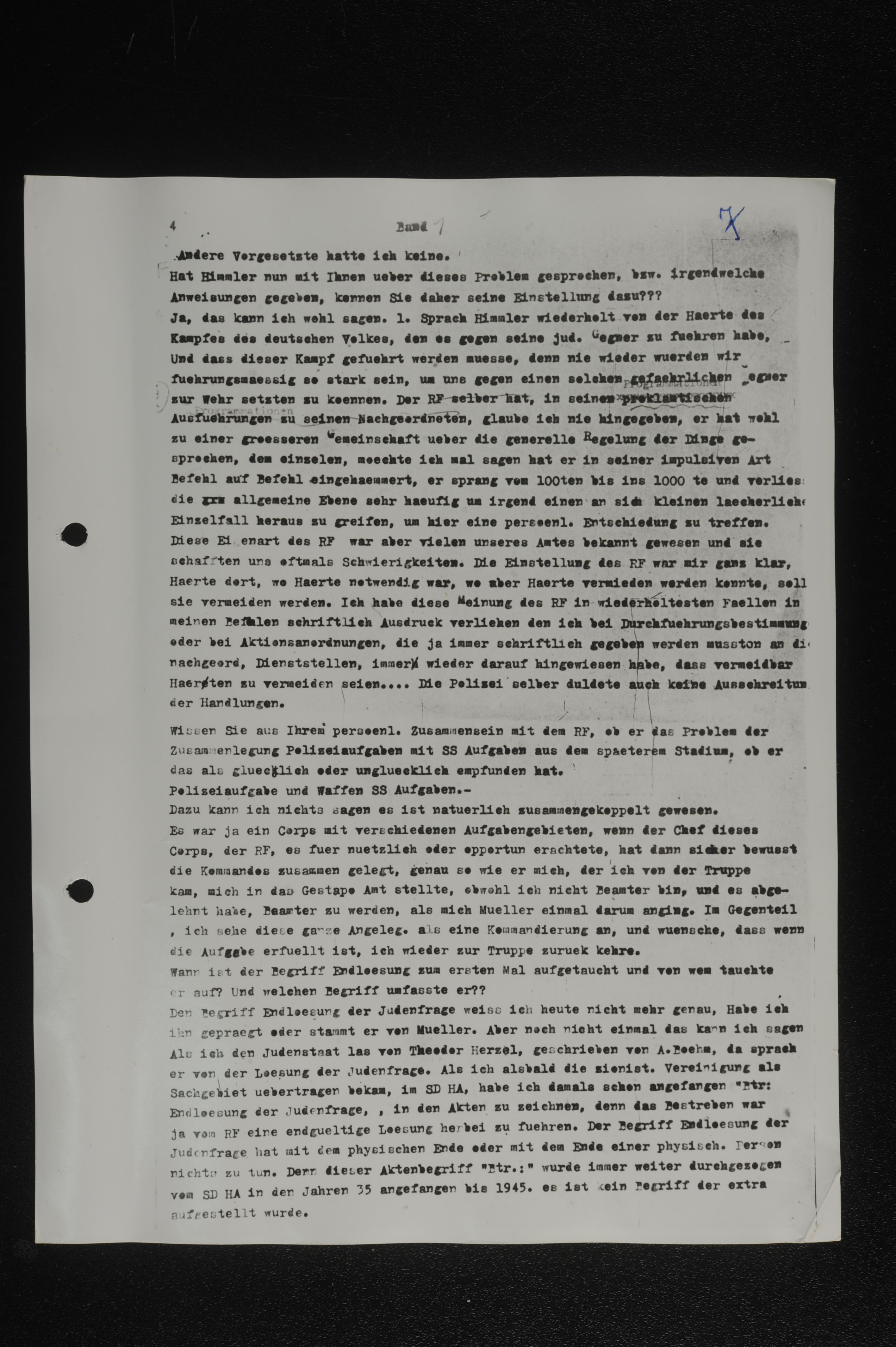
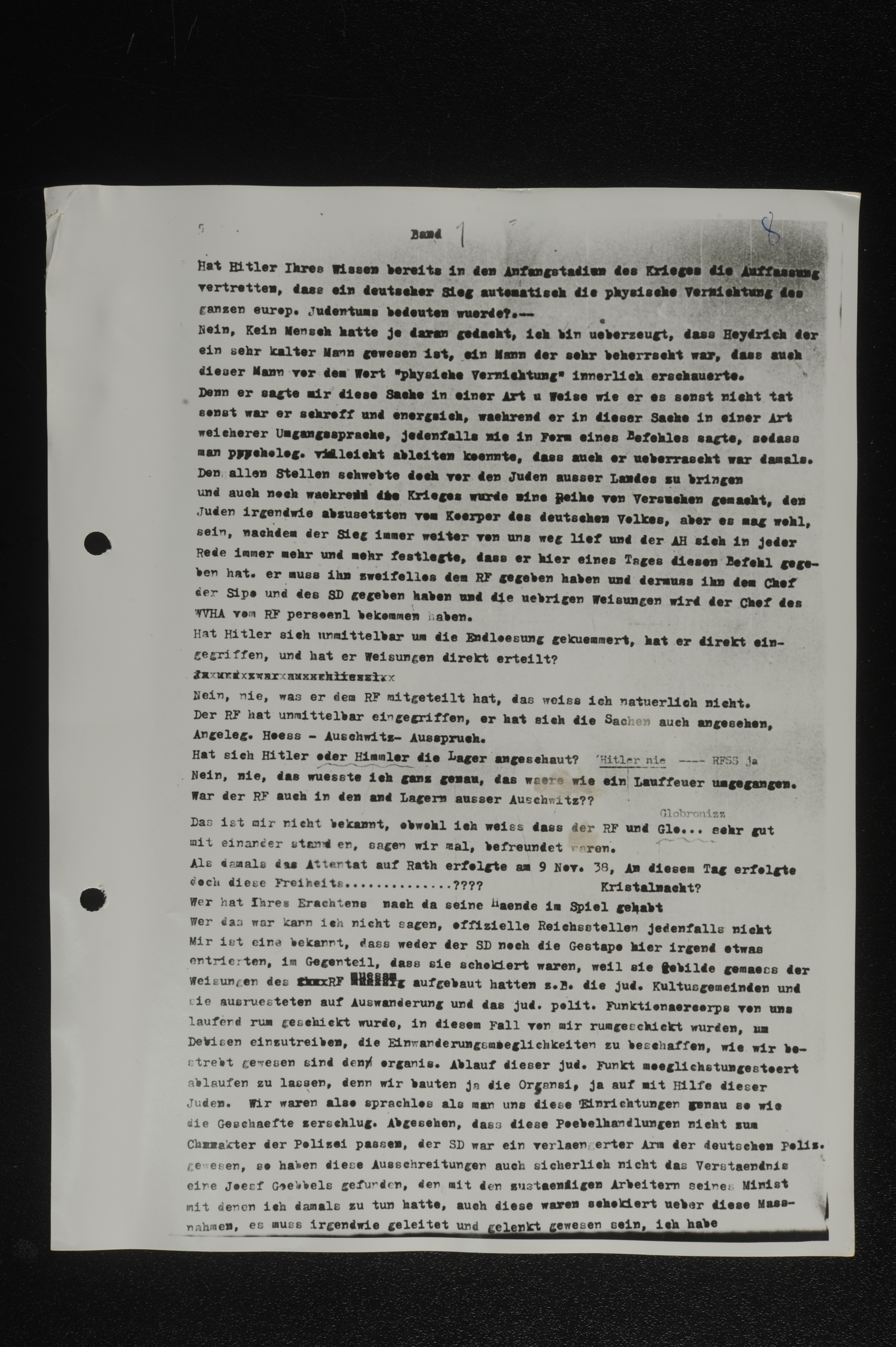
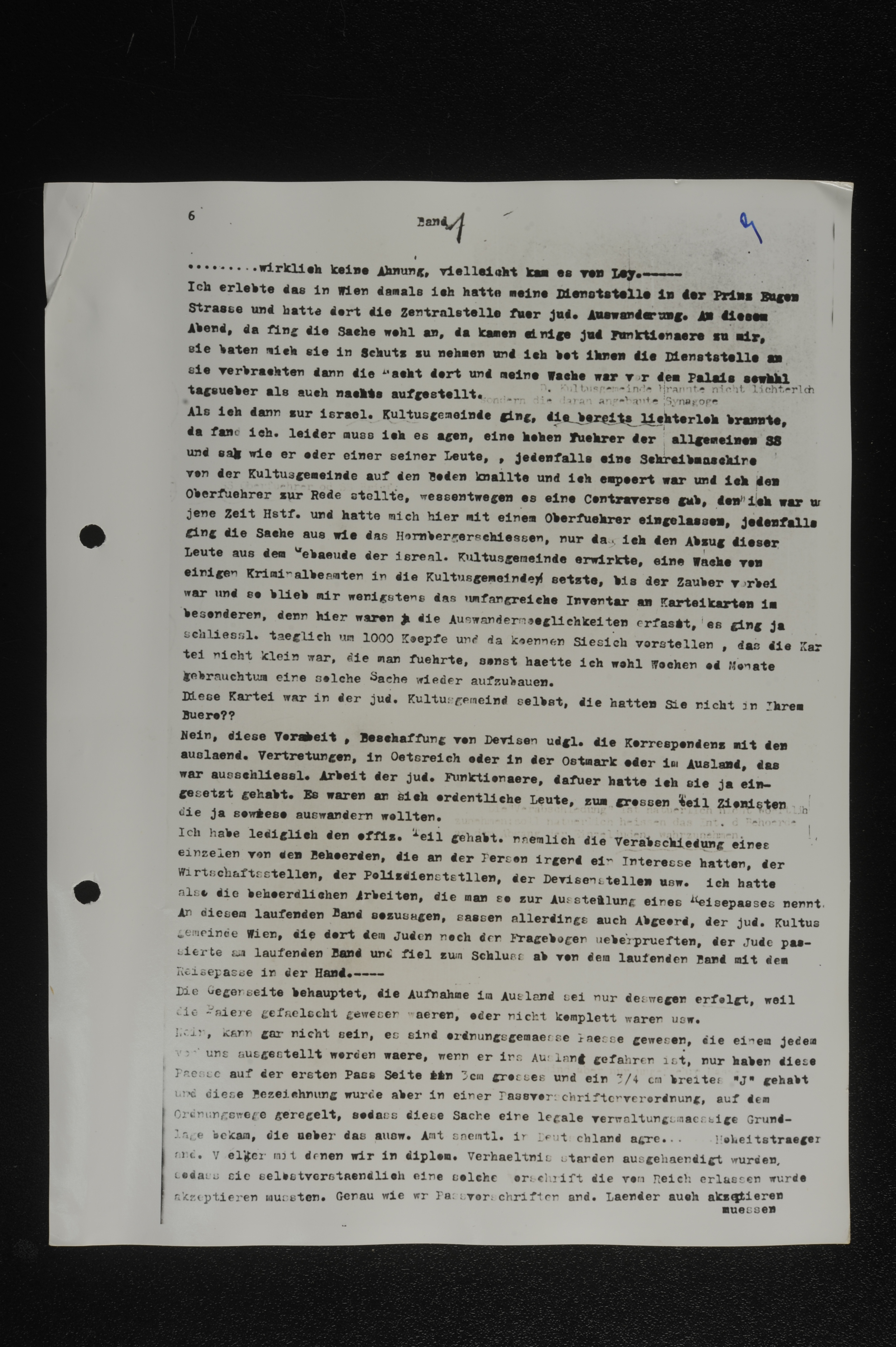
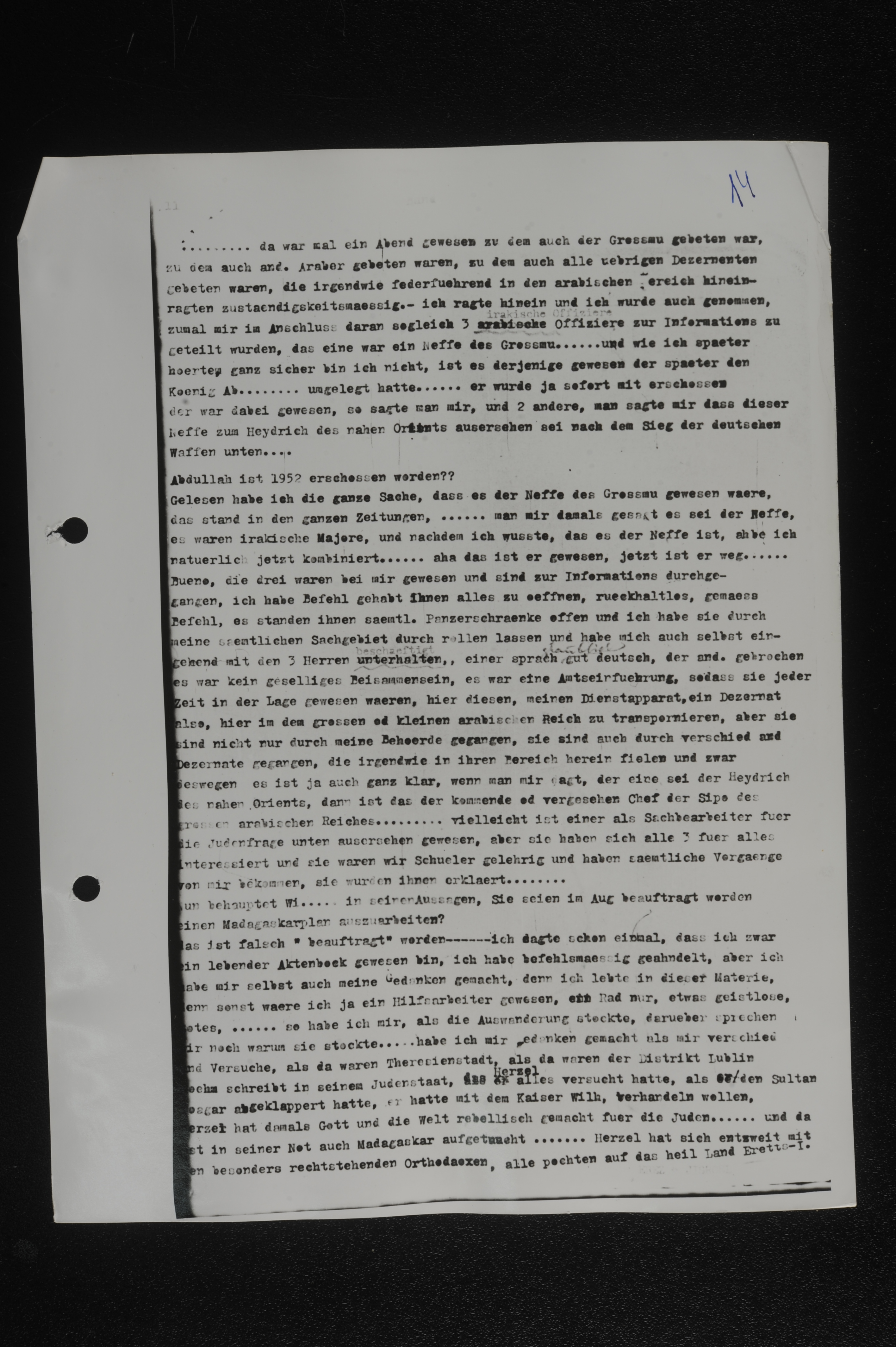
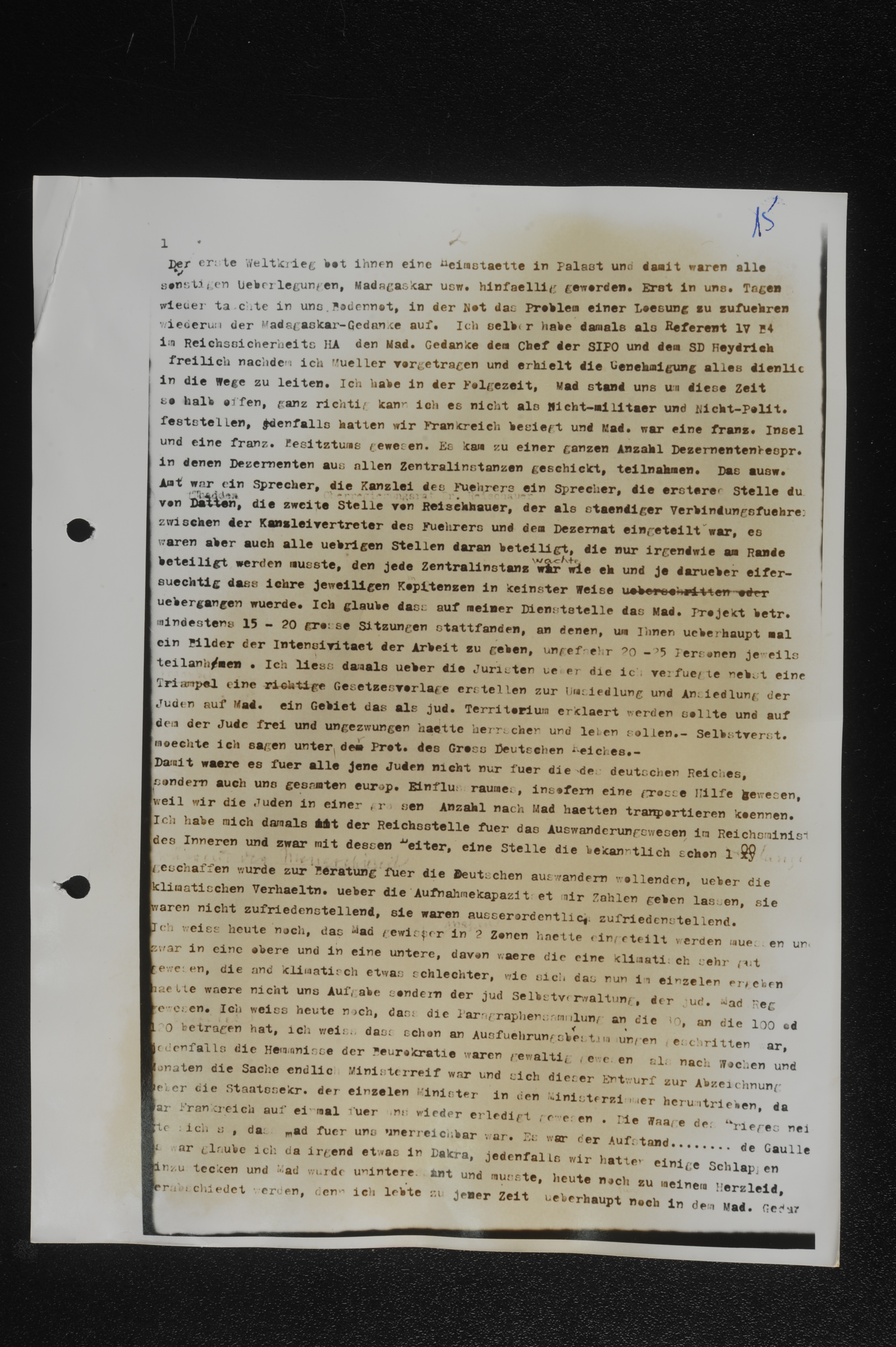
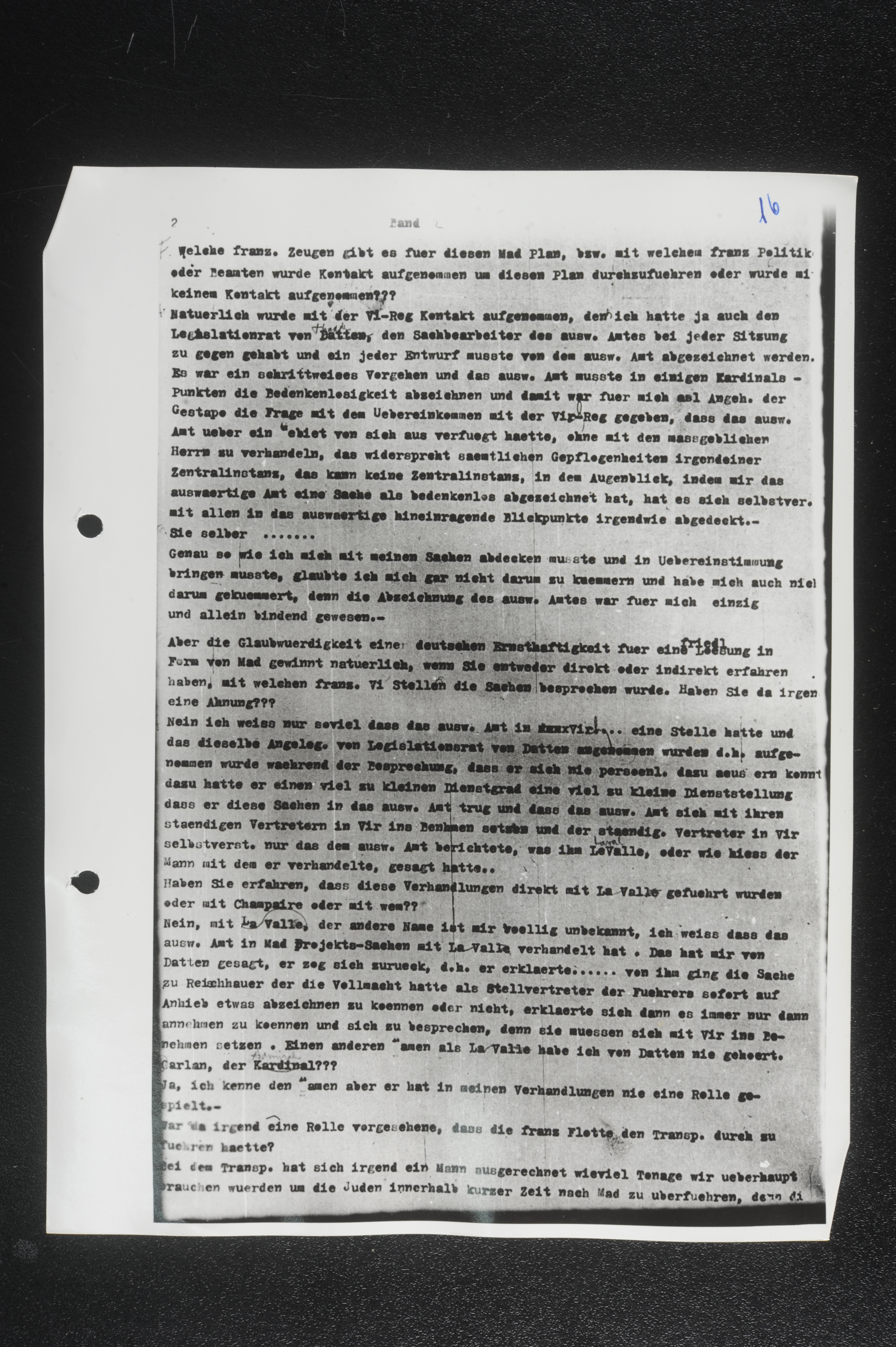
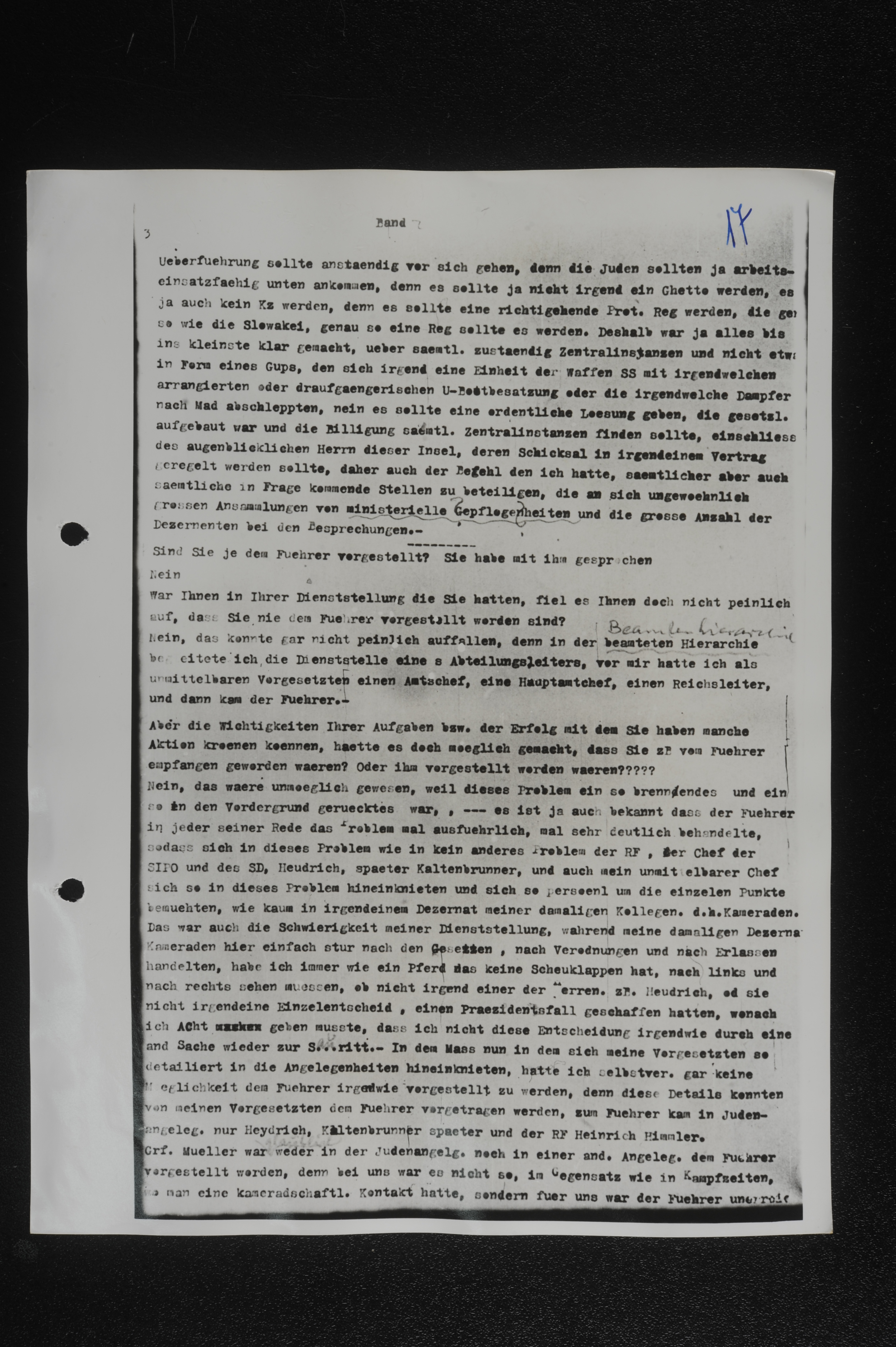
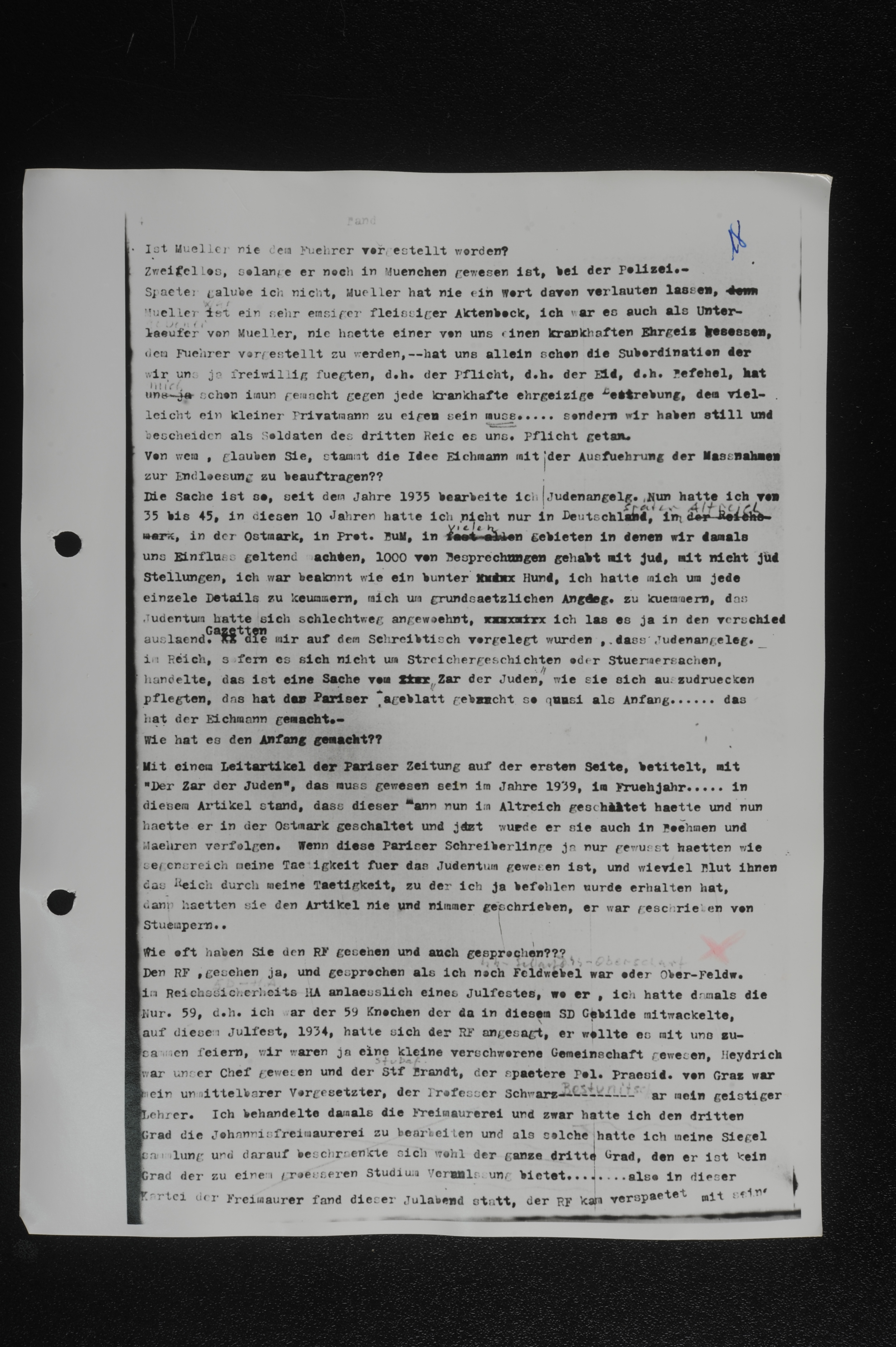
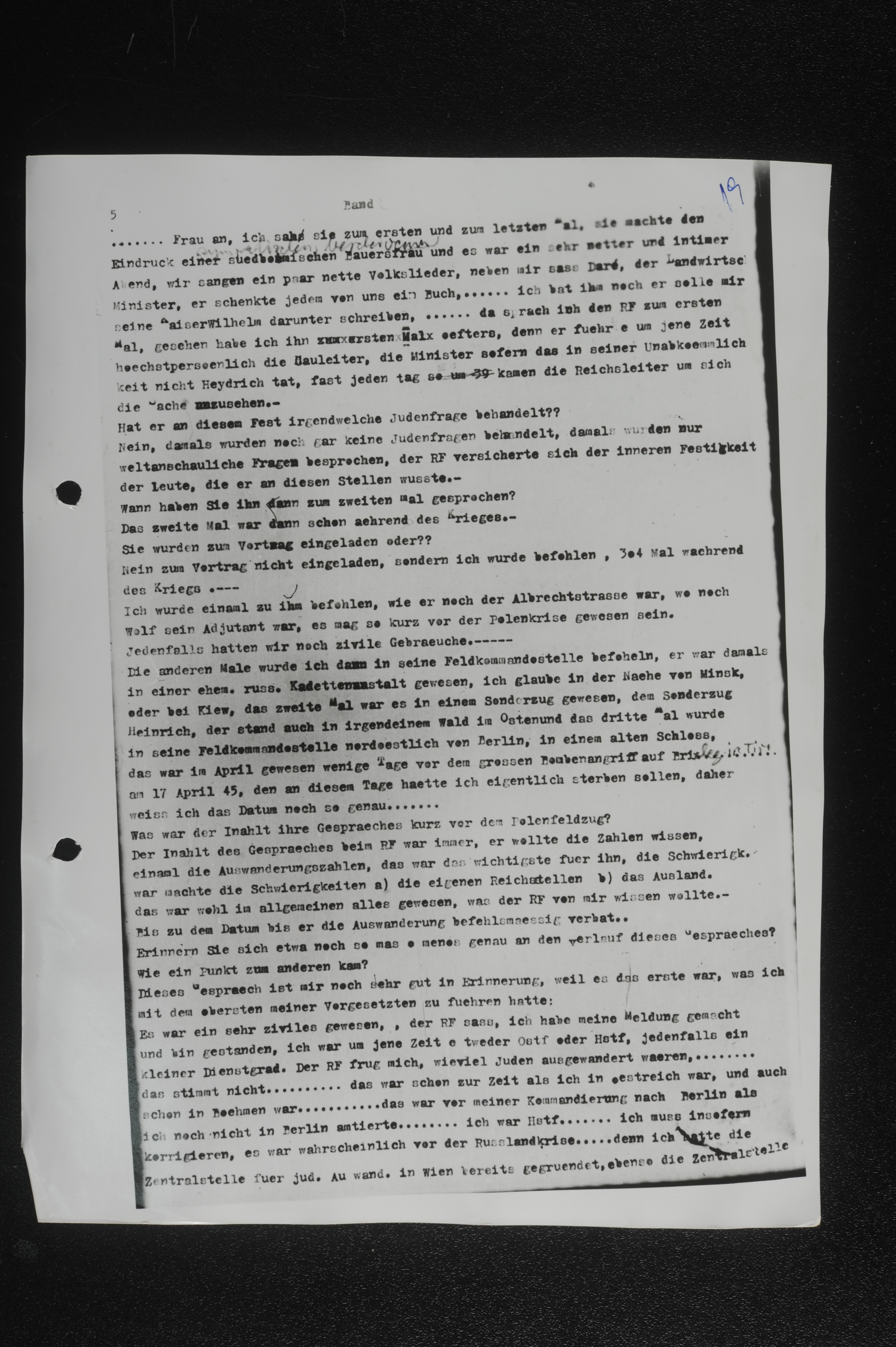
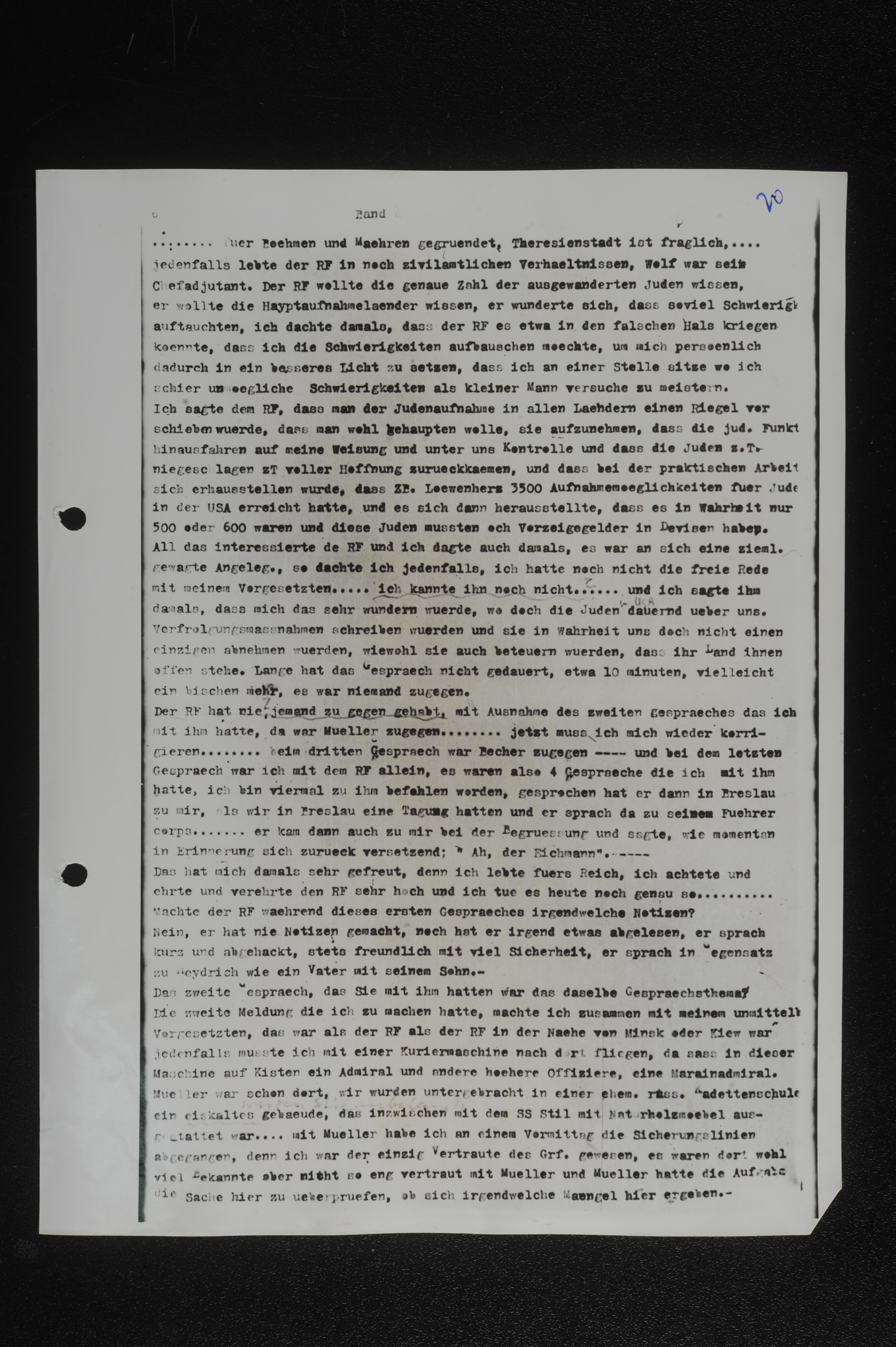
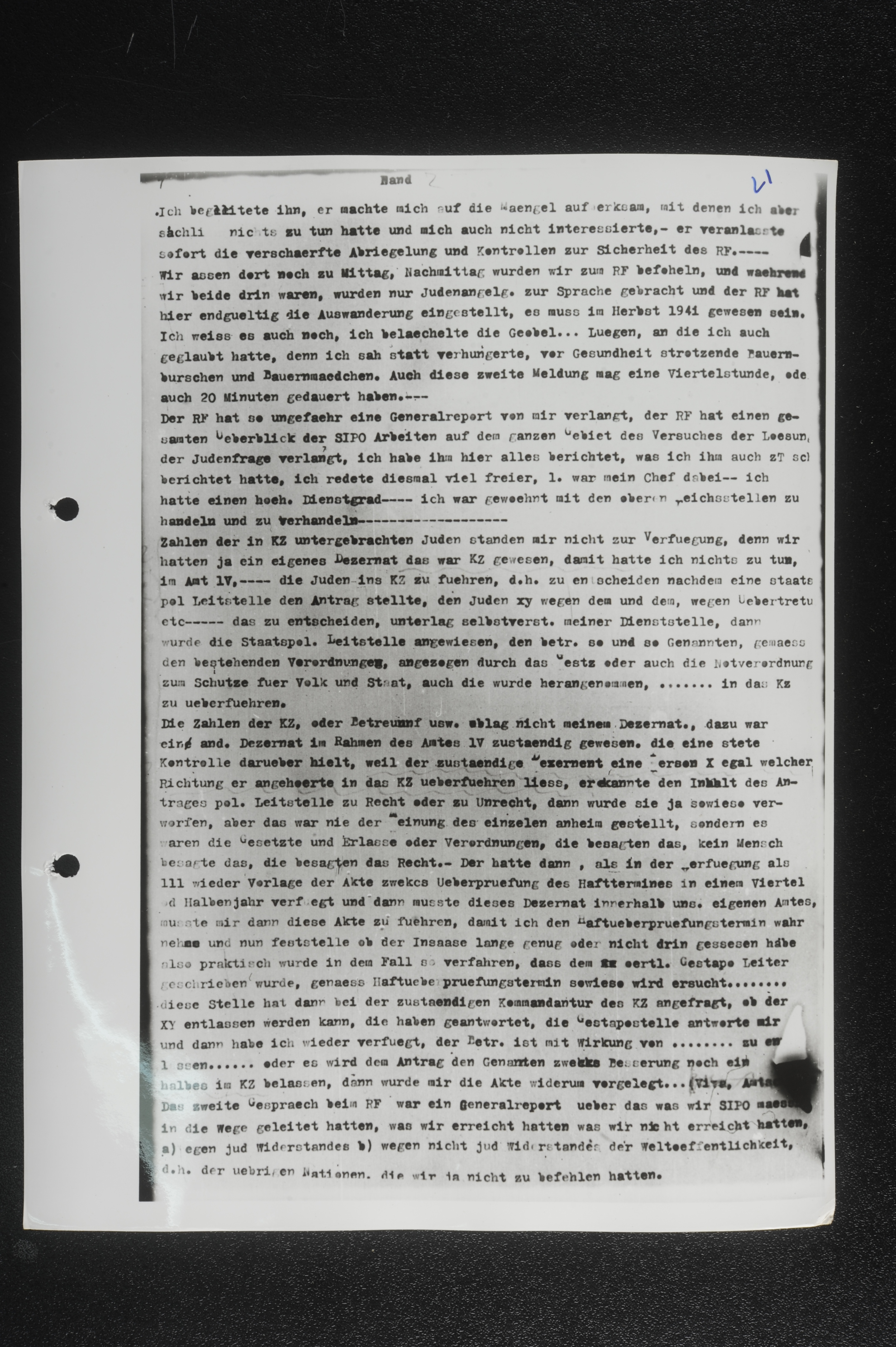
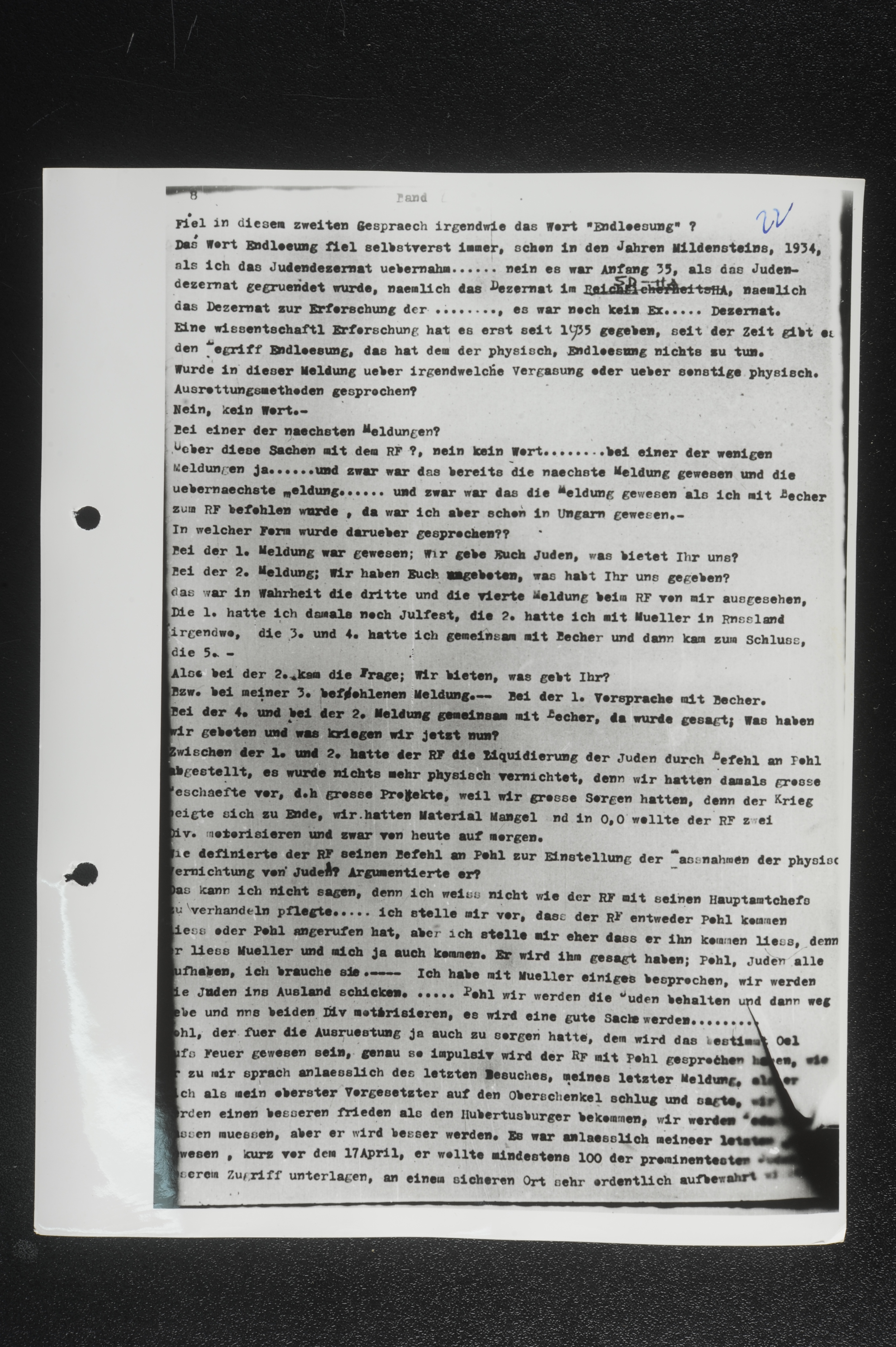
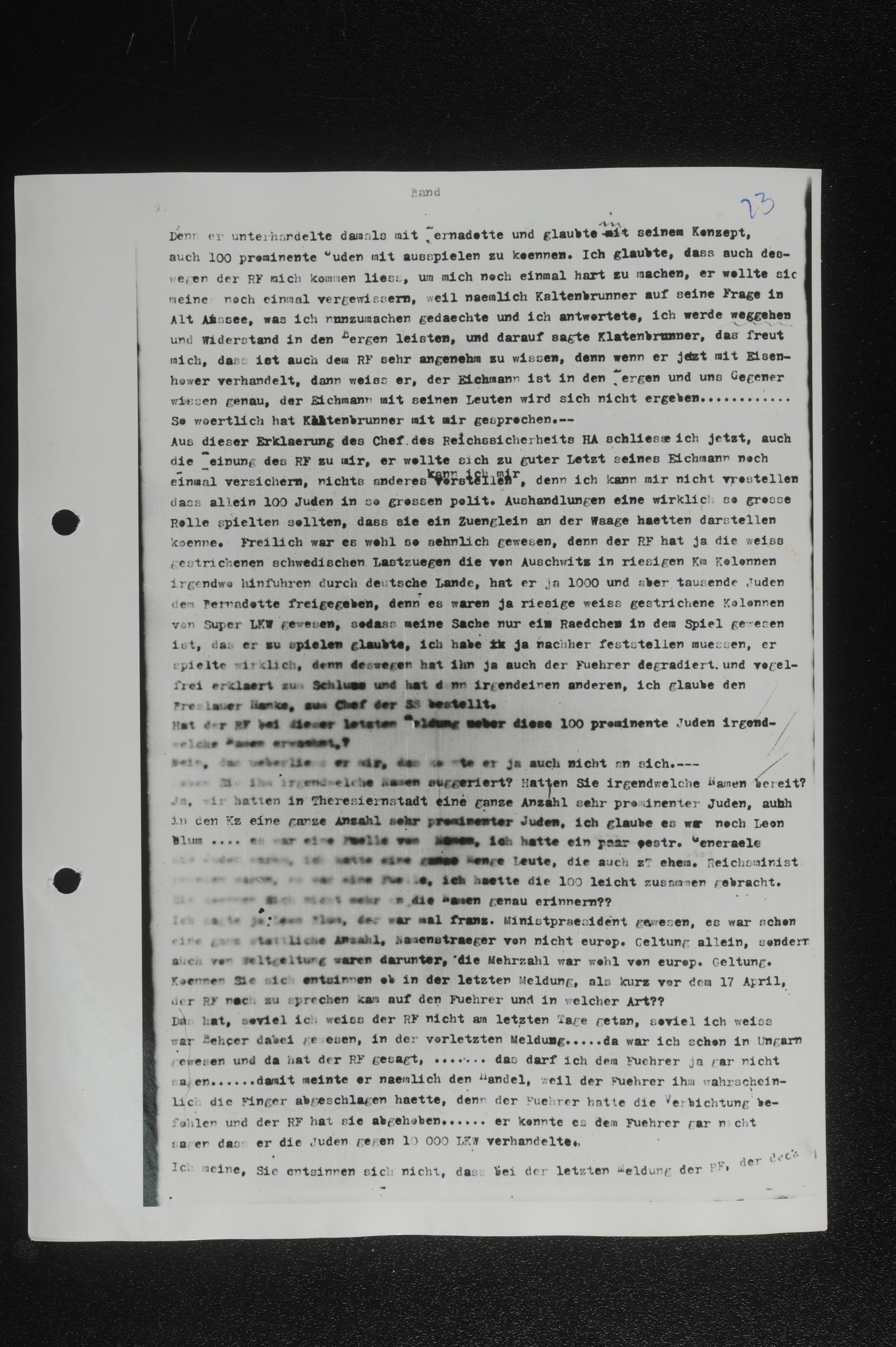
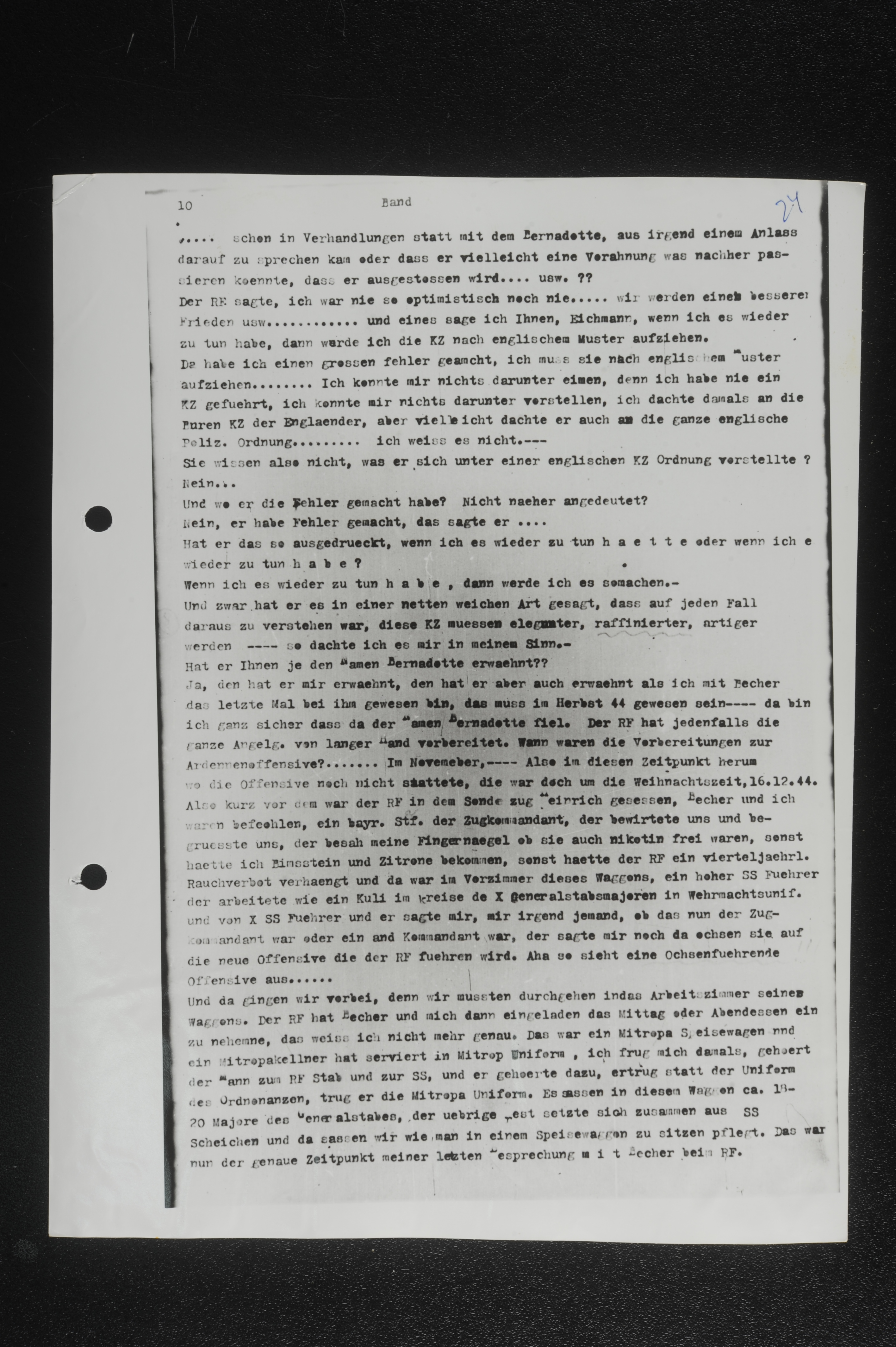
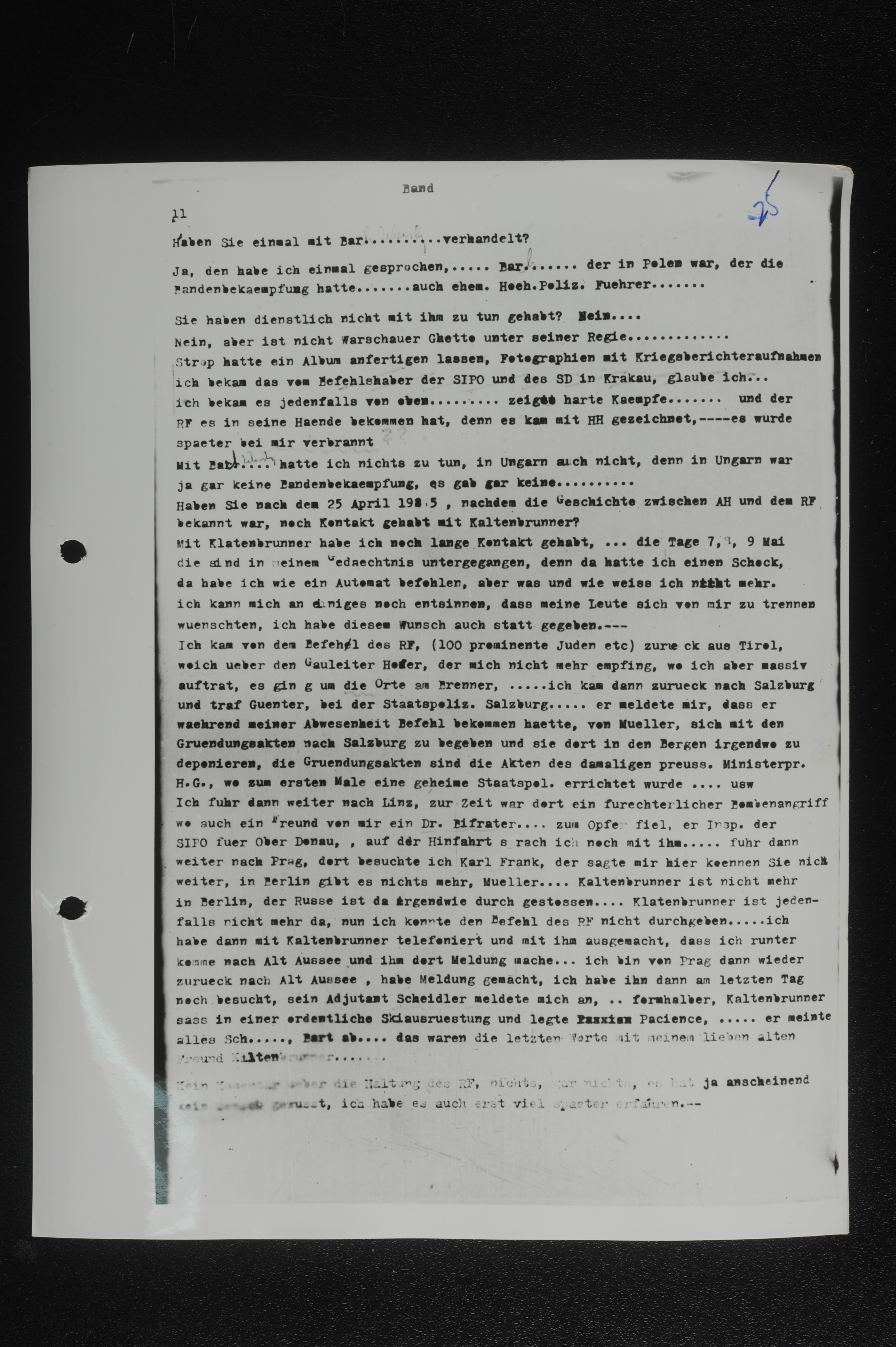
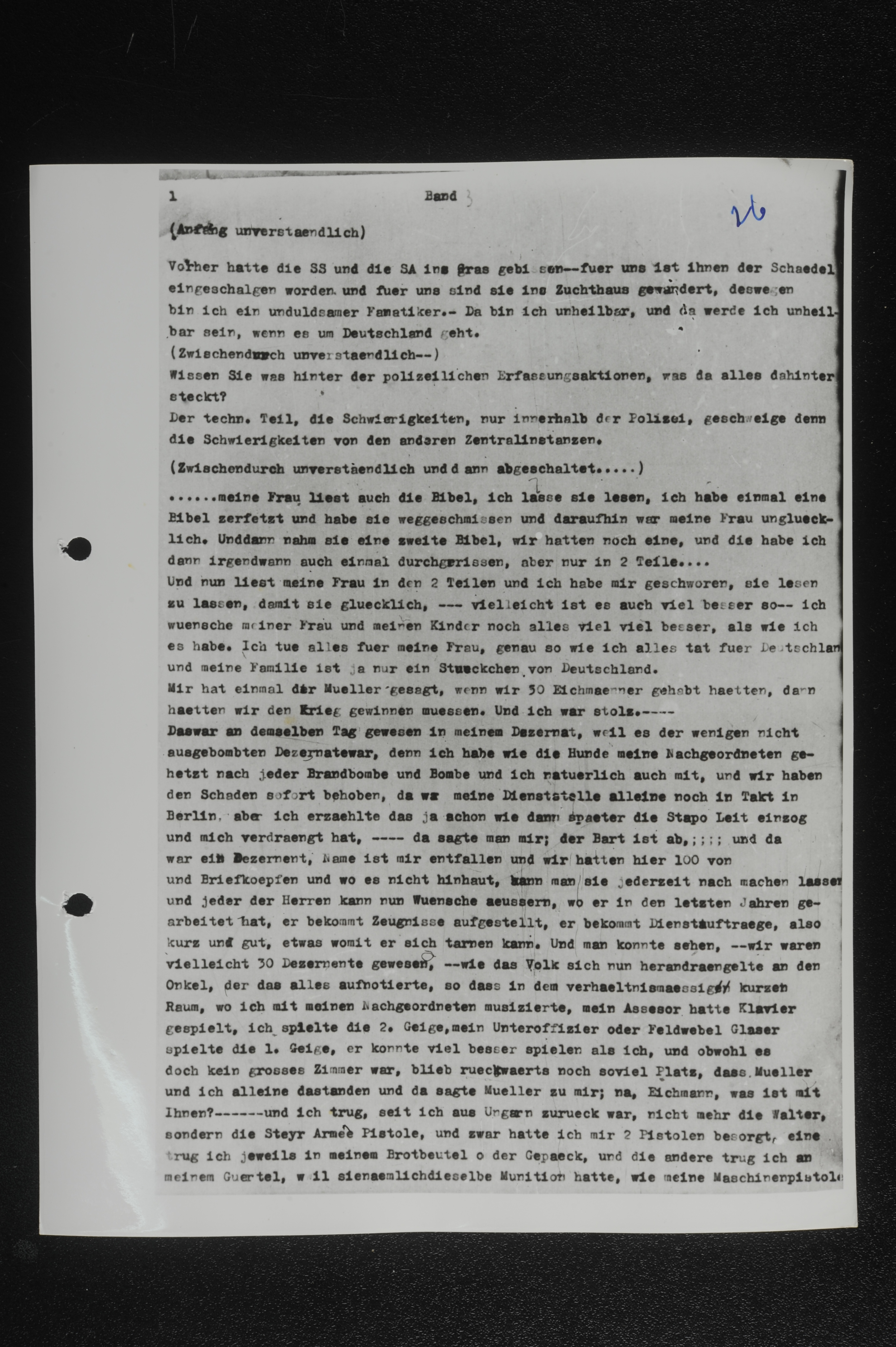
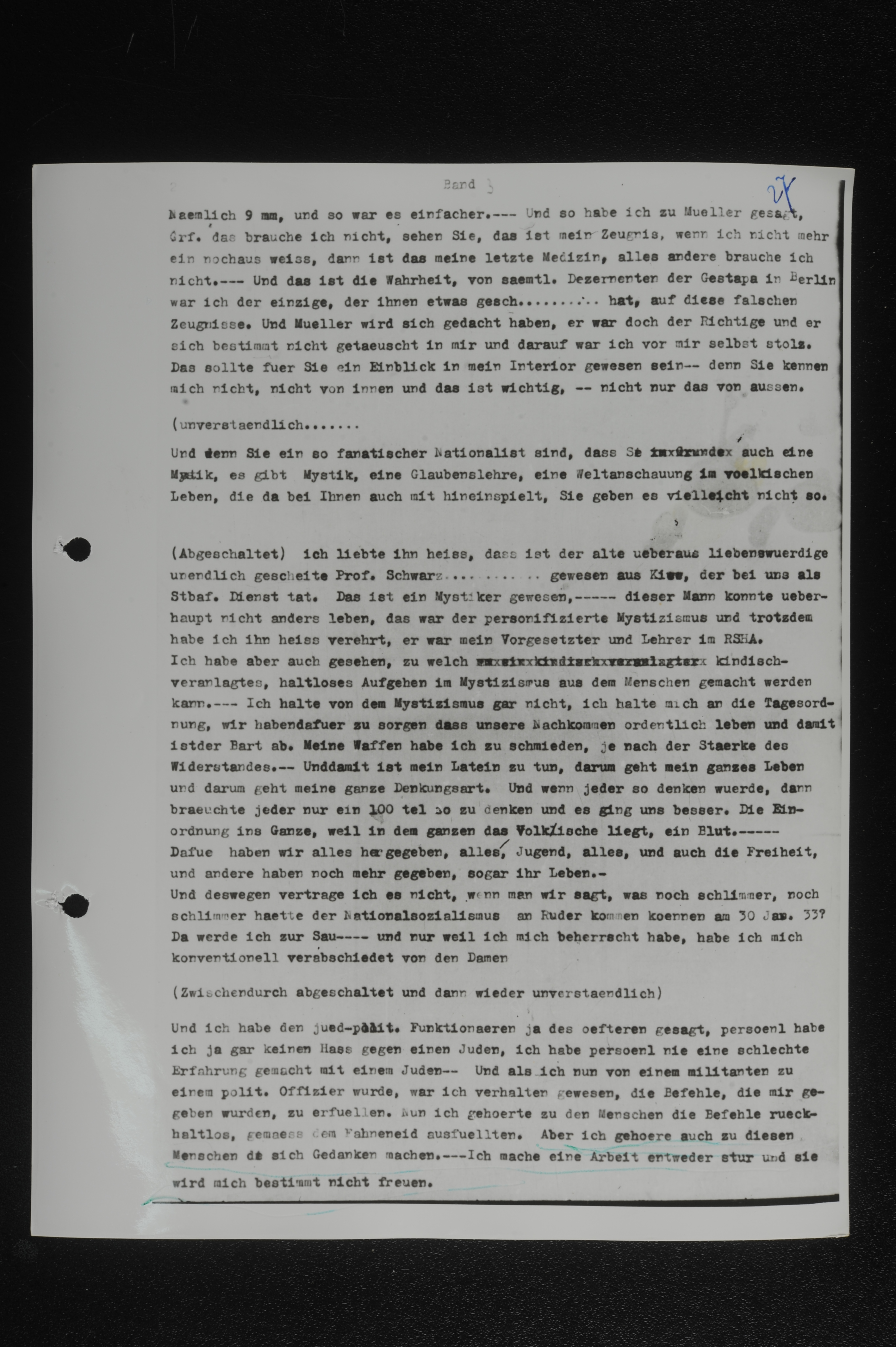
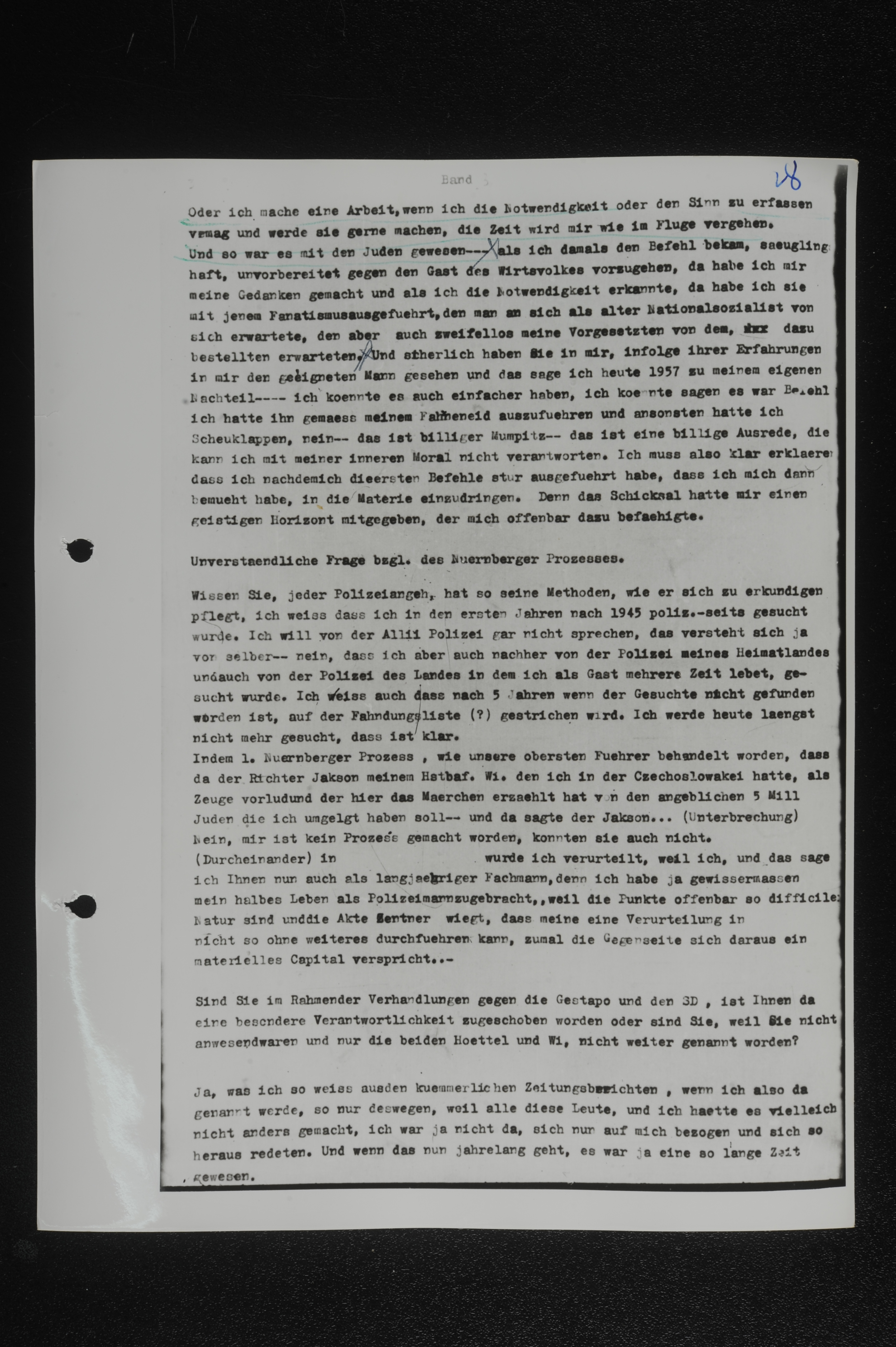
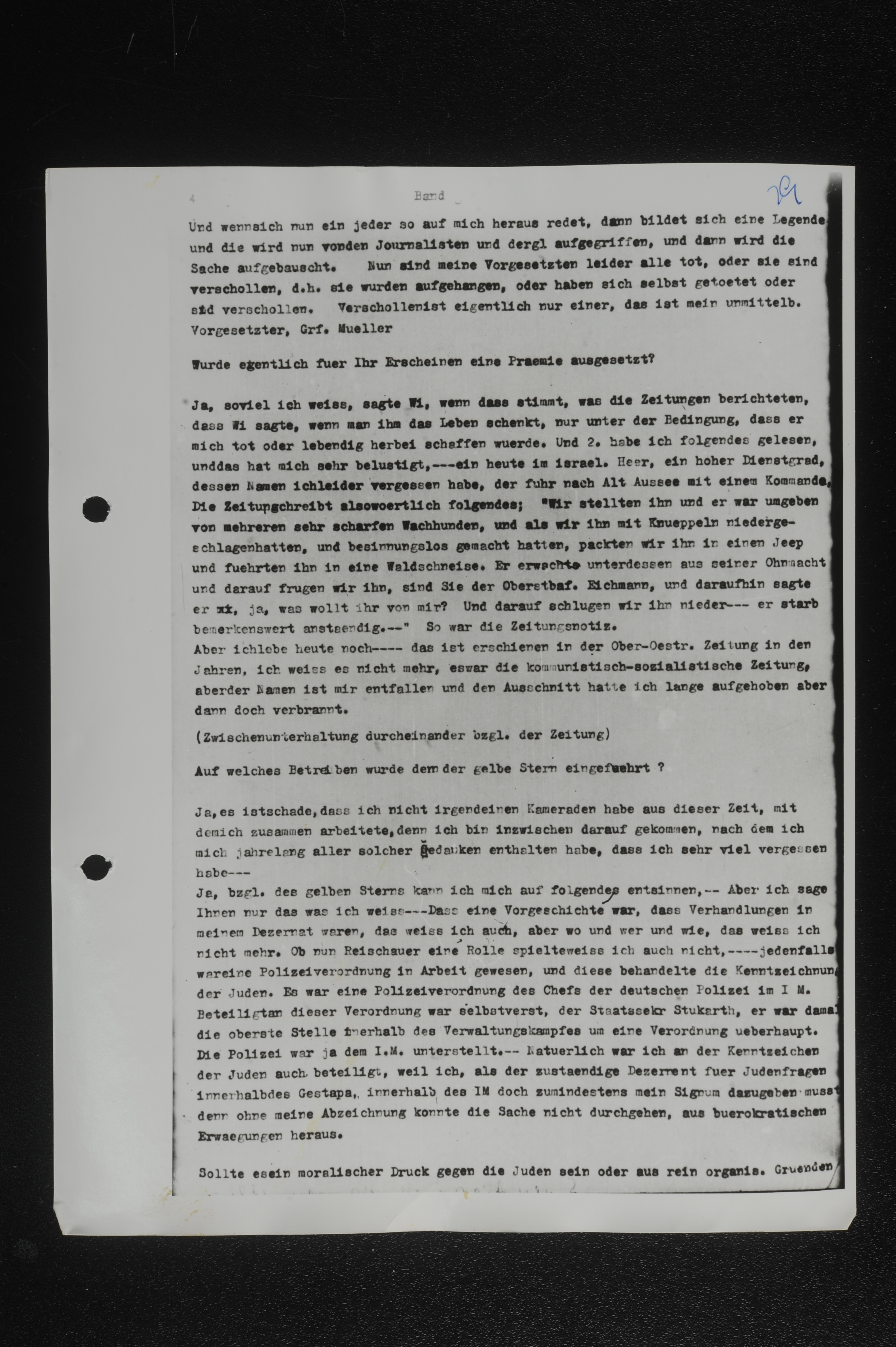
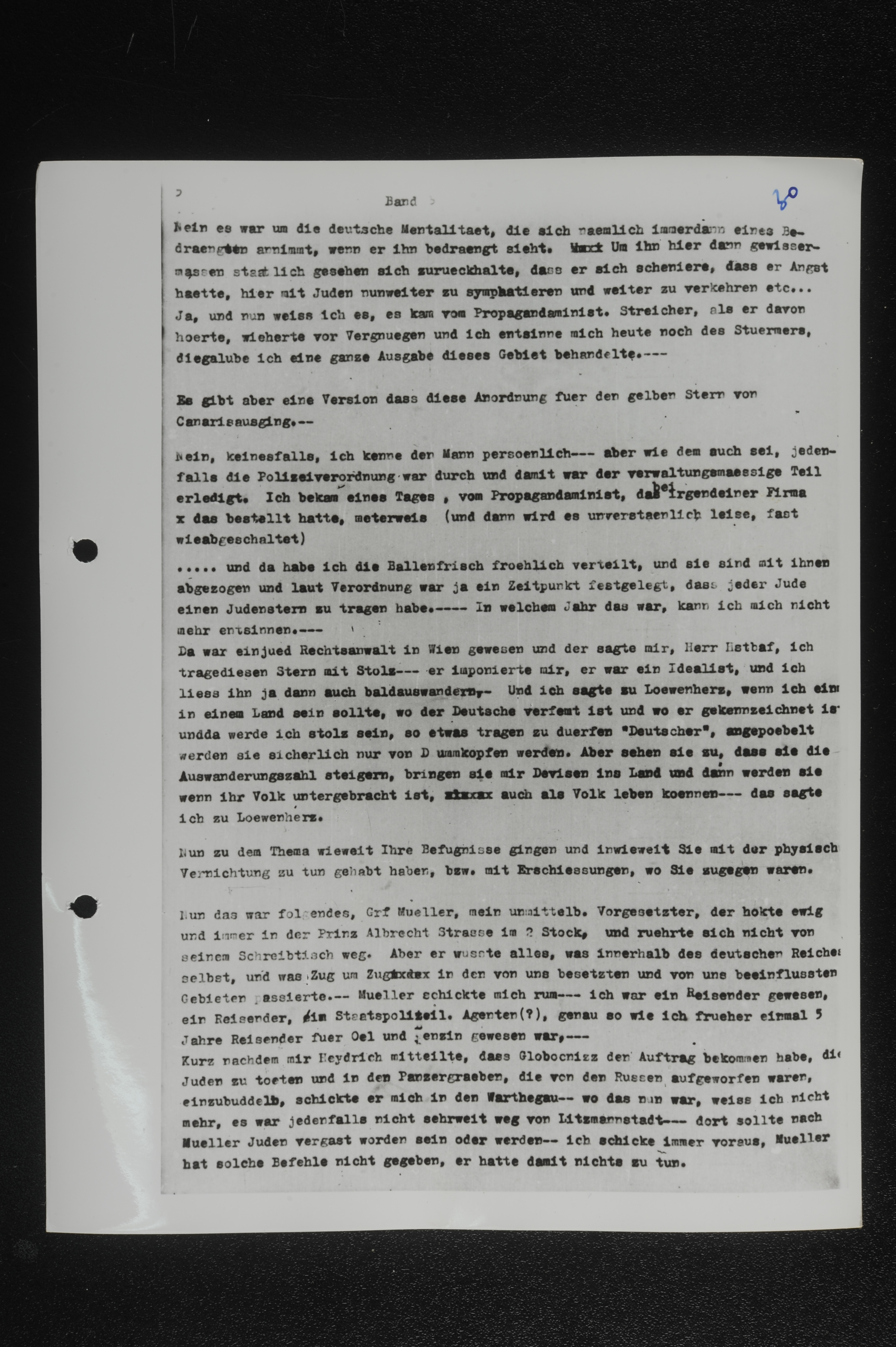
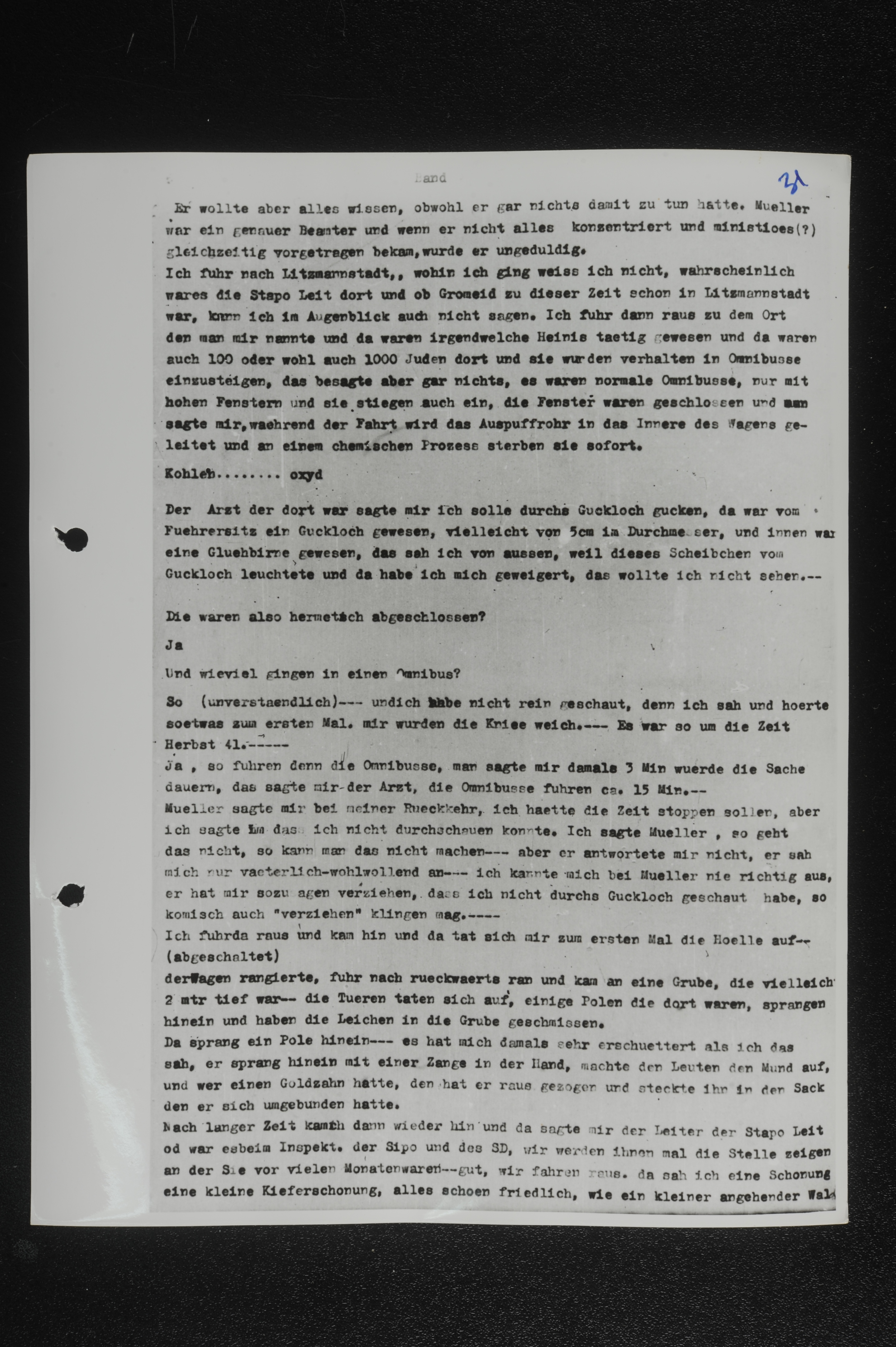
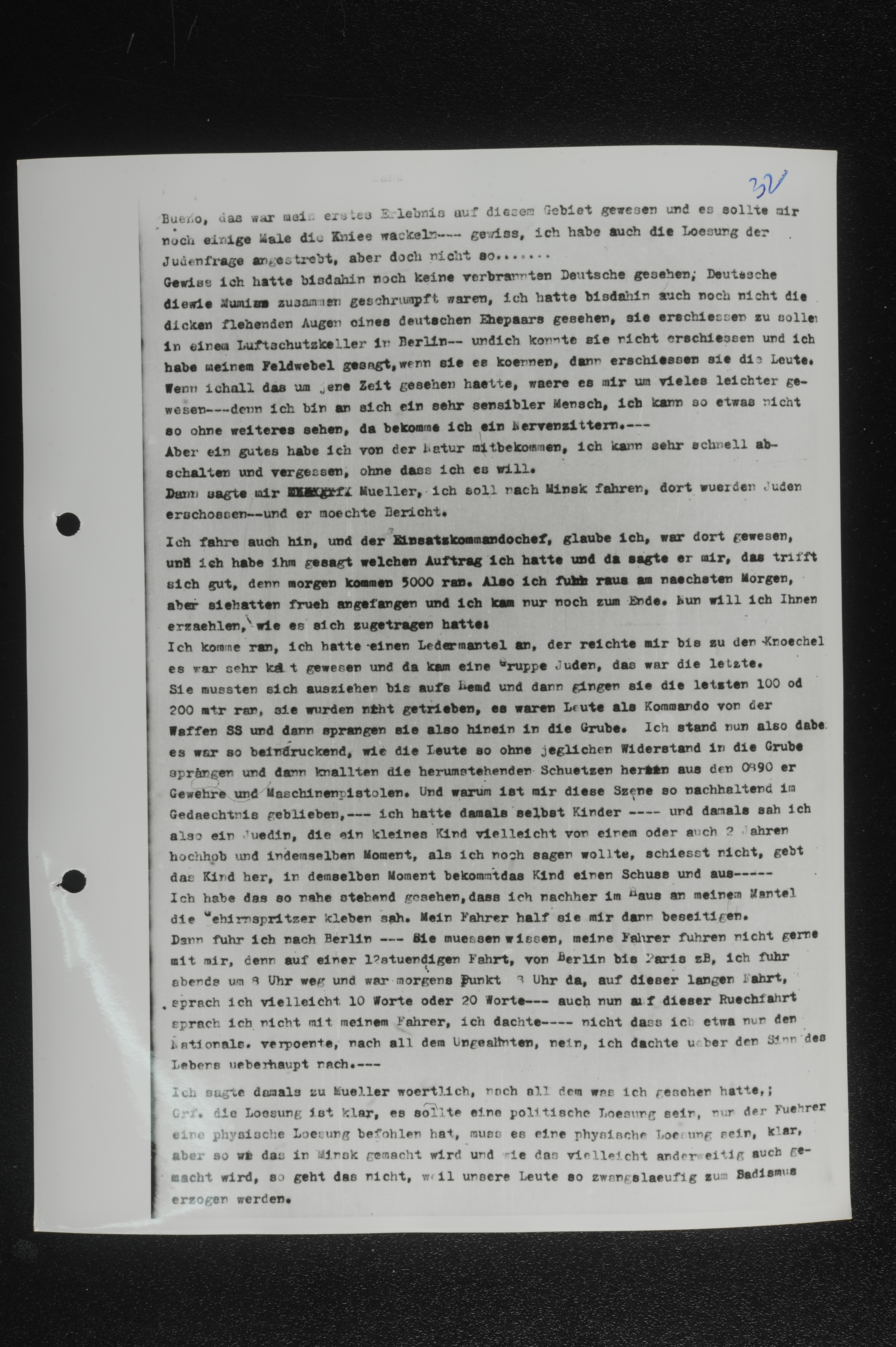
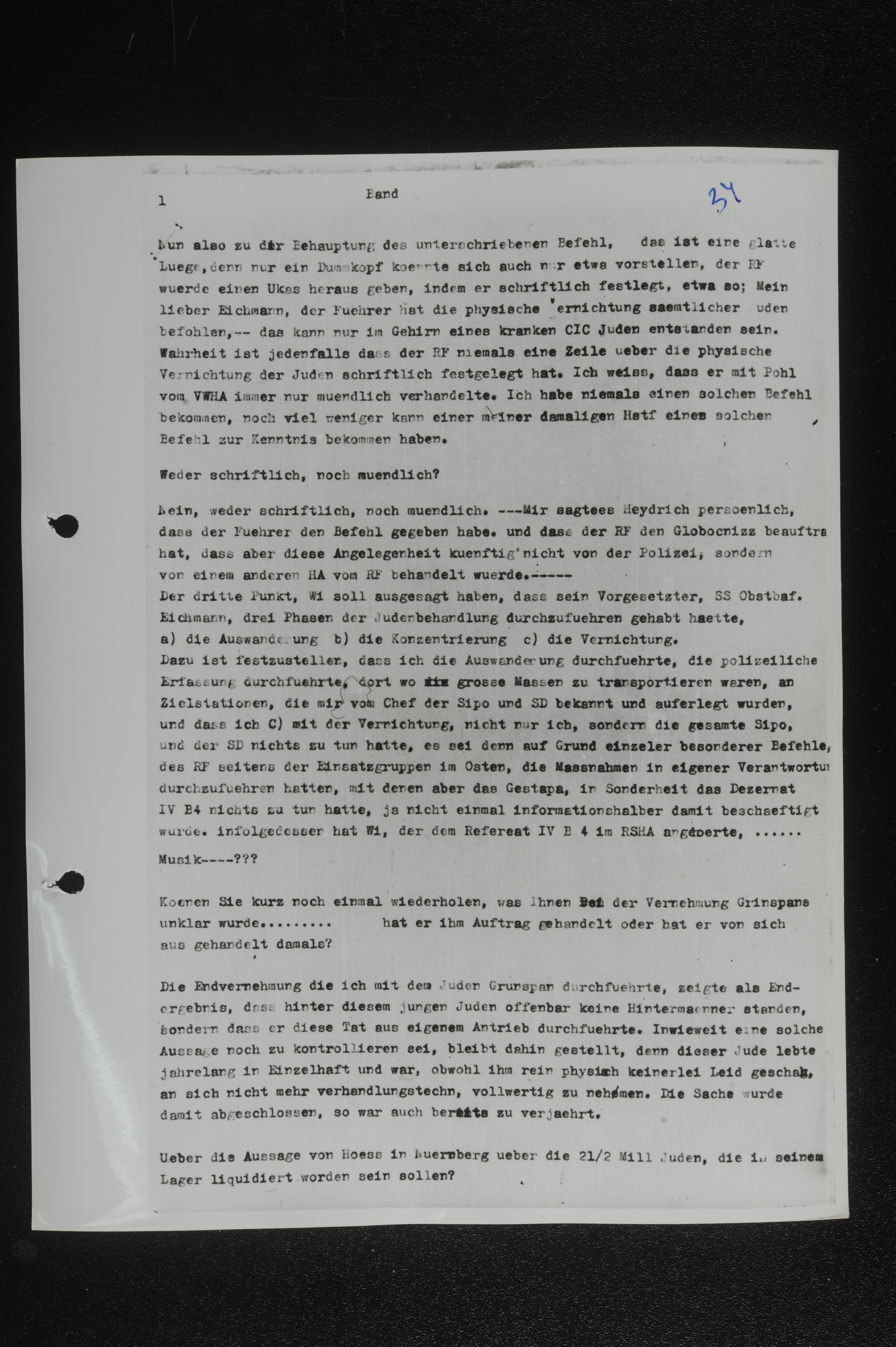
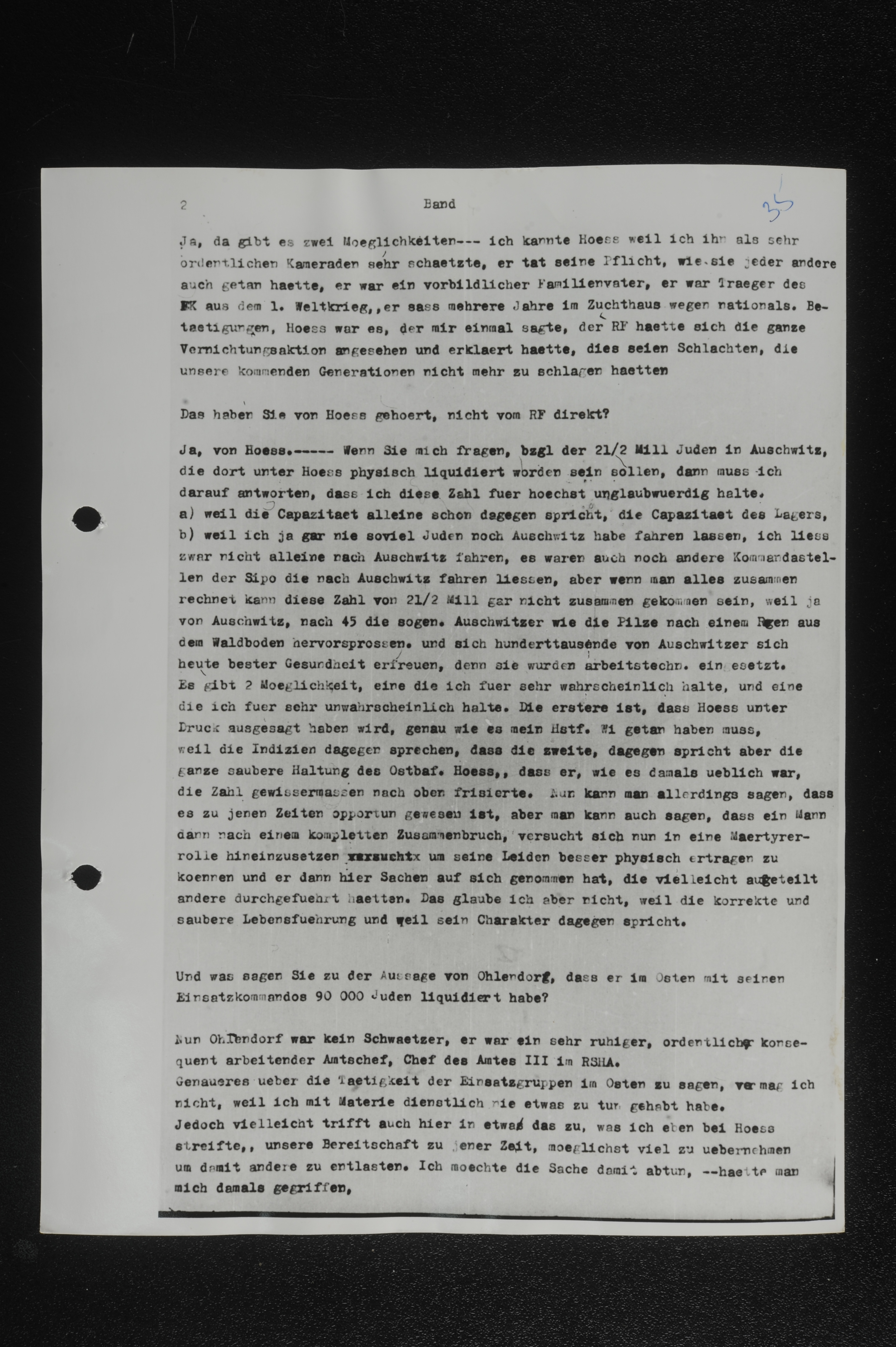
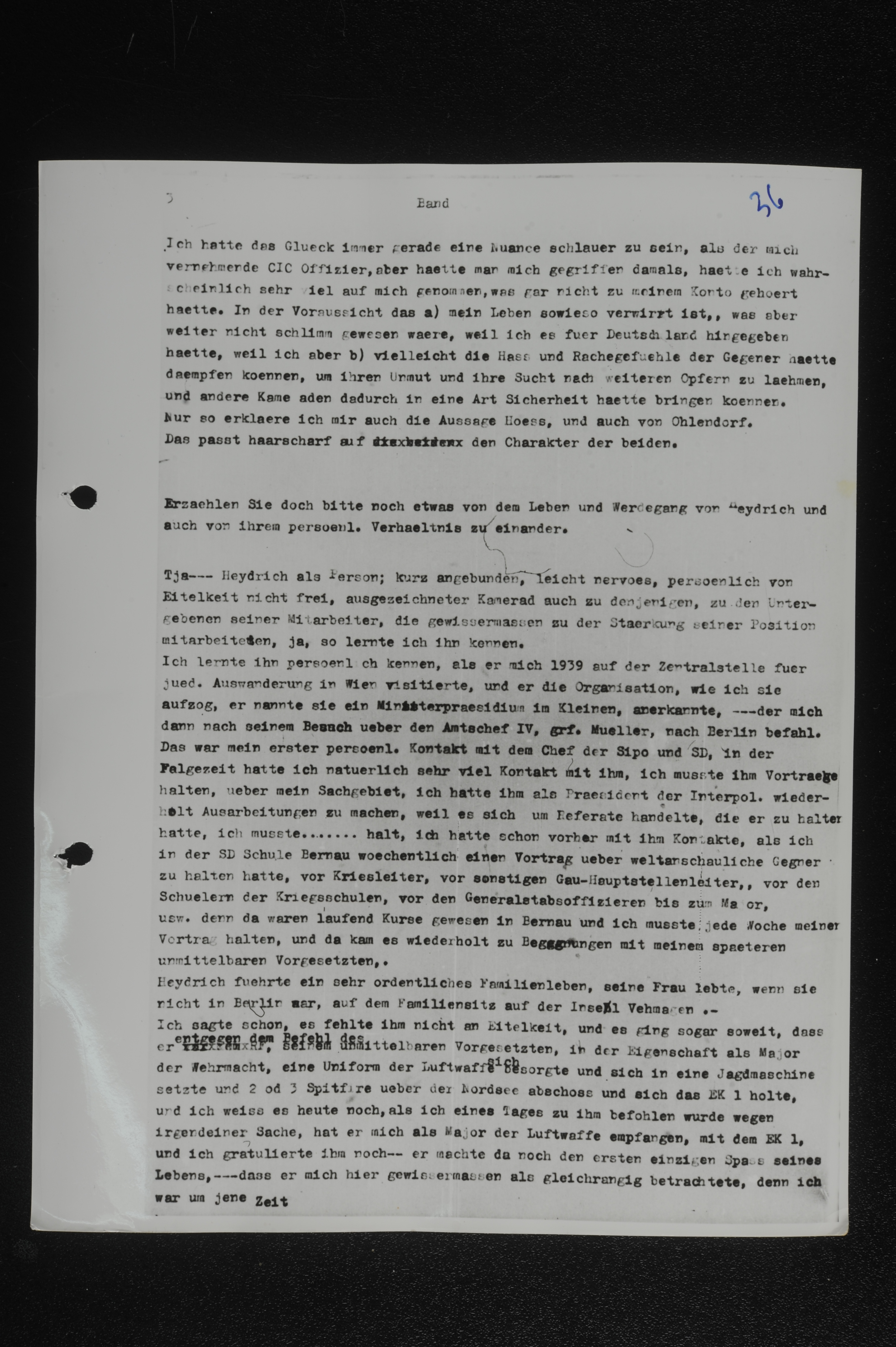
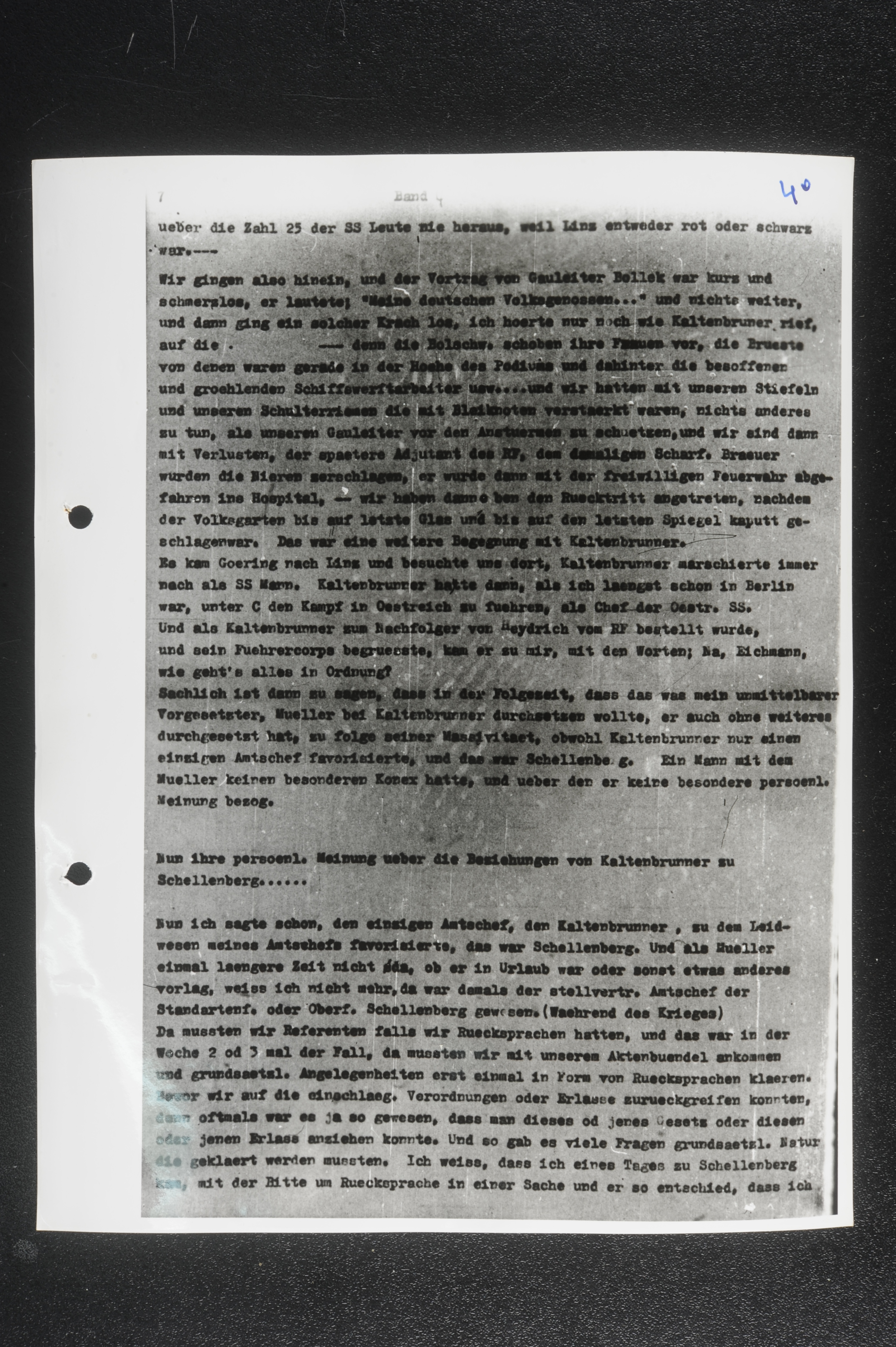
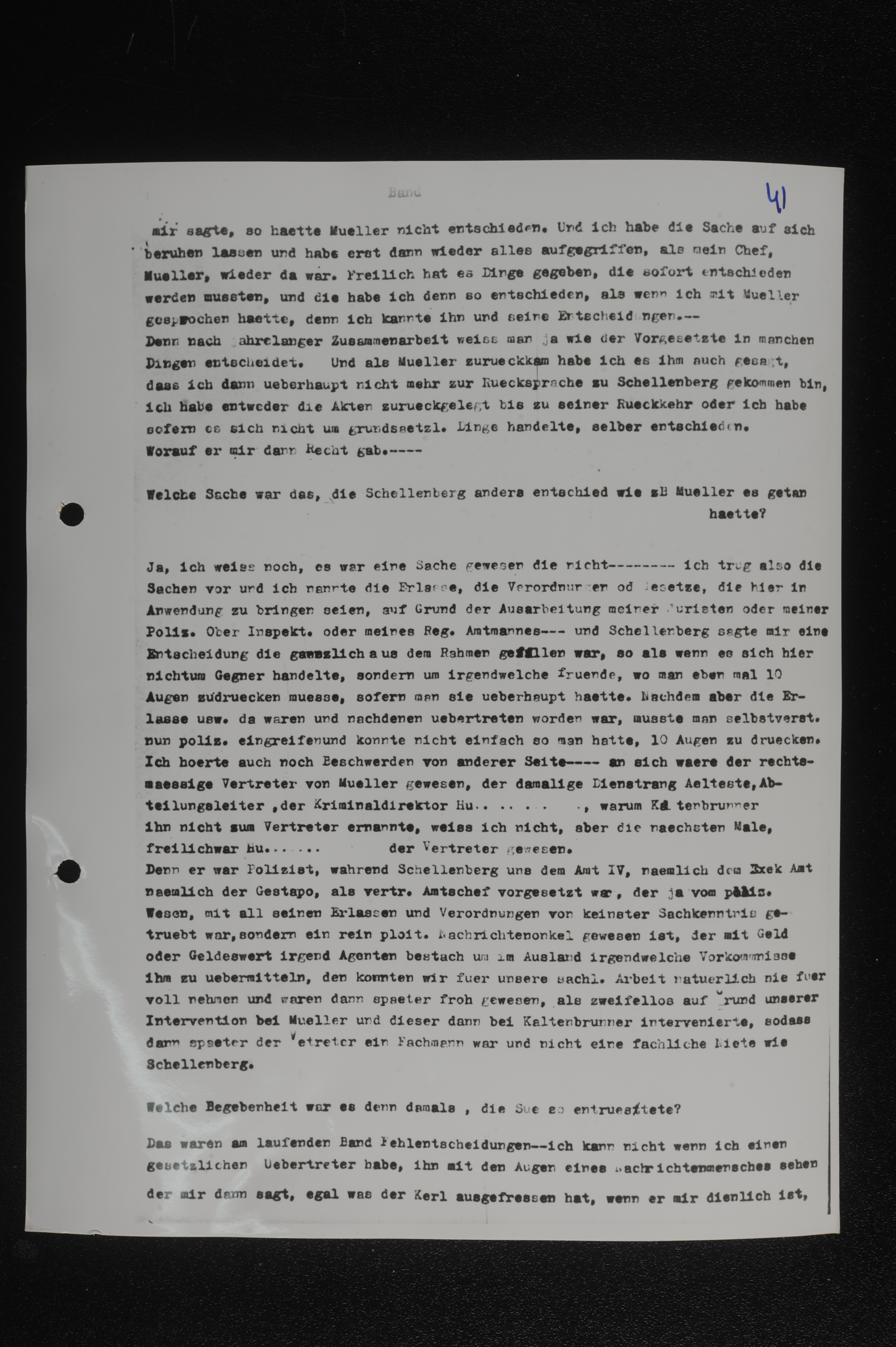
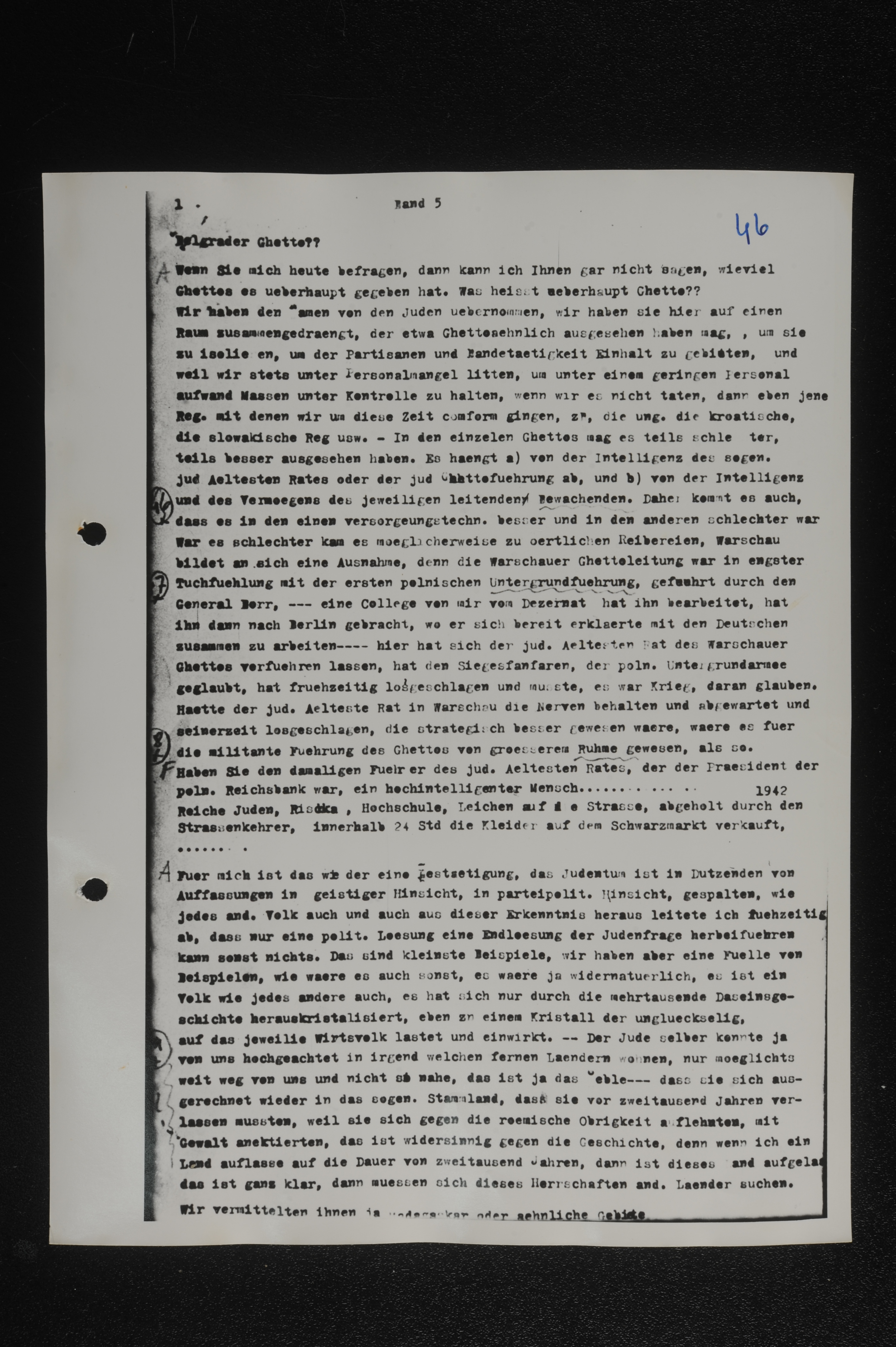
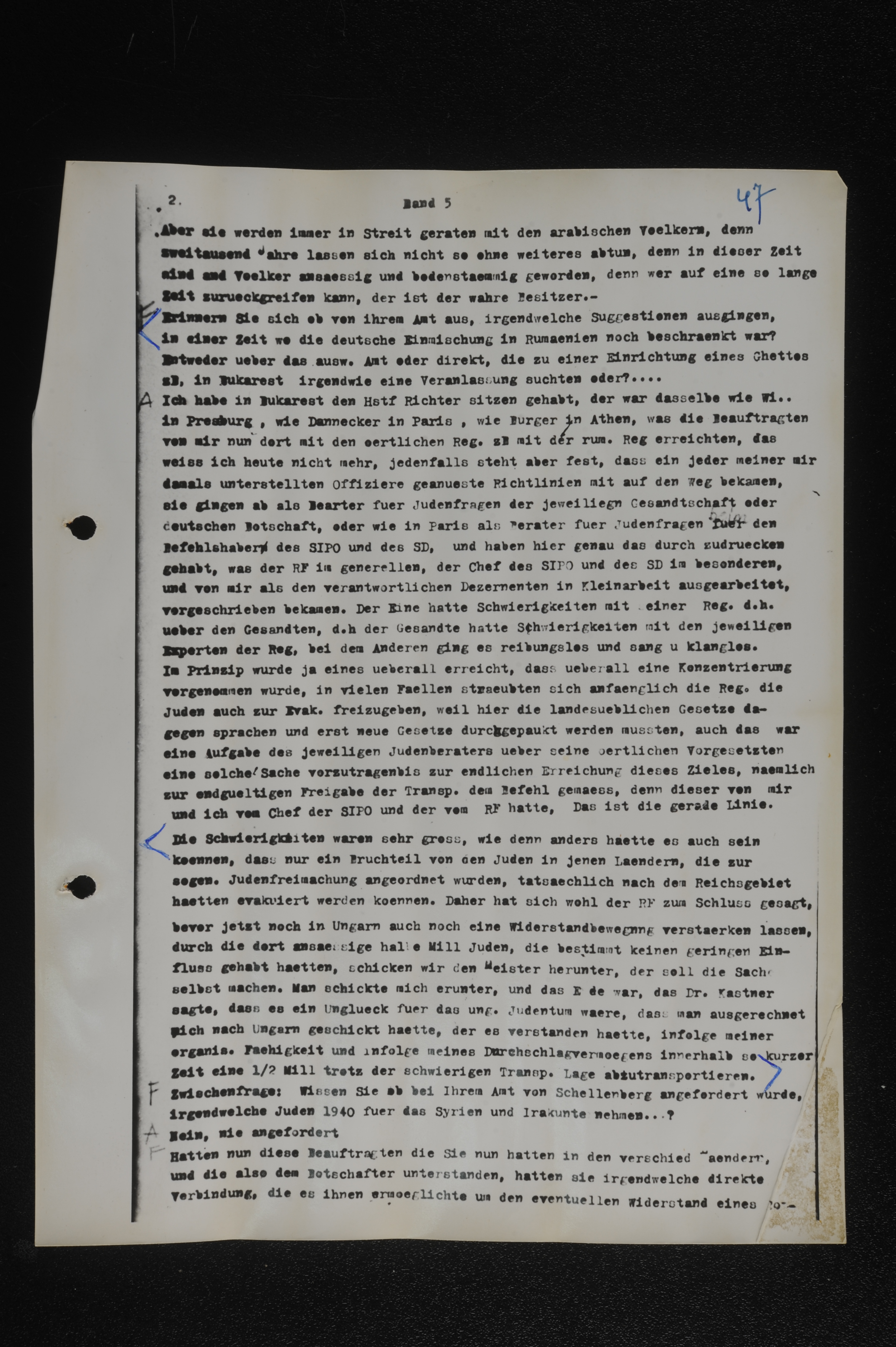
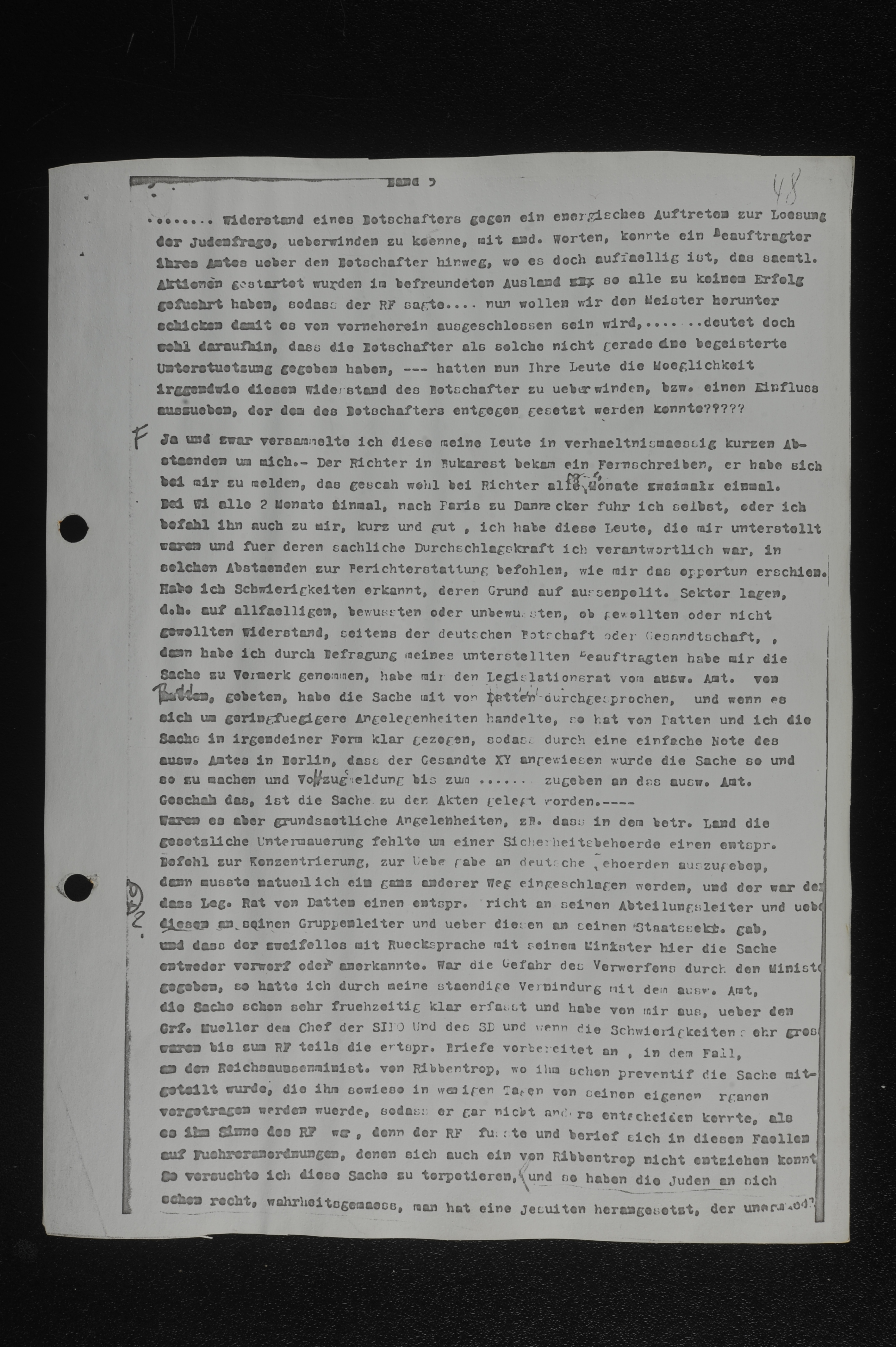
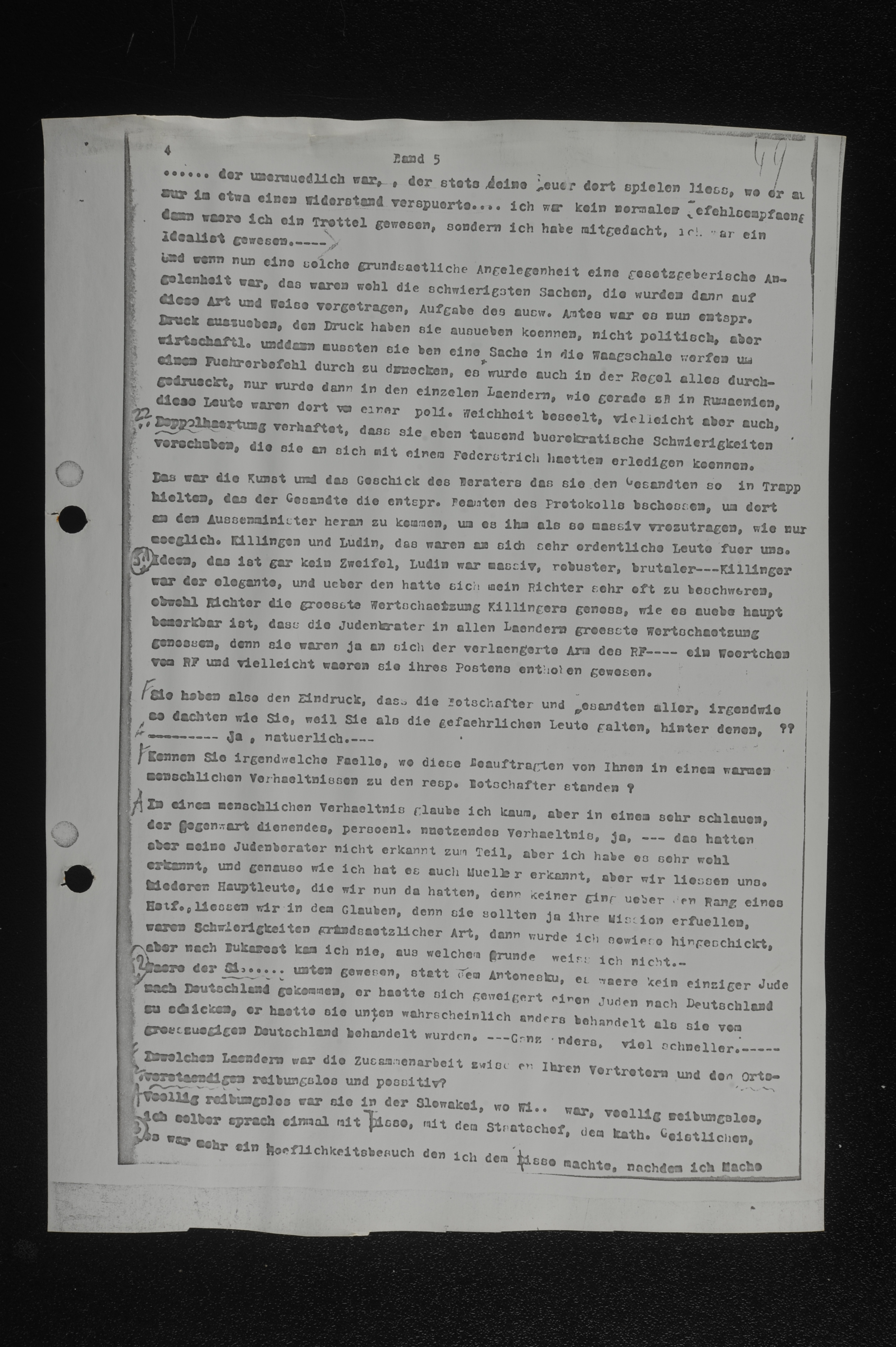
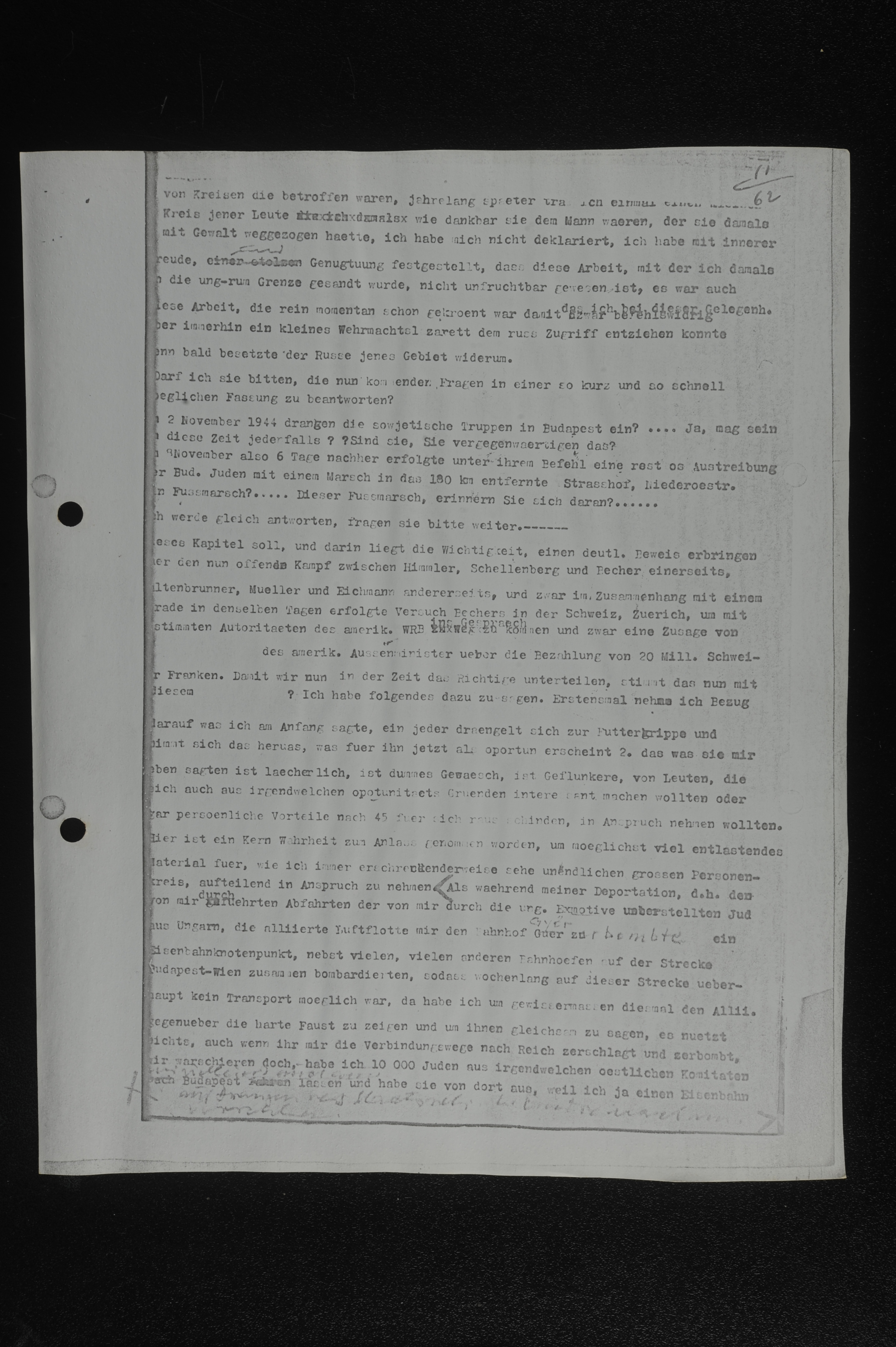
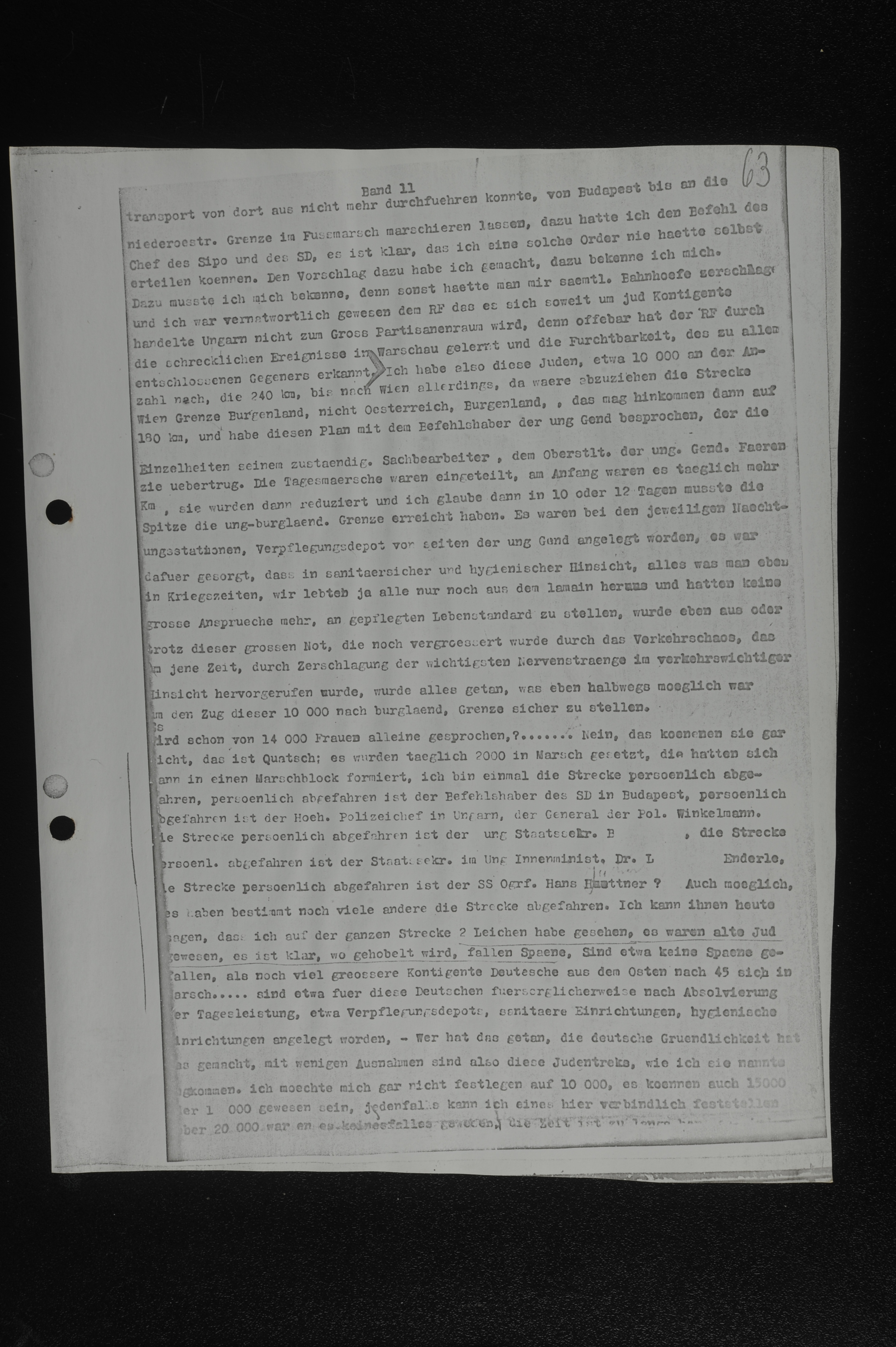
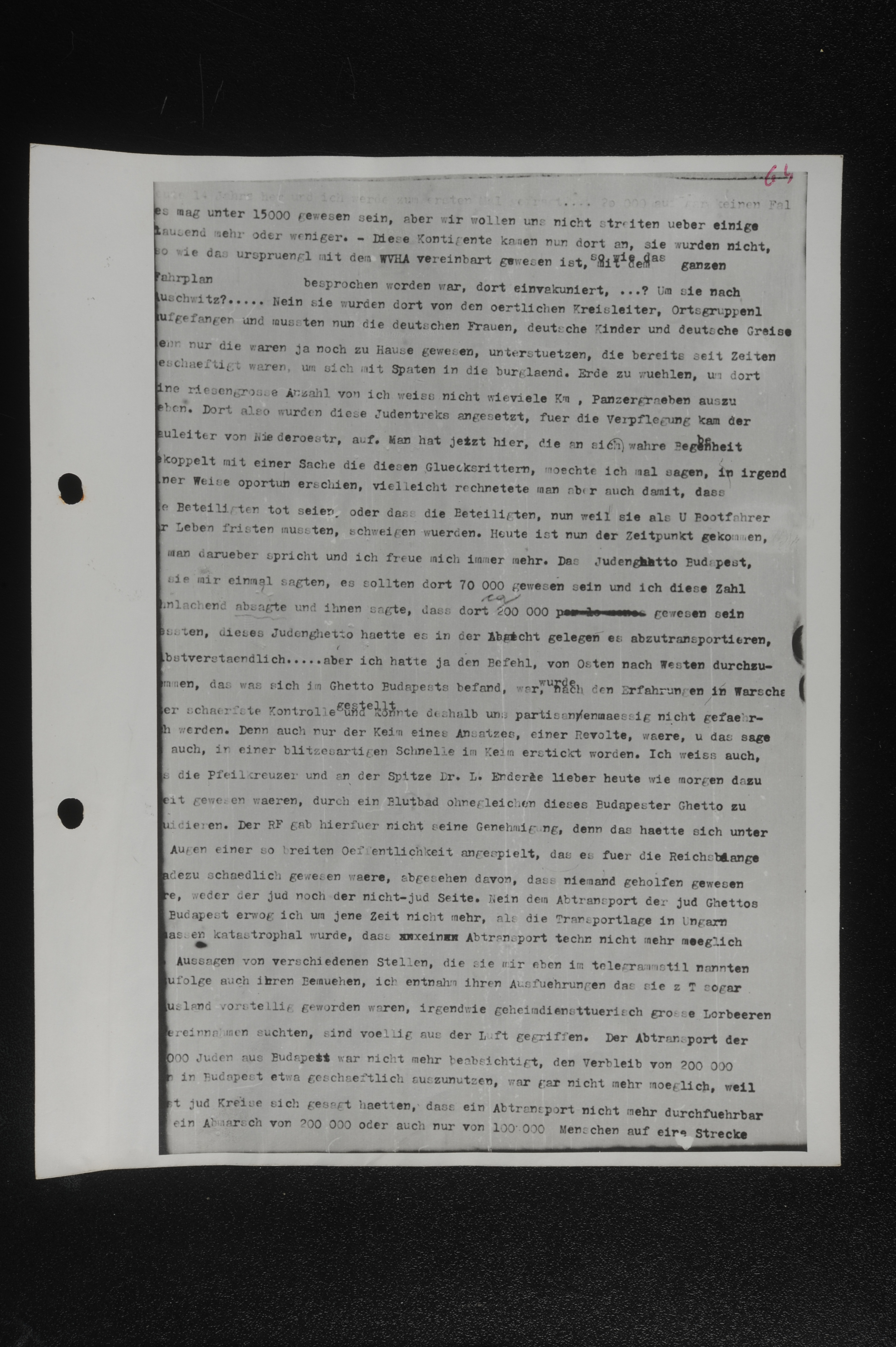
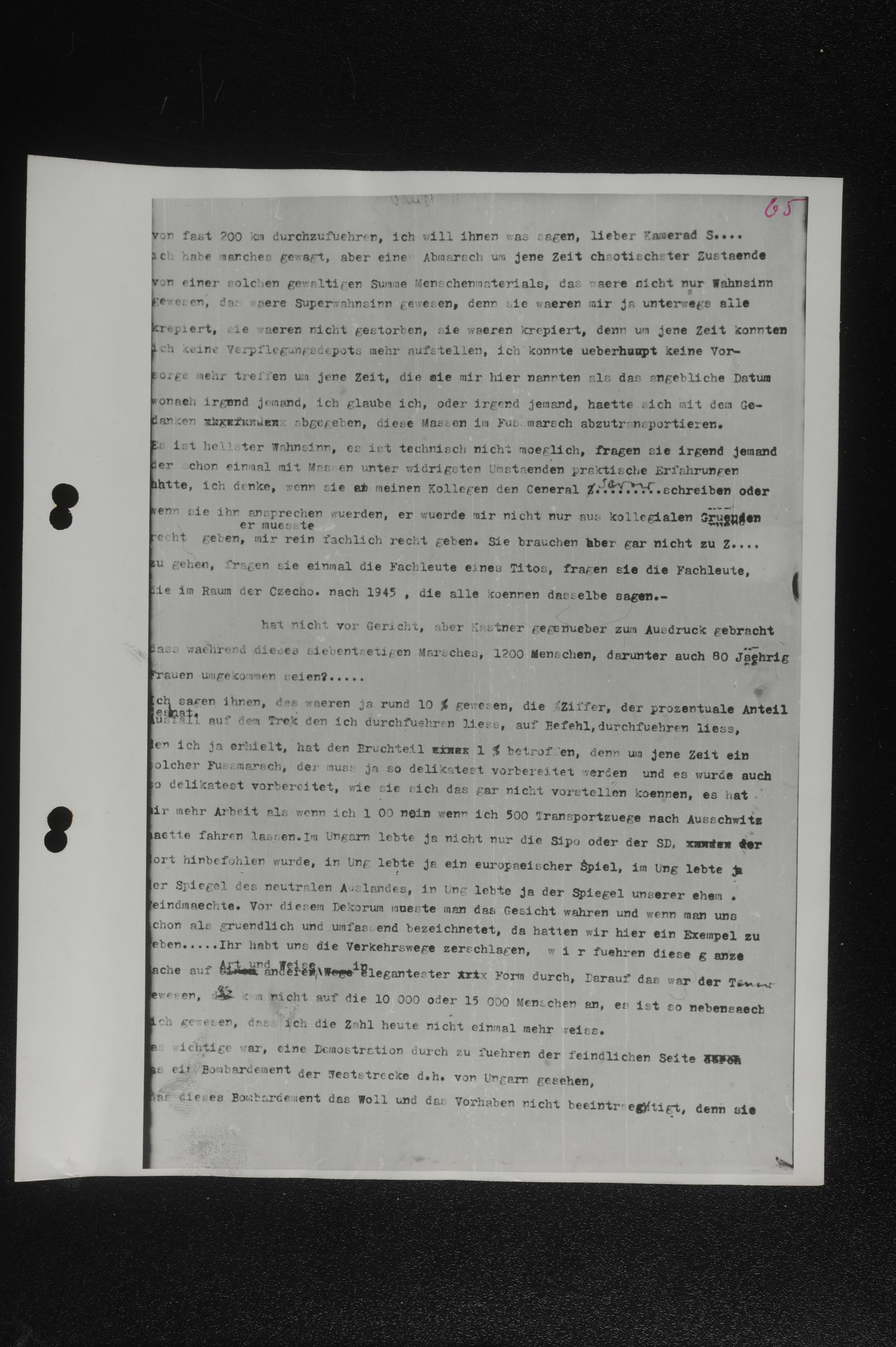
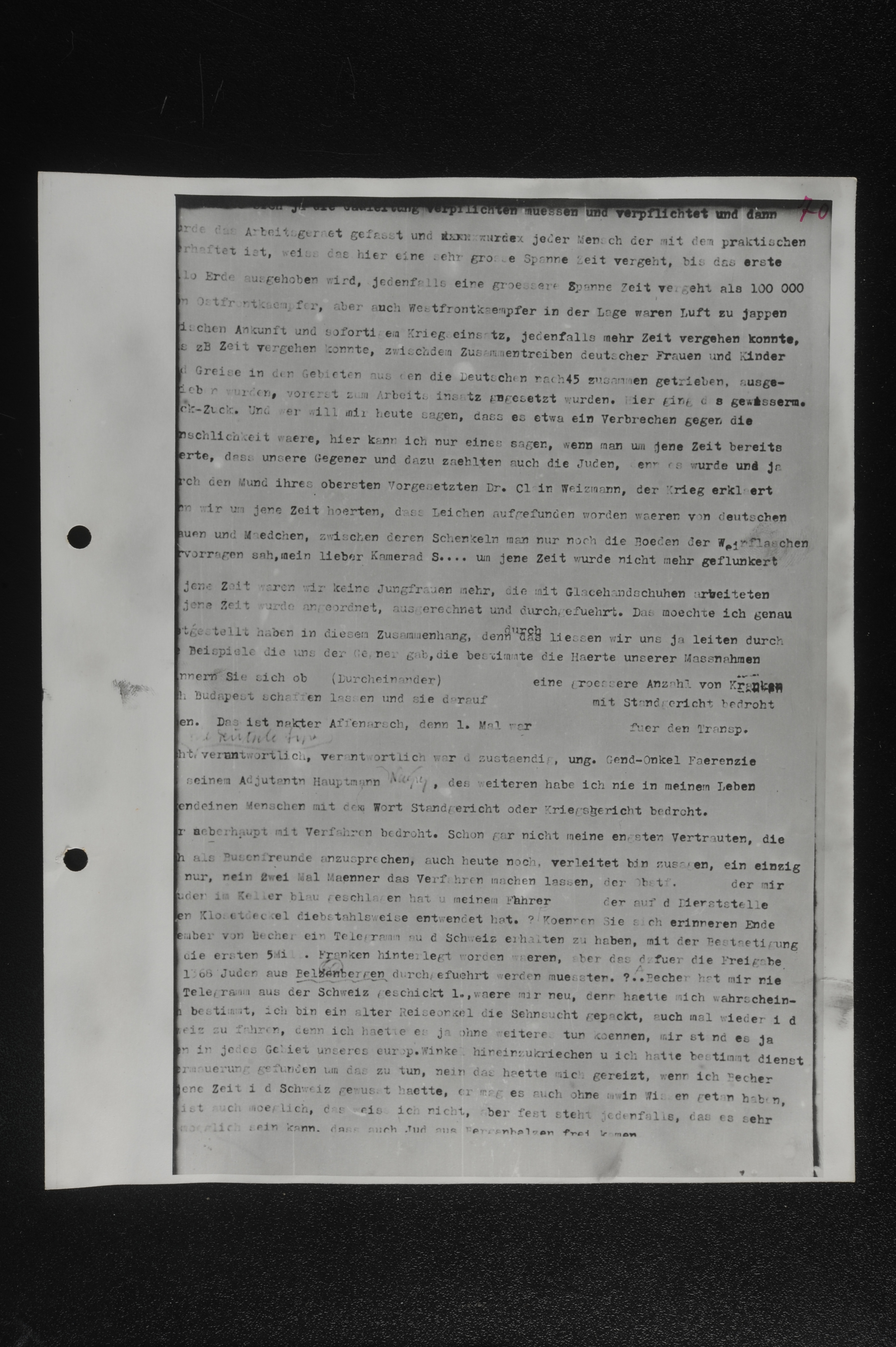
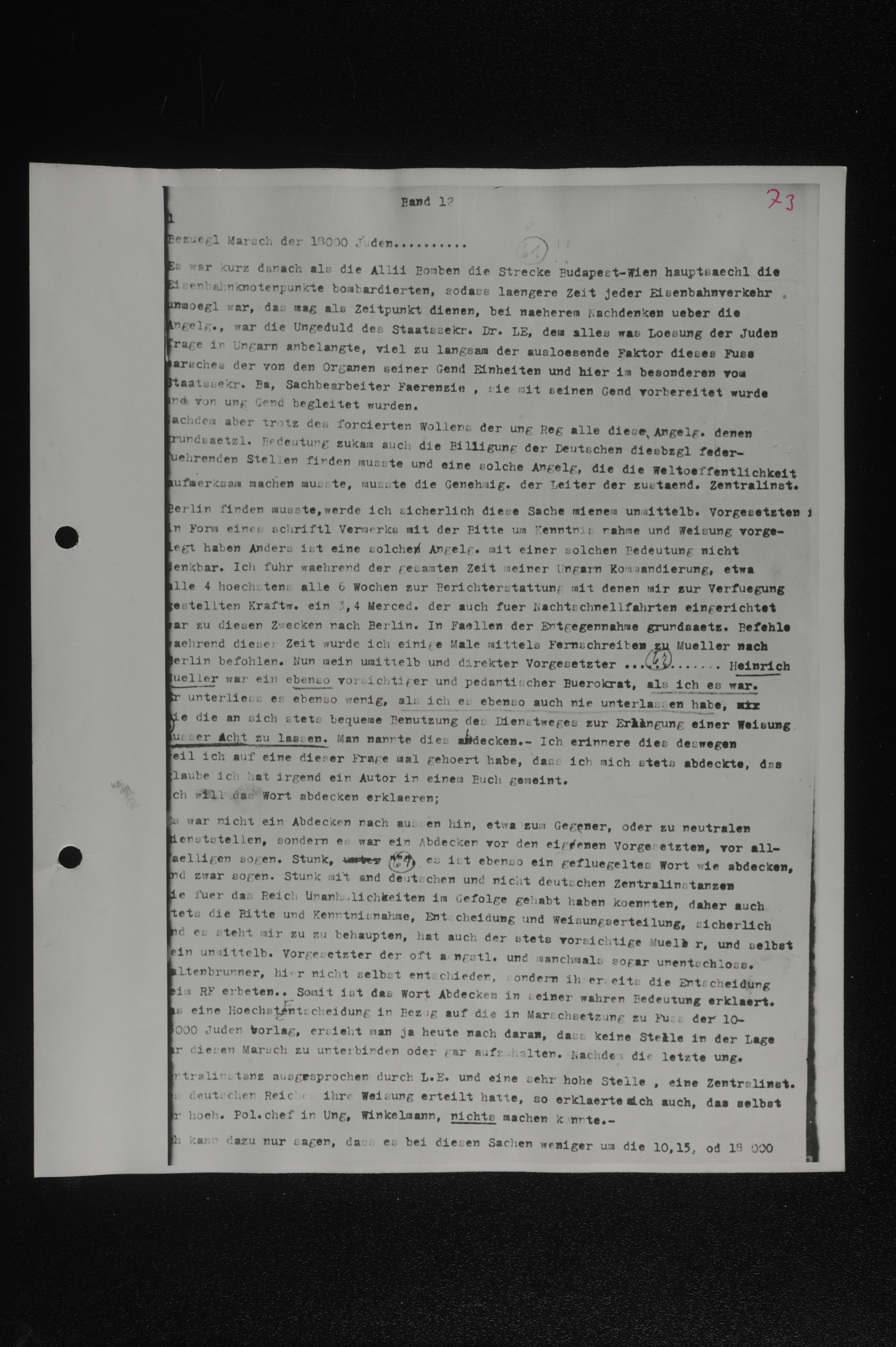
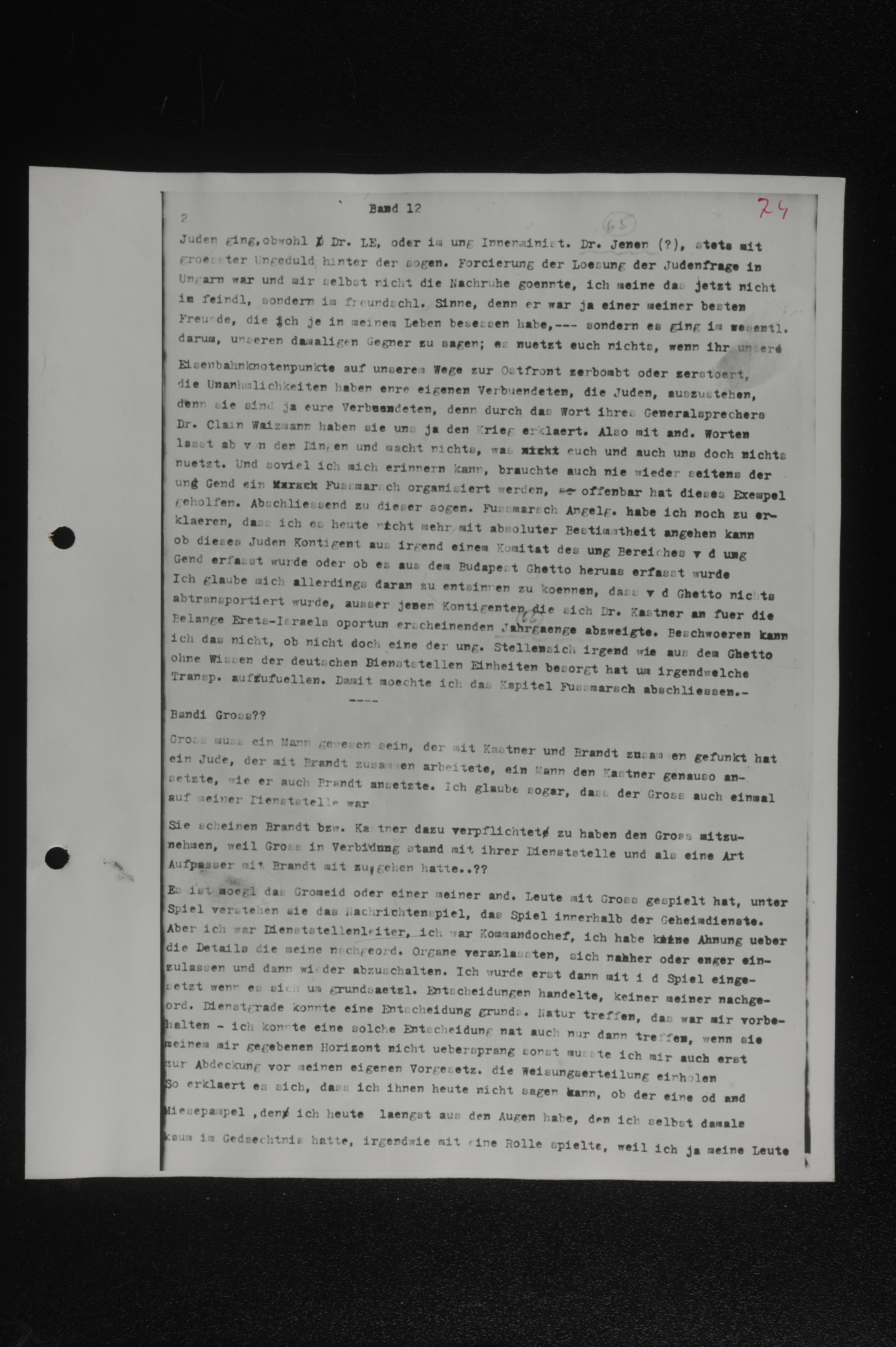
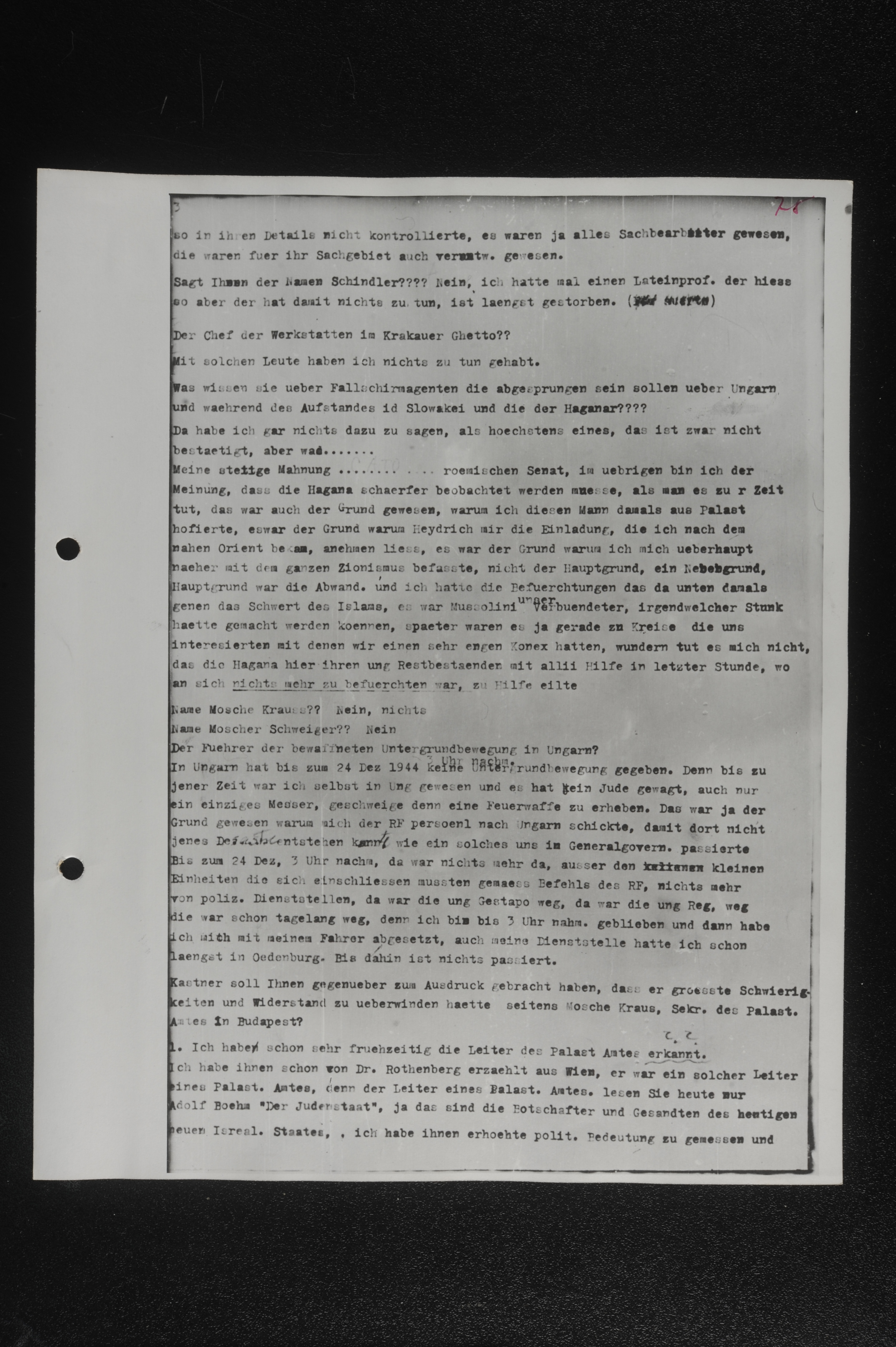
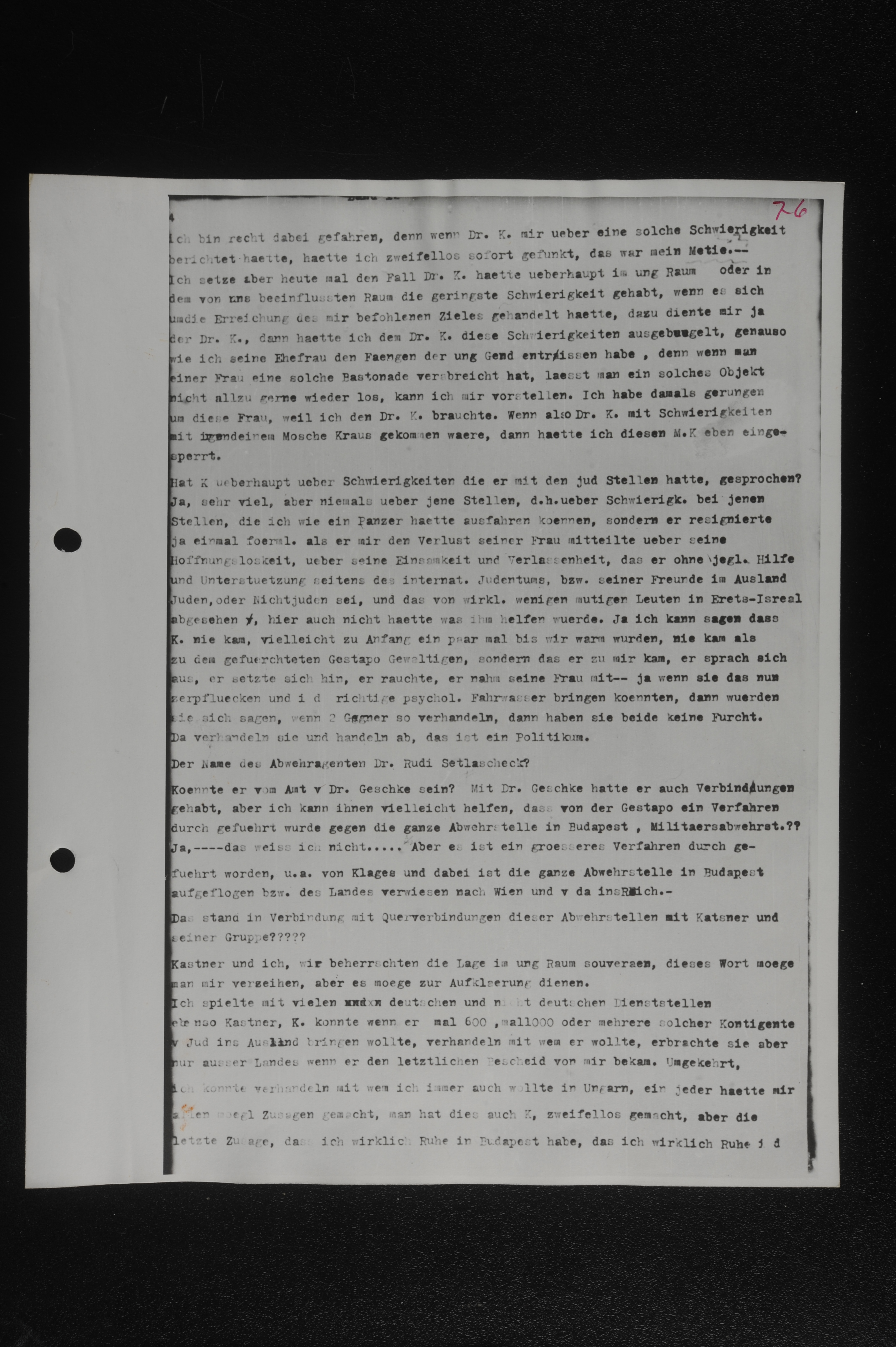
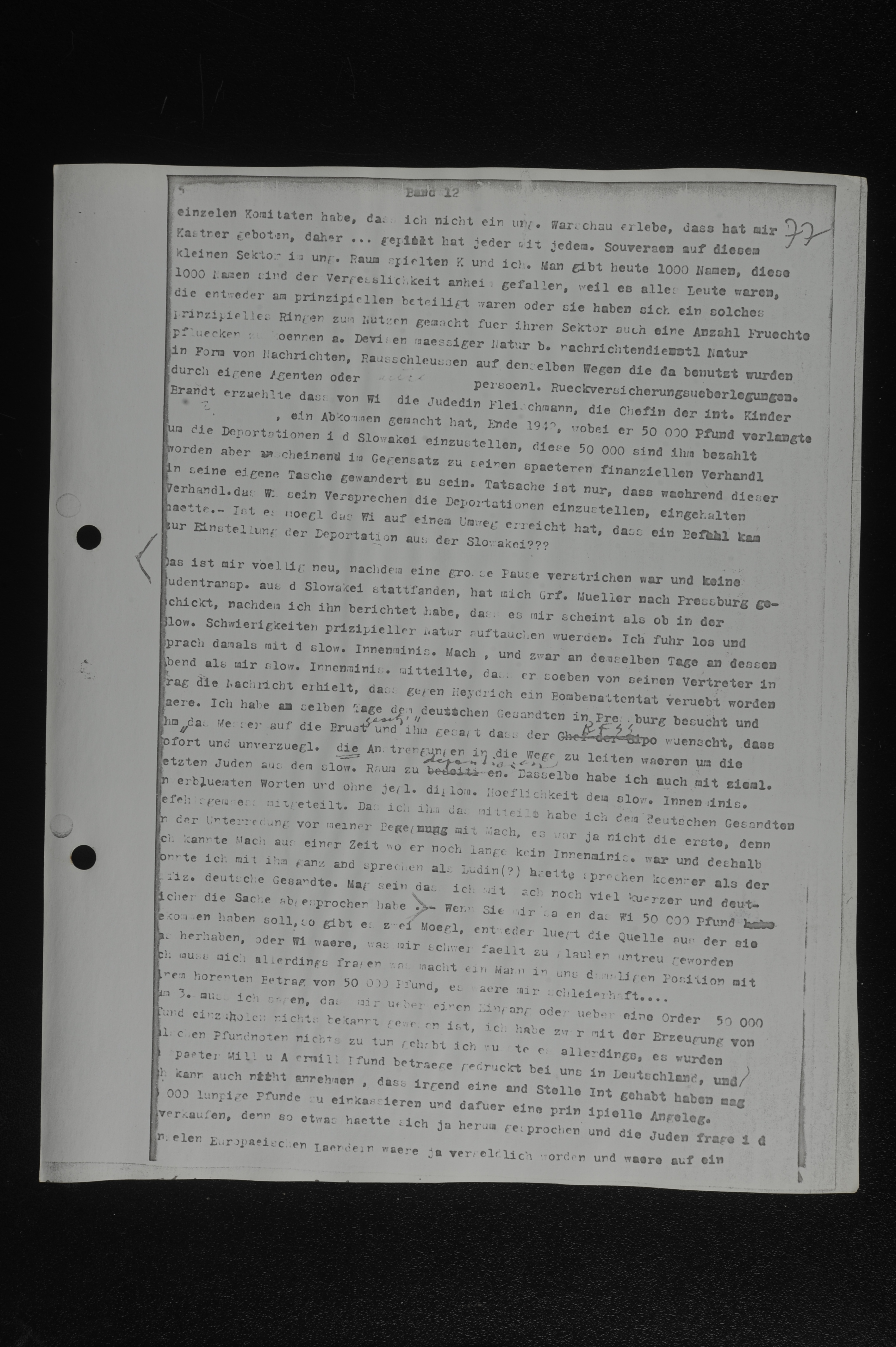
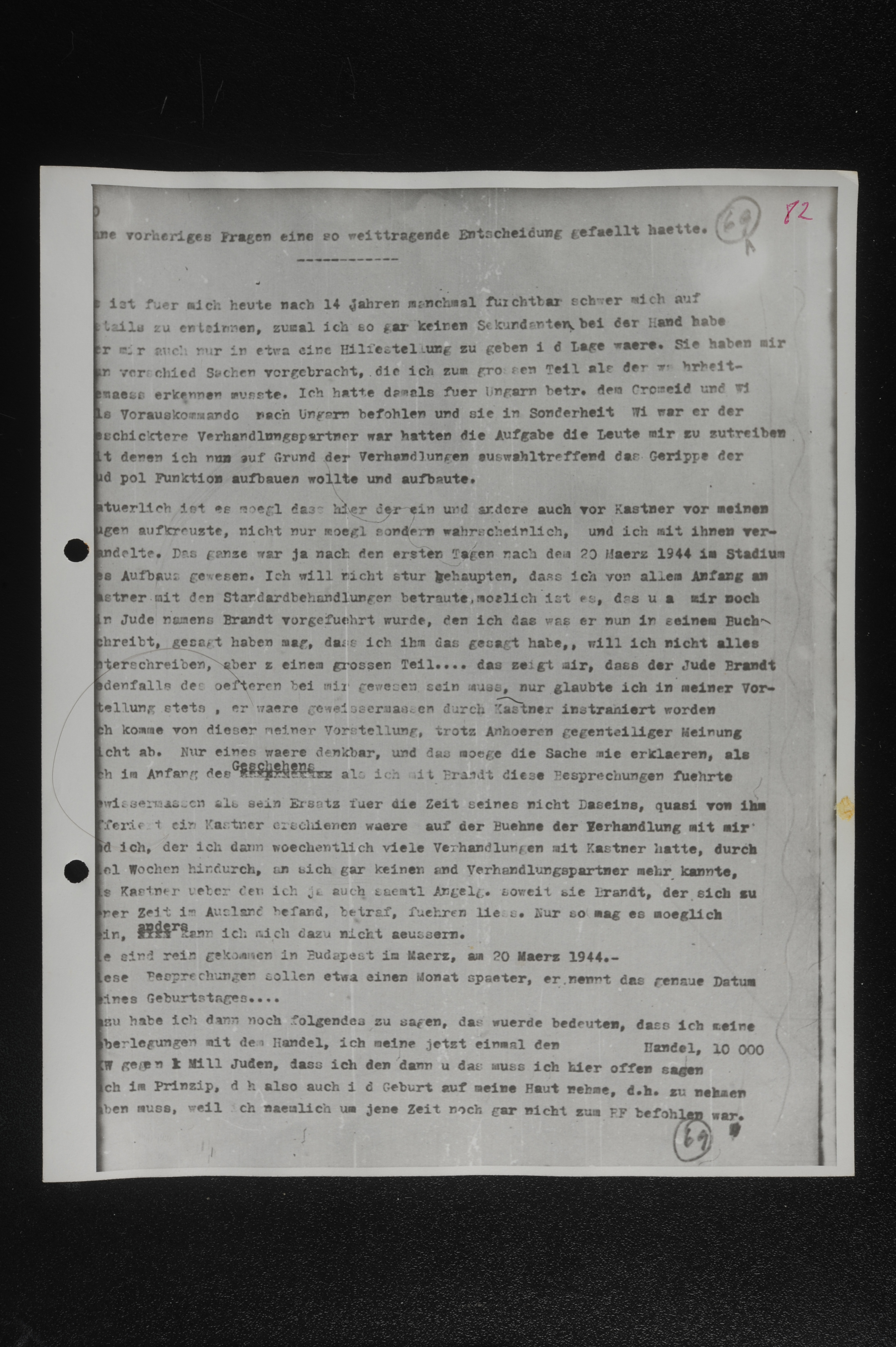
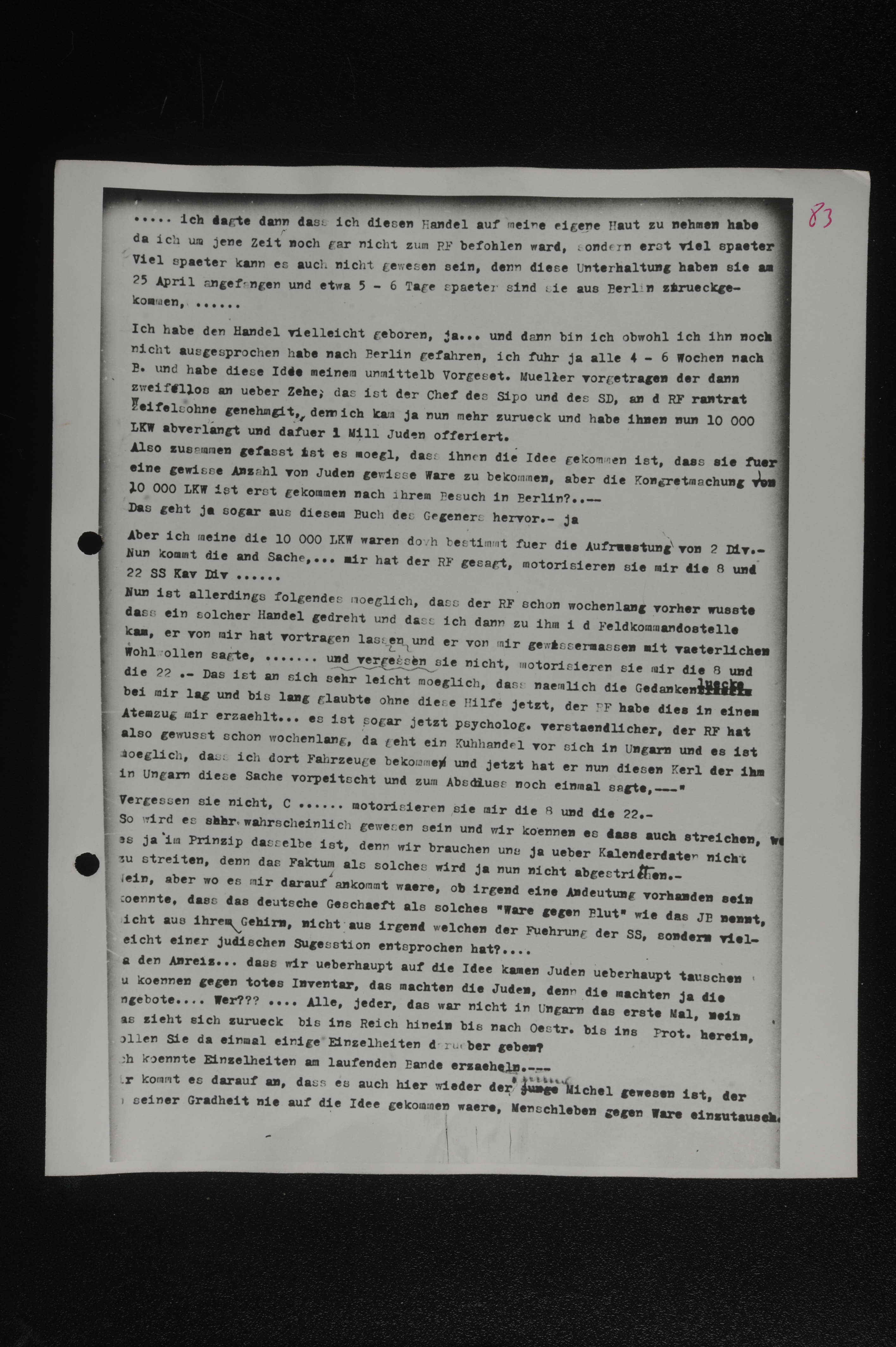
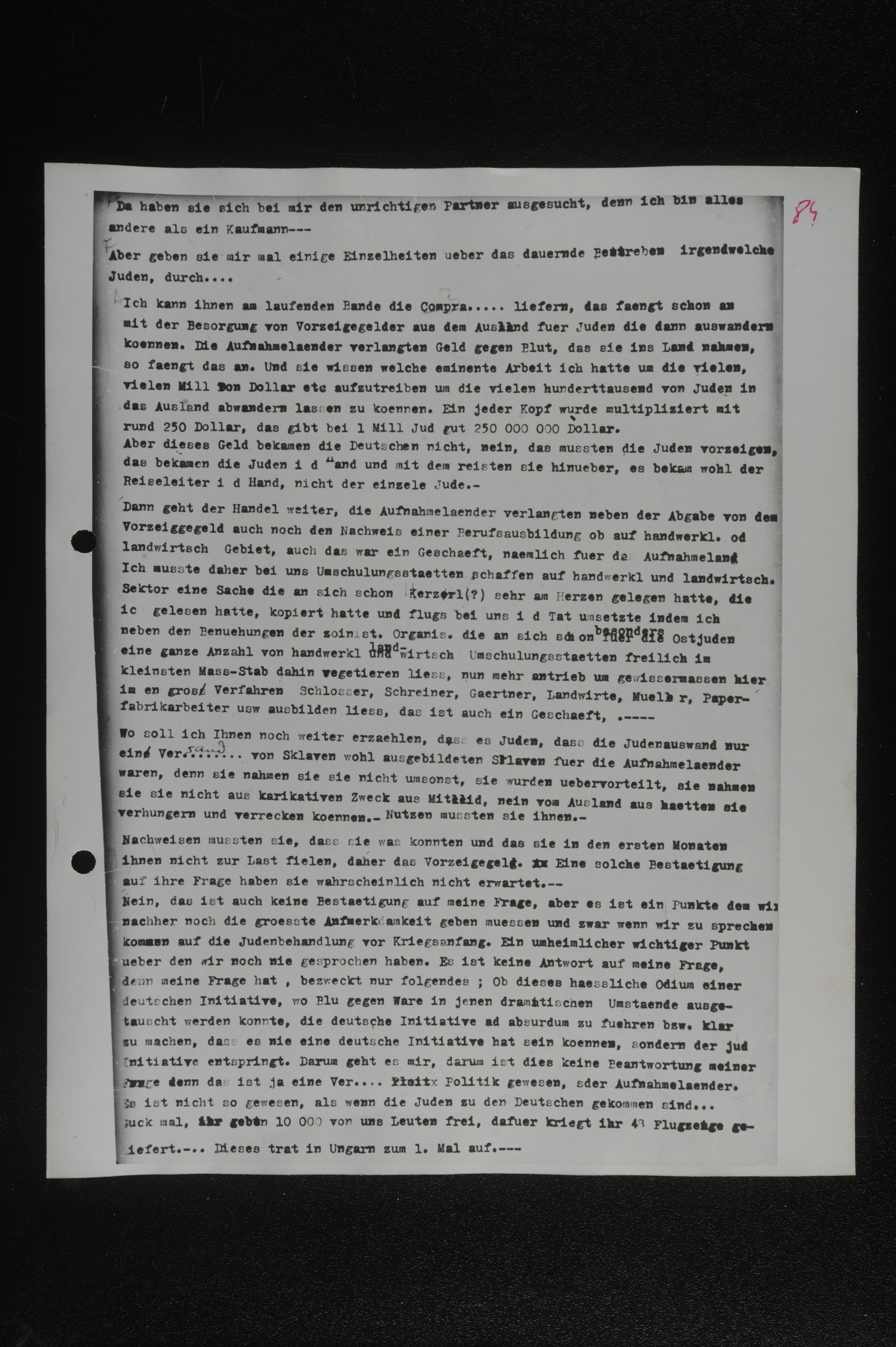
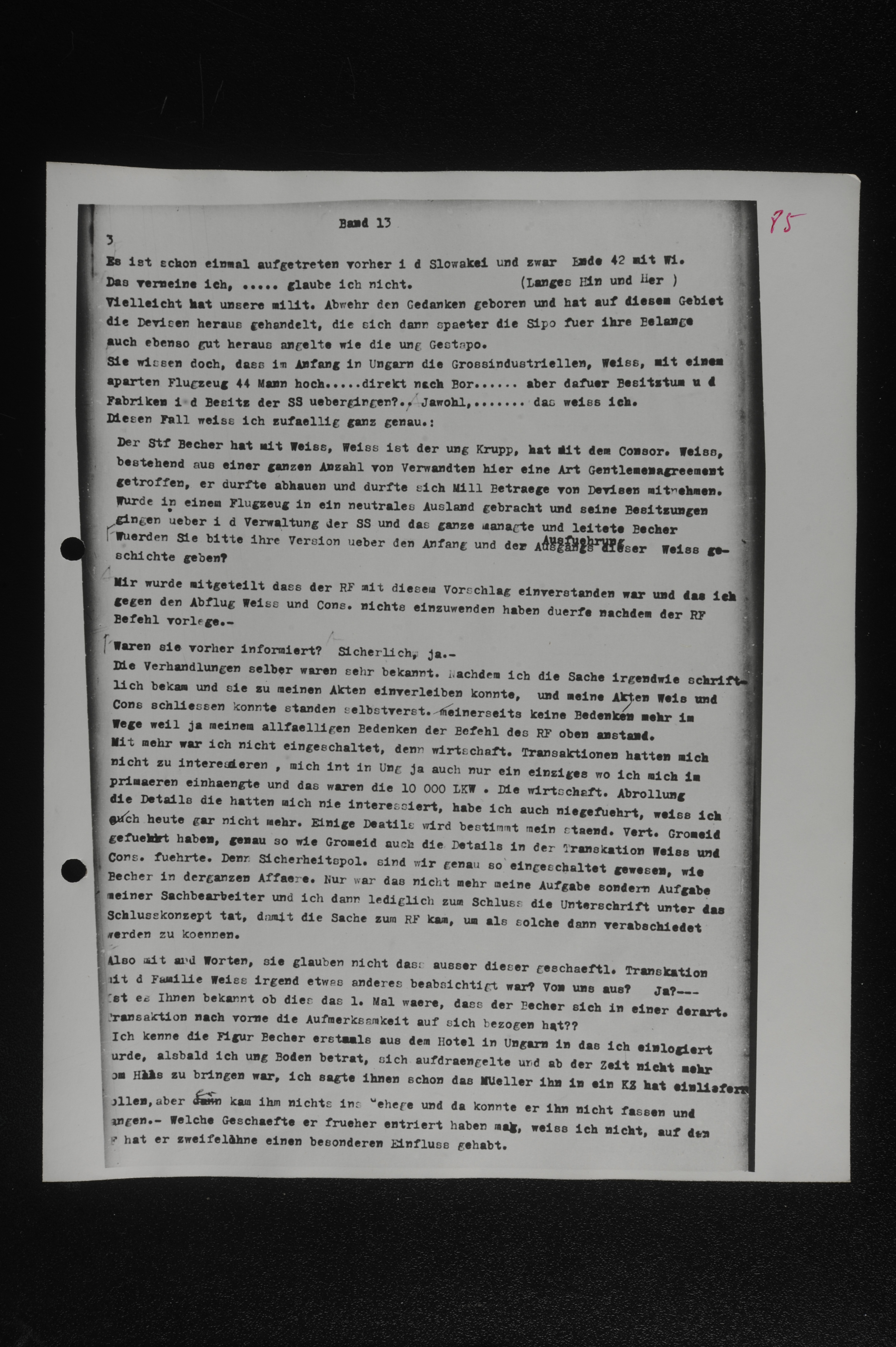
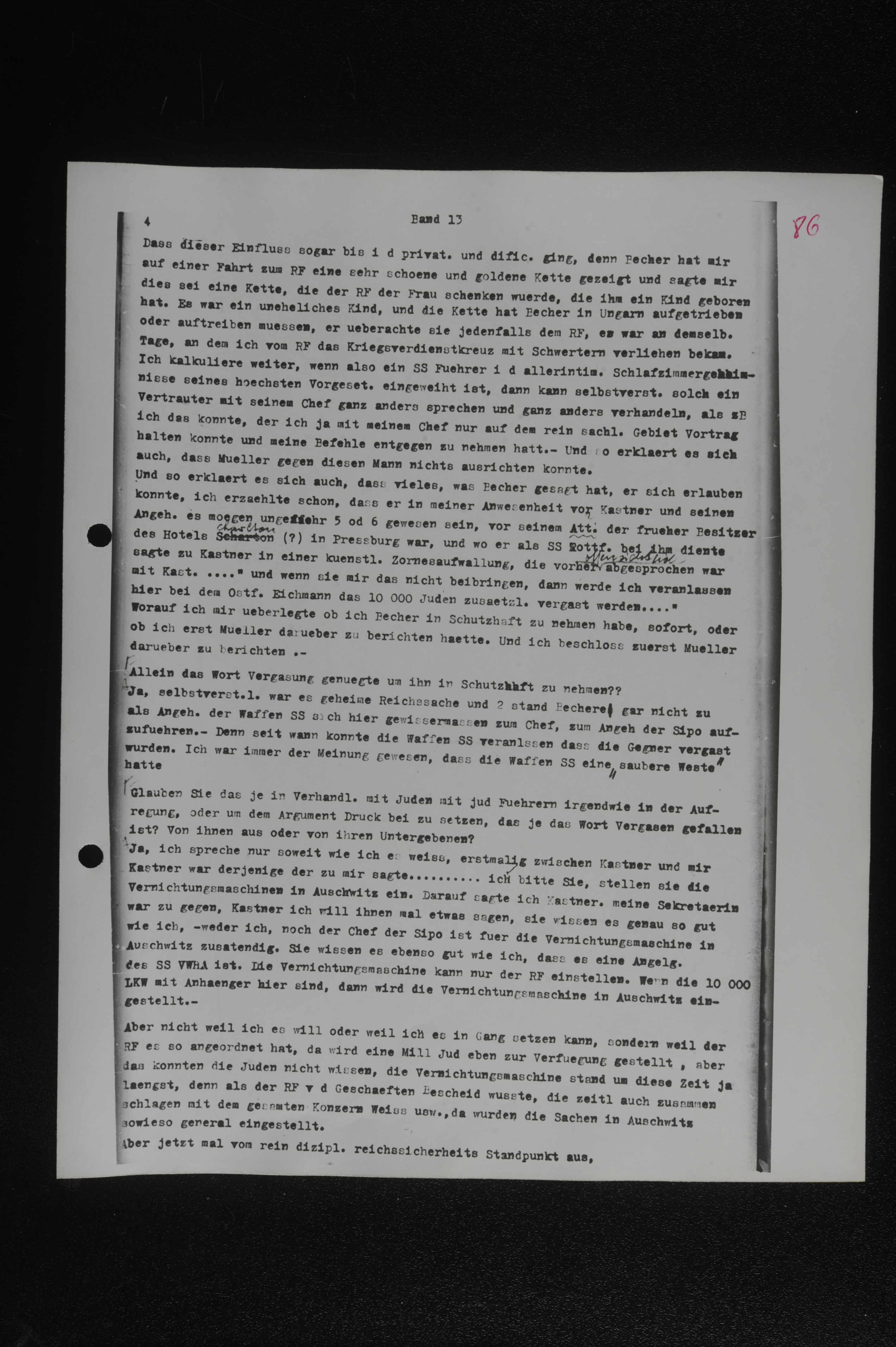
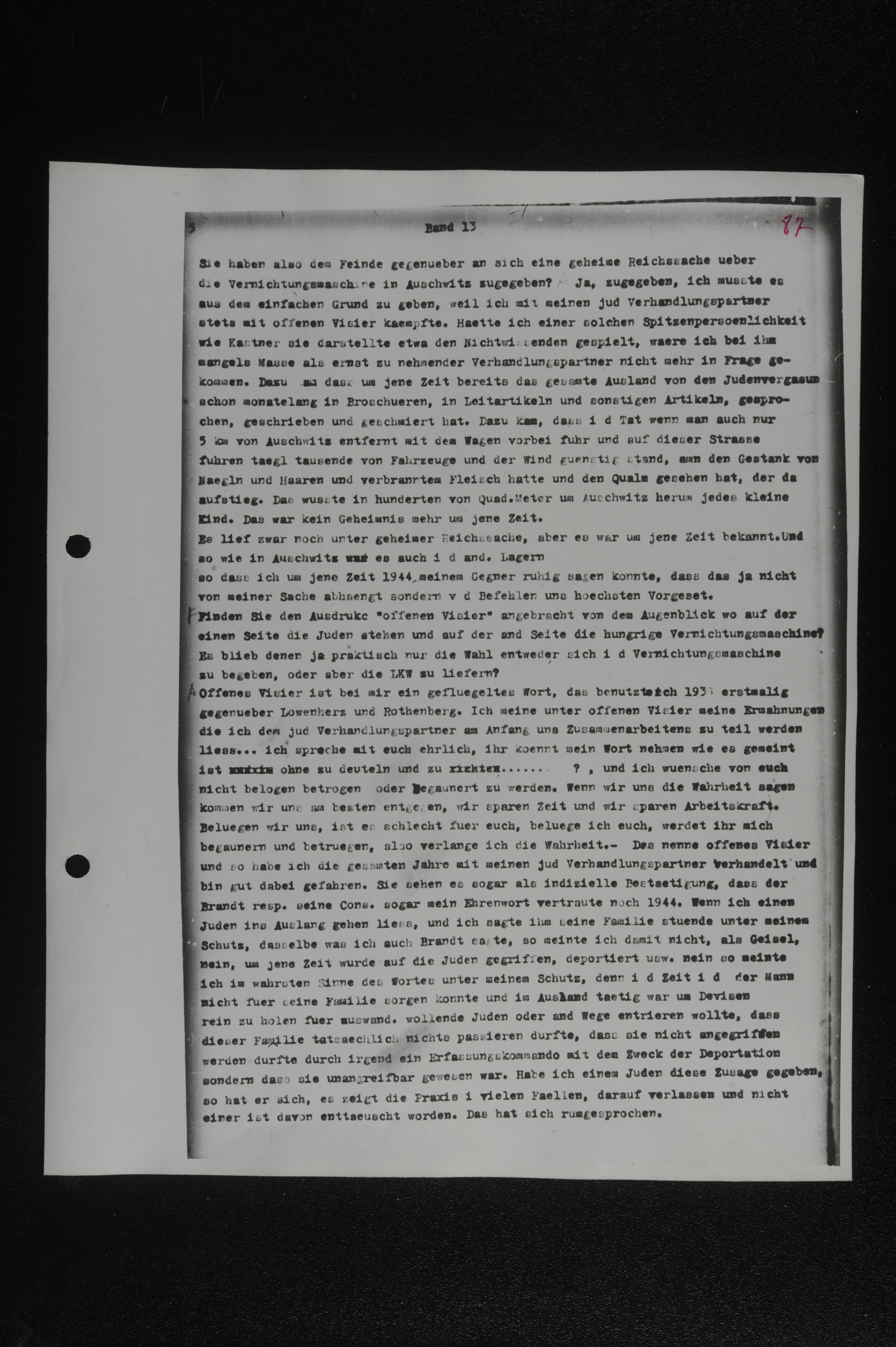
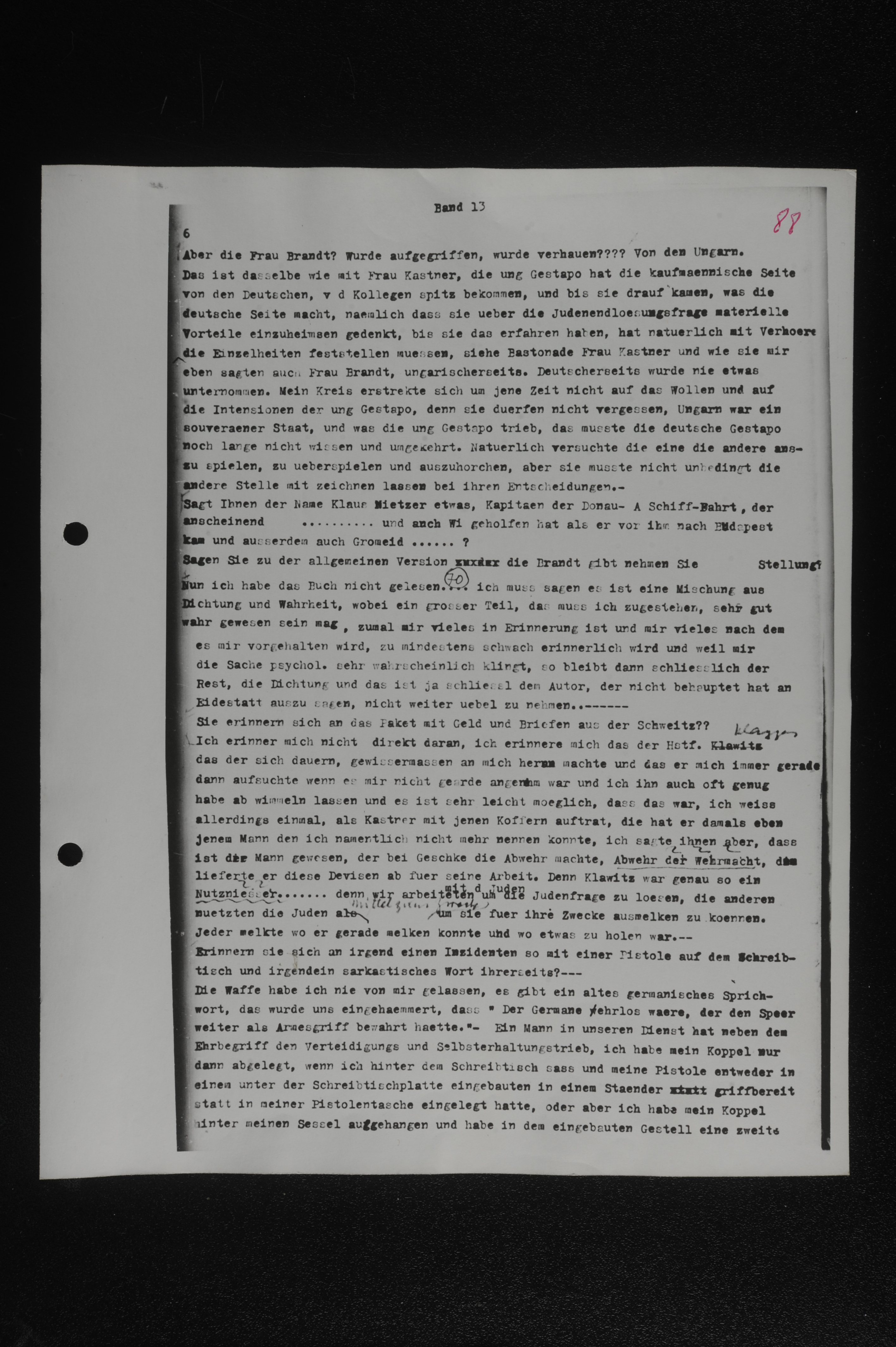
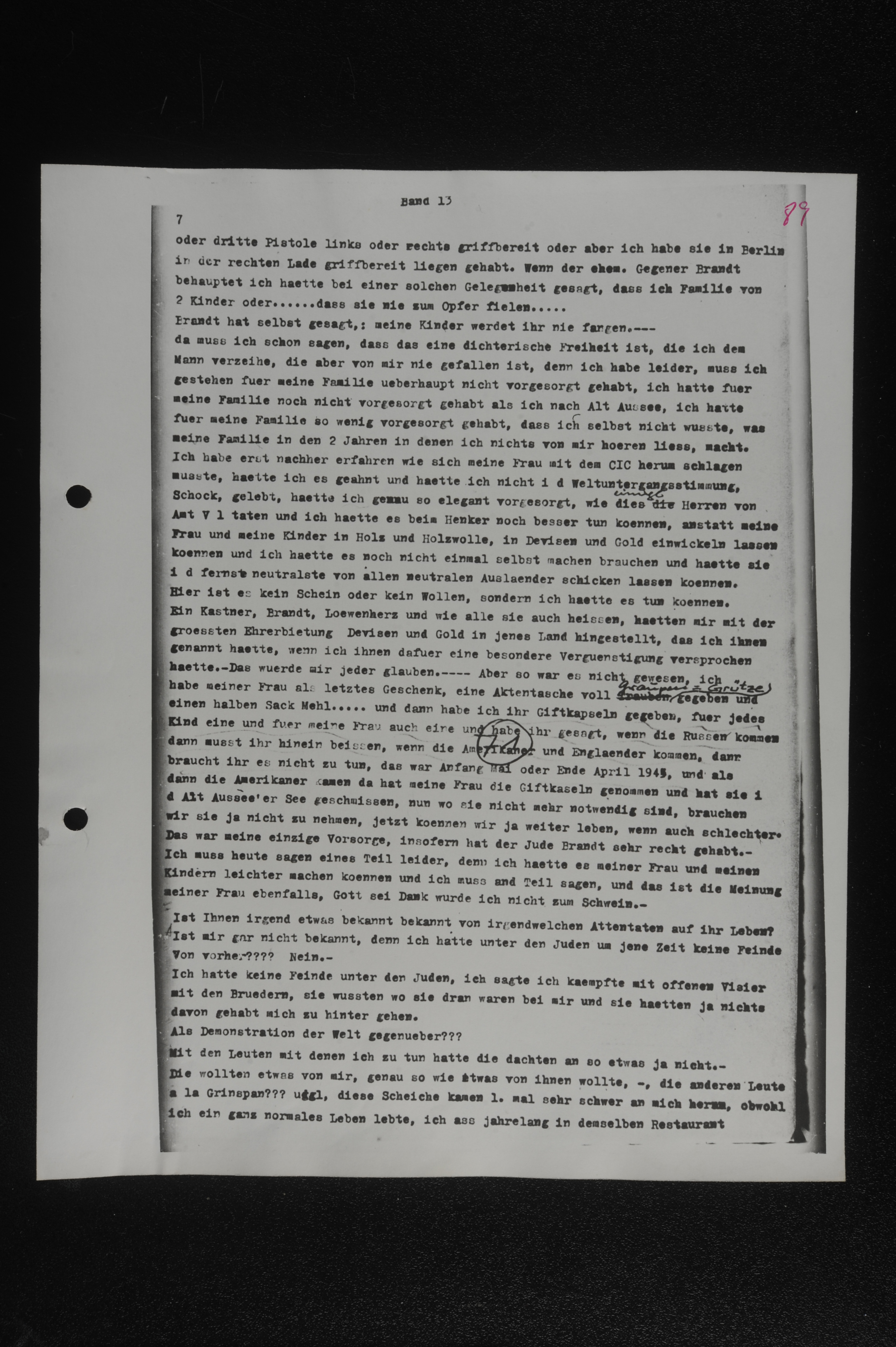
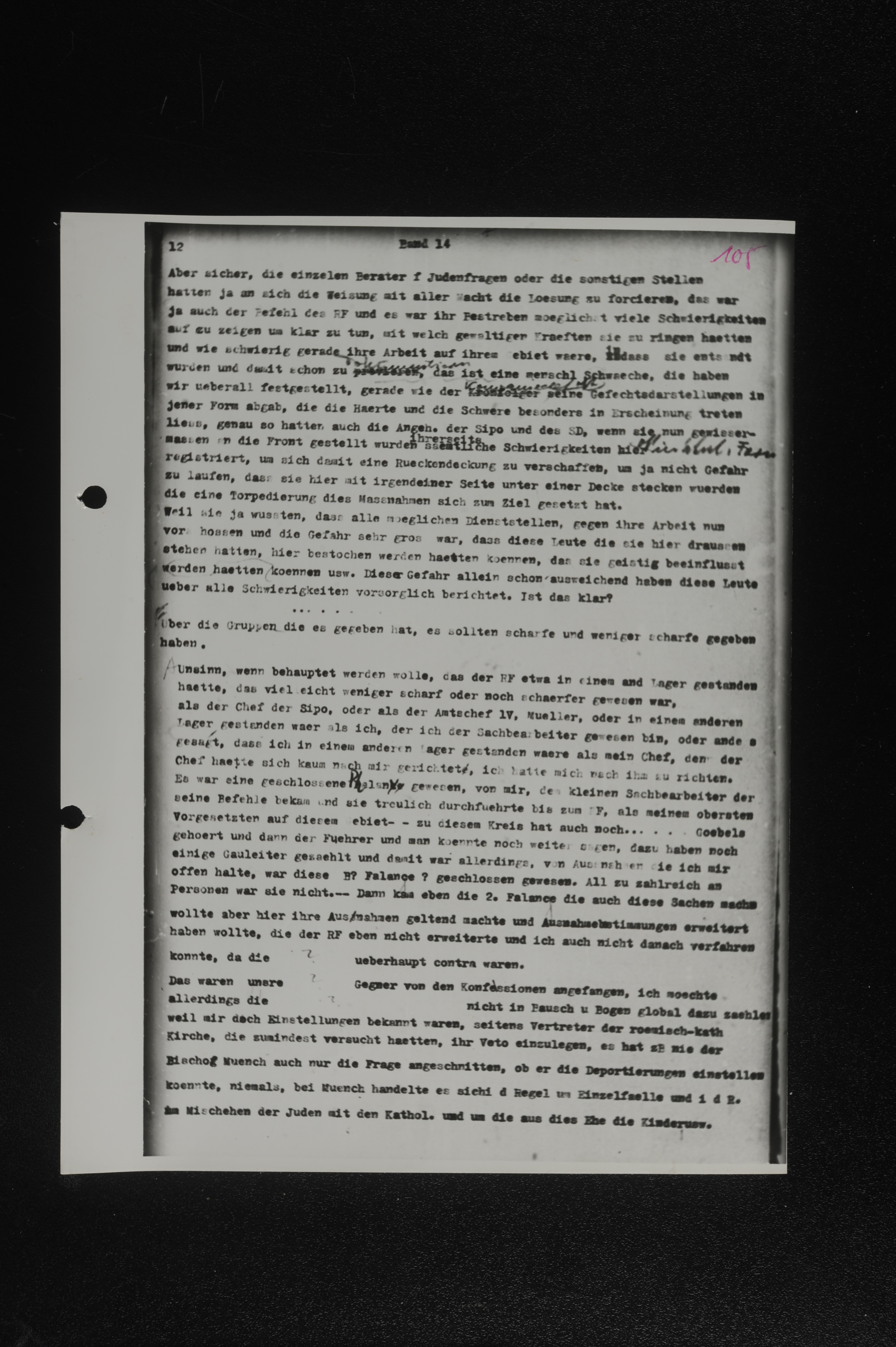
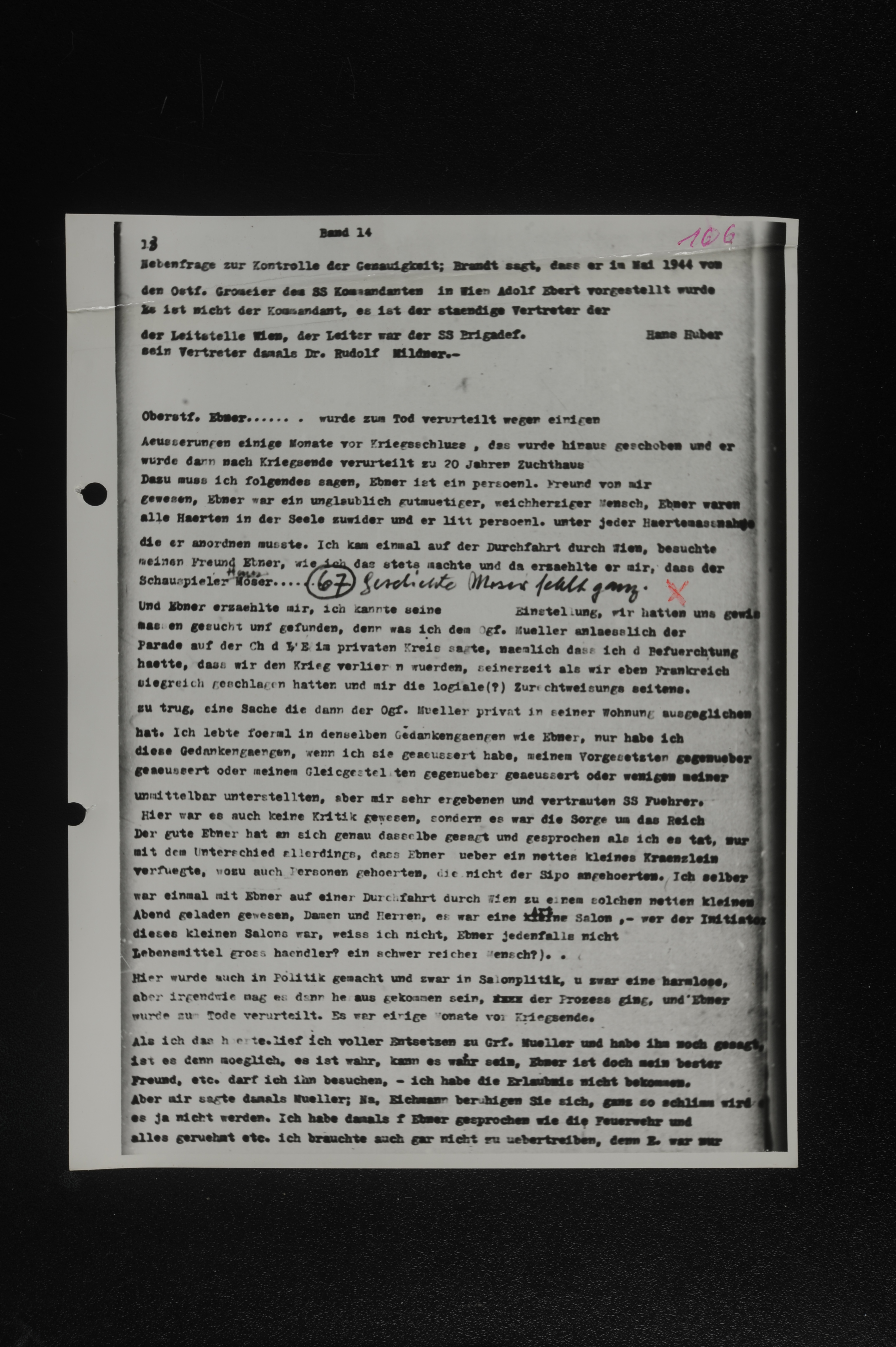
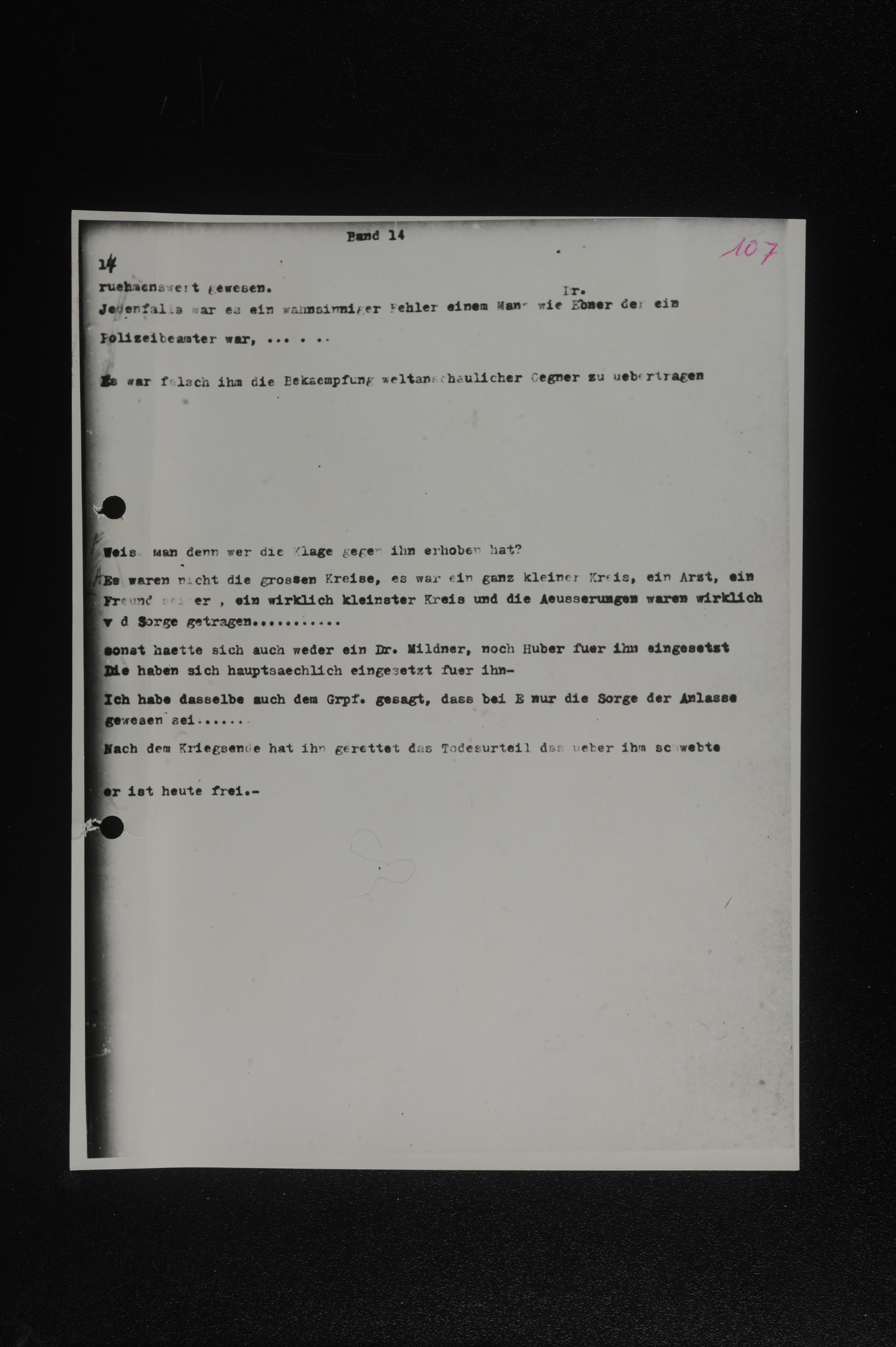
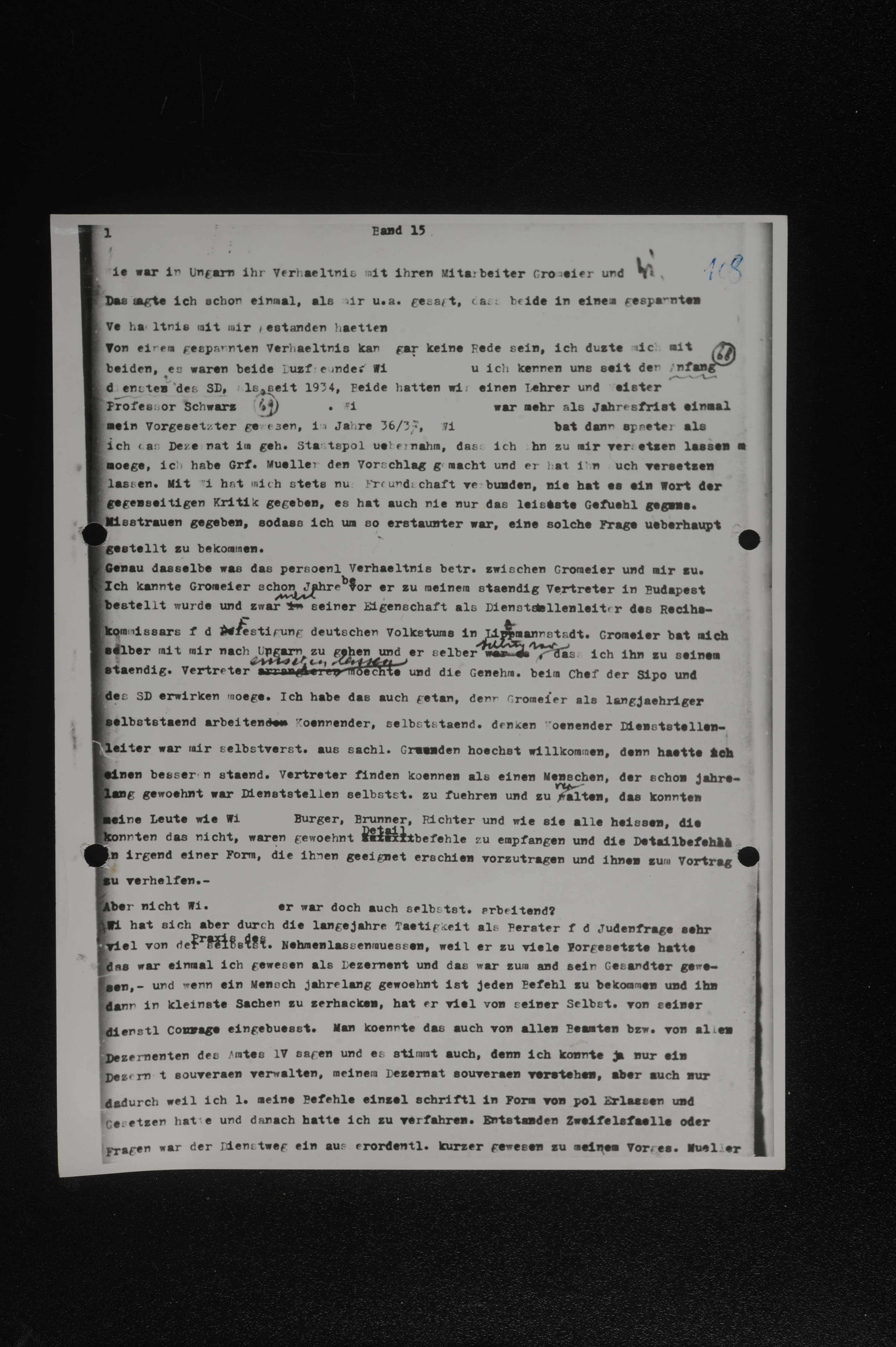
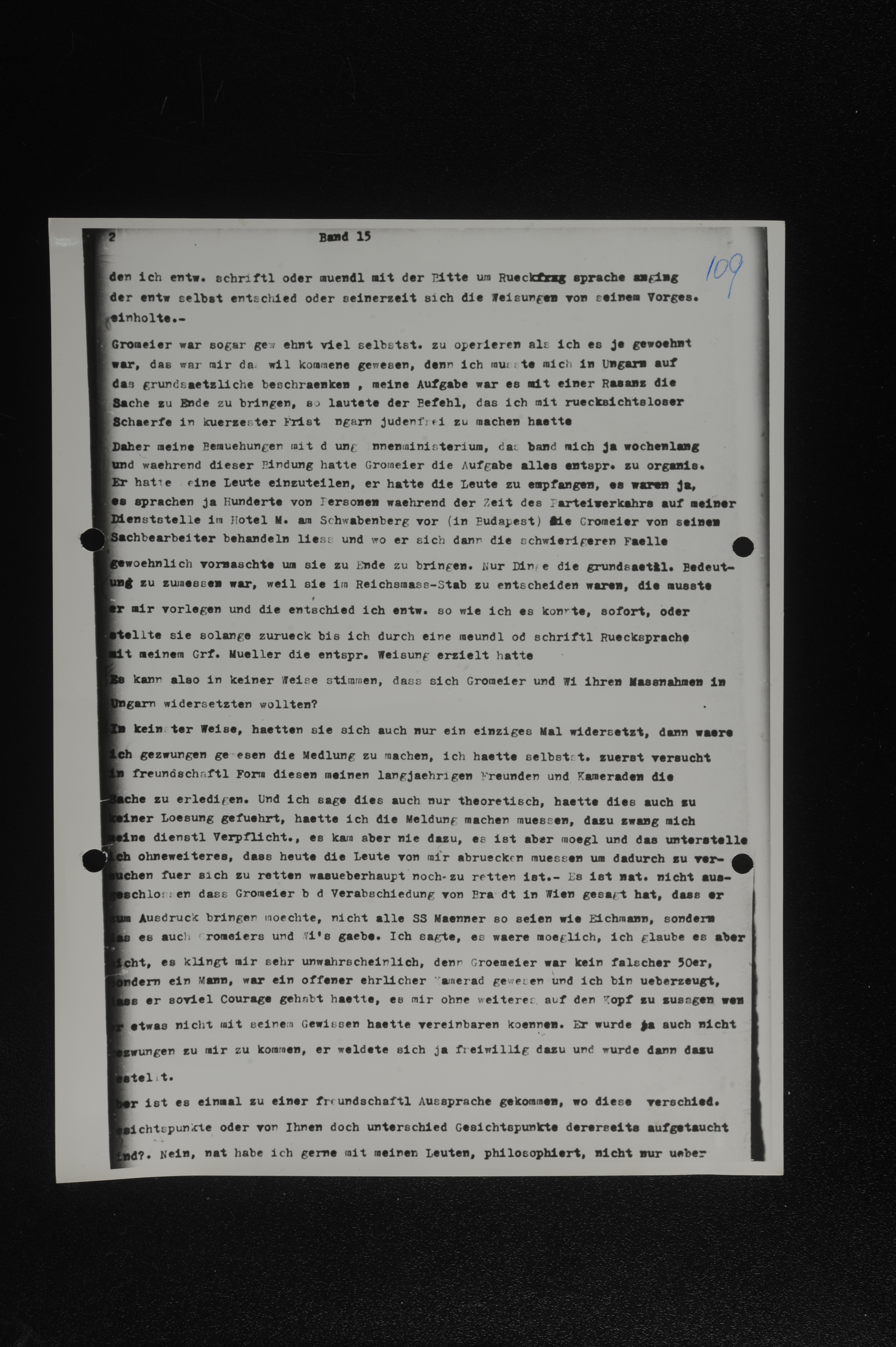
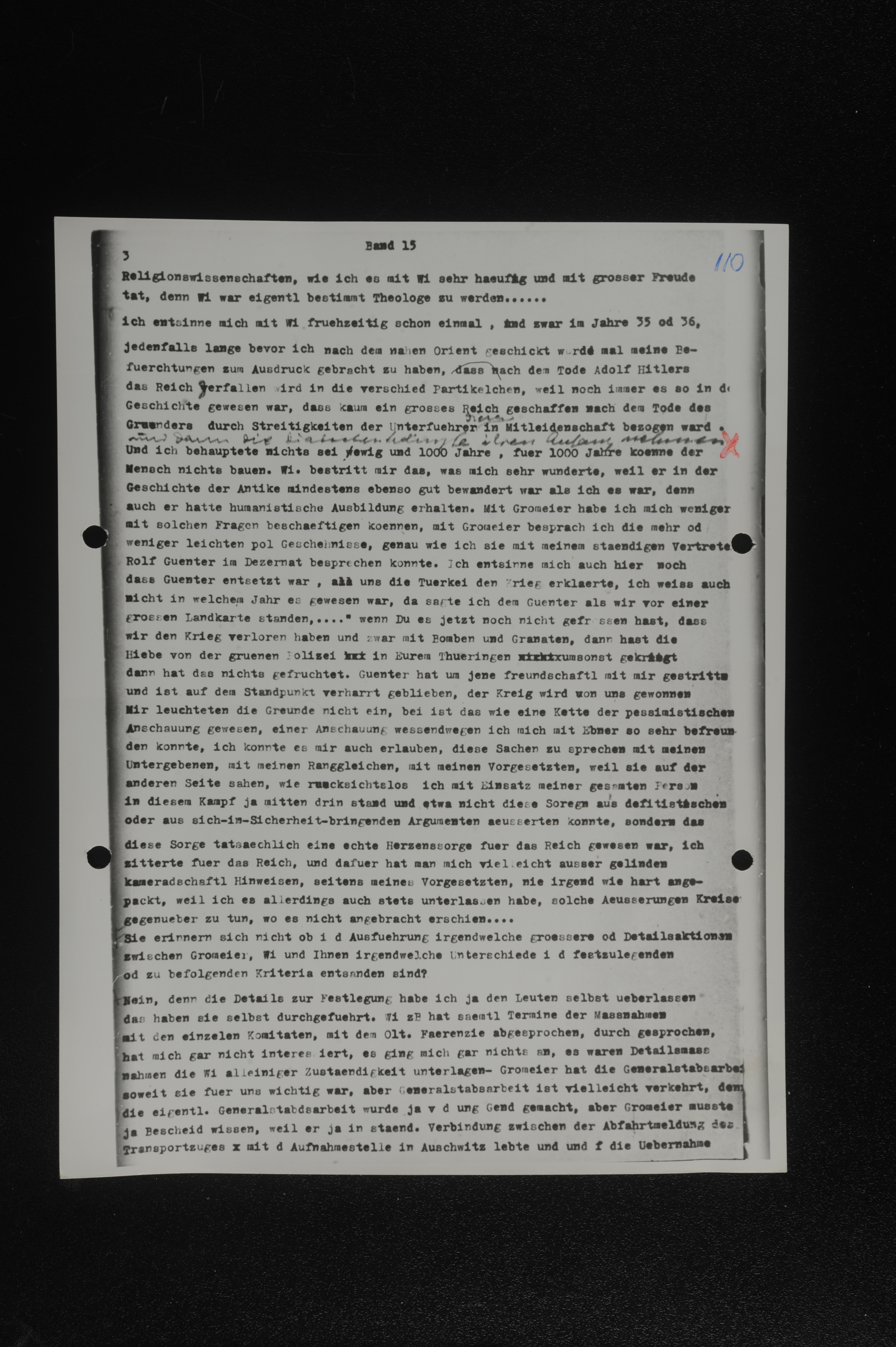
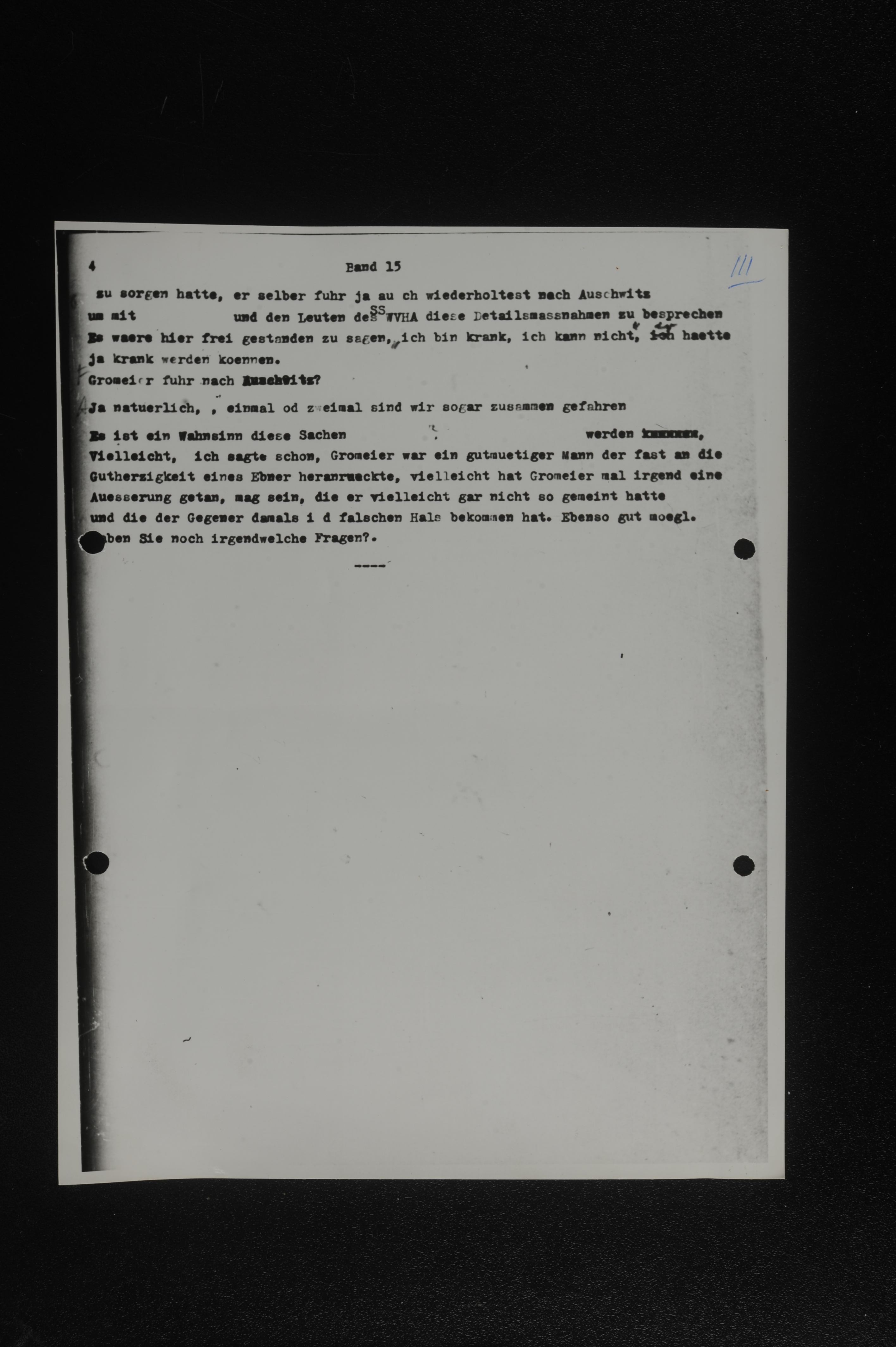
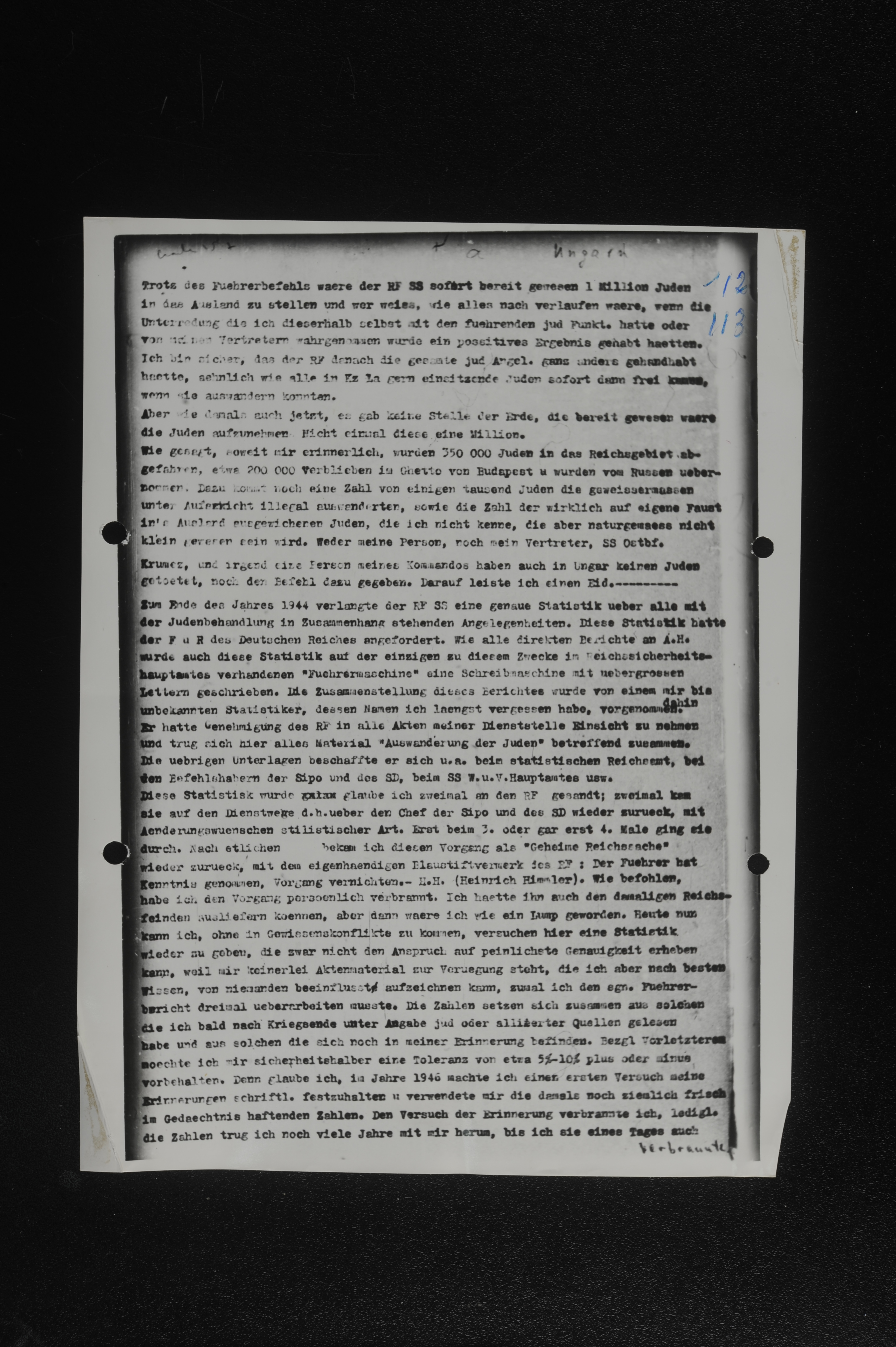
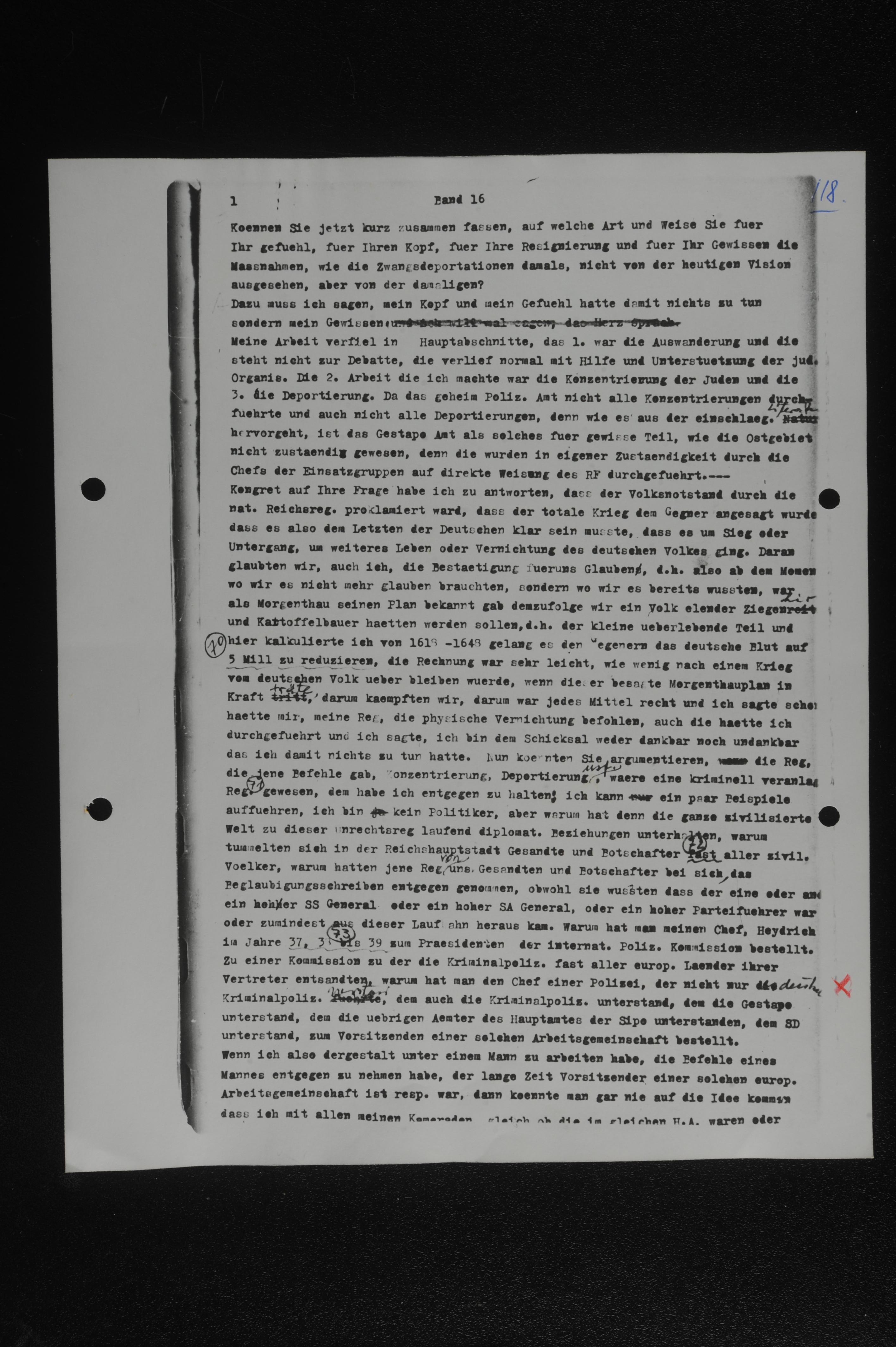
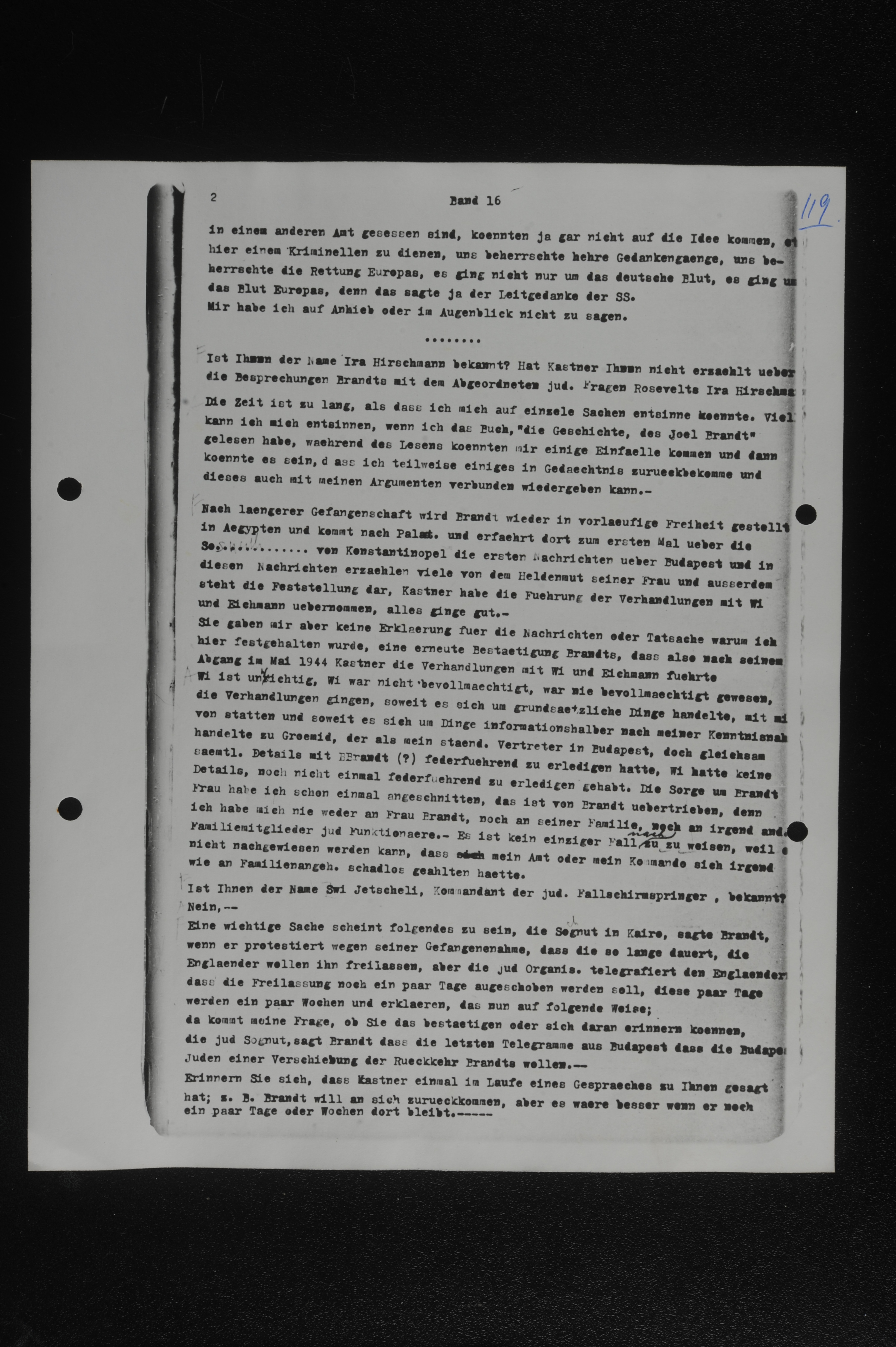
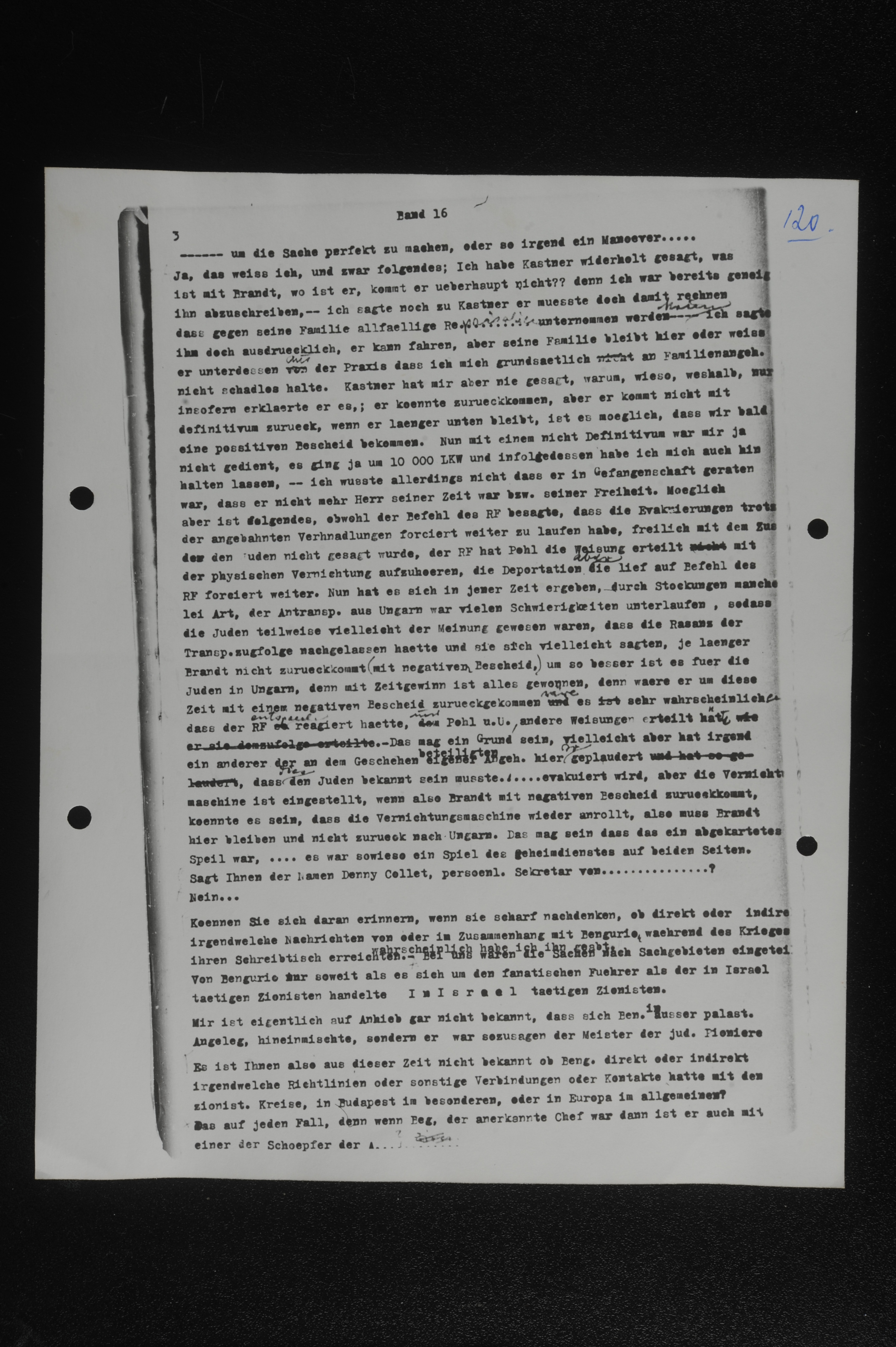
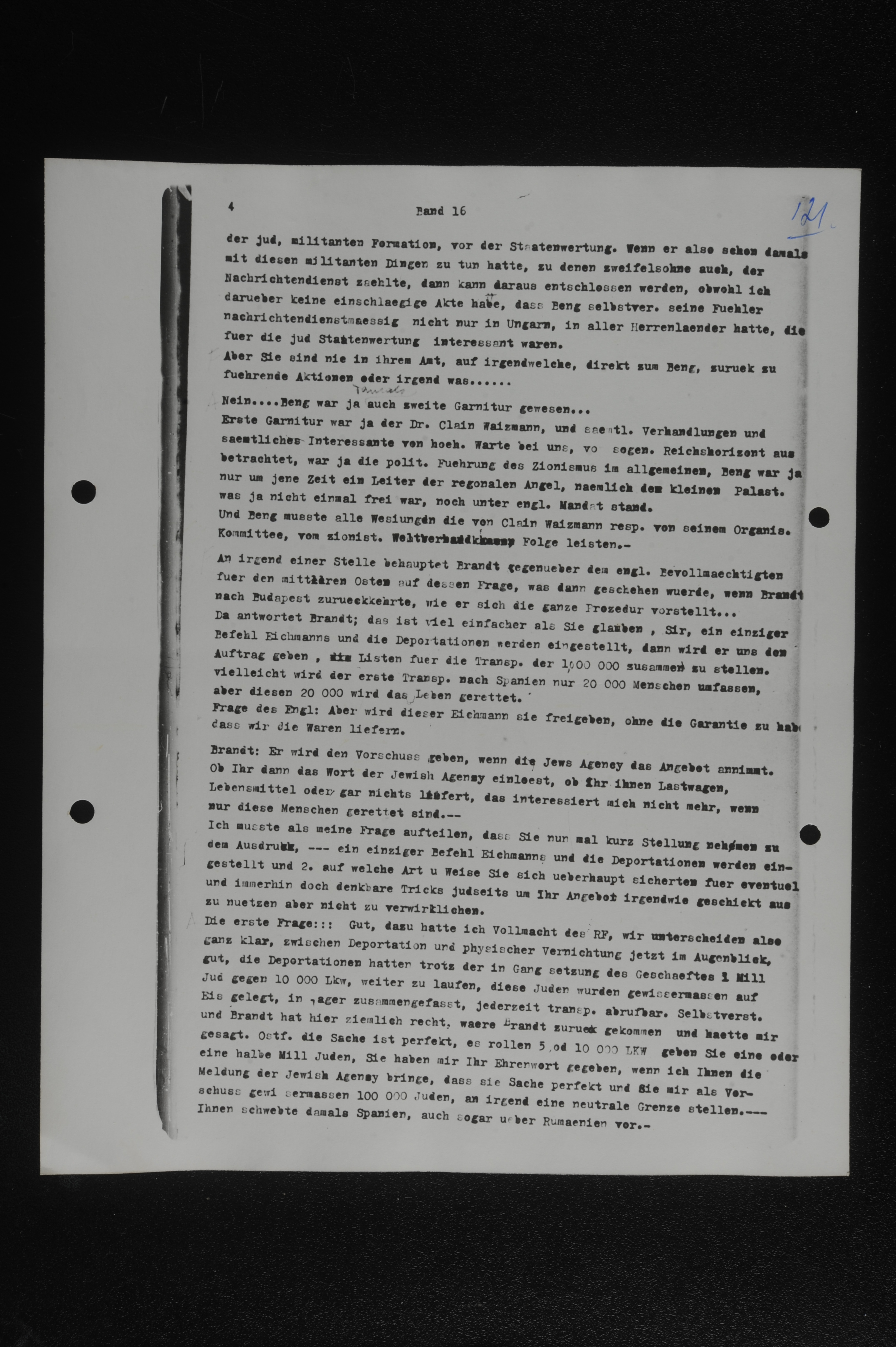
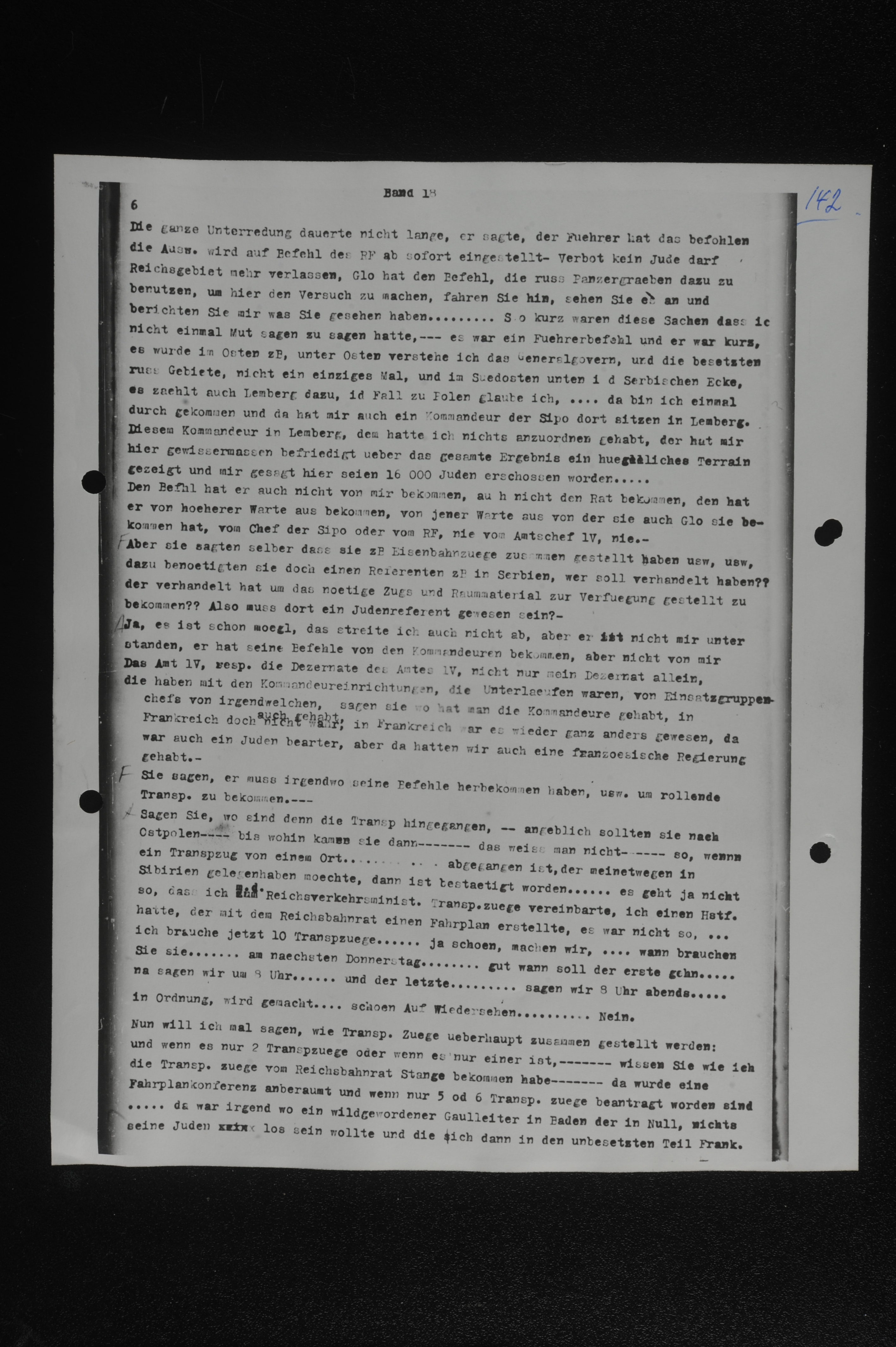
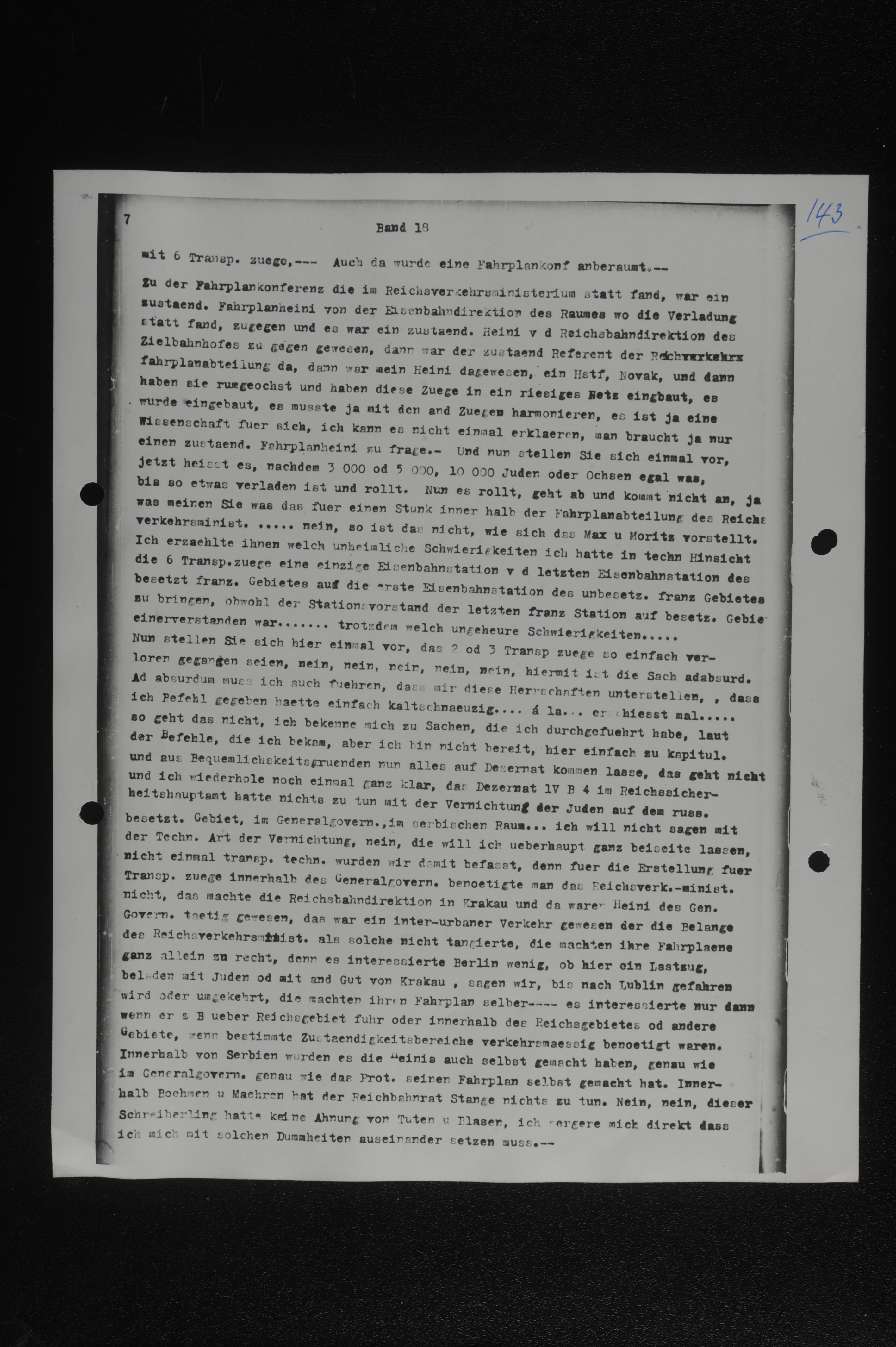
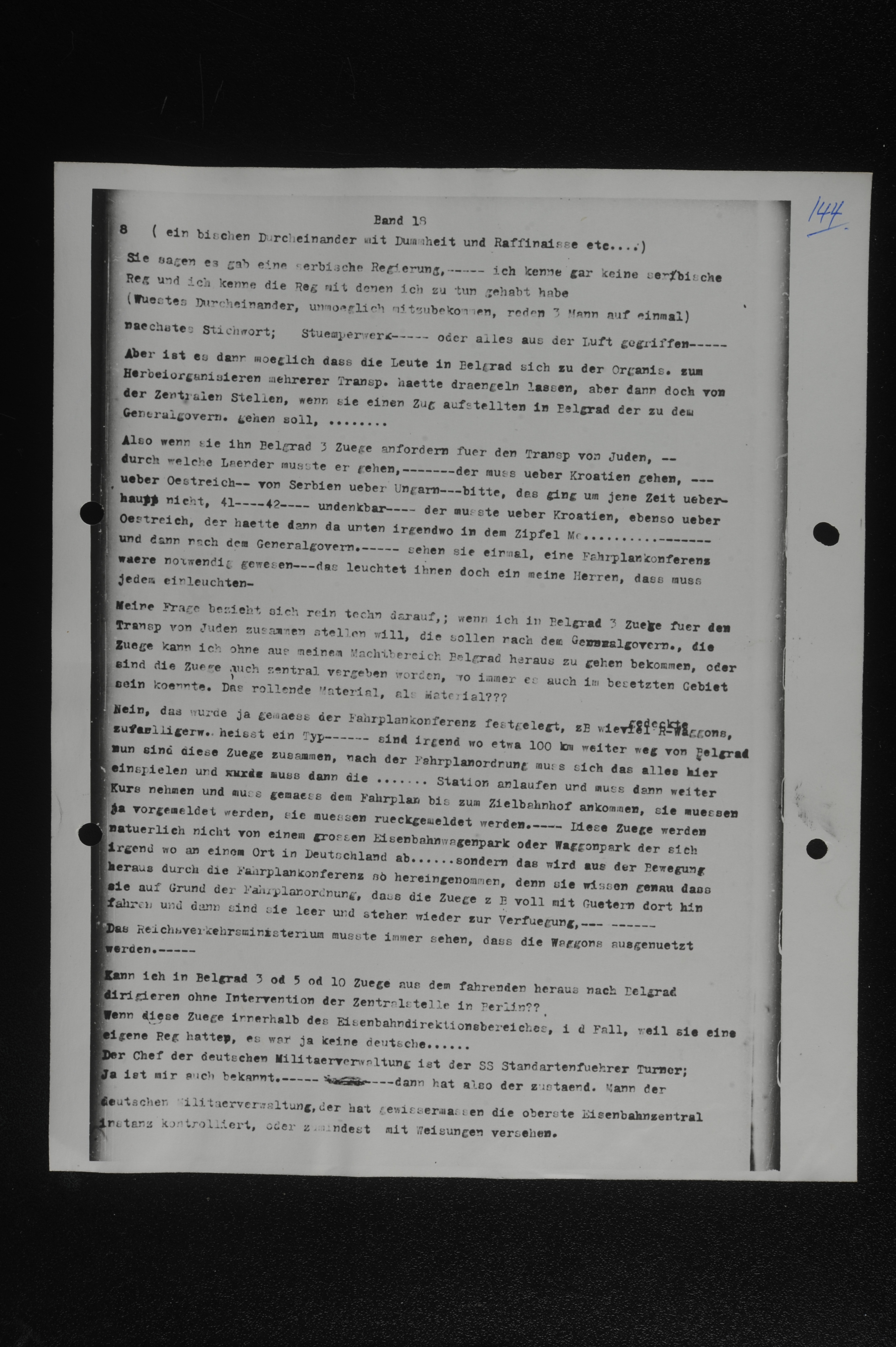
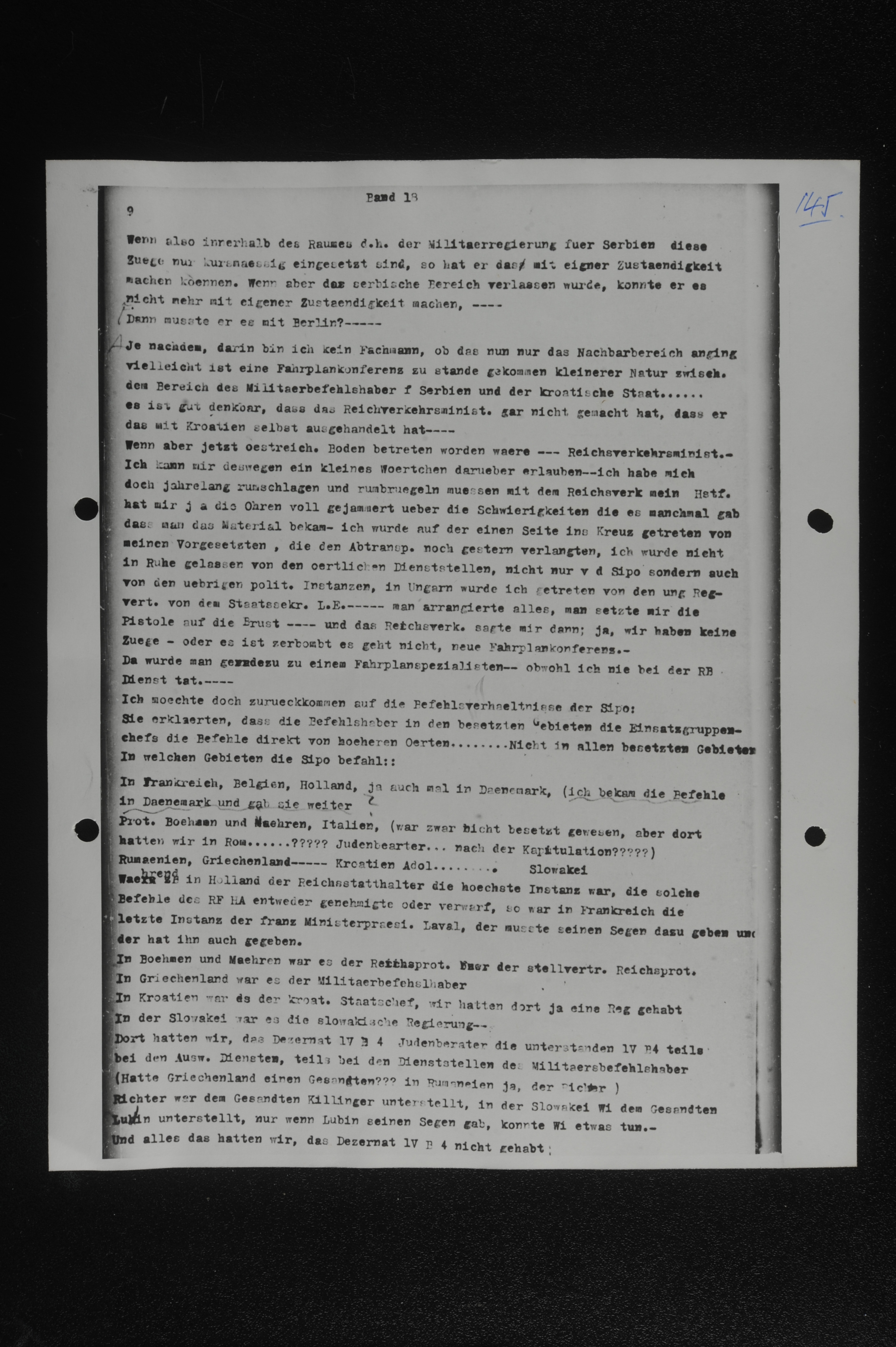
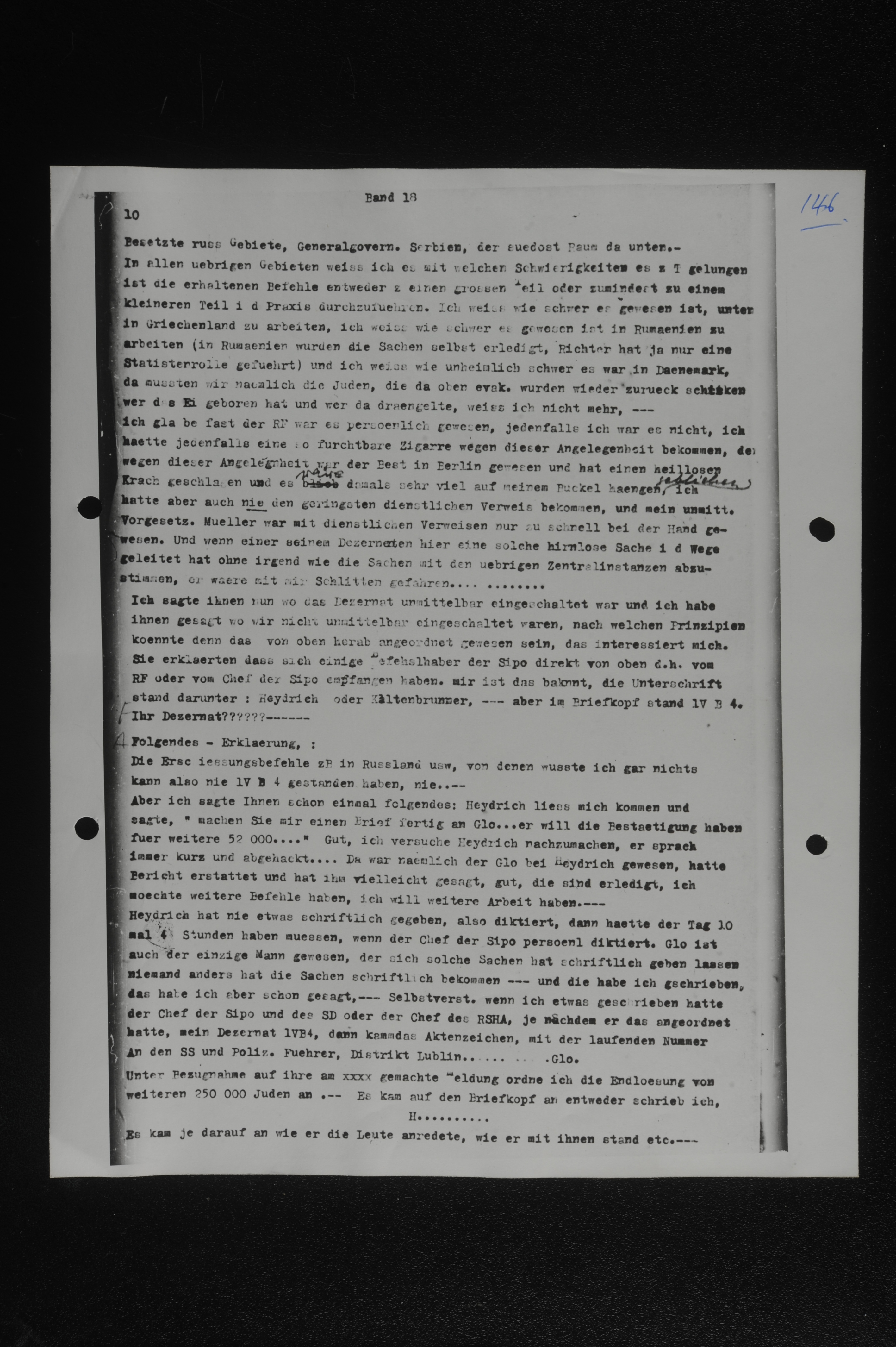
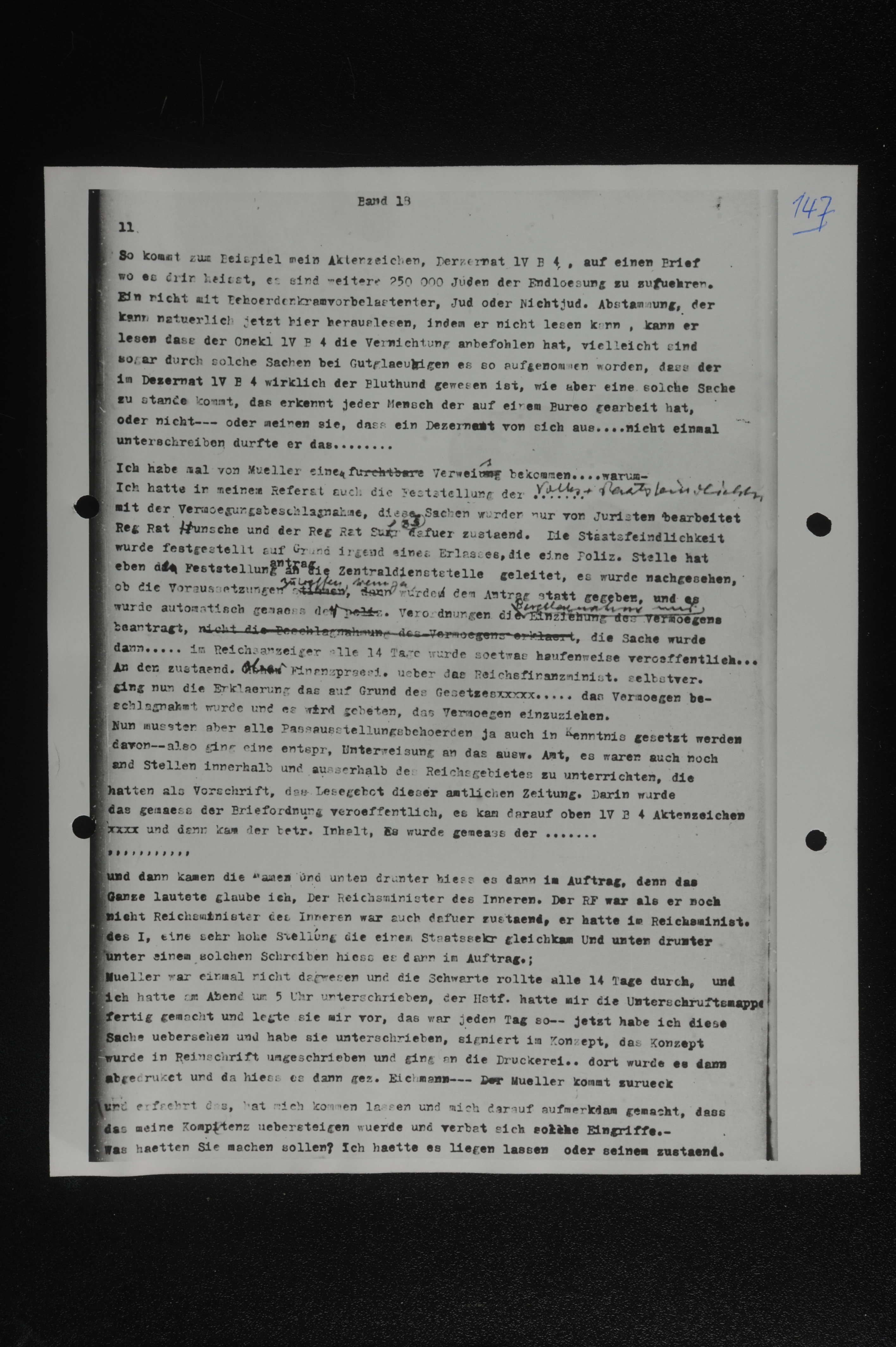
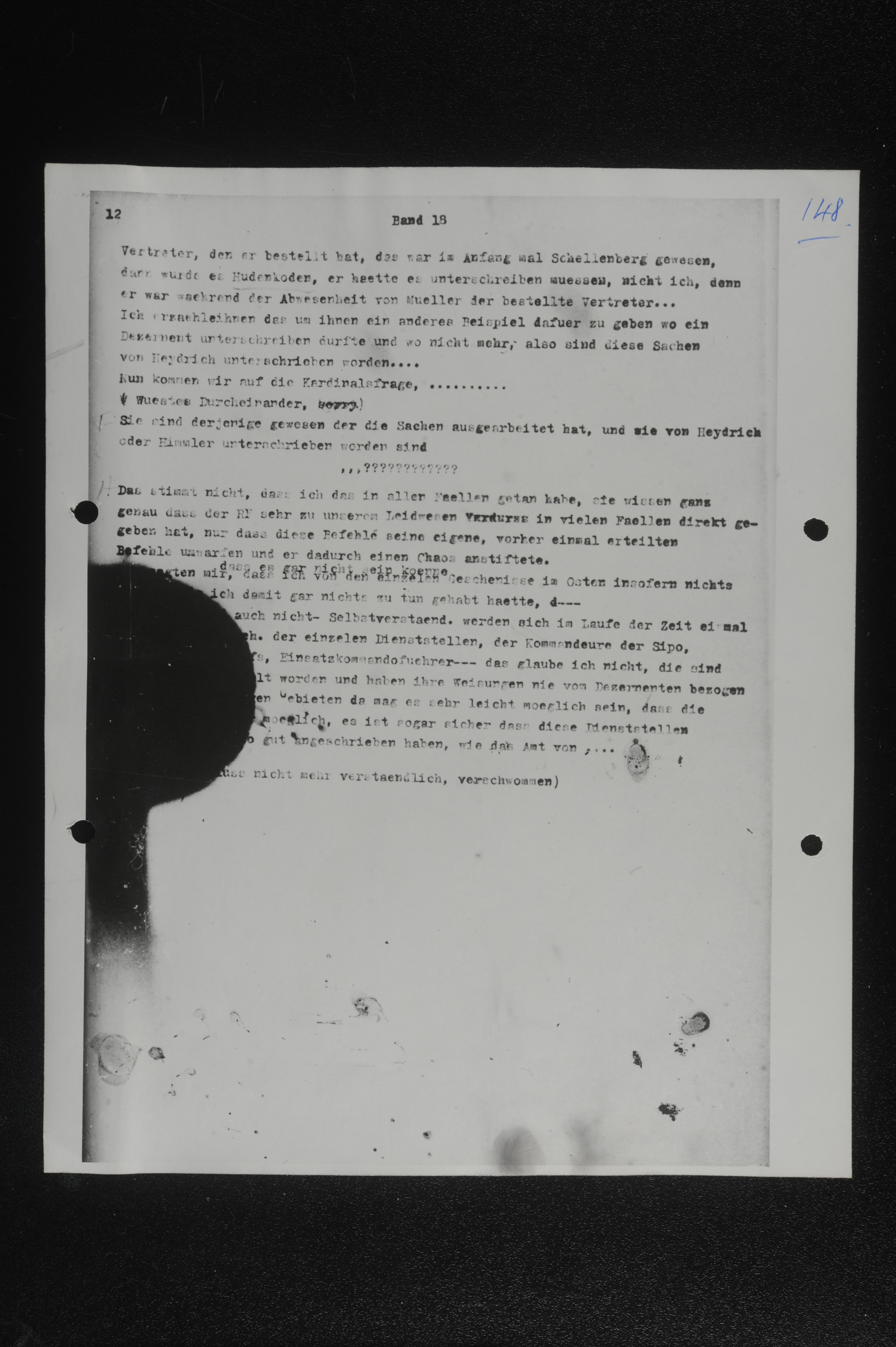
Sheet 1 of file 85
Sheet tools
Filter flags

What the flags mean

One passage can have more than one kind. Open a flag to see why it was added.

Knowledge
What Eichmann says he knew.
Orders
Commands he says he gave or got.
His office
Acts he links to his unit or job.
Intent
What he says he wanted or approved.
Figures
Numbers he gives.
Denial
What he says he didn't know or do.
Other
A passage outside the six groups above.

The Eichmann and Sassen interview, O.65 file 85

In 1957 Adolf Eichmann taped months of conversations in Buenos Aires with Willem Sassen. The typed transcript runs to 714 sheets, kept at Yad Vashem as four files, 85 to 88. Each sheet is shown beside its English, with the German a click away. Every sheet's English was verified against the scan. Questions are left unnamed unless the sheet or the tape gives the speaker. Check the scan before quoting.

Go to the first sheet in this file

O.65 file 85

Folio 10622517 · scans 00001 to 00148 · 148 scan pages

Jump to a scan in O.65 file 85 148 scans

Archive cover sheet. The interview begins on the next scan.

Open sheet image, German, and notes
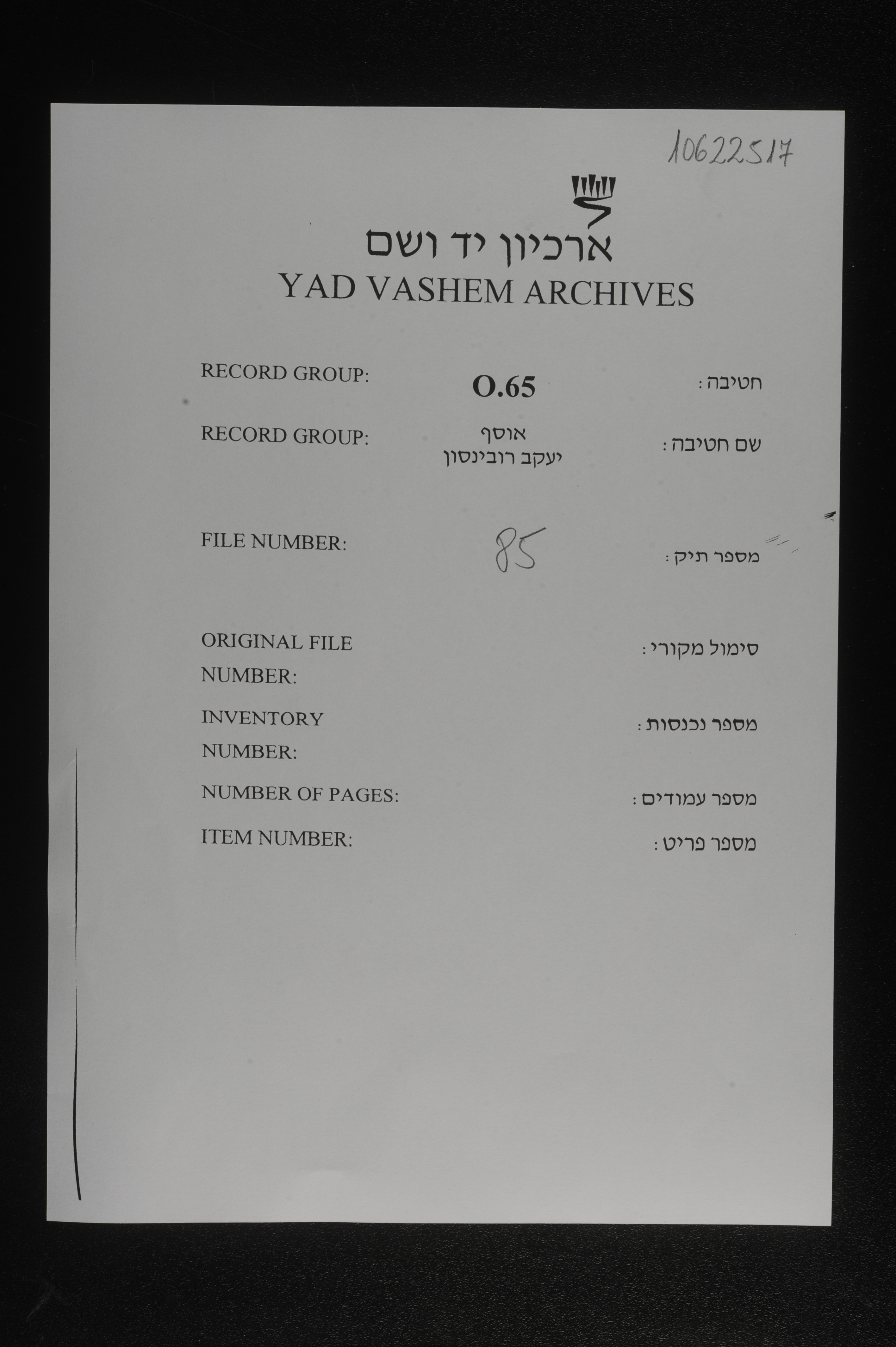
Scan 00001 of the Sassen transcript, O.65 file 85.
This is scan 00001 of the Sassen transcript, O.65 file 85. The image is 2832 by 4256 pixels. Yad Vashem Archives, Jacob Robinson Collection O.65, file 85.

German transcription

[HW: 10622517] ארכיון יד ושם YAD VASHEM ARCHIVES RECORD GROUP: O.65 חטיבה : RECORD GROUP: אוסף שם חטיבה : יעקב רובינסון FILE NUMBER: [HW: 85] מספר תיק : ORIGINAL FILE NUMBER: סימול מקורי : INVENTORY NUMBER: מספר נכנסות : NUMBER OF PAGES: מספר עמודים : ITEM NUMBER: מספר פריט :

English translation

[HW: 10622517] יד ושם Archive [Hebrew: archion Yad Vashem] YAD VASHEM ARCHIVES RECORD GROUP: O.65 Division [Hebrew: chativa]: RECORD GROUP: Collection [Hebrew: osef] Name of Division [Hebrew: shem chativa]: Jacob Robinson [Hebrew: Yaakov Robinson] FILE NUMBER: [HW: 85] File Number [Hebrew: mispar tik]: ORIGINAL FILE NUMBER: Original Reference/Symbol [Hebrew: simul mekori]: INVENTORY NUMBER: Accession Number [Hebrew: mispar nichnasot]: NUMBER OF PAGES: Number of Pages [Hebrew: mispar amudim]: ITEM NUMBER: Item Number [Hebrew: mispar parit]:
Unreviewed notes

These notes haven't been reviewed. A note can identify a speaker where the reviewed English doesn't. If they disagree, use the reviewed English.

Transcription note

This is NOT a Sassen-Eichmann interview transcript page but a Yad Vashem Archives bilingual (English/Hebrew) cover/title sheet for Record Group O.65 (אוסף יעקב רובינסון / Jacob Robinson Collection), File Number 85. Text-bearing elements: a menorah emblem above the Hebrew heading (rendered as the logo, not transcribed as text); printed English field labels on the left and their printed Hebrew equivalents on the right (RTL). Printed values: "O.65" (bold) and the Hebrew "אוסף יעקב רובינסון". Handwritten additions: "10622517" (top-right corner, ink) and "85" (in the FILE NUMBER field) — both marked [HW:]. Non-text pen marks not transcribed: a short squiggle/check at upper right and a long vertical stroke down the lower-left margin. Fields ORIGINAL FILE NUMBER, INVENTORY NUMBER, NUMBER OF PAGES, and ITEM NUMBER are blank. Hebrew text preserved verbatim; no German present on this page.

Translation notes

- The supplied text contains NO German. It is a Yad Vashem Archives catalog/cover form whose labels are bilingual English–Hebrew. This is not a German-language document. It is a Yad Vashem Archives descriptive cover sheet with pre-printed bilingual (English/Hebrew) field labels and a few hand/typed entries filled in. The only substantive filled-in data values are: RECORD GROUP = O.65; RECORD GROUP name/collection = Jacob (Yaakov) Robinson; FILE NUMBER = [HW: 85]. All other fields (ORIGINAL FILE NUMBER, INVENTORY NUMBER, NUMBER OF PAGES, ITEM NUMBER) are blank on the form. [HW: 10622517] at the top is a handwritten catalog/scan control number. [HW: 85] is a handwritten file number. Paragraph structure, blank fields, and the [HW: …] markers are preserved. No speaker inference applies (there is no narrative content). No OCR uncertainty markers ([illegible], deletions, insertions) were present in the source to preserve.
Questioner

From which main thesis shall we proceed with this book?

The following: various ideas, various possibilities that have occurred to me, to set them out one by one and as precisely as possible. They can then [off the sheet] serve as a kind of leitmotif. In my opinion, there is no point in trying [off the sheet] to trivialize the matter, nor in exaggerating it and speaking to please the opponent. Is there a middle way that would serve the truth at the same time [off the sheet]? In the end, it is all about examining the truth and, insofar as the [off the sheet] of the objective … it is ultimately about examining the truth, about investigating the truth.

I believe one possibility would be to portray the German [off the sheet] people before and during the war as a people [off the sheet] that had achieved its unity through Bismarck scarcely 50 years earlier, with a temporal difference… In the First World War it saw all the opposing forces united against it; through the unspeakable hardship after the First World War, the Jews were undoubtedly the beneficiaries of the German people's hardship.

One need only recall the mortgage stories and the expulsion stories of the farmers in the north of the country, which slowly but surely formed an annihilation campaign [overtyped] of the (handwritten) small and upper middle class, all of whom became victims of Jewish interest-rate policy. The reason the interest-rate question found such a wide response in the NSDAP program. Precisely in the postwar [off the sheet] period of the First World War, a political and economic regression took place, through which many efforts toward unity, painstakingly established through Bismarck (handwritten), were largely reversed …

This people [off the sheet], after the seizure of power in '33, had one leg on the path toward the development of a … realization of the national program [abbreviated], and the other on the path to war. Through the development of the war, this people was suddenly (handwritten) called to leadership tasks for which it lacked experience, and for which that complex of experience values that gradually [off the sheet] condenses into a certain technique was lacking. It isn't learned in crash courses; it is the result and sediment of many generations, of the bitter experiences of generations.

The German people, without this complex of experience, was placed before a leadership task for which experience and forces were utterly lacking. As German [off the sheet] influence spread across Europe through military development, and [off the sheet] as Jewish legislation had been proclaimed in Germany since 1936, there were still so many disturbing gaps in the practical execution of that legislation. On the other hand, in the modern Reich, which the Third Reich was, a problem had to be solved while observing laws and regulations and a certain distribution of power within the state.

All this led to great difficulties within Germany. Even Germany's efforts [off the sheet] to solve the Jewish problem within Germany [off the sheet] through emigration, by involving foreign countries, produced no tangible results. In hindsight [off the sheet], it becomes very clear that foreign countries, which [off the sheet] later became enemy countries, had from the outset kept this whole Jewish question [overtyped] as a weapon in reserve and had sought by every means to prevent this

Open sheet image, German, and notes
Scan 00002 of the Sassen transcript, O.65 file 85.
This is scan 00002 of the Sassen transcript, O.65 file 85. The image is 2832 by 4256 pixels. Yad Vashem Archives, Jacob Robinson Collection O.65, file 85.

German transcription

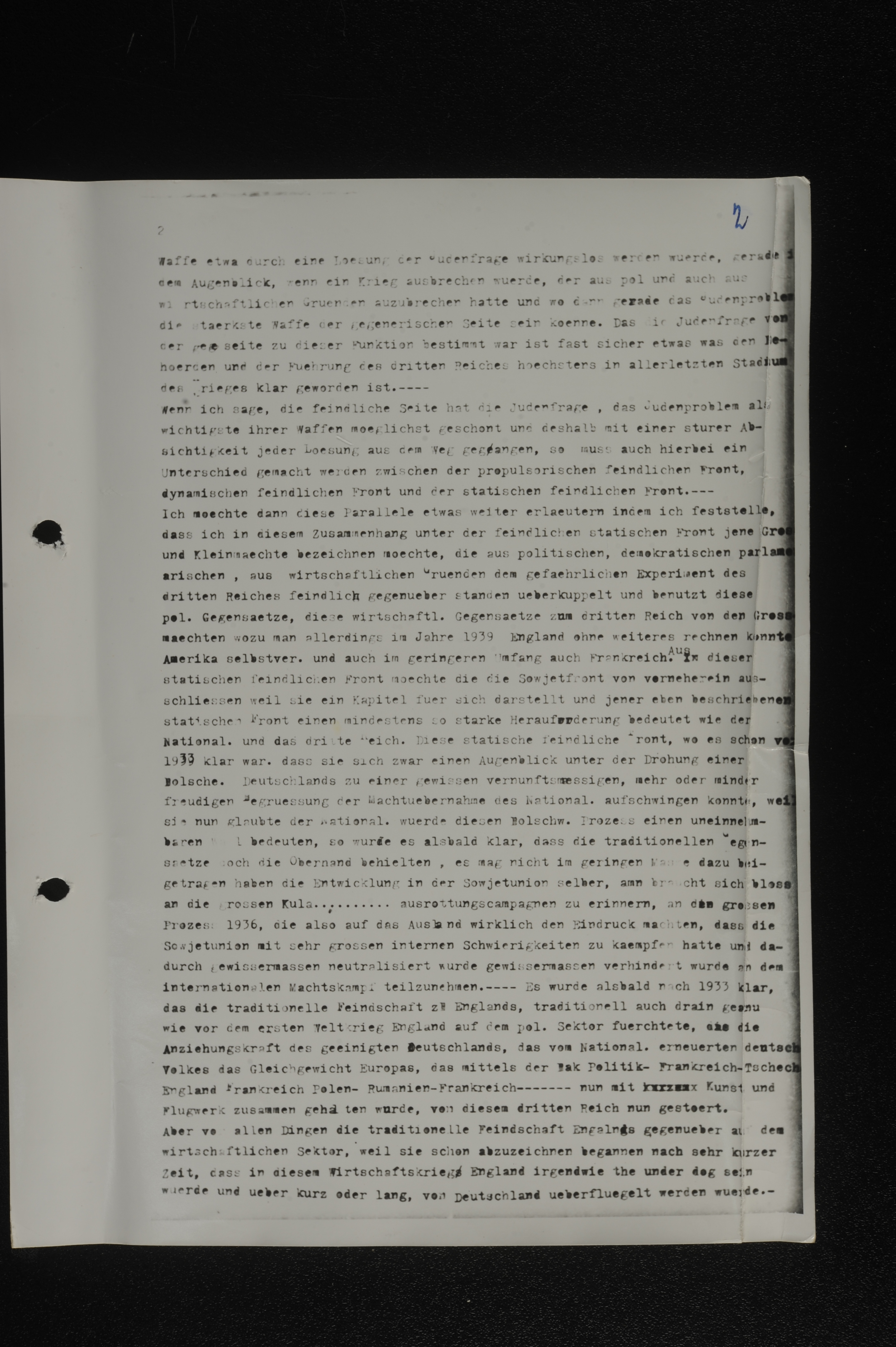
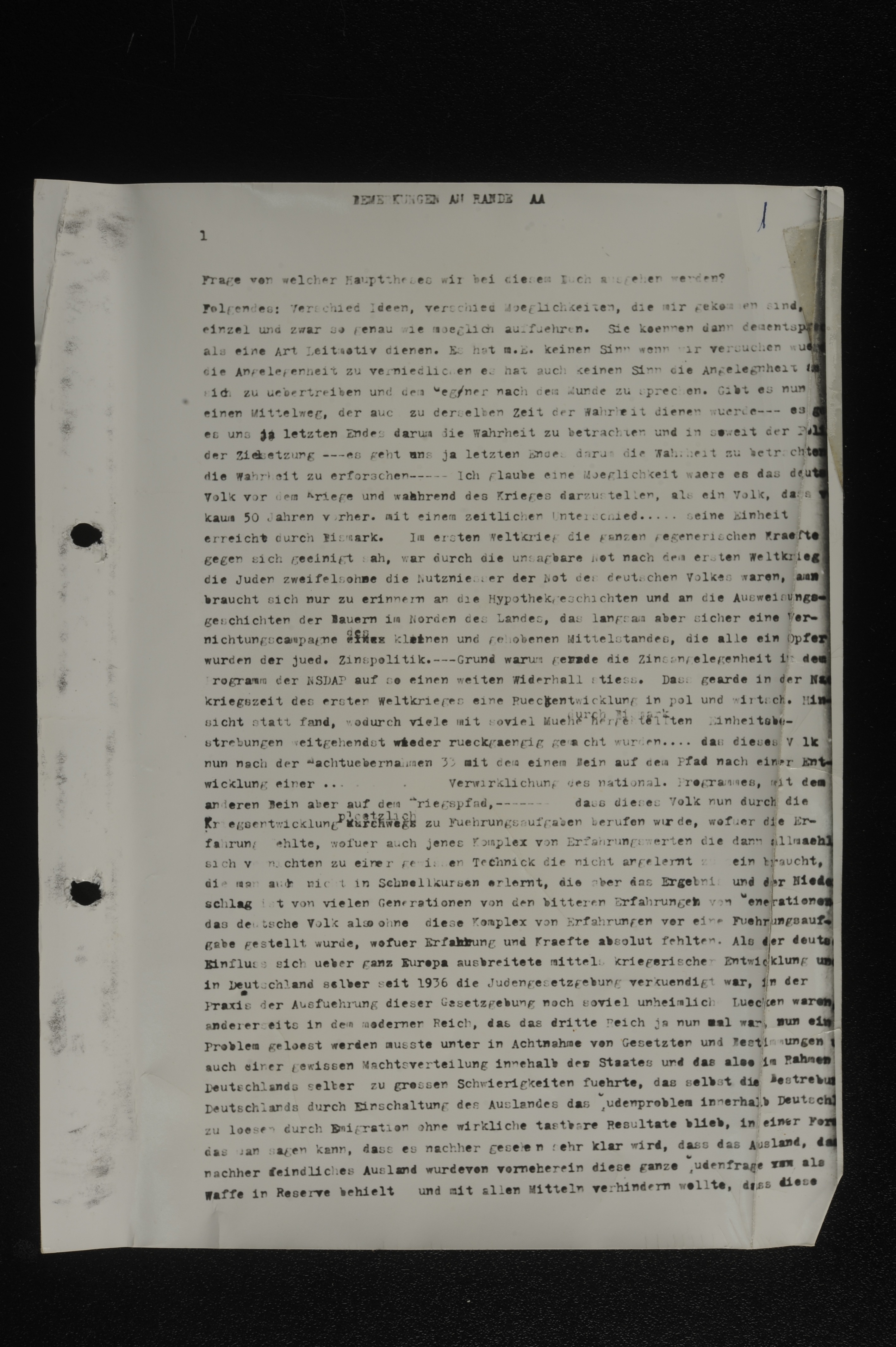
BEMERKUNGEN AM RANDE AA 1 [HW: 1] Frage von welcher Hauptthese wir bei diesem Buch ausgehen werden? Folgendes: Verschied Ideen, verschied Moeglichkeiten, die mir gekommen sind, einzel und zwar so genau wie moeglich auffuehren. Sie koennen dann dementspr als eine Art Leitmotiv dienen. Es hat m.E. keinen Sinn wenn wir versuchen wuer die Angelegenheit zu verniedlichen es hat auch keinen Sinn die Angelegnheit an sich zu uebertreiben und dem Gegner nach dem Munde zu sprechen. Gibt es nun einen Mittelweg, der auch zu derselben Zeit der Wahrheit dienen wuerde--- es g es uns ja letzten Endes darum die Wahrheit zu betrachten und in soweit der Pol der Zielsetzung ---es geht uns ja letzten Endes darum die Wahrheit zu betrachten die Wahrheit zu erforschen----- Ich glaube eine Moeglichkeit waere es das deut Volk vor dem Kriege und waehrend des Krieges darzustellen, als ein Volk, das v kaum 50 Jahren vorher. mit einem zeitlichen Unterschied..... seine Einheit erreicht durch Bismark. Im ersten Weltkrieg die ganzen gegnerischen Kraefte gegen sich geeinigt sah, war durch die unsagbare Not nach dem ersten Weltkrieg die Juden zweifelsohne die Nutzniesser der Not des deutschen Volkes waren, man braucht sich nur zu erinnern an die Hypothekgeschichten und an die Ausweisungs- geschichten der Bauern im Norden des Landes, das langsam aber sicher eine Ver- nichtungscampagne [DEL: eixxx] [HW: des] kleinen und gehobenen Mittelstandes, die alle ein Opfer wurden der jued. Zinspolitik.----Grund warum gerade die Zinsangelegenheit in dem Programm der NSDAP auf so einen weiten Widerhall stiess. Dass gearde in der Na kriegszeit des ersten Weltkrieges eine Rueckentwicklung in pol und wirtsch. Hin- sicht statt fand, wodurch viele mit soviel Muehe [HW: durch Bismark] hergestellten Einheitsbe- strebungen weitgehendst wieder rueckgaengig gemacht wurden.... das dieses Vlk nun nach der Machtuebernahmen 33 mit dem einem Bein auf dem Pfad nach einer Ent- wicklung einer ...... . Verwirklichung des national. Programmes, mit dem anderen Bein aber auf dem Kriegspfad,------- dass dieses Volk nun durch die Kriegsentwicklung [HW: Ploetzlich] durchweg zu Fuehrungsaufgaben berufen wurde, wofuer die Er- fahrung fehlte, wofuer auch jenes Komplex von Erfahrungswerten die dann allmaehl sich verdichten zu einer gewissen Technik die nicht angelernt zu sein braucht, die man auch nicht in Schnellkursen erlernt, die aber das Ergebnis und der Nieder schlag ist von vielen Generationen von den bitteren Erfahrungen von Generationen das deutsche Volk also ohne diese Komplex von Erfahrungen vor eine Fuehrungsauf- gabe gestellt wurde, wofuer Erfahrung und Kraefte absolut fehlten. Als der deut Einfluss sich ueber ganz Europa ausbreitete mittels kriegerischer Entwicklung un in Deutschland selber seit 1936 die Judengesetzgebung verkuendigt war, in der Praxis der Ausfuehrung dieser Gesetzgebung noch soviel unheimlich Luecken waren, andererseits in dem moderner Reich, das das dritte Reich ja nun mal war, nun ein Problem geloest werden musste unter in Achtnahme von Gesetzten und Bestimmungen auch einer gewissen Machtverteilung innehalb des Staates und das alles im Rahmen Deutschlands selber zu grossen Schwierigkeiten fuehrte, das selbst die Bestrebun Deutschlands durch Einschaltung des Auslandes das Judenproblem innerhalb Deutschl zu loesen durch Emigration ohne wirkliche tastbare Resultate blieb, in einer For das man sagen kann, dass es nachher gesehen sehr klar wird, dass das Ausland, da nachher feindliches Ausland wurdevon vorneherein diese ganze Judenfrage [DEL: illegible typewriter overtyping] als Waffe in Reserve behielt und mit allen Mitteln verhindern wollte, dass diese

English translation

MARGINAL REMARKS AA 1 [HW: 1] Question: from which main thesis will we proceed with this book? The following: Different ideas, different possibilities that have occurred to me, to set out individually and indeed as precisely as possible. They can then [EDGE: probably accordingly] serve as a kind of leitmotif. It makes no sense in my opinion if we [EDGE: probably were] to try to trivialize the matter, it also makes no sense to exaggerate the matter in itself and to speak in a manner pleasing to the opponent [lit. to speak according to the opponent's mouth]. Is there now a middle way that would at the same time also serve the truth--- it [EDGE: probably is] after all ultimately a matter for us of considering the truth and insofar the Pol[EDGE: ending missing] of the objective ---it is after all ultimately a matter for us of considering the truth of investigating the truth----- I believe one possibility would be to portray the German[EDGE: ending missing] people before the war and during the war, as a people that [EDGE: missing after the source letter v] barely 50 years before. with a temporal difference..... achieved its unity through Bismarck [source spelling: Bismark]. In the first World War saw the entire opposing forces united against itself, was through the unspeakable hardship after the first World War the Jews were without doubt the beneficiaries of the hardship of the German people, one need only recall the mortgage stories and the eviction- stories of the peasants in the north of the country, which slowly but surely a campaign of annihilation [DEL: eixxx] [HW: of the] small and elevated middle class, which all became a victim of the Jew[ish] interest policy.----Reason why precisely the interest matter in the program of the NSDAP met with such a wide resonance. That precisely in the af[EDGE: ter]- war period of the first World War a regression in pol[itical] and econom[ic] respect took place, whereby many unity-endeavors established with so much effort [HW: through Bismarck] were to a large extent again reversed.... that this peop[EDGE: le] now after the seizure of power 33 with one leg on the path toward a develop- ment of a ...... . realization of the national[ABBR: ending not written] program, but with the other leg on the war path,------- that this people now through the war-development [HW: Suddenly] throughout was called to leadership tasks, for which the ex- perience was lacking, for which also that complex of experiential values which then gradual[EDGE: ending missing] condense into a certain technique which need not be learned by rote, which one also does not learn in crash courses, which however is the result and the precipitate of many generations of the bitter experiences of generations the German people therefore without this complex of experiences was placed before a leadership task, for which experience and forces were absolutely lacking. As the German[EDGE: ending missing] influence spread over all of Europe by means of warlike development [EDGE: and] in Germany itself since 1936 the Jewish legislation was proclaimed, in the practice of the execution of this legislation there were still so many uncanny gaps, on the other hand in the modern Reich, that the Third Reich after all now was, now a problem had to be solved with regard for laws and regulations also a certain distribution of power within the State and all that within the framework of Germany itself led to great difficulties, that even the endeavor[EDGE: plural ending missing] of Germany through the involvement of foreign countries to solve the Jewish problem within German[EDGE: y] through emigration remained without really tangible results, in a for[EDGE: m] that one can say that seen afterward it becomes very clear that the foreign countries, tha[EDGE: t] afterward became hostile foreign countries kept from the outset this whole Jewish question [DEL: illegible typewriter overtyping] as a weapon in reserve and wanted by all means to prevent that this
Unreviewed notes

These notes haven't been reviewed. A note can identify a speaker where the reviewed English doesn't. If they disagree, use the reviewed English.

Transcription note

Faint carbon-copy typescript; the entire right margin is cut off / faded so many lines end in truncated words (e.g. "dementspr", "wuer", "deut", "Na", "un", "For", "da"), transcribed as the visible partial letters without conjectural completion. Typed page number "1" at upper left and a separate handwritten "[HW: 1]" in blue pen at upper right are both included. Three interlinear handwritten pencil additions read: "des" (over an overstruck typed word rendered "eixxx"), "durch Bismark" (above the line at "hergestellten"), and "Ploetzlich" (above "durchweg"); each anchored to the nearest base-text point. Header reading "BEMERKUNGEN AM RANDE AA" is faint; second word could be "AN". Typed idiosyncrasies preserved: abbreviations "verschied", "einzel", "pol", "wirtsch.", "jued.", "national."; "gearde" for gerade; "Vlk" for Volk; "wurdevon" run together; dark x-like material after "Judenfrage" is rendered as illegible typewriter overtyping rather than as a word.

Translation notes

- 'Bemerkungen am Rande AA' — 'AA' is an unexplained marginal notation/initials; rendered as-is, not translated. - 'dem Gegner nach dem Munde zu sprechen' is an idiom ('to tell the opponent what he wants to hear' / 'to speak so as to please the opponent'); translated literally with a gloss. - 'der Pol der Zielsetzung' — the sheet ends after 'Pol'. The literal layer keeps the visible letters and marks the right-edge loss instead of choosing 'Politik' or another completion. - 'Verwirklichung des national. Programmes' — 'national.' is an abbreviation. The literal layer marks the unwritten ending and does not expand it to 'nationalist' or 'National Socialist'. - 'gehobenen Mittelstandes' — 'gehoben' rendered 'elevated/upper'; means the more affluent middle class. - The [DEL: eixxx] deletion contains an illegible/uncertain struck word; preserved as printed with the xxx uncertainty. - Multiple sentences are grammatically broken and incomplete in the German (anacoluthon); e.g. 'Im ersten Weltkrieg die ganzen gegnerischen Kraefte gegen sich geeinigt sah, war durch die unsagbare Not...' — the broken syntax is preserved rather than repaired. - Dark x-like marks after 'Judenfrage' are visible typewriter overtyping. They are marked as an illegible deletion, not treated as a word or as edge loss. - 'Ausweisungsgeschichten' rendered 'eviction/expulsion stories'; could denote either eviction from land or expulsion. - The page ends mid-sentence ('...verhindern wollte, dass diese') with no completion on this page. - Every bracket beginning 'EDGE:' marks English supplied from a German word cut by the folded right edge. The bracket says what was supplied or that the missing ending was not chosen. This page is the opening of a planning/framing statement for the book project — a continuous monologue laying out the thesis ('from which main thesis will we proceed with this book'). It contains no explicit speaker labels or initials. Although the content is programmatic and interviewer-like in tone (framing how the book should be structured), there is no turn boundary on the page and no self-identifying first-person account (e.g. of RSHA/IVB4 duties) that would unambiguously fix the speaker per this page's own content alone. Per the attribution rules, position, alternation, and narrative plausibility cannot be used, so speaker_turns is left empty rather than attributing the monologue to Sassen or Eichmann. The header 'BEMERKUNGEN AM RANDE / AA / 1' with a page-number '1' suggests this is an introductory/first page. Repeated clauses ('es geht uns ja letzten Endes darum die Wahrheit zu betrachten') are duplicated in the German (a false-start/dictation repetition) and preserved.

weapon, for example, would be rendered ineffective through a solution of the Jewish question, precisely at the moment [off the sheet] when a war was to break out, a war that had to break out for political and economic reasons, and when the Jewish problem could be the strongest weapon of the opposing side. That the opposing side had assigned the Jewish question this function is almost certainly something that became clear to the authorities and the leadership of the Third Reich only in the very last stage of the war.

When I say that the enemy side spared the Jewish question, the Jewish problem, as its most important weapon as much as possible, and therefore avoided every solution with stubborn deliberateness, a distinction must also be made here between the propulsive enemy front, the dynamic enemy front, and the static enemy front. I would like to take this parallel a little further by stating that, in this context, by the static enemy front I mean those great and small powers that stood hostile to the dangerous experiment of the Third Reich for political, democratic-parliamentary [off the sheet], and economic reasons, and which [meaning unclear] used these political and economic antagonisms against the Third Reich.

Among the great powers, in 1939 one could readily count England, America of course, and, to a lesser extent, France. From this static enemy front I would exclude the Soviet front from the outset, because it represents a chapter of its own and posed at least as strong a challenge to the just-described static front as National Socialism and the Third Reich. This static enemy front, where it was already clear before 1933 [off the sheet] that, under the threat of a Bolshevized Germany, it could for a moment rise to a reasonable, more or less willing welcome of the National Socialist seizure of power, because it believed National Socialism would be an impregnable wall against the Bolshevik process, soon showed that the traditional antagonisms still held the upper hand.

The development within the Soviet Union may have contributed to this in no small measure; one need only recall the great Kula[not typed] extermination campaigns and the great trial of 1936. These made such an impression abroad that the Soviet Union had to contend with great internal difficulties and was thereby, in a sense, neutralized, in a sense prevented from taking part in the international power struggle. It soon became clear after 1933 that traditional hostility, including England's, remained.

As before the First World War, England feared on the political front that the appeal of a united Germany, of the German people [off the sheet] renewed by National Socialism, would disturb the balance of Europe, held together by the Bak policy [too faint] of France-Czechoslovakia [off the sheet], England-France-Poland-Romania-France, now with [overtyped] art and Flugwerk [meaning unclear]. Above all, England's traditional hostility in the economic sphere soon became apparent. In this economic war, England would somehow become the underdog and sooner or later be outstripped by Germany.

Open sheet image, German, and notes
Scan 00003 of the Sassen transcript, O.65 file 85.
This is scan 00003 of the Sassen transcript, O.65 file 85. The image is 2832 by 4256 pixels. Yad Vashem Archives, Jacob Robinson Collection O.65, file 85.

German transcription

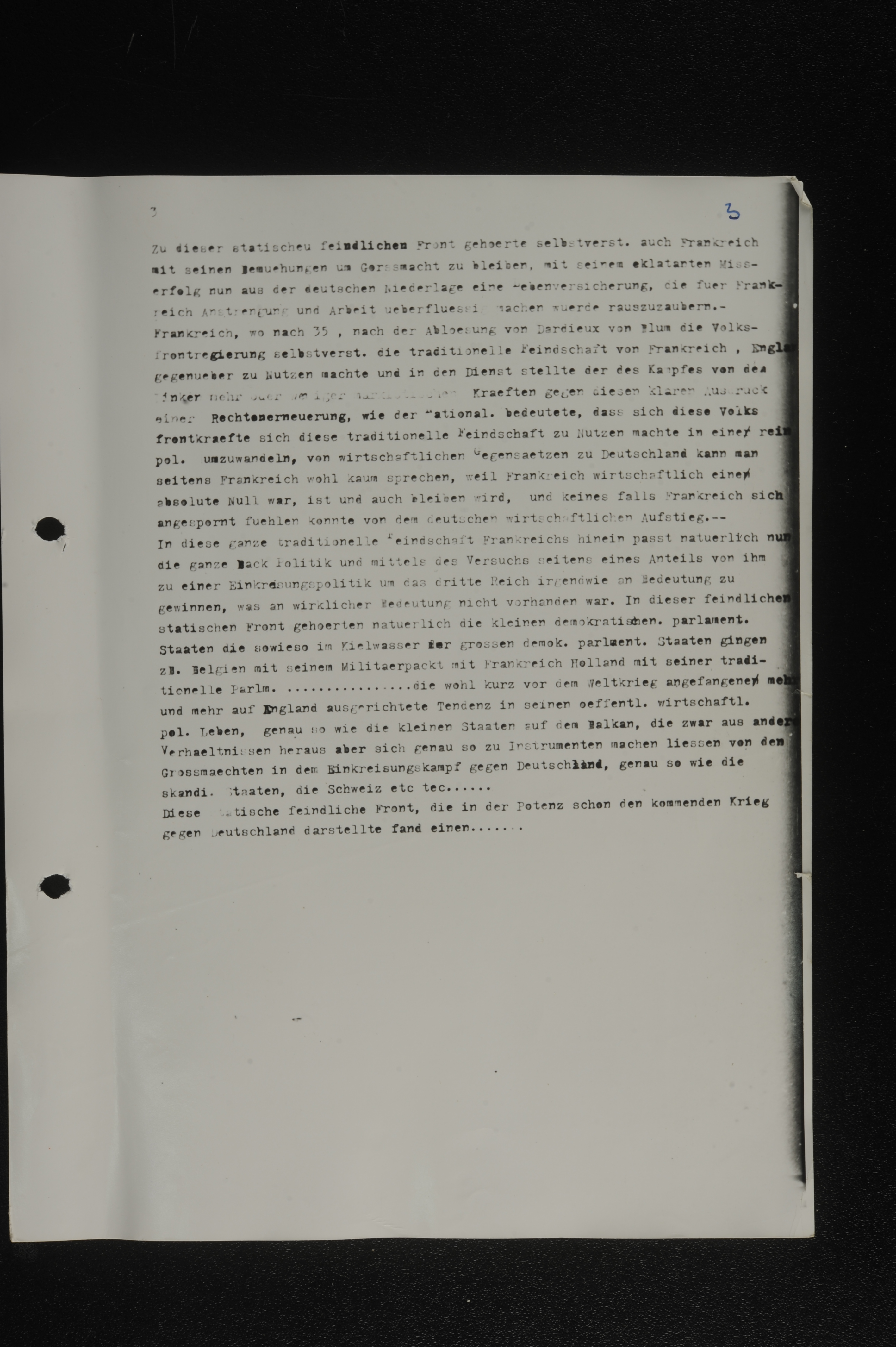
2 [HW: 2] Waffe etwa durch eine Loesung der Judenfrage wirkungslos werden wuerde, gerade i dem Augenblick, wenn ein Krieg ausbrechen wuerde, der aus pol und auch aus wirtschaftlichen Gruenden auzubrechen hatte und wo dann gerade das Judenproblem die staerkste Waffe der gegnerischen Seite sein koenne. Das die Judenfrage von der geg. seite zu dieser Funktion bestimmt war ist fast sicher etwas was den Be- hoerden und der Fuehrung des dritten Reiches hoechstens in allerletzten Stadium des Krieges klar geworden ist.----- Wenn ich sage, die feindliche Seite hat die Judenfrage , das Judenproblem als wichtigste ihrer Waffen moeglichst geschont und deshalb mit einer sturer Ab- sichtigkeit jeder Loesung aus dem Weg gegangen, so muss auch hierbei ein Unterschied gemacht werden zwischen der propulsorischen feindlichen Front, dynamischen feindlichen Front und der statischen feindlichen Front.--- Ich moechte dann diese Parallele etwas weiter erlaeutern indem ich feststelle, dass ich in diesem Zusammenhang unter der feindlichen statischen Front jene Gross und Kleinmaechte bezeichnen moechte, die aus politischen, demokratischen parlame arischen , aus wirtschaftlichen Gruenden dem gefaehrlichen Experiment des dritten Reiches feindlich gegenueber standen ueberkuppelt und benutzt diese pol. Gegensaetze, diese wirtschaftl. Gegensaetze zum dritten Reich von den Gross maechte wozu man allerdings im Jahre 1939 England ohne weiteres rechnen konnte Amerika selbstver. und auch im geringeren Umfang auch Frankreich. [TS INS: Aus] Im dieser statischen feindlichen Front moechte die die Sowjetfront von vorneherein aus- schliessen weil sie ein Kapitel fuer sich darstellt und jener eben beschriebenen statischen Front einen mindestens so starke Herausforderung bedeutet wie der National. und das dritte Reich. Diese statische feindliche Front, wo es schon vo 1933 klar war. dass sie sich zwar einen Augenblick unter der Drohung einer Bolsche. Deutschlands zu einer gewissen vernunftsmessigen, mehr oder minder freudigen Begruessung der Machtuebernahme des National. aufschwingen konnte, weil sie nun glaubte der National. wuerde diesen Bolschw. Prozess einen uneinnehm- baren Wall bedeuten, so wurde es alsbald klar, dass die traditionellen Gegen- saetze noch die Oberhand behielten , es mag nicht im geringen Masse dazu bei- getragen haben die Entwicklung in der Sowjetunion selber, amn braucht sich bloss an die grossen Kula.......... ausrottungscampagnen zu erinnern, an den grossen Prozess 1936, die also auf das Ausland wirklich den Eindruck machten, dass die Sowjetunion mit sehr grossen internen Schwierigkeiten zu kaempfen hatte und da- durch gewissermassen neutralisiert wurde gewissermassen verhindert wurde an dem internationalen Machtskampf teilzunehmen.----- Es wurde alsbald nach 1933 klar, das die traditionelle Feindschaft zB Englands, traditionell auch drain genau wie vor dem ersten Weltkrieg England auf dem pol. Sektor fuerchtete, ans die Anziehungskraft des geeinigten Deutschlands, das vom National. erneuerten deutsch Volkes das Gleichgewicht Europas, das mittels der Bak Politik- Frankreich-Tschech England Frankreich Polen- Rumanien-Frankreich------ nun mit [DEL: illegible typewriter overtyping] Kunst und Flugwerk zusammen gehalten wurde, von diesem dritten Reich nun gestoert. Aber vor allen Dingen die traditionelle Feindschaft Engalnds gegenueber auf dem wirtschaftlichen Sektor, weil sie schon abzuzeichnen begannen nach sehr kurzer Zeit, dass in diesem Wirtschaftskrieg England irgendwie the under dog sein wuerde und ueber kurz oder lang, von Deutschland ueberfluegelt werden wuerde.-

English translation

weapon would become ineffective, for instance through a solution of the Jewish question, precisely at the moment when a war would break out, which for pol[itical] and also for economic reasons had to break out and where then precisely the Jewish problem could be the strongest weapon of the opposing side. That the Jewish question was destined for this function by the oppos[ing] side is almost certainly something that became clear to the authorities and the leadership of the Third Reich at most in the very last stage of the war.----- When I say the enemy side spared the Jewish question, the Jewish problem, as the most important of its weapons as much as possible and therefore avoided every solution with a stubborn deliberateness, then here too a distinction must be made between the propulsory enemy front, dynamic enemy front and the static enemy front.--- I would then like to elaborate this parallel somewhat further by establishing that in this connection I would like to designate under the enemy static front those great and small powers which, out of political, democratic, parliamentary [parlame(ntary)], out of economic reasons, stood hostile to the dangerous experiment of the Third Reich, overarched [?] and use these pol[itical] antagonisms, these economic antagonisms toward the Third Reich, of the great powers, among which in the year 1939 one could without further ado count England, America of course [selbstver(ständlich)] and also to a lesser extent also France. [TS INS: Out] In this static enemy front I would like to exclude the Soviet front from the outset because it represents a chapter of its own and constitutes at least as strong a challenge to that just-described static front as National[ism] and the Third Reich. This static enemy front, where it was already clear before [vo(r)] 1933, that although for a moment under the threat of a Bolshe[vik] Germany [Bolshevization of Germany?] it could rise up to a certain reasonable, more or less joyful welcome of the seizure of power by National[ism], because it now believed National[ism] would mean an impregnable wall to this Bolshevik process, so it soon became clear that the traditional antagonisms still retained the upper hand, it may not in small measure have contributed to it the development in the Soviet Union itself, one need only recall the great Kula[k].......... extermination campaigns, the great trial of 1936, which thus really made the impression on foreign countries that the Soviet Union had to struggle with very great internal difficulties and was thereby to a certain extent neutralized, to a certain extent prevented from taking part in the international power struggle.----- It became clear soon after 1933 that the traditional hostility, for example England's [zB Englands], traditionally also therein [drain — sic], just as before the first World War, England feared on the pol[itical] sector [ans — sic] the attractive force of united Germany, that of the National[ism-] renewed German people, the balance of Europe, that by means of the Bak[?] policy — France-Czech[oslovakia], England-France-Poland-Romania-France ------ now with [DEL: illegible typewriter overtyping] art and [Flugwerk — meaning uncertain] was held together, now disturbed by this Third Reich. But above all things the traditional hostility of England [Engalnds — sic] toward [it] on the economic sector, because they already began to become apparent after a very short time, that in this economic war England would somehow be the under dog and sooner or later would be outstripped by Germany.-
Unreviewed notes

These notes haven't been reviewed. A note can identify a speaker where the reviewed English doesn't. If they disagree, use the reviewed English.

Transcription note

Faded carbon-copy typescript, single continuous prose page (no speaker labels). Typed page number "2" at top left; blue-pencil handwritten folio "2" at top right (rendered as [HW: 2]). The right margin is partly obscured by page curl/shadow, so several line-endings are cut off (e.g. line 1 "gerade i", line 3 "Judenproblem", line 15 "parlame", line 18/24 "Gross"/"vo", line 39/40 "deutsch"/"Tschech") — visible glyphs transcribed as seen without completion. Line 20: a small superscript "Aus" sits above the typed "Im"; read as a later typewritten insertion correcting "Im dieser" toward "Aus dieser". Line 29: "Wall" read from a faded but determinable "W...l". Line 39 reads "zB Englands", not "zu Englands". Line 41 has a dense typewriter cancellation before "Kunst"; the cancelled word is marked [DEL: illegible typewriter overtyping] because its letters cannot be recovered. Preserved original typos/abbreviations verbatim: "auzubrechen", "geg. seite", "amn", "Engalnds", "ans die", "Kula..........", "Bak", "the under dog", period-for-comma punctuation, and repeated hyphen runs approximated. Two punch holes on the left margin do not obscure text.

Translation notes

- 'ueberkuppelt' — rendered 'overarched [?]'. The word is grammatically detached from the surrounding sentence (the German syntax is broken here); its intended sense is unclear. - 'Bolsche. Deutschlands' — abbreviated. Could be 'a Bolshevik Germany' or 'a Bolshevization of Germany'; the genitive 'Deutschlands' favors the latter but the sense is left uncertain. - 'Bak Politik' — 'Bak' is not a recognized word; likely OCR garbling (possibly for a term describing the interwar alliance/encirclement policy). Left as 'Bak[?] policy'. - 'Flugwerk' — the letters are visible, but the intended sense in 'Kunst und Flugwerk' is uncertain. The German word is kept rather than translated as settled English. - The dense typewriter cancellation before 'Kunst' is marked [DEL: illegible typewriter overtyping]. Its cancelled word is unrecoverable. - 'zB Englands' — means 'for example, England's'. The earlier reading 'zu Englands' reversed who held the hostility. - 'the under dog' appears in English in the German source and was left verbatim. - 'propulsorisch' / 'propulsory' — an unusual coinage; the speaker distinguishes propulsory/dynamic vs. static fronts. Kept literal. This is page 2 (marked '2' and [HW: 2]). It is a continuous analytical monologue on the geopolitics of 1933–1939 (England, America, France, the Soviet Union, the Jewish question as a 'weapon'). There is no explicit speaker label, no initial, no question, no turn boundary anywhere on the page — the text is a single uninterrupted first-person discourse that continues from a prior page ('weapon would become ineffective...') and runs off the bottom ('outstripped by Germany.-'). Per the attribution rules, a continuous monologue with no turn boundary and no self-identifying content that fixes the speaker on this page alone must return an empty speaker_turns array. Numerous OCR/typing corruptions were preserved literally: 'Engalnds', 'auzubrechen', 'drain', 'ans', 'vo(r)', 'amn', 'the under dog'. The [TS INS: Aus] insertion, [DEL: illegible typewriter overtyping] cancellation, and run-on dashes were preserved.

To this static hostile front, of course, France also belonged, with its efforts to remain a great power and its glaring failure to conjure from Germany's defeat a life insurance that would make effort and work unnecessary for France. France, where after '35, after Dardieux was replaced by Blum, the Popular Front government naturally used France's traditional hostility toward England [off the sheet] and put it in the service of the struggle of left-wing, more or less [too faint] forces against this clear expression of a renewal of the Right, which the damaged “ational.[too faint] represented.

These Popular Front forces used this traditional hostility to turn it into a solely political one. One can hardly speak of economic antagonisms toward Germany on France's part, because France was economically an absolute zero, is, and will remain so, and France could in no way feel spurred on by Germany's economic rise. The whole Back policy [meaning unclear] naturally fits into this traditional enmity, along with an attempt by part of it to gain importance through an encirclement policy around the Third Reich, though it had no real importance.

The small democratic parliamentary states also belonged to this hostile static front, states that in any case followed in the wake of the large democratic parliamentary states: Belgium with its military pact with France, Holland with its traditional parliament…[not typed] and its tendency, probably begun shortly before the World War, to orient its public economic and political life more and more toward England, just like the small states in the Balkans, which, although arising from different circumstances [off the sheet], nevertheless allowed themselves to be made into instruments by the great powers in the encirclement struggle against Germany, just like the Scandinavian states [abbreviated], Switzerland, and so on. This static hostile front, which already represented the coming war against Germany in potential, found a…[not typed]

Open sheet image, German, and notes
Scan 00004 of the Sassen transcript, O.65 file 85.
This is scan 00004 of the Sassen transcript, O.65 file 85. The image is 2832 by 4256 pixels. Yad Vashem Archives, Jacob Robinson Collection O.65, file 85.

German transcription

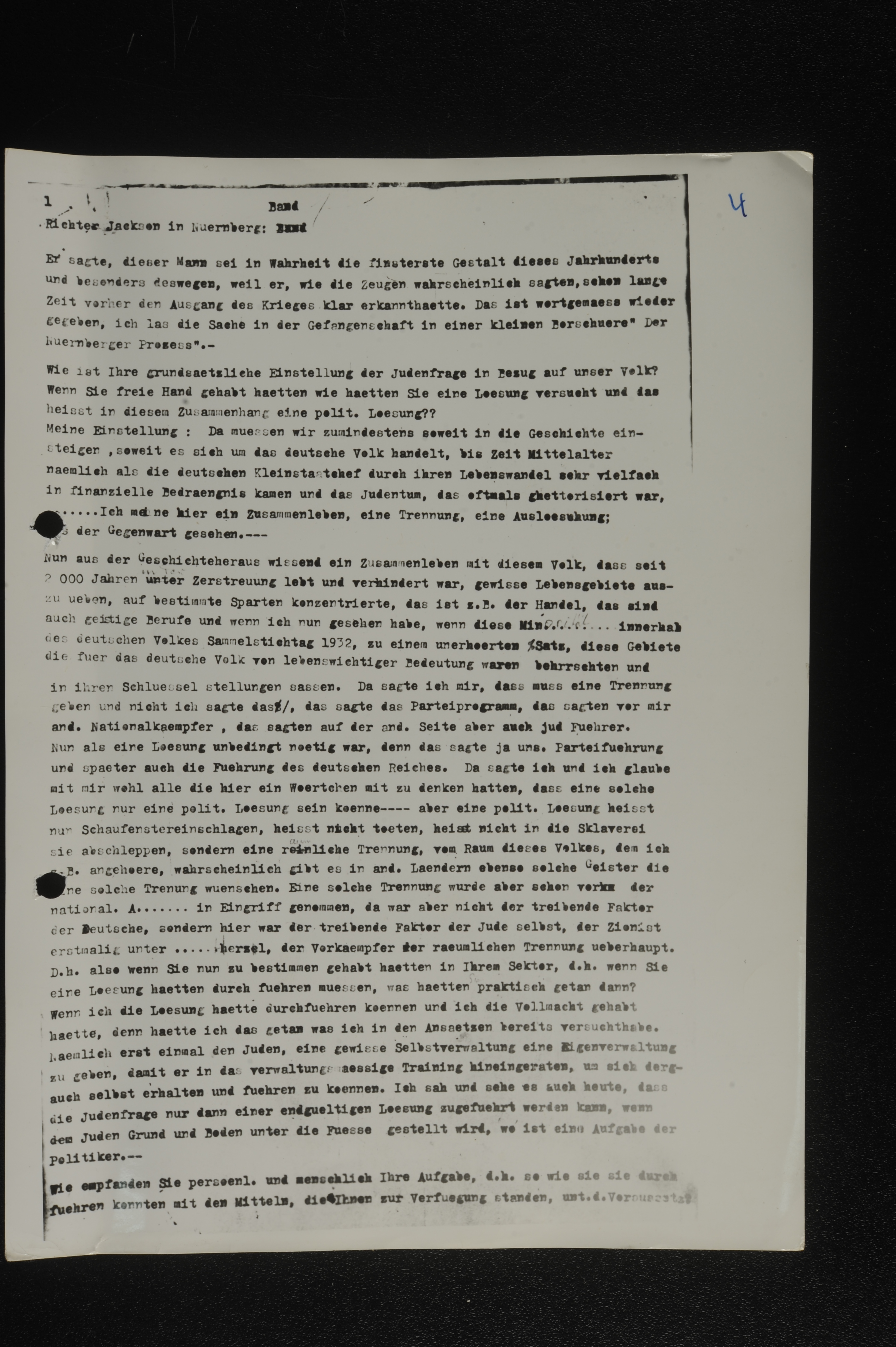
3 [HW: 3] Zu dieser statischeu feindlichen Front gehoerte selbstverst. auch Frankreich mit seinen Bemuehungen um Grossmacht zu bleiben, mit seinem eklatanten Miss- erfolg nun aus der deutschen Niederlage eine Lebenversicherung, die fuer Frank- reich Anstrengung und Arbeit ueberfluessig machen wuerde rauszuzaubern.- Frankreich, wo nach 35 , nach der Abloesung von Dardieux von Blum die Volks- frontregierung selbstverst. die traditionelle Feindschaft von Frankreich , Engla gegenueber zu Nutzen machte und in den Dienst stellte der des Kampfes von dea linker mehr oder weniger [?marxistischen?] Kraeften gegen diesen klaren Ausdruck einer Rechtenerneuerung, wie der "ational. bedeutete, dass sich diese Volks frontkraefte sich diese traditionelle Feindschaft zu Nutzen machte in einer rein pol. umzuwandeln, von wirtschaftlichen Gegensaetzen zu Deutschland kann man seitens Frankreich wohl kaum sprechen, weil Frankreich wirtschaftlich einer absolute Null war, ist und auch bleiben wird, und keines falls Frankreich sich angespornt fuehlen konnte von dem deutschen wirtschaftlichen Aufstieg.-- In diese ganze traditionelle Feindschaft Frankreichs hinein passt natuerlich nun die ganze Back Politik und mittels des Versuchs seitens eines Anteils von ihm zu einer Einkreisungspolitik um das dritte Reich irgendwie an Bedeutung zu gewinnen, was an wirklicher Bedeutung nicht vorhanden war. In dieser feindlichen statischen Front gehoerten natuerlich die kleinen demokratischen. parlament. Staaten die sowieso im Kielwasser der grossen demok. parlment. Staaten gingen zB. Belgien mit seinem Militaerpackt mit Frankreich Holland mit seiner tradi- tionelle Parlm. ................die wohl kurz vor dem Weltkrieg angefangenen mehr und mehr auf England ausgerichtete Tendenz in seinen oeffentl. wirtschaftl. pol. Leben, genau so wie die kleinen Staaten auf dem Balkan, die zwar aus ander Verhaeltnissen heraus aber sich genau so zu Instrumenten machen liessen von den Grossmaechten in dem Einkreisungskampf gegen Deutschland, genau so wie die skandi. Staaten, die Schweiz etc tec...... Diese statische feindliche Front, die in der Potenz schon den kommenden Krieg gegen Deutschland darstellte fand einen.......

English translation

3 [HW: 3] To this static hostile front belonged of course also France with its efforts to remain a great power, with its blatant failure now to conjure out of the German defeat a life insurance that would make effort and work superfluous for France.- France, where after 35, after the replacement of Dardieux by Blum the Popular Front government of course made use of France's traditional enmity toward Engla[nd] and placed [it] in the service of the of the struggle of the left, more or less [?marxist?] forces against this clear expression of a renewal of the Right, such as the damaged "ational." meant, that these Popular Front forces made use of this traditional enmity to transform [it] into a purely pol[itical] one, of economic antagonisms toward Germany one can hardly speak on the part of France, because France economically was, is and will also remain an absolute zero, and in no case could France feel spurred on by the German economic rise.-- Into this whole traditional enmity of France there fits of course now the whole Back policy and by means of the attempt on the part of a portion of it toward an encirclement policy in order somehow to gain in importance against the Third Reich, which in real importance was not present. In this hostile static front belonged of course the small democratic. parliament[ary] states which anyway went in the wake of the large democ[ratic]. parliment[ary]. states e.g. Belgium with its military pact with France Holland with its tradi-tional Parlm[.] ................ the tendency, probably begun shortly before the World War, more and more oriented toward England in its public economic pol[itical] life, exactly like the small states in the Balkans, which indeed out of other circumstances but let themselves be made into instruments just the same by the great powers in the encirclement struggle against Germany, exactly like the Scandi[navian] states, Switzerland etc etc...... This static hostile front, which in its potency already represented the coming war against Germany, found a.......
Unreviewed notes

These notes haven't been reviewed. A note can identify a speaker where the reviewed English doesn't. If they disagree, use the reviewed English.

Transcription note

Typed page numbered "3" at top-left; a handwritten "3" in blue crayon/pencil appears at top-right, transcribed as [HW: 3]. Two-hole punch at left margin. Right edge of the text block is cut off by the scan/page edge on several lines, truncating words (e.g. "Engla" for England line 6/7; "aus ander" line 24; "von den" line 25) — transcribed as visible. Line 8 is faint/greyed; the word read as "marxistischen" is marked uncertain. Line 9 shows "ational." apparently preceded by a stray quotation mark where "National" was intended; transcribed verbatim. Various apparent typos preserved (statischeu, dea, einer, parlment., tec). Rows of typed periods (line 22 ~16 dots; lines 27, 29 trailing dots) reproduced approximately. Faint stray marks near mid/lower page are not legible text and were not transcribed.

Translation notes

- 'Back Politik' — the German 'Back' is not a standard German word here and its meaning is uncertain; it may be an OCR error, a foreign term, or a proper name. Left untranslated. - 'die traditionelle Feindschaft von Frankreich, Engla gegenueber' — 'Engla' is cut off at the right edge and continues with 'gegenueber' on the next line. The relation is France's hostility toward England; no Germany is supplied. - 'wie der "ational. bedeutete' — the quoted word begins '"ational.' with a missing leading letter and uncertain ending. The literal layer keeps the damaged form rather than choosing Nationalism or National Socialism. - 'Dardieux' — likely a rendering of the French politician Daladier or Tardieu; the exact name intended is uncertain. Left as printed. - 'nach 35' — presumably the year 1935 (or possibly '36); the abbreviated form is preserved. - 'Lebenversicherung' translated as 'life insurance'; note the German is spelled without the usual 's' (Lebens-), preserved as an OCR/typo feature but does not change the meaning. - The sentence 'wie die skandi. Staaten, die Schweiz etc tec......' trails off with an abbreviation and repeated 'etc/tec' — rendered literally. This page (numbered "3", corroborated by [HW: 3]) is a continuous monologue: a single first-person political-historical exposition about France, the "static hostile front," and the encirclement of the Third Reich before WWII. It contains no explicit speaker labels, no question-and-answer boundaries, and no turn transitions. It reads as an uninterrupted stretch of one speaker's argument, opening mid-sentence ("Zu dieser statischen feindlichen Front gehoerte...") continuing from a prior page and breaking off mid-sentence at the bottom ("fand einen......."). Per the attribution rules, a continuous monologue with no turn boundary and no in-page evidence of who is speaking must return an empty speaker_turns array. While the content (a sweeping ideological narrative) is consistent with Eichmann's monologues elsewhere in the Sassen transcripts, nothing ON THIS PAGE identifies the speaker, so no attribution is made. Numerous OCR corruptions are preserved: 'statischeu' (for statischen), 'ational.' (missing leading N), 'parlment.', 'tec' (for etc), truncations ('Engla', 'ander'), and the anomalous 'Back Politik'.
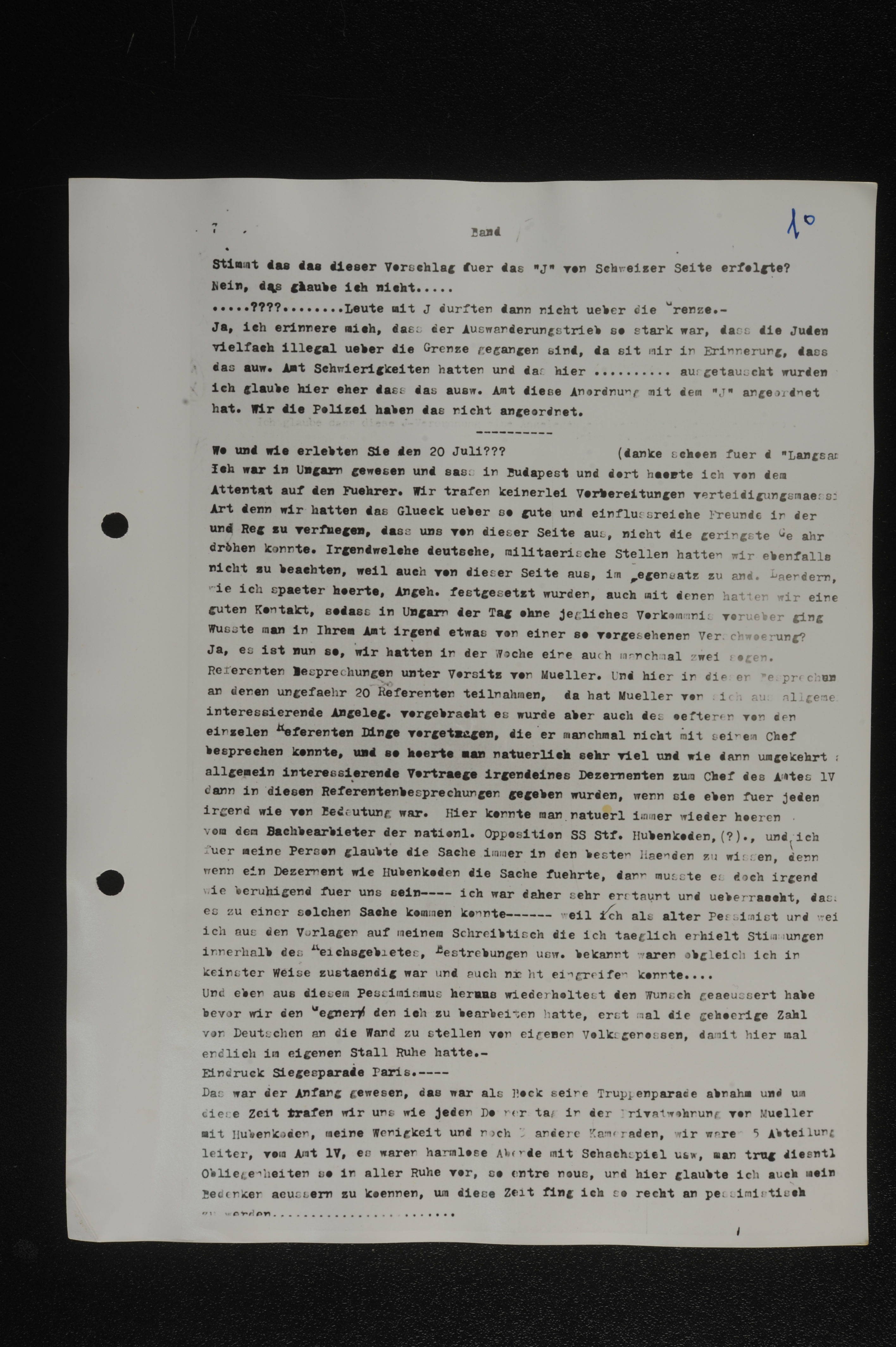
Band 1, page 1

He said this man was in truth the darkest figure of this century, and especially because he, as the witnesses probably said, had recognized the outcome of the war clearly a long time beforehand. That is given back word for word. I read the thing in captivity, in a small pamphlet, "The Nuremberg Trial".

Questioner

What is your fundamental attitude to the Jewish question with regard to our people? If you had had a free hand, how would you have attempted a solution, and in this connection that means a political solution?

Eichmann

My attitude: there we have to go back into history at least far enough, so far as the German people is concerned, to the time of the Middle Ages, namely when the German rulers of the small states came into financial difficulty very often through their way of life, and Jewry, which was frequently confined to ghettos, [not typed] I mean here a living together, a separation, an extinguishing; [punch hole] seen from the present.

Now, knowing it out of history, a living together with this people, which for 2,000 years has lived in dispersion and was prevented from following certain fields of life, concentrated on particular branches, that is for example trade, and also the intellectual professions. And when I then saw that this [overtyped] within the German people, with 1932 as the reference date, controlled at an unheard-of percentage those fields that were of vital importance for the German people, and sat in their key positions, then I said to myself that there has to be a separation.

And it was not I who said that [overtyped]; the Party program said it, other national fighters said it before me, and on the other side Jewish leaders said it too. Now, since a solution was absolutely necessary, because that is what our Party leadership said and later the leadership of the German Reich as well, I said, and I believe along with me all those who had a small word to contribute here, that such a solution could only be a political solution.

But a political solution only means smashing shop windows, it does not mean killing, it does not mean dragging them off into slavery, but rather a clean separation [handwriting] from the territory of this people to which I for example belong. Probably there are in other countries just such minds who wish for [punch hole] such a separation. But such a separation had already been taken in hand before the national A [not typed], and there the driving factor was not the German. Here the driving factor was the Jew himself, the Zionist, for the first time under [not typed] Herzl, the pioneer of territorial separation altogether.

Questioner

That is to say, if you had had the say in your sector, that is, if you had had to carry a solution through, what would you have done in practice then?

Eichmann

If I had been able to carry the solution through and had had the full authority, then I would have done what I had already attempted in the first steps. Namely, first of all to give the Jew a certain self-administration, an administration of his own, so that he would get into administrative training, in order to be able to maintain and lead himself as well. I saw, and see it today too, that the Jewish question can only be brought to a final solution when land and soil is put under the Jew's feet, and that is a task for the politicians.

Questioner

How did you feel about your task personally and as a human being, that is, as you were able to carry it out with the means at your disposal, under the assumption [off the sheet]

Open sheet image, German, and notes
Scan 00005 of the Sassen transcript, O.65 file 85.
This is scan 00005 of the Sassen transcript, O.65 file 85. The image is 2832 by 4256 pixels. Yad Vashem Archives, Jacob Robinson Collection O.65, file 85.

German transcription

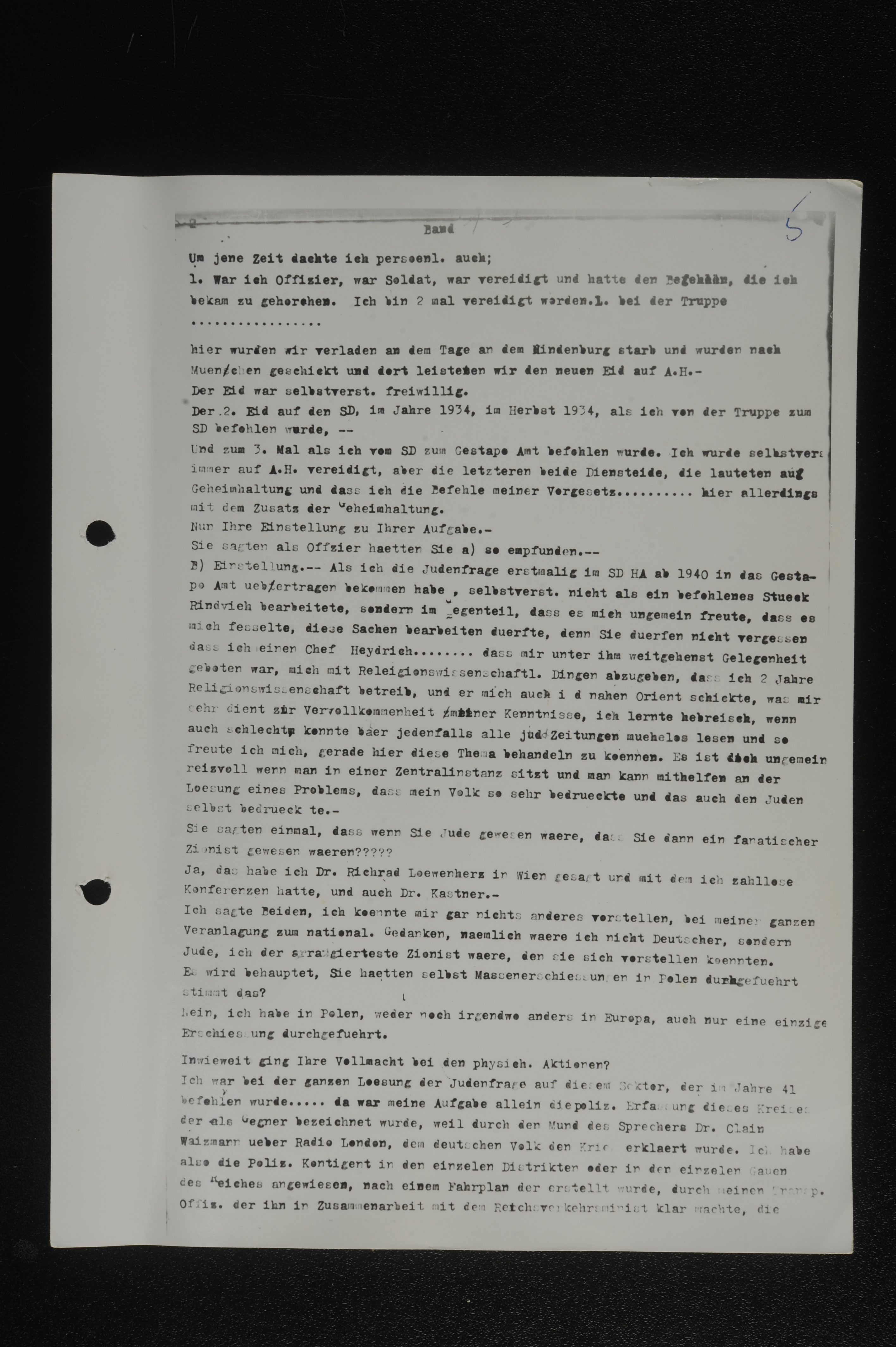
1 Band / [HW: 4] Richter Jackson in Nuernberg: [DEL: [illegible]] Er sagte, dieser Mann sei in Wahrheit die finsterste Gestalt dieses Jahrhunderts und besonders deswegen, weil er, wie die Zeugen wahrscheinlich sagten, schon lange Zeit vorher den Ausgang des Krieges klar erkannthaette. Das ist wortgemaess wieder gegeben, ich las die Sache in der Gefangenschaft in einer kleinen Borschuere" Der Nuernberger Prozess".- Wie ist Ihre grundsaetzliche Einstellung der Judenfrage in Bezug auf unser Volk? Wenn Sie freie Hand gehabt haetten wie haetten Sie eine Loesung versucht und das heisst in diesem Zusammenhang eine polit. Loesung?? Meine Einstellung : Da muessen wir zumindestens soweit in die Geschichte ein- steigen ,soweit es sich um das deutsche Volk handelt, bis Zeit Mittelalter naemlich als die deutschen Kleinstaatchef durch ihren Lebenswandel sehr vielfach in finanzielle Bedraengnis kamen und das Judentum, das oftmals ghetterisiert war, ........Ich meine hier ein Zusammenleben, eine Trennung, eine Ausloeschung; [HOLE: au]s der Gegenwart gesehen.---- Nun aus der Geschichteheraus wissend ein Zusammenleben mit diesem Volk, dass seit 2 000 Jahren unter Zerstreuung lebt und verhindert war, gewisse Lebensgebiete aus- zu ueben, auf bestimmte Sparten konzentrierte, das ist z.B. der Handel, das sind auch geistige Berufe und wenn ich nun gesehen habe, wenn diese Min[illegible/overtyped]... innerhab des deutschen Volkes Sammelstichtag 1932, zu einem unerhoerten %Satz, diese Gebiete die fuer das deutsche Volk von lebenswichtiger Bedeutung waren behrrschten und in ihrer Schluessel stellungen sassen. Da sagte ich mir, dass muss eine Trennung geben und nicht ich sagte dass[illegible/overtyped]/, das sagte das Parteiprogramm, das sagten vor mir and. Nationalkaempfer , das sagten auf der and. Seite aber auch jud Fuehrer. Nun als eine Loesung unbedingt noetig war, denn das sagte ja uns. Parteifuehrung und spaeter auch die Fuehrung des deutschen Reiches. Da sagte ich und ich glaube mit mir wohl alle die hier ein Woertchen mit zu denken hatten, dass eine solche Loesung nur eine polit. Loesung sein koenne----- aber eine polit. Loesung heisst nur Schaufenstereinschlagen, heisst nicht toeten, heisst nicht in die Sklaverei sie abschleppen, sondern eine [HW: [?auch?]] reinliche Trennung, vom Raum dieses Volkes, dem ich z.B. angehoere, wahrscheinlich gibt es in and. Laendern ebenso solche Geister die [HOLE: ei]ne solche Trenung wuenschen. Eine solche Trennung wurde aber schon vorm der national. A........ in Eingriff genommen, da war aber nicht der treibende Faktor der Deutsche, sondern hier war der treibende Faktor der Jude selbst, der Zionist erstmalig unter ......[?hersel?], der Vorkaempfer der raeumlichen Trennung ueberhaupt. D.h. also wenn Sie nun zu bestimmen gehabt haetten in Ihrem Sektor, d.h. wenn Sie eine Loesung haetten durch fuehren muessen, was haetten praktisch getan dann? Wenn ich die Loesung haette durchfuehren koennen und ich die Vollmacht gehabt haette, denn haette ich das getan was ich in den Ansaetzen bereits versuchthabe. Naemlich erst einmal den Juden, eine gewisse Selbstverwaltung eine Eigenverwaltung zu geben, damit er in das verwaltungsmaessige Training hineingeraten, um sich derg- auch selbst erhalten und fuehren zu koennen. Ich sah und sehe es auch heute, dass die Judenfrage nur dann einer endgueltigen Loesung zugefuehrt werden kann, wenn dem Juden Grund und Boden unter die Fuesse gestellt wird, wo ist eine Aufgabe der Politiker.-- Wie empfanden Sie persoenl. und menschlich Ihre Aufgabe, d.h. so wie sie sie durch fuehren konnten mit den Mitteln, die Ihnen zur Verfuegung standen, unt.d.Voraussetz

English translation

1 Volume / [HW: 4] Judge Jackson in Nuremberg: [DEL: [illegible]] He said this man was in truth the darkest figure of this century, and especially because he, as the witnesses probably said, had already recognized clearly the outcome of the war a long time before. This is rendered verbatim again, I read the matter in captivity in a small brochure "The Nuremberg Trial".- What is your fundamental attitude toward the Jewish question in relation to our people? If you had had a free hand, how would you have attempted a solution, and that means in this context a political solution?? My attitude: There we must at least go so far back into history, insofar as it concerns the German people, until the Middle Ages, namely when the German small-state chiefs through their way of life came very often into financial distress and the Jewry, which was often ghettoized, ........I mean here a living-together, a separation, an extinction; [HOLE: as] seen from the present.---- Now, knowing out of history, a living-together with this people, which for 2,000 years lives under dispersion and was prevented from exercising certain areas of life, concentrated on certain sectors, that is for example trade, those are also intellectual professions, and when I have now seen, when this min[illegible/overtyped]... within the German people, collective reference date 1932, at an unheard-of percentage rate, dominated these areas which were of vitally important significance for the German people and sat in their key positions. There I said to myself, there must be a separation, and it was not I who said that[illegible/overtyped]/, the Party program said that, before me other national-fighters said that, on the other side, however, Jewish leaders also said that. Now, as a solution was absolutely necessary, for that is what our Party leadership said and later also the leadership of the German Reich said. There I said, and I believe with me probably all those who here had a little word to think along, that such a solution could only be a political solution----- but a political solution means only smashing shop-windows, does not mean killing, does not mean dragging them off into slavery, but rather a [HW: [?also?]] clean separation, from the space of this people, to which I for example belong, probably there are in other countries likewise such spirits who wish [for] [HOLE: a] such separation. Such a separation, however, was already taken in hand before the national A........, but there the driving factor was not the German, but rather here the driving factor was the Jew himself, the Zionist for the first time under ......[?hersel?], the pioneer of the spatial separation altogether. That is, so, if you now had had to determine in your sector, that is, if you had had to carry out a solution, what would [you] practically have done then? If I had been able to carry out the solution and I had had the full authority, then I would have done what I already attempted in the beginnings. Namely first of all to give the Jew a certain self-administration, an own administration, so that he gets into the administrative training, in order to be able also to maintain and lead himself thereby. I saw and see it also today, that the Jewish question can only then be brought to a final solution when land and soil is placed under the feet of the Jew, [that] is a task of the politicians.-- How did you feel personally and humanly [about] your task, that is, as you could carry it out with the means that stood at your disposal, under the presupposition
Unreviewed notes

These notes haven't been reviewed. A note can identify a speaker where the reviewed English doesn't. If they disagree, use the reviewed English.

Transcription note

Typescript page, Part1/00005. The head has typed page number 1, the word “Band,” and a blue handwritten folio 4. A dense overtyped and cancelled word follows “Richter Jackson in Nuernberg.” Two round punch holes cut through the left edge of the paper. The upper hole removes “au” from “aus”; the lower hole removes “ei” from “eine.” Bracketed HOLE letters reconstruct only what the surrounding words support. The typist left a dot run before “Ich meine,” overtyped the word beginning “Min,” overtyped letters after “dass,” and left “national. A........” unfinished. Dots precede a damaged name that appears as “hersel.” A faint penciled word above “reinliche” may read “auch”; it is marked as uncertain handwriting. The visible spelling “Ausloeschung” is kept. The last line fades at the lower-right edge and continues on the next sheet. Other visible spellings and typing errors remain unchanged.

Translation notes

- ‘Ausloeschung’ is rendered as ‘extinction.’ The German can mean erasure, destruction, or annihilation; this exchange does not settle which force Eichmann intended. - The bracketed HOLE words show where round punch holes remove letters at the left edge. ‘As’ and ‘a’ are reconstructed from the surviving syntax. - The word beginning ‘Min’ and the letters after ‘said that’ are covered by typewriter overstrikes. They are marked as overtyped rather than as paper loss. - The faint handwritten word above ‘reinliche’ may read ‘auch’ (‘also’ or ‘too’). It remains uncertain in both language layers. - ‘......hersel’ is the damaged typed form. The reviewed English identifies Theodor Herzl from the surrounding reference to a Zionist leader. - The bracketed ‘you’ and ‘that’ supply subjects missing from the German syntax rather than letters hidden by damage. - ‘unt.d.Voraussetz’ at the foot is an abbreviated and incomplete ‘unter der Voraussetzung.’ The question continues on the next sheet. This is a question-and-answer sheet without typed speaker initials. The questions remain Q, an unnamed questioner. The first-person policy answers are assigned to E from their content. The opening captivity recollection is also assigned to E, but the sheet does not give a speaker mark for it. Round punch-hole loss, typed dot runs, typewriter overstrikes, faint handwriting, uncertain spelling, grammatical additions, and the cut-off final line are marked separately.

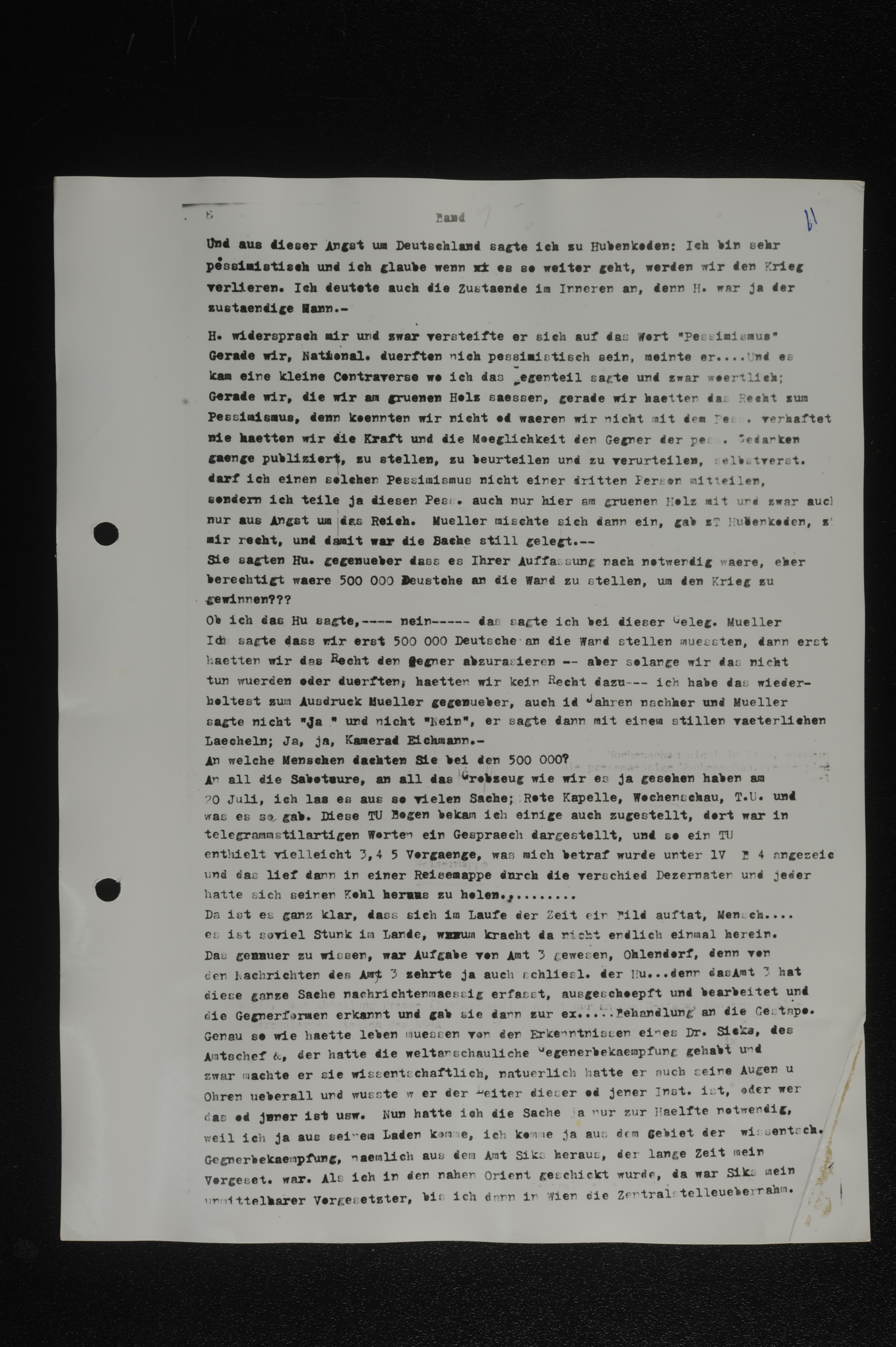
At that time I also thought personally: first, I was an officer, was a soldier, was sworn in, and had to obey the orders I received. I was sworn in twice. First with the troop [not typed]

Here we were loaded onto trains on the day Hindenburg died, and we were sent to Munich, and there we swore the new oath to A.H. The oath was of course voluntary. The second oath to the SD, in the year 1934, in the autumn of 1934, when I was ordered from the troop to the SD. And for the third time when I was ordered from the SD to the Gestapo Office. I was [off the sheet], always sworn to A.H., but the two later service oaths were oaths of secrecy and that I would follow the orders of my superiors [not typed], here however with the addition of secrecy.

Questioner

Only your attitude to your task. You said that as an officer you felt about it in the first way.

Eichmann

Second, my attitude. When the Jewish question was first transferred to me in the SD Head Office, and from 1940 into the Gestapo Office, I did not of course work on it as a head of cattle acting under orders. On the contrary, it delighted me enormously, it gripped me, that I was allowed to work on these things, because you must not forget that I had a chief, Heydrich [not typed], that under him I was given every opportunity to occupy myself with matters of religious scholarship, that I studied religious scholarship for two years, and that he also sent me to the Near East, which served me very well in perfecting my knowledge.

I learned Hebrew, badly enough, but in any case I could read all Jewish newspapers without effort, and so I was glad to be able to handle exactly this subject. It really is uncommonly attractive when you sit in a central authority and can help in the solution of a problem that weighed so heavily on my people and that weighed on the Jews themselves as well.

Questioner

You once said that if you had been a Jew you would then have been a fanatical Zionist.

Eichmann

Yes, I said that to Dr. Josef Loewenherz in Vienna, with whom I had countless conferences, and to Dr. Kastner as well. I said to both of them that I could not imagine anything else, given my whole disposition toward the national idea. Namely, that if I were not a German but a Jew, I would be the most committed Zionist they could imagine.

Questioner

It is claimed that you yourself carried out mass shootings in Poland. Is that correct?

Eichmann

No, I never carried out a single shooting, neither in Poland nor anywhere else in Europe.

Questioner

How far did your authority go in the physical actions?

Eichmann

In the whole solution of the Jewish question in this sector, which was ordered in the year 41, my task was solely the police registration of this group, which was described as the enemy because through the mouth of the spokesman Dr. Chaim Weizmann, over Radio London, war was declared on the German people. So I instructed the police contingents in the individual districts or in the individual Gaue of the Reich, according to a timetable that was drawn up by my transport officer, who settled it in cooperation with the Reich Transport Ministry, to

Open sheet image, German, and notes
Scan 00006 of the Sassen transcript, O.65 file 85.
This is scan 00006 of the Sassen transcript, O.65 file 85. The image is 2832 by 4256 pixels. Yad Vashem Archives, Jacob Robinson Collection O.65, file 85.

German transcription

[HW: 5] - 2 - Band Um jene Zeit dachte ich persoenl. auch; 1. War ich Offizier, war Soldat, war vereidigt und hatte den Befehlen, die ich bekam zu gehorchen. Ich bin 2 mal vereidigt worden.1. bei der Truppe ................ hier wurden wir verladen an dem Tage an dem Hindenburg starb und wurden nach Muenchen geschickt und dort leisteten wir den neuen Eid auf A.H.- Der Eid war selbstverst. freiwillig. Der.2. Eid auf den SD, im Jahre 1934, im Herbst 1934, als ich von der Truppe zum SD befohlen wurde, -- Und zum 3. Mal als ich vom SD zum Gestapo Amt befohlen wurde. Ich wurde selbstvers[EDGE] immer auf A.H. vereidigt, aber die letzteren beide Diensteide, die lauteten auf Geheimhaltung und dass ich die Befehle meiner Vorgesetz.......... hier allerdings mit dem Zusatz der Geheimhaltung. Nur Ihre Einstellung zu Ihrer Aufgabe.- Sie sagten als Offzier haetten Sie a) so empfunden.-- B) Einstellung.-- Als ich die Judenfrage erstmalig im SD HA ab 1940 in das Gesta- po Amt uebertragen bekommen habe , selbstverst. nicht als ein befohlenes Stueck Rindvieh bearbeitete, sondern im Gegenteil, dass es mich ungemein freute, dass es mich fesselte, diese Sachen bearbeiten duerfte, denn Sie duerfen nicht vergessen dass ich einen Chef Heydrich........ dass mir unter ihm weitgehenst Gelegenheit geboten war, mich mit Releigionswissenschaftl. Dingen abzugeben, dass ich 2 Jahre Religionswissenschaft betreib, und er mich auch i d nahen Orient schickte, was mir sehr dient zur Vervollkommenheit meiner Kenntnisse, ich lernte hebreisch, wenn auch schlechte konnte baer jedenfalls alle judd Zeitungen mueheles lesen und so freute ich mich, gerade hier diese Thema behandeln zu koennen. Es ist doch ungemein reizvoll wern man in einer Zentralinstanz sitzt und man kann mithelfen an der Loesung eines Problems, dass mein Volk so sehr bedrueckte und das auch den Juden selbst bedrueck te.- Sie sagten einmal, dass wenn Sie Jude gewesen waere, dass Sie dann ein fanatischer Zionist gewesen waeren????? Ja, das habe ich Dr. Richrad Loewenherz in Wien gesagt und mit dem ich zahllose Konfererzen hatte, und auch Dr. Kastner.- Ich sagte Beiden, ich koennte mir gar nichts anderes vorstellen, bei meiner ganzen Veranlagung zum national. Gedanken, naemlich waere ich nicht Deutscher, sondern Jude, ich der arrangierteste Zionist waere, den sie sich vorstellen koennten. Es wird behauptet, Sie haetten selbst Massenerschiessungen in Polen durchgefuehrt stimmt das? Nein, ich habe in Polen, weder noch irgendwo anders in Europa, auch nur eine einzige Erschiesung durchgefuehrt. Inwieweit ging Ihre Vollmacht bei den physisch. Aktionen? Ich war bei der ganzen Loesung der Judenfrage auf diesem Sektor, der im Jahre 41 befohlen wurde..... da war meine Aufgabe allein diepoliz. Erfassung dieses Kreises der als Gegner bezeichnet wurde, weil durch den Mund des Sprechers Dr. Clain Waizmann ueber Radio London, dem deutschen Volk den Krieg erklaert wurde. Ich habe also die Poliz. Kontigent in den einzelen Distrikten oder in den einzeler Gauen des Reiches angewiesen, nach einem Fahrplan der erstellt wurde, durch meinen Transp. Offiz. der ihn in Zusammenarbeit mit dem Reichsverkehrsminist klar machte, die

English translation

[HW: 5] - 2 - Volume [/ Tape] Around that time I also personally thought; 1. I was an officer, was a soldier, was sworn in and had to obey the orders that I received. I was sworn in 2 times. 1. with the troop ................ here we were loaded up on the day on which Hindenburg died and were sent to Munich and there we swore the new oath to A.H.- The oath was of course voluntary. The 2nd oath to the SD, in the year 1934, in the autumn of 1934, when I was ordered from the troop to the SD, -- And for the 3rd time when I was ordered from the SD to the Gestapo Office. I was [EDGE: probably ‘of course’] always sworn to A.H., but the latter two service oaths, those pertained to secrecy and that I [obey] the orders of my superior.......... here however with the addition of secrecy. Only your attitude toward your task.- You said as an officer you had felt a) that way.-- B) Attitude.-- When I first received the Jewish question transferred in the SD HA from 1940 into the Gesta- po Office, [I] of course did not work [on it] as a commanded piece of cattle, but on the contrary, that it pleased me exceedingly, that it gripped me, that I was permitted to work on these matters, for you must not forget that I had a chief Heydrich........ that under him I was to a great extent offered opportunity to occupy myself with matters of religious scholarship, that I pursued 2 years [of] religious scholarship, and he also sent me to the near [Middle] East, which served me very much for the perfecting of my knowledge, I learned Hebrew, even if badly, could ba[e]r [but] in any case read all Jewish newspapers effortlessly and so I was pleased to be able to treat precisely this subject here. It is indeed exceedingly appealing when one sits in a central authority and one can help in the solution of a problem that so greatly oppressed my people and that also oppressed the Jews themselves.- You once said that if you had been a Jew, that you would then have been a fanatical Zionist????? Yes, that I said to Dr. Richrad [Richard?] Loewenherz in Vienna and with whom I had countless conferences, and also Dr. Kastner.- I said to both, I could not imagine anything else at all, with my whole disposition toward the national idea, namely were I not German, but [a] Jew, I would be the most arranged [committed?] Zionist that they could imagine. It is claimed you yourself carried out mass shootings in Poland, is that true? No, I have, neither in Poland, nor anywhere else in Europe, carried out even a single shooting. To what extent did your authority [power of attorney] extend in the physical actions? I was, in the whole solution of the Jewish question in this sector, which in the year 41 was ordered..... there my task was solely the police registration of this circle which was designated as the enemy, because through the mouth of the spokesman Dr. Clain [Chaim] Waizmann [Weizmann] over Radio London, war was declared on the German people. I have thus directed the police contingent in the individual districts or in the individual Gaus of the Reich, according to a timetable that was drawn up, by my transport officer who made it clear in cooperation with the Reich Transport Ministry, the
Unreviewed notes

These notes haven't been reviewed. A note can identify a speaker where the reviewed English doesn't. If they disagree, use the reviewed English.

Transcription note

Typescript Page 6. The head has ‘- 2 -,’ ‘Band,’ and a blue handwritten 5. A long dark line partly covers the typed sheet number. The sheet continues an answer from Page 5. No speaker initials are typed. Three dot runs show places where the typist left words out. The right edge cuts off ‘selbstvers’; [EDGE] says that its completion isn’t visible. The oath count says two but lists three. The sheet types ‘Richrad Loewenherz’ and ‘Dr. Clain Waizmann.’ The last line continues on Page 7. Other spellings stay as typed.

Translation notes

- ‘selbstvers’ reaches the right edge. It probably shortens ‘selbstverständlich,’ ‘of course,’ but the ending isn’t visible. - ‘arrangierteste’ is odd and disturbed. ‘Most committed’ gives the likely sense, not a certain one. - ‘Vollmacht’ can mean full authorization or delegated power. The sheet doesn’t fix the scope. - ‘physisch. Aktionen’ is kept as ‘physical actions.’ In this exchange it is a euphemism for violence and killing. - ‘Richrad Loewenherz’ is kept with a bracketed question. Later sheets use Richard. Yad Vashem calls the Vienna official Josef Löwenherz. - ‘Dr. Clain Waizmann’ is kept beside the bracketed name Chaim Weizmann. - ‘i d nahen Orient’ is rendered ‘near [Middle] East’; the bracket adds the modern English term. - ‘baer’ appears to be the typist’s error for ‘aber,’ ‘but.’ - Bracketed verbs and pronouns repair broken German grammar. They aren’t hidden letters. - The last line stops midway through the transport answer and continues on Page 7. This sheet begins midway through an answer that starts on Page 5. It has no typed speaker initials. First-person content is the basis for E; every question stays Q because the sheet doesn’t name a questioner. The right edge cuts off ‘selbstvers,’ the typist left three dot runs, and the last line continues on Page 7. Brackets show ordinary English additions, name repairs, and edge loss.

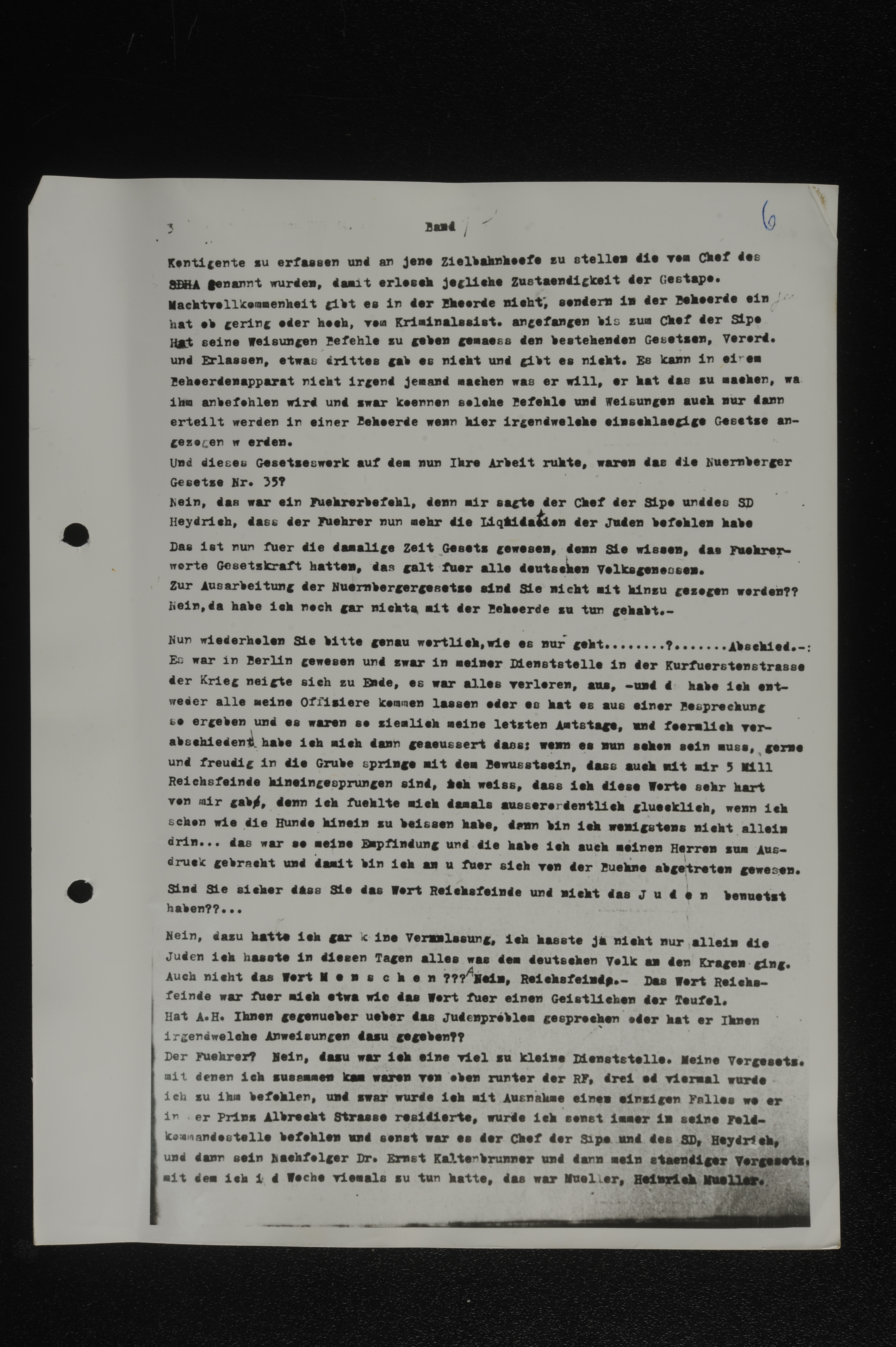
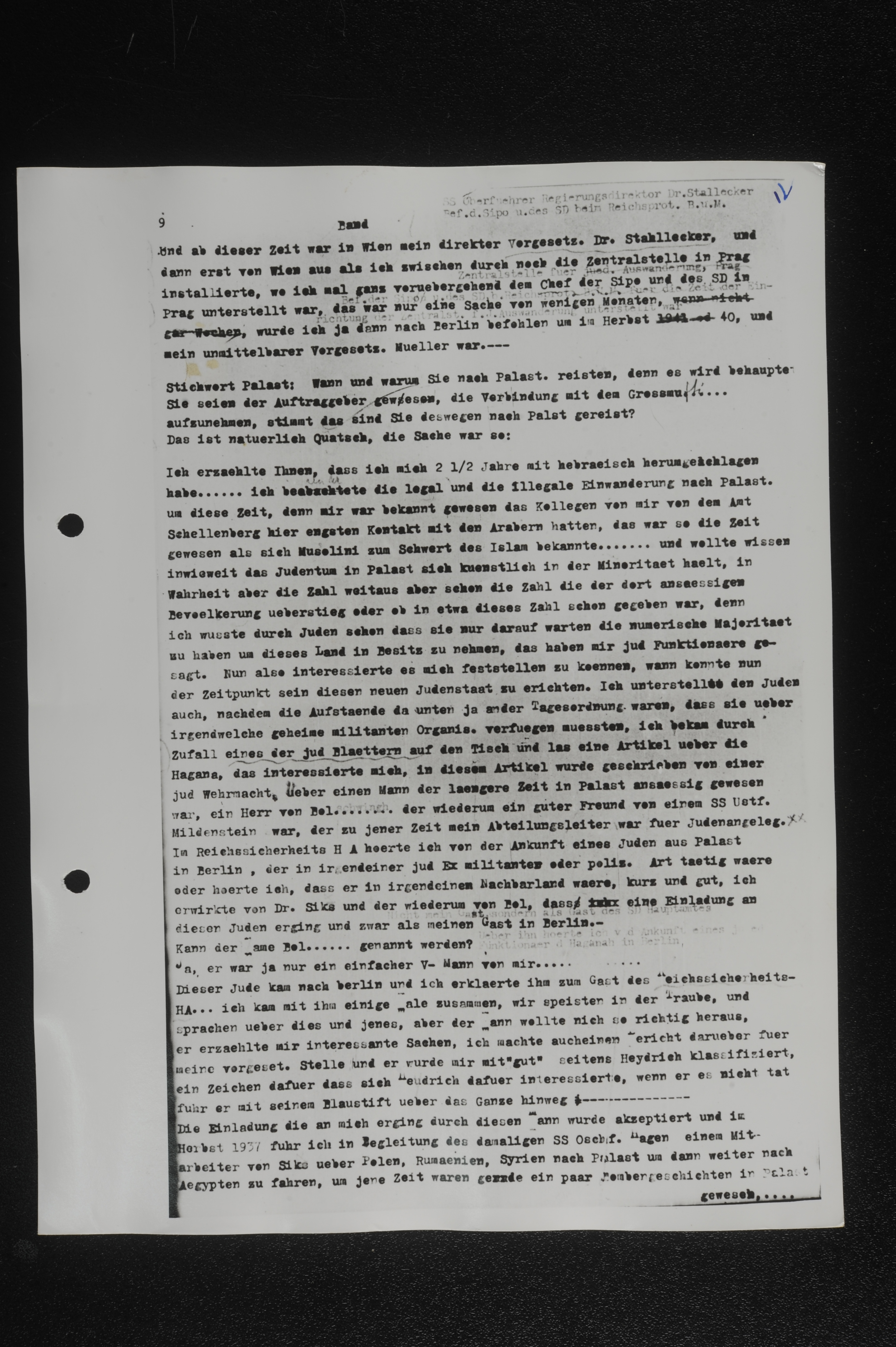
register the contingents and place them at those destination stations named by the Chief of the SDHA. That ended the Gestapo’s responsibility. Full authority doesn’t exist in a government office. Rather, everyone in an office, whether low or high, from a Kriminalassistent up to the Chief of the Security Police, has to issue instructions and orders under existing laws, regulations and decrees. There was no third possibility and there is none. In a government office nobody can do whatever he wants. He has to do what he is ordered to do, and such orders and instructions can be issued only when a relevant law is cited.

Questioner

And was this body of law on which your work rested the Nuremberg Laws No. 35?

Eichmann

No. That was a Führer order. Heydrich, the Chief of the Security Police and the SD, told me that the Führer had now ordered the liquidation of the Jews. At that time this was law. You know that the Führer’s words had the force of law, and that applied to all German members of the Nazi national community.

Questioner

You weren’t brought in to work on the Nuremberg Laws?

Eichmann

No. At that point I had nothing at all to do with the government office.

Questioner

Now please repeat it exactly, word for word, as far as you can [not typed].

Eichmann

It was in Berlin, in my office on Kurfürstenstrasse. The war was drawing to an end. Everything was lost, finished. I either summoned all my officers, or it came out of a meeting. These were more or less my last days in office. Taking my leave formally, I said that if it had to be so, I would gladly and joyfully jump into the pit knowing that five million enemies of the Reich had jumped in with me. I know I spoke these words very harshly because I felt extraordinarily happy at the time. If I had to go in and bite like the dogs, at least I wouldn’t be alone in there. That was how I felt, and I told my men. With that, I had in effect left the stage.

Questioner

Are you certain that you used the words “enemies of the Reich” and not “Jews”?

Eichmann

No. I had no reason to use that. I didn’t hate only the Jews. In those days I hated everything that threatened the German people.

Questioner

Nor the word “human beings”?

Eichmann

No, “enemies of the Reich.” To me, “enemies of the Reich” was like the word “devil” to a clergyman.

Questioner

Did A.H. speak to you about the Jewish problem, or did he give you any instructions about it?

Eichmann

The Führer? No. My office was far too junior for that. At the top of the chain of superiors I dealt with was the Reichsführer. I was summoned to him three or four times. Apart from one occasion when he was based on Prinz Albrecht Strasse, I was always called to his field command post. Otherwise it was Heydrich, the Chief of the Security Police and the SD, then his successor Dr. Ernst Kaltenbrunner, and then my immediate superior, Heinrich Mueller, whom I dealt with several times a week.

Open sheet image, German, and notes
Scan 00007 of the Sassen transcript, O.65 file 85.
This is scan 00007 of the Sassen transcript, O.65 file 85. The image is 2832 by 4256 pixels. Yad Vashem Archives, Jacob Robinson Collection O.65, file 85.

German transcription

3 Band [HW: /] [HW: 6] Kontigente su erfassen und an jene Zielbahnhoefe zu stellen die vom Chef des SDHA genannt wurden, damit erlosch jegliche Zustaendigkeit der Gestapo. Machtvollkommenheit gibt es in der Bhoerde nicht, sondern in der Behoerde ein [HW: [?jeder?]] hat ob gering oder hoch, vom Kriminalassist. angefangen bis zum Chef der Sipo Hat seine Weisungen Befehle zu geben gemaess den bestehenden Gesetzen, Verord. und Erlassen, etwas drittes gab es nicht und gibt es nicht. Es kann in einem Behoerdenapparat nicht irgend jemand machen was er will, er hat das su machen, wa[EDGE] ihm anbefohlen wird und zwar koennen solche Befehle und Weisungen auch nur dann erteilt werden in einer Behoerde wenn hier irgendwelche einschlaegige Gesetze an- gezogen w erden. Und dieses Gesetzeswerk auf dem nun Ihre Arbeit ruhte, waren das die Nuernberger Gesetze Nr. 35? Nein, das war ein Fuehrerbefehl, denn mir sagte der Chef der Sipo unddes SD Heydrich, dass der Fuehrer nun mehr die Liquida[DEL: c][HW: t]ion der Juden befohlen habe Das ist nun fuer die damalige Zeit Gesetz gewesen, denn Sie wissen, das Fuehrer- worte Gesetzkraft hatten, das galt fuer alle deutschen Volksgenossen. Zur Ausarbeitung der Nuernbergergesetze sind Sie nicht mit hinzu gezogen worden?? Nein,da habe ich noch gar nichts mit der Behoerde zu tun gehabt.- Nun wiederholen Sie bitte genau wortlich,wie es nur geht........?.......Abschied.-: Es war in Berlin gewesen und zwar in meiner Dienststelle in der Kurfuerstenstrasse der Krieg neigte sich zu Ende, es war alles verloren, aus, -und d habe ich ent- weder alle meine Offisiere kommen lassen oder es hat es aus einer Besprechung so ergeben und es waren so ziemlich meine letzten Amtstage, und feermlich ver- abschiedent habe ich mich dann geaeussert dass; wenn es nun schon sein muss, gerne und freudig in die Grube springe mit dem Bewusstsein, dass auch mit mir 5 Mill Reichsfeinde hineingesprungen sind, ich weiss, dass ich diese Worte sehr hart von mir gab, denn ich fuehlte mich damals ausserordentlich glueeklich, wenn ich schon wie die Hunde hinein zu beissen habe, dann bin ich wenigstens nicht allein drin... das war so meine Empfindung und die habe ich auch meinen Herren zum Aus- druck gebracht und damit bin ich an u fuer sich von der Buehne abgetreten gewesen. Sind Sie sicher dass Sie das Wort Reichsfeinde und nicht das J u d e n benuetzt haben??... Nein, dazu hatte ich gar k ine Veranlassung, ich hasste ja nicht nur allein die Juden ich hasste in diesen Tagen alles was dem deutschen Volk an den Kragen ging. Auch nicht das Wort M e n s c h e n ???[HW: A]Nein, Reichsfeinde.- Das Wort Reichs- feinde war fuer mich etwa wie das Wort fuer einen Geistlichen der Teufel. Hat A.H. Ihnen gegenueber ueber das Judenproblem gesprochen oder hat er Ihnen irgendwelche Anweisungen dazu gegeben?? Der Fuehrer? Nein, dazu war ich eine viel su kleine Dienststelle. Meine Vergesets. mit denen ich zusammen kam waren von oben runter der RF, drei od viermal wurde ich zu ihm befohlen, und zwar wurde ich mit Ausnahme eines einzigen Falles wo er in er Prinz Albrecht Strasse residierte, wurde ich sonst immer in seine Feld- kommandostelle befohlen und sonst war es der Chef der Sipo und des SD, Heydrich, und dann sein Nachfolger Dr. Ernst Kaltenbrunner und dann mein staendiger Vergesets. mit dem ich i d Woche viemals zu tun hatte, das war Mueller, Heinrich Mueller.

English translation

3 Volume [HW: /] [HW: 6] to register contingents and to deliver them to those destination stations that were named by the Chief of the SDHA, with that any jurisdiction of the Gestapo was extinguished. Plenary power does not exist in the auth[or]ity; rather, in the authority [HW: probably ‘everyone’], whether low or high, from the criminal-assist[ant] on up to the Chief of the Sipo, has to give his instructions [and] orders in accordance with the existing laws, ordin[ances] and decrees, a third thing did not exist and does not exist. In an apparatus of authority someone cannot simply do what he wants, he has to do wha[t] is enjoined upon him, and indeed such orders and instructions can also only be issued in an authority if some pertinent laws are invoked he re. And this body of law upon which your work now rested, was that the Nuremberg Laws No. 35? No, that was a Führer order, for the Chief of the Sipo and of the SD Heydrich told me that the Führer had now ordered the liquidation of the Jews That was law for that time then, for you know that Führer words had force of law, that applied to all German fellow-nationals. You were not brought in to participate in the drafting of the Nuremberg Laws?? No, at that point I had nothing at all to do with the authority.- Now please repeat exactly word for word, as far as it can be done........?.......Farewell.-: It had been in Berlin, and indeed in my office in the Kurfürstenstrasse the war was drawing to its end, everything was lost, over, -and th I either had all my off[i]cers come or it came about that way out of a discussion and those were pretty much my last days in office, and formally taking my leave I then expressed that; if it now has to be, [I would] gladly and joyfully jump into the pit with the awareness that 5 mill[ion] enemies of the Reich have jumped in with me as well, I know that I uttered these words very harshly, for at that time I felt extraordinarily happy, if I already have to bite into it like the dogs, then at least I am not alone in there... that was my feeling and I also expressed it to my gentlemen and with that I had in and of itself stepped down from the stage. Are you certain that you used the word enemies of the Reich and not the J e w s??... No, I had no occasion at all for that, after all I did not hate only the Jews alone I hated in those days everything that went for the throat of the German people. Nor the word h u m a n b e i n g s ???[HW: A]No, enemies of the Reich.- The word enemies of the Reich was for me something like the word for a clergyman [is] the devil. Did A.H. speak to you about the Jewish problem or did he give you any instructions on it?? The Führer? No, for that I was much too small an office. My superi[ors] with whom I came together were from the top down the RF, three or four times I was ordered to him, and indeed with the exception of a single case where he resided in th e Prinz Albrecht Strasse, I was otherwise always ordered to his field command post and otherwise it was the Chief of the Sipo and of the SD, Heydrich, and then his successor Dr. Ernst Kaltenbrunner and then my permanent superi[or] with whom I had dealings [four or many] times i[n] th[e] week, that was Mueller, Heinrich Mueller.
Unreviewed notes

These notes haven't been reviewed. A note can identify a speaker where the reviewed English doesn't. If they disagree, use the reviewed English.

Transcription note

Typed transcript page, Band header centered at top; typewritten "3" at upper left (typed page/serial number), "Band" centered with a small handwritten slash/flourish after it, and a handwritten blue-crayon "6" at upper right (archival folio number). Two-hole punch at left margin. Lower third of the page shows heavy dark exposure/scan bleed but text remains legible. The typescript is full of typewriter idiosyncrasies (e.g. su/zu, Offisiere, Bhoerde vs Behoerde, benuetzt, gab, k ine, i d Woche, drei od viermal, in er) which have been preserved verbatim rather than corrected. In "Liquidacion" a handwritten t corrects the typed c, so the diplomatic text records Liquida[DEL: c][HW: t]ion. A faint cursive word follows "...Behoerde ein" and probably reads jeder; the diplomatic text marks the reading uncertain. A handwritten A stands above "Nein" following "M e n s c h e n ????" and marks the answer boundary. No struck-through spans were found that resolved into a [DEL:]/[HW:] replacement pair. The line ending in "wa" reaches the right edge; the missing final letter of was is marked [EDGE].

Translation notes

The English does not fully carry the legal-administrative sense of the German term. - 'Bhoerde' (sic, for 'Behoerde') is rendered '[auth]ority'. A faint handwritten word after 'ein' probably reads 'jeder' ('everyone'), but the reading remains marked uncertain. - 'Kriminalassist.' expanded as 'criminal-assist[ant]' — the rank Kriminalassistent, a junior criminal-police grade; left untranslated as a title it would be 'Kriminalassistent'. - 'Sipo' = Sicherheitspolizei (Security Police), left as the source abbreviation. - 'Verord.' expanded as 'ordin[ances]' (Verordnungen); 'Erlassen' as 'decrees'. The distinction between Verordnung and Erlass has no exact English equivalent. - 'etwas drittes gab es nicht' rendered literally 'a third thing did not exist'; the sense is 'there was no third possibility'. - 'einschlaegige Gesetze angezogen werden' rendered 'pertinent laws are invoked' — 'anziehen' in this bureaucratic-legal usage means to cite/adduce; 'invoked' is an interpretation of that idiom. - 'die Nuernberger Gesetze Nr. 35?' — the numeral '35' is legible in the German but its referent is unclear (possibly the year 1935, possibly a paragraph or item number). Rendered as written without resolution. - The typist wrote 'Liquidacion' and a handwritten t corrects the c, producing 'Liquidation'. The English reads 'liquidation'. - 'deutschen Volksgenossen' rendered 'German fellow-nationals'; 'Volksgenosse' is a National Socialist term of art ('racial comrade' / 'member of the national community') with no neutral English equivalent. - 'Nun wiederholen Sie bitte genau wortlich, wie es nur geht........?.......Abschied.-:' — the ellipses and the isolated word 'Abschied' are in the source. "'5 Mill Reichsfeinde' — 'Mill' is an abbreviation, expanded as 'mill[ion]'." It could mean 'viermals' ('four times') or 'vielmals' ('many times'), so the literal layer keeps both readings. - 'Kurfuerstenstrasse', 'Prinz Albrecht Strasse' left in German as street names. - The line ending 'wa' reaches the right edge and probably completes to 'was'; the missing letter is marked. - A handwritten A above the joined 'Menschen????Nein' line marks the answer boundary. Page identification: header reads "3", then "Band" with a handwritten mark, then handwritten "6" — i.e. page 3 of tape/volume 6. Both header insertions are marked [HW: ]. Source defects preserved rather than corrected: the transcription contains numerous typewriter errors that I have carried across as-is with the German form flagged in translation_uncertainties: su/zu (three times: "Kontigente su erfassen", "das su machen", "viel su kleine"), Kontigente/Kontingente, Bhoerde/Behoerde, Offisiere/Offiziere, glueeklich/glücklich, feermlich, verabschiedent, Liquidacion/Liquidation, k ine/keine, viemals, and the split words "w erden", "in er"/"in der", "unddes"/"und des". Broken spacing inside words ("he re", "th e") reflects the German line breaks. Grammatical breakage preserved: the sentence beginning "Machtvollkommenheit gibt es in der Bhoerde nicht, sondern in der Behoerde ein / hat ob gering oder hoch, vom Kriminalassist. angefangen bis zum Chef der Sipo / Hat seine Weisungen Befehle zu geben..." is ungrammatical in the German — a subject appears to be missing after "ein", and "Hat" is capitalised mid-sentence at a line start. I have kept the anacoluthon and marked the supplied subject in brackets. Emphasis by letter-spacing: "J u d e n" and "M e n s c h e n" are spaced out in the typescript (an emphasis convention); I have reproduced the spacing in the English words "J e w s" and "h u m a n b e i n g s". The word "Reichsfeinde" is not spaced in the source and so is rendered normally. Turn boundaries: the page carries NO explicit speaker labels or initials. Attribution therefore rests on rule 2 — content alone. Every attributed turn is either an unmistakable second-person question/imperative to the respondent (assigned S) or an unmistakable first-person account of the respondent's own RSHA-subordinate position, superiors and office (assigned E). No turn was assigned by alternation or position alone. One turn boundary is not marked by a line break in the source: "Auch nicht das Wort M e n s c h e n ????Nein, Reichsfeinde.-" runs the question and the reply together on a single line with no separator beyond the question marks. "????" "Nein" The first turn on the page begins mid-sentence ("Kontigente su erfassen und...") and continues an answer started on the preceding page; I have not supplied the missing opening. No OTHER speaker is identifiable on this page: nothing in the text marks a third participant. Substantive contradiction within the page, preserved and not reconciled: the speaker first asserts at length that no plenipotentiary power existed and that all orders had to rest on existing laws, ordinances and decrees, with "a third thing did not exist"; he then immediately answers that the legal basis for his work was not the Nuremberg Laws but "a Führer order", asserting that Führer words had force of law. The German lets the tension between "only statute law" and "a Führer order was law" stand, and the translation leaves it standing. Two further points of content I have not smoothed: the "5 mill[ion]" figure and the phrase "enemies of the Reich" are what the German says, including the speaker's insistence under questioning on that term over "Jews" or "human beings"; and the claim of never having received instructions from Hitler directly, with the chain of superiors named as RF (Himmler), Heydrich, Kaltenbrunner, and Heinrich Mueller as the permanent immediate superior. "SDHA" is left unresolved (see translation_uncertainties) rather than silently normalised to RSHA. Scan reconciliation on August 27, 2026 read the faint word after 'ein' as probably handwritten 'jeder', the mark over 'Liquidacion' as a handwritten t correcting c, and the mark before 'Nein' as a handwritten A. The right-edge loss after 'wa' is also marked.
Band 1, page 4

I had no other superiors.

Questioner

Did Himmler speak with you about this problem or give you any instructions? Do you therefore know his position on it?

Eichmann

Yes, I can say that. First, Himmler repeatedly spoke of the harshness of the struggle the German people had to wage against their Jewish opponents. He said this struggle had to be fought because never again would we be strong enough in leadership to defend ourselves against such a dangerous opponent. I don't believe the Reichsführer himself ever dwelt on this in his programmatic remarks to his subordinates. He did speak to larger groups about the general rule. With individuals, I would say, he hammered in order after order in his impulsive way.

He jumped from the hundredth thing to the thousandth and often left the general level to seize on some small, ridiculous individual case and make a personal decision. This trait of the Reichsführer was known to many in our office and often caused us difficulties. His position was clear to me. Harshness where harshness was necessary, but where it could be avoided, it should be avoided. I repeatedly put this view in writing in my orders. In implementing regulations or action orders, which always had to be issued in writing to subordinate offices, I again and again pointed out that avoidable hardships were to be avoided. The police itself also tolerated no excesses in its actions.

Questioner

From your personal dealings with the Reichsführer, do you know whether he regarded the later combination of police and SS duties as fortunate or unfortunate? Police duties and Waffen SS duties.

Eichmann

I can't say. They were of course linked. It was one corps with different fields of duty. If the chief of this corps, the Reichsführer, considered it useful or expedient, he certainly combined the commands deliberately. In the same way, he assigned me, who came from the troops, to the Gestapo Office, although I wasn't a civil servant. I refused to become one when Mueller once approached me about it. On the contrary, I see this whole matter as a temporary posting, and I want to return to the troops when the task is complete.

Questioner

When did the term “Final Solution” first appear, who introduced it, and what did it cover?

Eichmann

I no longer know exactly whether I coined the term “Final Solution of the Jewish Question” or whether it came from Mueller. I can't even say that. When I read The Jewish State by Theodor Herzl, written by A. Boehm, he spoke there of the solution of the Jewish question. Soon afterward, when I was given the Zionist association as my subject area in the SD Main Office, I had already begun to mark files “Re: Final Solution of the Jewish Question.” The Reichsführer's aim was to bring about a final solution. The term “Final Solution of the Jewish Question” has nothing to do with physical death or the death of a person. This file heading, “Re:,” continued to be used by the SD Main Office from 1935 through 1945. It wasn't a term created separately.

Open sheet image, German, and notes
Scan 00008 of the Sassen transcript, O.65 file 85.
This is scan 00008 of the Sassen transcript, O.65 file 85. The image is 2832 by 4256 pixels. Yad Vashem Archives, Jacob Robinson Collection O.65, file 85.

German transcription

4 Band [HW: 1] [HW: 7] Andere Vorgesetzte hatte ich keine. Hat Himmler nun mit Ihnen ueber dieses Problem gesprochen, bzw. irgendwelche Anweisungen gegeben, kennen Sie daher seine Einstellung dazu??? Ja, das kann ich wohl sagen. 1. Sprach Himmler wiederholt von der Haerte des Kampfes des deutschen Volkes, den es gegen seine jud. Gegner zu fuehren habe, Und dass dieser Kampf gefuehrt werden muesse, denn nie wieder wuerden wir fuehrungsmaessig so stark sein, um uns gegen einen solchen gefaehrlichen Gegner zur Wehr setzten zu koennen. Der RF selber hat, in seinen [DEL: proklamatischen] [HW: [?programmatischen?]] [HW: [?Programmationen?]] Ausfuehrungen zu seinen Nachgeordneten, glaube ich nie hingegeben, er hat wohl zu einer groesseren Gemeinschaft ueber die generelle Regelung der Dinge ge- sprochen, dem einzelnen, moechte ich mal sagen hat er in seiner impulsiven Art Befehl auf Befehl eingehaemmert, er sprang vom 100ten bis ins 1000 te und verliess die [DEL: illegible] allgemeine Ebene sehr haeufig um irgend einen an sich kleinen laecherliche[EDGE] Einzelfall heraus zu greifen, um hier eine persoenl. Entschiedung zu treffen. Diese Eigenart des RF war aber vielen unseres Amtes bekannt gewesen und sie schafften uns oftmals Schwierigkeiten. Die Einstellung des RF war mir ganz klar, Haerte dort, wo Haerte notwendig war, wo aber Haerte vermieden werden konnte, soll sie vermieden werden. Ich habe diese Meinung des RF in wiederholtesten Faellen in meinen Befehlen schriftlich Ausdruck verliehen den ich bei Durchfuehrungsbestimmung oder bei Aktionsanordnungen, die ja immer schriftlich gegeben werden mussten an di[EDGE] nachgeord. Dienststellen, immer wieder darauf hingewiesen habe, dass vermeidbar Haerten zu vermeiden seien.... Die Polizei selber duldete auch keine Ausschreitum[EDGE] der Handlungen. Wissen Sie aus Ihrem persoenl. Zusammensein mit dem RF, ob er das Problem der Zusammenlegung Polizeiaufgaben mit SS Aufgaben aus dem spaeterem Stadium, ob er das als gluecklich oder ungluecklich empfunden hat. Polizeiaufgabe und Waffen SS Aufgaben.- Dazu kann ich nichts sagen es ist natuerlich zusammengekoppelt gewesen. Es war ja ein Corps mit verschiedenen Aufgabengebieten, wenn der Chef dieses Corps, der RF, es fuer nuetzlich oder opportun erachtete, hat dann sicher bewusst die Kommandos zusammen gelegt, genau so wie er mich, der ich von der Truppe kam, mich in das Gestapo Amt stellte, obwohl ich nicht Beamter bin, und es abge- lehnt habe, Beamter zu werden, als mich Mueller einmal darum anging. Im Gegenteil , ich sehe diese ganze Angeleg. als eine Kommandierung an, und wuensche, dass wenn die Aufgabe erfuellt ist, ich wieder zur Truppe zurueck kehre. Wann ist der Begriff Endloesung zum ersten Mal aufgetaucht und von wem tauchte er auf? Und welchen Begriff umfasste er?? Den Begriff Endloesung der Judenfrage weiss ich heute nicht mehr genau, Habe ich ihn gepraegt oder stammt er von Mueller. Aber noch nicht einmal das kann ich sagen Als ich den Judenstaat las von Theodor Herzel, geschrieben von A.Boehm, da sprach er von der Loesung der Judenfrage. Als ich alsbald die zionist. Vereinigung als Sachgebiet uebertragen bekam, im SD HA, habe ich damals schon angefangen "Btr: Endloesung der Judenfrage, , in den Akten zu zeichnen, denn das Bestreben war ja vom RF eine endgueltige Loesung herbei zu fuehren. Der Begriff Endloesung der Judenfrage hat mit dem physischen Ende oder mit dem Ende einer physisch. Person nichts zu tun. Denn dieser Aktenbegriff "Btr:" wurde immer weiter durchgezogen vom SD HA in den Jahren 35 angefangen bis 1945. es ist kein Begriff der extra aufgestellt wurde.

English translation

4 Volume [HW: 1] [HW: 7] I had no other superiors. Did Himmler now speak with you about this problem, or give any instructions, do you therefore know his attitude toward it??? Yes, that I can well say. 1. Himmler repeatedly spoke of the harshness of the struggle of the German people, which it had to wage against its Jewish opponents, And that this struggle must be waged, for never again would we be so strong in terms of leadership as to be able to defend ourselves against such a dangerous opponent. The RF himself, in his [DEL: proclamatory] [HW: [?programmatic?]] [HW: [?Programmations?]] statements to his subordinates, I believe never gave himself over, he did indeed speak to a larger community about the general regulation of things, to the individual, I would say, he in his impulsive manner hammered in order upon order, he jumped from the 100th to the 1000th and left the [DEL: illegible] general level very frequently in order to seize upon some in itself small ridiculous[EDGE] individual case, in order to make a personal decision here. This peculiarity of the RF was however known to many of our office and it often created difficulties for us. The attitude of the RF was quite clear to me, harshness there, where harshness was necessary, but where harshness could be avoided, it should be avoided. I have given expression to this opinion of the RF in the most repeated cases in my orders in writing, which I, in implementation regulations or in action directives, which indeed always had to be given in writing to th[EDGE] subordinate offices, again and again pointed out, that avoidable harshnesses were to be avoided.... The police itself also tolerated no excesses[EDGE] of the actions. Do you know from your personal being together with the RF, whether he perceived the problem of the combining of police tasks with SS tasks from the later stage, whether he perceived that as fortunate or unfortunate. Police task and Waffen SS tasks.- About that I can say nothing, it was of course coupled together. It was indeed one Corps with various fields of tasks, if the chief of this Corps, the RF, deemed it useful or opportune, then he surely deliberately combined the commandos, exactly as he placed me, who came from the troop, placed me in the Gestapo Office, although I am not an official, and I declined to become an official, when Mueller once approached me about it. On the contrary , I see this whole matter as a secondment, and wish that when the task is fulfilled, I return again to the troop. When did the concept final solution first surface and by whom did it surface? And which concept did it encompass?? The concept final solution of the Jewish question, I no longer know today exactly, Did I coin it or does it stem from Mueller. But not even that can I say. When I read the Jewish State by Theodor Herzl, written by A. Boehm, there he spoke of the solution of the Jewish question. When soon thereafter I received the zionist association as a subject area assigned, in the SD HA, I already began then "Re: final solution of the Jewish question," to sign in the files, for the endeavor was indeed from the RF to bring about a final solution. The concept final solution of the Jewish question has nothing to do with the physical end or with the end of a physical person. For this file-concept "Re:" was carried further and further by the SD HA in the years beginning 35 up to 1945. it is not a concept that was specially set up.
Unreviewed notes

These notes haven't been reviewed. A note can identify a speaker where the reviewed English doesn't. If they disagree, use the reviewed English.

Transcription note

Single typed page. The typed page number 4 stands at upper left and Band is typed at center; a faint handwritten 1 follows Band and a blue handwritten folio 7 stands at upper right. The typed proklamatischen is struck through. Pencil above it probably reads programmatischen; a second faint pencil attempt in the left margin may read Programmationen. Both remain uncertain. An overtyped or deleted word before allgemeine Ebene is illegible. The right edge cuts off the ends after laecherliche, an di, and Ausschreitum. The forms zrm, an die, and completed edge words from the earlier OCR are not treated as visible source text. The double comma after Judenfrage and the typed numbering 1. remain as written.

Translation notes

- 'RF' is left untranslated; it abbreviates 'Reichsführer' (Reichsführer-SS Himmler). Rendered as 'RF' throughout to preserve the source abbreviation. - The typed proklamatischen is deleted. Pencil above it probably reads programmatischen, while a second faint margin attempt may read Programmationen. The literal layer keeps both uncertain. - 'nie hingegeben' ('never gave himself over') is grammatically incomplete/ambiguous in the German; the intended sense (perhaps 'never devoted himself to it' or 'never let himself go') cannot be resolved from the text. - 'Corps' — the German 'Corps' is kept; it refers to the combined SS/police body, could also read as 'corps'. - 'Kommandierung' rendered as 'secondment' (temporary posting/detachment); 'detached duty' is an alternative. - 'A. Boehm' / 'Theodor Herzel' — the transcription attributes 'Der Judenstaat' to Herzl but says it was 'written by A. Boehm'; this apparent confusion is preserved as written rather than resolved (Adolf Böhm authored a separate zionist history). The page has no typed speaker initials. Questions remain interviewer prompts and first-person answers remain Eichmann. The header is not speech. The literal layer keeps the probable pencil correction, the illegible overtyped word, and three right-edge losses visible. The incomplete glaube ich nie hingegeben phrase and the mixed Herzl/Boehm attribution remain unresolved.
Band 1, page 5
Questioner

To your knowledge, did Hitler already hold the view at the start of the war that a German victory would automatically mean the physical annihilation of all European Jewry?

No. Nobody had ever thought of that. I am convinced that Heydrich, who was a very cold man and very much in control of himself, that even he shuddered inwardly at the words "physical annihilation." He told me this in a manner he otherwise never used. He was normally brusque and forceful, but here he spoke in a softer, more conversational way, never in the form of an order. One could perhaps infer that he too was surprised at the time.

All the offices had intended to get the Jews out of the country, and even during the war a series of attempts was made to detach the Jews somehow from the body of the German people. But it may well be that, once victory kept moving further away from us and Adolf Hitler committed himself more and more in every speech, he gave this order one day. He must without doubt have given it to the Reichsführer, who must have given it to the Chief of the Security Police and the SD. The Chief of the WVHA will have received the remaining directions personally from the Reichsführer.

Questioner

Did Hitler concern himself directly with the Final Solution, did he intervene directly, and did he give orders directly?

Eichmann

No, never. What he communicated to the Reichsführer, I naturally don't know. The Reichsführer intervened directly and looked at the matter himself.

Questioner

Did Hitler or Himmler look at the camps?

Eichmann

No, never. I would know that for certain. It would have gone around like wildfire.

Questioner

Was the Reichsführer in the other camps besides Auschwitz?

Eichmann

I don't know. I do know that the Reichsführer and Glo[not typed] got on very well. They were friends, let us say.

Questioner

When the attack on Rath took place on Nov 9, 1938, that same day this [not typed] happened.

In your view, who had a hand in it?

Eichmann

Who it was I can't say. Official Reich offices in any event did not. I do know that neither the SD nor the Gestapo initiated anything here. On the contrary, they were shocked, because under the Reichsführer's directions [unclear] they had built up bodies such as the Jewish religious communities and equipped them for emigration. The group of Jewish political officials was constantly being sent around by us, in this instance by me, to collect foreign currency and find immigration possibilities.

We had tried to let this Jewish functionary system run with as little disruption as possible, since we were building the organization with the aid of these Jews. We were speechless when these bodies were smashed just like the shops. Such mob actions did not suit the character of the police. The SD was an extended arm of the German police. These excesses certainly did not meet with Joseph Goebbels's approval, since the officials of his ministry with whom I dealt at the time were shocked by these measures too. It must somehow have been directed and steered. I have

Open sheet image, German, and notes
Scan 00009 of the Sassen transcript, O.65 file 85.
This is scan 00009 of the Sassen transcript, O.65 file 85. The image is 2832 by 4256 pixels. Yad Vashem Archives, Jacob Robinson Collection O.65, file 85.

German transcription

5 Band [HW: 1] [HW: 8] Hat Hitler Ihres Wissen bereits in den Anfangstadium des Krieges die Auffassung vertretten, dass ein deutscher Sieg automatisch die physische Vernichtung des ganzen europ. Judentums bedeuten wuerde?.-- Nein, Kein Mensch hatte je daran gedacht, ich bin ueberzeugt, dass Heydrich der ein sehr kalter Mann gewesen ist, ein Mann der sehr beherrscht war, dass auch dieser Mann vor dem Wort "physische Vernichtung" innerlich erschauerte. Denn er sagte mir diese Sache in einer Art u Weise wie er es sonst nicht tat sonst war er schroff und energsich, waehrend er in dieser Sache in einer Art weicherer Umgangssprache, jedenfalls nie in Form eines Befehles sagte, sodass man psycholog. vielleicht ableiten koennte, dass auch er ueberrascht war damals. Den allen Stellen schwebte doch vor den Juden ausser Landes zu bringen und auch noch waehrend des Krieges wurde eine Reihe von Versuchen gemacht, den Juden irgendwie abzusetzten vom Koerper des deutschen Volkes, aber es mag wohl, sein, nachdem der Sieg immer weiter von uns weg lief und der AH sich in jeder Rede immer mehr und mehr festlegte, dass er hier eines Tages diesen Befehl gege- ben hat. er muss ihn zweifelles dem RF gegeben haben und dermuss ihn dem Chef der Sipo und des SD gegeben haben und die uebrigen Weisungen wird der Chef des WVHA vom RF persoenl bekommen haben. Hat Hitler sich unmittelbar um die Endloesung gekuemmert, hat er direkt ein- gegriffen, und hat er Weisungen direkt erteilt? [DEL: illegible] Nein, nie, was er dem RF mitgeteilt hat, das weiss ich natuerlich nicht. Der RF hat unmittelbar eingegriffen, er hat sich die Sachen auch angesehen, Angeleg. Hoess - Auschwitz- Ausspruch. Hat sich Hitler oder Himmler die Lager angeschaut? 'Hitler nie ----- RFSS ja Nein, nie, das wuesste ich ganz genau, das waere wie ein Lauffeuer umgegangen. War der RF auch in den and Lagern ausser Auschwitz?? Das ist mir nicht bekannt, obwohl ich weiss dass der RF und Gle... [HW: Globronizz] sehr gut mit einander stand en, sagen wir mal, befreundet waren. Als damals das Attentat auf Rath erfolgte am 9 Nov. 38, An diesem Tag erfolgte doch diese Freiheits.............???? Kristalnacht? Wer hat Ihres Erachtens nach da seine Haende im Spiel gehabt Wer das war kann ich nicht sagen, offizielle Reichsstellen jedenfalls nicht Mir ist eine bekannt, dass weder der SD noch die Gestapo hier irgend etwas entrierten, im Gegenteil, dass sie schokiert waren, weil sie Gebilde gemaess der Weisungen des [DEL: illegible]RF [DEL: illegible] [TS INS: muessen] aufgebaut hatten z.B. die jud. Kultusgemeinden und sie ausruesteten auf Auswanderung und das jud. polit. Funktionaercorps von uns laufend rum geschickt wurde, in diesem Fall von mir rumgeschickt wurden, um Devisen einzutreiben, die Einwanderungsmoeglichkeiten zu beschaffen, wie wir be- strebt gewesen sind denn organis. Ablauf dieser jud. Funkt moeglichstungestoert ablaufen zu lassen, denn wir bauten ja die Organsi, ja auf mit Hilfe dieser Juden. Wir waren also sprachles als man uns diese Einrichtungen genau so wie die Geschaefte zerschlug. Abgesehen, dass diese Poebelhandlungen nicht zum Chmakter der Polizei passen, der SD war ein verlaengerter Arm der deutschen Poliz. gewesen, so haben diese Ausschreitungen auch sicherlich nicht das Verstaendnis eine Josef Goebbels gefunden, den mit den zustaendigen Arbeitern seines Minist mit denen ich damals zu tun hatte, auch diese waren schokiert ueber diese Mass- nahmen, es muss irgendwie geleitet und gelenkt gewesen sein, ich habe

English translation

Did Hitler, to your knowledge, already hold the view in the early stage of the war that a German victory would automatically mean the physical annihilation of the whole of European Jewry?.-- No, no person had ever thought of that, I am convinced that Heydrich, who was a very cold man, a man who was very controlled, that even this man inwardly shuddered before the word "physical annihilation." For he told me this matter in a manner and way in which he otherwise did not do, otherwise he was brusque and energetic, whereas in this matter [he spoke] in a kind of softer colloquial speech, in any case never in the form of an order, so that one might perhaps psychologically deduce that he too was surprised at the time. For all the offices had in mind after all to bring the Jews out of the country, and also still during the war a series of attempts was made to somehow remove the Jews from the body of the German people, but it may well be that, after victory ran ever further away from us and AH committed himself in every speech more and more, that he here one day gave this order. he must without doubt have given it to the RF and he must have given it to the Chief of the Sipo and of the SD and the remaining directives the Chief of the WVHA will have received personally from the RF. Did Hitler concern himself directly with the Final Solution, did he intervene directly, and did he issue directives directly? [DEL: illegible] No, never, what he communicated to the RF, that I naturally do not know. The RF intervened directly, he also looked at the things himself, Matter Hoess - Auschwitz - utterance. Did Hitler or Himmler look at the camps? 'Hitler never ----- RFSS yes No, never, I would know that quite exactly, that would have gone around like wildfire. Was the RF also in the other camps besides Auschwitz?? That is not known to me, although I know that the RF and Gle... [HW: Globronizz] stood very well with one another, let us say, were friends. When back then the assassination attempt on Rath occurred on 9 Nov. 38, on this day there occurred after all this freedom.............???? Crystal Night? Who in your view had his hands in the game there Who that was I cannot say, official Reich offices in any case not. To me it is known that neither the SD nor the Gestapo entered into anything here, on the contrary, that they were shocked, because they had built up structures in accordance with the directives of the [DEL: illegible]RF [DEL: illegible] [TS INS: must], e.g. the Jewish religious communities and equipped them for emigration and the Jewish political functionary corps was continuously sent around by us, in this case was sent around by me, in order to collect foreign currency, to procure the immigration possibilities, as we strove to let the organizational course of these Jewish functionaries run as undisturbed as possible, for we were building up the organization, yes, with the help of these Jews. We were thus speechless when these institutions of ours were smashed just like the businesses. Apart from the fact that these mob actions do not fit the character of the police, the SD had been an extended arm of the German police, so these excesses also certainly did not find the understanding of a Josef Goebbels, for with the responsible workers of his ministry with whom I dealt at the time, these too were shocked over these measures, it must somehow have been directed and steered, I have
Unreviewed notes

These notes haven't been reviewed. A note can identify a speaker where the reviewed English doesn't. If they disagree, use the reviewed English.

Transcription note

Typed transcript page. The typed page number 5 stands at upper left, Band with handwritten 1 at center, and a blue handwritten 8 at upper right. A full line below the question about Hitler's direct role is x-struck and illegible. The standalone Angeleg. Hoess - Auschwitz- Ausspruch. is a typed topic cue. The right-margin answer cue reads 'Hitler nie ----- RFSS ja. Handwriting above Gle... reads Globronizz. The intended identity is probably Globocnik, but the written form is preserved. The Nov 9 question breaks at Freiheits.............???? with a separate Kristalnacht? cue. Two overtyped groups around RF are illegible; muessen is typed above the second. Orthography and the incomplete final line remain as typed.

Translation notes

- 'AH' is left as-is; it is the abbreviation used in the source, understood contextually as Adolf Hitler, but I have not silently expanded it. - 'RF' rendered literally as the abbreviation; contextually 'Reichsführer(-SS)', i.e. Himmler, but not expanded in translation. - 'RFSS' left as the source abbreviation (Reichsführer-SS). - 'Sipo' (Sicherheitspolizei) and 'SD' (Sicherheitsdienst) and 'WVHA' (SS Economic-Administrative Main Office) left as source abbreviations. - 'diese Freiheits.............????' is a broken/truncated word in the German (possibly 'Freiheitsaktion' or similar) followed by uncertainty dots; rendered literally as 'this freedom.............????' — the intended word is not determinable. - 'Angeleg. Hoess - Auschwitz- Ausspruch' is a telegraphic note fragment, not a full sentence; 'Angeleg.' = 'Angelegenheit' (matter/affair) and 'Ausspruch' = 'utterance/statement'. Rendered literally as note fragments. - 'Rath' — the assassination victim (Ernst vom Rath); the name is as in the source. - 'Poebelhandlungen' rendered 'mob actions'; 'Chmakter' is an OCR-garbled 'Charakter' (character), translated as intended but the source spelling is corrupt. - 'schokiert' (twice) is a nonstandard spelling of 'schockiert' (shocked); rendered 'shocked'. - 'Gle...' is followed by the handwritten form 'Globronizz'. The intended identity is probably Odilo Globocnik, but the literal layer keeps the handwriting as written. - The two damaged groups around 'RF' cannot be read. A typed insertion above the second appears to say 'muessen'; the literal layer keeps both losses visible. - The fully x-struck line below the question about Hitler's direct role is illegible. No wording is reconstructed. The page has no typed speaker initials. Questions remain interviewer prompts and first-person answers remain Eichmann. The header and three typed cues are not speech. The literal layer keeps the x-struck line, Globronizz handwriting, broken Freiheits phrase, and overtyped RF span visible. The final answer ends mid-thought at the page break.
Band 1, page 6

[not typed] really no idea. Perhaps it came from Ley. I witnessed it in Vienna. My office was on Prinz Eugen Strasse, and I had the Central Office for Jewish Emigration there. That evening, when the affair seems to have begun, several Jewish functionaries came to me. They asked me to protect them, and I offered them the office. They spent the night there, while my guard stood outside the palace day and night. When I went to the Israelite religious community, which was already in flames, I found, unfortunately I must say, a senior General SS leader. I saw him or one of his men slam a typewriter from the religious community onto the floor.

I was outraged and confronted the Oberführer, which led to a quarrel. I was a Hauptsturmführer at the time and had taken on an Oberführer. The affair came to nothing, like the shooting at Hornberg, except that I got these men out of the religious community building and stationed several criminal police officers there until the commotion ended. The extensive card index at least remained intact. It listed emigration possibilities. We were dealing with a thousand people a day, and you can imagine that the card file wasn't small. Otherwise, I would probably have needed weeks or months to rebuild it.

Questioner

This card file was kept in the Jewish religious community itself. You didn't have it in your office?

Eichmann

No. Preliminary work such as obtaining foreign currency and corresponding with foreign missions in Austria, the Ostmark, or abroad was done entirely by the Jewish functionaries. That was why I had assigned them. They were decent people, largely Zionists who wanted to emigrate anyway. I only handled the official side, meaning official clearance for each person's departure by the agencies that had an interest in it: the economic offices, police offices, currency offices, and so on. I handled the official work needed to issue a passport. Delegates from Vienna's Jewish religious community also sat at this assembly line. They checked each Jew's questionnaire. The Jew passed along the assembly line and came off at the end with a passport in hand.

Questioner

The other side says people were admitted abroad only because the papers were forged or incomplete.

Eichmann

No, that can't be. They were regular passports, the kind that would have been issued to any one of us traveling abroad. The only difference was that the first page bore a “J” three centimeters high and three quarters of a centimeter wide. This marker was governed by a passport regulation through administrative channels, which gave it a legal administrative basis. The rule was sent through the Foreign Office to the [not typed] representatives of other countries accredited in Germany, with whom we had diplomatic relations. They therefore had to accept a regulation issued by the Reich, just as we had to accept other countries' passport regulations.

Open sheet image, German, and notes
Scan 00010 of the Sassen transcript, O.65 file 85.
This is scan 00010 of the Sassen transcript, O.65 file 85. The image is 2832 by 4256 pixels. Yad Vashem Archives, Jacob Robinson Collection O.65, file 85.

German transcription

6 Band [HW: 1] [HW: 9] ........wirklich keine Ahnung, vielleicht kam es von Ley.------ Ich erlebte das in Wien damals ich hatte meine Dienststelle in der Prinz Eugen Strasse und hatte dort die Zentralstelle fuer jud. Auswanderung. An diesem Abend, da fing die Sache wohl an, da kamen einige jud Funktionaere zu mir, sie baten mich sie in Schutz zu nehmen und ich bot ihnen die Dienststelle an sie verbrachten dann die Nacht dort und meine Wache war vor dem Palais sowohl tagsueber als auch nachts aufgestellt. [TS INS: D. Kultusgemeinde brannte nicht lichterloh sondern die daran angebaute Synagoge] Als ich dann zur israel. Kultusgemeinde ging, die bereits lichterloh brannte, da fand ich. leider muss ich es sagen, eine hohen Fuehrer der allgemeinen SS [TS INS: SS Oberfuehrer od SS Brigf.] und sah wie er oder einer seiner Leute, , jedenfalls eine Schreibmaschine von der Kultusgemeinde auf den Boden knallte und ich empoert war und ich den Oberfuehrer zur Rede stellte, wessentwegen es eine Contraverse gab, den ich war w jene Zeit Hstf. und hatte mich hier mit einem Oberfuehrer eingelassen, jedenfalls ging die Sache aus wie das Hornbergerschiessen, nur dass ich den Abzug dieser Leute aus dem Gebaeude der isreal. Kultusgemeinde erwirkte, eine Wache von einigen Kriminalbeamten in die Kultusgemeinde setzte, bis der Zauber vorbei war und so blieb mir wenigstens das umfangreiche Inventar an Karteikarten im besonderen, denn hier waren ja die Auswandermoeglichkeiten erfasst, es ging ja schliessl. taeglich um 1000 Koepfe und da koennen Siesich vorstellen , das die Kar tei nicht klein war, die man fuehrte, sonst haette ich wohl Wochen od Monate gebrauchtum eine solche Sache wieder aufzubauen. Diese Kartei war in der jud. Kultusgemeind selbst, die hatten Sie nicht in Ihrem Buero?? Nein, diese Vorarbeit , Beschaffung von Devisen udgl. die Korrespondenz mit den auslaend. Vertretungen, in Oetsreich oder in der Ostmark oder im Ausland, das war ausschliessl. Arbeit der jud. Funktionaere, dafuer hatte ich sie ja ein- gesetzt gehabt. Es waren an sich ordentliche Leute, zum grossen Teil Zionisten die ja sowieso auswandern wollten. [TS INS: Die "Verabschiedung" ist natuerlich nicht woertlich zunehmen; soll natuerlich heissen das Int. d Behoerde an den Abgang des Einzeljuden wahrzunehmen.] Ich habe lediglich den offiz. Teil gehabt. naemlich die Verabschiedung eines einzelen von den Behoerden, die an der Person irgend ein Interesse hatten, der Wirtschaftsstellen, der Polizdienstellen, der Devisenstellen usw. ich hatte also die behoerdlichen Arbeiten, die man so zur Ausstellung eines Reisepasses nennt. An diesem laufenden Band sozusagen, sassen allerdings auch Abgeord, der jud. Kultus gemeinde Wien, die dort dem Juden noch den Fragebogen ueberprueften, der Jude pas- sierte am laufenden Band und fiel zum Schluss ab von dem laufenden Band mit dem Reisepasse in der Hand.----- Die Gegenseite behauptet, die Aufnahme im Ausland sei nur deswegen erfolgt, weil die Paiere gefaelscht gewesen waeren, oder nicht komplett waren usw. Nein, kann gar nicht sein, es sind ordnungsgemaesse Paesse gewesen, die einem jedem von uns ausgestellt worden waere, wenn er ins Ausland gefahren ist, nur haben diese Paesse auf der ersten Pass Seite ein 3cm grosses und ein 3/4 cm breites "J" gehabt und diese Bezeichnung wurde aber in einer Passvorschrifterverordnung, auf dem Ordnungswege geregelt, sodass diese Sache eine legale verwaltungsmaessige Grund- lage bekam, die ueber das ausw. Amt saemtl. in Deutschland agre.... Hoheitstraeger and. Voelker mit denen wir in diplom. Verhaeltnis standen ausgehaendigt wurden, sodass sie selbstverstaendlich eine solche Vorschrift die vom Reich erlassen wurde akzeptieren mussten. Genau wie wr Passvorschriften and. Laender auch akzeptieren muessen

English translation

6 Volume [HW: 1] [HW: 9] ........really no idea, perhaps it came from Ley.------ I experienced that in Vienna at the time, I had my office in the Prinz Eugen Strasse and had there the Central Office for Jewish Emigration. On this evening, when the affair probably began, several Jewish functionaries came to me, they asked me to take them under protection and I offered them the office, they then spent the night there and my guard was posted in front of the Palais both during the day and at night. [TS INS: The religious community (Kultusgemeinde) was not ablaze but rather the synagogue built onto it] When I then went to the Israelite religious community, which was already ablaze, there I found, unfortunately I must say it, a high leader of the General SS [TS INS: SS Oberführer or SS Brigadeführer.] and saw how he or one of his people, , in any case slammed a typewriter from the religious community onto the ground and I was outraged and I took the Oberführer to task, over which there was a controversy, for I was at that time Hauptsturmführer and had here gotten involved with an Oberführer, in any case the matter ended like the Hornberg shooting, only that I obtained the withdrawal of these people from the building of the Israelite religious community, set a guard of a few criminal police officers into the religious community, until the whole spectacle was over, and so there at least remained to me the extensive inventory of card files in particular, for here the emigration possibilities were recorded, it was after all in the end a matter of 1000 heads daily and there you can imagine, that the card file that one kept was not small, otherwise I would probably have needed weeks or months to build up such a thing again. This card file was in the Jewish religious community itself, you did not have it in your office?? No, this preliminary work, procurement of foreign currency and the like, the correspondence with the foreign representations, in Austria or in the Ostmark or abroad, that was exclusively the work of the Jewish functionaries, for that I had after all deployed them. They were in themselves decent people, for the greater part Zionists who wanted to emigrate anyway. [TS INS: “Farewell” is of course not to be taken literally; it means that the offices attended to the departure of each Jew.] I had merely the official part, namely the discharge/dispatch of an individual by the authorities that had any interest in the person, the economic offices, the police offices, the foreign currency offices etc. I had thus the official/bureaucratic tasks that one calls so for the issuance of a passport. On this assembly line so to speak, however, there also sat delegates of the Jewish religious community Vienna, who there still checked the questionnaire of the Jew, the Jew passed on the assembly line and fell off at the end from the assembly line with the passport in his hand.----- The opposing side claims the reception abroad occurred only for the reason that the papers had been forged, or were not complete etc. No, cannot be at all, they were proper passports which would have been issued to any one of us if he traveled abroad, only these passports had on the first passport page a 3cm large and a 3/4 cm wide "J" and this designation was however regulated in a passport-regulation ordinance, by the administrative route, so that this matter got a legal administrative basis, which via the Foreign Office [was?] [illegible] in Germany [illegible] sovereigns [Hoheitsträger] of other peoples with whom we stood in diplomatic relations were handed out, so that they of course had to accept such a regulation which was issued by the Reich. Exactly as we too must accept passport regulations of other countries
Unreviewed notes

These notes haven't been reviewed. A note can identify a speaker where the reviewed English doesn't. If they disagree, use the reviewed English.

Transcription note

Typed transcript page. The typed page number 6 stands at upper left, Band with handwritten 1 at center, and a blue handwritten 9 at upper right. The page opens mid-answer and ends with a low-set muessen that completes the passport reply. Three faint typed notes distinguish the attached synagogue from the community building, leave the SS rank open, and explain Verabschiedung as the authority's interest in each Jew's departure. The broken agre.... before Hoheitstraeger remains incomplete. Orthography and other typist errors remain as typed.

Translation notes

- The faint rank note reads 'SS Oberfuehrer od SS Brigf.' and leaves the man's rank open between SS Oberführer and SS Brigadeführer. - The faint note on 'Verabschiedung' says the term is not literal and refers to the offices attending to each Jew's departure. - 'wie das Hornbergerschiessen' is an idiom for an affair that comes to nothing. The literal layer keeps the Hornberg wording without adding a gloss inside the transcript. - The near-final sentence is grammatically broken and partly illegible ('agre....'). The English keeps the missing word visible instead of reconstructing it. - The low-set 'muessen' completes the last sentence on this page. Page 11 begins a new question. The page has no typed speaker initials. Questions remain interviewer prompts and first-person answers remain Eichmann. The header and three faint typed notes are not speech. The literal layer keeps the broken Foreign Office passage visible. The low-set final word completes the answer.
Questioner

Is it correct that this proposal for the “J” came from the Swiss side?

No, I don't believe so.

Questioner

[not typed] People with a J were then not allowed across the border.

Eichmann

Yes. I remember that the urge to emigrate was so strong that Jews often crossed the border illegally. I remember that the Foreign Office had difficulties and that [not typed] were exchanged here. I believe instead that the Foreign Office ordered this “J” requirement. We in the police didn't order it.

Questioner

Where were you on July 20, and how did you experience it?

Eichmann

I was in Hungary, sitting in Budapest, when I heard about the attack on the Führer. We made no defensive preparations. We were fortunate to have such good and influential friends in the [not typed] and the government that not the slightest danger threatened us from that quarter. Nor did we have to worry about German military offices. As I later heard, members were arrested in other countries, but we had good contacts with the military too. The day passed in Hungary without incident.

Questioner

Did anyone in your office know anything about a planned conspiracy of that kind?

Eichmann

Yes. We held one, sometimes two, so-called desk officers' meetings each week under Müller. About twenty desk officers attended. Müller raised matters of general interest, and the officers often brought up matters they couldn't discuss with their chiefs. One naturally heard a great deal. Likewise, an officer could give the head of Department IV a talk of general interest at these meetings if it mattered to everyone. We repeatedly heard from the case officer for the national opposition, SS-Standartenführer Hubenkoden. I believed the matter was in the best of hands.

If a man like Hubenkoden was handling it, that had to reassure us. I was astonished that anything like this could happen. I had long been a pessimist. The papers I received on my desk each day told me about moods and efforts within the Reich, although I had no responsibility for them and couldn't intervene. Out of this pessimism, I repeatedly said that before we dealt with the opponent assigned to me, we should first put the proper number of our own German countrymen against the wall so that there would finally be quiet in our own stable.

Questioner

What impression did the victory parade in Paris make on you?

Eichmann

That had been the beginning. It was when Bock took the salute at his troop parade. Around that time, we met every Thursday at Müller's private apartment. Hubenkoden, I, and three other comrades attended. We were five department heads from Department IV. They were harmless evenings with chess and the like. We discussed official duties calmly, just among ourselves. I believed I could voice my concerns there. Around this time, I really began to become pessimistic.

Open sheet image, German, and notes
Scan 00011 of the Sassen transcript, O.65 file 85.
This is scan 00011 of the Sassen transcript, O.65 file 85. The image is 2832 by 4256 pixels. Yad Vashem Archives, Jacob Robinson Collection O.65, file 85.

German transcription

7 . Band [HW: 10] Stimmt das das dieser Vorschlag fuer das "J" von Schweizer Seite erfolgte? Nein, das glaube ich nicht..... .....????........Leute mit J durften dann nicht ueber die Grenze.- Ja, ich erinnere mich, dass der Auswanderungstrieb so stark war, dass die Juden vielfach illegal ueber die Grenze gegangen sind, da ist mir in Erinnerung, dass das ausw. Amt Schwierigkeiten hatten und das hier .......... ausgetauscht wurden ich glaube hier eher dass das ausw. Amt diese Anordnung mit dem "J" angeordnet hat. Wir die Polizei haben das nicht angeordnet. [TS INS: Ich glaube dass diese J-Verordnung eine [illegible]] ---------- Wo und wie erlebten Sie den 20 Juli??? [TS INS: (danke schoen fuer d "Langsa[illegible])] Ich war in Ungarn gewesen und sass in Budapest und dort hoerte ich von dem Attentat auf den Fuehrer. Wir trafen keinerlei Vorbereitungen verteidigungsmaessi Art denn wir hatten das Glueck ueber so gute und einflussreiche Freunde in der und Reg zu verfuegen, dass uns von dieser Seite aus, nicht die geringste Ge ahr drohen konnte. Irgendwelche deutsche, militaerische Stellen hatten wir ebenfalls nicht zu beachten, weil auch von dieser Seite aus, im Gegensatz zu and. Laendern, wie ich spaeter hoerte, Angeh. festgesetzt wurden, auch mit denen hatten wir eine guten Kontakt, sodass in Ungarn der Tag ohne jegliches Vorkommnis vorueber ging Wusste man in Ihrem Amt irgend etwas von einer so vorgesehenen Verschwoerung? Ja, es ist nun so, wir hatten in der Woche eine auch manchmal zwei sogen. Referenten Besprechungen unter Vorsitz von Mueller. Und hier in diesen Besprechun an denen ungefaehr 20 Referenten teilnahmen, da hat Mueller von sich aus allgeme interessierende Angeleg. vorgebracht es wurde aber auch des oefteren von den einzelen Referenten Dinge vorgetragen, die er manchmal nicht mit seinem Chef besprechen konnte, und so hoerte man natuerlich sehr viel und wie dann umgekehrt a allgemein interessierende Vortraege irgendeines Dezernenten zum Chef des Amtes lV dann in diesen Referentenbesprechungen gegeben wurden, wenn sie eben fuer jeden irgend wie von Bedeutung war. Hier konnte man natuerl immer wieder hoeren vom dem Sachbearbeiter der nationl. Opposition SS Stf. Hubenkoden,(?)., und ich fuer meine Person glaubte die Sache immer in den besten Haenden zu wissen, denn wenn ein Dezernent wie Hubenkoden die Sache fuehrte, dann musste es doch irgend wie beruhigend fuer uns sein---- ich war daher sehr erstaunt und ueberrascht, dass es zu einer solchen Sache kommen konnte------ weil ich als alter Pessimist und wei ich aus den Vorlagen auf meinem Schreibtisch die ich taeglich erhielt Stimmungen innerhalb des Reichsgebietes, Bestrebungen usw. bekannt waren obgleich ich in keinster Weise zustaendig war und auch nicht eingreifen konnte.... Und eben aus diesem Pessimismus heraus wiederholtest den Wunsch geaeussert habe bevor wir den Gegner den ich zu bearbeiten hatte, erst mal die gehoerige Zahl von Deutschen an die Wand zu stellen von eigenen Volksgenossen, damit hier mal endlich im eigenen Stall Ruhe hatte.- Eindruck Siegesparade Paris.----- Das war der Anfang gewesen, das war als Bock seine Truppenparade abnahm und um diese Zeit trafen wir uns wie jeden Donnerstag in der Privatwohnung von Mueller mit Hubenkoden, meine Wenigkeit und noch 3 andere Kameraden, wir waren 5 Abteilung leiter, vom Amt lV, es waren harmlose Aberde mit Schachspiel usw, man trug dienstl Obliegenheiten so in aller Ruhe vor, so entre nous, und hier glaubte ich auch mein Bedenker aeussern zu koennen, um diese Zeit fing ich so recht an pessimistisch zu werden......................

English translation

7 . Volume [HW: 10] Is it correct that this proposal for the "J" came from the Swiss side? No, I don't believe that..... .....????........People with J were then not allowed to cross the border.- Yes, I remember that the emigration urge was so strong that the Jews often went across the border illegally, I remember, that the Foreign Office had difficulties and that here .......... were exchanged I believe here rather that the Foreign Office ordered this order with the "J" We, the police, did not order that. [TS INS: I believe that this J regulation [illegible]] ---------- Where and how did you experience the 20th of July??? [TS INS: (thank you for the "slow[illegible])] I had been in Hungary and was sitting in Budapest and there I heard of the attempt on the Führer. We made no preparations of a defensive kind for we had the luck to have such good and influential friends in the and Gov[ernment] at our disposal, that from this side not the slightest danger could threaten us. Any kind of German, military offices we likewise did not have to heed, because also from this side, in contrast to oth[er] countries, as I heard later, member[s] were arrested, also with those we had a good contact, so that in Hungary the day passed without any incident Did anyone in your office know anything of such an intended conspiracy? Yes, it is so, we had in the week one sometimes also two so-called Referent [desk-officer] meetings under the chairmanship of Mueller. And here in this meeting in which approximately 20 desk-officers took part, there Mueller of his own accord brought forward matters of general interest, but it was also often brought forward by the individual desk-officers things, which he sometimes could not discuss with his chief, and so one heard naturally very much and how then conversely also lectures of general interest of some official to the chief of Office IV were then given in these desk-officer meetings, if they were just for everyone somehow of significance. Here one could naturally hear again and again from the case officer for the national opposition SS Stf. Hubenkoden,(?)., and I for my part always believed the matter to be in the best hands, for if a desk-officer like Hubenkoden ran the matter, then it must surely somehow be reassuring for us---- I was therefore very astonished and surprised, that it could come to such a thing------ because I as an old pessimist and becau[se] I knew from the submissions on my desk which I received daily, moods within the Reich territory, aspirations etc. although I was in no way responsible and also could not intervene.... And precisely out of this pessimism I repeatedly expressed the wish before we [take on] the enemy which I had to work on, first to put the proper number of Germans against the wall of our own fellow countrymen, so that here finally there would be quiet in one's own stall.- Impression victory parade Paris.----- That was the beginning, that was when Bock reviewed his troop parade and around this time we met like every Thursday in the private apartment of Mueller with Hubenkoden, my humble self and 3 other comrades, we were 5 department heads, from Office IV, they were harmless even[ings] with chess games etc, one presented offi[cial] duties thus in all calm, so entre nous, and here I believed I could also express my misgivings, around this time I really began to become pessimistic .....................
Unreviewed notes

These notes haven't been reviewed. A note can identify a speaker where the reviewed English doesn't. If they disagree, use the reviewed English.

Transcription note

Typed transcript page. The typed page number 7 stands at upper left, Band without a numeral at center, and a blue handwritten 10 at upper right. Two faint later notes concern the J regulation and a request to speak slowly. Many lines run into the right edge. The German keeps visible partial words, typist grammar, and the uncertain spelling Hubenkoden(?). The final low-set words complete the Paris-parade answer on this sheet.

Translation notes

- The first words before 'People with J' were not caught by the typist. - A gap in the Foreign Office sentence leaves what was exchanged unknown. - The faint J-Verordnung note can be read only through 'eine'; the rest has faded. - The parenthetical request to speak slowly runs beyond the right edge. - A noun is missing before 'und Reg' in the Budapest answer. - Several words run beyond the right edge; the literal English shows supplied endings in brackets. - The page types Hubenkoden(?) twice. Walter Huppenkothen is the likely person, but the diplomatic and literal layers keep the typed spelling. - The page types Aberde where Abende (evenings) is intended. - The faint digit after noch reads 3; the next clause independently gives five department heads. The page has no typed speaker initials. Direct questions and the Paris topic prompt belong to the interviewer by role; first-person replies belong to Eichmann. The two faint later notes are not speech. The literal layer keeps broken right-edge words visible.

Out of that fear for Germany, I said to Hubenkoden: I am very pessimistic. I believe that if this goes on, we will lose the war. I also spoke of conditions inside Germany, since H. was responsible for them. H. disagreed with me and fixed on the word “pessimism.” We National Socialists of all people mustn't be pessimists, he said. We had a small dispute. I answered, word for word: we, who sit on the green wood, have every right to pessimism. Without it we would never have the strength or means to confront, judge, and condemn an opponent who publishes pessimistic ideas. Of course, I can't share such pessimism with a third person. I share it only here on the green wood and only from fear for the Reich. Müller intervened. He partly agreed with Hubenkoden and partly with me, and that settled the matter.

Questioner

You said to Hu. that, in your view, it was necessary, or rather justified, to put 500,000 Germans against the wall to win the war?

Eichmann

Did I say that to Hu.? No. I said it to Müller on that occasion. I said that first we would have to put 500,000 Germans against the wall. Only then would we have the right to mow down the enemy. As long as we did not, or were not allowed to, we had no such right. I made this point to Müller repeatedly, including in later years. Müller said neither yes nor no. With a quiet, fatherly smile, he said: yes, yes, Comrade Eichmann.

Questioner

Whom did you have in mind among the 500,000?

Eichmann

All the saboteurs, all that rabble, as we saw on July 20. I gathered it from so many things: the Rote Kapelle, the press review, T.U., and whatever else there was. Some of these T.U. sheets were also sent to me. They set out a conversation in telegraphic wording. One T.U. might contain three, four, or five matters. Anything that concerned me was marked under IV B 4. The folder then passed through the different sections, and each person had to take out his own part. Over time, the picture became clear. Man, there is so much trouble in the country. Why doesn't it finally come crashing down? Knowing this more exactly was the task of Office III under Ohlendorf. Even Hu. drew on Office III's reports.

Office III gathered and worked over the information, identified types of opponents, and passed them to the Gestapo for [not typed] treatment. In the same way, one had to draw on the findings of Dr. Six, who dealt with research on ideological opponents and did it as academic work. Of course, he too had eyes and ears everywhere. He knew who led this or that institution, and who this or that person was. I needed only half of it because I came from his shop. I came from research on ideological opponents, from Six's office. He had been my superior for a long time. When I was sent to the Near East, Six was my immediate superior, until I took over the Central Office in Vienna.

Open sheet image, German, and notes
Scan 00012 of the Sassen transcript, O.65 file 85.
This is scan 00012 of the Sassen transcript, O.65 file 85. The image is 2832 by 4256 pixels. Yad Vashem Archives, Jacob Robinson Collection O.65, file 85.

German transcription

8 Band [HW: 1] [HW: 11] Und aus dieser Angst um Deutschland sagte ich zu Hubenkoden: Ich bin sehr pessimistisch und ich glaube wenn [illegible overtype] es so weiter geht, werden wir den Krieg verlieren. Ich deutete auch die Zustaende im Inneren an, denn H. war ja der zustaendige Mann.- H. widersprach mir und zwar versteifte er sich auf das Wort "Pessimismus" Gerade wir, National. duerften nich pessimistisch sein, meinte er....Und es kam eine kleine Contraverse wo ich das Gegenteil sagte und zwar woertlich; Gerade wir, die wir am gruenen Holz saessen, gerade wir haetten das Recht zum Pessimismus, denn koennten wir nicht od waeren wir nicht mit dem Pes. verhaftet nie haetten wir die Kraft und die Moeglichkeit den Gegner der pes. Gedanken gaenge publiziert, zu stellen, zu beurteilen und zu verurteilen, selbstverst. darf ich einen solchen Pessimismus nicht einer dritten Person mitteilen, sondern ich teile ja diesen Pes. auch nur hier am gruenen Holz mit und zwar auch nur aus Angst um das Reich. Mueller mischte sich dann ein, gab zT Hubenkoden, zT mir recht, und damit war die Sache still gelegt.-- Sie sagten Hu. gegenueber dass es Ihrer Auffassung nach notwendig waere, eher berechtigt waere 500 000 Deustche an die Wand zu stellen, um den Krieg zu gewinnen??? Ob ich das Hu sagte,---- nein----- das sagte ich bei dieser Geleg. Mueller Ich sagte dass wir erst 500 000 Deutsche an die Wand stellen muessten, dann erst haetten wir das Recht den Gegner abzurasieren -- aber solange wir das nicht tun wuerden oder duerften; haetten wir kein Recht dazu--- ich habe das wieder- holtest zum Ausdruck Mueller gegenueber, auch id Jahren nachher und Mueller sagte nicht "Ja " und nicht "Nein", er sagte dann mit einem stillen vaeterlichen Laecheln; Ja, ja, Kamerad Eichmann.- An welche Menschen dachten Sie bei den 500 000? [TS INS: Wochenschau nicht im Kino, sondern die pressmaessige Wochenschau, Pressespiegel] An all die Saboteure, an all das Grobzeug wie wir es ja gesehen haben am 20 Juli, ich las es aus so vielen Sache; Rote Kapelle, Wochenschau, T.U. und was es so gab. Diese TU Bogen bekam ich einige auch zugestellt, dort war in telegrammstilartigen Worten ein Gespraech dargestellt, und so ein TU enthielt vielleicht 3,4 5 Vorgaenge, was mich betraf wurde unter IV B 4 angezeic [TS INS: Reisemappe] und das lief dann in einer Reisemappe durch die verschied Dezernaten und jeder hatte sich seinen Kohl heraus zu holen.,........ Da ist es ganz klar, dass sich im Laufe der Zeit ein Bild auftat, Mensch.... es ist soviel Stunk im Lande, warum kracht da nicht endlich einmal herein. Das genauer zu wissen, war Aufgabe von Amt 3 gewesen, Ohlendorf, denn von den Nachrichten des Amt 3 zehrte ja auch schliesl. der Hu...denn das Amt 3 hat diese ganze Sache nachrichtenmaessig erfasst, ausgeschoepft und bearbeitet und die Gegnerformen erkannt und gab sie dann zur ex.....Behandlung an die Gestapo. [TS INS: [illegible] dann Abteilung Presse (Inn[illegible]Ausland) [illegible] nicht nur an [illegible] Gestapo, sondern an [illegible] interessierten Stellen des RSHA] Genau so wie haette leben muessen von den Erkenntnissen eines Dr. Sicks [HW: Six], des Amtschef [illegible], der hatte die weltanschauliche Gegnerbekaempfung gehabt und zwar machte er sie wissentschaftlich, natuerlich hatte er auch seine Augen u Ohren ueberall und wusste w er der Leiter dieser od jener Inst. ist, oder wer das od jener ist usw. Nun hatte ich die Sache ja nur zur Haelfte notwendig, weil ich ja aus seinem Laden komme, ich komme ja aus dem Gebiet der wissentsch. Gegnerbekaempfung, naemlich aus dem Amt Siks heraus, der lange Zeit mein Vorgeset. war. Als ich in den nahen Orient geschickt wurde, da war Siks mein unmittelbarer Vorgesetzter, bis ich dann in Wien die Zentralstelleueberrahm.

English translation

8 Volume [HW: 1] [HW: 11] And out of this fear for Germany I said to Hubenkoden [Huppenkothen?]: I am very pessimistic and I believe if [illegible overtype] it goes on like this, we will lose the war. I also hinted at the conditions on the inside, for H. was after all the responsible man.- H. contradicted me and specifically he stiffened himself on the word "Pessimism" Precisely we, National[socialists], should not be pessimistic, he thought....And a little controversy arose where I said the opposite and verbatim: precisely we, who sit on the green wood [i.e. are still in the sap / on the green branch], precisely we would have the right to pessimism, for could we not or were we not bound up with the pes., never would we have the strength and the possibility to confront [expose/publish?], to judge and to condemn the opponent of the pes. trains of thought that have been published — of course I may not communicate such a pessimism to a third person, but rather I share this pes. also only here on the green wood and specifically also only out of fear for the Reich. Mueller then interfered [interjected], gave partly Hubenkoden [Huppenkothen], part[ly] me right, and with that the matter was laid to rest.-- You said to Hu. that in your view it would be necessary, or rather justified, to put 500,000 Germans up against the wall, in order to win the war??? Whether I said that to Hu,---- no----- I said that on this occasion [to] Mueller. I said that we would first have to put 500,000 Germans up against the wall, only then would we have the right to shave off [eliminate] the opponent -- but as long as we would not or were not permitted to do that; we would have no right to it--- I expressed that repeatedly to Mueller, also in [id] years afterward, and Mueller said neither "Yes" nor "No," he then said with a quiet fatherly smile; Yes, yes, comrade Eichmann.- Of which people were you thinking with the 500,000? [TS INS: Newsreel not in the cinema, but the press review, press digest] Of all the saboteurs, of all the coarse riffraff such as we indeed saw it on 20 July, I read it out of so many things; Rote Kapelle [Red Orchestra], Wochenschau [newsreel], T.U. and whatever there was. These TU sheets I got some delivered to me too, there a conversation was presented in telegram-style words, and such a TU contained perhaps 3, 4, 5 events [proceedings], what concerned me was marked under IV B 4, [TS INS: travel folder] and it then ran in a travel-folder [circulation folder] through the various desks [Dezernate], and each had to pull out his own cabbage [i.e. his own portion].,........ There it is quite clear, that in the course of time a picture opened up, Man.... there is so much stink in the country, why doesn't it finally crash in there once. To know that more precisely, had been the task of Amt 3 [Office 3], Ohlendorf, for from the intelligence of Amt 3 the Hu... also ultimately fed [drew sustenance]...for Amt 3 grasped this whole matter in intelligence terms, exhausted [drew out] and processed it and recognized the opponent-forms and then handed them over for ex[ecutive].....treatment to the Gestapo. [TS INS: [illegible] then press section (domestic[illegible]foreign) [illegible] not only to [illegible] Gestapo, but to [illegible] interested offices of the RSHA] Exactly just as [I?] would have had to live from the findings [insights] of a Dr. Sicks [HW: Six], the Amtschef [illegible] [Chief of Office 6], he had had the ideological combating of opponents and specifically he did it scientifically, of course he too had his eyes and ears everywhere and knew who the head of this or that inst[itution] is, or who this or that one is etc. Now I only needed the matter by half, because I do after all come from his shop, I do come out of the field of the scientific combating of opponents, namely out of the Amt Siks [Six's Office], who for a long time was my superior. When I was sent to the Near [nearby] Orient, then Siks was my immediate superior, until I then took over the Zentralstelle [Central Office] in Vienna.
Unreviewed notes

These notes haven't been reviewed. A note can identify a speaker where the reviewed English doesn't. If they disagree, use the reviewed English.

Transcription note

Typed transcript page. The typed page number 8 stands at upper left, Band with a faint handwritten 1 at center, and a blue handwritten 11 at upper right. The first paragraph has an unreadable overtype. Faint later notes explain the press review, repeat Reisemappe, and add that a press section sent reports to other RSHA offices. The body types Sicks and Siks; a faint correction reads Six. The symbol after Amtschef is unreadable. The German keeps typist grammar, abbreviations, broken words, and the uncertain Hubenkoden spelling.

Translation notes

- An overtyped mark after wenn in the first paragraph cannot be read. - The phrase am gruenen Holz is clear on the sheet, but its intended image here is uncertain, so the literal layer keeps green wood. - The clause about an opponent who publishes pessimistic ideas is grammatically broken in the German. - The source types Hubenkoden and shortens it to H. and Hu. Walter Huppenkothen is the likely person, but the source layers keep the typed form. - The faint press-review, Reisemappe, and press-section notes are later additions, not speech. - The IV B 4 line runs past the right edge after angezeic. - The word before Behandlung begins ex and then breaks into dots. - The source types Dr. Sicks and Amt Siks. A faint correction reads Six. The symbol after Amtschef is unreadable and no number is supplied. - The last word Zentralstelleueberrahm is typed that way; the literal sense is took over the Central Office. The page has no typed speaker initials. The direct questions remain an unnamed questioner in the reviewed layer. The raw attribution layer calls that role S as an inference, not because the sheet names Sassen. First-person answers belong to Eichmann, who is addressed as Kamerad Eichmann on the page.

From then on my direct superior in Vienna was Dr. Stahlecker. Later, while still based in Vienna, I set up the Central Office in Prague. For a short time there I answered to the chief of the Security Police and the SD in Prague. It lasted only a few months. Then I was ordered to Berlin in the autumn of 1940, where Mueller became my immediate superior.

Questioner

Keyword Palestine. When and why did you travel to Palestine? It is said that you gave the order to make contact with the Grand Mufti. Is that true? Is that why you went to Palestine?

Eichmann

That is nonsense, of course. This is what happened.

I told you that I had struggled with Hebrew for two and a half years. At that time I watched legal and illegal immigration into Palestine. I knew that colleagues in Schellenberg's office had close contact with the Arabs. It was around the time when Mussolini styled himself the Sword of Islam. I wanted to know whether Jews in Palestine were keeping themselves artificially in the minority, although their number had already passed that of the population living there, or whether it was close to doing so. Jewish officials had told me that they were only waiting for a numerical majority so they could take possession of the country. I wanted to find out when the time might come to set up this new Jewish state.

Since uprisings down there were common, I assumed the Jews must have secret militant organizations. By chance, a Jewish newspaper landed on my desk and I read an article about the Haganah. It spoke of a Jewish armed force and of a man who had lived in Palestine for a long time, a Mr. Pol… He was a good friend of SS Untersturmfuehrer Mildenstein, who was then my department head for Jewish affairs. At the Reich Security Main Office I heard that a Jew from Palestine had arrived in Berlin and was said to be active in some Jewish militant or political capacity. Or I heard that he was in a neighboring country. In short, I went through Dr. Six, and Six through Pol, to have an invitation sent to this Jew as my guest in Berlin.

Questioner

May the name Pol… be given?

Eichmann

Yes. He was only a simple informant of mine.

This Jew came to Berlin, and I made him a guest of the Reich Security Main Office. I met him several times. We ate at the Traube and spoke about this and that, but the man wanted to draw me out. He told me interesting things. I wrote up what he said for my superiors, and Heydrich rated it good. That showed Heydrich was interested. When he was not, he ran his blue pencil across the whole thing.

I accepted the invitation that came to me through this man. In the autumn of 1937, I traveled with the then SS Oberscharfuehrer Hagen, a colleague of Six, through Poland, Rumania, and Syria to Palestine, intending to continue to Egypt. There had just been several bombing incidents in Palestine…

Open sheet image, German, and notes
Scan 00013 of the Sassen transcript, O.65 file 85.
This is scan 00013 of the Sassen transcript, O.65 file 85. The image is 2832 by 4256 pixels. Yad Vashem Archives, Jacob Robinson Collection O.65, file 85.

German transcription

9 Band [HW: IV] [TS INS: SS Oberfuehrer Regierungsdirektor Dr. Stallecker Bef. d. Sipo u. des SD beim Reichsprot. B. u. M.] Und ab dieser Zeit war in Wien mein direkter Vorgesetz. Dr. Stahlecker, und dann erst von Wien aus als ich zwischen durch noch die Zentralstelle in Prag [TS INS: Zentralstelle fuer jued. Auswanderung Prag] installierte, wo ich mal ganz voruebergehend dem Chef der Sipo und des SD in [TS INS: Bef. der Sipo u. des SD b. Reichsprot. B. u. M. fuer die Zeit der Ein- richtung der Zentralst. f. j. Auswanderung unterstellt war] Prag unterstellt war, das war nur eine Sache von wenigen Monaten, [DEL: wenn nicht gar Wochen,] wurde ich ja dann nach Berlin befohlen um im Herbst [DEL: 1943 und] 40, und mein unmittelbarer Vorgesetz. Mueller war.---- Stichwort Palaest: Wann und warum Sie nach Palaest. reisten, denn es wird behauptet Sie seien der Auftraggeber gewesen, die Verbindung mit dem Grossmu[HW: fti].... aufzunehmen, stimmt das sind Sie deswegen nach Palaest gereist? Das ist natuerlich Quatsch, die Sache war so: Ich erzaehlte Ihnen, dass ich mich 2 1/2 Jahre mit hebraeisch herumgeschlagen habe....... ich beobachtete die legal und die illegale Einwanderung nach Palaest. um diese Zeit, denn mir war bekannt gewesen das Kollegen von mir von dem Amt Schellenberg hier engsten Kontakt mit den Arabern hatten, das war so die Zeit gewesen als sich Musolini zum Schwert des Islam bekannte....... und wollte wissen inwieweit das Judentum in Palaest sich kuenstlich in der Minoritaet haelt, in Wahrheit aber die Zahl weitaus aber schon die Zahl die der dort ansaessigen Bevoelkerung ueberstieg oder ob in etwa dieses Zahl schon gegeben war, denn ich wusste durch Juden schon dass sie nur darauf warten die numerische Majoritaet zu haben um dieses Land in Besitz zu nehmen, das haben mir jud Funktionaere ge- sagt. Nun also interessierte es mich feststellen zu koennen, wann koennte nun der Zeitpunkt sein diesen neuen Judenstaat zu errichten. Ich unterstellte den Juden auch, nachdem die Aufstaende da unten ja an der Tagesordnung waren, dass sie ueber irgendwelche geheime militanten Organis. verfuegen muessten. Ich bekam durch Zufall eines der jud Blaettern auf den Tisch und las eine Artikel ueber die Hagana, das interessierte mich, in diesem Artikel wurde geschrieben von einer jud Wehrmacht, ueber einen Mann der laengere Zeit in Palaest ansaessig gewesen war, ein Herr von Pol........., der wiederum ein guter Freund von einem SS Ustf. Mildenstein war, der zu jener Zeit mein Abteilungsleiter war fuer Judenangeleg. In Reichssicherheits H A hoerte ich von der Ankunft eines Juden aus Palaest in Berlin, der in irgendeiner jud Ex militanter oder polis. Art taetig waere oder hoerte ich, dass er in irgendeinem Nachbarland waere, kurz und gut, ich erwirkte von Dr. Siks und der wiederum von Pol, dass [DEL: illegible] eine Einladung an [TS INS: nicht als mein Gast, sondern als Gast des SD-Hauptamtes] diesen Juden erging und zwar als meinen Gast in Berlin.- [TS INS: Ueber ihn hoerte ich v. d. Ankunft eines j. [illegible] Funktionaer d. Haganah in Berlin,] Kann der Name Pol...... genannt werden? Ja, er war ja nur ein einfacher V-Mann von mir...... Dieser Jude kam nach Berlin und ich erklaerte ihn zum Gast des Reichssicherheits- HA... ich kam mit ihm einige Male zusammen, wir speisten in der Traube, und sprachen ueber dies und jenes, aber der Mann wollte mich so richtig heraus, er erzaehlte mir interessante Sachen, ich machte aucheinen Bericht darueber fuer meine vorgesetz. Stelle und er wurde mir mit "gut" seitens Heydrich klassifiziert, ein Zeichen dafuer dass sich Heydrich dafuer interessierte, wenn er es nicht tat fuhr er mit seinem Blaustift ueber das Ganze hinweg [graphic line] Die Einladung die an mich erging durch diesen Mann wurde akzeptiert und im Herbst 1937 fuhr ich in Begleitung des damaligen SS Oschf. Hagen einem Mit- arbeiter von Siks ueber Polen, Rumaenien, Syrien nach Palaest um dann weiter nach Aegypten zu fahren, um jene Zeit waren gerade ein paar Bombengeschichten in Palaest gewesen,.....

English translation

9 Volume [HW: IV] [TS INS: SS Senior Colonel, Government Director Dr. Stallecker Representative of the Security Police and the SD with the Reich Protector B. and M.] And from this time my direct superior in Vienna was Dr. Stahlecker, and then only from Vienna, when in between I still installed the Central Office in Prague, [TS INS: Central Office for Jewish Emigration, Prague] where I was once quite temporarily subordinated to the Chief of the Security Police and the SD in [TS INS: Representative of the Security Police and the SD with the Reich Protector B. and M. for the time of the set- ting up of the Central Office for Jewish Emigration was subordinated] Prague, that was only a matter of a few months, [DEL: if not even weeks,] I was then ordered to Berlin around in autumn [DEL: 1943 and] 40, and my immediate superior was Mueller.---- Keyword Palestine: When and why did you travel to Palestine, because it is maintained that you had been the giver of the order to take up the connection with the Grand Muf[HW: ti]...., is that right, did you travel to Palestine for that reason? That is naturally nonsense, the matter was so: I told you that I had knocked myself around with Hebrew for 2 1/2 years....... I watched the legal and the illegal immigration to Palestine around this time, because it had been known to me that colleagues of mine from the Schellenberg office had the closest contact here with the Arabs, that was about the time when Musolini declared himself the Sword of Islam....... and wanted to know to what extent Jewry in Palestine artificially kept itself in the minority, when in truth however the number by far however already exceeded the number of the population settled there or whether about this number had already been reached, because I already knew through Jews that they were only waiting to have the numerical majority in order to take this country into possession, Jewish functionaries told me that. So then it interested me to be able to determine when the time could now be to establish this new Jewish state. I also assumed of the Jews, since the uprisings down there were on the order of the day, that they must have some sort of secret militant organizations at their disposal. By chance I received one of the Jewish papers on my desk and read an article about the Hagana, that interested me, in this article it was written of a Jewish armed force, about a man who had been resident in Palestine for a longer time, a Mr. von Pol........., who in turn was a good friend of an SS Second Lieutenant Mildenstein, who at that time was my department head for Jewish affairs. In Reich Security Main Office I heard of the arrival of a Jew from Palestine in Berlin, who was active in some Jewish ex-militant or political way, or I heard that he was in some neighboring country, in short, I obtained from Dr. Siks and he in turn from Pol, that [DEL: illegible] an invitation to [TS INS: not as my guest, but as a guest of the SD Main Office] this Jew went out, and indeed as my guest in Berlin.- [TS INS: About him I heard of the arrival of a J. [illegible] Haganah functionary in Berlin,] May the name Pol...... be given? Yes, he was after all only a simple V-man of mine...... This Jew came to Berlin and I declared him a guest of the Reich Security Main Office... I met with him a few times, we dined in the Traube, and spoke about this and that, but the man wanted to draw me out properly, he told me interesting things, I also made a paper about it for my superior office and it was graded "good" for me by Heydrich, a sign that Heydrich was interested in it; when he was not, he drove his blue pencil across the whole thing [graphic line] The invitation that came to me through this man was accepted and in autumn 1937 I traveled accompanied by the then SS Staff Sergeant Hagen, a co- worker of Siks, through Poland, Rumania, Syria to Palestine in order then to continue to Egypt, around that time there had just been a few bombing incidents in Palestine, [continued: been,.....]
Unreviewed notes

These notes haven't been reviewed. A note can identify a speaker where the reviewed English doesn't. If they disagree, use the reviewed English.

Transcription note

Single-page typescript from the Sassen-Eichmann interview, image 00013.jpg (Part1_10622517). Base text is a dark typewritten ribbon; interspersed are fainter, lighter-ribbon typed interlinear/marginal annotations (rendered as [TS INS: ...]) that identify offices/persons — e.g. the top identification of "Dr.Stallecker" (spelled with -ll- in the annotation vs "Stahlecker" in the body) and the several faint lines about the Zentralstelle fuer Jued. Auswanderung / Ref. der Sipo. These faint lines are only partially legible; uncertain words are marked [?...?]. This typewriter/scan renders many leading capitals and 'o' vowels weakly. Idiosyncratic spellings from the visible ribbon are preserved verbatim (se for so, Menaten, Vergesetz, Muselini, wellte, Mineritaet, uebersieg, Majoritaet, erichten, vueruebergehend, nich, Sipe). Cancellations: "wenn nicht gar Wochen," is struck through (line-break split); "1941" struck and followed by typed "40" in the date; a short struck word (read tentatively [?ihm?]) after "dass". A handwritten mark sits above "beabsichtete" — a defensible reading is "beobachtete" but it is genuinely uncertain, so marked [HW: [?beobachtete?]]. "XX" after "Judenangeleg." appears to be a reference mark. The trailing "#--------------" reproduces a symbol followed by a row of hyphens. Diplomatic-preservation instructions in this task prompt were followed (preserve visible text, no completion from context) except that clearly faded-but-present ink was read; this differs slightly from a strict letter-absent reading and is flagged here for the adjudicator.

Translation notes

- 'Vergesetz.' is an OCR-corrupted abbreviation of 'Vorgesetzter' (superior); rendered as 'superior' but the truncation is preserved as in the German. - 'Stichwert' is OCR for 'Stichwort' (keyword); translated as 'keyword'. - 'die legal und die illegale Einwanderung nach Palast. um diese Zeit' has no clear governing verb after 'ich beabsichtete [HW: [?beobachtete?]]'; 'beabsichtete' = 'intended' and the HW gloss '[?beobachtete?]' = 'observed' point to different verbs — both preserved. The object 'immigration' has no completing verb, so 'I intended the ... immigration' reads incompletely in German too. - The passage 'in truth the number by far but already the number that exceeded the number of the resident population' is grammatically broken and self-interrupting in the German ('weitaus aber schon die Zahl die der dort ansaessigen Bevoelkerung uebersieg'); the incoherence is preserved rather than smoothed. 'uebersieg' appears to be OCR for 'überstieg' (exceeded). - 'jud Wehrmacht' translated literally as 'Jewish Wehrmacht'; 'Wehrmacht' here means armed/military force, not the German armed forces specifically. - 'Herr von Bel.......' — name truncated with ellipsis in source; a later TS insertion and Eichmann's reply reference the Haganah, but the full name is not given on this page. - 'Dr. Siks' / 'Siks' likely refers to Dr. Six (Franz Alfred Six); spelling 'Siks' preserved as written. - 'ex militanter' (ex-militant) is unclear; possibly OCR for a different word; rendered literally. - 'Muselini' = Mussolini (OCR spelling preserved in note as normalized). - The final clause 'around that time there were just a couple of bomb-stories in Palestine had been,.....' contains a redundant/misplaced 'gewesen' (had been) at the line's end, producing broken syntax preserved as-is. - '#--------------' and 'XX' are transcription marks in the source, retained. - 'V- Mann' / 'V-man' = Vertrauensmann (confidential informant/agent); left as 'V-man' to preserve the source term. This is a continuous interview page (Volume [HW: IV], p. 9) with clear turn boundaries driven by question-and-answer structure. The bulk is Eichmann's first-person account of his pre-war involvement with Jewish emigration/Palestine matters, his chain of command (Stahlecker, Müller), the Prague Central Office, and his 1937 Palestine trip. Two short interviewer questions (the 'Stichwort Palast' opener and 'Kann der Name Bel... genannt werden?') are attributed to Sassen on the basis of their interrogative function; the source carries no explicit speaker initials or labels, so these attributions rest on content and Q/A structure per rule 2, not on explicit labels per rule 1. Numerous [TS INS: ...] typescript insertions appear to be later editorial/marginal annotations (correcting names like Stahlecker/Stallecker, adding office designations, and revising 'as my guest' to 'as guest of the SD Head Office'); these are preserved in english_literal as bracketed insertions at their in-text positions. The insertion 'nicht als mein Gast, sondern als Gast des SD Hauptamtes' directly contradicts the running text 'als meinen Gast' — this contradiction is preserved, not resolved. The year is emended in-text from a deleted 1941 to 40, and from 1941 to 40 for the Berlin order; both the deletion and replacement are kept."
Band [number blank], page [?10?]

I came to Haifa. The German News Bureau representative had meanwhile been injured in a car crash. Dr. Reichardt received me in Haifa. Since Palestine wasn't favorable ground, I obtained permission to go ashore only with the greatest difficulty, and then for just one day. Landscape descriptions.

I then traveled directly to Alexandria. My companion and I spent three days as guests of young Arab lawyers. A certain Henry Lakasch had traveled with us on the ship. His father had been president of the Arab lawyers. Dr. Reichardt awaited me there, along with a certain Mr. Genz, the local German News Bureau representative. Through Dr. Reichardt, my former Jewish guest from Berlin came from Cairo too. We met one evening at Mena House. Various proposals were made, including a German airline. The matter wasn't very fruitful.

Dr. Reichardt gave me, as a gift so to speak, a mail sack from the Mandate aviation company that Arabs had stolen. It held several important letters addressed to the High Commissioner and a senior judge. We passed the letters to the Foreign Office. On Sept 1, 1939, when war broke out with Poland, they appeared on the front page of the Voelkischer Beobachter. They didn't interest me at all because I wasn't responsible for that subject.

Questioner

What did the documents say?

Eichmann

They dealt with cooperation between the Mandate authorities and official Jewish bodies, to the disadvantage and harm of the Arabs. That is why they were made public. The Reich wanted to show that other powers were outmaneuvering the Arabs in some way. I didn't meet the Grand Mufti. The German News Bureau had planned a visit to the then King Abdalla. They had already obtained a chess set for me and warned me that I had to lose the game because that was the custom.

I didn't reach the Grand Mufti. There was great unrest down there at the time and bombs were being laid. I tried a second time because I had again arranged to meet my former Jewish guest from Berlin in Haifa or Te… I went to the British consulate general in Alexandria. Although I showed a Berliner Tageblatt writer's pass, the official responsible said, "I'm sorry." That ended the matter. I had started the trip at a time that became as unfavorable as possible while I was still on the outward journey, something we couldn't have known beforehand. In quieter times it would have been better, and I could have studied much more closely.

Questioner

When did you meet the Grand Mufti?

Eichmann

I met him when he was an official guest in Berlin. He came to Berlin for treatment of an eye ailment after ending his stay in Italy and going to Germany. Here he stood under the protection of Office VI, later Schellenberg's office. The office had its guesthouse at Wannsee, and…

Open sheet image, German, and notes
Scan 00014 of the Sassen transcript, O.65 file 85.
This is scan 00014 of the Sassen transcript, O.65 file 85. The image is 2832 by 4256 pixels. Yad Vashem Archives, Jacob Robinson Collection O.65, file 85.

German transcription

10 Band [faint, illegible] [HW: 13] ....... ich kam nach Haifa, der Vertreter des deutschen Nachrichten[TS INS: bueros] unter- dessen mit dem Auto verunglueckt, [TS INS: Dr. Reichardt] empfing mich in Haifa und nachdem Palaest kein guenstiger Boden war, mit groesster Muehe bekam ich ueberhaupt die Erlaubnis herunter zu gehen, den einen Tag aber musste ich aus....... Landschaftsschilderungen...... fuhr dann direkt weiter nach Alexandrien, wo ich drei Tage mit meinem Begleiter Gast war bei den jungen arabischen Rechtsanwaelte, der mit uns zusammen auf dem Schiff fuhr ein gewisser Henry Lakasch, sein Vater war Praesident der arab. Rechtsanwaelte gewesen. Hier erwartete mich Dr. Reichardt und ein gewisser Herr Genz, der oertliche DNB Vertreter, und durch Vermittlung von Dr. Reichardt kam auch mein ehem. jud Gast aus Berlin aus Kairo gefahren. Wir trafen uns in M........Haus [TS INS: Menahouse] an einen Abend, es wurden verschied Sachen vorgeschlagen, er schlug unter and eine deutsche Luftfahrtlinie, jedenfalls sehr fruchtbringend war die Angeleg. nicht............ Der Dr. Reichardt uebergab mir als Geschenk gewissermassen einen von den Araber geklauter Postsack der Mandatsluftfahrtgesellschaft, es waren einige wichtige Briefe darin an den High Commissioner gerichtet und an einen Oberrichter und diese Briefe die dann von uns aus an der ausw. Amt uebergingen und die wurden dann am 1. Sept 1939, als der Krieg ausbrach mit Polen auf der ersten Seite des Voelkischen Beobachters veroeffentlich, es waren Sachen die mich ueberhaupt nicht interessierten, denn ich war sachlich [GRAPHIC: pen stroke] ueberhaupt nicht zustaendig dafuer... Inhalt der Dokumente? Die Zusammenarbeit der Mandats mit den jud. offiziellen Stellen zum Nachteil und Schaden der Araber gewesen..... deswegen wurden sie auch veroeffentlich, das waren die Interessen die das Reich hatten, dass sie hier nachweisen konnten dass die Araber hier in irgend einer Form ueberspielt werden durch and. Maechte. Den Grossmu......... habe ich nicht getroffen, es war zwar vom DNB ein Besuch vorgesehen bei dem damaligen Koenig Abdalla und man besorgte mir schon ein Schachspiel und man machte mich schon darauf aufmerksam dass ich die Partei auf jeder Fall zu verlieren habe, denn das sei der Brauch........ Ich kam jedenfalls nicht zum Grossmu, es waren um jene Zeit grosse Unruhen dort unten, es wurden Bomben gelegt .. und als ich es zum zweiten Mal versuchte, denn ich hatte wiederum mit ehem. jud Gast aus Berlin in Haifa oder Te......... verabredet, da ging ich zum engl. Generalkonsulat in Alexandrien und obwohl ich einen Schriftstellerausweis des Berliner Tageblattes vorzuweisen hatte, mir der dort zustaendige Beamte "I'm sorry" und damit war diese Sache erledigt, es war eine Reise in einer Zeit angetreten, die ploetzlich noch waehrend der Hin- reise sich so unguenstig wie nur moeglich darbot, was man vorher ja auch gar nicht hatte wissen koennen.--- In ruhigeren Zeiten waere es jedenfalls besser und guenstiger gewesen, und man haette noch so manchen eingehender studieren koennen. Wann haben Sie denn nun den Grossmu....... kennen gelernt? Den lernte ich kennen als er als offizieller Gast in Berlin war, d.h. er kam nach Berlin zur Ausheilung eines Augenleidens, als er seinen Ital. Aufenthalt ab- brach und nach deutschland sich begab und hier unter dem Schutz des Amtes [HW: 6] stand, spaeter Amt von Schellenberg, -- am Wannsee hatte das Amt sein Gaesteheim, und

English translation

10 Volume [faint, illegible] [HW: 13] ....... I came to Haifa, the representative of the German News [TS INS: bureau] had mean- while had an accident with the car, [TS INS: Dr. Reichardt] received me in Haifa and since Palestine was no favorable ground, with the greatest difficulty I got at all the permission to go down, but the one day I had to out....... Landscape descriptions...... then traveled directly farther to Alexandria, where I for three days with my companion was guest with the young Arab lawyers, who traveled together with us on the ship, a certain Henry Lakasch, his father had been president of the Arab lawyers. Here Dr. Reichardt awaited me and a certain Mr. Genz, the local DNB representative, and through mediation by Dr. Reichardt my former Jewish guest from Berlin came traveled from Cairo too. We met in M........House [TS INS: Menahouse] on one evening, various things were proposed, he proposed among other things a German airline, in any event very fruitful the matter was not............ Dr. Reichardt handed me, as a gift so to speak, one stolen by the Arabs mail sack of the Mandate aviation company, there were some important letters in it addressed to the High Commissioner and to a senior judge, and these letters that then passed from us to the Foreign Office and they were then on Sept 1, 1939, when the war broke out with Poland, on the first page of the Voelkischer Beobachter made public, they were things that didn't interest me at all, because in substance [GRAPHIC: pen stroke] I wasn't responsible at all for them... Content of the documents? The cooperation of the Mandate with the official Jewish offices to the disadvantage and harm of the Arabs..... for that reason they too were made public, those were the interests that the Reich had, that they could prove here that the Arabs here in some form were being outplayed by other powers. The Grand Mu......... I didn't meet, it is true that the DNB had planned a visit to the then King Abdalla and they had already obtained a chess set for me and they had already called my attention to the need for me to lose the game in every event, because that was the custom........ In any event I didn't get to the Grand Mu, there was great unrest down there at that time, bombs were being laid .. and when I tried it for the second time, because I had again arranged with the former Jewish guest from Berlin in Haifa or Te........., then I went to the English consulate general in Alexandria and although I had an identity card as a writer for the Berliner Tageblatt to show, the official responsible there to me "I'm sorry" and with that this matter was disposed of, it was a journey begun at a time that suddenly, still during the outward journey, presented itself as unfavorable as only possible, which one beforehand indeed couldn't at all have known.--- In quieter times it would in any event have been better and more favorable, and one could have studied many things more closely. When did you now get to know the Grand Mu.......? I got to know him when he was an official guest in Berlin, that is, he came to Berlin for the healing of an eye complaint, when he broke off his Italian stay and went to Germany and here stood under the protection of Office [HW: 6], later office of Schellenberg, -- at Wannsee the office had its guesthouse, and
Unreviewed notes

These notes haven't been reviewed. A note can identify a speaker where the reviewed English doesn't. If they disagree, use the reviewed English.

Transcription note

Typewritten interview page. Top-right blue-crayon folio "13". Header centered "Band" followed by a stroke "/", with the band number left blank; the faint typed page number at top left is uncertain ([?10?]). Several later handwritten/interlinear additions are present but small and faint at this resolution: "buros" above the end of line 1 (apparently correcting "Nachrichten..." to "Nachrichtenbüro"), with an overstruck cluster before "unter-" marked [DEL: [?Richt?]]; a handwritten "Dr. Reichardt" above line 2; an interlinear clarification above line 7 that reads approximately "Praesid. der" (HW) / "Praes. gen. Jungarab. Rechtsanwalte" (lighter typewritten), inserted to gloss "jungen arabischen ... Rechtsanwaelte"; an illegible handwritten letter/word above "M.......haus" (line 12); and a right-margin handwriting near line 17 reading approximately "an eng. Oberrichter der Mandatsm..." glossing "Oberrichter". A handwritten "Kairo" appears above "Haifa oder Te......." A small handwritten "5" (possibly "9") sits above "des Amtes." An ink smear/scribble crosses "sachlich" near line 21. Ellipses of typed periods and their approximate counts preserved. "mi[?ss?] der" (line: "vorzuweisen hatte, mi..s der") uncertain. Placement of interlinear additions reflects nearest anchor in the base text; exact readings of faint handwriting limited by scan resolution.

Translation notes

- 'Grossmu.......' / 'Grossmu' is an abbreviated/truncated form of 'Großmufti' (Grand Mufti, i.e. Amin al-Husseini); rendered literally as 'Grand Mu...' since the German is deliberately truncated with trailing dots — not silently expanded. - 'nachdem Palast kein guenstiger Boden war' — 'Palast' literally means 'palace'; contextually this is almost certainly 'Palästina' (Palestine), but the German as transcribed reads 'Palast'. Rendered 'Palace[i.e. Palestine]' to flag the discrepancy rather than resolve it. - 'END' (in 'es war zwar vom END ein Besuch vorgesehen') is an unexpanded abbreviation of uncertain reference; left as 'END[?]'. - 'Amt' rendered as 'Office'; in context (later 'Amt von Schellenberg') this is the RSHA foreign-intelligence office (Amt VI), but the literal word is 'Amt' = Office/Bureau. Not expanded. - 'die Partei ... zu verlieren' translated as 'the match' — 'Partie' means a game/round (of chess); the transcription reads 'Partei' (party), which if literal would be a spelling slip. Translated per evident sense ('match/game') given the chess context; flagged here. - 'ausw. Amt' = 'auswärtiges Amt' = Foreign Office (German Foreign Ministry); abbreviation expanded in sense. - 'mi[?ss?] der dort zustaendige Beamte "I'm sorry"' — the verb of speaking is not fully legible ('mi[?ss?]', perhaps 'meinte' = said/opined); 'said' supplied in brackets to make the English readable while flagging the gap. - 'Voelkischer Beobachter' left as proper name (Nazi party newspaper). - '"I'm sorry"' appears in English in the German source; retained verbatim. This page is clearly interview dialogue: a continuous first-person travel/political narrative (a 1938-39 trip to Haifa/Alexandria, DNB representatives, the stolen Mandate mailbag published in the Völkischer Beobachter on 1 Sept 1939, and the Grand Mufti) interrupted twice by short interviewer questions ('Content of the documents?' and 'When did you get to know the Grand Mu...?'). The source carries NO explicit speaker labels or initials anywhere on the page — attribution rests entirely on turn structure (bare questions vs. first-person answers). If strict single-page rule-1/rule-2 attribution is required, the question turns could be OTHER/S-uncertain and the narration UNCERTAIN. The narrative voice is consistent throughout, so all three answer segments share one speaker. Header markers preserved: '[?- 10 -?]' page number (uncertain), 'Band /' (reel/tape), '[HW: 13]' handwritten. Numerous typewriter ellipses (.......) and one truncated building name 'M.......[HW: ?]haus' preserved. Handwritten insertions (Reichardt, buros, Kairo, the chief-justice gloss, '5') and one deletion ([DEL: [?Richt?]]) and one typed insertion (TS INS) preserved as marked."

There was once an evening to which the Grand Mufti, other Arabs, and all the other desk officers whose duties reached into Arab affairs were invited. My duties reached into that area, so I was included. Immediately afterward three Iraqi officers were assigned to me for briefings. One was said to be a nephew of the Grand Mufti. I later heard, though I am not entirely certain, that he was the man who later killed King Ab… The attacker was shot dead at once. I was told that this man had been there with two others, and that the nephew was intended to become the Heydrich of the Near East after a German victory.

Questioner

Abdullah was shot in 1952?

Eichmann

I read that the Grand Mufti's nephew was said to have done it. It was in all the newspapers, and at the time I was told it was the nephew. They were Iraqi majors. Since I knew one was said to be the nephew, I put it together afterward: aha, that was him; now he is gone.

Well, the three had been with me for briefings. I had orders to open everything to them without reservation. Every safe was open to them. I let them go through every area handled by my desk, and I spoke at length with all three. One spoke good German and another spoke broken German. This wasn't a social gathering. It was an office introduction meant to prepare them to transfer my apparatus, a desk like mine, into a future greater or smaller Arab empire. They went through other offices whose duties touched their area too. If one of them was meant to be the Heydrich of the Near East, he was the intended future head of the Security Police for this Arab empire. Perhaps another was meant to handle the Jewish question there. All three were interested in everything. They learned eagerly, received every file from me, and had each process explained to them.

Questioner

Wi… says in his account that in Aug you were commissioned to draw up a Madagascar plan?

Eichmann

The word "commissioned" is wrong. I said before that I was a living file rack. I acted under orders, but I had thoughts of my own because I lived in this subject. Otherwise I would have been an assistant, just a cog, something mindless and dead. When emigration stalled, I began thinking about it. We will discuss why it stalled later. Various attempts came to mind, including Theresienstadt and the Lublin district. Herzl writes in The Jewish State that he tried everything. He approached the Sultan and wanted to negotiate with Kaiser Wilhelm. Herzl stirred up heaven and earth for the Jews, and in his distress Madagascar came up too. Herzl fell out with the especially right-wing Orthodox, who all insisted on the Holy Land, Eretz Israel.

Open sheet image, German, and notes
Scan 00015 of the Sassen transcript, O.65 file 85.
This is scan 00015 of the Sassen transcript, O.65 file 85. The image is 2832 by 4256 pixels. Yad Vashem Archives, Jacob Robinson Collection O.65, file 85.

German transcription

11 [faint] [HW: 14] .......... da war mal ein Abend gewesen zu dem auch der Grossmu gebeten war, zu dem auch and. Araber gebeten waren, zu dem auch alle uebrigen Dezernenten gebeten waren, die irgendwie federfuehrend in den arabischen Bereich hinein- ragten zustaendigkeitsmaessig.-- ich ragte hinein und ich wurde auch genommen, zumal mir im Anschluss daran sogleich 3 [DEL: arabische] [TS INS: irakische Offiziere] Offiziere zur Informations zu geteilt wurden, das eine war ein Neffe des Grossmu......und wie ich spaeter hoerte, ganz sicher bin ich nicht, ist es derjenige gewesen der spaeter den Koenig Ab......... umgelegt hatte...... er wurde ja sofort mit erschossen der war dabei gewesen, so sagte man mir, und 2 andere, man sagte mir dass dieser Neffe zum Heydrich des nahen Orients ausersehen sei nach dem Sieg der deutschen Waffen unten.... Abdullah ist 1952 erschossen worden?? Gelesen habe ich die ganze Sache, dass es der Neffe des Grossmu gewesen waere, das stand in den ganzen Zeitungen, ...... man mir damals gesagt es sei der Neffe, es waren irakische Majore, und nachdem ich wusste, das es der Neffe ist, habe ich natuerlich jetzt kombiniert...... aha das ist er gewesen, jetzt ist er weg...... Bueno, die drei waren bei mir gewesen und sind zur Informations durchge- gangen, ich habe Befehl gehabt ihnen alles zu oeffnen, rueckhaltlos, gemaess Befehl, es standen ihnen saemtl. Panzerschraenke offen und ich habe sie durch meine saemtlichen Sachgebiete durch rollen lassen und habe mich auch selbst ein- gehend mit den 3 Herren unterhalten [TS INS: beschaeftigt], einer sprach gut deutsch, der and. gebrochen es war kein geselliges Beisammensein, es war eine Amtseinfuehrung, sodass sie jeder Zeit in der Lage gewesen waeren, hier diesen, meinen Dienstapparat, ein Dezernat also, hier in dem grossen od kleinen arabischen Reich zu transformieren, aber sie sind nicht nur durch meine Behoerde gegangen, sie sind auch durch verschied and Dezernate gegangen, die irgendwie in ihren Bereich herein fielen und zwar deswegen es ist ja auch ganz klar, wenn man mir sagt, der eine sei der Heydrich des nahen Orients, dann ist das der kommende od vorgesehene Chef der Sipo des grossen arabischen Reiches.......... vielleicht ist einer als Sachbearbeiter fuer die Judenfrage unten ausersehen gewesen, aber sie haben sich alle 3 fuer alles interessiert und sie waren wie Schueler gelehrig und haben saemtliche Vorgaenge von mir bekommen, sie wurden ihnen erklaert......... Nun behauptet Wi..... in seinen Aussagen, Sie seien im Aug beauftragt worden einen Madagaskarplan auszuarbeiten? Das ist falsch "beauftragt" worden-------ich sagte schon einmal, dass ich zwar ein lebender Aktenbock gewesen bin, ich habe befehlsmaessig gehandelt, aber ich habe mir selbst auch meine Gedanken gemacht, denn ich lebte in dieser Materie, denn sonst waere ich ja ein Hilfsarbeiter gewesen, ein Rad nur, etwas Geistloses, totes, ...... so habe ich mir, als die Auswanderung stockte, darueber sprechen wir noch warum sie stockte..... habe ich mir Gedanken gemacht als mir verschied- ene Versuche, als da waren Theresienstadt, als da waren der Distrikt Lublin [EDGE LOSS: Theodor] schreibt in seinem Judenstaat, [OVR: dass er] [HW: Herzel] alles versucht hatte, als er den Sultan sogar abgeklappert hatte, er hatte mit dem Kaiser Wilh, verhandeln wollen, [EDGE LOSS: Her]zel hat damals Gott und die Welt rebellisch gemacht fuer die Juden...... und da ist in seiner Not auch Madagaskar aufgetaucht ...... Herzel hat sich entzweit mit den besonders rechtsstehenden Orthodoxen, alle pochten auf das heil Land Eretz-I.

English translation

11 [faint] [HW: 14] .......... there had once been an evening to which the Grand Mu too was invited, to which other Arabs too were invited, to which all the remaining desk officers too were invited who in some way had the lead extending into the Arab area in terms of responsibility.-- I extended into it and I was taken too, especially since immediately afterward 3 [DEL: Arab] [TS INS: Iraqi officers] officers were assigned to me for information. One was a nephew of the Grand Mu......and as I later heard, I am not entirely certain, he was the one who later did away with King Ab......... he was indeed shot along with him immediately. He had been there, so I was told, and 2 others. I was told that this nephew was intended as the Heydrich of the Near East after the victory of German arms down there.... Abdullah was shot in 1952?? I read the whole matter, that it had been the nephew of the Grand Mu, that was in all the newspapers, ...... I was told at the time it was the nephew. They were Iraqi majors, and after I knew that it is the nephew, I naturally now combined...... aha that was him, now he is gone...... Bueno, the three had been with me and went through for information. I had orders to open everything to them, without reservation, according to orders. All the armored cabinets stood open to them and I let them roll through all my subject areas and I too personally conversed in depth with the 3 gentlemen [TS INS: occupied myself], one spoke good German, the other broken. It was no social gathering, it was an office introduction, so that at any time they would have been in a position to transfer this, my service apparatus, a desk that is, here into the great or small Arab empire. But they didn't only go through my authority, they went through various other desks too, which in some way fell into their area, and indeed for that reason it is quite plain, if one tells me one is the Heydrich of the Near East, then that is the coming or intended chief of the Security Police of the great Arab empire.......... perhaps one was intended as desk officer for the Jewish question down there, but all 3 interested themselves in everything and they were as teachable as pupils and received all the files from me, they were explained to them......... Now Wi..... maintains in his accounts that in Aug you were commissioned to work out a Madagascar plan? That is false, "commissioned"-------I said once before that I was indeed a living file rack, I acted according to orders, but I made my own thoughts too, because I lived in this subject, because otherwise I would have been an auxiliary, only a cog, something mindless, dead, ...... so I thought, when emigration stalled, we will talk later about why it stalled..... I thought when various attempts came to me, such as Theresienstadt, such as the Lublin district. [EDGE LOSS: Theodor] writes in his Jewish State, [OVR: that he] [HW: Herzel] had tried everything, when he went knocking on the Sultan's door, he had wanted to negotiate with Kaiser Wilhelm. [EDGE LOSS: Her]zl had then stirred up heaven and earth for the Jews...... and then in his distress Madagascar came up too ...... Herzel had fallen out with the especially right-leaning Orthodox, all insisted on the Holy Land, Eretz I.
Unreviewed notes

These notes haven't been reviewed. A note can identify a speaker where the reviewed English doesn't. If they disagree, use the reviewed English.

Transcription note

Typewritten interview transcript page, single carbon-copy sheet with three punch holes on the left margin. Handwritten blue folio number "14" in the upper right corner. Three cursive handwritten annotations sit above the base text: "irakische Offiziere" above "arabische ... Offiziere" (line 5); "beschaeftigt" above "unterhalten" and a short cursive word (tentatively "dankbar", genuinely uncertain) above "sprach ... gut deutsch" (line 21); and "Herzel" above the "Boehm ... Judenstaat" line (line 42). None of these annotations strike through the underlying typewriting, so they are anchored as [HW: ...] near the corresponding words rather than as [DEL:]/[HW:] replacement pairs. No struck-through text is present. Several typewriter errors preserved verbatim (e.g. "Informatiens", "rueckhaltles", "Aktenbeek", "scken", "ahbe", "Orthodaexen", "Erretts-I"). A faint pencil marking (possibly "11") is visible at the top-left above the first line but is too faint for a confident reading and was not transcribed. Left margin of several lines is slightly cropped/faint but readings are secure. The letter B in "Bereich" (line 3) is faint but reconstructed from context and stroke traces.

Translation notes

- 'Aktenbeek' (in 'lebender Aktenbeek') is OCR-corrupted German; read as 'Aktenbock'/'Aktenschrank' (file-cabinet). The idiom 'living file-cabinet' is inferred; the exact German noun is uncertain. - 'Land Erretts-I.' at the page end is a cut-off/truncated word; likely something like 'heilige Land' + a truncated word (possibly 'Erez[-Israel]' or 'Errettungs-...'). Left as truncated; meaning uncertain. - [HW: [?dankbar?]] handwritten insertion is itself marked uncertain in the source ('gratefully'?); the intended word for the handwritten gloss on 'spoke good German' is unclear. - 'transpernieren' is not a standard German word (likely OCR for 'transponieren'/'transferieren'); rendered 'transpose'. Intended verb uncertain. - 'Amtseirfuehrung' read as 'Amtseinführung' (office induction/introduction to duties); OCR-uncertain. - 'Wi.....' — the named third party whose statement is cited is truncated in the source; identity not determinable from this page. - 'Ab........' — truncated name; contextually King Abdullah, but the source elides it. - 'ed' appears twice for 'und' (e.g. 'des grossen ed kleinen', 'kommende ed vergesehen'); read as 'and'. 'vergesehen' read as 'vorgesehen' (designated/foreseen). - The [HW: beschaeftigt] handwritten insertion appears to gloss/replace 'unterhalten' ('conversed'); rendered the base verb as 'conversed' with the HW gloss 'occupied myself' preserved, but the intended relationship (correction vs addition) is uncertain. Source is a 1957 Buenos Aires interview transcript (Sassen–Eichmann). Handwritten page number [HW: 14] at top. No explicit speaker labels/initials appear anywhere on the page; turn boundaries are inferred only from content (direct questions vs first-person RSHA/desk-officer narrative), and two turns are attributed on that basis while ambiguous ones are left UNCERTAIN. "Grossmu" is an abbreviation/truncation of "Grossmufti" (Grand Mufti, i.e. Amin al-Husseini); rendered as "Grand Mu[fti]". "Ab........" is a truncated/elided name (contextually King Abdullah of Jordan, assassinated 1952); left truncated as in source. "Wi....." is a truncated name in the source (an unnamed person whose statements are cited); left truncated. "Boehm"/"Herzl" refers to Theodor Herzl and his book "Der Judenstaat"; [HW: Herzl] is a handwritten insertion. "Sipe" = Sipo (Sicherheitspolizei); "Aktenbeek" appears to be OCR corruption of "Aktenbock"/"Aktenschrank" — rendered as "file-cabinet" per context. "Erretts-I." at the end is a truncated/cut-off word (line ends mid-word). Heavy diplomatic markers preserved: ellipses (......), the mid-sentence OCR garble, incomplete words, and handwritten insertions [HW: ...]. OCR typos in the German (e.g. "Informatiens", "ahbe", "scken", "ed" for "und", "geistlose", "vergesehen", "Amtseirfuehrung", "transpernieren", "Judenstaat") are read through to intended meaning where the intent is legible, without silently correcting the source.

The First World War gave them a homeland in Palestine, which made the other ideas, including Madagascar, obsolete. Only in our own time, amid our shortage of land and the need to solve the problem, did the Madagascar idea return. As the IV B4 desk officer in the Reich Security Main Office, I put it to Heydrich after first presenting it to Mueller, and I received permission to set the useful steps in motion. France had been defeated, and Madagascar was a French possession. Representatives from the central agencies then attended a series of meetings.

The Foreign Office had a spokesman, the Fuehrer's Chancellery had a spokesman, the former through von Thadden, the latter through Reischauer. Every other office whose duties touched the project was involved too, because each agency guarded its powers closely. I believe my office held at least fifteen to twenty large meetings on the Madagascar project, with roughly twenty to twenty-five people at each one. I had lawyers draw up a bill for moving and settling Jews on Madagascar. It was to be called Jewish territory, where Jews would supposedly rule and live freely, though under the protectorate of the Greater German Reich.

I thought this would help Jews not only in Germany but throughout the part of Europe under our influence, because we could have transported them to Madagascar in large numbers. I asked the head of the Reich Office for Emigration Affairs in the Interior Ministry for figures on the climate and the island's capacity. That office had long advised Germans who wanted to emigrate. They weren't satisfactory; they were extraordinarily satisfactory.

I still remember that Madagascar was to be divided into an upper and a lower zone. One was said to have a very good climate and the other a somewhat worse one. The details, I said, would be left to Jewish self-government and a Jewish Madagascar government. The collection of clauses ran to about 80?, perhaps 100 or 120, and work had already begun on implementing regulations. The bureaucratic obstacles were enormous. After weeks and months, the draft was finally ready for the ministers and was circulating among state secretaries for their initials. Then France was no longer available to us. The course of the war made Madagascar unreachable. There was the uprising, de Gaulle, and something at Dakar, I believe. We suffered several setbacks, and Madagascar lost its value and had to be abandoned, to my regret even today. At that time I was still entirely absorbed in the Madagascar idea.

Open sheet image, German, and notes
Scan 00016 of the Sassen transcript, O.65 file 85.
This is scan 00016 of the Sassen transcript, O.65 file 85. The image is 2832 by 4256 pixels. Yad Vashem Archives, Jacob Robinson Collection O.65, file 85.

German transcription

1 [HW: 2] [HW: 15] Der erste Weltkrieg bot ihnen eine Heimstaette in Palast und damit waren alle sonstigen Ueberlegungen, Madagaskar usw. hinfaellig geworden. Erst in uns. Tagen wieder tauchte in uns Bodennot, in der Not das Problem einer Loesung zu zufuehren wiederum der Madagaskar-Gedanke auf. Ich selber habe damals als Referent IV B4 im Reichssicherheits HA den Mad. Gedanke dem Chef der SIPO und dem SD Heydrich freilich nachdem ich Mueller vorgetragen und erhielt die Genehmigung alles dienlic[h: EDGE LOSS] in die Wege zu leiten. Ich habe in der Folgezeit, Mad stand uns um diese Zeit so halb offen, ganz richtig kann ich es nicht als Nicht-militaer und Nicht-Polit. feststellen, jedenfalls hatten wir Frankreich besiegt und Mad. war eine franz. Insel und eine franz. Besitztums gewesen. Es kam zu einer ganzen Anzahl Dezernentenbespr. in denen Dezernenten aus allen Zentralinstanzen geschickt, teilnahmen. Das ausw. Amt war ein Sprecher, die Kanzlei des Fuehrers ein Sprecher, die erstere Stelle du[rch: EDGE LOSS] von Datten [HW: Thadden], die zweite Stelle von Reischhauer, [TS INS: Oberregierungsrat R. Reischauer] der als staendiger Verbindungsfuehrer zwischen der Kanzleivertreter des Fuehrers und dem Dezernat eingeteilt war, es waren aber auch alle uebrigen Stellen daran beteiligt, die nur irgendwie am Rande beteiligt werden musste, den jede Zentralinstanz war [HW: wachte] wie eh und je darueber eifer- suechtig dass ichre jeweiligen Kopitenzen in keinster Weise [DEL: ueberschritten oder] uebergangen wuerde. Ich glaube dass auf meiner Dienststelle das Mad. Projekt betr. mindestens 15 - 20 grosse Sitzungen stattfanden, an denen, um Ihnen ueberhaupt mal ein Bilder der Intensivitaet der Arbeit zu geben, ungefehr 20 - 25 Personen jeweils teilanhmen. Ich liess damals ueber die Juristen ueber die ich verfuegte nebst eine [UNCLEAR: Triampel] eine richtige Gesetzesvorlage erstellen zur Umsiedlung und Ansiedlung der Juden auf Mad. ein Gebiet das als jud. Territorium erklaert werden sollte und auf dem der Jude frei und ungezwungen haette herrschen und leben sollen.- Selbstverst. moechte ich sagen unter dem Prot. des Gross Deutschen Reiches.- Damit waere es fuer alle jene Juden nicht nur fuer die des deutschen Reiches, sondern auch uns gesamten europ. Einflussraumes, insofern eine grosse Hilfe gewesen, weil wir die Juden in einer grossen Anzahl nach Mad haetten transportieren koennen. Ich habe mich damals mit der Reichsstelle fuer das Auswanderungswesen im Reichsminist[erium: EDGE LOSS] des Inneren und zwar mit dessen Leiter, eine Stelle die bekanntlich schon 19[??: FAINT] geschaffen wurde zur Beratung fuer die Deutschen auswandern wollenden, ueber die klimatischen Verhaeltn. ueber die Aufnahmekapazitaet mir Zahlen geben lassen, sie waren nicht zufriedenstellend, sie waren ausserordentlich zufriedenstellend. Ich weiss heute noch, das Mad gewisser in 2 Zonen haette eingeteilt werden muessen un[d: EDGE LOSS] zwar in eine obere und in eine untere, davon waere die eine klimatisch sehr gut gewesen, die and klimatisch etwas schlechter, wie sich das nun im einzelen ergeben haette waere nicht uns Aufgabe sondern der jud Selbstverwaltung, der jud. Mad. Reg. gewesen. Ich weiss heute noch, dass die Paragraphensammlung an die [?80?], an die 100 od[er: EDGE LOSS] 120 betragen hat, ich weiss dass schon an Ausfuehrungsbestimmungen geschritten war, jedenfalls die Hemmnisse der Beurokratie waren gewaltig gewesen als nach Wochen und Monaten die Sache endlich Ministerreif war und sich dieser Entwurf zur Abzeichnung ueber die Staatssekr. der einzelnen Minister in den Ministerzimmer herumtrieben, da war Frankreich auf einmal fuer uns wieder erledigt gewesen. Die Waage des Krieges nei[g-: EDGE LOSS] te sich so, dass Mad fuer uns unerreichbar war. Es war der Aufstand........ de Gaulle es war glaube ich da irgend etwas in Dakra, jedenfalls wir hatten einige Schlappen hinzustecken und Mad wurde uninteress. und musste, heute noch zu meinem Herzleid, verabschiedet werden, denn ich lebte zu jener Zeit ueberhaupt noch in dem Mad. Gedan[ken: EDGE LOSS]

English translation

1 [HW: 2] [HW: 15] The First World War offered them a homeland in Palast and with that all other considerations, Madagascar and so on, had become void. Only in our days did there arise again in us land shortage, in the need to bring the problem to a solution, again the Madagascar idea. I myself at that time, as desk officer IV B4 in the Reich Security Main Office, put the Madagascar idea to the Chief of the Security Police and the SD, Heydrich, though after I had presented it to Mueller, and received authorization to set everything useful in motion. In the period that followed, Madagascar stood half open to us at that time. I cannot establish it quite correctly as a non-military man and non-politician. In any case we had defeated France and Madagascar was a French island and had been a French possession. There came a whole number of desk-officer conferences in which desk officers sent from all central authorities took part. The Foreign Office had a spokesman, the Chancellery of the Fuehrer had a spokesman, the former office through von Datten [HW: Thadden], the second office through Reischhauer, [TS INS: Senior Government Councillor R. Reischauer], who was assigned as permanent liaison officer between the Chancellery representative of the Fuehrer and the desk. But all the other offices were involved too, any that had to be involved even at the edge, for every central authority was [HW: watched] as ever jealous that its respective competences should in no way be [DEL: exceeded or] passed over. I believe that at my office at least fifteen to twenty large meetings concerning the Madagascar project took place, in which, to give you some picture of the intensity of the work, roughly twenty to twenty-five people took part each time. At that time, through the lawyers I had at my disposal together with a [UNCLEAR: Triampel], I had a proper draft law drawn up for the resettlement and settlement of the Jews on Madagascar, a territory that was to be declared Jewish territory and on which the Jew was to rule and live freely and unconstrained. Under the protectorate of the Greater German Reich, I would of course say. With that it would have been a great help for all those Jews, not only for those of the German Reich but also of our entire European sphere of influence, because we could have transported the Jews to Madagascar in great numbers. At that time I had the Reich Office for Emigration Affairs in the Reich Ministry of the Interior, and in particular its head, an office that as is known had already been created in 19[??], to advise Germans wanting to emigrate, give me figures on the climatic conditions and the absorption capacity. They were not satisfactory; they were extraordinarily satisfactory. I still know today that Madagascar would have had to be divided into two zones, an upper and a lower one. One would have been climatically very good and the other climatically somewhat worse. How that would have worked out in detail would not have been our task but that of the Jewish self-administration, the Jewish Madagascar government. I still know today that the collection of paragraphs amounted to about [?80?], about one hundred or one hundred and twenty. I know that work had already proceeded to implementing regulations. In any case, the obstacles of bureaucracy had been enormous. When after weeks and months the matter was finally ready for the ministers and this draft was circulating for initialing among the state secretaries of the individual ministers in the ministerial offices, France was suddenly finished for us again. The scales of the war tipped so that Madagascar was unreachable for us. It was the uprising........ de Gaulle. There was, I believe, something in Dakra. In any case we had a few setbacks to take, and Madagascar became uninteresting and had to be dropped, to my heartache to this day, because at that time I was still living entirely in the Madagascar idea [EDGE LOSS].
Unreviewed notes

These notes haven't been reviewed. A note can identify a speaker where the reviewed English doesn't. If they disagree, use the reviewed English.

Transcription note

Faded carbon-copy typescript on a page photographed against a dark background; the right-hand margin runs off the sheet on several lines, so trailing words are physically truncated in the scan (e.g. "dienlic", "Verbindungsfuehre", "Reichsminist", "muessen un", "Krieges nei", "Mad. Gedan") — transcribed exactly as far as visible without completing them. Blue crayon "15" at top right is the archival folio number (rendered as [HW: 15]); a handwritten "2" (or curl) sits center-top and the typed "1" is the paragraph number at far left. Handwritten cursive "Thadden" appears above the typed name "Datten" (name correction, not a strikeout — anchored adjacent); handwritten "wachte" is written above "war" in line "jede Zentralinstanz war ... eifer-". "ueberschritten oder" at the end of the "in keinster Weise" line appears struck through, marked [DEL:]. A faint typed line above "von Datten" reads plausibly "Oesterreichungsrat R. Reischauer" but is very faint (possible bleed/insertion) — marked [TS INS:] with uncertainty. Right-margin handwriting near "schon 19" (possibly "lange") and a faint left-margin word are uncertain/illegible. The number in "Paragraphensamlung an die [?80?]" is uncertain (could be 30). Original orthographic errors preserved verbatim (e.g. "ersteree", "ichre", "Kopitenzen", "Triampel", "teilanhmen", "ungefehr", "Einflus raumes", "gro sen", "die and", "einzelen", "Beurokratie", "Dakra", "hinzu tecken"); apparent contradiction "nicht zufriedenstellend, sie waren ausserordentlich zufriedenstellend" is as typed.

Translation notes

- 'Palast' is transcribed literally; in context ('Heimstaette' / homestead offered by the First World War) it almost certainly stands for 'Palästina' (Palestine), but the German text as frozen reads 'Palast' (palace). Translated as Palast [Palestine] to preserve the ambiguity. - 'nebst eine Triampel' — 'Triampel' is not a standard German word and is likely an OCR/transcription corruption of a name or term; left untranslated as [Triampel [?]]. - 'sie waren nicht zufriedenstellend, sie waren ausserordentlich zufriedenstellend' — the text contains an internal contradiction (they were not satisfactory / they were extraordinarily satisfactory) which is preserved verbatim; possibly a transcription/dictation error but not silently resolved. - 'die ersteree Stelle du von Datten [HW: Thadden]' — the surname is corrected in handwriting from 'Datten' to 'Thadden'; the TS insertion '[?Oesterreichungsrat R. Reischauer?]' is itself flagged uncertain in the source and does not clearly parse. Rendered literally. - 'Dakra' — almost certainly 'Dakar', but transcribed as 'Dakra' in the frozen text; preserved as 'Dakra [Dakar?]'. - 'schon 19 [HW: [?lange?]]' — the number/word after '19' is incomplete and uncertain; possibly a year (1938/1939) or the word 'lange' inserted by hand. Left as given. - 'ihre jeweiligen Kopitenzen' — 'Kopitenzen' read as 'Kompetenzen' (competences); OCR-corrupted spelling. - 'Bodennot' rendered as 'shortage of land'; literally 'land-distress/land-scarcity'. This page is a single continuous first-person monologue about the Madagascar Plan with no turn boundary, no question, and no explicit speaker label. Attribution to Eichmann (E) rests on the self-identifying phrase 'Ich selber habe damals als Referent lV B4 im Reichssicherheits HA' — the RSHA IV B4 desk officer running Jewish deportation, which is Eichmann's own documented role, delivered in the first person. The whole page is therefore treated as one E turn rather than an invented conversation. The header carries [HW: 2] and [HW: 15] page/marginal marks and a leading '1'. Structural/OCR features preserved: broken words ('teilanhmen', 'teilnahmen', 'Verbindungsfuehre[r]', 'Ausfuehrungsbestimmungen'), the [DEL: ueberschritten oder] deletion, [HW:] handwritten insertions ('wachte', 'Thadden', 'lange', illegible), the [TS INS: ...] typed insertion, and the internal contradiction about satisfaction of the figures. Several proper nouns are OCR-degraded (Datten/Thadden, Reischhauer/Reischauer, Dakra/Dakar, Palast/Palästina).
Questioner

Which French witnesses can confirm the Madagascar plan? Which French politician or official was contacted to carry it out, or was no one contacted?

Naturally the Vichy government was contacted. Legation Councillor von Thadden, the Foreign Office desk officer, attended every meeting, and the Foreign Office had to initial every draft. The project moved step by step. The Foreign Office had to state that it had no objections on several major points. As a Gestapo officer, I took those initials to mean that agreement with Vichy existed. No central authority could dispose of a territory without negotiating with the responsible officials. Once the Foreign Office initialed a matter as unobjectionable, I assumed it had covered every aspect within its area.

Questioner

You didn't contact them yourself?

Eichmann

No. Just as I had to bring my own matters into line with the offices responsible for them, I assumed I didn't need to concern myself with the Foreign Office's contacts. Its initials alone were binding for me.

Questioner

The German proposal for a peaceful solution on Madagascar would be more credible if you had learned, directly or indirectly, which French or Vichy offices discussed it. Do you know?

Eichmann

I know only that the Foreign Office had an office in Vichy? and that Legation Councillor von Thadden took the matter up during the meetings. His rank was too low for him to decide it personally. He carried it into the Foreign Office, which contacted its permanent representative in Vichy. That representative then told the Foreign Office what Laval, or whatever the man's name was, had said.

Questioner

Did you learn that these talks were conducted directly with Laval, or with Champaitre, or with whom?

Eichmann

With Laval. The other name is completely unknown to me. I know that the Foreign Office negotiated with Laval about the Madagascar project because von Thadden told me so. He said the matter then went to Reischauer, who supposedly had authority as the Fuehrer's deputy to initial it at once or refuse. He would accept or discuss it only after consulting Vichy. Von Thadden never gave me any name other than Laval.

Questioner

Darlan, the admiral?

Eichmann

I know the name, but he never played a role in my talks.

Questioner

Was the French fleet meant to carry out the transport?

Eichmann

For the transport, some man worked out how much tonnage we would need altogether to move the Jews to Madagascar within a short time, because th [off the sheet]

Open sheet image, German, and notes
Scan 00017 of the Sassen transcript, O.65 file 85.
This is scan 00017 of the Sassen transcript, O.65 file 85. The image is 2832 by 4256 pixels. Yad Vashem Archives, Jacob Robinson Collection O.65, file 85.

German transcription

2 [faint HW: Band 2] [HW: 16] F. Welche franz. Zeugen gibt es fuer diesen Mad Plan, bzw. mit welchem franz Politik[er: EDGE LOSS] oder Beamten wurde Kontakt aufgenommen um diesen Plan durchzufuehren oder wurde mi[t: EDGE LOSS] keinem Kontakt aufgenommen??? E. Natuerlich wurde mit der Vi-Reg Kontakt aufgenommen, denn ich hatte ja auch den Legationsrat von Datten [HW: Thadden], den Sachbearbeiter des ausw. Amtes bei jeder Sitzung zu gegen gehabt und ein jeder Entwurf musste von dem ausw. Amt abgezeichnet werden. Es war ein schrittweises Vorgehen und das ausw. Amt musste in einigen Kardinals- Punkten die Bedenkenlosigkeit abzeichnen und damit war fuer mich als Angeh. der Gestapo die Frage mit dem Uebereinkommen mit der Vi-Reg gegeben, dass das ausw. Amt ueber ein Gebiet von sich aus verfuegt haette, ohne mit den massgeblichen Herrn zu verhandeln, das widerspricht saemtlichen Gepflogenheiten irgendeiner Zentralinstanz, das kann keine Zentralinstanz, in dem Augenblick, indem mir das auswaertige Amt eine Sache als bedenkenlos abgezeichnet hat, hat es sich selbstver. mit allen in das auswaertige hineinragende Blickpunkte irgendwie abgedeckt.- F. Sie selber ....... E. Genau so wie ich mich mit meinen Sachen abdecken musste und in Uebereinstimmung bringen musste, glaubte ich mich gar nicht darum zu kuemmern und habe mich auch nie darum gekuemmert, denn die Abzeichnung des ausw. Amtes war fuer mich einzig und allein bindend gewesen.- Aber die Glaubwuerdigkeit einer deutschen Ernsthaftigkeit fuer eine [HW: friedl.] Loesung in Form von Mad gewinnt natuerlich, wenn Sie entweder direkt oder indirekt erfahren haben, mit welchen franz. Vi Stellen die Sachen besprochen wurde. Haben Sie da irgend eine Ahnung??? Nein ich weiss nur soviel dass das ausw. Amt im [OVR: ...Vich...] eine Stelle hatte und das dieselbe Angeleg. von Legationsrat von Datten angenommen wurde d.h. aufge- nommen wurde waehrend der Besprechung, dass er sich nie persoenl. dazu aeussern konnte dazu haette er einen viel zu kleinen Dienstgrad eine viel zu kleine Dienststellung dass er diese Sachen in das ausw. Amt trug und dass das ausw. Amt sich mit ihren staendigen Vertreter in Vi ins Benehmen setzte und der staendig. Vertreter in Vi selbstverst. nur das dem ausw. Amt berichtete, was ihm LeValle, oder wie hiess der Mann mit dem er verhandelte, gesagt haette.. Haben Sie erfahren, dass diese Verhandlungen direkt mit La Valle gefuehrt wurden oder mit Champaitre oder mit wem?? Nein, mit La Valle, der andere Name ist mir voellig unbekannt, ich weiss dass das ausw. Amt in Mad Projekts-Sachen mit La Valle verhandelt hat. Das hat mir von Datten gesagt, er zog sich zurueck, d.h. er erklaerte...... von ihm ging die Sache zu Reichhauer der die Vollmacht hatte als Stellvertreter der Fuehrers sofort auf Anhieb etwas abzeichnen zu koennen oder nicht, erklaerte sich dann es immer nur dann annehmen zu koennen und sich zu besprechen, denn sie muessen sich mit Vi ins Be- nehmen setzen. Einen anderen Namen als La Valle habe ich von Datten nie gehoert. Darlan, der Admiral??? Ja, ich kenne den Namen aber er hat in meinen Verhandlungen nie eine Rolle ge- spielt.- War da irgend eine Rolle vorgesehen, dass die franz Flotte den Transp. durch zu fuehren haette? Bei dem Transp. hat sich irgend ein Mann ausgerechnet wieviel Tonnage wir ueberhaupt brauchen wuerden um die Juden innerhalb kurzer Zeit nach Mad zu ueberfuehren, denn di[EDGE LOSS]

English translation

2 [faint HW: Band 2] [HW: 16] Q. What French witnesses are there for this Madagascar plan, or with which French politician or official was contact made in order to carry out this plan, or was contact made with no one??? E. Naturally contact was made with the Vichy government, because I also had Legation Councillor von Datten [HW: Thadden], the Foreign Office desk officer, present at every meeting, and every draft had to be initialed by the Foreign Office. It was a step-by-step process and the Foreign Office had to initial that there were no objections on several cardinal points, and with that, for me as a member of the Gestapo, the question of agreement with the Vichy government was given. That the Foreign Office would have disposed of a territory on its own, without negotiating with the responsible gentlemen, would run against every custom of any central authority. No central authority can do that. At the moment when the Foreign Office had initialed a matter for me as unobjectionable, it had naturally covered itself somehow on all aspects extending into foreign affairs.- Q. You yourself ....... E. Just as I had to cover myself on my own matters and bring them into agreement, I believed I didn't have to worry about it at all, and I never did worry about it, because the Foreign Office's initials were solely and entirely binding for me.- But the credibility of German seriousness about a [HW: peaceful] solution in the form of Madagascar naturally gains if you learned either directly or indirectly with which French Vichy offices the matters were discussed. Do you have any idea??? No. I know only this much, that the Foreign Office had an office in [OVR: ...Vichy...] and that the same matter was accepted by Legation Councillor von Datten, that is, was taken up during the conference. He could never express himself personally about it. For that he had far too low an official rank, far too low an office. He carried these matters into the Foreign Office and the Foreign Office contacted its permanent representative in Vichy, and the permanent representative in Vichy naturally merely told the Foreign Office what LeValle, or whatever the name of the man with whom he negotiated was, had told him.. Q. Did you learn that these negotiations were conducted directly with La Valle, or with Champaitre, or with whom?? E. No, with La Valle. The other name is completely unknown to me. I know that the Foreign Office negotiated with La Valle on Madagascar-project matters. Von Datten told me that. He withdrew, that is, he explained...... From him the matter went to Reichhauer, who had the power as the Fuehrer's deputy to initial something immediately or not. He then said he could accept and discuss it only after they had contacted Vichy. I never heard any name other than La Valle from von Datten. Q. Darlan, the admiral??? E. Yes, I know the name, but he never played a role in my negotiations.- Q. Was any role planned in which the French fleet would carry out the transport? E. For the transport, some man worked out how much tonnage we would need in all to transfer the Jews to Madagascar within a short time, because th[EDGE LOSS]
Unreviewed notes

These notes haven't been reviewed. A note can identify a speaker where the reviewed English doesn't. If they disagree, use the reviewed English.

Transcription note

Faint, unevenly exposed carbon typescript with heavy show-through/staining in the lower half; several line ends are cut off at the right margin (e.g. "franz Politik[er]", "wurde mi[t]", "da irgen[d]", "denn di[e]") and a few line-starts are faint at the left edge. Transcribed as visible per instructions, preserving typographic errors and odd spellings (e.g. "niel", "widerspreht", "perseonl.", "aeus ern kennt", "Tenage", "War wa", "vorgesehene"). This typewriter appears to render some capital letters (N, G) as a quotation mark; preserved as literal " ("ebiet, "amen). Header: typed page number "2" top-left, "Band" centered (possible faint numeral/smudge after it, not legible), archival folio "16" handwritten in blue ink top-right. Three later handwritten additions: an illegible word above "Datten" (line 5); "friedl." above "Loesung"; and "Laval" above the typed "LeValle" (correction, anchored adjacent). At "in ...Vir..." (line beginning "Nein ich weiss nur soviel") there is a typewritten x-overstrike cancellation whose underlying text is illegible; marked [DEL: [illegible]]. Faint marks/ticks appear in the left margin beside several question lines but are too indistinct to read. Two file-punch holes along the left edge do not obscure text.

Translation notes

"ebiet" "territory" This page (Volume [HW:16], p.2) is a Q&A interview about the Madagascar Plan for deporting Jews. "Mad" = Madagascar; "Vi-Reg"/"Vir" = Vichy-Regierung (Vichy Government), abbreviated inconsistently; "ausw. Amt" = auswärtiges Amt (Foreign Office). The turn structure alternates between short questions (interviewer) and longer first-person answers describing the answerer's role as a Gestapo member coordinating with the Foreign Office. Names in the source are garbled: "LeValle/La Valle" is almost certainly Pierre Laval (the [HW: Laval] gloss confirms this); "Reischhauer" and "von Datten" are OCR-uncertain surnames; "Champaire" and "Carlan, der Kardinal" are unclear (the latter may be a garbled reference to a French cardinal, possibly a confusion). Broken grammar, typos (spreht for spricht, kennt for konnte, aeus ern for aeussern, Tenage for Tonnage, franz./frans. inconsistent, "amen" for "Namen", di for die), and mid-sentence truncation at the page bottom are preserved. Speaker labels are ENTIRELY ABSENT from the source — there are no initials, no names prefixing turns, only paragraph breaks and content shifts.
Band [?2?], page 3

The transfer was supposed to proceed decently so that the Jews arrived fit for labor. Madagascar wasn't meant to be a ghetto or concentration camp, I said, but a proper protectorate government like Slovakia. Everything had therefore been settled through the responsible central agencies. This wasn't to be a coup by a Waffen-SS detachment, a reckless U-boat crew, or steamers towing people to Madagascar. It was to be an orderly legal arrangement approved by every central agency and by the island's current ruler through a treaty. I was ordered to involve every office concerned, which explained the unusually large ministry gatherings and the number of desk officers at the meetings.

Questioner

Were you ever introduced to Hitler? Did you speak with him?

Eichmann

No.

Questioner

Given the post you held, didn't it embarrass you that you were never introduced to Hitler?

Eichmann

No. In the civil-service hierarchy I was only a department head. Above me came an office chief, a main-office chief, a Reich leader, and then Hitler.

Questioner

But the importance of your tasks and your success in some actions could have led Hitler to receive you or have you introduced to him.

Eichmann

No. The Jewish question was so pressing and prominent, and Hitler spoke about it so often, that the Reichsfuehrer-SS, the chief of the Security Police and SD, Heydrich and later Kaltenbrunner, and my immediate superior involved themselves closely in its details. That made my post difficult. Other desk officers could follow laws, ordinances, and decrees. I had to look in every direction for an individual decision or precedent from one of my superiors, such as Heydrich, and make sure I didn't undo it through another action.

Because my superiors dealt with the details so closely, there was no reason for me to be introduced to Hitler. They could bring the details to him. On Jewish matters, only Heydrich, later Kaltenbrunner, and Heinrich Himmler went to Hitler. Gruppenfuehrer Mueller was never introduced to Hitler on Jewish affairs or anything else. Unlike the early Nazi movement, when there had been personal comradeship, Hitler was unreachable to us.

Open sheet image, German, and notes
Scan 00018 of the Sassen transcript, O.65 file 85.
This is scan 00018 of the Sassen transcript, O.65 file 85. The image is 2832 by 4256 pixels. Yad Vashem Archives, Jacob Robinson Collection O.65, file 85.

German transcription

3 [faint HW: Band 2] [HW: 17] Ueberfuehrung sollte anstaendig vor sich gehen, denn die Juden sollten ja arbeits- einsatzfaehig unten ankommen, denn es sollte ja nicht irgend ein Ghetto werden, es ja auch kein Kz werden, denn es sollte eine richtiggehende Prot. Reg werden, die gen[au: EDGE LOSS] so wie die Slowakei, genau so eine Reg sollte es werden. Deshalb war ja alles bis ins kleinste klar gemacht, ueber saemtl. zustaendig Zentralinstanzen und nicht etwa in Form eines Gups, den sich irgend eine Einheit der Waffen SS mit irgendwelchen arrangierten oder draufgaengerischen U-Bootbesatzung oder die irgendwelche Dampfer nach Mad abschleppten, nein es sollte eine ordentliche Loesung geben, die gesetzl. aufgebaut war und die Billigung saemtl. Zentralinstanzen finden sollte, einschliess[l.: EDGE LOSS] des augenblicklichen Herrn dieser Insel, deren Schicksal in irgendeinem Vertrag geregelt werden sollte, daher auch der Befehl den ich hatte, saemtlicher aber auch saemtliche in Frage kommende Stellen zu beteiligen, die an sich ungewoehnlich grossen Ansammlungen von ministerielle Gepflogenheiten [HW: ?] und die grosse Anzahl der Dezernenten bei den Besprechungen.- ---------- Sind Sie je dem Fuehrer vorgestellt? Sie habe mit ihm gesprochen Nein War Ihnen in Ihrer Dienststellung die Sie hatten, fiel es Ihnen doch nicht peinlich auf, dass Sie nie dem Fuehrer vorgestellt worden sind? Nein, das konnte gar nicht peinlich auffallen, denn in der beamten Hierarchie [HW: Beamtenhierarchie] bekleidete ich die Dienststelle eines Abteilungsleiters, vor mir hatte ich als unmittelbaren Vorgesetzten einen Amtschef, eine Hauptamtchef, einen Reichsleiter, und dann kam der Fuehrer.- Aber die Wichtigkeiten Ihrer Aufgaben bzw. der Erfolg mit dem Sie haben manche Aktion kroenen koennen, haette es doch moeglich gemacht, dass Sie zB vom Fuehrer empfangen geworden waeren? Oder ihm vorgestellt worden waeren????? Nein, das waere unmoeglich gewesen, weil dieses Problem ein so brennendes und ein so in den Vordergrund geruecktes war, , --- es ist ja auch bekannt dass der Fuehrer in jeder seiner Rede das Problem mal ausfuehrlich, mal sehr deutlich behandelte, sodass sich in dieses Problem wie in kein anderes Problem der RF, der Chef der SIPO und des SD, Heydrich, spaeter Kaltenbrunner, und auch mein unmittelbarer Chef sich so in dieses Problem hineinknieten und sich so persoenl um die einzelen Punkte bemuehten, wie kaum in irgendeinem Dezernat meiner damaligen Kollegen. d.h. Kameraden. Das war auch die Schwierigkeit meiner Dienststellung, waehrend meine damaligen Dezernat- Kameraden hier einfach stur nach den Gesetzen, nach Verordnungen und nach Erlassen handelten, habe ich immer wie ein Pferd das keine Scheuklappen hat, nach links und nach rechts sehen muessen, ob nicht irgend einer der Herren, zB. Heydrich, od sie nicht irgendeine Einzelentscheid, einen Praezidentsfall geschaffen hatten, wonach ich Acht [DEL: mussten] geben musste, dass ich nicht diese Entscheidung irgendwie durch eine and Sache wieder zur S[HW?: au]ritt.- In dem Mass nun in dem sich meine Vorgesetzten so detailliert in die Angelegenheiten hineinknieten, hatte ich selbstver. gar keine Moeglichkeit dem Fuehrer irgendwie vorgestellt zu werden, denn diese Details konnten von meinen Vorgesetzten dem Fuehrer vorgetragen werden, zum Fuehrer kam in Juden- angeleg. nur Heydrich, Kaltenbrunner spaeter und der RF Heinrich Himmler. Grf. Mueller war weder in der Judenangeleg. noch in einer and. Angeleg. dem Fuehrer vorgestellt worden, denn bei uns war es nicht so, im Gegensatz wie in Kampfzeiten, wo man eine kameradschaftl. Kontakt hatte, sondern fuer uns war der Fuehrer unerreic[hbar: EDGE LOSS]

English translation

3 [faint HW: Band 2] [HW: 17] The transfer was to proceed decently, because the Jews were to arrive down there fit for labor. It was not to become just some ghetto, nor was it to become a concentration camp, because it was to become a proper protectorate government, just like Slovakia. That is precisely the kind of government it was to become. Therefore everything had been clarified down to the smallest point through all responsible central authorities and not, say, in the form of a coup in which some Waffen SS unit with some arranged or reckless U-boat crew, or some steamers, towed them off to Madagascar. No, there was to be an orderly solution, legally constructed and approved by all central authorities, including the island's present ruler, whose destiny was to be settled in some treaty. That was also why my order was to involve every office in question. This explains the unusually large gatherings of ministerial customs [HW: ?] and the large number of desk officers at the conferences.- ---------- Q. Were you ever introduced to the Fuehrer? Did you speak with him? E. No. Q. Given the post you held, didn't it strike you as embarrassing that you were never introduced to the Fuehrer? E. No, that could not have been embarrassing, because in the civil-service hierarchy [HW: civil-service hierarchy] I held the post of a department head. Above me, as my immediate superior, I had an office chief, a main-office chief, a Reich leader, and then came the Fuehrer.- Q. But the importance of your tasks and the success with which you crowned some actions could have made it possible for you to be received by the Fuehrer, or introduced to him????? E. No, that would have been impossible, because this problem was so pressing and so prominent. It is well known that in every speech the Fuehrer treated the problem, sometimes at length and sometimes very plainly. The Reichsfuehrer, the Chief of the Security Police and SD, Heydrich and later Kaltenbrunner, and my immediate chief involved themselves personally in the separate points to a degree scarcely seen with any desk held by my colleagues, that is, comrades. That was also the difficulty of my post. While my fellow desk officers acted rigidly under laws, ordinances, and decrees, I always had to look left and right, like a horse without blinkers, to see whether one of the gentlemen, for example Heydrich, had made some individual decision or created a precedent. I had to take care not to undo that decision somehow through another matter. To the extent that my superiors involved themselves so closely in the details, I naturally had no possibility of being introduced to the Fuehrer. My superiors could bring those details to him. Only Heydrich, later Kaltenbrunner, and Reichsfuehrer Heinrich Himmler went to the Fuehrer on Jewish matters. Gruppenfuehrer Mueller was never introduced to the Fuehrer, either on a Jewish matter or any other matter. Unlike the time of struggle, when there had been comradely contact, for us the Fuehrer was unreach[able: EDGE LOSS].
Unreviewed notes

These notes haven't been reviewed. A note can identify a speaker where the reviewed English doesn't. If they disagree, use the reviewed English.

Transcription note

Single-page typewritten transcript from the Sassen-Eichmann interview, faded carbon/photostat with heavy right-margin fade and light bleed-through. Header: printed page number "3" at upper left; centered "Band" followed by a very faint numeral read tentatively as "2"; blue crayon/ink "17" handwritten at upper right (folio number). Right-hand text edge is cut/faded on several lines; the visible portions are transcribed and the run-off portions are NOT reconstructed. Affected line-ends include "die ge" (line 3), "und nicht etw" (line 5), and "einschliess" (line 9). Handwritten marginal note "Beamten hierarchie" (cursive) sits to the right of the typed phrase "beamteten Hierarchie"; it is a clarifying gloss, not a replacement of any cancellation, so it is anchored immediately after "Hierarchie" as [HW: ...]. A long vertical pen line runs down the right margin alongside the following several lines (down to "und dann kam der Fuehrer.-"), apparently marking/bracketing the passage; it carries no legible text. "ich ACht [DEL: [illegible]] geben musste" — after "ACht" there is a short typed word (≈5 characters) struck over/x-ed out; no defensible reading survives, so it is marked [DEL: [illegible]]. Uncertain/ambiguous readings preserved verbatim: "richtigehende Prot. Reg", "Gups", "nach Mad", "be eitete" (intra-word gap), "eine s Abteilungsleiters" (intra-word space), "persoenl", "einzelen", "zur S...ritt.-" (faded middle characters), and the last visible line "der Fuehrer unerroic" which is cut off at the bottom-right corner. Misspellings in the base text (e.g. "Heudrich" for Heydrich, "vorgestllt", "Praezidentsfall", "detailiert", "gesetl.") are left as typed.

Translation notes

- 'Prot. Reg' rendered as 'Prot. Gov.' — most plausibly 'Protektorat[s]-Regierung' (Protectorate government), given the comparison to Slovakia and the Madagascar context, but the abbreviation is not spelled out. - 'Gups' is not a standard German word; translated literally as 'coup' on the assumption it is a garbled 'Coup'/'Putsch', but this is uncertain. - 'Mad' expanded to 'Mad[agascar]' from context (steamers, island, treaty, 'lord of this island'); the German gives only the truncated 'Mad'. - 'be eitete ich die Dienststelle' is broken/incomplete ('be eitete' likely 'bearbeitete' = handled/worked); rendered '[worked/handled?] the office'. - 'ACht geben musste ... dass ich nicht diese Entscheidung ... zur S...ritt' is grammatically broken and partly illegible; 'S...ritt' left untranslated as '[S...ritt]' (possibly a form involving 'Schritt' = step, but unresolved). 'geben' with 'Acht' idiomatically = 'give/pay heed', but the surrounding clause structure is corrupt. - 'kroenen koennen' translated 'could crown' (crown = bring to a successful culmination); idiomatic but faithful. - 'unerroic' at the end is a truncated/garbled word, rendered 'unreac[hable]' on the assumption it is 'unerreichbar'; the actual word is cut off and uncertain. - 'zum Fuehrer kam ... nur Heydrich' — 'came to the Führer' meaning 'gained access to'; rendered literally as 'came'. This is page 3 of 'Band [?2?]' with a handwritten '17'. The page opens mid-sentence in a continuous monologue (the transfer/Madagascar solution passage) with no turn boundary before the horizontal rule '----------'. All Q&A after the rule is a clear alternating question/answer structure driven by second-person direct questions (Sassen) and first-person RSHA-duty answers (Eichmann). Retained: [HW: 17], [HW: Beamten hierarchie], [DEL: [illegible]], the '[?2?]' band-number OCR uncertainty, the multiple '?????' question marks, broken spellings (Heudrich for Heydrich, vorgestllt, be eitete), and truncations (Mad, unerroic, S...ritt)."
Questioner

Was Mueller ever introduced to Hitler?

I assume he certainly was while he was still with the Munich police. Later, I don't think so. Mueller never mentioned it. Mueller was a diligent file man, and I was the same as his subordinate. Neither of us had the unhealthy ambition to be introduced to Hitler. Subordination, duty, our oath, and orders made me immune to that sort of ambition. We quietly and modestly did our duty as soldiers of the Third Reich.

Questioner

Who do you think decided to put Eichmann in charge of carrying out the measures for the Final Solution?

Eichmann

I had handled Jewish affairs since 1935. From 1935 to 1945, I dealt with them in the Altreich, the Ostmark, the Protectorate of Bohemia and Moravia, and many areas where Germany exerted influence. I had a thousand meetings with Jewish and non-Jewish bodies. I was known everywhere and dealt with every detail and basic question. Foreign newspapers placed on my desk taught Jewish organizations that, apart from Streicher stories or tax matters, Jewish affairs in the Reich were the business of the 'Tsar of the Jews.' The Pariser Tageblatt started that idea. People would say, 'Eichmann did that.'

Questioner

How did it start?

Eichmann

A Paris newspaper ran what I remember as a front-page editorial titled 'The Tsar of the Jews' in spring 1939. It said I had held sway in the Altreich and the Ostmark and would now pursue the same activity in Bohemia and Moravia. If those Paris scribblers had known how beneficial my activity was for Jews and how much Jewish blood the Reich had preserved through the task I was ordered to perform, they would never have written it. Bunglers wrote it.

Questioner

How often did you see the Reichsfuehrer-SS and speak with him?

Eichmann

I saw Himmler and spoke with him once when I was still a junior NCO, at a Yule party in 1934. I had number 59, the fifty-ninth bone moving in the SD body. We were a small, sworn group. Heydrich was our chief. Max Brand, later police president of Graz, was my immediate superior, and Professor Gregor Schwartz-Bostunitsch was my intellectual teacher. I handled the first three degrees of lodge Freemasonry and kept a collection of seals. The party took place in the Freemason card-index room. Himmler arrived late with his…

Open sheet image, German, and notes
Scan 00019 of the Sassen transcript, O.65 file 85.
This is scan 00019 of the Sassen transcript, O.65 file 85. The image is 2832 by 4256 pixels. Yad Vashem Archives, Jacob Robinson Collection O.65, file 85.

German transcription

4 [faint HW: Band 2] [HW: 18] Ist Mueller nie dem Fuehrer vorgestellt worden? Zweifellos, solange er noch in Muenchen gewesen ist, bei der Polizei.-- Spaeter glaube ich nicht, Mueller hat nie ein Wort davon verlauten lassen, [DEL: denn] Mueller [DEL: ist; HW: war] ein sehr emsiger fleissiger Aktenbock, ich war es auch als Unter- laeufer [HW?: Beamter] von Mueller, nie haette einer von uns einen krankhaften Ehrgeiz besessen, dem Fuehrer vorgestellt zu werden,--hat uns allein schon die Subordination der wir uns ja freiwillig fuegten, d.h. der Pflicht, d.h. der Eid, d.h. Befehl, hat [DEL: uns ja; HW: mich] schon immun gemacht gegen jede krankhafte ehrgeizige Bestrebung, dem viel- leicht ein kleiner Privatmann zu eigen sein muss..... sondern wir haben still und bescheiden als Soldaten des dritten Reiches uns. Pflicht getan. Von wem, glauben Sie, stammt die Idee Eichmann mit der Ausfuehrung der Massnahmen zur Endloesung zu beauftragen?? Die Sache ist so, seit dem Jahre 1935 bearbeite ich Judenangeleg. Nun hatte ich von 35 bis 45, in diesen 10 Jahren hatte ich nicht nur in Deutschland, [DEL: in der Boehme- mark; HW: Altreich], in der Ostmark, in Prot. BuM, in [DEL: fest allen; HW: vielen] Gebieten in denen wir damals uns Einfluss geltend machten, 1000 von Besprechungen gehabt mit jud, mit nicht jud Stellungen, ich war bekannt wie ein bunter [DEL: ?] Hund, ich hatte mich um jede einzele Details zu kuemmern, mich um grundsaetzlichen Angeleg. zu kuemmern, das Judentum hatte sich schlechtweg angewoehnt, [DEL: ?] ich las es ja in den verschied auslaend. [DEL: ?; HW: Gazetten] die mir auf dem Schreibtisch vorgelegt wurden, dass Judenangeleg. im Reich, sofern es sich nicht um Streichergeschichten oder Steuersachen, handelte, das ist eine Sache vom [DEL: ?] "Zar der Juden", wie sie sich auszudruecken pflegten, das hat das Pariser Tageblatt gebracht so quasi als Anfang....... das hat der Eichmann gemacht.- Wie hat es den Anfang gemacht?? Mit einem Leitartikel der Pariser Zeitung auf der ersten Seite, betitelt, mit "Der Zar der Juden", das muss gewesen sein im Jahre 1939, im Fruehjahr..... in diesem Artikel stand, dass dieser Mann nun im Altreich geschaltet haette und nun haette er in der Ostmark geschaltet und jetzt wurde er sie auch in Boehmen und Maehren verfolgen. Wenn diese Pariser Schreiberlinge ja nur gewusst haetten wie segensreich meine Taetigkeit fuer das Judentum gewesen ist, und wieviel Blut ihnen das Reich durch meine Taetigkeit, zu der ich ja befohlen wurde erhalten hat, dann haetten sie den Artikel nie und nimmer geschrieben, er war geschrieben von Stuempern.. Wie oft haben Sie den RF gesehen und auch gesprochen??? Den RF, gesehen ja, und gesprochen als ich noch Feldwebel war oder Ober-Feldw. [HW?: SS-rank equivalents] im Reichssicherheits HA anlaesslich eines Julfestes, wo er, ich hatte damals die Nur. 59, d.h. ich war der 59 Knochen der da in diesem SD Gebilde mitwackelte, auf diesem Julfest, 1934, hatte sich der RF angesagt, er wollte es mit uns zu- sammen feiern, wir waren ja eine kleine verschworene Gemeinschaft gewesen, Heydrich war unser Chef gewesen und der Stf Brandt [HW: Stubaf.], der spaetere Pol. Praesid. von Graz war mein unmittelbarer Vorgesetzter, der Professor Schwarz-[HW: Bostunitsch] war mein geistiger Lehrer. Ich behandelte damals die Freimaurerei und zwar hatte ich den dritten Grad die Johannisfreimaurerei zu bearbeiten und als solche hatte ich meine Siegel sammlung und darauf beschraenkte sich wohl der ganze dritte Grad, den er ist kein Grad der zu einem groesseren Studium Veranlassung bietet......... also in dieser Kartei der Freimaurer fand dieser Julabend statt, der RF kam verspaetet mit seine[r: EDGE LOSS]

English translation

4 [faint HW: Band 2] [HW: 18] Q. Was Mueller never introduced to the Fuehrer? E. Undoubtedly, while he was still in Munich, with the police.-- Later I don't think so. Mueller never let a word about it be heard. Mueller [DEL: is; HW: was] a very diligent, industrious file drudge. I was one too as an under- ling [HW?: official] of Mueller. Neither of us would ever have possessed a diseased ambition to be introduced to the Fuehrer. The subordination to which we voluntarily submitted, that is, duty, that is, the oath, that is, command, made [DEL: us; HW: me] immune to every diseased, ambitious effort that might belong to a little private man..... Instead, quietly and modestly, as soldiers of the Third Reich, we did our duty. Q. From whom, do you believe, came the idea to commission Eichmann with carrying out the measures for the Final Solution?? E. The matter is this. Since 1935 I have handled Jewish affairs. From 35 to 45, in these 10 years, I had not only in Germany, [DEL: in the Bohemia- mark; HW: Altreich], in the Ostmark, in the Protectorate of Bohemia and Moravia, and in [DEL: almost all; HW: many] areas where we then asserted our influence, had a thousand conferences with Jewish and non-Jewish bodies. I was known everywhere. I had to concern myself with every single detail and with matters of principle. Jewry had simply grown used to it. I read in the various foreign [DEL: ?; HW: gazettes] placed on my desk that Jewish affairs in the Reich, when they didn't concern Streicher stories or tax matters, were a matter for the "Tsar of the Jews," as they liked to put it. The Pariser Tageblatt brought that, so to speak, as the beginning....... Eichmann did that.- Q. How did it begin?? E. With a front-page editorial in the Paris newspaper, titled "The Tsar of the Jews." That must have been in 1939, in the spring..... The article said that this man had now held sway in the Altreich, then held sway in the Ostmark, and would now pursue them in Bohemia and Moravia too. If those Paris scribblers had only known how beneficial my activity had been for Jewry, and how much Jewish blood the Reich had preserved through the activity I was ordered to perform, then they would never have written the article. It was written by bunglers.. Q. How often did you see the Reichsfuehrer-SS and speak with him??? E. I saw the Reichsfuehrer-SS, yes, and spoke with him when I was still a sergeant or senior sergeant, [HW?: SS-rank equivalents] in the Reich Security Main Office on the occasion of a Yule party. I then had number 59, that is, I was the fifty-ninth bone that moved along in this SD structure. The Reichsfuehrer-SS had announced himself for this Yule party in 1934. He wanted to celebrate it with us. We had been a small, sworn community. Heydrich had been our chief, and Stf Brandt [HW: Stubaf.], the later police president of Graz, was my immediate superior. Professor Schwarz-[HW: Bostunitsch] was my intellectual teacher. At that time I handled Freemasonry, specifically the third degree, Johannisfreimaurerei, and as such I had my seal collection. That was probably the whole third degree, because it is not a degree that prompts greater study......... Thus this Yule evening took place in this card index of the Freemasons. The Reichsfuehrer-SS arrived late with his [EDGE LOSS].
Unreviewed notes

These notes haven't been reviewed. A note can identify a speaker where the reviewed English doesn't. If they disagree, use the reviewed English.

Transcription note

Faded carbon/typescript on a punched sheet, photographed against black. Base text is a Q&A interview format (interviewer questions run flush left, answers follow). Handwritten (pencil/ink) marginal corrections and insertions present: - "Staaten ALTREICH" written above the "der Reichs-mark" area (line beginning "Die Sache ist so..."). - "vielen" written above the struck typed "faet allen". - "Gazetten" written above the start of "die mir auf dem Schreibtisch" (replacing/clarifying the struck "XX" after "auslaend."). - an inserted closing quotation mark above "Zar der Juden,". - "1943-Oberscharf" written to the right of "Ober-Feldw." — accompanied by a red crayon/pencil X in the right margin at this line. - "Stubaf" written above "Stf Brandt". - a handwritten correction over the typed surname following "Professor Schwarz" (the person appears to be Gregor Schwartz-Bostunitsch); reading of the correction is uncertain. Additional faint handwritten pencil marks appear in the left margin beside lines 4–5 ("laeufer von Mueller") and line 8 ("uns ja schon imun"); they are too faint to yield a defensible reading and are not transcribed. The top-right corner bears a blue handwritten mark (page/folio indicator) that could not be confidently read. Numerous typewriter strike-overs (rows of x/X and mistyped letters) are treated as cancellations [DEL: ...]; several represent literal overtyped characters used to cancel a word rather than a separate later editorial hand. "geb[?ra?]cht" and "Schwarz[?-Bostunitz?]" flagged as uncertain readings of garbled/overtyped typed text. Original spellings/typos (e.g. "imun", "Befehel", "einzele", "keummern", "Angdeg.", "Reic es uns") preserved as typed.

Translation notes

- 'Aktenbock' is not a standard German word; rendered as 'paper-pusher/desk-mule'. Literally a compound of Akten (files/documents) and Bock (buck/goat/mule), an idiomatic pejorative for a bureaucratic drudge; exact connotation uncertain. - 'RF' is an abbreviation left untranslated. It most likely denotes 'Reichsfuehrer' (i.e. Himmler as Reichsfuehrer-SS), but this is not spelled out on the page, so the expansion is not certain and is left as 'RF'. - 'geschaltet' (from schalten) rendered as 'operated/held sway'; in this context it carries a sense of exercising authority or running things, but the precise nuance is uncertain. - 'segensreich' rendered 'beneficial/blessing-rich'; the literal 'blessing-rich' is retained alongside a smoother gloss because the speaker uses it with grotesque irony about 'blood spared'. - 'dieser "ann"' — the German shows a truncated/garbled word after the opening quotation mark (apparently intended as 'Mann', man), preserved as "an" per the transcription; the referent is a person but the exact word is corrupt. - 'Zar der Juden' rendered 'Tsar of the Jews'; the DEL: Zkxr before it appears to be a deleted false start of the same word. - 'Prot. BuM' expanded contextually as Protectorate of Bohemia and Moravia (Boehmen und Maehren), consistent with the later reference to Bohemia and Moravia, but the abbreviation is left largely as-is. - 'bekannt wie ein bunter Hund' is an idiom ('known like a motley dog' = known to everyone); translated literally rather than idiomatically to preserve the German. - The years given are internally contradictory in the source: the Yule-festival is first tied to the RF's speaking around the time he was Feldwebel/Ober-Feldwebel (with a HW note '1943-Oberscharf') but then dated '1934'. This contradiction is preserved, not resolved. The page is a continuous Q&A interview with clear alternation between short interviewer questions and longer first-person answers. Attribution rests on content, not alternation: each question refers to the respondent's activities in the second person or names 'Eichmann' in the third person (so the questioner is Sassen), and each answer is a first-person account of the respondent's own SS/Jewish-affairs/SD duties (so the respondent is Eichmann). No explicit speaker labels or initials appear in the source; the '[?Rand?]' marker at the top is a marginal-note indicator, not a speaker label. Handwritten insertions [HW: …], deletions [DEL: …], OCR uncertainty markers [?…?], ellipses, and broken grammar have been preserved. The internal date contradiction (1943/Oberscharf note vs. 1934 for the same Yule-festival) is left standing. No third-party (OTHER) speaker is evident on this page.

…wife. I saw her for the first and last time. She struck me as a South Bohemian farm woman. It was a pleasant, intimate evening and we sang folk songs. Walther Darré, the Agriculture Minister, sat beside me and gave each of us a book. I asked him to write his [not typed] beneath it. That was the first time I spoke with Himmler. I had seen him more often because he or Heydrich personally showed Gauleiter, ministers, and Reich leaders around.

Questioner

Did Himmler discuss Jewish affairs at that gathering?

Eichmann

No. No Jewish affairs were discussed then, only ideological questions. Himmler tested the inner firmness of the people in those posts.

Questioner

When did you speak with him a second time?

Eichmann

The second time was during the war.

Questioner

Were you invited to give a lecture?

Eichmann

No. I was summoned three or four times during the war. One summons came while Himmler was still at Albrechtstrasse and Wolff was his adjutant, perhaps shortly before the crisis over Poland. We still followed civilian customs. The other meetings took place at his field headquarters: a former Russian cadet school near Minsk or Kiev; Special Train Heinrich in a forest in the East; and an old castle northeast of Berlin. The castle meeting came in April, a few days before what I date as the major air raid on Brixlegg on Apr 17, 1945. I remember the date because I was supposed to die that day.

Questioner

What did you discuss shortly before the campaign against Poland?

Eichmann

Himmler always wanted numbers, above all the emigration totals. He wanted to know whether the Reich offices or foreign countries were causing difficulties. That was generally everything he wanted from me until he prohibited Jewish emigration by order.

Questioner

Do you remember how that conversation developed, point by point?

Eichmann

I remember it very well because it was my first conversation with my highest superior. It was a very civilian affair. Himmler sat while I made my formal announcement and remained standing. I was either an Obersturmfuehrer or Hauptsturmfuehrer, a minor rank. He asked how many Jews had emigrated. No, that isn't right. I was already in Austria and Bohemia. It was before my posting to Berlin, while I was a Hauptsturmfuehrer. I must revise that: it was probably before the crisis with Russia, because I had already founded the Vienna Central Office for Jewish Emigration, and likewise the Central Office…

Open sheet image, German, and notes
Scan 00020 of the Sassen transcript, O.65 file 85.
This is scan 00020 of the Sassen transcript, O.65 file 85. The image is 2832 by 4256 pixels. Yad Vashem Archives, Jacob Robinson Collection O.65, file 85.

German transcription

5 [faint HW: Band 2] [HW: 19] ....... Frau an, ich sah sie zum ersten und zum letzten Mal, sie machte den Eindruck einer suedboehmischen Bauersfrau [HW?: eine einfache, herbe Frau] und es war ein sehr netter und intimer Abend, wir sangen ein paar nette Volkslieder, neben mir sass Darré, der Landwirtschafts- Minister, er schenkte jedem von uns ein Buch,...... ich bat ihn noch er solle mir seine KaiserWilhelm darunter schreiben, ...... da sprach ich den RF zum ersten Mal, gesehen habe ich ihn [DEL: zum ersten Mal] oefters, denn er fuehrte um jene Zeit hoechstpersoenlich die Gauleiter, die Minister sofern das in seiner Unabkoemmlich- keit nicht Heydrich tat, fast jeden tag [DEL: so um 39?] kamen die Reichsleiter um sich die Sache anzusehen.- Hat er an diesem Fest irgendwelche Judenfrage behandelt?? Nein, damals wurden noch gar keine Judenfragen behandelt, damals wurden nur weltanschauliche Fragen besprochen, der RF versicherte sich der inneren Festigkeit der Leute, die er an diesen Stellen wusste.- Wann haben Sie ihn dann zum zweiten Mal gesprochen? Das zweite Mal war dann schon waehrend des Krieges.- Sie wurden zum Vortrag eingeladen oder?? Nein zum Vortrag nicht eingeladen, sondern ich wurde befohlen, 3-4 Mal waehrend des Kriegs .---- Ich wurde einmal zu ihm befohlen, wie er noch der Albrechtstrasse war, wo noch Wolff sein Adjutant war, es mag so kurz vor der Polenkrise gewesen sein. Jedenfalls hatten wir noch zivile Gebraeuche.------ Die anderen Male wurde ich dann in seine Feldkommandostelle befohlen, er war damals in einer ehem. russ. Kadettenanstalt gewesen, ich glaube in der Naehe von Minsk, oder bei Kiew, das zweite Mal war es in einem Sonderzug gewesen, dem Sonderzug Heinrich, der stand auch in irgendeinem Wald im Osten und das dritte Mal wurde [ich] in seine Feldkommandostelle nordoestlich von Berlin, in einem alten Schloss, das war im April gewesen wenige Tage vor dem grossen Bombenangriff auf Brixlegg [HW?: 16.IV.!] am 17 April 45, denn an diesem Tage haette ich eigentlich sterben sollen, daher weiss ich das Datum noch so genau........ Was war der Inhalt ihre Gespraeches kurz vor dem Polenfeldzug? Der Inhalt des Gespraeches beim RF war immer, er wollte die Zahlen wissen, einmal die Auswanderungszahlen, das war das wichtigste fuer ihn, die Schwierigk. war machte die Schwierigkeiten a) die eigenen Reichstellen b) das Ausland. das war wohl im allgemeinen alles gewesen, was der RF von mir wissen wollte.- Bis zu dem Datum bis er die Auswanderung befehlsmaessig verbat.. Erinnern Sie sich etwa noch so [TYPE COLLISION: mas...menes] genau an den Verlauf dieses Gespraeches? Wie ein Punkt zum anderen kam? Dieses Gespraech ist mir noch sehr gut in Erinnerung, weil es das erste war, was ich mit dem obersten meiner Vorgesetzten zu fuehren hatte: Es war ein sehr ziviles gewesen, der RF sass, ich habe meine Meldung gemacht und bin gestanden, ich war um jene Zeit entweder Ostf oder Hstf, jedenfalls ein kleiner Dienstgrad. Der RF frug mich, wieviel Juden ausgewandert waeren,........ das stimmt nicht.......... das war schon zur Zeit als ich in Oesterreich war, und auch schon in Boehmen war............ das war vor meiner Kommandierung nach Berlin als ich noch nicht in Berlin amtierte......... ich war Hstf....... ich muss insofern korrigieren, es war wahrscheinlich vor der Russlandkrise..... denn ich hatte die Zentralstelle fuer jud. Auswand. in Wien bereits gegruendet, ebenso die Zentralstelle

English translation

5 [faint HW: Band 2] [HW: 19] ....... wife. I saw her for the first and last time. She gave the impression of a South Bohemian farmer's wife [HW?: a plain, severe woman], and it was a very pleasant and intimate evening. We sang a few pleasant folk songs. Darré, the Agriculture Minister, sat beside me. He gave each of us a book....... I then asked him to write his Kaiser Wilhelm beneath it....... That was when I spoke to the Reichsfuehrer-SS for the first time. I had seen him [DEL: for the first time] more often, because at that time he personally showed the Gauleiter and the ministers around, unless his being indispensable meant that Heydrich did it. Almost every day [DEL: around 39?] the Reich leaders came to look at the matter.- Q. Did he discuss any Jewish question at this party?? E. No. At that time no Jewish questions at all were discussed. Only ideological questions were discussed. The Reichsfuehrer-SS assured himself of the inner steadfastness of the people whom he knew to be in these posts.- Q. When did you speak with him for the second time? E. The second time was already during the war.- Q. Were you invited to give a lecture or?? E. No, I wasn't invited to give a lecture. Instead, I was ordered to him three or four times during the war.---- I was once ordered to him when he was still at Albrechtstrasse and when Wolff was still his adjutant. It may have been shortly before the Polish crisis. In any event, we still had civilian customs.------ The other times I was ordered to his field headquarters. At that time he was in a former Russian cadet school, I believe near Minsk or by Kiev. The second time was on a special train, Special Train Heinrich, which stood in some forest in the East. The third time I was ordered to his field headquarters northeast of Berlin, in an old castle. That was in April, a few days before the major air raid on Brixlegg [HW?: 16 Apr!], on 17 Apr 45, because I was actually supposed to die that day, and so I still know the date so precisely........ Q. What did you discuss shortly before the Polish campaign? E. The content of my conversations with the Reichsfuehrer-SS was always the same. He wanted to know the numbers, first the emigration numbers, which were the most important thing for him, and the difficulties. Who made the difficulties: a) the Reich offices themselves; b) foreign countries. That was generally everything the Reichsfuehrer-SS wanted to know from me, until the date when he prohibited emigration by order. Q. Do you still remember the course of this conversation [TYPE COLLISION: unclear] precisely, how one point led to another? E. I remember this conversation very well because it was the first one I had with the highest of my superiors. It was a very civilian affair. The Reichsfuehrer-SS sat. I made my formal announcement and remained standing. At that time I was either an Obersturmfuehrer or Hauptsturmfuehrer, in any event a minor rank. The Reichsfuehrer-SS asked me how many Jews had emigrated........ That isn't right.......... That was already at the time when I was in Austria and already in Bohemia............ It was before my posting to Berlin, when I didn't yet hold office in Berlin......... I was a Hauptsturmfuehrer....... I must correct myself to this extent: it was probably before the Russian crisis..... because I had already founded the Central Office for Jewish Emigration in Vienna, and likewise the Central Office
Unreviewed notes

These notes haven't been reviewed. A note can identify a speaker where the reviewed English doesn't. If they disagree, use the reviewed English.

Transcription note

Single-page typewritten carbon of the Sassen–Eichmann interview, image Part1/00020. Printed page number "5" top-left; centered header "Band" (any following number/mark not legibly resolvable); blue handwritten folio "19" top-right (recorded as folio). Typewriter renders leading capitals (M, K, W, S, O, T, B, G) as a small raised mark; these are read as their intended capital letters since determinable. Several genuine typos preserved as typed: "aehrend", "wachrend", "3o4", "einaml", "Inahlt" (x2), "war machte", "e tweder", "so mas o menes", "Ostenund", "fuehr e", "Au wand.". Line 6: overtyped x-cancellation of "zum ersten Mal" rendered [DEL: zum ersten Mal]. Line 8: struck false start "se um 39" rendered [DEL: se um 39] — reading of the digits and strike extent is uncertain. Handwriting: an illegible cursive interlineation above line 2; an illegible cursive marginal annotation (appears date-like, possibly "10.IV") at the right of the "…alten Schloss," line; a faint marginal check mark before the "Ich wurde einaml…" line ([HW: ✓]). Right-margin text loss on several lines from the page edge ("Landwirtsch", "Unabkoemmlich", "Brix", "Zentralstelle"). RF = Reichsführer; Ostf/Hstf = Ostuf./Hstuf. abbreviations, left as typed. page_metadata.band set to the scan grouping "Part1" as the printed volume number was not legible.

Translation notes

- 'Band' rendered as 'Volume' (archival/tape/volume header at top of page); it is a label, not part of the dialogue. - 'seine KaiserWilhelm darunter schreiben' is literally 'write his KaiserWilhelm underneath' — the intended sense (likely an autograph/signature reference, possibly a nickname or a play on a signature) is uncertain; translated literally. - 'Vertrag' means 'contract' or 'treaty'; the intended referent here (possibly a specific ceremony/agreement) is unclear, rendered literally as 'treaty [contract]'. - 'so mas o menes' is Spanish 'más o menos' (more or less), preserved as written in the source with the German 'so'. - 'Brix' translated as 'Brüx' (the town, Czech Most) — the OCR spells it 'Brix'; identification as the town is inferred but the spelling is preserved as an uncertainty. - 'Ostf.' and 'Hstf.' expanded contextually as SS rank abbreviations (Obersturmführer / Hauptsturmführer); left abbreviated in the translation to avoid resolving them. - 'die Schwierigk. war machte die Schwierigkeiten' is broken/incomplete German ('the difficult- was who made the difficulties'); the broken grammar is preserved rather than smoothed. The page is a continuous Q&A interview with no explicit speaker labels or initials in the source. Attribution rests on on-page content: a repeating pattern of short second-person interrogatives (invited/ordered? when? what content?) answered by long first-person accounts of the respondent's own meetings with Himmler ('the RF' = Reichsführer-SS) and his own duties founding the 'Zentralstelle für jüdische Auswanderung' in Vienna and holding SS rank Hstf. These first-person duty-accounts fix the respondent as Eichmann and the questioner as the interviewer Sassen. No third participant is evidenced on this page. OCR markers preserved: [HW: 19], [HW: [illegible]], [HW: ✓], [DEL: for the first time], [DEL: se um 39]. The double comma ', ,' after 'a very civilian one' and the trailing ellipses/dashes are reproduced from the source. The opening line begins mid-sentence ('....... woman, ...'), continuing from a prior page; per instruction its text is taken only from this page. Eichmann's long final turn contains an in-line self-correction ('that is not right... I must to that extent correct'), preserved as a contradiction rather than resolved."

…for Bohemia and Moravia. I can't recall whether Theresienstadt existed yet. Himmler still lived under civilian official conditions, and Wolff was his chief adjutant. Himmler wanted the exact number of Jews who had emigrated and the main countries receiving them. I worried he might think I was inflating the obstacles to make myself look better, a junior officer overcoming nearly impossible difficulties.

I told him every country put up a barrier to Jewish admission while claiming it was willing to accept Jews. Jewish officials traveled abroad on my orders and under our control. Some returned full of hope. I claimed that Löwenherz had found 3,500 possible places in the United States, but that only 500 or 600 proved real and applicants still needed proof of funds in foreign currency.

Himmler was interested. I thought I was speaking boldly because I didn't yet know him or speak freely with him. I said it surprised me that Jews in the United States kept writing about German persecution while, as I put it, their country wouldn't take even one Jew from us despite saying it was open. The conversation lasted about ten minutes, perhaps a little longer, with nobody else present.

Himmler never had anyone present, except Müller at the second conversation. No, I must correct myself again: Becher attended the third, and I was alone with Himmler at the last. I was formally summoned four times. At a separate conference in Breslau, Himmler greeted me with, "Ah, Eichmann." That pleased me greatly because I lived for the Reich. I respected, honored, and revered Himmler, and I still do today.

Questioner

Did Himmler make any notes during the first conversation?

Eichmann

No. He never made notes or read from anything. He spoke briefly and abruptly, always friendly and confident. Unlike Heydrich, he spoke like a father with his son.

Questioner

Did your second conversation cover the same subject?

Eichmann

I made the second report with my immediate superior when Himmler was near Minsk or Kiev. I flew there in a courier aircraft. An admiral and other senior officers sat on boxes in the plane. Müller was already there. We stayed in a freezing former Russian cadet school furnished in the SS natural-wood style. One morning I walked the security lines with Müller. The abbreviated phrase about my being the only close acquaintance of the Grf. isn't fully secure. Müller was checking whether the security arrangements had any shortcomings.

Open sheet image, German, and notes
Scan 00021 of the Sassen transcript, O.65 file 85.
This is scan 00021 of the Sassen transcript, O.65 file 85. The image is 2832 by 4256 pixels. Yad Vashem Archives, Jacob Robinson Collection O.65, file 85.

German transcription

6 [faint HW: Band 2] [HW: 20] ......... fuer Boehmen und Maehren gegruendet, Theresienstadt ist fraglich..... jedenfalls lebte der RF in noch zivilamtlichen Verhaeltnissen, Wolff war sein Chefadjutant. Der RF wollte die genaue Zahl der ausgewanderten Juden wissen, er wollte die Hauptaufnahmelaender wissen, er wunderte sich, dass soviel Schwierigk auftauchten, ich dachte damals, dass der RF es etwa in den falschen Hals kriegen koennte, dass ich die Schwierigkeiten aufbauschen moechte, um mich persoenlich dadurch in ein besseres Licht zu setzen, dass ich an einer Stelle sitze wo ich schier unmoegliche Schwierigkeiten als kleiner Mann versuche zu meistern. Ich sagte dem RF, dass man der Judenaufnahme in allen Laehdern einen Riegel vor schieben wuerde, dass man wohl behaupten wolle, sie aufzunehmen, dass die jud. Funkt hinausfahren auf meine Weisung und unter uns Kontrolle und dass die Juden z.T. [DAMAGE: in diese Laender?] zT voller Hoffnung zurueckkaemen, und dass bei der praktischen Arbeit sich herausstellen wurde, dass zB. Loewenherz 3500 Aufnahmemoeglichkeiten fuer Jude in der USA erreicht hatte, und es sich dann herausstellte, dass es in Wahrheit nur 500 oder 600 waren und diese Juden mussten [DAMAGE: auch?] Vorzeigegelder in Devisen haben. All das interessierte de RF und ich sagte auch damals, es war an sich eine zieml. gewagte Angeleg., so dachte ich jedenfalls, ich hatte noch nicht die freie Rede mit meinem Vorgesetzten..... ich kannte ihn noch nicht....... und ich sagte ihm damals, dass mich das sehr wundern wuerde, wo doch die Juden [HW: in USA] dauernd ueber uns. Verfolgungsmassnahmen schreiben wuerden und sie in Wahrheit uns doch nicht einen einzigen abnehmen wuerden, wiewohl sie auch beteuern wuerden, dass ihr Land ihnen offen stehe. Lange hat das Gespraech nicht gedauert, etwa 10 Minuten, vielleicht ein bischen mehr, es war niemand zugegen. Der RF hat nie jemand zu gegen gehabt, mit Ausnahme des zweiten Gespraeches das ich mit ihm hatte, da war Mueller zugegen........ jetzt muss ich mich wieder korri- gieren......... beim dritten Gespraech war Becher zugegen ---- und bei dem letzten Gespraech war ich mit dem RF allein, es waren also 4 Gespraeche die ich mit ihm hatte, ich bin viermal zu ihm befohlen worden, gesprochen hat er dann in Breslau zu mir, als wir in Breslau eine Tagung hatten und er sprach da zu seinem Fuehrer corps....... er kam dann auch zu mir bei der Begruessung und sagte, wie momentan in Erinnerung sich zurueck versetzend; "Ah, der Eichmann".----- Das hat mich damals sehr gefreut, denn ich lebte fuers Reich, ich achtete und ehrte und verehrte den RF sehr hoch und ich tue es heute noch genau so.......... Machte der RF waehrend dieses ersten Gespraeches irgendwelche Notizen? Nein, er hat nie Notizen gemacht, noch hat er irgend etwas abgelesen, er sprach kurz und abgehackt, stets freundlich mit viel Sicherheit, er sprach im Gegensatz zu Heydrich wie ein Vater mit seinem Sohn.- Das zweite Gespraech, das Sie mit ihm hatten war das dasselbe Gespraechsthema? Die zweite Meldung die ich zu machen hatte, machte ich zusammen mit meinem unmittelb Vorgesetzten, das war als der RF als der RF in der Naehe von Minsk oder Kiew war jedenfalls musste ich mit einer Kuriermaschine nach dort fliegen, da sass in dieser Maschine auf Kisten ein Admiral und andere hoehere Offiziere, eine Marainadmiral. Mueller war schon dort, wir wurden untergebracht in einer ehem. russ. Kadettenschule ein eiskaltes Gebaeude, das inzwischen mit dem SS Stil mit Naturholzmoebel aus- gestattet war.... mit Mueller habe ich an einem Vormittag die Sicherungslinien abgegangen, denn ich war der einzig Vertraute des Grf. gewesen, es waren dort wohl viel Bekannte aber nicht so eng vertraut mit Mueller und Mueller hatte die Aufgabe die Sache hier zu ueberpruefen, ob sich irgendwelche Maengel hier ergeben.-

English translation

6 [faint HW: Band 2] [HW: 20] ......... for Bohemia and Moravia founded. Theresienstadt is uncertain..... in any event the Reichsfuehrer-SS was still living under civilian official conditions. Wolff was his chief adjutant. The Reichsfuehrer-SS wanted to know the exact number of Jews who had emigrated. He wanted to know the main receiving countries. He wondered why so many difficulties appeared. At the time I thought the Reichsfuehrer-SS might take it the wrong way, that I might want to inflate the difficulties in order personally to put myself in a better light, that I sat in a post where I, as a minor man, tried to master virtually impossible difficulties. I told the Reichsfuehrer-SS that a barrier was placed before the admission of Jews in every country, that people claimed they wanted to admit them, that the Jewish officials traveled abroad on my orders and under our control, and that some Jews [DAMAGE: into these countries?] sometimes returned full of hope, and that in practical work it emerged that, for example, Loewenherz had obtained 3,500 possible places for Jews in the USA, and then it emerged that in truth there were only 500 or 600, and these Jews also had to have show money in foreign currency. All that interested the Reichsfuehrer-SS, and I also said then that it was in itself a rather bold matter, or so I thought in any event. I didn't yet speak freely with my superior..... I didn't yet know him....... and I told him then that this surprised me greatly, since the Jews [HW: in USA] constantly wrote about our persecution measures but in truth wouldn't take even one from us, although they also declared that their country was open to them. The conversation didn't last long, about 10 minutes, perhaps a little more. Nobody else was present. The Reichsfuehrer-SS never had anybody else present, except during the second conversation I had with him, when Mueller was present........ Now I must correct myself again......... Becher was present during the third conversation ---- and during the last conversation I was alone with the Reichsfuehrer-SS. Thus there were four conversations I had with him. I was ordered to him four times. He then spoke to me in Breslau when we had a conference in Breslau and he spoke there to his leadership corps....... During the greeting he then came to me too and said, as if momentarily casting his memory back: "Ah, Eichmann."----- That pleased me greatly at the time, because I lived for the Reich. I respected and honored and revered the Reichsfuehrer-SS very highly, and today I still do exactly the same.......... Q. Did the Reichsfuehrer-SS make any notes during this first conversation? E. No. He never made notes, nor did he read anything. He spoke briefly and abruptly, always friendly and with great confidence. Unlike Heydrich, he spoke like a father with his son.- Q. Did the second conversation you had with him concern the same subject? E. I made the second report I had to make together with my immediate superior. That was when the Reichsfuehrer-SS, when the Reichsfuehrer-SS was near Minsk or Kiev. In any event I had to fly there in a courier aircraft. In this aircraft an admiral and other senior officers sat on boxes, a [sic: Marainadmiral]. Mueller was already there. We were housed in a former Russian cadet school, an ice-cold building that had meanwhile been furnished in SS style with natural-wood furniture.... With Mueller I walked the security lines one morning, because I had been the only person closely acquainted with the Grf. There were probably many acquaintances there, but none so closely acquainted with Mueller, and Mueller had the task of checking the matter here to see whether any shortcomings had arisen.-
Unreviewed notes

These notes haven't been reviewed. A note can identify a speaker where the reviewed English doesn't. If they disagree, use the reviewed English.

Transcription note

Typewritten carbon/photocopy; right margin is trimmed so several line-final words are cut off (L4 "Schwierigk", L10 "Funkt", L13 "Jude", L39 "unmittelb", L47 "Aufga"). Left edge of the lower lines is faded but readable. Handwritten blue crayon folio "20" at top right, transcribed as [HW: 20]. A handwritten "USA" with an insertion caret appears above the line between "Juden" and "dauernd" (L19), rendered [HW: USA]; reading is fairly but not fully certain. A handwritten querying "?" with a wavy underline under "ich kannte ihn noch nicht" (L18) is rendered [HW: ?]. Uncertain typed word at start of L12 flagged [?niegec?] (possibly intended "niedergeschlagen"/"nieder"). The proper name on L13 is typed "Leewenhers" (likely intended Löwenherz) — preserved as typed. Other apparent typos preserved verbatim: "Laehdern" (L9), "erhausstellen" (L13), "och" for "noch" (L15), "Verzeigegelder" (L15), "de RF" (L16), "Verfrolgungsmassnahmen" (L20), doubled "als der RF als der RF" (L40), "eine Marainadmiral" (L42), "gebaeude" lowercase (L44). Header far-left character read as "o". No stamps present.

Translation notes

- 'Verzeigegelder' (rendered 'referral-money') is not a standard German word; the intended term is unclear — possibly a garbled 'Vorzeigegelder' (show-money/proof-of-funds required for immigration) or a similar OCR corruption. Meaning is inferred, not certain. - '[?niegec?] lagen' is marked uncertain in the source; tentatively read as related to 'nirgends/nowhere' but the word cannot be reliably recovered — translation of 'nowhere lay' is speculative. - 'Grf.' is an abbreviation whose expansion is uncertain — possibly 'Gruppenführer' (Mueller was Gruppenführer) rather than a personal name; rendered as 'Grf.(?)'. - 'in ein besseres Licht zu setzen' clause structure: the German 'dass ich ... aufbauschen moechte, um mich ... in ein besseres Licht zu setzen' is rendered as reported/hypothetical concern; the '[as if]' insertion clarifies the RF's suspected interpretation and is editorial. - 'Leewenhers' is a proper name of uncertain spelling/identity as transcribed; left as-is. - 'wo doch die Juden dauernd ueber uns Verfolgungsmassnahmen schreiben wuerden' — the syntax is broken in the source; translation preserves the awkward construction rather than smoothing it. This page is a continuous first-person monologue by the respondent (Eichmann) about his conversations with the Reichsführer-SS (RF = Himmler), interrupted twice by short interviewer questions. There are no explicit speaker labels or initials anywhere on the page; attribution rests on content. The two short interrogative lines ('Did the RF make any notes...?' and 'The second conversation you had with him, was it the same topic?') are questions directed AT the respondent about his own experience, consistent with the interviewer (Sassen), and each is immediately answered in the first person — this question/answer pairing is the concrete basis. The self-identification 'Ah, der Eichmann' quoted within the narrative confirms the narrator is Eichmann. 'RF' = Reichsführer-SS (Himmler); 'Wolf' = Karl Wolff; 'Mueller' = Heinrich Müller (Gestapo chief); 'Becher' = Kurt Becher; 'Heydrich' = Reinhard Heydrich. [HW: 20] at the foot is a handwritten page/band number.
Band 2

I accompanied Müller while he examined the security lines. He pointed out defects that had nothing to do with my duties and didn't interest me. He ordered tighter cordons and controls around Himmler. After lunch, Müller and I were summoned. We discussed only Jewish affairs. Himmler finally stopped emigration then, so the meeting must have taken place in autumn 1941.

I remember smiling at damaged words that seem to refer to Goebbels's lies, which I had believed too. Instead of starving people, I saw farm boys and girls who looked very healthy. The meeting lasted perhaps fifteen or twenty minutes.

Himmler asked for a full overview of Security Police activity across the effort to solve the Jewish question. I told him everything, including some matters I seem to say I had mentioned before. I spoke more freely because my chief was there, I held a higher rank, and I was used to dealing with senior Reich offices.

I didn't have the number of Jews held in concentration camps. A separate section in Office IV handled camp matters, and I had nothing to do with that. But I then said my office decided requests from regional State Police headquarters to transfer a named Jew to a camp. The local office received an order invoking decrees, including the Decree for the Protection of People and State.

Camp totals and care weren't assigned to my section. Another Office IV section kept watch. Its head judged whether a local police request had merit. I said the decision wasn't left to one person's opinion. The laws, orders, or decrees decided. No person decided.

He had then ordered, as item 111 in the order, that the file be submitted again to review the detention date in a quarter or half year, and then this section within our own office had to send me this file, so that I would observe the detention-review date and now determine whether the inmate had been in there long enough or not. So in practice the matter was handled this way: the local Gestapo head was written to, under the detention-review date such and such it is requested…

That office then asked the responsible commandant's office of the camp whether XY can be released. They answered, the Gestapo office answered me, and then I ordered again, the person concerned is to be released with effect from … Or the application is granted that the named man be left another half [not typed] in the camp for improvement, and then the file was submitted to me again… (Viva, Anta [off the sheet]

The second meeting with Himmler covered what the Security Police had set in motion, what it had achieved, and what it hadn't achieved. I blamed Jewish resistance and resistance from world opinion, meaning nations Germany couldn't command.

Open sheet image, German, and notes
Scan 00022 of the Sassen transcript, O.65 file 85.
This is scan 00022 of the Sassen transcript, O.65 file 85. The image is 2832 by 4256 pixels. Yad Vashem Archives, Jacob Robinson Collection O.65, file 85.

German transcription

7 [faint HW: Band 2] [HW: 21] .Ich begleitete ihn, er machte mich auf die Maengel aufmerksam, mit denen ich aber sachli[ch] nichts zu tun hatte und mich auch nicht interessierte,- er veranlasste sofort die verschaerfte Abriegelung und Kontrollen zur Sicherheit des RF.----- Wir assen dort noch zu Mittag, Nachmittag wurden wir zum RF befohlen, und waehrend wir beide drin waren, wurden nur Judenangeleg. zur Sprache gebracht und der RF hat hier endgueltig die Auswanderung eingestellt, es muss im Herbst 1941 gewesen sein. Ich weiss es auch noch, ich belaechelte die Goebel[DAMAGE: ...] Luegen, an die ich auch geglaubt hatte, denn ich sah statt verhungerte, vor Gesundheit strotzende Bauern- burschen und Bauernmaedchen. Auch diese zweite Meldung mag eine Viertelstunde, ode[r] auch 20 Minuten gedauert haben.--- Der RF hat so ungefaehr eine Generalreport von mir verlangt, der RF hat einen ge- samten Ueberblick der SIPO Arbeiten auf dem ganzen Gebiet des Versuches der Loesung der Judenfrage verlangt, ich habe ihm hier alles berichtet, was ich ihm auch zT sch[DAMAGE: on?] berichtet hatte, ich redete diesmal viel freier, 1. war mein Chef dabei-- ich hatte einen hoeh. Dienstgrad---- ich war gewohnt mit den oberen Reichsstellen zu handeln und zu verhandeln------------------- Zahlen der in KZ untergebrachten Juden standen mir nicht zur Verfuegung, denn wir hatten ja ein eigenes Dezernat das war KZ gewesen, damit hatte ich nichts zu tun, im Amt IV,----- die Juden ins KZ zu fuehren, d.h. zu entscheiden nachdem eine staats- pol Leitstelle den Antrag stellte, den Juden xy wegen dem und dem, wegen Uebertretu[DAMAGE: ng?] etc----- das zu entscheiden, unterlag selbstverst. meiner Dienststelle, dann wurde die Staatspol. Leitstelle angewiesen, den betr. so und so Genannten, gemaess den bestehenden Verordnungen, angezogen durch das Gesetz oder auch die Notverordnung zum Schutze fuer Volk und Staat, auch die wurde herangenommen, ....... in das KZ zu ueberfuehren. Die Zahlen der KZ, oder Betreu[DAMAGE: ung?] usw. oblag nicht meinem Dezernat., dazu war ein and. Dezernat im Rahmen des Amtes IV zustaendig gewesen. die eine stete Kontrolle darueber hielt, weil der zustaendige Dezernent eine Person X egal welcher Richtung er angehoerte in das KZ ueberfuehren liess, erkannte den Inhalt des An- trages pol. Leitstelle zu Recht oder zu Unrecht, dann wurde sie ja sowieso ver- worfen, aber das war nie der Meinung des einzelnen anheim gestellt, sondern es waren die Gesetze und Erlasse oder Verordnungen, die besagten das, kein Mensch besagte das, die besagten das Recht.- Der hatte dann, als in der Verfuegung als [DAMAGE: 111] wieder Vorlage der Akte zwecks Ueberpruefung des Hafttermines in einem Viertel od Halbenjahr verfuegt und dann musste dieses Dezernat innerhalb uns. eigenen Amtes, musste mir dann diese Akte zufuehren, damit ich den Haftueberpruefungstermin wahr nehme und nun feststelle ob der Insasse lange genug oder nicht drin gesessen habe also praktisch wurde in dem Fall so verfahren, dass dem oertl. Gestapo Leiter geschrieben wurde, gemaess Haftueberpruefungstermin sowieso wird ersucht....... diese Stelle hat dann bei der zustaendigen Kommandantur des KZ angefragt, ob der XY entlassen werden kann, die haben geantwortet, die Gestapostelle antwortete mir und dann habe ich wieder verfuegt, der Betr. ist mit Wirkung von ........ zu ent- lassen...... oder es wird dem Antrag den Genannten zwecks Besserung noch ein halbes [DAMAGE: Jahr?] im KZ belassen, dann wurde mir die Akte wiederum vorgelegt.... [ILLEGIBLE HW] Das zweite Gespraech beim RF war ein Generalreport ueber das was wir SIPO maessig in die Wege geleitet hatten, was wir erreicht hatten was wir nicht erreicht hatten, a) wegen jud Widerstandes b) wegen nicht jud Widerstandes der Weltoeffentlichkeit, d.h. der uebrigen Nationen, die wir ja nicht zu befehlen hatten.

English translation

7 [faint HW: Band 2] [HW: 21] E. I accompanied him. He drew my attention to the shortcomings, with which, however, I had nothing to do in my subject area and which didn't interest me. He at once ordered tighter cordoning and controls for the safety of the Reichsfuehrer-SS.----- We still ate lunch there. In the afternoon we were ordered to the Reichsfuehrer-SS, and while we were both inside, only Jewish affairs were discussed, and the Reichsfuehrer-SS finally stopped emigration here. It must have been in autumn 1941. I still know it because I smiled at the [DAMAGE: Goebel...] lies, which I too had believed, because instead of starving people I saw farm boys and farm girls bursting with health. This second report may have lasted a quarter of an hour, or even 20 minutes.--- The Reichsfuehrer-SS asked me for something like a general report. The Reichsfuehrer-SS asked for a complete overview of the Security Police work across the whole field of the attempt to solve the Jewish question. I told him everything here that I had in part already [DAMAGE: ?] told him. This time I spoke much more freely. First, my chief was there. I had a higher rank. I was used to dealing and negotiating with the senior Reich offices. I didn't have the numbers of Jews placed in concentration camps, because we had a separate section that was for concentration camps. I had nothing to do with that in Office IV.----- Taking Jews to a concentration camp, that is, deciding after a State Police headquarters submitted the request to take Jew XY for this or that, for a violation and so on----- deciding that naturally fell to my office. Then the State Police headquarters was told to transfer the person so named, under the existing decrees, invoking the law or the Emergency Decree for the Protection of People and State, which was used too, ....... to the concentration camp. The camp totals, or [DAMAGE: care?], and so on weren't the responsibility of my section. Another section within Office IV was responsible. It kept constant control because the responsible section head had a Person X transferred to the camp, no matter which group he belonged to. He judged the substance of the State Police headquarters' request as justified or unjustified. Then it was rejected anyway, but this was never left to the opinion of the individual. Rather, the laws, orders, or decrees said it. No person said it. They stated the law.- He had then, [DAMAGE: as item 111?] in the order, ordered the file to be submitted again to review the detention date in a quarter or half-year, and then this section within our own office had to send the file to me so that I observed the detention-review date and now determined whether the inmate had sat inside long enough or not. In practice the matter was handled so that the local Gestapo head was written to: under the detention-review date such-and-such, you are asked....... That office then asked the responsible concentration-camp command whether XY could be freed. They answered. The Gestapo office answered me, and then I ordered again: the person concerned is to be freed with effect from ........ Or the application is denied and the named person is to remain another half [DAMAGE: year?] in the concentration camp for improvement. Then the file was submitted to me again.... [ILLEGIBLE HW] The second conversation with the Reichsfuehrer-SS was a general report about what we in the Security Police had set in motion, what we had achieved, what we hadn't achieved, (a) because of Jewish resistance and (b) because of non-Jewish resistance from world public opinion, that is, the other nations, whom we had no power to command.
Unreviewed notes

These notes haven't been reviewed. A note can identify a speaker where the reviewed English doesn't. If they disagree, use the reviewed English.

Transcription note

Typewritten carbon-copy page, faded and with dark liquid/burn damage along the right margin and lower-right corner, which truncates the ends of several lines (esp. lines ending "Loesun", "zT sch", "Uebertretu", "zu en", "(Viza. Anta", "SIPO maesu"). Header: centered "Band" followed by a faint numeral read as [?2?]; a blue crayon "21" is written in the top-right corner (rendered [HW: 21]). A small dark mark/smudge sits at the top-left of the header, not clearly a legible character. Many characters (o, e, s, R, D, G) are dropped or ghosted due to weak carbon strike; where the intended letter is recoverable from stroke remnants I have given the visible reading (e.g. "Goebel...", "Betreumnf", "zweccs", "Halbenjahr", "widerum", "einzelen", "Insaase", "Gesetzte") without silently correcting. "dem xx oertl." on the "also praktisch..." line shows two struck/overtyped characters preserved literally as "xx" (visible typed characters, not a placeholder). No clearly later handwritten additions or struck-through deletions in the body other than the corner folio number. Runs of typed periods approximated in count. RF = Reichsführer, KZ, SIPO, pol., betr. abbreviations left unexpanded as typed.

Translation notes

- 'RF' is left untranslated; in context it denotes the Reichsführer-SS (Himmler), but the abbreviation itself is not expanded in the source. - 'SIPO maesu(ig)' rendered as 'in a SIPO manner' by reading it as 'SIPO-mäßig'; the word is broken/incomplete (SIPO = Sicherheitspolizei / Security Police). - 'Viza. Anta' is a broken/incomplete parenthetical fragment; left transliterated as-is since its meaning cannot be determined. - 'Betreumnf' / 'Betreu(u)ng' rendered as 'care'; the German is a broken word likely for 'Betreuung' (care/administration). - The final clause 'die wir ja nicht zu befehlen hatten' is rendered 'which we indeed had no power to command'; 'power' is supplied to render the elliptical 'nicht zu befehlen hatten' — the German has no explicit noun there. - 'strotzende Bauernburschen und Bauernmaedchen' — 'bursting with health' renders 'vor Gesundheit strotzende'; idiom preserved literally. - 'anheim gestellt' rendered 'left to'; 'left up to' would be equivalent. The page is a single continuous first-person monologue with no turn boundaries, no explicit speaker labels, and no interviewer question interrupting it. Per rule 2, attribution to Eichmann (E) is made because the content is self-identifying: the speaker describes commanding Office IV (Amt IV) of the RSHA, personally deciding the transfer of Jews to concentration camps, administering detention-review procedures, and reporting to the Reichsführer-SS — first-person duties that on this page alone unambiguously identify Eichmann. Sassen (the interviewer) does not appear on this page. The '[HW: 21]' handwritten marginal is preserved. The band number is uncertain in the source ('[?2?]'). Broken/incomplete words (sächli, Judenangelg., Uebertretu, Betreumnf, SIPO maesu, sch) and OCR uncertainty markers are preserved rather than silently resolved. Note the internal contradiction/awkwardness in the source (e.g. 'the Gestapo office answers me' present-tense intrusion into a past narrative) is preserved. There is a possible logical inconsistency in the source itself where the speaker first says KZ matters were another section's responsibility ('with that I had nothing to do') and then describes personally ordering detention reviews and releases — this contradiction is left intact, not resolved."
Questioner

Did the phrase Final Solution come up during this second meeting?

The word Final Solution came up as a matter of course all the time, already in Mildenstein's years, 1934, when I took over the Jewish desk… no, it was the beginning of 35, when the Jewish desk was founded, that is the desk in the SD-H [handwriting], that is the desk for research into the …, it was not yet an ex… desk. Scholarly research has existed only since 1935; since that time the term Final Solution has existed, and that has nothing to do with the physical Final Solution.

Questioner

Did this briefing include any discussion of gassing or other means of physical extermination?

Eichmann

No. Not a word.

Questioner

Did it come up at one of the next briefings?

Eichmann

About these things with the RF? No, not a word… at one of the few briefings, yes… and that was already the next briefing and the one after next… that was the briefing when I was ordered to the RF with Becher, but by then I had already been in Hungary.-

Questioner

How was it discussed?

Eichmann

At the first briefing it had been, We give you Jews, what do you offer us? At the second briefing, We have offered you, what have you given us? In truth that was the third and the fourth briefing with the RF, as seen from me. The first I still had at the Julfest then, the second I had with Müller somewhere in Russia, the third and fourth I had together with Becher, and then at the end came the fifth.

Questioner

So at the second one came the question, We offer, what do you give?

Eichmann

Or rather at my third ordered briefing. At the first audience with Becher.

Between the first and the second the RF had stopped the liquidation of the Jews by order to Pohl, nothing more was physically destroyed, because we had big business in prospect then, that is big projects, because we had big worries, because the war was drawing to a close, we had a shortage of material [not typed] and in O, O the RF wanted to motorize two divisions, and that from one day to the next.

Questioner

How did Himmler put his order to Pohl to stop the physical extermination of Jews? Did he give reasons?

Eichmann

I can't say that, because I don't know how the RF used to deal with his main office chiefs… I imagine that the RF either had Pohl come or telephoned Pohl, but I imagine rather that he had him come, because he had Müller and me come too. He will have said to him, Pohl, keep all the Jews, I need them.… I discussed some things with Müller, we will send the Jews abroad. … Pohl, we will keep the Jews and then give them away and motorize our two divisions, it will be a good thingPohl, who also had to see to the equipment, that will certainly have been oil on the fire for him.

The RF will have spoken with Pohl just as impulsively as he spoke to me on the occasion of the last visit, my last briefing, when as my highest superior he struck me on the thigh and said, we will get a better peace than the Hubertusburg one, we will have to [off the sheet] ssen, but it will be better. It was on the occasion of my last [off the sheet] shortly before Apr 17, he wanted at least 100 of the most prominent [off the sheet] who were within our reach kept very properly in a safe place [off the sheet]

Open sheet image, German, and notes
Scan 00023 of the Sassen transcript, O.65 file 85.
This is scan 00023 of the Sassen transcript, O.65 file 85. The image is 2832 by 4256 pixels. Yad Vashem Archives, Jacob Robinson Collection O.65, file 85.

German transcription

8 [faint HW: Band 2] [HW: 22] Fiel in diesem zweiten Gespraech irgendwie das Wort "Endloesung" ? Das Wort Endloesung fiel selbstverst immer, schon in den Jahren Mildensteins, 1934, als ich das Judendezernat uebernahm...... nein es war Anfang 35, als das Juden- dezernat gegruendet wurde, naemlich das Dezernat im [DEL: Reichssicherheitshauptamt] [HW above deletion: SD-H...], naemlich das Dezernat zur Erforschung der ......., es war noch kein Ex..... Dezernat. Eine wissenschaftl Erforschung hat es erst seit 1935 gegeben, seit der Zeit gibt es den Begriff Endloesung, das hat dem der physisch, Endloesung nichts zu tun. Wurde in dieser Meldung ueber irgendwelche Vergasung oder ueber sonstige physisch. Ausrottungsmethoden gesprochen? Nein, kein Wort.- Bei einer der naechsten Meldungen? Ueber diese Sachen mit dem RF ?, nein kein Wort.........bei einer der wenigen Meldungen ja......und zwar war das bereits die naechste Meldung gewesen und die uebernaechste Meldung...... und zwar war das die Meldung gewesen als ich mit Becher zum RF befohlen wurde , da war ich aber schon in Ungarn gewesen.- In welcher Form wurde darueber gesprochen?? Bei der 1. Meldung war gewesen; Wir gebe Euch Juden, was bietet Ihr uns? Bei der 2. Meldung; Wir haben Euch [OVERWRITE: angeboten], was habt Ihr uns gegeben? das war in Wahrheit die dritte und die vierte Meldung beim RF von mir ausgegangen, Die 1. hatte ich damals noch Julfest, die 2. hatte ich mit Mueller in Russland irgendwo, die 3. und 4. hatte ich gemeinsam mit Becher und dann kam zum Schlusse, die 5. - Also bei der 2. kam die Frage; Wir bieten, was gebt Ihr? Bzw. bei meiner 3. befohlenen Meldung.--- Bei der 1. Vorsprache mit Becher. Bei der 4. und bei der 2. Meldung gemeinsam mit Becher, da wurde gesagt; Was haben wir geboten und was kriegen wir jetzt nun? Zwischen der 1. und 2. hatte der RF die Liquidierung der Juden durch Befehl an Pohl abgestellt, es wurde nichts mehr physisch vernichtet, denn wir hatten damals grosse Geschaefte vor, d.h grosse Projekte, weil wir grosse Sorgen hatten, denn der Krieg neigte sich zu Ende, wir hatten Material Mangel nd in O,O wollte der RF zwei Div. motorisieren und zwar von heute auf morgen. Wie definierte der RF seinen Befehl an Pohl zur Einstellung der [DAMAGE: Massnahmen der physischen] Vernichtung von Juden? Argumentierte er? Das kann ich nicht sagen, denn ich weiss nicht wie der RF mit seinen Hauptamtchefs zu verhandeln pflegte..... ich stelle mir vor, dass der RF entweder Pohl kommen liess oder Pohl angerufen hat, aber ich stelle mir eher dass er ihn kommen liess, denn er liess Mueller und mich ja auch kommen. Er wird ihm gesagt haben; Pohl, Juden alle aufheben, ich brauche sie.----- Ich habe mit Mueller einiges besprochen, wir werden die Juden ins Ausland schicken. ..... Pohl wir werden die Juden behalten und dann weg geben und uns beiden Div motorisieren, es wird eine gute Sache werden......... Pohl, der fuer die Ausruestung ja auch zu sorgen hatte, dem wird das bestimmt Oel ins Feuer gewesen sein, genau so impulsiv wird der RF mit Pohl gesprochen haben, wie er zu mir sprach anlaesslich des letzten Besuches, meines letzter Meldung, als er mich als mein oberster Vorgesetzter auf den Oberschenkel schlug und sagte, wir werden einen besseren frieden als den Hubertusburger bekommen, wir werden [DAMAGE: ...ssen] muessen, aber er wird besser werden. Es war anlaesslich meiner letzten [DAMAGE] gewesen , kurz vor dem 17April, er wollte mindestens 100 der prominentesten Juden, die unserem Zugriff unterlagen, an einem sicheren Ort sehr ordentlich aufbewahrt [DAMAGE: wi...].

English translation

8 [faint HW: Band 2] [HW: 22] I. Did the word Final Solution somehow arise in this second conversation? E. The word Final Solution of course always arose, already in the years of Mildenstein, 1934, when I took over the Jewish section...... no, it was at the beginning of 35, when the Jewish section was founded, namely the section in the [DELETED: Reich Security Main Office] [HANDWRITTEN above deletion: SD-H...], namely the section for research into the ......., it was not yet an Ex..... section. There was scientific research only from 1935, and from that time the concept Final Solution existed. That has nothing to do with that of the physical Final Solution. I. In this briefing, was there talk about any gassing or about other physical methods of extermination? E. No, not a word.- I. At one of the next briefings? E. About these matters with the Reichsfuehrer-SS? No, not a word......... at one of the few briefings yes...... and indeed that had already been the next briefing and the one after the next...... and indeed that was the briefing when I was ordered with Becher to the Reichsfuehrer-SS. I was already in Hungary then.- I. In what form was it discussed? E. At the first briefing it had been: We give you Jews, what do you offer us? At the second briefing: We have [OVERWRITE: offered] you, what have you given us? In truth those were my third and fourth briefings that went from me to the Reichsfuehrer-SS. I had the first at the Julfest then. I had the second with Mueller somewhere in Russia. I had the third and fourth jointly with Becher, and then at the end came the fifth.- So at the second the question came: We offer, what do you give? Or rather, at my third ordered briefing.--- At the first audience with Becher. At the fourth, and at the second briefing jointly with Becher, it was said: What have we offered and what do we get now? Between the first and second, the Reichsfuehrer-SS had stopped the liquidation of the Jews by an order to Pohl. Nothing more was physically destroyed, because at that time we had big businesses ahead, that is, big projects, because we had big worries, because the war was nearing its end. We had a shortage of material, and in O,O the Reichsfuehrer-SS wanted to motorize two divisions, from one day to the next. I. How did the Reichsfuehrer-SS define his order to Pohl to stop the [DAMAGED: measures for the physical] extermination of Jews? Did he argue for it? E. I cannot say that, because I do not know how the Reichsfuehrer-SS used to negotiate with his main-office chiefs..... I imagine that the Reichsfuehrer-SS either had Pohl come or called Pohl, but I imagine rather that he had him come, because he had Mueller and me come too. He will have said to him: Pohl, keep all the Jews, I need them.----- I discussed some things with Mueller. We will send the Jews abroad. ..... Pohl, we will keep the Jews and then give them away and motorize our two divisions. It will be a good thing......... Pohl, who also had to see to the equipment, will certainly have found that oil on the fire. The Reichsfuehrer-SS will have spoken just as impulsively with Pohl as he spoke to me on the occasion of the last visit, my last briefing, when he struck me on the thigh as my highest superior and said: We will get a better peace than the Peace of Hubertusburg. We will have to [DAMAGED: ...ssen; perhaps pay] for it, but it will be better. It was on the occasion of my last [DAMAGED] shortly before Apr 17. He wanted at least 100 of the most prominent Jews under our control kept very properly in a safe place [DAMAGED: wi...].
Unreviewed notes

These notes haven't been reviewed. A note can identify a speaker where the reviewed English doesn't. If they disagree, use the reviewed English.

Transcription note

Scan Part1/00023 (file 00023.jpg). Typewritten transcript page, faint/blotchy carbon impression, several holes punched in left margin. Header row: printed page number "8" at left, centered word "Band" (following digit smudged/illegible), and a handwritten blue "22" in the upper right corner (treated as folio). Handwritten correction: over the typed "ReichsicherheitsHA" the word is underlined and "SD-HA" is written above in pencil/ink; rendered as [HW: SD-HA] adjacent to the typed word. It is an annotation/gloss rather than a strike-through, so no [DEL:] applied. Right and lower-left edges of the sheet are curled/cut and there are dark shadows/blotches, so the last several lines are truncated: their opening letters are clipped at the left margin (e.g. "ohl" for "Pohl", "r zu mir", "orden", "assen", "wesen", "eserem") and their line ends are lost to shadow, marked [illegible]. These are transcribed as visibly clipped, not reconstructed. Ellipses of repeated typed periods (......, ........, .....) preserved at approximate length. Original typewriter/typing errors kept verbatim (e.g. "selbstverst", "Prokekte", "Vergesetzter", "eberster", "erdentlich", "ver dem", "frieden" lowercase, "Reichsicherheits" single-s, "physisc"/"physisch." truncations, "nd" for und, "O.O"). No translation or normalization applied.

Translation notes

- '"egriff'/'"erm' — the German OCR reads '"egriff' (initial letter dropped), evidently 'Begriff' (term/concept); rendered as '"erm' to preserve the dropped initial, but 'term/concept' is the intended sense. - 'Endloesung, das hat dem der physisch, Endloesung nichts zu tun.' — the German is grammatically broken ('das hat dem der physisch'); read as 'das hat mit der physischen Endloesung nichts zu tun' (has nothing to do with the physical Final Solution). Translation of the intended sense is likely but the surface German is corrupt. - 'Versprache' (1. Versprache with Becher) — not a standard German word; may be a corruption of 'Besprechung' (discussion/meeting) or 'Aussprache' (talk), or a slip. Left bracketed and untranslated. - '"eschaefte'/'"usinesses' and '"egriff' and '"assnahmen' and 'Prokekte'/'projects' — OCR has dropped/garbled initial capitals: 'Geschaefte' (businesses), 'Massnahmen' (measures), 'Projekte' (projects). Rendered per the intended words with the corruption noted. - 'O.O' (twice: 'in O.O') — an abbreviation/place-designation left as-is; meaning not determinable from the page (possibly 'Oberösterreich'/Upper Austria or an abbreviation for a location). - '"edd[illegible] assen muessen' — 'wir werden "edd... assen muessen'; the verb is illegible/broken. Read tentatively as 'wir werden ... lassen muessen' ('we will have to let/give up'), but the object and verb stem are illegible. Rendered '[give up?/let go?]' to flag uncertainty. - 'sehr erdentlich' — likely 'sehr ordentlich' (very properly/orderly); OCR 'erdentlich' is non-standard. - 'Ju[illegible]' (prominentesten Ju...) — read as 'Juden' (Jews) but the word is truncated at the illegible right margin. - 'RF' = Reichsführer (Himmler); 'RSHA'/'ReichsicherheitsHA' = Reich Security Main Office; 'SD-HA' = SD-Hauptamt — expanded per standard usage, not spelled out in the source. - The final several lines are damaged at the right margin with repeated [illegible] markers; the sense ('keep 100 prominent Jews in a safe place') is reconstructed but line-ends are lost. This is a continuous interview exchange with clear question/answer alternation but NO explicit speaker labels or initials in the source — attribution rests on content, not labels. The short interrogative lines are attributed to Sassen (S) as interviewer; the first-person accounts of RSHA/Judendezernat duties, reports to the Reichsführer, and dealings with Pohl, Mueller and Becher are unmistakably Eichmann (E). This content-based attribution is strong here because the answers contain first-person accounts of Eichmann's specific documented role (founding the Judendezernat, reports to Himmler, the Becher negotiations). No third participant speaks on this page. The header reads "8 Band [HW: 22]". The OCR is degraded with dropped initial capitals (B→", G→", M→", etc.) and right-margin damage in the final block; these are preserved as marked rather than silently corrected. The grammar is broken/telegraphic throughout ('broken grammar' preserved). Historical note: 'Hubertusburger' refers to the 1763 Peace of Hubertusburg; '17. April' and the '100 prominent Jews' passage refer to late-war events (April 1945)."

Himmler was negotiating with Bernadotte and thought he could use the 100 prominent Jews in his plan. I believed he summoned me to harden me and secure my loyalty once more. I based this on a remark Kaltenbrunner made at Altaussee. Kaltenbrunner said Himmler would welcome knowing that I was in the mountains and would not surrender while he negotiated with Eisenhower. I said Kaltenbrunner gave me those words verbatim. From them I inferred Himmler's reason for summoning me. I couldn't believe 100 Jews alone carried much weight in such broad talks. I then recalled huge columns of white vehicles and said that Himmler released thousands of Jews to Bernadotte from Auschwitz. I treated my task as one small part of Himmler's plan and linked it to Hitler's later removal of Himmler and appointment of Hanke as SS chief.

Questioner

Did Himmler name any of the 100 prominent Jews at that last briefing?

Eichmann

No. He left the selection to me and didn't know whom I would choose.

Questioner

Did you suggest anyone? Did you have a list ready?

Eichmann

Yes, in Theresienstadt we had a whole number of very prominent Jews, and also in the camps a whole number of very prominent Jews, I believe Leon Blum was still there… it was a wealth of names, I had a few Austrian generals who were Jews, I had a whole lot of people who had also in part been former Reich ministers, [too faint] were, it was a wealth, I could easily have brought the 100 together.

Questioner

Can you recall anyone else with certainty?

Eichmann

I again named Léon Blum, the former French prime minister. I said the group included people known beyond Europe, though most were known within Europe. I gave no other name.

Questioner

At the last briefing shortly before Apr 17, did Himmler speak about Hitler? If so, how?

Eichmann

Not at the last briefing, as far as I knew. I placed it at the next-to-last briefing in Hungary, with Becher present. I recalled Himmler saying he could not tell Hitler about the trade. I guessed Hitler would have chopped off Himmler's fingers because Hitler had ordered the killing and Himmler had lifted it. I said Himmler couldn't tell Hitler he was bargaining Jews for 10,000 trucks.

Questioner

I mean, don't you remember that at the last briefing the RF, who after all

Open sheet image, German, and notes
Scan 00024 of the Sassen transcript, O.65 file 85.
This is scan 00024 of the Sassen transcript, O.65 file 85. The image is 2832 by 4256 pixels. Yad Vashem Archives, Jacob Robinson Collection O.65, file 85.

German transcription

9. Band [HW: 23] Denn er unterhandelte damals mit Bernadotte und glaubte [DEL: mit] [HW: in?] seinem Konzept, auch 100 prominente Juden mit ausspielen zu koennen. Ich glaubte, dass auch des- wegen der RF mich kommen liess, um mich noch einmal hart zu machen, er wollte sich meiner noch einmal vergewissern, weil naemlich Kaltenbrunner auf seine Frage in Alt Aussee, was ich nunzumachen gedachte und ich antwortete, ich werde weggehen und Widerstand in den Bergen leisten, und darauf sagte Kaltenbrunner, das freut mich, dass ist auch dem RF sehr angenehm zu wissen, denn wenn er jetzt mit Eisen- hower verhandelt, dann weiss er, der Eichmann ist in den Bergen und uns Gegner wissen genau, der Eichmann mit seinen Leuten wird sich nicht ergeben........... So woertlich hat Kaltenbrunner mit mir gesprochen.--- Aus dieser Erklaerung des Chef.des Reichssicherheits HA schliesse ich jetzt, auch die Meinung des RF zu mir, er wollte sich zu guter Letzt seines Eichmann noch einmal versichern, nichts anderes kann ich mir vorstellen, denn ich kann mir nicht vorstellen dass allein 100 Juden in so grossen polit. Aushandlungen eine wirklich so grosse Rolle spielten sollten, dass sie ein Zuenglein an der Waage haetten darstellen koenne. Freilich war es wohl so aehnlich gewesen, denn der RF hat ja die weiss gestrichenen schwedischen Lastzuegen die von Auschwitz in riesigen Km Kolonnen irgendwo hinfuhren durch deutsche Lande, hat er ja 1000 und aber tausende Juden dem Bernadotte freigegeben, denn es waren ja riesige weiss gestrichene Kolonnen von Super LKW gewesen, sodass meine Sache nur ein Raedchen in dem Spiel gewesen ist, das er zu spielen glaubte, ich habe ja nachher feststellen muessen, er spielte wirklich, denn deswegen hat ihn ja auch der Fuehrer degradiert und vogel- frei erklaert zum Schluss und hat dann irgendeinen anderen, ich glaube den Breslauer Hanke, zum Chef der SS bestellt. Hat der RF bei dieser letzten Meldung ueber diese 100 prominente Juden irgend- welche Namen erwaehnt? Nein, das ueberliess er mir, das [UNCLEAR: hatte] er ja auch nicht an sich.--- Haben Sie ihm irgendwelche Namen suggeriert? Hatten Sie irgendwelche Namen bereit? Ja, wir hatten in Theresienstadt eine ganze Anzahl sehr prominenter Juden, auch in den KZ eine ganze Anzahl sehr prominenter Juden, ich glaube es war noch Leon Blum .... es war eine Fuelle von Namen, ich hatte ein paar oestr. Generaele [DAMAGE: line opening], jedenfalls wir hatten eine ganze Menge Leute, die auch zT ehem. Reichsminist- er waren, [DAMAGE: line opening], ich haette die 100 leicht zusammen gebracht. Koennen Sie sich noch mehr an die Namen genau erinnern?? Ich sagte ja: Leon Blum, der war mal franz. Ministerpraesident gewesen, es war schon eine ganz stattliche Anzahl, Namenstraeger von nicht europ. Geltung allein, sondern auch von Weltgeltung waren darunter, die Mehrzahl war wohl von europ. Geltung. Koennen Sie sich entsinnen ob in der letzten Meldung, als kurz vor dem 17 April, der RF noch zu sprechen kam auf den Fuehrer und in welcher Art?? Das hat, soviel ich weiss der RF nicht am letzten Tage getan, soviel ich weiss war Becher dabei gewesen, in der vorletzten Meldung..... da war ich schon in Ungarn gewesen und da hat der RF gesagt, ........ das darf ich dem Fuehrer ja gar nicht sagen...... damit meinte er naemlich den Handel, weil der Fuehrer ihm wahrschein- lich die Finger abgeschlagen haette, denn der Fuehrer hatte die Vernichtung be- fohlen und der RF hat sie aufgehoben...... er konnte es dem Fuehrer gar nicht sagen dass er die Juden gegen 10 000 LKW verhandelte. Ich meine, Sie entsinnen sich nicht, dass bei der letzten Meldung der RF, der doch [PAGE 25: ..... schon in Verhandlungen sta[n/d] mit dem Bernadotte, aus irgend einem Anlass darauf zu sprechen kam oder dass er vielleicht eine Vorahnung was nachher pas- sieren koennte, dass er ausgestossen wird.... usw. ??]

English translation

9. Band [HANDWRITTEN: 23] E. For he was negotiating then with Bernadotte and believed [DELETED: with] [HANDWRITTEN: in?] his plan that he could also play the 100 prominent Jews as a card. I believed that this was also why the Reichsfuehrer-SS had me come, to harden me once more. He wanted to make sure of me once more, because Kaltenbrunner, in response to his question in Alt Aussee as to what I intended to do, and I answered that I would go away and offer resistance in the mountains, and then Kaltenbrunner said: That pleases me. That is also very agreeable for the Reichsfuehrer-SS to know, because if he now negotiates with Eisen- hower, then he knows Eichmann is in the mountains, and our opponents know exactly that Eichmann with his people will not surrender........... That is how Kaltenbrunner spoke to me, word for word.--- From this statement by the chief of the Reich Security Main Office I now infer also the Reichsfuehrer-SS's view of me. At the very end he wanted to assure himself once more of his Eichmann. I can imagine nothing else, because I cannot imagine that 100 Jews alone in such large political negotiations could really have played such a large role that they could have represented the small weight that tips the scale. Admittedly it was probably something like that, because the Reichsfuehrer-SS did release to Bernadotte the white-painted Swedish freight vehicles that drove from Auschwitz in enormous kilometer-long columns somewhere through German lands, 1,000 and indeed thousands of Jews, because they were enormous white-painted columns of superb trucks. Thus my matter was only a small cog in the game that he believed he was playing. I later had to find that he really was playing, because for that reason the Fuehrer also demoted him and declared him an outlaw at the end, and then appointed some other man, I think Hanke of Breslau, as chief of the SS. I. Did the Reichsfuehrer-SS mention any names concerning these 100 prominent Jews at this last briefing? E. No, he left that to me. He [UNCLEAR: had] nothing himself.--- I. Did you suggest any names to him? Did you have any names ready? E. Yes, in Theresienstadt we had a whole number of very prominent Jews, and also in the concentration camps a whole number of very prominent Jews. I believe Leon Blum was still there.... It was a wealth of names. I had a few Austrian generals [DAMAGED: line opening]. In any case, we had a whole number of people who were also in part former Reich minis- ters. [DAMAGED: line opening]. I could easily have brought the 100 together. I. Can you remember more of the names exactly? E. I said yes: Leon Blum, who had once been French prime minister. There was indeed a quite considerable number, people with names of not merely European standing, but people of world standing were among them. Most were probably of European standing. I. Can you remember whether at the last briefing, shortly before Apr 17, the Reichsfuehrer-SS came to speak about the Fuehrer, and in what way? E. As far as I know, the Reichsfuehrer-SS did not do that on the last day. As far as I know, Becher was present at the next-to-last briefing..... I was already in Hungary then, and there the Reichsfuehrer-SS said: ........ I absolutely cannot tell the Fuehrer that...... By that he meant the trade, because the Fuehrer would probably have chopped off his fingers, because the Fuehrer had ordered the extermination and the Reichsfuehrer-SS had lifted it...... He absolutely could not tell the Fuehrer that he was negotiating Jews in exchange for 10,000 trucks. I. I mean, do you not remember that at the last briefing the Reichsfuehrer-SS, who [PAGE 25: ..... was already negotiating with Bernadotte, for some reason came to speak about it, or that he perhaps had a foreboding of what could happen later, that he would be cast out.... and so on?]
Unreviewed notes

These notes haven't been reviewed. A note can identify a speaker where the reviewed English doesn't. If they disagree, use the reviewed English.

Transcription note

Scan Part1/00024. Centered header "Band" (volume number blank); "9." typed at upper left; "23" in blue handwriting at upper right (folio number). Upper half of page legible; lower half is faded/low-contrast carbon, reducing confidence on several lines. Text throughout is a continuous Q&A with no explicit speaker labels; speakers not inferred. The typewriter renders certain capitals (B, J, N, M, U, G) very faintly; these were read as their intended letters where the word was determinable (e.g. Bernadotte, Juden, Namen). Notable visible typos preserved verbatim: "Klatenbrunner" (line 6), "vrestellen", "ik", "Freslauer" (for Breslauer), "Theresierstadt", "Ministpraesident". Two supralinear handwritten additions: "in" above "mit" in line 1, and "kann ich mir" above "vorstellen" mid-page; both anchored at nearest base-text point. A short marginal/end-of-line handwritten note at the very bottom right reads uncertainly as "der deck?" — marked [HW: der deck?]. One faded line-start could not be resolved and is marked [illegible]. Ellipsis/dash run lengths approximated.

Translation notes

- 'uns Gegener' is grammatically irregular in the source (would normally be 'uns Gegnern' / 'wir Gegner'); rendered as 'we opponents' but could mean 'us opponents' — the case is ambiguous. - 'ein Zuenglein an der Waage' is an idiom meaning 'the decisive factor / the tipping point'; translated literally as 'a little tongue on the scales' to preserve the image, but the idiomatic sense is 'the deciding factor'. - 'gestr. Generaele' — 'gestr.' is an abbreviation, most plausibly 'gestrichene' (struck-off/dismissed), rendered as 'struck-off [dismissed] generals'; the expansion is uncertain. - 'der RF hat sie abgehoben' — 'abheben' here is ambiguous; rendered 'lifted it off' (i.e. skimmed/diverted/countermanded the extermination order); the intended sense is uncertain. - 'vogelfrei' rendered 'outlawed'; the literal historical sense is 'declared an outlaw with no legal protection'. - 'die weiss gestrichenen schwedischen Lastzuegen' — grammatically irregular ending; 'Lastzuege' = freight-trains/truck-trains, rendered 'freight-trains'. - 'Freslauer Hanke' — 'Freslauer' is likely an OCR error for 'Breslauer' (of Breslau); Karl Hanke was Gauleiter of Breslau/Lower Silesia; rendered 'Breslauer Hanke' but the spelling as given is corrupt. - '[HW: der deck?]' — the handwritten insertion at the page bottom is uncertain in the source and left as-is. This page is a continuous interview exchange with no explicit speaker labels or initials in the source text. Attribution rests entirely on turn content: unbroken first-person narrative about the respondent's own wartime situation (RSHA context, control of prominent prisoners in Theresienstadt/camps, presence in Hungary) is attributed to E (Eichmann); the short direct questions ('Did the RF...mention any names?', 'Did you suggest...?', 'Can you recall...?', 'I mean, you do not recall...') are attributed to S (Sassen) as the interviewer. No third participant is evident on this page. The header '9. Band [HW: 23]' indicates volume/tape 9, handwritten '23'. 'RF' = Reichsführer(-SS) Heinrich Himmler throughout. Several OCR corruptions preserved: 'Klatenbrunner'→Kaltenbrunner, 'sic'→sich, 'vrestellen'→vorstellen, 'ik'→(stray), 'Theresierstadt'→Theresienstadt, 'nunzumachen'→nun zu machen, 'Reichsminist'→Reichsminister. The date '17 April' refers to 1945. The final line is cut off at the page bottom mid-sentence.
Questioner

… already in negotiations with Bernadotte, that he came to speak of it for some reason, or that he perhaps had a premonition of what could happen afterwards, that he would be cast out, and so on?

The RF said, I was never so optimistic, never yet. We will get a better peace, and so on. And one thing I tell you, Eichmann, if I have it to do again, then I would set the concentration camps up on the English model. There I made a big mistake, I must set them up on the English model. I could make nothing of it, because I never ran a concentration camp, I could picture nothing by it. At the time I thought of the Boer concentration camps of the English, but perhaps he was also thinking of the whole English police order. I don't know.

Questioner

So you don't know what he pictured by an English concentration camp order?

Eichmann

No.

Questioner

And where he had made the mistakes? He didn't indicate that more closely?

Eichmann

No, he had made mistakes, that he said.

Questioner

Did he put it that way, if I had it to do again, or if I have it to do again?

Eichmann

If I have it to do again, then I will do it that way. And he said it in a nice, soft manner, so that in any case it was to be understood from it that these concentration camps must become more elegant, more refined, better behaved. That is how I took it in my own mind.

Questioner

Did he ever mention the name Bernadotte to you?

Eichmann

Yes, he mentioned it to me, and he also mentioned it when I was with Becher at his place the last time. That must have been in the autumn of 44. I am quite sure that the name Bernadotte fell there. The RF in any case had prepared the whole affair long in advance.

Questioner

When were the preparations for the Ardennes offensive?

Eichmann

In November.

Questioner

So around that point in time, when the offensive had not yet taken place, it was around Christmas, 12/16/44.

Eichmann

So shortly before that the RF sat in the special train Heinrich. Becher and I were ordered there. A Bavarian Stf. was the train commander, he entertained us and greeted us, he inspected my fingernails to see whether they were free of nicotine, otherwise I would have gotten a glass of water with lemon, otherwise the RF would have imposed a smoking ban for a quarter of a year. And in the anteroom of this carriage there was a senior SS leader who worked like a coolie in a circle of general staff majors in Wehrmacht uniform and of SS leaders. And he said to me, somebody said to me, whether it was the train commander or another commander, he said to me, there they are cramming for the new offensive that the RF will lead.

So that is what a cramming offensive looks like. And we went past, because we had to go through into the office of his carriage. The RF then invited Becher and me to take lunch or dinner, I no longer know exactly. It was a Mitropa dining car and a Mitropa waiter served in Mitropa uniform. I asked myself at the time whether the man belonged to the RF's staff and to the SS, and he did belong to it. Instead of the uniform of the orderlies, he wore the Mitropa uniform. There sat in this carriage about 18 to 20 majors of the general staff, the rest were made up of SS bigwigs, and we sat there as one is accustomed to sit in a dining car. That was the exact point in time of my last discussion with Becher at the RF's.

Open sheet image, German, and notes
Scan 00025 of the Sassen transcript, O.65 file 85.
This is scan 00025 of the Sassen transcript, O.65 file 85. The image is 2832 by 4256 pixels. Yad Vashem Archives, Jacob Robinson Collection O.65, file 85.

German transcription

10. Band [HW: 24] I. ..... schon in Verhandlungen statt mit dem Bernadotte, aus irgend einem Anlass darauf zu sprechen kam oder dass er vielleicht eine Vorahnung was nachher pas- sieren koennte, dass er ausgestossen wird.... usw. ?? E. Der RF sagte, ich war nie so optimistisch noch nie..... wir werden eines besseren Frieden usw............ und eines sage ich Ihnen, Eichmann, wenn ich es wieder zu tun habe, dann werde ich die KZ nach englischem Muster aufziehen. Da habe ich einen grossen Fehler geancht, ich muss sie nach englischem Muster aufziehen......... Ich konnte mir nichts darunter einen, denn ich habe nie ein KZ gefuehrt, ich konnte mir nichts darunter vorstellen, ich dachte damals an die [B]uren KZ der Englaender, aber vielleicht dachte er auch an die ganze englische Poliz. Ordnung......... ich weiss es nicht.--- I. Sie wissen also nicht, was er sich unter einer englischen KZ Ordnung vorstellte ? E. Nein... I. Und wo er die Fehler gemacht habe? Nicht naeher angedeutet? E. Nein, er habe Fehler gemacht, das sagte er .... I. Hat er das so ausgedrueckt, wenn ich es wieder zu tun h a e t t e oder wenn ich es wieder zu tun h a b e ? E. Wenn ich es wieder zu tun h a b e, dann werde ich es so machen.- Und zwar hat er es in einer netten weichen Art gesagt, dass auf jeden Fall daraus zu verstehen war, diese KZ muessen eleganter, raffinierter, artiger werden ---- so dachte ich es mir in meinem Sinn.- I. Hat er Ihnen je den Namen Bernadotte erwaehnt?? E. Ja, den hat er mir erwaehnt, den hat er aber auch erwaehnt als ich mit Becher das letzte Mal bei ihm gewesen bin, das muss im Herbst 44 gewesen sein---- da bin ich ganz sicher dass da der Name Bernadotte fiel. Der RF hat jedenfalls die ganze Angeleg. von langer Hand vorbereitet. I. Wann waren die Vorbereitungen zur Ardennenoffensive?........ E. Im November,---- I. Also in diesen Zeitpunkt herum wo die Offensive noch nicht stattete, die war doch um die Weihnachtszeit,16.12.44. E. Also kurz vor dem war der RF in dem Sonde[r]zug "[H]einrich" gesessen, Becher und ich waren befohlen, ein bayr. Stf. der Zugkommandant, der bewirtete uns und be- gruesste uns, der besah meine Fingernaegel ob sie auch nikotin frei waren, sonst haette ich Bimstein und Zitrone bekommen, sonst haette der RF ein vierteljaehrl. Rauchverbot verhaengt und da war im Vorzimmer dieses Waggons, ein hoher SS Fuehrer der arbeitete wie ein Kuli im Kreise de[r] X Generalstabsmajoren in Wehrmachtsunif. und von X SS Fuehrer und er sagte mir, mir irgend jemand, ob das nun der Zug- kommandant war oder ein and. Kommandant war, der sagte mir noch da ochsen sie auf die neue Offensive die der RF fuehren wird. Aha so sieht eine Ochsenfuehrende Offensive aus...... Und da gingen wir vorbei, denn wir mussten durchgehen in das Arbeitszimmer seines Waggons. Der RF hat Becher und mich dann eingeladen das Mittag oder Abendessen ein zu nehmen, das weiss ich nicht mehr genau. Das war ein Mitropa Speisewagen und ein Mitropakellner hat serviert in Mitrop Uniform, ich frug mich damals, gehoert der Mann zum RF Stab und zur SS, und er gehoerte dazu, er trug statt der Uniform des Ordonnanzen, trug er die Mitropa Uniform. Es sassen in diesem Waggon ca. 18- 20 Majore des Generalstabes, der uebrige Rest setzte sich zusammen aus SS Scheichen und da sassen wir wie man in einem Speisewaggon zu sitzen pflegt. Das war nun der genaue Zeitpunkt meiner letzten Besprechung m i t Becher beim RF.

English translation

10. Band [HANDWRITTEN: 24] I. ..... was already in negotiations [TYPED: statt; probably stand] with Bernadotte, came for some reason to speak about it, or that he perhaps had a foreboding of what could hap- pen later, that he would be cast out.... and so on?? E. The Reichsfuehrer-SS said, I was never so optimistic, never before..... we will have a better peace and so on............ and one thing I tell you, Eichmann, if I have it to do again, then I will set up the concentration camps according to the English model. There I have [TYPED: geancht; probably made] a great mistake. I must set them up according to the English model ......... I could make nothing of it [TYPED: einen; probably reimen], for I have never run a concentration camp. I could imagine nothing by it. At the time I thought of the [B]oer concentration camps of the English, but perhaps he was thinking of the whole English police order......... I do not know.--- I. So you do not know what he imagined by an English concentration-camp order? E. No... I. And where he had made the mistakes? He did not indicate it more closely? E. No, he had made mistakes, that is what he said.... I. Did he express it as, if I had it to do again, or if I have it to do again? E. If I have it to do again, then I will do it that way.- And he said it in a nice, soft manner from which it was in any event to be understood that these concentration camps must become more elegant, more refined, nicer ---- that is how I understood it in my mind.- I. Did he ever mention the name Bernadotte to you?? E. Yes, he mentioned him to me, and he mentioned him when I was there with Becher for the last time. That must have been in autumn 1944---- I am quite sure that the name Bernadotte came up. In any event the Reichsfuehrer-SS had prepared the whole matter long beforehand. I. When were the preparations for the Ardennes offensive?........ E. In November,---- I. So around that time, when the offensive had not yet [TYPED: stattete; probably taken place]. It was around Christmas, Dec 16, 1944. E. Thus shortly before that the Reichsfuehrer-SS had been sitting in Special Train "Heinrich." Becher and I were ordered there. A Bavarian [UNCLEAR: Stf.], the train commander, entertained us and greeted us. He looked at my fingernails to see whether they were free of nicotine; otherwise I would have got pumice stone and lemon, otherwise the Reichsfuehrer-SS would have imposed a quarter-year smoking ban. In the anteroom of this car was a senior SS leader working like a coolie amid X general-staff majors in Wehrmacht uniform and X SS leaders. Someone told me, whether it was the train commander or another commander, he told me: there they are cramming for the new offensive that the Reichsfuehrer-SS will lead. Aha, so this is what an ox-led offensive looks like [WORDPLAY: ochsen and Ochsenfuehrende]...... We passed by because we had to go through into the office in his car. The Reichsfuehrer-SS then invited Becher and me to take lunch or dinner. I no longer know which. It was a Mitropa dining car and a Mitropa waiter served in a Mitropa uniform. I wondered then whether the man belonged to the Reichsfuehrer-SS staff and the SS, and he did. Instead of the uniform of an orderly, he wore the Mitropa uniform. In this car sat about 18 to 20 general-staff majors; the remaining group consisted of SS bigwigs, and there we sat as one usually sits in a dining car. This was the precise time of my last meeting with Becher before the Reichsfuehrer-SS.
Unreviewed notes

These notes haven't been reviewed. A note can identify a speaker where the reviewed English doesn't. If they disagree, use the reviewed English.

Transcription note

Single typed page (Sassen-Eichmann transcript). Header: printed "10" top-left, "Band" centered, handwritten blue "24" top-right (rendered as [HW: 24]). This typewriter prints certain leading capital letters (B, H, M, N, R, E) as a faint raised mark rather than a full glyph; these were read as their determinable letters (e.g. Muster, Buren, Namen, Herbst, Hand, Heinrich, Becher, Rest, Besprechung, Generalstabes). Typos/oddities preserved as typed and NOT corrected: "geamcht", "eimen", "wurde" (for würde), "somachen", "stattete", "befeohlen", "niketin", "senst" (twice), "Einsstein", "indas", "nehmne", "nnd", "Mitrop", "ertrug", "Ordnenanzen", "Waggen(s)", "Speisewaggen", "Sonde zug", "Scheichen". Spaced-out emphasis kept: "h a e t t e", "h a b e", "m i t". Stray trailing "e" at end of the "oder wenn ich e" line retained. Two overstrike cancellation marks in the lower block ("im kreise de x Generalstabsmajoren" and "und von x SS Fuehrer") appear to be typed-over corrections; rendered as the visible lowercase "x" since the underlying text is not recoverable. "Buren" first letter is slightly ambiguous (could read P-); chosen on strokes + Boer-camps context.

Translation notes

- 'RF' is expanded contextually as 'Reichsführer' (Himmler); the transcription leaves it as the abbreviation 'RF', and the translation preserves 'RF' rather than silently expanding it. - 'ochsen' / 'Ochsenfuehrende' is rendered as 'cramming' (student slang 'ochsen' = to cram/swot) but 'Ochsenfuehrende' literally contains 'Ochsen' (oxen); the pun between studying hard ('cramming') and 'oxen-leading' is ambiguous and preserved as 'ox-cramming/ox-leading'. - 'Einsstein und Zitrone' is uncertain: 'Einsstein' is not a normal German word (possibly OCR corruption of 'Eisstein', 'Eisbein', or a place/brand name); rendered as '[Einsstein]' with 'and lemon'. The intended meaning is unclear. - 'SS Scheichen' translated literally as 'SS sheikhs'; this is odd and likely a joking or corrupted term — possibly 'SS-Scheichs' as slang, or an OCR error. Meaning uncertain. - 'poli. Ordnung' / 'englische Poliz. Ordnung' expanded as 'poli(ce) order' but the abbreviation could alternatively mean 'political order' (politische); left ambiguous. - 'artiger' rendered as 'more well-behaved' (comparative of 'artig' = well-behaved/polite); in context of concentration camps the intended nuance is unclear. The page is a continuous 1957 Buenos Aires interview transcript with no explicit speaker labels or initials in the source text. Turn boundaries are inferred from question/answer structure only. The strongest anchor is the direct address 'Eichmann' inside a quoted remark by the Reichsführer, and the recurring first-person accounts (with Becher at Himmler's special train, running RSHA-adjacent duties), which identify the narrating respondent as Eichmann; the interspersed direct questions ('So you do not know...', 'Did he ever mention... to you') are the interviewer Sassen's. The opening fragment is left UNCERTAIN because the page begins mid-sentence and its attribution cannot be resolved from this page alone. The header reads '10 Band' with a handwritten '24'. Numerous OCR-level typos are present in the German (geamcht=gemacht, eimen=denken?, vorstellen, Angelg.=Angelegenheit, befeohlen=befohlen, nnd=und, ertrug=er trug, niketin=Nikotin, senst=sonst, Waggens=Waggons, Sonde zug=Sonderzug) and were read through to sense where unambiguous; genuinely uncertain items are recorded above. 'RF' = Reichsführer-SS Heinrich Himmler; 'Becher' = Kurt Becher; 'Bernadotte' = Count Folke Bernadotte; 'Mitropa' = the German railway dining-car company; 'Stf.' = Standartenführer (SS rank abbreviation)."
Questioner

Did you ever negotiate with Bar [unclear]?

Yes, I spoke with him once. Bar [unclear], who was in Poland, who had the anti-partisan fighting. Also a former Higher Police Leader.

Questioner

You had no official dealings with him?

Eichmann

No.

Questioner

No, but isn't the Warsaw ghetto under his direction?

Eichmann

Strop had had an album made, photographs with war reporter shots. I got it from the Commander of the SIPO and the SD in Krakow, I believe. In any case I got it from above. It showed hard fighting. And the RF got it into his hands, because it came marked with HH. It was burned at my place later. With Bar [unclear] I had nothing to do, in Hungary not either, because in Hungary there was no anti-partisan fighting at all, there was none.

Questioner

After April 25, 1945, once the affair between AH and the RF was known, did you still have contact with Kaltenbrunner?

Eichmann

With Kaltenbrunner I had contact for a long time yet. The days of the 7th, 8th and 9th of May have sunk out of my memory, because I had a shock then. I gave orders like an automaton, but what and how I no longer know. I can still remember some of it, that my men wished to separate from me, and I granted that wish.

I came back from Tyrol with the order of the RF, the 100 prominent Jews and so on, by way of Gauleiter Hofer, who no longer received me, but where I came on strongly. It was about the places at the Brenner. I then came back to Salzburg and met Guenter at the State Police in Salzburg. He reported to me that during my absence he had received an order from Mueller to take himself off to Salzburg with the founding files and to deposit them somewhere there in the mountains.

The founding files are the files of the then Prussian Minister President H.G., where a secret State Police was set up for the first time, and so on. I then drove on to Linz. At the time there was a terrible bombing raid there, in which a friend of mine, a Dr. Bifrater, was killed. He was Inspector of the SIPO for Upper Danube. On the way there I spoke with him once more. Then I drove on to Prague. There I visited Karl Frank, who told me you can't go any further here, in Berlin there is nothing left, Mueller, Kaltenbrunner is no longer in Berlin, the Russian has broken through there somehow.

Kaltenbrunner is in any case no longer there. So I could not pass on the RF's order. I then telephoned Kaltenbrunner and arranged with him that I would come down to Alt Aussee and make my report to him there. From Prague I went back to Alt Aussee, made my report, and I visited him again on the last day. His adjutant Scheidler announced me, as a formality. Kaltenbrunner sat there in a proper set of ski gear and was laying out patience. He said it's all sh…, the beard is off. Those were the last words with my dear old friend Kaltenbrunner.

Questioner

No comment about the RF's conduct, nothing, nothing at all, apparently no one knew [too faint]

Eichmann

I only found out much later myself.…

Open sheet image, German, and notes
Scan 00026 of the Sassen transcript, O.65 file 85.
This is scan 00026 of the Sassen transcript, O.65 file 85. The image is 2832 by 4256 pixels. Yad Vashem Archives, Jacob Robinson Collection O.65, file 85.

German transcription

11. Band [HW: 25] I. Haben Sie einmal mit Ba[?]......... verhandelt? E. Ja, den habe ich einmal gesprochen,..... Ba[?]....... der in Polen war, der die Bandenbekaempfung hatte....... auch ehem. Hoeh.Poliz. Fuehrer....... I. Sie haben dienstlich nicht mit ihm zu tun gehabt? E. Nein.... Nein, aber ist nicht Warschauer Ghetto unter seiner Regie............. Strop hatte ein Album anfertigen lassen, Photographien mit Kriegsberichteraufnahmen ich bekam das vom Befehlshaber der SIPO und des SD in Krakau, glaube ich... ich bekam es jedenfalls von oben.......... zeigte harte Kaempfe....... und der RF es in seine Haende bekommen hat, denn es kam mit HH gezeichnet,---- es wurde spaeter bei mir verbrannt Mit Ba[?] hatte ich nichts zu tun, in Ungarn auch nicht, denn in Ungarn war ja gar keine Bandenbekaempfung, es gab gar keine............ I. Haben Sie nach dem 25 April 19[4]5, nachdem die Geschichte zwischen AH und dem RF bekannt war, noch Kontakt gehabt mit Kaltenbrunner? E. Mit Klatenbrunner habe ich noch lange Kontakt gehabt, ... die Tage 7, 8, 9 Mai die sind in meinem Gedaechtnis untergegangen, denn da hatte ich einen Schock, da habe ich wie ein Automat befohlen, aber was und wie weiss ich nicht mehr. ich kann mich an einiges noch entsinnen, dass meine Leute sich von mir zu trennen wuenschten, ich habe diesem Wunsch auch statt gegeben.--- Ich kam von den Befehl des RF, (100 prominente Juden etc) zurueck aus Tirol, wo ich ueber den Gauleiter Hofer, der mich nicht mehr empfing, wo ich aber massiv auftrat, es ging um die Orte am Brenner, .....ich kam dann zurueck nach Salzburg und traf Guenter, bei der Staatspoliz. Salzburg..... er meldete mir, dass er waehrend meiner Abwesenheit Befehl bekommen haette, von Mueller, sich mit den Gruendungsakten nach Salzburg zu begeben und sie dort in den Bergen irgendwo zu deponieren, die Gruendungsakten sind die Akten des damaligen preuss. Ministerpr. H.G., wo zum ersten Male eine geheime Staatspol. errichtet wurde .... usw Ich fuhr dann weiter nach Linz, zur Zeit war dort ein furechterlicher Bombenangriff wo auch ein Freund von mir ein Dr. Pifrater.... zum Opfer fiel, er Insp. der SIPO fuer Ober Donau, , auf der Hinfahrt sprach ich noch mit ihm..... fuhr dann weiter nach Prag, dort besuchte ich Karl Frank, der sagte mir hier koennen Sie nicht weiter, in Berlin gibt es nichts mehr, Mueller.... Kaltenbrunner ist nicht mehr in Berlin, der Russe ist da irgendwie durch gestossen.... Kaltenbrunner ist jeden- falls nicht mehr da, nun ich konnte den Befehl des RF nicht durchgeben.....ich habe dann mit Kaltenbrunner telefoniert und mit ihm ausgemacht, dass ich runter komme nach Alt Aussee und ihm dort Meldung mache... ich bin von Prag dann wieder zurueck nach Alt Aussee, habe Meldung gemacht, ich habe ihn dann am letzten Tag noch besucht, sein Adjutant Scheidler meldete mich an, .. formhalber, Kaltenbrunner sass in einer ordentliche Skiausruestung und legte Pacience, ..... er meinte alles Sch....., Bart ab.... das waren die letzten Worte mit meinem lieben alten Freund Kaltenbrunner........ I. [FAINT: Kein Kommentar ueber die Haltung des RF, nichts, gar nichts, es hat ja anscheinend kein Mensch gewusst] E. ich habe es auch erst viel spaeter erfahren.---

English translation

11. Tape [HANDWRITTEN: 25] I. Did you ever negotiate with Ba[?].........? E. Yes, I spoke with him once,..... Ba[?]....... who was in Poland, who had the anti-partisan fighting....... also formerly Higher Police Leader....... I. You had nothing to do with him officially? E. No.... No, but was not the Warsaw Ghetto under his direction?............. [TYPED: Strop; Stroop] had an album made, photographs with war-correspondent images. I got that from the Commander of the Security Police and SD in Krakow, I think... in any event I got it from above.......... it showed hard fighting....... and the Reichsfuehrer-SS got it into his hands, for it came marked HH,---- it was later burned at my place. I had nothing to do with Ba[?], not in Hungary either, for in Hungary there was no anti-partisan fighting at all, there was none............ I. After Apr 25, 19[4]5, after the matter between AH and the Reichsfuehrer-SS became known, did you still have contact with Kaltenbrunner? E. I remained in contact with [TYPED: Klatenbrunner; Kaltenbrunner] for a long time, ... the days May 7, 8, and 9 have vanished from my memory, for then I had a shock. I gave orders like an automaton, but I no longer know what or how. I can still remember some things, that my men wished to separate from me. I granted this wish.--- I came back from Tyrol from [TYPED: den Befehl; the order] of the Reichsfuehrer-SS, (100 prominent Jews etc), where through Gauleiter Hofer, who no longer received me, but where I made a forceful appearance, it concerned the places at the Brenner, .....I then came back to Salzburg and met Guenter at the Salzburg State Police..... he told me that during my absence he had received an order from Mueller to go to Salzburg with the founding files and deposit them somewhere there in the mountains. The founding files are the files of the then Prussian Minister President H.G., where for the first time a secret state police was set up .... and so on. I then continued to Linz. At the time there was a terrible air raid there in which a friend of mine, a Dr. Pifrater...., fell victim. He was Inspector of the Security Police for Upper Danube. On the outward journey I had still spoken with him..... I then drove on to Prague. There I visited Karl Frank, who told me: You cannot continue here; there is nothing left in Berlin; Mueller.... Kaltenbrunner is no longer in Berlin; the Russian has somehow broken through there.... In any event Kaltenbrunner is no longer there. Now I could not pass on the Reichsfuehrer-SS's order..... I then telephoned Kaltenbrunner and arranged with him that I would come down to Alt Aussee and make my appearance there... I then returned from Prague to Alt Aussee, made my appearance, and visited him once more on the last day. His adjutant Scheidler announced me, .. as a formality. Kaltenbrunner sat in proper ski clothing and played [TYPED: Pacience; patience], ..... he said: everything is sh....., beard off.... Those were the last words with my dear old friend Kaltenbrunner........ I. [FAINT: No comment about the Reichsfuehrer-SS's stance, nothing, absolutely nothing; apparently no one knew] E. I only learned it much later too.---
Unreviewed notes

These notes haven't been reviewed. A note can identify a speaker where the reviewed English doesn't. If they disagree, use the reviewed English.

Transcription note

Single-speaker/interview transcript page; typewritten base text with no clear editorial-layer cancellations. Header word "Band" is centered at top; typed page number "11" at upper left; handwritten "25" in blue crayon/pencil at upper right (folio), lightly underlined. In line 1 there appears to be a faint handwritten mark/scribble above the dotted redaction of "Bar........" but no defensible reading is possible, so it is not represented as [HW:]. Several proper names are typed with a dotted-line redaction/blank ("Bar........", "Bab.....", "Kalten?runner") — dot counts are approximate. Uncertain readings marked with [?...?]: the year digit in "19[?4?]5", the middle date digit "7,[?8?], 9 Mai", and the two faint final lines ("[?Kommentar?]", "[?Mensch?]") which are heavily faded but read as coherent forward-running typed text (not show-through) and were transcribed accordingly. "Paxxixx Pacience" reflects a genuine typewriter overstrike (a word x'd out then retyped as "Pacience"); the x-glyphs are literal on the page. Visible misspellings/typos preserved verbatim: "Strop" (for Stroop), "Klatenbrunner"/"Kaltenbrunner" variants, "furechterlicher", "s rach" (split "sprach"), "nick" (cut "nicht"), "gin g", "weich", "Hofer", "ordentliche". Faint ghost marks near the left margin around the "verbrannt" line appear to be offset/show-through and are not text-bearing content of this page.

Translation notes

- 'Band' plus '11' is the reel/tape header; '11' and [HW: 25] are catalog/page markers, not speech. - 'Bar.........' and 'Bab.....' are redacted/incomplete surnames in the source; kept as-is. The person 'who was in Poland, who had the anti-partisan combat, also former Higher Police Leader' points to an HSSPF but the name is not recoverable from the page. - 'Strop'/'Bab' vs 'Bar': the source spells the album-maker 'Strop' (SS-Brigadeführer Jürgen Stroop crushed the Warsaw Ghetto uprising and compiled the 'Stroop Report' album); rendered 'Stroop' but the source omits the doubled o. - 'RF' = Reichsführer(-SS) (Himmler); 'HH' = Heinrich Himmler's initials/mark; 'AH' = Adolf Hitler; 'SIPO' = Sicherheitspolizei; 'SD' = Sicherheitsdienst; 'HSSPF' = Höherer SS- und Polizeiführer. Left as source abbreviations. - 'weich ueber den Gauleiter Hofer' — 'weich' is likely an OCR corruption; it may be 'wich (aus)' = 'evaded/dodged' or 'weich(en)'. Translated tentatively as '[?evasively?]'. Genuinely uncertain. - 'koennen Sie nick weiter' — 'nick' is a truncation of 'nicht'; rendered 'you can [not?] [go] further'. - 'Guenter' = a person named Günther (likely Rolf Günther, Eichmann's deputy); left as spelled in source. - 'Pacience' / 'Paxxixx Pacience' — the card game patience/solitaire; source has garbled characters 'Paxxixx' struck through before 'Pacience'. - 'H.G.' = the then Prussian Minister President = Hermann Göring (who founded the Gestapo in 1933); expansion is inference, not stated on the page. - 'Dr. Bifrater' — surname uncertain in source; kept as spelled. - 'alles Sch......' = 'everything sh...' (a truncated expletive, likely 'Scheiße'); left partial. - 'Klatenbrunner'/'Kaltenbrunner' — the source alternates the misspelling 'Klatenbrunner' with 'Kaltenbrunner'; normalized to 'Kaltenbrunner' in translation. - The date '25 April 19[?4?]5' has uncertainty markers on digits in the source; the '4' and the day '8' in '7,8,9 May' are bracketed as uncertain. This page is a continuous Q&A interview segment. Explicit speaker labels are ABSENT from the source — attribution rests on turn content (second-person interviewer questions vs. first-person respondent narratives). Given the respondent's detailed first-person account of the final days of the war matching Eichmann's known trajectory (Himmler's order re prominent Jews, Gauleiter Hofer/Tyrol, the Brenner, Günther, the Gestapo founding files, travel through Linz and Prague to Alt Aussee, the farewell to Kaltenbrunner), and the interviewer's probing dated questions matching Sassen, S/E attribution is well-supported by content. One turn ('No, but is the Warsaw Ghetto not under his direction') is left UNCERTAIN because it blends a continuing 'No' reply with a leading question and its boundary/speaker cannot be fixed from the page alone. The transcription contains heavy OCR ellipses and truncations that were preserved, not resolved.
Band 3, page 1

Before that the SS and the SA had bitten the dust. For us their skulls were beaten in, and for us they went to the penitentiary. That is why I am an intolerant fanatic. There I am incurable, and there I will stay incurable, when it comes to Germany.

Questioner

Do you know what stands behind the police registration actions, everything that is behind it?

Eichmann

The technical part, the difficulties, only within the police, let alone the difficulties from the other central authorities.

… my wife also reads the Bible, I let her read. I once tore a Bible to shreds and threw it away, and my wife was unhappy about it. And then she took a second Bible, we still had one, and at some point I tore that one through as well, but only into 2 parts. And now my wife reads in the 2 parts, and I have sworn to myself to let her read, so that she is happy. Perhaps it is much better that way. I wish my wife and my children everything much, much better than what I have. I do everything for my wife, exactly as I did everything for Germany, and my family is after all only a little piece of Germany.

Mueller once said to me, if we had had 50 Eichmanns, then we would have had to win the war. And I was proud.

That had been on the same day, in my section, because it was one of the few sections that had not been bombed out. I drove my subordinates like dogs after every incendiary bomb and bomb, and of course I went along too, and we repaired the damage at once. My office was the only one still intact in Berlin. But I already told how the Stapo headquarters moved in later and pushed me out. They said to me, the beard is off.

And there was a section head, the name has slipped my mind, and we had 100 of [unclear] here, and letterheads, and where it doesn't fit you can have them made up again at any time, and each of the gentlemen can now state his wishes, where he worked in the last years, he gets certificates drawn up, he gets service orders, in short something he can use as camouflage. And you could see it. There were perhaps 30 of us section heads. You could see how the crowd now pressed in on the uncle who was noting all that down.

So that in that relatively small space, where I was making music with my subordinates, my Assessor had played the piano, I played second violin, my corporal or sergeant Glaser played first violin, he could play much better than I could, and although it was not a big room after all, there was still so much space at the back that Mueller and I stood there alone. And Mueller said to me, well, Eichmann, what about you? And since I had come back from Hungary I no longer carried the Walther, but the Steyr army pistol. I had got hold of 2 pistols, one I carried in my bread bag or my baggage, and the other I carried on my belt, because it took the same ammunition as my submachine gun,

Open sheet image, German, and notes
Scan 00027 of the Sassen transcript, O.65 file 85.
This is scan 00027 of the Sassen transcript, O.65 file 85. The image is 2832 by 4256 pixels. Yad Vashem Archives, Jacob Robinson Collection O.65, file 85.

German transcription

1. Band [HW: 3] [HW: 26] (Anfang unverstaendlich) E. Vorher hatte die SS und die SA ins Gras gebissen--fuer uns ist ihnen der Schaedel eingeschalgen worden und fuer uns sind sie ins Zuchthaus gewandert, deswegen bin ich ein unduldsamer Fanatiker.- Da bin ich unheilbar, und da werde ich unheil- bar sein, wenn es um Deutschland geht. (Zwischendurch unverstaendlich--) I. Wissen Sie was hinter der polizeilichen Erfassungsaktionen, was da alles dahinter steckt? E. Der techn. Teil, die Schwierigkeiten, nur innerhalb der Polizei, geschweige denn die Schwierigkeiten von den anderen Zentralinstanzen. (Zwischendurch unverstaendlich undd ann abgeschaltet.....) E. ......meine Frau liest auch die Bibel, ich lasse sie lesen, ich habe einmal eine Bibel zerfetzt und habe sie weggeschmissen und daraufhin war meine Frau unglueck- lich. Unddann nahm sie eine zweite Bibel, wir hatten noch eine, und die habe ich dann irgendwann auch einmal durchgerissen, aber nur in 2 Teile.... Und nun liest meine Frau in den 2 Teilen und ich habe mir geschworen, sie lesen zu lassen, damit sie gluecklich, --- vielleicht ist es auch viel besser so-- ich wuensche meiner Frau und meinen Kinder noch alles viel viel besser, als wie ich es habe. Ich tue alles fuer meine Frau, genau so wie ich alles tat fuer Deutschland und meine Familie ist ja nur ein Stueckchen von Deutschland. Mir hat einmal der Mueller gesagt, wenn wir 50 Eichmaenner gehabt haetten, dann haetten wir den Krieg gewinnen muessen. Und ich war stolz.---- Daswar an demselben Tag gewesen in meinem Dezernat, weil es der wenigen nicht ausgebombten Dezernatewar, denn ich habe wie die Hunde meine Nachgeordneten ge- hetzt nach jeder Brandbombe und Bombe und ich natuerlich auch mit, und wir haben den Schaden sofort behoben, da war meine Dienststelle alleine noch in Takt in Berlin, aber ich erzaehlte das ja schon wie dann spaeter die Stapo Leit einzog und mich verdraengt hat, ---- da sagte man mir; der Bart ist ab;;;;; und da war ein Dezernent, Name ist mir entfallen und wir hatten hier 100 von und Briefkoepfen und wo es nicht hinhaut, kann man/sie jederzeit nach machen lassen und jeder der Herren kann nun Wuensche aeussern, wo er in den letzten Jahren ge- arbeitet hat, er bekommt Zeugnisse aufgestellt, er bekommt Dienstauftraege, also kurz und gut, etwas womit er sich tarnen kann. Und man konnte sehen, --wir waren vielleicht 30 Dezernate gewesen, --wie das Volk sich nun herandraengelte an den Onkel, der das alles aufnotierte, so dass in dem verhaeltnismaessig kurzen Raum, wo ich mit meinen Nachgeordneten musizierte, mein Assesor hatte Klavier gespielt, ich spielte die 2. Geige, mein Unteroffizier oder Feldwebel Glaser spielte die 1. Geige, er konnte viel besser spielen als ich, und obwohl es doch kein grosses Zimmer war, blieb rueckwaerts noch soviel Platz, dass Mueller und ich alleine dastanden und da sagte Mueller zu mir; na, Eichmann, was ist mit Ihnen?--------und ich trug, seit ich aus Ungarn zurueck war, nicht mehr die Walter, sondern die Steyr Armee Pistole, und zwar hatte ich mir 2 Pistolen besorgt, eine trug ich jeweils in meinem Brotbeutel o der Gepaeck, und die andere trug ich an meinem Guertel, w[ei]l sie naemlich dieselbe Munition hatte, wie meine Maschinenpistole [Fortsetzung auf Seite 28]

English translation

1. Tape [HANDWRITTEN: 3] [HANDWRITTEN: 26] (Beginning unintelligible) E. Previously the SS and SA had bitten the dust--for us their skulls had been smashed in, and for us they had gone to the penitentiary. Therefore I am an intolerant fanatic.- In that I am incurable, and I will remain incurable when Germany is at issue. (Unintelligible in between--) I. Do you know what lies behind the police registration actions, all that lies behind them? E. The technical part, the difficulties within the police alone, let alone the difficulties from the other central agencies. (Unintelligible in between and then switched off.....) E. ......my wife also reads the Bible. I let her read it. Once I tore a Bible to pieces and threw it away, and after that my wife was unhappy. Then she took a second Bible; we still had one, and sometime later I tore that one through too, but only into two parts.... And now my wife reads it in the two parts, and I have sworn to let her read, so that she is happy, --- perhaps it is also much better this way-- I wish my wife and my children everything much, much better than I have it. I do everything for my wife, just as I did everything for Germany, and my family is only a little piece of Germany. Mueller once told me that if we had had 50 Eichmanns, then we would have had to win the war. And I was proud.---- That was on the same day in my department, because it was one of the few departments that had not been bombed out. I had driven my subordinates like dogs after every incendiary bomb and bomb, and I naturally joined in, and we repaired the damage at once, so my office alone was still intact in Berlin. But I have already told how the Stapo Leit later moved in and displaced me. ---- Then I was told, the beard is off;;;;; and there was a department head whose name I have forgotten, and we had here 100 of [GAP] and letterheads; and where it did not work, one could have them copied at any time. Each of the gentlemen could now say where he wished to have worked in recent years. Certificates were made out for him, he received official assignments, in short, something with which he could disguise himself. And one could see--there may have been 30 departments--how the people now crowded around the uncle who wrote it all down, so that in the fairly small room where I made music with my subordinates, my assessor had played piano, I played second violin, my noncommissioned officer or sergeant Glaser played first violin. He could play much better than I, and even though it was not a large room, enough space remained at the back for Mueller and me to stand alone. Then Mueller said to me: Well, Eichmann, what about you?--------and since I had returned from Hungary, I no longer carried the [TYPED: Walter; Walther], but the Steyr Army pistol. I had obtained two pistols. I carried one in my bread bag or luggage, and the other on my belt, because it had the same ammunition as my submachine gun [Continued on Page 28]
Unreviewed notes

These notes haven't been reviewed. A note can identify a speaker where the reviewed English doesn't. If they disagree, use the reviewed English.

Transcription note

Page number "1" top-left; centered heading "Band 3" (band number typed). Blue handwritten "26" (folio) top-right. Text runs to bottom edge with last line partially cut; several right-edge characters truncated by page margin (e.g. "Deutschlan", "lasse", "Maschinenpistole"). Faint pencil/ink marks and typewriter overstrikes noted throughout but transcribed as visible.

Translation notes

- 'ins Gras gebi sen' is a broken/OCR-split rendering of 'ins Gras gebissen' (idiom 'bitten the dust', i.e. died); translated as the idiom with literal gloss. - 'der Schaedel eingeschalgen' = 'eingeschlagen' (skull smashed in); OCR transposition preserved in source, translation gives intended sense. - 'der Bart ist ab' is an idiom ('the beard is off') meaning roughly 'it's over / done with'; rendered literally with a bracketed gloss rather than smoothed. - 'wir hatten hier 100 von [break] und Briefkoepfen' — the sentence is broken; '100 von' is followed by a line break with an apparently missing/incomplete noun before 'und Briefkoepfen' (letterheads). The object of '100 of' is not recoverable from the page; marked as incomplete. - 'Stapo Leit' is an abbreviation, most likely 'Staatspolizei-Leitstelle' (State Police headquarters/regional control office); expanded tentatively in brackets. - 'Assessor' left untranslated (a German junior civil-service/legal rank); could be rendered 'assessor' but the office-specific sense is ambiguous. - 'musizierte' rendered 'made music'; the whole music/violin passage is coherent German, translation confidence high, included here only for completeness. This is a page from a 1957 Buenos Aires tape transcript (Band 3, hand-numbered 26). It carries multiple '(unintelligible)' / '(switched off)' markers indicating a live recording, but NO explicit speaker labels or initials anywhere on the page. Nearly the entire page is a continuous first-person monologue in Eichmann's voice: he is addressed by name as 'Eichmann' by Müller within the narration, describes his own RSHA section (Dezernat, consistent with IV B4), his subordinates, his return from Hungary, and his personal life (wife, Bible, children). On that basis the surrounding narration is attributed to E. The one embedded question about 'police registration operations' has no label and its speaker cannot be determined from this page alone — it is left UNCERTAIN rather than assigned to Sassen by alternation. No third-party (OTHER) speaker is identifiable. Attribution rule 2 (content unambiguous on this page) governs the E turns via the direct-address 'Eichmann' and first-person duty account; rule 3 (UNCERTAIN) governs the unlabeled question.
Band 3, page 2

namely 9 mm, and so it was simpler. And so I said to Mueller, Grf., I don't need that, you see, this is my certificate, and if I don't know any way out any more, then this is my last medicine, I don't need anything else. And that is the truth. Of all the section heads of the Gestapa in Berlin I was the only one who [unclear] them anything about these false certificates. And Mueller will have thought to himself, he was the right one after all, and he certainly did not deceive himself in me, and I was proud of that before myself. That was meant to be a look into my interior for you, because you don't know me, not from the inside, and that is what matters, not just the outside.

Questioner

And if you are such a fanatical nationalist that you [unclear] also a mysticism, there is mysticism, a doctrine of faith, a worldview in the folkish life, that comes into play with you as well, perhaps you don't give it out that way.

Eichmann

I loved him dearly, that is the old, exceedingly amiable, endlessly clever Prof. Schwarz [unclear], from Kiev, who served with us as Stbaf. That was a mystic. This man simply could not live any other way, that was mysticism personified, and even so I revered him dearly, he was my superior and my teacher in the RSHA. But I also saw what a childishly disposed, unsteady absorption in mysticism a person can be turned into. I think nothing at all of mysticism, I keep to the order of the day. We have to see to it that our descendants live decently, and with that the beard is off.

I have to forge my weapons according to the strength of the resistance. And with that I am at the end of my Latin, that is what my whole life is about, and that is what my whole way of thinking is about. And if everyone thought that way, then everyone would only need to think a hundredth as much and we would be better off. Fitting into the whole, because in the whole lies the folkish, one blood. For that we gave everything, everything, our youth, everything, and our freedom too, and others gave still more, even their lives.

And that is why I can't stand it when people say to us, what could have been worse, still worse, than National Socialism coming to the helm on January 30, 33? Then I turn into a swine. And only because I controlled myself did I take my leave of the ladies conventionally.

And I told the Jewish political functionaries often enough that personally I have no hatred at all against a Jew, personally I never had a bad experience with a Jew. And when I went from being a military officer to being a political officer, I was held to carrying out the orders that were given to me. Now, I belonged to those people who carried out orders without reserve, in accordance with the oath to the flag. But I also belong to those people who think about things. I do a job either doggedly, and then it certainly won't give me any pleasure.

Open sheet image, German, and notes
Scan 00028 of the Sassen transcript, O.65 file 85.
This is scan 00028 of the Sassen transcript, O.65 file 85. The image is 2832 by 4256 pixels. Yad Vashem Archives, Jacob Robinson Collection O.65, file 85.

German transcription

2. Band [HW: 3] [HW: 27] E. Naemlich 9 mm, und so war es einfacher.---- Und so habe ich zu Mueller gesagt, Grf. das brauche ich nicht, sehen Sie, das ist mein Zeugnis, wenn ich nicht mehr ein nochaus weiss, dann ist das meine letzte Medizin, alles andere brauche ich nicht.---- Und das ist die Wahrheit, von saemtl. Dezernenten der Gestapa in Berlin war ich der einzige, der Ihnen etwas gesch............. hat, auf diese falschen Zeugnisse. Und Mueller wird sich gedacht haben, er war doch der Richtige und er sich bestimmt nicht getaeuscht in mir und darauf war ich vor mir selbst stolz. Das sollte fuer Sie ein Einblick in mein Interior gewesen sein-- denn Sie kennen mich nicht, nicht von innen und das ist wichtig, -- nicht nur das von aussen. (unverstaendlich....... I. Und wenn Sie ein so fanatischer Nationalist sind, dass Sie [OVERSTRIKE] auch eine [OVERSTRIKE], es gibt Mystik, eine Glaubenslehre, eine Weltanschauung im voelkischen Leben, die da bei Ihnen auch mit hineinspielt, Sie geben es vielleicht nicht so. (Abgeschaltet) E. ich liebte ihn heiss, dass ist der alte ueberaus liebenswuerdige unendlich gescheite Prof. Schwarz............. gewesen aus Kiew, der bei uns als Stbaf. Dienst tat. Das ist ein Mystiker gewesen,----- dieser Mann konnte ueber- haupt nicht anders leben, das war der personifizierte Mystizismus und trotzdem habe ich ihn heiss verehrt, er war mein Vorgesetzter und Lehrer im RSHA. Ich habe aber auch gesehen, zu welch [OVERSTRIKE] kindisch- veranlagtes, haltloses Aufgehen im Mystizismus aus dem Menschen gemacht werden kann.---- Ich halte von dem Mystizismus gar nicht, ich halte mich an die Tagesord- nung, wir habendafuer zu sorgen dass unsere Nachkommen ordentlich leben und damit istder Bart ab. Meine Waffen habe ich zu schmieden, je nach der Staerke des Widerstandes.--- Unddamit ist mein Latein zu tun, darum geht mein ganzes Leben und darum geht meine ganze Denkungsart. Und wenn jeder so denken wuerde, dann braeuchte jeder nur ein 100 tel so zu denken und es ging uns besser. Die Ein- ordnung ins Ganze, weil in dem ganzen das Volkische liegt, ein Blut.------ Dafue haben wir alles hergegeben, alles, Jugend, alles, und auch die Freiheit, und andere haben noch mehr gegeben, sogar ihr Leben.- Und deswegen vertrage ich es nicht, wenn man mir sagt, was noch schlimmer, noch schlimmer haette der Nationalsozialismus am Ruder kommen koennen am 30 Jan. 33? Da werde ich zur Sau---- und nur weil ich mich beherrscht habe, habe ich mich konventionell verabschiedet von den Damen (Zwischendurch abgeschaltet und dann wieder unverstaendlich) E. Und ich habe den jued-p[?]lit. Funktionaeren ja des oefteren gesagt, persoenl habe ich ja gar keinen Hass gegen einen Juden, ich habe persoenl nie eine schlechte Erfahrung gemacht mit einem Juden--- Und als ich nun von einem militanten zu einem polit. Offizier wurde, war ich verhalten gewesen, die Befehle, die mir ge- geben wurden, zu erfuellen. Nun ich gehoerte zu den Menschen die Befehle rueck- haltlos, gemaess dem Fahneneid ausfuellten. Aber ich gehoere auch zu diesen Menschen de sich Gedanken machen.----Ich mache eine Arbeit entweder stur und sie wird mich bestimmt nicht freuen. [Fortsetzung auf Seite 29]

English translation

2. Tape [HANDWRITTEN: 3] [HANDWRITTEN: 27] E. Namely 9 mm, and so it was simpler.---- And so I said to Mueller, Group Leader, I do not need that. You see, this is my certificate. If I no longer know whether I am coming or going, then that is my last medicine. I need nothing else.---- And that is the truth. Of all the department heads of the Gestapo in Berlin, I was the only one who had [INCOMPLETE] on these false certificates. And Mueller will have thought he had chosen the right man and had certainly not been mistaken in me, and for that I was proud of myself. That was meant to give you an insight into my interior-- for you do not know me, not from within, and that is important, -- not only what is on the outside. (unintelligible....... I. And if you are such a fanatical nationalist that you [OVERSTRIKE] also have a [OVERSTRIKE], there is mysticism, a doctrine, a worldview in voelkisch life that also plays into you, perhaps you do not admit it in that way. (Switched off) E. I loved him dearly. That is the old, exceedingly lovable, infinitely clever Prof. Schwarz [INCOMPLETE] from Kyiv, who served with us as a Sturmbannfuehrer. He was a mystic.----- This man could not live in any other way at all. He was mysticism personified, and nevertheless I revered him dearly. He was my superior and teacher in the RSHA. But I also saw what a [OVERSTRIKE] childishly inclined, unsteady dissolution into mysticism can make of a person.---- I think nothing of mysticism. I stick to the order of the day. We have to see to it that our descendants live properly, and that ends the matter. I have to forge my weapons according to the strength of the resistance.--- And with that my Latin is [TYPED: to do; likely at an end]. That is what my entire life and my whole way of thinking are about. And if everyone thought that way, each would need to think only one hundredth as much and things would go better for us. Subordination to the whole, because the voelkisch lies in the whole, one blood.------ For that we gave up everything, everything, youth, everything, and also freedom, and others gave still more, even their lives.- And therefore I cannot bear it when someone says to me what still worse, still worse [than] National Socialism could have come to the helm on Jan 30, 1933. Then I go berserk---- and only because I controlled myself did I take a conventional farewell from the ladies. (Switched off in between and then unintelligible again) E. And I have often told the Jewish-political officials that personally I have no hatred at all for a Jew. I have personally never had a bad experience with a Jew.--- And when I went from being a militant to a political officer, I had been bound to carry out the orders given to me. Now I belonged to those people who carried out orders without reserve, according to the flag oath. But I also belong to those people who think.---- I either do a task rigidly, and it will certainly not please me [Continued on Page 29]
Unreviewed notes

These notes haven't been reviewed. A note can identify a speaker where the reviewed English doesn't. If they disagree, use the reviewed English.

Transcription note

Typewritten transcript page, header "Band 3" with typed "2" at top-left margin and a blue handwritten mark (reads like "2/" or "24") at top-right. Two punch holes at left margin (do not affect text). Faint green/blue pencil underlining beneath the last paragraph (non-textual marginalia). Two heavily x-overstruck cancellations rendered as [DEL: ...]: after "dass Se" the struck span is a plausible but uncertain "im Grunde"; before "kindisch-" the struck span is fully illegible under overtyping. Several typewriter run-together words preserved as visible (habendafuer, istder, Unddamit). Dot- and dash-runs approximated as counted. "Se" (for Sie), "wir" (in "wenn man wir sagt"), "Volkische", "Dafue", "nochaus" preserved as typed. "jued-p[?olit?]." is overtyped and uncertain.

Translation notes

- 'Zeugnis' is rendered as 'testimony/certificate': in context (Eichmann carrying something as 'my last medicine' / cyanide reference implied by '9 mm' and 'letzte Medizin') it likely means a document/certificate, but the word can also mean 'testimony'. Kept both. - 'gesch.........' is an incomplete/truncated word in the German ('etwas gesch...... hat, auf diese falschen Zeugnisse'); the verb cannot be determined. Possibly 'geschrieben' (written) or 'geschworen' (sworn), but this is not resolved — translated as '[gave/showed] them something gesch......... [word incomplete]' preserving the truncation. - 'er war doch der Richtige und er sich bestimmt nicht getaeuscht in mir' — the German is broken; 'er war' grammatically says 'he was', but sense suggests Eichmann means Mueller was right that Eichmann ('I') was the right man. Rendered 'he [I] was after all the right one' to preserve the ambiguity. - 'zur Sau werde' — literally 'I become a pig'; idiomatically 'I become furious / I lose my temper / go wild'. Kept literal with gloss. - 'damit ist der Bart ab' — idiom, literally 'with that the beard is off', meaning 'that settles it / that's the end of the matter'. Glossed. - 'damit ist mein Latein zu tun' — a variant/broken form of 'mit meinem Latein am Ende sein' ('to be at the end of one's Latin', i.e. to have exhausted one's knowledge); here it also reads as 'that is what my whole effort is directed at'. Ambiguous; glossed. - '[DEL: [?im Grunde?]]' — the deleted text is itself marked uncertain in the German ('im Grunde' = 'at bottom / fundamentally'); preserved as an uncertain deletion. - 'wenn man wir sagt' — grammatically broken German (nominative 'wir' where accusative/dative 'uns' expected); rendered 'when one says to us [we]' preserving the error. - 'jued-p[?olit?]. Funktionaeren' — the abbreviation is expanded to 'Jewish-political' but 'p[?olit?]' is marked uncertain in the source; preserved. - The '100 tel' ('a 100th') passage is compressed and idiosyncratic; 'everyone would only need to think a 100th so' is a literal rendering of ambiguous phrasing. This is page 2 of Band (Volume) 3 of the 1957 Sassen interview transcript, with a handwritten '[HW: 2/]' at the top. The page is dominated by a continuous first-person monologue by the interviewee (Eichmann), broken by parenthetical technical/editorial notes about the recording: '(unverstaendlich...)' = (unintelligible), '(Abgeschaltet)' = (switched off), '(Zwischendurch abgeschaltet und dann wieder unverstaendlich)' = (in between switched off and then again unintelligible). These are transcription/recording notes, not speaker turns, and are not attributed. The one turn that plausibly belongs to the interviewer (Sassen) — the 'if you are such a fanatical nationalist...' probe addressing the speaker in the second person — carries no label and is left UNCERTAIN per the attribution rules; it could alternatively be Eichmann continuing in reported/hypothetical voice. Attributions of the three monologue blocks to Eichmann rest on their first-person content (RSHA service, superior/teacher in the RSHA, dealings with Mueller and the Gestapa, dealings with 'Jewish-political functionaries', the oath to the flag) — all matching the interviewee's biography — but the source page carries NO explicit speaker labels or initials; the attribution is by content only. 'Gestapa' = Geheimes Staatspolizeiamt (Gestapo headquarters). Abbreviations expanded: 'Grf.'=Graf (Count), 'Stbaf.'=Sturmbannführer, 'Prof.'=Professor, 'RSHA'=Reichssicherheitshauptamt. The '9 mm' / 'last medicine' opening appears to reference a means of suicide.

Or I do a piece of work when I am able to grasp its necessity or its sense, and then I will do it gladly, and the time will fly by for me. And so it had been with the Jews. When I received the order back then, to move against the guest of the host people in a helpless, unprepared way, I thought it over, and once I recognized the necessity I carried it out with that fanaticism which one expected of oneself as an old National Socialist, and which my superiors doubtless also expected of the man [unclear] appointed to it.

And they certainly saw in me, from their experience, the suitable man for it, and I say that today in 1957 to my own disadvantage. I could have it easier: I could say it was an order, I had to carry it out in accordance with my oath to the flag, and otherwise I wore blinkers. No, that is cheap humbug, that is a cheap excuse, and I cannot answer for it before my own inner morality. So I have to state plainly that after I had carried out the first orders blindly, I then took pains to penetrate into the material. For fate had given me a mental horizon that evidently made me capable of it.

You know, every policeman has his own methods for making inquiries. I know that in the first years after 1945 I was wanted by the police. I don't even want to speak of the Allied police, that goes without saying. No, that afterward I was also wanted by the police of my homeland and by the police of the country where I lived some time as a guest. I also know that after five years, if the wanted man has not been found, he is struck off the wanted list. I am long since not wanted any more, that much is clear. In the first Nuremberg trial, the way our highest leaders were treated, that Judge Jackson summoned my Hauptsturmführer Wi., whom I had had in Czechoslovakia, as a witness, and that he told the fairy tale there about the alleged five million Jews I am supposed to have done in, and then Jackson said

No, no trial was held against me, they couldn't hold one either.

In [unclear] I was sentenced, because I, and I say this to you now as a long-standing expert, since I have after all spent half my life as a policeman, because the points are evidently of such a difficult nature and the file weighs hundredweights, so that a conviction of mine in [unclear] cannot simply be carried through, all the more since the other side promises itself material capital out of it

Questioner

In the framework of the proceedings against the Gestapo and the SD, was a particular responsibility pushed onto you there, or were you, because you were not present and only the two, Höttel and Wi., not named any further?

Eichmann

Yes, what I know from the meager newspaper reports, if I am named there, then only because all these people, and I would perhaps not have done it differently, since I was not there, referred everything to me and talked their way out of it like that. And when that goes on for years, it was after all such a long time,

Open sheet image, German, and notes
Scan 00029 of the Sassen transcript, O.65 file 85.
This is scan 00029 of the Sassen transcript, O.65 file 85. The image is 2832 by 4256 pixels. Yad Vashem Archives, Jacob Robinson Collection O.65, file 85.

German transcription

3. Band [FAINT: 3] [HW: 28] E. Oder ich mache eine Arbeit,wenn ich die Notwendigkeit oder den Sinn zu erfassen vermag und werde sie gerne machen, die Zeit wird mir wie im Fluge vergehen. Und so war es mit den Juden gewesen---[CROSS MARK] als ich damals den Befehl bekam, saeugling- haft, unvorbereitet gegen den Gast des Wirtsvolkes vorzugehen, da habe ich mir meine Gedanken gemacht und als ich die Notwendigkeit erkannte, da habe ich sie mit jenem Fanatismusausgefuehrt,den man an sich als alter Nationalsozialist von sich erwartete, den aber auch zweifellos meine Vorgesetzten von dem, [OVERSTRIKE] dazu bestellten erwarteten. Und stherlich haben Sie in mir, infolge ihrer Erfahrungen in mir den geeigneten Mann gesehen und das sage ich heute 1957 zu meinem eigenen Nachteil---- ich koennte es auch einfacher haben, ich koennte sagen es war B[?]ehl ich hatte ihn gemaess meinem Fahneneid auszufuehren und ansonsten hatte ich Scheuklappen, nein-- das ist billiger Kumpitz-- das ist eine billige Ausrede, die kann ich mit meiner inneren Moral nicht verantworten. Ich muss also klar erklaeren dass ich nachdemich dieersten Befehle stur ausgefuehrt habe, dass ich mich dann bemueht habe, in die Materie einzudringen. Denn das Schicksal hatte mir einen geistigen Horizont mitgegeben, der mich offenbar dazu befaehigte. Unverstaendliche Frage bzgl. des Nuernberger Prozesses. E. Wissen Sie, jeder Polizeiangeh, hat so seine Methoden, wie er sich zu erkundigen pflegt, ich weiss dass ich in den ersten Jahren nach 1945 poliz.-seits gesucht wurde. Ich will von der Allii Polizei gar nicht sprechen, das versteht sich ja von selber-- nein, dass ich aber auch nachher von der Polizei meines Heimatlandes undauch von der Polizei des Landes in dem ich als Gast mehrere Zeit lebet, ge- sucht wurde. Ich weiss auch dass nach 5 Jahren wenn der Gesuchte nicht gefunden worden ist, auf der Fahndungsliste (?) gestrichen wird. Ich werde heute laengst nicht mehr gesucht, dass ist klar. Indem 1. Nuernberger Prozess, wie unsere obersten Fuehrer behandelt worden, dass da der Richter Jakson meinen Hstbaf. Wi. den ich in der Czechoslowakei hatte, als Zeuge vorludund der hier das Maerchen erzaehlt hat von den angeblichen 5 Mill Juden die ich umgelegt haben soll-- und da sagte der Jakson... (Unterbrechung) Nein, mir ist kein Prozess gemacht worden, konnten sie auch nicht. (Durcheinander) in [GAP] wurde ich verurteilt, weil ich, und das sage ich Ihnen nun auch als langjaehriger Fachmann,denn ich habe ja gewissermassen mein halbes Leben als Polizeimannzugebracht,,weil die Punkte offenbar so difficile[INCOMPLETE] Natur sind unddie Akte Zentner wiegt, dass meine eine Verurteilung in nicht so ohne weiteres durchfuehren kann, zumal die Gegenseite sich daraus ein materielles Capital verspricht...- I. Sind Sie im Rahmender Verhandlungen gegen die Gestapo und den SD, ist Ihnen da eine besondere Verantwortlichkeit zugeschoben worden oder sind Sie, weil Sie nicht anwesendwaren und nur die beiden Hoettel und Wi, nicht weiter genannt worden? E. Ja, was ich so weiss ausden kuemmerlichen Zeitungsberichten, wenn ich also da genannt werde, so nur deswegen, weil alle diese Leute, und ich haette es vielleicht nicht anders gemacht, ich war ja nicht da, sich nun auf mich bezogen und sich so heraus redeten. Und wenn das nun jahrelang geht, es war ja eine so lange Zeit gewesen. [Fortsetzung auf Seite 30]

English translation

3. Tape [FAINT: 3] [HANDWRITTEN: 28] E. Or I do a task when I am able to grasp its necessity or purpose, and I will gladly do it; time will pass for me as if in flight. And so it was with the Jews.---[CROSS MARK] When I then received the order, infant- like and unprepared, to proceed against the guest of the host people, I thought it over. When I recognized the necessity, I carried it out with that fanaticism which one expected of oneself as an old National Socialist, and which my superiors, appointed for that purpose, undoubtedly expected as well. And surely, from their experience, they saw in me the suitable man. I say this today in 1957 to my own detriment.---- I could make it easier for myself. I could say it was an or[UNCLEAR]er, that I had to carry it out according to my oath and otherwise wore blinders. No, that is cheap nonsense. That is a cheap excuse which I cannot reconcile with my inner morality. I must therefore state clearly that, after I had at first carried out the orders rigidly, I then tried to penetrate the subject. Fate had given me an intellectual horizon that evidently enabled me to do so. Unintelligible question about the Nuremberg Trial. E. You know, every police member has his methods of making inquiries. I know that in the first years after 1945 I was sought by the police. I do not even mean the Allied police; that goes without saying. No, later I was sought by the police of my homeland and by the police of the country in which I lived as a guest for some time. I also know that after five years, if a wanted person has not been found, he is struck from the wanted list (?). I have long since ceased to be wanted today. That is clear. In the first Nuremberg Trial, in the way our highest leaders were treated, Judge Jackson called my Hauptsturmfuehrer Wi., whom I had in Czechoslovakia, as a witness. He told the fairy tale there about the alleged five million Jews whom I was supposed to have killed, and then Jackson said... (Interruption) No, no trial was made for me. Nor could they have made one. (Cross-talk) in [GAP] I was convicted because I, and I tell you this as a long-time expert, since I have spent roughly half my life as a policeman, because the points are evidently of such a difficul[INCOMPLETE] nature and the file weighs hundredweights, that my one conviction in [MISSING] cannot be carried out so readily, especially as the other side expects material gain from it...- I. In the proceedings against the Gestapo and the SD, was special responsibility assigned to you, or were you not named further because you were absent and only the two, Hoettl and Wi., were named? E. Yes, from what I know from the meager newspaper reports, if I am named there, it is only because all these people, and perhaps I would not have acted differently, since I was not there, referred to me and talked their way out of it at my expense. And when that goes on for years, it was such a long time. [Continued on Page 30]
Unreviewed notes

These notes haven't been reviewed. A note can identify a speaker where the reviewed English doesn't. If they disagree, use the reviewed English.

Transcription note

Scan Part1/00029 of the 1957 Sassen-Eichmann transcript; single typewritten page with two punch holes at left margin (no text loss). Header: centered typed "Band" followed by a faint, barely legible numeral (read tentatively as 3). Top-right corner bears a handwritten blue-crayon "28" (folio number). Handwritten/editorial marks: (1) A green pen underline runs beneath the first two typed lines ("Oder ich mache..." / "vemag und werde... vergehen.") and continues under part of line 3 — an editorial underscore, no added text. (2) A handwritten diagonal "X"-shaped mark sits between "gewesen---" and "als" in line 3 (rendered [HW: X]). (3) A small handwritten slash/tick appears just before "Und" in "erwarteten.Und" (line 8), not transcribed as text. Line "von dem, [DEL: [illegible]] dazu": a short typed word between "dem," and "dazu" is overstruck/cancelled by overtyping and cannot be resolved from the pixels. "[?Zentner?]" ("die Akte Zentner wiegt"): the initial capital is a heavy/overstruck letter ambiguous between S and Z; read as Zentner on stroke and contextual grounds (pun on file "weighing"), but genuinely uncertain. Blank gap in "(Durcheinander) in wurde ich verurteilt" reproduces a deliberate blank space left in the typescript (place name omitted); represented with spaces. Preserved as typed: numerous run-together words and missing spaces (e.g. "Fanatismusausgefuehrt", "nachdemich", "dieersten", "undauch", "vorludund", "Polizeimannzugebracht", "unddie", "Rahmender", "ausden", "anwesendwaren"), typographic oddities ("vemag", "lebet", "umgelgt", "langjaebriger", "Polizeiangeh.", "poliz.-seits", "Allii", "difficiler", "Capital"), the typed "(?)" after "Fahndungsliste", double commas, and repeated hyphen runs. "SD" read in "gegen die Gestapo und den SD". No page footer present; final line ends mid-sentence ", gewesen." at the bottom edge.

Translation notes

- 'saeuglings haft' (line-broken 'säuglingshaft') is unusual: literally 'infant-like / suckling-fashion', rendered here as helplessness/unpreparedness paired with 'unvorbereitet'. The intended sense is uncertain and may be an OCR error for another word. - 'die Akte [?Zentner?] wiegt' — 'Zentner' (hundredweight) is bracketed as uncertain in the source; the sense 'the file weighs a hundredweight' is a figurative claim of bulk, translated literally but the reading of the weight-unit word is not secure. - 'Fahndungsliste (?)' carries a source (?) uncertainty marker; rendered 'wanted list (?)'. - 'Jakson' is the source spelling; rendered 'Jackson' (Robert H. Jackson, the U.S. Nuremberg prosecutor). Note the source calls him 'Richter' (judge), which is inexact — Jackson was chief prosecutor, not a judge — but this is preserved as the source's own wording, not corrected. - 'Hstbaf.' expanded as Hauptsturmführer (abbreviation in source); the officer named only as 'Wi.' - 'in wurde ich verurteilt' — a place/context word is blank/omitted in the source before 'I was condemned'; the gap is preserved. - 'verurteilt' translated as 'condemned/convicted' — ambiguous between a legal conviction and being condemned; both senses retained. - 'material Capital' rendered 'material capital'; the sense is that the opposing side hopes to make material/financial gain out of it. - Final clause 'es war ja eine so lange Zeit, gewesen' is grammatically broken (trailing 'gewesen' with a stray comma); rendered literally as broken. This page is a continuous stretch of the interview: a long first-person monologue by the respondent, then a parenthetical stage-note 'Unintelligible question regarding the Nuremberg trial', then a further monologue, then one direct interviewer question, then a reply. The header reads 'Band [?3?]' (tape/volume 3, uncertain) with a handwritten '28'. Speaker attribution rests entirely on content, not on any explicit labels — there are no initials in the source. The two long first-person passages are attributed to Eichmann on the strength of their self-incriminating content (receiving/executing the order against the Jews, 'my Hauptsturmführer whom I had in Czechoslovakia', 'the 5 million Jews whom I am supposed to have killed', dating the statement 'today in 1957'). The single interrogative addressed to 'Sie' about proceedings against the Gestapo/SD is attributed to the interviewer, Sassen, and the following 'Yes...' answer to Eichmann. The stage-note about an unintelligible question implies a Sassen turn existed but its content is not transcribed, so it is not emitted as a speaker turn. The date-house-rule (converting European date/number forms) was not applied to numerals here as they are years and quantities within a verbatim quotation; '5 Mill' and '1957' left as-is.

And when every one of them now talks his way out onto me like that, then a legend forms, and the journalists and the like pick it up, and then the thing gets blown up. Now my superiors are unfortunately all dead, or they are missing, that is, they were hanged, or killed themselves, or are missing. Missing is really only one of them, and that is my immediate superior, Gruppenführer Müller.

Questioner

Was a reward actually offered for your capture?

Eichmann

Yes, as far as I know, Wi said, if what the newspapers reported is correct, that Wi said his life would be spared only on the condition that he brought me in dead or alive. And second, I read the following, and it amused me greatly. A man who is today a high rank in the Israeli army, whose name I have unfortunately forgotten, drove to Alt Aussee with a commando.

The newspaper writes the following word for word: "We tracked him down and he was surrounded by several very fierce guard dogs, and when we had beaten him down with cudgels and knocked him senseless, we packed him into a jeep and took him into a forest clearing. Meanwhile he woke from his faint, and we asked him, are you Obersturmbannführer Eichmann, and thereupon he said [unclear], yes, what do you want from me? And thereupon we struck him down. He died remarkably decently." That was the newspaper item. But I am still alive today. That appeared in the Upper Austrian newspaper in the years, I don't know any more, it was the communist-socialist paper, but the name has slipped my mind, and I kept the cutting a long time but then burned it after all.

Questioner

On whose initiative was the yellow star then introduced?

Eichmann

Yes, it is a pity that I have no comrade from that time with whom I worked together, because I have come to realize in the meantime, after keeping myself from all such thoughts for years, that I have forgotten a great deal. Yes, regarding the yellow star I can recall the following. But I tell you only what I know. That there was a prior history, that there were negotiations in my section, that I know too, but where and who and how, that I no longer know. Whether Reischauer played a part in it I also don't know. In any case a police ordinance was in preparation, and it dealt with the marking of the Jews.

It was a police ordinance of the Chief of the German Police in the Interior Ministry. Involved in this ordinance was of course State Secretary Stuckart. He was at that time the highest authority within the administrative struggle over an ordinance at all. The police were after all subordinated to the Interior Ministry. Naturally I was also involved in the marking of the Jews, because as the responsible desk officer for Jewish affairs within the Gestapa, within the Interior Ministry, I at least had to add my signature to it, since without my initialing the thing could not go through, for bureaucratic reasons.

Questioner

Was it supposed to be a moral pressure against the Jews, or for purely organizational reasons

Open sheet image, German, and notes
Scan 00030 of the Sassen transcript, O.65 file 85.
This is scan 00030 of the Sassen transcript, O.65 file 85. The image is 2832 by 4256 pixels. Yad Vashem Archives, Jacob Robinson Collection O.65, file 85.

German transcription

4. Band [FAINT: 3] [HW: 29] E. Und wennsich nun ein jeder so auf mich heraus redet, dann bildet sich eine Legende und die wird nun vonden Journalisten und dergl aufgegriffen, und dann wird die Sache aufgebauscht. Nun sind meine Vorgesetzten leider alle tot, oder sie sind verschollen, d.h. sie wurden aufgehaengt, oder haben sich selbst getoetet oder sid verschollen. Verschollenist eigentlich nur einer, das ist mein unmittelb. Vorgesetzter, Grf. Mueller I. Wurde eigentlich fuer Ihr Erscheinen eine Praemie ausgesetzt? E. Ja, soviel ich weiss, sagte Wi, wenn dass stimmt, was die Zeitungen berichteten, dass Wi sagte, wenn man ihm das Leben schenkt, nur unter der Bedingung, dass er mich tot oder lebendig herbei schaffen wuerde. Und 2. habe ich folgendes gelesen, unddas hat mich sehr belustigt,----ein heute im israel. Heer, ein hoher Dienstgrad, dessen Namen ichleider vergessen habe, der fuhr nach Alt Aussee mit einem Kommando, Die Zeitungschreibt alsowoertlich folgendes; "Wir stellten ihn und er war umgeben von mehreren sehr scharfen Wachhunden, und als wir ihn mit Knueppeln niederge- schlagenhatten, und besinnungslos gemacht hatten, packten wir ihn in einen Jeep und fuehrten ihn in eine Waldschneise. Er erwachte unterdessen aus seiner Ohnmacht und darauf frugen wir ihn, sind Sie der Oberstbaf. Eichmann, und daraufhin sagte er [OVERSTRIKE], ja, was wollt ihr von mir? Und darauf schlugen wir ihn nieder--- er starb bemerkenswert anstaendig.---" So war die Zeitungsnotiz. Aber ichlebe heute noch---- das ist erschienen in der Ober-Oestro. Zeitung in den Jahren, ich weiss es nicht mehr, eswar die kommunistisch-sozialistische Zeitung, aberder Namen ist mir entfallen und den Ausschnitt hatte ich lange aufgehoben aber dann doch verbrannt. (Zwischenunterhaltung durcheinander bzgl. der Zeitung) I. Auf welches Betreiben wurde dem der gelbe Stern eingefuehrt ? E. Ja,es istschade,dass ich nicht irgendeinen Kameraden habe aus dieser Zeit, mit demich zusammen arbeitete,denn ich bin inzwischen darauf gekommen, nach dem ich mich jahrelang aller solcher Gedanken enthalten habe, dass ich sehr viel vergessen habe--- Ja, bzgl. des gelben Sterns kann ich mich auf folgendes entsinnen,-- Aber ich sage Ihnen nur das was ich weiss----Dass eine Vorgeschichte war, dass Verhandlungen in meinem Dezernat waren, das weiss ich auch, aber wo und wer und wie, das weiss ich nicht mehr. Ob nun Reischauer eine Rolle spielteweiss ich auch nicht,----jedenfalls wareine Polizeiverordnung in Arbeit gewesen, und diese behandelte die Kenntzeichnung der Juden. Es war eine Polizeiverordnung des Chefs der deutschen Polizei im I M. Beteiligtan dieser Verordnung war selbstverst. der Staatssekr Stukerth, er war damals die oberste Stelle innerhalb des Verwaltungskampfes um eine Verordnung ueberhaupt. Die Polizei war ja dem I.M. unterstellt.--- Natuerlich war ich an der Kennzeichnung der Juden auch beteiligt, weil ich, als der zustaendige Dezernent fuer Judenfragen innerhalbdes Gestapa, innerhalb des IM doch zumindestens mein Signum dazugeben musste, denn ohne meine Abzeichnung konnte die Sache nicht durchgehen, aus buerokratischen Erwaegungen heraus. I. Sollte esein moralischer Druck gegen die Juden sein oder aus rein organis. Gruenden [Fortsetzung auf Seite 31]

English translation

4. Tape [FAINT: 3] [HANDWRITTEN: 29] E. And when everyone talks his way out at my expense like that, a legend forms, and it is then taken up by journalists and the like, and then the matter is inflated. Now my superiors are unfortunately all dead, or they are missing; that is, they were hanged, or killed themselves, or are missing. Actually only one is missing. That is my immediate superior, Gruppenfuehrer Mueller. I. Was a reward actually offered for producing you? E. Yes, as far as I know, Wi. said, if what the newspapers reported is true, that Wi. said they would spare his life only on condition that he bring me in dead or alive. Second, I read the following, and it amused me greatly: a man who today holds a high rank in the Israeli army, whose name I have unfortunately forgotten, went to Alt Aussee with a commando. The newspaper writes the following verbatim: "We confronted him and he was surrounded by several very fierce guard dogs. After we had beaten him down with clubs and rendered him unconscious, we put him in a jeep and took him to a forest clearing. In the meantime he awoke from unconsciousness, and then we asked him, Are you Obersturmbannfuehrer Eichmann? Thereupon he said, [OVERSTRIKE] yes, what do you want from me? Thereupon we beat him down. He died remarkably decently." That was the newspaper item. But I am still alive today. It appeared in the Upper Austrian newspaper in those years, but I no longer know when. It was the communist-socialist newspaper, but the name has escaped me. I kept the clipping for a long time but then burned it. (Cross-talk about the newspaper) I. At whose instigation was the yellow star introduced? E. Yes, it is a pity that I don't have any comrade from that time with whom I worked, for I have since realized, after refraining from all such thoughts for years, that I have forgotten a great deal. Yes, with regard to the yellow star I can recall the following. But I tell you only what I know. There was a prehistory, and there were negotiations in my department. I know that too, but I no longer know where, who, or how. Whether Reischauer played a role, I also don't know. In any case, a police ordinance had been in preparation, and it dealt with marking Jews. It was a police ordinance of the Chief of the German Police in the Interior Ministry. State Secretary Stuckart was of course involved in this ordinance. At that time he was the highest office in the administrative struggle over an ordinance at all. The police was subordinate to the Interior Ministry. Naturally I was also involved in marking Jews because, as the official responsible for Jewish questions within the Gestapo, within the Interior Ministry, I at least had to give my sign-off. Without my countersignature the matter couldn't go through, for bureaucratic reasons. I. Was it intended as moral pressure against the Jews or for purely organizational reasons? [Continued on Page 31]
Unreviewed notes

These notes haven't been reviewed. A note can identify a speaker where the reviewed English doesn't. If they disagree, use the reviewed English.

Transcription note

Single-page OCR of Part1/00030 (source file 00030.jpg in Part1_10622517). Typewritten interview transcript, one hand-numbered folio. Header line: typed page number "4" at upper left, the word "Band" centered (with a faint typed mark/tail after it), and a handwritten blue numeral read as "79" in the upper right corner (marked [HW: 79]); the blue mark is somewhat ambiguous and could be read as "7g". Editorial marks: The only visible cancellation is a short struck typewritten cluster after "er" in the line "er [DEL: xx], ja, was wollt ihr von mir?"; the two struck characters are rendered as they appear (x-like); enclosed in [DEL:]. The typist frequently runs words together without spaces (e.g. "wennsich", "vonden", "Verschollenist", "ichleider", "Zeitungchreibt", "alsowoertlich", "schlagenhatten", "ichlebe", "eswar", "aberder", "istschade", "demich", "spielteweiss", "wareine", "Beteiligtan", "innerhalbdes", "esein"); these intra-word/lost spaces are preserved verbatim rather than corrected. "Wi" appears twice as an apparent name abbreviation ("sagte Wi", "dass Wi sagte") and is left as visible. Runs of hyphens and typed periods (---, -----, ----, .--, .-) preserved approximately as counted. Two round punch holes appear in the left margin (no text loss). The right edge of several lines is slightly cropped/faded but readings are defensible. Final line at bottom of page continues ("...Gruenden") onto the following page and is transcribed as visible.

Translation notes

- "Grf. Mueller" — the rank abbreviation is ambiguous in the OCR ("Grf."); rendered as Grp[f]. (Gruppenfuehrer) but could be another rank. The German is legible as printed but the intended abbreviation is uncertain. - "Oberstbaf." — an abbreviation for Eichmann's SS rank (Obersturmbannfuehrer); left as-is because the source form is truncated. - "Waldschneise" — translated as "forest clearing/lane"; a Schneise is specifically a cut lane/firebreak through woods rather than an open clearing. - "Stukarth" — personal name as spelled in the source (historically Wilhelm Stuckart); kept the source spelling. - "Reischauer" — personal name as spelled in the source; identity/spelling uncertain, not resolved. - "Signum" — rendered as "signum/mark"; refers to an official initialing/sign-off mark. - "heraus redet ... auf mich" — idiomatic; translated literally as "talks their way out onto me" meaning shifts blame onto me; the literal rendering is deliberately awkward. - "in den Jahren" — the sentence trails off ("in the years, I no longer know"); the incomplete construction is preserved. This is continuous interview dialogue with implicit (unlabeled) turns: no explicit speaker initials appear in the German. Attribution rests on content — direct questions vs. first-person answers grounded in Eichmann's own biography (his superior Mueller, the newspaper story about \"Eichmann,\" his role as Dezernent for Jewish questions in the Gestapa). The interviewer's questions are attributed to Sassen (S) as the known interviewer, but strictly the German carries no label proving each question is Sassen rather than another participant; they are marked S on the basis that they are the interviewer's probing questions in this Sassen-led session, and this reasoning is disclosed here. \"Wi\" in the reward passage is an abbreviation left untranslated (likely a name, possibly \"Wiesenthal\" or similar, but not resolved). OCR artifacts in the German (wennsich, vonden, sid, egentlich, Zeitungchreibt, niederge-schlagenhatten, Kenntzeichnung/Kenntzeichen, Staatssekr, damal, durchgehen) were read through to their evident intended words without silently correcting the sense; the [HW: 79], [DEL: xx], and (Zwischenunterhaltung) markers are preserved. \"I M\" / \"I.M.\" expanded to Interior Ministry (Reichsministerium des Innern) in brackets. The final line is a question whose answer is not on this page."
Band 3, page 2

No, it was about the German mentality, which always takes up the cause of a hard-pressed man as soon as it sees him hard-pressed. [unclear] In order to make him hold back here, as it were from the state's point of view, so that he would be embarrassed, so that he would be afraid to go on sympathizing with Jews here and to keep associating with them and so on. Yes, and now I know it, it came from the Propaganda Ministry. Streicher, when he heard of it, brayed with delight, and I still remember Der Stürmer today. I believe a whole issue dealt with this subject.

Questioner

But there is a version that this order for the yellow star came from Canaris.

Eichmann

No, in no case. I know the man personally. But be that as it may, in any case the police ordinance was through and with that the administrative part was settled. One day I received, from the Propaganda Ministry, that some firm [unclear] had ordered it, by the meter

and so I handed out the bales fresh and cheerfully, and they went off with them, and by the ordinance a date had been fixed by which every Jew had to wear a Jewish star. In what year that was I can no longer recall. There had been a Jewish lawyer in Vienna, and he said to me, Herr Hauptsturmführer, I wear this star with pride. He impressed me, he was an idealist, and I then let him emigrate soon afterward. And I said to Löwenherz, if I should be in a country where the German is outlawed and where he is marked, then I will be proud to be allowed to wear such a thing, "German", and they will surely only be jeered at by fools. But see to it that you raise the emigration figures, bring me foreign currency into the country, and then, once your people is settled, you will [unclear] also be able to live as a people. That is what I said to Löwenherz.

Questioner

Now to the subject of how far your powers went and how far you had to do with the physical extermination, or with shootings where you were present.

Eichmann

Now, it was like this. Gruppenführer Müller, my immediate superior, squatted forever and always in the Prinz Albrecht Strasse on the second floor and never stirred from his desk. But he knew everything that happened within the German Reich itself and everything that happened step by step in the territories occupied by us and influenced by us. Müller sent me around. I had been a traveler, a traveler, a state police agent [unclear], just as I had once been a traveler for oil and petrol for five years.

Shortly after Heydrich informed me that Globocnik had been given the task of killing the Jews and burying them in the anti-tank ditches thrown up by the Russians, he sent me to the Warthegau. Where that was I no longer know, in any case it was not very far from Litzmannstadt. There, according to Müller, Jews were supposed to have been gassed or were to be gassed. I always say in advance, Müller did not give such orders, he had nothing to do with it.

Open sheet image, German, and notes
Scan 00031 of the Sassen transcript, O.65 file 85.
This is scan 00031 of the Sassen transcript, O.65 file 85. The image is 2832 by 4256 pixels. Yad Vashem Archives, Jacob Robinson Collection O.65, file 85.

German transcription

2 Band [FAINT: 3] [HW: 30] E. Nein es war um die deutsche Mentalitaet, die sich naemlich immerdann eines Be- draengten annimmt, wenn er ihn bedraengt sieht. [OVERSTRIKE] Um ihn hier dann gewisser- massen staatlich gesehen sich zurueckhalte, dass er sich scheniere, dass er Angst haette, hier mit Juden nunweiter zu sympatieren und weiter zu verkehren etc... Ja, und nun weiss ich es, es kam vom Propagandaminist. Streicher, als er davon hoerte, wieherte vor Vergnuegen und ich entsinne mich heute noch des Stuermers, diegalube ich eine ganze Ausgabe dieses Gebiet behandelte.--- I. Es gibt aber eine Version dass diese Anordnung fuer den gelben Stern von Canarisausging.--- E. Nein, keinesfalls, ich kenne den Mann persoenlich--- aber wie dem auch sei, jeden- falls die Polizeiverordnung war durch und damit war der verwaltungsmaessige Teil erledigt. Ich bekam eines Tages, vom Propagandaminist, dass [TS INS: bei] irgendeiner Firma x das bestellt hatte, meterweis (und dann wird es unverstaenlich leise, fast wieabgeschaltet) ..... und da habe ich die Ballenfrisch froehlich verteilt, und sie sind mit ihnen abgezogen und laut Verordnung war ja ein Zeitpunkt festgelegt, dass jeder Jude einen Judenstern zu tragen habe.----- In welchem Jahr das war, kann ich mich nicht mehr entsinnen.--- Da war einjued Rechtsanwalt in Wien gewesen und der sagte mir, Herr Hstbaf, ich tragediesen Stern mit Stolz--- er imponierte mir, er war ein Idealist, und ich liess ihn ja dann auch baldauswandern,- Und ich sagte zu Loewenherz, wenn ich ein in einem Land sein sollte, wo der Deutsche verfemt ist und wo er gekennzeichnet is unddda werde ich stolz sein, so etwas tragen zu duerfen "Deutscher", angepoebelt werden sie sicherlich nur von D ummkopfen werden. Aber sehen sie zu, dass sie die Auswanderungszahl steigern, bringen sie mir Devisen ins Land und dann werden sie wenn ihr Volk untergebracht ist, [OVERSTRIKE] auch als Volk leben koennen--- das sagte ich zu Loewenherz. I. Nun zu dem Thema wieweit Ihre Befugnisse gingen und inwieweit Sie mit der physisch Vernichtung zu tun gehabt haben, bzw. mit Erschiessungen, wo Sie zugegen waren. E. Nun das war folgendes, Grf Mueller, mein unmittelb. Vorgesetzter, der hokte ewig und immer in der Prinz Albrecht Strasse im 2 Stock, und ruehrte sich nicht von seinem Schreibtisch weg. Aber er wusste alles, was innerhalb des deutschen Reiches selbst, und was Zug um Zug[OVERSTRIKE] in den von uns besetzten und von uns beeinflussten Gebieten passierte.--- Mueller schickte mich rum---- ich war ein Reisender gewesen, ein Reisender, ein Staatspolizeil. Agenten(?), genau so wie ich frueher einmal 5 Jahre Reisender fuer Oel und Benzin gewesen war,--- Kurz nachdem mir Heydrich mitteilte, dass Globocnizz den Auftrag bekommen habe, die Juden zu toeten und in den Panzergraeben, die von den Russen aufgeworfen waren, einzubuddelb, schickte er mich in den Warthegau--- wo das nun war, weiss ich nicht mehr, es war jedenfalls nicht sehrweit weg von Litzmannstadt--- dort sollte nach Mueller Juden vergast worden sein oder werden--- ich schicke immer voraus, Mueller hat solche Befehle nicht gegeben, er hatte damit nichts zu tun. [Fortsetzung auf Seite 32]

English translation

2 Tape [FAINT: 3] [HANDWRITTEN: 30] E. No. It concerned the German mentality, which always takes up the cause of a person under pressure when it sees him under pressure. [OVERSTRIKE] The aim, seen from the state's point of view, was then to make him hold back, to make him feel ashamed and afraid to continue sympathizing and associating with Jews, and so on. Yes, now I remember. It came from the Propaganda Ministry. When Streicher heard of it, he brayed with delight, and I still remember Der Stuermer. I believe an entire issue dealt with this subject. I. But there is a version that this order for the yellow star came from Canaris. E. No, under no circumstances. I know the man personally. But be that as it may, the police ordinance had passed, and with that the administrative part was settled. One day I received, from the Propaganda Ministry, that [TYPED INSERTION: at] some firm X had ordered it by the meter. (Then it becomes unintelligibly quiet, almost as if switched off.) ..... and then I cheerfully handed out the bales, and they left with them. The ordinance had fixed a date by which every Jew had to wear a Jewish star. I can no longer remember what year that was. There had been a Jewish lawyer in Vienna, and he said to me, Herr Hstbaf, I wear this star with pride. He impressed me. He was an idealist, and I soon allowed him to emigrate. I said to Loewenherz, if I were in a country where the German was outlawed and marked, then I would be proud to be allowed to wear something saying "German." You will certainly be jeered at only by fools. But see to it that you raise the emigration figure and bring foreign currency into the country. Then, once your people is settled, [OVERSTRIKE] you will also be able to live as a people. That is what I said to Loewenherz. I. Now to the question of how far your powers extended and how far you were involved in physical extermination or in shootings at which you were present. E. It was as follows. Gruppenfuehrer Mueller, my immediate superior, sat forever on the second floor of Prinz Albrecht Strasse and never stirred from his desk. But he knew everything that happened within the German Reich itself and, step by step, in the territories occupied and influenced by us. Mueller sent me around. I had been a traveling man, a traveling man, a state-police agent (?), just as I had earlier been a traveling salesman for oil and gasoline for five years. Shortly after Heydrich told me that Globocnik had been given the task of killing the Jews and burying them in the anti-tank trenches dug by the Russians, he sent me into the Warthegau. I no longer know where that was, but it was in any case not very far from Litzmannstadt. According to Mueller, Jews were supposed to have been gassed or were to be gassed there. I always say in advance that Mueller didn't give such orders. He had nothing to do with it. [Continued on Page 32]
Unreviewed notes

These notes haven't been reviewed. A note can identify a speaker where the reviewed English doesn't. If they disagree, use the reviewed English.

Transcription note

Single-page typescript, Sassen-Eichmann interview, Part1/00031 (Part1_10622517). Header line: printed page number "2" at left, centered "Band 3" (numeral faint), blue handwritten folio "30" at upper right. Two round punch-holes at left margin do not obscure text. Uncertain/notable readings: line 2 overtype-cancelled word before "Um" rendered [DEL: Wxxx] (visible strokes appear to be "W" plus overstruck letters). "dass [TS INS: bei] irgendeiner Firma" — small "bei" inserted above the base line between "dass" and "irgendeiner"; appears typewritten so marked [TS INS], but could be a later hand. "Herr Hstbaf" — rank abbreviation, transcribed as visible (possibly Hstuf/Hstubaf). Line "wenn ich ein" and following lines "gekennzeichnet is", "des deutschen Reiches", "bekommen habe, die" are clipped at the right image edge; transcribed as visible. "Zug um Zugixdex" contains an overtype cluster left as visible characters. "[DEL: zixxx]" before "auch als Volk" is an overtype cancellation, exact letters not recoverable. Preserved as-visible run-together/typo forms: immerdann, zuruueckhalte, scheniere, sympatieren, diegalube, Canarisausging, wieabgeschaltet, Ballenfrisch, einjued, tragediesen, baldauswandern, unddda, ummkopfen, Staatspolizeil, Globocnizz, einzubuddelb, sehrweit. Repeated-dash/period runs approximated in length.

Translation notes

- 'Grf Mueller' is abbreviated; expanded here as 'Gruppenführer Müller' (Heinrich Müller, Gestapo chief) but the abbreviation could also read 'Graf' (Count). Rank expansion is inferred, not written out in the source. - 'Hstbaf' is an abbreviation of an SS rank/address (likely Hauptsturmführer or Obersturmbannführer); the exact rank is not spelled out in the German and is left as the abbreviation. - 'Ballenfrisch froehlich verteilt' rendered as 'distributed the bales fresh [and] cheerfully'; 'Ballen frisch fröhlich' may be a run-together phrase and the intended sense (bales of star-fabric distributed 'freshly/cheerfully') is uncertain. - 'Staatspolizeil. Agenten(?)' — the source itself carries a '(?)' uncertainty marker on 'Agenten'; preserved. - 'Globocnizz' is an OCR/spelling variant of the name Globocnik (Odilo Globocnik); the doubled/altered ending is preserved from the source. - The pronoun of 'angepoebelt werden sie sicherlich nur von Dummkopfen werden' is ambiguous between formal 'you' (Sie) and 'they' (sie); the German is lowercase 'sie', so both readings are possible within the reported speech to Löwenherz. - The passage after '(und dann wird es unverstaenlich leise...)' contains a transcriber's parenthetical noting the audio became inaudible; the surrounding sentence is grammatically incomplete as in the source. This is a continuous interview page (Volume 3, p.2, HW '30'). It reads as an alternating Q&A: two short interviewer prompts (the Canaris 'version' challenge and the framing of the extermination/shootings topic) bracket longer first-person answers. Attribution to E rests on sustained first-person accounts of RSHA duties (the yellow-star ordinance, dealings with Löwenherz, Müller as 'my immediate superior', Heydrich informing 'me', dispatch to the Warthegau); attribution to S rests on the two turns being second-person questions/challenges directed at the respondent rather than first-person accounts. The source carries NO explicit speaker labels or initials — attribution here is by content (rule 2), not by a label (rule 1). The turn boundaries are inferred from the blank-line paragraph breaks in the diplomatic transcription. Historically sensitive content (admissions regarding gassing in the Warthegau, Globocnik's killing order) is attributed to Eichmann strictly on the first-person basis given, not to make the page 'read as' a conversation. 'Prinz Albrecht Strasse' = Gestapo/RSHA headquarters; 'Litzmannstadt' = Łódź; 'Warthegau' = the annexed Reichsgau Wartheland (Chełmno gas-van site lay within it).

But he wanted to know everything, although he had nothing at all to do with it. Müller was a precise official, and if he did not get it all presented to him at once, concentrated and in detail [unclear], he grew impatient. I drove to Litzmannstadt. Where I went I don't know, probably it was the Stapo headquarters there, and whether Gromeid was already in Litzmannstadt at that time I also cannot say at the moment. I then drove out to the place they named to me, and some fellows or other had been at work there, and there were also a hundred or maybe even a thousand Jews there, and they were made to get into buses. But that meant nothing at all, they were normal buses, only with high windows, and they got in too, the windows were closed, and I was told that during the drive the exhaust pipe is led into the interior of the vehicle and they die at once from a chemical process.

Speaker not established

Carbon [unclear] monoxide

Eichmann

The doctor who was there told me I should look through the peephole. There was a peephole from the driver's seat, perhaps five centimeters across, and inside there had been a light bulb. I saw that from outside, because this little pane of the peephole was lit. And there I refused, I did not want to see it.

Questioner

So they were hermetically sealed?

Eichmann

Yes

Questioner

And how many went into one bus?

Eichmann

About [unclear]. And I did not look in, because I was seeing and hearing something like that for the first time. My knees went weak. It was around the time of autumn 41. Yes, so the buses drove off. I was told at the time the thing would take three minutes, the doctor told me that, and the buses drove about fifteen minutes. Müller told me on my return that I should have timed it, but I told him I could not see through. I said to Müller, it can't go on like this, you can't do it this way. But he gave me no answer, he only looked at me in a fatherly, well-meaning way. I never really knew where I stood with Müller. He as good as forgave me for not having looked through the peephole, however odd "forgave" may sound. I drove out there and arrived, and there hell opened up before me for the first time

The vehicle maneuvered, backed up and came to a pit that was perhaps two meters deep. The doors opened, and some Poles who were there jumped in and threw the corpses into the pit. One Pole jumped in there. It shook me badly at the time when I saw it. He jumped in with a pair of pliers in his hand, opened the people's mouths, and whoever had a gold tooth, he pulled it out and put it in the sack he had tied around himself. After a long time I came out there again, and the head of the Stapo headquarters said to me, or it was at the office of the Inspector of the Security Police and the SD, we will show you the spot where you were many months ago. Good, we drove out. There I saw a plantation, a small pine plantation, all nicely peaceful, like a small young wood

Open sheet image, German, and notes
Scan 00032 of the Sassen transcript, O.65 file 85.
This is scan 00032 of the Sassen transcript, O.65 file 85. The image is 2832 by 4256 pixels. Yad Vashem Archives, Jacob Robinson Collection O.65, file 85.

German transcription

[FAINT: ?] Band [HW: 31] E. Er wollte aber alles wissen, obwohl er gar nichts damit zu tun hatte. Mueller war ein genauer Beamter und wenn er nicht alles konzentriert und ministioes(?) gleichzeitig vorgetragen bekam,wurde er ungeduldig. Ich fuhr nach Litzmannstadt,, wohin ich ging weiss ich nicht, wahrscheinlich wares die Stapo Leit dort und ob Gromeid zu dieser Zeit schon in Litzmannstadt war, kann ich im Augenblick auch nicht sagen. Ich fuhr dann raus zu dem Ort den man mir nannte und da waren irgendwelche Heinis taetig gewesen und da waren auch 100 oder wohl auch 1000 Juden dort und sie wurden verhalten in Omnibusse einzusteigen, das besagte aber gar nichts, es waren normale Omnibusse, nur mit hohen Fenstern und sie stiegen auch ein, die Fenster waren geschlossen und man sagte mir,waehrend der Fahrt wird das Auspuffrohr in das Innere des Wagens ge- leitet und an einem chemischen Prozess sterben sie sofort. U. Kohlen........ oxyd Der Arzt der dort war sagte mir ich solle durchs Guckloch gucken, da war vom Fuehrersitze ein Guckloch gewesen, vielleicht von 5cm im Durchme.sser, und innen war eine Gluehbirne gewesen, das sah ich von aussen, weil dieses Scheibchen vom Guckloch leuchtete und da habe ich mich geweigert, das wollte ich nicht sehen.--- I. Die waren also hermetisch abgeschlossen? E. Ja I. Und wieviel gingen in einen Omnibus? E. So (unverstaendlich)--- undich habe nicht rein geschaut, denn ich sah und hoerte soetwas zum ersten Mal. mir wurden die Kniee weich.--- Es war so um die Zeit Herbst 41.------ Ja , so fuhren denn die Omnibusse, man sagte mir damals 3 Min wuerde die Sache dauern, das sagte mir der Arzt, die Omnibusse fuhren ca. 15 Min.--- Mueller sagte mir bei meiner Rueckkehr, ich haette die Zeit stoppen sollen, aber ich sagte im dass ich nicht durchschauen konnte. Ich sagte Mueller, so geht das nicht, so kann man das nicht machen---- aber er antwortete mir nicht, er sah mich nur vaeterlich-wohlwollend an---- ich kannte mich bei Mueller nie richtig aus, er hat mir sozu agen verziehen, dass ich nicht durchs Guckloch geschaut habe, so komisch auch "verziehen" klingen mag.----- Ich fuhrda raus und kam hin und da tat sich mir zum ersten Mal die Hoelle auf--- (abgeschaltet) E. derWagen rangierte, fuhr nach rueckwaerts ran und kam an eine Grube, die vielleich 2 mtr tief war-- die Tueren taten sich auf, einige Polen die dort waren, sprangen hinein und haben die Leichen in die Grube geschmissen. Da sprang ein Pole hinein---- es hat mich damals sehr erschuettert als ich das sah, er sprang hinein mit einer Zange in der Hand, machte den Leuten den Mund auf, und wer einen Goldzahn hatte, den hat er raus gezogen und steckte ihn in den Sack den er sich umgebunden hatte. Nach langer Zeit kamth dann wieder hin und da sagte mir der Leiter der Stapo Leit od war esbeim Inspekt. der Sipo und des SD, wir werden Ihnen mal die Stelle zeigen an der Sie vor vielen Monatenwaren---gut, wir fahren raus. da sah ich eine Schonung eine kleine Kieferschonung, alles schoen friedlich, wie ein kleiner angehender Wald [Fortsetzung auf Seite 33: Bueno, das war mein erstes Erlebnis ...]

English translation

[FAINT: ?] Tape [HANDWRITTEN: 31] E. But he wanted to know everything, although he had nothing at all to do with it. Mueller was a precise official, and if everything wasn't presented to him at once, concentrated and `ministioes(?)` [unclear], he grew impatient. I went to Litzmannstadt. I don't know where I went, probably to the State Police office there, and I can't now say whether Gromeid was already in Litzmannstadt at that time. I then drove out to the place I was told, and some guys had been active there. There were also 100, or perhaps even 1,000, Jews there, and they were made to board buses. That meant nothing at first. They were normal buses, only with tall windows. They boarded, the windows were closed, and I was told that during the journey the exhaust pipe was directed into the vehicle's interior and they died at once through a chemical process. U. Carbon........ oxide The doctor who was there told me to look through the peephole. There was a peephole by the driver's seat, perhaps five centimeters in diameter, and inside there was a light bulb. I could see that from outside because the little pane in the peephole was lit. I refused. I didn't want to see that. I. So they were hermetically sealed? E. Yes. I. And how many went into one bus? E. So [unintelligible]. I didn't look inside, for I was seeing and hearing such a thing for the first time. My knees went weak. It was around autumn 1941. So the buses drove. I was told then that the process would take three minutes. The doctor told me that. The buses drove for about fifteen minutes. When I returned, Mueller told me I should have timed it, but I told him that I couldn't look through. I told Mueller, this won't do, it can't be done this way. But he didn't answer me. He only looked at me in a fatherly, benevolent way. I never quite knew where I stood with Mueller. He forgave me, so to speak, for not looking through the peephole, however strange "forgave" may sound. I drove out there and arrived, and for the first time hell opened before me. (Switched off.) E. The vehicle maneuvered, reversed up to a pit that was perhaps two meters deep, and its doors opened. Some Poles who were there jumped in and threw the corpses into the pit. One Pole jumped in. It shook me greatly then when I saw it. He jumped in with pliers in his hand, opened the people's mouths, and if someone had a gold tooth, he pulled it out and put it in the sack he had tied around himself. After a long time I returned. The head of the State Police office, or perhaps it was the inspector of the Security Police and SD, said to me, we will show you the place where you were many months ago. Good, we drove out. There I saw a plantation, a small pine plantation, everything peaceful, like a small young wood. [Continued on Page 33: Bueno, this had been my first experience ...]
Unreviewed notes

These notes haven't been reviewed. A note can identify a speaker where the reviewed English doesn't. If they disagree, use the reviewed English.

Transcription note

Typewritten transcript page. Centered faint header reads "Band" (no band number typed after it). Blue handwritten page number "31" in upper right corner, transcribed as [HW: 31]. Two dark punch/tear holes in the left margin do not obscure text. The typed "ministioes(?)" retains its parenthetical question mark exactly as typed. Several run-together words (undich, soetwas, derWagen, esbeim, Monatenwaren) and idiosyncratic spellings (kamth, fuhrda, sozu agen) preserved as visible. "Durchme.ser" reflects a stray mark/gap in the typing. No struck-through or later-inserted text detected; all markup limited to the single handwritten folio number.

Translation notes

- 'Heinis' (colloquial pejorative German for unspecified 'guys/fellows', here likely the killing personnel) rendered as 'fellows'; the dismissive colloquial tone is only approximated. - 'ministioes(?)' carries a source uncertainty marker and is not a standard German word; left transliterated. It may be a garbling of an adverb (possibly 'minutioes' / 'minutiously', i.e. in minute detail), but this is not resolved here. - 'Gromeid' is a proper name of uncertain spelling; left as in source. - 'Stapo Leit' expanded as 'Stapo headquarters' (Staatspolizei-Leitstelle, regional Gestapo control office); the abbreviation is preserved in sense but is an editorial expansion. - 'Inspekt. der Sipo und des SD' rendered 'Inspect. of the Sipo and the SD' (Inspector/Inspectorate of the Security Police and SD); abbreviation ambiguous between the office and its head. - 'vaeterlich-wohlwollend' rendered 'fatherly-benevolently'; the compound is preserved but the exact nuance is approximate. - 'angehender Wald' rendered 'beginning forest' (a young/nascent forest); 'angehend' is awkward to render literally. - 'kamth' appears to be an OCR corruption of 'kam ich' (I came); translated as 'I came' but the source form is garbled. - 'undich' appears run together in the source (und ich); rendered 'and I'. The page carries no explicit speaker labels or initials anywhere; attribution rests entirely on content. The long first-person passages are a continuous eyewitness account by someone who was sent to Litzmannstadt (Łódź) on Müller's authority, who reported back to Gestapo chief Heinrich Müller of the RSHA, and who describes the gas-van killings — this account matches Eichmann's known role and his own testimony, so those turns are attributed to E on content grounds (first-person account of RSHA duties, direct interaction with Müller as a subordinate). The three short interjected lines — "So they were hermetically sealed?", "And how many went into one omnibus?", and the single-word answers — form a Q/A exchange embedded in the narrative: the questions are the interviewer's (S), the "Yes" and "So (unintelligible)... and I did not look inside" are the narrator's replies (E). "Carbon........ oxide" stands alone as a fragment (a clarification of the chemical process just mentioned); it is unlabeled and could be either speaker completing "carbon monoxide," so it is marked UNCERTAIN. "(switched off)" and "(unintelligible)" are transcription/recording annotations, not speech. "Band [HW: 31]" is a handwritten reel/tape header. "ministioes(?)", "Gromeid", "Heinis" (rendered "fellows") retained as in source; the "(?)" uncertainty on "ministioes" is preserved. Numbers "100 or 1000", "5cm", "3 min", "15 min", "2 meters", "41" preserved verbatim. Broken/run-on grammar and dashes preserved.

Bueno, that had been my first experience in this field, and my knees were to go weak a few more times. Certainly, I had also worked toward the solution of the Jewish question, but not like that. Certainly, up to then I had not yet seen any burned Germans; Germans who had shriveled together like mummies. Up to then I had also not yet seen the swollen, pleading eyes of a German married couple, that I was supposed to shoot them in an air-raid shelter in Berlin, and I could not shoot them, and I said to my sergeant, if you can do it, then you shoot the people.

If I had seen all that around that time, it would have been much easier for me, because in myself I am a very sensitive person, I cannot simply look at something like that, I get a trembling of the nerves. But one good thing I was given by nature, I can switch off and forget very quickly, without wanting to. Then [unclear] Mueller told me I should go to Minsk, Jews were being shot there, and he wanted a report.

So I go there, and the head of the Einsatzkommando, I believe, had been there, and I told him what assignment I had, and then he said to me, that works out well, because tomorrow 5,000 are coming up. So I drove out the next morning, but they had started early and I only came in time for the end. Now I want to tell you how it happened. I come up, I was wearing a leather coat that reached down to my ankles, it had been very cold, and then a group of Jews came, that was the last one. They had to undress down to their shirts, and then they walked the last 100 or 200 meters up, they were not driven, there were men there as a detail from the Waffen SS, and then they jumped into the pit.

So I stood there, it was so striking, how the people jumped into the pit without any resistance at all, and then the marksmen standing around blazed away into it with their 0890 [unclear] rifles and machine pistols. And why has this scene stayed with me so lastingly in my memory? At the time I had children of my own, and then I saw a Jewess who lifted up a small child, perhaps one or even 2 years old, and at the same moment, as I still wanted to say, don't shoot, hand the child over, at that same moment the child is hit by a shot and that was the end of it.

I saw that from so close by that afterward, in the house, I saw the brain spatter sticking to my coat. My driver then helped me get it off. Then I drove to Berlin. You must understand, my drivers did not like driving with me, because on a 12-hour drive, from Berlin to Paris for example, I left at 8 in the evening and was there at 3 in the morning on the dot, on this long drive I would speak perhaps 10 words or 20 words. On this return drive too I did not speak with my driver, I was thinking. Not that I now somehow condemned National Socialism, after all the [unclear], no, I was thinking about the meaning of life altogether.

At the time I said to Mueller, word for word, after everything I had seen, [unclear], the solution is clear, it was supposed to be a political solution. Now that the Fuehrer has ordered a physical solution, it must be a physical solution, fine. But the way it is being done in Minsk and the way it is perhaps being done elsewhere as well, that will not do, because our people are inevitably being trained into sadism this way.

Open sheet image, German, and notes
Scan 00033 of the Sassen transcript, O.65 file 85.
This is scan 00033 of the Sassen transcript, O.65 file 85. The image is 2832 by 4256 pixels. Yad Vashem Archives, Jacob Robinson Collection O.65, file 85.

German transcription

[FAINT: Band] [HW: 32] Bueno, das war mein erstes Erlebnis auf diesem Gebiet gewesen und es sollte mir noch einige Male die Kniee wackeln---- gewiss, ich habe auch die Loesung der Judenfrage angestrebt, aber doch nicht so....... Gewiss ich hatte bisdahin noch keine verbrannten Deutsche gesehen; Deutsche diewie Mumien zusammen geschrumpft waren, ich hatte bisdahin auch noch nicht die dicken flehenden Augen eines deutschen Ehepaars gesehen, sie erschiessen zu sollen in einem Luftschutzkeller in Berlin-- undich konnte sie nicht erschiessen und ich habe meinem Feldwebel gesagt,wenn sie es koennen, dann erschiessen sie die Leute. Wenn ichall das um jene Zeit gesehen haette, waere es mir um vieles leichter ge- wesen----denn ich bin an sich ein sehr sensibler Mensch, ich kann so etwas nicht so ohne weiteres sehen, da bekomme ich ein Nervenzittern.---- Aber ein gutes habe ich von der Natur mitbekommen, ich kann sehr schnell ab- schalten und vergessen; ohne dass ich es will. Dann sagte mir [DEL: unleserlich] Mueller, ich soll nach Minsk fahren, dort wuerden Juden erschossen--und er moechte Bericht. Ich fahre auch hin, und der Einsatzkommandochef, glaube ich, war dort gewesen, und ich habe ihm gesagt welchen Auftrag ich hatte und da sagte er mir, das trifft sich gut, denn morgen kommen 5000 ran. Also ich fuhr raus am naechsten Morgen, aber siehatten frueh angefangen und ich kam nur noch zum Ende. Nun will ich Ihnen erzaehlen, wie es sich zugetragen hatte: Ich komme ran, ich hatte einen Ledermantel an, der reichte mir bis zu den Knoechel es war sehr kalt gewesen und da kam eine Gruppe Juden, das war die letzte. Sie mussten sich ausziehen bis aufs Hemd und dann gingen sie die letzten 100 od 200 mtr ran, sie wurden nicht getrieben, es waren Leute als Kommando von der Waffen SS und dann sprangen sie also hinein in die Grube. Ich stand nun also dabe. es war so beindruckend, wie die Leute so ohne jeglichen Widerstand in die Grube sprangen und dann knallten die herumstehenden Schuetzen herein aus den 0890 er Gewehre und Maschinenpistolen. Und warum ist mir diese Szene so nachhaltend im Gedaechtnis geblieben,---- ich hatte damals selbst Kinder ---- und damals sah ich also ein Juedin, die ein kleines Kind vielleicht von einem oder auch 2 Jahren hochhob und indemselben Moment, als ich noch sagen wollte, schiesst nicht, gebt das Kind her, in demselben Moment bekommtdas Kind einen Schuss und aus----- Ich habe das so nahe stehend gesehen, dass ich nachher im Haus an meinem Mantel die Gehirnspritzer kleben sah. Mein Fahrer half sie mir dann beseitigen. Dann fuhr ich nach Berlin ---- Sie muessen wissen, meine Fahrer fuhren nicht gerne mit mir, denn auf einer 12stuendigen Fahrt, von Berlin bis Paris zB, ich fuhr abends um 8 Uhr weg und war morgens Punkt 3 Uhr da, auf dieser langen Fahrt, sprach ich vielleicht 10 Worte oder 20 Worte--- auch nun auf dieser Ruechfahrt sprach ich nicht mit meinem Fahrer, ich dachte---- nicht dass ich etwa nun den NationalS. verpoente; nach all dem Ungeahmten, nein, ich dachte ueber den Sinn des Lebens ueberhaupt nach.---- Ich sagte damals zu Mueller woertlich, nach all dem was ich gesehen hatte,; Grf. die Loesung ist klar, es sollte eine politische Loesung sein, nur der Fuehrer eine physische Loesung befohlen hat, muss es eine physische Loesung sein, klar, aber so wie das in Minsk gemacht wird und wie das vielleicht anderweitig auch ge- macht wird, so geht das nicht, weil unsere Leute so zwangslaeufig zum Sadismus erzogen werden. [Fortsetzung auf Seite 34: 2! Wir koennen unmoeglich eine Frau ...]

English translation

[FAINT: Tape] [HANDWRITTEN: 32] Bueno, that had been my first experience in this field, and it was to make my knees shake a few more times. Certainly, I too had worked toward the solution of the Jewish question, but not like that. Certainly, until then I had not yet seen any burned Germans; Germans who had shrunk together like mummies. Until then I had also not yet seen the swollen, pleading eyes of a German married couple whom I was supposed to shoot in an air-raid shelter in Berlin. I couldn't shoot them, and I said to my sergeant, if you can do it, then you shoot the people. If I had seen all that around that time, it would have been much easier for me, because I am in myself a very sensitive person. I can't simply look at something like that. I get a nervous trembling. But I received one good thing from nature. I can switch off and forget very quickly without wanting to. Then [DELETED: illegible] Mueller told me to go to Minsk. Jews would be shot there, and he wanted a report. I went there, and the Einsatzkommando chief, I believe, was there. I told him what assignment I had, and he said to me, that works out well, because tomorrow 5,000 are coming up. So I drove out the next morning, but they had started early and I arrived only for the end. Now I want to tell you how it happened. I arrived wearing a leather coat that reached down to my ankle. It had been very cold, and then a group of Jews came. It was the last group. They had to undress down to their shirts and then walked the last 100 or 200 meters. They weren't driven. Men from the Waffen SS were there as a detail, and then they jumped into the pit. I now stood beside it. It was so striking how the people jumped into the pit without any resistance, and then the marksmen standing around fired into it with the 0890 rifles and submachine guns. Why has this scene remained so lastingly in my memory? I had children myself at the time, and then I saw a Jewish woman who lifted up a small child, perhaps one or even two years old. At the same moment, as I still wanted to say, don't shoot, give me the child, the child was shot, and that was the end. I saw it from so close that afterward, in the house, I saw the brain spatter sticking to my coat. My driver then helped me remove it. Then I drove to Berlin. You must know that my drivers didn't like driving with me. On a twelve-hour drive, from Berlin to Paris for example, I left at eight in the evening and arrived at three in the morning on the dot. On that long drive I spoke perhaps ten or twenty words. On this return drive too, I didn't speak with my driver. I thought, not that I now condemned National Socialism after all the Ungeahmten [unclear nonword]. No, I thought about the meaning of life as such. I said to Mueller at the time, word for word, after everything I had seen: Grf. [unexpanded], the solution is clear. It was supposed to be a political solution. Only, the Fuehrer has ordered a physical solution, so it must be a physical solution, fine. But the way it is being done in Minsk, and perhaps elsewhere too, won't do, because our people will inevitably be trained into sadism. [Continued on Page 34: 2! We cannot possibly shoot a woman ...]
Unreviewed notes

These notes haven't been reviewed. A note can identify a speaker where the reviewed English doesn't. If they disagree, use the reviewed English.

Transcription note

Typewritten transcript page (single column, full page of prose). Blue handwritten folio "32" in top-right corner. A very faint typed word appears centered at the very top, read tentatively as "Band". The word struck/overtyped immediately before "Mueller" (line beginning "Dann sagte mir") is a typed-over correction and is not legibly recoverable from the pixels; marked [DEL: [illegible]]. "0890 er Gewehre" reads as typed (possibly intended "08/90 er" or a caliber, but rendered without separator). "Sadismus" in the final sentence is typed with a capital that resembles "B" (Badismus) but reads as the determinable word Sadismus. Numerous run-together words (undich, ichall, siehatten, bekommtdas, diewie) preserved as typed. Two punch holes on left margin do not obscure text.

Translation notes

- 'nach all dem Ungealmten' — 'Ungealmten' is not a standard German word (likely an OCR error or nonce form); rendered as 'after all the un[?]ed'. The intended word is undetermined; possibly 'Ungeahnten' (the unforeseen/unimagined) but this is not resolvable from the text. - 'Grf.' — an unexpanded abbreviation left verbatim (possibly a name/title, e.g. 'Gruppenführer'); not translated. - '0890 er Gewehre' — the numeral '0890' as a rifle designation is anomalous and likely an OCR corruption; rendered literally as '0890 rifles'. - 'Bueno' — Spanish 'well/good', left as in the source (interview conducted in Buenos Aires). - 'National S. verpoente' — 'National S.' rendered as abbreviated 'National S[ocialist]'; the exact expansion is inferred from the abbreviation. - 'ich do drive there too' — 'Ich fahre auch hin' rendered as present-tense 'I do drive there too' preserving the German present tense used in narration. This page is a single continuous first-person monologue by Eichmann recounting his visit to Minsk to observe Einsatzkommando shootings, with no interviewer intervention, no explicit speaker labels, and no turn boundaries visible on the page. Per the rules, it would ordinarily read as a monologue with a single turn; the content nonetheless makes the speaker unambiguous (Müller's order, report on shootings of Jews, personal children, the 'physical solution' / Führer's order), so it is attributed to Eichmann rather than UNCERTAIN. No Sassen turn appears on this page. The header carries '[?Band?]' (uncertain 'Band'/tape or volume marker) and a handwritten '[HW: 32]' page number; these are structural marginalia, not dialogue, and are omitted from english_literal. Preserved as in source: dash runs (----, ---), ellipses, run-on grammar, missing spaces implied by the diplomatic transcription, the [DEL: [illegible]] deletion before 'Mueller', and the abbreviation 'Grf.'."

We cannot possibly put a bullet into the brain of a woman who cannot defend herself, holding a child out toward us. That is not how we solve the Jewish question. But this time too Mueller was like a sphinx. Then I was sent to Lemberg, I came there and I saw a piece of ground,

Questioner

Which points, in your view, are lies?

Eichmann

I read repeatedly that my Hstf Wi, as a witness in the 1st Nuremberg trial, testified against me, less against me as a person than to the monstrousness of it. He said that, first, I am supposed to have said in front of him and in front of several other officers of my section that I would leap joyfully into the pit because I had killed 5 million Jews. Second, I read that Wi testified that I am supposed to have shown him a written order from the RF from which it emerged that the Fuehrer had ordered the physical destruction of the Jews. Third, Wi is supposed to have said that I was responsible for 3 factors, that is, that the whole Jewish business was divided into these 3 factors up to 1945: a) emigration, b) concentration, c) destruction.

To that I said, as to point 1, that I cannot have said the word Jews, because the figure of 5 million bore no relation to the figure known to me as physically destroyed. Rather, I declared, I will leap joyfully into the pit if it must be, in the awareness that 5 million enemies of the Reich have leapt in along with me. All in all, I had brought only so and so many to emigration, and with the concentration my section had nothing to do at all, with the exception of Theresienstadt, and that was 10,000.

A figure of 5 million would have been absurd, my section never handled such a figure. It is true that 4 1/2 to 5 million Jews were dealt with, but as emigration cases, as people concentrated in ghettos, and as people handled in the camps by the V and W main office, that is, either killed or brought to labor deployment, and the statistician Korherr did write that up and set it out and gave this report to the RF SS, that report which then came back with the notation taken note of, destroy the file, HH. And I then burned it myself.

And if I had really said it that way in front of my subordinates, then I would surely have said Jews to them, and not enemies of the Reich, because we handled nothing other than Jews. But in that case it was about enemies of the Reich. The Jews interested me only in terms of registration, not in terms of destruction. I did not even know who was being killed at all, none of us in the Sipo knew that, they could just as easily be coming to the Heinkel works to do labor. But my subordinates would probably have taken me for a megalomaniac, because they probably knew it much better than I did. My transport sheikh alone, Hstf. Novak, who constantly had to negotiate the trains with the Reichsbahn official Stange,

Open sheet image, German, and notes
Scan 00034 of the Sassen transcript, O.65 file 85.
This is scan 00034 of the Sassen transcript, O.65 file 85. The image is 2832 by 4256 pixels. Yad Vashem Archives, Jacob Robinson Collection O.65, file 85.

German transcription

8 Band [HW: 33] 2! Wir koennen unmoeglich eine Frau, die sich nicht wehren kann, mit einem Kind dass sie uns entgegen haelt, die Kugel ins Gehirn agen. So loesen wir die Juden frage nicht. Aber Mueller war auch dieses Mal wie ein Phinx...... Dann wurde ich nach Lemberg geschickt, ich kam hir und da sah ich ein Terraino, (Unverstaendlich und dann abgeschaltet) Unterhaltung durcheinander bzgl eines Buches Welche Punkte sind nun nach Ihrer Auffassung Luegen? Ich las wiederholtest, dass mein Hstf Wi, als Zeuge in 1. Nuernberger Prozess gegen mich ausgesagt hat, weniger gegen mich als Person, sondern zu der Unge- heuerlichkeit--- er sagte dass ich 1. vor ihm und vor einigen anderen Offizieren meines Dezernates gesagt haben soll, ich wuerde freudig in die Grube springen weil ich 5 Mill Juden umgebracht haette. 2. Las ich, dass Wi ausgesagt habe, dass ich ihm einen schriftlichen Befehl des RF vorgezeigt haben soll, aus dem hervorgeht, dassder Fuehrer die physische Vernichtung der Juden angeordnet hat. 3. Soll Wi gesagt haben, dass ich zustaendig war fuer 3 Faktoren, dh. also dass das ganze Judengeschehen in diesen 3 Faktoren bis 1945 unterteilt war a) Auswanderu b) Konzentrierung c) Vernichtung. Dazu habe ich gesagt, dass ich zu Punkt 1, ich nicht das Wort Juden gesagt haben kann, weil die Zahl von 5 Mill in keinem Verhaeltnis stand, zu der Zahl die mir be- kannt war als physisch vernichtet--- sondern ich habe erklaert, ich springe freudig indie Grube wenn es sein muss in dem Bewusstsein, dass mit mir ebenfalls 5 Mill Reichsfeinde hinein gesprungen sind. Insgesamt hatte ich ja nur soundsoviele zur Auswanderung gebracht und mit der Konzentrierung hatte ja mein Dezernat ueberhaupt nichts zu tun, mit Ausnahme von Theresienstadt und das waren 10 000. Eine Zahl von 5 Mill waere ja absurd gewesen, eine solche Zahl hat ja mein Dezernat nie und nimmer behandelt. Es sind zwar 41/2 bis 5 Mill Juden behandelt worden, aber auswanderungstechn. in Ghettos Konzentrierte und durch das V&W HA in den KL Behandelte, d.h. also entweder getoetete oder zum Arbeitseinsatz Gebrachte und das hat der Statistiker Korherr ja denn geschrieben und aufgestellt und diesen Bericht an den RF SS gegeben, jener Bericht der dann zurueck kam mit dem Vermerkzur Kenntnis genommen, Vorgang zu vernichten HH-- und ich habe ihn dann selbst verbrannt. Und wenn ich das nun wirklich so gesagt haette vor meinen Untergebenen, dann haette ich ihnen wohl gesagt Juden, und nicht Reichsfeinde, denn wir haben ja nichts anderes behandelt als Juden.-- Aber in dem Fall ging es um Reichsfeinde-- mich interessierten ja die Juden nur erfassungsmaessig--- aber nicht vernichtungsmaessig. Ich wusste ja gar nicht wer ueberhaupt getoetet wurde, das wusste keiner von uns in der Sipo, sie konnten ja auch ebenso gut in die Heinkelwerke kommen zum arbeiten.---- Aber meine Untergebenen haetten mich wahrscheinlich fuer groessenwahnsinnig ge- halten, weil sie es ja wahrscheinlich viel besser wussten als ich. Allein schon mein Transportscheich, der Hstf. Novak, der die Zuege mit dem Reichsbahnrat Stange dauern aushandeln musste...... [Fortsetzung auf Seite 35: Das ist natuerlich eine glatte Luege ...]

English translation

8 Tape [HANDWRITTEN: 33] 2! We cannot possibly put a bullet into the brain of a woman who cannot defend herself, with a child that she holds out toward us. That is not how we solve the Jewish question. But Mueller was once again like a Phinx [typed form]. Then I was sent to Lemberg. I came here and there and saw a Terraino [unclear typed form]. (Unintelligible and then switched off) Conversation jumbled regarding a book Which points, then, are in your view lies? I have repeatedly read that my Hstf Wi, as a witness at the first Nuremberg trial, testified against me, less against me as a person than concerning the enormity. He said that I: 1. allegedly said before him and several other officers of my section that I would joyfully jump into the pit because I had killed 5 million Jews. 2. I read that Wi testified that I had supposedly shown him a written order from the RF, from which it followed that the Fuehrer had ordered the physical destruction of the Jews. 3. Wi is supposed to have said that I was responsible for three factors, that the whole Jewish matter was divided into these three factors until 1945: a) emigratio[n, cut off] b) concentration c) destruction. In response I said, about point 1, that I cannot have used the word Jews, because the figure of 5 million bore no relation to the figure known to me as physically destroyed. Instead I stated: I will joyfully jump into the pit if it must be, aware that 5 million enemies of the Reich have jumped in with me. In all, I had brought only so and so many to emigration, and my section had nothing at all to do with concentration, except for Theresienstadt, and that was 10,000. A figure of 5 million would have been absurd. My section never handled such a figure. It is true that 4 1/2 to 5 million Jews were handled, but through emigration, concentrated in ghettos, and handled in the concentration camps by the V&W HA, that is, either killed or put to work. The statistician Korherr wrote and compiled that and gave this report to the RF SS. That report then came back with the notation, taken note of, file to be destroyed, HH, and I then burned it myself. And if I really had said it that way before my subordinates, then I surely would have said Jews to them, and not enemies of the Reich, because we handled nothing but Jews. But in that case it was about enemies of the Reich. The Jews interested me only in terms of registration, not in terms of destruction. I did not even know who was killed. None of us in the Sipo knew that. They could just as well have gone to the Heinkel works to work. But my subordinates would probably have thought me megalomaniacal, because they probably knew it much better than I did. My transport sheikh alone, Hstf Novak, who continually had to negotiate the trains with Reichsbahn official Stange ... [Continued on Page 35: That is of course a flat lie ...]
Unreviewed notes

These notes haven't been reviewed. A note can identify a speaker where the reviewed English doesn't. If they disagree, use the reviewed English.

Transcription note

Typewritten page, single interview-transcript column, no cancellations or interlinear insertions detected. Handwriting present: blue crayon "33" (folio number) at top right, and a short curved pen dash/mark in the right margin beside the "(Unverstaendlich und dann abgeschaltet)" line — no legible text, not transcribed as words. Header line has page number "8" at left and the word "Band" centered with no band number typed after it. Preserved as-visible peculiarities: "Gehirn agen" (missing j of "jagen"), "Phinx", "hir", "Terraino", "wiederholtest", "dassder", "indie", "Vermerkzur", "HH--", "V&W HA", "41/2". The R of "Reichsfeinde" at the line beginning "^eichsfeinde hinein gesprungen sind." is typed as a small raised/superscript character above the baseline; read as "Reichsfeinde". Faint blue dot marks appear scattered on the page (photographic/paper artifacts), not text. Two hole-punch holes at left margin.

Translation notes

- "agen" in the source ('die Kugel ins Gehirn agen') is a corrupted/incomplete verb; from context it is almost certainly 'jagen' (to drive/put the bullet into the brain), rendered here as 'put ... into the brain' but the German word itself is broken. - "Phinx" is an OCR-corrupted 'Sphinx'; translated as 'Sphinx' but the source spelling is incomplete. - "Terraino" is an irregular/foreign form; rendered as 'terrain' but the exact intended word is uncertain. - "Auswanderu" (item a) is cut off mid-word; the full word is 'Auswanderung' (emigration), rendered '[emigration]' to mark the truncation. - "RF" is expanded contextually as 'Reichsführer(-SS)' but written only as the abbreviation 'RF' / 'RF SS'; left abbreviated as 'RF' / 'RF SS' in the translation. - "V&W HA" is an abbreviation left untranslated; likely a Hauptamt (Head Office) designation (possibly WVHA, SS Economic-Administrative Main Office), but the OCR form 'V&W' does not resolve unambiguously. - "KL" rendered as 'KL' (Konzentrationslager, concentration camps) — abbreviation preserved. - "HH" after 'process to be destroyed' is preserved verbatim; likely initials (possibly 'Heinrich Himmler') but not resolved. - "auswanderungstechn." is abbreviated in the source; rendered awkwardly as 'as-emigration-technique' to preserve the compressed adverbial form. - "held me for megalomaniacal" (hielten mich fuer groessenwahnsinnig) is a literal rendering of the idiom 'to consider someone insane/megalomaniacal'. - "Sipo" (Sicherheitspolizei, Security Police) left as 'Sipo'. - Ranks abbreviated in source are preserved: 'Hstf.' = Hauptsturmführer, left abbreviated. This is a single continuous transcript page (Band/Volume 8, [HW: 33]) with no explicit speaker labels or initials anywhere in the source. Attribution rests on content only. The single embedded question ('Which points are lies?') is a second-person interviewer question → S (Sassen). The long reply is a first-person defense against Nuremberg testimony referencing the speaker's own Dezernat (section/IVB4), the Korherr report, and subordinate Novak → E (Eichmann). The opening block (2/ ... Lemberg) has first-person content plausibly Eichmann's but no turn boundary or label to confirm it on this page alone, so it is marked UNCERTAIN rather than attributed. The '2/' at the top appears to be a segment/continuation number rather than a speaker marker. Bracketed transcriber notes ('Unintelligible and then switched off', 'Conversation jumbled regarding a book') are editorial and marked UNCERTAIN. OCR corruptions preserved: 'agen' (jagen), 'Phinx' (Sphinx), 'Terraino', 'Auswanderu' (cut off), 'indie'/'dassder' spacing errors. Abbreviations RF, V&W HA, KL, HH, Sipo left unresolved per instruction not to silently resolve uncertainty.

Now then, as to the claim about the signed order, that is a flat lie, because only a fool could even imagine that the RF would issue an edict in which he sets down in writing something like this: My dear Eichmann, the Fuehrer has ordered the physical destruction of all Jews. That can only have arisen in the brain of a sick CIC Jew. The truth is in any case that the RF never set down a single line about the physical destruction of the Jews in writing. I know that he only ever dealt with Pohl of the VWHA orally. I never received such an order, and still less can any of my Hstf of that time have been given knowledge of such an order.

Questioner

Neither in writing nor orally?

Eichmann

No, neither in writing nor orally. Heydrich told me personally that the Fuehrer had given the order, and that the RF had charged Globocnizz with it, but that this matter would in future be handled not by the police but by another main office under the RF. The third point, Wi is supposed to have testified that his superior, SS Obstbaf. Eichmann, had to carry out three phases of the treatment of the Jews: a) emigration, b) concentration, c) destruction.

On that it is to be stated that I carried out the emigration, that I carried out the police registration, in places where [unclear] large masses had to be transported, to destination stations that were made known and imposed on me by the head of the Sipo and SD, and that with c), the destruction, not only I but the entire Sipo and the SD had nothing to do, except on the basis of individual special orders of the RF on the part of the Einsatzgruppen in the East, which had to carry out the measures on their own responsibility, but with which the Gestapa, and in particular section IV B4, had nothing to do, and was not even kept informed about it. Consequently Wi, who belonged to section IV B 4 in the RSHA,

Questioner

Can you briefly repeat once more what became unclear to you at the interrogation of Grinspan. Was he acting on someone's orders, or did he act on his own account at the time?

Eichmann

The final interrogation that I conducted with the Jew Grunspan showed as its end result that there were evidently no men behind this young Jew, but rather that he carried out this deed on his own initiative. How far such a statement can still be checked remains open, because this Jew had lived for years in solitary confinement and, although no purely physical harm came to him, was in himself no longer to be taken as fully sound for the purposes of proceedings. The matter was closed with that, and it was also already too far out of time.

Questioner

About the testimony of Hoess at Nuremberg concerning the 2 1/2 million Jews who are supposed to have been liquidated in his camp?

Open sheet image, German, and notes
Scan 00035 of the Sassen transcript, O.65 file 85.
This is scan 00035 of the Sassen transcript, O.65 file 85. The image is 2832 by 4256 pixels. Yad Vashem Archives, Jacob Robinson Collection O.65, file 85.

German transcription

1 Band [HW: 34] Nun also zu der Behauptung des unterschriebenen Befehl, das ist eine glatte Luege,denn nur ein Dummkopf koennte sich auch nur etwa vorstellen, der RF wuerde einen Ukas heraus geben, indem er schriftlich festlegt, etwa so; Mein lieber Eichmann, der Fuehrer hat die physische Vernichtung saemtlicher Juden befohlen,-- das kann nur im Gehirn eines kranken CIC Juden entstanden sein. Wahrheit ist jedenfalls dass der RF niemals eine Zeile ueber die physische Vernichtung der Juden schriftlich festgelegt hat. Ich weiss, dass er mit Pohl vom VWHA immer nur muendlich verhandelte. Ich habe niemals einen solchen Befehl bekommen, noch viel weniger kann einer meiner damaligen Hstf eines solchen Befehl zur Kenntnis bekommen haben. Weder schriftlich, noch muendlich? Nein, weder schriftlich, noch muendlich. ---Mir sagtees Heydrich persoenlich, dass der Fuehrer den Befehl gegeben habe. und dass der RF den Globocnizz beauftra hat, dass aber diese Angelegenheit kuenftig' nicht von der Polizei; sondern von einem anderen HA vom RF behandelt wuerde.----- Der dritte Punkt, Wi soll ausgesagt haben, dass sein Vorgesetzter, SS Obstbaf. Eichmann, drei Phasen der Judenbehandlung durchzufuehren gehabt haette, a) die Auswanderung b) die Konzentrierung c) die Vernichtung. Dazu ist festzustellen, dass ich die Auswanderung durchfuehrte, die polizeiliche Erfassung durchfuehrte, dort wo [DEL: unleserlich] grosse Massen zu transportieren waren, an Zielstationen, die mir vom Chef der Sipo und SD bekannt und auferlegt wurden, und dass ich C) mit der Vernichtung, nicht nur ich, sondern die gesamte Sipo, und der SD nichts zu tun hatte, es sei denn auf Grund einzeler besonderer Befehle, des RF seitens der Einsatzgruppen im Osten, die Massnahmen in eigener Verantwortu durchzufuehren hatten, mit denen aber das Gestapa, in Sonderheit das Dezernat IV B4 nichts zu tun hatte, ja nicht einmal informationshalber damit beschaeftigt wurde. infolgedessen hat Wi, der dem Referat IV B 4 im RSHA angeoerte, ...... Musik----??? Koennen Sie kurz noch einmal wiederholen, was Ihnen bei der Vernehmung Grinspans unklar wurde......... hat er im Auftrag gehandelt oder hat er von sich aus gehandelt damals? Die Endvernehmung die ich mit dem Juden Grunspan durchfuehrte, zeigte als End- ergebnis, dass hinter diesem jungen Juden offenbar keine Hintermaenner standen, sondern dass er diese Tat aus eigenem Antrieb durchfuehrte. Inwieweit eine solche Aussage noch zu kontrollieren sei, bleibt dahin gestellt, denn dieser Jude lebte jahrelang in Einzelhaft und war, obwohl ihm rein physisch keinerlei Leid geschah, an sich nicht mehr verhandlungstechn, vollwertig zu nehmen. Die Sache wurde damit abgeschlossen, so war auch bereits zu verjaehrt. Ueber die Aussage von Hoess in Nuernberg ueber die 21/2 Mill Juden, die in seinem Lager liquidiert worden sein sollen?

English translation

1 Tape [HANDWRITTEN: 34] Now then, concerning the assertion of the signed order, that is a flat lie, because only a fool could even imagine that the RF would issue an ukase in which he puts in writing something like this: My dear Eichmann, the Fuehrer has ordered the physical destruction of all Jews. That can only have arisen in the brain of a sick CIC Jew. The truth is in any event that the RF never put a single line in writing about the physical destruction of the Jews. I know that he dealt with Pohl of the VWHA only orally. I never received such an order, and even less could one of my Hstf at the time have learned of such an order. Not in writing or orally? No, not in writing or orally. Heydrich told me personally that the Fuehrer had given the order and that the RF had charged Globocnizz, but that in future this matter would be handled not by the police but by another HA of the RF. The third point: Wi is supposed to have testified that his superior, SS Obstbaf. Eichmann, had to carry out three phases in the treatment of the Jews: a) emigration, b) concentration, c) destruction. On this it is to be stated that I carried out emigration and police registration where [DEL: illegible] great masses had to be transported to destination stations that the Chief of the Sipo and SD made known to me and imposed on me; and that with C), destruction, not only I but the entire Sipo and SD had nothing to do, except through individual special orders of the RF to the Einsatzgruppen in the East, which had to carry out the measures on their own responsibility, but with which the Gestapa, especially Section IV B4, had nothing to do and was not even occupied with them for information. Consequently Wi, who belonged to Section IV B 4 in the RSHA, ...... Music----??? Can you briefly repeat what became unclear to you during the interrogation of Grinspan......... did he act under orders or did he act on his own at that time? The final interrogation that I conducted with the Jew Grunspan showed as its final result that there were evidently no men behind this young Jew, but that he carried out this act on his own initiative. How far such an account can still be tested remains open, because this Jew lived for years in solitary confinement and, although no harm at all happened to him physically, he could no longer be taken as fully competent for proceedings. The matter was closed with that, so it was already too time-barred. About the testimony of Hoess at Nuremberg concerning the 2 1/2 million Jews who are supposed to have been liquidated in his camp?
Unreviewed notes

These notes haven't been reviewed. A note can identify a speaker where the reviewed English doesn't. If they disagree, use the reviewed English.

Transcription note

Typescript carbon of the Sassen–Eichmann interview, single side, mounted on dark backing; two black ink/adhesive blots at left margin. Header line: typed "1" (left), typed "Band" (center), handwritten "34" (right, blue). "Vernichtung" "Juden" Uncertain/idiosyncratic forms preserved verbatim rather than corrected: "Luege,denn" (no space), "sagtees" (run-together "sagte es"), "Globocnizz", "einzeler", "verhandlungstechn," (abbreviated, comma follows), "angeoerte" (for angehoerte), "21/2 Mill" (for 2 1/2). Line-final cut-off/abbreviated words left as typed: "beauftra", "Verantwortu". "Wi", "RF", "HA", "Hstf", "Obstbaf.", "CIC", "VWHA", "Sipo", "SD", "RSHA", "Gestapa" left as typed (abbreviations/initials not expanded). Two overtyped corrections: a struck/overtyped word before "grosse Massen" is illegible ([DEL: [illegible]]); "bei" is preceded by an overtyped "Bei" ([DEL: Bei] bei). Section-cue lines "Weder schriftlich, noch muendlich?" and "Musik----???" appear to be interviewer prompts/cues but are transcribed as typed without inferring speakers. No stamps, signatures, or marginalia other than the folio number.

Translation notes

- 'RF' is an abbreviation left untranslated; in context it denotes the Reichsführer(-SS), i.e. Himmler, but the source uses only 'RF'. - 'Ukas' rendered as 'ukase' (a decree); the German uses the loanword to mean an autocratic edict. - 'CIC' in 'kranken CIC Juden' is unexplained (possibly a stray OCR fragment or an abbreviation); left as 'CIC' and not resolved. - 'VWHA' left as-is; historically the SS economic-administrative office is WVHA (Wirtschafts-Verwaltungshauptamt) — the source has 'VWHA', which may be a transcription error, but is preserved. - 'HA' rendered as 'HA' (Hauptamt / main office); expansion is inferred and not resolved. - 'Hstf' left abbreviated (Hauptsturmführer); rendered as 'Hstf'. - 'Globocnizz' preserved as written; the historical name is Globocnik — bracketed correction supplied but the OCR form is kept. - 'Grinspan' / 'Grunspan' / 'Grünspan' appear in variant spellings across the page (in the question 'Grinspan', in the answer 'Grunspan'); each is rendered as written. Refers to Herschel Grynszpan. - 'verhandlungstechn, vollwertig zu nehmen' rendered literally as 'to be taken as fully valid in negotiation-technical terms'; the intended sense (his testimony no longer procedurally usable/reliable) is uncertain. - 'so war auch bereits zu verjaehrt' is grammatically broken; rendered literally as 'and was also already too far time-barred'. - 'Obstbaf.' expanded contextually to Obersturmbannführer (SS rank); left abbreviated as 'Obstbaf.' would be, but rendered as 'Obstbaf.' This page is a Q&A transcript with a clear alternation of short questions and longer first-person answers. The answers are attributed to Eichmann on the strength of their own content: first-person defence against charges naming 'SS Obstbaf. Eichmann' as the speaker's identity, first-person description of RSHA / IV B4 / emigration duties, and 'My dear Eichmann' framed as an address TO the speaker. The short questions are attributed to Sassen (S) as the interviewer's role, but this rests on the questioning register and topical role rather than an explicit label — the source carries no speaker labels or initials at all (attribution rule 2, content-based, for E; the S attributions are weaker and could arguably be UNCERTAIN, but the direct second-person questions to the respondent make Sassen the plainly implied interviewer). 'Music----???' is a non-speech annotation and is marked UNCERTAIN. No explicit speaker labels appear anywhere on the page; the '[HW: 34]' is a handwritten page/band number, not a speaker mark. Historical abbreviations (RF, VWHA/WVHA, HA, Hstf, Sipo, SD, Gestapa, RSHA, Einsatzgruppen) are preserved untranslated. The final line is an incomplete question fragment introducing a new topic and continues onto the next page.

Yes, there are two possibilities. I knew Hoess because I valued him very highly as a very decent comrade, he did his duty as any other would have done it too, he was a model family man, he was a bearer of the Iron Cross from the 1st World War, he sat several years in the penitentiary for National Socialist activities. It was Hoess who once told me that the RF had looked over the whole destruction operation and had declared that these were battles which our coming generations would no longer have to fight

Questioner

You heard that from Hoess, not from the RF directly?

Eichmann

Yes, from Hoess. If you ask me about the 2 1/2 million Jews in Auschwitz who are supposed to have been physically liquidated there under Hoess, then I must answer that I consider this figure highly implausible. a) because the capacity alone speaks against it, the capacity of the camp; b) because I never had that many Jews sent to Auschwitz at all.

I was not the only one sending them to Auschwitz, there were also other command offices of the Sipo that had people sent to Auschwitz, but if you add it all up, this figure of 2 1/2 million cannot have come about, because after 45 the so-called Auschwitzers sprang up out of Auschwitz like mushrooms out of the forest floor after a rain, and hundreds of thousands of Auschwitzers today enjoy the best of health, because they were put to work. There are 2 possibilities, one that I consider very likely and one that I consider very unlikely. The first is that Hoess will have testified under pressure, exactly as my Hstf.

Wi must have done, because the circumstantial evidence speaks against it. The second, against which the whole clean bearing of Ostbaf. Hoess speaks, is that he, as was then customary, dressed the figure upward to a certain extent. Now one can of course say that at those times it was opportune, but one can also say that a man, after a complete collapse, then tries to put himself into the role of a martyr in order to bear his sufferings better physically, and that he then took things upon himself here that others might have carried out on their share. But I do not believe that, because his correct and clean conduct of life and his character speak against it.

Questioner

And what do you say to the statement by Ohlendorf that in the East he liquidated 90,000 Jews with his Einsatzkommandos?

Eichmann

Well, Ohlendorf was no windbag, he was a very quiet, orderly, consistently working office chief, chief of Office III in the RSHA. I am not able to say anything more exact about the activity of the Einsatzgruppen in the East, because in an official capacity I never had anything to do with the matter. But perhaps what I just touched on with Hoess applies here to some extent as well, our readiness at that time to take on as much as possible in order to relieve others. I would like to close the matter with this. Had they caught me at the time,

Open sheet image, German, and notes
Scan 00036 of the Sassen transcript, O.65 file 85.
This is scan 00036 of the Sassen transcript, O.65 file 85. The image is 2832 by 4256 pixels. Yad Vashem Archives, Jacob Robinson Collection O.65, file 85.

German transcription

2 Band [HW: 35] Ja, da gibt es zwei Moeglichkeiten--- ich kannte Hoess weil ich ihn als sehr ordentlichen Kameraden sehr schaetzte, er tat seine Pflicht, wie sie jeder andere auch getan haette, er war ein vorbildlicher Familienvater, er war Traeger des EK aus dem 1. Weltkrieg,,er sass mehrere Jahre im Zuchthaus wegen nationals. Be- taetigungen, Hoess war es, der mir einmal sagte, der RF haette sich die ganze Vernichtungsaktion angesehen und erklaert haette, dies seien Schlachten, die unsere kommenden Generationen nicht mehr zu schlagen haetten Das haben Sie von Hoess gehoert, nicht vom RF direkt? Ja, von Hoess.----- Wenn Sie mich fragen, bzgl der 21/2 Mill Juden in Auschwitz, die dort unter Hoess physisch liquidiert worden sein sollen, dann muss ich darauf antworten, dass ich diese Zahl fuer hoechst unglaubwuerdig halte. a) weil die Capazitaet alleine schon dagegen spricht, die Capazitaet des Lagers, b) weil ich ja gar nie soviel Juden noch Auschwitz habe fahren lassen, ich liess zwar nicht alleine nach Auschwitz fahren, es waren auch noch andere Kommandastel- len der Sipo die nach Auschwitz fahren liessen, aber wenn man alles zusammen rechnet kann diese Zahl von 21/2 Mill gar nicht zusammen gekommen sein, weil ja von Auschwitz, nach 45 die sogen. Auschwitzer wie die Pilze nach einem Regen aus dem Waldboden hervorsprossen. und sich hunderttausende von Auschwitzer sich heute bester Gesundheit erfreuen, denn sie wurden arbeitstechn. ein esetzt. Es gibt 2 Moeglichkeit, eine die ich fuer sehr wahrscheinlich halte, und eine die ich fuer sehr unwahrscheinlich halte. Die erstere ist, dass Hoess unter Druck ausgesagt haben wird, genau wie es mein Hstf. Wi getan haben muss, weil die Indizien dagegen sprechen, dass die zweite, dagegen spricht aber die ganze saubere Haltung des Ostbaf. Hoess,, dass er, wie es damals ueblich war, die Zahl gewissermassen nach oben frisierte. Nun kann man allerdings sagen, dass es zu jenen Zeiten opportun gewesen ist, aber man kann auch sagen, dass ein Mann dann nach einem kompletten Zusammenbruch, versucht sich nun in eine Maertyrer- rolle hineinzusetzen [DEL: versucht] um seine Leiden besser physisch ertragen zu koennen und er dann hier Sachen auf sich genommen hat, die vielleicht aufgeteilt andere durchgefuehrt haetten. Das glaube ich aber nicht, weil die korrekte und saubere Lebensfuehrung und weil sein Charakter dagegen spricht. Und was sagen Sie zu der Aussage von Ohlendorf, dass er im Osten mit seinen Einsatzkommandos 90 000 Juden liquidiert habe? Nun Ohlendorf war kein Schwaetzer, er war ein sehr ruhiger, ordentlicher konse- quent arbeitender Amtschef, Chef des Amtes III im RSHA. Genaueres ueber die Taetigkeit der Einsatzgruppen im Osten zu sagen, vermag ich nicht, weil ich mit Materie dienstlich nie etwas zu tun gehabt habe. Jedoch vielleicht trifft auch hier in etwas das zu, was ich eben bei Hoess streifte,, unsere Bereitschaft zu jener Zeit, moeglichst viel zu uebernehmen um damit andere zu entlasten. Ich moechte die Sache damit abtun, --haette man mich damals gegriffen,

English translation

2 Tape [HANDWRITTEN: 35] Yes, there are two possibilities. I knew Hoess because I esteemed him very highly as a very decent comrade. He did his duty as anyone else would have done. He was a model family man. He held the Iron Cross from the First World War. He spent several years in the penitentiary for nationalist activity. It was Hoess who once told me that the RF had watched the whole extermination operation and had declared that these were battles which our coming generations would no longer have to fight. You heard that from Hoess, not directly from the RF? Yes, from Hoess. If you ask me about the 2 1/2 million Jews at Auschwitz who are supposed to have been physically liquidated there under Hoess, then I must answer that I consider this figure highly implausible. a) because the capacity alone speaks against it, the capacity of the camp, b) because I never had so many Jews sent to Auschwitz at all. I wasn't the only one who had people sent to Auschwitz. There were also other Sipo command posts that had people sent to Auschwitz. But if one adds everything together, this figure of 2 1/2 million can't have been reached at all, because after 45 the so-called Auschwitzers sprang from Auschwitz like mushrooms from the forest floor after rain, and hundreds of thousands of Auschwitzers enjoy the best of health today because they were put to work. There are 2 possibilities, one which I consider very likely and one which I consider very unlikely. The former is that Hoess will have testified under pressure, exactly as my Hstf. Wi must have done, because the signs speak against it, that the second, but against this speaks the whole clean bearing of Ostbaf. Hoess, that he, as was customary at the time, in a manner of speaking dressed the figure upward. Now one can indeed say that at those times it was opportune, but one can also say that a man, after a complete collapse, tries to put himself into the role of a martyr [DEL: tries] in order to bear his sufferings better physically, and that he then took things upon himself here which others might have carried out, divided among them. But I don't believe that, because his correct and clean conduct of life and his character speak against it. And what do you say about Ohlendorf's statement that he liquidated 90,000 Jews in the East with his Einsatzkommandos? Well, Ohlendorf wasn't a chatterer. He was a very calm, orderly office chief who worked consistently, chief of Office III in the RSHA. I can't say anything more precise about the activity of the Einsatzgruppen in the East because I never had anything to do with the matter in an official capacity. But perhaps what I just touched on with Hoess applies here to some extent as well, our readiness at that time to take on as much as possible in order to relieve others. I would like to dismiss the matter with this, if they had caught me at the time,
Unreviewed notes

These notes haven't been reviewed. A note can identify a speaker where the reviewed English doesn't. If they disagree, use the reviewed English.

Transcription note

Typed page number "2" at top left, centered heading "Band", and a handwritten "35" in the top-right corner (blue crayon), transcribed as [HW: 35] and recorded as the folio. The word at "hineinzusetzen ... um seine Leiden" shows a typed word cancelled by x-overstrike (reads as x-flanked "versucht"); transcribed as [DEL: versucht]. Near the end of the Auschwitz paragraph, "arbeitstechn. ein esetzt." shows a faint/missing "g" (intended "eingesetzt"); transcribed as visible "ein esetzt." with the intra-word gap preserved. Double commas (",,") preserved at "Weltkrieg,,er", "Hoess,, dass", and "streifte,,". Two holes are punched in the left margin (no text affected).

Translation notes

- 'nationals. Betaetigungen' is abbreviated in the German ('nationals.' for 'nationalsozialistische' or 'nationale'); rendered 'national activities' but the exact adjective is truncated in the source. - 'mein Hstf. Wi' — 'Wi' is a truncated name; translated as 'Hstf. [Hauptsturmführer] Wi' without expanding to any full surname, as the source gives only the fragment. - The sentence 'weil die Indizien dagegen sprechen, dass die zweite, dagegen spricht aber...' is grammatically broken/incomplete in the German (the clause about 'the second [possibility]' is left dangling); the literal rendering preserves this brokenness and the logic is genuinely unclear. - 'arbeitstechn. eingesetzt' rendered 'deployed labor-technically' — a literal calque of the German administrative euphemism for being put to forced labor. - 'Ostbaf.' and 'Ostubaf.' both appear as OCR/source abbreviations for Obersturmbannführer (Höss's actual rank was Obersturmbannführer); rendered as 'Ostubaf. [Obersturmbannführer]' but the source spelling varies. - 'frisierte' (from 'frisieren', to doctor/dress up figures) rendered 'dressed up ... upward'; idiomatic sense is 'inflated/falsified'. - The final turn ends mid-sentence ('--had one seized me at that time,') with a trailing comma; the thought is cut off at the page boundary and is preserved unfinished. Page 2 of 'Band [HW: 35]' — a continuous 1957 Buenos Aires interview Q&A with no explicit speaker labels or initials in the source. Attribution rests on content per rule 2: the two short interrogative turns are the interviewer's (Sassen) questions put to the respondent; the long first-person passages are the respondent's (Eichmann), fixed by first-person claims of control over Auschwitz deportations, reference to a subordinate ('mein Hstf. Wi'), self-description of RSHA-insider position, and an explicit back-reference ('which I just touched on with Höss'). No third participant is evident on this page. RF = Reichsführer(-SS) Himmler; EK = Eisernes Kreuz (Iron Cross); Sipo = Sicherheitspolizei; Amt III = Sicherheitsdienst/SD-Inland (Ohlendorf's office). Note: the source's placement of Ohlendorf as chief of 'Amt III' is Eichmann's own statement and is preserved as spoken (historically Ohlendorf did head Amt III RSHA). '[HW: 35]' is a handwritten page/band marking preserved from the header. Deletion marker [DEL: versucht] and broken grammar preserved as instructed. The '2 1/2 Mill' figure is the transcription's own rendering (dotless '1/2'); preserved as '2 1/2 million'."

I always had the luck to be just a nuance cleverer than the CIC officer questioning me, but if they had caught me back then, I would probably have taken a great deal on myself that did not belong to my account at all. In the expectation that a) my life is confused anyway, which would not have been so bad, because I would have given it for Germany, but because b) I might have been able to dampen the hatred and vengeful feelings of the opponents, to paralyze their resentment and their craving for further victims, and could thereby have brought other comrades into a kind of safety. That is the only way I can explain the statement of Hoess to myself, and also that of Ohlendorf. That fits exactly the character of the two of them.

Questioner

Please tell us something more about the life and career of Heydrich, and also about your personal relationship to one another.

Eichmann

Well, Heydrich as a person: curt, slightly nervous, personally not free of vanity, an excellent comrade also toward those, toward the subordinates of his colleagues, who in a certain way worked to strengthen his position. Yes, that is how I came to know him. I got to know him personally when he inspected me in 1939 at the Central Office for Jewish Emigration in Vienna, and he acknowledged the organization as I had set it up, he called it a prime minister's office in miniature.

After his visit he ordered me to Berlin through the head of Office IV, Gruppenfuehrer Mueller. That was my first personal contact with the Chief of the Security Police and the SD. In the period that followed I naturally had a great deal of contact with him, I had to give him presentations on my area of work, and as President of Interpol he repeatedly had me prepare papers, because they were addresses that he had to deliver. I had to [not typed].

No, wait, I had contact with him even earlier, when I had to give a weekly lecture on ideological opponents at the SD school in Bernau, before district leaders, before other Gau main office leaders, before the students of the war academies, before general staff officers down to the rank of major, and so on, because there were continuous courses at Bernau and I had to give my lecture every week, and there it repeatedly came to encounters with my later immediate superior. Heydrich led a very orderly family life. His wife lived, when she was not in Berlin, at the family seat on the island of Fehmarn.

I already said that he did not lack vanity, and it even went so far that he, against the order of his immediate superior, in his capacity as a major of the Wehrmacht, obtained a Luftwaffe uniform and got into a fighter aircraft and shot down two or three Spitfires over the North Sea and won himself the Iron Cross First Class. And I still remember it today, when I was ordered to see him one day about some matter, he received me as a major of the Luftwaffe, with the Iron Cross First Class, and I congratulated him. He then made the first and only joke of his life, that he here regarded me in a certain way as of equal rank, because at that time I was

Open sheet image, German, and notes
Scan 00037 of the Sassen transcript, O.65 file 85.
This is scan 00037 of the Sassen transcript, O.65 file 85. The image is 2832 by 4256 pixels. Yad Vashem Archives, Jacob Robinson Collection O.65, file 85.

German transcription

3 Band [HW: 36] Ich hatte das Glueck immer gerade eine Nuance schlauer zu sein, als der mich vernehmende CIC Offizier,aber haette man mich gegriffen damals, haette ich wahr- scheinlich sehr viel auf mich genommen,was gar nicht zu meinem Konto gehoert haette. In der Voraussicht das a) mein Leben sowieso verwirrt ist,, was aber weiter nicht schlimm gewesen waere, weil ich es fuer Deutschland hingegeben haette, weil ich aber b) vielleicht die Hass und Rachegefuehle der Gegner haette daempfen koennen, um ihren Unmut und ihre Sucht nach weiteren Opfern zu laehmen, und andere Kame aden dadurch in eine Art Sicherheit haette bringen koennen. Nur so erklaere ich mir auch die Aussage Hoess, und auch von Ohlendorf. Das passt haarscharf auf [DEL: diexbeidenx] den Charakter der beiden. Erzaehlen Sie doch bitte noch etwas von dem Leben und Werdegang von Heydrich und auch von ihrem persoenl. Verhaeltnis zu einander. Tja--- Heydrich als Person; kurz angebunden, leicht nervoes, persoenlich von Eitelkeit nicht frei, ausgezeichneter Kamerad auch zu denjenigen, zu den Unter- gebenen seiner Mitarbeiter, die gewissermassen zu der Staerkung seiner Position mitarbeiteten, ja, so lernte ich ihn kennen. Ich lernte ihn persoenl ch kennen, als er mich 1939 auf der Zentralstelle fuer jued. Auswanderung in Wien visitierte, und er die Organisation, wie ich sie aufzog, er nannte sie ein Ministerpraesidium im Kleinen, anerkannte, ---der mich dann nach seinem Besuch ueber den Amtschef IV, grf. Mueller, nach Berlin befahl. Das war mein erster persoenl. Kontakt mit dem Chef der Sipo und SD, in der Falgezeit hatte ich natuerlich sehr viel Kontakt mit ihm, ich musste ihm Vortraege halten, ueber mein Sachgebiet, ich hatte ihm als Praesident der Interpol. wieder- holt Ausarbeitungen zu machen, weil es sich um Referate handelte, die er zu halten hatte, ich musste....... halt, ich hatte schon vorher mit ihm Kontakte, als ich in der SD Schule Bernau woechentlich einen Vortrag ueber weltanschauliche Gegner zu halten hatte, vor Kriesleiter, vor sonstigen Gau-Hauptstellenleiter,, vor den Schuelern der Kriegsschulen, vor den Generalstabsoffizieren bis zum Major, usw. denn da waren laufend Kurse gewesen in Bernau und ich musste jede Woche meinen Vortrag halten, und da kam es wiederholt zu Begegnungen mit meinem spaeteren unmittelbaren Vorgesetzten,. Heydrich fuehrte ein sehr ordentliches Familienleben, seine Frau lebte, wenn sie nicht in Berlin war, auf dem Familiensitz auf der Insel Vehmarn .- Ich sagte schon, es fehlte ihm nicht an Eitelkeit, und es ging sogar soweit, dass er [DEL: xarxRxxRxf,] [TS INS: entgegen dem Befehl des] seinem unmittelbaren Vorgesetzten, in der Eigenschaft als Major der Wehrmacht, eine Uniform der Luftwaffe [TS INS: sich] besorgte und sich in eine Jagdmaschine setzte und 2 od 3 Spitfire ueber der Nordsee abschoss und sich das EK 1 holte, und ich weiss es heute noch,als ich eines Tages zu ihm befohlen wurde wegen irgendeiner Sache, hat er mich als Major der Luftwaffe empfangen, mit dem EK 1, und ich gratulierte ihm noch-- er machte da noch den ersten einzigen Spass seines Lebens,---dass er mich hier gewissermassen als gleichrangig betrachtete, denn ich war um jene Zeit

English translation

3 Tape [HW: 36] I always had the luck to be just a nuance cleverer than the CIC officer interrogating me, but had I been caught back then, I would probably have taken a great deal upon myself that would not have belonged to my account at all. In the anticipation that a) my life is confused anyway,, which however would not have been further bad, because I would have given it up for Germany, because however b) I might perhaps have been able to dampen the hate and revenge feelings of the opponents, in order to paralyze their displeasure and their craving for further victims, and could thereby have brought other comrades into a kind of safety. Only thus do I also explain to myself the statement of Hoess, and also of Ohlendorf. That fits precisely onto [DEL: thexbothx] the character of the two. Do please tell something more about the life and career of Heydrich and also about your personal relationship to one another. Well--- Heydrich as a person; curt, easily nervous, personally not free of vanity, an excellent comrade also to those, to the subordinates of his co-workers, who to a certain extent worked toward the strengthening of his position, yes, so I got to know him. I got to know him personally when he visited me in 1939 at the Central Office for Jewish Emigration in Vienna, and he recognized the organization as I set it up, he called it a Minister-Presidium in miniature,---who then after his visit ordered me to Berlin via the chief of Office IV, Gruppenführer Mueller. That was my first personal contact with the Chief of the Sipo and SD, in the following time I naturally had very much contact with him, I had to hold lectures for him, about my subject area, I had, as President of Interpol, repeatedly to make elaborations for him, because it concerned papers/talks that he had to hold, I had to....... stop, I already had contacts with him before that, when I in the SD School Bernau had to hold a weekly lecture on ideological/worldview opponents, before Kreisleiter, before other Gau-main-office leaders,, before the students of the war schools, before the general staff officers down to Major, etc. for there were continuous courses in Bernau and I had to hold my lecture every week, and there it came repeatedly to encounters with my later immediate superior,. Heydrich led a very orderly family life, his wife lived, when she was not in Berlin, at the family seat on the island of Fehmarn.- I already said, it was not lacking in vanity in him, and it even went so far that he [DEL: xarxRxxRxf,] [TS INS: contrary to the order of] his immediate superior, in the capacity as Major of the Wehrmacht, procured [TS INS: himself] a uniform of the Luftwaffe and seated himself in a fighter aircraft and shot down 2 or 3 Spitfires over the North Sea and got himself the EK 1, and I know it still today, when I was one day ordered to him because of some matter, he received me as Major of the Luftwaffe, with the EK 1, and I still congratulated him-- he made there yet the first only joke of his life,---that he here to a certain extent regarded me as of equal rank, for I was at that time
Unreviewed notes

These notes haven't been reviewed. A note can identify a speaker where the reviewed English doesn't. If they disagree, use the reviewed English.

Transcription note

Typed page number "3" at top-left; centered heading "Band"; handwritten blue folio "36" at top-right. Two hole-punch marks along the left margin. The strike-out after "auf" reads as "die beiden" overtyped with x's (transcribed as visible: diexbeidenx). Near the bottom, an overtyped/xxx'd word after "er" is cancelled and replaced by a typewritten insertion above the line, "entgegen dem Befehl des"; the cancelled span is illegible under the x-overstrikes so rendered literally as best-visible glyphs. "sich" is a typewritten insertion above the line between "Luftwaffe" and "besorgte". Both above-line insertions are in the same typeface as the base text, hence marked [TS INS] rather than [HW]. "Vehmarn" (for the island Fehmarn) transcribed as the visible initial glyph; "Falgezeit" (for Folgezeit), "Kriesleiter" (for Kreisleiter), "persoenl ch" and "Kame aden" all preserved as visibly typed with their errors/intra-word spaces.

Translation notes

- 'kurz angebunden' rendered as 'curt' — idiomatic for brusque/short-spoken; literal would be 'short-tied'. - 'ein Ministerpraesidium im Kleinen' rendered as 'a Minister-Presidium in miniature' — 'Ministerpräsidium' is left near-literal; it evokes a prime-minister's office / cabinet-office structure. - 'Ausarbeitungen' rendered as 'elaborations' — means worked-out drafts/written preparations; 'Referate' rendered as 'papers/talks' since it can mean either written reports or spoken lectures. - 'weltanschauliche Gegner' rendered as 'ideological/worldview opponents' — 'weltanschaulich' has no single English word. - 'er machte da noch den ersten einzigen Spass seines Lebens' rendered as 'he made there yet the first only joke of his life' — the German is grammatically odd ('ersten einzigen'); the sense is ambiguous between 'the first and only' joke, preserved literally. - EK 1 = Eisernes Kreuz 1. Klasse (Iron Cross 1st Class); left as 'EK 1' as in source. The page carries no explicit speaker labels or initials; attribution rests on content. The page is a clear Q&A: a reflective first-person passage, then a set-off interviewer question ('Do please tell...'), then a first-person answer about Heydrich. The question is Sassen's (interviewer); the surrounding first-person passages are the interviewee's (Eichmann), identified by the 1939 Vienna Central Office for Jewish Emigration visit, the summons to Berlin via Office IV / Mueller, and being Heydrich's immediate subordinate. 'Vehmarn' in the source is the island of Fehmarn (spelling as in OCR). Deletions [DEL:] and typescript insertions [TS INS:] preserved from the source. The [HW: 36] is a handwritten page/marginal number. 'Falgezeit' is an OCR/typo for 'Folgezeit' (following time), translated as such. The final turn breaks off mid-sentence ('for I was at that time'), continuing to the next page.

Sturmbannfuehrer, that is to say major, and of equal rank as my superior.

Questioner

It is claimed in places that his dashing manner was a certain [not typed], because he had Jewish blood in his veins.

Eichmann

Yes, I heard that too, but it is all a lie and slander. Heydrich came from the navy, he was, I believe, a lieutenant at sea, and he had already been assigned to signals work in the navy, and then kept to that direction and committed himself to the intelligence service, and then rose beyond those small beginnings to become Chief of the Security Police and the SD.

Questioner

Do you know when he joined Hitler?

Eichmann

No, I do not know that. But the very fact alone, that he was a typically Nordic appearance and was married to a Frisian woman. No, it is impossible, although appearance is never decisive. But it would certainly have leaked out, just as it leaked out that the Fuehrer's diet cook had a certain Jewish family connection, and I was then able to establish afterward that she was only a thirty-second part Jewish. In the same way I would certainly have received such an inquiry assignment through Mueller, to establish something regarding Heydrich's origin. Or he would have looked into it himself and I would have learned of it somehow.

Questioner

Can you tell us something more about Mueller?

Eichmann

The word Sphinx for Mueller is right, because even I, who was with Mueller for a presentation two or three times a week, who for a long time, like my other comrades, met every Thursday evening in Mueller's private apartment, so that over a small cognac and a game of chess we could talk out all the personal troubles and also those of an official nature, for which there was no time in the day's work, even I can say heartily little about Mueller. I know that he came from middling to higher civil service circumstances, that he came from the Bavarian political police, that he was a great silent man. I always compared him with Moltke. His mouth was eternally shut, at most a small twist of his lips into a smile, of recognition, or of mocking disbelief, depending on the situation.

He was an extremely cautious man, lived in the most modest way, and was an always orderly, correct and well-disposed superior. He had only one weakness, that whatever happened was always recorded in a file note and incorporated into the registry. He was a bureaucrat, and through him I was inevitably held to becoming a bureaucrat myself, and I felt extraordinarily happy and comfortable under his direction. Ideologically he was one hundred percent aligned with our idea, I was never able to see any difficulty. And when he once offered me to transfer into the civil service, I told him that it would be all the same whether I did the work as an official

Open sheet image, German, and notes
Scan 00038 of the Sassen transcript, O.65 file 85.
This is scan 00038 of the Sassen transcript, O.65 file 85. The image is 2832 by 4256 pixels. Yad Vashem Archives, Jacob Robinson Collection O.65, file 85.

German transcription

4 Band [HW: 37] Stbaf, also Major, und gleichrangig als mein Vorgesetzter. Es wird stellenweise behauptet, dass seine Schneidigkeit eine gewisse........ sei, weil er jued. Blut in den Adern habe, Ja, das habe ich auch gehoert, aber es ist alles Luege und Verleumdung. Heydrich kommt aus der Marine, er war, glaube ich Lt zur See gewesen, und war schon in der Marine nachrichtenmaessig angesetzt gewesen und hat dann diese Richtung beibehalten und hat sich dem Nachrichtendienst verschrieben und hat es dann heber diese kleinen Anfaenge hinaus bis zum Chef der Sipo und SD gebracht. Wissen Sie wann er zu Hitler stiess? Nein, das weiss ich nicht.---- aber schon allein die Tatsache, der ein typisches nordisches Erscheinungsbild war, und mit einer Friesin verheirate war..... Nein, es ist unmoeglich, obwohl das Erscheinungsbild nie ausschlagegend ist,--- aber es waere bestimmt durchgesickert und genauso wie es durchsickerte, dass die Diaetkoechin des Fuehrers eine gewisse jued. Versippung aufzuweisen haette, ich koennte dann ja nachher feststellen, dass sie nur zu einem 32.tel Juedin war, so haette ich bestimmt durch Mueller auch so einen solchen Erhebungsauftrag be- kommenum etwas festzustellen bzgl Heydrichs Herkunft. Oder er haette es selbst er- hoben und ich haette es irgendwie erfahren. Koennen Sie uns etwas Naeheres ueber Mueller erzaehlen? Das Wort Phinx fuer Mueller stimmt, denn auch ich, der ich woechentlich 2 od 3 mal bei Mueller zum Vortrag war,, der ich eine lange Zeit, wie meinen anderen "amera- den, die wir uns jeden Donnerstagabend in Muellers Privat Wohnung trafen, um uns bei einem kleinen Co gnac und beim Schachspiel alle die persoenl Noete und auch dienstl. Natur vom Herzen zu reden,fuer die man in der Tagesarbeit keine Zeit hatte, ----auch ich vermag ueber Mueller herzlich wenig zu sagen. Ich weiss, dass er aus mittl. gehobenen Beamtenverhaeltnissen stammt,dass er aus der bayr. polit. Polizei kam, dass er ein grosser Schweiger war, ich verglich ihn immer mit Moltke, -sein Mund war ewig geschlossen, hoechstens ein kleines Verziehen seiner Lippen zu einem Laecheln, der Anerkennung, oder des spoettisch unglaubwuerdigen je nach Sachlage,-----er war ein ueberaus vorsichtiger Mann, lebte bescheidenst, und war ein stets ordentlicher, korrekter und wohlwollender Vorgesetzter. Der nur eine Schwaeche hatte, dass alles was auch immer passierte, aktenvermerksmaessig aufgenommen wird, und der Registratur einverleibt wird. Er war ein Buerokrat und durch ihn wurde ich zwangslaeufig verhalten, ein Buero- krat zu werden, und fuehlte mich unter seiner Leitung ausserordentlich gluecklich und wohl. Weltanschaulich war er 100% fuer unsere Idee ausgerichtet, nie ver- mochte ich eine Schwierigkeiten erblicken und als er mir einmal anbot, in das Beamtenverhaeltnis ueberzusteigen, da sagte ich ihm, dass es ja egal waere ob ich die Arbeit als Beamter

English translation

4 Volume [HW: 37] Stbaf, that is Major, and of equal rank as my superior. It is asserted in places that his dashing manner is a certain........, because he had Jewish blood in his veins. Yes, I have also heard that, but it is all lies and slander. Heydrich comes from the Navy, he had, I believe, been a Lieutenant at Sea, and had already been deployed in the Navy in intelligence matters and then kept to this direction and dedicated himself to the intelligence service and then brought it beyond these small beginnings up to Chief of the Sipo and SD. Do you know when he joined Hitler? No, that I do not know.---- but already the mere fact alone, who was a typically Nordic appearance, and was married to a Frisian woman..... No, it is impossible, although the appearance is never decisive,--- but it would certainly have leaked through and just as it leaked through that the diet-cook of the Führer was said to exhibit a certain Jewish related-taint, I could then indeed afterwards establish that she was only a Jewess to a 32nd part, so I would certainly through Müller have also received such an investigation order to establish something regarding Heydrich's origin. Or he would have investigated it himself and I would somehow have found out about it. Can you tell us something more detailed about Müller? The word Sphinx for Müller is correct, for I too, who was 2 or 3 times a week at Müller's for the report, who for a long time, like my other "omrades, whom we met every Thursday evening in Müller's private apartment, in order to speak from the heart, over a small cognac and at the game of chess, about all the personal troubles and also of a professional nature, for which one had no time in the day's work, ----I too am able to say precious little about Müller. I know that he stems from middle-elevated civil-service circumstances, that he came from the Bavarian political police, that he was a great silent man, I always compared him with Moltke, -his mouth was eternally closed, at most a small twisting of his lips into a smile, of recognition, or of the mockingly incredulous depending on the situation,-----he was an exceedingly cautious man, lived most modestly, and was an always orderly, correct and benevolent superior. Who had only one weakness, that everything whatever might happen, is recorded by way of a file-note, and is incorporated into the registry. He was a bureaucrat and through him I was inevitably made to become a bureaucrat, and felt under his direction extraordinarily happy and well. Ideologically he was 100% aligned to our idea, never was I able to perceive any difficulty and when he once offered me to cross over into the civil-servant status, then I said to him that it would be all the same whether I did the work as a civil servant
Unreviewed notes

These notes haven't been reviewed. A note can identify a speaker where the reviewed English doesn't. If they disagree, use the reviewed English.

Transcription note

Typewritten transcript page. Top-left typed page number "4"; centered header "Band"; blue handwritten "37" (folio) in top-right corner, rendered as [HW: 37]. No cancellations or struck-through text present. Two file-punch holes at left margin do not obscure text. "co gnac" appears with an intra-word space in the original. "Phinx" (for Sphinx) is a visible typo left as written. Double comma after "war,," and "kommenum" reflect the original typing.

Translation notes

- 'Schneidigkeit' rendered 'dashing manner'; connotes military smartness/dash/keenness — the following elided word (shown as '........') that qualified it is missing in the source, so the sentence's predicate is incomplete. - 'jued. Versippung' rendered 'Jewish related-taint' — 'Versippung' denotes being related by kinship/marriage (with a pejorative Nazi-era coloring of racial taint); no single English equivalent. - 'mittl. gehobenen Beamtenverhaeltnissen' rendered 'middle-elevated civil-service circumstances'; 'gehobener Dienst' is a specific German civil-service grade ('elevated/senior service'), so this may mean the middle band of the elevated grade. - 'Beamtenverhaeltnis' rendered 'civil-servant status' — the formal tenured civil-service employment relationship; the final clause about whether he did the work 'as a civil servant' is cut off at the page break. - 'Phinx' in source read as 'Sphinx' (OCR/typo missing initial S); translated on that basis. - 'Lt zur See' expanded to 'Lieutenant at Sea' (Leutnant zur See, a naval rank); abbreviation in source. Page 4, 'Band' (Volume), with a handwritten '37' at the top right [HW: 37]. The page is a continuous Q&A interview on Heydrich and then Gestapo chief Heinrich Müller. The first line ('Stbaf, also Major...') is a sentence fragment continuing from the previous page and left UNCERTAIN. No explicit speaker labels or initials appear anywhere on the page; attributions rest on question-vs-answer structure and first-person content (insider RSHA/security-service duties, subordinate relationship to Müller) that identifies the respondent as Eichmann and the questioner as Sassen. 'Stbaf' = Sturmbannführer (the source glosses it 'Major'). The final sentence is truncated mid-clause at the page break and is preserved incomplete. OCR artifacts preserved as encountered: '\"omrades'/'\"amera-den' for 'Kameraden' (comrades), 'Phinx' for 'Sphinx', 'Co gnac' spacing, doubled comma after 'Vortrag war,,'. Several elisions in the source (rows of dots) are retained.

or as an SS officer. I do it out of idealism and not out of materialism. When the war is over, then you will certainly get me a position as police president, preferably in Linz or else in Graz, and with that I would like to end my life. And at that his lips twisted again into a slight smile.

Questioner

And now the question, how did you reach the rank of Obersturmbannfuehrer?

Eichmann

I have not thought about why I did not get beyond it, but rather about the question that has been raised on this point in various books. Why I was not promoted beyond Sturmbannfuehrer is quite clear, because I was pressed into an office, and this office knew established posts, and no ghosts. We were about thirty desk officers in Office IV. A desk officer is a Regierungsrat or Oberregierungsrat, equivalent to Sturmbannfuehrer or Obersturmbannfuehrer. The next step up is department head, in the rank of an Oberregierungsrat or a criminal police director, or precisely of an Obersturmbannfuehrer or Standartenfuehrer. So if I had somehow been proposed by Mueller for promotion while I was a desk officer, there would have been a row among the twenty-nine others.

They were civil servants, some of them were waiting on pensions and all those things. There would have been discord of every kind, obstructing the work. In an authority, however hard a man is set to work, nobody can be promoted as long as he holds that established post. When I came back from Hungary, my permanent deputy, Sturmbannfuehrer Guenther, congratulated me on my promotion to Standartenfuehrer, that is, in April 45. I never heard such a promotion pronounced by my superior Mueller, and therefore I never took note of it. Nor have I, unlike some other comrades after 45, ever made use of it, except at this moment. Because I never adorned myself with feathers that were not mine.

Questioner

Did you not ask Mueller about it?

Eichmann

No, I worked out of idealism, not for material gain. But even if I had not seen it that way, it would have run against every etiquette and all decency, had I now gone to Mueller and asked him about it. No, that was not possible. That did not exist. One had to wait until the promotion was pronounced, or else you commit a faux pas. But I did give it thought, because the other side played on it. In Jesuitism, for example, there is this: it lets its members, insofar as they have certain tasks to perform that go beyond a certain frame, appear as insignificant as possible. It is also a means of covering up, so to speak. But perhaps the other side means that with it. No, that has nothing to do with it. Had I held the established post, I would have been promoted as well.

Open sheet image, German, and notes
Scan 00039 of the Sassen transcript, O.65 file 85.
This is scan 00039 of the Sassen transcript, O.65 file 85. The image is 2832 by 4256 pixels. Yad Vashem Archives, Jacob Robinson Collection O.65, file 85.

German transcription

Band [HW: 38] oder als SS Fuehrer mache. Ich mache sie aus Idealismus und nicht aus Materialis mus. Wenn der Krieg zu Ende ist, dann werden sie mir bestimmt eine Position als Polizeipraesident am liebsten in Linz oder auch in Graz verschaffen und damit moechte ich mein Leben beenden. Und da verzo en sich seine Lippen wiederum zu einem leichten Laecheln. Und nun die Frage, wie Sie in den Dienstgrad eines Obstbaf. kamen? Ich habe nicht darueber nacgedacht, warum ich nicht darueber hinaus kam, sonder ueber die Frage, die diesbzgl. in verschied. Buechern aufgeworfen wurde. Warum ich nicht befoerdert wurde, ueber den Stbaf, ist ganz klar, denn ich war in ein Amt gepresst, und dieses Amt kannte Planstellen, und keine Geister. Wir waren etwa 30 Dezernenten gewesen im Amt IV, ein Dezernent ist Reg Rat oder Obereg Rat gleichbedeutend Stbaf oder Oberstbaf.--der naechste Sprung ist Ab- teilungsleiter, im Rang eines Obereg Rates oder eines Kriminalpoliz. Direktors oder eben eines Ostbaf oder Standartenf. Waere ich also von Mueller irgendwie vorgeschlagen worden zur Befoerderung als ich Dezernent war, haette es Krach, innerhalb der 29 anderen gegeben, das waren Beamte, zT lauerten sie auf Pensionen und all diese Sachen. es haette Zerwuerfnisse aller Art gegeben, arbeitshemmend.-- es kann in einer Behoerde, sei er noch so forciert arbeitsmaessig eingesetzt, niemand befoerdert werden, solange er diese Planstelle innehatte. Als ich von Ungarn zurueckkam, gratulierte mir mein staendiger Vertreter, der Stbaf. Guenter zu meiner Befoerderung zum Standartenf. also im April 45,--- Ich habe nie von meinem Vorgesetzten Mueller, eine solche Befoerderung aus- sprechen gehoert, und habe es daher auch nicht zur Kenntnis genommen. Ich habe auch nicht, im Gegensatz zu manch anderen Kameraden nach 45 davon, ausser in diesem Augenblick, nie davon Gebrauch gemacht. Weil ich mich nie mit Federn schmueckte, die mir nicht zustanden. Haben Sie nicht bei Mueller rueckgefragt? Nein, ich arbeitete aus Idealismus, nicht um materielle Gewinne. Aber selbst wenn ich das nicht so aufgefasst haette, haette es jeder Etikette und jeglichem Anstand widersprochen, waere ich nun zu Mueller gegangen und haetteihn diesbzgl gefragt,--- nein das ging nicht. Das gab es nicht, da haette man zu warten bis die Befoerderung ausgesprochen wird, oder sonst begehn sie einen Faupas. Aber ich machte mir deshalb Gedanken, weil es die Gegenseite anspielte, -- esgibt beim Jesuitismus zB folgendes, er laesst seine Angeh. so sie gewisse Aufgaben zu erfuellen haben, die einen gewissen Rahmen sprengen, moeglichst gering erscheinen.----- es ist auch eine Moeglichkeit der Vertuschung sozusagen, vielleicht aber meint die Gegenseite, das damit----nein das hat damit gar nichts zu tun, haette ich die Planstelle besessen, waere ich auch befoerdert worden.

English translation

Tape [HW: 38] or as an SS leader do. I do it out of idealism and not out of materialism. When the war is over, then they will certainly procure for me a position as police president, most preferably in Linz or also in Graz, and with that I would like to end my life. And there his lips again twisted into a slight smile. And now the question, how you came into the rank of an Obstbaf. [Obersturmbannführer]? I have not thought about why I did not get beyond it, but rather about the question that was raised in this respect in various books. Why I was not promoted beyond the Stbaf. [Sturmbannführer], is quite clear, for I was pressed into an office, and this office knew authorized posts, and no ghosts. We had been about 30 desk officers in Office IV, a desk officer is Government Councillor or Senior Government Councillor equivalent to Stbaf or Oberstbaf.--the next jump is department head, in the rank of a Senior Government Councillor or a Criminal Police Director or precisely an Ostbaf [Obersturmbannführer] or Standartenf. [Standartenführer]. Had I therefore been somehow proposed by Mueller for promotion when I was a desk officer, there would have been trouble, within the 29 others, those were officials, in part they lay in wait for pensions and all these things. there would have been discord of all kinds, work-hampering.-- in an authority, however forcibly he may be deployed work-wise, no one can be promoted, as long as he held this authorized post. When I came back from Hungary, my permanent deputy, the Stbaf. Guenter, congratulated me on my promotion to Standartenf. so in April 45,--- I never heard such a promotion pronounced by my superior Mueller, and have therefore also not taken note of it. I have also, in contrast to many other comrades after 45, except in this moment, never made use of it. Because I never adorned myself with feathers that were not due to me. Did you not inquire back with Mueller? No, I worked out of idealism, not for material gains. But even if I had not conceived it that way, it would have contradicted every etiquette and every decency, had I now gone to Mueller and asked him in this respect,--- no that did not go. That did not exist, there one would have to wait until the promotion is pronounced, or else you commit a faux pas. But I gave thought to it for that reason, because the other side alluded to it, -- there is with Jesuitism for example the following, he lets his members, when they have to fulfill certain tasks that burst a certain frame, appear as slight as possible.----- it is also a possibility of covering up so to speak, but perhaps the other side means, that with that----no that has nothing at all to do with it, had I possessed the authorized post, I would also have been promoted.
Unreviewed notes

These notes haven't been reviewed. A note can identify a speaker where the reviewed English doesn't. If they disagree, use the reviewed English.

Transcription note

Single typewritten transcript sheet (Part1/00039). Faded centered header reads "Band" (typewritten, no volume number typed after it). Handwritten blue folio number "38" at top right. Two punched filing holes down the left margin (do not affect text). Weak ribbon leaves several capital G's and other initial letters very faint but determinable; rendered as full words (Gegensatz, Gegenseite, Gedanken, esgibt). "verzo en" retained with the intra-word gap where the 'g' failed to print (intended "verzogen"). The typewritten word "Geister" has a hand-drawn oval/circle around it (annotation only, no added text). Typos preserved as typed: "nacgedacht", "sonder" (line-end, cut for "sondern"), "haetteihn" (run together), "diesbzgl", "Faupas" (for faux pas), "esgibt". Repeated period/dash runs preserved approximately (.--, ,---, ----, .-----). No struck-through text present.

Translation notes

- 'Obstbaf.' / 'Ostbaf' are abbreviated ranks; both most plausibly abbreviate Obersturmbannführer. The two spellings are rendered as written and both glossed as Obersturmbannführer, but the source's inconsistent abbreviation leaves some residual ambiguity as to whether identical ranks are intended. - 'Planstellen' translated as 'authorized posts' (established/budgeted positions in a civil-service establishment); 'this office knew authorized posts, and no ghosts (Geister)' is an idiomatic contrast that reads awkwardly literally — the sense is that the office had fixed established positions, not phantom/illusory ones. - 'der naechste Sprung ist Abteilungsleiter' — 'jump' is retained literally for 'Sprung' (a leap/promotion step). - 'die einen gewissen Rahmen sprengen' translated literally as 'that burst a certain frame' (i.e. exceed/go beyond a certain scope); the idiom 'den Rahmen sprengen' means to exceed normal bounds. - 'Faupas' is a phonetic misspelling of French 'faux pas' in the German source; rendered as 'faux pas'. - The Jesuitism passage is elliptical and grammatically broken in the source ('er laesst seine Angeh. so sie gewisse Aufgaben zu erfuellen haben ... moeglichst gering erscheinen'); the translation preserves this awkward, incomplete construction rather than smoothing it. This page is clearly a Q&A interview segment with two alternating questions ('And now the question, how you came into the rank...' and 'Did you not inquire back with Mueller?') and three first-person answers. The source carries no explicit speaker labels (no 'S:'/'E:' initials). Attribution rests on content: the answers are first-person accounts of the speaker's own SS rank, his position as a desk officer in Amt IV (Office IV / Gestapo), his superior Mueller (Heinrich Müller, chief of the Gestapo/Amt IV), and his return from Hungary — all of which are unambiguously the respondent Eichmann's biography. The two questions are interviewer prompts, attributed to Sassen. 'Band' + '[HW: 38]' at the top is a tape/reel header, translated as 'Tape'. Abbreviations expanded in brackets on first occurrence: Obstbaf/Ostbaf = Obersturmbannführer, Stbaf = Sturmbannführer, Standartenf = Standartenführer, Reg Rat = Regierungsrat (Government Councillor). Broken grammar, dashes, run-on sentences, and the truncated word 'nacgedacht' (for 'nachgedacht') and 'verzo en' (for 'verzogen') are preserved in sense; the OCR-level letter drops were treated as legible-but-typo'd rather than as uncertainty markers, since the intended words are unambiguous. No [illegible], no deletions/insertions markers present in the source other than the single [HW: 38]."

I could not have achieved more than I was [blotted] as a desk officer in Office IV, and therefore could not be promoted higher either. However sorry the other side is about it, because they would prefer it if they could point to a higher rank, since I have read in all the tomes on the subject that they made me a Gruppenfuehrer. The newspapers in Austria wrote only of General Eichmann.

That sounds more like music, because now, after all my superiors had died, gone missing or been hanged, a next victim had to be found, so that this building could be kept standing, the building on which thirteen billion in restitution were founded. And it is also quite clear to me that the Jewish side, up to now at least, had no interest at all in tracking me down, because I did not live nearly as concealed as people imagine. The longer I stay silent, the more smoothly the billions are paid for a thing they should not be paying for.

If it comes out what a relatively small rank I was, if it comes out how the enemy propaganda has fixed itself on this rank, because this small rank had to spend years in conferences and discussions with Jewish functionaries, in order, compared with the physical extermination, to concern himself only with emigration or with Theresienstadt, then there are two possibilities: either they [not typed], or they revolt here and the Old Testament hatred breaks out, the hatred I have been warned about. And despite the warning I must tell the truth, because until now a historical lie has been peddled, and because until now no one has dared to oppose this historical lie. For the sake of the truth alone, I speak today into this recording drum.

Questioner

And what can you say regarding Kaltenbrunner?

Eichmann

Well, Kaltenbrunner was Heydrich's successor, though a very weak successor. That should take nothing away from Kaltenbrunner as a human being. Far warmer feelings and a far greater inner connection bind me to Kaltenbrunner than, say, to the cold, cool north German Heydrich, although I valued the latter very much and he valued me too. Kaltenbrunner and I knew each other as children already. Old Kaltenbrunner and my father were business friends. When in 1931 the Gauleiter for Upper Austria gave one of his fighting speeches in the Maerzenkeller in Linz, Gauleiter Bolleck, I was there too. Bolleck was an old first lieutenant from the imperial and royal army, then married in Linz and became an official of the Linz electricity company.

And after that speech Kaltenbrunner, who was an SS man at the time and working in law in his father's chambers, said to me, you belong with us. And with that I came to the SS. We then had a few hall battles to go through, once in the Volksgarten, where Bolleck was to speak, and two thousand [not typed] Bolsheviks were in front of us, who had filled the hall since four in the afternoon. So only Bollek with twenty-five SS members got permission from the police to enter the hall, although the hall had been rented by the NSDAP. I belonged to it then as an SS man too, but I must say to that, we came

Open sheet image, German, and notes
Scan 00040 of the Sassen transcript, O.65 file 85.
This is scan 00040 of the Sassen transcript, O.65 file 85. The image is 2832 by 4256 pixels. Yad Vashem Archives, Jacob Robinson Collection O.65, file 85.

German transcription

[HW: 39] Ich habe nicht mehr leisten koennen, als ich als Dezernent im Amt IV befggt war, und konnte daher auch nicht hoeher befoerdert werden. So leid es auch der Gegenseite tut, denn es waere ihr lieber, wenn sie mit einem hoeheren Dienstgrad aufweisen koennte, denn ich habe in allen diesbzgl. Schwarten gelesen, dass man mich zum Gruppf. machte----- die Zeitungen in Oestr. schrieben nur von dem General Eichmann----das klingt eher nach Musik, denn man musste nun, nachdem meine saemtl Vorgesetzten verstorben, ver chollen oder aufgehagen waren ein naechstes Opfer suchen, um dieses Gebaeude aufrecht erhalten zu koennen, worauf sich 13 Millard. Wiedergutmachung draaf aufbauten...... Und es ist mir auch ganz klar, dass die jued. Seite, bis jetzt wenigstens, gar kein Interesse hatte, mich aufzu- stoebern, denn ich lebte gar nicht so getarnt wie man es sich vorstellt, denn je laenger ich schweige, um so reibunsloser werden die Millard bezahlt fuer eine Sache, fuer die sie nicht zu bezahleb sind. Wenn es sich herausstellt, welch relativ kleiner Dienstgrad ich gewesen bin, wenn es sich herausstellt, wie sich die gegnerische Propaganda sich auf diesen Dienstgrad abgestellt hat, weil sich dieser kleine Dienstgrad durch Jahre hin- durch in Konferenzen und Besprechungen mit jued Funktionaere ergehen musste, um im Vergleich zu der physischen Vernichtung, sich nur um die Auswanderung oder um Theresienstadt zu kuemmern hatte,----- dann gibt es 2 Moeglichkeiten, entweder sie sie oder sie revoltieren hier und der Alt-Testamentarische Hass kommt zum Ausbruch, vor dem man mich gewarnt hat. Und trot der Warnung muss ich die Wahrheit sagen weil bisher eine geschichtliche Luege verzapftwurde. und weil es bis jetzt niemand gewagt hat, dieser geschichtlichen Luege entgegen zu treten. Aus Gruenden der Wahrheit allein, spreche ich heute in diese Walse...... Und was koennen Sie bzgl. Kaltenbrunner sagen? Tja---Kaltenbrunner war der Nachfolger von Heydrich gewesen, allerdings ein sehr schwacher Nachfolger, das soll aber dem Mensch Kaltenbrunner durchaus keinen Abbruch tun,--mit Kaltenbrunner verbinden mich weit mehr herzlichere Gefuehle und ein weitmehr innerer Konex, als etwa mit dem kalten kuehlen norddeutschen Heydrich, obwohl ich Letzteren sehr schaetzte und er mich auch. Kaltenbrunner und ich kannten unsschon als Kinder, -- der alte Kaltenbrunner und mein Vater waren Geschaeftsfreunde,----Als 1931 der Gauleiter fuer Ober-Oestr. im Maerzenkeller in Linz einen seiner Kampfvortraege hielt, Gauleiter Bolleck, war ich auch zugegen---Bolleck war ein alter Oberlt aus dem K.K. Heer, hat dann in Linz geheiratet und wurde dann Beamter der Linzer Elektri. Gesellsch. und im Anschluss dieses Vortrags sagte Kaltenbrunner, der damals SS Mann und juristisch taetig war in der Kanzlei seines Vaters,--Du, gehoerst zu uns------ unddamit kam ich zur SSaal--wir hatten dann einige Saalschlachten mitzumachen, einmal im Volksgarten, wo Bolleck sprechen sollte, und 2000 Bolschw. vor uns waren, die schon seit 4 Uhr nachmittags den Saal gefuellt hatten,---- so bekam allerdings mxr vonder Polizei nur Bollek mit 25 SS Angeh. die Erlaubnis den Saal zu betreten,obwohl der Saal von der NSDAB aus gemietet war. Ichgehoerte damals als SS Mann auch dazu, aber ich muss dazu sagen , wir kamen

English translation

[HW: 39] I could not have accomplished more than [I did] when I was authorized as a desk officer [Dezernent] in Office IV [Amt IV], and therefore could also not be promoted higher. As sorry as the opposing side may be about it, for it would be more agreeable to them if they could show a higher rank, for I have read in all the relevant tomes on this subject that they made me into a Gruppenführer----- the newspapers in Austria wrote only of the General Eichmann----that sounds rather like music, for one had to, now that all my superiors had died, disappeared or been hanged, seek a next victim in order to be able to keep this edifice standing, upon which 13 billion of reparation [Wiedergutmachung] were built...... And it is also quite clear to me that the Jewish side, at least until now, had no interest at all in flushing me out, for I did not live at all as camouflaged as one imagines, for the longer I keep silent, the more frictionlessly the billions are paid for a matter for which they are not to be paid. If it comes out what a relatively small rank I have been, if it comes out how the opposing propaganda has fixated itself on this rank, because this small rank had for years on end to occupy itself in conferences and discussions with Jewish functionaries, in order — compared to the physical annihilation — to concern itself only with the emigration or with Theresienstadt,----- then there are 2 possibilities, either they [gap] they or they revolt here and the Old-Testament hatred breaks out, against which I have been warned. And despite the warning I must tell the truth because until now a historical lie was dished up. and because until now no one has dared to confront this historical lie. For reasons of truth alone, I speak today into this [Walse / whale?]...... And what can you say regarding Kaltenbrunner? Well---Kaltenbrunner had been the successor of Heydrich, admittedly a very weak successor, but that should by no means do any harm to the man Kaltenbrunner,--with Kaltenbrunner I am bound by far more heartfelt feelings and a far more inner connection [Konnex], than say with the cold, cool north-German Heydrich, although I esteemed the latter very much and he [esteemed] me too. Kaltenbrunner and I knew one another already as children, -- old Kaltenbrunner and my father were business friends,----When in 1931 the Gauleiter for Upper Austria held one of his combat-lectures in the Märzenkeller in Linz, Gauleiter Bolleck, I too was present---Bolleck was an old Oberleutnant from the Imperial-Royal [K.K.] Army, then married in Linz and then became an official of the Linz Electricity Company. and following this lecture Kaltenbrunner, who at that time was an SS man and was active as a jurist in the office of his father,--said, You belong to us------ and with that I came to the SS [SSaal]--we then had to take part in some hall-battles, once in the Volksgarten, where Bolleck was to speak, and 2000 [gap] Bolsheviks were before us, who had already filled the hall since 4 o'clock in the afternoon,---- so, however, only Bolleck with 25 SS members received from the police the permission to enter the hall, although the hall had been rented by the NSDAP. I too, as an SS man at that time, belonged to it, but I must add to this, we came
Unreviewed notes

These notes haven't been reviewed. A note can identify a speaker where the reviewed English doesn't. If they disagree, use the reviewed English.

Transcription note

Single typewritten page from the Sassen-Eichmann interview transcript. Top-right corner bears a handwritten page number "39" in blue pencil (rendered [HW: 39]); this is the only handwriting on the page. A very faint typed fragment (possibly "und") appears near the top center above the first line but is too faint for a defensible reading, so it is omitted rather than guessed. Two punch holes on the left margin do not obscure text. The word rendered "SSaal" reflects an overtype where "Saal" was struck over "SS." (the base intent appears to be "zur SS."); transcribed as the composite visible characters. The tokens "Bolschw." (right end) and "den Saal gefuellt hatten" (raised above the base line) are misaligned typewriter output, not later insertions; they are given in reading sequence. Spelling/typing oddities preserved verbatim: "befggt", "aufgehagen", "draaf", "bezahleb", "reibunsloser", "Millard", "trot", "verzapftwurde", "Walse", "unsschon", "weitmehr", "Konex", "unddamit", "mxr", "vonder", "Ichgehoerte", "NSDAB". Name spelling varies within the page: "Bolleck"/"Bollek".

Translation notes

- 'in diese Walse' — the German word 'Walse' is uncertain/apparently corrupt; it could be a typo for 'Welt' (world), 'Walze' (roller/tape), or a phonetic rendering. It might mean 'I speak today into this [recording/tape]', but this cannot be determined from the page. Rendered literally as '[Walse]'. - 'entweder sie [gap] sie oder sie revoltieren hier' — the sentence contains a visible gap/repetition ('sie ... sie oder sie'); the intended verb between the first two 'sie' is missing, so the clause is left incomplete in the translation. - 'Konex' translated as 'connection/nexus (Konnex)'; the sense is 'inner connection/bond,' but the exact register is uncertain. - 'befggt' = 'befugt' (authorized/empowered) assumed; OCR-corrupt. Translated as 'authorized', but 'assigned/entrusted' is also possible. - 'Bolleck' vs 'Bolek/Bollek' — the Gauleiter's name is spelled inconsistently in the source (Bolleck, Bollek); the historical Gauleiter of Upper Austria in 1931 context is uncertain and not resolved here. The page contains a running monologue, one clear interviewer question ('And what can you say regarding Kaltenbrunner?'), and a resuming first-person answer. There are NO explicit speaker labels or initials anywhere on the page. Attribution therefore rests on content only. The two monologue blocks are attributed to Eichmann because their first-person content (Dezernent in Amt IV, dealings with Jewish functionaries/emigration/Theresienstadt, being cast as 'General Eichmann', childhood friendship with Kaltenbrunner, recruitment into the SS in Linz 1931) is unambiguous for Eichmann on this page alone. The single question is attributed to Sassen as the interviewer; this rests on the interviewer/respondent structure of a direct question about a third party sitting between two Eichmann first-person passages — slightly weaker than the Eichmann attributions but still content-grounded (a question, not a first-person account). Numerous OCR corruptions are preserved verbatim in english_literal via bracketed markers or literal renderings (befggt, diesbzgl., verstorben/verchollen/aufgehagen, draaf, bezahleb, SSaal, unddamit, verpftwurde, Walse). The '[HW: 39]' at the top is a handwritten page number, preserved. The final sentence is cut off mid-clause ('we came'), reflecting a page break — not completed.
Band 4, page 7

…never beyond the number of 25 SS men, because Linz was either red or black. So we went in, and Gauleiter Bollek's speech was short and painless. It ran: "My German fellow countrymen…" and nothing more, and then such an uproar broke out that all I could still hear was Kaltenbrunner shouting, onto the [not typed] because the Bolsheviks pushed their women out in front, and the breasts of those women were exactly at the height of the podium, and behind them the drunken and bawling shipyard workers and so on. With our boots and our shoulder straps, which were reinforced with lead knots, we had nothing else to do but protect our Gauleiter from the onslaught, and we came away with casualties.

The later adjutant of the Reichsführer, at that time Scharführer Brauer, had his kidneys beaten in, and he was then driven off to the hospital by the volunteer fire brigade. We then simply withdrew, after the Volksgarten had been smashed up down to the last glass and the last mirror. That was a further encounter with Kaltenbrunner. Goering came to Linz and visited us there, and Kaltenbrunner always marched behind as an SS man. Later, long after I was already in Berlin, Kaltenbrunner had to conduct the struggle in Austria under C, as chief of the Austrian SS.

And when Kaltenbrunner was appointed by the Reichsführer as Heydrich's successor, and greeted his leadership corps, he came up to me with the words: Well, Eichmann, how is it going, everything in order? As a matter of fact it has to be said that in the period that followed, whatever my immediate superior Mueller wanted to push through with Kaltenbrunner, he also pushed through without difficulty, on account of his forcefulness, although Kaltenbrunner favored only a single office chief, and that was Schellenberg. A man with whom Mueller had no particular connection, and about whom he held no particular personal opinion.

Questioner

Now your personal opinion about Kaltenbrunner's relations with Schellenberg.

Eichmann

Well, I already said that the only office chief Kaltenbrunner favored, to my own office chief's chagrin, was Schellenberg. And once when Mueller was [blotted] for a longer stretch of time, whether he was on leave or something else was going on, I no longer know, the deputy office chief at that time was Standartenführer or Oberführer Schellenberg. (During the war.)

So we desk officers, if we had consultations, and that was the case two or three times a week, we had to turn up with our bundle of files and first settle matters of principle in the form of consultations. Before we could fall back on the relevant regulations or decrees, it was often the case that one could invoke this or that law or this or that decree. And so there were many questions of a fundamental nature that had to be settled. I remember that one day I came to Schellenberg with a request for a consultation on a matter, and he decided it in such a way that I

Open sheet image, German, and notes
Scan 00041 of the Sassen transcript, O.65 file 85.
This is scan 00041 of the Sassen transcript, O.65 file 85. The image is 2832 by 4256 pixels. Yad Vashem Archives, Jacob Robinson Collection O.65, file 85.

German transcription

7 Band 4 [HW: 40] ueber die Zahl 25 der SS Leute nie heraus, weil Linz entweder rot oder schwarz war.--- Wir gingen also hinein, und der Vertrag von Gauleiter Bollek war kurz und schmerzlos, er lautete; "Meine deutschen Volksgenossen..." und nichts weiter, und dann ging ein solcher Krach los, ich hoerte nur noch wie Kaltenbrunner rief, auf die . -- denn die Bolschw. schoben ihre Frauen vor, die Brueste von denen waren gerade in der Hoehe des Pediums und dahinter die besoffenen und groehlenden Schiffswerftarbeiter usw....und wir hatten mit unseren Stiefeln und unseren Schulterriemen die mit Bleiknoten verstaerkt waren, nichts anderes zu tun, als unseren Gauleiter vor den Ansturmen zu schuetzen,und wir sind dann mit Verlusten, der spaetere Adjutant des RF, dem damaligen Scharf. Brauer wurden die Nieren zerschlagen, er wurde dann mit der freiwilligen Feuerwehr abge- fahren ins Hospital, -- wir haben dann eben den Ruecktritt angetreten, nachdem der Volksgarten bis auf letzte Glas und bis auf den letzten Spiegel kaputt ge- schlagenwar. Das war eine weitere Begegnung mit Kaltenbrunner. Es kam Goering nach Linz und besuchte uns dort, Kaltenbrunner marschierte immer nach als SS Mann. Kaltenbrunner hatte dann, als ich laengst schon in Berlin war, unter C den Kampf in Oestreich zu fuehren, als Chef der Oestr. SS. Und als Kaltenbrunner zum Nachfolger von Heydrich vom RF bestellt wurde, und sein Fuehrercorps begruesste, kam er zu mir, mit den Worten; Na, Eichmann, wie geht's alles in Ordnung? Sachlich ist dann zu sagen, dass in der Folgezeit, dass das was mein unmittelbarer Vorgesetzter, Mueller bei Kaltenbrunner durchsetzen wollte, er auch ohne weiteres durchgesetzt hat, zu folge seiner Massivitaet, obwohl Kaltenbrunner nur einen einzigen Amtschef favorisierte, und das war Schellenbe.g. Ein Mann mit dem Mueller keinen besonderen Konex hatte, und ueber den er keine besondere persoenl. Meinung bezog. Nun ihre persoenl. Meinung ueber die Beziehungen von Kaltenbrunner zu Schellenberg...... Nun ich sagte schon, den einzigen Amtschef, den Kaltenbrunner , zu dem Leid- wesen meines Amtschefs favorisierte, das war Schellenberg. Und als Mueller einmal laengere Zeit nicht [?§?]da, ob er in Urlaub war oder sonst etwas anderes vorlag, weiss ich nicht mehr,da war damals der stellvertr. Amtschef der Standartenf. oder Oberf. Schellenberg gewesen.(Waehrend des Krieges) Da mussten wir Referenten falls wir Ruecksprachen hatten, und das war in der Woche 2 od 3 mal der Fall, da mussten wir mit unserem Aktenbuendel ankommen und grundsaetzl. Angelegenheiten erst einmal in Form von Ruecksprachen klaeren. Bevor wir auf die einschlaeg. Verordnungen oder Erlasse zurueckgreifen konnten, dann oftmals war es ja so gewesen, dass man dieses od jenes Gesetz oder diesen oder jenen Erlass anziehen konnte. Und so gab es viele Fragen grundsaetzl. Natur die geklaert werden mussten. Ich weiss, dass ich eines Tages zu Schellenberg kam, mit der Bitte um Ruecksprache in einer Sache und er so entschied, dass ich

English translation

7 Band 4 [HW: 40] ...never beyond the number 25 of the SS men, because Linz was either red or black.--- So we went inside, and the address of Gauleiter Bollek was short and painless, it read: "My German fellow-countrymen..." and nothing further, and then such an uproar broke out, I could only still hear how Kaltenbrunner shouted, onto the . -- for the Bolshev[iks] pushed their women forward, the breasts of those were just at the height of the podium and behind them the drunken and bawling shipyard workers etc....and we, with our boots and our shoulder-straps which were reinforced with lead knots, had nothing else to do than to protect our Gauleiter from the onslaughts, and we then, with losses -- the later adjutant of the RF, the then Scharf[ührer] Brauer had his kidneys smashed, he was then driven off to the hospital with the volunteer fire brigade -- we then just began the retreat, after the Volksgarten had been smashed to pieces down to the last glass and down to the last mirror. That was a further encounter with Kaltenbrunner. Goering came to Linz and visited us there, Kaltenbrunner always marched behind as an SS man. Kaltenbrunner then had, when I had long since been in Berlin, to lead the fight in Austria under C, as chief of the Austr[ian] SS. And when Kaltenbrunner was appointed successor to Heydrich by the RF, and greeted his Führer-corps, he came to me, with the words: Well, Eichmann, how [are things], all in order? Objectively it is then to be said, that in the following period, that what my immediate superior, Mueller wanted to push through with Kaltenbrunner, he also readily pushed through, on account of his massiveness, although Kaltenbrunner favored only a single office-chief, and that was Schellenbe[r]g. A man with whom Mueller had no particular connection, and about whom he held no particular personal opinion. Now your personal opinion about the relations of Kaltenbrunner to Schellenberg...... Now I already said, the only office-chief whom Kaltenbrunner favored, to the sorrow of my office-chief, that was Schellenberg. And when Mueller once [was] not there for a longer time, whether he was on leave or something else was the case, I no longer know, then at that time the deputy office-chief had been the Standartenf[ührer] or Oberf[ührer] Schellenberg. (During the war) Then we desk-officers, if we had consultations, and that was the case 2 or 3 times a week, then we had to arrive with our bundle of files and first of all clarify matters of principle in the form of consultations. Before we could fall back on the pertinent ordinances or decrees, then often it had indeed been so, that one could invoke this or that law or this or that decree. And so there were many questions of a fundamental nature that had to be clarified. I know that one day I came to Schellenberg, with the request for a consultation in a matter, and he decided thus, that I
Unreviewed notes

These notes haven't been reviewed. A note can identify a speaker where the reviewed English doesn't. If they disagree, use the reviewed English.

Transcription note

Header line: typed "7" at left, "Band 4" centered, blue handwritten "40" (rendered as "4o") at top right — transcribed as [HW: 40]. Two round punch holes at left margin do not obscure text. Page is a faint/low-contrast carbon or photostat; several readings are consequently uncertain but no span is fully illegible. Notable uncertain/anomalous readings preserved verbatim: "Gauleiter Bollek", "in der Hoehe des Pediums", "Scharf. Brauer", "bis auf letzte Glas", "marschierte immer nach als SS Mann", "unter C den Kampf", "Konex", "Schellenbe.g." (typo with stray period/space), "schlagenwar" (run-on). The phrase "nicht #da" contains a stray overstruck character rendered [?§?]. No struck-through or handwritten-replacement editorial layers detected apart from the folio number.

Translation notes

- "auf die ." is a broken/incomplete phrase in the German (trailing period, sentence abandoned); rendered literally as "onto the ." — the object of Kaltenbrunner's shout is missing in the source. - "Gauleiter Bollek" — surname as transcribed; the historical Gauleiter of Oberdonau/Linz was Eigruber; "Bollek" may be an OCR or transcription artifact, but preserved verbatim as given. - "der Vertrag von Gauleiter Bollek" — "Vertrag" literally means "contract/treaty" but context (a speech beginning "My German fellow-countrymen") strongly suggests "Vortrag" (address/speech); translated as "address" with this noted. Cannot silently resolve whether the German intends Vertrag or Vortrag. - "unter C" — "under C" left literal; likely a code/section designation (possibly "unter c" as a sub-point, or an abbreviation) but its referent is not determinable from the page. - "Massivitaet" rendered "massiveness" (i.e. forcefulness/heavy-handedness of Mueller); the exact connotation is uncertain. - "Konex" rendered "connection" (Austrianism/colloquial for Konnex = contact/connection). - "wie geht's alles in Ordnung?" translated "how [are things], all in order?" — the German itself is elliptical/run-together; the bracket marks supplied words not literally present. - "[?§?]da" in "nicht [?§?]da" — an uncertainty marker in the source around "da" (there); rendered by translating "nicht ... da" as "[was] not there" and preserving that a token is uncertain. This is a mid-conversation page from Band 4 (stamped [HW: 40], leaf marker \"7\"). It opens mid-sentence (\"...never beyond the number 25...\") continuing from a prior page and ends mid-sentence (\"...he decided thus, that I\"), continuing onto the next. The page carries NO explicit speaker labels or initials. Attribution reasoning: The long opening block is a first-person SS/RSHA-insider narrative in which Kaltenbrunner explicitly addresses the speaker as \"Eichmann\" (\"Na, Eichmann, wie geht's...\") and the speaker names Mueller as \"mein unmittelbarer Vorgesetzter\" — both make the first-person voice unambiguously Eichmann on this page alone, so it is attributed E-content but marked UNCERTAIN as a turn only because the block may be a continuation of a preceding answer rather than a fresh turn (no visible boundary at the top). I have labeled it UNCERTAIN to respect the no-guessing rule about turn boundaries at the page top; its CONTENT is Eichmann's. The blank-line-separated \"Now your personal opinion about the relations of Kaltenbrunner to Schellenberg......\" is a short second-person prompt soliciting an opinion — an interviewer move, attributed S. The following blank-line-separated block answers it in the first person as the desk-officer under Mueller — attributed E. Historical note (not used to override page evidence): the Linz Gauleiter was Eigruber, and Kaltenbrunner did head the Austrian SS and succeed Heydrich as RSHA chief — consistent with the content — but attribution here rests on the page's own first-person markers, not external knowledge.

told myself, Mueller would not have decided it that way. And I let the matter rest and only took it all up again when my chief, Mueller, was back. Admittedly there were things that had to be decided at once, and those I decided as though I had spoken with Mueller, because I knew him and I knew his decisions. After years of working together you know how your superior decides certain things. And when Mueller came back I told him as much, that I had stopped going to Schellenberg for consultation altogether. I either put the files aside until his return, or, so long as it was not a matter of principle, I decided them myself. At which he told me I had been right.

Questioner

Which matter was it that Schellenberg decided differently from the way Mueller, for example, would have done?

Eichmann

Yes, I still remember, it was a matter that did not… So I laid the matters out and I named the decrees, the regulations or laws that were to be applied here, on the basis of the work done by my jurists or my police chief inspector or my government official. And Schellenberg gave me a decision that fell completely outside the frame, as though this were not a matter of opponents but of some sort of friends, where you simply have to close ten eyes, assuming you had them at all.

But since the decrees and so on existed, and since they had been violated, one obviously had to intervene with police measures and could not simply close ten eyes as one pleased. I also heard complaints from other quarters. Mueller's rightful deputy would have been the man then senior in service rank, the department head, the criminal director Hu [not typed]. Why Kaltenbrunner did not appoint him as deputy I do not know, but the next times round it was of course Hu [not typed] who was the deputy.

For he was a policeman, whereas Schellenberg was set over us in Office IV, that is the executive office, namely the Gestapo, as acting office chief, a man untroubled by the least expert knowledge of police work with all its decrees and regulations, but a purely political intelligence uncle who bribed some agent or other with money or money's worth to pass him some occurrence abroad. Naturally we could never take him seriously for our specialist work, and we were glad later on when, doubtless on the strength of our intervention with Mueller and his in turn with Kaltenbrunner, the deputy later on was a specialist and not a professional dud like Schellenberg.

Questioner

Which incident was it then that outraged you so?

Eichmann

Those were wrong decisions one after another. I cannot, when I have a legal offender in front of me, see him through the eyes of an intelligence man who then tells me, never mind what the fellow has got up to, if he is useful to me,

Open sheet image, German, and notes
Scan 00042 of the Sassen transcript, O.65 file 85.
This is scan 00042 of the Sassen transcript, O.65 file 85. The image is 2832 by 4256 pixels. Yad Vashem Archives, Jacob Robinson Collection O.65, file 85.

German transcription

Band mir sagte, so haette Mueller nicht entschieden. Und ich habe die Sache auf sich beruhen lassen und habe erst dann wieder alles aufgegriffen, als mein Chef, Mueller, wieder da war. Freilich hat es Dinge gegeben, die sofort entschieden werden mussten, und die habe ich denn so entschieden, als wenn ich mit Mueller gesprochen haette, denn ich kannte ihn und seine Entscheidungen.-- Denn nach jahrelanger Zusammenarbeit weiss man ja wie der Vorgesetzte in manchen Dingen entscheidet. Und als Mueller zurueckkam habe ich es ihm auch gesagt, dass ich dann ueberhaupt nicht mehr zur Ruecksprache zu Schellenberg gekommen bin, ich habe entweder die Akten zurueckgelegt bis zu seiner Rueckkehr oder ich habe sofern es sich nicht um grundsaetzl. Dinge handelte, selber entschieden. Worauf er mir dann Recht gab.----- Welche Sache war das, die Schellenberg anders entschied wie zB Mueller es getan haette? Ja, ich weiss noch, es war eine Sache gewesen die nicht-------- ich trug also die Sachen vor und ich nannte die Erlasse, die Verordnungen od Jesetze, die hier in Anwendung zu bringen seien, auf Grund der Ausarbeitung meiner Juristen oder meiner Poliz. Ober Inspekt. oder meines Reg. Amtmannes--- und Schellenberg sagte mir eine Entscheidung die ganzlich aus dem Rahmen gefallen war, so als wenn es sich hier nichtum Gegner handelte, sondern um irgendwelche fruende, wo man eben mal 10 Augen zudruecken muesse, sofern man sie ueberhaupt haette. Nachdem aber die Er- lasse usw. da waren und nachdenen uebertreten worden war, musste man selbstverst. nun poliz. eingreifenund konnte nicht einfach so man hatte, 10 Augen zu druecken. Ich hoerte auch noch Beschwerden von anderer Seite----- an sich waere der rechts- maessige Vertreter von Mueller gewesen, der damalige Dienstrang Aelteste, Ab- teilungsleiter ,der Kriminaldirektor Hu....... ., warum Kaltenbrunner ihn nicht zum Vertreter ernannte, weiss ich nicht, aber die naechsten Male, freilichwar Hu...... der Vertreter gewesen. Denn er war Polizist, wahrend Schellenberg uns dem Amt IV, naemlich dem Exek Amt naemlich der Gestapo, als vertr. Amtschef vorgesetzt war, der ja vom polizei. Wesen, mit all seinen Erlassen und Verordnungen von keinster Sachkenntnis ge- truebt war,sondern ein rein ploit. Nachrichtenonkel gewesen ist, der mit Geld oder Geldeswert irgend Agenten bestach um im Ausland irgendwelche Vorkommnisse ihm zu uebermitteln, den konnten wir fuer unsere sachl. Arbeit natuerlich nie fuer voll nehmen und waren dann spaeter froh gewesen, als zweifellos auf Grund unserer Intervention bei Mueller und dieser dann bei Kaltenbrunner intervenierte, sodass dann spaeter der Vetreter ein Fachmann war und nicht eine fachliche Niete wie Schellenberg. Welche Begebenheit war es denn damals , die Sue so entruestete? Das waren am laufenden Band Fehlentscheidungen--ich kann nicht wenn ich einen gesetzlichen Uebertreter habe, ihn mit den Augen eines Nachrichtenmensches sehen der mir dann sagt, egal was der Kerl ausgefressen hat, wenn er mir dienlich ist,

English translation

Band [tape/reel] told me, Mueller would not have decided so. And I let the matter rest and only then took everything up again, when my chief, Mueller, was back again. Admittedly there were things that had to be decided immediately, and those I then decided as if I had spoken with Mueller, for I knew him and his decisions.-- For after years of working together one indeed knows how the superior decides in certain matters. And when Mueller came back I also told him, that I then did not come to consult with Schellenberg at all any more, I either put the files back until his return or I, insofar as it was not a matter of fundamental things, decided myself. Whereupon he then agreed with me.----- Which matter was that, which Schellenberg decided differently than e.g. Mueller would have done? Yes, I still remember, it had been a matter which not-------- so I presented the matters and I named the decrees, the regulations or [Jesetze = Gesetze] laws, which were to be brought into application here, on the basis of the working-out by my jurists or my Police Chief Inspector or my [Reg.] government official [Amtmann]--- and Schellenberg told me a decision that had fallen entirely out of the frame, as if it were here not a matter of opponents, but of some friends, where one just had to close 10 eyes, insofar as one had them at all. But after the decrees etc. were there and after they had been transgressed against, one had of course now to intervene by police [means] and could not simply, as one had, close 10 eyes. I also still heard complaints from another side----- in itself the lawful deputy of Mueller would have been [him], the department head who was at that time seniormost in service rank, the Criminal Director Hu....... ., why Kaltenbrunner did not appoint him as deputy, I do not know, but the next times, admittedly Hu...... had been the deputy. For he was a policeman, while Schellenberg was placed over us of Amt IV, namely the Executive Office [Exek Amt], namely the Gestapo, as acting Office Chief, who indeed by [nothing] of police matters, with all its decrees and regulations, was clouded by no expertise whatsoever, but rather was a purely [ploit. = polit.] political intelligence-uncle [Nachrichtenonkel], who with money or money's worth bribed some agents in order to transmit to him some occurrences abroad, whom we of course could never take fully seriously for our factual work and were then later glad, when doubtless on the basis of our intervention with Mueller and this one then intervened with Kaltenbrunner, so that then later the deputy was a specialist and not a professional dud [Niete] like Schellenberg. Which occurrence was it then at that time, which so outraged [Sue = Sie/you?]? Those were on the running band [i.e. continuously] wrong decisions--I cannot, when I have a lawful transgressor, see him with the eyes of an intelligence-man who then says to me, no matter what the fellow has done wrong, if he is useful to me,
Unreviewed notes

These notes haven't been reviewed. A note can identify a speaker where the reviewed English doesn't. If they disagree, use the reviewed English.

Transcription note

Top-center faint typed header reads "Band". Top-right blue handwritten page number "41" [HW: 41]. Two hole-punches on the left margin. Text is a carbon/typescript with several faint or overstruck characters; readings such as "od Jesetze" (for "od. Gesetze"), "ploit." and "vertr." follow the visible glyphs. Ellipsis dots after "Hu" represent redaction/omission dots in the typescript (name withheld). Line spacing between the two interviewer questions preserved.

Translation notes

- 'als wenn ich mit Mueller gesprochen haette' rendered 'as if I had spoken with Mueller' — a counterfactual; could also read 'as I would have if I had spoken with Mueller'. - 'die nicht--------' breaks off mid-clause; 'a matter which not--------' preserves the incomplete German. - 'der ja vom polizei. Wesen ... von keinster Sachkenntnis getruebt war' is grammatically tangled in the source; literally 'who indeed by police matters ... was clouded by no expertise whatsoever' — the intended sense is that he had no police expertise; rendered literally without smoothing. - 'am laufenden Band' idiomatically means 'continuously / one after another'; rendered literally as 'on the running band' with a gloss, since the source itself opens with the isolated word 'Band'. - 'Nachrichtenonkel' is a colloquial/derisive coinage; rendered literally 'intelligence-uncle' (i.e. an intelligence-service man) — no standard English equivalent. - 'Niete' rendered 'dud'; can also be 'washout / failure / nonentity'. - 'die Sue so entruestete' — the object 'Sue' is uncertain; probably an OCR error for 'Sie' (you), giving 'which so outraged you'; possibly a name. The 'you' reading is not certain. This is a mid-conversation transcript page: it opens with the recording marker 'Band' and the sentence fragment 'mir sagte, so haette Mueller nicht entschieden' (no leading capital / continuation of a prior sentence carried over from the previous page). It closes mid-sentence ('wenn er mir dienlich ist,'). No explicit speaker labels or initials appear anywhere on the page — attribution rests entirely on content. The two standalone interrogative paragraphs are structurally set apart (the first is right-indented in the source) and read as interviewer prompts (Sassen). The surrounding first-person passages describe the deponent's own Amt IV / Gestapo authority ('my jurists', 'us of Amt IV, namely the Gestapo') and complaints about superiors (Mueller, Schellenberg, Kaltenbrunner), consistent with Eichmann. Because there are no labels, the E/S assignments are inferences from content, not from source marking; they are defensible on this page but not certain. OCR artifacts preserved: 'Jesetze'→Gesetze, 'ploit.'→polit., redacted name 'Hu.......', spacing/run-together words ('nichtum', 'eingreifenund', 'freilichwar'), and 'Sue'→likely Sie. No [HW:] or [illegible] markers were present in the supplied German. The trailing block of file paths in the prompt is an unrelated directory listing and is not part of the transcription page; it was not translated."

then I pay him another hundred pounds on top and then I have my advantage too. That may do in the intelligence business, but never in executive work inside the territory of the Reich.

Questioner

And what you laid before him surely had to do with Jews?

Eichmann

Yes, with nothing else, and it was in fact a punishable matter, and Schellenberg evidently did not want these regulations or decrees applied, and I opposed that. I was bound to, on grounds of state alone.

Questioner

Do you not know whether this temporary taking over of the office by Schellenberg caused critical voices about his person to be raised at all?

Eichmann

Raised out loud, no. They inoculated themselves into our official hearts, because from that time on we no longer took Schellenberg seriously. From that time on he was reduced to absurdity. He was no longer respected as a man inside the Sipo. He may well have been good at gathering intelligence abroad, but in any case he had not five kreuzer's worth of understanding for a matter of police administration. Whether he did it deliberately or only out of personal ignorance, that I am not able to say.

Questioner

Did Schellenberg or his intelligence apparatus help your section anywhere, whether in a search or…

Eichmann

No, the opposite was the case. Not a week went by without Office VI applying to have the Jew X, Y, Z exempted from all the measures the Reich government had decided on against the Jews, on the grounds that they were to be used as informants. At the start that was believed too. Later I began to have misgivings, I put them to Mueller as well and he shared them. My permanent deputy, Guenter, was angered green, black and blue, and quarreled constantly with the people from Office VI, so that the responsible desk officers of Office VI grew sharp-eared and grew cautious.

It took a while before we got to the bottom of it, because the people from Office VI thought themselves cleverer than the so-called stinking officials of Office IV, and believed they could read our tolerance and our accommodation as stupidity. They grew more presumptuous in their demands and I cut across their plans. My inner balance was not in the least [not typed] when I let Jews of a Zionist persuasion emigrate, because first, I knew these Jews, and second, I knew my goal.

I had my political goal and not the goal of covering myself personally, as certain members of Office VI did when they were in a manner of speaking creating a pension for themselves in case the war should turn out badly. Even so, as a constant pessimist I did have a foreboding of how the war would end, and I said so often to my subordinates. That is why I could see through people much better than if I had been an optimist.

Open sheet image, German, and notes
Scan 00043 of the Sassen transcript, O.65 file 85.
This is scan 00043 of the Sassen transcript, O.65 file 85. The image is 2832 by 4256 pixels. Yad Vashem Archives, Jacob Robinson Collection O.65, file 85.

German transcription

[HW: 42] dann zahle ich ihm eber noch 100 Pfund und dann habe ich auch meinen Vorteil . das mag gehen im Nachrichtenwesen, aber niemals in dem Exek. Wesen inner halb des Reichsgebietes.---- Und das was Sie ihm vortrugen handelte sich sicher um Juden? Ja, um nichts anderes und zwar handelte es sich um eine strafwuerdige Angelegenht und Schellenberg wollte offenbar nicht, dass diese Verordnungen oder Erlasse in Anwendung gebracht werden und dagegen opponierte ich, ich musste es ja von Staatswegen allein schon..... Wissen Sie nicht ob diese zeitweilige Amtsuebernahme von Schellenberg, ob dadurch nicht ueberhaupt kritische Stimmen ueber seine Person laut geworden sind? Laut geworden-----nein die haben sich eingeimpft in unsere beamteten Herzen, denn wir nahmen Schellenberg ab dieser Zeit nicht mehr fuer voll, er war ab dieser Zeit ad absurdum gefuehrt. Er war nicht mehr angesehen als Mensch innerhalb der Sipo, er mag wohl gut gewesen sein fuer Nachrichten zu sammeln im Ausland, jedenfalls hatte er fuer eine poliz. verwaltungstechn. Angelegenheit nicht fuer 5 Kreuzer Verstand. Ob er es bewusst tat oder nur aus persoenl. Unkenntnis heraus das vermag ich allerdings nicht zu sagen. Hat Schellenberg oder sein Nachrichtenapparat Ihrem Dezernat irgendwo geholfen, sei es bei einer Fahndung oder... Nein, das Gegenteil war der Fall. Es verging ja keine Woche, wo nicht das Amt VI vorstellig wurden den Juden X, Y, Z, ....... freizustellen von saemtl. Massnahmen, die die Reichsreg. gegen die Juden beschlossen hatte, weil sie als V- Maenner einzusetzen waeren. Das wurde im Anfang auch geglaubt, spaeter kamen mir Bedenken, ich trug sie auch Mueller vor und er teilte diese Bedenken, Mein staendiger Vertreter, Guenter, aergerte sich gruen, schwarz und blau und stritt sich staendig mit den Leuten vom Amt VI----so, dass die zustaendigen Dezernenten des Amtes VI hellhoerig wurden, und vorsichtig wurden. Es dauerte eine Zeitlang bis wir dahinter kamen, denn die Leute vom Amt VI duenkten sich klueger als die sogen. verstunkenen Beamten vom Amt IV. und glaubten unsere Toleranz und unsere Entgegenkommen mit Dummheit auslegen zu koennen. Sie wurden in ihren Forderungen anmassender und ich haute ihnen da ins Konzept. Ich kam mit meinem inneren Gleichgewicht durchaus nicht in wenn ich etwa zionistisch eingestellte Juden auswandern liess, denn a) kannte ich diese Juden und b) wusste ich um mein Ziel. Ich hatte mein polit. Ziel und nicht das Ziel einer persoenl. Absicherung wie gewisse Angeh. des Amtes VI indem sie sich gewissermassen eine Rente schufen fuer den Fall, dass der Krieg schlecht ausgehen sollte, Obwohl ich es als staendiger Pessimist doch ahnte, wie der Krieg ausgehen wuerde und ich habe es oft meinen Nachgeordneten gesagt. Daher konnte ich die Leute viel besser durchschauen, alswenn ich ein Optimis gewesen waere.

English translation

[HW: 42] then I still pay him another 100 pounds and then I too have my advantage. that may work in the intelligence business, but never in the executive business within the Reich territory.---- And what you presented to him surely concerned Jews? Yes, nothing else, and indeed it concerned a punishable matter and Schellenberg evidently did not want these ordinances or decrees to be brought into application, and against that I opposed, I had to [do so] on state grounds alone..... Do you not know whether this temporary taking-over of the office by Schellenberg, whether through it critical voices about his person did not become loud at all? Become loud-----no, they inoculated themselves into our official hearts, for from this time on we no longer took Schellenberg fully [seriously], he was from this time on led ad absurdum. He was no longer regarded as a human being within the Sipo, he may well have been good for gathering intelligence abroad, in any case he did not have for 5 kreuzer [worth of] understanding for a police administrative-technical matter. Whether he did it consciously or only out of personal ignorance, that I am however not able to say. Did Schellenberg or his intelligence apparatus help your section anywhere, be it in a manhunt or... No, the opposite was the case. Not a week went by in which Office VI did not make representations to release the Jew X, Y, Z, ....... from all measures which the Reich government had decided against the Jews, because they were to be deployed as V-men [informants]. In the beginning that was also believed, later I came to have misgivings, I presented them to Mueller as well and he shared these misgivings. My permanent deputy, Guenter, was angered green, black and blue and quarreled constantly with the people from Office VI----so that the responsible section heads of Office VI became keen-eared, and became cautious. It took a while until we got behind it, for the people from Office VI thought themselves cleverer than the so-called stinking officials of Office IV. and believed they could interpret our tolerance and our accommodation as stupidity. They became more presumptuous in their demands and I struck into their plan. I did not come with my inner equilibrium at all into if I let, say, Zionistically-inclined Jews emigrate, for a) I knew these Jews and b) I knew about my goal. I had my political goal and not the goal of a personal safeguarding like certain members of Office VI in that they created, so to speak, a pension for themselves for the case that the war should turn out badly. Although I as a constant pessimist did sense how the war would turn out, and I often said it to my subordinates. Therefore I could see through the people much better than if I had been an optimist.
Unreviewed notes

These notes haven't been reviewed. A note can identify a speaker where the reviewed English doesn't. If they disagree, use the reviewed English.

Transcription note

Blue crayon handwritten page number "42" at top right. Typewritten transcript page, single carbon-typed column. Several right-margin words run past the type line and lose their final letter(s): line 1 "Vorteil" is complete but "Angelegenht" (for Angelegenheit) and last line "Optimis" (for Optimist) are truncated at the page edge — transcribed as visible, not silently corrected. First word of line 1 ("dann") and the word "das" at the start of line 2 show typewriter overstrike/faint carbon but no determinable cancelled span, so left as plain reading. In "ich haute ihnen da ins Konzept" the "en" of "ihnen" is a small superscript/raised typing insertion above the line; rendered inline as "ihnen". Isolated word "wenn" sits at the far right of the "Ich kam mit meinem inneren Gleichgewicht durchaus nicht in" line after a wide gap (apparent stray/misaligned key); preserved with spacing. Two hole-punch marks at left margin do not obscure text. No struck-through cancellations or later handwriting other than the folio number.

Translation notes

- 'Exek. Wesen' rendered 'executive business' — abbreviation of 'Exekutivwesen' (executive/enforcement affairs); the sense is police enforcement/executive operations as opposed to intelligence. - 'sie haben sich eingeimpft in unsere beamteten Herzen' rendered literally 'they inoculated themselves into our official hearts'; the idiomatic sense (the critical voices took hold in the hearts of us officials) is preserved literally, not smoothed. - 'nicht mehr fuer voll [nehmen]' rendered 'no longer took Schellenberg fully [seriously]'; the German idiom 'für voll nehmen' = to take seriously; bracketed word supplied for readability. - 'nicht fuer 5 Kreuzer Verstand' rendered 'not for 5 kreuzer [worth of] understanding' — idiom meaning 'not the slightest bit of sense'; kept literal. - 'hellhoerig wurden' rendered 'became keen-eared' (became alert/suspicious); literal rendering retained. - 'ich haute ihnen da ins Konzept' rendered 'I struck into their plan' — idiom 'jemandem ins Konzept fahren/hauen' = to thwart/disrupt someone's plan; kept close to literal. - 'V-Maenner' rendered 'V-men [informants]' — Vertrauensmänner, confidential informants. - 'Guenter' — the deputy is elsewhere spelled Günther (Rolf Günther); source spelling 'Guenter' retained. - 'stritt sich gruen, schwarz und blau' rendered 'angered green, black and blue' — the German 'sich grün und blau ärgern' is an idiom for extreme annoyance; the added 'schwarz' is preserved as in source. Page carries a handwritten '42' at top and no printed speaker labels. The text is a continuous interview Q&A. Attributions of the question turns to 'S' and answer turns to 'E' rest on the interview structure (probing questions vs. first-person accounts of the respondent's own RSHA/Office IV duties, his deputy Günther, and dealings with Müller, Schellenberg, and Office VI), which is unambiguous within this page for the answer turns. The question turns are attributed to Sassen as the interviewer because they probe the respondent's account; there is no explicit label. The first fragment ('then I still pay him another 100 pounds...') is the tail of a preceding answer whose start is not on this page, so its speaker cannot be fixed from this page's content alone and is left UNCERTAIN.\n\nOne genuine gap in the source is preserved: 'Ich kam mit meinem inneren Gleichgewicht durchaus nicht in [large gap] wenn ich etwa...' — the noun/object after 'in' is missing (blank space in the German). Rendered as 'I did not come with my inner equilibrium at all into [blank] if I let...' with the gap preserved rather than filled. Likely intended sense is 'I did not come into conflict/imbalance', but the object is not present in the source and is NOT supplied.\n\nOCR of X, Y, Z with trailing dots and the '.....' ellipses in two places are preserved as in the source. 'Amt VI' = SD-Ausland (Schellenberg's office); 'Amt IV' = Gestapo; both left as 'Office VI'/'Office IV'.

That is also the reason for the controversy I had with Hu [not typed], because if we are not pessimists, then we can never see through our people.

Questioner

But you must also know for certain that Schellenberg drew on rather large information services for the victory in the West, quite apart from the organization of the [not typed] in which the English intelligence captains, West and Stevens, were taken prisoner.

Eichmann

Yes, Knochen got the Iron Cross First Class for that with us.

Questioner

But that operation was largely planned by Schellenberg. Apart from that, even at the time there was already talk by way of rumor…

Eichmann

Yes, around that time they had still been good. Later they carried to both sides. I can prove that to you, because to Mueller's annoyance, to my annoyance, to Guenter's annoyance, they were forever trying on such a large scale to buy Jews free, and it was demonstrated to them that this Jew brought them nothing but money at most.

Questioner

But you probably know that Schellenberg spied out France, and there above all the air force business, that is the French air force, somehow outstandingly well, and in fact by the middle of June or July the rumor was already going round that he had deployed a great many Jewish informants in order to prepare the Western campaign in terms of information. Do you have any evidence of that?

Eichmann

No. I have only proof that the nearer the war came to its end, the more Jews Schellenberg's office demanded from me.

Questioner

But how could they still demand Jews, when after the beginning of 43 there were hardly any Jews left?

Eichmann

Yes, there were still plenty there, and there were still a whole series of Jews living there through interventions of one sort or another by the commissioner for the Four Year Plan, or through other interventions, and we had to prize them out and comb them out in laborious detail work. And Schellenberg took Jews out of France, Holland, Belgium, Luxembourg, wherever he could only get them, not he himself, his desk officers or department heads…

Questioner

Can you give me a few names, in Holland for instance?

Eichmann

Yes, Hoettel for instance was one such, although he was only an underling. The same Hoettel who behaved so crookedly at Alt Aussee, so that the peasants said the first man to be hanged, if they could ever hang anyone again, would be Hoettel. Hoettel also pushed his way into the same lie, as the [blotted] testified.

Open sheet image, German, and notes
Scan 00044 of the Sassen transcript, O.65 file 85.
This is scan 00044 of the Sassen transcript, O.65 file 85. The image is 2832 by 4256 pixels. Yad Vashem Archives, Jacob Robinson Collection O.65, file 85.

German transcription

[HW: 4/10] Band [HW: 43] Das ist auch der Grund zu meiner Contraverse die ich mit Hu.. .. hatte, denn 'sind wir keine Pessimisten, dann koennen wir unsere Leute nie durchschauen. Sie wissen doch auch sicher dass Schellenberg fuer den Sieg im Westen ziemlich grosse Informationsdienste in Anspruch genommen hat, abgesehen von der Organisa- tion des wobei die englischen Na hrichtencaptains, West, Stevens gefangen genommen wurden- Ja, da hat Knochen das EK1 dafuer bekommen bei uns Aber dieses Unternehmen war ja weitgehenst von Schellenberg geplant, -- abgesehen davon ist also auch damals schon geruechtemaessig...... Ja, um jene Zeit waren sie noch gut gewesen - spaeter haben sie nach beiden Seiten getragen--- das kann ich Ihnen beweisen, weil sie zum Verdruss Muellers, zu meinem Verdruss, zum Verdruss von Guenter, in einem so grossen Masse sich stets Juden loszukaufen versuchten---und man ihnen nachgewiesen hat, dass ihnen dieser Jude nichts bringt, als hoechstens Geld. Aber Sie wissen wahrscheinlich, dass Schellenberg in Frankreich und da vor allen Dingendas Luftwaffenwesen, also die franzoesische Luftwaffe irgendwie aus- gezeichnet ausspioniert haette, undzwar tauchte schon Mitte Juni-Juli das Geruecht auf, es waeren von ihm sehr viele jued. V-Maenner eingesetzt gewesen um informa- tionsmaessig den Westfeldzug vorzubreiten. Haben Sie irgendwelche Indizien dafuer? Nein-- ich habe nur Beweise dafuer, dass je mehr sich der Krieg zum Ende neigte, um so mehr Juden verlangte das Amt Schellenberg von mir. Aber wieso kon ten die noch Juden verlan en? Wo doch nach Anfang 43 kaum noch Juden dawaren? Ja, es waren doch noch genug da und es lebten da noch eine ganze Reihe von Juden die durch irgendwelche Interventionen des Beauftragten des 4 Jahreslpanes oder sei es durch sonstige Interventionen, die mussten wir in muehseliger Kleinarbeit herausschaelen und herauskaemmen. Und das Schellebberg Juden aus Frankreich, Holland, Belgien , Luxemburg, wo er sie nur herbekma, nicht er, seine Dezernente oder Abteilungsleiter..... Koennen Sie mir einige Namen sagen, in HollandzB? Ja, Hoettel ist zB so einer gewesen, allerdings ist der nur ein Unterlaeufer gewesen, --derselbe Hoettel der sich so schraeg benommen hat in Alt Aussee, so dass die Bauern sagten, dass der erste der gehangen werden wuerde, wenn sie mal wieder aufhaengen koennten, das sei der Hoettel--- Hoettel hat auch in dieselbe Luege hineingestossen, wie der W[?ihler?] ausgesagt hat.--

English translation

[HW: 4/10] Band [HW: 43] That is also the reason for my controversy which I had with Hu.. .., because 'if we are not pessimists, then we can never see through our people. You surely also know for certain that Schellenberg made use of rather large information services for the victory in the West, apart from the organiza- tion of the whereby the English intelligence captains, West, Stevens were taken prisoner- Yes, there Knochen got the EK1 [Iron Cross First Class] for that with us But this operation was after all largely planned by Schellenberg, -- apart from that, then, already at that time by way of rumor...... Yes, around that time they had still been good - later they carried to both sides--- that I can prove to you, because to the annoyance of Mueller, to my annoyance, to the annoyance of Guenter, to such a great extent they constantly tried to buy Jews free---and one proved to them, that this Jew brings them nothing, at most money. But you probably know, that Schellenberg in France and there above all the air-force matters, that is the French air force, had somehow ex- cellently spied out, and indeed already in mid June-July the rumor surfaced, that very many Jew. V-men [informers] had been deployed by him in order to prepare the Western campaign information-wise. Do you have any indications for that? No-- I have only proofs for it, that the more the war neared its end, the more Jews the Office Schellenberg demanded from me. But how could they still demand Jews? When after all after the beginning of 43 there were hardly any Jews left? Yes, there were after all still enough there and there still lived a whole series of Jews who through some interventions of the commissioner of the 4 Year Plan or be it through other interventions, those we had to laboriously in painstaking detail-work peel out and comb out. And that Schellenberg Jews from France, Holland, Belgium, Luxemburg, wherever he only could get them, not he, his section-heads or department-leaders..... Can you tell me some names, in Holland for example? Yes, Hoettel was for example one such, however he was only an underling [under-runner], --the same Hoettel who behaved so crookedly in Alt Aussee, so that the peasants said, that the first one who would be hanged, if they could once again hang [people], that would be Hoettel--- Hoettel also thrust into the same lie, as the W[?ihler?] testified.--
Unreviewed notes

These notes haven't been reviewed. A note can identify a speaker where the reviewed English doesn't. If they disagree, use the reviewed English.

Transcription note

Header: faint typed centered word "Band" near top; handwritten "4/10" (fraction-like) in blue at top left and handwritten "43" in blue at top right. Two round hole-punch marks in left margin (blacked out). A short handwritten/typed tick mark appears in the left margin beside the "seine Dezernente" line. The line after "tion des" has a large blank gap (name/word omitted or left blank by typist) before "wobei". Last line: the name after "wie der W" is overwritten/uncertain — read as "Wihler" but the pixels are ambiguous (possibly a handwritten correction over the typed letters), marked [?ihler?]. Various faded typewriter strikes ("gut", "Geruecht", "Reihe", "Krieg") read from context-supported strokes. No struck-through spans or clear later handwritten insertions in the body text.

Translation notes

- 'Hu.. ..' is an incomplete/omitted name in the source (rendered with trailing dots); left untranslated and unresolved. - 'die Organisation des [blank]' — the object of 'organization of the' is blank in the source (a gap follows 'des'); the missing noun is not present and was not supplied. - 'EK1' translated as 'Iron Cross First Class' (Eisernes Kreuz erster Klasse); the German source gives only the abbreviation 'EK1' — expansion is editorial and bracketed. - 'englischen Nachrichtencaptains' rendered 'English intelligence captains'; 'Nahrichtencaptains' in source appears to be 'Nachrichtencaptains' with a dropped 'c' (OCR/typing), and mixes German 'Nachrichten-' with English 'captains'. - 'V-Maenner' / 'V-Maenner' translated 'V-men [informers]'; V-Mann = Vertrauensmann (confidential informant/agent). Bracketed gloss is editorial. - 'Unterlaeufer' translated literally as 'underling [under-runner]'; this is not a standard German word and its exact intended sense is uncertain. - 'schraeg benommen' rendered 'behaved so crookedly'; 'schraeg' (lit. slanted/oblique) here idiomatically implies dishonest/shady behavior. - 'W[?ihler?]' — the name is marked uncertain in the source (bracketed with question marks, possibly 'Wihler' or 'Wisliceny'); left as an uncertain surname and not resolved. - 'hineingestossen' in 'in dieselbe Luege hineingestossen' rendered literally 'thrust into the same lie'; the idiomatic sense (joined in / pushed into the same lie) is somewhat uncertain. Page header carries [HW: 4/10] and [HW: 43] with the word 'Band' (tape/reel) between them, preserved verbatim at the top of english_literal. The page is mid-conversation: the first paragraph continues from a prior page ('That is also the reason...') and the final paragraph continues onto the next page. Speaker turns follow a clear question/answer alternation with no explicit speaker labels or initials in the source; attributions rest on content — interviewer-style contextual questions (Sassen) vs. first-person insider replies about RSHA/deportation operations naming Mueller, Guenter, Knochen, Hoettel (Eichmann). The very first paragraph is left UNCERTAIN because it is a continuation with no self-identifying content on this page. Several OCR-level artifacts preserved: 'kon ten' (koennten), 'undzwar', 'vorzubreiten' (vorzubereiten), 'herbekma' (herbekam), 'Schellebberg' (Schellenberg), 'Jahreslpanes' (Jahresplanes), '4 Jahreslpanes' = commissioner of the Four Year Plan (Goering's office). Errant leading apostrophe before 'sind wir keine Pessimisten' preserved. Damaged/uncertain surname W[?ihler?] preserved as marked.
Questioner

So in other words, the attitude toward the Reich that Schellenberg showed later, roughly from Stalingrad on, you have no closer proof of it from your contact with his office?

Only the increase in the demands that I hand him Jews. Even the simplest clerk in my section saw through the thing and read it as insurance against any unpleasantness that might come. A certain security, in case the war ended badly.

Questioner

Can you give any figures on that?

Eichmann

Well, it may have been 300, 400 or even 500. And what annoyed us most was that they sent these Jews abroad behind our backs and only told us afterward. Technically they could do it. They gave the Jew a passport, had an official of Office VI take him to the border, and then he was out. They didn't even have to do it from Reich territory. They could do it from France too, from Paris, or from Holland or from the other occupied territories, and from there the Jews went on into neutral countries.

I always said, trust anyone in Office IV, but watch out for the people from Office VI. Too many opportunists and adventurers had gathered in growing numbers around the section heads in Office VI, who were in part really harmless. They outmaneuvered the real section head, who in his own way was genuinely upright and a proper member of the RSHA. He just didn't know it, because the other man was cleverer. They let themselves be outmaneuvered, and that is what I hold against them.

Questioner

Apart from Höttl, you know of no one by name?

Eichmann

No, not at the moment, but others will certainly come back to me.

Questioner

Did Göring stand in any superior relationship to Heydrich? And in which fields?

Eichmann

As the original head of the Gestapo, Göring was [blotted] not only Heydrich's superior, but Himmler's as well. Heydrich also accepted Göring as his superior, because here, as Plenipotentiary for the Four Year Plan, he could put his oar into every branch. I wrote Göring a good dozen letters for Heydrich, where Heydrich gave me the key points and afterward signed the letter. He always chose the heading "Herr Reichsmarschall" and never "My dear so-and-so," which he otherwise liked to do. For instance "My dear Ley." To Goebbels he wrote "Herr Reichsminister." He gave nothing away, that vain Heydrich. He always worked out very carefully how best to open. He was an ice-cold egoist, and nobody was more fastidious about style than he was. Kaltenbrunner, by contrast, was a peasant who signed whatever was put in front of him. Not Heydrich. Now and then he corrected the text as well.

Open sheet image, German, and notes
Scan 00045 of the Sassen transcript, O.65 file 85.
This is scan 00045 of the Sassen transcript, O.65 file 85. The image is 2832 by 4256 pixels. Yad Vashem Archives, Jacob Robinson Collection O.65, file 85.

German transcription

11 Band [HW: 44] Also mit anderen Worten, die nachher an den Tag getretene Einstellung von Schellenberg, seit Stalingrad ungefaehr, dem Reiche gegenueber, haben Sie aus Ihrem Kontrakt mitseinem Amt keine naeheren Beweise? Ja, nur die Zunahme der Forderungen, ihm Juden zu geben, sodass selbst der simpelste Angestellte in meinem Dezernat die Sache durchschaute und die Sache als Versicheung fuer allfaellige Unzukoemmlichkeiten auslegten. Also eine gewisse Sicherheit, fuer den Falldass der Krieg schlechtaus geht. Koennen Sie irgendetwas zahlenmaessig angeben diesbzgl? Nun das koennen 300, 400 oder auch500 gewesen sein, Und was uns am meisten aergerte, sie haben diese Juden hinter unserem Ruecken ins Ausland geschickt und uns erst nachtraeglich Bescheid gegeben. Techn. konnten sie das machen, sie haben den Juden Reisepaesse gegeben undihn dann von einem Beamten des Amtes VI bis zur Grenze bringen lassen und dann waren sie draussen. Und sie brauchten es noch nicht vom Reichsgebiete machen, das konnten sie auch von Frankreich aus, von Paris, oder von Holland oder von den anderen besetzten Gebieten und von dort aus kamen denn die Juden ins neutrale Ausland.-- Ich habe immer gesagt, traut jedem im Amt IV, aber vor den Leuten vom Amt VI, da passtauf. denn da hatten sich zuviel Opportunisten und Gluecksritter in zunehmenden Masse um die teilweise wirklich harmlosen Dezernenten im Amt VI ge- schart, denn die ueberspielten ja den wahren Dezernenten, der in seiner Art wirklich bieder gewesen ist und ein ordentlicher [DEL: Beamter] [HW: Angeh.] des RSHA war , er wusste es bloss nicht, weil der andere schlauer war, sie liessen sich ueber- spielen und das werfe ich ihnen vor. Namenmaessig ausser Hoettel ist Ihnen niemand bekannt? Nein, im Moment nicht, aber esfallen mir bestimmt wieder welche ein. Stand Goering in irgendeinem Vorgesetztenverhaeltnis zu Heydrich? Und auf welchen Gebieten? Goering war ja als der urspruengliche Chef der Gestapo [DEL: xxxxxx] nicht nur Vorgesets- von Heydrich, sondern ja auch von Himmler.-- Goering wurde von Heydrichauch als sein Vorgesetzter akzeptiert, denn hier konnteerals Beauftragterdes 4 Jahresplanes in alle Sparten mit hineinspucken. Ich habe an Goering fuer Heydrich ein gutes Dutzend an Briefe geschrieben,, wo mir Heydrich die Stichworte gab und nachher das Schreiben dann unterschrieb. Er hat stets die Ueberschrift gewaehlt, "Herr Reichsmarschall" und nie"Mein "lieber Sowieso" wie er es zu gerne tat.- Z.B. "Mein lieber Ley", an Goebbels schrieb er "Herr Reichsminister", Er vergab sich in keinster Weise, der eitle Heydrich, er hatte es sich immer sehr gut ausgedacht wie er am besten anstiess. Er war ein eiskalter Egoist und niemand war penibler gewesen im Stil als er, dagegenwar Kaltenbrunner ein Bauer, der unterschrieb, was man ihm vorlegte, aber Heydrich nicht, erkorrigierte ab und zu auch den Text.-----

English translation

11 Volume [HW: 44] So in other words, the attitude of Schellenberg toward the Reich that later came to light, roughly since Stalingrad, you have no closer proofs of from your contact with his office? Yes, only the increase of the demands to give him Jews, so that even the simplest employee in my section saw through the matter and interpreted the matter as insurance for possible unpleasantnesses. So a certain security, in case the war turns out badly. Can you give anything numerically in this regard? Well, that may have been 300, 400 or also 500. And what annoyed us most, they sent these Jews abroad behind our backs and only informed us afterwards. Technically they could do that, they gave the Jews travel passports and then had them brought to the border by an official of Amt VI and then they were outside. And they did not even need to do it from Reich territory, they could also do it from France, from Paris, or from Holland or from the other occupied territories and from there then the Jews came into the neutral foreign countries.-- I always said, trust everyone in Amt IV, but before the people from Amt VI, watch out there. because there too many opportunists and soldiers of fortune had in increasing measure gathered around the partly really harmless section-heads in Amt VI, because they outplayed the true section-head, who in his way was really upright and a proper [DEL: official] [HW: member] of the RSHA, he just did not know it, because the other was cleverer, they let themselves be outplayed and that I reproach them with. By name, apart from Hoettel, is no one known to you? No, at the moment not, but certainly some will occur to me again. Did Goering stand in any superior relationship to Heydrich? And in which areas? Goering was, as the original chief of the Gestapo [DEL: xxxxxx], not only a superior of Heydrich, but indeed also of Himmler.-- Goering was also accepted by Heydrich as his superior, because here he could, as commissioner of the 4-Year-Plan, spit into all branches. I wrote for Heydrich to Goering a good dozen letters, where Heydrich gave me the catchwords and afterwards then signed the letter. He always chose the heading, "Herr Reichsmarschall" and never "My "dear So-and-so" as he all too gladly did.- E.g. "My dear Ley", to Goebbels he wrote "Herr Reichsminister". He gave himself away in no way, the vain Heydrich, he had always thought it out very well how he best made contact. He was an ice-cold egoist and no one had been more meticulous in style than he, against that Kaltenbrunner was a peasant, who signed what was laid before him, but Heydrich not, he corrected the text now and then too.-----
Unreviewed notes

These notes haven't been reviewed. A note can identify a speaker where the reviewed English doesn't. If they disagree, use the reviewed English.

Transcription note

Typewritten interview page. Printed page number "11" top-left, centered "Band" heading, handwritten blue "44" top-right (recorded as folio). One handwritten correction: typed "Beamter" is overstruck (x-cancelled) with handwritten "Angeh." added above the line as replacement, rendered as [DEL: Beamter] [HW: Angeh.]. After "Chef der Gestapo" a short x-struck cancellation ("xxxxxx") precedes "nicht nur Vorgesets-". Several run-together words reflect missing spaces in the original typing (mitseinem, Falldass, undihn, passtauf, konnteerals, Beauftragterdes, dagegenwar, erkorrigierte, Heydrichauch). Line "und nie\"Mein" carries a stray opening quote continued on next line as "\"lieber Sowieso\"". Two hole-punch marks in left margin. No stamps or signatures present.

Translation notes

- "Unzukoemmlichkeiten" rendered as "unpleasantnesses"; the word can also mean "improprieties/irregularities" — the intended sense is ambiguous. - "in alle Sparten mit hineinspucken" rendered literally as "spit into all branches"; this is an idiomatic/colloquial expression meaning roughly "have a say in / meddle in all areas," and the literal rendering is retained per instruction. - "wie er am besten anstiess" rendered as "how he best made contact"; "anstoßen" is ambiguous (could mean to give offense, to make contact/toast, or to broach) — the exact intended sense is uncertain. - "bieder" rendered as "upright"; the word carries connotations ranging from "honest/upright" to "staid/conventional" and the precise nuance is uncertain. - "Gluecksritter" rendered as "soldiers of fortune"; can also mean "adventurers/fortune-hunters." This page is a clear Q&A interview format with alternating short questions and longer first-person answers. Attribution follows rule 2: no explicit speaker labels appear in the source, but the alternation of probing second-person questions (addressed to "Sie") and first-person insider answers about RSHA/Amt IV/IVB4 duties makes speaker roles unambiguous on this page — the questioner is the interviewer (Sassen) and the respondent gives first-person accounts of Jewish-affairs section duties and drafting Heydrich's correspondence (Eichmann). Preserved: [HW: 44] header annotation; [DEL: Beamter] with [HW: Angeh.] insertion (deleted "official," handwritten "member"); [DEL: xxxxxx] struck text after Gestapo; broken spacing/run-together OCR words (e.g. "mitseinem," "auch500," "undihn," "konnteerals," "dagegenwar") were read through to their intended words but their fused character is noted here. Original spelling irregularities and the doubled comma after "geschrieben,," and stray quotation marks around "lieber Sowieso" / "My dear So-and-so" reflect the source. Dash sequences (--, -----) preserved as in the German. The header "Band" = "Volume/Tape" with page number 11.

And to Keitel he wrote "My dear Keitel." Also "My dear Funk." When he wrote "My dear," then there was an agreement of purpose. When he was distant from someone, he wrote in a distant way as well, to Goebbels too. Perhaps the reserve lay in the fact that both were ice-cold people, and neither let the other come closer than three paces. But Heydrich was like that with everyone, only not quite so with the people he worked with daily, and I think Goebbels was just the same. Today people have rather lost sight of all that

Open sheet image, German, and notes
Scan 00046 of the Sassen transcript, O.65 file 85.
This is scan 00046 of the Sassen transcript, O.65 file 85. The image is 2832 by 4256 pixels. Yad Vashem Archives, Jacob Robinson Collection O.65, file 85.

German transcription

[HW: 45] Und an Keitel schrieb er "Mein lieber Keitel".----- Auch an "Mein lieber Funk", Wenn er geschrieben hat, "Mein lieber" , dann war das eine Konformitaet des Wollens,--wenn er fremd war, dann schrieb er auch distanziert--- auch an Goebbels. Vielleicht mag die Zurueckhaltung daringelegen haben, das beide eiskalte Leute waren, und niemand mxfx keiner den anderen xkzx auf mehr als auf 3 Schritte vom Leib an sich herankommen liess.-- Heydrich war aber so mit allen Menschen so, nur nicht ganz so mit seinentaeglichen Mitarbeiter, und ich glaube, Goebbels war genau so----- aber man hat das alles heute so ein bischen aus dem Auge verloren.......

English translation

[HW: 45] And to Keitel he wrote "My dear Keitel".----- Also to "My dear Funk". When he had written, "My dear", then that was a conformity of the will,--when he was distant/a stranger, then he also wrote in a distanced manner--- also to Goebbels. Perhaps the reserve may have lain in the fact that both were ice-cold people, and no one xkzx [struck-through/garbled] let the other come closer to himself than to within 3 steps. -- But Heydrich was like that with all people, only not quite so with his daily co-workers, and I believe Goebbels was exactly the same----- but one has today rather lost sight of all that.......
Unreviewed notes

These notes haven't been reviewed. A note can identify a speaker where the reviewed English doesn't. If they disagree, use the reviewed English.

Transcription note

Single typewritten paragraph (8 lines) at top of page; remainder of the sheet is blank. Two-hole punch at left margin. Handwritten "45" in blue crayon/pencil at top right, transcribed as [HW: 45]. Two typewriter x-overstrike corrections appear in line 5: "mxfx" (following "niemand") and "xkzx" (following "anderen"), where the typist overstruck an aborted word with x's; transcribed literally as the visible garbled characters rather than as [DEL:], since the underlying letters are not recoverable from the strokes. A very faint ghost/bleed-through mark near top center (possibly "Band") is not confidently legible and is omitted. "das beide eiskalte Leute" retains the typed "das" (for "dass"). Spelling/grammar preserved as typed (e.g. "daringelegen", "seinentaeglichen", "bischen", "Konformitaet").

Translation notes

- "Konformitaet des Wollens" rendered as "conformity of the will"; the intended sense (agreement/shared purpose) is preserved literally rather than smoothed. - "wenn er fremd war" is ambiguous: 'fremd' can mean 'a stranger/unfamiliar' or 'distant/aloof'; rendered as "distant/a stranger". - "auf mehr als auf 3 Schritte vom Leib an sich herankommen liess" is an idiom ('keep at more than 3 paces' / not let anyone get physically or personally close); rendered literally as "let the other come closer to himself than to within 3 steps". - "heute so ein bischen aus dem Auge verloren" — "so ein bischen" (somewhat/a little) softens the clause; rendered as "rather lost sight of". The page is a mid-conversation fragment beginning with "Und" (And), continuing a prior sentence not present on this page. There is no explicit speaker label anywhere on the page. The OCR shows several corruption/deletion markers in the German: "mxfx keiner" (an overstruck/garbled word before "keiner"), "den anderen xkzx" (garbled token), and "seinentaeglichen" (missing space, = "seinen taeglichen"). These are preserved rather than silently resolved. The passage is a continuous monologue with no internal turn boundary; per the attribution rules a single-voice fragment whose speaker cannot be determined from its own content is returned as one UNCERTAIN turn. The subject matter (reflection on Heydrich's manner, comparison to Goebbels) is consistent with either the interviewer's framing or the respondent's recollection and does not decide the speaker.
Band 5, page 1
Questioner

Belgrade ghetto

If you ask me today, I can't tell you at all how many ghettos there even were. What does ghetto mean anyway? We took the name over from the Jews. We crowded them together here into one space that may have looked something like a ghetto, in order to isolate them, in order to put a stop to partisan and gang activity, and because we were always short of staff, in order to keep masses under control with a small outlay of personnel. When we didn't do it, then it was those governments we were acting in agreement with at that time, for instance the Hungarian, the Croatian, the Slovak government and so on.

In the individual ghettos it may have looked partly worse, partly better. It depended, first, on the intelligence of the so-called Jewish Council of Elders or of the Jewish ghetto leadership, and second, on the intelligence and the means of the man in charge of guarding it at the time. That is also why in some the supply situation was better and in others worse. Where it was worse, local friction possibly arose. Warsaw is in itself an exception, because the Warsaw ghetto leadership was in the closest touch with the first Polish underground leadership, led by General [unclear].

A colleague of mine from the section worked on him and then brought him to Berlin, where he declared himself ready to work together with the Germans. Here the Jewish Council of Elders of the Warsaw ghetto let itself be led astray. It believed the victory fanfares of the Polish underground army, struck too early, and had to pay for it. It was war. Had the Jewish Council of Elders in Warsaw kept its nerve and waited and struck at a moment that would have been strategically better, it would have brought greater glory to the militant leadership of the ghetto than it did.

Questioner

Did you know the head of the Jewish Council of Elders at that time, who was the president of the Polish state bank, a highly intelligent man

Eichmann

For me that is like a confirmation. Jewry is split into dozens of views, in intellectual terms and in party political terms, like every other people, and from that recognition too I concluded early on that only a political solution can bring about a final solution of the Jewish question, nothing else. These are the smallest examples, but we have an abundance of examples. How could it be otherwise? It would be against nature. It is a people like any other. It has only crystallized out through the several thousand years of its existence, into a crystal that unhappily weighs on the host people of the moment and works upon it.

The Jew himself could live highly respected by us in some distant country, only as far away from us as possible and not so near. That is the bad part, that they of all things annexed by force the so-called homeland they had to leave two thousand years ago because they rebelled against the Roman authority. That is contrary to history, because if I give up a country for the span of two thousand years, then that country is given up. That is quite clear. Then these gentlemen must look for other countries.

We did offer them Madagascar or similar territories

Open sheet image, German, and notes
Scan 00047 of the Sassen transcript, O.65 file 85.
This is scan 00047 of the Sassen transcript, O.65 file 85. The image is 2832 by 4256 pixels. Yad Vashem Archives, Jacob Robinson Collection O.65, file 85.

German transcription

1 . Band 5 [HW: 46] Belgrader Ghetto?? Wenn Sie mich heute befragen, dann kann ich Ihnen gar nicht sagen, wieviel Ghettos es ueberhaupt gegeben hat. Was heisst ueberhaupt Ghetto?? Wir haben den Namen von den Juden uebernommen, wir haben sie hier auf einen Raum zusammengedraengt, der etwa Ghettoaehnlich ausgesehen haben mag, , um sie zu isolieren, um der Partisanen und Bandetaetigkeit Einhalt zu gebieten, und weil wir stets unter Personalmangel litten, um unter einem geringen Personal aufwand Massen unter Kontrolle zu halten, wenn wir es nicht taten, dann eben jene Reg. mit denen wir um diese Zeit comform gingen, zB. die ung. die kroatische, die slowakische Reg usw. - In den einzelen Ghettos mag es teils schlechter, teils besser ausgesehen haben. Es haengt a) von der Intelligenz des sogen. jud Aeltesten Rates oder der jud Ghettofuehrung ab, und b) von der Intelligenz und des Vermoegens des jeweiligen leitenden Bewachenden. Daher kommt es auch, dass es in den einen versorgeungstechn. besser und in den anderen schlechter war War es schlechter kam es moeglicherweise zu oertlichen Reibereien, Warschau bildet an sich eine Ausnahme, denn die Warschauer Ghetteleitung war in engster Tuchfuehlung mit der ersten polnischen Untergrundfuehrung, gefuehrt durch den General Berr, --- eine College von mir vom Dezernat hat ihn bearbeitet, hat ihn dann nach Berlin gebracht, wo er sich bereit erklaerte mit den Deutschen zusammen zu arbeiten---- hier hat sich der jud. Aeltesten Rat des Warschauer Ghettes verfuehren lassen, hat den Siegesfanfaren, der poln. Untergrundarmee geglaubt, hat fruehzeitig losgeschlagen und musste, es war Krieg, daran glauben. Haette der jud. Aelteste Rat in Warschau die Nerven behalten und abgewartet und seinerzeit losgeschlagen, die strategisch besser gewesen waere, waere es fuer die militante Fuehrung des Ghettos von groesserem Ruhme gewesen, als so. Haben Sie den damaligen Fuelrer des jud. Aeltesten Rates, der der Praesident der poln. Reichsbank war, ein hochintelligenter Mensch............. .. 1942 Reiche Juden, Ricdka , Hochschule, Leichen auf d e Strasse, abgeholt durch den Strassenkehrer, innerhalb 24 Std die Kleider auf dem Schwarzmarkt verkauft, ....... Fuer mich ist das wie der eine Festsetigung, das Judentum ist im Dutzenden von Auffassungen in geistiger Hinsicht, in parteipolit. Hinsicht, gespalten, wie jedes and. Volk auch und auch aus dieser Erkenntnis heraus leitete ich fruehzeitig ab, dass nur eine polit. Loesung eine Endloesung der Judenfrage herbeifuehren kann sonst nichts. Das sind kleinste Beispiele, wir haben aber eine Fuelle von Beispielen, wie waere es auch sonst, es waere ja widernatuerlich, es ist ein Volk wie jedes andere auch, es hat sich nur durch die mehrtausende Daseinsge- schichte herauskristalisiert, eben zu einem Kristall der unglueckselig, auf das jeweilie Wirtsvolk lastet und einwirkt. -- Der Jude selber kennte ja von uns hochgeachtet in irgend welchen fernen Laendern wohnen, nur moeglichts weit weg von uns und nicht so nahe, das ist ja das Ueble--- dass sie sich aus- gerechnet wieder in das sogen. Stammland, dass sie vor zweitausend Jahren ver- lassen mussten, weil sie sich gegen die reemische Obrigkeit auflehnten, mit Gewalt anektierten, das ist widersinnig gegen die Geschichte, denn wenn ich ein Land auflasse auf die Dauer von zweitausend Jahren, dann ist dieses Land aufgelas das ist ganz klar, dann muessen sich dieses Herrschaften and. Laender suchen. Wir vermittelten ihnen ja Madegaskar oder aehnliche Gebiete

English translation

Band 5 [HW: 46] Belgrade ghetto?? If you ask me today, then I cannot tell you at all how many ghettos there even were. What does "ghetto" even mean?? We took over the name from the Jews, we crowded them together here into a space that may have looked somewhat ghetto-like, in order to isolate them, in order to put a stop to the partisan and gang activity, and because we constantly suffered from a shortage of personnel, in order to keep masses under control with a small expenditure of personnel; if we did not do it, then it was precisely those governments with whom we were in agreement at this time, e.g. the Hungarian, the Croatian, the Slovak government etc. — In the individual ghettos it may have looked partly worse, partly better. It depends a) on the intelligence of the so-called Jewish Council of Elders or the Jewish ghetto leadership, and b) on the intelligence and the ability of the respective leading guard. That is also why in some it was better in supply terms and in others worse. Where it was worse it possibly came to local frictions. Warsaw in itself forms an exception, for the Warsaw ghetto leadership was in closest contact with the first Polish underground leadership, led by General Berr, — a colleague of mine from the section worked on him, then brought him to Berlin, where he declared himself ready to work together with the Germans — here the Jewish Council of Elders of the Warsaw ghetto let themselves be seduced, believed the victory fanfares of the Polish underground army, struck too early and had to — it was war — pay for it. Had the Jewish Council of Elders in Warsaw kept their nerve and waited and struck at the time that would have been strategically better, it would have been of greater glory for the militant leadership of the ghetto than as it was. Did you [have] the then leader of the Jewish Council of Elders, who was the president of the Polish Reichsbank, a highly intelligent man............. .. 1942 Rich Jews, Ricdka(?), university, corpses on the street, collected by the street-sweeper, within 24 hours the clothes sold on the black market, ....... For me this is like the one confirmation(?), Jewry is split into dozens of conceptions in intellectual respect, in party-political respect, like every other people too, and out of this recognition too I derived early on that only a political solution can bring about a final solution of the Jewish question, nothing else. These are the smallest examples, but we have an abundance of examples, how could it be otherwise, it would indeed be unnatural, it is a people like every other too, it has only crystallized itself out through the many-thousand-[year] history of existence, precisely into a crystal which, unfortunate, weighs upon and acts upon the respective host people. — The Jew himself could well live, highly respected by us, in some far-off countries, only as far away from us as possible and not so near, that is indeed the bad thing — that they, of all things, again annexed by force the so-called homeland which they had to leave two thousand years ago because they rose up against the Roman authority, that is nonsensical against history, for if I give up a land for the duration of two thousand years, then this land is given up, that is quite clear, then these gentlemen must look for other countries. We did indeed offer them Madagascar or similar territories
Unreviewed notes

These notes haven't been reviewed. A note can identify a speaker where the reviewed English doesn't. If they disagree, use the reviewed English.

Transcription note

Typed transcript page, Band 5, page "1" typed top-left, folio "46" handwritten in blue ink top-right. Left margin bears numerous handwritten annotations (letters A, F and circled numbers/symbols marking speaker turns or passages): an "A" beside the first paragraph, a circled symbol beside "und des Vermoegens...", a circled "7" beside "Tuchfuehlung...", a circled figure and "F" near "seinerzeit/Haben Sie...", an "A" beside "Fuer mich...", and further loop/bracket marks along the lower-left. These marginal marks are annotations to the base text and are not part of the typewritten content. The last typed line at the very bottom is partly cut off/faded ("Wir vermittelten ihnen ja Madegaskar oder aehnliche Gebiete"). "Ricdka" is an uncertain reading of a proper noun. "Fuelrer" and "Festsetigung" retained as typed (visible typo). Faded/lightly struck characters read as best supported by pixels.

Translation notes

- 'Festsetigung' (in 'wie der eine Festsetigung') is not standard German and is likely an OCR/typing corruption; rendered tentatively as 'confirmation' (perhaps for 'Feststellung' = finding/observation, or 'Festsetzung' = fixing/establishment). The intended word is uncertain. - 'General Berr' — the surname is given as 'Berr' in the source but may be an OCR error for another name; left as written. - 'Ricdka' appears to be an OCR-garbled word (possibly a place or institution name); left transliterated as-is with a query. - 'des Vermoegens des jeweiligen leitenden Bewachenden' rendered as 'the ability ... of the respective leading guard'; 'Vermoegen' can mean 'ability/capacity' or 'wealth/means' — 'ability' chosen from context but ambiguous. - 'Haben Sie den damaligen Fuelrer...' — 'Fuelrer' is a typo for 'Fuehrer' (leader); the sentence is grammatically incomplete (no main verb completing 'Haben Sie'), so 'Did you [have]...' is a literal placeholder for a broken/unfinished construction. - 'auf das jeweilie Wirtsvolk' — 'jeweilie' is a typo for 'jeweilige' (respective); translated accordingly. This page (Band 5, HW marginal '46') is a near-continuous first-person monologue by the respondent about ghettos, the Warsaw ghetto/uprising, the Jewish Councils of Elders, his rationale for a 'political'/'final' solution, and the Madagascar plan. The content is strongly self-attributing to Eichmann via first-person operational references ('a colleague of mine from the section', 'we crowded them together', 'I derived early on that only a political solution can bring about a final solution'). The source carries NO explicit speaker labels or initials anywhere on the page; attribution to E rests on turn content alone per rule 2. One embedded fragment beginning 'Haben Sie den damaligen Fuehrer...' has the surface form of an interviewer question but is broken and dissolves into telegraphic note-fragments; it is left UNCERTAIN rather than assigned to Sassen, since neither the label nor the fragment's own content fixes the speaker. Paragraph breaks in the source are preserved as turn/paragraph boundaries. Numerous OCR/typing corruptions preserved: 'Bandetaetigkeit', 'Fuelrer', 'Ghettes', 'Ricdka', 'Reg.' (abbreviation for Regierung/government), 'comform' (=konform/in agreement), 'anektierten' (=annektierten), 'reemische' (=roemische/Roman), 'aufgelas' (truncated 'aufgelassen'). No [HW:], [illegible], or deletion markers other than the marginal [HW: 46] at the head.
Band 5, page 2

But they will always come into conflict with the Arab peoples, because two thousand years can't simply be brushed aside. In that time other peoples became settled and rooted in the soil, and whoever can reach back over such a long stretch of time is the true owner.

Questioner

Do you recall whether any suggestions went out from your office, at a time when German interference in Romania was still limited? Either by way of the Foreign Office or directly, seeking some occasion for setting up a ghetto in Bucharest, for instance, or

Eichmann

In Bucharest I had Hauptsturmführer Richter sitting there. He was the same as [not typed] in Pressburg, as Dannecker in Paris, as Burger in Athens. What the men I sent achieved there with the local governments, for instance with the Romanian government, I no longer know today. In any case it is certain that every one of the officers under me at that time was given the most precise guidelines to take with him.

They went out as advisers on Jewish questions to the legation or German embassy concerned, or, as in Paris, as adviser on Jewish questions to the Commander of the Security Police and the SD, and here they had to push through exactly what the Reichsführer laid down in general terms, the Chief of the Security Police and the SD in particular, and what I as the responsible section head worked out in detail. One man had difficulties with a government, that is by way of the minister, that is the minister had difficulties with the government experts concerned. With another it went smoothly and without a sound.

In principle one thing was achieved everywhere, that a concentration was carried out everywhere. In many cases the governments at first resisted releasing the Jews for evacuation as well, because the laws of the country spoke against it and new laws first had to be forced through. That too was a task of the Jewish adviser concerned, to put such a matter to his local superiors until this goal was finally reached, namely the final release of the transports in accordance with the order, since this order came from me, and I had mine from the Chief of the Security Police, and he had his from the Reichsführer. That is the straight line.

The difficulties were very great. How could it have been otherwise, that only a fraction of the Jews in those countries, which were ordered to undergo the so-called clearing of Jews, could actually have been evacuated to Reich territory. That is probably why the Reichsführer finally said to himself, before we let a resistance movement in Hungary be strengthened as well, by the half million Jews settled there, who would certainly have had no small influence, we will send the master down, he is to do the thing himself. They sent me down, and the end of it was that Dr. Kastner said it was a misfortune for Hungarian Jewry that they had sent me of all people to Hungary, who had known how, thanks to my organizational ability and my capacity to push things through, to transport away half a million within so short a time despite the difficult transport situation.

Questioner

A question in between. Do you know whether Schellenberg requested of your office that any Jews be taken in 1940 for Syria and Iraq

Eichmann

No, never requested

Questioner

Now did these representatives you had in the various countries, who were subordinate to the ambassador, have any direct connection that made it possible for them to get around the eventual resistance of an amb-

Open sheet image, German, and notes
Scan 00048 of the Sassen transcript, O.65 file 85.
This is scan 00048 of the Sassen transcript, O.65 file 85. The image is 2832 by 4256 pixels. Yad Vashem Archives, Jacob Robinson Collection O.65, file 85.

German transcription

.2. Band 5 [HW: 47] .Aber sie werden immer in Streit geraten mit den arabischen Voelkern, denn zweitausend Jahre lassen sich nicht so ohne weiteres abtun, denn in dieser Zeit sind ass Voelker ansaessig und bodenstaemmig geworden, denn wer auf eine so lange Zeit zurueckgreifen kann, der ist der wahre Besitzer.- [HW: F] Erinnern Sie sich ob von ihrem Amt aus, irgendwelche Suggestionen ausgingen, in einer Zeit we die deutsche Einmischung in Rumaenien noch beschraenkt war? Entweder ueber das ausw. Amt oder direkt, die zu einer Einrichtung eines Ghettos zB, in Bukarest irgendwie eine Veranlassung suchten oder?.... [HW: A] Ich habe in Bukarest den Hstf Richter sitzen gehabt, der war dasselbe wie Wi.. in Presburg , wie Dannecker in Paris , wie Burger in Athen, was die Beauftragten von mir nun dort mit den oertlichen Reg. zB mit der rum. Reg erreichten, das weiss ich heute nicht mehr, jedenfalls steht aber fest, dass ein jeder meiner mir damals unterstellten Offiziere geanueste Richtlinien mit auf den Weg bekamen, sie gingen ab als Bearter fuer Judenfragen der jeweiliegn Gesandtschaft oder deutschen Botschaft, oder wie in Paris als Berater fuer Judenfragen fuer den Befehlshaber des SIPO und des SD, und haben hier genau das durch zudruecken gehabt, was der RF im generellen, der Chef des SIPO und des SD im besonderen, und von mir als den verantwortlichen Dezernenten in Kleinarbeit ausgearbeitet, vorgeschrieben bekamen. Der Eine hatte Schwierigkeiten mit einer Reg. d.h. ueber den Gesandten, d.h der Gesandte hatte Schwierigkeiten mit den jeweiligen Experten der Reg, bei dem Anderen ging es reibungslos und sang u klanglos. Im Prinzip wurde ja eines ueberall erreicht, dass ueberall eine Konzentrierung vorgenommen wurde, in vielen Faellen straeubten sich anfaenglich die Reg. die Juden auch zur Evak. freizugeben, weil hier die landesueblichen Gesetze da- gegen sprachen und erst neue Gesetze durchgepaukt werden mussten, auch das war eine Aufgabe des jeweiligen Judenberaters ueber seine oertlichen Vorgesetzten eine solche Sache vorzutragenbis zur endlichen Erreichung dieses Zieles, naemlich zur endgueltigen Freigabe der Transp. dem Befehl gemaess, denn dieser von mir und ich vom Chef der SIPO und der vom RF hatte, Das ist die gerade Linie. Die Schwierigkeiten waren sehr gross, wie denn anders haette es auch sein koennen, dass nur ein Bruchteil von den Juden in jenen Laendern, die zur sogen. Judenfreimachung angeordnet wurden, tatsaechlich nach dem Reichsgebiet haetten evakuiert werden koennen. Daher hat sich wohl der RF zum Schluss gesagt, bevor jetzt noch in Ungarn auch noch eine Widerstandbewegnng verstaerken lassen, durch die dort ansaessige halbe Mill Juden, die bestimmt keinen geringen Ein- fluss gehabt haetten, schicken wir den Meister herunter, der soll die Sache selbst machen. Man schickte mich erunter, und das Ende war, das Dr. Kastner sagte, dass es ein Unglueck fuer das ung. Judentum waere, dass man ausgerechnet mich nach Ungarn geschickt haette, der es verstanden haette, infolge meiner organis. Faehigkeit und infolge meines Durchschlagvermoegens innerhalb so kurzer Zeit eine 1/2 Mill trotz der schwierigen Transp. Lage abzutransportieren. [HW: F] Zwischenfrage: Wissen Sie ob bei Ihrem Amt von Schellenberg angefordert wurde, irgendwelche Juden 1940 fuer das Syrien und Irakunte nehmen...? [HW: A] Nein, wie angefordert [HW: F] Hatten nun diese Beauftragten die Sie nun hatten in den verschied [?Laendern?], und die also dem Botschafter unterstanden, hatten sie irgendwelche direkte Verbindung, die es ihnen ermoeglichte um den eventuellen Widerstand eines Bo-

English translation

.2. Volume 5 [HW: 47] .But they will always come into conflict with the Arab peoples, for two thousand years cannot simply be dismissed just like that, for in this time those peoples have become settled and rooted to the soil, for whoever can reach back over such a long time, he is the true owner.- [HW: F] Do you remember whether from your office any suggestions went out, in a time when the German interference in Romania was still limited? Either via the Foreign Office or directly, that sought somehow to prompt the establishment of a ghetto, for example, in Bucharest, or...? [HW: A] In Bucharest I had the Hstf. [Hauptsturmführer] Richter sitting there, he was the same as Wi.. [Wisliceny] in Pressburg, like Dannecker in Paris, like Burger in Athens; what my deputies there now achieved with the local Gov[ernment], e.g. with the Rom[anian] Gov[ernment], that I no longer know today; in any case, however, it stands firm that each of the officers subordinate to me at that time received the most precise directives along on their way; they went off as advisers for Jewish questions of the respective legation or German embassy, or, as in Paris, as adviser for Jewish questions for the Commander of the SIPO and the SD, and here had to push through exactly what the RF [Reichsführer] in general, the Chief of the SIPO and the SD in particular, and, worked out by me as the responsible desk officer in detailed labor, they received prescribed. The one had difficulties with a Gov[ernment], that is via the envoy, that is the envoy had difficulties with the respective experts of the Gov[ernment]; with the other it went smoothly and without a sound. In principle one thing was indeed achieved everywhere, that everywhere a concentration was carried out; in many cases the Gov[ernments] initially resisted also releasing the Jews for evac[uation], because here the customary laws of the land spoke against it and new laws first had to be pushed/crammed through; that too was a task of the respective Jewish adviser, to present such a matter via his local superiors until the final achievement of this goal, namely the final release of the transp[orts] in accordance with the order, for this one which I [had] from the Chief of the SIPO and he from the RF. That is the straight line. The difficulties were very great — how indeed could it otherwise also have been, that only a fraction of the Jews in those countries, which were ordered for the so-called making-free-of-Jews, could actually have been evacuated into the Reich territory. Therefore the RF probably said to himself in the end, before now still in Hungary also letting a resistance movement be strengthened further, through the half a million Jews resident there, who certainly would have had no small influence, we send the master down there, he is to do the thing himself. They sent me down there, and the end was that Dr. Kastner said that it would be a misfortune for Hungarian Jewry that of all people they had sent me to Hungary, who had understood, as a consequence of my organiz[ational] ability and as a consequence of my capacity-to-force-through/effectiveness, within so short a time to transport away a 1/2 million despite the difficult transp[ort] situation. [HW: F] Intermediate question: Do you know whether at your office there was a request from Schellenberg to take some Jews in 1940 for Syria and Iraq...? [HW: A] No, how [as] requested [HW: F] Did these deputies whom you now had in the various [?countries?], and who were thus subordinate to the ambassador, did they have any direct connection which made it possible for them, in order to [handle] the eventual resistance of an amba-
Unreviewed notes

These notes haven't been reviewed. A note can identify a speaker where the reviewed English doesn't. If they disagree, use the reviewed English.

Transcription note

Single scan Part1/00048; typewritten carbon-copy transcript page, Band 5, printed page no. ".2." top-left, handwritten blue folio "47" top-right. Many original typing errors preserved verbatim (e.g. "we" for wo, "geanueste", "Bearter", "jeweiliegn", "erunter", "Widerstandbewegnng", "vorzutragenbis" run together, "Irakunte nehmen"). "sind ass Voelker" line 3: the cluster "ass" is a garbled/mistyped word but transcribed as visibly printed. Left margin carries handwritten speaker letters (F = Frage / A = Antwort) beside the relevant lines, transcribed as [HW: F]/[HW: A]; the letter beside "Erinnern Sie sich" is faint and read as F. Assorted blue-pencil marks (checkmarks, carets, brackets) and a faint blue notation near the right margin around lines 15-16 (possibly a date, e.g. "5/10", not confidently legible) are editorial marks and were not transcribed as text. Two punch holes on left margin. Bottom-right corner torn/stained; final word "Bo-" is cut at the tear. No struck-through text; no later typewritten insertions identified.

Translation notes

- 'ass Voelker' is an OCR corruption; read as 'diese Völker' (those/these peoples) from context. Translated as 'those peoples'. - 'Wi..' is abbreviated/truncated in the source; expanded to 'Wisliceny' (Dieter Wisliceny in Pressburg/Bratislava) as the historically consistent reading, but the source only gives 'Wi..'. - 'Presburg' = Pressburg (German name for Bratislava); rendered as Pressburg. - 'Bearter' is an OCR error for 'Berater' (adviser); translated as 'advisers'. - 'geanueste' is an OCR error for 'genaueste' (most precise); translated accordingly. - 'durchgepaukt' literally means crammed/drummed through (as in cramming for an exam); rendered 'pushed/crammed through'. - 'sang u klanglos' = 'sang- und klanglos', an idiom meaning 'without any fuss / silently / without a sound'; rendered 'without a sound'. - 'Durchschlagvermoegens' rendered as 'capacity to force through / effectiveness'; the noun conveys penetrating force / ability to get things done. - The RF chain-of-command sentence '...denn dieser von mir und ich vom Chef der SIPO und der vom RF hatte' is grammatically broken in the German (incomplete); translated as literally as possible, preserving the broken structure. - [HW: A] 'Nein, wie angefordert' is grammatically incomplete/ambiguous ('No, how/as requested'); the German fragment does not clearly resolve to standard syntax. Preserved as-is. - 'verschied [?Laendern?]' — the source itself marks 'Laendern' (countries) as uncertain with [?...?]; uncertainty preserved. - 'Judenfreimachung' rendered literally as 'making-free-of-Jews'; it is a euphemistic bureaucratic term for clearing/removing Jews from an area. This page is p.2 of 'Band 5' with a handwritten '47' at the top. It is clearly a Q&A interview transcript: turns are explicitly marked with handwritten [HW: F] (Frage = question) and [HW: A] (Antwort = answer) markers. This gives an explicit, source-carried basis for attribution under rule 1. Given the established interview roles, F (question) maps to the interviewer Sassen (S) and A (answer) maps to the respondent Eichmann (E); the answer content (first-person RSHA/IVB4 duties, named subordinates, Hungary deportation) independently confirms E under rule 2. The opening fragment before the first [HW: F] marker carries no label and its content does not fix the speaker, so it is left UNCERTAIN. The final [HW: F] turn is cut off mid-sentence at the page bottom ('Bo-' = beginning of 'Botschafters', ambassador).
Band 5
Questioner

[not typed] the resistance of an ambassador against an energetic approach to solving the Jewish question, in other words, could a deputy of your office go over the ambassador's head? It is striking that all the actions launched in friendly foreign countries [blotted] led to no success, so that the Reichsführer said, now we want to send the master down so that it will be ruled out from the start. That does suggest that the ambassadors as such gave no very enthusiastic support. Did your people have any way of overcoming this resistance from the ambassador, or of exerting an influence that could be set against the ambassador's?

Yes, and I did it by gathering these men of mine around me at fairly short intervals. The judge in Bucharest got a teleprinter message telling him to report to me. With Richter that happened about every [not typed] months, twice, once. With Wi [not typed] once every two months. To Paris, to Dannecker, I went myself, or I ordered him to come to me. In short, I ordered these men, who were under me and for whose practical effectiveness I was responsible, to report at whatever intervals seemed opportune to me.

If I saw difficulties whose cause lay in the foreign-policy area, that is, in any occasional resistance, conscious or unconscious, intended or not intended, on the part of the German embassy or legation, then I questioned my subordinate deputy and made a memorandum on the matter. I asked the legation councillor at the Foreign Office, von Datten [handwriting], and I talked the matter through with von Datten. If it was a minor affair, von Datten and I settled it in one form or another, so that a simple note from the Foreign Office in Berlin instructed envoy XY to handle the matter this way or that and to report execution to the Foreign Office by [not typed]. Once that was done, the matter went into the files.

But if these were matters of principle, for example that the country in question lacked the legal basis for giving a security authority a corresponding order for concentration and for handover to German authorities, then of course a quite different route had to be taken. That route was for Legation Councillor von Datten to send a corresponding report to his department head, through him to his group leader, and through him to his state secretary, and for the state secretary, no doubt after consulting his minister, either to reject the matter or to accept it.

If there was a danger the minister would reject it, then thanks to my constant contact with the Foreign Office I had grasped the matter very early, and I myself, through Gruppenführer Müller, the chief of the Sipo and the SD, and where the difficulties were very great up to the Reichsführer, had partly prepared the corresponding letters to, in that case, the Reich Foreign Minister von Ribbentrop, in which the matter was put to him in advance, the matter that his own people would have laid before him within a few days anyway, so that he could not decide otherwise than in the Reichsführer's sense. For in these cases the Reichsführer rested on and invoked Führer orders, which even a von Ribbentrop could not evade. That is how I tried to torpedo this business, and so the Jews are right in themselves, truthfully, they set a Jesuit on it who was un

Open sheet image, German, and notes
Scan 00049 of the Sassen transcript, O.65 file 85.
This is scan 00049 of the Sassen transcript, O.65 file 85. The image is 2832 by 4256 pixels. Yad Vashem Archives, Jacob Robinson Collection O.65, file 85.

German transcription

Band 5 [HW: 48] ........ Widerstand eines Botschafters gegen ein energisches Auftreten zur Loesung der Judenfrage, ueberwinden zu koenne, mit and. Worten, konnte ein Beauftragter ihres Amtes ueber den Botschafter hinweg, wo es doch auffaellig ist, das saemtl. Aktionen gestartet wurden im befreundeten Ausland [DEL: [illegible]] so alle zu keinem Erfolg gefuehrt haben, sodass der RF sagte.... nun wollen wir den Meister herunter schicken damit es von vorneherein ausgeschlossen sein wird,......deutet doch wohl daraufhin, dass die Botschafter als solche nicht gerade eine begeisterte Unterstuetzung gegeben haben, --- hatten nun Ihre Leute die Moeglichkeit irgendwie diesen Widerstand des Botschafter zu ueberwinden, bzw. einen Einfluss auszueben, der dem des Botschafters entgegen gesetzt werden konnte????? [HW: F] Ja und zwar versammelte ich diese meine Leute in verhaeltnismaessig kurzen Ab- staenden um mich.- Der Richter in Bukarest bekam ein Fernschreiben, er habe sich bei mir zu melden, das gescah wohl bei Richter alle [HW: [illegible]] Monate zweimalx einmal. Bei Wi alle 2 Monate einmal, nach Paris zu Danecker fuhr ich selbst, oder ich befahl ihn auch zu mir, kurz und gut , ich habe diese Leute, die mir unterstellt waren und fuer deren sachliche Durchschlagskraft ich verantwortlich war, in solchen Abstaenden zur Berichterstattung befohlen, wie mir das opportun erschien. Habe ich Schwierigkeiten erkannt, deren Grund auf aussenpolit. Sektor lagen, d.h. auf allfaelligen, bewussten oder unbewussten, ob gewollten oder nicht gewollten Widerstand, seitens der deutschen Botschaft oder Gesandtschaft, , dann habe ich durch Befragung meines unterstellten Beauftragten habe mir die Sache zu Vermerk genommen, habe mir den Legislationsrat vom ausw. Amt. von [HW: [?Thadden?]] Datten, gebeten, habe die Sache mit von Datten durchgesprochen, und wenn es sich um geringfuegigere Angelegenheiten handelte, so hat von Datten und ich die Sache in irgendeiner Form klar gezogen, sodass durch eine einfache Note des ausw. Amtes in Berlin, dass der Gesandte XY angewiesen wurde die Sache so und so zu machen und Vollzugmeldung bis zum ....... zugeben an das ausw. Amt. Geschah das, ist die Sache zu der Akten gelegt worden.----- Waren es aber grundsaetliche Angelegenheiten, zB. dass in dem betr. Land die gesetzliche Untermauerung fehlte um einer Sicherheitsbehoerde einen entspr. Befehl zur Konzentrierung, zur Uebergabe an deutsche Behoerden auszugeben, dann musste natuerlich ein ganz anderer Weg eingeschlagen werden, und der war der dass Leg. Rat von Datten einen entspr. Bericht an seinen Abteilungsleiter und ueber diesen an seinen Gruppenleiter und ueber diesen an seinen Staatssekt. gab, und dass der zweifellos mit Ruecksprache mit seinem Minister hier die Sache entweder verwerf oder anerkannte. War die Gefahr des Verwerfens durch den Ministe gegeben, so hatte ich durch meine staendige Verbindung mit dem ausw. Amt, die Sache schon sehr fruehzeitig klar erfasst und habe von mir aus, ueber den Grf. Mueller dem Chef der SIPO Und des SD und wenn die Schwierigkeiten sehr gross waren bis zum RF teils die entspr. Briefe vorbereitet an , in dem Fall, an den Reichsaussenminist. von Ribbentrop, wo ihm schon preventif die Sache mit- geteilt wurde, die ihm sowieso in wenigen Tagen von seinen eigenen Organen vorgetragen werden wuerde, sodass er gar nicht anders entscheiden konnte, als es im Sinne des RF war, denn der RF fusste und berief sich in diesen Faellen auf Fuehreranordnungen, denen sich auch ein von Ribbentrop nicht entziehen konnt So versuchte ich diese Sache zu torpetieren, [HW: (] und so haben die Juden an sich schon recht, wahrheitsgemaess, man hat eine Jesuiten herangesetzt, der unerm[illegible]

English translation

Volume 5 [HW: 48] ........ to be able to overcome the resistance of an ambassador against an energetic conduct toward the solution of the Jewish question, in other words, could a deputy of your office [go] over the ambassador's head, where it is indeed conspicuous, that all actions started in friendly foreign countries [DEL: [illegible]] thus all led to no success, so that the RF said.... now we want to send the master down so that it will be excluded from the outset,......this does indeed suggest, that the ambassadors as such did not exactly give an enthusiastic support, --- did your people now have the possibility somehow to overcome this resistance of the ambassador, or to exert an influence that could be set against that of the ambassador????? [HW: F] Yes, and indeed I gathered these my people around me at relatively short intervals.- The judge in Bucharest received a teleprinter message, that he was to report to me, that happened with the judge probably every [HW: [illegible]] months twice, once. With Wi[?] once every 2 months, to Paris to Dannecker I drove myself, or I also ordered him to me, in short, I ordered these people, who were subordinate to me and for whose factual striking-power I was responsible, to report at such intervals as seemed opportune to me. If I recognized difficulties whose cause lay in the foreign-policy sector, i.e. in any occasional, conscious or unconscious, whether willed or not willed resistance, on the part of the German embassy or legation, , then I took, through questioning of my subordinate deputy, [I] took the matter down for a memorandum, [I] asked the legation councilor of the Foreign Office, of [HW: [?Thadden?]] Datten [?], [I] discussed the matter through with von Datten, and if it was a matter of more trivial affairs, then von Datten and I drew the matter clear in some form, so that through a simple note of the Foreign Office in Berlin, that the envoy XY was instructed to do the matter thus and so and to give an execution-report by the ....... to the Foreign Office. If that happened, the matter was laid to the files.----- But if it were fundamental affairs, e.g. that in the country in question the legal underpinning was lacking to give a security authority a corresponding order for the concentration, for the handover to German authorities, then naturally a quite different path had to be taken, and that was the [one] that Legation Councilor von Datten gave a corresponding report to his department head and via him to his group leader and via him to his state secretary, and that the latter, undoubtedly after consultation with his minister, here either rejected or acknowledged the matter. If the danger of rejection by the minister was given, then through my constant connection with the Foreign Office I had already grasped the matter very early and had, from my side, via Gruppenf. Müller the chief of the SIPO and of the SD and, when the difficulties were very great, up to the RF, partly prepared the corresponding letters to, in that case, to the Reich Foreign Minister von Ribbentrop, where the matter was communicated to him preventively, [the matter] which would in any case be presented to him within a few days by his own organs, so that he could not decide otherwise than as was in the sense of the RF, for the RF founded and invoked himself in these cases on Führer-orders, which even a von Ribbentrop could not withdraw from. Thus I tried to torpedo this matter, [HW: (] and so the Jews are indeed right in themselves, truthfully, one has set a Jesuit onto it, who [illegible]
Unreviewed notes

These notes haven't been reviewed. A note can identify a speaker where the reviewed English doesn't. If they disagree, use the reviewed English.

Transcription note

Scan Part1/00049 (folio 48). Faded carbon-copy typescript, monologue on the Judenfrage/Botschafter apparatus. Header reads "Band 5" (the numeral is faint; likely 5). Handwritten folio "48" top right. A large handwritten "F" marks the start of the answer paragraph (rendered [HW: F]). Left-margin cursive at the "Datten, gebeten" line appears to read the name "Thadden" (correcting the typed "Datten"); marked [HW: [?Thadden?]] and left as uncertain. A small handwritten mark sits above "alle ... Monate" (illegible). "zweimalx einmal" shows the typed "x" cancellation the typist used before "einmal"; left verbatim as it is ambiguous whether struck. The overtyped cluster after "Ausland" is cancelled/illegible ([DEL: [illegible]]). A handwritten open parenthesis precedes "und so haben die Juden". Bottom-left margin near the punch hole bears a faint handwritten symbol and "2." (too indistinct to transcribe confidently). Final line runs off the right/bottom edge ("der unerm..."). Repeated-period/hyphen/question-mark counts approximated. Typos preserved verbatim (koenne, gescah, saemtl., verwerf, torpetieren, preventif, konnt, etc.). "Datten" is the real Legationsrat Eberhard von Thadden; preserved as typed per instructions.

Translation notes

- 'Datten' / 'von Datten' is almost certainly a transcription/OCR corruption of Legationsrat von Thadden (Eberhard von Thadden of the Foreign Office's Judenreferat). The handwritten marginal [HW: [?Thadden?]] appears to gloss/correct this. This page (Band 5, marginal HW 48) contains exactly two speaker turns: one long interviewer question and one long respondent answer. The answer is explicitly marked with a handwritten [HW: F] at its start, which functions as an answer/turn marker. Attribution to S (question) and E (answer) rests on: (1) the turn structure — a second-person question about 'your office/your people' followed by a first-person operational account; (2) the answer's content being a detailed first-person description of directing the subordinate Judenreferenten network (Bucharest, Dannecker/Paris) and escalating through Müller, the RF (Himmler), and Ribbentrop, which only the RSHA/IVB4 principal (Eichmann) could give. No explicit initial 'S' or 'E' appears in the source; the attribution rests on rule 2 (content unambiguous on this page). 'RF' = Reichsführer (Himmler). 'RSHA', 'SIPO', 'SD' left as acronyms. The [HW: (] near the end appears to open a parenthetical/editorial mark with no closing. Several proper names are OCR-corrupted (Datten→Thadden, likely Danecker→Dannecker) and are flagged in translation_uncertainties rather than silently corrected. Deletions [DEL: [illegible]], illegible markers, the trailing mid-word break, and the run of question marks/periods are preserved verbatim.
Band 5, page 4

[not typed] who was tireless, who always let his fire play wherever he sensed the least resistance. I was no ordinary order-taker, or I would have been a fool. I thought along with it. I was an idealist.

And when such a fundamental matter was a legislative matter, those were probably the hardest cases, they were then put forward in this way. It was now the task of the Foreign Office to exert corresponding pressure. They could exert the pressure, not politically but economically, and then they had to throw something into the scales to push a Führer order through. As a rule everything was pushed through. Only then, in the individual countries, as in Romania for instance, these people were filled with a political softness, or perhaps also stuck in a double hardening, so that they put off a thousand bureaucratic difficulties which they could really have settled with a stroke of the pen.

That was the art and the skill of the adviser, that they kept the envoy so hard at it that the envoy went after the corresponding protocol officials in order to get at the foreign minister there, so as to put it to him as forcefully as possible. Killinger and Ludin, those were really very decent people as far as we were concerned. Beyond that, there is no doubt about it, Ludin was blunt, more robust, more brutal. Killinger was the elegant one, and my man Richter often had cause to complain about him, although Richter enjoyed the greatest esteem from Killinger, as is also mainly noticeable in the fact that the Jewish advisers enjoyed the greatest esteem in every country, for they were really the extended arm of the Reichsführer. One word from the Reichsführer and they might have been removed from their post.

Questioner

So you have the impression that the ambassadors and envoys all thought somehow the way you did, because you counted as the dangerous people, behind whom [not typed]

Eichmann

Yes, naturally.

Questioner

Do you know of any cases where these deputies of yours stood in a warm human relationship with the respective ambassador?

Eichmann

A human relationship, I hardly think so, but a very shrewd one, serving the moment, a personally useful relationship, yes. Some of my Jewish advisers had not seen that, but I saw it very well, and Müller saw it just as I did, though we let ourselves. The junior captains we had there, since none went above the rank of Hauptsturmführer, we left in their belief, because they were to carry out their mission. If there were difficulties of a fundamental kind, then I was sent out anyway. But I never went to Bucharest, and I do not know why.

Had [not typed] been down there instead of Antonescu, not a single Jew would have come to Germany. He would have refused to send a Jew to Germany. He would probably have handled them down there differently from the way they were handled by generous Germany. Quite differently, much faster.

Questioner

In which countries was the cooperation between your representatives and the local officials smooth and positive?

Eichmann

It was completely smooth in Slovakia, where Wi [not typed] was, completely smooth. I myself spoke once with Disse, with the head of state, the Catholic clergyman. It was more of a courtesy visit that I paid to Disse, after I had Mach

Open sheet image, German, and notes
Scan 00050 of the Sassen transcript, O.65 file 85.
This is scan 00050 of the Sassen transcript, O.65 file 85. The image is 2832 by 4256 pixels. Yad Vashem Archives, Jacob Robinson Collection O.65, file 85.

German transcription

4 Band 5 [HW: 47] ...... der unermuedlich war,., der stets seine Feuer dort spielen liess, wo er a[l] nur im etwa einen widerstand verspuerte.... ich war kein normales Befehlsempfaeng[er] dann waere ich ein Trottel gewesen, sondern ich habe mitgedacht, ich war ein Idealist gewesen.-----> Und wenn nun eine solche grundsaetliche Angelegenheit eine gesetzgeberische An- gelenheit war, das waren wohl die schwierigsten Sachen, die wurden dann auf diese Art und Weise vorgetragen, Aufgabe des ausw. Amtes war es nun entspr. Druck auszueben, den Druck haben sie ausueben koennen, nicht politisch, aber wirtschaftl. unddann mussten sie ben eine Sache in die Waagschale werfen um einen Fuehrerbefehl durch zu druecken, es wurde auch in der Regel alles durch- gedrueckt, nur wurde dann in den einzelen Laendern, wie gerade zB in Rumaenien, diese Leute waren dort von einer poli. Weichheit beseelt, vielleicht aber auch, [HW: 22] Doppelhaertung verhaftet, dass sie eben tausend buerokratische Schwierigkeiten verschoben, die sie an sich mit einem Federstrich haetten erledigen koennen. Das war die Kunst und das Geschick des Beraters das sie den Gesandten so in Trapp hielten, das der Gesandte die entspr. Beamten des Protokolls beschossen, um dort an den Aussenminister heran zu kommen, um es ihm als so massiv vrozutragen, wie nur moeglich. Killingen und Ludin, das waren an sich sehr ordentliche Leute fuer uns. [HW: 5] Zudem, das ist gar kein Zweifel, Ludin war massiv, robuster, brutaler----Killinger war der elegante, und ueber den hatte sich mein Richter sehr oft zu beschweren, obwohl Richter die groesste Wertschaetzung Killingers genoss, wie es auch haupt bemerkbar ist, dass die Judenkrater in allen Laendern groesste Wertschaetzung genossen, denn sie waren ja an sich der verlaengerte Arm des RF---- ein Woertchen von RF und vielleicht waeren sie ihres Postens enthoben gewesen. [HW: F] Sie haben also den Eindruck, dass die Botschafter und Gesandten aller, irgendwie es dachten wie Sie, weil Sie als die gefaehrlichen Leute galten, hinter denen, ?? [HW: A] -------- Ja , natuerlich.---- [HW: F] Kennen Sie irgendwelche Faelle, wo diese Beauftragten von Ihnen in einem warmen menschlichen Verhaeltnissen zu den resp. Botschafter standen ? [HW: A] In einem menschlichen Verhaeltnis glaube ich kaum, aber in einem sehr schlauen, der Gegenwart dienendes, persoenl. nnetzendes Verhaeltnis, ja, --- das hatten aber meine Judenberater nicht erkannt zum Teil, aber ich habe es sehr wohl erkannt, und genauso wie ich hat es auch Mueller erkannt, aber wir liessen uns. niederen Hauptleute, die wir nun da hatten, denn keiner ging ueber den Rang eines Hstf., liessen wir in dem Glauben, denn sie sollten ja ihre Mission erfuellen, waren Schwierigkeiten grundsaetzlicher Art, dann wurde ich sowieso hingeschickt, [HW: 2] aber nach Bukarest kam ich nie, aus welchem Grunde weiss ich nicht.- waere der Si..... unten gewesen, statt dem Antonesku, es waere kein einziger Jude nach Deutschland gekommen, er haette sich geweigert einen Juden nach Deutschland zu schicken, er haette sie unten wahrscheinlich anders behandelt als sie vom grosszuegigen Deutschland behandelt wurden. ---Ganz anders, viel schneller.----- Inwelchen Laendern war die Zusammenarbeit zwischen Ihren Vertretern und den Orts- verstaendigen reibungslos und possitiv? [HW: 3] Voellig reibungslos war sie in der Slowakei, wo Wi.. war, voellig reibungslos, ich selber sprach einmal mit Tisso, mit dem Staatschef, dem kath. Geistlichen, es war mehr ein hoeflichkeitsbesuch den ich dem Tisso machte, nachdem ich Mache

English translation

......who was tireless,., who always let his fire play there, where he al[l] only sensed roughly some resistance.... I was not a normal order-receiv[er] then I would have been a fool, rather I thought along, I was an Idealist.-----> And when now such a fundamental matter was a legislative mat- ter, those were probably the most difficult things, those were then presented in this manner, the task of the Foreign Office was now to exert corresponding pressure, the pressure they were able to exert, not politically, but economically andthen they had to [ben] throw a thing into the scales in order to push through a Führer-order, as a rule everything was also pushed through, only then in the individual countries, as just for example in Romania, these people there were animated by a poli[tical] softness, but perhaps also, [HW: 22] arrested [in] a double-hardening, that they precisely postponed a thousand bureaucratic difficulties, which they in themselves could have settled with a stroke of the pen. That was the art and the skill of the adviser that they kept the envoy so in [Trapp/trot] held, that the envoy shot at the corresponding officials of the protocol, in order there to get close to the Foreign Minister, in order to present it to him as massively as possible. Killingen and Ludin, those were in themselves very decent people for us. [HW: 5] Moreover, there is no doubt, Ludin was massive, more robust, more brutal----Killinger was the elegant one, and about him my judge very often had to complain, although Richter enjoyed the greatest esteem of Killinger, as it is also mainly noticeable, that the Jew-craters [Judenkrater] in all countries enjoyed the greatest esteem, for they were in themselves the extended arm of the RF---- a little word from RF and perhaps they would have been relieved of their post. [HW: F] You have thus the impression, that the ambassadors and envoys all, somehow thought like you, because you counted as the dangerous people, behind whom, ?? [HW: A] -------- Yes, naturally.---- [HW: F] Do you know any cases, where these agents of yours stood in a warm human relationship to the resp[ective] ambassador? [HW: A] In a human relationship I hardly believe, but in a very shrewd, present-serving, personally [nnetzendes/exploiting] relationship, yes, --- but my Jewish-advisers had not recognized that in part, but I recognized it very well, and just as I did, Müller also recognized it, but we let ourselves. lower captains, whom we now had there, for none went above the rank of a Hstf. [Hauptsturmführer], we left in the belief, for they were to fulfill their mission, [if] there were difficulties of a fundamental kind, then I was sent there anyway, [HW: 2] but to Bucharest I never came, for which reason I do not know.- had the Si..... been down there, instead of Antonescu, there would not have been a single Jew come to Germany, he would have refused to send a Jew to Germany, he would have probably treated them down there differently than they were treated by generous Germany. ---Quite differently, much faster.----- In which countries was the cooperation between your representatives and the local liaisons smooth and positive? [HW: 3] Completely smooth it was in Slovakia, where Wi.. was, completely smooth, I myself spoke once with Tisso, with the head of state, the Catholic clergyman, it was more a courtesy-visit that I paid to Tisso, after I [had] Mache
Unreviewed notes

These notes haven't been reviewed. A note can identify a speaker where the reviewed English doesn't. If they disagree, use the reviewed English.

Transcription note

Single-page carbon-copy typescript, very faded/low-contrast with uneven inking; several line-ends run off the right edge of the sheet (bracketed completions [l], [er] are edge cutoffs, not editorial insertions). Header: printed page number "4" (upper left), centered "Band 5", and a handwritten folio number reading "47" in the upper-right corner. The left margin carries handwritten annotations anchored to the transcribed lines: "22" beside "Doppelhaertung", a numeral read as "5" beside "Zudem", and what appear to be Q/A markers (letters F/A) and small numerals (2, 3) beside the interview turns — all are genuinely uncertain given contrast and are marked [HW: ...]; their exact character (letters vs. brackets/check marks) could not be resolved from the pixels. Numerous typewriter errors preserved verbatim (e.g. "gelenheit", "unddann", "ben", "vrozutragen", "Killingen", "Judenkrater", "possitiv", "Inwelchen", "nnetzendes"). "Wi.." and "Si....." are truncated names in the original typescript. Two round punch-holes and ink smudges at the left edge do not obscure text.

Translation notes

- 'ich war kein normales Befehlsempfaeng[er]' is grammatically broken in the German (nominative 'kein' with a truncated 'Befehlsempfänger'); rendered literally as 'I was not a normal order-receiv[er]' preserving the truncation. - 'ben' in 'mussten sie ben eine Sache' has no clear meaning — likely a typo/stray for 'eben' (just/precisely) or 'denn'; left in brackets as [ben], untranslated. - 'in Trapp hielten' — 'Trapp' is ambiguous: most likely the idiom 'in Trab halten' (to keep someone on the go / on their toes); translated as '[trot]' but the OCR form 'Trapp' may be a proper name or error. - 'Judenkrater' has no standard meaning; it may be a garbled 'Judenberater' (Jewish-affairs advisers), which appears correctly later as 'meine Judenberater'. Rendered literally as 'Jew-craters' with the OCR form flagged; do not resolve. - 'persoenl. nnetzendes Verhaeltnis' — 'nnetzendes' is not a German word; plausibly a corruption of 'nützendes' (useful/exploiting) or 'vernetzendes' (networking). Rendered as '[exploiting]' provisionally; genuinely uncertain. - 'Killingen' vs 'Killinger' — the name is spelled two ways; the person is Manfred von Killinger. Both forms preserved as written. - 'Wi..' (Slovakia) is truncated in the source — likely 'Wisliceny' (Dieter Wisliceny, Eichmann's adviser in Slovakia), but not resolved; left as 'Wi..'. - 'Si.....' ('waere der Si..... unten gewesen') is truncated and the referent is unclear — possibly a name (a person who, unlike Antonescu, would have refused to send Jews). Left as 'Si.....'; do not guess. - 'nachdem ich Mache' is cut off at the page bottom mid-word/phrase; 'Mache' is incomplete (possibly 'gemacht' or a place/name). Rendered 'after I [had] Mache' preserving the truncation. - 'RF' is expanded in notes as Reichsführer[-SS] (Himmler) but written only as the abbreviation 'RF' in the source; kept as 'RF' in the text. The page opens with "4 Band 5 [HW: 47]" — a header line (volume/band reference and a handwritten page/segment number). The body is a running interview transcript. Marginal handwritten numbers ([HW: 22], [HW: 5], [HW: 2], [HW: 3], [HW: 47]) appear to be editorial/segment markers, not speaker labels; they are preserved verbatim in-line where the German placed them. Two of the handwritten markers ARE functional speaker labels: [HW: F] = "Frage" (question) and [HW: A] = "Antwort" (answer). These bracket a clean Q/A exchange in the middle of the page and are the strongest attribution evidence on the page. Given the interview setup (Sassen = interviewer, Eichmann = respondent), F/A most plausibly map to S/E respectively, and the content confirms it (the F turns ask about Eichmann's agents/advisers; the A turns answer in the first person as the person who deployed "meine Judenberater"). "RF" The closing block (after the last [HW: A], starting "lower captains...") continues the answer in the first person (Müller, Hstf. rank, Bucharest, Antonescu, the Tisso/Slovakia visit "I myself spoke once with Tisso") — clearly Eichmann. "In which countries was the cooperation... smooth and positive?" "RF" = Reichsführer[-SS] (Himmler). "Hstf." = Hauptsturmführer. "Judenkrater" is likely a garbled/idiosyncratic term (possibly "Judenberater" = Jewish-affairs advisers, given the same word appears correctly later as "Judenberater"); preserved literally as "Jew-craters" with the OCR form noted. "Killingen"/"Killinger" — the name is spelled both ways on the page (Manfred von Killinger, German envoy to Romania/Slovakia). "Tisso" = Jozef Tiso, Slovak head of state and Catholic priest. "Antonesku" = Ion Antonescu of Romania. "Ludin" = Hanns Ludin, envoy to Slovakia. "Richter" = Gustav Richter, Eichmann's Jewish-affairs adviser in Romania.
Band 5, page 50

[not typed] had gone to see Mach. [not typed] At Mach's urging I then had to pay this visit to Disse. Disse was an antisemite. He was not a politician where the Jewish question was concerned, he simply had an aversion.

Unlike me. I am no antisemite. I am opposed on political grounds, because they rob us of the breath of our life.

It had also gone smoothly in Romania. That the people there released a few tens of thousands to us for transport and then made difficulties again over a further ten thousand, that I call delaying resistance and hedging your bets, because you could never know there what might be coming. It was also completely smooth in Athens. It was the opposite of smooth in Copenhagen. I can wind the matter up by saying it was actually smooth everywhere. In France it went splendidly and without any difficulty. So it was relatively smooth everywhere. You had to work everywhere, that is quite clear. The only difficulty was really only Copenhagen.

Questioner

Concrete cases where the German envoy or ambassador sabotaged your policy of registering the Jews, directly or indirectly, you know of none?

Eichmann

No.

Questioner

Did you have anything from [handwriting]?

Eichmann

No, in no way at all. He did what Oberg demanded of him, and Oberg was Knochen's superior, and Knochen was my old comrade, the one I grew up with in the SD.

Questioner

But Knochen did not belong to IV B 4?

Eichmann

No, Knochen is really a Schellenberg man, but I personally had a very close contact with Knochen, and that helped over a good deal.

Questioner

About your representatives abroad. You know that a great deal was said and written during the war and then after the war about a systematic robbery of valuables and so on belonging to the Jewish nationals in question, carried out from the offices of your deputies, with or without the cooperation of other police offices or of diplomatic offices. Did it ever happen during your term of office that representatives of your office had to be recalled on account of some excess?

Eichmann

No, not one single time. They had no opportunity at all. In the individual capitals, or in the cities where the individual governments sat, the ones we were on neutral friendly terms with or lived alongside as comrades in the war, I had one deputy for Jewish questions. The man had three or four orderlies and one or two typists, at the very most. He had no more staff than that.

Two. He had no executive powers. He could not issue orders to his own police, where it was a matter of an occupied country, and still less could he give orders to the police of the friendly or pacified nation, as was the case in France for example. He had no power at all to carry out house searches or anything of the kind, that falls under executive authority. So enrichment by that route falls away entirely. What would remain is that one of my former captains had gone somewhere and simply appropriated something of monetary value, or that he had dealt with some Jew in order to fleece him in a business-like way and to exempt him from measures of some kind if he made this endowment over to him, would

Open sheet image, German, and notes
Scan 00051 of the Sassen transcript, O.65 file 85.
This is scan 00051 of the Sassen transcript, O.65 file 85. The image is 2832 by 4256 pixels. Yad Vashem Archives, Jacob Robinson Collection O.65, file 85.

German transcription

5 . Band 5 [HW: 50] :.... Mache aufgesucht hatte, ...... ich musste dann auf Draengen von Mach bei Disse diesen Besuch machen. Disse war ein Antisemit, er war kein Politiker im Hinblick auf die Judenfrage, er hatte eben eine Aversien .---- Im Gegensatz zu mir, ich bin kein Antisemit, ich bin politisch dagegen, einge- stellt, weil sie uns unseren Lebensatem rauben.----- [HW: (M+)] Sie war auch reibungslos in Rumaenien gewesen. - Dass die Leute uns einige zehn- tausend freigegeben haben zum Transp. und es wegen weiteren zehntausend wieder Schwierigkeiten gemacht haben, das nenne ich hinhaltenden Widerstand und Rueck- versicherung, denn man konnte da nie wissen, was kommen kann--- sie war auch voell reibungslos in Athen---- sie war das gegenteil von reibunglos in Kopenhagen, ich kann die Sache abschliessen, eigentlich dass sie ueberall reibungslos war, in Frankreich ging das ja herrlich und ohne jede Schwierigkeit vor sich--- es war also ueberall verhaeltnismeassig reibungslos, arbeiten mussten man ueberall, das ist ganz klar, die einzige Schwiergkeit war eigentlich nur Kopenha n.- F Kongrete Faelle, wo der deutsche Gesandte od Botschafter direkt oder indirekt ihre Politik die Erfassung der Juden sabotierte, kenenen Sie nicht?? A Nein.- F Haben Sie zB von [DEL: Habets] [HW: Abetz] irgendwelche......? A Nein, in keinster Weise, der machte das was Oberg von ihm forderte und Oberg war der Vorgesetzte von Knochen und Knochen war mein alter Kamerad. mit dem ich gross geworden bin im SD.-- F Aber Knochen gehoerte doch nicht zu 1V B 4 ?? Nein, Knochen ist an sich ein Schellenberger, aber ich habe persoenlich mit Knochen einen sehr engen Konex gehabt, das half ueber vieles hinweg..... F Mit Bezug auf Ihre Auslandsvertreter, Sie wissen dass shon waehrend des Krieges und dann nach dem Krieg vieles geredet und geschrieben worden ist, dass von den Dienststellen Ihrer Beauftragten aus in Zusammenarbeit od ohne Zusammenarbeit mit sonstigen Polizeistellen oder aber diplom. Dienststellen ein systematsicher Raub von Wertgegenstaende usw. der betr. jud. Landesangeh. erfolgt sein sollte.? Ist es in Ihrer Amtzeit ueberhaupt vorgekommen, dass wegen irgendwelcher Ubergriffe Vertreter von Ihrem Amt haben abberufen muessen? A Nein, nicht ein einziges Mal.---- Sie hatten ja gar keine Gelegenheit, in den einzelen Hauptstaedten hatte ich od in den Staedten in denen die einzelen Reg sassen mit denen war in neutraler Form befreundet waren od als Kameraden im Krieg lebten, da hatte ich einen Beauftragten fuer Judenfragen. Der Mann hatte 3 e 4 Ordonanzen oder [TS INS: 1 od] 2 Maschinenschreiberinnen , wenn es hoch kam. Mehr Personal hatte er nicht. 2. [?Exekutive?] Befugnisse hatte er nicht, er konnte weder seine eigene Polizei, sofern es sich um ein besetztes Land handelte irgendwelche Anordnungen erteilen, er kennte schon gar nicht der Polizei der befreundeten od befriedemten Nation irgendwelche Anordnungen geben, so wie in Frankreich es war ZB, ..... er hatte keinerlei Be- Fugnisse irgendwelche Haussuchungen od dgl. durch zu fuehren, das faellt unter [?Exekutive?] Vollmacht, also eine Bereicherung auf diesem Wege faellt ja nun voellig flach, es bliebe noch uebrig, dass einer meiner ehem. Hauptleute irgendwo hingegan- gen waere und sich einfach Geldeswert angeeignet haette oder er mit iggendweinem Juden verhandelt haette um ihn auf geschaeftlicher Art u Weise auszunehmen und aus- susendern wenn irgendwelchen Massnahmen, wenn er ihm diese Dotation uebereigen [?wuer?]

English translation

5 . Volume 5 [HW: 50] :.... had sought out Mache, ...... I then had to make this visit to Disse at Mach's urging. Disse was an antisemite, he was not a politician with regard to the Jewish question, he simply had an aversion .---- In contrast to me, I am not an antisemite, I am opposed on political grounds, because they rob us of our breath of life.----- [HW: (M+)] It had also gone smoothly in Romania. - That the people released some tens of thousands to us for transport and then again made difficulties over further tens of thousands, that I call delaying resistance and reinsurance/hedging, for one could never know there what might come--- it had also been fully smooth in Athens---- it was the opposite of smooth in Copenhagen, I can conclude the matter, actually, that it was smooth everywhere, in France it went splendidly and without any difficulty--- so it was everywhere relatively smooth, one had to work everywhere, that is quite clear, the only difficulty was actually only Copenha[gen].- F Concrete cases where the German envoy or ambassador directly or indirectly sabotaged your policy, the registration/capturing of the Jews, you do not know of any?? A No.- F Have you e.g. from [DEL: Habets] [HW: Abetz] any......? A No, in no way whatsoever, he did what Oberg demanded of him and Oberg was the superior of Knochen and Knochen was my old comrade, with whom I grew up in the SD.-- F But Knochen did not belong to IV B 4 then?? No, Knochen is really a Schellenberg man, but I personally had a very close connection with Knochen, that helped over many things..... F With regard to your foreign representatives, you know that already during the war and then after the war much has been said and written, that from the offices of your delegates, in cooperation or without cooperation with other police offices or else diplomatic offices, a systematic robbery of valuables etc. of the respective Jewish nationals was supposedly carried out.? Did it happen at all during your term of office, that on account of any excesses/abuses representatives had to be recalled from your office? A No, not a single time.---- They had no opportunity at all, in the individual capitals I had, or in the cities in which the individual governments sat, with which [we/one] were in a neutral form on friendly terms or lived as comrades during the war, there I had a delegate for Jewish questions. The man had 3 e[or?] 4 orderlies or [TS INS: 1 or] 2 typists, when it came to a lot. He had no more personnel than that. 2. [?Executive?] powers he did not have, he could neither issue any orders to his own police, insofar as it concerned an occupied country, still less could he give any orders to the police of the friendly or pacified nation, as it was in France for example, ..... he had no powers whatsoever to carry out any house searches or the like, that falls under [?executive?] authority, so an enrichment by this route falls away entirely, there would still remain the possibility that one of my former captains had gone somewhere and simply appropriated money's worth, or that he had negotiated with some Jew in order to fleece him in a business-like manner and to [exclude/single out?] him from any measures, if he transferred this endowment to him [?would?]
Unreviewed notes

These notes haven't been reviewed. A note can identify a speaker where the reviewed English doesn't. If they disagree, use the reviewed English.

Transcription note

Typewritten interview transcript page, Band 5, handwritten folio "50" in blue ink top right; typed page number "5" top left. A circled handwritten "(M+)" marginal mark sits at the left margin beside the "Sie war auch reibungslos in Rumaenien" paragraph. In the "Haben Sie zB von..." line the typed word (read as "Habets") is struck through and a handwritten correction "Abetz" is written above it. The "^" carets above several word-initials (Leute, Kamerad, Beauftragten, Gelegenheit, Geldeswert) mark where the typist's leading capital failed to print; these have been read as the intended words. Two overstruck/messy typed words rendered [?Exekutive?] are the typist's overtyped corrections at "2. Exekutive Befugnisse" and "unter Exekutive Vollmacht". A small superscript insertion between "oder" and "2" reads as "1 od". The final line is faint and cut off at the lower page edge; last word rendered [?wuer?]. Numerous typographical/spelling irregularities (Disse, Aversien, voell, reibunglos, Schwiergkeit, sabotierte, kenenen, shon, systematsicher, befriedemten, iggendweinem, susendern) preserved as visible per diplomatic-fidelity instruction.

Translation notes

- 'Erfassung der Juden' rendered as 'registration/capturing of the Jews' — Erfassung can mean registration, recording, or seizure/apprehension; the exact sense is not disambiguated by the German. - 'reibungslos' rendered 'smoothly / without friction'; 'hinhaltender Widerstand' rendered 'delaying resistance'; 'Rueckversicherung' rendered 'reinsurance/hedging' (a hedging-one's-bets sense), literal insurance term retained. - 'befreundeten od befriedemten Nation' — 'befriedemten' is an irregular/misspelled form; rendered 'friendly or pacified nation' on the assumption of 'befriedeten' (pacified), but the intended word is uncertain. - 'auszunehmen' rendered 'to fleece' (idiomatic for exploiting/cleaning out); literal sense is 'to take out/gut'. - 'aussusendern' (garbled, likely 'auszusondern') rendered '[exclude/single out?]' — the word is corrupted and the intended meaning (to segregate, to exclude, to except him from measures) is uncertain. - 'Dotation uebereigen [?wuer?]' — the sentence breaks off mid-word; 'uebereigen' read as 'uebereignen' (to transfer/make over) and '[?wuer?]' as the start of 'wuerde' (would); rendered '[transferred] ... [?would?]' but incomplete. - 'Geldeswert' rendered 'money's worth' (monetary value / goods of monetary value). - '3 e 4 Ordonanzen' — the 'e' is likely a garbled 'od'/'oder' (or); rendered '3 e[or?] 4 orderlies'. Speaker attribution rests on the explicit F/A convention in the source (F = Frage/question = Sassen the interviewer; A = Antwort/answer = Eichmann the respondent), reinforced by content: every 'A' turn is a first-person account of Eichmann's own RSHA/IV B 4 apparatus, delegates, SD career, and deportation operations. Two turns have no visible F/A label: (1) the opening block at the top of the page, which is a mid-conversation continuation from the previous page and is left UNCERTAIN despite fitting Eichmann's voice, per the rule against attributing to make the page read as dialogue; (2) the 'No, Knochen is really a Schellenberg man...' line, which lacks a printed 'A' but is a first-person answer directly resolving the preceding F question, so attributed to E on content. Preserved markers: [HW: 50] header handwriting; [HW: (M+)] margin mark; [DEL: Habets] struck / [HW: Abetz] handwritten correction (Otto Abetz, German ambassador to France); [TS INS: 1 od] typescript insertion; [?Exekutive?] two uncertainty-marked occurrences; the '2.' before the executive-powers sentence appears to be an enumeration inserted in the typescript. The final sentence breaks off mid-word ('uebereigen [?wuer?]'), preserved as incomplete. 'IV B 4' (rendered from '1V B 4' OCR) is Eichmann's Jewish-affairs section of the RSHA. Historical names surfaced: Oberg (HSSPF France), Helmut Knochen (BdS France, SD), Otto Abetz (ambassador), Schellenberg (SD-Ausland).
Band 5, page 6

I am still very glad and happy today that I sent such people from my department abroad, men for whom I would still put my hand in the fire, every one of them. In my entire term of office I did not hear the slightest complaint even once, and you can be sure, and this may be the best proof, that these men of mine stood so much in the public limelight that every wrong move they made was registered somehow and would sooner or later have become known through some channel either to me or to one of my thirty colleagues in Office IV. Whether through the resistance movement or through the other branches of the state police [not typed], if there had been even the slightest thing.

They were all across the board exceedingly modest, decent, unassuming people. In their outlook they were very orderly and correct minds. I believe that apart from Wi they were all married.

Questioner

Here is an example. A Jew of German nationality has somehow managed to smuggle himself out of Germany and arrives in France. Did your deputy Dannecker then have police power over him? Could he arrest him, or did he have to call in the help of the higher police leader or of a police office of the occupied territory?

Eichmann

Well, I do not of course know the exact dividing line between the commander of the Sipo and the SD and the French security authorities, but as far as I know from practice it is this way, that every [not typed] measure by the commander of the Sipo and the SD required an agreement, a conformity, on the part of the French security authorities. That is why the French security authority also kept its liaison officer with the commander of the Sipo and the SD.

If I had been commander of the Sipo and the SD in Paris, and a Jew had escaped, a woods-and-meadows Jew is of no interest of course, so a Jew on a scale that mattered to the Reich, and had come to France, then as commander I would have had him arrested preventively through my own people. But I had no authority whatever over this person and had to comply with French law. So in that case I would have had to inform the competent police prefect in Paris at once and ask him, after I had set out the case on the record in such and such a way, ask him to release the man for lack of interest so that he could be sent back to the Reich. That is how I would have done it.

Questioner

But was it within the powers of your representative Dannecker to arrest such an escaped Jew of German nationality?

Eichmann

No. None of my people had the slightest [not typed] powers, which is precisely why they were called only advisers on the Jewish question, and an adviser has no [not typed] powers at all. [not typed] power belongs only to the man who is charged with it, but if he is called an adviser he has none. None of the advisers I sent abroad had [not typed] scope. Had he been with me in my department inside the Reich, he would of course have had [not typed] full powers. But once he was seconded as an adviser, the [not typed] garment fell to the ground.

Questioner

So by and large, in the occupied territories as in the friendly foreign ones, the cooperation with the diplomatic representations resident there and so on

Open sheet image, German, and notes
Scan 00052 of the Sassen transcript, O.65 file 85.
This is scan 00052 of the Sassen transcript, O.65 file 85. The image is 2832 by 4256 pixels. Yad Vashem Archives, Jacob Robinson Collection O.65, file 85.

German transcription

6 Band 5 [HW: 51] Ich bin heute noch sehr froh und gluecklich, dass ich selche Leute von meinem Dezernat ins Ausland schickte, fuer die ich, fuer jeden auch heute noch meine Hand ins Fener legen wuerde, Ich habe waehrend meiner gesamten Amtszeit nicht ein einziges Mal auch nur die geringste Klage gehoert und Sie koennen ueberzeugt sein, und das mag der beste Beweis sein, dass diese meine Leute se im Rampen- licht der Oeffentlichkeit standen dass ein jeder Fehlzug, den sie machten, irgen- wie registriert wurde und auf irgendwelchen Kanaelen frueher od spaeter entweder mir oder einem meiner 30 Kollegen des Amtes IV bekannt geowrden waere. Sei es uber die Widerstandsbewegung, sei es ueber die uebrigen Sparten der Staatsplo. Ex........., wie lag auch nur das geringste vor.--- Es waren alle durch die Bank durch ueberaus bescheidene, anstaendige anspruchslose Menschen, es waren weltanschaulich sehr erdentliche u korrekte Geister. Ich glaube mit ausnahme von Wi waren sie alle verheiratet.- [HW: F] Folgendes Beispiel nun : Ein Jude deutscher Staatsangeh. hat sich nun irgendwie aus Deutschland herausschmuggeln koennen, kommt in Frankreich an, hatte dann Ihr Beauftragter Dannecker sD, poliz. Gewalt ueber ihn, konnte er ihn verhaften oder musste er da die Hilfe des hoeh. Polizeifuehrers od einer Polizeidienststelle des besetzten Gebietes einholen ? [HW: A] Also die genaue Abgrenzung die kenne ich natuerlich nicht, zwischen dem Befehlslabe des SIPO und des SD und den franz. Sicherheitsbehoerden, aber soviel ich aus der Praxis kenne, ist es so dass eine jede ex........ Massnahme des Befehlshabers der SIPO und des SD eine Verstaendigung mit Conformitaet seitens der franz. Sicherheitsbehoerden erforderte, deswegen hat ja die franz Sicherheitsbehoerde auch ihren Verbindungsoffzier zum Befehlshaber der SIPO und des SD unterha ten. Wenn ich Befehlslahaber der SIPO und des SD in Paris gewesen waere und es waere ein Jude, ein Wald u Wiesenjude interssiert ja nicht, also ein Jude von reichswichtigem Mass-Stab entwichen und waere nach Frankreich gekommen, so haette ich ihn als Befehlshaber preventiv verhaften lassen durch meiney ei nen Organe. Ich habe aber ueber diesen Menschen keinerlei Befugnis gehabt und mich nach den franz. Gesetzten zu richten gehabt. Ich habe also in dem Fall sofort den zustaendigen Polizeipraefekt. in Paris unterrichten muess und und ihn bitten muessen, dass nachdem der das so und so und das und das, also aktenmaessig geschildert haette und ihn gebeten haette, er ihm mangels Interesse freigibt, damit er nach dem Reichsgebiet zurueck be- foerdert werden kann.--- Das haette ich so gemacht.---- [HW: F] Aber war es innerhalb der Befugnisse Ihrers Vertreters Dannecker so einen entwiche- nem Juden deutscher Staatsangeh. zu verhaften??? [HW: A] Nein, - Keiner meiner Leute hatten die geringsten ex......... Befugnisse, deswegen hiessen sie ja auch nur Berater der Judenfrage und ein Berater ha keinerlei ex.. ......Befugnisse. Eine Ex..... Gewalt hat nur der, d e r dazu beauftragt ist, wenn er aber Berater heisst, hat er keine, niemand meiner von mir ins Aus- land geschickten Berater, hatte ex........ Moeglichkeiten, waere er bei mir in meinem Dezernat gewesen innerhalb des Reichsgebietes, haette er selbstverst. ex............ Vellmachten gehabt. Nun er aber als Brater abkommandiert wurde, fiel das ex........ Gewand zu Boden. - [HW: F] So ist also im Grossen und Ganzen im besetzten, wie im befreundeten auslaendischen Gebieten, die Zusammenarbeit mit den dort ansaessigen diplom. Vertretungen usw.

English translation

6 Volume 5 [HW: 51] I am still very glad and happy today that I sent such people from my department abroad, for whom, for each one even today, I would put my hand into the fire, I did not hear even a single time during my entire term of office even the slightest complaint and you can be convinced, and that may be the best proof, that these my people stood so in the limelight of the public that every misstep [Fehlzug] they made was somehow registered and would sooner or later have become known through some channels either to me or to one of my 30 colleagues of Office IV. Be it through the resistance movement, be it through the remaining branches of the state police [Staatsplo.] Ex........., insofar as even the slightest thing was present.--- They were, across the board, exceedingly modest, decent, unassuming people, they were ideologically very orderly and correct minds. I believe with the exception of Wi they were all married.- [HW: F] The following example now: A Jew of German nationality has now somehow been able to smuggle himself out of Germany, arrives in France, did your commissioner [Beauftragter] Dannecker sD then have police power over him, could he arrest him or did he there have to obtain the help of the higher police leader [höh. Polizeiführer] or of a police office of the occupied territory? [HW: A] Well, the exact demarcation, that of course I do not know, between the command staff [Befehlslabe] of the SIPO and the SD and the French security authorities, but as far as I know from practice, it is so that each ex........ measure of the commander of the SIPO and the SD required an understanding with conformity on the part of the French security authorities, that is why the French security authority also maintained [unterha ten] its liaison officer to the commander of the SIPO and the SD. If I had been commander of the SIPO and the SD in Paris and there had been a Jew — a woods-and-meadows Jew [Wald u Wiesenjude] is of no interest of course, so a Jew of Reich-important scale — escaped and had come to France, then I as commander would have had him preventively arrested through my own organs. But I had no authority whatsoever over this person and had to comply with the French laws. So in that case I would have had to inform the competent police prefect in Paris immediately and had to ask him that, after I had described it so and so and this and that, that is in a case-file manner, and had asked him, he release him to him for lack of interest, so that he can be transported back to the Reich territory.--- That is how I would have done it.---- [HW: F] But was it within the powers of your representative Dannecker to arrest such an escaped Jew of German nationality??? [HW: A] No, - None of my people had the slightest ex......... powers, that is why they were also called only advisers of the Jewish question, and an adviser ha[s] no ex.. ...... powers whatsoever. Ex..... power [Gewalt] has only the one who is charged [beauftragt] with it, but if he is called adviser, he has none, none of my advisers sent abroad by me had ex........ possibilities, had he been with me in my department within the Reich territory, he would of course have had ex............ full powers [Vollmachten]. But now as he was seconded [abkommandiert] as adviser, the ex........ garment fell to the ground. - [HW: F] So then, by and large, in the occupied as in the friendly foreign territories, the cooperation with the diplomatic representations resident there etc.
Unreviewed notes

These notes haven't been reviewed. A note can identify a speaker where the reviewed English doesn't. If they disagree, use the reviewed English.

Transcription note

Single scan Part1/00052 (file 00052.jpg). Typed page with faintly-struck uppercase forms (B, F, W, L, O) rendered by this machine; read as the intended capitals where the glyph supports it. Page number "6" typed top-left, "Band 5" centered, and a blue crayon "51" top-right (handwritten, [HW: 51]). The margin speaker letters F/A (Frage/Antwort) are ink annotations in the left margin, marked [HW: F]/[HW: A]; there are also handwritten underlines under portions of the "A" paragraph, a small caret between "ei nen", and a vertical wavy bracket beside the first "A" answer — non-text marks, not transcribed. Two round hole-punch shadows fall at right and left edges but do not obscure legible words. Numerous typewritten typos preserved verbatim (Fener, geowrden, erdentliche, Befehlslabe, Befehlslahaber, interssiert, Vellmachten, Brater, meiney ei nen). The "ex........" strings are the typist's dotted-out abbreviation for "exekutive/Exekutiv-"; approximate dot counts retained. Uncertain glyph readings: "sD" and "poliz." after Dannecker; "SD" vs "SL" in the second A-paragraph line; "diesen Menschen" (vowel ambiguous). No defensible full-illegible spans.

Translation notes

- "Fehlzug" rendered as "misstep" — literally could be "wrong move/train/error"; context of misconduct being registered supports "misstep/lapse", but the exact intended word is uncertain. - "Staatsplo." is an abbreviation (likely Staatspolizei/state police, i.e. Gestapo) followed by "Ex........." — the truncated/abbreviated form is preserved; "branches of the state police" is an interpretive expansion of "Sparten der Staatsplo." - The recurring "ex........" / "Ex....." strings clearly abbreviate "exekutiv-" forms (executive powers/authority/measures/full powers); translated literally as "ex........" placeholders rather than silently completing them, since the German itself is abbreviated/truncated. - "Wald u Wiesenjude" translated literally as "woods-and-meadows Jew" — a dismissive colloquialism meaning an ordinary/insignificant Jew (as opposed to one of "Reich-important scale"); the literal rendering preserves the original figure of speech. - "reichswichtigem Mass-Stab" rendered "Reich-important scale" — awkward literal rendering of a compound meaning importance at the level of the Reich. - "Berater der Judenfrage" rendered "advisers of the Jewish question" (Judenberater) — literal; standard historical term is "advisers on Jewish affairs". - "das ex........ Gewand fiel zu Boden" rendered literally "the ex........ garment fell to the ground" — a metaphor meaning the executive authority was shed/lost upon being seconded as an adviser; kept literal per instructions. The page carries explicit handwritten speaker markers [HW: F] (Frage = question, Sassen the interviewer) and [HW: A] (Antwort = answer, Eichmann the respondent), which give an authoritative basis for attribution of every marked turn. The opening paragraph precedes the first [HW: F] marker; it is a first-person monologue about running his own Dezernat and the advisers he dispatched abroad, and is attributed to Eichmann on content grounds (self-description as head of the department / Office IV with 30 colleagues). Header line: \"6 / Band 5 / [HW: 51]\" — page 6, Volume 5, handwritten page number 51. OCR uncertainties preserved verbatim: multiple truncated \"ex........\"/\"Ex.....\" strings (executive-power terms), \"Staatsplo.\", \"Befehlslabe\"/\"Befehlslahaber\" (Befehlshaber, commander — mis-typed), \"unterha ten\" (unterhalten), \"Beauftragter Dannecker sD\", \"geowrden\"/\"Fener\"/\"selche\"/\"irgenwie\"/\"muess\" and similar apparent typos in the source. The final turn is incomplete (question trails off with \"usw.\"). The page-list and JSON file paths appended after the German are environment/run artifacts, not part of the transcription; they were ignored for translation.
Band 5, page 5V
Questioner

[not typed] went off without friction. But did you still have anything to carry out in neutral foreign countries, even if only in the way of informational missions?

In neutral foreign countries, no. My territory was the countries directly involved in the fighting.

Questioner

And you also couldn't, for any operations, our own or enemy ones, wouldn't it have been important if a certain cooperation had existed, purely for information, between Schellenberg and your office?

Eichmann

No, there was none.

Questioner

For instance, wasn't Schellenberg obliged to pass on to your office that in Portugal, for example, an operation was under way that intended to pick up Jews from the occupied territories in order to ship them somehow to Palestine, or to get them to emigrate to North America? None of that ever came to your ears?

Eichmann

No. What use would that have been to Office VII?

Questioner

Couldn't Office [handwriting] have been of use to you?

Eichmann

No, not to us. Every member of the office wore blinkers, and blinkers leave you a certain angle, and that angle is called my task, and this task angle is then subdivided into sections. Not even the section next to mine, its area of responsibility interested me, I was responsible for that. But if I happened to be consulted in passing, then the section head concerned, before it went to the office chief for signature, wrote out the countersignature of any other section head involved, that is, noted it down. IV B 4, for instance.

And then, if I agreed, I countersigned; if I did not agree, it had to go back to the section and they had to revise it accordingly so that both interests were safeguarded. Of course there were many matters that concerned both Office VI and Office IV. In that case the section head of Office IV, when submitting something to [not typed], also had to take the interests of Office VI into account, through the countersignature of the responsible section head. But as regards your question, nothing of the kind occurred.

We became mistrustful because of Office VI's secretiveness, and we withdrew like a snail into its shell, contrary to the openness between officials that was handed down to us within an institution. And all that perhaps carried us so far that we imputed negative things to them, although they wanted positive ones but couldn't carry them out, because they hadn't involved the other branches, and the other branches were already shooting at them from the outset. Office IV and Office VI could have worked together much better than they did, thanks to Schellenberg.

Questioner

Can you remember your office passing important information to Office VI?

Eichmann

I handed the information material over to Office VI in the form of one body that did the thinking, namely with the adviser, who was abroad after all, he worked together with them. Because not only was the adviser for Jewish affairs attached to the commander of the Security Police or to the German envoy there, but the corresponding section head of Office VI was there as well, and the task of these people within this office in Athens, Bucharest and so on was precisely to work together. They had the file lying in front of them.

Open sheet image, German, and notes
Scan 00053 of the Sassen transcript, O.65 file 85.
This is scan 00053 of the Sassen transcript, O.65 file 85. The image is 2832 by 4256 pixels. Yad Vashem Archives, Jacob Robinson Collection O.65, file 85.

German transcription

Band 5 [HW: 5V] ...... reibungsles abgelaufen. Haben Sie aber noch im Rahmen und wenn es auch nur informatorische Missionen gewesen sind, im neutralen Ausland durch zufuehren gehabt? [HW: A] Im neutralen A sland, nein.----- Mein Gebiet war die im unmittelbaren Kriegsgeschehen stehenden Laendern..-- [HW: F] Und Sie kennten auch nicht fuer irgendwelche Aktionen , eigene od feindliche Aktionen, waere es doch wichtig gewesen, wenn eine gewisse Zusammenarbeit be- standen haette rein informatorisch zwischen Schellenberg und Ihrem Amt?? [HW: A] Nein, hat es nicht gegeben.--- [HW: F] zB. war Schellenberg nicht verpflichtet Ihrem Amt durchzugeben, dass zB in Portugal eine Aktion anlief, die beabsichtigte irgendwelche Juden aus den besetzte Gebieten aufzufangen um sie irgendwie nach Palast zu verfrachten oder sie zur Auswanderung nach Nordamerika zu veranlassen, alles das ist Ihnen nie zu Ohren gekommen? [HW: A] Nein, was haette das denn dem Amt Vll [HW: ?] dienen koennen?? [HW: F] Haette das Amt Vll Ihnen nicht dienen koennen? Nein uns nicht.--- Ein jeder Amtsangeh. hatte Scheuklappen, und diese lassen einen gewissen Winkel und der Winkel heisst meine Aufgabe und dieser Aufgabewinkel hat nun Unterteilungen in Dezernate, nicht einmal das Dezernat neben mir, dessen Aufgabengebiet hat mich interessiert, da war ich [HW: nicht] zustaendig dafuer. Sollte ich aber in etwa am Rande angesprochen worden sein, so hat der jeweilige Dezernent bevor es zum Abzeichnen zum Amtschef kam die Mitzeichnung eines allfaelligen, and. Dezernenten, ausgeschrieben, d.h mit vermerkt. lV B 4, zB. und dann habe ich wenn ich einverstanden war mit abgezeichnet, wenn ich nicht einverstanden war, musste das zurueck gehen an das Dezernat und sie mussten das entsprechend umarbeitet sodass beide Int. gewaehrleistet waren. Selbstverst. hat es viele Punkte gegeben, d sowohl das Amt Vl, als auch d as AmtlV betrafen, in dem Fall musste der Dezernent des Amtes lV bei einer Vorlage an den XY auch die Interessen des Amtes Vl be- ruecksichtigen, durch die Mitzeichnung des zustaendigen Dezernenten.---- Aber bzgl. Ihrer Frage ist nichts dergleichen vorgekommen.----- [HW: illegible] Wir wurden durch ie Geheimniskraemerei des Amtes Vl misstrauisch und haben uns wie eine Schnecke in ihr Haus, zurueckgezogen, entgegen uns. ueberlieferten beamteten Offenheit innerhalb einer Institution. --- Und das alles hat uns vielleic soweit gefuehrt, dass wir ihnen negatives unterstellten obwohl sie positives wellte es aber nicht durchfuehren konnten, weil sie die and. Sparten nicht beteiligt hatte und die and. Sparten ihnen schon von vorneherein entgegen schossen. Das Amt lV und das Amt Vl haette viel besser zusammen arbeiten koennen, als es war, dank Schellenberg.----- [HW: F] Koennen Sie sich erinnern, dass Ihr Amt wichtige Informationen an Amt Vl geleitet hat? [HW: A] Ich habe dem Amt Vl das Infromationsmate ial uebergeben in Form von einem Koerper der dachte, naemlich mit dem Berater, der war ja im Ausland, mit dem arbeitete er ja zusammen, denn nicht nur der Berater fuer Judnfragen beim Befehlshaber derSIPO od beim deutschen Gesandten war da, sondern auch der entspr. Dezernent des Amtes Vl war da gewesen und Aufgabe dieser Leute innerhalb dieses Amtes in Athen, Buakrest usw. war es ja zusammen zu arbeiten, sie hatten ja die Akte vor sich liegen. -

English translation

Band 5 [HW: 5V] ...... proceeded without friction. But did you still, within the framework and even if they were only informatory missions, have [any] to carry out abroad in neutral [countries]? [HW: A] Abroad in neutral [countries], no.----- My area was the countries standing in the immediate war events..-- [HW: F] And you also did not [know] for any actions, [your] own or enemy actions, it would surely have been important if a certain cooperation had existed, purely informatorily, between Schellenberg and your office?? [HW: A] No, there was none.--- [HW: F] E.g. was Schellenberg not obligated to pass on to your office that e.g. in Portugal an action was starting, which intended to catch some Jews from the occupied territories in order to somehow ship them to Palest[ine] or to induce them to emigrate to North America, all of that never came to your ears? [HW: A] No, what could that have served office VI [HW: ?] with?? [HW: F] Could office VI not have served you? No, not us.--- Every office member had blinders, and these leave a certain angle and the angle means my task and this task-angle has subdivisions into sections [Dezernate], not even the section next to mine, whose area of tasks interested me, there I was [HW: not] competent for it. Should I however have been addressed somewhat at the margin, then the respective section head [Dezernent], before it came to signing off to the office chief, [had] the co-signature of any incidental, other section head, written out, i.e. noted down. IV B 4, e.g. and then I have, if I was in agreement, co-signed off, if I was not in agreement, that had to go back to the section and they had to rework it accordingly so that both interests were guaranteed. Of course there were many points, that concerned both office VI, as well as office IV, in that case the section head of office IV, when submitting to the XY, also [had to] take into account the interests of office VI, through the co-signature of the competent section head.---- But regarding your question nothing of the kind occurred.----- [HW: illegible] We became distrustful through the secretiveness [secret-mongering] of office VI and withdrew like a snail into its house, contrary to the official openness handed down to us within an institution. --- And all that has perhaps led us so far, that we imputed negative [things] to them although they wanted positive [things] but could not carry it out, because they had not involved the other branches and the other branches already fired against them from the outset. Office IV and office VI could have worked together much better, than it was, thanks to Schellenberg.----- [HW: F] Can you remember that your office passed important information to office VI? [HW: A] I handed to office VI the information material in the form of a body that thought, namely with the advisor, he was indeed abroad, with him he worked together, for not only the advisor for Jewish questions with the commander of the SIPO or with the German envoy was there, but also the corresponding section head of office VI had been there and the task of these people within this office in Athens, Bucharest etc. was indeed to work together, they had the file lying before them. -
Unreviewed notes

These notes haven't been reviewed. A note can identify a speaker where the reviewed English doesn't. If they disagree, use the reviewed English.

Transcription note

Scan Part1/00053. Typed header "Band 5" centered; handwritten "5V" in blue crayon/pencil at upper right (folio mark). Left-margin speaker letters (A/F) are executed in thick hand-drawn strokes and are transcribed as [HW: ...]; they alternate as question/answer markers. The F-marker before "zB. war Schellenberg" is drawn slightly like a "P" but read as F on stroke evidence within the alternating pattern. A caret-inserted handwritten "nicht" sits above the line between "ich" and "zustaendig" (transcribed adjacent to insertion point). A small handwritten "?" appears above the first "Amt Vll dienen koennen" line. A handwritten mark/symbol sits in the left margin beside "Wir wurden durch..." — no defensible letter reading, marked [HW: illegible]. Right edge of several lines is cropped/cut by the scan margin (e.g. "besetzte", "vielleic", "wellte", "hatte", "umarbeitet"), so those line-ends are truncated as visible. Roman numerals rendered by typist as "Vll"/"lV"/"Vl" are preserved literally rather than normalized to VII/IV/VI. Typos preserved verbatim: "reibungsles", "A sland", "Infromationsmate ial", "Judnfragen", "derSIPO", "Buakrest", "Palast" (for Palestine/Palaest.), "wellte", "kennten".

Translation notes

- 'reibungsles' is OCR-corrupt for 'reibungslos' (frictionless/smoothly); translated as 'without friction' preserving the reading but the intended sense is 'smoothly'. - 'Sie kennten auch nicht fuer irgendwelche Aktionen' is grammatically broken in the German ('kennten' likely for 'konnten' [could] or 'kannten' [knew]); rendered literally as 'did not [know] for any actions' with the verb bracketed, since the intended verb is genuinely ambiguous. - 'nach Palast' is a truncated 'Palästina' (Palestine); rendered 'Palest[ine]'. - 'Amt Vll' / 'Amt Vl' — the OCR renders office numbers inconsistently (Vll vs Vl). Amt VI (office VI, Schellenberg's foreign-intelligence office) is meant throughout; 'Vll' with the [HW: ?] appears to be an OCR/typing slip for VI. Translated as 'office VI' but flagged. - 'einem Koerper der dachte' literally 'a body that thought' — an unusual/awkward German metaphor (a thinking body/entity); preserved literally rather than smoothed. - 'XY' appears verbatim in the German as a placeholder (likely standing for the office chief or a redacted name); left as 'XY'. - 'Int.' expanded as 'interests' (Interessen) and 'Amtsangeh.' as 'office member' (Amtsangehörige); these are abbreviation expansions inferred from context. - 'Buakrest' is OCR-corrupt for 'Bukarest' (Bucharest); rendered 'Bucharest'. - 'wellte' is OCR-corrupt for 'wollten' (wanted); 'unterstellten' translated as 'imputed'. - 'entgegen uns. ueberlieferten beamteten Offenheit' — 'uns.' abbreviates 'unserer' (our); rendered 'handed down to us / to our... official openness'. This page is a clear question-and-answer interview transcript. The respondent is identified as Eichmann by first-person accounts of Amt IV / IV B 4 duties, co-signing section documents, and the RSHA office structure. Two turns lack a clean F/A label: the long 'Nein uns nicht...' passage begins unlabeled but is a continuous first-person answer to the preceding question, and the 'Wir wurden... misstrauisch' passage is preceded by [HW: illegible]; both are attributed to E on the strength of their first-person institutional content, not on alternation. The header reads 'Band 5' with [HW: 5V]. Numerous OCR corruptions are preserved and flagged in translation_uncertainties rather than silently corrected. Office numbers (Amt IV = Eichmann's RSHA department; Amt VI = Schellenberg's foreign intelligence) are central to the exchange.
Band 5, page 53

Because among ourselves nobody made any secret of matters classified as secret Reich business, when it was a question of fighting the enemy.

Questioner

Do you perhaps remember any incidents where, from your office, you came upon connections of an international character, or connections leading through the occupied territories to foreign countries, from Office VI?

Eichmann

No, that was Office VII's task, that was not my task. My task was [not typed], not research. Just as Ohlendorf had to do research at home, so Six had to do research at home and abroad regarding the ideological enemies. It was Office VII's task to report any cross-connections to Office VI as well as to Office IV.

Questioner

But I mean, if through the registration of a Jew Goldenstein you came upon the existence of an organization that had its seat in Lisbon [not typed]

Eichmann

Individual cases yes, those were dealt with singly in the files, only matters of principle were not.

Questioner

In this connection, did you come upon the trail of any Jewish connections regarding the 20th of July?

Eichmann

No.

Questioner

Which Jews were exempted from these special treatments, and to what degree were they exempted? Which Jews were exempted from all the regulations altogether?

Eichmann

Those were all the privileged Jews of mixed marriages, those were the holders of decorations for bravery from the First World War, those were all the wounded from the First World War who could prove it. There were Jews who had earned merit for the national cause. In very few cases those were also particular leading Jews of the economy who had in any case served the Reich.

Questioner

What became known in your office, for instance, about this strange situation whereby Dr. Hirschfeld, who throughout the whole war remained in his post in Holland as the great economic man, and who in the year 193[too faint] was even given the German Eagle?

Eichmann

About these individual cases I know nothing.

Questioner

Do you know further names besides Milch, not military men but civilians? Who were exempted somehow on account of outstanding achievement?

Eichmann

All of these were gathered together at the end in Theresienstadt, because they had to be protected from any seizure. This gathering began soon after Theresienstadt was set up. The Reichsfuehrer ordered a ghetto for prominent people. I can no longer give the names today.

Questioner

So there were no Jews who, for instance, had distinguished themselves in the First World War, or had been wounded, who were not registered and were allowed to stay in their homes? That did not happen? Right up to the end of the war?

Eichmann

Yes, that happened too. There were even Jews exempted from wearing the star.

Questioner

Do you have any names there?

Eichmann

No, those were collective categories, those are many, they come under the police regulation. One quite particular police regulation stated which Jews were to be exempted from all

Open sheet image, German, and notes
Scan 00054 of the Sassen transcript, O.65 file 85.
This is scan 00054 of the Sassen transcript, O.65 file 85. The image is 2832 by 4256 pixels. Yad Vashem Archives, Jacob Robinson Collection O.65, file 85.

German transcription

? Band 5 [HW: 53] Denn untereinander hat man ja aus geheimen Reichssachen keinen Hehl gemacht, wenn es sich um die Gegenerbekaempfung handelte. F Erinnern Sie sich vielleicht auf irgendwelche Vorkommnisse wo Sie von Ihrem Amt aus, auf irgendwelche Zusammenhaenge die einen internat. Charakter hatte oder uber die besetzten Gebiete ins Ausland fuehrte vom Amt Vl ??? A Nein, das war Aufgabe von Amt Vll, das war nicht meine Aufgabe. Meine Aufgabe war Ex......., nicht Forschung, so wie Ohlendorf im Inneren zu forschen hatte, so hatte Sicks im Inn und Ausland zu forschen bzgl der weltan- schaulichen Gegner. Aufgabe des Amt Vll war es irgendwelche Querverbindungen dem Amt Vl als auch dem Amt lV mitzuteilen. F Ich meine aber wenn Sie durch die Erfassung eines Juden Goldenstein auf die Existe einer Organis, gekommen, die ihren Sitz in Lissabonn hatte......? A Einzelfaelle ja, die wurden aktenmaessig einzel behandelt, nur grundsaetzliche Sachen nicht.--- F Sind Sie in dieser Verbindung irgendwelche jud Zusammenhaengen bzgl. des 20. Juli auf die Spur gekommen? A Nein.------- F Welche Juden wurden von diesen Sonderbehandlungen ausgenommen und bis zu welchem Grade wurden sie ausgenommen?. Welche Juden wurden ueberhaupt von allen Bestimmunge ausgenommen? A Das waren saemtl. previll[HW: [illegible]]ierten Juden der Mischehen, das waren die Inhaber der Tapferkeitsauszeichnungen aus dem 1. Weltkrig, das waren saemtl. Verwundeten aus dem 1. Weltkrieg die es nachweisen konnten. Es waren Juden gewesen die sich fuer die national. Belange verdienst gemacht hatten, das waren auch in ganz weniger Faellen besondere Spitzenjuden gewesen der Wirtschaft, die jedenfalls dem Reich gedient haben. .- F Was Ist zB in Ihrem Amt bekannt geworden ueber diese merkwuerdige Situation wedurcl der Dr. Hirschfeld der in Holland waehrend des ganzen Krieges als der grosse Wirt- schaftler wieter in seinem Amt gewesen ist und der sogar im Jahre 193[?8?] den deutschen Adler bekommen hat? A Ueber diese Einzelfaelle weiss ich keinen Bescheid? F Kennen Sie weitere Namen ausser Milch, nicht Militaer, sondern Zivilisten? Die irgendwie wegen hervorragender Leistung ausgenommen wurden? A Alle diese sind zusammen gefasst worden zum Schluss in Theresienstadt weil sie ja geschuetzt werden mussten er irgendwelchen Zugriffen.---- Diese Zusammenfassung ging bald los nach der Errichtung von Theresienstadt, da hat der RF ein prominenten Ghetto befohlen, Namen kann ich heute nicht mehr nennen. - F Es hat also keine Juden gegeben, die zB sich im 1. Weltkrieg ausgezeichnet haben, oder verwundet waren, dass die nicht erfasst wurden und in ihrem Haus bleiben durften, das hat es nicht gegeben? Bis zum Ende des Krieges??? A Doch hat es auch gegeben.--- Es waren sogar Judenbefreit vom Tragen des Sterns. F Haben Sie da irgendwelche Namen??? A Nein, das sind Sammelbegriffe gewesen, das sind viele, die fallen unter die Polizeiverord. Eine ganz bestimmte Polizeiverord. sagte, welche Juden von jegl.

English translation

Band 5 [HW: 53] For among one another one made no secret of secret Reich matters, when it concerned the combating of the enemy [Gegnerbekämpfung]. Q Do you perhaps remember any occurrences where you, from your office, [came across] any connections that had an international character or that led over the occupied territories abroad, from Amt VI ??? A No, that was the task of Amt VII, that was not my task. My task was Ex......., not research, just as Ohlendorf had to research internally [im Inneren], so Sicks [Six] had to research at home and abroad regarding the ideological opponents. It was the task of Amt VII to communicate any cross-connections both to Amt VI and to Amt IV. Q But I mean, when through the registration of a Jew Goldenstein you came upon the existence of an organization that had its seat in Lisbon......? A Individual cases yes, those were handled individually by file, only fundamental matters not.--- Q In this connection, did you come upon the trail of any Jewish connections regarding the 20th of July? A No.------- Q Which Jews were exempted from these special treatments [Sonderbehandlungen] and to what degree were they exempted? Which Jews were exempted from all provisions at all? A Those were all the priv[HW: [illegible]]ileged Jews of mixed marriages, those were the holders of the bravery decorations from the 1st World War, those were all the wounded from the 1st World War who could prove it. There had been Jews who had rendered service for the national concerns, those had also in very few cases been particular top Jews [Spitzenjuden] of the economy, who in any case had served the Reich. .- Q What has for example become known in your office about this strange situation whereby Dr. Hirschfeld, who in Holland during the whole war continued to be in his office as the great economist, and who even in the year 193[?8?] received the German Eagle? A About these individual cases I know no information? Q Do you know further names besides Milch, not military, but civilians? Who were somehow exempted on account of outstanding achievement? A All these were gathered together at the end in Theresienstadt because they indeed had to be protected [from] any [outside] access.---- This gathering-together began soon after the establishment of Theresienstadt, there the RF [Reichsführer] ordered a prominents' ghetto, names I can no longer name today. - Q So there were no Jews, who for example distinguished themselves in the 1st World War, or were wounded, that they were not registered and were allowed to stay in their house, that did not exist? Until the end of the war??? A Yes there were also.--- There were even Jews exempted from the wearing of the star. Q Do you have any names there??? A No, those were collective terms, those are many, they fall under the police ordinance. A quite specific police ordinance said which Jews from every
Unreviewed notes

These notes haven't been reviewed. A note can identify a speaker where the reviewed English doesn't. If they disagree, use the reviewed English.

Transcription note

Header reads "Band 5" (centered, typed); a handwritten "53" in blue crayon/ink sits at top right — transcribed as [HW: 53]. A faint stray mark ("?") appears at the extreme top-left margin, rendered as a leading "?". Speaker indicators F/A stand in the left margin at the start of each turn; kept inline at line-start. Right-hand text edge is clipped/cropped, so several line-ending words run off the page: "Existe" (Existenz), "Bestimmunge" (Bestimmungen), "wedurcl" (wodurch), and the year line — cut/faded final digit rendered 193[?8?]. Above the typed "previll…ierten" (intended privilegierten) there is a small handwritten mark I cannot resolve; marked [HW: [illegible]] at its position. Typos preserved verbatim (e.g. "Weltkrig", "wieter", "wedurcl", "Gegenerbekaempfung", "uber"). Repeated period/hyphen runs approximated as seen.

Translation notes

- The 'A' turn opens 'Meine Aufgabe war Ex.......' — 'Ex' is an incomplete/elided word in the source (possibly 'Exekutive'/'Exekution'/'Exekutivmaßnahmen'). Left untranslated as 'Ex.......' rather than resolved. - 'Sicks' is rendered as written; it is almost certainly a phonetic OCR error for 'Six' (Franz Six, chief of Amt VII). Translation retains 'Sicks [Six]' to preserve the source spelling while flagging the intended referent. - 'previll[HW: [illegible]]ierten' — the German has a handwritten illegible insertion mid-word within 'privilegierten' (privileged). Rendered as 'priv[HW: [illegible]]ileged' to preserve the marker's position. - '193[?8?]' — the year digit is marked uncertain in the source (likely 1938 for Hans Hirschfeld and the German Eagle order of merit, but the OCR flags the final digit as uncertain). - 'Gegenerbekaempfung' in the source is likely a typo for 'Gegnerbekämpfung' (combating of opponents/enemy); translated as 'combating of the enemy'. - 'er irgendwelchen Zugriffen' in the Theresienstadt answer appears to be a truncated/garbled 'vor irgendwelchen Zugriffen' (from any access); rendered '[from] any [outside] access' with the bracketed reconstruction flagged. - 'wedurcl' is a garbled form of 'wodurch' (whereby); translated as 'whereby'. - 'wieter' is a garbled form of 'weiter' (further/continued); translated as 'continued to be'. - 'internat.' and 'Organis.' and 'previll.' etc. are source abbreviations expanded in translation (international, organization, privileged). The page is a Q&A interview transcript. Every turn carries an explicit typed speaker label — "F" (Frage = Question) or "A" (Antwort = Answer). In this Sassen–Eichmann interview, the questioner (F) is the interviewer Sassen and the answerer (A) is the respondent Eichmann; the content confirms this: the "A" turns are first-person accounts of RSHA office duties (Amt VII vs. his own task, Sonderbehandlung exemptions, Theresienstadt gathering-together ordered by the Reichsführer), which are Eichmann's domain (IVB4). The "F" turns are interrogative and press for names/details. "F" "RF" = Reichsführer(-SS), i.e. Himmler. "Sicks" is almost certainly a phonetic OCR rendering of "Six" (Franz Six, head of Amt VII). "Ex......." is left as an incomplete/elided word in the source. Header "Band 5" and handwritten "53" preserved.
Band 5, page 9

measures to be exempted from. There are thousands. Naturally, there were some Gaue where the Gauleiters were especially radical. They ordered the transfer, and those people came to Theresienstadt only at the very end, and only if the German-blooded partner had died. If the German-blooded partner was still alive, he had to remain in his apartment, because no German-blooded partner was sent to Theresienstadt. If the German-blooded partner had not died, the Jew was not regarded as a Jew, but as a privileged mixed-marriage partner.

Questioner

Do you remember the contents of the police ordinance that specified these measures?

Eichmann

No, I don't know the number. I already told you the exemption provisions. Theresienstadt was not a concentration camp; it was in no way under any German bayonet. Rather, from Grand Rabbi Beck to Murmelstein, Theresienstadt was exclusively under Jewish leadership; we didn't meddle in it at all. We sealed it off with Czech gendarmerie, but we couldn't seal it off completely, because the highway from Berlin to Prague ran right through Theresienstadt. We supplied them with truckloads of food every week or every fourteen days. We had a fight with the Gauleiter of Saxony, Mutschmann, and with the other local-group leaders, because the Jews were better supplied with food than the German population.

Questioner

Did the Jews in Theresienstadt have no war work to do?

Eichmann

Of course. They also worked for the armaments industry, and were paid by the armaments firms. It even happened that the Jews privileged by the police ordinance were misused by Office VI, which sought every V-man it needed preferably from Jewish circles.

Questioner

Do you know where Schellenberg deployed these Jewish V-men?

What was the actual number of Jewish V-men in service?

Eichmann

The number is very high. There may have been several hundred or even several thousand, all German Jews. They were also deployed throughout the occupied territory. They were smuggled out, most of them to Lisbon, because I had to certify their harmlessness so that they could then get a passport to Lisbon.

Questioner

Do you believe they actually supplied intelligence for Schellenberg?

Eichmann

Not at all.

Questioner

Don't you think it was possible that these Jews carried out important espionage work abroad or in neutral countries? Are you aware that suicides occurred among a significant number of the Jews who were to be transported?

Eichmann

Apart from a normal number, which is minimal among Jews, I know nothing about it; among Germans it would certainly be higher. As for suicides before the general registration, they were numerically very few.

Questioner

Hoess testified, among other things, that the instructions for mass extermination in Auschwitz

Open sheet image, German, and notes
Scan 00055 of the Sassen transcript, O.65 file 85.
This is scan 00055 of the Sassen transcript, O.65 file 85. The image is 2832 by 4256 pixels. Yad Vashem Archives, Jacob Robinson Collection O.65, file 85.

German transcription

Massnahmen auszunehmen sind. Das sind tausende.----- Natuerlich hat es einige Gaue gegeben, wo die Gauleiter besonders radikal gewe- sen waren, die haben dann die Verbringung angeordnet, und die kamen dann aber erst zum Schluss nach Theresienstadt, aber nur wenn der deutschbluetige Teil gestorben war, wenn der deutschbluetige Teil nach am Leben war, da musste er in seiner Wohnung bleiben, denn nach Theresienstadt wurde kein deutschbluetiger Teil eingeliefert , denn wenn der deutschbluetige Teil nicht gestorben war, wurde der Jude nicht als Jude angesehen, sondern als previligierter Mischehe- partner. -- F Erinnern Sie sich an den Inhalt der Polizeiverord.? Worin diese betr. Massnahmen angegeben sind? A Nein, die Nummer weiss ich nicht.---- Die Ausnahmebestimmungen sagte ich doch scho Theresienstadt war kein Kz, es unterstand ja in keinster Weise irgendweinem deutschen Bajonett, sondern Theresienstadt unterstand von dem Grossrabbiner Beck bis zum [DEL: [?Braxx?]] Murmelstein ausschliesslich der jud Leitung, wir haben ueberhaupt nichts darein gemeckert. Wir haben es durch die tcheschische Gend abgeriegelt, wi konnten es aber nicht ganz abriegeln, weil mitten durch Theresienstadt fuehrte die Autostrasse von Berlin nach Prag. - Wir lieferten ihnen jede Woche oder alle 14 Tage die Lastzuege mit Lebemittel an, wir hatten den Kampf mit dem Gauleiter von Sachsen, dem Mutschmann, und mit den uebrigen Ortsgruppenleiter weil es den Juden [DEL: [?in dieser?]] [HW: [?bisherige?]] Zeit lebensmitteltechn. besser ging als der deutschen Bevoelkerung F Hatten die Juden in Theresienstadt keine Wehrleistungen zu machen ?? A Natuerlich ----sie haben ja auch fuer die Ruestungsindustrie gearbeitet, dafuer bekamen sie bezahlt von den Ruestungsfirmen.-- Es ist sogar so gewesen dass die durch die Polizeiverod. prev. Juden vom [HW: 27] Amt VI missbraucht worden sind, dass sie jeden einzelen V-Mann den sie brauchten sich vorzugsweise aus jud Kreisen suchten.---- F Wissen Sie wo Schellenberg diese jud V-Maenner ansetzte? F Die effektive Zahl, der im Dienst stehenden jud. V-Maenner? A Die Zahl ist sehr hoch, es koennen mehrere 100 oder auch mehrere 1000 gewesen sei nur deutsche Juden--- sie wurden auch im besetzten Gebiet, ueberall, sie wurden herausgeschleusst, die meisten nach Lisabonn, weil ich naemlich meine Unbedenk- lichkeit bescheinigen musste, dass sie dann einen Pass bekamen nach Lisabonn. F Glauben Sie dass sie effektiv Informationsarbeit fuer Schellenberg geliefert haben ? A Keineswegs-------- F Glauben Sie nicht, dass es eine Moeglichkeit gegeben, hat, dass bei wichtiger Spionagearbeit im Ausland od im neutralen Ausland von diesen Juden geleistet werden sind???? Ist Ihnen bekannt dass bei einer nennenswerten Anzahl von Juden die da transp. werden sollten, dass da Selbstmorde vorgekommen sind? A Ausser einer normalen Anzahl die gerade bei Juden minimal liegt, ist mir nicht bekannt, bei deutschen laege sie bestimmt hoeher. Aber nur von Selbstmorden ver der allgemeinen Erfassung, sie ist aber zahlenmaessig sehr gering.- F Hoess hat ua ausgesagt, dass die Anweisungen zu Massenvernichtungen in Auschwitz

English translation

measures are to be exempted. Those are thousands.----- Naturally there were some Gaue where the Gauleiter had been especially radical, they then ordered the transfer, and they then came only at the very end to Theresienstadt, but only if the German-blooded part had died; if the German-blooded part was still alive, then he had to remain in his apartment, for no German-blooded part was delivered to Theresienstadt, for if the German-blooded part had not died, the Jew was not regarded as a Jew, but rather as a privileged mixed-marriage partner. -- Q Do you remember the content of the police ordinance? In which these respective measures are specified? A No, I do not know the number.---- The exemption provisions I already told you. Theresienstadt was not a concentration camp, it was in no way whatsoever subject to any German bayonet, rather Theresienstadt was subject, from the Grand Rabbi Beck up to the [DEL: [?Braxx?]] Murmelstein, exclusively to the Jewish leadership; we did not carp into it at all. We sealed it off by means of the Czech gendarmerie, but we could not seal it off entirely, because right through the middle of Theresienstadt ran the highway from Berlin to Prague. - We delivered to them every week or every 14 days the truck-convoys with foodstuffs; we had the fight with the Gauleiter of Saxony, Mutschmann, and with the remaining local-group leaders because the Jews [DEL: [?in this?]] [HW: [?up-to-now?]] time were doing better in terms of food-supply than the German population Q Did the Jews in Theresienstadt have no defense-service to perform?? A Naturally ----they also worked for the armaments industry, for that they were paid by the armaments firms.-- It was even so that the Jews privileged through the police ordinance were misused by [HW: 27] Office VI, that for each single V-man they needed they preferentially sought them out from Jewish circles.---- Q Do you know where Schellenberg deployed these Jewish V-men? Q The effective number of the Jewish V-men in service? A The number is very high, it may have been several 100 or also several 1000, only German Jews--- they were also in the occupied territory, everywhere, they were smuggled out, most to Lisbon, because I namely had to certify my clearance, so that they then received a passport to Lisbon. Q Do you believe that they effectively delivered intelligence work for Schellenberg? A By no means-------- Q Do you not believe that a possibility existed that in important espionage work abroad, or in the neutral abroad, was performed by these Jews???? Is it known to you that among a notable number of Jews who were to be transported there, that suicides occurred there? A Apart from a normal number, which precisely among Jews lies at a minimum, is not known to me; among Germans it would certainly lie higher. But only of suicides [ver] the general registration, but it is numerically very small.- Q Hoess among other things testified that the instructions for mass exterminations in Auschwitz
Unreviewed notes

These notes haven't been reviewed. A note can identify a speaker where the reviewed English doesn't. If they disagree, use the reviewed English.

Transcription note

Typewritten interview transcript page. Header: "9" (typed, top left, with faint dots), "Band 5" (centered), and "54" in blue crayon/pencil (handwritten, top right) recorded as folio. Speaker letters F/A appear at left margin of each turn; the letter before "Die effektive Zahl" is faint (rendered F). Several right-margin words are cut off by the page edge and left as visible fragments: "scho" (schon), "wi" (wir), "sei" (sein), "ueberhaupt". Struck typewritten word after "bis zum" is overtyped with x's, uncertain reading [?Braxx?]. On the "Juden ... Zeit" line a typewritten span is struck through with a cursive handwritten replacement above it; both are uncertain ([?in dieser?] / [?bisherige?]). A handwritten "27" (possibly 23) sits in the left margin beside the "Amt VI" line, marked [HW: 27]. Original typos preserved (irgendweinem, Lebemittel, einzelen, Polizeiverod., prev., Lisabonn, tcheschische, Wehrleistungen). Two punch holes at left margin do not obscure text.

Translation notes

- 'deutschbluetige Teil' rendered as 'German-blooded part' (i.e. the German-blooded spouse/partner in a mixed marriage); the noun 'Teil' is grammatically neuter but referenced with masculine 'er'/'seiner' in the German, reflecting reference to the person — preserved literally as 'he'/'his'. - 'wir haben ueberhaupt nichts darein gemeckert' rendered as 'we did not carp into it at all'; 'meckern' is colloquial (grumble/complain/nitpick), and 'darein' (into it) is non-standard — the intended sense is roughly 'we did not interfere/complain about it at all'. - 'previligierter' / 'prev.' is a misspelling of 'privilegierter' (privileged); translated as 'privileged'. - 'Wehrleistungen' rendered as 'defense-service'; literally 'defense/military contributions' — the exact sense (labor duty vs. military-type obligation) is ambiguous. - 'V-Mann'/'V-Maenner' left as 'V-man'/'V-men' (Vertrauensmann, confidential informant/agent); not translated to avoid resolving the term. - 'Aber nur von Selbstmorden ver der allgemeinen Erfassung' is grammatically broken and truncated in the German ('ver' appears to be an incomplete word, possibly 'vor'/'von der'); the clause cannot be rendered as coherent English and is preserved as broken, with '[ver]' left in place. - 'Unbedenklichkeit bescheinigen' rendered as 'certify my clearance' (i.e. certify no objection/clearance certificate); exact bureaucratic sense preserved approximately. - The final line is cut off mid-sentence at the page boundary ('the instructions for mass exterminations in Auschwitz...') and is not completed. The page uses an explicit F (Frage = question) / A (Antwort = answer) labeling scheme throughout, which is the primary attribution basis: every F is attributed to the interviewer (Sassen, S) and every A to the respondent (Eichmann, E), consistent with the transcript's known structure. Two consecutive F lines appear in two places (the Schellenberg V-men pair, and the espionage/suicide pair) with no intervening A — these are grouped/attributed as interviewer questions. The opening paragraph before the first F carries NO label; it continues a first-person administrative account from the previous page (mid-thought, beginning 'measures are to be exempted'), so although its content is consistent with the respondent, it is marked UNCERTAIN because it cannot be fixed from an explicit label on this page and the turn boundary lies on the prior page. Markers preserved: [DEL: [?Braxx?]], [DEL: [?in this?]], [HW: [?up-to-now?]] ('bisherige'), [HW: 27], and the broken/truncated German clause. Names as OCR'd: 'Beck' (Grand Rabbi; the historical figure is Leo Baeck), 'Murmelstein' (Benjamin Murmelstein), 'Mutschmann' (Martin Mutschmann, Gauleiter of Saxony), 'Schellenberg' (Walter Schellenberg, Amt VI/SD-Ausland), 'Hoess' (Rudolf Höss). These are preserved exactly as transcribed and not corrected in english_literal. 'Amt VI' = Office VI of the RSHA (foreign intelligence).
Band 5, page 10
Questioner

for the most part had been signed by you?

By me?

Questioner

Yes.

Eichmann

Not a single letter. I simply couldn't order another main office to do anything, because that office was subordinate to a different office chief, while I in turn was subordinate to another main-office chief, and both main-office chiefs were subordinate to the RF. I was a desk officer in the Reich Security Main Office; I couldn't order or command a desk officer belonging to another main office. At most, if I had done such a thing, it would have had to come down through the Chief of the SIPO and the SD, through Pohl, to Hoess.

Such a thing is unthinkable because administratively it is impossible. At most, the Chief of the SIPO and the SD could have told the Chief of the VWHA, 'The RF recently told me that this or that Jew is to be killed.' The Chief of the VWHA would then have asked the RF whether that was correct, and he would have issued the instruction. How could I, as a section officer of Office IV, have given an order to a section officer of the SS VWHA?

Questioner

So there is a certain intention behind this, to make you liable for the mass exterminations.

Eichmann

That's precisely what outrages me. It is a parallel to what they dictated to Wi; there were three phases, and for all three it was the…

Open sheet image, German, and notes
Scan 00056 of the Sassen transcript, O.65 file 85.
This is scan 00056 of the Sassen transcript, O.65 file 85. The image is 2832 by 4256 pixels. Yad Vashem Archives, Jacob Robinson Collection O.65, file 85.

German transcription

10 Band 5 [HW: 55] zum groessten Teil von Ihnen unterschrieben gewesen waren?? [HW: A] Von mir?? [HW: F] Ja,.-- [HW: A] Nicht einen Brief, ich kann doch gar nicht einem and. Hauptamt nichts be- fehlen, denn dieses Hauptamt untersteht ja einem and. Amtschef und ich unter- stehe widerum einem an. Hauptamtchef und beide Hauptamtchefs unterstehen dem RF, ich bin ein Referent im Reichssicherheithauptamt, ich kann einem Referenten der einem and. Hauptamt angehoert, doch nichts anordnen oder befehlen. Es muesste hoechstens eine solche Sache, wenn ich sie getan haette ueber den Chef de SIPO und des SD, ueber Pohl, zu Heess runter gekommen sein, . Eine solche Sache ist undenkbar, weil sie verwaltungstechn. eine Unmoeglichkeit darstellt, denn es haette hoechstens der Chef der SIPO und des SD dem Chef des VWHA sagen koenne, der RF hat mir neuliche gesagt , dass diese od jene Juden zu toeten sind, daraufhin haette sich der Chef des VWHA beim RF erkundigt, ob das auch stimt, dann haette er die Weisung gegeben, wie haette ich denn als Dezernent des Amtes IV einem Dezernenten vom SS VWHA eine Anordnung geben koennen.---- Es liegt also doch eine gewisse Absicht darin, Sie haftbat zu machen fuer die Massenvernichtungen.... [HW: F] Das ist ja das, was mich so empoert--- Es ist eine Parallele zu dem, was man Wi in die Feder diktierte; es gab drei Phase und fuer alle drei war der ...........

English translation

10 Volume 5 [HW: 55] for the most part had been signed by you?? [HW: A] By me?? [HW: F] Yes,.-- [HW: A] Not a single letter, I really cannot command another main office anything, for this main office is after all subordinate to another office chief and I am in turn subordinate to another main-office chief and both main-office chiefs are subordinate to the RF, I am a desk officer [Referent] in the Reich Security Main Office, I really cannot order or command anything to a desk officer who belongs to another main office. At most such a matter, if I had done it, would have had to come down via the Chief of the SIPO and the SD, via Pohl, down to Heess, . Such a matter is unthinkable, because administratively-technically it represents an impossibility, for at most the Chief of the SIPO and the SD could have said to the Chief of the VWHA, the RF recently told me that this or that Jew is to be killed, whereupon the Chief of the VWHA would have inquired with the RF whether that is indeed correct, then he would have given the instruction, how could I then as a section officer [Dezernent] of Office IV have given an order to a section officer of the SS VWHA.---- There does then after all lie a certain intention in it, to make you liable for the mass exterminations.... [HW: F] That is precisely the thing that so outrages me--- It is a parallel to what one dictated into Wi's pen [i.e. put in Wi's mouth/dictated for Wi to write]; there were three phases and for all three the ...........
Unreviewed notes

These notes haven't been reviewed. A note can identify a speaker where the reviewed English doesn't. If they disagree, use the reviewed English.

Transcription note

Single-page OCR of Part1/00056, a Band 5 sheet from the Sassen-Eichmann interview. Header: typed page number "10" at upper left, "Band 5" centered. Blue handwritten "55" (folio/stamp number) at upper right. Left-margin handwritten speaker marks: small pencil/ink letters appear beside four lines — "A" before "Von mir??", "F" before "Ja,.--", "A" before "Nicht einen Brief...", and "F" before "Das ist ja das...". Rendered as [HW: A]/[HW: F] anchored at the start of those lines. They are minimal single-character marks; reading them as A/F (Antwort/Frage) is confident but the strokes are faint. The leftmost word of most lines is heavily inked/darkened (typewriter ribbon or line-start over-strike artifact), not a cancellation; transcribed as normal typed text. There is a short handwritten underline beneath "haette" in the line "...wenn ich sie getan haette ueber den" — an underscore-style emphasis mark, not text; noted here rather than in-line since there is no dedicated marker for underlining. Visible non-standard spellings preserved verbatim (not corrected): "Chef de SIPO" (for der), "stimt" (stimmt), "haftbat" (haftbar), "neuliche" (neulich), "widerum" (wiederum), "od" (oder), "Heess", "koenne". "Wi" left as the visible initials. Right edge: last full-text line is truncated at the page margin — "es gab drei Phase" is cut off after "Phase" (likely "Phasen"); transcribed as visible. Three punched holes down the left margin and a dark photographic border; no text lost to them. Lower two-thirds of the sheet is blank.

Translation notes

- 'einem Referenten ... doch nichts anordnen oder befehlen' — the German sentence 'ich kann einem Referenten der einem and. Hauptamt angehoert, doch nichts anordnen oder befehlen' has a fronted dative object with no explicit main-clause object; rendered as 'I really cannot order or command anything to a desk officer who belongs to another main office.' The exact force of 'doch' ('after all'/'still') is preserved loosely. - 'Referent' and 'Dezernent' both denote officials within a main office; translated as 'desk officer' and 'section officer' respectively to preserve the distinction the German draws, but the precise RSHA rank/role nuance is approximate. - 'Es ist eine Parallele zu dem, was man Wi in die Feder diktierte' — 'jemandem etwas in die Feder diktieren' is idiomatic ('to dictate to someone what to write / put words in someone's pen'). Rendered literally as 'dictated into Wi's pen' with a gloss; 'Wi' is an abbreviated name/initial of uncertain referent. - 'RF' left untranslated (Reichsführer, i.e. Himmler); 'SIPO', 'SD', 'VWHA' (Wirtschafts-Verwaltungshauptamt / SS Economic-Administrative Main Office) left as source abbreviations. - 'Heess' and 'Pohl' — surnames as transcribed; 'Heess' spelling as given (possibly Höß/Höss). The page is a Q&A exchange marked by handwritten [HW: A] (Antwort/Answer) and [HW: F] (Frage/Question) labels. The [HW: A] turns are the respondent (Eichmann), giving first-person accounts of his position in the RSHA (Amt IV / IVB4) and denying authority to command other main offices. Two lines carry no label ('for the most part had been signed by you??' at the top, and 'There does then after all lie a certain intention...') and are addressed to 'you'/the respondent — consistent with the interviewer Sassen but not explicitly labeled, so left UNCERTAIN per the rule against inferring from alternation. CONTRADICTION FLAG: the line 'That is precisely the thing that so outrages me' carries an [HW: F] (Question) label, but its first-person content is the respondent's reaction, not a question — the handwritten label and the content disagree. This is preserved rather than resolved. The final line is an incomplete sentence trailing off ('the ...........') and continues onto the next page; its speaker cannot be fixed from this page. Header: '10 Band 5 [HW: 55]' is a page/volume marking, not dialogue.

No interview speech on this sheet.

Open sheet image, German, and notes
Scan 00057 of the Sassen transcript, O.65 file 85.
This is scan 00057 of the Sassen transcript, O.65 file 85. The image is 2832 by 4256 pixels. Yad Vashem Archives, Jacob Robinson Collection O.65, file 85.

German transcription

[HW: 50] Band 11 Seite 1 ; 50 Oberdachstetten 51 Deggendorf an der Donau 52 Annsbach 53 SS Sturmbaf. Opperbeck vom V & W HA 54 Nicht alle Offiziere hielt Opperbeck fuer notwendig 55 bzw. der verantwortl Lageroffizier (Deutsche) die Genehmigung hierzu erteilte 56 Genau schilderte ich es nur 2 Offizieren Seite 1 ; Soll man den Namen Opperbeck preisgeben? ebenso Freisleben? B. R. 57 SS Oberstuf. Rudolf Jaenisch 58 Sollte mein ehem. Chef heute irgendwo im Osten Dienst tuen so wurde eine solche allfaellige Tatsache in keinster Weise meine Achtung vor diesem Manne mindern Seite 5 ; 59 Ich glaube Juettner hatte doch diesen M irgendwo be schrieben oder beanstandet. Kann man denn hier nicht das genaue Datum feststellen. Es ist m.E. sehr wichtig Seite 7 ;;60 Bergen Belsen [HW: 7]

English translation

[HW: 50] Volume 11 Page 1 ; 50 Oberdachstetten 51 Deggendorf on the Danube 52 Annsbach 53 SS Sturmbannf[ührer] Opperbeck from the V & W HA [Verwaltungs- und Wirtschaftshauptamt / Administrative and Economic Main Office] 54 Opperbeck did not consider all officers necessary 55 or rather the responsible camp officer (German) granted the authorization for this 56 I described it in detail only to 2 officers Page 1 ; Should the name Opperbeck be disclosed? likewise Freisleben? B. R. 57 SS Oberst[urm]f[ührer] Rudolf Jaenisch 58 Should my former chief today be doing service somewhere in the East then such a possible fact would in no way diminish my respect for this man Page 5 ; 59 I believe Juettner had after all described or objected to this M[an?] somewhere. Can one not here establish the exact date. It is in my opinion very important Page 7 ;;60 Bergen Belsen [HW: 7]
Unreviewed notes

These notes haven't been reviewed. A note can identify a speaker where the reviewed English doesn't. If they disagree, use the reviewed English.

Transcription note

Content: index/table-of-contents page headed "Band 11", listing page numbers (50–60) against topic keywords, with interspersed "Seite" cross-references. Physical damage: two punched holes on the left margin (upper hole partly obscures the "58" line number; lower hole falls in the dark plate area). Handwriting: folio "50" in blue crayon top right; a handwritten "7" below the "Seite 7 ;;60" line, roughly centred. A faint handwritten vertical stroke/caret sits beneath "Genehmigung" (line 55) — too indeterminate to transcribe. Typewriter/reading uncertainties: this machine's lowercase "n" and capital "N"/"K" render ambiguously — "Namen" reads close to "Kamen", "nur" close to "rur", "Kann" close to "Kanr", "Juettner" close to "Juettrer"; standardised readings given. "Annsbach" is typed with a doubled n (city normally "Ansbach"); left verbatim. "V & W HA": the character between V and W is an ampersand-like glyph (likely the abbreviation for "V(erwaltung) u(nd) W(irtschafts) HA / WVHA"); rendered as visible "&". Lines 55 ("hierzu") and 58 ("so wurde") each show typewriter overstrike/correction at the start of the word; the base words are legible and given as such — no separate [DEL]/[HW] warranted since these are same-keystroke overtypes, not editorial cancellations. After "diesen M" (line 59) the typist left a blank gap before "irgendwo", preserved as extra spaces. Lower half of the sheet: the bottom ~45% is a dark, scratched photographic plate/emulsion damage, at the very bottom of which appears mirror-reversed, upside-down show-through text bleeding from the verso (readable when flipped, e.g. "...mit dem ich mich persoenlich recht auf und nett anfreundete, beiden sagte ich, dass ...", "befindlichen Oberst.", "waere. Ich sagte, dann, sowohl dem Stbf. Opperbeck...", "...zum Absatz sah, dass dem eine solche Notwendigkeit abschlaegig beschieden worden...", "die Zustimmung erbeten, es war einfach eine Formsache, koennte mir nie vorstellen,", "Zeit auch nicht viel gefragt, es wurde einfach von Opperbeck als Lagerleiter", "Das ich verfolgt wuerde, da ich politisch taetig gewesen waere. Es wurde um jene..."). This is bleed-through from the reverse side, not native recto content, so it is not folded into the main transcription; noted here for completeness.

Translation notes

- Line 53: 'V & W HA' expanded as Verwaltungs- und Wirtschaftshauptamt (SS Administrative and Economic Main Office); the abbreviation is legible but the expansion is inferred. - Line 54: 'Sturmbaf.' rendered as Sturmbannführer (rank abbreviation); expansion inferred from standard SS rank abbreviations. - Line 55: syntax is broken/elliptical in the German ('bzw. der verantwortl Lageroffizier (Deutsche) die Genehmigung hierzu erteilte') — the grammatical subject/predicate relationship is incomplete and preserved as-is. - Line 57: 'Oberstuf.' rendered as Obersturmführer; expansion inferred. - Line 59: the token 'M' followed by a gap is ambiguous — possibly an abbreviation, an initial for a name, or 'Mann'; rendered '[Man?]' with the uncertainty preserved. - Line 59: 'irgendwo beschrieben oder beanstandet' — 'beschrieben' (described) is unusual paired with 'beanstandet' (objected to/complained about); possibly 'be-' is line-break split; meaning kept literal. - The lines 50-60 appear to be index/reference entries keyed to page numbers (Seite 1, Seite 5, Seite 7) within Band 11, not continuous prose; the numeric structure is preserved. This page is an index/register (Inhaltsverzeichnis-style) for Band 11: numbered entries (50–60) keyed to page references ('Seite 1', 'Seite 5', 'Seite 7') and place-names/persons (Oberdachstetten, Deggendorf, Annsbach, Bergen Belsen; Opperbeck, Jaenisch, Juettner, Freisleben). It is not a transcribed dialogue and carries no explicit speaker labels or initials attributable to Sassen or Eichmann. Some entries are first-person ('Genau schilderte ich es nur 2 Offizieren' / 'I described it in detail only to 2 officers'; 'mein ehem. Chef' / 'my former chief'; 'Ich glaube' / 'I believe') and read like Eichmann's voice, since they concern SS chain of command and his former superior. However, on a page that is structured as an index of reference lines rather than a conversation, there is no turn boundary and no explicit label, and the parenthetical editorial note 'Should the name Opperbeck be disclosed? likewise Freisleben? B. R.' is a third-party editorial annotation (initialed 'B. R.', not Sassen or Eichmann). Per the attribution rules, first-person content alone on an index page does not make a *speaker turn* unambiguous, so no turns are asserted and speaker_turns is left empty rather than inventing dialogue. 'B. R.' is an editorial marginal query (likely the transcript editor's initials), not a dialogue participant; it is preserved in english_literal but not emitted as a speaker turn. [HW: 50] and [HW: 7] are handwritten marginal page/folio markers preserved verbatim.
Band 11, page 57
Questioner

So could you explain more closely how Huertel came to know your false name and so on?

Yes. After several camps I was taken to the large collection camp at Weiden in the Upper Palatinate. My Ostf. Jenisch was brought in with me. After some time, the North Americans called for the so-called labor companies, and I volunteered for one. I left as a platoon leader, having passed myself off as an Untstf., and came to Camp Oberlagstetten in Franconia. My Ostf. Jenisch went with his unit to a labor camp in Beckendorf on the Danube. I entered Camp Oberlagstetten as Lieutenant Eckmann around August 1945 and remained there until early January 1946.

In the meantime, the CIC interrogated us in Ansbach, where we had been taken. When I could roughly calculate that the administrative process, if any suspicion at all had been raised about me, might come back to Ansbach or Oberstetten for further processing, I decided to have myself discharged. Since there were, I believe, nine or eleven officers in the camp, I naturally couldn't strike out on my own, so I asked the camp leader, Sturmbf. Opperbeck of the VuWHA, for an officers' conference.

Questioner

Did he know them?

Eichmann

I should add that I did not reveal myself to Opperbeck during all those months, until around Christmas 1945. Around that time, when I began making preparations for my escape, I told Ostf. Opperbeck my name, rank, and position. He said to me, 'My dear comrade Eckmann, I have known that for a long time. Your Untstf.

Jenisch told me in confidence, but because you had not said anything to me about it, I kept the matter locked in my heart.' I explained to him why I needed to leave and asked him to convene the meeting so that I could obtain my fellow officers' approval for my departure, because it was an unsatisfactory code of honor that an officer could leave only when all his fellow officers agreed to such a departure. Under some circumstances, there was reason to fear that the guards might resort to reprisals, or might have done so. The officers' conference took place. Without revealing myself to the individual comrades, I explained to them why I needed to leave.

Questioner

In what form did you describe it?

Eichmann

That I was being persecuted because I had been politically active. At that time not much was asked. Opperbeck, as camp leader, simply sought their consent; it was just a formality. I could never imagine that in an SS camp, if one of the SS leaders saw the need for a departure, that need would be refused. I then told both Stbf. Opperbeck and an Oberstf. who was in his camp. I can name him without concern: it was Ostf. Freiersleben, with whom I became quite close and friendly. I told them both that

Open sheet image, German, and notes
Scan 00058 of the Sassen transcript, O.65 file 85.
This is scan 00058 of the Sassen transcript, O.65 file 85. The image is 2832 by 4256 pixels. Yad Vashem Archives, Jacob Robinson Collection O.65, file 85.

German transcription

Band 11 [HW: 57] Also koennten Sie mir naeher erklaeren, wieso Huertel ziu zu seinen Kenntnissen ihres falschen Namens usw. hat gelangen koennen? Ja, ich wurde nach einigen Lagern dem grossen Sammellager Weiden in der Oberpfalz zugefuehrt. Mit mir eingeliefert wurde mein Ostf Jenisch und dort selbst wurden nach einiger Zeit wurden die sogen, Arbeitskompanien v de Nordamerikaner ange- fordert u ich meldete mich selbst zu einer sogen. Arbeitskomp. Ich ging als Zug- fuehrer, nachdem ich mich als Untstf. ausgab, ab, und kam i d Lager Oberlagstetten [HW: (50)] im Fraenkischen Mein Ostf. Jenisch kam mit seiner Einheit in ein Arbeitslager in be [HW: (51)] Beckendorf, Donau, In dieses Lager Oberlagstetten in dem ich als Deutnant Eckmann einzog betrat ich etwa im August 1945 und verblieb dort selbst bis Anfang Januar 1946. In der Zwischenzeit wurden wir von der CIC in Ansbach, wo wir hingefahren [HW: (52)] wurden, verhoert. Als ich mir in etwa ausrechnen konnte, dass [HW: [?wieder um welche zeit?]] der verwaltungsmaessi [HW: X] Vorgang, falls ueberhaupt an meiner Person irgendwelche Verdacht laut geworden haette sein koennen, zur weiteren Bearbeitung nach Ansbach oder nach Oberstetten [HW: lag/] [HW: [?hätte kommen können.?]] zurueck [DEL: kam], beschloss ich mich selbst zu entlassen. [HW: X] Nach dem wir in diesem Lager, glaube ich, neun oder elf Offiziere waren, konnte ich selbstverstaendlich nicht auf eigene Faust lostueremn, sondern ich bat den Lagerleiter Sturmbf [HW: (53)] vom VuWHA Opperbeck um eine Offiziersbesprechung. ? Kannte er sie? Ich muss dazu sagen, dass ich mich gegenueber Opperbeck in diesen ganzen Monaten bis so um die Weihnachtszeit 1945 nicht deklarierte. Um jene Zeit, als ich anfing meine Fluchtvorbereitungen zu treffen, habe ich Ostf. Opperbeck meinen Namen, meinen Dienstgrad und meine Dienstellung genannt, worauf er mir sagte, mein lieber Kamerad Eckmann, das weiss ich bereits seit langem, der ihr Untstf. Jenisch hat mir unter dem Siegel des Vertrauens mitgeteilt, aber nachdem sie sich diesbzgl. mir gegenueber nicht geaeussert hatten, habe ich die Sache in meinem Herzen ver- schlossen. Ich schilderte ihm die Notwendigkeit einer Absetzung meiner Person und bat ihn, die Besprechung anzuberaumen, damit ich die Genehmigung meiner [HW: soweit sie Opperbeck.tur notwendig hielt] [HW: (54)] Offizierskameraden in diesem Lager dafuer bekomme, denn es war ein unbefriedigender [HW: [?Sohn?]] [HW: einem solchen] Ehrenkodex, dass ein Offizier nur dann abgesetzt, wenn saemtliche Offizierskameraden mit [DEL: diesexx] [HW: einem solchen] Absatz einverstanden sind, [HW: (55)] da ja unter Umstaenden zu befuerchten war dass der bewachende Teil zu irgendwelchen Repressalien geschritten waer, oder haette schreiten koennen. Die Offiziersberechung [HW: (56)] fand statt, ohne mich den einzelen Kameraden zu deklarieren, schilderte ich ihnen die Notwendigkeit meines Absatzes ? Inwelcher Form schilderten sie das?--- Das ich verfolgt wuerde, da ich politisch taetig gewesen waere. Es wurde um jene Zeit auch nicht viel gefragt, es wurde einfach von Opperbeck als Lagerleiter die Zustimmung erbeten, es war einfach eine Formsache, koennte mir nie vorstellen, dass irgend in einem Lager der SS, wenn einer der SS Fuehrer die Notwendigkeit zum Absatz sah, dass dem eine solche Notwendigkeit abschlaegig beschieden worden waere. Ich sagte,dann, sowohl dem Stbf. Opperbeck, als auch einem in seinem Lager befindlichen Oberstf., ich kann auch ruhig nennen, es war der Ostf. Freiersleben, mit dem ich mich persoenlich recht eng und nett anfreundete, beiden sagte ich, dass

English translation

Band 11 [HW: 57] So could you explain to me in more detail how Huertel was able to arrive at his knowledge of your false name etc.? Yes, after several camps I was taken to the large collection camp Weiden in the Oberpfalz. Brought in together with me was my Ostf[Obersturmführer] Jenisch and there itself after some time the so-called labor companies were requested by the North Americans and I myself reported to a so-called labor comp[any]. I went off as a platoon leader, after I gave myself out as an Untstf[Unterscharführer], and came to the Oberlagstetten camp [HW: (50)] in Franconia. My Ostf. Jenisch came with his unit into a labor camp in [DEL/struck?] [HW: (51)] Beckendorf, Danube. Into this camp Oberlagstetten in which I moved in as Lieutenant Eckmann I entered around August 1945 and remained there itself until the beginning of January 1946. In the meantime we were interrogated by the CIC in Ansbach, where we had been driven [HW: (52)]. When I could roughly reckon out for myself that [HW: [?again at about what time?]] the administrative [HW: X] procedure, in case any suspicion had at all been able to become loud about my person, would [HW: lay/] [HW: [?could have come.?]] back [DEL: came] to Ansbach or to Oberstetten for further processing, I decided to discharge myself. [HW: X] Since in this camp we were, I believe, nine or eleven officers, I could naturally not go off/set off on my own hook, but rather I asked the camp leader Sturmbf[Sturmbannführer] [HW: (53)] from the VuWHA Opperbeck for an officers' conference. ? Did he know them/you? I must add that I did not declare myself to Opperbeck during all these months up to around Christmas time 1945. Around that time, when I began to make my flight preparations, I named to Ostf. Opperbeck my name, my rank and my post/position, whereupon he said to me, my dear comrade Eckmann, I have known that for a long time already, your Untstf. Jenisch communicated it to me under the seal of confidence, but after you had not expressed yourself in this respect toward me, I locked the matter away in my heart. I described to him the necessity of a removal/absenting of my person and asked him to schedule the conference, so that I might obtain the permission of [HW: insofar as she/it Opperbeck.tur held necessary] [HW: (54)] my officer comrades in this camp for it, for it was an unsatisfactory [HW: [?son?]] [HW: such a one] code of honor, that an officer is only then removed/discharged when all officer comrades are in agreement with [DEL: thisxx] [HW: such a] paragraph/removal, [HW: (55)] since under circumstances it was indeed to be feared that the guarding part had stepped, or would have been able to step, to some reprisals. The officers' conference [HW: (56)] took place, without declaring myself to the individual comrades, I described to them the necessity of my removal. ? In what form did you describe that?--- That I would be persecuted, since I would have been politically active. Around that time not much was asked either, it was simply requested from Opperbeck as camp leader the consent, it was simply a formality, I could never imagine that anywhere in a camp of the SS, if one of the SS leaders saw the necessity for removal, that such a necessity would have been refused. I said then, both to the Stbf. Opperbeck, as well as to an Oberstf. present in his camp, I can also freely name him, it was the Ostf. Freiersleben, with whom I personally became quite closely and pleasantly friends, to both I said that
Unreviewed notes

These notes haven't been reviewed. A note can identify a speaker where the reviewed English doesn't. If they disagree, use the reviewed English.

Transcription note

Typed transcript page, single carbon typescript, three-hole punched at left. Header "Band 11" centered; red crayon "57" upper right (folio). Numerous later handwritten annotations in pencil/ink: a sequence of circled reference numbers in the margins/interlinear (50)–(56), transcribed at their nearest anchor points. Two red-crayon "X" proof marks in the right/mid area (rendered [HW: X]). Interlinear handwritten notes are faint and cursive; several readings uncertain: [?wieder um welche zeit?] above "der verwaltungsmaessi"; "hätte kommen können." near struck "kam"; "soweit sie Opperbeck.tur notwendig hielt" above the "Offizierskameraden" line; "einem solchen" written above the overtyped/struck "diesexx"; a small marginal word at right of the "unbefriedigender" line read tentatively as [?Sohn?]; "lag/" at right of the "Oberstetten" line. Base typescript retains original typos/abbreviations verbatim (e.g. "ziu zu", "v de", "u ich", "i d Lager", "lostueremn", "Dienstellung", "Deutnant", "Offiziersberechung", "einzelen"). Question turns are marked in the typescript with a leading "?". Bottom line is faded/cut by the page edge but legible. Band number and page-in-band identical (57); folio value taken from the same red number as no separate archival stamp is visible.

Translation notes

- 'Absetzung / Absatz / absetzen' is rendered as 'removal/absenting/discharge' — in this camp context it means having oneself formally released/discharged (and possibly slipping away), but the word literally is 'setting off/removal'; the double meaning (self-discharge vs. disappearance/flight) is preserved rather than resolved. - 'auf eigene Faust lostueremn' — the German verb is garbled/OCR-corrupt ('lostueremn', likely for 'lostürmen/losstürmen' = to storm off / act rashly); rendered idiomatically as 'go off/set off on my own hook', but the exact verb is uncertain. - 'sich deklarieren' rendered as 'declare oneself' (i.e. disclose one's true identity/name); could also carry the sense of 'identify/reveal oneself'. - 'der bewachende Teil' rendered literally as 'the guarding part' (i.e. the guarding side/party — the guards); the literal 'part' is retained. - 'sie' in 'Kannte er sie?' and 'schilderten sie das?' is ambiguous between formal 'you' (Sie) and 'them/her' (sie); the source lowercases it, so rendered as 'them/you' and as 'you' respectively with the ambiguity noted. - 'VuWHA' left as-is; likely a garbled form of an SS-WVHA / administrative office abbreviation, not resolved. - The name is spelled 'Huertel' in the opening question and the alias 'Eckmann' throughout — Eichmann's real postwar alias was 'Otto Eckmann'; spellings preserved verbatim. This is a continuous interview page (Band 11, HW page 57) alternating between short interviewer questions (marked in the source with a leading '?' and/or trailing dashes) and longer first-person answers. The respondent narrates his own postwar concealment under the alias 'Eckmann'/'Eltmann', arrival at camp Oberlagstetten (Franconia) around August 1945 until early January 1946, CIC interrogation at Ansbach, and his engineered self-discharge via camp leader Opperbeck and an officers' conference — a personal flight narrative consistent with Eichmann, though no explicit 'E'/'S' labels appear on the page; attributions rest on question-vs-first-person-answer structure and the '?' interjection markers, not on explicit labels. Numerous handwritten marginal insertions ((50)–(57) and interlinear phrases) are cross-reference/annotation markers and editorial corrections; preserved in english_literal in place. Several HW insertions are themselves uncertain-readings ([?again at about what time?], [?could have come.?], [?son?], 'insofar as she/it Opperbeck.tur held necessary') and are kept bracketed. One deletion [DEL: kam] ('came') and [DEL: diesexx] ('this') preserved. The trailing sentence is incomplete (page cuts off at 'to both I said that'). Grammar irregularities and OCR corruptions (e.g. 'ziu zu', 'lostueremn', 'Offiziersberechung'/'Offiziersberechung') preserved and not silently corrected in the literal rendering."

…who was staying in Egypt at the time, could be reached. I believe I have already described how I went into hiding; I can skip all that and pick up in either summer 1946 or summer 1947. Around that time I was in the wooded heathland of the district of Celle, where I found a whole stack of old newspapers whose articles, among other things, dealt with me. The articles ran under headings such as 'Mass murderer Eichmann, where is the mass murderer? Where is Eckmann?' and similar ones. That made me suspicious, and I said to myself… It made me suspicious when I read the name Eckmann.

I read literally that the notorious mass murderer Eichmann, who had last been staying under the name Eckmann, Lieutenant Eckmann, at Camp Oberlagstetten, had fled from the camp, the date matching exactly, and that he was trying, as they wrote it, to make his way to Gross [blotted] by hidden paths known to him. Then I told myself that it was clearly high time to leave. I wondered where the CIC could have got the name Eckmann. I see two possibilities. First, my Obersturmführer Jenisch, who absolutely could not be induced to change his rank or his name. At that time it was prudent to understate rather than overstate, let alone to remain what one was.

This Obersturmbannführer Jenisch was, in human terms, a somewhat resilient mind, but he was useful in administrative work, and he may have been questioned at the camp Deggendorf, or wherever else he ended up, especially since, I must say, he had the audacity to list his unit as SD. The second possibility, which seems very unlikely to me, is that after my flight the CIC interrogated Obersturmbannführer Opperbeck and that Opperbeck may have told himself: the man has long since disappeared behind the seven mountains, so I can tell the truth now. What use is all this talk if, in a few weeks, the CIC proves the opposite of what I tell them under questioning? And above all, the camp I led would have suffered unpleasant consequences.

I think it very likely that the CIC learned about me through Sturmbannführer Jenisch, who, in his Lower Saxon thick-headedness, could in no way be induced by me to change his name or rank and, as I have described, even entered SD as his service assignment on the questionnaires. That is how the CIC came to know all about me, and how it also learned my name Eckmann. Because I had assumed that this was possible, I took precautions early: when I left Camp Oberlagstetten, I immediately took the documents I had prepared as Otto Henninger, and from 1946 to 1950 I was able to live in the Lüneburg Heath as Otto Henninger without any difficulty. I think that deals with the matter exhaustively.

Open sheet image, German, and notes
Scan 00059 of the Sassen transcript, O.65 file 85.
This is scan 00059 of the Sassen transcript, O.65 file 85. The image is 2832 by 4256 pixels. Yad Vashem Archives, Jacob Robinson Collection O.65, file 85.

German transcription

[HW: 58] der sich mur Zeit in Aeypten aufhielte, gelangen. Ich glaube, wie mich absetzte. habe ich geschildert, ich kann das alles ueberspringen und kann ansetzen auf entwedeer Sommer 1946 oder Sommer 1947. Um jene Zeit also befand ich mich in [HW: d] waldreichen Heidegebiet, des Kreises Zelle und dort [DEL: wurde mir] [HW: konnte ich] ein ganzer Stapel v [HW: alter] Zeitungen [DEL: vorgelegt] [HW: finden], die sich [HW: in] ihren Artikel [HW: m.u.a. auch] mit mirbefassten. Unter Massen- moerder Eichmann, wo steckt der Massenmoerder, wo steckt Eckmann und aehnliches mehr, gingen die Artikel und hier wurde ich stutzig und sagte mir,..und hier wurde ich stutzig als ich den Namen Eckmann las, ich las hier woertlich, dass der beruechtigte Massenmoerder Eichmann, der sich zuletzt unter dem Namen Eckmann, Leutnant Eckmann in dem Lager Oberlagstetten aufhielt, irgendwie das Datum stimmte [HW: auch genau,] aus dem Lager gefluechtet sei und das er sich, sie schrieben es woertlich, auf verborgenen, ihm bekannten Pfaden zum Gross [DEL: [illegible]] durchzuschlagen bestrebt war. Da habe ich mir gesagt, das es offenbar hoechste Zeit war, mich abzusetzen ich habe mir ueberlegt woher koennte wohl das CIC den Namen Eckmann bekommen haben. Es gibt fuer mich zwei Moeglichkeiten, einmal das mein Ostf Jenisch, der absolut nicht dazu zu bringen war, seinen Dienstgrad zu aendern u seinen Namen zu aendern denn um jene Zeit war es oportun gewesen, tiefzustapeln und nicht hochzustapeln. geschweige denn das zu bleiben, was man war, dass dieser Ostbf. Jenisch, der an sich rein menschlich gesehen ein wenig widerstansfaehiger Geist war, so gut und so brauchbar [HW: dieser Mann] er im Verwaltungstechn Arbeiten anzusprechen [DEL: ist] gewesen ist, dass man diesem Ostf. Jenisch im Lager [?Deggendorf?] oder wo er dann sonst hingekommen sein mag, entsprechend verhoert und gehoert hat, zumal er, ich muss es heute sagen die Kuehnheit beaaaa, als Einheit anzugeben SD. Die zweite Moeglichkeit, die mir sehr unwahrscheinlich ist, ist die das [DEL: [?mit die?]] [HW: der CIC] nach meiner Flucht den Ostbf. Opperbeck ins Verhoer nahm und das Opperbeck sich moeglicherweise [DEL: sagte] [HW: er sich], der Mann ist jezt laengst hinter allen sieben Bergen verschwunden, ich kann jetzt die Wahrheit sagen denn was nuetzt auch alles daher gerede, wenn mir das CIC in einigen Wochen das Gegenteil beweist von dem was ich ihm im Augenblick auf Befragen [HW: zur] Antworte gebe, ich habe und vor allen Dingen, das von mir gefuehrte Lager haette damit nur Widerwaertig keiten im Gefolge. Ich halte es fuer sehr wahrscheinlich, dass dem CIC ueber dem Stf. Jenisch, der eben in seiner niedersaechsischen Dickschaedeligkeit durch mich in keinster Weise dazu zu bringen war Name und Dienstgrad zu aendern und daruber hinaus noch wie ich eben schilderte, soagr als Dienstverwendung SD in die Fragebogen ein- fuegte. So kam es also dass dem CIC jedenfalls ganz klar ueber mich Bescheid wusste so kam es dass die CIC auch [DEL: mei]nen Namen Eckmann kannte, denn ich [HW: aber] Weil ich solches in etwa als etwa moeglich unterstellte, schon fruehzeitig dadurch parierte, als ich mit dem Verlassen des Lager Oberlagstetten mir sofort die von mir vorbereiteten Dokumente als Otto Henninger mir zulegte und ich sodann von 1946 bis 1950 in der Lueneburgerheide als Otto Henninger ohne jede Schwierigkeit leben konnte. Ich glaube die Sache ist erschoepfend behandelt.-

English translation

[HW: 58] who was staying in Egypt at the time, reach. I believe, as I set myself down. I have described, I can skip all of this and can pick up at either summer 1946 or summer 1947. So around that time I found myself in the [HW: the] forest-rich heath region of the district of Celle and there [DEL: was placed before me] [HW: I was able to find] a whole stack of [HW: old] newspapers [DEL: laid before me] [HW: to find], which in their articles [HW: among other things also] concerned themselves with me. Under mass-murderer Eichmann, where is the mass-murderer hiding, where is Eckmann hiding and similar things, the articles ran, and here I became suspicious and said to myself,.. and here I became suspicious when I read the name Eckmann, I read here word for word, that the notorious mass-murderer Eichmann, who last stayed under the name Eckmann, Lieutenant Eckmann in the camp Oberlagstetten, somehow the date matched [HW: also exactly,] that he had fled from the camp and that he, they wrote it word for word, was striving on hidden paths known to him to fight his way through to the Gross [DEL: [illegible]]. Then I said to myself, that it was evidently high time to remove myself. I considered from where the CIC could possibly have gotten the name Eckmann. There are for me two possibilities, firstly that my Ostf. Jenisch, who absolutely could not be brought to change his rank and to change his name, for at that time it had been opportune to understate and not to overstate, let alone to remain what one was, that this Ostbf. Jenisch, who in himself, purely humanly seen, was a somewhat little resistant mind, as good and as usable [HW: this man] as he was to be spoken of in administrative-technical works, that one questioned and heard this Ostf. Jenisch appropriately in the camp [?Deggendorf?] or wherever else he may have then ended up, especially since he, I must say it today, had the boldness [OCR: beaaaa] to state as unit SD. The second possibility, which seems to me very unlikely, is that [DEL: [?with the?]] [HW: the CIC] after my flight took the Ostbf. Opperbeck into interrogation and that Opperbeck possibly [DEL: said] [HW: he], the man has now long disappeared behind all the seven mountains, I can now tell the truth, for what use is all the talk anyway, when the CIC proves to me in a few weeks the opposite of what I give it at the moment in answer to questioning [HW: as] answer, I have and above all, the camp led by me would only have unpleasantnesses as a consequence therefrom. I consider it very probable, that the CIC over the Stf. Jenisch, who just in his Lower Saxon thick-headedness could in no way be brought by me to change name and rank and beyond that furthermore, as I just described, even inserted as service assignment SD into the questionnaires. So it came about that the CIC in any case knew quite clearly about me, so it came that the CIC also knew my name Eckmann, for I [HW: but] Because I in some measure presumed such as possible, parried early on by that means, when upon leaving the camp Oberlagstetten I immediately acquired for myself the documents prepared by me as Otto Henninger and I then from 1946 to 1950 in the Lüneburg Heath could live as Otto Henninger without any difficulty. I believe the matter is exhaustively treated.-
Unreviewed notes

These notes haven't been reviewed. A note can identify a speaker where the reviewed English doesn't. If they disagree, use the reviewed English.

Transcription note

Single typewritten page, first-person Eichmann/Sassen narrative, with multiple later handwritten (pencil/ink) cursive corrections in the top third and scattered interlinear insertions. Folio "58" handwritten in red at top-right corner (rendered as [HW: 58] at the head). Uncertain readings flagged: the dense cursive corrections in lines 4-5 ("d" left-margin, "konnte ich" replacing "wurde mir", "alter", "finden" replacing "vorgelegt", "in", "m.u.a. auch") are legible in gist but individual words are only moderately certain; the struck word after "zum Gross" (line 12) could not be resolved from the pixels ([illegible]); "Deggendorf" (line 21) has an ambiguous initial letter; the struck word in line 24 ("mit die"?) under the "der CIC" insertion is uncertain. Typewriter idiosyncrasies preserved verbatim: "Aeypten", "entwedeer", "aehnliches", "widerstansfaehiger", "beaaaa", "soagr", "mirbefassten", "oportun", "jezt". Overstruck/bold-appearing typed words (e.g. "mur", second "hier", "Jenisch") left in base text since they are typed, not editorially cancelled. Adjacency convention used for [DEL:]/[HW:] replacement pairs per protocol.

Translation notes

- 'des Kreises Zelle' — rendered 'district of Celle'; the German spells 'Zelle' (also = 'cell'), but in context this is the Landkreis Celle in Lower Saxony. Kept literal-with-note; did not silently normalize the spelling. - 'zum Gross [DEL: [illegible]] durchzuschlagen' — 'to fight his way through to the Gross...' The object of 'Gross' is a deleted/illegible fragment; the intended place-name (e.g. a compound beginning 'Groß-') cannot be recovered and is left incomplete. - 'ein wenig widerstansfaehiger Geist' — literally 'a somewhat little resistant/resistance-capable mind'; 'widerstandsfähig' misspelled 'widerstansfaehiger'. Ambiguous whether it means low resistance to pressure (easily broken) or physically frail; kept literal. - 'die Kuehnheit beaaaa' — 'had the boldness [beaaaa]'; the verb is garbled OCR, almost certainly 'besass' (possessed/had). Rendered 'had the boldness' but the source token is corrupt and preserved as [OCR: beaaaa] in english_literal. - 'zumal er ... anzugeben SD' — 'especially since he ... to state as unit SD'; the syntax is broken (verb 'anzugeben' stranded), meaning: he stated 'SD' as his unit on the questionnaire. Kept the broken word order. - Ranks are inconsistent in the source between 'Ostf.', 'Ostbf.' and 'Stf.' for the same man (Jenisch) — likely OCR variants of Obersturmführer/Obersturmbannführer/Sturmbannführer. Left each abbreviation as written; did not normalize. - '[?Deggendorf?]' — camp name flagged uncertain in the source; retained as an uncertain reading, not confirmed. The page is a single uninterrupted first-person monologue. There is no explicit speaker label, no initial, no question, and no turn boundary visible on the page — so under the attribution rules the one turn is marked UNCERTAIN rather than attributed to Eichmann, even though the autobiographical content (flight under alias 'Eckmann', later 'Otto Henninger', hiding in the Lüneburg Heath 1946–1950, evading the CIC) strongly matches Eichmann's known post-war escape. Speaker cannot be fixed from this page alone. HW insertions, DEL deletions, [illegible], and OCR-garbled tokens (beaaaa, [?Deggendorf?]) are preserved in english_literal. The opening clause ('who was staying in Egypt at the time, reach.') is a mid-sentence fragment continuing from the previous page; it is grammatically broken and left as-is. 'Eckmann' vs 'Eichmann' spelling variation is preserved throughout as it is substantively part of the alias narrative."

I am coming back to this matter now. This is my story about it. You see, it is just as I became aware of it through a newspaper article, while I was, so to speak, living underground and dependent on whatever reached me. Dr. Hoettel, who was living freely and had daily access to all the outpourings of the daily press and literature, could naturally have formed a picture of what happened much earlier than I could, since I always received these things late. So it is quite possible that Hoettel, you told me he wrote it in 1952, used these reports from the German press in 1952, when revising his book or adding a note, and connected them with the statements he had treated exhaustively in the first edition of his book. Is that clear to you, Comrade S.? And so, to help you understand this possible connection, I have described this background at somewhat greater length.

Questioner

Did you know Reiner?

Eichmann

Reiner was… wasn't he a higher SS officer? … No, the one who was apparently picked up together with [not typed] south of Klagenfurt at the beginning of July 1945, and later still in…

Questioner

Who was Reiner? Wasn't Reiner a Gauleiter? … A Gauleiter, I believe… You see, Reiner was a Gauleiter. Where was he Gauleiter? He can't have been from Carinthia, Styria, Tyrol, Upper Austria, or Lower Austria… Yes, no, I wouldn't rule out Lower Austria. Reiner must have been an Austrian Gauleiter, if I remember correctly… He was, indeed, but he must somehow have travelled with [not typed] and been picked up, or have received an assignment, and … I can't think of it at the moment. Tell me, what do you have to say about the possibility that Obergruppenführer Müller is now in Russian service?

Eichmann

Yes, you see, Comrade S. If I may interrupt you, Heydrich apparently became aware of Müller through his in-depth study of the Russian police system.

Yes, you see, Comrade S. I could say that Bolshevik communism and National Socialism are, in many respects, what we used to call first cousins. I don't know whether you know that expression. In fact, we had various things in common, but I wouldn't want that to be seen as dominant in the case of my former superior. Rather, Müller was a criminal investigator and only a criminal investigator, more a policeman, and only then did everything else come in.

In any event, I never got a different impression of him. In my eyes, he was an ideal National Socialist and could be addressed as such. I once said to Gruppenführer Müller, when questions about promotion or salary became pressing on my part: 'Gruppenführer, look, I don't work here for the wages. I work for ideal reasons, out of idealistic motives. I have no ambitious aspirations at all. I don't want to be ambitious. I want to fulfil my task and help us accomplish it…'

Open sheet image, German, and notes
Scan 00060 of the Sassen transcript, O.65 file 85.
This is scan 00060 of the Sassen transcript, O.65 file 85. The image is 2832 by 4256 pixels. Yad Vashem Archives, Jacob Robinson Collection O.65, file 85.

German transcription

Ich komme jetzt nach auf diese Sache, das ist meine Geschichte dazu, jetzt sehen sie, genau so wie ich durch einen Zeitungsartikel aufmerksam wurde, [HW: [?wie?]] (der ich ge- wissermassen U-Boot fuhr und abhaengig von dem was ich [HW: [?ebenfalls auf?] [illegible] bearbeiten] [DEL: zugeleitet erhielt,] [HW: konnte] koennte natuerlich der Dr. Hoettel, der ja in Freiheit lebte, dem alle Erguesse der Tagespresse oder d Literatur taeglich zu gaenglich war, noch viel frueher von mir ein entsprechendes Bild machen ueber das was geschah, als ich das konnte, der ja diese Sachen immer verspaetet [DEL: [?verspaeht?]] bekam, also ist es sehr leicht moeglich, das Hoettel, sie sagten mir 1952 haette er das geschrieben, das er 1952 bei einer allfaellig Revidierung seines Buches oder [HW: eines] Zusatzvermerkes hier diese Mitteilungen der deutschen Presse verwertete und dann mit den Aeusserungen die er [HW: ja] in seinem Buch, in seiner Erstauflage erscheepfend behandelte in Verbindung brachte Ist ihnen das klar, Kamerad S.....? Und deswegen, damit sie diese Verbindungsmoeglichkeit verstehen, habe ich diese Vorgeschichte etwas breiter ausholend geschilder t. Haben sie Reiner gekannt??? Reiner war,..... war er nicht ein hoeherer SS Dienstgrad..........Nein der anscheinend mit zusammen Anfang Juli 45 suedlich von Klagenfurt aufgegriffen wurde, der spaeter noch in...... Wer war Reiner, war Reiner nicht Gauleiter?..... Gauleiter, glaube ich, ... sehen sie, .. Reiner war Gauleiter, von wo war er Gauleiter... Er kann es nicht gewesen sein von Kaernten, von der Steiermark, nicht von Tirol, nicht von Ober- oetserreich, nicht von Niederoesterreich.....ja, nein Niederoesterreich moechte ich nicht abstreiten. Reiner muss aber ein oesterreichischer Gauleiter gewesen sein, wenn ich mich recht entsinne.... Das war er allerdings, aber er muss irgend wie zusammen mit gewandert sein und aufgegriffen worden sein oder einen Auftrag bekommen haben, und zwar..... im Augenblick komme ich auch nicht darauf....... Dagen Sie, was haben sie dazu zu sagen, dass ueber die Moeg- lichkeiten das Ogf. Mueller jetzt in russ. Diensten waer..... Ja sehen sie mal, Kamerad S...........-- Zumal, wenn ich sie unterbrechen darf Heydrich anscheinend auf Mueller aufmerksam geworden ist durch sein tiefgehendes Studiums des russ, Polizeisystems.-???? Ja, sehen sie mal, Kamerad S....ich koennte sagen, der Bolschw. Komminismus und der National. sind in vielen Dingen, schon wie wir es damals ausdrueckten, Geschwisterkinder, ich weiss nicht, ob ihnen diese Redewendung bekannt ist In der Tat haben wir auch verschiedens gemeinsames gehabt, dass moechte ich aber bei meinem ehem Vorgesetzten nicht als dominant gelten lassen, sondern Mueller war Kriminalist und nur Kriminalist und mehr Poligist und erst dann kam alles andere so sehr er, jedenfalls hatte ich nie einen [HW: anders] Eindruck von ihm bekommen, so sehr er ein, in meinen Augen jedenfalls ein idieller Nat war undals solcher angesprochen werden konnte. Ich sagte dem Grf Mueller einmal, als irgend wie die Fragen mit Befoerderung oder Gehaltsbzuegen meinerseits akut waren..... Grf. schauen Sie, ich arbeite hier nicht um des Lohnes wegen, ich arbeite aus ideal. Gruenden heraus, idiellen Motiven, ich habe auch keinerlei, ich sagte es woertlich, keinerlei Ehrgeizige Bestrebungen, ich wuensche gar nicht ehrgeizig zu sein, ich wuensche meine Aufgabe zu erfuellen und mit zuhlfen, das wir das schoffen...

English translation

I now come back to this matter, that is my story about it, now you see, exactly as I became aware through a newspaper article, [HW: [?how?]] (I who to a certain extent travelled as a submarine [i.e. lived underground] and dependent on what I [HW: [?likewise?] [illegible] work on] [DEL: was passed and received,] [HW: could] Dr. Hoettel could of course, who indeed lived in freedom, to whom all the outpourings of the daily press or the literature were daily accessible, form a corresponding picture of me about what happened much earlier than I could, I who always received these things belatedly [DEL: [?belatedly?]], so it is very easily possible that Hoettel — you told me he wrote that in 1952 — that he in 1952, in the course of a possible revision of his book or [HW: a] supplementary note here, made use of these communications of the German press and then brought them into connection with the statements which he [HW: indeed] in his book, in his first edition, treated exhaustively. Is that clear to you, Comrade S.....? And therefore, so that you understand this possibility of connection, I have depicted this prehistory in a somewhat broader, more expansive way. Did you know Reiner??? Reiner was,..... was he not a higher SS rank..........No, who apparently together with was picked up at the beginning of July 45 south of Klagenfurt, who later still in...... Who was Reiner, was Reiner not Gauleiter?..... Gauleiter, I believe, ... you see, .. Reiner was Gauleiter, of where was he Gauleiter... He cannot have been it of Carinthia, of Styria, not of Tyrol, not of Upper Austria, not of Lower Austria.....yes, no Lower Austria I would not like to deny. But Reiner must have been an Austrian Gauleiter, if I remember rightly.... That he was indeed, but he must somehow have wandered together with and been picked up or have received an assignment, and namely..... at the moment I also cannot come up with it....... Say, what do you have to say about it, that concerning the possibilities that the Ogf. [Obergruppenführer] Mueller is now in Russian service..... Yes you see, Comrade S...........-- Especially, if I may interrupt you, Heydrich apparently became aware of Mueller through his deep study of the Russian police system.-???? Yes, you see, Comrade S....I could say, Bolshevik communism and National [Socialism] are in many things, already as we expressed it back then, siblings' children [i.e. first cousins], I do not know whether this figure of speech is known to you. Indeed we also had various things in common, but that I would not like to let count as dominant with my former superior, but rather Mueller was a criminalist and only a criminalist and more a policeman and only then came everything else, however much he — in any case I had never gotten a [HW: different] impression of him — however much he was, in my eyes at any rate an ideal Nat[ional Socialist] and could be addressed as such. I once said to Gruf. Mueller, when somehow the questions of promotion or salary payments on my part were acute..... Gruf., look, I do not work here for the sake of wages, I work out of ideal grounds, ideal motives, I also have no — I said it verbatim — no ambitious aspirations, I do not wish at all to be ambitious, I wish to fulfil my task and to help, that we accomplish it...
Unreviewed notes

These notes haven't been reviewed. A note can identify a speaker where the reviewed English doesn't. If they disagree, use the reviewed English.

Transcription note

Typewritten interview transcript page, single column, with pencil/ink handwritten interlinear additions concentrated in the top three lines and scattered elsewhere. Red handwritten folio number "57" (possibly "5?") at top right corner, recorded as folio. The interlinear handwriting above lines 2-3 is cursive and only partially legible at this resolution; readings marked [?...?] / [illegible] accordingly. "zugeleitet erhielt," (line 3) appears struck/overwritten and is marked [DEL:] with the interlinear handwriting above it treated as its replacement per protocol. Handwritten single-word insertions read with more confidence: "eines" (line 9, above "oder ... Zusatzvermerkes"), "ja" (line 11, above "in seinem Buch"), "anders" (line 38, above "einen Eindruck"), and margin/insertion "konnte" at start of line 4. Blank gaps within lines (e.g. "der anscheinend mit zusammen"; "irgend wie zusammen mit gewandert") are left spaces in the typescript, preserved. Numerous typewriter typos preserved verbatim (e.g. "oetserreich", "duedlich"→transcribed as "suedlich", "Komminismus", "Poligist", "erscheepfend", "idieller", "schoffen", "zuhlfen", "taafgehendes"→read as "tiefgehendes"). Faint pencil scribbles at very top center of the page are illegible and not transcribed. Speaker turns are not labeled in the source; no speaker identities inferred.

Translation notes

- 'U-Boot fuhr' rendered literally as 'travelled as a submarine'; idiomatically means 'lived underground / in hiding' (as a fugitive). Both given. - 'Geschwisterkinder' rendered literally as 'siblings' children'; the intended sense is 'first cousins' (i.e. closely related). Both given. - 'idieller Nat' / 'idiellen Motiven' — 'idiell' is a non-standard/misspelled form of 'ideell' (ideal, idealistic); 'Nat' is an abbreviation, read here as 'Nat[ional Socialist]'. The abbreviation expansion is inferred. - 'Ogf.' expanded as Obergruppenführer and 'Grf.'/'Gruf.' as Gruppenführer — rank abbreviations; the exact intended rank is inferred from standard SS usage and not spelled out in the source. - 'National.' left with an ellipsis in the German (truncated word); rendered 'National [Socialism]' with the completion bracketed as inferred. - 'schoffen' (in 'das wir das schoffen') read as a colloquial/erroneous form of 'schaffen' (accomplish/manage). Uncertain. - 'erscheepfend' read as 'erschöpfend' (exhaustively) — apparent typo. 'geschilder t' read as 'geschildert' (depicted). 'Poligist' read as 'Polizist' (policeman). 'Komminismus' read as 'Kommunismus'. 'zuhlfen' read as 'helfen' (to help). This page is a continuous stretch of interview transcript with no explicit speaker labels or initials anywhere in the German. Speaker changes are only implied by punctuation (question strings, dashes, ellipses) and by direct address to 'Kamerad S....' (Comrade S., i.e. Sassen). Per the attribution rules, address-to-Sassen and topical content (RSHA/Müller duties consistent with Eichmann) do not by themselves meet the standard for firm attribution without an explicit label, and several turns visibly contain more than one voice (e.g. a question about Reiner immediately answered, or 'if I may interrupt you'). I have therefore left all turns UNCERTAIN rather than guess from alternation or narrative plausibility. Blank runs shown as ' ' correspond to gaps/redactions in the source (a name that was to accompany 'together with'). Names retained in source spelling: Reiner (likely Friedrich Rainer, Gauleiter of Carinthia/Salzburg), Hoettel (Wilhelm Höttl), Mueller (Heinrich Müller), Heydrich (Reinhard Heydrich)."

…that we all wanted to accomplish… So I may put it this way: I can still see him before me today. I cannot say I laughed at him; I looked at him, and I had an inner connection and inner contact with this man. I could speak with Müller in a way I could not with even my closest so-called confidants, men of equal rank and comrades I had known for years. When you ask me what I thought of it, whether Müller might have gone over into Russian service, I must counter that if the Eastern side had assigned my former chief an international criminal-police field of duties, I would let both my hands be burned before I would fail to believe that Müller could have accepted such an offer.

It accords completely with this man's behavior, for he was an expert. You must understand: there were only two Reich Criminal Directors, only two who worked their way up from the bottom, and in my eyes there were no more thorough criminalists than he and Nebe. When I learned from my friends, after the events of recent times, that in the Soviet zone all sorts of SD members whom I had long believed dead had reached relatively high specialist posts, whether from the SD or from other branches of the NSDAP, I must tell you that I cannot reject such a question out of hand. Does this discussion satisfy you? Had you expected something like this?

Questioner

Can you tell me this: on 1 August 1944, the various German operations were expecting about ninety thousand Jews from Hungary. The next day, 2 August, you were supposedly summoned by Himmler. Does the brickworks at [not typed] mean anything to you? Was it supposed to be operating again as a reception site, a collection point for Jews from Budapest? On 21 August the Diplomatic Corps lodged a protest with [not typed], and on the 25th it was decided that the Interior Ministry would again take control of the Jews in labor camps. On the 26th, your Einsatzgruppe

Eichmann

I wasn't an Einsatzgruppe. I was a Sonderkommando. They called it Eichmann.

Questioner

Had the Einsatzgruppe Hungary left? And you yourself had parted from them on the 23rd in a state of deepest depression. Were you then probably supposed to travel to Romania? On the 29th, the head of government, Steue, was dismissed and General L… became head of government. What can you say about these questions?

Eichmann

It is as I already said: the entire library published from the unhappy days of 1945 to today is a miscellany of fiction and truth. If you ask me whether reception operations took place again at a brickworks, and so on, I must tell you that in Hungary it was not German police offices that were in charge, but the Hungarian executive authorities, made up chiefly of the Hungarian Gendarmerie, Arrow Cross formations, and so on. What they carried out locally, in Hungary, was outside my knowledge, although I was informed after the fact of one event or another.

Open sheet image, German, and notes
Scan 00061 of the Sassen transcript, O.65 file 85.
This is scan 00061 of the Sassen transcript, O.65 file 85. The image is 2832 by 4256 pixels. Yad Vashem Archives, Jacob Robinson Collection O.65, file 85.

German transcription

wir alle schalten wollten..... [illegible] . so darf ich es sagen, ich sehe es heute noch vor mir, angelacht kann ich nicht sagen, angesehen und ich hatte mit diesem Mann inneren Konex und inneren Kontakt gehabt. Ich konnte mit Mueller sprechen, wie ich es nicht mit jedem engsten, sogenannten Engsten Vertrauten, Gleichrangigen, lange Jahre bekannten Kameraden tun konnte. Wenn sie mir sagen, was ich davon hielte, ob Mueller etwa in russ. Dienst uebergegangen waere, da muss ich dem entgegen halten, das wenn, die Ostseite meinem ehem Chef ein, int. kriminal polizeiliches Aufgabengebiet zugeteilt haben sollte, ich mir foermlich beide Haende verbrennen lassen wuerde, wenn ich nicht glauben wuerde, dass Mueller ein solches Angebot angenommen haben [DEL: koennte] kann Es entspricht durchaus dem Verhalten dieses Mannes, denn er war Fachmann. Sie muessen das Verstehen, es gab nur 2 Reichskriminaldirektoren, nur 2, die von der pike an sich raufgearbeitet haben und es gab in meinen Augen keinen und gruendlicheren Kriminalisten wie ihn und Nebe. Wenn ich daruebr hinaus, nach dem Geschehen vor juengsten Zeiten durch meine Freunde vernehmen konnte, dass zB in der sowjet Zone, alle moeglichen SD Angehoerige, die ich laengst tot waehnte dort zu relativ hohen Fachstellen gekommen sind, sei aus dem SD sei aus [DEL: xxx] sonstigen Gliederungen der NSDAP so muss ich ihnen sagen dass eine solche Frage, die sie mirstellten von mir keinesfalls an Anhieb verneint werden kann. Ist ihnen damit gedient mit dieser Eroerterung? Hatten sie aehnliches erwartet, oder?.... 58 Koenne Sie mir sagen, am 1 Aug 1944 erwartete man in den verschiedenen deutschen Einsaetzen etwa neunzig tausend Juden, aus Ungarn, am naechsten Tag, also am 2.Aug 44 sollten Sie von Himmler zu sich bestellt sein, da soll auch die Ziegelei in B??? sagt ihnen das was?.... als Afnahmeort , also Aufnahmesammelstelle fuer Juden [HW: [?Neuda?]] aus Budapest wieder angelaufen sein? Am 21 Aug legte das Diplm. Corps, du ch den [HW: ?] ein Protest bei H ?..... ein und am 25. wurde entschlossen, dass das Ministerium des Inneren wieder Die Gewalt ueber die in Arbeitslagern befindlichen Juden uebernehmen wuerde, am 26, haette ihre Einsatzgruppe, ......Ich war keine Einsatzgruppe, ich war ein Sonderkommando, Eichmann hatte man es genannt, ....... haette die Einsatz- gruppe Ungarn verlassen? Und Sie selber waeren am 23. im Zustand tiefster Depression von ihnen geschieden. Und sollen dann wahrscheinlich nach Rum. gefahren sein?...... Am 29 wurde dann [DEL: xxxxxxxxSt].......... entlassen, der Regierungschef Steue, und General L.... zum Regierungschef.... W s koennen sie ueber diese Fragen sagen? .... Es ist wie ich schon sagte, die gesamte Bibliothek, die seit den unseligen Tagen 45 bis heute erschien, ist ein Sammelsorium von Dichtung und Wahrheit. Wenn sie mich fragen dass in einer Ziegelei wiederum Aufnahmen statt fanden, usw, so muss ich ihnen darauf sagen, dass in Ungarn ja nicht deutsche pol Stellen federfuehrend am Werke waren sondern das d ung. Exmotive, bestehend vornehmlich aus d ung Gend. aus Pfeilkreuzlerverbaenden usw ihrer seits die Judenfragen loesten, was siemm oertlichst, also im Raume Ungarns durchfuehrte entzogs a) meiner Kenntnis, wenngleich ich von dem ein od anderen Geschehen informiert wurde, nachtraeglich informiert

English translation

we all wanted to switch off..... [illegible] . so may I say it, I still see it before me today, laughed-at I cannot say, looked-at, and I had had an inner connection and inner contact with this man. I could speak with Mueller as I could not do with every closest, so-called closest confidant, equal-in-rank, comrades known for many long years. When you ask me what I thought of it, whether Mueller might have gone over into Russian service, I must counter that, that if the Eastern side were to have allotted my former chief an international criminal-police field of duties, I would literally let both my hands be burned, if I did not believe that Mueller could [DEL: could] can have accepted such an offer. It corresponds entirely to the conduct of this man, for he was an expert. You must understand this, there were only 2 Reich Criminal Directors, only 2, who worked their way up from the bottom, and there was in my eyes no and more thorough criminalist than him and Nebe. When beyond that, after the events of most recent times, I could learn through my friends, that e.g. in the Soviet zone, all sorts of SD members, whom I had long believed dead, have there come to relatively high specialist positions, be it from the SD be it from [DEL: xxx] other divisions of the NSDAP, so I must tell you that such a question, which you posed to me, can by no means be denied off-hand by me. Are you thereby served with this discussion? Had you expected something similar, or?.... 58 Can you tell me, on 1 Aug 1944 one expected in the various German operations about ninety thousand Jews, from Hungary, on the next day, that is on 2 Aug 44 you were supposedly summoned to Himmler, there supposedly also the brickworks in B??? does that tell you anything?.... as reception place, that is reception collection point for Jews [HW: [?Neuda?]] from Budapest, supposedly started up again? On 21 Aug the Diplomatic Corps lodged, through the [HW: ?] a protest with H?..... and on the 25th it was decided that the Ministry of the Interior would again take over the authority over the Jews located in labor camps, on the 26th, your Einsatzgruppe would have, ......I was no Einsatzgruppe, I was a Sonderkommando, one had called it Eichmann, ....... the Einsatz- gruppe would have left Hungary? And you yourself, on the 23rd, in a state of deepest depression, would have parted from them. And are then supposed probably to have gone to Rum[ania]?...... On the 29th then [DEL: xxxxxxxxSt].......... was dismissed, the head of government Steue, and General L.... as head of government.... What can you say about these questions? .... It is as I already said, the entire library, that has appeared since the ill-fated days 45 until today, is a hodgepodge of poetry and truth. When you ask me whether in a brickworks receptions took place again, etc., then I must tell you to that, that in Hungary indeed German political offices were not leading the way at work, but rather the Hungarian executive-motives, consisting chiefly of the Hungarian gendarmerie, of Arrow-Cross-associations etc., for their part solved the Jewish questions, which they most-locally, that is in the area of Hungary carried out, was withdrawn from a) my knowledge, even though I was informed of one or another event, informed after the fact
Unreviewed notes

These notes haven't been reviewed. A note can identify a speaker where the reviewed English doesn't. If they disagree, use the reviewed English.

Transcription note

Top-right corner bears handwritten folio number "60" in ink. A circled "58" appears mid-page at end of the "oder?...." line, likely a page/section number. First line is partly struck/faded ("wir alle schalten wollten....."). A short handwritten insertion appears in the right margin near the "Neuda"/Aufnahmeort line — reading uncertain, transcribed as [HW: [?Neuda?]]. Another faint handwritten mark ("?") sits at the right edge near "du ch den". Struck-through spans marked [DEL:]; the "koennte kann" correction at line 10 shows cancelled "koennte" replaced by typed "kann". Several abbreviations and typos (Konex, Afnahmeort, daruebr, entzogs, siemm) preserved as visible.

Translation notes

- 'angelacht'/'angesehen' — literally 'laughed-at'/'looked-at'; the phrasing is elliptical and the intended contrast (perhaps 'not liked, but respected') is not fully determinable from the fragment; rendered literally. - 'int. kriminal polizeiliches Aufgabengebiet' rendered 'international criminal-police field of duties'; 'int.' abbreviation expanded as 'international' but could be another word. - 'ich mir foermlich beide Haende verbrennen lassen wuerde' rendered idiomatically-literally as 'I would literally let both my hands be burned' (a hand-burning oath idiom); the German itself uses 'foermlich' (formally/literally). - 'keinen [gap] und gruendlicheren Kriminalisten' — a word appears to be missing before 'und' in the source; the comparative construction is broken and rendered with the gap preserved. - 'ung. Exmotive' rendered literally as 'Hungarian executive-motives'; likely a garbled/abbreviated 'Exekutivorgane' (executive organs/bodies) but preserved as written rather than silently corrected. - 'Steue' and 'General L....' — proper names truncated in source; left as-is. 'Steue' may be a truncated surname (possibly Sztójay), not resolved. - 'B???' brickworks location left unresolved as in source (possibly Budakalász or another Budapest-area brickyard used as a Jewish collection point in 1944). - 'was siemm oertlichst' — 'siemm' appears to be an OCR corruption of 'sie im'; rendered 'which they most-locally' preserving the apparent superlative 'oertlichst'. - The concluding sentence 'entzogs a) meiner Kenntnis ... nachtraeglich informiert' is grammatically broken and cut off at the page bottom; rendered literally with the fragmentation preserved. This page is mid-interview and contains no explicit speaker labels or initials; attribution rests entirely on internal content. The page divides cleanly into: (1) a first-person monologue about Heinrich Mueller by someone who reported to him as chief and speaks as the interviewee — attributed E (Eichmann); (2) a long interrogative block full of dated facts about Hungary Aug 1944 addressed in the second person to the respondent — attributed S (Sassen), the interviewer; embedded in it is a first-person interruption ('I was no Einsatzgruppe, I was a Sonderkommando') which is the respondent (E) correcting the questioner; (3) a first-person reply beginning 'It is as I already said... hodgepodge of poetry and truth' answering the preceding questions about Hungary — attributed E. The E/S attributions are strong on content grounds (chief-relationship, IVB4/Sonderkommando self-identification, question-vs-answer structure) but carry the standard caveat that no explicit label is present. The number '58' near the middle is likely a marginal line/section number, not dialogue. Diplomatic fidelity preserved: [DEL:] deletions, [HW:] handwritten insertions, [illegible], truncated names, and broken grammar all carried through without smoothing."

…not through. I had heard from quarters that the Hungarian government was not obliged to tell the Higher SS and Police Leader, or even me, everything it carried out or intended to carry out in the sphere of domestic policy. Which camps the Arrow Cross organizations set up, which camps the Hungarian police established in the individual counties, and which camps the Hungarian Gendarmerie established in the individual counties, occupied or dissolved, I do not know; it was none of my concern. What mattered to me was that the Hungarian area be cleansed of those elements which, according to the Reich leaders above me, could become a first-order partisan area through the continued presence of this group of people.

What mattered to me was to have this group handed over to me by the Hungarian government. That was my order, because with the few people I had I could never have carried out even one registration operation. No, for me it was a bureaucratic handover and takeover, although this bureaucratic process had to be expanded: first, I had rolling stock brought into Hungary from the Reich Ministry of Transport to take up this group of people for transport; second, I assigned, I believe, 30 Order Police men to each train as guards and sent the trains directly to the reception station ordered for me.

What local arrangements and measures the Hungarian circles, whether police, gendarmerie, or Arrow Cross, undertook to achieve this goal, namely to fill the empty trains brought into Hungary by the Reich Ministry of Transport, did not concern me. It did not interest me, and I was not involved in it in any way, since Hungary was a sovereign government, even though it had made certain agreements with the German Reich government; in any case, those matters were outside my area of work. When you ask me, and tell me that at the time I had, so to speak, liquidated my Sonderkommando, that is not right.

I cannot remember the date. As I told you, it must have been late summer or early autumn, when, for lack of more people deportable from Hungary, I was almost unemployed and received the order, in the area of Neuarat, on the Romanian border, to remove 10,000 or 12,000 ethnic Germans from Russian control and deport them into the Reich, whether they wanted to go or not. I believe I have already told you about that, and I don't know whether I should repeat it all. That, as you say, was my so-called withdrawal to Romania.

I did not enter Romania itself; I was only at the Romanian border, because Neuarat is right on the border between Romania and Hungary. There I carried out the assignment, namely I set the transport in motion to secure the ethnic Germans, who at that time were crying murder and mayhem and later probably lit a candle of thanks to the Virgin Mary in their churches because I stood firm and removed them from the area. Today, they probably receive Reich support and pensions, like all those people who can or cannot prove ownership, insofar as they are unfit for labor service, and receive their support with regard to burdens [off the sheet].

Open sheet image, German, and notes
Scan 00062 of the Sassen transcript, O.65 file 85.
This is scan 00062 of the Sassen transcript, O.65 file 85. The image is 2832 by 4256 pixels. Yad Vashem Archives, Jacob Robinson Collection O.65, file 85.

German transcription

[HW: 61] nicht durch. Stellen gehoert habe, die ung Reg war ja nicht verhalten gewesen dem Hoeh. SS un[DEL: d]r Polizeifuehrer oder gar mir alles das zu sagen, was sie an innerpol. Massnahmen durchfuehrten und durchzufuehren gedenke.-gedachte, Welche Lager diese Pfeilkreuzorganis., welche Lager die ung. Polizei in den einz. Komitaten, welche Lager die ung Gend in den einzel Komitaten aufzog, belegen liess aufloeste, weiss ich nicht, ging mich auch nichts an, Mir kam es darauf an, dass der ung Raum von jenen Elementen gesaeubert wird, der laut meiner vorgesetzten Reichsleiter die Moeglichkeit in sich verschliessen koenne, das durch weiteren Verbleib dieses Personenkreis zu einem Partisanengebiet erster Ordnung werden koennte und mir kam es darauf an, dass ich diesen Personenkreis von der ung Reg ueberstellt bekam, so[DEL: xmit] lautete mein Befhel, denn ich haette ja mit den paar Menschen, niemals auch nur eine einzige Erfassungsaktion durchfuehren koennte, nein bei mir war es eine Bueromaessige, und [DEL: xUbxr] Uebergabe und Ubernahme, wenngleich dieses bueromaessige insofern zu erweitern war als ich a) vom Reichsverkehrsministerium das rollende Material nach Ungarn einfahren liess um diesen Personenkreis transporttechn aufzunehmen und b) und diesem rollenden Material jeweils, glaube ich 30 Mann Ordnungspolizei als Bewachung zuteilen und diese Zuege glattweg nach der mir befohlenen Aufnahmestation abrollen liess. Welche [TS INS: oertl.] Vorkehrungen und welche Massnahmen ung. [TS INS: int.] Kreise, ob Polizei, ob Gend, ob Pfeilkreuzer zur Erreichung dieses Zieles naemlich der Fuellung der jeweils vom [TS INS: Reichs/] Verkehrsmin. nach Ungarn eingefahrenen Leer- zuege durchfuehrten, hatte mich nicht zu interessieren, interessierte mich auch nicht und wurde auch nicht in keinster Weise daran beteiligt denn es war ja immerhin eine souveraene ung Reg. wenngleich sie mit der deutschen Reichsregierung gewisse Abmachungen getroffen hatte, sie jedenfalls nicht auf meinem Arbeitssektor la gen. Wenn sie mich fragen und wenn sie mir sagen, dass ich um[DEL: d] diese angegebene Zeit gewissermassen mein Sonderkommanda liquidiert haette, so stimmt das auch nicht, ich kann mich an die Zeit nicht erinnern, denn ich sagte ihnen dass es die Zeit ist, es muss etwa Spaetsommer oder frueher Herbst gewesen sein, als ich mangles weiterer abschiebbarer Masse aus Ungarn fast arbeitslos gewesen war und ich den Befehl erhielt, im Raum von Neuarat, dass ist an der rum. Grenze 10 000 oder 12000 Volksdeutsche dem russ. Zugriff zu entziehen und sie mit Wollen oder Nichtwollen in das Reichsgebiet zu deportieren haette. Ich habe ihnen glaube ich schon darueber erzaehlt und ich weiss nicht, ob ich alles noch einmal wiederholen soll das also ist mein sogenanntes Absetzen, wie sie sagen, nach Rumaenien, Rum. selbe[r] habe ich nicht betreten, ich war nur an der rum. Grenze, denn Neuarat ist hart an der Grenze zwischen Rum und Ung. Dort habe diesen Auftrag erfuellt, naemlich den Abtransport in die Wege geleitet zur Sicherung der Volksdeutschen, die zu jener Zeit Zeder und Mordio schrieen und spaeter wahrscheinlich in ihren Kirchen der Jungfrau Maria eine Dankkerze stifteten, dafuer dass ich hart blieb und sie aus diesem Raum abgezogen habe und das sie heute wahrscheinlich zT mit Reichs- unterstuetzung, mit Pensionen wie das all diesen Leuten, [TS INS: [?gabl?]] die Besitztuemer nach- weisen koennen oder auch nicht Besitztuemer nachweisen koennen, soweit sie nicht arbeitseinsatzfaelig sind, ihre Unterstuetzung beziehen die im Hinblick auf Lasten [illegible]

English translation

not through. ...offices [I] have heard, that the Hung[arian] gov[ernment] was indeed not obliged toward the High[er] SS an[DEL: d]d Police Leader or even to me to tell all that which they carried out and intend[ed] to carry out.-intended in the way of internal-political measures. Which camps this Arrow Cross organiz[ation], which camps the Hung[arian] police in the individual counties, which camps the Hung[arian] Gend[armerie] in the individual counties set up, had occupied, dissolved, I do not know, [it] was also none of my concern. What mattered to me was that the Hung[arian] space be cleansed of those elements which, according to my superior Reich Leader, could hold within themselves the possibility that through further remaining of this circle of persons it could become a partisan area of the first order, and what mattered to me was that I got this circle of persons handed over to me by the Hung[arian] gov[ernment], so[DEL: xwith] ran my order, for I could of course with the few people never have carried out even a single single registration action, no, with me it was an office-manner one, an[DEL: xUbxr] handover and takeover, although this office-manner one was to be extended insofar as I a) had the rolling stock brought into Hungary from the Reich Transport Ministry in order to take up this circle of persons in transport-technical terms and b) and to this rolling stock in each case, I believe, 30 men [of] Order Police as guard [I] assigned and had these trains roll off smoothly to the reception station ordered to me. Which [TS INS: local] provisions and which measures Hung[arian] [TS INS: int.] circles, whether police, whether Gend[armerie], whether Arrow Cross, carried out to achieve this goal, namely the filling of the empty trains brought into Hungary in each case by the [TS INS: Reich/] Transport Min[istry], I had not to interest myself, [it] also did not interest me and I was also in no way whatsoever involved in it, for it was after all a sovereign Hung[arian] gov[ernment], even though it had made certain arrangements with the German Reich government, they [the arrangements] in any case did not lie in my work sector. If you ask me and if you tell me that I around[DEL: d] this stated time had so to speak liquidated my Special Commando, then that too is not correct, I cannot remember the time, for I told you that it is the time, it must have been roughly late summer or early autumn, when for lack of further deportable mass out of Hungary I had been almost unemployed and I received the order, in the area of Neuarad, that is on the Rum[anian] border, to withdraw 10,000 or 12,000 ethnic Germans from the Russ[ian] grasp and to deport them, with willing or not-willing, into the Reich territory. I have I believe already told you about this and I do not know whether I should repeat everything once more, that then is my so-called setting-off, as you say, to Rumania, Rum[ania] itself I did not set foot in, I was only at the Rum[anian] border, for Neuarad is hard on the border between Rum[ania] and Hung[ary]. There [I] fulfilled this assignment, namely set in motion the transport away for the securing of the ethnic Germans, who at that time cried Zeter and Mordio [murder and mayhem] and later probably in their churches dedicated a thank-candle to the Virgin Mary, for the fact that I stayed hard and pulled them out of this area, and that they today probably in part with Reich support, with pensions like all these people, [TS INS: [?gabl?]] who can demonstrate the possessions or also cannot demonstrate possessions, insofar as they are not fit for labor deployment, draw their support, who with regard to burdens [illegible]
Unreviewed notes

These notes haven't been reviewed. A note can identify a speaker where the reviewed English doesn't. If they disagree, use the reviewed English.

Transcription note

Typewritten interview transcript page (Sassen-Eichmann, 1957), single column, faded toward the bottom. Handwritten folio number "61" in red/pink pencil at top-right corner; transcribed as [HW: 61]. Editorial insertions: three small superscript insertions appear squeezed above the base line in the middle of the page — "oertl." above "Vorkehrungen", "int." above "Kreise", and "Reichs/" (with a trailing slash) at the left margin, anchored here before "Verkehrsmin." to form Reichsverkehrsmin(isterium). They appear typewritten, so marked [TS INS: ...]; distinction from handwriting is not fully certain at this resolution. A further faint superscript insertion above "diesen Leuten, die" is only partly legible; best guess rendered as [TS INS: [?gabl?]]. X-overstrike cancellations: several words carry typed x-strikeovers. "so[DEL: xmit] lautete" — the letters "mit" are overstruck (reading uncertain; possibly the whole word "somit" with a stray strike). "und [DEL: xUbxr] Uebergabe" — a false-start "Ueber" overstruck before "Uebergabe". "un[DEL: d]r Polizeifuehrer" (line 2) and "um[DEL: d]" (Wenn sie mich fragen...) show single overstruck letters. Additional lighter overstrikes were left as clean readings where a word clearly survives (e.g. "nicht", "immerhin", "liquidiert"). Visible typos/spellings preserved without correction: "Befhel", "Ubernahme" (missing e), "Sonderkommanda", "arbeitseinsatzfaelig", "la gen" (intra-word space), "gedenke.-gedachte". Line right edge is cropped on several lines: "transporttechn(...)", "selbe[r]" partly cut. The final line is essentially illegible (very faint, partially outside the exposed area) — likely begins "[?ausgleich usw. ...?]" but no defensible pixel-level reading, so marked [illegible]. Two black binder-hole marks in the left margin are physical, not text. Numerals preserved: "10 000 oder 12000", "30 Mann", "zT".

Translation notes

- 'Zeter und Mordio schrieen' rendered literally as 'cried Zeter and Mordio'; this is a fixed German idiom for raising a desperate hue and cry / screaming bloody murder — glossed as [murder and mayhem] but not smoothed away. - 'Sonderkommanda' (sic, for Sonderkommando) translated as 'Special Commando'; refers to Eichmann's Sondereinsatzkommando in Hungary, not a camp Sonderkommando. - 'bueromaessige … Uebergabe und Ubernahme' rendered 'office-manner handover and takeover' — i.e. a purely bureaucratic/paperwork transfer; the awkward literal phrasing is preserved. - 'ung. int. Kreise' — the [TS INS: int.] abbreviation is expanded to 'internal' but could also mean 'interested' (interessierte) circles; left as 'internal' with low confidence. - 'Neuarat' is preserved as written in the German (Neuarad on the Romanian border, i.e. Nou Arad/Aradul Nou is the likely referent); spelling not silently corrected. - 'arbeitseinsatzfaelig' (sic, for arbeitseinsatzfähig) rendered 'fit for labor deployment'. - The final clause 'die im Hinblick auf Lasten [illegible]' breaks off; 'who with regard to burdens' is left incomplete as in the source. This page is a single uninterrupted first-person monologue by Eichmann with no explicit speaker labels or turn boundaries; the opening fragment ('nicht durch.') and the closing '[illegible]' show the page is mid-passage on both ends. Only one speaker turn is emitted. The interviewer (Sassen) is referenced within Eichmann's speech ('If you ask me and if you tell me', 'as you say', 'I have already told you') but does not himself speak on this page — no separate Sassen turn is warranted. OCR/typing markers preserved: [HW: 61] page number; [DEL: …] struck material (und, xmit, xUbxr, umd, d); [TS INS: …] typescript insertions (oertl., int., Reichs/, [?gabl?]); [illegible] final clause. The bracketed '[?gabl?]' is an uncertain OCR token left unresolved. Non-standard spellings in the source (Sonderkommanda, Neuarat, Befhel, arbeitseinsatzfaelig, Ubernahme) are preserved rather than corrected."

from circles who were affected, years later I once met a small circle of those people … how grateful they were to the man who had forcibly taken them away at the time. I did not identify myself; I noted with inner joy and satisfaction that this work, for which I had been sent to the Hungarian-Romanian border, had not been fruitless. This work had, for the moment, also been crowned by the fact that, on that occasion, although under orders, I was nevertheless able to withdraw a small Wehrmacht [too faint] from the Russian grasp, since the Russians soon occupied that territory again.

Questioner

May I ask you to answer the questions now coming in as briefly and quickly as possible?

On 2 November 1944, did Soviet troops enter Budapest?

Eichmann

Yes, perhaps, at that time anyway.

Questioner

Are you visualizing that? On 8 November, so six days later, did a total expulsion of the Budapest Jews take place under your command, with a march to Straßhof, 180 km away, in Lower Austria? On foot? This foot march, do you remember it?

Eichmann

I will answer right away; please continue asking.

Questioner

This chapter is intended, and that is its importance, to provide clear proof of the now open struggle between Himmler, Schellenberg, and Becher on one side, and Kaltenbrunner, Mueller, and Eichmann on the other, in connection with an attempt Becher made on those same days in Zurich, Switzerland, to speak with certain authorities of the American WRB and obtain a pledge from the American foreign minister concerning the payment of 20 million Swiss francs. To put the matter in the right time sequence, does this agree with it?

Eichmann

I have the following to say about it. First, I refer back to what I said at the beginning: everyone crowds to the feeding trough and takes what now appears opportune to him. Second, what you have just told me is ridiculous, stupid chatter, and fibbing, from people who wanted to make themselves interesting for opportunistic reasons or even wanted to wring personal advantages from the post-1945 period and claim them. Here a kernel of truth has been taken as a pretext to claim as much exculpatory material as possible for the frighteningly large circle of people who, as I see with growing horror, divide it among themselves.

During my deportations, that is, the departures I carried out of the Jews from Hungary whom the Hungarian [unclear] had placed under my authority, the Allied air force bombed the railway station at Guer, a railway junction, along with many other stations on the Budapest-Vienna line, so that for weeks no transport at all was possible along that route. I then, in order to show the Allies the hard fist this time and, so to speak, tell them that it was no use, even if they smashed and bombed my routes to the Reich, had 10,000 Jews brought from various eastern counties to Budapest and had them sent on from there, because I had a railway…

Open sheet image, German, and notes
Scan 00063 of the Sassen transcript, O.65 file 85.
This is scan 00063 of the Sassen transcript, O.65 file 85. The image is 2832 by 4256 pixels. Yad Vashem Archives, Jacob Robinson Collection O.65, file 85.

German transcription

- - - - - [HW: 62] von Kreisen die betroffen waren, jahrelang spaeter traf ich einmal einen [?kleinen?] Kreis jener Leute [DEL: [illegible]] wie dankbar sie dem Mann waeren, der sie damals mit Gewalt weggezogen haette, ich habe mich nicht deklariert, ich habe mit innerer Freude, [DEL: einer stolzen] Genugtuung festgestellt, dass diese Arbeit, mit der ich damals an die ung-rum Grenze gesandt wurde, nicht unfruchtbar gewesen ist, es war auch diese Arbeit, die rein momentan schon gekroent war damit [TS INS: das ich bei dieser Gelegenh.] zwar befehlsmässig aber immerhin ein kleines Wehrmachtsl zerett dem russ Zugriff entziehen konnte wenn bald besetzte der Russe jenes Gebiet widerum. Darf ich sie bitten, die nun kommenden Fragen in einer so kurz und so schnell moeglichen Fassung zu beantworten? am 2 November 1944 drangen die sowjetische Truppen in Budapest ein? .... Ja, mag sein um diese Zeit jederfalls ? ?Sind sie, Sie vergegenwaertigen das? am 8November also 6 Tage nachher erfolgte unter ihrem Befehl eine rest os Austreibung der Bud. Juden mit einem Marsch in das 180 km entfernte Strasshof, Niederoestr. in Fussmarsch?..... Dieser Fussmarsch, erinnern Sie sich daran?...... Ich werde gleich antworten, fragen sie bitte weiter.------ Dieses Kapitel soll, und darin liegt die Wichtigkeit, einen deutl. Beweis erbringen ueber den nun offende Kampf zwischen Himmler, Schellenberg und Becher einerseits, Kaltenbrunner, Mueller und Eichmann andererseits, und zwar im Zusammenhang mit einem grade in denselben Tagen erfolgte Versuch Bechers in der Schweiz, Zuerich, um mit bestimmten Autoritaeten des amerik. WRB [DEL: [illegible]] [TS INS: ins Gespräch] zu kommen und zwar eine Zusage von des amerik. Aussenmirister ueber die Bezahlung von 20 Mill. Schwei- zer Franken. Damit wir nun in der Zeit das Richtige unterteilen, stimmt das nun mit diesem ? Ich habe folgendes dazu zu sagen. Erstensmal nehme ich Bezug darauf was ich am Anfang sagte, ein jeder draengelt sich zur Futterkrippe und nimmt sich das heraus, was fuer ihn jetzt als oportun erscheint 2. das was sie mir eben sagten ist laecherlich, ist dummes Gewaesch, ist Geflunkere, von Leuten, die sich auch aus irgendwelchen opotunitaets Gruenden interessant machen wollten oder gar persoenliche Vorteile nach 45 fuer sich raus schinden, in Anspruch nehmen wollten. Hier ist ein Kern Wahrheit zum Anlass genommen worden, um moeglichst viel entlastendes Material fuer, wie ich immer erschreckenderweise sehe unendlichen grossen Personen- kreis, aufteilend in Anspruch zu nehmen. Als waehrend meiner Deportation, d.h. den [TS INS: durch] von mir [TS INS: durch]geführten Abfahrten der von mir durch die ung. Exmotive umberstellten Jud aus Ungarn, die alliierte Luftflotte mir den Bahnhof Guer [HW: Gyer] zu [HW: rbombte] ein Eisenbahnknotenpunkt, nebst vielen, vielen anderen Bahnhoefen auf der Strecke Budapest-Wien zusammen bombardierten, sodass wochenlang auf dieser Strecke ueber- haupt kein Transport moeglich war, da habe ich um gewissermassen diesmal den Allii. gegenueber die harte Faust zu zeigen und um ihnen gleichsam zu sagen, es nuetzt nichts, auch wenn ihr mir die Verbindungswege nach Reich zerschlagt und zerbombt, wir marschieren doch, habe ich 10 000 Juden aus irgendwelchen oestlichen Komitaten nach Budapest [DEL: fahren] lassen und habe sie von dort aus, weil ich ja einen Eisenbahn [HW: [illegible]]

English translation

- - - - - [HW: 62] of circles who were affected, years later I once met a [?small?] circle of those people [DEL: [illegible]] how grateful they would be to the man who had at that time pulled them away by force, I did not declare myself, I established with inner joy, [DEL: a proud] satisfaction, that this work, with which I was at that time sent to the Hung.-Rum. border, had not been fruitless, it was also this work, which purely momentarily was already crowned by the fact [TS INS: that I on this occasion] admittedly by order but nevertheless was able to withdraw a small Wehrmacht [?l?] from the Russ. grasp, since soon the Russian occupied that area again. May I ask you to answer the questions now coming in a fashion as brief and as quick as possible? on 2 November 1944 the Soviet troops penetrated into Budapest? .... Yes, may be, around this time in any case ? ?Are you, you visualize that? on 8 November thus 6 days later there occurred under your command a total expulsion of the Bud. Jews with a march into the 180 km distant Strasshof, Lower Austria, on foot march?..... This foot march, do you remember it?...... I will answer immediately, please ask on further.------ This chapter is to, and therein lies the importance, provide a clear proof about the now open struggle between Himmler, Schellenberg and Becher on the one side, Kaltenbrunner, Mueller and Eichmann on the other side, and indeed in connection with an attempt of Becher's occurring precisely in these same days in Switzerland, Zurich, to come [TS INS: into conversation] with certain authorities of the American WRB [DEL: [illegible]] and indeed a commitment of the American Foreign Minister about the payment of 20 million Swiss Francs. So that we now in the time subdivide the right thing, does that now agree with this ? I have the following to say about it. Firstly I take reference to what I said at the beginning, everyone crowds to the feeding trough and takes for himself that which now appears opportune for him 2. that which you just told me is ridiculous, is stupid drivel, is fibbing, from people who also wanted to make themselves interesting out of some opportunity reasons or even wanted to wrangle, claim personal advantages for themselves after 45. Here a kernel of truth has been taken as an occasion, in order to claim as much exculpatory material as possible for, as I always see with horror, an infinitely large circle of persons, apportioning it out. As during my deportation, i.e. the [TS INS: through] departures [TS INS: through]-conducted by me of the Jews reassigned by me through the Hung. Exmotive [?executive?] out of Hungary, the allied air fleet bombed the station Guer [HW: Gyer] to me, a railway junction, together with many, many other stations on the stretch Budapest-Vienna they bombarded together, so that for weeks on this stretch no transport at all was possible, there I, in order so to speak to show the Allies this time the hard fist and in order as it were to say to them, it is of no use, even if you smash and bomb my connection routes to the Reich, we march anyway, I had 10,000 Jews from some eastern counties [DEL: driven] brought to Budapest and had them from there, because I indeed a railway [HW: [illegible]]
Unreviewed notes

These notes haven't been reviewed. A note can identify a speaker where the reviewed English doesn't. If they disagree, use the reviewed English.

Transcription note

Faint/low-contrast typescript with clipped left margin; clipped words completed where determinable. Top-right handwritten page number read as "62" (with an accompanying slash/curl mark). Several superscript insertions appear typewritten (small typed additions above the line): "das ich bei dieser Gelegenh." (line 6), "ins Gespräch" (WRB line), and "durch" (twice, near "geführten"). Struck typewritten spans over-typed with x's are illegible and marked [DEL: [illegible]]. Around "Bahnhof Guer" there is a handwritten correction: "Gyer" (Győr) above and cursive "rbombte" (for zerbombte) — reading of the cursive is uncertain. Two lines of German cursive handwriting run across the bottom margin and are not confidently legible ([HW: [illegible]]). "rest os" (line for Austreibung) is a split typing of "restlos"; retained as visible.

Translation notes

- 'ung-rum Grenze' rendered as 'Hung.-Rum. border' (Hungarian-Romanian); the abbreviation is expanded interpretively — 'rum' could be a truncation. - 'ein kleines Wehrmachtsl' — the noun is truncated ('Wehrmachtsl'); rendered as 'a small Wehrmacht [?l?]', likely intended a Wehrmacht unit/element (e.g. 'Wehrmachtslazarett' = military hospital, or a Wehrmacht column), but this is not determinable from the text. - 'ung. Exmotive' rendered literally as 'Hung. Exmotive'; the word is likely a garbling of 'Exekutive' (executive/authorities), flagged with [?executive?], but preserved as written. - 'umberstellten' rendered as 'reassigned' ('umgestellt'/'umbestellt'); the exact intended verb is uncertain. - 'amerik. Aussenmirister' rendered 'American Foreign Minister' (Außenminister, misspelled 'Mirister'); refers to the U.S. Secretary of State, but translated literally as the German gives it. - 'WRB' left as-is (War Refugee Board), an untranslated acronym in the source. - 'Guer [HW: Gyer]' — the town is Győr; the OCR 'Guer' and handwritten correction 'Gyer' both preserved. - 'zu [HW: rbombte]' rendered as 'bombed ... to me'; the handwritten fragment 'rbombte' appears to complete 'zerbombte' (bombed to pieces), reconstructed cautiously. - 'unterteilen' in 'in der Zeit das Richtige unterteilen' rendered literally as 'subdivide the right thing in the time'; the intended sense (place events correctly in time) is not smoothed. - 'Genugtuung' rendered 'satisfaction'; the deleted preceding 'einer stolzen' ('a proud') is preserved as a deletion. - 'Geflunkere' rendered 'fibbing'; colloquial, could also be 'fibs/fabrication'. - The initial fragment 'von Kreisen die betroffen waren' continues a sentence from the prior page; 'of circles who were affected' is a mid-sentence fragment. This is page [HW: 62] of the 1957 Buenos Aires (Sassen) interview transcript. The page carries NO explicit speaker labels or initials anywhere — attribution rests entirely on turn content. The page opens mid-sentence (continuation from a prior page) and closes mid-sentence (continues onto the next page, ending at a handwritten illegible mark). Structurally the page reads as a Q&A: an interviewer's framing questions about the Nov 1944 deportation of Budapest Jews and the Becher/Himmler vs. Kaltenbrunner/Mueller/Eichmann struggle, answered by a first-person respondent who self-attributes the Hungarian deportations ('my deportation', 'conducted by me', 'I had 10,000 Jews ... brought to Budapest') — content that identifies him as Eichmann. The interviewer questions (brief-answer request, dated deportation questions, the chapter-framing that names Eichmann in the third person, and the verifying 'does that agree') are attributed to S (Sassen). Two fragments are left UNCERTAIN: the opening continuation fragment (its speaker cannot be fixed from this page alone, though its content is a respondent's self-narration) and the short 'Ja, mag sein' interjection interleaved within the interviewer's question block (belongs to either speaker; not determinable). Diplomatic markers preserved: [HW: …] handwritten insertions, [DEL: …] deletions, [TS INS: …] typescript insertions, [?…?] and [illegible] uncertainty, and the truncated/garbled words (Wehrmachtsl, Exmotive, Aussenmirister). No OCR uncertainty was silently resolved.
Band 11, page 63

transport from there could no longer be carried out, let them march on foot from Budapest to the Lower Austrian border; for that I had the order of the Chief of the Sipo and the SD. It is clear that I could never have issued such an order myself. I made the proposal for it, and I admit that. I had to admit it, because otherwise they would have smashed all my railway stations, and I was responsible to the RF that, insofar as Jewish contingents were concerned, Hungary would not become a large partisan area. Evidently the RF had learned from the terrible events in Warsaw and recognized the frightfulness of an enemy resolved to do anything.

So I had these Jews, about 10,000 in number, march the 240 km to Vienna; however, subtracting the stretch from Vienna to the Burgenland border, not Austria but Burgenland, that comes to about 180 km. I discussed this plan with the commander of the Hungarian Gendarmerie, who passed the details to his responsible desk officer, the lieutenant colonel of the Hungarian Gendarmerie, Faerenzie. The daily marches were divided up; at first they covered more kilometers each day, then they were reduced, and I believe the head of the column must have reached the Hungarian-Burgenland border in 10 or 12 days.

At the respective overnight stations, supply depots had already been set up by the Hungarian Gendarmerie. It was arranged that, in sanitary and hygienic respects, everything that could be done in wartime was done. We were all living on [unclear] and no longer had much expectation of a comfortable standard of living. Despite this great hardship, made worse by the traffic chaos caused by the destruction of the most important transport arteries, everything that was at least halfway possible was done to secure the trek of these 10,000 to the Burgenland border.

Questioner

Are they already speaking of 14,000 women alone?

Eichmann

No, they cannot possibly say that; it is nonsense. Two thousand were set out on the march each day, and they then formed a marching block. I once drove along the route myself. The commander of the SD in Budapest personally drove along it; so did the Higher Police Chief in Hungary, General of Police Winkelmann. The Hungarian State Secretary B. personally drove along it; so did the State Secretary in the Hungarian Interior Ministry, Dr. L. Enderle. SS-Obergruppenführer Hans Hauttner? Possibly as well. Certainly many others also drove along the route. I can tell you today that I saw two corpses along the entire route; they were old Jews.

It is clear: where wood is planed, shavings fall. Did no shavings fall when much larger contingents of Germans from the East set out on the march after 1945? Were supply depots, sanitary facilities, and hygienic facilities set up for these Germans, as a matter of concern, after they had completed the day's march? Who did that? German thoroughness did it. With few exceptions, these Jewish treks, as I called them, arrived. I do not want to commit myself at all to 10,000; it may have been 15,000 or 1,000. In any case, I can state one thing definitively: there were certainly not more than 20,000; the time is too long

Open sheet image, German, and notes
Scan 00064 of the Sassen transcript, O.65 file 85.
This is scan 00064 of the Sassen transcript, O.65 file 85. The image is 2832 by 4256 pixels. Yad Vashem Archives, Jacob Robinson Collection O.65, file 85.

German transcription

Band 11 [HW: 63] transport von dort aus nicht mehr durchfuehren konnte, von Budapest bis an die niederoestr. Grenze im Fussmarsch marschieren lassen, dazu hatte ich den Befehl des Chef des Sipo und des SD, es ist klar, das ich eine solche Order nie haette selbst erteilen koennen. Den Vorschlag dazu habe ich gemacht, dazu bekenne ich mich. Dazu musste ich mich bekenne, denn sonst haette man mir saemtl. Bahnhoefe zerschlag und ich war verantwortlich gewesen dem RF das es sich soweit um Jud Kontingente handelte Ungarn nicht zum Gross Partisanenraum wird, denn offebar hat der RF durch die schrecklichen Ereignisse im Warschau gelernt und die Furchtbarkeit, des zu allen entschlossenen Gegeners erkannt. Ich habe also diese Juden, etwa 10 000 an der An- zahl nach, die 240 km, bis nach Wien allerdings, da waere abzuziehen die Strecke Wien Grenze Burgenland, nicht Oesterreich, Burgenland, . das mag hinkommen dann auf 180 km, und habe diesen Plan mit dem Befehlshaber der ung Gend besprochen, der die Einzelheiten seinem zustaendig. Sachbearbeiter , dem Oberstlt. der ung. Gend. Faeren zie uebertrug. Die Tagesmaersche waren eingeteilt, am Anfang waren es taeglich mehr Km , sie wurden dann reduziert und ich glaube dann in 10 oder 12 Tagen musste die Spitze die ung-burglaend. Grenze erreicht haben. Es waren bei den jeweiligen Naecht- ungsstationen, Verpflegungsdepot vor zeiten der ung Gend angelegt worden, es war dafuer gesorgt, dass in sanitaersicher und hygienischer Hinsicht, alles was man eben in Kriegszeiten, wir lebteb ja alle nur noch aus dem lamain herum und hatten keine grosse Ansprueche mehr, an gepflegten Lebenstandard zu stellen, wurde eben aus oder trotz dieser grossen Not, die noch vergroessert wurde durch das Verkehrschaos, das um jene Zeit, durch Zerschlagung der wichtigsten Nervenstraenge im verkehrswichtiger Hinsicht hervorgerufen wurde, wurde alles getan, was eben halbwegs moeglich war um den Zug dieser 10 000 nach burglaend, Grenze sicher zu stellen. [illegible] Wird schon von 14 000 Frauen alleine gesprochen,?...... Nein, das koennen sie gar nicht, das ist Quatsch; es wurden taeglich 2000 in Marsch gesetzt, die hatten sich dann in einen Marschblock formiert, ich bin einmal die Strecke persoenlich abge- fahren, persoenlich abgefahren ist der Befehlshaber des SD in Budapest, persoenlich abgefahren ist der Hoeh. Polizeichef in Ungarn, der General der Pol. Winkelmann. die Strecke persoenlich abgefahren ist der ung Staatssekr. B , die Strecke persoenl. abgefahren ist der Staatssekr. im Ung Innenminist, Dr. L Enderle, le Strecke persoenlich abgefahren ist der SS Ogrf. Hans Hauttner ? Auch moeglich, es haben bestimmt noch viele andere die Strecke abgefahren. Ich kann ihnen heute sagen, dass ich auf der ganzen Strecke 2 Leichen habe gesehen, es waren alte Jud gewesen, es ist klar, wo gehobelt wird, fallen Spaene. Sind etwa keine Spaene ge- fallen, als noch viel groessere Kontingente Deutesche aus dem Osten nach 45 sich in Marsch..... sind etwa fuer diese Deutschen fuersoerglicherweise nach Absolvierung der Tagesleistung, etwa Verpflegungsdepots, sanitaere Einrichtungen, hygienische Einrichtungen angelegt worden, - Wer hat das getan, die deutsche Gruendlichkeit hat das gemacht, mit wenigen Ausnahmen sind also diese Judentreks, wie ich sie nannte gkommen. ich moechte mich gar nicht festlegen auf 10 000, es koennen auch 15000 er 1 000 gewesen sein, jedenfalls kann ich eines hier verbindlich feststellen ber 20 000 war en es keinesfalls gewesen, die Zeit ist zu lange her

English translation

Band 11 [HW: 63] could no longer carry out the transport from there, [I decided] to let [them] march on foot from Budapest to the Lower Austrian border; for this I had the order of the Chief of the Sipo and the SD; it is clear that I could never have issued such an order myself. I made the proposal for it, to that I confess. To that I had to confess, for otherwise they would have smashed all my railway stations for me, and I had been responsible to the RF that, insofar as it was a matter of Jewish contingents, Hungary would not become a large partisan area, for evidently the RF had learned through the terrible events in Warsaw and had recognized the frightfulness of an enemy resolved to anything. So I had these Jews, some 10,000 in number, march the 240 km, up to Vienna, however, from which would have to be deducted the stretch Vienna–border Burgenland, not Austria, Burgenland, that may come out then to 180 km, and I discussed this plan with the commander of the Hungarian Gendarmerie, who transferred the details to his responsible desk officer, the Lieutenant Colonel of the Hungarian Gendarmerie Faeren zie [Ferenczy?]. The day's marches were divided up; at the beginning it was more kilometers daily, they were then reduced, and I believe then in 10 or 12 days the head [of the column] must have had to reach the Hungarian-Burgenland border. At the respective overnight stations, provisioning depots had been laid out beforehand by the Hungarian Gendarmerie; it was seen to that in sanitary and hygienic respect, everything that one just—we all lived only out of the [lamain?] anyway and had no great demands any more to make on a cared-for standard of living—was just, out of or despite this great distress, which was further enlarged by the traffic chaos that at that time was brought about through the smashing of the most important nerve-strands in a traffic-important respect, everything was done that was just halfway possible to make secure the trek of these 10,000 to the Burgenland border. [illegible] Is [it] already being spoken of 14,000 women alone,?...... No, that they cannot at all, that is nonsense; 2000 were set in march daily, they had then formed into a marching-block; I once drove down the stretch personally, personally driven down [it] is the commander of the SD in Budapest, personally driven down [it] is the Higher Police Chief in Hungary, the General of Police Winkelmann. The stretch personally driven down is the Hungarian State Secretary B , the stretch personally driven down is the State Secretary in the Hungarian Interior Ministry, Dr. L Enderle [Endre?], the stretch personally driven down is the SS-Ogruf. Hans Hauttner? [Juttner?] Also possible, certainly still many others drove down the stretch. I can tell you today that on the whole stretch I saw 2 corpses, they had been old Jews, it is clear, where [wood] is planed, shavings fall. Did no shavings fall, then, when even much greater contingents of Germans from the East after 45 set themselves in march..... were, then, for these Germans, providently after completion of the day's performance, say, provisioning depots, sanitary installations, hygienic installations laid out—Who did that, German thoroughness did that; with few exceptions these Jew-treks, as I called them, thus arrived. I do not want to fix myself at all on 10,000, it could also have been 15,000 or 1[?],000, in any case I can here bindingly establish one thing: over 20,000 it was in no case, the time is too long ago
Unreviewed notes

These notes haven't been reviewed. A note can identify a speaker where the reviewed English doesn't. If they disagree, use the reviewed English.

Transcription note

Faint carbon-copy typescript, single page from the Sassen-Eichmann transcript (Part1/00064). Header "Band 11" is centered at top; a large handwritten "63" appears in the upper right corner (rendered as [HW: 63]). Two punched holes and a torn/frayed lower edge are present but bear no text. The left margin of the lower half of the page (from the "Wird schon..." line downward) is cut off / falls into the scan shadow, so the first one to three characters of many lines are lost. "gkommen" "er 1 000" "ber 20 000" "le Strecke" I did not reconstruct the missing leading letters per the no-completion instruction. A short faint mark sits at the far left immediately before "Wird schon von 14 000..."; no defensible reading is possible from the pixels, so it is marked [illegible]. A faint vertical pen line runs down the left margin alongside the lower paragraph (a reader's marginal marking), and there appear to be hand/underscore underlines under portions of "2 Leichen habe gesehen, es waren alte Jud gewesen" and "wo gehobelt wird, fallen Spaene." These are marginal/emphasis markings outside the defined marker set and are noted here rather than in-line. Visible typescript irregularities preserved verbatim (not corrected): "vernatwortlich"/"verantwortlich" region, "offebar", "lebteb", "lamain", "Deutesche", "fuersoerglicherweise", "Faeren"/"zie" (name split across lines, likely Ferenczy but transcribed as seen), "Hauttner", doubled/spaced numerals ("10 000", "15000", "1 000", "20 000"), and multiple blank runs where names were withheld ("Staatssekr. B ,", "Dr. L Enderle,"). Repeated-period runs after "gesprochen,?" and "Marsch" preserved approximately.

Translation notes

- 'aus dem lamain herum' — 'lamain' is not standard German (likely OCR corruption, possibly 'aus dem la main' / 'from hand to mouth' idiom or a garbled word). Translated literally as '[lamain?]'; the intended sense may be 'lived hand to mouth,' but this is not resolvable from the German as given. - 'Faeren zie' (Oberstlt. der ung. Gend.) — reads as a garbled proper name; the historical figure is László Ferenczy, but the OCR text does not clearly spell that. Left as 'Faeren zie [Ferenczy?]'. - 'Dr. L Enderle' — surname partially blanked/spaced in source; historically László Endre, Hungarian State Secretary. Rendered as 'Dr. L Enderle [Endre?]' without silently correcting. - 'Hans Hauttner' (SS-Ogrf.) — likely a garbled rendering; the historical SS-Obergruppenführer present in Hungary was Hans Jüttner. Left as 'Hauttner? [Juttner?]' per the source's own question mark. - 'es koennen auch 15000 er 1 000 gewesen sein' — the second figure is broken ('er 1 000'); 'er' may be a truncated 'oder' and '1 000' is incomplete/uncertain. Rendered '15,000 or 1[?],000' preserving the break; the intended number cannot be recovered. - 'General der Pol. Winkelmann' — Otto Winkelmann was the Higher SS and Police Leader in Hungary; source says 'Hoeh. Polizeichef'/'General der Pol.' — translated literally as 'Higher Police Chief' / 'General of Police'. - 'Staatssekr. B ' — Hungarian State Secretary, surname blanked in source; left blank, not filled in. This page is a continuous stretch of Eichmann's first-person testimony about the November 1944 forced foot-march of Hungarian Jews from Budapest toward the Austrian (Burgenland) border, with a single short interjected question ('Is already being spoken of 14,000 women alone?') that separates two blocks of his monologue. The source carries NO explicit speaker labels or initials anywhere on the page; attribution to E rests entirely on unambiguous first-person content (issuing the proposal, holding the Sipo/SD chief's order, responsibility to the RF/Reichsführer, 'these Jew-treks, as I called them,' personally driving the route). The interjected question is left UNCERTAIN because nothing on this page identifies whether it is Sassen or another participant. The '[HW: 63]' at top is a handwritten page/folio number preserved as marked. '[illegible]' before the interjection is preserved. Blanked surnames (B, L Enderle) are spaced-out redactions in the source and were not filled. OCR-garbled proper names (Faeren zie/Ferenczy, Hauttner/Jüttner) preserved verbatim with bracketed queries. Broken numeral '15000 er 1 000' preserved. Minor OCR typos in the German (durchfuehren, bekenne, lebteb, Naechtungsstationen, fuersoerglicherweise, gkommen) were read through to sense but their brokenness is not reflected as English errors; where a word (lamain) is genuinely unrecoverable it is bracketed.

It may have been under 15,000, but let us not argue over a few thousand more or less. These contingents arrived there. They were not evacuated there, as had originally been agreed with the WVHA and as had been discussed in the full schedule…

Questioner

To take them to Auschwitz?

Eichmann

No. They were taken in there by the local Kreisleiter and Ortsgruppenleiter and then had to support the German women, German children, and German elderly people, for only they were still at home. Those people had already been working for some time, digging with spades into the Burgenland soil to dig an enormous number of kilometers of anti-tank trenches. So these Jewish treks were put to work there; the Gauleiter of Lower Austria saw to their provisions. One has now linked the true event itself to something that seemed opportune to these fortune hunters, as I would call them. Perhaps they also reckoned that those involved were dead, or that, since they had to eke out their lives as U-boat men, they would keep silent.

Now the time has come when people are talking about it, and I am increasingly pleased. The Jewish ghetto of Budapest: as you once told me, there were supposed to have been 70,000 there, and I laughed off that number and told you there must have been 200,000. The intention had of course been to deport this ghetto, but I had the order to get through from east to west. What was in the Budapest ghetto was, in light of the experience in Warsaw, placed under the strictest control and therefore could not endanger us as a partisan force. For even the first germ of a revolt would, as I say, have been smothered at lightning speed.

I also know that the Arrow Cross, with Dr. L. Enderee at its head, would have been ready sooner rather than later to liquidate this Budapest ghetto in an unparalleled bloodbath. The RF did not authorize this because it would have taken place under the eyes of such a broad public that it would have been outright harmful to Reich interests, quite apart from the fact that no one would have been helped, neither the Jewish nor the non-Jewish side. No, by that time I was no longer considering deporting the Budapest Jewish ghetto; the transport situation in Hungary had become catastrophically bad, so deportation was technically no longer possible.

The statements from the various offices that you just named to me in telegram style, along with their efforts, which I gathered from your account had even included approaches abroad, seeking in some secret-service fashion to claim great laurels, are completely fabricated. The deportation of the 200,000 Jews from Budapest was no longer intended; it was no longer possible to exploit the presence of 200,000 Jews in Budapest for business, because Jewish circles would have told themselves that deportation was no longer feasible, that a march of 200,000 or even only 100,000 people along a route

Open sheet image, German, and notes
Scan 00065 of the Sassen transcript, O.65 file 85.
This is scan 00065 of the Sassen transcript, O.65 file 85. The image is 2832 by 4256 pixels. Yad Vashem Archives, Jacob Robinson Collection O.65, file 85.

German transcription

[illegible] 14 Jahr [illegible] ich werde zum ersten Mal ..... 70 000 [illegible] keiner Fal es mag unter 15000 gewesen sein, aber wir wollen uns nicht streiten ueber einige Tausend mehr oder weniger. - Diese Kontigente kamen nun dort an, sie wurden nicht, so wie das urspruengl mit dem WVHA vereinbart gewesen ist, [TS INS: so wie das] mit dem ganzen Fahrplan besprochen worden war, dort einvakuniert, ...? Um sie nach Auschwitz?..... Nein sie wurden dort von den oertlichen Kreisleiter, Ortsgruppenl aufgefangen und mussten nun die deutschen Frauen, deutsche Kinder und deutsche Greise denn nur die waren ja noch zu Hause gewesen, unterstuetzen, die bereits seit Zeiten beschaeftigt waren, um sich mit Spaten in die burglaend. Erde zu wuehlen, um dort eine riesengrosse Anzahl von ich weiss nicht wieviele Km , Panzergraeben auszu heben. Dort also wurden diese Judentreks angesetzt, fuer die Verpflegung kam der Gauleiter von Niederoestr, auf. Man hat jetzt hier, die an sich) wahre Begebenheit gekoppelt mit einer Sache die diesen Gluecksrittern, moechte ich mal sagen, in irgend einer Weise oportun erschien, vielleicht rechnetete man aber auch damit, dass die Beteiligten tot seien, oder dass die Beteiligten, nun weil sie als U Bootfahrer ihr Leben fristen mussten, schweigen wuerden. Heute ist nun der Zeitpunkt gekommen, wo man darueber spricht und ich freue mich immer mehr. Das Judenghetto Budapest, wie sie mir einmal sagten, es sollten dort 70 000 gewesen sein und ich diese Zahl hinlachend absagte und ihnen sagte, dass dort 200 000 [HW: [?ca?]] [DEL: [?par le neens?]] gewesen sein mussten, dieses Judenghetto haette es in der Absicht gelegen es abzutransportieren, selbstverstaendlich.....aber ich hatte ja den Befehl, von Osten nach Westen durchzu- kommen, das was sich im Ghetto Budapests befand, war, [TS INS: wurde] nach den Erfahrungen in Warscha der schaerfste Kontrolle [TS INS: gestellt] und koennte deshalb uns partisanenmaessig nicht gefaehr- lich werden. Denn auch nur der Keim eines Ansatzes, einer Revolte, waere, u das sage ich auch, in einer blitzesartigen Schnelle im Keim erstickt worden. Ich weiss auch, dass die Pfeilkreuzer und an der Spitze Dr. L. Enderee lieber heute wie morgen dazu bereit gewesen waeren, durch ein Blutbad ohnegleichen dieses Budapester Ghetto zu liquidieren. Der RF gab hierfuer nicht seine Genehmigung, denn das haette sich unter den Augen einer so breiten Oeffentlichkeit angespielt, das es fuer die Reichsbelange geradezu schaedlich gewesen waere, abgesehen davon, dass niemand geholfen gewesen waere, weder der jud noch der nicht-jud Seite. Nein dem Abtransport der jud Ghettos von Budapest erwog ich um jene Zeit nicht mehr, als die Transportlage in Ungarn massen katastrophal wurde, dass [DEL: [?xxxeinxx?]] Abtransport techn nicht mehr moeglich Aussagen von verschiedenen Stellen, die sie mir eben im telegrammstil nannten zufolge auch ihren Bemuehen, ich entnahm ihren Ausfuehrungen das sie z T sogar ausland vorstellig geworden waren, irgendwie geheimdiensttuerisch grosse Lorbeeren vereinnahmen suchten, sind voellig aus der Luft gegriffen. Der Abtransport der 200 000 Juden aus Budapest war nicht mehr beabsichtigt, den Verbleib von 200 000 Juden in Budapest etwa geschaeftlich auszunutzen, war gar nicht mehr moeglich, weil erst jud Kreise sich gesagt haetten, dass ein Abtransport nicht mehr durchfuehrbar sein Abmarsch von 200 000 oder auch nur von 100 000 Menschen auf eine Strecke

English translation

[illegible] 14 year(s) [illegible] I am for the first time ..... 70,000 [illegible] in no case; it may have been under 15,000, but let us not quarrel over a few thousand more or less. — These contingents now arrived there, they were not, as had originally been agreed with the WVHA, [TS INS: as] had been discussed with the whole schedule, evacuated there, ...? In order [to take] them to Auschwitz?..... No, they were there caught/received by the local Kreisleiter, Ortsgruppen[leiter] and now had to support the German women, German children and German old people, for only those had still been at home, [old people] who had already for [some] time been employed to burrow with spades into the Burgenland earth, in order to dig out there an enormous number of I-don't-know-how-many kilometers of anti-tank trenches. There, then, these Jew-treks were set to work; the Gauleiter of Lower Austria provided for the provisioning. One has now here coupled the (in itself) true occurrence with a matter which to these fortune-hunters, I would like to say, seemed in some way opportune; perhaps, however, one also reckoned with [the possibility] that the persons involved were dead, or that the persons involved, now because as U-boat[-runners / submarine-dwellers, i.e. people in hiding] they had to eke out their life, would keep silent. Today the moment has now come when one speaks about it and I am ever more glad. The Jewish ghetto of Budapest, as you once told me, there were supposed to have been 70,000 there, and I, laughing off this figure, denied it and told you that there must have been 200,000 [HW: [?ca?]] [DEL: [?par le neens?]] there; this Jewish ghetto — it had lain within the intention to transport it away, of course..... but I had, after all, the order to get through from east to west; what was located in the Budapest ghetto was, [TS INS: became] according to the experiences in Warsaw[?], [put under] the strictest control [TS INS: placed] and could therefore not become dangerous to us in a partisan manner. For even the mere germ of a beginning of a revolt would — and this too I say — have been smothered in the germ with lightning-like speed. I also know that the Arrow-Cross [men] and at their head Dr. L. Enderee[?] would have been ready rather today than tomorrow to liquidate this Budapest ghetto through a bloodbath without equal. The RF did not give his authorization for this, for that would have played out under the eyes of such a broad public [sphere] that it would have been downright harmful to the Reich's interests, apart from the fact that no one would have been helped, neither the Jewish nor the non-Jewish side. No, the transporting-away of the Jewish ghettos of Budapest I no longer contemplated at that time, [any] more than [when] the transport situation in Hungary became massively catastrophic, so that [DEL: [?xxxeinxx?]] transporting-away [was] technically no longer possible. Statements from various offices, which you just named to me in telegram-style, according also to their efforts — I gathered from your remarks that they had in part even become active/petitioned abroad, sought somehow in secret-service fashion to appropriate great laurels — are completely plucked out of the air. The transporting-away of the 200,000 Jews from Budapest was no longer intended; to exploit the remaining/presence of 200,000 Jews in Budapest, say commercially, was no longer possible at all, because first Jewish circles would have said to themselves that a transporting-away was no longer feasible[;] [the] marching-off of 200,000 or even only of 100,000 people over a stretch/distance
Unreviewed notes

These notes haven't been reviewed. A note can identify a speaker where the reviewed English doesn't. If they disagree, use the reviewed English.

Transcription note

Single-page typescript from the Sassen-Eichmann interview, folio "64" in red pencil top-right. Left margin is clipped by the scan/binding, so the first one or two characters of most lines run off the frame; visible glyphs transcribed and obvious full words rendered where the clip removes at most one determinable initial letter. A very faint, partly cut-off ghost line runs above the first full line at the top of the page (likely ribbon-faded typing or bleed-through); only fragments are legible and marked accordingly. Several squeezed-in superscript corrections in the same typewriter face are marked [TS INS: ...] (so wie das; wurde; gestellt). Line 19 (200 000) carries a small handwritten mark above and a struck-out foreign-looking correction after the numeral, both genuinely uncertain and marked [HW: [?ca?]] / [DEL: [?par le neens?]]. Line 32 shows an x-overstruck cancelled word rendered [DEL: [?xxxeinxx?]]. Overall image contrast is low but the base typescript is largely readable.

Translation notes

- 'einvakuniert' is a nonstandard/garbled form (likely 'evakuiert', evacuated); rendered 'evacuated there' but the OCR word itself is corrupt. - 'U Bootfahrer' literally = 'U-boat riders/submariners'; in this context it is the Nazi-era slang for Jews living illegally underground/in hiding ('U-Boote'). Rendered with both senses flagged; the intended sense is people in hiding. - 'Pfeilkreuzer' rendered as 'Arrow-Cross [men]' (Hungarian Arrow Cross / Pfeilkreuzler); the exact form is nonstandard. - 'Dr. L. Enderee' is an uncertain name reading (possibly a garbled surname); left as transcribed. - 'nach den Erfahrungen in Warscha' — 'Warscha' is a truncated word, almost certainly Warschau (Warsaw); rendered 'Warsaw[?]'. - 'RF' expanded parenthetically as Reichsführer[-SS] (i.e. Himmler) but the source gives only the abbreviation; left as 'RF'. - The sentence 'No, the transporting-away ... I no longer contemplated at that time, more than when the transport situation ... became massively catastrophic' has broken grammar in the German ('erwog ich um jene Zeit nicht mehr, als die Transportlage ... massen katastrophal wurde'); the comparative construction is incomplete and the translation preserves that brokenness. - 'den Verbleib von 200 000 Juden ... geschaeftlich auszunutzen' — 'Verbleib' rendered as 'remaining/presence'; 'geschaeftlich auszunutzen' = 'to exploit commercially/for business'. - '[DEL: [?par le neens?]]' and '[DEL: [?xxxeinxx?]]' are deleted, illegible fragments preserved verbatim from the source; not translated. - The final sentence is cut off mid-clause ('over a stretch/distance') at the page boundary. - 'oportun' (sic, for 'opportun') translated as 'opportune'. This page is a single continuous first-person account with no explicit speaker labels or initials in the source. Attribution rests on internal content, not alternation or position. The speaker: (a) claims personal operational authority — \"I had the order to get through from east to west\"; (b) makes decisions about deporting/not deporting the Budapest ghetto; (c) addresses a second person who had earlier supplied the 70,000 figure ("as you once told me"), which fits Sassen having raised that number and the respondent (Eichmann) correcting it to 200,000; (d) speaks with insider knowledge of Himmler ("RF") withholding authorization and of Warsaw-ghetto precedent. All of this is consistent with Eichmann as the respondent. There is genuine risk here: no label anchors it, and the standing instruction warns against making pages read as conversation. However, per rule 2 the content (first-person RSHA/deportation command decisions, direct address to an interlocutor who fed a figure) makes the speaker unambiguous as the interviewee. "...?\" "evacuated there, ...? In order to take them to Auschwitz?\" If a stricter reading is required, the interrogative fragments could be flagged UNCERTAIN, but I judged them part of the monologue. No OCR uncertainty was silently resolved; all markers preserved."

of almost 200 km, let me tell you something, dear comrade S… I have dared many things, but a march at that time, under the most chaotic conditions, involving such an enormous mass of human material, would not only have been madness, it would have been super-madness. They would all have perished along the way; they would not have died, they would have perished, because at that time I could no longer set up supply depots or make any provision at all.

This was the time you named here as the alleged date after which someone, I believe me, or someone, had entertained the idea of transporting these masses on foot. It is sheer madness, technically impossible. Ask anyone with practical experience of dealing with masses under the most adverse conditions. I think if you wrote to my colleague General Z… or spoke to him, he would agree with me not only for collegial reasons but on purely professional grounds. But you do not need to go to Z…; ask Tito's experts, ask the experts who were in the Czecho. area after 1945. They can all say the same.

Questioner

Wasn't it stated, not in court but to Kastner, that 1,200 people, including 80-year-old women, died during this seven-day march?

Eichmann

I tell you, that would have been about 10 percent. The figure, the percentage share of losses on the trek I had carried out, carried out on an order I had received, was a fraction of 1 percent. Because at that time a foot march like that had to be prepared with the utmost care, and it was prepared with such care that you cannot imagine it. It took me more work than if I had sent 100, no, 500 transport trains to Auschwitz. In Hungary it was not only the Sipo or the SD that had been sent there; Hungary was a European stage, the mirror of neutral foreign countries, and the mirror of our former enemy powers.

Against that backdrop we had to save face, and since we were already being described as thorough and comprehensive, we had to set an example here. You have smashed our transport routes; we are carrying out this whole affair in the most elegant form. That was the tenor. It did not matter whether there were 10,000 or 15,000 people; it was so incidental that I do not even know the number anymore. The important thing was to make a demonstration to the enemy that the bombing of the western route, that is, as seen from Hungary, did not impair our will and intention, because they…

Open sheet image, German, and notes
Scan 00066 of the Sassen transcript, O.65 file 85.
This is scan 00066 of the Sassen transcript, O.65 file 85. The image is 2832 by 4256 pixels. Yad Vashem Archives, Jacob Robinson Collection O.65, file 85.

German transcription

[HW: 65] von fast 200 km durchzufuehren, ich will ihnen was sagen, lieber Kamerad S.... ich habe manches gewagt, aber eine Abmarsch um jene Zeit chaotischster Zustaende von einer solchen gewaltigen Summe Menschenmaterials, das waere nicht nur Wahnsinn gewesen, das waere Superwahnsinn gewesen, denn sie waeren mir ja unterwegs alle krepiert, sie waeren nicht gestorben, sie waeren krepiert, denn um jene Zeit konnten ich keine Verpflegungsdepots mehr aufstellen, ich konnte ueberhaupt keine Vor- sorge mehr treffen um jene Zeit, die sie mir hier nannten als das angebliche Datum wonach irgend jemand, ich glaube ich, oder irgend jemand, haette sich mit dem Ge- danken [DEL: abgefunden] abgegeben, diese Massen im Fussmarsch abzutransportieren. Es ist hellster Wahnsinn, es ist technisch nicht moeglich, fragen sie irgend jemand der schon einmal mit Massen unter widrigsten Umstaenden praktische Erfahrungen hatte, ich denke, wenn sie an meinen Kollegen den General Z.[HW: [illegible]]......schreiben oder wenn sie ihn ansprechen wuerden, er wuerde mir nicht nur aus kollegialen Gruenden [HW: er muesste] recht geben, mir rein fachlich recht geben. Sie brauchen aber gar nicht zu Z.... zu gehen, fragen sie einmal die Fachleute eines Titos, fragen sie die Fachleute, die im Raum der Czecho. nach 1945 , die alle koennen dasselbe sagen.- hat nicht vor Gericht, aber Kastner gegenueber zum Ausdruck gebracht dass waehrend dieses siebentaetigen Marsches, 1200 Menschen, darunter auch 80 Jaehrig Frauen umgekommen seien?..... Ich sagen ihnen, das waeren ja rund 10 % gewesen, die Ziffer, der prozentuale Anteil [?deshat?] Ausfall auf dem Trek den ich durchfuehren liess, auf Befehl,durchfuehren liess, den ich ja erhielt, hat den Bruchteil [DEL: eines] 1 % betroffen, denn um jene Zeit ein solcher Fussmarsch, der muss ja so delikatest vorbereitet werden und es wurde auch so delikatest vorbereitet, wie sie sich das gar nicht vorstellen koennen, es hat mir mehr Arbeit als wenn ich 1 00 nein wenn ich 500 Transportzuege nach Ausschwitz haette fahren lassen.Im Ungarn lebte ja nicht nur die Sipo oder der SD, [DEL: xxxxx] der dort hinbefohlen wurde, in Ung lebte ja ein europaeischer Spiel, im Ung lebte ja der Spiegel des neutralen Auslandes, in Ung lebte ja der Spiegel unserer ehem . Feindmaechte. Vor diesem Dekorum musste man das Gesicht wahren und wenn man uns schon als gruendlich und umfassend bezeichnetet, da hatten wir hier ein Exempel zu geben.....Ihr habt uns die Verkehrswege zerschlagen, w i r fuehren diese g anze Sache auf [DEL: einem anderen Wege] [HW: in] elegantester [DEL: Artx] Form durch, Darauf das war der [?Tenor?] gewesen, [HW: [?25?]] es kam nicht auf die 10 000 oder 15 000 Menschen an, es ist so nebensaech lich gewesen, dass ich die Zahl heute nicht einmal mehr weiss. Das wichtige war, eine Demonstration durch zu fuehren der feindlichen Seite [DEL: durch] das ein Bombardement der Weststrecke d.h. von Ungarn gesehen, das dieses Bombardement das Woll und das Vorhaben nicht beeintraechtigt, denn sie

English translation

of almost 200 km, I want to tell you something, dear comrade S.... I have dared many things, but a march-off at that time of the most chaotic conditions of such an enormous sum of human material, that would not only have been madness, that would have been super-madness, for they would all have perished on me along the way, they would not have died, they would have perished, for at that time I could no longer set up any provisioning depots, I could make no provision at all any more at that time, which you named to me here as the alleged date after which someone, I believe I, or someone, had [DEL: come to terms with] taken up the thought of transporting away these masses on foot. It is the brightest madness, it is technically not possible, ask anyone who has already once had practical experience with masses under the most adverse circumstances, I think, if you write to my colleague the General Z.[HW: [illegible]]...... or if you were to address him, he would agree with me not only on collegial grounds [HW: he would have to], agree with me on purely technical grounds. But you don't need to go to Z.... at all, just ask the experts of a Tito, ask the experts who in the region of Czecho. after 1945, they can all say the same.- not before the court, but expressed vis-à-vis Kastner that during this seven-day march, 1200 people, among them also 80-year-old women, perished?..... I tell you, that would indeed have been about 10 %, the figure, the percentage proportion [?therefore?] loss on the trek which I had carried out, on orders, had carried out, which I indeed received, concerned the fraction of [DEL: a] 1 %, for at that time such a march on foot, that must indeed be so most delicately prepared and it was also prepared so most delicately, as you cannot even imagine, it took me more work than if I had had 1 00 no if I had had 500 transport trains run to Auschwitz. In Hungary there lived not only the Sipo or the SD, [DEL: xxxxx] which was ordered there, in Hung there lived indeed a European play, in Hung there lived indeed the mirror of the neutral foreign countries, in Hung there lived indeed the mirror of our former enemy powers. Before this decorum one had to save face and when one already designated us as thorough and comprehensive, we had here an example to set..... You have smashed our traffic routes, w e carry out this whole affair [DEL: by another way] [HW: in] most elegant [DEL: manner] form, Upon that that was the [?tenor?] been, [HW: [?25?]] it did not depend on the 10,000 or 15,000 people, it was so incidental that I today do not even know the number any more. The important thing was to carry out a demonstration to the enemy side [DEL: through] that a bombardment of the western route i.e. seen from Hungary, that this bombardment does not impair the will and the intention, for they
Unreviewed notes

These notes haven't been reviewed. A note can identify a speaker where the reviewed English doesn't. If they disagree, use the reviewed English.

Transcription note

Folio "65" is handwritten in red at top right (rendered [HW: 65]). A very faint pencil smudge sits near top-center above the first line but yields no defensible reading, so it is not transcribed. Correction-heavy page. Confident overtype/strikeout readings: "danken [DEL: abgefunden] abgegeben"; "Bruchteil [DEL: eines] 1 %"; "elegantester [DEL: Artx] Form". The handwritten "er muesste" is an interlinear insertion anchored before "recht geben" on its line; there is also a handwritten underline beneath "Gruenden" on the preceding line (not text). Genuinely uncertain readings flagged with [?...?]: interlinear cursive above the typed "Z......." (a general's name) is [illegible]; the small typed word above "Ausfall" reads roughly [?deshat?]; a faint marginal handwritten figure above "es kam" reads [?25?]; the last word of the "elegantester Form durch" line reads [?Tenor?]. The struck span after "der SD," is overtyped and its underlying text is illegible ([DEL: xxxxx]); the visible overtype characters are literal x's. Original typos/grammar preserved verbatim (e.g. "chaotischster", "eine Abmarsch", "europaeischer Spiel", "bezeichnetet", "das Woll", "80 Jaehrig / Frauen", "das ein Bombardement"), as are intra-word spaces ("w i r", "g anze", "1 00") and spacing like "1945 ,".

Translation notes

- 'Menschenmaterials' rendered literally as 'human material' (Nazi bureaucratic dehumanizing term); no softer gloss substituted. - 'krepiert' vs 'gestorben' — the German draws a deliberate contrast between 'perished/died like animals' (krepiert) and neutral 'died' (gestorben); rendered as 'perished' vs 'died' to preserve the distinction. - '[?deshat?]' is an OCR-uncertain token, tentatively read as 'deshalb' (therefore) and flagged with '[?therefore?]'. - '[?Tenor?]' — the marked-uncertain word rendered as 'tenor' (i.e. the gist/thrust); the '?' marker is preserved. - 'Spiel' rendered literally as 'play' (theatrical sense implied by context — 'European play / stage'), but the intended sense could be 'game' or 'spectacle'; kept literal. - 'Ung' / 'Ungarn' abbreviation left as 'Hung' where the source abbreviates 'Ung'. - '1 00 nein wenn ich 500' — the self-correction ('1 00 no if I had had 500') and the split digits are preserved as written. The page is headed with a handwritten '[HW: 65]' (page number) and begins mid-sentence ('of almost 200 km'), continuing from a prior page; it also ends mid-sentence ('for they'), continuing onto the next. The German carries no explicit speaker labels (no initials, no dashes marking turns beyond the '.-' and '.....' punctuation), so attributions rest on turn content alone. Two Eichmann turns are attributed with high confidence from first-person operational defense of the deportation march and the direct address 'dear comrade S....'. The intervening question about the Kastner statement / 1200 deaths is left UNCERTAIN: its interrogative form suits the interviewer, but the turn's grammatical subject ('...expressed') is severed at the page top and no label confirms Sassen. Several OCR uncertainty markers ([DEL:], [HW:], [illegible], [?...?]) are preserved verbatim in both fields. The redaction 'Z.[HW: [illegible]]' is a partly-illegible surname of a named general; kept as-is."

these routes were bombed so that the Jewish transport might be prevented; that was the leitmotif.

Questioner

How do you know that?

Eichmann

I established that. I received it through the Higher SS and Police Leader, to whom I appeared daily to report while I was in Budapest. I did not ask for the corresponding responses; that would have been presumptuous, since I was too low in rank for that. I received Winkelmann's response in a fatherly, benevolent way. It may also be that Fesemeier told me these things. I know one thing: Fesemeier was an extraordinarily fearful man whenever matters arose that could cause us harm, even in the slightest, because Fesemeier had been a Reich plenipotentiary who walked on triple rubber soles and foresaw calamity before measures were even set in motion that might cause it. That was Fesemeier.

Questioner

Were there also small children in this deportation?

Eichmann

No. It was march-capable personnel. The order was to put march-capable personnel on their feet. What the Hungarian Gendarmerie understood by 'march-capable' did not concern the German authorities, because the German authorities were not involved and we were not responsible for it; it would have been interference in internal affairs. I had advisers in the counties, including the Hungarian gendarmerie lieutenant Faerenzie. My advisers had from me the orders that Gruppenführer Müller gave me, supplementing them down to the detail. I formulated and passed on the RF's orders, and that order also said, in the Hungarian region, that avoidable hardships were to be avoided. I remember precisely that for this undertaking I demanded that only march-capable personnel be put on their feet.

Questioner

From what age does one speak of being march-capable?

Eichmann

March-capable personnel ranges from 16 to 50, 56; under some circumstances one can go up to 60, depending on physical fitness. A 40-year-old can have an infirmity and not be march-capable.

Questioner

Is it known to you that SS Ogrf. Hüttner, together with Hoest, had the assignment of supervising the march and reporting their observations?

Eichmann

Yes, I still know that. I remember that Hoest drove along this trek route. It wasn't only Hoest; several other people involved did so as well. I would like to name them, but I can't recall the term the WVHA used for them: [blotted]. They drove along this trek route. No doubt some took an interest because Jews were, after all, a pretext for a pleasant official journey to a country that had until then remained hidden to them. That was often a reason people liked to travel, and among other things it was also a…

Open sheet image, German, and notes
Scan 00067 of the Sassen transcript, O.65 file 85.
This is scan 00067 of the Sassen transcript, O.65 file 85. The image is 2832 by 4256 pixels. Yad Vashem Archives, Jacob Robinson Collection O.65, file 85.

German transcription

[HW: (59)] !! [HW: 68] rden bombadiert diese Strecken damit der Judentransport unterbunden werden moege as war ueberhaupt das Leitmotiv, ? Woher wissen sie das? .... Das habe ich festge- tellt, das habe ich durch den Hoeh. SS und Pol.Fuehrer bekommen bei dem ich solang ch in Budapest war, taeglich zur Berichterstattung erschien und wo ich mir die tspr. Echos nicht geben liess, das waere zu vermessen, dazu war ich ein zu kleiner enstgrad gewesen, gegenueber dem Hoeh. Polfuehrer , wo ich das Echo von Winkelmann eterlich, wohlwollend mitgeteilt bekam. Es mag auch sein, dass mir Fesemeier diese chem mitteilte, ich weiss eines, das Fesemeier ein ausserordentlich aengstlicher rr gewesen war, wenn es sich um Angelegenheiten handelte, die uns irgendwie ch nur im leisesten , ahetten Schaden zu fuegen koennen, denn Fesemeier war [DEL: ein] ichsbevollmaechtigter gewesen, der auf dreifachen Gummisohlen einher schritt. nd der Unheil schon voraus sah, bevor ueberhaupt Massnahmen in die Wege geleitet urden, die allfaelliges Unheil haetten ausloesen koennen.- So war Fesemeier. Waren bei dieser Deportierung auch kleine Kinder? ..... [HW: 4] Nein, es war marschfaehiges ie Order u.der Befehl, hiess marschfaehiges Personal auf die Beine zu stellen as die ung Gend unter marschfaehig verstand hatte die deutschen Stellen nicht zu nteressieren, denn daran waren die deutschen Stellen nicht beteiligt, und dafuer aren wir auch nicht zustaendig gewesen, es waere eine Einmischung gewesen, in inner ng Angeleg. [HW: [] Ich hatte in den Komitaten meine Berater, den ung. Gendlt. Faerenzie ur Verfuegung dazu gehoert auch [HW: [?Sipos?] i. 9.56,] , meine Berater hatten von mir die efehle die mir der Gruppf. Mueller, der Chef des [DEL: deutschen] [HW: /] eiterhin ergaenzend und bis in das Detail, der RF, die habe ich formuliert und [HW: [?übermittelt?]] eitergegeben und auch dort hiess es in diesen Befehl, auch im ung Raum, [DEL: bemerk-] [HW: vermeidbare] [DEL: are] Haerten sind zu vermeiden und ich entsinne mich genau, dass gerade zu diesem orhaben ich verlangt habe, dass nur marschfaehiges Personal auf die Beine zu ringen ist. ? Von welchem Alter ab spricht man ueber marschfaehig? ls marschfaehiges Personal gilt von 16 bis 50, 56, unter Umstaenden kann man auch is 60 gehen, je nach Ruestigkeit oder nicht, es kann ein 40jaehriger ein Gebrechen aben und ist nicht marschafehig .- ? Ist ihnen bekannt, dass der SS Ogrf. [HW: [?Möller?]] Huettner it Hoest? zusammen den Auftrag hatte den Marsch zu ueberwachen und ihre Wahr ehmungen zu berichten?..... Ja, auch das weiss ich noch, ich entsinne mich, dass oest diese Trekstrecke abgefahren ist, es ist nicht nur Hoest diese Strecke ab- ahren es sind noch verschiedene andere Daranbeteiligte, ich moechte[DEL: xxxxxxxgriff] [HW: einmal im ueber-] [DEL: trikmenten nennen, diexdas] nennen, weil mir der Begriff fehlt den das WVHA kannte, [HW: [?tragenen Sinn?]] ezernente, gewesen, die diese Trekstrecke abfuhren. Zweifellos haben sich zT us Interesse gemacht, weil Sie Jud nun mal Vorwand [DEL: waren] eine nette Dienstreise ein Land zu machen, das ihnen bis dahin verborgen blieb, das war auch ja vielfach t Grund gewesen, das die Leute gerne reisen u.z.a. war es auch eine sich ins .

English translation

[HW: (59)] !! [HW: 68] ...were bombed, these routes, so that the Jewish transport might be prevented, that was in fact the leitmotif, ? How do you know that? .... That I established, that I received through the Higher SS and Police Leader, at whom, as long as I was in Budapest, I appeared daily for the reporting, and where I did not let the corresp. echoes be given to me, that would have been too presumptuous, for that I had been too low a rank, in relation to the Higher Police Leader, where I received the echo from Winkelmann fatherly, benevolently communicated. It may also be that Fesemeier communicated these things to me, I know one thing, that Fesemeier had been an extraordinarily fearful gentleman, when it concerned matters that could in any way, even in the slightest, have done us harm, for Fesemeier had been [DEL: a] Reich plenipotentiary, who strode along on triple rubber soles. And who foresaw calamity even before measures were at all set in motion, which could have triggered eventual calamity.- Thus was Fesemeier. Were there also small children in this deportation? ..... [HW: 4] No, it was march-capable [personnel], the order and the command was to put march-capable personnel on their feet, what the Hung. Gend. understood by march-capable did not concern the German offices, for the German offices were not involved in that, and for that we were also not competent, it would have been an interference in internal Hung. affairs. [HW: ] I had in the counties my advisers, the Hung. gendarmerie lt. Faerenzie at my disposal, to that belongs also [HW: [?Sipos?] i. 9.56,], my advisers had from me the orders which Gruppf. Mueller, the Chief of the [DEL: German], gave me. [HW: /] further supplementing and down to the detail, the RF, those I formulated and [HW: [?transmitted?]] passed on further, and there too it said in this order, also in the Hung. region, [DEL: remark-] [HW: avoidable] [DEL: are] hardships are to be avoided and I recall precisely that precisely for this undertaking I demanded that only march-capable personnel is to be brought to their feet. ? From what age on does one speak of march-capable? As march-capable personnel counts from 16 to 50, 56, under circumstances one can also go to 60, according to robustness or not, a 40-year-old can have an infirmity and is not march-capable.- ? Is it known to you that the SS Ogrf. [HW: [?Möller?]] Huettner together with Hoest? had the assignment to supervise the march and to report their observations?..... Yes, that too I still know, I recall that Hoest drove along this trek route, it is not only Hoest [who] drove along this route, there are still various others involved in it, I would like [DEL: xxxxxxxseize] [HW: once in the trans-] [DEL: -trikments to name, whichxthe] to name, because I lack the term which the WVHA knew, [HW: [?ferred sense?]] decernents [officials in charge], had been, who drove along this trek route. Doubtless some in part made [it] out of interest, because you Jew were after all a pretext [DEL: were] to make a nice official trip into a country that had until then remained hidden to them, that was also indeed many times a reason, that the people gladly travel and among other things it was also a [text breaks off]
Unreviewed notes

These notes haven't been reviewed. A note can identify a speaker where the reviewed English doesn't. If they disagree, use the reviewed English.

Transcription note

Carbon typescript, single column, from the Sassen-Eichmann interview transcript. The sheet is skewed/cut at the LEFT margin, so the first one to three letters of nearly every line are lost off the page edge; the transcription therefore begins each line at the first visible character (e.g. "rden" = [we]rden, "as war" = [D]as war, "ch in" = [i]ch in, etc.). No cut characters were reconstructed. Editing/marginalia zones (all uncertain readings flagged): - Top center: pencil "(59) !!" (the "(59)" is hard to read). Top right corner: red crayon "68" (archival folio, used for folio field). - Line "...kleine Kinder?": a handwritten "4" (or "A") sits above the line near "Nein". - "war ein": the trailing "ein" is struck through. - Ferenczy zone: a handwritten "[" opening bracket precedes "Ich hatte..."; a blank gap in the next line carries a handwritten insertion read tentatively as "[?Sipos?] i. 9.56," — possibly an archivist's dating note rather than authorial. "Faerenzie" = Ferenczy (left as typed). - "der Chef des deutschen": "deutschen" struck through; a handwritten word (read tentatively "übermittelt") sits in the right margin by the next line, and a handwritten "/" at the left of the following line. - "bemerk-/are Haerten": the typewritten "bemerkbare" (broken across two lines as "bemerk-" + "are") is struck through and replaced by handwritten "vermeidbare" written above; placed adjacent per protocol. - "SS Ogrf. Huettner": a handwritten correction (tentatively "Möller") is written above the printed name "Huettner"; both retained, reading of the handwriting genuinely uncertain. - The "ich moechte ... nennen" passage (2 lines) is very heavily overtyped/struck; the cancelled spans are only partly legible ("xxxxxxxgriff", "trikmenten nennen, diexdas") and a handwritten insertion runs above them, read tentatively as "einmal im uber-/tragenen Sinn". Marked with [DEL:] / [HW:] and [?...?] where strokes are ambiguous. - "weil Sie Jud nun mal Vorwand waren": "waren" struck through. - A stray typed period sits alone at the bottom-left below the last line (transcribed as final "."). - Two round hole-punch holes at the left. Preserved original typos/spellings verbatim: "bombadiert", "ahetten", "allfaelliges", "marschafehig", "Trekstrecke", "ezernente", "Daranbeteiligte", "u.z.a.". Abbreviations left unexpanded (Hoeh., Pol.Fuehrer, ung., Gendlt., Gruppf., RF, WVHA, SS Ogrf., zT). Repeated-period ellipses approximated (".....", "....").

Translation notes

- 'Fesemeier' — the surname is spelled 'Fesemeier' in the source; it may correspond to Edmund Veesenmayer, the Reich plenipotentiary in Hungary, but the transcription reads Fesemeier and this identification is not resolved in the text. - 'Reichsbevollmaechtigter' rendered 'Reich plenipotentiary'; the word is fragmentary at line-start ('ichsbevollmaechtigter') due to left-margin truncation. - 'auf dreifachen Gummisohlen einher schritt' rendered literally 'strode along on triple rubber soles' — an idiom conveying extreme cautiousness; kept literal per instruction not to smooth. - 'Faerenzie' — Hungarian gendarmerie lieutenant's name uncertain in transcription (likely Ferenczy, but source reads Faerenzie). - 'Dezernente' rendered 'decernents [officials in charge]' — administrative term (department heads/case officers); no clean English equivalent. - 'weil Sie Jud nun mal Vorwand [DEL: waren]' rendered 'because you Jew were after all a pretext' — the direct-address singular 'Sie'/'Jud' construction is grammatically broken in the source and its intended sense is unclear; possibly generic/collective address. - 'Hoest' / 'Huettner' — spellings as transcribed; 'Hoest' is followed by a '?' in one instance in the source, marking OCR/name uncertainty. - The line 'ich moechte [DEL: xxxxxxxgriff] [HW: einmal im ueber-] [DEL: trikmenten nennen, diexdas] nennen ... [HW: [?tragenen Sinn?]]' is heavily struck-through and interleaved with handwriting; reconstructed reading is tentative. 'im uebertragenen Sinn' = 'in the figurative sense' is a plausible intended phrase but split across DEL/HW fragments. - 'RF' rendered as-is (abbreviation, likely Reichsführer-SS); expanded only as an inline note. Every line in the source is truncated at the left margin (first 1–3 characters missing), a systematic scan/OCR artifact; I reconstructed the leading fragments where the word is unambiguous (e.g. 'rden'→'werden', 'as'→'das', 'ie'→'die') and flagged the doubtful ones. The page is clearly dialogic: it carries no explicit speaker initials, but turn boundaries are marked by inline '?' glyphs introducing questions and by '.....' before answers. Questions are short, second-person probes about specific facts (children in the deportation, age criteria, named SS officers supervising the march); answers are sustained first-person accounts of Budapest deportation administration, RSHA advisers, orders from Gruppenführer Müller, and WVHA terminology — content that identifies the respondent as Eichmann. Handwritten marginal numbers ([HW: (59)], [HW: 68], [HW: 4]) are preserved but not translated. Multiple deletions ([DEL: …]) and handwritten insertions ([HW: …]) are retained in place. The final sentence breaks off mid-clause ('it was also a...').
Speaker not established

…It had originally been planned that the trek would remain on German soil and be placed at the disposal of the SS WVHA, so that the political leaders could take it in for anti-tank ditch construction. That wasn't foreseen as such; it was improvised, I might say cleverly, by us Gauleiters, who supported the hard-working German blood at that border in the excavation of anti-tank ditches through welcome drivers…

Questioner

Hüttner mentioned in his official report that, before the end of the war, about two-thirds of the way to Budapest there were columns of Jewish women, some up to 60 years old; many could no longer go on and lay on the road. When did he submit this report?

Around that time…

Questioner

Is that proved, or is it a lie?

Eichmann

I don't know. Winkelmann told me, that is, Hüttner, that he was powerless in the matter and would be grateful if I could undertake something.

Speaker not established

He told me that Eichmann was responsible…

Eichmann

That was me too; I had the order for it. I admit to that.

Questioner

I mean, what do you say to this report?

Eichmann

I can't understand it, because it makes a mockery of the truth. It would have made my superior Müller tear his A… open, as he used to put it, if I had suffered a fiasco in that matter. I myself never heard even the slightest reproach from the very sensitive chief of the SD, Dr. Kaltenbrunner. I emphasize that and want it written down. I never heard the slightest reproach from Winkelmann either, who was himself a very sensitive man. None of these people can say that they were put under pressure by the Ostf. Eichmann, because in rank and official position I had to click my heels before them. If they wanted to make me into a Caligula, I must say that choosing a date before 1945 was very unfortunate.

These gentlemen strike themselves in the face with their own fist if they now claim that, before the end of 1945, I mean before the end of our war in 1945, not the end of the year, I let myself be tyrannized in some way by an Ostf., by a Sonderkommando leader Eichmann, by a desk officer, because nothing else can come of it if they tell me, 'He could do nothing about it.' I never in my life had a written special authorization from the RF; I never had a written special authorization from the chief of the Sipo. I had nothing special or extraordinary, only my rank and my official position. I always worked at 100 percent, I thought the matter through above all, and in giving orders I was certainly not lukewarm.

Open sheet image, German, and notes
Scan 00068 of the Sassen transcript, O.65 file 85.
This is scan 00068 of the Sassen transcript, O.65 file 85. The image is 2832 by 4256 pixels. Yad Vashem Archives, Jacob Robinson Collection O.65, file 85.

German transcription

[HW: Band 11] [HW: 67] nn urspruenglich war ja geplant gewesen, dass die er Trek auf deutschen Boden rleiben und em SS WVHA z. Verfuegung gestellt wird, dass ihn die pol. Leiter reinnahmen zum Panzergrabenbau, das war an sich nicht vorgesehen, war improvisiert m moechte sagen listigerweise durch uns Gauleiter, die das schwerschuftente utsche Blut an jener Grenze zum Panzergrabenauswurf unterstuetzen durch willkommene tschauffler.... ettner hat damals in seinem offiziellen Bericht erwaehnt....?vor dem Kreigsende?... twa 2/3 auf dem Wege nach Budapest Kolonnen jud Frauen, die bis zu 60 Jahre alt ren, viele konnten nicht mehr u blieben auf der Strasse liegen.....?Wann hat er esen Bericht abgegeben?.... So etwa um diese Zeit....?Ist das bewiesen oder ist s gelogen? Weiss ich nicht.... Winkelmann sagte mir(also Huettner) er sei in der che machtlos und waere dankbar wenn ich etwas unternehmen koennte. n sagte mir, dass Eichmann der Verantwortliche sei..... ar war ich auch, ich hatte den Befehl dazu... dazu bekenne ich mich..... ch meine, was sagen sie zu diesem Bericht?... Das ich ihn nicht verstehen kann il es der Wahrheit Hohn spricht, es haette meinem Vorgesetzten Mueller, den A... fgerissen, wie er zu sagen pflegte, wenn ich bei jener Sache ein Frakasso erlitten ette, ich habe selbst von keinem, in solchen Dingen sehr empfindlichen, ich betone ch einmal und ich lege Wert darauf dass das auch geschrieben wird, sehr empfindlichen ef des SD Dr. Kaltenbrunner je auch nur den leisesten Vorwurf gehoert, ich habe nie m Winkelmann der an sich auch eine sehr sensible Natur gewesen ist war, je den leist. rwurf vernommen, niemand dieser Leute kann etwa sagen, dass sie durch den Ostf. chmann unter Druck gesetzt worden waeren, weil ich ja dienstgradmaessig und dienst- tellmaessig vor diesen Leuten meine Hacken zu sammen zu nehmen hatte, wenn sie mich d jetzt komme ich auf das Wort und jetzt verstehe ich es erst recht, wenn sie mich zu einem Galikula stempeln wollten, dann muss ich sagen, dann ist der Zeitpunkt vor 45 gesagt zu haben sehr ungluecklich gewaehlt und diese Herrschaften schlagen sich t mit ihrer eigenen Faust selbst ins Gesicht, wenn sie heute behaupten wollen s vor dem Ende 1945 ich meine vor unserem Kriegsende 1945, nicht Jahresende, ch von einem Ostf. von einem Sonderkommandofuehrer Eichmann, von einem Dezernenten gendwie tyrannisieren lassen, denn nicht anderes kann ja heraus kommen, wenn sie mir gen..."er koenne nichts dagegen machen.. . Ich hatee ja nite in meinem Leben eine riftliche Sondervollmacht desRF, ich hatte nie eine schriftl Sondervollmacht des f der Sipo, ich hatte ueberhaupt nichts besonderes oderextrass vagangtes, ich habe n der meines Dienstgrad, meine Dienststellung und ich habe allerdings, das age ich, immer 100% gearbeitet u ich habe vor allen Dingen die Sache durchdacht, d ich war in meiner Befehlsgebung bestimmt nicht lau gewesen.

English translation

[HW: Band 11] [HW: 67] ...originally it had indeed been planned that the [er] trek would remain on German soil and be placed at the disposal of the SS WVHA, that the pol[itical] leaders would take them in for the anti-tank ditch construction, that was not actually foreseen, [it] was improvised, one might say cunningly by us Gauleiter, who supported the hard-toiling German blood at that border for the anti-tank ditch excavation through welcome [tschauffler / draymen(?)].... [Hue]ttner mentioned at the time in his official report....?before the end of the war?...about 2/3 on the way to Budapest columns of Jew[ish] women who were up to 60 years old, many could no longer [go on] and remained lying on the road.....?When did he submit this report?.... So about around that time....?Is that proven or is it a lie? I don't know.... Winkelmann told me (that is, Huettner) he was powerless in the matter and would be grateful if I could undertake something. [He/one] told me that Eichmann was the one responsible..... that I was too, I had the order for it... to that I confess myself..... I mean, what do you say to this report?... That I cannot understand it because it makes a mockery of the truth, it would have torn open my superior Mueller, the A..., as he used to say, if I had suffered a fiasco in that matter, I have myself from no one, [who is] very sensitive in such things, I emphasize it once again and I attach importance to that being written down too, [from no] very sensitive chief of the SD Dr. Kaltenbrunner ever heard even the slightest reproach, I never heard from Winkelmann, who in himself was also a very sensitive nature, ever the slightest reproach, none of these people can say, for instance, that they had been put under pressure by the Ostf[.] Eichmann, because in terms of rank and in terms of position I had to click my heels together before these people, if they — and now I come to the word and now I understand it properly for the first time — if they wanted to stamp me into a [Galikula = Caligula?], then I must say, then the moment of having said [it] before '45 is very unhappily chosen and these gentlemen are striking themselves in the face with their own fist if they want to claim today that before the end 1945 — I mean before our war's end 1945, not the year's end — I let myself somehow be tyrannized by an Ostf[.], by a Sonderkommando leader Eichmann, by a desk officer, for nothing else can come out of it if they tell me..."he could do nothing against it".. . I never in my life had a written special authorization of the RF, I never had a written special authorization of the chief of the Sipo, I had nothing special or extra [vagangtes] at all, I had [nothing but(?) the ...] of my rank, my position of service and I have indeed, that I say, always worked 100% and I have above all thought the matter through, and I was in my giving of orders certainly not lukewarm.
Unreviewed notes

These notes haven't been reviewed. A note can identify a speaker where the reviewed English doesn't. If they disagree, use the reviewed English.

Transcription note

Faded carbon typescript, left margin cropped along the entire left edge so the first 1–4 characters of most lines are lost; leading fragments transcribed as visible. Two hole-punch marks and a black ink smudge in the left margin. Handwritten heading top-center reads cursively "Band 11" (i.e. Band II); red crayon "67" at top right (folio). "Kreigsende" (line 8) is a visible typo for Kriegsende. Line 21 "gewesen ist war": "ist" appears struck over/overtyped in bold; retained as visible since strokes do not clearly cancel it. "oderextrass vagangtes" (line 34) transcribed as visible; likely intended "oder extra vagantes" but preserved as typed. Gap of several blank spaces after "n der" (line 35) preserved. No later handwritten or typewritten insertions in the body; no clear deletions warranting [DEL:].

Translation notes

- 'listigerweise durch uns Gauleiter' — rendered 'cunningly by us Gauleiter'; the case/agreement is broken in the German ('durch uns Gauleiter'), so whether the speaker identifies as a Gauleiter or is quoting Gauleiter is unclear. - 'willkommene tschauffler' — 'tschauffler' is not standard German; possibly a garbled rendering of 'Chauffeure' (chauffeurs/drivers) or a dialectal term for draymen/carters. Translated tentatively as 'draymen(?)'. - 'ihn die pol. Leiter reinnahmen' — 'ihn' (singular masc.) does not agree with the plural trek; rendered 'take them in' for sense, but the German pronoun is singular. - 'einen Galikula stempeln' — 'Galikula' is likely a phonetic garbling of 'Caligula' (to brand him a tyrant/despot); translated as 'Caligula?' but the OCR form is non-standard. - 'oder extrass vagangtes' — 'vagangtes' is not a recognizable German word (possibly a corruption of a participle); left partly untranslated as '[vagangtes]'. - 'ich habe n der [gap] meines Dienstgrad' — a gap/incomplete phrase in the German ('n der' with an omission); rendered '[nothing but the ...] of my rank' as a tentative reading of a damaged clause. - 'den A... fgerissen, wie er zu sagen pflegte' — 'Mueller, den A... aufgerissen' is a crude idiom (roughly 'Mueller would have torn open his A[rsch]', i.e. been furious); the euphemism/vulgarity is only partially spelled in the source and the exact idiom is uncertain. This is a single continuous transcript page (Band 11, p.67) with heavy line-start truncation on the left margin (many words begin mid-word: 'nn' for wohl 'denn', 'rleiben' for 'bleiben', 'em' for 'dem', 'ettner'/'esen' etc. show the leftmost 1-2 characters clipped). Turn boundaries are not marked by explicit labels; the interview's Q&A structure and embedded '?...?' question markers are the only signals. The Huettner-report block (2nd paragraph) fuses report content, embedded questions, and short answers into one OCR run and could not be split into reliable turns, so it is left UNCERTAIN as a whole. Attribution to E and S in turns 4-6 rests on content: turn 4 ('that I was too, I had the order for it... to that I confess') is a first-person affirmation directly answering an attribution of responsibility to Eichmann; turn 5 is a direct question to the respondent; turn 6 is a first-person self-defense that speaks of 'the Ostf. Eichmann' in the third person as others' object of fear — a characteristic Eichmann rhetorical move (referring to himself in the third person), but this is inference from content and the reader should note the third-person self-reference could alternatively be read as another speaker. RF = Reichsführer(-SS); Sipo = Sicherheitspolizei; SD = Sicherheitsdienst; WVHA = SS-Wirtschafts-Verwaltungshauptamt; Ostf. = Obersturmbannführer (abbrev.); pol. Leiter = political leaders (NSDAP). 'Panzergrabenbau' = anti-tank ditch construction, i.e. forced labor of the deportee columns. No [HW:], [illegible], or deletion markers appeared in the body beyond the two header notations.

…I say that too; [too faint]. It would serve no purpose, but I admit that I carried out my duty exactly and correctly, so Müller once told me: 'If we had had 50 Eichmanns, we would automatically have won the war.' This was not meant, and did not refer, to the loss of the enemy's blood substance; no, it referred to hard power of enforcement and unconditional fidelity in carrying out received orders. And for that reason, understand me, Comrade S… I cannot understand at all that there were German officers who interpreted and construed the orders they received to suit themselves. So we had to lose the war. And you can also understand my defeatist and pessimistic attitude since the parade of Boks on the Champs de L… in Paris.

Questioner

On 2 November, a few weeks later, you are said to have expressed your outrage furiously about certain men who could not judge whether people who had been on the road for seven or eight days should be considered fit for work, because various contingents could somehow return to Budapest. Do you remember anything along those lines? It might indicate that a certain surveillance mandate from Hüttner and Hoest had somehow come to your ears at the time.

Eichmann

I can tell you that I know exactly that, at that time, shots were fired by Kunz and Kinz? Who fired them I no longer know today, and it doesn't interest me at all. Hüttner? It may have been him too; I no longer know. Shots had come from so many quarters that I simply don't know. You can include Hüttner too; it no longer plays any role. There were so many places involved; I had been dealing with it for weeks. Only one thing: the RF never called me to account or reproached me; neither did the chief of the Sipo, nor, as I told you earlier, my immediate superior Gruppf.

Müller. Nor did the people I dealt with in Hungary, namely Winkelmann; he even congratulated me on this elegant execution. The Reich plenipotentiary, Dr. Feaemeier, congratulated me on the elegant execution. Dr. Enderle congratulated me on it too. With Enderle, I must say, I even drank to it with him. It was schnapps made from horse's milk, mare's milk. I drank it for the first time, which is why I still remember it. [handwriting] In any case, I drank mare's-milk schnapps that day and still remember the story.

What those people called it was [handwriting]; the word came back to me then. I considered this mare's-milk schnapps, made at the farm of my friend Dr. Enderle, excellent, although I had never drunk it before. I now associate these thoughts with it and can remember clearly. I also know that [too faint] fired across, and I know that may be right. Furious isn't the right word, but when I speak with my sonorous voice, which I

Open sheet image, German, and notes
Scan 00069 of the Sassen transcript, O.65 file 85.
This is scan 00069 of the Sassen transcript, O.65 file 85. The image is 2832 by 4256 pixels. Yad Vashem Archives, Jacob Robinson Collection O.65, file 85.

German transcription

[HW: 76] sage ich auch, das kann u [illegible] wie schlagen, [illegible] auch eute kein Schwanz mehr abnehmen, es haette keinen Zweck, doch ich bekenne mich, ich abe meinen Dienst exakt u korrekt durchgefuehrt, so dass Mueller mir einmal sagte; hetten wir 50 Eichmaenner gehabt, dann haetten wir den Krieg automatisch gewinnen mue en, das soll sich aber nicht beziehen und hat sich auch nicht bezogen auf Ver- ust blutlicher Substanz des Gegners, nein, d s hat sich bezogen auf hartes Durch- etzungsvermoegen und auf eine bedingung lose Ausfuehrungstreue erhaltener Befehle. nd aus diesem Grund verstehen sie mich, Kamerad S....kann ich sogar nicht verstehen, as es deutsche Offiziere gegeben hat, die erhaltene Befehle deutelten und auslegten ie es ihnen gerade in den Kram passte. So mussten wir den Krieg verlieren und so erstehen sie auch, meine deffitistische und pessimistische Einstellung seit der arade Boks auf der Champs de L.....in Paris. n 2. November, also einige Wochen nachher, sollen Sie wuetend zum Ausdruck gebracht aben ihre Empoerung ueber gewisse Herren die nicht, die nicht zu beurteilen vermoe- en ob Leute die 7 od 8 Tage auf der Strasse waren, als arbeitsfaehig betrachtet wer- en sollen oder nicht, weil naemlich verschiedene Kontingente, die irgendwie [DEL: nicht] nach udapest zurueck gehen konnten, erinnern Sie sich etwas in diesem Sinne, weil das arauf hindeuten koennte, das ihnen damals eine gewisse Ueberwachungsmandat von Huettne nd Hoest, irgendwie doch zu Ohren gekommen waere.. (Kurze Wiederholung bis Tage) a kann ich ihnen dazu sagen, dass ich ganz genau weiss,dass damals von Kunz und Kinz? der geschossen wurde. Das weiss ich, von wem weiss ich heute nicht mehr, int, mich uch gar nicht, Huettner? Moeglich ist es auch, ich weiss es nicht mehr, es wurde chon von soviel Stellen quer geschossen, dass ich es gar nicht weiss, sie koennen uhig Huettner auch mit nennen, es spielt ja gar keine Rolle mehr, soviele Stellen, aren es, ich hatte wochenlang mit zu tun gehabt. Nur eins der RF hat mich nie zur erantwortung gezogen, hat mir nie einen Vorwurf gemacht, der Chef der Sipo auch icht, ich sagte ihnen vorhin schon, der unmittelbare Vorgesetzte Grupf. Mueller uch nicht, [DEL: xxx] die Leute mit denen ich in Ungarn zu tun hatte, naemlich Wolf. Winkel- ann auch nicht, der mir sogar gratulierte zu dieser eleganten Durchfuehrung. er Reichsbevollmaechtigte Dr. Feaemeier hat mir gratuliert zu d eleg. Durchfuehrung er Dr. Enderle hat mir gratuliert z d eleg. Durchfuehrung, mit Enderle muss ich sagen, abe ich noch mit ihm einen darauf gesoffen und zwar es war Schnaps gewesen aus Pferde- ilch, Stutenmilch gewesen, ich trank es zum 1.Mal, nur des egen weiss ich es auch noch e grosse Freude [HW: [illegible]] der ung Reg. fuer diese Belange, der an diesem ge, ob er zum 1. Male weiss ich nicht, jedenfalls habe ich an diesem Tage einen chnaps aus Stutenmilch getrunken und ich entsann mich noch d Geschichte,.... tan nn diese Leute,nannten das?.. auch das Wort fiel mir damals ein, ie sie dieses soeif nannten das sie aus Stutenmilch tranken und ich habe diesen Stutenmilch Schnaps r auf dem Hofe meines Freundes I. Enderle gemacht wurde, fuer ausgezeichnet gehalten nn gleich ich ihn bis dahin noch nie getrunken hatte, aber diese Gedanken assoziier i ge ich jetzt damit zusammen und kann mich genu erinnern, ich weiss auch dass eine gion quer geschossen hat und ich weiss allerdings auch und das mag stimmen, wuetend st nicht der richtige Ausdruck, aber wenn ich mit meiner sonoren Stimme, die ich mir

English translation

[HW: 76] I also say, that can u [illegible] like strike, [illegible] also today no tail can take off anymore, it would have no purpose, but I confess myself, I have carried out my duty exactly and correctly, so that Mueller once said to me; had we had 50 Eichmanns, then we would have had to win the war automatically, but that is not supposed to refer and also did not refer to loss of bloodly substance of the enemy, no, that referred to hard assertiveness and to an uncondition al fidelity in execution of orders received. And for this reason you understand me, Comrade S....I even cannot understand, that there were German officers who twisted and interpreted orders received as it just suited their convenience. Thus we had to lose the war and thus you also understand my defeatist and pessimistic attitude since the parade Boks on the Champs de L.....in Paris. On 2 November, that is a few weeks afterward, you are said to have furiously expressed your indignation about certain gentlemen who are not, who are not able to judge whether people who were 7 or 8 days on the street should be regarded as fit for work or not, because namely various contingents that somehow [DEL: not] could go back to Budapest, do you remember something to this effect, because that could indicate that a certain surveillance mandate from Huettner and Hoest had somehow nonetheless come to your ears back then.. (Short repetition up to days) To that I can say to you, that I know quite exactly, that back then it was shot across by Kunz and Kinz? or. That I know, from whom I no longer know today, does not int(erest) me at all either, Huettner? Possible it is too, I no longer know it, it was already shot across by so many quarters, that I do not know it at all, you can calmly name Huettner too, it plays no role anymore at all, so many quarters it was, I had had for weeks to deal with. Only one, the RF never called me to account, never made me a reproach, the Chief of the Sipo also not, I told you earlier already, the immediate superior Grupf. Mueller also not, [DEL: xxx] the people with whom I had to deal in Hungary, namely Wolf. Winkel-mann also not, who even congratulated me on this elegant execution. The Reich Plenipotentiary Dr. Feaemeier congratulated me on the eleg. execution the Dr. Enderle congratulated me on the eleg. execution, with Enderle I must say, I even drank one on it with him and namely it was schnaps that had been from mare's milk, mare's milk it had been, I drank it for the 1st time, only because of that I also still know it the great joy [HW: [illegible]] of the Hung Gov. for these matters, who on this day, whether he for the 1st time I do not know, in any case I drank on this day a schnaps from mare's milk and I still recalled the story,.... tan then these people, called that?.. also the word occurred to me back then, how they called this soeif that they drank from mare's milk and I considered this mare's-milk schnaps r made on the farm of my friend I. Enderle, excellent even though I had until then never yet drunk it, but these thoughts I associat i now connect together with it and can exactly remember, I know too that a legion shot across and I know however also and that may be correct, furious is not the right expression, but if I with my sonorous voice, which I my
Unreviewed notes

These notes haven't been reviewed. A note can identify a speaker where the reviewed English doesn't. If they disagree, use the reviewed English.

Transcription note

Faint carbon-copy typescript with the entire left margin cut off at the scan edge, so nearly every line begins mid-word; first letters transcribed as visible. Top line is very faint and partly crossed by a horizontal strike; readings there are low-confidence. Top-right corner bears a handwritten folio number read as 76 (adjacent pen mark uncertain). One handwritten insertion above the line "e grosse Freude" is illegible. Marker [DEL: nicht] reflects a struck typewritten word ("nicht") mid-line; [DEL: xxx] reflects a short struck typed cluster. Punch-hole margin marks and small pen brackets in the left margin are not text-bearing and were not transcribed.

Translation notes

- 'wie schlagen' rendered literally as 'like strike'; meaning unclear in context, possibly idiomatic ('schlagen' = to strike/beat) and not confidently translatable given surrounding [illegible] gaps. - 'kein Schwanz mehr abnehmen' rendered literally as 'no tail can take off anymore'; 'Schwanz' colloquially can mean 'nobody/not a soul', and the phrase is idiomatic — the literal rendering may not capture the intended sense. - 'blutlicher Substanz' (typo for 'blutmaessiger'/'blutliche') rendered as 'bloodly substance'; German is itself irregular, meaning 'substance of blood/manpower' of the enemy. - 'bedingung lose Ausfuehrungstreue' rendered 'uncondition al fidelity in execution'; German word-break preserved. - 'parade Boks auf der Champs de L' — 'Boks' unclear (possibly a place/event name); 'Champs de L.....' truncated in source, likely 'Champs Élysées' but not stated, so left as written. - 'quer geschossen' rendered literally 'shot across'; idiomatically means 'to obstruct / interfere / thwart', but literal rendering retained per instruction not to smooth. - 'RF' expanded parenthetically-in-mind as Reichsfuehrer but left as 'RF' in the text since the source abbreviates it. - 'int, mich uch gar nicht' — 'int' appears to be a broken/incomplete word ('interessiert'); rendered '(int)erest me' with the fragment flagged. - 'Grupf.' left as abbreviation (likely 'Gruppenfuehrer'); not expanded because the source abbreviates. - 'Dr. Feaemeier' — proper name garbled in OCR; left verbatim. Likely refers to the Reich Plenipotentiary in Hungary (historically Edmund Veesenmayer), but not resolved because the German is corrupt. - 'eleg. Durchfuehrung' rendered 'eleg. execution' preserving abbreviation; 'Durchfuehrung' = execution/carrying-out (of the deportation operation), not 'execution' in the sense of killing. - 'soeif' — unclear word (possibly a phonetic rendering of a foreign term for the mare's-milk drink, e.g. kumis); left verbatim. - 'tan' and 'nannten das?' fragments — broken speech preserved; the 'tan' fragment's referent is unclear. - 'I. Enderle' vs earlier 'Dr. Enderle' — inconsistent name form in source preserved; 'I.' initial uncertain. - 'assoziier / i ge' broken word 'associate/associat...' preserved as incomplete. - 'Hoest' and 'Huettner'/'Huettne' — name spellings vary in source (line-break truncation); preserved as written. - 'ung Reg.' / 'Hung Gov.' — abbreviation for Hungarian Government/regime; expanded minimally. This page ([HW: 76]) is predominantly a first-person monologue in reply to one embedded interviewer question. No explicit speaker labels (initials, names, colons) appear in the source to mark turns; segmentation into turns rests on content: the direct second-person question with a '(Short repetition up to days)' stage note is the interviewer (Sassen), and the surrounding first-person account of IVB4/Hungary chain-of-command and being congratulated 'on the elegant execution' is consistent with Eichmann. All OCR uncertainty markers ([HW:], [illegible], [DEL:]) and broken/incomplete words have been preserved rather than resolved.

…could sometimes put on, here with the force of my conviction and the force of my legal position, I could mark and denounce injustice, whether the man was a Gruppf. or Ogruppf. In the heat of the fight, despite my very disciplined subordination, I would not say that I let myself be carried away. No, I felt obliged, in the most emphatic and clearest terms, to assert the principle that what was claimed was wrong and is wrong, if that was indeed the case. These people, who stood higher than I did in rank and official position, would never have tolerated such a tone from me, I emphasize it, a tone, if I had not been able to prove to them with state-police precision that what they had just presented as something they had heard, as a rule, was false and incorrect. Have I expressed myself clearly? Yes… good.

I am now getting into the same rage I fell into at that time, perhaps not so much today as then. Today a certain indifference has been added to my whole manner of expression, so that I can no longer demonstrate the power of conviction with which I probably did so then. But you will be able to put it roughly: why did they then bring no case against this little Ostf. and little desk officer in the Reich Security Main Office and temporary leader of the Sonderkommando Eichmann?

Why did they not bring proceedings against this little man? At that time, proceedings could be brought against high and highest ranks for the smallest trifles. No one could have done it more easily than the Higher SS and Police Leader Winkelmann in Hungary; it would even have been easy for the commander of the Sipo and SD, Standartenführer Geschke, to bring proceedings against me. Why, I ask myself, did they not only fail to do that, but congratulate me on the elegant solution to this problem? Why? Have I said enough about it?

Questioner

Do you remember whether several groups, a certain number of sick people, were brought back to Budapest from these foot transports?

Eichmann

That is quite possible. I said that I demanded this from the Hungarian Gendarmerie. I must explain first: I demanded from the advance command of the Hungarian Gendarmerie that it set the daily marching distance and arrange places to receive them at the end of each day's march. Naturally, these were not supplied in the form of Pullman mattresses, that is clear, because at that time even an Eastern Front fighter could camp for days without a warm sip in his stomach. And if you tell me that I had taken the view that these Jews, on arrival at the destination, would be taken over by local authorities of the NSDAP in the territories of Greater Germany and immediately put to work, you surely can't imagine that the man who arrived at 10 o'clock already had a shovel by 10:15 and then, at 10:20, had already made the first spade stroke

Open sheet image, German, and notes
Scan 00070 of the Sassen transcript, O.65 file 85.
This is scan 00070 of the Sassen transcript, O.65 file 85. The image is 2832 by 4256 pixels. Yad Vashem Archives, Jacob Robinson Collection O.65, file 85.

German transcription

[HW: [illegible]] [HW: 69] zuweilen anlegen konnte, hier mit der Kraft meiner Ueberze gung und mit der Kraft meines Standpunctes des Rechtes, Unrecht ankreiden und anprangern konnte, ich sowohl auch, egal ob der Mann Gruppf. oder Ogrupp f. war, in der Rage des Gefechtes mich trtz meiner s mat sehr disziplinierten Subordination habe, dahinreissen moechte ich gar nicht mal sagen, nein ich habe mich verpflichtet gefuehlt, in akzentuiertester und klarster Darstellung, die Devise dafuer anzu treten, dass das was behauptet wurde, Unrecht war und Unrecht ist, wenn es solche gewesen war. Denn nie haetten mich diese Leute, die mir ja dienstgrad u- dienststellungsmaessig hoeher standen, nie haetten mich diese Leute von mir je einensolchen Ton, ich betone es, Ton gefallen lassen, wenn ich ihnen nicht mit einer staatspolizeil. Genauigkeit haette nachweisen koennen, dass das was sie eben als gehoert, das war es i d Regel, vortrugen, falsch und unrichtig war. Habe ich mich klar ausgerdruckt? Ja...gut Ich gerate naemlich jetzt gerade in dieselbe Rage hinein, in die ich auch um jene Zeit hineingeraten war, vielleicht heute nicht mehr so [HW: [illegible]] wie damals Heute hat sich ein Teilgleichgueltigkeit zu meiner ganzen Ausdrucksweise geschlagen sodass ich auch nicht mehr die Ueberzeugungskraft auch zu demonstrieren vermag mit der ich das damals wahrscheinlich getan haben werde. Sie werden sich es aber ungefaehr uebersetzen koennen, Warum hat man [TS INS: dann] gegen diesen kleinen Ostf. und kleinen Dezernenten im Reichssicherheitsahptamt und zeitweiligen Fuehrer des Sonderkommandos Eichmann, warum hat man denn diesem kleinen Mann kein Verfahren an den Hals gehaengt, es konnten doch wegen der kleinsten Kleinigkeit um jene Zeit von hohen und Hoechsten Dienstgraden Verfahren an den Hals gehangen werden, es waere ja niemanden leichter gewesen, als etwa dem Hoeh. SS und Polf. Winkelmann in Ungarn mir ein Verfahren an den Hals zu haengen, es waere sogar dem Befehlshaber der Sipo und des SD Stf. Geschke ein leichtes gewesen ein Verfahren mir an den Hals zu haengen Warum frage ich mich, hat man das nicht nur nicht getan, sondern man hat mir gratu- liert zu eleganten Loesung dieses Problemes. Warum? Habe ich genug gesagt dazu? Erinnern Sie sich ob aus diesen Fusstransp. mehrere Gruppen, so eine gewisse Anzahl von Kranken nach Budapest zurueck geschafft wurden? Das ist leicht moeglich, ich sagte, dass ich verlangt habevon der ung. Gend..... ich mus vorausschicken, ich habe von dem Vorkommando der ung. Gend verlangt, die taegl. Marschleistung festzusetzen, am Ende der taegl. Marschleistung Aufnahme- moeglichkeiten zu beschaffen, die waren natuerl nicht in Form von Pul mannmatratzen geliefert worden, das ist klar,denn um jene Zeit kampierte ja schliesl. und endlich auch ein Ostfrontkaempfer tagelang ohne einen warmen Schluck im Magen zu haben und wenn sie mir sagen, dass ich auf dem Standpunkt gestanden waere, dass diese Jud nach Ankunft an der Zielstrecke nun vereinnahmt waren durch oertliche Hoheitstraeger der NSDAP auf den Gebieten des Grossdeutschenreiches sofort zum Arbeitseinsatz kamen wuerden sie sich natuerlich nicht vorstellen, dass der Mann der um 10 Uhr ankam um 10,15 bereits die Schaufel bekam und dann um 10,20 bereits den ersten Spatenstich [illegible]

English translation

[HW: [illegible]] [HW: 69] could at times apply, here with the force of my conviction and with the force of my standpoint of the law, could mark and denounce injustice, I both also, regardless of whether the man was Gruppf. [Gruppenführer] or Ogruppf. [Obergruppenführer], in the heat of the fray, despite my — sometimes — very disciplined subordination have, carried away I would not even want to say, no I felt obligated, in the most accentuated and clearest presentation, to advance the maxim for it, that what was asserted was injustice and is injustice, if it had been such. For never would these people, who indeed stood higher than me in rank and duty-position, never would these people have tolerated such a tone from me, I emphasize it, tone, had I not been able to prove to them with a state-police precision, that what they had just — as heard, that was it as a rule — presented, was false and incorrect. Have I expressed myself clearly? Yes...good For I am now getting into precisely the same fury into which I had also gotten at that time, perhaps today no longer so [HW: [illegible]] as back then Today a partial-indifference has attached itself to my whole manner of expression so that I am also no longer able to demonstrate the persuasive-force with which I probably will have done it back then. But you will approximately be able to translate it for yourselves, Why did one [TS INS: then] against this little Ostf. [Obersturmführer] and little desk-officer in the Reich Security Main Office and temporary leader of the Sonderkommando Eichmann, why then did one not hang a proceeding around this little man's neck, for even for the smallest triviality at that time proceedings could be hung around the necks of high and highest ranks, it would indeed have been easier for no one, than say for the Higher SS and Police Leader Winkelmann in Hungary to hang a proceeding around my neck, it would even have been an easy thing for the Commander of the Sipo and the SD Stf. [Standartenführer] Geschke to hang a proceeding around my neck. Why do I ask myself, has one not only not done that, but one congratulated me on the elegant solution of this problem. Why? Have I said enough about it? Do you recall whether from these foot-transports several groups, so a certain number of the sick, were transported back to Budapest? That is easily possible, I said, that I demanded from the Hung. Gend. [Hungarian Gendarmerie]..... I must premise, I demanded from the advance-command of the Hung. Gend. to set the daily march-performance, at the end of the daily march-performance to procure reception-possibilities, these were of course not delivered in the form of Pullman mattresses, that is clear, for at that time after all and finally even an Eastern-Front-fighter camped for days without a warm sip in his stomach and if you tell me that I would have stood on the standpoint, that these Jew[s] after arrival at the destination-stretch were now taken over by local sovereignty-bearers of the NSDAP in the territories of the Greater German Reich would immediately come to labor-deployment you would of course not imagine, that the man who arrived at 10 o'clock at 10:15 already got the shovel and then at 10:20 already the first spade-thrust [illegible]
Unreviewed notes

These notes haven't been reviewed. A note can identify a speaker where the reviewed English doesn't. If they disagree, use the reviewed English.

Transcription note

Typewritten transcript page of the 1957 Sassen–Eichmann interview. Handwritten red "69" (folio) at top right; a faint cursive handwritten annotation at top center is illegible. The left text margin is faded/partly cut off but most words are recoverable; readings such as "trtz meiner s mat sehr disziplinierten", "Subordination", "sagen", "falsch", "gestanden", "vereinnahmt", "Ostfrontkaempfer" reflect determinable faded type. On the line "...heute nicht mehr so ___ wie damals" a light word (possibly a handwritten annotation) sits between "so" and "wie damals" and is illegible. "dann" appears typed above the line between "man" and "gegen" and is marked as a typewritten insertion. Original typewriter errors/run-togethers preserved (e.g. "Ueberze gung", "Standpunctes", "ausgerdruckt", "einensolchen", "habevon", "Pul mannmatratzen", "schliesl.", "Reichssicherheitsahptamt"). A final faint line at the bottom edge is illegible.

Translation notes

- 'des Rechtes, Unrecht ankreiden und anprangern' — rendered 'of the law, [could] mark and denounce injustice'; 'ankreiden' literally 'to chalk up / hold against', translated 'mark' to preserve the physical metaphor. - 'in der Rage des Gefechtes' — 'in the heat of the fray'; 'Gefecht' is literally a military 'combat/engagement', here figurative for a heated argument. - 'dahinreissen moechte ich gar nicht mal sagen' — broken/self-interrupting syntax; rendered 'carried away I would not even want to say'; 'dahinreissen' (sich hinreißen lassen = to be carried away) is left incomplete as in the source. - 'die Devise dafuer anzu treten' — 'to advance the maxim for it'; 'Devise antreten' is not a standard idiom; possible blend of 'die Devise ausgeben' (issue the watchword) and 'antreten' (to step up); translated literally with uncertainty. - 'staatspolizeil. Genauigkeit' — expanded to 'state-police precision' (staatspolizeiliche). - 'Fusstransp.' — expanded to 'foot-transports' (Fußtransporte), i.e. deportation marches on foot. - 'Marschleistung' — 'march-performance', i.e. daily distance/quota to be marched; no natural single English word. - 'Pul mannmatratzen' — read as 'Pullmann-Matratzen' (Pullman[-car] mattresses), a sarcastic reference to luxury railway comfort; OCR split 'Pul mann' preserved as source spacing. - 'oertliche Hoheitstraeger der NSDAP' — 'local sovereignty-bearers of the NSDAP', i.e. local Party officials holding territorial authority; 'Hoheitsträger' is a Nazi Party administrative term. - 'die Jud' (singular, no plural ending) — the German is grammatically incomplete/broken; rendered 'these Jew[s]' with a bracketed plural to flag that the German lacks the plural marker. - 'Standpunkt gestanden waere ... vereinnahmt waren ... kamen wuerden ... nicht vorstellen' — the long sentence's grammar is broken and the tenses/conditionals do not resolve cleanly; the English preserves the tangled, unfinished construction rather than smoothing it. - 'Zielstrecke' — 'destination-stretch' (target section/route); rendered literally. This is page [HW: 69] of the 1957 Sassen interview, a continuous stretch of Eichmann's testimony interrupted once by an interviewer question. Attribution is grounded in content, not alternation: the two long passages are first-person accounts of Eichmann's own RSHA/Sonderkommando role, his position vis-à-vis Winkelmann and Geschke in Hungary, and his personal orders to the Hungarian Gendarmerie regarding the foot-transports (deportation marches) — content that only Eichmann could speak of in the first person on this page. Diplomatic features preserved: HW page number 69, two [HW: [illegible]] insertions, one [TS INS: dann] typescript insertion (rendered 'then'), the trailing [illegible], numerous OCR-mangled/abbreviated ranks (Gruppf., Ogrupp f., Ostf., Sipo, SD, Stf.) expanded in brackets on first use, and broken grammar/incomplete constructions left unsmoothed. The sarcastic 'Pullman mattresses' and 'warm sip' and the 10:00/10:15/10:20 sequence are Eichmann minimizing the march conditions; preserved verbatim. No dates requiring the American-date house rule appear on this page (times 10 Uhr / 10,15 / 10,20 are clock times, left as source)."

[off the sheet] had to be obligated and was obligated, and then the work equipment was [blotted]. Anyone who is involved in the practical work knows that a very long span of time passes before the first shovelful of earth is dug out. In any event, more time passes than 100,000 Eastern Front fighters, and Western Front fighters too, had available to catch their breath between arrival and immediate deployment in combat. More time could pass, for example, between the rounding up of German women, children, and old people in areas from which Germans were rounded up and driven out after '45 and their being put to work. Here it went, so to speak, quick-quick. And who will tell me today that this was a crime against humanity?

Here I can only say one thing: when, at that time, it was already clear that our opponents included the Jews, who, through the mouth of their supreme superior, Dr. Chaim Weizmann, had declared war, and when we heard that corpses of German women and girls had been found, with only the bottoms of wine bottles still protruding between their thighs, my dear comrade S…, at that time there was no more fibbing. At that time we were no longer virgins who worked with kid gloves. At that time it was ordered, calculated, and carried out. I want to make that clear in this context, because we let ourselves be guided by the examples the enemy gave us; they determined the harshness of our measures.

Questioner

Do you remember whether a larger number of sick people were brought to Budapest and then threatened with a summary court?

Eichmann

That is naked monkey-arse. First, the transport was not my responsibility; responsibility lay with Uncle Ferenczy of the Hungarian gendarmerie and his adjutant, Captain [handwriting]. Furthermore, I have never in my life threatened anyone with the words 'summary court' or 'court-martial', or threatened anyone with proceedings at all. Least of all my closest confidants, whom I am still inclined to call bosom friends. I am tempted to say, only once, no, twice, I had men subjected to proceedings: the Obersturmführer who beat Jews black and blue for me in the cellar, and my driver, who stole a toilet lid at the office.

Questioner

Can you remember receiving a telegram from Becher in Switzerland at the end of November, confirming that the first five million francs had been deposited, but that the freeing of 1,368 Jews from Bergen-Belsen had to be carried out?

Eichmann

Becher never sent me a telegram from Switzerland; that would be news to me. I am an old travel-uncle; the longing to go to Switzerland again would probably have seized me, since I could easily have done so. I was free to slip into any territory in our European corner, and I would certainly have found official backing for doing it. No, that would have tempted me if I had had to go to Switzerland for Becher at that time. He may have done it without my knowledge; that is also possible, I don't know. But it is quite possible that Jews from Bergen-Belsen were freed.

Open sheet image, German, and notes
Scan 00071 of the Sassen transcript, O.65 file 85.
This is scan 00071 of the Sassen transcript, O.65 file 85. The image is 2832 by 4256 pixels. Yad Vashem Archives, Jacob Robinson Collection O.65, file 85.

German transcription

[illegible] ja die [?dauernde?] verpflichten muessen und verpflichtet und dann [HW: 70] urde das Arbeitsgeraet gefasst und xxxxwurdex jeder Mensch der mit dem praktischen erhaftet ist, weiss das hier eine sehr grosse Spanne Zeit vergeht, bis das erste ilo Erde ausgehoben wird, jedenfalls eine groessere Spanne Zeit vergeht als 100 000 n Ostfrontkaempfer, aber auch Westfrontkaempfer in der Lage waren Luft zu jappen ischen Ankunft und sofortigem Kriegseinsatz, jedenfalls mehr Zeit vergehen konnte, as zB Zeit vergehen konnte, zwischdem Zusammentreiben deutscher Frauen und Kinder d Greise in den Gebieten aus den die Deutschen nach45 zusammen getrieben, ausge- ieb n wurden, vorerst zum Arbeits insatz angesetzt wurden. Hier ging d s gewisserm. ck-Zuck. Und wer will mir heute sagen, dass es etwa ein Verbrechen gegen die nschlichkeit waere, hier kann ich nur eines sagen, wenn man um jene Zeit bereits erte, dass unsere Gegener und dazu zaehlten auch die Juden, denn es wurde und ja rch den Mund ihres obersten Vorgesetzten Dr. Cl in Weizmann, der Krieg erklaert n wir um jene Zeit hoerten, dass Leichen aufgefunden worden waeren von deutschen auen und Maedchen, zwischen deren Schenkeln man nur noch die Boeden der Weinflaschen rvorragen sah,mein lieber Kamerad S.... um jene Zeit wurde nicht mehr geflunkert jene Zeit waren wir keine Jungfrauen mehr, die mit Glacehandschuhen arbeiteten jene Zeit wurde angeordnet, ausgerechnet und durchgefuehrt. Das moechte ich genau [TS INS: durch] tgestellt haben in diesem Zusammenhang, denn das liessen wir uns ja leiten durch Beispiele die uns der Gegner gab,die bestimmte die Haerte unserer Massnahmen nnern Sie sich ob (Durcheinander) eine groessere Anzahl von Kranken h Budapest schaffen lassen und sie darauf mit Standgericht bedroht en. Das ist nakter Affenarsch, denn 1. Mal war fuer den Transp. [HW: [illegible]] ht/verantwortlich, verantwortlich war d zustaendig, ung. Gend-Onkel Faerenzie seinem Adjutantn Hauptmann [HW: [?Nagy?]], des weiteren habe ich nie in meinem Leben endeinen Menschen mit dem Wort Standgericht oder Kriegsgericht bedroht. r ueberhaupt mit Verfahren bedroht. Schon gar nicht meine engsten Vertrauten, die h als Busenfreunde anzusprechen, auch heute noch, verleitet bin zusagen, ein einzig nur, nein zwei Mal Maenner das Verfahren machen lassen, der Obstf. der mir uden im Keller blau geschlagen hat u meinem Fahrer der auf d Dienststelle en Klosetdeckel diebstahlsweise entwendet hat. ? Koennen Sie sich erinnern Ende ember von Becher ein Telegramm au d Schweiz erhalten zu haben, mit der Bestaetigung die ersten 5Mill. Franken hinterlegt worden waeren, aber das dafuer die Freigabe 1368 Juden aus Belsenbergen durchgefuehrt werden muessten. ?..Becher hat mir nie Telegramm aus der Schweiz geschickt l.,waere mir neu, denn haette mich wahrschein- n bestimmt, ich bin ein alter Reiseonkel die Sehnsucht gepackt, auch mal wieder i d weiz zu fahren, denn ich haette es ja ohne weiteres tun koennen, mir stnd es ja en in jedes Gebiet unseres europ.Winkel hineinzukriechen u ich hatte bestimmt dienst ermauerung gefunden um das zu tun, nein das haette mich gereizt, wenn ich Becher jene Zeit i d Schweiz gemusst haette, er mag es auch ohne mwin Wissen getan haben, ist auch moeglich, das weiss ich nicht, aber fest steht jedenfalls, das es sehr moeglich sein kann, dass auch Jud aus Bergenbelzen frei kamen.

English translation

[illegible] yes must [?permanently?] oblige and obliged and then [HW: 70] the work equipment was seized and xxxxwasx every person who is arrested with the practical [work] knows that here a very large span of time passes until the first kilo of earth is dug out, in any case a greater span of time passes than 100,000 Eastern-front fighters, but also Western-front fighters were able to gasp for air between arrival and immediate combat deployment, in any case more time could pass, as e.g. time could pass, between the driving-together of German women and children and old people in the areas from which the Germans after '45 were driven together, driven out, [and] were first put to labour deployment. Here this went so to speak lickety-split. And who wants to tell me today that this would be, say, a crime against humanity — here I can only say one thing, when one already at that time regis[tered], that our opponents, and among these counted also the Jews, for war was and indeed through the mouth of their supreme superior Dr. Ch[ai]m Weizmann, declared, [that] we at that time heard, that corpses had been found of German women and girls, between whose thighs one saw only the bottoms of the wine bottles still protruding, my dear comrade S.... at that time there was no more fibbing, at that time we were no longer virgins who worked with kid gloves, at that time it was ordered, calculated and carried out. That I would like to have precisely [TS INS: through] established in this connection, for we let ourselves indeed be guided by the examples that the opponent gave us, which determined the harshness of our measures. [Do you] remember whether (confusion/talking over each other) a larger number of sick people had had brought to Budapest and thereupon [had] threatened them with a summary court/drumhead court. That is naked monkey-arse, for 1st, for the trans[port] was [HW: [illegible]] not/responsible, responsible was and competent [was] the Hung[arian] gendarmerie-uncle Faerenzie [and] his adjutant Captain [HW: [?Nagy?]], furthermore I have never in my life threatened any person whatever with the word summary-court or war-court [court-martial], or at all threatened [anyone] with proceedings. Least of all my closest confidants, whom I as bosom-friends am inclined to address [as such], even today still, [I] am led to say, [that] a single [time] only, no two times, [I] had men subjected to proceedings, the Obstf. [Obersturmführer] who beat Jews black and blue for me in the cellar, and my driver who at the office stole a lavatory-lid by way of theft. ? Can you remember, at the end of [Nov]ember, having received a telegram from Becher from Switzerland, with the confirmation that the first 5 million francs had been deposited, but that for this the release of 1368 Jews from Belsen[bergen] would have to be carried out? ..Becher never sent me a telegram from Switzerland[,] that would be news to me, for it would probably have determined me, I am an old travel-uncle, [I would have been] seized by the longing to travel to Swit[zerland] again once, for I could indeed have done it without further ado, it stood open to me indeed to creep into every area of our European corner, and I certainly had official under[pinning] found to do that, no, that would have tempted me, if I had had to [go] to Switzerland at that time [as] Becher [had], he may also have done it without my knowledge, that is also possible, that I do not know, but it stands firm in any case, that it can very well be possible, that also Jews from Bergenbelzen came free.
Unreviewed notes

These notes haven't been reviewed. A note can identify a speaker where the reviewed English doesn't. If they disagree, use the reviewed English.

Transcription note

Faded carbon/photostat typescript, page cut/faded along the left margin so most lines lose their first one or two characters; transcription begins at the first legible character on each line. Page number "70" is a red pencil handwritten numeral in the top-right corner. Line 2 contains typed x-overstrike cancellation ("xxxxwurdex") whose underlying text is not recoverable; preserved literally. Line 13 "Dr. Cl in Weizmann" is faded (intended Chaim Weizmann) and preserved as visible. A typewritten "durch" is inserted above the line before "denn das liessen" (marked [TS INS: durch]). Line 21 "Kranken" carries faint marks above it (possible strike/scribble) but no defensible cancellation reading. Cursive handwriting below the "Affenarsch/Transp." line is illegible ([HW: [illegible]]). Handwritten name after "Hauptmann" read tentatively as [?Nagy?]. "Belsenbergen" (l.34) and "Bergenbelzen" (l.42) preserved as the two differing visible spellings for Bergen-Belsen. Numerous typist errors kept verbatim: "nach45", "Arbeits insatz", "zwischdem", "Adjutantn", "Klosetdeckel", "mwin", "stnd", "gemusst".

Translation notes

- 'Arbeitsgeraet gefasst' rendered as 'work equipment was seized'; 'fassen' in military usage means 'to draw/be issued (equipment),' so 'the work equipment was drawn/issued' is an equally valid reading. - 'der mit dem praktischen ... erhaftet ist' — the sentence is broken; 'praktischen' has no noun and 'erhaftet' is likely 'verhaftet' (arrested). Rendered '[work]' as a supplied gloss; the intended sense may be 'anyone practically involved/experienced' rather than 'arrested.' - 'Luft zu jappen' translated 'to gasp for air'; 'jappen' is a colloquial/dialectal variant of 'japsen/schnappen' (to gasp). The rhetorical comparison it sits in is grammatically incomplete and its exact logic is unclear. - 'Zuck-Zuck' (OCR 'ck-Zuck') rendered idiomatically as 'lickety-split'; literally an onomatopoeic 'quick-quick.' - 'regis[tered]' supplies the end of OCR 'erte' (likely 'registrierte' or 'realisierte'); the exact verb is uncertain. - 'Dr. Cl in Weizmann' read as 'Dr. Ch[aim] Weizmann'; the OCR 'Cl in' is corrupted and the reconstruction as the first name Chaim is an inference. - 'nakter Affenarsch' (naked monkey-arse) is coarse German slang meaning roughly 'utter nonsense/rubbish'; kept literal. - 'Gend-Onkel Faerenzie' — 'Gend' expanded to 'gendarmerie'; 'Onkel' ('uncle') is Eichmann's derisive slang, kept literal. The name 'Faerenzie' is likely Ferenczy (László Ferenczy, Hungarian gendarmerie officer), but is left as spelled. - 'Belsenbergen' and 'Bergenbelzen' both appear as corrupted forms of 'Bergen-Belsen'; left as spelled in the source. - '5Mill. Franken' — 'Franken' translated 'francs' (Swiss francs implied by the Switzerland context), but the OCR gives only the abbreviation. - 'Reiseonkel' rendered literally 'travel-uncle' (a habitual traveller); idiomatic sense preserved as literal compound. - 'dienst ermauerung' read as 'dienstliche Untermauerung' → 'official under[pinning/foundation]'; the word is broken across the line and the reconstruction is uncertain. - The number '1368' and '5 Mill.' are preserved as OCR'd but are digit-sequences vulnerable to OCR corruption; not independently verified. This is a single continuous transcript page of the 1957 Sassen interview, heavily damaged OCR with the left margin truncated on nearly every line (words like 'urde'→'wurde', 'ilo'→'kilo', 'n Ostfrontkaempfer'→'[100 000] Ostfrontkaempfer' show the lost leading characters). The page is dominated by Eichmann's first-person monologue and denials. Two clear interviewer questions punctuate it — the Budapest/summary-court accusation (whose individual attribution is muddied by a '(Durcheinander)' talking-over marker, so left UNCERTAIN) and the Becher-telegram question (attributed S by content). The 'S....' address in the first turn confirms the speaker is talking TO Sassen, supporting E for that turn. Attributions of the question turns rest on question-form + answer-pairing, not on explicit labels, which the page does not carry. The [HW: 70] appears to be a page/sequence number. [TS INS: durch] and 'xxxx...x' strikeouts are preserved as typescript editorial marks.
Band 11 (Schluss)

I already told them, I freed for Dr. Kastner every contingent of Jews he named to me; it didn't matter to me whether it was 1,000 or 10,000 Jews.

Open sheet image, German, and notes
Scan 00072 of the Sassen transcript, O.65 file 85.
This is scan 00072 of the Sassen transcript, O.65 file 85. The image is 2832 by 4256 pixels. Yad Vashem Archives, Jacob Robinson Collection O.65, file 85.

German transcription

Band 11 (Schluss) [HW: 71] Ich sagte ihnen schon, ich habe dem Dr. Kastner jedes Kontigent Jud freigegeben die er mir s gte, denn mir kam es doch nicht auf 1000 oder 10.000 Jud an.- [illegible] ja die Bearbeitung verpflichten muessen und verpflichtet und dann urde das Arbeitsgeraet gefasst und xxxxxwurdex jeder Mensch der mit dem praktischen rbeitet ist [illegible]

English translation

Volume 11 (Conclusion) [HW: 71] I already told them, I released to Dr. Kastner every contingent of Jew[s] that he told me, for it was after all not a matter of 1000 or 10,000 Jew[s] to me.- [illegible] indeed have had to obligate the processing and obligated and then the work-implement was grasped and xxxxxwasx every human being who [works] with the practical work is [illegible]
Unreviewed notes

These notes haven't been reviewed. A note can identify a speaker where the reviewed English doesn't. If they disagree, use the reviewed English.

Transcription note

Photographed sheet, mostly blank with typewritten heading and two text lines at top and a shadow-obscured block of typewritten text at the bottom edge. Top: Heading "Band 11 (Schluss)" centered. A handwritten "71" in red ink at the upper right corner (folio number). Two typewritten lines of body text follow. Line "die er mir s gte" retains an intra-word gap where a faint/dropped letter ("sagte") is not clearly struck; transcribed as visibly appears "s gte". "Kontigent" and "Jud" transcribed as typed (not normalized to Kontingent/Juden). Number given as "10.000". Bottom: three partially legible typewritten lines emerging below a broad dark shadow band across the lower page. The left margin of each is cut off by the shadow, hence leading [illegible]. "xxxxxwurdex" reflects literal typewritten x-overstrike cancellation followed by "wurdex" as it appears on the page (not an invented placeholder). The final line "rbeitet ist" is truncated at the sheet edge. Two punch holes at left margin and scattered emulsion spots/scratches on the negative do not obscure text. Band/folio: handwritten red "71" is the folio; heading declares Band 11 (Schluss). page_in_band recorded as scan reference Part1/00072.

Translation notes

- 'die er mir s gte' is a broken/OCR-damaged form of 'die er mir sagte' ('that he told/named to me'); translated as 'that he told me' but the verb is reconstructed from context. - 'Kontigent' is a misspelling of 'Kontingent' (contingent/quota); rendered as 'contingent'. - 'Jud' (singular) is used where German would normally have plural 'Juden'; preserved as singular 'Jew[s]' with bracketed plural since a quota implies plural — the singular form is retained as in the source. - The second paragraph is grammatically broken and fragmentary. 'ja die Bearbeitung verpflichten muessen und verpflichtet' is incomplete/agrammatical; rendered literally as 'indeed have had to obligate the processing and obligated' without smoothing. - 'Arbeitsgeraet gefasst' — literally 'work-implement/equipment grasped/seized/apprehended'; 'gefasst' is ambiguous (grasped/comprehended/seized/composed). Meaning unclear; rendered as 'the work-implement was grasped'. - 'jeder Mensch der mit dem praktischen [r]beitet ist' — 'rbeitet' is a damaged form of 'arbeitet' (works); the clause is truncated by [illegible] and its sense cannot be completed. Rendered literally as far as legible. The material to translate is the short passage headed "Band 11 (Schluss)"; the long list of .json file paths that followed the German in the prompt is OCR artifact filesystem output, not transcript content, and was excluded. [HW: 71] is a handwritten page/annotation number preserved as given. The second paragraph opens with a leading [illegible] and is heavily degraded ('xxxxx' strikeouts/deletions preserved: 'xxxxxwurdex' appears to be a struck 'wurde'). Speaker segmentation: only the first paragraph is a coherent first-person statement attributable on its own content; the source carries no explicit speaker labels. The second paragraph is too fragmentary and speaker-ambiguous to attribute and was left out of speaker_turns rather than guessed. The 'them' in 'I already told them' ('ihnen') is lowercase in the source, so it is the dative 'them' (the interlocutors), not the formal 'Ihnen' (you); rendered as 'them'.

No interview speech on this sheet.

Open sheet image, German, and notes
Scan 00073 of the Sassen transcript, O.65 file 85.
This is scan 00073 of the Sassen transcript, O.65 file 85. The image is 2832 by 4256 pixels. Yad Vashem Archives, Jacob Robinson Collection O.65, file 85.

German transcription

Band 12 Seite 1 ; 61 Zur Sicherheit siehe Nr. 59 62 Der Amtsceh IV des RSHA 63 M. E. sehr wichtig 64 Stunk innerhalb der Zentralinstanzen des Reiches (untereinander) Seite 2 ; 65 Der ungar. Innenminist hiess nicht Dr. Jenen, den genauen Namen weiss ich jetzt nicht mehr 66 Natuerlich nicht alle [?Juden?] der von ihm gew enschten Jahrgaenge die haette er j a ch nicht einmal unterbringen koennen Seite 3 ; 67 Vertreter seinen bisherigen also nun abwesenden Chef zu....... 68 Organisationen, die nun illegal usw..... 69 Kam Sassen: was machen wir hier nun, ich werde alleine nicht schlau daraus. ich meine das Datum [HW: 72] [illegible] Band 11 (Schluss)

English translation

Band 12 Page 1 ; 61 For security see No. 59 62 The head of Office IV of the RSHA 63 In my opinion very important 64 Squabbling within the central authorities of the Reich (among one another) Page 2 ; 65 The Hungarian Interior Minister was not called Dr. Jenen, the exact name I no longer know now 66 Naturally not all [?Jews?] of the year-groups he wished for, he could not have accommodated even a single one [of them] / he could not even have accommodated them Page 3 ; 67 Representative his previous, thus now absent chief to....... 68 Organizations, which now illegal etc..... 69 Sassen came [in]: what do we do here now, I cannot on my own make sense of it. I mean the date [HW: 72] [illegible] Band 11 (End)
Unreviewed notes

These notes haven't been reviewed. A note can identify a speaker where the reviewed English doesn't. If they disagree, use the reviewed English.

Transcription note

Page is an index/table-of-contents leaf listing entries for "Band 12" (Seite/Nr. columns 61-69) with a footer "Band 11 (Schluss)". Handwritten red "72" in the upper-right corner treated as folio number / [HW: 72]. Typewritten oddities preserved as visible: "Amtsceh" (for Amtschef), "Innenminist" (truncated), intra-word gap in "gew enschten", the fragmentary "j a ch" (likely "ja doch"), and runs of trailing periods after "Chef zu......." and "usw.....". Line 66: an area preceding "den" is heavily faded; contextually "Juden" but the ink is only partly discernible, so marked [?Juden?]. The large dark band occupying roughly the lower-middle third of the sheet is a heavily damaged/darkened photographic strip with abraded surface; it may carry text but no defensible reading is possible from the pixels — marked [illegible]. "Nr. 59" final digit partly degraded but read as 9.

Translation notes

- Line 62 'Amtsceh' is an OCR corruption of 'Amtschef' (office chief/head); translated as 'head of Office' but the corrupted form is preserved in noting the uncertainty. - Line 65 'Innenminist' is truncated for 'Innenminister' (Interior Minister). The name 'Dr. Jenen' is itself flagged in the source as not the correct name; not resolved. - Line 66 'die haette er j a ch nicht einmal unterbringen koennen' — the OCR fragment 'j a ch' is ambiguous. It most plausibly reads 'ja doch nicht einmal' or 'ja auch nicht einmal' ('not even ... at all'). The translation 'he could not have accommodated even ...' preserves the sense but the exact particles are uncertain; rendered two ways. - Line 67 'Vertreter seinen bisherigen also nun abwesenden Chef zu.......' is grammatically broken and truncated ('zu' trails into ellipsis). 'Vertreter' could be nominative ('representative/deputy') or a verb form ('to represent/deputize for'); 'seinen bisherigen ... Chef' (accusative) suggests '[to] deputize for his previous, now absent chief', but the fragment is incomplete and rendered literally. - Line 68 'Organisationen, die nun illegal usw.....' is a truncated fragment; 'usw.' = 'etc.' - Line 69 'schlau daraus' idiom: 'nicht schlau daraus werden' = 'cannot make sense of it'. This page is an index / table of contents for audio tapes ("Band 12", with "Band 11 (Schluss)" = "Band 11 (End)" at the foot). Each numbered line (61–69) is a marginal index entry keyed to a Band/Seite location, giving a short content summary — not a transcribed spoken turn. There are no explicit speaker labels or initials for any line, and no line is a self-contained dialogue turn spoken on this page. Line 69 mentions Sassen in the third person ("Sassen came [in]: ...") as a summary of what occurred at Band 12 / Seite 3, but this is an index annotation, not a quotation attributable as a spoken turn on this page. Per the attribution rules, no turn can be attributed from this page's own content, so speaker_turns is empty. 'Stunk' (line 64) is colloquial German for 'trouble/friction/squabbling'. 'M. E.' (line 63) = 'meines Erachtens' = 'in my opinion/estimation'.

It was shortly afterward, when Allied bombs struck the Budapest-Vienna line, chiefly its railway junctions, so that all rail traffic was impossible for a long time. That may serve as a point in time. On closer thought, the impatience of State Secretary Dr. L. E., for whom everything concerning the solution of the Jewish question in Hungary was moving far too slowly, was the factor that triggered this foot march. It was prepared by the organs of his gendarmerie units, in particular by State Secretary Ba and desk officer Ferenczy, and was accompanied by Hungarian gendarmes.

But since, despite the Hungarian government's forceful will, all such matters of fundamental importance also needed approval from the German offices leading on them, and a matter that would draw the world's attention needed approval from the head of the competent central office in Berlin, I must surely have submitted it to my immediate superior in a written memorandum asking for acknowledgment and directions. A matter of such importance could not have been handled otherwise. Throughout my assignment in Hungary, I drove to Berlin for briefings about every four weeks, at most every six, in a 3.4 Mercedes provided to me and fitted for fast night travel.

When fundamental orders arrived during that time, I was summoned several times by teletype to Müller in Berlin. My immediate and direct superior, Heinrich Müller, was as cautious and pedantic a bureaucrat as I was. He was no less careful than I was to use the convenient official channel to obtain a direction. This was called 'covering oneself.' I mention this because I once heard, in connection with one of these questions, that I always covered myself; I believe some author meant that in a book.

I want to explain the word 'abdecken.' It was not covering toward the outside, toward the enemy or neutral offices, but covering oneself before one's own superiors, against any possible so-called Stunk. 'Stunk' is as much a set phrase as 'abdecken', meaning trouble with German and non-German central offices that could have brought unpleasantness for the Reich. Hence the constant requests for acknowledgment, decisions, and directions. I can say that even the ever-cautious Müller, and his immediate superior Kaltenbrunner, who was often anxious and sometimes even indecisive, did not decide this themselves; they in turn sought the decision from the RF.

Thus the word 'Abdecken' is explained in its true meaning. The fact that a supreme decision existed regarding the setting out on foot of 10-5,000 Jews is clear today from the fact that no office could prevent or even stop this march. Once the last Hungarian central office, through L. E., and a very high office, a central office in the German Reich, had issued its direction, it also became clear that even the senior police chief in Hungary, Winkelmann, could do nothing. I can only say that in these matters it was less about the 10, 15, or 18,000

Open sheet image, German, and notes
Scan 00074 of the Sassen transcript, O.65 file 85.
This is scan 00074 of the Sassen transcript, O.65 file 85. The image is 2832 by 4256 pixels. Yad Vashem Archives, Jacob Robinson Collection O.65, file 85.

German transcription

Band 12 [HW: 73] 1 Bezuegl Marsch der 18000 Juden......... [HW: [illegible]] Es war kurz danach als die Allii Bomben die Strecke Budapest-Wien hauptsaechl die Eisenbahnknotenpunkte bombardierten, sodass laengere Zeit jeder Eisenbahnverkehr . unmoegl war, das mag als Zeitpunkt dienen, bei naeherem Nachdenken ueber die Angelg., war die Ungeduld des Staatssekr. Dr. LE, dem alles was Loesung der Juden Frage in Ungarn anbelangte, viel zu langsam der ausloesende Faktor dieses Fuss marsches der von den Organen seiner Gend Einheiten und hier im besonderen vom Staatssekr. Ba, Sachbearbeiter Faerenzie , sie mit seinen Gend vorbereitet wurde und von ung Gend begleitet wurden. Nachdem aber trotz des forcierten Wollens der ung Reg alle diese, Angelg. denen grundsaetzl. Bedeutung zukam auch die Billigung der Deutschen diesbzgl feder- fuehrenden Stellen finden musste und eine solche Angelg, die die Weltoeffentlichkeit aufmerksam machen musste, musste die Genehmig. der Leiter der zustaend. Zentralinst. Berlin finden musste,werde ich sicherlich diese Sache mienem unmittelb. Vorgesetzten i in Form eines schriftl Vermerks mit der Bitte um Kenntnisrahme und Weisung vorge- legt haben Anders ist eine solche Angelg. mit einer solchen Bedeutung nicht denkbar. Ich fuhr waehrend der gesamten Zeit meiner Ungarn Kommandierung, etwa alle 4 hoechstens alle 6 Wochen zur Berichterstattung mit denen mir zur Verfuegung gestellten Kraftw. ein 3,4 Merced. der auch fuer Nachtschnellfahrten eingerichtet war zu diesen Zwecken nach Berlin. In Faellen der Entgegennahme grundsaetz. Befehle waehrend dieser Zeit wurde ich einige Male mittels Fernschreiben zu Mueller nach Berlin befohlen. Nun mein unmittelb und direkter Vorgesetzter ...[HW: [?63?]]....... Heinrich Mueller war ein ebenso vorsichtiger und pedantischer Buerokrat, als ich es war. Er unterliess es ebenso wenig, als ich es ebenso auch nie unterlassen habe, mir die die an sich stets bequeme Benutzung des Dienstweges zur Erlangung einer Weisung ausser Acht zu lassen. Man nannte dies abdecken.- Ich erinnere dies deswegen weil ich auf eine dieser Frage mal gehoert habe, dass ich mich stets abdeckte, das glaube ich hat irgend ein Autor in einem Buch gemeint. Ich will das Wort abdecken erklaeren; Es war nicht ein Abdecken nach aussen hin, etwa zum Gegener, oder zu neutralen Dienststellen, sondern es war ein Abdecken vor den eigenen Vorgesetzten, vor all- faelligen sogen. Stunk, [DEL: [?unter?]] [HW: [?64?]] es ist ebenso ein gefluegeltes Wort wie abdecken, und zwar sogen. Stunk mit and deutschen und nicht deutschen Zentralinstanzen die fuer das Reich Unannehmlichkeiten im Gefolge gehabt haben koennten, daher auch stets die Bitte und Kenntnisnahme, Entscheidung und Weisungserteilung, sicherlich und es steht mir zu zu behaupten, hat auch der stets vorsichtige Mueller, und selbst sein unmittelb. Vorgesetzter der oft aengstl. und manchmals sogar unentschloss. Kaltenbrunner, hier nicht selbst entschieden, sondern ihrerseits die Entscheidung beim RF erbeten.. Somit ist das Wort Abdecken in seiner wahren Bedeutung erklaert. Das eine Hoechstentscheidung in Bezug auf die in Marschsetzung zu Fuss der 10- 5000 Juden vorlag, ersieht man ja heute nach daram, dass keine Stelle in der Lage war diesen Marsch zu unterbinden oder gar aufzuhalten. Nachdem die letzte ung. Zentralinstanz ausgesprochen durch L.E. und eine sehr hohe Stelle , eine Zentralinst. im deutschen Reiche ihre Weisung erteilt hatte, so erklaerte sich auch, das selbst er hoeh. Pol.chef in Ung, Winkelmann, nichts machen konnte.- Ich kann dazu nur sagen, dass es bei diesen Sachen weniger um die 10,15, od 18 000

English translation

Band 12 [HW: 73] 1 Concerning march of the 18000 Jews......... [HW: [illegible]] It was shortly afterwards when the Alli[ed] bombs bombarded the Budapest-Vienna route, chiefly the railway junctions, so that for a longer time any railway traffic was impossible, that may serve as a point in time; on closer reflection about the matter, the impatience of the State Secretary Dr. LE, to whom everything concerning the solution of the Jewish question in Hungary was much too slow, was the triggering factor of this foot march which was prepared by the organs of his Gend[armerie] units and here in particular by the State Secretary Ba, case officer Faerenzie[,] it [they] with his Gend[armerie] prepared it and were accompanied by Hung[arian] Gend[armerie]. But after, despite the forced will of the Hung[arian] Gov[ernment,] all these[,] matters to which fundamental significance was attached also had to find the approval of the German leading [pen-holding] offices in this regard[,] and such a matter, which had to draw the attention of the world public, had to find the approval of the head of the competent central inst[itution] Berlin[,] I will surely have submitted this matter to my immediate superior in the form of a written note with the request for acknowledgment and instruction. Otherwise such a matter with such a significance is not conceivable. I drove throughout the entire time of my Hungary posting, about every 4 at most every 6 weeks for reporting with the motor car[s] placed at my disposal[,] a 3.4 Merced[es] which was also set up for fast night driving[,] for these purposes to Berlin. In cases of the receipt of fundamental orders during this time I was ordered a few times by teletype to Müller in Berlin. Now my immediate and direct superior ...[HW: [?63?]]....... Heinrich Müller was just as careful and pedantic a bureaucrat as I was. He just as little neglected, as I also never neglected it, to [not] leave out of consideration for me the in itself always convenient use of the official channel for obtaining an instruction. One called this covering.- I recall this for the reason that I once heard on one of this [these] question[s] that I always covered myself, that I believe some author or other meant in a book. I want to explain the word covering; It was not a covering toward the outside, say toward the enemy, or toward neutral offices, but it was a covering before one's own superiors, before any possible so-called Stunk [trouble/stink], [DEL: [?under?]] [HW: [?64?]] it is just as much a winged word [saying] as covering, and namely so-called Stunk with [and] German and non-German central authorities which could have had unpleasantnesses in their train for the Reich, therefore also always the request and acknowledgment, decision and issuance of instruction, surely and it is within my right to assert, the always careful Müller too, and even his immediate superior[,] the often anxious and sometimes even irresolute Kaltenbrunner, did not decide here himself, but for their part requested the decision from the RF [Reichsführer]. Thus the word covering is explained in its true meaning. That a highest decision existed with respect to the setting in march on foot of the 10- 5000 Jews, one sees indeed today too from the fact that no office was in a position to prevent this march or even to stop it. After the last Hung[arian] central authority[,] expressed through L.E. and a very high office[,] a central inst[itution] in the German Reich had given its instruction, it also explained itself[,] that even the high[er] Pol[ice] chief in Hung[ary], Winkelmann, could do nothing.- I can only say to this, that in these matters it was less about the 10,15, or 18 000
Unreviewed notes

These notes haven't been reviewed. A note can identify a speaker where the reviewed English doesn't. If they disagree, use the reviewed English.

Transcription note

Single-page typescript, "Band 12" centred header, red-pencil folio "73" upper right, two file-punch holes on left. Left margin letters run into the page shadow but are legible and read fully. Several hand-drawn circled marks with numerals sit in the typed dotted gaps (after "Juden.........", in "Vorgesetzter ...()....... Heinrich", and after "Stunk,"); their numerals are only partly legible and are given as [HW: [?..?]] / [illegible]. One struck typed word before that second circle read tentatively "unter" ([DEL: [?unter?]]). Hand underlining (pen) runs under "Mueller war ... als ich es war.", "die an sich stets bequeme ... ausser Acht zu lassen", and "nichts"; underlining has no dedicated marker so the text is left plain. Faint ghost/offset smudges near the punch holes carry no defensible text. Visible typos preserved (e.g. "mienem", "Gegener", "daram", "Kenntnisrahme").

Translation notes

- 'Stunk' rendered as 'trouble/stink' — colloquial German for internal friction/complaints; kept the German word since it is discussed as a term ('winged word') in the text itself. - 'abdecken' rendered literally as 'covering' throughout; it functions here as bureaucratic jargon meaning to secure oneself/get authorization in writing, not physical covering. The text explicitly discusses the word, so the literal gloss is retained. - 'federfuehrenden Stellen' rendered 'leading [pen-holding] offices' — an administrative term for the office holding lead/drafting responsibility. - 'gefluegeltes Wort' rendered literally as 'winged word' (= a common saying/proverbial expression). - The sentence 'sie mit seinen Gend vorbereitet wurde' has broken grammar in the German (mismatched 'sie'/'wurde'); the 'it [they]' ambiguity is preserved rather than smoothed. - '3,4 Merced.' rendered '3.4 Mercedes'; the numeral could be an engine/model designation but is left as transcribed. - The number '10-5000 Jews' is internally contradictory in the source (a hanging '10-' then '5000'); preserved verbatim rather than resolved to any figure. Elsewhere the page gives '18000', '10,15, od 18 000'. - 'es steht mir zu zu behaupten' rendered 'it is within my right to assert'. - 'RF' expanded parenthetically as Reichsführer [SS] but left abbreviated in the literal text as in the source. The page is a single continuous first-person monologue with no explicit speaker label, no interviewer question, and no visible turn boundary anywhere on the page (it begins mid-topic under heading '1' and ends mid-sentence). Per the attribution rules, no alternation or narrative-fit inference was used. The single turn is attributed to E (Eichmann) only because the content is self-identifying: a first-person account of the deponent's own official duties during his Hungary deployment, his reporting relationship to his named direct superior Heinrich Müller, and his personal defense of the 'abdecken' practice — consistent with Eichmann and not with Sassen (the interviewer) or a third party. Abbreviated names in the source: LE / L.E. = plausibly László Endre (Hungarian State Secretary); Ba = plausibly László Baky (Hungarian State Secretary); 'Faerenzie' = plausibly Ferenczy (László Ferenczy, gendarmerie liaison); these expansions are NOT inserted into english_literal, which preserves the abbreviations as transcribed. OCR/HW markers ([HW: 73], [HW: ?63?], [HW: ?64?], [DEL: ?under?], [illegible]) are preserved in place. Grammatical breaks and the internally contradictory Jew-count figures are left unresolved."}
Band 12, page 2

Jews, although Dr. LE, or Dr. Jenen [unclear] in the Hungarian Interior Ministry, was always pushing with the greatest impatience for the so-called forcing of the solution of the Jewish question in Hungary and never let me rest. I don't mean that in a hostile sense, but in a friendly one, because he was one of the best friends I ever had. Essentially, it was about telling our enemies at the time: it does you no good to bomb or destroy our railway junctions on our way to the Eastern Front; your own allies, the Jews, will have to bear the inconveniences.

They are your allies, after all, because through the words of their spokesman, Dr. Chaim Weizmann, they declared war on us. In other words, leave these things alone and do nothing that benefits neither you nor us. As far as I remember, the Hungarian gendarmerie never again had to organize a foot march; apparently, this example did the job. To conclude this so-called foot-march matter, I must also say that I can no longer state with absolute certainty whether this Jewish contingent was seized by the Hungarian gendarmerie from some county in Hungary or from the Budapest Ghetto.

I believe, however, that nothing was transported out of the Ghetto except the contingent Dr. Kastner diverted, by age group, for the purposes he considered useful to Eretz-Israel. I can't swear that no Hungarian agency somehow obtained people from the Ghetto without the knowledge of the German offices to fill some transports. With that I would like to close the chapter on the foot march.

Gross must have been a man who worked with Kastner and Brandt, a Jew who worked with Brandt, a man whom Kastner deployed just as he deployed Brandt. I even believe that Gross was once at my office.

Questioner

It seems you obliged Brandt or Kastner to take Gross along, because Gross was connected with your office and had to go along with Brandt as a kind of lookout?

Eichmann

It is possible that Gromeid or one of my other men played intelligence games with Gross. By play, I mean the intelligence game, the game within the secret services. But I was head of the office, I was the commander; I had no idea about the details in which my subordinate organs became involved and then disengaged. I was brought into the game only when fundamental decisions were involved; none of my subordinate officers could make a decision of a fundamental nature, because that was reserved for me. Of course, I could make such a decision only when it did not exceed the horizon assigned to me; otherwise I too first had to obtain instructions, to cover myself before my own superiors. That explains why I can't tell you today whether one or another sourpuss, whom I've long since lost sight of and barely remembered even then, played some role, because I had my people…

Open sheet image, German, and notes
Scan 00075 of the Sassen transcript, O.65 file 85.
This is scan 00075 of the Sassen transcript, O.65 file 85. The image is 2832 by 4256 pixels. Yad Vashem Archives, Jacob Robinson Collection O.65, file 85.

German transcription

2 Band 12 [HW: (65)] [HW: 24] Juden ging,obwohl [DEL: D] Dr. LE, oder im ung Innenminist. Dr. Jenen (?), stets mit groesster Ungeduld hinter der sogen. Forcierung der Loesung der Judenfrage in Ungarn war und mir selbst nicht die Nachruhe goennte, ich meine das jetzt nicht im feindl, sondern im freundschl. Sinne, denn er war ja einer meiner besten Freunde, die ich je in meinem Leben besessen habe,--- sondern es ging im wesentl. darum, unseren damaligen Gegner zu sagen; es nuetzt euch nichts, wenn ihr unsere Eisenbahnknotenpunkte auf unserem Wege zur Ostfront zerbombt oder zerstoert, die Unannmlichkeiten haben enre eigenen Verbuendeten, die Juden, auszustehen, denn sie sind ja eure Verbuendeten, denn durch das Wort ihres Generalsprechers Dr. Clain Waizmann haben sie uns ja den Krieg erklaert. Also mit and. Worten lasst ab von den Dingen und macht nichts, was [DEL: nikkt] euch und auch uns doch nichts nuetzt. Und soviel ich mich erinnern kann, brauchte auch nie wieder seitens der ung Gend ein [DEL: Marxxx] Fussmarsch organisiert werden, [DEL: se] offenbar hat dieses Exempel geholfen. Abschliessend zu dieser sogen. Fussmarsch Angelg. habe ich noch zu er- klaeren, dass ich es heute nicht mehr mit absoluter Bestimmtheit angehen kann ob dieses Juden Kontigent aus irgend einem Komitat des ung Bereiches v d ung Gend erfasst wurde oder ob es aus dem Budapest Ghetto heruas erfasst wurde Ich glaube mich allerdings daran zu entsinnen zu koennen, dass v d Ghetto nichts abtransportiert wurde, ausser jenem Kontigenten die sich Dr. Kastner an fuer die Belange Erets-Israels oportun erscheinenden [HW: (66)] Jahrgaenge abzweigte. Beschwoeren kann ich das nicht, ob nicht doch eine der ung. Stellensich irgend wie aus dem Ghetto ohne Wissen der deutschen Dienststellen Einheiten besorgt hat um irgendwelche Transp. aufzufuellen. Damit moechte ich das Kapitel Fussmarsch abschliessen.- ---- Bandi Gross?? Gross muss ein Mann gewesen sein, der mit Kastner und Brandt zusammen gefunkt hat ein Jude, der mit Brandt zusammen arbeitete, ein Mann den Kastner genauso an- setzte, wie er auch Brandt ansetzte. Ich glaube sogar, dass der Gross auch einmal auf meiner Dienststelle war Sie scheinen Brandt bzw. Kastner dazu verpflichtet[?] zu haben den Gross mitzu- nehmen, weil Gross in Verbidung stand mit ihrer Dienststelle und als eine Art Aufpasser mit Brandt mit zugehen hatte..?? Es ist moegl das Gromeid oder einer meiner and. Leute mit Gross gespielt hat, unter Spiel verstehen sie das Nachrichtenspiel, das Spiel innerhalb der Geheimdienste. Aber ich war Dienststellenleiter, ich war Kommandochef, ich habe [DEL: keine] Ahmung ueber die Details die meine nachgeord. Organe veranlassten, sich nahher oder enger ein- zulassen und dann wieder abzuschalten. Ich wurde erst dann mit i d Spiel einge- setzt wenn es sich um grundsaetzl. Entscheidungen handelte, keiner meiner nachge- ord. Dienstgrade konnte eine Entscheidung grunds. Natur treffen, das war mir vorbe- halten - ich konnte eine solche Entscheidung nat auch nur dann treffen, wenn sie meinem mir gegebenen Horizont nicht uebersprang sonst musste ich mir auch erst zur Abdeckung vor meinen eigenen Vorgesetz. die Weisungserteilung eirholen So erklaert es sich, dass ich ihnen heute nicht sagen kann, ob der eine od and Miesepampel ,den ich heute laengst aus den Augen habe, den ich selbst damals kaum im Gedaechtnis hatte, irgendwie mit eine Rolle spielte, weil ich ja meine Leute

English translation

2 Volume 12 [HW: (65)] [HW: 24] [the] Jews went, although [DEL: D] Dr. LE, or in the Hung[arian] Interior Minist[ry] Dr. Jenen (?), was always with the greatest impatience behind the so-called forcing of the solution of the Jewish question in Hungary and did not grant me myself the after-quiet [nightly rest], I do not mean that now in the hostile, but in the friendly sense, for he was indeed one of my best friends that I have ever possessed in my life,--- but rather it was essentially about telling our then-opponent: it is of no use to you if you bomb or destroy our railway junction points on our way to the Eastern Front, the inconveniences your own allies, the Jews, have to endure, for they are indeed your allies, for through the word of their spokesman-general Dr. Clain [Chaim] Waizmann they did after all declare war on us. So in other words, desist from these things and do nothing that [DEL: nikkt] is of no use to you and also to us. And as far as I can remember, there also never again needed to be organized on the part of the Hung[arian] Gend[armerie] a [DEL: Marxxx] foot-march, [DEL: se] apparently this example helped. In conclusion to this so-called foot-march matter I still have to declare that today I can no longer approach it with absolute certainty whether this Jew contingent was seized from some county [Komitat] of the Hungarian area by the Hungarian Gend[armerie] or whether it was seized out of the Budapest ghetto. I do however believe I can recall that from the ghetto nothing was transported away, except that contingent which Dr. Kastner diverted off for the year-groups appearing opportune for the concerns of Eretz-Israel [HW: (66)]. I cannot swear to it, whether after all one of the Hungarian agencies did not somehow procure units out of the ghetto without the knowledge of the German offices in order to fill up some transport[s]. With this I would like to close the chapter foot-march.- ---- Bandi Gross?? Gross must have been a man who signaled/radioed together with Kastner and Brandt, a Jew who worked together with Brandt, a man whom Kastner deployed just as he also deployed Brandt. I even believe that Gross too was once at my office. You seem to have obligated[?] Brandt or Kastner to take Gross along, because Gross was in connection with your office and, as a kind of watcher, had to go along with Brandt..?? It is possible that Gromeid or one of my other people played with Gross, by play you understand the intelligence-game, the game within the secret services. But I was office chief, I was command chief, I have [DEL: no] no idea about the details that my subordinate organs undertook, to involve themselves later or more closely and then to switch off again. I was only then brought into the game when it concerned fundamental decisions, none of my subordinate ranks could make a decision of fundamental nature, that was reserved for me - I could of course also make such a decision only when it did not leap over the horizon given to me, otherwise I too first had to obtain, for my cover before my own superiors, the issuance of instructions. Thus it is explained that I cannot tell you today whether the one or other sourpuss, whom today I have long lost from sight, whom I myself at the time scarcely had in memory, somehow played a part with it, because I after all [had] my people
Unreviewed notes

These notes haven't been reviewed. A note can identify a speaker where the reviewed English doesn't. If they disagree, use the reviewed English.

Transcription note

Typewritten transcript page, Band 12, typed page number "2" top-left, red handwritten "24" top-right (folio). Two circled handwritten insertion markers "(65)" and "(66)" appear in the text area (marginal/interlinear pencil numbering); rendered as [HW:]. Several typewriter self-corrections rendered as [DEL:] with best-effort readings (over-struck "nikkt", "Marxxx", "se", "D", "keine") — these are xx-style typewriter cancellations and their exact underlying letters are partly uncertain. "verpflichtet" has an ambiguous struck final character, marked with [?]. Faded/low-contrast scan; visible spelling/typing errors (enre, Ahmung, heruas, eirholen, Clain, oportun, Kontigent) preserved as-is. A large ink smudge/thumbprint overlaps the lower-left margin and a coffee-ring-like stain crosses the upper text but does not obscure readings.

Translation notes

- 'Nachruhe' (rendered 'after-quiet [nightly rest]') is not a standard German word; likely means peace/rest, translated literally. - 'gefunkt hat' rendered 'signaled/radioed' — 'funken' can mean to radio/transmit (intelligence sense) but colloquially 'mit jemandem funken' can also mean to be in cahoots/click with; context of intelligence work favors radio/signaling. - 'ansetzte' rendered 'deployed' — in intelligence jargon 'jemanden ansetzen' means to set/deploy an agent onto a target; kept as 'deployed'. - 'Miesepampel' rendered 'sourpuss' — colloquial/dialectal term for a grumpy or unpleasant person; exact tone uncertain. - 'verpflichtet[?]' the source marks this word with a bracketed question mark; 'obligated/committed' retained with the uncertainty marker. - 'Dr. Clain Waizmann' clearly refers to Chaim Weizmann; the OCR forms 'Clain' and 'Waizmann' are preserved with the intended name bracketed. - 'Gromeid' (a personal name) is uncertain in the source; preserved verbatim. - 'Erets-Israel'/'Eretz-Israel' — Hebrew for the Land of Israel; kept. - 'Belange ... oportun erscheinenden Jahrgaenge' rendered 'year-groups appearing opportune for the concerns' — 'Jahrgaenge' as age-cohorts/birth-year groups. This is a continuous interview transcript page (Volume 12) with no explicit speaker labels or initials in the source. Attribution is based on turn content alone, as required. The two long first-person passages describe command authority over the Hungarian deportation apparatus, subordinate organs, and RSHA-style decision structure — content unambiguously that of the respondent (Eichmann), not the interviewer. The short second-person interrogative turn ('You seem to have obligated... ??') is an interviewer's question (Sassen). The lines 'Band 12', 'Bandi Gross??', and the dashes are transcript apparatus / topic prompts. 'Bandi Gross' likely names Andor 'Bandi' Grosz, a courier associated with the Brand/Kastner negotiations; the '??' suggests it is Sassen raising the topic. I did not merge the 'Bandi Gross??' prompt into a Sassen turn as a standalone because it is ambiguous whether it is a heading or spoken question; I folded the clearly-interrogative sentence that follows into a Sassen turn. Several OCR uncertainty markers (?), [DEL:], [HW:] are preserved. This is a genuine contradiction/ambiguity in the source and is preserved rather than silently resolved."

So I did not check them in detail; they were all case officers, each responsible for his own area.

Questioner

Does the name Schindler mean anything to you?

Eichmann

No, I once had a Latin professor named that, but he had nothing to do with it; he died long ago.

Questioner

The head of the workshops in the Krakow Ghetto?

Eichmann

I had nothing to do with such people.

Questioner

What do you know about parachute agents who are said to have dropped over Hungary, during the uprising in Slovakia, and those of the Haganah?

Eichmann

I have absolutely nothing to say about that, except perhaps one thing, which is admittedly not confirmed, but what… My constant warning … Roman Senate … In any case, I believe the Haganah should be watched more closely than it is now. That was also why I courted this man from the Palace Office back then; it was why Heydrich had me accept the invitation I received to the Near East; it was why I became more closely involved with Zionism as a whole, not the main reason, a secondary one.

The main reason was emigration. I feared that down there, at that time, with Mussolini as an ally against the sword of Islam, some kind of trouble might be stirred up. Later, the circles that interested us were precisely those with whom we had a very close connection. It doesn't surprise me that the Haganah came to the aid of its Hungarian remnants here, with Allied help, at the last moment, when there was no longer anything to fear.

Questioner

Mosche Krauss?

Eichmann

No, nothing.

Questioner

Moscher Schweiger?

Eichmann

No.

Questioner

The leader of the armed underground movement in Hungary?

Eichmann

In Hungary there was no underground movement until December 24, 1944, at 3 p. m. Until then I myself had been in Hungary, and no Jew dared raise even a single knife, let alone a firearm. That was the reason the RF sent me personally to Hungary, so that the kind of thing that happened to us in the General Government could not arise there. By December 24 at 3 p. m., nothing was left except the small units that had to shut themselves in under the RF's order; there were no police offices left. The Hungarian Gestapo was gone, the Hungarian government was gone, and it had been gone for days, because I stayed until 3 p. m. and then left with my driver. I had moved my office to Oedenburg long before. Until then, nothing had happened.

Questioner

Kastner is supposed to have told you that he faced the greatest difficulties and resistance from Mosche Kraus, secretary of the Palace Office in Budapest?

Eichmann

I recognized the leaders of the Palace Office very early on. I already told you about Dr. Rothenberg from Vienna; he was such a leader of a Palace Office. As for the leader of a Palace Office, just read Adolf Boehm's "Der Judenstaat" today. Yes, those are the ambassadors and envoys of today's new State of Israel. I attributed heightened political significance to them, and…

Open sheet image, German, and notes
Scan 00076 of the Sassen transcript, O.65 file 85.
This is scan 00076 of the Sassen transcript, O.65 file 85. The image is 2832 by 4256 pixels. Yad Vashem Archives, Jacob Robinson Collection O.65, file 85.

German transcription

3 [HW: 28] so in ihren Details nicht kontrollierte, es waren ja alles Sachbearbeiter gewesen, die waren fuer ihr Sachgebiet auch verantw. gewesen. Sagt Ihnen der Namen Schindler???? Nein, ich hatte mal einen Lateinprof. der hiess so aber der hat damit nichts zu tun, ist laengst gestorben. ( [DEL: [illegible]] ) Der Chef der Werkstatten im Krakauer Ghetto?? Mit solchen Leute haben ich nichts zu tun gehabt. Was wissen sie ueber Fallschirmagenten die abgesprungen sein sollen ueber Ungarn, und waehrend des Aufstandes id Slowakei und die der Haganar???? Da habe ich gar nichts dazu zu sagen, als hoechstens eines, das ist zwar nicht bestaetigt, aber was....... Meine stetige Mahnung ........ ... roemischen Senat, im uebrigen bin ich der Meinung, dass die Hagana schaerfer beobachtet werden muesse, als man es zu r Zeit tut, das war auch der Grund gewesen, warum ich diesen Mann damals aus Palast hofierte, eswar der Grund warum Heydrich mir die Einladung, die ich nach dem nahen Orient bekam, annehmen liess, es war der Grund warum ich mich ueberhaupt naeher mit dem ganzen Zionismus befasste, nicht der Hauptgrund, ein Nebengrund, Hauptgrund war die Abwand. und ich hatte die Befuerchtungen das da unten damals genen das Schwert des Islams, es war Mussolini [TS INS: [?unser?]] verbuendeter, irgendwelcher Stunk haette gemacht werden koennen, spaeter waren es ja gerade zu Kreise die uns interessierten mit denen wir einen sehr engen Konex hatten, wundern tut es mich nicht, das die Hagana hier ihren ung Restbestaenden mit allii Hilfe in letzter Stunde, wo an sich nichts mehr zu befuerchten war, zu Hilfe eilte Name Mosche Krauss?? Nein, nichts Name Moscher Schweiger?? Nein Der Fuehrer der bewaffneten Untergrundbewegung in Ungarn? In Ungarn hat bis zum 24 Dez 1944 [TS INS: 3 Uhr nachm.] keine Untergrundbewegung gegeben. Denn bis zu jener Zeit war ich selbst in Ung gewesen und es hat kein Jude gewagt, auch nur ein einziges Messer, geschweige denn eine Feuerwaffe zu erheben. Das war ja der Grund gewesen warum mich der RF persoenl nach Ungarn schickte, damit dort nicht jenes De[illegible]entstehen kann/ wie ein solches uns im Generalgovern. passierte Bis zum 24 Dez, 3 Uhr nachm, da war nichts mehr da, ausser den [DEL: kleinem] kleinen Einheiten die sich einschliessen mussten gemaess Befehls des RF, nichts mehr von poliz. Dienstatellen, da war die ung Gestapo weg, da war die ung Reg, weg die war schon tagelang weg, denn ich bim bis 3 Uhr nahm. geblieben und dann habe ich mich mit meinem Fahrer abgesetzt, auch meine Dienststelle hatte ich schon laengst in Oedenburg. Bis dahin ist nichts passiert. Kastner soll Ihnen gegenueber zum Ausdruck gebracht haben, dass er groesste Schwierig- keiten und Widerstand zu ueberwinden haette seitens Mosche Kraus, Sekr. des Palast. Amtes in Budapest? 1. Ich habe schon sehr fruehzeitig die Leiter des Palast Amtes erkannt. [HW: [illegible]] Ich habe ihnen schon von Dr. Rothenberg erzaehlt aus Wien, er war ein solcher Leiter eines Palast. Amtes, denn der Leiter eines Palast. Amtes. lesen Sie heute nur Adolf Boehm "Der Judenstaat", ja das sind die Botschafter und Gesandten des heutigen neuen Isreal. Staates, , ich habe ihnen erhoehte polit. Bedeutung zu gemessen und

English translation

3 [HW: 28] thus did not check in their details, they had all been case officers, they had been responsible for their subject area too. Does the name Schindler mean anything to you???? No, I once had a Latin professor who was called that but he has nothing to do with it, died long ago. ( [DEL: [illegible]] ) The head of the workshops in the Kraków ghetto?? With such people I had nothing to do. What do you know about parachute agents who are supposed to have jumped over Hungary, and during the uprising in Slovakia and those of the Haganah???? On that I have nothing at all to say, except at most one thing, it is admittedly not confirmed, but what....... My constant admonition ........ ... Roman Senate, for the rest I am of the opinion that the Hagana must be watched more sharply than one does at present, that had also been the reason why I courted this man out of the Palace back then, it was the reason why Heydrich let me accept the invitation which I received to the Near East, it was the reason why I concerned myself more closely with the whole of Zionism at all, not the main reason, a secondary reason, the main reason was the emigration. and I had the apprehensions that down there back then against the sword of Islam, it was Mussolini [TS INS: [?our?]] ally, some kind of trouble could have been made, later it was precisely the circles that interested us with whom we had a very close connection, it does not surprise me that the Hagana here rushed to the aid of its Hungarian remnants with all help at the last hour, when in itself there was nothing more to fear Name Mosche Krauss?? No, nothing Name Moscher Schweiger?? No The leader of the armed underground movement in Hungary? In Hungary there was no underground movement until 24 Dec 1944 [TS INS: 3 o'clock in the afternoon]. For until that time I myself had been in Hungary and no Jew dared to raise even a single knife, let alone a firearm. That had indeed been the reason why the RF sent me personally to Hungary, so that there that De[illegible] cannot arise / such as one such befell us in the General Government. Until 24 Dec, 3 o'clock in the afternoon, then there was nothing more there, except the [DEL: small] small units that had to lock themselves in according to order of the RF, nothing more of police service stations, then the Hungarian Gestapo was gone, then the Hungarian government was gone it was already gone for days, for I stayed until 3 o'clock afternoon and then I withdrew with my driver, my service office too I had long since in Oedenburg. Until then nothing happened. Kastner is supposed to have expressed to you that he had the greatest difficulties and resistance to overcome on the part of Mosche Kraus, secretary of the Palace Office in Budapest? 1. I recognized the leaders of the Palace Office very early. [HW: [illegible]] I already told you about Dr. Rothenberg from Vienna, he was such a leader of a Palace Office, for the leader of a Palace Office. just read today Adolf Boehm "Der Judenstaat", yes those are the ambassadors and envoys of today's new Israeli State, , I attributed heightened political significance to them and
Unreviewed notes

These notes haven't been reviewed. A note can identify a speaker where the reviewed English doesn't. If they disagree, use the reviewed English.

Transcription note

Typed page number "3" at top-left; handwritten red "28" at top-right (recorded as folio). The image supplied to me corresponds to Part1/00076 (the only scan accessible in the mounted directory). Several typewriter overstrikes present: "Sachbearbeiter", "verantw.", "Ihnen" all show corrective overtyping but resolve to the readings given. Parenthetical after "gestorben." contains a short struck/overtyped cluster that is not confidently recoverable — rendered as [DEL: [illegible]]. Superscript small-type insertion above "Mussolini ... verbuendeter" reads plausibly as "unser" but strokes are ambiguous (could be "unger"), marked [TS INS: [?unser?]]. Small-type insertion "3 Uhr nachm." sits above "Untergrundbewegung" in the 24 Dez 1944 line; placed adjacent to the date. Word after "jenes De" and before "entstehen" is overtyped/illegible. "ausser den [DEL: kleinem] kleinen": first "kleinem" struck through and re-typed. Faint handwritten marks above the "1. Ich habe..." line are not confidently legible ([HW: [illegible]]). Underlining is present under "nichts mehr zu befuerchten" (typed underscores/underline not separately marked as it is base-text emphasis). Idiosyncratic spellings/abbreviations preserved verbatim (id Slowakei, Haganar, eswar, allii, Konex, Dienstatellen, bim, nahm., Isreal, RF, persoenl).

Translation notes

- 'Sachbearbeiter' rendered as 'case officers' / subject-matter specialists — could also be 'desk officers' or 'clerks handling a subject area'; the bureaucratic sense is retained. - 'hofierte ... aus Palast' ('courted ... out of the Palace') is grammatically awkward in the German; the exact sense (courted him away from / paid court to him at) is uncertain and left literal. - 'die Abwand.' is an abbreviation, rendered as 'the emigration' (Abwanderung); it could alternatively be 'the emigration/removal (of Jews)' — the abbreviation is preserved in meaning but the full word is not spelled out in the source. - [TS INS: [?our?]] before 'ally' (Mussolini): the typescript insertion is itself marked uncertain in the source; 'Mussolini our ally' is the likely reading but the insertion carries its own question mark. - 'De[illegible]' after 'so that there that ... cannot arise' — an incomplete word broken by illegibility (possibly 'Debakel'/'debacle' or similar), left unresolved. - 'RF' left as-is (abbreviation, most plausibly Reichsführer[-SS] Himmler) — not expanded, since the source gives only the initials. - 'Palast. Amt' / 'Palast Amtes' translated literally as 'Palace Office' (Palästina-Amt / Palestine Office is the likely institution being abbreviated), but the source abbreviates it as 'Palast', so the literal 'Palace' is preserved. - 'Konex' rendered as 'connection' (Konnex/nexus); minor OCR/spelling variant. - 'Der Judenstaat' attributed in the source to Adolf Boehm — this title is Herzl's; Boehm authored 'Die zionistische Bewegung.' The source's attribution is preserved verbatim without correction. This is a dialogue page in clear Q&A form. The German carries no explicit speaker labels or initials; attribution rests on content. The interviewer's questions are consistently short probes ending in multiple question marks (????, ??, ?) — a distinctive device visible throughout the page — while the answers are first-person accounts that repeatedly place the speaker inside RSHA/emigration policy and the Hungary deportation apparatus (Heydrich authorizing a Near East trip, 'the RF sent me personally to Hungary', personal driver and service office in Oedenburg/Sopron, prior Vienna Palestine-Office experience). These self-identifying admissions make Eichmann the unambiguous respondent for those turns on this page alone, and the paired question/answer structure makes Sassen the questioner. No third participant is evident. The source's mis-attribution of 'Der Judenstaat' to Adolf Boehm is left as written per the no-silent-correction rule.

I did quite well with that, because if Dr. K. had reported such a difficulty to me, I would certainly have radioed immediately; that was my métier. But let me suppose that Dr. K. had encountered even the slightest difficulty in the Hungarian area, or in the area under our influence, when it concerned achieving the goal assigned to me. That was what I needed Dr. K. for. Then I would have smoothed out those difficulties for Dr. K., just as I tore his wife from the clutches of the Hungarian gendarmerie. When a woman has been given such a bastinado, one does not readily let such an object go again, I can imagine. I fought for that woman then because I needed Dr. K. So if Dr. K. had come to me with difficulties involving some Mosche Kraus, I would simply have locked up that M.K.

Questioner

Did K. ever speak about difficulties he had with the Jewish offices?

Eichmann

Yes, a great deal, but never about those offices, that is, about difficulties at offices I could have rolled over like a tank. Rather, he once formally gave up when he told me of the loss of his wife, of his hopelessness, loneliness, and abandonment, that he was without any help or support from international Jewry or from his friends abroad, Jews or non-Jews, and that, apart from the very few truly courageous people in Eretz-Israel, there was nothing here that could help him.

I can say that K. never came, perhaps at the beginning a few times until we warmed to each other, as one comes to the feared Gestapo potentate. Rather, he came to me, spoke his mind, sat down, smoked, and brought his wife along. If you could dissect that and put it into the right psychological channel, you would say: when two opponents negotiate like that, neither is afraid. They negotiate and bargain; that is a political matter.

Questioner

The name of the Abwehr agent Dr. Rudi Setlascheck?

Speaker not established

Could he have been from Dr. Geschke's office? He also had connections with Dr. Geschke, but perhaps I can help you: the Gestapo conducted proceedings against the entire Abwehr station in Budapest, the military counterintelligence station?

Yes, I don't know about that… But a major proceeding was conducted, among others by Klages, and the entire Abwehr station in Budapest was exposed, or rather expelled from the country to Vienna and from there into the Reich.

Questioner

Was that connected with the cross-connections between these Abwehr stations and Kastner and his group?

Eichmann

Kastner and I controlled the situation in the Hungarian area absolutely; pardon the word, but let it serve to clarify. I played with many German and non-German agencies, as did Kastner. When K. wanted to take 600, 1,000, or several such contingents of Jews abroad, he could negotiate with whomever he wished, but he got them out of the country only after he received the final word from me. Conversely, I could negotiate with whomever I wished in Hungary; everyone would have made me every possible promise, and they undoubtedly made the same promises to K., but the final assurance, that I would really have peace in Budapest, that I would really have peace in the…

Open sheet image, German, and notes
Scan 00077 of the Sassen transcript, O.65 file 85.
This is scan 00077 of the Sassen transcript, O.65 file 85. The image is 2832 by 4256 pixels. Yad Vashem Archives, Jacob Robinson Collection O.65, file 85.

German transcription

[?Band I?] 4 [HW: 76] ich bin recht dabei gefahren, denn wenn Dr. K. mir ueber eine solche Schwierigkeit berichtet haette, haette ich zweifellos sofort gefunkt, das war mein Metie.-- Ich setze aber heute mal den Fall Dr. K. haette ueberhaupt im ung Raum oder in dem von uns beeinflussten Raum die geringste Schwierigkeit gehabt, wenn es sich umdie Erreichung des mir befohlenen Zieles gehandelt haette, dazu diente mir ja der Dr. K., dann haette ich dem Dr. K. diese Schwierigkeiten ausgebuegelt, genauso wie ich seine Ehefrau den Faengen der ung Gend entrissen habe , denn wenn man einer Frau eine solche Bastonade verabreicht hat, laesst man ein solches Objekt nicht allzu gerne wieder los, kann ich mir vorstellen. Ich habe damals gerungen um diese Frau, weil ich den Dr. K. brauchte. Wenn also Dr. K. mit Schwierigkeiten mit irgendeinem Mosche Kraus gekommen waere, dann haette ich diesen M.K eben einge- sperrt. Hat K ueberhaupt ueber Schwierigkeiten die er mit den jud Stellen hatte, gesprochen? Ja, sehr viel, aber niemals ueber jene Stellen, d.h.ueber Schwierigk. bei jenen Stellen, die ich wie ein Panzer haette ausfahren koennen, sondern er resignierte ja einmal foerml. als er mir den Verlust seiner Frau mitteilte ueber seine Hoffnungslosigkeit, ueber seine Einsamkeit und Verlassenheit, das er ohne jegl. Hilfe und Unterstuetzung seitens des internat. Judentums, bzw. seiner Freunde im Ausland Juden, oder Nichtjuden sei, und das von wirkl. wenigen mutigen Leuten in Erets-Isreal abgesehen /, hier auch nicht haette was ihm helfen wuerde. Ja ich kann sagen dass K. nie kam, vielleicht zu Anfang ein paar mal bis wir warm wurden, nie kam als zu dem gefuerchteten Gestapo Gewaltigen, sondern das er zu mir kam, er sprach sich aus, er setzte sich hin, er rauchte, er nahm seine Frau mit-- ja wenn sie das nun zerpfluecken und i d richtige psychol. Fahrwasser bringen koennten, dann wuerden sie sich sagen, wenn 2 Gegner so verhandeln, dann haben sie beide keine Furcht. Da verhandeln sie und handeln ab, das ist ein Politikum. Der Name des Abwehragenten Dr. Rudi Setlascheck? Koennte er vom Amt v Dr. Geschke sein? Mit Dr. Geschke hatte er auch Verbindungen gehabt, aber ich kann ihnen vielleicht helfen, dass von der Gestapo ein Verfahren durch gefuehrt wurde gegen die ganze Abwehrstelle in Budapest , Militaersabwehrst.?? Ja,----das weiss ich nicht..... Aber es ist ein groesseres Verfahren durch ge- fuehrt worden, u.a. von Klages und dabei ist die ganze Abwehrstelle in Budapest aufgeflogen bzw. des Landes verwiesen nach Wien und v da insReich.- Das stand in Verbindung mit Querverbindungen dieser Abwehrstellen mit Katsner und seiner Gruppe????? Kastner und ich, wir beherrschten die Lage im ung Raum souveraen, dieses Wort moege man mir vergeihen, aber es moege zur Aufklaerung dienen. Ich spielte mit vielen xxdxx deutschen und nicht deutschen Dienststellen ebenso Kastner, K. konnte wenn er mal 600 ,mal1000 oder mehrere solcher Kontigente v Jud ins Ausland bringen wollte, verhandeln mit wem er wollte, erbrachte sie aber nur ausser Landes wenn er den letztlichen Bescheid von mir bekam. Umgekehrt, ich konnte verhandeln mit wem ich immer auch wollte in Ungarn, ein jeder haette mir allen moegl Zusagen gemacht, man hat dies auch K, zweifellos gemacht, aber die letzte Zusage, dass ich wirklich Ruhe in Budapest habe, das ich wirklich Ruhe i d

English translation

4 [HW: 76] I did well by it, for if Dr. K. had reported such a difficulty to me, I would doubtless have radioed immediately, that was my métier.-- But let me now posit the case that Dr. K. had had the slightest difficulty at all in the Hung[arian] area or in the area influenced by us, when it was a matter of the attainment of the goal ordered to me — for that indeed was what Dr. K. served me for — then I would have ironed out these difficulties for Dr. K., just as I snatched his wife from the clutches of the Hung[arian] gend[armerie], for when one has administered such a bastinado to a woman, one does not all too gladly let such an object go again, I can imagine. I wrestled at that time over this woman, because I needed Dr. K. So if Dr. K. had come with difficulties with some Mosche Kraus, then I would have simply locked up this M.K. Did K. speak at all about difficulties that he had with the Jew[ish] offices? Yes, very much, but never about those offices, i.e. about difficult[ies] at those offices which I could have driven out like a tank, but rather he resigned himself once quite formally when he informed me of the loss of his wife over his hopelessness, over his loneliness and abandonment, that he was without any help and support on the part of internat[ional] Jewry, or rather of his friends abroad, Jews, or non-Jews, and that apart from really few courageous people in Erets-Isreal /, here too there would be nothing that would help him. Yes I can say that K. never came, perhaps at the beginning a few times until we became warm, never came as to the feared Gestapo mighty-one, but rather that he came to me, he spoke himself out, he sat down, he smoked, he brought his wife along-- yes if you could now pick this apart and bring it into the right psychol[ogical] channel, then you would say to yourselves, when 2 opponents negotiate so, then they both have no fear. There they negotiate and settle, that is a political matter. The name of the Abwehr agent Dr. Rudi Setlascheck? Could he be from the Office of Dr. Geschke? He had also had connections with Dr. Geschke, but I can perhaps help you, that by the Gestapo a proceeding was carried out against the whole Abwehr station in Budapest, Military-Abwehr-stat[ion]?? Yes,----that I do not know..... But a larger proceeding was carried out, among others by Klages and thereby the whole Abwehr station in Budapest blew up, or rather was expelled from the country to Vienna and from there into the Reich.- That stood in connection with cross-connections of these Abwehr stations with Katsner and his group????? Kastner and I, we dominated the situation in the Hung[arian] area sovereignly, this word may one forgive me, but let it serve for clarification. I played with many German and non-German service-offices, likewise Kastner, K. could, when he wanted to bring sometimes 600, sometimes 1000 or several such contingents of Jew[s] abroad, negotiate with whomever he wanted, but he brought them out of the country only when he got the final decision from me. Conversely, I could negotiate with whomever I ever also wanted in Hungary, everyone would have made me all possible assurances, one has doubtless done this also to K., but the final assurance, that I really have quiet in Budapest, that I really have quiet in the
Unreviewed notes

These notes haven't been reviewed. A note can identify a speaker where the reviewed English doesn't. If they disagree, use the reviewed English.

Transcription note

Typewritten transcript page, single column, generally legible but with a faded/uneven ribbon; left margin and lower lines are lighter. Top-centre carries a faint typed band header ("Band ...") that is largely illegible; page number "4" at upper left; a red handwritten folio number "76" at upper right (rendered [HW: 76] in metadata). Line "mit vielen xxdxx deutschen": the "xxdxx" is a literal typed x-string used to cancel/blot a word and is reproduced as it appears on the page. "insReich" at the end of the Klages paragraph shows the R overstruck/bold; read as "ins Reich" run together. "abgesehen /" carries a short slash-like typed mark. Numerals reproduced literally: "600", "mal1000". "Erets-Isreal" spelled as typed. The final line is a catchword continuing to the next page.

Translation notes

- 'ich bin recht dabei gefahren' rendered as 'I did well by it' — the idiom 'gut/recht dabei fahren' means 'to fare well / come off well'; the literal 'I drove rightly thereby' is preserved in sense but the exact idiomatic force is approximate. - 'Bastonade' translated as 'bastinado' (beating on the soles of the feet); the German could also loosely mean a beating in general — the specific torture sense is assumed. - 'Gestapo Gewaltigen' rendered 'Gestapo mighty-one' — 'Gewaltiger' is an archaic/ironic term for a powerful person; no clean single-word English equivalent. - 'jene Stellen ... die ich wie ein Panzer haette ausfahren koennen' — 'ausfahren' with 'wie ein Panzer' is idiomatically opaque; rendered literally as 'drive out like a tank' but the intended sense (overrun/roll over?) is uncertain. - 'Erets-Isreal' — spelled thus in the source (Eretz Israel); spelling preserved verbatim including the transposed 'Isreal'. - 'das von wirkl. wenigen mutigen Leuten ... abgesehen' — the clause is grammatically incomplete/broken in the German; the '/' mark appears mid-sentence and its function (editorial insertion point?) is unclear; preserved as-is. - 'Setlascheck' — proper name of uncertain spelling, preserved verbatim. - 'Katsner' / 'Kastner' — the name appears spelled two ways on the page (Katsner, then Kastner); both spellings preserved as written (refers to Rezső/Rudolf Kastner). - 'Politikum' rendered 'political matter' — a Germanism for 'a matter of political significance'; approximate. - 'wenn wir warm wurden' rendered literally 'until we became warm' (i.e. warmed to each other); idiomatic sense preserved literally. This is an interior page (numbered '4', with [HW: 76] handwritten) of a Q&A interview transcript, mid-conversation (it begins and ends mid-sentence). The source carries NO explicit speaker labels or initials — attribution rests entirely on content and question/answer form. Short bare interrogatives (often with multiple '?' marks: '?????') are treated as interviewer (Sassen) prompts; the extended first-person narratives describing command authority over Hungarian Jewish affairs, the Kastner relationship, and Gestapo power are attributed to Eichmann on content grounds (matching his RSHA/IVB4 role). Two turns in the middle (the 'Could he be from the Office of Dr. Geschke?' exchange about the Abwehr station) are left UNCERTAIN: they mix question and statement forms and 'Yes, that I do not know...' does not carry enough self-identifying content to fix the speaker on this page alone, and I decline to infer from alternation. 'K.'/'Dr. K.' is a third party discussed in the transcript (an unnamed doctor/agent Eichmann used), NOT a speaker on this page. 'Mosche Kraus', 'Klages', 'Geschke', 'Kastner' are named third parties, not speakers here. Paragraph breaks and the '--', '----', '.....' punctuation runs of the original are preserved in english_literal."
Band 12, page 77

individual counties, so that I would not experience a Hungarian Warsaw; Kastner offered me that. Therefore … everyone played with everyone. Kastner and I were sovereign in this small sector of Hungarian affairs. Today people cite a thousand names; those thousand names have fallen into oblivion, because they were all people who were either involved in the principled matter or used such a principled struggle to harvest benefits for their own sector: (a) foreign exchange; (b) intelligence, in the form of information, smuggling people out along the same routes used by their own agents, or personal safeguards.

Questioner

Brandt said that Wi had made an agreement with the Jewess Fleischmann, head of the international children's [not typed], at the end of 1942. He demanded 50,000 pounds to stop the deportations in Slovakia; the 50,000 pounds were paid to him, but apparently, unlike his later financial negotiations, they went into his own pocket. The only fact is that Wi kept his promise during these negotiations to stop the deportations. Is it possible that Wi achieved through a back channel that an order was issued to stop the deportations from Slovakia?

Eichmann

That is completely new to me. After a long pause had passed and no Jewish transports were taking place from Slovakia, Gruppenführer Müller sent me to Pressburg after I had reported to him that it seemed to me that difficulties of a fundamental nature were emerging in Slovakia. I set out and spoke with the Slovak Interior Minister Mach, and on that same day, that evening, the Slovak Interior Minister told me that he had just received word from his representative in Prague that an assassination attempt had been made against Heydrich.

I visited the German envoy in Pressburg that same day and put a knife to his chest, telling him that the Sipo chief wanted efforts set in motion immediately and without delay to remove the last Jews from Slovak territory. I told the Slovak Interior Minister the same thing, in rather blunt words and without any diplomatic courtesy, as ordered. I told the German envoy in our discussion, before my meeting with Mach, that I had conveyed this to him; it was not our first meeting, because I had known Mach from a time when he was still far from being Interior Minister, and therefore I could speak with him quite differently from the way Ludin [unclear], the German envoy, could have spoken.

Perhaps I discussed the matter with Mach even more briefly and clearly. If you tell me that Wi is supposed to have received 50,000 pounds, there are two possibilities: either the source you got it from is lying, or Wi had become disloyal, which I find hard to believe. I must ask myself what a man in our position at that time would do with an enormous sum of 50,000 pounds; it would be baffling to me… I must also say that I knew nothing of any receipt of 50,000 pounds or any order to collect it.

I had nothing to do with producing counterfeit pound notes, although millions and many millions in pound notes were later printed by us in Germany. Nor can I assume that some other office had an interest in collecting a measly sum of [unclear] pounds and selling a matter of principle for it, because such a thing would have become known and the Jewish question in the many European countries would have been [off the sheet] and would have…

Open sheet image, German, and notes
Scan 00078 of the Sassen transcript, O.65 file 85.
This is scan 00078 of the Sassen transcript, O.65 file 85. The image is 2832 by 4256 pixels. Yad Vashem Archives, Jacob Robinson Collection O.65, file 85.

German transcription

Band 12 [HW: 77] einzelen Komitaten habe, dass ich nicht ein ung. Warschau erlebe, dass hat mir Kastner geboten, daher ... gespielt hat jeder mit jedem. Souveraen auf diesem kleinen Sektor in ung. Raum spielten K und ich. Man gibt heute 1000 Namen, diese 1000 Namen sind der Vergesslichkeit anheim gefallen, weil es alles Leute waren, die entweder am prinzipiellen beteiligt waren oder sie haben sich ein solches prinzipielles Ringen zum Nutzen gemacht fuer ihren Sektor auch eine Anzahl Fruechte pfluecken zu koennen a. Devisen maessiger Natur b. nachrichtendienstl Natur in Form von Nachrichten, Rausschleussen auf denselben Wegen die da benutzt wurden durch eigene Agenten oder [DEL: [illegible]] persoenl. Rueckversicherungsueberlegungen. Brandt erzaehlte dass von Wi die Judedin Fleischmann, die Chefin der int. Kinder , ein Abkommen gemacht hat, Ende 1942, wobei er 50 000 Pfund verlangte um die Deportationen i d Slowakei einzustellen, diese 50 000 sind ihm bezahlt worden aber anscheinend im Gegensatz zu seinen spaeteren finanziellen Verhandl in seine eigene Tasche gewandert zu sein. Tatsache ist nur, dass waehrend dieser Verhandl.das Wi sein Versprechen die Deportationen einzustellen, eingehalten haette.- Ist es moegl das Wi auf einem Umweg erreicht hat, dass ein Befehl kam zur Einstellung der Deportation aus der Slowakei??? Das ist mir voellig neu, nachdem eine grosse Pause verstrichen war und keine Judentransp. aus d Slowakei stattfanden, hat mich Grf. Mueller nach Pressburg ge- schickt, nachdem ich ihn berichtet habe, dass es mir scheint als ob in der Slow. Schwierigkeiten prizipieller Natur auftauchen wuerden. Ich fuhr los und sprach damals mit d slow. Innenminis. Mach , und zwar an demselben Tage an dessen Abend als mir slow. Innenminis. mitteilte, dass er soeben von seinen Vertreter in Prag die Nachricht erhielt, dass gegen Heydrich ein Bombenattentat veruebt worden waere. Ich habe am selben Tage den deutschen Gesandten in Pressburg besucht und ihm das Messer auf die Brust [HW: gesetzt] und ihm gesagt dass der Chef der [?Sipo?] [HW: RFSS] wuenscht, dass sofort und unverzuegl. die Anstrengungen in die Wege zu leiten waeren um die letzten Juden aus dem slow. Raum zu [?beseitigen?] [HW: deportieren]. Dasselbe habe ich auch mit zieml. n erbluemten Worten und ohne jegl. diplom. Hoeflichkeit dem slow. Innenminis. efehlsgemaess mitgeteilt. Das ich ihm das mitteils habe ich dem Deutschen Gesandten n der Unterredung vor meiner Begegnung mit Mach, es war ja nicht die erste, denn ch kannte Mach aus einer Zeit wo er noch lange kein Innenminis. war und deshalb onnte ich mit ihm ganz and sprechen als Ludin(?) haette sprechen koennen als der iz. deutsche Gesandte. Mag sein das ich mit ach noch viel kuerzer und deut- icher die Sache abgesprochen habe .- Wenn Sie mir sagen das Wi 50 000 Pfund [DEL: [illegible]] ekommen haben soll, so gibt es zwei Moegl, entweder luegt die Quelle aus der sie as herhaben, oder Wi waere, was mir schwer faellt zu glauben untreu geworden ch muss mich allerdings fragen was macht ein Mann in uns damaligen Position mit nem horenten Betrag von 50 000 Pfund, es waere mir schleierhaft.... um 3. muss ich sagen, das mir ueber einen Eingang oder ueber eine Order 50 000 und einzuholen nichts bekannt gewesen ist, ich habe zwar mit der Erzeugung von lschen Pfundnoten nichts zu tun gehabt ich zu tue es allerdings, es wurden paeter Mill u A ermill Pfund betraege gedruckt bei uns in Deutschland, und ch kann auch nicht annehmen, dass irgend eine and Stelle Int gehabt haben mag 000 lumpige Pfunde zu einkassieren und dafuer eine prinzipielle Angeleg. verkaufen, denn so etwas haette sich ja herum gesprochen und die Juden frage i d n vielen Europaeischen Laendern waere ja [?verseldlich?] worden und waere auf ein

English translation

Volume 12 [HW: 77] individual Komitats [counties], that I do not experience a Hung. Warsaw, that Kastner offered me, therefore ... everyone played with everyone. Sovereign in this small sector in the Hung. space, K and I played. Today one gives 1000 names, these 1000 names have fallen into oblivion, because they were all people who were either involved in the fundamental matter or they made such a fundamental struggle into a profit for their sector, also to be able to pluck a number of fruits: a. of a foreign-exchange nature b. of an intelligence-service nature in the form of news, smuggling out along the same routes that were used there through their own agents or [DEL: [illegible]] personal reinsurance considerations. Brandt told that of Wi the Jewess Fleischmann, the head of the int. Children [omission], made an agreement, at the end of 1942, whereby he demanded 50,000 pounds in order to halt the deportations to Slovakia, these 50,000 were paid to him but apparently, in contrast to his later financial negotiations, seem to have wandered into his own pocket. The only fact is that during these negotiations Wi would have kept his promise to halt the deportations.— Is it possible that Wi achieved by a roundabout way that an order came for the halting of the deportation out of Slovakia??? That is completely new to me, after a great pause had elapsed and no Jewish transports out of Slovakia were taking place, Grf. [Gruppenführer] Mueller sent me to Pressburg, after I had reported to him that it seems to me as if difficulties of a fundamental nature would be arising in Slovakia. I set off and spoke at that time with the Slov. Interior Minister Mach, and indeed on the same day on whose evening the Slov. Interior Minister informed me that he had just received the news from his representative in Prague that a bomb assassination attempt had been carried out against Heydrich. I visited the German envoy in Pressburg on the same day and put the knife to his chest [HW: put] and told him that the chief of the [?Sipo?] [HW: RFSS] wishes that immediately and without delay the efforts be set in motion to [?remove?] [HW: deport] the last Jews out of the Slov. space. The same I also communicated to the Slov. Interior Minister with rather flowered [unflowered?] words and without any diplomatic politeness, as ordered. That I communicated this to him I [told] the German envoy in the discussion before my meeting with Mach, it was indeed not the first, for I knew Mach from a time when he was still far from being an Interior Minister and therefore I could speak with him quite differently than Ludin(?) could have spoken as the [?] German envoy. It may be that I discussed the matter with [M]ach even more briefly and clearly.— If you tell me that Wi is supposed to have received 50,000 pounds [DEL: [illegible]], then there are two possibilities, either the source from which you have this is lying, or Wi would have — which I find hard to believe — become unfaithful. I must however ask myself what does a man in our position of that time do with an [horrendous?] amount of 50,000 pounds, it would be baffling to me.... As for the 3rd, I must say that nothing was known to me about an incoming receipt or about an order to collect 50,000 [pounds], I indeed had nothing to do with the production of false pound notes, I [do it however / do have to do with it however], later millions and [also many?] million pound amounts were printed at ours in Germany, and I also cannot assume that any other office may have had interest in cashing in 5,000 [or 50,000] measly pounds and selling a fundamental matter for it, for such a thing would have gotten around and the Jewish question in the many European countries would have been [?spoiled/betrayed?] and would have been [text breaks off]
Unreviewed notes

These notes haven't been reviewed. A note can identify a speaker where the reviewed English doesn't. If they disagree, use the reviewed English.

Transcription note

Photo-negative style scan (light typescript on dark ground). Header reads "Band 12" centred; handwritten "77" in the upper-right margin (page number). "n erbluemten..." Handwritten editorial annotations noted inline: [HW: gesetzt] appears above the line after "Brust" (an evidently omitted word); [HW: RFSS] is written above "der Chef der [?Sipo?]" — I could not confirm whether the typed word is struck, so no [DEL] was applied; [HW: deportieren] is written below "Raum zu [?beseitigen?]" (typed word garbled/possibly cancelled, but strike-through not certain). A struck typed word follows "oder" in line 9 and another follows "50 000 Pfund" in the "...Pfund" line; both are illegible under the cancellation. Additional non-textual pencil marks (a bracket/arrow in the left margin beside the second paragraph, small check/squiggle marks near the "Brandt" line, stray slashes in the right margin) were not transcribed. Numerous typescript typos preserved verbatim (Judedin, prizipieller, horenten, Rausschleussen, etc.). Year read as "Ende 1942" but the final digit is faint. Two punch holes at left.

Translation notes

- 'Souveraen ... spielten K und ich' — rendered 'Sovereign ... K and I played'; the sense of 'spielen' here (played / acted / operated) and whether 'souveraen' modifies the persons or the manner is uncertain. - 'zieml. n erbluemten Worten' — the OCR shows a broken word 'n erbluemten'. It could be 'unverblümten' (unvarnished/blunt) or 'verblümten/erblümten' (flowered, i.e. euphemistic). 'without any diplomatic politeness' following it favors 'unverblümt' (blunt), but the letters as given ('erbluemten') literally suggest 'flowered'. Preserved as 'flowered [unflowered?]'. - 'ich zu tue es allerdings' — grammatically broken German; ambiguous between 'ich tue es allerdings' (I do do it/have to do with it however) and a mis-transcription of 'ich habe damit allerdings zu tun'. Sense left open as '[do it however / do have to do with it however]'. - 'Mill u A ermill Pfund betraege' — 'A ermill' is corrupt OCR; rendered tentatively as 'and [also many?] million pound amounts'. - '5 000 / 50 000 lumpige Pfunde' — the text reads '5 000 lumpige Pfunde' (measly pounds) in one clause after discussing 50,000; the exact figure at this point (5,000 vs 50,000) is uncertain in the source. - 'verseldlich' — not a real German word (OCR corruption). Guessed contextually as 'verspielt' (gambled away) or 'verschleudert/verselbständigt'; rendered '[?spoiled/betrayed?]' with low confidence. - 'horenten Betrag' — 'horrent' is non-standard; likely 'horrenden' (horrendous/enormous). Rendered '[horrendous?]'. - 'die Chefin der int. Kinder' — 'int.' abbreviation (international?) and the noun after 'Kinder' is cut off by an omission gap in the source; the office title of Fleischmann is incomplete. - '[?Sipo?] [HW: RFSS]' — the printed word is uncertain ('Sipo'?) and a handwritten 'RFSS' (Reichsführer-SS) is inserted; whether RFSS replaces or annotates 'Sipo' is not resolvable from the transcription. - '[?beseitigen?] [HW: deportieren]' — printed verb uncertain (possibly 'beseitigen', to remove/eliminate) with handwritten 'deportieren' (deport) inserted as correction; both preserved. This is Band 12, HW page number 77. The page opens mid-sentence and ends mid-sentence (text breaks off), i.e. it is an interior page of a continuous transcript. Content concerns Hungary (Komitate, Kastner), then a shift to Slovakia: the Fleischmann/Wi ('Wisliceny') 50,000-pound affair and the deportation halt, and the deponent's mission to Pressburg around the time of the Heydrich assassination (May 1942). On speaker attribution: the page carries NO explicit speaker labels or initials anywhere. Two apparent turn boundaries exist — the '???' question ending the first block, and 'Das ist mir voellig neu' opening the second. The second block is a sustained first-person operational account (sent by Mueller, delivered the deportation order to the Slovak minister and German envoy) that unambiguously belongs to the interviewee-perpetrator and answers the preceding question; historically that man is Eichmann and the interviewer is Sassen. However, per the stated attribution rules, without an explicit label on THIS page I have not raised either turn above UNCERTAIN. The first block is additionally internally mixed (it contains both a first-person 'K and I played' perpetrator claim AND a closing interviewer-style question), so its boundary/speaker is genuinely unresolved. Attributing the deportation-order admission to Eichmann by name would be an evidentiary claim I cannot support from the page's own markings alone, so both turns are left UNCERTAIN. Abbreviations expanded inline where reasonably certain: Grf. = Gruppenführer (Heinrich Müller); RFSS = Reichsführer-SS; 'Wi' = a person's name-abbreviation (Wisliceny is the historically likely referent but not written out on the page, so left as 'Wi'); 'ung.' = ungarisch (Hungarian); 'slow./Slow.' = slowakisch/Slowakei (Slovak/Slovakia); Pressburg = Bratislava.
Band 12, page 8

…pushed onto a track, which was practically impossible to work on any further.

Questioner

What do you say to this sentence? The negotiations were under way, and various difficulties the Jews were having caused a deadline to lapse, Wi's deadline, a particular deadline [not typed], and then the following: Wi showed that he wasn't to be trifled with and sent 3,000 people to the gas chambers; two days later this Jewish woman had all the money…

Eichmann

Either the source they got this from is lying, or Wi must have bluffed to such a degree that, given his intolerance, I wouldn't even want to credit him with it. I had no right, no authority to send even one Jew into even one gas chamber, nor any right to shoot even one Jew with a pistol, beat him down with a cudgel, hang him, or do anything of the sort. How much less right did a captain subordinate to me have?

Questioner

It is also mentioned here that in 1943 Wi proposed, on the basis of $2 million, to halt deportations throughout Europe except in Germany and Poland, and that the Jews desperately searched for the money but couldn't raise it…

Eichmann

Don't go on. The source is lying, shamelessly. Suppose, then, that one of my captains were to demand $2 million in return for halting deportations from the European area, excluding Poland and Germany. If the commissioning office wanted to accept this whole arrangement, which would have meant a loss of face within our then allied states, let us accept all that. But never, never can they tell me that Jewry wasn't willing, or wasn't able, to raise those paltry $2 million for such a multitude of people, who would allegedly have been saved from deportation, when later it involved entirely different sums and much less was raised, as Becher in Hungary shows.

Questioner

Yes, yes, but that is precisely his thesis: in 1942/43 the $2 million couldn't be raised, and therefore Wi made the counterproposal to halt the deportations for $200,000 a month.

Eichmann

First, Wi never had any right to that. When a matter had been settled ideologically for us, it was never sold in opposition to such a matter… That it was sold later, I know; that was what Becher achieved with the RF in exchange for foreign currency. At some point, somewhere, it was 10,000 trucks with trailers, winterized, in exchange for one million Jews. That made sense even to me, because it was about sparing German blood substance. I never got involved with dollars or foreign currency, because money meant nothing to me.

Winterized trucks for the East, fine, I agreed to that. It was worth fighting for and throwing myself into it with my whole self. I said once before that I had Kast, with several suitcases of foreign currency, unloaded at the responsible foreign-service fellows, at the Gestapo, not the Hungarian Gestapo. I mention this to emphasize how every office in Hungary had been eager to squeeze everything possible out of the Jews, to pinch and wring them under…

Open sheet image, German, and notes
Scan 00079 of the Sassen transcript, O.65 file 85.
This is scan 00079 of the Sassen transcript, O.65 file 85. The image is 2832 by 4256 pixels. Yad Vashem Archives, Jacob Robinson Collection O.65, file 85.

German transcription

8 Band 12 78 Gleis geschoben worden, das praktisch nicht mehr zubearbeiten war. Was sagen sie zu diesem Satz?: Es waren also die Verhandlungen im Gange und irgendwelche Schwierigkeiten die die Juden hatten brachten mit sich, das ein Terminverstrich, von Wi Termin, bestimmte Terminverstrich,...... dannfolgendes; Wi zeigte dass er mit sich nicht spassen liess und schickte 3000 Menschen i d Gaskammern, 2 Tage darauf hatte diese Juedin das ganze Geld......???? Entweder liegt die Quelle v d sie das herhaben, oder Wi haette dermassen gebluefft [HW: [illegible]] wie ich ihm in Folge seiner Intolenzagar nicht zutrauen moechte, denn ich hatte kein Recht, keine Befehlsbefugnis auch nur einen einzigen Juden in auch nur eine einzige Gaskammer zu schicken , ebenso kein Recht.......... auch nur einen einzigen Juden mit der Pistole niederzuschiessen, mit einem Knueppel niederzuschlagen aufzuhaengen oder irgend etwas, um wieviel weniger hat ein mir nachgestellter Hauptmann das Recht. Es wird hier auch erwaehnt, das Wi 43 den Vorschlag machte um auf Basis von 2 Mill Dollar die Deportation in ganz Europa ausser in Deutschalnd und in Polen, einzu- stellen, davon wurde v d Jud verzweifelt nach dem Geld gesucht, es wurde nicht auf- gebracht........ Nichtweiterreden, die Quelle luegt, schamlos...... Gesetzt den Fall also, wenn hier einer meiner Hauptleute 2 Mill Dollar verlangen wuerde und dafuer die Deportation aus dem europ. Raum, minus Polen u Deutschl. einzustellen, wenn diese auftraggeberde Stelle diesen gesamten Konex, der ja ein Gesichtsverlust innerhalb unserer damaligen [?verbuendeten?] Staaten eingetragen haette, wollen wir das alles gelten lassen, aber nie, nie koennen sie mir sagen dass das Judentum nicht bereit bzw. nicht i d Lage gewesen waere diese lumpigen 2 Mill Dollar fuer eine solche Fuelle von Menschen, die dann angebl. vor einer Deportation gerettet worden waeren, wo es ja spaeter um ganz andere Summen ging und um viel weniger ging [DEL: [illegible]] [HW: die] aufgebracht wurden siehe Becher in Ungarn Ja ja, aber das ist ja gerade seine These, dass 1942/43 konnte man die 2 Mill nicht aufbringen und deshalb wurde ja auch der Gegenvorschlag von Wi um fuer 200 000 Dollar monatl die Deportation einzustellen Durcheinander.... Luege und Stunk........ 1. Hat dazu Wi nie ein Recht gehabt, wenn eine Sache bei uns weltanschaulich klar gezogen wurde,wurde [DEL: [illegible]] nie gegen solche Sache verkauft,... dass sie spaeter verkauft wurde, dass weiss ich, dass hat der Becher erreicht beim RF. gegen Devisen. Mit Irgend einer Stelle waren die 10 000 LKW mit Anhenger winterfest gegen eine Mill Jud, das leuchtete auch mir ein, denn hier ging es um Schonung der deutschen Blutsubstanz, mit Dollar od Devisen habe ich mich nie eingelassen, denn Geld bedeutete fuer mich nichts, LKW winterfest fuer den Osten, gut, dafuer erklaerte ic mich einverstanden, Da lohnte es sich darum zu kaempfen und sich mit seiner ganzen Persoenl hinein zu knieen. Ich sagte schon einmal, ich habe Kast mit mehreren Koffern mit Devisen abgeladen hat bei den zustaend. Auslangsheinis, bei der Gestapo, nicht bei der Ung Gestapo. Ich erwaehne es darum um zu betonen wie jede Stelle bemueht gewesen ist in Ungarn d Juden alles moegl nur heraus zu pressen u heraus zu zwicken oder zwacken unter

English translation

8 Volume 12 78 pushed onto a track, which was practically no longer workable. What do you say to this sentence?: So the negotiations were under way and whatever difficulties the Jews had brought with them that a deadline lapsed, of Wi[?] deadline, certain deadline lapse,...... then the following; Wi showed that he was not to be trifled with and sent 3000 people i[nto] t[he] gas chambers, 2 days after that this Jewess had the whole money......???? Either the source lies from which they have this, or Wi would have bluffed to such a degree [HW: [illegible]] as I, in consequence of his intolerance[?], would not even want to credit him with, for I had no right, no authority to command even one single Jew into even one single gas chamber, likewise no right.......... to shoot down even one single Jew with the pistol, to beat down with a cudgel to hang up or anything, how much less does a captain subordinate to me have the right. It is also mentioned here that Wi 43 made the proposal to halt, on the basis of 2 mill[ion] dollars, the deportation in all of Europe except in Germany and in Poland, thereupon by[?] the Jew[s] it was desperately searched for the money, it was not raised........ Talk no further, the source lies, shamelessly...... Supposing then the case, if here one of my captains were to demand 2 mill[ion] dollars and for that to halt the deportation out of the Europ[ean] space, minus Poland a[nd] Germ[any], if this commissioning agency [would take on] this entire connection, which would indeed have brought a loss of face within our then [?allied?] states, we want to let all that stand, but never, never can they tell me that the Jewry would not have been willing or rather not in a position to raise these lousy 2 mill[ion] dollars for such an abundance of people, who then allegedly would have been saved before a deportation, where indeed later it was about entirely different sums and about much less [DEL: [illegible]] [HW: which] were raised see Becher in Hungary Yes yes, but that is precisely his thesis, that 1942/43 one could not raise the 2 mill[ion] and therefore there was also the counter-proposal by Wi to halt the deportation for 200,000 dollars monthly Confusion.... Lie and stink........ 1. Wi never had any right to that, if a matter with us was drawn clear ideologically, [it was] [DEL: [illegible]] never sold against such a matter,... that it was later sold, that I know, that the Becher achieved with the RF[?]. against foreign currency. With some agency or other the 10,000 trucks with trailer winterized against a mill[ion] Jew[s], that also made sense to me, for here it was about the sparing of the German blood substance, with dollars or foreign currency I never got involved, for money meant nothing to me, trucks winterized for the East, good, for that I declared myself in agreement, There it was worth it to fight for it and to kneel into it with one's whole person[al]. I already said once, I [have] Kast[?] unloaded with several suitcases with foreign currency at the competent foreign chaps[?], at the Gestapo, not at the Hung[arian] Gestapo. I mention it in order to emphasize how every agency was at pains in Hungary to squeeze and to pinch or pinch[?] everything possible out of the Jews under
Unreviewed notes

These notes haven't been reviewed. A note can identify a speaker where the reviewed English doesn't. If they disagree, use the reviewed English.

Transcription note

Typewritten transcript page, Band 12. Header: typed "8" at top-left (page-in-band; digit slightly ambiguous, could be 6 but reads 8), centered "Band 12", and a red crayon "78" (rendered by scanner ligature as "7 8") at top-right = folio. Left margin is cropped/bound so the first character of many lines is partly clipped, but the words are determinable and transcribed in full. Handwriting: (1) a faint cursive addition in the right/upper area of the "Entweder liegt die Quelle..." line — not legibly resolvable, marked [HW: [illegible]]; (2) an overtyped/handwritten word before "Staaten" in "unserer damaligen ___ Staaten" — strokes support "verbuendeten" but it is genuinely uncertain, marked [?verbuendeten?]; (3) "die" written by hand above the struck/overtyped word in "und um viel weniger ging ___ aufgebracht wurden". Struck/overtyped illegible clusters rendered [DEL: [illegible]] (the "und um viel weniger" line and the "wurde ___ nie gegen" line). Odd typed forms preserved verbatim: "Intolenzagar", "Deutschalnd", "auftraggeberde", "Konex", "Anhenger", "Auslangsheinis". Repeated period runs and the "????" preserved approximately.

Translation notes

- 'von Wi Termin, bestimmte Terminverstrich' is garbled in the source; rendered literally as 'of Wi deadline, certain deadline lapse' — the intended sense is unclear. - 'Intolenz' is a non-standard/OCR form read as 'Intoleranz' (intolerance); the reading is uncertain. - 'auftraggeberde Stelle' read as 'auftraggebende Stelle' (commissioning/ordering agency); '[would take on]' supplies the elided verb sense of 'diesen gesamten Konex ... eingetragen haette' loosely. - 'Konex' is not standard German; translated as 'connection/nexus' — uncertain. - '[?verbuendeten?]' carries a source uncertainty marker; rendered 'allied' but the reading is flagged as uncertain in the German. - 'RF.' left abbreviated; probably 'Reichsführer' (Himmler) but not spelled out in the source, so not expanded. - 'Kast' — likely a surname (possibly 'Kastner'), but only 'Kast' appears; unexpanded. - 'zustaend. Auslangsheinis' read as 'zuständigen Ausland-Heinis' → 'competent foreign chaps/fellows'; 'Auslangs' is an OCR-uncertain form and 'Heinis' is colloquial — reading uncertain. - 'zwicken oder zwacken' — near-synonyms both meaning 'to pinch/nip'; rendered 'pinch or pinch' to preserve the doubling. - 'Blutsubstanz' rendered literally 'blood substance'. - 'die Quelle luegt' / 'Luege und Stunk' rendered 'the source lies' / 'Lie and stink' preserving the colloquial 'Stunk'. - The short interjections 'Nichtweiterreden', 'Durcheinander....', 'Luege und Stunk' may be transcriber annotations rather than verbatim speech; translated literally without resolving that ambiguity. Header line "8 ... Band 12 ... 78" is a page/volume marker (Band 12 = Volume 12; the flanking numbers are page/folio references), not spoken text. The German source carries NO explicit speaker labels or initials anywhere on this page. Speaker segmentation is therefore inferred only where the turn's own content is unambiguous per the page (a direct first-person denial of authority over gas chambers = Eichmann; a quoted question "Was sagen sie zu diesem Satz?" and the "Ja ja, aber das ist ja gerade seine These" framing = the interviewer). Where boundaries or attribution are not forced by content alone, they are marked UNCERTAIN. Note "Wi" is an abbreviated name (likely Wisliceny — Dieter Wisliceny — but the source only gives "Wi"; not expanded in translation). "RF" likely = Reichsführer-SS (Himmler) but only "RF." appears. "Kast" and "Auslangsheinis" (read as Ausland-Heinis, "foreign-currency chaps/fellows") are uncertain OCR readings. The interjections "Nichtweiterreden...", "Durcheinander....", "Confusion.... Lie and stink" read as transcriber/stage annotations or terse interjections rather than clearly attributable dialogue; their speaker is not determinable from the page.
Band 12, page 7

What you are saying now is this: Wi had no right, no order, no assignment for it. I've never heard of anything like that; it wouldn't have been hidden from me, because the matter was ultimately arranged among us so that not everyone could bungle around without being called to account. In other words, I checked my men as far as I could and as far as I was required to, to see whether they kept to the right path. I checked them… exactly as I know Müller always had me watched and checked. That was quite all right with me, and I wanted it that way, because someone who does what is right can let himself be watched. I am only annoyed by this jumble of lies, which is so primitive, and I wonder how he can put such a primitive thing before the public.

Speaker not established

That would have been at two dollars per head, and he says here that Scheu… refused the money. Wi had Berlin start the extermination machine again… the transports went to Auschwitz, Majdanek, Trebl…; we Volksgenossen had to go into the gas chambers because Sammi Meier and [not typed] could only pay two dollars per head after the war. Perhaps the Allied foreign-exchange rules required that. The advance of $57,000 that Wi had received from the Jews for this deal, this $57,000 advance, Baron Dieter von Wi gave… to the commander of the SD and [not typed], because the deal did not come to a conclusion.

Eichmann

Wi wasn't a baron; he wasn't noble. He wasn't commander of the Sipo either; he was my agent, an adviser on the Jewish question in Pressburg, at the German envoy's office. That was his official title.

Questioner

Brandt repeatedly tries in his book to make clear that he was the actual Jewish representative in negotiations with the German offices, and that only after he fled did Kastner take his place. That is all the more remarkable because the book appeared in '56, when Kastner was still alive, and this false claim by Brandt, in your view a false claim, that he was the real operator, the principal actor, surely could not have been refuted by Kastner. Or do you have any other explanation for why Brandt gives himself importance at Kastner's expense?

Eichmann

I said before that Brandt was Kastner's underling. If he insists in his book on claiming the opposite, I have this to say: Kastner and Brandt were closest friends, that is certain. After Brandt had spent several years watching his friend stand in the pillory of public opinion in the new State of Israel, fight for his life, and fight as a member of [handwriting] for the party he belonged to, Mapei, and after the trial Kastner brought against himself apparently failed to show the goal he sought, his friend Brandt stepped in.

Brandt, who could prove that he had been active abroad throughout this period, had fought here, in the truest sense of the word, for one million Jews, fought with Jewish and non-Jewish offices, fought with the minister of the [handwriting] Orient of the English Empire, fought with every possible economic [not typed] and with luminaries, the man, therefore, who could prove an alibi…

Open sheet image, German, and notes
Scan 00080 of the Sassen transcript, O.65 file 85.
This is scan 00080 of the Sassen transcript, O.65 file 85. The image is 2832 by 4256 pixels. Yad Vashem Archives, Jacob Robinson Collection O.65, file 85.

German transcription

Band 12 7 [HW: 79] der Drohung jetzt kommt der boese Eichmann.- Das was sie jetzt sagen ist....... Wi hatte kein Recht , kein Befehl, keinen Auf- trag dazu, ich habe noch nie etwas davon gehoert, es waere mir nicht verborgen geblieben, denn bei uns war ja die Sache auch schliesl so geregelt, dass nicht jeder herum wurschteln konnte, ohne gehoert zu werden, mit and Worten... ich habe meine Maenner soweit es ging und soweit ich dazu verhalten war, sie zu kontrollieren ob sie auch die rechte Bahn einhalten wuerden, kontrolliert...... genau so wie ich weiss, dass mich Mueller stets u staend bewachen u kontrollieren liess. Das war mir dogar sehr recht gewesen und ich wuenschte mir das, denn jemand der recht tut kann sich auch ueberwachen lassen. Ich aergere mich nur ueber das Luegensammelsurium das so primitiv ist und ich wundere mich nur, wie er eine so primitive Sache der Oeffentl vorsetzten kann Das waere damals auf 2 Dollar pro Judenkopf und er sagte hier, der [HW: [illegible]] Scheu........ verweigerte das Geld, Wi liess durch Berlin die Vernichtungsmaschine wieder an- laufen, .... gingen die Transp. nach Ausch itz nach Maidanek, nach Trebl.....?, uns Volksgenossen mussten i d Gaskammern, weil Sammi Meier und der [HW: [illegible]] Scheunt?, 2 Dollar pro Kopf erst nach dem Kriege auszahlen konnten. Vielleicht haben das die Allii Devisenbestimmungen verlangt. Der Vorschuss von 57 000 Do die Wi auf dieses Geschaeft v d Jud empfangen hatte, , diesen Vorschuss von 57000 Dollar gab Baron Dieter von Wi. ....dem Kommandeur des SD und der aus Benehmen von Wi, weil das Geschaeft nicht zum Abschluss gekommen ist. " Wi war nicht Baron gewesen, er war [DEL: ueberhaupt] nicht adlig " Er war auch nicht Kommandeur der Sipo [TS INS: mein Beauftrager] , er war Berater f Judenfrage in Press- burg gewesen, bei dem deutschen Gesandten, das war sein offiz. Titel Brandt versucht in seinem Buch dauernd klar zu machen, dass der eigentl. jud Beauf- tragte f d Verhandlungen mit den deutschen Dienststellen, er war, erst nach seinem Flug Kastner an seine Stelle trat, dass ist um so merkwuerdigkeit wo das Buch erst 956 heraus gekommen ist, also zu einem Zeitpunkt wo Kast noch am Leben war und diese falsche Behauptung, nach ihren Ansichten falsche Behauptung von Brandt, als waere er der eigentl Macher gewesen, Hauptaktionaer, die haette doch von Kastner nicht widerlegt werden konnen oder haben sie noch and Erkalerungen f d Tatsache dass Brandt sich auf Kosten von Kastner seiner Person Bedeutung gibt.- Ich sagte schon einmal dass Brandt der Unterlaeufer Kastners war, wenn er in seinem sich das Gegenteil zu behaupten, sich versteift, dann habe ich dazu zu sagen, Kastner und Brandt waren dickste Freunde, das steht fest, nachdem Brandt nun einige Jahre hindurch nun sehen musste wie sein Freund an den Pranger der oeffentl Meinung es neuer Staates Israels stand, wie er foermlich um sein Leben kaempfen musste, wie er, das Mitglied des [HW: [?Knesset?]] fuer seine Partei die er angehoerte Mapei? , kaempfen musste, wie der Prozess, den Kastner gegen sich selbt beantragte, offen- bar nicht das vom ihm erstrebte Ziel zeigte, hier trat nun sein Freund Brandt ein.- Brandt der e nachweisen konnte, dass er diese Zeit ueber im Ausland taetig war und hier gerungen hat, im wahrsten Sinne des Wortes gerungen hat um 1 Mill [HW: [illegible]] Juden, gerungen hat mit jud und nicht jud Stellen, gerungen hat mit dem Minister des [HW: [illegible]] hen Orients des engl Imperiums, gerungen hat mit allen moegl wirtschfatl und mit. Coiphaeen, der Mann also, der ein Alibi nachweisen konnte,

English translation

Volume 12 7 [HW: 79] of the threat, now comes the evil Eichmann.- What they are saying now is....... We had no right, no order, no commission for that, I have never heard anything of it, it would not have remained hidden from me, for with us the matter was after all ultimately so regulated that not everyone could bungle around without being heard, in other words... I have, as far as it went and as far as I was obligated to it, to check my men whether they would also keep to the right track, checked...... exactly as I know that Mueller constantly and continually had me watched and checked. That was even very agreeable to me and I wished it for myself, for someone who acts rightly can also let himself be monitored. I am only annoyed about the hodgepodge of lies that is so primitive and I only wonder how he can set such a primitive matter before the public That would then have been at 2 dollars per Jew-head and he says here, the [HW: [illegible]] Scheu........ refused the money, Wi had the extermination machine start up again through Berlin, .... the transports went to Auschwitz to Maidanek, to Treblinka.....?, we national comrades had to go into the gas chambers, because Sammi Meier and the [HW: [illegible]] Scheunt?, could only pay out 2 dollars per head after the war. Perhaps the Allied foreign-exchange regulations demanded that. The advance of 57,000 dollars which Wi had received on this deal from the Jews, , this advance of 57,000 dollars Baron Dieter von Wi gave. ....to the commander of the SD and the from the conduct of Wi, because the deal did not come to a conclusion. " Wi had not been a Baron, he was [DEL: at all] not of noble birth " He was also not commander of the Sipo [TS INS: my agent], he had been advisor for the Jewish question in Pressburg, with the German envoy, that was his official title Brandt keeps trying in his book to make clear that he was the actual Jewish agent for the negotiations with the German offices, and only after his flight Kastner took his place, that is all the more a peculiarity where the book only came out in 956, that is, at a point in time when Kast[ner] was still alive and this false claim, in your view false claim by Brandt, as if he had been the actual doer, principal shareholder, could surely not have been refuted by Kastner or do you have still other explanations for the fact that Brandt gives his own person importance at Kastner's expense.- I already said once that Brandt was Kastner's underling, if in his he stiffens himself to claim the opposite, then I have to say to that, Kastner and Brandt were closest friends, that is certain, after Brandt now for some years had to watch how his friend stood at the pillory of the public opinion of the new state of Israel, how he had to literally fight for his life, how he, the member of the [HW: [?Knesset?]] for his party to which he belonged Mapei? , had to fight, how the trial, which Kastner requested against himself, evidently did not show the goal striven for by him, here now his friend Brandt entered.- Brandt who c[ould] prove that he was active abroad during this time and here wrestled, in the truest sense of the word wrestled for 1 million [HW: [illegible]] Jews, wrestled with Jewish and non-Jewish offices, wrestled with the Minister of the [HW: [illegible]] Orient of the English Empire, wrestled with all possible economic and with. luminaries, the man then, who could prove an alibi,
Unreviewed notes

These notes haven't been reviewed. A note can identify a speaker where the reviewed English doesn't. If they disagree, use the reviewed English.

Transcription note

Scan Part1/00080. Typed header "Band 12" (faint, centered). Typed page number "7" at top left; handwritten red "79" at top right (folio). Left margin of the typed block is cropped/rotated so the first one or two letters of most body lines are cut off at the page edge; readable word-forms transcribed as they appear. Several faint interlinear/cursive additions could not be resolved and are marked [HW: [illegible]]: above "der Scheu........", above "und der ... Scheunt?", and two right-margin notes near "um 1 Mill" and "mit dem Minister des". "mein Beauftrager" is typed above the line over "der Sipo" — treated as [TS INS] positioned after "Sipo". "ueberhaupt" in the "Wi war nicht Baron" line appears struck through — marked [DEL:]. Handwritten cursive after "Mitglied des" tentatively read [?Knesset?]. Ellipses of typed periods approximated (e.g. "ist.......", "kontrolliert......", "Scheu........", "Trebl.....?", "....dem"). "57 000 Do die Wi" retains the visible gap/incomplete "Do". Struck/deleted and uncertain readings preserved per protocol.

Translation notes

- 'Judenkopf' rendered literally as 'Jew-head' (per head); the dehumanizing register is preserved rather than smoothed to 'per Jew'. - 'Volksgenossen' rendered 'national comrades' — the Nazi-era term for ethnic-German compatriots; here used ironically/pejoratively and the ironic force may not carry in English. - 'Unterlaeufer' rendered 'underling' — the German is unusual/possibly non-standard; it could imply 'one who runs under/beneath' (subordinate) but the exact nuance is uncertain. - 'sich versteift' rendered 'stiffens himself' (i.e. insists rigidly); the idiomatic sense 'obstinately insists' is preserved as a literal calque. - 'Coiphaeen' (OCR-garbled) read as 'Koryphäen' = 'luminaries/leading authorities'; reading is uncertain. - 'Macher' rendered 'doer/maker' and 'Hauptaktionaer' as 'principal shareholder' — the latter is a stock-market metaphor applied to Brandt's alleged role. - '956' left as written; presumably 1956, but the leading digit is absent in the source and not silently completed. - 'Minister des ...hen Orients des engl Imperiums' — 'des ...hen Orients' has an illegible adjective (possibly 'Nahen/Mittleren' = Near/Middle); rendered 'Minister of the [HW: [illegible]] Orient of the English Empire' without resolving. - The sentence fragment 'to the commander of the SD and the' breaks off mid-clause in the source; left incomplete. - 'mit. Coiphaeen' and 'wirtschfatl' contain OCR corruption ('wirtschaftl' = economic assumed); rendered as best-fit without correction flagged inline. This page is a continuation of a monologue-heavy passage with embedded quotation of a printed source (evidently Joel Brand's / Brandt's book and the Kastner affair). Speaker attribution here is genuinely difficult because the page carries NO explicit speaker labels or initials — only paragraph breaks and quotation marks. "in your view... or do you have still other explanations" "I already said once that Brandt was Kastner's underling" The correction "Wi had not been a Baron... [TS INS: my agent]" carries a first-person possessive over a subordinate and reads as Eichmann correcting the record. However, the opening confrontational framing ("now comes the evil Eichmann") and the long "2 dollars per Jew-head / Wi / 57,000 dollars" passage are ambiguous: they could be the interviewer reading out and mocking a printed claim, or Eichmann rebutting it. Per the attribution rules, alternation/position were NOT used as evidence. If a reviewer needs conservative output, the first two turns (S and UNCERTAIN) should be treated as low-confidence.
Band 12, page 8

…for the Jews living in Palestine. So the man stepped forward, took his friend Kastner under his protection, because Kastner had involved himself with Gestapo matters in an intelligence service, turned the tables, and made himself Kastner's superior. Conveniently, Kastner now had countless ways to evade responsibility, as a mere recipient of orders or something similar. That could be an explanation, although one must bear in mind that the gravest Jewish accusations against Kastner were made precisely when Brandt was away.

The most serious accusations therefore come from the period when Brandt was away and, according to Brandt's version, Kastner had become responsible. We had kept in constant contact between Kastner and Brandt. If I had sent the second-in-command abroad instead of the chief, it would have been all right. If I had sent the second chief, F. Brandt, abroad, your conclusion wouldn't hold. When I send the chief abroad, he has a substitute.

The substitute can only do what the chief had previously given him as guidance, or what the chief then gave him by correspondence, through the technical route the Jews had at their disposal, which I don't know. Another parallel, though it didn't apply to us: when the head of a department in an office was detached, his permanent deputy, whom he always had, was put in his place and authorized to carry out the measures necessary during his chief's absence, without having to consult or ask the chief. In an institution that now operates illegally, the ways and means are entirely different from those in a legal apparatus.

Questioner

What can you tell me about your office's involvement in carrying out the Night and Fog operations?

Eichmann

I know the Night and Fog decree, but I don't recall offhand what it says. It has nothing to do with Jews. Was it a decree from the RF, or one dating from Heydrich's time? I believe the Night and Fog decree concerned Communists, the National Opposition, and similar groups. There was no Night and Fog decree for Jews, nor was one needed, because the Führer had ordered the physical liquidation of this opponent. No Night and Fog decree was needed for that.

Questioner

Brandt says that on 25 April 1944 he was ordered by you to your office and that they spoke there for the first time about one million Jews in return for something from the Jewish side. You had already cast serious doubt on this date.

Eichmann

I rejected that… The fact is that it was precisely B's birthday, and for that reason… I have rejected this date and must reject it, 25 April 1944. That was one month and almost exactly one week after I first set foot on Hungarian soil. Consider the amount of initial contact, negotiations, and organizational work needed even to obtain a first general authorization, that is, even the Hungarian government's wish to take over the Jews. Only a specialist can…

Open sheet image, German, and notes
Scan 00081 of the Sassen transcript, O.65 file 85.
This is scan 00081 of the Sassen transcript, O.65 file 85. The image is 2832 by 4256 pixels. Yad Vashem Archives, Jacob Robinson Collection O.65, file 85.

German transcription

Band 12 [HW: 80] 8 fuer das in Palast lebende Judentum, der Mann trat also nun auf, nahm seinen Freund Kastner, dem es weil er sich mit Angel. der Gestapo in einen Geheimdienst einge- lassen hatte, in Schutz, trete den Spiess um, und macht sich zum Vorgesetzten Kastners. Billigerweise standen nun Kastner ungeahnte Ausfluchtmoeglichkeiten offen und zwar so, Befehlsempfaenger oder aehnliches mehr. Das koennte ine Erklaerung sein, wobei man allerdings bedenken muss, dass die schwersten jud Vorwuerfe Kast gegenueber gemacht erden, gerade in einer Zeit wo Brandt weg war, also die schwersten Vorwuerfe entstammen der Zeit, wo Brandt weg war und also nach der Brandt Version, Kastner zustaendig wurde... Nun wir haben ja dauernd die Verbindung zwische Kastner und Brandt gehabt, haetten ich also statt den Chef, den 2. Chef ins Ausland geschickt, waere es in Ordnung gewesen. Haette ich also den 2. Chef, id F. Brandt, ins Ausland geschickt, dann stimmt ihre Folgerung nicht, wenn ich den Chef ins Ausland schicke, dann hat er einen Substituten, der Sub kann nur das machen, was der Chef ihm als Wegweiser vorher erteilte oder worum der Chef dann durch Correspondenz, der techn. Weg ist mir unbeka ueber den die Jud damals verfuegten, gegeben hat. Eine andere Parallele, die aber nicht bei uns gegeben war,.... wenn bei uns ein Chef irgendeiner Abteilung eines Dezernates eines Amtes abkommandiert wurde, dann wurde sein staend. Vertreter den er ja immer hatte an seine Stelle gesetzt und befugt, die Massnahmen zu erreiche [HW: [illegible]] die waehrend der Abwesenheit seines Chefes notwendig sind, ohne dass der staend. Vertreter [HW: (67)] seiner Chef befragen oder ersuchen muss. Bei einer 1[HW: [illegible]] [HW: (68)] die nun illegal arbeitet sind die Wege und die Mittel ganzand Art wie bei eimem legalen Aparat. Was koennen Sie mir sagen ueber die Einschaltung ihrer Dienststelle i d Ausfuehrung der Operationen Nacht u Nebel.?? .... Ich kenne den Nacht und Nebel Erlass, aber was er besagt weiss ich auf Anhieb nicht... Mit Juden hat der Nacht und Nebel Erlass nichts zu tun. Ist es ein Erlass vom RF oder ist es ein Erlass noch aus Heydrichs Zeiten her, der Nacht u Nebel Erlass hat glaube ich mit Kommunisten, National Opposition und so aehrlichem zu tun. Mit Juden einen Nacht u Nebel Erlass gab es nicht, war auch gar nicht notwendig weil die phys. Liquidierung dieses Gegners hat ja der Fuehrer befohlen, dafuer bedurfte es keinen Nacht u Nebel Erlass. Brandt sagt am 25 April 1944 von ihnen zu ihrer Dienststelle befohlen worden zu sein und dort wurde ihm zum 1. Mal ueber die 1 Mill Jud gegen eine Gegenleistung jud Seite gesprochen. Dieses Datum 25 April 1944 haben sie schon einmal vorher irgend wie stark in Zweifel gezogen.... Das habe ich verworfen, .... Tatsache ist das das gerade der Geburtstag von B gewesen ist und er aus diesem Grunde.... . Diesen Zeitpunkt habe ich verworfen und muss ihm verwerfen, der 25 April 1944, das sind also ein Monat u fast haargenau eine Woche spaeter als zum 1. Mal ung. Boden betrat---- bedenken sie einmal welche Fuelle von Verbindungsaufnahmen, Verhandlungen, organis. Arbeiten um ueberhaupt einmal 1. generelle Genehmigung, d h. sogar den Wunsch der ung Reg, zu ernten, die Juden zu uebernehmen. Nur der Fachmann kann sich

English translation

Band 12 [HW: 80] 8 for the Jewry living in the Palace [Palast], so the man then stepped forward, took his friend Kastner, whom, because he had gotten involved with matters [Angel. = Angelegenheiten] of the Gestapo in an intelligence service, he took under his protection, turns the tables [Spiess um], and makes himself Kastner's superior. Cheaply/reasonably [Billigerweise] now unimagined possibilities of evasion [Ausfluchtmoeglichkeiten] stood open to Kastner, and indeed thus, order-recipient [Befehlsempfaenger] or the like more. That could be an explanation, whereby one must however consider that the gravest Jewish [jud] reproaches are made against Kast[ner], precisely in a time when Brandt was away, so the gravest reproaches stem from the time when Brandt was away and thus, according to the Brandt version, Kastner became responsible/competent [zustaendig]... Now we did after all continuously have the connection between Kastner and Brandt, so if I had sent, instead of the chief, the 2nd chief abroad, it would have been in order. So if I had sent the 2nd chief, that is [id = i.e.] F. Brandt, abroad, then your conclusion is not correct; if I send the chief abroad, then he has a substitute, the sub[stitute] can only do that which the chief had given him beforehand as a signpost [Wegweiser] or that which the chief then through correspondence — the technical route is unknown to me [unbeka(nnt)] by which the Jews at that time disposed [verfuegten] — has given. Another parallel, which however was not present in our case [bei uns], .... if with us a chief of some section [Abteilung] of a desk-unit [Dezernat] of an office [Amt] was seconded/detached [abkommandiert], then his permanent deputy [staend. Vertreter], whom he indeed always had, was put in his place and empowered to carry out [erreiche(n)] the measures [HW: [illegible]] that are necessary during the absence of his chief, without the permanent deputy [HW: (67)] having to consult or request his chief. In the case of a 1[HW: [illegible]] [HW: (68)] which now works illegally, the ways and the means are quite of another [ganzand(erer)] kind than in a legal apparatus. What can you tell me about the involvement [Einschaltung] of your office [Dienststelle] in the execution of the Night and Fog [Nacht u Nebel] operations.?? .... I know the Night and Fog decree, but what it says I do not know offhand [auf Anhieb]... With Jews the Night and Fog decree has nothing to do. Is it a decree from the RF[SS] or is it a decree still from Heydrich's times, the Night and Fog decree has, I believe, to do with Communists, national opposition and such-like [aehrlichem — sic]. With Jews a Night and Fog decree there was not, was also not at all necessary because the physical liquidation of this opponent the Fuehrer had after all ordered, for that no Night and Fog decree was needed. Brandt says that on 25 April 1944 he was ordered by you to your office [Dienststelle] and there for the 1st time to him about the 1 million Jews in return for a counter-performance [Gegenleistung] on the Jewish side was spoken. This date 25 April 1944 you already once before somehow strongly cast into doubt.... That I have rejected, .... The fact is that that was precisely the birthday of B[randt] and he for this reason.... . This point in time I have rejected and must reject it, the 25 April 1944, that is thus one month and almost exactly to the hair one week later than when for the 1st time I set foot on Hungarian [ung.] soil---- consider once what an abundance [Fuelle] of establishing-of-contacts, negotiations, organizational works in order to even once reap the 1st general authorization [Genehmigung], i.e. even the wish of the Hungarian [ung] government, to take over the Jews. Only the expert [Fachmann] can
Unreviewed notes

These notes haven't been reviewed. A note can identify a speaker where the reviewed English doesn't. If they disagree, use the reviewed English.

Transcription note

Scan Part1/00081. Typewritten transcript page. Centered header "Band 12"; small typed "8" at upper left margin below the header; large handwritten "80" in the upper right corner (red/pink pencil). Two file-punch holes at left margin. Page has fair contrast but many characters are faint/broken (e.g. "koennte ine", "gemacht erden", "zwische", "ganzand", "eimem" preserved as visibly typed, including apparent typos and dropped letters). Right edge of several lines is clipped by the scan margin (e.g. "unbeka", "Ausfuehrung"); lower-left of the bottom paragraph is slightly clipped but words remain legible. Handwritten additions in the central paragraph: an illegible cursive correction written above the typed word "erreiche"; two circled handwritten reference numbers, read as (67) below/near "Vertreter seiner" and (68) near a cursive scrawl overwriting the typed "1..." in "Bei einer 1...". Both cursive scrawls are genuinely illegible and marked [HW: [illegible]]. Folio field records the handwritten "80"; page_in_band records the typed "8".

Translation notes

- 'im Palast lebende Judentum' — 'Palast' rendered literally as 'Palace'; could be a place-name or an OCR error, meaning uncertain. - 'Angel. der Gestapo' — expanded as 'Angelegenheiten' (matters/affairs) of the Gestapo, but the abbreviation is not fully certain. - 'Billigerweise' — ambiguous between 'reasonably/fairly' and 'cheaply'; both senses preserved. - 'zustaendig wurde' — translated 'became responsible/competent'; the administrative sense (having jurisdiction) is likely but not disambiguated in the source. - 'Wegweiser' — literally 'signpost'; used figuratively here for instruction/guidance. - 'ueber den die Jud damals verfuegten' — clause placement is broken in the German; 'verfuegten' rendered 'disposed (of)'; the referent of the 'technical route' the Jews controlled is grammatically unclear. - 'Dezernat' / 'Abteilung' / 'Amt' — German administrative-unit terms rendered as desk-unit/section/office; exact hierarchy not standardized in translation. - 'erreiche' — likely truncation of 'erreichen' (to achieve/carry out); rendered 'carry out'. - 'ganzand Art' — truncated 'ganz anderer Art' rendered 'quite of another kind'. - 'aehrlichem' — appears to be an OCR/typing error for 'aehnlichem' (similar); translated as 'such-like' but the source spelling is anomalous. - 'RF' — expanded to 'RF[SS]' (Reichsfuehrer-SS) as the most likely referent, but the source gives only 'RF'. - 'Gegenleistung jud Seite' — 'counter-performance on the Jewish side'; the 'goods-for-blood' bargain sense is implied but the phrasing is compressed. - 'haargenau' — idiomatic 'exactly to the hair'; rendered literally. - 'ung. Boden' / 'ung Reg' — 'ung.' expanded to 'Hungarian' throughout. - The final sentence 'Nur der Fachmann kann sich' is cut off at the page bottom mid-clause ('can... himself/oneself'); completion not present on this page. This page (Band 12, stamped [HW: 80], internal number 8) is a continuous interview passage with NO explicit speaker labels or initials anywhere in the source text. Turns were segmented on visible boundaries: the shifts between second-person questions/challenges ('was koennen Sie mir sagen...', 'Brandt sagt... von ihnen... befohlen worden zu sein') and first-person replies ('Ich kenne den...', 'Das habe ich verworfen', 'als ich das 1. Mal ung. Boden betrat'). While the pattern strongly suggests interviewer (Sassen) questions answered by the respondent (Eichmann) — the first-person Hungarian-deportation activity is characteristic of Eichmann — the attribution rules require an explicit label or page-alone-unambiguous content. No label is present, so every turn is marked UNCERTAIN rather than assigned. Numerous OCR truncations and abbreviations are preserved (id, unbeka, ganzand, erreiche, jud, Kast, RF, ung). Several handwritten reference markers appear: [HW: 80] top-right, [HW: (67)], [HW: (68)], and two [HW: [illegible]] annotations, all preserved in place. The page begins and ends mid-sentence.
Band 12, page 9

…form an idea of the work required, for example, to bring the Hungarian executive organs into position where the first Jewish registrations could be set in motion. Only a specialist can imagine how much work it meant at that time to get the transport trains delivered to the right place. I had to free German Order Police guard contingents, who in their regular rotation had to move their service from the loading station to the unloading station and return again.

When you speak with a specialist, a police specialist, no matter what country he comes from, he will tell you that the run-up time to the first transports, a month and a scant week, was already a witch's job, possible only when various components met on the same line, for example, when people who were looking for each other found each other, like Dr. L. E. and me. We were fortunate, and our opponents unfortunate, that the constellation was such that the first state secretary had the executive branch under him, the second had the legislature, and no third person had to be consulted.

In what country did that exist at all? Even taking that into account, a run-up time of five weeks is so short that there's no more to say. But if you now tell me that after the first transport I had already proposed such a deal, that contradicts all reason, because a matter first has to get moving before possibilities and [blotted] can be brought into the calculation at all. A deal involving 10,000 winterized trucks in exchange for one million Jews was something I couldn't even dare to consider in my official position; the idea wouldn't have occurred to me.

It could have occurred to me, it would have occurred to me, and perhaps it did occur to me, I don't know anymore. On the basis of the orders received from the RF, that is where they were negotiated. As proof that the date cannot be right, I would also point out that this deal fell during the period when, to use Kastner's words, the extermination machine in Auschwitz was running at full speed and the RF had halted the physical extermination. That was when the deal was negotiated, 10,000 trucks for one million Jews. That was therefore the summer of 1944. Brandt is wrong here, he is wrong.

Speaker not established

He left on 15 May 1944…

Eichmann

If he left on 15 May, I would have been wrong across the board. Then… there really is nothing else to say except that I myself originated the whole thing, as astonishing as that sounds to me today, because I wouldn't have thought it possible that I had overridden a matter of principle. But if he left around that time, and I had not yet been with the RF, then I offered it to him on my own initiative. I must then withdraw everything I have said, even though, 13 or 14 years after the event, it goes against my understanding.

I don't know: did I originate the deal, did it arise from the interplay of forces, or from an order of the RF, or somehow… Then I must tell you frankly: I originated the deal. I must also stand by that, and I state it here equally clearly. Then I must also say that it no longer seems strange to me today that the RF received me so often afterward and continually expressed his goodwill toward me. It would, however, be the first time I had made such a far-reaching decision here…

Open sheet image, German, and notes
Scan 00082 of the Sassen transcript, O.65 file 85.
This is scan 00082 of the Sassen transcript, O.65 file 85. The image is 2832 by 4256 pixels. Yad Vashem Archives, Jacob Robinson Collection O.65, file 85.

German transcription

9 Band 12 81 eine Vorstellung machen um z B einmal die ung ex Organe am Ort u Stelle zu bringen, wo die ersten Juden Erfassungen i d Wege geleitet werden nur der Fachmann kann sich eine Vorstellung machen, wieviel Arbeit es um diese Zeit bedeutete, die Transp zuege an Ort und Stelle geliefert zu bekommen, ich musste v d [TS INS: deutschen] Ord Pol die Bewachungskontigente frei machen, die im laufenden Tournus v d Verladungsstation bis zur Ausladestation ihren Dienst zu schieben hatten und wieder zurueck zu kehren hatten... Wenn sie mit einem Fachmann sprechen, mit einem Poliz. Fachmann sprechen, egal von welchem Land er sein mag, dann wird er ihnen sagen koennen, dass die Anlauf zeit bis zu den ersten Transporten, ein Monat und eine knappe Woche sowieso schon eine Hexenarbeit ist und das es nur moegl ist, wenn sich verschied Komponente auf gleicher Linie treffen, wie z B, das sich gesucht und gefunden, wie der Dr.L E und ich. Wie z B fuer uns glueckl und fuer den Gegner unglueckl Constellation mir so gegeben lag, dass der 1. Staatssekr. die Ex unter sich, der 2. die Legislative und kein dritter befragt werden brauchte. In welchem Land gab es das ueberhaupt? Selbst wenn sie das beziehen, ist eine Anlaufzeit von 5 Wochen eine so kurze, dass man kein weiteres Wort zu verlieren braucht. Wenn sie mir aber jetzt etwa sagen, dass ich nach dem ersten Transp. bereits einen solchen Handel vorgeschlagen haette, dann [TS INS: wider] entspricht das jeglicher Vernunft weil ja erst einmal eine Sache ins Rollen kommen muss um Moeglichkeiten und [?Maxxkx?] Mutifikation ueberhaupt ins Kalkul zu ziehen. Eine solche Sache mit 10 000 LKW winterfest gegen 1 Mill Jud konnte ich mich in meiner Dienststellung ueberhaupt gar nicht einmal wagen ins Konzept zu ziehen, die Idee waere mir gar nicht gekommen. Sie haette mir kommen koennen, sie waere mir gekommen, und ist mir vielleicht auch gekommen, das weis ich heute nicht mehr, a f Grund der Befehlsempfaenge beim RF, da wurden sie ausgehandelt. Als Beweis dass das Datum gar nicht stimmen kann moechte ich ferner anfuehren dass dieser Handel i d Zeit des vollen Anlaufens der um mit Kats. Worten zu sprechen auf Volltour laufende [?Maxxxx?] Vernichtungsmaschine in Auschwitz und dem Stop der phys. Vernichtung durch den RF lag. Da lag der Zeitpunkt des Aushandelns, 10 000 LKW gegen k Mill Juden. Das war also der Sommer 44 gewesen. Hier irrt Brandt, hier irrt er. Er ist am 15 Mai 1944 geflogen....... Wenn er am 15 Mai geflogen ist, dann haette ich mich ja auf der ganzen Linie geirrt, dann muss .. dann gibt es wirklich nichts anderes als ich selbst die ganze Sache geboren habe, dass muss ich dann sagen, so erstauntlich es mir heute auch klingt weil ich es nicht fuer moegl gehalten haette dass ich mich ueber eine s. grundsaetzl Sache hinweg gesetzt haben sollte. Aber wenn er um diese Zeit geflogen ist, um diese Zeit war ich noch nicht beim RF gewesen, da habe ich ihm das aus eigenem Ermessen das angeboten, dann muss ich alles zurueck nehmen was ich gesagt habe, sowohl es heute 13 od 14 Jahre nach dem Geschehen gegen meinen Verstand ist, ich weiss nicht, habe ich den Handel geboren, oder ist er durch das Zusammenspiel der Kraefte geboren worden oder ist er durch einen Befehl des RF, oder irgendwie..... dann muss ich ihnen freilich sagen, dann habe ich den Handel geboren, dann muss ich aber auch dazu stehen, das erklaere ich hier ebenfalls ganz deutlich Dann muss ich allerdings sagen, dann ist es mir heute auch nicht mehr wunderlich dass der RF mich i d Folgezeit so oft empfangen hat und mir sein Wohlwollen am laufenden Bande ausdrueckte. Es waere allerdings das erste Mal dass ich hier

English translation

9 Volume 12 81 form an idea in order e.g. to bring the ung ex [Hungarian executive?] organs to the place and spot where the first Jew registrations are set in motion, only the specialist can form an idea of how much work it meant around this time to get the transp[ort] trains delivered to the place and spot, I had to free up from the [TS INS: German] Ord[er] Pol[ice] the guard contingents, which in the running rotation had to push their duty from the loading station to the unloading station and had to return again... When you speak with a specialist, speak with a police specialist, no matter from which country he may be, then he will be able to tell you that the run-up time until the first transports, a month and a scant week, is anyway already a witch's labor and that it is only possible if various components meet on the same line, as e.g., that they sought and found each other, like Dr. L E and I. As e.g. for us fortunately and for the opponent unfortunately a constellation lay so given to me, that the 1st State Secretary had the Ex [executive?] under him, the 2nd the legislative and no third needed to be consulted. In which country was there that at all? Even if you relate that [illegible], a run-up time of 5 weeks is such a short one that one need not lose another word. But if you now say to me for instance that after the first transp[ort] I had already proposed such a deal, then [TS INS: again] that contradicts all reason because a matter must first once get rolling in order to draw possibilities and [?Maxxkx?] mutification [modification?] into calculation at all. Such a matter with 10,000 trucks winterized against 1 mill[ion] Jew[s] I could not in my official position even dare at all to draw into concept, the idea would not even have come to me. It could have come to me, it would have come to me, and perhaps it also came to me, that I no longer know today, on the basis of the receiving of orders at the RF, there they were negotiated. As proof that the date cannot be right at all I would like furthermore to cite that this deal lay in the time of the full running-up of the — to speak with Kats[tner's?] words — running-on-full-tour [?Maxxxx?] extermination machine in Auschwitz and the stop of the phys[ical] extermination by the RF. There lay the point in time of the negotiating, 10,000 trucks against k [1?] mill[ion] Jews. That had therefore been the summer of 44. Here Brandt errs, here he errs. He flew on 15 May 1944....... If he flew on 15 May, then I would have erred all along the line, then must .. then there really is nothing else than that I myself gave birth to the whole matter, that I must then say, as astonishing as it also sounds to me today because I would not have held it possible that I should have set myself over such a fundamental matter. But if he flew around this time, around this time I had not yet been at the RF, then I offered him that out of my own discretion, then I must take back everything I have said, however much it is today 13 or 14 years after the happening against my reason, I do not know, did I give birth to the deal, or was it born through the interplay of forces or was it through an order of the RF, or somehow..... then I must indeed tell you, then I gave birth to the deal, then I must however also stand by it, that I likewise declare here quite clearly. Then I must admittedly say, then it is also no longer strange to me today that the RF received me so often in the following period and expressed his goodwill to me continuously. It would admittedly be the first time that I here
Unreviewed notes

These notes haven't been reviewed. A note can identify a speaker where the reviewed English doesn't. If they disagree, use the reviewed English.

Transcription note

Typewritten interview transcript page, single column, no signatures or stamps. Header line: "9" (upper left, typed page number of Band 12), "Band 12" (centered), and "81" (upper right, handwritten in red crayon — treated as folio number). Two above-the-line insertions appear in the same typeface as the body and are marked [TS INS:]: "deutschen" inserted above "v d Ord Pol" (yielding "v d deutschen Ord Pol"), and "wider" inserted above "entspricht" (correcting to "widerspricht"). Two short words are overstruck/x-ed on the typewriter and could not be resolved with confidence, rendered [?Maxxkx?] before "Mutifikation" and [?Maxxxx?] before "Vernichtungsmaschine". Several blank gaps in the base text (after "die ung ex", after "die Ex", after "sie das") reflect spaces left / erased on the original and are preserved with spacing. Idiosyncratic spellings preserved as typed (e.g. "Kontigente", "Tournus", "Mutifikation", "erstauntlich", "grundsaetzl", "Zusammenspiel" typed "Zusammenspiel"). Abbreviations (v d, i d, z B, RF, LKW, Transp, moegl, Poliz., phys., Staatssekr., Kats.) left unexpanded.

Translation notes

- 'die ung ex Organe': abbreviations 'ung' and 'ex' are truncated; rendered as 'Hungarian executive(?) organs' but 'ung' could also be 'ungarischen' or another word, and 'ex' as 'Exekutive'. This is inference, not certain. - 'Dr.L E': initials only; not expanded (likely a named individual, not resolved from the page). - 'Ex' (in '1. Staatssekr. die Ex unter sich'): abbreviation left truncated in source; rendered 'Executive(?)' following the legislative/executive contrast in the same sentence. - 'Mutifikation': non-standard German word; possibly OCR corruption of 'Modifikation' (modification). Translated tentatively as 'mutification / modification(?)'. - 'k Mill Juden': 'k' before 'Mill' is ambiguous — likely OCR corruption of '1' (one million), matching '1 Mill Jud' earlier, but left flagged as '1(?)'. - 'Kats. Worten': abbreviation; likely 'Kastner' (Rezső Kasztner) but not certain — rendered 'Kastner's(?) words'. - 'RF': expanded contextually to Reichsführer(-SS) / Himmler in notes but left as 'RF' in the literal text since the source abbreviates it. - 'Ord Pol' / 'Poliz.' / 'Transp' / 'Staatssekr.' etc.: source abbreviations expanded in brackets where the expansion is standard and unambiguous. This is a mid-page continuation (page 81, Band 12) of a continuous first-person monologue by Eichmann defending the chronology of the 'trucks-for-Jews' (Blut gegen Ware / Brand mission) negotiations, arguing about dates and whether he originated the deal. The source carries NO explicit speaker labels or initials anywhere on the page; attribution rests entirely on content (sustained first-person account of RSHA/transport duties and dealings with the Reichsführer, which is unambiguously Eichmann's own conduct). The one line 'He flew on 15 May 1944.......' is set off and functions as an interjected date that the surrounding text reacts to; it may have been spoken by another participant (Sassen or a third person supplying/citing the Brandt/Brand flight date) or may be Eichmann himself citing it, so it is left UNCERTAIN. 'Brandt'/'he' who 'flew on 15 May 1944' most likely refers to Joel Brand's mission, but the page spells it 'Brandt'; this is preserved verbatim and not corrected. Several TS INS (typescript insertions) are preserved: [TS INS: deutschen], [TS INS: wider]. Two OCR uncertainty markers [?Maxxkx?] and [?Maxxxx?] in the German are preserved and reflected in the uncertainties. Numerous period abbreviations (Ord Pol, Transp, Staatssekr, Legislative, RF) are expanded in brackets only where standard. The page ends mid-sentence ('It would admittedly be the first time that I here').

…prior asking, had made such a far-reaching decision.

It is sometimes terribly difficult for me today, after 14 years, to recall details, especially since I have no second at hand who could give me even a little help. You have put various things to me, most of which I had to recognize as corresponding to the truth. At that time I sent [unclear] and Wi to Hungary as an advance party. They, and Wi in particular, since he was the more skilled negotiating partner, were tasked with bringing people to me with whom, on the basis of the negotiations, I wanted to build, and did build, the skeleton of the Jewish-political function.

Naturally, one or another of them may also have appeared before Kastner, in front of me, not merely possibly but probably, and I negotiated with them. The whole thing was in the stage of construction after the first days following 20 March 1944. I don't want to insist that from the very beginning I entrusted Kastner with the standard terms. It is possible that, among others, a Jew named Brandt was brought before me. I may have told him what he now writes in his book; I won't endorse all of what he says, but a large part… That shows me that the Jew Brandt must in any case have been with me often. I always believed, though, that he had, so to speak, been instructed by Kastner.

I can't get away from that conception despite hearing contrary opinions. Only one possibility occurs to me, and it may explain the matter: at the beginning of the events, when I conducted these discussions with Brandt, perhaps a Kastner appeared on the stage of negotiations with me, as if Brandt had offered him as his substitute during his absence. I then had many negotiations with Kastner every week, for weeks on end, and essentially knew no other negotiating partner than Kastner, through whom I had all matters conducted insofar as they concerned Brandt, who at that time was abroad. Only in that way may it be possible; otherwise I can't comment on it.

Questioner

You arrived in Budapest in March, on 20 March 1944.

These discussions are supposed to have taken place about a month later; he gives the exact date, his birthday…

Eichmann

To that I have the following to add: this would mean that, when I consider the deal, I mean specifically the deal of 10,000 trucks against [too faint] million Jews, I must, and I say this openly, take it upon myself in principle, including its inception, because at that time I had not yet been summoned to the RF.

Open sheet image, German, and notes
Scan 00083 of the Sassen transcript, O.65 file 85.
This is scan 00083 of the Sassen transcript, O.65 file 85. The image is 2832 by 4256 pixels. Yad Vashem Archives, Jacob Robinson Collection O.65, file 85.

German transcription

hne vorheriges Fragen eine so weittragende Entscheidung gefaellt haette. [HW: 69] [HW: 72] ------------- s ist fuer mich heute nach 14 Jahren manchmal furchtbar schwer mich auf tails zu entsinnen, zumal ich so gar keinen Sekundanten bei der Hand habe er mir auch nur in etwa eine Hilfestellung zu geben i d Lage waere. Sie haben mir an verschied Sachen vorgebracht, die ich zum grossen Teil als der wa hrheit- gemaess erkennen musste. Ich hatte damals fuer Ungarn betr. dem [?Cromeid?] und Wi ls Vorauskommando nach Ungarn befohlen und sie in Sonderheit Wi war er der eschicktere Verhandlungspartner war hatten die Aufgabe die Leute mir zu zutreiben it denen ich nun auf Grund der Verhandlungen auswahltreffend das Gerippe der ud pol Funktion aufbauen wollte und aufbaute. atuerlich ist es moegl dass hier der ein und andere auch vor Kastner vor meinen ugen aufkreuzte, nicht nur moegl sondern wahrscheinlich, und ich mit ihnen ver- andelte. Das ganze war ja nach den ersten Tagen nach dem 20 Maerz 1944 im Stadium es Aufbaus gewesen. Ich will nicht stur behaupten, dass ich von allem Anfang am astner mit den Standardbehandlungen betraute,moelich ist es, das u a mir noch in Jude namens Brandt vorgefuehrt wurde, den ich das was er nun in seinem Buch~ chreibt, gesagt haben mag, dass ich ihm das gesagt habe,, will ich nicht alles nterschreiben, aber z einem grossen Teil.... das zeigt mir, dass der Jude Brandt edenfalls des oefteren bei mir gewesen sein muss, nur glaubte ich in meiner Vor- tellung stets , er waere geweissermassen durch Kastner instraniert worden ch komme von dieser meiner Vorstellung, trotz Anhoeren gegenteiliger Meinung icht ab. Nur eines waere denkbar, und das moege die Sache mie erklaeren, als ch im Anfang des [DEL: [illegible]] [TS INS: Geschehens] als ich mit Brandt diese Besprechungen fuehrte ewissermassen als sein Ersatz fuer die Zeit seines nicht Daseins, quasi von ihm fferiert ein Kastner erschienen waere auf der Buehne der Verhandlung mit mir d ich, der ich dann woechentlich viele Verhandlungen mit Kastner hatte, durch el Wochen hindurch, an sich gar keinen und Verhandlungspartner mehr kannte, s Kastner ueber den ich ja auch saemtl Angelg. soweit sie Brandt, der sich zu ner Zeit im Ausland befand, betraf, fuehren liess. Nur so mag es moeglich ein, [DEL: [illegible]] [TS INS: anders] kann ich mich dazu nicht aeussern. ie sind rein gekommen in Budapest im Maerz, am 20 Maerz 1944.- iese Besprechungen sollen etwa einen Monat spaeter, er nennt das genaue Datum ines Geburtstages.... zu habe ich dann noch folgendes zu sagen, das wuerde bedeuten, dass ich meine berlegungen mit dem Handel, ich meine jetzt einmal den Handel, 10 000 KW gegen k Mill Juden, dass ich den dann u das muss ich hier offen sagen ch im Prinzip, d h also auch i d Geburt auf meine Haut nehme, d.h. zu nehmen aben muss, weil ich naemlich um jene Zeit noch gar nicht zum RF befohlen war. [HW: 69]

English translation

out prior asking would have made such a far-reaching decision. [HW: 69] [HW: 72] ------------- It is for me today after 14 years sometimes terribly hard to recall de- tails, especially since I have no second [i.e. no assistant/support person] at all at hand who would be in a position to give me even so much as some help. You have brought forward various things to me which I for the large part had to recognize as being in accordance with the truth. I had at that time for Hungary ordered as regards the [?Cromeid?] and Wi [Wisliceny?] as advance detachment to Hungary and them in particular Wi as he was the more skillful negotiating partner had the task of driving the people toward me with whom I now on the basis of the negotiations, making a selection, wanted to build up and did build up the skeleton of the Jewish-political function. Naturally it is possible that here the one and the other also cropped up before Kastner before my eyes, not only possible but probable, and I negotiated with them. The whole thing was indeed after the first days after the 20 March 1944 in the stage of the build-up. I do not want to stubbornly assert that from the very beginning I entrusted Kastner with the standard treatments, possible it is, that among others there was also brought before me a Jew named Brandt, to whom what he now in his book writes, I may have said, that I said that to him,, I do not want to sign off on all of it, but for a large part.... that shows me, that the Jew Brandt at any rate must have been with me quite often, only I believed in my con- ception always, that he had been, so to speak, instructed [instruiert] through Kastner. I do not come away from this conception of mine, despite hearing the opposite opinion. Only one thing would be conceivable, and that may explain the matter to me, when in the beginning of the [DEL: [illegible]] [TS INS: happenings/events] when I conducted these discussions with Brandt so to speak as his substitute for the time of his non-presence, quasi by him proffered [offeriert] a Kastner had appeared on the stage of the negotiation with me and I, who then weekly had many negotiations with Kastner, through many weeks, in fact no longer knew any [other] negotiating partner at all, as [i.e. than] Kastner, through whom I indeed also all matters, insofar as they concerned Brandt, who at one time was abroad, had conducted. Only thus may it be possible, [DEL: [illegible]] [TS INS: otherwise] I cannot express myself about it. You came in [arrived] in Budapest in March, on 20 March 1944.- These discussions are supposed [to have been] about a month later, he names the exact date of his birthday.... To that I then have still the following to say, that would mean, that I take my considerations with the deal, I mean now once the deal, 10,000 trucks against [k] million Jews, that I then, and this I must here say openly, take, that is thus also in the birth [i.e. at its inception], onto my skin [i.e. take upon myself], that is, have to take, because I namely at that time was not yet at all summoned to the RF [Reichsführer]. [HW: 69]
Unreviewed notes

These notes haven't been reviewed. A note can identify a speaker where the reviewed English doesn't. If they disagree, use the reviewed English.

Transcription note

Photographic negative-style scan (light text on dark ground) of a typed transcript page. "hne" "s ist" "atuerlich" "ewissermassen" "Ohne" "Es ist" "Natuerlich" "gewissermassen" Two later editorial corrections appear as typewritten words placed above struck-out typed spans: "Geschehens" (above an x-cancelled word in "ch im Anfang des ... als ich mit Brandt") and "anders" (above a cancelled word in "ein, ... kann ich mich dazu nicht aeussern"). "[?Cromeid?]" Preserved verbatim typist irregularities: "wa hrheit-" (intra-word space), "habe,," (double comma), "Teil...." and "Geburtstages...." (four periods), "betraute,moelich" (missing space), "stets ," (space before comma), abbreviations "moegl", "verschied", "betr.", "saemtl", "Angelg.", "i d", "u a", "d h", "z einem", and forms "moelich", "instraniert", "auswahltreffend", "geweissermassen", "mie erklaeren", "Buch~", "RF". "k Mill" and "ud pol" transcribed as visible. Curved ink/scratch lines crossing the page (from a paperclip/rubber band and film handling) and two punched-hole shadows at the left are physical artifacts, not text. A faint mark at the very top-left corner above line 1 was too ambiguous to transcribe.

Translation notes

- '[?Cromeid?]' is marked uncertain in the source OCR and is untranslatable as given; it may be a garbled name (possibly a personal/place name) — left as-is. - 'Wi' is an abbreviation, almost certainly for Wisliceny (Dieter Wisliceny), given the Hungary 1944 context, but the source gives only 'Wi' and this expansion is inferential. - 'Sekundanten' literally 'second' (as in a duel), here used figuratively for someone to assist/support him; rendered literally with a gloss. - 'instraniert' is a non-standard/corrupt form; read as 'instruiert' (instructed) — the intended word is uncertain. - 'k Mill Juden' — the 'k' before 'Mill.' is unclear in the source (possibly an abbreviation or OCR noise); the number of millions is not specified, so left as '[k] million'. - 'auf meine Haut nehme' rendered literally as 'take onto my skin'; idiomatically 'take upon myself / take responsibility for'. - 'RF' expanded as Reichsführer (Reichsführer-SS, Himmler); the source gives only the abbreviation 'RF'. - 'Standardbehandlungen' rendered 'standard treatments'; the precise intended sense is unclear. - The opening line begins mid-word ('hne vorheriges Fragen' = 'ohne vorheriges Fragen') and is a continuation from a prior page. The page is a continuous first-person testimony (Eichmann on the Hungary 1944 Kastner/Brandt negotiations and the 'trucks-for-Jews' deal) interrupted by one short second-person prompt and one third-person summarizing line. There are no explicit speaker labels or initials anywhere on the page; all attributions rest on content (first-person RSHA/Hungary-negotiation duties for E; a dated second-person prompt for the S turn). The two lines that reference a third party in the third person ('he names the exact date of his birthday') and the mid-word opening fragment are left UNCERTAIN because their speaker cannot be fixed from this page alone. The many lines in the German begin with a dropped leading character (left-margin OCR truncation, e.g. 'hne'=ohne, 's ist'=es ist, 'atuerlich'=natürlich, 'ie sind'=Sie sind); these were read through to their intended words but the truncation is a source condition. [HW: 69], [HW: 72] are handwritten marginal numbers preserved as-is; the dashed rule '-------------' is a horizontal divider in the source.

I thought then that I had to take this deal upon my own skin, because at that time I had not yet been summoned to the RF, but only much later.

Questioner

It can't have been much later, because you began this conversation on 25 April and returned from Berlin about five or six days later…

Eichmann

I may have given birth to the deal, yes… and then, although I had not yet spoken it aloud, I went to Berlin. I went every four to six weeks to B. and presented this idea to my immediate superior, Müller, who then undoubtedly took it, via Zehe, the Chief of the Sipo and the SD, to the RF. It was undoubtedly approved, and I came back and demanded 10,000 trucks from them and offered one million Jews in return.

Questioner

So, summed up, it is possible that the idea occurred to you that you could obtain certain goods for a certain number of Jews, but the concrete figure of 10,000 trucks only came after your visit to Berlin?

That even emerges from this book of the opponent.

Eichmann

Yes.

Questioner

But I mean, the 10,000 trucks were surely intended for the rearmament of two divisions.

Eichmann

Now there is the other matter… The RF said to me, 'Motorize the 8th and 22nd SS Cavalry Divisions…'

It is also quite possible that the RF already knew for weeks that such a deal was being worked out, and that when I came to him at the field command post, he had me report it and, with fatherly benevolence, said, '…and don't forget, motorize the 8th and the 22nd.' It is quite possible that the gap in my thinking lay with me and that, until now, I believed that the RF had told me this in a single breath. It is psychologically more understandable now: the RF already knew for weeks that a horse trade was going on in Hungary, and it was possible that I would get vehicles there. Now he had this fellow driving the matter forward for him in Hungary and said once more at the conclusion, 'Don't forget, C… motorize the 8th and the 22nd.'

Questioner

That is very probably how it was, and we can strike that as well, since it is essentially the same. We don't need to argue over calendar dates, because the fact itself is not being disputed.

No, but what matters to me is whether there could be any indication that the German deal as such, 'goods against blood,' as JB calls it, did not come from your own minds or from any of the SS leadership, but perhaps corresponded to a Jewish suggestion…

Eichmann

…the incentive: the idea of exchanging Jews at all for dead inventory came from the Jews, because they made the offers

Questioner

Who?

Eichmann

Everyone, everyone. That was not the first time in Hungary; the thread runs back into the Reich itself, into Austria, and into the Protectorate.

Questioner

Would you give some details about that?

Eichmann

I could tell you details without end.

Questioner

What matters is that here again it was the young Michel who, in his straightforwardness, would never have thought of exchanging human lives for goods…

Open sheet image, German, and notes
Scan 00084 of the Sassen transcript, O.65 file 85.
This is scan 00084 of the Sassen transcript, O.65 file 85. The image is 2832 by 4256 pixels. Yad Vashem Archives, Jacob Robinson Collection O.65, file 85.

German transcription

[HW: 83] ..... ich dagte dann dass ich diesen Handel auf meine eigene Haut zu nehmen habe da ich um jene Zeit noch gar nicht zum RF befohlen ward, sondern erst viel spaeter Viel spaeter kann es auch nicht gewesen sein, denn diese Unterhaltung haben sie am 25 April angefangen und etwa 5 - 6 Tage spaeter sind sie aus Berlin zhrueckge- kommen, ...... Ich habe den Handel vielleicht geboren, ja... und dann bin ich obwohl ich ihn noch nicht ausgesprochen habe nach Berlin gefahren, ich fuhr ja alle 4 - 6 Wochen nach B. und habe diese Idee meinem unmittelb Vorgeset. Mueller vorgetragen der dann zweifellos an ueber Zehe; das ist der Chef des Sipo und des SD, an d RF rantrat Zeifelsohne genehmgit, demich kam ja nun mehr zurueck und habe ihnen nun 10 000 LKW abverlangt und dafuer 1 Mill Juden offeriert. Also zusammen gefasst ist es moegl, dass ihnen die Idee gekommen ist, dass sie fuer eine gewisse Anzahl von Juden gewisse Ware zu bekommen, aber die Kongretmachung von 10 000 LKW ist erst gekommen nach ihrem Besuch in Berlin?.-- Das geht ja sogar aus diesem Buch des Gegeners hervor.- ja Aber ich meine die 10 000 LKW waren dovh bestimmt fuer die Aufruestung von 2 Div.- Nun kommt die and Sache,... mir hat der RF gesagt, motorisieren sie mir die 8 und 22 SS Kav Div ...... Nun ist allerdings folgendes moeglich, dass der RF schon wochenlang vorher wusste dass ein solcher Handel gedreht und dass ich dann zu ihm i d Feldkommandostelle kam, er von mir hat vortragen lassen und er von mir gewissermassen mit vaeterlichem Wohlwollen sagte, ....... und vergessen sie nicht, motorisieren sie mir die 8 und die 22 .- Das ist an sich sehr leicht moeglich, dass naemlich die Gedankens[DEL: [?luecke?]] [HW: luecke] bei mir lag und bis lang glaubte ohne diese Hilfe jetzt, der RF habe dies in einem Atemzug mir erzaehlt... es ist sogar jetzt psycholog. verstaendlicher, der RF hat also gewusst schon wochenlang, da geht ein Kuhhandel vor sich in Ungarn und es ist moeglich, dass ich dort Fahrzeuge bekommen und jetzt hat er nun diesen Kerl der ihm in Ungarn diese Sache vorpeitscht und zum Abschluss noch einmal sagte,---" Vergessen sie nicht, C ...... motorisieren sie mir die 8 und die 22.- So wird es sehr wahrscheinlich gewesen sein und wir koennen es dass auch streichen, we es ja im Prinzip dasselbe ist, denn wir brauchen uns ja ueber Kalenderdaten nicht zu streiten, denn das Faktum als solches wird ja nun nicht abgestrichen.- ein, aber wo es mir darauf ankommt waere, ob irgend eine Andeutung vorhanden sein oennte, dass das deutsche Geschaeft als solches "Ware gegen Blut" wie das JB nennt, icht aus ihrem Gehirn, nicht aus irgend welchen der Fuehrung der SS, sondern viel- eicht einer judischen Sugesstion entsprochen hat?.... a den Anreiz... dass wir ueberhaupt auf die Idee kamen Juden ueberhaupt tauschen u koennen gegen totes Inventar, das machten die Juden, denn die machten ja die ngebote.... Wer??? .... Alle, jeder, das war nicht in Ungarn das erste Mal, mein as zieht sich zurueck bis ins Reich hinein bis nach Oestr. bis ins Prot. herein, ollen Sie da einmal einige Einzelheiten d rueber gebem? ch koennte Einzelheiten am laufenden Bande erzaeheln.---- r kommt es darauf an, dass es auch hier wieder der junge Michel gewesen ist, der n seiner Gradheit nie auf die Idee gekommen waere, Menschleben gegen Ware einzutausch.

English translation

..... I thought then that I would have to take this trade upon my own skin, since at that time I had not yet been ordered to the RF [Reichsführer] at all, but only much later. It cannot have been much later either, for they [you] began this conversation on 25 April and about 5 - 6 days later they [you] came back from Berlin, ...... I perhaps gave birth to the trade, yes... and then, although I had not yet spoken it out, I drove to Berlin, I drove to B. every 4 - 6 weeks and presented this idea to my immediate superior Müller, who then undoubtedly approached — via Zehe [?]; that is the chief of the Sipo and the SD — the RF. Without doubt approved, for I now came back and demanded of them 10,000 trucks and offered 1 million Jews for it. So, summed up, it is possible that the idea occurred to them [you] that they [you] for a certain number of Jews were to get certain goods, but the concretization of 10,000 trucks came only after their [your] visit in Berlin?.-- That even follows from this book of the opponent.- yes But I mean the 10,000 trucks were surely intended for the rearmament of 2 divisions.- Now comes the other matter,... the RF said to me, motorize for me the 8th and 22nd SS Cav[alry] Div[ision] ...... Now, however, the following is possible, that the RF already for weeks beforehand knew that such a trade was being turned, and that when I then came to him at the field command post, he had it presented to him by me and he to me in a manner with fatherly benevolence said, ....... and do not forget, motorize for me the 8th and the 22nd.- That is in itself very easily possible, that namely the gap in thinking [DEL: [?gap?]] [HW: gap] lay with me and until now I believed, without this help now, that the RF had told me this in one breath... it is even now psychologically more understandable, the RF had thus already known for weeks, there a horse-trade is going on in Hungary and it is possible that I get vehicles there, and now he has this fellow who whips this matter forward for him in Hungary and at the conclusion once more said,---" Do not forget, C ...... motorize for me the 8th and the 22nd.- So it will very probably have been and we can also strike that, si[nce] it is in principle the same, for we do not need to quarrel over calendar dates, for the fact as such is now not struck off.- [n]o, but where it would matter to me would be whether some indication could be present that the German business as such "goods against blood" as the JB [Jewish Book?] calls it, [n]ot out of their [your] brain, not out of any of the leadership of the SS, but per- [h]aps corresponded to a Jewish suggestion?.... [y]es the incentive... that we came upon the idea at all of being able to exchange Jews at all against dead inventory, that the Jews did, for they made the offers.... Who??? .... All, everyone, that was not in Hungary the first time, my [?that?] draws back into the Reich, into Austria, into the Prot[ectorate], [w]ill you give some particulars about that? [I] could tell particulars in a running stream.---- [fo]r it matters that here again it was the young Michel [common man], who in his straightforwardness would never have come upon the idea of exchanging human lives against goods.
Unreviewed notes

These notes haven't been reviewed. A note can identify a speaker where the reviewed English doesn't. If they disagree, use the reviewed English.

Transcription note

Folio number "83" is handwritten in red ink at the top-right corner. The typewritten text runs off the right edge on several lines (e.g., "streichen, we[nn]") and off the left edge on the lower block (lines beginning "ein,/oennte/icht/eicht/a den/u koennen/ngebote/as zieht/ollen/ch/r kommt/n seiner"); only the visible partial characters are transcribed. Left-hole punches appear in the left margin. In the line ending "die Gedankens...", the typewritten word ending is struck through and a handwritten "luecke" is added above as a correction. A handwritten underline appears under "vergessen" ("und vergessen sie nicht"). Faint marks/scribble appear above "junge" in "der junge Michel"; no defensible cancellation reading, left as typed.

Translation notes

- 'ich dagte' is an OCR/typo form; read as 'ich dachte' (I thought). Rendered as 'I thought'. - 'zum RF befohlen ward' — 'ward' is archaic/typo for 'wurde'; rendered 'had...been ordered to the RF'. RF = Reichsführer-SS (Himmler); expanded only in a bracketed gloss, kept as 'RF' in the literal text. - 'sie' throughout is ambiguous between formal-address 'you' (Sie) and third-person 'they' (sie); the diplomatic text is lowercased inconsistently. Rendered as 'they [you]' at first occurrences to preserve the ambiguity. - 'ueber Zehe;' — reading uncertain. 'Zehe' may be a garbled personal name or word; the clause 'das ist der Chef des Sipo und des SD' glosses the RSHA/Sipo-SD chief (Kaltenbrunner/Müller's superior). Left as 'via Zehe [?]'. - 'genehmgit' read as 'genehmigt' (approved); 'demich' read as 'denn ich' (for I); 'zhrueckgekommen' as 'zurückgekommen' (came back); 'abverlangt' as demanded. - 'Kongretmachung' read as 'Konkretisierung/Konkretmachung' (concretization/making concrete). - 'JB' and 'das JB nennt' — abbreviation not expanded in source; possibly 'Joel Brand' or a book title (the earlier 'Buch des Gegners' / 'book of the opponent'). Left as 'JB' with a tentative '[Jewish Book?]' gloss flagged as uncertain. - 'Michel' / 'junge Michel' — 'der deutsche Michel' is a stock figure for the naive ordinary German; rendered literally as 'the young Michel' with a gloss. - 'Gedankens[DEL: [?luecke?]] [HW: luecke]' — source shows a deletion and a handwritten insertion both reading 'luecke' (gap); rendered 'gap in thinking' with the DEL/HW markers preserved. - Several line-initial letters are cut off in the source (e.g. 'ein'→'[n]ein', 'icht'→'[n]icht', 'eicht'→'[perh]aps', 'a den'→'[j]a', 'ollen'→'[w]ollen', 'ch'→'[I]ch', 'r kommt'→'[e]r/[fü]r'); reconstructed letters shown in brackets, meaning preserved as legible. This page is a continuous multi-turn interview exchange on the 1944 Hungary "trucks/goods for Jews" (Blut gegen Ware) negotiation: reporting to superior Müller, the demand for 10,000 trucks in exchange for 1 million Jews, the RF's order to motorize the 8th and 22nd SS Cavalry Divisions, and a discussion of whether the exchange idea originated with the SS or from a "Jewish suggestion." The content strongly suggests the first-person account passages are Eichmann and the summarizing/probing questions are Sassen, and the transcript-management asides ("we can strike that") fit the interviewer. However, per the attribution rules, the frozen German page carries NO explicit speaker labels or initials, and the turn boundaries are marked only by blank lines and shifts of person — not by attribution. A reviewer with access to adjacent pages or the original label convention could likely resolve most of these to S (questions/asides) and E (first-person account). The [HW: 83] at the top is a handwritten page number. The trailing embedded 'Who???' inside one answer may be a second voice interjecting into the answer, which further destabilizes that turn's boundary.

You have picked the wrong partner in me, because I am anything but a businessman…

Questioner

But give me some details about the ongoing effort to get certain Jews through…

Eichmann

I can supply you with the Compra… on a running basis; it begins with obtaining show money from abroad for Jews who could then emigrate. The receiving countries demanded money against blood to take them into the country; that's where it begins. And you know what enormous work I had to do to raise the many, many million dollars and so on, so that the many hundreds of thousands of Jews could emigrate abroad. Each head was multiplied by about 250 dollars, which for one million Jews comes to a good 250,000,000 dollars.

But the Germans did not get this money. No, the Jews had to show it; the Jews received it in hand and travelled across with it. The travel leader, presumably, held it in hand, not the individual Jew. Then the deal continues: besides handing over the show money, the receiving countries also demanded proof of vocational training, whether in handicrafts or agriculture. That too was a business, namely for the receiving country.

I therefore had to create retraining centers in the handicraft and agricultural sectors, a matter that had already been very close to [unclear], which I had read about, copied, and quickly put into practice here. Alongside the efforts of the Zionist organizations, which had already let a number of handicraft and agricultural retraining centers for Eastern Jews vegetate, albeit on the smallest scale, I now gave them more impetus, so that locksmiths, joiners, gardeners, farmers, millers, paper-factory workers, and so on could be trained here on a wholesale scale.

That too is a business. What more can I tell you? Jewish emigration was only a shipment of slaves, well-trained slaves for the receiving countries. They did not take them for nothing; they were exploited. They did not take them out of charity or pity. No, abroad they could have starved and croaked. They had to be useful to them. They had to prove that they could do something and that, in the first months, they would not be a burden to them, hence the show money. You probably didn't expect such confirmation in answer to your question.

Questioner

No, that is not an answer to my question either, but it is a point to which we must later give the greatest attention, when we come to speak about the treatment of Jews before the start of the war. An extraordinarily important point we have never yet discussed. It is not an answer to my question, because my question was aimed only at this: whether this ugly odium of a German initiative, in which blood could be exchanged for goods in those dramatic circumstances, was meant to reduce the German initiative to absurdity, or to make clear that it could never have been a German initiative but sprang from a Jewish initiative.

That is what matters to me, and that is why this does not answer my question, because that was a [not typed] policy of the receiving countries. It wasn't as though the Jews had gone to the Germans saying: 'Look, you release 10,000 of our people, and in return you get 43 aircraft delivered.' This appeared in Hungary for the first time.

Open sheet image, German, and notes
Scan 00085 of the Sassen transcript, O.65 file 85.
This is scan 00085 of the Sassen transcript, O.65 file 85. The image is 2832 by 4256 pixels. Yad Vashem Archives, Jacob Robinson Collection O.65, file 85.

German transcription

Da haben sie sich bei mir den unrichtigen Partner ausgesucht, denn ich bin alles andere als ein Kaufmann--- [HW: F] Aber geben sie mir mal einige Einzelheiten ueber das dauernde Bestreben irgendwelche Juden, durch.... Ich kann ihnen am laufenden Bande die Compra..... liefern, das faengt schon an mit der Besorgung von Vorzeigegelder aus dem Ausland fuer Juden die dann auswandern koennen. Die Aufnahmelaender verlangten Geld gegen Blut, das sie ins Land nahmen, so faengt das an. Und sie wissen welche eminente Arbeit ich hatte um die vielen, vielen Mill Don Dollar etc aufzutreiben um die vielen hunderttausend von Juden in das Ausland abwandern lassen zu koennen. Ein jeder Kopf wurde multipliziert mit rund 250 Dollar, das gibt bei 1 Mill Jud gut 250 000 000 Dollar. Aber dieses Geld bekamen die Deutschen nicht, nein, das mussten die Juden vorzeigen, das bekamen die Juden i d "and und mit dem reisten sie hinueber, es bekam wohl der Reiseleiter i d Hand, nicht der einzele Jude.- Dann geht der Handel weiter, die Aufnahmelaender verlangten neben der Abgabe von dem Vorzeiggegeld auch noch den Nachweis einer Berufsausbildung ob auf handwerkl. od landwirtsch Gebiet, auch das war ein Geschaeft, naemlich fuer da Aufnahmelang Ich musste daher bei uns Umschulungsstaetten schaffen auf handwerkl und landwirtsch. Sektor eine Sache die an sich schon [?Kerzerl?](?) sehr am Herzen gelegen hatte, die ic gelesen hatte, kopiert hatte und flugs bei uns i d Tat umsetzte indem ich neben den Benuehungen der zoinist. Organis. die an sich sch on [TS INS: besonders] fuer die Ostjuden eine ganze Anzahl von handwerkl und [TS INS: land] wirtsch Umschulungsstaetten freilich im kleinsten Mass-Stab dahin vegetieren liess, nun mehr antrieb um gewissermassen hier im en gross Verfahren Schlosser, Schreiner, Gaertner, Landwirte, Muell r, Paper- fabrikarbeiter usw ausbilden liess, das ist auch ein Geschaeft, .----- Wo soll ich Ihnen noch weiter erzaehlen, dass es Juden, dass die Judenauswand nur eine Ver[HW: sand]..... von Sklaven wohl ausgebildeten Sklaven fuer die Aufnahmelaender waren, denn sie nahmen sie sie nicht umsonst, sie wurden uebervorteilt, sie nahmen sie sie nicht aus karikativen Zweck aus Mitleid, nein vom Ausland aus haetten sie verhungern und verrecken koennen.- Nutzen mussten sie ihnen.- Nachweisen mussten sie, dass sie was konnten und das sie in den ersten Monaten ihnen nicht zur Last fielen, daher das Vorzeigegeld. xx Eine solche Bestaetigung auf ihre Frage haben sie wahrscheinlich nicht erwartet.-- Nein, das ist auch keine Bestaetigung auf meine Frage, aber es ist ein Punkte dem wir nachher noch die groesste Aufmerkdamkeit geben muessen und zwar wenn wir zu sprechen kommen auf die Judenbehandlung vor Kriegsanfang. Ein unheimlicher wichtiger Punkt ueber den wir noch nie gesprochen haben. Es ist keine Antwort auf meine Frage, denn meine Frage hat , bezweckt nur folgendes ; Ob dieses haessliche Odium einer deutschen Initiative, wo Blu gegen Ware in jenen dramatischen Umstaende ausge- tauscht werden konnte, die deutsche Initiative ad absurdum zu fuehren bzw. klar zu machen, dass es nie eine deutsche Initiative hat sein koennen, sondern der jud Initiative entspringt. Darum geht es mir, darum ist dies keine Beantwortung meiner Frage denn das ist ja eine Ver.... [?Bloitx?] Politik gewesen, oder Aufnahmelaender. Es ist nicht so gewesen, als wenn die Juden zu den Deutschen gekommen sind... Guck mal, ihr gebt 10 000 von uns Leuten frei, dafuer kriegt ihr 43 Flugzeuge ge- liefert.-... Dieses trat in Ungarn zum 1. Mal auf.---- [HW: 84]

English translation

There you picked the wrong partner in me, for I am anything but a merchant--- [HW: F] But give me some details about the constant endeavor [of] some Jews, through.... I can supply you the Compra..... on a running belt [i.e. continuously], it begins already with the procurement of show-money from abroad for Jews who could then emigrate. The receiving countries demanded money against blood, which they took into the country, that is how it begins. And you know what an eminent work I had to raise the many, many mill[ion] Don Dollar[s] etc. in order to be able to let the many hundred-thousand[s] of Jews migrate away into abroad. Every head was multiplied by around 250 dollars, that gives with 1 mill[ion] Jew[s] a good 250,000,000 dollars. But this money the Germans did not get, no, that the Jews had to show, that the Jews got in the "and[hand] and with it they traveled across, it was the travel-leader who got it in the hand, not the individual Jew.- Then the trade continues, the receiving countries demanded besides the handing over of the show-money also still the proof of a vocational training whether in the handicraft or agricultural field, that too was a business, namely for the receiving-count[ry] I therefore had to create retraining-centers among us in the handicraft and agricultural. sector a matter which in itself already [?Kerzerl?](?) had lain very much at heart, which I had read, had copied and swiftly among us put into the deed [i.e. into practice] by [my], besides the efforts of the zoinist [Zionist] organiz[ations] which in themselves alr[eady] [TS INS: especially] for the Eastern Jews had let a whole number of handicraft and [TS INS: land]-agricultural retraining-centers, admittedly on the smallest scale, vegetate along there, now spurred more on in order to, so to speak, here in the en gross [wholesale] procedure have locksmiths, joiners, gardeners, farmers, mill[er]s, paper-factory-workers etc. trained, that too is a business, .----- Where should I tell you still further, that it [was] Jews, that the Jewish-emigration [was] only a dispatch[HW: sand]..... of slaves well-trained slaves for the receiving countries, for they took them them not for nothing, they were overcharged [cheated], they took them them not out of charitable purpose out of pity, no from abroad they could have starved and perished [croaked].- They had to be of use to them.- They had to prove that they could do something and that in the first months they did not fall as a burden to them, therefore the show-money. xx Such a confirmation to your question you probably did not expect.-- No, that is also no confirmation to my question, but it is a point to which we must afterward still give the greatest attention, namely when we come to speak on the Jewish-treatment before the start of the war. An uncannily important point about which we have never yet spoken. It is no answer to my question, for my question has, aims only [at] the following: Whether this ugly odium of a German initiative, where blo[od] against goods could be exchanged in those dramatic circumstances, to lead the German initiative ad absurdum, or rather to make clear, that it could never have been a German initiative, but springs from the Jew[ish] initiative. That is what it is about for me, that is why this is no answering of my question for that was after all a Ver.... [?Bloitx?] policy, or [rather] receiving-countries. It was not so, as if the Jews had come to the Germans... Look here, you [pl.] release 10,000 of us people, in return you [pl.] get 43 airplanes delivered.-... This appeared in Hungary for the 1st time.---- [HW: 84]
Unreviewed notes

These notes haven't been reviewed. A note can identify a speaker where the reviewed English doesn't. If they disagree, use the reviewed English.

Transcription note

Single-page typewritten carbon of the Sassen-Eichmann interview. Handwritten red folio "84" upper right. Faint handwritten mark ("F"?) in left margin beside the "Aber geben sie mir mal" line. Two typewritten interlinear insertions: "besonders" above the line ("die an sich sch on ... fuer die Ostjuden") and "land" below the line forming "landwirtsch". A cursive handwritten "sand" appears above "eine Ver..." Uncertain readings marked: [?Kerzerl?] (page also bears a typed "(?)" there), and [?Bloitx?] (a word that appears struck with x's after "eine Ver....). Numerous typing overstrikes and worn characters left as visible. "i d \"and" reproduces a stray raised mark before "and" in the base text.

Translation notes

- 'Compra.....' is an incomplete/foreign fragment (Spanish/Italian 'compra' = purchase); left untranslated as it appears in the source. Its intended meaning is unclear. - 'am laufenden Bande' rendered literally as 'on a running belt'; idiomatically 'continuously / non-stop / one after another'. Both given. - 'Don Dollar' — 'Don' appears to be an OCR corruption within 'Mill Don Dollar'; likely intended 'Millionen Dollar'. Preserved verbatim; translation of 'Don' uncertain. - 'i d "and' — the German shows 'i d' (= 'in die/in der') plus a stray quotation mark and 'and', apparently a truncation of 'Hand' (hand). Rendered '"and[hand]' to preserve the corruption; the intended word is uncertain. - '[?Kerzerl?](?)' — flagged as uncertain in the source; not translated. The word is unclear and the clause reads awkwardly; possibly a garbled word. - 'flugs bei uns i d Tat umsetzte indem ich' — the sentence has broken grammar; 'by [my]' is an attempt to render the trailing 'indem ich' (by/in that I) construction that is left grammatically incomplete in the source. - 'en gross' — French/German 'en gros' (wholesale/on a large scale); rendered 'wholesale'. - 'Ver....[?Bloitx?] Politik' — heavily corrupted; 'Ver....' is a truncated word and '[?Bloitx?]' is flagged uncertain in the source. Not resolved; possibly a garbled term for a policy of e.g. displacement/removal. - 'verrecken' rendered 'perished [croaked]' — the German is a crude/pejorative verb for dying (of animals); the coarse register is preserved. - 'sie nahmen sie sie nicht' — the doubled 'sie sie' is preserved as 'took them them'; it is a repetition/stutter in the source, not resolved. - 'Judenbehandlung' rendered literally 'Jewish-treatment' (treatment of the Jews); the term's euphemistic administrative sense is noted but not smoothed. This page is continuous interview dialogue with a clear question/answer structure. Only one explicit speaker marker is present: the handwritten '[HW: F]' at the start of the second paragraph. 'F' most plausibly denotes 'Frage' (question) — an interviewer's prompt — which is why that short turn and the argumentative closing turn are attributed to Sassen (S), while the two long first-person operational accounts of running Jewish emigration finance and retraining are attributed to Eichmann (E). The attributions rest on turn content (first-person RSHA/emigration duties vs. interviewer framing 'my question') and the internal cross-references between turns ('your question' → 'my question'), not on mere alternation. The opening fragment '...anything but a merchant' is treated as the tail of Eichmann's prior answer that the [HW: F] question interrupts. The [HW: 84] at the foot is a page/sheet number, not dialogue. The text is severely OCR-degraded with multiple truncations, doubled words, and stray marks, all preserved."
Band 13, page 3
Questioner

It had already occurred once before in Slovakia, at the end of '42, with Wi.

I deny that… I don't think so.

Perhaps our military intelligence gave birth to the idea and negotiated the foreign currency in this field, which later the Sipo also fished out for its own interests, just as the Hungarian Gestapo did.

Questioner

Surely you know that, at the beginning in Hungary, the major industrialist Weiss, with a special aircraft and 44 men aboard, went directly to Bor…; in return, his property and factories passed into SS possession?

Eichmann

Yes, I know that. I happen to know this case very precisely.

Questioner

Standartenführer Becher made a kind of gentlemen's agreement with Weiss, the Hungarian Krupp, and with the Weiss consortium, made up of a large number of relatives. Weiss was allowed to leave and to take millions in foreign currency with him. He was flown by plane to a neutral country, his holdings passed into SS administration, and Becher managed and directed the whole thing. Would you please give your version of the beginning and execution of this Weiss story?

Eichmann

I was informed that the RF had agreed to this proposal and that I was not to object to the departure of Weiss and the consortium once the RF's order was produced.

Questioner

Were you informed beforehand?

Eichmann

Certainly, yes. The negotiations themselves were very well known. Once I somehow received the matter in writing, could put it into my files, and could close my files on Weiss and the consortium, there were naturally no objections left on my part, because above any possible objection of mine stood the RF's order. I was not involved beyond that, because economic transactions were not supposed to concern me. In Hungary there was only one in which I became involved at the primary level, and that was the 10,000 trucks.

The economic working-out, the details, never interested me; I never handled them, and today I no longer know them at all. Some details were surely handled by my permanent deputy, Gromeid, just as Gromeid handled the details of the Weiss and consortium transaction. We in the Security Police were involved in it exactly as Becher was in the whole affair. That was no longer my task, however, but the task of my case officers. At the end I merely put my signature under the final draft so that the matter could go to the RF and be approved.

Questioner

So, in other words, you don't believe that anything besides this business transaction with the Weiss family was intended on our part? Yes?

Is it known to you whether this was the first time Becher had drawn attention to himself in a transaction of this kind?

Eichmann

I first encountered Becher at the hotel in Hungary where I was staying. As soon as I set foot on Hungarian soil, he pushed himself forward and from then on could not be gotten rid of. I already told you that Müller wanted to have him sent to a concentration camp, but then nothing came in his way, and Müller couldn't catch him. I don't know what dealings he may have entered into earlier; he undoubtedly had a particular influence on the RF.

Open sheet image, German, and notes
Scan 00086 of the Sassen transcript, O.65 file 85.
This is scan 00086 of the Sassen transcript, O.65 file 85. The image is 2832 by 4256 pixels. Yad Vashem Archives, Jacob Robinson Collection O.65, file 85.

German transcription

Band 13 95 3 Es ist schon einmal aufgetreten vorher i d Slowakei und zwar Ende 42 mit Wi. Das verneine ich, ..... glaube ich nicht. (Langes Hin und Her ) Vielleicht hat unsere milit. Abwehr den Gedanken geboren und hat auf diesem Gebiet die Devisen heraus gehandelt, die sich dann spaeter die Sipo fuer ihre Belange auch ebenso gut heraus angelte wie die ung Gestapo. Sie wissen doch, dass im Anfang in Ungarn die Grossindustriellen, Weiss, mit einem aparten Flugzeug 44 Mann hoch.....direkt nach Bor..... aber dafuer Besitztum u d Fabriken i d Besitz der SS uebergingen?. Jawohl,....... das weiss ich. Diesen Fall weiss ich zufaellig ganz genau.: Der Stf Becher hat mit Weiss, Weiss ist der ung Krupp, hat mit dem Consor. Weiss, bestehend aus einer ganzen Anzahl von Verwandten hier eine Art Gentlemenagreement getroffen, er durfte abhauen und durfte sich Mill Betraege von Devisen mitnehmen. Wurde in einem Flugzeug in ein neutrales Ausland gebracht und seine Besitzungen gingen ueber i d Verwaltung der SS und das ganze managte und leitete Becher Wuerden Sie bitte ihre Version ueber den Anfang und der [DEL: Ausgangs] [HW: Ausfuehrung] dieser Weiss ge- schichte geben? Mir wurde mitgeteilt dass der RF mit diesem Vorschlag einverstanden war und das ich gegen den Abflug Weiss und Cons. nichts einzuwenden haben duerfe nachdem der RF Befehl vorlege.- Waren sie vorher informiert? Sicherlich, ja.- Die Verhandlungen selber waren sehr bekannt. Nachdem ich die Sache irgendwie schrift- lich bekam und sie zu meinen Akten einverleiben konnte, und meine Akten Weis und Cons schliessen konnte standen selbstverst. meinerseits keine Bedenken mehr im Wege weil ja meinem allfaelligen Bedenken der Befehl des RF oben anstand. Mit mehr war ich nicht eingeschaltet, denn wirtschaft. Transaktionen hatten mich nicht zu interessieren , mich int in Ung ja auch nur ein einziges wo ich mich im primaeren einhaengte und das waren die 10 000 LKW . Die wirtschaft. Abrollung die Details die hatten mich nie interessiert, habe ich auch niegefuehrt, weiss ich auch heute gar nicht mehr. Einige Deatils wird bestimmt mein staend. Vert. Gromeid gefuehrt haben, genau so wie Gromeid auch die Details in der Transkation Weiss und Cons. fuehrte. Denn Sicherheitspol. sind wir genau so eingeschaltet gewesen, wie Becher in derganzen Affaere. Nur war das nicht mehr meine Aufgabe sondern Aufgabe meiner Sachbearbeiter und ich dann lediglich zum Schluss die Unterschrift unter das Schlusskonzept tat, damit die Sache zum RF kam, um als solche dann verabschiedet werden zu koennen. Also mit and Worten, sie glauben nicht dass ausser dieser geschaeftl. Transkation mit d Familie Weiss irgend etwas anderes beabsichtigt war? Von uns aus? Ja?--- Ist es Ihnen bekannt ob dies das 1. Mal waere, dass der Becher sich in einer derart. Transaktion nach vorne die Aufmerksamkeit auf sich bezogen hat?? Ich kenne die Figur Becher erstmals aus dem Hotel in Ungarn in das ich einlogiert urde, alsbald ich ung Boden betrat, sich aufdraengelte und ab der Zeit nicht mehr om Häss zu bringen war, ich sagte ihnen schon das MUeller ihn in ein KZ hat einliefern ollen,aber [DEL: dann] kam ihm nichts ins "ehege und da konnte er ihn nicht fassen und angen.- Welche Geschaefte er frueher entriert haben mag, weiss ich nicht, auf den F hat er zweifelohne einen besonderen Einfluss gehabt.

English translation

Band 13 95 3 It already once occurred before in Slovakia, namely at the end of '42 with Wi. I deny that, ..... I don't think so. (Long back and forth) Perhaps our military Abwehr [counterintelligence] gave birth to the idea and on this field haggled out the foreign currency, which then later the Sipo likewise fished out just as well for its own interests as did the Hungarian Gestapo. Surely you know that in the beginning in Hungary the big industrialists, Weiss, with a separate aeroplane 44 men strong.....directly to Bor..... but for that property and factories passed into the possession of the SS?. Yes indeed,....... that I know. This case I happen to know quite exactly.: The Stf [Standartenführer] Becher, with Weiss, Weiss is the Hungarian Krupp, made with the Consor.[tium] Weiss, consisting of a whole number of relatives, here a kind of gentlemen's agreement, he was allowed to clear out and was allowed to take millions of amounts of foreign currency with him. Was brought in an aeroplane to a neutral foreign country and his possessions passed over into the administration of the SS and the whole thing was managed and directed by Becher. Would you please give your version about the beginning and the [DEL: origin] [HW: execution] of this Weiss story? I was informed that the RF [Reichsführer] agreed with this proposal and that I was not to have anything to object against the departure of Weiss and Cons.[ortium] after the RF's order was presented.- Were you informed beforehand? Certainly, yes.- The negotiations themselves were very well known. After I got the matter somehow in writing and could incorporate it into my files, and could close my files Weis and Cons, there stood self-evidently on my part no more reservations in the way because indeed above my possible reservations stood the order of the RF. With more than that I was not involved, for economic transactions were not supposed to interest me, in Hungary only a single one interested me where I hung myself in on the primary level and that was the 10,000 trucks. The economic rolling-off, the details, those had never interested me, I also never conducted them, I know also today no longer at all. Some details my permanent deputy Gromeid will certainly have conducted, exactly as Gromeid also conducted the details in the transaction Weiss and Cons. For as security police we were involved exactly as Becher was in the whole affair. Only that was no longer my task but the task of my case-officers and I then merely at the end put the signature under the final concept, so that the matter came to the RF, in order to then be able to be approved as such. So in other words, you don't believe that besides this business transaction with the Weiss family anything else was intended? From our side? Yes?--- Is it known to you whether this would be the 1st time that Becher drew the attention onto himself to the fore in such a transaction?? I know the figure Becher for the first time from the hotel in Hungary in which I was lodged, as soon as I set foot on Hungarian soil, he pushed himself forward and from that time on could no longer be got rid of, I already told you that Mueller wanted to have him committed to a concentration camp, but [DEL: then] nothing came into his path [idiom garbled] and so he could not grasp and catch him.- What business he may have entered into earlier, I do not know, on the [R]F he doubtless had a particular influence.
Unreviewed notes

These notes haven't been reviewed. A note can identify a speaker where the reviewed English doesn't. If they disagree, use the reviewed English.

Transcription note

Header "Band 13" centered; "95" at top right is a later handwritten archival folio number in red crayon. "3" at upper left is the typed sequence number. Several faint handwritten proofreading marks (small carets/check-ticks) appear in the left margin and above individual words (e.g. before "Wuerden", "Mir", "Waren", above "Akten", "selbstverst.") without added lexical content; not transcribed as text. In the line "und der Ausgangs dieser Weiss ge-", the typed "Ausgangs" is struck through with the handwritten replacement "Ausfuehrung" above it; "dieser" reads as retained. The lower five lines are clipped at the left page edge, so leading letters are lost (e.g. "urde"=wurde, "om"=vom, "ollen"=(w/s)ollen, "angen"=(f)angen, "F"=RF); transcribed as visible. "om Häss zu bringen" is uncertain (idiomatically "vom Halse bringen"). "ins \"ehege" carries a stray typed mark before the word (intended "Gehege"). Numerous typist errors left uncorrected per protocol (Weis, Deatils, Transkation, niegefuehrt, derganzen, zweifelohne, etc.).

Translation notes

- 'Wi.' (end of first line) is an abbreviation left unexpanded in the source; possibly a person's name or unit. Not resolved. - 'Bor' is left incomplete in the source ('nach Bor.....'); likely the Bor labor camp/mine (Serbia) but the source truncates it, so it is left as 'Bor'. - '44 Mann hoch' rendered '44 men strong'; the figure 44 may itself refer to the year '44 rather than a count, but the surrounding 'Mann hoch' idiom supports a count. Kept literal. - 'Stf' expanded tentatively as Standartenführer; the source gives only the abbreviation. - 'Gromeid' is spelled as read; the name is uncertain and may be an OCR/hearing variant of another name. - 'Weis' vs 'Weiss' — the source alternates spellings ('Weis und Cons', 'Weiss und Cons'); preserved as written. - 'kam ihm nichts ins "ehege"' — the phrase is garbled (likely 'ins Gehege', an idiom 'to get in the way / poach on his territory'); rendered literally as 'nothing came into his path' with the idiom flagged. The opening quotation mark before 'ehege' and the missing 'G' reflect the OCR state. - The final 'auf den F' almost certainly means 'auf den RF' (on the Reichsführer); the source drops the 'R' at a line break ('auf den / F'). Rendered '[R]F' to flag the reconstruction. - 'Mueller' = Heinrich Müller (Gestapo chief) is the likely referent but the source gives only the surname. - 'niegefuehrt' / 'niegefuehrt haben' read as 'nie geführt' (never conducted); words run together in the source. - Several lines have dropped initial letters from OCR ('urde' for 'wurde', 'om' for 'vom', 'ollen' for 'wollen', 'ollte'/'angen' for 'fangen'); reconstructed silently in the flow but noted here. This is page 95 of Band 13, a continuous Q&A passage of the 1957 Sassen interview concerning the Weiss/Manfred Weiss industrialist family deal in Hungary and Kurt Becher's role. No line in the source carries an explicit speaker label or initial — attribution here rests entirely on rule 2 (content: direct questions vs. first-person insider replies). The [DEL:]/[HW:] markers on 'Ausgangs'→'Ausfuehrung' and the [DEL: dann] deletion are preserved. This is an evidentiary passage in which Eichmann distances himself from the economic transactions while admitting knowledge of the Weiss deal and Becher — attributions were kept conservative to avoid mis-assigning an admission.
Band 13, page 4

That this influence even reached into the private and intimate sphere: on a trip to the RF, Becher showed me a very beautiful golden chain and told me it was a chain that the RF would give to the woman who had borne him a child. It was an illegitimate child, and Becher had procured, or had to procure, the chain in Hungary; in any case, he handed it to the RF. It was on the same day that I received the War Merit Cross with Swords from the RF.

I reason further: if an SS leader is privy to the most intimate bedroom secrets of his highest superior, then naturally such a confidant can speak with his chief quite differently and negotiate quite differently than I could, since I could only make reports to my chief on purely factual matters and had to receive my orders. And so it is also explained why Müller could do nothing against this man. And so it is also explained why Becher could say so much.

I have already recounted that, in my presence, before Kastner and his associates, perhaps five or six of them, including his adjutant, formerly the owner of a hotel in Pressburg, who had served under him as an SS Rottenführer, he said to Kastner in an artificially staged fit of anger that had been prearranged with Kastner: “… and if you don’t bring me that, I will arrange here with Ostf. Eichmann for an additional 10,000 Jews to be gassed …” Whereupon I considered whether I should take Becher into protective custody immediately or first report it to Müller. I decided to report it to Müller first.

Questioner

The word “gassing” alone was enough to take him into protective custody?

Eichmann

Yes, of course it was a secret Reich matter, and, secondly, it wasn’t Becher’s place, as a member of the Waffen-SS, to set himself up here as a chief, as a member of the Sipo. Since when could the Waffen-SS arrange for opponents to be gassed? I had always believed that the Waffen-SS had a “clean vest.”

Questioner

Do you believe that in negotiations with Jews, with Jewish leaders, in the heat of the moment or to put pressure on an argument, the word “gassing” was ever used, either by you or by your subordinates?

Eichmann

Yes, I will speak only about what I know. The first time was between Kastner and me. Kastner was the one who said to me, “I beg you, shut down the extermination machines in Auschwitz.” My secretary was present. I said to Kastner, “I will tell you something. You know just as well as I do that neither I nor the Chief of the Sipo is responsible for the extermination machine in Auschwitz. You know just as well as I do that it is an affair of the SS WVHA. Only the RF can shut down the extermination machine. When the 10,000 trucks with trailers are here, the extermination machine in Auschwitz will be shut down.”

But not because I want it or because I can set it in motion, but because the RF has ordered it that way: a million Jews will then be made available. But the Jews couldn’t know that. By that time the extermination machine had long since stopped, because when the RF learned about the businesses, which also coincided in time with the entire Weiss concern and so on, operations in Auschwitz were generally shut down anyway.

Questioner

But now, from the purely disciplinary Reich-security standpoint,

Open sheet image, German, and notes
Scan 00087 of the Sassen transcript, O.65 file 85.
This is scan 00087 of the Sassen transcript, O.65 file 85. The image is 2832 by 4256 pixels. Yad Vashem Archives, Jacob Robinson Collection O.65, file 85.

German transcription

4 Band 13 [HW: 86] Dass dieser Einfluss sogar bis i d privat. und dific. ging, denn Becher hat mir auf einer Fahrt zum RF eine sehr schoene und goldene Kette gezeigt und sagte mir dies sei eine Kette, die der RF der Frau schenken wuerde, die ihm ein Kind geboren hat. Es war ein uneheliches Kind, und die Kette hat Becher in Ungarn aufgetrieben oder auftreiben muessen, er ueberachte sie jedenfalls dem RF, es war an demselb. Tage, an dem ich vom RF das Kriegsverdienstkreuz mit Schwertern verliehen bekam. Ich kalkuliere weiter, wenn also ein SS Fuehrer i d allerintim. Schlafzimmergehsim- nisse seines hoechsten Vorgeset. eingeweiht ist, dann kann selbstverst. solch ein Vertrauter mit seinem Chef ganz anders sprechen und ganz anders verhandeln, als zB ich das konnte, der ich ja mit meinem Chef nur auf dem rein sachl. Gebiet Vortrag halten konnte und meine Befehle entgegen zu nehmen hatt.- Und so erklaert es sich auch, dass Mueller gegen diesen Mann nichts ausrichten konnte. Und so erklaert es sich auch, dass vieles, was Becher gesagt hat, er sich erlauben konnte, ich erzaehlte schon, dass er in meiner Anwesenheit vor Kastner und seinen Angeh. es moegen ungeffehr 5 od 6 gewesen sein, vor seinem Att. der frueher Besitzer des Hotels [DEL: Scharton] [HW: Charlton] (?) in Pressburg war, und wo er als SS Rottf. bei ihm diente sagte zu Kastner in einer kuenstl. Zornesaufwallung, die vorher [HW: offensichtlich] abgesprochen war mit Kast. ...." und wenn sie mir das nicht beibringen, dann werde ich veranlassen hier bei dem Ostf. Eichmann das 10 000 Juden zusaetzl. vergast werden...." Worauf ich mir ueberlegte ob ich Becher in Schutzhaft zu nehmen habe, sofort, oder ob ich erst Mueller darueber zu berichten haette. Und ich beschloss zuerst Mueller darueber zu berichten .- [HW: |] Allein das Wort Vergasung genuegte um ihn in Schutzhaft zu nehmen?? Ja, selbstverst.l. war es geheime Reichssache und 2 stand Becheref gar nicht zu als Angeh. der Waffen SS sich hier gewissermassen zum Chef, zum Angeh der Sipo auf- zufuehren.- Denn seit wann konnte die Waffen SS veranlssen dass die Gegner vergast wurden. Ich war immer der Meinung gewesen, dass die Waffen SS eine saubere Weste" hatte [HW: |] Glauben Sie das je in Verhandl. mit Juden mit jud Fuehrern irgendwie in der Auf- regung, oder um dem Argument Druck bei zu setzen, das je das Wort Vergasen gefallen ist? Von ihnen aus oder von ihren Untergebenen? Ja, ich spreche nur soweit wie ich es weiss, erstmalig zwischen Kastner und mir Kastner war derjenige der zu mir sagte......... ich bitte Sie, stellen sie die Vernichtungsmaschinen in Auschwitz ein. Darauf sagte ich Kastner. meine Sekretaerin war zu gegen, Kastner ich will ihnen mal etwas sagen, sie wissen es genau so gut wie ich, -weder ich, noch der Chef der Sipo ist fuer die Vernichtungsmaschine in Auschwitz zusatendig. Sie wissen es ebenso gut wie ich, dass es eine Angelg. des SS VWHA ist. Die Vernichtungsmaschine kann nur der RF einstellen. Wenn die 10 000 LKW mit Anhaenger hier sind, dann wird die Vernichtungsmaschine in Auschwits ein- gestellt.- Aber nicht weil ich es will oder weil ich es in Gang setzen kann, sondern weil der RF es so angeordnet hat, da wird eine Mill Jud eben zur Verfuegung gestellt , aber das konnten die Juden nicht wissen, die Vernichtungsmaschine stand um diese Zeit ja laengst, denn als der RF v d Geschaeften Bescheid wusste, die zeitl auch zusammen schlagen mit dem gesamten Konzern Weiss usw.,da wurden die Sachen in Auschwits sowieso general eingestellt. Aber jetzt mal vom rein dizipl. reichssicherheits Standpunkt aus,

English translation

4 Volume 13 [HW: 86] That this influence even reached into the private and delicate/intimate sphere, for Becher, on a drive to the RF [Reichsführer], showed me a very beautiful and golden chain/necklace and told me this was a chain that the RF would give to the woman who had borne him a child. It was an illegitimate child, and Becher procured, or had to procure, the chain in Hungary; he handed it over to the RF in any case, it was on the same day on which I received from the RF the War Merit Cross with Swords. I calculate further, if then an SS leader is initiated into the very most intimate bedroom secrets of his highest superior, then of course such a confidant can speak with his chief quite differently and negotiate quite differently than, for example, I could, who indeed could only give reports to my chief on the purely factual/business terrain and had to receive my orders. — And so it is also explained that Müller could achieve nothing against this man. And so it is also explained that much of what Becher said, he could permit himself, I already recounted that he, in my presence, before Kastner and his relatives/associates, there may have been about 5 or 6, before his adjutant who was formerly owner of the Hotel [DEL: Scharton] [HW: Charlton] (?) in Pressburg, and where he [Becher] served with him as SS Rottenführer, said to Kastner in an artificial fit of rage which had beforehand [HW: evidently] been arranged with Kast[ner] ...." and if you do not teach/get me that, then I shall arrange here with the Ostf. [Obersturmführer] Eichmann that 10,000 Jews be additionally gassed...." Whereupon I considered whether I should take Becher into protective custody, immediately, or whether I should first report about it to Müller. And I decided first to report to Müller about it. — [HW: |] The word gassing alone was enough to take him into protective custody?? Yes, of course it was a secret Reich matter, and secondly it was not at all Becher's place, as a member of the Waffen SS, to set himself up here in a manner as chief, as a member of the Sipo. — For since when could the Waffen SS arrange that opponents be gassed. I had always been of the opinion that the Waffen SS had a "clean vest"/clean record [HW: |] Do you believe that, ever, in negotiations with Jews, with Jewish leaders, somehow in the excitement/agitation, or in order to add pressure to the argument, that the word gassing was ever uttered? From you, or from your subordinates? Yes, I speak only as far as I know it, for the first time between Kastner and me. Kastner was the one who said to me......... I beg you, shut down the extermination machines in Auschwitz. Thereupon I said to Kastner, my secretary was present, Kastner I will tell you something, you know it just as well as I do, — neither I nor the chief of the Sipo is responsible for the extermination machine in Auschwitz. You know it just as well as I do, that it is a matter of the SS VWHA [WVHA]. The extermination machine can only be shut down by the RF. When the 10,000 trucks with trailers are here, then the extermination machine in Auschwitz will be shut down. — But not because I want it or because I can set it in motion, but because the RF has so ordered it, there a mill[ion] Jews are then placed at disposal, but the Jews could not know this, the extermination machine had by this time long stood [stopped], for when the RF knew about the businesses, which also coincide in time with the whole Weiss concern etc., there the things in Auschwitz were generally shut down anyway. But now from the purely disciplinary Reich-security standpoint,
Unreviewed notes

These notes haven't been reviewed. A note can identify a speaker where the reviewed English doesn't. If they disagree, use the reviewed English.

Transcription note

Scan Part1/00087 (Part1_10622517). Typescript page, printed page number "4" top-left, centered header "Band 13", red-pencil handwritten folio "86" top-right. Hotel name "Scharton" struck through with cursive "Charlton" written above; typed "(?)" follows. Cursive "offensichtlich" inserted above the line over "vorher ... abgesprochen war". Two short handwritten pen strokes/marks in the left margin beside the two question paragraphs (rendered [HW: |]). A few stray pen marks (small "4"-like mark after "eine" near "saubere Weste", quotation-like marks). Text preserves original typos/abbreviations (dific., ueberachte, geffehr, Becheref, zusatendig, Auschwits, dizipl., etc.). Two hole-punch marks in left margin.

Translation notes

- 'privat. und dific.' — abbreviated German; 'dific.' is not a standard German abbreviation. Rendered 'private and delicate/intimate sphere' by inference from context (the following bedroom-secret anecdote); the exact intended word is uncertain. - 'ueberachte' — likely a typo for 'überreichte' (handed over/presented); translated 'handed it over' on that assumption. - 'RF' = Reichsführer[-SS] (Himmler); expanded only in the note, kept as RF in text. - 'Ostf.' — abbreviation used for Eichmann here; expanded as Obersturmführer, though Eichmann's actual rank was Obersturmbannführer. The abbreviation in the source is ambiguous and may be an error in the transcript. - 'SS VWHA' — almost certainly the SS-WVHA (Wirtschafts-Verwaltungshauptamt); the source letter order 'VWHA' is preserved but flagged. - 'eine Mill Jud' — 'Mill' abbreviates 'Million'; 'a million Jews' rendered as 'a mill[ion] Jews'. - 'die Vernichtungsmaschine stand ... laengst' — 'stand' (stood) here means had long since stopped/been halted; 'stood [stopped]' given to preserve the literal verb. - 'beibringen' — ambiguous: can mean 'teach/impart' or colloquially 'get/procure for me'. Two readings given ('teach/get me that'). - 'Konzern Weiss' — reference to the Manfred Weiss concern (Hungarian industrial group); left as 'Weiss concern'. The page is Band 13, handwritten folio 86, and reads as a Q&A section of the interview. No explicit name-labels ('S:'/'E:') appear in the source; attribution rests on turn structure and self-identifying content (Eichmann recounts events involving himself, including a third-person reference to 'the Ostf. Eichmann' inside a quoted threat by Becher). No third participant speaks on this page. Diplomatic markers preserved: [DEL: Scharton]/[HW: Charlton] (?) with its uncertainty query, [HW: evidently], the two [HW: |] marginal strokes, and the doubled question marks '??' in the first question. Broken/abbreviated German (privat./dific., ueberachte, VWHA) preserved and flagged rather than silently corrected.
Band 13, page 5
Questioner

you therefore admitted to the enemy a secret Reich matter concerning the extermination machine in Auschwitz?

Yes, I admitted it. I had to, for the simple reason that I always fought with my Jewish negotiating partners with an open visor. Had I pretended ignorance to such a top-ranking personality as Kastner, he would no longer have considered me a serious negotiating partner, for lack of substance. Besides, by that time the entire outside world had already been talking, writing, and smearing for months in pamphlets, leading articles, and other articles about the gassing of Jews.

Besides, in fact, if one drove past Auschwitz only 5 km away, and thousands of vehicles traveled that road daily, and the wind was favorable, one smelled the stench of nails, hair, and burnt flesh and saw the smoke rising there. Every little child within hundreds of square meters of Auschwitz knew it. It was no longer a secret by that time. It still officially fell under secret Reich business, but by then it was known. And just as in Auschwitz, so in the other camps too, so in 1944 I could calmly tell my opponent that this did not depend on me but on the orders of our highest superior.

Questioner

Do you find the expression “open visor” appropriate from the moment when the Jews stood on one side and the hungry extermination machine on the other? In practice, were they left only with the choice of entering the extermination machine or delivering the trucks?

Eichmann

“Open visor” is a set phrase for me. I first used it in 193? toward Löwenherz and Rothenberg. By “open visor” I mean the warnings I gave my Jewish negotiating partners at the beginning of our cooperation: “I speak honestly with you. You can take my word as I mean it, without quibbling … and I don’t want you to lie to, cheat, or swindle me. If we tell each other the truth, we meet one another halfway best; we save time and labor. If we lie to each other, it is bad for you; if I lie to you, you will swindle and deceive me, so I demand the truth.”

That is what I call an open visor, and that is how I negotiated with my Jewish negotiating partners throughout all those years, and it served me well. You even see it as indirect confirmation that Brandt, or his associates, still trusted my word of honor in 1944. When I let a Jew go abroad and told him that his family was under my protection, as I also told Brandt, I did not mean as hostages. No. At that time Jews were being seized, deported, and so on.

No, I meant under my protection in the fullest sense of the word: the man could not provide for his family and was active abroad bringing in foreign currency for Jews who wanted to emigrate or wanted to pursue other routes [unclear], so that nothing could actually happen to that family, so that it could not be attacked by any roundup commando whose purpose was deportation, but so that it was untouchable. When I gave a Jew that assurance, he relied on it, as practice in many cases shows, and not one was disappointed. Word got around.

Open sheet image, German, and notes
Scan 00088 of the Sassen transcript, O.65 file 85.
This is scan 00088 of the Sassen transcript, O.65 file 85. The image is 2832 by 4256 pixels. Yad Vashem Archives, Jacob Robinson Collection O.65, file 85.

German transcription

5 Band 13 [HW: 87] Sie haben also dem Feinde gegenueber an sich eine geheime Reichssache ueber die Vernichtungsmaschine in Auschwitz zugegeben? Ja, zugegeben, ich musste es aus dem einfachen Grund zu geben, weil ich mit meinen jud Verhandlungspartner stets mit offenen Visier kaempfte. Haette ich einer solchen Spitzenpersoenlichkeit wie Kastner sie darstellte etwa den Nichtwissenden gespielt, waere ich bei ihm mangels Masse als ernst zu nehmender Verhandlungspartner nicht mehr in Frage ge- kommen. Dazu au dass um jene Zeit bereits das gesamte Ausland von den Judenvergasun schon monatelang in Broschueren, in Leitartikeln und sonstigen Artikeln, gespro- chen, geschrieben und geschmiert hat. Dazu kam, dass i d Tat wenn man auch nur 5 km von Auschwitz entfernt mit dem Wagen vorbei fuhr und auf dieser Strasse fuhren taegl tausende von Fahrzeuge und der Wind guenstig stand, amn den Gestank von Naegln und Haaren und verbranntem Fleisch hatte und den Qualm gesehen hat, der da aufstieg. Das wusste in hunderten von Quad.Meter um Auschwitz herum jedes kleine Kind. Das war kein Geheimnis mehr um jene Zeit. Es lief zwar noch unter geheimer Reichssache, aber es war um jene Zeit bekannt.Und so wie in Auschwitz war es auch i d and. Lagern so dass ich um jene Zeit 1944 meinem Gegner ruhig sagen konnte, dass das ja nicht von meiner Sache abhaengt sondern v d Befehlen uns hoechsten Vorgeset. F Finden Sie den Ausdrukc "offenen Visier" angebracht von dem Augenblick wo auf der einen Seite die Juden stehen und auf der and Seite die hungrige Vernichtungsmaschine? Es blieb denen ja praktisch nur die Wahl entweder sich i d Vernichtungsmaschine zu begeben, oder aber die LKW zu liefern? A Offenes Visier ist bei mir ein gefluegeltes Wort, das benutzte ich 193? erstmalig gegenueber Lowenherz und Rothenberg. Ich meine unter offenen Visier meine Ermahnungen die ich dem jud Verhandlungspartner am Anfang uns Zusammenarbeitens zu teil werden liess... ich spreche mit euch ehrlich, ihr koennt mein Wort nehmen wie es gemeint ist [DEL: naxbxa] ohne zu deuteln und zu [DEL: xxxkxxx]...... ? , und ich wuensche von euch nicht belogen betrogen oder begaunert zu werden. Wenn wir uns die Wahrheit sagen kommen wir uns am besten entgegen, wir sparen Zeit und wir sparen Arbeitskraft. Beluegen wir uns, ist es schlecht fuer euch, beluege ich euch, werdet ihr mich begaunern und betruegen, also verlange ich die Wahrheit.- Das nenne offenes Visier und so habe ich die gesamten Jahre mit meinen jud Verhandlungspartner verhandelt und bin gut dabei gefahren. Sie sehen es sogar als indizielle Bestaetigung, dass der Brandt resp. seine Cons. sogar mein Ehrenwort vertraute noch 1944. Wenn ich einem Juden ins Auslang gehen liess, und ich sagte ihm seine Familie stuende unter meinem Schutz, dasselbe was ich auch Brandt sagte, so meinte ich damit nicht, als Geisel, nein, um jene Zeit wurde auf die Juden gegriffen, deportiert usw. nein so meinte ich im wahrsten Sinne des Wortes unter meinem Schutz, denn i d Zeit i d der Mann nicht fuer seine Familie sorgen konnte und im Auslamd taetig war um Devisen rein zu holen fuer auswand. wollende Juden oder and Wege entrieren wollte, dass dieser Familie tatsaechlich nichts passieren durfte, dass sie nicht angegriffen werden durfte durch irgend ein Erfassungskommando mit dem Zweck der Deportation sondern dass sie unangreifbar gewesen war. Habe ich einem Juden diese Zusage gegeben, so hat er sich, es zeigt die Praxis i vielen Faellen, darauf verlassen und nicht einer ist davon enttaeuscht worden. Das hat sich rumgesprochen.

English translation

5 Volume 13 [HW: 87] So you did in fact admit to the enemy, in itself a secret Reich matter, about the extermination machine in Auschwitz? Yes, admitted, I had to admit it for the simple reason that I always fought with an open visor with my Jew[ish] negotiating partner. Had I played the one-who-knows-nothing to such a top personality as Kastner represented, I would, for lack of substance, no longer have come into question with him as a negotiating partner to be taken seriously. Add to that th[at] by that time already the entire foreign world had for months been talking, writing and scribbling about the Jew-gassings in brochures, in lead articles and other articles. Add to that, that in fac[t] even if one drove past by car only 5 km distant from Auschwitz and on this road thousands of vehicles drove daily and the wind stood favorable, [one] had the stench of nails and hair and burnt flesh and saw the smoke that rose up there. Every little child within hundreds of square meters around Auschwitz knew that. It was no longer a secret by that time. It did indeed still run under secret Reich matter, but by that time it was known. And as it was in Auschwitz so it was also in the oth[er] camps so that by that time 1944 I could calmly tell my adversary that this does not indeed depend on my affair but o[n] the orders [of] our highest superior[s]. Q Do you find the expression "open visor" appropriate from the moment where on the one side stand the Jews and on the oth[er] side the hungry extermination machine? There practically remained to them only the choice either to betake themselves i[nto] the extermination machine, or else to deliver the trucks? A Open visor is with me a winged word, that I used in 193? for the first time toward Löwenherz and Rothenberg. I mean by open visor my admonitions which I let be imparted to the Jew[ish] negotiating partner at the beginning of our working-together... I speak with you honestly, you can take my word as it is meant [DEL: naxbxa] without quibbling and without [DEL: xxxkxxx]...... ? , and I wish not to be lied to, cheated or swindled by you. If we tell each other the truth we come to meet each other best, we save time and we save manpower. If we lie to each other, it is bad for you, [if] I lie to you, you will swindle and deceive me, so I demand the truth.- That I call open visor and so I negotiated all the years with my Jew[ish] negotiating partner and fared well thereby. You even see it as circumstantial confirmation, that Brandt resp[ectively] his cons[orts] even trusted my word of honor still in 1944. When I let a Jew go abroad, and I told him his family would stand under my protection, the same as I also said to Brandt, I did not thereby mean, as hostage, no, by that time the Jews were being seized, deported etc. no, I meant in the truest sense of the word under my protection, for in the time in which the man could not provide for his family and was active abroad in order to bring in foreign currency for Jews wanting to emigrate or wanted to enter [?] other ways, that this family in fact was not permitted to have anything happen to it, that it was not permitted to be attacked by any registration-commando with the purpose of deportation but rather that it was unassailable. If I gave a Jew this assurance, then he, the practice shows [it] i[n] many cases, relied on it and not one has been disappointed thereby. That got around by word of mouth.
Unreviewed notes

These notes haven't been reviewed. A note can identify a speaker where the reviewed English doesn't. If they disagree, use the reviewed English.

Transcription note

Typewritten transcript page, Band 13, page number "5" top-left, "Band 13" centered heading, red handwritten folio number "87" top-right. Left margin has typed dialogue markers "F" (Frage) and "A" (Antwort). The year "193?" after "benutzte ich" has an unclear final digit (possibly 1933). Two short struck-over/x-ed out words mid-page rendered as [DEL: ...] with best-guess of overtyped x-strings. Text contains numerous typewriter irregularities (e.g. "Ausdrukc", "amn", "Auslamd", "auswand.") preserved verbatim. The "?" mid-line after the ellipsis is part of the typed base text.

Translation notes

- 'gefluegeltes Wort' rendered literally as 'winged word'; the idiomatic English equivalent is 'a stock phrase / catchphrase / saying'. - 'mit offenen Visier kaempfte' rendered 'fought with an open visor' (visor of a helmet raised); idiomatically 'fought fair / with cards on the table'. Kept literal per instructions. - 'entrieren wollte' (near '...und[or] and Wege entrieren wollte') is uncertain — 'entrieren' is not standard German; likely a Gallicism (French 'entrer', to enter/broach) rendered tentatively as 'wanted to enter [?] other ways'. Meaning could be 'wanted to broach/open other routes.' Flagged with [?]. - 'mangels Masse' rendered 'for lack of substance'; a legal-idiom ('for want of assets/mass', as in insolvency) — here used figuratively, exact nuance uncertain. - 'Erfassungskommando' rendered 'registration-commando' (unit for capturing/registering persons); no settled English equivalent. - 'kommen wir uns am besten entgegen' rendered 'we come to meet each other best'; idiomatic sense is 'we accommodate each other best / get along best.' - 'auswand. wollende Juden' expanded to 'Jews wanting to emigrate' from abbreviated 'auswand.' (auswandern) — expansion of a source abbreviation, not an addition of new content. This page is a Q&A interview segment (Band 13, handwritten page number 87). The German carries explicit turn labels 'F' (Frage/question) and 'A' (Antwort/answer) for the second exchange, which anchor the attribution of those two turns securely. The first exchange (top of page) has NO explicit label, but the opening line is a direct interrogative and the reply is a first-person insider account of RSHA-level negotiation with Kastner and admitted knowledge of Auschwitz — so by content the question is the interviewer Sassen and the answer is Eichmann, consistent with the labeled second exchange. Source OCR features preserved: [HW: 87] handwritten page number; two [DEL: ...] deletion markers ('naxbxa' and 'xxxkxxx', evidently struck typewriter overtypes); a bare '?' uncertainty marker mid-sentence in the 'open visor' passage; the '193?' with an illegible final digit (year of first use of the phrase, kept as '193?'); and numerous truncated/abbreviated words in the German (au=auch, i d=in der, and=anderen, uns=unser/unseren, resp.=respektive, Cons.=Consorten, jud=jüdisch, taegl=täglich, Quad.=Quadrat, Ausland/Auslamd typo, amn/anm typo for 'man', naxbxa strike). Truncations were rendered with bracketed completions [th[at]], [o[n]], [i[n]] etc. to preserve the visible incompleteness rather than silently smoothing. Historical caveat for the record: the substance (admission of knowledge of gassings at Auschwitz; the 'open visor' self-characterization; the Kastner/Brandt truck-negotiation context — the 'Blood for Trucks' / Joel Brand affair) is the interviewee's own self-serving narrative and must not be read as neutral fact. The translation reproduces his claims verbatim without endorsing them. No third-participant (OTHER) turns are visible on this page; all attributions are S or E, secured by the F/A labels plus first-person content.
Band 13, page 6
Questioner

But Mrs. Brandt? Was she seized, was she beaten? By the Hungarians.

It was the same as with Mrs. Kastner. The Hungarian Gestapo got wind of the business side from the Germans, from their colleagues, and until they discovered what the German side was doing, namely that it intended to pocket material advantages from the question of the Jewish Final Solution, they naturally had to establish the details by interrogation. Witness the bastinado of Mrs. Kastner and, as you just told me, Mrs. Brandt too, on the Hungarian side.

On the German side nothing was ever undertaken. My sphere at that time did not extend to the wishes and intentions of the Hungarian Gestapo. You must not forget that Hungary was a sovereign state, and what the Hungarian Gestapo did, the German Gestapo by no means necessarily had to know, and vice versa. Naturally, each tried to play the other off, outmaneuver it, and sound it out, but it did not necessarily have to have the other office sign off on its decisions.

Questioner

Does the name Klaus Mietzer mean anything to you, captain of the Danube-A Shipping Line, who apparently … and also helped Wi when he came before him in Budapest, and also Gromeid …?

What is your position on the general version that Brandt gives?

Eichmann

Well, I haven’t read the book. I must say it is a mixture of fiction and truth. A large part of it, I must admit, may well have been true, especially since much of it is in my memory and much of it, once it is put before me, comes back to me at least faintly, and because the matter sounds psychologically very plausible to me. So what remains in the end is the fiction, and that is ultimately the author’s affair. He hasn’t claimed to be testifying under oath, so one shouldn’t take it too badly.

Questioner

Do you remember the parcel with money and letters from Switzerland?

Eichmann

I don’t remember it directly. I do remember that Hauptsturmführer Klawitz kept, so to speak, pressing himself on me and always sought me out precisely when it wasn’t convenient for me, and I often had to brush him off. It is quite possible that that was the case. I do know, however, that once, when Kastner turned up with those suitcases, he handed them to that man whose name I could no longer give you. I told you, though, that this was the man who ran the Abwehr for Geschke, the Wehrmacht’s Abwehr. He handed him these foreign currencies for his work. Klawitz was just such a profiteer … For we worked to solve the Jewish question, while the others milked the Jews for their own purposes. Everyone milked wherever he could and wherever there was something to be had.

Questioner

Do you remember any incident involving a pistol on the desk and some sarcastic remark on your part?

Eichmann

I never let the weapon out of my possession. There is an old Germanic proverb that was drummed into us: “The Germanic man would be defenseless who kept his spear farther away than arm’s reach.” A man in our service has, alongside the concept of honor, the instinct for defense and self-preservation. I took off my belt only when I sat behind my desk and had placed my pistol in a holder built into the underside of the desk, ready to hand rather than in my holster; or else I hung my belt behind my chair and placed a second

Open sheet image, German, and notes
Scan 00089 of the Sassen transcript, O.65 file 85.
This is scan 00089 of the Sassen transcript, O.65 file 85. The image is 2832 by 4256 pixels. Yad Vashem Archives, Jacob Robinson Collection O.65, file 85.

German transcription

Band 13 6 [HW: 88] Aber die Frau Brandt? Wurde aufgegriffen, wurde verhauen???? Von den Ungarn. Das ist dasselbe wie mit Frau Kastner, die ung Gestapo hat die kaufmaennische Seite von den Deutschen, v d Kollegen spitz bekommen, und bis sie drauf kamen, was die deutsche Seite macht, naemlich dass sie ueber die Judenendloesungsfrage materielle Vorteile einzuheimsen gedenkt, bis sie das erfahren haben, hat natuerlich mit Verhoere die Einzelheiten feststellen muessen, siehe Bastonade Frau Kastner und wie sie mir eben sagten auch Frau Brandt, ungarischerseits. Deutscherseits wurde nie etwas unternommen. Mein Kreis erstrekte sich um jene Zeit nicht auf das Wollen und auf die Intensionen der ung Gestapo, denn sie duerfen nicht vergessen, Ungarn war ein souveraener Staat, und was die ung Gestapo trieb, das musste die deutsche Gestapo noch lange nicht wissen und umgekehrt. Natuerlich versuchte die eine die andere aus- zu spielen, zu ueberspielen und auszuhorchen, aber sie musste nicht unbedingt die andere Stelle mit zeichnen lassen bei ihren Entscheidungen.- Sagt Ihnen der Name Klaus Mietzer etwas, Kapitaen der Donau- A Schiff-Fahrt, der anscheinend .......... und auch Wi geholfen hat als er vor ihm nach Budapest kam und ausserdem auch Gromeid ...... ? Sagen Sie zu der allgemeinen Version xxxdxr die Brandt gibt nehmen Sie Stellung? Nun ich habe das Buch nicht gelesen.... [HW: (70)] ich muss sagen es ist eine Mischung aus Dichtung und Wahrheit, wobei ein grosser Teil, das muss ich zugestehen, sehr gut wahr gewesen sein mag , zumal mir vieles in Erinnerung ist und mir vieles nach dem es mir vorgehalten wird, zu mindestens schwach erinnerlich wird und weil mir die Sache psychol. sehr wahrscheinlich klingt, so bleibt dann schliesslich der Rest, die Dichtung und das ist ja schliesl dem Autor, der nicht behauptet hat an Eidestatt auszu sagen, nicht weiter uebel zu nehmen..------- Sie erinnern sich an das Paket mit Geld und Briefen aus der Schweitz?? [HW: Klawitz] Ich erinner mich nicht direkt daran, ich erinnere mich das der Hstf. Klawitz das der sich dauern, gewissermassen an mich heran machte und das er mich immer gerade dann aufsuchte wenn es mir nicht gerade angenehm war und ich ihn auch oft genug habe ab wimmeln lassen und es ist sehr leicht moeglich, dass das war, ich weiss allerdings einmal, als Kastner mit jenen Koffern auftrat, die hat er damals eben jenem Mann den ich namentlich nicht mehr nennen konnte, ich sagte ihnen aber, dass ist der Mann gewesen, der bei Geschke die Abwehr machte, Abwehr der Wehrmacht, dem lieferte er diese Devisen ab fuer seine Arbeit. Denn Klawitz war genau so ein Nutzniesser....... denn wir arbeiteten [HW: mit d Juden] um die Judenfrage zu loesen, die anderen muetzten die Juden als [HW: mittel zum Zweck] um sie fuer ihre Zwecke ausmelken zu koennen. Jeder melkte wo er gerade melken konnte und wo etwas zu holen war.-- Erinnern sie sich an irgend einen Inzidenten so mit einer Pistole auf dem Schreib- tisch und irgendein sarkastisches Wort ihrerseits?--- Die Waffe habe ich nie von mir gelassen, es gibt ein altes germanisches Sprich- wort, das wurde uns eingehaemmert, dass " Der Germane wehrlos waere, der den Speer weiter als Armesgriff bewahrt haette."- Ein Mann in unseren Dienst hat neben dem Ehrbegriff den Verteidigungs und Selbsterhaltungstrieb, ich habe mein Koppel nur dann abgelegt, wenn ich hinter dem Schreibtisch sass und meine Pistole entweder in einem unter der Schreibtischplatte eingebauten in einem Staender xtatt griffbereit statt in meiner Pistolentasche eingelegt hatte, oder aber ich habe mein Koppel hinter meinen Sessel aufgehangen und habe in dem eingebauten Gestell eine zweite

English translation

Band 13 6 [HW: 88] But Mrs. Brandt? Was she seized, was she beaten???? By the Hungarians. That is the same as with Mrs. Kastner; the Hung[arian] Gestapo got wind of the commercial side of the Germans, of the colleagues, and until they figured out what the German side was doing, namely that it intended to reap material advantages out of the Jewish final-solution question, until they had learned that, they naturally had to establish the details by interrogations, see the bastinado of Mrs. Kastner and, as you just told me, also Mrs. Brandt, on the Hungarian side. On the German side nothing was ever undertaken. My circle at that time did not extend to the wishes and to the intentions of the Hung[arian] Gestapo, for you must not forget, Hungary was a sovereign state, and what the Hung[arian] Gestapo was up to, the German Gestapo did not necessarily have to know for a long while, and vice versa. Naturally the one tried to play off the other, to overplay and to sound out the other, but it did not necessarily have to have the other office co-sign in its decisions.- Does the name Klaus Mietzer mean anything to you, captain of the Danube shipping line, who apparently .......... and also helped Wi[?] when he came to Budapest before him, and besides also Gromeid ...... ? To the general version xxxdxr that the Brandt woman gives, do you take a position? Well, I have not read the book.... [HW: (70)] I must say it is a mixture of fiction and truth, whereby a large part, I must concede this, may very well have been true, especially since much of it is in my memory and much of it, after it is held up to me, at least becomes faintly recollectable to me, and because the thing sounds to me psychol[ogically] very probable, so then finally there remains the rest, the fiction, and that is after all in the end not to be held further against the author, who has not claimed to be testifying under oath..------- Do you remember the packet with money and letters from Switzerland?? [HW: Klawitz] I do not remember it directly, I remember that the Hstf. Klawitz, that he continually, in a manner of speaking, made his way up to me, and that he always sought me out precisely then when it was not exactly agreeable to me, and I also often enough let him be brushed off, and it is very well possible that that was so, I do however know one time, when Kastner turned up with those suitcases, those he handed over back then to precisely that man whom I could no longer name by name, but I told you, that was the man who ran the counter-intelligence at Geschke's, counter-intelligence of the Wehrmacht, to him he delivered these foreign currencies for his work. For Klawitz was just exactly such a beneficiary....... for we worked [HW: with the Jews] in order to solve the Jewish question, the others used the Jews as [HW: a means to an end] in order to be able to milk them for their purposes. Everyone milked where he could just then milk and where there was something to be had.-- Do you remember any incident like that with a pistol on the desk and some sarcastic word on your part?--- The weapon I never let go from me, there is an old Germanic proverb, it was hammered into us, that "The Germanic man would be defenseless who kept the spear farther than an arm's grasp away."- A man in our service has, besides the concept of honor, the defensive and self-preservation instinct, I laid off my belt only then, when I was sitting behind the desk and had my pistol either placed in a stand built in under the desktop, ready to hand instead of in my pistol holster, or else I had hung up my belt behind my armchair and had in the built-in rack a second
Unreviewed notes

These notes haven't been reviewed. A note can identify a speaker where the reviewed English doesn't. If they disagree, use the reviewed English.

Transcription note

Typewritten transcript page, Band 13, internal page number "6" at upper left; red-crayon folio "88" at upper right (rendered as [HW: 88]). Header "Band 13" centered. Handwritten additions: a circled "(70)" inserted into the line beginning "Nun ich habe das Buch nicht gelesen...."; the name "Klawitz" written by hand in the right margin at the line ending "...aus der Schweitz??" (apparently a spelling clarification of the typed "Klawitz"); a superscript insertion "[HW: mit d Juden]" above the typed "arbeiteten ... um die Judenfrage"; and "[HW: mittel zum Zweck]" inserted after the typed "muetzten die Juden als". These handwritten reads are legible but cursive and moderately uncertain, especially "mittel zum Zweck". The line "Sagen Sie zu der allgemeinen Version xxxdxr die Brandt..." contains a typed overstrike (row of x-characters) cancelling an underlying word; the underlying word is not recoverable, so the visible x-cluster is transcribed literally as "xxxdxr". Later, "in einem Staender xtatt griffbereit" shows a typed false start "xtatt" (for "statt") followed on the next line by the corrected "statt"; both preserved as typed. Ellipsis/period runs (e.g. after "anscheinend", "Gromeid", "gelesen", "Nutzniesser") are approximated in length. Numerous faint pencil/ink tick-marks appear at the left edge of several lines but carry no legible text and are not transcribed. Spelling and typos (erstrekte, Intensionen, schliesl, Eidestatt, muetzten, Inzidenten, Armesgriff, etc.) preserved as typed.

Translation notes

- 'Klaus Mietzer' — proper name as given in the source; spelling not verifiable. - 'Donau-A Schiff-Fahrt' rendered as 'Danube shipping line'; the stray 'A' before 'Schiff-Fahrt' is unexplained in the source and may be an OCR artifact or an abbreviation of a company name. - 'als er vor ihm nach Budapest kam' rendered 'when he came to Budapest before him' — the two masculine pronouns ('er', 'ihm') are ambiguous as to referent; kept literal. - 'auch Wi geholfen hat' — 'Wi' is an incomplete/abbreviated name; left as 'Wi[?]'. - 'Gromeid' — incomplete word followed by ellipsis in source; treated as a proper name fragment. - 'Stellung nehmen zu' idiomatically 'to comment on / take a position on'; rendered literally as 'take a position to'. - 'sich dauern ... an mich heran machte' — 'dauern' appears to be a truncation of 'dauernd' (continually); rendered as 'continually'. - 'Hstf.' expanded contextually as the SS rank abbreviation Hauptsturmführer, left abbreviated. - 'Dichtung und Wahrheit' rendered 'fiction and truth' (also the title of Goethe's autobiography); rendered literally, no allusion assumed. - 'eingebauten in einem Staender xtatt griffbereit statt in meiner Pistolentasche' — the source contains a garbled 'xtatt' (evidently 'statt', 'instead of') followed by a duplicated 'statt'; the doubled/broken construction is preserved as best as literally renderable. The page is a continuous Q&A interview segment. It carries no explicit speaker labels/initials in the transcription; attribution rests on turn content: short direct second-person questions ('Does the name ... mean anything to you?', 'Do you remember ...?', 'do you take a position?') are the interviewer (Sassen), and the long first-person replies describing the respondent's own official role, memory, and personal habits are the respondent (Eichmann). Speaker turns alternate cleanly Q/A on this page; each attribution is grounded in content, not in alternation alone. The page header reads 'Band 13' and page '6' with a handwritten '[HW: 88]'. Handwritten insertions '[HW: (70)]', '[HW: Klawitz]', '[HW: mit d Juden]', and '[HW: mittel zum Zweck]' are preserved inline where they appear. The final sentence is cut off mid-clause ('a second ...') at the page break and is not completed. OCR-garbled tokens ('xxxdxr', 'xtatt', 'Intensionen' for 'Intentionen', 'erstrekte' for 'erstreckte', 'schliesl' for 'schliesslich', 'Schweitz' for 'Schweiz') are reflected in the literal translation without silent correction where they affect sense; obvious orthographic variants were rendered by their intended word with the uncertainty noted.
Band 13, page 7

or a third pistol ready to hand on the left or right, or else I had it ready to hand in Berlin in the right-hand drawer. If the former opponent Brandt claims that on such an occasion I said that I had a family with two children or … that they would fall as victims … Brandt himself said, “You will never catch my children.” I must say that is a poetic license, which I forgive the man, but it was never said by me, because, unfortunately, I must admit, I made no provision at all for my family. I had made no provision for my family when I went to Alt Aussee; I had made so little provision for my family that I myself didn’t know what my family was doing during the two years in which I let nothing be heard from me.

Only later did I learn how my wife had to struggle with the CIC. Had I known, and had I not been living in an end-of-the-world mood, in shock, I would have made provision just as elegantly as the gentlemen of Office V 1 did, and I could have done it even better than the devil, instead of having my wife and children wrapped in wood and wood wool, foreign currency, and gold. I wouldn’t even have had to do it myself and could have sent them to the most distant and neutral of all neutral foreign countries. This wasn’t mere pretense or wishful thinking; I could have done it.

A Kastner, Brandt, Löwenherz, or whatever they are all called, would have deposited foreign currency and gold for me in whatever country I named, with the greatest deference, if I had promised them a special favor in return. Anyone would believe that of me. But that wasn’t how it was. I gave my wife, as a last gift, a briefcase containing … and half a sack of flour … Then I gave her poison capsules, one for each child and one for my wife, and told her, “When the Russians come, you must bite into one; when the Americans and English come, you don’t need to.”

That was the beginning of May or the end of April 1945. When the Americans came, my wife took the poison capsules and threw them into Lake Alt Aussee. Now that they were no longer necessary, we didn’t need to take them; now we could go on living, even if worse off. That was my only provision; in that respect, the Jew Brandt was quite right. I must say today, on the one hand, unfortunately, because I could have made things easier for my wife and children; but on the other hand, and this is also my wife’s opinion, thank God I did not become a swine.

Questioner

Is anything known to you about any assassination attempts on your life?

Eichmann

I know nothing about that at all, because I had no enemies among the Jews at that time.

Questioner

From before?

Eichmann

No. I had no enemies among the Jews. I said I fought with an open visor with the brothers. They knew where they stood with me, and they would have gained nothing by going behind my back.

Questioner

As a demonstration to the world?

Eichmann

The people I dealt with didn’t think of such a thing. They wanted something from me, just as I wanted something from them. The other people, à la Grinspan [unclear], these sheikhs had great difficulty approaching me the first time, although I lived a completely normal life; I ate for years in the same restaurant

Open sheet image, German, and notes
Scan 00090 of the Sassen transcript, O.65 file 85.
This is scan 00090 of the Sassen transcript, O.65 file 85. The image is 2832 by 4256 pixels. Yad Vashem Archives, Jacob Robinson Collection O.65, file 85.

German transcription

Band 13 7 oder dritte Pistole links oder rechts griffbereit oder aber ich habe sie in Berlin in der rechten Lade griffbereit liegen gehabt. Wenn der ehem. Gegener Brandt behauptet ich haette bei einer solchen Gelegenheit gesagt, dass ich Familie von 2 Kinder oder......dass sie wie zum Opfer fielen..... Brandt hat selbst gesagt,: meine Kinder werdet ihr nie fangen.---- da muss ich schon sagen, dass das eine dichterische Freiheit ist, die ich dem Mann verzeihe, die aber von mir nie gefallen ist, denn ich habe leider, muss ich gestehen fuer meine Familie ueberhaupt nicht vorgesorgt gehabt, ich hatte fuer meine Familie noch nicht vorgesorgt gehabt als ich nach Alt Aussee, ich hatte fuer meine Familie so wenig vorgesorgt gehabt, dass ich selbst nicht wusste, was meine Familie in den 2 Jahren in denen ich nichts von mir hoeren liess, macht. Ich habe erst nachher erfahren wie sich meine Frau mit dem CIC herum schlagen musste, haette ich es geahnt und haette ich nicht i d Weltuntergangsstimmung, Schock, gelebt, haette ich genau so elegant vorgesorgt, wie dies [HW: einige] die Herren von Amt V 1 taten und ich haette es beim Henker noch besser tun koennen, anstatt meine Frau und meine Kinder in Holz und Holzwolle, in Devisen und Gold einwickeln lassen koennen und ich haette es noch nicht einmal selbst machen brauchen und haette sie i d fernst neutralste von allen neutralen Auslaender schicken lassen koennen. Hier ist es kein Schein oder kein Wollen, sondern ich haette es tun koennen. Ein Kastner, Brandt, Loewenherz und wie alle sie auch heissen, haetten mir mit der groessten Ehrerbietung Devisen und Gold in jenes Land hingestellt, das ich ihnen genannt haette, wenn ich ihnen dafuer eine besondere Verguenstigung versprochen haette.-Das wuerde mir jeder glauben.----- Aber so war es nicht gewesen, ich habe meiner Frau als letztes Geschenk, eine Aktentasche voll [DEL: Graupen] [HW: Graupen = Grütze)] gegeben und einen halben Sack Mehl..... und dann habe ich ihr Giftkapseln gegeben, fuer jedes Kind eine und fuer meine Frau auch eine und [HW: [?44?]] habe ihr gesagt, wenn die Russen kommen dann musst ihr hinein beissen, wenn die Amerikaner und Englaender kommen, dann braucht ihr es nicht zu tun, das war Anfang Mai oder Ende April 1945, und als dann die Amerikaner kamen da hat meine Frau die Giftkaseln genommen und hat sie i d Alt Aussee'er See geschmissen, nun wo sie nicht mehr notwendig sind, brauchen wir sie ja nicht zu nehmen, jetzt koennen wir ja weiter leben, wenn auch schlechter. Das war meine einzige Vorsorge, insofern hat der Jude Brandt sehr recht gehabt.- Ich muss heute sagen eines Teil leider, denn ich haette es meiner Frau und meinen Kindern leichter machen koennen und ich muss and Teil sagen, und das ist die Meinung meiner Frau ebenfalls, Gott sei Dank wurde ich nicht zum Schwein.- Ist Ihnen irgend etwas bekannt bekannt von irgendwelchen Attentaten auf ihr Leben? [HW: 4] Ist mir gar nicht bekannt, denn ich hatte unter den Juden um jene Zeit keine Feinde Von vorhe.???? Nein.- Ich hatte keine Feinde unter den Juden, ich sagte ich kaempfte mit offenem Visier mit den Bruedern, sie wussten wo sie dran waren bei mir und sie haetten ja nichts davon gehabt mich zu hinter gehen. Als Demonstration der Welt gegenueber??? Mit den Leuten mit denen ich zu tun hatte die dachten an so etwas ja nicht.- Die wollten etwas von mir, genau so wie etwas von ihnen wollte, -, die anderen Leute a la Grinspan??? uggl, diese Scheiche kamen 1. mal sehr schwer an mich heran, obwohl ich ein ganz normales Leben lebte, ich ass jahrelang in demselben Restaurant

English translation

Volume 13 7 or a third pistol ready to hand on the left or right, or else I kept it ready to hand in Berlin in the right-hand drawer. If the former opponent Brandt claims that on such an occasion I said that I would have my family of 2 children or......that they fell as if to sacrifice..... Brandt himself said,: you will never catch my children.---- then I must indeed say that this is a poetic licence, which I forgive the man, but which was never uttered by me, for I had unfortunately, I must confess, not made any provision at all for my family, I had not yet made provision for my family when I [went] to Alt Aussee, I had made so little provision for my family that I myself did not know what my family was doing in the 2 years during which I let nothing be heard from me. I only found out afterwards how my wife had to fight it out with the CIC, had I suspected it and had I not lived in an end-of-the-world mood, shock, I would have made provision just as elegantly as [HW: some of] the gentlemen of Office V 1 did, and by the hangman I could have done it even better, instead of being able to have my wife and my children wrapped up in wood and wood-wool, in foreign currency and gold, and I would not even have needed to do it myself and could have had them sent to the most distant, most neutral of all neutral foreign countries. Here it is not a semblance or a wishing, but rather I could have done it. A Kastner, Brandt, Loewenherz and whatever they are all called, would with the greatest deference have deposited foreign currency and gold for me in that country which I would have named to them, if I had promised them a special favour for it.-Everyone would believe that of me.----- But it was not so, I gave my wife as a last gift a briefcase full of [DEL: pearl barley] [HW: Graupen = groats)] and half a sack of flour..... and then I gave her poison capsules, one for each child and one for my wife as well and [HW: [?44?]] told her, when the Russians come then you must bite into it, when the Americans and English come, then you do not need to do it, that was the beginning of May or end of April 1945, and when then the Americans came my wife took the poison capsules and threw them into the Alt Aussee lake, now that they are no longer necessary, we do not need to take them, now we can go on living, even if worse off. That was my only provision, in that respect the Jew Brandt was quite right.- I must say today, in one part unfortunately, for I could have made it easier for my wife and my children, and I must say in another part, and this is my wife's opinion as well, thank God I did not become a swine.- Is anything known known to you of any assassination attempts on your life? [HW: 4] It is not known to me at all, for I had no enemies among the Jews at that time From before.???? No.- I had no enemies among the Jews, I said I fought with open visor with the brothers, they knew where they stood with me and they would have had nothing to gain from going behind my back. As a demonstration to the world??? The people with whom I had to deal, they did not think of anything like that.- They wanted something from me, just as [I] wanted something from them, -, the other people à la Grinspan??? uggl, these sheikhs approached me the 1st time with great difficulty, although I lived a completely normal life, for years I ate in the same restaurant
Unreviewed notes

These notes haven't been reviewed. A note can identify a speaker where the reviewed English doesn't. If they disagree, use the reviewed English.

Transcription note

Header "Band 13" centered top; typed page number "7" upper left; handwritten red folio "89" upper right. Two-hole punch at left margin. Handwritten cursive gloss "einige" inserted above the line before "die Herren von". Struck typewritten word after "eine Aktentasche voll" read as "Graupen" (wavy strike) with adjacent handwritten gloss "Graupen = Grütze)". A circled handwritten mark in mid-page over "und/habe ihr gesagt" read tentatively as "44" ([?44?]). A small handwritten "4"-like mark at the left margin of the "Ist mir gar nicht bekannt" line. Preserved visible typos: "Giftkaseln" (second occurrence, vs. "Giftkapseln" first), "and Teil" (for zum Teil), "eines Teil". Repeated periods/hyphens and multiple "?" preserved approximately.

Translation notes

- 'wie zum Opfer fielen' — literally 'fell as if to sacrifice/as victims'; the sentence is broken (trails off with .....) so its intended sense is uncertain in the German itself. - 'Amt V 1' rendered 'Office V 1'; the exact office designation is as written and not interpreted. - 'Graupen' is glossed by the handwritten annotation as 'Grütze = groats'; the DEL/HW markers indicate the transcriber deleted 'Graupen' and glossed it — rendered here as 'pearl barley' with the gloss 'groats' preserved. - 'mit offenem Visier ... mit den Bruedern' rendered literally 'with open visor with the brothers'; 'Brueder' (brothers) is likely a colloquial/derogatory reference and its tone is uncertain. - 'diese Scheiche' rendered 'these sheikhs'; the referent and whether it is literal or slang is unclear. - 'Grinspan' left as written (likely a reference to Herschel Grynszpan); spelling is as in the source and not corrected. - 'uggl' is an untranslatable OCR fragment/abbreviation, left as-is. - 'i d' (abbreviation, likely 'in die'/'in der') expanded contextually as 'into the'/'in the' where the case is inferable; where ambiguous the literal broken form is preserved. This is a continuous run of interview dialogue: a long first-person monologue by the interviewee (about his wife, children, poison capsules, flight to Alt Aussee, and Brandt), followed by three short question–answer exchanges. There are NO explicit speaker labels or initials anywhere on the page. All attributions are made under rule 2 (content-based) or fall to UNCERTAIN. The interviewee's turns are attributed to E (Eichmann) based on the first-person account rebutting Brandt and describing his own family's flight and his dealings 'with the Jews', consistent with the respondent role; the interrogatives ('on your life', 'As a demonstration to the world???') are attributed to S (Sassen) as interviewer questions. These are inferences from role/content, not from labels — a reader should note that a purely content-based attribution of a first-person admission carries evidentiary risk. The fragment 'Von vorhe.???? Nein.-' is left UNCERTAIN because it cannot be assigned from its own content. Page header 'Band 13' and page number '7'. OCR uncertainty markers preserved: [HW: some], [HW: Graupen = groats)] (note stray closing paren in source), [HW: [?44?]], [HW: 4], [DEL: Graupen], and multiple '???' / '????' typed uncertainty runs. Broken grammar and trailing '.....' omissions preserved as in source. 'i d' abbreviations, 'ehem.' (former), and 'and Teil' (broken 'andern Teil') retained as broken forms."
Band 13, page 8
Questioner

Where was the restaurant?

It was a Bavarian place near the Memorial Church.

Questioner

You never heard anything about preparations for an assassination attempt?

Eichmann

Nothing, no. I received threatening letters in large quantities, so in Prague the Reich Protector gave me a special guard in front of the house assigned to me as lodging. I also received dozens of threatening letters in Hungary, so Winkelmann put a guard of six Order Police officers in the house, or even ten. Two posts always had to patrol, one stood at the front door, and the rest moved around inside in the hall. They took turns and were relieved every three hours.

Questioner

What did those threatening letters contain?

Eichmann

I can't tell you that today either. The theme was that I was a murder-swine and had to be done away with, that my days were numbered, and that my children and my wife would be killed if I didn't disappear immediately, and so on. It was only because various things came to K. Frank and later to Winkelmann that they both gave me guards at the house.

Questioner

Was there never a letter among them that particularly caught your attention…?

Eichmann

I never concerned myself with the threatening letters.

Questioner

Did you have any contact with Ja…?

Eichmann

No.

Questioner

Did you hear from him, I mean from his son Ja…?

Eichmann

No.

Questioner

You didn't know at all that he was in Budapest?

Eichmann

No.

Questioner

Then there is another matter: Dr. Ladislao Göttesmann?

Eichmann

No.

Questioner

He was a leader of the Jews in Hungary?

Eichmann

No.

Questioner

Then he must have been in the community?

Eichmann

Yes.

Questioner

'Mr. Brandt, hurry, come back, otherwise your people here will be done for?'

Eichmann

That kind of expression isn't in my vocabulary. I would have had to be born again before I would have used it in negotiations with others.

Questioner

But that you would bring 100,000 Jews to the Spanish border, that is correct?

Eichmann

Yes, I said that: the Romanian or Spanish border. I was still thinking, though: how can you transport a million Jews at all?

Questioner

Yes, how did you imagine doing that?

Eichmann

That would have gone very quickly. I would have squeezed the necessary transport out of the Reich Transport Ministry, first the 10,000 trucks; then I would have squeezed out the trains and taken the Jews without any fuss directly from Hungary the few kilometers to the Romanian border, sending some from the concentration camps in Reich territory across the Reich and through France. If they did not reach Spain, I would still have delivered them in France, where international Jewry could have taken them over; in that case, the Spanish border would have been the destination for me.

Questioner

Now I would like to raise one more matter that happened in Constantinople: a conversation between Bandi Grosch, Prosch, and Brandt?

Open sheet image, German, and notes
Scan 00091 of the Sassen transcript, O.65 file 85.
This is scan 00091 of the Sassen transcript, O.65 file 85. The image is 2832 by 4256 pixels. Yad Vashem Archives, Jacob Robinson Collection O.65, file 85.

German transcription

Band 13 8 [HW: 90] Wo war das Restaurant? -- Das war ein bayr. Lokal gewesen bei der Gedaechtniskirch Sie haben nie etwas von der Vorbereitung eines Attentates gehoert? [HW: A] Nichts, nein. Drohbriefe habe ich in rauhen Mengen bekommen,---- sodass ich in Prag vom Reichs- [HW: stellvert:] protektor eine besondere Wache vor das Haus, das mir als Unterkunft zu gewiesen war bekommen habe, ich habe auch in Ungarn Drohbriefe bekommen, Dutzende, sodass Winkelmann mir eine Wache von 6 Mann Ord. Poliz. ins Haus legte, oder soagr 10 Mann, wovon 2 Posten stets [DEL: auf der Strasse] zu patroll. hatten, ein Posten der unter der Haustuer stand und der Rest sich drin i d Halle herumtrieb und die wechselten sich nun ab und wurden alle 3 Stunden abgeloest.- Was enthielten diese Drohbriefe??? Das kann ich ihnen heute auch nicht mehr sagen, das Thema war, dass ich eben das Mordschwein waere und dass ich umgelegt werden muesse , dass meine Tage gezaehlt waeren und dass man meine Kinder umbringen wuerde, auch meine Frau und dass wenn ich nicht sofort verschwinden wuerde usw.----- Und nur weil verschied Sachen zu K. Frank und spaeter auch zu Winkelmann kamm, haben sie mir beide Wachen ins Haus gegeben. Es war nie ein Brief dabei der ihre besondere Aufmerksamkeit......? Ich habe mich um die Drohbriefe nie gekuemmert-- Haben Sie in irgendwelchen Kontak gestanden mit Ja.. [HW: (72)] [HW: ???] [HW: X] Nein. Haben Sie von ihm gehoert, ich meine von dem Sohn Ja.....? Nein, Sie wusster gar nicht, dass er in Budapest war? Nein.-- Dann gibt es noch eine Sache, der [DEL: [illegible]] [TS INS: Dr] Ladislao, Göttesmann ? Nein. Er war ein Fuehrer der Juden in Ungarn??? Nein, dann muss er in Gemeinde gewesen sein? Ja.- Diese Drohung, Herr Brandt machen sie schnell, kommen sie zurueck, sonst gehen hier ihre Leute kaputt?---- Sie liegt nicht in meinem Sprachschatz, eine solche Redewendung, da haette ich noch einmal geboren werden, haette ich sie in Verhandlungen anderen gegenueber angebracht. Aber dass sie die 100 000 Juden an die spanische Grenze bringen wuerden, das stimmt? Ja, das habe ich gesagt, rumaenische oder spanische Grenze.- Weil ich mir noch uber- legte, wie kannst Du ueberhaupt eine Mill Juden transportieren.- Ja, wie hatten Sie sich das ueberhaupt vorgestellt? Das waere sehr schnell gegangen, ich haette dem Reichsverkehrministerium die noetigen Zuege heraus gepresst, ertsaml die 10 000 LKW,- dann haette ich dem Reichsverkehrministerium die Zuege heraus gepresst und haette die Juden samg- u klanglos direkt [TS INS: teils] von Ungarn die paar Km an die rum Grenze gebrach und teils von den Kz aus dem Reichsgebiet uebers Reich, Frankreich rueber geschickt. Waeren sie nicht nach Spanien gekommen, haette ich sie doch abgeliefert in Frankreich wo sie das internat Judentum haette uebernehmen koennen, es waere fuer mich dann i d Falle die spanische Grenze gewesen.- Jetzt moechte ich noch eine Sache anschneiden, die in Constantinopel passiert ist ein Gespraech zwischen dem Bandi Grosch, Frosch und Brandt??

English translation

Band 13 8 [HW: 90] Where was the restaurant? -- That had been a Bavarian pub near the Memorial Church (Gedächtniskirche) You never heard anything about the preparation of an assassination attempt? [HW: A] Nothing, no. Threatening letters I received in vast quantities,---- so that in Prague I received from the Reich- [HW: deputy:] protector a special guard in front of the house that had been assigned to me as lodging, I also received threatening letters in Hungary, dozens, so that Winkelmann placed a guard of 6 men of the Order Police (Ord. Poliz.) in the house, or even 10 men, of whom 2 posts always [DEL: on the street] had to patrol, one post that stood under the front door and the rest loitered around inside in the hall and they now took turns and were all relieved every 3 hours.- What did these threatening letters contain??? That I also can no longer tell you today, the theme was that I was precisely the murder-swine and that I had to be bumped off, that my days were numbered and that they would kill my children, also my wife, and that if I did not disappear immediately etc.----- And only because various matters came to K. Frank and later also to Winkelmann, they both gave me guards in the house. There was never a letter among them that (drew) your particular attention......? I never concerned myself with the threatening letters-- Did you stand in any contact with Ja.. [HW: (72)] [HW: ???] [HW: X] No. Did you hear from him, I mean from the son Ja.....? No, so you did not know at all that he was in Budapest? No.-- Then there is still one matter, the [DEL: [illegible]] [TS INS: Dr] Ladislao, Göttesmann? No. He was a leader of the Jews in Hungary??? No, then he must have been in (the) community? Yes.- This threat, Herr Brandt make it quick, come back, otherwise here your people are done for?---- It does not lie within my vocabulary, such a turn of phrase, there I would have to be born once more before I would have brought it up toward others in negotiations. But that you would bring the 100,000 Jews to the Spanish border, that is correct? Yes, that I said, Romanian or Spanish border.- Because I was still consid- ering, how can you transport a million Jews at all.- Yes, how had you imagined that at all? That would have gone very fast, I would have pressed out of the Reich Transport Ministry the necessary trains, first the 10,000 trucks (LKW),- then I would have pressed out of the Reich Transport Ministry the trains and would have taken the Jews without-a- (soundlessly), directly [TS INS: partly] from Hungary the few km to the Romanian border and partly from the concentration camps (Kz) from the Reich territory across the Reich, sent over toward France. Had they not come to Spain, I would still have delivered them in France where the international Jewry could have taken them over, it would then in that case for me have been the Spanish border.- Now I would like to broach one more matter that happened in Constantinople, a conversation between the Bandi Grosch, Frosch and Brandt??
Unreviewed notes

These notes haven't been reviewed. A note can identify a speaker where the reviewed English doesn't. If they disagree, use the reviewed English.

Transcription note

Typed header "Band 13" centered; typed page number "8" top-left; handwritten "90" in red ink top-right (folio). The transcript is a Q&A dialogue with no typed speaker labels. Left margin carries a column of small handwritten ticks/marks (appearing to alternate, likely question/answer editorial markers) beside most lines; these are too faint/ambiguous to transcribe reliably and are not rendered individually except the clearer caret+"A" above the "gehoert?" line. "stellvert:" is a handwritten insertion above "Reichs-". After "Kontak gestanden mit Ja.." there is a wavy underline and handwritten annotations: a circled "72", "???", and a red "X". Before "Ladislao" a typed word is struck through with a superscript typed "Dr" inserted above; the struck word is not confidently legible. "teils" is a superscript typed insertion above "direkt von". Several typos preserved as visible sic: "soagr", "kamm", "wusster", "ertsaml", "samg-", "gebrach", "rum" (=rumaenische), "i d" (=in der), "internat". Name "Göttesmann" transcribed as it appears (diaeresis uncertain).

Translation notes

- 'Mordschwein' rendered literally as 'murder-swine' (a compound epithet); could be idiomatically 'murdering swine/pig'. - 'sang- und klanglos' (here spelled 'samg- u klanglos' in the source) is an idiom meaning 'without any fuss / silently / unceremoniously'; rendered literally as 'without-a- (soundlessly)' to preserve the fragmented OCR; the reading is uncertain. - 'heraus gepresst' rendered 'pressed out'; idiomatically 'squeezed/extracted (the trains) out of' the ministry. - 'da haette ich noch einmal geboren werden' rendered literally 'there I would have to be born once more'; the intended sense is 'I would have to be born again (become a different person) before I would say such a thing.' - 'ihre besondere Aufmerksamkeit' with an implied verb (e.g. 'erregte/verdiente') that is absent in the source; 'drew' supplied in parentheses to mark the ellipsis. - 'Ladislao, Göttesmann' — name spelling uncertain; possibly 'Ladislaus Gottesmann'. - 'Gedaechtniskirch' truncated in source; expanded to 'Gedächtniskirche' (Memorial Church) with note. - 'Bandi Grosch, Frosch' — 'Bandi Grosz' (Hungarian agent Andor/Bandi Grosz) is the likely referent, but the source shows 'Grosch, Frosch' with apparent OCR/hearing uncertainty; preserved verbatim. This page is a Q&A interview transcript (Band 13, page 8, [HW: 90]) with no explicit speaker labels/initials in the source. Attribution is therefore made under rule 2: the alternating question/answer structure is confirmed on this page by the source's own reply dashes ('--'), by direct second-person questions ('you'), and by first-person answers describing the respondent's personal circumstances (his lodging guards ordered by the Reich-protector and Winkelmann, his role pressing trains out of the Reich Transport Ministry, his plan to move 100,000 Jews to the Romanian/Spanish border). These self-incriminating logistical first-person accounts of deportation planning identify the answerer as the interviewee (Eichmann), and the questioner as the interviewer (Sassen). Where two utterances share a line ('No,' followed by a new question), they are split into separate turns. Several short 'No.'/'Yes.' answers are attributed to E as replies to the preceding question. No third-party (OTHER) speaker is identifiable on this page. The [HW: ...] handwritten insertions (90, A, deputy:, (72), ???, X), the deletion [DEL: on the street] / [DEL: [illegible]], and the typescript insertions [TS INS: Dr] / [TS INS: partly] are preserved in english_literal. Named persons: K. Frank (Karl Hermann Frank), Winkelmann (Otto Winkelmann, HSSPF Hungary), Brandt (likely Joel Brand), and Constantinople/Bandi Grosz relate to the 1944 'Blood for Goods' negotiations.
Band 15, page 3
Questioner reads from Kastner's report

And Brandt was already sitting on hot coals at that time, because he could not prevail with the Jews, while the Turks, on the other hand, somehow wanted to arrest him and would not let him return to Germany? Then this Gross said to Brandt: 'Joel, you are blind as a child. You simply don't understand what is going on behind the scenes. Do you really believe Eichmann wants to release one million Jews to get dollars or trucks? I have spoken with someone from Kla… and I know what is being played out. The Nazis know they have lost the war; they know no peace can be made with Hitler.

Himmler wants to use every possible contact to enter into talks with the Allies. Do you remember how I told you about my secret mission? I had to tear up the instructions on the airplane, but now in this situation I can reveal something to you. I was tasked with establishing contacts here with the English and Americans, from which separate peace negotiations were to emerge. Your whole Jewish affair was a side issue; we would have saved the Jews, but that would have been only a by-product of my mission here.

For us ourselves, it was the most important thing.' Then Brandt adds: 'At that time I didn't believe Bandi a word. Now, after a decade of experience, I see many things in a different light. He gave me no peace; he kept talking at me: Joel, don't have any illusions. If we are deported and return to German territory, we are lost. The Nazis will see that all our connections are worthless and will throw us away like squeezed-out lemons. We can expect no mercy from them.' He railed wildly against the Zionist government. What do you have to say to this, based on your knowledge?

People employed in the intelligence service, whether paid or unpaid, are of secondary importance in themselves, though the paid branch is even more inclined to overestimate its own importance. That's an old piece of wisdom. They have no idea of the sober, bone-dry daily routine of intelligence-service employees. They are often adventurers who try to dress up their adventurism in idealistic motives, but also ruthless fellows who act only for filthy lucre. These words force themselves on me when I picture Gross.

I imagine that Gross may have inspired Brandt, since ten years have passed and he would now see many things differently, because he has read too much about the efforts of the RF to enter into talks. One thing, in any case, belongs to the time when the man departed, which must have been April or May, still before the time when the RF was Reich Interior Minister and before the assassination attempt on the Führer. At that time the RF had not yet thought of making a pact with the enemy to set a separate initiative in motion. These are things that only a subordinate mind like Brandt's or Gross's could later have pulled from his fingers as filler, or gathered from other books, to fill their book. It is drivel.

Open sheet image, German, and notes
Scan 00092 of the Sassen transcript, O.65 file 85.
This is scan 00092 of the Sassen transcript, O.65 file 85. The image is 2832 by 4256 pixels. Yad Vashem Archives, Jacob Robinson Collection O.65, file 85.

German transcription

[HW: 3] Band 15 [HW: 91] Und Brandt sass damals schon auf heissen Kohlen, weil er sich bei den Juden nicht druchsetzten konnte, und andererseits die Tuerken ihn irgend wie verhaften wollten und nicht nach Deutschland zurueck kehren lassen wollten?? Da sagt nun dieser Gross folgendes zu Brandt: Joel die bist blind wie ein Kind, Du verstehst einfach nicht was hinter den Kulissen vorgeht, glaubst Du wirklich der Eichmann will 1 Mill Juden frei geben um Dollars od LKW zu bekommen. Ich habe [DEL: [illegible]] mit einem von Kla...... gesprochen und ich weiss was gespielt wird Die Nazis wissen dass sie den Krieg verloren haben, sie wissen dass man mit Hitler zu keinem Frieden kommen kann, der Himmler will alle moegl Kontakte benuetzen um mit den Alliiierten ins Gespraech zu kommen, erinnerst Du Dich wie ich Dir von meiner geheimen Mission erzaehlt habe, die Instruktionen habe ich im Flugzeug zerreissen muessen, aber jetzt in dieser Situation kann ich Dir einiges Verraten ich hatte die Aufgabe hier mit den Engl und den Amerik Verbindungen aufzunehmen aus denen separat Friedensverhandlungen hervorgehen sollten, Deine ganze Juden sache war eine Nebenfrage, die Juden haetten wir gerettet aber das waere nur ein Abfallprodukt meiner hiesigen Mision gewesen, fuer uns selber aber das wichtigste. Da fuegt Brandt hinzu: damals habe ich dem Bandi kein Wort geglaubt -- jetzt nach den Erfahrungen eines Jahrzents sehe ich viele Dinge in einem and Licht, er liess mir keine Ruhe, er redete foermlich auf mich ein, Joel mach Dir keine Illusionen. wenn wir abgeschoben werden und auf deutsches Gebiet zurueck kommen sind wir ver- loren, die Nazis sehen dann dass alle unsere Verbindungen nichts wert sind, sie werfen uns dann weg, wie ausgepresste Zitronen, wir haben von denen keine Gnade zu erwarten, er schimpfte wuest auf die zionist. Reg. Was haben Sie dazu zu sagen, aus ihren Kenntnissen heraus? [HW: 4] Leute die im Geheimdienst verwandt werden, ob bezahlt oder unbezahlt, ist an sich von sekund. Bedeutung, obgleich die Sparte die bezahlt wird, noch eher dazu neigt die neigen zur Ueberschaetzung ihrer eigenen Person, das ist eine alte Weisheit. Denn sie haben ja gar keine Ahnung v d nuechternen strohtrocknen Tagesablauf der Geheimdienstbeschaeftigten, es sind vielfach Abenteurer die ihre Abenteurerei in idelle Motive zu verbraemen versuchen, aber auch ruecksichtslose Kerle, die nur des schnoeden Mammons wegen erledigen. Diese Worte draengen sich mir auf, wenn ich mir den Gross vorstelle,den Gross stelle ich mir weiter vor, dass er den Brandt inspiriert haben mag, dazu nachdem 10 Jahre ins Land gingen und er manche Dinge jetzt anders sehen wuerde, sie in Wahrheit auch and sehen kann, weil er ja zu viel gelesen hat, von den Bemuehungen des RF ins Gespraech zu kommen. Eine Sache jedenfalls die zu der Zeit, als der Mann abmarschiert und die Zeit im April Mai gelegen haben muss, also noch vor der Zeit als der RF, Reichsinnenminister war, vor der Zeit als das Attentat auf den Fuehrer statt fand, um jene Zeit hat der RF noch nicht daran gedacht mit dem Gegener zu paktieren um eine extra Lancierung i d Wege zu leiten. Das sind Sachen die sich nur ein subalternes Gehirn wie es nur Brandt oder Gross sein koennen nachtraeglich als eilenfueller aus den Finger gezogen, resp. aus and Schwarten zusammen getragen hat, m ihr Buch zu fuellen. Es ist Geseiche.--- astmer spricht ueber einen Vorschlag von ihnen und zwar am 3 Juni 1944:

English translation

[HW: 3] Band 15 [HW: 91] And Brandt was already sitting on hot coals at that time, because he could not prevail with the Jews, and on the other hand the Turks somehow wanted to arrest him and did not want to let him return to Germany?? Now this Gross says the following to Brandt: Joel you are blind as a child, you simply do not understand what is going on behind the scenes, do you really believe that Eichmann wants to release 1 million Jews in order to get dollars or trucks. I have [DEL: [illegible]] spoken with one of Kla...... and I know what is being played. The Nazis know that they have lost the war, they know that one cannot come to any peace with Hitler, Himmler wants to use all possible contacts in order to enter into conversation with the Allies, do you remember how I told you about my secret mission, I had to tear up the instructions in the airplane, but now in this situation I can reveal a few things to you, I had the task here of taking up connections with the English and the Americans out of which separate peace negotiations were to emerge, your whole Jewish matter was a side question, we would have saved the Jews but that would only have been a by-product of my mission here, but for us ourselves the most important thing. Then Brandt adds: at that time I did not believe Bandi a word -- now after the experiences of a decade I see many things in a different light, he gave me no rest, he formally talked at me, Joel do not make yourself any illusions. if we are deported and come back onto German territory we are lost, the Nazis then see that all our connections are worth nothing, they then throw us away, like squeezed-out lemons, we have no mercy to expect from them, he cursed wildly at the Zionist gov[ernment]. What do you have to say to this, out of your own knowledge? [HW: 4] People who are used in the intelligence service, whether paid or unpaid, is in itself of secondary importance, although the branch that is paid tends even more to it, they tend to overestimate their own person, that is an old wisdom. For they have no idea at all of the sober straw-dry daily routine of the intelligence-service employees, they are in many cases adventurers who try to gloss over their adventurism with ideal[istic] motives, but also ruthless fellows who dispatch [it] only for the sake of vile Mammon. These words force themselves upon me when I picture the Gross to myself, the Gross I further picture that he may have inspired the Brandt, to this after 10 years went into the land and he would now see many things differently, in truth can also see them differently, because he has after all read too much, of the efforts of the RF to enter into conversation. One thing in any case that at the time, when the man marched off and the time must have lain in April May, thus still before the time when the RF was Reich Interior Minister, before the time when the assassination attempt on the Führer took place, around that time the RF had not yet thought of pacting with the opponent in order to set an extra launching underway. These are things which only a subaltern brain such as only Brandt or Gross can be has afterwards pulled out of the fingers as a filler, resp. dragged together from other tomes, to fill their book. It is drivel [Geseiche].--- astmer speaks about a proposal of theirs, namely on 3 June 1944:
Unreviewed notes

These notes haven't been reviewed. A note can identify a speaker where the reviewed English doesn't. If they disagree, use the reviewed English.

Transcription note

Scan of a single leaf, bold-face typewriter, two-hole punch at left margin. Header centered reads "Band" followed by a two-digit number read as "15" but the second digit is ambiguous between 5 and 3. A faint numeral "3" sits at the top-left corner (rendered [HW: 3]; could be a typed page/section number). A red handwritten "91" (folio number) appears at the top-right, rendered [HW: 91]. A handwritten/marginal "4" sits at the left margin against the line beginning "Leute die im Geheimdienst" (rendered [HW: 4]); it appears to number the answer turn following the question line "Was haben Sie dazu zu sagen...". One typed cancellation: after "Ich habe" a word is struck out by overtyped characters and is not recoverable ([DEL: [illegible]]). "Kla......" is followed by typed trailing periods (a redaction/omission of a name), transcribed as visible. Because the page is slightly skewed/cropped at the lower left, the first character(s) of several lines fall outside the platen edge; these are transcribed exactly as visible: "eilenfueller" (initial Z lost, i.e. Zeilenfueller not completed by me), "m ihr Buch" (initial u lost), and the final line "astmer spricht" (initial K lost — likely the name Kastner/Kasztner, but only the visible glyphs are given and the reading between m/n is uncertain). Spelling irregularities of the original preserved verbatim: "druchsetzten", "Alliiierten", "Mision", "Jahrzents", "idelle", "Gegener", "Geseiche", abbreviations "moegl", "od LKW", "Engl", "Amerik", "sekund.", "v d", "i d", "and" (for andern/anderen), "RF", "zionist. Reg." No stamps or other marginalia present.

Translation notes

- 'RF' is an abbreviation, rendered here as Reichsführer (i.e. Himmler, 'Reichsführer-SS'); the text itself glosses 'RF, Reichsinnenminister' (RF, Reich Interior Minister), confirming RF = Himmler. Not spelled out in full in the source. - 'Bandi' vs 'Brandt': the text says 'dem Bandi kein Wort geglaubt' — 'Bandi' appears to be a nickname (possibly for Gross/Bandi Grosz), distinct from Brandt, but this is not made explicit and is left as-is. - 'Kla......' is truncated in the source (trailing dots); the referent name is not recoverable from this page and is left incomplete. - 'des schnoeden Mammons wegen erledigen' — 'erledigen' (to dispatch/finish off/handle) lacks an explicit object; rendered 'dispatch [it]' to preserve the incompleteness. - 'eilenfueller' / 'eilenfüller' appears to be a variant/typo for 'Zeilenfüller' (line-filler / filler); translated as 'filler' but the exact word is uncertain. - 'Geseiche' is coarse/vulgar dialect ('piss', figuratively 'drivel/nonsense'); rendered 'drivel' with the German preserved in brackets. - 'astmer' at the foot of the page is almost certainly a truncated/garbled speaker name (the start of the line is cut); the referent is not determinable from this page. - 'to this after 10 years went into the land' translates 'dazu nachdem 10 Jahre ins Land gingen' — broken syntax in the German preserved literally; sense is roughly 'given that 10 years have passed'. - 'set an extra launching underway' translates 'eine extra Lancierung i d Wege zu leiten' ('i d' = 'in die'); 'Lancierung' (launching/planting/floating of an initiative) is rendered literally. The page is a continuous two-turn exchange: a long interviewer passage (reading/paraphrasing a book account of the Brandt–Gross conversation, then posing a direct question) followed by the respondent's answer. Speaker labels are NOT explicit in the source; attribution is inferred from the question/answer structure and content (third-person reference to 'Eichmann' in the first turn rules out Eichmann as that speaker; the answer's first-person expert content and its position as the reply to the question support Eichmann). Header markers [HW: 3], [HW: 91], [HW: 4] and 'Band 15' preserved. The account within the first turn quotes/paraphrases third parties (Gross, Brandt, 'Bandi') — these are reported speech inside the interviewer's turn, not separate speaker turns on this page. The trailing line beginning 'astmer' introduces a new topic (a proposal dated 3 June 1944) but is cut off and its speaker cannot be determined; it is included in english_literal for fidelity but not emitted as a speaker turn."}
Band 13, page 10
Speaker not established reads from Kastner's report

They had talked with each other for hours; the adjutants listened silently, while Wunsch and Novak were nervous and impatient and Gromeid and Wi had neutral faces. Several times, it seemed to me that Eichmann wanted to give in, Kastner says. Then he was seized by a new fit of rage, struck the table, and wanted to hear nothing more. After an hour he made an entirely unexpected proposal: 'You know what? I will send 100 to 200 Jews from Clausenburg to Theresienstadt.

We'll arrange it so that I attach them in five extra carriages to a deportation train, but they will arrive in Slovakia; they will not go to Auschwitz…' At once, without thinking, I, Kastner, rejected the proposal. 'You don't believe me? I, K., can hardly imagine how one is to organize a Hungarian emigration transport from Theresienstadt… But understand me for once: I can't justify it to the [unclear] government. I can't play the Jew-rescuer here. I have promised L.E. that no Jew will return alive to this country.'

Questioner

Wait, please, why would this matter be happening at all?

Speaker not established reads from Kastner's report

Wi, who had turned his back on us until then, joins the conversation. 'I believe, Adolf,' he says, 'you will have no difficulty with the Hungarians. I told Lieutenant Colonel Faerenzie that we had uncovered a serious Zionist conspiracy; we are following its trail in the other provincial ghettos too. I told him these conspirators couldn't be put together with the others; they would cause unrest in the Reich and disrupt the work.' 'And what did F. say to that? Did he swallow it?' 'Yes, he swallowed it.' B. and E. know about these things too. 'Did they swallow it?' Eichmann repeats. He smiles; one can read on his face the otherworldly satisfaction of the master race. He thinks for a while, then says: 'All right, the people from Clausenburg come to Budapest. Now they will bargain over how many are to come. Eichmann wants to allow 50 persons; I demand 50 families.'

Questioner

What do you say to that?

So these are Romanian Jews?

Yes.

Questioner

The ones who were supposed to come to Hungary, whom they did not want there?

Eichmann

Yes.

Questioner

And Wi told me he had arranged that with B. and E.?

Eichmann

No, he had arranged it with Faerenzie.

Everything you have read to me is a lie and a fabrication. I know of no case, not only in Hungary but anywhere, perhaps except Poland, where I was not in the lead, or in any of the western cases, in which even a so-called, let alone a Zionist, conspiracy took place. Nor am I aware, nor am I aware, that such a form would have seemed expedient to me; nor am I aware that my Hstuf., after I was in Hungary, could negotiate on his own authority with the people assigned to me as liaison officers. Nor am I aware that my subordinates could have told me whether, or to what extent, my dearest friend Dr. L.E., who opened his innermost self to me just as I did to him, had expressed some such feeling that one of my captains would have had to report it to me [blotted]. A lie. A fabrication. For what purpose, I ask?

Open sheet image, German, and notes
Scan 00093 of the Sassen transcript, O.65 file 85.
This is scan 00093 of the Sassen transcript, O.65 file 85. The image is 2832 by 4256 pixels. Yad Vashem Archives, Jacob Robinson Collection O.65, file 85.

German transcription

Band 13 10 [HW: 2.] 92 Sie haetten stunde[DEL: [illegible]],dnn Adjutanten hoeren schweigend su Wunsch und Novak nervoes und ungeduldig, Gromeid und Wi mit neutralen Gesichtern, einige Male scheint es mir als ob Eichmann nachgeben wollte, das sagt Kastner..... Dann wird er von einer neuen Tobsucht befallen, (Eichmann), schlaegt auf den Tisch und will von nichts mehr wissen, nach einer Stunde macht er ganz unerwartet einen Vorschlag: " Wissen Sie was, ich werde 100 - 200 Juden aus Clausenburg nach Theresienstadt schicken, wir machen es so dass ich sie in 5 Extrawaggons einem Deportationszug anschliesse, sie werden aber in der Slowakei ankommen, sie gehen nicht nach Auschwits....\.." Sofort und ohne zu ueberlegen, lehnte ich, Kastner, den Vorschlag ab "Sie glauben mir nicht,???--- Ich, K. kann mir schwer vorstellen wie man einen ung Auswand. Transp. aus Theresienstadt organisieren...... "Aber verstehen sie doch einmal, ich kann es der und Reg gegenueber nicht verant- worten, ich kann hier nicht den Judenretter spielen, ich habe L.E. versprochen, dass keine Jude lebendig in dieses Land zurueck kommt Moment, bitte, warum ginge diese Sache ueberhaupt??? Wi der uns bis jetzt den Ruecken zu kehrte, mischt sich i d Gespraech ein, Ich glaube, "Adolf, sagt er, mit den Ungarn wirst Du keine Schwierigkeiten haben ich habe Ostlt. Faerenzie erzaehlt dass wir einer schweren zionist Verschwoerung auf die Spur gekommen sind, wir verfolgen diese Spur auch i d and Provinzghettos ich sagte ihm, diese Verschwoerer koennten nicht mit and zusammen gelegt werden , sie wuerden [DEL: mix] im Reich Unruhe stiften und die Arbeit stoeren."Und was hat F. dazu gesagt, hat er es geschluckt, ?" " Ja, er hat es geschluckt."- B und E. wissen auch von diesen Sachen----- haben sie geschluckt,-- wiederholt Eichmann, er laechelt, auf seinem Gesicht liest man die uebersinnliche Genugtuung ob des Diplom. Genies der Herrenrasse. Er ueberlegt eine Weile, dann sagt er,: Also gut, kommen die Clausenburger nach Budapest, jetzt wird darum gehandet wieviel kommen soll, Eichmann will 50 Personen zu lassen, ich verlange 50 Familien.------ Was sagen Sie dazu?---- Das sind also rumaenische Juden? [HW: A] Ja, Die nach Ungarn kommen sollten, die sie nicht dort haben wollten? Ja. Und mir sagte Wi, er haette das mit B u E abgeredet, ? [HW: A] Nein er haette mit Faerensie Dieses ganz was sie mir vorgelesen haben, ist erlogen und erstunken......... Denn mir ist nicht nur in Ungarn, mir ist in keinem der Faelle, mag sein in Polen, da bin ich nicht so federfuehrend gewesen, in keinem der westl Faelle bekannt, dass auch nur in etwa eine sogen, oder auch zionist Verschwoerung statt findet. Mir ist aber auch nicht bekannt, mir ist aber auch nicht bekannt, dass etwa eine solche Form mir als opportun erschienen waere, mir ist auch nicht bekannt, dass mein Hatf. nachdem ich in Ungarn war mit den Leuten die mir als Verbindungsoffiz. zugeteilt waren, selbstherrlich verhandeln konnte. Mir ist auch nicht bekannt, dass meine Untergebenen mirx sagen konnten ob und inwieweit mir mein herzinniglicher Freund Dr. L.E. , der sich mir mit seinem Innersten offenbarte, genau wie ich umgekehrt ihm, dass ich eine solche Regung meines Freundes von einer meiner Hauptleute bekannt gemacht werden musste, Erlogen -------- Erstunkennnn------ Zu welchem Zweck frage ichnun??

English translation

Band 13 10 [HW: 2.] 92 You would have hour[DEL: [illegible]], then the adjutants listen silently to Wunsch and Novak nervous and impatient, Gromeid and Wi with neutral faces, a few times it seems to me as though Eichmann wanted to give in, that is what Kastner says..... Then he is seized by a new fit of rage, (Eichmann), strikes on the table and will hear no more of anything, after an hour he makes, quite unexpectedly, a proposal: " You know what, I will send 100 - 200 Jews from Clausenburg to Theresienstadt, we do it this way, that I attach them in 5 extra wagons to a deportation train, but they will arrive in Slovakia, they do not go to Auschwitz....\.." At once and without reflecting, I, Kastner, declined the proposal "You do not believe me,???--- I, K. can hardly imagine how one is to organize a Hung. emigr. transp. out of Theresienstadt...... "But do understand for once, I cannot answer for it to the and Reg[ime?], I cannot play the Jew-rescuer here, I have promised L.E. that no Jew comes back into this country alive Moment, please, why would this matter go at all??? Wi, who up to now had turned his back to us, joins in the conversation, I believe, "Adolf, he says, with the Hungarians you will have no difficulties I have told Ostlt. Faerenzie that we have come onto the track of a serious Zionist conspiracy, we are pursuing this track also in the oth[er] province ghettos I told him, these conspirators could not be put together with oth[ers] , they would [DEL: mix] stir up unrest in the Reich and disturb the work."And what did F. say to that, did he swallow it, ?" " Yes, he swallowed it."- B and E. also know of these things----- did they swallow it,-- repeats Eichmann, he smiles, on his face one reads the supersensory satisfaction at the diplom. genius of the master race. He reflects a while, then he says,: All right then, the Clausenburgers come to Budapest, now it will be bargained over how many are to come, Eichmann wants to allow 50 persons, I demand 50 families.------ What do you say to that?---- So these are Romanian Jews? [HW: A] Yes, The ones who were to come to Hungary, whom they did not want to have there? Yes. And Wi told me he had arranged that with B and E, ? [HW: A] No he had with Faerensie This whole thing that you have read out to me, is a lie and a fabrication......... For to me it is not only in Hungary, to me in none of the cases, it may be in Poland, there I was not so responsible-in-charge, in none of the western cases known, that even approximately a so-called, or also Zionist conspiracy takes place. Nor is it known to me, nor is it known to me, that such a form would have appeared to me as opportune, nor is it known to me, that my Hstuf. after I was in Hungary could negotiate autocratically with the people who were assigned to me as liaison officers. Nor is it known to me, that my subordinates could tell me whether and to what extent my heartfelt-dearest friend Dr. L.E., who revealed himself to me with his innermost being, exactly as I conversely to him, that I would have had to be informed of such a stirring of my friend by one of my captains, A lie -------- A fabricationnnn------ For what purpose, I ask now??
Unreviewed notes

These notes haven't been reviewed. A note can identify a speaker where the reviewed English doesn't. If they disagree, use the reviewed English.

Transcription note

Header: "Band 13" centered; "10" typed at upper left (page number within band); "92" in red pencil/ink at upper right (folio/archival numbering); a small handwritten "2." sits above the first line, right of center — rendered [HW: 2.]. First line: after "stunde" a dense typewritten overstrike (letters typed over letters, cancelling the string) is not defensibly legible — rendered [DEL: [illegible]]. The word immediately following it reads "dnn" (no space) then two spaces before "Adjutanten". "[DEL: mix]" in the line "sie wuerden ... im Reich Unruhe stiften": a short typed word struck/overtyped before "im Reich"; the strokes are genuinely uncertain (reads like "mix"/"mit"), left inside the deletion. Handwritten "A" markers: small handwriting appears above the base line near "Das sind also rumaenische Juden?" and near "abgeredet, ? Nein" — each reads as a single capital "A" (possibly a speaker/annotation mark) and is anchored adjacently; both are somewhat uncertain. In the margin at the left edge before the lines "Das sind also rumaenische Juden?" and "Und mir sagte Wi" there are faint handwritten paragraph/check marks that could not be resolved into a defensible character; not transcribed. Typos/idiosyncrasies preserved verbatim: "su" (for zu), "Auschwits", "gehandet", "erstunken/Erstunkennnn", "mirx", "ichnun??", "Faerenzie"/"Faerensie", abbreviations (Ostlt., Reg, Hatf., Transp., Auswand., Verbindungsoffiz., i d, B u E, L.E.). Rows of repeated periods/hyphens reproduced approximately.

Translation notes

- 'Sie haetten stunde' is broken/incomplete German ('You would have hour...') followed by a deleted illegible fragment; rendered literally but the intended sense is unclear. - 'der und Reg' — 'der und' appears to be a truncated OCR fragment; 'Reg' likely abbreviates 'Regierung' (government) or 'Regime'; rendered '[Regime?]' to flag the guess. - 'Ostlt. Faerenzie' / 'Faerensie' — rank abbreviation 'Ostlt.' (likely Oberstleutnant, lieutenant-colonel) and the proper name are OCR-uncertain and spelled inconsistently ('Faerenzie' vs 'Faerensie'); preserved as written. - 'Gromeid', 'Wunsch', 'Novak', 'Wi', 'B', 'E.', 'L.E.', 'Dr. L.E.' are name abbreviations/initials preserved verbatim; 'L.E.' and 'Dr. L.E.' plausibly refer to the same person (Dr. Rudolf/'Rezső' Kastner's interlocutor, i.e. Kurt Becher or another) but this is not resolved. - 'federfuehrend' translated as 'responsible-in-charge' / lead-drafting; the idiom means the party holding the lead/pen on a matter. - 'Hatf.' and 'Hauptleute' — 'Hatf.' is an OCR-garbled rank abbreviation rendered 'Hstuf.' (Hauptsturmführer) tentatively; it could also be read otherwise. 'Hauptleute' rendered 'captains'. - 'ung Auswand. Transp.' expanded to 'Hung[arian] emigr[ation] transp[ort]'; abbreviations are the transcriber's. - 'uebersinnliche Genugtuung' rendered 'supersensory satisfaction'; could also be 'transcendent/otherworldly satisfaction'. - 'erlogen und erstunken' (idiom, lit. 'lied and stunk') is a fixed German phrase meaning 'a complete lie / made up from start to finish'; rendered 'a lie and a fabrication' with the drawn-out 'Erstunkennnn' preserved as 'A fabricationnnn'. This page is dominated by a read-out document (evidently a Kastner account of a negotiation with Eichmann in Hungary), quoted and narrated in the first person by figures ('Kastner'/'K.', 'Wi', with Eichmann described in the third person) who are NOT the live interview participants. The short Q/A exchanges near the bottom, flagged with handwritten [HW: A] (Antwort/answer) markers, carry no explicit speaker labels and are left UNCERTAIN. The final long paragraph is confidently attributed to E: it is a first-person rebuttal ('what you have read out to me is a lie'), asserting command authority over subordinates, liaison officers, and a Hstuf. in Hungary, and personal friendship with 'Dr. L.E.' — content that only the live respondent Eichmann could utter. The '[HW: 2.]' at top and '[HW: A]' markers, the [DEL: ...] deletions ('mix', an illegible fragment), OCR-garbled ranks/names, and the doubled 'nor is it known to me / nor is it known to me' repetition are all preserved verbatim. Page header 'Band 13 / 10 / 92' retained."
Band 15, page 11
Speaker not established

The point was that at that time, on 13 July, Brandt was sitting in Constantinople and could get no further, so to speak. Kastner told him that if they now began deporting people from the provinces and shipping them to Auschwitz, the Jewish delegates in Constantinople would no longer believe anything they said and would refuse to join this position, though not entirely, since he then demanded 200 families. You were prepared to give him 200 persons, and so on.

From Clausenburg? Yes, but Clausenburg is in Romania? They wanted to keep the people in Budapest somehow. We did indeed preserve Hungarian Jews in Hungary, but never Romanian Jews in Hungary, which would have been madness. It wasn't possible to bring all the Jews from Romania to Hungary; I did the opposite: Jews from Hungary to Romania for illegal emigration. Some people had also bolted, including some members of the Council of Elders from Budapest. I then said, why investigate? They're gone. The Jewish Council of Elders came to me with long faces and reported that they had bolted and expected their punishment.

Questioner

They were expecting collective punishment?

Eichmann

It happened like this: one day a Jewish delegation appeared before me and told me that a few days earlier some prominent members of the Jewish Council of Elders of Budapest had bolted through Romania, one of them with red hair. In a depressed mood they reported this fact and apparently expected nothing but the famous fit of rage, collective punishment, and so on. I said, 'Gentlemen, what has bolted has bolted. It's gone; there's nothing to do. One more or one less means nothing to me. If they are lucky and get across the border, let them march on.' And that was the end of it.

They were probably baffled by my decision, as Brandt repeatedly says they were baffled by some of the decisions I had made and couldn't understand. But such decisions were, in a way, diabolically devised and criminally demanding, so these people never knew where they stood with me at the moment; the Jew never knew how to play me. Never. Kastner, Loewenherz, and Eppstein knew how it worked, because when people had spoken with me in hundreds of negotiations, they knew me. The newcomer couldn't know me; he never knew where he stood. He took the truth and told the truth, and so I saw through the fellow faster than they ever expected.

Questioner

Do you remember when this incident with the Jewish Council of Elders took place?

Eichmann

It was around the time of the great deportations from Hungary; it may also have been midsummer 1944.

Questioner

Didn't you fear that the unpunished escape of a few prominent Jews might encourage many others to do the same?

Eichmann

More than a few could not escape me at all: they were under constant control. They had to cross the green border, and only a few could get through each time.

Open sheet image, German, and notes
Scan 00094 of the Sassen transcript, O.65 file 85.
This is scan 00094 of the Sassen transcript, O.65 file 85. The image is 2832 by 4256 pixels. Yad Vashem Archives, Jacob Robinson Collection O.65, file 85.

German transcription

[?Band 15?] 11 [HW: 93] Es handelte sich darum, dass Brandt zu dieser Zeit, also 13 Juli, sitzt Brandt in Constantinopel, kommt nicht weiter sozusagen und Kastner sagt ihm gegenueber wenn sie jetzt anfangen, die Leute aus der Provinz zu deportieren, nach Auschwits zu verfrachten, dann werden die Jud Delegierten in Constantinopel nichts mehr von ihnen glauben, und sie verweigern sich dann, sich diesem Standpunkt an zu schliessen, aber auch wieder nicht so ganz, denn er fordert dann 200 Familien, Sie (Eichm) sind bereit ihm 200 Personen zu geben usw, usw. [HW: A] Aus Clausenburg? Ja, aber Clausenburg ist in Rumaenien? Die Leute wollten die in Budapest irgendwie bewahren.--- Wir haben es wohl gemacht, ung Juden in Ungarn bewahrt, aber nie rum. Jud in Ungarn bewahrt, ein Wahnsinn.-- [DEL: [?Man?]] [HW: nicht] kann all Juden aus Rum. nach Ungarn bringen, wo ich es umgekehrt gemacht habe. Jud aus Ung nach Rum. zur illegalen Auswand.wie auch einige Leute getuermt sind, einige Leute des Aeltesten Rates aus Budapest, wo ich dann gesagt habe, warum nachforschen, die sind weg.-- Der Jud. Aelteste Rat kam zu mir mit langen Gesichter und haben mir gemeldet das sie getuermt sind und haben ihre Strafe erwartet. [HW: F] Sie haben eine Collektiv Strafe erwartet? [HW: A] Es war so, eines Tages erschien bei mir eine Judenabordnung, und teilte mir mit dass einige Tage vorher einige prominente Mitglieder des jud Aeltestenrates von Budapest ueber Rum. getuermt waren, darunter war auch einer mit rotem Haar, in gedrueckter Stimmung haben sie mir dieses Faktum berichtet und haben offenbar nichts anderes erwartet als Ehrenmission den beruehmten Tobsuchtsanfall, Collektivstrafe usw......Und ich habe gesagt " Meine Herrn, was getuermt ist, ist getuermt, weg, da kann man nichts machen, auf einen mehr oder weniger kommt es mir gar nicht an, wenn sie Glueck haben und ueber die Grenze kommen, sollen sie weiter marschieren" und damit war die Sache aus. Wahrscheinlich waren sie verblueefft gewesen ueber meine Entscheidung, wie Brandt wiederholt sagt, dass sie verblueefft gewesen waeren, ueber manche sogen. Entscheidung die ich getroffen haette und sie sich nicht ausgekannt haben. Aber solche waren gewissermassen diabolisch angelegt, kriminalistisch fordernd gewesen, das diese Leute bei mir nie wussten, woran sie im Augenblick waren, nie wusste der Jude, wie er mit mir zu spielen hatte. Nie.--- Kastner, Loewenherz, Eppstein die wussten es, denn wenn man mit mir in hunderten von Verhandlungen spricht, dann kannten mich die Leute,--- der Neue konnte mich nicht kennen, er wusste nie wie er dran war, er nahm die Wahrheit und gab die Wahrheit an und so kam ich diesem Kerl schneller auf die Schliche als sie es je ahnten, Erinnern Sie sich wann dieser Vorfall gewesen ist mit dem jud. Aeltesten Rat Das war so um die Zeit der grossen Deportationen aus Ungarn , es mag auch so Mittsommer 44 gewesen sein. Fuerchteten Sie nicht, dass das straflose Entkommen von ein paar prominenten Juden auch viele andere dazu ansetzen koennte? Mehr wie ein paar konnten mir gar nicht entkommen, da sie ja dauernd unter Kontrolle standen - sie mussten ja ueber die gruene Grenze und da konnten auch nur immer ein paar passieren.

English translation

It was a matter of the fact that Brandt at this time, that is 13 July, Brandt is sitting in Constantinople, is not getting anywhere so to speak, and Kastner says to him that if they now begin to deport the people from the province, to ship them off to Auschwitz, then the Jew[ish] delegates in Constantinople will no longer believe anything from them, and he then refuses to associate himself with this standpoint, but then again not entirely, for he then demands 200 families, You (Eichm[ann]) are prepared to give him 200 persons etc., etc. [HW: A] From Klausenburg? Yes, but Klausenburg is in Romania? The people wanted to somehow preserve those [people] in Budapest.--- We indeed did it, preserved Hung[arian] Jews in Hungary, but never preserved Roman[ian] Jew[s] in Hungary, a madness.-- One [DEL] [HW: cannot] bring all Jews from Rom[ania] to Hungary, where I did it the other way around. Jew[s] from Hung[ary] to Rom[ania] for illegal emigration, as also some people slipped away/bolted, some people of the Council of Elders from Budapest, where I then said, why investigate, they are gone.-- The Jew[ish] Council of Elders came to me with long faces and reported to me that they [some of them] had bolted and awaited their punishment. [HW: F] They awaited a collective punishment? [HW: A] It was thus, one day a Jewish delegation appeared before me, and informed me that some days earlier some prominent members of the Jew[ish] Council of Elders of Budapest had bolted via Rom[ania], among them was also one with red hair, in a depressed mood they reported this fact to me and evidently expected nothing other than [as] a matter of honor the famous fit of rage, collective punishment etc......And I said "Gentlemen, what has bolted, has bolted, gone, there's nothing to be done about it, one more or less does not matter to me at all, if they are lucky and get across the border, they should march on" and with that the matter was over. Probably they had been baffled by my decision, as Brandt repeatedly says, that they had been baffled by many so-called decisions that I had made and that they could not make sense of. But such were in a certain way diabolically laid out, criminalistically demanding, so that these people with me never knew where they stood at the moment, the Jew never knew how he had to play with me. Never.--- Kastner, Loewenherz, Eppstein, they knew it, for when one speaks with me in hundreds of negotiations, then the people knew me,--- the new one could not know me, he never knew where he stood, he took the truth and gave the truth, and thus I got onto this fellow's tricks faster than they ever suspected. Do you remember when this incident was with the Jew[ish] Council of Elders? That was around the time of the great deportations from Hungary, it may also have been about midsummer '44. Did you not fear that the unpunished escape of a few prominent Jews could also incite many others to do so? No more than a few could escape me at all, since they were constantly under control - they had to [go] across the green border and there too only a few could ever get through.
Unreviewed notes

These notes haven't been reviewed. A note can identify a speaker where the reviewed English doesn't. If they disagree, use the reviewed English.

Transcription note

Typewritten interview transcript page, single column, no signatures or stamps beyond a faint centered top stamp read as [?Band 15?]. Top-left typed page number "11"; top-right handwritten folio "93" in red crayon. Faint handwritten speaker marks (Frage/Antwort abbreviations) appear in the left margin beside several dialogue turns; the clearest are transcribed as [HW: A] / [HW: F], but the paragraphs beginning "Es handelte sich", "Erinnern Sie sich" and "Das war so" and "Fuerchteten Sie" also carry small illegible marginal ticks that could not be resolved. The line beginning "kann all Juden aus Rum..." carries a handwritten "nicht" above a struck typed opening word read tentatively as [?Man?]; both the cancelled word and the insertion are uncertain. Abbreviations left as typed (ung, rum, Jud, Rum., Ung, Auswand.). Repeated periods/dashes approximated. OCR could not zoom beyond the base display; several faint letterforms in the lower half (e.g. "beruehmten", "verblueefft") retained as visibly typed without further correction.

Translation notes

- 'getuermt' (also 'getürmt') is Austrian/colloquial German for 'bolted/fled/absconded'; rendered as 'bolted/slipped away'. Not an OCR uncertainty but a colloquial term whose exact register is hard to reproduce in English. - 'Ehrenmission den beruehmten Tobsuchtsanfall' is grammatically broken in the source; translated tentatively as 'as a matter of honor the famous fit of rage'. 'Ehrenmission' (lit. 'honor-mission/mission of honor') does not fit the syntax cleanly and the intended sense is uncertain. - 'kriminalistisch fordernd' rendered as 'criminalistically demanding'; the intended nuance (investigative/detective-like demanding manner) is uncertain. - 'wie er mit mir zu spielen hatte' translated literally as 'how he had to play with me'; idiomatic sense (how to deal/gamble with me) is possible but not resolved. - 'auf die Schliche kommen' rendered 'got onto [his] tricks' — idiom meaning 'saw through his game / caught on to him'. - Klausenburg = Cluj (Kolozsvár); the source spells it 'Clausenburg' and notes it is in Romania — preserved as written including the internal contradiction with the Hungarian context. Page header: '[?Band 15?]', line number '11', and handwritten '[HW: 93]' preserved as frozen; not part of dialogue. The opening paragraph carries no label and speaks of Eichmann in the third person with a parenthetical '(Eichm)', so I left it UNCERTAIN rather than assign it to Sassen on position alone. Frozen source features preserved in english_literal: [DEL: [?Man?]] deletion → [DEL] with [HW: cannot] insertion; abbreviations (ung=Hungarian, rum=Romanian, Jud=Jew); broken grammar ('never preserved Romanian Jews in Hungary, a madness'); ellipses '......'; dashes '.---'; parenthetical '(Eichm)'. The '(Eichm)' parenthetical inside the first paragraph is a transcript editorial gloss identifying who 'You' refers to, not a speaker label for the paragraph itself."
Band 14, page 94
Questioner

Are you aware that, in order to obtain foreign currency for the [not typed] recruitment of the Waffen-SS in Hungary, exit permits for Slovak Jews were obtained for 30 million?

No.

Questioner

And specifically, the point was to obtain this foreign currency to make payments for the families of these Waffen-SS men, so as not to burden the Reich.

Eichmann

I never heard anything about that. Perhaps these attempts to obtain the foreign currency also ran through Stf. Becher, because what he did in individual cases is beyond my knowledge.

Questioner

So you aren't aware of this matter; neither the Sipo nor the SD was ever involved?

Eichmann

I know nothing at all about it. It may be that Stf. Becher undertook something in connection with Geschke. But, as I said, it may be… I have already said generally that there was a certain milk cow standing there, which I presented through Kastner, and over time every possible office tried to milk the cow, including the Hungarian secret state police.

Questioner

Did the Hungarians have any agreements, then? Financial agreements?

Eichmann

No agreement. But I told you that, after the great mistrust on the part of the head of the Hungarian state police toward us, and after I repeatedly smoothed things over through State Secretary LE, the conduct of the head of the Hungarian Gestapo and his closest associates became somewhat friendlier again, once the Hungarian Gestapo had also tapped Kastner financially. I know that K made his deliveries to the Hungarian Gestapo as well.

Questioner

Do you think you would have been involved if such an operation had been entrusted to such a [not typed]?

Eichmann

If it had been directed through Stf. Becher, I would not necessarily have needed to be involved, because Becher had special instructions and special powers from the RF. I know that for certain, because I was with Becher at the RF several times.

Questioner

So this isn't known to you, no? Not even that Jews were called upon to equip the Hungarian SS, or that ethnic-German Hungarians were taken into the SS?

Eichmann

I know that Becher arranged many economic or financial agreements with Dr. K. in order to provide some kind of goods to the 8th and 22nd SS Cavalry Divisions in particular, and to the SS in general. What do I know? I don't know what kind of goods they were in individual cases; I never concerned myself with that.

Just as we established that he ran the Csepel matter as a kind of trustee, he even called himself General Director of the Weiss Works for a time, while production continued, and it is obvious that Becher had substantial goods, insofar as they could be diverted, delivered to the SS despite the oversight of state authorities. He certainly didn't do it on his own, because the power involved was far too great, given the extensive discussions. It was the Hungarian Club. This also explains why Becher was so often summoned to the RF, where these economic matters were negotiated. These economic

Open sheet image, German, and notes
Scan 00095 of the Sassen transcript, O.65 file 85.
This is scan 00095 of the Sassen transcript, O.65 file 85. The image is 2832 by 4256 pixels. Yad Vashem Archives, Jacob Robinson Collection O.65, file 85.

German transcription

Band 14 [HW: F] 1.Ist Ihnen bekannt das man zwecks Devisenbeschaffung zur freil [DEL: [?ø?]]Werbung f.d. Waffen SS in Ungarn Ausreisgenehm. f Slow. Juden fuer 30 Mill. [HW: Pengö] einholte [HW: A] Nein: [HW: F] Und zwar handelt es sich um diese Devisen zu beschaffen um Familienang. [HW: unterstuetzung] dieser Waffen SS zu zahlen d.h um das Reich nicht zu belasten. [HW: A] Davon habe ich nie etwas gehoert- Vielleicht sind diese Versuche diese Devisen zu bekommen, auch ueber den Stf. Becher gelaufen, denn was er im einzelen gemachthat entzieht sich meiner Kenntnisnahme [HW: F] Ihnen ist also nicht bekannt diese Sache, weder Sipo noch SD sind je eingeschaltet worden?-- [HW: A] Weiss ich gar nichts davon, es kann es sein das Stf Becher in Verbindung mit Geschke etwas unternommen hat. Aber kann wie gesagt sein........ Ich habe generell schon gesagt, dass eine gewisse Milchkuh dagestanden ist und die ich durch Kastner eben praesentierte u das im Laufe der Zeit alle m-egl Stellen versucht haben, v d Melkkuh abzumelken, auch die ung. geheim. Staatspol. [HW: F] Haben denn die Ungarn irgendwelche Abkommen?-- Finanzieller Art [HW: A] Abkommen nicht, aber ich sagte Ihnen, als [TS INS: nachdem] das grosse Misstrauen seitens des Leiters d ung. Staatspol gegen uns da war und als ich ewig und immer wieder ueber den Staatssekr. LE ausbuegelte habe, wurde das Benehmen des Leiters d ung. Gestapo und seiner engsten Mitarbeiter erst dann wieder etwas freundlicher, nachdem die ung. Gestapo Kastner ebenfalls finanziell angezapft hatte, denn ich weiss es dass K auch seine Ablieferungen an die ung. Gestapo machte [HW: F] Glauben Sie, dass sie befasst worden waere, falls eine derartige Aktion mit einer derartigen betraut worden waere. [HW: A] Wenn sie v d Stf. Becher i d Wege geleitet worden ist, dann ha e ich nicht unbedingt damit befasst werden brauchen, weil Becher Sonderweisungen u Sondervollmachten vom RF hatte, das weiss ich genau, weil ich mit Becher einige Male beim RF war. [HW: F] Als ist Ihnen nicht bekannt, nein,------ auch nicht das Juden herangezogen worden sind zur Ausruestung der ung SS , bzw. v Volksdeutschen Ung. die i d SS uebernommen wurden.- [HW: A] Mir ist bekannt, dass Becher sehr viele wirtschaftl od finanzielle Vereinbar. mit Dr.K. i d Wege geleitet hat, um der 8 und 22. SS Kav Div im besonderen, darueber hinaus der SS im allgemeinen, irgendwelche Gueter zu kommen zu lassen, was weiss ich, aber welcher Art diese Gueter im einzelen waren, weiss ich nicht, habe ich mich nie darum gekuemmert. Genauso wie wir festgestellt haben, dass er die Sache [HW: Csepel] Schepel gewissermassen als Treuhaender gefuehrt hat, er nannte sich sogar eine Zeit lang Generaldirektor der [HW: Weiss] [HW: [?59?]] Werke u d Produktion lief ja weiter u es ist selbst. dass Becher namhafte Sachen, soweit sie sich abzweigen liessen, trotz Kontrolle bei den staatl Instanzen, der SS zufuehren liess.- Er hat es bestimmt nicht auf eigne Faust gemacht, denn die Potenz ist viel zu gross gewesen b d gewaltigen Unterred, es ist der ung Klub.-So erklaert es sich auch,,dass Becher sehr oft zum RF befohlen war und dann dort diese wirtschaftl. Sachen ausgehandelt wurden.- Diese wirtsch.

English translation

Volume 14 [HW: Q] 1. Are you aware that for the purpose of obtaining foreign currency for the free [DEL: [?ø?]] recruitment for the Waffen SS in Hungary, exit permission for Slovak Jews was obtained for 30 million [HW: Pengő] [HW: A] No: [HW: Q] And specifically it is a matter of obtaining this foreign currency in order to pay for family-member [HW: support] of these Waffen SS, that is, in order not to burden the Reich. [HW: A] I never heard anything of this — Perhaps these attempts to obtain this foreign currency also ran through Stf. Becher, for what he did in individual cases is outside my knowledge. [HW: Q] So this matter is not known to you, neither Sipo nor SD were ever brought in?-- [HW: A] I know nothing at all about it, it can be that Stf Becher in connection with Geschke undertook something. But it can be, as I said........ I have generally already said, that a certain milk cow was standing there and which I precisely presented through Kastner and that in the course of time all possible offices tried to milk from the milk cow, also the Hungarian secret State police. [HW: Q] Did the Hungarians then have any sort of agreements?-- Of a financial nature [HW: A] Agreement no, but I told you, when [TS INS: after] the great mistrust on the part of the leader of the Hungarian State police against us was there and when I forever and again ironed it out through the State Secretary LE, the conduct of the leader of the Hungarian Gestapo and his closest collaborators only then again became somewhat friendlier, after the Hungarian Gestapo had likewise tapped Kastner financially, for I know that K also made his deliveries to the Hungarian Gestapo [HW: Q] Do you believe that she would have been involved, if such an action with such a had been entrusted. [HW: A] If it was directed through the way of Stf. Becher, then I would not necessarily have needed to be involved with it, because Becher had special instructions and special powers of authority from the RF, that I know precisely, because I was with Becher at the RF several times. [HW: Q] So it is not known to you, no,------ also not that Jews were drawn upon for the equipping of the Hungarian SS, or of ethnic-German Hungarians who were taken into the SS.- [HW: A] It is known to me that Becher directed very many economic or financial agreements with Dr.K. by way, in order to let some sort of goods come to the 8th and 22nd SS Cavalry Division in particular, and beyond that to the SS in general, what do I know, but of what kind these goods were in individual cases, I do not know, I never bothered about it. Just as we established, that he ran the [HW: Csepel] Schepel matter to a certain extent as a trustee, he even called himself for a time General Director of the [HW: Weiss] [HW: [?59?]] Works and production indeed continued and it is obvious that Becher had considerable things, insofar as they could be siphoned off, despite control at the state instances, brought to the SS.- He certainly did not do it on his own initiative, for the potency was much too great in the enormous discussion, it is the Hungarian club.-So it is also explained, that Becher was very often summoned to the RF and then these economic matters were negotiated there.- These economic.
Unreviewed notes

These notes haven't been reviewed. A note can identify a speaker where the reviewed English doesn't. If they disagree, use the reviewed English.

Transcription note

Typewritten Q&A transcript page, Band 14, header "Band 14" centered. Red handwritten pagination "94" top right. Additional faint handwritten marks/doodles across the top margin near the header (a "1", stray strokes, a caret/slash) not transcribed as text. Left-margin speaker markers alternate throughout and appear to be later handwritten additions; read as F (Frage) and A (Antwort) and rendered [HW: F]/[HW: A]. The glyph forms are somewhat stylized, so the F/A reading carries mild uncertainty though the Q&A alternation strongly supports it. Handwritten editorial additions above the typed line: "Pengö" (currency, above "30 Mill."), "unterstuetzung" (above "Familienang. ... dieser"; typed base word appears truncated as "Familienang."), and a small "nachdem" above "als das" which reads as a typewritten superscript insertion, marked [TS INS: nachdem] (could alternatively be handwritten). Near the bottom the typed word reads "Schepel" with handwritten "Csepel" written above it (Csepel = Budapest district of the Manfred Weiss works); rendered [HW: Csepel] Schepel per replacement-adjacency protocol, though the typed word is not physically struck through. Following line: handwritten "Weiss" inserted before "Werke", plus a circled handwritten number read tentatively as "59" ([?59?]) — genuinely uncertain. The struck character before "Werbung" in line 1 (looks like a slashed/overtyped letter) enclosed as [DEL: [?ø?]]; reading uncertain. Various typewriter irregularities preserved verbatim: "gemachthat" (run together), "ha e ich" (missing b), "m-egl" (for möglichen), doubled comma "auch,,dass", and rows of trailing periods/hyphens approximated in count. Right edge of several lower lines is faint but legible.

Translation notes

- 'zur freil Werbung' — 'freil' is an abbreviation (likely 'freiwillig' = voluntary/free); rendered as 'free' with the sense uncertain. A [DEL] deletion of an illegible token precedes 'Werbung'. - 'einholte' at end of the first question has no closing punctuation; the German sentence is incomplete/unpunctuated and left as an open interrogative. - 'Milchkuh'/'Melkkuh' translated literally as 'milk cow'; it is figurative German for an exploitable source of money — kept literal per instruction not to smooth. - 'LE' (State Secretary) is an abbreviation/initials in the source and left untranslated; the referent is not spelled out on the page. - 'RF' left as 'RF' — abbreviation for Reichsführer(-SS); not expanded in the source. - The question 'mit einer derartigen [gap] betraut worden waere' contains a blank/omitted noun in the German (a gap of spaces); the object of 'such a ...' is missing and preserved as a gap. - 'm-egl' / 'm-egl Stellen' — OCR-broken 'mögliche' (possible); rendered 'all possible offices'. - 'Csepel'/'Schepel': [HW: Csepel] is a handwritten insertion over/beside the typed 'Schepel'; both preserved. - '[HW: Weiss] [HW: [?59?]] Werke' — the Manfred Weiss Works; the '[?59?]' handwritten token is uncertain and preserved verbatim. - 'i d Wege geleitet' (twice) is a broken form of 'in die Wege geleitet' = 'set in motion/arranged'; rendered literally as 'directed by way / directed through the way' to preserve the broken grammar. - 'Sipo' = Sicherheitspolizei, 'SD' = Sicherheitsdienst, 'Stf' = Sturmbannführer, 'ung.' = Hungarian — abbreviations left as-is or expanded minimally. - 'ha e ich' is an OCR-broken 'hätte ich' (I would have); translated accordingly. - 'gemachthat' is run-together OCR for 'gemacht hat'. The page is a Q&A interrogation-style segment from "Band 14" with handwritten [HW: F] (Frage = Question) and [HW: A] (Antwort = Answer) labels marking every turn. These explicit F/A labels are the primary basis for attribution. In this 1957 Sassen interview, the questioner (F) is the interviewer, Willem Sassen, and the answerer (A) is the respondent, Adolf Eichmann; the answer content — first-person accounts of dealings with Becher, Kastner, the Hungarian Gestapo, and visits to the Reichsführer (RF) — is consistent with Eichmann and corroborates the F/A → S/E mapping. The subject matter is the exploitation of Hungarian Jewish assets (the "milk cow"), Becher's economic/financial dealings (Manfred Weiss/Csepel works as trustee), and foreign-currency schemes tied to Waffen-SS. Several OCR-broken words, abbreviations, and a literal blank/gap in one question are preserved. Numerous strike-through/insertion markers ([DEL], [TS INS]) retained. The final turn ends mid-sentence ("These economic.") indicating the text continues on the next page.
Band 14, page 95

matters never interested me, and I also had nothing to do with them. It was enough for me to know: Becher had orders from the RF to pursue his economic intentions over the backs of the Jews. That made Becher untouchable from the state-police point of view, because I knew he was acting under higher orders, specifically under an authority I absolutely had to respect and acknowledge, since he was also almost my highest superior.

Questioner

Did Dr. Kastner ever complain to you that he was being tapped financially too much by other offices?

Eichmann

K did not complain about it; he only hinted at it. At first he reported everything to me out of fear, perhaps because he feared I would become jealous or suspicious if he negotiated with all sorts of people here and made contacts. He assumed I was having him watched at every step, which I wasn't doing at all; I didn't have him watched for a single hour. Then he reported to me, as I said, that someone had come with a suitcase and said, “Yes, I have to deliver this there now, because the gentlemen have needs too, and they've said they need this and that.”

I told him, “Kastner, first and foremost this is about the Jews, about the Jewish question in Hungary. If they can and want to do other things beyond that, it's all the same to me, but they must not play crooked games.” I admonished K several times in this way, but he was far too cautious to do anything here that was truly crooked. So I really don't believe it, and I never once heard in Hungary that even a single person had been involved, not one of our people.

I never heard anything, and one would have heard about it where so many offices were so intricately intertwined and linked through such matters, offices that in the end also fought and tore one another apart. But I never heard anything. Perhaps that was also why I heard nothing. I was like a [unclear] in Hungary; people attributed far more powers and suspicion to me there than I actually had. I had no time for it, and so everyone believed they were being watched. Perhaps that fear was what kept them from making any concrete demands.

Questioner

Can you no longer recall any concrete demands that Kastner made known to you, demands that were put to him by another side?

Eichmann

I know that the [not typed] from the EDS office in Hungary was given foreign currency; Becher, of course, was too. I already mentioned the Hungarian Gestapo. You ask me about the German Abwehr: I believe the German Abwehr was also somehow drawn into it. I don't know that, but it was quite possible. Why shouldn't they have been, when they had seen that this milk cow was yielding foreign currency,

Open sheet image, German, and notes
Scan 00096 of the Sassen transcript, O.65 file 85.
This is scan 00096 of the Sassen transcript, O.65 file 85. The image is 2832 by 4256 pixels. Yad Vashem Archives, Jacob Robinson Collection O.65, file 85.

German transcription

Band 14 [HW: 95] Sachen haben mich ja nie int u ich habe auch nichts damit zu tun gehabt, mir war es genug wenn ich wusste, gut, Becher hat Befehl vom RF, ueber den Ruecken d Jud seine wirtsch. Intensionen vorweg zu tragen, damit war Becher fuer staatspol gesehen unantastbar, weil ich wusste, dass er im hoeheren Auftrag handelte und zwar in dem [HW: ek] Auftrag den ich unbedingt resptieren musste u anerken en musste, denn es war ja auch mein beinah hoech ter Vorgesetzter. Hat sich Dr. Kastner bei ihnen nicht dar ueber ausgel ssen, das er zu viel von and Stel e finanziell angezapft wird? K hat sich nicht darueber beklagt, er deutete es mir nur an, am Anfang meldete er mir alles aus Angst, viel eicht aus Angst, ich koer te eifersuechtig werden oder ich koen te irgend ein Mis trauen aufkommen lassen wenn er mit al en moegl hier verhandelt u Beziehungen aufkommen laes t, und unter- stellte mir, das ich ihn auf Schritt und Tritt ueberwachen lie e, was ich ja gar nicht tat, ich habe ihn nicht eine einzige Stunde ueberwachen lassen Da meldete er mir, ich sagte es schon, da k m einer mit einem Koffer und sagte, ja das muss ich jetzt dorthin liefern, denn die Herren haben auch ihren Bedarf u haben ges t, sie brauchen jetzt das und das-- - da sagte ich ihm, Kastner in erster Linie dreht es sich um die Angel. d Jud, um die Judenfrage in Ungarn, wenn die darueber hinaus noch and Sachen machen koennen u wollen, mir ist es egal, machen sie bloss keine krummen Touren. So in dieser Art habe ich K verschied Male ermahnt, aber er war viel zu vorsichtig gewesen um hier Sachen zu machen, die wirkl krumme Sachen ge- wesen sind, so gl ube ich wirklich nicht und ich habe in Ungarn nicht ein einziges Mal davongehoert, dass nur ein einziger persoenl. [HW: mi] dazu [HW: [illegible]] gewesen waere, kein einziger von uns ren Leuten. ich habe nie et as davon gehoert u man haette davon ge- hoert wo soviele Stelle so verzwickt ineinander verschacht und verbunden waren von solchen Sachen, wo sie sich diese Stelle auch bekaempften u zerfetzen zum Schluss, aber ich habe nie etwas gehoert. Viel eicht auch eswegen nicht, ich war wie eine Betriebsruebe in Ungarn, man unter- stellte mir vielmehr in Ungarn vielmehr Vollmachten und Argwohn als ich ueberhaupt hatte, ich hatte keine Zeit dazu, ick und so glaubte sich jeder ueberwacht, vielleicht ar es auch dies Angst, die sie davon abhielt irgendwelche kongrete [HW: finanzielle] Anfoerderungen die ihnen von Kastner bekannt sind, die ihm v d Seite gestellt wurden, koennen sie sich nicht mehr erinnern? ch weiss dass der Glas....?.. [HW: Klasse] v d Dienststelle des EDS in Ung dem hat er Devisen ge- ben, Becher selbstverst. auch, die ung Gestapo erwaehnte ich schon, . Sie fragen ch wegen der deutschen Abwehr; d deutsche Abwehr [HW: [illegible]] glaube ich haben auch irgendwie ran gezogen, das weiss ich nicht, es war sehr wohl moegl und warum haetten sie nicht ch ziehen sollen, wo sie doch gesehen haben, dass diese Melkkuh Devisen abwirft,

English translation

Band 14 [HW: 95] matters never interested me and I also had nothing to do with it, it was enough for me if I knew, good, Becher has an order from the RF, to advance his economic intentions over the backs of the Jews, with that Becher was, seen from a state-political standpoint, untouchable, because I knew that he was acting on higher authority, and indeed in that [HW: ek] authority which I absolutely had to respect and had to acknowledge, for he was after all also my almost highest superior. Did Dr. Kastner not express himself to you about this, that he was being tapped financially too much by other office(s)? K did not complain about it, he only hinted it to me, at the beginning he reported everything to me out of fear, perhaps out of fear, I might become jealous or I might let some distrust arise if he negotiated with all sorts of people here and let relationships arise, and he imputed to me that I had him watched at every step, which I did not do at all, I did not have him watched for a single hour. Then he reported to me, I already said it, then someone came with a suitcase and said, yes I must now deliver this there, for the gentlemen have their needs too and have said, they need now this and that -- - then I said to him, Kastner in the first place it revolves around the affair(s) of the Jews, around the Jewish question in Hungary, if beyond that they can and want to do other things, it is all the same to me, only do no crooked tours. In this manner I admonished K several times, but he had been much too cautious to do things here that were really crooked things, so I really do not believe and I did not in Hungary a single time hear about it, that even a single personal [HW: mi] was [HW: [illegible]] involved in it, not a single one of our people. I never heard anything of it and one would have heard of it where so many offices were so intricately dovetailed and connected with such matters, where these offices also fought and tore each other to pieces in the end, but I never heard anything. Perhaps also for that reason not, I was like a work-beet in Hungary, one imputed to me rather in Hungary rather more powers and suspicion than I even had, I had no time for it, ick and so everyone believed himself watched, perhaps it was also this fear that held them back from any concrete [HW: financial] demands any concrete [HW: financial] demands that are known to you from Kastner, that were put to him from the [ ] side, can you no longer remember? I know that the Glas....?.. [HW: Klasse] of the office of the EDS in Hungary, to him he gave foreign currency, Becher of course too, the Hungarian Gestapo I already mentioned, . You ask me about the German Abwehr; the German Abwehr [HW: [illegible]] I believe also somehow pulled in on it, that I do not know, it was very well possible and why should they not have pulled in too, when they had after all seen that this milk-cow yields foreign currency,
Unreviewed notes

These notes haven't been reviewed. A note can identify a speaker where the reviewed English doesn't. If they disagree, use the reviewed English.

Transcription note

Single-page OCR of Part1/00096 (Band 14, handwritten red folio "95" top right). Typed carbon transcript, single-spaced, four paragraphs. Left edge of the sheet is cropped/in shadow, so several line-initial letters are lost (e.g. lines beginning "ar es auch", "ch weiss", "ch wegen", "ch ziehen", "ran gezogen") — transcribed as visible without reconstructing the missing letters. Text shows the machine's characteristic dropped/spaced letters (e.g. "Intensionen", "resptieren", "anerken en", "Stel e", "koer te"), preserved verbatim. Handwritten additions: caret-inserted "ek" over the end of line 4 (anchored at "dem"); small "mi" and an illegible cursive insertion over "persoenl. ... gewesen waere" on the line beginning "Mal davongehoert"; "finanzielle" above "kongrete Anf..."; "Klasse" above the garbled typed "Glas....?.."; an illegible circled mark after "deutsche Abwehr". Faint pencil paragraph/marginal marks at the left of the "Hat sich Dr. Kastner" and "Viel eicht" paragraphs are present but too indistinct for a defensible reading. Content concerns Becher, Dr. Kastner, the Judenfrage in Ungarn, and Devisen — consistent with the interview subject matter.

Translation notes

- 'Betriebsruebe' rendered literally as 'work-beet' (Betrieb = operation/enterprise/works + Ruebe = beet/turnip); the intended idiom is unclear — possibly a self-deprecating image of being a fixture/beast of burden, but the German itself is odd and the translation is left literal. - 'Anfoerderungen' (spelled with -oe-) rendered as 'demands' on the assumption of 'Anforderungen'; the OCR form is nonstandard and the exact word is uncertain. - 'Melkkuh' rendered 'milk-cow' (idiomatically 'cash cow'); kept literal to avoid smoothing. - 'staatspol' expanded to 'state-political' (staatspolizeilich = 'state-police-related' is also possible); abbreviation resolved cautiously. - 'EDS' left as-is; the referent (likely a named office/person abbreviation) is not determinable from the page. - 'krumme Touren' / 'crumme Sachen' rendered literally as 'crooked tours' / 'crooked things' (meaning dishonest dealings); kept literal. - 'ich koer te' and 'koen te' preserved as 'I might'/'might' from OCR-broken 'koennte'; the broken forms are uncertain. - 'ick' left untranslated in the E turn as an apparent stray/dialectal fragment in the German. Page is Band 14, HW-numbered 95. It is clearly a Q&A interview page with two interrogative turns (formal 'sie/ihnen', direct questions) alternating with sustained first-person answers about Becher, Kastner, currency, and Hungarian operations. Attribution rests on content, not alternation: the questions address the respondent and are interrogative (Sassen); the answers are first-person insider accounts of RSHA/Hungary Jewish-affairs operations and explicitly acknowledge being questioned ('You ask me about...') — only Eichmann. The opening paragraph is mid-turn (continues from the previous page). No explicit speaker labels/initials appear in the source; 'K' and 'Kastner' are the person discussed, not speaker labels. The final answer turn is cut off at the page bottom. HW insertions ([HW: 95], [HW: ek], [HW: mi], [HW: financial], [HW: Klasse]) and [illegible] markers preserved in place. Several OCR-broken words (int[eressiert], resp[ek]tieren, anerken[n]en, ausgel[a]ssen, koer[n]te, al[l]en, verschach[telt]) left as the German shows without silent completion.

They would have been foolish not to make use of this situation and opportunity. Everyone who needed something lived off it, lived off the efforts of the Jews here to be of service to the Hungarian and German offices, especially since everyone had probably promised them something in one way or another. I also knew, however, that the Germans had promised a great deal, so in a written or oral report I once again trotted out my old refrain, the one I had had to repeat over and over since '38: that the intervention of third parties on behalf of Jews in the territory was, under the RF's order, to be handled in line with the Solution.

In Vienna, for example, it was the NS lawyers who pushed forward to represent Jews legally before the authorities, to make exceptions accessible to them through their connections with German authorities, and naturally they charged very high fees. When admonitions bore no fruit, I had to keep admonishing, because I was getting a jumble of directives, and the RF's guidelines, which were meant to be the standard rule for all cases, could hardly be applied anymore.

The case officers at the Gestapo headquarters in Vienna and my own case officers at Central Jewish Emigration no longer knew how to treat each Jew, or which guidelines to follow. So I summoned the head of the NS Legal Professionals' Association in Vienna. After I had discussed the matter with Dr. Stahlecker, and while he was surely obtaining appropriate instructions in Berlin, I told him that from then on, on Berlin's instructions, any lawyer caught intervening on behalf of Jews was to be taken immediately into protective custody. That stopped it abruptly.

I had, however, incurred the enmity of almost all Vienna's lawyers. My very good friend Dr. Jakowich, who had also agreed to work at my office and did so for several years, later rose to the rank of Hstf.; he told me that the lawyers had examined my life story in minute detail, from my birth to the day of this prohibition, hoping to find a dark spot that would let them get rid of me from here. They didn't succeed. I was amused by it at the time. It all righted itself again, because I had no personal enmity with any of the gentlemen.

That was how it was in nearly all territories where the Jewish question was to be brought to a solution, whether the Old Reich, the Protectorate of Bohemia and Moravia, or the areas of Europe controlled and influenced by us. Everywhere there was a struggle against intervention. Even the Reichsmarschall and Plenipotentiary for the Four-Year Plan, H. Goering, repeatedly intervened personally for Jews and obtained exceptions, which then had to be granted because he always claimed them in his capacity as Plenipotentiary for the Four-Year Plan. There was nothing to be done. The churches of both confessions, in particular

Open sheet image, German, and notes
Scan 00097 of the Sassen transcript, O.65 file 85.
This is scan 00097 of the Sassen transcript, O.65 file 85. The image is 2832 by 4256 pixels. Yad Vashem Archives, Jacob Robinson Collection O.65, file 85.

German transcription

5 [HW: 96] Sie waeren ja troericht gewesen, haetten sie diese Situation u Geleg. nicht be- nuetzt-Jeder der etwas brauchte lebte davon, lebte v d Bemuehungen der jud hier de ung u deutschen Stellen zu Diensten zu sein, zumal ihnen wahrscheinlich jeder irgen wie etwas versprochen hat. Das was ich allerdings auch, dass die Deutschen sehr viel versprochen haben, sodass ich in einem Bericht schriftl oder muendl meine alte Walze wieder aufgezogen hatte die ich schon seit 38 immer wieder aufziehen musste, die der Intervention dritter Personen fuer Juden des Gebietes gemaess des Befehles des RF Juden loesungsmaessig zu behandeln sein sollte.- In Wien waren es z B die NS Rechtswahrer die sich herandraengelten, den Juden irgendwie rechtl zu vertreten b d Behoerden ihnen Ausnahmebstimmungen auf irgend eine Art ihrer Verbindungen u Beziehungen zu deutschen Behoerden zugaenglich zu machen und sich natuerlich sehr schwer bezahlen liessen. Nachdem die Ermahnungen nichts fruchteten, ich musste ermahnen, denn ich be- kam ja hier ein Durcheinander v Richtlinien, dass die vom RF erstellten Richtlinien das die Standardnorm fuer alle [TS INS: Faelle] ueberhaupt kaum noch in Anwendung zu bringen waren dass sowohl die Sachbearbeiter in Wien der Gestapo Leitstelle als auch meine Sach- bearbeiter v d Zentral jud Auswand, die wussten zum Schluss uebrhaupt nicht mehr wie sie den einzelen Juden zu behandeln hatten, resp. mit welchen Richtlinien sie nun zu verfahren haetten und da habe ich mir dem Leiter des NS Rechtswahrerbundes in Wienkm kommen lassen, [DEL: bevor] [HW: nachdem] ich die Sache mit [HW: ehem Chef] Dr. Stahlecker besprochen hatte, und er sicherlich sich in Berlin entspr. Weisungen einholte, habe ihm eroeffnet dass nun mehr auf Weisung [DEL: aus] Berlin hin, jeder Rechtswahrer wenn er kuenftig betroffen wird bei Intervention von Juden sofort in Schutzhaft [DEL: genommen wird] [HW: zu nehmen ist]. Damit hoerte es schlagartig auf, ich hatte mir allerdings die Feindschaft der fast gesamt Wiener Rechtsanwaelte zugezogen, und mein sehr guter Freund, der sich a ch bereit erklaerte auf meiner Dienststelle mit zu arbeiten, was er auch getan hat, einige Jahre hat er mit gearbeitet, Dr. Jakowich, [HW: [illegible]] der es spaeterhin bis zum Hstf, brachte, der hat mir gesgt, dass [DEL: nur die] Rechtsanwaelte [DEL: dabei] [HW: in Wien] gewesen waren meinen Lebenslauf schier v m Geburt bis zum Tage [DEL: mein] dieses Verbotes genauestens zu beleuchten und durchleuchten mit der Hoffnung irgendwie einen dunklen Punkt finden zu koennen um mich von hier ab- zuservieren. Das ist ihnen nicht gelungen, ich habe mich damals noch sehr darueber belgustigt, es ist ihnen nicht gelungen, so sehr sie sich auch zweifellos bemuehten. Es hat sich auch wieder eingerenkt, denn persoenl. Feindschaft hat ich ja mit gar keinem der Herren.-- So war es in schier allen Gebieten, in denen der Judenfrage eine oesung zugefuehrt werden sollte, egal ob das das alt Reich, ob Protekt. Boehmen und aehren egel ob das die einzelen von uns beherrschten und beeinflussten Raeume uropas waren, ueberall war der Kampf gegen die Intervention, sogar der Rechtsmarschall nd Beauftragt. f d 4. J.Plan H Goering hat sich wiederholtest persoenl fur Jud einge- etzt und hat Ausnahmebestimmungen erwirkt, denen dann auch statt gegeben werden musst il er diese Ausnahmebstim. stets in seiner Eigensch. als Beauftr. f.d.4.J.P. bean- ruchte, hier war also nichts zu machen. Die Kirchen beider Konfession, in Sonderheit

English translation

You would indeed have been foolish had you not made use of this situation and opportunity — everyone who needed something lived off it, lived off the efforts of the Jews here [de-] and to be of service to the German offices, especially since probably everyone had promised them something in some way. That, however, I also [did/knew?], that the Germans had promised very much, so that in a report, written or oral, I had once again cranked up my old barrel-organ [i.e. my old refrain], the one I had had to crank up again and again ever since '38, that the intervention of third parties for Jews of the territory, in accordance with the order of the RF [Reichsführer], was to be treated in a solution-conforming manner [i.e. in accordance with the (final) solution].— In Vienna it was, for example, the NS legal guardians [NS-Rechtswahrer] who pushed their way forward, to somehow represent the Jews legally before the authorities, to make exceptional provisions accessible to them in some way through their connections and relations to German authorities, and of course had themselves paid very dearly. After the admonitions bore no fruit — I had to admonish, for I was getting here a jumble of guidelines, so that the guidelines drawn up by the RF, the ones that were the standard norm for all [TS INS: cases], could scarcely be applied at all any more, so that both the case-officers in Vienna of the Gestapo headquarters [Leitstelle] and my case-officers of the Central Jewish Emigration [office], in the end no longer knew at all how they were to treat the individual Jews, resp. by which guidelines they were now to proceed — and so I had the head of the NS Legal Guardians' Association [NS-Rechtswahrerbund] in Vienna [Wienkm] summoned; [DEL: before] [HW: after] I had discussed the matter with [HW: former chief] Dr. Stahlecker, and he had surely obtained corresponding instructions in Berlin, I informed him that henceforth, on instruction [DEL: from] Berlin, every legal guardian, if he is in future caught intervening on behalf of Jews, [DEL: is taken] [HW: is to be taken] immediately into protective custody [Schutzhaft]. With that it stopped abruptly; I had, however, brought upon myself the enmity of almost all of Vienna's lawyers, and my very good friend, who also declared himself willing to work along at my office, which he also did — for some years he worked along — Dr. Jakowich, [HW: [illegible]] who later on rose to the rank of Hauptsturmführer [Hstf.], he told me that [DEL: only the] lawyers [DEL: with it] [HW: in Vienna] had set about examining and X-raying my curriculum vitae most precisely, virtually from [my?] birth up to the day [DEL: of my] of this prohibition, with the hope of somehow being able to find a dark point in order to remove me from here [abservieren]. That they did not succeed in doing; I still made great fun of it at the time, they did not succeed, however much they doubtless exerted themselves. It also righted itself again, for personal enmity I had with none at all of the gentlemen.— So it was in virtually all territories in which the Jewish question was to be brought to a [s]olution, no matter whether it was the Old Reich, whether [the] Protectorate [of] Bohemia and [M]oravia, no matter whether it was the individual spaces of [E]urope dominated and influenced by us — everywhere there was the struggle against intervention; even the Reichsmarschall [Rechtsmarschall — sic] and Commissioner for the 4th [Four-]Year Plan H[ermann] Goering repeatedly personally interceded for Jews and obtained exceptional provisions, which then also had to be granted, [be]cause he always claimed these exceptional provisions in his capacity as Commissioner for the 4th [Four-]Year Plan; here, then, there was nothing to be done. The churches of both confessions, in particular
Unreviewed notes

These notes haven't been reviewed. A note can identify a speaker where the reviewed English doesn't. If they disagree, use the reviewed English.

Transcription note

Right margin is physically cut off in the scan; several lines in the top two paragraphs lose their final characters (e.g. "der jud hier de", "irgen", "sodass"). The left margin is slightly clipped on the bottom ~10 lines, dropping leading characters (e.g. "oesung"=Loesung, "aehren"=Maehren, "uropas"=Europas, "nd"=und, "etzt"=setzt, "il"=weil, "ruchte"=bruchte). Handwritten page number "96" in red/dark ink top right; typed "5" top left. Editorial handwritten corrections present: "bevor"→"nachdem", insertion "ehem Chef" before Dr. Stahlecker, "genommen wird"→"zu nehmen ist". The mark above "Dr. Jakowich" is a short handwritten annotation I could not resolve (marked [illegible]); reading uncertain. Line "dass nur die Rechtsanwaelte dabei ... in Wien gewesen waren" has two struck spans and an interlinear "in Wien"; cancellation extents are somewhat uncertain. Typos preserved as typed (Ausnahmebstimmungen, uebrhaupt, gesgt, belgustigt, egel, Beauftragt.).

Translation notes

- 'Das was ich allerdings auch' — the verb is defective/broken. 'war' (was) is implied but the sentence reads as 'That was I as well, that...' which is ungrammatical; likely 'Das wusste ich allerdings auch' (that I knew too) or 'Das war ich mir allerdings auch [bewusst]'. Rendered as '[did/knew?]' to preserve the uncertainty. - 'meine alte Walze wieder aufgezogen' — idiom, literally 'cranked up / put on my old barrel-organ roller'; figurative sense is 'trotted out my old routine/refrain'. Rendered literally with a gloss. - 'loesungsmaessig zu behandeln' — 'to be treated in a solution-conforming manner'; the euphemistic reference to the (final) solution is preserved without expansion. - 'abservieren' — colloquial 'to get rid of / dispose of (someone)'; rendered 'to remove me from here'. - 'Rechtsmarschall' applied to Goering is anomalous — Goering was Reichsmarschall. This appears to be an OCR/typing error for 'Reichsmarschall'; both are shown. - 'Wienkm kommen lassen' — 'Wienkm' contains an apparent stray 'km'; read as 'in Wien ... kommen lassen' (had summoned). The 'km' is treated as a typing artifact. - 'schier v m Geburt bis zum Tage dieses Verbotes' — 'v m' expanded as 'von meiner' (from my); the possessive is abbreviated in the source and the reading is inferred. - Line-break word-splits at the left margin (e.g. 'de-'/'de ung', truncated leading letters 'oesung', 'aehren', 'uropas', 'nd', 'etzt', 'il', 'ruchte') reflect the source's dropped first characters at line starts; determinable words completed ([L]ösung, [M]ähren, [E]uropas, [u]nd, [s]etzt, [we]il, [bean]sprucht) and marked with brackets. This is page 5 [HW: 96], a continuous monologue by Eichmann with no visible turn boundary or speaker label anywhere on the page. It begins mid-sentence (continuing from a prior page) and ends mid-sentence ('The churches of both confessions, in particular'). Per the attribution rules a single continuous monologue is one turn; I have emitted one turn attributed to E on content grounds (first-person account of RSHA/Central Emigration duties, ordering Schutzhaft on Berlin's instruction, running his own office in Vienna). No question from Sassen or any third party is present on this page. The diplomatic markers preserved include: [HW: 96] page number, [TS INS: Faelle], [DEL: bevor]/[HW: nachdem], [HW: ehem Chef], [DEL: aus], [DEL: genommen wird]/[HW: zu nehmen ist], [HW: [illegible]] after Jakowich, [DEL: nur die], [DEL: dabei]/[HW: in Wien], [DEL: mein]. Abbreviations expanded in brackets: RF = Reichsführer(-SS); Hstf = Hauptsturmführer; 4.J.P./4.J.Plan = Four-Year Plan; NS = National Socialist. If the strict reading of 'one turn per monologue' is not desired, the entire english_literal field is the full-fidelity translation and can stand alone."
Band 14, page 4

however, those of the Protestant confession also intervened continually for him. In particular, the present Provost of Berlin, Pastor Krueger, despite repeated state-police warnings, which I myself also gave him in a friendly form, did not desist and repeatedly intervened with the local offices on behalf of Jews. He was also praised after the war for this intervention; I read it myself once, either in a religious column or in a newspaper. I only want to answer your question: it wasn't only Hungary; it was everywhere. Why should Hungary have been different from everywhere else?

I had to fight against this, though not because I was so anxious not to let a single Jew escape. That anxiety, for example, was felt by the Hungarian State Secretary Dr. LE. In his idealism he went so far as to fight for every individual Jew, and when he heard of intervention from the Hungarian side, Dr. LE proceeded with ruthless severity. The individual Jew was not the issue; he could have his own guidelines. What mattered to me was the principle: the rules already established were so complicated and tangled, barely manageable for the case officers, that they must not be made still more complicated, making practical work even harder and finally impossible.

Questioner

Do you recall any interventions in Hungary on the part of the Catholic Church?

Eichmann

At the German offices, the Catholic Church in Hungary did not intervene. The Catholic Church as a whole intervened little on behalf of the Jews; those who did intervene were the confessionally faithful Protestants. No. [not typed]. No.

No, I had official dealings with only one bishop. He is now [handwriting] in the diplomatic corps in Bonn; at the time he was a bishop and the managing director of the Bishops' Conference, Bishop Muench. He came to my office perhaps once or twice a month. His chancellery arranged the time with my anteroom, and I almost always, I believe, sent an Ustf to meet him at my guard post. The Ustf then gave him a guard of honor from the guard post to my office. There Bishop Muench brought forward his wishes on little slips of paper. I could grant the wishes, or I had to reject them, or I promised to inquire whether and to what extent anything could be done, and so the questions were deferred until the next meeting.

Questioner

Catholic bishop?

Eichmann

No, that was in Berlin, not in Hungary. I said it was the only time I had dealings with a Catholic bishop who held such a high position in the Roman Catholic Church, namely as permanent managing director of the Bishops' Conference, which met, so to speak. It was the only body that intervened, but that isn't quite the right way to put it. Bishop Muench did not intervene on his own; he made inquiries, including inquiries on behalf of cardinals; he was

Open sheet image, German, and notes
Scan 00098 of the Sassen transcript, O.65 file 85.
This is scan 00098 of the Sassen transcript, O.65 file 85. The image is 2832 by 4256 pixels. Yad Vashem Archives, Jacob Robinson Collection O.65, file 85.

German transcription

4 Band 14 [HW: 97] allerdings die der prostetant. Konfession intervenierten ebenfalls laufend f ihn. Hier war es in Sonderheit der heutige Probst zu Berlin, d Pfarrer Krueger, der trotz wiederholtester Sta tspol. Ermahnung, die ich ihm auch selbst erteilte und zwar in freundschaftlicher Form, nicht davon abliess und immer wieder bei den oertl Stellen f Jud intervinierte. Er wurde auch nach dem Kriege f d Seite Intervention lobend e rwaehnt, ich habe es selbst einmal, entweder in einer relig. Sparte oder in einer Zeitung gelesen. Ich will damit bloss ihre Frage benatworten, nicht nur Ungarn ist so gewesen, sondern ueberall, warum sollte es in Ungarn anders gewese n sein, als es ueberall bislang schon gewesen war, dagegen musste ich allerdings [?k?] kaempfen, nicht deswegen weil ich etwa so aengstlich war, um nur ja keinen enzigen Jud entkommen zu lassen, diese Aengstlichk. z B hatte der ung Staatsek. Dr.LE, in seinem Idealismus ging er soweit und kaempfte um jeden einzelen Juden und wenn e von Intervention ung Seits hoerte, da verfuhr Dr.LE mit einer ruecksichtsl. Strenge Hier kam es also nicht auf den Einzeljud an, der konnte ruhig seine Verpflicht. [TS INS: Richtlinien] haben, hier kam es mir auf das Prinzip drauf an, naemlich die erstellt waren ohnedies schon so kompliziert und veraestelt , kaum noch recht ueberschaubar f d Sachbearbeiter waren, nicht noch mehr zu komplizieren und eine sachl. Arbeit dann noch mehr zu [DEL: komplizieren] erschweren und zum Schluss unmoegl. zu machen. [HW: F] Erinnern Sie sich an irgendwelche Intervention in Ungarn seitens der kath Kirche/? [HW: A] Bei den deutschen Dienststellen hat die kath. Kirche in Ungarn nicht interveniert, die kath Kirche ueberhaupt hat an sich wenig interveniert f d Jud, wer interveniert waren die bekenntnistreue Protesta ten.- Nein..... Kardinal hat mit Faerenzie.......nein. [HW: A] Nein, ich habe nur mit einem einzigen Bischof dienstl zu tun gehabt, der ist ja [HW: [illegible]] der heutige [HW: [illegible]] des diplm Corps in Bonn, der damalige Bischof und [DEL: vorstaend] [HW: [?Staatss?]] [HW: [?Faßbach?]] [HW: (62)] Geschaeftsfuehrer d [DEL: ung] Bischofskonferenz, Bischof Muench, der kam wohl im Monat eins, zwei mal auf meine Dienstselle, seine Kanzlei vereinbarte die Stunde mit meinem Vorzimmer und ich habe ihn fast immer glaube ich zu meiner Wache einen Ustf entgegen geschicktund der Ustf hatte ihm dann das Ehrengelit zu geben von der Wache bis z meinem Dienstzimmer und hier hat dann der Bischof Muench mit [HW: [?einer?]] [HW: [?grossen?]] kleinen Zettelchen [DEL: seine] Wuensch vorgebracht, entweder konnte ich den Wuenschen statt geben, oder ich musste sie ablehnen, oder ich versprach, mich zu erkundigen ob und inwieweit hier ueberhaupt etwas zu machen sei und so wurden dann diese Faregn bis auf die naechste Zusammenkunft zurueckgestellt [HW: F] Kath. Bischof?............. Nein, das war in Berlin gewesen, in Ungarn nicht, ich sagte, es war das einzige Mal, dass ich mit einem kath Bischof, der noch seine so hohe Dienststellung hatte, innerhalb der roemisch-kath Kirche, naemlich als staendiger Geschaeftsfuehrer der [HW: Fuld.] Bischofskonferenz, die tagte ja [DEL: in-] [HW: [illegible]] gewissermassen. Es ist die einzige Stelle die intervenierte, aber es ist nicht gut ausgedrueckt, der Bischof Muench intervenierte an u fuer sich nicht, er zog Er- kundigungen ein, zog auch Erkundigungen im Auftrag von Kardinaelen ein, er war

English translation

4 Volume 14 [HW: 97] however, those of the Protestant confession likewise intervened continually for him. Here it was in particular the present Provost of Berlin, [the] pastor Krueger, who despite most repeated State-police admonition, which I myself also gave him, and indeed in a friendly form, did not desist from it and again and again intervened at the local offices for Jew[s]. He was also praised after the war for his intervention[s], I myself read it once, either in a religious column or in a newspaper. I want thereby merely to answer your question, not only Hungary was so, but everywhere, why should it have been otherwise in Hungary than it had already been everywhere hitherto, against this however I did have to [?fight?] [struggle], not because I was perhaps so anxious, only so as not to let a single Jew escape, this anxiety, e.g. the Hungarian State Secretary Dr. LE had [it], in his idealism he went so far and fought for every single Jew and when he heard of intervention from [the] Hungarian side, then Dr. LE proceeded with a ruthless severity. Here therefore it did not depend on the individual Jew, he could well have his obligation [TS INS: guidelines], here it depended for me on the principle, namely they which were established were anyway already so complicated and branching, hardly even properly surveyable for the [case-]officials, not to complicate [them] even more and then to make a factual/substantive work even more [DEL: to complicate] to make difficult and finally to make impossible. [HW: Q] Do you remember any intervention in Hungary on the part of the Catholic Church? [HW: A] At the German offices the Catholic Church in Hungary did not intervene, the Catholic Church at all/in itself intervened little for the Jew[s], who did intervene were the confession-faithful Protestants.- No..... Cardinal has with Faerenzie.......no. [HW: A] No, I had official dealings with only a single bishop, he is indeed [HW: [illegible]] the present [HW: [illegible]] of the diplomatic Corps in Bonn, the then bishop and [DEL: chair] [HW: [?State-secr?]] [HW: [?Faßbach?]] [HW: (62)] managing director of the [DEL: Hung.] Bishops' Conference, Bishop Muench, he came probably once or twice a month to my duty-office/service-post, his chancellery arranged the hour with my anteroom and I have almost always I believe sent an Ustf [Untersturmführer] to my guard[house] to meet him, and the Ustf then had to give him the guard of honour from the guard[house] to my duty-room and here then Bishop Muench brought forward his wishes with [HW: [?a?]] [HW: [?large?]] little slips [of paper] [DEL: his], either I could accede to the wishes, or I had to decline them, or I promised to inquire whether and to what extent anything at all could be done here, and thus then these questions were deferred until the next meeting. [HW: Q] Catholic bishop?............. No, that was in Berlin, not in Hungary, I said, it was the only time that I with a Catholic bishop, who still had his such high duty-position, within the Roman-Catholic Church, namely as permanent managing director of the [HW: Fuld.] Bishops' Conference, which indeed convened [DEL: in-] [HW: [illegible]] as it were. It is the only office that intervened, but it is not well expressed, Bishop Muench intervened in and for itself not, he obtained inquiries, obtained inquiries also on behalf of Cardinals, he was
Unreviewed notes

These notes haven't been reviewed. A note can identify a speaker where the reviewed English doesn't. If they disagree, use the reviewed English.

Transcription note

Typed carbon-copy page, faint in places. Header "Band 14" centered top; typed "4" at top-left is the page number within the band; "97" top-right is a handwritten folio number in red pencil. Two-hole punch at left margin (does not obscure text). Marginal capital letters "F" and "A" (question/answer markers) appear in the left margin at the start of four paragraphs; rendered as [HW:] since they sit apart from the text block and may be added by hand, though they could be typed markers. Several later handwritten annotations are only partially legible: (1) a faint hand insertion after "der ist ja" and another where the doyen's title of the diplomatic corps in Bonn would go; (2) the struck typed word before "Geschaeftsfuehrer" (read as "vorstaend") is replaced by a hand word read tentatively as "Staatss"; (3) the circled "(62)" and the name written to its left (tentatively "Faßbach") are hand additions in the margin between lines; (4) hand additions above "kleinen Zettelchen" (tentatively "einer" / "grossen") and above the line beginning "gewissermassen" (illegible). These uncertain hand readings are flagged with [?...?] or [illegible] inside [HW:]. "[DEL: komplizieren]" mid-page is a typed word x-ed over (over-struck), replaced in sequence by "erschweren". "[DEL: seine]" and "[DEL: ung]" are struck typed words; "[DEL: in-]" at page bottom is a struck typed fragment. Abbreviations left verbatim as typed (f, d, ung, kath, relig., Sta tspol., Staatsek., Ustf, etc.), including intra-word spaces (e.g. "gewese n", "Sta tspol", "Protesta ten", "e rwaehnt") and the run-together "geschicktund". "Faregn" (for Fragen) and "Faerenzie" left as visibly typed.

Translation notes

- 'Dr. LE' — abbreviated/redacted surname in the source (Hungarian State Secretary); rendered as given, not expanded. Arbeit ... noch mehr zu [DEL: komplizieren] erschweren' has a stacked correction (komplizieren deleted, erschweren substituted) yielding broken syntax ('to make even more difficult to make'); preserved as broken. - 'Faerenzie' — garbled/OCR-uncertain proper noun in 'Kardinal hat mit Faerenzie.......nein'; possibly a name (e.g. a mangled 'Ferenc'/personal name) but left as written. - 'Faßbach' [HW, ?] and 'Staatss?' [HW, ?] — uncertain handwritten marginal identifications of the bishop; left flagged. - 'Bischof Muench' — read as the surname Muench (München/Muench); the figure is likely Aloisius Muench, but spelling in source is 'Muench', kept verbatim. - 'Fuld.' [HW] with 'Bischofskonferenz' — abbreviation, most plausibly 'Fuldaer Bischofskonferenz' (Fulda Bishops' Conference), but expansion not certain from the abbreviation; kept as 'Fuld.'. - 'grossen / kleinen Zettelchen' — the source has '[HW: [?grossen?]] kleinen Zettelchen' with a struck/inserted contradiction between 'large' and 'small/little'; the size adjective is genuinely contradictory in the source and preserved. - '[?k?] kaempfen' — an uncertain single-letter OCR marker before 'kaempfen'; rendered as [?fight?]/[struggle], preserving the uncertainty. - 'Ustf' = Untersturmführer (SS rank); expanded in a bracket on first use, otherwise kept as the abbreviation from the source. Page header: '4 Band 14 [HW: 97]'. The page opens mid-sentence ('allerdings die der prostetant. Konfession...') continuing a thought from the previous page, and closes mid-sentence ('...zog auch Erkundigungen im Auftrag von Kardinaelen ein, er war'). Two complications reduce certainty: (1) the opening paragraph and the final paragraph carry first-person 'official' content but no clean label at their own turn boundary — the final block runs on after a 'Kath. (2) The stray line 'Nein..... Kardinal hat mit Faerenzie.......nein.' is an unlabeled fragment left UNCERTAIN. OCR/typing artifacts throughout (prostetant., benatworten, Dienstselle, Faregn, intervinierte) are treated as source-level and not silently corrected in the literal; standard readings given in English. Content concerns Church interventions (Protestant pastor Krueger; Catholic Bishop Muench of the Fulda Bishops' Conference), the anti-intervention 'principle', and Hungarian State Secretary 'Dr. LE'.

In a sense, he was appointed as the business manager of the Bishops' Conference. When various cardinals and German church leaders had points requiring clarification, they turned to the Fulda Bishops' Conference and its business manager, whose task was to deal with the matter with the Reich authorities.

Questioner

Was there an offer from the Slovak government to deport the Jews from Slovakia?

Eichmann

Yes, of course. That was always the prerequisite for us to be able to work at all. I will briefly describe how such a thing was set in motion. A country was occupied, or a protection treaty was made, as in this case with Slovakia. Slovakia was not occupied, but was in friendship, under a protection treaty.

Questioner

It is claimed that in this case you proceeded especially cautiously?

Eichmann

Yes, that is also true. We had to proceed just as cautiously in France. The Reich also assigned German foreign-service personnel there, and assigned them to Slovakia as well. In Pressburg, for example, we made available to the foreign service, that is, to the envoy, a Sipo adviser for Jewish questions, in this case Hstf. [not typed]. They worked in the German envoy's area in Pressburg. In Paris we had two foreign-service posts and also a commander of the Sipo and the SD. But since the shirt is closer than the coat, I did not appoint an adviser for Jewish questions in Paris. Instead, I had one of my leaders, in this case Hstf. Danecker, installed as a desk officer in the office of the commander of the Sipo and the SD.

Questioner

Now let's return to Slovakia. The first task of such an adviser for Jewish questions, like those we also had in Romania, was to work through the envoy, who in turn… Was the adviser subordinate to the political attaché?

Eichmann

No. He was directly and immediately subordinate to Berlin and to the envoy. The reporting went to the envoy and Berlin, not to me in Berlin. Anything he reported to my office, that is, to the Secret State Police, had to be sealed or countersigned by the envoy. That did not interest us at all. His first task was to secure through the envoy that the Slovak government approached the German envoy with a request to take over Jews of Slovak nationality and Jews of other nationalities, insofar as they fell under the RF's regulations.

Until such a request was made, nothing could be done on the German side. We could not provide the personnel for registration; the country had to provide that personnel too. Slovak organs had to gather the Jews and carry out the loading. Once the transport train was loaded, German Order Police forces boarded it, normally 24 to 30 men strong, and escorted it to the destination station named to me by the WEHA or, at the beginning, by the Chief of the Sipo. But before such transports could be carried out, it was now necessary…

Open sheet image, German, and notes
Scan 00099 of the Sassen transcript, O.65 file 85.
This is scan 00099 of the Sassen transcript, O.65 file 85. The image is 2832 by 4256 pixels. Yad Vashem Archives, Jacob Robinson Collection O.65, file 85.

German transcription

[HW: 97] [illegible] gewissermassen beauftragt als Geschaeftsfeuehrer der Bischofs- konferenz, wenn die verschied Zardinaele u d verschied deutschen Kirchenfuersten irgendwelche Punkte hatten, die einer Klaerung bedurften, so wandten sie sich dann an die Fuldaerer Bischofkonferenz und deren Geschaeftsfuehrer und dessen Aufgabe war es dann mit den Reichsbehoerden die Sache entspr. zu behandeln. [HW: F] Lag ein Angebot der slowak. Regierung vor, die Jud aus der Slowakei zu deportieren [HW: A] Ja, selbstverst., das ist immer Voraussetzung gewesen, dass wir ueberhaupt arbeiten konnten Ich will mal kurz schildern, wie so etwas in die Wege geleitet wurde. Ein Land wurde besetzt, oder es wurde ein Schutzvertrag gemacht wie in dies Fall mit der Slowakei gemacht (Slowakei nicht besetzt, sondern in Freundschaft, ein Schutzvertrag) ?/ Es wird behauptet, dass Sie in dies Fall besonders vorsichtig vorgegangen waeren? [HW: A] Ja, das stimmt auch, ebenso vorsichtig, mussten wir auch in Frankreich vorgehen, Es wurden ja dann auch seitens der Reichsreg dorthin auch deutsche auswaertige Dienst abgestellt, Slowakei zF, acu nach [HW: frankreich] wurden deutsche auswaertige Dienste abgestellt, nur hatten wir , [DEL: im Vergleich] [HW: 3.R.], in Pressburg hatten wir Sipo dem auswaertigen Dienst, d.h de, Gesandten einem Berater f Judenfrage, i.d.F. Hstf. zur Verfuegung gestellt. Da waren also im Arbeitsbereich des deutschen Gesandten in Pressburg taetig. In Paris hatten wir zwei [?ø?] auswaertige Dienste, wir hatten in Paris auch einen Befehlshaber der Sipo u des SD Nachdem wir aber, das Hemd [DEL: laenger] [HW: naeher] hing, als der Rock , habe ich selbstverst. Paris keinen Berater f Judenfragen etwa nach ab , sondern da nach habe ich einen meiner Fuehrer i.d.F. Hstf Danecker als Referenten der Dienststelle des Befehlshaber der Sipo und des SD einbauen lassen [HW: F] Jetzt kommen wir auf die Slowakei zurueck; Die erste Aufgabe eines solchen Berater f Judenfragen, wie wir sie Zb auch in Rumaenien hatten, der hiess auch Berater f Judenfragen, war es ueber den Gesandten, der seinerseits, ?? Unterstand der Berater dem Pol. Attache.? [HW: A] Nein. Unterstand direkt und unmittel Berlin u dem Gesandten.- Die Berichterstattung war der Gesandte und Berlin, nicht was er mir nach Berlin mir also berichtete, als meiner Dienststelle,d.h.der Geh. Sta. Pol berichtete, musste unbeidngt der Gesandte gesiegelt od abgezeichnet haben .das interessierte uns gar nicht,......... Nun war es seine erste Aufgabe ueber den Gesandten zu erreichen, dass i.d.F. die slowakische Regierung an den deutschen Gesandten herantritt mit der Bitte, die Juden slowak. Staatsangeh. und and Staatsangeh, soweit es im Rahmen der Verörd. des RF fiel, zu uebernehmen, solange eine solche Bitte nicht vorlag, konnte deutscher seits ueberhaupt nichts gemacht werden. Dazu kam dann, dass wir ja das Personal nicht [TS INS: zur Erfassung] stellen konnten, sondern dies Personal musste dies Land ebenfalls stellen, i.d.F. mussten Slowakische Organe die Juden zusammen fassen und die Verladung durchfuehren. War der Transportzug beladen, dann bestieg diesen Transp. deutsche Ordnungspol Kraefte, i.d.Regel.24 - 30 Mann stark u begleitete dies Transp. bis s d Bestimmungsbahnhof der mir vom WEHA oder am Anfang vom Chef des Sipo genannt wurde. Bevor aber nun solche Transp. durch gefuehrt werden konntens usste nun

English translation

[HW: 97] [illegible] to a certain extent commissioned as the business manager of the bishops' conference, when the various cardinals and various German church princes had any points that required clarification, they then turned to the Fulda bishops' conference and its business manager and his task was then to handle the matter accordingly with the Reich authorities. [HW: F] Was there an offer from the Slovak government to deport the Jews from Slovakia? [HW: A] Yes, of course, that has always been the prerequisite for us to be able to work at all. Let me briefly describe how something like this was set in motion. A country was occupied, or a protection treaty was made as was made in this case with Slovakia (Slovakia not occupied, but in friendship, a protection treaty) ?/ It is claimed that in this case you proceeded especially cautiously? [HW: A] Yes, that is also correct, we also had to proceed just as cautiously in France, German foreign service personnel were then also assigned there by the Reich government, Slovakia for example, also to [HW: France] German foreign services were assigned, only we had, [DEL: in comparison] [HW: 3.R.], in Pressburg we had Sipo placed at the disposal of the foreign service, i.e. the envoy, an advisor for the Jewish question, in this case Hstf. . So they were active within the working area of the German envoy in Pressburg. In Paris we had two [?ø?] foreign services, in Paris we also had a commander of the Sipo and the SD. But since the shirt hung [DEL: longer] [HW: closer] than the coat, I of course did not appoint an advisor for Jewish questions in Paris something like after for , but rather there after that I had one of my leaders in this case Hstf Danecker installed as a desk officer of the office of the commander of the Sipo and the SD. [HW: F] Now we come back to Slovakia; The first task of such an advisor for Jewish questions, as we also had them for example in Romania, who was also called advisor for Jewish questions, was to achieve, via the envoy, who for his part, ?? Was the advisor subordinate to the political attaché? [HW: A] No. Was subordinate directly and immediately to Berlin and to the envoy.- The reporting was the envoy and Berlin, not what he reported to me in Berlin, i.e. to my office, i.e. to the Secret State Police, the envoy absolutely had to have sealed or signed off on . that did not interest us at all,......... Now his first task was to achieve, via the envoy, that in this case the Slovak government approaches the German envoy with the request, to take over the Jews of Slovak nationality and other nationality, insofar as it fell within the framework of the ordinance of the RF, as long as such a request did not exist, nothing at all could be done on the German side. In addition, there was the fact that we could not provide the personnel [TS INS: for the registration] , but this personnel had to likewise be provided by this country, in this case Slovakian organs had to gather together the Jews and carry out the loading. Once the transport train was loaded, then German Order Police forces boarded this transport, as a rule 24 - 30 men strong, and escorted this transport up to the destination station which was named to me by the WEHA or at the beginning by the chief of the Sipo. But before such transports could now be carried out, it now had to
Unreviewed notes

These notes haven't been reviewed. A note can identify a speaker where the reviewed English doesn't. If they disagree, use the reviewed English.

Transcription note

Faded, high-contrast photographic negative-style scan of a carbon typescript; three-hole punched left margin. Handwritten folio "97" in pink/purple ink at top right. A faint, largely illegible centered header line appears above the body text (possibly a page/band notation, struck or overexposed) — marked [illegible]. Marginal handwritten letters "F" (Frage) and "A" (Antwort) mark question/answer turns; transcribed as [HW: F]/[HW: A] at the start of the relevant lines. Cursive handwritten insertion above line 15 read as "frankreich" (low confidence). Struck typewritten "im Vergleich" with handwritten "3.R." above it near line 16. Struck "laenger" with handwritten "naeher" above it in the "das Hemd ... hing" line. A handwritten symbol after "zwei" (line "In Paris hatten wir zwei") is ambiguous, rendered [?ø?]. "zur Erfassung" appears as a smaller typewritten interlinear insertion and is marked [TS INS: ...]. Large blank gaps in several lines (after "Hstf.", and in "etwa nach ... ab ... sondern") preserved with spacing; these appear to be intentional typing gaps/omissions in the original. Numerous typos preserved verbatim (e.g. "Geschaeftsfeuehrer", "Zardinaele", "unbeidngt", "konntens usste", "acu", "Verörd.", "WEHA").

Translation notes

- 'Bischofskonferenz' / 'Fuldaerer Bischofkonferenz' rendered 'bishops' conference' / 'Fulda bishops' conference'; the source spells it 'Fuldaerer' and 'Bischofkonferenz' inconsistently. - 'Schutzvertrag' rendered 'protection treaty'; could also be 'protectorate treaty', but the text explicitly contrasts it with occupation. - 'das Hemd hing naeher als der Rock' translated literally as 'the shirt hung closer than the coat' — a German proverb ('the shirt is closer than the coat' = one's own interests come first / nearer concerns take priority); left literal per instruction not to editorialize. - 'i.d.F.' expanded as 'in this case' (in diesem Falle); this abbreviation recurs and its exact expansion is inferred. - 'Berater f Judenfragen' rendered 'advisor for Jewish questions' / 'advisor for the Jewish question'; the source varies between singular and plural. - 'zF' / 'zB' rendered 'for example' (zum Beispiel); 'zF' may be an OCR variant of 'zB'. - 'Verörd. des RF' rendered 'ordinance of the RF'; RF most plausibly abbreviates Reichsführer(-SS) but is not spelled out on the page. - 'WEHA' left as-is; likely an OCR corruption of 'WVHA' (SS-Wirtschafts-Verwaltungshauptamt) but not corrected per instruction. - 'gesiegelt od abgezeichnet' rendered 'sealed or signed off on'. - 'Ordnungspol Kraefte' rendered 'Order Police forces' (Ordnungspolizei). - Danecker: almost certainly Theodor Dannecker (Eichmann's man in France); source spells it 'Danecker' with one n, preserved. Page [HW: 97] of a 1957 Buenos Aires (Sassen) interview transcript. The source carries handwritten speaker markers [HW: F] (Frage/question) and [HW: A] (Antwort/answer), which drive the attribution: F → interviewer (Sassen, S), A → respondent (Eichmann, E). These labels are the primary basis for S/E assignment. Two turns lack explicit labels: the opening monologue fragment about the Fulda bishops' conference (top of page, following [illegible] — attributed UNCERTAIN because it is a mid-sentence continuation with no marker and its content does not fix the speaker) and the interposed '?? Was the advisor subordinate to the political attaché?' (prefixed only with '??', no F/A label — UNCERTAIN). The challenge 'It is claimed that you proceeded especially cautiously?' is unlabeled but is a direct second-person question to the respondent, attributed S; the following [HW: A] answer confirms the Q/A structure. Numerous OCR gaps ([illegible], blank runs shown as spaces, '[?ø?]', trailing dots) and edit marks ([DEL:], [HW:], [TS INS:]) are preserved verbatim. The content is an unambiguous first-person account by the respondent of the deportation mechanism (Slovakia/France, advisors for Jewish questions, Dannecker, Order Police escorts, destination stations), consistent with Eichmann.
Band 14, page 6

The request of the respective government to the German government was submitted. Naturally, the Foreign Office had to give its approval, and naturally the RF had to give his approval. Before practical action could begin, that government also had to ensure that the relevant legislation, based as closely as possible on legislation long approved in the Reich, was enacted in that country. That applied to Hungary too, because without a legal basis people in the individual countries could undertake nothing. The group of people to be deported also had to be precisely defined: who on the Slovak side was wanted for deportation.

Certainly the government, like all governments except the Hungarian government, had its special cases among the Jews, its protégés, for one reason or another, including reasons connected with the churches. In Slovakia especially this was very difficult, and the head of state Tisso himself told me, when I visited him once, that in every case where a person belonged to the Roman Catholic Church, no removal or handover could be considered. He instructed his interior minister very sharply on that point. Tisso had himself been a clergyman, so it is understandable that he took particular care of this group, while the other groups seemed rather a matter of indifference to him.

Questioner

And you had to comply absolutely with such wishes of Tisso?

Eichmann

Yes, of course.

Questioner

And there were no side measures either? Was that also in the sense of the [handwriting]?

Eichmann

No, no. Why should we endanger the whole thing over a few small remnants or groups? It was not at all in the interest of my leadership.

Questioner

Did the Slovak offer to transport the Jews out of Slovakia come about only under pressure, or was it offered by the Slovaks themselves?

Eichmann

I know nothing about the efforts of the German envoy to obtain agreement here; that was the Foreign Office's business. But I can assert, not merely on feeling but on circumstantial evidence, that this request to take over Slovak Jewish nationals definitely did not arise under pressure. I dealt twice with the Slovak interior minister, Mach, and both times I had the impression that Mach's greatest interest and readiness, and his readiness to proceed with the greatest speed and thoroughness, could hardly wait for Slovakia to become free of Jews.

If you have seen these efforts of the responsible Slovak official, there can be no talk of pressure. They also transferred large contingents of Jews with Slovak citizenship to the Germans with astonishing speed. Only at the end did they create some difficulties. I do not know why. Perhaps some Reich-security matter was involved, or someone had lost his nerve over his own boldness. In any case, I know that for a time there were great difficulties with Slovakia in obtaining further transports, not because the Slovak government withdrew its willingness, but because local difficulties existed or were created.

Open sheet image, German, and notes
Scan 00100 of the Sassen transcript, O.65 file 85.
This is scan 00100 of the Sassen transcript, O.65 file 85. The image is 2832 by 4256 pixels. Yad Vashem Archives, Jacob Robinson Collection O.65, file 85.

German transcription

6 Band 14 [HW: 99] das Ansuchen der jew. Reg an die deutsche Regierung vorlag, selbstverst. musste das auswaertige Amt seinen Segen dazu erteilen, selbstverst. musste der RF seinen Segen dazu erteilen, bis zur praktischen Inangriffnahme musste diese Regierung ja auch dafuer sorgen, das die einschlaegige Gesetzgebung, unter engster Anliegung an die schon laengst im Reich apro. Gesetzgebung , in diesem Land durchgefuehrt wurde das galt auch fuer Ungarn, denn ohne gesetzl. Handhabe konnten ja die Leute i d enzelen Laendern nichts unternehmen, es musste ja auch der Personenkreis genau festgestellt werden, wer hier slowaisch. seits gewuenscht wird, ab zuschieben. [HW: [illegible]] Sicherlich hat d [DEL: slow]Reg, wie alle Reg mit Ausnahme der ung. Reg , ihre Spartellen gehabt von Juden, Protiges(?),einmal, zum and aus Grunden der Kirchen gegerueber .... ...... ... .. besonders i d Slowakei war das sehr difficil, und das sagte mir selbst der Staats- chef Tisso, [DEL: der mir] [HW: [?dem mal?]] ein einziges Mal einen Besuch machen mas te, d r [DEL: [illegible]] sagte; in allen Faellen, in denen ein Teil der roemisch-kath Kirche angehoeren wuerde, hier [HW: k]eine Abstellung od Ablieferung i Frage kommen duerfe und er wies seinen Innenminister diesbzgl auch sehr scharf an-Tisso war ja selbst Geistlicher gewesen u daher ist es auch ver taendl., dass er sich um diesen Personenkreis be- sonders annahm, waehrend ihm d and. Teile offenbar ziemlich gleichgueltig war.- -Und Sie hatten solchen Wuenschen Tissos absolut zu entsprchen? - [HW: A] Ja, selbstverst. -Da gab es auch keine Nebenmassnahmen, ? Es war auch so im Sinne d [?R?] [HW: [illegible]] Nein, nein, warum sollten wir wegen einiger, kleiner Restbestaende od Gruppen, das ganze gefaehrten, es lag gar nicht im Interesse meiner Fuehrung. ?Das Angebot der Slow. der Juden aus der Slowakei zu transportieren, kam das nur unter Druck zu stande, oder wurde es von den Slowaken selbst angeboten? A Ueber die Bemuehungen des deutschen Gesndten, hier die Zustimmung zu erreichen weiss ich nichts, das ist Sache de auswaertigen Amtes gewesen- Nun kann ich aber nicht nur rein gefuehlsmaessig, rein indizienmaessig, die Behauptung aufstell n, das diese Bitte um Uebernahme d Jud solw. Staatsangeh. bestimmt nicht unter Druck zu stande gekommen sein, denn 2 mal hatte ich mit dem slow. Innenminister Mach(?) zu tun u beide Male hatte ich denn Eindruck gehabt, dass Mach sein groestes Int., sein groeste Bereitschaft und diese Bereitschaft mit groesster Schnelle und Gruendlichkei vorzugehen, ja es kaum noch erwarten konnte, dass nun die Slowakei judenfrei werde Wenn Sie also diese Bemuhungen des verantwortl. slow. Mannes gesehen habe, dann kann von Druck gar keine Rede sein und den Faktor haben sie ja auch mit einer er- staunlichen Schnelligkeit grose Kontigente von ud mit slow. Staatsangeh. an die Deutschen ueberstelt, nur machten sie dann zum Schlu einige Schwierigkeiten warum wei ich, vielleicht ist dem einen o ander n Reichve sicherung mo gl. [HW: [illegible]] gekommen oder einer hat mit Angst um seinen grossen Schneid zu tun gehabt, jedenf. weiss ich, dass [HW: das A.A. [illegible]] eine Zeitlang mit der Slowakei grosse Schwierigkeiten hatte, um weitere Transp. zu bekommen, nicht etwa weil d slow. Reg das gekuendigt haette die Bereitschaft, sondern weil oertl. Schwierigkeiten vorlagen oder weil oertl Schwierigkeiten gemacht wurde.

English translation

6 Volume 14 [HW: 99] the request of the Jew. Gov. to the German government was present, of course the Foreign Office had to give its blessing to it, of course the RF had to give his blessing to it, until the practical commencement this government had indeed also to see to it, that the relevant legislation, in closest accordance with the legislation long since appro. in the Reich, was carried out in this country, that applied also to Hungary, for without a legal handle the people in the individual countries could indeed undertake nothing, the circle of persons had indeed also to be exactly determined, who here on the Slovak. side is desired, to be deported. [HW: [illegible]] Certainly the [DEL: Slov]Gov., like all Gov. with the exception of the Hung. Gov., had their favorites among Jews, protégés(?), for one, for another out of reasons of the churches vis-à-vis .... ...... ... .. especially in Slovakia that was very difficult, and that the head of state Tisso himself told me, [DEL: who to me] [HW: [?to whom once?]] had to pay a visit a single time, who [DEL: [illegible]] said; in all cases in which a part would belong to the Roman-Cath. church, here [HW: n]o removal or delivery could come into question and he instructed his interior minister in this regard also very sharply—Tisso had indeed himself been a clergyman and therefore it is also understandable that he took particular care of this circle of persons, whereas the other parts were evidently rather a matter of indifference to him.— —And you had to comply absolutely with such wishes of Tisso? — [HW: A] Yes, of course. —There were also no side measures, ? It was also so in the sense of the [?R?] [HW: [illegible]] No, no, why should we for the sake of a few, small remnants or groups, endanger the whole thing, it was not at all in the interest of my leadership. ?The offer of the Slov. to transport the Jews out of Slovakia, did that come about only under pressure, or was it offered by the Slovaks themselves? A About the efforts of the German envoy, to achieve consent here, I know nothing, that was a matter of the Foreign Office— Now however I cannot, purely on the basis of feeling, purely on the basis of circumstantial evidence, put forward the assertion that this request for the taking over of the Jews of Slov. state citizenship definitely did not come about under pressure, for 2 times I had to do with the Slov. interior minister Mach(?) and both times I had the impression that Mach his greatest int., his greatest readiness and to proceed with this readiness with the greatest speed and thoroughness, indeed could hardly wait for it, that now Slovakia would become free of Jews. If you thus have seen these efforts of the responsible Slov. man, then there can be no talk at all of pressure and the factor they also with an astonishing speed transferred great contingents of Jews with Slov. state citizenship to the Germans, only they then at the end made some difficulties, why I know, perhaps to the one or other Reich-securing came [HW: [illegible]] or one had to do with fear for his great courage, in any case I know that [HW: the F.O. [illegible]] for a while had great difficulties with Slovakia, to obtain further transp., not for instance because the Slov. Gov. had canceled the readiness, but because local difficulties were present or because local difficulties were made.
Unreviewed notes

These notes haven't been reviewed. A note can identify a speaker where the reviewed English doesn't. If they disagree, use the reviewed English.

Transcription note

Photographed loose leaf on black ground; two hole-punches on left margin. Header: typed "6" (top-left page number), centered "Band 14"; red crayon "99" (archival foliation) top-right. Typescript is faint/uneven with many dropped or light letters and abbreviations (e.g. "i d enzelen", "d and.", "de auswaertigen", "d Jud solw.", "von ud mit slow.", "o ander n", "mo gl.", "Schlu", "wei ich") preserved as visible. Several intra-word gaps preserved (aufstell n, Reichve sicherung). Dialogue lines carry leading "-", "?" or "A" marks as typed. Multiple pencil/ink handwritten annotations are only partly legible: mark at end of "ab zuschieben." line; struck "slow" before "Reg"; over the Tisso passage the typed "der mir" appears cancelled with a cursive replacement read tentatively as "dem mal", and a further cancelled span after "d r" is illegible; inserted "k" turning "eine" into "keine"; a handwritten "A" before "Ja"; illegible cursive at right of the "im Sinne d [?R?]" line and after "Reichve sicherung"; a handwritten insertion reading "das A.A." plus an illegible parenthetical before "eine Zeitlang". A blue vertical margin stroke sits beside the "besonders i d Slowakei" line (editorial mark, not transcribed as text). "Protiges(?)" and "Mach(?)" carry the typist's own parenthetical question marks. Ambiguous s/z typewriter glyphs resolved to intended German where letters support it.

Translation notes

- 'Segen' rendered literally as 'blessing' (i.e. approval/sanction); 'RF' left as-is — likely 'Reichsführer(-SS)', i.e. Himmler, but not spelled out in the source. - 'apro.' translated as 'appro.' (abbreviation, most plausibly 'approbiert'/approved) — kept abbreviated to preserve source. - 'Spartellen' has no standard meaning; rendered contextually as 'favorites' alongside 'Protiges(?)' (protégés); the German word itself is uncertain/possibly OCR-corrupted. - 'einen Besuch machen mas te' — 'mas te' appears to be a corrupted form of 'musste' (had to); the syntax around Tisso's visit is broken and the subject of who visited whom is unclear. - 'Reichve sicherung mo gl.' rendered literally as 'Reich-securing... possibly' — the phrase is broken and its meaning is genuinely obscure in the German. - 'Angst um seinen grossen Schneid' — 'Schneid' translated as 'courage/nerve'; the idiom is unusual and the intended sense (loss of nerve) is inferred. - 'Mach(?)' — the Slovak interior minister's name is marked uncertain in the source (this is historically Alexander Mach); preserved as marked. - The interviewer/answer structure (questions vs. 'A' answers) is reconstructed from source punctuation and the handwritten 'A' markers, not from explicit speaker names. This page is a continuous discussion of the deportation of Jews from Slovakia. The opening block (roughly the first third) is unlabeled first-person narration; its content (dealing with Tisso, 'my leadership', the deportation apparatus) is consistent with the interviewed official (Eichmann) but carries no explicit label on this page, so it is marked UNCERTAIN per the attribution rules rather than assigned. The remainder follows a Q/A pattern signaled by dashes, a handwritten 'A' (Antwort/answer) marker, and question punctuation in the source: second-person questions ('you had to comply', 'The offer... did that come about only under pressure') are consistent with Sassen as interviewer, and the first-person 'A'-marked replies with the interviewed official. No explicit personal names ('Sassen'/'Eichmann') appear as speaker labels on the page; attributions of S/E rest on the direct-question vs. first-person-answer structure and the 'A' markers. Several OCR uncertainties (Spartellen, Reichve sicherung, mas te, Mach(?)) are preserved and not silently resolved. '[HW: 99]' is a handwritten page/archival number; 'Band 14' = Volume 14."
Questioner

Can you give some numerical indication of the Jewish population in Slovakia, how large it may have been?

I can't say exactly. I can give you a number, but I ask you to look it up in the relevant literature published after the war. I would say that about 40,000 to 45,000 Jews were transported out of Slovakia. That number is running through my head.

Speaker not established

The figures are 60,000, and 30,000 of them disappeared, that is, were transported away.

Questioner

The deportation of Jews from Slovakia, was that roughly in October 1944?

Eichmann

I would say somewhat earlier. October 1944 may be right. In any case, the matter arose during the Hungarian affair… No, the difficulties arose somewhat earlier. He left Slovakia for Hungary in March 1944. He returned to Pressburg a few times to settle various matters, but without any official success, and I don't know what he had to settle there. They were official matters in any case. No, the difficulties go back much further. Once I had to travel to Pressburg to clear up such a difficulty with Mach and set things right again. We already had difficulties in 1942. The negotiations mentioned here also took place in 1942, between…

On the same day the attempt on Heydrich took place, I had dealings with Mach, and that is why I remember the date so exactly. Mach was the one who first brought me the news. We were bowling after dinner when an orderly from the interior minister came with the news that an attempt had been made on Heydrich and that… He had instructed his representative in Prague to report to him every half hour, and so I got word from Mach every half hour about how the affair with Heydrich was unfolding. I then broke off my official trip and drove to Prague during the night.

Questioner

Did you see Heydrich again at that time, after the attempt?

Eichmann

No, not anymore.

Questioner

Is it true that, before or after October 1944, Jews were forcibly deported by you, although negotiations were under way between the RF and a representation [handwriting], with the Final Solution of the Jewish Question as their result?

Eichmann

In October 1944? That's rubbish. If the RF had issued a stop order and I had dared to ignore it, then, in case of doubt, the RF would have dealt with me terribly, leaving little of me. Only a fool could believe that an Ostf. snooping around somewhere out there, or sitting behind a desk in the central office, could dare to [blotted] an order from the RF into its opposite.

Questioner

Were any Jews deported from Slovakia in or after October 1944?

Eichmann

I would deny that most emphatically, because even from Hungary no more Jews were transported at that time. At most, local offices of the Sipo and the SD may have transported a few small groups of Jews on their own initiative, too few to count in numerical terms, unless they were in partisan-infested territory. Slovakia was already s…

Open sheet image, German, and notes
Scan 00101 of the Sassen transcript, O.65 file 85.
This is scan 00101 of the Sassen transcript, O.65 file 85. The image is 2832 by 4256 pixels. Yad Vashem Archives, Jacob Robinson Collection O.65, file 85.

German transcription

Koennen Sie zahlenmaessig etwas andeuten ueber das Judentum i d Slowakei, wieviel das gewesen sein kann? [HW: 100] Ich kann es nicht genau sagen, ich kann ihnen eine Zahl nennen, aber ich bitte sie nachzusehen i d einschlaegigen Literatur, die nach dem Kriege heraus gekommen ist,- ich moechte sagen das wohl an die 40 - 45 000 Juden aus der Slowakei abgefahren hat- Diese Zahl schwirrt mir im Kopf herum.-- Die Angabe sind 60 000 und davon 30 000 verschwunden, also abtransportiert.- Die Judenabtransportierung aus der Slowakei, war das ungefaehr im Oktober 44? Ich moechte sagen etwas frueher, Okt.44, mag sein, jedenfalls waehrend der Ung. [DEL: [illegible]] Geschichte trat die Sache auf...... Nein die Schwierigkeiten traten schon etwas frueher auf, [HW: [?Wisliceny?]] ging ja im Maers 1944 v d Slowakei weg nach Ungarn, er fuhr allerdings eirige wenige Male nach Pressburg zurueck, um dort irgendwelche Sachen zu erledigen, die aber von keinem dienstl Erfolg begleitet waren und was er dort zu erledigen hatte, weiss ich auch nicht, es waren jedenfalls dienstl Angeleg. [HW: #] Nein, die Schwierigkeiten lagen viel frueher zurueck, denn einmal musste [HW: [illegible]] zum aus- bueglen einer solchen Schwierigkeit nach Pressburg fahren um mit Mach,die Sache wieder klar zu stellen.- 42 haben wir schon Schwierigkeiten gehabt- 42 waren auch die hier angefuehrten Unter- handlungen zwischen [HW: Mach u. mir. (Tag [?attentat?]- Heydrich.)] [HW: X] An demselben Tag, an dem das Attentat gegen Heydrich veruebt wurde, hatte ich mit Mach zu tun, und entsinne mich deshalb des Datums noch so genau, weil Mach der- jenige war, der mir als erster die Nachricht ueberbrachte, wir waren gerade beim Kegeln nach dem Abendessen und da kam eine Ordonanz des Innenminister mit der Nachricht, das gegen Heydrich ein Attentat veruebt worden waere und das.. . . Er hatte seinem Beauftragten in Prag Weisung gegeben ihm alle 1/2 Stunde Bericht durch zu geben und so bekam ich alle 1/2 Bescheid von Mach wie sich die Affaere mit Heydrich zu trug und wie das nun weiter ging... ich habe dann meinen Dienst[DEL: [illegible]] [HW: reise] abgebr chen und bin in der Nach n ch nach Prag gefahren [HW: +] Haben Sie damals Heydrich noch gesehen? Nach dem Attentat? Nein, nicht mehr. Stimmt das, dass die Juden vor od nach Okt 44 von Ihnen aus forciert deportiert wurden, obwohl Verhandlungen zwischen dem RF un d des Vertretung [illegible] gelaufen sind und als deren Ergebnis ie ndloesung der Judenfrage wurde? Im okt 44? Das ist Quatsch. 1. Wenn der RF einen Stoppbefehl gegeben haette und ich es gewagt haette, diesen Stoppbefehl zu [HW: [?ignorieren?]] dann waere der RF im [?mk?] Zweifels falle in einer fuerchterlichen Form mit mir Schlitten gefahren, das von mir nicht mehr viel uebrig geblieben waere, nur ein Schwachkopf kann glauben, dass einen Ostf, der da draussen irgendwo rumschnueffelt oder der i d Zentralinstanz hinter dem Schreibtisch hockt, es wagen koennte einen Befehl des RF ims Gegenteil zu [DEL: [illegible]] [HW: [illegible]] Sind im oder ab Okt 44 aus der Slowakei noch Juden deportiert worden? Das moechte ich striktestens verneinen, weil selbst aus Ungarn um diese Zeit keine Juden mehr abtransp. worden sind Es mag hoechstens sein, dass die oertl. Stellen der Sipo und des SD vielleicht einige kleine Judengruppen, die absolut z hlungsmaessig nicht i entferntestens ims Gewicht fallen konnten, auf eigene Faust abtransport. haben, es sei das sie im Partisanen verseuchten Gebiet, die Slowakei war ja s?

English translation

Can you indicate something numerically about the Jewry in Slovakia, how much that may have been? [HW: 100] I cannot say it exactly, I can name you a number, but I ask you to look it up in the relevant literature that has come out after the war,— I would like to say that [it] probably transported off some 40 – 45,000 Jews out of Slovakia— This number is buzzing around in my head.—— The figures given are 60,000 and of that 30,000 vanished, that is, transported away.— The Jew-transportation out of Slovakia, was that approximately in October 44? I would like to say somewhat earlier, Oct. 44, may be, in any case during the Hung. [DEL: [illegible]] history the matter arose...... No the difficulties arose already somewhat earlier, [HW: [?Wisliceny?]] left Slovakia in March 1944 for Hungary, he did however travel back to Pressburg a few times, in order to settle some matters there, which were however accompanied by no official success, and what he had to settle there, I also do not know, they were in any case official affairs [HW: #] No, the difficulties lay much further back, for once [HW: [illegible]] had to travel to Pressburg to iron out such a difficulty, in order to set the matter straight again with Mach.— In 42 we already had difficulties— in 42 there were also the negotiations cited here between [HW: Mach and me. (Day [?assassination?]- Heydrich.)] [HW: X] On the same day on which the assassination against Heydrich was carried out, I had dealings with Mach, and therefore remember the date still so exactly, because Mach was the one who as the first brought me the news, we were just at bowling after dinner and then an orderly of the Interior Minister came with the news that an assassination had been carried out against Heydrich and that..... He had given his agent in Prague instruction to report to him every 1/2 hour and so I received every 1/2 [hour] word from Mach how the affair with Heydrich was unfolding and how it now went on further... I then broke off my official [DEL: [illegible]] [HW: trip] and drove in the night to Prague [HW: +] Did you still see Heydrich at that time? After the assassination? No, no longer. Is it true that the Jews before or after Oct 44 were forcibly deported by you, although negotiations between the RF and the representation [illegible] were running, and as their result the final solution of the Jewish question became? In Oct 44? That is rubbish. 1. If the RF had given a stop order and I had dared to [HW: [?ignore?]] this stop order then the RF would in [?the?] case of doubt have ridden roughshod over me in a terrible manner, that not much would have remained left of me, only a fool can believe that an Ostf, who sniffs around out there somewhere or who squats behind the desk in the central authority, could dare to [DEL: [illegible]] [HW: [illegible]] a command of the RF into the opposite. Were in or from Oct 44 still Jews deported out of Slovakia? That I would like to deny most strictly, because even out of Hungary around this time no more Jews were transported away. It may at most be, that the local offices of the Sipo and the SD perhaps transported away some small groups of Jews on their own initiative, which absolutely could not carry weight in the remotest in terms of numbers, unless it be that in the partisan-infested territory, Slovakia was indeed s?
Unreviewed notes

These notes haven't been reviewed. A note can identify a speaker where the reviewed English doesn't. If they disagree, use the reviewed English.

Transcription note

Typewritten interview transcript page, single side, with faded/uneven typewriter ink and several handwritten additions in ink. Handwritten page number "100" in red/pink ink at top right (recorded as folio). Key uncertainties: (1) struck word at end of line "...waehrend der Ung." is cancelled and illegible; (2) inserted handwritten name after "frueher auf," read as "Wisliceny" but strokes are compressed — marked uncertain; (3) handwritten phrase after "zwischen" read as "Mach u. mir. (Tag attentat- Heydrich.)"; a large red X sits to the right of this line; (4) small handwritten marks/carets (#, +, X) appear in margins and above lines — represented as [HW: ...] at nearest anchor; (5) handwritten "reise" above a struck typed span after "Dienst" (likely forming "Dienstreise") — output as [DEL: ...] [HW: reise]; (6) handwritten insertion after "Stoppbefehl zu" read tentatively as "ignorieren"; (7) "im mk Zweifels" — the letters before "Zweifels" are faint/uncertain; (8) struck+overwritten handwriting at end of "...ims Gegenteil zu" illegible. Blank/gap spacing preserved as blank lines between dialogue turns. Faint typewriter dropouts (e.g. "abgebr chen", "n ch", "z hlungsmaessig", "ims") transcribed as visibly rendered rather than corrected. No OCR tool used; reading is from the supplied high-resolution scan only.

Translation notes

- 'das wohl an die 40 - 45 000 Juden aus der Slowakei abgefahren hat' — the subject of 'abgefahren hat' is missing/elided in the German (likely 'das [RSHA/Amt/man]'); rendered as an impersonal '[it] probably transported off', but the actual subject is indeterminate. - 'Tag [?attentat?]- Heydrich.' — the handwritten parenthetical is bracketed as uncertain in the source; translated as '(Day [?assassination?]- Heydrich.)' but its exact wording and meaning (probably 'day of the assassination of Heydrich') is uncertain. - 'im [?mk?] Zweifels falle' — the token '[?mk?]' is an OCR-uncertain abbreviation; rendered contextually as 'in [?the?] case of doubt', but the abbreviation itself is not resolved. - 'einen Befehl des RF ims Gegenteil zu [DEL: [illegible]] [HW: [illegible]]' — the governing verb is deleted/illegible, so the action performed on 'a command of the RF into the opposite' is unknown; the sentence is left grammatically incomplete as in the source. - 'die Slowakei war ja s?' — the German sentence breaks off mid-word ('s?') at the bottom of the page; the completion is unknown. - 'Ostf' rendered untranslated as an SS rank abbreviation (Obersturmführer); expansion not certain from the page. - 'RF' left as 'RF' (Reichsführer-SS, Himmler); not expanded in the source. - 'forciert deportiert' rendered 'forcibly deported'; 'forciert' could also mean 'in accelerated/pushed-through fashion'. This page is clearly dialogic: it alternates between short interrogative turns and longer first-person answers. One interjected statement of figures ('The figures given are 60,000...') carries no label and no self-identifying content, so it is left UNCERTAIN rather than assigned to either interlocutor. The [HW: 100] at the top and the various [HW: X], [HW: #], [HW: +] margin marks appear to be later annotation marks and were preserved in english_literal in place but not treated as speech. The handwritten '[?Wisliceny?]' name is preserved with its uncertainty marker.
Band 14, page 101

…partisan-infested, so that small groups had formed in the course of the partisan fighting and were then transported away… But that is beyond my exact knowledge.

Questioner

But in October or September 1944 there was supposedly a large Slovak partisan uprising. Is that what is being referred to here? Perhaps this was in the course of suppressing that uprising?

Eichmann

Yes, that is possible. But that has nothing more to do with deportation. It was already anti-partisan fighting. It was no longer a preventive measure, because I was acting preventively to prevent bands, after the experiences in Warsaw. That is why there was such speed in Hungary too: there was fear that in the eastern counties we would lose control. Our order was to comb Hungary from east to west. In Slovakia too, at first not, but later people were brought out for preventive reasons to make the formation of bands more difficult. But where such things happened in Slovakia, my jurisdiction no longer applied, because it had already passed from preventive to active measures.

Questioner

If, in an area where anti-partisan fighting was being conducted on a larger scale, Jewish prisoners were captured by army units, were these prisoners eventually handed over to your office because they were Jews?

Eichmann

No. They were not treated that way because they were Jews; they were treated just like partisans, wholesale and alike. That was no longer our concern.

Questioner

Various publications expressly point out that within the SS and the persecution of the Jews there were two groups. One group was Himmler together with Schellenberg; the other was the group that wanted some kind of compromise, and then there was another group, which was you, Müller, and Kaltenbrunner

Eichmann

That's utter nonsense. I must admit there were two groups within the SS, or, if you like, even three. Within the Sipo there was [not typed], Müller, the chief of the Sipo, Heydrich, later Kaltenbrunner, and the RF. The second group consisted essentially only of Schellenberg. To what extent Schellenberg had devised another solution was never said to me. I never heard anything about it, nor did I hear to what extent he had used Jews for his own intelligence work.

He used them extensively for intelligence, and we did not put any obstacles in his way. The third group were the so-called salon officers of the SS, who, as it were, kept their hands in white gloves and wanted to know nothing about the matter. Wolf, for example, was one of them. I once clashed with him, and clashed so badly that the matter went up to the RF, because I wanted to challenge Wolf, but that was not granted to me.

Questioner

Why did you want to challenge him?

Eichmann

Because he chewed me out on the telephone, although I was right. I had acted exactly according to the RF's regulations in an individual case, and he wanted an exception for this Jew, but it was in no way possible to grant that exception.

Open sheet image, German, and notes
Scan 00102 of the Sassen transcript, O.65 file 85.
This is scan 00102 of the Sassen transcript, O.65 file 85. The image is 2832 by 4256 pixels. Yad Vashem Archives, Jacob Robinson Collection O.65, file 85.

German transcription

Band 14 Partisanen verseucht, dass sich da im Zuge v Partisanen kleine Gruppen gebildet hatten und das sie die eben noch abtransportiert haben...... Das entzieht sich aber meiner [DEL: genauen] Kenntnis.- Aber im Okt oder Sept 44 sollen ein grosser slowakischer Partisanenaufstand gewesen sein, worauf hier Bezug genommen wird? Das vielleicht im Zuge der Unterdrueckung dieses Partisanenaufstandes ?... Ja, das ist moeglich... Das hat mit Deportierung aber nichts mehr zu tun, das ist schon Bandenbekaempfung gewesen, das war nicht mehr eine [HW: praeventiv] Massnahme, denn ich war [HW: praeventiv] taetig, um Banden zu verhindern, nach den Erfahrungen in Wgrschau Deswegen ja auch diese Schnelligkeit in Ungarn, weil man Angst hatte das uns in den Ostkomitaten die Hand dem Speil entgleisen wuerde, unser Befehl die Ungarn vom Osten nach Westen zu durchkaemmen. In der Slowakei wurde ebenfalls, am Anfang nicht, aber spaeter ja aus [HW: praeventiv] gruenden hier raus geholt, um eine solche Bandenbildung zu erschweren. Wo es aber in der Slowakei zu solchen Sache kam, da war meine Zustaendigkeit nicht mehr gegeben, denn hier war es bereits vom [HW: praev]. zum effektiven uebergegangen. Wenn in einem Gebiet der Bandenbekaempfung im groesseren Umfang zh jud Gefangene gemacht wurden, von Heeresverbaenden, wurden dann diese Gefangenen weil sie Juden waren, schlies lich doch ihrem Amt uebergebn? Nein, die wurden nicht weil sie Juden , sondern auch Partisanen im Bausch u Bogen egal gleich behandelt. Das int. gar nicht mehr. Langes Durcheinandergerede.-........ Es wird ausdreucklich in verschied Veroeffentlichen darauf hingewiesen, dass es innerhalb der SS und der Judenverfolgung, zwei Gruppen gab. Eine Gruppe war Himmler zusammen mit Schellenberg, die anderen waren also diejenigen die irgendeine Kompro misloesung wollten, dann war die a Gruppe da, das waren Sie, Mueller und Kaltenbrunner..... Das ist bluehender Unsinn, ich muss zugelen, es waren 2 Gruppen innerhalb der SS . das stimmt, wenn sie wollen, sogar 3 Gruppen naemlich; innerhalb der Sipo war , Mueller, der Chef der Sipo Heydrich, spaeter Kaltenbrunner und der RF. Die 2 Gruppe bestand eigentl nur aus Schellenberg, inwieweit Schellenberg hier vielleicht eine and Loesung erdachte, wurde mir gegenueber nie ausgesprochen ich habe auch nie etwas davon gehoert oder inwieweit er die Juden fuer sich nachrichtendienstl. angesetzt hat, in grosszuegiger Form hat er sie nachrichtendienst maessig angesetzt, es wurde von uns aus auch keine Schwierigkeiten i d Wege geleitd Die 3. Gruppe waren die sogen. Salonoffiziere, der SS, die hier gewissermazzen ihre Haende in weisse Handschuhe steckten und von der Sache nichts wissen wollten.Als solcher zB gilt Wolf mit dem ich selbst einmal zusammen gekracht bin allerdings so zusammen gekracht, dass die Sache bis zum RF gegangen ist, weil ich den Wolf fordern wollte und dem ist mir dann nicht statt gegeben. Warum wollten sie ihn fordern? Weil er mich am Telefon zur Sau gemacht hatte, ob- wohl ich Recht hatte, weil ich genau nachden Bestim ungen des RF in einem Einzelfall so verfahren bin und er fuer diesen Juden einer Ausnahmestellung habe wollte u die Ausnahmestellung in keinster Weise irgendwie zu emoeglicher war.

English translation

Band 14 infested with partisans, so that in the course of partisans small groups had formed and that they had just still transported them away...... But that eludes my [DEL: exact] knowledge.- But in Oct or Sept 44 there is supposed to have been a large Slovak partisan uprising, to which reference is made here? That perhaps in the course of the suppression of this partisan uprising?... Yes, that is possible... But that no longer has anything to do with deportation, that was already combating of bands, that was no longer a [HW: preventive] measure, for I was [HW: preventive]ly active, in order to prevent bands, after the experiences in Warsaw. That is also why this speed in Hungary, because one was afraid that in the eastern komitats the hand would slip from us [lit. "the hand would slip from the game to us"], our order to comb the Hungary from the east to the west. In Slovakia likewise, at the beginning not, but later yes for [HW: preventive] reasons pulled out here, in order to make such band-formation more difficult. But where in Slovakia it came to such a thing [/matter], there my competence was no longer given, for here it had already passed from the [HW: prevent(ive)] to the effective. If in an area of the combating of bands Jewish prisoners were made on a larger scale, by army units, were then these prisoners, because they were Jews, finally after all handed over to your office [/authority]? No, they were not because they were Jews, but rather also partisans in the lump and mass [i.e. wholesale] all the same treated equally [/immediately]. That doesn't int[erest] anymore at all. Long talking-at-cross-purposes.-........ It is expressly pointed out in various publications that within the SS and the persecution of the Jews, there were two groups. One group was Himmler together with Schellenberg, the others were then those who wanted some kind of compromise solution, then the a group was there, that was you, Mueller and Kaltenbrunner..... That is flowering nonsense [i.e. utter nonsense], I must admit, there were 2 groups within the SS. that is correct, if you like, even 3 groups namely; within the Sipo was , Mueller, the chief of the Sipo Heydrich, later Kaltenbrunner and the RF. The 2nd group actually consisted only of Schellenberg, to what extent Schellenberg here perhaps devised an[other] solution, was never expressed to me, I also never heard anything of it or to what extent he deployed the Jews for himself in intelligence-service [terms], in generous form he deployed them intelligence-service-wise, no difficulties were put in the way from our side either. The 3rd group were the so-called salon officers, of the SS, who here as it were put their hands into white gloves and wanted to know nothing of the matter. As such, for example, counts Wolf with whom I myself once clashed [lit. crashed together], however clashed so [badly] that the matter went up to the RF, because I wanted to challenge [/call out] Wolf [to a duel] and that was then not granted to me. Why did you want to challenge him? Because he had bawled me out [lit. "made me into a sow"] on the telephone, although I was right, because I had proceeded exactly according to the regulations of the RF in an individual case and he wanted an exceptional position for this Jew and the exceptional position was in no way somehow to be made possible.
Unreviewed notes

These notes haven't been reviewed. A note can identify a speaker where the reviewed English doesn't. If they disagree, use the reviewed English.

Transcription note

Typewritten interview transcript page, "Band 14" heading at top center (faint). Handwritten page number "101" in red/pink ink at upper right. Two-hole punch at left margin; several handwritten interviewer/marginal tick marks (short vertical/hook strokes) in the left margin beside many lines, plus a blue crayon/pencil mark. The word "praeventiv"/"praev." appears several times as cursive handwritten insertions where the typist left blanks or overwrote; these are rendered as [HW: praeventiv]. "genauen" in line 3 appears struck through ([DEL: genauen]). Some blank gaps left in the typescript (e.g. before "Gruppe da" and before "Mueller, der Chef") are preserved as spacing. Typographical oddities preserved as typed: "das sie", "sollen ein", "Wgrschau", "Speil", "schlies lich", "zugelen", "gewissermazzen", "emoeglicher", "zh jud".

Translation notes

- 'die Hand dem Speil entgleisen wuerde' — 'Speil' appears to be an OCR corruption of 'Spiel' (game/play). The idiom would be roughly 'that the matter/situation would get out of our hands / slip out of control.' Translated literally but the phrase is garbled in the source. - 'Ostkomitaten' rendered as 'eastern komitats' — Komitat is the Hungarian administrative county unit; left untranslated as a term of art. - 'im Bausch u Bogen' = 'in bausch und bogen', idiom meaning 'wholesale / lock, stock and barrel'; translated literally as 'in the lump and mass' with gloss. - 'gleich behandelt' — 'gleich' can mean 'equally/alike' or 'immediately/at once'; both readings given. - 'Das int. gar nicht mehr' — 'int.' is an abbreviation, read as 'interessiert' (that no longer interests at all); the abbreviation is not fully written out in the source. - 'zur Sau gemacht' — German idiom for harshly berating/humiliating someone; rendered as 'bawled me out' with the literal 'made me into a sow' noted. - 'fordern' / 'fordern wollte' — in the SS/dueling context means to challenge to a duel; translated as 'challenge / call out' with the dueling sense flagged, but the source does not explicitly state 'to a duel'. - 'bluehender Unsinn' — idiom, literally 'flowering nonsense', i.e. utter/rank nonsense. - 'Wgrschau' in the source is an OCR corruption of 'Warschau' (Warsaw); read as Warsaw. - 'emoeglicher' read as 'ermoeglichen' (to make possible); OCR/typo in source. - 'zh jud Gefangene' — 'zh' is unclear (possibly a stray/OCR artifact); 'jud' read as 'juedische' (Jewish); translated as 'Jewish prisoners'. This is a continuous interview transcript with no explicit speaker labels or initials in the source text — attribution is therefore made under rule 2 (content unambiguous on this page alone), never from alternation alone. The page reads as a Q&A: short interrogative prompts (several citing external 'publications' or documentary references, and one 'your office' addressed to the respondent) are attributed to S (Sassen the interviewer), while the long first-person accounts of official competence, RSHA-adjacent duties, deportation logistics in Hungary/Slovakia, and the personal Wolf/RF anecdote are attributed to E (Eichmann the respondent). The 'Why did you want to challenge him?' — answer pair is an unusually tight question/answer unit and is confidently split S→E. The very first fragment opens mid-thought with no visible preceding question and is left UNCERTAIN rather than assumed to be Eichmann. Several gaps/blanks in the German (e.g. '[the] a group', 'was , Mueller', 'white gloves') are preserved as spacing gaps and reflect illegible/omitted text in the source; they are not filled in. The parenthetical stage direction 'Long talking-at-cross-purposes' ('Langes Durcheinandergerede') is a transcriber's note, not a speaker turn, and is excluded from speaker_turns. 'RF' = Reichsführer (Himmler); left as the abbreviation used in the source. 'Sipo' = Sicherheitspolizei. Note the source's own internal ordering re: Heydrich/Kaltenbrunner reads awkwardly ('the chief of the Sipo Heydrich, later Kaltenbrunner') and is preserved as-is without smoothing.
Band 14, page 8

Because no provision was readily available for fitting this case into some exceptional provision. Naturally, I would have gladly granted it on my own, because with such a mass the individual no longer played any role. But I was not allowed to do that in front of my lawyers, who had to supervise these provisions most scrupulously, nor in front of my Hstf. in the field, who likewise had to observe them. If I had therefore made, at the central office, an arbitrary exception that was not provided for by the RF's provisions, such a decision would have spread like an avalanche.

Within the shortest time, with the support of the many German offices that were already lying in wait and trying to intervene, and with the support of Jewry's own efforts, I would have had an avalanche of irregularities. It would have become a pigsty, and no one would have seen through it anymore; no one would have known what was going on. The consequence would even have been that, in the end, Jews would have been deported who under the general provisions were not allowed to be deported at all. Once they had been deported, such deportations could have led to further consequences, to foreign-policy [blotted], and to difficulties for the Reich leadership.

It had happened a few times, but here it would have been on a global scale. The whole matter would have blown up and become a disgrace of the greatest order, not for me, but for the central authorities of the Reich. Therefore I had to oppose it in this case. When he said to me, [blotted], I said: Yes, I know that, Obergruppenführer, but I must point out that you are connected with the secret State Police and are speaking with a desk officer of the Secret Police Office, Obersturmführer Eichmann.

Questioner

When was that?

Eichmann

That must have been around 1943.

Questioner

Were German Jews deported from Romania?

Eichmann

Yes. In Romania, at the envoy Killinger, SA-Obergruppenführer Killinger, I had my Hstf. Richter. Here, unlike in other countries, Richter's, or Riter's, sole task was [not typed]. An official for Jewish questions was requested from below, or rather, through the Foreign Office, the Sipo was asked to dispatch an adviser for Jewish questions to its envoy Killinger in Bucharest. That was Richter. His task was to tell the envoy Killinger all this and give him the guidelines for how things were done in other countries according to the RF's order. On the German side, no Jew was taken over from Romania. Rather, the treatment of the Jews in Romania was carried out exclusively in Romania, or on Romanian territory, by the Romanian side itself, without help or support from German offices.

Questioner

For the Romanian case, was only one adviser appointed on the German side?

Eichmann

Yes.

Questioner

An adviser for the German envoy, not for the Romanian government?

Eichmann

That was left to the discretion of the German envoy, whether and to what extent he sent Richter himself to the Romanian offices. As far as I can remember, Richter, who regularly came to Berlin to report, repeatedly told me that he had an excellent relationship with his envoy, but that the envoy

Open sheet image, German, and notes
Scan 00103 of the Sassen transcript, O.65 file 85.
This is scan 00103 of the Sassen transcript, O.65 file 85. The image is 2832 by 4256 pixels. Yad Vashem Archives, Jacob Robinson Collection O.65, file 85.

German transcription

8 Band 14 [HW: 102] Weil auch kein Punkt irgendwie griffbereit gewesen war und diesen Fall in irgend eine Bestimmung der Ausnahmestell. einzubauen. Natuerlich haette ich von mir aus dem gerne statt gegeben, denn bei einer solchen Masse spielt das Einzelindivi- dium gar keine Rolle mehr, aber ich durfte es ja nicht vor meinen Juristen die diese Bestimmungen ja peinlichst ueberwachen mussten, durfte es nicht tun vor meine Hstf. die ich draussen hatten, die ebenfalls diese Bestimmungen beachten mussten haette ich also i d Zentralinstanz, wild und billig eine Ausnahme gemacht die nicht vorgesehen war durch die Bestimmungen des RF, dann haet e eine solche Entscheidung lawinenartig um sich gegriffen mit der Folge das binnen kuerzester Zeit, unterstuetzt durch die vielen deutschen Stellen die sowieso darauf lauerten und zu intervenieren versuchten, unterstuetzt durch die Bemuehungen des Judentums selber, haette ich binnen kuerzester Zeit eine Lawine von Unzukoemmlichkeiten gehabt, es waere eine Saustall geworden und kein Schwein haette mehr durch gesehen keiner haette sichmehr ausgekannt u d Folge waere sogar gwesen dass zum Schluss Deportattionen durchgefuehrt worden waeren von Juden die nach den allgemeinen Bestimmungen gar nicht deportiert werden durften u weil sie nun einmal deportiert wurden, haetten solche Deportationen zu Weiterungen fuehren koennen, zu Aussen- politischen [DEL: [?Verwicklungen?]] [HW: [illegible]] fuehren koennen, su Schwierigkeiten fuehren koennen die Reichsfuehrung, wie sie sie ja auch einige Male kam, hier aber global und die Sache waere geplatzt und waere eine Blamage groesster Ordnung gewesen, nicht fuer mich,sondern fuer die Zentralinstanzen des Reiches.Daher musste ich in diesem Fall contra geben und ich habe, als er mir sagte, [DEL: [illegible]] [HW: [illegible]] jawohl das weiss ich Ogrf. aber ich darf entgegen halten dass Sie mit der geheimen Sattpol verbunden sind und mit einem Referenten des geheimen Poliz. Amtes sprechen, mit Ostf. Eichmann. [HW: F] Um welche Zeit war das?[HW: A]Das muss im 43. Jahr gewesen sein, etwa. [HW: F] Sind durch die [HW: z.z.z] Deutschen Juden aus Rumaenien deportiert worden? Ja, in Rum hatte ich auch beim Gesandten Killinger,SA Ogrf. Killinger, hatte ich meinen Hstf. Richter.- Hier war es im Gegensatz zu anderen Laendern Richters od Riters, alleinige Auf- gabe nachdem die rum Reg...... ... . da wurde ein Beamter f Judenfragen angefordert, also von unten, resp. ueber das auswaertige Amt wurde die Sipo gebeten nach Bukarest zu ihrem Gesandten Killinger einen Berater f Judenfragen in Marsch zu setzen, das war Richters. Dessen Aufgabe war es dem Gesandten Killinger/ all das zu sagen, [DEL: [illegible]] [HW: all ihnen] Richtlinien zu geben wie man in and Laendern praktizierte gemaess dem Befehldes RF. Von Rum wurde deutscherseits kein Jude uebernommen, sondern die Behandlung der Juden in Rum wurde ausschliessl in Rum. oder auf rum. Hoheitsgebiet durch rum. Partei selbst druch gefuehrt, ohne Hilfe , ohne Unterstuetzung deutscher Stellen. [HW: F] Zu dem Falle Rum wurde von deutscher Seite nur einen Berater bestimmt?[HW: A] Ja. [HW: F] Ein Berater fuer den deutschen Gesandten,?nicht f d rum Reg? das oblag dem Ermessen des deutschen Gesandten ob und wieweit er nun Richter selbst zu den rum Stellen schickt.Soviel ich mich noch entsinnen kann, hat mir Richter, der ja rum laufend zur Berichterstattung nach Berlin kam wiederholtest vorgetragen, dass er zwar ein ausgezeichnetes Verhaeltnis zu seinem Gesandten habe, dass aber der Gesandte

English translation

8 Band 14 [HW: 102] Because also no point had been somehow at hand to build this case into some provision of the exceptional position. Of course I would from my side gladly have granted it, for with such a mass the single individual plays no role anymore, but I was not allowed to do it in front of my jurists who had to monitor these provisions most scrupulously, was not allowed to do it in front of my Hstf. [Hauptsturmführer] whom I had outside, who likewise had to observe these provisions, had I therefore in the central instance, wildly and cheaply made an exception which was not foreseen by the provisions of the RF [Reichsführer], then would such a decision have spread avalanche-like around it with the consequence that within the shortest time, supported by the many German offices which were lying in wait for that anyway and tried to intervene, supported by the efforts of Jewry itself, I would within the shortest time have had an avalanche of improprieties, it would have become a pigsty and no swine would have seen through anymore, no one would have known his way around anymore and the consequence would even have been that in the end deportations would have been carried out of Jews who according to the general provisions were not permitted to be deported at all and because they were now once deported, such deportations could have led to complications, to foreign-political [DEL: [?entanglements?]] [HW: [illegible]] could have led, to difficulties could have led, the Reich leadership, as it also came a few times, but here globally and the matter would have burst and would have been a disgrace of the greatest order, not for me, but for the central instances of the Reich. Therefore I had in this case to give contra and I have, when he said to me, [DEL: [illegible]] [HW: [illegible]] yes indeed that I know Ogrf. [Obergruppenführer] but I may hold against it that you are connected with the secret Sattpol [state police] and are speaking with a desk officer of the secret Police Office, with Ostf. [Obersturmführer] Eichmann. [HW: F] At what time was that? [HW: A] That must have been in the year 43, roughly. [HW: F] Were German Jews deported from Romania through the [HW: z.z.z]? Yes, in Rum [Romania] I had also at the envoy Killinger, SA Ogrf. Killinger, I had my Hstf. Richter.- Here it was in contrast to other countries Richter's or Riter's, sole task after the Rom[anian] gov[ernment]...... ... . there an official for Jewish questions was requested, thus from below, resp. via the foreign office the Sipo was asked to set in march to Bucharest to their envoy Killinger an advisor for Jewish questions, that was Richters. Whose task it was to tell the envoy Killinger/ all that, [DEL: [illegible]] [HW: to give them all] to give guidelines how one practiced in other countries in accordance with the order of the RF. From Rum no Jew was taken over on the German side, but rather the treatment of the Jews in Rum was carried out exclusively in Rum. or on Rom[anian] sovereign territory by the Rom[anian] party itself, without help, without support of German offices. [HW: F] For the Rum case only one advisor was determined from the German side? [HW: A] Yes. [HW: F] An advisor for the German envoy,? not for the Rom[anian] gov[ernment]? that was incumbent upon the discretion of the German envoy whether and how far he now sends Richter himself to the Rom[anian] offices. As far as I can still recall, Richter, who indeed came continuously to Berlin for reporting, presented to me most repeatedly that he indeed had an excellent relationship with his envoy, but that the envoy
Unreviewed notes

These notes haven't been reviewed. A note can identify a speaker where the reviewed English doesn't. If they disagree, use the reviewed English.

Transcription note

Scan Part1/00103 of the 1957 Sassen-Eichmann transcript. Typed carbon-copy page, faint in places; German diplomatic transcription preserving original spelling, spacing and typos (e.g. "Deportattionen", "sichmehr", "druch", "Befehldes"). Header: typed page number "8" at left, "Band 14" centered; "102" at top right in red/purple crayon (folio number, treated as [HW]). Marginal/editorial marks by a later hand: several "F"-like paragraph markers in the left margin (before "Um welche Zeit", "Sind durch die Deutschen", "Zu dem Falle Rum", "Ein Berater"); small caret/insertion marks rendered [HW: A] at question/answer breaks; a "z.z.z" (or "2.2.2") pencil note above "Deutschen"; blue crayon bracketing around "43. Jahr gewesen sein, etwa."; a red crayon "X" in the right margin beside the "Referenten"/"Eichmann" lines. These crayon strokes are attention marks, not text, and only the legible ones are transcribed. Uncertain readings: the struck typed word after "Aussenpolitischen" is likely "Verwicklungen" but is cancelled and overwritten with illegible cursive, marked [DEL: [?Verwicklungen?]] [HW: [illegible]]. The mid-page correction on the "contra geben ... sagte," line has both cancelled typescript and a cursive interlinear addition, neither confidently legible — marked [DEL: [illegible]] [HW: [illegible]]; the surrounding "jawohl das weiss / ich Ogrf." is typed. On the "Killinger / all das zu sagen" line a typed word is struck and replaced by handwritten "all ihnen". Line breaks and paragraph spacing follow the original. No translation, expansion of abbreviations (Hstf., Ogrf., RF, Sipo, Ostf., Rum., rum., f, u, d), or grammar correction performed.

Translation notes

- 'Ausnahmestell.' is abbreviated in the source (period suggests truncation of Ausnahmestellung); rendered 'exceptional position' but the exact intended word is uncertain. - 'geheimen Sattpol' — 'Sattpol' is almost certainly an OCR corruption of 'Staatspol[izei]' (State Police / Gestapo); translated as 'secret Sattpol [state police]' but the corrupted form is preserved. - 'Ogrf.' rendered as Obergruppenführer, 'Ostf.' as Obersturmführer, 'Hstf.' as Hauptsturmführer, 'RF' as Reichsführer, 'Sipo' as Sicherheitspolizei — these are standard SS/police abbreviation expansions but the source gives only the abbreviations. - 'Richter's or Riter's' — the source hedges the spelling of the name (Richters od Riters); both spellings preserved. - '[HW: z.z.z]' — a handwritten insertion of uncertain content, possibly an abbreviation; rendered literally as its marker. - 'in Marsch setzen' translated literally as 'set in march' (idiom for 'dispatch'); literal rendering retained per instruction. - 'Weiterungen' rendered as 'complications'; can also mean 'further consequences/ramifications'. - The [HW: all ihnen] insertion is rendered 'to give them all' but the exact syntactic placement of the handwritten correction is uncertain. - 'wild und billig' rendered literally 'wildly and cheaply' (idiomatically closer to 'arbitrarily and casually'). This page is the middle of a running interview transcript (Band 14, HW page 102) and opens mid-sentence continuing from a prior page. The source uses handwritten [HW: F] (Frage/question) and [HW: A] (Antwort/answer) markers to delimit some — but not all — turns; these are the strongest attribution evidence and were used to assign S (question) and E (answer) for the clearly marked pairs. The long opening monologue and the final block carry no clean turn marker at their own boundaries, so they are left UNCERTAIN despite content strongly consistent with Eichmann (first-person RSHA central-instance authority, self-identification as 'Ostf. Eichmann'). The F/A marker convention is a labeling scheme where F=interviewer (Sassen) and A=respondent (Eichmann); this is inferred from the interview structure but the markers themselves do not name the speakers. Names present: Killinger (German envoy to Romania, SA-Obergruppenführer), Richter (Judenberater / advisor for Jewish questions at the Bucharest legation). Several deletions [DEL:] and handwritten insertions [HW:] are preserved; multiple abbreviations are expanded in brackets on first use in english_literal."
Band 14, page [illegible]

Killinger would conduct virtually all negotiations himself with the Romanian offices. By contrast, Wi…, who held the same post as Richter in Bucharest, was sent by L… to all possible offices of the Slovak government; he conducted negotiations himself only when they were of fundamental importance. As I just said, Killinger largely kept all these matters in his own hands, even conducting the negotiations with the Romanian offices himself.

Questioner

So Germany's involvement in the Jewish question in Romania was practically limited to a single person? The sole adviser for Jewish questions was subordinate to the German envoy in Bucharest. Here too, he had less to advise the Romanian government than to advise the German envoy.

Is it true that from March to May 1943 you carried out deportations of Jews from Macedonia, despite warnings from your staff about a typhus epidemic?

Eichmann

I can't imagine that at all, Wi… In Athens, Wi… had nothing at all to do. In Athens I had a Hstf. [blotted], or Burghardt, or Bei… Originally, I believe, I had Burghardt there, and they then sent Brunner to support him. Jews were deported from Greece into the Reich, if I was told correctly. Once, the following happened: an epidemic was faked and they wanted to use it to prevent the deportation. This was reported to me; I had it investigated, and then, regardless of whether an alleged epidemic existed or not, the deportation was carried out.

If it had not been carried out, I would suddenly have had epidemics of every kind in all countries, and I would have received no more. It is entirely possible that this case, which has now become clear to me from the darkness of my subconscious, happened in Greece. That is possible. But in any case I did not learn that typhus broke out in the camps where the allegedly typhus-infected transports arrived. Nor can one argue that these Jews were immediately led to physical annihilation, because, as far as I can remember, there were always [unclear] nationals everywhere, so these people were kept alive and were affected by neither typhus nor physical annihilation.

Questioner

Who gave you the information that a typhus epidemic was prevailing?

Eichmann

Whenever any difficulties or dangerous situations arose, it was the task of the man assigned by the Gestapo office to the individual districts. He received the information either from the Jews themselves, from the respective [handwriting] organs, or from the German offices of the countries concerned.

Questioner

Is it possible that Wi… told you that?

Eichmann

I can't believe that. What did Wi… have to do in Greece?

Questioner

What role did the Italians play with regard to the Jews in Greece?

Is it true that the Italians offered the Jews great protection?

Did it go so far that many Italian officers married Greek Jewesses in order to bring them to Italy?

Why should things in Greece have been different from those in the other countries?

Open sheet image, German, and notes
Scan 00104 of the Sassen transcript, O.65 file 85.
This is scan 00104 of the Sassen transcript, O.65 file 85. The image is 2832 by 4256 pixels. Yad Vashem Archives, Jacob Robinson Collection O.65, file 85.

German transcription

[HW: 103] Band 14 Killinger mit den rum Stellen weitgehenst saemtliche Verhandlungen selbst fuehren wurde. Im Gegensatz also zu Wi.. . der dieselbe Dienststelle wie Richter in Bukarest hatte, von L..... zu allen moeglic en Stel en der slowak. Reg ge- schickt wurde und die Verhandlungen nur dann selbst fuehrte, wenn sie von grund- saetzlicher Bedeutung waren. Waehrend wie ich eben sagte, sich Killinger all diese Sachen weitgehenst persoenl vorbehielt, selbst die Verhandl. mit rum Stellen durch- fuehrte. Also die Einschaltung Deutschlands in die Judenfrage in Rumarien beschraenkte sich praktisch auf eine einzige Person? Die einzige Person, der Berater f Judenfrage war dem deutschen Gesandten in Bukarest unterstellt. Er hatt auch hier weniger die rum Reg zu beraten als den deutschen Gesandten zu beraten.- Stimmt es dass Sie vom Maerz bis Mai 1943 aus Mazedonien Deportierungen von Juden durchgefuehrt haben, trotz Hinweise ihrer Mitarbeiter auf eine Fleckfieberepedemie Das kann ich mir gar nicht vorstellen, Wi.. . Wi hat in Athen gar nichts zu tun gahbt, in Athen hatte ic den Hstf. [HW: 63] [DEL: Brunner] od Burghardt, oder Bei..... Urspruengl glaube ich hatte ich Burghardt unten und sie haben Brunner dann zu seiner Unterstuetzung nach geschickt-Aus Griechenlanland wurden Juden deportiert ins Reichsgebiet, wenn man mir ter ges gt hat.. . . Einmal war folgendes gewesen, da hat man eine Epedemie vorgetaeuscht und wollte ueber die Epedemie die Deporta[?z?]ion verhindern, das wurde mir gemeldet, ich habe es untersuchen lassen und dann wurde, ohne Ruecksicht ob eine angebl. Epedemie vorlag oder nicht deportiert, denn waere nicht deportiert worden, dann haette ich auf einmal in allen Laendern Epedemie aller Art gehabt und ich haette keine mehr bekommen, Es ist also durchaus moegl das dieser Fall de mir jetzt dunkel im Unterbewus tsein klar geworde ist , das sich in Griechenland abgespielt haben mag, das ist moegl. Aber jedenfalls habe ich nicht erfahren, dass in d Lagern in denen die angebl. fleckfieberverseuchten Transp. ankamm, dann Fleckfieber aufgetreten ist. Man kann dem aber auch nicht entgegen halten, dass diese Juden sofort der physischen Vernichtung zu gefuehrt wurden, denn soviel ich mich entsinnen kann, hat es immer wieder jugendl(?) Staatsangeh. in allen Ecken und Enden gegeben, sodass diese Leute am Leben erhalten worden sind und weder von Fleckfieber noch von einer phys. Vernichtung in Mitleidenschaft gezogen wordenwaren. Wer gab Ihnen die Hinweise das eine Fleckfieberepedemie herrschte? Wenn sich Unzukoemmlichkeiten oder Gefahrenmomente irgendwelcher Art ergaben, so war das Aufgabe des Mannes der [HW: 64] vom Gestapoamtes im den einzelen Distrikten abgestellt war. Der bekam sie entweder v d Juden selber oder von den jeweiligen [HW: [?jüd?]] Organe oder v d deutschen Dienststellen der betr. Laender Ist es moegl dass Ihnen Wi das gesagt hat? das kann ich nicht glauben denn was hat Wi [HW: 65] in Griechenland zu tun gehabt. Welche Rolle spielten die Italiener in Bezug auf die Juden in Griechenland? Stimmt es das die Italiener den Juden grossen Schutz geboten haben? Das soweit ging, das sich viele ital. Offiziere mit griech. Juedinnen verheirateten um sie so nach Italien zu bringen? Warum sollte es in Griechenland denn anders gewesen sein als in den uebrigen Laendern

English translation

[HW: 103] Band 14 Killinger would to a large extent conduct all negotiations himself with the Rum[anian] offices. In contrast, then, to Wi.., who had the same office/post as Richter in Bucharest, was sent by L..... to all possible offices of the Slovak[ian] gov[ernment] and only conducted the negotiations himself when they were of fundamental significance. Whereas, as I just said, Killinger largely reserved all these matters to himself personally, carrying out even the negotiations with Rum[anian] offices himself. So Germany's involvement in the Jewish question in Rumania was practically limited to a single person? The single person, the adviser for the Jewish question, was subordinate to the German envoy in Bucharest. Here too he had less to advise the Rum[anian] gov[ernment] than to advise the German envoy.- Is it true that from March to May 1943 you carried out deportations of Jews from Macedonia, despite indications from your co-workers of a spotted-fever [typhus] epidemic? That I cannot imagine at all, Wi... Wi had nothing at all to do in Athens; in Athens I had the Hstf. [HW: 63] [DEL: Brunner] or Burghardt, or Bei..... Originally, I believe, I had Burghardt down there and they then sent Brunner down to support him.- From Greece Jews were deported into Reich territory, if I have been told correctly.... On one occasion the following had happened: an epidemic was feigned and the intention was to prevent the deporta[?t?]ion by means of the epidemic; this was reported to me, I had it investigated, and then, without regard for whether an alleged epidemic existed or not, deportation was carried out, for had there been no deportation, then I would suddenly have had epidemics of every kind in all countries and I would have received none more [i.e. no more transports]. It is thus entirely possible that this case, which has now dawned darkly from my subconscious, may have taken place in Greece, that is possible. But in any case I did not learn that in the camps at which the allegedly spotted-fever-infected transports arrived, spotted fever then broke out. Nor can one hold against this that these Jews were immediately delivered to physical annihilation, for as far as I can recall, there were again and again youthful(?) nationals in all corners and ends, so that these people were kept alive and were affected neither by spotted fever nor by a physical annihilation. Who gave you the indications that a spotted-fever epidemic prevailed? Whenever inconveniences or moments of danger of any kind arose, that was the task of the man who [HW: 64] was posted from the Gestapo office in the individual districts. He received them either from the Jews themselves or from the respective [HW: [?Jewish?]] organs, or from the German offices of the countries concerned. Is it possible that Wi told you that? That I cannot believe, for what did Wi [HW: 65] have to do in Greece. What role did the Italians play with regard to the Jews in Greece? Is it true that the Italians offered the Jews great protection? That went so far that many Ital[ian] officers married Greek Jewesses in order thereby to bring them to Italy? Why then should it have been any different in Greece than in the other countries?
Unreviewed notes

These notes haven't been reviewed. A note can identify a speaker where the reviewed English doesn't. If they disagree, use the reviewed English.

Transcription note

Faded carbon-copy typescript of the Sassen–Eichmann interview transcript. Header centered "Band 14"; red handwritten "103" at top right (recorded as folio). Top-left running page number is too faint to read (marked [illegible]). Three circled handwritten numbers in the text body (63, 64, 65) rendered as [HW: ...] at their anchor points. "Brunner" in the line beginning "Wi hat in Athen" is struck through ([DEL: Brunner]); "Brunner" recurs untouched two lines later. "Burghardt" is underlined in the typescript (underlining not marked). Uncertain overtyped character in "Deporta[?z?]ion". A small cursive marginal insertion after "jeweiligen" reads plausibly "jüd." but is genuinely uncertain ([HW: [?jüd?]]). Numerous typewriter faults, missing/faded letters, and ellipsis-like gaps preserved as visible. Interviewer/interviewee turns are unmarked in the original typescript; not inferred.

Translation notes

- 'wenn man mir ter ges gt hat' is OCR-garbled; read as 'wenn man mir richtig gesagt hat' (= 'if I have been told correctly'), but the middle token 'ter' is unreconstructed, so this reading is uncertain. - 'jugendl(?) Staatsangeh.' — the source itself marks 'jugendl' with (?). 'jugendliche Staatsangehörige' = 'youthful/young nationals'; the sense (young citizens of which state? Jewish nationals?) is unclear and possibly an OCR error for another word. - 'ich haette keine mehr bekommen' rendered 'I would have received none more' — the object is elided in the German; 'none' most plausibly means no more transports/deportees, supplied editorially in brackets. - 'Berater f Judenfrage' translated 'adviser for the Jewish question' (the standard 'Berater für Judenfragen' title); abbreviation expanded. - 'Unzukoemmlichkeiten' (Unzukömmlichkeiten) rendered 'inconveniences/improprieties' — Austrian-German usage can mean irregularities/improprieties rather than mere inconveniences; exact register uncertain. - 'in allen Ecken und Enden' rendered literally 'in all corners and ends' (idiom = 'everywhere / all over the place'). - 'physische Vernichtung' rendered literally 'physical annihilation/extermination'; both English words are defensible. This is a continuous interview page from Band 14 (HW page number 103) covering deportations from Rumania, Macedonia/Greece, an alleged spotted-fever (Fleckfieber, typhus) epidemic, and the role of the Italians. It carries NO explicit speaker labels or initials anywhere on the page — attribution rests entirely on content (rule 2). Names are partially OCR-redacted/abbreviated: 'Wi..' (a recurring participant/official whose full name is cut off — could be a third party being discussed, not necessarily a speaker), 'L.....', 'Killinger' (Manfred von Killinger, German envoy to Rumania), 'Richter' (Gustav Richter, Judenberater Bucharest), 'Burghardt', 'Brunner' (deleted in source: [DEL: Brunner]), 'Bei.....'. The [DEL: Brunner] deletion and [HW: 63/64/65] handwritten insertions are preserved. The opening sentence begins mid-clause ('would ... conduct'), confirming continuation from a prior page — I did not complete it. Turns marked E are attributed on strong first-person operational content (command over subordinate officers, ordering investigations, running deportations); turns marked S on interrogative/framing form. No text was added or completed beyond bracketed editorial glosses flagged in translation_uncertainties."
Band 14, page 11

Why should the Italians in Greece have given the Jews greater protection and intervened in greater numbers than other countries did with the resources and forces at their disposal? That is in the nature of things: Italian interests again came to the fore over the backs of the Jews and were exploited. Everything possible played out on the backs of the Jews. Some of it was economic, some was secret-service activity of every conceivable kind, and there were many efforts at uprisings, that is, partisan efforts. The Jews were a welcome object to use from every possible quarter to advance one's own interests. I can't specifically recall whether the Italian efforts in Greece may have been especially strong. I would limit myself to saying: why should things there have been different from what was the case in the other countries?

Questioner

It is claimed that the Italian army in its occupation areas, in Greece and southern France, distinguished itself especially by protecting the Jews?

Eichmann

As far as the Jews in southern France are concerned, I can say that this is completely untrue. It cannot be true, because I myself traveled through southern France and inspected the local outposts of the State Police, or rather the offices of the Sipo and the SD, and I could perceive no Italian influence whatsoever.

Questioner

Did you never hear that Italian officers married Jewish women as a sham and brought them abroad in larger numbers?

Eichmann

In larger numbers, no. The fact that Jewish women sought to marry non-Jews was common practice everywhere. Exorbitant sums were paid for such sham marriages, and as a rule they soon divorced once one party was safe. That was known everywhere. Here too I must say that I don't remember larger numbers having any fundamental significance; it wouldn't have been practically possible. If something reached very large proportions, it would have been stopped.

Questioner

Do you know nothing about these actions?

Eichmann

Nothing. I have never seen a report making a complaint. I told you, individual cases may always have existed, but they acquired no fundamental significance; otherwise they would have been recorded.

Questioner

How large do you estimate the individual cases to have been?

Eichmann

They can hardly be estimated. They were being found continuously, but, as I said, what we understood by individual cases, and what is always called an individual case, was something that had no fundamental significance and was not capable of disturbing the measures even slightly. That is what is called an individual case, so a numerical comparison is unnecessary. If the individual cases were so few that they could not disturb the measures, they really were not noteworthy and were not even worth recording or registering.

Questioner

They would certainly have notified you if…

Open sheet image, German, and notes
Scan 00105 of the Sassen transcript, O.65 file 85.
This is scan 00105 of the Sassen transcript, O.65 file 85. The image is 2832 by 4256 pixels. Yad Vashem Archives, Jacob Robinson Collection O.65, file 85.

German transcription

11 • Band 14 [HW: 104] Warum sollten in Greichenland die Ital den Juden einen groesseren Schutz haben angedeihen lassen und in einer groesseren Zahl interveniert haben, als in and Laendern es and Stelle und and Kraefte taten. Das liegt an sich in der Natur der Dinge, dass ital Interessen wieder ueber den Ruecken der Juden hervortraten, und ausgenutzt worden sind. Es spielte sich ja auf dem Ruecken d Juden alles moegl ab, es spielte sich zT wirtschaftl. Angeleg. „Geheim Dienstbestrebungen [?allernur?] nur denkbarer Art ab, es spielten sich viele Aufstands bemuehungen, also Partisanen bestrebungen ab, es war ein willkommendes Objekt gewesen, den Juden hier von allen moegl Stellen mit zur Vortragung eigener Intensieren zu benuetzen. Ich kann mich im [?kongesten?] nicht entsinnen ob die Bemuehungen ital. seits in Griechenland besonders stark gewesen sein moegen, ich moechte mich darauf beschraenken, zu sagen warum soll es dort nicht anders gewesen sein, wie es auch in den uebrigen Laendern der Fall war. Es wird behauptet dass die ital. Armee in ihren Besatzungsgebieten, also in Griechenl und in Suedfrankreich, dass sie sich dort besonders durch den Schutz f d Juden hervor getan hat hat?. Sofern es sich um die Juden in Suedfrankreich handelt, , da kann ich sagen, das stimmt ueberhaupt nicht- das kann nicht stimmen, denn ich selber habe Suedfrank- reich bereist und habe unten die Aussenstellen der Staatspol kontrolliert, resp. die Dienststellen der Sipo und des SD besichtige, und hier habe ich in keinster Weise irgendwie ital Einfluss wahrnehmen koennen, in keinster Weise. Durcheinander. [HW: 66] Ist Ihnen nie zu Ohren gekommen, das ital Offiziere Juedinnen heirateten zum Schein und sie in groesseren Mengen, ins Ausland brachten? In groesseren Menegn, nein, die Tatsache, dass Juedinnen bestrebt waren auch Nichtjuden zu heiraten war ja ueber all Gang und Gebe gewesen und man bezahlte hier horente Summen fuer solche Schein- ehen und man liess alsbald i.d.Regel wieder scheiden, sobald sich der eine Teil in Sicherheit befand. Das war ueberall bekannt. Auch hier muss ich sagen, dass mir in groesseren Mengen, dass ihnen grundsaetzl. Bedeutung zu kam, nichts in Erinnerung, es waere ja auch praktisch nicht gut moegl gewesen. Wenn etwas sehr grosse Ausmasse annimmt , dann haette man das abgestoppt. Ist Ihnen von diesen Aktionen nichts bekannt? Nichts, ich habe nie einen klagefueh- renden Bericht zu Gesicht bekommen, ich sagte ihner Einzelfaelle mag es immer gege- ben haben, grundsaetzl. Bedeutung bekamen sie nicht, sonst waeren sie erfasst worden. In welcher Hoehe koennten sie die Einzelfaelle schaetzen? Man kann sie kaum schnetzen, sie waren am laufenden Band festzustellen, aber wie gesagt, das was wir unter Einzelfaelle verstanden, und als Einzelfaelle wird immer etwas bezeichnet, sofern es keine grundsaetzl. Bedeutung hatte und diese Einzelf. nicht geeignet waren, die Massnahmen auch nur in etwa stoerend zu beeinflussen. Das nennt man Einzelfaelle, sodass sich hier ein zahlenmaessiger Vergleich eruebrigt weil wenn die Einzelfaelle so gering sind, dass sie die Massnahmen nicht stoerend beeinflussen koenne, ist es wirklich nicht beachtenswert und eventl auch gar nicht aufzeichnungs urd registrierungswert. Man haette Sie bestimmt benachrichtigt, falls...

English translation

11 • Band 14 [HW: 104] Why should the Ital[ians] in Greece have granted the Jews a greater protection and have intervened in a greater number than in other countries [other] places and forces did it. That lies in itself in the nature of things, that ital[ian] interests again came to the fore over the backs of the Jews, and were exploited. Everything possible played itself out on the backs of the Jews, there played out in part economic matter[s], "secret service endeavors [?of only?] every conceivable kind, there played out many uprising efforts, that is partisan endeavors, it had been a welcome object, to use the Jews here from all possible offices for the advancement of one's own [interests / intensieren]. I cannot in the [?congesten?] recall whether the endeavors on the ital[ian] side in Greece may have been particularly strong, I would like to limit myself to saying why should it not have been different there, as it was also the case in the remaining countries. It is claimed that the ital[ian] army in its occupation areas, that is in Greece and in Southern France, that it distinguished itself there especially through the protection for the Jews[?]. Insofar as it concerns the Jews in Southern France, , there I can say, that is not correct at all — that cannot be correct, for I myself have traveled through Southern France and down there inspected [/ controlled] the outstations of the state police, resp. viewed the offices [Dienststellen] of the Sipo and the SD, and here I have in no way been able to perceive any ital[ian] influence whatsoever, in no way. Confusion [/ jumble]. [HW: 66] Has it never come to your ears, that ital[ian] officers married Jewesses for appearance['s sake] and brought them in larger quantities abroad? In larger quantities, no, the fact that Jewesses strove also to marry non-Jews had been common [Gang und Gebe] everywhere and one paid here exorbitant sums for such sham marriages and one had them soon as a rule divorced again, as soon as the one party was in safety. That was known everywhere. Here too I must say, that to me in larger quantities, that to them fundamental significance came, nothing in memory, it would also practically not have been well possible. When something takes on very great dimensions, then one would have stopped it. Is nothing known to you about these actions? Nothing, I have never gotten to see a complaint-bearing report, I said to you [/ them] individual cases may always have existed, fundamental significance they did not receive, otherwise they would have been recorded. To what magnitude could you estimate the individual cases? One can hardly estimate them, they were to be established at a running rate [am laufenden Band], but as said, that which we understood by individual cases, and as individual cases something is always designated, insofar as it had no fundamental significance and these individual case[s] were not suited to influence the measures even in the slightest disruptively. That is what one calls individual cases, so that here a numerical comparison becomes unnecessary because if the individual cases are so few, that they cannot influence the measures disruptively, it is really not noteworthy and eventually also not at all worth recording and registering. One would certainly have notified you, in case...
Unreviewed notes

These notes haven't been reviewed. A note can identify a speaker where the reviewed English doesn't. If they disagree, use the reviewed English.

Transcription note

Typewritten page, band 14, typed page number "11" top-left, "Band 14" centered header, handwritten red-pencil folio "104" top-right. A handwritten circled "66" sits to the right of the centered "Durcheinander." line. Two hole-punches at left margin (no text). Base text is a carbon/typescript with many heavy or partly-struck overtypes and abbreviations left as visible (and, moegl, grundsaetzl., ital., etc.). Uncertain readings: end of the "„Geheim Dienstbestrebungen" line appears to be an overtyped double "aller/nur" -> [?allernur?]; "im [?kongesten?]" is an overstruck word; "schnetzen" (vs. "schaetzen") and "horente", "ihner", "Menegn", "Intensieren", "urd" are preserved as visibly typed misspellings. A stray slash-like mark appears after "und" before "des SD"; a short pen dash appears at right of the "der Fall war." line — both treated as non-lexical marks and not transcribed as characters.

Translation notes

- 'Intensieren' (in 'zur Vortragung eigener Intensieren') is not a standard German word; likely a garbled 'Interessen' (interests) or 'Intentionen' (intentions). Rendered tentatively as 'interests'. - 'am laufenden Band' rendered literally as 'at a running rate' / continuously; idiomatically 'all the time / constantly'. - 'ich sagte ihner' — 'ihner' is non-standard; ambiguous between 'ihnen' (to you-formal / to them). Both readings preserved as 'to you [/ them]'. - 'dass ihnen grundsaetzl. Bedeutung zu kam' — the pronoun 'ihnen' (to them) shifts from the preceding 'mir' (to me); the sentence is grammatically broken in the source and the translation preserves that breakage. - 'Gang und Gebe' (correctly 'gang und gäbe') rendered as 'common / customary'. - 'Durcheinander' as a standalone bracketed line likely marks crosstalk/overlapping speech in the recording rather than being spoken content; rendered 'Confusion / jumble'. This is a continuous Q&A stretch of the 1957 Sassen interview (Band 14, HW page marker 104). The page carries NO explicit speaker labels or initials anywhere — attribution rests entirely on turn content (question form vs. first-person answer). The very first paragraph is left UNCERTAIN because the page opens mid-monologue with no question preceding it and no page-local evidence uniquely fixes the speaker. The two bracketed handwritten items ([HW: 104] top, [HW: 66] mid-page) are page/segment markers, not dialogue, and 'Durcheinander.' is a transcription note about crosstalk. OCR uncertainty markers [?...?] were preserved verbatim into the translation. The final line is an unfinished interviewer prompt ('...falls...')."
Band 14, page 12

But certainly, the individual advisers for Jewish questions and the other offices had the instruction to force the solution through with all their might. That was also the RF's order. They tried to point out as many difficulties as possible, to show what enormous forces they had to contend with and how difficult their work was in their [blotted] field. So that they were sent out and thereby [blotted]. That is a human weakness we found everywhere.

Just as [blotted] submitted his battle reports in a form that made the hardship and severity stand out, the members of the Sipo and the SD, when they were in a sense put at the front, likewise recorded all the difficulties here [handwriting], in order to secure cover for themselves and avoid the risk of being suspected of colluding with some side that had set itself the goal of torpedoing these measures. They knew that all possible offices were working against their efforts, and that there was a great danger that the people they had stationed out there might have been bribed or mentally influenced, and so on. To avoid that danger alone, these people reported all the difficulties in advance. Is that clear?

Questioner

As for the groups that existed, there were supposed to be hard-line and less hard-line ones.

Eichmann

Nonsense. To claim that the RF stood in one camp, perhaps less hard-line or even more hard-line than the Chief of the Sipo or the head of Office IV, Müller, or that I, who was the case officer, stood in another camp, or, put differently, that I stood in a different camp from my chief, is nonsense. The chief could hardly have taken his direction from me; I had to take mine from him. It was a closed phalanx, from me, the small case officer who received his orders and faithfully carried them out, up to the RF, my highest superior in this field.

This circle also included [not typed], Goebbels, then the Führer, and one could go further and say that a few Gauleiters also belonged to it. Apart from exceptions I reserve, this RF phalanx was closed. It was not very large in numbers. Then came the second phalanx, which also wanted to carry out these things but asserted its exceptions and wanted the exceptional provisions expanded, which the RF did not expand and which I could not act on either, since [not typed] were entirely opposed.

Those were our opponents, beginning with the religious denominations. I wouldn't, however, count [not typed] among them wholesale and globally, because I knew of positions taken by representatives of the Roman Catholic Church who had at least tried to lodge their veto. Bishop Muench, for example, only raised the question of whether he could stop the deportations, but never did so. In Muench's case it was generally a matter of individual cases, usually mixed marriages between Jews and Catholics and the children of those marriages, and so on.

Open sheet image, German, and notes
Scan 00106 of the Sassen transcript, O.65 file 85.
This is scan 00106 of the Sassen transcript, O.65 file 85. The image is 2832 by 4256 pixels. Yad Vashem Archives, Jacob Robinson Collection O.65, file 85.

German transcription

12 Band 14 [HW: 105] Aber sicher, die einzelen Berater f Judenfragen oder die sonstigen Stellen hatten ja an sich die Weisung mit aller Macht die Loesung zu forcieren, das war ja auch der Befehl des RF und es war ihr Bestreben moeglichst viele Schwierigkeiten auf zu zeigen um klar zu tun, mit welch gewaltigen Kraeften sie zu ringen haetten und wie schwierig gerade ihre Arbeit auf ihrem [HW: illegible] Gebiet waere, [?ii?]dass sie entsandt wurden und damit schon zu [DEL: prwmieren] [HW: illegible], das ist eine merschl Schwaeche, die haben wir ueberall festgestellt, gerade wie der [DEL: Kdtoffizier] [HW: illegible] seine Gefechtsdarstellungen in jener Form abgab, die die Haerte und die Schwere besonders in Erscheinung treten liess, genau so hatten auch die Angeh. der Sipo und des SD, wenn sie nun gewisser- massen an die Front gestellt wurden [HW: [?ihrerseits?]] saemtliche Schwierigkeiten hie[r] [HW: illegible] registriert, um sich damit eine Rueckendeckung zu verschaffen, um ja nicht Gefahr zu laufen, dass sie hier mit irgendeiner Seite unter einer Decke stecken wuerden die eine Torpedierung dies Massnahmen sich zum Ziel gesetzt hat. Weil sie ja wussten, dass alle moeglichen Dienststellen, gegen ihre Arbeit nun vor. hossen und die Gefahr sehr gros war, dass diese Leute die sie hier draussen stehen hatten, hier bestochen werden haetten koennen, das sie geistig beeinflusst werden haetten koennen usw. Diese Gefahr allein schon ausweichend haben diese Leute ueber alle Schwierigkeiten vorsorglich berichtet. Ist das klar? . . . . . . Über die Gruppen die es gegeben hat, es sollten scharfe und weniger scharfe gegeben haben. [HW: illegible] Unsinn, wenn behauptet werden wolle, das der RF etwa in einem and Lager gestanden haette, das vielleicht weniger scharf oder noch schaerfer gewesen war, als der Chef der Sipo, oder als der Amtschef 1V, Mueller, oder in einem anderen Lager gestanden waer als ich, der ich der Sachbearbeiter gewesen bin, oder ande s gesagt, dass ich in einem anderen Lager gestanden waere als mein Chef, den der Chef haette sich kaum nach mir gerichtet, ich hatte mich nach ihm zu richten. Es war eine geschlossene [HW: illegible] Phalanx gewesen, von mir, dem kleinen Sachbearbeiter der seine Befehle bekam und sie treulich durchfuehrte bis zum RF, als meinem obersten Vorgesetzten auf diesem Gebiet- - zu diesem Kreis hat auch noch..... . Goebels gehoert und dann der Fuehrer und man koennte noch weiter sagen, dazu haben noch einige Gauleiter gesaehlt und damit war allerdings, von Ausnahmen die ich mir offen halte, war diese B? Falance [HW: ?] geschlossen gewesen. All zu zahlreich an Personen war sie nicht.-- Dann kam eben die 2. Falance die auch diese Sachen machn wollte aber hier ihre Ausnahmen geltend machte und Ausnahmebestimmungen erweitert haben wollte, die der RF eben nicht erweiterte und ich auch nicht danach verfahren konnte, da die [HW: ?] ueberhaupt contra waren. Das waren unsere [HW: ?] Gegner von den Konfessionen angefangen, ich moechte allerdings die [HW: ?] nicht in Pausch u Bogen global dazu zaehlen weil mir doch Einstellungen bekannt waren, seitens Vertreter der roemisch-kath Kirche, die zumindest versucht haetten, ihr Veto einzulegen, es hat zB wie der Bischof Muench auch nur die Frage angeschnitten, ob er die Deportierungen einstellen koennte, niemals, bei Muench handelte es sichi d Regel um Einzelfaelle und i d R. Am Mischehen der Juden mit den Kathol. und um die aus dies Ehe die Kinderusw.

English translation

12 Volume 14 [HW: 105] But certainly, the individual advisors for Jewish questions or the other offices did have the directive to force the solution with all [their] might, that was indeed also the order of the RF [Reichsführer], and it was their endeavor to point out as many difficulties as possible in order to make clear with what enormous forces they had to wrestle and how difficult precisely their work in their [HW: illegible] field was, [?ii?]so that they were dispatched and thereby already to [DEL: prwmieren] [HW: illegible], that is a human weakness, which we established everywhere, just as the [DEL: Kdtoffizier (commandant-officer?)] [HW: illegible] gave his battle presentations in that form which let the harshness and the severity appear especially, exactly so the members of the Sipo and the SD, when they were now to a certain extent placed at the front [HW: [?for their part?]], registered all difficulties here [HW: illegible] in order thereby to secure a backing/cover for themselves, so as not to run the risk that they here would be in league with any side which has set itself the goal of a torpedoing of these measures. Because they indeed knew that all possible service-offices [Dienststellen] were now [proceeding?] against their work, and the danger was very great that these people whom they had standing here outside could have been bribed here, that they could have been mentally/intellectually influenced etc. Merely evading this danger alone, these people reported precautionarily about all difficulties. Is that clear? . . . . . . About the groups that there have been, there were supposed to have been sharp[er] and less sharp ones. [HW: illegible] Nonsense, if one wants to claim that the RF stood in a different camp, which was perhaps less sharp or even sharper, than the chief of the Sipo, or than the office-chief IV, Mueller, or stood in a different camp than I, I who was the case-officer [Sachbearbeiter], or put differently, that I stood in a different camp than my chief, for the chief would hardly have oriented himself by me, I had to orient myself by him. It had been a closed [HW: illegible] phalanx, from me, the little case-officer who received his orders and faithfully carried them out, up to the RF, as my supreme superior in this field- - to this circle also belonged still..... . Goebbels and then the Führer and one could say still further, to it also counted a few Gauleiter, and thereby, admittedly, apart from exceptions which I keep open for myself, this B? Phalanx [HW: ?] had been closed. Not all too numerous in persons was it.-- Then came the 2nd phalanx which also wanted to do these things but here asserted its exceptions and wanted to have exceptional-provisions expanded, which the RF precisely did not expand and by which I also could not proceed, since the [HW: ?] were altogether contra. Those were our [HW: ?] opponents, starting with the confessions [religious denominations], I would however not count the [HW: ?] in the lump globally to it, because after all attitudes/stances were known to me on the part of representatives of the Roman-Catholic Church, who would at least have attempted to enter their veto, there was e.g. as when the bishop Muench also only broached the question whether he could halt the deportations, never, with Muench it was as a rule a matter of individual cases and as a rule of mixed-marriages of the Jews with the Catholics and about the children from these marriages etc.
Unreviewed notes

These notes haven't been reviewed. A note can identify a speaker where the reviewed English doesn't. If they disagree, use the reviewed English.

Transcription note

Typewritten transcript page. Header: typed "12" (top-left page number), "Band 14" (centered), and a handwritten purple/red "105" (folio, could read 108) at top-right. Two typewritten words carry strikethroughs with cursive replacements above them that are not legibly readable ("prwmieren" line 6; "Kdtoffizier" line 7); marked [DEL: ...] [HW: illegible]. Additional faint cursive interlinear insertions above lines 5, 10 (right margin), and above "Phalanx" (line 27) could not be read with confidence; marked [HW: illegible]; the insertion above "wurden" (line 10) tentatively reads "ihrerseits". Several floating handwritten pencil "?" query marks appear in mid-text gaps (after "Falance"; before "ueberhaupt"; before "Gegner"; before "nicht in Pausch"); rendered [HW: ?]. Typist spelling/OCR-visible oddities preserved verbatim: "einzelen", "merschl", "1V" (for IV), "vor. hossen", "sichi d Regel", "machn", "Goebels", "Falance"/"Phalanx" inconsistency. The "B?" preceding "Falance" (line 32) appears typewritten and is retained as visible.

Translation notes

- 'prwmieren' [DEL] is a garbled word (OCR/typing artifact); it plausibly stands for 'prämieren' (to reward/give a bonus/premium), which would fit the sense 'to be dispatched and thereby already to be rewarded', but this is a reconstruction, not certain — rendered as the deleted token untranslated. - 'Kdtoffizier' [DEL] is an abbreviation, tentatively 'Kommandant(ur)offizier' (commandant/command-post officer); expansion is uncertain. - 'vor. hossen' — the German is broken/garbled here; read tentatively as 'vorgingen/vorgehen' (proceeded/were proceeding against their work). Rendered as '[proceeding?]'. - 'die B? Falance' and 'Falance' — 'Falance' is an OCR rendering of 'Phalanx' (phalanx); the standalone 'B?' before it is an unresolved fragment carried in the source with a query marker. - 'Bischof Muench' — name as transcribed; identity/spelling not independently verified. - 'geistig beeinflusst' rendered 'mentally/intellectually influenced'; 'geistig' spans both senses. - The sentence beginning 'es hat zB wie der Bischof Muench...' is grammatically broken in the German ('es hat ... wie ...'); the literal rendering preserves the broken syntax rather than smoothing it. - Several [HW: ?] and [HW: illegible] insertions could not be read and are left as markers; where they interrupt a clause the surrounding grammar remains incomplete. This is a continuous stretch of interview transcript (Volume 14, stamp [HW: 105]) with no explicit speaker labels or initials anywhere on the page. The only structural boundary is a dotted separator line ('. . . . . .') and a paragraph break before the 'Nonsense...' rebuttal. Because attribution rule 1 (explicit label) does not apply and rule 2 (unambiguous from content) is not satisfiable — the first-person 'case-officer/Sachbearbeiter' and 'our opponents' material is highly consistent with Eichmann's self-described role, but 'consistent with' is not 'unambiguous on this page alone' — all turns are marked UNCERTAIN per the instruction that a wrong attribution of an admission is a serious evidentiary error. The short line about 'sharp and less sharp groups' functions as a prompt that the following paragraph rebuts ('Nonsense'), suggesting a two-party exchange, but the page gives no marker fixing which party is which. Deletions, insertions, [HW:] markers, OCR-garbled tokens (prwmieren, Falance, vor.hossen), and broken grammar are preserved in english_literal without resolution."
Band 14, page 13
Questioner

Brandt says that in May 1944 he was introduced by Ostf. Groseier to Adolf Ebner, the SS commander in Vienna.

He wasn't the commander; he was the permanent representative of the Vienna Leitstelle. Its head was SS Brigadeführer Hans Huber, and his deputy at the time was Dr. Rudolf Mildner.

Questioner

Oberstf. Ebner was sentenced to death for certain statements made a few months before the end of the war. The sentence was postponed, and after the war he was sentenced to 20 years in prison.

Eichmann

To this I must say the following. Ebner was a personal friend of mine. He was an unbelievably good-natured, soft-hearted man; all harshness was repugnant to his soul, and he personally suffered under every harsh measure he had to order. Once, while passing through Vienna, I visited my friend Ebner, as I always did, and he told me that the actor Moser… And Ebner told me, I knew his attitude, we had, in a sense, sought and found each other, because of what I had said to Obergruppenführer Müller in a private circle at the parade on the Ch. d. L'E., namely that I feared we would lose the war, at a time when we had just defeated France, and the [unclear] reprimand I received from him, something Obergruppenführer Müller later settled privately in his apartment.

I was thinking along the same lines as Ebner. But whenever I expressed these thoughts, I did so to my superior, to an equal, or to a few immediate subordinates who were very devoted to me and trusted SS leaders. Here too it wasn't criticism; it was concern for the Reich. Good Ebner had said and spoken exactly the same things I did, with the difference that he had a pleasant little circle that also included people who did not belong to the Sipo. I was once invited with Ebner, while passing through Vienna, to one such pleasant little evening, ladies and gentlemen. It was a salon. I don't know who started this little salon, but it certainly wasn't Ebner.

A wholesale grocer? A very wealthy man? Politics was also discussed there, salon politics, and harmless politics at that. But somehow it may have come out; the trial went ahead, and Ebner was sentenced to death. It was a few months before the end of the war. When I heard it, I ran in horror to Gruppenführer Müller and said to him: Is it possible? Is it true? Can it be true? Ebner is my best friend, after all. May I visit him? I wasn't given permission. But Müller said to me then: “Well, Eichmann, calm yourself. It won't be quite so bad.” I spoke up for Ebner like the fire brigade and praised everything, and so on. I didn't need to exaggerate, because Ebner was to me…

Open sheet image, German, and notes
Scan 00107 of the Sassen transcript, O.65 file 85.
This is scan 00107 of the Sassen transcript, O.65 file 85. The image is 2832 by 4256 pixels. Yad Vashem Archives, Jacob Robinson Collection O.65, file 85.

German transcription

13 Band 14 [HW: 106] Nebenfrage zur Kontrolle der Genauigkeit; Brandt sagt, dass er im Mai 1944 von den Ostf. Grosmier des SS Kommandanten in Wien Adolf Ebert vorgestellt wurde Es ist nicht der Kommandant, es ist der staendige Vertreter der der Leitstelle Wien, der Leiter war der SS Brigadef. Hans Huber sein Vertreter damals Dr. Rudolf Mildner.- Oberstf. Ebner...... . wurde zum Tod verurteilt wegen einigen Aeusserungen einige Monate vor Kriegsschluss , das wurde hinaus geschoben und er wurde dann nach Kriegsende verurteilt zu 20 Jahren Zuchthaus Dazu muss ich folgendes sagen, Ebner ist ein persoenl. Freund von mir gewesen, Ebner war ein unglaublich gutmuetiger, weichherziger Mensch, Ebner waren alle Haerten in der Seele zuwider und er litt persoenl. unter jeder Haertemassnahme die er anordnen musste. Ich kam einmal auf der Durchfahrt durch Wien, besuchte meinen Freund Ebner, wie ich das stets machte und da erzaehlte er mir, dass der Schauspieler [HW: Hans] Moser..... [HW: (67) Geschichte Moser fehlt ganz.] [HW: X] Und Ebner erzaehlte mir, ich kannte seine Einstellung, wir hatten uns gewiss massen gesucht und gefunden, denn was ich dem Ogf. Mueller anlaesslich der Parade auf der Ch d L'E im privaten Kreis sagte, naemlich dass ich d Befuerchtung haette, dass wir den Krieg verlieren wuerden, seinerzeit als wir eben Frankreich siegreich geschlagen hatten und mir die logiale(?) Zurechtweisungs seitens. zu trug, eine Sache die dann der Ogf. Mueller privat in seiner Wohnung ausgeglichen hat. Ich lebte foerml in denselben Gedankengaengen wie Ebner, nur habe ich diese Gedankengaengen, wenn ich sie geaeussert habe, meinem Vorgesetzten gegenueber geaeussert oder meinem Gleicgestellten gegenueber geaeussert oder wenigen meiner unmittelbar unterstellten, aber mir sehr ergebenen und vertrauten SS Fuehrer. Hier war es auch keine Kritik gewesen, sondern es war die Sorge um das Reich Der gute Ebner hat an sich genau dasselbe gesagt und gesprochen als ich es tat, nur mit dem Unterschied allerdings, dass Ebner ueber ein nettes kleines Kraenzlein verfuegte, wozu auch Personen gehoerten, die nicht der Sipo angehoerten. Ich selber war einmal mit Ebner auf einer Durchfahrt durch Wien zu einem solchen netten kleinen Abend geladen gewesen, Damen und Herren, es war eine [DEL: kleine] [TS INS: AA] Salon ,- wer der Initiator dieses kleinen Salons war, weiss ich nicht, Ebner jedenfalls nicht Lebensmittel gross haendler? ein schwer reicher Mensch?). . Hier wurde auch in Politik gemacht und zwar in Salonplitik, u zwar eine harmlose, aber irgendwie mag es dann he aus gekommen sein, [DEL: [illegible]] der Prozess ging, und Ebner wurde zum Tode verurteilt. Es war einige Monate vor Kriegsende. Als ich das hoerte.lief ich voller Entsetzen zu Grf. Mueller und habe ihm noch gesagt, ist es denn moeglich, es ist wahr, kann es wahr sein, Ebner ist doch mein bester Freund, etc. darf ich ihn besuchen, - ich habe die Erlaubnis nicht bekommen. Aber mir sagte damals Mueller; Na, Eichmann beruhigen Sie sich, ganz so schlimm wird e es ja nicht werden. Ich habe damals f Ebner gesprochen wie die Feuerwehr und alles geruehmt etc. ich brauchte auch gar nicht zu uebertreiben, denn E. war mir

English translation

13 Volume 14 [HW: 106] Supplementary question to check accuracy; Brandt says that in May 1944 he was introduced by the Ostf. Grosmier of the SS commandant in Vienna to Adolf Ebner It is not the commandant, it is the permanent deputy of the Leitstelle [Control Center] Vienna, the head was the SS Brigadef. Hans Huber his deputy at that time Dr. Rudolf Mildner.- Oberstf. Ebner...... . was sentenced to death because of some utterances a few months before the end of the war, that was postponed and he was then, after the end of the war, sentenced to 20 years of penitentiary To this I must say the following, Ebner was a personal friend of mine been, Ebner was an unbelievably good-natured, soft-hearted man, all harshnesses were repugnant to Ebner's soul and he suffered personally under every harsh measure that he had to order. I once came, passing through Vienna, visited my friend Ebner, as I always did, and there he told me that the actor [HW: Hans] Moser..... [HW: (67) The Moser story is entirely missing.] [HW: X] And Ebner told me, I knew his attitude, we had certainly somewhat sought and found [each other], for what I said to Ogf. Mueller on the occasion of the parade on the Ch d L'E in a private circle, namely that I had the apprehension that we would lose the war, at that time when we had just victoriously beaten France and the logical(?) reprimand on the part of. brought to me, a matter which the Ogf. Mueller then privately in his apartment settled has. I lived virtually in the same trains of thought as Ebner, only I have expressed these trains of thought, when I expressed them, to my superior expressed or to my equal-ranked expressed or to a few of my immediate subordinates, but very devoted to me and trusted SS leaders. Here too it had been no criticism, but it was the concern for the Reich Good Ebner said and spoke in itself exactly the same as I did it, only with the difference however, that Ebner had a nice little little-circle [Kränzlein] at his disposal, to which also belonged persons who did not belong to the Sipo. I myself was once with Ebner, passing through Vienna, invited to such a nice little evening, ladies and gentlemen, it was a [DEL: small] [TS INS: AA] salon,- who the initiator of this little salon was, I do not know, Ebner at any rate not Wholesale grocery dealer? a heavily rich man?). . Here too politics was made and indeed in salon-politics, and indeed a harmless one, but somehow it may then have come out, [DEL: [illegible]] the trial went, and Ebner was sentenced to death. It was a few months before the end of the war. When I heard that, I ran full of horror to Grf. Mueller and I still said to him, is it then possible, it is true, can it be true, Ebner is after all my best friend, etc. may I visit him, - I did not receive the permission. But Mueller said to me at that time; Well, Eichmann, calm yourself, it will not become quite so bad. I spoke at that time for Ebner like the fire brigade and praised everything etc. I did not need to exaggerate at all, for E. was to me
Unreviewed notes

These notes haven't been reviewed. A note can identify a speaker where the reviewed English doesn't. If they disagree, use the reviewed English.

Transcription note

Typewritten Sassen transcript page, Band 14, typed page number "13" top-left, centered heading "Band 14", handwritten red "106" top-right (archival folio). Handwritten additions: A small pencil/ink "Hans" written above the name "Moser" (Hans Moser, the actor). A larger handwritten editorial note in the right-center margin: "(67) Geschichte Moser fehlt ganz." (the (67) is circled), accompanied by a red X mark. These are later reviewer annotations. Uncertain readings: "Grosmier" (surname/title, faded, ambiguous — could be Grossmeier). "logiale(?)" — the "(?)" is part of the original typed text. Line "es war eine kleine Salon": "kleine" is struck through and there is a small typed overstrike above it that most plausibly reads "AA" but is genuinely unclear; marked [TS INS: AA] tentatively — it may instead be a corrective "ein". After "gekommen sein," a short overstruck/typed-out span is illegible ([DEL: [illegible]]). Typing irregularities preserved verbatim: "Salonplitik", "Gleicgestellten", "foerml", "d Befuerchtung", "f Ebner", "gross haendler", "wird e" (line cut). Many characters are faint due to a weak/dirty typewriter ribbon; readings reflect best reader-interpretation of the pixels. Hole punches at left margin (two visible) do not obscure text.

Translation notes

- 'Grosmier' (Ostf. Grosmier) is likely a garbled name/rank; left as-is. It may be a surname or a corruption of a rank abbreviation. - 'logiale(?)' carries an OCR uncertainty marker in the German; rendered as 'logical(?)' but the intended word is uncertain — possibly 'loyale' (loyal) rather than 'logische' (logical). - 'Zurechtweisungs seitens.' is grammatically broken and truncated in the German (a genitive/possessive dangling after 'seitens', 'on the part of'), leaving the source of the reprimand unstated; the broken construction is preserved. - 'Ch d L'E' is an abbreviation left untranslated; likely a location/parade-ground designation (possibly 'Champ de l'Élysée' / a French venue) but not resolvable from the page. - 'Kränzlein' translated literally as 'little circle/little wreath' (a small social/coffee circle); the diminutive doubling ('nice little little-circle') reflects 'ein nettes kleines Kraenzlein'. - 'Ogf.' expanded contextually to Obergruppenführer and 'Grf.' to Gruppenführer for Mueller; the source alternates the abbreviations for the same person (Heinrich Müller), which is preserved as written. - [TS INS: AA] replacing deleted 'kleine' before 'Salon' is a typescript insertion of uncertain meaning ('AA'); left as the literal marker. - The final line is truncated mid-sentence ('for E. was to me') as it continues onto the next page; not completed. This is a continuous first-person monologue with no interviewer turn visible on the page. The opening three paragraphs function as transcript/editorial notes and a factual correction (identifying Huber/Mildner, and stating Ebner's sentencing), whose speaker is not marked and cannot be fixed from this page alone — left UNCERTAIN rather than attributed to Sassen. The bulk of the page is a single sustained account attributed to Eichmann, established internally by Mueller addressing him as 'Eichmann.' No Sassen (interviewer) question appears on this page. Several handwritten annotations ([HW: Hans], [HW: (67) The Moser story is entirely missing.], [HW: X], [HW: 106]) and deletion/insertion markers were preserved verbatim. Page carries header '13 Band 14' and a handwritten page number 106. The text breaks off mid-sentence at the bottom.
Band 14, page 107

Worthy of praise. In any case, it was a mad mistake to entrust a man like Ebner, who was a police officer… It was wrong to assign him the task of combating ideological opponents.

Questioner

Does one know who brought the complaint against him?

Eichmann

It wasn't the large circles; it was a very small circle, a doctor, a friend of his, a truly tiny circle, and the statements had really been made out of concern. Otherwise neither Dr. Mildner nor Huber would have intervened on his behalf. They mainly intervened for him. I said the same thing to the Gruppenführer: that in Ebner's case the only motive was concern about the circumstances. After the war ended, the death sentence hanging over him saved him. He is free today.

Open sheet image, German, and notes
Scan 00108 of the Sassen transcript, O.65 file 85.
This is scan 00108 of the Sassen transcript, O.65 file 85. The image is 2832 by 4256 pixels. Yad Vashem Archives, Jacob Robinson Collection O.65, file 85.

German transcription

Band 14 14 ruehmenswert gewesen. Jedenfalls war es ein wahnsinniger Fehler einem Mann wie Ebner der ein Ir. Polizeibeamter war, ...... Es war falsch ihm die Bekaempfung weltanschaulicher Gegner zu uebertragen Weiss man denn wer die Klage gegen ihn erhoben hat? Es waren nicht die grossen Kreise, es war ein ganz kleiner Kreis, ein Arzt, ein Freund sei er , ein wirklich kleinster Kreis und die Aeusserungen waren wirklich v d Sorge getragen.......... sonst haette sich auch weder ein Dr. Mildner, noch Huber fuer ihm eingesetzt Die haben sich hauptsaechlich eingesetzt fuer ihn- Ich habe dasselbe auch dem Grpf. gesagt, dass bei E nur die Sorge der Anlasse gewesen sei...... Nach dem Kriegsende hat ihn gerettet das Todesurteil das ueber ihm schwebte er ist heute frei.- [HW: 107]

English translation

Band 14 14 been praiseworthy. In any case it was an insane mistake for a man like Ebner who was a Ir. police official, ...... It was wrong to entrust to him the combating of ideological opponents Does one even know who brought the complaint against him? It was not the large circles, it was a quite small circle, a physician, a friend he is said to be, a really smallest circle and the utterances were really b[orne] out of concern.......... otherwise neither a Dr. Mildner nor Huber would have interceded for him They chiefly interceded for him- I said the same thing also to the Gruf[?], that in E's case only the concern of the occasions had been [the reason]...... After the end of the war the death sentence that hung over him saved him he is free today.- [HW: 107]
Unreviewed notes

These notes haven't been reviewed. A note can identify a speaker where the reviewed English doesn't. If they disagree, use the reviewed English.

Transcription note

Typewritten transcript page, Band 14, with red handwritten page number "107" in the upper right corner. Header "Band 14" is centered at top. A typed "14" appears at the far left of the header row. A short typed fragment "Ir." floats at the right margin on the second text line. Text is a light/faded typewriter impression on white paper; two round punch-hole marks appear at the left margin. Readings of faded letters (e.g. "ruehmenswert", "wahnsinniger", "uebertragen") are legible but low-contrast. "Grpf." and "Dr. Mildner" retained as typed; abbreviations "v d" and "E" left as-is per no-expansion rule.

Translation notes

- 'ein Ir.' is a truncated/broken fragment at the end of the line (possibly an abbreviation or interrupted word, e.g. beginning of a term); it is left untranslated as 'Ir.' - 'v d Sorge getragen' is telegraphic/broken German ('von der Sorge getragen' — 'borne out of concern'); rendered literally but the exact sense (that the statements were made out of concern) is inferred. - 'Grpf.' is an abbreviation, likely a rank/title (possibly 'Gruppenführer' — Gruf.); left as 'Gruf[?]' since the expansion is not certain from the page. - 'dass bei E nur die Sorge der Anlasse gewesen sei' is grammatically broken; 'Anlasse' (occasions/causes) and the elided predicate make the intended meaning ('that in E's case only concern had been the cause/occasion') uncertain. - 'E' likely refers to Ebner but this is not made explicit on the page. - 'Dr. Mildner' and 'Huber' are names read as legible but not verified. - 'ruehmenswert' rendered as 'praiseworthy' (from 'rühmenswert'); the opening line is a sentence fragment with no visible subject. The page is a fragmentary sequence of short statements separated by blank lines, apparently forming a back-and-forth exchange about a man named Ebner (a police official entrusted with combating ideological opponents), a legal complaint against him, and figures who interceded (Dr. Mildner, Huber). The German carries no explicit speaker labels, initials, or dashes marking turns, and no turn's content on this page alone unambiguously identifies its speaker (Sassen vs. Eichmann vs. another participant). Several short lines read like questions and answers, and the exchange plausibly alternates, but the attribution rules forbid inferring speakers from alternation or narrative plausibility. Accordingly speaker_turns is left empty rather than assigning turns by guess. Note the mixed use of 'E' (line about 'bei E') and 'Ebner' — 'E' is most likely Ebner but is not confirmed on the page. '[HW: 107]' is a handwritten page/marginal number preserved as-is.
Band 15, page 1
Questioner

…what was your relationship in Hungary with your colleagues Gromeier and Wi?

I said that once before, when I was told, among other things, that both had stood in a strained relationship with me. There can be no question of a strained relationship. I was on familiar terms with both; we were both on “du” terms. Wi and I have known each other since the beginning of the SD, since 1934. We had the same teacher and master, Professor Schwarz. Wi had once been my superior for more than a year, in 1936 or 1937. Later, when I took over the section in the Secret State Police, Wi asked me to have him transferred to me.

I proposed it to Gruppenführer Müller, and he had him transferred. Only friendship bound me to Wi. There was never a word of mutual criticism, nor even the faintest feeling of mutual mistrust, so I was all the more astonished that I was asked such a question. Exactly the same applies to my personal relationship with Gromeier. I had known Gromeier for years before he was appointed my permanent deputy in Budapest, in his capacity as the head of an office of the Reich Commissioner for the Consolidation of German Nationhood in Lippmannstadt.

Gromeier himself asked to go with me to Hungary, and wanted me to have him appointed my permanent deputy and obtain permission from the Chief of the Sipo and the SD. I did so. As a long-serving office head able to work and think independently, Gromeier was naturally welcome to me for practical reasons. Could I have found a better permanent deputy than a man who had been accustomed for years to lead and administer offices independently? My men, such as Wi, Burger, Brunner, Richter, and all the rest, couldn't do that. They were accustomed to receiving detailed orders and presenting those orders in whatever form suited them, helping to get them presented.

Questioner

But not Wi. He was independent too, wasn't he?

Eichmann

But through his many years as an adviser on Jewish affairs, Wi had lost much of his independence because he had too many superiors. One was me, as section head, and the other was his envoy. When someone has been accustomed for years to receive every order and then break it down into the smallest details, he loses much of his self-reliance and professional courage. The same could be said of all officials, or rather all section heads, of Office IV, and it's true. I could administer only one section independently, but only because I had my orders individually in writing, in the form of decrees and laws, and had to act accordingly. Whenever doubts or questions arose, the chain of command was extraordinarily short, up to my superior Müller

Open sheet image, German, and notes
Scan 00109 of the Sassen transcript, O.65 file 85.
This is scan 00109 of the Sassen transcript, O.65 file 85. The image is 2832 by 4256 pixels. Yad Vashem Archives, Jacob Robinson Collection O.65, file 85.

German transcription

1 Band 15 ie war in Ungarn ihr Verhaeltnis mit ihren Mitarbeiter Gromeier und Wi. [HW: [illegible]] [HW: 108] Das agte ich schon einmal, als mir u.a. gesagt, dass beide in einem gespannten Ve haltnis mit mir estanden haetten Von einem gespannten Verhaeltnis kan gar keine Rede sein, ich duzte mich mit [HW: (68)] beiden, es waren beide Duzfreunde Wi u ich kennen uns seit den Anfang [HW: [illegible]] diensten des SD, als seit 1934, Beide hatten wir einen Lehrer und Meister Professor Schwarz (69) . Wi war mehr als Jahresfrist einmal mein Vorgesetzter gewesen, im Jahre 36/37, Wi bat dann spaeter als ich das Dezernat im geh. Staatspol uebernahm, dass ich ihn zu mir versetzen lassen m moege, ich habe Grf. Mueller den Vorschlag gemacht und er hat ihn auch versetzen lassen. Mit Wi hat mich stets nur Freundschaft verbunden, nie hat es ein Wort der gegenseitigen Kritik gegeben, es hat auch nie nur das leiseste Gefuehl gegens. Misstrauen gegeben, sodass ich um so erstaunter war, eine solche Frage ueberhaupt gestellt zu bekommen. Genau dasselbe was das persoenl Verhaeltnis betr. zwischen Gromeier und mir zu. Ich kannte Gromeier schon Jahre [HW: be]vor er zu meinem staendig Vertreter in Budapest bestellt wurde und zwar [DEL: im] [HW: [?weil?]] seiner Eigenschaft als Dienststellenleiter des Reichs- kommissars f d [HW: [?F?]]efestigung deutschen Volkstums in Lippmannstadt. Gromeier bat mich selber mit mir nach Ungarn zu gehen und er selber war [HW: [?wollte es?]] das ich ihn zu seinem staendig. Vertreter [DEL: arrangieren] [HW: einsetzen lassen] moechte und die Genehm. beim Chef der Sipo und des SD erwirken moege. Ich habe das auch getan, denn Gromeier als langjaehriger selbststaend arbeitende[DEL: n] Koennender, selbststaend. denken Koennender Dienststellen- leiter war mir selbstverst. aus sachl. Gruenden hoechst willkommen, denn haette ich einen besseren staend. Vertreter finden koennen als einen Menschen, der schon jahre- lang gewoehnt war Dienststellen selbstst. zu fuehren und zu [HW: ver]walten, das konnten meine Leute wie Wi Burger, Brunner, Richter und wie sie alle heissen, die konnten das nicht, waren gewoehnt [DEL: [?Einzel?]][HW: Detail]befehle zu empfangen und die Detailbefehle in irgend einer Form, die ihnen geeignet erschien vorzutragen und ihnen zum Vortrag zu verhelfen.- Aber nicht Wi. er war doch auch selbstst. erbeitend? Wi hat sich aber durch die langejahre Taetigkeit als Berater f d Judenfrage sehr viel von der [DEL: selbstst.] [HW: Praxis des] Nehmenlassenmuessen, weil er zu viele Vorgesetzte hatte das war einmal ich gewesen als Dezernent und das war zum and sein Gesandter gewe- sen,- und wenn ein Mensch jahrelang gewoehnt ist jeden Befehl zu bekommen und ihn dann in kleinste Sachen zu zerhacken, hat er viel von seiner Selbst. von seiner dienstl Courage eingebuesst. Man koennte das auch von allen Beamten bzw. von allen Dezernenten des Amtes IV sagen und es stimmt auch, denn ich konnte ja nur ein Dezernt souveraen verwalten, meinem Dezernat souveraen verstehen, aber auch nur dadurch weil ich 1. meine Befehle einzel schriftl in Form von pol Erlassen und Gesetzen hatte und danach hatte ich zu verfahren. Entstanden Zweifelsfaelle oder Fragen war der Dienstweg ein aus erordentl. kurzer gewesen zu meinem Vorges. Mueller

English translation

[HW: [illegible]] [HW: 108] ...w[h]at was, in Hungary, your relationship with your co-workers Grom[e]ier and Wi. [HW: [illegible]] [HW: 108] I [s]aid that once already, when [it was] said to me among other things that both had stood in a strained relationship with me. Of a strained relationship there can be no talk at all, I was on familiar ("du") terms with [HW: (68)] both, they were both "du"-friends. Wi[ ] and I have known each other since the beginning [HW: [illegible]] of the [SD] services, thus since 1934. We both had one teacher and master, Professor Schwarz (69). Wi[ ] had, more than a year's span, once been my superior, in the year 36/37; Wi[ ] then later asked, when I took over the section in the secret State Police, that I might have him transferred to me; I made the proposal to G[e]neral Mueller and he did also have him transferred. With Wi only friendship has always bound me, never has there been a word of mutual criticism, there has also never been even the faintest feeling of mutual mistrust, so that I was all the more astonished to be asked such a question at all. Exactly the same as regards the personal relationship between Grom[e]ier and me too. I knew Grom[e]ier already years [HW: be]fore he was appointed as my permanent deputy in Budapest, and indeed [DEL: in] [HW: [?because?]] of his capacity as office-head ("Dienststellenleiter") of the Reich Commissar for the [HW: [?S?]]trengthening of German Nationhood in Lippmannstadt. Grom[e]ier himself asked to go with me to Hungary and he himself was [HW: [?wanted it?]] that I might [DEL: arrange] [HW: install] him as my permanent deputy and obtain the permission ("Genehm.") from the Chief of the Sipo and the SD. I also did that, for Grom[e]ier, as a long-time [DEL: capable one working] independently, [thinking-independently-capable] office-head, was of course, for factual reasons, most welcome to me, for could I have found a better permanent deputy than a person who had already for years been accustomed to lead and to [HW: ad]minister offices independently — that my people like Wi[ ] Burger, Brunner, Richter and whatever they all are called, they could not do, [they] were accustomed to receive [DEL: [?single?]][HW: detail] orders and to present the detail orders in some form that seemed suitable to them and to help them to their presentation.— But not Wi[ ], he too worked independently, didn't he? Wi has however, through the long years' activity as advisor for the Jewish question, [lost] very much of the [DEL: independence] [HW: practice of] having-to-let-oneself-be-taken, because he had too many superiors — that was on the one hand me, as section head ("Dezernent"), and that was on the other hand his envoy ("Gesandter"),— and when a person is for years accustomed to receive every order and then to chop it up into the smallest matters, he has forfeited much of his self[-reliance], of his official ("dienstl") courage. One could say that also of all officials, or rather of all section-heads ("Dezernenten") of Office IV, and it is also correct, for I could indeed only administer a section sovereignly, understand my section sovereignly, but also only thereby because I 1. had my orders individually in writing in the form of political decrees and laws and had to proceed accordingly. If cases of doubt or questions arose, the official channel ("Dienstweg") had been an extra[ordina]rily short one, to my superior Mueller
Unreviewed notes

These notes haven't been reviewed. A note can identify a speaker where the reviewed English doesn't. If they disagree, use the reviewed English.

Transcription note

Typed transcript page, dense with editorial handwritten corrections. Header: typed "1" (page-in-band) top-left, "Band 15" centered, blue handwritten "108" (folio) top-right, plus a small handwritten mark after "Wi." on line 1 (illegible). A circled "68" appears in the right margin beside the "ich duzte mich" line; typed "(69)" follows Professor Schwarz. Several inline handwritten corrections: caret "be" before "vor" (bevor); an uncertain "weil"/"im" struck word before "seiner Eigenschaft"; a correction letter (read tentatively as F/B) above "Pefestigung"; struck "arrangieren" replaced by handwritten "einsetzen lassen"; handwritten "ver" prefixing "walten" (verwalten); a struck word (read tentatively "Einzel") replaced by handwritten "Detail" in "…befehle zu empfangen"; struck "selbstst." replaced by handwritten "Praxis des"; and an uncertain handwritten interlineation above "und er selber war" (read tentatively "wollte es"). Three punch-hole black dots and a cursive squiggle under "Anfang" (illegible) are non-textual/uncertain. Numerous faint/broken typed letters left as visible (e.g. "ie war", "agte", "Ve haltnis", "estanden", "kan", "erbeitend"). "Lippmannstadt" = Litzmannstadt as typed-visible. Cursive German handwriting is the main source of uncertainty; uncertain readings marked with [?...?] inside their [HW]/[DEL] spans per protocol.

Translation notes

- 'er selber war [HW: [?wollte es?]] das ich ihn zu seinem staendig. Vertreter einsetzen lassen moechte' is broken German. Literally 'he himself was that I might install him as his permanent deputy.' The handwritten insertion [?wollte es?] ('wanted it') seems intended to repair it to 'he himself wanted it that I should install him as his permanent deputy,' but the base sentence keeps the verb 'war' (was). Rendered literally, preserving the contradiction. - 'Nehmenlassenmuessen' is a nonce German compound; rendered literally as 'having-to-let-oneself-be-taken.' The intended sense is ambiguous — possibly 'having to let orders be taken/dictated to him' (i.e. having to accept instructions). Not smoothed. - 'selbststaend arbeitende Koennender, selbststaend. denken Koennender' is grammatically broken (mixed adjective/participle forms). Rendered literally as 'independently-working capable-one, thinking-independently-capable.' - The verb governing the fragment 'Wi hat sich aber ... sehr viel von der Praxis des Nehmenlassenmuessen' is missing; a verb like 'eingebuesst/verloren' (forfeited/lost) is implied by parallel with the later clause. Supplied '[lost]' in brackets in english_literal, left as bracketed in the turn text. - 'zum and sein Gesandter gewesen' — 'sein Gesandter' (his envoy) could mean the diplomat/Gesandter to whom Wisliceny was attached; translated literally as 'his envoy.' This is a continuous page from 'Band 15' (Volume 15). No explicit speaker labels or initials appear in the source; the leading line and the mid-page line 'Aber nicht Wi. er war doch auch selbstst. erbeitend?' are unmarked. Attribution rests on turn content: the two questions are interviewer prompts (Sassen), and the two long first-person replies give an insider RSHA/Amt IV account (Eichmann as Dezernent, superior of Wisliceny, subordinate of Mueller, organizing the Hungarian deputation via Grommeier). 'Wi' is almost certainly Wisliceny (Dieter Wisliceny), 'Grom[e]ier' likely Grommeier; both names preserved as OCR'd. Handwritten margin numbers [HW: 108], [HW: (68)], (69) appear to be editorial/footnote references and are preserved. 'Lippmannstadt' is likely an OCR/transcription rendering (possibly for Litzmannstadt/Łódź) but preserved verbatim as no correction is warranted from this page alone. Numerous [DEL: ] deletions and [HW: ] insertions preserved. The page ends mid-sentence.
Band 15, page 2

…whom I approached either in writing or orally with a request for consultation. He either decided the matter himself or obtained instructions from his superior at the time. Gromeier was accustomed to operating far more independently than I ever was, which was welcome to me there, because in Hungary I had to restrict myself to essentials. My task was to bring the matter to an end with speed; the order was that I was to make Hungary free of Jews with ruthless severity in the shortest possible time. Hence my efforts with the Hungarian Interior Ministry, which kept me tied up for weeks.

During that time Gromeier had to organize everything accordingly. He had to assign his people and receive the visitors. Hundreds of people came during public office hours to my office at Hotel M. on Schwabenberg in Budapest. Gromeier had his case officers handle them, and usually took the more difficult cases himself to bring them to an end. Only matters of fundamental importance, which had to be decided at Reich level, did he have to submit to me. I either decided them immediately as best I could or held them back until I had obtained the appropriate instruction from Gruppenführer Müller through an oral or written consultation.

Questioner

So it can't possibly be true that Gromeier and Wi wanted to resist the measures in Hungary?

Eichmann

In no way. If they had resisted even once, I would have been forced to file a report. I would first have tried on my own to settle the matter amicably with these long-standing friends and comrades. I say this only theoretically. If that had produced no solution, I would have had to file the report; my official duty required it. But it never came to that. It is possible, however, and I readily assume it, that today these men have to distance themselves from me in order to save whatever can still be saved for themselves.

It isn't impossible that Gromeier, at Brandt's farewell in Vienna, said he wanted to make clear that not all SS men were like Eichmann, but that there were also men like Gromeier and Wi. I said that was possible, but I don't believe it. It sounds very unlikely to me, because Gromeier wasn't a false fifty, a phony; he was an open, honest comrade. I'm convinced he would have had the courage to tell me to my face if he couldn't reconcile something with his conscience. He wasn't forced to come to me. He volunteered, and was then assigned to it.

Questioner

But did you ever have a friendly discussion in which these different views, or views that differed between your side and theirs, came up?

Eichmann

No. Of course I liked to philosophize with my men, not only about…

Open sheet image, German, and notes
Scan 00110 of the Sassen transcript, O.65 file 85.
This is scan 00110 of the Sassen transcript, O.65 file 85. The image is 2832 by 4256 pixels. Yad Vashem Archives, Jacob Robinson Collection O.65, file 85.

German transcription

2 Band 15 [HW: 109] den ich entw. schriftl oder muendl mit der Bitte um Rueck[?frag?]sprache anging der entw selbst entschied oder seinerzeit sich die Weisungen von seinem Vorges. einholte.- Gromeier war sogar gew ehnt viel selbstst. zu operieren als ich es je gewoehnt war, das war mir da. wil kommene gewesen, denn ich musste mich in Ungarn auf das grundsaetzliche beschraenken , meine Aufgabe war es mit einer Rasanz die Sache zu Ende zu bringen, so lautete der Befehl, das ich mit ruecksichtsloser Schaerfe in kuerzester Frist ngarn judenfrei zu machen haette Daher meine Bemuehungen mit d ung nnenministerium, das band mich ja wochenlang und waehrend dieser Bindung hatte Gromeier die Aufgabe alles entspr. zu organis. Er hatte eine Leute einzuteilen, er hatte die Leute zu empfangen, es waren ja, es sprachen ja Hunderte von Personen waehrend der Zeit des Parteiverkehrs auf meiner Dienststelle im Hotel M. am Schwabenberg vor (in Budapest) die Gromeier von seinem Sachbearbeiter behandeln liess und wo er sich dann die schwierigeren Faelle gewoehnlich vorna[?hm?]te um sie zu Ende zu bringen. Nur Din e die grundsaetzl. Bedeut- ung zu zumessen war, weil sie im Reichsmass-Stab zu entscheiden waren, die musste er mir vorlegen und die entschied ich entw. so wie ich es konnte, sofort, oder stellte sie solange zurueck bis ich durch eine muendl od schriftl Ruecksprache mit meinem Grf. Mueller die entspr. Weisung erzielt hatte Es kann also in keiner Weise stimmen, dass sich Gromeier und Wi ihren Massnahmen in Ungarn widersetzten wollten? In keinster Weise, haetten sie sich auch nur ein einziges Mal widersetzt, dann waere ich gezwungen gewesen die Meldung zu machen, ich haette selbstst. zuerst versucht in freundschaftl Form diesen meinen langjaehrigen Freunden und Kameraden die Sache zu erledigen. Und ich sage dies auch nur theoretisch, haette dies auch zu keiner Loesung gefuehrt, haette ich die Meldung machen muessen, dazu zwang mich meine dienstl Verpflicht., es kam aber nie dazu, es ist aber moegl und das unterstelle ich ohneweiteres, dass heute die Leute von mir abruecken muessen um dadurch zu ver- suchen fuer sich zu retten wasueberhaupt noch- zu retten ist.- Es ist nat. nicht aus- geschlossen dass Gromeier b d Verabschiedung von Bra dt in Wien gesagt hat, dass er zum Ausdruck bringen moechte, nicht alle SS Maenner so seien wie Eichmann, sondern das es auch Gromeiers und Wi's gaebe. Ich sagte, es waere moeglich, ich glaube es aber nicht, es klingt mir sehr unwahrscheinlich, denn Groemeier war kein falscher 50er, sondern ein Mann, war ein offener ehrlicher Kamerad gewesen und ich bin ueberzeugt, dass er soviel Courage gehabt haette, es mir ohne weiteres auf den Kopf zu zusagen wen r etwas nicht mit seinem Gewissen haette vereinbaren koennen. Er wurde ja auch nicht gezwungen zu mir zu kommen, er weldete sich ja freiwillig dazu und wurde dann dazu gestellt. Aber ist es einmal zu einer freundschaftl Aussprache gekommen, wo diese verschied. Gesichtspunkte oder von Ihnen doch unterschied Gesichtspunkte dererseits aufgetaucht sind?. Nein, nat habe ich gerne mit meinen Leuten, philosophiert, nicht nur ueber

English translation

[HW: 109] whom I approached either in writing or orally with the request for a consult[?ation?], who decided the matter himself or at the time obtained the instructions from his superior.- Gromeier was even accustomed to operate much more independently than I had ever been accustomed to, that had been welcome to me there, for in Hungary I had to restrict myself to the fundamental [matters], my task was to bring the matter to an end with an impetuousness/rapidity, so the order read, that I was to make Hungary free of Jews with ruthless severity in the shortest time. Hence my efforts with the Hung[arian] Interior Ministry, that indeed bound me for weeks, and during this commitment Gromeier had the task of organizing everything accordingly. He had to assign his people, he had to receive the people, there were indeed, there indeed spoke hundreds of persons during the time of the party [i.e. official/public] traffic at my office in Hotel M. on the Schwabenberg (in Budapest), whom Gromeier had his desk-officer handle and where he then usually took on the more difficult cases himself in order to bring them to an end. Only matters to which fundamental significance was to be attributed, because they were to be decided on the Reich scale, those he had to submit to me and those I decided either as I could, at once, or set them aside until I had, through an oral or written consultation with my Gruf. Müller, obtained the corresponding instruction. So it can in no way be correct that Gromeier and Wi wanted to oppose their measures in Hungary? In no way; had they even opposed [me] a single time, then I would have been forced to make the report; I would independently first have tried in a friendly form to settle the matter [for] these long-standing friends and comrades of mine. And I say this too only theoretically, had this too led to no solution, I would have had to make the report, to that my official duty compelled me, but it never came to that; it is however possible and I readily suppose it, that today the people have to distance themselves from me in order thereby to try to save for themselves whatever can still be saved.- It is of course not excluded that Gromeier at the leave-taking of Bra[n]dt in Vienna said that he would like to express, that not all SS men were as Eichmann is, but rather that there were also Gromeiers and Wi's. I said, it would be possible, but I do not believe it, it sounds very improbable to me, for Gromeier was no false 50-er [i.e. no hypocrite/two-faced man], but rather a man, had been an open honest comrade, and I am convinced that he would have had so much courage as to say it to me straight to my face without hesitation if he could not reconcile something with his conscience. He was indeed also not forced to come to me, he indeed reported himself voluntarily for it and was then assigned to it. But did it once come to a friendly discussion, where these differ[ent] points of view or points of view differing on your part, on their side, emerged? No, of course I gladly philosophized with my people, not only about
Unreviewed notes

These notes haven't been reviewed. A note can identify a speaker where the reviewed English doesn't. If they disagree, use the reviewed English.

Transcription note

Typescript page, single carbon-copy column, clear but with faded strikes and left-margin characters partly cropped by the scan edge; several line-initial letters were reconstructed from context where the glyph was clipped. Header line: printed "2" at top-left, centered "Band 15", and a handwritten "109" in blue/red at top-right (transcribed as [HW: 109]). Line 1 shows an overtype at "Ruecksprache" where "frag" appears struck over on the same typewriter; rendered [?frag?] as genuinely uncertain. "vorna[?hm?]te" and "Din e" (Dinge), "Bra dt" (Brandt), "b d" (bei der), "d ung nnenministerium" (dem Innenministerium) all show faded/dropped characters preserved as visible. Non-standard forms preserved verbatim: "gew ehnt", "da. wil kommene", "ngarn", "wen / r etwas" (wenn er, split across line), "weldete", "Groemeier"/"Gromeier" (both spellings occur), "wasueberhaupt". No genuine handwritten prose additions beyond the folio number; no legible full-word cancellations requiring [DEL:].

Translation notes

- 'Rasanz' rendered 'impetuousness/rapidity' — the word denotes speed/dash/verve; the exact connotation (aggressive momentum vs. mere speed) is ambiguous in this context. - 'Parteiverkehr' translated 'party [official/public] traffic' — likely means the period of official reception hours when petitioners/the public called at the office; could alternatively bear a Nazi-Party-specific sense. Rendered literally with a bracketed gloss. - 'kein falscher 50er' rendered 'no false 50-er' with a bracketed gloss 'hypocrite/two-faced man'. The idiom is uncertain; 'falscher Fuffziger' is a colloquial German expression for a treacherous/two-faced person, and '50er' here likely reflects that idiom, but the literal digits are preserved. - 'die Sache zu erledigen' for these 'friends and comrades' — the case-syntax ('diesen meinen ... Freunden') is a dative that reads as 'to settle the matter for/with these friends'; rendered 'settle the matter [for]'. - 'Verabschiedung von Bra dt' — 'Bra dt' is an OCR gap; likely the surname Brandt, rendered 'Bra[n]dt'. 'Verabschiedung' could mean 'leave-taking/farewell' or 'discharge/dismissal from service'; rendered 'leave-taking'. - 'Wi' is preserved verbatim as an abbreviation/name-initial for a second subordinate; its full form is not determinable from this page. The page is a continuous interview passage with clear Q&A alternation. It opens mid-sentence (continuation from a prior page) and ends mid-sentence. Header: '2 Band 15 [HW: 109]'. No explicit speaker initials or labels appear in the source text; all speaker attribution therefore rests on turn content (direct questions vs. first-person command narrative), per attribution rule 2. Sassen (S) is attributed to the two clear interviewer questions; Eichmann (E) is attributed to the first-person replies given the internal reference 'not all SS men were as Eichmann is' and the first-person account of RSHA/Hungary command duties (order to render Hungary judenfrei, reporting to 'Gruf. Müller' = Heinrich Müller). The opening paragraph before the first visible question is marked UNCERTAIN: although its content matches Eichmann's narrative, it begins mid-passage with no visible turn boundary or label. OCR artifacts preserved: 'entw.'/'muendl'/'schriftl' (abbreviations), 'Gromeier'/'Groemeier'/'Gromeiers' (spelling variants of the same surname in the source), 'ngarn' (missing initial U in 'Ungarn'), 'ung nnenministerium' (garbled 'ungar. Innenministerium'), 'wil kommene' (split 'willkommene'), 'vorna[?hm?]te', 'Rueck[?frag?]sprache', 'weldete' (for 'meldete'), 'Din e' (for 'Dinge'), 'wasueberhaupt' (run-together), 'wen r' / 'b d' spacing artifacts. Names Gromeier and 'Wi' are subordinates Eichmann is discussing; 'Brandt' (Bra[n]dt) and 'Müller' also named."
Band 15, page 3

religious studies, which I discussed with Wi very often and with great pleasure, for Wi was actually destined to become a theologian… I recall having expressed my apprehensions to Wi early on, once, in the year 1935 or 1936, in any case long before I was sent to the Near East, that after Adolf Hitler's death the Reich would break apart into various fragments, because history had always shown that scarcely any great empire was created that, after the death of its founder, was not drawn into ruin by quarrels among subordinate leaders.

And I maintained that nothing is eternal, and that man can't build anything for a thousand years. Wi contradicted me, which greatly surprised me, because he was at least as well versed in the history of antiquity as I was; he too had received a humanistic education. I was less able to discuss such questions with Gromeier. With Gromeier I discussed more or less minor political events, just as I could discuss them with my permanent deputy Rolf Guenter in the department. I also remember Guenter being horrified when Turkey declared war on us.

I don't know which year it was. As we stood before a large map, I said to Guenter, '…if you still haven't grasped by now that we have lost the war, with bombs and grenades, then you took those blows from the green police in your Thuringia for nothing. That achieved nothing.' Guenter argued with me in a friendly way and held to the position that we would win the war. The reasons didn't convince me. I had a chain of pessimistic views, an outlook that allowed me to become so close to Ebner.

I could speak of these things with my subordinates, my equals in rank, and my superiors, because they saw how ruthlessly I stood in the middle of this struggle, committing my entire person, and that I was not expressing these concerns out of defeatist or self-preserving arguments, but because this concern was genuinely a heartfelt concern for the Reich. I trembled for the Reich, and for that perhaps, apart from mild comradely hints from my superior, I was never treated harshly, because I always refrained from making such statements to circles where they were inappropriate…

Questioner

Do you recall whether, in carrying out any larger operations or detailed measures, any differences arose between Gromeier, Wi, and yourself in the criteria to be established or followed?

Eichmann

No, because I left the details of determining them to the people themselves; they carried them out themselves. Wi, for example, discussed all the dates for the measures with the individual counties and with Olt. Faerenzie. It didn't interest me at all; it was none of my concern. They were detailed measures under Wi's sole responsibility. Gromeier handled the general-staff work insofar as it was important to us, but perhaps 'general-staff work' is the wrong term, because the actual general-staff work was done by the Hungarian gendarmerie. Gromeier nevertheless had to know what was going on, because he was in constant contact between the departure notification for transport train X and the receiving point in Auschwitz, and for the takeover…

Open sheet image, German, and notes
Scan 00111 of the Sassen transcript, O.65 file 85.
This is scan 00111 of the Sassen transcript, O.65 file 85. The image is 2832 by 4256 pixels. Yad Vashem Archives, Jacob Robinson Collection O.65, file 85.

German transcription

3 Band 15 [HW: 110] Religionswissenschaften, wie ich es mit Wi sehr haeufig und mit grosser Freude tat, denn Wi war eigentl bestimmt Theologe zu werden...... ich entsinne mich mit Wi fruehzeitig schon einmal , und zwar im Jahre 35 od 36, jedenfalls lange bevor ich nach dem nahen Orient geschickt wurde mal meine Be- fuerchtungen zum Ausdruck gebracht zu haben, dass nach dem Tode Adolf Hitlers das Reich zerfallen wird in die verschied Partikelchen, weil noch immer es so in d Geschichte gewesen war, dass kaum ein grosses Reich geschaffen nach dem Tode des Gruenders durch Streitigkeiten der Unterfuehrer [HW: neuer] in Mitleidenschaft bezogen ward . [HW: und dann die [?Auseinandersetzung?] ihren [?Anfang?] [?nehmen?]] [HW: X] Und ich behauptete nichts sei ewig und 1000 Jahre , fuer 1000 Jahre koenne der Mensch nichts bauen. Wi. bestritt mir das, was mich sehr wunderte, weil er in der Geschichte der Antike mindestens ebenso gut bewandert war als ich es war, denn auch er hatte humanistische Ausbildung erhalten. Mit Gromeier habe ich mich weniger mit solchen Fragen beschaeftigen koennen, mit Gromeier besprach ich die mehr od weniger leichten pol Geschehnisse, genau wie ich sie mit meinem staendigen Vertrete Rolf Guenter im Dezernat besprechen konnte. Ich entsinne mich auch hier noch dass Guenter entsetzt war , als uns die Tuerkei den Krieg erklaerte, ich weiss auch nicht in welchem Jahr es gewesen war, da sagte ich dem Guenter als wir vor einer grossen Landkarte standen,....." wenn Du es jetzt noch nicht gefr ssen hast, dass wir den Krieg verloren haben und zwar mit Bomben und Granaten, dann hast die Hiebe von der gruenen Polizei [DEL: kxk] in Eurem Thueringen [DEL: xkkkxx]umsonst gekriegt dann hat das nichts gefruchtet. Guenter hat um jene freundschaftl mit mir gestritt und ist auf dem Standpunkt verharrt geblieben, der Kreig wird von uns gewonnen Mir leuchteten die Greunde nicht ein, bei ist das wie eine Kette der pessimistischen Anschauung gewesen, einer Anschauung wessendwegen ich mich mit Ebner so sehr befreun- den konnte, ich konnte es mir auch erlauben, diese Sachen zu sprechen mit meinen Untergebenen, mit meinen Ranggleichen, mit meinen Vorgesetzten, weil sie auf der anderen Seite sahen, wie ruecksichtslos ich mit Einsatz meiner gesamten Person in diesem Kampf ja mitten drin stand und etwa nicht diese Sorgen aus defitistaeschen oder aus sich-in-Sicherheit-bringenden Argumenten aeusserten konnte, sondern das diese Sorge tatsaechlich eine echte Herzenssorge fuer das Reich gewesen war, ich zitterte fuer das Reich, und dafuer hat man mich vielleicht ausser gelinden kameradschaftl Hinweisen, seitens meines Vorgesetzten, nie irgend wie hart ange- packt, weil ich es allerdings auch stets unterlassen habe, solche Aeusserungen Kreise gegenueber zu tun, wo es nicht angebracht erschien.... Sie erinnern sich nicht ob i d Ausfuehrung irgendwelche groessere od Detailsaktionen zwischen Gromeier, Wi und Ihnen irgendwelche Unterschiede i d festzulegenden od zu befolgenden Kriteria entsanden sind? Nein, denn die Details zur Festlegung habe ich ja den Leuten selbst ueberlassen das haben sie selbst durchgefuehrt. Wi zB hat saemtl Termine der Massnahmen mit den einzelen Komitaten, mit dem Olt. Faerenzie abgesprochen, durch gesprochen, hat mich gar nicht interesiert, es ging mich gar nichts an, es waren Detailsmass nahmen die Wi alleiniger Zustaendigkeit unterlagen- Gromeier hat die Generalstabsarbe soweit sie fuer uns wichtig war, aber Generalstabsarbeit ist vielleicht verkehrt, denn die eigentl. Generalstabsarbeit wurde ja v d ung Gend gemacht, aber Gromeier musste ja Bescheid wissen, weil er ja in staend. Verbindung zwischen der Abfahrtmeldung des Transportzuges x mit d Aufnahmestelle in Auschwitz lebte und und f die Uebernahme

English translation

Religious studies, as I very often and with great pleasure did with Wi, for Wi was actually destined to become a theologian...... I recall having expressed my apprehensions to Wi early on already once, namely in the year 35 or 36, in any case long before I was sent to the Near East, that after the death of Adolf Hitler the Reich will disintegrate into the various little particles, because it had always been so in history that scarcely a great empire created after the death of the founder [was] affected [drawn into suffering] through quarrels of the sub-leaders [HW: new]. [HW: and then the [?confrontation/dispute?] take their [?beginning?]] [HW: X] And I asserted nothing is eternal and 1000 years, for 1000 years man cannot build anything. Wi disputed this with me, which surprised me very much, because he was at least as well-versed in the history of antiquity as I was, for he too had received a humanistic education. With Gromeier I was able to occupy myself less with such questions; with Gromeier I discussed the more or less light political events, exactly as I could discuss them with my permanent deputy Rolf Guenter in the Dezernat [section]. I recall here too still that Guenter was horrified when Turkey declared war on us, I do not know either in which year it had been, then I said to Guenter as we stood before a large map,....." if you have not yet grasped [lit. "eaten"] by now that we have lost the war and indeed with bombs and grenades, then you got the beatings from the green police [DEL: xxx] in your Thuringia [DEL: xxxxxx] for nothing, then that bore no fruit. Guenter argued with me around that in a friendly manner and remained persisting in the standpoint, the war will be won by us. The reasons did not become clear to me [lit. "the reasons did not illuminate me"], with me it has been like a chain of the pessimistic view, a view on account of which I could become so very friendly with Ebner, I could also permit myself to speak these things with my subordinates, with my equals in rank, with my superiors, because on the other side they saw how ruthlessly, with the commitment of my entire person, I stood right in the middle in this struggle and did not perhaps utter these concerns out of defeatist or out of bringing-oneself-into-safety arguments, but rather that this concern actually had been a genuine heartfelt concern for the Reich, I trembled for the Reich, and for that one has, apart from mild comradely hints on the part of my superior, never in any way taken me hard [dealt hardly with me], because I have indeed also always refrained from making such utterances toward circles where it did not appear appropriate.... You do not recall whether in the execution [of] any larger or detailed actions between Gromeier, Wi and you any differences in the criteria to be laid down or to be followed arose? No, for the details for the laying-down I left to the people themselves, that they carried out themselves. Wi for example agreed upon, discussed through, all deadlines/appointments of the measures with the individual Komitate [counties], with the Olt. [Oberleutnant?] Faerenzie [Ferenczy?], [it] did not interest me at all, it was none of my concern at all, they were detail measures that fell under Wi's sole competence — Gromeier did the general-staff work insofar as it was important for us, but general-staff work is perhaps wrong, for the actual general-staff work was done by the Hungarian gendarmerie, but Gromeier had to be informed, because he lived [stood] in constant connection between the departure notification of the transport train x with the reception point in Auschwitz and and for the taking-over
Unreviewed notes

These notes haven't been reviewed. A note can identify a speaker where the reviewed English doesn't. If they disagree, use the reviewed English.

Transcription note

Scan Part1/00111. Typed page, single-spaced, right edge partly cropped so some line-final characters are cut off (e.g. "so in d[e]", "Vertrete[r]", "gestritt[en]", "Kreise[n]", "Generalstabsarbe[it]") — transcribed only what is visible on the pixels. Header "Band 15" centered top; typed page number "3" top-left; blue crayon "110" top-right (handwritten). A cursive handwritten insertion line runs between "...bezogen ward ." and "Und ich behauptete..."; it is genuinely hard to read — best-effort "und dann die [?Auseinandersetzung?] ihren [?Anfang?] [?nehmen?]" — with a large red/pencil "X" mark in the right margin at that line. Small handwritten "neuer" appears above the line near "Unterfuehrer"; anchored after that word. Two typed overstrike clusters on the "Hiebe von der gruenen Polizei..." line (x/k overtyping) marked [DEL: kxk] and [DEL: xkkkxx] — the exact struck characters are ambiguous. Black hole-punch dots in the left and right margins do not obscure text. Spelling oddities (Kreig, Greunde, defitistaeschen, interesiert, einzelen, Faerenzie, entsanden) left verbatim.

Translation notes

- 'gefr ssen hast' (German 'gefressen', crude/animal 'eaten') is rendered idiomatically as 'grasped'; the literal register is coarse ('devoured/gotten it into your head') and the OCR shows a gap ('gefr ssen'). - 'Olt. Faerenzie' is expanded tentatively as Oberleutnant Ferenczy (the Hungarian gendarmerie officer László Ferenczy); the rank abbreviation 'Olt.' and the surname spelling 'Faerenzie' are taken verbatim from the source and not corrected. - 'Komitate' translated as 'counties' (Hungarian administrative districts); left in bracketed gloss. - 'v d ung Gend' expanded as 'by the Hungarian gendarmerie' ('ungarische Gendarmerie'); the abbreviation is interpreted, not verbatim. - 'in Mitleidenschaft bezogen ward' rendered 'was drawn into suffering/affected'; the exact idiom is 'in Mitleidenschaft gezogen', here spelled 'bezogen'. - 'Greunde' and 'Kreig' in the source are apparent misspellings of 'Gruende' (reasons) and 'Krieg' (war), translated accordingly but flagged. - 'Faerenzie abgesprochen' — the sentence structure is broken; 'abgesprochen, durch gesprochen' rendered as 'agreed upon, discussed through'. This is Band 15, source page marker [HW: 110], a continuous interview passage. Two clear turn boundaries exist on the page: a long first-person monologue by the respondent, an interviewer's second-person question ('...between Gromeier, Wi and you...'), and the respondent's answer beginning 'Nein, denn die Details...'. No explicit speaker labels/initials appear in the source; attribution rests on turn content (direct question vs. first-person account of the respondent's own subordinates, deportation transports to Auschwitz, and RSHA-section duties). 'Wi' and 'Gromeier' are the respondent's subordinates (referred to in the third person and as reporting to him); they are named participants in the narrative, not speakers on this page. Handwritten insertions preserved: [HW: 110] (page number), [HW: neuer]/[HW: new], a partly-illegible HW marginal note, and [HW: X]. Two struck-through deletions preserved around 'green police' and 'Thuringia'. Broken grammar, OCR gaps, and misspellings retained rather than silently corrected."
Band 15, page 4

to take care of, he himself drove repeatedly to Auschwitz to discuss these detailed measures with [not typed] and the men of the SS WVHA. It would have been open to him to say, 'I am ill, I can't'; he could indeed have become ill.

Questioner

Did Gromeier travel to…?

Eichmann

Yes, of course. Once or twice we even traveled together. It is madness, these things [not typed]. Perhaps, as I already said, Gromeier was a good-natured man who almost approached Ebner's kind-heartedness. Perhaps Gromeier once made some remark, perhaps he didn't mean it that way at all, and the adversary at the time took it the wrong way. Equally possible. Do you have any more questions?

Open sheet image, German, and notes
Scan 00112 of the Sassen transcript, O.65 file 85.
This is scan 00112 of the Sassen transcript, O.65 file 85. The image is 2832 by 4256 pixels. Yad Vashem Archives, Jacob Robinson Collection O.65, file 85.

German transcription

4 Band 15 [HW: 111] zu sorgen hatte, er selber fuhr ja au ch wiederholtest nach Auschwits um mit und den Leuten des [TS INS: SS] WVHA diese Detailsmassnahmen zu besprechen Es waere hier frei gestanden zu sagen, ich bin krank, ich kann nicht, [DEL: ich] haette ja krank werden koennen. Gromeier fuhr nach [DEL: Auschwits]? Ja natuerlich, , einmal od zweimal sind wir sogar zusammen gefahren Es ist ein Wahnsinn diese Sachen werden [DEL: [?koennen?]], Vielleicht, ich sagte schon, Gromeier war ein gutmuetiger Mann der fast an die Gutherzigkeit eines Ebner heranrueckte, vielleicht hat Gromeier mal irgend eine Auesserung getan, mag sein, die er vielleicht gar nicht so gemeint hatte und die der Gegener damals i d falschen Hals bekommen hat. Ebenso gut moegl. Haben Sie noch irgendwelche Fragen?. -----

English translation

4 Band 15 [HW: 111] had to take care of, he himself indeed also drove repeatedly to Auschwitz in order to discuss these detailed measures with and the people of the [TS INS: SS] WVHA It would have been open here to say, I am ill, I cannot, [DEL: I] could indeed have become ill. Gromeier drove to [DEL: Auschwitz]? Yes of course, , once or twice we even drove together It is a madness that these things are [DEL: [?can be?]], Perhaps, I already said, Gromeier was a good-natured man who almost approached the kind-heartedness of an Ebner, perhaps Gromeier once made some utterance, may be, that he perhaps did not even mean that way and that the opponent back then took the wrong way. Just as well possible. Do you still have any questions?.
Unreviewed notes

These notes haven't been reviewed. A note can identify a speaker where the reviewed English doesn't. If they disagree, use the reviewed English.

Transcription note

Typewritten transcript page. Top-left typed page number "4"; centered heading "Band 15"; upper-right handwritten folio "111" (blue pencil). Line 2 has a blank gap (omitted name) after "um mit"; above "des...WVHA" is a small superscript "SS" (appears typewritten insertion), rendered [TS INS: SS]. Line 3: the word "ich" before "haette" is struck through; a small handwritten mark (checkmark-like) sits above near "haette" but carries no defensible textual reading. "Auschwits" on the Gromeier question line is overtyped/struck through. After "werden" a word is x-ed out; strokes are consistent with "koennen" but uncertain, so given as [DEL: [?koennen?]]. Final text line begins over/near a black punch-hole; first letter "H" of "Haben" is partly obscured but legible. Trailing "-----" dash sequence closes the section. Various stray ink/pencil ticks and hole-punches on the page are not text. Diplomatic spellings preserved (e.g., "au ch", "wiederholtest", "od", "i d", "Gegener", "Auesserung", "moegl.", double comma after "natuerlich,").

Translation notes

- 'in den falschen Hals bekommen' (OCR: 'i d falschen Hals bekommen') is an idiom meaning 'to take the wrong way / take offense at'; rendered literally as 'took the wrong way'. The literal image is 'got it into the wrong throat.' - 'Es waere hier frei gestanden zu sagen' rendered 'It would have been open/free here to say' — 'jemandem freistehen' = to be at one's liberty/free to do; the exact modal nuance is preserved approximately. - 'die er vielleicht gar nicht so gemeint hatte' — 'that he perhaps did not even mean that way' is literal; 'so gemeint' = 'meant it thus/so'. - The deleted [DEL: [?can be?]] following 'werden' is uncertain in the German itself (bracketed OCR uncertainty '[?koennen?]'); the clause 'diese Sachen ... werden' is grammatically incomplete. This is Band 15, handwritten page number 111. The page is a continuation (it opens mid-sentence: 'had to take care of'), consistent with a transcript body page rather than a cover/index. The German carries no explicit speaker labels or initials anywhere on the page — no 'S:', 'E:', names in margin, or dashes marking turns beyond blank lines. Per the stated attribution rules (label > unambiguous own content > UNCERTAIN, and alternation/narrative-sense explicitly forbidden), every turn is left UNCERTAIN. The blank lines suggest turn boundaries, so I segmented the page into five turns, but none can be attributed to S or E from content alone. Contextually (NOT used for attribution, recorded only as a caveat): the Auschwitz/WVHA detail-discussion narration and the closing 'Do you still have any questions?' would in a Sassen–Eichmann interview typically place the closing question with Eichmann and the 'Gromeier drove to Auschwitz?' probe with Sassen — but this cannot be confirmed from the page's own visible content, so no attribution is asserted. Preserved verbatim: OCR artifacts ('au ch', 'wiederholtest', 'od', 'moegl.', double commas ', ,'), markup [HW:], [TS INS:], [DEL:], [?...?], the em-gap blank (unreadable name/word) after 'besprechen' and 'mit', and the incomplete/broken grammar. Names appearing: Gromeier, Ebner (as a comparison figure for kind-heartedness), Auschwitz, WVHA (SS-Wirtschafts-Verwaltungshauptamt), SS.

Despite the Führer's order, the RF SS would at once have been ready to place one million Jews abroad, and who knows how everything would have turned out if the discussion I myself held on this matter with the leading Jewish functionaries, or that was conducted by my representatives, had produced a positive result. I am certain that the RF would then have handled the entire Jewish matter quite differently, just as all Jews confined in concentration camps were immediately freed when they could emigrate. But then, as now, there was no place on earth prepared to receive the Jews.

Not even this one million. As I said, as far as I remember, 350,000 Jews were transported into Reich territory; about 200,000 remained in the Budapest ghetto and were taken over by the Russians. In addition, there were several thousand Jews who emigrated illegally under supervision, as well as those who escaped abroad entirely on their own initiative. I don't know their number, but it naturally won't have been small. Neither I personally, nor my representative, SS Ostbf. Krumey, nor anyone in my Kommando killed a single Jew in Hungary or gave the order to do so. I swear to that.

At the end of 1944, the RF SS demanded an exact statistic about all matters connected with the treatment of Jews. This statistic had been requested by the Führer and Reich Chancellor of the German Reich. Like all direct reports to A.H., it too was written on the only 'Führer machine' available for this purpose in the Reich Security Main Office, a typewriter with oversized letters. The compilation of this report was undertaken by a statistician unknown to me, whose name I have long since forgotten.

He had permission from the RF to inspect all the files of my office, and collected there all the material concerning 'Emigration of the Jews.' He obtained the remaining documents, among other places, from the Reich Statistical Office, the commanders of the Sipo and the SD, the SS W. u. V. Main Office, and so on. I believe this statistic was sent to the RF twice; twice it returned through official channels, that is, via the Chief of the Sipo and the SD, with requests for stylistic changes. Only on the third, or perhaps not until the fourth, attempt did it go through.

After several [not typed], I received the file back as a 'Secret Reich Matter', with the RF's handwritten blue-pencil note: 'The Führer has taken note; destroy the file.' H.H. (Heinrich Himmler). As ordered, I personally burned the file. I could have handed it over to the Reich's enemies at the time, but then I would have become like a scoundrel. Today I can, without coming into conflicts of conscience, try to reproduce a statistic here. It can't claim the utmost accuracy, because I have no documentary material to submit, but I can set it down to the best of my knowledge, influenced by no one, especially since I had to revise the so-called Führer report three times.

The figures consist of some that I read soon after the end of the war, with Jewish or Allied sources cited, and some that remain in my memory. For the latter, as a precaution, I would like to reserve a tolerance of about 5 to 10 percent, plus or minus. I believe that in 1946 I made a first attempt to put my memories down in writing, using figures that were still quite fresh in my memory. I burned that written attempt; I carried only the figures with me for many years, until one day I also

Open sheet image, German, and notes
Scan 00113 of the Sassen transcript, O.65 file 85.
This is scan 00113 of the Sassen transcript, O.65 file 85. The image is 2832 by 4256 pixels. Yad Vashem Archives, Jacob Robinson Collection O.65, file 85.

German transcription

[HW: [illegible] F [?a?] Ungarn] [HW: 12] [HW: 113] Trotz des Fuehrerbefehls waere der RF SS sofort bereit gewesen 1 Million Juden in das Ausland zu stellen und wer weiss, wie alles nach verlaufen waere, wenn die Unterredung die ich dieserhalb selbst mit den fuehrenden jud Funkt. hatte oder von meinen Vertretern wahrgenommen wurde ein possitives Ergebnis gehabt haetten. Ich bin sicher, das der RF danach die gesamte jud Angel. gans anders gehandhabt haette, aehnlich wie alle in Kz La gern einsitzende Juden sofort dann frei kamen, wenn sie auswandern konnten. Aber wie damals auch jetzt, es gab keine Stelle der Erde, die bereit gewesen waere die Juden aufzunehmen. Nicht einmal diese eine Million. Wie gesagt, soweit mir erinnerlich, wurden 350 000 Juden in das Reichsgebiet ab- gefahren, etwa 200 000 verblieben in Ghetto von Budapest u wurden vom Russen ueber- nommen. Dazu kommt noch eine Zahl von einigen tausend Juden die geweissermassen unter Aufsicht illegal auswanderter, sowie die Zahl der wirklich auf eigene Faust in's Ausland ausgewicheren Juden, die ich nicht kenne, die aber naturgemaess nicht klein gewesen sein wird. Weder meine Person, noch mein Vertreter, SS Ostbf. Krumey, und irgend eine Person meines Kommandos haben auch in Ungar keinen Juden getoetet, noch den Befehl dazu gegeben. Darauf leiste ich einen Eid.---------- Zum Ende des Jahres 1944 verlangte der RF SS eine genaue Statistik ueber alle mit der Judenbehandlung in Zusammenhang stehenden Angelegenheiten. Diese Statistik hatte der F u R des Deutschen Reiches angefordert. Wie alle direkten Berichte an A.H. wurde auch diese Statistik auf der einzigen zu diesem Zwecke im Reichssicherheits- hauptamtes vorhandenen "Fuehrermaschine" eine Schreibmaschine mit uebergrossen Lettern geschrieben. Die Zusammenstellung dieses Berichtes wurde von einem mir bis unbekannten Statistiker, dessen Namen ich laengst vergessen habe, vorgenommen. [HW: dahin] Er hatte Genehmigung des RF in alle Akten meiner Dienststelle Einsicht zu nehmen und trug sich hier alles Material "Auswanderung der Juden" betreffend zusammen. Die uebrigen Unterlagen beschaffte er sich u.a. beim statistischen Reichsamt, bei den Befehlshabern der Sipo und des SD, beim SS W.u.V.Hauptamtes usw. Diese Statistik wurde [DEL: [?genau?]] glaube ich zweimal an den RF gesandt; zweimal kam sie auf den Dienstwege d.h.ueber den Chef der Sipo und des SD wieder zurueck, mit Aenderungswuensche stilistischer Art. Erst beim 3. oder gar erst 4. Male ging sie durch. Nach etlichen bekam ich diesen Vorgang als "Geheime Reichssache" wieder zurueck, mit dem eigenhaendigen Blaustiftvermerk des RF : Der Fuehrer hat Kenntnis genommen, Vorgang vernichten.- H.H. (Heinrich Himmler). Wie befohlen, habe ich den Vorgang persoenlich verbrannt. Ich haette ihn auch den damaligen Reichs- feinden ausliefern koennen, aber dann waere ich wie ein Lump geworden. Heute nun kann ich, ohne in Gewissenskonflikte zu kommen, versuchen hier eine Statistik wieder zu geben, die zwar nicht den Anspruch auf peinlichste Genauigkeit erheben kann, weil mir keinerlei Aktenmaterial zur Vorlegung steht, die ich aber nach besten Wissen, von niemanden beeinflusst aufzeichnen kann, zumal ich den sgn. Fuehrer- bericht dreimal ueberarbeiten musste. Die Zahlen setzen sich zusammen aus solchen die ich bald nach Kriegsende unter Angabe jud oder alliierter Quellen gelesen habe und aus solchen die sich noch in meiner Erinnerung befinden. Bezgl Vorletzterem moechte ich mir sicherheitshalber eine Toleranz von etwa 5%-10% plus oder minus vorbehalten. Denn glaube ich, im Jahre 1946 machte ich einen ersten Versuch meine Erinnerungen schriftl. festzuhalten u verwendete mir die damals noch ziemlich frisch im Gedaechtnis haftenden Zahlen. Den Versuch der Erinnerung verbrannte ich, ledigl. die Zahlen trug ich noch viele Jahre mit mir herum, bis ich sie eines Tages auch [HW: verbrannte]

English translation

[HW: [illegible] F [?a?] Hungary] [HW: 12] [HW: 113] Despite the Führer's order, the RF SS would have been immediately prepared to make available 1 million Jews to foreign countries, and who knows how everything would have turned out afterwards, if the negotiation which I myself conducted in this matter with the leading Jew. functionaries or which was carried out by my representatives had had a positive result. I am sure that the RF would afterwards have handled the entire Jewish matter quite differently, similarly as all Jews confined in Kz camps then immediately came free when they could emigrate. But as then so also now, there was no place on earth that would have been prepared to take in the Jews. Not even this one million. As said, as far as I can recall, 350,000 Jews were transported away into the Reich territory, about 200,000 remained in the ghetto of Budapest and were taken over by the Russians. In addition there comes a number of some thousand Jews who to a certain extent under supervision emigrated illegally, as well as the number of the Jews who really on their own initiative escaped abroad, whom I do not know, but which by its nature will not have been small. Neither my person, nor my representative, SS Ostbf. Krumey, and any person of my Kommando have in Hungar too killed no Jew, nor given the order thereto. On this I swear an oath.---------- Toward the end of the year 1944 the RF SS demanded an exact statistic about all matters connected with the treatment of the Jews. This statistic had been requested by the F and R of the German Reich. Like all direct reports to A.H. this statistic too was written on the only "Führer machine" present for this purpose in the Reich Security Main Office, a typewriter with oversized letters. The compilation of this report was undertaken by a statistician until [HW: then] unknown to me, whose name I have long forgotten. He had permission from the RF to take inspection into all files of my office and here gathered together all material concerning "Emigration of the Jews." The remaining documents he procured among other places from the Statistical Reich Office, from the commanders of the Sipo and the SD, from the SS W.u.V. Main Office etc. This statistic was, I believe [DEL: [?exactly?]], sent to the RF twice; twice it came back through official channels, i.e. via the Chief of the Sipo and the SD, with change requests of a stylistic kind. Only on the 3rd or even only 4th time did it go through. After a number of [blank] I got this transaction back again as "Secret Reich Matter," with the RF's own-hand blue-pencil note: The Führer has taken cognizance, destroy transaction.- H.H. (Heinrich Himmler). As ordered, I personally burned the transaction. I could also have delivered it to the Reich enemies of that time, but then I would have become like a scoundrel. Today now I can, without coming into conflicts of conscience, attempt to reproduce here a statistic, which indeed cannot lay claim to the most painstaking accuracy, because no file material whatsoever is available to me for presentation, but which I can record to the best of my knowledge, influenced by no one, all the more since I had to revise the so-called Führer report three times. The figures are composed of such as I read soon after the war's end with citation of Jewish or Allied sources, and of such as still are in my memory. Regarding the last-mentioned I would like, to be safe, to reserve for myself a tolerance of about 5%-10% plus or minus. For I believe, in the year 1946 I made a first attempt to hold my memories in writing and used for myself the figures then still fairly freshly lodged in memory. The attempt at memory I burned, only the figures I still carried around with me for many years, until one day I also [HW: burned] them
Unreviewed notes

These notes haven't been reviewed. A note can identify a speaker where the reviewed English doesn't. If they disagree, use the reviewed English.

Transcription note

Faint, low-contrast typescript on a photographed page; readings are the best defensible from the pixels. Top margin carries faint handwritten annotations (partly illegible cursive, an isolated "F", an uncertain single letter, and "Ungarn") plus blue-crayon page numbers "12" and "113" at upper right. HW "dahin" is written above the line ending "vorgenommen." and sensibly belongs with "mir bis dahin unbekannten"; anchored to its physical position per protocol. Struck word before "glaube ich" (line "Diese Statistik wurde ...") read tentatively as "genau" inside [DEL:]. "Krumey" read with some uncertainty (typed glyph ambiguous, possibly "Krumez"). Blank gap after "Nach etlichen" preserved as spacing. Bottom-right HW "verbrannte" continues the final line. Numerals 350 000 / 200 000 / 1944 / 1946 / 5%-10% read as typed.

Translation notes

- 'in das Ausland zu stellen' rendered 'to make available to foreign countries' — the verb 'stellen' here is unusual; it likely means 'to provide/hand over 1 million Jews for emigration abroad', but the exact nuance is uncertain. - 'geweissermassen' is a misspelling of 'gewissermassen' ('to a certain extent/so to speak'); translated accordingly but the intended sense of 'under supervision illegally emigrated' is internally contradictory in the German and preserved as such. - 'in Ungar' is truncated/broken German for 'in Ungarn' (in Hungary); the double negative 'haben ... keinen Juden getoetet' ('have killed no Jew') is preserved literally as broken grammar meaning they killed no Jew. - 'F u R des Deutschen Reiches' expanded literally as 'F and R of the German Reich' — abbreviation uncertain; likely 'Führer und Reichskanzler' (Führer and Reich Chancellor), but not spelled out in the source. - 'W.u.V.Hauptamtes' left as 'W.u.V. Main Office' — refers to the SS Wirtschafts- und Verwaltungshauptamt (Economic and Administrative Main Office / WVHA); abbreviation not expanded in source. - 'Nach etlichen [blank]' — a noun is missing after 'etlichen' ('after several ...'); the German itself has a gap, rendered as '[blank]'. - 'wie ein Lump geworden' rendered 'become like a scoundrel'; 'Lump' = scoundrel/cad, tone approximate. - [DEL: [?genau?]] — a deleted word read uncertainly as 'genau' (exactly); preserved as a deletion with the uncertainty marker intact. - 'ausgewicheren' is a nonstandard/broken form (for 'ausgewichenen', evaded/escaped); translated as 'escaped/evaded abroad'. This page is a continuous first-person monologue by the respondent (Eichmann) with no visible speaker labels, no questions, and no turn boundaries within the page. The two speaker_turns objects correspond to the two paragraph blocks (Hungary deportation figures / oath, then the RF-statistic account); both are attributed to Eichmann on the basis of first-person references to 'my representative SS Ostbf. Krumey', 'my Kommando' in Hungary, 'my office', and being personally ordered by Himmler (RF) to compile and burn the Jewish-treatment statistic. No Sassen turn (S) is present; there is no interviewer question on this page. The header carries three handwritten marks: an illegible marginal note referencing Hungary, and page numbers '12' and '113'. The abbreviation 'RF SS' = Reichsführer SS (Himmler); 'A.H.' = Adolf Hitler; 'Kz' = Konzentrationslager. Broken grammar, truncations ('in Ungar'), the OCR uncertainty markers, the deletion, the handwritten insertions ('[HW: dahin]' placed mid-sentence in the source, rendered as '[HW: then]'; '[HW: verbrannte]' at the very end), and the internal contradiction in the emigration-figures sentence are all preserved and not smoothed.
Speaker not established

At the seizure of power, the figures were: Old Reich, 500,000; Austria, 220,000; Protectorate of Bohemia and Moravia, 340,000; total, 1,060,000 (one million and sixty thousand). Of these, the following emigrated, based on former Jewish statistics from the Jewish Community Vienna: approximately 300,000 from the Old Reich, 202,000 from Austria, and 200,000 from the Protectorate of Bohemia and Moravia legally; approximately 40,000 from the Old Reich, 10,000 from Austria, and 30,000 from the Protectorate of Bohemia and Moravia illegally; total, 782,000. Population at the seizure of power, 1,060,000; reduction through emigration, 782,000; remainder, 278,000.

At the end of the war, in these entire territories, according to official findings, 222,000 Jews were found. Subtracting this sum from the aforementioned remainder yields 56,000. The natural decrease of the Jews in the Old Reich, Austria, and Bohemia and Moravia must still be deducted from 56,000. Since, after the cessation of the resupply in substance from the eastern great ghettos, and through the severe restrictions to which Jewry in these named areas was subjected, as well as emigration itself, which generally affected the younger, agile part, the age structure here soon resembled a pyramid standing on its tip, this number still to be deducted is certainly quite considerable.

I can no longer enter this number today; a population statistician would have to reconstruct it approximately. The number then remaining represented those Jews who suffered death: through detention in the concentration camps and through Allied air raids. In those same concentration camps were roughly 222,000 Jews who belonged to the Old Reich, the Austrian districts, and Bohemia and Moravia and, according to official findings, survived the war. This number also includes the Jews who lived in Theresienstadt, the so-called privileged Jews living with freedom of movement, and those who managed to remain successfully hidden. This would be the statistics concerning the Jews in the Old Reich, Austria, Bohemia and Moravia.

Open sheet image, German, and notes
Scan 00114 of the Sassen transcript, O.65 file 85.
This is scan 00114 of the Sassen transcript, O.65 file 85. The image is 2832 by 4256 pixels. Yad Vashem Archives, Jacob Robinson Collection O.65, file 85.

German transcription

1) Bei Uebernahme der Macht vorhanden gewesene Juden (lt jud Statistik;) [HW: 114] a) [DEL: [illegible]] Altreich 500 000 b) Oesterreich 220 000 c) Protektorat Boe & Mae. 340 000 1 060 000 (Eine Million u sechzigtausend) Hiervon sind ausgewandert: (ehem jud Statistik, Kultusgem. Wien) a) legal a) [DEL: Ukraine] Altreich ca 300 000 a) Oesterreich ca 202 000 a) Protekt. Boe & Mae. ca. 200 000 b) Illegal b) Altreich ca 40 000 b) Oesterreich ca 10 000 b) Protekt. Boe & Mae. ca 30 000 Zusammen :782 000 Daher: 1) Bestand bei Machtergreifung 1 060 000 2) Abgang durch Auswanderung 782 000 Rest 278 000 Bei Kriegsende wurde in diesen gesamten Gebieten, laut oeffentlichen Feststellungen 222 000 Juden vorgefunden. Diese Summe von vorgenannten Restbestand abgezogen ergibt eine Zahl von 56 000. Die Anzahl der natuerlichen Verminderung der Juden im Altreich, Oesterreich und Boehmen und Maehren ist von der Zahl 56 000 noch in Abzug zu bringen. Da nach dem Aufhoeren des Nachschubes in Substanz aus den oestlichen Gross Ghettos, sowie durch die starken Beschraenkungen denen das Judentum in diesen genannten Raeumen unterworfen war, sowie die Auswanderung selbst, die ja in der Regel den jungen, agilen Teil traf, die Altersgliederung hier sehr bald einer auf die Spitze gestellten Pyramide glich, ist diese noch abzuziehende Zahl sicherlich recht bedeutend. Ich vermag diese Zahl heute nicht mehr einzusetzen, einem Bevoelkerungsstatisten muesste es noch gelingen, sie etwa zu rekonstruieren. Die dann noch uebrig bleibende Zahl stellte jene Juden dar, die den Tot erlitten a) durch Haft in den Kz b) durch alliierte Luftangriffe. In eben denselben Kz sassen die rund 222 000 Juden, welche zum Gebiet des Altreiches der oesterreichischen Gaue und zu Boehmen und Maehren gehoerten und laut oeffentl. Feststellungen, den Krieg ueberstanden. Eingeschlossen in diese Zahl sind ferner diejenigen Juden, welche in Theresienstadt lebten, ferner auch die in Freizuegigkeit lebenden sogen. privilegierten Juden und auch jene, welche sich erfolgreich ver- steckt halten konnten. Dies waere die Statistik bezgl der Juden im Altreich, Oesterreich. Boehmen u Maehren.

English translation

1) Jews present at the seizure of power (acc. to Jewish statistics;) [HW: 114] a) [DEL: [illegible]] Old Reich 500 000 b) Austria 220 000 c) Protectorate Boh. & Mor. 340 000 1 060 000 (One million and sixty thousand) Of these, the following emigrated: (former Jewish statistics, Religious Community Vienna) a) legal a) [DEL: Ukraine] Old Reich approx 300 000 a) Austria approx 202 000 a) Protect. Boh. & Mor. approx. 200 000 b) Illegal b) Old Reich approx 40 000 b) Austria approx 10 000 b) Protect. Boh. & Mor. approx 30 000 Together :782 000 Therefore: 1) Stock at seizure of power 1 060 000 2) Departure through emigration 782 000 Remainder 278 000 At the end of the war, in these entire territories, according to public findings, 222 000 Jews were found present. This sum subtracted from the aforementioned remaining stock yields a figure of 56 000. The number of the natural decrease of the Jews in the Old Reich, Austria and Bohemia and Moravia is still to be subtracted from the figure 56 000. Since, after the cessation of the resupply in substance from the eastern great ghettos, as well as through the severe restrictions to which the Jewry in these named areas was subjected, as well as the emigration itself, which as a rule after all struck the young, agile part, the age structure here very soon resembled a pyramid stood on its point, this figure still to be subtracted is certainly quite considerable. I am no longer able today to put in this figure, a population statistician ought still to succeed in reconstructing it approximately. The number then still remaining represented those Jews who suffered death a) through detention in the concentration camps b) through Allied air raids. In those same concentration camps sat the roughly 222 000 Jews, who belonged to the territory of the Old Reich, the Austrian Gaue and to Bohemia and Moravia and, according to public findings, survived the war. Furthermore, included in this figure are those Jews who lived in Theresienstadt, further also the so-called privileged Jews living in freedom of movement and also those who were able to keep themselves successfully hidden. This would be the statistics regarding the Jews in the Old Reich, Austria. Bohemia and Moravia.
Unreviewed notes

These notes haven't been reviewed. A note can identify a speaker where the reviewed English doesn't. If they disagree, use the reviewed English.

Transcription note

Statistical page tabulating Jewish population figures. Folio "114" is handwritten in blue crayon/ink at top right; transcribed as [HW: 114] anchored to the heading line. The numeral "340 000" (item c), "ca 30 000" (Illegal Protekt.), the "782 000" total under Zusammen, and the "782 000" in the Daher list are underlined in the typescript. Two struck-over typos appear before "Altreich": the first (table 1, item a) is an over-typed word with no defensible reading ([DEL: [illegible]]); the second (legal section, item a) reads "Ukraine" struck through. Neither strike-out has a handwritten replacement — "Altreich" is the following typed word, not a correction. The word "Substanz" is typed far to the right at the end of the line "Da nach dem Aufhoeren des Nachschubes in" with a wide gap; spacing preserved approximately. Diplomatic spellings preserved as typed: "Tot" (for Tod), "natuerlichen Verminderung", "Bevoelkerungsstatisten". "Boehmen u Maehren" ends the page with "u" typed as a small superscript-style abbreviation. Two-hole punch and photographic borders present; no stamps or other marginalia.

Translation notes

- 'Bestand' rendered as 'stock'; in this demographic context it means the standing/remaining population count. 'Abgang' rendered as 'departure/decrease'. - 'Nachschub ... in Substanz' — the word 'Substanz' is set off to the right margin in the source, making its syntactic attachment ambiguous; rendered literally as 'the resupply in substance'. - 'agilen Teil' rendered 'agile part'; connotes the active/able-bodied segment of the population. - 'einer auf die Spitze gestellten Pyramide' rendered literally as 'a pyramid stood on its point' (i.e. inverted age pyramid). - 'in Freizuegigkeit lebenden' rendered 'living in freedom of movement'; refers to Jews not confined/deported, permitted free residence. - 'den Tot erlitten' — 'Tot' is a misspelling of 'Tod' (death) in the source; translated as 'death'. This page is a demographic/statistical summary of the Jewish population in the Old Reich, Austria, and Bohemia-Moravia: figures at the 'seizure of power', emigration deductions, and an analytical passage on residual numbers and wartime deaths. The [HW: 114] is a handwritten page/marginal number. Two OCR/orthographic artifacts preserved without silent correction: the repeated sub-label 'a)' throughout the emigration block (both the legal and illegal sub-entries are labelled 'a)'/'b)' inconsistently in the source), and 'den Tot' for 'den Tod'. The '[DEL: Ukraine]' deletion under the legal-emigration Old Reich line and '[DEL: [illegible]]' under the Altreich stock line are preserved as struck-through insertions. The single first-person sentence prevents no attribution because a continuous statistical monologue on this page carries no turn boundary and no speaker label; per the instructions, this returns a single UNCERTAIN entry covering the whole page rather than an invented S/E exchange."}

The number of Jews present in Europe (excluding the USSR) in 1939 was estimated by Jewish and non-Jewish authorities in many assessments at approximately 5,000,000 (five million). The total number of Jews within the then-German sphere of influence who were encountered here from 1939 to 1944 was given in all accounts available to me at the time as 4,500,000 (four million five hundred thousand). Of these, according to the estimates of that time, legal and illegal, roughly 1,500,000 Jews had migrated beyond the national sphere of influence.

Illegal migration was naturally substantial from France, Holland, Belgium, the so-called General Government, and also from the occupied Russian territories, Slovakia, Hungary, and for a short time Romania. According to Allied statements, in 1945, 2,100,000 Jews were found alive in Germany's former sphere of power, naturally including the so-called Greater German Reich itself and Bohemia and Moravia. Therefore, a residual number of 900,000 Jews remains to be explained. A large part of the Jews found had been concentrated in the concentration-camp areas and in armaments industries and survived the war as laborers or in ghettos.

The 900,000 is distributed as follows:

In the area of the so-called General Government and the Warthegau, killed: approximately 200,000.

In the occupied Eastern territories, killed: approximately 120,000.

In Auschwitz concentration camp, killed: approximately 250,000.

From the General Government, crossed over into the Russian area: approximately 100,000.

The natural reduction of the Jews in Germany's European sphere of influence, including the Old Reich, Austria, and Bohemia and Moravia themselves, including losses through partisan fighting, air raids, and the liquidation of Jews by Baltic peoples, Lithuanians, Estonians, and Latvians, accounts for the remaining 230,000. The number appears somewhat too low, while the number who crossed over from the General Government appears almost too high. This 230,000 also includes the not particularly large share of Jews who died in the concentration camps of the former Greater German Reich between 1933 and 1939.

But this would be the overall statistics. Now, I have given a historian or statistician, even if not always with the most exact numbers, such textual pointers that a wealth of material will doubtless be available to him; with the help of these pointers, it will be easier to separate truth from untruth. I have also clearly shown that it would be absurd to assert that there was no Führer order for the annihilation of the Jews; and also that by no means five million or six million Jews could have been killed, since there were not that many Jews at all in the areas accessible to us, while the 2,100,000 living Jews found by the Allies alone, together with the large number who emigrated, already speak powerfully.

In my view, without wishing to lapse into resentment, one might ask: "What about the number of German women, children, and old people killed from 1939 until long after the war? And the number of male German civilians who had to lose their lives?"

Open sheet image, German, and notes
Scan 00115 of the Sassen transcript, O.65 file 85.
This is scan 00115 of the Sassen transcript, O.65 file 85. The image is 2832 by 4256 pixels. Yad Vashem Archives, Jacob Robinson Collection O.65, file 85.

German transcription

2) [HW: C] [HW: 115] Die Zahl der in Europa (ohne UdSSR) im Jahre 1939 vorhanden gewesenen Juden, wurden von jud und nicht jud Seite in vielen Feststellungen mit rund 5000 000 (fuenf Millionen) beziffert. Die Gesamtzahl der Juden innerhalb des damaligen deutschen Einflussgebietes die hier seit 1939 bis 1944 angetroffen wurden, wurde in allen mir seinerzeit zugaenglichen Berichten mit 4 500 000 (Vier Millionen u fuenfhunderttausend) beziffert. Hiervon sind nach den damaligen Feststellungen (Legal um I llegal) rund 1500 000 Juden ausserhalb des nat. Einflussraumes abgewandert. Die Zahl der illegalen Abwand. war naturgmaess gross aus: Frankreich. Holland, Belgien, dem sogen. Generalgov. aber auch aus den besetzten russischen Gebieten, uas der Slowakei, Ungarn und kurze Zeit auch aus Rumaenien. Lau alliierter Angaben wurden 1945 im ehem. Machtbereich Dutschlands, (natuerlich einschl. des sogen. Grossdeutschen Reiches selbst, sowie Boehmen und Maehren) 2 100 000 Juden lebend angetroffen. Daher verbleibt ein noch aufzuklaerender Restbestand von 900 000 Juden. Ein grosser Teil der vorgefundenen Juden war innerhalb der Kz Bereiche in Ruestu industrien zusammengefasst und ueberlebten den Krieg als Arbeit oder in Ghettos. Die Zahl von 900 000 verteilt sich wie folgt: Im Bereich des sogen. Generalgovernement u im Warthegau getoetet: rund 200 000 In den besetzten Ostgebieten getoetet rund 120 000 Im Kz Auschritz getoetet rund 250 000 Aus dem Generalgov. in den russischen Bereich hinueber gewechselt rund 100 000 Die Zahl der natuerlichen Verminderung der Juden im europaeischen Einflussbereich Deutschlands (einschl. Altreich, Oesterreich und Boehmen u Maehren selbst) einschl Ausfaelle durch Partisanenkaempfe, Luftangriffe, sowie Liquidierung der Juden durch baltischen Voelker (Litauer, Esten, Letten) der Rest von 230 000 (wobei die Zahl eher etwas zu nieder und die Anzahl der im Generalgov gewechsel- ten fast zu hoch erscheint) In dieser Zahl von 230 000 sind auch eingeschlossen der an sich nicht grosse An- teil der in den Jahren 1933 bis1939 verstorbenen Juden in den Kz des ehem. Gross- deutschen Reiches. Dies aber waere die Gesamtstatistik. Nun, einem Geschichts- schreiber oder Statistiker habe ich hier wenn auch nicht immer mit genauesten Zahlen gedient, so doch mit solche Texthinweise gegeben, dass es ihm dann zweifel- ohne eine ganze Fueller Material zur Veffuegung stehen wird, mit Hilfe dieser Hinweise leichter moeglich sein wird, Wahrheit von Unwahrheit zu trennen. Ich habe auch [?kaum?] aufgezeigt, dass es ein Widersinn waere, behaupten zu wollen, dass es einen Fuehrerbefehl zur Judenvernichtung nicht gegeben haette; ferner aber auch, dass keines[DEL: [?falls?]]wegs fuenf Millionen oder sechs Millionen Juden ge- toetet worden sein koennen, da es ja soviele Juden gar nicht in den uns zugaeng- lichen Raeumen gegeben hat zum einen und zum anderen die 2 100 000 von alliierter Seite vorgefundener lebender Juden [DEL: [?alleine?]] und die grosse Zahl abgewanderter Juden alleine schon eine gewichtige Sprache reden.-- Meines Erachtens, ohne das ich in Resentiments verfallen moechte, koennte man aus fragen;"und die Zahl der von 1939 bis lange nach dem Krieg getoeteten deutschen Frauen, Kinder und Greise?" und die Zahl der maennlichen deutschen Zivilisten, die ihr Leben lassen mussten?.-

English translation

2) [HW: C] [HW: 115] The number of Jews present in Europe (excluding USSR) in the year 1939, was reckoned by Jewish and non-Jewish side in many determinations at approximately 5,000,000 (five million). The total number of Jews within the then German sphere of influence who were encountered here from 1939 until 1944, was in all reports available to me at that time reckoned at 4,500,000 (Four million and five hundred thousand). Of these, according to the determinations of that time (Legal and Illegal), approximately 1,500,000 Jews migrated away outside the nat[ional] sphere of influence. The number of illegal migration was naturally large from: France, Holland, Belgium, the so-called General Gov[ernment] but also from the occupied Russian territories, from Slovakia, Hungary and for a short time also from Romania. According to Allied statements, in 1945 in the former sphere of power of Germany, (naturally including the so-called Greater German Reich itself, as well as Bohemia and Moravia) 2,100,000 Jews were encountered alive. Therefore there remains a still-to-be-clarified residual stock of 900,000 Jews. A large part of the Jews found were within the KZ [concentration camp] areas concentrated in armament industries and survived the war as labor or in ghettos. The number of 900,000 is distributed as follows: In the area of the so-called General Government and in the Warthegau killed: approximately 200,000 In the occupied Eastern territories killed approximately 120,000 In the KZ Auschritz [Auschwitz] killed approximately 250,000 Crossed over from the General Gov[ernment] into the Russian area approximately 100,000 The number of the natural reduction of the Jews in the European sphere of influence of Germany (including Altreich, Austria and Bohemia and Moravia itself) including losses through partisan battles, air raids, as well as liquidation of the Jews by Baltic peoples (Lithuanians, Estonians, Latvians) the remainder of 230,000 (whereby the number appears rather somewhat too low and the number of those crossed-over in the General Gov[ernment] appears almost too high) In this number of 230,000 are also included the in itself not large share of the Jews who died in the years 1933 to 1939 in the KZ of the former Greater German Reich. But this would be the total statistics. Now, to a history- writer or statistician I have here — even if not always with the most exact numbers — served, yet given such textual indications, that then doubt- less a whole abundance of material will be at his disposal, with the help of these indications it will be more easily possible for him to separate truth from untruth. I have also [?barely?] shown, that it would be an absurdity to want to claim, that there had not been a Führer-order for the annihilation of the Jews; but furthermore also, that by no [DEL: [?means?]] means five million or six million Jews can have been killed, since there were not so many Jews at all in the spaces accessible to us on the one hand and on the other hand the 2,100,000 living Jews found by the Allied side [DEL: [?alone?]] and the great number of migrated-away Jews alone already speak a weighty language.-- In my estimation, without wishing to fall into resentments, one could ask; "and the number of the German women, children and old people killed from 1939 until long after the war?" and the number of the male German civilians, who had to give up their lives?.-
Unreviewed notes

These notes haven't been reviewed. A note can identify a speaker where the reviewed English doesn't. If they disagree, use the reviewed English.

Transcription note

Original 2832x4256 photostat of a typed carbon; text mostly clear. Marginalia: handwritten "C" (pencil) top-centre and red-crayon "115" top-right, both rendered as [HW: ...]. "2)" top-left is typewritten. Three pairs of binder hole-punches down the left/right margins (non-textual). Uncertain/overstruck readings: - "habe auch [?kaum?] aufgezeigt": the word carries a typed overstrike correction; the corrected result reads plausibly "kaum" but could be "klar". Marked uncertain. - "keines[DEL: [?falls?]]wegs": intra-word typewriter overtype; typist appears to have begun "keinesfalls" and overstruck to reach "keineswegs". Only the ambiguous struck cluster is enclosed. - "vorgefundener lebender Juden [DEL: [?alleine?]] und": a struck word precedes "und"; reading "alleine" (which then recurs, un-struck, in the following clause) is plausible but not certain. - Right margin is slightly clipped on several lines; visible fragments transcribed as-is without completion (e.g. "Ruestu" / "industrien" wrap, "Grossdeutschen", "Einflussbereich", "An-/teil", "Gross-/deutschen", "gewechsel-/ten", "zweifel-/ohne", "zugaeng-/lichen", "ge-/toetet"). - Original spelling/typos preserved verbatim: "vorhanden gewesenen", "5000 000", "naturgmaess", "uas der Slowakei", "Lau alliierter", "Dutschlands", "Auschritz", "Legal um I llegal", "Veffuegung", "Fueller", "bis1939", "Resentiments", "so doch mit solche Texthinweise". "rund"

Translation notes

- 'Kz Auschritz' is an OCR-corrupted rendering, almost certainly 'KZ Auschwitz'; translated as 'Auschritz [Auschwitz]' preserving the corruption. The '250 000' killed figure is attributed to it in the German. - '[?kaum?] aufgezeigt' — the bracketed uncertain word 'kaum' means 'barely/hardly', which contradicts the sense of the sentence (one would expect 'clearly shown'); the German uncertainty is preserved as [?barely?]. - 'keines[DEL: [?falls?]]wegs' — the word is 'keineswegs' (by no means) with an uncertain deleted insertion '[?falls?]' embedded; rendered as 'by no [DEL: [?means?]] means' to preserve both the deletion marker and the split, though the reconstruction of the intended word is uncertain. - 'einen Fuehrerbefehl zur Judenvernichtung nicht gegeben haette' — the double negative construction ('that there had NOT been a Führer-order') is grammatically as written in the German; the passage asserts it would be absurd to deny such an order existed. - 'Veffuegung' is an OCR corruption of 'Verfügung' (disposal); 'Fueller' is likely a corruption of 'Fülle' (abundance/fullness); translated per intended meaning. - 'Lau alliierter Angaben' — 'Lau' is a corruption of 'Laut' (according to); translated as 'According to'. - 'Dutschlands' (for 'Deutschlands'), 'uas' (for 'aus'), 'naturgmaess' (for 'naturgemäss'), 'Ruestu industrien' (for 'Rüstungsindustrien'), 'Verffuegung', 'gewichtige Sprache' — multiple OCR/typing corruptions read through to intended meaning. This page is a continuous first-person monologue — a written statistical argument, not a dialogue. It carries no explicit speaker labels or initials, and no turn boundaries. Per the attribution rules, a continuous monologue with no turn boundary returns an empty speaker_turns array. The content (a first-person defense of the numbers, personally reckoning figures, arguing against the five/six million figure and the existence question of a Führer-order, and the closing rhetorical whataboutism about German civilian dead) is consistent with Eichmann's known written statements from the Sassen material, but the page ALONE provides no explicit label proving the speaker, so no turns are attributed. The header carries [HW: C] and [HW: 115] handwritten annotations, and the page number '2)'. The text is a self-contained argumentative statement; the shift to first-person 'Ich habe...' and 'Meines Erachtens' does not create a new speaker turn — it is the same continuous voice throughout. The numeric breakdown sums (200k+120k+250k+100k+230k = 900k) is internally consistent as written. No dialogue is present; leaving unattributed is the correct evidentiary choice rather than assigning this admission-laden monologue to Eichmann on inference alone.

I am, of course, convinced that considerably more Jews would have been killed in accordance with the Führer order if, because of the constant shortage of labor within the institutions subordinate to or influenced by the SS W. u. V. Main Office, they had not been used for labor. Without doubt, however, the RF was not in much of a hurry to carry out the Führer order. He believed until late into the spring of 1945 in a more or less favorable outcome of the war. In April 1945 I was ordered to report to the RF. During my report at his field command post, he told me, while tapping himself on [not typed], that he had never been as optimistic in recent times as he was then. We would have to shed some feathers, but in his opinion we would achieve a better peace than the "Hubertusburg" peace. I was, as always, pessimistic and kept silent, for it was too late.

He ordered me to send about 100 prominent Jews from Theresienstadt to the Brenner and to discuss with the Gauleiter of Tyrol the possibility of accommodating them in "summer resort villages" that were empty anyway. He was in negotiations over [not typed] and would now use them in an exchange. I drove to [not typed] on 17 April 1945. I arrived at [not typed] just as a terrible enemy air raid descended on this small Tyrolean town.

I let the raid, which may have lasted about three-quarters of an hour, pass over me while I lay with my driver in a small park, since it was immaterial whether I drove or lay down, because the bombs were hitting everywhere. I finally reached Innsbruck and was told the names of two villages at the Brenner. But on the way back to Berlin to report the result to SS Gruppenführer Müller, I learned that communication with the Reich capital was no longer possible and that the Chief of the Sipo and SD was no longer in office.

The war was nearing its end. In the last days, almost, I would say, hours, of this war, I said to an officer subordinate to me: "And if it must be so now, I leap joyfully into the pit, in the awareness that five million enemies of the Reich were killed along with us." I made this statement because the thinking and actions of a human being are determined by the events of the time in which he lives. So when our enemies were already smashing our Reich, I rejoiced over every one of our enemies who was killed; for if it was already smashed, then let it be under the highest possible number of enemy casualties. Our enemies at that time took the same position for themselves.

The phrase about five million enemies of the Reich was, after the war, consciously or unconsciously, but in any event falsely, transformed into "five million Jews." I am unable to determine from my present vantage point what role the former SS Hauptsturmführer [not typed] and the former SS Sturmbannführer Dr [not typed] played in this distortion of the facts. The latter was not even present when I made the statement and was not subordinate to me. In any event, the absurdity of the assertion that five (or even more) million Jews were killed is obvious. It is untrue.

In this account I have described the truth, soberly and objectively, as things happened.

Open sheet image, German, and notes
Scan 00116 of the Sassen transcript, O.65 file 85.
This is scan 00116 of the Sassen transcript, O.65 file 85. The image is 2832 by 4256 pixels. Yad Vashem Archives, Jacob Robinson Collection O.65, file 85.

German transcription

[HW: 2] [HW: 116] Ich bin freilich der Ueberzeugung, dass dem Fuehrerbefehl gemaess, bedeutend mehr Juden getoetet worden waeren, wenn dieselben, infolge steten Mangels an Arbeits- kraeften innerhalb des dem SS W.uV. Hauptamtes unterstellten oder beeinflussten Einrichtungen nicht arbeitseinsatzmaessig verwendet worden waeren. Zweifelsohne hattes der RF aber mit der Durchfuehrung des Fuehrerbefehls nicht allzu eilig Er glaubte jedenfalls noch bis spaet in das Fruehjahr 1945 an einen halbwegs guenstigen Ausgang des Krieges. Im April 1945 wurde ich zum RF befohlen. bei dieser Meldung in seiner Feldkommandostelle teilte er mir mit, wober er sich auf den klopfte, er sei in der letzten Zeit noch nie so optimistisch gewesen wie jetzt, wir wuerden zwar Federn lassen muessen, wuerden aber nach seiner Meinung einen besseren Frieden als den "Hubertusburger" erreichen. Ich war wie stets pessimistisch und schwieg, denn es war zu spaet. Er gab mir Befehl etwa 100 prominente Juden aus Teresienstadt an den Brenner zu schicken und mir vom Gauleiter von Tirol Aufnahmemoeglichkeit in " Sommer- frischen Doerfer" die ohnedies leer seien, zu besprechen. Er sei ueber in Unterhandlung und wuerde sie jetzt als Austausch benuetzen. Ich fuhr nach gerade am 17.4.45. kam ich nach als ein furchtbarer feindl. Luftangriff auf diese kleine Tiroler Stadt herniederging. Ich liess den Angriff der etwa 3/4 Stunde gedauert haben mag, mit meinem Fahrer in einem kleinen Park liegend ueber mich ergehen, da es ohnehin gleichgueltig war, ob ich fuhr oder lag denn die Bomben hauten ueberall hin. Ich kam noch endlich nach Innsbruck und bekam 2 Doerfer am Brenner genannt. Als ich jedoch auf dem Rueckweg nach Berlin zur Meldung des Ergebnisses an SS Grupp. Mueller wollte, erfuhr ich auf dem Weg dorthin, dass eine Verbindungsmoeglichkeit nach der Reichshauptstadt nicht mehr bestand und der Chef der Sipo und des SD auch oder nicht mehr amtierte. Der Krieg neigte sich zum Ende. Inden letzten Zeiten, fast moechte ich sagen Stunden, dieses Krieges habe ich mich zu einem , mir unterstellten Offiziere geaeussert;..... und wennes nun sein muss, ich springe freudig i d Grube, in dem Bewusstsein, dass mit uns und fuenf Millionen Reichsfeinde getoetet wurden.....- Diesen Ausspruch tat ich; denn das Denken u Handeln des Menschen wird bestimmt vom Geschehen der Zeit in der er lebt. Wenn also unsere Feinde, unser Reich schon zertruemmerten, freue ich mich ueber jeden unserer getoeteten Feinde; denn wenn schon zertruemmert, denn unter einer Hoechstzahl von Feindesopfer. Denselben Standpunkt fuer sich, nahmen ja auch unseren damaligen Feinde ein. Das Wort von den fuenf Millionen Reichsfeinden wurde nach dem Kriege, bewusst oder unbewusst, jedenfalls faelschlicherweise in " fuenf Millionen Juden" umge- wandelt. Welche Rolle hierbei, bei dieser Verdrehung der Tatsachen der ehem. SS Hauptsturmfuehrer und der ehem. SS Sturmbannfuehrer Dr spielten, letzterer war als ich den Ausspruch tat ja gar nicht zugegen, er war mir nicht unterstellt, vermag ich von meinem jetzigen Horizont aus nicht zu ueber- sehen; jedenfalls; die Absurditaet dieser Behauptung von funf (oder gar noch mehr) getoeteter Juden liegt klar auf der Hand. Es ist unwahr .------ Ich habe in dieser Darstellung die Wahrheit geschildert, nuechtern und sachlich, so wie die Dinge sich zutrugen.

English translation

[HW: 2] [HW: 116] I am, to be sure, of the conviction that, in accordance with the Führer order, considerably more Jews would have been killed if the same, as a result of a constant shortage of labor forces within the installations subordinated to or influenced by the SS W.uV. Head Office, had not been used in a labor-deployment manner. Without doubt, however, the RF was not in all too great a hurry with the carrying out of the Führer order. He believed, at any rate, still until late into the spring of 1945, in a halfway favorable outcome of the war. In April 1945 I was ordered to the RF. At this reporting in his field command post he informed me, whereby he tapped himself on the [—], that he had in recent times never been as optimistic as now; we would indeed have to leave feathers, but would, in his opinion, attain a better peace than the "Hubertusburg" one. I was, as ever, pessimistic and remained silent, for it was too late. He gave me the order to send about 100 prominent Jews from Theresienstadt to the Brenner and to discuss with me [with] the Gauleiter of Tyrol accommodation possibility in "summer-retreat villages" which were empty anyway. He was in negotiation over [—] and would now use them as an exchange. I drove to [—] just on 17.4.45. I came to [—] as a terrible enemy air attack came down upon this little Tyrolean town. I let the attack, which may have lasted about 3/4 of an hour, pass over me lying in a small park with my driver, since it was indifferent anyway whether I drove or lay, for the bombs struck everywhere. I finally got to Innsbruck after all and was given 2 villages at the Brenner named. When, however, on the way back to Berlin I wanted to report the result to SS Grupp. Müller, I learned on the way there that a connection possibility to the Reich capital no longer existed and that the Chief of the Sipo and of the SD too was, or no longer, in office. The war was drawing to its end. In the last times, I would almost like to say hours, of this war I expressed myself to an officer subordinated to me;..... and if it now must be, I spring joyfully into the pit, in the awareness that with us also five million enemies of the Reich were killed.....- This utterance I made; for the thinking and acting of the human being is determined by the events of the time in which he lives. If, then, our enemies were already smashing our Reich, I rejoice over every one of our killed enemies; for if [it is] already smashed, then [it be] under a maximum number of enemy victims. The same standpoint for themselves was taken also by our then enemies. The word about the five million enemies of the Reich was after the war, consciously or unconsciously, at any rate falsely, transformed into "five million Jews." What role in this, in this distortion of the facts, the former SS Hauptsturmführer [—] and the former SS Sturmbannführer Dr [—] played — the latter, when I made the utterance, was indeed not at all present, he was not subordinated to me — I am not able to survey from my present horizon; at any rate; the absurdity of this assertion of five (or even more) killed Jews lies clearly at hand. It is untrue .------ I have in this account depicted the truth, sober and factual, just as the things came to pass.
Unreviewed notes

These notes haven't been reviewed. A note can identify a speaker where the reviewed English doesn't. If they disagree, use the reviewed English.

Transcription note

Typewritten page, carbon/faded especially along the right edge; determinable words at the faded right margin completed per reader-interpretation standard (e.g. "bei dieser", "Luftangriff", "2 Doerfer", "dass eine"). Blue-pencil "116" at top right and a small handwritten mark (read as "2") near top center are marked [HW:]. Blank spaces preserved where the typist left gaps for names (lines with "und", "nach", "SS Hauptsturmfuehrer ... Dr"). Original typos preserved verbatim: "hattes", "wober", "Inden", "wennes", "funf", "Teresienstadt". A handwritten caret-like mark may sit before "Sommer-" in the Gauleiter line but no inserted text is legible, so none is transcribed. Approximate runs of periods/hyphens preserved.

Translation notes

- 'wober er sich auf den ... klopfte' (line break with a missing word): the object of the tapping is omitted in the source; likely 'auf den [Schenkel/Oberschenkel] klopfte' (tapped himself on the thigh/knee, a gesture of confidence) but the noun is not present, so rendered as '[—]'. Translation of the gesture object is therefore uncertain. - 'wober' is itself likely an OCR/typo for 'wobei' (whereby); translated as 'whereby'. - '"Hubertusburger"' refers to the Peace of Hubertusburg (1763); rendered as an adjectival reference to that peace. The quotation marks and truncated form are preserved as in the source. - 'Er sei ueber [—] in Unterhandlung' — a word is omitted after 'ueber' (over/about what he was negotiating); the object of the negotiation is not present in the source. - 'Ich fuhr nach [—] gerade am 17.4.45. kam ich nach [—]' — two place names are omitted (blank after 'nach' both times); destinations not recoverable from this page. - 'der Chef der Sipo und des SD auch oder nicht mehr amtierte' — the clause is grammatically broken ('auch oder nicht mehr'); the intended meaning (whether Kaltenbrunner was still in office 'too' or 'no longer') is genuinely ambiguous in the German and left broken in translation. - 'denn wenn schon zertruemmert, denn unter einer Hoechstzahl von Feindesopfer' — broken grammar with repeated 'denn'; the second 'denn' appears to stand for 'dann' (then). Rendered literally, preserving the brokenness. - 'die Absurditaet dieser Behauptung von funf ... getoeteter Juden' — the source says 'funf' (five) Million Jews here, whereas the standard figure discussed elsewhere is six million; this is preserved verbatim, not corrected. - The two personal names after 'SS Hauptsturmfuehrer' and 'SS Sturmbannfuehrer Dr' are blank in the source (omitted/redacted); rendered as '[—]'. This page (HW page markers '2' and '116') is a single continuous first-person monologue with no dialogue, no question, and no turn boundary. There are NO explicit speaker labels or initials anywhere on the page. Attribution to Eichmann (E) rests entirely on internal content that is unambiguous on this page alone: the narrator is personally summoned to the Reichsführer-SS (Himmler) in April 1945, is ordered to arrange the Theresienstadt→Brenner transfer of prominent Jews, and reports (or attempts to report) results to SS Gruppenführer Müller, to whom he is directly subordinate — the RSHA IVB4 organizational position of Eichmann. The passage is a first-person self-defense concerning the origin of the 'five million' statement, consistent with Eichmann's known apologetics. Because there is only one speaker and no interviewer turn on this page, a single E turn is emitted rather than an artificial S/E exchange. Abbreviations retained: RF = Reichsführer-SS (Himmler); SS W.uV. Hauptamt = SS-Wirtschafts- und Verwaltungshauptamt (WVHA); Sipo = Sicherheitspolizei; SD = Sicherheitsdienst; Grupp. = Gruppenführer. Note the internally significant '5 million enemies of the Reich' vs '5 million Jews' distinction the narrator is drawing, and that the source itself writes 'five' million Jews (not six) — both preserved verbatim per instructions."

The relationship between the Jewish leaders and me could be described as businesslike and correct. Dr. Loewenherz, the director of the Israelite Religious Community in Vienna, which was the umbrella organization for all Jewish organizations working in the Ostmark at that time, Dr. Kastner of Budapest, Dr. Eppstein of Berlin, and many others often had more than just an open exchange with me. I told them more than once that I knew nothing of racial hatred and rejected so-called Stürmer methods.

I believe none of the Jewish political functionaries can complain that, in the countless conferences and discussions over the years, they encountered in me a raging, sadistic murderer. Looking back today, one could describe the negotiations as having been conducted with an open visor. All this was done with the permission of my former superior, a point I stress so that I don't fall under suspicion of wanting to place myself in a milder light than I deserve.
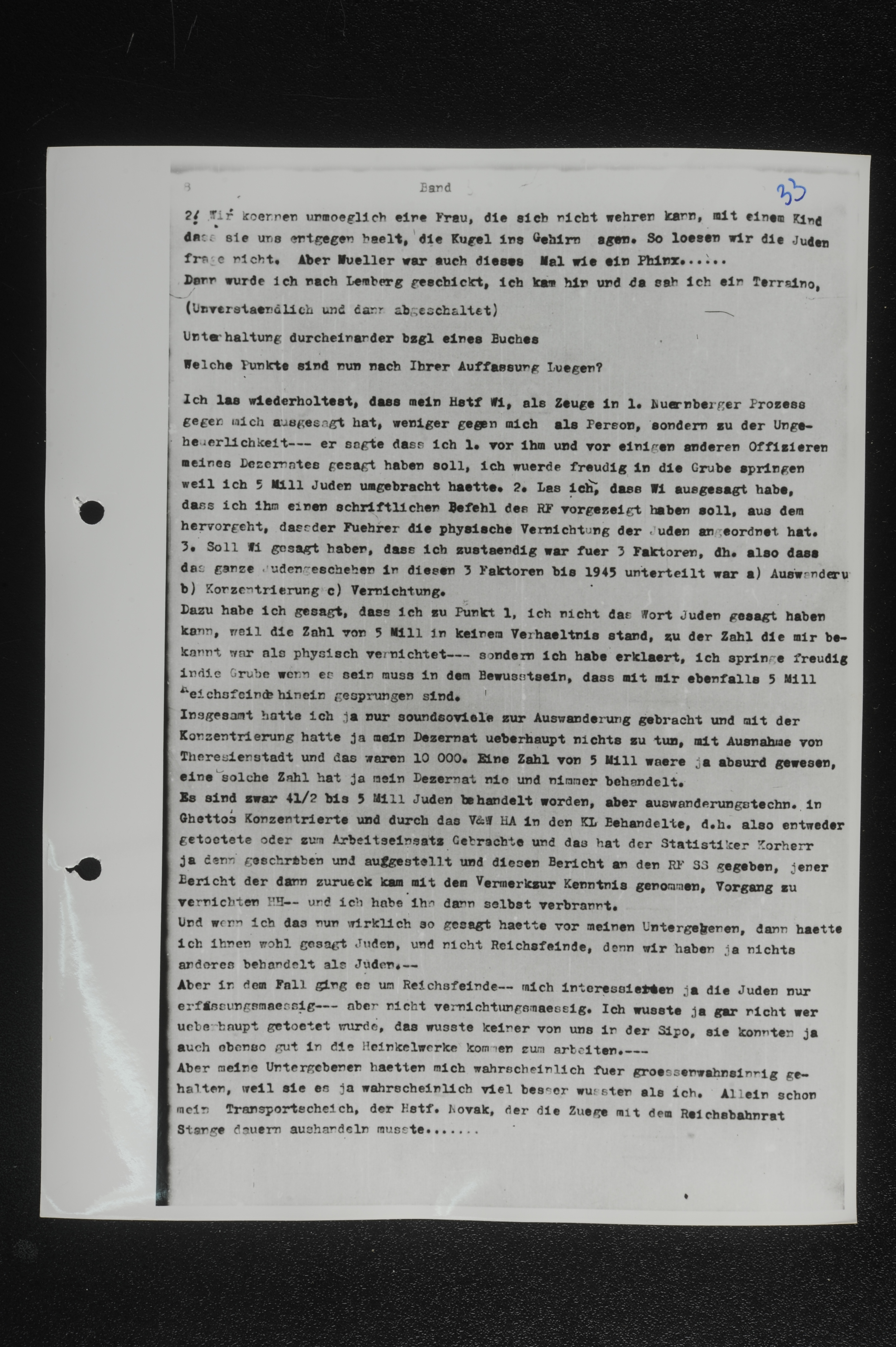
Dr. Kastner of Budapest, for example, implored me, perhaps in the summer of 1944, to shut down the "extermination machine." I told him then, in the presence of my stenotypist, that I had nothing to do with these measures, and that they had nothing to do with the Reich Security Main Office in general or Department IV B4 in particular. Only the RF could stop this here, or revoke the order he had given the Main Office in his area for this purpose. And that was the truth.

Dr. Eppstein of Berlin, Commercial Councillor Storfer of Vienna, and, I believe, Dr. Weimann and Edelstein of Prague were, during my absence from the Reich in 1944, taken to a concentration camp without my knowledge, and died or were killed there. They were Jewish functionaries with whom I had worked, in part, for years, officially and correctly, from both sides. When I learned the facts afterward, I made no secret of my regret and incomprehension, either before the Jews or before my superior, Lieutenant General of Police H. Müller, or my permanent deputy.

I had once promised Dr. Rothenberg, head of the Palestine Office in Vienna, that I would arrange for him to emigrate to Palestine when the opportunity arose. When he reminded me after some time, I kept my word. I had also made promises to Commercial Councillor Storfer that I could no longer keep.

I had Dr. Bach and Dr. Murmelstein brought into the leadership in Theresienstadt, and it would be untrue to say that they, like the other inmates in that town, fared badly there, naturally because of the war. I once saw for myself the relatively decent housing in which, for example, Dr. Murmelstein lived there with his wife.

The spirit of the individual is shaped and his actions determined by the time in which he lives. For example, when my mind was being formed, I lived in the time of the shame of Versailles. Pressure produces counterpressure. Perhaps, under different circumstances, I would never have declared myself a National Socialist. If the shame of Versailles, that great injustice, had not existed, or, as Charles Callan, a professor of history at Georgetown University in Washington, calls it, the stupidity of Versailles, perhaps there would have been no National Socialism at all. Perhaps no Second World War either. Perhaps I was already bound to National Socialist thinking before I properly grasped and understood the shame of Versailles.

In any case, this much is certain: National Socialism meant a great deal to me, as it did to hundreds of thousands at that time, because it fought and preached against this injustice. It was shaped, in a way, around the supranational principle of service to the people. It demanded sacrifice and obedience. What benefits the people is right. England: "Right or wrong, my country."

Open sheet image, German, and notes
Scan 00117 of the Sassen transcript, O.65 file 85.
This is scan 00117 of the Sassen transcript, O.65 file 85. The image is 2832 by 4256 pixels. Yad Vashem Archives, Jacob Robinson Collection O.65, file 85.

German transcription

[HW: 15/9] [HW: 117] Das Verhaeltnis zwischen den jud Fuehrer und mir war als sachlich und korrekt zu bezeichnen. Dr. Loewenherz, der Amtsdirektor der isreal. Kultusgemeinde in Wien, als Dachorganisation aller in der damaligen Ostmark arbeitenden jud Organis Dr. Kastner, Budapest, Dr. Eppstein, Berlin u.v.a. mehr hatten des oefteren eine mehr als nur offene Aussprache mit mir; denn ich sagte ihnen mehr als nur einmal dass ich Rassenhass nicht kennen wuerde und sogen. Stuermer Methoden ablehne.- Keiner der jud pol Funkt. kann sich, glaube ich darueber beklagen, indem zahllosen Konferenzen und Besprechungen seiner Jahre in mir auf einen wuetenden, satistische Moerder gestossen zu sein, ja man koennte heute, zurueckschauend die Verhandlungen als mit offenen Visier gefuehrt, bezeichnen. Dies alles mit Genehmigung meines ehem. Vorgesetzten; was ich aus dem Grunde betonen moechte, um nicht in den Ver- dacht zu geraten, ich wolle mich heute in ein milderentes Licht setzen, als mir das zukommt. Dr. Kastner, Budapest, beisp. beschwor mich, es mag der Sommer 1944 gewesen sein, die "Vernichtungsmaschine" abzustellen. Ich sagte ihm darauf, in Gegenwart meiner Stenotipistin, dass ich mit diesen Massnahmen nichts zu tun haette, [DEL: [illegible]] und sie wuerden mit dem Reichssicherheitshauptamtes im algemeinen und mit dem Dezernat IV B4 im besonderen nichts zu tun haben. Der RF allein [DEL: [illegible]] kann hier abstellen oder dem Hauptamt seines Bereiches dem er hierfuer den Befehl gab, diesen widerrufen. Und dies entsprach der Wahrheit, Dr. Eppstein, Berlin, Kom. Rat Storfer, Wien und glaube ich auch Dr. Weimann und Edelstein, Prag wurden waehrend meiner Abwesen- heit aus dem Reichsgebiet, im Jahre 1944, ohne mein Wissen in ein Ks gebracht und sind dort gestorben oder getoete worden. Es waren dies jud Funkt, mit denen ich zum Teil jahrelang zusammengearbeitet hab - versteht sich ; dienstlich - korrekt, von beiden Seiten - und ich habe als ich den Sachverhalt hinterher erfuhr mit meinem Bedauern und Nichtverstehen weder vor den Juden, noch vor meinen Vorgesetzten dem Generallt.der Pol. H Mueller, sowie meinem staendigen Vertreter, hinter dem Berg gehalten. Dem Dr. Rothenberg, Leiter des Palast. Amtes in Wien, hatte ich einmal versprochen ihm bei Gelegenheit nach Palast. auswandern zu lassen. Als er mich nach Zeiten daran erinnerte, loeste ich mein Wort ein. Und so hatte ich auch dem Kom. Storfer Zusagen gemacht, die ich nunmehr nicht mehr einloesen konnte. Dr. Bach und Dr, Murmelstein liess ich in die Leituug nach Teresienstadt bringen und es waere ein Unwahrheit wollte man behaupten es waere ihnen, genau wie die uebrigen Insassen, in dieser Satdt, natuerlich kriegsbedingt schlecht gegangen Ich ueberzeugte mich selbst einmal, in welch relativ ordentlicher Wohnung z.B. Dr. Murmelstein mit seiner Frau dort lebte. Der Geist des Individiums wird geformt und sein Handeln bestimmt, von der Zeit in der sein Traeger lebt. Ich zum Besp. lebte zur Zeit meiner Geistesformung in der Zeit der Schmach von Versailles. Und Druck erzeugt Gegendruck. Vielleicht haette ich zB. mich unter anderer Voraussetzung gar nicht zum Nat. bekannt, ja haette es die Schmach von Versailles,nicht gegeben, jenes grosse Unrecht, oder wie der Professor fuer Geschichte, an der Georgetown Univ. Washington, Charles Callan es nennt die Dummheit von Versailles, es haette vielleicht gar keinen Nat. gegeben. Vielleicht auch keinen zweiten Weltkrieg. Vielleicht war ich aber schon mit nat. Denken verhaftet, ehe ich die Schmach von Versailles erst so richtig begriff u verstand. Jedenfalls aber sicher ist dies, mir sagte, wie Hunderttausenden zu jener Zeit der hat sehr viel, der so kaempfte u predigte gegen dieses Unrecht. Er formte gewisserm. um Supernat. - Dienst am Volk- er [DEL: [illegible]] verlangte- Opfern u Gehorchen recht ist was dem Volke nuetzt. England" Right or wrong, my country."

English translation

[HW: 15/9] [HW: 117] The relationship between the Jewish leaders and me was to be described as businesslike and correct. Dr. Loewenherz, the office director of the Israelite Religious Community in Vienna, as the umbrella organization of all Jewish organiz[ations] then working in the Ostmark, Dr. Kastner, Budapest, Dr. Eppstein, Berlin, and many others often had a more than merely open discussion with me; for I told them more than only once that I would not know racial hatred and reject so-called Stürmer methods.— None of the Jewish political functionaries can, I believe, complain about having, in the countless conferences and discussions of his years [of these years], encountered in me a raging, sadistic murderer, indeed one could today, looking back, describe the negotiations as conducted with open visor. All this with the authorization of my former superior; which I would like to emphasize for the reason of not falling under the suspicion that I want to place myself today in a more mitigating light than is due to me. Dr. Kastner, Budapest, for example, implored me, it may have been the summer of 1944, to shut down the "extermination machine". I said to him thereupon, in the presence of my stenotypist, that I had nothing to do with these measures, [DEL: [illegible]] and they would have nothing to do with the Reich Security Main Office in general and with the Department IV B4 in particular. The RF alone [DEL: [illegible]] can shut down here or revoke this [order given] to the Main Office of his area for which he gave the order. And this corresponded to the truth. Dr. Eppstein, Berlin, Commercial Councillor Storfer, Vienna, and I believe also Dr. Weimann and Edelstein, Prague, were, during my absence from the Reich territory, in the year 1944, brought into a Ks [concentration camp] without my knowledge and died or were killed there. These were Jewish functionaries with whom I had in part worked together for years — it is understood; in an official — correct manner, from both sides — and when I learned the state of affairs afterwards I did not hold back, with my regret and non-understanding, either before the Jews or before my superior, the Lieutenant General of the Police H[einrich] Mueller, as well as my permanent deputy. To Dr. Rothenberg, head of the Palestine Office in Vienna, I had once promised to let him emigrate to Palestine on occasion. When he reminded me of it after [some] times, I redeemed my word. And thus I had also made promises to Commercial [Councillor] Storfer, which I now could no longer redeem. Dr. Bach and Dr. Murmelstein I had brought into the leadership at Theresienstadt and it would be an untruth if one wanted to claim that they, exactly like the other inmates, had fared badly in this town, naturally on account of the war. I convinced myself once, in what relatively decent lodging for example Dr. Murmelstein lived there with his wife. The spirit of the individual is shaped and its action determined by the time in which its bearer lives. I for example lived at the time of my mental formation in the time of the disgrace of Versailles. And pressure produces counter-pressure. Perhaps I for example would, under different circumstances, not have professed myself to Nat[ional Socialism] at all, indeed, had the disgrace of Versailles not existed, that great injustice, or as the professor for history at Georgetown Univ[ersity] Washington, Charles Callan, calls it, the stupidity of Versailles, perhaps there would have been no Nat[ional Socialism] at all. Perhaps also no second world war. But perhaps I was already bound up with nat[ional] thinking, before I even really grasped and understood the disgrace of Versailles properly. In any case, however, this is certain, [it] told me, as [it did] to hundreds of thousands at that time, the [text incomplete] has [done] very much, [he] who fought and preached thus against this injustice. He shaped as it were around supernat[ional] — service to the people — he [DEL: [illegible]] demanded — sacrifice and obedience[.] right is what benefits the people. England [:] "Right or wrong, my country."
Unreviewed notes

These notes haven't been reviewed. A note can identify a speaker where the reviewed English doesn't. If they disagree, use the reviewed English.

Transcription note

Single-page typescript from the 1957 Sassen-Eichmann interview transcript (Part1/00117). The working directory (Part1_00117_2o2txf7e) identifies this as the target scan; the long list of page IDs in the prompt is a batch manifest, not a request to transcribe all of them. Marginalia: handwritten "15/9" at top left; handwritten "117" (in red/pencil) at top right, matching the folio number. A small, faint handwritten mark (possibly "2" or "e") sits above the first line near the page center — too indistinct for a defensible reading, so not transcribed. Several faint pencil check/tick marks appear in the right margin and near the ends of some lines; these are non-lexical and are omitted. Struck-through text: the typist cancelled short spans by overtyping with "x" characters, which obscures the underlying letters. Three such deletions are marked [DEL: [illegible]] — after "haette," (line "...nichts zu tun haette,"), after "Der RF allein", and after "er" in the penultimate line ("Dienst am Volk- er ... verlangte-"). No defensible reading of the cancelled base text is possible from the pixels in any of the three. Preserved verbatim (not corrected): "isreal." (for israel.), "satistische", "milderentes", "Leituug", "Satdt", "getoete", "Individiums", "algemeinen", "Besp." and "beisp." variants, "Weimann", "Stenotipistin", "Generallt.der", "Dr," (comma for period before Murmelstein), and the incomplete/run-on final lines. Line "Organis" at end appears truncated at right margin as typed. Right edge of the paper is slightly cropped/curled; a few line-final characters (e.g. "Verhandlungen", "Vorgesetzten", "zahllosen", "IV B4") are faint but read with reasonable confidence. The lower portion of the last paragraph has its left edge partly cut off by the page curl, but the leading characters remain legible ("haette", "haette", "der", "es", "Vielleicht", "Denken", "Jedenfalls", "hat", "um", "recht").

Translation notes

- 'sachlich und korrekt' — rendered 'businesslike and correct'; 'sachlich' could also be 'objective/matter-of-fact'. - 'seiner Jahre' in 'in zahllosen Konferenzen und Besprechungen seiner Jahre' is grammatically anomalous (possessive 'his years'); may be an OCR/typing error for 'dieser Jahre' (these years). Rendered literally with a bracketed alternative; the German ambiguity is preserved. - 'mit offenem Visier' (source: 'mit offenen Visier') — idiom 'with open visor' meaning openly/honestly; rendered literally. - 'Ks' — abbreviation, most plausibly 'KZ/Konzentrationslager' (concentration camp); expanded tentatively in brackets but not resolved. - 'RF' — abbreviation left unexpanded; in context most plausibly 'Reichsführer[-SS]' (Himmler), but not stated on the page, so not resolved. - The sentence 'Der RF allein kann hier abstellen oder dem Hauptamt seines Bereiches dem er hierfuer den Befehl gab, diesen widerrufen' has broken grammar; the referent structure is unclear. Translation preserves the fractured syntax approximately. - 'Dr. Bach und Dr. Murmelstein liess ich in die Leituug nach Teresienstadt bringen' — 'Leituug' is an OCR error for 'Leitung' (leadership/management); 'liess ... bringen' rendered 'had brought into the leadership at Theresienstadt', but could mean 'had brought to the management/administration at Theresienstadt'. - The final paragraph's closing sentences are severely fragmented in the German ('mir sagte, wie Hunderttausenden zu jener Zeit der / hat sehr viel, der so kaempfte u predigte gegen dieses Unrecht'). A subject/object appears missing (an unnamed figure, likely Hitler, is implied but not written). The translation preserves the incompleteness with bracketed [text incomplete]/[he]/[it] markers rather than supplying the missing words. - 'Er formte gewisserm. um Supernat. - Dienst am Volk' — 'gewisserm.' = 'gewissermassen' (as it were); 'um Supernat.' is fragmentary and its syntax unclear; rendered tentatively. - 'Charles Callan' — likely refers to historian Charles Callan Tansill of Georgetown; only 'Charles Callan' appears on the page, surname not resolved. This page is a continuous first-person monologue with no question, no explicit speaker label, and no turn boundary. It reads throughout as a single speaker's self-defense and reminiscence about his official dealings with named Jewish functionaries and his relationship to the 'extermination machine' and to Versailles/National Socialism. On the internal evidence this is Eichmann (E): the first-person voice repeatedly describes personal authority over emigration promises, dealings with the Reich Security Main Office / Department IV B4, a permanent deputy, and the explicit concern about placing himself 'in a more mitigating light' — an unmistakable self-exculpatory account by the interview's respondent. Because there is no explicit label and no turn boundary, this is emitted as a single E turn rather than a multi-turn exchange; there is no Sassen (S) question or OTHER voice on this page. The page carries two handwritten notations at the top ([HW: 15/9] and [HW: 117]) preserved verbatim. Diplomatic OCR artifacts (e.g. 'isreal.', 'algemeinen', 'getoete', 'Satdt', 'Leituug', 'individiums', 'milderentes') are preserved in the German-facing sense and translated to their evident intended words without silently 'correcting' the underlying record; grammatical breaks and the fragmentary closing sentences are preserved. Deletion and illegibility markers ([DEL: [illegible]]) are kept in place."
Band 16, page 1
Questioner

Can you now briefly sum up how you saw measures such as the forced deportations at that time, in terms of your feelings, your mind, your resignation, and your conscience, not from today's viewpoint but from that of the time?

I must say that my head and my feelings had nothing to do with it, but rather my conscience.

My work fell into main sections. The first was emigration, and that is not at issue; it proceeded normally with the help and support of Jewish organizations. The second task I did was the concentration of Jews, and the third was deportation. Because the Secret Police Office did not carry out all concentrations or all deportations, as is clear from the relevant [handwriting], the Gestapo Office as such was not responsible for certain areas, such as the Eastern territories, because those were carried out under the authority of the chiefs of the Einsatzgruppen on the direct orders of the RF.

To answer your question concretely, I have to say that the national emergency was proclaimed by the national Reich government, that total war was declared against the enemy, and that it therefore had to be clear to the last German that it was a matter of victory or downfall, continued life or the annihilation of the German people. We believed this, I did too. The confirmation of that belief, that is, the moment when we no longer needed to believe it but already knew it, came when Morgenthau made his plan public, according to which we were to become a people of wretched goat herders and potato farmers, that is, the small surviving part, and here I calculated that from 1618 to 1648 the enemy had succeeded in reducing German blood to five million.

The calculation was very easy: how little of the German people would remain after a war under the stated Morgenthau Plan. That is why we fought, that is why every means was justified, and I said that if my government had ordered physical annihilation, I would have carried that out too. I said I was neither grateful nor ungrateful to fate that I had nothing to do with it.

Now you might argue that if the government that issued those orders, concentration and deportation, was a criminally inclined government, my answer is this: I can give a few examples. I am no politician, but why did the entire civilized world maintain ongoing diplomatic relations with this lawless regime? Why did envoys and ambassadors of almost all civilized peoples throng in the Reich capital? Why did those governments receive our envoys and ambassadors and accept their letters of credence, even though they knew that one or another was a high SS general, a high SA general, or a high Party leader, or at least had come out of that career?

Why was my chief, Heydrich, appointed from 1937 through 1939 as president of the International Police Commission? It was a commission to which the criminal police of almost every European country sent their representatives. Why did they appoint as chairman of such a working group the head of a police force to whom the criminal police were subordinate, as were the Gestapo, the other offices of the Sipo Main Office, and the SD?

If I therefore had to work under a man in this way, had to receive the orders of a man who for a long time was, or had been, chairman of such a European working group, then no one could ever get the idea that I, together with all my comrades, whether they were in the same Main Office or

Open sheet image, German, and notes
Scan 00118 of the Sassen transcript, O.65 file 85.
This is scan 00118 of the Sassen transcript, O.65 file 85. The image is 2832 by 4256 pixels. Yad Vashem Archives, Jacob Robinson Collection O.65, file 85.

German transcription

1 Band 16 [HW: 118.] Koennen Sie jetzt kurz zusammen fassen, auf welche Art und Weise Sie fuer Ihr gefuehl, fuer Ihren Kopf, fuer Ihre Resignierung und fuer Ihr Gewissen die Massnahmen, wie die Zwangsdeportationen damals, nicht von der heutigen Vision ausgesehen, aber von der damaligen? Dazu muss ich sagen, mein Kopf und mein Gefuehl hatte damit nichts zu tun sondern mein Gewissen[DEL: und ich will mal sagen, das Herz sprach.] Meine Arbeit verfiel in Hauptabschnitte, das 1. war die Auswanderung und die steht nicht zur Debatte, die verlief normal mit Hilfe und Unterstuetzung der jud. Organis. Die 2. Arbeit die ich machte war die Konzentrierung der Juden und die 3. die Deportierung. Da das geheim Poliz. Amt nicht alle Konzentrierungen durch- fuehrte und auch nicht alle Deportierungen, denn wie es aus der einschlaeg. [HW: [illegible]] [DEL: Natur] hervorgeht, ist das Gestapo Amt als solches fuer gewisse Teil, wie die Ostgebiet nicht zustaendig gewesen, denn die wurden in eigener Zustaendigkeit durch die Chefs der Einsatzgruppen auf direkte Weisung des RF durchgefuehrt.--- Kongret auf Ihre Frage habe ich zu antworten, dass der Volksnotstand durch die nat. Reichsreg. proklamiert ward, dass der totale Krieg dem Gegner angesagt wurde dass es also dem Letzten der Deutschen klar sein musste, dass es um Sieg oder Untergang, um weiteres Leben oder Vernichtung des deutschen Volkes ging. Daran glaubten wir, auch ich, die Bestaetigung fuerums Glauben, d.h. also ab dem Momen wo wir es nicht mehr glauben brauchten, sondern wo wir es bereits wussten, war als Morgenthau seinen Plan bekannt gab demzufolge wir ein Volk elender Ziegen[?reit?] [HW: zu] und Kartoffelbauer haetten werden sollen,d.h. der kleine ueberlebende Teil und [HW: 70] hier kalkulierte ich von 1618 -1648 gelang es den Gegnern das deutsche Blut auf 5 Mill zu reduzieren, die Rechnung war sehr leicht, wie wenig nach einem Krieg vom deutschen Volk ueber bleiben wuerde, wenn dieser besagte Morgenthauplan in Kraft [DEL: tritt] [HW: [?traet?]],darum kaempften wir, darum war jedes Mittel recht und ich sagte scho haette mir, meine Reg, die physische Vernichtung befohlen, auch die haette ich durchgefuehrt und ich sagte, ich bin dem Schicksal weder dankbar noch undankbar das ich damit nichts zu tun hatte. Nun koennten Sie argumentieren, [DEL: wenn] die Reg, die jene Befehle gab, Konzentrierung, Deportierung[HW: [?usw?]], waere eine kriminell veranlag Reg[HW: 71] gewesen, dem habe ich entgegen zu halten; ich kann [DEL: nur] ein paar Beispiele auffuehren, ich bin [DEL: ja] kein Politiker, aber warum hat denn die ganze zivilisierte Welt zu dieser Unrechtsreg laufend diplomat. Beziehungen unterhalten, warum tummelten sich in der Reichshauptstadt Gesandte und Botschafter [HW: 72] fast aller zivil. Voelker, warum hatten jene Reg[HW: von] uns.Gesandten und Botschafter bei sich,das Beglaubigungsschreiben entgegen genommen, obwohl sie wussten dass der eine oder ande ein [?hoher?] SS General oder ein hoher SA General, oder ein hoher Parteifuehrer war oder zumindest aus dieser Lauf ahn heraus kam. Warum hat man meinen Chef, Heydrich im Jahre 37, 3[HW: 73] bis 39 zum Praesidenten der internat. Poliz. Kommission bestellt. Zu einer Kommission zu der die Kriminalpoliz. fast aller europ. Laender ihrer Vertreter entsandten, warum hat man den Chef einer Polizei, der nicht nur [DEL: die] [HW: deutsche] [HW: X] Kriminalpoliz. [DEL: [illegible]], dem auch die Kriminalpoliz. unterstand, dem die Gestapo unterstand, dem die uebrigen Aemter des Hauptamtes der Sipo unterstanden, dem SD unterstand, zum Vorsitzenden einer solchen Arbeitsgemeinschaft bestellt. Wenn ich also dergestalt unter einem Mann zu arbeiten habe, die Befehle eines Mannes entgegen zu nehmen habe, der lange Zeit Vorsitzender einer solchen europ. Arbeitsgemeinschaft ist resp. war, dann koennte man gar nie auf die Idee kommen dass ich mit allen meinen Kameraden gleich ob die im gleichen H.A. waren oder

English translation

Band 16 [HW: 118.] Can you now briefly summarize in what way, for your feeling, for your head, for your resignation and for your conscience, the measures, like the forced deportations back then, seen not from today's vision, but from that of the time? To that I must say, my head and my feeling had nothing to do with it, but rather my conscience[DEL: and I want to say once, the heart spoke.] My work fell into main sections, the 1st was the emigration and that is not up for debate, it ran normally with the help and support of the Jewish organiz[ations]. The 2nd work that I did was the concentration of the Jews and the 3rd the deportation. Since the secret police office did not carry out all concentrations and also not all deportations, for as emerges from the relevant [HW: [illegible]] [DEL: nature], the Gestapo office as such was not competent for certain parts, like the Eastern territories, for these were carried out under their own competence by the chiefs of the Einsatzgruppen on direct instruction of the RF.--- Concretely to your question I have to answer that the popular state of emergency was proclaimed by the national Reich government, that total war was declared to the opponent, that thus it had to be clear to the last of the Germans that it was a matter of victory or downfall, of further life or annihilation of the German people. In that we believed, I too, the confirmation for our belief, i.e. thus from the moment where we no longer needed to believe it, but where we already knew it, was when Morgenthau announced his plan, according to which we were supposed to become a people of wretched goat[?herds?] [HW: to] and potato farmers, i.e. the small surviving part, and [HW: 70] here I calculated from 1618-1648 the opponents succeeded in reducing the German blood to 5 million, the calculation was very easy, how little would be left of the German people after a war, if this said Morgenthau plan [DEL: comes] [HW: [?came?]] into force, that is what we fought for, that is why every means was right, and I already said, had my government ordered me the physical annihilation, that too I would have carried out, and I said, I am neither grateful nor ungrateful to fate that I had nothing to do with it. Now you could argue, [DEL: if] the government that gave those orders, concentration, deportation[HW: [?etc?]], had been a criminally inclined government[HW: 71], to that I have to counter; I can [DEL: only] cite a couple of examples, I am [DEL: indeed] no politician, but why then did the whole civilized world maintain ongoing diplomatic relations with this unlawful government, why did envoys and ambassadors [HW: 72] of almost all civil[ized] peoples cavort in the Reich capital, why did those governments have envoys and ambassadors from [HW: of] us with them, accepted the credentials, although they knew that one or the other was a [?high?] SS general or a high SA general, or a high party leader, or at least came out of this career. Why was my chief, Heydrich, in the year 37, 3[HW: 73] to 39 appointed president of the international police commission. To a commission to which the criminal police of almost all European countries sent their representatives, why was the chief of a police, who not only [DEL: the] [HW: German] [HW: X] criminal police [DEL: [illegible]], to whom also the criminal police was subordinate, to whom the Gestapo was subordinate, to whom the remaining offices of the main office of the Sipo were subordinate, to whom the SD was subordinate, appointed chairman of such a working community. If I thus in such manner have to work under a man, have to receive the orders of a man who for a long time is resp. was chairman of such a European working community, then one could never even come upon the idea that I with all my comrades, alike whether they were in the same main office or
Unreviewed notes

These notes haven't been reviewed. A note can identify a speaker where the reviewed English doesn't. If they disagree, use the reviewed English.

Transcription note

Typescript page, Band 16, typed page number "1" top-left; blue-pencil folio "118." top-right (with underline). Right edge of the typescript is cropped/lost in the scan, so several lines run off at the right margin and are transcribed only to the visible edge (e.g. "ab dem Momen[t]", "ich sagte scho[n]", "der eine oder ande[re]", "kriminell veranlag[t]"). A vertical white streak/crease down the left side partially obscures line-starts. Editorial marks are handwritten (pencil/ink): a sequence of circled numbers in the margins/text read 70, 71, 72, 73 (the first is uncertain, possibly 20/70). A red-pencil "X" sits in the right margin at the "der nicht nur ... deutsche" line. Several handwritten interlinear insertions are small and only partly legible; uncertain readings are marked [?...?] or [illegible] and anchored to the nearest base-text point. Notable struck spans: the phrase after "Gewissen" ("und ich will mal sagen, das Herz sprach."), the word "Natur" at line-start, "tritt" (with an interlinear handwritten replacement, possibly "traet"), "wenn", "nur", "ja", "die", and an illegible struck word after the second "Kriminalpoliz." The word transcribed [?hoher?] ("hehler"/"hoher") is a typewriter ambiguity resolved toward the parallel "hoher SA General"/"hoher Parteifuehrer" in the same sentence but is genuinely uncertain. "Kongret", "fuerums Glauben", "Lauf ahn" (intra-word space) preserved as typed.

Translation notes

- 'Volksnotstand' rendered as 'popular state of emergency' — literally 'people's/national state of emergency'; no exact English equivalent. - 'Ziegen[?reit?]' is OCR-uncertain; the intended word is almost certainly 'Ziegenhirten' (goatherds) parallel to 'Kartoffelbauer' (potato farmers), but the German as written is broken; rendered as 'goat[?herds?]' to preserve the uncertainty. - 'RF' expanded in meaning as Reichsführer (RF-SS, i.e. Himmler) but left as 'RF' since the source uses the abbreviation and does not spell it out. - 'Arbeitsgemeinschaft' rendered literally as 'working community'; in context (the international police commission) it functions as 'association' or 'joint body'. - 'tummelten sich' rendered 'cavorted/romped' as 'cavort'; the German is colloquial and slightly pejorative, hard to render without smoothing. - The stray isolated 'Massnahmen' vs 'measures' — the question's syntax is broken in the German ('die Massnahmen, wie die Zwangsdeportationen damals, nicht von der heutigen Vision ausgesehen') and the broken grammar is preserved in the English. The page opens with the reel/tape header 'Band 16' and a handwritten page number [HW: 118.]. There is no explicit speaker label or initial anywhere on the page. Attribution rests on content: the opening paragraph is a direct interviewer question (Sassen's role), and the long answer is a first-person account of the respondent's own deportation-apparatus duties and subordination to Heydrich, which identifies Eichmann on this page alone. The blank in 'verfiel in Hauptabschnitte' (a missing number, presumably '3') is left as-is. Numerous marginal handwritten numbers (70, 71, 72, 73) appear inline in the source — likely later annotation/indexing marks — and are preserved as [HW: ...] where positioned. The turn breaks at the bottom mid-sentence ('same main office or') as the page cuts off; no text beyond the page was added."
Band 16, page 2

in another office, could never have imagined they were serving a criminal here. Lofty ideas ruled us; the rescue of Europe ruled us. It wasn't only about German blood; it was about the blood of Europe, for that was the SS's guiding principle. I can't say anything offhand at the moment.

Questioner

Is the name Ira Hirschmann known to you? Didn't Kastner tell you about Brandt's discussions with Roosevelt's representative on Jewish affairs, Ira Hirschma

Eichmann

It's been too long for me to recall individual things. I might remember a lot if I read the book The History of Joel Brandt; while reading it, some things might come back to me, and I might partly recover things from memory and repeat them together with my own arguments.

Questioner

After a long captivity, Brandt is provisionally released in Egypt and comes to Palestine. There, through [blotted] from Constantinople, he first receives news about Budapest. The reports tell of his wife's heroism and also state that Kastner had taken over the negotiations with Wi and Eichmann, and that everything was going well. No explanation was given to me for the reports or for why I was being held here, another confirmation from Brandt that after his departure in May 1944, Kastner was conducting the negotiations with Wi and Eichmann.

Eichmann

Wi is incorrect. Wi was not authorized and had never been authorized. Where matters of principle were concerned, the negotiations were conducted through me; where they concerned information, once they had come to my attention, they went through Greemid, my permanent representative in Budapest, who in effect took the lead in handling all the details with Brandt (?). Wi had no details and had not even handled them in a leading capacity. I have already mentioned the concern about Brandt's wife; Brandt exaggerates it, because I never did anything to Mrs. Brandt, her family, or any family member of Jewish functionaries. No case can be shown, because it cannot be proved that my office or my command ever in any way helped itself at the expense of family members.

Questioner

Is the name Swi Jetscheli, commander of the Jewish parachutists, known to you?

Eichmann

No.

Questioner

One important matter seems to be this. Brandt said that when he protested in Cairo to the Jewish Agency about his detention lasting so long, the English wanted to release him, but the Jewish organization telegraphed the English that his release should be postponed a few more days. Those few days became weeks, and this was explained as follows. The Jewish Agency, Brandt says, reported that the latest telegrams from Budapest said that the Budapest Jews wanted Brandt's return postponed.

Here is my question: can you confirm this or remember it? Do you remember Kastner once saying during a conversation, for example, Brandt wants to come back, but it would be better if he stayed there a few more days or weeks?

Open sheet image, German, and notes
Scan 00119 of the Sassen transcript, O.65 file 85.
This is scan 00119 of the Sassen transcript, O.65 file 85. The image is 2832 by 4256 pixels. Yad Vashem Archives, Jacob Robinson Collection O.65, file 85.

German transcription

2 Band 16 [HW: 119.] in einem anderen Amt gesessen sind, koennten ja gar nicht auf die Idee kommen, e hier einem Kriminellen zu dienen, uns beherrschte hehre Gedankengaenge, uns be- herrschte die Rettung Europas, es ging nicht nur um das deutsche Blut, es ging um das Blut Europas, denn das sagte ja der Leitgedanke der SS. Mir habe ich auf Anhieb oder im Augenblick nicht zu sagen. ........ Ist Ihnen der Name Ira Hirschmann bekannt? Hat Kastner Ihnen nicht erzaehlt ueber die Besprechungen Brandts mit dem Abgeordneten jud. Fragen Rosevelts Ira Hirschma Die Zeit ist zu lang, als dass ich mich auf einzele Sachen entsinne koennte. Viel kann ich mich entsinnen, wenn ich das Buch,"die Geschichte, des Joel Brandt" gelesen habe, waehrend des Lesens koennten mir einige Einfaelle kommen und dann koennte es sein, d ass ich teilweise einiges in Gedaechtnis zurueckbekomme und dieses auch mit meinen Argumenten verbunden wiedergeben kann.- Nach laengerer Gefangenschaft wird Brandt wieder in vorlaeufige Freiheit gestellt in Aegypten und kommt nach Palst. und erfaehrt dort zum ersten Mal ueber die So[illegible]........ von Konstantinopel die ersten Nachrichten ueber Budapest und in diesen Nachrichten erzaehlen viele von dem Heldenmut seiner Frau und ausserdem steht die Feststellung dar, Kastner habe die Fuehrung der Verhandlungen mit Wi und Eichmann uebernommen, alles ginge gut.- Sie gaben mir aber keine Erklaerung fuer die Nachrichten oder Tatsache warum ich hier festgehalten wurde, eine erneute Bestaetigung Brandts, dass also nach seinem Abgang im Mai 1944 Kastner die Verhandlungen mit Wi und Eichmann fuehrte Wi ist unrichtig, Wi war nicht bevollmaechtigt, war nie bevollmaechtigt gewesen, die Verhandlungen gingen, soweit es sich um grundsaetzliche Dinge handelte, mit mi von statten und soweit es sich um Dinge informationshalber nach meiner Kenntnisnah handelte zu Greemid, der als mein staend. Vertreter in Budapest, doch gleichsam saemtl. Details mit BBrandt (?) federfuehrend zu erledigen hatte, Wi hatte keine Details, noch nicht einmal federfuehrend zu erledigen gehabt. Die Sorge um Brandt Frau habe ich schon einmal angeschnitten, das ist von Brandt uebertrieben, denn ich habe mich nie weder an Frau Brandt, noch an seiner Familie, noch an irgend and. Familiemitglieder jud Funktionaere.- Es ist kein einziger Fall [HW: nach]zu zu weisen, weil e nicht nachgewiesen werden kann, dass [DEL: sich] mein Amt oder mein Kommando sich irgend wie an Familienangeh. schadlos geahlten haette. Ist Ihnen der Name Swi Jetscheli, Kommandant der jud. Fallschirmspringer , bekannt? Nein,-- Eine wichtige Sache scheint folgendes zu sein, die Sognut in Kairo, sagte Brandt, wenn er protestiert wegen seiner Gefangenenahme, dass die so lange dauert, die Englaender wollen ihn freilassen, aber die jud Organis. telegrafiert den Englaender dass die Freilassung noch ein paar Tage augeschoben werden soll, diese paar Tage werden ein paar Wochen und erklaeren, das nun auf folgende Weise; da kommt meine Frage, ob Sie das bestaetigen oder sich daran erinnern koennen, die jud Sognut, sagt Brandt dass die letzten Telegramme aus Budapest dass die Budape Juden einer Verschiebung der Rueckkehr Brandts wollen.-- Erinnern Sie sich, dass Kastner einmal im Laufe eines Gespraeches zu Ihnen gesagt hat; z. B. Brandt will an sich zurueckkommen, aber es waere besser wenn er noch ein paar Tage oder Wochen dort bleibt.------

English translation

2 Band 16 [HW: 119.] sat in another office, could not possibly get the idea, e to serve a criminal here, us were governed by lofty trains of thought, us were go- verned by the saving of Europe, it was not only about German blood, it was about the blood of Europe, for that is what the guiding principle of the SS said. I have nothing to say to myself/me right off the bat or at the moment. ........ Is the name Ira Hirschmann known to you? Did Kastner not tell you about the discussions of Brandt with the Jewish affairs deputy of Roosevelt Ira Hirschma The time is too long for me to be able to recall individual matters. Much I can recall if I have read the book, "the story, of Joel Brandt" during the reading some notions could come to me and then it could be, that I partly get some things back in memory and can reproduce this also connected with my arguments.- After lengthy captivity Brandt is again placed at provisional liberty in Egypt and comes to Palest. and learns there for the first time about the So[illegible]........ from Constantinople the first reports about Budapest and in these reports many tell of the heroism of his wife and moreover there stands the assertion, Kastner has taken over the conduct of the negotiations with Wi and Eichmann, everything is going well.- But they gave me no explanation for the reports or fact why I was held here, a renewed confirmation of Brandt('s), that thus after his departure in May 1944 Kastner conducted the negotiations with Wi and Eichmann Wi is incorrect, Wi was not authorized, was never authorized, the negotiations went, insofar as it concerned matters of principle, with me proceeding and insofar as it concerned matters for information's sake according to my taking cognizance concerned, to Greemid, who as my perm. deputy in Budapest, yet as it were had all details with BBrandt (?) to handle in a leading capacity, Wi had no details, had not even had to handle in a leading capacity. The concern for Brandt('s) wife I have already touched upon once, this is exaggerated by Brandt, for I have never [addressed myself] neither to Mrs. Brandt, nor to his family, nor to any oth. family members Jewish functionaries.- There is not a single case to be [HW: proven/traced], because e it cannot be proven, that [DEL: itself] my office or my command in any way had held [themselves] harmless/compensated on family members. Is the name Swi Jetscheli, commandant of the Jewish parachutists, known to you? No,-- An important matter seems to be the following, the Sognut in Cairo, said Brandt, when he protests because of his imprisonment, that it lasts so long, the English want to release him, but the Jewish organiz. telegraphs the English that the release should be postponed a few more days, these few days become a few weeks and explain, this now in the following manner; here comes my question, whether you can confirm this or remember it, the Jewish Sognut, says Brandt that the last telegrams from Budapest that the Budape(st) Jews want a postponement of the return of Brandt.-- Do you remember that Kastner once in the course of a conversation said to you [that]; e.g. Brandt wants in itself to come back, but it would be better if he still stays there a few days or weeks.------
Unreviewed notes

These notes haven't been reviewed. A note can identify a speaker where the reviewed English doesn't. If they disagree, use the reviewed English.

Transcription note

Typescript carbon, single column, right margin of the text block runs off the right edge of the scan so several lines are truncated mid-word (visible fragments transcribed as-is): "...kommen, e", "...Ira Hirschma", "...koennte. Viel", "...mit mi", "...meiner Kenntnisnah", "...irgend and.", "...weil e", "...den Englaender", "...die Budape". Top-right "119." is handwritten in ink (folio stamp); page number "2" and centered "Band 16" are typed header. Small handwritten caret/insertion marks appear above the line at "Wi ist unrichtig" and above "die Sognut in Kairo" but carry no legible text, so are omitted. The line beginning "So" before "von Konstantinopel" has an overstruck/garbled cluster followed by a run of typed periods (~7-8); rendered "So[illegible]........". Handwritten "nach" is inserted above the printed "Fall zu zu weisen" (yielding intended "nachzuweisen"), anchored as [HW: nach] before "zu zu weisen". One typed word after "dass" in the "nicht nachgewiesen" line is struck through (reads "sich"), given as [DEL: sich]. "BBrandt (?)" — the doubled B and the "(?)" are part of the typescript itself. Non-standard spellings preserved verbatim: "einzele", "Palst.", "Greemid", "augeschoben", "geahlten", "Familiemitglieder", "Sognut", "Gefangenenahme".

Translation notes

- 'Mir habe ich auf Anhieb oder im Augenblick nicht zu sagen.' is grammatically broken; 'Mir' (dative 'to me') with 'habe ich ... nicht zu sagen' is ungrammatical. Rendered literally as 'I have nothing to say to myself/me right off the bat or at the moment' — the intended sense is uncertain. - 'schadlos geahlten haette' — 'geahlten' is not a standard word; read as a typo for 'gehalten' in the idiom 'sich schadlos halten' (to compensate oneself / recoup at another's expense). Translated as 'held harmless/compensated', but the OCR form is corrupt. - 'Greemid' — a personal name; spelling as given, identity not resolved (likely a garbled rendering of a deputy's name). - 'Sognut' — rendered as given; refers to the Jewish Agency (Sochnut/Sokhnut). Left untranslated as it appears verbatim. - 'Swi Jetscheli' — proper name as transcribed; spelling per OCR, not normalized. - The final Kastner sentence 'Brandt will an sich zurueckkommen' — 'an sich' rendered literally 'in itself'; idiomatic sense is roughly 'as such / actually', but preserved literally. - 'Wi' is an abbreviation left as-is throughout; its referent (a person or office beginning 'Wi', possibly Winkelmann/Wisliceny) is not spelled out on the page. Page header: '2 / Band 16 / [HW: 119.]' — the '119.' is handwritten. Structure and line breaks preserved as in the source. Several OCR truncations at line ends preserved literally: 'Hirschma' (Hirschmann), 'Kenntnisnah' (Kenntnisnahme), 'Budape' (Budapester/Budapest), 'Englaender'. The dotted separator '........' between the opening monologue tail and the Hirschmann question is preserved. The '[HW: nach]' insertion before 'zu zu weisen' (nachzuweisen) and the '[DEL: sich]' deletion are preserved. 'e' appears as a stray trailing character at several line ends (OCR artifacts) and is retained. This page is a mixed Q&A section: the interviewer poses two 'Is the name X known to you?' questions and an explicit 'here comes my question' frame; the respondent answers with first-person accounts of his Budapest command. The opening monologue tail (top of page) and the third-person Brandt-narrative paragraph could not be pinned to a specific speaker from this page alone and are marked UNCERTAIN, per the attribution rules — the narrative paragraph refers to 'Eichmann' in the third person, which argues against Eichmann as its speaker but does not by itself fix Sassen. No explicit speaker labels/initials appear anywhere on the page; all S/E attributions rest on question-form vs. first-person-account content."
Band 16, page 3
Questioner

to make the matter perfect, or some kind of maneuver…

Yes, I know that, and specifically this: I repeatedly asked Kastner what was happening with Brandt, where he was, and whether he was coming back at all. I was already inclined to write him off. I also told Kastner that he had to reckon with possible reprisals against his family. I told him explicitly: he could go, but his family would stay here. Or did he know from experience that I did not spare family members? Kastner never told me why or for what reason. He only explained that Brandt could come back, but would not return with a definitive answer; if he stayed there longer, we might soon receive a positive answer. A non-definitive answer was no use to me; it was about 10,000 trucks, and so I let myself be kept waiting.

I did not know that he had fallen into captivity and was no longer master of his time or freedom. It is possible, however, that although the RF's order said the evacuations were to continue forcefully despite the negotiations already under way, with an addition not disclosed to the Jews, the RF had instructed Pohl to stop the physical extermination; deportations continued forcefully under the RF's orders. At that time, transports from Hungary ran into difficulties of many kinds, so some Jews may have thought the pace of the transports had slackened. They may have told themselves that the longer Brandt did not return with a negative answer, the better it was for the Jews in Hungary, because time gained was everything.

If he had returned then with a negative answer, it was very likely that the RF would have reacted and might have given Pohl and others different orders from those he subsequently gave. That may be one reason. Perhaps someone else involved in what happened let something slip here, so the Jews must have known that people were being evacuated but the extermination machine had been stopped. If Brandt returned with a negative answer, the extermination machine might start again. So Brandt had to stay here and not return to Hungary. That may have been a rigged game; in any event, it was a game played by the secret services on both sides.
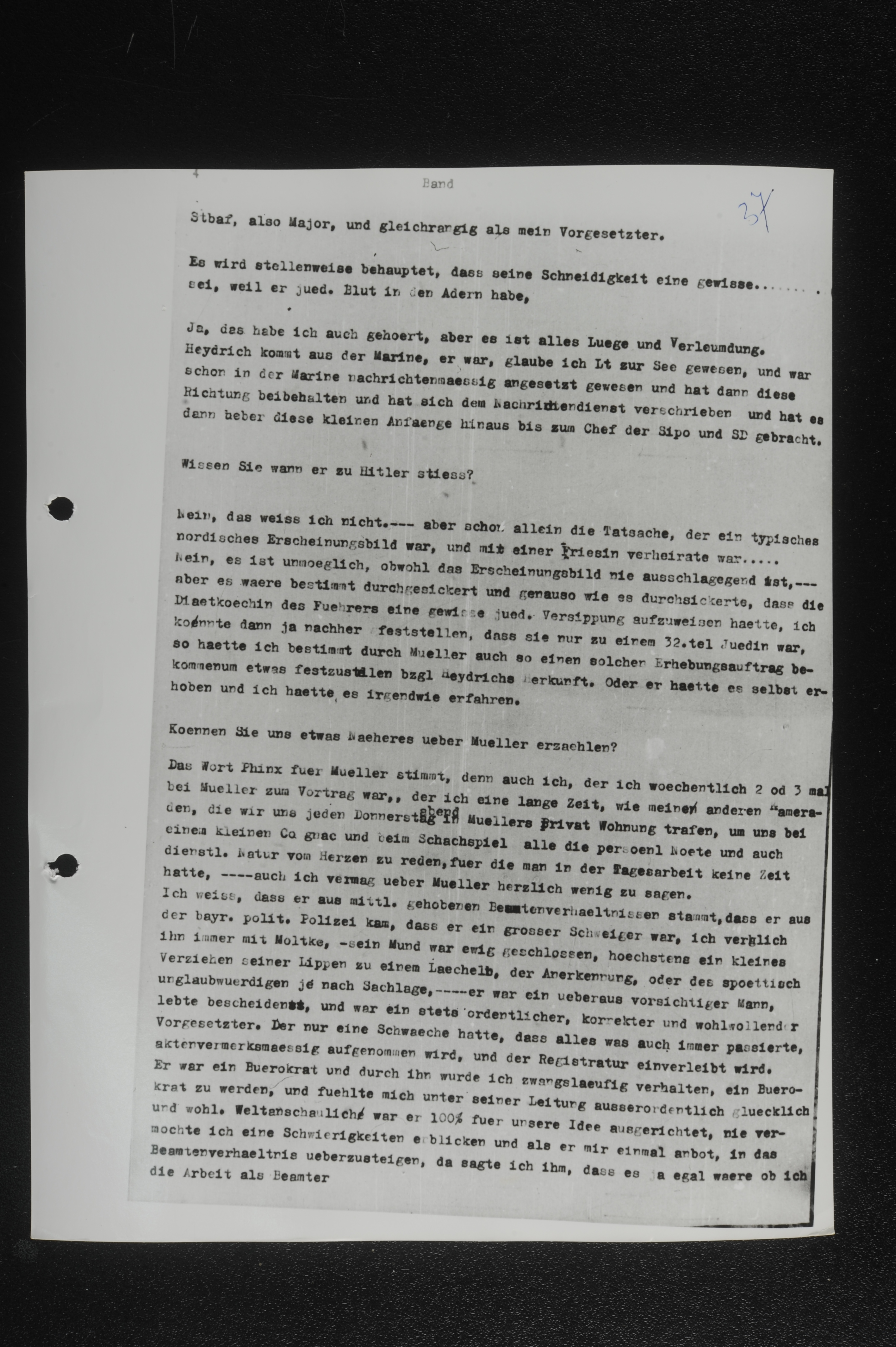
Questioner

Does the name Denny Collet, personal secretary to … mean anything to you?

Eichmann

No.

Questioner

Can you remember, if you think hard, whether any messages directly or indirectly from or connected with Ben-Gurion reached your desk during the war?

Eichmann

At our office, matters were divided by subject. We dealt with Ben-Gurion only insofar as he was the fanatical leader of the Zionists active in Israel. I am not aware offhand that Ben-Gurion interfered in matters outside Palestine; he was, so to speak, the master of the Jewish pioneers.

Questioner

So from that period you don't know whether Ben-Gurion had any directives or other connections or contacts with Zionist circles, particularly in Budapest or in Europe generally?

Eichmann

That is certainly the case, because if Ben-Gurion was the recognized leader, then he was also one of the creators of the A…

Open sheet image, German, and notes
Scan 00120 of the Sassen transcript, O.65 file 85.
This is scan 00120 of the Sassen transcript, O.65 file 85. The image is 2832 by 4256 pixels. Yad Vashem Archives, Jacob Robinson Collection O.65, file 85.

German transcription

Band 16 3 ------ um die Sache perfekt zu machen, oder so irgend ein Manoever..... Ja, das weiss ich, und zwar folgendes; Ich habe Kastner widerholt gesagt, was ist mit Brandt, wo ist er, kommt er ueberhaupt nicht?? denn ich war bereits geneig ihn abzuschreiben, -- ich sagte noch zu Kastner er muesste doch damit rechnen [HW: [?müssen?]] dass gegen seine Familie allfaellige Re[?pressalien?] unternommen werden---- ich sagte ihm doch ausdruecklich, er kann fahren, aber seine Familie bleibt hier oder weiss er unterdessen [HW: aus] von der Praxis dass ich mich grundsaetlich [DEL: nicht] an Familienang. nicht schadles halte. Kastner hat mir aber nie gesagt, warum, wieso, weshalb, nur insofern erklaerte er es,; er koennte zurueckkommen, aber er kommt nicht mit definitivum zurueck, wenn er laenger unten bleibt, ist es moeglich, dass wir bald eine possitiven Bescheid bekommen. Nun mit einem nicht Definitivum war mir ja nicht gedient, es ging ja um 10 000 LKW und infolgedessen habe ich mich auch hin halten lassen, -- ich wusste allerdings nicht dass er in Gefangenschaft geraten war, dass er nicht mehr Herr seiner Zeit war bzw. seiner Freiheit. Moeglich aber ist folgendes, obwohl der Befehl des RF besagte, dass die Evakuierungen trotz der angebahnten Verhnadlungen forciert weiter zu laufen habe, freilich mit dem Zus [DEL: den] den Juden nicht gesagt wurde, der RF hat Pohl die Weisung erteilt [DEL: nicht] [HW: aber] mit der physischen Vernichtung aufzuhoeren, die Deportation die lief auf Befehl des RF forciert weiter. Nun hat es sich in jener Zeit ergeben, [DEL: durch] Stockungen manche lei Art, der Antransp. aus Ungarn war vielen Schwierigkeiten unterlaufen , sodass die Juden teilweise vielleicht der Meinung gewesen waren, dass die Rasans der Transp.zugfolge nachgelassen haette und sie sich vielleicht sagten, je laenger Brandt nicht zurueckkommt(mit negativem Bescheid,) um so besser ist es fuer die Juden in Ungarn, denn mit Zeitgewinn ist alles gewonnen, denn waere er um diese Zeit mit einem negativen Bescheid zurueckgekommen [DEL: und ist] [HW: ware] sehr wahrscheinliche dass der RF [DEL: so] [HW: und] reagiert haette, [DEL: dem] [HW: und] Pohl u.U. andere Weisungen erteilt hätt[HW: e] [DEL: wie] [DEL: er sie demzufolge erteilte.]-Das mag ein Grund sein, vielleicht aber hat irgend ein anderer der an dem Geschehen [DEL: eigener] [HW: beteiligten] Angeh. hier geplaudert [DEL: und hat so ge-] [DEL: laudert], [HW: hier] dass den Juden bekannt sein musste./.....evakuiert wird, aber die Vernicht maschine ist eingestellt, wenn also Brandt mit negativen Bescheid zurueckkommt, koennte es sein, dass die Vernichtungsmaschine wieder anrollt, also muss Brandt hier bleiben und nicht zurueck nach Ungarn. Das mag sein dass das ein abgekartetes Spiel war, .... es war sowiese ein Spiel des Geheimdienstes auf beiden Seiten. Sagt Ihnen der Name Denny Collet, persoenl. Sekretar von...............? Nein... Koennen Sie sich daran erinnern, wenn sie scharf nachdenken, ob direkt oder indire irgendwelche Nachrichten von oder im Zusammenhang mit Bengurio, waehrend des Krieges ihren Schreibtisch erreichten.- [TS INS: wahrscheinlich habe ich ihn nach] Bei uns waren die Sachen nach Sachgebieten eingetei Von Bengurio nur soweit als es sich um den fanatischen Fuehrer als der in Israel taetigen Zionisten handelte I m I s r a e l taetigen Zionisten. Mir ist eigentlich auf Anhieb gar nicht bekannt, dass sich Ben.[TS INS: in]usser palast. Angeleg, hineinmischte, sondern er war sozusagen der Meister der jud. Pioniere Es ist Ihnen also aus dieser Zeit nicht bekannt ob Beng. direkt oder indirekt irgendwelche Richtlinien oder sonstige Verbindungen oder Kontakte hatte mit den zionist. Kreise, in Budapest im besonderen, oder in Europa im allgemeinen? Das auf jeden Fall, denn wenn Beg, der anerkannte Chef war dann ist er auch mit einer der Schoepfer der A....[illegible]
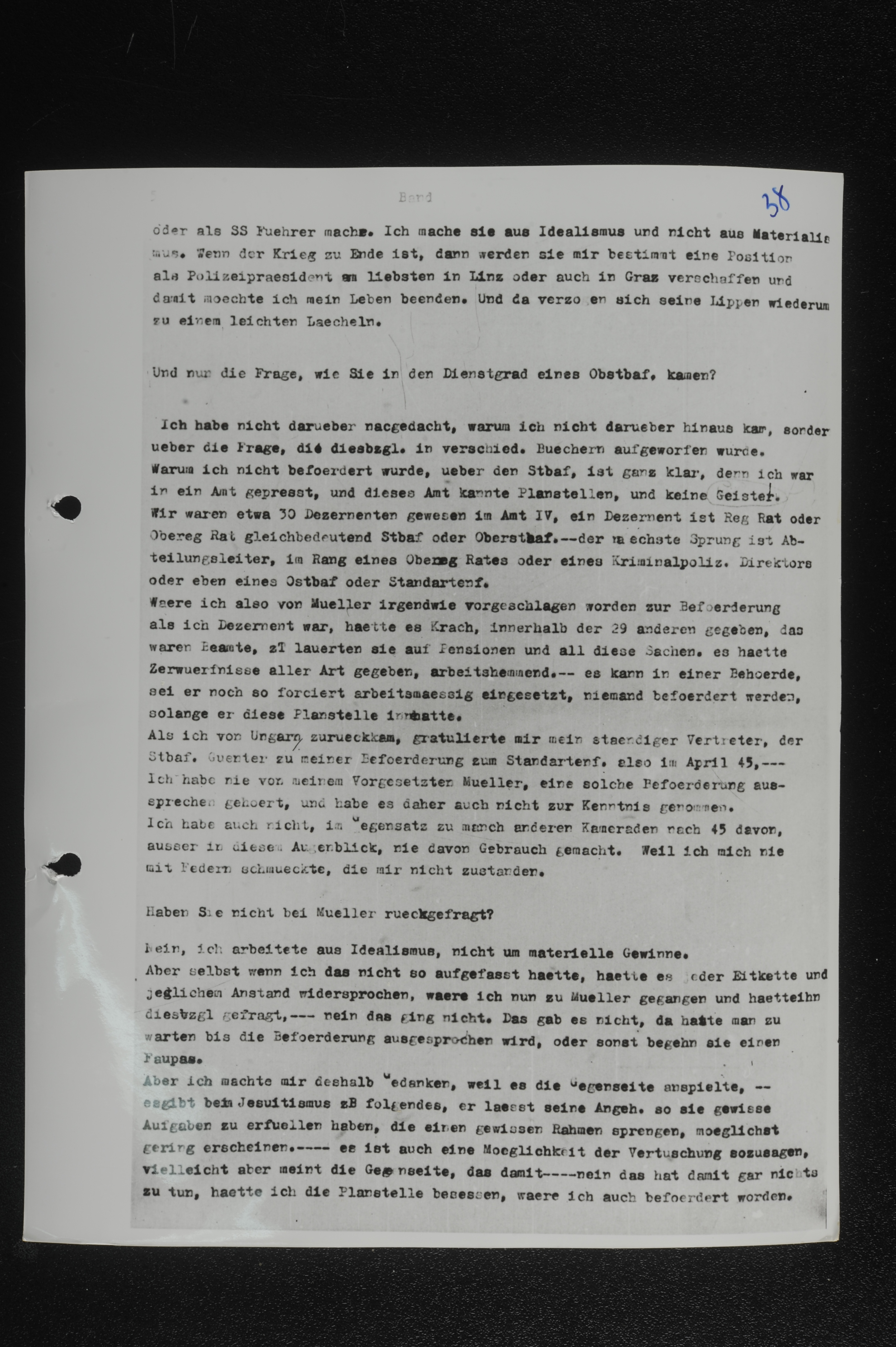
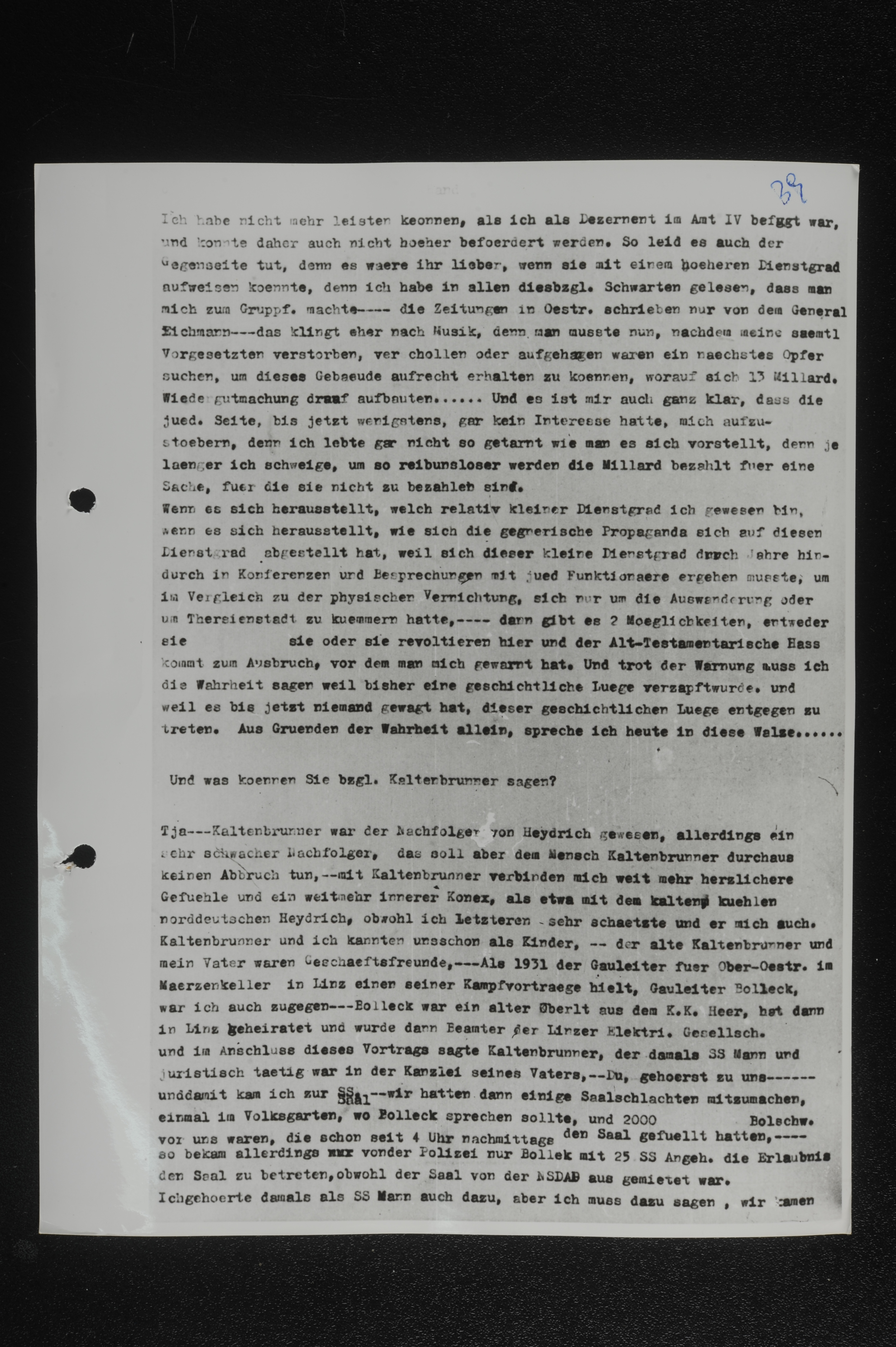
English translation

------ in order to make the thing perfect, or some such maneuver..... Yes, that I know, and namely the following; I told Kastner repeatedly, what is with Brandt, where is he, is he not coming at all?? for I was already incline[d] to write him off, -- I still said to Kastner he would after all have to reckon [HW: [?have to?]] that against his family possible re[?prisals?] would be undertaken---- I did after all tell him expressly, he can go, but his family stays here or does he know in the meantime [HW: from] from the practice that I fundamentally do [DEL: not] toward family members not hold harmless. But Kastner never told me why, how, for what reason, only insofar did he explain it,; he could come back, but he is not coming back with [a] definitive [answer], if he stays down [there] longer, it is possible that we soon receive a positive reply. Now with a non-definitive [answer] I was of course not served, it was after all about 10,000 trucks and consequently I also let myself be put off, -- I did not know however that he had fallen into captivity, that he was no longer master of his time, or rather of his freedom. Possible however is the following, although the order of the RF stated that the evacuations, despite the initiated negotiations, were to continue forced, admittedly with the addit[ion] [DEL: that] that was not told to the Jews, the RF gave Pohl the instruction [DEL: not] [HW: but] to cease with the physical extermination, the deportation ran forced onward on the order of the RF. Now it came about in that time, [DEL: through] stoppages of various kinds, the transport-in from Hungary had run into many difficulties, so that the Jews perhaps in part had been of the opinion that the rapidity of the transport-train sequence had slackened and they perhaps said to themselves, the longer Brandt does not come back (with negative reply,) the better it is for the Jews in Hungary, for with time gained everything is gained, for had he come back around this time with a negative reply [DEL: and is] [HW: [it] would be] very probable that the RF [DEL: so] [HW: and] would have reacted, [DEL: to whom] [HW: and] would have given Pohl possibly other instructions [HW:than] [DEL: as] [DEL: he accordingly gave them.]-That may be one reason, but perhaps some other one of the members [DEL: own] [HW: involved] in the events chattered here [DEL: and thus gos-] [DEL: siped], [HW: here] that it must have become known to the Jews./.....is being evacuated, but the exterminat[ion] machine is halted, so if Brandt comes back with negative reply, it could be that the extermination machine rolls on again, so Brandt must stay here and not [go] back to Hungary. It may be that that was a put-up game, .... it was in any case a game of the secret service on both sides. Does the name Denny Collet, personal secretary of..............?, mean anything to you? No... Can you remember, if you think hard, whether directly or indire[ctly] any news of or in connection with Bengurio, during the war, reached your desk.- [TS INS: probably I have him after] With us the matters were divided by subject-areas. Of Bengurio only insofar as it concerned the fanatical leader as the one active in Israel Zionist [it] handled the in Israel active Zionists. I am actually offhand not at all aware that Ben.[TS INS: in] beyond palest[inian] matters interfered, rather he was so to speak the master of the Jewish pioneers. It is thus not known to you from this time whether Beng. directly or indirectly had any guidelines or other connections or contacts with the Zionist circles, in Budapest in particular, or in Europe in general? That in any case, for if Beg was the recognized chief then he is also with one of the creators of the A....[illegible]
Unreviewed notes

These notes haven't been reviewed. A note can identify a speaker where the reviewed English doesn't. If they disagree, use the reviewed English.

Transcription note

Typed transcript page, single speaker/interview exchange, dense with later ink corrections. Header "Band 16" centered (with a short ink stroke after it); "3" typed at top-left as the in-band page number; "120." in blue crayon/ink at top-right (folio). Three-hole punched, curled left edge causing slight text loss at the left margin near the binding. Right edge of the typewriting is cropped/faded, causing several line-final letters to be lost: line 3 "geneig(t)", line 16 "Zus(atz)", line 19 "manche(r)"/"mancher-", line 25 "wahrscheinliche(r)", line 29 "Vernicht(ungs)-", line 36 "indire(kt)", line 38 "eingetei(lt)". Handwritten (ink) corrections are extensive and cursive; several are only partially legible. Uncertain HW readings marked with [?...?]: line 4 end-of-line HW word (possibly "müssen"), line 5 typed "Re..." completed uncertainly. The [DEL:...]/[HW:...] pairs on lines 17, 25, 26, 27–29 represent struck typed text with an ink replacement written immediately above/below the line; adjacency in output reflects the replacement, per protocol. Line 38 contains a typed-over-typed layer: "wahrscheinlich habe ich ihn nach" appears struck/overtyped across "Bei uns waren die Sachen nach" — rendered as [TS INS:...] adjacent; the superimposition makes exact word order uncertain. Line 41 "Ben.[in]usser palast." has a small raised insertion "in" (likely typed) between "Ben." and "usser"; "palast." is abbreviated on the page. Names appearing: Kastner, Brandt, Pohl, RF (Reichsführer), Denny Collet, Bengurio/Beng./Beg (Ben-Gurion). No stamps or footers present.

Translation notes

- 'ich mich grundsaetlich [DEL: nicht] an Familienang. nicht schadles halte' — the German is grammatically broken (double negative with one deleted, plus 'schadles' for 'schadlos'). Rendered as 'I fundamentally do [DEL: not] toward family members not hold harmless', i.e. 'I do not spare / hold harmless family members'; the exact polarity intended is uncertain given the deletion. - 'RF' left untranslated as an abbreviation; in context it denotes the Reichsführer(-SS), i.e. Himmler, but this is an expansion not present verbatim in the German. - 'possitiven Bescheid' / 'definitivum' — 'definitivum' is used as a noun ('a definitive [answer]'); the bracketed '[answer]' is supplied for readability and is not in the German. - 'die Rasans der Transp.zugfolge nachgelassen haette' — 'Rasans' is an unusual/possibly corrupt form (likely 'Rasanz', rapidity/pace); translated as 'rapidity of the transport-train sequence'. - 'A....[illegible]' — the final word is broken off after 'A'; not resolved. - The TS INS fragment 'wahrscheinlich habe ich ihn nach' ('probably I have him after') is an incomplete typescript insertion; its intended continuation is unknown. - 'Bengurio' / 'Beng.' / 'Beg' are OCR variants of 'Ben-Gurion'; preserved as written rather than normalized. - 'Denny Collet' — name as transcribed; may be an OCR rendering of a different name (the referent of 'personal secretary of...' is left blank in the source). This is Band 16, page 3, a dialogue page. It contains no explicit speaker labels or initials — attribution rests entirely on content (interrogative form for the questioner; first-person operational RSHA/deportation testimony for the respondent). The interviewer's questions and the respondent's answers alternate cleanly here, but attributions are grounded in each turn's own content (question vs. first-person insider account), not in alternation. The long opening testimony about Kastner, Brandt, the 10,000-trucks negotiation, and the RF's order to Pohl regarding deportation vs. physical extermination is attributed to E on the strength of its first-person deportation-organization content. The very first fragment ('------ in order to make the thing perfect...') is a continuation from the previous page and is marked UNCERTAIN. Editorial markers ([HW:], [DEL:], [TS INS:], [illegible], [?...?]) are preserved in english_literal. Broken grammar, incomplete words, and mid-sentence starts have been preserved rather than smoothed."
Band 16, page 4

the Jewish militant formation, before the creation of a state. If he was already involved in these militant matters, which undoubtedly included the intelligence service, one can conclude, although I have no relevant file on it, that Ben-Gurion evidently had intelligence feelers not only in Hungary but in all the countries that were of interest to Jewish state formation.

Questioner

But in your office, you never came across any actions directly traceable to Ben-Gurion, or anything…

Eichmann

No. Ben-Gurion was second rank, after all. First rank was Dr. Chaim Weizmann. From our so-called Reich perspective, the political leadership of Zionism in general was behind all negotiations and everything of interest from higher quarters. At that time Ben-Gurion was only a leader of the regional branch, namely Palestine, which was not even free and was still under British mandate. And Ben-Gurion had to follow all instructions from Chaim Weizmann or from his organizational committee, from the Zionist [blotted].

Questioner

At one point Brandt told the British plenipotentiary for the Middle East, in response to the latter's question about what would happen if Brandt returned to Budapest, how he imagined the whole procedure. Brandt said it was much simpler than the Englishman thought: a single order from Eichmann and the deportations would stop; then Eichmann would instruct them to compile lists for transports of 1,000,000. Perhaps the first transport to Spain would contain only 20,000 people, but those 20,000 would be saved. The Englishman asked whether Eichmann would release them without a guarantee that the goods would be delivered. Brandt replied that Eichmann would give the advance if the Jewish Agency accepted the offer. Whether you then honored the Jewish Agency's word, and whether you delivered trucks, food, or nothing at all, no longer concerned him, as long as these people were saved.

I had to divide my question: first, I asked you to comment briefly on the statement that a single order from Eichmann would stop the deportations; second, how you protected yourself against possible, and nevertheless conceivable, tricks on the Jewish side to exploit your offer without carrying it out.

Eichmann

For the first point, I had authority from the RF. We distinguish very clearly, at this moment, between deportation and physical extermination. The deportations were to continue despite the deal of one million Jews for 10,000 trucks being set in motion. These Jews were, in a sense, put on ice, gathered in camps, ready to be transported at any time. Of course, Brandt is quite right here. If Brandt had returned and said to me: The matter is settled. Five or ten thousand trucks are rolling. Give me one or half a million Jews. You gave me your word of honor that, if I bring you the Jewish Agency's message that the matter is settled, you will, as an advance, place approximately 100,000 Jews at some neutral border. At that time you had Spain in mind, perhaps even via Romania.

Open sheet image, German, and notes
Scan 00121 of the Sassen transcript, O.65 file 85.
This is scan 00121 of the Sassen transcript, O.65 file 85. The image is 2832 by 4256 pixels. Yad Vashem Archives, Jacob Robinson Collection O.65, file 85.

German transcription

4 Band 16 [HW: 121.] der jud, militanten Formation, vor der Staatenwertung. Wenn er also schon damals mit diesen militanten Dingen zu tun hatte, zu denen zweifelsohne auch, der Nachrichtendienst zaehlte, dann kann daraus entschlossen werden, obwohl ich darueber keine einschlaegige Akte habe, dass Beng selbstver. seine Fuehler nachrichtendienstmaessig nicht nur in Ungarn, in aller Herrenlaender hatte, die fuer die jud Staatenwertung interessant waren. Aber Sie sind nie in ihrem Amt, auf irgendwelche, direkt zum Beng, zurueck zu fuehrende Aktionen oder irgend was...... Nein....Beng war ja auch [HW: [illegible]] zweite Garnitur gewesen... Erste Garnitur war ja der Dr. Clain Waizmann, und saemtl. Verhandlungen und saemtliches Interessante von hoeh. Warte bei uns, vo sogen. Reichshorizont aus betrachtet, war ja die polit. Fuehrung des Zionismus im allgemeinen, Beng war ja nur um jene Zeit ein Leiter der regonalen Angel. naemlich dem kleinem Palast. was ja nicht einmal frei war, noch unter engl. Mandat stand. Und Beng musste alle Wesiungen die von Clain Waizmann resp. von seinem Organis. Kommittee, vom zionist. [DEL: Weltverband[illegible]] Folge leisten.- An irgend einer Stelle behauptet Brandt gegenueber dem engl. Bevollmaechtigten fuer den mittleren Osten auf dessen Frage, was dann geschehen wuerde, wenn Brandt nach Budapest zurueckkehrte, wie er sich die ganze Prozedur vorstellt... Da antwortet Brandt; das ist viel einfacher als Sie glauben , Sir, ein einziger Befehl Eichmanns und die Deportationen werden eingestellt, dann wird er uns den Auftrag geben , [DEL: [?die?]] Listen fuer die Transp. der 1 000 000 zusammen zu stellen. vielleicht wird der erste Transp. nach Spanien nur 20 000 Menschen umfassen, aber diesen 20 000 wird das Leben gerettet. Frage des Engl: Aber wird dieser Eichmann sie freigeben, ohne die Garantie zu hab dass wir die Waren liefern. Brandt: Er wird den Vorschuss geben, wenn die Jews Ageney das Angebot annimmt. Ob Ihr dann das Wort der Jewish Agenoy einloest, ob Ihr ihnen Lastwagen, Lebensmittel oder gar nichts laefert, das interessiert mich nicht mehr, wenn nur diese Menschen gerettet sind.-- Ich musste als meine Frage aufteilen, dass Sie nun mal kurz Stellung nehmen zu dem Ausdruck, --- ein einziger Befehl Eichmanns und die Deportationen werden ein- gestellt und 2. auf welche Art u Weise Sie sich ueberhaupt sicherten fuer eventuel und immerhin doch denkbare Tricks judseits um Ihr Angebot irgendwie geschickt aus zu nuetzen aber nicht zu verwirklichen. Die erste Frage::: Gut, dazu hatte ich Vollmacht des RF, wir unterscheiden also ganz klar, zwischen Deportation und physischer Vernichtung jetzt im Augenblick, gut, die Deportationen hatten trotz der in Gang setzung des Geschaeftes 1 Mill Jud gegen 10 000 Lkw, weiter zu laufen, diese Juden wurden gewissermassen auf Eis gelegt, in ,ager zusammengefasst, jederzeit transp. abrufbar. Selbstverst. und Brandt hat hier ziemlich recht. waere Brandt zurueck gekommen und haette mir gesagt. Ostf. die Sache ist perfekt, es rollen 5 od 10 000 LKW geben Sie eine oder eine halbe Mill Juden, Sie haben mir Ihr Ehrenwort gegeben, wenn ich Ihnen die Meldung der Jewish Agenoy bringe, dass sie Sache perfekt und Sie mir als Ver- schuss gewi sermassen 100 000 Juden, an irgend eine neutrale Grenze stellen.---- Ihnen schwebte damals Spanien, auch sogar ueber Rumaenien vor.-

English translation

See notes field for full literal translation.
Unreviewed notes

These notes haven't been reviewed. A note can identify a speaker where the reviewed English doesn't. If they disagree, use the reviewed English.

Transcription note

Typescript page, single column, carbon typescript with numerous strike-overs. Header: printed "4" at left, "Band 16" centered; handwritten "121." in ink at top right (folio). A small handwritten cursive insertion sits above the word "auch" in the "Nein....Beng war ja auch" line; it is not legibly resolvable and is marked [HW: [illegible]]. The word following "vom zionist." appears to be "Weltverband..." heavily overtyped/cancelled with characters (k/m); marked as a [DEL: ...] cancellation with illegible tail. In the "Auftrag geben ," line a short overtyped word (possibly "die" or "ein") precedes "Listen"; rendered as a cancelled [DEL: [?die?]]. The right margin is cropped/faded: the line "...ohne die Garantie zu hab" appears cut off at the page edge (likely "haben"); transcribed as visible without completion. Line breaks preserved as typed. Spanish/English terms as typed ("Jews Ageney", "Jewish Agenoy"). Several idiosyncratic spellings kept verbatim (Staatenwertung, Wesiungen, regonalen, laefert, gewi sermassen, ,ager).

Translation notes

- test probe
Band 16, page 5

For this I had authority, but I could also have set 10, 15, or 20,000 Jews rolling. Sending 20,000 Jews via Romania to Palestine, or via France to Spain, would have been very quick on our side. The delay would have been on the recipients' side, that is, among the Jews themselves. I estimate that, at that time, transporting 20,000 Jews on my side could have been completed in two days, but at least fourteen days or three to four weeks would then have passed on the side of the reception facilities that international Jewry would have to create before a second stage of 30,000 or 40,000 could begin.

Since those facilities would only just have been getting started, the first contingent would have taken many times longer than the fourth, fifth, or sixth, when things might have gone more smoothly because the organization would already be running. It would not have caused me too much difficulty once I had pressured the Reich Transport Ministry to get the rolling stock for 20,000 units moving within two days.

I had the authority to pledge my word of honor to the Jews, and they could believe it, with good reason, because I had never broken a promise. This was the first time I gave a Jew my word of honor, because it was a particularly interesting matter for us if it put me in a position, at one stroke and on the RF's orders, to motorize two SS divisions. It was worth pledging my word of honor for that. The Jewish negotiators' tendency at the time was that, in the end, it did not matter to them whether anything came of the deal; the blame would fall on the English.

The main thing was that the English would, in principle, grant approval through the Jewish Agency and give Brandt a certificate from the Jewish Agency, so that on the basis of that document he could prove to me that the deal was [handwriting]. I would then have set 20, 30, up to 50,000 Jews rolling, because that was what had been agreed. Had I not done so, I would have broken my word, but I did not need to, because I had the RF's approval. So they would have rolled; after fourteen days or three weeks at the latest, it would have become clear.

Questioner

Do you know when and how Horthy intervened very forcefully around May 1944 to stop the deportations?

Eichmann

I don't know of Horthy, the Reich Regent, ever raising an objection. If he did raise one, his objection was worth zero, because the deportations had been fixed with the Hungarian Interior Ministry, which had designated L.E. and B. as the case officers for the two state secretaries here; that area of responsibility had to be discussed with them alone. The executive side was carried out by the supreme commander of the Hungarian Gendarmerie.

Open sheet image, German, and notes
Scan 00122 of the Sassen transcript, O.65 file 85.
This is scan 00122 of the Sassen transcript, O.65 file 85. The image is 2832 by 4256 pixels. Yad Vashem Archives, Jacob Robinson Collection O.65, file 85.

German transcription

5 Band 16 122. Dazu hatte ich Vollmacht, ich haette abe: auch 10, 15, 20 000 Juden anrollen lassen. Nun das Abrollen von 20 000 Juden ueber Rum nach Palast oder auch ueber Frankreich nach Spanien das waere von uns aus sehr schnell, die Verzoegerung waere eingetreten auf der Seite des Abnehmers, d.h. also von den Juden selbst und ich schaetze,dass um jene Zeit der Abtransport von 20 000 Juden vom mir aus, in 2 Tage erledigt gewesen waere, dass aber dann mindestens 14 Tage oder 3-4 Wochen vergange waeren seitens der Aufnahme Einrichtungen die ja vom internat Judentum geschaffen werden wuessen, verstrichen waeren, bis zur Ingang Setzung einer 2 Etappe, 30 000 oder 40 000.- Weil diese Aufnahmeeinrichtung ja erst im Anlaufen gewesen waere, kaette also das erste Kontigent, um ein vielfaches laenger gedauert als beim 4, 5 6 Kontigent, wo es vielleicht dann schon reibungsloser gegangen waere, weil die Organis. dann schon im Laufen gewesen waere. Mir haette seinerzeit keine allzu grossen Schwierigkeiten bedeutet nachdem ich das Reichsverkehrsminist. unter Druck gesetzt hatte um das rollend Material fuer 20 000 Einheiten innerhalb von 2 Tage abrollen lassen zu koennen. 2. Frage: Ich hatte die Vollmacht meine Ehrenwort den Juden zu verpfaenden, und sie haben daran glauben koennen und sie haben mit R cht daran glauben koennen, denn ich habe nie ein Verpprechen gebrochen, es war dies das erste Mal, dass ich einem Juden das Ehrenwort gab, denn es handelte ja uch fuer um eine eine recht interessante Angelg. wenn ich mit einem Schlag dadurch in die Lage versetzt werde auf Befehl des RF 2 SS Div. motorisieren zu koennen. Da lohnte es sich einmal auch das Ehrenwort zu verpfaenden, Nachdem also ging die Tendenz der jud. Unterhaendler damals so, dass es ja schliessl. ihm egal waere, ob aus dem Geschaeft etwas wuerde, die Schuld laege dann beim Englaender, die Hauptsache waere dass der Engl. einmal prinzip. seine Genehmigung durch die Jewish Agency erteilt und Brandt eine Certi ficate der J.A. in die Hand gibt und er auf Grund dieser Bescheinigung er mir nachweisen kann, dass der Handel [DEL: [?comfort?]] [HW: [?perfekt d.J.?]] geht.- Darauf haette ich selbst. 20, 30, bis zu 50 000 Juden abrollen lassen, denn so war es ja ausgemacht. haette ich es nicht getan waere i h wortbruechig geworden, ich brauchte es aber nicht zu werden, denn ich hatte die Genehmigung des RF . Also waeren sie Abgerollt, spaetest nach 14 Tage od 3 Wochen haette es sich ja dann heraus gestellt RF -- nach mir die Sintflut...... ......... Ist Ihnen bekannt, wann und auf welche Weise Horthy etwa rund Mai 44 sehr energisc eingegriffen hat um die Deportationen zu stoppen? Mir ist richt bekannt dass der Reichsverw. von Horthy jemals Einspruch erhoben hat, sollte er aber jemals Einspruch erhoben habe, so wra sein Einspruch gleich 0 denn die Deportationen waren festgelegt mit dem ungarisch. Innenminist. das als Sachbearbeiter hier fuer die beiden Staatssekr. L.E. und B. namhaft gemacht hatten und mit denen allein war dieses Aufgabengebiet durchzusprechen. Die exekut. [HW: [?exekutive?]] Seite wurde vom dem obersten Kommandanten der ung Gend durchgefuehrt.

English translation

5 Volume 16 122. For this I had authorization, but I could also have had 10, 15, 20,000 Jews rolled off. Now the rolling-off of 20,000 Jews via Rum. to Palast. or also via France to Spain, that would have been very quick from our side; the delay would have occurred on the side of the receiver, that is to say on the side of the Jews themselves, and I estimate that around that time the transporting-away of 20,000 Jews would have been handled, as far as I was concerned, in 2 days, but that then at least 14 days or 3-4 weeks would have passed, elapsed on the side of the reception facilities which would after all have had to be created by international Jewry, until the setting-in-motion of a 2nd stage, 30,000 or 40,000.— Because these reception facilities would only just have been getting going, the first contingent would therefore have taken many times longer than at the 4th, 5th, 6th contingent, where it might then perhaps have gone more smoothly, because the organiz. would then already have been running. It would not have meant all too great difficulties for me at the time, after I had put pressure on the Reich Transport Minist. in order to be able to have the rolling stock for 20,000 units rolled off within 2 days. 2. Question: I had the authorization to pledge my word of honor to the Jews, and they could believe in it and they could with right believe in it, for I have never broken a promise; this was the first time that I gave a Jew my word of honor, for it was after all also for a really interesting matter, if by that I am at one stroke put in the position of being able, on the order of the RF SS, to motorize 2 Div. There it was worth pledging one's word of honor for once. After this the tendency of the Jew. negotiators at that time ran thus, that ultimately it would be all the same to him, whether anything came of the deal, the blame would then lie with the Englishman, the main thing would be that the Engl. once in principle grants his approval through the Jewish Agency and gives Brandt a certificate of the J.A. into his hand, and that he, on the basis of this certification, can prove to me that the deal goes [DEL: [?comfort?]] [HW: [?perfect d.J.?]].— Thereupon I would myself have had 20, 30, up to 50,000 Jews rolled off, for so it was after all agreed. Had I not done it I would have become a word-breaker, but I did not need to become one, for I had the approval of the RF. Thus they would have been rolled off; at the latest after 14 days or 3 weeks it would then after all have turned out RF — after me the deluge...... ......... Is it known to you when and in what way Horthy intervened very energetic[ally] around about May 44 in order to stop the deportations? It is not known to me that the Reich Administrator [Reichsverw.] of Horthy ever raised an objection; should he however ever have raised an objection, then his objection was equal to 0, for the deportations were fixed with the Hungarian Interior Minist. who had named as case-officers here for the two State Secr. L.E. and B., and with these alone was this area of tasks to be discussed through. The execut. [HW: [?executive?]] side was carried out by the supreme commander of the Hung. gend[armerie].
Unreviewed notes

These notes haven't been reviewed. A note can identify a speaker where the reviewed English doesn't. If they disagree, use the reviewed English.

Transcription note

Typescript page, single carbon/ribbon text with faint characters; several typos preserved verbatim (e.g. "abe:", "vom mir aus", "R cht", "Verpprechen", "uch", "eine eine", "i h", "richt", "wra", "vom dem"). Handwritten folio number "122." at top right in ink. A small handwritten diacritic/umlaut mark appears above "haette" in the line "Organis. dann schon im Laufen gewesen waere. Mir haette seinerzeit..." (a bare accent stroke, not transcribed as a word). The cancellation on the line "dass der Handel ... geht.-" is uncertain: a struck typewritten word (read tentatively as "comfort") with a cursive handwritten insertion above it (tentatively "perfekt d.J."); both readings are genuinely uncertain and marked accordingly. "Die exekut. Seite" carries a faint cursive handwritten annotation above "exekut." (tentatively "exekutive"), marked uncertain. Row of spaced periods between the "Sintflut" line and the next question preserved approximately. Three hole-punch marks along the left/b, and a dark bound-edge shadow along the left margin do not obscure text.

Translation notes

- 'Rum.' is an abbreviation, most plausibly Rumänien/Romania, and 'Palast.' most plausibly Palästina/Palestine, but both are abbreviated in the source and are not expanded here with certainty. - '[HW: [?perfect d.J.?]]' — the handwritten insertion 'perfekt d.J.' is itself marked uncertain in the German; 'd.J.' is not resolved. The deleted word rendered '[?comfort?]' is a doubtful reading. The sense of the clause 'that the deal goes perfect' is reconstructed only as far as the uncertain German allows. - 'motorize 2 Div.' — the German 'SS Div. motorisieren' with a leading '2' is ambiguous as to whether '2' modifies the number of divisions; rendered literally as 'motorize 2 Div.' - 'Reichsverw. von Horthy' rendered 'Reich Administrator of Horthy' — 'Reichsverweser' (Regent) is the likely intended title for Horthy himself, but the source reads as an abbreviated 'Reichsverw.' with 'von Horthy', which is grammatically odd; preserved literally rather than resolved. - 'L.E. and B.' — the two State Secretaries are given only by initials in the source; not expanded. - 'the deal goes' translates 'der Handel ... geht'; 'Handel' could mean 'deal/trade' or 'dealings', left as 'deal'. - 'after me the deluge' translates 'nach mir die Sintflut' (idiom); rendered literally. - 'reception facilities' / 'Aufnahme Einrichtungen' translated as facilities/installations for reception (of arriving Jews); the exact institutional referent is not specified in the source. Page header reads '5 Band 16 122.' — Volume 16, page 122. The line '2. Frage:' ('2. Question:') appears as a header but the text immediately following it is a first-person answer (about pledging one's word of honor), not a question; the second block therefore continues an answer rather than posing a question, so the '2. Frage:' label is treated as a misplaced/structural artifact and not as evidence that a question turn occurs there. No explicit speaker initials (S/E) are present anywhere on the page; all attributions rest on content: the two long first-person operational-authority passages and the reply about Horthy read as the respondent (Eichmann, describing RSHA/deportation authority and the Brandt/'blood-for-goods' negotiations), and the single interrogative sentence ('Is it known to you when and in what way Horthy...') reads as the interviewer (Sassen). The isolated 'RF — after me the deluge' fragment is left UNCERTAIN. OCR artifacts preserved from the source: 'abe:' (aber), 'kaette' (haette), 'Kontigent' (Kontingent), 'Verpprechen' (Versprechen), 'i h'/'wra'/'richt' broken tokens, 'Angelg.' (Angelegenheit), 'durchgefuehrt'. These broken German tokens were read for sense in translation but their brokenness is noted here rather than reproduced as garbled English.
Band 16, page 6
Questioner

There are two different interventions by Horthy. The first was supposed to have been around March-April 1944 and was intended to prevent the physical annihilation of Hungarian Jews, which was technically being carried out outside Hungarian territory.

It is a puzzle to me how international law would permit the Hungarian Regent to intervene in matters taking place on German Reich territory or in Polish-occupied territory. In any case, extermination actions were never carried out directly on Hungarian soil, but this seems to be fairly well supported by the Dem… of the Swedish and Swiss governments, who urged him to carry out such an intervention…

The second intervention was supposed to have started about three or four months later, in September 1944…

Questioner

When was Horthy deposed, and when did Sa… come in his place?

Eichmann

November 1944. In the beginning I had to deal with the [not typed] of Budapest Land County, Dr. L.E. The [not typed], that is, the representative of the Lord Lieutenant, became the second State Secretary in the Hungarian Interior Ministry, who was responsible for legislative matters. His second horse, so to speak, was the first Hungarian State Secretary in the Hungarian Interior Ministry, B., who had the [not typed] under him, gendarmerie and police.

Questioner

When did the first transports leave Hungary?

Eichmann

In April 1944. When the first transports left Hungary, E. was already a State Secretary. What Horthy ordered did not concern me; what concerned me was that B. and E. wanted the forced removal of the Hungarian Jews. Dr. Fesemeier, the Reich plenipotentiary, had to deal with Horthy. Dr. Fesemeier would summon me, or I would seek him out myself when fundamental questions were at issue. When I was going in and out of Winkelmann's office almost daily, I would be ordered to see Fesemeier, or I would seek him out to discuss important questions. In all, I spoke with Fesemeier perhaps eight to twelve times.

Fesemeier could have given me the stop order, and would have given it to me if there had really been difficulties on the highest Hungarian side. Since neither Fesemeier nor Winkelmann gave me such a stop order, and since the two Hungarian State Secretaries never asked me to slow down or use delaying tactics, but demanded exactly the opposite and urged me to move the transports still faster and more rapidly than I was already prepared to do, I cannot assume that it was as you tell me. It is possible, however, that Horthy, in his capacity as Regent, wanted to secure a kind of alibi before his … circles, or before his whole worldview … before history.

In any case, it is very easy to take a stand against something, but not to push that stand through with the force of one's personality; that was essentially the whole matter. And Disso, the Slovak head of state, was not 100% pleased that he had to hand over Jews with Slovak citizenship to the Reich. I gathered that from his words, but Disso did not offer the delaying resistance Horthy was supposed to have exercised or wanted to exercise. Disso meant more or less: It has to be so; make it humane; how are the transports, etc. In other words, Disso was the prisoner of the [handwriting] Guard, and Horthy, one might say, a prisoner of the Arrow Cross.

Open sheet image, German, and notes
Scan 00123 of the Sassen transcript, O.65 file 85.
This is scan 00123 of the Sassen transcript, O.65 file 85. The image is 2832 by 4256 pixels. Yad Vashem Archives, Jacob Robinson Collection O.65, file 85.

German transcription

6 Band 16 [HW: 123.] Es gibt 2 verschied. Interventionen von Horthy; Die 1. soll liegen so etwa um Maerz -April 1944 und beabsichtigte die physich. Vernichtung von ung Juden also techn. ausserhalb des ung Territoriums vollzogen, zu unterbinden. Soweit das internat. gerechtlich ueberhaupt moeglich ist dass der ung Reichsverw. eingreift in Sachen die auf deutschen R[DEL: ei]chsgebiet geschehen od auch auf poln. besetzten Gebiet, --- jedenfalls nie wurden Vernichtungsaktionen auf dem ung Boden direkt durchgefuehrt------ ist mir ein Taetsel, aber dieses scheint ziemlich unterbaut zu sein von der Dem.......... der schwedischen und der schweizerischen Reg. die ihn angedrungen haben eine solche Intervention durchzu- fuehren..... Die zweite Intervention soll etwa 3 od 4 Moante spaeter gestartet sein, im Sept 44....... Wann ist Horthy abgesetzt worden, wann kam Sa[HW: [?Szalasy?]] an seine Stelle? Nov. 44 Im Anfang hatte ich es mit dem [HW: [?Vicegespan?]] Eu..... der Gespanschaft Budapest Land zu tun ge- kabt, Dr. L.E. Aus dem Eu.... also dem Vertreter des Obergespan [HW: (74)] wurde der 2. Staatssekr. im ung. Innenminist. der fuer die Legislative zu sorgen hatte. sein,,2. Pferd sozusagen war der 1. ung Staatssekr. im ung. Innenminist. B. der die Ex........ unter sich hatte, Gend und Polizei. [HW: (74)] Die ersten Transporte rollten aus Ung, wann ??? Im April 44 .. [HW: (75)] Als die ersten Transp. aus Ungarn abrollten, war E. bereits Staatssekr. gewesen, was Horthy befahl, hatte mich nicht zu interessieren, mich hatte zu interessieren dass B. und E. die forcierte Abnahme der ung. Juden wuenschten. Mit Harthy hat sich der Reichsbevollm. Dr. Fesemeier auseinander zu setzen. Dr. Fesemeier liess mich mal kommen, oder ich habe ihn auch selbst aufgesucht wenn es sich um grundsaetzl. Fragen handelte. D.h. also wenn ich bei Winkelmann schier taeglich ein und aus g wurde ich zu Fesemeier befohlen, oder suchte ihn auf um wichtige Fragen zu be- sprechen. Im ganzen habe ich vielleicht mit Fesemeier 8-12 Mal gesprochen.- Fesemeier haette mir den Stockbefehl geben koennen und haette ihn mir auch gegeben wenn wirklich von der hoechsten ung. Seite Schwierigkeiten zu versiehmen gewesen waeren. Nachdem mir weder Fesemeier, noch Winkelmann einen solchen [HW: Stock]befehl gegeben hat, nachdem mich die beiden ung. Staatssekr. nie gebeten haben, etwa langsamer zu machen, etwa hinhaltende Taktik anzuwenden, sondern das geradzu Gegenteilige von forderten und mich beschworen, noch schneller und noch rasanter abzufahren, als ich ohnedies schon bereit war es zu tun, daher kann nich nicht annehmen, dass dem so gewesen ist wie Sie mir das sagen. Moeglich ist allerdings dass der Horthy in seiner Art als Reichsverw. [HW: sich] eine Art Alibi verschaffen wollte vor seinen [HW: Personl.] Kreisen oder auch vor [HW: Vielleicht] seiner ganzen Weltanschauurken [HW: und] vor der Geschichte jedenfalls ist es sehr leicht gegen etwas Stellung zunehmen, aber nicht mit der Wucht der Persoenlichkeit der Stellung durchzudringen, so war naemlich an sich die ganze Sache. Und [DEL: der] Disso,der slow. Staatspres. war nicht 100% erfreut und erbaut dass er die Juden mit slow. Staatsangeh. dem Reich uebergeben musste, das entnahm ich seinen Worten, aber Disso hat nicht in dem Mass hinhaltenden Widerstand geleistet, wie Horthy ihn geuebt haben sollte oder wollte. Disso meinte nur so ungefaehr...... es muss ja sein..... machen Sie es menschlich----- wie sind die Transp. etc. tec. Mit and. Worten Disso war der Gefangene der [HW: [?Hlinka?]]Linkergarde----- und Horth moechte man mal sagen, ein Gefangener der Pfeilkreuzer.

English translation

6 Volume 16 [HW: 123.] There are 2 different interventions by Horthy; The 1st is supposed to lie roughly around March–April 1944 and was intended to prevent the physical annihilation of Hung. Jews, thus technically carried out outside the Hung. territory. Insofar as it is at all internationally lawfully possible that the Hung. Reich administrator intervenes in matters that happen on German R[DEL: ei]ch territory or also on Pol. occupied territory, --- in any case annihilation actions were never carried out directly on Hung. soil ------ is a riddle to me, but this seems fairly substantiated by the Dem.......... of the Swedish and the Swiss govt. who urged him to carry out such an intervention ..... The second intervention is supposed to have been started about 3 or 4 months later, in Sept 44....... When was Horthy deposed, when did Sa[HW: [?Szalasy?]] come to his place? Nov. 44 In the beginning I had had to do with the [HW: [?Vicegespan?]] Eu..... of the county of Budapest Land, Dr. L.E. From the Eu.... thus the representative of the head-county-official [HW: (74)] became the 2nd State Secretary in the Hung. Interior Ministry who had to see to the legislative. his ,,2nd horse'' so to speak was the 1st Hung. State Secretary in the Hung. Interior Ministry B. who had the Ex........ under him, gendarmerie and police. [HW: (74)] The first transports rolled out of Hung., when ??? In April 44 .. [HW: (75)] When the first transports rolled out of Hungary, E. had already been State Secretary, what Horthy ordered was of no concern to me, what had to concern me was that B. and E. wished the forced removal of the Hung. Jews. With Horthy the Reich plenipotentiary Dr. Fesemeier had to deal. Dr. Fesemeier had me summoned sometimes, or I also sought him out myself when it concerned fundamental questions. That is, when I went in and out at Winkelmann's almost daily, I was ordered to Fesemeier, or sought him out to discuss important questions. In all I have perhaps spoken with Fesemeier 8-12 times.- Fesemeier could have given me the stop-order and would also have given it to me if difficulties really had been detectable from the highest Hung. side. Since neither Fesemeier nor Winkelmann gave me such a [HW: stop]-order, since the two Hung. State Secretaries never asked me to proceed somewhat more slowly, to apply somewhat delaying tactics, but demanded the very opposite and implored me to carry off still faster and still more rapidly than I was already prepared to do anyway, therefore I cannot assume that it was so as you tell me that. It is however possible that Horthy in his manner as Reich administrator [HW: himself] wanted to procure for himself a kind of alibi before his [HW: personal] circles or also before [HW: perhaps] his whole worldview [HW: and] before history in any case it is very easy to take a position against something, but not with the force of the personality to break through with the position, for that is namely in itself how the whole matter was. And [DEL: the] Disso, the Slov. head of state was not 100% pleased and edified that he had to hand over the Jews with Slov. citizenship to the Reich, that I gathered from his words, but Disso did not to that degree offer delaying resistance, as Horthy is supposed to have practiced or wanted to. Disso meant only roughly so...... it must indeed be...... do it humanely----- how are the transports etc. etc. In other words Disso was the prisoner of the [HW: [?Hlinka?]]-Linke-guard----- and Horth one might say, a prisoner of the Arrow Cross.
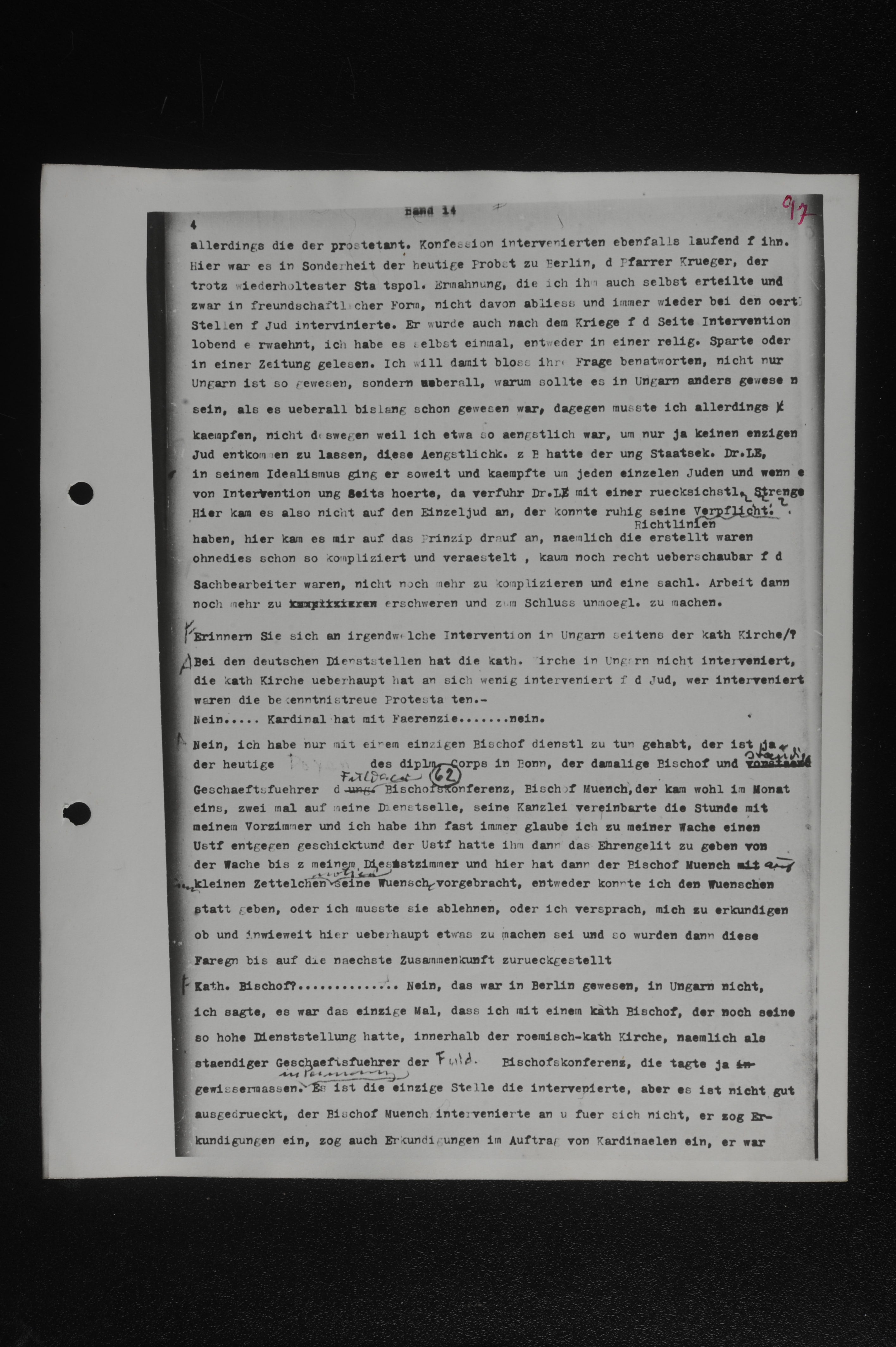
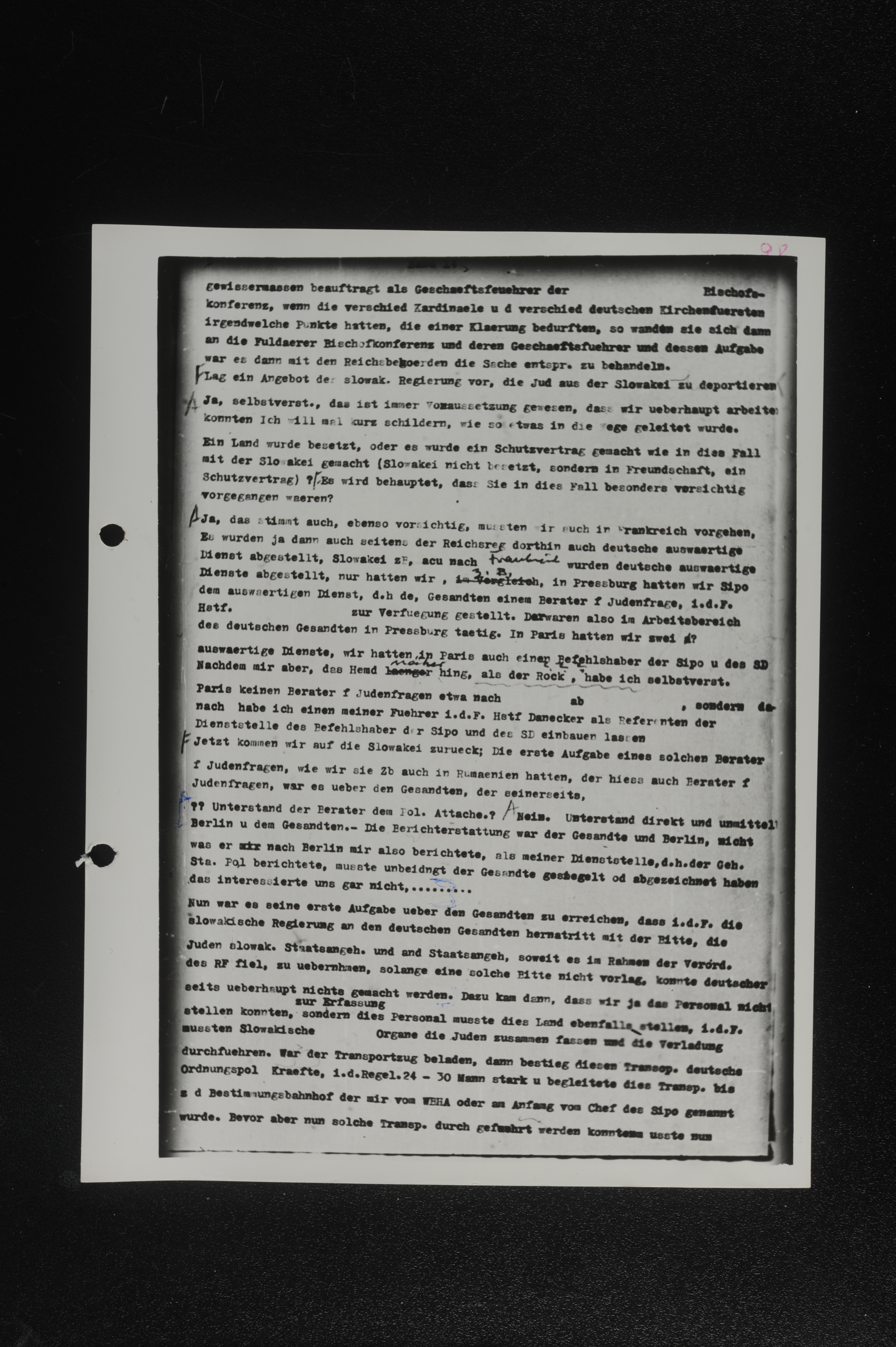
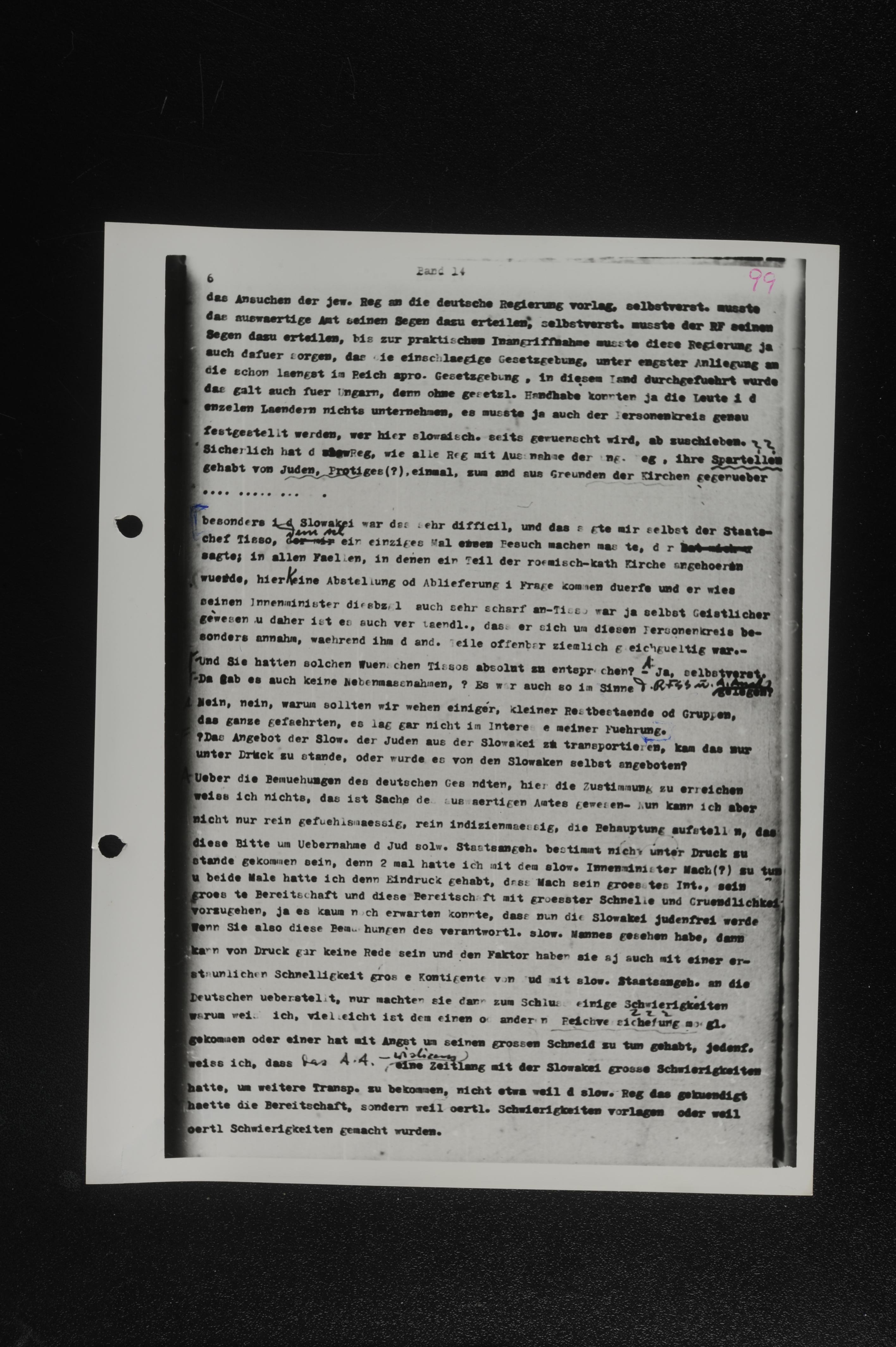
Unreviewed notes

These notes haven't been reviewed. A note can identify a speaker where the reviewed English doesn't. If they disagree, use the reviewed English.

Transcription note

Typed carbon-copy transcript page. Header: typed page number "6" top-left, "Band 16" centered (with a small handwritten flourish/underline after "16"), and colored-pencil handwritten folio "123." top-right. Handwriting/marginalia readings are uncertain: the name written over typed "Sa..." (line 13) is read as [?Szalasy?] (Szálasi, Horthy's successor); the interlinear word above "Eu....." is read as [?Vicegespan?] (Hungarian vicispán/deputy county head, consistent with surrounding "Gespanschaft"/"Obergespan"). Circled handwritten reference numbers (74), (74), (75) appear in the margins/inline and are marked [HW:]. Line 30: "einen solchen Stockbefehl" shows a heavy overtype on "Stock" with an apparent handwritten "Stock" above; rendered as [HW: Stock]befehl — genuinely ambiguous whether correction or reinforcement. Bottom-left margin handwriting below "Linkergarde" read as [?Hlinka?] — very likely correcting the typed "Linkergarde" to Hlinka-Garde (Slovak Hlinka Guard; "Disso" = Tiso). Placed adjacent to the corresponding typed word per the replacement protocol. Several lines run into the right paper edge and appear truncated mid-word (e.g. "...ein und aus g", "...hat sich", "...Staatssekr. gewesen"); transcribed only as far as legible without completing. Spelling preserved as typed including apparent errors: "physich.", "Moante", "sezusagen"→read "sozusagen", "geradzu", "versiehmen", "Weltanschauurken", "Harthy"/"Horth", "Taetsel", "tec.". Repeated period/hyphen runs approximated.

Translation notes

- 'Vicegespan' (HW) = vice-comes / deputy county head (Hungarian administrative title); rendered as vice head-county-official but the exact office is uncertain. - 'Obergespan' rendered as 'head-county-official' (Hungarian főispán / lord-lieutenant of a county); exact English equivalent chosen for literalness. - 'Dem..........' is truncated; likely 'Demarche' (diplomatic démarche) but left untranslated as it appears in the source. - 'Ex........' truncated; from context (gendarmerie and police under him) likely 'Exekutive' (executive), but left as truncated. - 'die forcierte Abnahme' rendered 'the forced removal/taking-off'; 'Abnahme' here plausibly means the taking-over/removal of the Jews (deportation), translation of the exact sense uncertain. - 'Stockbefehl'/'Stockbefehl' rendered 'stop-order' assuming 'Stopp'; the German literally reads 'Stock' (stick/halt) — the intended word is uncertain (the HW insertion 'Stock' repeats it). - 'zu versiehmen' appears garbled; read as 'zu vernehmen/verspüren' (to be detected/perceptible); rendered 'detectable', uncertain. - 'Weltanschauurken' is garbled; read as 'Weltanschauung' (worldview) and rendered so; the trailing letters are unexplained. - 'Disso' is a personal name (Slovak head of state) as transcribed; historically likely refers to Jozef Tiso — but the source spells 'Disso', preserved as written. - 'Hlinka'-Linke-guard: HW inserts '[?Hlinka?]' before 'Linkergarde'; historically the 'Hlinka Guard' (Hlinkagarde). The transcription 'Linkergarde' is preserved; the HW marks the intended reading as uncertain. - 'Pfeilkreuzer' rendered 'Arrow Cross' (Hungarian Arrow Cross Party / Pfeilkreuzler); the form is slightly nonstandard in the source. - 'Sa[HW: [?Szalasy?]]' — the name begins 'Sa' with HW gloss '[?Szalasy?]' (Szálasi); preserved as uncertain. - 'Fesemeier' — name as transcribed; historically likely refers to Edmund Veesenmayer (Reich plenipotentiary in Hungary), but preserved as written. The page carries no explicit speaker labels or initials. It reads as a continuous first-person account (RSHA/deportation-of-Hungarian-Jews duties, dealings with Veesenmayer/Winkelmann, the two Hungarian state secretaries) consistent with Eichmann, interleaved with embedded questions ("When was Horthy deposed...?", "The first transports rolled out of Hung., when ???"). However, these questions are not marked as separate turns in the source — they appear inline within the running text (e.g. "The first transports rolled out of Hung., when ??? In April 44 ..") and the [HW: (75)] annotations and question marks read as editorial/interview-note apparatus rather than transcribed speaker changes. Because no turn boundary is explicitly marked and the running admission cannot be safely split into attributed turns from this page alone without guessing from alternation, speaker_turns is left empty per the attribution rules. Note: 'E.' and 'B.' in the text are third-party Hungarian officials (the two state secretaries), NOT Eichmann — 'E.' here is the Hungarian 2nd State Secretary, so 'E.' must not be read as an Eichmann self-label. Historical name normalizations (Veesenmayer, Tiso, Szálasi, Hlinka Guard, Arrow Cross) are recorded in translation_uncertainties but the source spellings are preserved verbatim.
Band 16, page 7
Questioner

It is a fact that Horthy, within his own sphere of authority, continually tried to sabotage interventions in favor of the Jews and general interventions against German organisational and deportation measures,

Of that I know nothing. It would have been easy enough for the Hungarian head of state to do it, because it was not German units that carried out registration in Hungary, nor the loading into wagons, nor the camp registration. His own Hungarian gendarmerie carried it out, with several thousand men in the individual counties, led by his own gendarmerie lieutenant colonel Faerenzie and his Hungarian gendarmerie captain Notsch… He could have recalled the Hungarian gendarmerie officers he himself had appointed without further ado. He did intervene for Jews, yes, in individual cases, but Reich Marshal Goering did that too. SS generals did it too. Everyone did it, whether for humanitarian or pecuniary reasons.

Questioner

Do you know anything about the technique, about how the Hungarian side carried out the concentration or similar treatment of the Jews? Were you ever present for it?

Eichmann

No, I did not watch a loading into wagons, because it was such a subordinate matter that I had no time for it. I did, however, watch various loadings in various parts of the Reich, but never in Hungary. It was not my task, but that of the Hungarian gendarmerie; it would have been interference in the jurisdiction of Hungarian sovereign authorities. The transports were loaded and provisioned for so many days, as had been agreed with the State Secretary. I had several Order Police men assigned to me for the transport escort, and through my guidelines I ordered that every transport train consist of a lieutenant and 30 men, an Oberfeldwebel with 30 men. Therefore, in Hungary I had…

I could at most have watched it privately, never in the course of duty or officially. The two State Secretaries, Dr. L.E. and Dr. B., were both human beings, not animals. They had fully adopted the guidelines we had long had before Hungary. When the first guidelines were drawn up, the RF personally told me to assume that what France granted us Germans after the world war in deportation, the Jews should be granted as well. Accordingly, at first I allowed 50 kilos of baggage and provisions for an unlimited time. The provisions and baggage were then reduced as the war years grew more severe; they were adjusted to the countries where evacuation took place and to the speed and duration of the transports.

They did not arrive at an empty destination station as the West Germans had then; they were delivered into a camp, even if it was called a KZ. In the KZ there was proper provisioning: morning coffee, midday meal, evening meal, and for those who worked, the so-called bread breaks in the morning and partly in the afternoon. We, the active troops, got food only three times a day. I know for certain that the prisoners in Dachau got food five times a day. These guidelines were humane and human; they said that all avoidable hardships were to be avoided.

Open sheet image, German, and notes
Scan 00124 of the Sassen transcript, O.65 file 85.
This is scan 00124 of the Sassen transcript, O.65 file 85. The image is 2832 by 4256 pixels. Yad Vashem Archives, Jacob Robinson Collection O.65, file 85.

German transcription

Band 16 7 [HW: 174] Tatsache ist es,dass Horthy auch in seinem eigenen Lebensbereicht dauernd Interventionen zu Gunsten der Juden und Interventionen allgemeiner Art gegen deutsche organis. deportationstechn Massnahmen versucht hat, zu sabortieren, Davon ist mir nichts bekannt, es waere ja nichts leichter gewesen fuer das ung. Staatsoberhaupt als das zu tun, denn nicht deutsche Einheiten haben die Erfassun in Ungarn durchgefuehrt, nicht deutsche Einheiten haben die Waggonierung, nicht [HW: [illegible]] die lagermaessige Erfassung,durchgefuehrt, sondern seine eigene ung. Gend hat sie durchgefuehrt in der Staerek von einigen tausend Mann in den einzelen Komitaten, [DEL: xxx] gefuehrt durch seinen eigenen Gend-Obstlt. Faerenzie, mit seinem ung Gend. Hauptmann Notsch----- er hatte ja von sich aus seine ung Gend-Offis., er ja ernannt hat, ohne weiteres reklllieren koennen. Fuer Juden interveniert---- ja , das stimmt, das hat er auch----in Einzelfaellen, dass hat aber ein Reichsmarsch. G o e r i n g auch getan.das haben SS generaele auch getan, das hat ein jeder getan, sei es aus menschl. sei es aus pekuniaeren Ueberlegungen. Ist Ihnen ueber die Technik, ueber die Ausfuehrung ung.seits von Konzentrieren odgl. der Juden etwas bekannt, sind Sie einmal dabei gewesen? Nein, ich habe mir eine Einwaggonierung, nicht angesehen, weil es eben eine so [HW: [illegible]] nachgeord. Angelegenheit war, zu der ich keine Zeit hatte, --- ich habe mir aber verschied. Einwaggonierung in verschied. Teilen des Reichs angesehen [DEL: und auch] [DEL: in verschied. anderen Laender], in Ungarn nie----es war ja auch nicht meine Aufgabe gewesen, sonder der der ung. Gend, es waere eine Einmengung gewesen in die Zustaendigkeitsbelange urg. hoheitstraeger.--- [HW: [?Sie?]] habe, die Transp. verladen und verproviantiert fuer soundsoviel Tage, so war es ja abgesprochen mit den Staatssek [HW: 76] [DEL: empfangen durch meine Ordnungspol], - ich hatte mehrere [HW: 100] Mann Ord. Pol., unterstellt, fuer die Transportbegleitung und ich habe dann durch meine Richtlinien befohlen, dass ein jeder Transportzug bestehen musste aus einem Leutnant und 30 Mann einem Oberfeld. mit 30 Mann, Jaher hatte ich in Ungarn --- ich haette es mir hoechstens privat ansehen koennen-----aber nie dienstlich od offiziell.---- Die beiden Staatssekr. Dr. L.E. und Dr. B. waren beiden Menschen und keine Tiere beide haben die Richtlinien, die wir lange schon vor Ungarn hatten, voll inhalt- lich aufgenommen. Bei der Erstellung der ersten Richtlinien hatte mir der RF persoenl. gesagt, lassen Sie sich bei Erstellung der Richtlinien davon leiten, gehen Sie davon aus, dass was Frankreich nach dem Weltkrieg uns [DEL: [?Staatsbevoelkerung?]] [HW: Deutschen] zu billigte bei der Deportation, das genehmigen Sie auch den Juden, [HW: [illegible]] Darauf hin habe ich im Anfang [DEL: sogar] gestattet 50 Kilo Gepaeck , Verpflegung fuer unbeschraenkte Zeit, ----- Die Verpflegung und das Gepaeck fiel dann waehrend der zunehmenden Kriegsjahre ab---- es wurden in den Laendern in denen evakuriert wurde und der Transp. Geschwirdigkeit und der Transp. Dauer angepasst, denn sie kamen ja nicht, wie damals die Westdeutscher vor ein Nichts an der Zielstation denn sie wurden ja in ein Lager eingeliefert, wenn man sie auch Ks nannte, aber auch in den Kz herrschte eine ordentlich Verpflegung vor Morgenkaffee, Mittagessen, Abendessen und fuer die Arbeitenden die sogen. Brotzeiten vorm. und teilw. nachm. Wir, die exerzierende Truppe, wir bekamen nur 3 mal am Tag zu essen, ich weiss ge- nau dass die Gefangenen in Dachau 5 mal am Tag zu essen bekamen. Diese Richt- linien waren human und menschlich, es hiess, dass alle vermeidb. Haerten zu vermeid. seiend.

English translation

Band 16 7 [HW: 174] It is a fact that Horthy, even within his own sphere of life, continually attempted to sabotage interventions in favour of the Jews and interventions of a general kind against German organis. deportation-technical measures, Of that nothing is known to me, it would have been nothing easier for the Hung. head of state than to do that, for it was not German units that carried out the registration in Hungary, not German units that carried out the loading into wagons, not [HW: [illegible]] the camp-wise registration, that carried out, but rather his own Hung. gendarmerie carried it out, in the strength of some thousand men in the individual counties, [DEL: xxx] led by his own gend.-lieutenant-colonel Faerenzie, with his Hung. gend. captain Notsch----- he could indeed have on his own recalled [reclaimed] his Hung. gend.-officers, whom he himself appointed, without further ado. Interceded for Jews---- yes, that is correct, that he did too----in individual cases, but a Reichsmarshal G o e r i n g did that too. SS generals did that too, everyone did that, be it out of humane, be it out of pecuniary considerations. Is anything known to you about the technique, about the execution on the Hung. side of concentrating or the like of the Jews, were you ever present at it? No, I did not look at [watch] a loading into wagons, because it was just such a [HW: [illegible]] subordinate matter, for which I had no time, --- but I have looked at various loadings into wagons in various parts of the Reich [DEL: and also] [DEL: in various other countries], in Hungary never----it was indeed also not my task, but rather that of the Hung. gend., it would have been an interference in the jurisdictional interests of Hung. sovereign authorities.--- [HW: [?You?]] have, loaded the transports and provisioned them for so-and-so many days, that is how it was agreed with the state secretary [HW: 76] [DEL: received by my Order Police], - I had several [HW: 100] men of Order Police, subordinated, for the transport escort and I then commanded through my guidelines that every transport train had to consist of a lieutenant and 30 men, an Oberfeld[webel] with 30 men, ever [?] I had in Hungary --- I could have at most looked at it privately-----but never on duty or officially.---- The two state secretaries Dr. L.E. and Dr. B. were both human beings and no animals, both took up the guidelines, which we had long before Hungary already, fully in content. At the drawing up of the first guidelines the RF [Reichsführer] had told me personally, let yourself be guided at the drawing up of the guidelines by this, proceed from the assumption that what France after the world war granted to us [DEL: [?state population?]] [HW: Germans] at the deportation, that you also grant to the Jews, [HW: [illegible]] Thereupon I in the beginning [DEL: even] permitted 50 kilos of luggage, provisions for unlimited time, ----- The provisions and the luggage then fell away during the increasing war years---- it was in the countries in which was evacuated adapted to the transport speed and the transport duration, for they did not come, like back then the West Germans, before a nothing at the destination station, for they were indeed delivered into a camp, even if one also called them KC [Kz], but also in the Kz [concentration camps] a proper provisioning prevailed before, morning coffee, midday meal, evening meal and for the working ones the so-called bread-times [snack breaks] in the forenoon and partly in the afternoon. We, the drilling troops, we got to eat only 3 times a day, I know exactly that the prisoners in Dachau got to eat 5 times a day. These guidelines were humane and human, it was said that all avoidable hardships were to be avoided.
Unreviewed notes

These notes haven't been reviewed. A note can identify a speaker where the reviewed English doesn't. If they disagree, use the reviewed English.

Transcription note

Scan is a photographic negative (light text on dark ground); file located at .../Part1_10622517/00124.jpg after probing filename patterns (work dir empty; no manifest). Typed base text carries the interviewee's characteristic typos (e.g. "Lebensbereicht", "Staerek", "reklllieren", "Geschwirdigkeit", "Jaher"), preserved verbatim. Heavy later editorial hand: (a) circled/marginal "76" at left of the "empfangen durch meine Ordnungspol" line and a large hand-drawn bracket/check at the "Ist Ihnen" question opening; (b) two "X"-type strike marks in the left margin near the mid-page and "offiziell" lines (editorial ticks, not transcribed as text); (c) inserted numeral "100" written above "mehrere"; (d) "Deutschen" written above a struck typed word (read tentatively as "Staatsbevoelkerung"). Several inter-linear cursive insertions are genuinely illegible in the negative and marked [HW: [illegible]] — notably above "nachgeord. Angelegenheit war", above "die Waggonierung, nicht", after "den Juden,", and the word before "habe" (tentative [?Sie?]). Cancellation "[DEL: und auch] / [DEL: in verschied. anderen Laender]" is a struck-through continuation running across two lines. Top-left typed "7" is the in-band page number; the top-right handwritten folio reads as "174" but the middle digit is ambiguous (could be 1_4). "xxx" after "Komitaten" is literal struck typing, rendered [DEL: xxx].

Translation notes

- 'sich reklllieren koennen' (OCR: reklllieren) — intended verb is almost certainly 'reklamieren' (to reclaim/recall/claim back). Rendered 'recalled [reclaimed]'; the exact sense (recall from post vs. reclaim jurisdiction over) is uncertain. - 'Faerenzie' — the Hungarian gendarmerie officer's name is an OCR/phonetic rendering (historically László Ferenczy); left as written in the German. Spelling in the source is uncertain. - 'Notsch-----' — captain's name broken off with a dash in the source; incomplete, translation left as rendered. - 'Jaher hatte ich in Ungarn' — 'Jaher' is not a standard word; possibly 'je/immer' (ever) or a garbled word. Rendered tentatively 'ever [?] I had in Hungary'; meaning uncertain. - '[HW: [?Sie?]] habe, die Transp. verladen' — the handwritten insertion '[?Sie?]' plus 'habe' produces a grammatically broken clause (Sie=you with 'habe'=I-form). Preserved as-is; who the subject is (I vs. you) is genuinely unclear in the source. - 'Staatssek' — abbreviation left as 'state secretary'; whether singular or plural at this point is unclear (later text names two: Dr. L.E. and Dr. B.). - 'was Frankreich nach dem Weltkrieg uns ... zubilligte' — 'Weltkrieg' here read as the First World War (post-WWI French deportation practice), but the source does not specify which war; left as 'the world war'. - 'Ks nannte ... in den Kz' — the source writes both 'Ks' and 'Kz' for concentration camp (Konzentrationslager); the first is likely an OCR slip for 'Kz'. Rendered 'KC [Kz]' / 'Kz' preserving the inconsistency. The page header reads 'Band 16', page '7', with handwritten '[HW: 174]'. The page is a continuous interview exchange: two question-turns framing/probing (attributed S) and two long first-person answer-turns (attributed E). Attribution rests on turn content alone — direct questions vs. detailed first-person accounts of RSHA guideline-drafting, Order Police command, and a personal instruction from the Reichsführer-SS — not on alternation or page position. Speakers are not labeled in the source; the attributions are content-based, not from explicit initials. Broken grammar, dashes, OCR garble (e.g. 'sabortieren' for 'sabotieren', 'Staerek' for 'Staerke', 'organis.', 'deportationstechn'), abbreviations, [DEL:], [HW:], and [illegible] markers are preserved in the literal translation. The '[HW: 76]' and '[HW: 100]' handwritten numbers appear inline mid-sentence and are retained at their positions. Historically the two Hungarian state secretaries were László Endre and László Baky (matching 'Dr. L.E.' and 'Dr. B.'), and 'Faerenzie' corresponds to Ferenczy — these identifications are contextual and NOT inserted into the translation.
Band 16, page 8

These guidelines were adopted by the Hungarian Ministry. They may have been altered somewhat to fit Hungarian mentality; perhaps they were adopted 100 percent. But none of that could or was allowed to concern me, because those were interventions in the Hungarian sovereign administration at that time.

Questioner

Did you never have an observer at the loadings into freight cars?

Eichmann

Of course, not just one. For every county where excessive roundups were carried out, I had my captains, who had practical experience from other countries behind them. Wi, Burger, Brunner fit that role, and whoever else they were. They assisted the local gendarmerie, to pass on something from their experience to the people there. The local commander was visited before Faerenzie in every case, and in most cases Faerenzie himself was present at the first transports. The adviser for Jews was also there, so Faerenzie could turn at any time to an officer of my special commando if any uncertainties arose. He either accepted them, or, if they remained unclear, he still had to refer the matter to his superior office, L.E. or B., regarding his ex… intervention.

Questioner

During this time, did no report ever reach your office through official channels from one of your subordinates, pointing to particular cruelty or inhumanity by the Hungarian gendarmerie during the loading, etc.?

Eichmann

Yes, Wi told me that, and another man whose name I no longer remember. Wi told me that such methods had not occurred in his earlier practice.

Questioner

What methods?

Eichmann

Rough treatment, the opposite of what my guidelines said: hardships are to be avoided. Apparently, this was ignored in individual cases, so my people were shocked by the inhumanity amid the registration, assignment to the camps, and loading into freight cars. Wi thought it was bestial, probably also because of his innate goodness. In that case I issued an instruction to inform State Secretary Dr. L.E. and, secondly, to file it. The instruction to inform Dr. L.E. was required several times. Several times I told the Hungarian authority that the point was not to punish individual Jews, because we wanted a political solution.

L.E. took note of that, and I know he repeatedly drew Faerenzie's attention to it. I myself also drew Faerenzie's attention to it. I remember that on the Hungarian side Frau Kastner was given the bastinado, an event that was new until then. I did not want to believe it, because in none of the European countries had I ever experienced harm being done to a relative or wife of one of my Jewish negotiating partners because she was negotiating with me, in order to get out of that person what she was negotiating with the German offices. That is the parallel: it begins with harshness and ends with the bastinado inflicted on the wife of one of my Jewish negotiating partners.

Open sheet image, German, and notes
Scan 00125 of the Sassen transcript, O.65 file 85.
This is scan 00125 of the Sassen transcript, O.65 file 85. The image is 2832 by 4256 pixels. Yad Vashem Archives, Jacob Robinson Collection O.65, file 85.

German transcription

8 Band 16 [HW: 125] Diese Richtlinien wurden vom ung Minist aufgenommen, sie wurden vielleicht nach ung. Mentalitset etwas abgeaendert, vielleicht hat man sie auch 100 % uebernemmen, aber das alles hatte und durfte mich nicht interessieren, denn das waren Eingriffe um jene Zeit in die ung. Hoheitsverwalt. Haben Sie nie einen Beobachter bei den Einwaggonierungen gehabt??? Selbstverst.,nicht nur einen Beobachter, ich hatte fuer jedes Komitat wo ex----- maessige Erfassungen durchgefuehrt wurden, selbstverst. meine Hauptleute gehabt, die eine Praxis durch and. Laender hinter sich hatten, da passt der Wi, Burger, Brunner hinein, und wie sie alle heissen und die sind nun den oertl. Gend. an die Hand gegangen um gewissermassen hier den Leuten etwas aus ihrer Praxis zu erzaehl Der oertl Kommandant der allerdings vor Faerenzie in jedem Fall aufgesucht wurde in den meisten Faellen sogar Faerenzie dabei war, bei den ersten Transp., war auch der Berater fuer Juden ebenfalls dabei, sodass Faerenzie, sich jederzeit an einen Offizier meines Sonderkommandos hat wenden koennen, falls irgendwelche Unklarheiten auftauchten entweder hat er sie akzeptiert oder waren sie ihm unklar musste er trotz dieses Rates bzgl seines ex...... Eingreifens noch immer nicht klar, sich diesbzgl an seine vorgesetz. Dienststelle, sich L.E. oder B. zu wenden. Ist Ihnen in dieser Zeit auf dem Dienstwege niemals einen Bericht von einem ihrer Untergebenen auf Ihrer Dienststelle zu gekommen wo auf besondere Grausam- keit oder Unmenschlichkeit seitens der ung Gend bei der Einwaggonierung usw. hingewiesen wurde?? Ja, das sagte mir Wi und ein anderer auch, an dessen Namen ich mich nicht mehr erinnere. Wi sagte mir dass in seiner Praxis von frueher solche Methoden nicht vorgekommen waeren.- Welche Methoden?? Rauheiten, naemlich das Kontraere, wie es in meinen Richtlinien.stand, naemlich vermeide Haerten sind zuvermeiden....wurden offenbar hier in einzelen Faellen ueberhaupt nicht beruecksichtigt, sodass meine Leute schokiert waren ueber diese Unmenschlichkeit unter deren die Erfassung, die Einweisung in die Lager und die Verwaggonierung zu erfolgen hatte, -Wi meinte, wohl auch infolge seiner angeborenen Gute, es sei viehisch.---- Ich habe dann in dem Fall die Verfuegung getroffen ( ich hatte alles nur in schriftl. Vermerken, muendliche Sachen gab es nicht bei mir) Unterrichtung des Staatssekr. Dr. L.E. und zweitens zu den Akten.- Die Verfuegung,- Unterrichtung Dr.L.E. war einige Male erforderlich, ich habe einige Male der ung. Behoerde mitgeteilt, dass es ja nicht darauf ankaeme, hier etwa den Einzeljuden bestrafen zu wollen, denn wir wollten ja eine polit. Loesung anstreben. L.E. hat das auch zur Kenntnis genommen, und ich weiss es dass er Faerenzie widerholtest darauf aufmerksam machte, ich selber habe Faerenzie auch darauf aufmerksam gemacht.- Ich erinnere, dass ung.seits Frau Kastner die Bastonate verabreicht wurde, ein Vorgang der bis dahin neu war, ich wollte es gar nicht glauben, denn in keinem der europ. Laender habe ich es jemals erlebt dass man der Verwandten oder der Ehefrau eines meiner jud Verhandlungspartner ein Leid zu fuegte, deswegen weil sie mit mir verhandelten, um aus dieser Person heraus zu bekommen, was sie mit den deutschen Dienststellen verhandelten. Das ist die Parallele die faengt an bei der Haerte und endet bei der Bastonate, der Ehefrau eines meiner jud. Verhandlungspartner.

English translation

8 Volume 16 [HW: 125] These guidelines were taken up by the Hung[arian] Minist[ry], perhaps they were somewhat altered according to Hung[arian] mentality, perhaps they also adopted them 100 %, but all that could not and was not permitted to interest me, for those were interventions at that time into the Hung[arian] sovereign administration. Did you never have an observer at the loadings into freight cars??? Of course, not only one observer, I had for every comitat where ex----- [OCR: illegible/incomplete] systematic registrations were carried out, of course my captains, who had a practice behind them through oth[er] countries, there Wi, Burger, Brunner fit in, and whatever they are all called, and they now assisted the local gend[armerie] to a certain extent to tell the people here something out of their practice. The local commandant who, however, was sought out before Faerenzie in every case, in most cases even Faerenzie was present, at the first transp[orts], the adviser for Jews was likewise present as well, so that Faerenzie could at any time turn to an officer of my special commando, in case any ambiguities arose he either accepted them or if they were unclear to him he had to, despite this advice regarding his ex...... [incomplete] intervention, still not clear, turn regarding this to his superior office, that is L.E. or B. Did in this time never a report from one of your subordinates come to you at your office through official channels, where particular cruelty or inhumanity on the part of the Hung[arian] gend[armerie] at the loading into freight cars etc. was pointed out?? Yes, that Wi told me and another one too, whose name I no longer remember. Wi told me that in his practice from earlier such methods had not occurred.- What methods?? Roughnesses, namely the contrary, as it stood in my guidelines, namely avoid harshnesses are to be avoided....were apparently here in individual cases not taken into account at all, so that my people were shocked about this inhumanity under which the registration, the assignment into the camps and the loading into freight cars had to take place, -Wi thought, probably also as a result of his innate goodness, it was bestial.---- I then in that case made the disposition ( I had everything only in written memoranda, oral matters did not exist with me) instruction of the State Secretary Dr. L.E. and secondly to the files.- The disposition,- instruction of Dr. L.E. was necessary several times, I informed the Hung[arian] authority several times that it was not the point here, to want to punish the individual Jew, for we indeed wanted to strive for a polit[ical] solution. L.E. also took note of that, and I know that he repeatedly drew Faerenzie's attention to it, I myself also drew Faerenzie's attention to it.- I remember that on the Hung[arian] side Frau Kastner was administered the bastinado, an occurrence that was new until then, I did not want to believe it at all, for in none of the Europ[ean] countries did I ever experience that harm was inflicted on the relatives or the wife of one of my Jew[ish] negotiating partners, for the reason that they negotiated with me, in order to get out of this person what they negotiated with the German offices. That is the parallel, it begins with the harshness and ends with the bastinado, of the wife of one of my Jew[ish] negotiating partners.
Unreviewed notes

These notes haven't been reviewed. A note can identify a speaker where the reviewed English doesn't. If they disagree, use the reviewed English.

Transcription note

Faded carbon-copy typescript, Q&A interview format (interviewer questions in separate paragraphs, followed by Eichmann's replies). Header line: typed "8" at top-left, centered "Band 16" heading, and blue handwritten folio "125" at top-right. Transcribed the header as a single line in the base text with the handwritten folio marked [HW: 125]. Reading uncertainties (visible-pixel readings retained, not corrected): line 2 "Mentalitset" appears to be a typo for "Mentalitaet" but is transcribed as the glyphs show. Line 10 "erzaehl" — the word runs into the smudged right margin and may be truncated/cut; transcribed as visible. Line 31 shows a parenthesis-like mark before "ich"; read as "( ich". Repeated-character runs preserved approximately: "ex-----" (~5 hyphens, line 7), "ex......" (~6 periods, line 17), "zuvermeiden...." (4 periods), "viehisch.----" (4 hyphens). Abbreviations left unexpanded per protocol: ung/ung. (ungarisch), Minist, oertl, Gend, Transp., bzgl/diesbzgl, vorgesetz., L.E., B., Dr., Staatssekr., schriftl., polit., europ., jud/jud., and., usw. No struck-through text, no typewritten insertions detected; the only non-typewritten element is the blue-ink folio number "125". Right margin is faded/darkened, mildly reducing legibility of line-ending words, but all typewritten lines are represented.

Translation notes

- 'Komitat' rendered as 'comitat' (Hungarian administrative county district); could also be Anglicized as 'county'. - 'Faerenzie' is a proper name as spelled in the source (likely a Hungarian gendarmerie officer, cf. Ferenczy); left transliterated as written, not corrected. - 'Bastonate'/'Bastonate' translated as 'bastinado' (beating on the soles of the feet); the German uses a rare loanword and the exact intended meaning is inferred from context. - 'L.E.' and 'B.' are abbreviated designations (L.E. explicitly tied to 'State Secretary Dr.' — likely László Endre; 'B.' unexplained on this page, possibly Baky); left as abbreviations, not expanded. - 'die Bastonate verabreicht wurde' — the passive with 'Frau Kastner' as dative ('was administered the bastinado to Frau Kastner') is rendered as 'Frau Kastner was administered the bastinado'; the grammar in the German is loose. - 'Rauheiten' rendered 'roughnesses' and 'Haerten' as 'harshnesses' to preserve the plural abstract nouns of the original. - 'in schriftl. Vermerken' rendered 'in written memoranda'; 'Vermerk' could also be 'note' or 'file note'. This is page 8 of Volume ('Band') 16 with handwritten '125' in the top margin. It is a continuous interview transcript with no explicit speaker labels/initials in the source text. Speaker turns were segmented on the internal structure: three clearly interrogative passages (marked with multiple '?') function as interviewer questions and are attributed to Sassen (S); the intervening first-person operational narratives — command of a Sonderkommando, 'my guidelines', 'my people', issuing dispositions, negotiations with Jewish partners in Hungary — are attributed to the interviewee Eichmann (E). The opening paragraph carries no question and continues mid-topic from a prior page with no label, so it is left UNCERTAIN despite being consistent with Eichmann's voice. Several OCR uncertainties preserved verbatim: 'ex-----', 'ex......', truncated words, and irregular dashes/ellipses. Proper names (Faerenzie, Wi, Burger, Brunner, Kastner, L.E., B.) left as spelled in the source. The passage contains a significant evidentiary admission (bastinado of Frau Kastner; systematic deportation registration and loading), attributed to Eichmann only on the strength of the sustained first-person account, not on alternation alone.
Band 16, page 9
Questioner

Do you recall any details from the reports of your subordinates about particular Hungarian methods used in loading people into freight cars, etc.?

I said yes. Wi told me that they drove them in and loaded them like cattle. That was roughly the situation, not everywhere; there were individual counties where such measures were carried out. Otherwise I had received no reports on this from my subordinates, and I would not have intervened with L.E. on that account, since he was an opponent of it, as were Faerenzie and his adjutant. But despite the severity of the order, procedures were carried out so that avoidable hardships were avoided, and yet our offices also acted differently here and there. I once saw a man strike a Jew on the head with an old rubber truncheon, so that he staggered.

I came around the corner and saw that the Jew could not have done anything; he was old and frail. I called the man to account, reported him to his commandant, and demanded punishment and removal. I could not pursue the matter further, but the commandant will have dealt with it; he had to, because he could not know whether I had also filed a report. I told you once already that I came to a railway station in the East which, officially, was none of my business, where a member of the Waffen-SS had set fire to the beard of an Orthodox man with a lighter. It was burning.

I immediately had him reported to his commandant and demanded punishment, and I also reported the matter through official channels. I do not know what happened with it. There was another example involving an Hstf. in the cellar and five or six Jews: punishment, expulsion from the SS, later in the Wehrmacht at the front, dead, head-sho… The last incident was at the Central Office for Jewish Emigration in autumn-winter 1939, [too faint], an Ostf. from Vienna, a Blood Order bearer and holder of NSDAP decorations. Because of that, he could not be expelled from the Party.

From the SS, yes; the RF did not tolerate such people. That is sadism. And if anyone says today that the transports were carried out with the most brutal harshness, that is not true. Local shortcomings occurred everywhere, because human fallibility generally prevents 100 percent obedience to an order. Orders can be supervised, but one is human too, and a 100 percent elimination of hardships exists nowhere. My colleagues on the other side, Russian, Slovak, and Czech police officers, wherever they come from, will be able to confirm this from their experience.

Although I must assume here that the deportations of Germans, or of people from other countries, after the war, which ran into the high millions, were certainly not worked out and carried out with German-Prussian precision in terms of provisions and transport, as they were in our times, and although we were at war with almost the entire world and had to assemble food for the transports under the greatest difficulties and could obtain covered wagons only under the greatest difficulties, Jews were never transported in open wagons. They were always carried in covered R-wagons. The fastest routes and fastest trains were always used. Even so, especially in hard winters when a sudden change in temperature came, difficulties arose, including difficulties with deaths during transport.

Open sheet image, German, and notes
Scan 00126 of the Sassen transcript, O.65 file 85.
This is scan 00126 of the Sassen transcript, O.65 file 85. The image is 2832 by 4256 pixels. Yad Vashem Archives, Jacob Robinson Collection O.65, file 85.

German transcription

9 Band 16 [HW: 126] Sind Ihnen aus den Berichten Ihrer Nachgeord. noch irgendwelche Details ge- laeufig ueber besondere ung. Methoden bei Einwaggonierung usw.?? Ich sagte ja, Wi sagte mir dass man sie wie Vieh eintreibe und einwaggoniere.- Vergleich-Schlachthaus------- So etwa war die Sache, nicht ueberall, es hat einzel[?n?] aber einzele Komitaten gegeben wo solche Massnahmen durchgefuehrt wurden. Sonst hatte ich ja diesbzgl von meiner Nachgeord, keine Berichte erhalten und haette dann auch nicht deswegen interveniert bei L.E. der ein G e g n e r davon war, ebenso Faerensie und sein Adjutant ein G e g n e r solcher Massnahmen war. Aber es wurde trotz der Schwere des Befehles so verfahren, dass vermeidbare Haerten vermieden wurden und trotzdem wurden auch von unserer Stellen hier und da anders gehandelt.-- Ich sah einmal [HW: 77] wie ein Mann mit einem alten Gummiknueppel einen Juden auf den Kopf schlug, dass er taumelte, ich kam um die Ecke herum und sah dass, der Jude konnte nichts angestellt haben er war alt und gebrechleih, ich stellte den Mann zur Rede, meldete ihm seinen Kommandanten und verlangte die Bestrafung und die Absetzung, ich konnte die Sache nicht weiter verfolgen, aber de[?r?] Kommandant wird die Sache gemacht haben er musste es, denn er konnte nicht wissen, ob ich nicht meinerseits auch eine Meldung gemacht habe.--- Ich sagte Ihnen schon einmal dass ich an einer Bahnhof kam des Ostens der an sich mich nichts anging, dienstlich, wo ein Angehoeriger der Waffen SS eine Orthodoxen Barttraeger den Bart mit dem Feuerzeug angezuendet hatte, , der brannte, darauf hin liess ich ihn sofort seinem Kommandanten melden, und habe Bestrafung verlangt, auch ich habe die Sache auf dem Dienstweg gemeldet, was damit passiert ist, weiss ich nicht- dann weiteres Beispiel mit dem Hstf im Keller, mit den 5-6 Juden, Bestrafunf -- SS ausgestossen-- spaeter in der Wehrmacht an der Front---tot-Kopfsch Die letzte Geschieht war in der Zentrale fuer jud Auswanderung, im Jahre 1939, xxxx Herbst - Winter 1939, [?Troestl?],°°Ostf. aus Wien- Blutordenstraeger und Ehrenzeichen traeger, der NSDAP, deswegen konnte er aus der Partei nicht ausgestossen werden. Aus der SS ja, dann der RF duldete solche Leute nicht, dass ist Sadismus und wenn heute jemand sagt, es seien die Transp. mit brutalster Haerte durchgefuehrt worden, dann stimmt das nicht, oertl. Unzulaenglichkeiten kamen allenthalben vor, , denn die menschliche Unzulaenglichkeit laesst von vornherein die 100% Befolgung eines Befehles i d Regel nicht zu.-- Man kann die Befehle ueberwachen, auch widerum nachdem auch nur selbst wieder Mensch ist, nach menschlichen Wollen und Vermoegen aber eine 100% Ausschaltung von Haerten, die gibt es nirgends. Meine Collegen auf der and. Seite, die russ, slow. tschech. Pol.Offiz woher sie immer herkommen moegen, sie werden ihnen das aus ihrer Praxis bestaetigen koennen. Obwohl ich hier unterstellen muss, dass die Deportation von Deutschen oder auch von anderen Laendern nach dem Krieg die in die hoher Millionen ging, bestimmt nicht mit der deutsch-preussischen Genauigkeit ausgearbeitet und durchgefuehrt wurden, Verproviantierungsmaessig, transportmaessig, wie dies in uns Zeiten geschah, und trotzdem wir hier fast gegen die gesamte Welt im Kriege lagen und unter groesstes Schwierigkeiten die Lebensmittel fuer die Transp, zusammen bringen konnten und nur unter groessten Schwierigkeiten gedeckte Waggons bekommen konnten, nie wurden Juden in offenen Waggons abtransp., stets waren es gedeckte R-Waggons gewesen. stets waren es schnellste Wege und schnellste Zuege gewesen, trotzdem kam es besonders in harten Winterzeiten wenn ein ploetzlicher Te mperaturwechsel kam, zu Schwierigk. ja auch zu Schwierigkeiten mit Todesfolge waehrend des Transportes.

English translation

9 Volume 16 [HW: 126] Are any details from the reports of your subordinates still familiar to you about particular Hung.[arian] methods during loading-into-boxcars etc.?? I did say, Wi told me that they drove them in and boxcarred them like cattle.- Comparison-slaughterhouse------- That is roughly how the matter was, not everywhere, there were individ[?ual?] but there were individual komitats/counties where such measures were carried out. Otherwise I had received no reports in this regard from my subordinate[s], and would then also not have intervened on that account with L.E. who was an o p p o n e n t of it, just as Faerensie and his adjutant was an o p p o n e n t of such measures. But despite the severity of the order it was proceeded in such a way that avoidable hardships were avoided and nonetheless our offices too here and there acted differently.-- I once saw [HW: 77] how a man with an old rubber truncheon struck a Jew on the head, so that he staggered, I came around the corner and saw that, the Jew could not have done anything he was old and frail, I called the man to account, reported him [to] his commandant and demanded the punishment and the removal, I could not pursue the matter further, but th[?e?] commandant will have handled the matter he had to, for he could not know, whether I for my part had not also made a report.--- I already told you once that I came to a railway station of the East that in itself did not concern me, in an official capacity, where a member of the Waffen SS had set fire to an Orthodox beard-wearer's beard with the lighter, , it was burning, thereupon I had him immediately reported [to] his commandant, and demanded punishment, I also reported the matter through official channels, what happened with it, I do not know- then further example with the Hstf[Hauptsturmführer] in the cellar, with the 5-6 Jews, punishmen[t] -- expelled from the SS-- later in the Wehrmacht at the front---dead-head-sho[t] The last stor[y] was in the Central Office for Jew.[ish] Emigration, in the year 1939, xxxx autumn - winter 1939, [?Troestl?],°°Ostf.[Obersturmführer] from Vienna- Blood-Order-bearer and decoration- bearer, of the NSDAP, on that account he could not be expelled from the Party. From the SS yes, then the RF[Reichsführer] did not tolerate such people, that is sadism and if today someone says, the transp.[orts] had been carried out with the most brutal harshness, then that is not correct, local inadequacies occurred everywhere, , for human inadequacy from the outset as a rule does not permit the 100% following of an order.-- One can supervise the orders, again also after [one] oneself is again only human, according to human will and capacity but a 100% elimination of hardships, that exists nowhere. My colleagues on the oth.[er] side, the Russ.[ian], Slov.[ak] Czech pol.[ice] offic.[ers] wherever they may always come from, they will be able to confirm this to you from their practice. Although I must here assume, that the deportation of Germans or also from other countries after the war which ran into the high millions, certainly was not worked out and carried out with German-Prussian precision, in terms of provisioning, in terms of transport, as this happened in our times, and although we here lay at war against almost the entire world and under greatest difficulties could bring together the foodstuffs for the transp.[orts] and only under greatest difficulties could obtain covered boxcars, never were Jews transported off in open boxcars, always were they covered R-wagons/goods-wagons. always were they the fastest routes and fastest trains, nonetheless it came, especially in harsh winter periods when a sudden change of temperature came, to difficult.[ies] indeed also to difficulties with resulting death during the transport.
Unreviewed notes

These notes haven't been reviewed. A note can identify a speaker where the reviewed English doesn't. If they disagree, use the reviewed English.

Transcription note

Single typewritten page, moderately faded/blurred, three-hole punched left margin. Header line reads typed "9" (upper left), centered "Band 16"; handwritten blue "126" upper right (folio). A handwritten circled "77" sits above the base line at "Ich sah einmal ... wie ein Mann" — transcribed as [HW: 77] anchored at that point. Right-hand line ends are darkened/cut in the scan; low-confidence end-of-line readings marked with [?...?] ("einzel[?n?]", "aber de[?r?]"). "xxxx" at end of the "im Jahre 1939" line is a run of typed-over cancel characters, transcribed as the visible x's. "[?Troestl?]" is a proper name of uncertain reading, followed by superscript-like marks (rendered °°). Several typos preserved verbatim (Geschieht, gebrechleih, Bestrafunf, hoher). No later typewritten insertions or struck-through spans identified beyond the cancel x's.

Translation notes

- 'einzel[?n?]' / 'einzele Komitaten' — the German has a broken/repeated word ('there were individ[?ual?] but there were individual komitats'); 'Komitaten' rendered as 'komitats/counties' (Hungarian administrative districts, comitatus); kept the stammered repetition. - 'Wi' — abbreviated name of a person who reported the cattle-driving; left as 'Wi' (possibly 'Wisliceny' but not resolved in the source). - 'L.E.' and 'Faerensie' — 'L.E.' left as initials; 'Faerensie' is an uncertain OCR of a Hungarian name (possibly 'Ferenczy'), rendered verbatim as printed. - 'gedeckte R-Waggons' — 'R-Waggons' translated as 'R-wagons/goods-wagons'; the 'R' likely denotes a wagon class but is left unexpanded. - 'Kopfsch' (broken) — rendered 'head-sho[t]' preceded by 'dead-'; the fragment 'tot-Kopfsch' is incomplete in the source. - '[?Troestl?]' — uncertain personal name marked with OCR uncertainty in the source; preserved as-is. - 'Blutordenstraeger' rendered 'Blood-Order-bearer' (Blutorden = Nazi Party decoration); left literal. - 'in uns Zeiten' — likely 'in unseren Zeiten' ('in our times'); the German is truncated ('uns'), translated as 'our times' but the truncation is noted. - 'nachdem auch nur selbst wieder Mensch ist' — grammatically broken German; rendered literally ('after [one] oneself is again only human') with the awkwardness preserved. This is page [HW: 126] of Volume 16 (Band 16), header numeral '9'. The page carries no explicit speaker labels or initials anywhere — attribution rests entirely on content. No third participant (OTHER) speaks on this page. The '[HW: 77]' and '[HW: 126]' are handwritten marginal/page numbers preserved inline. 'xxxx' and '°°' and doubled commas are transcription artifacts preserved from the source. The date-handling house rule was not applied here as this is a verbatim diplomatic translation, not authored prose; years are rendered as printed (1939)."

During the war, these difficulties involving casualties upset me less insofar as they were unavoidable, because, after all, in the end I wasn't allowed to get upset either. The bombing of German cities, with the deaths of children and women… that was perhaps, so to speak, the whole of my feelings, my attitude toward the orders I received…

Questioner

These reports often mention that the loading into wagons was done in a bestial manner, and that the Hungarian Gendarmerie put two buckets in each wagon: one with drinking water, the other for later drinking water, pee-pee. These wagons weren't allowed to be opened at intermediate stations, and it is pointed out that a reasonably bearable provision was made only on Reich territory. Is that also known to you?

Eichmann

On Hungarian soil, we had no possibility of intervening in this regard in any way. Rather, the intervention was carried out by Hungarian ex… organs. We could be present, but we couldn't directly arrange anything. It corresponds exactly to the moment we reached Reich territory: the transport command was now able to operate freely. The lieutenant of my transport command now had authority to give orders. He could order the stationmaster to route the train outside or inside a railway station. He could order that the train be held until a fresh-water supply had been provided, and that it proceed only after the waste buckets had been emptied and cleaned, if only to prevent epidemics.

This is clear proof that on Reich territory things were done differently. It proves that the guidelines I had given for carrying out an evacuation were strictly followed wherever we had sovereign authority, apart from the individual small exceptions that exist everywhere. I even spoke about this with Kastner. I said, 'Kastner, it is impossible and unthinkable that German organs abducted your wife.' Avoidable harshness, too, was like organ music to me, as an SS man and SS officer, and also to the RF, because he was fundamentally a kind-hearted man who granted all the concessions that were possible.

So the RF was immediately willing when I told him that it was necessary to establish a separate theater for the Jews in Theresienstadt, and a kindergarten or other cultural facilities, because Theresienstadt wasn't supposed to be a concentration camp. It was supposed to be more of a ghetto, an old-age home, where the Jews were to be held and, for the first time, sustain themselves. A brutal spirit would never have granted this to people who had allowed war to be declared on his blood. Only a man of the stature of the RF could do that.

Questioner

The question would be more interesting if several details about protest-like official reports from your office on the manner and methods of the Hungarian Gendarmerie during the deportation of Jews could be reconstructed. Then the point would be whether your office, in carrying out the PF's orders clearly, even outside German sovereign territory, had tried to have such questionable measures as these forced deportations carried out as humanely as possible. The first point was the beatings: Jews who were dying in the camps were thrown into the wagons; Jews were loaded who, under the evacuation regulations, no longer

Open sheet image, German, and notes
Scan 00127 of the Sassen transcript, O.65 file 85.
This is scan 00127 of the Sassen transcript, O.65 file 85. The image is 2832 by 4256 pixels. Yad Vashem Archives, Jacob Robinson Collection O.65, file 85.

German transcription

[HW: 16/10] Mich hat waehrend des Krieges diese Schwierigk, mit Todesopfer weniger aufgeregt, soweit sie unvermeidbar waren, weil ich mich ja schliesslich und letzten Endes auch nicht aufregen durfte, die Bombenabwuerfe auf deutsche Staedte mit Todesopfer von Kindern und Frauen.......... dass war vielleicht sozusagen meine ganzen Gefuehle, meine Einstellung zu den Befehler die ich bekam... Es wird in diesen Berichten des oefteren erwaehnt, dass die Einwaggonierung also auf bestidische Weise geschah und die ung. Gend in jeden Waggon 2 Eimer hinei stellte, ein Eimer mit Trinkwasser und den and. Eimer fuer das spaetere Trinkwasse pipi. diese Waggons durften auf den Zwischbahnhoefen nicht geoeffnet werden, und es wird darauf hingewiesen, dass er st auf Reichsgebiet eine einigermassen tragbare Versorgung statt fand. Ist Ihnen das auch bekannt???? Auf dem ung. Boden hatten wir gar keine Moeglichkeit diebzgl. irgendwie einzugreife sondern das Eingreifen erfolgt durch ung. ex..... Organe, wir konnten dabei sein, wir konnten aber nichts unmittelbar veranlassen . Es deckt sich genau, mit Erreichung des Reichsgebietes war das Transp. kommando nunmehr i d Lage sich frei entfalten zu koennen, nun mehr hatte der Leutnant meines Transp. kommandos Befehlsbefugnis, nun mehr konnte er dem Stationsvorstand befehlen, dass der Zug ausserhalb oder innerhalb einer Bahnstation gefuehrt wird, er konnte befehlen, dass der Zug solange aufzuhalten ist, bis eine Frischwasserversorgung durchgefuehrt ist, dass der Zug erst dann weiter fahren durfte bis die Unratskuebel entleert und gereinigt waren., schon allein deswegen, wegen Vermeidung von Seuchenbildung. Das ist ein eindeutiger Beweis, auf dem Reichsgbiet wurde es anders, es beweist dass die Richtlinien die ich gegeben habe zur Durchfuehrung einer Evakuierung striktens eingehalten wurden dort, wo wir Hoheitsbefugnisse hatten ----- immer abgesehen von den einzelen kleine Ausnahmefaellen, die es all ueberall gibt.--- Selbst [TS INS: mit] Kastner habe ich darueber gesprochen---- ich sagte; Kastner,unmoeglich und undenkbar ist es, dass deutsche Organe ihre Frau entfuehrt haben. Vermeidbare Haerte...... . war auch fuer mich wie Orgelklang, fuer mich als SS Mann und SS Offizier, auch fuer den RF, denn er war im Grunde ein gutherziger Mensch, der alle Erleichterungen soweit sie moeglich waren, einraeumte............... So war der RF sofort bereit. asl ich ihm sagte, dass es notwendig waere, in Theresienstadt ein eigenes Theater fuer die Juden errichten zu lassen, einen Kinder- garten oder sonstige kulturelle Einrichtungen einzurichten seien, denn Theresien- stadt sollte ja kein Kz sein, es sollte ja mehr ein Ghetto sein, ein Altersheim, die Juden sollter hier verhalten werden zum 1. Mal sich selbet zu erhalten, -------- Ein brutaler Geist haette den Leuten, die ja seinem Blut den Krieg erklaeren liessen, niemals dies zugebilligt, dass konnte nur ein Mann v d Groesse wie es de RF war, machen. Frage mehr interessant wenn: Mehere Einzelheiten ueber protestartige dienstl. Information von Ihrer Dienstatelle neb Art u Weise der ung Gend bei den Juden- deportation zurueckkonstruieren koennten, denn dann wuerde es darauf ankommen, dass Ihre Dienststelle in klarere Ausfuehrung d Befehle des PF, sogar ausserhalb des deutschen Hoheitsgebiets, danach bestrebt war, so human wie moeglich, diese Zweifel- haftemassnahmen wie diese Zwangsdeportationen,durchgefuehrt haben, :: Das war 1. die Pruegeleien, Juden d im Sterben lagen i d Lagern, wurden i d Waggons mit hinein- geworfen, es wurden Juden verladen die gemaess den Evak. bestimmungen nicht mehr

English translation

[HW: 16/10] During the war these difficult[ies], with fatalities agitated me less, insofar as they were unavoidable, because after all and in the final analysis I was not permitted to get agitated either, the bomb-drops on German cities with fatalities of children and women.......... that was perhaps so to speak my whole feelings, my attitude toward the order[s] which I received... It is mentioned in these reports quite often that the loading-into-wagons happened, then, in a besti[al] manner and the Hung. gend[armerie] placed 2 buckets into each wagon, one bucket with drinking water and the oth. bucket for the later drinking wate[r] pee-pee. these wagons were not permitted to be opened at the intermediate stations, and it is pointed out that only on Reich territory did a somewhat bearable provisioning take place. Is that known to you also???? On Hung. soil we had no possibility whatsoever to intervene in any way in this regard, but rather the intervention was carried out by Hung. ex..... organs, we could be present, but we could not directly cause anything to be done. It coincides exactly, with the reaching of the Reich territory the transp. commando was now in the position to be able to unfold freely, now the lieutenant of my transp. commando had command authority, now he could order the station master that the train be led outside or inside a railway station, he could order that the train is to be held up for as long as until a fresh-water supply is carried out, that the train was then only permitted to travel on once the refuse-tubs were emptied and cleaned., for that reason alone, on account of avoiding the formation of epidemics. That is an unambiguous proof, on the Reich territory it became different, it proves that the guidelines which I gave for the carrying out of an evacuation were most strictly adhered to there, where we had sovereign authority ----- always apart from the individual small exceptional cases, which exist all everywhere.--- Even [TS INS: with] Kastner I spoke about it---- I said; Kastner, it is impossible and unthinkable that German organs abducted your wife. Avoidable harshness...... . was also for me like organ-sound, for me as an SS man and SS officer, also for the RF, for he was fundamentally a good-hearted person, who granted all facilitations insofar as they were possible............... Thus the RF was immediately prepared. when I told him that it would be necessary to have a separate theater for the Jews established in Theresienstadt, to set up a kinder-garten or other cultural facilities, for Theresien-stadt was after all not supposed to be a KZ [concentration camp], it was after all supposed to be more a ghetto, an old-age home, the Jews were to be induced here for the 1st time to maintain themselves, -------- A brutal spirit would never have granted this to the people, who after all had war declared on his blood, that could only be done by a man of the greatness such as the RF was. Question more interesting if: Several details about protest-like official information from your service-office along with the manner and mode of the Hung. gend[armerie] at the Jew-deportation could be reconstructed back, for then it would come to depend on this, that your service-office in clearer execution of the orders of the PF, even outside the German sovereign territory, thereafter strove to have these doubtful measures such as these forced-deportations carried out as humanely as possible, :: That was 1. the beatings, Jews wh[o] lay dying in the camps, were thrown in along into the wagons, Jews were loaded who according to the evac. regulations no longer
Unreviewed notes

These notes haven't been reviewed. A note can identify a speaker where the reviewed English doesn't. If they disagree, use the reviewed English.

Transcription note

Single-page typewritten Sassen-Eichmann transcript. Handwritten "16/10" upper left, handwritten folio "127" upper right (blue). Typed insertion "pipi." set off to the right below the line ending "Trinkwasse" (right edge of that line and the following few lines is cut off at the page margin, so several lines end abruptly: "hinei[n]", "Trinkwasse[r]", "einzugreife[n]"). Typed superscript "mit" inserted above the line "Selbst Kastner ...", rendered as [TS INS: mit] at its anchor. "bestidische" (line 7) is likely a mistyping of "bestialische" but transcribed as visibly typed. Right margin of the block is partially trimmed throughout; word-final letters shown as they appear on the pixels. RF = Reichsfuehrer, PF = Parteifuehrer (not expanded per instructions).

Translation notes

- 'bestidische Weise' is a garbled/OCR-corrupted form; rendered as 'besti[al] manner' (bestialische Weise) on the reading that 'bestialisch' was intended, but this is a translator inference from a damaged German word. - 'ung. ex..... Organe' — the abbreviated/truncated word after 'ex' is not resolved in the German; left as 'Hung. ex..... organs' (possibly 'exekutive' = executive organs, but not stated). - 'Orgelklang' rendered literally as 'organ-sound' (the sound of a pipe organ); the intended idiomatic sense (something soothing/pleasant to hear) is not made explicit and is left literal. - 'RF' expanded parenthetically as (Reichsführer) — abbreviation not spelled out in the German; the reading as Himmler is an external inference not stated on the page. - 'PF' left unexpanded; the abbreviation is not spelled out in the German and its referent is not determinable from this page. - 'KZ' glossed as [concentration camp]; the German gives only the abbreviation 'Kz'. - 'zurueckkonstruieren' rendered literally as 'reconstructed back' / 'reconstruct back'; the intended sense is awkward in the German itself and preserved literally. - 'protestartige dienstl. Information' rendered 'protest-like official information'; 'protestartige' is an unusual coinage and the meaning is not fully clear in the German. - 'Unratskuebel' rendered 'refuse-tubs'; could denote latrine/waste buckets more specifically, but the German is literally 'refuse buckets/tubs'. The page is a mid-conversation stretch with no explicit speaker labels in the source. Attribution rests on turn content: the two interrogatives ('Is that known to you also????' and the 'Question ... if' block, addressing 'your service-office' in the second person) are the interviewer Sassen; the long first-person block between them is a self-incriminating account of the respondent's own duties ('the guidelines which I gave', 'my transp. commando', dealings with Kastner and the RF, self-identification 'as an SS man and SS officer') and is Eichmann. The opening fragment before the first question begins mid-sentence and, though its 'orders which I received' content fits the respondent, has no independent turn boundary or label on this page, so it is marked UNCERTAIN rather than assigned to Eichmann. Diplomatic features preserved: [HW: 16/10] marginal handwritten notation; [TS INS: mit] typescript insertion; the isolated word 'pipi.' set off to the right in the wagon-bucket passage; abbreviations (ung., transp., d, bzgl., dienstl., evak., Kz, RF, PF, ex.....) kept and only glossed in brackets; OCR-garbled words ('Schwierigk', 'Gend', 'bestidische', 'ex.....', 'asl', 'Zweifel-haftemassnahmen', 'sollter', 'selbet') carried through with [bracketed] or truncated markers rather than silently corrected; ellipses and dash-runs (---, -----) and repeated question marks retained; the final line breaks off incomplete ('no longer') exactly as in the source. Content warning: the material is a perpetrator's self-justifying account of deportations and is translated for evidentiary fidelity only.
Band 17, page 1

It was indeed so, not always, but it happened that too few waste buckets were put in for them, that they were given too little drinking water or none at all, that the provisions were poor or were stolen during loading or went missing, that the wagons weren't loaded as prescribed with such-and-such a number of men, but were overloaded so the camp could be emptied as quickly as possible. Now you can roughly imagine what it is like when the Gendarmerie has orders from its superiors: everything in, in, in; the Hungarian border is reached in 240 km, and then comes German…

Let the Germans see how they manage. That is roughly what my captains reported to me. I put it in the files and reported it to my office, and I also told State Secretary E., asking that it be remedied. That was why I went to Auschwitz so often. Too often, the commandant of Auschwitz, Hoess, for a time represented by SS Osf. Liebehenschel, and the doctors of Dachau, in short, the staff of that camp, told me what deso… condition these transports from Hungary arrived in at their destination, Auschwitz railway station.

In other countries, care was taken of food, water, and the emptying of individual wagons during longer stops by the respective wagon orderly. In most of these transports there were wagon orderlies, marked by armbands, who commanded the wagons during the journey. At a stop, as the first part of the escort, they surrounded the train, came out of the wagons, and reported any incidents to the police transport officer. The transport leader, usually a lieutenant, had to see that these deficiencies were remedied.

It wasn't in our interest to send the material to the camps for labor as complete failures needing the sick bay, because that would have exposed us, the Sipo, to the WVHA. We didn't know which of the individual transports were sent to the Final Solution. We did know that most were registered for labor deployment. That was done, and that is why there are still many who were supposed to have been gassed and are still alive today. None of this was to be seen in the transports from Hungary, apart from exceptions, naturally; they simply didn't adhere to it.

It may be so, I have no proof, that when the L.E. was already impatient with me over the pace, which seemed rapid to me, he, through his colleagues B. and de., to whom the Hungarian Ex… was subordinate, became even more restless and energetic, and that B. gave his Gendarmerie the necessary orders to finish the deportation, whatever the conditions, as quickly as possible. Since Ex… organs in all countries are accustomed to carrying out orders rigidly and punctually, it would be no wonder if the Hungarian Gendarmerie said to itself: The German objections, the German complaints, however they arrive, don't interest us. After us, the deluge.

Open sheet image, German, and notes
Scan 00128 of the Sassen transcript, O.65 file 85.
This is scan 00128 of the Sassen transcript, O.65 file 85. The image is 2832 by 4256 pixels. Yad Vashem Archives, Jacob Robinson Collection O.65, file 85.

German transcription

1 Band 17 [HW: 128] Es war schon so, nicht immer, aber es kam vor dass man ihnen zu wenig Unratskuebel hineinstellte, man hatte ihnen zu wenig Trinkwasser mitgegeben oder gar kein Trinkwasser, die Verproviantisierung war schlecht, oder wurde waehrend der Verlade zeit gestohlen oder ist abhanden gekommen, man hat die Waggons nivht ,wie vor- geschrieben war. mit soundsoviel Mann beladen, man hat uebergeladen, damit das Lager so schnell wie moeglich geleert werden konnte--- nun sie koennen sich un- gefaehr vorstellen, wie das ist wenn die Gend Befehl hat von ihren Vorgesetzen, alles rein, rein rein, in 240 Km ist ung Grenze erreicht, ---und dann kommt Deutsch sollen die Deutschen sehen wie sie fertig werden, so ungefaehr wurde mir das von meinen Hauptleuten berichtet, so habe ich es auch zu den Akten genommen und so habe ich es auch meiner Dienststelle berichtet und habe es aber auch dem Staatssekr E. gesagt mit der Bitte um Abstellung, denn zu oft, und das waren die Gruende gewes warum ich Auschwitz oefters anlief, zu oft hat mir der Kommandant des KZ Auschwits Hoess, eine Zeitlang war er auch vertretten durch einen SS Os f. Liebehenschel, und zu oft haben mir die Aerzte des KZ Dachau, kurz und gut der Stab dieses KZ gesagt in welch deso[HW: [?latem?]]..... Zustand diese Transporte aus Ungarn, ander Ziel- station, naemlich Bahnstation Auschwitz ankamen. In and Laendern auf Lebensmittel- sektor, auf Wassersektor auf Entkloakierung der einzelen Waggons auf laengeren Aufenthaltsorten durch den jeweiligen Waggonordner Sorge getragen, ja bei den meiste dieser Transp. gab es Waggonsordner die durch Armbinden gekenntzeichnet werden mussten, die waehrend des Transp. das Kommando in diesen Waggons hatten, die als erstes als das Begleitpersonal bei Aufenthalt den Transportzug umstellten, aus den Waggons heraus kam und den Poliz. Transf. allfaellige Vorkommnisse meldeten und zu melden hatten , dass der Transp.fuehrer, i d Regel,war es ein Leutnant, zur Ab- stellung dieser Maengel Sorge zu tragen hatte, denn es war ja nicht in unserem Interesse gelegen, dass das Material dann in den Kz arbeitseinsatzmaessig einge- setzt werden sollte, als vollendente Nieten, die Revierbeduerftig waren, abzu- liefern, denn damit haetten wir uns ja, wir die Sipo, [HW: [?aus den Prozessen?]] [DEL: die Provokations] des WVHA ausgesetzt, denn was von den einzeler Transporten, der Endloesung zu gefuehrt wurden, dass wussten wir nicht. Dass der groesste Teil arbeitseinsatzmaessig er- fasst wird, dass wussten. Das wurde ja gemacht und deswegen gibt es ja heute auch noch eine ganze Menge [HW: Juden] die an sich vergast sein sollten, die sich auch heute noch des Lebensfreuen. Das alles war von den Transporten aus Ungarn, von Ausnahmen nat. abgesehen, nicht zu verzeichnen, man hat sich [HW: [?auch?]] einfach nicht daran gehalten. Es mag vielleicht sein, ich habe keine Beweise, dass wenn der L.E. schon mir gegenueber ungeduldig war mit dem Tempo, das fuer mich ein rasantes darstellte, dass er seinerseits ueber seine Collegen B, de, die ung. Ex...... unterstand, [HW: (48)] noch unruhiger, noch energischer wurde und dass B. seiner Gend die noetigen Befehle gab, die Deportierung egal unter welchen Verhaeltnissen, so schnell wie moeglich zu beenden. Nachdem nun einmal Ex...... Organe in allen Laendern, gewoehnt sind Befehle stur und puenktlich auszufuehren, waere es kein Wunder dass sich die ung. Gend hier gesagt hat, die Deutschen Einwaende, dieddeutschen Beschwerde, wie sie an- kommen, interessiert uns nicht---------hinter uns die Sintflut.-

English translation

Band 17 [HW: 128] It was in fact so, not always, but it happened that one put too few refuse-buckets in for them, one had given them too little drinking water or no drinking water at all, the provisioning was bad, or was stolen during the loading time or went missing, one did not [load] the wagons as prescribed, with such-and-such a number of men, one overloaded [them], so that the camp could be emptied as quickly as possible--- now you can approximately imagine how it is when the Gendarmerie has orders from their superiors, everything in, in in, in 240 Km the border is reached, ---and then comes Germ[an] the Germans are to see how they manage, roughly so it was reported to me by my captains, so I also took it to the files and so I also reported it to my office but I also said it to State-Secr[etary] E. with the request for remedy, for too often, and those were the reasons why I approached Auschwitz more often, too often did the commandant of the KZ Auschwitz Hoess, for a while he was also represented by an SS-Os[turmb?]f. Liebehenschel, and too often did the doctors of the KZ Dachau, in short the staff of this KZ tell me in what deso[HW: [?late?]]..... condition these transports from Hungary arrived at the destination station, namely railway station Auschwitz. In other Countries in the foodstuff sector, in the water sector, in the desewering of the individual wagons at longer stopping places, care was taken by the respective wagon-warden, yes with most of these transp[orts] there were wagon-wardens who had to be marked by armbands, who during the transp[ort] had the command in these wagons, who as the first, as the accompanying personnel, at a stop surrounded the transport train, came out of the wagons and reported and had to report to the Poli[ce] Transf[?] any occurrences, that the transp[ort] leader, as a rule it was a lieutenant, had to see to the remedy of these defects, for it was after all not in our interest that the material was then to be deployed in the KZ for labor-deployment, to deliver as complete washouts, who were in need of the sick-bay, for with that we would have exposed ourselves, we the Sipo, [HW: [?to the trials?]] [DEL: the provocation] of the WVHA, for what of the individual transports were led to the Final-Solution, that we did not know. That the greatest part is registered for labor-deployment, that we knew. That was indeed done and that is why today there still exists a whole lot of [HW: Jews] who as such were supposed to have been gassed, who even today still enjoy life. All that was, apart from exceptions nat[urally], not to be recorded of the transports from Hungary, one simply [HW: [?also?]] did not adhere to it. It may perhaps be, I have no proof, that if the L.E. was already impatient with me over the tempo, which for me represented a breakneck one, that he for his part over his colleagues B, de, to whom the Hung[arian] Ex...... was subordinate, [HW: (48)] became even more restless, even more energetic, and that B. gave his Gendarmerie the necessary orders to complete the deportation, no matter under what conditions, as quickly as possible. Now since Ex...... organs in all Countries are accustomed to carrying out orders doggedly and punctually, it would be no wonder that the Hung[arian] Gend[armerie] here said to itself, the German objections, the German complaint, however they arrive, does not interest us---------after us the deluge.-
Unreviewed notes

These notes haven't been reviewed. A note can identify a speaker where the reviewed English doesn't. If they disagree, use the reviewed English.

Transcription note

Typed carbon transcript page, Band 17, typed page number "1" top-left, blue crayon folio "128" top-right. Faint vertical marks appear between "1" and "Band 17" in the header (scan-damage/dark band region) and were not transcribed as text. Several handwritten interventions in ink: (1) cursive over/after "deso" before the ellipsis (read tentatively as "latem"); (2) an interlinear addition above the struck typed phrase "die Provokations" — the base "die Provokations" appears struck through and the handwriting above it is read tentatively as "aus den Prozessen"; (3) "Juden" written above the line after "eine ganze Menge"; (4) a small interlinear word above "sich/einfach" read tentatively as "auch"; (5) a circled handwritten number, read as "48", in the left margin beside the "noch unruhiger" line. All uncertain handwriting readings marked with [?...?]. Ellipses/dashes retained approximately as typed (e.g. "deso.....", "Ex......", "nicht---------").

Translation notes

- 'Unratskuebel' rendered as 'refuse-buckets' (literally waste/filth buckets); in the transport context likely sanitary/latrine buckets, but the German is left literal. - 'Verproviantisierung' — an unusual/nonstandard formation; rendered 'provisioning' (provisioning with victuals). - 'Entkloakierung' — a coined/nonstandard term (from Kloake, sewer/cesspit); rendered 'desewering' (removal of waste/sewage) to preserve the improvised German. - 'vollendente Nieten' — 'vollendete Nieten' with an intrusive 'n'; 'Niete' colloquially = failure/dud/washout; rendered 'complete washouts' referring to persons unfit for labor. The dehumanizing metaphor is preserved as in the source. - 'Revierbeduerftig' — 'Revier' here = the camp sick-bay/infirmary; rendered 'in need of the sick-bay'. - 'Poliz. Transf.' — abbreviation, expansion uncertain; possibly 'Polizei-Transport(f?)' or 'Polizei-Transferf...'; rendered literally as 'Police Transf[er]'. - 'B, de' — garbled OCR, possibly a name or fragment; left as in source. - 'ung. Ex......' / 'Ex......' — truncated with ellipsis in source; almost certainly 'Exekutiv(organe)' (executive organs/authorities); rendered '[Hungarian] Ex...... organs' preserving the truncation. - 'L.E.' — initials of a person not expanded on this page; left as-is. - 'Staatssekr E.' — State-Secretary with initial 'E.'; left as-is (not expanded). - 'SS Os f.' — abbreviated SS rank, likely SS-Obersturmbannführer or SS-Obersturmführer; rendered 'SS-Os[turmb?]f.' preserving uncertainty. - '240 Km ist ung Grenze erreicht' — 'ung' likely abbreviation for 'ungarische' (Hungarian border) but could be part of another word; rendered 'the border is reached' leaving the modifier uncertain. - 'hinter uns die Sintflut' — idiom 'après nous le déluge'; rendered literally 'after us the deluge'. The page is header-marked 'Band 17' with handwritten '[HW: 128]' (a page/tape number). The body is a single continuous first-person monologue with no interlocutor question, no explicit speaker label, and no visible turn boundary. This is a single turn, not a dialogue. The [DEL: die Provokations] deletion and the [HW: [?aus den Prozessen?]] handwritten insertion sit at the same point in the sentence, apparently a substitution ('the provocation' struck, 'to the trials' inserted); both are preserved. Several truncations ('Ex......', 'deso...late....') are ellipses in the source and are kept. The passage is exculpatory in tone (claiming the Sipo did not know which transports went to the Final Solution, and that many 'supposed to have been gassed' survived) — this is preserved verbatim without smoothing; it is the speaker's assertion, not a factual endorsement."
Band 17, page 2

As witnesses for this I name all those people in the administration of the Auschwitz concentration camp, most of whom are still alive today and can surely remember this transport because it remained so deeply lodged in their memories. They represented exceptions, insofar as this concerns central and western European conditions. How things looked in the East, I don't know, because I wasn't responsible for that.

Questioner

When you went to Hungary, according to the information available to you, the number of Jews in Hungary was…

Speaker not established

It was said to have been half a million.

Eichmann

I don't want to commit myself to half a million. It was a rough, blanket figure, because in Hungary the Jewish population couldn't be precisely counted, that is, we couldn't count it, because the number of assimilated Jews in Hungary was disproportionately large. People liked to speak of Francophile and Anglophile peoples; I would say that at that time in Hungary one could even speak of Judaeophile Magyars. In Hungary there had been a vassal class. This class consisted of large contingents of the former imperial and royal army.

There were poor devils among them who, as first lieutenants or even lieutenants, married and, according to army principles, had to post a bond below the rank of captain. What did these men do? They married; they gilded their coats of arms; they married a rich woman who could post the bond. There were many Jews. The Hungarian officer corps was Judaized. I often discussed this with L.E. He was well informed and had written a book about it long before I arrived. The Jews who had married into the family through a scion of a noble family or an officer dynasty, this entire Jewish clan, were thereby automatically counted among the assimilated Jews.

Questioner

And couldn't you obtain a clear overview of the number of Jews in Hungary?

Eichmann

I said that I had transported roughly 350, perhaps 450,000 Jews out of Hungary, but I no longer know exactly.

Speaker not established

The literature says 450,000, transported and gassed in Poland…

Eichmann

In Auschwitz. But they weren't all gassed. Most of the Hungarian Jews are still alive today, thanks to Brandt-Kastner's efforts and the RF's order to Pohl to halt the physical extermination.

In the Budapest ghetto there were around 150,000, a number that then rose to around 200,000, because whoever could go underground from the individual counties made his way to the Budapest ghetto and disappeared there, thereby escaping the reach of the Hungarian Ex… Of the units I transported out of Hungary, most weren't physically exterminated, because with the Kastner-Brandt group I had set in motion the trade of 10,000 trucks for 1 million Jews, and I was waiting for the outcome.

I told you that I, with Hoess, or rather, I once took part in a discussion with Pohl in Berlin, following the RF's order that Jews of Hungarian nationality, from a certain date onward, could no longer be sent to physical extermination but had to be kept ready on call at all times. This created difficulties for Hoess, the commandant of the Auschwitz concentration camp, with these enormous masses…

Open sheet image, German, and notes
Scan 00129 of the Sassen transcript, O.65 file 85.
This is scan 00129 of the Sassen transcript, O.65 file 85. The image is 2832 by 4256 pixels. Yad Vashem Archives, Jacob Robinson Collection O.65, file 85.

German transcription

2 Band 17 [HW: 129] Als Zeuge nenne ich dafuer all diese Leute der Kz Verwaltung Auschwits, die zum groessten Teil ja heute noch am Leben sind, die sich dieser Transp. sicherlich erinnern koennen weil sie nachhaltigst in ihrem Gedaechtnis haften geblieben sind. Weil sie eben Ausnahmen darstellten, soweit es sich um zentral westliche europ. Verhaeltnisse handelt, wie es im Osten ausgesehen, dass weiss ich nicht, denn dafuer war i h ja nicht zustaedig. ------ Als Sie nach Ungarn zogen, war, nach den Angaben, die Ihnen vorlagen, die Zahl der Juden in Ungarn....... 1/2 Mill soll es gewesen sein. Ich moechte mich auf eine 1/2 Mill nicht festlegen, es war eine Zahl in Bausch- Bogen, weil man gerade in Ungarn das Judentum nicht genau erfassen konnte, d.h. wir nicht erfassen konnten, weil die Zahl der asim. eingestellten Juden in Ungarn unverhaeltnismaessig gross war. Man spricht gerne von franko[?philen?].. von ang[HW: [illegible]] Voelkern, ich moechte sagen, dass man in Ungarn um jene Zeit sogar von judai[HW: [illegible]] [?Marharen?] [DEL: Voelker] [HW: [illegible]] sprechen konnte. In Ungarn war eine Vasalschicht gewesen, diese Vasalschicht bestand aus grossen Kontigenten der ehem. kaiserl-koenogl. Armee, [HW: [illegible]] Es waren arme Teufel dabei gewesen, die als Oberlt, oder auch als Lt heirateten, [DEL: wie] nach den Armeeprinzipien eine Kaution zu stellen hatten unter dem Dienstgrad eines Hauptmanns, was machten diese Leute, sie heirateten, sie vergoldeten ihren Adelschild, sie heirateten eine Reiche, die die Kaution stellen konnte, es waren viel Juden---- das ung Offizierscorps war verjudet. Ich sprach mit L.E. des oefteren darueber, er wusste Bescheid, er hat ja darueber ein Buch geschrieben, lange vor meinem Eintreffen, diese Juden nun, die ganze Sippschaft die durch einen Spross einer Adelsfamilie oder durch einen Spross der Offiziersdynasti erheiratet wurden, diese gesamte J udensippe, wurde dadurch automatisch zum asiml. gestimmten Juden. Und haben sie keinen ganz klaren Ueberblick ueber die Judenanzahl in Ungarn bekommen koennen.--[HW: [illegible]] Ich sagte, dass ich aus Ungarn ungefaehr 350 vielleicht 450 000 Juden abgefahren habe, dass weiss ich heute nicht mehr genau. 4 450 000 sagt die Literatur-- transportiert und vergast in P o l e n ---- In Auschwitz, aber sie sind nicht alle vergast worden, der groesste der ung. Juden lebt heute noch, lebt heute noch durch die Bemuehungen Brandt-Kastner und durch den Befehl des RF an Pohl, die physische Vernichtung einzustellen. Zahl der Juden: Im Ghetto in Budapest waren rund 150 000 , eine Zahl die dann auf rund 200 000 kletterte, weil sie aus den einzelen Komitaten, was ueberhautp so U-Boot fahren konnte sich auf den Weg nach dem Budapester Ghetto durchpirschte und dort verschwand, und sich auf diese Art u Weise dem Zugriff der ung. Ex.... entzog.Von den von mir aus Ung abgefahren Einheiten wurde, der groesste Teil nicht physisch vernichtet, weil ich ja mit der Gruppe Kastner-Brandt den Handel von 10 000 LKW gegen 1 Mill Juden i d Wege geleitet hatte und weil ich auf das Ergebnis wartete.-- Ich sagte Ihnen, dass ich mit Hoess, resp. ich hatte einmal bei einer Besprechung mit Pohl in Berlin teilgenommen, durch den Befehl des RF, dass die Juden ung. Staats- angeh. ab eines bestimmten Stichtages, nicht mehr der physischen Vernichtung zu ge- fuehrt werden durfen, sondern jederzeit auf Abruf bereit gehalten werden mussten entstand fuer Hoess dem Kommandanten des Kz Auschwitz die Schwierigkeiten , diess an sich gewaltige Masse[?n?]

English translation

2 Volume 17 [HW: 129] As witnesses for this I name all these people of the concentration camp administration Auschwitz, who for the most part are indeed still alive today, who can surely remember these transp. because they remained lodged most enduringly in their memory. Because they precisely constituted exceptions, insofar as it concerns central western European conditions; how it looked in the East, that I do not know, for I was indeed not responsible for that. ------ When you moved to Hungary, was, according to the data that lay before you, the number of the Jews in Hungary....... 1/2 mill. it is said to have been. I do not want to commit myself to a 1/2 mill., it was a figure in a rough sum [lump-and-sheet], because precisely in Hungary one could not exactly grasp Jewry, i.e. we could not grasp it, because the number of assim.-minded Jews in Hungary was disproportionately large. One likes to speak of Franco[?phile?].. of ang[HW: [illegible]] peoples; I would like to say that in Hungary at that time one could even speak of Judai[HW: [illegible]] [?Magyars?] [DEL: peoples] [HW: [illegible]]. In Hungary there had been a vassal stratum, this vassal stratum consisted of large contingents of the former imperial-royal army, [HW: [illegible]] There had been poor devils among them, who as first lieutenants, or also as lieutenants, married, [DEL: as] who according to the army principles had to post a bond [surety] below the rank of a captain; what did these people do, they married, they gilded their shield of nobility, they married a rich woman who could post the bond, there were many Jews---- the Hungarian officer corps was Jewified. I spoke with L.E. often about it, he was well informed, he indeed wrote a book about it, long before my arrival; these Jews now, the whole clan that was married in through a scion of a noble family or through a scion of the officer dynasty, this entire Jewish clan thereby automatically became assim.-minded Jews. And could you not obtain any quite clear overview of the number of Jews in Hungary.--[HW: [illegible]] I said that I carried off out of Hungary roughly 350 perhaps 450,000 Jews, that I do not know exactly anymore today. 4 450,000 says the literature-- transported and gassed in P o l a n d ---- In Auschwitz, but they were not all gassed, the greatest [part] of the Hungarian Jews is still alive today, is still alive today through the efforts of Brandt-Kastner and through the order of the RF to Pohl to cease the physical annihilation. Number of the Jews: In the ghetto in Budapest there were around 150,000, a figure that then climbed to around 200,000, because out of the individual comitats [counties], whatever at all could so travel as a U-boat [go underground] stalked its way onto the road toward the Budapest ghetto and disappeared there, and in this manner and way withdrew itself from the grip of the Hungarian ex.... From the units carried off by me out of Hung., the greatest part was not physically annihilated, because I had indeed set in motion, with the Kastner-Brandt group, the trade of 10,000 trucks for 1 mill. Jews, and because I was waiting for the result.-- I told you that I with Hoess, resp. I had once taken part in a discussion with Pohl in Berlin, through the order of the RF, that the Jews of Hung. nationality, from a certain deadline on, could no longer be led to physical annihilation, but rather had to be held ready at all times on call, there arose for Hoess the commandant of the concentration camp Auschwitz the difficulties, this in itself enormous mass[?es?]
Unreviewed notes

These notes haven't been reviewed. A note can identify a speaker where the reviewed English doesn't. If they disagree, use the reviewed English.

Transcription note

Typed page number "2" and "Band 17" head the page; "129" is handwritten in blue at top right (folio). Several interlinear and marginal cursive additions in the paragraph beginning "unverhaeltnismaessig gross war" are genuinely illegible at this resolution and are marked [HW: [illegible]]: a word above the line end after "ang", above "judai...", between "Marharen"/"Voelker" (where "Voelker" is struck through), and in the left margin beside "Es waren arme Teufel". "Vasalschicht" (second occurrence) carries a wavy underline. "wie" at the start of the "nach den Armeeprinzipien" line is struck through. A caret/insertion mark appears at "koennen.--" before "Ich sagte" (illegible). Some typed readings are uncertain due to faded/overstruck ink: "franko[?philen?]", "[?Marharen?]", final "Masse[?n?]" (last line partly faded/cropped at bottom). Typed spelling irregularities preserved verbatim: "Auschwits" (line 1) vs "Auschwitz" later, "zustaedig", "asim.", "asiml.", "Kontigenten", "koenogl.", "Offiziersdynasti", "einzelen", "ueberhautp", "durfen", "diess", intra-word spaces "i h", "J udensippe", "i d Wege".

Translation notes

- 'in Bausch-Bogen' rendered 'in a rough sum [lump-and-sheet]' — the idiom is 'in Bausch und Bogen' (wholesale, in the lump); the source has the truncated/hyphenated 'Bausch-Bogen', so the literal reading is preserved with a gloss. - 'franko[?philed?]' — source reads 'franko[?philen?]', a broken word marked uncertain in the German; rendered 'Franco[?phile?]' preserving the uncertainty. - '[?Marharen?]' rendered '[?Magyars?]' — the source token is uncertain and non-standard; 'Magyaren' (Magyars/Hungarians) is the plausible reading but is not certain, so the bracketed uncertainty is retained. - 'judai[HW: [illegible]]' — 'judai-' fragment followed by an illegible handwritten continuation; likely 'judaisierten/judaisierte' (Judaized) but left as the fragment 'Judai...' since the German is incomplete. - 'kaiserl-koenogl. Armee' rendered 'imperial-royal army' — 'koenogl.' is an OCR corruption of 'königl.' (royal, k.u.k. army); translated as intended but the corrupted form is noted. - 'ung. Ex....' rendered 'Hungarian ex....' — truncated in the source; likely 'Exekutive' (Hungarian executive/authorities) but left incomplete as in the German. - 'der groesste der ung. Juden' and 'der groesste Teil' — 'der groesste' (the greatest) with an elided noun in the first instance; supplied '[part]' in brackets where the noun is omitted. - 'RF' left as 'RF' (Reichsführer, i.e. Himmler) — expanded in a note only; abbreviation preserved in text. - 'L.E.' left as initials — the source gives only the initials of the person Eichmann says wrote a book; not expanded. - 'gewaltige Masse[?n?]' — the sentence breaks off mid-word at the foot of the page; 'Masse' with an uncertain plural '-n' marker preserved, and the clause is left incomplete as in the source. This is a page of dialogue from Band 17 (typed page 2, handwritten folio 129) covering the Hungarian deportations. The page has no explicit speaker labels or initials anywhere — attribution rests entirely on turn content. Question turns (second-person 'When you moved to Hungary', 'could you not obtain an overview') and literature-citing/figure-supplying interjections ('1/2 mill.', '450,000 says the literature') are the non-respondent voice; extended first-person operational accounts ('carried off by me', 'the trade of 10,000 trucks', 'I had taken part in a discussion with Pohl') are the deportation organiser's own testimony and are attributed to E on content grounds. The short interjections ('1/2 mill. it is said to have been.', '450,000 says the literature-- transported and gassed in Poland') are left UNCERTAIN: although they read like the interviewer, the source carries no label, and this is a documented multi-participant interview where a third participant (OTHER) could supply such figures/literature claims. Under the attribution rules, guessing S over OTHER from alternation alone is not permitted. The two clearly-interviewer question turns are marked S; where a question runs on the same line into a first-person answer with no rule or label ('And could you not obtain... overview.-- I said that I carried off...'), the question segment is left UNCERTAIN because the turn boundary itself is ambiguous in the source layout, while the first-person 'I carried off' segment is confidently E. Historical figures referenced: RF = Reichsführer-SS Himmler; Pohl = Oswald Pohl (WVHA); Hoess = Rudolf Höß (Auschwitz commandant); Kastner/Brandt = the Kastner train / 'goods for blood' (Blut gegen Ware) negotiations. These identifications are not inserted into the translation. The 'Jewified officer corps' and antisemitic characterizations are the source speaker's own; preserved verbatim in literal translation without editorial comment. Numbers preserved exactly as written, including the hedged '350 perhaps 450,000', the recurring '1/2 mill.', '10,000 trucks', '1 mill. Jews', '150,000' and '200,000' ghetto figures. The trailing digit '4' after '...not know exactly anymore today. 4' and the '2' at the page head are preserved as they appear (likely a stray marginal/line number); not integrated into prose.
Band 17, page 3

… to house the evacuated units in his camp area as well, without his camp area suffering epidemics, increased mortality, risk of disease, or depression among the other inmates, whom one had to keep in good spirits because they had to work: at the Heinkel works, in the armaments industry, in the mines. So there was no interest in harassing the incarcerated personnel; one wanted to gain their labor power. We were living in a time of total war… So it was very difficult for Hoess. The transports rolled in at a forced pace, and everything continued at more than a forced pace with the Hungarian transports, so the staff of the normally quiet camp was roused and had to work day and night.

At times, 10,000 units arrived every day… I had a very good, comradely friendship with Hoess. He simply couldn't understand why I took no account of him at all. But how could I? I had been just as small a desk officer in my sector as he was in his. Pohl, too, was appalled by the pace. The pace wasn't determined by him; I could do only one thing, let it flow through channels as elegantly as possible. And Hoess, of course, was the one who received the transports and described their condition in florid terms. I don't know how much he exaggerated, but it could at any rate be compared with the reports of my captains.

Questioner

Do you know that, after the war, the Russian side stated that about 250,000 Jews were found in Budapest, Hungary? On the Hungarian Jewish side, however, people try to explain the relatively high figure by saying that, since the uprising in Slovakia in October-November 1944, larger numbers of Slovak Jews, and some Polish Jews as well, were smuggled illegally into the Budapest ghetto. The figure rose very rapidly, so that when the Russians arrived there were actually 250,000 or 260,000. What is your position on that?

Eichmann

When the Budapest ghetto was set up by the Arrow Cross, I emphasize, it wasn't German offices that created a Budapest ghetto; it was the Hungarian Arrow Cross. The figure was 150,000. I told you that those who could successfully escape the reach of the Hungarian Ex… from the individual counties could go nowhere else underground but the Budapest ghetto. They had nowhere else to hide. I estimate, and this is how I remember it, that, given the number of Jews in the individual counties, I must note that in the eastern counties the number of Jews was fairly precisely known, because there the Jews were predominantly Orthodox or Zionist.

In the western counties and the capital, the Jews were predominantly assimilated. Once the number of Jews living in the eastern counties was fairly precisely established, a certain percentage was always missing in the sweep. They had gone underground and were not found, so they had made their way to Budapest, where they were safe. That also explains the figure of around 200,000 that I cited in my final reports, which I got from L.E., from the Hungarian side. I had no means of making a count. When people tell me that Slovak and Polish Jews made their way into the Budapest ghetto, I can't believe it. The ghetto wasn't meant to be the last measure the Arrow Cross wanted, and

Open sheet image, German, and notes
Scan 00130 of the Sassen transcript, O.65 file 85.
This is scan 00130 of the Sassen transcript, O.65 file 85. The image is 2832 by 4256 pixels. Yad Vashem Archives, Jacob Robinson Collection O.65, file 85.

German transcription

3 Band 17 [HW: 130] ..... der evaku. Einheiten auch in seinem Lagerbereich unterzubringen, ohne dass er fuer seinen Lagerbereich als Folgeerscheinung Seuchen, erhoehte Sterblichkeits- ziffer, Seuchegefahr, Depression der uebrigen Lagerinsassen, die man ja immerhin bei guter Laune halten mussten denn sie mussten ja arbeiten----- Heinkelwerke, Ruestungsindustrie, Bergwerek----- also hatte man hier gar kein Interesse das in- haftierte Personal zu schikanieren, man wollte ja die Arbeitskraft gewinnen, man lebte ja in einer Zeit des totalen Krieges ......... also war es fuer Hoess sehr schwer gewesen, die Transporte rollten forciert ein,- es ging ja alles mehr als forciert weiter mit den ung. Transp. -- sodass also der Stab des ruhig lebenden Ks augescheucht wurde und Tag und Nacht arbeiten, teilweise kamen taeglich 10 000 Einheiten angefahren... Ich lebte mit Hoess in einer sehr guten, kameradschaftl. Freundschaft, er konnte es nur nicht verstehen, dass ich auf ihn so gar keine Ruecksicht nahm, aber wie sollte ich, ich war ein genau so kleiner Sachbearbeiter auf meinem Sektor gewesen, wie er es auf seinem Sektor gewesen ist. Auch Pohl war entsetzt ueber das Tempo, das Tempo bestimmte nicht imh, ich konnte nur eines machen ich konnte es in so eleganten Bahnen wie nur moeglich fliessen lassen. Und Hoess war natuerlich derjenige der die Tramp. entgegen nahm und sich ueber den Zustand in den bluehendten Farbenschilderungen erging, wie weit er aufgeschnitten hat weiss ich nicht, Es war aber immerhin auf eine Parallele zu bringen mit den Berichten meiner Hauptleute.-- Wissen Sie dass nach Kriegende russischerseits angegeben wird in Ungarn, dass noch etwa 250 000 Juden in Budapest aufgefunden wurden, man versucht aber judeseits von den ung, Juden aus, die relativ hohe Ziffer damit zu erklaeren, dass seit dem Aufstand i d Slowakei Okt - Nov. 44 in groesseren Mengen und illegal, slow. Juden z. T. auch poln. Juden in das Budapest Ghetto hinein geschmuggelt wurden. Dadurch die Ziffer sehr rapide anschwoll, sodass bei Eintreffen der Russen tatsaechl. 250, 260 000 da waren. Was ist Ihre Stellung nahme dazu?? Als das Budapest Ghetto durch die feilkreuzler eingerichtet wurde ich b e t o n e nicht deutsche Dienststellen haben ein Budapest Ghetto geschaffen es waren die ung. Pfeilkreuzler gewesen, war die Zahl 150 000 gewesen, ich sagte ihnen dass sich aus dem einzelen Komitaten dem ex... Zugriff mit Erfolg entziehen konnten. Die konnten nirgends anders untertauchen, als im Budapester Ghetto. Ich schaetze und so ist es mir in Erinnerung, nachdem in den einzelen Komitaten soundsoviel Juden waren, ich muss bemerken, dass die in den oestl. Komitaten die Judenzahl ziemlich genau bekannt war, denn dort war der Jude vorwie. und orthodox eingestellt, oder Zionist. in den westl. Komitaten und in der Landeshauptstadt da waren vorwiegend die asim. eingestellten Juden. Also nachdem die Zahl der in den oestl Komitaten einsitzenden Juden ziemlich genau feststand, fehlten bei der Durchkaemmung immer ein gewisser % Satz. -Der war untergetaucht und der wurde auch nicht gefunden, also hat er sich nach Budapest durchgeschlagen, da war er sicher. Daher erklaert sich auch die Zahl rund 200 000 die ich in meinen Abschluss berichten nannte, die ich von L.E bekam, als von ung. Seite bekam, ich hatte keine Moegl. fuer eine Zaehlung gehabt. Wenn man mir sagt, dass sich slow. und poln. Juden i d Budapest Ghetto durch- schlugen, so vermag ich das nicht zu glauben. Ghetto soll ja nicht bedeuten die letzte Massnahme die die Pfeilkreuzler wollten und

English translation

3 Volume 17 [HW: 130] ..... to house the evacu. units also in his camp area, without his incurring, for his camp area as a consequence, epidemics, increased mortality figure, epidemic danger, depression of the remaining camp inmates, whom one after all had to keep in good spirits, for they had to work----- Heinkel works, armaments industry, mine----- so one had here no interest at all in harassing the detained personnel, one wanted after all to gain the labor force, one lived after all in a time of total war ......... so it had been very hard for Hoess, the transports rolled in forced,- it all went more than forced onward with the Hung. transp. -- so that the staff of the quietly-living Cs was scared up and worked day and night, in part daily 10,000 units came driven in... I lived with Hoess in a very good, comradely friendship, he only could not understand that I took so entirely no consideration for him, but how was I to, I had been just such a small case-officer in my sector, as he had been in his sector. Also Pohl was horrified over the tempo, the tempo did not determine [it] to me[?], I could only do one thing I could let it flow in as elegant channels as at all possible. And Hoess was of course the one who received the tramp[transports?] and expatiated over the condition in the most blooming color-descriptions, how far he cut it open [exaggerated] I do not know, It was however at any rate to be brought to a parallel with the reports of my captains.-- Do you know that after the war's end it is stated on the Russian side in Hungary, that still about 250,000 Jews were found in Budapest, one tries however on the Jewish side from the Hung. Jews, to explain the relatively high figure thereby, that since the uprising in Slovakia Oct - Nov. 44 in larger quantities and illegally, Slov. Jews in part also Pol. Jews were smuggled into the Budapest ghetto. Thereby the figure swelled very rapidly, so that upon the arrival of the Russians actually 250, 260,000 were there. What is your position on this?? When the Budapest ghetto was set up by the arrow-crossers I e m p h a s i z e not German offices created a Budapest ghetto it was the Hung. Arrow-crossers, the number had been 150,000, I told you that from the individual comitats the ex... access could with success withdraw themselves. They could nowhere else go under [hide], than in the Budapest ghetto. I estimate and so is it in my memory, after in the individual comitats such-and-such-many Jews were, I must remark, that in the eastern comitats the Jew-number was rather exactly known, for there the Jew was predom. and orthodox-minded, or Zionist. in the western comitats and in the country's capital there were predominantly the assim. minded Jews. So after the number of the Jews sitting in the eastern comitats stood rather exactly fixed, there were always lacking a certain % rate at the combing-through. -That one was gone under [hidden] and that one was also not found, so he made his way through to Budapest, there he was safe. Therefrom is also explained the number round 200,000 which I named in my closing reports, which I from L.E received, as received from Hung. side, I had had no possib. for a counting. When one tells me, that Slov. and Pol. Jews made their way through into the Budapest ghetto, so I am unable to believe that. Ghetto is not supposed to mean the last measure which the arrow-crossers wanted and
Unreviewed notes

These notes haven't been reviewed. A note can identify a speaker where the reviewed English doesn't. If they disagree, use the reviewed English.

Transcription note

Typewritten interview transcript page, faint/uneven strike; no editorial cancellations or handwritten insertions in the body. Only handwritten element is the blue folio "130" at top right, marked [HW: 130]. Header line reads "3" (upper left, page number within band) and "Band 17" (centred). Preserved visible typos/idiosyncrasies as typed: "Bergwerek", "augescheucht", "imh" (for ihm), "Tramp." and "Transp." (abbrev. Transporte), "bluehendten", "judeseits", "einzelen", "vorwie." (abbreviated), "asim." (assimiliert), "Ks" (abbrev.), "L.E", "i d"/"i d" (in der), spaced emphasis "b e t o n e". Middle-of-page occurrence "feilkreuzler" (lower case, faint) transcribed as it appears though clearly Pfeilkreuzler; the other two instances read "Pfeilkreuzler". Dash and dot runs (5 hyphens after "arbeiten" and "Bergwerek"; ~9 dots after "Krieges"; 3 dots after "angefahren" and "ex"; double "??" after "dazu") approximated per visible count. Left margin shows three-hole punch and faint edge marks, no text.

Translation notes

- 'Bergwerek' is an OCR-corrupted form of 'Bergwerk' (mine); translated as 'mine'. - 'die man ja immerhin bei guter Laune halten mussten' — 'mussten' is grammatically discordant (subject 'man' takes 'musste'); rendered literally as 'had to'. - 'das Tempo bestimmte nicht imh' — 'imh' is corrupt (likely 'ihm' = 'to/for him', or 'mich' = 'me', or 'ich'); the clause 'the tempo did not determine [it] to me[?]' is uncertain and possibly garbled in the source. - 'die Tramp.' is an abbreviation/OCR artifact, almost certainly for 'Transporte' (transports); rendered 'tramp[transports?]'. - 'wie weit er aufgeschnitten hat' — 'aufschneiden' idiomatically means to brag/exaggerate; rendered literally 'cut it open' with '[exaggerated]' gloss. - 'feilkreuzler' / 'Pfeilkreuzler' — the Hungarian Arrow Cross (Nyilaskeresztes) party; 'feilkreuzler' is an OCR error for 'Pfeilkreuzler'. - 'Komitaten' (comitats) = Hungarian administrative counties (vármegye/comitatus); left as 'comitats'. - 'dem ex... Zugriff' contains an incomplete/elided word 'ex...' followed by 'Zugriff' (access/seizure); the sense (withdrawing from access/seizure) is preserved but the elided word is not resolved. - 'die ich von L.E bekam' — 'L.E' is an unexpanded abbreviation/initials of unclear referent; left as 'L.E'. - 'vorwie.' (predom.), 'asim.' (assim.), 'ung.' (Hung.), 'poln.' (Pol.), 'slow.' (Slov.), 'Transp.' (transp.), 'Ks'/'Cs' (camp[s]?), 'evaku.' (evacu.), 'kameradschaftl.' (comradely), 'Moegl.' (possib.), 'oestl.'/'westl.' (eastern/western), 'i d' (in the) are all source abbreviations rendered abbreviated to preserve the diplomatic form. This is a mid-conversation page from Band 17 of the Sassen transcripts (handwritten page number 130). The content concerns Auschwitz (Hoess), the tempo of the 1944 Hungarian deportations, and the size of the Budapest ghetto population. The page carries no explicit speaker labels or initials; all attributions rest on content alone: a first-person account of directing the transport apparatus ('my sector', 'my captains', 'my closing reports') identifies Eichmann as the respondent, and a direct question posing external Russian/Jewish figures ('What is your position on this??') identifies the interviewer as Sassen. The first turn's continuity with a prior page ('.....' at start) means its opening is truncated; the final line is truncated at the page bottom ('...wanted and') and is left UNCERTAIN because no turn boundary is visible within the fragment. The double spacing in 'I e m p h a s i z e' reflects letter-spacing (typewriter emphasis) in the source; preserved. Numerous OCR corruptions (Bergwerek, imh, feilkreuzler, augescheucht, bluehendten, einzelen) were preserved in meaning without silently correcting the underlying uncertainty.
Band 17, page 131

whereby a certain number of houses and street blocks were actually sealed off, and a proper ghetto was formed, rather than going underground in the Jewish community in Budapest. Even with a few exceptions, they would have had it much easier and much better to slip into the eastern counties, which had already been combed through.

Questioner

But they had proper cordons there, didn't they?

Eichmann

The Russians were there, after all. They would only have needed to go along with the advancing Russians.

Questioner

But they were in German-occupied territory, and were smuggling themselves out of Slovakia after the uprising in Slovakia had been put down…

I don't believe that. They could not have known when we would begin the evacuation in Budapest. They would have been much safer if they had gone from the German-occupied Slovak area into the German-occupied area [unclear], and then later seeped into the Slovak area conquered by Russia. Do not underestimate the information available to the Jews. For example, the Budapest counterintelligence office passed word to Brandt, Kastner, [unclear], and von Freudenstein about a week beforehand that you would come to Budapest, before you even came to Hungary. The Jewish leadership was just as clear about this, because what your method in Hungary would be had been studied closely by the Jews in Poland.

They also knew that you had been ordered to move very quickly and rapidly; they had described the individual stages before the later stages took effect and warned about them in detail. For example, they understood perfectly that the apparently harmless registration of the Jews with the Jewish council and so on was the precondition for removing the Jew from the general population, taking away his anonymity, and marking him as a Jew. Then came the evacuation measures, in which the Jews had to present themselves to be evacuated, under threat of heavy penalties if they did not obey the order; then the evacuation, and possibly the physical destruction.

Don't you believe that the measures used here remained secret?

Eichmann

I don't believe that; I don't even need to go into the details. Every people had its peculiarities. We Germans are often called big-mouths (which is also true); the Ostmärkler are wrongly called slack-tails [not typed]. I don't know what names are used for the Dutch, the [unclear], the Swedes, or the Flemings. Every country has its own catchword. For the Jews, the catchword is arrogance in good days and Servilitas in bad times. You have asked me several questions from the literature after the event.

The Jew's arrogance, the opponent's arrogance, can be traced from gray antiquity, the Old Testament, to our newest age. Take the small, insignificant incident that a high-ranking military man of today's Israel managed, even though I was guarded by a pack of the fiercest dogs, to kidnap me cold-bloodedly in a forest clearing in a jeep and kill me there, while reporting to his office that I had shown remarkable equanimity… This is a small example.

Open sheet image, German, and notes
Scan 00131 of the Sassen transcript, O.65 file 85.
This is scan 00131 of the Sassen transcript, O.65 file 85. The image is 2832 by 4256 pixels. Yad Vashem Archives, Jacob Robinson Collection O.65, file 85.

German transcription

Band 17 [HW: 145] [HW: 131] wodurch wirklich eine gewisse Anzahl, Haeuser und Strassenblocks, abgesperrt wurde, und wodurch ein richtiges Ghetto formiert wurde, sondern in die jud. Gemein schaft in Budapest untertauchten. Auch das mit einigen Ausnahmen, aber dann haetten sie es ja viel leichter und viel besser gehabt sich in die oestl. Komitaten, die bereits durchgekaemmt waren hineinlanciert. Aber dort hatten sie doch richtige Sperrriegel? Dort waren ja die Russen, sie haetten ja mit den vormarschierenden Russen mitgehen brauchen.--- Aber sie waren ja im deutsch besetzten Gebiet, und schmuggelten sich nun aus der Slewakei nach dem Niederschlag des Aufstandes i d Slewakei................ Das glaube ich nicht, sie konnten ja gar nicht wissen, wann wir mit der Evakuierung in Budapest beginnen, sie waeren doch viel sicherer gewesen, wenn sie aus deutsch- slew. besetzten Teil, in den partisanem versuchten, deutsch besetzten Teil gegangen waeren und spaeter dann i d russ, eroberten, slew. Teil weiter gesickert waeren. Unterschaetzen Sie nicht die Informationsquellen, die den Juden zur Verfuegung standen. Z.B. dass Sie nach Budapest kommen wuerden, wurde Brandt, Kastner, [?Koleni?] und von Freudenstein etwa eine Woche vorher durchgegeben von der Budapester Ab- wehrstelle, bevor Sie ueberhaupt nach Ungarn kamen. Genau so war sich die jud. Fuehrung darueber im Klaren, weil [DEL: [illegible]] das naeml in Polen von den Juden genau studiert wurde, wie ihre Methode in Ungarn sein wuerde, sie wussten auch, dass Sie den Auftrag hatten, sehr schnell und rasant versu- gehen und sie haben die einzelen Phasen, bevor die and. Phasen in Wirkung traten, schon beschrieben und ausfuehrlichst davor gewarnt. Z.B. sie waren sich vollkommen darueber im klaren, dass die an sich harmlos erscheinende Registrierung der Juden bei dem Judenrat usw, die Voraussetzung war, um den Juden aus der national. Masse heraus zu nehmen , sein Anonymat wegzunehmen und ihn als Juden zu kennzeichen. daraufhin die Evakuierungsmassnahmen, die getroffen wurden, wobei sich die Juden zu stellen hatten, damit sie evakuiert wurden, allerdings unter Androhung hoher Strafen wenn sie diesem Befehl nicht nachkaemen, daraufhin also die Evaku. und daraufhin eventuell auch die physisch. Vernichtung. Glauben Sie etwa nicht, dass die Massnahme die heir anzutreffen waren, geheim geblieben sind.-- [HW: A] Das glaube ich nicht, ich brauche gar nicht auf die Einzelheiten einzugehen. Jedes Volk hatte seine Eingenarten, wir, Deutsche, werden oftmals als gross-schnautz (stimmt auch) bezeichnet, die Ostmaerkler werden zu Unrecht als Schlappschwaense(??) bezeichnet, wie man die Hollander, die Eslaender, die Schweden, die Flamen (????) bezeichnet, weiss ich nicht, jedes Land hat so sein bestimmtes Schlagwort,- Fuer die Juden gilt das Schlagwort Ueberheblichkeit in guten Tagen---- und Servilitas in schlechten Zejten----. Sie haben mir einige Fragen gestellt aus der Literatur nach dem Geschehen; Ueberheblichkeit des Juden, des Gegeners, koennen wir nach weisen aus grauer Zeit, altes Testament und enden Sie bei unserer neuesten Zeit. Enden Sie bei dem kleinen unbedeutenden Vorgang, naemlich dass ein hohes Militaer des heutigen Israel es zustande gebracht hat, trotzdem ich durch einen Rudel schaerfster Hunde bewacht war, mich kaltbluetig auf einer Waldschneise in einem Jeep zu entfuehren und mich dort umzulegen, wobei er bei seiner Dienststelle meldete dass ich mit bemerkenswertem gleichmut........das ist ein kleines Beispiel. [HW: (Zit. einer österr. Zeitungsmeldung )] [HW: X]

English translation

Band 17 [HW: 145] [HW: 131] whereby really a certain number, houses and street-blocks, were sealed off, and whereby a proper ghetto was formed, but rather submerged into the Jewish community in Budapest. That too with a few exceptions, but then they would have had it much easier and much better to slip themselves into the eastern comitats [counties], which had already been combed through. But there they had real barrier-cordons, didn't they? There the Russians were, after all, they would only have needed to go along with the advancing Russians.--- But they were, after all, in German-occupied territory, and were now smuggling themselves out of Slovakia after the suppression of the uprising in Slovakia................ That I do not believe, they could not even know when we would begin with the evacuation in Budapest, they would surely have been much safer if they had gone out of the German-Slovak occupied part, into the partisans[,] tried[,] gone into the German-occupied part and later then seeped further into the Russian-conquered Slovak part. Do not underestimate the sources of information that were at the Jews' disposal. E.g. that you would come to Budapest, was passed on to Brandt, Kastner, [?Koleni?] and von Freudenstein about a week beforehand by the Budapest counter-intelligence office [Abwehrstelle], before you even came to Hungary at all. Exactly in the same way the Jewish leadership was clear about this, because [DEL: [illegible]] that namely was precisely studied in Poland by the Jews, how their method in Hungary would be, they also knew that you had the assignment to proceed very quickly and rapidly [versu- (incomplete word)], and they described the individual phases before the other phases took effect already, and warned against it most thoroughly. E.g. they were completely clear about it, that the in itself harmlessly appearing registration of the Jews at the Jewish council etc., was the precondition, to take the Jew out of the national mass, to take away his anonymity and to mark him as a Jew. thereupon the evacuation measures, which were taken, whereby the Jews had to present themselves, so that they were evacuated, admittedly under threat of heavy penalties if they did not comply with this order, thereupon then the evacuation and thereupon eventually also the physical annihilation. Do you perhaps not believe, that the measures which were to be encountered here, remained secret.-- [HW: A] That I do not believe, I do not even need to go into the details. Every people had its peculiarities, we, Germans, are often designated as big-mouths [gross-schnautz] (which is also true), the Ostmärkler [Austrians] are wrongly designated as slack-tails [Schlappschwänze] (??), how one designates the Dutch, the [Eslaender — Estonians?], the Swedes, the Flemings (????), I do not know, every country has thus its particular catchword,- For the Jews the catchword applies: arrogance in good days---- and servility [Servilitas] in bad times----. You have posed me a few questions from the literature after the event; arrogance of the Jew, of the opponent, we can demonstrate from grey antiquity, Old Testament, and end you at our most recent time. End you at the small insignificant occurrence, namely that a high military man of today's Israel brought it about, even though I was guarded by a pack of the fiercest dogs, to abduct me cold-bloodedly on a forest clearing-lane [Waldschneise] in a jeep and to bump me off there, whereby he reported at his service-office that I with remarkable equanimity........that is a small example. [HW: (Quotation from an Austrian newspaper report)] [HW: X]
Unreviewed notes

These notes haven't been reviewed. A note can identify a speaker where the reviewed English doesn't. If they disagree, use the reviewed English.

Transcription note

Header "Band 17" typed centered. Top-right blue-pencil handwritten folio numbers: "145" (upper) and "131" (lower); rendered as two [HW:] tokens. Left-margin handwritten "A" marks the start of the final answer paragraph. The struck-through overtyped cluster after "weil" is a jammed row of characters with no defensible reading; rendered [DEL: [illegible]]. Uncertain proper name after "Brandt, Kastner," read as [?Koleni?] (possibly Kolomi/Komoly). Bottom handwritten cursive line read as "(Zit. einer österr. Zeitungsmeldung )"; a red crayon "X" sits to its right, rendered [HW: X]. Preserved visible spellings/typos verbatim: "Slewakei", "slew.", "partisanem", "gesickert", "heir", "Eingenarten", "gross-schnautz", "Eslaender", "Zejten", "Gegeners", "gleichmut", double space in "des heutigen Israel". Ellipsis lengths approximated as typed.

Translation notes

- 'oestl. Komitaten' rendered 'eastern comitats [counties]' — Komitat is the Hungarian administrative county unit; kept the loanword. - 'Sperrriegel' (sic, triple-r in source) rendered 'barrier-cordons' — a blocking/barrier line; exact military sense uncertain. - 'gross-schnautz' rendered 'big-mouths' — colloquial/slang; the source itself brackets '(stimmt auch)' = '(which is also true)'. - 'Schlappschwaense(??)' rendered 'slack-tails' — vulgar slang for weaklings/cowards; the source's own '(??)' uncertainty preserved. - 'Eslaender' rendered tentatively 'Estonians[?]' — the OCR form is not standard German 'Estländer'; could be another nationality. Uncertain. - 'Servilitas' left as a Latinate form 'servility [Servilitas]' — appears as a Latin/pseudo-Latin term in the source, deliberately not fully Germanized. - 'mich...umzulegen' rendered 'to bump me off' — colloquial for 'to kill'; kept the informal register of the German. - 'Waldschneise' rendered 'forest clearing-lane' — a cut lane/aisle through forest. - 'gleichmut' / 'with remarkable equanimity' — sentence is cut off with '........' in the source; the reported clause is incomplete. - 'versu-' in 'sehr schnell und rasant versu- gehen' appears to be an incomplete/garbled word (perhaps 'zu Werke gehen' or 'vorzugehen'); rendered by treating 'gehen' as 'to proceed' and marking the fragment. - '[?Koleni?]' name preserved verbatim with the source's uncertainty markers; 'Brandt' likely refers to Joel Brand (Kastner-Brand rescue negotiations) but spelled 'Brandt' in source — not corrected. This is a continuous mid-conversation page from Band 17 (Sassen interviews, 1957 Buenos Aires). It opens mid-sentence and the dialogue turns are dense with few explicit boundaries. The source carries almost no explicit speaker labels — only [HW: A] before the penultimate paragraph and a handwritten [HW: (Zit. einer österr. Zeitungsmeldung)] = '(Quotation from an Austrian newspaper report)' at the very end, plus [HW: X] and page numbers [HW:145]/[HW:131]. Because the instructions forbid attributing turns from alternation or narrative sense, and the page's second-person framing ('when we would begin... that you would come to Budapest... you had the assignment') is genuinely ambiguous as to whether it is Sassen addressing Eichmann or vice versa, all turns are left UNCERTAIN despite the strong thematic pull toward S=interviewer / E=respondent. The final abduction anecdote is explicitly flagged as a quotation from an Austrian newspaper, which further destabilizes naïve attribution of that first-person 'I was guarded / abducted me' passage to the on-page speaker. Deletion, illegible, and multiple source-internal uncertainty markers ('(??)', '(????)', '[?Koleni?]') are preserved verbatim. Broken grammar and incomplete words ('versu-', trailing '........') are kept unresolved.
Band 17, page 5

It is very easy for these Jews, after the event, to smear and write whatever pleases them, as it suits them. If they had written that they possessed a phenomenal intelligence service that had told them weeks and months in advance what would happen, the brothers would have reacted quite differently. Often it was just the opposite: looking at it strictly from a police standpoint, we struck a nest where the evidence showed that they had been surprised at lunch. That does not speak for a good intelligence service. It is easy to say afterward that they knew, but where is the proof? The wealthy parts of Hungarian Jewry would then have made use of crossing the green border. In France, that is what happened.

But, for example, there can be no doubt that the Abwehr office worked hand in hand… Our own Abwehr offices? That is a chapter in itself. That is quite clear, because Canaris and Company were the Jewish intelligence service, not a German intelligence service, a Jewish intelligence service. When I went to Canaris … [not typed].

It is quite clear that Canaris was the chief [not typed] of the Jewish intelligence service. Even Canaris did not know a few days before my departure for Budapest. Neither did he. I myself only knew fourteen days beforehand, and I was held in KZ Mauthausen, roughly like any other KZ prisoner. I was not allowed to leave the camp boundary, except that I could move about in the officers' casino, talk with the individual KZ leaders, and play chess. I had my personnel there.

I formed my command there and set it up as a motorized unit. I then received another 100 or 150 KW from the Ordnungspolizei and had to organize and prepare my march column, about 700 [handwriting] long, there. I received Gromeid as my deputy with 40 motorized units. In short, it was a march column seven kilometers long. So no one could know. It is Jewish arrogance. But that changes nothing about the fact that the Wehrmacht intelligence service under Canaris was, in itself, a Jewish intelligence service [not typed].

Questioner

Personal impressions of Höss?

Eichmann

Regarding the commandant of the Auschwitz concentration camp, Ostbf. Höss, I have this to say: as a person, as a comrade, and in his attitude toward the inherently burdensome order, I would answer this way: Höss was a lovable comrade and friend to me. I came to know him as the war years advanced, and as we had more and more official work to do, he as the officer responsible for the SS WVHA and I as the officer responsible for the Gestapo Office, he, who by nature was a reserved man, opened up more and more. He told me that during the Weimar Republic he had been sentenced to ten or twelve years in prison for nationalist activity, though I no longer remember which. He was a soldier in the First World War and earned the EK I. With the seizure of power, he was, so to speak, washed back into freedom from prison walls.

Open sheet image, German, and notes
Scan 00132 of the Sassen transcript, O.65 file 85.
This is scan 00132 of the Sassen transcript, O.65 file 85. The image is 2832 by 4256 pixels. Yad Vashem Archives, Jacob Robinson Collection O.65, file 85.

German transcription

5 Band 17 [HW: Hft] [HW: 132] Es ist sehr einfach fuer diese jud. Es........ nach dem Geschehen zu schmieren und zu schreiben, was ihnen beliebt, wie es ihnen dient. Wenn sie haette schreib dass sie ueber einen phaenomenalen Nachrichtendienst verfuegt haetten, der ihnen schon Wochen und Monate voraus gesagt haette, was sich da zutragen wuerde, dann haetten die Brueder ja ganz anders reagiert. Vielfach war es ja so gewesen, jeztt einmal rein poliz. gesehen, dass wir in ein Nest hineinschlugen, wo man indizien- maessig feststellen konnte, sie sind beim Mittagsmahl ueberrascht worden. Das zeugt nicht fuer eine gute nachrichtenmaessige Funktion. Leicht ist es zu sagen hinterher, sie haetten es gewusst, aber wo ist der Beweis dafuer, dann haetten doch die vermoegenden Teile des ung Judentums vom Passieren der gruenen Grenze Gebrauch gemacht.- In Frankreich ist es so gewesen.--- Aber z.b. kann es keinem Zweifel unterliegen, dass die Abwehrstelle......... Hand in Hand arbeiteten.-- Unsere eigenen Abwehrstellen???? Das ist ein Kapitel fuer sich.- Das ist ganz klar, denn die Konsorten Canaris und Companie, das war ja der jud. Nachrichtendienst, das war kein d e u t s c h e r Nachrichten, ein j u e d i s c Nachrichten dienst. Als ich zu Canaris ging.......Bemerkung Mueller......Fuchs..- Es ist ganz klar, dass Canaris der Chef (???? ejo) des jud. Nachrichtendienstes war, ein Canaris musste auch Tage vor meinem Abmarsch nach Budapest nicht Bescheid auch er nicht.- Weil ich es selber erst 14 Tage vorher wusste und ich wurde im Kz Mauthausen konzentriet, so ungefaehr wie jeder and. Kz Haeftling, ich durfte die Lagergrenze nicht verlassen, nur mit dem einen Unterschied dass ich mich im Offiz. Kasino herum treiben konnte, ich konnte mich mit den einzelen Fuehrern des Kz unterhalten, ich konnte Schachspielen, ich hatte dort mein Personal, ich bildete dort mein Kommando und stellte dort mein Kommando auf, das motorisiert gewesen war und bekam dann noch die 100 oder 150 KW der Ord. Poliz.meine Marschkolonne [HW: Marsch] von ungefaehr 700 km/Laenge in dem KZ [DEL: Auschwitz] [HW: Mauthausen] organis. vorzubereiten. Dort bekam ich Gromeid als meinen Vertreter mit 40 motorisierten Einheiten.. [HW: (SR)] kurz und gut eine Marschkolonne von 7 Km war es gewesen.-- Es konnte also niemand wissen, es ist jud. Ueberheblichkeit. Aber es aendert nichts an der Tatsache das der Nachrichtendienst der Wehrmacht unter Canaris, an sich [DEL: der] [HW: als] jud. Nachrichtendienst gewesen war ( ?????????????????) Frage: Persoenliche Eindruecke von Hoess? Ueber den Kommandanten des Kz Auschwitz, den Ostbf. Hoess habe ich zu sagen a) Mensch, b) Kamerad c) seine Einstellung zu dem an sich shwer lastenden Befehl war, so habe ich zu antworten, dass: Hoess war mir ein liebenswerter Kamerad und Freund, ich lernte in den anrueckten hohen Kriegsjahren kennen und in dem Mass in dem wir dienstlich immer mehr und mehr zu tun hatten, er, als der Dezernent fuer das SS WVHA, und ich als Dezernent fuer die Gestapo Amt ging er, der an sich von zu Haus aus, als dass zu bezeichnen war, was man unter einer verschlossenen Natur versteht, immer mehr aus sich heraus, er erzaehlte mir, dass er waehrend der Weimarer Republiekszeit zu 10 od 12 Jahren Zuchthaus verurteilt war, wegen national. Betaetigung, welcher weiss ich nicht mehr. er war waehrend des 1. Weltkrieges Soldat und erwarb sich das EK1, er wurde mit der Machergreifung gewissermassen wieder in die Freiheit gespuelt, aus Zuchthausmauern.

English translation

5 Volume 17 [HW: Hft] [HW: 132] It is very easy for these Jew. It........ after the fact to smear and to write whatever pleases them, as it serves them. If she had written [schreib—] that they had had a phenomenal intelligence service at their disposal, which had told them already weeks and months in advance what would come to pass there, then the brothers would surely have reacted quite differently. Frequently it had indeed been the case, now seen once purely from a police standpoint, that we struck into a nest, where one could establish on the basis of indications, they were surprised at the midday meal. That does not attest to a good intelligence-related function. It is easy to say afterwards that they had known it, but where is the proof for that, then surely the wealthy portions of Hung. Jewry would have made use of crossing the green border.- In France it was so.--- But e.g. it can be subject to no doubt that the counterintelligence office......... worked hand in hand.-- Our own counterintelligence offices???? That is a chapter unto itself.- That is quite clear, for the confederates Canaris and Company, that was indeed the Jew. intelligence service, that was no G e r m a n intelligence, a J e w i s [c—] intelligence service. When I went to Canaris.......Remark Mueller......Fuchs..- It is quite clear, that Canaris was the chief (???? ejo) of the Jew. intelligence service, a Canaris also, days before my departure to Budapest, [did] not [have] knowledge [Bescheid—] he neither.- Because I myself only knew it 14 days beforehand and I was concentrated in the [Kz] Mauthausen, roughly like every oth. Kz prisoner, I was not permitted to leave the camp boundary, only with the one difference that I could roam about in the Offic. casino, I could converse with the individual leaders of the Kz, I could play chess, I had my personnel there, I formed my command there and set up my command there, which had been motorized and then also received the 100 or 150 KW of the Ord. Poliz. my march column [HW: March] of about 700 km/length in the KZ [DEL: Auschwitz] [HW: Mauthausen] organiz. to prepare. There I received Gromeid as my deputy with 40 motorized units.. [HW: (SR)] in short a march column of 7 Km it had been.-- So no one could know, it is Jew. arrogance. But it changes nothing about the fact that the intelligence service of the Wehrmacht under Canaris, in itself [DEL: the] [HW: as] Jew. intelligence service had been ( ?????????????????) Question: Personal impressions of Hoess? About the commandant of the Kz Auschwitz, the Ostbf. Hoess I have to say a) man, b) comrade c) his attitude toward the in itself heavily weighing order was, thus I have to answer, that: Hoess was to me a lovable comrade and friend, I came to know [him] in the advancing high war years and in the measure in which we had more and more to do officially, he, as the officer-in-charge for the SS WVHA, and I as officer-in-charge for the Gestapo Office, he, who in himself from home was such as could be designated as what one understands by a closed-off nature, [came] more and more out of himself, he told me that during the Weimar Republic era he had been sentenced to 10 or 12 years penitentiary, on account of national. activity, which one I no longer know. he was a soldier during the 1st World War and earned himself the EK1, he was, with the seizure of power, so to speak flushed back into freedom, out of penitentiary walls.
Unreviewed notes

These notes haven't been reviewed. A note can identify a speaker where the reviewed English doesn't. If they disagree, use the reviewed English.

Transcription note

Page header reads "5 Band 17". Top-right corner has handwritten "Hft" (or "Hf" ligature) and below it "132" in blue/purple pencil — archival foliation. Left margin has a dark vertical scan artifact (binding shadow); three punch holes visible along left edge do not obscure text. Several handwritten interlinear annotations in the middle paragraph: "Marsch" written above "Marschkolonne"; over the typed "Auschwitz" in "in dem KZ Auschwitz" there is a cursive handwritten word read as "Mauthausen" apparently correcting/replacing it — treated as [DEL: Auschwitz] [HW: Mauthausen] though the strike is faint; a circled handwritten "(SR)" mark at end of the "40 motorisierten Einheiten" line. Near end of paragraph a small handwritten "als" above typed "der" in "an sich der jud." Several readings uncertain due to faded carbon-copy typescript: "ejo" after "Chef (????"; the row of question marks in parentheses is typed. Name "Gromeid" (Grothmann?) uncertain but transcribed as typed. Line "musste auch Tage vor" has a gap where a numeral may be faint/missing. "shwer" and other typos preserved as visible.

Translation notes

- "Wenn sie haette schreib" is grammatically broken in the source — the verb is cut off ('schreib' rather than 'geschrieben'), and 'sie' could be singular 'she' or plural 'they'; the subsequent clause uses 'ihnen'/'dass sie ... verfuegt haetten' (plural). Rendered 'If she had written' following the singular 'haette', but the referent is uncertain. - "KW der Ord. Poliz." — 'KW' expanded ambiguously; likely an abbreviation (possibly vehicles/Kraftwagen or a unit designation) of the Ordnungspolizei. Left as 'KW' since the German does not spell it out. - "(???? ejo)" after 'Chef' — the parenthetical contains OCR-uncertain characters; 'ejo' is not translatable and is preserved verbatim as it appears. - "nicht Bescheid ... auch er nicht" — the sentence is fragmentary: 'wusste' (knew) appears to be elided after 'Bescheid'. Rendered as '[did] not [have] knowledge ... he neither' with bracketed supplied words to preserve the broken grammar. - "Gromeid" — proper name uncertain in the source; transcribed as-is. - "Ostbf." — abbreviation for Hoess's rank; rendered literally as 'Ostbf.' rather than expanded (likely Obersturmbannführer, but the source abbreviation is preserved). - "Machergreifung" — appears to be an OCR/typo for 'Machtergreifung' (seizure of power); translated as 'seizure of power' but the German form is anomalous. - "in den anrueckten hohen Kriegsjahren" — 'anrueckten' is grammatically irregular (expected 'anrückenden'); rendered 'in the advancing high war years'. - "an sich shwer lastenden Befehl" — 'shwer' is a typo for 'schwer'; translated 'heavily weighing'. - "konzentriet" — typo for 'konzentriert' (concentrated/interned); rendered 'concentrated' literally, meaning held/interned at the camp. This is page 5 of Band 17 (with handwritten '132' and 'Hft'). It is a near-continuous first-person monologue with a single interviewer interjection. The only explicit speaker marker on the page is 'Frage:' (Question:), which identifies the interviewer prompt about Hoess — attributed to Sassen (S) as interviewer. The surrounding monologue material is a first-person operational account (departure to Budapest, staging from KZ Mauthausen, forming a motorized march column, a named deputy, service as officer-in-charge for the Gestapo Office, personal friendship with Auschwitz commandant Hoess). This content is strongly consistent with Eichmann, the interview respondent, and historically matches Eichmann's role in the 1944 Hungarian deportations and his account of the Mauthausen staging. HOWEVER, the page carries no explicit speaker label for these passages, and the governing standard forbids inferring the speaker from position, alternation, or narrative sense. Because a wrong attribution of an admission to the wrong man is a serious evidentiary error, the monologue turns are marked UNCERTAIN with the strong Eichmann lean documented in each basis, rather than asserted as E. Key diplomatic markers preserved: [HW: Hft], [HW: 132], [HW: Marsch], [HW: Mauthausen], [HW: (SR)], [HW: als], the deletions [DEL: Auschwitz] and [DEL: der], all uncertainty runs of question marks, and the ellipsis dot-runs. The [DEL: Auschwitz] [HW: Mauthausen] correction is historically notable — the camp name was corrected from Auschwitz to Mauthausen. Antisemitic content (references to a 'Jewish intelligence service', Canaris, 'Jewish arrogance') is preserved verbatim as historical source material without smoothing or editorial comment, per the fidelity requirement."
Band 17, page 6

After various SS assignments, he finally came to the commandant's office of the Auschwitz concentration camp. Höss led an exemplary family life. He was modesty personified, and punctuality and accuracy personified. Höss was his own registrar as far as his [unclear], bureaucratic conduct was concerned. Perhaps in the end Höss was too limited in outlook to manage the enormous Auschwitz camp area, though he had a large staff for that.

I learned from his own mouth that Höss personally, as a human being, suffered under his work, which partly included the physical destruction of opponents. Once, when we were sitting in his apartment, he told me, as if for his own consolation, that the RF had visited Auschwitz a few days earlier and had seen everything, including the physical destruction of opponents, from gassing to burning. In Höss's presence, the RF said to these men, "These are battles that our coming generations will no longer have to fight."

This RF saying had given not only his men but also Höss himself inner reassurance that this difficult, burdensome work was necessary for the blood from which he descended and had to be carried out. From this I concluded that Höss was not the bulldog-like, uncomplicated, brutal camp commandant people portray, but a man accustomed to sit in judgment on himself and account for what he did. But we thought as Höss did, too. When Höss told me this RF saying, which I can still repeat exactly today, it probably gave me, in my official role, although I was not present, as much as it may have given Höss in his sector.

We were followers, voluntary followers, of our RF; by the oath to the flag and the oath of service, we had pledged ourselves to obey the orders of our superiors and carry out our orders, for the welfare and benefit of our German blood. Höss impressed me personally, even outwardly, because in my eyes he stood out pleasantly from the appearance of many an SS salon officer. He wore a casual field blouse, … When I visited him, we would get into his Kfz 15 and drive to some part of the camp or outside it. He showed me his new buildings, his administration, and its difficulties.

His administration employed prisoners of nearly every nationality. Höss's own house stood inside the camp area, a spacious house of about five or six rooms where he lived with his family. He had three or four small children. The furniture was in SS natural-wood style, clean and simple, but homey and pleasant. Höss himself was stocky, short, sturdy, extraordinarily calm and taciturn. He was one of those people I would count as Waterkantler; one often had to draw the words out of Höss's mouth. He had no passions, drank hardly at all except as a matter of courtesy, and smoked more or less only for sociability.

Questioner

What do you make of the widespread talk of Höss handing out whippings?

Eichmann

Nonsense. First, Höss did not concern himself with individual fates at all, because he could not. His camp comprised several hundred thousand units, in any case more than 100,000. A man who has to give orders over so many units has, first, no time whatsoever even for a single

Open sheet image, German, and notes
Scan 00133 of the Sassen transcript, O.65 file 85.
This is scan 00133 of the Sassen transcript, O.65 file 85. The image is 2832 by 4256 pixels. Yad Vashem Archives, Jacob Robinson Collection O.65, file 85.

German transcription

6 Band 17 [HW: 132?] [HW: 133] Er kam dann schliesslich nach verschied. SS Verwendungen zu der Kommandantur des KZ Auschwitz. Hoess fuehrte ein vorbildliches Familieleben, H. war die Bescheidenheit in Person, H, war die personifizierte Puenktlichkeit und Akuratess Hoess war sein eigener Registrator was seine benible, buerokratische Handlung anbelangt, Hoess war vielleicht zum Schluss horizontmaessig zu klein gewesen um den gewaltigen Kz Bereich Auschwitz zu bearbeiten, freilich hatte er dazu sein gorssen Stab .- Das Hoess persoenl als Mensch unter seiner Arbeit, die teilweise auch die physische Vernichtungsarbeit von Gegnern gehoerte, litt, das habe ich aus seinem eigenen Mund erfahren, denn geweissermassen, wie zu seinem eigenen Troste hat er mir einmal als wir in seiner Wohnung sassen, gesagt, dass ver wenigen Tagen der RF , das Kz Auschwitz besucht habe, dass er sich alles angesehen habe, auch die physische Vernichtung der Gegner, von der Vergasung bis zur Verbrennung. Der RF habe in Anwesenheit auch von Hoess diesen Maennern gesagt, "Das sind Schlachten, die unsre kommenden Generationen nicht mehr zu schlagen brauchen"....und das dieses RF Wort nicht nur seinen Maennern, sondern auch ihm selbst die innere Beruhigung gegeben haette, dass diese an sich schwere, an sich belastende Arbeit fuer das Blut dem er entstammt notwendig sei und durchgefuehrt werden muesse. Ich habe daraus entnommen, dass Hoess das nicht war was man einen Bulldoggenhaften, unkomplizierten, brutalen Kz Kommandanten darstellt, sondern dass Hoess ein Mann war, der mit sich selbst ins Gericht zu gehen pflegte und sich selbst auch Rechenschaft davon abzulegen gewohnt war, was er tat. Aber so wie Hoess dachte, so dachten wir ja auch, und wenn Hoess mir diesen RF Satz sagte, den ich heute noch genau so wiederholen kann, so hat mir diesen Reichsf. Satz fuer meinen dienstl. Teil, obwohl ich nicht zu gegen war, wahrscheinlich genau soviel gegeben, als er Hoess auf seinem Sektor gegeben haben mag, denn wir waren ja Gefolgschaftsmitglieder, freiwillig, unseres RF, haben uns durch Fahneneid und Diensteid verpflichtet uns den Befehlen uns. Vorgeset. zu fuegen und uns. Befehle auszufuehren, zum Wohle und zum Nutzen uns. deutschen Blutes. Hoess imponierte mir selber, schon rein aeusserlich, weil er sich jedenfalls fuer meine Augen weil er sich so wohltuend abhob von dem Erscheinungsbild von manchem SS Salonoffizier, er ging in einer saloppen Feldbluse einher,................. wir bestiegen wenn ich ihn besuchte, seinen KFZ 15, fuhren in irgendein Bereich des Lagers oder auch ausserhalb des Lagers, er zeigte mir seine Neubauten, seine Verwaltung, seine Schwierigkeiten, innerhalb seiner Verwaltung hatte er Haeftlinge schier aller Nationen beschaeftigt, im Hause selbst von Hoess, er hatte sein Haus innerhalb des Kz Bereiches, ein geraeumiges Haus von etwa 5-6 Zimmer, wo er mit seiner Familie lebte, er hatte 3-4 kleine Kinder, , Mobilar SS Naturholzstil, sauber einfach, aber heimich und nett in seiner Wohnung,- Hoess selber war ge- drungen, klein kraeftig, ausserordentlich ruhig und wortkarg. Er war einer jener Leute, die ich zu den Waterkantler rechnen moechte- man musste Hoess oftmals die Worte aus dem Munde ziehen. Er hatte keine Leidenschaften, er trank kaum, nur an- standshalber mit,- er rauchte mehr oder minder nur aus Gesellichkeit,--- Was halten Sie von dem vielverbreiteten Gerede, von dem Peitschenhiebe austeilendem Hoess?? Bluehender Unsinn----1. hat sich Hoess um Einzelschicksale gar nicht gekuemmert, weil er sich nicht kuemmern konnte, sein Kz hat mehrere 100 000 Einheiten umfasst jeden falls ueber die 100 000 ist es gegangen, ein Mensch, der ueber soviel Einheite anzuordnen hat, hat 1. zeitlich ueberhaupt keine Moeglichkeit auch nur einen einzig.

English translation

6 Volume 17 [HW: 132?] [HW: 133] He then finally came, after various SS assignments, to the Commandant's office of the Auschwitz concentration camp. Hoess led an exemplary family life, H. was modesty in person, H. was punctuality and accuracy personified. Hoess was his own registrar as far as his [benible — unclear], bureaucratic conduct was concerned. Hoess was perhaps in the end horizon-wise too small to administer the enormous Auschwitz concentration camp area, though of course for that he had his large staff.— That Hoess personally as a human being suffered under his work, which in part also included the physical extermination work against opponents, that I learned from his own mouth, for so to speak, as if for his own consolation he once said to me, when we were sitting in his apartment, that a few days before the RF [Reichsführer] had visited the Auschwitz concentration camp, that he had looked at everything, also the physical extermination of the opponents, from the gassing to the burning. The RF had, in the presence also of Hoess, said to these men, "These are battles that our coming generations will no longer have to fight".... and that this RF word had given not only his men but also him himself the inner reassurance, that this in itself heavy, in itself burdensome work for the blood from which he descends was necessary and had to be carried out. I took from this that Hoess was not what one portrays as a bulldog-like, uncomplicated, brutal concentration camp commandant, but rather that Hoess was a man who was accustomed to sit in judgment on himself and also accustomed to give himself an account of what he did. But just as Hoess thought, so did we too think, and when Hoess said this RF sentence to me, which I can still repeat today exactly the same, this Reichsf. sentence has for my official part, although I was not present, probably given me exactly as much as it may have given him, Hoess, in his sector, for we were after all followers [Gefolgschaftsmitglieder], voluntarily, of our RF, [we] committed ourselves through oath to the flag [Fahneneid] and oath of service [Diensteid] to submit ourselves to the orders of our superiors and to carry out our orders, for the good and for the benefit of our German blood. Hoess impressed me myself, already purely outwardly, because at any rate for my eyes because he set himself off so pleasantly from the appearance of many an SS salon officer, he went about in a casual field blouse,................. we boarded, when I visited him, his KFZ 15 [vehicle], drove into some area of the camp or also outside the camp, he showed me his new buildings, his administration, his difficulties, within his administration he had prisoners of virtually all nations employed, in Hoess's own house, he had his house within the concentration camp area, a spacious house of about 5–6 rooms, where he lived with his family, he had 3–4 small children, , furniture SS natural-wood style, clean simple, but homey [heimich — sic] and nice in his apartment.— Hoess himself was stocky, small [and] strong, extraordinarily calm and taciturn. He was one of those people whom I would count among the Waterkantler [coastal folk / North-Sea coast dwellers]— one often had to draw the words out of Hoess's mouth. He had no passions, he hardly drank, only for decency's sake along [with others],— he smoked more or less only out of sociability,--- What do you make of the widespread talk, of the whip-lash-dealing Hoess?? Flourishing nonsense----1. Hoess did not concern himself at all with individual fates, because he could not concern himself, his concentration camp comprised several 100,000 units in any case it went over the 100,000, a person who has to give orders over so many units has 1. temporally no possibility at all to [attend to] even a single
Unreviewed notes

These notes haven't been reviewed. A note can identify a speaker where the reviewed English doesn't. If they disagree, use the reviewed English.

Transcription note

Typewritten transcript page, Band 17, page number "6" top left, "Band 17" centered heading. Top-right corner bears blue handwritten marks: an upper glyph read tentatively as "132" (struck/looped, uncertain) over a clearer "133". No struck-through typewriting or later insertions detected in the body. Faint carbon-copy strike; several characters ambiguous due to overinked/faded type (e.g. "benible", "geweissermassen", "gorssen", "heimich", "Gesellichkeit" retained as visibly typed rather than corrected). "Waterkantler" read as typed. Left edge shows a dark scan/binding shadow but no text is obscured.

Translation notes

- "seine benible, buerokratische Handlung" — "benible" is not a German word and appears to be an OCR corruption (possibly for "penible" = meticulous/painstaking); left transliterated as [benible — unclear] rather than resolved. - "horizontmaessig zu klein" rendered literally as "horizon-wise too small", i.e. too limited in intellectual/mental horizon; the idiomatic sense is preserved but the German is a non-standard coinage. - "Waterkantler" is a Low German / regional term (people of the Waterkant, the North Sea coast); rendered with a gloss but the exact connotation Sassen/Eichmann intended is uncertain. - "heimich" is a typo/OCR variant of "heimelig" (homey/cozy); translated as "homey" but preserved-as-uncertain. - "KFZ 15" translated as a vehicle designation (Kfz 15, a Wehrmacht medium cross-country car); left as the code with a gloss. - The final sentence is cut off mid-clause ("...to [attend to] even a single"); the object/verb is not present on the page. "[attend to]" is an inserted bracketed guess to make the fragment readable and is not in the German. - "nur anstandshalber mit" rendered "only for decency's sake along [with others]"; the elliptical "mit" (along) has an implied object supplied in brackets. This page is a continuous first-person narrative account of the narrator's personal acquaintance with Rudolf Höss (Hoess), Auschwitz commandant, including a reported Himmler ("RF"/Reichsführer) statement, interrupted near the bottom by one direct question and the beginning of its answer. The page carries NO explicit speaker labels or initials anywhere — attribution of the two bottom turns rests on function (a direct question = interviewer/Sassen; the reply = respondent/Eichmann), which is a reasonable inference but not label-backed; a stricter reading could mark both as UNCERTAIN. The long body monologue above the question is a single unbroken turn with no internal turn boundary, so it is not separately segmented. Abbreviations preserved: RF = Reichsführer(-SS) (Himmler); Reichsf. = Reichsführer; KZ/Kz = Konzentrationslager (concentration camp); SS = Schutzstaffel; Fahneneid = oath to the flag; Diensteid = oath of service; Gefolgschaftsmitglieder = members of the following/retinue. OCR corruptions preserved and flagged rather than silently corrected: benible, gorssen (grossen), Familieleben, Akuratess, geweissermassen (gewissermassen), ver (vor), Einheite (Einheiten), heimich, saloppen, Waterkantler, Gesellichkeit (Geselligkeit). The trailing \"[HW: 132?]\" and \"[HW: 133]\" are handwritten page-number markers preserved verbatim. The band/page header \"6 Band 17\" is preserved."
Band 17, page 7

whip blow to a man. Second, he is not at all in a position, in terms of his mental horizon, to do anything at all, because he has to take care, because within twenty-four hours he must order what has to be ordered. Höss had to work in his command center, and had to steal from his daily routine the minutes or hours he unavoidably had to spend driving around the camp.

Third, a camp commandant who had handed out even slaps, quite apart from whippings, would have been relieved by the RF immediately, in the same hour that it was heard, and punished as well. But it would not even have reached the RF; SS-Obergruppenführer Pohl, as head of the WVHA, would have dealt with it himself. The Höss department was under him. There was only one man more soft-hearted and thoughtful than Höss. In that respect Höss could even be called hard; that man was his successor. Höss was detached for several months and replaced by Ostf.

Liebehenschel, who came from the main office, from the concentration-camp inspectorate of SS Ostf. Glücks. Liebehenschel knew camp life only from the files; he was now sent for several months into rough reality and also had to deal with me. I know as well today as I did then that he behaved almost like an enfant terrible in Auschwitz and, in the end, turned a blind eye and let his staff do as they pleased. They had been used to this from Höss's time under his admittedly strict command, and Liebehenschel therefore fared best.

In other words, I know no camp commandant who acted inhumanely or who had ever let himself be carried away, even once, to a stick, a whip, or a slap in the face. I know of only one case in which a camp commandant was relieved by the RF and shot: SS-Standartenführer Koch of Buchenwald. That man had, I believe, gone astray in financial matters and committed an offense. His superior office discovered it, he was relieved, put on trial, and executed by firing squad for financial gain involving precious stones, gold, money, and so on.

I say this only to show that the RF and his chief of the main office, Pohl, were extremely strict about keeping the camp SS personnel placed in the spotlight of world public opinion in order. Where that could no longer be guaranteed, the men were relieved and put on trial, without regard to possible propaganda. The SS had its own jurisdiction, whose provisions were far harsher than Roman criminal law ever provided. After these proceedings, all of us in the SS were treated, judged, and assessed. So much for the question of whippings by men in the SS.

Someone may have gone astray here and there, but he was put on trial, even if he had struck Jews. I want to stress that because it can be proved and because it was no exception; wherever it happened, action was taken. The opponent was not dealt with individually; the matter was solved politically, insofar as it could be solved politically, or insofar as political success could be recorded. I can judge that well within my department, the office to which I belonged, but I cannot presume to judge the success in this area of the other offices and main offices, which were not under my main office, Sipo.

Questioner

Did Höss ever take you through the camp?

Eichmann

Yes, of course. Not just once; he took me through the camp several times.

Open sheet image, German, and notes
Scan 00134 of the Sassen transcript, O.65 file 85.
This is scan 00134 of the Sassen transcript, O.65 file 85. The image is 2832 by 4256 pixels. Yad Vashem Archives, Jacob Robinson Collection O.65, file 85.

German transcription

7 Band 17 ? [HW: 443] [HW: 134] Peitschenhieb an den Mann zu bringen, 2. ist er horizontmaessig gar nicht i d Lage etwas ueberhaupt zu tun, weil er ja Sorge tragen muss, weil er ja innerhalb 24 Stunden anordnen muss, was anzuordnen ist. Hoess hatte in seiner Kommandozentral zu arbeiten gehabt, und hat sich die Minuten oder Stunden, die er unumgaenglich im Lager herumfahren zu hatte,foermlich von seinem Tagesablauf stehlen muessen 3. ein Kz Kommandant, der etwa nur nur Ohrfeigen ausgeteilt haette, abgesehen von Peitschenhieben, den haette der RF sofort noch inderselben Stunde des Hoerens nicht nur abloesen, sondern bestrafen lassen. Aber das waere gar nicht erst zum RF gekommen, das haette der an sich ausserordentlich weichherzig veranlagte SS Ogf. Pohl als Chef des WVHA dem Hoess[?schen?] Dezernent unterstand, in einer Person be- sorgt. Es gab nur einen Grad an Weichherzigkeit und an sorgender Ueberlegung mehr als Hoess, insofern ist Hoess sogar als harte Person zubezeichnen, das war sein Nachfolger, resp. Hoess war irgend wann einmal abkommandiert, auf etliche Monate, seine Nachfolger Ostf. Liebehenschel, der aus dem Hauptamt kam, aus dem Amt der Inspektuure fuer Kz , des SS Ostf. Gluecks, jener Liebehenschel, der das Kz Leben nur aus den Akten kannte, wurde nun fuer etliche Monate in die rauhe Wirklichkeit versetzt und hatte auch mit mir zu tun. Und ich weiss es heute noch so gut wie damal dass er sich quasi wie ein Enfant terrible in Auschwitz benahm und zum Schluss als fuenfe grad sein liess und sein Stabspersonal schalten und walten liess, wie sie dies aus Hoess Zeiten unter dem freilichen straffen Kommandofuehrung gewoehnt waren, so fuhr Liebehenschel noch am besten.- Mit and Worten, mir ist ueberhaupt kein Kommandant der Kz bekannt, die unmenschlich vorgegangen waeren oder die auch nur ein einziges "al zu einem Stock, zu einer Peitsche oder zu einer Ohrfeige haetten hinreissen lassen. Mit ist nur ein einziger Fall bekannt, dass ein Kommandant eines Kz Lager vom RF abgeloest wurde und er - schossen wurde, das ist der SS Stf. Koch gewesen. aus dem Kz Buchenwald, jener Mann hatte sich glaube ich auf finanziellen Gebiet daneben begeben und vergangen. Man kam in seiner vorgesetz. Dienststelle darauf, er wurde abgeloest, es wurde ihm der Prozes gemacht und er wurde fuesiliert. Wegen finanziellen Vorteilen, Edelsteinen, Gold oder Geld usw. - Ich will damit nur sagen, dass der RF und sein Hauptamtschef Pohl, mit aeusserster Strenge darauf bedacht waren, dass das an das Rampenlicht der Weltoeffentlichkeit gestellte SS Personal der Kz Lager in Ord, waren und wo das nicht mehr gewaehrleistet war, wurden diese Leute abgeloest und es wurde ihnen der Prozess gemacht, ohne Ruecksicht auf allfaellige Propaganda, dazu hatte die SS ja in ihrer Strenge ein eigenes Gerichtsbarkeit, deren Bestimmungen weitaus schaerfer waren, als dies das roemische Strafrecht je versah.----Nach diesem Gerichtsverfahren wurden wir alle, die wir in der Schutz Staffel waren, behandelt, beurteilt und be- funden. Soviel zu der Frage bzgl. Peitschenhiebe von Herren die in der SS standen.- Es hat sich wohl hie und da mal einer vergangen, aber es wurde ihm der Prozess ge- macht, auch wenn er die Juden schlug, das moechte ich eigens fest halten, weil es beweisbar ist und weil es kein AUsnahme fall ist, weil ueberall wo es passierte, durchgegriffen wurde. Der Gegner wurde nicht individuell behandelt, die Angelegen- heit wurde politisch geloest, inwieweit sie polit. geloest werden konnte, oder in- wieweit der polit. Erfolg zu verzeichnen war, das vermag ich in meinem Dezernats- sektor, dem Amtdem ich angehoerte, wohl zu beurteilen, kann mir aber nicht an- massen ein Urteil zu bilden ueber die Erfolge auf diesem Gebiet seitens der and. Aemter, Hauptaemter, die naemlich meinem Hauptamt Sipo, nicht unterstanden. Hat Hoess Sie einmal durch das Lager gefuehrt? Ja, natuerlich, nicht nur einmal, mehrmals hat er mich durch das lager gefuehrt

English translation

7 Band 17 ? [HW: 443] [HW: 134] to bring the whip to the man, 2. he is on the level of his horizon not at all in a position to do anything at all, because he must indeed take care, because he must indeed within 24 hours order what is to be ordered. Hoess had to work in his command center, and had to virtually steal from his daily routine the minutes or hours that he unavoidably had to drive around in the camp 3. a concentration-camp commandant who had, say, only only handed out slaps in the face, apart from whip-lashes, him the RF would immediately, still in the same hour of hearing of it, not only relieve, but have punished. But that would not even have come to the RF in the first place, that would have been taken care of, in one person, by the SS Ogf. Pohl, disposed of by nature extraordinarily soft-hearted, as chief of the WVHA, to whom the Hoess[?ian?] section head was subordinate. There was only one degree of soft-heartedness and of caring reflection more than Hoess, insofar Hoess is even to be designated as a hard person, that was his successor, resp. Hoess was at some point once detached, for several months, his successor Ostf. Liebehenschel, who came from the main office, from the office of the Inspectorate for concentration camps, of the SS Ostf. Gluecks, that Liebehenschel, who knew concentration-camp life only from the files, was now transferred for several months into the rough reality and also had to do with me. And I know it today still as well as then, that he behaved quasi like an enfant terrible in Auschwitz and in the end let five be an even number and let his staff personnel do as they pleased, as they were accustomed to this from Hoess's times under the admittedly tight command leadership, thus Liebehenschel still fared best.- In other words, no commandant of the concentration camps is known to me at all who would have proceeded inhumanly or who would even have let himself be carried away even a single "al to a stick, to a whip or to a slap in the face. Only a single case is known to me, that a commandant of a concentration camp was relieved by the RF and was shot, that was the SS Stf. Koch from the concentration camp Buchenwald, that man had, I believe, gone astray and offended in the financial domain. His superior duty-office came upon it, he was relieved, he was put on trial and he was shot [fusiliert]. Because of financial advantages, precious stones, gold or money etc. - I only want to say with this, that the RF and his main-office chief Pohl were, with utmost strictness, intent that the SS personnel of the concentration camps placed in the limelight of world public opinion were in order, and where that was no longer guaranteed, these people were relieved and they were put on trial, without regard to any possible propaganda, for this the SS did indeed in its strictness have its own jurisdiction, whose provisions were far more severe than the Roman criminal law ever provided.----After this court procedure we were all, we who were in the Protection Squadron [Schutzstaffel], treated, judged and found. So much for the question regarding whip-lashes by gentlemen who stood in the SS.- There did indeed here and there sometime someone offend, but he was put on trial, even if he struck the Jews, that I would like to specifically hold fast, because it is provable and because it is no exceptional case, because everywhere where it happened, decisive action was taken. The adversary was not treated individually, the matter was solved politically, to what extent it could be solved politically, or to what extent the political success was to be recorded, that I am able to judge well in my section-sector, the office to which I belonged, but I cannot presume to form a judgment about the successes in this domain on the part of the other offices, main offices, which namely were not subordinate to my main office Sipo. Did Hoess once lead you through the camp? Yes, of course, not only once, several times he led me through the camp
Unreviewed notes

These notes haven't been reviewed. A note can identify a speaker where the reviewed English doesn't. If they disagree, use the reviewed English.

Transcription note

Typewritten transcript page, single column, no editorial cancellations. Top-of-page markings: printed "7" at upper left, centered "Band 17" heading, a faint "?" mark at upper-center-right (possibly a stray typed character or blemish), and two blue handwritten numbers stacked at upper right rendered as [HW: 443] and [HW: 134] (archival foliation). "443" reading is somewhat uncertain (could be 448/443). Line 10: overtyped word after "dem Hoess" is ambiguous (typewriter overstrike); rendered as Hoess[?schen?]. Line 3 "Kommandozentral" runs into the right margin and appears truncated (no final "e"). Several idiosyncratic spacings/spellings preserved verbatim (e.g. "i d Lage", "nur nur", "zu hatte,foermlich", "Amtdem", "AUsnahme fall"). Text is clean typescript with good legibility overall; no handwritten additions or strike-throughs in the body.

Translation notes

- 'liess er fuenfe grad sein' rendered as the German idiom 'to let five be an even number' (i.e. to turn a blind eye / be lax); a smoother idiomatic English equivalent would be 'to turn a blind eye,' but the literal form is preserved. - 'fuesiliert' translated as 'shot [fusiliert]' — the German is a misspelling/variant of 'fusiliert' (executed by firing squad); the bracketed original is retained. - 'horizontmaessig gar nicht i d Lage' rendered literally as 'on the level of his horizon not at all in a position'; 'horizontmaessig' is an unusual formation (roughly 'in terms of his mental horizon/scope'). - 'Rampenlicht der Weltoeffentlichkeit' rendered 'limelight of world public opinion'; 'Rampenlicht' = footlights/limelight, kept literal. - 'behandelt, beurteilt und befunden' rendered 'treated, judged and found'; 'befunden' (found/assessed) has no clean single-word English equivalent here and reads as an incomplete construction in the German too. This page is the middle of Band 17 (header 'Band 17', HW annotations 443 and 134). The bulk of the page is a continuous first-person monologue with no explicit speaker labels; it is attributed to Eichmann (E) on the basis of its content — a detailed first-person defense of concentration-camp commandants, RF/Pohl/WVHA structure, Liebehenschel at Auschwitz, and repeated reference to 'my main office Sipo,' consistent with the respondent (Eichmann) rather than the interviewer. The final two lines form a clear Q&A pair: an interviewer's direct question ('Did Hoess once lead you through the camp?') answered in the first person. The question carries no explicit label but is attributed to Sassen (S) as the interviewer posing a direct question that the monologue-speaker then answers in the first person; the reply is attributed to E as it answers in the first person consistent with the preceding monologist. Note the German is diplomatically preserved throughout: broken text such as 'ein einziges \"al' (an OCR-damaged fragment, likely 'ein einziges Mal' = 'even a single time'), doubled 'nur nur', 'and' for 'anderen'/'anderen Worten', 'i d Lage' for 'in der Lage', 'Kommandozentral' (truncated), 'inderselben' run together, and 'Inspektuure' — all left uncorrected. The '\"al' fragment is rendered literally as '\"al' without silently completing it to 'Mal.' 'Hoess[?schen?]' preserves the OCR uncertainty marker from the source. Abbreviations preserved: RF (Reichsführer), Ogf. (Obergruppenführer), Ostf. (Obersturmführer/Obersturmbannführer — ambiguous), Stf. (Standartenführer), Kz (Konzentrationslager), WVHA, Sipo, RSHA context."
Band 17, page 00135
Questioner

Could you tell me something about the first time?

That is very difficult. I no longer know how often I was there. I was there alone, and I was there with Groeneid. Hoess showed me everything. At the end he also showed me a trench where gassed Jewish corpses lay on very sturdy iron grates. They were doused with some fuel, set alight, and smoldered, like braised meat. On that occasion Hoess told me the RF's words, because I said then that I had seen something like this for the first time in my life, and perhaps Hoess, who had often watched it, saw a shyness and horror in me. It made such an impression on me that even today, after 12, 13, 14 years, I still see that heap of corpses before me.

There I stood, and he told me the RF's words, and I answered him roughly in these words: When I look at your corpses and at the charred remains in the air-raid bunker, and when I think of the old Berlin couple whose bellies had been struck by iron girders, where the man, his eyes bulging, begged me to shoot him, and his wife looked at me with the same eyes, and I couldn't do it, in a deep air-raid cellar in Berlin where the house above was burning so fiercely that my men sprayed water over me and themselves with buckets, so that our coats were wet and we could pass through the wall of fire, and I said to my sergeant, who stood behind me, Slawik, 'Well then, put a bullet through his head, so they may be freed.' But he didn't do it in my presence either; after all, I hadn't given him the order.

Whether he did it afterward, I don't know. I fear he didn't either. These were the thoughts I had there after seeing all those things in Berlin. I mention only this one case; whole volumes could be filled with such things. These things had hardened me, so that I didn't find the heap of corpses on the grate all that frightening, although, without being conscious of it, I must have shown some slight gesture of horror, because otherwise Hoess wouldn't, at that moment, have in a sense backed me up. It would have looked bad if I had fainted. There was a small tail of subordinates behind us, and such a thing would have been treated as a lapse and spread like wildfire, and the people would have had to correct their whole bearing. That must not happen.

Questioner

Through the tours Hoess gave you, can you still remember any particular characteristics of the camp? For example, were you also in these workshops?

Eichmann

No, I wasn't there. There was also a park with flowers. It was a spacious area, several square kilometers, partly more heavily fenced and partly less heavily fenced, surrounded by towers fitted with machine guns. Along the edges, guards went with bloodhounds, or rather police dogs. Female inmates were escorted by female personnel and male inmates by male personnel.

Questioner

Did you observe a brothel in Auschwitz?

Eichmann

No.

Questioner

Have you ever heard of one in Buchenwald, a brothel for camp inmates?

Eichmann

Yes, yes, I didn't hear about it; I took it from a file, specifically from the time when the concentration-camp inmates were taken for armaments…

Open sheet image, German, and notes
Scan 00135 of the Sassen transcript, O.65 file 85.
This is scan 00135 of the Sassen transcript, O.65 file 85. The image is 2832 by 4256 pixels. Yad Vashem Archives, Jacob Robinson Collection O.65, file 85.

German transcription

Band 17 [HW: Heft] [HW: 135] Koennten Sie vom ersten Mal etwas erzaehlen??? Das ist sehr schwer , wie oft ich dort war, weiss ich nicht mehr, ich war alleine dort, ich war mit [?Gromeid?] dort, Hoess hat mir alles gezeigt, er hat mir auch zum Schluss einen Graben gezeigt, wo auf sehr starken Eisenrosten, die vergasten Judenleichen lagen, und die wurden mit irgend einem Brennstoff uebergossen , ange- zuendet und schmorten, wie eben Schmorfleisch schmor[DEL: [illegible]]-- und bei dieser Gelegenheit hat mir Hoess die Werte des RF gesagt, denn ich sagte damals, ich habe zum ersten Mal in meinem Leben so etwas gesehen und es mag sein dass Hoess in mir, der es ja oefters mit angesehen hatte, in mir eir Scheu ein Entsetzen sah----- es hat jedenfalls ein solchen Eindruck auf mich gemacht, dass ich heute noch diesen Leichenberg vor mir sehe, nach 12, 13 , 14 Jahren [DEL: [illegible]] Da stand ich und da sagte er mir das RF Wert, und ich antwortete ihm so ungefaehr sinngemaess---wenn ich mir Deine Leichen ansehe und ich mir die verkohlten Reste in den Luftschutzbunker an sehe und wenn ich nach an das alte Berliner ehepaar denke dem die Eisen trerversen ueber die Baeuche geschlagen hatten und wo mich der Mann mit herausquellenden Augen gebeten hat, ich soll ihn erschiessen und seine Frau mich angesehen hat mit denselben Augen und wo ich das nicht konnte, in einem tiefen Luftschutzkeller in Berlin, wo das darueber liegende Haus so brannte, dass meine Maenner mich und auch sich mit Kuebel von Wasser nass spritzen damit unsere Maentel nass waren und wir durch die Feuerwand durchgehen konnten und ich meinem Feldwebel, der hinter mir stand, Slawik, sagte - na dann schiess ihm mal ne Kugel durch den Kopf, damit sie erloest werden, er es aber in meiner Gegenwart auch nicht getan hat, ich hatte ihm ja nicht den Befehl gegeben,---ob er es nachher getan hat weiss ich nicht, ich befuerchte, er hat es auch nicht getan....... Diese Ueberlegungen stellte ich dann dort an, nachdem ich alle diese Sachen in Berlin gesehen hatte, ich nenn nur diesen Einzelfall, es ägebe ganze Baende mit solchen Sachen zufuellen, ---- diese Sachen die haben in mir die Haerte hervor gerufen, dass ich an sich disen Leichhaufen auf dem Rost gar nicht so erschreckend fand, obwohl ich ohne physischem Bewusstsein, wenn auch geringe Geste des Erschrecken gezeigt haben muss, denn sonst haette mir Hoess nicht in diesem Augenblick gewisser- massen sekundiert -- genau so wie es sich schlecht gemacht haette, waere ich im Ohnmaont gefallen, dann schliesslich befand sich doch ein kleiner Schwanz Nachgeord. hinter uns und wo eine solche Sache als ein Lapsus ausgelegt ware und die sofort wie ein Lauffeuer umgegangen waere und die Leute sich in ihrer ganzen Haltung persoen| einer Korrektur unterzogen haetten, dass durfte nicht sein. Koennen Sie sich durch die Herumfuehrungen die Hoess mit Ihnen gemacht haben/ noch an besondere Charakteristika des Lagers erinnern. zB. waren Sie auch in diesem Werkstaetten? Nein, dort war ich nicht-- Es war auch eine Parkanlge mit Blumen, es war eine grossraeumige Anlage--es waren mehrere qKm, z T schaerfer eingezaeumt, zT, weniger scharf eingezaeumt, rimgsum versehen mit Tuermen, auf denen MG versehen waren und an den Raendern ging das Bewachungspersonal zT mit Bluthunden, besser gesagt Jolizeihunden, weibliches Insassen wurden durch weibliches Personal gefuehrt und maennliches Personal fuer maennl. Insassen Haben Sie in Ausewitz ein Puff festgestellt? Nein, -- Haben Sie jemals davon gehoert in Buchenwalde ? Ein Puff fuer Lagerinsassen, ?? Ja, ja, dass habe ich nicht gehoert, dass habe ich aus einem Vergang entnommen und zwar, ab dem Zeitpunkt, an dem naemlich die KZ Insassen zu Ruestungsarbeiten

English translation

Volume 17 [HW: Booklet] [HW: 135] Could you tell something about the first time??? That is very difficult, how often I was there, I no longer know, I was alone there, I was there with [?Gromeid?], Hoess showed me everything, at the end he also showed me a trench, where on very strong iron grates the gassed Jewish corpses lay, and they were doused with some fuel, set on fire and smoldered/braised, just as braised meat braises[DEL: [illegible]]-- and on this occasion Hoess told me the figures of the RF, for I said at the time, I had for the first time in my life seen such a thing and it may be that Hoess in me, who had after all often watched it, saw in me a shyness a horror----- it in any case made such an impression on me that even today I still see this heap of corpses before me, after 12, 13, 14 years [DEL: [illegible]] There I stood and there he told me the RF figure, and I answered him approximately along these lines---when I look at your corpses and I look at the charred remains in the air-raid bunkers and when I then think of the old Berlin married couple across whose bellies the iron girders had struck and where the man with eyes bulging out begged me, I should shoot him and his wife looked at me with the same eyes and where I could not do it, in a deep air-raid cellar in Berlin, where the house lying above burned so that my men sprayed me and also themselves wet with buckets of water so that our coats were wet and we could go through the wall of fire and I said to my sergeant, who stood behind me, Slawik, - well then shoot him a bullet through the head, so that they may be released, but he too did not do it in my presence, I had after all not given him the order,---whether he did it afterwards I do not know, I fear, he too did not do it....... These considerations I then made there, after I had seen all these things in Berlin, I name only this single case, one could fill whole volumes with such things, ---- these things they called forth in me the hardness, that I in itself did not find this heap of corpses on the grate so terrifying at all, although without physical consciousness, I must have shown even if a slight gesture of horror, for otherwise Hoess would not at this moment have to a certain extent seconded me -- just as it would have looked bad, had I fallen into a faint, then after all there was a small tail of subordinates behind us and where such a thing would be interpreted as a lapse and which would immediately have gone around like wildfire and the people would have subjected themselves in their whole bearing personally to a correction, that could not be. Can you, through the tours-around that Hoess made with you, still remember particular characteristics of the camp. e.g. were you also in these workshops? No, there I was not-- There was also a park layout with flowers, it was a spacious layout--it was several square kilometers, in part more sharply fenced in, in part less sharply fenced in, all around fitted with towers, on which MGs were fitted and at the edges the guard personnel went in part with bloodhounds, better said police dogs, female inmates were led by female personnel and male personnel for male inmates Did you observe a brothel in Auschwitz? No, -- Have you ever heard of it in Buchenwald? A brothel for camp inmates, ?? Yes, yes, that I did not hear, that I took from a proceeding/process and indeed, from the point in time at which namely the concentration camp inmates to armament work
Unreviewed notes

These notes haven't been reviewed. A note can identify a speaker where the reviewed English doesn't. If they disagree, use the reviewed English.

Transcription note

Typewritten interview transcript page, single column, carbon/photostat with a dark binding shadow along the left edge and a lighter one at the right; several lines run into the right margin and are clipped (e.g. "persoen|" and the trailing "/" on the "gemacht haben/" line, which is the visible page-edge cutoff rather than punctuation). Header "Band 17" is centered at top. Two handwritten blue-ink notations appear in the upper right margin: the upper reads plausibly "Heft" and the lower a number read as "135" (matches scan sequence Part1/00135); both are uncertain. Two struck-through spans could not be read from the pixels: (1) after "Schmorfleisch schmor" before the "--", and (2) after "12, 13 , 14 Jahren" (a long horizontal cancellation running to mid-line); both rendered [DEL: [illegible]]. Retained visible typos/idiosyncrasies without correction: "eir" (for eine), "trerversen" (Traversen), "ägebe", "disen", "rimgsum", "Jolizeihunden", "Parkanlge", "Ausewitz", "Buchenwalde", "Vergang", "Ohnmaont", "an sehe". The name in "ich war mit [?Gromeid?] dort" is uncertain. Faint marginal slash marks appear at the left margin beside a couple of lower lines but are too indistinct in the binding shadow for a defensible reading. "es ägebe" shows an overtyped initial character (a over/into g); transcribed as the visible composite "ägebe".

Translation notes

- 'die Werte des RF' / 'das RF Wert' — 'RF' is an abbreviation (likely Reichsführer, i.e. Himmler); rendered literally as 'the figures of the RF' / 'the RF figure'. The German itself is inconsistent (plural 'Werte' then singular 'Wert'), preserved. - 'schmorten, wie eben Schmorfleisch schmor[DEL: ...]' — 'schmoren' spans 'to braise/stew/smolder'; rendered as 'smoldered/braised' to preserve both senses; the sentence is broken by a deletion. - 'Eisen trerversen' (OCR of 'Eisentraversen') — rendered 'iron girders/traverses'. - 'Slawik' — a proper name of the sergeant, transcribed as given. - 'Puff' — colloquial German for 'brothel'; translated as 'brothel'. - 'aus einem Vergang entnommen' — 'Vergang' is likely a truncation/OCR variant of 'Vorgang' (proceeding/process/occurrence); rendered 'from a proceeding/process' with uncertainty. - 'ohne physischem Bewusstsein' — literally 'without physical consciousness'; meaning obscure, preserved literally. - 'einer Korrektur unterzogen haetten' with fragment 'persoen|' — rendered incorporating 'persoenlich' (personally); the line-break/truncation preserved in sense. - 'MG' rendered as 'MGs' (machine guns), an abbreviation left as in source. This is a continuous interview page from Band 17 with clear question/answer alternation. The transcription carries no explicit speaker labels or initials; attributions rest on content: the questions ('Could you tell...', 'Can you... still remember...', 'Did you observe... in Auschwitz?', 'Have you ever heard...') are direct interview questions consistent with the interviewer Sassen, and the answers are first-person eyewitness accounts of being personally shown Auschwitz by Hoess and of RSHA-era experiences, consistent with the interviewed subject Eichmann. No third participant is evident on this page. The respondent is attributed to E rather than left UNCERTAIN because the content (Hoess personally guiding him through the camp, giving him 'the RF figures', his own subordinates named) is a first-person account fitting the interview's known subject; however, note that per the attribution rules this rests on inference from the interview frame rather than an explicit label — the questions vs. answers structure and first-person perspective are the concrete basis. The page begins mid-context ([HW: 135] booklet marker) and ends mid-sentence ('...to armament work'). Deletions [DEL: [illegible]] and the OCR uncertainty marker [?Gromeid?] are preserved. 'Ausewitz' in the German ('Auschwitz') and other OCR spellings normalized in translation but flagged where meaning is affected.
Band 17, page 9

When they were brought in, these brothels were set up for them in the camps. After their work, for which they were paid, the prisoners could have their little trysts. They had more out of life, were calm and content, and worked all the more cheerfully and obediently the next day, or perhaps not, because they were already looking forward to the next little tryst. That was fairly early in the period of total war.

Questioner

Was there no such institution in Auschwitz?

Eichmann

I don't know, but if there was a general rule for all concentration camps, then presumably there was one there too. I can't imagine that the WVHA would have issued an order that, as a matter of principle, was meant to apply in every concentration camp, as an RSHA order would, wherever armaments work was carried out. And that was almost everywhere, even in my Theresienstadt, which wasn't a concentration camp; there they were given the lightest work, work for old people who, by accident, had not yet died.

Questioner

In the last days of the war, did Müller, Kaltenbrunner, or anyone among your immediate superiors point out to you that around mid-April a proposal had been made to the RF to mark some 100,000 concentration-camp inmates with blood-group signs, thereby making the otherwise immediate identification of all SS personnel impossible?

Eichmann

I'm hearing this from you for the first time, but I wish the RF had thought of this idea, because then they wouldn't have got me either and could have caught me.

Questioner

Do you know the RF's answer?

Eichmann

My Schutzstaffel should be ready to die for its idea; mixing me with the enemies of the Reich would have been the greatest humiliation.

Open sheet image, German, and notes
Scan 00136 of the Sassen transcript, O.65 file 85.
This is scan 00136 of the Sassen transcript, O.65 file 85. The image is 2832 by 4256 pixels. Yad Vashem Archives, Jacob Robinson Collection O.65, file 85.

German transcription

9 Band 17 [HW: [illegible]] [HW: 136] herangezogen wurden, wurden ihnen in den Lagern diese Bordells eingerichtet, und da konnten die Haeftlinge nach ihrer Arbeit fuer die sie ja entloehnt wurden, konnten sie ihre kleine Schaeferstuendchen absolvieren [DEL: [illegible]] hatten mehr vom Leben, waren beruhigt und zufrieden und arbeiteten am naechsten Tag um so schoener und braver ( oder auch nicht) weil sie sich schon wieder auf das naechste Schaeferstuendchen freuen. Das war ziemlich fruch in der Zeit des totalen Krieges Im Auschwits war eine solche Einrichtung nicht ? Das weiss ich nicht, aber wenn eine generelle Regle fuer alle Kz gwesen war, dann dort wohl auch. Ich kann mir nicht vorstellen dass das VW HA and Befehle heraus- gegeben haette in seiner grundsaetzl. Erwaegung, als das Reichs SiHA, als wird der Befehl in saemtl KZ Gueltigkeit gehabt haben, ueberall wo Ruestungsarbeiten durgefuehrt wurden, und das war ja fast ueberall der Fall, sogar in meinem Theresi stadt, dass kein KZ lager,[HW: [illegible]] dort bekamne sie die leichtesten Arbeiten, Arbeiten fuer Greise, die versehentlich noch nicht gestorben [DEL: sind] [HW: [?waren?]] , Hat Ihnen in den letzten Kriegstagen Mueller, Kaltenbrunner, oder irgend jemand von Ihrem unmittelbaren Vorgesetz. daraufhin gewiesen, dass etwa Mitte April dem RF den Vorschlag gemacht wurde, etwa einige 100 000 Insassen von KZ mit den Blutgruppenzeichen zu versehen und auf diese sonst immer erfolgende sofortige Indentifizierung saemtlicher SS Elemente unmoeglich su machen ? Das hoere ich von Ihnen nun zum ersten Mal- aber ich wollte der RF waere je auf diese Idee gekommen, denn dann haetten sie auch mich nicht bekommen und mich fangen koenne,-- Koenne Sie die Antwort des RF? Meine Schutz Staffel soll bereit sein fuer ihre Idee zu sterben, mich su mischen mit den Reichsfeinden waere die groesste Ernaedrigung gewesen.--------

English translation

9 Band 17 [Volume 17] [HW: [illegible]] [HW: 136] were brought in, these brothels were set up for them in the camps, and there the prisoners could, after their work for which they were indeed remunerated, they could accomplish their little amorous trysts [DEL: [illegible]] had more out of life, were calmed and satisfied and worked the next day all the more nicely and well-behaved (or also not) because they were already again looking forward to the next amorous tryst. That was rather early [fruch — likely "früh"] in the time of total war In Auschwitz such an arrangement was not [present]? That I do not know, but if a general rule had existed for all concentration camps, then there presumably also. I cannot imagine that the VW HA [WVHA] would have issued orders in its fundamental consideration, as [with?] the Reich SiHA [SiPo/RSHA?], as [wird — "we/one"?] the order will have had validity in all concentration camps, everywhere where armaments work was carried out, and that was indeed almost everywhere the case, even in my Theresi[en]- stadt, that no concentration camp [lager], [HW: [illegible]] there they got the lightest work, work for the aged, who had by oversight not yet died [DEL: are] [HW: [?were?]], Did in the last days of the war Mueller, Kaltenbrunner, or anyone of your immediate superiors point out to you that around mid-April the proposal was made to the RF [Reichsführer] to provide some 100,000 inmates of concentration camps with the blood-group markings and thereby to make the otherwise always occurring immediate identification of all SS elements impossible? I hear this from you now for the first time — but I would have wished the RF had ever come upon this idea, for then they would not have gotten me either and been able to catch me, -- Do you know the RF's answer? My protection squad [Schutzstaffel] shall be ready to die for their idea, to mix me with the enemies of the Reich would have been the greatest humiliation. --------
Unreviewed notes

These notes haven't been reviewed. A note can identify a speaker where the reviewed English doesn't. If they disagree, use the reviewed English.

Transcription note

Typed page number "9" at top left; typed heading "Band 17" centered. Top-right corner has pencil marginalia: an underlined word struck/overwritten (unreadable, possibly an abbreviation) above an underlined "136". Small pencil marks (checkmark/dash-like) appear in the left margin at several question/answer starts (before "Im Auschwits", "Das weiss ich", "Hat Ihnen", "Das hoere ich", "Koenne Sie"); glyphs too ambiguous to transcribe individually. Line 3: a short parenthetical/typed span after "absolvieren" is overstruck and illegible — marked [DEL: [illegible]]. "die versehentlich" (line 15) is underlined in pencil. End of line 15: typed "sind" is struck through and replaced by a handwritten word read tentatively as "waren", followed by a stray comma. Handwritten caret/mark above "lager," (line 14) not confidently readable. Many verbatim typos/spellings preserved (e.g. "Regle", "gwesen", "VW HA", "and", "durgefuehrt", "bekamne", "Indentifizierung", "su", "Ernaedrigung", "fruch"). "Theresi-/stadt" (Theresienstadt) is split across lines 13–14 as typed.

Translation notes

- 'fruch' is not a standard German word; most plausibly a typo for 'früh' (early), so rendered 'rather early'. Could conceivably be intended otherwise; the OCR uncertainty is preserved by noting it. - 'VW HA' is almost certainly a garbling of 'WVHA' (SS-Wirtschafts-Verwaltungshauptamt, the Economic-Administrative Main Office); translated literally as 'VW HA' with the likely intended office bracketed. - 'Reichs SiHA' is ambiguous: possibly 'Sicherheitshauptamt' (Security Main Office / RSHA) or 'Sipo-HA'. Left as 'Reich SiHA' with a query. - 'als wird der Befehl' is grammatically broken; 'wird' may be an OCR error for 'wir' (we) or an auxiliary. The clause structure is uncertain and rendered literally. - 'Schaeferstuendchen' literally 'shepherd's little hour', an idiom for an amorous rendezvous/tryst; rendered 'amorous tryst'. - 'RF' abbreviates 'Reichsführer' (i.e. Himmler); left as 'RF' per literal preservation. - The final speaker's line partly voices the RF's answer ('My protection squad shall be ready to die for their idea') and partly the respondent's own reaction; the boundary is not marked in the German, so the whole is left as one turn without inserting quotation. This page is the continuation of an interview transcript. The header '9 Band 17' and the [HW: 136] appear to be an archival/page marker, not dialogue. The German is heavily OCR-degraded with multiple broken words (fruch, gwesen, durgefuehrt, su, Indentifizierung, Ernaedrigung, Koenne). The page contains no explicit speaker labels or initials; attributions in speaker_turns rest entirely on the internal question/answer structure and first-person content, which is why the questions are marked S and the first-person SS-insider answers E. These are content-based attributions, not label-based — a reader wanting label-certain attribution should treat them as provisional. The alternating Q/A structure is clear on the page, but per the attribution rules, alternation alone was not used as the basis; each turn was justified on its own content (direct question vs. first-person answer). No third-party (OTHER) speaker is visible on this page.
Band 18, page 1
Questioner

You probably know that after the annexation of the Bačka to Hungary, deportations of Jews from the Bačka across the Danube were carried out by the government of Bardo… in 1941? They later came to the Belgrade ghetto.

That is in any case a measure I know nothing about.

Questioner

These Jews were interned in the Belgrade ghetto, where about 25,000 Jews then gathered. These 25,000 Jews were the basis of a report by Benzler, the German representative to Ribbentrop, with the intention of deporting them to Poland and Russia? The report says the following: on the basis of this report, at Benzler's request that the Jews be deported to Poland and Russia, Eichmann declared that there was no room in Poland and Russia at that moment and that he could make only one proposal, to shoot these Jews?

Eichmann

I could never have made such a proposal, because I was responsible for evacuation, not annihilation. As far as my department was concerned, Amt IV did not make such a proposal in a single case at that time. That was long after the double battle had been fought at… Weeks after those battles, I drove into the area and still saw the tank wrecks lying there. Around that time Heydrich summoned me and explained that, on the Führer's orders, physical annihilation had begun and that Glo… had been ordered to use the Russian anti-tank ditches for it.

I was instructed to go there to Glo… and report back to the Chief of the Sipo on the progress of the preparatory work. That was, in a sense, the first time I heard in the Reich Security Main Office about such a thing. I said it was several weeks after the double battle, Minsk and Bialystok (name written in by hand) I arrived weeks later; the clean-up crews had already cleared everything away. There were still Russian tanks to be seen, but no longer the number that the WB had announced. I also said it was autumn; that was when I first heard of such things.

At that time the Sipo, that is, Amt IV, had nothing to do with liquidation, shooting, or physical annihilation. The Foreign Office liaison to me at that time was Legation Councillor von Datten. Whenever there were difficulties involving Foreign Office services abroad, von Datten came straight to me with notes from his department inside the Foreign Office to discuss the matter. I could never have told a Legation Councillor from the Foreign Office, 'I advise you to have them shot.' At most I could have given such advice to a member of the Sipo or the SD, but I said 'could.' At that time this large-scale liquidation was not current.

The Einsatzgruppen in the East had direct instructions and orders from the RF, perhaps also from the Chief of the Sipo, but Amt IV itself was kept completely out of it. You can even see that the opposing literature states that the desk officer of Amt IV B4 had nothing to do with these matters; that corresponds to the facts. I could not have advised shooting the Jews; that would have exceeded the scope of my authority. At most, Müller could have given such advice. But it would also have been practically conceivable that I, too, had passed such advice to the…

Open sheet image, German, and notes
Scan 00137 of the Sassen transcript, O.65 file 85.
This is scan 00137 of the Sassen transcript, O.65 file 85. The image is 2832 by 4256 pixels. Yad Vashem Archives, Jacob Robinson Collection O.65, file 85.

German transcription

1 Band 18 [HW: [?146?]] [HW: 137] [HW: F] Es ist ihnen wahrscheinlich bekannt, dass nach Anschluss der Batschka an Ungarn Die Reg Deportationen der Juden aus der Ba ueber die Donau durchgefuehrt hat? Der Regierung Bardo.:....? 1941 Sie kamen dann spaeter i d Ghetto von Belgrad [HW: A] Das ist jedenfalls eine Massnahme gewesen, von der ich nichts weiss.-- Diese Juden wurden im Ghetto von Belgrad interniert, im Belgrader Ghetto sammelten sich dann ca 25 000 Juden, diese 25 000 Juden waren die Grundlage eines Berichtes vc Benzler, des deutschen Beauftragten an Ribbentrop mit der Absicht diese Juden an Polen und Russland abzuschieben? Berichtet ist folgendes; Dass Eichmann auf Grund dieses Berichtes unter der Bitte von Benzler die Juden nach Polen und Russland abzuschieben erklaerte, in Polen und Russland sei kein Platz im Augenblick, er koennte nur einen Vorschlag machen, diese Juden zu erschiessen?-- [HW: A] Solchen Vorschlag werde ich nie gegeben haben, denn ich war zustaendig fuer Evaku. aber nicht fuer Vernichtung, ein solcher Vorschlag wurde vom Amt lV, jedenfalls mein Dezernat betreffend in keinem einzigen Fall gemacht, um jene Zeit......... lange als die Doppelschlacht geschlagen war bei.... Wochen spaeter nach diesen Schlachten ich in diesen Gebiet hinein fuhr und noch die Tankwraks liegen gesehen habe..... um jene Zeit hat Heydrich mich zu sich befohlen und hat mir erklaert , dass nun mehr auf Befehl des Fuehrers die physische Vernichtung begonnen habe und dass Glo beauftragt worden sei, hier die russ. Panzergraeben dazu zu benutzen. Ich haette Auftrag von ihm hinzufahren [DEL: [?zu?]]Glo und ihm nach Rueckkehr zu berichten dem Chef der Sipo zu berichten ueber den Fortgang der Vorbereitungsarbeiten Das war gewissermassen das erste mal dass ich im Reichssicherheitshauptamt gehoert habe ueber eine solche Sache, ich sagte das war mehrere Wochen nach der Doppel schlacht,-- Minsk und [HW: [?Bjelostok?]] Ich kam Wochen spaeter hin, die Aufraeumungsmannschften hatten schon alles weg ge- putzt, es waren noch russ Panzer zu sehen, aber nicht mehr die Fuelle die der WB hatte verlauten lassen, ausserdem sagte ich dass es Herbst wa ,da hoerte ich also zum ersten Mal von solchen Sachen , die Sipo, d.h. das Amt lV hatte um jene Zeit mit Liquidierung, Erschiesung, physischer Vernichtung nichts zu tun. Um jene Zeit war der Verbindungsamt vom Auswaertigen Amt xxr zu mir, der Leg. Rat von Datten. Der Leg Rat von Datten wird mir, wenn irgend welche Schwierigkeiten, seitens der Dienste des Auswaert. Amtes im Ausland gewesen sind, ist er sofort mit seinen Noten die er von seiner Dienststelle innerhalb des Ausw. Amtes bekam, zu mir gekommen, um die Sache zu besprechen. Einem Leg Rat von Datten, Angeh. des Ausw. Amtes haette ich ja niemals sagen duerfen.... ich gebe ihnen den Rat, lassen sie sie erschiessen.- Koennte hoechstens eine solchen Rat einem Angeh. der Sipo oder des SD gegeben haben... aber ich sagte koennte.... um jene Zeit war das nicht aktuell gewesen dieses grosszuegige Liquidieren, die Einsatzgruppen im Osten, ja die hatten Weisung und Befehl vom RF direkt, vielleicht auch vom Chef der Sipo, aber das Amt lV selber wurde aus dieser Sache voellig heraus gehalten und sie sehen sogar, dass die gegnerische Literatur feststellt, dass der Dezernent des Amtes lV B4 mit diesen Sachen nichts zu tun hatte- es entspricht den Tatsachen. Einen Rat gegeben, die Juden zu erschiessen, konnte ich ja auch gar nicht, das haette ja den Rang meiner Zustaendigkeit gesprengt, einen solchen Rat haette hoechstens Mueller geben koennen. Es waere aber auch praktisch denkbar gewesen, dass auch ich einen solchen Rat dem

English translation

1 Volume 18 [HW: [?146?]] [HW: 137] [HW: Q] It is probably known to you that after the annexation of the Bačka to Hungary The gov deportations of the Jews from the Ba[čka] carried out across the Danube ? The government Bardo.:....? 1941 They then came later i[n]to [the] ghetto of Belgrade [HW: A] That is in any case a measure of which I know nothing.-- These Jews were interned in the ghetto of Belgrade, in the Belgrade ghetto there then gathered ca 25,000 Jews, these 25,000 Jews were the basis of a report by Benzler, the German plenipotentiary, to Ribbentrop with the intention of deporting these Jews to Poland and Russia? Reported is the following; That Eichmann, on the basis of this report, upon the request of Benzler to deport the Jews to Poland and Russia, declared, in Poland and Russia there was no room at the moment, he could only make one proposal, to shoot these Jews?-- [HW: A] Such a proposal I would never have made, for I was responsible for evacu[ation] but not for extermination, such a proposal was, in any case as concerns my department, not made by Amt IV in any single case, at that time......... long after the double battle had been fought at.... weeks later after these battles I drove into this area and still saw the tank wrecks lying ..... at that time Heydrich summoned me to him and explained to me that now, on the Führer's order, the physical extermination had begun and that Glo[bocnik] had been ordered to use the Russian tank ditches here for this. I was to have an order from him to drive there [DEL: [?to?]]Glo[bocnik] and after returning to report to him to report to the Chief of the Sipo about the progress of the preparatory works That was as it were the first time that I in the Reich Security Main Office heard about such a thing, I said that was several weeks after the double battle,-- Minsk and [HW: [?Bialystok?]] I arrived there weeks later, the clean-up teams had already cleaned everything away, there were still Russian tanks to be seen, but no longer the abundance which the WB had let it be understood, moreover I said that it was autumn, so there I heard for the first time of such things, the Sipo, i.e. Amt IV had at that time nothing to do with liquidation, shooting, physical extermination. At that time the liaison office from the Foreign Office xxr to me was, the Leg[ation] Councillor von Datten. The Leg[ation] Councillor von Datten will [come] to me, whenever there were any difficulties on the part of the services of the Foreign Office abroad, he came immediately with his notes which he received from his office within the Foreign Office, to me, to discuss the matter. To a Leg[ation] Councillor von Datten, a member of the Foreign Office, I could never have been permitted to say.... I give you the advice, have them shot.- Could at most have given such advice to a member of the Sipo or the SD... but I said could.... at that time it was not current, this large-scale liquidating, the Einsatzgruppen in the East, yes they had instruction and order from the RF directly, perhaps also from the Chief of the Sipo, but Amt IV itself was kept entirely out of this matter and you even see that the opposing literature establishes that the desk officer of Amt IV B4 with these matters had nothing to do- it corresponds to the facts. Given advice to shoot the Jews, I could not have done at all, that would have burst the rank of my competence, such advice could at most have been given by Müller. It would however also have been practically conceivable that I too such advice to the
Unreviewed notes

These notes haven't been reviewed. A note can identify a speaker where the reviewed English doesn't. If they disagree, use the reviewed English.

Transcription note

Typed carbon/photostat transcript page, single column. Header: page number "1" at left, "Band 18" centered. Top-right margin bears two handwritten archival numbers in ink: an upper struck/underlined figure read tentatively as [?146?] (possibly 1476) and below it "137" (matches scan folio 00137). Small handwritten speaker/editorial marks appear in the left margin at the start of several turns (an "F"-like mark before "Es ist ihnen...", "A"-like marks before "Das ist jedenfalls..." and "Solchen Vorschlag..."); rendered as [HW: F]/[HW: A] but these strokes are faint and could be simple slashes. The word following "Minsk und" is a handwritten insertion, most plausibly a place name (Bialystok/Bjelostok, consistent with the Bialystok–Minsk double battle referenced by "Doppelschlacht"); marked uncertain. On the "hinzufahren...Glo" line there is a short overstruck typed cluster before "Glo" (rendered [DEL: [?zu?]]); the exact struck characters are indistinct. Line-end truncations at the right margin ("...Berichtes vc", "...von Belgrad", "...sammelten") result from the page/photostat edge. Original typewriter idiosyncrasies preserved verbatim: "lV" (lowercase l for Roman numeral I), "Erschiesung", "Tankwraks", "Aufraeumungsmannschften", "Herbst wa", "i d Ghetto", spaced number "25 000". Abbreviations left unexpanded: Reg, Ba, WB, RF, SD, Sipo, Leg. Rat, Angeh., Ausw., Glo. Image is a high-contrast photographic negative-style scan on black background; three punch holes at left; text remains fully legible except where noted.

Translation notes

- 'Der Regierung Bardo.:....?' is garbled OCR; 'Bardo' is not resolved and rendered as-is. It may be a corrupted place or personal name; not translated. - 'i d Ghetto' rendered as 'i[n]to [the] ghetto' — abbreviation 'i d' expanded tentatively. - 'Benzler' — Felix Benzler was the German plenipotentiary (Bevollmächtigter) in Serbia; 'Beauftragten' rendered literally as 'plenipotentiary/authorized representative'. - 'Glo' expanded to 'Glo[bocnik]' (Odilo Globocnik) as the most likely referent given the Russian tank-ditch/extermination context, but the source gives only 'Glo'. - 'WB' left untranslated (possibly 'Wehrmachtbericht', the Wehrmacht communiqué); expansion not certain. - 'RF' left as 'RF' (likely Reichsführer[-SS], i.e. Himmler); not expanded in text. - 'xxr' after 'Auswaertigen Amt' appears to be a struck/typo artifact and is preserved literally. - 'von Datten' is preserved as spelled; the historical liaison figure may be a different spelling (e.g. von Thadden), but the German is legible as 'Datten' and not silently corrected. - '[?Bjelostok?]' rendered 'Bialystok' — the HW uncertainty marker is preserved. - Final sentence is cut off mid-clause ('...such advice to the'); no completion added. This is a dialogue page from a 1957 Sassen interview transcript. The source carries explicit handwritten speaker markers: [HW: F] (Frage = question) for the interviewer and [HW: A] (Antwort = answer) for the respondent. F/A markers are the primary attribution basis. The second question block (25,000 Jews / Benzler / 'That Eichmann... declared...') carries no explicit F or A marker in the transcription but is interrogative and refers to Eichmann in the third person, so it is attributed to the interviewer (S) rather than the respondent. The long [HW: A] block is a continuous first-person account of Amt IV / IV B4 responsibilities and personal experience (Heydrich summons, Globocnik, Foreign Office liaison von Datten), consistent with the respondent Eichmann. Note the strong exculpatory framing throughout ('responsible for evacuation but not extermination', 'Amt IV had nothing to do with liquidation'). Page numbering: 'Band 18' with HW '[?146?]' and '137'. Several OCR ellipses (.....) mark gaps in the original typescript and are preserved."
Band 18, page 2

head of Amt IV through official channels, so to speak. That too would have been conceivable, if it had been conceivable at all that such advice could have been given at that time.

Questioner

But perhaps you have some more details in this connection; perhaps something will come to mind…

Eichmann

But as far as I can remember, it is impossible.

Questioner

In the course of the negotiations between the Chief of the Sipo and the Foreign Office, the question was also raised whether these Jews should not be deported to Rum…; the Foreign Office declared that this was no longer possible. Have you heard of that?

Eichmann

No.

Questioner

But surely you know that, to clarify this question, the person sent to Serbia by Heydrich and Lutter was not someone from the Sipo or SD, but rather Rademacher…

Eichmann

The Legation Councillor von Datten? That's not right. It was Rademacher then too. Rademacher had been von Datten's predecessor. Evidently, at that time the Chief of the Sipo had his reasons for keeping his office, the official Secret State Office in Berlin, entirely away from these matters. It was striking that the Einsatzgruppen chiefs received ordinary orders about the treatment of Jews and other enemy persons without the responsible desk officers of the Secret State Police Office being involved at all. This whole matter may be connected with that, and it is very likely that, after the negotiations at State Secretary level had ended, I received the whole complex as the responsible desk office, with instructions to put it in the appropriate files as a registry matter; I had nothing to do with the matter itself.

Questioner

Before Rademacher's departure for Hungary, did you have no conversation with him?

Eichmann

It's possible, but I can't remember ever giving an order in this regard. What you have taken from the literature here contradicts itself. If a Main Office of the RF dealt with a particular matter with a State Secretary of the Foreign Office, a matter that wasn't even of fundamental importance on the Reich-wide scale, you can't say that this little complex was of fundamental importance on the Reich scale or on the Reich horizon. If the matter was handled at State Secretary level, you can imagine that it wasn't handled by a small desk officer. The relationship between a desk officer and the State Secretary level is so great that a desk officer can't burst in with a so-called piece of advice. Can you imagine Heydrich accepting such advice from a desk officer? His vanity alone would have spoken against it. Besides, no one would have dared, because we respected Heydrich too much.

Questioner

But as you know, it was customary that at discussions, whether at State Secretary or Sipo level, full written reports had to be prepared?

Eichmann

Yes. I was astonished when I heard what orders the Einsatzkommando chiefs received about the treatment of the Jews. I only learned that after the shots had long since been fired, from the situation reports that the Einsatzgruppen chiefs submitted to the Security Main Office. Those reports then circulated through official channels and were marked for the individual desk offices according to responsibility, so they could be entered in the files. That was when I heard for the first time that people were being liquidated here and [off the sheet]

Open sheet image, German, and notes
Scan 00138 of the Sassen transcript, O.65 file 85.
This is scan 00138 of the Sassen transcript, O.65 file 85. The image is 2832 by 4256 pixels. Yad Vashem Archives, Jacob Robinson Collection O.65, file 85.

German transcription

Band 18 2 [HW: 447] [HW: 138] Amtschef 4 auf dem Dienstweg gewissermassen weiter geleitet haette, das waere auch denkbar, wenn es ueberhaupt denkbar gewesen waere, dass um jene Zeit solche Ratschlaege ueberhaupt haetten erteilt werden koennen.-- Aber vielleicht haben sie in dem Zusammenhang noch einige Details, vielleicht kommt ....... aber soweit ich mich entsinnen kann, es ist unmoeglich.------ Im Rahmen der Verhandlungen zwischen dem Chef der Sipo und dem Ausw. Amt wurde auch die Frage laut, ob man diese Juden nicht nach Rum abschieben sollte... wobei das Ausw. Amt erklaerte, dass dies nicht mehr moeglich sei? Haben Sie davon gehoert? Nein.- Aber es ist ihnen bestimmt bekannt dass dann [HW: gemeinsam] von Heydrich und lutter, nicht einmal [HW: (81)] der Sipo und des SD, zur Klaerung dieser Frage nach Serbien gesandt wurde, sondern Rademacher..... Das von Leg Rat von Datten, das stimmt nicht, auch das war damals Rademacher...... Rademacher war der Vorgaenger von von Datten gewesen.- Offbar hatte um jene Zeit der Chef der Sipo [HW: Vielleicht auch der RF] seine Gruende warum er sein Amt, das offiz. Geheime Staatsamt in Berlin von diesen Sachen gaenzlich ferne hielt, es ist ja auffallend gewesen, das die Einsatzgruppen chefs gewoehnliche Order ueber die Behandlung von Juden und and gegenerischen Personen bekamen, ohne das die zustaend. Dezernenten des geheimen Staatspol. Amtes daran ueberhaupt beteiligt wurden. Und diese ganze Sache mag damit im Zusammenhang [HW: nehm] sein und es ist sehr wahrscheinlich dass nach Abschluss der Verhandlungen die auf staatssekret. Ebene gefuehrt wurden dass ich dann den ganzen Komplex als zustaendiges Dezernat bekommen habe, mit der Weisung es den einschlaegigen Akten einzuleiben, registraturmaessig, mit der Sache selber habe ich nichts zu tun gehabt.- Hatten Sie vor dem Abgang Rademachers nach Ungarn mit ihm keine Unterredung? Es ist moegl, aber ich kann mich nicht entsinnen je eine diesbzgl Befehl gegeben zu haben, es widerspri[DEL: cht sich] ja was sie hier entnommen haben au[DEL: m]s der Literatur wenn also ein Hauptamt des RF, mit einem Staatssekr. des Ausw. Amtes eine bestimmte Sache behandelt, die nicht einma von grundsaetzlicher Bedeutung im Reichsmass- stab zu betrachten ist, denn das kann man nicht sagen, dass sie von grundsaetl. Bed. [DEL: istx] im Hinblick auf Reichsmass Stab, auf dem Reichshorizont anzusprechen ist, dieser kleine Komplex hier, Wenn also die Sache auf dieser staatssekr. Ebene ge- fuehrt worden ist, dann koennen sie sich ungefaehr vorstellen, dass diese staats- sekr. Ebene nicht von einem kleinen Dezernenten und die Relation eines Dezernenten mit der Staatssekr. Ebene ist eine so grose, dass eine Dezernent nicht mit einem sogen. Rat hineinplatzen kann . Koennen Sie sich vorstellen, dass ein Heydrich sich einen solchen Rat von einem Dezernenten haette gefallen lassen? Seine Eitelkeit haette schon dagegen gesprochen, abgesehen davon haette es keiner gewagt, denn wir respektierten Heydrich zu sehr.- Aber wie sie wissen war es ueblich, dass gearde [?Fut?] Besprechungen sei es Staatsek. oder Sipo sich Ausarbeitungen in vollen [HW: geben muessem?] -Ja Ich war erstaunt gewesen, als ich hoerte welche Befehle die Einsatzkommandoshefs in Hinblick auf die Behandlung der Juden bekamen, das habe ich erst gewusst, nachdem die Schuesse oben laengst geknallt hatten und ich aus den Lageberichten die die Einsatgr. Chefs an der Sicherheitshauptamt abgaben, und die dann auf dem Dienstwege cirkulierten, je nach Zustaendigkeit ausgezeichnet wurden fuer die einzelen Dezernate, die eben aktenmaessig vereinnahmt werden konntem, da hoerte ich ueber- haupt zum 1. Mal, dass hier liquidiert und [illegible]

English translation

Band 18 2 [HW: 447] [HW: 138] ...would have, in a manner of speaking, passed it on further, Amtschef 4 [Office Chief 4], along the official channel, that too would be conceivable, if it had been conceivable at all that at that time such advice could have been given at all.-- But perhaps you have in this connection some further details, perhaps there comes ....... but as far as I can recall, it is impossible.------ In the framework of the negotiations between the Chief of the Sipo and the Foreign Office [Ausw. Amt], the question also arose whether one should not deport these Jews to Rum[ania?]... whereby the Foreign Office declared that this was no longer possible? Have you heard of this? No.- But it is certainly known to you that then [HW: jointly] by Heydrich and lutter, not even [HW: (81)] of the Sipo and the SD, was sent to Serbia to clarify this question, but rather Rademacher..... The [one] by Leg[ations] Rat von Datten, that is not correct, that too was at that time Rademacher...... Rademacher had been the predecessor of von Datten.- Evidently at that time the Chief of the Sipo [HW: perhaps also the RF] had his reasons why he kept his office, the official Secret State Office in Berlin, entirely away from these matters, it was indeed striking that the Einsatzgruppen chiefs received ordinary Order about the treatment of Jews and other adversarial persons, without the responsible Dezernenten [desk officers] of the Secret State Police Office being involved in it at all. And this whole matter may be connected with that [HW: take] and it is very probable that after the conclusion of the negotiations that were conducted at state-secretary level that I then received the whole complex as the responsible desk [Dezernat], with the instruction to incorporate it into the relevant files, in registry fashion; with the matter itself I had nothing to do.- Did you have no conversation with Rademacher before his departure to Hungary? It is possible, but I cannot recall ever having given an order in this regard, it contradi[DEL: cts itself] indeed what you have taken from the literature here if, then, a Main Office [Hauptamt] of the RF treats a particular matter with a State Secretary of the Foreign Office, one that is not even to be regarded as of fundamental significance on a Reich scale — for one cannot say that it is of fundamental sig[nificance] [DEL: isx] in respect of Reich scale, to be addressed on the Reich horizon, this little complex here — if, then, the matter has been conducted at this state-secretary level, then you can roughly imagine that this state- secretary level [is] not [conducted] by a small desk officer, and the relation of a desk officer to the State Secretary level is such a great one that a desk officer cannot burst in with a so-called piece of advice. Can you imagine that a Heydrich would have put up with such advice from a desk officer? His vanity alone would have spoken against it, apart from which no one would have dared, for we respected Heydrich too much.- But as you know it was customary that pre[cisely] [?Fut?] discussions, be it State Secretary or Sipo, must be given elaborations in full [HW: must give?] -Yes I had been astonished when I heard what orders the Einsatzkommando chiefs received in respect of the treatment of the Jews; I only knew that after the shots up there had long since gone off and [when] I, from the situation reports that the Einsatzgr[uppen] chiefs submitted to the Security Head Office, and which then circulated along the official channel, were marked out according to competence for the individual Dezernate, which could just be taken in file-wise — there I heard for the very 1st time that here [things] were being liquidated and [illegible]
Unreviewed notes

These notes haven't been reviewed. A note can identify a speaker where the reviewed English doesn't. If they disagree, use the reviewed English.

Transcription note

Single scan Part1/00138, typescript page headed "Band 18", typed page number "2" upper left. Right margin carries blue handwritten folio "138" beneath a struck-through "447". A circled handwritten "81" sits in the upper-right area of the block near the "und lutter" line. Several small handwritten interlinear insertions ("gemeinsam", "Vielleicht auch der RF", "nehm", "geben muessem?") were placed above the base typescript and are anchored adjacently. Typewritten strike-outs occur in "widerspri[cht sich]", "au[m]s", and "[istx]"; readings of the struck characters are approximate. "[?Fut?]" and the tail of the final line are uncertain/illegible where the type runs off the bottom edge. Original spelling, punctuation, run-on syntax, and abbreviations preserved verbatim; no correction or expansion applied.

Translation notes

- 'nach Rum abschieben' — 'Rum' is almost certainly an abbreviation/truncation of 'Rumänien' (Romania), but the German is truncated; rendered 'Rum[ania?]' rather than silently completing it. - 'Heydrich und lutter' — 'lutter' (lowercase) is likely a garbled/OCR-uncertain name (possibly 'Luther', i.e. Martin Luther of the Foreign Office); left as literally written 'lutter'. - 'nicht einmal [HW: (81)] der Sipo und des SD, zur Klaerung dieser Frage nach Serbien gesandt wurde' — the sentence subject (who/what 'was sent to Serbia') is grammatically incomplete in the German; the object being sent is not named, so the English preserves the dangling construction. - 'Leg Rat von Datten' — 'Leg Rat' expanded as 'Legationsrat' (Legation Councillor); the name 'von Datten' is as written and may be an OCR variant of another Foreign Office official. - '[HW: nehm]' inserted mid-sentence ('im Zusammenhang [HW: nehm] sein') — rendered '[HW: take]'; its grammatical role is unclear and it may be a stray handwritten fragment; not integrated into the sentence. - 'gearde [?Fut?] Besprechungen' — 'gearde' is likely 'gerade' (precisely/just); '[?Fut?]' is an OCR uncertainty marker left in place; rendered 'pre[cisely] [?Fut?]'. - 'in vollen [HW: geben muessem?]' — the clause '...sich Ausarbeitungen in vollen geben muessen' is grammatically incomplete/garbled ('geben muessem?' is itself marked uncertain); rendered literally 'must be given elaborations in full [HW: must give?]' without smoothing. - 'Amtschef 4' most plausibly refers to the chief of Amt IV (Gestapo) of the RSHA, i.e. Heinrich Müller, but the text gives only the numeral; not expanded. - 'gegenerischen Personen' read as 'gegnerischen Personen' (adversarial/opposing persons); the OCR form is misspelled. - 'einzuleiben' read as 'einzuverleiben' (to incorporate); the form as written is truncated/nonstandard. This is a single continuous interview page (Band 18, p.2), not a cover sheet or index, so speaker turns are present. It is a rapid Q&A where the diplomatic transcription runs questions and answers together on the same lines without explicit speaker labels or initials — there are NO source-provided speaker markers anywhere on this page. All attributions therefore rest on rule 2 (content) and are inherently softer than a labelled page would allow. The high-confidence attributions are: direct second-person questions ('Have you heard of this?', 'Did you have no conversation with Rademacher...') → S; one-word replies immediately answering them ('No.-', '-Yes') → E; and the extended first-person accounts of the speaker's own RSHA desk (Dezernat) duties, file competence, and first learning of the Einsatzgruppen killings → E, since only Eichmann on this page speaks from inside the RSHA reporting chain. The Rademacher/von Datten correction turn ('that is not correct... Rademacher had been the predecessor of von Datten') is attributed E on corrective content, but the exact turn boundary within the '.....'-broken run is inferred and less certain. Historically the content is Eichmann's characteristic minimization: claiming he received the 'complex' only as a registry/filing matter, denying substantive involvement, and claiming he learned of the shootings only belatedly from circulated Lageberichte — these self-exculpatory framings are preserved verbatim without endorsement. Deletions [DEL: ...], insertions, and [HW: ...] handwritten marks are preserved in english_literal. The page ends mid-sentence at [illegible]."
Band 18, page 3

That had been entirely unfamiliar up to then; it was something new. It is quite possible that Heydrich may have asked me where to put the Jews, but it is equally possible that, since it was a relatively small number, he simply decided, as he often liked to do, to send them here and there. Heydrich, unlike Kaltenbrunner, did not always consult his desk officers beforehand. I remember the creation of the Theresienstadt old-age home: he blithely promised the press something he couldn't keep, and afterward he called me in and asked my advice on how he could best get out of this mess. 'I've promised something now, and something has to happen.' With the matter in Ba… I never had anything to do. In general, as the course of the whole affair shows, I can still remember the individual events to some extent.

Questioner

Perhaps I can remind you by recalling the famous Wannsee meeting of 20 May 1942. At that meeting the question of the Jews deported from Hungary and Yugoslavia was also discussed, and it was decided there that these Jews were to be transported to eastern Poland.

Eichmann

So, a full year later, as the matter had stood up to then, the whole matter was raised again at another conference, namely this Wannsee meeting. Why then did they transport the Jews, if I had already given the advice to shoot them out of hand because otherwise there would be no room? The very phrase "no room" in Poland and Russia is such far-fetched nonsense that I can't describe it any other way. At that time the transport question was also more pressing, because I always received the transport reports. Those were the real arrangements between the RF and the Reich Transport Ministry. …

And so it was determined that these Jews from Hungary and Yugoslavia were to be transported to eastern Poland. Then Glo… probably got them… And then it is claimed that these Jews never reached eastern Poland, but disappeared on the way, so it is assumed that they were liquidated en route. Look, how can you make 25,000 Jews, or people, or let us say 25,000 cows, how can you make 25,000 animals simply disappear on the way? The mass is far too large for them to just lose them like a 10-Pfennig piece and for nobody to know about it.

That came from some fantasist who wants to shine with something new here and is devoid of all reality, because after all… Have you ever seen 25,000 people in one heap? It is possible that it wasn't 25,000 but only a fraction. Let's say 10,000. Have you ever seen 10,000 people in one heap? That's five transport trains, and if you pack the transports full according to the pattern of the Hungarian Gend…, at best no more than 3,000 people fit in one transport train. Fine, that's three transport trains, but how are you going to make three transport trains crammed full of people disappear without anyone knowing in any way that

Open sheet image, German, and notes
Scan 00139 of the Sassen transcript, O.65 file 85.
This is scan 00139 of the Sassen transcript, O.65 file 85. The image is 2832 by 4256 pixels. Yad Vashem Archives, Jacob Robinson Collection O.65, file 85.

German transcription

3 Band 18 [HW: 148] [HW: 139.] Das war bis dahin voellig fremd gewesen, das war etwas neuartiges gewesen. Es ist leicht moeglich, dass Heydrich mich gefragt haben mag, wohin mit den Juden aber es ist ebenso gut moeglich, nachdem es eine relativ kleine Zahl war, er entschieden hat, wie er das oftmals gerne machte, dass Heydrich einfach entschieden hat, dort und dort hin, denn Heydrich war derjenige gewesen, im Gegensatz zu Klatenbrunner, der nicht immer vorher seine Dezerneten zu Rate zog, --- ich erinnere an die Entstehng des Altersheim Theresienstadt, hier hat er einfach frisch froehlich der Presse etwas versprochen, was er nicht halten konnte und nachher hat er mich rangezogen und hat von mir einen Rat verlangt, wie er sich nun aus diesem Gelaemmer am besten heraus ziehen koenne, -- ich habe nun mal etwas versprochen und etwas muss geschehen--- Mit der Sache in Ba... habe ich nie etwas zu tun gehabt, im allgemeinen kann ich mich wohl wie der Verlauf der ganzen Dinge zeigt, in etwa schon noch erinnern auf die einzelen Geschenisse.- Vielleicht kann ich sie erinnern wenn ich sie an die beruchmte Wannseebesprechung am 20. 5. 42 erinnere - auf dieser Besprechung wurde auch die Frage der aus Ung und Jugos. abgeschobenen Juden durchgesprochen und dort wurde entschieden, dass diese Juden nach Ostpolen zu transportieren seien. Also ein ganzes Jahr spaeter, als die Sache bis jetzt anstand, wurde auf einer anderen Konferens, also bei dieser Wannseebesprechung, die ganze Sache nochmals angeschnitten.-- Warum hat man dann die Juden, wenn ich schon den Rat gegeben habe, sie kurzerhand zu erschiessen, weil sonst kein Platz waere, allein das Wort "kein Platz" in Polen und Russland ist ein so an den Haaren herbei gezogener Unsinn wie ich ihn anders nicht deklarieren kann, - um jene Zeit war die Transport frage auch prekier gewesen, denn ich bekam ja immer die Transportberichte, das waren die Abmachungen reeller Natur gewesen zwischen RF und dem Reichsverkehrsministerium. ...... und nun wurde also bestimmt, dass diese Juden aus Ungarn und Jugos. nach Ostpolen zu transportieren seien... Dann wird sie wahrscheinlich der Glo... bekommen haben... Und dann wird behauptet, dass diese Juden niemals nach Ostpolen gekommen seien, sondern unterwegs verschwunden seien, man nimmt also an, dass sie unterwegs liqu- diert worden seien..... Sehen Sie einmal, wie koennen Sie 25 000 Juden, od Menschen oder sagen wir 25000 Kuehe, wie koennen sie 25000 Tiere unterwegs so einfach verschwinden lassen, dazu ist die Masse viel zu gross, dass sie sie einfach verlieren koennen wie ein 10 Pfennig Stueck und dass dann niemand darueber Bescheid wuesste, das sit von irgend einem Fantasten, der hier mit etwas Neuem glaenzen moechte, entsprungen und entbehrt jeder Realitaet, denn es ist ja.... Haben Sie jemals 25000 Menschen auf einen Haufen gesehen.-?? Es ist moeglich, dass es sich nicht um 25000 handelt, sondern nur um einen Bruch- teil... Sagen wir 10 000, haben Sie je mal 10 000 Menschen auf einen Haufen gesehen? Das sind 5 Transportzuege und lassen sie nach dem Muster der ung [?Gend?] die Transps. vollknallen, da geht ihnen beim besten Willen in einen Transpz. nicht mehr wie 3000 Menschen herein- gut sind es 3 Transpz., aber wie wollen sie 3 Transps. vollge- rammelt mit Menschen verschwinden lassen ohne dass man es irgend wie weiss, dass

English translation

3 Volume 18 [HW: 148] [HW: 139.] That had been completely foreign until then, that had been something novel. It is quite possible that Heydrich may have asked me, where to put the Jews, but it is equally possible, since it was a relatively small number, that he decided, as he often liked to do, that Heydrich simply decided, to there and there, for Heydrich had been the one, in contrast to Klatenbrunner [Kaltenbrunner], who did not always consult his desk officers beforehand, --- I recall the origin of the Theresienstadt old-age home, here he simply blithely cheerfully promised the press something that he could not keep, and afterwards he pulled me in and demanded advice from me, how he could now best extricate himself from this mess, -- I have after all promised something and something must happen--- With the matter in Ba... I never had anything to do; in general I can probably, as the course of the whole affair shows, more or less still remember the individual events.- Perhaps I can remind you if I remind you of the famous Wannsee conference on 20. 5. 42 [20 May 1942] - at this conference the question of the Jews deported from Hung[ary] and Yugos[lavia] was also discussed through, and there it was decided that these Jews were to be transported to eastern Poland. So a whole year later, as the matter had stood until now, at another conference, that is, at this Wannsee conference, the whole matter was once again broached.-- Why then were the Jews, if I already gave the advice to shoot them out of hand, because otherwise there would be no room, the word "no room" alone in Poland and Russia is such a far-fetched nonsense as I cannot declare it otherwise, - around that time the transport question had also been precarious, for I always received the transport reports, those were the arrangements of a real nature between RF [Reichsführer] and the Reich Transport Ministry. ...... and now it was thus determined that these Jews from Hungary and Yugos[lavia] were to be transported to eastern Poland... Then it [she] will probably have gotten the Glo... [Globocnik?]... And then it is claimed that these Jews never came to eastern Poland, but rather vanished en route; it is thus assumed that they were liqui- dated en route..... Look here, how can you make 25,000 Jews, or people or let us say 25,000 cows, how can you make 25,000 animals vanish so simply en route, for that the mass is much too large, that they could simply lose them like a 10 Pfennig piece and that then no one would know about it, that is sprung from some fantasist who here wants to shine with something new, and lacks all reality, for it is indeed.... Have you ever seen 25,000 people in a heap.-?? It is possible that it is not a matter of 25,000, but only of a frac- tion... Let us say 10,000, have you ever seen 10,000 people in a heap? That is 5 transport trains, and let them, after the pattern of the Hung[arian] [?Gend?], fill up the transp[ort]s [full], there does not go in — with the best will — into one transp[ort] tr[ain] more than 3,000 people - fine, it is 3 transp[ort] tr[ains], but how do you want to make 3 transp[ort]s crammed full with people vanish without one somehow knowing it, that
Unreviewed notes

These notes haven't been reviewed. A note can identify a speaker where the reviewed English doesn't. If they disagree, use the reviewed English.

Transcription note

Typed carbon-copy page. Header line: typed "3" (top-left page number) and centered "Band 18". Top-right corner carries two blue handwritten folio numbers: "148" (upper) and "139." (lower); rendered as [HW:] markers. No strikethroughs or typewritten insertions present. Visible typos/malformations preserved verbatim: "Klatenbrunner" (for Kaltenbrunner), "Entstehng" (missing letter, with intra-word gap in scan), "einzelen", "Geschenisse", "beruchmte", "Konferens", "prekier", "das sit von" (for ist), "vollknallen"/"Transpz."/"Transps." abbreviations. "gefragt" in line 2 has a faded/smudged f but is a defensible reading. Line "der ung Gend" — "Gend" is a genuinely uncertain reading (possibly an abbreviation), marked [?Gend?]; "ung" left as visible partial abbreviation. Right edge of page shows scan damage/darkening but text remains legible. Ellipsis/dash counts approximated as typed.

Translation notes

- 'Band 18' rendered as 'Volume 18' — could be a tape/reel band rather than a book volume in this transcript context; kept literal as 'Volume'. - 'Klatenbrunner' preserved as written (OCR/typescript spelling); the historical figure is Ernst Kaltenbrunner — noted in brackets but not silently corrected. - 'wohin mit den Juden' rendered 'where to put the Jews' — idiomatic; literally 'whereto with the Jews'. - 'Gelaemmer' translated as 'mess'; the word is nonstandard (likely 'Gejammer'/'Schlamassel'-type colloquialism) and its exact sense is uncertain. - 'Then it [she] will probably have gotten the Glo...' — German 'sie' is ambiguous (they/she/it/formal you); referent and the truncated 'Glo...' (possibly Globocnik) are both uncertain. - 'nach dem Muster der ung [?Gend?]' left largely literal ('after the pattern of the Hungarian [?Gend?]'); '[?Gend?]' is an OCR-uncertainty marker in the source and its expansion is unknown — possibly an abbreviation (Gendarmerie?). - 'vollknallen' / 'vollgerammelt' rendered 'fill up full' / 'crammed full' — colloquial German for packing the trains; approximate. - The date '20. 5. 42' is transcribed as given; the actual Wannsee Conference was 20 January 1942, but the source reads 20.5.42 and is preserved without correction. This is a mid-conversation page from a continuous first-person monologue by the respondent (Eichmann), broken once by a short third-party interjection. There are no explicit speaker labels or initials anywhere on the page; attribution rests on content. The bulk of the page is a sustained first-person argument by someone with intimate knowledge of RSHA operations, Wannsee, Heydrich/Kaltenbrunner's working methods, and transport administration — consistent with Eichmann and attributed to E. The one line that steps outside this voice ('It is possible that it is not a matter of 25,000, but only of a fraction...') functions as an objection prompting the speaker's next rebuttal; because no label exists and its content does not identify the speaker (it could be Sassen or another participant), it is marked UNCERTAIN rather than assigned to S. The header carries two handwritten page numbers ([HW: 148] and [HW: 139.]) and a typed '3' and 'Band 18'. Several OCR/truncation markers ('Ba...', 'Glo...', '[?Gend?]', 'liqu-diert' line break) are preserved. Historical name/date discrepancies (Klatenbrunner→Kaltenbrunner, 20.5.42 vs the actual 20 Jan 1942 Wannsee date) were NOT silently corrected in the literal text.
Band 18, page 4

…the Jews would have registered it very precisely; they had registered much more insignificant individual cases of 20, 30, and 50 in the greatest detail. The scribbler somehow pulled this out of his sleeve and turned a perhaps harmless matter into: perhaps they were deported, I don't know; I had nothing to do with it. … Perhaps I did have something to do with it; that's also possible, but I wasn't directing it. Otherwise I would know that such a case had occurred, and that I could have negotiated the whole matter with Rademacher or someone else. And you yourselves say the matter was discussed between Heydrich and a State Secretary of the Foreign Office. That alone proves the scribbler a liar, just as the scribbler's claim that a crowd of several thousand simply disappeared proves him a liar. Unthinkable, not logical.

Questioner

Do you remember having had a conversation with Rademacher after he returned from Belgrade?

Eichmann

It is possible that he reported to me, but I had nothing to do with it as the lead authority.

Questioner

Do you know anything more specific about the Zenum camp in Serbia?

Eichmann

Nothing at all. I've never heard of it.

Questioner

What was it subordinate to?

In this Zenum camp, were 60,000 women and children annihilated after the men had been sent to work or sent away?

Sipo commanders, Fuchs and Schaefer?

Eichmann

Yes… Fuchs is right, but it was without the Secret State Police Office, on his own authority under some order from above, exactly like the Einsatzgruppen chiefs. So I couldn't have known anything about it either. It belonged to the same complex as the Einsatzgruppen chiefs in the East. We had four of them, didn't we? Fuchs received his orders, I can still see him. Wasn't Fuchs replaced by Schaefer? And yes, Fuchs came to me once. Fuchs was a small, slight man, an Oberführer or Brigadeführer. He received his orders from above, not from us.

It would have been unthinkable otherwise, because Referat IV B 4 had not issued an extermination order at all up to 8 May 1945, not in a single case. I wasn't allowed to; I wasn't responsible for that. I was responsible for deportation, but I wasn't responsible for deportation within the General Government. I wasn't responsible for the movement of the masses onto Russian soil, … not responsible for the movement of the masses down in the Serbian area. I did have a man sitting in Belgrade, or did I not? … No, then I'm mistaken. I'm confusing it with Athens.

Questioner

It is emphasized that, because of the difficult terrain, it wasn't a man from the Eichmann office but a man from the Foreign Office. That was Rademacher.

Eichmann

That is further proof. I'm trying to remember whether I had an adviser in Belgrade. There was nothing there for me to advise on, just as I had no adviser in Poland or in the individual districts. There was nothing to advise on there. Those local office-holders received their instructions from a higher authority than Referat IV B 4. I had no Jewish-affairs adviser to send into the whole Russian area; the heads of those offices received their instructions from a higher authority, and I later read them in the general situation reports circulated in the various departments and Dezernate

Open sheet image, German, and notes
Scan 00140 of the Sassen transcript, O.65 file 85.
This is scan 00140 of the Sassen transcript, O.65 file 85. The image is 2832 by 4256 pixels. Yad Vashem Archives, Jacob Robinson Collection O.65, file 85.

German transcription

4 Band 18 [HW: 1140] muessten, dass haetten die Juden ganz genau registriert, denn sie haben viel bedeutungslosere Einzelfaelle von 20, 30, 50 , genauestens registriert, das hat der Schreiberling sich hier irgend wie aus dem Aermel gesogen und hat aus einer vielleicht harmlosen Sache.. .. siesind vielleicht deportiert worden, ich weiss es nicht, ich habe nichts damit zu tun gehabt, .....vielleicht habe ich auch damit zu tun gelabt, es ist auch moeglich, aber nicht federfuehrend.--- Sonst wuesste ich ja Bescheid, dass ein solcher Fall gewesen waere, dass ich damals mit Rademacher odermit irgend jemand anderes haette verhandeln koennen, diese ganze Angelegenheit- und sie sagen selber, die Sache ist zwischen Heydrich und einem Staatssekr. des Ausw. Amtes besprochen worden. Das allein straft den Schreiber Luegen wie den Schreiber auch Luegen straft eine Menschenmenge von mehren tausenden [HW: /] sei einfach verschwunden geggangen. Undenkbar, nicht logisch.- [HW: /] Erinnern Sie sich das sie mit Rademacher eine Unterredung hatten nachdem er aus Belgrad zurueckkam .- [HW: /] Moeglich ist es dass er mir Bericht erstatte hat, aber ich habe federfuehrend damit nichts zu tun gehabt.- (82) [HW: /] Ist ihnen etwas naeher ueber das Lager Zenum in Serbien bekannt? Ueberhaupt nichts, nie davon gehoert.o Wem war es unterstellt.- [HW: /] In diesem Lager Zenum sind 60 000 Frauen und Kinder nachdem die Maenner zur Arbeit oder verschcikt wurden, vernichtet worden ? [HW: /] Kommandeure der Sipo, Fuchs und Schaefer??- [HW: /] Ja.... Fuchs stimmt, aber ohne geheime Staatspolizeiamt, in eigener Zustaendigkeit irgend eines Befehles von oben, genau wie die Einsatztruppenchefs, daher kannte ich auch davon nichts wissen, das gehoerte ebenfalls zu demselben Komplex wie die Einsatzgruppenchefs im Osten, 4 hatten wir gehabt nicht wahr, -- Fuchs bekam seine Order, ich sehe ihn noch, Fuchs, wurde er nicht abgeloest durch Schaefer?. und ja da kam Fuchs einmal zu mir, Fuchs war ein kleiner schmaechtiger Mann, er war Oberf. oder Brigadefuehrer, Der Mann hat seine Order bezogen von oben, nicht von uns, es waere ja undenkbar, denn um jene Zeit -- das Refereat 1V b 4 bis sum 8 Mai 45 ueberhaupt keinen Vernichtungsbefehl gegeben, nicht in einem einzigen Fall. Durfte ich nicht, ich war nicht zustaend dafuer, ich war zustaend. fuer die Depor- tierung, ich war nicht zustaend, fuer die Deportierung innerhalb des Generalgovern. ich war nicht zustaend. fuer die Bewegungen der Massen nach russ Boden, [DEL: ich war] [HW: [illegible]] nicht zustaend. fuer die Bewegung der Massen untem im serbischen Raum [HW: [illegible]] Ich hatte jedoch einen Mann in Belgrad sitzen oder etwa nicht?...Nein,dann irre ich mich ---- verwechsle es mit Athen.- [HW: /] Es wird betont wegen des schwierigen Bodens nicht ein Mann der Dienststelle Eichmann, sondern ein Mann der Ausw. Amtes, das war Rademacher.- [HW: /] Das istauch weiter ein Beweis, ich versuche mich zu entsinnen ob ich einen Berat in Belgrad hatte, dabei war da ja gar nichts fuer mich zu beraten, genauso wenig wie ich keinen Berater in Polen hatte oder in den einzelen Distrikten, da gab es nicht zu beraten, diese dortigen Dienststelleinhaber haben ihre Weisungen von hoeherer Stelle empfangen als es das Dezernat 1V B 4 gewesen ist, ich hatte keinen Juden berater hinzuschicken in den gesamten russ Raum, naemlich die Dienststellenleiter haben ihre Weisungen von hoeherer Warte bekommen, ich las sie nachtraeglich dann in den allgemeinen Lageberichten, die in den verschied. Abteilungen und Dezernaten

English translation

[HW: 1140] ...would have to, the Jews would have registered that quite precisely, for they registered much more insignificant individual cases of 20, 30, 50, most precisely, this the scribbler here somehow sucked out of his sleeve and made out of a perhaps harmless matter.... they were perhaps deported, I do not know it, I had nothing to do with it, .....perhaps I did also have to do with it, it is also possible, but not in a leading capacity.--- Otherwise I would indeed know about it, that such a case had been, that I back then could have negotiated with Rademacher or with anyone else, this whole matter- and you yourself say the thing was discussed between Heydrich and a state secretary of the Foreign Office. That alone gives the scribbler the lie, as it also gives the scribbler the lie [that] a crowd of several thousands [HW: /] had simply vanished, gone. Unthinkable, not logical.- [HW: /] Do you recall that you had a conversation with Rademacher after he came back from Belgrade.- [HW: /] It is possible that he made a report to me, but in a leading capacity I had nothing to do with it.- (82) [HW: /] Is anything more precise known to you about the camp Zenum in Serbia? Nothing at all, never heard of it. To whom was it subordinated.- [HW: /] In this camp Zenum were 60,000 women and children, after the men were sent to work or dispatched, annihilated? [HW: /] Commanders of the Sipo, Fuchs and Schaefer??- [HW: /] Yes.... Fuchs is correct, but without secret State Police office, in own competence [under] some order from above, exactly like the Einsatztruppe chiefs, therefore I also could know nothing of it, that belonged likewise to the same complex as the Einsatzgruppe chiefs in the East, 4 we had had, isn't that so, -- Fuchs got his order, I still see him, Fuchs, was he not relieved by Schaefer?. and yes there Fuchs came to me once, Fuchs was a small slight man, he was Oberf[ührer] or Brigadeführer, The man drew his order from above, not from us, it would indeed be unthinkable, for at that time -- the department IV b 4 up to the 8 May 45 gave no annihilation order at all, not in a single case. I was not permitted to, I was not competent for it, I was competent for the deportation, I was not competent for the deportation within the General Government[ment], I was not competent for the movements of the masses toward Russian soil, [DEL: I was] [HW: [illegible]] not competent for the movement of the masses down in the Serbian area [HW: [illegible]] However I did have a man sitting in Belgrade or did I not?...No, then I am mistaken ---- I confuse it with Athens.- [HW: /] It is emphasized, because of the difficult terrain, [it was] not a man of the office Eichmann, but a man of the Foreign Office, that was Rademacher.- [HW: /] That is also further a proof, I try to recall whether I had an advisor in Belgrade, whereby there was indeed nothing at all for me to advise on there, just as little as I had no advisor in Poland or in the individual districts, there was nothing to advise on there, those local office holders there received their instructions from a higher place than the department IV B 4 was, I had no Jewish advisor to send into the entire Russian area, namely the office directors received their instructions from a higher vantage point, I read them afterward then in the general situation reports, which in the various sections and departments
Unreviewed notes

These notes haven't been reviewed. A note can identify a speaker where the reviewed English doesn't. If they disagree, use the reviewed English.

Transcription note

Header "Band 18" centered; typed page number "4" top-left; "1140" written in blue crayon/pen top-right (archival folio) rendered as [HW: 1140]. Numerous short diagonal pen slashes appear in the left margin before certain lines marking speaker turns/attention; rendered as [HW: /] anchored at the start of those lines. "(82)" mid-page appears as a hand-circled figure. Two cursive handwritten insertions at the ends of the lines "...nach russ Boden," and "...im serbischen Raum" are genuinely illegible from the pixels; the first sits after an apparently struck typed "ich war". Bottom-most line of the page is cut off/not present in the frame. Typed base text preserves original errors (e.g. "gelabt", "geggangen", "verschcikt", "Refereat", "istauch", "einzelen", "untem"). "1V b 4"/"1V B 4" reproduce the typist's use of "1V" for IV.

Translation notes

- 'federfuehrend' rendered as 'in a leading capacity' / 'in a leading (responsible) capacity' — literally 'holding the pen / having the lead responsibility'; the recurring denial 'nicht federfuehrend' means 'not the lead-responsible party', an administrative term of art. - 'Schreiberling' rendered 'scribbler' — a derogatory diminutive for a hack writer; 'gives ... the lie' renders 'straft ... Luegen' (proves someone a liar). - 'Zenum' preserved as written; this is almost certainly a mistranscription/misspelling of the Sajmiste/Semlin (Zemun) camp near Belgrade, but the German text as frozen reads 'Zenum' and is left uncenormalized. - 'Einsatztruppenchefs' vs 'Einsatzgruppenchefs' — the German uses both forms in adjacent clauses ('Einsatztruppenchefs' then 'Einsatzgruppenchefs'); both preserved as written. - 'Oberf.' expanded to 'Oberf[ührer]' as a rank abbreviation; could also be 'Oberführer' fully — the abbreviation is in the source. - 'Generalgovern.' expanded to 'General Government[ment]' (Generalgouvernement, occupied Poland); abbreviation truncated in source. - 'Berat' in 'ob ich einen Berat in Belgrad hatte' appears to be a truncated/typo form of 'Berater' (advisor); translated as 'advisor' consistent with the surrounding 'Judenberater' references, but the literal token is incomplete. - 'verschcikt' (typo for 'verschickt') rendered 'dispatched/sent away'. - 'geggangen' (typo for 'gegangen') rendered 'gone'. - The two [HW: [illegible]] handwritten insertions in the 'competence' passage cannot be read; their content is preserved as illegible and not guessed. This is Band 18, page marked '4' with handwritten '1140'. The page is a continuous run of dialogue about Serbia (the Zemun/Sajmiste camp, Rademacher, Fuchs and Schaefer, and the respondent's claims about IV B 4 competence). Crucially, the source carries NO explicit speaker labels or initials anywhere on the page — only recurring handwritten '/' slash marks in the left margin, which appear to mark turn boundaries or points of note but do NOT identify who speaks. Several OCR lines merge a question and its answer on one line (e.g. the Zenum line: 'Is anything known to you...? Nothing at all, never heard of it. To whom was it subordinated.-'), so a clean turn split is not recoverable from the frozen text; those are reported as single uncertain blocks preserving the merged content. The '/' marks are counted as note/boundary markers, not attributions. Numerous OCR typos preserved verbatim in the German and reflected in translation uncertainties. The trailing sentence is cut off mid-clause ('which in the various sections and departments'), continuing onto the next page.
Band 18, page 5

…each department here took out its notes to file them in its registry. I had no staff in that room downstairs either.

Questioner

But I would put it to you that surely the Kommandeur of the Sipo and SD, or the Befehlshaber of the Sipo and SD in Belgrade, surely had a section chief within the framework of your section?

Eichmann

No, that wasn't possible, or rather, it wasn't necessary.

Questioner

But within Amt IV there was certainly a Jewish-affairs officer?

Eichmann

Yes, that is possible, but in that case he received his orders exactly as the Jewish-affairs officers with the individual Einsatzgruppen chiefs in the East did: not from the responsible desk officer of Amt IV, but from the Einsatzgruppen chief, right down in that area where I had no personnel. He received his orders directly from his commander, the Chief of the Sipo and SD. The title itself makes that clear. In Belgrade there had been a commander, or was he a Befehlshaber? He was a Befehlshaber for Serbia, and under him there had been a commander in Belgrade.

Where there were commanders, I had nothing to command. The commanders, and the Einsatzkommando leaders, received their orders from the Einsatzgruppen chief. The Einsatzgruppen chief naturally had a desk officer on his staff, and they received their orders from the Einsatzgruppen chief, not from Berlin. This was passed down as part of a tight chain of command from above. Otherwise a triangle would have formed: the RF would have issued orders directly, and the individual desk officers in Amt IV would have built in their bureaucratic route.

That probably went too slowly for those gentlemen, so they eliminated the bureaucracy entirely and achieved their results faster through rapid transmission of orders. That is completely clear to me, administratively speaking. And so I had no man stationed in Belgrade, neither one directly subordinate to me nor a man who, as a desk officer for ideological opponents in the office of the Commander of the Sipo and SD for Ja…, was sitting there and coming to me for instructions. I couldn't intervene in commanders' areas by way of instructions.

Questioner

An instruction from a higher place, what do you understand by that?

Eichmann

Either the Chief of the Sipo and SD personally, who acted personally on behalf of the RF; as a rule, however, it was the RF. The Einsatzgruppen chiefs received their orders from the RF, acting on behalf of the Chief of the Sipo and SD, never from an office chief.

Questioner

That isn't clear to me, because I know that the instructions, the detailed instructions that were issued, couldn't have been worked out by the Chief of the Sipo and his close staff. That's what he had his desk officers for.

Eichmann

But nothing was worked out. The elaboration was very brief. It said: "The Führer has ordered physical extermination; proceed accordingly." Exactly as briefly as Heydrich communicated it to me.

Open sheet image, German, and notes
Scan 00141 of the Sassen transcript, O.65 file 85.
This is scan 00141 of the Sassen transcript, O.65 file 85. The image is 2832 by 4256 pixels. Yad Vashem Archives, Jacob Robinson Collection O.65, file 85.

German transcription

Band 18 [HW: 141] 5 jedes Referat hier seine Notizen heraus nahm, um es seine Registratur einsuverleiben. Ich hatte auch keine Bearter in diesem Raum unten.- Aber ich moechte ihnen dagegen halten, dass sie doch sicher beim Kommandeur der Sipo und des SD, oder Befehlshaber der Sipo und des SD in Belgrad doch sicher einen Referatsleiter im [DEL: ihrem Referartx] Rahmen ihres Referats hatten?? Nein das war gar nicht moeglich, bzw. nicht noetig. [HW: /] Aber im Rahmen des Amtes lV war bestimmt eing Judenreferent, ? [HW: /] Ja das ist moeglich, der bezog aber die Befehle in dem Fall genau so wie die Judenreferenten bei den einzelen Einsatzgruppenchefs im Osten nicht vom dem zustaend Dezernenten des Amtes lV, sondern bezog die Befehle vom Einsatzgruppenchef genau unten in diesem Raum, wo ich keine Leute hatte, bezog er seine Befehle direkt vom seinem Kommandeur, das war der Chef der Sipo und des SD.- Kommandeur, das geht schon aus der Bezeichnung hervor, in Belgrad war ein Kommandeur gewesen----oder war er ein Befehlshaber, Es war ein Befehslahber fuer Serbien, und unter dem war ein Kommandeur gewesen in Belgrad--- Dort wo Kommandeure gewesen sind, da hatte ich nichts zu kommandieren, die Kommandeur waren [HW: [?me?]] auch die Einsatzkommandofuehrer [?aB.?] bezogen ihre Befehle [HW: [?me?]] vom Einsatzgruppen chef, und der Einsatzgruppenchef hatte natuerlich in seinem Stab einen Referenten sitzen und die bezogen ihre Befehle vom Einsatzgruppenchef und nicht etwa aus Berlin.-Das ist im Zuge einer straffen Befehlsgebung von oben so durchgegeben wor den, sonst waere ja ein Triangel entstanden, der RF haette direkt befohlen und dann haette die einzelen Dezernenten im Amt lV ihren burokratischen Weg hineingebaut, das ging den Herrschaften wahrscheinlich zu langsam, sie haben die Burokratie gaenzlich aus- geschaltet und haben hier durch eine rasche Befehlsuebermittlung eben ihre Resultate schneller erzielen koennen, das ist mir an sich voellig klar, verwaltungsmaessig Und so hatte ich unten in Belgrad auch keinen Mann sitzen, weder einen direkt unter- stellten noch einen Mann den ich, weil er Referent [HW: fuer] weltanschaulichen Gegener in der Dienststelle des Kommandeurs der Sipo und des SD fuer Ja... gewesen ist, dort sitzen der mich um Weisungen anging [DEL: [illegible]] um meine Weisungen zu beziehen, konnte ich nicht, ich konnte in Kommandeurbereiche weisungsmaessig nicht eingreifen.- [HW: /] Weisung vom hoeheren Ort, was verstehen Sie darunter? [HW: /] Entweder den Chef der Sipo und des SD persoenlich, der im Auftrag der RF persoenl gehandelt hat, in der Regel war es aber der [DEL: Chef] RF. Die Einsatzgruppenchefs bezogen ihre Befehle vom RF, in Vertretung vom Chef der Sipo und des SD , niemals von einem Amtschef.- Das ist mir nicht klar,-- denn ich weiss, dass Weisungen, detaillierte Weisungen, die ausgegeben sind, das es dem Chef der Sipo und seinem engeren Stab unmoeglich gewesen ist, das auszuarbeiten, denndazu hat er seine Dezernenten gehabt.- Aber es wurde ja nichts ausgearbeitet, die Ausarbeitung war ganz kurz gewesen, Die Ausarbeitung hiess: Der Fuehrer hat die physisch. Vernichtung angeordnet, verfahren sie danach.- Genau so kurz wie mir das der Heydrich mitgeteilt hat.

English translation

Band 18 [HW: 141] 5 each Referat here took out its notes, in order to incorporate it into its registry. I also had no Bearter [officials?] in this room down below.- But I would like to hold against you [put to you], that you surely, with the Kommandeur of the Sipo and the SD, or Befehlshaber of the Sipo and the SD in Belgrade, surely had a Referat-leader within the [DEL: your Referart] framework of your Referat?? No, that was not at all possible, or rather not necessary. [HW: /] But within the framework of Amt IV there was certainly a Jewish-affairs officer [Judenreferent], ? [HW: /] Yes that is possible, but he drew the orders in that case exactly as the Jewish-affairs officers with the individual Einsatzgruppen chiefs in the East did, not from the responsible desk-officer of Amt IV, but drew the orders from the Einsatzgruppen chief, exactly down below in this room, where I had no people, he drew his orders directly from his Kommandeur, that was the Chief of the Sipo and the SD.- Kommandeur, that already emerges from the designation, in Belgrade there had been a Kommandeur----or was he a Befehlshaber, It was a Befehlshaber for Serbia, and under him there had been a Kommandeur in Belgrade--- There where Kommandeure were, there I had nothing to command, the Kommandeure were [HW: [?me?]] also the Einsatzkommando-leaders [?aB.?] drew their orders [HW: [?me?]] from the Einsatzgruppen chief, and the Einsatzgruppen chief naturally had a Referent sitting in his staff and they drew their orders from the Einsatzgruppen chief and not, say, from Berlin.-This was passed down in the course of a tight [chain of] command-giving from above, otherwise a triangle would have arisen, the RF would have commanded directly and then the individual desk-officers in Amt IV would have built in their bureaucratic path, that went too slowly for the gentlemen probably, they switched off the bureaucracy entirely and were here able, through a rapid transmission of orders, to achieve their results faster, that is in itself completely clear to me, administratively. And so I also had no man sitting down in Belgrade, neither a directly subordinate one nor a man whom I, because he was a Referent [HW: for] ideological enemies in the office of the Kommandeur of the Sipo and the SD for Ja... [Jewish...], had been, sitting there who came to me for instructions [DEL: [illegible]] to draw my instructions, I could not, I could not intervene by way of instruction in Kommandeur-areas.- [HW: /] Instruction from a higher place, what do you understand by that? [HW: /] Either the Chief of the Sipo and the SD personally, who acted on behalf of the RF personally, as a rule, however, it was the [DEL: Chief] RF. The Einsatzgruppen chiefs drew their orders from the RF, in representation [on behalf] of the Chief of the Sipo and the SD, never from an Amtschef [office-chief].- That is not clear to me,-- for I know, that instructions, detailed instructions, that were issued, that it was impossible for the Chief of the Sipo and his closer staff to work that out, for that he had his desk-officers.- But nothing was worked out, the working-out had been very short, The working-out went: The Führer has ordered the physical extermination, proceed accordingly.- Exactly as short as Heydrich communicated it to me.
Unreviewed notes

These notes haven't been reviewed. A note can identify a speaker where the reviewed English doesn't. If they disagree, use the reviewed English.

Transcription note

Single typed page from the Sassen-Eichmann interview, Band 18, typed page "5", archival folio "141" (handwritten in blue ink, top right). Three punch-holes down the left margin (no text loss). The typewriting is heavily overstruck/corrected throughout; readings preserve visible (often erroneous) spelling per the diplomatic protocol. Uncertain / notable points: - Header word after "keine" transcribed as visible "Bearter" (intended "Beamter"); the mid-word letters are ambiguous between "m" and "rt". - "einen Referatsleiter im [DEL: ihrem Referartx] Rahmen..." — the span "ihrem Referartx" is overtyped with x's; treated as a cancellation. - Right margin of one line is truncated by the page edge: "...nicht vom dem zustaend" (word cut off, likely "zustaendigen"). - Two small cursive handwritten additions appear ABOVE the line "waren ... die Einsatzkommandofuehrer ... bezogen ihre Befehle ... vom Einsatzgruppen"; each reads like "me" but is genuinely uncertain — rendered [HW: [?me?]] anchored to the nearest base-text point. - "[?aB.?]" after "Einsatzkommandofuehrer" is a short overtyped cluster; reading uncertain. - Handwritten "fuer" inserted above the line at "weil er Referent [HW: fuer] weltanschaulichen Gegener". - "anging [DEL: [illegible]] um meine Weisungen zu" — heavily x-overstruck run (possibly "um den ich"); no defensible reading, marked [illegible]. - "war es aber der [DEL: Chef] RF." — struck word read as "Chef". - Left-margin handwritten strokes (slashes/angle marks) flag speaker turns; the clearer ones are rendered as [HW: /] at line start, but their exact form is only approximate. - Other preserved visible typos: "einsuverleiben", "eing", "Befehslahber", "einzelen", "wor den", "Resultate" (overstruck), "Gegener", "denndazu", "physisch.".

Translation notes

- 'Bearter' (in 'keine Bearter in diesem Raum') is not a standard German word; likely an OCR corruption of 'Beamter/Beamte' (officials). Rendered tentatively as '[officials?]' — the intended word is uncertain. - 'einsuverleiben' is a malformed form of 'einzuverleiben' (to incorporate/annex); translated as 'to incorporate' but the OCR form is corrupt. - 'Bearter' aside, 'Referat' / 'Referatsleiter' / 'Referent' / 'Judenreferent' / 'Dezernent' are all left as German technical terms or glossed, since precise English equivalents ('section', 'desk', 'department') differ; glosses are approximate. - 'fuer Ja...' is truncated in the source; almost certainly '[Referent] fuer Judenfragen/Juden' (Jewish affairs), rendered '[Jewish...]' but the completion is inferred and not present in full. - 'RF' is left unexpanded; in context it denotes the Reichsführer-SS (Himmler), but the source uses only the abbreviation. - 'in Vertretung' rendered 'in representation / on behalf of' — the sense (acting for) is clear but the literal phrasing is preserved. - The final line's German 'physisch. Vernichtung' has an anomalous period ('physisch.'); rendered 'physical extermination' assuming 'physische Vernichtung'. This page (Band 18, handwritten page 141, sub-item 5) is a mid-conversation exchange in a clearly dialogic passage about RSHA/Amt IV command structure and the flow of orders through Einsatzgruppen chiefs, Kommandeure, and Befehlshaber in Belgrade/Serbia. There are no explicit speaker initials in the source. Several handwritten '/' marks appear at the left margin of certain lines; on this page they consistently precede short question turns and their answers, functioning as turn-boundary markers. The final turn is attributed to Eichmann on strong internal evidence: the first-person receipt of the extermination order 'as short as Heydrich communicated it to me' is Eichmann's well-attested account and only he was the recipient of Heydrich's communication. The opening fragment continues from a prior page and is left UNCERTAIN. Multiple OCR corruptions preserved: 'Bearter', 'einsuverleiben', 'Bearter', 'Referartx' (deleted), 'burokratischen', 'gaenzlich', 'denndazu' (run-together), 'physisch.' The [DEL:], [HW:], and [illegible] markers from the source are preserved in the literal translation. The handwritten '[?me?]' marks mid-line are of uncertain meaning (possibly a proofing tick or an abbreviation) and are left as-is."
Band 18, page 6

The whole conversation didn't last long. He said: "The Führer has ordered this. Emigration is to be stopped immediately on the RF's orders. No Jew may leave Reich territory anymore. Glo has the order to use the Russian anti-tank ditches to try it there. Go there, look at it, and report to me what you've seen." The things were so brief that I didn't even have the courage to say anything. It was a Führer order, and it was brief. It was in the East; by East I mean the General Government and the occupied Russian territories, not once, and in the southeast, down in the Serbian corner.

Lemberg counts as part of it too, in the case of Poland, I believe. I passed through there once, and a Sipo commander stationed in Lemberg told me… I had nothing to order this commander in Lemberg. He showed me a hilly stretch of terrain, apparently satisfied with the overall result, and told me that 16,000 Jews had been shot there… He didn't receive the order from me, or the advice. He received it from a higher authority, from the same authority from which Glo received it, from the Chief of the Sipo or the RF, never from the head of Amt IV, never.

Questioner

But you said yourself that you put railway trains together, and so on. For that you needed a referent, for example in Serbia. Who was supposed to negotiate? Who negotiated to get the necessary trains and rolling stock made available? So there must have been a Jewish-affairs referent there?

Eichmann

Yes, that is possible; I don't deny it. But he wasn't subordinate to me. He received his orders from the commanders, not from me. Amt IV, or rather its departments, not just my department, had dealings with the commanders' installations, which were subordinate branches of various Einsatzgruppen chiefs, or whatever. Where did one have commanders, you ask? In France too, didn't one? In France it was different again. There was also a Jewish-affairs adviser, but there we also had a French government.

Questioner

You say he must have received his orders from somewhere, and so on, in order to get rolling stock.

Tell me, where did the transports go? They were supposedly meant to go to eastern Poland. How far did they get? We don't know.

Eichmann

So, if a transport train had left from some place, which for all I know might have been in Siberia, then it was confirmed… It isn't that I arranged transport trains with the Reich Transport Ministry and had an Hstf. draw up a timetable with the Reichsbahnrat. It wasn't like that. … 'I need ten transport trains now.' 'Fine, we'll do it.' 'When do you need them?' 'Next Thursday.' 'Good, when should the first go?' 'Let's say eight o'clock.' 'And the last?' 'Let's say eight in the evening.' 'All right, it'll be done.' 'Fine, goodbye.' 'No.' Now I'll explain how transport trains are put together.

Even if it is only two transport trains or just one, do you know how I got the transport trains from Reich Railway Councillor Stange? A timetable conference was convened, and even if only five or six transport trains had been requested, somewhere a Gauleiter in Baden had gone wild and wanted to be rid of his Jews in no time, and they then … into the unoccupied part of France

Open sheet image, German, and notes
Scan 00142 of the Sassen transcript, O.65 file 85.
This is scan 00142 of the Sassen transcript, O.65 file 85. The image is 2832 by 4256 pixels. Yad Vashem Archives, Jacob Robinson Collection O.65, file 85.

German transcription

Band 18 6 [HW: 142] Die ganze Unterredung dauerte nicht lange, er sagte, der Fuehrer hat das befohlen die Ausw. wird auf Befehl des RF ab sofort eingestellt- Verbot kein Jude darf Reichsgebiet mehr verlassen, Glo hat den Befehl, die russ Panzergraeben dazu zu benutzen, um hier den Versuch zu machen, fahren Sie hin, sehen Sie es an und berichten Sie mir was Sie gesehen haben......... So kurz waren diese Sachen dass ic nicht einmal Mut sagen zu sagen hatte,--- es war ein Fuehrerbefehl und er war kurz, es wurde im Osten zB, unter Osten verstehe ich das Generalgovern, und die besetzten russ Gebiete, nicht ein einziges Mal, und im Suedosten unten i d Serbischen Ecke, es zaehlt auch Lemberg dazu, id Fall zu Polen glaube ich, .... da bin ich einmal durch gekommen und da hat mir auch ein Kommandeur der Sipo dort sitzen in Lemberg. Diesem Kommandeur in Lemberg, dem hatte ich nichts anzuordnen gehabt, der hat mir hier gewissermassen befriedigt ueber das gesamte Ergebnis ein [?hueggliches?] Terrain gezeigt und mir gesagt hier seien 16 000 Juden erschossen worden..... Den Befhl hat er auch nicht von mir bekommen, au h nicht den Rat bekommen, den hat er von hoeherer Warte aus bekommen, von jener Warte aus von der sie auch Glo sie be- kommen hat, vom Chef der Sipo oder vom RF, nie vom Amtschef 1V, nie.- [HW: F] Aber sie sagten selber dass sie zB Eisenbahnzuege zusammen gestellt haben usw, usw, dazu benoetigten sie doch einen Referenten zB in Serbien, wer soll verhandelt haben?? der verhandelt hat um das noetige Zugs und Raummaterial zur Verfuegung gestellt zu bekommen?? Also muss dort ein Judenreferent gewesen sein?- [HW: A] Ja, es ist schon moegl, das streite ich auch nicht ab, aber er ist nicht mir unter standen, er hat seine Befehle von den Kommandeuren bekommen, aber nicht von mir Das Amt 1V, resp. die Dezernate des Amtes 1V, nicht nur mein Dezernat allein, die haben mit den Kommandeureinrichtungen, die Unterlaeufen waren, von Einsatzgruppen- chefs von irgendwelchen, sagen sie wo hat man die Kommandeure gehabt, in Frankreich doch [TS INS: auch gehabt] nicht wahr; in Frankreich war es wieder ganz anders gewesen, da war auch ein Juden bearter, aber da hatten wir auch eine franzoesische Regierung gehabt.- [HW: F] Sie sagen, er muss irgendwo seine Befehle herbekommen haben, usw. um rollende Transp. zu bekommen.--- [HW: X] Sagen Sie, wo sind denn die Transp hingegangen, -- angeblich sollten sie nach Ostpolen---- bis wohin kamen sie dann------- das weiss man nicht------ so, wenmn ein Transpzug von einem Ort........ .. abgegangen ist,der meinetwegen in Sibirien gelegenhaben moechte, dann ist bestaetigt worden...... es geht ja nicht so, dass ich [?zum?] Reichsverkehrsminist. Transp.zuege vereinbarte, ich einen Hstf. hatte, der mit dem Reichsbahnrat einen Fahrplan erstellte, es war nicht so, ... ich brauche jetzt 10 Transpzuege...... ja schoen, machen wir, .... wann brauchen Sie sie....... am naechsten Donnerstag........ gut wann soll der erste gehn..... na sagen wir um 8 Uhr...... und der letzte........ sagen wir 8 Uhr abends..... in Ordnung, wird gemacht.... schoen Auf Wiedersehen.......... Nein. Nun will ich mal sagen, wie Transp. Zuege ueberhaupt zusammen gestellt werden: und wenn es nur 2 Transpzuege oder wenn es nur einer ist,------- wissen Sie wie ich die Transp. zuege vom Reichsbahnrat Stange bekommen habe------- da wurde eine Fahrplankonferenz anberaumt und wenn nur 5 od 6 Transp. zuege beantragt worden sind ..... da war irgend wo ein wildgewordener Gauleiter in Baden der in Null, nichts seine Juden [DEL: [illegible]] los sein wollte und die sich dann in den unbesetzten Teil Frank.

English translation

Band 18 6 [HW: 142] The whole conversation did not last long, he said, the Fuehrer has ordered this the emig. is to be halted immediately by order of the RF- Prohibition no Jew may leave Reich territory anymore, Glo has the order to use the Russ tank ditches for this purpose, in order to make the attempt here, go there, look at it and report to me what you have seen......... So brief were these matters that I did not even have the courage to say [Mut sagen zu sagen], --- it was a Fuehrer order and it was brief, it was in the East e.g., by East I understand the Generalgovern[ement], and the occupied Russ territories, not a single time, and in the Southeast down in the Serbian corner, Lemberg also counts as part of it, in the case of Poland I believe, .... there I came through once and there a commander of the Sipo sitting there in Lemberg also [told] me. This commander in Lemberg, I had had nothing to order him, he showed me here in a manner as it were satisfied about the entire result a [?hueggliches?] terrain and told me here 16,000 Jews had been shot..... The order he also did not receive from me, also did not receive the advice, that he received from a higher vantage point, from that vantage point from which Glo also received it, from the Chief of the Sipo or from the RF, never from the Amtschef IV, never.- [HW: F] But you said yourself that you e.g. put together railway trains etc., etc., for that you did after all need a referent e.g. in Serbia, who is supposed to have negotiated?? who negotiated in order to get the necessary train and rolling-stock material made available?? So there must have been a Jewish referent there?- [HW: A] Yes, it is quite possible, I also do not deny that, but he was not subordinated to me, he received his orders from the commanders, but not from me. The Amt IV, resp. the Dezernate of the Amt IV, not only my Dezernat alone, they had with the commander-installations, which were the subordinate-branches [Unterlaeufen], of Einsatzgruppen-chiefs of whatever, say where did one have the commanders, in France after all [TS INS: also had] is that not so; in France it had again been quite different, there was also a Jewish adviser [Juden bearter], but there we had also had a French government.- [HW: F] You say, he must have gotten his orders from somewhere, etc. in order to get rolling transports.--- [HW: X] Say, where then did the transports go, -- allegedly they were supposed to [go] to East Poland---- to where then did they come------- that one does not know------ so, when a transport train has departed from some place........ .. which for all I care might have lain in Siberia, then it was confirmed...... it does not go so, that I [?with?] the Reich Transport Minist[ry]. agreed transport trains, [that] I had a Hstf., who drew up a timetable with the Reichsbahnrat, it was not so, ... I need now 10 transport trains...... yes fine, we will do it, .... when do you need them....... next Thursday........ good when shall the first go..... well let us say at 8 o'clock...... and the last........ let us say 8 o'clock in the evening..... in order, will be done.... fine Goodbye.......... No. Now I want to say once, how transport trains are put together at all: and even if it is only 2 transport trains or if it is only one,------- do you know how I got the transport trains from the Reichsbahnrat Stange------- there a timetable conference was convened and even if only 5 or 6 transport trains had been applied for..... there was somewhere a gauleiter gone wild in Baden who in nothing, no time wanted to be rid of his Jews [DEL: [illegible]] and who then [got themselves] into the unoccupied part of Franc[e].
Unreviewed notes

These notes haven't been reviewed. A note can identify a speaker where the reviewed English doesn't. If they disagree, use the reviewed English.

Transcription note

Single-page typescript from the Sassen-Eichmann interview, Band 18, internal page 6, archival folio 142 (handwritten in ink, upper right margin). Header "Band 18" centered; "6" typed upper left. Page is a photographic negative-style scan with a dark surround, two-hole punch on the left, and several dark ink/adhesive blots in the margins; none obscure the text. Speaker markers: small handwritten letters appear in the left margin at the start of several turns — "F" before "Aber sie sagten...", "A" before "Ja, es ist schon...", "F" before "Sie sagen, er muss...", and an "X" before "Sagen Sie, wo sind...". Rendered as [HW: F] / [HW: A] / [HW: X]. These are interpreted as later handwritten speaker/turn annotations (F likely = Frage, A = Antwort); treated as marginalia, not certain. Uncertain readings: - Line 12 "ein [?hueggliches?] Terrain": word carries overstruck characters (typed correction); reading uncertain — plausibly intended "huebsches"/"haeussliches" but the strokes are not clearly resolvable. - Line "so, dass ich [?zum?] Reichsverkehrsminist.": a short overtyped/bolded word precedes "Reichsverkehrsminist." Best guess "zum". - Last line "seine Juden [DEL: [illegible]] los": a word cancelled by typed strikeover characters (x-overtype); underlying word not recoverable, marked as illegible within [DEL]. Roman numeral IV is typed as "1V" (numeral one + capital V) throughout ("Amtschef 1V", "Amt 1V", "Amtes 1V"); preserved as typed rather than normalized. Line 26 "Frankreich doch [TS INS: auch gehabt] nicht wahr": "auch gehabt" is squeezed in above the base line as a later typewritten insertion between "doch" and "nicht wahr". Preserved verbatim typos/oddities as visible: "Ausw." (abbrev.), "ic" (line-end truncation), "Befhl", "au h", "id Fall", "i d", "bearter", "wenmn", "gehn", "Frank." (line-end abbrev.), spaced numeral "16 000", and the variable runs of typed periods (....) and hyphens (---/-------) approximated in count. No text was omitted; every visible typewritten line is represented.

Translation notes

- 'nicht einmal Mut sagen zu sagen hatte' is garbled/broken German (a doubled 'sagen'); rendered literally as 'did not even have the courage to say [Mut sagen zu sagen]'. The intended sense is likely 'did not even have the courage to say [anything]', but the doubling is preserved and not silently corrected. - '[?hueggliches?] Terrain' — the German word is flagged uncertain in the source (marked with ?...?); it may be intended as 'hügeliges' (hilly) terrain, but this is not resolved. Translation of the adjective is therefore left as the bracketed uncertain token. - 'Juden bearter' is a broken/misspelled compound (probably 'Judenberater' = Jewish adviser/referent, cf. 'Judenreferent' earlier). Rendered as 'Jewish adviser [Juden bearter]' preserving the corrupt form. - 'Unterlaeufen' (in 'die Kommandeureinrichtungen, die Unterlaeufen waren') is grammatically irregular; rendered literally as 'subordinate-branches [Unterlaeufen]'. The intended sense (a plural noun or the verb 'unterlaufen') is unclear. - 'ich [?zum?] Reichsverkehrsminist. Transp.zuege vereinbarte' — the preposition/word 'zum' is flagged uncertain in the source; rendered as '[?with?] the Reich Transport Minist[ry]'. - 'wildgewordener Gauleiter ... der in Null, nichts seine Juden los sein wollte' — idiom rendered literally as 'gauleiter gone wild ... who in nothing, no time wanted to be rid of his Jews'; 'in Null, nichts' is colloquial for 'in no time at all'. - 'die sich dann in den unbesetzten Teil Frank.' — the sentence is truncated at the bottom of the page and grammatically incomplete; 'die sich' rendered as 'who then [got themselves]' with a bracketed supplied verb-sense, and 'Frank.' left as 'Franc[e]'. The clause's completion is not on this page. - 'so kurz waren diese Sachen dass ic' — 'ic' is a truncated 'ich' (I) at a line break in the source; read as 'ich' and translated 'that I', with no other text supplied. This is a continuous interview transcript page (Band 18, page marked [HW: 142]) from the 1957 Sassen interviews. The page carries explicit handwritten turn markers in the source: [HW: F] = Frage (question, the interviewer Sassen), [HW: A] = Antwort (answer, the respondent Eichmann), and one [HW: X] whose meaning is not F or A. Attribution reasoning: The two [HW: F] blocks and the one [HW: A] block are attributed to S and E respectively on the authority of their explicit source labels (attribution rule 1), each corroborated by content (direct questions vs. a first-person subordination-denial about Amt IV). The opening block before the first marker has no label but is unambiguous first-person Eichmann-type self-exculpation, so attributed to E under rule 2. The final [HW: X] block is deliberately left UNCERTAIN: its marker is explicitly neither F nor A, and its own content is internally mixed — it opens with an interrogative ('where then did the transports go') like the interviewer but then delivers a sustained first-person operational account of arranging transport trains with Reichsbahnrat Stange, which reads like the respondent. Per the instructions, [HW: X] is not resolved by alternation or narrative sense; it is marked UNCERTAIN. Note the evidentiary stakes: the transport-arrangement account, if it is Eichmann's, is an admission — but the marker does not authorize attributing it, so it is not attributed. Structural markers preserved as-is: [HW: …], [DEL: [illegible]], [TS INS: …], [?…?] uncertainty tokens, ellipses/dashes reproduced, truncated words ('ic', 'Frank.', 'Generalgovern') and broken grammar left intact. Abbreviations left as in source with bracketed expansions where needed: RF = Reichsfuehrer[-SS], Sipo = Sicherheitspolizei, Glo = Globocnik (not expanded in text; left as 'Glo'), Amt IV / IVB4 context, Hstf. = Hauptsturmfuehrer. The transport-conversation is rendered as a reported mock-dialogue (Eichmann-or-X quoting a hypothetical exchange with rail officials); it is kept inside the single [HW: X] turn rather than split into sub-turns, since it is one speaker's reported speech, not separate participants speaking on the page.
Band 18, page 7

with six transport trains… There too, a timetable conference was convened.

At the timetable conference held in the Reich Transport Ministry, there was a responsible timetable clerk from the railway directorate for the district where loading took place, and a responsible man from the Reichsbahn directorate of the destination station. The responsible officer from the Reich Transport Ministry's timetable department was there, and my man was there too, a Hauptsturmführer, Novak. Then they worked and worked, fitting these trains into a huge network. They had to harmonize with the other trains. It is a science in itself; I couldn't explain it. You need only ask a responsible timetable man.

Now imagine this: after 3,000, 5,000, or 10,000 Jews or oxen, whatever it is, have been loaded and the train is rolling. It rolls, departs, and doesn't arrive. What kind of uproar do you think that would cause within the timetable department of the Reich Transport Ministry? No, that's not how it is, as Max and Moritz imagine it. I told you what incredible technical difficulties I had in bringing the six transport trains from the last railway station in the occupied French territory to the first railway station in the unoccupied French territory, even though the stationmaster of the last station in the occupied territory agreed. And still, what enormous difficulties.

Now imagine two or three transport trains simply getting lost. No, no, no, no, no. That makes the whole thing absurd. I must also show the absurdity of the idea that these gentlemen say I gave an order cold-bloodedly, like, "Just shoot them…" That's not how it was. I acknowledge the things I carried out, under the orders I received, but I'm not prepared simply to capitulate here and, for convenience, let everything be put on the department. That won't do. And I repeat once more, quite clearly: Department IV B 4 in the Reich Security Main Office had nothing to do with the extermination of the Jews in the Russian-occupied territory, the General Government, or the Serbian area. I don't want to speak about the technical manner of the extermination; I want to leave that entirely aside. We weren't even involved in the transport side of it.

Transport trains within the General Government didn't require the Reich Transport Ministry. The Reich Railway Directorate in Krakow handled that, with the men in the General Government working there. It was inter-city traffic that didn't concern the Reich Transport Ministry as such. They made their timetables entirely on their own. Berlin cared little whether a freight train loaded with Jews or other goods traveled from Krakow, say, to Lublin, or the other way around. They made their own timetable. It mattered only when a train traveled through Reich territory, within the Reich, or through other territories where particular areas of authority were needed for transport purposes.

Within Serbia, the local men would have done it themselves too, just as in the General Government, just as the Protectorate made its own timetable. Within Bohemia and Moravia, Reich Railway Councillor Stange had nothing to do with it. No, no, this scribbler didn't know the first thing about it. It makes me angry that I have to deal with such stupidity.

Open sheet image, German, and notes
Scan 00143 of the Sassen transcript, O.65 file 85.
This is scan 00143 of the Sassen transcript, O.65 file 85. The image is 2832 by 4256 pixels. Yad Vashem Archives, Jacob Robinson Collection O.65, file 85.

German transcription

7 Band 18 [HW: 143] mit 6 Transp. zuege,--- Auch da wurde eine Fahrplankonf anberaumt.-- Zu der Fahrplankonferenz die im Reichsverkehrsministerium statt fand, war ein zustaend. Fahrplanheini von der Eisenbahndirektion des Raumes wo die Verladung statt fand, zugegen und es war ein zustaend. Heini v d Reichsbahndirektion des Zielbahnhofes zu gegen gewesen, dann war der zustaend Referent der Re[DEL: [?chxverkehrx?]] fahrplanabteilung da, dann war mein Heini dagewesen, ein Hstf, Novak, und dann haben sie rumgeochst und haben diese Zuege in ein riesiges Netz eingbaut, es wurde eingebaut, es musste ja mit den and Zuegen harmonieren, es ist ja eine Wissenschaft fuer sich, ich kann es nicht einmal erklaeren, man braucht ja nur einen zustaend. Fahrplanheini zu frage.- Und nun stellen Sie sich einmal vor, jetzt heisst es, nachdem 3 000 od 5 000, 10 000 Juden oder Ochsen egal was, bis so etwas verladen ist und rollt. Nun es rollt, geht ab und kommt nicht an, ja was meinen Sie was das fuer einen Stunk inner halb der Fahrplanabteilung des Reichs verkehrsminist. ..... nein, so ist das nicht, wie sich das Max u Moritz vorstellt. Ich erzaehlte ihnen welch unheimliche Schwierigkeiten ich hatte in techn Hinsicht die 6 Transp.zuege eine einzige Eisenbahnstation v d letzten Eisenbahnstation des besetzt franz. Gebietes auf die erste Eisenbahnstation des unbesetz. franz Gebietes zu bringen, obwohl der Stationsvorstand der letzten franz Station auf besetz. Gebie einerverstanden war....... trotzdem welch ungeheure Schwierigkeiten..... Nun stellen Sie sich hier einmal vor, das 2 od 3 Transp zuege so einfach ver- loren gegangen seien, nein, nein, nein, nein, nein, hiermit ist die Sach adabsurd. Ad absurdum muss ich auch fuehren, dass mir diese Herrschaften unterstellen, , dass ich Pefehl gegeben haette einfach kaltschnaeuzig.... á la... erchiesst mal..... so geht das nicht, ich bekenne mich zu Sachen, die ich durchgefuehrt habe, laut der Befehle, die ich bekam, aber ich bin nicht bereit, hier einfach zu kapitul. und aus Bequemlichkeitsgruenden nun alles auf Dezernat kommen lasse, das geht nicht und ich wiederhole noch einmal ganz klar, das Dezernat 1V B 4 im Reichssicher- heitshauptamt hatte nichts zu tun mit der Vernichtung der Juden auf dem russ. besetzt. Gebiet, im Generalgovern.,im serbischen Raum... ich will nicht sagen mit der Techn. Art der Vernichtung, nein, die will ich ueberhaupt ganz beiseite lassen, nicht einmal transp. techn. wurden wir damit befasst, denn fuer die Erstellung fuer Transp. zuege innerhalb des Generalgovern. benoetigte man das Reichsverk.-minist. nicht, das machte die Reichsbahndirektion in Krakau und da waren Heini des Gen. Govern. taetig gewesen, das war ein inter-urbaner Verkehr gewesen der die Belange des Reichsverkehrsminist. als solche nicht tangierte, die machten ihre Fahrplaene ganz allein zu recht, denn es interessierte Berlin wenig, ob hier ein Lastzug, beladen mit Juden od mit and Gut von Krakau , sagen wir, bis nach Lublin gefahren wird oder umgekehrt, die machten ihren Fahrplan selber----- es interessierte nur dann wenn er z B ueber Reichsgebiet fuhr oder innerhalb des Reichsgebietes od andere Gebiete, wenn bestimmte Zustaendigkeitsbereiche verkehrsmaessig benoetigt waren. Innerhalb von Serbien wurden es die Heinis auch selbst gemacht haben, genau wie im Generalgovern. genau wie das Prot. seinen Fahrplan selbst gemacht hat. Inner- halb Boehmen u Maehren hat der Reichsbahnrat Stange nichts zu tun. Nein, nein, dieser Schreiberling hatte keine Ahnung von Tuten u Blasen, ich aergere mich direkt dass ich mich mit solchen Dummheiten auseinander setzen muss.--

English translation

with 6 transport trains,--- There too a timetable conference was scheduled.-- At the timetable conference which took place in the Reich Transport Ministry, a competent timetable-fellow ["Fahrplanheini"] from the railway directorate of the district where the loading took place was present, and there was a competent fellow ["Heini"] from the Reichsbahn directorate of the destination station present, then the competent desk-officer of the Re[DEL: [?rail-transport?]] timetable department was there, then my fellow ["Heini"] had been there, a Hstf [Hauptsturmführer], Novak, and then they slaved away ["rumgeochst"] and built these trains into a huge network, it was built in, it had to harmonize with the other trains, it is after all a science in itself, I cannot even explain it, one only needs to ask a competent timetable-fellow.- And now just imagine, now the situation is, after 3,000 or 5,000, 10,000 Jews or oxen no matter what, until such a thing is loaded and rolls. Now it rolls, departs and does not arrive, well what do you suppose that means for a stink ["Stunk"] within the timetable department of the Reich Transport Ministry ..... no, that is not how it is, the way Max and Moritz imagine it. I told them what uncanny difficulties I had in technical respect to bring the 6 transport trains a single railway station from the last railway station of the occupied French territory onto the first railway station of the unoccupied French territory, although the stationmaster of the last French station in occupied territory was in agreement....... nevertheless what tremendous difficulties..... Now just imagine here that 2 or 3 transport trains had simply gotten lost, no, no, no, no, no, with this the matter is ad absurdum ["adabsurd"]. Ad absurdum I must also lead the fact that these gentlemen impute to me that I had given an order simply cold-heartedly ["kaltschnäuzig"].... à la... just shoot them dead ["erschiesst mal"]..... it does not go like that, I acknowledge myself to the things that I carried out, according to the orders that I received, but I am not prepared here simply to capitulate ["kapitul."] and out of reasons of convenience now let everything come onto the desk-section ["Dezernat"], that does not go, and I repeat once more quite clearly, the desk-section IV B 4 in the Reich Security Main Office had nothing to do with the extermination of the Jews in the Russian occupied territory, in the General Government, in the Serbian area... I do not want to say with the technical manner of the extermination, no, that I want to leave entirely aside altogether, not even in transport-technical respect were we occupied with it, for the provision of transport trains within the General Government one did not need the Reich Transport Ministry, that the Reichsbahn directorate in Cracow did, and there fellows ["Heini"] of the General Government had been active, that had been an inter-urban traffic which did not touch the concerns of the Reich Transport Ministry as such, they made their timetables quite alone by themselves, for it interested Berlin little whether here a freight train, laden with Jews or with other goods, was driven from Cracow, let us say, up to Lublin or vice versa, they made their timetable themselves----- it interested only then when it e.g. drove over Reich territory or within the Reich territory or other territories, when particular jurisdictional areas were needed in transport terms. Within Serbia the fellows ["Heinis"] will also have done it themselves, exactly as in the General Government, exactly as the Protectorate ["Prot."] made its timetable itself. Within Bohemia and Moravia the Reichsbahnrat Stange has nothing to do. No, no, this scribbler ["Schreiberling"] had no idea of tooting and blowing ["von Tuten und Blasen"], I am directly annoyed that I have to occupy myself with such stupidities.--
Unreviewed notes

These notes haven't been reviewed. A note can identify a speaker where the reviewed English doesn't. If they disagree, use the reviewed English.

Transcription note

Single-column typescript page from the Sassen-Eichmann interview. Header line: typed "7" at upper left, "Band 18" centered, and a blue handwritten "143" at upper right (the archival folio number, marked [HW:]). Three punched binder holes appear down the left margin and a punch/mark at right; none obscure text. The typing is uniform machine text with numerous idiosyncratic abbreviations and typos that were preserved verbatim (e.g., "Fahrplankonf", "Hstf", "eingbaut", "Pefehl", "erchiesst", "kapitul.", "adabsurd", "1V B 4"). One in-line typewriter correction on line 5: after "Referent der Re" a cluster is over-struck with x-characters; the struck span is genuinely uncertain and rendered [DEL: [?chxverkehrx?]] — the intended reading is apparently part of "Reichsverkehrsfahrplanabteilung", continuing to "fahrplanabteilung" at the start of the next line. The accented "á la" is typed with a grave/acute a and preserved as seen. Ellipses of repeated periods and repeated hyphens were reproduced at approximate length. No other handwriting, stamps, or marginalia present.

Translation notes

- "Heini" / "Fahrplanheini" is disparaging slang for a nameless functionary/fellow; rendered as 'fellow' / 'timetable-fellow' but has no exact English equivalent. - "rumgeochst" (from 'Ochse', ox) is coarse slang for laboring/slaving away dumbly; the exact register is hard to reproduce. - "Stunk" rendered literally as 'stink' meaning a fuss/uproar/trouble. - "Max und Moritz" is an allusion to the German comic figures, used dismissively to mean 'those two clowns / any random pair'; kept literal. - "kaltschnäuzig" rendered as 'cold-heartedly' (lit. cold-snouted; cool/callous). - "von Tuten und Blasen keine Ahnung" is an idiom meaning 'to have no clue whatsoever'; rendered semi-literally as 'no idea of tooting and blowing'. - "Dezernat" rendered as 'desk-section'; it is an administrative sub-unit/office. The reference to it 'coming onto the Dezernat' meaning being dumped on his office is somewhat elliptical in the German. - "inter-urbaner Verkehr" rendered 'inter-urban traffic'; likely means intra-regional rail traffic not crossing into other jurisdictions. - "Prot." expanded to 'Protectorate' (Protectorate of Bohemia and Moravia), consistent with the following 'Bohemia and Moravia'. - The clause 'the Reichsbahnrat Stange has nothing to do' is in present tense in the German and grammatically clipped; meaning is that Stange had no role there. This page (Band 18, HW page 143, sheet 7) is a single continuous first-person monologue by the interviewee with no visible speaker labels, initials, or turn boundaries. There is no question or Sassen turn visible on the page. Preserved: the [HW: 143] header marker, the [DEL: ...] deletion of an uncertain word (transcribed as [?chxverkehrx?], likely 'Reichsverkehrs-'), the abbreviations (Hstf, IV B 4, Prot., Gen. Govern., Reichsverk.-minist.), the broken/telegraphic grammar, repeated 'nein', trailing dashes, and OCR-uncertain spellings ('Pefehl' for 'Befehl', 'adabsurd', 'erchiesst', 'kapitul.', 'anberaumt', 'zu gegen'). 'Pefehl' (a likely OCR/typo for 'Befehl' = order) was translated as 'order' but the German anomaly is flagged here. The reference to '143' matching the HW page number and 'Band 18' places this in the transport/timetable discussion.
Band 18, page 8
Speaker not established

You say there was a Serbian government… I don't know any Serbian government, and I know the governments with which I dealt.

Questioner

But is it possible that the people in Belgrade let themselves be pushed into organizing several transports, but then, from the central offices, when they set up a train in Belgrade bound for the General Government

Speaker not established

So if they request three trains in Belgrade to transport Jews, through which countries would the train have to go? It would have to go through Croatia, through Austria, from Serbia through Hungary. Please, that wasn't possible at all at that time, 1941-42, unthinkable. It had to go through Croatia, likewise through Austria, then somewhere in the tip, Mo…, and on to the General Government. You see, a timetable conference would have been necessary. That must be clear to you gentlemen; it must be clear to everyone.

Questioner

My question is purely technical: if I want to assemble three trains in Belgrade for transporting Jews to the General Government, can I get the trains without leaving my area of authority in Belgrade, or were they also allocated centrally, wherever that could be in the occupied territory? The rolling stock, the material?

No, that was fixed at the timetable conference, for example, how many R-wagons were needed. One type is called… They may be about 100 km from Belgrade. Once the trains are assembled, everything has to fit into the timetable; the train then has to call at the … station, continue on its route, and arrive at the destination station according to the timetable. They have to be announced in advance and reported back.

These trains aren't taken from some huge rail or wagon park sitting at one place in Germany… The timetable conference draws them in from the traffic, because the trains travel there full of goods and then are empty and available again. The Reich Transport Ministry always had to see that the wagons were used.

Questioner

Can I direct three, five, or ten trains in Belgrade out of the moving traffic to Belgrade without intervention from the central office in Berlin?

Speaker not established

If these trains were within the railway directorate's area, since it had its own government, it wasn't German… The head of the German military administration is SS-Standartenführer Turner. Yes, I know that too… So the responsible man of the German military administration in effect controlled the highest railway authority, or at least issued it directives.

Open sheet image, German, and notes
Scan 00144 of the Sassen transcript, O.65 file 85.
This is scan 00144 of the Sassen transcript, O.65 file 85. The image is 2832 by 4256 pixels. Yad Vashem Archives, Jacob Robinson Collection O.65, file 85.

German transcription

Band 18 8 ( ein bischen Durcheinander mit Dummheit und Raffinaisse etc....) [HW: 144] Sie sagen es gab eine serbische Regierung,----- ich kenne gar keine serbische Reg und ich kenne die Reg mit denen ich zu tun gehabt habe (Wuestes Durcheinander, unmoeglich mitzubekommen, reden 3 Mann auf einmal) naechstes Stichwort; Stuemperwerk----- oder alles aus der Luft gegriffen----- Aber ist es dann moeglich dass die Leute in Belgrad sich zu der Organis. zum Herbeiorganisieren mehrerer Transp. haette draengeln lassen, aber dann doch von der Zentralen Stellen, wenn sie einen Zug aufstellten in Belgrad der zu dem Generalgovern. gehen soll, ........ Also wenn sie ihn Belgrad 3 Zuege anfordern fuer den Transp von Juden, -- durch welche Laender musste er gehen,-------der muss ueber Kroatien gehen, --- ueber Oestreich-- von Serbien ueber Ungarn---bitte, das ging um jene Zeit ueber- haupt nicht, 41----42---- undenkbar---- der musste ueber Kroatien, ebenso ueber Oestreich, der haette dann da unten irgendwo in dem Zipfel Mo.........----- und dann nach dem Generalgovern.----- sehen sie einmal, eine Fahrplankonferens waere notwendig gewesen---das leuchtet ihnen doch ein meine Herren, dass muss jedem einleuchten- Meine Frage bezieht sich rein techn darauf,; wenn ich in Belgrad 3 Zuege fuer den Transp von Juden zusammen stellen will, die sollen nach dem Generalgovern., die Zuege kann ich ohne aus meinem Machtbereich Belgrad heraus zu gehen bekommen, oder sind die Zuege auch zentral vergeben worden, wo immer es auch im besetzten Gebiet sein koennte. Das rollende Material, als Material??? Nein, das wurde ja gemaess der Fahrplankonferenz festgelegt, zB wieviel [TS INS: [?gedeckte?]] R-Waggons, zufaelligerw. heisst ein Typ------ sind irgend wo etwa 100 km weiter weg von Belgrad nun sind diese Zuege zusammen, nach der Fahrplanordnung muss sich das alles hier einspielen und [DEL: wurde] muss dann die ....... Station anlaufen und muss dann weiter Kurs nehmen und muss gemaess dem Fahrplan bis zum Zielbahnhof ankommen, sie muessen ja vorgemeldet werden, sie muessen rueckgemeldet werden.----- Diese Zuege werden natuerlich nicht von einem grossen Eisenbahnwagenpark oder Waggonpark der sich irgend wo an einem Ort in Deutschland ab......sondern das wird aus der Bewegung heraus durch die Fahrplankonferenz so hereingenommen, denn sie wissen genau dass sie auf Grund der Fahrplanordnung, dass die Zuege z B voll mit Guetern dort hin fahren und dann sind sie leer und stehen wieder zur Verfuegung,--- ------ Das Reichsverkehrsministerium musste immer sehen, dass die Waggons ausgenuetzt werden.----- Kann ich in Belgrad 3 od 5 od 10 Zuege aus dem fahrenden heraus nach Belgrad dirigieren ohne Intervention der Zentralstelle in Berlin?? Wenn diese Zuege innerhalb des Eisenbahndirektionsbereiches, i d Fall, weil sie eine eigene Reg hatte, es war ja keine deutsche...... Der Chef der deutschen Militaerverwaltung ist der SS Standartenfuehrer Turner; Ja ist mir auch bekannt.----- [DEL: [illegible]]----dann hat also der zustaend. Mann der deutschen Militaerverwaltung, der hat gewissermassen die oberste Eisenbahnzentral instanz kontrolliert, oder zumindest mit Weisungen versehen.

English translation

Volume 18 8 ( a bit of confusion with stupidity and cunning etc....) [HW: 144] You say there was a Serbian government,----- I do not know any Serbian gov and I know the gov with which I had dealings (Wild confusion, impossible to follow, 3 men talking at once) next keyword; botched work----- or all plucked out of thin air----- But is it then possible that the people in Belgrade let themselves be pushed into the organiz., into the organizing-up of several transp., but then after all from the central offices, when they set up a train in Belgrade that is supposed to go to the Generalgovern., ........ So if in Belgrade they request 3 trains for the transp of Jews, -- through which countries did it have to go,-------it has to go via Croatia, --- via Austria-- from Serbia via Hungary---please, at that time that was not possible at all, 41----42---- unthinkable---- it had to go via Croatia, likewise via Austria, it would then down there somewhere in the tip Mo.........----- and then to the Generalgovern.----- look here, a timetable conference would have been necessary---that is obvious to you gentlemen, that must be obvious to everyone- My question refers purely technically to this,; if I want to assemble 3 trains in Belgrade for the transp of Jews, they are supposed to go to the Generalgovern., the trains I can get without going out of my sphere of power Belgrade, or were the trains also allocated centrally, wherever it might be in the occupied territory. The rolling stock, as material??? No, that was determined according to the timetable conference, e.g. how many [TS INS: [?covered?]] R-wagons, by chance one type is called------ are somewhere about 100 km further away from Belgrade now these trains are together, according to the timetable order everything must here mesh in and [DEL: was] must then run to the ....... station and must then take further course and must arrive according to the timetable at the destination station, they must after all be announced in advance, they must be reported back.----- These trains are of course not [taken] from a large railway car park or wagon park that somewhere at a place in Germany dep......but that is taken in out of the movement through the timetable conference, for you know exactly that you, on the basis of the timetable order, that the trains e.g. travel there full of goods and then they are empty and are again available,--- ------ The Reich Transport Ministry always had to see to it that the wagons are utilized.----- Can I direct 3 or 5 or 10 trains in Belgrade out of the moving [traffic] to Belgrade without intervention of the central office in Berlin?? If these trains within the railway directorate area, in the case, because it had its own gov, it was after all not a German...... The head of the German military administration is the SS Standartenführer Turner; Yes, that is also known to me.----- [DEL: [illegible]]----so then the responsible man of the German military administration, he in a way controlled the supreme railway central authority, or at least provided it with directives.
Unreviewed notes

These notes haven't been reviewed. A note can identify a speaker where the reviewed English doesn't. If they disagree, use the reviewed English.

Transcription note

Typewritten interview transcript, one leaf, Band 18, typed page number "8" top-left. Handwritten "144" (blue crayon/ink, underlined) top-right corner — archival folio number. Centered heading reads "Band 18" (final digit could be read as S but reads 18 in context of Band series). Two visibly warranted editorial marks: (1) a same-font word typed above the line between "wieviel" and "R-Waggons" reading "gedeckte" (first letter ambiguous g/f) — marked [TS INS: [?gedeckte?]]; (2) the word "wurde" struck over in "einspielen und ... muss dann die" — marked [DEL: wurde]. Near foot, after "Ja ist mir auch bekannt.-----" there is a short scribbled/overtyped cancellation before "----dann hat also..." that yields no defensible reading — marked [DEL: [illegible]]. Text is faded/uneven (typewriter ribbon variation, some see-through from verso) but base text is fully legible. Numerous author abbreviations preserved as typed (Reg, Transp, Organis., Generalgovern., techn, i d Fall, z B, od). Repeated dash/period runs approximated per visible count.

Translation notes

- 'Raffinaisse' is a non-standard spelling (likely for French 'raffinesse'/German 'Raffinesse', cunning/finesse); rendered 'cunning'. - 'Herbeiorganisieren' is a nonce compound (organize-here/organize-into-being); rendered literally as 'organizing-up'. - 'Stuemperwerk' rendered as 'botched work' (bungling/amateur work). - 'gedeckte R-Waggons' — [TS INS: [?covered?]] marks a typescript insertion with OCR uncertainty; 'R-Waggons' left untranslated as an abbreviation of uncertain expansion. - 'aus dem fahrenden heraus' rendered 'out of the moving [traffic]'; the noun is elided in the German. - The sentence 'sondern das wird aus der Bewegung heraus...' is grammatically broken and rendered as literally as possible. - 'ab......' and 'Mo.........' and 'anlaufen'-clause with '.......' are incomplete/broken words in the source, preserved. This page is dominated by a rapid multi-party technical exchange about railway logistics (assembling trains in Belgrade for Jewish transports, timetable conferences, the Reich Transport Ministry, the Generalgouvernement, and SS-Standartenführer Turner as head of the German military administration in Serbia). The German carries explicit stage-direction markers of chaos ('Wild confusion, impossible to follow, 3 men talking at once'). There are NO explicit speaker labels, initials, or attributions anywhere on the page. The turns visibly alternate between a questioner posing technical logistics questions ('My question refers purely technically...', 'Can I direct 3 or 5 or 10 trains...') and a respondent explaining rail operations — but attribution to specific persons (S vs E) cannot be established from this page's own content alone: the questioner could be Sassen or a third participant, and the source itself notes three men speaking at once. Per the attribution rules, alternation and narrative plausibility are explicitly disallowed as a basis. The '[HW: 144]' at the top appears to be a handwritten page/reference number. Because no turn can be attributed to a named speaker on the strength of this page alone, speaker_turns is returned empty rather than inventing attributions — the evidentiary cost of misassigning a logistics admission to the wrong man is high.
Band 18, page 9
Questioner

So if, within that area, that is, the Military Government of Serbia, these trains were used only on their scheduled routes, he could arrange it under his own authority. But if the Serbian area were left, he could no longer do it under his own authority… Then he had to deal with Berlin?

It depended. I'm no expert in this. If it concerned only the neighboring area, perhaps a smaller timetable conference was held between the area of the Military Commander for Serbia and the Croatian state. It is quite possible that the Reich Transport Ministry did nothing, and that he negotiated it directly with Croatia… But if Austrian soil had been entered, then the Reich Transport Ministry…

I can say a word about that. For years I had to fight and struggle with the Reich Transport Ministry. My Hauptsturmführer constantly complained to me about the difficulties of obtaining the material. On one side, my superiors were kicking me in the back, demanding the deportation transport by yesterday; the local offices, not only the Sipo but also the other political authorities, gave me no peace. In Hungary I was pressured by the Hungarian government representatives and State Secretary L.E. Everything was arranged, a pistol was put to my chest, and the Reich Transport Ministry would then tell me: "We have no trains, or it has been bombed out. It can't be done. A new timetable conference." They practically turned me into a timetable specialist, although I never served with the Reichsbahn.

Questioner

I'd like to return to the command structure of the Sipo. You explained that in the occupied territories the commanders, the Einsatzgruppen chiefs, received their orders directly from higher authorities…

Eichmann

Not in all occupied territories.

In France, Belgium, Holland, and sometimes Denmark. (I received the orders in Denmark and passed them on.) The Protectorate of Bohemia and Moravia, Italy (it wasn't occupied, but there we had in Rome… [not typed] Jewish advisers… after the capitulation?), Romania, Greece, Croatia, Adol…, Slovakia.

While in Holland the Reich Governor was the highest authority, who either approved or rejected such orders from the RF HA, in France the last authority was the French Prime Minister, Laval. He had to give his blessing, and he gave it. In Bohemia and Moravia it was the Reich Protector, or the Deputy Reich Protector. In Greece it was the Military Commander. In Croatia it was the Croatian Head of State; we had a government there. In Slovakia it was the Slovak government.

There we had Jewish advisers from Department IV B 4, subordinate to IV B 4, some at the Foreign Office services, some at the offices of the Military Commander. (Did Greece have an envoy? In Romania, yes, Richter.) Richter was subordinate to Envoy Killinger; in Slovakia, Wi was subordinate to Envoy Lubin. Only when Lubin gave his blessing could Wi do anything. And none of that did we, Department IV B 4, have…

Open sheet image, German, and notes
Scan 00145 of the Sassen transcript, O.65 file 85.
This is scan 00145 of the Sassen transcript, O.65 file 85. The image is 2832 by 4256 pixels. Yad Vashem Archives, Jacob Robinson Collection O.65, file 85.

German transcription

9 Band 18 [HW: 145.] Wenn also innerhalb des Raumes d.h. der Militaerregierung fuer Serbien diese Zuege nur kursmaessig eingesetzt sind, so hat er das/ mit eigner Zustaendigkeit machen koennen. Wenn aber das serbische Bereich verlassen wurde, konnte er es nicht mehr mit eigener Zustaendigkeit machen, ---- Dann musste er es mit Berlin?----- Je nachdem, darin bin ich kein Fachmann, ob das nun nur das Nachbarbereich anging vielleicht ist eine Fahrplankonferens zu stande gekommen kleinerer Natur zwisch. dem Bereich des Militaerbefehlshaber f Serbien und der kroatische Staat...... es ist gut denkbar, dass das Reichverkehrsminist. gar nicht gemacht hat, dass er das mit Kroatien selbst ausgehandelt hat---- Wenn aber jetzt oestreich. Boden betreten worden waere --- Reichsverkehrsminist.- Ich kann mir deswegen ein kleines Woertchen darueber erlauben--ich habe mich doch jahrelang rumschlagen und rumbruegeln muessen mit dem Reichsverk mein Hstf. hat mir j a die Ohren voll gejammert ueber die Schwierigkeiten die es manchmal gab dass man das Material bekam- ich wurde auf der einen Seite ins Kreuz getreten von meinen Vorgesetzten , die den Abtransp. noch gestern verlangten, ich wurde nicht in Ruhe gelassen von den oertlichen Dienststellen, nicht nur v d Sipo sondern auch von den uebrigen polit. Instanzen, in Ungarn wurde ich getreten von den ung Reg- vert. von dem Staatssekr. L.E.------ man arrangierte alles, man setzte mir die Pistole auf die Brust ---- und das Reichsverk. sagte mir dann; ja, wir haben keine Zuege - oder es ist zerbombt es geht nicht, neue Fahrplankonferens.- Da wurde man geradezu zu einem Fahrplanspezialisten-- obwohl ich nie bei der RB Dienst tat.----- Ich moechte doch zurueckkommen auf die Befehlsverhaeltnisse der Sipo: Sie erklaerten, dass die Befehlshaber in den besetzten Gebieten die Einsatzgruppen- chefs die Befehle direkt von hoeheren Oerten........Nicht in allen besetzten Gebieten In welchen Gebieten die Sipo befahl:: In Frankreich, Belgien, Holland, ja auch mal in Daenemark, (ich bekam die Befehle in Daenemark und gab sie weiter [HW: [illegible]] Prot. Boehmen und Maehren, Italien, (war zwar nicht besetzt gewesen, aber dort hatten wir in Rom......????? Judenbearter... nach der Kapitulation?????) Rumaenien, Griechenland----- Kroatien Adol........ Slowakei Waehr[illegible] [TS INS: brend] in Holland der Reichsstatthalter die hoechste Instanz war, die solche Befehle des RF HA entweder genehmigte oder verwarf, so war in Frankreich die letzte Instanz der franz Ministerpraesi. Laval, der musste seinen Segen dazu geben und der hat ihn auch gegeben. In Boehmen und Maehren war es der Rei[?ch?]sprot. [?Ener?] der stellvertr. Reichsprot. In Griechenland war es der Militaerbefehlshaber In Kroatien war es der kroat. Staatschef, wir hatten dort ja eine Reg gehabt In der Slowakei war es die slowakische Regierung-- Dort hatten wir, das Dezernat 1V B 4 Judenberater die unterstanden 1V B4 teils bei den Ausw. Diensten, teils bei den Dienststellen des Militaersbefehlshaber (Hatte Griechenland einen Gesandten??? in Rumaenien ja, der [?Richter?] ) Richter war dem Gesandten Killinger unterstellt, in der Slowakei Wi dem Gesandten Lubin unterstellt, nur wenn Lubin seinen Segen gab, konnte Wi etwas tun.- Und alles das hatten wir, das Dezernat 1V B 4 nicht gehabt;

English translation

9 Volume 18 [HW: 145.] So if within the area, i.e. of the Military Government for Serbia, these trains are deployed only on a scheduled-route basis, then he was able to do that/ under his own competence. But when the Serbian area was left, he could no longer do it under his own competence, ---- Then he had to do it with Berlin?----- Depending, in this I am no expert, on whether that now concerned only the neighboring area, perhaps a timetable conference of smaller nature came about between the area of the Military Commander for Serbia and the Croatian State...... it is quite conceivable that the Reich Transport Ministry did not do it at all, that he negotiated it with Croatia himself---- But if now Austrian soil had been entered --- Reich Transport Ministry.- I can therefore permit myself a small word about it--I did after all have to fight and battle around for years with the Reich Transport [Ministry] my Hauptsturmführer poured his heart out to me about the difficulties that there sometimes were, that one got the material- on the one side I was kicked in the back by my superiors, who demanded the removal-transport already yesterday, I was not left in peace by the local offices, not only by the Sipo but also by the other political authorities, in Hungary I was kicked by the Hungarian government representative, by the State Secretary L.E.------ one arranged everything, one put the pistol to my chest ---- and the Reich Transport then told me; yes, we have no trains - or it is bombed out it does not work, new timetable conference.- There one became downright a timetable specialist-- although I never served with the RB [Reichsbahn].----- I would like to come back after all to the command relationships of the Sipo: You explained that the commanders in the occupied territories the Einsatzgruppen-chiefs the orders directly from higher places........Not in all occupied territories In which territories the Sipo commanded:: In France, Belgium, Holland, yes also once in Denmark, (I received the orders in Denmark and passed them on [HW: [illegible]] Protectorate Bohemia and Moravia, Italy, (was indeed not occupied, but there we had in Rome......????? Jewish advisor... after the capitulation?????) Romania, Greece----- Croatia Adol........ Slovakia Whi[illegible] [TS INS: le] in Holland the Reich Governor was the highest authority, which either approved or rejected such orders of the RSHA, so in France the last authority was the French Minister-President Laval, he had to give his blessing to it and he did also give it. In Bohemia and Moravia it was the Rei[?ch?] Protector [?Ener?] the deputy Reich Protector. In Greece it was the Military Commander In Croatia it was the Croatian Head of State, we had after all had a government there In Slovakia it was the Slovak government-- There we had, the department IV B 4 Jewish advisors who were subordinate to IV B 4 partly at the Foreign [Office] services, partly at the offices of the Military Commander (Did Greece have an envoy??? in Romania yes, the [?Richter?] ) Richter was subordinate to the envoy Killinger, in Slovakia Wi[sliceny] subordinate to the envoy Ludin, only if Ludin gave his blessing could Wi[sliceny] do something.- And all that we, the department IV B 4, had not had;
Unreviewed notes

These notes haven't been reviewed. A note can identify a speaker where the reviewed English doesn't. If they disagree, use the reviewed English.

Transcription note

Typewritten transcript page, generally legible carbon/ribbon text on a photographed sheet; three punch holes down each side. Header centered "Band 18" (the final glyph reads as an 8); typed page number "9" at top left; handwritten "145." in blue ink/pencil at top right (archival folio number). Uncertain readings: line "Rei[?ch?]sprot. [?Ener?] der stellvertr. Reichsprot." — the first "Reichsprot." is overstruck/jammed and the following word could be "Eher"; both marked uncertain. "der [?Richter?]" in the parenthetical about Rumaenien is faint. The envoy names as typed read "Killinger", "Lubin" (twice) and "Wi" (abbreviation); preserved as visible even though the Slovak envoy was historically Ludin. The line beginning "Waehr..." shows a jammed/overstruck cluster after "Waehr" (rendered [illegible]) and a separately typed fragment "brend" squeezed below the line, apparently a typewritten correction completing the intended word "Waehrend"; marked [TS INS: brend]. A small handwritten mark (curl/hook) sits after "in Daenemark und gab sie weiter"; rendered [HW: [illegible]]. Faint additional pencil/ink ticks or letters appear in the left margin beside the "Je nachdem" line and the "Lubin"/final lines, too indistinct to transcribe with confidence and therefore not marked. Numerals: the Dezernat designation is rendered "1V B 4" (Roman IV typed with a "1" and "V"); it appears three times. Repeated dot/dash runs and question-mark runs (e.g. "?????", "........", "-----") preserved at approximate length. Right margin of several lower lines is cut/faded ("...Segen dazu geben und", "besetzten Gebieten") but readings are complete.

Translation notes

- 'kursmaessig eingesetzt' rendered as 'deployed only on a scheduled-route basis' — refers to trains running on fixed timetable routes; exact idiom uncertain. - 'ins Kreuz getreten' / 'getreten' rendered literally as 'kicked in the back' / 'kicked' — colloquial German for being pressured/harassed; kept literal but the sense is 'pressured/pushed'. - 'Abtransp.' expanded as 'removal-transport' (Abtransport) — in this context the deportation transport; translated literally to avoid resolving. - 'L.E.' left as-is; likely initials of a Hungarian State Secretary but not expanded in the source. - 'Judenberater' rendered 'Jewish advisor(s)' (Judenberater = the RSHA 'advisor on Jewish affairs' posted to a country); literal compound. - 'Wi' expanded tentatively as 'Wi[sliceny]' (Dieter Wisliceny) and 'Lubin'/'Ludin' as the envoy Ludin — the source reads 'Lubin'; the historical figure is envoy Hanns Ludin, so the OCR 'Lubin' may be an error, flagged not silently corrected. - 'Killinger' — envoy Manfred von Killinger (Romania); name as in source. - '[?Richter?]' — SS advisor Gustav Richter (Romania); OCR-uncertain in source, preserved with its query marks. - 'RB' expanded as '[Reichsbahn]' (German State Railway); abbreviation not spelled out in source. - 'Reichsprot. [?Ener?]' — the '[?Ener?]' is an uncertain OCR fragment, possibly a garbled name or word; left unresolved. This page is a continuous 1957 Sassen interview transcript with no explicit speaker labels/initials in the frozen German. Attribution follows content only. The two long first-person passages are attributed to Eichmann (E) with high confidence: they give a first-person operational account of IVB4/RSHA transport duties, dealing with the Reich Transport Ministry over deportation trains (incl. Hungary), and the country-by-country RSHA command structure including 'the department IV B 4' and its Jewish advisors — content only the deportation organizer would narrate in the first person. The topic-steering line ('I would like to come back... You explained that...') is attributed to Sassen (S) as the interviewer redirecting. The three short opening railway-competence lines are left UNCERTAIN: they read like interviewer prompts but the technical framing and lack of any label mean the speaker cannot be fixed from this page alone. Structure preserved including OCR markers: [HW: ...], [illegible], [TS INS: ...], multiple '?????' uncertainty runs (e.g. Italy/Rome passage, 'Judenberater... nach der Kapitulation'), truncated words ('Adol........', 'Waehr[illegible]'), and query-marked OCR name guesses ([?ch?], [?Ener?], [?Richter?]). 'Wi'/'Ludin'/'Killinger'/'Richter' expansions flagged in translation_uncertainties rather than silently resolved; the source's 'Lubin' likely = envoy Ludin. Page header '9 / Band 18 / [HW: 145.]' retained at top of english_literal.
Band 18, page 10

Occupied Russian territories, the General Government, Serbia, and the southeastern region there…

In all the other territories, I know how difficult it was, in some cases, to carry out the orders received, either to a large extent or at least in part. I know how difficult it was to work in Greece, how difficult in Romania (in Romania things were handled by themselves; Richter merely played a statistical role), and how extraordinarily difficult it was in Denmark. There we had to send back the Jews who had been evacuated up there. Who started it and who pushed for it, I no longer know. I almost think the RF did it personally.

In any case, it wasn't I. I would have received a terrible dressing-down over the matter. Because of this matter, Best had been in Berlin and had made an unholy row, and a great deal of it remained on my shoulders at the time. But I never received the slightest official reprimand, and my immediate superior, Müller, was only too quick with official reprimands. If one of his desk officers had put such a brainless thing into motion without coordinating it with the other central authorities, he would have dealt harshly with me…

Speaker not established

I told you where the department was directly involved, and where we weren't directly involved. By what principle could it have been ordered from above? That interests me.

Questioner

You explained that some Sipo commanders received orders directly from above, that is, from the RF or the Chief of the Sipo

Eichmann

I know that. The signature stood below it: Heydrich or Kaltenbrunner, but the letterhead said IV B 4.

Questioner

Your department?

Eichmann

The shooting orders, for example in Russia and so on, I knew nothing about. IV B 4 could therefore never have appeared on them, never.

But I already told you this once: Heydrich had me come in and said, "Prepare a letter for me to Glo… He wants confirmation for another 52,000…" Good, I tried to imitate Heydrich; he always spoke briefly and abruptly. Glo had been with Heydrich, had given his report, and perhaps told him, "Good, those are finished. I want further orders; I want further work."

Heydrich never put anything in writing. He dictated, so the day would have needed ten times four hours if the Chief of the Sipo had dictated personally. Glo was the only man who had such things put in writing. No one else received them in writing, and I wrote them, as I already said. Of course, when I wrote something, depending on what the Chief of the Sipo and the SD or the Chief of the RSHA had ordered, my department, IV B 4, then came the file reference with its running number:

"To the SS and Police Leader, District Lublin… Glo.

With reference to your report of xxxx, I order the Final Solution of a further 250,000 Jews."

Depending on the letterhead, I either wrote, "H…" It depended on how he addressed people, what his relationship with them was, and so on.

Open sheet image, German, and notes
Scan 00146 of the Sassen transcript, O.65 file 85.
This is scan 00146 of the Sassen transcript, O.65 file 85. The image is 2832 by 4256 pixels. Yad Vashem Archives, Jacob Robinson Collection O.65, file 85.

German transcription

Band 18 10 [HW: 146] Besetzte russ Gebiete, Generalgovern. Serbien, der suedost Raum da unter.- In allen uebrigen Gebieten weiss ich es mit welchen Schwierigkeiten es z T gelungen ist die erhaltenen Befehle entweder z einen grossen Teil oder zumindest zu einem kleineren Teil i d Praxis durchzufuehren. Ich weiss wie schwer es gewesen ist, unter in Griechenland zu arbeiten, ich weiss wie schwer es gewesen ist in Rumaenien zu arbeiten (in Rumaenien wurden die Sachen selbst erledigt, Richter hat ja nur eine Statisterrolle gefuehrt) und ich weiss wie unheimlich schwer es war in Daenemark, da mussten wir naemlich die Juden, die da oben evak. wurden wieder zurueck sch[?ic?]ken wer d s Ei geboren hat und wer da draengelte, weiss ich nicht mehr, --- ich gla be fast der RF war es persoenlich gewesen, jedenfalls ich war es nicht, ich haette jedenfalls eine so furchtbare Zigarre wegen dieser Angelegenheit bekommen, den wegen dieser Angelegneit [HW: [?wann?]] war der Best in Berlin gewesen und hat einen heillosen Krach geschlagen und es [DEL: blieb] damals sehr viel auf meinem Buckel haengen [HW: [?geblieben?]], ich hatte aber auch nie den geringsten dienstlichen Verweis bekommen, und mein unmitt. Vorgesetz. Mueller war mit dienstlichen Verweisen nur zu schnell bei der Hand ge- wesen. Und wenn einer seinem Dezernaten hier eine solche hirnlose Sache i d Wege geleitet hat ohne irgend wie die Sachen mit den uebrigen Zentralinstanzen abzu- stimmen, er waere mit mir Schlitten gefahren.... ........ Ich sagte ihnen nun wo das Dezernat unmittelbar eingeschaltet war und ich habe ihnen gesagt wo wir nicht unmittelbar eingeschaltet waren, nach welchen Prinzipien koennte denn das von oben herab angeordnet gewesen sein, das interessiert mich. Sie erklaerten dass sich einige Befehlshaber der Sipo direkt von oben d.h. vom RF oder vom Chef der Sipo empfangen haben. mir ist das bekannt, die Unterschrift stand darunter : Heydrich oder Kaltenbrunner, --- aber im Briefkopf stand lV B 4. [HW: [illegible]] Ihr Dezernat??????------ [HW: [?4?]] Folgendes - Erklaerung, : Die Ersc iessungsbefehle zB in Russland usw, von denen wusste ich gar nichts kann also nie lV B 4 gestanden haben, nie..-- Aber ich sagte Ihnen schon einmal folgendes: Heydrich liess mich kommen und sagte, " machen Sie mir einen Brief fertig an Glo...er will die Bestaetigung haben fuer weitere 52 000...." Gut, ich versuche Heydrich nachzumachen, er sprach immer kurz und abgehackt.... Da war naemlich der Glo bei Heydrich gewesen, hatte Bericht erstattet und hat ihm vielleicht gesagt, gut, die sind erledigt, ich moechte weitere Befehle haben, ich will weitere Arbeit haben.--- Heydrich hat nie etwas schriftlich gegeben, also diktiert, dann haette der Tag 10 mal 4 Stunden haben muessen, wenn der Chef der Sipo persoenl diktiert. Glo ist auch der einzige Mann gewesen, der sich solche Sachen hat schriftlich geben lassen niemand anders hat die Sachen schriftlich bekommen --- und die habe ich geschrieben, das habe ich aber schon gesagt,--- Selbstverst. wenn ich etwas geschrieben hatte der Chef der Sipo und des SD oder der Chef des RSHA, je nachdem er das angeordnet hatte, mein Dezernat lVB4, dann kammdas Aktenzeichen, mit der laufenden Nummer An den SS und Poliz. Fuehrer, Distrikt Lublin..... ... .Glo. Unter Bezugnahme auf ihre am xxxx gemachte Meldung ordne ich die Endloesung von weiteren 250 000 Juden an .--- Es kam auf den Briefkopf an entweder schrieb ich, H......... Es kam je darauf an wie er die Leute anredete, wie er mit ihnen stand etc.----

English translation

Band 18 10 [HW: 146] Occupied Russ[ian] territories, Generalgovern[ment], Serbia, the southeast region there under.- In all remaining territories I know with what difficulties it in p[art] succeeded to carry out the received orders either in a large part or at least in a smaller part in practice. I know how hard it has been, to work under in Greece, I know how hard it has been to work in Romania (in Romania the things were handled by themselves, Richter has after all only played a walk-on role) and I know how uncannily hard it was in Denmark, there we namely had to send back again the Jews who were evac[uated] up there who laid the egg [i.e. who started it] and who was pushing there, I no longer know, --- I almost bel[ieve] it had been the RF [Reichsführer] personally, in any case it was not I, I would in any case have received such a terrible cigar [i.e. dressing-down] over this matter, because because of this matter [HW: [?when?]] the Best had been in Berlin and made an unholy row and [DEL: remained] at that time very much hung on my back [HW: [?remained?]], but I had also never received the slightest official reprimand, and my immed[iate] superior Mueller had been only too quick to hand with official reprimands. And if one had put such a brainless thing in the way of his desk-officers here without in any way coordinating the things with the other central authorities, he would have driven sleigh with me [i.e. he would have had it out with me].... ........ I told them now where the desk [Dezernat] was directly involved and I told them where we were not directly involved, by what principles then could it have been ordered from above, that interests me. You explained that some commanders of the Sipo received directly from above i.e. from the RF or from the Chief of the Sipo. to me that is known, the signature stood beneath it: Heydrich or Kaltenbrunner, --- but in the letterhead stood lV B 4. [HW: [illegible]] Your desk??????------ [HW: [?4?]] The following - Explanation, : The shooting orders e.g. in Russia etc., of those I knew nothing at all, so [it] can never have said lV B 4, never..-- But I told you once already the following: Heydrich had me come and said, "make me ready a letter to Glo...he wants to have the confirmation for a further 52,000...." Good, I try to imitate Heydrich, he always spoke short and chopped.... For Glo had namely been with Heydrich, had rendered [a] report and perhaps told him, good, these are finished, I would like to have further orders, I want to have further work.--- Heydrich never gave anything in writing, so dictated, then the day would have had to have 10 times 4 hours, if the Chief of the Sipo personal[ly] dictated. Glo has also been the only man who had such things given to him in writing no one else received the things in writing --- and those I wrote, but this I have already said,--- Of course when I had written something the Chief of the Sipo and of the SD or the Chief of the RSHA, according to whichever he had ordered that, my desk lVB4, then came the file reference, with the running number To the SS and Poliz[e] Leader, District Lublin..... ... .Glo. With reference to your report made on xxxx I order the final solution of a further 250,000 Jews.--- It depended on the letterhead either I wrote, H......... It depended after all on how he addressed the people, how he stood with them etc.----
Unreviewed notes

These notes haven't been reviewed. A note can identify a speaker where the reviewed English doesn't. If they disagree, use the reviewed English.

Transcription note

Typewritten transcript page, single column, well-exposed. Header "Band 18" centered top; typed page number "10" at upper left; handwritten folio "146" (ink) upper right. Handwriting/editorial marks: - Line "wegen dieser Angelegneit ...": a small handwritten insertion in ink above the typed line near "war"; reading genuinely uncertain, rendered [HW: [?wann?]]. - "Krach geschlagen und es blieb damals ...": the typed word "blieb" is struck through ([DEL: blieb]); a large cursive ink word extends into the right margin at line end, read tentatively as [?geblieben?] (would form "haengengeblieben"); placed adjacent after "haengen". - Left margin beside "Ihr Dezernat??????" carries an illegible handwritten stroke/mark ([HW: [illegible]]). - Left margin beside "Folgendes" carries a handwritten mark read tentatively as "4" ([HW: [?4?]]). - Faint pencil scribbles appear at the extreme upper left near "10" (illegible, not transcribable). - Underlining: "nie" in "hatte aber auch nie" is underlined (emphasis); no protocol marker exists for underline, so left as plain text. Diplomatic-fidelity notes: several capitals (T in "Teil", B in "Befehlshaber", M in "Meldung") are typed with a raised/circumflex-like stroke; rendered as the plain letter. "z T", "z einen", "i d", "evak.", "unmitt.", "persoenl", "Selbstverst." kept as abbreviated in original. Split/spaced words preserved as typed: "gla be", "d s Ei", "Ersc iessungsbefehle", "kammdas". "sch[?ic?]ken" (zurueck schicken) has overtyping making the middle letters uncertain. "Angelegneit" (line spelling error) preserved. Repeated periods/dashes approximated as visible. Metadata caveat: header read as "Band 18" — the final digit is clear enough but could conceivably be another figure; folio "146" is handwritten. page_in_band from typed "10".

Translation notes

- 'wer d s Ei geboren hat' — literally 'who gave birth to / laid the egg'; rendered as the idiom 'who laid the egg' meaning 'who started/originated it'. The idiom sense is inferred from context; kept literal in the main text. - 'eine so furchtbare Zigarre bekommen' — literally 'received such a terrible cigar'; German idiom for receiving a severe reprimand/dressing-down. Translated literally with a gloss. - 'er waere mit mir Schlitten gefahren' — literally 'he would have driven sleigh with me'; German idiom meaning 'he would have dealt harshly with me / had it out with me'. Kept literal with a gloss. - 'in Griechenland zu arbeiten' preceded by 'unter' with no object — the German 'zu arbeiten, unter in Griechenland' is broken; 'unter' (under) has no completing noun. Preserved as broken. - 'Glo' is an abbreviation, almost certainly Globocnik (SS and Police Leader, Lublin District), but the source gives only 'Glo'; not expanded in the literal text. - 'RF' rendered as Reichsführer[-SS] (Himmler); 'Best' rendered as the surname Best (Werner Best, in Denmark context), but the source gives only 'der Best'. Neither is spelled out in the German. - '52 000' and '250 000' — the two figures given for the confirmation request and the ordered 'final solution' respectively; preserved exactly. - The '10 mal 4 Stunden' passage ('the day would have had to have 10 times 4 hours') is elliptical in German; the sense is that dictation would have consumed impossibly many hours. Translated literally. This is a page of the 1957 Sassen interview transcript (Band 18, page marked [HW: 146]), heavily marked with handwritten insertions, one deletion, and OCR/typing corruption ('z T' = zum Teil, 'i d' = in der, 'unmitt.' = unmittelbar, etc.). The text carries NO explicit speaker labels or initials anywhere on the page — attribution rests entirely on internal content.\n\nThe bulk of the page is a first-person operational/exculpatory monologue in the unmistakable voice of the respondent (references to 'my desk IVB4', Müller as immediate superior, drafting Heydrich's orders, denial of the Russia shooting orders). Under attribution rule 2 this is attributed to Eichmann, whose IVB4 authorship and RSHA position make the speaker unambiguous.\n\nOne interior block ('I told them now...Your desk??????') is genuinely mixed: it contains both a first-person 'my desk' claim and a pointed second-person challenge ('You explained...', 'that interests me', 'Your desk??????') that reads as the interviewer (Sassen) pressing. Because the transcript places no label to separate the questioner's interjection from the respondent's speech, and the turn boundary cannot be fixed from this page alone, that segment is marked UNCERTAIN per the attribution rules rather than split by guesswork. I did not force it into a clean S/E alternation.\n\nNo third-party (OTHER) voice is identifiable on this page. 'Glo' = almost certainly Globocnik; 'RF' = Reichsführer-SS Himmler; 'Best' = likely Werner Best — none expanded in the literal rendering per the frozen-transcription mandate."
Band 18, page 11

Take my own file reference, Department IV B 4. It appears on a letter saying that another 250,000 Jews are to be delivered to the Final Solution. A person who isn't steeped in bureaucratic matters, whether Jew or non-Jew by descent, could naturally read into it, since he doesn't know how to read it properly, that Uncle IV B 4 ordered the extermination. Perhaps even well-meaning people took it that way, thinking that the man in Department IV B 4 really was the bloodhound. But anyone who has worked in an office understands how something like that happens, doesn't he? Or do you think a department would act on its own? It wasn't even allowed to sign it…

I once received a terrible reprimand from Müller… why? In my department I also dealt with determining hostility to the state and with the seizure of property. These matters were handled only by lawyers. Regierungsrat Hunsche and Regierungsrat [handwriting] were responsible. State hostility was determined on the basis of some decree. A police office sent the application to the central office. They checked whether the conditions were met, then approved the application. Under the police regulations, an application was automatically made for the forfeiture of the property.

The matter was then… In the Reichsanzeiger, such things appeared in heaps every fourteen days. The declaration then went, via the Reich Finance Ministry, to the responsible finance president, stating that under the statute [not typed]… the property had been seized and asking that it be forfeited. All passport-issuing authorities also had to be informed, so a corresponding notice went to the Foreign Office. Other offices within and outside the Reich territory also had to be told; they were required to read this official newspaper.

It was set out according to the filing rules. At the top came IV B 4, the file reference xxxx, followed by the corresponding content. It was set out according to… Then came the names, and underneath them it said "by order of," because the whole thing was headed, I believe, "The Reich Minister of the Interior." The RF, before he was Reich Minister of the Interior, was also responsible for this. He held a very high position in the Reich Ministry of the Interior, equivalent to a State Secretary. At the bottom of such a letter it then said "by order of."

Müller was once away, and the gazette came around every fourteen days. I had signed at five in the evening; the Hauptsturmführer had prepared the signature folder and laid it before me. That was the daily routine. This time I overlooked the matter and signed it, initialing the draft. The draft was rewritten in fair copy and sent to the printer. There it was printed, and it said "signed: Eichmann." Müller came back and learned of it, had me called in, and pointed out that this exceeded my authority and forbade such interventions.

Questioner

What should you have done?

Eichmann

I would have left it, or referred it to his responsible

Open sheet image, German, and notes
Scan 00147 of the Sassen transcript, O.65 file 85.
This is scan 00147 of the Sassen transcript, O.65 file 85. The image is 2832 by 4256 pixels. Yad Vashem Archives, Jacob Robinson Collection O.65, file 85.

German transcription

Band 18 11. So kommt zum Beispiel mein Aktenzeichen, Derzernat lV B 4 , auf einen Brief wo es drin heisst, es sind weitere 250 000 Juden der Endloesung zu zufuehren. Ein nicht mit Behoerdenkramvorbelasteter, Jud oder Nichtjud. Abstammung, der kann natuerlich jetzt hier herauslesen, indem er nicht lesen kann , kann er lesen dass der Onckl lV B 4 die Vernichtung anbefohlen hat, vielleicht sind sogar durch solche Sachen bei Gutglaeubigen es so aufgenommen worden, dass der im Dezernat lV B 4 wirklich der Bluthund gewesen ist, wie aber eine solche Sache zu stande kommt, das erkennt jeder Mensch der auf einem Bureo gearbeit hat, oder nicht--- oder meinen sie, dass ein Dezernamt von sich aus....nicht einmal unterschreiben durfte er das........ Ich habe mal von Mueller eine [HW: [illegible]] furchtbare Verweisung bekommen....warum- Ich hatte in meinem Referat auch die Feststellung der [HW: Volks+ [?Reichsfeindlichkeit?]] mit der Vermoegungsbeschlagnahme, diese Sachen wurden nur von Juristen bearbeitet Reg Rat [?Hunsche?] und der Reg Rat Sum [HW: [?35?]] dafuer zustaend. Die Staatsfeindlichkeit wurde festgestellt auf Grund irgend eines Erlasses,die eine Poliz. Stelle hat eben den Feststellung [HW: antrag] an die Zentraldienststelle geleitet, es wurde nachgesehen, ob die Voraussetzungen [DEL: stimmen] [HW: [?zutreffen, wenns?]], dann wurden dem Antrag statt gegeben, und es wurde automatisch gemaess der [HW: [illegible]] poliz. Verordnungen die Einziehung des Vermoegens beantragt, [DEL: nicht die Beschlagnahmung des Vermoegens erklaert], die Sache wurde dann..... im Reichsanzeiger alle 14 Tage wurde soetwas haufenweise veroeffentlich... An den zustaend. [DEL: Ober]n Finanzpraesi. ueber das Reichsfinanzminist. selbstver. ging nun die Erklaerung das auf Grund des Gesetzesxxxxx..... das Vermoegen be- schlagnahmt wurde und es wird gebeten, das Vermoegen einzuziehen. Nun mussten aber alle Passausstellungsbehoerden ja auch in Kenntnis gesetzt werden davon--also ging eine entspr. Unterweisung an das ausw. Amt, es waren auch noch and Stellen innerhalb und ausserhalb des Reichsgebietes zu unterrichten, die hatten als Vorschrift, das Lesegebot dieser amtlichen Zeitung. Darin wurde das gemaess der Briefordnung veroeffentlich, es kam darauf oben lV B 4 Aktenzeichen xxxx und dann kam der betr. Inhalt, Es wurde gemaess der ....... ,,,,,,,,,,, und dann kamen die Namen Und unten drunter hiess es dann im Auftrag, denn das Ganze lautete glaube ich, Der Reichsminister des Inneren. Der RF war als er noch nicht Reichsminister des Inneren war auch dafuer zustaend, er hatte im Reichsminist. des I, eine sehr hohe Stellung die einem Staatssekr gleichkam Und unten drunter unter einem solchen Schreiben hiess es dann im Auftrag.; Mueller war einmal nicht dagewesen und die Schwarte rollte alle 14 Tage durch, und ich hatte am Abend um 5 Uhr unterschrieben, der Hstf. hatte mir die Unterschriftsmappe fertig gemacht und legte sie mir vor, das war jeden Tag so-- jetzt habe ich diese Sache uebersehen und habe sie unterschrieben, signiert im Konzept, das Konzept wurde in Reinschrift umgeschrieben und ging an die Druckerei.. dort wurde es dann abgedrukt und da hiess es dann gez. Eichmann--- Der Mueller kommt zurueck und erfaehrt das, hat mich kommen lassen und mich darauf aufmerksam gemacht, dass das meine Kompetenz uebersteigen wuerde und verbat sich solche Eingriffe.- Was haetten Sie machen sollen? Ich haette es liegen lassen oder seinem zustaend.

English translation

Band 18 11. Thus, for example, my file reference, Section IV B 4, comes onto a letter in which it says a further 250,000 Jews are to be brought to the final solution. A person not burdened with bureaucratic paperwork, Jew or non-Jew, by descent, that person can now naturally read out of it here, in that he cannot read, he can read that Uncle IV B 4 ordered the extermination, perhaps through such things it was even taken up thus by well-meaning [/credulous] people that the one in Section IV B 4 really was the bloodhound, but how such a thing comes about, that every person recognizes who has worked in an office, or not--- or do you think that a section on its own initiative....he was not even permitted to sign that........ I once received a [HW: [illegible]] terrible reprimand from Mueller....why- In my department I also had the determination of [HW: hostility to the Volk + [?to the Reich?]] together with the confiscation of property, these matters were handled only by jurists, Reg[ierungs]rat [?Hunsche?] and the Reg[ierungs]rat Sum [HW: [?35?]] were responsible for it. The hostility to the state was determined on the basis of some decree; a police office simply forwarded the determination [HW: application] to the central office, it was examined whether the preconditions [DEL: are correct] [HW: [?apply, if they?]], then the application was granted, and automatically, in accordance with the [HW: [illegible]] police ordinances, the seizure of the property was applied for, [DEL: not the confiscation of the property declared], the matter was then..... published in the Reichsanzeiger every 14 days such things were published in heaps... To the responsible [DEL: Chief] Finance President, via the Reich Finance Ministry, of course, there now went the declaration that on the basis of the lawxxxxx..... the property was confiscated and it is requested that the property be seized [/drawn in]. But now all the passport-issuing authorities also had to be informed of this--so a corresponding instruction went to the Foreign Office, there were also still other offices inside and outside the Reich territory to be informed, they had as a regulation the reading requirement of this official newspaper. Therein it was published in accordance with the letter regulation, at the top there came IV B 4 file reference xxxx and then came the relevant content, It was done in accordance with the ....... ,,,,,,,,,,, and then came the names And underneath it then it said By order [im Auftrag], for the whole thing read I believe, The Reich Minister of the Interior. The RF, when he was not yet Reich Minister of the Interior, was also responsible for it, he had in the Reich Ministry of the Interior a very high position which was equivalent to a state secretary And underneath under such a document it then said By order [im Auftrag].; Mueller had once not been there and the tome rolled through every 14 days, and I had signed in the evening at 5 o'clock, the Hstf. [Hauptsturmführer] had prepared the signature folder for me and laid it before me, that was so every day-- now I overlooked this matter and signed it, initialed [it] in draft, the draft was rewritten in fair copy and went to the printing house.. there it was then printed and there it then said signed [gez.] Eichmann--- Mueller comes back and learns of this, had me come and drew my attention to the fact that this would exceed my competence and forbade such interventions.- What should you have done? I would have let it lie or [given it to] his responsible
Unreviewed notes

These notes haven't been reviewed. A note can identify a speaker where the reviewed English doesn't. If they disagree, use the reviewed English.

Transcription note

Single scan Part1/00147 transcribed. Typed header "Band 18" centered; typed page number "11." top-left; handwritten blue folio number "147" top-right. The typewritten base text is heavily annotated in cursive ink in the second paragraph block; several handwritten additions are only partly legible at this resolution and are marked [HW: ...] with [?...?] or [illegible] where the reading is not defensible. Key uncertainties: the caret-mark above "eine furchtbare Verweisung"; the handwritten expansion after "Feststellung der" (read as "Volks+ [Reichsfeindlichkeit]"); the name "Reg Rat [?Hunsche?]" and the handwritten number over "Sum" (~"35"); the handwritten "antrag" above "Feststellung"; the replacement over "stimmen" (~"zutreffen, wenns"); and an illegible cursive gloss over "gemaess der ... poliz. Verordnungen". Visible strikethroughs marked with [DEL: ...] at "nicht die Beschlagnahmung des Vermoegens erklaert" and at "Ober(n) Finanzpraesi." Typewritten idiosyncrasies (e.g., "Onckl", "Bureo", "Dezernamt", "gearbeit", "abgedrukt", "veroeffentlich", "xxxxx"/"xxxx" strike sequences, row of typed commas) preserved verbatim.

Translation notes

- 'Ein nicht mit Behoerdenkramvorbelasteter' rendered 'A person not burdened with bureaucratic paperwork'; 'Behoerdenkram' is colloquial/pejorative for red tape. - 'Gutglaeubigen' rendered 'well-meaning' but could also mean 'credulous / acting in good faith' — the legal sense of bona fide is possible. - 'die Einziehung des Vermoegens' vs 'die Beschlagnahmung des Vermoegens': German distinguishes Einziehung (forfeiture/drawing-in) from Beschlagnahme (seizure); the deleted line and the surviving line use these terms in a way that is not fully internally consistent in the source. Rendered 'seizure'/'confiscation' approximately. - 'die Schwarte rollte' idiomatic — 'the tome/heavy volume rolled through'; rendered loosely as the periodical/bulletin going out every 14 days. - 'signiert im Konzept' rendered 'initialed in draft' (Konzept = draft document); 'signiert' here means initialed/marked rather than a full signature. The page (Band 18, sheet 11) is a continuous first-person monologue in the voice of the IV B 4 official describing his office procedures and a reprimand from Müller. The trailing question 'What should you have done?' (Was haetten Sie machen sollen?) is grammatically a second-person question but reads as a rhetorical self-question embedded within the same speaker's monologue rather than a separate interviewer turn — it is immediately answered in the same sentence ('I would have let it lie...'), and there is no explicit speaker boundary marker in the source. I therefore did not split it into a separate S turn; splitting would require inferring a speaker change from content alone, which the page does not unambiguously support. The single turn is attributed to E on the strength of sustained first-person IV B 4 / 'gez. Eichmann' content, but no explicit label exists, so this rests on attribution rule 2 (content unambiguous) rather than rule 1. The page ends mid-sentence.
Band 18, page 12

representative whom he had appointed. At first it was Schellenberg; later it was [unclear]. He should have signed it, not me, because during Müller's absence he was the appointed representative. I'm telling you this to give you another example of where a department head was allowed to sign and where he was no longer allowed to. So these matters were signed by Heydrich.

Questioner

Now we come to the central question… You were the one who worked these matters out, and they were signed by Heydrich or Himmler…

Eichmann

That isn't true, that I did this in every instance. You know perfectly well that the RF, much to our regret, gave direct orders in many instances. The trouble was that these orders overturned his own earlier orders and he thereby created chaos.

[blotted]the events in the East, insofar as I had nothing at all to do with them, d… [blotted] also not. Naturally, over time, the various offices, the commanders of the Sipo, the Einsatzkommando leaders… I don't believe that; they were [blotted] and never received their directions from the department heads. In those areas it may very well be possible that… It is even certain that these offices were as well regarded as the office of [blotted]

Open sheet image, German, and notes
Scan 00148 of the Sassen transcript, O.65 file 85.
This is scan 00148 of the Sassen transcript, O.65 file 85. The image is 2832 by 4256 pixels. Yad Vashem Archives, Jacob Robinson Collection O.65, file 85.

German transcription

12 Band 18 [HW: 148] Vertreter, den er bestellt hat, das war im Anfang mal Schellenberg gewesen, dann wurde es Hudenkoden, er haette es unterschreiben muessen, nicht ich, denn er war waehrend der Abwesenheit von Mueller der bestellte Vertreter... Ich erzaehleihnen das um ihnen ein anderes Beispiel dafuer zu geben wo ein Dezernent unterschreiben durfte und wo nicht mehr, also sind diese Sachen von Heydrich unterschrieben worden.... Nun kommen wir auf die Kardinalsfrage, ......... ( Wuestes Durcheinander, [DEL: sorry]) Sie sind derjenige gewesen der die Sachen ausgearbeitet hat, und wie von Heydrich oder Himmler unterschrieben worden sind ,,,????????????? Das stimmt nicht, dass ich das in aller Faellen getan habe, sie wissen ganz genau dass der RF sehr zu unserem Leidwesen [DEL: Verdurss] in vielen Faellen direkt ge- geben hat, nur dass diese Befehle seine eigene, vorher einmal erteilten Befehle umwarfen und er dadurch einen Chaos anstiftete. [TS INS: dass es gar nicht sein koenne] [?Sagten?] wir, dass ich von den einzelen Geschenisse im Osten insofern nichts [illegible] ich damit gar nichts zu tun gehabt haette, d--- [illegible] auch nicht- Selbstverstaend. werden sich im Laufe der Zeit einmal [illegible]ch. der einzelen Dienststellen, der Kommandeure der Sipo, [illegible]fs, Einsatzkommandofuehrer--- das glaube ich nicht, die sind [illegible]lt worden und haben ihre Weisungen nie vom Dezernenten bezogen [illegible]en Gebieten da mag es sehr leicht moeglich sein, dass die [illegible]moeglich, es ist sogar sicher dass diese Dienststellen [illegible]o gut angeschrieben haben, wie das Amt von ,... [illegible]dass nicht mehr verstaendlich, verschwommen)

English translation

12 Volume 18 [HW: 148] Deputy, whom he has appointed, in the beginning that had been Schellenberg, then it became Hudenkoden, he would have had to sign it, not I, for he was during Mueller's absence the appointed deputy... I am telling you this in order to give you another example of where a desk officer was permitted to sign and where no longer, so these matters were signed by Heydrich.... Now we come to the cardinal question, ......... ( Wild confusion, [DEL: sorry]) You are the one who worked the matters out, and as [they] were signed by Heydrich or Himmler ,,,????????????? It is not true that I did this in all cases, you know quite well that the RF, very much to our regret [DEL: annoyance], in many cases gave [orders] directly, only that these orders overturned his own orders, once previously issued, and that he thereby instigated a chaos. [TS INS: that it could not be at all] [?Said?] we, that I of the individual happenings in the East insofar knew nothing [illegible] I with it had nothing at all to do, th--- [illegible] not either- Of course. will in the course of time at some point [illegible]. of the individual offices, of the commanders of the Sipo, [illegible]fs, Einsatzkommando leaders--- I do not believe that, they are [illegible]ed and never obtained their instructions from the desk officer [illegible]en areas there it may very easily be possible that the [illegible]possible, it is even certain that these offices [illegible]wrote up as well as the office of ,... [illegible]that no longer comprehensible, blurred)
Unreviewed notes

These notes haven't been reviewed. A note can identify a speaker where the reviewed English doesn't. If they disagree, use the reviewed English.

Transcription note

Typewritten transcript page, single column. Header: printed page number "12" top-left; centered "Band 18" (the final digit could conceivably be a 3, but reads as 8); blue-crayon handwritten "148" with an underline in the top-right corner (folio/archive number), rendered [HW: 148]. A large dark ink blot covers the lower-left quadrant of the page, obscuring the beginning (roughly first quarter) of the last nine text lines (from "...ich damit gar nichts..." downward). Those obscured line-starts are marked [illegible]; the right-hand remainders are legible and transcribed. Line 8: "( Wuestes Durcheinander, [DEL: sorry])" — the leading mark is a paren-like symbol; the struck word reads "sorry" (English word, struck through) — treated as a cancellation. Line 13: "Verdurss" (spelling as typed) appears overstruck/cancelled after "Leidwesen"; marked [DEL: Verdurss]. Reading of this word is somewhat uncertain (possibly intended "Verdruss"). Interlinear: a small typed insertion "dass es gar nicht sein koenne" floats above the line beginning "Sagten wir"; rendered [TS INS: ...] anchored at that line. "Sagten" itself is partly overlapped and marked [?Sagten?]. Names/abbreviations transcribed as visibly typed without correction: "Hudenkoden" (likely intended Huppenkothen), "RF" (Reichsführer abbreviation), "Geschenisse", "erzaehleihnen", "einzelen" — all left verbatim. Faint left-margin speaker-turn marks (bracket/slash strokes) appear beside several lines but are ambiguous (typed vs. penciled) and were not separately transcribed to avoid inventing content. Trailing dot/question-mark runs counted approximately (Kardinalsfrage ~9 periods; centered query line ~13 question marks after ",,,").

Translation notes

- 'Hudenkoden' is almost certainly a garbled OCR rendering of a surname (possibly 'Hudenrode'/ 'Hudal' or another Gestapo/RSHA official name); it is preserved verbatim rather than resolved. - 'RF' is expanded contextually as an abbreviation for 'Reichsführer' (Reichsführer-SS, i.e. Himmler); the source gives only the initials 'RF'. - The struck-through '[DEL: Verdurss]' is likely the misspelled word 'Verdruss' (annoyance/vexation), which was deleted in favor of 'Leidwesen' (regret); translated as 'annoyance' but the exact word is uncertain. - The sentence beginning 'You are the one who worked the matters out, and as [they] were signed...' is grammatically incomplete in the German ('und wie von Heydrich oder Himmler unterschrieben worden sind'); the '[they]' subject is supplied and the clause is left broken. - '[?Sagten?] wir' — the bracketed uncertainty marker on 'Sagten' is preserved; the reading and its function ('Said we' / 'we said') is uncertain. - '[illegible]fs' — the fragment before 'fs' is illegible; it may be part of an office/rank abbreviation (e.g. '...chefs' = 'chiefs') but is not resolved. - 'angeschrieben haben' rendered literally as 'wrote up' / 'were on the books with' — the idiomatic sense ('gut angeschrieben' = to be in good standing / well-regarded) is possible but the fragmentary illegible context prevents a confident reading. This page (Band 18, HW page 148) is mid-conversation with clear dialogic structure: an accusatory question ('You are the one who worked the matters out...') answered by a first-person denial invoking the RF (Himmler) and the RSHA chain of command. The content strongly supports S (interrogator) → E (respondent defending his role in the East and disclaiming knowledge of Einsatzkommando/Sipo actions), but the source carries NO explicit speaker labels or initials — attribution rests entirely on the question-then-first-person-denial structure and the insider RSHA/IVB4-adjacent content. The line '( Wuestes Durcheinander )' ('Wild confusion') and the trailing '(...that no longer comprehensible, blurred)' are transcriber's parenthetical stage notes, not spoken turns, and are left in english_literal but not emitted as speaker turns. No text was added beyond what the German supplies.
Where this comes from
Holding
Yad Vashem Archives, Jacob Robinson Collection O.65, files 85 to 88
Scan pages
714 across 4 archival files
Reviewed English
714 of 714 scans, with English and speaker assignments verified against the scan
Speaker turns in the word-for-word layer
5880 turns on 705 sheets; 8 sheets with words but no confirmed speaker; 1 sheet without a transcription
Flagged passages
252 on this file, grouped by knowledge, orders, office, intent, numbers, and denial. These groups can be wrong. They stay hidden until you turn them on.
Browse by topic 54 sections
The four files

Each file has a separate page with the scan, German transcription and English translation side by side: file 85, file 86, file 87, file 88.

People and words 145 entries

Hover, focus, or tap an underlined word in Reviewed English for a short explanation. The full glossary adds background, the way the speakers use each item, scan passages, related entries, and references.

Open the full glossary
  • Party, state, and military 11
  • SS and police 16
  • Offices and codes 11
  • Ranks and titles 21
  • People and initials 16
  • Places and occupied regions 13
  • Camps and ghettos 14
  • Laws, plans, and events 8
  • Persecution and deportation 17
  • Movements and foreign bodies 9
  • Money, equipment, and technical short forms 7
  • Unsettled readings 2