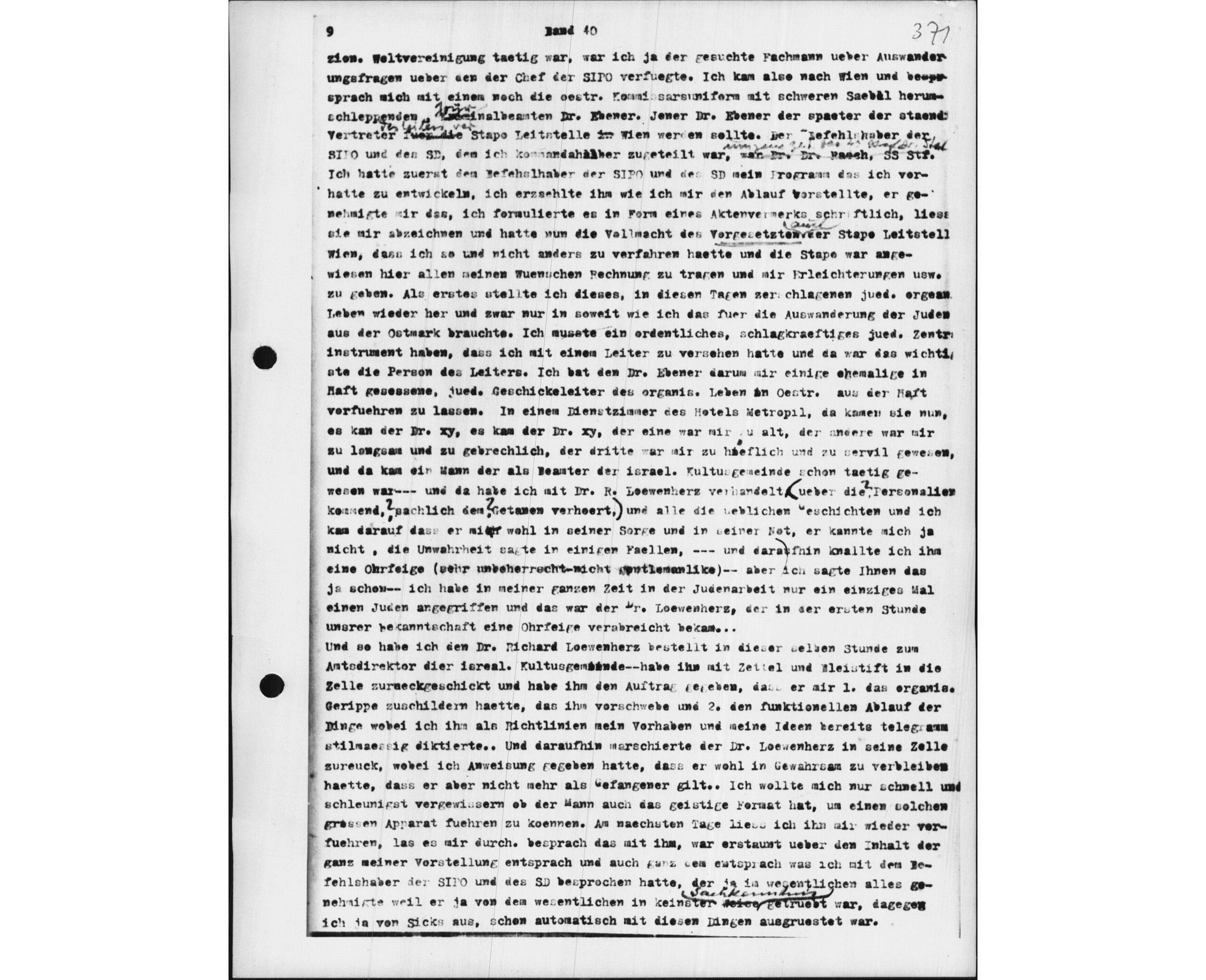
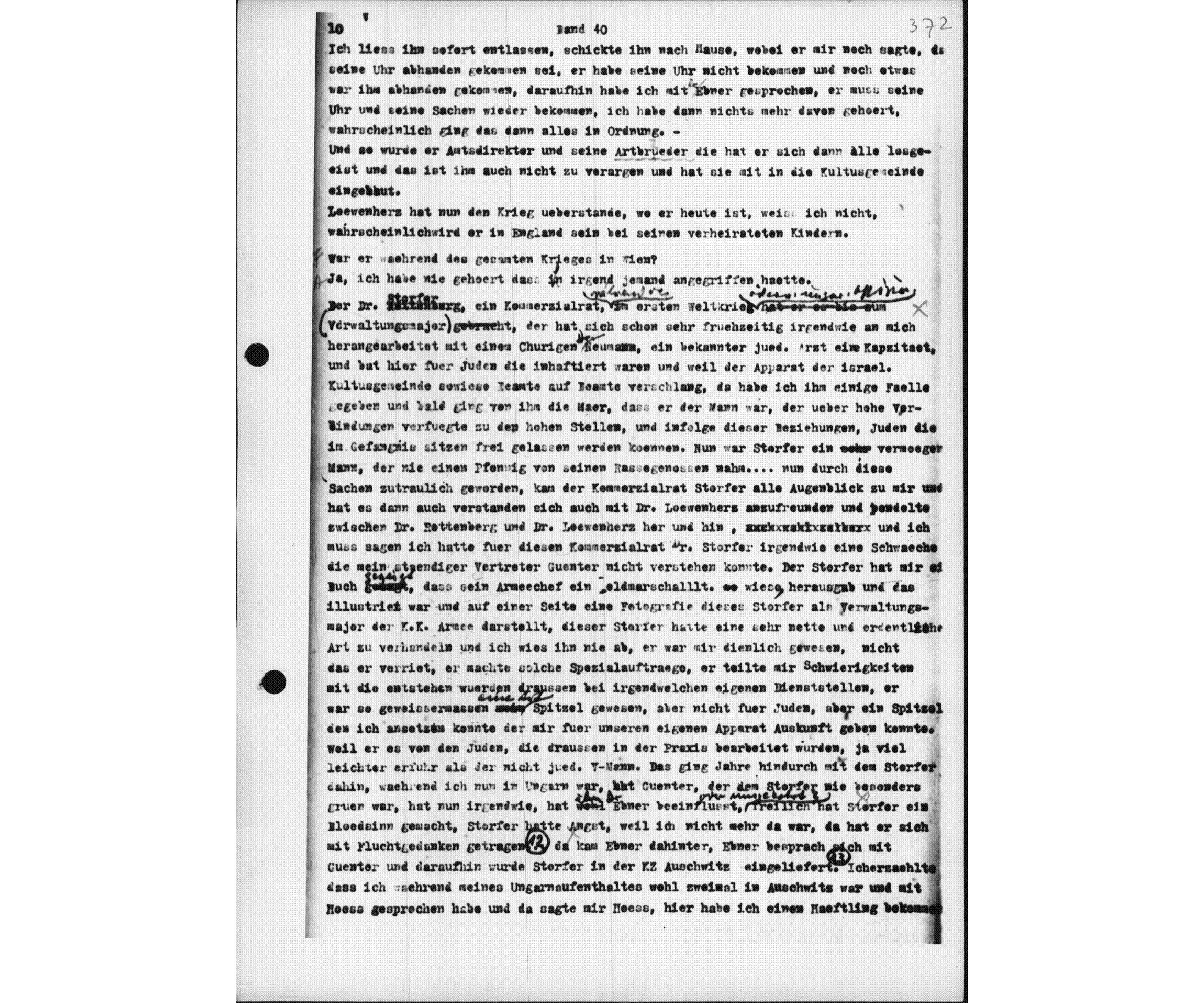
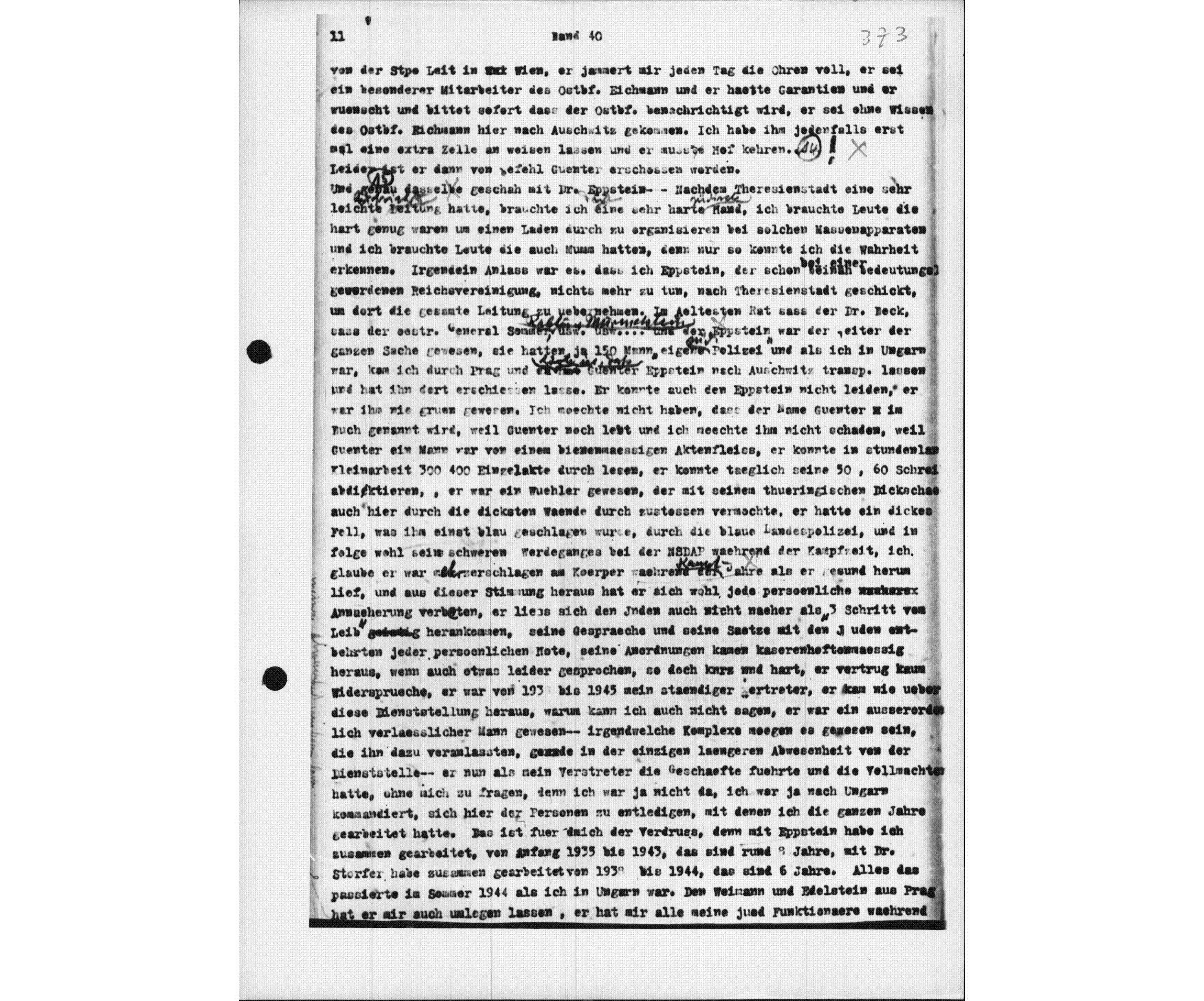
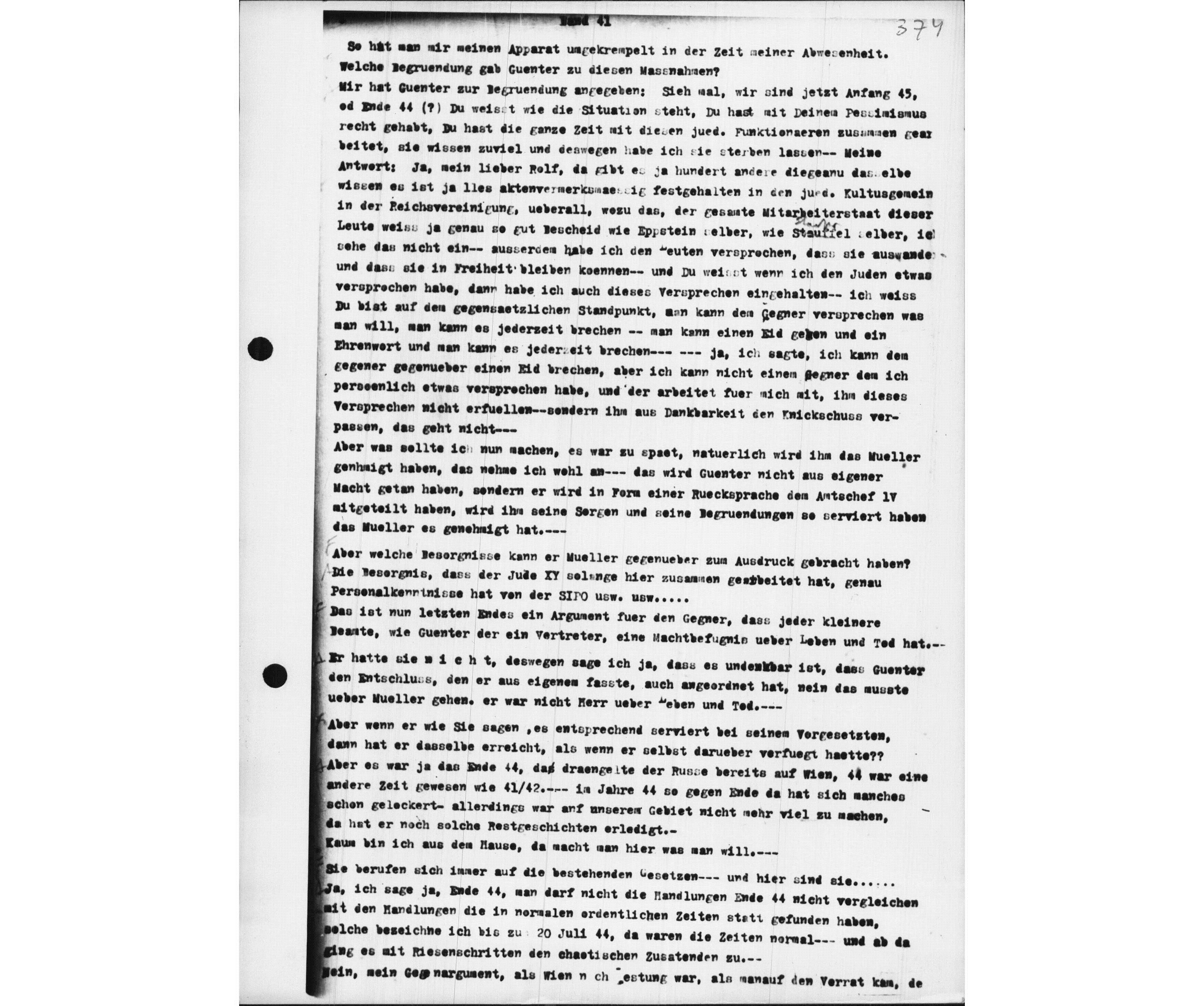
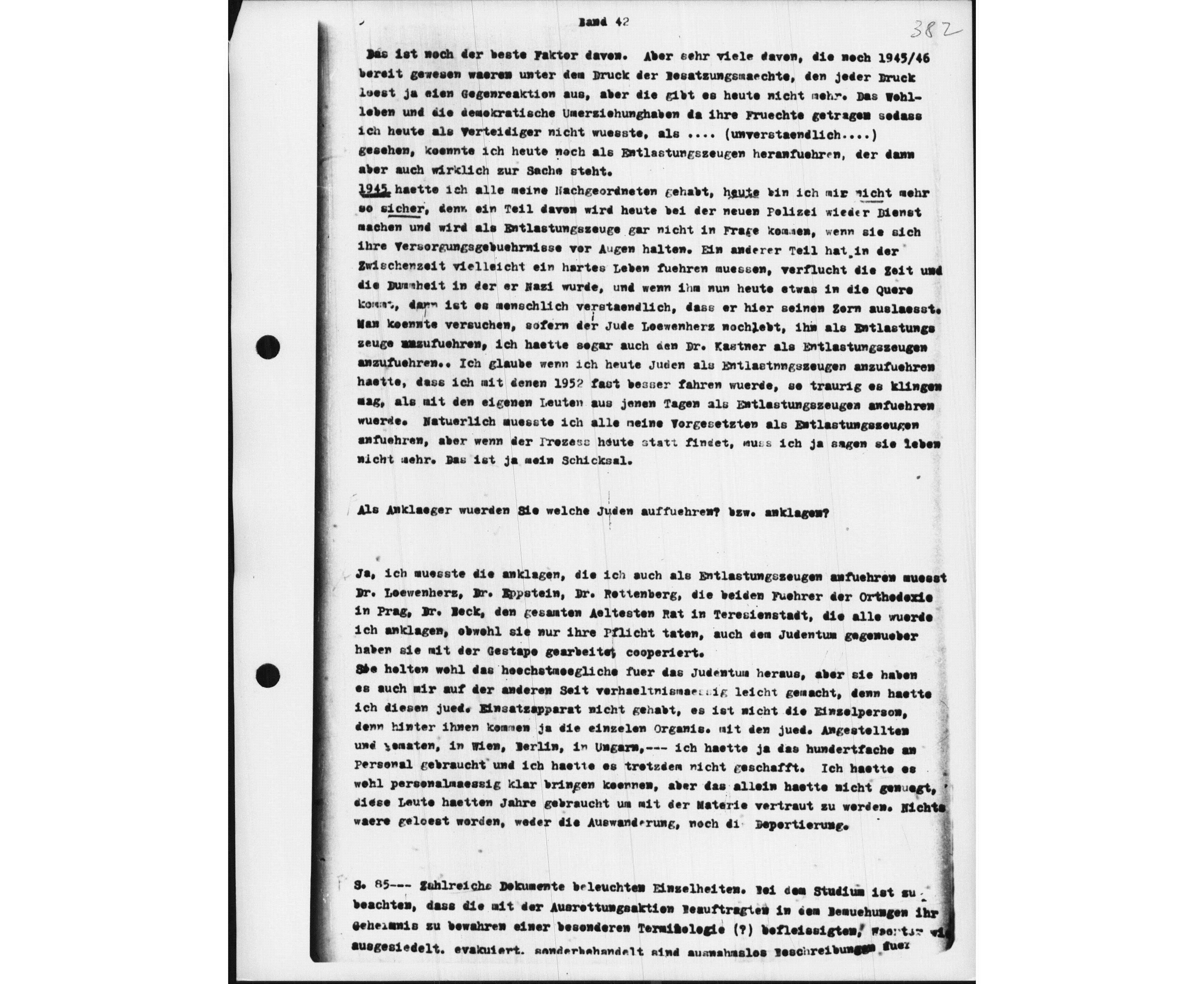
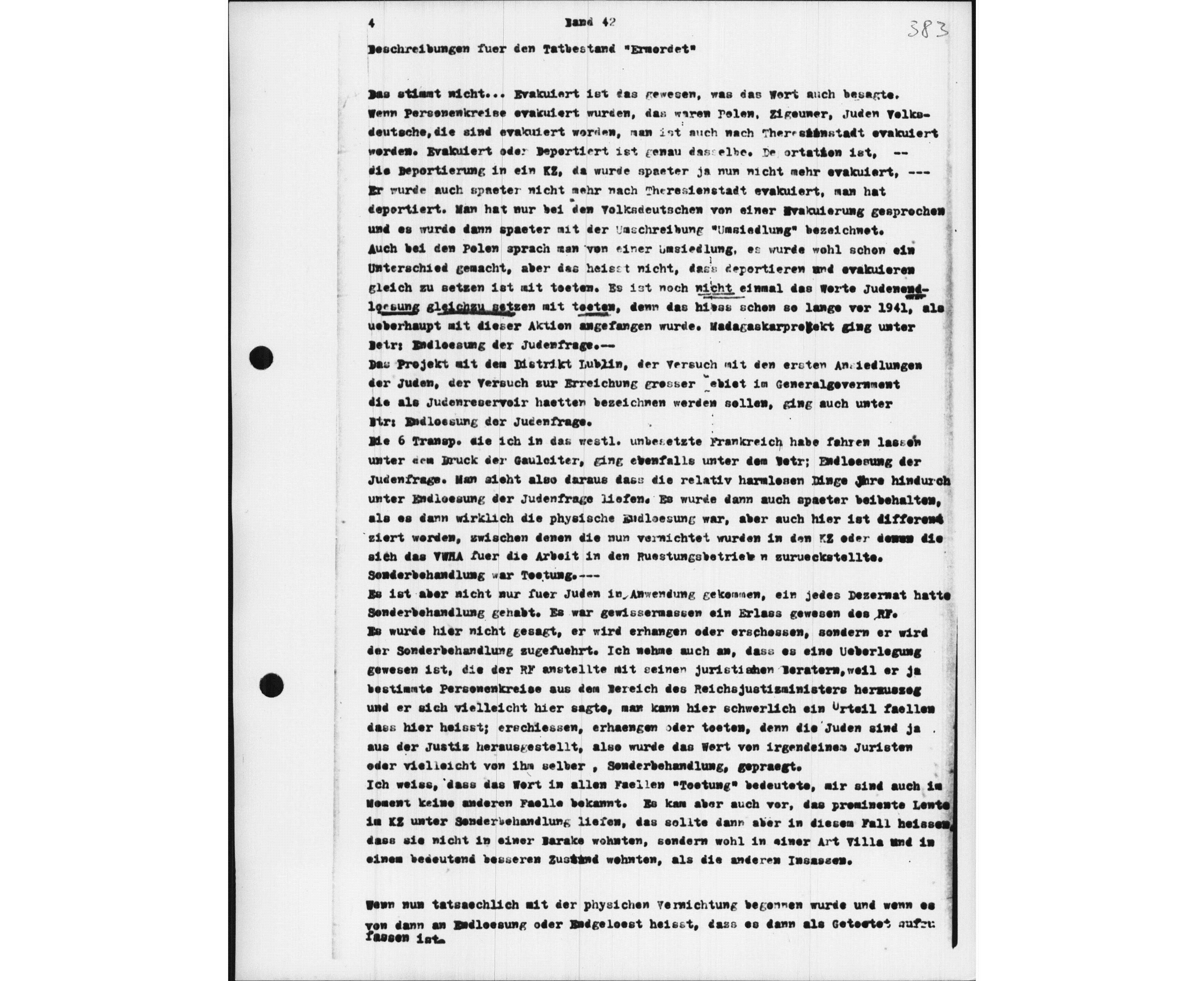
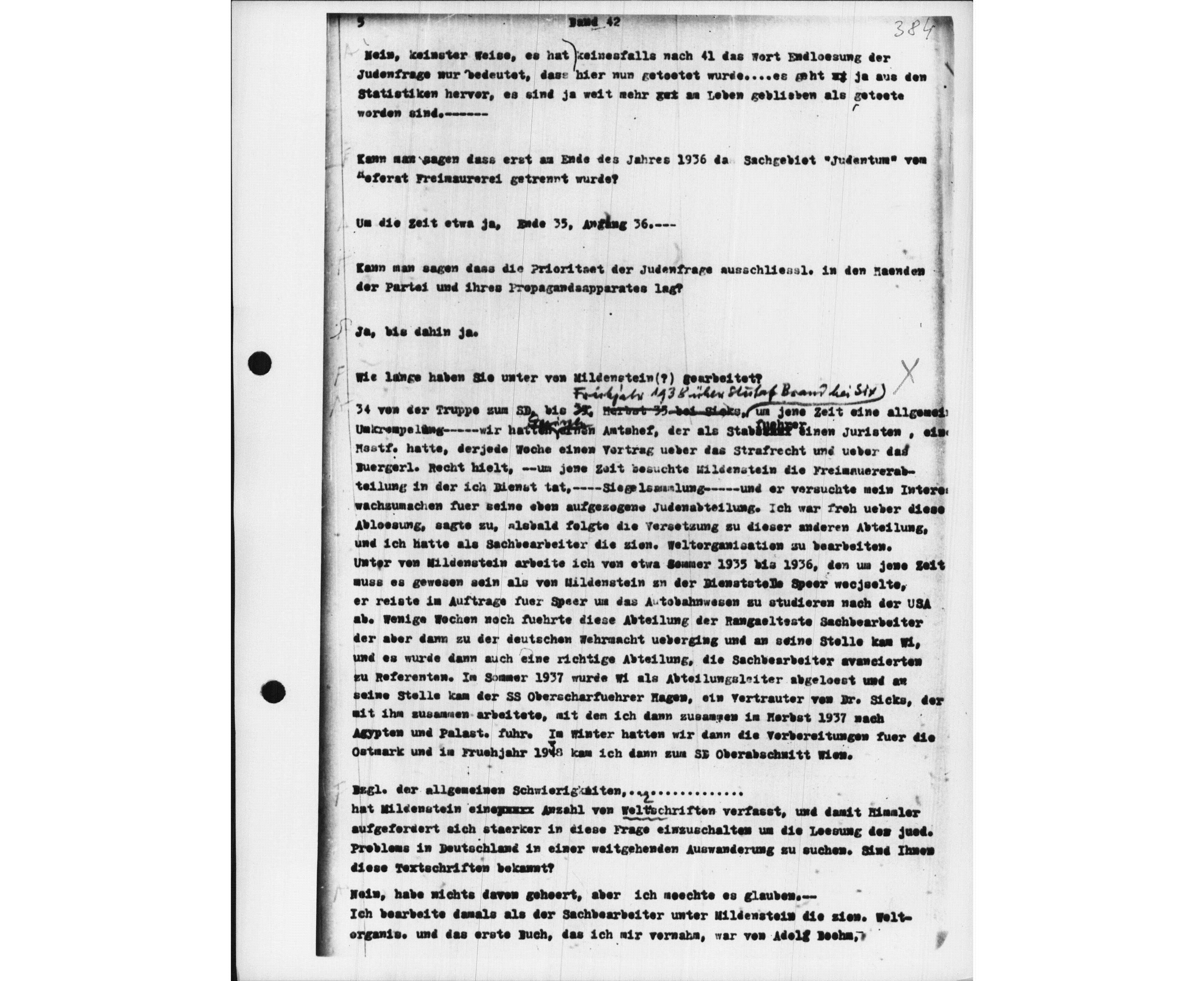
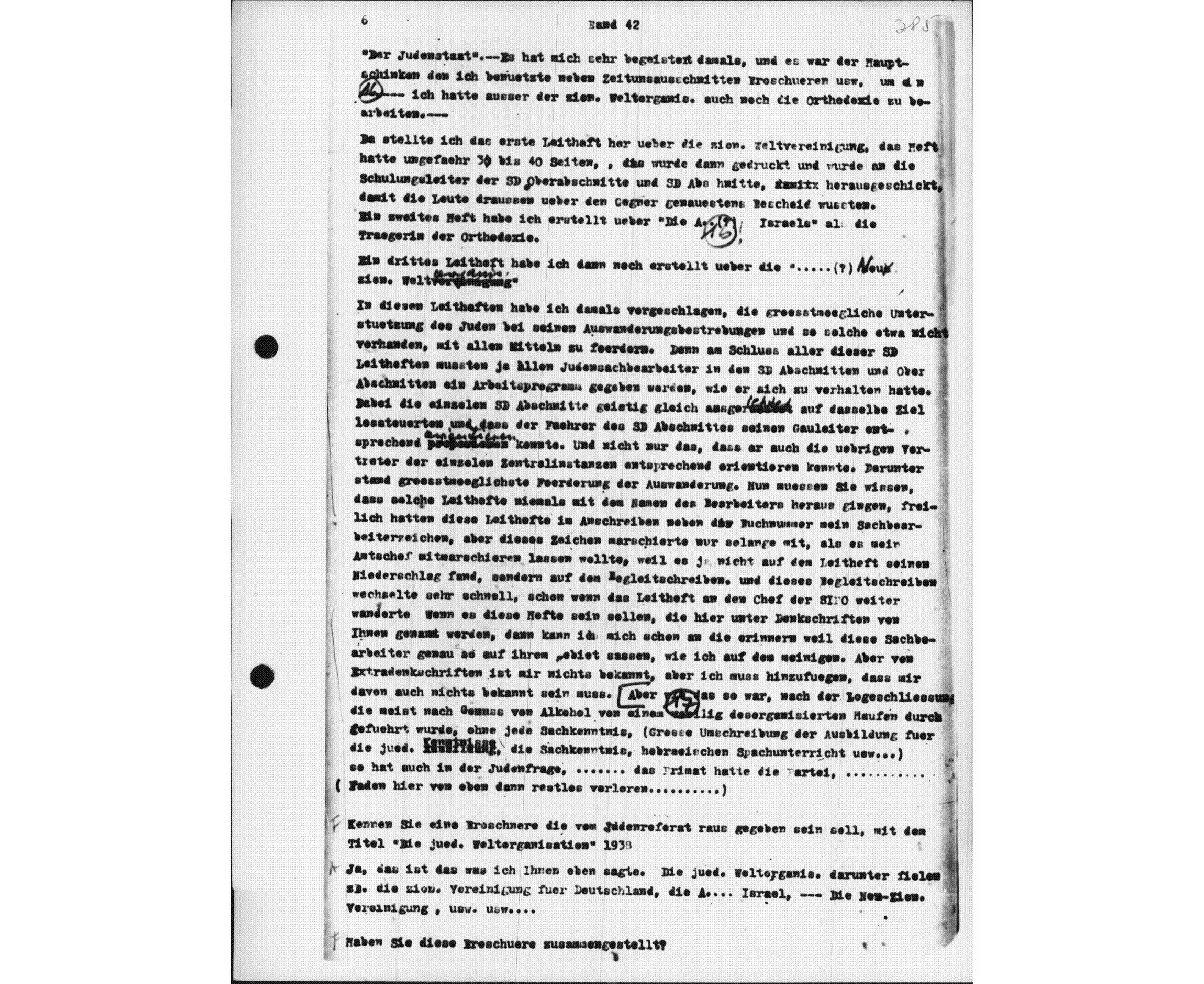
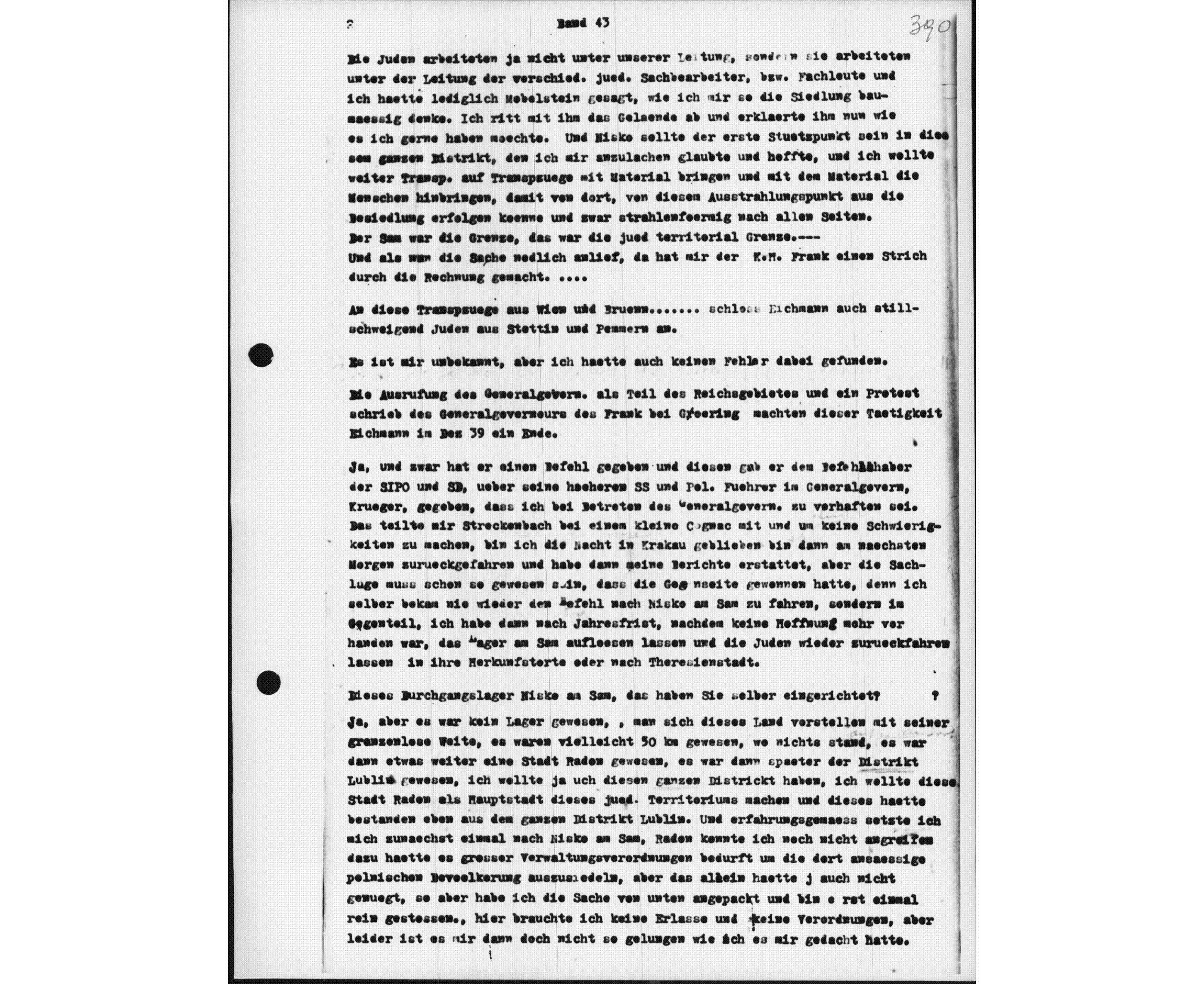
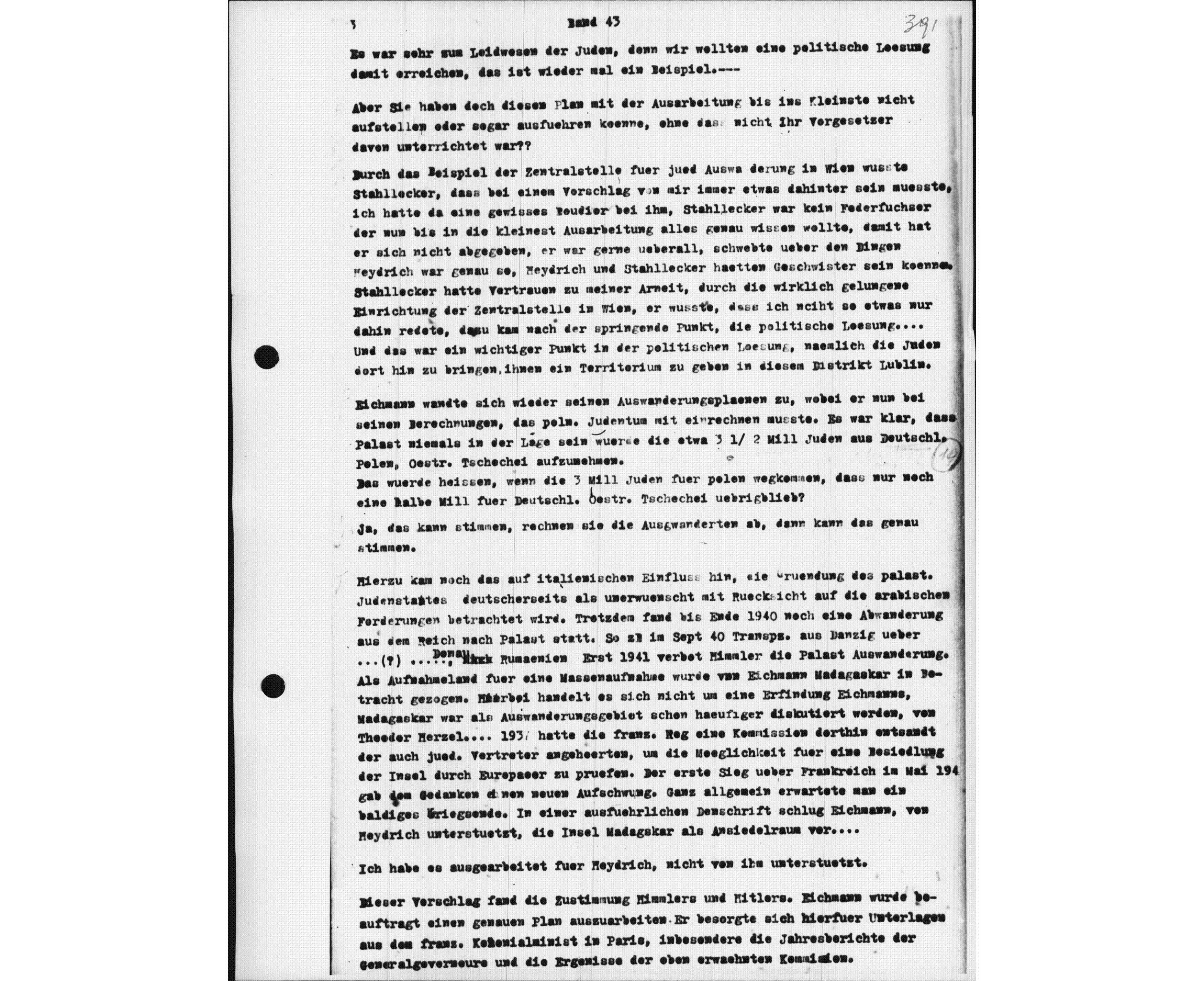
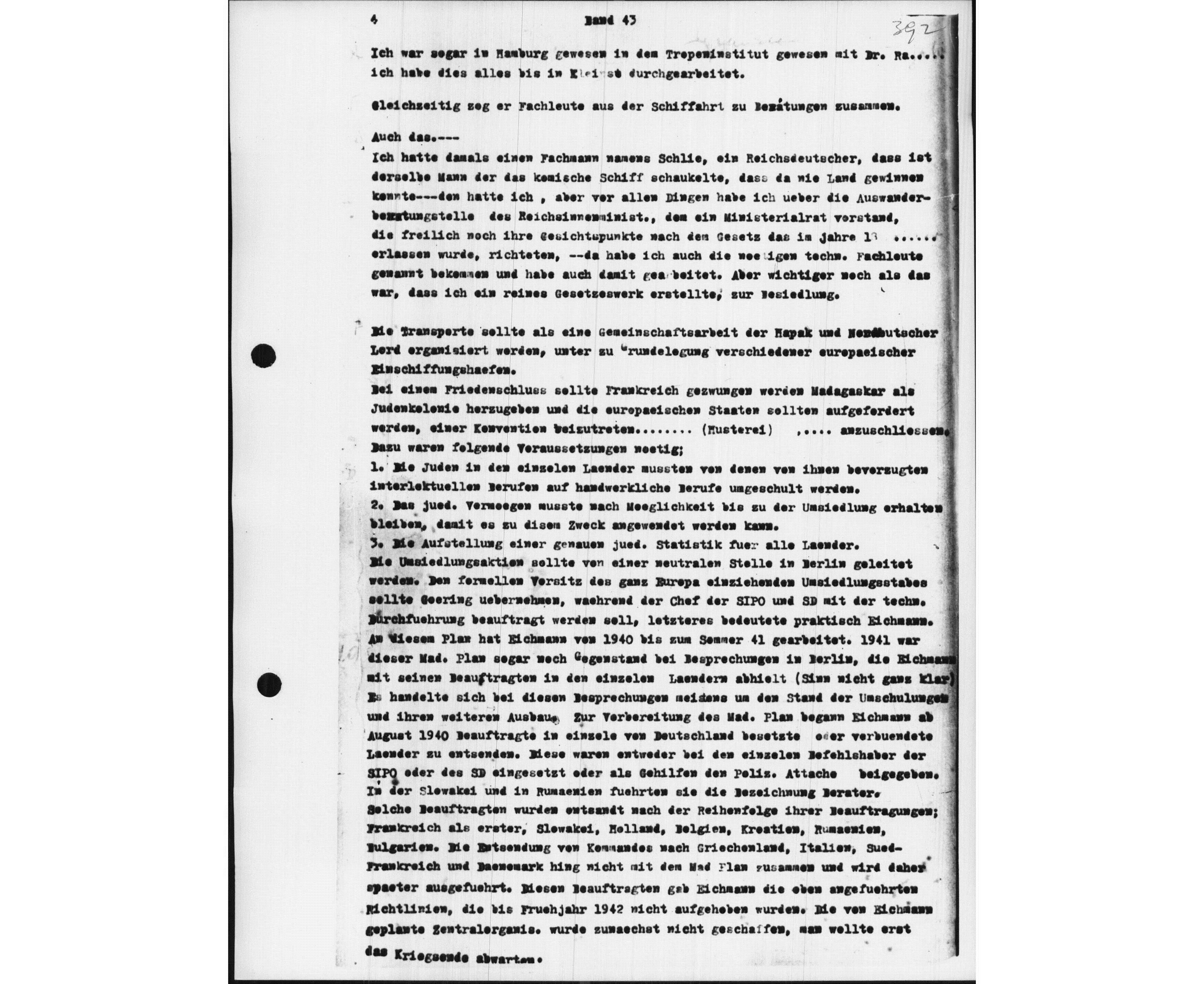
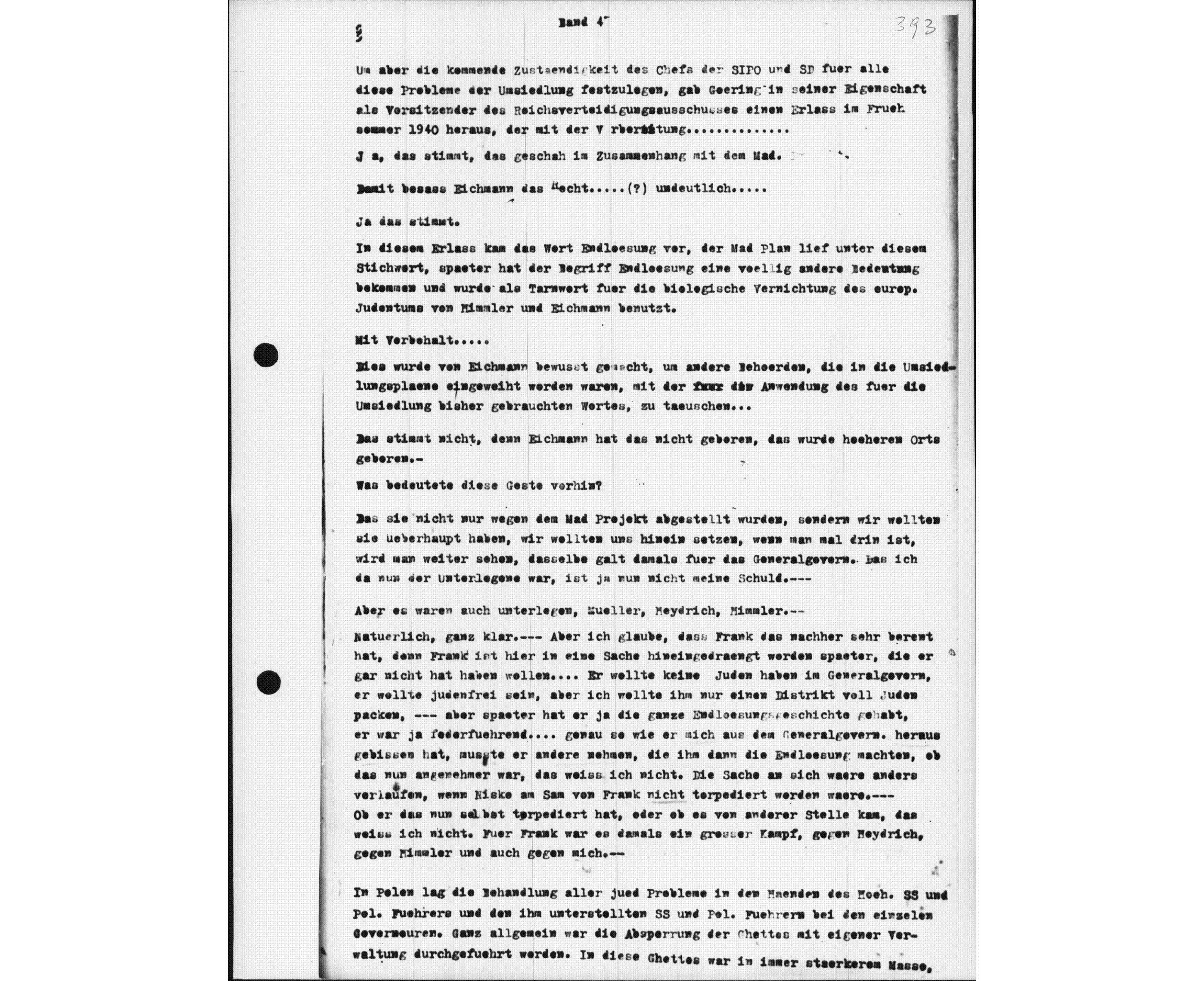
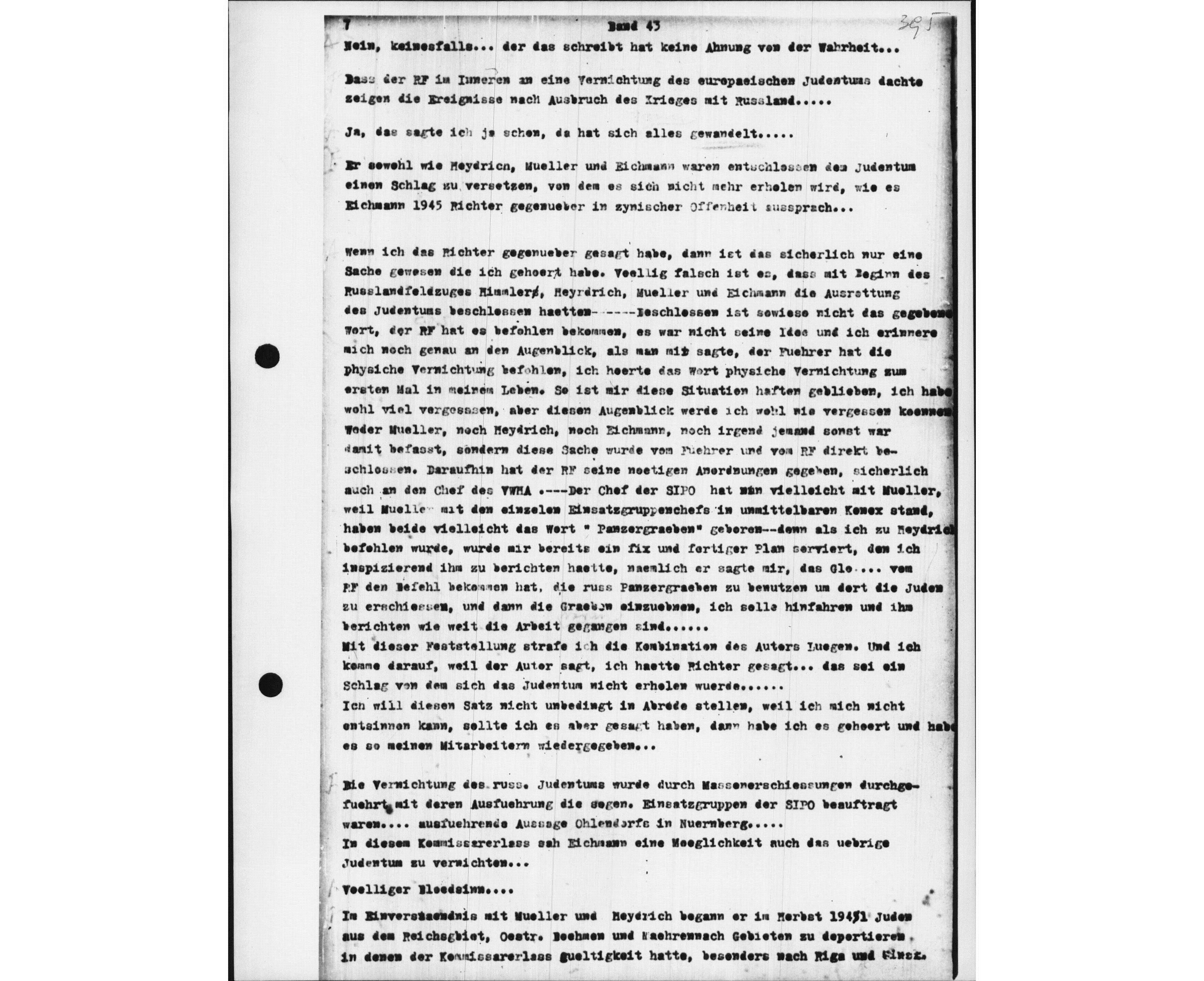
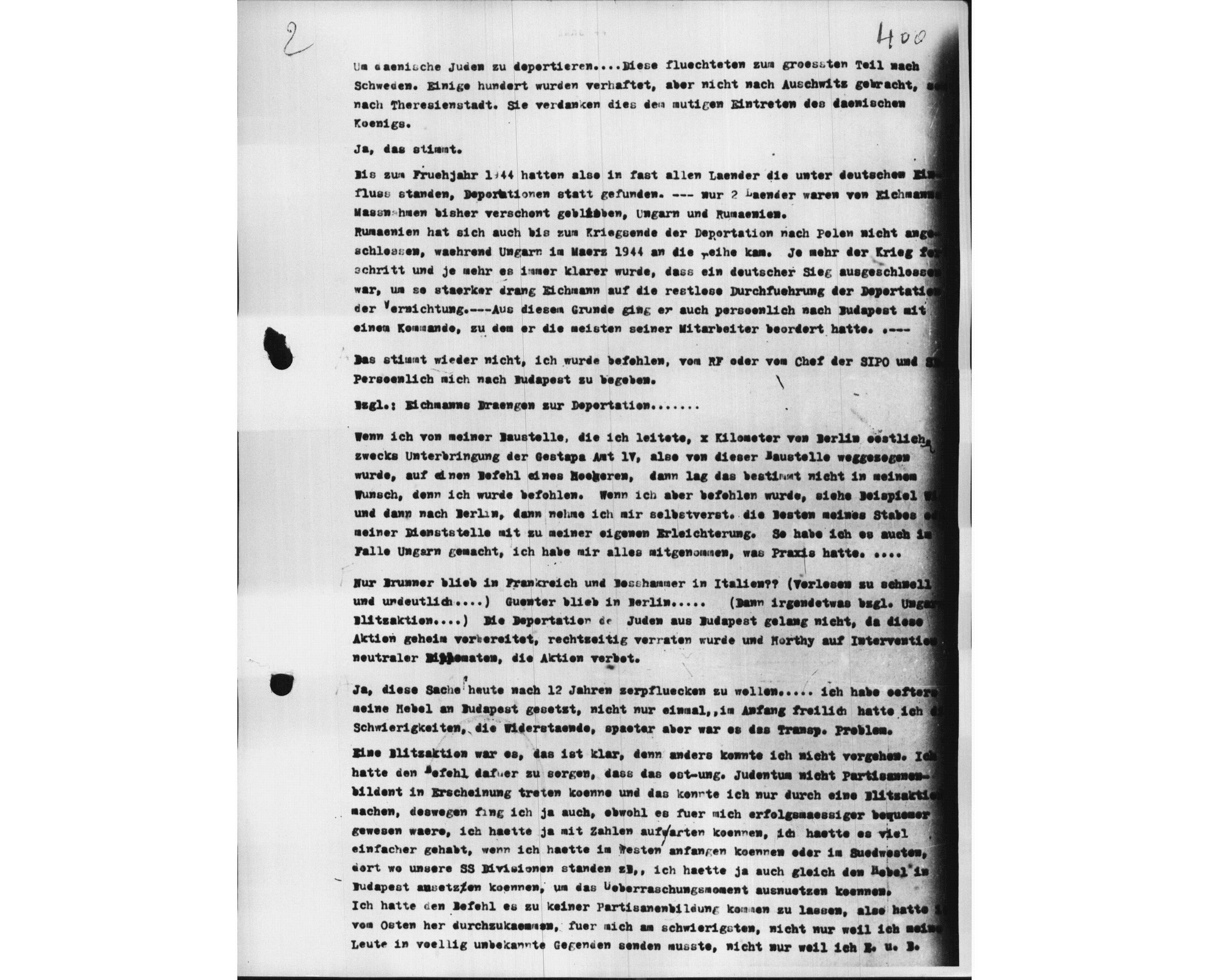
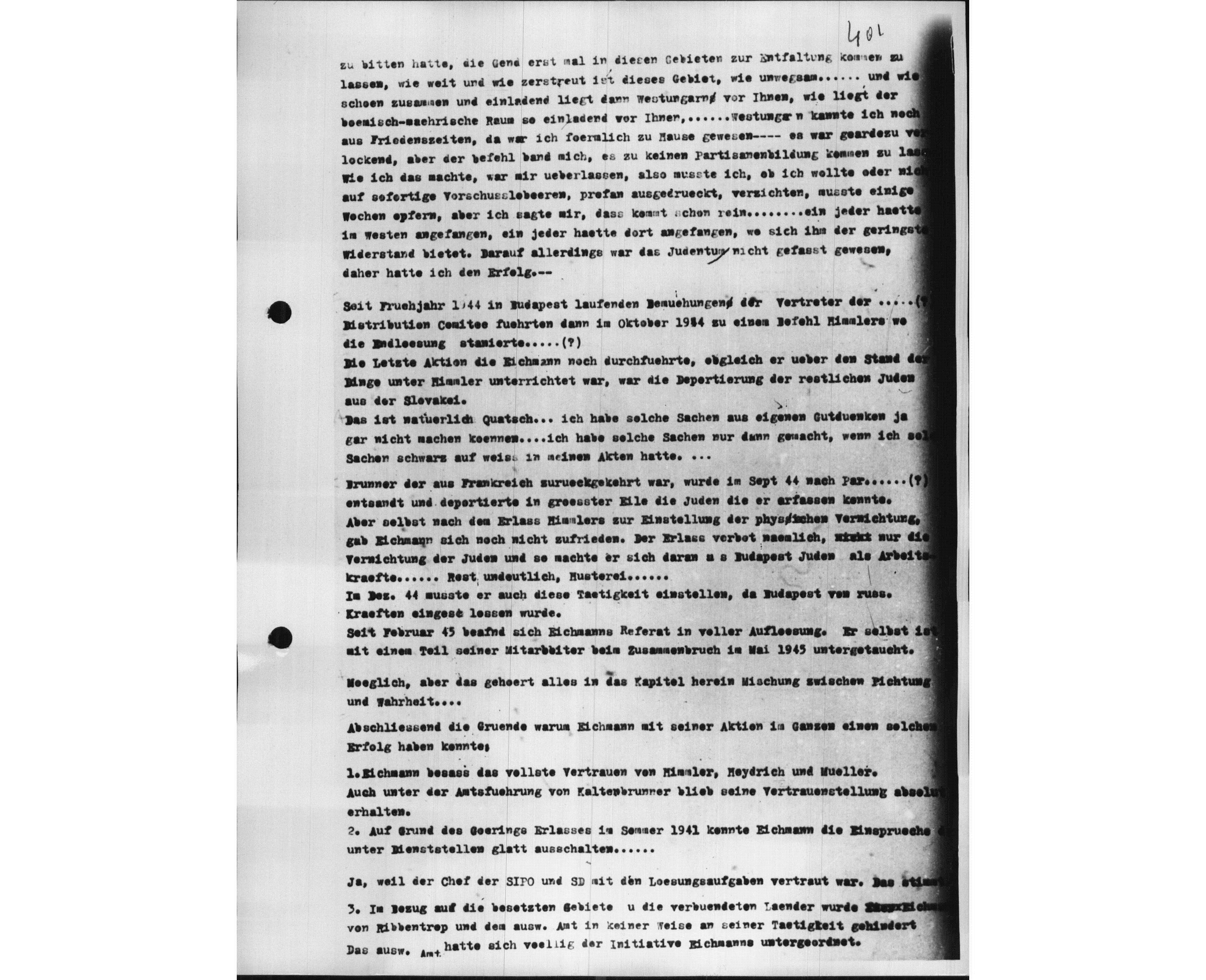
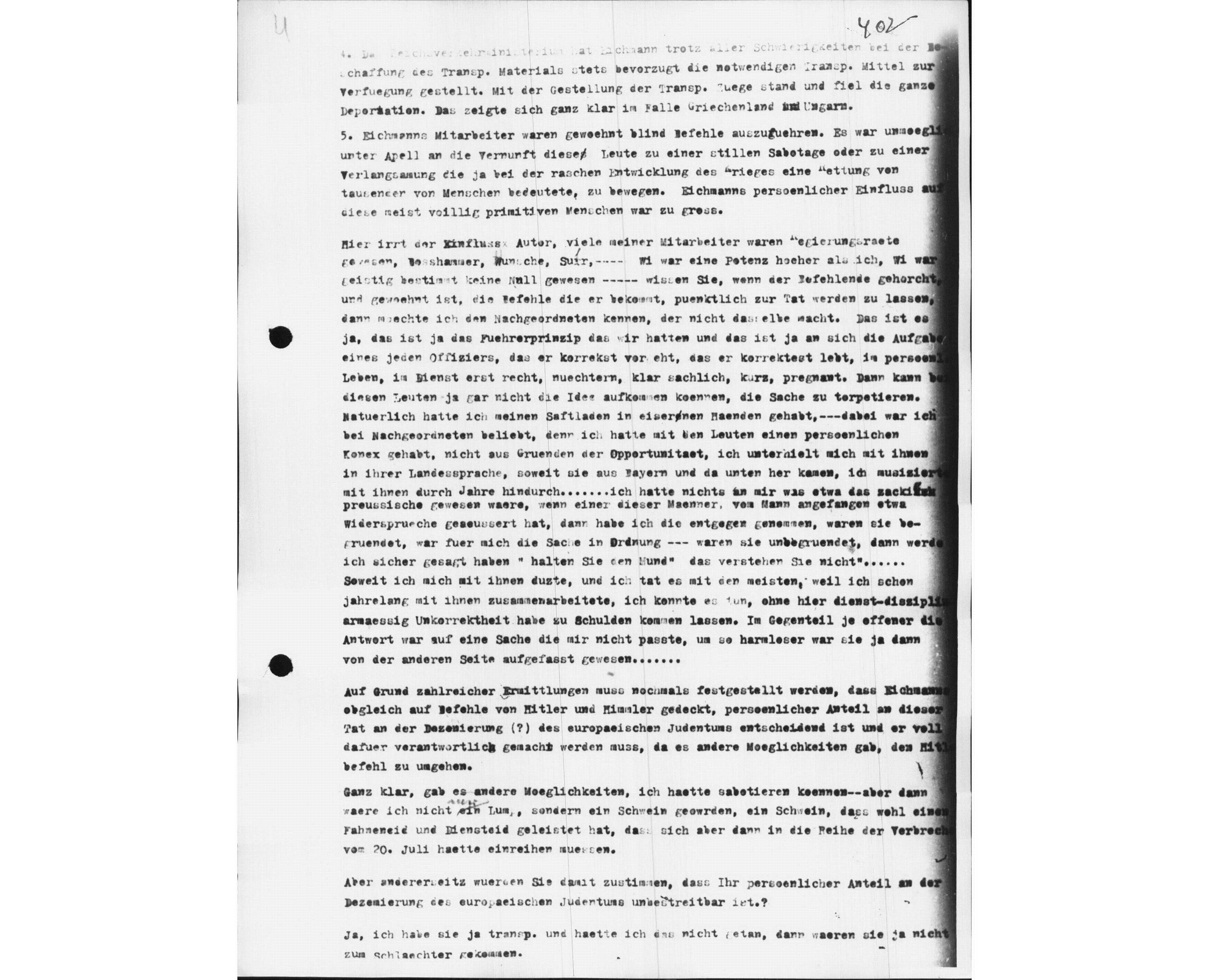
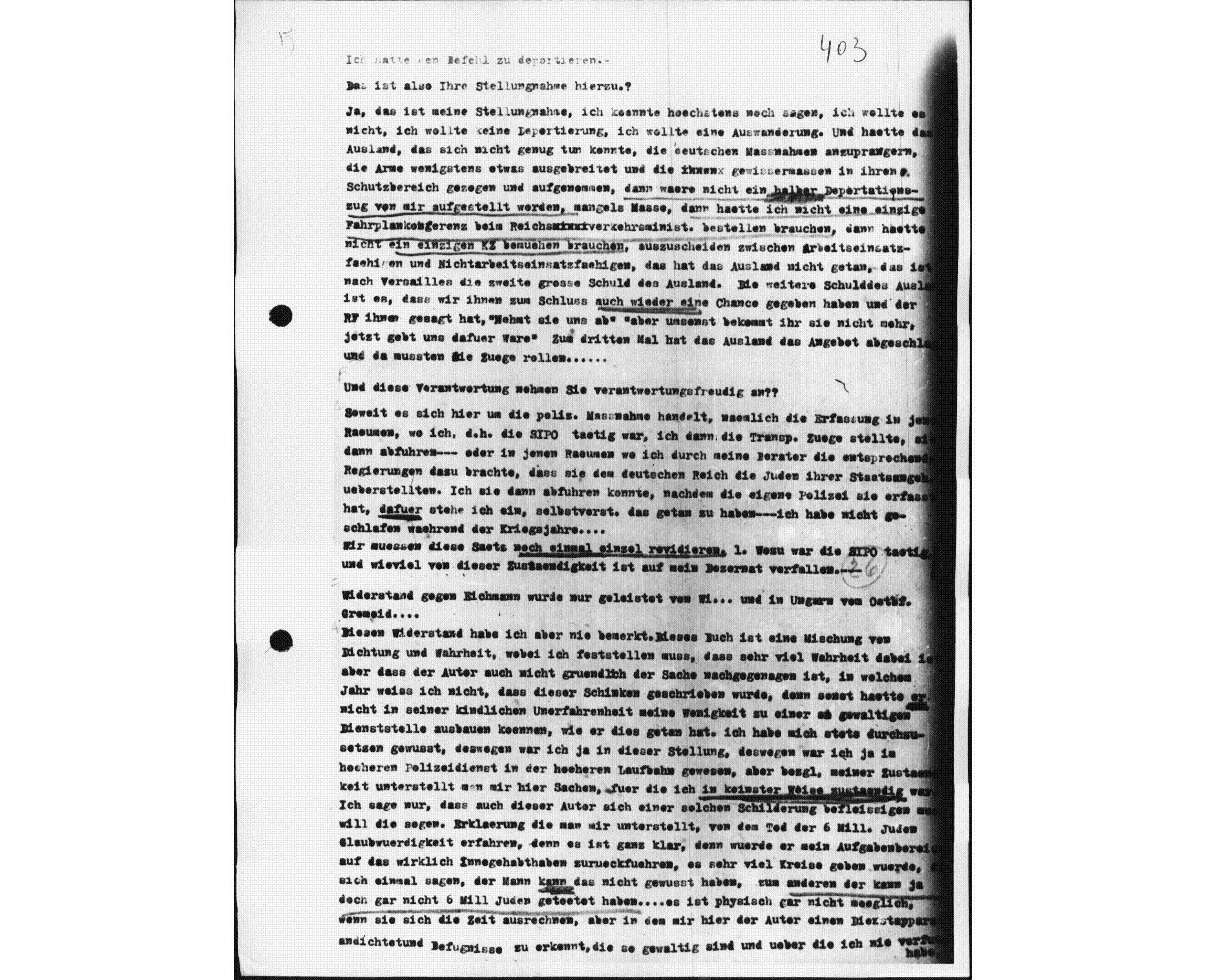
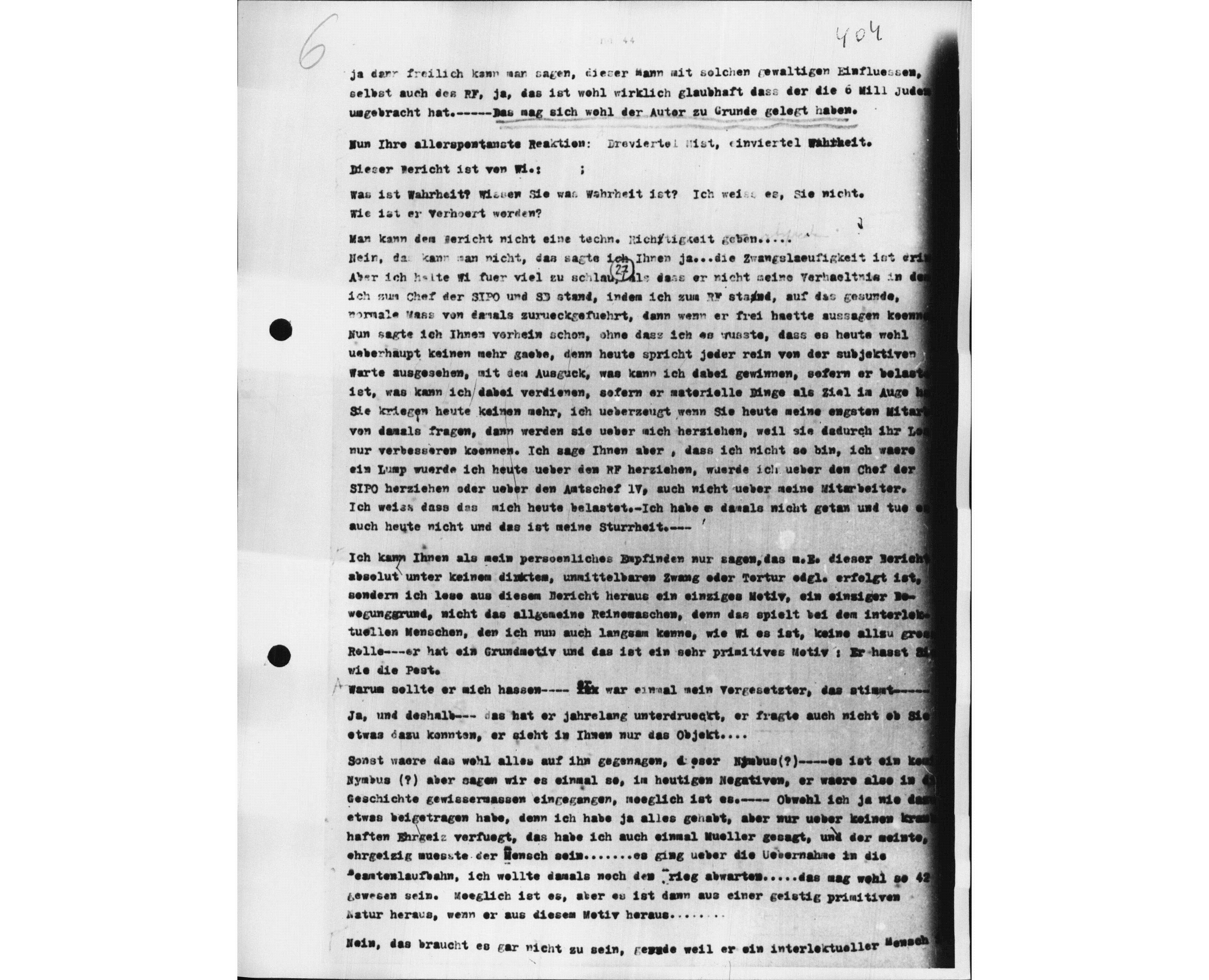
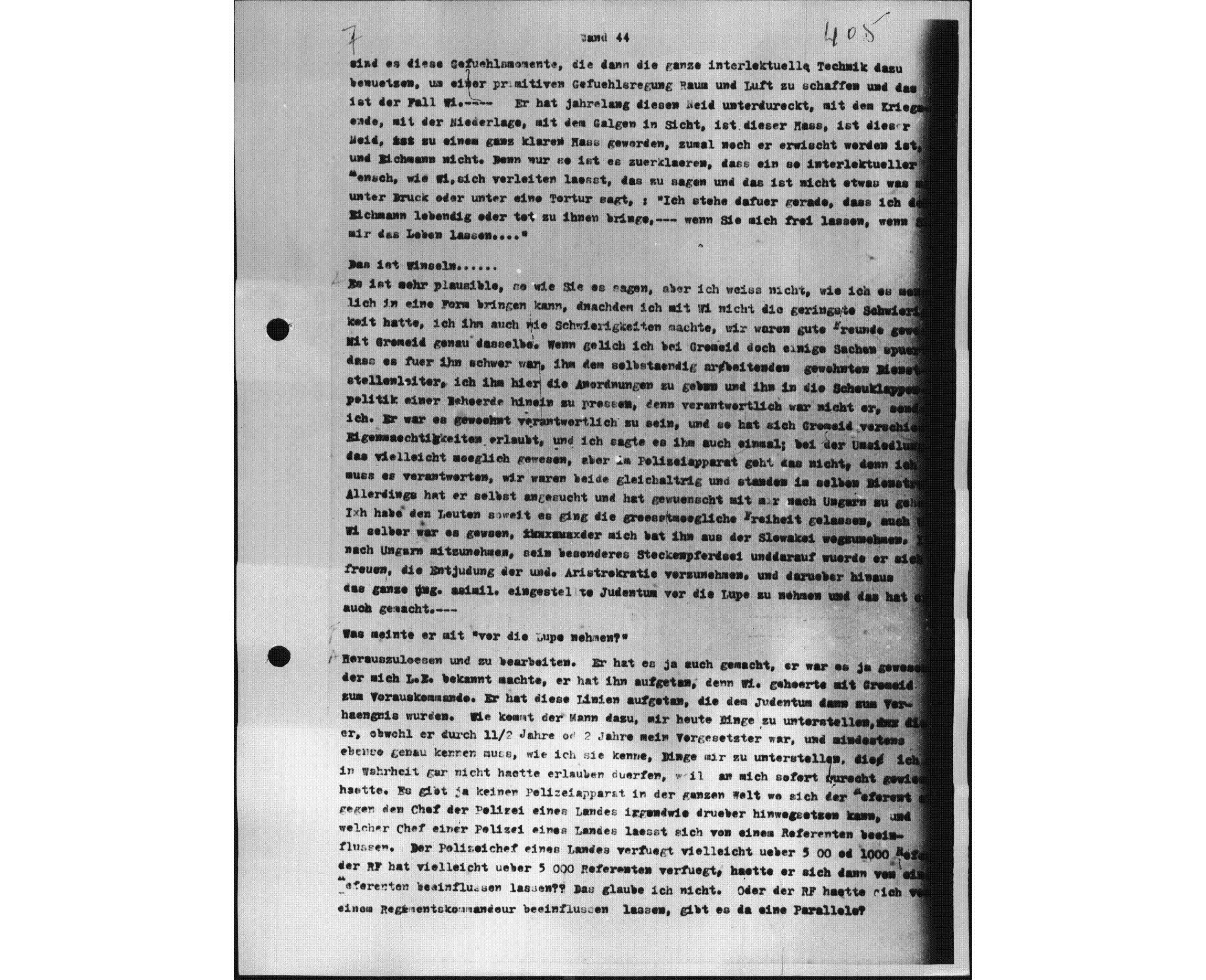
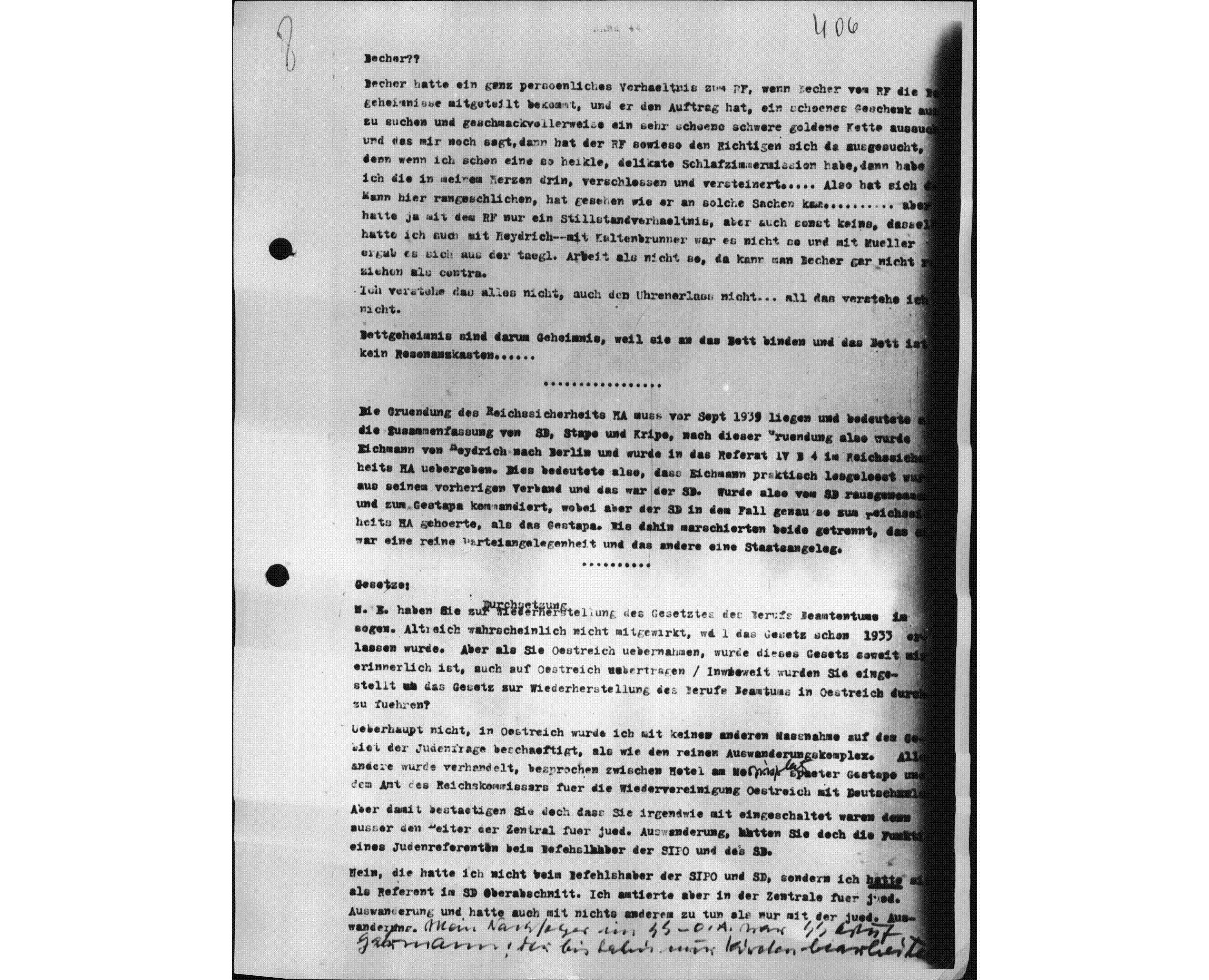
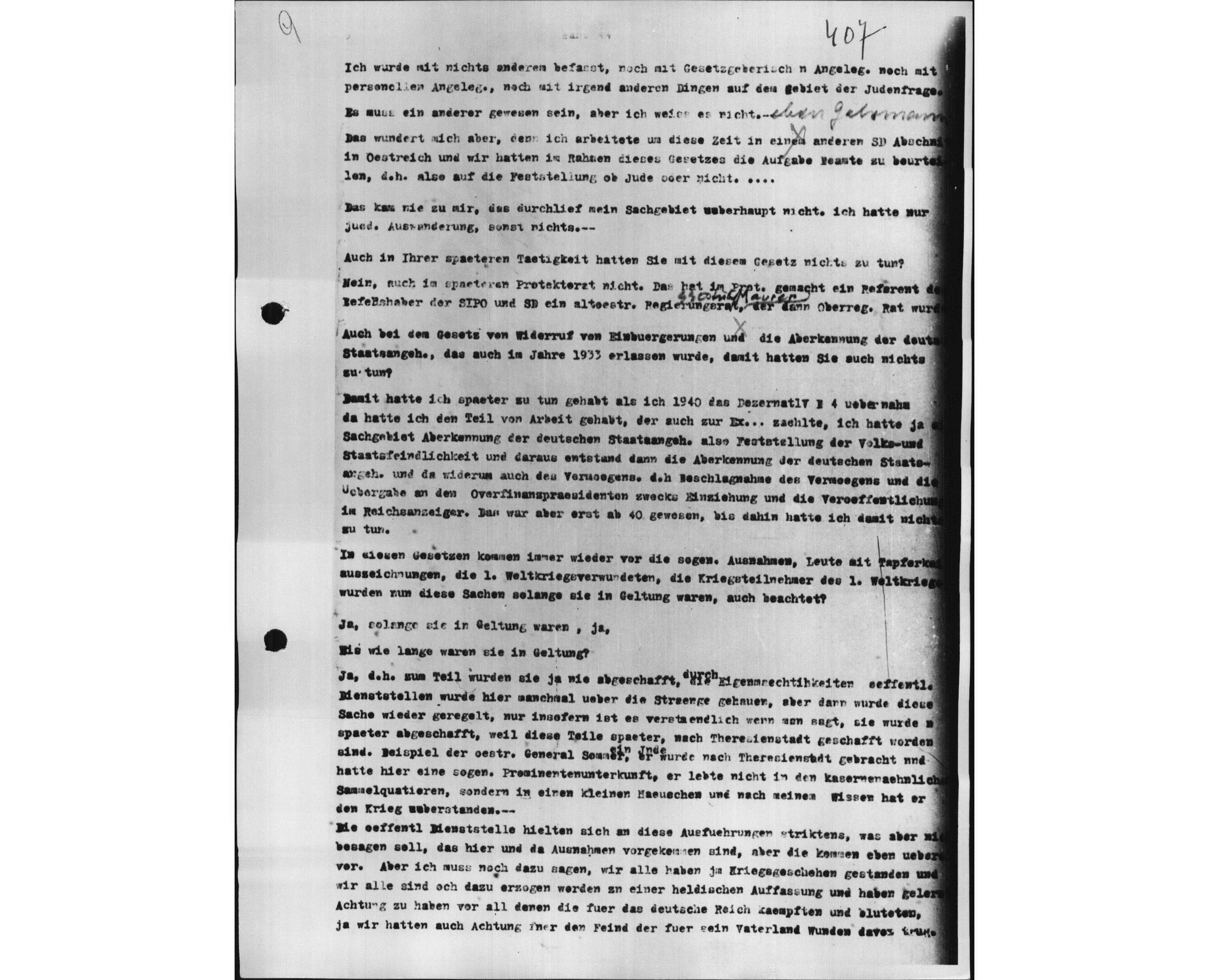
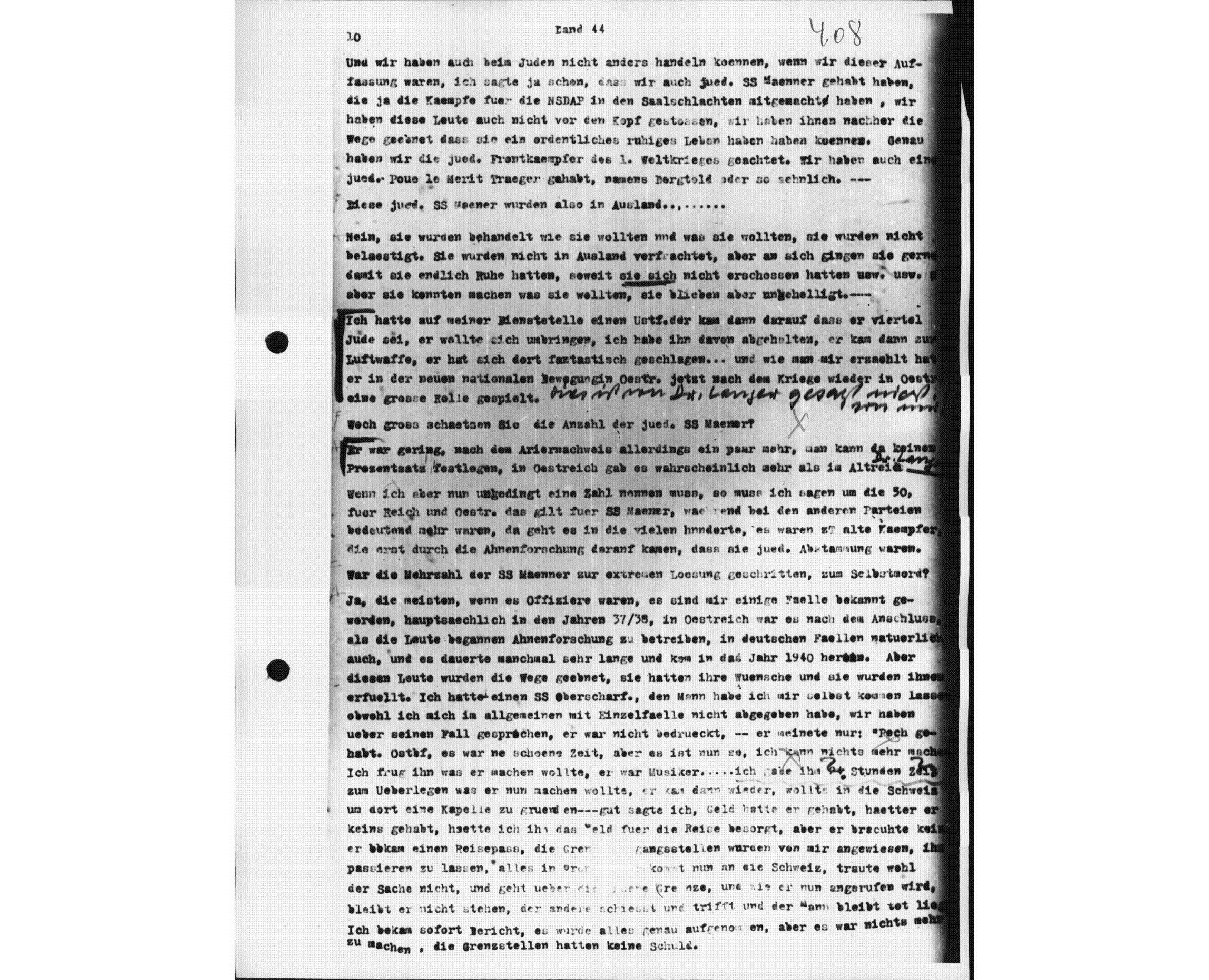
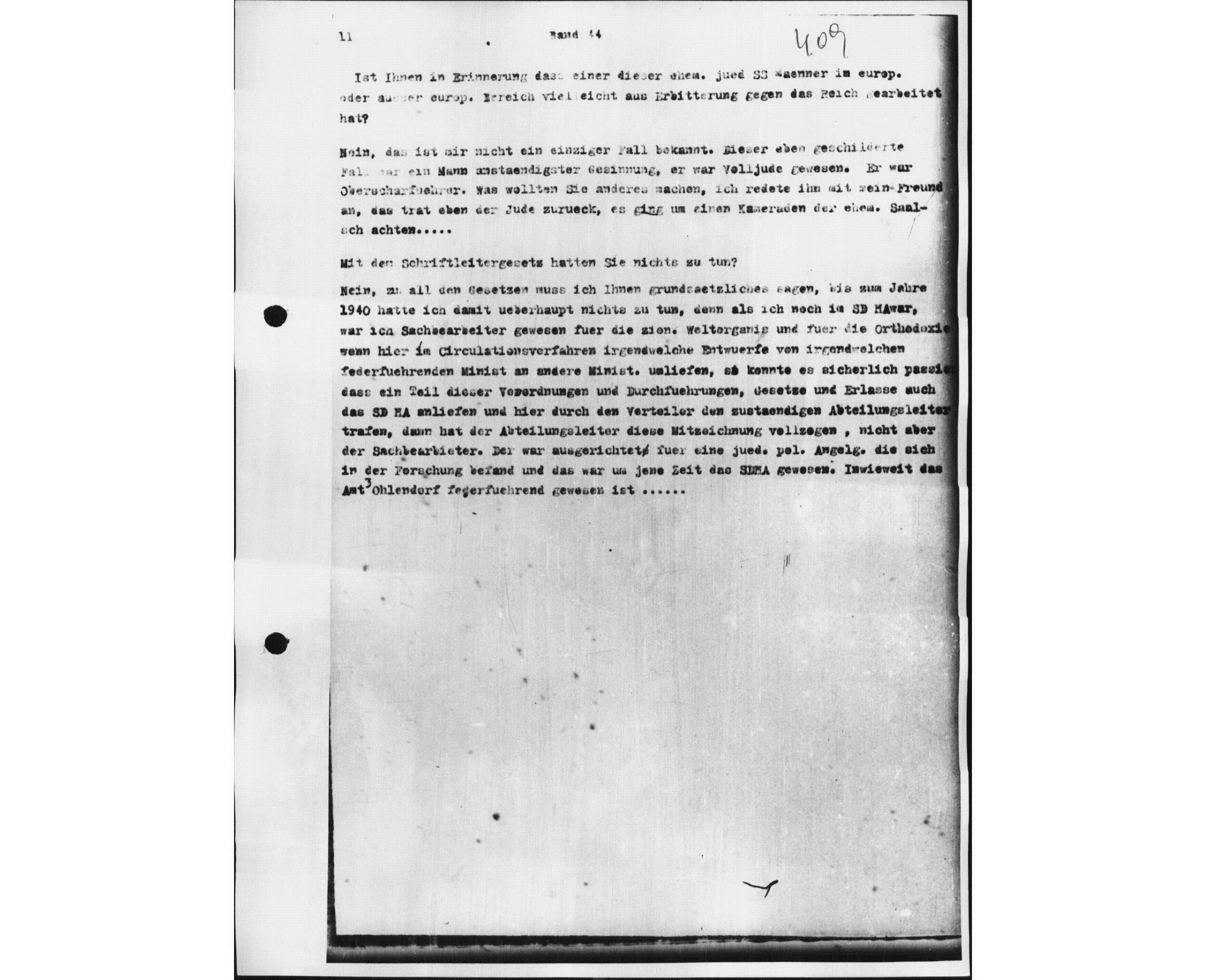
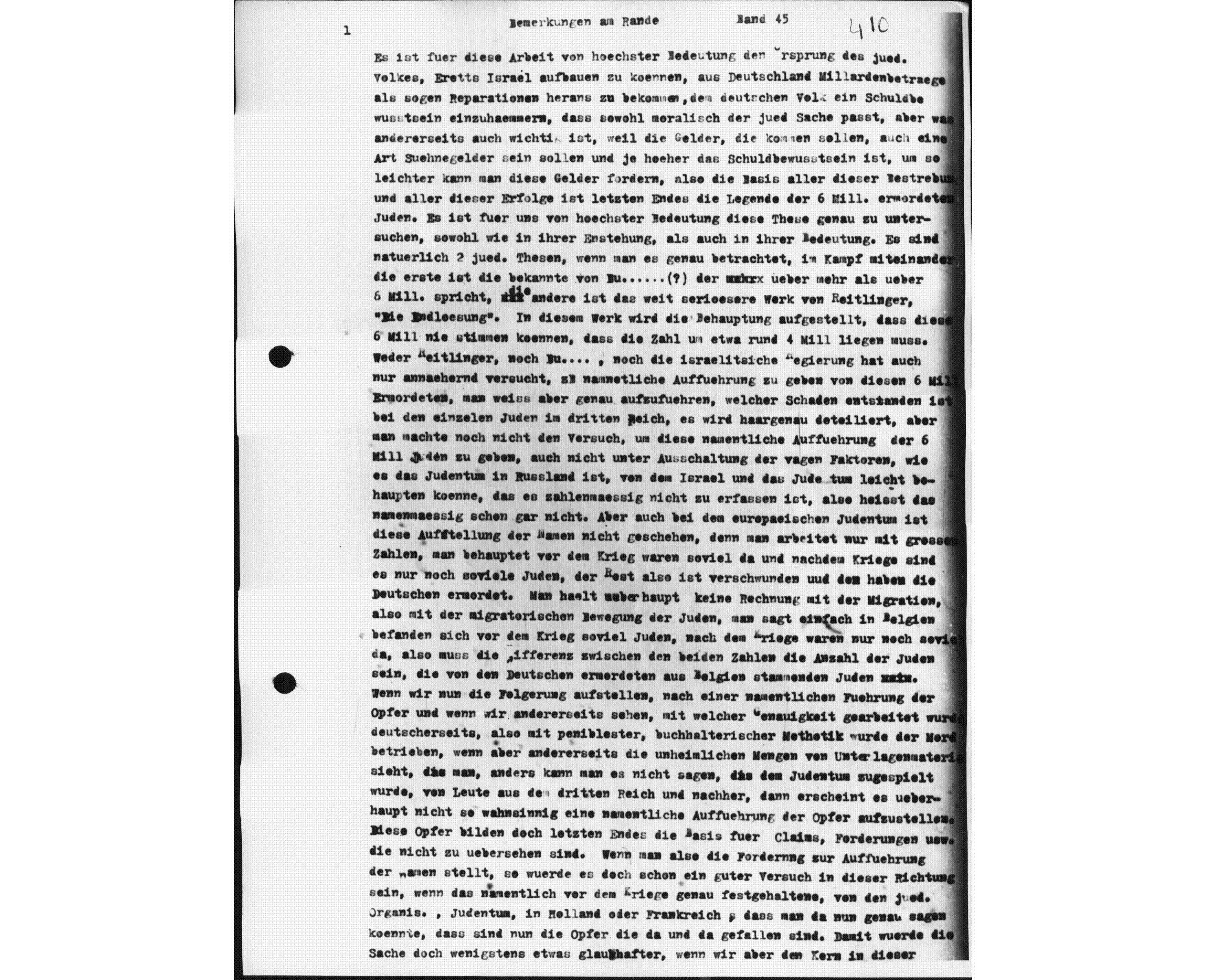
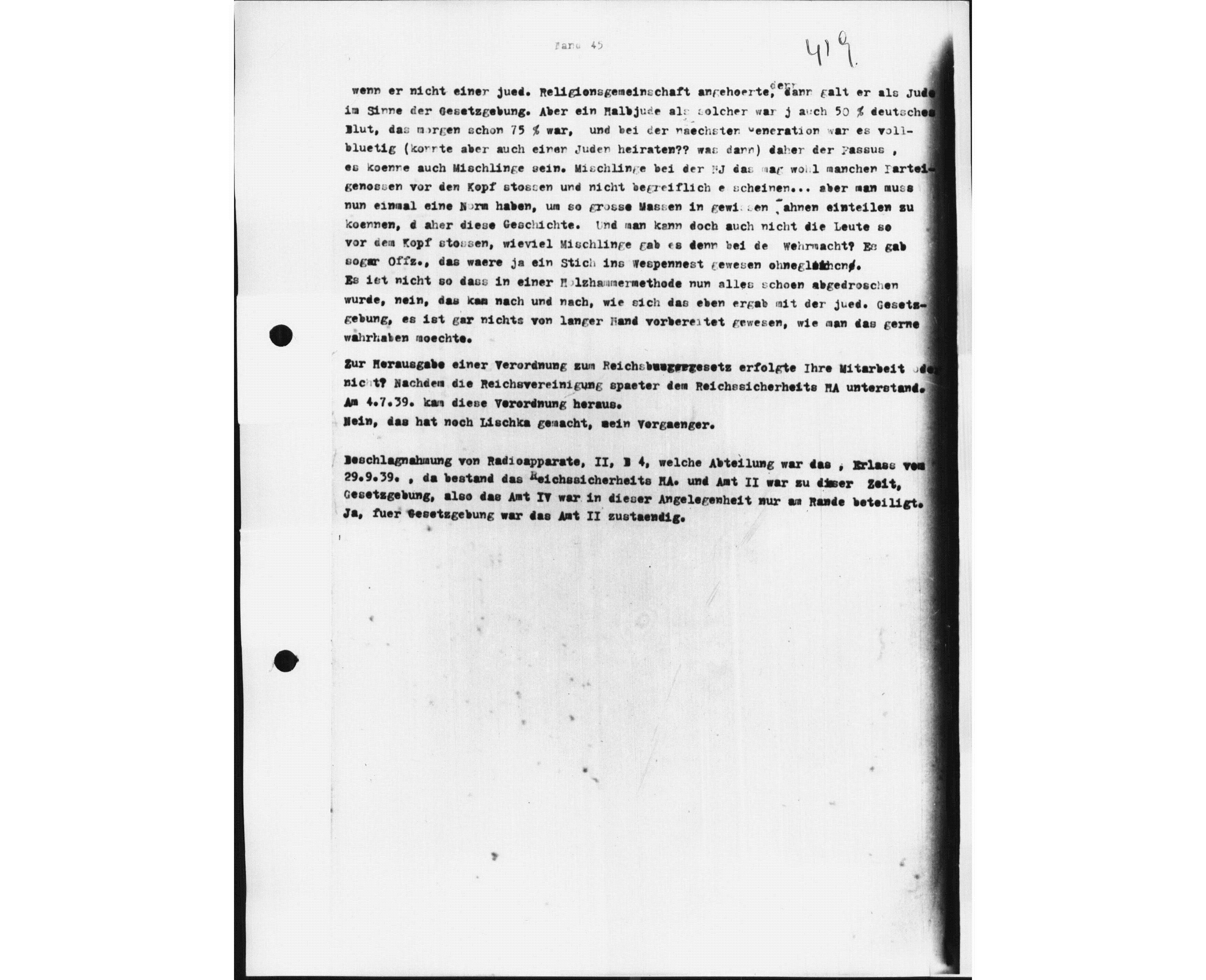
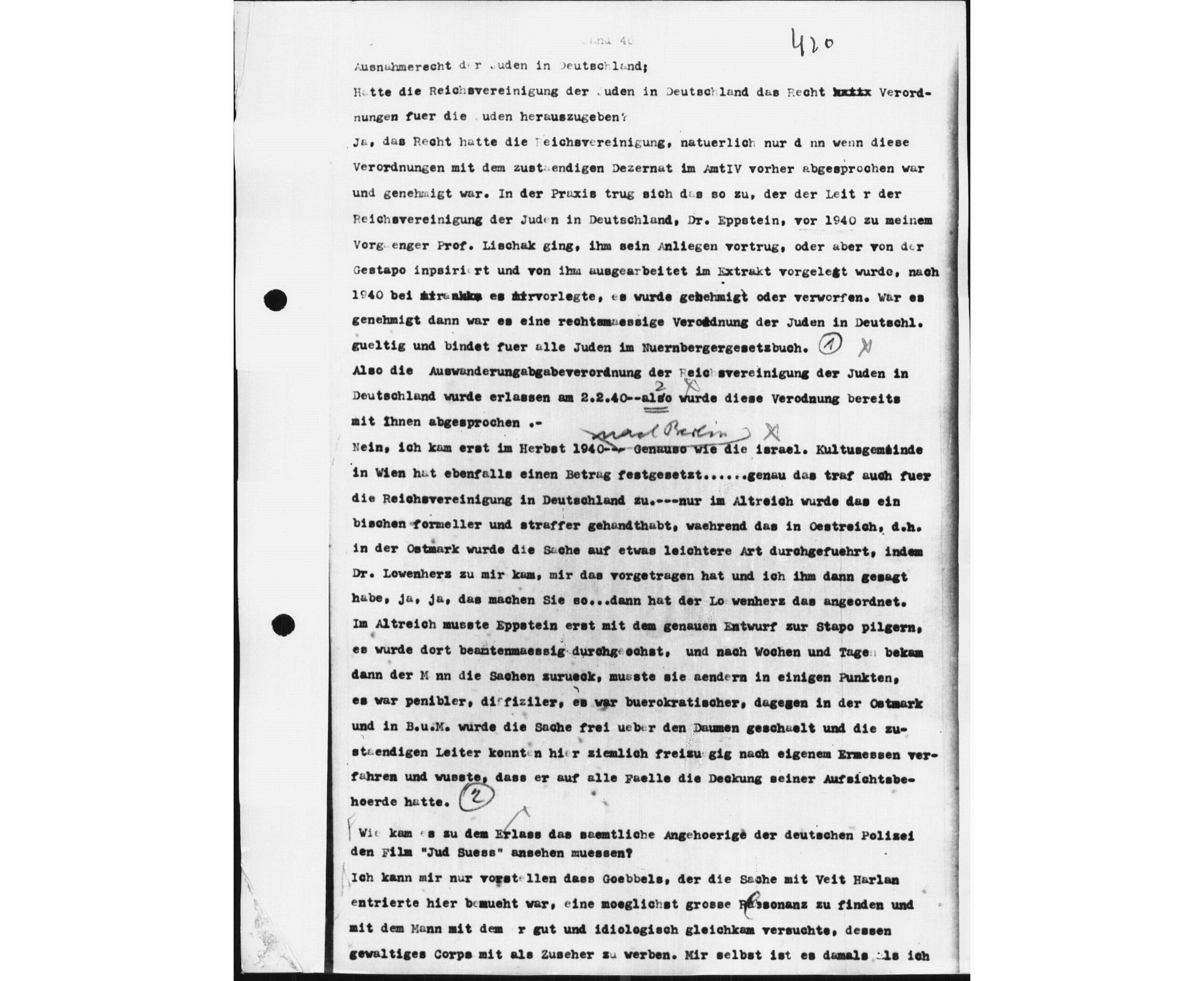
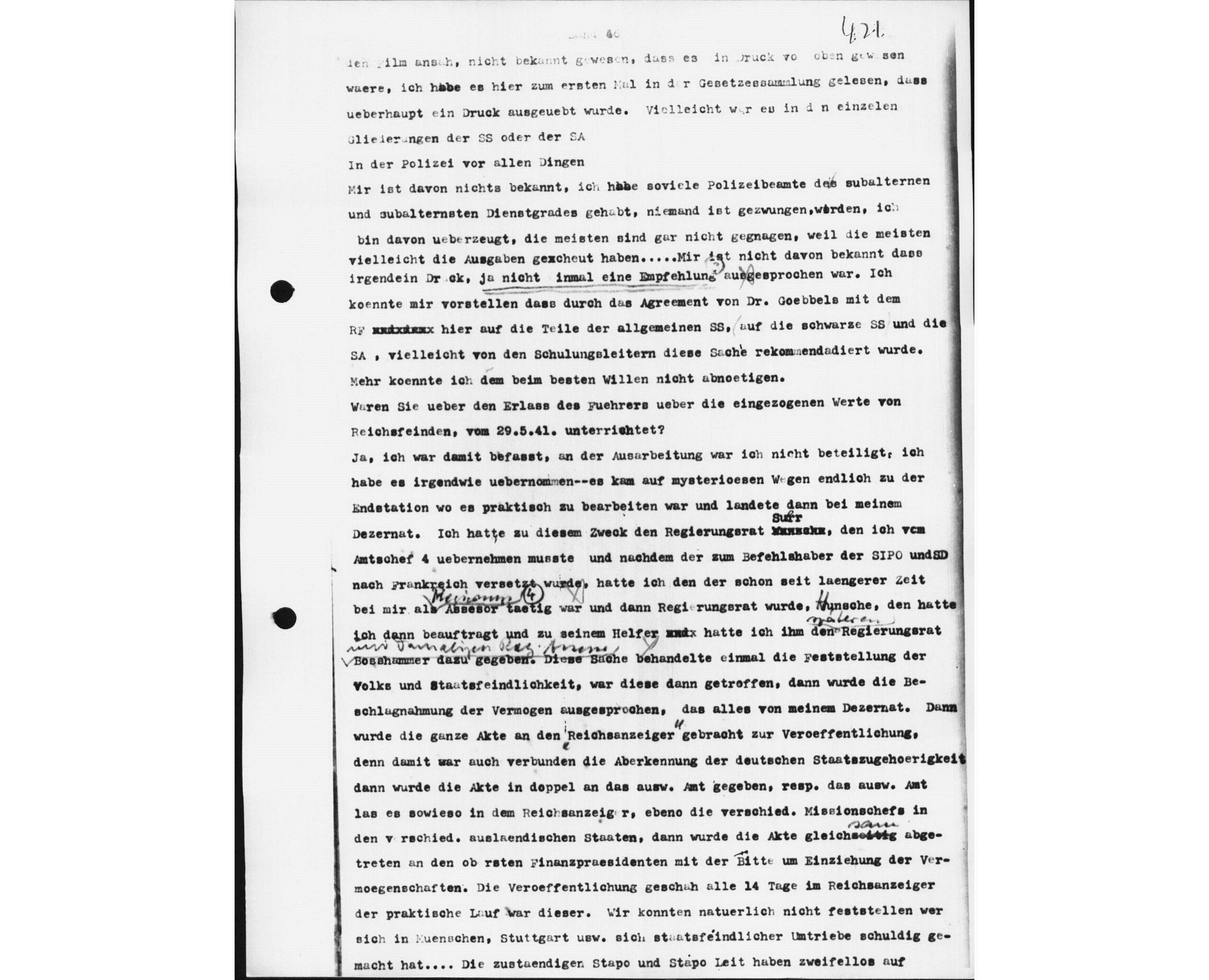
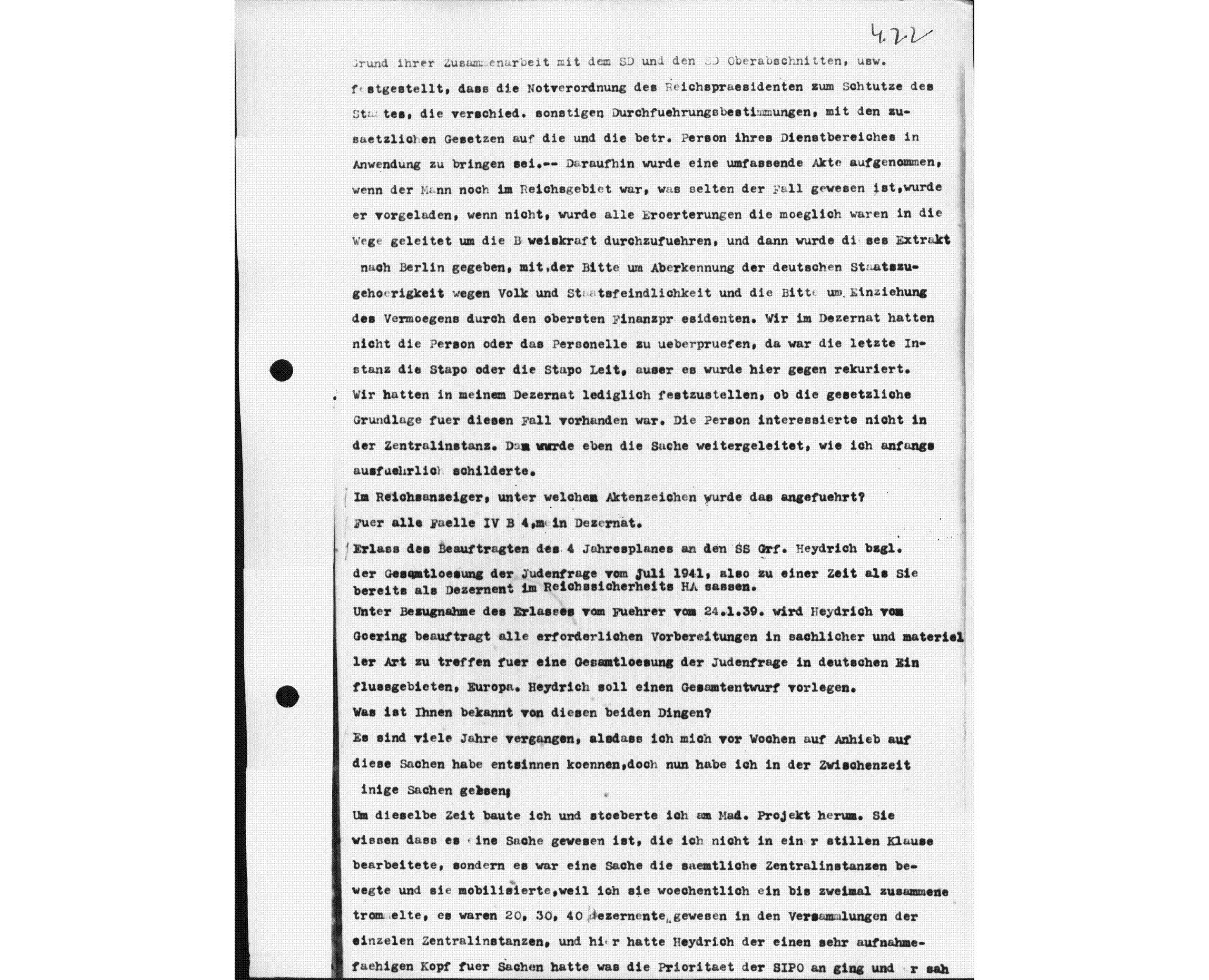
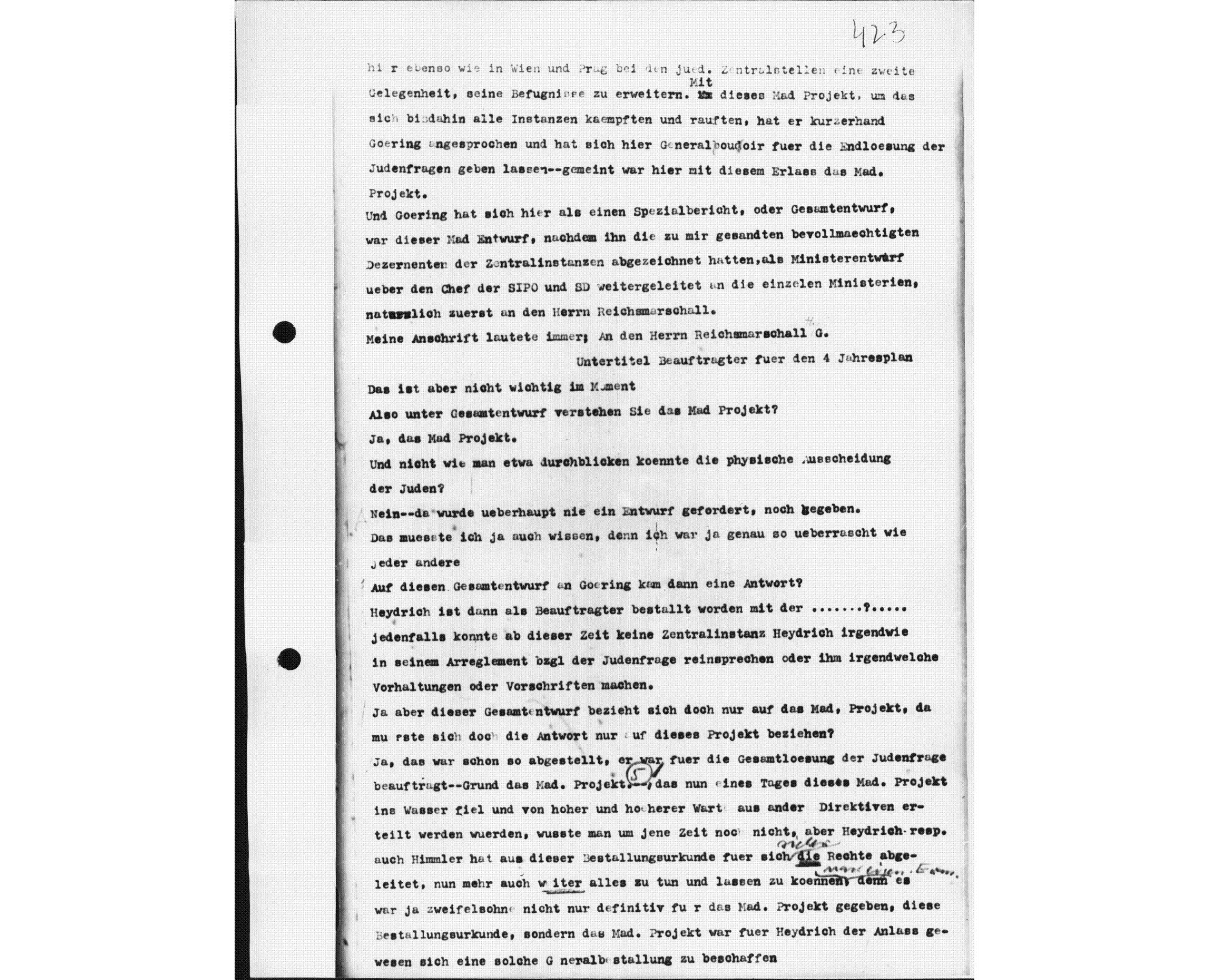
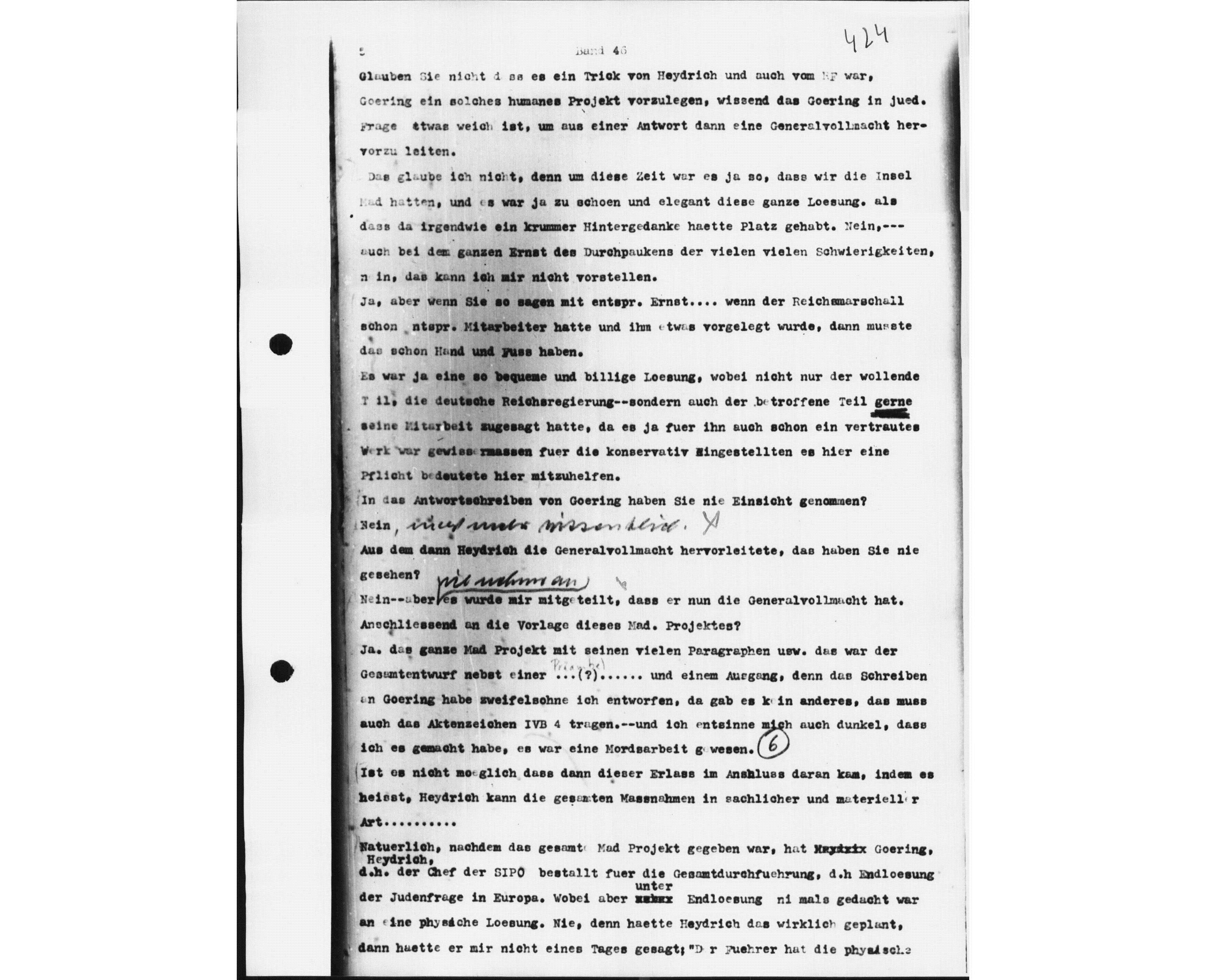
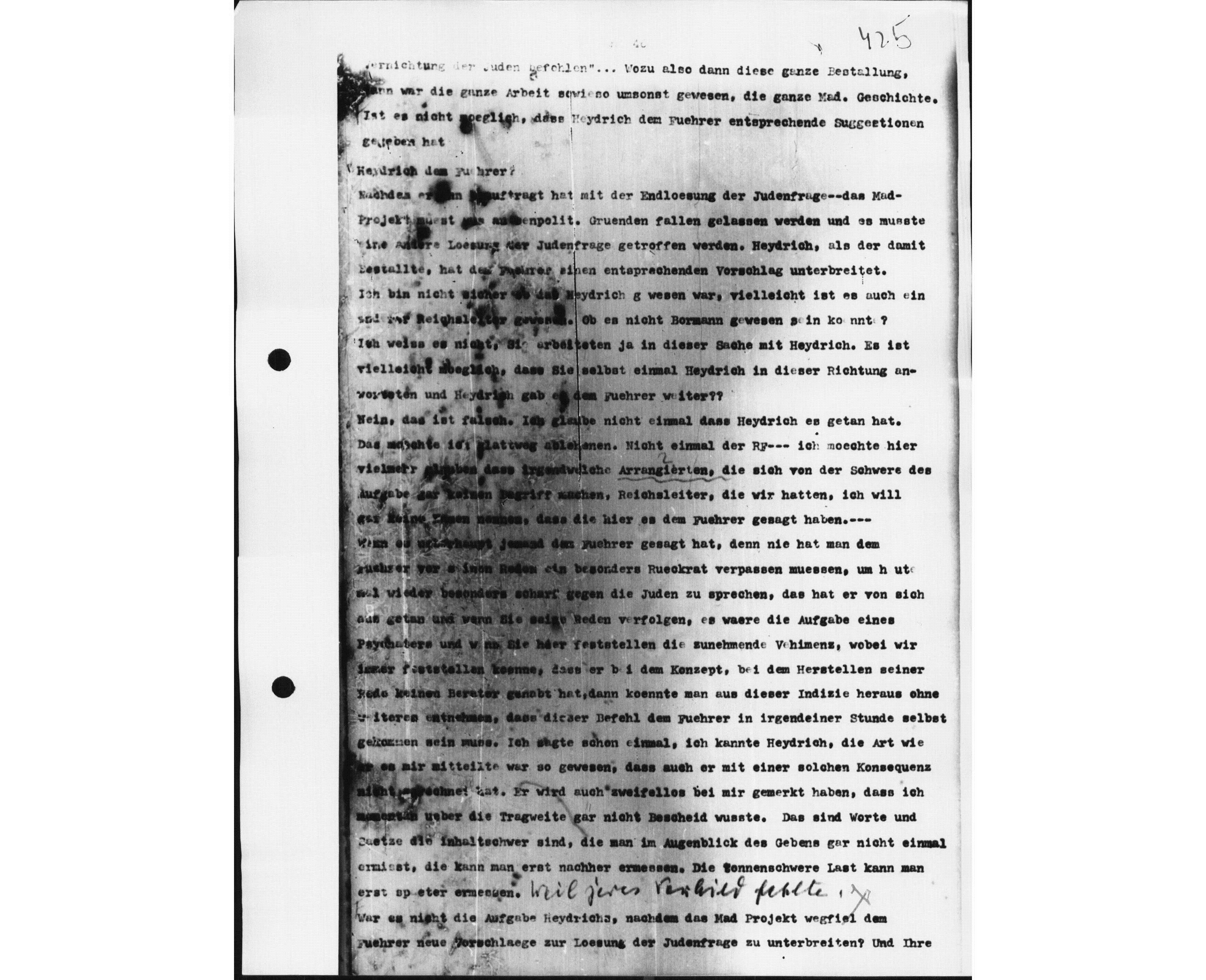
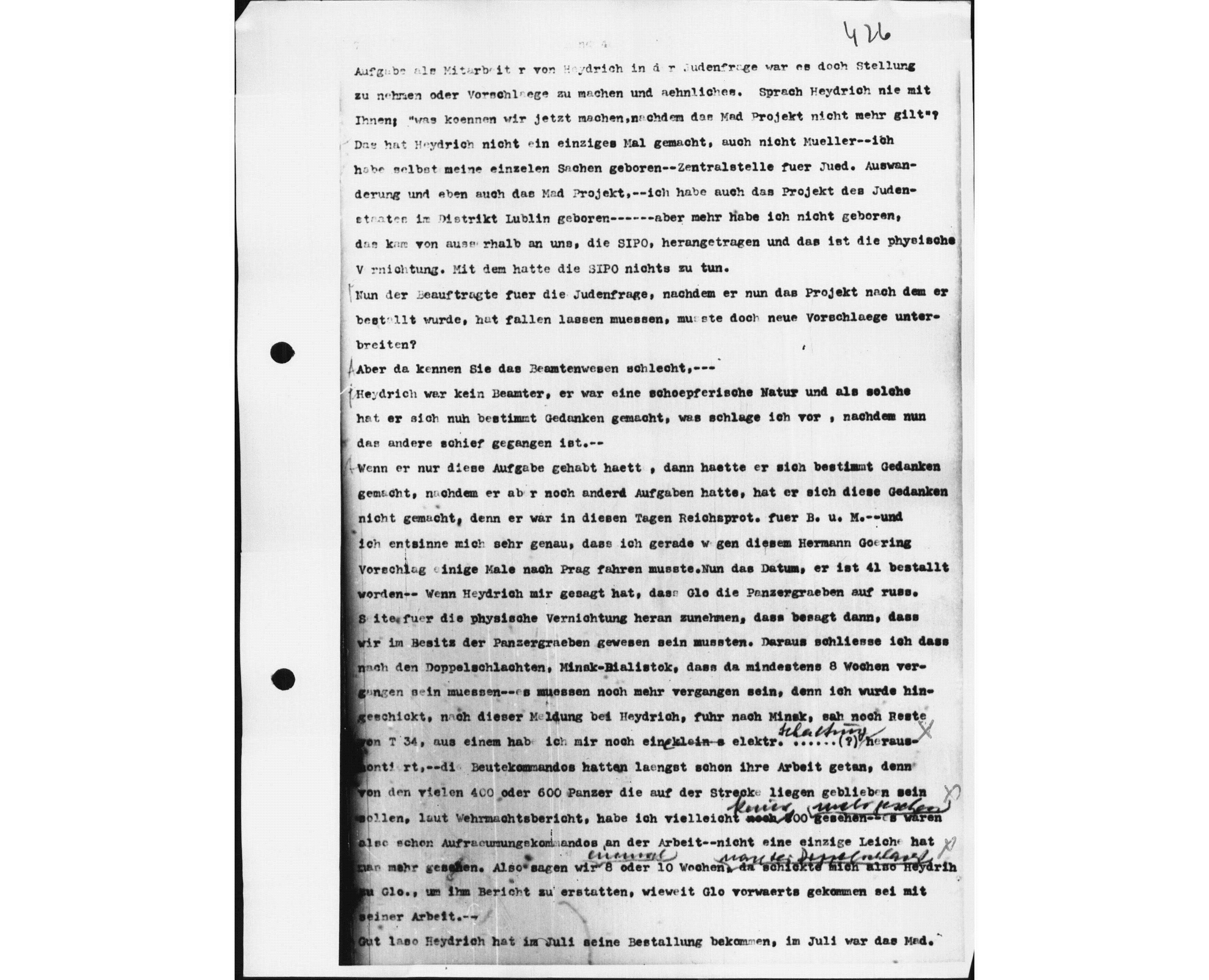
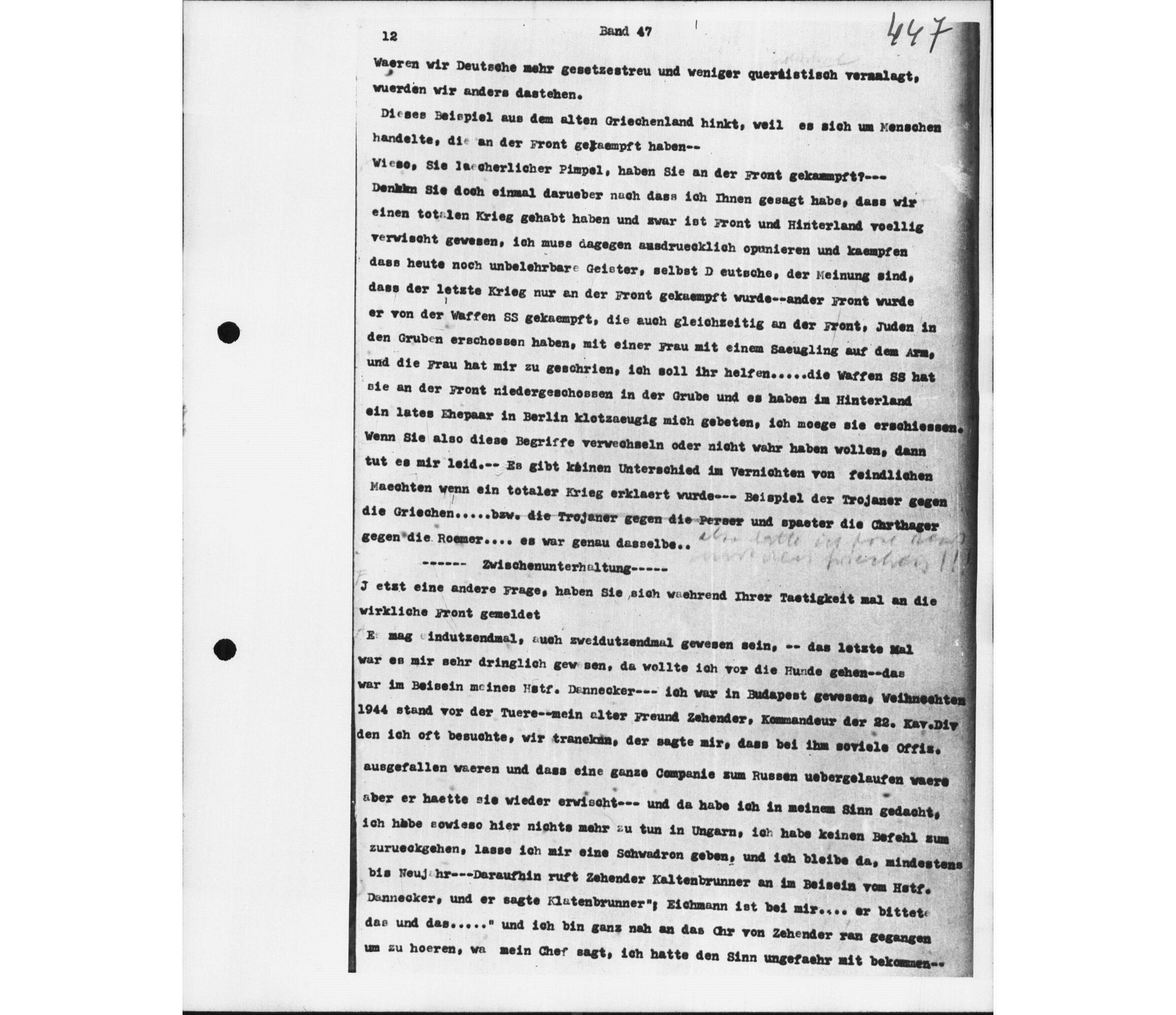
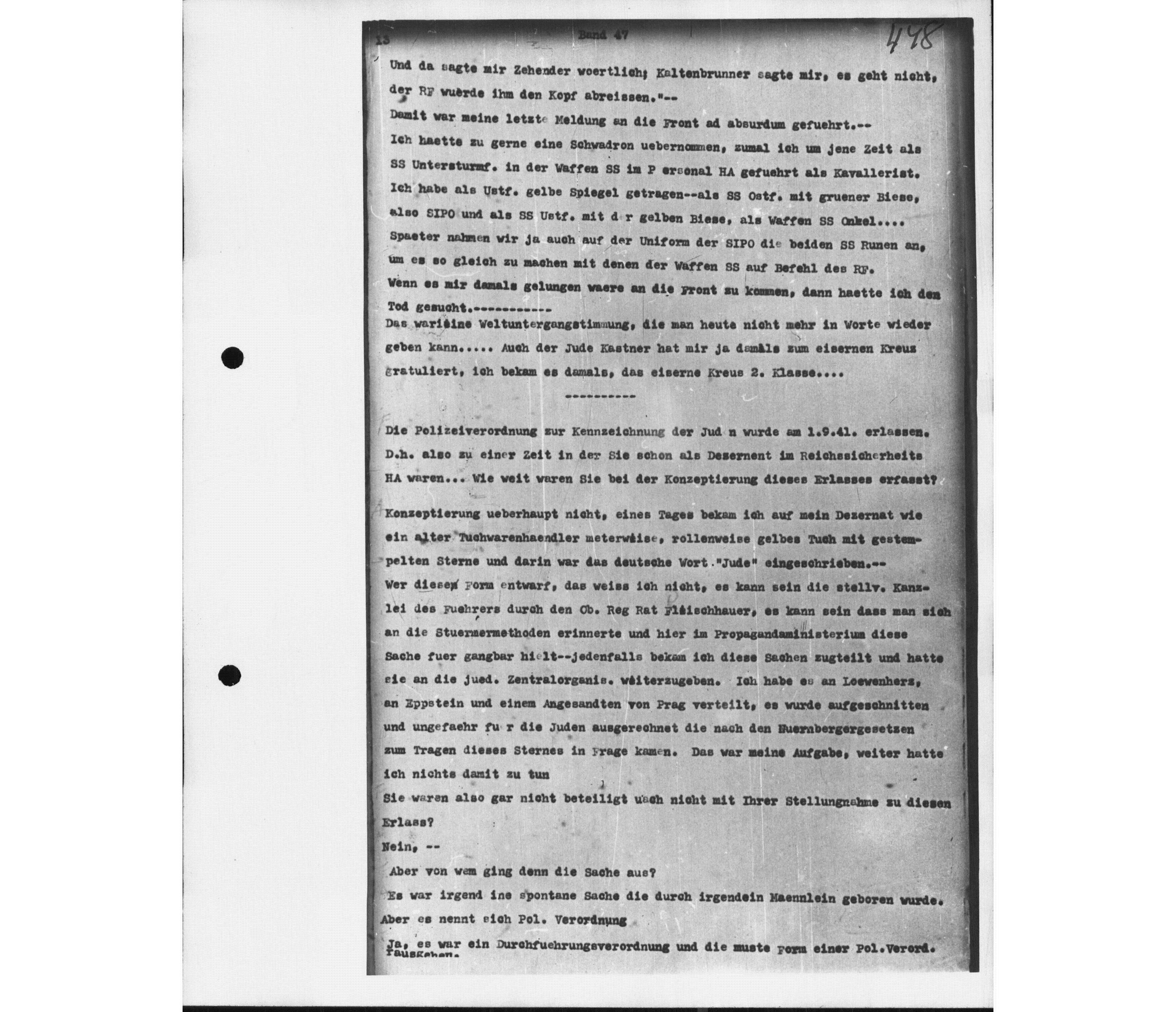
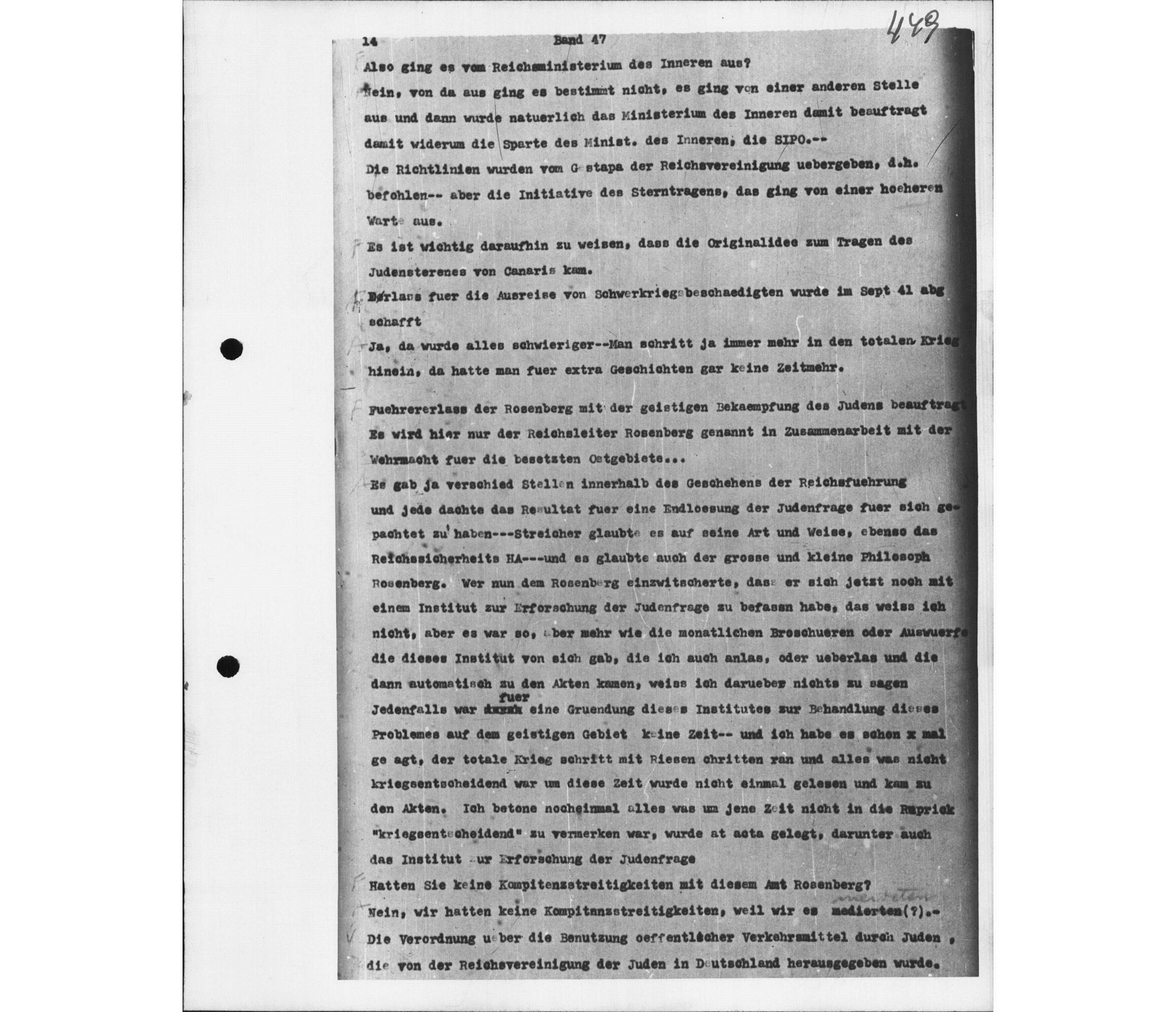
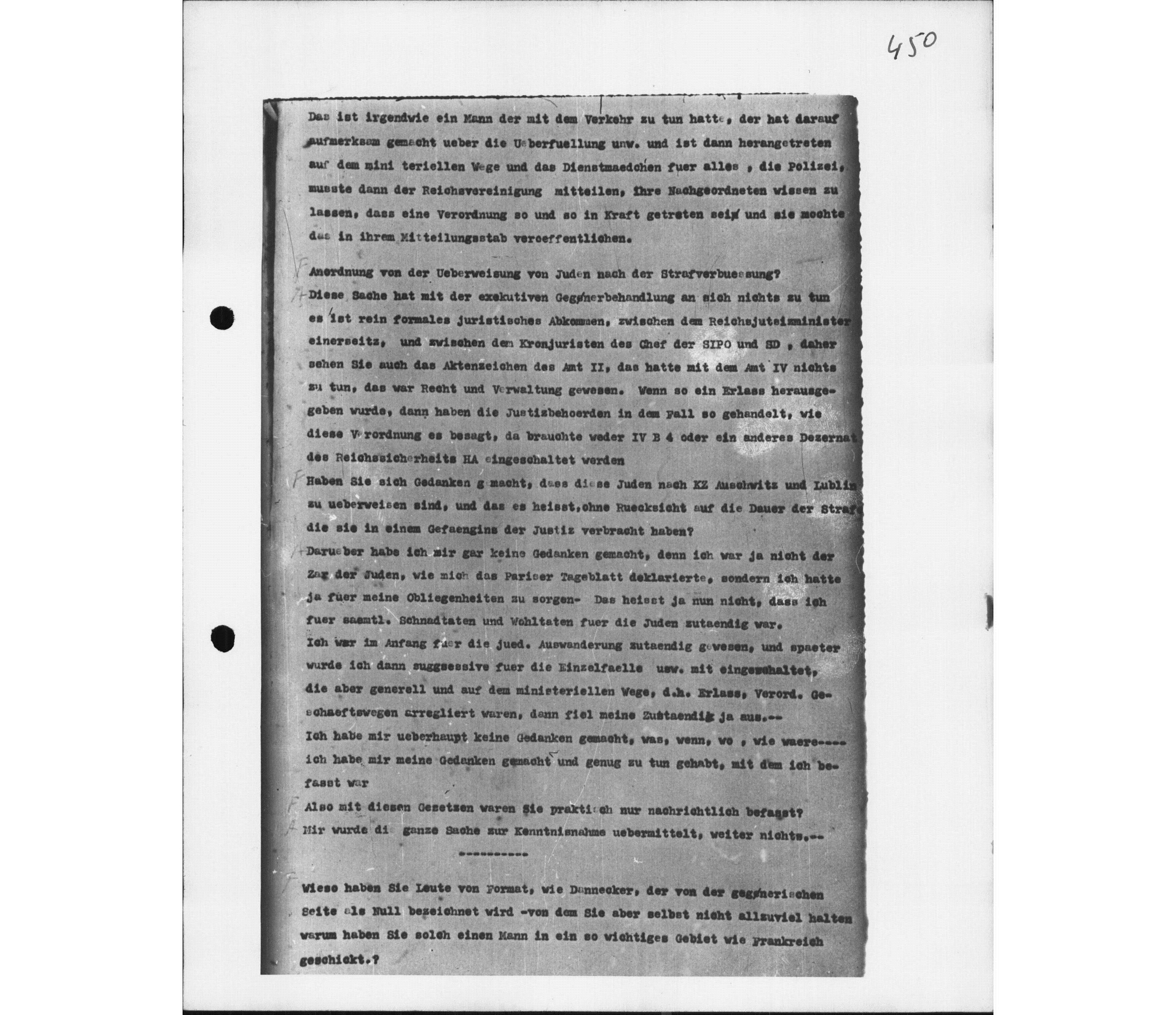
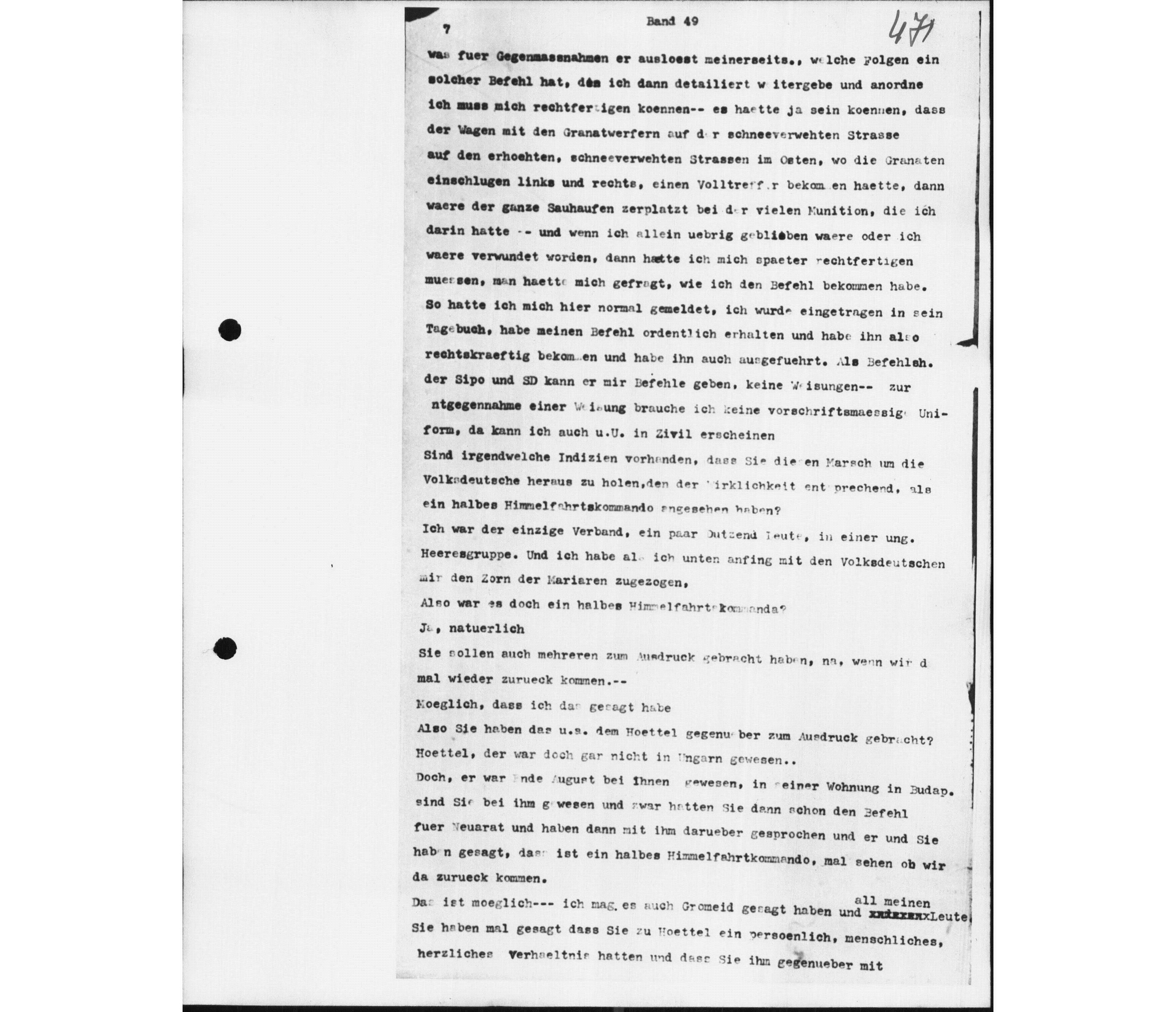
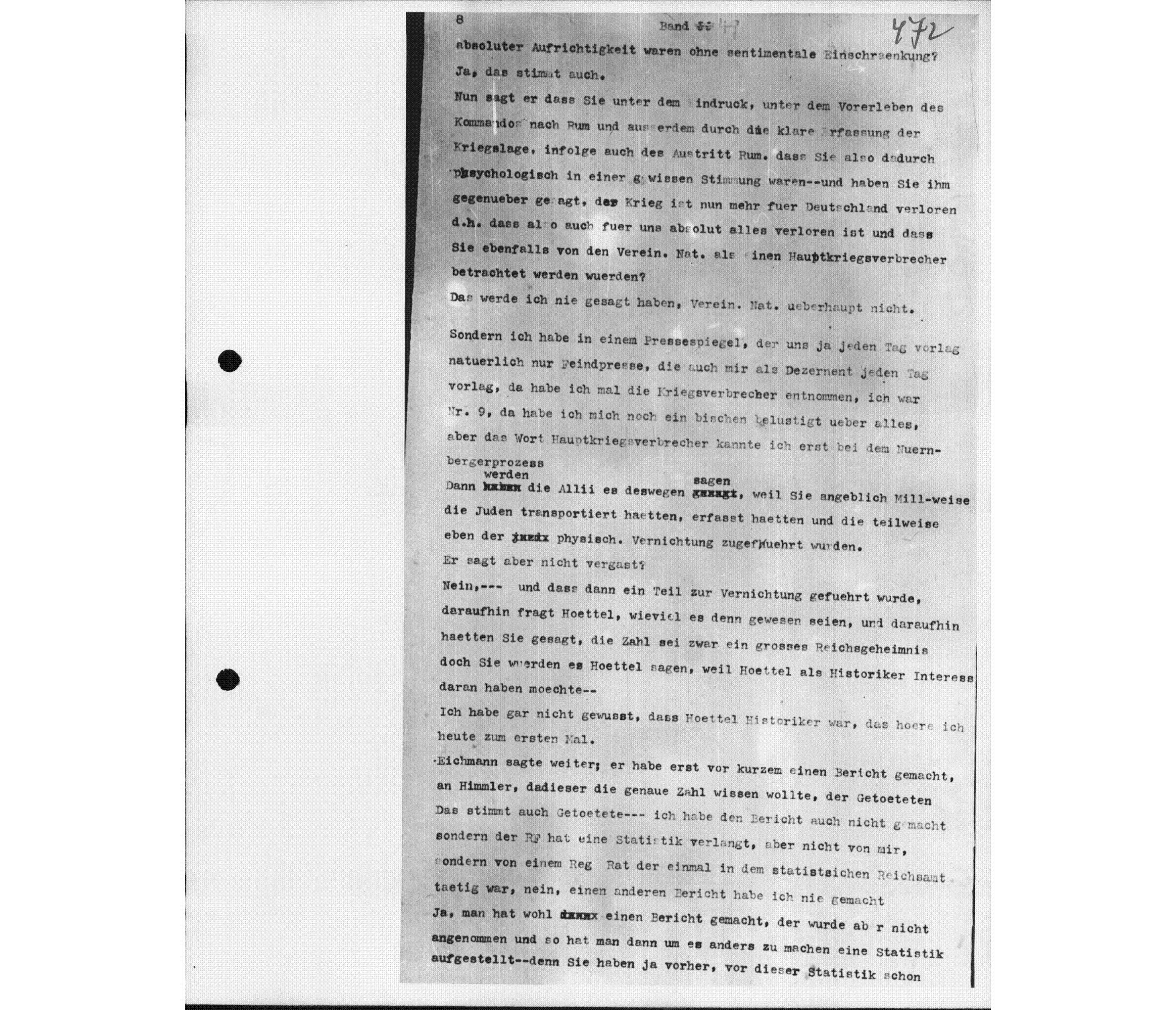
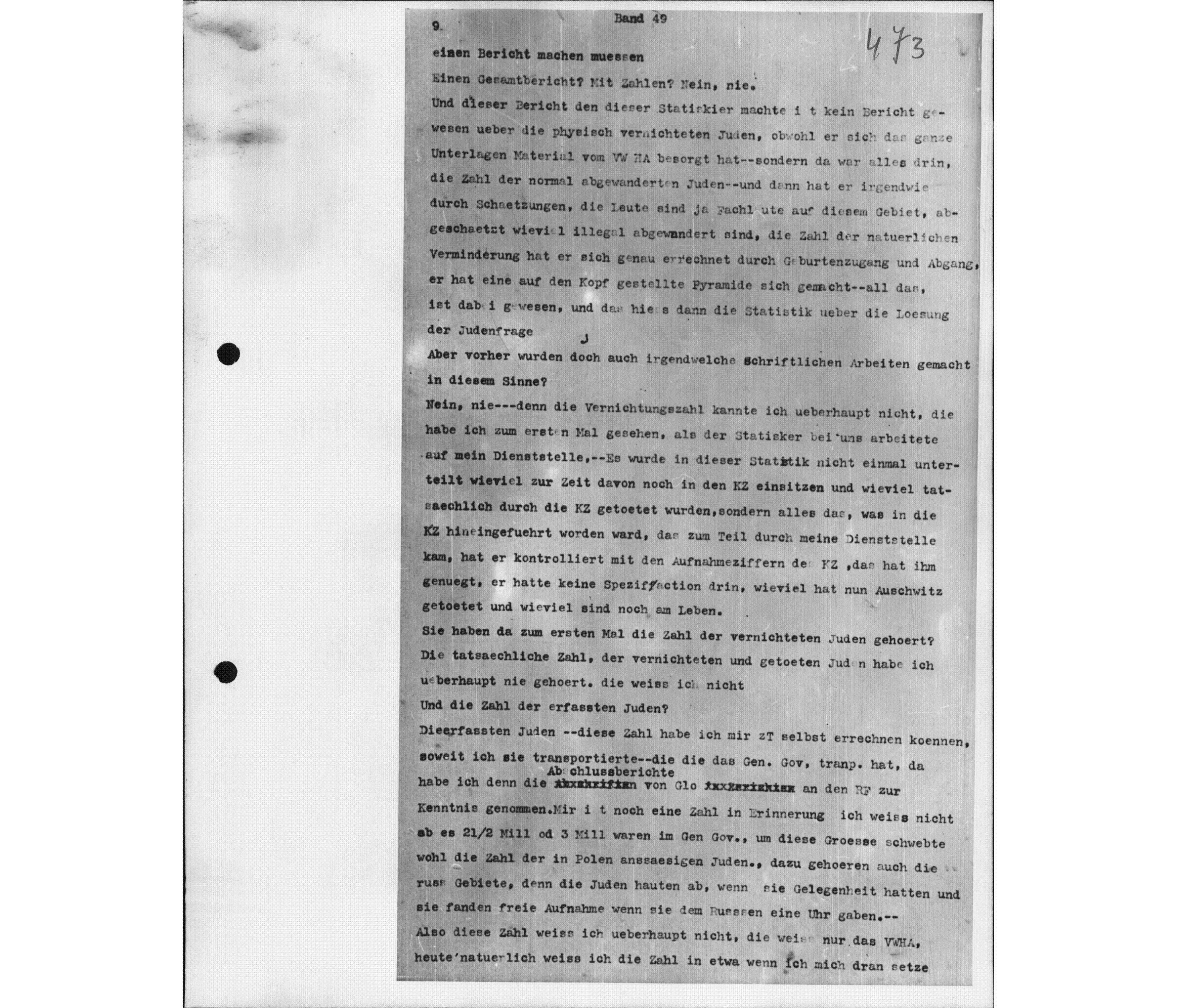
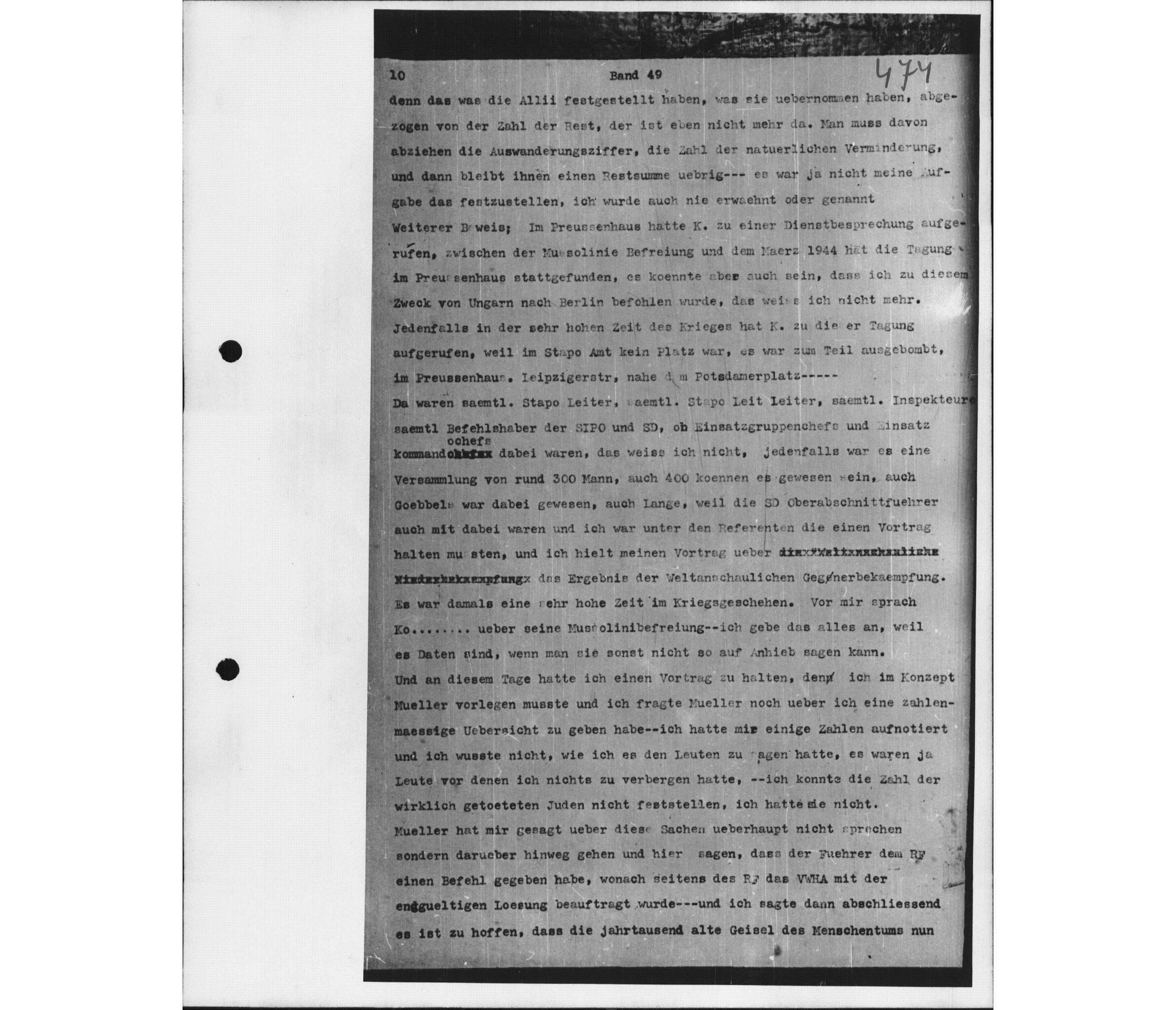
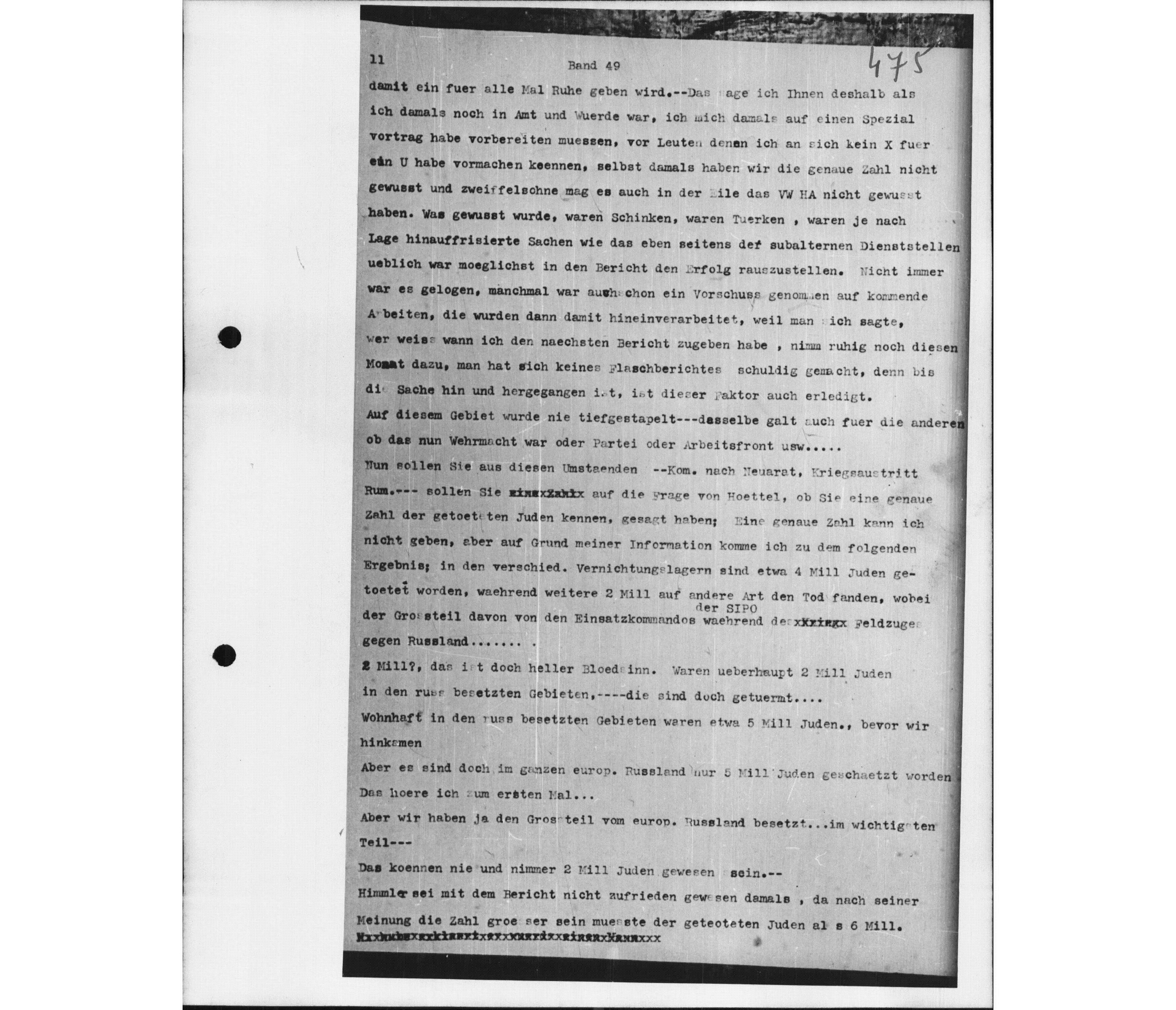
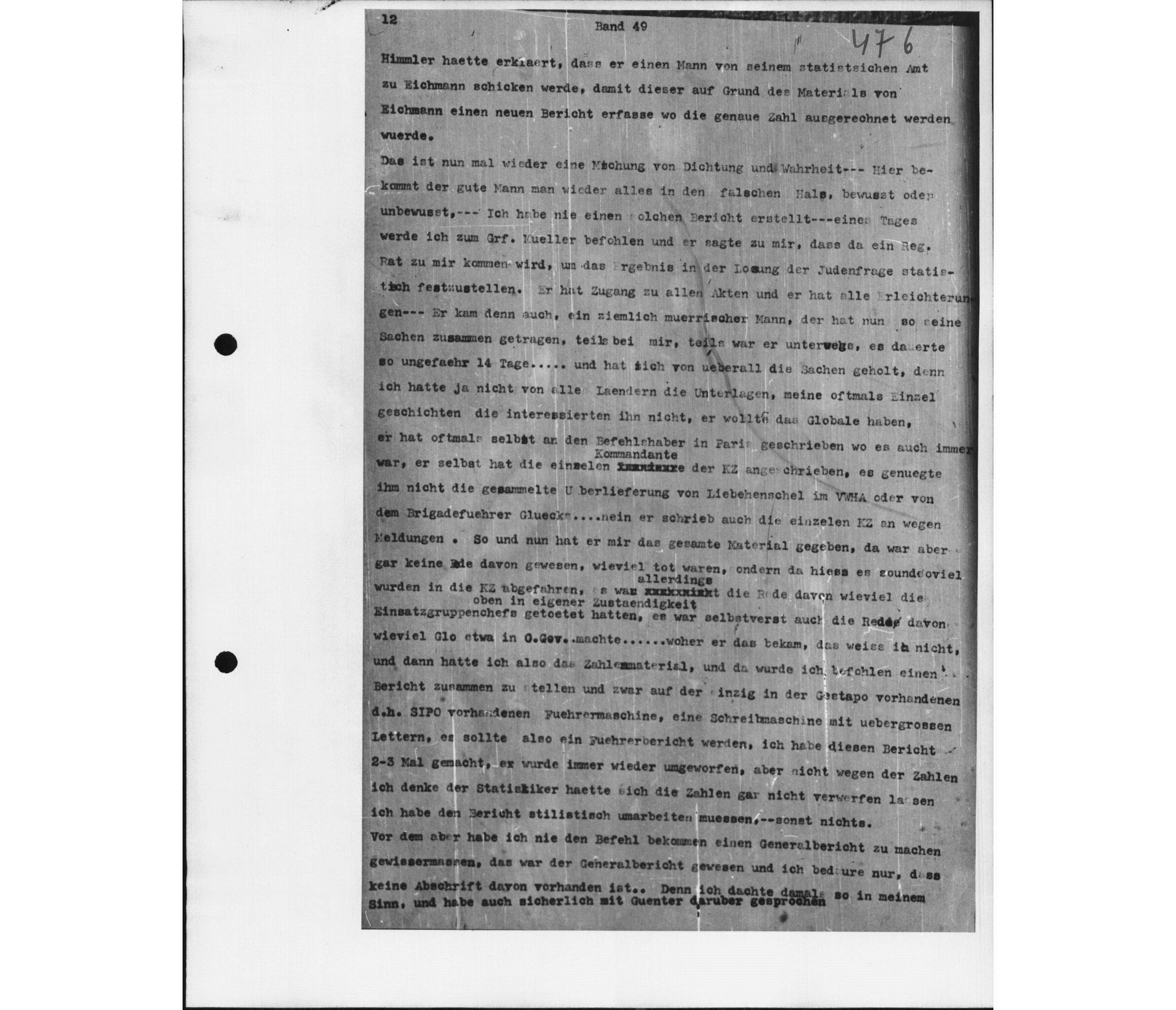
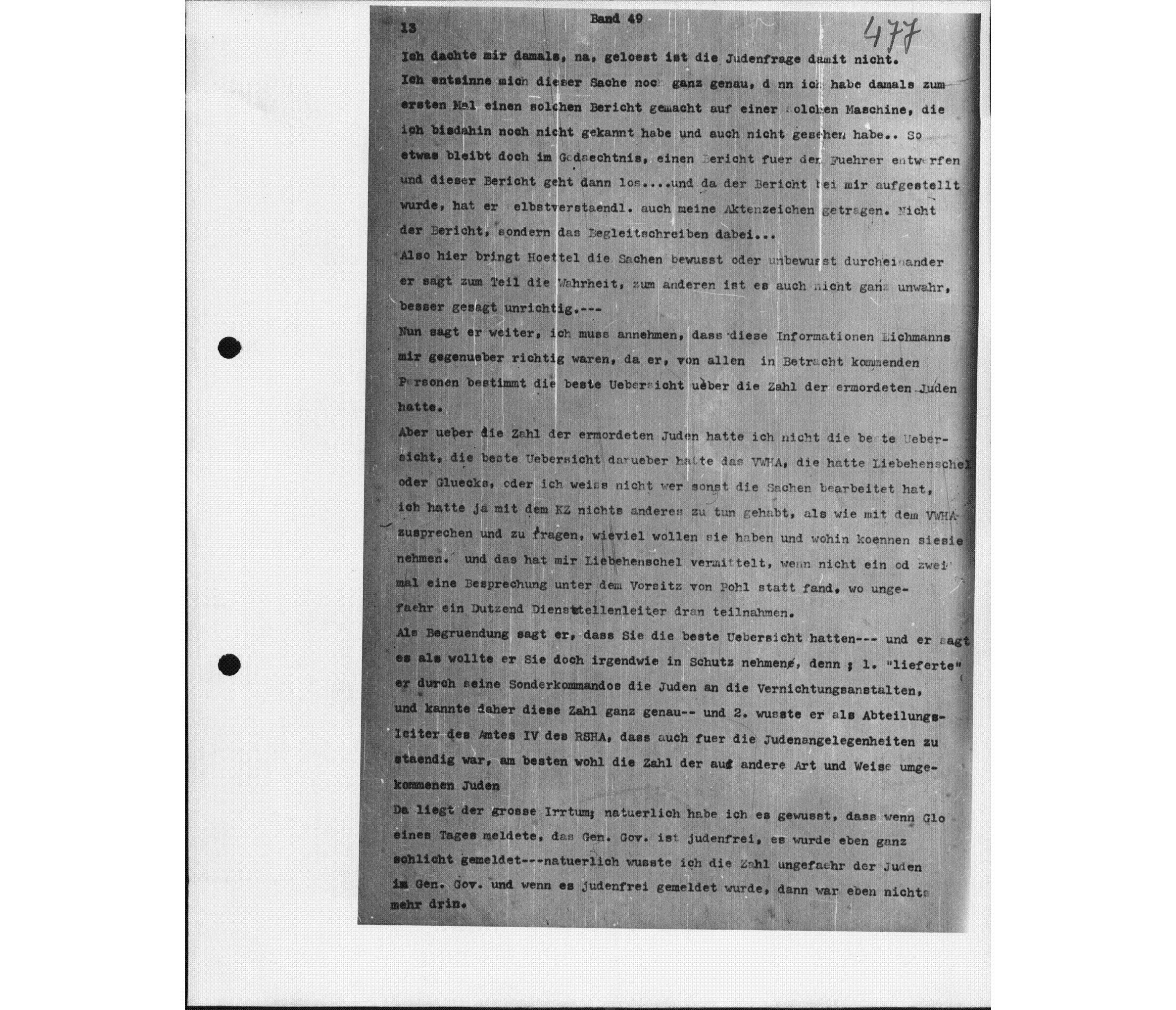
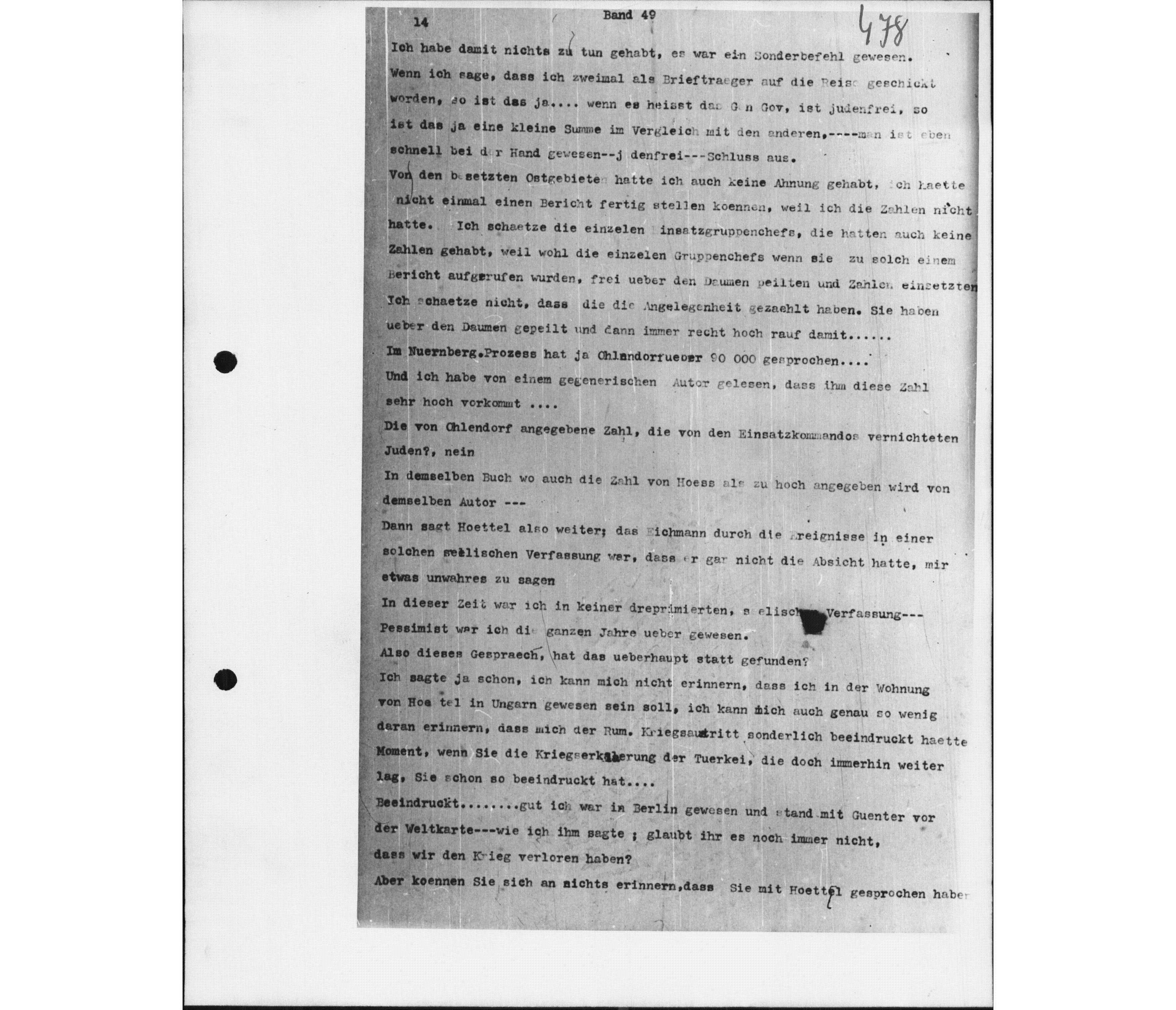
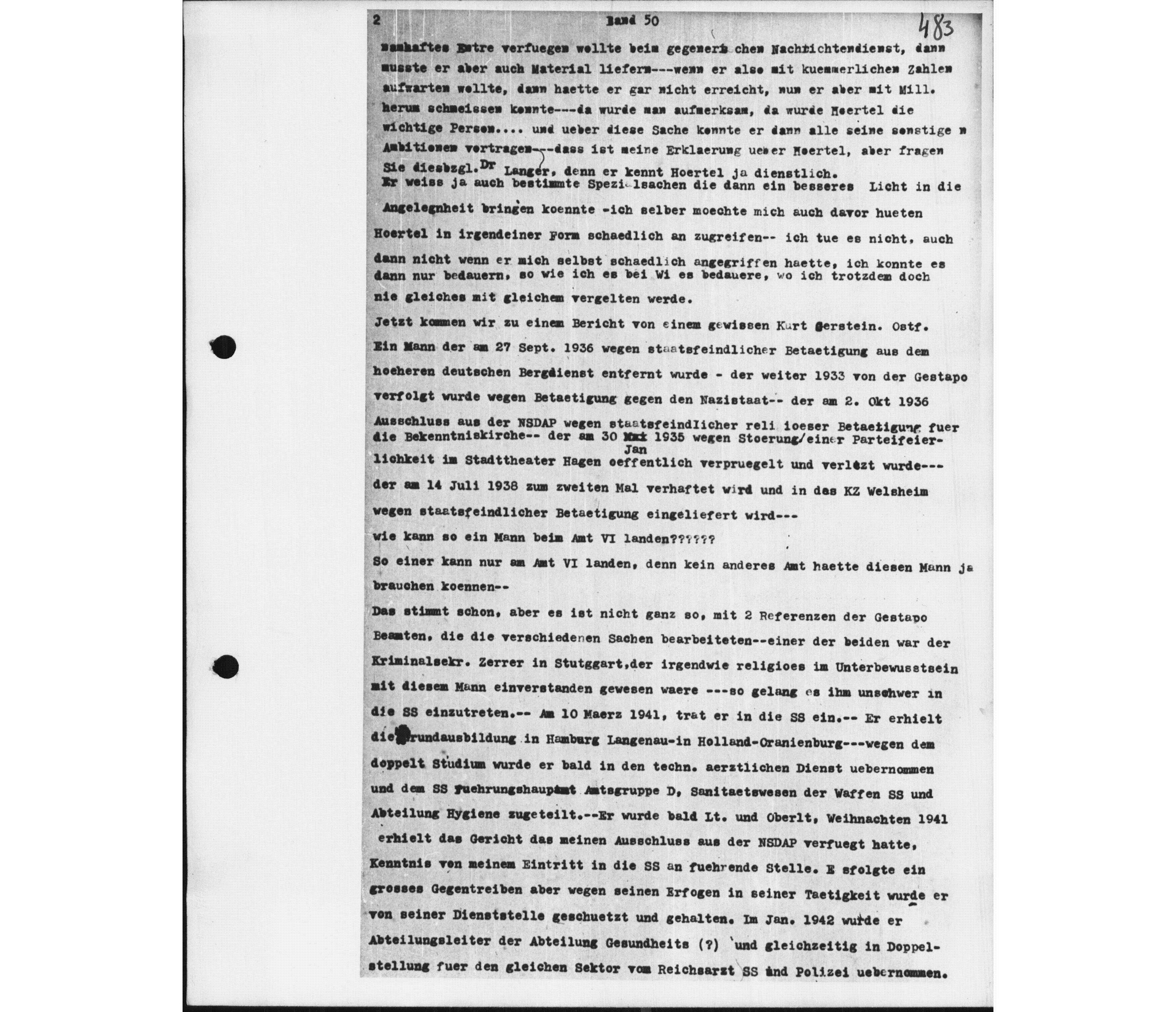
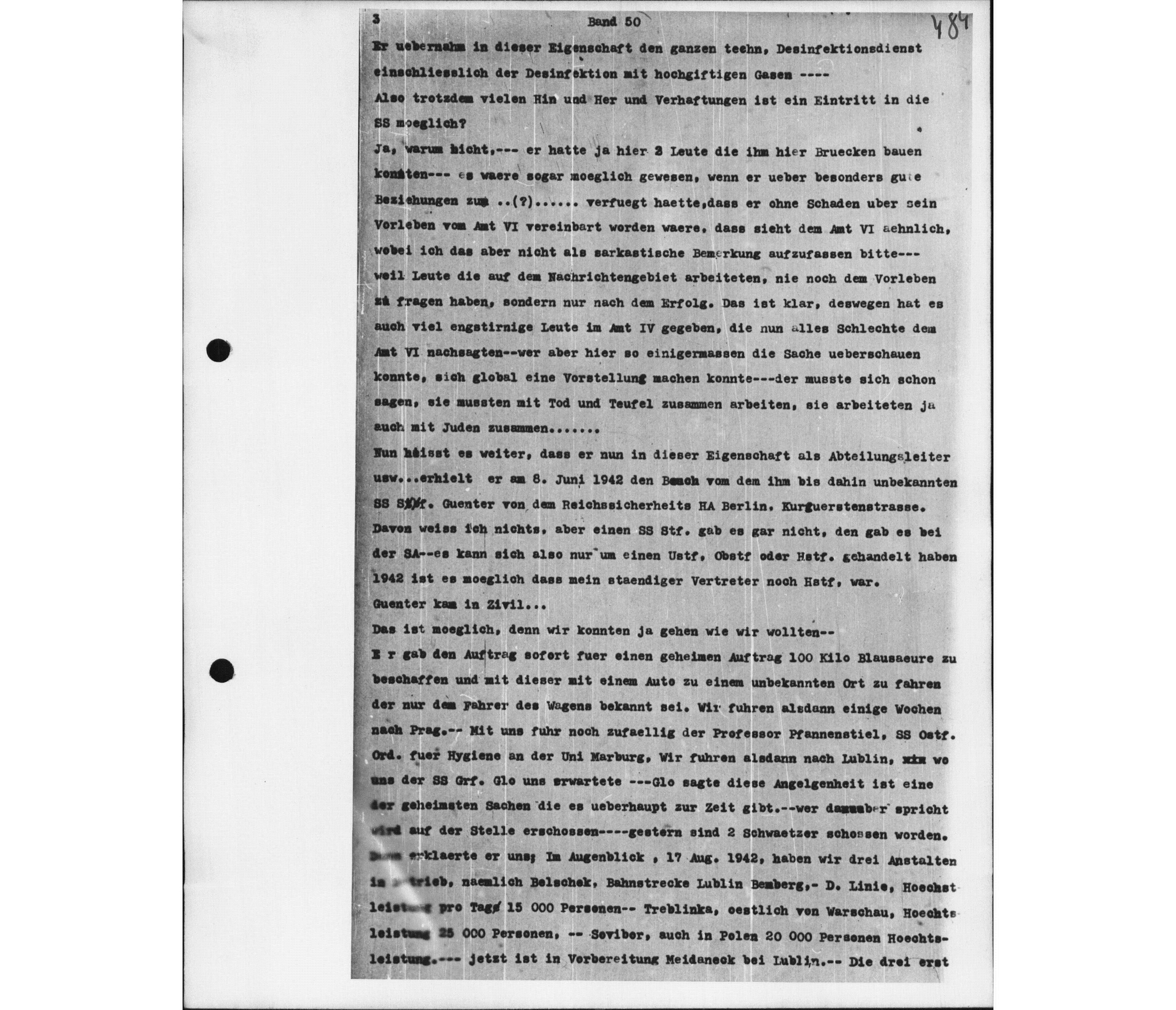
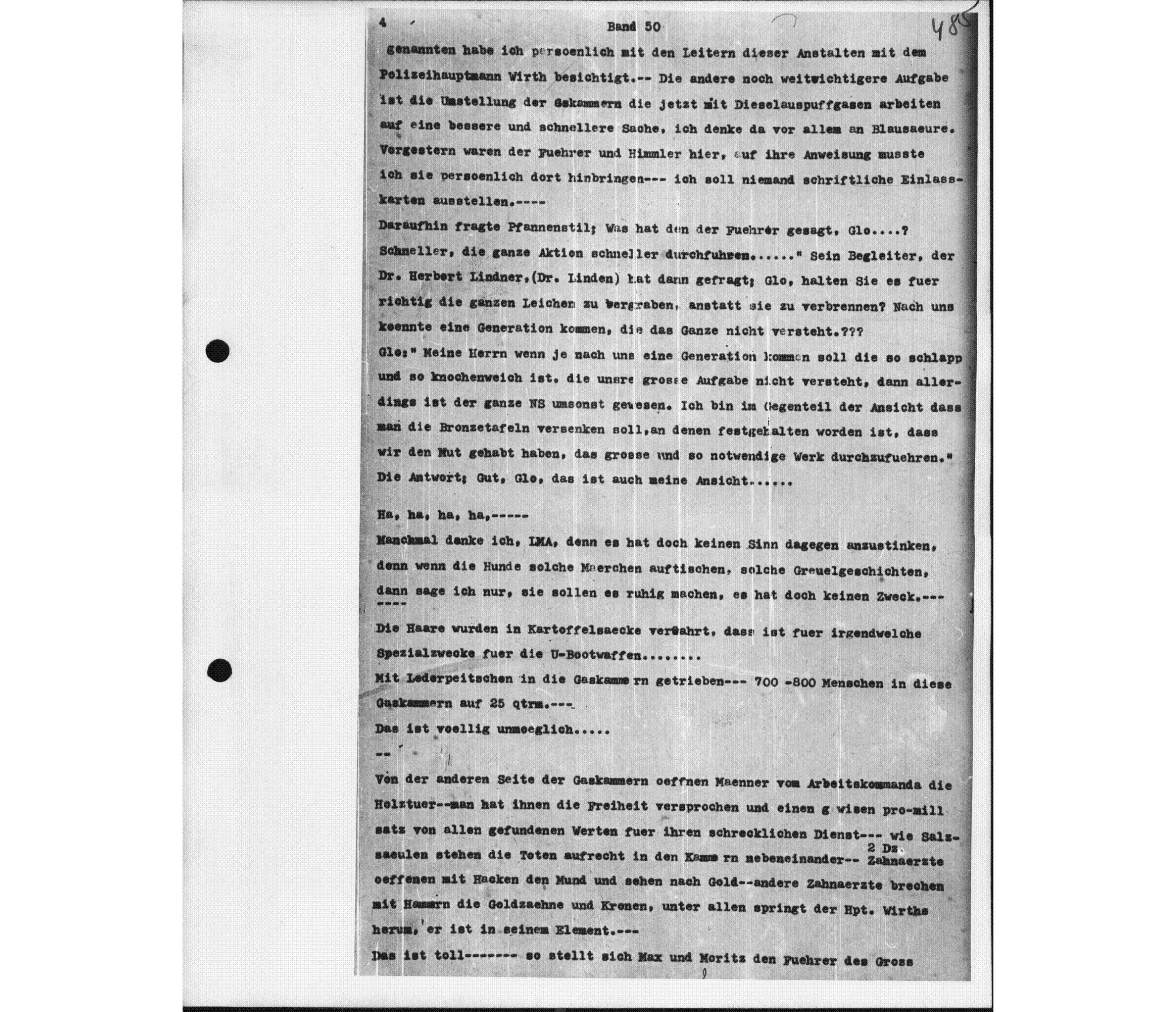
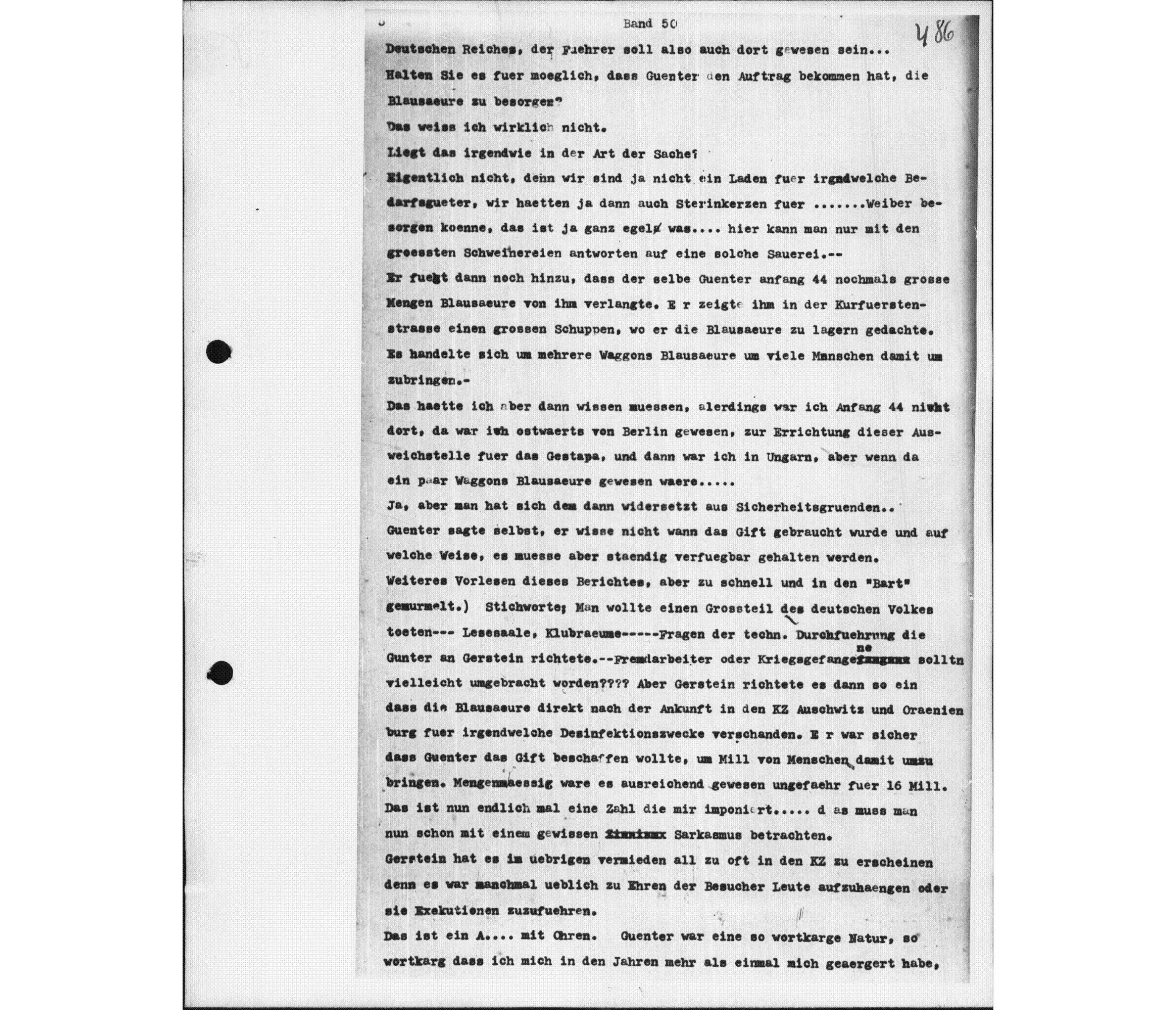
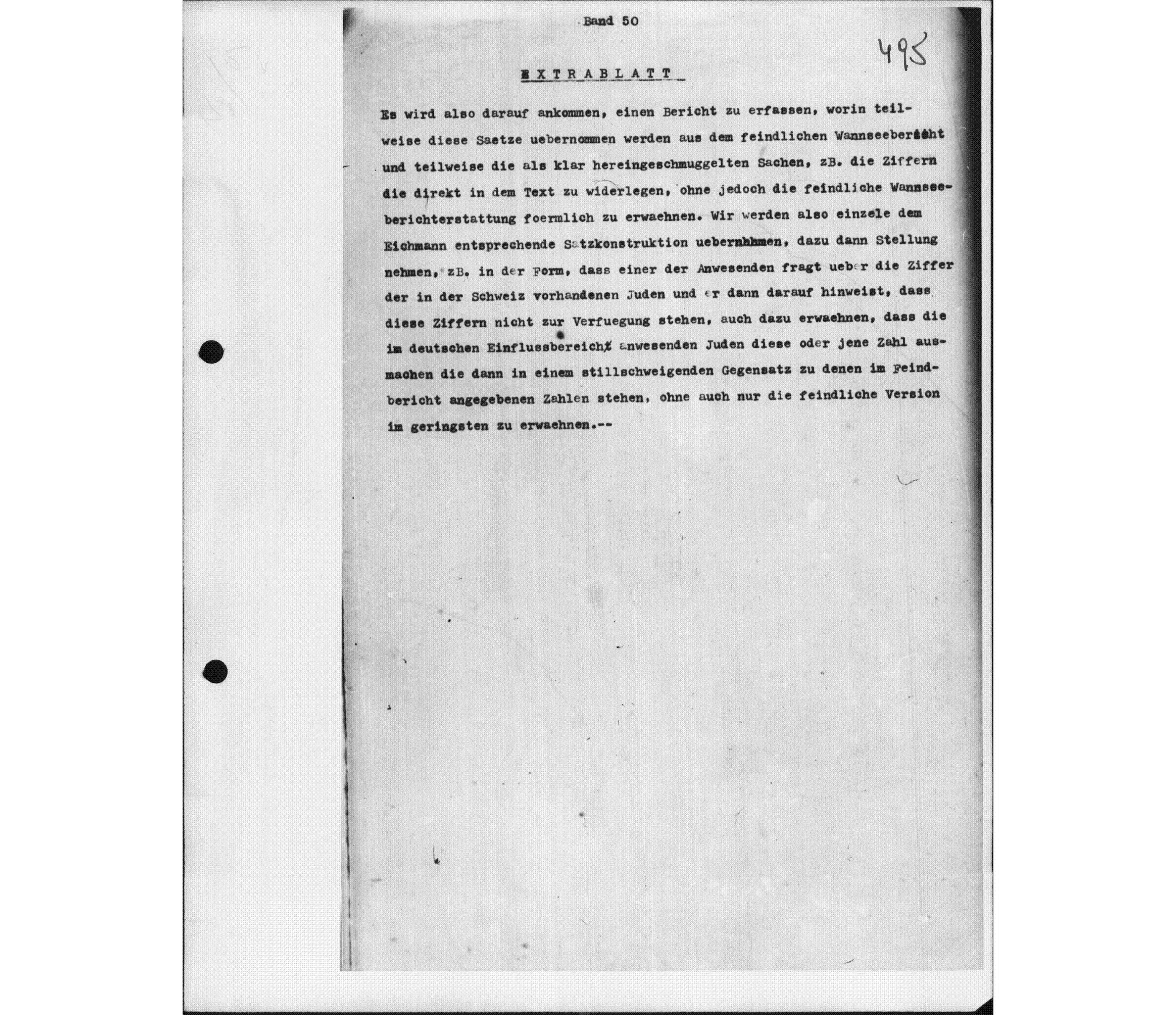
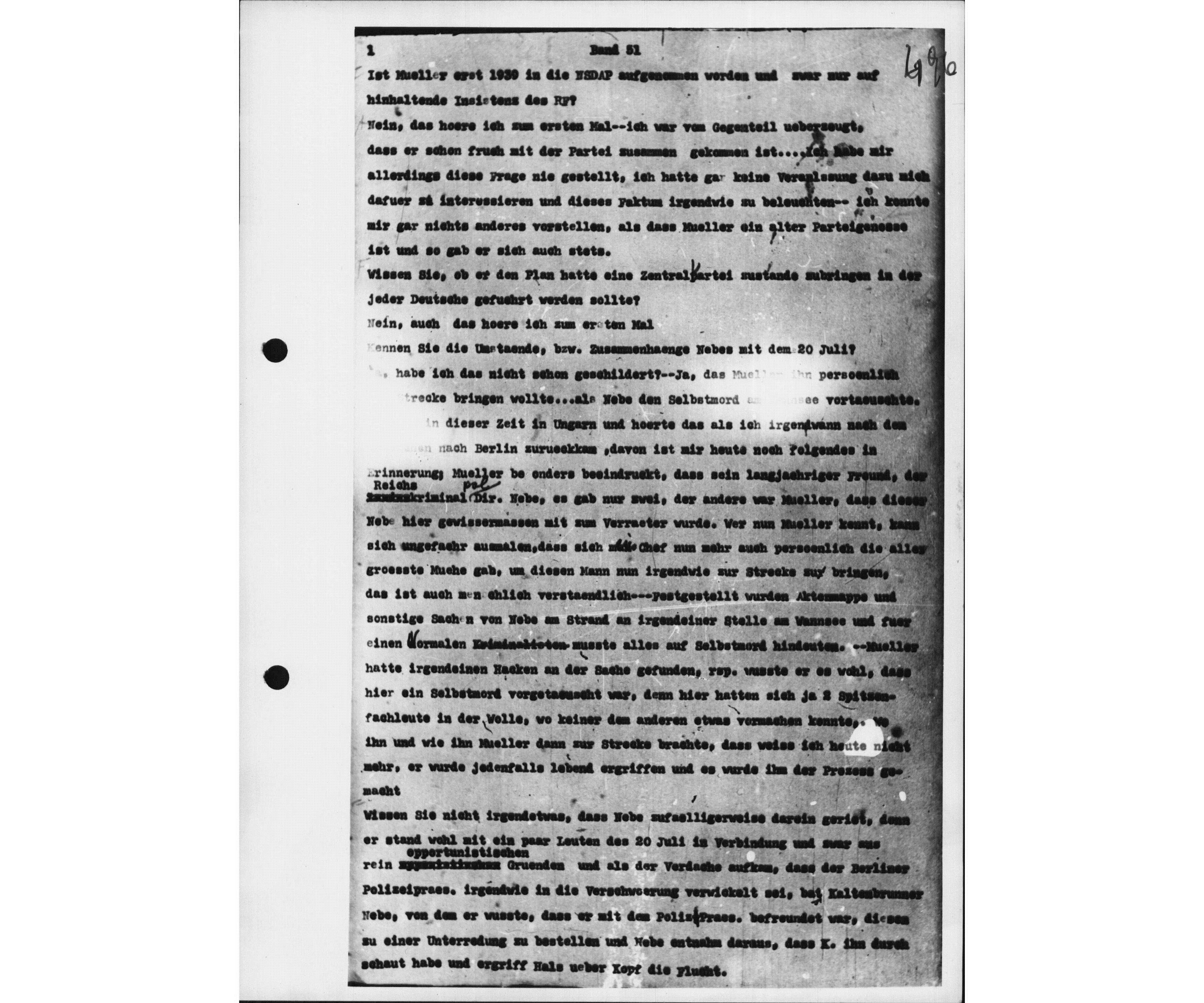
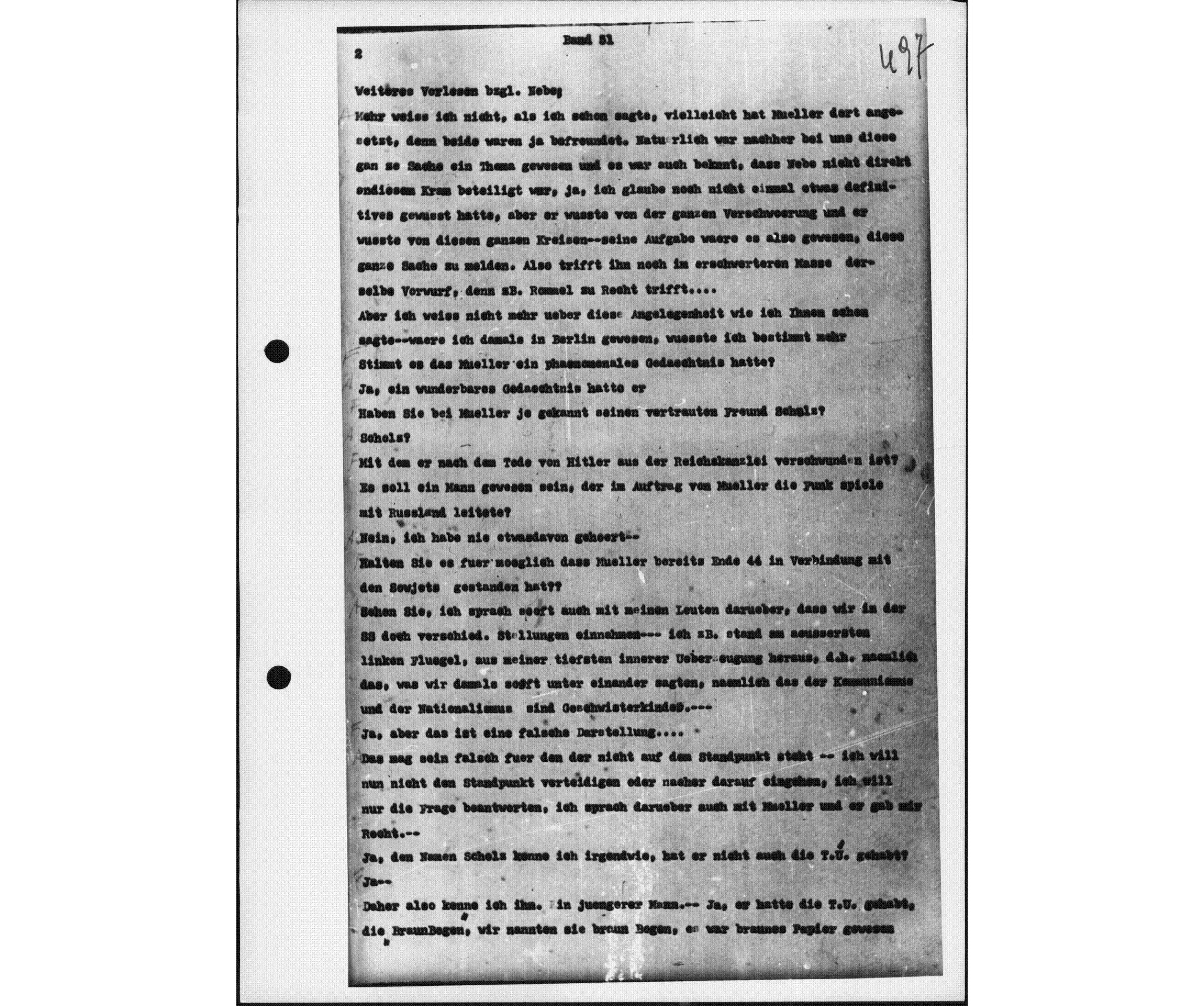
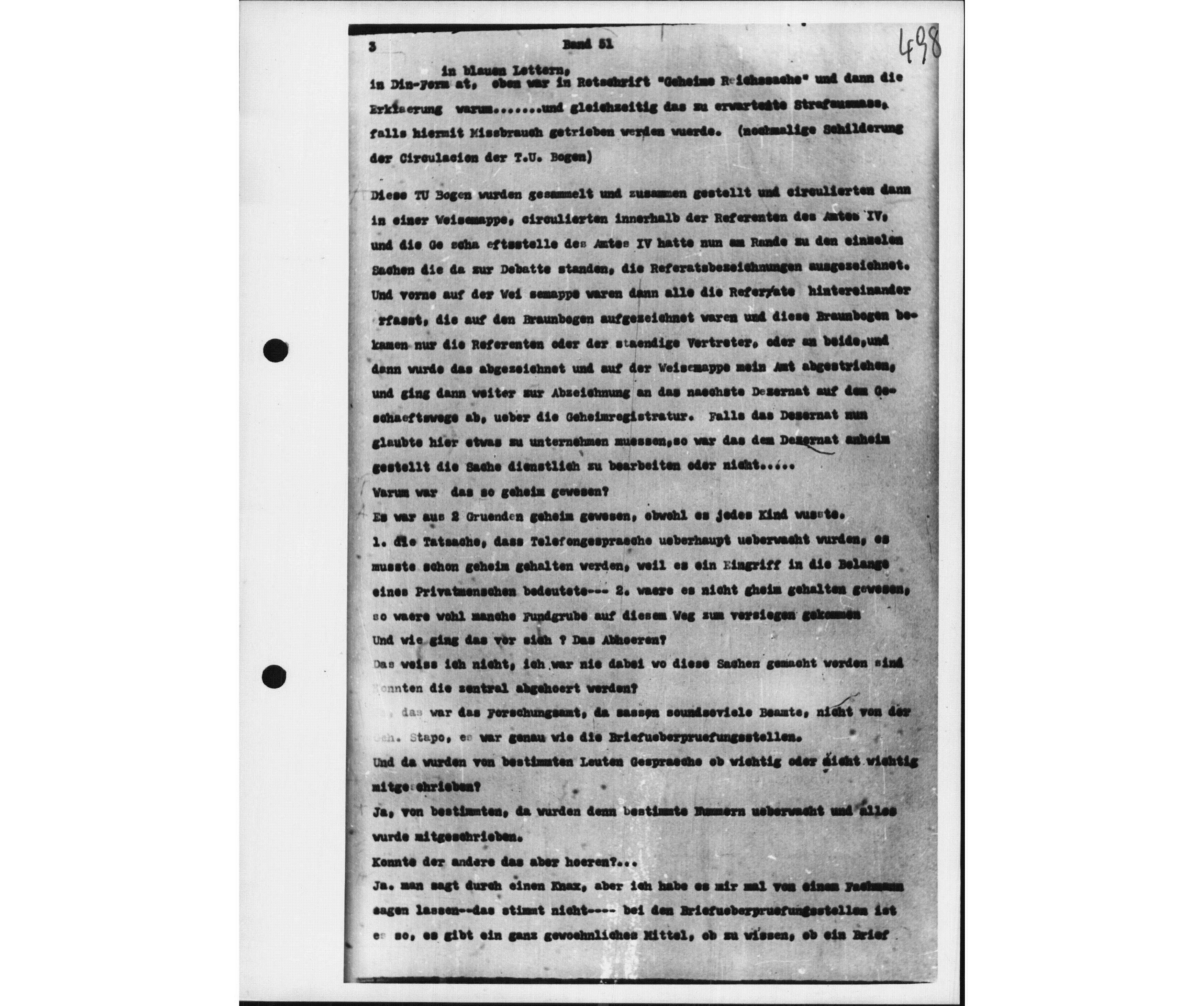
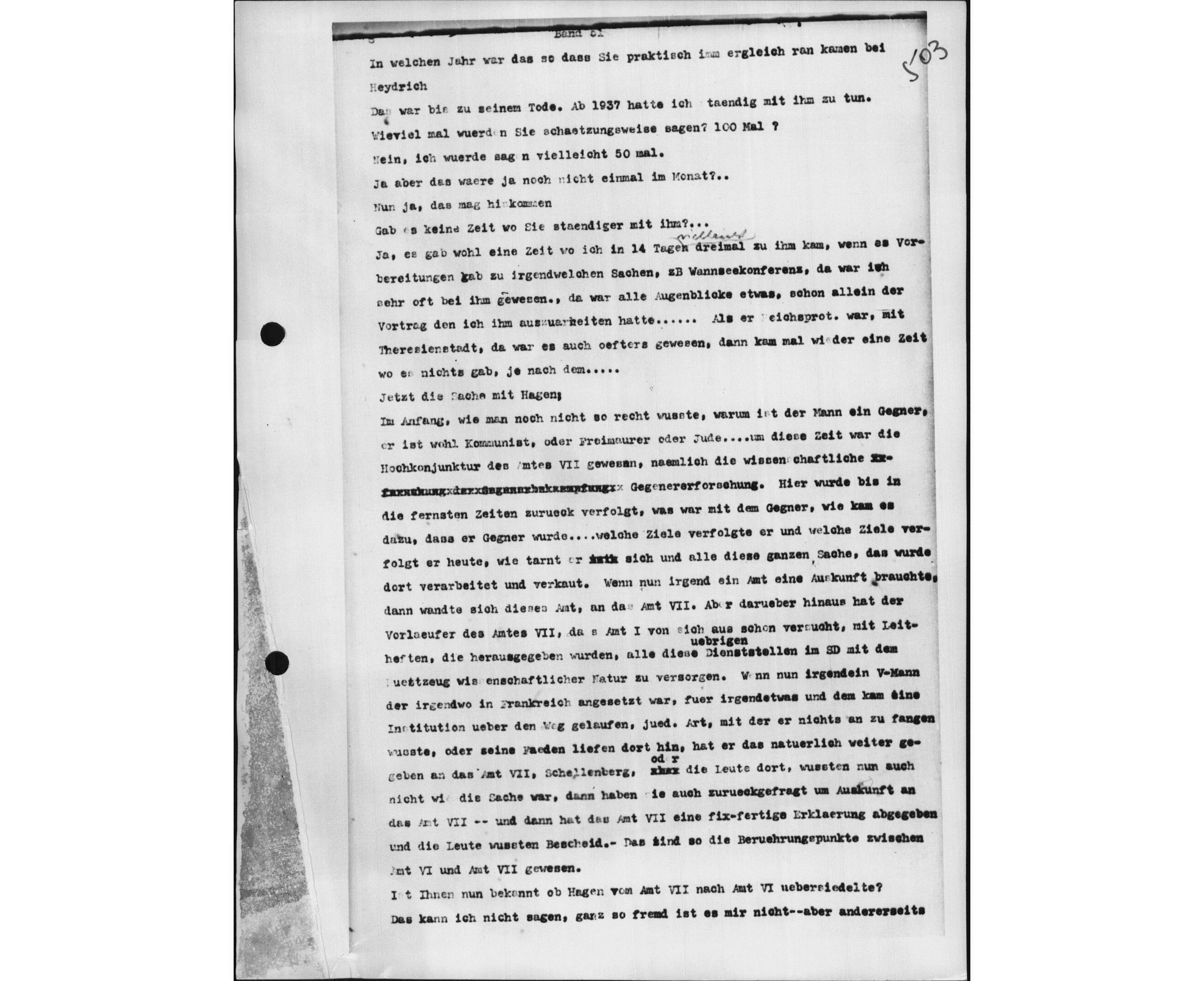
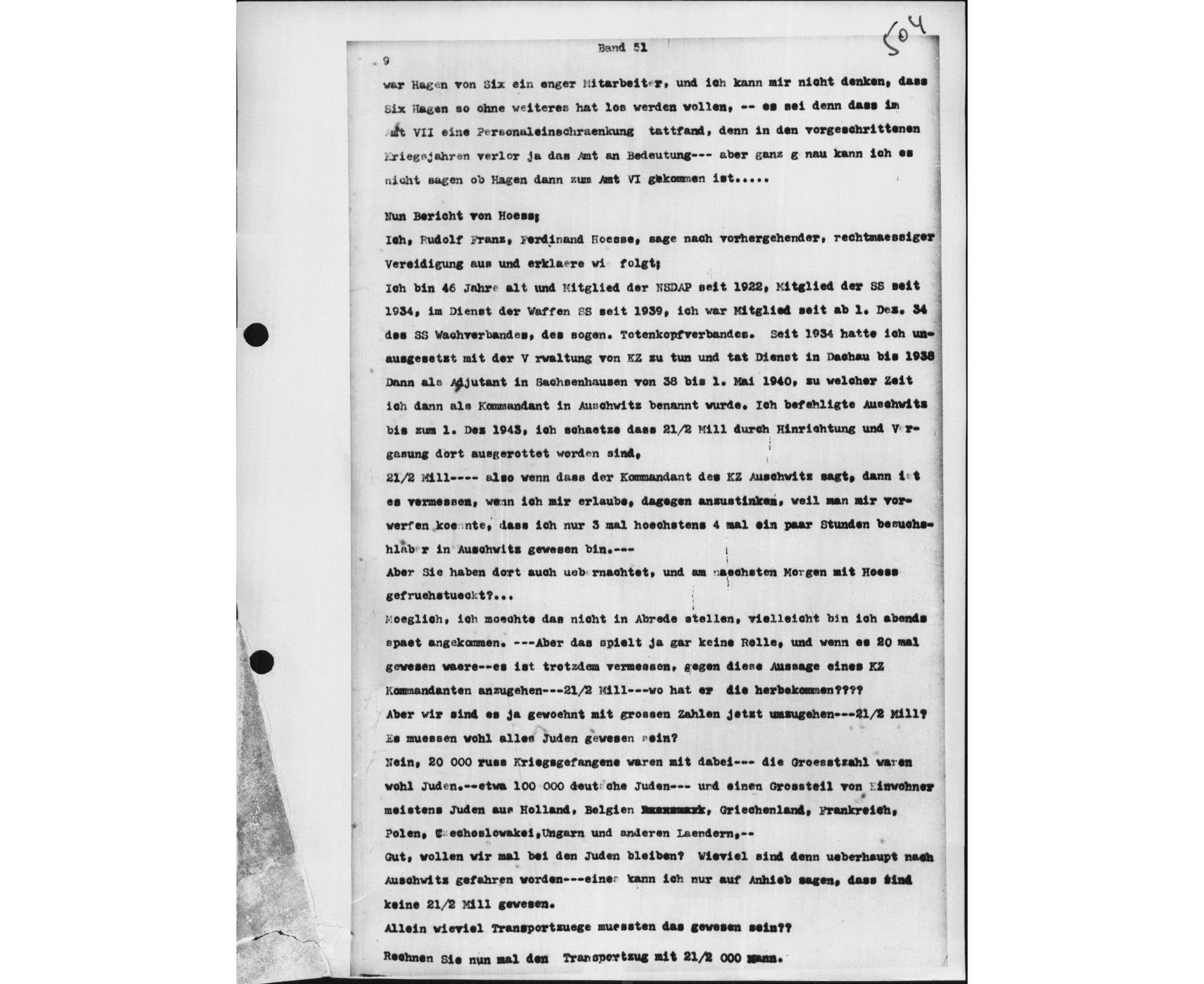
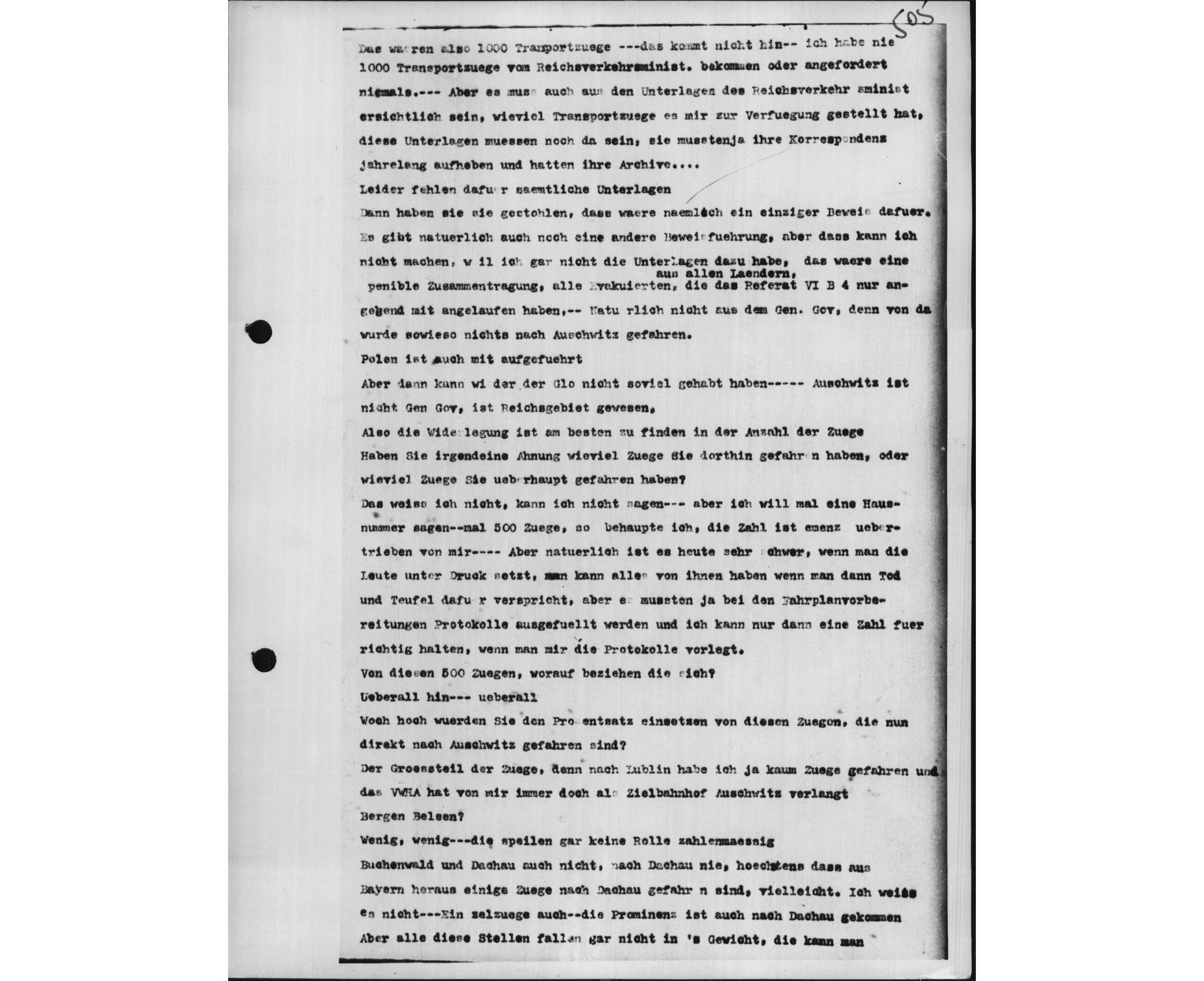
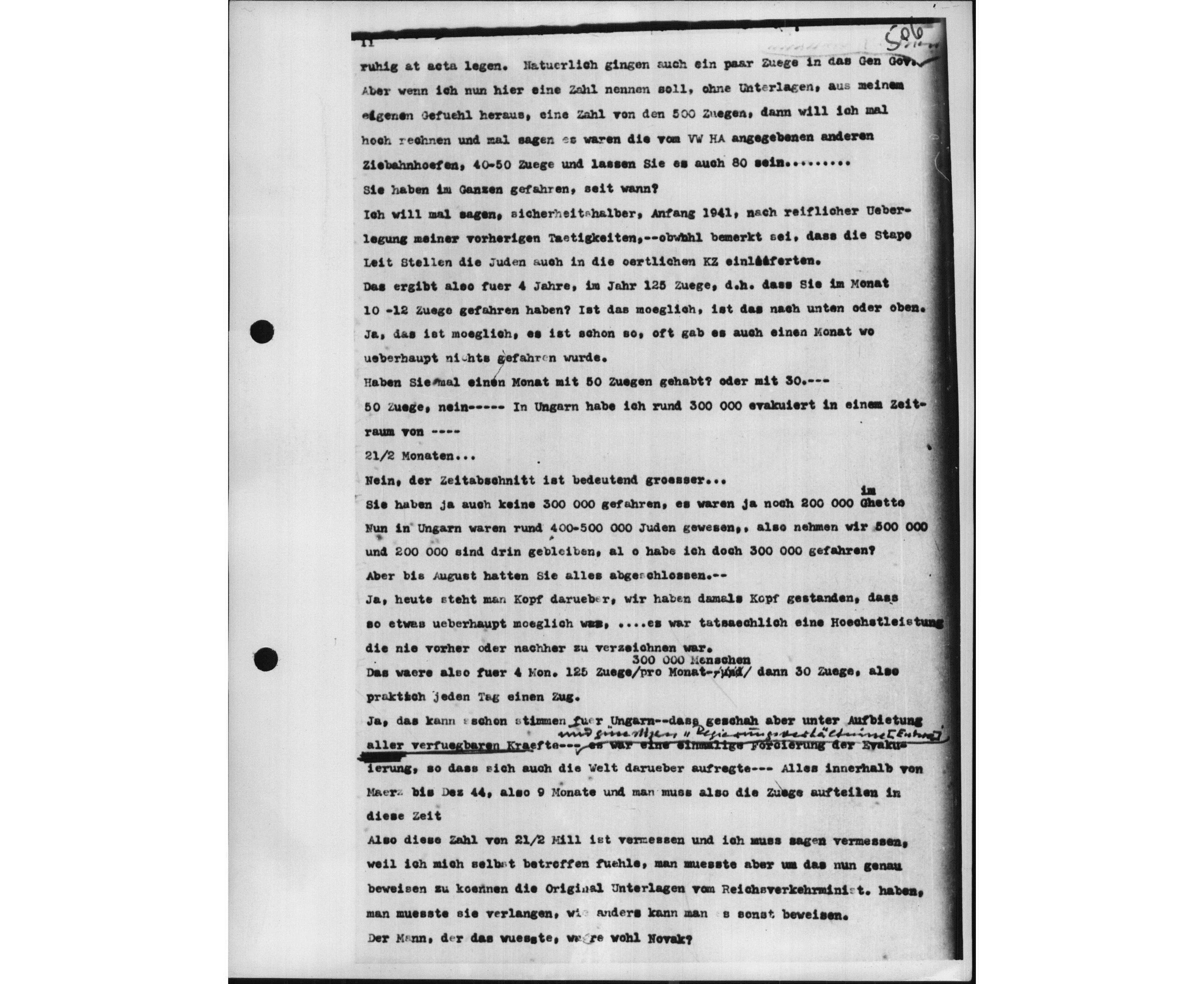
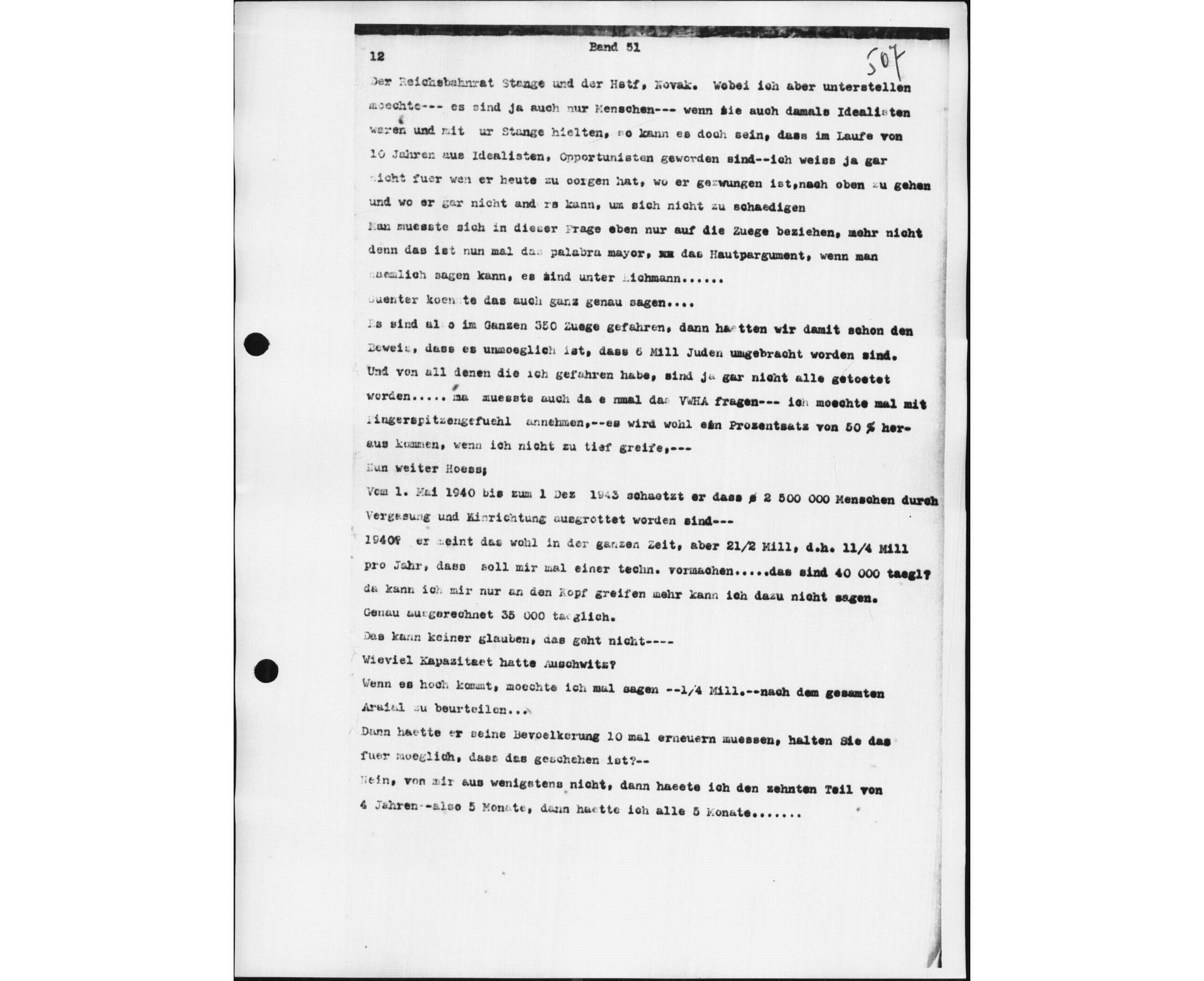
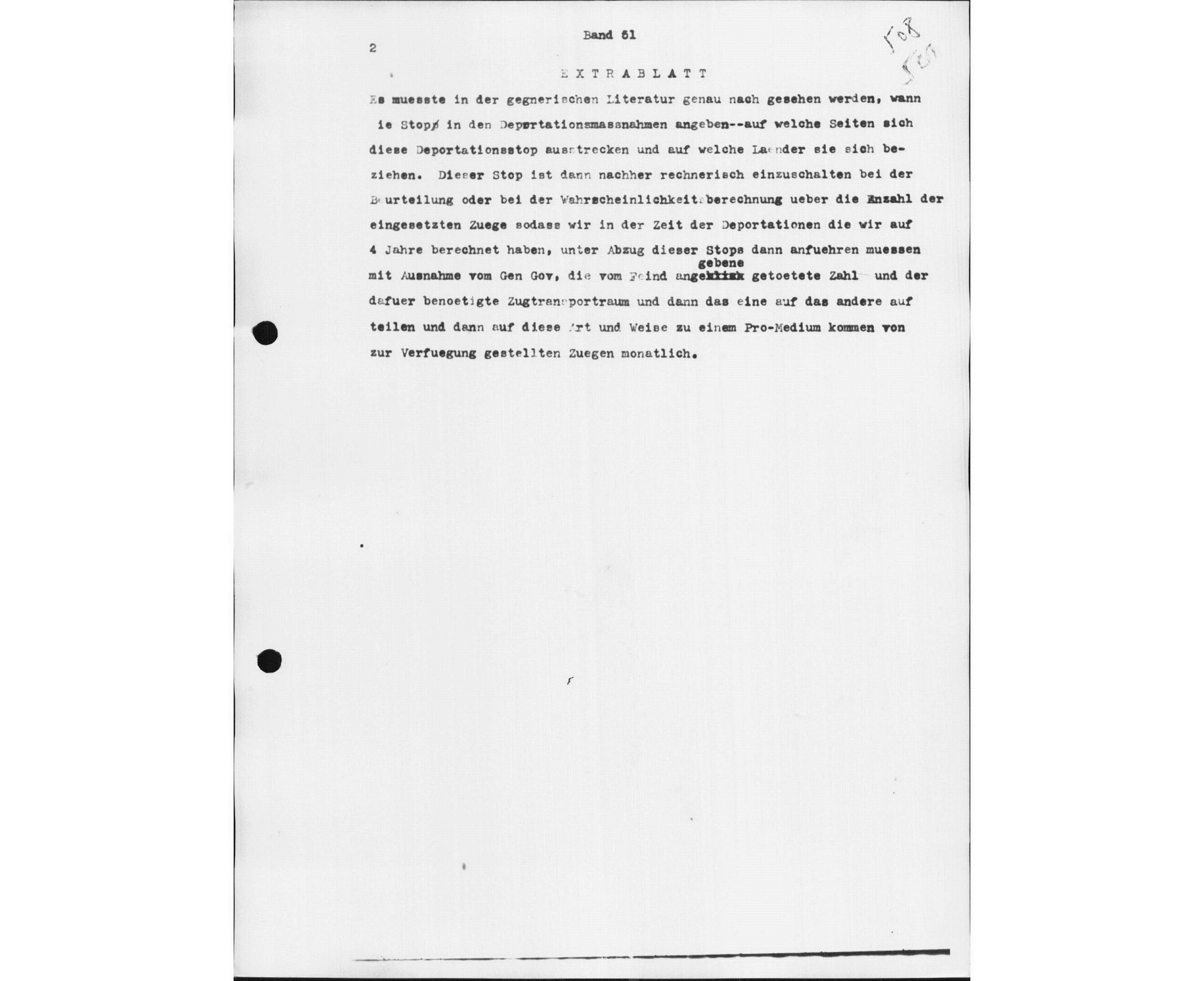
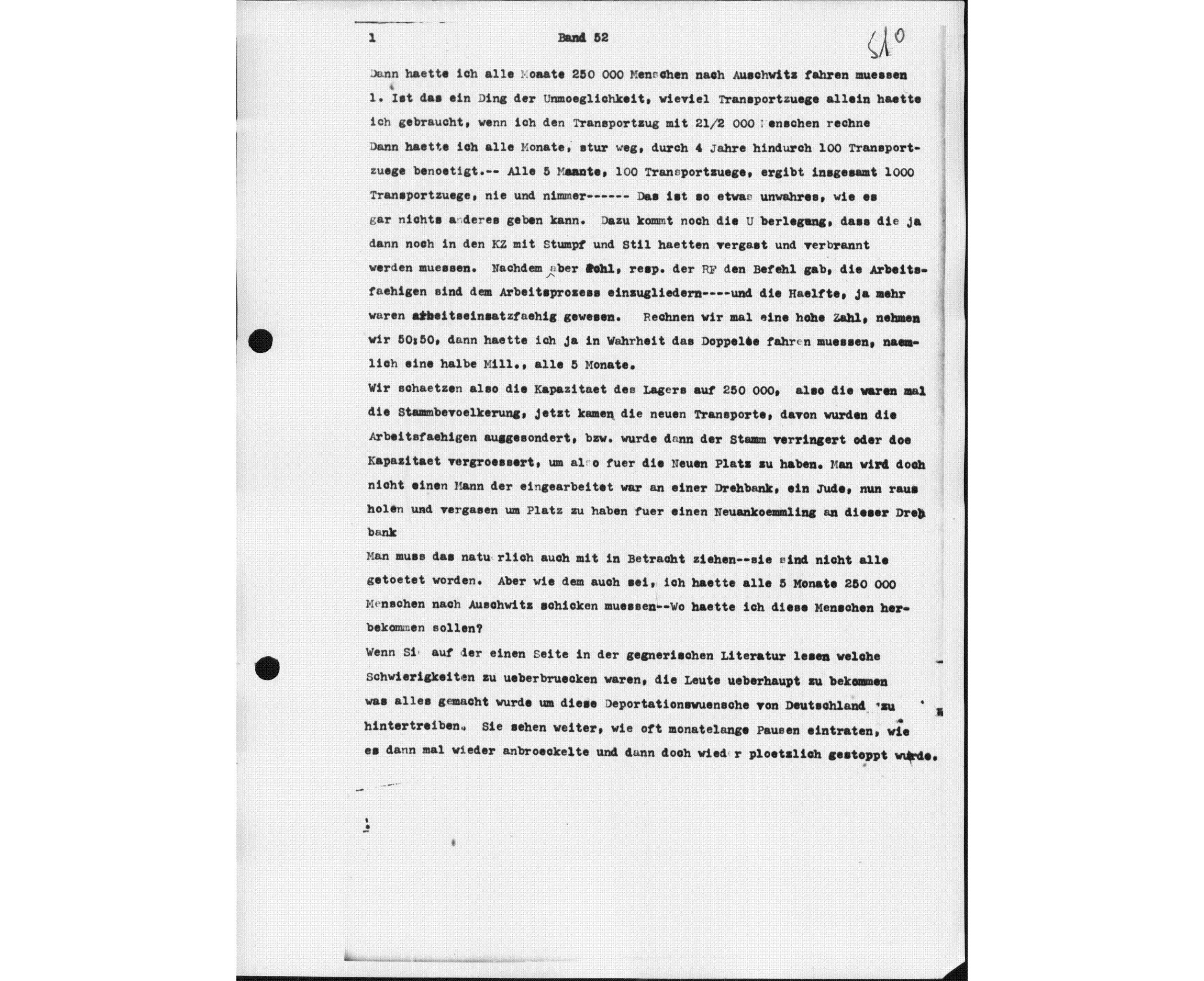
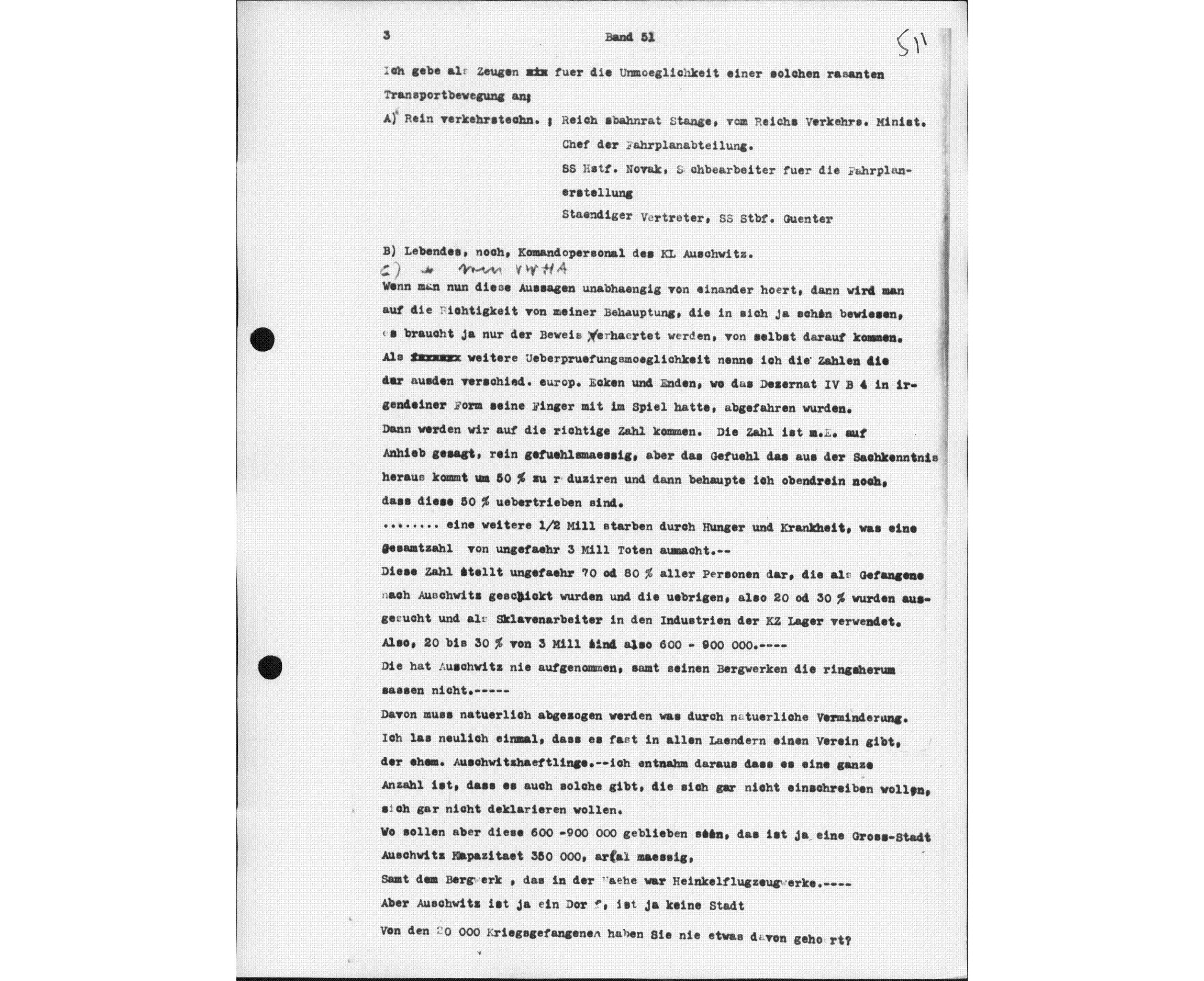
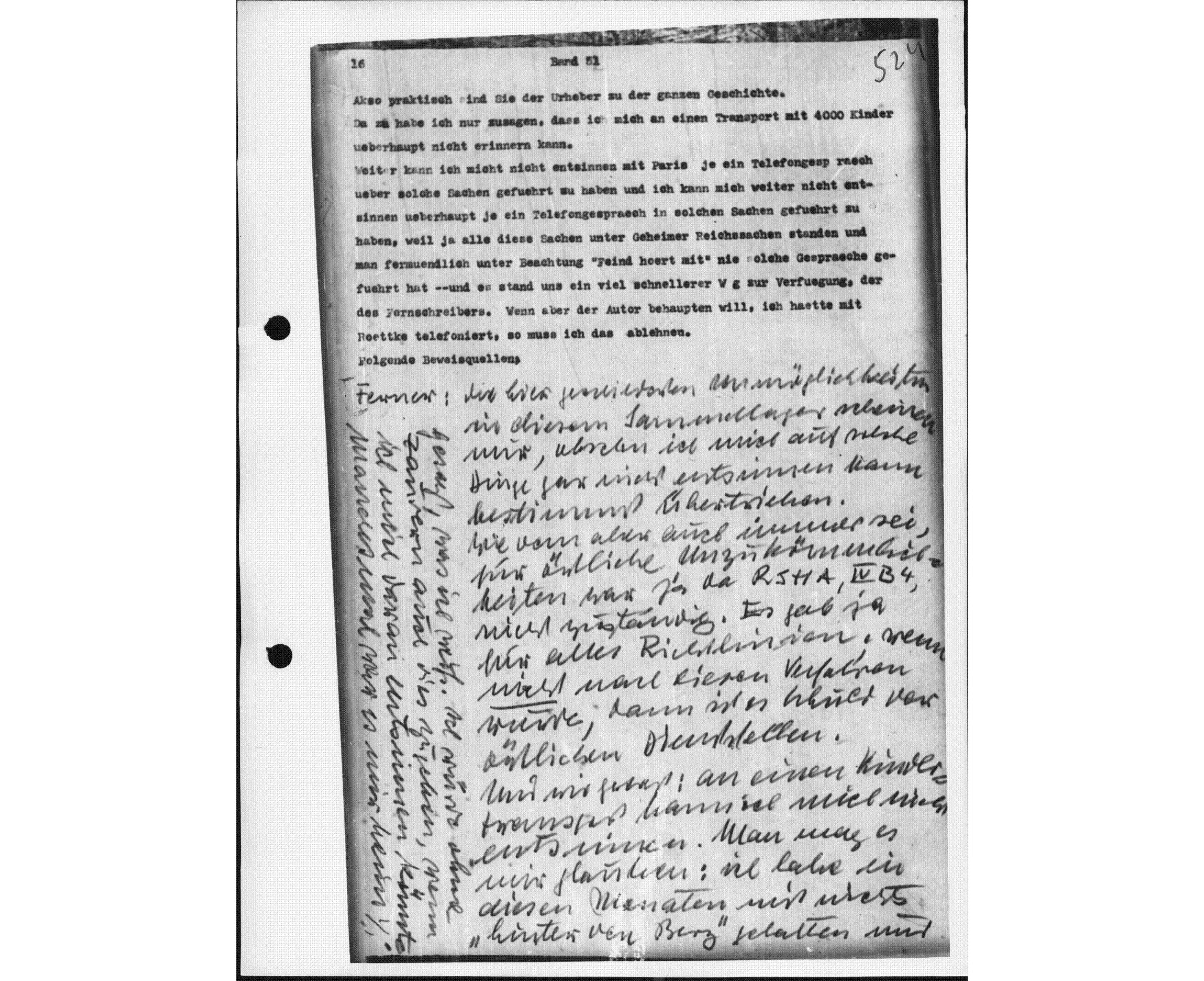
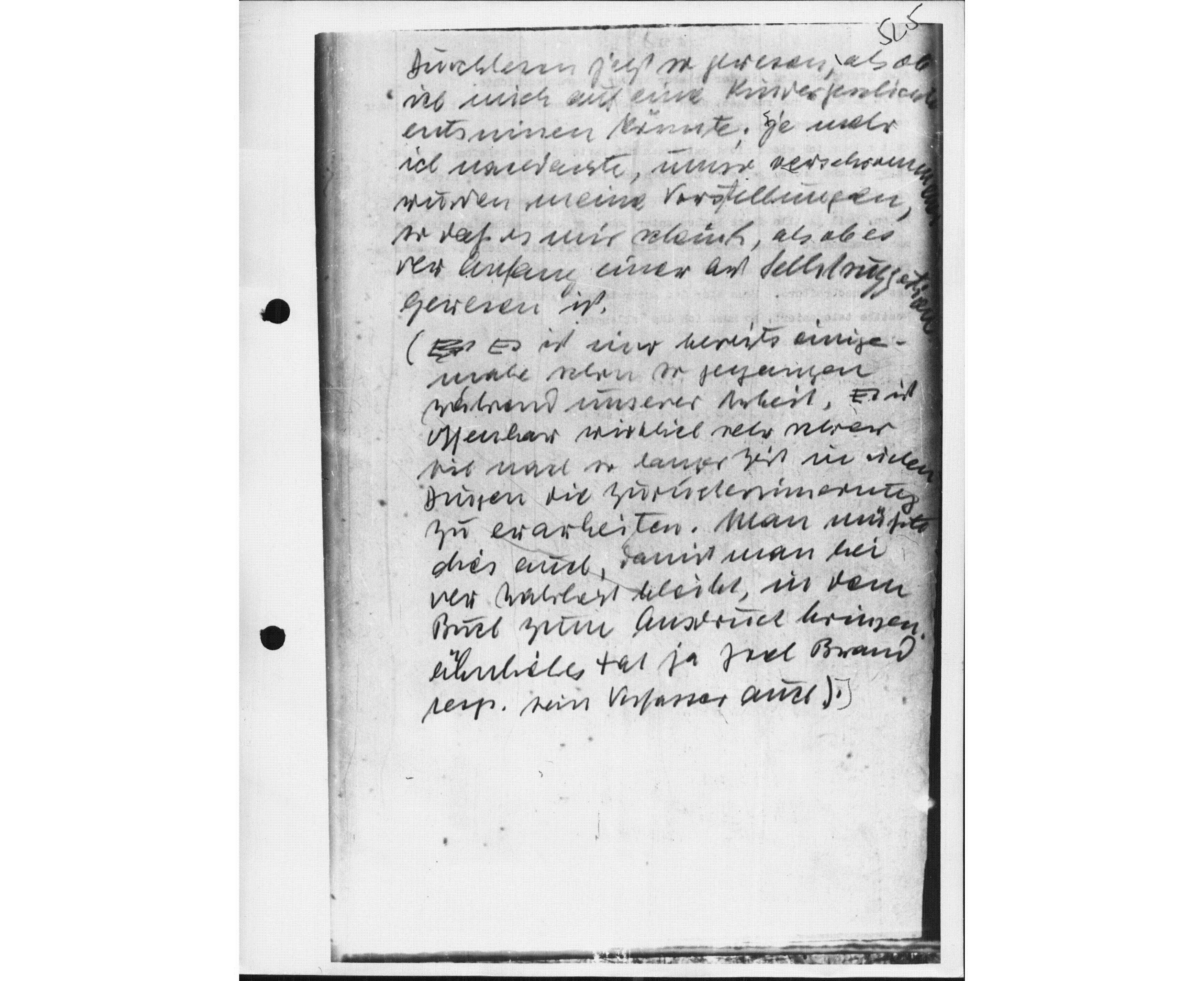
Sheet 1 of file 85
Sheet tools
Filter flags

What the flags mean

One passage can have more than one kind. Open a flag to see why it was added.

Knowledge
What Eichmann says he knew.
Orders
Commands he says he gave or got.
His office
Acts he links to his unit or job.
Intent
What he says he wanted or approved.
Figures
Numbers he gives.
Denial
What he says he didn't know or do.
Other
A passage outside the six groups above.

The Eichmann and Sassen interview, O.65 file 87

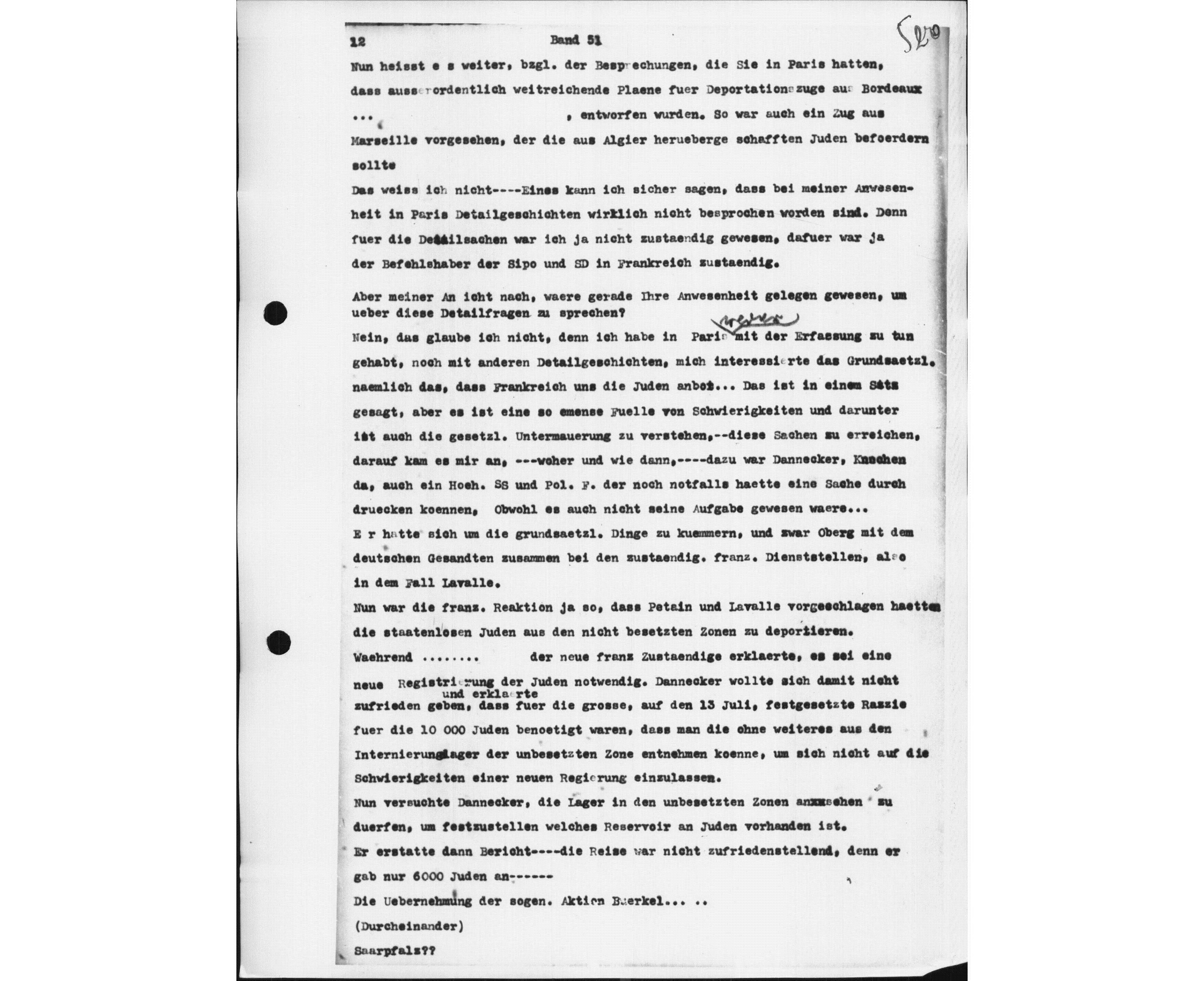
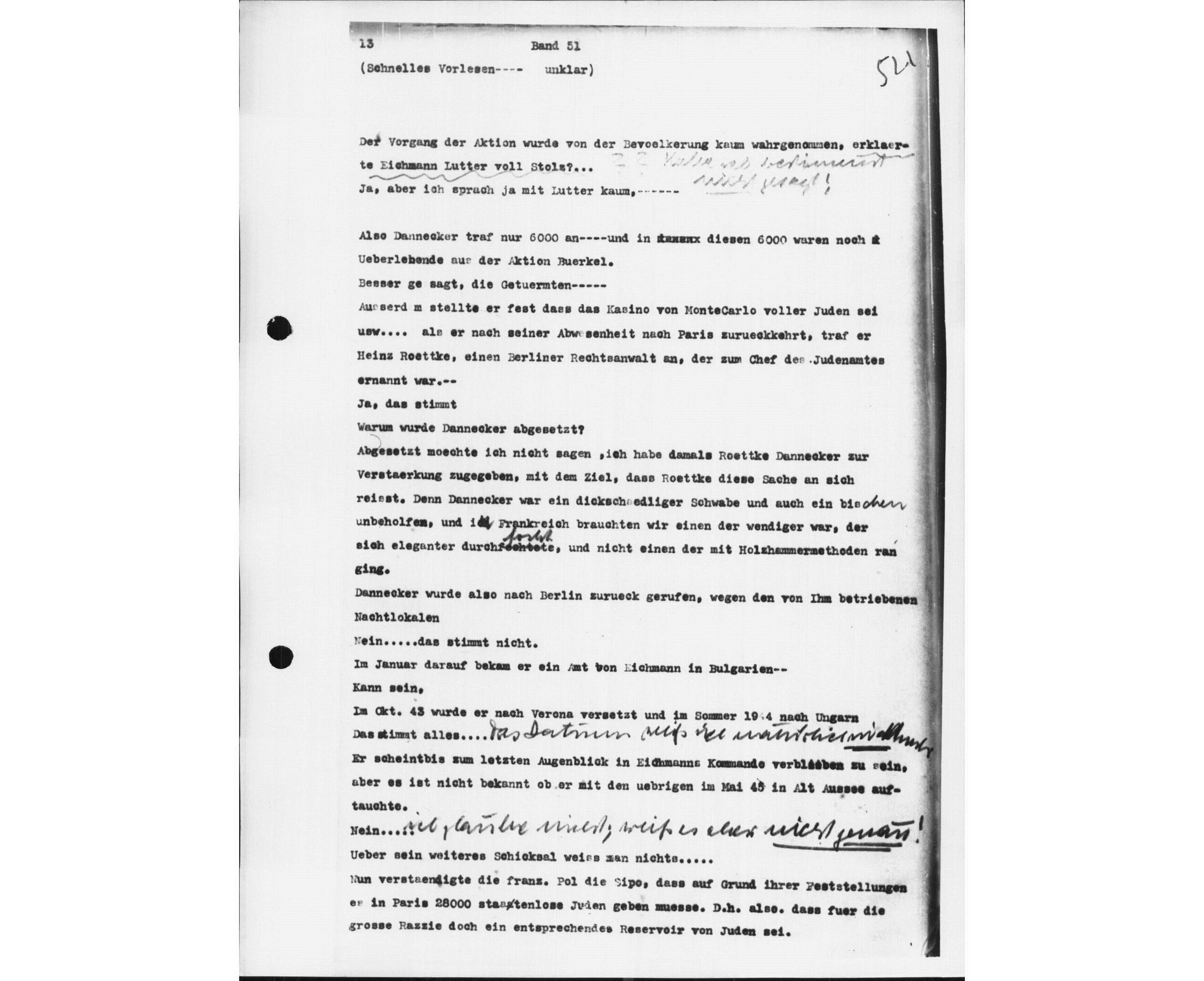
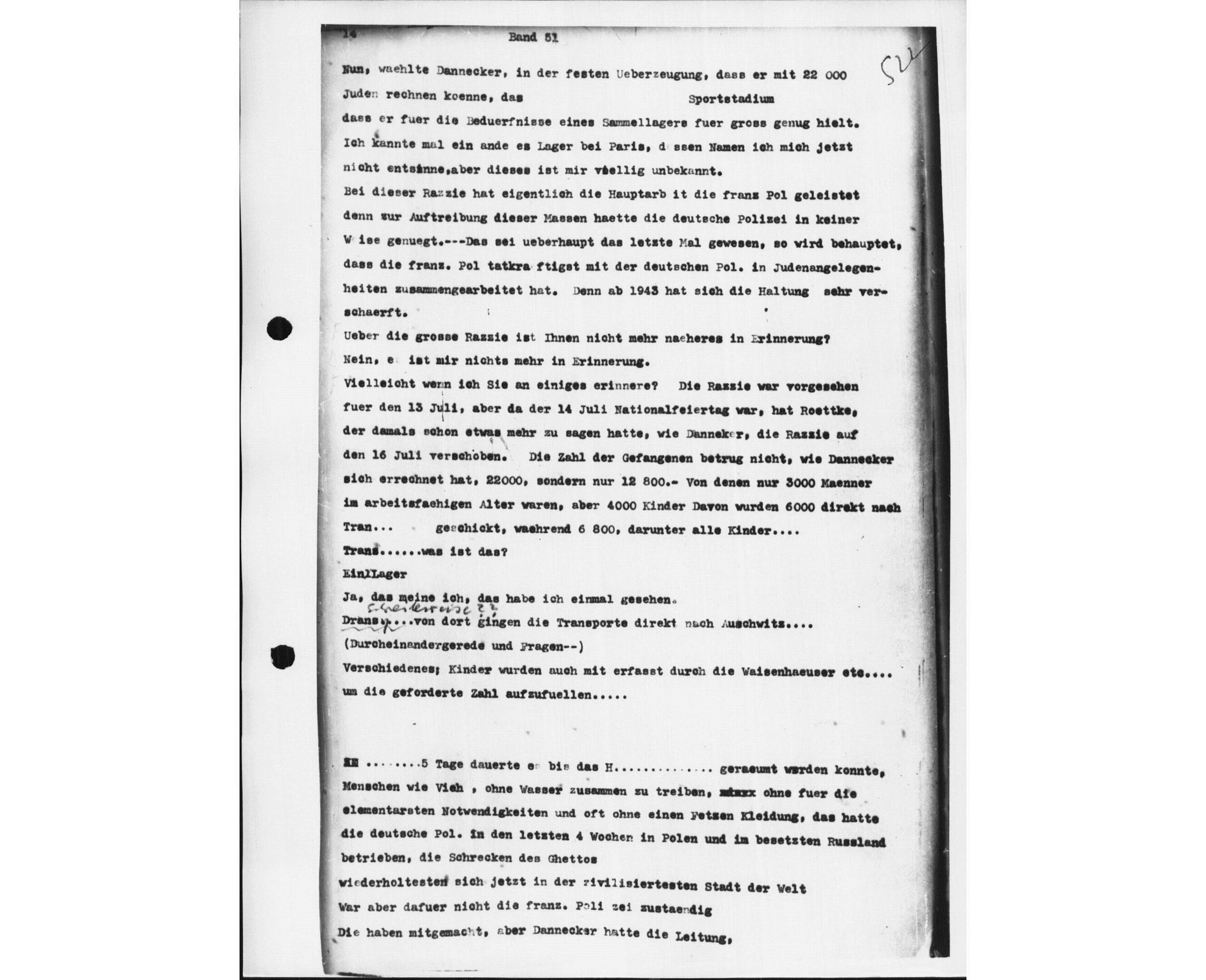
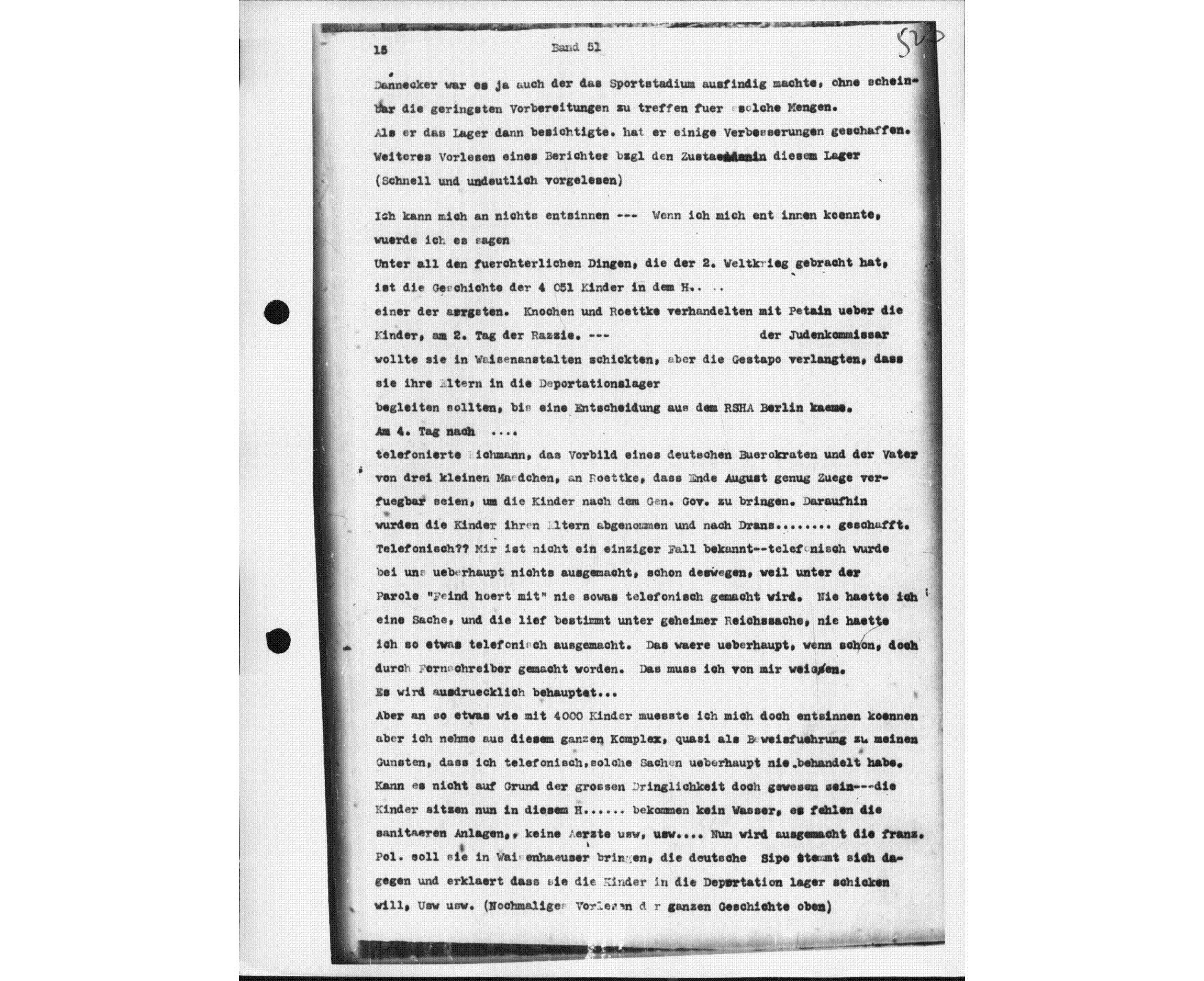
In 1957 Adolf Eichmann taped months of conversations in Buenos Aires with Willem Sassen. The typed transcript runs to 714 sheets, kept at Yad Vashem as four files, 85 to 88. Each sheet is shown beside its English, with the German a click away. Every sheet's English was verified against the scan. Questions are left unnamed unless the sheet or the tape gives the speaker. Check the scan before quoting.

Go to the first sheet in this file

O.65 file 87

Folio 10623184 · scans 00001 to 00165 · 165 scan pages

Jump to a scan in O.65 file 87 165 scans

Archive cover sheet. The interview begins on the next scan.

Open sheet image, German, and notes
Scan 00001 of the Sassen transcript, O.65 file 87.
This is scan 00001 of the Sassen transcript, O.65 file 87. The image is 3504 by 3544 pixels. Yad Vashem Archives, Jacob Robinson Collection O.65, file 87.

German transcription

[HW: 10623184] ארכיון יד ושם YAD VASHEM ARCHIVES RECORD GROUP: O.65 : חטיבה RECORD GROUP: אוסף : שם חטיבה יעקב רובינסון FILE NUMBER: [HW: 87] : מספר תיק ORIGINAL FILE : סימול מקורי NUMBER: INVENTORY : מספר נכנסות NUMBER: NUMBER OF PAGES: : מספר עמודים ITEM NUMBER: : מספר פריט

English translation

[HW: 10623184] ארכיון יד ושם [Hebrew: Yad Vashem Archives] YAD VASHEM ARCHIVES RECORD GROUP: O.65 : חטיבה [Hebrew: Record Group / division] RECORD GROUP: אוסף [Hebrew: collection] : שם חטיבה [Hebrew: Name of Record Group] יעקב רובינסון [Hebrew: Jacob Robinson] FILE NUMBER: [HW: 87] : מספר תיק [Hebrew: File number] ORIGINAL FILE : סימול מקורי [Hebrew: Original symbol/reference] NUMBER: INVENTORY : מספר נכנסות [Hebrew: Accession number] NUMBER: NUMBER OF PAGES: : מספר עמודים [Hebrew: Number of pages] ITEM NUMBER: : מספר פריט [Hebrew: Item number]
Unreviewed notes

These notes haven't been reviewed. A note can identify a speaker where the reviewed English doesn't. If they disagree, use the reviewed English.

Transcription note

This is not a transcript page but a Yad Vashem Archives bilingual (Hebrew/English) cover/catalogue sheet. It contains no German or Sassen-Eichmann interview text. Printed English field labels appear at left, printed Hebrew field labels at right. Printed/typeset value "O.65" is the record group; the Hebrew record-group name reads "אוסף יעקב רובינסון" (Jacob Robinson Collection). Handwritten additions: archive item number "10623184" at top right, and "87" in the FILE NUMBER field. All other value fields (ORIGINAL FILE NUMBER, INVENTORY NUMBER, NUMBER OF PAGES, ITEM NUMBER) are blank. A short handwritten stroke/mark appears upper left and near the right margin; a vertical ink line runs down the lower left. No struck-through text present.

Translation notes

- The source contains no German prose to translate; it is a bilingual Hebrew/English archival catalog form. The English form labels are already in English and are reproduced verbatim; the Hebrew labels are rendered as bracketed glosses. - The Record Group name field carries the Hebrew personal name יעקב רובינסון, rendered 'Jacob Robinson'; the exact transliteration is conventional and cannot be confirmed from the page alone. - The fields Original File Number, Inventory Number, Number of Pages, and Item Number are blank on this page; no values are present. This is a Yad Vashem Archives cover/catalog sheet, not a page of the Sassen interview transcript. It carries a handwritten accession number [HW: 10623184], the bilingual archives header, and a catalog form identifying Record Group O.65, collection name 'Jacob Robinson' (יעקב רובינסון), and File Number [HW: 87]. There is no German-language content and no dialogue. Per the attribution rules, a cover sheet carrying no dialogue returns an empty speaker_turns array; no statement can or should be attributed to Sassen, Eichmann, or any other participant from this page.
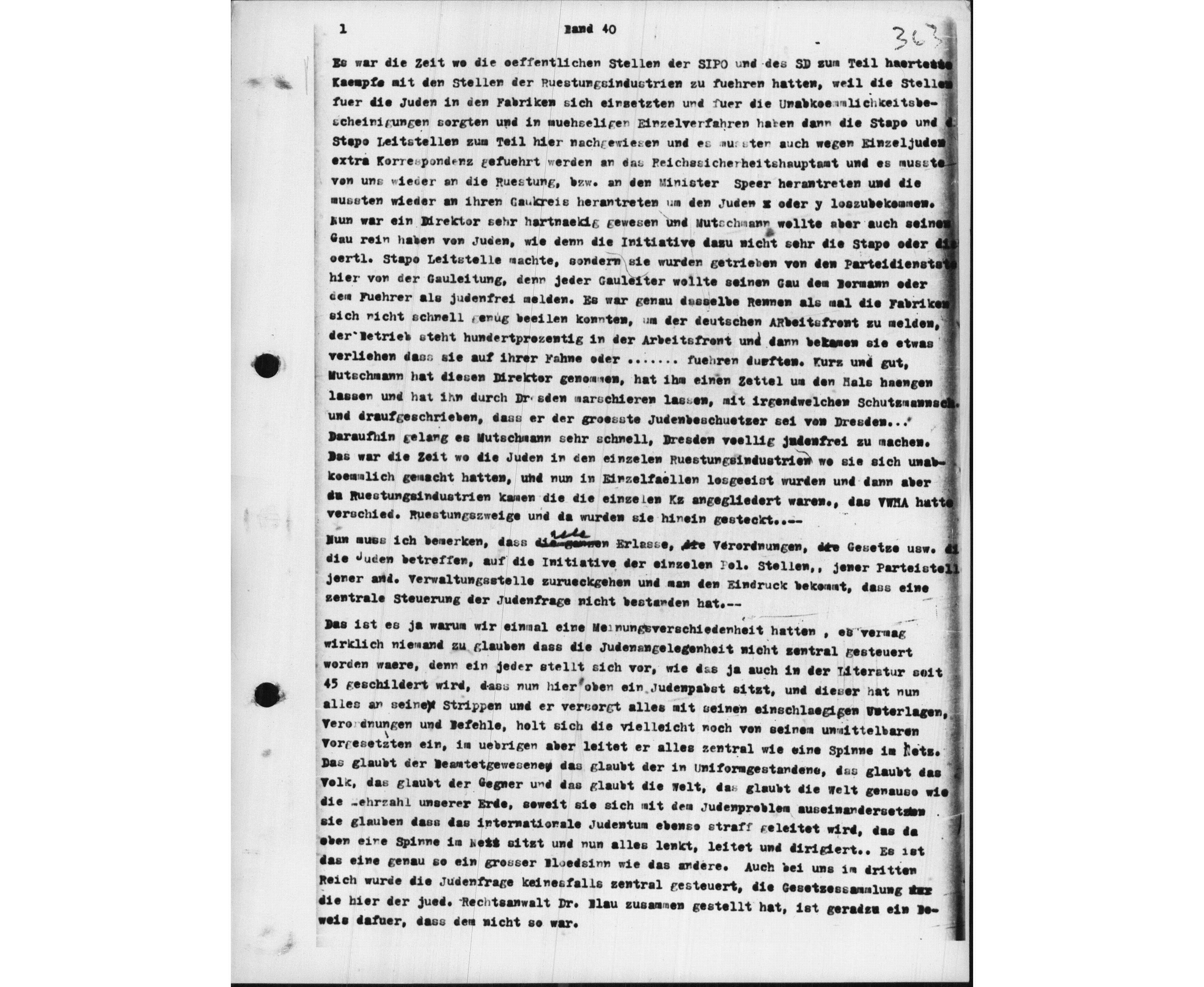
Band 40, page 1

It was the time when the offices of the Sipo and the SD had to fight some of their hardest battles with the armaments industry offices, because those offices stood up for the Jews in the factories and arranged the certificates that made them exempt from being drafted. In laborious individual proceedings the Stapo and the Stapo regional headquarters then showed in part what the situation really was here, and separate correspondence had to be carried on with the Reich Security Main Office over single Jews, and we in turn had to approach the armaments people, or Minister Speer, and they in turn had to approach their Gau district office to get Jew x or y released.

Now one director had been very stubborn, but Mutschmann wanted his Gau clean of Jews too, since the initiative for this did not really come from the Stapo or the local Stapo regional headquarters. They were driven by the Party offices, here by the Gau leadership, because every Gauleiter wanted to report his Gau to Bormann or to the Fuehrer as free of Jews. It was exactly the same race as when the factories could not hurry fast enough to report to the German Labor Front that the plant was one hundred percent in the Labor Front, and then they got something awarded that they were allowed to carry on their flag or [not typed].

In short, Mutschmann took this director, had a placard hung round his neck and had him marched through Dresden with some sort of police escort, and written on it that he was the greatest protector of Jews in Dresden. After that Mutschmann succeeded very quickly in making Dresden completely free of Jews. That was the time when the Jews in the individual armaments industries, where they had made themselves indispensable, were now prised loose in individual cases, but then came to armaments industries that were attached to the individual concentration camps. The WVHA had various armaments branches and they were put into those.

Now I must remark that all the decrees, regulations, laws and so on that concern the Jews go back to the initiative of the individual police offices, of this or that Party office, of this or that other administrative office, and one gets the impression that no central control of the Jewish question existed.

That is exactly why we once had a difference of opinion. Nobody is really able to believe that the Jewish matter was not centrally controlled, because everyone imagines, as it has also been described in the literature since 45, that a Jew-pope sits up here, and he now has everything on his strings and supplies everything with the relevant papers, regulations and orders, perhaps still obtaining them from his immediate superior, but otherwise directing it all centrally like a spider in its web. The man who was an official believes that, the man who stood in uniform believes that, the people believe it, the enemy believes it and the world believes it.

The world believes it just as most of our earth does, so far as they concern themselves with the Jewish problem, and they believe that international Jewry is led just as tightly, that a spider sits up there in the web and now steers, leads and directs everything. The one is exactly as great a piece of nonsense as the other. With us in the Third Reich too the Jewish question was in no way centrally controlled. The collection of laws that the Jewish lawyer Dr. Blau compiled here is downright proof that it was not so.

Open sheet image, German, and notes
Scan 00002 of the Sassen transcript, O.65 file 87.
This is scan 00002 of the Sassen transcript, O.65 file 87. The image is 3504 by 2872 pixels. Yad Vashem Archives, Jacob Robinson Collection O.65, file 87.

German transcription

1 Band 40 [HW: 363] Es war die Zeit wo die oeffentlichen Stellen der SIPO und des SD zum Teil haerteste Kaempfe mit den Stellen der Ruestungsindustrien zu fuehren hatten, weil die Stellen fuer die Juden in den Fabriken sich einsetzten und fuer die Unabkoemmlichkeitsbe- scheinigungen sorgten und in muehseligen Einzelverfahren haben dann die Stape und d Stape Leitstellen zum Teil hier nachgewiesen und es mussten auch wegen Einzeljuden extra Korrespondenz gefuehrt werden an das Reichssicherheitshauptamt und es musste von uns wieder an die Ruestung, bzw. an den Minister Speer herantreten und die mussten wieder an ihren Gaukreis herantreten um den Juden x oder y loszubekommen. Nun war ein Direktor sehr hartnaeckig gewesen und Mutschmann wollte aber auch seinen Gau rein haben von Juden, wie denn die Initiative dazu nicht sehr die Stape oder di oertl. Stape Leitstelle machte, sondern sie wurden getrieben von den Parteidienstst hier von der Gauleitung, denn jeder Gauleiter wollte seinen Gau dem Bormann oder dem Fuehrer als judenfrei melden. Es war genau dasselbe Rennen als mal die Fabriken sich nicht schnell genug beeilen konnten, um der deutschen ARbeitsfront zu melden, der Betrieb steht hundertprozentig in der Arbeitsfront und dann bekamen sie etwas verliehen dass sie auf ihrer Fahne oder ....... fuehren durften. Kurz und gut, Mutschmann hat diesen Direktor genommen, hat ihm einen Zettel um den Hals haengen lassen und hat ihn durch Dresden marschieren lassen, mit irgendwelchen Schutzmannsch. und draufgeschrieben, dass er der groesste Judenbeschuetzer sei von Dresden...' Daraufhin gelang es Mutschmann sehr schnell, Dresden voellig judenfrei zu machen. Das war die Zeit wo die Juden in den einzelen Ruestungsindustrien wo sie sich unab- koemmlich gemacht hatten, und nun in Einzelfaellen losgeeist wurden und dann aber zu Ruestungsindustrien kamen die die einzelen Kz angegliedert waren., das VWHA hatte verschied. Ruestungszweige und da wurden sie hinein gesteckt..-- Nun muss ich bemerken, dass [DEL: die ganzen] [HW: alle] Erlasse, [DEL: die] Verordnungen, [DEL: die] Gesetze usw. di die Juden betreffen, auf die Initiative der einzelnen Pol. Stellen,, jener Parteistell jener and. Verwaltungsstelle zurueckgehen und man den Eindruck bekommt, dass eine zentrale Steuerung der Judenfrage nicht bestanden hat.-- Das ist es ja warum wir einmal eine Meinungsverschiedenheit hatten , es vermag wirklich niemand zu glauben dass die Judenangelegenheit nicht zentral gesteuert worden waere, denn ein jeder stellt sich vor, wie das ja auch in der Literatur seit 45 geschildert wird, dass nun hier oben ein Judenpabst sitzt, und dieser hat nun alles an seinen Strippen und er versorgt alles mit seinen einschlaegigen Unterlagen, Verordnungen und Befehle, holt sich die vielleicht noch von seinem unmittelbaren Vorgesetzten ein, im uebrigen aber leitet er alles zentral wie eine Spinne im Netz. Das glaubt der Beamtetgewesene, das glaubt der in Uniformgestandene, das glaubt das Volk, das glaubt der Gegner und das glaubt die Welt, das glaubt die Welt genauso wie die Mehrzahl unserer Erde, soweit sie sich mit dem Judenproblem auseinandersetzen sie glauben dass das internationale Judentum ebenso straff geleitet wird, das da oben eine Spinne im Netz sitzt und nun alles lenkt, leitet und dirigiert.. Es ist das eine genau so ein grosser Bloedsinn wie das andere. Auch bei uns im dritten Reich wurde die Judenfrage keinesfalls zentral gesteuert, die Gesetzessammlung die die hier der jued. Rechtsanwalt Dr. Blau zusammen gestellt hat, ist geradzu ein Be- weis dafuer, dass dem nicht so war.

English translation

It was the time when the public offices of the SIPO and the SD in part had to wage the harshest struggles with the offices of the armaments industries, because the offices championed the Jews in the factories and saw to the indispensability-certificates, and in laborious individual proceedings the Stapo and Stapo control-centers in part demonstrated [/proved] this here, and extra correspondence also had to be conducted on account of individual Jews to the Reich Security Main Office, and we in turn had to approach the armaments [ministry], respectively Minister Speer, and they in turn had to approach their Gau-district in order to get Jew x or y released. Now a director had been very stubborn, and Mutschmann however also wanted to have his Gau clean of Jews, since the initiative for it was not so much made by the Stapo or the local Stapo control-center, but rather they were driven by the Party service-offices, here by the Gauleitung, for every Gauleiter wanted to report his Gau to Bormann or to the Führer as free of Jews. It was exactly the same race as when the factories once could not hurry quickly enough to report to the German Labor Front, "the enterprise stands one-hundred-percent in the Labor Front," and then they got something conferred [on them] that they were permitted to carry on their banner or ....... Long and short, Mutschmann took this director, had a placard hung around his neck and had him marched through Dresden, with some kind of police-guards[?] and written on [it] that he was the greatest Jew-protector of Dresden...' Thereupon Mutschmann succeeded very quickly in making Dresden completely free of Jews. That was the time when the Jews in the individual armaments industries where they had made themselves indispensable, and now in individual cases were pried loose and then however came to armaments industries to which the individual KZ[concentration camps] were attached; the WVHA had various armaments branches and there they were stuck in..-- Now I must remark that [DEL: the whole] [HW: all] decrees, [DEL: the] regulations, [DEL: the] laws etc. which concern the Jews go back to the initiative of the individual police offices, that Party office, that other administrative office, and one gets the impression that a central steering of the Jewish question did not exist.-- That is indeed why we once had a difference of opinion; no one is really able to believe that the Jewish matter would not have been centrally steered, for everyone imagines, as it is also depicted in the literature since '45, that up here there now sits a Jew-pope, and he now has everything on his strings and he supplies everything with his relevant documents, regulations and orders, perhaps still obtains them from his immediate superior, but otherwise directs everything centrally like a spider in the web. That the one-who-was-an-official believes, that the one-who-stood-in-uniform believes, that the people believe, that the enemy believes and that the world believes; the world believes it just as the majority of our earth [does], insofar as they concern themselves with the Jewish problem; they believe that international Jewry is likewise tightly led, that up there sits a spider in the web and now steers, leads and directs everything.. The one is just exactly as great a nonsense as the other. Also with us in the Third Reich the Jewish question was by no means centrally steered; the collection of laws which the Jewish lawyer Dr. Blau here compiled is downright a proof of the fact that it was not so.
Unreviewed notes

These notes haven't been reviewed. A note can identify a speaker where the reviewed English doesn't. If they disagree, use the reviewed English.

Transcription note

Single scan Part3/00002 transcribed. Header: typed "1" (top left), typed "Band 40" (center), handwritten "363" (top right, marked [HW:]). Right margin is cut off on several lines, leaving trailing partial words (e.g. "und d", "es musste", "oder di", "Parteidienstst", "usw. di", "jener Parteistell") transcribed as visible. Line 25 contains an editorial correction: typewritten "die ganzen" struck through with handwritten "alle" written above as replacement, and the "die" before "Verordnungen" and before "Gesetze" each struck through; rendered per replacement-adjacency protocol. Whether "die" is fully included in the first cancellation vs. "ganzen" alone is slightly uncertain from the strokes. "VWHA" transcribed as the visible glyphs (not silently corrected to WVHA). Row of typed periods after "Fahne oder" preserved (~7). Faint mottling/blots and hole-punch marks in left margin are not text-bearing.

Translation notes

- 'zum Teil hier nachgewiesen' — 'nachgewiesen' rendered as 'demonstrated/proved'; the intended object (what was demonstrated/documented) is grammatically loose in the German and the reading is uncertain. - 'irgendwelchen Schutzmannsch.' — abbreviation expanded to 'Schutzmannschaft(en)' (police-guards); the abbreviation is unresolved in the source. - 'fuehren durften' after 'auf ihrer Fahne oder .......' — the German trails off with an ellipsis; the object carried on the banner is omitted in the source and left incomplete. - 'losgeeist' — colloquial 'pried/broken loose'; rendered literally as 'pried loose'. - 'Das ist es ja warum wir einmal eine Meinungsverschiedenheit hatten' — 'we once had a difference of opinion': whether 'wir' includes the current speaker and the addressee (interviewer/respondent) is ambiguous and bears on attribution. - 'der Beamtetgewesene' / 'der in Uniformgestandene' — nonce nominalizations ('the one who was an official' / 'the one who stood in uniform') rendered periphrastically. Single continuous page (Band 40, stamped [HW: 363]). No explicit speaker labels or initials anywhere on the page. The page divides into two blocks by a paragraph break. The first block is a sustained first-person administrative narrative (SIPO/SD vs. armaments industries, RSHA correspondence, Mutschmann/Dresden, WVHA camps) closing with 'Now I must remark...' the Jewish question was not centrally steered — attributed to E on content grounds (insider RSHA-level procedural detail), though without an explicit label. The second block opens with 'That is indeed why we once had a difference of opinion' — this phrasing suggests a turn boundary and a reply/rejoinder, which is why it is separated, but its content merely continues the same 'no central steering' argument and does not on its own name the speaker; per the attribution rules it is left UNCERTAIN rather than guessed from alternation. Preserved: [HW: 363], [HW: alle], the [DEL: ...] deletions, the trailing ellipses ('.......'), the stray closing quote after 'Dresden', and the double-hyphen line terminators ('..--', '.--').
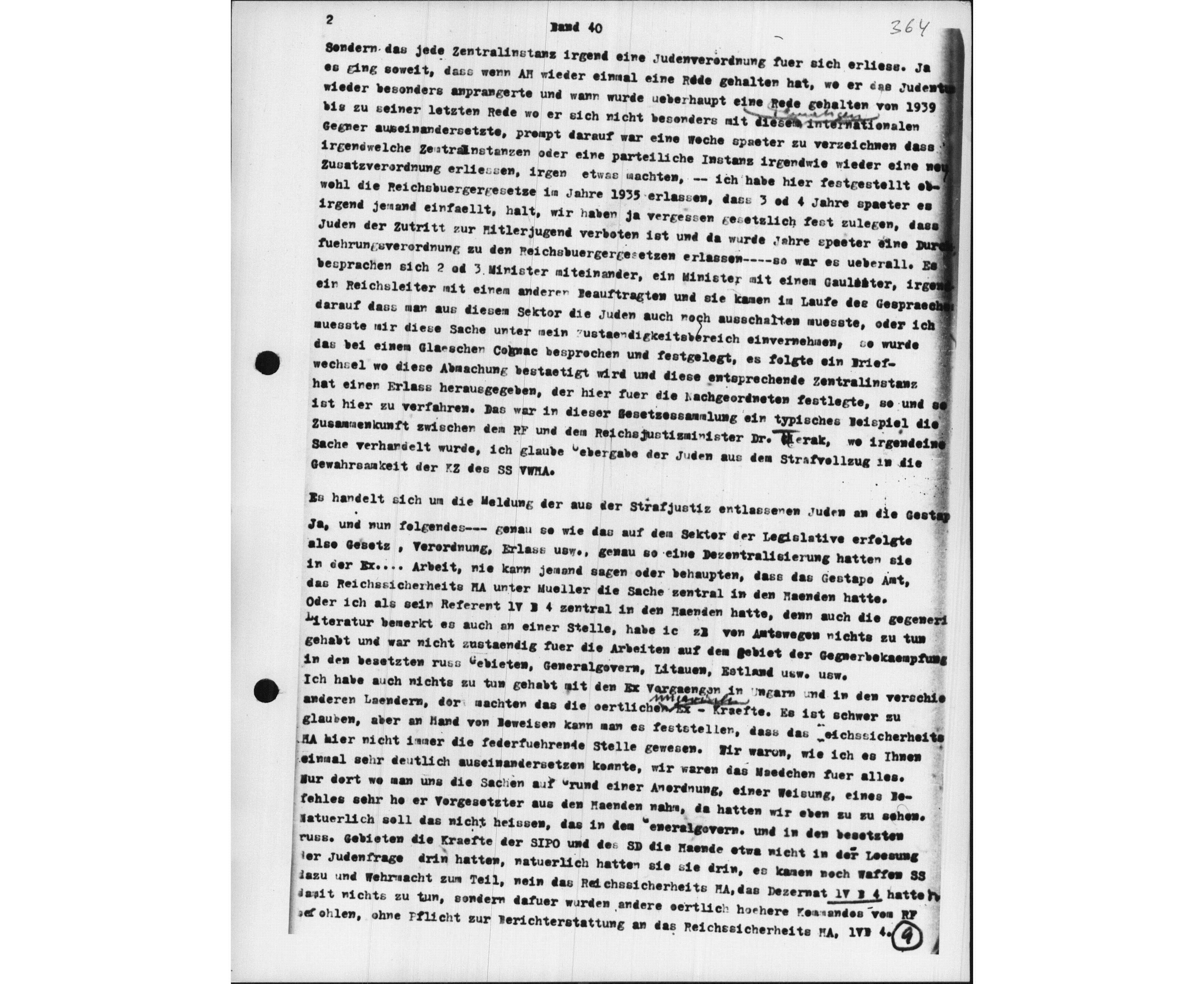
Band 40, page 2

Rather, each central authority issued some Jewish regulation of its own. Yes, it went so far that whenever AH had once again made a speech in which he denounced Jewry with particular force, and when was a speech ever given, from 1939 up to his last speech, in which he did not deal especially with this international enemy, promptly a week later one could note that some central authorities or some Party authority again issued some new supplementary regulation, did something.

I have established here that although the Reich Citizenship Laws were issued in 1935, three or four years later it occurs to somebody, hold on, we have forgotten to lay down in law that Jews are forbidden access to the Hitler Youth, and years later an implementing regulation to the Reich Citizenship Laws was issued. It was like that everywhere. Two or three ministers talked with each other, a minister with a Gauleiter, some Reichsleiter with another plenipotentiary, and in the course of the conversation they came round to the idea that the Jews would have to be excluded from this sector as well, or that I would have to take this matter into my own area of competence.

So it was discussed and settled over a small glass of cognac, an exchange of letters followed in which this arrangement was confirmed, and the central authority concerned issued a decree that laid down for the subordinate offices that this is how it is to be handled here. A typical example in this collection of laws was the meeting between the RF and the Reich Minister of Justice Dr. Therak, where some matter was dealt with. I believe the handing over of the Jews from the penal system into the custody of the concentration camps of the SS WVHA.

Questioner

It concerns the reporting of the Jews released from the criminal justice system to the Gestapo.

Eichmann

Yes, and now the following. Exactly as it happened in the sector of legislation, that is, law, regulation, decree and so on, they had exactly the same decentralization in the [not typed] work. Nobody can ever say or claim that the Gestapo Office, the Reich Security Main Office under Mueller, had the matter centrally in hand. Or that I as his desk officer IV B 4 had it centrally in hand, because even the hostile literature notes it in one place, I for example had officially nothing to do with, and was not competent for, the work in the field of fighting the enemy in the occupied Russian territories, the General Government, Lithuania, Estonia and so on.

I also had nothing to do with the [not typed] operations in Hungary and in the various other countries. There the local [handwriting] forces did that. It is hard to believe, but on the basis of evidence one can establish that the Reich Security Main Office was not always the office in charge here. We were, as I was once able to explain to you very clearly, we were the maid of all work. Only where the matters were taken out of our hands on the basis of an instruction, a directive, an order from a very senior superior, there we simply had to look on.

Of course that is not to say that in the General Government and in the occupied Russian territories the forces of the Sipo and the SD did not have their hands in the solution of the Jewish question. Of course they had them in it, the Waffen SS came in as well and the Wehrmacht in part. No, the Reich Security Main Office, the section IV B 4, had nothing to do with it. Instead other local higher commands were ordered to do it by the RF, without any duty to report to the Reich Security Main Office, IV B 4.

Open sheet image, German, and notes
Scan 00003 of the Sassen transcript, O.65 file 87.
This is scan 00003 of the Sassen transcript, O.65 file 87. The image is 3504 by 2864 pixels. Yad Vashem Archives, Jacob Robinson Collection O.65, file 87.

German transcription

2 Band 40 [HW: 364] Sondern das jede Zentralinstanz irgend eine Judenverordnung fuer sich erliess. Ja es ging soweit, dass wenn AH wieder einmal eine Rede gehalten hat, wo er das Judentum wieder besonders anprangerte und wann wurde ueberhaupt eine Rede gehalten von 1939 bis zu seiner letzten Rede wo er sich nicht besonders mit diesem internationalen [HW: [illegible]] Gegner auseinandersetzte, prompt darauf war eine Woche spaeter zu verzeichnen dass irgendwelche Zentralinstanzen oder eine parteiliche Instanz irgendwie wieder eine neu Zusatzverordnung erliessen, irgen etwas machten, -- ich habe hier festgestellt ob- wohl die Reichsbuergergesetze im Jahre 1935 erlassen, dass 3 od 4 Jahre spaeter es irgend jemand einfaellt, halt, wir haben ja vergessen gesetzlich fest zulegen, dass Juden der Zutritt zur Hitlerjugend verboten ist und da wurde Jahre spaeter eine Durch fuehrungsverordnung zu den Reichsbuergergesetzen erlassen----so war es ueberall. Es besprachen sich 2 od 3 Minister miteinander, ein Minister mit einem Gaulaeter, irgen ein Reichsleiter mit einem anderen Beauftragten und sie kamen im Laufe des Gespraeches darauf dass man aus diesem Sektor die Juden auch noch ausschalten muesste, oder ich muesste mir diese Sache unter mein Zustaendigkeitsbereich einvernehmen, so wurde das bei einem Glaeschen Cognac besprechen und festgelegt, es folgte ein Brief- wechsel wo diese Abmachung bestaetigt wird und diese entsprechende Zentralinstanz hat einen Erlass herausgegeben, der hier fuer die Nachgeordneten festlegte, so und so ist hier zu verfahren. Das war in dieser Gesetzessammlung ein typisches Beispiel die Zusammenkunft zwischen dem RF und dem Reichsjustizminister Dr. Therak, wo irgendeine Sache verhandelt wurde, ich glaube Uebergabe der Juden aus dem Strafvollzug in die Gewahrsamkeit der KZ des SS VWHA. Es handelt sich um die Meldung der aus der Strafjustiz entlassenen Juden an die Gestap Ja, und nun folgendes--- genau se wie das auf dem Sektor der Legislative erfolgte also Gesetz , Verordnung, Erlass usw., genau so eine Dezentralisierung hatten sie in der Ex.... Arbeit, nie kann jemand sagen oder behaupten, dass das Gestapo Amt, das Reichssicherheits HA unter Mueller die Sache zentral in den Haenden hatte. Oder ich als sein Referent IV B 4 zentral in den Haenden hatte, denn auch die gegneri Literatur bemerkt es auch an einer Stelle, habe ic zB von Amtswegen nichts zu tun gehabt und war nicht zustaendig fuer die Arbeiten auf dem Gebiet der Gegnerbekaempfung in den besetzten russ Gebieten, Generalgovern, Litauen, Estland usw. usw. Ich habe auch nichts zu tun gehabt mit den Ex Vorgaengen in Ungarn und in den verschie anderen Laendern, dor machten das die oertlichen [HW: [?militaerische?]] Ex - Kraefte. Es ist schwer zu glauben, aber an Hand von Beweisen kann man es feststellen, dass das Reichssicherheits HA hier nicht immer die federfuehrende Stelle gewesen. Wir waron, wie ich es Ihnen einmal sehr deutlich auseinandersetzen konnte, wir waren das Maedchen fuer alles. Nur dort wo man uns die Sachen auf Grund einer Anordnung, einer Weisung, eines Be- fehles sehr ho er Vorgesetzter aus den Haenden nahm, da hatten wir eben zu zu sehen. Natuerlich soll das nicht heissen, das in dem Generalgovern. und in den besetzten russ. Gebieten die Kraefte der SIPO und des SD die Haende etwa nicht in der Loesung der Judenfrage drin hatten, natuerlich hatten sie sie drin, es kamen noch Waffen SS dazu und Wehrmacht zum Teil, nein das Reichssicherheits HA, das Dezernat IV B 4 hatte damit nichts zu tun, sondern dafuer wurden andere oertlich hoehere Kommandos von RF befohlen, ohne Pflicht zur Berichterstattung an das Reichssicherheits HA, IVB 4. [HW: 4]

English translation

But that each central authority issued some Jewish regulation for itself. Yes it went so far, that when AH once again gave a speech, where he again especially denounced Jewry — and when was a speech ever given at all from 1939 up to his last speech where he did not especially engage with this international [HW: [illegible]] adversary — promptly thereupon it was to be recorded a week later that some central authorities or a Party authority somehow again issued a new supplementary regulation, made some thing or other, — I have here determined, although the Reich Citizenship Laws [were] issued in the year 1935, that 3 or 4 years later it occurs to someone, stop, we have indeed forgotten to establish legally that Jews are forbidden entry to the Hitler Youth, and there years later an implementing regulation to the Reich Citizenship Laws was issued——so it was everywhere. 2 or 3 ministers conferred with one another, one minister with a Gauleiter, some Reichsleiter or other with another commissioner, and in the course of the conversation they came to [the point] that one would have to eliminate the Jews also from this sector too, or I would have to bring this matter into agreement under my area of jurisdiction, so that was discussed and established over a little glass of cognac, there followed a correspondence where this arrangement is confirmed and this corresponding central authority issued a decree, which here for the subordinates laid down, thus and thus is to be proceeded here. That was in this collection of laws a typical example, the meeting between the RF and the Reich Justice Minister Dr. Therak, where some matter was negotiated, I believe transfer of the Jews from penal custody into the custody of the concentration camps of the SS VWHA. It concerns the reporting of the Jews released from the criminal justice [system] to the Gestapo. Yes, and now the following——exactly the way that occurred in the sector of the legislative, that is law, regulation, decree etc., exactly such a decentralization they had in the ex.... work, never can anyone say or claim, that the Gestapo Office, the Reich Security Main Office under Mueller had the matter centrally in [its] hands. Or [that] I as his desk officer IV B 4 had [it] centrally in [my] hands, for even the opposing literature notes it too at one place, I had for instance officially nothing to do [with it] and was not responsible for the works in the field of adversary-combating in the occupied Russian territories, General Government, Lithuania, Estonia etc. etc. I also had nothing to do with the ex proceedings in Hungary and in the various other countries, there the local [HW: [?military?]] ex-forces did it. It is hard to believe, but on the basis of proofs one can determine, that the Reich Security Main Office here was not always the leading office. We were, as I could once set out to you very clearly, we were the maid-of-all-work. Only there where one took the matters out of our hands on the basis of an order, an instruction, a command of very high superior, there we just had to watch. Naturally that shall not mean, that in the General Government and in the occupied Russian territories the forces of the SIPO and the SD did not have their hands, so to speak, in the solution of the Jewish question, naturally they had them in [it], there came in addition Waffen SS and Wehrmacht in part, no, the Reich Security Main Office, the section IV B 4 had nothing to do with it, but rather for that other local higher commands were ordered by the RF, without obligation to report to the Reich Security Main Office, IVB 4. [HW: 4]
Unreviewed notes

These notes haven't been reviewed. A note can identify a speaker where the reviewed English doesn't. If they disagree, use the reviewed English.

Transcription note

Single scan Part3/00003 (file 00003.jpg). Header line: printed "2" (page-in-band, top left), "Band 40" (centre), handwritten "364" (archival folio, top right). Two paragraphs of typewritten interview text; typewriter shows many faded/misaligned characters. Two handwritten cursive additions above the base line: one above the end of the line "...mit diesem internationalen" (illegible cursive scrawl), and one above "oertlichen Ex - Kraefte" (tentatively read "militaerische", genuinely uncertain). "IV B 4" in the last paragraph is underlined by hand; a circled handwritten "4" appears at the lower-right corner after the final line. Visible original typos/spellings preserved verbatim (e.g. "Gaulaeter", "waron", "se wie", "ho er", "zu zu sehen", "irgen", "dor", "Therak" for Thierack, "Judentum"/"Judentu" truncation, "Gestap"/"gegneri" line-end truncations from page margin). Two punch-holes in left margin do not obscure text.

Translation notes

- "Therak" is the transcribed spelling of the Reich Justice Minister's name (historically Otto Thierack); rendered as written in the German, not corrected. - "SS VWHA" is rendered as in the source; historically the office administering concentration camps was the SS-WVHA (Wirtschafts-Verwaltungshauptamt). The source reads VWHA (letter order as transcribed). - "ex.... work", "ex proceedings", "ex-forces" translate the abbreviated German "Ex....", "Ex Vorgaengen", "Ex - Kraefte". The abbreviation "Ex" is left unexpanded because the German does not spell it out (likely 'Exekution'/'Exekutiv', i.e. execution/executive), and expanding it would resolve an uncertainty present in the source. - "maid-of-all-work" translates "das Maedchen fuer alles" (idiom: the one who does everything / general dogsbody); rendered literally with the idiomatic sense noted. - "adversary-combating" translates "Gegnerbekaempfung" literally (combating of adversaries/enemies). - "engage with ... adversary" translates "sich auseinandersetzte ... Gegner"; "Gegner" (adversary/opponent) here refers to the "international" enemy Hitler denounced. - "came to [the point]" fills an elliptical German construction "kamen ... darauf dass"; the bracket marks the supplied object. This page (Band 40, HW page 364) is a continuous monologue: it opens mid-sentence (\"Sondern das...\" — \"But that...\") continuing from the previous page and ends mid-topic. The bulk is a first-person account by a speaker describing RSHA / Amt IV / Dezernat IV B 4 internal workings, explicitly self-identifying as Mueller's desk officer \"IV B 4\" and addressing an interlocutor (\"as I could once set out to you\") — consistent with Eichmann as respondent. No explicit speaker labels or initials appear anywhere on the page. The one sentence \"It concerns the reporting of the Jews released from the criminal justice system to the Gestapo\" reads as a possible interjection/clarification and its speaker cannot be fixed from this page alone, so it is left UNCERTAIN rather than assigned. Broken/incomplete German preserved: \"irgen\" (for irgend), \"neu\" (neue), \"od\" (oder), \"ho er\" (hoeher), \"waron\" (waren), \"ic\" (ich), \"verschie anderen\" (verschiedenen anderen), \"Gestap\" (Gestapo, word cut off at line end), \"Ex....\" ellipsis, \"zu zu sehen\" (repeated 'zu'). Handwritten marginalia preserved: [HW: 364] top, [HW: [illegible]], [HW: [?military?]] (uncertain reading of a handwritten insertion above \"Ex - Kraefte\"), and [HW: 4] at foot. \"AH\" = Adolf Hitler, \"RF\" = Reichsfuehrer (Himmler), left as abbreviations as in source. The trailing file paths in the prompt are the run's OCR artifact listing and are not part of this page's content.
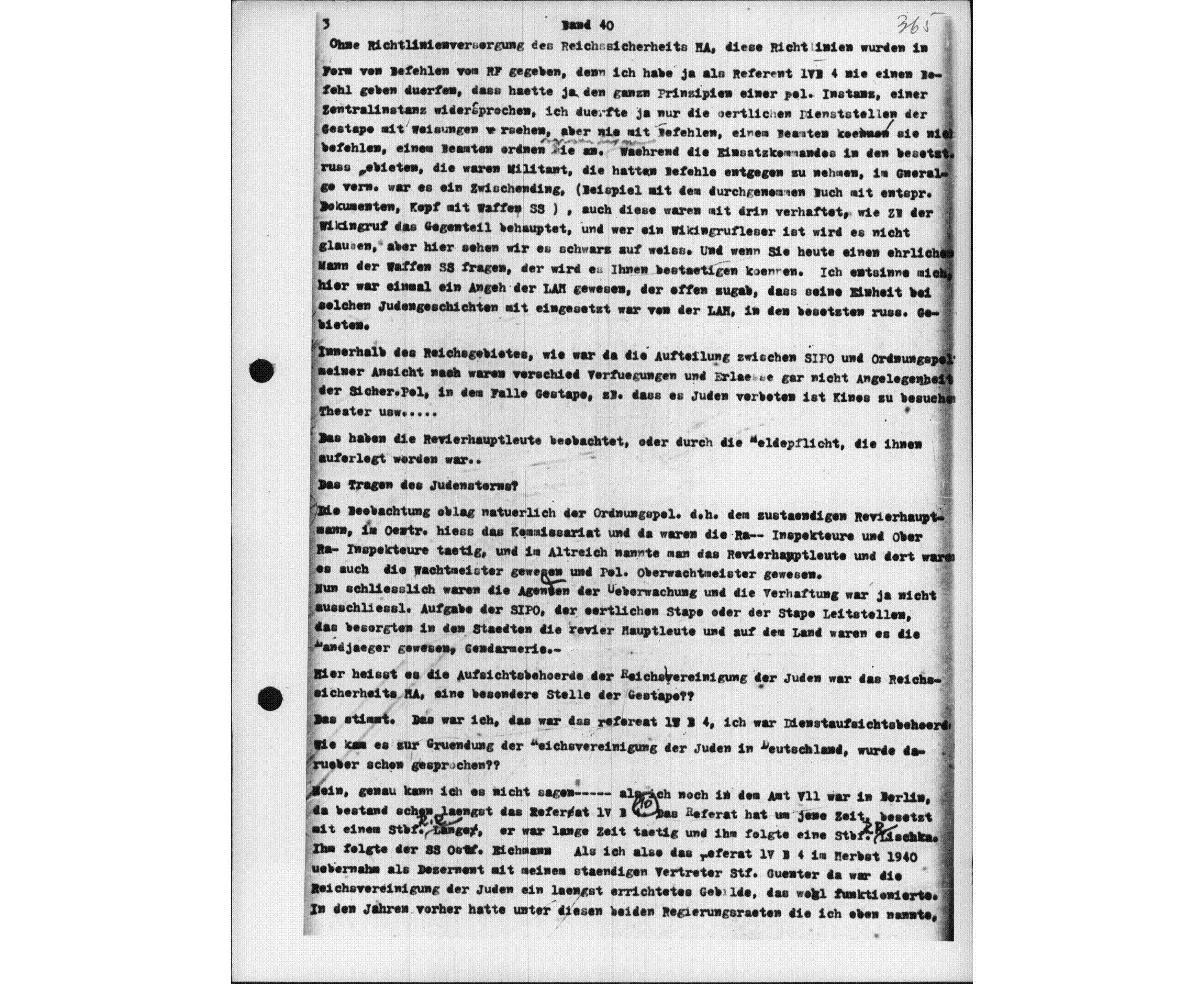
Band 40, page 3

Without any supply of directives from the Reich Security Main Office. These directives were given in the form of orders from the RF, because as desk officer IV B 4 I was never allowed to give an order. That would have contradicted the whole principles of a police authority, of a central authority. I was only allowed to furnish the local offices of the Gestapo with directives, never with orders. You cannot give an official an order, you issue an instruction to an official. Whereas the Einsatzkommandos in the occupied Russian territories, they were militant, they had to take orders.

In the General Government it was something in between (example with the book gone through, with the relevant documents, letterhead with Waffen SS). These were caught up in it as well, whereas for instance the Wikingruf claims the opposite, and anyone who reads the Wikingruf will not believe it, but here we see it in black and white. And if you ask an honest man of the Waffen SS today, he will be able to confirm it to you. I remember, there was a member of the LAH here once who openly admitted that his unit was deployed in such Jewish affairs by the LAH, in the occupied Russian territories.

Questioner

Within the Reich territory, how was the division there between Sipo and the Ordnungspolizei? In my opinion various orders and decrees were not a matter for the security police at all, in this case the Gestapo, for instance that Jews are forbidden to visit cinemas, theaters and so on.

Eichmann

The precinct captains watched that, or it was done through the duty to report that had been imposed on them.

Questioner

The wearing of the Jewish star?

Eichmann

Watching that was of course the business of the Ordnungspolizei, that is, of the responsible precinct captain. In Austria that was called the Kommissariat, and there the [not typed] inspectors and senior [not typed] inspectors were active, and in the Old Reich they were called precinct captains, and there it was the sergeants and police senior sergeants. Then finally there were the agents of surveillance, and the arrest was not the exclusive task of the Sipo, of the local Stapo or of the Stapo regional headquarters. In the towns the precinct captains saw to that, and in the countryside it was the rural constables, the gendarmerie.

Questioner

It says here that the supervisory authority of the Reich Association of the Jews was the Reich Security Main Office, a special office of the Gestapo?

Eichmann

That is right. That was me, that was the desk IV B 4, I was the supervisory authority.

Questioner

How did the Reich Association of the Jews in Germany come to be founded, has that been discussed already?

Eichmann

No, I cannot say exactly. When I was still in Amt VII in Berlin, the desk IV B [not typed] had long existed. At that time the desk was staffed with a Sturmbannfuehrer Langer, he was active for a long time, and he was followed by a Sturmbannfuehrer Lischka. He was followed by SS Obersturmfuehrer Eichmann. So when I took over the desk IV B 4 in the autumn of 1940 as section head, with my permanent deputy Sturmfuehrer Guenter, the Reich Association of the Jews was a body that had been set up long before and worked well. In the years before, under these two government councillors I have just named,

Open sheet image, German, and notes
Scan 00004 of the Sassen transcript, O.65 file 87.
This is scan 00004 of the Sassen transcript, O.65 file 87. The image is 3504 by 2864 pixels. Yad Vashem Archives, Jacob Robinson Collection O.65, file 87.

German transcription

3 Band 40 [HW: 365] Ohne Richtlinienversorgung des Reichssicherheits HA, diese Richtlinien wurden in Form von Befehlen vom RF gegeben, denn ich habe ja als Referent lVB 4 wie einen Be- fehl geben duerfen, dass haette ja den ganzn Prinzipien einer pol. Instanz, einer Zentralinstanz widersprochen, ich duerfte ja nur die oertlichen Dienststellen der Gestape mit Weisungen versehen, aber nie mit Befehlen, einem Beamten koennen sie nicht befehlen, einem Beamten ordnen sie an. Waehrend die Einsatzkommandos in den besetzt. russ. gebieten, die waren Militant, die hatten Befehle entgegen zu nehmen, im Gneral- ge vern. war es ein Zwischending, (Beispiel mit dem durchgenommen Buch mit entspr. Dokumenten, Kopf mit Waffen SS ) , auch diese waren mit drin verhaftet, wie ZB der Wikingruf das Gegenteil behauptet, und wer ein Wikingrufleser ist wird es nicht glausen, aber hier sehen wir es schwarz auf weiss. Und wenn Sie heute einen ehrlichen Mann der Waffen SS fragen, der wird es Ihnen bestaetigen koennen. Ich entsinne mich, hier war einmal ein Angeh der LAH gewesen, der offen zugab, dass seine Einheit bei solchen Judengeschichten mit eingesetzt war von der LAH, in den besetzten russ. Ge- bieten. Innerhalb des Reichsgebietes, wie war da die Aufteilung zwischen SIPO und Ordnungspol meiner Ansicht nach waren verschied Verfuegungen und Erlaesse gar nicht Angelegenheit der Sicher.Pol, in dem Falle Gestape, zB. dass es Juden verboten ist Kinos zu besuchen Theater usw..... Das haben die Revierhauptleute beobachtet, oder durch die Meldepflicht, die ihnen auferlegt worden war.. Das Tragen des Judensterns? Die Beobachtung oblag natuerlich der Ordnungspol. d.h. dem zustaendigen Revierhaupt- mann, in Oestr. hiess das Kommissariat und da waren die Ra-- Inspekteure und Ober Ra- Inspekteure taetig, und im Altreich nannte man das Revierhauptleute und dort waren es auch die Wachtmeister gewesen und Pol. Oberwachtmeister gewesen. Nun schliesslich waren die Agenten der Ueberwachung und die Verhaftung war ja nicht ausschliessl. Aufgabe der SIPO, der oertlichen Stape oder der Stape Leitstellen, das besorgten in den Staedten die revier Hauptleute und auf dem Land waren es die Landjaeger gewesen, Gendarmerie.- Hier heisst es die Aufsichtsbehoerde der Reichsvereinigung der Juden war das Reichs- sicherheits HA, eine besondere Stelle der Gestape?? Das stimmt. Das war ich, das war das referat lV B 4, ich war Dienstaufsichtsbehoerd Wie kam es zur Gruendung der Reichsvereinigung der Juden in Deutschland, wurde da- rueber schon gesprochen?? Nein, genau kann ich es nicht sagen------ als ich noch in dem Amt Vll war in Berlin, da bestand schon laengst das Referat lV B [HW: 10] Das Referat hat um jene Zeit, besetzt mit einem Stbf. Langex, [HW: R.G.] er war lange Zeit taetig und ihm folgte eine Stbf. Lischka. [HW: L.R.] Ihm folgte der SS Ostuf. Eichmann Als ich also das referat lV B 4 im Herbst 1940 uebernahm als Dezernent mit meinem staendigen Vertreter Stf. Guenter da war die Reichsvereinigung der Juden ein laengst errichtetes Gebilde, das wohl funktionierte. In den Jahren vorher hatte unter diesen beiden Regierungsraeten die ich eben nannte,

English translation

3 Volume 40 [HW: 365] Without directive-provisioning of the Reich Security Main Office, these directives were given in the form of orders by the RF, for as a desk officer [Referent] IVB4 I was of course [not] permitted to give an order, that would after all have contradicted the whole principles of a pol[itical] authority, a central authority; I was after all only permitted to furnish the local offices of the Gestapo with instructions [Weisungen], but never with orders; you cannot order [befehlen] an official, you direct [ordnen an] an official. Whereas the Einsatzkommandos in the occupied russ[ian] territories, they were militant, they had to receive orders; in the Gener­al­gov[ernment] it was an in-between thing, (example gone through with the book with corresp[onding] documents, letterhead with Waffen SS), these too were caught up in it, as for example the Wikingruf claims the opposite, and whoever is a Wikingruf reader will not believe it, but here we see it in black and white. And if you today ask an honest man of the Waffen SS, he will be able to confirm it to you. I recall, there was once here a member of the LAH, who openly admitted that his unit had been deployed along in such Jew-affairs by the LAH, in the occupied russ[ian] terri­tories. Within the Reich territory, how was the division there between SIPO and Ordnungspol[izei]? in my opinion various decrees and edicts were not at all a matter of the Sicher[heits]pol[izei], in that case the Gestapo, e.g. that it is forbidden to Jews to visit cinemas, theaters etc..... That the precinct captains [Revierhauptleute] observed, or through the reporting-duty that had been imposed on them.. The wearing of the Jewish star? The observation lay of course with the Ordnungspol[izei], i.e. with the responsible precinct captain [Revierhauptmann], in Austr[ia] that was called the Kommissariat and there the Ra-- Inspectors and Senior Ra- Inspectors were active, and in the Altreich one called that precinct captains [Revierhauptleute] and there it was also the Wachtmeister and Pol[ice] Oberwachtmeister. Now finally the agents of the surveillance and the arrest was after all not exclusively [the] task of the SIPO, of the local Stape or of the Stape control-centers [Leitstellen], that was seen to in the cities by the precinct captains and in the countryside it was the Landjäger, gendarmerie.- Here it says the supervisory authority of the Reich Association of the Jews was the Reich Security Main Office, a special office of the Gestapo?? That is correct. That was I, that was the desk [Referat] IV B 4, I was [the] duty-supervisory-authority [Dienstaufsichtsbehörd(e)] How did it come about that the Reich Association of the Jews in Germany was founded, has that already been spoken about?? No, exactly I cannot say it------ when I was still in Amt VII in Berlin, the Referat IV B [HW: 10] already existed long since. The Referat at that time [was] staffed with a Stbf. Langex, [HW: R.G.] he was active for a long time and him there followed a Stbf. Lischka. [HW: L.R.] Him there followed the SS Ostuf. Eichmann. So when I took over the Referat IV B 4 in autumn 1940 as Dezernent [officer-in-charge] with my permanent deputy Stf. Günter, the Reich Association of the Jews was a long-since erected structure, which functioned well. In the years before, under these two Regierungsräte [government councillors] whom I just named,
Unreviewed notes

These notes haven't been reviewed. A note can identify a speaker where the reviewed English doesn't. If they disagree, use the reviewed English.

Transcription note

Typewritten transcript page, heavily faded carbon with typical typewriter-defect substitutions preserved as visible (e.g. "gebieten" with lowercase g, "Gestape", "Kines"/"Kinos", "ganzn", "glausen", "Gneralge vern.", "Militant", "Langex"). Header: typed "3" top-left, "Band 40" centered, handwritten "365" top-right. Two hole-punch holes in left margin. A circled handwritten "10" is superimposed over the "B" in "lV B" in the line beginning "da bestand schon laengst" — rendered as [HW: 10]. Small handwritten initials appear above "Stbf. Langex" (read as R.G.) and above/after "Stbf. Lischka" (read as L.R.); both are faint and uncertain. Scattered stray pen/pencil marks and a checkmark-like stroke near "ordnen sie an." are not legible text and were not transcribed. Line-final letters at the right edge are occasionally clipped by the scan (e.g. "koennen sie nicht" reads "koennen sie nic", "Ordnungspol" clipped); expanded to the visible-intended forms only where the clipped strokes are still discernible.

Translation notes

- 'ich habe ja als Referent lVB 4 wie einen Befehl geben duerfen' — the German as transcribed is grammatically broken and, taken literally, means 'I was of course permitted to give an order like a...', which contradicts the surrounding argument. Sense requires a negation ('never permitted to give an order'); 'wie' is very likely an OCR error for 'nie' (never). Translation of this clause is uncertain. - 'Ohne Richtlinienversorgung des Reichssicherheits HA' rendered as 'Without directive-provisioning of the Reich Security Main Office' — 'Richtlinienversorgung' is an unusual compound (directive-supply/provision); the intended sense is uncertain and this line also continues from a previous page, so the leading 'Ohne' may be mid-sentence. - 'Stbf. Langex' — 'Langex' is almost certainly the surname 'Lange' with a stray trailing letter (OCR artifact) or a rank/abbreviation fragment; the exact name is uncertain. - 'Dienstaufsichtsbehörd' is truncated in the source (missing final -e); rendered as 'duty-supervisory-authority' with the truncation noted. - 'Das war ich' rendered literally 'That was I' — could also mean 'That was me [i.e. my responsibility]'; the literal rendering is retained. - 'diese waren mit drin verhaftet' rendered 'these too were caught up in it' — literally closer to 'these were arrested in there too'; 'verhaftet' (arrested) sits oddly and the intended sense (implicated/involved vs. literally arrested) is uncertain. - 'wie ZB der Wikingruf das Gegenteil behauptet' — 'wie' here likely means 'as/although' rather than 'like'; syntax is loose, translation approximate. Single page, Band 40, HW page-number 365; no explicit speaker labels anywhere in the source. It reads as an interview: short interrogative fragments (interviewer prompts) alternating with longer first-person expository answers about RSHA/Gestapo/IVB4 administration. Two turns carry first-person claims that only Eichmann could make ("das war ich, das war das Referat IV B 4"; "als ich also das Referat IV B 4 im Herbst 1940 übernahm ... mit meinem ständigen Vertreter Stf. Günter" — Rolf Günther was Eichmann's deputy), so those are attributed to E. The two questions ending in "??" and the topic-shifting fragments read as interviewer prompts, but without labels I cannot exclude that some are Eichmann reading aloud from a document ("Hier heisst es...", "Hier war einmal...") — several are marked UNCERTAIN accordingly. "Gestape" "RF" "lVB 4" "lV B 4" "Wikingruf" "Der Wiking-Ruf" "glausen" "Gneral-ge vern." "Stbf. Langex" "x" "Dienstaufsichtsbehörd" "genau kann ich es nicht sagen------" "ich habe ja als Referent lVB 4 wie einen Befehl geben duerfen" "for as a desk officer I was of course NOT permitted to give an order" "wie" "nie"
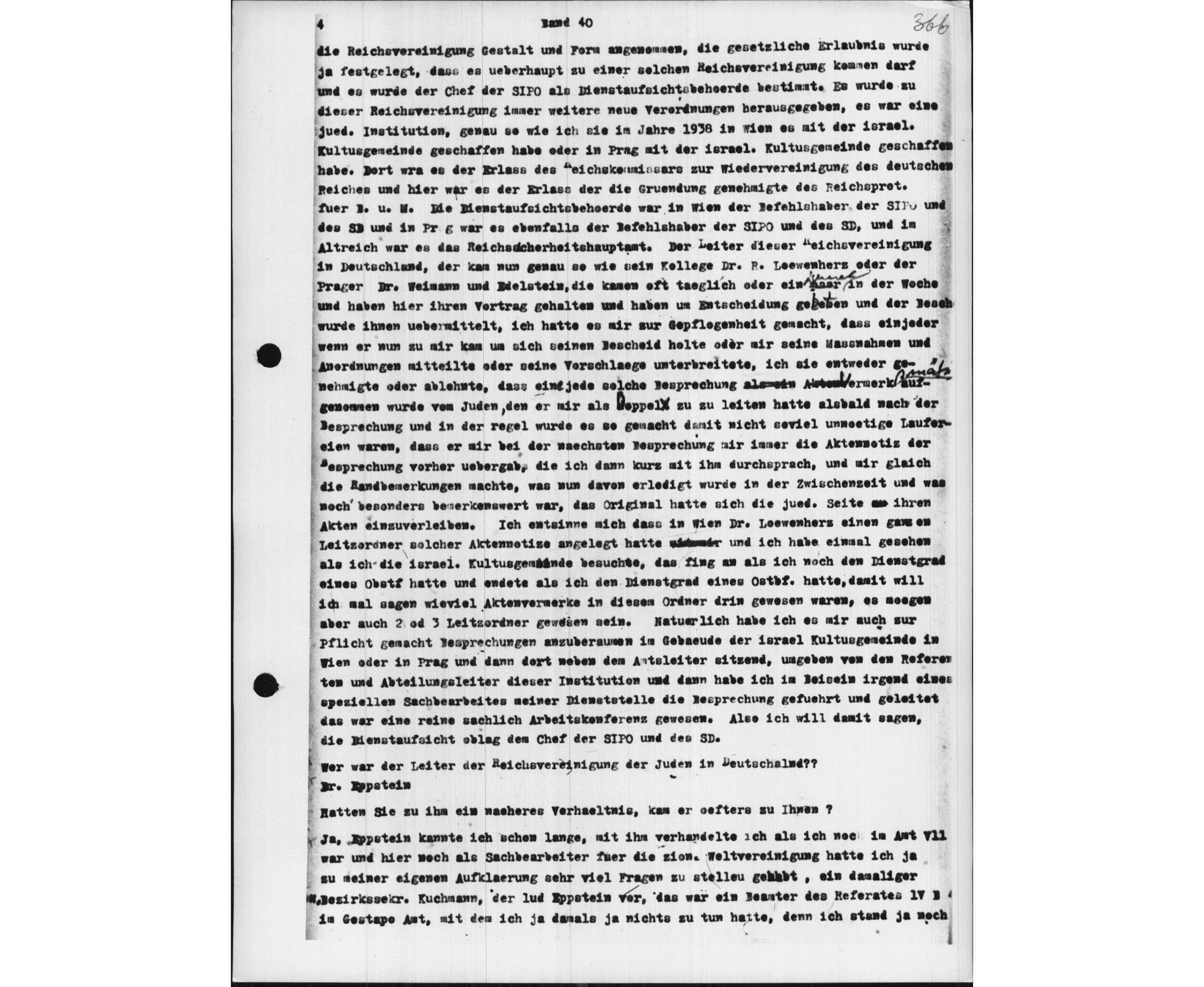
Band 40, page 4

the Reich Association took shape and form. The legal permission was laid down that such a Reich Association could come about at all, and the Chief of the Security Police was designated as the supervisory authority. Further new regulations kept being issued for this Reich Association. It was a Jewish institution, exactly as I created it in 1938 in Vienna with the Israelite Community, or in Prague with the Israelite Community. There it was the decree of the Reich Commissioner for the Reunification of the German Reich, and here it was the decree of the Reich Protector for Bohemia and Moravia that approved the founding.

The supervisory authority in Vienna was the Commander of the Security Police and the SD, and in Prague it was likewise the Commander of the Security Police and the SD, and in the Old Reich it was the Reich Security Main Office. The head of this Reich Association in Germany came just as his colleague Dr. R. Loewenherz did, or the Prague men Dr. Weimann and Edelstein. They came often daily, or a [blotted] times in the week, and gave their report here and asked for a decision, and the decision was passed to them.

I had made it my practice that whenever one of them came to me to collect his ruling, or told me his measures and orders, or put his proposals to me, and I either approved or refused them, every such discussion was taken down as a [blotted] note by the Jew, who had to send me a duplicate as soon as possible after the discussion. As a rule it was done this way, so that there was not so much unnecessary running about, that at the next discussion he always handed me the file note of the earlier discussion, which I then went through briefly with him, and I made my marginal remarks at once on what had been settled in the meantime and what was still especially worth noting.

The original the Jewish side had to file in its own records. I remember that in Vienna Dr. Loewenherz had built up a whole ring binder of such file notes, and I saw it once when I visited the Israelite Community. That began when I still held the rank of an Obersturmfuehrer and ended when I held the rank of an Obersturmbannfuehrer, by which I mean to say how many file notes were in that binder. There may also have been two or three ring binders.

Of course I also made it my duty to call discussions in the building of the Israelite Community in Vienna or in Prague, and then, sitting there next to the office director, surrounded by the desk officers and department heads of this institution, I conducted and led the discussion in the presence of some particular case officer of my own office. That was a purely factual working conference. So what I want to say is that the supervision lay with the Chief of the Security Police and the SD.

Questioner

Who was the head of the Reich Association of Jews in Germany?

Eichmann

Dr. Eppstein.

Questioner

Did you have a closer relationship with him? Did he come to you often?

Eichmann

Yes, I had known Eppstein for a long time. I dealt with him when I was still in Office VII, and here, still as the case officer for the Zionist world organization, I had a great many questions to ask for my own instruction. A district secretary named Kuchmann summoned Eppstein. He was an official of Section IV B 4 in the Gestapo office, with whom I had nothing to do at that time, because I was still

Open sheet image, German, and notes
Scan 00005 of the Sassen transcript, O.65 file 87.
This is scan 00005 of the Sassen transcript, O.65 file 87. The image is 3504 by 2872 pixels. Yad Vashem Archives, Jacob Robinson Collection O.65, file 87.

German transcription

die Reichsvereinigung Gestalt und Form angenommen, die gesetzliche Erlaubnis wurde ja festgelegt, dass es ueberhaupt zu einer solchen Reichsvereinigung kommen darf und es wurde der Chef der SIPO als Dienstaufsichtsbehoerde bestimmt. Es wurde zu dieser Reichsvereinigung immer weitere neue Verordnungen herausgegeben, es war eine jued. Institution, genau so wie ich sie im Jahre 1938 in Wien es mit der israel. Kultusgemeinde geschaffen habe oder in Prag mit der israel. Kultusgemeinde geschaffen habe. Dort wra es der Erlass des Reichskommissars zur Wiedervereinigung des deutschen Reiches und hier war es der Erlass der die Gruendung genehmigte des Reichspret. fuer B. u. M. Die Dienstaufsichtsbehoerde war in Wien der Befehlshaber der SIPO und des SD und in Pr g war es ebenfalls der Befehlshaber der SIPO und des SD, und im Altreich war es das Reichssicherheitshauptamt. Der Leiter dieser Reichsvereinigung in Deutschland, der kam nun genau so wie sein Kollege Dr. R. Leewenherz oder der Prager Dr. Weimann und Edelstein,die kamen oft taeglich oder ein [HW: [?jene?]] Paar in der Woche und haben hier ihren Vortrag gehalten und haben um Entscheidung gebeten und der Besch wurde ihnen uebermittelt, ich hatte es mir zur Gepflogenheit gemacht, dass einjeder wenn er nun zu mir kam um sich seinen Bescheid holte oder mir seine Massnahmen und Anordnungen mitteilte oder seine Vorschlaege unterbreitete, ich sie entweder ge- nehmigte oder ablehnte, dass ein jede solche Besprechung als [DEL: ein Akten]Vermerk auf- [HW: [?gemäß?]] genommen wurde vom Juden,den er mir als Doppel[HW: X] zu zu leiten hatte alsbald nach der Besprechung und in der regel wurde es so gemacht damit nicht soviel unnoetige Laufer- eien waren, dass er mir bei der naechsten Besprechung mir immer die Aktennotiz der Besprechung vorher uebergab, die ich dann kurz mit ihm durchsprach, und mir gleich die Randbemerkungen machte, was nun davon erledigt wurde in der Zwischenzeit und was noch besonders bemerkenswert war, das Original hatte sich die jued. Seite in ihren Akten einzuverleiben. Ich entsinne mich dass in Wien Dr. Leewenherz einen ganzen Leitzordner solcher Aktennotize angelegt hatte [DEL: [?nichmer?]] und ich habe einmal gesehen als ich die israel. Kultusgemeinde besuchte, das fing an als ich noch den Dienstgrad eines Obstf hatte und endete als ich den Dienstgrad eines Ostbf. hatte,damit will ich mal sagen wieviel Aktenvermerke in diesem Ordner drin gewesen waren, es moegen aber auch 2 od 3 Leitzordner gewesen sein. Natuerlich habe ich es mir auch zur Pflicht gemacht Besprechungen anzuberaumen im Gebaeude der israel Kultusgemeinde in Wien oder in Prag und dann dort neben dem Amtsleiter sitzend, umgeben von den Referen ten und Abteilungsleiter dieser Institution und dann habe ich im Beisein irgend eines speziellen Sachbearbeites meiner Dienststelle die Besprechung gefuehrt und geleitet das war eine reine sachlich Arbeitskonferenz gewesen. Also ich will damit sagen, die Dienstaufsicht oblag dem Chef der SIPO und des SD. Wer war der Leiter der Reichsvereinigung der Juden in Deutschalnd?? Dr. Eppstein Hatten Sie zu ihm ein naeheres Verhaeltnis, kam er oefters zu Ihnen ? Ja, Eppstein kannte ich schon lange, mit ihm verhandelte ich als ich noch im Amt Vll war und hier noch als Sachbearbeiter fuer die zion. Weltvereinigung hatte ich ja zu meiner eigenen Aufklaerung sehr viel Fragen zu stellen gehabt , ein damaliger M.Bezirkssekr. Kuchmann, der lud Eppstein vor, das war ein Beamter des Referates lV B 4 im Gestapo Amt, mit dem ich ja damals ja nichts zu tun hatte, denn ich stand ja noch

English translation

the Reich Association took shape and form, the legal permission was indeed established that such a Reich Association may come about at all, and the Chief of the SIPO was designated as the supervisory authority (Dienstaufsichtsbehörde). For this Reich Association ever more new ordinances were issued; it was a Jewish institution, exactly as I created it in the year 1938 in Vienna with the Israelite Religious Community (Kultusgemeinde), or created it in Prague with the Israelite Religious Community. There it was the decree of the Reich Commissar for the Reunification of the German Reich, and here it was the decree that approved the founding, of the Reich Protector (Reichspret.) for B[ohemia] and M[oravia]. The supervisory authority in Vienna was the Commander of the SIPO and the SD, and in Prague it was likewise the Commander of the SIPO and the SD, and in the Altreich it was the Reich Security Main Office (Reichssicherheitshauptamt). The head of this Reich Association in Germany, he now came just like his colleague Dr. R. Loewenherz or the Prague [ones] Dr. Weimann and Edelstein, they came often daily or a [HW: [?those?]] couple [of times] in the week and gave their report (Vortrag) here and asked for a decision, and the decision (Besch[eid]) was conveyed to them; I had made it my custom that each one, whenever he now came to me to obtain his decision (Bescheid) or communicated to me his measures and orders or submitted his proposals, [and] I either approved or rejected them, that every such discussion was recorded as a [DEL: a files-]memorandum [HW: [?according to?]] by the Jew, which he had to convey to me as a duplicate [HW: X] soon after the discussion, and as a rule it was done this way so that there were not so much unnecessary running-around (Lauferei), that at the next discussion he always handed me beforehand the file-note (Aktennotiz) of the discussion, which I then briefly discussed through with him, and immediately made the marginal notes for myself, [as to] what of it had now been dealt with in the meantime and what was still especially noteworthy; the original the Jewish side had to incorporate into their files. I recall that in Vienna Dr. Loewenherz had set up a whole Leitz-binder of such file-notes [DEL: [?nichmer?]] and I once saw, when I visited the Israelite Religious Community — this began when I still had the rank of an Obstf[ührer] and ended when I had the rank of an Ostbf[ührer], by which I mean to say how many file-memoranda had been in this binder, but there may also have been 2 or 3 Leitz-binders. Naturally I also made it my duty to arrange discussions in the building of the Israelite Religious Community in Vienna or in Prague, and then sitting there next to the office head, surrounded by the desk-officers (Referenten) and department heads of this institution, and then in the presence of some special case-officer (Sachbearbeiter) of my office I conducted and led the discussion; that had been a purely factual work-conference. So, by this I mean to say, the supervision (Dienstaufsicht) lay with the Chief of the SIPO and the SD. Who was the head of the Reich Association of the Jews in Germany?? Dr. Eppstein Did you have a closer relationship with him, did he come to you more often? Yes, I had known Eppstein for a long time, I negotiated with him when I was still in Office VII, and here, still as case-officer for the Zionist World Federation, I did have very many questions to put for my own enlightenment; a then M[?] district-secretary Kuchmann, he summoned Eppstein — that was an official of the Referat IV B 4 in the Gestapo Office, with whom I at that time indeed had nothing to do, for I was still
Unreviewed notes

These notes haven't been reviewed. A note can identify a speaker where the reviewed English doesn't. If they disagree, use the reviewed English.

Transcription note

Header line: typed "4" (top left, page number in band), typed "Band 40" (top center), handwritten "366" (top right, folio; transcribed to metadata). Body is single-spaced typewritten prose (Eichmann narrating the Reichsvereinigung/Kultusgemeinde structure), consistent with a continuous testimony page; two Q&A exchanges begin near the foot (Wer war der Leiter... / Dr. Eppstein; Hatten Sie... / Ja, Eppstein...). Uncertain handwriting: (1) a short cursive insertion above "ein ... Paar in der Woche" (line 13) — read tentatively as [?jene?]; placement is above the line, could equally modify "paar". (2) A right-margin cursive note beside the struck "dass ein jede solche Besprechung als [DEL: ein Akten]Vermerk auf-" — read tentatively as [?gemäß?]; the strikethrough span "ein Akten" is fairly clear but its exact endpoints and the marginal correction are ambiguous. (3) A bold mark after "Doppel" rendered [HW: X] (emphasis/annotation, possibly typed). (4) A struck word after "angelegt hatte" (line 26) read tentatively as [DEL: [?nichmer?]]. Typos preserved verbatim (not corrected): "wra" (for war), "Pr g" (spacing gap for Prag), "Deutschalnd", "Sachbearbeites", "Aktennotize", "Vll" (Amt VII), "lV B 4" (Referat IV B 4), "Obstf"/"Ostbf." rank abbreviations, "Reichspret." (Reichsprotektor), "B. u. M." (Böhmen und Mähren). Raised/high-set capitals (R in Reichskommissars/Reichsvereinigung, L in Leiter, D in Deutschland) are typewriter artifacts and were rendered as ordinary capitals. Right edge of the last few lines is slightly cropped/faint; "lV B 4" partly at the margin. Physical scan: two dark punch-hole marks in the left margin; page is a photostat/negative-style reproduction with some show-through and speckling, but text legibility is good throughout.

Translation notes

- 'Reichspret. fuer B. u. M.' — expanded as 'Reich Protector (Reichsprotektor) for Bohemia and Moravia'; 'B. u. M.' is confidently Böhmen und Mähren, but 'Reichspret.' is an abbreviation and the exact intended word is inferred. - 'ein [HW: [?jene?]] Paar in der Woche' — the handwritten insertion is uncertain in the German ([?jene?]); rendered as '[HW: [?those?]]'. The phrase 'or a couple [of times] a week' fills an implicit 'times' not present in the German. - 'als [DEL: ein Akten]Vermerk auf-[HW: [?gemäß?]]genommen' — the deleted 'ein Akten' and the handwritten [?gemäß?] make the exact intended phrasing uncertain; translated as 'recorded as a [DEL: a files-]memorandum [HW: [?according to?]]', preserving the fragmentation. - 'Doppel[HW: X]' — rendered 'duplicate'; the handwritten mark [HW: X] is preserved but its meaning is unclear. - '[DEL: [?nichmer?]]' — deleted and illegible/uncertain in the German; preserved as a deletion marker without translation. - Ranks 'Obstf' and 'Ostbf' are abbreviations; expanded tentatively to Obersturmführer / Obersturmbannführer is NOT asserted — left as '[HW/abbr] Obstf[ührer]' / 'Ostbf[ührer]' since the exact SS rank abbreviation intended is uncertain. - 'M.Bezirkssekr. Kuchmann' — 'M.' abbreviation left unexpanded as 'M[?]'; 'district-secretary' for 'Bezirkssekr.' is an expansion of the abbreviation. - 'zion. Weltvereinigung' translated 'Zionist World Federation' — 'Weltvereinigung' literally 'world-association/federation'; the exact organization referred to is not certain from the abbreviation. The page is a continuous first-person monologue that then breaks into a short Q&A exchange. The long opening block carries no explicit speaker label but its content (first-person establishment and supervision of the Vienna/Prague Jewish Religious Communities, personal SS rank progression, IVB4 administrative practice) is unambiguous as the respondent, Eichmann (E). The three question/answer boundaries within the Q&A are legible from content: two short second-person/interrogative turns are the interviewer's (S), each immediately answered by a first-person reply (E). No explicit initials or labels appear in the source; attributions rest on turn content (direct questions vs. first-person self-account), not on alternation. The page ends mid-sentence ('for I was still'). OCR/diplomatic markers preserved: [HW: …] handwritten insertions, [DEL: …] deletions, [?…?] uncertainty. Several German spellings are garbled in the source (e.g. 'wra', 'Pr g', 'Deutschalnd', 'Leewenherz' for Loewenherz, 'Besch' truncation, 'einjeder', 'Anordnungen', 'Lauferei/Lauferei-en'); these were read through to the intended word where confident and flagged where not."
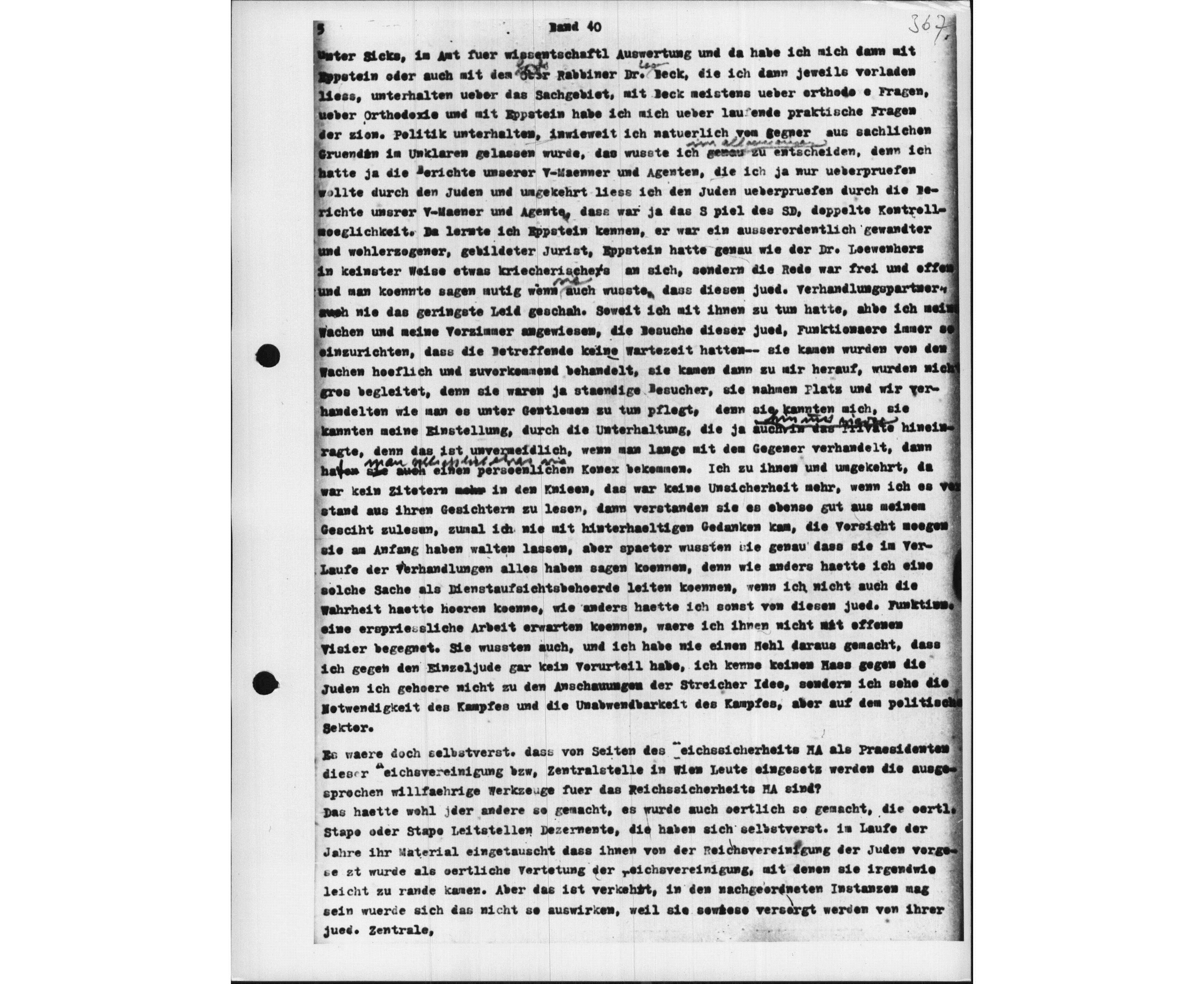
Band 40, page 5

under Six, in the office for scholarly evaluation, and there I then talked with Eppstein, or also with the Chief Rabbi Dr. Beck, whom I had brought in as the case required, about the subject area. With Beck it was mostly about questions of orthodoxy, about Orthodoxy, and with Eppstein I talked about current practical questions of Zionist politics. How far I was of course being left in the dark by the opponent for reasons of his own, that I knew precisely how to judge, because I had the reports of our informers and agents, which I only wanted to check through the Jew, and the other way round I had the Jew checked through the reports of our informers and agents.

That was the game of the SD, a double means of control. That is where I got to know Eppstein. He was an exceptionally adroit and well brought up, educated lawyer. Eppstein, exactly like Dr. Loewenherz, had nothing whatever servile about him. Instead his speech was free and open, and one could say courageous, even though he knew that these Jewish negotiating partners never came to the slightest harm either. So far as I had dealings with them, I instructed my guards and my outer offices always to arrange the visits of these Jewish functionaries so that the men concerned had no waiting time.

They came, they were treated politely and obligingly by the guards, they then came up to me, they were not escorted much, since they were regular visitors, they took a seat, and we negotiated as one does among gentlemen, because they knew me, they knew my attitude through the conversation, which also reached into [handwriting], since that is unavoidable when one negotiates a long time with the opponent. Then they also got a personal contact. I to them and the other way round. There was no more trembling in the knees, that was no longer any uncertainty. If I understood how to read from their faces, then they understood just as well how to read from my face, especially since I never came with underhanded thoughts.

They may have let caution prevail at the start, but later they knew exactly that in the course of the negotiations they could say everything, for how else could I have run such a matter as the supervisory authority if I could not also hear the truth? How else could I have expected fruitful work from these Jewish functionaries had I not met them with an open visor? They also knew, and I have never made any secret of it, that I have no prejudice at all against the individual Jew. I know no hatred against the Jews. I do not belong to the views of the Streicher idea. Instead I see the necessity of the struggle and the inevitability of the struggle, but on the political sector.

Questioner

It would surely go without saying that on the part of the Reich Security Main Office, people would be installed as presidents of this Reich Association, or of the Central Office in Vienna, who were outspokenly compliant tools for the Reich Security Main Office?

Eichmann

Anyone else would probably have done it that way, and it was also done that way locally. The local Gestapo posts or Gestapo regional headquarters desk officers, over the years they of course exchanged their material that was put before them by the Reich Association of Jews as the local representation of the Reich Association, people they could get along with somehow easily. But that is wrong. In the subordinate offices it may be that this would not work out that way, because they are supplied anyway by their Jewish head office,

Open sheet image, German, and notes
Scan 00006 of the Sassen transcript, O.65 file 87.
This is scan 00006 of the Sassen transcript, O.65 file 87. The image is 3504 by 2864 pixels. Yad Vashem Archives, Jacob Robinson Collection O.65, file 87.

German transcription

5 Band 40 367. Unter Sicks, im Amt fuer wissenschaftl Auswertung und da habe ich mich dann mit Eppstein oder auch mit dem Obsr Rabbiner Dr. Beck, [HW: [illegible]] die ich dann jeweils verladen liess, unterhalten ueber das Sachgebiet, mit Beck meistens ueber orthode e Fragen, ueber Orthodexie und mit Eppstein habe ich mich ueber laufende praktische Fragen der zion. Politik unterhalten, inwieweit ich natuerlich vom Gegner aus sachlichen Gruenden im Unklaren gelassen wurde, das wusste ich [HW: [?im allgemeinen?]] genau zu entscheiden, denn ich hatte ja die Berichte unserer V-Maenner und Agenten, die ich ja nur ueberpruefen wollte durch den Juden und umgekehrt liess ich den Juden ueberpruefen durch die Be- richte unser V-Maener und Agente, dass war ja das S piel des SD, doppelte Kontroll- moeglichkeit. Da lernte ich Eppstein kennen, er war ein ausserordentlich gewandter und wohlerzogener, gebildeter Jurist, Eppstein hatte genau wie der Dr. Loewenhers in keinster Weise etwas kriecherisches an sich, sondern die Rede war frei und offen und man koennte sagen mutig wenn [HW: [illegible]] auch wusste, dass diesen jued. Verhandlungspartner, auch nie das geringste Leid geschah. Soweit ich mit ihnen zu tun hatte, ahbe ich meine Wachen und meine Vorzimmer angewiesen, die Besuche dieser jued, Funktioaere immer so einzurichten, dass die Betreffende keine Wartezeit hatten-- sie kamen wurden von den Wachen hoeflich und zuverkommend behandelt, sie kamen dann zu mir herauf, wurden nicht gros begleitet, denn sie waren ja staendige Besucher, sie nahmen Platz und wir ver- handelten wie man es unter Gentlemen zu tun pflegt, denn sie kannten mich, sie kannten meine Einstellung, durch die Unterhaltung, die ja auch [DEL: in das Private] [HW: [illegible]] hinein- ragte, denn das ist unvermeidlich, wenn man lange mit dem Gegener verhandelt, dann haben [HW: [illegible]] sie auch einen persoenlichen Konex bekommen. Ich zu ihnen und umgekehrt, da war kein Zitetern mehr in den Knieen, das war keine Unsicherheit mehr, wenn ich es ver stand aus ihren Gesichtern zu lesen, dann verstanden sie es ebenso gut aus meinem Gesciht zulesen, zumal ich nie mit hinterhaeltigen Gedanken kam, die Vorsicht moegen sie am Anfang haben walten lassen, aber spaeter wussten bie genau dass sie im Ver- Laufe der Verhandlungen alles haben sagen koennen, denn wie anders haette ich eine solche Sache als Dienstaufsichtsbehoerde leiten koennen, wenn ich nicht auch die Wahrheit haette hoeren koenne, wie anders haette ich sonst von diesen jued. Funktinm. eine erspriessliche Arbeit erwarten koennen, waere ich ihnen nicht mit offenem Visier begegnet. Sie wussten auch, und ich habe nie einen Hehl daraus gemacht, dass ich gegen den Einzeljude gar kein Verurteil habe, ich kenne keinen Hass gegen die Juden ich gehoere nicht zu den Anschauungen der Streicher Idee, sondern ich sehe die Notwendigkeit des Kampfes und die Unabwendbarkeit des Kampfes, aber auf dem politische Sektor. Es waere doch selbstverst. dass von Seiten des Reichssicherheits HA als Praesidenten dieser Reichsvereinigung bzw, Zentralstelle in Wien Leute eingesetz werden die ausge- sprochen willfaehrige Werkzeuge fuer das Reichssicherheits HA sind? Das haette wohl jder andere so gemacht, es wurde auch oertlich so gemacht, die oertl. Stape oder Stape Leitstellen Dezernente, die haben sich selbstverst. im Laufe der Jahre ihr Material eingetauscht dass ihnen von der Reichsvereinigung der Juden vorge- se zt wurde als oertliche Vertetung der Reichsvereinigung, mit denen sie irgendwie leicht zu rande kamen. Aber das ist verkehrt, in den nachgeordneten Instanzen mag sein wuerde sich das nicht so auswirken, weil sie sowiese versorgt werden von ihrer jued. Zentrale,

English translation

Under Six, in the office for scientific evaluation, and there I then, with Eppstein or also with the Chief Rabbi Dr. Beck, [HW: [illegible]] whom I then in each case had loaded/transported away, conversed about the subject area, with Beck mostly about orthodo[x] questions, about orthodox[y], and with Eppstein I conversed about current practical questions of Zionist politics; to what extent I was of course, from the opponent's side, for factual reasons left in the dark — that I knew [HW: [?in general?]] exactly how to decide, for I did after all have the reports of our V-men and agents, which I after all only wanted to verify through the Jew, and conversely I had the Jew verified through the reports of our V-men and agents; that was after all the game of the SD, a double check-possibility. There I got to know Eppstein; he was an extraordinarily adroit and well-bred, educated jurist. Eppstein, exactly like Dr. Loewenherz, had in no way anything servile/fawning about him, but rather the speech was free and open and one could say courageous, even when [HW: [illegible]] one also knew that to these Jewish negotiating partners not even the slightest harm ever came. Insofar as I had to do with them, I have instructed my guards and my anterooms/outer-offices always to arrange the visits of these Jewish functionaries so that the persons concerned had no waiting time — they came, were treated by the guards politely and obligingly, they then came up to me, were not much escorted, for they were after all constant visitors, they took a seat and we negotiated as one is accustomed to do among gentlemen, for they knew me, they knew my attitude, through the conversation, which after all also [DEL: into the private] [HW: [illegible]] extended, for that is unavoidable when one negotiates a long time with the opponent, then [HW: [illegible]] they also acquired a personal connection. I to them and vice versa, there was no more trembling in the knees, that was no more insecurity, when I understood how to read from their faces, then they understood it just as well [how] to read from my face, especially since I never came with underhanded/insidious thoughts; the caution they may have let prevail at the beginning, but later they [bie=sie] knew exactly that in the course of the negotiations they could have said everything, for how else could I have conducted such a matter as a supervisory authority [Dienstaufsichtsbehörde] if I could not also have heard the truth; how else could I otherwise have expected fruitful/profitable work from these Jewish functionaries [Funktinm.] if I had not met them with open visor. They also knew, and I have never made any secret of it, that I have no prejudice at all against the individual Jew, I know no hatred against the Jews, I do not belong to the views of the Streicher idea, but rather I see the necessity of the struggle and the inevitability of the struggle, but on the political sector. It would surely be self-evident that on the part of the Reich Security Main Office, as presidents of this Reich Association or Central Office in Vienna, people were installed who are decidedly willing/compliant tools for the Reich Security Main Office? That anyone else would probably have done likewise, it was also done so locally; the local Stapo or Stapo control-center desk officers [Dezernenten], they have of course in the course of the years exchanged their material [/traded around the material] that was placed before them by the Reich Association of the Jews as local representation of the Reich Association, with whom they somehow easily got along. But that is wrong; in the subordinate instances/agencies it may be that it would not work out that way, because they are in any case provided for by their Jewish central office,
Unreviewed notes

These notes haven't been reviewed. A note can identify a speaker where the reviewed English doesn't. If they disagree, use the reviewed English.

Transcription note

Typescript carbon, faded/blurred; letters "m/n" and "e/o" frequently ambiguous — transcribed as they appear (e.g. "orthode e", "Orthodexie", "Loewenhers", "zuverkommend", "Konex", "Funktinm.", "sowiese", "Vertetung", "eingesetz", "se zt", "S piel"). Several interlinear cursive additions could not be read with confidence and are marked [HW: [illegible]]; the note above "wusste ich" is a tentative "[?im allgemeinen?]". One apparent strike-through over "in das Private" (line ~19) with an illegible handwritten replacement above. "Reichssicherheits HA" / "Reichsvereinigung" begin with a superscript-style handwritten/typed initial capital in the base text; rendered as normal capitals. Top-right "367." is a handwritten archival page/folio number; "5" is the typed page number and "Band 40" the running header.

Translation notes

- "verladen liess" rendered as "had loaded/transported away" — verladen literally means to load (as cargo/for transport); in this context the sinister deportation sense is likely but the German is not explicit, so the literal reading is preserved. - "Sicks" / "Six": the name is given as "Sicks" in the German; historically this is SS officer Franz Six, head of the office for scientific evaluation (Amt VII). Rendered as "Six" in the turn text but the source spelling "Sicks" is noted. - "Konex" translated as "connection" — reading the OCR "Konex" as Konnex (connection/nexus). - "eingetauscht" (exchanged/traded) is ambiguous in context: possibly "exchanged information/material" or "traded/swapped the local representatives placed before them"; rendered literally as "exchanged their material." - "willfaehrige Werkzeuge" rendered "willing/compliant tools" — willfährig carries connotations of "pliant/obsequious." - "mit offenem Visier" translated literally as "with open visor" (idiomatically: openly, above-board). Page header: \"5 Band 40 367.\" (Volume 40, page 367). The page is largely a continuous first-person monologue; a clear turn boundary occurs only at the bottom where a question (ending in \"?\") is put and then answered. Numerous OCR corruptions preserved: \"orthode e\" (orthodoxe), \"Orthodexie\" (Orthodoxie), \"Loewenhers\" (Loewenherz), \"ahbe\" (habe), \"Funktioaere\" (Funktionäre), \"Zitetern\" (Zittern), \"Gesciht zulesen\" (Gesicht zu lesen), \"bie\" (sie), \"Funktinm.\" (Funktionären), \"jder\" (jeder), \"eingesetz\" (eingesetzt), \"Vertetung\" (Vertretung), \"se zt\" (gesetzt), \"sowiese\" (sowieso), \"V-Maener/Maener\" (V-Männer), \"Agente\" (Agenten), \"Dezernente\" (Dezernenten), \"Verurteil\" (Vorurteil). The [DEL: in das Private] deletion with an [HW: [illegible]] insertion above it is preserved; the sentence still reads coherently with \"into the private\" restored, but the deletion/insertion is a genuine textual alteration and is flagged rather than silently resolved. The trailing comma after \"Jewish central office\" indicates the answer continues onto the next page.
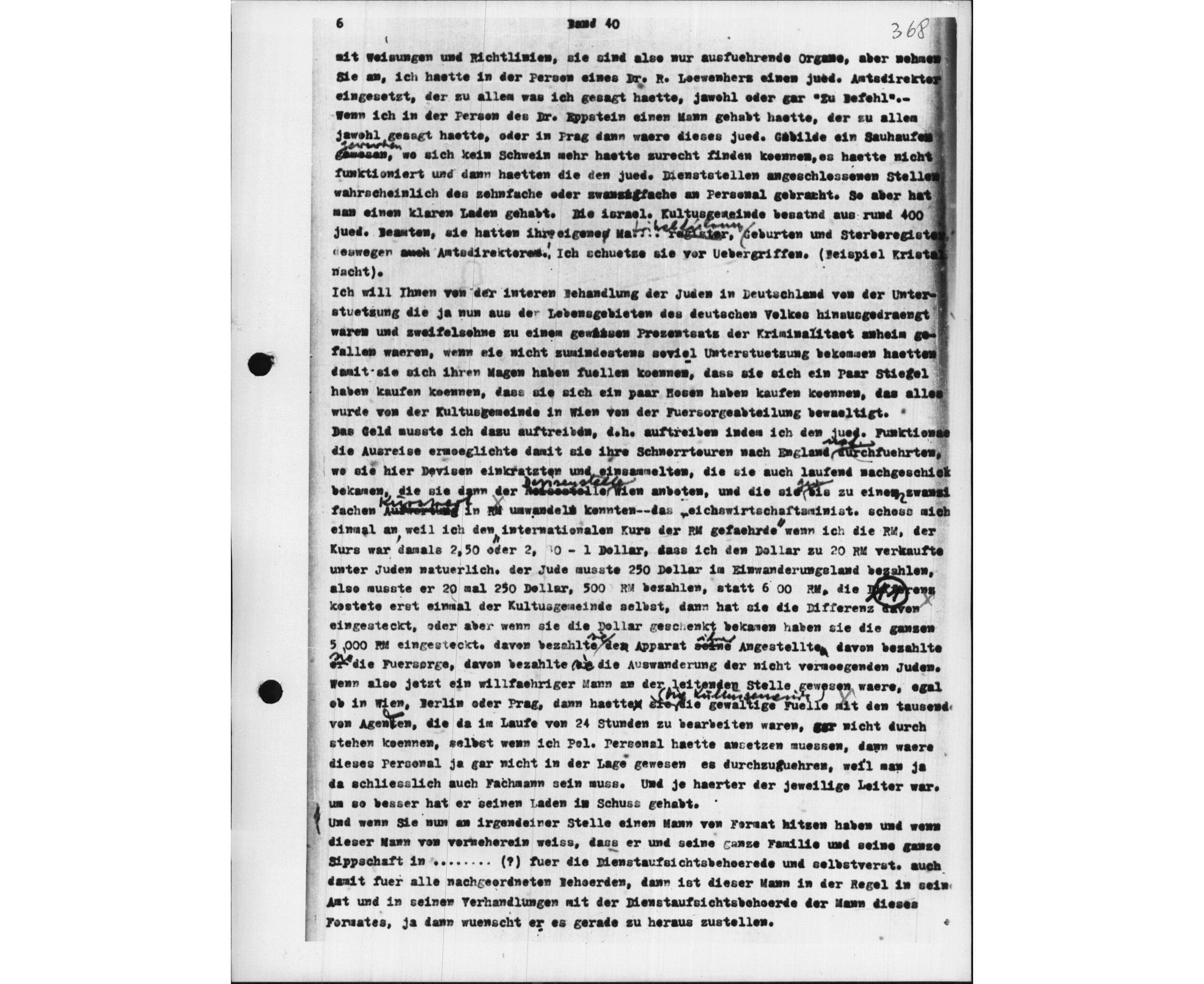
Band 40, page 6

with instructions and guidelines. They are therefore only executing organs. But suppose I had installed a Jewish office director in the person of a Dr. R. Loewenherz who said yes to everything I said, or even said "At your command". If in the person of Dr. Eppstein I had had a man who had said yes to everything, or in Prague, then this Jewish body would have been a pigsty where no swine could have found its way about any more. It would not have worked, and then the offices attached to the Jewish agencies would probably have needed ten or twenty times the staff. As it was, one had a clear shop.

The Israelite Community consisted of around 400 Jewish officials. They had their own [blotted] register, birth and death registers, which is why they also had office directors. I protected them from encroachments. (Example of Kristallnacht.) I want to tell you about the internal treatment of the Jews in Germany, about the support for those who had now been pushed out of the areas of life of the German people and who would doubtless have fallen into criminality to a certain percentage had they not received at least enough support to fill their stomachs, to be able to buy themselves a pair of boots, to be able to buy themselves a pair of trousers.

All that was managed by the Community in Vienna through the welfare department. I had to raise the money for it, that is, raise it by making it possible for the Jewish functionaries to travel out so that they could carry out their begging tours to England, where they scraped together and collected foreign currency, which was also sent on to them continuously, which they then offered to the [handwriting] in Vienna, and which they could convert into Reichsmarks at up to twenty times the [handwriting].

The Reich Economics Ministry once jumped on me because I was endangering the international rate of the Reichsmark. The rate at the time was 2.50 or 2.[too faint] to 1 dollar, and I was selling the dollar at 20 Reichsmarks, among Jews of course. The Jew had to pay 250 dollars in the country of immigration, so he had to pay 20 times 250 dollars, 500 Reichsmarks, instead of 6 00 Reichsmarks. The difference first cost the Community itself, then it pocketed the difference from it, or else, if they were given the dollars, they pocketed the whole 5 000 Reichsmarks.

Out of that the apparatus paid its employees, out of that it paid the welfare, out of that it paid for the emigration of the Jews without means. So if a compliant man had been in the leading position, whether in Vienna, Berlin or Prague, then they could not have stood up to the enormous mass of work at all, with the thousands of agents that had to be dealt with in the course of 24 hours. Even if I had had to put police personnel on it, this personnel would not have been in a position to carry it through, because in the end one has to be a specialist there too.

And the harder the head in each case was, the better he had his shop in order. And if you now have a man of stature sitting in some position, and if this man knows from the start that he and his whole family and his whole clan are in [not typed] for the supervisory authority, and of course thereby for all subordinate authorities as well, then this man is as a rule, in his office and in his negotiations with the supervisory authority, the man of that stature, and then he wants to set it out plainly.

Open sheet image, German, and notes
Scan 00007 of the Sassen transcript, O.65 file 87.
This is scan 00007 of the Sassen transcript, O.65 file 87. The image is 3504 by 2864 pixels. Yad Vashem Archives, Jacob Robinson Collection O.65, file 87.

German transcription

6 Band 40 [HW: 368] mit Weisungen und Richtlinien, sie sind also nur ausfuehrende Organe, aber nehmen Sie an, ich haette in der Person eines Dr. R. Loewenherz einen jued. Amtsdirektor eingesetzt, der zu allem was ich gesagt haette, jawohl oder gar "Zu Befehl".- Wenn ich in der Person des Dr. Eppstein einen Mann gehabt haette, der zu allem jawohl gesagt haette, oder in Prag dann waere dieses jued. Gebilde ein Sauhaufen [HW: [illegible]] gewesen, wo sich kein Schwein mehr haette zurecht finden koennen,es haette nicht funktioniert und dann haetten die den jued. Dienststellen angeschlossenen Stellen wahrscheinlich des zehnfache oder zwanzigfache an Personal gebracht. So aber hat man einen klaren Laden gehabt. Die israel. Kultusgemeinde besatnd aus rund 400 jued. Beamten, sie hatten ihr eigenes Matr[HW: [illegible]] register, Geburten und Sterberegister deswegen auch Amtsdirektoren. Ich schuetze sie vor Uebergriffen. (Beispiel Kristal nacht). Ich will Ihnen von der inneren Behandlung der Juden in Deutschland von der Unter- stuetzung die ja nun aus der Lebensgebieten des deutschen Volkes hinausgedraengt waren und zweifelsohne zu einem gewissen Prozentsatz der Kriminalitaet anheim ge- fallen waeren, wenn sie nicht zumindestens soviel Unterstuetzung bekommen haetten damit sie sich ihren Magen haben fuellen koennen, dass sie sich ein Paar Stiefel haben kaufen koennen, dass sie sich ein paar Hosen haben kaufen koennen, das alles wurde von der Kultusgemeinde in Wien von der Fuersorgeabteilung bewaeltigt. Das Geld musste ich dazu auftreiben, d.h. auftreiben indem ich den jued. Funktionae die Ausreise ermoeglichte damit sie ihre Schnorrtouren nach England [HW: [illegible]] durchfuehrten, wo sie hier Devisen einkratzten und einsammelten, die sie auch laufend nachgeschick bekamen, die sie dann der [DEL: [?Reisestelle?]] [HW: [illegible]] Wien anboten, und die sie bis zu einem zwanzi fachen [DEL: [?Auswertung?]] [HW: [?Kurswert?]] in RM umwandeln konnten--das Reichswirtschaftsminist. schoss mich einmal an, weil ich den internationalen Kurs der RM gefaehrde wenn ich die RM, der Kurs war damals 2,50 oder 2,30 - 1 Dollar, dass ich den Dollar zu 20 RM verkaufte unter Juden natuerlich. der Jude musste 250 Dollar im Einwanderungsland bezahlen, also musste er 20 mal 250 Dollar, 500 RM bezahlen, statt 6 00 RM, die Differenz kostete erst einmal der Kultusgemeinde selbst, dann hat sie die Differenz davon eingesteckt, oder aber wenn sie die Dollar geschenkt bekamen haben sie die ganzen 5 000 RM eingesteckt. davon bezahlte [HW: [illegible]] dem Apparat seine Angestellte, davon bezahlte er die Fuersorge, davon bezahlte sie die Auswanderung der nicht vermoegenden Juden. Wenn also jetzt ein willfaehriger Mann an der leitenden Stelle gewesen waere, egal ob in Wien, Berlin oder Prag, dann haetten sie [HW: [?die Kultusgemeinde?]] die gewaltige Fuelle mit den tausend von Agenten, die da im Laufe von 24 Stunden zu bearbeiten waren, gar nicht durch stehen koennen, selbst wenn ich Pol. Personal haette ansetzen muessen, dann waere dieses Personal ja gar nicht in der Lage gewesen es durchzufuehren, weil man ja da schliesslich auch Fachmann sein muss. Und je haerter der jeweilige Leiter war. um so besser hat er seinen Laden im Schuss gehabt. Und wenn Sie nun an irgendeiner Stelle einen Mann von Format sitzen haben und wenn dieser Mann von vorneherein weiss, dass er und seine ganze Familie und seine ganze Sippschaft in ........ (?) fuer die Dienstaufsichtsbehoerede und selbstverst. auch damit fuer alle nachgeordneten Behoerden, dann ist dieser Mann in der Regel in sein Amt und in seiner Verhandlungen mit der Dienstaufsichtsbehoerde der Mann dieses Formates, ja dann wuenscht er es gerade zu heraus zustellen.

English translation

6 Volume 40 [HW: 368] with instructions and directives, so they are only executive organs, but suppose I had installed in the person of a Dr. R. Loewenherz a Jewish office director who, to everything I had said, [said] "yes indeed" or even "at your command".- If I had had in the person of Dr. Eppstein a man who had said yes to everything, or in Prague, then this Jewish structure would have been a pigsty [HW: [illegible]] where no swine could have found its way around any more, it would not have functioned and then the offices attached to the Jewish agencies would probably have brought in ten times or twenty times the personnel. But as it was, one had a clear-run shop. The Israelite Religious Community consisted of around 400 Jewish officials, they had their own regis[HW: [illegible]] register, birth and death registers, and therefore also office directors. I protect them from encroachments. (Example Kristal night). I want to [tell] you about the internal treatment of the Jews in Germany, about the support [for those] who had now been pushed out of the spheres of life of the German people and who without doubt would to a certain percentage have fallen prey to criminality, if they had not received at least enough support so that they could fill their stomachs, that they could buy themselves a pair of boots, that they could buy themselves a pair of trousers, all of this was handled by the Religious Community in Vienna by the welfare department. The money I had to drum up for it, that is, drum up by making emigration possible for the Jewish functionar[ies] so that they carried out their sponging tours to England [HW: [illegible]], where they scraped together and collected foreign currency here, which they also had continually forwarded to them, which they then offered to the [DEL: [?travel office?]] [HW: [illegible]] Vienna, and which they could convert up to a twenty-fold [DEL: [?utilization?]] [HW: [?exchange rate?]] into RM--the Reich Economics Minist[ry] once jumped on me because I endanger the international exchange rate of the RM when I [sell] the RM, the rate was then 2.50 or 2.30 - 1 dollar, that I sold the dollar at 20 RM among Jews of course. the Jew had to pay 250 dollars in the immigration country, so he had to pay 20 times 250 dollars, 500 RM, instead of 6 00 RM, the difference first of all cost the Religious Community itself, then it pocketed the difference from it, or else if they got the dollars as a gift they pocketed the whole 5 000 RM. from that [HW: [illegible]] the apparatus paid its employees, from that it paid the welfare, from that it paid the emigration of the non-propertied Jews. So if now a compliant man had been at the leading position, no matter whether in Vienna, Berlin or Prague, then they [HW: [?the Religious Community?]] would not have been able at all to get through the enormous abundance with the thousands of agents that had to be dealt with there in the course of 24 hours, even if I had had to deploy police personnel, then this personnel would not have been at all in a position to carry it out, because one ultimately also has to be a specialist there. And the harder the respective leader was, the better he had his shop in order. And if you now have a man of stature sitting at some position and if this man knows from the outset that he and his whole family and his whole clan in ........ (?) for the supervisory authority and self-evident[ly] also thereby for all subordinate authorities, then this man is as a rule in his office and in his negotiations with the supervisory authority the man of this stature, yes then he wishes precisely to make it stand out.
Unreviewed notes

These notes haven't been reviewed. A note can identify a speaker where the reviewed English doesn't. If they disagree, use the reviewed English.

Transcription note

Scan file: Part3_10623184/00007.jpg (requested as Part3/00007). Heavily degraded carbon/typescript. Header: printed page number '6' top-left, 'Band 40' centered, handwritten '368' top-right (archival foliation). Several small cursive handwritten corrections sit above the base line; at the available resolution most are not confidently legible and are marked [HW: [illegible]] or [?...?]. Two typewritten words on the currency passage (tentatively 'Reisestelle' and 'Auswertung') appear struck with a handwritten replacement above; contextually the second replacement reads as 'Kurswert' ('zwanzigfachen Kurswert in RM'), but the ink is only partly legible. Right margin carries several ink 'X' marks (near the 'zwanzi-fachen' line and the '6 00 RM / Differenz' line) and a drawn loop/circle around 'Differenz'; left margin has a bracket-like stroke beside the final paragraph. These marginal marks are annotation gestures, not clearly text. Uncertain lexical readings resolved by reader-interpretation: 'Loewenherz', 'Schnorrtouren', 'Stiefel', 'sitzen'. Two pages of the binder appear punched (two hole punches visible at left).

Translation notes

- 'Matr[HW: [illegible]] register' rendered as 'regis[HW: [illegible]] register'; the German 'Matrikelregister' (register of vital records) is the likely intended word but the OCR breaks it with an illegible HW insertion, so the reading is left partial. - '6 00 RM' and '5 000 RM' preserved with the source spacing; the surrounding arithmetic (20 × 250 = 5000) suggests '6 00 RM' may be an OCR corruption of '5 000 RM' or another figure, but the number is left as written and not reconciled. - 'Schnorrtouren' translated literally as 'sponging tours' (schnorren = to scrounge/sponge); this is a pejorative German colloquialism preserved without softening. - '[DEL: [?Reisestelle?]]' translated as 'travel office' — the deleted German word is itself marked uncertain in the source, so the English is doubly tentative. - '[DEL: [?Auswertung?]] [HW: [?Kurswert?]]' — the deleted word ('utilization/evaluation') and the handwritten replacement ('exchange rate') are both source-marked uncertain; both readings are carried through. - 'in ........ (?) fuer die Dienstaufsichtsbehoerede' — the sentence has an ellipsis gap in the German with a '(?)' marker; a verb is apparently missing, so the clause is grammatically incomplete and its meaning cannot be fully determined; translated as literally as the fragment allows. - 'Kristal nacht' preserved as 'Kristal night' with the source's broken/anglicized spelling and line break rather than normalized to 'Kristallnacht'. Header line reads '6 Band 40 [HW: 368]' (page 6, Volume 40, handwritten 368). The page is a single continuous first-person monologue with no turn boundary and no explicit speaker label. Content is a first-person account of controlling the Jewish Religious Communities' emigration/welfare apparatus and the dollar-to-RM currency conversion scheme — consistent with Eichmann's Vienna/Berlin/Prague emigration-office role — so the whole page is attributed to E on content grounds, per attribution rule 2. There is no second speaker on this page; the rhetorical 'suppose I had...' and 'if you now have a man...' are addressed by the same monologuing speaker, not a separate turn. Broken grammar preserved: 'I want to [tell] you' supplies the elided verb (German 'Ich will Ihnen von... ' lacks 'erzählen/berichten'); tense shifts ('I endanger', 'I protect them') left as in the German present tense against a past narration. Numbers, currency figures, and the exchange-rate arithmetic preserved verbatim without silent correction."
Band 40, page 7
Questioner

So according to your assertion, Dr. Loewenherz, Dr. Eppstein and the representative in Prague were compliant tools?

No, they gave me their contra. They had their ifs and buts. They had to.

Questioner

Can you remember concrete examples in which they gave their contra, where you can show that in practice the negotiation was between equals?

Eichmann

The [handwriting] example:

How did the Central Office for Jewish Emigration come about in the first place? You know that a tax clearance certificate was needed for it, a certificate of good conduct, and so on and so on [not typed] A series of papers had to be produced that were needed to obtain a passport. Some of these papers that had to be produced had a relatively short life. The tax clearance certificate, as the hardest one to obtain, was valid for 6 weeks, after which it was invalid. If the Jew, who had to wait at the offices anyway until the rest of the public had been dealt with, finally still got a chance to speak to the counter official, then he was lucky.

As a rule he had to come three or four times, and finally his turn came. Once he finally had this tax clearance certificate in his hands, he then had to queue up just as often by a similar route and then be told, Jew, wait, according to the mood of the counter official. The result was that the 6 or 8 weeks' life of the tax certificate had long since run out, and he had to start again from the beginning, and in the meantime other papers became invalid again. Then Dr. Rottenberg and Dr. Loewenherz came to me one day and said to me, Obersturmfuehrer, this cannot go on. What are the Jews still supposed to do in order to be able to emigrate?

And they described to me what I have just described to you, and they said to me, if it is not possible here to give the Jews preferential treatment, then you will not get rid of the Jews although the Jew is willing to emigrate. After that I thought it over and discussed the difficulty with the Commander of the Security Police and the SD, Dr. Stahlecker, and I said to him, if we could bring together all these counter officials who have to be approached, all under our control in a building that the Security Police gives me, then they go down as if on a conveyor belt and drop off ready with their passports. It is good for both sides.

I had the luck to have a superior like Stahlecker, who took the matter up at once and the same day went with me to the Reich Commissioner [handwriting]. [handwriting] was all fire and flame, and the same day the Reich Commissioner's decree came about. That is an example. A man without stature would have come crawling and would have whined. Yes, he would perhaps have wanted to gloss the matter over and so on and so on. No, the office director was no compliant tool in the hands of the Security Police. No, he was a man of stature who came forward, demanded and wished. Loewenherz had a bit of the streak, the temperament of an Austrian, while Eppstein was the gross type of a bold, tersely expressive Prussian lawyer, and an ice cold lawyer at that.

Open sheet image, German, and notes
Scan 00008 of the Sassen transcript, O.65 file 87.
This is scan 00008 of the Sassen transcript, O.65 file 87. The image is 3504 by 2848 pixels. Yad Vashem Archives, Jacob Robinson Collection O.65, file 87.

German transcription

7 Band 40 [HW: 369] Also nach Ihrer Behauptung waren [HW: weder] der Dr. Leewenherz, noch der Dr. Eppstein, noch der Vertreter in Prag, willfaehrige Werkzeuge? Nein, sie haben mir contra gegeben, sie haben ihr Wenn und Aber gehabt, das mussten sie. Koennen Sie sich auf konkrete Beispiele erinnern in denen sie ihr Contra gegeben habe Wo Sie beweisen koennen, das praktisch von gleich zu gleich verhandelt wurde? Das [DEL: schwie[?rig?]gste] [HW: [?naechste?]] Beispiel: Wie kam es zur Zentralstelle fuer jued. Auswanderung ueberhaupt? Sie wissen dass dazu notwendig war eine steuerliche Unbedenklichkeitsbescheinigung, ein Fuehrungs zeugnis ein so wie so so so so..... es mussten eine Reihe von Papieren erbracht werden, die zur Erlangung eines Reise- passes notwendig waren. Ein Teil dieser Papiere die erbracht werden mussten, hatten eine raltiv kurze Laufzeit, die steuerliche Unbedenklichkeitsbescheinigung als die am schwierigsten zu erlangende, hatte eine Gueltigkeit von 6 [HW: 8] Wochen, danach war sie ungueltig. Hatte der Jude der sowieso bei den Behoerden warten musste, bis der uebrige Parteiverkehr abgewickelt war, endlich noch Gelegenheit den Schalterbeamten zu sprechen, dann hat er Glueck gehabt, in der Regel musste er drei od viermal kommen und endlich kam er dann dran. Hatte er nun endlich diese steuerliche Unbedenk- lichkeitsbescheinigung in Haenden, dann musste er auf aehnlichem Wege genau so oft Schlange stehen und dann feststellen, Jude, warten.....je nach Lust und Laune des Schalterbeamten. Die Folge war, dass die 6 od 8 Wochen Laufzeit der steuerlichen Bescheinigung laengst verstrichen waren, und er musste wieder von vorne anfangen und inzwischen wurden wieder andere Papiere ungueltig. Da kamen Dr. Rottenberg und Dr. Leewenherz eines Tages zu mir und haben mir gesagt, Ostf. so geht das nicht weiter, was sollen denn die Juden noch tun um auswandern zu koennen und haben mir das geschildert, was ich Ihnen eben geschildert habe, und haben mir gesagt, wenn es hier nicht gelingt die Juden bevorzugt zu behandeln, dann werden Sie die Juden nicht los obwohl der Jude auswanderungswillig ist. Daraufhin habe mir das durchdacht und habe die Schwiergkeit mit dem Befehlshaber der SIPO und des SD Dr. Stahllecker be- sprechen und habe ihm gesagt, wenn es uns gelaenge alle diese Schalterbeamten, die da angelaufen werden muessen, alle unter unsre Kontrolle in ein Gebaeude dass die SIPO mir gibt, zu versammeln, dann gehen sie wie am laufenden Band runter und fallen passfertig ab, es ist fuer beide Teile gut. Ich hatte das Glueck gehabt einen Vor- gesetzten wie Stahllecker zu haben, der die Sache sofor aufgriff und am selben Tage noch mit mir den Reichskommissar [DEL: Guestel] [HW: [?Buerckel?]] aufsuchte--[DEL: Guestel] [HW: [?Buerckel?]] war Feuer und Flamme, und am selben Tage kam es noch zu dem Erlass des Reichskommissars. Das ist ein Beispiel, ein Mann ohne Format waere gekrochen gekommen und haette gewinselt, ja er haette viel leicht die Sache verschoenigen wollen usw usw.... nein der Amtsdirekter war kein willfaehriges Werkzeug in den Haenden der SIPO, nein es war ein Mann von Format der auftrat, forderte und wuenschte. Leewenherz hatte ein bischen den Einschlag, das Naturell eines Oestreichers, waehrend Eppstein der Bruttotyp eines kessen, pregnant sich ausdrueckenden, preuss. Jurist gewesen ist, und zwar ein eiskalter Jurist. [HW: [illegible]] X

English translation

7 Volume 40 [HW: 369] So according to your assertion [HW: neither] Dr. Löwenherz, nor Dr. Eppstein, nor the representative in Prague were compliant tools? No, they gave me contra, they had their ifs and buts, they had to. Can you remember concrete examples in which they gave their contra Where you can prove that in practice it was negotiated on equal terms? The [DEL: most diffi[?cult?]] [HW: [?next?]] example: How did the Central Office for Jewish Emigration come about at all? You know that for this a tax clearance certificate was necessary, a certificate of good conduct, a such-and-such and so on..... a series of papers had to be produced, which were necessary for obtaining a travel passport. A part of these papers that had to be produced had a relatively short period of validity, the tax clearance certificate as the most difficult to obtain, had a validity of 6 [HW: 8] weeks, after that it was invalid. If the Jew, who anyway had to wait at the authorities until the rest of the party traffic had been dealt with, finally still had opportunity to speak to the counter official to speak, then he had luck, as a rule he had to come three or four times and finally then it was his turn. Had he now finally this tax clearance certificate in hand, then he had to in a similar way just as often stand in line and then find out, Jew, wait.....according to the mood and whim of the counter official. The consequence was that the 6 or 8 weeks period of validity of the tax certificate had long since elapsed, and he had to start again from the beginning and meanwhile other papers again became invalid. Then Dr. Rottenberg and Dr. Löwenherz came to me one day and said to me, Ostf. this does not go on like this, what then are the Jews still supposed to do to be able to emigrate, and described to me that which I have just described to you, and said to me, if it does not succeed here to treat the Jews preferentially, then you will not get the Jews rid of although the Jew is willing to emigrate. Thereupon I thought this through and discussed the difficulty with the Commander of the SIPO and of the SD Dr. Stahlecker and said to him, if we succeeded in gathering all these counter officials, who must be run to there, all under our control in a building that the SIPO gives me, to assemble, then they go down like on a conveyor belt and fall off ready-with-passport, it is good for both parts. I had had the luck to have a superior like Stahlecker, who took up the matter immediately and on the same day still sought out with me the Reich Commissioner [DEL: Güstel] [HW: [?Bürckel?]]--[DEL: Güstel] [HW: [?Bürckel?]] was fire and flame, and on the same day still came about the decree of the Reich Commissioner. That is an example, a man without stature would have come crawling and would have whimpered, yes he would have per- haps wanted to embellish the matter etc etc.... no the office director was no compliant tool in the hands of the SIPO, no it was a man of stature who appeared, demanded and wished. Löwenherz had a bit of the strain, the temperament of an Austrian, whereas Eppstein was the gross type of a bold, pregnantly expressing himself, Prussian jurist was, and indeed an ice-cold jurist. [HW: [illegible]] X
Unreviewed notes

These notes haven't been reviewed. A note can identify a speaker where the reviewed English doesn't. If they disagree, use the reviewed English.

Transcription note

Typed transcript page, Band 40, typed page number "7" top-left, handwritten folio "369" top-right. Handwritten insertions: "weder" inserted above line 1 after "waren"; a handwritten word (read as possible "naechste") written above a struck typed word in "Das ... Beispiel:" line — the struck typed word begins "schwie-" and ends "-gste" (likely "schwierigste"); superscript handwritten "8" above the typed "6" in "von 6 Wochen". Two occurrences of the typed name "Guestel" appear struck with a handwritten correction above each — read as a probable "Buerckel"/"Bürckel" (Reichskommissar Josef Bürckel), but the strokes are genuinely uncertain, hence [?Buerckel?]. Bottom-of-page handwritten signature/scrawl is illegible, followed by a mark "X". Typewriter idiosyncrasies preserved verbatim (e.g. "raltiv", "Schwiergkeit", "sofor", "Amtsdirekter", "Bruttotyp", "Oestreichers", ellipses/period runs). Name "Rottenberg" read as typed (could also be "Rettenberg"). Faint/low-contrast typeface throughout; readings given reflect best defensible interpretation of the pixels.

Translation notes

- 'sie haben mir contra gegeben' / 'ihr Contra gegeben' — 'contra' is used as a noun ('gave me contra' / 'gave their contra'), i.e. pushed back / opposed; rendered literally as 'contra' rather than smoothing to 'opposed me'. - 'Ostf.' left untranslated — abbreviation for 'Obersturmführer' (SS rank), the form of address used by Rottenberg/Löwenherz to Eichmann. - 'fallen passfertig ab' — literally 'fall off ready-with-passport' (conveyor-belt metaphor: the applicant emerges from the assembly line with a completed passport); the coinage 'passfertig' has no clean English equivalent. - 'war Feuer und Flamme' — idiom 'was fire and flame' = 'was highly enthusiastic'; kept literal. - 'der Bruttotyp' — 'Brutto' normally means 'gross' (as in gross/net); here likely meaning 'the gross/crude type' or possibly a slip; rendered literally as 'gross type'. - 'ein bischen den Einschlag' — 'Einschlag' here in the sense of a 'strain' / 'streak' / 'touch' of a character type; rendered 'a bit of the strain'. - 'pregnant sich ausdrueckenden' — 'prägnant' = 'terse/pithy/pregnant (with meaning)'; kept as 'pregnantly expressing himself'. - Trailing dangling 'gewesen ist' ('...jurist was') reflects the broken German word order; preserved. This page is unambiguous dialogue with a clear Q&A structure and no explicit speaker labels in the source. Attribution rests on content: the interviewer's turns are direct challenges to the respondent's assertions ("according to your assertion", "can you prove"), matching Sassen's role; the respondent's turns are first-person operational accounts of establishing the Vienna Central Office for Jewish Emigration, dealing with SIPO/SD commander Stahlecker and the Reich Commissioner (Bürckel, Vienna Gauleiter/Reichskommissar) — an account only Eichmann, who ran that office, would give in the first person. This maps cleanly to the known Sassen–Eichmann interview. Deletions/insertions preserved: [DEL: schwierigste][HW: nächste]; [DEL: Güstel][HW: Bürckel] (twice); 6→[HW: 8] weeks. 'Leewenherz' (OCR spelling) = Josef Löwenherz, head of the Vienna Jewish community; 'Rottenberg' likely Rothenberg; 'Stahllecker' = Franz Walter Stahlecker; 'Eppstein' = Paul Eppstein. These name normalizations are noted but the OCR forms are what appear in the source. The header 'Band 40' with page markers 7 and [HW: 369] identifies transcript volume/pagination."
Band 40, page 8
Questioner

Can you tell me a similar example involving Dr. Eppstein, like the one you just told me about Dr. Loewenherz?

Another Viennese example.

A lawyer of the Austrian Jewish Community in Vienna came to me once, in the days after the Reichskristallnacht. He was serving in the Central Office for Jewish Emigration. He said to me, Hauptsturmfuehrer, "Wild Jewish lout attacks harmless German lion." I was sitting at my desk. The officials simply came in like that, to discuss some particular special case, and so this man came in and told me that as a good, nice joke. Now if I, who after all embodied the SIPO, had been some rabid Jew-devourer, hardly anyone would have dared to say anything like that to me here in the office, where my permanent deputy Hauptsturmfuehrer Guenter sat across from me. I wasn't even alone, the two of us worked in one room.

Dr. Eppstein always came running whenever the guidelines for carrying out the evacuation weren't followed exactly somewhere in the transports, through local shortcomings. He, the meticulous lawyer, had his prescription in the form of guidelines for the evacuation. He had those. If he found some failure here on the part of the local offices, he came running and reported it to me, giving the place and sometimes also the official's name, and asked me to put a stop to it before it set a precedent.

Questioner

Do you have a concrete example?

Eichmann

No, that happened continuously, and I'll tell you the following

Questioner

No, what interests me is only whether these people were installed as [blotted] of the Reich Association of Jews in Germany, as [blotted] of the Jewish Communities, and whether they were compliant tools of the Reich Security Main Office.

Eichmann

But now we know how it was.

Questioner

And now, what was the further course of these people?

Eichmann

Dr. R. Loewenherz, over the years, one did sometimes exchange a private word, these people did also have private worries once in a while, and Dr. Loewenherz said to me quite early on: Obersturmfuehrer, you promised Dr. Rottenberg that he may emigrate to Palestine once he has spent a certain time as head of the Palestine Office setting the thing up here, and once the shop is running, so that a deputy of his can take the matter over. You have now kept the promise and permitted Dr. Rottenberg to emigrate to Palestine.

Now I ask for myself as well, when my task here is finished, would you promise me to let me emigrate to England? In the year 1939. And then I told him: Herr Loewenherz, I promise you, you can emigrate to England, but for the time being there's no question of it. Work here and do the job here, because as director of the Jewish Community you are put in charge of a shop with 400 employees, and I wouldn't know whom to take in your place

Questioner

An interposed question. How did you come upon the person of Dr. Loewenherz?

Eichmann

A few days after the reunification I had orders to come to Vienna, to get the emigration going there. Since I had been in Berlin as the desk officer for the

Open sheet image, German, and notes
Scan 00009 of the Sassen transcript, O.65 file 87.
This is scan 00009 of the Sassen transcript, O.65 file 87. The image is 3504 by 2856 pixels. Yad Vashem Archives, Jacob Robinson Collection O.65, file 87.

German transcription

8 Band 40 [HW: 370] Koennen Sie mir ein aehnliches Beispiel erzaehlen, in Verbindung mit Dr. Eppstein wie Sie es eben von Dr. Loewenherz erzaehlt habe? Noch ein Wiener Beispiel: Zu mir kam einmal ein Jurist der oestr. jued. Kultusgemeinde in Wien in den Tagen nach der Reichskristallnacht. Und zwar tat er Dienst in der Zentrale fuer jued. Aus- wanderung. Er sagte zu mir Hstf. " Wilder Judenluemmel greift harmlosen deutschen Loewen an." Ich sass am Schreibtisch, die Beamten kamen ja so rein um einen be- sonderen Spezialfall zu besprechen-- also dieser kam nun herein und erzaehlte mir di als einen guten, netten Witz, --- Wenn ich nun, der ich ja die SIPO verkoerperte, so ein wildgewordener Judenfresser gewesen, es haette wohl kaum einer wagen koennen, aehnliches hier mir im Amtsraum zu sagen, wo mir gegenueber mein staendiger Vertrete der Hstf. Guenter sass, ich war nicht einmal allein, wir arbeiteten zu zweit in einen Raum.-- Dr. Eppstein kam immer dann angealu en, wenn irgendwie bei den Transp. durch oertl. Unzulaenglichkeiten, die Richtlinien zur Durchfuehrung der Evakuierung nicht genau eingehalten wurden, Er der peinliche Jurist hatte sein Rezept in Form von Richt- linien fuer die Evakuierung, die hatte er, Fand er hier irgend einen Versager, seit der oertl. Dienststellen, kam er angelaufen und teilte mir das unter Angabe des Orte und teilweise auch unter Angabe des Beamten mit und bat mich das abzustellen, be- vor es Schule machen wuerde. Haben Sie ein kongretes Beispiel?? Nein, dasist am laufenden Bande passiert und ich sage Ihnen folgendes.... Nein, mich interessiert nur ob diese Leute als [DEL: Praesidente] [HW: Leiter] der Reichsvereinigung der Juden in Deutschland, als [DEL: Praesidente] [HW: [illegible]] der Kultusgemeinden eingesetzt wurden und ob sie willfaehrige Werkzeuge des Reichssicherheits HA waren?? Aber nun wissen wir ja wie es war.---- Undnun wie ist der weitere Weg dieser Leute gewesen? Der Dr. R. Loewenherz hat sich im Laufe der Jahre, man sprach ja auch einmal ein privates Wort-- diese Leute hatte ja auch einmal private Sorgen--und da sagte mir der Dr. Loewenherz schon einmal rechtfruehzeitig; Ostf, Sie haben dem Dr. Rottenberg ver- sprochen, dass er nach Palast. auswandern darf, wenn er eine gewisse Zeit als Leiter des Palast. Amtes die Sache hier eingerichtet hat und wenn der La den laeuft, so dass ein Vertreter von ihm die Sache uebernehmen kann, Sie haben nun das Versprechen ge- halten und dem Dr. Rottenberg die Auswanderung nach Palast. gestattet. Ich bitte nun auch fuer meine Person, wenn meine Aufgabe hier abgeschlossen ist, wuerden Sie mir versprechen, mich nach England auswandern zu lassen?... Im Jahre 1939...Und da habe ich ihm gesagt. Herr Loewenherz, ich verspreche Ihnen, Sie koennen nach England aus- wandern, aber vorlaeufig ist keine Rde davon, arbeiten Sie hier und machen Sie die Sache hier, denn Sie sind als Amtsdirektor der jurd. Kultusgemeinde einen Laden mit 400 Angestellten vorgesetzt und ich wuesste nicht wen ich an Ihrer Stelle nehmen koen Zwischenfrage: Wie kamen Sie auf die Person des Dr. Loewenherz? Einige Tage nach der Wiedervereinigung hatte ich Befehl nach Wien zu kommen, um dort die Auswanderung anzukurbeln. Nachdem ich ja in Berlin als Sachbearbeiter fuer die

English translation

8 Volume 40 [HW: 370] Can you tell me a similar example, in connection with Dr. Eppstein as you have just told me about Dr. Loewenherz? Another Viennese example: There came to me once a jurist of the Austrian Jewish Religious Community [Kultusgemeinde] in Vienna in the days after the Reich Kristallnacht. And indeed he did service in the Central Office for Jewish emi- gration. He said to me, Hstf. [Hauptsturmführer], "Wild Jewish lout attacks harmless German lion." I sat at the desk, the officials came in just like that to discuss a spe- cial special case-- so this one now came in and told me this as a good, nice joke, --- If I now, I who indeed embodied the SIPO, had been such a rabid Jew-devourer, hardly anyone could have dared, to say anything similar to me here in the office room, where opposite me my permanent deputy the Hstf. Guenter sat, I was not even alone, we worked as a pair in one room.-- Dr. Eppstein always came running along when somehow with the transports through local inadequacies, the guidelines for the carrying out of the evacuation were not exactly adhered to, He the meticulous jurist had his recipe in the form of guide- lines for the evacuation, that he had, If he found here some failure, on the part of the local offices, he came running along and communicated that to me with statement of the place and partly also with statement of the official and asked me to stop that, be- fore it would set a precedent. Do you have a concrete example?? No, that happened on the running belt [i.e. continuously] and I tell you the following.... No, I am only interested whether these people were installed as [DEL: presidents] [HW: leaders] of the Reich Association of the Jews in Germany, as [DEL: presidents] [HW: [illegible]] of the Religious Communities and whether they were compliant tools of the Reich Security Main Office [Reichssicherheits HA]?? But now we do indeed know how it was.---- And now what was the further path of these people? Dr. R. Loewenherz has, over the course of the years, one did after all also speak a private word once-- these people did after all also have private worries once--and there Dr. Loewenherz said to me already once quite early on; Ostf. [Obersturmführer], you have promised Dr. Rottenberg, that he may emigrate to Palest[ine], when for a certain time as leader of the Palest[ine] Office he has set up the matter here and when the shop runs, so that a deputy of his can take over the matter, You have now kept the promise and permitted Dr. Rottenberg the emigration to Palest[ine]. I now ask also for my person, when my task here is completed, would you promise me, to let me emigrate to England?... In the year 1939...And there I said to him. Herr Loewenherz, I promise you, you can emigrate to England, but for the time being there is no talk of it, work here and do the matter here, for you are as office director of the Jewish Religious Community set over a shop with 400 employees and I would not know whom I could take in your place Interposed question: How did you come upon the person of Dr. Loewenherz? Some days after the Reunification [Anschluss] I had orders to come to Vienna, in order there to crank up the emigration. After I had indeed, in Berlin as case-officer for the
Unreviewed notes

These notes haven't been reviewed. A note can identify a speaker where the reviewed English doesn't. If they disagree, use the reviewed English.

Transcription note

Typewritten transcript page, generally legible carbon/typescript with faint areas. Header: typed "8" upper-left, "Band 40" centered, handwritten "370" (appears as "3 70") upper-right in ink. Two editorial cancellations with handwritten replacements in the paragraph beginning "Nein, mich interessiert nur...": (1) "Praesidente" struck through (crossed out) with handwritten cursive "Leiter" written above it; (2) a second "Praesidente" struck through in the following line with a cursive handwritten replacement written above it that I could not read with confidence, rendered [HW: [illegible]]. The word could not be resolved from the pixels; it did not clearly read "Leiter." Note "La" (twice, lines "wenn der La den laeuft" and possibly abbreviating "Laden") retained verbatim; abbreviations (Hstf., Ostf., oestr., jued., oertl., Palast., HA, SIPO, Transp.) left unexpanded. Several apparent typos preserved verbatim (dasist, Undnun, Rde, jurd., kongretes, angealu en, rechtfruehzeitig, wuesste... koen[nen] cut off at right margin). Right margin appears slightly clipped on some lines (e.g. "des Orte[s]", "seit[e]", "koen[nte]"). Two hole-punch marks along left edge. Scattered stray ink/dust dots present but not transcribed.

Translation notes

- 'am laufenden Bande passiert' rendered literally as 'happened on the running belt'; idiomatically it means 'happened all the time / continuously / one after another' — glossed in brackets. - 'angealu en' (line: 'Dr. Eppstein kam immer dann angealu en') is a garbled OCR form; translated as 'came running along' by analogy to the later 'kam er angelaufen', but the exact word is uncertain. - 'Wiedervereinigung' translated literally as 'Reunification'; in this 1938 Vienna context it denotes the Anschluss (annexation of Austria) — noted but not silently resolved in the literal text. - 'La den' / 'Laden' rendered 'shop'; a colloquial term for the operation/office ('the outfit'), here kept literal. - 'peinliche Jurist' translated 'meticulous jurist'; 'peinlich' here carries the older sense of 'scrupulous/painstaking', though it could also read as 'awkward/embarrassing' — meticulous chosen from context. - 'Palast.' is an abbreviation expanded as 'Palest[ine]' (Palästina); the abbreviation is in the source. - 'SIPO' = Sicherheitspolizei (Security Police); left as SIPO. - 'Reichssicherheits HA' expanded as 'Reich Security Main Office' (Reichssicherheitshauptamt); 'HA' = Hauptamt abbreviation in source. Page 8, Band 40, [HW: 370]. This is a clearly turn-structured interview page: short interrogative turns alternate with long first-person narrative turns. No explicit speaker labels/initials appear except the source's own 'Zwischenfrage:' ('Interposed question:') marking one interviewer turn. Attribution of interviewer turns to S (Sassen) and respondent turns to E (Eichmann) rests on internal content: the narrative turns are first-person accounts of SIPO/emigration-office authority, a permanent deputy Hstf. Guenter, and being addressed by the honorific 'Ostf.'/'Hstf.' — consistent only with the SS respondent, i.e. Eichmann; the questions are external analytic prompts consistent with the interviewer. The garbled/broken forms ('angealu en', 'La den', 'Undnun', 'dasist', doubled 'Spezialfall/special special case', 'kongretes') are preserved. Deletions [DEL:] and handwritten insertions [HW:] and [illegible] are preserved verbatim. The final turn is cut off mid-sentence at the page bottom ('as case-officer for the'), preserved as incomplete."
Band 40, page 9

Zionist World Union, I was of course the sought-after expert on emigration questions, whom the Chief of the SIPO had at his disposal. So I came to Vienna and spoke with a police detective, Dr. Ebener, who was still lugging around the Austrian commissar's uniform with a heavy sabre. That same Dr. Ebener who was later to become the permanent deputy for the Stapo regional headquarters in Vienna. The Commander of the SIPO and the SD, to whom I was assigned for command purposes, was [handwriting].

I first had to lay out my program to the Commander of the SIPO and the SD, I told him how I pictured the sequence of things, he approved it for me, I put it in writing in the form of a memorandum, had it signed off, and now had the authority of the superior of the Stapo regional headquarters Vienna, that I was to proceed in this way and no other, and the Stapo was instructed to accommodate all my wishes here and to give me facilities and so on. As the first thing I restored this Jewish organizational life, which had been smashed in those days, and only to the extent that I needed it for the emigration of the Jews from the Ostmark.

I had to have a proper, hard-hitting Jewish central instrument, which I had to provide with a head, and the most important thing there was the person of the head. I therefore asked Dr. Ebener to have some formerly imprisoned Jewish leaders of organized life in Austria brought to me out of custody. They came to an office room of the Hotel Metropol. Dr. so-and-so came, Dr. so-and-so came, one was too old for me, the other was too slow and too frail for me, the third had been too polite and too servile for me, and then came a man who had already been active as an official of the Israelite Community.

And then I negotiated with Dr. R. Loewenherz, coming to the personal details, questioning him factually on what he had done, and all the usual stories, and I came to realize that in his worry and his distress he told me untruths in some cases, he didn't know me after all, and thereupon I slapped his face. But I already told you that. In my whole time in the Jewish work I attacked a Jew only one single time, and that was Dr. Loewenherz, who received a slap in the face in the first hour of our acquaintance.

And so I appointed Dr. Richard Loewenherz in that same hour as director of the Israelite Community. I sent him back to his cell with a notepad and pencil and gave him the task of describing to me, first, the organizational skeleton he had in mind, and second, the functional course of things, whereby I dictated my intentions and my ideas to him in telegram style as guidelines. And thereupon Dr. Loewenherz marched back to his cell, whereby I had given instructions that he was indeed to remain in custody, but that he no longer counted as a prisoner.

I just wanted to make sure quickly and without delay whether the man also had the intellectual format to be able to run such a large apparatus. The next day I had him brought to me again, read it through, discussed it with him, was astonished at the content, which corresponded entirely to my idea and also corresponded entirely to what I had discussed with the Commander of the SIPO and the SD, who after all approved essentially everything, because in the essentials he was not clouded by any [blotted], whereas I, coming from the SD, was already automatically equipped for these things.

Open sheet image, German, and notes
Scan 00010 of the Sassen transcript, O.65 file 87.
This is scan 00010 of the Sassen transcript, O.65 file 87. The image is 3504 by 2848 pixels. Yad Vashem Archives, Jacob Robinson Collection O.65, file 87.

German transcription

9 Band 40 [HW: 371] zien. Weltvereinigung taetig war, war ich ja der gesuchte Fachmann ueber Auswander- ungsfragen ueber den der Chef der SIPO verfuegte. Ich kam also nach Wien und besp- sprach mich mit einem noch die oestr. Kommissarsuniform mit schweren Saebel herum- schleppenden [HW: [illegible]] Kriminalbeamten Dr. Ebener. Jener Dr. Ebener der spaeter der staend. Vertreter fuer die Stapo Leitstelle im Wien werden sollte. Der Befehlshaber der SIPO und des SD, dem ich kommandahalber zugeteilt war, war Dr. Dr. Rasch, SS Stf. [HW: [illegible]] Ich hatte zuerst dem Befehlhaber der SIPO und des SD mein Programm das ich vor- hatte zu entwickeln, ich erzaehlte ihm wie ich mir den Ablauf vorstellte, er ge- nehmigte mir das, ich formulierte es in Form eines Aktenvermerks schriftlich, liess sie mir abzeichnen und hatte nun die Vollmacht des Vorgesetzten [HW: [illegible]] der Stape Leitstell Wien, dass ich so und nicht anders zu verfahren haette und die Stape war ange- wiesen hier allen meinen Wuenschen Rechnung zu tragen und mir Erleichterungen usw. zu geben. Als erstes stellte ich dieses, in diesen Tagen zerschlagenen jued. [?organ.?] Leben wieder her und zwar nur in soweit wie ich das fuer die Auswanderung der Juden aus der Ostmark brauchte. Ich musste ein ordentliches, schlagkraeftiges jued. Zentr- instrument haben, dass ich mit einem Leiter zu versehen hatte und da war das wichtig- ste die Person des Leiters. Ich bat dem Dr. Ebener darum mir einige ehemalige in Haft gesessene, jued. Geschickeleiter des organis. Leben in Oestr. aus der Haft verfuehren zu lassen. In einem Dienstzimmer des Hotels Metropil, da kamen sie nun, es kam der Dr. xy, es kam der Dr. xy, der eine war mir zu alt, der andere war mir zu langsam und zu gebrechlich, der dritte war mir zu haeflich und zu servil gewesen, und da kam ein Mann der als Beamter der israel. Kultusgemeinde schon taetig ge- wesen war--- und da habe ich mit Dr. R. Loewenherz verhandelt [HW: (]ueber die [HW: ²]Personalien kommend, [HW: ²]sachlich den [HW: ²]Getanen verhoert,[HW: )] und alle die ueblichen Geschichten und ich kam darauf dass er mir wohl in seiner Sorge und in seiner Not, er kannte mich ja nicht , die Unwahrheit sagte in einigen Faellen, --- und daraufhin knallte ich ihm eine Ohrfeige (sehr unbeherrecht-nicht gentlemanlike)-- aber ich sagte Ihnen das ja schon-- ich habe in meiner ganzen Zeit in der Judenarbeit nur ein einziges Mal einen Juden angegriffen und das war der Dr. Loewenherz, der in der ersten Stunde unsrer bekanntschaft eine Ohrfeige verabreicht bekam... Und so habe ich den Dr. Richard Loewenherz bestellt in dieser selben Stunde zum Amtsdirektor dier isreal. Kultusgemeinde--habe ihm mit Zettel und Bleistift in die Zelle zurueckgeschickt und habe ihm den Auftrag gegeben, dass er mir 1. das organis. Gerippe zuschildern haette, das ihm vorschwebe und 2. den funktionellen Ablauf der Dinge wobei ich ihm als Richtlinien mein Vorhaben und meine Ideen bereits telegramm- stilmaessig diktierte.. Und daraufhin marschierte der Dr. Loewenherz in seine Zelle zurueck, wobei ich Anweisung gegeben hatte, dass er wohl in Gewahrsam zu verbleiben haette, dass er aber nicht mehr als Gefangener gilt.. Ich wollte mich nur schnell und schleunigst vergewissern ob der Mann auch das geistige Format hat, um einen solchen grossen Apparat fuehren zu koennen. Am naechsten Tage liess ich ihn mir wieder ver- fuehren, las es mir durch. besprach das mit ihm, war erstaunt ueber den Inhalt der ganz meiner Vorstellung entsprach und auch ganz dem entsprach was ich mit dem Be- fehlshaber der SIPO und des SD besprochen hatte, der ja im wesentlichen alles ge- nehmigte weil er ja von dem wesentlichen in keinster [DEL: [?Weise?]] [HW: Sachkenntnis] getruebt war, dagegen ich ja von Sicks aus, schon automatisch mit diesen Dingen ausgeruestet war.

English translation

9 Band 40 [HW: 371] ...cutt off. World Union was active, I was indeed the sought-after specialist on emigration questions at whose disposal the Chief of the SIPO stood [i.e. over whom the Chief of the SIPO had disposal]. So I came to Vienna and conferred with a criminal-police official Dr. Ebener, still dragging around the Austrian commissar's uniform with a heavy sabre [HW: [illegible]]. That Dr. Ebener who was later to become the permanent representative for the Stapo Regional Headquarters in Vienna. The Commander of the SIPO and of the SD, to whom I was attached for command purposes, was Dr. Dr. Rasch, SS-Standartenführer [HW: [illegible]]. I first presented to the Commander of the SIPO and of the SD my program that I intended to develop, I told him how I imagined the sequence of events would go, he approved this for me, I formulated it in writing in the form of a file memorandum, had it initialed off for me, and now had the authorization of the superior [HW: [illegible]] of the Stapo Regional Headquarters Vienna, that I was to proceed thus and not otherwise, and the Stapo was instructed to take account of all my wishes here and to give me facilitations etc. As the first thing I re-established this Jewish [?organizational?] life, smashed in these days, and indeed only insofar as I needed it for the emigration of the Jews out of the Ostmark. I had to have a proper, hard-hitting Jewish central instrument, which I had to provide with a leader, and there the most important thing was the person of the leader. I asked Dr. Ebener to have some formerly imprisoned Jewish skilled leaders [?Geschäftsleiter/business-leaders?] of organized life in Austria brought out to me from custody. In a duty-room of the Hotel Metropol, there they came now, there came Dr. xy, there came Dr. xy, the one was too old for me, the other was too slow and too frail for me, the third was too ugly and too servile for me, and then there came a man who had already been active as an official of the Israelite Religious Community --- and there I negotiated with Dr. R. Loewenherz [HW: (] coming to the personal particulars, [HW: ²]objectively interrogated the [HW: ²]person questioned [HW: )], and all the usual stories, and I came upon [the fact] that he probably, in his worry and in his distress -- he did not know me, after all -- told me the untruth in some cases, --- and thereupon I dealt him a slap in the face (very uncontrolled - not gentlemanlike) -- but I already told you that -- in my whole time in the Jewish work I attacked a Jew only a single time, and that was Dr. Loewenherz, who in the first hour of our acquaintance was administered a slap in the face... And so I appointed Dr. Richard Loewenherz in this same hour as Office Director of the Israelite Religious Community -- sent him back into the cell with paper slip and pencil and gave him the assignment that he was to sketch for me 1. the organizational skeleton that he envisaged, and 2. the functional sequence of things, whereby I already dictated to him telegram-style my intention and my ideas as guidelines.. And thereupon Dr. Loewenherz marched back into his cell, whereby I had given instruction that he was indeed to remain in custody, but that he no longer counts as a prisoner.. I only wanted to assure myself quickly and with all haste whether the man also has the intellectual format to be able to lead such a large apparatus. On the next day I had him brought to me again, read it through, discussed that with him, was astonished at the content which corresponded entirely to my conception and also corresponded entirely to what I had discussed with the Commander of the SIPO and of the SD, who essentially approved everything because he was in no [DEL: [?way?]] [HW: expert knowledge] clouded by the essential [i.e. was not clouded by any expert knowledge of the essentials], whereas I from Sicks [?] onward was already automatically equipped with these things.
Unreviewed notes

These notes haven't been reviewed. A note can identify a speaker where the reviewed English doesn't. If they disagree, use the reviewed English.

Transcription note

Scan: Part3_10623184/00010.jpg (Band 40, typed page 9, handwritten folio 371 top right). Base text is a carbon/ribbon typescript with heavy overtyping and faint capitals; several capital letters (e.g. G in "Geschichten") are faded but physically present and read as such. Genuine typescript oddities left uncorrected per instruction: "besp-"/"sprach" (redundant syllable at line break), "Saebel", "im Wien", "kommandahalber", "Befehlhaber" (line 7, missing s), "Metropil", "haeflich", "unbeherrecht", "dier isreal.", "Sicks" (apparently for "sich"), and the abbreviation-with-period line-end "jued. [?organ.?]" whose truncated/overtyped ending is uncertain. Handwriting: three cursive marginal/interlinear annotations could not be read at the available resolution and are marked [HW: [illegible]] — (a) above "Kriminalbeamten" (line 4), (b) in the right margin beside lines 5–6, and (c) above "Vorgesetzten ... der" (line 10). Higher-resolution imaging would likely resolve these. Lines 23–24: handwritten parentheses and superscript "²" figures bracket/number the phrase "ueber die Personalien kommend, sachlich den Getanen verhoert," — evidently an editorial word-order/insertion mark; rendered inline as [HW: (], [HW: ²], [HW: )]. Line 44: a struck typescript word between "keinster" and "getruebt" (probable reading "Weise") with the cursive addition "Sachkenntnis" written below/adjacent; whether the handwriting replaces the struck word or is a marginal gloss is ambiguous, so it is placed adjacent to the [DEL: ...] span. Right edge of several lines is clipped by the scan margin, truncating word-final characters (e.g. "staend.", "Zentr-", "wichtig-").

Translation notes

- 'ueber den der Chef der SIPO verfuegte' — grammatically 'over whom the Chief of the SIPO had disposal/control'; rendered as the Chief of the SIPO having authority to deploy the speaker. The relative-clause direction ('at whose disposal the Chief stood' vs 'over whom the Chief disposed') is slightly ambiguous in the diplomatic text; the intended sense is that the speaker was a specialist the SIPO Chief could call upon. - 'Geschickeleiter' — non-standard/OCR-uncertain word; likely 'Geschäftsleiter' (business managers) or 'Geschickleiter'; translated as 'skilled leaders / business-leaders' with the German preserved. - 'jued. [?organ.?] Leben' — 'organ.' abbreviation read as 'organisatorisches/organized' but marked uncertain in the source. - 'Getanen verhoert' in the [HW] insertion — 'den Getanen' is odd; read as 'den Getanen' = the one who acted / the person concerned (rendered 'the person questioned'); uncertain. - 'ich ja von Sicks aus' — 'Sicks' is unclear; may be a place, a name, or an OCR corruption (possibly 'von Hause aus' = 'from the outset', or a proper noun). Left as 'Sicks' with a query. - 'in keinster [DEL: [?Weise?]] [HW: Sachkenntnis] getruebt war' — with the deletion of '[?Weise?]' and handwritten replacement 'Sachkenntnis', the phrase reads 'was in no way clouded by expert knowledge of the essentials', i.e. he approved because he had no expert knowledge to object. The deletion/insertion changes the sense and is preserved. This page is a continuous first-person monologue with no explicit speaker labels and no question/answer turn boundary. Per the attribution rules, the content — an insider account of organising Jewish emigration from Vienna, running the Israelite Religious Community's leadership, and personally interrogating/slapping and appointing Dr. Loewenherz — is unambiguously the account of the RSHA emigration official (Eichmann), so it is attributed to E as a single turn rather than left UNCERTAIN. No text was completed or added beyond what appears; several OCR-uncertain words (Geschickeleiter, Sicks, organ.) are preserved with markers. Header line '9 / Band 40 / [HW: 371]' is a page/volume/handwritten-number header, not dialogue. The German text is cut off at the start ('zien.' is a fragment of a word continuing from the previous page)."
Band 40, page 10

I had him released at once, sent him home, whereupon he also told me that his watch had gone missing, that he hadn't got his watch back and something else had gone missing too. Thereupon I spoke with Ebner, he must get his watch and his things back. I then heard nothing more about it, probably it was all put in order after that.

And so he became director, and he then got all his fellow Jews released and built them into the Community, and that isn't to be held against him either.

Loewenherz has now come through the war. Where he is today I don't know, probably he'll be in England with his married children.

Questioner

Was he in Vienna for the whole of the war?

Eichmann

Yes, I never heard that anyone attacked him.

Dr. [blotted], a Kommerzialrat, in the First World War [handwriting] as an administrative major, had already worked his way toward me very early on, together with a surgeon Neumann, a well-known Jewish doctor, a leading authority, and asked here for Jews who were imprisoned. And because the apparatus of the Israelite Community was swallowing official upon official anyway, I gave him a few cases, and soon the word went round about him that he was the man who had connections to high places, and that as a result of these connections Jews sitting in prison could be released. Now Storfer was a wealthy man who never took a penny from his fellow Jews.

Having now become confiding through these matters, the Kommerzialrat Storfer came to me every other moment and then also managed to make friends with Dr. Loewenherz, and shuttled back and forth between Dr. Rottenberg and Dr. Loewenherz, and I must say I had a certain soft spot for this Kommerzialrat Dr. Storfer, which my permanent deputy Guenter could not understand. Storfer brought me a book that his army chief, a field marshal or the like, had published, and which was illustrated, and on one page it showed a photograph of this Storfer as an administrative major of the Imperial and Royal Army.

This Storfer had a very pleasant and decent way of negotiating, and I never turned him away, he had been useful to me. Not that he betrayed anyone, he carried out such special assignments, he told me about difficulties that would arise out there with any of our own offices. He was in a manner of speaking [blotted] an informer, but not for Jews, rather an informer whom I could put to work and who could give me information for our own apparatus. Because he learned it from the Jews who were being dealt with out there in practice far more easily than the non-Jewish V-man did.

That went on for years with Storfer. While I was now in Hungary, Guenter, who was never particularly well disposed toward Storfer, somehow, apparently influenced Ebner. [handwriting] Storfer had certainly done something stupid, Storfer was afraid because I was no longer there, so he entertained thoughts of escape, Ebner got wind of it, Ebner conferred with Guenter, and thereupon Storfer was committed to the Auschwitz concentration camp. I recounted that during my stay in Hungary I was in Auschwitz twice and spoke with Hoess, and Hoess said to me, here I've got a prisoner

Open sheet image, German, and notes
Scan 00011 of the Sassen transcript, O.65 file 87.
This is scan 00011 of the Sassen transcript, O.65 file 87. The image is 3504 by 2920 pixels. Yad Vashem Archives, Jacob Robinson Collection O.65, file 87.

German transcription

10 Band 40 [HW: 372] Ich liess ihn sofort entlassen, schickte ihn nach Hause, wobei er mir noch sagte, da seine Uhr abhanden gekommen sei, er habe seine Uhr nicht bekommen und noch etwas war ihm abhanden gekommen, daraufhin habe ich mit Ebner gesprochen, er muss seine Uhr und seine Sachen wieder bekommen, ich habe dann nichts mehr davon gehoert, wahrscheinlich ging das dann alles in Ordnung. - Und so wurde er Amtsdirektor und seine Artbrueder die hat er sich dann alle losge- eist und das ist ihm auch nicht zu verargen und hat sie mit in die Kultusgemeinde eingebaut. Leewenherz hat nun den Krieg ueberstande, wo er heute ist, weiss ich nicht, wahrscheinlichwird er in England sein bei seinen verheirateten Kindern. War er waehrend des gesamten Krieges in Wien? Ja, ich habe nie gehoert dass ihn irgend jemand angegriffen haette. Der Dr. [DEL: [?Rittenberg?]] [HW: Sterfer], ein Kommerzialrat, im ersten Weltkrieg [HW: [?gelegen o.?]] [DEL: hat er es bis zum] [HW: [?oder messer o.?]] [DEL: X] (Verwaltungsmajor)gebracht, der hat sich schon sehr fruehzeitig irgendwie an mich herangearbeitet mit einem Churigen [HW: [?...?]] Neumann, ein bekannter jued. Arzt eine Kapazitaet, und bat hier fuer Juden die inhaftiert waren und weil der Apparat der israel. Kultusgemeinde sowiese Beamte auf Beamte verschlang, da habe ich ihm einige Faelle gegeben und bald ging von ihm die Maer, dass er der Mann war, der ueber hohe Ver- bindungen verfuegte zu den hohen Stellen, und infolge dieser Beziehungen, Juden die in Gefaengnis sitzen frei gelassen werden koennen. Nun war Sterfer ein [DEL: sehr] vermoeger Mann, der nie einen Pfennig von seinen Rassegenossen nahm.... nun durch diese Sachen zutraulich geworden, kam der Kommerzialrat Storfer alle Augenblick zu mir und hat es dann auch verstanden sich auch mit Dr. Loewenherz anzufreunden und pendelte zwischen Dr. Rettenberg und Dr. Loewenherz her und hin , [DEL: xxxxxxxxxxxxxx] und ich muss sagen ich hatte fuer diesen Kommerzialrat Dr. Storfer irgendwie eine Schwaeche die mein staendiger Vertreter Guenter nicht verstehen konnte. Der Storfer hat mir ei Buch [DEL: [?gebracht?]], dass sein Armeechef ein [?Feldmarschalllt?]. so wies, herausgab und das illustriet war und auf einer Seite eine Fotografie dieses Storfer als Verwaltungs- major der K.K. Armee darstellt, dieser Storfer hatte eine sehr nette und ordentliche Art zu verhandeln und ich wies ihn nie ab, er war mir dienlich gewesen, nicht das er verriet, er machte solche Spezialauftraege, er teilte mir Schwierigkeiten mit die entstehen wuerden draussen bei irgendwelchen eigenen Dienststellen, er war so gewissermassen [DEL: mein] [HW: [?eine Art?]] Spitzel gewesen, aber nicht fuer Juden, aber ein Spitzel den ich ansetzen konnte der mir fuer unseren eigenen Apparat Auskunft geben konnte. Weil er es von den Juden, die draussen in der Praxis bearbeitet wurden, ja viel leichter erfuhr als der nicht jued. V-Mann. Das ging Jahre hindurch mit dem Storfer dahin, waehrend ich nun in Ungarn war, hat Guenter, der dem Storfer nie besonders gruen war, hat nun irgendwie, hat [HW: [?...?]] wohl Ebner beeinflusst, [HW: [?...?]] freilich hat Storfer ein Bloedsinn gemacht, Storfer hatte Angst, weil ich nicht mehr da war, da hat er sich mit Fluchtgedanken getragen [HW: 12] [DEL: X] da kam Ebner dahinter, Ebner besprach sich mit [HW: 13] Guenter und daraufhin wurde Storfer in der KZ Auschwitz eingeliefert. Icherzaehlte dass ich waehrend meines Ungarnaufenthaltes wohl zweimal in Auschwits war und mit Hoess gesprochen habe und da sagte mir Hoess, hier habe ich einen Haeftling bekomm

English translation

10 Volume 40 [HW: 372] I had him released immediately, sent him home, whereby he still told me that his watch had gone missing, he had not gotten his watch back and something else had gone missing from him, thereupon I spoke with Ebner, he must get his watch and his things back again, I then heard nothing more about it, probably it all then came in order. - And so he became Office Director and his kind-brothers he then detached them all for himself and that too is not to be held against him and built them into the Cultural Community. Loewenherz has now survived the war, where he is today, I do not know, probably he will be in England with his married children. Was he in Vienna during the entire war? Yes, I never heard that anyone had attacked him. The Dr. [DEL: [?Rittenberg?]] [HW: Sterfer], a Commercial Councillor, in the first World War [HW: [?lain o.?]] [DEL: he brought it up to the] [HW: [?or knife o.?]] [DEL: X] (administrative major) brought it, he already very early on somehow worked his way to me with a Churigen [HW: [?...?]] Neumann, a well-known Jew. doctor a capacity, and asked here for Jews who were imprisoned and because the apparatus of the Israel. Cultural Community anyway devoured official upon official, so I gave him a few cases and soon the tale spread from him that he was the man who commanded high connections to the high offices, and as a result of these relations, Jews who sit in prison can be set free. Now Sterfer was a [DEL: very] wealthy man, who never took a pfennig from his race-comrades.... now having become trusting through these matters, the Commercial Councillor Storfer came to me at every moment and then also understood how to befriend himself also with Dr. Loewenherz and shuttled back and forth between Dr. Rettenberg and Dr. Loewenherz, [DEL: xxxxxxxxxxxxxx] and I must say I somehow had a weakness for this Commercial Councillor Dr. Storfer which my constant deputy Guenter could not understand. The Storfer brought me a book [DEL: [?brought?]], that his army chief a [?Field Marshal Lt.?] so knew, published and which was illustrated and on one page depicts a photograph of this Storfer as administrative major of the K.K. [Imperial-Royal] Army, this Storfer had a very nice and orderly manner of negotiating and I never turned him away, he had been of service to me, not that he betrayed, he did such special assignments, he informed me of difficulties that would arise out there at any of our own service posts, he was so to speak [DEL: my] [HW: [?a kind of?]] informant, but not for Jews, but an informant whom I could deploy who could give me information for our own apparatus. Because he learned it much more easily from the Jews who were being worked on out there in practice than the non-Jew. V-man [confidential informant]. This went on for years with the Storfer, while I was now in Hungary, Guenter, who was never particularly fond of the Storfer, has now somehow, has [HW: [?...?]] probably influenced Ebner, [HW: [?...?]] admittedly Storfer did a foolishness, Storfer was afraid, because I was no longer there, so he entertained thoughts of flight [HW: 12] [DEL: X] then Ebner got wind of it, Ebner conferred with [HW: 13] Guenter and thereupon Storfer was committed to the KZ [concentration camp] Auschwitz. I recounted that during my stay in Hungary I was probably twice in Auschwitz and spoke with Hoess and there Hoess told me, here I have received a prisoner
Unreviewed notes

These notes haven't been reviewed. A note can identify a speaker where the reviewed English doesn't. If they disagree, use the reviewed English.

Transcription note

Typewritten interview page, Band 40, page "10" (top-left), archival folio "372" (top-right, handwritten). Base text carries many typewriter typos preserved verbatim (e.g. "sowiese", "vermoeger", "illustriet", "Icherzaehlte", "Auschwits", "wahrscheinlichwird"). Several right-edge line-ends are cut off (e.g. line 1 "da[ss]", final line "bekomm[en]"). Marginal/interlinear handwriting is faint and largely conjectural: the struck surname after "Der Dr." is replaced by a handwritten name read as "Sterfer" (the base text later types both "Sterfer" and "Storfer"); interlinear corrections over "im ersten Weltkrieg hat er es bis zum" and above "hat wohl Ebner beeinflusst" could not be read with confidence and are marked [?...?]. Circled handwritten numerals "12" and "13" and handwritten X-marks appear near the lower paragraph. Line 24 contains a run of typewriter x-strikeover cancellation rendered as literal x's within [DEL: ...].

Translation notes

- 'Artbrueder' rendered literally as 'kind-brothers'; the sense is 'those of his own kind/his fellow (Jews)', but no standard English equivalent exists — kept literal. - 'losgeeist' (from 'loseisen') rendered 'detached/pried loose for himself'; idiomatically 'extract/procure', translation of the exact nuance is uncertain. - 'Churigen Neumann' — 'Churigen' is not a known German word and may be an OCR/name error; left untranslated. Unclear whether it modifies Neumann or is a separate word. - 'K.K. Armee' expanded as '(Imperial-Royal) Army' (kaiserlich-königlich, Austro-Hungarian); expansion is interpretive. - 'V-Mann' rendered 'V-man'; means 'Vertrauensmann' = confidential informant/agent — glossed in brackets. - The verb placement 'in the first World War ... brought it (gebracht)' with the intervening deletions/insertions makes the sentence's intended meaning about Sterfer's WWI rank uncertain; preserved as broken. - '[?Feldmarschalllt.?]' read as 'Field Marshal Lieutenant' (Feldmarschall-Leutnant, an Austro-Hungarian rank), but the OCR is marked uncertain. - 'so wies' rendered 'so knew' (so wusste?); the clause 'dass sein Armeechef ... so wies, herausgab' is grammatically broken and its meaning uncertain. - 'zutraulich' rendered 'trusting'; could mean Storfer became trusting toward Eichmann or vice versa — subject is ambiguous in the German. The page is a continuous first-person monologue by the respondent (Eichmann), interrupted once by a single short question. Only that question ('Was he in Vienna during the entire war?') presents a clear turn boundary attributable to the interviewer (Sassen). The source carries NO explicit speaker labels or initials anywhere on the page; attributions rest entirely on content (first-person RSHA/deportation-apparatus duties, being in Hungary, visiting Auschwitz and speaking with Hoess for E; a direct probing question for S). Name inconsistency in the source itself: the same person appears as Sterfer/Storfer and the associated 'Rittenberg'/'Rettenberg' — preserved as written, not normalized. The header line '10 / Band 40 / [HW: 372]' is a page/volume marker, not dialogue. Multiple deletions (DEL) and handwritten insertions (HW) in the Sterfer/Storfer sentence are preserved; several HW marginalia ([HW: 12], [HW: 13]) appear to be reference marks and are kept inline where they occur. The final sentence is cut off mid-word ('bekomm' / 'prisoner...') at the page bottom — no completion added.
Band 40, page 11

from the Stapo headquarters in Vienna. He fills my ears with his complaints every day, that he is a special associate of Obersturmbannfuehrer Eichmann and that he had guarantees, and he wishes and asks that the Obersturmbannfuehrer be notified at once, that he came here to Auschwitz without the Obersturmbannfuehrer Eichmann's knowledge. In any case I first had a separate cell assigned to him, and he had to sweep the yard. Unfortunately he was then shot on Guenter's orders.

And exactly the same thing happened with Dr. Eppstein. Since Theresienstadt had a very lax administration, I needed a very hard hand. I needed people who were hard enough to organize a shop through, with such mass apparatuses, and I needed people who also had guts, because only in that way could I recognize the truth. There was some occasion or other for it, so that I sent Eppstein, who at a Reich Association that had already become insignificant had nothing more to do, to Theresienstadt, to take over the entire administration there.

On the Council of Elders sat Dr. Beck, then the Austrian General Sommer, and so on and so on, and Eppstein had been the head of the whole thing. They had 150 men, their own police, and while I was in Hungary I came through Prague, and Guenter had Eppstein transported to Auschwitz and had him shot there. He couldn't stand Eppstein either, he had been ill disposed toward him.

I would not like the name Guenter to be mentioned in the book, because Guenter is still alive and I don't want to harm him, because Guenter was a man of a bee-like diligence with files. He could read through 300 or 400 individual files in hours of detailed work, he could dictate his 50 or 60 letters daily, he had been a burrower who with his Thuringian thick skull was able to push through the thickest walls here too. He had a thick hide, which was once beaten black and blue by the blue state police, and probably as a consequence of his hard rise in the NSDAP during the years of struggle.

I believe he was beaten about the body during [blotted] years when he was running around in good health, and out of that mood he probably forbade himself any personal approach. He wouldn't let Jews come nearer than three paces to him. His conversations and his sentences with the Jews lacked any personal note, his instructions came out in barrack-room fashion, and even if something was unfortunately said, it was still short and hard. He could hardly bear contradiction. He was my permanent deputy from 193 to 1945. Why he never got out beyond this posting I also cannot say. He had been an extraordinarily reliable man.

There may have been complexes of some kind that led him, precisely during the one longer absence from the office, when he was running the business as my deputy and had the full powers, without asking me, because after all I wasn't there, I had been posted to Hungary, to rid himself here of the people with whom I had worked all those years. That is the vexation for me, because I worked together with Eppstein from the beginning of 1935 to 1943, that is roughly 8 years, and with Dr. Storfer I worked together from 1938 to 1944, that is 6 years. All that happened in the summer of 1944 while I was in Hungary. He also had Weimann and Edelstein from Prague bumped off for me. He had all my Jewish functionaries during

Open sheet image, German, and notes
Scan 00012 of the Sassen transcript, O.65 file 87.
This is scan 00012 of the Sassen transcript, O.65 file 87. The image is 3504 by 2912 pixels. Yad Vashem Archives, Jacob Robinson Collection O.65, file 87.

German transcription

11 Band 40 [HW: 373] von der Stpo Leit in [DEL: [illegible]] Wien, er jammert mir jeden Tag die Ohren voll, er sei ein besonderer Mitarbeiter des Ostbf. Eichmann und er haette Garantien und er wuenscht und bittet sofort dass der Ostbf. benachrichtigt wird, er sei ohne Wissen des Ostbf. Eichmann hier nach Auschwitz gekommen. Ich habe ihm jedenfalls erst mal eine extra Zelle an weisen lassen und er musste Hof kehren. [HW: [?44)?]] ! [HW: X] Leider ist er dann von Befehl Guenter erschossen worden. Und genau dasselbe geschah mit Dr. Eppstein-- Nachdem Theresienstadt eine sehr [HW: [illegible]] leichte Leitung hatte, brauchte ich eine sehr harte Hand, ich brauchte Leute die [HW: [?mildert?]] hart genug waren um einen Laden durch zu organisieren bei solchen Massenapparaten und ich brauchte Leute die auch Mumm hatten, denn nur so konnte ich die Wahrheit erkennen. Irgendein Anlass war es. dass ich Eppstein, der schon [HW: bei einer] keinen bedeutungslos gewordenen Reichsvereinigung, nichts mehr zu tun, nach Theresienstadt geschickt, um dort die gesamte Leitung zu uebernehmen. Im Aeltesten Rat sass der Dr. Beck, dass der sestr. General Sommer, usw. usw.... und der Eppstein war der Leiter der [HW: [?Sektor + Marmelstein?]] ganzen Sache gewesen, sie hatten ja 150 Mann, eigene Polizei und als ich in Ungarn [HW: auf] war, kam ich durch Prag und [DEL: [illegible]] Guenter Eppstein nach Auschwitz transp. lassen [HW: [illegible]] und hat ihn dort erschiessen lasse. Er konnte auch den Eppstein nicht leiden, er war ihm wie gruen gewesen. Ich moechte nicht haben, dass der Name Guenter x im Buch genannt wird, weil Guenter noch lebt und ich moechte ihm nicht schaden, weil Guenter ein Mann war von einem bienenmaessigen Aktenfleiss, er konnte in stundenlan Kleinarbeit 300 400 Einzelakte durch lesen, er konnte taeglich seine 50 , 60 Schrei abdiktieren, , er war ein Wuehler gewesen, der mit seinem thueringischen Dickschae auch hier durch die dicksten Waende durch zustossen vermochte, er hatte ein dickes Fell, was ihm einst blau geschlagen wurde, durch die blaue Landespolizei, und in folge wohl seine schweren Werdeganges bei der NSDAP waehrend der Kampfzeit, ich. glaube er war [DEL: [illegible]]zerschlagen am Koerper waehrend [HW: Kampf] [DEL: der] Jahre als er gesund herum lief, und aus dieser Stimmung heraus hat er sich wohl jede persoenliche [DEL: menschenx] Annaeherung verboten, er liess sich den Juden auch nicht naeher als 3 Schritt vom Leib [DEL: gesetig] herankommen, seine Gespraeche und seine Saetze mit den Juden ent- behrten jeder persoenlichen Note, seine Anordnungen kamen kasernenhaftenmaessig heraus, wenn auch etwas leider gesprochen, so doch kurz und hart, er vertrug kaum Widersprueche, er war von 193 bis 1945 mein staendiger Vertreter, er kam wie ueber diese Dienststellung heraus, warum kann ich auch nicht sagen, er war ein ausserorde lich verlaesslicher Mann gewesen-- irgendwelche Komplexe moegen es gewesen sein, die ihn dazu veranlassten, gerade in der einzigen laengeren Abwesenheit von der Dienststelle-- er nun als mein Vertreter die Geschaefte fuehrte und die Vollmachten hatte, ohne mich zu fragen, denn ich war ja nicht da, ich war ja nach Ungarn kommandiert, sich hier der Personen zu entledigen, mit denen ich die ganzen Jahre gearbeitet hatte. Das ist fuer mich der Verdruss, denn mit Eppstein habe ich zusammen gearbeitet, von Anfang 1935 bis 1943, das sind rund 8 Jahre, mit Dr. Storfer habe zusammen gearbeitet von 1938 bis 1944, das sind 6 Jahre. Alles das passierte im Sommer 1944 als ich in Ungarn war. Den Weimann und Edelstein aus Prag hat er mir auch umlegen lassen , er hat mir alle meine jued Funktionaere waehrend

English translation

11 Volume 40 [HW: 373] from the Stpo Leit[ung] in [DEL: [illegible]] Vienna, he moans in my ear every day, [that] he is a special collaborator of Ostbf. Eichmann and he has guarantees and he wishes and asks immediately that the Ostbf. be notified, [that] he came here to Auschwitz without the knowledge of Ostbf. Eichmann. In any case, I first had an extra cell assigned to him and he had to sweep the yard. [HW: [?44)?]] ! [HW: X] Unfortunately he was then shot on Günter[']s order. And exactly the same happened with Dr. Eppstein-- After Theresienstadt had a very [HW: [illegible]] light management, I needed a very hard hand, I needed people who [HW: [?mitigates?]] were hard enough to organize a shop through with such mass apparatuses and I needed people who also had guts, for only thus could I recognize the truth. There was some occasion, [such] that I sent Eppstein, who already [HW: at a] with a Reichsvereinigung that had become meaningless[,] having nothing more to do, to Theresienstadt, to take over the entire management there. In the Council of Elders sat Dr. Beck, [such] that the [?sestr.?] General Sommer, etc. etc.... and Eppstein had been the head of the [HW: [?Sektor + Marmelstein?]] whole affair, they had indeed 150 men, [their] own police and when I was in Hungary [HW: on/at] I came through Prague and [DEL: [illegible]] Günter had Eppstein transp[orted] to Auschwitz [HW: [illegible]] and had him shot there. He also could not stand Eppstein, he was [as green/like poison?] to him. I would not like to have the name Günter x named in the book, because Günter is still alive and I would not like to harm him, because Günter was a man of a bee-like diligence with files, he could in hours-long detailed work read through 300[,] 400 individual files, he could daily dictate his 50, 60 letter[s], he had been a burrower, who with his Thuringian thick-skull was also able to push through here through the thickest walls, he had a thick hide, which was once beaten blue on him, by the blue provincial police, and in consequence probably of his hard course of development at the NSDAP during the time of struggle, I. believe he was [DEL: [illegible]]smashed on the body during [HW: struggle] [DEL: the] [the] years when he ran around healthy, and out of this mood he probably forbade himself any personal [DEL: human x] approach, he did not let the Jews come nearer to his body than 3 paces [DEL: [illegible]], his conversations and his sentences with the Jews lacked any personal note, his orders came out barracks-like, even if unfortunately somewhat spoken, yet short and hard, he could scarcely bear contradictions, he was from 193 to 1945 my permanent deputy, he came [as/how over] this official position, why I also cannot say, he had been an extraordinarily reliable man-- some complexes may have been it, that induced him, precisely in the single longer absence from the office-- he now conducting the business as my deputy and having the full powers, without asking me, for I was indeed not there, I was indeed commanded to Hungary, to rid himself here of the persons with whom I had worked all the years. That is for me the vexation, for with Eppstein I worked together, from the beginning of 1935 until 1943, that is roughly 8 years, with Dr. Storfer [I] worked together from 1938 until 1944, that is 6 years. All this happened in the summer of 1944 when I was in Hungary. Weimann and Edelstein from Prague he also had killed off for me, he had [killed] all my Jew[ish] functionaries during
Unreviewed notes

These notes haven't been reviewed. A note can identify a speaker where the reviewed English doesn't. If they disagree, use the reviewed English.

Transcription note

Heavily degraded carbon/photostat typescript, Band 40, typed page number "11" top-left, "Band 40" centred header, handwritten "373" top-right (archival folio). Page is a single continuous first-person monologue (Eichmann) with no speaker labels. Notable: a circled handwritten numeral (read tentatively "44)") plus an "!" and an "X" in the right margin after "Hof kehren"; interlinear HW "bei einer" over the typed "keinen"; interlinear HW (tentatively "Sektor + Marmelstein") above the "General Sommer" line; interlinear HW "auf" above "eigene Polizei"; interlinear HW "Kampf" above "waehrend ... Jahre". Several typewritten overstrike corrections rendered as [DEL: ...] where the struck span could be located but not read. There is faint vertical handwriting in the left margin (approx. mid-page) that is illegible. Two large punch/hole artefacts on the left edge. Line 1 has a typed overstrike before "Wien". Digit strings preserved as typed ("193 bis 1945", "300 400", "50 , 60"). Uncertain readings flagged inline; no text omitted.

Translation notes

- 'er war ihm wie gruen gewesen' — literal 'he was to him as/like green'; the idiom is unclear. Possibly a truncated 'jemandem grün sein' (to be well-disposed to someone), but the surrounding sense ('could not stand Eppstein') implies the opposite; rendered ambiguously as '[as green/like poison?]'. - 'er kam wie ueber diese Dienststellung heraus' — 'he came [as/how] over/out of this official position'; the sentence is grammatically broken and the intended meaning (how he rose to/beyond the post) is uncertain. - 'kasernenhaftenmaessig' — non-standard compound; rendered 'barracks-like' (in the manner of a barracks / military brusqueness). - 'wenn auch etwas leider gesprochen' — 'even if somewhat unfortunately spoken'; 'leider' (unfortunately) may be an OCR error for 'leiser' (more quietly/softly), which would fit 'yet short and hard'; preserved as written. - 'zerschlagen am Koerper waehrend Kampf Jahre als er gesund herum lief' — broken syntax; 'als er gesund herum lief' ('when he ran around healthy') sits oddly against 'smashed on the body' and may be a transcription artifact. - 'sestr. General Sommer' — 'sestr.' is an unresolved abbreviation/OCR fragment; left untranslated. - '193 bis 1945' — the start year is written '193' (incomplete, likely 1938 or 1933); preserved as written, not silently completed. This page is a continuous first-person monologue with no turn boundary and no explicit speaker label. Per the instructions it could arguably return an empty speaker_turns array as a continuous monologue; however, the content is strongly self-identifying (the speaker names his own deputy Günther, his own multi-year collaboration with Eppstein and Storfer, and his command to Hungary in 1944 — the organiser of the deportations), so it is attributed as a single Eichmann (E) turn rather than left UNCERTAIN. The passage begins mid-sentence ('from the Stpo Leit in Vienna...') continuing from a prior page and ends mid-sentence ('during'). Numerous [HW: ...] marginal insertions, [DEL: ...] deletions, and [illegible] markers are preserved in english_literal. The header line '11 Band 40 [HW: 373]' is a page/volume marker, not speech. 'Ostbf.' = Obersturmbannführer; 'Stpo Leit' = Stapo-Leit[stelle] (State Police regional headquarters); 'Reichsvereinigung' = Reichsvereinigung der Juden in Deutschland. 'Günter' here refers to Rolf Günther, Eichmann's deputy. Names Weimann/Edelstein (Jacob Edelstein) and Storfer (Berthold Storfer) as victims Günther had killed while Eichmann was in Hungary."
Band 41

So they turned my whole apparatus inside out while I was away.

Questioner

What reason did Guenter give for these measures?

Eichmann

Guenter gave me this as his reason. Look, we're now at the beginning of 45, or the end of 44 [unclear], you know how the situation stands, you were right with your pessimism, you worked the whole time with these Jewish functionaries, they know too much, and that's why I let them die. My answer was: yes, my dear Rolf, there are a hundred others who know exactly the same thing, it's all been recorded in the files at the Jewish religious communities, at the Reich Association, everywhere. What's the point? The entire staff of these people knows just as well as Eppstein himself, as Stauffel himself. I don't see the sense of it.

Besides, I promised these people that they could emigrate and that they could stay free, and you know that when I promised the Jews something, then I kept that promise too. I know you take the opposite view, that you can promise an opponent whatever you like and break it at any time, that you can swear an oath and give your word of honor and break it at any time. Yes, I said, I can break an oath toward an opponent, but I cannot fail to keep a promise to an opponent I personally promised something to, and who works alongside me, and then out of gratitude give him a bullet in the neck. That won't do.

But what was I supposed to do now, it was too late. Of course Mueller will have approved it for him, I do assume so. Guenter won't have done that on his own authority. He will have reported it to the head of Department IV in the form of a consultation, and will have served up his worries and his reasons in such a way that Mueller approved it.

Questioner

But what concerns could he have expressed to Mueller?

Eichmann

The concern that the Jew XY had worked here alongside us for so long and had exact knowledge of the personnel of the Sipo and so on.

Questioner

In the end that is an argument for the opponent, that every minor official like Guenter, a deputy, has the power of life and death.

Eichmann

He did not have it. That is exactly why I say it is unthinkable that Guenter also gave the order for the decision he took on his own. No, that had to go through Mueller. He was not master over life and death.

Questioner

But if, as you say, he served it up accordingly to his superior, then he achieved the same thing as if he had decided it himself.

Eichmann

But it was the end of 44, the Russian was already pressing on Vienna. 44 was a different time from 41/42. In 44, toward the end, some things had already loosened up. Admittedly there wasn't much left to do in our field, so he was still settling such leftover matters.

No sooner am I out of the house than they do here whatever they like.

Questioner

You always invoke the existing laws, and here they are.

Eichmann

Yes, I do say it, end of 44. You must not compare the actions at the end of 44 with the actions that took place in normal, orderly times. I count those as lasting until 20 July 44, then the times were normal, and from then on it went by giant strides toward chaotic conditions.

No, my counter-argument, when Vienna was still a fortress, when the betrayal came to light, the

Open sheet image, German, and notes
Scan 00013 of the Sassen transcript, O.65 file 87.
This is scan 00013 of the Sassen transcript, O.65 file 87. The image is 3504 by 2928 pixels. Yad Vashem Archives, Jacob Robinson Collection O.65, file 87.

German transcription

Band 41 374 So hat man mir meinen Apparat umgekrempelt in der Zeit meiner Abwesenheit. Welche Begruendung gab Guenter zu diesen Massnahmen? Mir hat Guenter zur Begruendung angegeben: Sieh mal, wir sind jetzt Anfang 45, od Ende 44 (?) Du weisst wie die Situation steht, Du hast mit Deinem Pessimismus recht gehabt, Du hast die ganze Zeit mit diesen jued. Funktionaeren zusammen gear beitet, sie wissen zuviel und deswegen habe ich sie sterben lassen-- Meine Antwort: Ja, mein lieber Rolf, da gibt es ja hundert andere diegeanu dasselbe wissen es ist ja lles aktenvermerksmaessig festgehalten in den jued. Kultusgemein in der Reichsvereinigung, ueberall, wozu das, der gesamte Mitarbeiterstaat dieser Leute weiss ja genau so gut Bescheid wie Eppstein selber, wie Stauffel [HW: [illegible]] selber, ic sehe das nicht ein-- ausserdem habe ich den Leuten versprechen, dass sie auswande und dass sie in Freiheit bleiben koennen-- und Du weisst wenn ich den Juden etwas versprechen habe, dann habe ich auch dieses Versprechen eingehalten-- ich weiss Du bist auf dem gegensaetzlichen Standpunkt, man kann dem Gegner versprechen was man will, man kann es jederzeit brechen -- man kann einen Eid gegen und ein Ehrenwert und man kann es jederzeit brechen--- --- ja, ich sagte, ich kann dem gegener gegenueber einen Eid brechen, aber ich kann nicht einem Gegner dem ich persoenlich etwas versprechen habe, und der arbeitet fuer mich mit, ihm dieses Versprechen nicht erfuellen--sondern ihm aus Dankbarkeit den Knickschuss ver passen, das geht nicht--- Aber was sollte ich nun machen, es war zu spaet, natuerlich wird ihm das Mueller genhmigt haben, das nehme ich wohl an--- das wird Guenter nicht aus eigener Macht getan haben, sondern er wird in Form einer Ruecksprache dem Amtschef lV mitgeteilt haben, wird ihm seine Sorgen und seine Begruendungen so serviert haben das Mueller es genehmigt hat.--- Aber welche Besorgnisse kann er Mueller gegenueber zum Ausdruck gebracht haben? Die Besorgnis, dass der Jude XY solange hier zusammen gearbeitet hat, genau Personalkenntnisse hat von der SIPO usw. usw..... Das ist nun letzten Endes ein Argument fuer den Gegner, dass jeder kleinere Beamte, wie Guenter der ein Vertreter, eine Machtbefugnis ueber Leben und Tod hat.-- Er hatte sie n i c h t, deswegen sage ich ja, dass es undenkbar ist, dass Guenter den Entschluss, den er aus eigenem fasste, auch angeordnet hat, nein das musste ueber Mueller gehen. er war nicht Herr ueber Leben und Tod.--- Aber wenn er wie Sie sagen ,es entsprechend serviert bei seinem Vorgesetzten, dann hat er dasselbe erreicht, als wenn er selbst darueber verfuegt haette?? Aber es war ja das Ende 44, da draengelte der Russe bereits auf Wien, 44 war eine andere Zeit gewesen wie 41/42.--- im Jahre 44 so gegen Ende da hat sich manches schon geleckert- allerdings war auf unserem Gebiet nicht mehr viel zu machen, da hat er noch solche Restgeschichten erledigt.- Kaum bin ich aus dem Hause, da macht man hier was man will.--- Sie berufen sich immer auf die bestehenden Gesetzen--- und hier sind sie...... Ja, ich sage ja, Ende 44, man darf nicht die Handlungen Ende 44 nicht vergleichen mit den Handlungen die in normalen ordentlichen Zeiten statt gefunden haben, solche bezeichne ich bis zu 20 Juli 44, da waren die Zeiten normal--- und ab da ging es mit Riesenschritten den chaotischen Zusatenden zu.-- Nein, mein Gegnargument, als Wien nch Festung war, als manauf den Verrat kam, de

English translation

Band 41 374 So they turned my apparatus upside down during the time of my absence. What justification did Guenter give for these measures? Guenter gave me as justification: Look, we are now at the beginning of 45, or end of 44 (?). You know how the situation stands, you were right with your pessimism, you worked the whole time together with these Jewish functionaries, they know too much and that is why I let them die-- My answer: Yes, my dear Rolf, there are a hundred others there who know exactly the same thing, it is all recorded in file-note form in the Jewish religious communities [Kultusgemein(den)], in the Reich Association [Reichsvereinigung], everywhere, what for, the entire staff of collaborators of these people knows just as well as Eppstein himself, as Stauffel [HW: [illegible]] himself, I do not see the point of it-- besides, I promised the people that they would emigrate and that they could remain in freedom-- and you know that when I have promised the Jews something, then I have also kept this promise-- I know you are of the opposite standpoint, one can promise the adversary whatever one wants, one can break it at any time -- one can [swear] an oath against [?] and a word of honor and one can break it at any time--- --- yes, I said, I can break an oath toward the adversary, but I cannot, toward an adversary to whom I have personally promised something, and who works along for me, not fulfill this promise for him--but instead out of gratitude give him the neck-shot [Knickschuss], that does not work--- But what was I supposed to do now, it was too late, of course Mueller will have approved it for him, I do assume that--- Guenter will not have done that out of his own power [authority], but rather he will, in the form of a consultation, have communicated it to the chief of Office IV, will have served up to him his worries and his justifications in such a way that Mueller approved it.--- But what concerns [Besorgnisse] can he have expressed toward Mueller? The concern that the Jew XY has worked together here for so long, has exact personnel knowledge of the SIPO etc. etc..... That is now in the final analysis an argument for the adversary, that every smaller official, like Guenter who is a deputy, has a power of authority over life and death.-- He did n o t have it, that is why I say indeed that it is unthinkable that Guenter also ordered the decision that he made on his own, no that had to go through Mueller. he was not master over life and death.--- But if he, as you say, served it up accordingly to his superior, then he achieved the same thing as if he had disposed over it himself?? But it was after all the end of 44, there the Russian was already pressing toward Vienna, 44 had been a different time from 41/42.--- in the year 44 so toward the end there many things had already become slack [?]- however in our field there was no longer much to be done, there he still settled such remnant matters [Restgeschichten].- Hardly am I out of the house, and here one does what one wants.--- You always invoke the existing laws--- and here they are...... Yes, I say indeed, end of 44, one must not compare the actions [of the] end of 44 with the actions that took place in normal orderly times, such I designate up to the 20th of July 44, there the times were normal--- and from there on it went with giant strides toward the chaotic conditions.-- No, my counter-argument, when Vienna was still a fortress, when one came upon the betrayal, the
Unreviewed notes

These notes haven't been reviewed. A note can identify a speaker where the reviewed English doesn't. If they disagree, use the reviewed English.

Transcription note

Typewritten page, single-spaced, no left indentation; an interview exchange with alternating question/answer lines (no explicit speaker labels typed). Header reads "Band 41" (the "Band" is faintly struck/overinked). Upper-right corner bears a handwritten archival folio number "374". Two file-punch holes are visible in the left margin (no text lost). A short handwritten scribble sits above the typed name "Stauffel" in the Eppstein/Stauffel line; it is not clearly legible and is marked [HW: [illegible]]. Numerous faint/broken glyphs from worn type and uneven inking; visible spellings and merged words (e.g. "diegeanu", "genhmigt", "manauf", "Zusatenden", "nch") preserved as typed rather than corrected. Line 44's final line is cut/faint at the page bottom edge but readable. "Amtschef lV" — the "lV" appears as lowercase-L + V (Roman numeral IV). No stamps or typewritten insertions present. The additional working directory scan Part3_10623184/00013.jpg is the source; this corresponds to the requested Part3/00013.

Translation notes

- 'jued. Kultusgemein' is a truncated word (Kultusgemeinden = Jewish religious/cultural communities); translated as 'Jewish religious communities' with the truncation preserved in brackets. - 'Stauffel' — likely an OCR-garbled surname (possibly 'Stahl' or another RSHA-associated Jewish functionary name); left as-is. Immediately followed by [HW: [illegible]] and a truncated 'ic'(h) = 'I'. - 'man kann einen Eid gegen und ein Ehrenwert' is grammatically broken: 'Eid gegen' (oath against) lacks an object, and 'Ehrenwert' appears to be a garble of 'Ehrenwort' (word of honor). Translated literally preserving the breakage. - 'da hat sich manches schon geleckert' — 'geleckert' is not a standard word; possibly a garble of 'gelockert' (loosened/become slack) or 'gelichtet'. Rendered as 'become slack [?]'. - 'Knickschuss' translated literally as 'neck-shot'; the term denotes a shot to the nape/neck (a method of execution). 'Knick' = the bend of the neck. - 'Ruecksprache' rendered as 'consultation' (a back-consultation/conferring with a superior). - 'Restgeschichten' rendered literally as 'remnant matters' (residual/leftover affairs). - 'Amtschef lV' — the 'lV' is Office IV (RSHA Amt IV, the Gestapo, headed by Mueller); OCR rendered the Roman numeral as 'lV'. - 'wozu das' rendered as 'what for'; could also be 'to what end'. - The final line is truncated mid-sentence: 'als manauf den Verrat kam, de' (OCR merges 'man auf'; 'de' begins an unfinished word). This is page 374 of Band 41 of the 1957 Sassen interview transcripts. The page carries no explicit speaker labels or initials — attribution rests entirely on content per the rules. Several short first-person asides and second-person accusations ('You always invoke the existing laws...') lack sufficient page-local evidence to fix the speaker and are left UNCERTAIN rather than forced into alternation; the 'existing laws' line in particular could be a third participant. No admission has been forced onto either man. The final line is truncated and continues on the next page. Broken grammar, truncated words, the [HW: [illegible]] marker, and the (?) uncertainty markers from the source have been preserved in english_literal."
Band 41, page 2

that the officers from the military district command committed by passing news to the Russians about weak points. When these people were caught they were not put against the wall straight away. Instead a normal court-martial hearing took place, and only then were they hanged. So even in a case like that it could have taken its normal course. And such examples are seized on with delight by the opponent, and with them the proof is given against the Gestapo that arbitrary rule prevailed there.

Questioner

If one takes these cases that happened at the end of 44 as the argument,

Eichmann

then all I can offer as proof is that in 41 volumes I have described everything that was normal, and now I can state nothing else.

Of course that is an arbitrary act.

Questioner

But you will have to grant me that right and law are not tied to a particular time.

Eichmann

My state of agitation then was quite a different one from today. I had seen, incidentally, that I had given the Jews my word and could not keep it. Because here I was affronted in so far as they ruined my own apparatus for me, because they ruined my section for me, where there was no arbitrary rule, and that was the only arbitrary act. That is why I gave Guenter a piece of my mind accordingly, and toward Mueller as well. I said it to him in exactly the same way.

Questioner

Did Guenter know about your promise?

Eichmann

Yes, of course he knew it.

Questioner

Did you not then start proceedings against this man for breach of discipline?

Eichmann

No, I could not do that, because I had been posted to Hungary, and my permanent deputy moved up during my absence, which ran from 19 March 44, barely 8 days, that was when I was in Mauthausen concentration camp, until the 2nd or 3rd of January 44, when I took up my official duties in Berlin again. Guenter moved up out of his post as my permanent deputy to acting desk officer in the absence of the desk officer.

Questioner

But there is one thing I don't understand. First you describe Guenter as a person who let off steam in petty procedures. How is it that you then name such a man as your deputy, especially as you first said he had been a reliable man. He was not reliable, if he knows that you gave promises and he does the opposite of it.

Eichmann

I'm no clairvoyant. First, it was not within my competence to choose a permanent deputy for myself. There was no such thing. He was given to me as permanent deputy. I did not know Guenter at all when he came to me. Guenter came from some SS leadership school. He wore a red-bordered arrow here on his left arm, Braunschweig. That was a senior SS leadership school where he was serving. Then one day in Vienna I was assigned 2 Guenters, one an Untersturmfuehrer and one an Obersturmfuehrer or Hauptsturmfuehrer. I didn't know them at all. I got the Hauptsturmfuehrer as my permanent deputy, although I was an Obersturmfuehrer at that time. When I was ordered to Berlin in 1940 as desk officer, the same decree, of which I had no idea, laid down that Guenter was to be my permanent deputy. The Chief of the Sipo and the SD ordered that personally. This whole transfer happened after Heydrich the

Open sheet image, German, and notes
Scan 00014 of the Sassen transcript, O.65 file 87.
This is scan 00014 of the Sassen transcript, O.65 file 87. The image is 3504 by 2920 pixels. Yad Vashem Archives, Jacob Robinson Collection O.65, file 87.

German transcription

2 Band 41 [HW: 375] den die Offiziere aus dem Wehrkreiskommando begangen haben, indem sie Nachrichten den Russen zukommen liessen ueber schwache Stellen--- diese Leute wurden als sie erwischt waren, nicht gleich an die Wand gestellt, sondern es fand eine normale Militaergerichtsverhandlung statt-- und dann erst wurden sie aufgehangen----- also auch in so einem Fall haette es seinen normalen Weg gehen koennen--- und solche Beispiele werden von dem "egner mit Wonne aufgegriffen und damit der "eweis gegeben die Gestapo, dass da die Willkuer herrschte.-- Wenn man diese Faelle, die sich Ende 44 zugetragen haben als Argumentation nimmt , da kann ich ja nur als Beweisfuehrung angeben, dass ich in 41 Baender all das normale geschildert habe, und nun nichts anderes angeben kann.----.-- Natuerlich ist d a s ein willkuerlicher Akt.---- Aber Sie werden mir zugeben muessen, dass "echt und Gesetz nicht an eine bestimmte Zeit gebunden ist ??.-- Meine Alterierung war damals eine ganze andere als heute,--- ich hatte nebenbei gesehen, dass ich den Juden mein Wort gegeben habe und es nicht halten konnte--- denn hier fuegte ich mich noch in sofern brueskiert, weil man mir meinen eigenen Apparat versaut, weil man mir mein "eferat versaut, wo es keine Willkuer gab, und das ist die einzige Willkuer gewesen, deswegen habe ich dem Guenter entsprechend bescheid gegeben und auch Mueller gegenuber, genau so habe ich es ihm auch gesagt.-- Wusste Guenter von Ihrem Versprechen?? Ja, selbstverst. wusste er das.-- Haben Sie dann nicht ein Verfahren gegen diesen "ann eingeleitet wegen Disziplin- losigkeit?? Nein, das konnte ich nicht machen, denn ich war nach Ungarn kommandiert und mein staendiger Vertreter rueckte waehrend meiner Abwesenheit, die vom 19 Maerz 44, wenig 8 Tage, da war ich ja im KZ Mauthausen---bis zum 2 od 3 Januar 44, als ich meine Dienstgeschaefte in Berlin wieder aufnahm, rueckte Guenter aus seiner Dienststellung als mein staendiger Vertreter zum Geschaeftsfuehrenden Referenten in Abwesenheit des "eferenten heran.- Da verstehe ich aber eines nicht, Sie schildern erst "uenter als eine Person die sich in kleinlichen Arbeitsgaengen austobte, wie kommt es dass Sie dann so einen Mann als Vertreter nennen, insbesondere als sie zuerst sagten--------- es sei ein verlaesslicher Mann gewesen.-- Er ist nicht verlaesslich gewesen, wenn er weiss dass Sie Versprechungen gegeben haben und er macht das gegenteil davon?? Ich bin ja kein Hellseher----1. ist es ja nicht meine Zustendigkeit gewesen, mir einen staendigen Vertreter zu erwaehlen--das gab es ja nicht, -- er ist mir als staendiger Vertreter gegeben worden--- ich kannte Guenter ueberhaupt nicht als er zu mir kam, Guenter kam aus irgendeiner SS Fuehrerschule---- er hatte hier auf dem linken Arm einen rot umrandeten Pfeil getragen - Braunschweig---- das war eine Hoeh. SS Fuehrerschule, wo er Dienst tat. Da bekam ich eines Tages in Wien 2 Guenters und zwar einen Ustf und einen Ostf od Hstf. Guenter zugeteilt, ich kannte sie gar nicht.--Den Hstf. bekam ich, obwohl ich Ostf. war um diese Zeit als meinen staendigen Vertreter . Als ich 1940 zum "ezernenten nach Berlin befohlen wurde besagte derselbe Erlass von dem ich keine Ahnung hatte, dass Guenter mein staendiger Vertreter zu sein habe, angeordnet hat das der Chef der SIPO und des SD persoenlich naemlich diese ganze Versetzung geschah nachdem Heydrich den Saftladen , die

English translation

Band 41 [HW: 375] that the officers from the Wehrkreis command committed, in that they let news reach the Russians about weak points--- these people, when they were caught, were not immediately stood up against the wall, but rather a normal military court proceeding took place-- and only then were they hanged----- so even in such a case it could have taken its normal course--- and such examples are seized upon with delight by the opponent, and thereby the proof is given [about] the Gestapo, that there arbitrariness prevailed.-- If one takes these cases, which occurred at the end of 44, as argumentation, then I can only give as demonstration of proof that in 41 volumes I have described all that [is] normal, and now can give nothing else.----.-- Of course t h a t is an arbitrary act.---- But you will have to grant me that right and law are not bound to a particular time??.-- My agitation [Alterierung] at that time was an entirely different one than today,--- I had incidentally seen that I had given the Jews my word and could not keep it--- for here I found myself moreover offended [brusquely treated], because they messed up my own apparatus for me, because they messed up my Referat [department] for me, where there was no arbitrariness, and that was the only arbitrariness there was, therefore I gave notice accordingly to Günter and also toward Müller, exactly so I said it to him too.-- Did Günter know of your promise?? Yes, of course he knew that.-- Did you then not initiate a proceeding against this man for lack of discipline [indiscipline]?? No, I could not do that, for I was commanded [posted] to Hungary and my permanent deputy moved up during my absence, which [was] from 19 March 44, barely 8 days, then I was in the KZ [concentration camp] Mauthausen---until the 2nd or 3rd January 44, when I resumed my official duties in Berlin, Günter moved up from his official position as my permanent deputy to acting [managing] Referent in the absence of the Referent.- But there is one thing I do not understand here, you first describe Günter as a person who let off steam in petty work processes, how does it come that you then name such a man as deputy, especially as you first said--------- he was a reliable man.-- He was not reliable, if he knows that you gave promises and he does the opposite of it?? I am no clairvoyant----1. it was indeed not my competence [responsibility] to choose a permanent deputy for myself--that did not exist,-- he was given to me as permanent deputy--- I did not know Günter at all when he came to me, Günter came from some SS officer school---- he had worn here on the left arm a red-bordered arrow - Braunschweig---- that was a Höhere [senior] SS officer school, where he did service. There one day in Vienna I got 2 Günters, namely an Ustf [Untersturmführer] and an Ostf or Hstf. Günter assigned [to me], I did not know them at all.--The Hstf. I got, although I was Ostf. at that time, as my permanent deputy. When I was ordered to Berlin in 1940 as Dezernent [desk officer], the same decree, of which I had no idea, that Günter was to be my permanent deputy, ordered that the Chief of the SIPO and the SD personally namely this whole transfer took place after Heydrich the junk-shop [Saftladen], the
Unreviewed notes

These notes haven't been reviewed. A note can identify a speaker where the reviewed English doesn't. If they disagree, use the reviewed English.

Transcription note

Typewritten interview transcript page, Band 41, page "2" (top-left), folio "375" handwritten top-right. Left margin has faint pencil check/tick marks beside several speaker-turn lines (not transcribed as text) and two large ink dots/blots (hole-punch or ink stains) in the left margin. On the line "staendiger Vertreter gegeben worden" the word "worden" is underlined by hand [HW underline]; underline noted here rather than in-line as it marks emphasis, not a replacement. Superscript-style raised opening quote marks appear before several capitalized words where the typist's shift/key produced a stray quote in place of a capital ("egner=Gegner, "eweis=Beweis, "echt=Recht, "eferat=Referat, "eferenten=Referenten, "ann=Mann, "uenter=Guenter, "ezernenten=Dezernenten) — transcribed as the visible quote character. Text preserved verbatim including typos (Zustendigkeit, gegenteil lower-case, "ganze andere", "wenig 8 Tage"). "2 od 3 Januar 44" and "19 Maerz 44" and "41 Baender" numerals as visible.

Translation notes

- 'Alterierung' (translated 'agitation') is not standard German; it appears to be a Latinate coinage from 'alterieren' (to agitate/upset). Rendered as 'agitation'; could also mean 'state of being disturbed/altered'. Kept literal. - 'Saftladen' is colloquial German (literally 'juice shop') meaning a shoddy, badly-run outfit/'junk-shop'/'joke of an organization'; the sentence is grammatically incomplete after it ('after Heydrich the junk-shop, the'), so the object of Heydrich's action is cut off at the page break. - 'brueskiert' rendered as 'offended/brusquely treated'; the surrounding clause ('here I found myself moreover offended') is grammatically strained in the German ('hier fuegte ich mich noch in sofern brueskiert') and the sense of 'fuegte ich mich' (submitted myself / found myself) is uncertain. - 'versaut' rendered 'messed up' (coarse; literally 'befouled/ruined'); could be stronger ('screwed up'). - 'Disziplinlosigkeit' rendered 'lack of discipline/indiscipline'. - Rank abbreviations left as in source: Ustf (Untersturmführer), Ostf (Obersturmführer — inferred), Hstf (Hauptsturmführer — inferred). The source itself hedges 'an Ostf od Hstf' and 'einen Ustf und einen Ostf od Hstf'. - 'Dezernent'/'Referent'/'Referat' left partly untranslated as administrative-post terms (desk officer / department head / desk). This page is continuous dialogue and its speaker structure is determinable from content alone: it contains three explicit direct questions (ending in '??') that address the respondent in the second person ('your promise', 'you gave promises', 'you first describe'), each followed by a first-person reply. No explicit speaker labels/initials appear in the source; attribution rests on rule 2 (content unambiguous on this page). The questioner probes and challenges (Sassen); the replies are first-person accounts of the respondent's own RSHA/IVB4 duties, rank, postings (Hungary, Vienna, Berlin), his deputy Günter, and dealings with Müller and Heydrich's SIPO/SD (Eichmann). The date '19 March 44' for the Hungary posting is historically correct (Germany occupied Hungary 19 March 1944); but the surrounding date figures are internally contradictory in the source ('from 19 March 44... until the 2nd or 3rd January 44... when I resumed my duties in Berlin') — 'January 44' cannot follow 'March 44'; this contradiction is preserved verbatim, not silently corrected. The header line reads 'Band 41' with a handwritten '375'; the top-left '2' is a page/line marker, preserved. The final sentence is grammatically broken and cut off at the page boundary ('...took place after Heydrich the junk-shop, the'); preserved as-is. The reference to '41 volumes'/'in 41 Baender' likely means the volumes of his testimony/record and is preserved literally."
Band 41, page 4
Questioner

or did you not ask Guenter directly, did Mueller approve that for you?

I can no longer recall that today. I believe it of my superior, whom I still hold in high regard today, and I think him capable of doing it, because it was not agreeable to him, since he knew my way of negotiating with the Jews, of dealing with the Jews. And it may be that Mueller was glad to play this trick on me, because if I had been there he would certainly have been talked out of this intention again and again in the course of consultations, by argument. Anyone who knows Mueller could well suspect him of finding such a proposal of Guenter's quite convenient.

Questioner

With that you would of course be supplying the opponent with even more arguments for being able to claim that arbitrary rule prevailed on the part of the Gestapo. Because if the minor official Guenter has the intention, and it is even done with pleasure as you claim here, and it is approved by the chief of the Gestapo, that people are dispatched to their death without their having actually incurred any guilt, other than working loyally with you for years, then those are wonderful arguments for the opponent to speak of arbitrary rule and to prove it. And it is of course to be assumed that other cases,

You know of no other cases?

Eichmann

No, in my time there was no arbitrary rule in my section.

Questioner

But it is possible that similar cases occurred in other sections, which get blown up and magnified and so on, and that this is how the Gestapo comes by the reputation it enjoys today.

Eichmann

Let me tell you something. What I am saying now is of course theory. If it were possible to set up a body of Jews and also non-Jews to work through every single minute of work in the time when I was desk officer of IV B 4, in the time when I was head of the Eichmann Commando in Hungary, in which I was head of the Central Office for Jewish Emigration, in which I was case officer and later desk officer in Department VII, if they were to work through my entire working life from the year 1934 to 1945 exactly, and stayed factual and stayed exactly with the truth and judged objectively, then let me tell you something, then such a body, which is supposed to convene in order to convict me, would have to acquit me. Because during my time in office there was no arbitrary rule in my section, in my office. Where I came across such few individual cases, since of course I could never vouch for my people, I stepped in at once and without mercy.

As I stand here, I always reported such incidents, and Mueller was grateful to me for such reports. So who ordered such things? Not I, and Mueller not either.

Questioner

Did Guenter have the authority to address requests of that kind to a concentration camp?

Eichmann

Not requests. He had to direct a decree to the SS economic and administrative office, and Mueller must have signed it. It is not possible otherwise, because as desk officer I could never have written to Hoess, here, do away with the Jew XY for me.

Questioner

One moment. You said that had been settled in a discussion with Guenter and Hoess?

Eichmann

Of course, naturally, as probable as that is, but it first had to be put in order in the files.

Open sheet image, German, and notes
Scan 00015 of the Sassen transcript, O.65 file 87.
This is scan 00015 of the Sassen transcript, O.65 file 87. The image is 3504 by 2904 pixels. Yad Vashem Archives, Jacob Robinson Collection O.65, file 87.

German transcription

4 Band 41 [HW: 376] bzw. haben Sie Guenter nicht direkt gefragt, hat Mueller Dir das genehmigt ?? Das kann ich mich heute nicht mehr entsinnen-- ich glaube und traue es meinem auch heute noch sehr verehrten Vorgesetzen zu, das zu machen, weil es ihm un-[HW: nicht] angenehm war, weil er naemlich meine Art kannte, mit den Juden zu verhandeln, mit den Juden umzugehen und es mag sein das Mueller mir gerne diesen Streich spielte weil er wenn ich dort gewesen waere, er bestimmt immer wieder im Verlaufe von Ruecksprachen mit Argumentationen von diesem Wollen abgebracht worden waere. Wer Mueller kennt, koennte ihm schon unterstellen, dass ihm ein solcher Vorschlag Guenters recht gelegen kam.- Damit wuerden Sie natuerlich dem Genger noch mehr Argumente zur Verfuegung stellen um behaupten zu koennen dass die Willkuer herrschte von seiten der Gestapo.?? Denn wenn der kleine Beamte Guenter die Absicht hat, und die wird sogar mit Vergnuegen wie Sie hier behaupten, und es wird vom Chef der Gestape genehmigt, dass Leute zum Tode befoerdert werden ohne dass sie eigentlich irgendeine Schuld auf sich geladen haben, ausser loyal durch Jahre mit Ihnen zusammen gearbeitet haben, sind das fuer den Gegener wunderbare Argumente von der Willkuer zu sprechen und diese zu beweisen. Und es ist natuerlich anzunehmen, dass andere Faelle,-- Sie kenen keine anderen Faelle? Nein, zu meiner Zeit hat es keine Willkuer gegeben in meinen Dezernat.- Aber es ist moeglich, dass in anderen Dezernaten aehnliche Faelle vergekommen sind, die aufgebauscht werden und vergroessert werden usw. und dass damit die Gestape in den Ruf kommt, den sie heute geniesst.- Ich will Ihnen mal was sagen, es ist natuerlich Theorie, was ich jetzt sage---- wenn es gelingen wuerde ein Kremium von Juden und auch Nicht Juden aufzustellen eine jede Arbeitsminute in der Zeit in der ich als Referent IVB 4 taetig war, in der Zeit in der ich als Leiter des Eichmann Kommandos in Ungarn taetig war in der ich als Leiter der Zentral fuer jued. Auswanderung taetig war, in der ich als Sachbearbeiter und spaeter als Referent in Amt Vll taetig war, wenn die also das gesamte Arbeitsleben vom Jahre 1934 bis 1945, genau durch arbeiten wuerden und sachlich blieben und genau bei der Wahrheit blieben, objektiv urteilen wuerden, dann will ich Ihnen etwas sagen, dann musste ein solches Kremium dass zusammen treten soll, um mich zu verurteilen, muesste mich frei sprechen, weil waehrend meiner Amtsfuehrung, hat es keine Willkuer gegeben in meinem Dezernat, in meiner Dienststelle, wo ich solche wenige Einzelfaelle antraf, denn ich koennte natuerlich nie fuer meine Leute garantieren, habe ich aber unverzueglich und unbarmherzig durchgegriffen.-(Schilderungen, der schon aufgenommenen Zwischenfaelle) So war ich hier stehe, ich habe immer Meldung gemacht von solchen Zwischenfaellen und Mueller war mir dankbar fuer solche Berichterstattungen.- Wer hat also solche Sachen befohlen, i c h nicht, - und der Mueller a u c h nicht,--- Hatte Guenter die Befugnis derartige Bitten an ein KZ auszusprechen? Bitten nicht, er musste an der SS MAVW einen Erlass richten und den muss Mueller unterzeichnet haben, anders ist es nicht moeglich, denn ich als Referent haette ja nie dem Roess schreiben koennen-- hier legen Sie mal den Juden XY um.----- Moment.-- Sie sagten dass sei in einer Aussprache mit Guenter und Hoess so ausge- macht worden? Selbstverst. natuerlich, w i e wahrscheinlich, aber dass musste erst einmal aktenmaessig zurechtgelegt werden.

English translation

Band 41 [HW: 376] or rather, did you not ask Guenter directly, did Mueller authorize that for you?? I can no longer recall that today-- I believe it, and I do credit my superior, whom I still even today greatly esteem, with doing that, because it was un-[HW: not]pleasant for him, because he namely knew my manner of negotiating with the Jews, of dealing with the Jews, and it may be that Mueller gladly played this trick on me because he, if I had been there, would certainly have been talked out of this intention again and again in the course of consultations by arguments. Whoever knows Mueller could well suppose of him that such a proposal of Guenter's came quite conveniently to him.- With that you would of course place still more arguments at the disposal of the opponent, to be able to claim that arbitrariness prevailed on the part of the Gestapo.?? For if the little official Guenter has the intention, and it is even done with pleasure as you claim here, and it is authorized by the chief of the Gestapo, that people be dispatched to death without their actually having loaded any guilt upon themselves, except for having loyally worked together with you for years, then those are wonderful arguments for the opponent to speak of arbitrariness and to prove it. And it is of course to be assumed that other cases,-- You know of no other cases? No, in my time there was no arbitrariness in my section (Dezernat).- But it is possible that in other sections (Dezernate) similar cases occurred, which are blown up and enlarged etc., and that thereby the Gestapo comes into the repute that it enjoys today.- I'll tell you something, it is of course theory, what I now say---- if it were to succeed to set up a body (Kremium) of Jews and also non-Jews, [to examine] every minute of work in the time in which I was active as desk officer (Referent) IVB 4, in the time in which I was active as leader of the Eichmann Kommando in Hungary, in which I was active as leader of the Central [Office] for Jewish Emigration, in which I was active as case-handler (Sachbearbeiter) and later as desk officer (Referent) in Amt VII, if they were then to work through exactly the entire working-life from the year 1934 to 1945, and remained factual and remained exactly with the truth, would judge objectively, then I will tell you something, then such a body which is supposed to convene in order to condemn me, would have to acquit me, because during my tenure of office, there was no arbitrariness in my section (Dezernat), in my office (Dienststelle), where I encountered such few individual cases, for I could of course never guarantee for my people, but I intervened without delay and mercilessly.-(Depictions of the incidents already recorded) As I stand here, I always made report of such incidents and Mueller was grateful to me for such reports.- Who then ordered such things, i not, - and Mueller a l s o not,--- Did Guenter have the authority to voice such requests to a concentration camp? Requests no, he had to direct a decree to the SS MAVW [WVHA?] and Mueller must have signed it, otherwise it is not possible, for I as desk officer (Referent) could never have written to Roess-- here just do away with the Jew XY.----- Moment.-- You said that had been arranged so in a discussion with Guenter and Hoess? Of course, naturally, as [was] probable, but that first had to be set right in the files (aktenmaessig).
Unreviewed notes

These notes haven't been reviewed. A note can identify a speaker where the reviewed English doesn't. If they disagree, use the reviewed English.

Transcription note

Page number "4" typed top-left; "Band 41" typed as heading (reads "Band" with typewriter). Handwritten "376" top-right in ink. Line 3: typed "un-" at line end has handwritten "nicht" inserted above (interlinear correction). "IVB 4" and "Amt Vll" transcribed as typed (roman numerals via typewriter letters). Faded carbon-copy typescript; several typos preserved as visible (Gestape, Genger, Kremium, kenen, vergekommen, Vorgesetzen).

Translation notes

- 'Kremium' (appears twice) is not standard German; it is a mistyping of 'Gremium' (body/panel/committee). Translated as 'body (Kremium)' preserving the source spelling. - 'SS MAVW' is not a standard abbreviation; the office to which a concentration-camp decree would be directed was the SS-WVHA (Wirtschafts-Verwaltungshauptamt). The source string is preserved as 'SS MAVW' with a bracketed query; it may be an OCR corruption of WVHA. - 'Roess' — almost certainly Rudolf Höss/Hoess, commandant of Auschwitz, referred to in the immediately following 'Guenter and Hoess'. Rendered as 'Roess' per source; likely the same person as 'Hoess' below. - 'befoerdert werden' rendered as 'be dispatched'; 'zum Tode befoerdern' is a euphemistic idiom (literally 'to convey/transport to death'). - 'Dezernat' rendered as 'section' with the German retained; it denotes an administrative sub-department/desk within the RSHA. - 'aktenmaessig zurechtgelegt' rendered 'set right in the files'; sense is 'arranged/documented in proper file form'. - The exact turn boundary between Eichmann's answer 'No, in my time there was no arbitrariness in my section' and the following sentence about 'other sections' cannot be fixed from the page; the second sentence is left UNCERTAIN. The page is a continuous Q&A between an interviewer pressing on procedure/arbitrariness and a respondent defending his own record. There are NO explicit speaker labels, initials, or dashes marking turns in the source; the transcript runs the two voices together on the page. Attribution therefore rests on content, not on labels: turns that are direct questions addressed in the second person ('You said', 'as you claim here', 'worked together with you') are attributed to Sassen (S); turns that are first-person accounts of RSHA/IVB4/Amt VII duties, of Mueller as 'my superior', and of 'my Dezernat' are attributed to Eichmann (E). One sentence about 'other sections / the Gestapo's reputation' cannot be assigned a turn boundary from the page alone and is left UNCERTAIN. The header reads 'Band 41' with a handwritten '376'; a leading '4' precedes it. [HW: nicht] is an interlinear handwritten insertion converting 'unangenehm' toward 'nicht angenehm'. 'Genger' in the German is a typo for 'Gegner' (opponent); 'Gestape' recurs as a typo for 'Gestapo'; 'Kremium' for 'Gremium'; 'koennte'/'vergekommen'/'kenen' etc. carry OCR/typing errors preserved in sense. The parenthetical '(Schilderungen, der schon aufgenommenen Zwischenfaelle)' is an editorial/stage note in the transcript, not spoken dialogue, and is rendered literally within Eichmann's turn as it appears mid-line.
Band 41, page 3

And Guenter must have done that through official channels. What he then did, how and in what form, is another matter. That is a consequence of the approval procedure laid down in the files.

You must not forget, it was a time in which people were being killed in the concentration camps one after another.

Questioner

When did this happen?

Eichmann

It was in the second half of 44, or in the last phase of the year 44. I can't give you the exact date. Because when I came to Auschwitz and Hoess told me about it, I said, well then have Storfer brought to me, I want to speak with him. And then Storfer came to me beaming with joy and I said to him, well my dear fellow, what are you doing here? And he said to me: Obersturmfuehrer, I did something stupid, I wanted to flee because you were no longer there, and then I got frightened and they caught me, but you know I never did anything.

I then said to Hoess that Storfer had always been decent, that he had worked together with me, and I also told Hoess that Storfer had never betrayed his own Jews. That was not something you necessarily knew even when you worked together. He mattered to me and he had been a good colleague to me, because as head of a Jewish central office I was of course bound up with all of them. I had Jewish officials sitting there too, so I had to work with them and they with me.

It was a special position, that as an employee of the Sipo and the SD I could give directions to the Reich finance officials and the economics ministry officials and so on. And I said to Hoess, give him light work and decent food, and he promised me that, and Storfer was very grateful to me. And I said, I want to speak with Hoener about what can be done here so that they get out of this place again. Hoess knew that, he had been present, the three of us spoke together.

And in that time, when I discussed these things, one has to know, once a man is in a concentration camp, you get in relatively easily but you get out terribly hard, because against that stood an order of the Reichsfuehrer that whoever is in a concentration camp may not be released. That was a basic order, and that is why it was so hard to get anybody out. So I thought to myself at the time, well, nothing much can happen to Storfer, that bit of sweeping the yard doesn't amount to much, he gets decent food.

Yes, he said to me: Obersturmfuehrer, it is terrible, I sleep in a room where a few hundred people sleep, I get palpitations, I have never done anything like this, can't I be somewhere, even if it were only a corner. And so I said to Hoess, let him sleep in some corner where he can sleep quietly and alone, arrange something and let him march out with his broom when he feels like it and let him sweep up here.

And Hoess did that too. He was not the brutal camp commandant that people picture with a bulldog face. He had been the father of a whole crowd of children, he had human understanding for human troubles, he had the orders that bound him. And had I, by the chance of fate, had to fill the post of a commandant of a concentration camp, I would not have acted differently either, and had I received the order to gas Jews and to shoot them, then I would have carried out the orders, and I have already said once,

Open sheet image, German, and notes
Scan 00016 of the Sassen transcript, O.65 file 87.
This is scan 00016 of the Sassen transcript, O.65 file 87. The image is 3504 by 2904 pixels. Yad Vashem Archives, Jacob Robinson Collection O.65, file 87.

German transcription

3 Band 41 [HW: 377] Und das musste Guenter auf dem Dienstwege gemacht haben, was er dann machte, wie und in welcher Form, das ist eine andere Sache. Das ist eine Folge des akten- maessige festgelgte Genehmigungsbeschmädes. Sie duerfen nicht vergessen, es war eine Zeit in der in den KZ am laufenden Band umgelegt wurde.-- Wann ist das Geschehen? Es war in der zweiten Haelfte von 44, ed in der letzten Phase des Jahres 44, das genaue Datum kann ich Ihnen nicht sagen.-- Denn als ich nach Auschwitz kam und mir Hoess davon erzaehlte, habe ich gesagt, na dann lassen sie mir mal Sterfer kommen, ich moechte mit ihm sprechen -- und dann kam Sterfer zu mir freudestrahlend und da sagte ich ihm, ja mein Lieber, was machen Sie denn hier, --und da sagte er mir: Ostf, ich habe ein Bloedsinn gemacht, ich wollte fluechten weil Sie nicht mehr da sind, und da habe ich Angst bekommen und sie haben mich erwischt, aber Sie wissen doch, ich habe nie etwas getan....... etc. Ich sagte dann zu Hoess, Sterfer sei immer erdentlich gewesen, er habe mit mir zusammen gearbeitet, wobei ich auch Hoess sagte, dass Sterfer nie seine eigenen Juden verraten hat, das wusste man auch nicht unbedingt wenn man zusammen arbeite er war mir wichtig und er war mir ein guter Mitarbeiter gewesen, denn ich war ja verhalten mit allen als "eiter einer jued. Zentrale, ich hatte ja auch jued beamte sitzen gehabt, also musst ich mit ihnen zusammen arbeiten und sie mit mir, es war eine Sonderstellung.-- dass ich asl Angestellter der SIPO un des SD dass ich verfuegen kennte ueber den Reichsfinanzbeamten und Wirtschaftsminister beamten usw. usw. -- und ich sagte Hoess, gib ihm leichte Arbeit und anstaendiges Essen und er versprach mir das und Sterfer war mir sehr dankbar-- und ich sagte, ich will mal mit Hoener sprechen, was sich hier machen laesst, dass sie wieder hier- aus kommen aus diesem Laden-- das wusste Hoess, er war dabei gewesen, wir sprachen zu dritt.-- Und in dieser Zeit, als ich die Sachen besprach---- man muss wissen, wer einmal im KZ ist---- man kommt verhaeltnismaessig leicht rein, aber man kommt furchtbar schwer raus, denn dem gegenueber stand ein Reichsfuehrerbe- fehl, dass wer im KZ ist, nicht entlassen werden darf, das war ein grundsaetzl. Befehl, und deshalb war es so schwer jemanden heraus zu kriegen.-- So habe ich mir damals gedacht, nun dem Sterfer kann nicht viel passieren, das bischen Hofkehren, das macht das kraut nicht fett, er kriegt ein anstaendiges Essen--- ja , er sagte mir: Ostf, es ist furchtbar, ich so lafe ja in einem Raum wo ein paar hundert Menschen drin schlafen, icj bekomme Herzbeklemmungen, ich habe so etwas noch nie gemacht, kann ich nicht irgendwo, und wenn es nur eine Ecke waere, Und da habe ich Hoess gesagt, lass ihn in irgendeiner Ecke schlafen wo er ruhig und allein schlafen kann, mache irgendetwas und lass ihn ausmarschieren mit seinem Besen wann er Lust und Laune hat und las ihn hier zusammen fegen---- und das hat Hoess auch gemacht, er war nicht der brutale KZ Kommandant, den man sich mit einem Bulldoggengesicht vorstellt, er war Vater von einem Haufen Kinder gewesen, er hatte menschliches Versta endnis fuer menschliche Sorgen, er hatte die Befehle die ihn banden und haette ich durch des Schicksals Zufall der Posten eines Kommandanten eines KZ ausfuellen muessen, ich haette auch nicht anders gehandelt und haette ich den Befehl bekommen Juden zu vergasen und zu erschiessen, dann haette ich die Befehle durchgefuehrt und ich habe schon einmal gesagt,;

English translation

And Guenter had to have done that through official channels, what he then did, how and in what form, that is another matter. That is a consequence of the file-recorded, fixed approval [Genehmigungsbeschmädes — corrupt word, apparently "approval decree/notice"]. You must not forget, it was a time in which people were being done away with [killed] on a running conveyor belt in the concentration camps.-- When did this happen [When is the occurrence]? It was in the second half of '44, ed [=and] in the last phase of the year '44, the exact date I cannot tell you.-- For when I came to Auschwitz and Hoess told me about it, I said, well then let Sterfer be brought to me, I would like to speak with him -- and then Sterfer came to me beaming with joy and then I said to him, yes my dear fellow, what are you doing here then, --and then he said to me: Ostf [Obersturmführer], I did a stupid thing, I wanted to flee because you are no longer there, and then I got afraid and they caught me, but you do know, I never did anything....... etc. I then said to Hoess, Sterfer had always been decent, he had worked together with me, whereby I also told Hoess that Sterfer never betrayed his own Jews, that one also did not necessarily know when one works together, he was important to me and he had been a good collaborator to me, for I was after all detained [verhalten — uncertain; possibly "restrained/held" or an error for "behalten"/"verhaftet"] with all as "leader" [eiter — apparent OCR of "Leiter"] of a Jewish central office, I had after all also had Jewish officials seated [sitting], so I had to work together with them and they with me, it was a special position.-- that I as an employee of the SIPO and the SD, that I could dispose over [command] the Reich finance official and economics-ministry officials etc. etc. -- and I said to Hoess, give him light work and decent food and he promised me that and Sterfer was very grateful to me-- and I said, I want to speak with Hoener sometime, what can be done here so that they get out of here again out of this shop [establishment]-- Hoess knew that, he had been present, we spoke as three [the three of us].-- And during this time, as I discussed the matters---- one must know, whoever is once in the concentration camp---- one gets in relatively easily, but one gets out terribly hard, for against that stood a Reichsfuehrer order, that whoever is in the concentration camp may not be released, that was a fundamental order, and therefore it was so hard to get someone out.-- So I thought to myself back then, well nothing much can happen to Sterfer, that bit of courtyard-sweeping, that doesn't do the cabbage any harm [idiom: it does no real harm], he gets decent food--- yes, he said to me: Ostf, it is terrible, I sleep in a room where a few hundred people sleep in it, I get heart palpitations [tightness of the heart], I have never done anything like this before, can I not somewhere, and if it were only a corner, And then I said to Hoess, let him sleep in some corner where he can sleep quietly and alone, do something and let him march out with his broom whenever he feels like it and let him sweep up here---- and Hoess did that too, he was not the brutal concentration-camp commandant that one imagines with a bulldog face, he had been a father of a heap of children, he had human understanding for human worries, he had the orders that bound him and had I through fate's chance had to fill the post of a commandant of a concentration camp, I too would not have acted differently and had I received the order to gas and to shoot Jews, then I would have carried out the orders and I have already once said,;
Unreviewed notes

These notes haven't been reviewed. A note can identify a speaker where the reviewed English doesn't. If they disagree, use the reviewed English.

Transcription note

Typewritten transcript page. Header line: typed "3" at left, "Band 41" centered, handwritten "377" at upper right (folio number). Two hole-punch marks (black dots) in left margin. A handwritten wavy underline runs beneath the line "Juden verraten hat, das wusste man auch nicht unbedingt wenn man zusammen arbeite" with two small handwritten caret/"7"-like marks above it; these are later reader annotations, not text, and were not transcribed as words. Several superscript capital letters appear typed slightly above the baseline (e.g. the leading letters of "Herzbeklemmungen", "Vater", "Haufen", "Kinder", "Laune", "Befehle"), rendered inline. Many typos are original to the document and preserved verbatim (e.g. "ed", "festgelgte", "Genehmigungsbeschmädes", "erdentlich", "eiter einer jued", "asl", "kennte", "icj", "lafe", "Versta endnis"). No struck-through typewritten text or handwritten replacement text detected on this page.

Translation notes

- 'Genehmigungsbeschmädes' is a corrupt/non-standard word; rendered as 'approval [decree/notice]' but the exact intended term is unrecoverable from the OCR. - 'ed in der letzten Phase' — 'ed' is an OCR fragment, most likely 'und' (and); translated as 'and'. - 'verhalten mit allen als eiter einer jued. Zentrale' — 'verhalten' is ambiguous (could mean 'restrained/held', an error for 'behalten' [kept], or 'verhaftet' [arrested]); 'eiter' is almost certainly OCR of 'Leiter' (leader). Rendered as 'detained... as leader' but the verb is uncertain. - 'Sterfer' — surname as transcribed; spelling uncertain, appears consistently in the passage. - 'Hoener' vs 'Hoess' — 'Hoener' appears once ('I want to speak with Hoener') and may be a distinct person or an OCR variant; preserved as written. - 'das macht das kraut nicht fett' — German idiom meaning 'that makes no real difference / does no real harm'; literal 'that does not make the cabbage fat' given alongside the sense. - 'Herzbeklemmungen' rendered as 'heart palpitations / tightness of the heart'; literally a feeling of oppression/constriction of the heart. - 'Ostf' expanded as Obersturmführer (SS rank abbreviation) — expansion is inferred from the standard abbreviation, not spelled out in the source. This page (Band 41, sheet '377') is a near-continuous first-person monologue recounting the speaker interceding at Auschwitz for a Jewish collaborator named Sterfer with camp commandant Höss, followed by a reflection on Höss and a counterfactual admission that the speaker would have carried out orders to gas and shoot Jews. The page carries NO explicit speaker labels or initials anywhere. There is exactly one turn boundary: the interposed question 'Wann ist das Geschehen?' ('When did this happen?'), which the following monologue answers. Per the attribution rules, absent an explicit label, all turns are marked UNCERTAIN: although the monologue's content (SIPO/SD employee, leader of a Jewish central office, addressed as 'Ostf'/Obersturmführer, authority over Reich officials, the gassing/shooting counterfactual) is highly consistent with Eichmann, and the interposed question is consistent with Sassen as interviewer, none of this is established by an explicit label, and role-consistency alone does not meet the 'unambiguous on this page alone' bar the instructions set. A wrong attribution of the gassing/shooting admission to the wrong man would be a serious evidentiary error, so UNCERTAIN is the correct conservative outcome. The passage was left as one long answer-turn plus one question rather than sub-splitting the reported speech of Sterfer/Höss, since those are quoted within a single speaker's narration."
Band 41, page 3

And Guenter would have had to do that through official channels. What he then did, how and in what form, that is another matter. It follows from the approval decision as it was fixed in the files. You must not forget, this was a time when people were being killed in the concentration camps one after another.

Questioner

When did this happen?

Eichmann

It was in the second half of 44, in the last phase of the year 44. I cannot give you the exact date. When I came to Auschwitz and Hoess told me about it, I said, well then have Sterfer brought to me, I want to speak with him. And then Sterfer came to me beaming with joy, and I said to him, my dear fellow, what are you doing here? And he said to me: Ostf, I did something stupid, I wanted to escape because you were no longer there, and then I got frightened and they caught me, but you know very well, I never did anything [not typed].

I then said to Hoess that Sterfer had always been decent, that he had worked together with me, and I also told Hoess that Sterfer never betrayed his own Jews. One did not necessarily know that even when one worked together [off the sheet]. He mattered to me and he had been a good colleague to me, because as head of a Jewish central office I was after all held to account for everything. I had Jewish officials sitting there too, so I had to work with them and they with me. It was a special position. That as an employee of the SIPO and the SD I could give directions to the Reich finance officials and the economics ministry officials and so on.

And I said to Hoess, give him light work and decent food, and he promised me that, and Sterfer was very grateful to me. And I said, I want to speak with Ebner about what can be done here so that they get out again, out of this outfit. Hoess knew that, he had been present, the three of us spoke together. And during this time, while I was discussing these things, one has to understand, whoever is once in a concentration camp gets in relatively easily, but gets out terribly hard, because set against that was an order of the Reichsfuehrer that whoever is in a concentration camp may not be released.

That was a basic order, and that is why it was so hard to get anyone out. So I thought to myself at the time, well, nothing much can happen to Sterfer, that bit of sweeping the yard does no great harm, he gets decent food. Well, he said to me: Ostf, it is terrible, I sleep in a room where a few hundred people sleep, I get palpitations, I have never done anything like this, could I not somewhere, even if it were only a corner. And so I said to Hoess, let him sleep in some corner where he can sleep quietly and alone, arrange something, and let him march out with his broom whenever he feels like it and let him sweep up here.

And Hoess did that too. He was not the brutal camp commandant one pictures with a bulldog face. He had been the father of a whole pile of children, he had human understanding for human worries, he had the orders that bound him. And if by the chance of fate I had had to fill the post of a commandant of a concentration camp, I would not have acted otherwise either, and if I had received the order to gas Jews and to shoot them, then I would have carried the orders out, and I have already said once,

Open sheet image, German, and notes
Scan 00017 of the Sassen transcript, O.65 file 87.
This is scan 00017 of the Sassen transcript, O.65 file 87. The image is 3504 by 2896 pixels. Yad Vashem Archives, Jacob Robinson Collection O.65, file 87.

German transcription

3 Band 41 [HW: 377] Und das musste Guenter auf dem Dienstwege gemacht haben, was er dann machte, wie und in welcher Form, das ist eine andere Sache. Das ist eine Folge des akten- maessige festgelgte Genehmigungsbescheides. Sie duerfen nicht vergessen, es war eine Zeit in der in den KZ am laufenden Band umgelegt wurde.- [HW: /] Wann ist das Geschehen? [HW: △] Es war in der zweiten Haelfte von 44, ed in der letzten Phase des Jahres 44, das genaue Datum kann ich Ihnen nicht sagen.-- Denn als ich nach Auschwitz kam und mir Hoess davon erzaehlte, habe ich gesagt, na dann lassen sie mir mal Sterfer kommen, ich moechte mit ihm sprechen -- und dann kam Sterfer zu mir freudestrahlend und da sagte ich ihm, ja mein Lieber, was machen Sie denn hier, --und da sagte er mir: Ostf, ich habe ein Bloedsinn gemacht, ich wellte fluechtet weil Sie nicht mehr da sind, und da habe ich Angst bekommen und sie haben mich erwischt, aber Sie wissen doch, ich habe nie etwas getan....... etc. Ich sagte dann zu Hoess, Sterfer sei immer erdentlich gewesen, er habe mit mir zusammen gearbeitet, wobei ich auch Hoess sagte, dass Sterfer nie seine eigenen Juden verraten hat, das wusste man auch [HW: 7] nicht unbedingt wenn man zusammen arbeite [HW: 7] er war mir wichtig und er war mir ein guter Mitarbeiter gewesen, denn ich war ja verhalten mit allem als Leiter einer jued. Zentrale, ich hatte ja auch jued beamte sitzen gehabt, also musst ich mit ihnen zusammen arbeiten und sie mit mir, es war eine Sonderstellung.-- dass ich als Angestellter der SIPO un des SD dass ich verfuegen kennte ueber den Reichsfinanzbeamten und Wirtschaftsminister beamte usw. usw. -- und ich sagte Hoess, gib ihm leichte Arbeit und anstaendiges Essen und er versprach mir das und Sterfer war mir sehr dankbar-- und ich sagte, ich will mal mit Ebner sprechen, was sich hier machen laesst, dass sie wieder hier- aus kommen aus diesem Laden-- das wusste Hoess, er war dabei gewesen, wir sprachen zu dritt.-- Und in dieser Zeit, als ich die Sachen besprach---- man muss wissen, wer einmal im KZ ist--- man kommt verhaeltnismaessig leicht rein, aber man kommt furchtbar schwer raus, denn dem gegenueber stand ein Reichsfuehrerbe- fehl, dass wer im KZ ist, nicht entlassen werden darf, das war ein grundsaetzl. Befehl, und deshalb war es so schwer jemanden heraus zu kriegen.--- So habe ich mir damals gedacht, nun dem Sterfer kann nicht viel passieren, das bischen Hofkehren, das macht das Kraut nicht fett, er kriegt ein anstaendiges Essen--- ja , er sagte mir: Ostf, es ist furchtbar, ich sc lafe ja in einem Raum wo ein paar hundert Menschen drin schlafen, icj bekomme Herzbeklemmungen, ich habe so etwas noch nie gemacht, kann ich nicht irgendwo, und wenn es nur eine Ecke waere, Und da habe ich Hoess gesagt, lass ihn in irgendeiner Ecke schlafen wo er ruhig und allein schlafen kann, mache irgendetwas und lass ihn ausmarschieren mit seinem Besen wann er Lust und Laune hat und las ihn hier zusammen fegen---- und das hat Hoess auch gemacht, er war nicht der brutale KZ Kommandant, den man sich mit einem Bulldoggengesicht verstellt, er war Vater von einem Haufen Kinder gewesen, er hatte menschliches Versta endnis fuer menschliche Sorgen, er hatte die Befehle die ihn banden und haette ich durch des Schicksals Zufall den Posten eines Kommandanten eines KZ ausfuellen muessen, ich haette auch nicht anders gehandelt und haette ich den Befehl bekommen Juden zu vergasen und zu erschiessen, dann haette ich die Befehle durchgefuehrt und ich habe schon einmal gesagt,;

English translation

And Guenter must have done that through official channels; what he then did, how and in what form, that is another matter. That is a consequence of the file-recorded [aktenmaessig] established authorization notice. You must not forget, it was a time in which people were being killed [umgelegt] on a running [conveyor] belt in the concentration camps.- [HW: /] When did this happen? [HW: △] It was in the second half of 44, [ed = "and"?] in the last phase of the year 44, the exact date I cannot tell you.-- For when I came to Auschwitz and Hoess told me about it, I said, well then let Sterfer come to me, I would like to speak with him -- and then Sterfer came to me beaming with joy, and I said to him, yes my dear fellow, what are you doing here then, --and then he said to me: Ostf [Obersturmführer], I did a stupid thing, I wanted to flee [fluechtet] because you are no longer there, and then I got afraid and they caught me, but you know of course, I never did anything....... etc. I then said to Hoess, Sterfer had always been decent [ordentlich], he had worked together with me, whereby I also told Hoess that Sterfer never betrayed his own Jews, one did not [HW: 7] necessarily know that even when one worked together [HW: 7] he was important to me and he had been a good coworker to me, for I was after all bound [verhalten] with everything as head of a Jewish central office [Zentrale], I had also had Jewish officials sitting there, so I had to work together with them and they with me, it was a special position.-- that I, as an employee of the SIPO and the SD, that I could dispose over the Reich finance officials and Ministry-of-Economics officials etc. etc. -- and I said to Hoess, give him light work and decent food and he promised me that and Sterfer was very grateful to me-- and I said, I want to speak with Ebner about what can be done here, so that they get out again out of this shop [Laden]-- Hoess knew that, he had been present, we spoke as three [zu dritt].-- And in this time, when I discussed the matters---- one must know, whoever is once in the concentration camp--- one gets in relatively easily, but one gets out terribly hard, for opposing that stood a Reichsführer order, that whoever is in the concentration camp may not be released, that was a fundamental order, and therefore it was so hard to get someone out.--- So I thought to myself back then, well nothing much can happen to Sterfer, the little bit of courtyard-sweeping [Hofkehren], that doesn't make the cabbage fat [i.e. it's no big deal], he gets decent food--- yes, he said to me: Ostf, it is terrible, I sleep after all in a room where a few hundred people sleep inside, I get heart palpitations [Herzbeklemmungen], I have never done such a thing, can I not somewhere, and if it were only a corner, And then I said to Hoess, let him sleep in some corner where he can sleep quietly and alone, do something and let him march out with his broom whenever he has the desire and mood and let him sweep together here---- and Hoess did that too, he was not the brutal concentration-camp commandant that one imagines with a bulldog face, he had been the father of a bunch of children, he had human understanding for human worries, he had the orders that bound him and had I through the chance of fate had to fill the post of a commandant of a concentration camp, I too would not have acted otherwise and had I received the order to gas Jews and to shoot them, then I would have carried out the orders and I have already said once,;
Unreviewed notes

These notes haven't been reviewed. A note can identify a speaker where the reviewed English doesn't. If they disagree, use the reviewed English.

Transcription note

Single-column typescript, carbon copy on thin paper with bleed-through; two ink punch-holes down the left margin (do not obscure text). Header line reads page "3" (typed, upper left), "Band 41" (typed, centre), and "377" in ink upper right (folio numbering). Handwritten elements: a short ink caret/tick sits in the left margin beside "Wann ist das Geschehen?" and a triangular delta mark beside the next line "Es war in der zweiten Haelfte..."; both rendered as best-effort [HW: /] and [HW: △]. Across the line "Juden verraten hat, das wusste man auch ... zusammen arbeite" there is a hand-drawn wavy ink underline flanked by two "7"-like ink strokes; represented as bracketing [HW: 7] markers at their approximate positions. These are reader/editorial marks, not textual insertions. Uncertain typewritten readings preserved as visible (not corrected): line 3 final word "Genehmigungsbescheides" is smudged (bleed-through); "ed" in "von 44, ed in der letzten Phase" (likely intended "od"/"oder"); "Sterfer" recurs (a personal name); "wellte fluechtet"; "erdentlich"; "un des SD"; "kennte ueber"; intra-word spaces retained in "ich sc lafe", "Versta endnis"; "icj bekomme" (for "ich"). Several capitals (V, K, H, L, B) type as raised/superscript glyphs, transcribed as ordinary letters. Repeated periods/hyphens counted approximately.

Translation notes

- 'umgelegt' rendered as 'killed'; the phrase 'am laufenden Band umgelegt' is idiomatic ('killed one after another / on a conveyor belt'). Translated literally as 'killed on a running belt' with a bracketed gloss, but the intended sense is 'killed en masse, continuously.' - 'Ostf' is an abbreviation, most likely 'Obersturmführer' (a rank/form of address); left as 'Ostf' in the literal text with a bracketed guess, not silently expanded. - 'verhalten' ('ich war ja verhalten mit allem') is translated as 'bound/constrained', but 'verhalten' here is ambiguous and could carry other senses (reserved, restrained); the exact meaning is uncertain. - 'das macht das Kraut nicht fett' is an idiom ('that won't make much difference / no big deal'); rendered literally as 'that doesn't make the cabbage fat' with a bracketed gloss. - 'Laden' translated literally as 'shop'; colloquially means 'this place/outfit'. - The name 'Sterfer' is transcribed as spelled; it may be an OCR rendering of a different surname and its correct form is uncertain. - 'Guenter' — the correct spelling/identity (Günther?) is not resolved here; kept as transcribed. Page header reads '3 Band 41 [HW: 377]', a tape/binder identifier and handwritten page number — not translated as content. This is a continuous monologue interrupted by one short interviewer question. The OCR contains uncertainty markers preserved verbatim: '[HW: /]', '[HW: △]', two inline '[HW: 7]' markers, and broken/incomplete forms which I did not silently correct: 'festgelgte' (for 'festgelegte'), 'ed' (likely 'und'), 'wellte fluechtet' (for 'wollte fluechten/fluechtet'), 'sc lafe' (for 'schlafe'), 'icj'/'las'/'verstae endnis' typographic corruptions. The trailing text ends mid-sentence with ';' — the sentence continues on the next page. Two speaker turns are attributed to E and one short question to S; the S attribution rests on it being a direct clarifying question answered immediately by a first-person Eichmann narrative, with a handwritten insertion mark, rather than on any explicit label. No explicit speaker labels (names/initials) appear in the source, so all attributions are content-based, not label-based."}
Band 41, page 6

I am neither grateful nor ungrateful to fate that I did not get such a post, because I cannot piss against the wind anyway. For we were bound by our oath to obey orders, and that I did. I was always a proper SS officer, one who was used to obeying. Another example. I set up Theresienstadt, and you know what Theresienstadt was. At first it was meant to be a collecting basin for the Jews from the Protectorate of Bohemia and Moravia, but was then converted into an old people's home.

Now during the time when it was still to become the collecting basin, so that the deputy Protector could keep the word he had once given the press, that in two months the Protectorate would be free of Jews, he said to me, Eichmann, now I have promised this and now something has to happen. You know Heydrich in his impulsive manner. Well then, one of the first measures in the first weeks, I had been in Berlin at the time and was only in Prague for a quick visit, and I find out that the commander of the SIPO and the SD in the Protectorate area of Bohemia and Moravia had issued an order that in Theresienstadt, publicly, three or four Jews were to be hanged on the gallows, and that in Theresienstadt, and that while Theresienstadt was being founded.

I can no longer describe the facts to you exactly. In any case the supervisory authority was the commander of the SIPO and the SD in the Protectorate of Bohemia and Moravia, and responsible for the handling of matters was the head of the Central Office for Jewish Emigration in Prague, my Hstf. Guenter, the brother of my permanent deputy. And this Guenter had established that some Jews had hatched or wanted to hatch this or that piece of filth, so that the commander of the SIPO and the SD ordered the public hanging here in Theresienstadt.

You can imagine the panic that broke out among the Jews already brought into Theresienstadt, who had after all been promised that they could now build up their own territory in Theresienstadt and so on. On one occasion when I visited Theresienstadt the Jewish functionaries gave me hell, and I explained to them at the time, I naturally had to cover for the commander in front of the Jews, well, if one offends against the laws in such a form, then I cannot help either, then the local commander simply steps in.

But I can assure you that in future no justice will be carried out here. I also expect, though, that in future the Council of Elders sees to it that such a thing does not occur again. And I then approved for them down there their own Jewish police, to grow to a strength of up to 150 men. You can now say that this too was arbitrary rule. If one wants, it can fall under that heading too. But the commander for Bohemia and Moravia, Dr. [unclear], in the same year as the Chief of the SIPO and the SD became deputy Reich Protector, 41,

Questioner

Were the Jews at that time in the Protectorate not subject to the ordinary courts?

Eichmann

Yes, they were subject to the courts of the Protectorate Government, and the Protectorate Government reached an agreement with the administration of the Reich Protector that it would resettle the Czech population in Theresienstadt, compensate them and settle them elsewhere. In return the Czech Protectorate Government would hand over all the Jews in the Protectorate area to the administration of the Reich Protector, because he had assured the Protectorate Government that they would go to Theresienstadt.

Open sheet image, German, and notes
Scan 00018 of the Sassen transcript, O.65 file 87.
This is scan 00018 of the Sassen transcript, O.65 file 87. The image is 3504 by 2904 pixels. Yad Vashem Archives, Jacob Robinson Collection O.65, file 87.

German transcription

6 Band 41 [HW: 378] Ich bin dem Schcik al weder dankbar, noch undankbar, dass ich so einenPosten nicht bekommen habe, weil ich gegen den Wind sowiese nicht anschiffen kann Denn wir waren verpflichtet durch unseren Eid den Befehlen Folge zu leisten und das habe ich getan, ich war immer ein ordentlicher SS Fuehrer, der gewoehnt war zu gehorchen. Ein anderes Beispiel: Ich richtete Tehersienstadt ein und sie wissen was There- sienstadt war, es sollte erst ein Sammelbacken sein fuer das Judentum aus dem Prot. Boehmen und Maehren, wurde aber dann zu einem Altersheim umgemobelt. Inder Zeit nun, als es erst das Sammelbecken werden sollte, damit der stellv. Prot. Fuehrer das Wort dass er der Presse nun einmal gegeben hat, in 2 Monaten sei das Prot. Judenfrei,---er sagte mir noch, Eichmann nun habe ich das versprocl und nun muss auch etwas geschehen, Sie kennen Heydrich in seiner impulsiven Art, gut nun, eines der ersten Massnahmen in den ersten Wochen, ich war zur Zeit in Berlin gewesen und war nur mal so auf ein Sprung in Prag, da komme ich doch drauf dass der Befehlshaber der SIPO und des SD im Prot. Bereich Boehmen und Maehren eine Anordnung gegeben hat, dass in Theresienstadt, oeffentlich, 3 od 4 Juden am Glagen zu erhaengen sind und das in Theresienstadt und das als There- sienstadt in Gruendung war, ich kann Ihnen nun den Sachverhalt nicht mehr genau schildert, jedenfalls Dienstaufsichtsbehoerde war der Befehlshaber der SIPO und des SD im Prot. B. u. M. und mit Bearbeitungsangelegenheiten war der Leiter der Zentrale fuer jued. Auswanderung in Prag, mein Hstf. Guenter, der Bruder meines staendigen Vertreters und dieser Guenter hat festgestellt, dass irgendwelc Juden diese od jene Schweinerei ausgeheckt haben od aushegen wollten, sodass der Befehlshaber der SIPO und des SD hier die oeffentliche Erhaengung angeordnet hat in Theresienstadt.---- Sie koennen sich vorstellen, welche Panikstimmung unter denen schon nach Theresienstadt eingelieferten Juden ausbrach, denen doch ver- sprochen wurden,dass sie nun in Theresienstadt sich ein eigenes Territorium aufbauen koennen usw. ---- es wurde mir einmal als ich Theresienstadt besuchte die Hoelle heiss gemacht von den jued. Funktionaeren und ich habe ihnen erklaert damals, ich musste natuerlich vor den Juden den Befehlshaber abdecken----ja ,wenn man sich gegen die Gesetze in einer solchen Form vergeht, dann kann ich auch nicht helfen, dann schreitet eben der oertliche Befehlshaber ein, aber ich kann versichern, kuenftig wird hier keine Justiz mehr veruebt, ich erwarte aber auch, dass kuenftig dass der Aeltesten Rat dafuer sorgt, dass so etwas nicht mehr ver- kommt und habe ihnen dann unten eine eigene jued. Polizei, die bis zu einer Staerke von 150 Mann anschwell genehmigt.---- Sie koennen nun sagen, auch dass waere Willkuerwenn man will kann es auch drunter fallen, aber der Befehlshaber fuer B.u. M. Dr. Weimann, in demselben Jahr als der Chef der SIPO und des SD, stellv. Reichspret. wurde, 41, -- Unterstanden die Juden zur damaligen Zeit im Prot. nicht der normalen Justiz? Ja, sie unterstanden der Justiz der Prot. Reg. und die Prot. Reg hat mit der Verwaltung des Reichspret. ein Uebereinkommen getroffen, dass sie die tschechische Bevoelkerung in Theresienstadt aussiedelt, entschaedigt, anderwaertig ansiedelt, dafuer ueberliefert die tschechische Prot. Reg. saemtliche Juden im Prot. Bereich der Verwaltung des Reichspret aus, weil er der Prot Reg zugesichert hat, sie kommen nach Theresienstadt.

English translation

I am neither grateful nor ungrateful to fate that I did not get such a post, because I cannot piss against the wind anyway. For we were obligated through our oath to comply with the orders and that I did, I was always a proper SS Fuehrer who was accustomed to obeying. Another example: I set up Theresienstadt and you know what Theresienstadt was, it was first supposed to be a collection basin for the Jewry from the Prot[ectorate] Bohemia and Moravia, but was then remodeled into a home for the aged. In the time now, when it was first supposed to become the collection basin, so that the deputy Prot[ectorate] Fuehrer [could keep] the word that he had once given to the press, that in 2 months the Prot[ectorate] would be free of Jews,---he still said to me, Eichmann now I have promised this [word cut: versproch(en)] and now something must also happen, you know Heydrich in his impulsive manner, well now, one of the first measures in the first weeks, I had at the time been in Berlin and was just briefly popping into Prague, then I do come upon [it] that the Commander of the SIPO and of the SD in the Prot[ectorate] area Bohemia and Moravia had given an order that in Theresienstadt, publicly, 3 or 4 Jews are to be hanged on the gallows and that in Theresienstadt and while [as] Theresienstadt was being founded, I can now no longer describe to you the facts of the matter exactly, in any case the supervisory service authority was the Commander of the SIPO and of the SD in the Prot[ectorate] B[ohemia] and M[oravia] and with processing matters was the Chief of the Central Office for Jewish Emigration in Prague, my Hstf. [Hauptsturmfuehrer] Guenter, the brother of my permanent deputy and this Guenter had established that some [word cut: irgendwelc(he)] Jews had hatched this or that piece of filth or wanted to hatch [it], so that the Commander of the SIPO and of the SD here ordered the public hanging in Theresienstadt.---- You can imagine what panic mood broke out among those Jews already delivered to Theresienstadt, who had after all been promised that they could now build up their own territory in Theresienstadt etc. ---- once when I visited Theresienstadt hell was made hot for me [I was given hell] by the Jewish functionaries and I explained to them at that time, I had of course to cover for the Commander before the Jews----yes, if one violates the laws in such a form, then I too cannot help, then the local Commander simply steps in, but I can assure [you], in future no [more] justice [summary justice] will be carried out here, but I also expect that in future that the Council of Elders sees to it that such a thing no longer occurs [word: verkommt] and I then granted them down there their own Jewish police, which swells [word: anschwell(t)] up to a strength of 150 men.---- You can now say, that too would be arbitrariness, if one wants it can also fall under that, but the Commander for B[ohemia] and M[oravia] Dr. Weimann, in the same year as the Chief of the SIPO and of the SD became deputy Reich Protector, 41, -- Were the Jews at that time in the Prot[ectorate] not subject to the normal justice/judiciary? Yes, they were subject to the justice/judiciary of the Prot[ectorate] Gov[ernment] and the Prot[ectorate] Gov[ernment] made an agreement with the administration of the Reich Protector, that it resettles the Czech population in Theresienstadt, compensates [them], settles [them] elsewhere, in return the Czech Prot[ectorate] Gov[ernment] hands over all Jews in the Prot[ectorate] area to the administration of the Reich Protector, because he assured the Prot[ectorate] Gov[ernment] they would come to Theresienstadt.
Unreviewed notes

These notes haven't been reviewed. A note can identify a speaker where the reviewed English doesn't. If they disagree, use the reviewed English.

Transcription note

Typewritten page, upper-left page number "6", centered heading "Band 41", handwritten "378" in upper-right corner (transcribed as [HW: 378]). Text is a continuous first-person monologue (Eichmann speaking) with an interpolated question near the foot of the page ("Unterstanden die Juden..."). Numerous typewriter faults preserved verbatim: "Schcik al" (for Schicksal), "einenPosten" (run together), "sowiese", "Tehersienstadt", "Sammelbacken", "umgemobelt", "Inder", "versprocl" (line-end truncation at right margin), "irgendwelc" (line-end truncation), "Glagen", "ausgeheckt", "anschwell", "Willkuerwenn" (run together), "Weimann". The letter "J" in "Juden" is consistently typed as a superscript/raised character in the original but transcribed as normal J. Some characters at the right margin are cut off by the page edge and left as truncated forms. Reading "sind und" on the Glagen line is partly faint but defensible from the strokes.

Translation notes

- 'gegen den Wind ... anschiffen' rendered literally as 'piss against the wind' — 'anschiffen' is coarse German slang for urinating; the idiom means 'I cannot act against overwhelming force/authority'. - 'Sammelbacken' — almost certainly OCR error for 'Sammelbecken' (collection basin/pool); translated as such but the surface OCR token is 'Sammelbacken'. - 'umgemobelt' — OCR for 'umgemoebelt' (remodeled/reworked); the umlaut is not marked in the OCR. - 'keine Justiz mehr veruebt' / 'Justiz' here means summary/lynch-style justice or vigilante action in context, not the judiciary institution; rendered literally as 'justice' with a bracketed gloss. - 'Dienstaufsichtsbehoerde' rendered as 'supervisory service authority' — could be more idiomatically 'disciplinary/service-oversight authority'. - 'die Hoelle heiss gemacht' is an idiom ('to give someone hell / make things very hot'); rendered literally with a bracketed gloss. - 'Weimann' — name as transcribed; the deputy Reich Protector in 1941 was Reinhard Heydrich, and 'the Commander for B.u.M. Dr. Weimann' is a garbled/possibly conflated passage; preserved as written without correction. - The clause 'als der Chef der SIPO und des SD, stellv. Reichspret. wurde, 41' is grammatically broken in the source; translation preserves the broken structure. Page header reads '6 Band 41 [HW: 378]' — page 6 of Band (volume) 41, with a handwritten '378' at top right. Several OCR artifacts preserved rather than silently corrected: 'Schcik al' (for 'Schicksal'), 'sowiese' (for 'sowieso'), 'anschiffen' (coarse slang), 'Sammelbacken' (for 'Sammelbecken'), 'umgemobelt', 'Inder' (for 'In der'), 'versprocl' (truncated 'versprochen'), 'am Glagen' (for 'am Galgen', on the gallows), 'irgendwelc' (truncated 'irgendwelche'), 'aushegen' (likely for 'aushecken'), 'Willkuerwenn' (run-together 'Willkuer wenn'), 'anschwell' (truncated 'anschwellt'), 'verkommt' (likely 'vorkommt'). Speaker attribution: the source carries NO explicit speaker labels or initials. The page is dominated by a first-person monologue whose content (setting up Theresienstadt, running the Central Office for Jewish Emigration, being addressed as 'Eichmann') makes Eichmann the unambiguous speaker. The single embedded question ('Were the Jews ... not subject to the normal justice?') is a clear interviewer probe and its answer ('Yes, they were subject to...') is Eichmann's reply; the questioner is attributed to Sassen as interviewer, though on this page alone only the question-vs-answer distinction is directly evidenced. I kept the interviewer as S per the established interview roles but the concrete proof is that it is an interlocutor question, not the narrator; a reviewer could reasonably mark that single turn UNCERTAIN if requiring page-internal proof of the questioner's identity specifically."
Band 41, page 7

Now Theresienstadt did not have as much capacity to take people in as there were Jews in Bohemia and Moravia, and so the Reich Protector was able to order that those parts that found no place in Theresienstadt should be sent off to eastern concentration camps. So from the moment they came to Theresienstadt they were subject to the commander of the SIPO and the SD, who had a permanent detachment of five to six men of his office staff in the town. Outside, Theresienstadt was guarded by 15 to 20 gendarmes of the Czech Protectorate Government, that is to say one man for every few kilometers.

Questioner

These unlawful acts of the Jews, were they committed in Theresienstadt itself?

Eichmann

Yes, they were committed in Theresienstadt itself, and as a deterrent example the punishment was carried out in Theresienstadt itself. It was not right in that respect, and I was told I was right when I said at the time, if we want to build something up here in Theresienstadt, then we must not begin straight away with executions, the people will take fright.

Questioner

But in what form did you want to punish the people who had committed unlawful acts?

Eichmann

Then one would have had to take these people to a concentration camp, but not hang them in Theresienstadt. I was against that. For the order of the Reichsfuehrer did state that such people were to be transferred to a concentration camp, and Theresienstadt was not a concentration camp, and that was an error of the commander of the SIPO and the SD. He probably thought in ignorance that it is a concentrated camp, therefore a concentration camp, and carried out executions in it, and that did not exist.

This Theresienstadt was in a certain sense also placed under the Reich Security Main Office as regards supervision, because I had founded and set it up and was now moving away from there, since I had been transferred to Berlin. And from Berlin I gave the injections, after which the Chief of the SIPO and the SD, my superior, became Reich Protector and asked me for practical advice on what was to be done, after he had made that promise to the journalists. And I proposed it to him, and that is why I was entrusted with the setting up work.

For the detailed work, since I still had my shop in Berlin as well, I proposed Guenter. Guenter was subordinate to the commander of the SIPO and the SD, and so the commander of the SIPO and the SD was the supervisory office for Theresienstadt. Theresienstadt was not a concentration camp according to the will of the Reichsfuehrer. He even made it into a showpiece and coined the name Jewish old people's home. No further execution then occurred, not one. It stayed as I had told the Jews, you will no longer be punished by German offices, punish yourselves.

Questioner

On what grounds was Seidel then sentenced to death?

Eichmann

The Jews themselves spoke for Seidel. All the people who did duty in Theresienstadt, whom I had put in place, whether that was this Seidel or [not typed]. In any case these people were sentenced to death and had only Jews as witnesses for the defense, and they all spoke for Seidel, and I read it myself, that the Jews did not understand why Seidel and the other people who lived in Theresienstadt were sentenced to death. It was simply a justice, it was also an arbitrary rule. There is arbitrary rule everywhere at some point, is there not? I now have nothing further to say about it.

Open sheet image, German, and notes
Scan 00019 of the Sassen transcript, O.65 file 87.
This is scan 00019 of the Sassen transcript, O.65 file 87. The image is 3504 by 2912 pixels. Yad Vashem Archives, Jacob Robinson Collection O.65, file 87.

German transcription

7 Band 41 [HW: 379] Nun hat Theresienstadt nicht soviel Aufnahmemoeglichkeiten gehabt. als Juden in B. u. M. waren, daher hat der Reichspret. anordnen koenne, dass Teile die keine Aufnahme fanden in Theresienstadt, diese Teile wurden dann in oestl. Kz abgefahren. Sie unterstanden also in dem Augenblick in dem sie nach Theresien stadt kamen dem Befehlshaber der SIPO und des SD, der in der Stadt ein staendige Kommando von 5 bis 6 Mann seiner Dienststellenangehoerigen hatte, aussen wurde Theresienstadt bewacht von 15 bis 20 Gendarmen der tschechischen Prot. Reg. d.h. also auf paar Kilomter kam ein Mann. [HW: F] Diese gesetzwidrige Handlungen der Juden wurden die in Theresienstadt selbst begangen? [HW: A] Ja, die wurden in Theresienstadt selbst begangen und als abschreckendes beispiel wurde der Strafvollzug in Theresienstadt selber durchgefuehrt.----- Es war insofern nicht recht, und man hat mir auch recht gegen, als ich damals sagte, wenn wir hie in Theresienstadt eine Sache aufbauen wollen, dann duerfen wir nicht gleich mit Exekutinen anfangen, die Leute werden ja kopfscheu.-- [HW: F] Aber in welcher Form wollten Sie die Leute bestrafen die gesetzwidrige Handlungen begangen haben? [HW: A] Dann haette man diese Leute ienem Kz[HW: u] fuehren muessen, aber nicht in Theresien- stadt aufhaengen, dagegen war ich .-- Denn dper Befehl des RF besagte ja, dass solche Leute in ein Kz zu ueberstellen sind und Theresienstadt war ja kein KZ und das war ein Irrtum des Befehlshaber der SIPO und des SD. Er hat wahrschein- lich in Unkenntnis gedacht, es ist ein konzentriertes Lager, als ein Kz und hat darin exekutiert, und das gab es nicht, dieses Theresienstadt war dem Reichs- sicherheits HA[HW: ,]gewissermassen aufsichtsmaessig auch unterstellt,, weil ich es gegruendet und eingerichtet habe und nun abrueckte von dort, weil ich ja nach Berlin versetzt war und von Berlin habe ich die[HW: „]Injektionsspritzen[HW: "] gegeben, nach denen der Chef der SIPO und des SD, mein Vorgesetzter Reichspret, wurde und mich um sachlichen Rat angefragt hat, was zu machen ist, nachdem er den Jernalisten da versprochen hatte.Und da habe ich ihm das vorgeschlagen und daher wurde ich mit d Einrichtungsarbeiten betraut, fuer die Deatilarbeiten, weil ich ja meinen Saft- laden in Berlin auch noch hatte, den Guenter vorgeschlagen, Guenter unterstand dem Befehlshaber der SIPO und des SD und als war der Befehlshaber der SIPO und des SD die Dienstaufsichtstelle fuer Theresienstadt. Theresienstadt war kein KZ nach dem Willen des RF, ja er hat es sogar als ein Aushaengeschild gemacht und hat den Namen jued. Altersheim gepraegt. Es kam dann keine Exekutinen mehr vor nicht eine, es blieb dabei was ich den Juden gesagt hatte, es wird nicht mehr von deutschen Dienststellen bestraft, bestraft ihr euch selber. . [HW: F] Mit welcher Begruendung wurde dann Seidel zum Tode verurteilt? [HW: A] Die Juden selber haben ja fuer Seidel gesprochen, alle die Leute die in Theresien- stadt Dienst taten, die ich eingesetzt hatte, ob das nun dieser Seidel war oder.. also jedenfalls diese Leute wurden zum Tode verurteilt und hatten als Entlastungs zeugen nur Juden und sie sprachen alle fuer Seidelund ich habe es selber gelesen dass die Juden nicht verstanden haben, warum Seidel und die anderen leute di in Theresienstadt lebten zum Tode verurteilt wurden, es war eben eine Justiz gewesen es war auch eine Willkuer, es gibt ueberall einmal Willkuer nicht, wahr?? Ich habe nun auch nichts mehr weiter zu sagen darueber.--

English translation

7 Volume 41 [HW: 379] Now Theresienstadt did not have as much accommodation capacity as there were Jews in B. u. M. [Bohemia and Moravia], therefore the Reichspret. [Reichsprotektor] could order that parts which found no accommodation in Theresienstadt, these parts were then hauled off to eastern Kz [concentration camps]. So at the moment they came to Theresienstadt they were subordinate to the Commander of the SIPO and the SD, who had a permanent detachment in the town of 5 to 6 men of his office personnel, on the outside Theresienstadt was guarded by 15 to 20 gendarmes of the Czech Prot. Gov. [Protectorate Government], that is, so, one man came every couple of kilometers. [HW: F] These unlawful acts of the Jews, were they committed in Theresienstadt itself? [HW: A] Yes, they were committed in Theresienstadt itself and as a deterrent example the execution of punishment was carried out in Theresienstadt itself.----- It was in that respect not right, and they also gave me right, when I said back then, if we here in Theresienstadt want to build up a thing, then we must not start right away with executions, the people become skittish, after all.-- [HW: F] But in what form did you want to punish the people who had committed unlawful acts? [HW: A] Then one would have had to take these people to a Kz[HW: u], but not hang them in Theresienstadt, I was against that.-- For the order of the RF [Reichsführer] stated, after all, that such people are to be transferred to a Kz and Theresienstadt was, after all, no KZ and that was an error of the Commander of the SIPO and the SD. He probably thought, in ignorance, it is a concentrated camp, as [being] a Kz and executed in it, and that did not exist, this Theresienstadt was to the Reich Security HA [Head Office], [HW: ,] in a manner of speaking also subordinated in supervisory terms, because I had founded and set it up and now moved away from there, because I had, after all, been transferred to Berlin and from Berlin I gave the [HW: „]injection syringes[HW: "], after which the Chief of the SIPO and the SD, my superior, became Reichspret., and asked me for factual advice on what is to be done, after he had promised the journalists there. And so I proposed that to him and therefore I was entrusted with the setting-up works, for the detail work, because I still had my mess-of-a-shop [Saftladen] in Berlin too, [I] proposed Guenter, Guenter was subordinate to the Commander of the SIPO and the SD and so the Commander of the SIPO and the SD was the service-supervisory office for Theresienstadt. Theresienstadt was no KZ according to the will of the RF, yes he even made it into a showpiece/display-sign [Aushaengeschild] and coined the name Jewish old-age home. There then occurred no more executions, not one, it remained as I had told the Jews, it will no longer be punished by German offices, punish yourselves. . [HW: F] On what grounds was Seidel then sentenced to death? [HW: A] The Jews themselves indeed spoke for Seidel, all the people who did service in Theresienstadt, whom I had installed, whether that was now this Seidel or.. so at any rate these people were sentenced to death and had as exculpatory witnesses only Jews and they all spoke for Seidel and I read it myself that the Jews did not understand why Seidel and the other people who lived in Theresienstadt were sentenced to death, it was just a [piece of] justice, it was also an arbitrariness, there is everywhere at some point arbitrariness, is there not, true?? I now also have nothing further to say about it.--
Unreviewed notes

These notes haven't been reviewed. A note can identify a speaker where the reviewed English doesn't. If they disagree, use the reviewed English.

Transcription note

Typescript page, Band 41, page number "7" top-left, "Band 41" centered header. Handwritten folio number "379" top-right corner (the final digit is ambiguous, could read 373). Faint handwritten "F"/"A" (Frage/Antwort) markers in the left margin have been rendered as [HW: F]/[HW: A] anchored to the start of the corresponding question/answer lines. Several small handwritten interlinear marks: "u" above "Kz" in "Kz fuehren", commas and quotation-mark carets inserted by hand. Text is a faded, dirty carbon/photostat with broken characters; many word-initial capitals (Juden, Teile, Befehlshaber, Namen, Gendarmen, Kilomter) print faintly. Typos preserved verbatim: "koenne", "Exekutinen", "Deatilarbeiten", "Jernalisten", "Seidelund", "Kilomter", "dper", "hie". Two hole-punch marks on left edge.

Translation notes

- 'Reichspret.' is an abbreviation rendered as Reichsprotektor (Reich Protector); the source truncates it and it recurs mid-page ('mein Vorgesetzter Reichspret, wurde') where the syntax is broken, so the referent (the office vs. the person who 'became Reichspret.') is not fully certain. - 'Saftladen' literally 'juice-shop', an idiom for a shabby/badly-run operation; translated as 'mess-of-a-shop'. Register is colloquial and the intended tone is uncertain. - 'Aushaengeschild' rendered as 'showpiece/display-sign' (literally a shop's hanging signboard, figuratively a showcase/front); the metaphorical vs. literal weight is uncertain. - 'Injektionsspritzen' (injection syringes) is marked in the source with handwritten quotation marks [HW: „] ... [HW: "], indicating it is used figuratively (i.e., impetus/prompting) rather than literally; the metaphorical meaning is preserved but its exact sense is uncertain. - 'die wurden dann in oestl. Kz abgefahren' — 'abgefahren' rendered as 'hauled off/transported away'; passive-of-motion with people as object, the neutral 'transported' vs. dismissive 'hauled off' nuance is uncertain. - The name 'Seidel' (also possibly 'Seidl') is transcribed as written; the historical figure and exact spelling are not verified from this page. - 'es blieb dabei was ich den Juden gesagt hatte' rendered 'it remained as I had told the Jews'; the clause is grammatically loose and the connection to 'punish yourselves' is a reconstruction of a broken sentence. This page carries explicit handwritten [HW: F] (Frage) and [HW: A] (Antwort) markers throughout, which per attribution rule 1 give direct label-based attribution: F = the questioner (Sassen, the interviewer) and A = the respondent (Eichmann). The [HW: A] turns independently confirm as Eichmann through first-person accounts of founding Theresienstadt, being transferred to Berlin, proposing Guenter, and personnel decisions ('whom I had installed') — RSHA/Theresienstadt administrative authority. The opening unlabeled paragraph (before the first [HW: F]) carries no marker; it is exposition consistent with the answering party but cannot be attributed from this page alone, so it is left UNCERTAIN per rule 3. The German is heavily broken diplomatic OCR with numerous typos (koenne/koennen, Reichspret, ienem/einem, dper/der, Jernalisten/Journalisten, Seidelund, di/die, Exekutinen/Exekutionen, Deatil/Detail); these were preserved as broken rather than silently corrected. RF = Reichsführer(-SS) (Himmler). B. u. M. = Böhmen und Mähren (Bohemia and Moravia). SIPO = Sicherheitspolizei; SD = Sicherheitsdienst; RSHA (Reichssicherheitshauptamt) = 'Reichs-sicherheits HA'. Kz/KZ = Konzentrationslager, both spellings appear in the source.
Questioner

If you had to conduct a trial today, about the whole complex of questions we have now been discussing for some time, and you were the prosecuting counsel, whom would you call as prosecution witnesses in order of importance, and whom would you bring in as witnesses for the defense if you had to conduct the defense?

In answering your question I have the following to state. As prosecuting counsel I would, on this complex, if I had the powers, have summoned AH and the Reichsfuehrer, both of them for the overall events. Then, for the police side, the police implementation, the Chief of the SIPO and the SD. Then, for everything that happened after the police registration, the head of the SS Economic and Administrative Main Office, Pohl. I would then have all the department heads and desk officers

Then for the Reich Security Main Office I would have the head of Office IV summoned, all the Einsatzgruppen chiefs in the East, the Higher SS and Police Leader in the General Government and the head of Office VII, SS Brigadefuehrer Dr. Sicks. Then, from Office IV B 4, the desk officer Eichmann and the desk officer for protective custody, and further, for the legislative part, the head of Office II and his department heads or desk officers concerned. Beyond that I would then have summoned all the SS and Police Leaders of the General Government, the commanders of the SIPO and the SD in the occupied territories or territories we influenced, and all the Jewish advisers in the various European countries.

And with that I believe we would have covered the SIPO side. I would then have summoned from the Economic and Administrative Main Office the inspector for concentration camp matters, SS Brigadefuehrer Gluecks, then the office head in that Main Office who was responsible for the administrative work, all the concentration camp commandants, and all the desk officers who formed the link between the camp commandants and the inspector of concentration camp matters. Then the Chief of the Order Police and with him the operations officer responsible for providing the transport escort detachments, which had to accompany the deportation trains as far as the transfer stations where they were handed over to the Economic and Administrative Main Office.

Further, from the German circle, the Gauleiter with their case officers, insofar as they had anything to do with the work of removing the Jews from the Gau. Further the Reich Foreign Minister and with him the state secretary concerned and the department heads and desk officers concerned, to clarify the negotiations of the German Reich with the various [unclear] states, so as to bring out the part played by the Foreign Office in obtaining these countries' agreement to the removal of the Jews.

Further the Reich Economics Minister with his department head, desk officers and state secretary concerned, on the one hand as those responsible for removing the Jews from the economy, and on the other to clarify the disposal of Jewish property to [blotted]. Further the head of the Chancellery of the Fuehrer, for the first period Rudolf Hess and then Bormann, with his permanent liaison officers to the Chancellery of the Fuehrer and to Office IV of the Reich Security Main Office and the Foreign Office and the remaining central authorities, for on his instructions he was in a manner of speaking the hammer of

Open sheet image, German, and notes
Scan 00020 of the Sassen transcript, O.65 file 87.
This is scan 00020 of the Sassen transcript, O.65 file 87. The image is 3504 by 2856 pixels. Yad Vashem Archives, Jacob Robinson Collection O.65, file 87.

German transcription

[HW: 3] [HW: 380] Wenn Sie heute einen Prozess zu fuehren haetten, ueber den gaz en Fragen komplex den wir nun schon seit laengerer Zeit besprechen und Sie waeren der Anklagevertreter, wen wuerden Sie in der Reihenfolge der Wichtigkeit als Anklagezeugen heran holen und wen wuerden Sie, wenn Sie die Verteidigung zu fuehren haetten als Entlastungszeuge heran fuehren? In der Beantwortung Ihrer Frage habe ich folgendes festzustellen. Als Anklage- vertreter wuerde ich zu dem Komplex wenn ich die Vollmachten haette, vorladen lassen; AH, RF, und zwar beide fuer das Globalgeschehen-- . 3. a) das Polizeiliche, die poli. Durchfuehrung, Chef der SIPO und SD 3. b) fuer all das was nach der poli. Erfassung passierte, den Chef des SSVWHA Pohl. Ich wuerde dann saemtliche Abteilungsleiter und Referenten)gestrichen----- Sodann wuerde ich fuer das Reichssicherheits HA noch den Amtschef IV vorladen lassen, saemtliche Einsatzgruppenchefs im Osten, den hoeh. SS und Pol. Fuehrer im Generalgovern.und den Amtschef VII, SS Brigadefuehrer Dr. Sicks. Sodann aus dem Amt IV B 4 , den Referenten Eichmann und den Schutzhaftreferente und ferner fuer den legislativen Teil den Amtschef II und seine in Frage kommenden Abteilungsleiter, bzw. Referenten. Des weiteren wuerde ich dann noch vorladen saemtliche SS und Pol. Fuehrer des Generalgovern., die Befehlshaber der SIPO und SD in den besetzten Gebieten oder Gebiete die wir beeinflussten, saemtl. Judenberater in den verschied. europaeischen Laendern. Und damit glaube ich, haetten wir das SIPO maessige umrissen, ich wuerde dann vorladen lassen aus dem VWHA den Inspekter fuer KL Wesen, SS Brigadef. Gluecks, dann den Amtschef im VWHA dem die verwaltungsmaessigen Arbeiten oblag, saemtl. KZ Kommandanten, und saemtl. Referenten die das Bindeglied zwischen dem KZ Kommandanten und dem Inspekteur des KZ Wesen darstellten. 3. c) den Chef der Ordnungspolizei und mit ihm den zustaendigen Operationsoffizie der fuer die Bereitstellung der Transportbegleitkommandos zu staendig war, die die Deportierungssuege bis an die desVWHA uebergebenden Uebergangsbahnhoefen zu begleiten hatten. Des weiteren aus dem deutschen Kreis die Gauleiter mit ihren Sachbearbeitern, soweit sie mit der Arbeit entjudung des Gaues zu tun hatte weiter den Reichsaussenminist und mit ihm den zustaendigen Staatssekr. und die zustaendigen Abteilungsleiter und Referensten, zur Klaerung fuer die Verhandlunge des deutschen Reiches mit den verschied Sadoliken(????) Staaten, um zu be- leuchten die Rolle die das ausw. Amt spielte, die Zustimmung dieser Laender fuer die Entjudung zu erlangen, des weiteren den Reichswirtschaftsminist mit seinem zustaendig. Abteilungsleiter und Referenten und zustaendig. Staatssekr. einmal fuer die Entjudung der Wirtschaft verantwortlichen und zum anderen zur Klaerung der Verwertung an die [?Reichsbank USW?] jued. Eigentums.,---- Ferner den Chef der Kanzlei des Fuehrers, fuer die erste Zeit Rudolf Hess und dann Bormann mit seinen bestaendigen Verbindungsfuehrer mit der Kanzlei des Fueh und dem Amte IV des Reichssicherheits HA und dem Ausw. Amt und dem uebrigen zentralinstanzen, denn er war in seinem Auftrage gewissermassen der Hammer der

English translation

[HW: 3] [HW: 380] If you today had to conduct a trial, about the whole complex of questions which we have now been discussing for a longer time, and you were the prosecuting counsel, whom would you, in the order of importance, bring in as prosecution witnesses, and whom would you, if you had to conduct the defense, bring forward as exculpatory witness? In answering your question I have the following to state. As prosecuting counsel I would, to the complex, if I had the authority, have summoned; AH, RF, and indeed both for the global events-- . 3. a) the police matter, the pol. execution, Chief of the SIPO and SD 3. b) for all that which happened after the pol. registration, the Chief of the SSVWHA Pohl. I would then [have summoned] all department heads and desk officers) struck----- Then I would, for the Reich Security Main Office, also have summoned the Office Chief IV, all Einsatzgruppen chiefs in the East, the Higher SS and Pol. Leader in the General Government, and the Office Chief VII, SS Brigadeführer Dr. Sicks. Then from Office IV B 4, the desk officer Eichmann and the protective-custody desk officer, and further for the legislative part the Office Chief II and his department heads, or desk officers, coming into question. Furthermore I would then also summon all SS and Pol. Leaders of the General Government, the commanders of the SIPO and SD in the occupied territories or territories which we influenced, all Jewish advisers in the various European countries. And with that I believe we would have outlined the SIPO-side matter, I would then have summoned from the VWHA the inspector for KL affairs, SS Brigadef. Glücks, then the Office Chief in the VWHA to whom the administrative work fell, all KZ commandants, and all desk officers who represented the connecting link between the KZ commandant and the inspector of the KZ affairs. 3. c) the Chief of the Order Police and with him the responsible operations officer who was responsible for the provision of the transport-escort commandos, who had to escort the deportation trains up to the transfer stations handed over to those of the VWHA. Furthermore from the German circle the Gauleiter with their desk officers, insofar as they had to do with the work of de-Jewifying the Gau, further the Reich Foreign Minister and with him the responsible State Secretary and the responsible department heads and desk officers, for the clarification of the negotiations of the German Reich with the various [Satellite?] states, in order to illuminate the role that the Foreign Office played, to obtain the consent of these countries for the de-Jewifying, furthermore the Reich Economics Minister with his responsible department head and desk officers and responsible State Secretary, on the one hand responsible for the de-Jewifying of the economy and on the other hand for the clarification of the utilization to the [?Reichsbank etc.?] of Jewish property.,---- Further the Chief of the Chancellery of the Führer, for the first period Rudolf Hess and then Bormann with his permanent liaison leader with the Chancellery of the Führ[er] and Office IV of the Reich Security Main Office and the Foreign Office and the remaining central authorities, for he was, in his commission, so to speak the hammer of the
Unreviewed notes

These notes haven't been reviewed. A note can identify a speaker where the reviewed English doesn't. If they disagree, use the reviewed English.

Transcription note

Typewritten page, single carbon copy, heavy toner smearing/streaking through the middle and lower third. Handwritten "3" top-left margin and "380" top-right (folio number), both in pencil/ink. Uncertain readings: (1) Line 1 "gaz en" — struck/dropped characters; the intended word is evidently "ganzen" (Fragenkomplex), but the visible glyphs read "gaz en". (2) "Sadoliken(????)" near the lower middle — the parenthetical "(????)" is literally typed on the page (four typed question marks), evidently the typist's own placeholder for an unresolved word; "Sadoliken" is my best but genuinely uncertain reading of the preceding word. (3) The line "der Verwertung an die [?Reichsbank USW?] jued. Eigentums.,----" contains overtyping/overstruck characters in the middle of the line making a confident reading impossible; "Reichsbank USW" is a tentative reading of the overtyped cluster. Several right-margin words are cut off by the page edge and appear truncated as typed: "Schutzhaftreferente(n)", "Operationsoffizie(r)", "Verhandlunge(n)", "Kanzlei des Fueh(rers)". Preserved visible typos/spellings: "poli." (police, abbreviated), "SSVWHA"/"VWHA" (for SS-WVHA), "Inspekter", "Referensten", "Deportierungssuege" (for -zuege), "desVWHA" (no space), "zu staendig" (split), "zentralinstanzen" (lowercase), "heran holen"/"heran fuehren" (split). Raised/faint capital letters in "Referenten)gestrichen" and "Generalgovern." transcribed as normal capitals. No struck-through cancellations with handwritten replacements were present; no [DEL:] spans needed.

Translation notes

- "Sadoliken(????) Staaten" — the source marks this with (????). Rendered as [Satellite?] states as the most plausible reading (Satellitenstaaten), but the OCR word is not legibly resolvable and this is a translation guess, not a confident reading. - "Entjudung" / "entjudung" rendered literally as "de-Jewifying" (the Nazi euphemism for the removal of Jews from economy/society/territory); no smoothing applied. - "[?Reichsbank USW?]" — the source carries the bracketed uncertainty marker with USW (=usw., 'etc.'); preserved as [?Reichsbank etc.?]. - "Uebergangsbahnhoefen" translated as "transfer stations" (transition/transfer railway stations); the surrounding clause "bis an die des VWHA uebergebenden Uebergangsbahnhoefe" is grammatically broken in the German and the rendering "up to the transfer stations handed over to those of the VWHA" reproduces that brokenness rather than resolving it. - "Dr. Sicks" — likely a mis-transcription of SS-Brigadeführer Dr. Franz Six (Amt VII chief), but the name is left as written in the source. - "the hammer of the" — the sentence breaks off at the bottom of the page ("der Hammer der"); the object is not present and has not been supplied. Page carries handwritten numerals [HW: 3] and [HW: 380] at the top, preserved. The page contains exactly one question and one long answer. The abbreviations are preserved as in the source: AH (Adolf Hitler), RF (Reichsführer-SS, i.e. Himmler), SIPO, SD, SSVWHA/VWHA (SS-Wirtschafts-Verwaltungshauptamt), RSHA (Reichssicherheitshauptamt), KL/KZ (concentration camp), IV B 4. The parenthetical \"(gestrichen-----)\" / \")gestrichen\" marks a deletion in the source and is rendered as \"struck\"; the deleted material itself (\"all department heads and desk officers\") is retained per instruction not to silently resolve. The list structure 3. a) / 3. b) / 3. c) is preserved. Note the striking evidentiary point that the speaker lists \"the desk officer Eichmann\" among the accused in the third person; this is left as-is and flagged, not resolved into a self-attribution."}
Band 42, page 2

had to force his way through for the Gestapo wherever objections of principle were the order of the day, the objections of principle to a solution in this or that field, right down to exempting Jews from military service so they could work in the armaments plants. I would even have the armaments minister summoned, and he would have to answer for why, on what scale, and under what conditions he employed Jews in the armaments industries.

Then I would summon the Reich Minister for Popular Enlightenment and Propaganda, to clarify what part he played through his responsible desk officers in the mental preparation, that is, the shaping of opinion. I would also summon Reich Interior Minister Stuckart with his responsible section head and state secretary, with his desk officers for general legislation, and if you like, also every member of the Reichstag who voted for the laws, the Reich citizenship laws and so on, even if only as a formality. That would have been the first rank of them.

Outside the Reich, all the state officials in the various countries who worked together with the Germans, and where they existed, the officials of the party organization as well. That is what I would do as prosecutor, and I would set down one [blotted] trial here.

That this was not done, and that they were taken one at a time, at a period when the material was not yet understood at all, was a mistake. Whether it was a mistake for the other side or a mistake for us, history may decide. It was a mistake, and I have my own definite view about this mistake, but that is of no interest.

So much for the prosecutor. Now the defense.

So the trial is now running.

Chief witness for the defense: history. I would call before the court a person who is an authority in this field, and I would further call before the court an authority on the disastrous effects the Treaty of Versailles had on the thinking and the conduct of every German and nationally minded person, because it was out of that attitude that men like AH, HH, Goebbels and so on came, and I am among them, so several million of us altogether. Added to that were the rest of the 75 million who had to support the 7 million unemployed, who themselves had a little too much to die on and already too little to live on. The high point was 1933.

Versailles brought the question to a head: in 1933 would 75 million Germans be Communists or National Socialists. Versailles allowed no other solution any more. That is also the chief witness for the defense for the whole circle of people I named before, the ones I would have summoned as prosecutor. It is still very hard, in the year 1952, to find witnesses for the defense in person, because in twelve years the influencing and the propaganda have so worked on the part of them who would have come into question at all as a defense witness, insofar as he has not died a natural or an unnatural death in the meantime, that some of the people simply want to know nothing more about it and want to remember nothing at all.

Open sheet image, German, and notes
Scan 00021 of the Sassen transcript, O.65 file 87.
This is scan 00021 of the Sassen transcript, O.65 file 87. The image is 3504 by 2856 pixels. Yad Vashem Archives, Jacob Robinson Collection O.65, file 87.

German transcription

2 Band 42 [HW: 381] fuer die Gestapo dort durchschlagen musste, wo irgendwelche grundsaetzliche Bedenken an der Tagesordnung standen, die grundsaetzlichen Bedenken fuer eine Loesung auf diesem od jenem Gebiet, bis zur UK Stellung der Juden fuer den Einsatz in den Ruestungsbetrieben----- ich wuerde sogar auch den Ruestungsminist vorladen lassen, wobei er sich zu verantworten haette, warum, in welcher Hoehe und unter welchen Bedingungen er Juden in den Ruestungsindustrien beschaeftigt hat, ferner den Reichsminister fuer Volksaufklaerung und Propaganda vorladen lassen, um zu klaeren welche Rolle er durch seine zustaendigen Sachbearbeiter spielte im Hinblick auf die geistige Vorbereitung d.h. die Beeinflussung, ich wuerde auch den Reichsinnenminist. Stukart vorladen lassen mitseinem zu- staendigen Abteilungsleiter und Staatssekr., mit seinen Dezernenten fuer die allgemeine Legislative und wenn Sie wollen, auch saemtliche Reichstagsabge- ordnete, die fuer die Gesetze, Reichsbuergergesetze usw. wenn auch nur formal abstimmten. Das waere die erste Garnitur gewesen. Soweit es das Reich nicht betrifft, alle die in den verschied. Laendern mit den Deutschen zusammen gearbeiteten Funktionaeren des Staates und wenn vorhanden auch der parteilichen Gliederung. Das wuerde ich als Anklagevertreter machen und hier einen Mo[illegible] [HW: [?monstre?]] Prozess anberaumen. Das man das nicht getan hat und das man sie einzel vornahm, zu einer Zeit wo man die Materie noch gar nicht ueberschaut, das war ein Fehler-- ob es ein Fehle fuer die Gegenseite war oder ein Fehler fuer uns, das mag die Geschichte bestimme Ein Fehler war, und ich habe meine bestimmte Auffassung ueber diesen Fehler aber das ist ja uninteressant. Das waere also der Anklagevertreter, nun die Verteidigung; Der Prozess laeuft also jetzt; L. Hauptentlastungszeuge ; die Geschichte-- ich wuerde eine Person vor Gericht laden, die eine Autoritaet auf diesem Gebiet ist und ich wuerde weiter eine Autoritaet vor Gericht laden, die die unheilvollen Auswirkungen den der Versaillesvertrag auf das Denken und Tun eines jeden deutsch und national den- kender Menschen auswirkte, denn aus dieser Einstellung heraus kamen ja die Maenner wie AH, HH, Goebbels, usw. usw, unter denen bin auch ich, also insge- samt einige Millionen, dazu kam der Rest auf 75 Mill die 7 Mill Arbeitslose erhalten musstem, die selber gerade noch zum sterben zu viel hatten, zum leben bereits zu wenig, Gipfelpunkt 1933.- Versailles liess die Frage auf die Spitze stellen, werden 1933 75 Mill Deutsche Kommunisten oder Nationalsozialisten. Eine andere Loesung liess Versailles nicht mehr zu. Das ist auch der Hauptentlastungszeuge fuer den ganzen Personen kreis den ich vorhin nannte, den ich als Anklaeger vorladen lassen wuerde. Es ist noch sehr schwer, im Jahre 1952, personifizierte Entlastungszeugen zu finden, denn eine Beeinflussung und eine Propaganda in 12 Jahren hat den Teil der als Entlastungszeuge ueberhaupt in Frage gekommen waere, sofern er nicht in der Zwischenzeit eines natuerlichen oder auch nicht natuerlichen Todes ver- storben ist, so beeinflusst, dass die Leute zum Teil von gar nichts mehr wissen wollen und sich einfach an gar nichts mehr erinnern wollen.

English translation

for the Gestapo there had to prevail wherever any fundamental objections were on the agenda, the fundamental objections for a solution in this or that area, up to the UK-classification [reserved-occupation deferment] of the Jews for deployment in the armaments enterprises----- I would even also have the armaments minister summoned, whereby he would have to answer for himself, why, in what magnitude and under what conditions he employed Jews in the armaments industries, further have the Reich Minister for Popular Enlightenment and Propaganda summoned, in order to clarify what role he played through his responsible desk-officers with regard to the intellectual preparation, i.e. the influencing, I would also have the Reich Interior Minister Stukart [Stuckart] summoned with his responsible department head and State Secretary, with his desk-officers for the general legislation and if you like, also all Reichstag deputies who voted, even if only formally, for the laws, Reich Citizenship Laws etc. That would have been the first set. Insofar as it does not concern the Reich, all the functionaries of the state who collaborated with the Germans in the various countries and, where present, also of the party organization. That I would do as prosecuting counsel and here schedule a mo[illegible] [HW: [?monster?]] trial. That one did not do this and that one took them individually, at a time when one does not yet survey the matter at all, that was a mistake-- whether it was a mistake for the opposing side or a mistake for us, that history may determine. It was a mistake, and I have my definite view about this mistake but that is indeed uninteresting. That would then be the prosecuting counsel, now the defense; The trial is thus now running; L. Chief exculpatory witness; history-- I would summon before the court a person who is an authority in this field and I would further summon before the court an authority [concerning] the calamitous effects that the Treaty of Versailles worked upon the thinking and doing of every German and nationally thinking person, for out of this attitude there came indeed the men like AH, HH, Goebbels, etc. etc., among whom I too am, thus in total some millions, added to this came the rest to 75 million who had to support the 7 million unemployed, who themselves had just barely too much to die, already too little to live, culminating point 1933.- Versailles let the question be brought to a head, in 1933 will 75 million Germans become Communists or National Socialists. Another solution Versailles no longer permitted. That is also the chief exculpatory witness for the whole circle of persons that I named earlier, whom I would have summoned as prosecutor. It is still very difficult, in the year 1952, to find personified exculpatory witnesses, for an influencing and a propaganda over 12 years has so influenced the part that would have come into consideration as an exculpatory witness at all, insofar as he has not in the meantime died a natural or also not natural death, that the people in part no longer want to know anything at all and simply no longer want to remember anything at all.
Unreviewed notes

These notes haven't been reviewed. A note can identify a speaker where the reviewed English doesn't. If they disagree, use the reviewed English.

Transcription note

Header: typed page number "2" at upper left, "Band 42" centered, and a handwritten folio number reading "381" at upper right. The base text is typewritten throughout with heavy strike-through/faint ink typical of a carbon copy; many letters (e.g. "sz"/"ss", "m"/"n", "B"/"D") are ambiguous due to worn type. One handwritten cursive insertion appears over the typed word beginning "Mo" in the line "hier einen Mo... Prozess anberaumen." — the typed word is largely obscured by the overwriting handwriting; the intended sense is likely "Monster(-)Prozess" but the handwritten form is genuinely uncertain, rendered [HW: [?monstre?]]. Preserved verbatim non-standard/typo forms: "od" (for "oder"), "Ruestungsminist" (truncated), "mitseinem", "Reichsinnenminist. Stukart" (for Stuckart), "musstem", "den der Versaillesvertrag", "versterben ist" (grammatically "verstorben"; the type reads "ver-" then "sterben ist" at line break — read as "versterben"/"verstorben" ambiguous, transcribed to match visible strokes). Line-end truncations "ein Fehle", "bestimme" appear cut at right margin but no further text is visible beyond the typed characters. Two hole-punch marks on the left margin do not obscure text. Abbreviations AH, HH left unexpanded per instructions.

Translation notes

- 'UK Stellung der Juden' — 'UK' is the German military/administrative abbreviation 'uk' (unabkömmlich = indispensable / reserved-occupation deferment). Rendered as 'UK-classification [reserved-occupation deferment]'; the exact intended sense of the deferment status is interpretive. - 'Stukart' is almost certainly Wilhelm Stuckart (State Secretary in the Reich Interior Ministry); the German spelling in the source is 'Stukart' and is preserved. - '[HW: [?monstre?]]' handwritten insertion — read as French/German 'Monstre-/Monster-Prozess' (a monster/mass trial); the '[?monstre?]' uncertainty marker is preserved and the translation of the completed word is not resolved. - 'Das waere die erste Garnitur gewesen' — 'Garnitur' translated literally as 'set' (in the sense of 'first string / first rank / first batch'); the idiomatic force is uncertain. - 'die selber gerade noch zum sterben zu viel hatten, zum leben bereits zu wenig' — literally 'who themselves had just barely too much to die, already too little to live'; the German is compressed/broken and the intended meaning ('too much to die on, too little to live on') is rendered literally, preserving the awkwardness. - The date '1952' appears in the text (twice implied: 'im Jahre 1952'), which sits oddly in a 1957 interview transcript; preserved verbatim as written, not corrected. - 'L.' preceding 'Hauptentlastungszeuge' is ambiguous — likely an enumeration/outline label (e.g. list item) rather than a speaker initial; rendered literally as 'L.' This is page 2 of Band 42 [HW: 381], a continuous first-person monologue with no explicit speaker labels and no visible turn boundary. The speaker reflects on how the postwar prosecution should have been conducted — a single large ('monster') trial summoning the armaments minister, the propaganda minister, Interior Minister Stuckart and Reichstag deputies as defendants, and Versailles/the resulting German political condition as the 'chief exculpatory witness.' Under the attribution rules this content does not, on this page alone, unambiguously identify the speaker (the legal-strategic, self-implicating framing is consistent with Eichmann but is not established by an explicit label or by page-internal unambiguous content), so the single turn is marked UNCERTAIN. Broken grammar, the tense slip ('ueberschaut'/'ueberschaute'), the 1952 date, incomplete abbreviations ('Ruestungsminist', 'Reichsinnenminist.', 'Staatssekr.'), the [illegible] and [HW: ...] markers, and the ambiguous 'L.' outline marker are all preserved rather than resolved. Paragraph breaks and the trailing semicolons/dashes of the original are retained in the literal translation.
Band 42, page 85

That is still the best factor in it. But a great many of them, who in 1945 and 1946 would still have been ready under the pressure of the occupying powers, since every pressure sets off a counter-reaction, those do not exist today. Good living and the democratic re-education have borne their fruit there, so that today, as a defense counsel, I would not know, apart from [not typed] whom I could still bring forward today as a defense witness who would then really stand by the matter.

In 1945 I would have had all my subordinates. Today I am not so sure any more, because some of them will be serving with the new police again today and will not come into question at all as defense witnesses, if they keep their pension entitlements in view. Another part of them may have had to lead a hard life in the meantime, curses the time and the stupidity in which he became a Nazi, and if something now gets in his way today, then it is humanly understandable that he vents his anger here.

One could try, if the Jew Loewenherz is still alive, to bring him forward as a defense witness. I would even bring forward Dr. Kastner as a defense witness. I believe that if I had to bring Jews forward as defense witnesses today, I would do almost better with them in 1952, however sad it may sound, than if I brought forward my own people from those days as defense witnesses. Of course I would have to bring all my superiors forward as defense witnesses, but if the trial takes place today, I have to say they are no longer alive. That is my fate.

Questioner

As prosecutor, which Jews would you bring forward, or rather charge?

Eichmann

Yes, I would have to charge the ones I would also have to bring forward as defense witnesses. Dr. Loewenherz, Dr. Eppstein, Dr. Rettenberg, the two leaders of the orthodoxy in Prague, Dr. Beck, the whole Council of Elders in Theresienstadt, I would charge them all, although they only did their duty, toward Jewry as well. They worked with the Gestapo, cooperated.

They probably got the utmost possible for Jewry, but they also made it comparatively easy for me on the other side, because if I had not had this Jewish apparatus at work, and it is not the individual person, since behind them come the separate organizations with the Jewish employees and officials, in Vienna, in Berlin, in Hungary, I would have needed a hundred times the staff and I still would not have managed it. I could probably have got it clear as far as staff went, but that alone would not have been enough. These people would have needed years to become familiar with the material. Nothing would have been solved, neither the emigration nor the deportation.

Open sheet image, German, and notes
Scan 00022 of the Sassen transcript, O.65 file 87.
This is scan 00022 of the Sassen transcript, O.65 file 87. The image is 3504 by 2864 pixels. Yad Vashem Archives, Jacob Robinson Collection O.65, file 87.

German transcription

Band 42 [HW: 382] Das ist noch der beste Faktor davon. Aber sehr viele davon, die noch 1945/46 bereit gewesen waeren unter dem Druck der Besatzungsmaechte, den jeder Druck loest ja eien Gegenreaktion aus, aber die gibt es heute nicht mehr. Das Wohl- leben und die demokratische Umerziehunghaben da ihre Fruechte getragen sodass ich heute als Verteidiger nicht wuesste, als .... (unverstaendlich....) gesehen, koennte ich heute noch als Entlastungszeugen heranfuehren, der dann aber auch wirklich zur Sache steht. 1945 haette ich alle meine Nachgeordneten gehabt, heute bin ich mir nicht mehr so sicher, denn ein Teil davon wird heute bei der neuen Polizei wieder Dienst machen und wird als Entlastungszeuge gar nicht in Frage kommen, wenn sie sich ihre Versorgungsgebuehrnisse ver Augen halten. Ein anderer Teil hat in der Zwischenzeit vielleicht ein hartes Leben fuehren muessen, verflucht die Zeit und die Dummheit in der er Nazi wurde, und wenn ihm nun heute etwas in die Quere kommt, dann ist es menschlich verstaendlich, dass er hier seinen Zorn auslaesst. Man koennte versuchen, sofern der Jude Loewenherz nochlebt, ihm als Entlastungs zeuge anzufuehren, ich haette sogar auch den Dr. Kastner als Entlastungszeugen anzufuehren.. Ich glaube wenn ich heute Juden als Entlastnngszeugen anzufuehren haette, dass ich mit denen 1952 fast besser fahren wuerde, so traurig es klingen mag, als mit den eigenen Leuten aus jenen Tagen als Entlastungszeugen anfuehren wuerde. Natuerlich muesste ich alle meine Vorgesetzten als Entlastungszeugen anfuehren, aber wenn der Prozess heute statt findet, muss ich ja sagen sie leben nicht mehr. Das ist ja mein Schicksal. Als Anklaeger wuerden Sie welche Juden auffuehren? bzw. anklagen? Ja, ich muesste die anklagen, die ich auch als Entlastungszeugen anfuehren muesst Dr. Loewenherz, Dr. Eppstein, Dr. Rettenberg, die beiden Fuehrer der Orthodexie in Prag, Dr. Beck, den gesamten Aeltesten Rat in Teresienstadt, die alle wuerde ich anklagen, obwohl sie nur ihre Pflicht taten, auch dem Judentum gegenueber haben sie mit der Gestapo gearbeitet, cooperiert. Sbe hielten wohl das hoechstmoegliche fuer das Judentum heraus, aber sie haben es auch mir auf der anderen Seit verhaeltnismaessig leicht gemacht, denn haette ich diesen jued. Einsatzapparat nicht gehabt, es ist nicht die Einzelperson, denn hinter ihnen kommen ja die einzelen Organis. mit den jued. Angestellten und Beamten, in Wien, Berlin, in Ungarn,---- ich haette ja das hundertfache an Personal gebraucht und ich haette es trotzdem nicht geschafft. Ich haette es wohl personalmaessig klar bringen koennen, aber das allein haette nicht genuegt, diese Leute haetten Jahre gebraucht um mit der Materie vertraut zu werden. Nichts waere geloest worden, weder die Auswanderung, noch di Deportierung. S. 85--- Zahlreiche Dokumente beleuchten Einzelheiten. Bei dem Studium ist su beachten, dass die mit der Ausrettungsaktion Beauftragten in dem Bemuehungen ihr Geheimnis su bewahren einer besonderen Terminologie (?) befleissigten, waertur wie ausgesiedelt. evakuiert. sonderbehandelt sind ausnahmslos Beschreibungen fuer

English translation

Volume 42 [HW: 382] That is still the best factor of it. But very many of them who in 1945/46 would still have been ready under the pressure of the occupying powers — for every pressure does indeed trigger a counter-reaction — but that no longer exists today. The good living and the democratic re-education have there borne their fruits, so that today as a defense counsel I would not know, as .... (unintelligible....) seen, I could today still bring forward as an exonerating witness [one] who then, however, really does stand behind the matter. In 1945 I would have had all my subordinates, today I am no longer so sure, for a part of them will today again be doing service with the new police and will not come into question at all as an exonerating witness, if they keep their pension entitlements before their eyes. Another part has in the meantime perhaps had to lead a hard life, curses the time and the stupidity in which he became a Nazi, and if now today something crosses his path, then it is humanly understandable that he here vents his anger. One could try, insofar as the Jew Loewenherz still lives, to bring him forward as an exonerating witness; I would even have Dr. Kastner too to bring forward as an exonerating witness.. I believe that if I today had to bring forward Jews as exonerating witnesses, that I would fare almost better with them in 1952 [sic], as sad as it may sound, than if I were to bring forward my own people from those days as exonerating witnesses. Naturally I would have to bring forward all my superiors as exonerating witnesses, but if the trial takes place today, I must indeed say they are no longer alive. That indeed is my fate. As a prosecutor, which Jews would you bring forward? or rather, prosecute? Yes, I would have to prosecute those whom I would also have to bring forward as exonerating witnesses. Dr. Loewenherz, Dr. Eppstein, Dr. Rettenberg [uncertain], the two leaders of the Orthodoxy in Prague, Dr. Beck, the entire Council of Elders in Theresienstadt, all these I would prosecute, although they only did their duty, also toward Jewry [Judentum] they worked with the Gestapo, cooperated. They indeed held out the highest possible for Jewry, but they also made it relatively easy for me on the other side, for had I not had this Jewish deployment-apparatus [Einsatzapparat] — it is not the individual person, for behind them come indeed the individual organiz[ations] with the Jewish employees and officials, in Vienna, Berlin, in Hungary,---- I would indeed have needed a hundredfold in personnel and I would still not have managed it. I could probably have managed it in terms of personnel, but that alone would not have sufficed, these people would have needed years to become familiar with the material. Nothing would have been solved, neither the emigration, nor the deportation. p. 85--- Numerous documents illuminate details. In the study it is to be noted, that those charged with the extermination-action [Ausrottungsaktion], in the endeavors to preserve their secret, cultivated a special terminology (?), [words such] as resettled, evacuated, specially-treated [sonderbehandelt] are without exception descriptions for
Unreviewed notes

These notes haven't been reviewed. A note can identify a speaker where the reviewed English doesn't. If they disagree, use the reviewed English.

Transcription note

Typewritten transcript page, Band 42, folio 382 (handwritten, upper right). Page number "382" is a handwritten pagination in the top-right corner. The header reads "Band 42" (typed as "Band 42", visually resembling "Band 42"). Text is a faded carbon/typewritten copy; several umlaut letters rendered as vowel+e (e.g., "haette", "wuerde"). Underlining appears under "1945", "heute", "so sicher" at start of lower paragraph. Bottom line partly cut off / faded at page edge. No handwritten insertions or strike-throughs detected in the body; "(?)" and "(unverstaendlich....)" are part of the original typescript. The last visible line runs into the bottom edge and is partly illegible ("waertur wie" is an uncertain reading).

Translation notes

- "1952" in "fare almost better with them in 1952" is preserved verbatim; in context (a hypothetical present-day trial vs. the 1945 era) one might expect a different year, but the German reads "1952" and is not silently corrected. - "Einsatzapparat" rendered as "deployment-apparatus"; it could also be read as "task-force apparatus" / "operational apparatus." The neutral-literal choice is retained. - "stand behind the matter" (zur Sache steht) — idiomatically could mean "is committed to / stands by the matter" or "is relevant to the case"; kept literal. - "held out the highest possible for Jewry" (hielten das hoechstmoegliche fuer das Judentum heraus) — awkward German; likely means "obtained/secured the maximum possible for Jewry," but the literal "held out" is preserved. - "Ausrottungsaktion" rendered "extermination-action"; the OCR shows "Ausrettungsaktion" (as if "rescue-action"), which is almost certainly an OCR error for "Ausrottungsaktion" given the surrounding context (secrecy terminology for resettled/evacuated/specially-treated). Translated as extermination but flagged; not silently resolved beyond this note. - "specially-treated" (sonderbehandelt) is the literal rendering of the Nazi euphemism; its euphemistic meaning (killing) is not inserted into the translation. This page is Band 42, HW pagination 382. The bracketed page reference \"S. 85\" and the closing paragraph beginning \"Zahlreiche Dokumente beleuchten Einzelheiten\" appear to be quoted/inserted editorial or documentary material (third-person scholarly voice about terminology of secrecy), distinct from the interview dialogue above it; it is not attributable to a Sassen/Eichmann turn and is included in english_literal but not segmented as a speaker turn. OCR-uncertain items preserved: \"(unverstaendlich....)\" = (unintelligible....); \"Terminologie (?)\" the parenthetical question mark is preserved as an uncertainty marker; \"Dr. Rettenberg\" flagged as a possibly mis-OCR'd surname (could be Murmelstein/another Theresienstadt figure) but not altered; \"Ausrettungsaktion\" flagged as likely \"Ausrottungsaktion.\" Broken grammar and OCR typos in the source (\"eien,\" \"Umerziehunghaben,\" \"nochlebt,\" \"Entlastnngszeugen,\" \"Sbe,\" \"einzelen Organis.,\" \"su beachten,\" \"waertur wie\") were carried through as broken/incomplete rather than smoothed. The dangling \"----\" and the trailing incomplete final sentence (\"...are without exception descriptions for\") are preserved as page-boundary truncations. Per the attribution rules, all three dialogue turns are marked UNCERTAIN: the page carries no explicit speaker labels or initials, and although the content strongly suggests an interviewer question (Sassen) and interviewee answers (Eichmann), rule 2 requires the speaker be unambiguous from this page alone by explicit self-identification, which is not present. The alternating question/answer structure alone is insufficient grounds under the stated rules."
Band 42, page 4

That is not right. Evacuated was what the word itself said. When groups of people were evacuated, those were Poles, Gypsies, Jews, ethnic Germans, they were evacuated, people were also evacuated to Theresienstadt. Evacuated or deported is exactly the same thing. Deportation is the deportation to a concentration camp. Later on there was no more evacuating. Later on a person was no longer evacuated to Theresienstadt either, people deported. Only with the ethnic Germans did one speak of an evacuation, and later that was given the paraphrase "resettlement".

With the Poles too one spoke of a resettlement. A distinction probably was made, but that does not mean that deporting and evacuating are to be equated with killing. Not even the word final solution of the Jewish question is to be equated with killing, because that had been in use for so long before 1941, when this operation was begun at all. The Madagascar project went under the heading: final solution of the Jewish question.

The project with the district of Lublin, the attempt at the first settlements of the Jews, the attempt to obtain large areas in the General Government that were to have been designated as a Jewish reservoir, also went under the heading: final solution of the Jewish question.

The six transports I had sent to unoccupied western France under pressure from the Gauleiter likewise went under the heading: final solution of the Jewish question. So one sees from this that relatively harmless things ran under the final solution of the Jewish question for years. It was then kept on later as well, when it really was the physical final solution, but here too a distinction was made, between those who were now destroyed in the concentration camps and those whom the SS Economic and Administrative Main Office held back for work in the armaments plants.

Special treatment was killing.

But it was not applied only to Jews. Every desk had special treatment. It had been, so to speak, a decree of the Reichsfuehrer. It was not said here that he will be hanged or shot, but rather that he will be given special treatment. I also assume that it was a consideration the Reichsfuehrer worked out with his legal advisers, because he was pulling certain groups of people out of the sphere of the Reich Minister of Justice, and he perhaps told himself here that one can hardly hand down a judgment here that says shoot, hang or kill, because the Jews have after all been placed outside the law. So the word special treatment was coined by some lawyer or perhaps by himself.

I know that the word meant killing in every case. No other cases are known to me at the moment either. But it also happened that prominent people in a concentration camp came under special treatment, and in that case it was meant to signify that they did not live in a hut but rather in a kind of villa, and lived in considerably better conditions than the other inmates.

Questioner

If the physical destruction had in fact been begun, and if from then on it says final solution or finally solved, does that then have to be understood as killed.

Open sheet image, German, and notes
Scan 00023 of the Sassen transcript, O.65 file 87.
This is scan 00023 of the Sassen transcript, O.65 file 87. The image is 3504 by 2856 pixels. Yad Vashem Archives, Jacob Robinson Collection O.65, file 87.

German transcription

4 Band 42 [HW: 383] Beschreibungen fuer den Tatbestand "Ermordet" Das stimmt nicht... Evakuiert ist das gewesen, was das Wort auch besagte. Wenn Personenkreise evakuiert wurden, das waren Polen, Zigeuner, Juden Volks- deutsche,die sind evakuiert worden, man ist auch nach Theresienstadt evakuiert worden. Evakuiert oder Deportiert ist genau dasselbe. Deportation ist, -- die Deportierung in ein KZ, da wurde spaeter ja nun nicht mehr evakuiert, --- Er wurde auch spaeter nicht mehr nach Theresienstadt evakuiert, man hat deportiert. Man hat nur bei den Volksdeutschen von einer Evakuierung gesprochen und es wurde dann spaeter mit der Umschreibung "Umsiedlung" bezeichnet. Auch bei den Polen sprach man von einer Umsiedlung, es wurde wohl schon ein Unterschied gemacht, aber das heisst nicht, dass deportieren und evakuieren gleich zu setzen ist mit toeten. Es ist noch nicht einmal das Worte Judenend- loesung gleichzu setzen mit toeten, denn das hiess schon so lange ver 1941, als ueberhaupt mit dieser Aktion angefangen wurde. Madagaskarprojekt ging unter Betr: Endloesung der Judenfrage.-- Das Projekt mit dem Distrikt Lublin, der Versuch mit den ersten Ansiedlungen der Juden, der Versuch zur Erreichung grosser ebiet im Generalgovernment die als Judenreservoir haetten bezeichnen werden sollen, ging auch unter Btr: Endloesung der Judenfrage. Die 6 Transp. die ich in das westl. unbesetzte Frankreich habe fahren lassen unter dem Druck der Gauleiter, ging ebenfalls unter dem Betr; Endloesung der Judenfrage. Man sieht also daraus dass die relativ harmlosen Dinge Jahre hindurch unter Endloesung der Judenfrage liefen. Es wurde dann auch spaeter beibehalten, als es dann wirklich die physische Endloesung war, aber auch hier ist differen- ziert worden, zwischen denen die nun vernichtet wurden in den KZ oder denen die sich das VWHA fuer die Arbeit in den Ruestungsbetrieb n zurueckstellte. Sonderbehandlung war Toetung.--- Es ist aber nicht nur fuer Juden in Anwendung gekommen, ein jedes Dezernat hatte Sonderbehandlung gehabt. Es war gewissermassen ein Erlass gewesen des RF. Es wurde hier nicht gesagt, er wird erhangen oder erschossen, sondern er wird der Sonderbehandlung zugefuehrt. Ich nehme auch an, dass es eine Ueberlegung gewesen ist, die der RF anstellte mit seinen juristischen Beratern,weil er ja bestimmte Personenkreise aus dem Bereich des Reichsjustizministers herauszog und er sich vielleicht hier sagte, man kann hier schwerlich ein Urteil faellen dass hier heisst; erschiessen, erhaengen oder toeten, denn die Juden sind ja aus der Justiz herausgestellt, also wurde das Wort von irgendeinem Juristen oder vielleicht von ihm selber , Sonderbehandlung, gepraegt. Ich weiss, dass das Wort in allen Faellen "Toetung" bedeutete, mir sind auch im Moment keine anderen Faelle bekannt. Es kam aber auch vor, das prominente Leute im KZ unter Sonderbehandlung liefen, das sollte dann aber in diesem Fall heissen, dass sie nicht in einer Baracke wohnten, sondern wohl in einer Art Villa und in einem bedeutend besseren Zustand wohnten, als die anderen Insassen. Wenn nun tatsaechlich mit der physichen Vernichtung begonnen wurde und wenn es von dann an Endloesung oder Endgeloest heisst, dass es dann als Getoetet aufzu fassen ist.

English translation

Band 42 [HW: 383] Descriptions for the offence/fact-pattern "Murdered" That is not correct... Evacuated is what it was, which the word also stated. When groups of persons were evacuated, those were Poles, Gypsies, Jews, ethnic Germans, they were evacuated, one was also evacuated to Theresienstadt. Evacuated or deported is exactly the same thing. Deportation is, -- the deportation into a concentration camp, there one was later no longer evacuated, --- One was also later no longer evacuated to Theresienstadt, one deported. Only in the case of the ethnic Germans did one speak of an evacuation and it was then later designated with the paraphrase "resettlement." In the case of the Poles too one spoke of a resettlement, a distinction was probably indeed made, but that does not mean that to deport and to evacuate is to be equated with to kill. Not even the word Jewish-final-solution is to be equated with to kill, for that already meant so [long] before 1941, when this operation was begun at all. The Madagascar project ran under Re: Final Solution of the Jewish Question.-- The project with the Lublin district, the attempt at the first settlements of the Jews, the attempt to attain large territor[ies] in the General Government which should have been designated as a Jewish reservoir, also ran under Re: Final Solution of the Jewish Question. The 6 transp[orts] which I had sent into western unoccupied France under the pressure of the Gauleiter, likewise ran under the Re: Final Solution of the Jewish Question. One sees therefore from this that the relatively harmless things ran for years under Final Solution of the Jewish Question. It was then also later retained, when it then really was the physical final solution, but here too it was differentiated, between those who were now annihilated in the concentration camps or those whom the VWHA [WVHA] held back for the work in the armaments enterprise[s]. Special treatment was killing.--- But it was not only applied for Jews, every department/section had had special treatment. It had been, so to speak, a decree of the RF [Reichsführer]. It was not said here, he will be hanged or shot, but rather he is subjected to special treatment. I also assume that it was a consideration which the RF made with his legal advisers, because he indeed withdrew certain groups of persons from the sphere of the Reich Minister of Justice and he perhaps said to himself here, one can hardly render a judgment here that here reads: shoot, hang or kill, for the Jews are indeed removed from [the] justice [system], so the word, special treatment, was coined by some jurist or perhaps by himself. I know that the word in all cases meant "killing," and no other cases are known to me at the moment either. But it also occurred that prominent people in the concentration camp ran under special treatment, but that in this case was then supposed to mean that they did not live in a barrack, but rather probably in a kind of villa and lived in a considerably better condition than the other inmates. If now the physical annihilation was actually begun and if from then on it is called final solution or final-solved, that it is then to be understood as killed.
Unreviewed notes

These notes haven't been reviewed. A note can identify a speaker where the reviewed English doesn't. If they disagree, use the reviewed English.

Transcription note

Typewritten transcript page; header "4" (upper left), "Band 42" (centered), and handwritten folio "383" (upper right). The word "nicht" in the line "Es ist noch nicht einmal das Worte Judenend-" is underlined, and the phrase "loesung gleichzu setzen mit toeten" on the following line carries a continuous underline; underlining is not represented by an editorial marker so it is only noted here. In "der Versuch zur Erreichung grosser ebiet" the leading capital "G" of "Gebiet" did not print (faint/dropped), leaving "ebiet" preceded by an extra space — transcribed as visible. Numerous characters are faint or partly dropped due to a worn/faded ribbon (e.g. "T"/"t" of toeten reading as "teeten" in places, "V" struck-in words), but readings are recoverable and given as the intended visible glyphs where the strokes support them. No struck-through text, no later handwritten or typewritten insertions in the body were observed. Two punch-hole marks appear in the left margin (no text loss). Trailing line "fassen ist." sits below a blank-line gap forming the final short paragraph.

Translation notes

- "der Tatbestand" rendered as "the offence/fact-pattern" — Tatbestand is a legal term of art (the constituent elements of an offence); no single English word captures it, so a doublet is given. - "das hiess schon so lange ver 1941" — the German is grammatically broken; 'ver' appears to be a truncated 'vor' (before). Translated as "already meant so [long] before 1941" but the sense of 'so lange' is uncertain in the broken construction. - "grosser ebiet" (with the g of 'Gebiet' dropped in the source) rendered "large territor[ies]"; number (singular vs. plural) ambiguous in the defective German. - "das VWHA" is preserved as written; the standard SS office is the WVHA (Wirtschafts-Verwaltungshauptamt). Left as source spelling with [WVHA] gloss, not silently corrected. - "RF" expanded as [Reichsführer] (Himmler) — standard abbreviation, but the expansion is inferred from context, not spelled out in the source. - "Endgeloest" rendered literally as "final-solved" — a coined participle mirroring the German neologism; awkward by design. - Final sentence is a grammatical fragment in the German ("dass es dann als Getoetet aufzufassen ist" following an if-clause with no main clause); the incompleteness is preserved. Header line reads \"4 Band 42 [HW: 383]\" — page/volume/handwritten-number markers, left in the literal rendering. The page carries no explicit speaker labels or initials anywhere. It is effectively a continuous monologue with a single blank-line break before the final fragment; there is no visible turn boundary and no interviewer question on the page. Attribution to Eichmann (E) rests solely on the first-person administrative content (\"The 6 transports which I had sent... under the pressure of the Gauleiter,\" the detailed insider account of RSHA terminology, special-treatment decree practice, and Himmler's legal deliberations), which is unambiguous on this page alone. No Sassen turn is present; no third-party turn is present. The final short paragraph after the blank line is treated as part of the same speaker's monologue (no evidence of a speaker change), so it is not split into a separate attributed turn. \"unter dem Betr:\" = \"under the Re:/subject-line:\", i.e. filed under that administrative heading. \"Sonderbehandlung\" preserved as \"special treatment\" throughout (Nazi euphemism the speaker himself glosses as killing).
Band 42, page 5

No, in no way. After 41 the words final solution of the Jewish question by no means only meant that killing was now going on here. It is clear from the statistics: far more stayed alive than were killed.

Questioner

Can one say that the subject area "Jewry" was only separated from the Freemasonry desk at the end of the year 1936?

Eichmann

About that time, yes. End of 35, beginning of 36.

Questioner

Can one say that priority in the Jewish question lay exclusively in the hands of the party and its propaganda apparatus?

Eichmann

Yes, up to then, yes.

Questioner

How long did you work under von Mildenstein?

Eichmann

34 from the troops to the SD, until [handwriting], around that time a general shake-up. We had [handwriting] a head of office who as chief of staff had a lawyer, a Hauptsturmfuehrer, who gave a lecture every week on criminal law and on civil law. Around that time Mildenstein visited the Freemasonry department where I was serving, the seal collection, and he tried to awaken my interest in his newly set up Jewish department. I was glad about this change, agreed, and the transfer to this other department followed at once, and as a desk officer I had the Zionist world organization to work on.

I worked under von Mildenstein from about summer 1935 until 1936, because it must have been around that time that von Mildenstein moved to the Speer office. He left for the USA on Speer's behalf to study road building. For a few weeks more the department was run by the senior desk officer, who then went over to the German armed forces, and in his place came Wi, and it then became a proper department, the desk officers were promoted to section heads. In summer 1937 Wi was replaced as head of department, and in his place came the SS Oberscharfuehrer Hagen, a confidant of Dr. Six, who worked together with him, and with whom I then went to Egypt and Palestine in the autumn of 1937. In the winter we then had the preparations for the Ostmark, and in the spring of 1938 I went to the SD Oberabschnitt Vienna.

Questioner

Concerning the general difficulties, [not typed] Mildenstein wrote a number of essays on world affairs, and with them called on Himmler to involve himself more strongly in this question, in order to seek the solution of the Jewish problem in Germany through emigration on a large scale. Are these writings known to you?

Eichmann

No, I have heard nothing of them, but I would like to believe it. At that time, as the desk officer under Mildenstein, I worked on the Zionist world organization, and the first book I took up was by Adolf Boehm,

Open sheet image, German, and notes
Scan 00024 of the Sassen transcript, O.65 file 87.
This is scan 00024 of the Sassen transcript, O.65 file 87. The image is 3504 by 2856 pixels. Yad Vashem Archives, Jacob Robinson Collection O.65, file 87.

German transcription

5 Band 42 [HW: 384] Nein, keinster Weise, es hat keinesfalls nach 41 das Wort Endloesung der Judenfrage nur bedeutet, dass hier nun getoetet wurde.....es geht mi ja aus den Statistiken hervor, es sind ja weit mehr gut am Leben geblieben als getoete worden sind.------ Kann man sagen dass erst am Ende des Jahres 1936 das Sachgebiet "Judentum" vom "eferat Freimaurerei getrennt wurde? Um die Zeit etwa ja, Ende 35, Anfang 36.---- Kann man sagen dass die Prioritaet der Judenfrage ausschliessl. in den Haenden der Partei und ihres Propagandsapparates lag? Ja, bis dahin ja. Wie lange haben Sie unter von Mildenstein(?) gearbeitet? X [HW: Frühjahr 1938 über [?Stülpe?] Brand bei S14)] 34 von der Truppe zum SD, bis [DEL: 35], Herbst [DEL: 35 bei Sicks], um jene Zeit eine allgemei Umkrempelung-----wir hatten [HW: [?Grimm?]] einen Amtshef, der als Stabs[DEL: fuehrer] [HW: Fuehrer] einen Juristen , ein Msstf. hatte, derjede Weche einen Vortrag ueber das Strafrecht und ueber das Buergerl. Recht hielt, --um jene Zeit besuchte Mildenstein die Freimaurerab- teilung in der ich Bienst tat,----Siegelsammlung-----und er versuchte mein Intere wachzumachen fuer seine eben aufgezogene Judenabteilung. Ich war froh ueber diese Abloesung, sagte zu, alsbald folgte die Versetzung zu dieser anderen Abteilung, und ich hatte als Sachbearbeiter die zion. Weltorganisation zu bearbeiten. Unter von Mildenstein arbeite ich von etwa Sommer 1935 bis 1936, den um jene Zeit muss es gewesen sein als von Mildenstein zn der Bienststelle Speer wecjselte, er reiste im Auftrage fuer Speer um das Autobahnwesen zu studieren nach der USA ab. Wenige Wochen noch fuehrte diese Abteilung der Rangaelteste Sachbearbeiter der aber dann zu der deutschen Wehrmacht ueberging und an seine Stelle kam Wi, und es wurde dann auch eine richtige Abteilung, die Sachbearbeiter avancierten zu Referenten. Im Sommer 1937 wurde Wi als Abteilungsleiter abgeloest und an seine Stelle kam der SS Oberscharfuehrer Hagen, ein Vertrauter von Dr. Sicks, der mit ihm zusammen arbeitete, mit dem ich dann zusammen im Herbst 1937 nach Aegypten und Palast. fuhr. Im Winter hatten wir dann die Verbereitungen fuer die Ostmark und im Fruehjahr 1938 kam ich dann zum SD Oberabschnitt Wien. Bzgl. der allgemeinen Schwierigkeiten,....,............ hat Mildenstein eine[DEL: [illegible]] Anzahl von Weltschriften verfasst, und damit Himmler aufgefordert sich staerker in diese Frage einzuschalten um die Loesung des jued. Problems in Deutschland in einer weitgehenden Auswanderung zu suchen. Sind Ihnen diese Textschriften bekannt? Nein, habe nichts davon gehoert, aber ich moechte es glauben.-- Ich bearbeite damals als der Sachbearbeiter unter Mildenstein die zion. Welt- organis. und das erste Buch, das ich mir vernahm, war von Adolf Boehm,

English translation

5 Volume 42 [HW: 384] No, in no way, it has in no case, after 41, the word Final Solution of the Jewish Question only meant that here now killing was done.....it is evident to me from the statistics, far more indeed remained well alive than were killed.------ Can one say that only at the end of the year 1936 was the subject-area "Jewry" separated from the "[R]eferat Freemasonry"? Around that time roughly yes, end of 35, beginning of 36.---- Can one say that the priority of the Jewish Question lay exclusively in the hands of the Party and its propaganda apparatus? Yes, up to that point yes. How long did you work under von Mildenstein(?) X [HW: Spring 1938 via [?Stülpe?] Brand near S14)] 34 from the troop to the SD, until [DEL: 35], autumn [DEL: 35 at Sicks], around that time a general reshuffling-----we had [HW: [?Grimm?]] an Office Chief, who as Staff[DEL: -leader] [HW: Leader] had a jurist, an M[a]sstf. [Hauptsturmführer?], who every w[ee]k held a lecture on criminal law and on civil law, --around that time Mildenstein visited the Freemasonry department in which I did serv[ice],----seal collection-----and he tried to awaken my interest for his newly set-up Jewish department. I was glad about this replacement, agreed, soon thereafter followed the transfer to this other department, and I had as case-officer to work on the Zion[ist] World Organization. Under von Mildenstein I work from about summer 1935 until 1936, for around that time it must have been when von Mildenstein [ch]anged to the [D]ienststelle Speer, he travelled on assignment for Speer in order to study the highway/autobahn matter, to the USA departed. For a few weeks more this department was led by the senior-ranking case-officer who however then transferred over to the German Wehrmacht and in his place came Wi, and it then also became a proper department, the case-officers advanced to referents. In summer 1937 Wi was relieved as department leader and in his place came the SS Oberscharführer Hagen, a confidant of Dr. Sicks, who worked together with him, with whom I then together in autumn 1937 travelled to Egypt and Palest[ine]. In winter we then had the prepar[a]tions for the Ostmark and in spring 1938 I then came to the SD Oberabschnitt Vienna. Regarding the general difficulties,....,............ Mildenstein composed a[DEL: [illegible]] number of world-writings [pamphlets/tracts], and thereby called upon Himmler to involve himself more strongly in this question in order to seek the solution of the Jew[ish] problem in Germany in a far-reaching emigration. Are these text-writings known to you? No, have heard nothing of it, but I would like to believe it.-- I work at that time as the case-officer under Mildenstein the Zion[ist] World organiz[ation] and the first book that I took up/perceived, was by Adolf Boehm,
Unreviewed notes

These notes haven't been reviewed. A note can identify a speaker where the reviewed English doesn't. If they disagree, use the reviewed English.

Transcription note

Typescript interview page, Band 42, page 5, folio 384 (HW top right). Q&A format. Header "Band 42" centered. Struck-through typescript in the "34 von der Truppe" line: "35" (after "bis") and "35 bei Sicks" (after "Herbst") are cancelled by hand-strike. Handwritten insertion above that line answering the Mildenstein question is faded/cursive; reads approximately "Frühjahr 1938 über [?Stülpe?] Brand bei S14)" — the middle name and final token are genuinely uncertain (marked [?...?]). Handwritten interlinear additions: "[?Grimm?]" above "einen Amtshef" and "Fuehrer" above the cancelled "Stabs[fuehrer]" — both cursive and uncertain. "eferat" (line 6) is the visible fragment of "Referat"; the leading R is cut/rendered as a quote-like mark — transcribed as visible. Several faint pencil tick/check marks in the left margin beside paragraphs (non-textual) were not transcribed. Large handwritten "X" to the right of the Mildenstein question retained. Digit "1938" in the "Ostmark ... Fruehjahr" line is partly ambiguous (could read 1948) but transcribed per most defensible reading; contextually Anschluss = 1938. Typewriter renders many capital N as M-like (e.g. "Nein"); read as intended German where strokes support it.

Translation notes

- 'Weltschriften' rendered literally as 'world-writings'; in context this most likely means published pamphlets/tracts/broadsheets, but the literal compound is preserved rather than resolved. - 'das ich mir vernahm' is grammatically irregular; 'vernehmen' normally means 'to hear/perceive/interrogate'. Rendered 'took up/perceived'; the intended sense (possibly 'nahm mir vor' = 'set myself to' / 'took on') is uncertain and preserved as broken. - 'Msstf.' is an ambiguous/garbled SS rank abbreviation (possibly Hauptsturmführer or a mis-transcription); rendered literally with a bracketed guess. - 'Umkrempelung' rendered 'reshuffling'; literally 'turning inside out / complete overhaul' of the organization. - 'Sachgebiet' / 'Sachbearbeiter' / 'Referent' / 'Referat' are German administrative terms rendered as subject-area / case-officer / referent / desk; exact institutional nuance is not fully captured in English. - 'the priority of the Jewish Question' — 'Prioritaet' could also mean 'primacy' or 'leading responsibility' in this administrative context; kept literal as 'priority'. - The handwritten marginal note [HW: Spring 1938 via [?Stülpe?] Brand near S14)] is fragmentary; place names Stülpe and the reference S14 are uncertain and the note's relation to the main text is unclear. The page opens mid-sentence (the first paragraph is the tail of an answer that began on the previous page — no question precedes it here), so its speaker cannot be fixed from this page alone despite content consistent with the respondent; marked UNCERTAIN per the attribution rules. The remainder is a clear interview Q&A structure: unlabeled but with unambiguous interrogatives from the interviewer (Sassen = S) alternating with first-person career/biographical answers matching Eichmann's documented SD service history (E). OCR carries numerous errors preserved verbatim where present: 'getoete'/'getoetet', 'mi'/'mir', 'eferat' (missing R), 'Bienst'/'Bienststelle' (D→B), 'zn'/'zu', 'wecjselte'/'wechselte', 'Verbereitungen'/'Vorbereitungen', 'bearbeite'/'work' present-tense where past expected, 'Palast.' abbreviation for Palestine, 'Wi' as an abbreviated/initialized surname. The header 'Band 42' with page-marker 5 and [HW: 384] is transcribed at the top. Deletions [DEL:], handwritten insertions [HW:], and [illegible] markers are preserved. The two long turns (Eichmann's career narrative and his final answer) were quoted in the speaker_turns using bracketed elision ('...[continuing through]...') to indicate continuous single turns without re-transcribing the full block already present verbatim in english_literal; all wording is drawn from this page only."
Band 42, page 6

"The Jewish State." It excited me a great deal at the time, and it was the main tome I used, alongside newspaper clippings, brochures and so on, in order to [unclear]

I had to work not only on the Zionist world organization but on Orthodoxy as well.

So I produced the first guidance booklet on the Zionist world federation. The booklet ran to about 30 or 40 pages. It was then printed and sent out to the training officers of the SD main sectors and SD sectors, so that the people out there would know their opponent in the most exact detail. A second booklet I produced was on "the [not typed] of Israel" as the bearer of Orthodoxy.

A third guidance booklet I then also produced on the "[not typed] Zionist world federation."

In these guidance booklets I proposed at the time the greatest possible support for the Jew in his emigration efforts, and where no such efforts existed, to promote them by every means. Because at the end of all these SD guidance booklets a work program had to be given to every Jewish desk officer in the SD sectors and main sectors, telling him how he was to conduct himself. In this way the individual SD sectors were steered, aligned in the same mental direction toward the same goal, and the head of the SD sector could [handwriting] his Gauleiter accordingly. And not only that, he could also brief the remaining representatives of the individual central authorities accordingly.

Under that stood the greatest possible promotion of emigration. Now you have to understand that such guidance booklets never went out with the name of the officer who prepared them. Admittedly these booklets carried my desk officer's mark in the covering letter, next to the book number, but that mark traveled along only as long as my office chief was willing to let it travel, because it did not appear on the booklet itself but on the covering letter, and that covering letter changed very quickly, already once the booklet moved on to the Chief of the Security Police.

If these are the booklets that are named here as memoranda from me, then I can certainly remember them, because these desk officers sat on their subject just as I sat on mine. But of any separate memoranda I know nothing, though I have to add that I need not know anything about them either. But [blotted] that was how it was, after the closing of the lodges, which was mostly carried out by a completely disorganized crowd after they had drunk alcohol, without any expert knowledge at all

so it went in the Jewish question too. The Party held primacy

Questioner

Do you know a brochure said to have been issued by the Jewish desk, with the title "The Jewish World Organization," 1938?

Eichmann

Yes, that is what I just told you about. The Jewish world organization, under it fell for example the Zionist Federation for Germany, the [not typed] Israel, the New Zionist Federation, and so on.

Questioner

Did you compile this brochure?

Open sheet image, German, and notes
Scan 00025 of the Sassen transcript, O.65 file 87.
This is scan 00025 of the Sassen transcript, O.65 file 87. The image is 3504 by 2864 pixels. Yad Vashem Archives, Jacob Robinson Collection O.65, file 87.

German transcription

6 Band 42 [HW: 285] "Der Judenstaat".--Es hat mich sehr begeistert damals, und es war der Haupt- schinken den ich benuetzte neben Zeitungsausschnitten Broschueren usw, um di e [HW: ○] --- ich hatte ausser der zion. Weltorganis. auch noch die Orthodexie zu be- arbeiten.--- Da stellte ich das erste Leitheft her ueber die zion. Weltvereinigung, das Heft hatte ungefaehr 30 bis 40 Seiten, , das wurde dann gedruckt und wurde an die Schulungsleiter der SD Oberabschnitte und SD Abschnitte, [DEL: xxxxx] herausgeschickt, damit die Leute draussen ueber den Gegner genauestens Bescheid wussten. Ein zweites Heft habe ich erstellt ueber "Die A.[HW: (16)] Israels" als die Traegerin der Orthodexie. Ein drittes Leitheft habe ich dann noch erstellt ueber die "......(?) [HW: Neue] zion. Weltver[DEL: einig]ung" In diesen Leitheften habe ich damals vergeschlagen, die greesstmoegliche Unter- stuetzung des Juden bei seinen Auswanderungsbestrebungen und so solche etwa nicht verhanden, mit allen Mitteln zu foerdern. Denn am Schluss aller dieser SD Leitheften mussten ja allen Judensachbearbeiter in den SD Abschnitten und Ober Abschnitten ein Arbeitsprogramm gegeben werden, wie er sich zu verhalten hatte. Dabei die einzelen SD Abschnitte geistig gleich ausger[DEL: ichtet] [HW: [?richtet?]] auf dasselbe Ziel lesteuerten und dass der Faehrer des SD Abschnittes seinen Gauleiter ent- sprechend [DEL: [illegible]] [HW: [illegible]] kennte. Und nicht nur das, dass er auch die uebrigen Ver- treter der einzelen Zentralinstanzen entsprechend orientieren kennte. Darunter stand greesstmoeglichste Foerderung der Auswanderung. Nun muessen Sie wissen, dass solche Leithefte niemals mit dem Namen des Bearbeiters heraus gingen, frei- lich hatten diese Leithefte im Anschreiben neben der Buchnummer mein Sachbear- beiterzeichen, aber dieses Zeichen marschierte nur solange mit, als es mein Amtschef mitmarschieren lassen wollte, weil es ja nicht auf dem Leitheft seinen Niederschlag fand, sondern auf dem Begleitschreiben. und dieses Begleitschreiben wechselte sehr schnell, schon wenn das Leitheft an den Chef der SIPO weiter wanderte Wenn es diese Hefte sein sollen, die hier unter Denkschriften von Ihnen genannt werden, dann kann ich mich schon an die erinnern weil diese Sachbe- arbeiter genau so auf ihrem ,ebiet sassen, wie ich auf dem meinigen. Aber von Extradenkschriften ist mir nichts bekannt, aber ich muss hinzufuegen, dass mir davon auch nichts bekannt sein muss. [HW: (] Aber [HW: (17)] das so war, nach der Logeschliessung die meist nach Genuss von Alkohol von einem voellig desorganisierten Haufen durch gefuehrt wurde, ohne jede Sachkenntnis, (Grosse Umschreibung der Ausbildung fuer die jued. [DEL: Ausbildung] [HW: Kenntnis], die Sachkenntnis, hebraeischen Spachunterricht usw...) so hat auch in der Judenfrage, ....... das Primat hatte die Partei, .......... ( Faden hier von oben dann restlos verleren..........) [HW: T] Kennen Sie eine Broschuere die vom Judenreferat raus gegeben sein soll, mit dem Titel "Die jued. Weltorganisation" 1938 [HW: X] Ja, das ist das was ich Ihnen eben sagte. Die jued. Weltorganis. darunter fielen zB. die zion. Vereinigung fuer Deutschland, die A.... Israel, --- Die Neu-Zion. Vereinigung , usw. usw.... [HW: T] Haben Sie diese Broschuere zusammengestellt?

English translation

6 Volume 42 [HW: 285] "The Jewish State".--It greatly inspired me at that time, and it was the main tome that I used, alongside newspaper clippings, brochures etc., in order to [HW: ○] --- besides the Zionist World Organization I also had to work on Orthodoxy.--- Then I produced the first guidance-booklet about the Zionist World Association; the booklet had about 30 to 40 pages, that was then printed and was sent out to the training-leaders of the SD Main-Sectors and SD Sectors, [DEL: xxxxx] so that the people out there would know most precisely about the enemy. A second booklet I produced about "The A.[HW: (16)] of Israel" as the bearer of Orthodoxy. A third guidance-booklet I then also produced about the "......(?) [HW: New] Zionist World Asso[DEL: ciation]ciation" In these guidance-booklets I proposed at that time to promote by every means the greatest-possible support of the Jew in his emigration efforts and such if any not present. For at the end of all these SD guidance-booklets a work-program had to be given to all the Jewish-affairs officers in the SD Sectors and Main-Sectors, as to how he was to conduct himself. Thereby the individual SD Sectors were mentally aligned/directed [DEL: aligned] [HW: [?directed?]] steered toward the same goal, and that the leader of the SD Sector would know his Gauleiter accordingly [DEL: [illegible]] [HW: [illegible]]. And not only that, that he could also orient the remaining representatives of the individual central agencies accordingly. Under that stood: greatest-possible promotion of emigration. Now you must know that such guidance-booklets never went out with the name of the compiler; admittedly these guidance-booklets had, in the cover-letter, alongside the book-number, my case-officer's mark, but this mark marched along only as long as my office-chief wanted to let it march along, because it did not, after all, find its expression on the guidance-booklet itself, but on the accompanying letter. and this accompanying letter changed very quickly, already once the guidance-booklet passed on to the Chief of the SIPO. If these are supposed to be the booklets that are here named under memoranda of yours, then I can indeed remember those because these case-officers sat in their field just as I did in mine. But of extra-memoranda nothing is known to me, but I must add that nothing of them need be known to me either. [HW: (] But [HW: (17)] that was so, after the lodge-closing which was mostly carried out, after the enjoyment of alcohol, by a completely disorganized bunch, without any expert knowledge, (Great paraphrase of the training for the Jewish [DEL: training] [HW: knowledge], the expert knowledge, Hebrew language instruction etc...) so too in the Jewish question, ....... the primacy was held by the Party, .......... ( thread here from above then completely lost..........) [HW: T] Do you know a brochure which is supposed to have been issued by the Jewish-Desk, with the title "The Jewish World Organization" 1938 [HW: X] Yes, that is what I just told you. The Jewish World Organization, under it fell for example the Zionist Association for Germany, the A.... Israel, --- The New-Zionist Association, etc. etc.... [HW: T] Did you compile this brochure?
Unreviewed notes

These notes haven't been reviewed. A note can identify a speaker where the reviewed English doesn't. If they disagree, use the reviewed English.

Transcription note

Single-page OCR of a heavily degraded carbon-typescript from the 1957 Sassen-Eichmann interview (Band 42, typed page "6", handwritten folio "285" top right). Header: typed "6" (top left), "Band 42" (centered), handwritten "285" (top right). The typescript is a poor carbon/photostat: the typewriter's "n" and "u"/"m" strokes are frequently indistinguishable, and initial capitals of some words (B/E/P/S) are broken. "Orthodexie" "Weltergamis." "greesstmoegliche" "Faehrer" "lesteuerten" "einzelen" "verleren" "Spachunterricht" "Logeschliessung" Editorial-layer decisions: - Line 3 left margin and the "Aber ... das so war" location carry circled handwritten reference numbers (archival annotations). "(16)" "Die A." "(17)" "Aber" A third circled mark on line 3 (left margin) is present but its number is not legibly resolvable, marked [HW: ○]. "(" "Aber" "Neue" "......(?)" "Ein drittes Leitheft" "Weltver_ung" "ausger[DEL: ichtet]" "sprechend [DEL: ...] [HW: ...] kennte" "die jued. [DEL: Ausbildung] [HW: Kenntnis]" "Kenntnis" "SD Abschnitte," "herausgeschickt"

Translation notes

- 'Leitheft' rendered as 'guidance-booklet' — literally a lead/guiding booklet used for ideological training; no exact English equivalent. - 'Die A. (16) Israels' / 'die A.... Israel' — the abbreviation 'A.' is left unexpanded in the source (likely 'Agudas'/'Agudath Israel', the Orthodox organization, given the 'bearer of Orthodoxy' description), but the German does not spell it out, so it is preserved as 'A.' - 'ausger[DEL: ichtet] [HW: [?richtet?]]' — the base verb is ambiguous between 'ausgerichtet' (aligned/directed) and a corrected form; rendered as 'aligned/directed' to preserve the deletion+handwritten-correction uncertainty. - 'Logeschliessung' rendered literally as 'lodge-closing' (Loge = Masonic lodge); meaning in context is uncertain — likely the dissolution/closing of Masonic lodges as an SD work area, but the referent is not made explicit on this page. - 'lesteuerten' appears to be an OCR corruption of 'gesteuert'/'steuerten' (steered); translated as 'steered' but the form is malformed in the source. - 'so solche etwa nicht verhanden' is broken German (OCR/typing errors: 'verhanden' for 'vorhanden'); rendered tentatively as 'and such if any not present' — the clause is grammatically incomplete. - 'greesstmoegliche/greesstmoeglichste', 'Faehrer', 'zion.', 'Orthodexie', 'Spachunterricht', 'verleren' etc. are OCR/typewriter corruptions of standard German words (größtmögliche, Führer, zion[istische], Orthodoxie, Sprachunterricht, verloren); translated to the evidently intended word. - '"......(?) [HW: Neue]' — the source marks an illegible/uncertain word with (?) and a handwritten insertion 'Neue' (New); preserved as '"...... (?)
Band 42, page 7

No, not the brochure. I only had the part on the world organization.

Questioner

When did this brochure come out?

Speaker not established

1938

Eichmann

Then it came out very late, because I finished my guidance booklet long before I traveled to Palestine.

Questioner

This brochure was issued under the pseudonym Dieter Schwarz. This Schwarz is supposed to be Heydrich?

Eichmann

I don't know that either.

Questioner

But the authors were Professor Sicks and Herbert Hagen.

Eichmann

Then that is right. Then they published these things later, after the SD sectors had them, and so made them available to the general public. How far my material was revised I don't know, because I stayed factual, we had to stay factual.

Questioner

The proposal for a Central Office for Jewish Emigration in Vienna is your proposal?

Eichmann

Yes.

Questioner

Heydrich was most strongly involved there in person?

Eichmann

You can't say that. At the beginning he knew nothing at all about it, because I made this proposal to Stahlecker in Vienna. He took the matter up at once, and when the thing was running to general satisfaction and it was then going well, Heydrich came to Vienna after [handwriting] and he spent a whole morning looking the matter over, and after that I was ordered to Berlin

Questioner

How would you describe the operation and the personality of Storfer and Professor Neumann?

Eichmann

I sent them both abroad, Loewenherz as well, to look for emigration possibilities and to raise foreign currency

Questioner

How high would you put the number of Jews who emigrated from Austria before 1939?

Eichmann

In almost a single year 100,000 Jews emigrated after the Central Office in Vienna was brought into being. It was the first well organized emigration, in cooperation with German and Jewish employees. It may well have been 206,000 in all, something like that, I don't know exactly any more, the work went on like a conveyor belt, as I already said. I came to Vienna in March 1938. At the start of my activity I had many difficulties to bridge, so it was almost the summer of 1938 before the shop was running properly, and it must then have been the beginning of 1939 that we had the first 100,000 together. The emigration in Vienna went on into the years 1940 and 1941.

I had by then already been in Prague with Stahlecker as an adviser when the

Open sheet image, German, and notes
Scan 00026 of the Sassen transcript, O.65 file 87.
This is scan 00026 of the Sassen transcript, O.65 file 87. The image is 3504 by 2864 pixels. Yad Vashem Archives, Jacob Robinson Collection O.65, file 87.

German transcription

7 Band 42 [HW: 386] Nein, die Broschuere nicht, ich habe nur den Teil zum Weltergamis. gehabt. Wann kam diese Broschuere heraus? 1938 Dann ist es aber sehr spaet heraus gekommen, denn ich habe mein Leitheft fertig gestellt, lange bevor ich nach Palast gefahren bin.-- Diese Broschuere ist unter dem Pseudonym Dieter Schwarz herausgegeben. Dieser Schwarz soll Heydrich sein? Das weiss ich auch nicht.- Aber der Verfasser war Prof. Sicks und Herbert Hagen Dann stimmt dass, dann haben sie diese Sachen nach dem es die SD Abschnitte hatten, spaeter dann veroeffentlich, also der Allgemeinheit zugaenglich gemacht. Inwieweit meine Sachen revidiert wurden, das weiss ich nicht, denn ich blieb sachlich, wir mussten sachlich bleiben.-- Der Vorschlag zu einer Zentralstelle fuer jued. Auswanderung in Wien, ist Ihr Vorschlag? Ja.- Heydrich war dort staerksten persoenlich eingeschaltet? Das kann man nicht sagen.- Er wusste ja am Anfang gar nichts davon, denn ich habe Stahllecker in Wien diesen Vorschlag gemacht. Der griff die Sache sofort auf, und als die Sache dann marschierte zurallgemeinen Zufriedenheit [HW: [illegible]] und es dann mikx gut ging, kam Heydrich nach Monaten nach Wien und er hat sich einen ganzen Vormittag die Sache angesehen und daraufhin wurde ich nach Berlin befohlen Wie wuerden Sie die Aktion und die Persoenlichkeit von [DEL: [?Staerker?]] [HW: Storfer] und Prof. Neumann beschreiben? Die habe ich beide ins Ausland geschickt, auch Loewenherz um Auswanderungs moeglichkeiten zu suchen und Devisen aufzutreiben Wie hoch wuerden Sie die Zahl der aus Oestr. ausgewanderten Juden an setzen vor 1939? In fast einem Jahr wanderten 100 000 Juden aus nach dem die Zentralstelle in Wien ins Leben gerufen wurde. Es war die erste wohl organisierte Auswanderung, in Zusammenarbeiten mit deuts chen und jued. Angestellten Es moegen wohl insgesamt 206 000, so etwas gewesen sein, ich weiss es nicht mehr genau, die Arbeit ging ja am laufenden Band, wie ich schon sagte. Ich kam im Maerz 1938 nach Wien, ich hatte ja zu Anfang meiner Taetigkeit viel Schwierigkeiten zu ueberbruecken, so kam es fast in den Sommer 1938 bis der Laden richtig lief, und es muss dann Anfang 39 gewesen sein, dass wir die ersten 100 000 zusammen hatten. Die Auswanderung in Wien ging noch bis in die Jahre 40/41.----- Ich war ja dann schon in Prag bei Stahllecker gewesen als Referent als die

English translation

7 Volume 42 [HW: 386] No, not the brochure, I only had the part on world [Weltergamis. — incomplete/garbled word]. When did this brochure come out? 1938 But then it came out very late, because I completed my guide-booklet [Leitheft] long before I travelled to Palest[ine].-- This brochure was published under the pseudonym Dieter Schwarz. This Schwarz is supposed to be Heydrich? That I do not know either.- But the author was Prof. Sicks [Six?] and Herbert Hagen Then that is correct, then they published these things after the SD sections had them, later then, that is, made [them] accessible to the general public. To what extent my things were revised, that I do not know, for I stayed factual, we had to stay factual.-- The proposal for a Central Office for Jewish emigration in Vienna, is that your proposal? Yes.- Heydrich was most strongly personally involved there? That one cannot say.- At the beginning he knew nothing at all about it, for I made this proposal to Stahllecker [Stahlecker] in Vienna. He took up the matter immediately, and when the matter then was marching, to general satisfaction [HW: [illegible]] and it then went well [mikx — garbled], Heydrich came to Vienna after months and he looked at the matter for a whole morning and thereupon I was ordered to Berlin How would you describe the action and the personality of [DEL: [?Staerker?]] [HW: Storfer] and Prof. Neumann? Those two I both sent abroad, also Loewenherz, in order to seek emigration possibilities and to raise foreign currency How high would you put the number of Jews who emigrated from Austria before 1939? In almost one year 100,000 Jews emigrated after the Central Office in Vienna was brought into being. It was the first well-organized emigration, in collaboration with German and Jewish employees. It may well have been altogether 206,000 or something like that, I no longer know exactly, the work went on continuously [on the assembly line], as I already said. I came to Vienna in March 1938, at the beginning of my activity I had many difficulties to bridge over, so it came almost to the summer of 1938 before the shop was running properly, and it must then have been the beginning of '39 that we had the first 100,000 together. The emigration in Vienna went on still into the years 40/41.----- I had then already been in Prague with Stahllecker [Stahlecker] as a desk officer [Referent] when the
Unreviewed notes

These notes haven't been reviewed. A note can identify a speaker where the reviewed English doesn't. If they disagree, use the reviewed English.

Transcription note

Scan Part3_10623184/00026.jpg. Header line: typed "7" top-left, typed "Band 42" centre, handwritten folio "386" top-right. Two-hole punch margin on left. Faint pencil marginal marks (dash/checkmark) beside "Wann kam" and "1938" lines are not transcribed. Two editorial interventions in the base text: 1. Above/between "...Zufriedenheit" and "und es dann mikx gut ging" there is a small cursive handwritten insertion (two words, possibly "kurze Zeit" but genuinely illegible on this contrast); rendered [HW: [illegible]] on its own line at that point. 2. In "...Persoenlichkeit von X und Prof. Neumann", a typed surname is struck through and a handwritten name "Storfer" written above it; rendered [DEL: [?Staerker?]] [HW: Storfer]. The struck typewritten form is uncertain (reads like "Staerker"/"Staehler"); the historical referent is Berthold Storfer. "mikx" retained as the visibly struck/garbled typing (overtype). "Monaten" shows possible overtyping but no defensible DEL span, left plain. Line "in Zusammenarbeiten mit deuts chen" retains the intra-word space in "deuts chen" as typed. Text is a very high-contrast/bleed-through scan; base text otherwise fully legible.

Translation notes

- "zum Weltergamis." is a garbled/incomplete word with a trailing period in the source; rendered as "the part on world [garbled/incomplete word]". The intended word is undetermined — possibly "Weltjudentum" (world Jewry) or a title, but this is not resolvable from the text. - "Palast" is written where "Palästina" (Palestine) is contextually meant; translated as "Palest[ine]" to preserve the truncation/misspelling in the source. - "Prof. Sicks" — the SS officer is Franz Six; "Sicks" preserved as written with [Six?] flagged as the likely intended name. - "Stahllecker" (appears twice) — the historical name is Franz Walter Stahlecker; the doubled-l spelling is preserved with [Stahlecker] flagged. - "und es dann mikx gut ging" — "mikx" is a garbled token (likely OCR corruption of "nix"/"nichts" or a filler); translated loosely as "it then went well" but the word "mikx" is not reliably legible. Retained as [mikx — garbled]. - "206 000" — the figure is stated then hedged ("I no longer know exactly"); the internal contradiction with the "100,000" figures is preserved as in the source, not reconciled. - "[DEL: [?Staerker?]] [HW: Storfer]" — the source shows a deleted uncertain reading "Staerker" corrected in handwriting to "Storfer"; both preserved. - "Referent" rendered as "desk officer"; the term denotes a specialist official/section head and is left glossed rather than smoothed. - "am laufenden Band" literally "on the running belt / assembly line"; rendered idiomatically as "went on continuously" with the literal "on the assembly line" retained in brackets. This page is a running interview transcript with NO explicit speaker labels or initials anywhere in the source — attribution rests entirely on turn content (rule 2/3). Sassen/Eichmann assignments for the clearly first-person-duty turns (Leitheft authorship, Vienna proposal to Stahlecker, dispatching Storfer/Neumann/Loewenherz, running the Central Office) are made because those turns are unambiguous first-person accounts of the emigration-apparatus work that is Eichmann's, answering interviewer questions; the matching questions are assigned to Sassen as the interviewer. Two turns are left UNCERTAIN: the opening composite block (a reply fused with a question, so no single speaker is unambiguous) and the bare "1938" answer (a one-word date that cannot be independently attributed). The header line "7 Band 42 [HW: 386]" is a page/volume/handwritten-number marker, not dialogue, and is excluded from speaker_turns. The final line is cut off mid-sentence at the page bottom and is kept within Eichmann's continuing turn. No text was completed or added beyond what appears on the page.
Band 42

German troops marched into Warsaw. I had already been there over a month. At that time I was carrying out a double function there, first as personal adviser to the commander of the Security Police and SD, and second as head of the Central Office for Jewish Emigration, which I had set up in Prague on the Vienna model. After it was established I was ordered to Berlin. Stahlecker stayed on there, was later sent east as head of an Einsatzgruppe, and fell outside Leningrad. At that time I then traveled constantly between Berlin and [blotted]. In Vienna at that time sat Guenter, a brother of my permanent deputy. That was in 1939 and by then I had hardly any contact with Vienna. In any case I have the figure 206,000 or 210,000 in my head, something like that.

Questioner

From Prague, how many got away?

Eichmann

I can't say, but well over 100,000 as well, although the war broke out a few months later, because I still remember a figure of 97,000.

Questioner

Is it correct that Heydrich's involvement in the Jewish question was limited until the summer of 1939 to Austria and Bohemia and Moravia, and that in the Reich territory he had nothing to say?

Eichmann

Yes, he did have a say in his police sector, not in the economic sector, there it was the Commissioner for the Four Year Plan.

Questioner

At the founding of the Reich Security Main Office, when was the founding?

Eichmann

It was before the war.

Questioner

At the founding of the Reich Security Main Office, at the organizational bringing together of the SD, Stapo and Kripo, Heydrich called Eichmann, who stood in the highest favor with him, to Berlin and handed him the Jewish desk IV D 4 in the Reich Security Main Office, with the task of building up a similar organization for the whole Reich territory as in Vienna and Prague?

Eichmann

That is only conditionally correct. Heydrich was in Vienna, and soon, a few weeks later, I received a teleprinter message telling me to come to Berlin with my deputy. We had been with Mueller, Mueller told us how we were now to come to Berlin, I had my reservations because of Prague. Fine, we went back and thought we had won, because we did not want to go to Berlin behind a desk, but a few weeks later a teleprinter message came saying we had to report for duty in Berlin.

I went to Mueller, Mueller told me so, he went with me to Heydrich as well, and Heydrich told me that alongside my work as a section head under Mueller in IV B 4 I was to set up a Central Office for Jewish Emigration in Berlin on the Vienna and Prague model, and here the Reich Association and so on. Well, that did not work in Berlin. I did set it up, but it did not function, because by that time there were already [handwriting] immigration possibilities. The countries closed themselves off, and Bohemia and Moravia and Austria could get rid of their Jews by way of emigration.

Open sheet image, German, and notes
Scan 00027 of the Sassen transcript, O.65 file 87.
This is scan 00027 of the Sassen transcript, O.65 file 87. The image is 3504 by 2864 pixels. Yad Vashem Archives, Jacob Robinson Collection O.65, file 87.

German transcription

a Band 42 387 deutschen Truppen in Warschau einmarschierten, schon ueber einen Monat war ich dort. Ich fuehrte damals dort eine Doppelfunktion, erstmal als persoenlicher Referent des Befehlshaber der SIPO und SD und zum anderen als Leiter der Zentralstelle fuer jued. Auswanderung, die ich dem Wiener Muster in Prag aufgezogen hatte und nachdem sie eingerichtet war, wurde ich nach Berlin befohlen, Stahllecker blieb dann noch dort, wurde dann spaeter als Einsatzgruppenchef in den Osten geschickt, fiel vor Leningrad. Ich fuhr damals dann dauernd zwischen Berlin und [DEL: rei] [HW: [illegible]] HGf. Im Wien sass damals Guenter, ein Bruder meines staendigen Vertreters. Das war damals 39 und da hatte ich dann schon kaum noch Kontakt zu Wien. Ich habe jedenfalls die Zahl 206, 210 000, so etwas im Kopf. Aus Prag, wieviel sind da weggekommen? Das kann ich nicht sagen aber auch weit ueber 100 000, obwohl wenige Monate spaeter der Krieg ausbrach, denn ich entsinne mich noch an eine Zahl 97 000 . Stimmt das, dass die Einschaltung Heydrichs in die Judenfrage sich bis zum Sommer 1939 beschraenkte auf Oestr. und Boehmen und Maehren? Und im Reichsgebiet er nichts zu sagen hatte. Ja, zu sagen hatte er schon auf seinem poliz. Sektor,nicht auf dem Sektor der Wirtschaft da war es der Beauftragte fuer den 4 Jahresplan. Bei der Gruendung des Reichssicherheits HA, -- wann war die Gruendung? Sie war vor dem Kriege. Bei der Gruendung des Reichssicherheits HA, bei der organis. Zusammenfassung der SD, Stapo und Kripo berief Heydrich den bei ihm in hoechster Gunst stehenden Eichmann nach Berlin und uebergab ihm das Judenreferat IV D 4 im Reichssicherheits HA mit dem Auftrag in Wien und Prag eine aehnliche Organis.fuer das gesamte Reichsgebiet aufzubauen ? Das stimmt nur bedingt----- Heydrich war in Wien, und alsbald wenige Wochen nachher bekam ich ein Fernschreiben mit meinem Vertretung [HW: Mann.] nach Berlin zukommen. Wir waren bei Mueller gewesen, Mueller teilte uns mit wie wir nun nach Berlin kommen sollten, ich hatte meine Bedenken wegen Prag----- gut, wir gingen zurueck und dachten nun wir haetten gewonnen denn wir wollten nicht hinter den Schreibtisch nach Berlin aber einige Wochen erging ein Fernschreiben, dass wir uns in Berlin zur Dienstleistung zu melden haetten. Ich ging zu Mueller, Mueller teilte mir das mit, er ging mit mir auch zu Heydrich, Heydrich sagte mir, dass ich neben meiner Arbeit als Dezernent bei Mueller IVB 4, eine Zentralstelle fuer jued. Auswanderung nach dem Muster Wien und Prag in Berlin zu errichten haette und hier die Reichs- vereinigung usw........ Nun das ging in Berlin nicht, ich habe sie zwar er- richtet, aber sie funktionierte nicht, [HW: [illegible]] denn um jene Zeit gab es bereits [HW: [illegible]] Einwanderungsmoeglichkeiten. Die Laender sperrten sich, auch Boehmen und Maeh und die Ostmark konnten ihre Juden [HW: [illegible]] auf dem Wege der Auswanderung loswerden.

English translation

a Band 42 387 German troops marched into Warsaw, I had already been there for over a month. I then held a dual function there, first as personal adviser [Referent] to the Commander of the SIPO and SD, and second as head of the Central Office for Jewish Emigration, which I had set up in Prague on the Vienna model, and after it was established, I was ordered to Berlin, Stahllecker then still remained there, was then later sent to the East as head of an Einsatzgruppe, fell before Leningrad. I then at that time continually travelled between Berlin and [DEL: rei] [HW: [illegible]] HGf. In Vienna at that time sat Guenter, a brother of my permanent deputy. That was then 39 and by then I had scarcely any contact with Vienna anymore. In any case I have the number 206, 210,000, something like that in my head. From Prague, how many got out of there? That I cannot say but also well over 100,000, although the war broke out a few months later, for I still recall a number 97,000. Is it correct that Heydrich's involvement in the Jewish question was, until the summer of 1939, limited to Austria and Bohemia and Moravia? And that in the Reich territory he had nothing to say. Yes, to say he did have something [to say] in his police sector, not in the sector of the economy, there it was the plenipotentiary for the Four Year Plan. At the founding of the Reich Security Main Office [Reichssicherheits HA] -- when was the founding? It was before the war. At the founding of the Reich Security Main Office, at the organizational combining of the SD, Stapo and Kripo, Heydrich called the Eichmann who stood in highest favour with him to Berlin and handed over to him the Jewish section [Judenreferat] IV D 4 in the Reich Security Main Office with the order to build up in Vienna and Prague a similar organization for the entire Reich territory? That is only conditionally correct----- Heydrich was in Vienna, and forthwith a few weeks afterward I received a teleprinter message [ordering] me together with my deputy [HW: Mann.] to come to Berlin. We had been at Mueller's, Mueller informed us how we were now to come to Berlin, I had my misgivings concerning Prague----- good, we went back and thought now we had won for we did not want to go behind the desk to Berlin, but a few weeks [later] there went out a teleprinter message that we were to report in Berlin for duty. I went to Mueller, Mueller informed me of it, he also went with me to Heydrich, Heydrich told me that, alongside my work as section head [Dezernent] under Mueller IVB 4, I was to establish a Central Office for Jewish Emigration in Berlin on the model of Vienna and Prague and here the Reich Association [Reichsvereinigung] etc........ Now that did not work in Berlin, I did indeed establish it, but it did not function, [HW: [illegible]] for around that time there already were [HW: [illegible]] immigration possibilities. The countries closed themselves off, Bohemia and Moravia too and the Ostmark could get rid of their Jews [HW: [illegible]] by way of emigration.
Unreviewed notes

These notes haven't been reviewed. A note can identify a speaker where the reviewed English doesn't. If they disagree, use the reviewed English.

Transcription note

Header: left "a", centre "Band 42", top-right handwritten folio "387". Two-hole punch at left margin. Base typescript is a Q&A exchange; question and answer paragraphs are separated by blank lines as typed. Several faint handwritten marginal/interlinear pencil marks are present but largely illegible; the clearest reading is "Mann." above "Vertretung" mid-page. Line "vor Leningrad..." ends with an overtyped/handwritten correction after "Berlin und" that is not confidently resolvable (partial "rei" struck, "HGf" follows). Right edge slightly cropped: "Maeh" is the truncated word "Maehren". Numerals preserved as typed (39, 206, 210 000, 100 000, 97 000, 1939, IV D 4, IVB 4, 4 Jahresplan).

Translation notes

- 'persoenlicher Referent des Befehlshaber der SIPO und SD' rendered as 'personal adviser to the Commander of the SIPO and SD'; 'Referent' is a functionary/desk-officer role, translated here as 'adviser', but 'referent/desk officer' is equally defensible. - 'Stahllecker' left as spelled in the source (the historical name is normally 'Stahlecker'); not silently corrected. - 'HGf.' is an unexpanded abbreviation in the source (possibly a place or office); left untranslated. - 'mit meinem Vertretung [HW: Mann.]' is grammatically broken in the German ('Vertretung' = 'deputyship/representation'); translated as 'together with my deputy' with the handwritten '[HW: Mann.]' preserved, but the intended sense (deputy person vs. abstract deputyship) is uncertain. - 'Judenreferat IV D 4' in the question vs. 'IVB 4' in the reply: the two designations differ in the source and are preserved as written; not reconciled. - 'Reichsvereinigung' rendered 'Reich Association' (the Reichsvereinigung der Juden in Deutschland); the source truncates with 'usw.' (etc.). - 'da war es der Beauftragte fuer den 4 Jahresplan' rendered 'there it was the plenipotentiary for the Four Year Plan'; 'Beauftragte' translated 'plenipotentiary/commissioner'. - 'einige Wochen erging ein Fernschreiben' — 'erging' rendered 'there went out' (a message was issued); a temporal word ('later') is bracketed as supplied, not present in German. - The trailing '206, 210 000' is ambiguous in the source (whether '206' and '210,000' are separate figures or one corrected figure); preserved verbatim. This page (Band 42, p. 387) is clearly dialogic: it alternates between short interviewer questions and longer first-person answers. No explicit speaker labels or initials are present in the source; attribution rests on turn content per rule 2. The long first-person accounts of RSHA/IVB4 duties, the Central Office for Jewish Emigration, and deportation figures are unambiguously the respondent's (Eichmann's) own testimony. The short verification/factual questions ('how many got out of Prague?', 'Is it correct that...?', 'when was the founding?') and the summarizing proposition that refers to 'Eichmann' in the third person are the interviewer's — attributed to Sassen (S), the established interviewer of this transcript. The alternation is corroborated by content (question → answering reply), not assumed from position alone. The third-person 'Eichmann' reference in the RSHA-founding question is decisive evidence that that turn is NOT Eichmann. Handwritten insertions, a deletion [DEL: rei], and [illegible] markers are preserved throughout. Abbreviations (HGf., Mann.) and the name 'Stahllecker' are left as written rather than silently normalized."
Band 42

Although the Jews wanted to emigrate, and the central offices offered the necessary help. But the countries abroad, instead of reducing the sums that had to be shown, screwed them up higher and higher. They also issued no more affidavits and no other immigration papers, and they made difficulties in other ways too.

Questioner

How high would you estimate the number of Jews remaining in Poland up to 1 September 1939?

Eichmann

3 million.

Questioner

Eichmann, after he had taken up his post in Berlin, formed the plan

Eichmann

One moment, that is not right, I was transferred to Berlin in 1940.

Questioner

Eichmann formed the plan of deporting the Jews from the Reich territory, from the Protectorate and from Austria to Poland, on the assumption that the Polish territories would sooner or later be an independent state again. So he quickly organized a transit camp in Nisko on the [not typed] and wanted to deport the Jews from Vienna, Bruenn and Maehrisch Ostrau there. Is that all correct?

Eichmann

Yes, that is right. I still did that under Stahlecker, at that time I had nothing at all to do with Berlin. I said to myself, now we have Poland. In my whole activity I was in a certain way inspired by the book "The Jewish State" by Adolf Boehm. Somehow through this book I also had the wish to help here, not for the Jews, but that the solution lies here for this problem, to make the German people free of the Jew.

Open sheet image, German, and notes
Scan 00028 of the Sassen transcript, O.65 file 87.
This is scan 00028 of the Sassen transcript, O.65 file 87. The image is 3504 by 2864 pixels. Yad Vashem Archives, Jacob Robinson Collection O.65, file 87.

German transcription

Band 42 388 Obwohl die Juden auswandern wollten, und die Zentralstellen die noetige Hilfe boten. Aber das Ausland, anstatt die Vorzeigegelder zu ermaessigen es sie immer mehr und mehr heraufschraubten. Sie erteilten auch keine [?Affidavits?] mehr und keine sonstigen Einwanderungspapiere und auch sonst machten sie Schwierigkeiten.-- Wie hoch wuerden sie bis zum 1. Sept 39 die Anzahl der in Polen ver- bliebenen Juden schaetzen? 3 Mill.-- Eichmann nachdem er sein Amt in Berlin angetreten hatte, fasste den Plan Moment, das stimmt nicht, ich wurde 40 nach Berlin versetzt..... Eichmann fasste den Plan die Juden aus dem Reichsgebiet, aus dem Prot. und aus Oestr. nach Polen abzuschieben, in der Annahme dass die polnischen Gebiete doch ueber kurz oder lang wieder ein selbstaendiges Staatswesen sein wuerden. So organisierte er rasch ein Durchgangslager [DEL: xxx] in Niske am [HW: San(?)] und wollte die Juden aus Wien, Bruenn und Maehrisch Ostrau(?) nachdorthin abschieben. Das stimmt alles? Ja, das stimmt, dashabe ich noch gemacht unter Stahllecker, da habe ich mit Berlin noch gar nichts zu tun gehabt, da habe ich mir gesagt, Jetzt habe er wir Polen...... ich wurde bei meiner ganzen Taetigkeit so gewisser- massen von dem Buch "Der Judenstaat" von Adolf Boehm inspiriert..... ich hatte irgendwie durch dieses Buch auch den Wunsch hier mitzuhelfen, nicht fuer die Juden, aber dass hier die Loesung liegt fuer dieses Problem um das deutsche Volk vom Juden frei zu machen....

English translation

Although the Jews wanted to emigrate, and the central offices provided the necessary help. But the foreign countries, instead of lowering the show-money (funds to be presented), they screwed it up more and more. They also no longer issued [?affidavits?] nor any other immigration papers and otherwise too they made difficulties.-- How high would you estimate the number of Jews remaining in Poland up to 1 Sept 39? 3 million.-- Eichmann, after he had taken up his office in Berlin, formed the plan Moment [one moment], that is not correct, I was transferred to Berlin in 40..... Eichmann formed the plan to deport the Jews out of the Reich territory, out of the Prot[ectorate] and out of Austria to Poland, in the assumption that the Polish territories would after all sooner or later again be an independent state entity. So he quickly organized a transit camp [DEL: xxx] in Niske on the [HW: San(?)] and wanted to deport the Jews from Vienna, Brünn and Mährisch Ostrau(?) thither. Is all that correct? Yes, that is correct, that I still did under Stahllecker [Stahlecker], there I had nothing at all to do with Berlin yet, there I said to myself, now we have Poland...... in my whole activity I was in a certain manner inspired by the book "Der Judenstaat" [The Jewish State] by Adolf Boehm..... I somehow through this book also had the wish to help along here, not for the Jews, but that here lies the solution for this problem of making the German people free of the Jew....
Unreviewed notes

These notes haven't been reviewed. A note can identify a speaker where the reviewed English doesn't. If they disagree, use the reviewed English.

Transcription note

Faint carbon-copy typescript, whole page transcribed. Header "Band 42" typed; "388" handwritten upper right. Small faint marginal marks (a symbol at upper-left near margin, stray dots left margin) not legible as text. "Affidavits" (line 4) is degraded and uncertain — reads roughly "Effeievits"; marked [?Affidavits?]. "Durchgangslager" followed by three typed x's cancelling a word, rendered [DEL: xxx]. Below "am" a handwritten insertion, read as "San" (Niske/Nisko am San), marked [HW: San(?)]; a typed "(?)" also appears in that vicinity. "Ostrau(?)" carries a typed question mark in parentheses. Line "Jetzt habe / er wir Polen" transcribed as visible though the split reads awkwardly. page_in_band not determinable from the scan; source image Part3/00028.

Translation notes

- 'Vorzeigegelder' rendered 'show-money' — the funds an emigrant had to show/present to obtain an entry visa; there is no exact single English term. - 'heraufschraubten' literally 'screwed up (higher)', i.e. kept raising/inflating (the required amounts); the German sentence is grammatically broken ('anstatt ... zu ermaessigen es sie ... heraufschraubten') and the brokenness is preserved. - 'Stahllecker' in the source is a spelling of the name Stahlecker (Walter Stahlecker); rendered as written with the standard form noted. - 'ein selbstaendiges Staatswesen' rendered 'an independent state entity'; 'Staatswesen' has no clean single-word English equivalent (state/polity/body politic). - 'mitzuhelfen' rendered 'to help along'; the object of the helping is left deliberately vague in the German. Band 42, page 388. A Q&A interview exchange. Attribution here rests on explicit turn-internal evidence rather than alternation: the interviewer's turns are marked by second-person questions and third-person narration of 'Eichmann' that end in verification questions ('Das stimmt alles?', 'Wie hoch wuerden sie ... schaetzen?'), while Eichmann's turns are marked by first-person self-reference contradicting or confirming those framings ('ich wurde 40 nach Berlin versetzt', 'dashabe ich noch gemacht unter Stahllecker', 'in meiner ganzen Taetigkeit'). The opening paragraph is a mid-thought fragment at the page top with no first/second-person marker and no explicit label, so it is left UNCERTAIN. Note the internal factual tension preserved in the text: the interviewer's framing says Eichmann formed the deportation plan 'after he had taken up his office in Berlin', which Eichmann immediately disputes ('I was transferred to Berlin in 40'), and he then locates the Niske/Nisko action as done 'under Stahlecker' with 'nothing to do with Berlin yet'. OCR markers preserved verbatim: [DEL: xxx], [HW: San(?)], [?Affidavits?], and the (?) uncertainty flags on Maehrisch Ostrau and San. Place names left in German form (Niske/Nisko, Brünn, Mährisch Ostrau) with the source spelling kept."
Band 43, page 1

to bring about a solution between Jewry and Germandom, and on the other hand to give the Jews a homeland in this way. Homeland had been a catchword of the Balfour Declaration.

Now in Stahlecker I had a superior who listened to me, a man who was extraordinarily lively and active, who was also somewhat ambitious, and everything that was a new idea, one can also say a creative inspiration, that is what he looked for. The whole life of officialdom runs by the book. The officials get transferred, or they have been in place a long time already and stay there until they die or reach pension age. New ideas are hardly ever born, unless through the poring over of implementing ordinances, decrees, and draft laws that the minister [unclear] calls especially creative. But when it comes to political solutions of a new kind, people have generally been tight-lipped.

Stahlecker was not, and he was not when I put to him the proposal for a central office for Jewish emigration, and he was not either when I put to him the proposal: now we have vast [unclear] in the East, we can break out a territory here the size of a German Gau, the head of it toward the Reich will be the Chief of the SIPO and SD, and all the Jews will be settled here, with their own schools and administrations, with only the supervisory authority being the Chief of the SIPO and of the SD. Stahlecker was enthusiastic about it. He will doubtless have reported it to Heydrich, because I received the authorization, and not only that, Stahlecker drove out there with me himself.

I came to the San [unclear]. I saw a blown-up railway bridge, wide, endlessly wide country from horizon to horizon, lightly formed like a plateau, the San, that mighty carrier of water, in front of me. As a fallback for the first moment I had the village of Nisko, a larger village, right on the border between the Russian sphere of interest and the German sphere of interest.

I thought to myself that the terrain was ideal. I drove back, made my terrain sketches and descriptions, and Stahlecker got into the car. We drove off together, we looked at everything, and then we drove to the [not typed] line. A GPU commissar received us, and after we had talked very pleasantly for a while, we then got a Siberian rifle [handwriting] orders to escort us through the Russian corridor so that we would be spared any possible unpleasantness, because we were driving in full uniform. And so we came back onto [blotted] soil that stood under German control.

I drove back and now had Jewish craftsmen assembled, 2000 of them, naturally along with the rest of the personnel. I took my rabbi, Dr. [blotted], along with me. He was given a certain amount of administrative work by me here. And after I had the best craftsmen in Mahrisch Ostrau, I had the best specialists and workers assembled for me from Prague and also from Vienna, possibly also from the Altreich, though I would almost deny that. And so I had material assembled from Theresienstadt, because we had a great many barracks there, and I now had a few trains put together with the 2000 people, among them also [blotted] veterinarian, [blotted] asked me that his son not have to work, but be allowed to be his adjutant. Good, I approved it.

Open sheet image, German, and notes
Scan 00029 of the Sassen transcript, O.65 file 87.
This is scan 00029 of the Sassen transcript, O.65 file 87. The image is 3504 by 2864 pixels. Yad Vashem Archives, Jacob Robinson Collection O.65, file 87.

German transcription

1 . Band 43 [HW: 389] Um eine Leesung zwischen Judentum und Deutschtum herbeizufuehren und anderer- seits den Juden auf diese Art und Weise eine Heimstaette zu geben. Heim- staette war ein gefluegeltes Wort der Balfour Declaration gewesen. Nun hatte ich in Stahllecker einen Vorgesetzten, der auf mich heerte, ein Mann der ausserordentlich lebendig und aktiv war, der auch etwas ehrgeizig war und alles was neuartige Gedanken waren, man kann auch sagen scheepferische Eingebungen waren, die suchte er. Das ganze Behoerdenleben spielt sich ja nach Chema F ab, die Beamten werden versetzt, oder sie sind schon lange am Platz und bleiben dort bis sie sterben oder pensionsreif werden. Neue Gedanken werden kaum geboren, es sei denn das durch das Waelzen von Durchfuehrungs verodnungen, Erlassen, Gesetzesentwuerfe die vom Minister Verzimmer als be- sonders scheepferisch bezeichnet werden......Wenn es sich aber um politische Loesungen von neuartiger Struktur handelt, ist man im allgemeinen zugekneepft gewesen. Stahllecker war es nnex nicht, auch nicht als ich ihm den Verschlag fuer eine Zentrale fuer jued. Auswanderung machte, er war es auch nicht als ich ihm den Verschlag machte, jetzt haben wir gewaltige Quken im Osten, wir koennen uns hier ein Territorium von der Greesse eines deutschen Gaues herausbreeckeln, Chef davon wird der Chef der SIPO und SD dem Reich gegenueber und angesiedelt werden hier saemtliche Juden, mit eigenen Schulen und Ver- waltungen, lediglich die Aufsichtsbehoerde ist der Chef der SIPO und des SD. Stahllecker war begeistert davon, er wird zweifelles davon Heydrich berichtet haben, denn ich erhielt die Genehmigung, ja nicht nur das, Stahllecker fuhr mit mir selbst hin----- ich kam an den San,(?) ich sah eine zersprengte Eisenbahnbruecke, weites unendlich weites "ebiet von Horizont zu Horizont, leicht Plateauartig gebildet, den San, den gewaltige Wassertraeger vor mir, als Rueckhalt fuer den ersten Moment hatte ich das Dorf Niske, ein greesseres Dorf, hart an der Grenze des russ Interessengebietes und des deutschen Interessengebietes. Ich dachte mir, das "elaende sei ideal, ich fuhr zurueck, machte mir meine Gelaendeskizzen und Beschreibungen und Stahllecker setzte sich auf den Wagen, wir fuhren zusammen los, ir sahen uns alles an, wir fuhren dann an die (?) Linie, ein GPU Kommissar empfing uns und nachdem wir uns eine Zeitlang [HW: (18)] [HW: [illegible]] [HW: !!!] sehr angenehm unterhalten hatten bekam dann eine sibirische Schuetzen Befehl uns durch den russ Kerrider zu begleiten damit wir vom allfaelligen Unliebsamkeiten verschont blieben, denn wir fuhren in voller Uniform und so kamen wir dann wieder auf [DEL: [?russischen?]] [HW: polnischen] Boden der unter deutscher Kontrolle stand. Ich fuhr zurueck und liess mir nun jued. Handwerker zusammen stellen und zwar 2000, naturlich mit dem uebrigen Personal. Mein Rabbiner Dr. [?Mobelstein?] [HW: Marmel] nahm ich mit, der hier gewissermassen verwaltungsmaessige Arbeiten uebertragen bekam von mir und nachdem ich die besten [HW: mit] Handwerker im maehrisch Ostrau hatte ich liess mir also die besten Fachleute und Arbeiter zusammen stellen aus Prag und auch aus Wien, meglicherweise auch aus dem Altreich, aber das moechte ich fast ableugnen, und so liess ich aus Theresienstadt Material zusammen stellen, denn dort hatten wir ja sehr viele Baraken und liess nun einige Zuege mit den 2000 Personen zusammen stellen, darunter auch [DEL: mehrere] [HW: einen] Tieraerzte, [HW: [?bat der?]] mich noch darum [HW: es] sein Sohn, damit er nicht zu arbeiten brauche, bei ihm Adju- tant sein koenne, gut, ich genehmigte es...

English translation

In order to bring about a solution [Leesung: OCR error, likely "Lösung" = solution] between Jewry and Germandom and on the other hand to give the Jews a homestead in this way. Homestead had been a winged word [i.e. a catchphrase] of the Balfour Declaration. Now in Stahllecker [Stahlecker] I had a superior who listened to me [heerte: OCR error, likely "hörte"], a man who was extraordinarily lively and active, who was also somewhat ambitious, and everything that were novel ideas, one can also say creative [scheepferische: OCR error, likely "schöpferische"] inspirations, those he sought. The whole life of officialdom plays out after all according to Schema F [Chema F: OCR error for Schema F, i.e. routine/by-the-book], the officials are transferred, or they have already been long in place and remain there until they die or become ready for pension. New ideas are hardly born, unless through the poring over of implementing ordinances [Durchfuehrungsverodnungen: OCR/typo], decrees, draft laws which are designated by the minister [Verzimmer: illegible/uncertain] as especially creative [scheepferisch: OCR error for schöpferisch]......But when it is a matter of political solutions [Loesungen] of a novel structure, one has in general been buttoned-up [zugekneepft: OCR error, likely "zugeknöpft" = reticent]. Stahllecker was not [nnex: OCR garble] that, also not when I made him the proposal [Verschlag: OCR error, likely "Vorschlag"] for a central office for Jewish emigration, he was also not [that] when I made him the proposal, now we have enormous [Quken: illegible, uncertain] in the East, we can carve out for ourselves here a territory of the size of a German Gau [herausbreeckeln: OCR error, likely "herausbröckeln"], chief of it will be the Chief of the SIPO and SD vis-à-vis the Reich, and settled here will be all the Jews, with their own schools and administrations, only the supervisory authority is the Chief of the SIPO and of the SD. Stahllecker was enthusiastic about it, he will doubtless have reported it to Heydrich, for I received the authorization, indeed not only that, Stahllecker himself drove there with me----- I came to the San [river] (?), I saw a blown-up railway bridge, wide, endlessly wide territory [Gebiet] from horizon to horizon, formed lightly plateau-like, the San, the mighty water-bearer before me, as a fall-back for the first moment I had the village of Niske, a larger village, hard on the border of the Russian sphere of interest and the German sphere of interest. I thought to myself, the terrain [Gelände] is ideal, I drove back, made myself my terrain sketches and descriptions and Stahllecker sat himself in the car, we drove off together, we looked at everything, we then drove to the (?) line, a GPU commissar received us and after we had conversed very pleasantly for a while [HW: (18)] [HW: [illegible]] [HW: !!!] then [a?] Siberian rifleman [Schützen] got orders to accompany us through the Russian corridor [Kerrider: OCR error, likely "Korridor"] so that we would be spared from any untoward unpleasantnesses, for we drove in full uniform and thus we then came again onto [DEL: [?Russian?]] [HW: Polish] soil which stood under German control. I drove back and now had Jewish craftsmen assembled for me, namely 2000, naturally with the rest of the personnel. My rabbi Dr. [?Mobelstein?] [HW: Marmel] I took along, who here was to a certain extent transferred administrative works [i.e. was assigned administrative tasks] by me, and after I had the best [HW: with] craftsmen in Mährisch Ostrau [Moravian Ostrava] I thus had the best specialists and workers assembled for me from Prague and also from Vienna, possibly also from the Altreich [Old Reich], but that I would almost deny, and thus I had material assembled from Theresienstadt, for there we had after all very many barracks and now had a few trains assembled with the 2000 persons, among them also [DEL: several] [HW: one] veterinarian(s), [HW: [?asked the?]] me still for it [HW: it/that] his son, so that he would not need to work, could be adjutant with him, good, I approved it...
Unreviewed notes

These notes haven't been reviewed. A note can identify a speaker where the reviewed English doesn't. If they disagree, use the reviewed English.

Transcription note

Typewritten page, Band 43, internal page "1." top-left; header "Band 43" centered; handwritten folio number top-right read as "389" (could be "38g"). The typewriter has a damaged 'o' glyph that frequently prints as 'e' (e.g. "Leesung"=Loesung, "heerte"=hoerte, "scheepferische"=schoepferische, "Greesse"=Groesse, "Kerrider"=Korridor); per instructions the visible forms are preserved without correction. Several handwritten cursive additions in the lower half are only partly legible at available resolution and are marked with [HW:] and [?...?]. Key uncertain items: name after "Dr." (typed as [?Mobelstein?], possibly Murmelstein) with cursive "Marmel" above; a struck typed word before "Boden" replaced by handwritten "polnischen"; cursive corrections "einen" (over struck "mehrere") and an illegible cursive phrase near the end of the "Tieraerzte" line; circled "(18)", an illegible cursive word, and "!!!" in the right margin by the "Zeitlang/sibirische Schuetzen" lines. "ir sahen" appears as typed (w faded).

Translation notes

- 'Leesung' (line 1) is an OCR corruption; translated as 'solution' (Lösung) from context ('Lösung zwischen Judentum und Deutschtum'), but the intended word is not certain. - 'Verzimmer' ('vom Minister Verzimmer als besonders scheepferisch bezeichnet') is uncertain — possibly a name or a garbled word; left untranslated/flagged. The clause structure ('designated by the minister ... as especially creative') is inferred. - 'gewaltige Quken im Osten' — 'Quken' is illegible/corrupt; rendered as 'enormous [illegible] in the East'. The intended noun (possibly 'Lücken' = gaps, or 'Räume' = spaces) is not determinable. - 'ich kam an den San' — 'San' is followed by '(?)' in the source and read as the San river (which fits the geography: Niske/Nisko on the San, near the German–Soviet demarcation line). Attribution of the noun as the river is contextual, not certain. - The rabbi's name is doubly uncertain: printed '[?Mobelstein?]' with a handwritten correction '[HW: Marmel]'. Both are preserved; neither is confirmed. - The final sentence about the veterinarian and his son is grammatically broken in the source ('darunter auch [DEL: mehrere] [HW: einen] Tieraerzte, [HW: [?bat der?]] mich noch darum [HW: es] sein Sohn'). "E" "S" "Band 43" "E"
Band 43

The Jews did not work under our direction. They worked under the direction of the various Jewish caseworkers and specialists, and I had only told [unclear] how I pictured the settlement in building terms. I rode over the terrain with him and explained to him how I would like it. And Nisko was to be the first strongpoint in this whole district, which I believed and hoped I could win for myself. I wanted to bring further transports in with material, and with the material bring the people there, so that the settlement could go out from there, from that radiating point, spreading out in all directions. The San was the border. That was the Jewish territorial border.

And just when the thing was finally getting going, K.H. Frank ruined it for me.

Questioner

To these transport trains from Vienna and Brunn [not typed] Eichmann also quietly attached Jews from Stettin and Pomerania.

Eichmann

That is unknown to me, but I would not have found anything wrong with it either.

Questioner

The proclamation of the General Government as part of Reich territory, and a protest that the Governor General, Frank, wrote to Goering, put an end to this activity of Eichmann's in December 39.

Eichmann

Yes, and he did give an order, and he gave it to the commander of the SIPO and SD, through his Higher SS and Police Leader in the General Government, Krueger, that I was to be arrested on entering the General Government. Streckenbach told me that over a small cognac, and so as not to cause any difficulties I stayed the night in Krakow and drove back the next morning, and then made my reports. But the state of things must already have been such that the other side had won, because I myself never again got the order to go to Nisko on the San. On the contrary, after a year, once there was no hope left, I had the camp on the San broken up and had the Jews driven back again, to their places of origin or to Theresienstadt.

Questioner

This transit camp Nisko on the San, did you set that up yourself?

Eichmann

Yes, but it had been no camp. If you picture this country with its boundless expanse, it was perhaps 50 km where nothing stood. Then somewhat further on there was a town, Radom. Later on it was the district of Lublin. I did want to have this whole district. I wanted to make this town of Radom the capital of this Jewish territory, and it would have consisted of the whole district of Lublin. And from experience I first set myself down at Nisko on the San. I could not tackle Radom yet. That would have needed large administrative decrees to resettle the Polish population living there, and that alone would not have been enough either. Instead I took the thing on from below and first of all just sat myself down there. Here I needed no decrees and no ordinances. But unfortunately it then did not succeed for me as I had thought it would.

Open sheet image, German, and notes
Scan 00030 of the Sassen transcript, O.65 file 87.
This is scan 00030 of the Sassen transcript, O.65 file 87. The image is 3504 by 2864 pixels. Yad Vashem Archives, Jacob Robinson Collection O.65, file 87.

German transcription

Band 43 Die Juden arbeiteten ja nicht unter unserer Leitung, sondern sie arbeiteten unter der Leitung der verschied. jued. Sachbearbeiter, bzw. Fachleute und ich haette lediglich Nobelstein gesagt, wie ich mir se die Siedlung bau- maessig denke. Ich ritt mit ihm das Gelaende ab und erklaerte ihm nun wie es ich gerne haben moechte. Und Nisko sollte der erste Stuetzpunkt sein in die sem ganzen Distrikt, den ich mir anzulachen glaubte und hoffte, und ich wollte weiter Transp. auf Transpzuege mit Material bringen und mit dem Material die Menschen hinbringen, damit von dort, von diesem Ausstrahlungspunkt aus die Besiedlung erfolgen koenne und zwar strahlenfoermig nach allen Seiten. Der San war die Grenze, das war die jued territorial Grenze.--- Und als man die Sache nedlich anlief, da hat mir der K.H. Frank einen Strich durch die Rechnung gemacht. .... An diese Transpzuege aus Wien und Bruenn....... schloss Eichmann auch still- schweigend Juden aus Stettin und Pommern an. Es ist mir unbekannt, aber ich haette auch keinen Fehler dabei gefunden. Die Ausrufung des Generalgovern. als Teil des Reichsgebietes und ein Protest schrieb des Generalgoverneurs des Frank bei Goering machten dieser Taetigkeit Eichmann in Dez 39 ein Ende. Ja, und zwar hat er einen Befehl gegeben und diesen gab er dem Befehlshaber der SIPO und SD, ueber seine haeheren SS und Pol. Fuehrer im Generalgovern, Krueger, gegeben, dass ich bei Betreten des Generalgovern. zu verhaften sei. Das teilte mir Streckenbach bei einem kleine Cognac mit und um keine Schwierig- keiten zu machen, bin ich die Nacht in Krakau geblieben bin dann am naechsten Morgen zurueckgefahren und habe dann meine Berichte erstattet, aber die Sach- lage muss schon so gewesen sein, dass die Gegnseite gewonnen hatte, denn ich selber bekam nie wieder den Befehl nach Nisko am San zu fahren, sondern im Gegenteil, ich habe dann nach Jahresfrist, nachdem keine Hoffnung mehr ver handen war, das Lager am San aufloesen lassen und die Juden wieder zurueckfahren lassen in ihre Herkunfsorte oder nach Theresienstadt. Dieses Durchgangslager Nisko am San, das haben Sie selber eingerichtet? ? Ja, aber es war kein Lager gewesen, , man sich dieses Land vorstellen mit seiner grenzenlose Weite, es waren vielleicht 50 km gewesen, wo nichts stand, es war dann etwas weiter eine Stadt Radom gewesen, es war dann spaeter der Distrikt Lublin gewesen, ich wollte ja uch diesen ganzen Districkt haben, ich wollte diese Stadt Radom als Hauptstadt dieses jued. Territoriums machen und dieses haette bestanden eben aus dem ganzen Distrikt Lublin. Und erfahrungsgemaess setzte ich mich zunaechst einmal nach Nisko am San, Radom konnte ich noch nicht angreifen dazu haette es grosser Verwaltungsverordnungen bedurft um die dort ansaessige polnischen Bevoelkerung auszusiedeln, aber das allein haette j auch nicht genuegt, so aber habe ich die Sache von unten angepackt und bin e rst einmal rein gesessen., hier brauchte ich keine Erlasse und keine Verordnungen, aber leider ist es mir dann doch nicht so gelungen wie ich es mir gedacht hatte.

English translation

Band 43 The Jews did not work under our direction, but rather they worked under the direction of the various Jewish caseworkers, or [rather] specialists, and I would merely have said [to] Nobelstein how I picture the settlement to myself construction-wise. I rode along the terrain with him and now explained to him how I would like to have it. And Nisko was to be the first strongpoint in this whole district, which I believed and hoped to lay claim to for myself, and I wanted to bring further transp[orts] on transp[ort] trains with material and to bring the people there with the material, so that from there, from this radiating point, the settlement could take place, and indeed radially in all directions. The San was the border, that was the Jewish territorial border.--- And when the matter had nicely got going, then K.H. Frank threw a wrench in my plans [lit. drew a line through my reckoning]. .... To these transp[ort] trains from Vienna and Brünn....... Eichmann also tacitly attached Jews from Stettin and Pomerania. It is unknown to me, but I would also not have found any fault in it. The proclamation of the General Government as part of the Reich territory and a protest wrote of the Governor-General [i.e. a protest written by the Governor-General] Frank to Göring put an end to this activity of Eichmann's in Dec[ember] [19]39. Yes, and namely he gave an order and this he gave to the commander of the SIPO and SD, via his higher SS and Pol[ice] Leader in the General Government, Krüger, gave [it], that I was to be arrested upon entering the General Government. This Streckenbach informed me of over a small cognac, and in order to make no difficulties, I stayed the night in Kraków, then drove back the next morning and then rendered my reports, but the situation must already have been such that the opposing side had won, for I myself never again received the order to drive to Nisko am San, but on the contrary, I then, after a year's time, after there was no longer any hope, had the camp on the San dissolved and had the Jews driven back again to their places of origin or to Theresienstadt. This transit camp Nisko am San, did you set that up yourself? ? Yes, but it had been no camp, [if] one imagines this land with its boundless expanse, it had perhaps been 50 km where nothing stood, there was then somewhat further a town of Radom, there was then later the district of Lublin, I indeed wanted to have this whole district too, I wanted to make this town of Radom the capital of this Jewish territory and this would have consisted precisely of the whole district of Lublin. And as experience showed, I first of all settled myself into Nisko am San, Radom I could not yet approach, for that great administrative ordinances would have been needed in order to resettle the Polish population resident there, but that alone would indeed also not have sufficed, but this way I tackled the matter from below and first sat right in, here I needed no decrees and no ordinances, but unfortunately it then did not succeed for me as I had imagined it.
Unreviewed notes

These notes haven't been reviewed. A note can identify a speaker where the reviewed English doesn't. If they disagree, use the reviewed English.

Transcription note

Header "Band 43" typed centered; illegible mark at top-left (possibly "?"). Handwritten "390" in top-right corner (folio). A "?" appears typed in the right margin beside the "Dieses Durchgangslager..." question line. Faded/broken typewriter characters throughout; transcription preserves visible (often garbled) letterforms rather than corrected spellings, e.g. "Nobelstein", "nedlich", "haeheren", "Gegnseite", "Districkt", "e rst".

Translation notes

- "wie ich mir se die Siedlung baumaessig denke" contains a stray "se" (likely an OCR artifact or false start for "sie"); translated as "how I picture the settlement to myself construction-wise" but the exact intended wording is uncertain. - "Nobelstein" — rendered as a proper name ("[to] Nobelstein"), but the dative object is not marked and this could be a garbled personal name or place; treated as a name without certainty. - "den ich mir anzulachen glaubte" — "anzulachen" (colloquial 'to bag/land/win for oneself') rendered as "to lay claim to for myself"; the idiom is informal and the exact force is approximate. - "machten dieser Taetigkeit Eichmann in Dez 39 ein Ende" — the German is grammatically broken ("a protest wrote of the Governor-General"); "ein Protest schrieb des Generalgoverneurs" appears to be a garbled "a protest written by the Governor-General" and has been translated as such, but the construction is corrupt. - The respondent turns beginning "Ja, und zwar hat er..." contain doubled verbs ("gegeben...gegeben") reflecting broken spoken syntax; preserved literally. - ", man sich dieses Land vorstellen mit seiner grenzenlose Weite" — a conditional/participial clause with a missing conjunction (likely "wenn"/"wie"); rendered "[if] one imagines..." with the bracketed insertion marking the reconstruction. The page opens with "Band 43" (a tape/volume header). The text mixes two registers: first-person interview speech and inserted third-person narratorial/editorial passages that refer to "Eichmann" by name (the sentences about attaching Stettin/Pomerania Jews and about Frank's protest to Göring ending the activity). These narratorial insertions are marked OTHER and are clearly not spoken by Eichmann or Sassen. Only one turn carries a clear intrinsic marker: the direct second-person question "did you set that up yourself?" (with trailing "?"), which is the interviewer Sassen's role, and its "Yes,..." reply directly answers it. Per the attribution rules, the many first-person "I"-narrated passages about the Nisko plan are consistent with Eichmann but carry no explicit speaker label on this page, so they are left UNCERTAIN rather than attributed to him, even though narrative sense would point to Eichmann. The trailing "?" characters and stray "se" appear to be OCR/typing artifacts and are preserved.
Band 43

It was very much to the regret of the Jews, because we wanted to achieve a political solution with it. That is another example.

Questioner

But surely you could not have drawn up this plan, worked out down to the smallest detail, or even carried it out, without your superior being informed of it?

Eichmann

Through the example of the Central Office for Jewish Emigration in Vienna, Stahlecker knew that with a proposal from me there always had to be something behind it. I had a certain credit with him. Stahlecker was no pen-pusher who wanted to know everything exactly down to the smallest working out. He did not concern himself with that. He liked being everywhere, he hovered above things. Heydrich was exactly the same. Heydrich and Stahlecker could have been brother and sister. Stahlecker had confidence in my work, because of the really successful setting up of the Central Office in Vienna. He knew that I did not just talk that way about something. On top of that came the crucial point, the political solution. And that was an important point in the political solution, namely to bring the Jews there, to give them a territory in this district of Lublin.

Questioner

Eichmann turned again to his emigration plans, in which he now had to reckon Polish Jewry into his calculations. It was clear that Palestine would never be in a position to take in the roughly 3 1/2 million Jews from Germany, Poland, Austria and Czechia.

That would mean that if the 3 million Jews for Poland went away, only half a million would be left over for Germany, Austria and Czechia?

Eichmann

Yes, that can be right. Deduct the ones who emigrated, then it can be exactly right.

Questioner

On top of this came the fact that, on Italian influence, the founding of the Palestine Jewish state is regarded on the German side as undesirable out of regard for the Arab demands. All the same, up to the end of 1940 there was still emigration from the Reich to Palestine. For instance in September 40 transports from Danzig by way of [not typed] the Danube [blotted] to Romania. Only in 1941 did Himmler forbid emigration to Palestine. As a country to receive a mass intake, Madagascar was considered by Eichmann.

This was not an invention of Eichmann's. Madagascar had already been discussed more often as an emigration area, by Theodor Herzl. In 1937 the French government had sent a commission there, which also included Jewish representatives, to examine the possibility of settling the island with Europeans. The first victory over France in May 194 gave the idea a new impetus. Quite generally people expected the war to end soon. In a detailed memorandum Eichmann proposed the island of Madagascar as a settlement area, supported by Heydrich.

Eichmann

I worked it out for Heydrich, not supported by him.

Questioner

This proposal met with the agreement of Himmler and Hitler. Eichmann was commissioned to work out an exact plan. For this he got hold of documents from the French colonial ministry in Paris, in particular the annual reports of the governors general and the findings of the commission mentioned above.

Open sheet image, German, and notes
Scan 00031 of the Sassen transcript, O.65 file 87.
This is scan 00031 of the Sassen transcript, O.65 file 87. The image is 3504 by 2856 pixels. Yad Vashem Archives, Jacob Robinson Collection O.65, file 87.

German transcription

3 Band 43 [HW: 391] Es war sehr zum Leidwesen der Juden, denn wir wellten eine politische Leesung damit erreichen, das ist wieder mal ein Beispiel.---- Aber Sie haben doch diesen Plan mit der Ausarbeitung bis ins kleinste nicht aufstellen oder sogar ausfuehren koenne, ohne dass nicht Ihr Vorgesetzer davon unterrichtet war?? Durch das Beispiel der Zentralstelle fuer jued Auswa derung in Wien wusste Stahllecker, dass bei einem Vorschlag von mir immer etwas dahinter sein muesste, ich hatte da eine gewisses [?Roudier?] bei ihm, Stahllecker war kein Federfuchser der nur bis in die kleinest Ausarbeitung alles genau wissen wollte, damit hat er sich nicht abgegeben, er war gerne ueberall, schwebte ueber den Dingen Heydrich war genau so, Heydrich und Stahllecker haetten Geschwister sein koennen. Stahllecker hatte Vertrauen zu meiner Arneit, durch die wirklich gelungene Einrichtung der Zentralstelle in Wien, er wusste, dass ich nicht so etwas nur dahin redete, dazu kam noch der springende Punkt, die politische Leesung.... Und das war ein wichtiger Punkt in der politischen Leesung, naemlich die Juden dort hin zu bringen,ihnen ein Territorium zu geben in diesem Distrikt Lublin. Eichmann wandte sich wieder seinen Auswanderungsplaenen zu, wobei er nun bei seinen Berechnungen, das poln. Judentum mit einrechnen musste. Es war klar, dass Palast niemals in der Lage sein wuerde die etwa 3 1/ 2 Mill Juden aus Deutschl. [HW: (16)] Polen, Oestr. Tschechei aufzunehmen. Das wuerde heissen, wenn die 3 Mill Juden fuer polen wegkommen, dass nur noch eine halbe Mill fuer Deutschl. Oestr. Tschechei uebrigblieb? Ja, das kann stimmen, rechnen sie die Ausgwanderten ab, dann kann das genau stimmen. Hierzu kam noch das auf italienischen Einfluss hin, die Gruendung des palast. Judenstaates deutscherseits als unerwuenscht mit Ruecksicht auf die arabischen Forderungen betrachtet wird. Trotzdem fand bis Ende 1940 noch eine Abwanderung aus dem Reich nach Palast statt. So zB im Sept 40 Transps. aus Danzig ueber ...(?) ....., [DEL: [illegible]] [HW: Donau] nach Rumaenien Erst 1941 verbot Himmler die Palast Auswanderung. Als Aufnahmeland fuer eine Massenaufnahme wurde von Eichmann Madagaskar in Be- tracht gezogen. Hierbei handelt es sich nicht um eine Erfindung Eichmanns, Madagaskar war als Auswanderungsgebiet schon haeufiger diskutiert werden, von Theeder Herzel.... 1937 hatte die franz. Reg eine Kommission dorthin entsandt der auch jued. Vertreter angehoerten, um die Moeglichkeit fuer eine Besiedlung der Insel durch Europaeer zu pruefen. Der erste Sieg ueber Frankreich im Mai 194 gab dem Gedanken einen neuen Aufschwung. Ganz allgemein erwartete man ein baldiges Kriegsende. In einer ausfuehrlichen Denkschrift schlug Eichmann, von Heydrich unterstuetzt, die Insel Madagskar als Ansiedelraum vor.... Ich habe es ausgearbeitet fuer Heydrich, nicht von ihm unterstuetzt. Dieser Vorschlag fand die Zustimmung Himmlers und Hitlers. Eichmann wurde be- auftragt einen genauen Plan auszuarbeiten.Er besorgte sich hierfuer Unterlagen aus dem franz. Kolonialminist in Paris, insbesondere die Jahresberichte der Generalgouverneure und die Ergenisse der oben erwaehnten Kommission.

English translation

Band 43 [HW: 391] It was very much to the sorrow of the Jews, for we wanted to achieve a political solution [Leesung — OCR for "Lösung"] thereby, that is once again an example.---- But you surely could not draw up or even carry out this plan with the elaboration down to the smallest detail, without your superior being informed of it?? Through the example of the Central Office for Jewish Emigration in Vienna, Stahllecker [Stahlecker] knew that with a proposal from me there always had to be something behind it, I had a certain [?Roudier?] with him, Stahllecker was no pen-pusher who only wanted to know everything exactly down to the smallest elaboration, he did not concern himself with that, he was gladly everywhere, hovered above things, Heydrich was exactly the same, Heydrich and Stahllecker could have been siblings. Stahllecker had confidence in my work, through the truly successful establishment of the Central Office in Vienna, he knew that I did not just talk like that into the void, added to that was the crucial point, the political solution.... And that was an important point in the political solution, namely to bring the Jews there, to give them a territory in this District Lublin. Eichmann turned again to his emigration plans, whereby he now, in his calculations, had to include Polish Jewry. It was clear that Palestine [Palast — OCR abbreviation/error for "Palästina"] would never be in a position to take in the roughly 3 1/2 million Jews from Germany [HW: (16)], Poland, Austria, Czechia [Tschechei]. That would mean, if the 3 million Jews for Poland go away, that only half a million would remain for Germany, Austria, Czechia? Yes, that can be right, deduct the emigrated ones, then it can be exactly right. To this came further that, on Italian influence, the founding of the Palestinian [palast.] Jewish state is regarded on the German side as undesirable with regard to the Arab demands. Nevertheless, up until the end of 1940 an emigration from the Reich to Palestine [Palast] still took place. Thus for example in Sept 40 transports from Danzig over ...(?)....., [DEL: [illegible]] [HW: Danube] to Romania. Only in 1941 did Himmler forbid the Palestine [Palast] emigration. As a receiving country for a mass reception, Madagascar was taken into consideration by Eichmann. In this it is not a matter of an invention of Eichmann's, Madagascar had already frequently been discussed as an emigration area, by Theeder Herzel [Theodor Herzl].... In 1937 the French government had sent a commission there, to which Jewish representatives also belonged, in order to examine the possibility for a settlement of the island by Europeans. The first victory over France in May 194[0] gave the idea a new upswing. Quite generally one expected a soon end of the war. In a detailed memorandum Eichmann, supported by Heydrich, proposed the island of Madagascar as a settlement space.... I worked it out for Heydrich, not supported by him. This proposal found the approval of Himmler and Hitler. Eichmann was commissioned to work out a precise plan. For this he procured documents from the French Colonial Ministry in Paris, in particular the annual reports of the Governors-General and the results of the above-mentioned commission.
Unreviewed notes

These notes haven't been reviewed. A note can identify a speaker where the reviewed English doesn't. If they disagree, use the reviewed English.

Transcription note

Typewritten interview transcript page, Band 43, folio 391 (handwritten top-right). Header line: "3" (top-left), "Band 43" (centre), "391" (handwritten, top-right). A circled/stamped notation appears in the right margin beside the "Deutschl." line, read tentatively as [HW: (16)] (could be (14)/(15)); genuinely uncertain. "wellten" "Leesung" "kleinest" "poln." "polen" "Ausgwanderten" "Theeder Herzel" "diskutiert werden" "Madagskar" "Ergenisse" "Arneit" "[?Roudier?]" The mid-page "Donau" is a handwritten insertion above a struck typewritten word (illegible under the strike); rendered as [DEL: [illegible]] [HW: Donau] at its anchor point before "nach Rumaenien". The sequence "...(?) ....., " reproduces the typist's own ellipsis/query marks. "im Mai 194" is cut/unfinished as typed. Two hole-punch circles on the left margin are not text.

Translation notes

- "Leesung" is OCR corruption of "Lösung" (solution); rendered as "solution" throughout (political solution). - "Palast" recurs as an OCR/abbreviation form; from context it stands for "Palästina" (Palestine), rendered as such. - "[?Roudier?]" is flagged uncertain in the source; the intended German word is unclear (possibly a name or a term such as "Renommee"/reputation) — left as the source bracketed the token. - "Tschechei" translated literally as "Czechia"; the period term for the occupied Czech lands. - "May 194" is truncated in the source (year incomplete); "[0]" supplied in brackets as the evident 1940 but the final digit is not present in the German. - "Theeder Herzel" is a corrupted rendering of "Theodor Herzl"; noted but preserved. - "Arneit" in the source is OCR for "Arbeit" (work); translated as "work". - "wellten" is OCR for "wollten" (wanted); "koenne" for "können"; "Vorgesetzer" for "Vorgesetzter"; "Ergenisse" for "Ergebnisse" — read as the evident words. - The parenthetical "...(?)...." after "Danzig over" marks an omitted/unread place-name in the source; preserved as a gap. This page is a mixed transcript: it alternates between direct first-person interview dialogue (question/answer turns) and third-person editorial/narrator passages (e.g. "Eichmann turned again to his emigration plans...", "As a receiving country... was taken into consideration by Eichmann..."). The narrator passages are NOT speaker turns and are excluded from speaker_turns; only the four dialogue exchanges plus the one first-person interjection ("I worked it out for Heydrich, not supported by him.") are segmented. The narrator/editorial third-person text has no explicit speaker label and reads as the compiler's summary, so it is left out rather than attributed to S or E. Attributions of the dialogue turns rest on question-vs-answer structure and first-person content (Central Office Vienna, own calculations, the Heydrich correction) matching Eichmann's documented role; none carries an explicit initial in the source, so these are content-based (rule 2), not label-based (rule 1). No "OTHER" or clearly third-party speaker appears on this page. The header line "3 Band 43 [HW: 391]" is page/volume foliation, not dialogue. Historically sensitive content (the "political solution," Lublin territorial plan, Madagascar plan, deportation figures) is preserved verbatim in translation without smoothing, per instruction.
Band 43, page 4

I had even been in Hamburg, in the Tropical Institute, with Dr. Ra [not typed]. I worked all of this through down to the smallest detail.

Questioner

At the same time he brought together experts from shipping for consultations.

Eichmann

That too. I had an expert at that time named Schlie, a Reich German, that is the same man who rocked the funny ship, who could gain land that way. I had him. But above all I worked through the emigration advice office of the Reich Interior Ministry, which a ministerial councillor headed, and which of course still framed its views according to the law passed in the year 1 [not typed]. There I also got the names of the necessary technical experts and worked with them as well. But more important still than that was that I drew up a clean body of law for the settlement.

Questioner

The transports were to be organized as a joint undertaking of the Hapag and Norddeutscher Lloyd, taking various European ports of embarkation as a basis. On the conclusion of peace, France was to be forced to hand Madagascar over as a Jewish colony, and the European states were to be called on to join a convention [not typed] to attach themselves.

The following conditions were needed for this. First, in the individual countries the Jews had to be retrained from the intellectual occupations they preferred into manual trades. Second, Jewish property had to be preserved as far as possible up to the resettlement, so that it could be used for this purpose. Third, the drawing up of an exact Jewish statistic for all countries.

The resettlement operation was to be directed by a neutral office in Berlin. Goering was to take over the formal chairmanship of the resettlement staff drawing on the whole of Europe, while the Chief of the SIPO and SD was to be charged with the technical execution, the latter meaning Eichmann in practice. Eichmann worked on this plan from 1940 until the summer of 41. In 1941 this Madagascar plan was even still the subject of discussions in Berlin which Eichmann held with his commissioners in the individual countries.

These discussions were mostly about the state of the retraining and its further development. To prepare the Madagascar plan, from August 1940 Eichmann began sending commissioners into individual countries occupied by or allied with Germany. These were either attached to the individual commanders of the SIPO or the SD, or added as assistants to the police attache. In Slovakia and in Romania they carried the title of adviser.

Such commissioners were sent out in the order in which they were commissioned: France first, then Slovakia, Holland, Belgium, Croatia, Romania, Bulgaria. The sending of detachments to Greece, Italy, southern France and Denmark had nothing to do with the Madagascar plan and is therefore dealt with later. Eichmann gave these commissioners the guidelines set out above, which were not rescinded until the spring of 1942. The central organization planned by Eichmann was not created at first. People wanted to wait for the end of the war.

Open sheet image, German, and notes
Scan 00032 of the Sassen transcript, O.65 file 87.
This is scan 00032 of the Sassen transcript, O.65 file 87. The image is 3504 by 2864 pixels. Yad Vashem Archives, Jacob Robinson Collection O.65, file 87.

German transcription

4 Band 43 [HW: 392] Ich war sogar in Hamburg gewesen in dem Tropeninstitut gewesen mit Dr. Ra..... ich habe dies alles bis ins Kleinste durchgearbeitet. Gleichzeitig zog er Fachleute aus der Schiffahrt zu Beratungen zusammen. Auch das.---- Ich hatte damals einen Fachmann namens Schlie, ein Reichsdeutscher, dass ist derselbe Mann der das komische Schiff schaukelte, dass da wie Land gewinnen konnte----den hatte ich , aber vor allen Dingen habe ich ueber die Auswander- beratungstelle des Reichsinnenminist., dem ein Ministerialrat vorstand, die freilich noch ihre Gesichtspunkte nach dem Gesetz das im Jahre 13 ...... erlassen wurde, richteten, --da habe ich auch die weetigen techn. Fachleute genannt bekommen und habe auch damit gearbeitet. Aber wichtiger noch als das war, dass ich ein reines Gesetzeswerk erstellte, zur Besiedlung. Die Transporte sollte als eine Gemeinschaftsarbeit der Hapak und Norddeutscher Lord organisiert werden, unter zu "rundelegung verschiedener europaeischer Einschiffungshaefen. Bei einem Friedenschluss sollte Frankreich gezwungen werden Madagaskar als Judenkolonie herzugeben und die europaeischen Staaten sollten aufgefordert werden, einer Konvention beizutreten........ (Husterei) ..... anzuschliessen. Dazu waren folgende Voraussetzungen noetig; 1. Die Juden in den einzelen Laender mussten von denen von ihnen bevorzugten interlektuellen Berufen auf handwerkliche Berufe umgeschult werden. 2. Das jued. Vermoegen musste nach Moeglichkeit bis zu der Umsiedlung erhalten bleiben, damit es zu disem Zweck angewendet werden kann. 3. Die Aufstellung einer genauen jued. Statistik fuer alle Laender. Die Umsiedlungsaktion sollte von einer neutralen Stelle in Berlin geleitet werden. Den formellen Vorsitz des ganz Europa einziehenden Umsiedlungsstabes sollte Goering uebernehmen, waehrend der Chef der SIPO und SD mit der techn. Durchfuehrung beauftragt werden soll, letzteres bedeutete praktisch Eichmann. An diesem Plan hat Eichmann von 1940 bis zum Sommer 41 gearbeitet. 1941 war dieser Mad. Plan sogar noch Gegenstand bei Besprechungen in Berlin, die Eichmann mit seinen Beauftragten in den einzelen Laendern abhielt (Sinn nicht ganz klar) Es handelte sich bei diesen Besprechungen meidens um den Stand der Umschulungen und ihrem weiteren Ausbau. Zur Vorbereitung des Mad. Plan begann Eichmann ab August 1940 Beauftragte in einzele von Deutschland besetzte oder verbuendete Laender zu entsenden. Diese waren entweder bei den einzelen Befehlshaber der SIPO oder des SD eingesetzt oder als Gehilfen den Poliz. Attache beigegeben. In der Slowakei und in Rumaenien fuehrten sie die Bezeichnung Berater. Solche Beauftragten wurden entsandt nach der Reihenfolge ihrer Beauftragungen; Frankreich als erster, Slowakei, Holland, Belgien, Kroatien, Rumaenien, Bulgarien. Die Entsendung von Kommandos nach Griechenland, Italien, Sued- Frankreich und Daenemark hing nicht mit dem Mad Plan zusammen und wird daher spaeter ausgefuehrt. Diesen Beauftragten gab Eichmann die eben angefuehrten Richtlinien, die bis Fruehjahr 1942 nicht aufgehoben wurden. Die von Eichmann geplante Zentralorganis. wurde zunaechst nicht geschaffen, man wollte erst das Kriegsende abwarten.

English translation

4 Band 43 [HW: 392] I had even been in Hamburg been in the Tropical Institute with Dr. Ra..... I worked through all of this down to the smallest detail. At the same time he brought together experts from shipping for consultations. That too.---- I had at that time an expert named Schlie, a Reich German, that is the same man who rocked the funny ship, that could there like gain land ----him I had, but above all things I have via the emigration- advisory office of the Reich Interior Ministry, which was headed by a Ministerialrat, which admittedly still oriented their viewpoints according to the law that in the year 13 ...... was issued, --there I also got the [weetigen?] technical experts named to me and worked with that too. But more important still than that was, that I established a pure body of law, for the settlement. The transports were to be organized as a joint undertaking of the Hapak and Norddeutscher Lord, taking as a basis various European embarkation ports. Upon a conclusion of peace France was to be compelled to give up Madagascar as a Jewish colony and the European states were to be called upon to accede to a convention........ (coughing) ..... to join. For this the following preconditions were necessary; 1. The Jews in the individual countries had to be retrained from the intellectual professions preferred by them to handicraft professions. 2. The Jewish property had to as far as possible until the resettlement be preserved, so that it can be applied for this purpose. 3. The drawing up of an exact Jewish statistic for all countries. The resettlement action was to be directed by a neutral office in Berlin. The formal chairmanship of the resettlement staff drawing in all Europe Goering was to take over, while the Chief of the SIPO and SD was to be entrusted with the technical execution, the latter meant practically Eichmann. On this plan Eichmann worked from 1940 until the summer of 41. In 1941 this Mad. plan was even still a subject at discussions in Berlin, which Eichmann held with his commissioned agents in the individual countries (sense not entirely clear) These discussions mostly concerned the state of the retrainings and their further expansion. For the preparation of the Mad. plan Eichmann began from August 1940 to dispatch commissioned agents into individual countries occupied by Germany or allied. These were either assigned to the individual commanders of the SIPO or of the SD or attached as assistants to the police attaché. In Slovakia and in Romania they bore the designation adviser. Such commissioned agents were dispatched according to the order of their commissioning; France as first, Slovakia, Holland, Belgium, Croatia, Romania, Bulgaria. The dispatch of commandos to Greece, Italy, Southern France and Denmark had no connection with the Mad plan and will therefore be set out later. To these commissioned agents Eichmann gave the just cited guidelines, which until spring 1942 were not rescinded. The central organization planned by Eichmann was at first not created, one wanted first to await the end of the war.
Unreviewed notes

These notes haven't been reviewed. A note can identify a speaker where the reviewed English doesn't. If they disagree, use the reviewed English.

Transcription note

Header line: printed page number "4" at left, "Band 43" centered, and handwritten "392" at upper right. A faint handwritten scribble is visible above the first line near "Dr. Ra....." but is illegible. First-line personal name after "Dr. Ra" trails off in typed dots. The word before "rundelegung" carries a raised quotation-like mark (apparent typo for "Zugrundelegung"); transcribed as visibly typed. "weetigen", "disem", "meidens", "einzele(n)", "interlektuellen", "Judenkolonie", "Friedenschluss", "Hapak", "Husterei" retained as typed. Two punched binding holes in left margin.

Translation notes

- 'die freilich noch ihre Gesichtspunkte nach dem Gesetz das im Jahre 13 ...... erlassen wurde, richteten' — 'im Jahre 13' is ambiguous: possibly '1913' truncated by the ellipsis, or another year; translated literally as 'in the year 13'. - 'weetigen' (in 'die weetigen techn. Fachleute') is not a valid German word (OCR-corrupt); left transliterated with a query.
Band 4
Questioner

But in order to fix the Chief of the Security Police and SD's coming jurisdiction over all these resettlement problems, Goering, in his capacity as chairman of the Reich Defense Council, issued a decree in the early summer of 1940, which with the [not typed]

Yes, that's right, that happened in connection with the Madagascar [too faint]

Questioner

With that Eichmann held the right [not typed]

Eichmann

Yes, that's right.

Questioner

In this decree the word Final Solution appeared. The Madagascar plan ran under that heading. Later the term Final Solution took on a completely different meaning and was used by Himmler and Eichmann as a cover word for the biological destruction of European Jewry.

Eichmann

With reservations [not typed]

Questioner

Eichmann did this deliberately, to deceive other agencies that had been let in on the resettlement plans, by keeping to the word used up to then for resettlement.

Eichmann

That isn't right, because Eichmann didn't give birth to that. That was born higher up.

Questioner

What did this gesture mean before that?

Eichmann

That they weren't shut down only because of the Madagascar project. We wanted to have them at all, we wanted to plant ourselves in there. Once you're inside, you'll see further. The same went at the time for the General Government. That I came off worse there is hardly my fault.

Questioner

But Mueller, Heydrich and Himmler came off worse as well.

Eichmann

Naturally, quite clearly. But I believe Frank regretted it badly afterward, because Frank was pushed into a business later that he didn't want at all. He didn't want any Jews in the General Government, he wanted to be free of Jews, and I only wanted to pack one district of his full of Jews. Later he had the whole Final Solution business, and he was the one steering it. Just as he bit me out of the General Government, he had to take others who then did the Final Solution for him. Whether that was any pleasanter, I don't know. The thing itself would have gone differently if Nisko on the San hadn't been torpedoed by Frank. Whether he torpedoed it himself, or whether it came from somewhere else, I don't know. For Frank it was a big fight at the time, against Heydrich, against Himmler and against me too.

Questioner

In Poland the handling of all Jewish problems lay in the hands of the Higher SS and Police Leader and the SS and Police Leaders under him with the individual governors. Quite generally the sealing off of the ghettos had been carried out with their own administration. Into these ghettos, in ever greater measure,

Open sheet image, German, and notes
Scan 00033 of the Sassen transcript, O.65 file 87.
This is scan 00033 of the Sassen transcript, O.65 file 87. The image is 3504 by 2856 pixels. Yad Vashem Archives, Jacob Robinson Collection O.65, file 87.

German transcription

Band 4 393 Um aber die kommende Zustaendigkeit des Chefs der SIPO und SD fuer alle diese Probleme der Umsiedlung festzulegen, gab Goering in seiner Eigenschaft als Vorsitzender des Reichsverteidigungsausschusses einen Erlass im Frueh sommer 1940 heraus, der mit der V rberatung............. J a, das stimmt, das geschah im Zusammenhang mit dem Mad. - Damit besass Eichmann das Recht.....(?) undeutlich..... Ja das stimmt. In diesem Erlass kam das Wort Endloesung ver, der Mad Plan lief unter diesem Stichwort, spaeter hat der Begriff Endloesung eine voellig andere Bedeutung bekommen und wurde als Tarnwort fuer die bielegische Vernichtung des eurep. Judentums von Himmler und Eichmann benutzt. Mit Verbehalt..... Dies wurde von Eichmann bewusst gemacht, um andere Behoerden, die in die Umsied- lungsplaene eingeweiht werden waren, mit der [DEL: fuer die] Anwendung des fuer die Umsiedlung bisher gebrauchten Wertes, zu taeuschen... Das stimmt nicht, denn Eichmann hat das nicht geboren, das wurde hoeheren Orts geboren.- Was bedeutete diese Geste verhin? Das sie nicht nur wegen dem Mad Prejekt abgestellt wurden, sondern wir wellten sie ueberhaupt haben, wir wellten uns hinein setzen, wenn man mal drin ist, wird man weiter sehen, dasselbe galt damals fuer das Generalgevern. Das ich da nun der Unterlegene war, ist ja nun nicht meine Schuld.--- Aber es waren auch unterlegen, Mueller, Heydrich, Himmler.-- Natuerlich, ganz klar.--- Aber ich glaube, dass Frank das nachher sehr bereut hat, denn Frank ist hier in eine Sache hineingedraengt werden spaeter, die er gar nicht hat haben wellen.... Er wellte keine Juden haben im Generalgevern, er wellte judenfrei sein, aber ich wellte ihm nur einen Distrikt voll Juden packen, --- aber spaeter hat er ja die ganze Endloesungsgeschichte gehabt, er war ja federfuehrend.... genau se wie er mich aus dem Generalgevern. heraus gebissen hat, musste er andere nehmen, die ihm dann die Endloesung machten, ob das nun angenehmer war, das weiss ich nicht. Die Sache an sich waere anders verlaufen, wenn Niske am Sam von Frank nicht terpediert werden waere.--- Ob er das nun selbst terpediert hat, eder ob es von anderer Stelle kam, das weiss ich nicht. Fuer Frank war es damals ein gresser Kampf, gegen Heydrich, gegen Himmler und auch gegen mich.-- In Pelen lag die Behandlung aller jued Probleme in den Haenden des Hoeh. SS und Pel. Fuehrers und den ihm unterstellten SS und Pel. Fuehrern bei den einzelen Geverneuren. Ganz allgemein war die Absperrung der Ghettos mit eigener Ver- waltung durchgefuehrt werden. In diese Ghettos war in immer staerkerem Masse,

English translation

Volume 4 393 But in order to establish the coming competence/jurisdiction of the Chief of the SIPO and SD for all these problems of the resettlement, Goering, in his capacity as Chairman of the Reich Defense Committee, issued a decree in early summer 1940, which with the preliminary consultation............. Yes, that is correct, that happened in connection with the Mad[agascar]. - With this Eichmann possessed the right.....(?) unclear..... Yes that is correct. In this decree the word Final Solution occurred, the Mad[agascar] Plan ran under this catchword/heading, later the term Final Solution acquired a completely different meaning and was used as a camouflage word for the biological annihilation of European Jewry by Himmler and Eichmann. With reservation..... This was consciously done by Eichmann, in order to deceive other authorities, which had been let in on the resettlement plans, with the [DEL: for the] application of the [word] hitherto used for the resettlement... That is not correct, for Eichmann did not give birth to that / did not originate that, that was born in higher quarters.- What did this gesture mean beforehand? That they were not only shut down/stopped because of the Mad[agascar] project, but we wanted to have them at all/anyway, we wanted to install ourselves in there, once one is in, one will see further, the same applied at that time for the General Government. That I was now the inferior/loser there, is now indeed not my fault.--- But they were also inferior/losers, Mueller, Heydrich, Himmler.-- Naturally, quite clear.--- But I believe that Frank regretted this very much afterward, for Frank was pushed into a matter here later, which he did not at all want to have.... He did not want to have any Jews in the General Government, he wanted to be free of Jews, but I wanted only to pack one district full of Jews for him, --- but later he indeed had the whole Final Solution business, he was indeed the one taking the lead / holding the pen.... exactly as he bit me out of the General Government, he had to take others, who then did the Final Solution for him, whether that was now more pleasant, that I do not know. The matter in itself would have run differently, if Niske[?] had not been torpedoed at the [Sam?] of Frank.--- Whether he now torpedoed that himself, or whether it came from another place/office, that I do not know. For Frank it was at that time a great struggle, against Heydrich, against Himmler and also against me.-- In Poland the treatment of all Jewish problems lay in the hands of the Higher SS and Pol[ice] Leader and the SS and Pol[ice] Leaders subordinate to him at the individual Governors. Quite generally the sealing-off of the ghettos with their own administration had been carried out. Into these ghettos there was in ever stronger measure,
Unreviewed notes

These notes haven't been reviewed. A note can identify a speaker where the reviewed English doesn't. If they disagree, use the reviewed English.

Transcription note

Header centered "Band 4" (final glyph after "4" ambiguous, possibly a stray mark). Top-left corner bears a handwritten/stamped section mark resembling "§". Top-right handwritten page number "393". Two black hole-punch marks in left margin (not text). The line "mit der fuer die Anwendung..." contains a struck-through "fuer die" (overtyped/cancelled) immediately before the retained "Anwendung des fuer die". "V rberatung" and "V rberatung"-style gaps reflect a dropped/faint character on the machine. Faint stray typed marks appear in the right margin at several lines (e.g. after "Mad." and near "verhin?"); treated as non-lexical. The scan folder is Part3_10623184 but the page header reads Band 4; page-in-band label not printed, only the handwritten 393.

Translation notes

- 'Mad.' / 'Mad Plan' / 'Mad Prejekt' is read as an abbreviation of 'Madagaskar' (the Madagascar Plan), a standard reference in this material; expanded as [Madagascar] but the source gives only the truncated 'Mad'. - 'Endloesung' rendered 'Final Solution'; 'Stichwort' rendered 'catchword/heading'; 'Tarnwort' rendered 'camouflage word'. - 'bielegische' is an OCR corruption of 'biologische' ('biological'); translated as 'biological' but the source spelling is corrupt. - 'Das sie nicht nur wegen dem Mad Prejekt abgestellt wurden' — 'abgestellt' is ambiguous: rendered 'shut down/stopped', but could mean 'assigned/detailed' depending on referent (the referent 'sie' = 'they' is itself unclear). - 'geboren' / 'geboren werden' rendered literally as 'give birth to' / 'was born'; this is idiomatic-broken German ('did not originate' is the likely sense) but preserved literally per instruction. - 'federfuehrend' rendered 'taking the lead / holding the pen' (i.e., the responsible/lead authority). - 'aus dem Generalgovern. heraus gebissen' rendered literally 'bit me out of'; idiomatic sense is 'squeezed/ousted me out of'. - 'Niske am Sam von Frank' — 'Niske' and 'Sam' are unresolved: 'Niske' may be a name (possibly Nisko, the Nisko deportation plan) and 'Sam' appears corrupt/unclear; both left as-is with [?] because the German OCR is uncertain. - 'V rberatung' read as 'Vorberatung' (preliminary consultation/deliberation); the source has a gap ('V rberatung'). - 'Reichsverteidigungsausschusses' rendered 'Reich Defense Committee'. - 'Hoeh. SS und Pel. Fuehrers' — 'Pel.' is an OCR corruption of 'Pol.' (Polizei/Police); rendered 'Higher SS and Pol[ice] Leader'. 'Pelen' in the last paragraph is likewise 'Polen' (Poland). - Multiple 'e'-for-'o' OCR substitutions throughout (e.g. 'ver'='vor', 'wellten'='wollten', 'Generalgevern'='Generalgouvernement', 'gresser'='grosser', 'Gexerneuren'/'Geverneuren'='Gouverneuren', 'terpediert'='torpediert', 'Prejekt'='Projekt', 'eurep.'='europ.'); translated by the intended word, noted here. This is Band 4, page 393 of the 1957 Sassen interview transcript. The page carries no explicit speaker labels or initials — attribution rests entirely on turn content. The German alternates between two registers: (1) impersonal, expository framing sentences (about Goering's decree, the meaning of 'Endloesung', the SS/police structure in Poland) that read like an interviewer's or editor's summary but whose speaker cannot be pinned down from this page, and several of which break off mid-sentence; and (2) short confirmations/rebuttals that refer to 'Eichmann' in the THIRD person — meaning those turns are NOT Eichmann speaking of himself and are therefore not attributable to him. Only two turns carry unambiguous first-person self-identification as Eichmann: the account of wanting to 'install ourselves' in the resettlement portfolio and being 'the loser', and the extended account of the rivalry with Hans Frank over Jews in the General Government ('I wanted only to pack one district full of Jews for him', 'as he bit me out'). These are attributed to E. All other turns — including the direct question 'What did this gesture mean beforehand?', which by role would be Sassen but whose content does not confirm the speaker — are left UNCERTAIN rather than inferred from alternation or narrative sense. The direct question was NOT attributed to Sassen because the rules forbid attribution from position/role alone. The page is heavily OCR-degraded with a systematic 'e'-for-'o' substitution; the German uncertainties are recorded above and not silently resolved in english_literal (intended readings given only where the diplomatic transcription itself is legible enough to warrant them, flagged in translation_uncertainties)."
Band 43, page 6
Questioner

armaments plants, especially naval outfitting, had been moved. The situation of the Jews as regards food, clothing, housing and so on varied completely, according to the attitude of the SS and Police Leader. Up to the summer of 1943 Eichmann concerned himself very little indeed with the Jews in Poland. He confined himself to issuing general guidelines on the forming of ghettos, the installing of Jewish councils of elders and the like. In the occupied territories and in the countries allied with Germany where Eichmann's agents were at work, the main weight lay on preparing the Madagascar plan. Individual measures that sprang from the local initiative of the commanders of the Security Police and SD or of the military administrations are deliberately left aside here, since only the broad line of the development is to be set down.

One is mostly inclined to see in Himmler an ice-cold, cynical politician. This view is certainly not right. Himmler was by his whole bearing a mystic who paid homage to his world view with religious fanaticism.

That isn't far off the mark.

Questioner

While on one side he consulted astronomers and turned to other sciences, out of the SS there grew a kind of religious sect with its own forms and customs, in which crude materialism mixed with hazy [not typed] notions. Not only was personal performance recognized, but promotion was tied to the number of children, to leaving the church and to other things.

Eichmann

And he had to be a believer in God. If he wasn't a believer in God, he could of course also leave the church and be an atheist, but then he was shut out. Atheistic lines of thought were not welcome.

Questioner

Against the world of the subhuman Himmler demanded the sharpest measures, and so the concentration camps came into being. Humanity in Himmler's view was Christian softening of the spine. Praised be what makes hard. To seek the solution of the Jewish question in emigration or in a colonial settlement was in Himmler's view no solution, only a shifting of the problem, the more strongly the thought of German world rule took hold of him.

Eichmann

That I'm hearing for the first time.

Questioner

Certainly he agreed to the Madagascar plan, as Eichmann has stated, only out of regard for world opinion and from political motives.

Eichmann

I don't recall having made any such statement. I would have taken such a statement as a breach of subordination.

Questioner

But do you hold it possible

Eichmann

No, no, I don't hold that possible.

Questioner

Do you hold it possible that a dead Jew was much dearer to the Reichsfuehrer than a living Jew on Madagascar?

Open sheet image, German, and notes
Scan 00034 of the Sassen transcript, O.65 file 87.
This is scan 00034 of the Sassen transcript, O.65 file 87. The image is 3504 by 2864 pixels. Yad Vashem Archives, Jacob Robinson Collection O.65, file 87.

German transcription

Betriebe der Ruestungsindustrie, besonders der Meeresausruestung verlegt worden. Die Lage der Juden war, was Ernaehrung, Kleidung, Unterbringung usw. an anbelangt ganz.unterschiedlich, je nach der Haltung des SS und Pol. Fuehrers. Eichmann hat sich bis zum Sommer 1943 herzlich wenig um die Juden in Polen ge- kuemmert. Er beschraenkte sich auf die Herausgabe allgemeiner Richtlinien ueber die Ghettobildung, Einsetzung jued. aeltesten Raete und aehnliches. In den besetzten Gebieten und mit [TS INS: in] denen mit Deutschland verbuendeten Laender in denen die Beauftragten Eichmanns taetig waren,lag das Hauptgewicht auf der Vorbereitung des Mad Planes. Von einzelen Massnahmen die der oertlichen Initiative der Befehlshaber der SIPO und SD oder der Militaerverwaltungen ent- sprangen ,soll bewusst hier abgesehen werden, da nur die grosse Linie der Ent- wicklung hier aufgezeichnet werden soll. Man ist meist geneigt in Himmler einen eiskalten, zyni chen Politiker zu sehen diese Ansicht ist sicher nicht richtig, Himmler war seiner ganzen Haltung nach ein Mystiker der seiner Weltanschauung mit religioesem Fanatismus huldigte. Das ist nicht ganz daneben getroffen.... Waehrend er auf der einen Seite Astronomen zu Rate zog und sich andere Wissen- schaften zuwandte, entstand aus der SS eine Art religioese Sekte mit eigenen Formen und Brauchtum, in der grober Materialismus mit verschwommenen .....(?) Verstellungen vermengte. Nicht nur die persoenliche Leistung wurde anerkannt, sondern die [DEL: [illegible]] Befoerderung war an Kinderzahl, Kirchenaustritten und anderen Dingen gebunden. Und gottglaeubig musste er sein..war er nicht gottglaeubig, er konnte ja auch aus der Kirche austreten, und ein Atheist sein, er war aber dann ausgeschlossen. Atheistische Gedankengaengen waren nicht zutraeglich. Gegenueber der Welt des Untermenschen forderte Himmler schaerfste Massnahmen , so entstanden die KZ, Humanitaet war nach Himmlers Ansicht christliche Ruecken- marckserweichung... Gelobt sei, was hart macht....... Die Leesung der Judenfrage in einer Auswanderung oder in einer kolonialen Siedlung zu suchen, war nach Himmlers Ansicht keine Leesung, sondern nur eine Verlagerung des Problems, je staerker der Gedanke der deutschen Weltherrschaft Besitz von ihm ergriff..-- Das heere ich zum ersten Mal..... Sicherlich hat er, wie Eichmann erklaert hat, den Mad. Plan nur mit Ruecksicht auf die Welteeffentlichkeit und aus politischen Motiven zugestimmt... Ich entsinne mich nicht eine solche Aeusserung getan zu haben, ich wuerde sie ja als suberdinationswidrig aufgefasst haben eine solche Aeusserung. Aber halten Sie es fuer moeglich....... Nein, nein,das halte ich nicht fuer moeglich.... Halten Sie es fuer moeglich, dass dem RF eintoter Juder viel lieber war, als einlebendiger Jude auf Mad?

English translation

plants of the armaments industry, especially of the naval outfitting/equipment, had been relocated. The situation of the Jews was, as far as nutrition, clothing, housing etc. is concerned, quite varied, depending on the attitude of the SS and Pol. leader. Eichmann concerned himself heartily little with the Jews in Poland up to the summer of 1943. He confined himself to the issuing of general guidelines regarding the ghetto formation, installation of Jewish councils of elders and the like. In the occupied territories and with [TS INS: in] those countries allied with Germany in which Eichmann's agents were active, the main emphasis lay on the preparation of the Mad[agascar] Plan. Of individual measures which sprang from the local initiative of the commanders of the SIPO and SD or of the military administrations, it shall consciously be disregarded here, since only the broad line of the development is to be recorded here. One is mostly inclined to see in Himmler an ice-cold, cynical politician, this view is surely not correct, Himmler was by his whole bearing a mystic who paid homage to his worldview with religious fanaticism. That is not entirely off the mark.... While on the one hand he consulted astronomers and turned to other sciences, out of the SS there arose a kind of religious sect with its own forms and customs, in which crude materialism mingled with vague .....(?) notions/displacements. Not only was personal achievement recognized, but the [DEL: [illegible]] promotion was tied to number of children, church withdrawals and other things. And believing-in-God he had to be..was he not believing-in-God, he could indeed also withdraw from the church, and be an atheist, but he was then excluded. Atheistic trains of thought were not conducive/beneficial. Toward the world of the subhuman Himmler demanded the sharpest measures, thus the concentration camps arose, humanity was according to Himmler's view Christian softening-of-the-spinal-marrow... Praised be what makes hard....... To seek the solution of the Jewish question in an emigration or in a colonial settlement was according to Himmler's view no solution, but only a shifting of the problem, the stronger the idea of German world domination took possession of him..-- That I hear for the first time..... Certainly he, as Eichmann has explained, agreed to the Mad[agascar] Plan only with regard to world public opinion and out of political motives... I do not recall having made such an utterance, I would indeed have understood it as insubordinate, such an utterance. But do you hold it to be possible....... No, no, that I do not hold to be possible.... Do you hold it to be possible, that to the RF[SS] a dead Jew was much dearer than a living Jew on Mad[agascar]?
Unreviewed notes

These notes haven't been reviewed. A note can identify a speaker where the reviewed English doesn't. If they disagree, use the reviewed English.

Transcription note

Scan Part3_10623184/00034.jpg. Header line: printed "6" (upper left), "Band 43" (center, with a bold/overstruck initial B), and a handwritten folio number "394" in the upper right corner (transcribed diplomatically as base text per page-number convention rather than an [HW:] editorial addition). Two round black hole-punch marks on the left margin (not text). A curved vertical ink/crease line runs down the right side of the page (not text). Typewriter idiosyncrasies preserved verbatim: the machine frequently prints what would be "oe" as a doubled "ee" — hence "Leesung" (twice, for Loesung), "heere" (for hoere), and "Welteeffentlichkeit" (for Weltoeffentlichkeit). These are transcribed as visibly rendered. Similarly "einzelen", "marckserweichung", "suberdinationswidrig", "eintoter Juder", and "einlebendiger" are kept as typed (intra-word spacing/typos not corrected). "ganz.unterschiedlich" has a period where a space would be expected. Line 7 ("In den besetzten Gebieten und mit denen mit Deutschland..."): a small superscript "in" is typed above the first "mit", marked as [TS INS: in]; the base "mit" is not struck. Line 21: before "Befoerderung" a short word is cancelled by typed x-overstrike (approx. five characters); no defensible reading recoverable, marked [DEL: [illegible]]. Ellipsis/dash counts (approximate, as typed): "getroffen...." (4); "verschwommenen .....(?)" (5 + parenthetical question mark, likely an editor/typist uncertainty mark that is part of the base text); "macht......." (7); "ergriff..--" (2 dots + 2 hyphens); "Mal....." (5); "zugestimmt..." (3); "moeglich......." (7); "moeglich...." (4). Faint pen/pencil tick marks appear in the left margin beside several of the short Q&A lines in the lower half of the page; too indistinct for a defensible reading, so not transcribed as [HW:].

Translation notes

- 'Meeresausruestung' rendered as 'naval outfitting/equipment' — literally 'sea equipment'; could mean naval/maritime armament outfitting. - 'Mad Planes' / 'Mad. Plan' / 'auf Mad' abbreviate the Madagascar Plan; expanded as 'Mad[agascar]' but the source only writes the abbreviation. - 'verschwommenen .....(?) Verstellungen' — the German itself carries an OCR gap marked '.....(?)'. 'Verstellungen' is unusual here; it may be an error for 'Vorstellungen' (notions/conceptions). Rendered as 'vague ... notions/displacements' to preserve the ambiguity. - 'Ruecken-marckserweichung' (sic, for 'Rueckenmarkserweichung', softening of the spinal cord/marrow) is an idiom for weakness; translated literally as 'softening-of-the-spinal-marrow'. - 'gottglaeubig' rendered literally as 'believing-in-God' — a specific Nazi-era term for a non-denominational theist who had left the church; not simply 'religious'. - 'suberdinationswidrig' (sic) read as 'subordinationswidrig' = 'contrary to subordination / insubordinate'. - 'Leesung' (sic, twice) read as 'Loesung' = 'solution'. - 'RF' expanded as 'RF[SS]' (Reichsführer-SS, i.e. Himmler) but source writes only 'RF'. - 'eintoter Juder' and 'einlebendiger Jude' show OCR word-joins and 'Juder' (sic for 'Jude'); read as 'ein toter Jude' / 'ein lebendiger Jude'. - 'heere' (sic) read as 'hoere' = 'hear'. - 'Welteeffentlichkeit' (sic) read as 'Welt-Oeffentlichkeit' = 'world public opinion'. The page mixes two registers: expository third-person prose about Himmler and the SS (referring to 'Eichmann' by name, so NOT a first-person Eichmann turn), and a short question-and-answer exchange at the bottom. Speaker labels are entirely absent from the source; attributions here rest only on turn content. The Q&A structure at the foot ('do you hold it possible' → 'No, no' → 'I do not recall having made such an utterance') gives enough internal evidence to assign the direct questions to the interviewer (Sassen) and the first-person denials to Eichmann, but this is inference from content, not an explicit label — hence low confidence, and the earlier narrative and interjections are left UNCERTAIN. The turn 'as Eichmann has explained' is third-person about Eichmann and so is spoken by someone else, but which participant cannot be fixed. Numerous OCR corruptions (Leesung, heere, Juder, suberdinationswidrig, Welteeffentlichkeit) are preserved in translation_uncertainties rather than silently corrected. Diplomatic markers [TS INS: in], [DEL: [illegible]], the '.....(?)' gap, and trailing ellipses were all kept.
Band 43, page 7

No, in no case. Whoever writes that has no idea of the truth.

Questioner

That the Reichsfuehrer inwardly was thinking of a destruction of European Jewry is shown by the events after the outbreak of the war with Russia.

Eichmann

Yes, I said that already, everything changed then.

Questioner

He as well as Heydrich, Mueller and Eichmann were determined to deal Jewry a blow from which it will not recover, as Eichmann put it to Richter in 1945 with cynical frankness.

Eichmann

If I said that to Richter, then it was surely only something I had heard. It is completely false that at the start of the Russian campaign Himmler, Heydrich, Mueller and Eichmann decided on the extermination of Jewry. Decided isn't the right word anyway. The Reichsfuehrer was given the order, it wasn't his idea, and I still remember exactly the moment when I was told the Fuehrer has ordered the physical destruction. I heard the words physical destruction for the first time in my life. That's how this situation stayed with me. I've forgotten a great deal, but that moment I'll probably never be able to forget. Neither Mueller nor Heydrich nor Eichmann nor anyone else had anything to do with it.

This business was decided directly by the Fuehrer and the Reichsfuehrer. On that the Reichsfuehrer gave his necessary orders, certainly to the head of the Economic and Administrative Main Office as well. The Chief of the Security Police perhaps together with Mueller, since Mueller stood in direct contact with the individual Einsatzgruppen chiefs, perhaps the two of them gave birth to the word "tank ditches". Because when I was ordered to Heydrich, a ready-made plan was served up to me, on which I was to inspect and report to him. He told me that [not typed] had been given the order by the Reichsfuehrer to use the Russian tank ditches to shoot the Jews there and then level the ditches, and that I should go there and report to him how far the work had gone.

With this statement I give the lie to the author's construction. And I come to it because the author says I supposedly told Richter it would be a blow from which Jewry would not recover. I don't want to deny that sentence outright, because I can't recall it, but if I did say it, then I heard it and passed it on that way to my staff.

Questioner

The destruction of Russian Jewry was carried out by mass shootings, and the so-called Einsatzgruppen of the Security Police were charged with carrying them out. Ohlendorf's testimony in Nuremberg carries this out. In this Commissar Order Eichmann saw a chance to destroy the rest of Jewry as well.

Eichmann

Complete nonsense.

Questioner

In agreement with Mueller and Heydrich he began in the autumn of 1941 to deport Jews from the Reich territory, Austria, Bohemia and Moravia to areas where the Commissar Order was in force, especially to Riga and Minsk.

Open sheet image, German, and notes
Scan 00035 of the Sassen transcript, O.65 file 87.
This is scan 00035 of the Sassen transcript, O.65 file 87. The image is 3504 by 2856 pixels. Yad Vashem Archives, Jacob Robinson Collection O.65, file 87.

German transcription

7 Band 43 [HW: 395] Nein, keinesfalls... der das schreibt hat keine Ahnung von der Wahrheit... Dass der RF im Inneren an eine Vernichtung des europaeischen Judentums dachte zeigen die Ereignisse nach Ausbruch des Krieges mit Russland..... Ja, das sagte ich ja schon, da hat sich alles gewandelt..... Er sowohl wie Heydrich, Mueller und Eichmann waren entschlossen dem Judentum einen Schlag zu versetzen, von dem es sich nicht mehr erholen wird, wie es Eichmann 1945 Richter gegenueber in zynischer Offenheit aussprach... Wenn ich das Richter gegenueber gesagt habe, dann ist das sicherlich nur eine Sache gewesen die ich gehoert habe. Voellig falsch ist es, dass mit Beginn des Russlandfeldzuges Himmlers, Heydrich, Mueller und Eichmann die Ausrottung des Judentums beschlossen haetten------beschlossen ist sowiese nicht das gegebene Wort, der RF hat es befohlen bekommen, es war nicht seine Idee und ich erinnere mich noch genau an den Augenblick, als man mir sagte, der Fuehrer hat die physische Vernichtung befohlen, ich hoerte das Wort physische Vernichtung zum ersten Mal in meinem Leben. So ist mir diese Situation haften geblieben, ich habe wohl viel vergessen, aber diesen Augenblick werde ich wohl nie vergessen koennen Weder Mueller, noch Heydrich, noch Eichmann, noch irgend jemand sonst war damit befasst, sondern diese Sache wurde vom Fuehrer und vom RF direkt be- schlossen. Daraufhin hat der RF seine noetigen Anordnungen gegeben, sicherlich auch an den Chef des VWHA.----Der Chef der SIPO hat man vielleicht mit Mueller, weil Mueller mit den einzelen Einsatzgruppenchefs in unmittelbaren Konex stand, haben beide vielleicht das Wort " Panzergraeben" geboren--denn als ich zu Heydrich befohlen wurde, wurde mir bereits ein fix und fertiger Plan serviert, den ich inspizierend ihm zu berichten haette, naemlich er sagte mir, das Glo.... vom RF den Befehl bekommen hat, die russ Panzergraeben zu benutzen um dort die Juden zu erschiessen, und dann die Graeben einzuebnen, ich solle hinfahren und ihm berichten wie weit die Arbeit gegangen sind...... Mit dieser Feststellung strafe ich die Kombination des Autors Luegen. Und ich komme darauf, weil der Autor sagt, ich haette Richter gesagt... das sei ein Schlag von dem sich das Judentum nicht erholen wuerde...... Ich will diesen Satz nicht unbedingt in Abrede stellen, weil ich mich nicht entsinnen kann, sollte ich es aber gesagt haben, dann habe ich es gehoert und habe es so meinen Mitarbeitern wiedergegeben... Die Vernichtung des russ. Judentums wurde durch Massenerschiessungen durchge- fuehrt, mit deren Ausfuehrung die sogen. Einsatzgruppen der SIPO beauftragt waren.... ausfuehrende Aussage Ohlendorfs in Nuernberg..... In diesem Kommissarerlass sah Eichmann eine Moeglichkeit auch das uebrige Judentum zu vernichten... Voelliger Bloedsinn.... Im Einverstaendnis mit Mueller und Heydrich begann er im Herbst 1941 Juden aus dem Reichsgbiet, Oestr. Boehmen und Maehrenwach Gebieten zu deportieren in denen der Kommissarerlass gueltigkeit hatte, besonders nach Riga und Minsk.

English translation

7 Volume 43 [HW: 395] No, in no case... whoever writes that has no idea of the truth... That the RF inwardly was contemplating an annihilation of European Jewry is shown by the events after the outbreak of the war with Russia..... Yes, I already said that, everything changed there..... He as well as Heydrich, Mueller and Eichmann were determined to deal Jewry a blow from which it will never recover again, as Eichmann expressed it in 1945 to Richter in cynical openness... If I said that to Richter, then that was surely only a thing which I had heard. It is completely false that with the beginning of the Russian campaign Himmler, Heydrich, Mueller and Eichmann had decided the extermination of Jewry------decided is anyway not the given word, the RF received it as an order, it was not his idea and I still remember exactly the moment when I was told, the Fuehrer has ordered the physical annihilation, I heard the word physical annihilation for the first time in my life. Thus this situation has stuck with me, I have indeed forgotten much, but this moment I will probably never be able to forget. Neither Mueller, nor Heydrich, nor Eichmann, nor anyone else at all was concerned with it, rather this matter was decided directly by the Fuehrer and by the RF. Thereupon the RF gave his necessary directives, surely also to the chief of the VWHA.----The chief of the SIPO one has perhaps with Mueller, because Mueller stood in immediate contact with the individual Einsatzgruppen chiefs, both perhaps gave birth to the word "tank ditches"--for when I was ordered to Heydrich, a ready-made plan was already served to me, which I inspecting had to report to him, namely he told me that Glo.... has received the order from the RF to use the Russian tank ditches in order to shoot the Jews there, and then to level the ditches, I was to drive there and report to him how far the work has progressed...... With this determination I give the lie to the author's combination. And I come to it, because the author says, I supposedly said to Richter... that it be a blow from which Jewry would not recover...... I do not necessarily want to deny this sentence, because I cannot recall, but should I have said it, then I heard it and gave it to my co-workers in that way... The annihilation of Russian Jewry was carried out through mass shootings, with whose execution the so-called Einsatzgruppen of the SIPO were charged.... executive/executing testimony of Ohlendorf in Nuremberg..... In this Commissar Order Eichmann saw a possibility to annihilate also the remaining Jewry... Complete nonsense.... In agreement with Mueller and Heydrich he began in autumn 1941 to deport Jews from the Reich territory, Austria, Bohemia and Moravia [Maehrenwach] areas in which the Commissar Order had validity, especially to Riga and Minsk.
Unreviewed notes

These notes haven't been reviewed. A note can identify a speaker where the reviewed English doesn't. If they disagree, use the reviewed English.

Transcription note

Header line: "7" (typed page number, top-left), "Band 43" (typed, centered), "395" (handwritten, top-right). The folio 395 is a handwritten number. Line "das Glo...." appears to be an abbreviated/interrupted name (Globocnik) left incomplete by the typist; transcribed as visible. "1941" appears as "1941" with an apparent overstrike making it look like "1945/1"; read as 1941 per context but the visible glyph is ambiguous. Various typewriter idiosyncrasies (Konex for Kontakt/Konnex, sowiese, gegenue) preserved as typed. Two hole-punch marks on left margin do not obscure text.

Translation notes

- 'in zynischer Offenheit' rendered 'in cynical openness'; could also be 'with cynical frankness/candor' — the sense is candor with a cynical cast. - 'ausfuehrende Aussage Ohlendorfs' is grammatically odd; rendered 'executive/executing testimony of Ohlendorf'. 'ausfuehrende' may be intended as 'ausfuehrliche' (detailed/extensive) or may mean the testimony describing the execution — ambiguous; not silently resolved. - 'der Chef der SIPO hat man vielleicht mit Mueller' is a broken/incomplete German construction; the literal rendering 'The chief of the SIPO one has perhaps with Mueller' preserves the grammatical breakage rather than smoothing it. - 'das Wort "Panzergraeben" geboren' literally 'gave birth to the word tank-ditches' — an idiom for coining/originating the term; kept literal. - 'inspizierend ihm zu berichten haette' rendered awkwardly literal ('which I inspecting had to report to him') to preserve the participial construction. - 'VWHA' translated as an acronym only; almost certainly a transcription of WVHA (SS Wirtschafts-Verwaltungshauptamt), but the source reads VWHA and is left as written. - 'Glo....' is an incomplete/truncated word in the source (likely a name beginning Glo-, plausibly Globocnik) — left truncated, not completed. The page is a polemical debate transcript: passages quoted from a book author's text (third-person, expository, naming Eichmann in the third person) alternate with a first-person respondent's point-by-point rebuttals. No explicit speaker labels or initials appear anywhere on the page — attribution rests entirely on content. The long first-person rebuttal ('If I said that to Richter...' through '...how far the work has progressed') and its continuation ('With this determination I give the lie to the author's combination...') are attributed to Eichmann (E) with confidence: the speaker refers to himself in the first person while listing 'Eichmann' among the third-person named men, contests the author's attribution of statements 'to Richter' to himself, and gives a first-person account of being personally ordered to Heydrich and handed a ready-made plan — content unambiguous on this page alone. The 'OTHER' turns are the quoted author's text (not a live third interview participant). I have labeled them OTHER because they are demonstrably neither Sassen-as-interviewer nor Eichmann-as-respondent speaking, but the reader should understand these are read-aloud/quoted book passages rather than a separate person's dialogue turns. Sassen (S) does not clearly speak on this page; no turn carries a direct interviewer question. The 'No, in no case...' opening fragment could not be pinned to a specific speaker and its basis notes it is effectively UNCERTAIN. Historical/OCR points preserved: 'RF' = Reichsfuehrer(-SS) Himmler; 'VWHA' likely WVHA; 'Glo....' truncated (plausibly Globocnik) left incomplete; 'Maehrenwach' appears to be a run-together OCR artifact for Moravia ('Maehren') plus a following word — kept as written with Moravia noted.
Band 43, page 8

The logic or the argument of this author is to be dismissed as sheer nonsense, because I wouldn't even have had the chance to look there for the only way of solving the problem. My job was to send the Jews into the concentration camps, after nobody would take them any more and the Reichsfuehrer had stopped all emigration at the start of the Russian campaign. The order came that whoever sits in a camp has to stay in it until the end of the war, nobody could be released, and that the Jews were all to be transferred into the camps. It was completely a matter of indifference to me where the Jews went.

As far as I was concerned they could have marched to Madagascar, as far as I was concerned also to Glo… to be gassed, as far as I was concerned also to Auschwitz, also to Riga. It was completely a matter of indifference to me, because I couldn't determine where anyway. My timetable man had to sit down with the responsible man in the Economic and Administrative Main Office each time, and that office told me the reception stations. Or if the Economic and Administrative Main Office was supposed to have been responsible to me for Riga and Minsk, it is very easily possible that the Reichsfuehrer himself fixed the reception stations, because the Reichsfuehrer had the mania of meddling often down to the smallest details and made life administratively hard for you that way.

Questioner

At this time no Jews are being destroyed outside Russian territory. They are being destroyed on Russian territory, on the basis of the Commissar Order.

Speaker not established

Of course Jews were killed in the General Government in 1941.

Questioner

In Riga was Eichmann's friend Stahlecker, chief of the Einsatzgruppen. This deportation to Riga and Minsk was meant to bring them in this way under the effect of the Commissar Order. This deportation answered to Eichmann's own private initiative, as he himself has admitted.

Eichmann

Nonsense, more I can't say. With Stahlecker I had nothing more to do from the moment he marched off from Prague. I had nothing to do with him either officially or privately, we never exchanged a single letter.

Questioner

On the other hand Theresienstadt was built up at this time as a model ghetto. From this alone the whole development is marked out step by step. From the summer of 1941 Eichmann began to concern himself in ever greater measure with Jewry in Poland.

Eichmann

That's rubbish, I had nothing at all to do with that. For me Poland was finished after the Nisko project and after the commander of the Security Police in Krakow told me he had orders to arrest me. After that I bothered about nothing more. I went there another two or three times to Glo… as a postman, but nothing else. I had no jurisdiction and no authority.

Questioner

Several times Eichmann carried out mass executions in Poland on Himmler's order?

Eichmann

No, I did not carry out a single execution.

Open sheet image, German, and notes
Scan 00036 of the Sassen transcript, O.65 file 87.
This is scan 00036 of the Sassen transcript, O.65 file 87. The image is 3504 by 2856 pixels. Yad Vashem Archives, Jacob Robinson Collection O.65, file 87.

German transcription

8 Band 43 [HW: 396] Die Logik oder die Beweisfuehrung dieses Auters ist als glatter Bloedsinn abzutun, denn ich haette es ja gar nicht moeglich gehabt, darin die einzige Moeglichkeit zu suchen das Problem zu loesem. Meine Aufgabe war die Juden in die KZ zu schicken, nachdem sie nun niemand mehr angenommen hat und der RF mit Beginn des Russlandfeldzuges jegliche Auswanderung gestoppt hat. Der Befehl kam, dass wer im KZ sitzt, drin zu bleiben haette bis Kriegsende, keiner entlassen werden durfte und dass die Juden alle in die KZ zu ueberweisen sind. Mir war es voellig egal, wohin die Juden kamen, von mir aus haetten sie auch nac Mad marschieren koennen, von mir aus auch zu Gle zum vergasen, von mir aus auch nach Auschwitz, auch nach Riga........das ist mir voellig egal gewesen, weil ich sowiese nicht bestimmen kannte wohin... mein Fahrplanonkel hatte sich ja mit dem Zustaendigen des VWHA jeweils zusammen zu setzen.... und dass das VWHA mir die Aufnahmestationen sagte oder wenn fuer Riga und Minsk der VWHA mich zustaendig gewesen sein sollte, ist es sehr leicht moeglich dass der RF selbst die Aufnahmestationen festlegte....denn der RF hatte die Sucht sich oftmals bis in die kleinsten Details sich einzumischen und machte einem damit das Leben verwaltungstechn schwer. Zu dieser Zeit werden ausserhalb des russ Territoriums keine Juden vernichtet. Sie werden auf russ Territorium vernichtet, auf Grund des Kommissaraerlasses. Selbstverst. sind 1941 im Generalgovern. Juden getoetet worden... In Riga war Eichmanns Freund, Stahllecker, Chef der Einsatzgruppen, dies e Deportation nach Riga und Minsk, um sie auf diese Weise unter die Wirkung des Kommissarerlasses zu bringen. Diese Deportation entsprach Eichmanns privater Initiative wie er selbst zu gegeben hat.. Bloedsinn, mehr kann ich nicht sagen.... Mit Stahllecker habe ich nichts mehr zu tun gehabt, ab dem Augenblick in dem er abmarschierte von Prag. Ich hatte weder dienstlich, noch privat mit ihm zu tun, wir haben nie einen einzigen Brief gewechselt. Andererseits wurde Theresienstadt um diese Zeit als Musterghettos aufgebaut Schon allein hieraus ist die ganze Entwicklung stufenweise gekennzeichnet. Seit dem Sommer 1941 begann Eichmann sich in immer staerkeren Masse sich mit dem Judentum in Polen zu befassen... Das ist Quatsch, damit hatte ich mich ja gar nicht zu befassen... Fuer mich war Polen erledigt gewesen nach dem Nisko Projekt und mir der BDS in Krakau sagte, dass er mich zu verhaften habe.....ich habe mich dann um nichts mehr gekuemmert, ich bin noch 2 od 3 Mal hingefahren zu Gle...als Brieftraeger, aber sonst nichts, ich habe keine Zustaendigkeit und keine Vollmacht gehabt..... Verschied. Male hat Eichmann auf Befehl Himmler in Polen Massenexkutionen durch gefuehrt?? Nein, ich habe nicht eine einzige Exekution durchgefuehrt.

English translation

The logic or the argumentation of this author is to be dismissed as sheer nonsense, for I would not even have had the possibility of seeking therein the only possibility of solving the problem. My task was to send the Jews to the concentration camps, after no one would take them any longer and the RF [Reichsführer] with the beginning of the Russian campaign stopped all emigration. The order came that whoever sits in the KZ [concentration camp] would have to stay in until the end of the war, none was allowed to be released, and that the Jews are all to be transferred to the KZ. It was completely all the same to me where the Jews came to; as far as I was concerned they could also have marched to Mad, as far as I was concerned also to Gle [Globocnik?] for gassing, as far as I was concerned also to Auschwitz, also to Riga........that was completely all the same to me, because I anyway could not determine where... my timetable-uncle [Fahrplanonkel] had after all to sit down together with the responsible person of the VWHA [WVHA] in each case.... and that the VWHA told me the reception stations or if for Riga and Minsk the VWHA should have been responsible for me, it is very easily possible that the RF himself established the reception stations....for the RF had the addiction to meddle often down into the smallest details and thereby made life administratively-technically difficult for one. At this time no Jews are exterminated outside of Russian territory. They are exterminated on Russian territory, on the basis of the Commissar Order. Self-evidently Jews were killed in 1941 in the General Government... In Riga was Eichmann's friend, Stahllecker [Stahlecker], chief of the Einsatzgruppen, this deportation to Riga and Minsk, in order to bring them in this way under the effect of the Commissar Order. This deportation corresponded to Eichmann's private initiative as he himself has admitted.. Nonsense, more I cannot say.... With Stahllecker [Stahlecker] I had nothing more to do, from the moment in which he marched off from Prague. I had neither officially nor privately anything to do with him, we never exchanged a single letter. On the other hand Theresienstadt was around this time built up as a model ghetto. From this alone the whole development is characterized step by step. Since the summer of 1941 Eichmann began to concern himself in ever stronger measure with Jewry in Poland... That is rubbish, with that I did not have to concern myself at all... For me Poland was finished after the Nisko project and the BDS in Krakau [Cracow] told me that he had to arrest me.....I then no longer bothered about anything, I still drove there 2 or 3 times to Gle [Globocnik?]...as a letter-carrier, but otherwise nothing, I had no jurisdiction and no authority..... Various times Eichmann carried out mass executions in Poland on Himmler's order?? No, I did not carry out a single execution.
Unreviewed notes

These notes haven't been reviewed. A note can identify a speaker where the reviewed English doesn't. If they disagree, use the reviewed English.

Transcription note

Typewritten interview transcript page, Band 43, page 8, with handwritten folio number "396" in ink at top right. The typewriter renders many n/m and w/n glyphs ambiguously (typeface degradation); visible letterforms preserved as typed, including apparent typos ("Auters", "loesem", "sowiese", "kannte", "Generalgovern.", "Massenexkutionen"). Abbreviations left unexpanded: "RF", "KZ", "VWHA", "BDS", "Gle" (recurring, likely a shorthand), "russ", "Selbstverst.", "Verschied.", "od". Line-broken split words preserved as typed with their intra-word spaces: "dies e / Deportation", "zu gegeben". End-of-line "nac / Mad" preserved as visible. Rows of typed periods (....) reproduced approximately. A heavy horizontal underline appears beneath the opening of the final line ("Nein, ich habe nicht eine einzige..."); it underlines rather than strikes through, so the text is left intact and not marked [DEL]. Two black punch/binding dots at the left margin are non-textual. No handwritten additions to the body text besides the folio number.

Translation notes

- "Auters" (Auter) is an OCR corruption of "Autors" (author's); translated as "author" but the base word is misspelled in the source. - "nac Mad" is truncated ("nach Mad") and "Mad" is an unclear place-name reference (possibly Madagascar or a place abbreviation); left as "Mad". - "zu Gle" / "nach Gle" — "Gle" is an abbreviation, plausibly for Globocnik ("Globus"/"Gle") but not certain; left literal as "Gle". - "Fahrplanonkel" literally "timetable-uncle" — an idiomatic/jargon term for the transport/timetable official; translated literally. - "VWHA" appears in the source; this is almost certainly a transposition of WVHA (SS-Wirtschafts-Verwaltungshauptamt); preserved as written "VWHA". - "Stahllecker" is the source spelling of the name Stahlecker (Walter Stahlecker); preserved as written. - "Kommissaraerlasses"/"Kommissarerlasses" translated as "Commissar Order"; the two spellings in the source vary. - "verwaltungstechn" is truncated ("verwaltungstechnisch"); rendered "administratively-technically". - "sich ... sich zu befassen" contains a doubled reflexive pronoun in the German (broken grammar); not smoothed. - "Musterghettos" (plural form "model ghettos") used with singular article context; rendered "model ghetto" following sense but the German ending is plural. Page 8, Band 43, [HW: 396]. The page alternates between first-person deposition testimony (rebutting an unnamed author/source) and third-person expository/commentary blocks that refer to "Eichmann" by name and summarize charges against him. The first-person turns are attributed to E (Eichmann) on the strength of their self-referential content: they answer or rebut the immediately preceding third-person claims and describe his own duties (RF, VWHA/WVHA, Nisko, BDS Krakau, executions). The third-person blocks and the two "??"-marked questions are left UNCERTAIN: the source carries no explicit speaker labels, and referring to Eichmann in the third person means the content alone does not establish whether Sassen, another participant, or quoted written source material is being voiced. Per the attribution rules I did not assume Sassen as interviewer for the questions absent explicit or unambiguous evidence. No explicit initials/labels are present anywhere on the page. OCR uncertainties (Auters, Mad, Gle, VWHA, Stahllecker, truncations) are preserved and catalogued rather than silently corrected.
Band 43, page 9
Questioner

His relationship became especially close with the Higher SS and Police Leader in Lublin, the former Austrian Gauleiter O. Gle [not typed], whom Eichmann already knew from Austria.

Yes, I knew him from Austria, but I had no close relationship with him.

Questioner

According to Eichmann's own statements to his subordinates, Gle [not typed] was the first to use gas chambers for the mass extermination of people.

Eichmann

Yes, but why does one never mention the subordinates?

Questioner

Gle had set up large labor camps in his [blotted] area. As Eichmann said, this procedure of Gle's was less conspicuous than the mass shootings, since various police units had refused to carry out the executions of women and children. On the other hand, for the removal of the traces of the executions there was a separate detachment, which was formally subordinated to Eichmann.

Eichmann

At the moment when the retreat began on our side, I was ordered to Mueller, and Mueller told me that the mass graves in the East had to be cleared up so that they would not fall into the hands of the Russians, and that within the next few days a Standartenfuehrer Paul Globel would report in Berlin, that he had been commissioned by the Chief of the Security Police, and that he was coming with his own detachment. Globel had earlier been an Einsatzkommando chief, and before that he was head of an SD district somewhere in western Germany. He went on to say, I don't know where I am supposed to put him, so I am placing him under you for supply purposes. I received the order, and some time later a big, coarse, farmhand of a man reported to me.

He introduced himself in a permanently hoarse voice, using rough words. The fellow hadn't five pennies' worth of manners. Obersturmfuehrer, you are to look after me in supply matters, my task is none of your business, where can I find quarters, I also have my own people here, three or four men, just as arrogant as he was himself. As I said, I was nothing more than a supply service for him. His work did not interest me, and I also had no idea how things went there. He had his own maps and worked entirely independently with his people. I had already had clashes with him once before, which I have already mentioned. The detachment was called only "Kommando Globel."

Questioner

After the start of the war with the USA, in November 1941, Hitler's decision came, to order the biological destruction of Jewry.

Speaker not established

[not typed]

Questioner

In August 1942 Eichmann showed Wi an order of Himmler's, dated spring 1942, for physical destruction. Is that right?

Eichmann

No, I never had an order from the Reichsfuehrer for physical destruction.

Open sheet image, German, and notes
Scan 00037 of the Sassen transcript, O.65 file 87.
This is scan 00037 of the Sassen transcript, O.65 file 87. The image is 3504 by 2856 pixels. Yad Vashem Archives, Jacob Robinson Collection O.65, file 87.

German transcription

9 Band 43 [HW: 397] Besonders [TS INS: eng] wurde sein Verhaeltnis mit dem Hoeh. SS und Pol. Fuehrer in Lublin, dem frueheren oestr. Gauleiter O. Gle....... dem Eichmann schon aus Oestr, kannte Ja, ich kannte ihn aus Oestr, aber hatte kein enges Verhaeltnis mit ihm..... Nach Eichmanns eigenen Angaben seiner Untergebenen gegenueber hat Gle... als erster Gaskammern zu Massenextermination von Menschen angewandt... Ja, aber warum sagt man die Untergebenen wie? Gle hatte in seinem [DEL: Arbeitxbereich] [TS INS: Kommando] grosse Arbeitslager errichtet. Wie Eichmann sagte, war dieses Verfahren Gle unauffaelliger als die Massenerschiessungen da sich verschied. die Pol. Einheiten geweigert hatten, die Exe kutionen von Frauen und Kindern durchzufuehren . Andererseits hatte man zur Beseitigung der Spuren der Exekutionen ein eigenes Kommando, das Eichmann formell unter stellt war . In dem Moment da bei uns der Rueckzug anfing, wurde ich zu Mueller befohlen und Mueller sagte mir, dass die Massengraeber im Osten um sie nicht in der Haende der Russen fallen zu lassen , aufgeraeumt werden muessen und dass sich in den naechsten Tagen ein Standf. Paul Globel in Berlin einfinden wird, der ist vom Chef der SIPO beauftragt worden, der kommt mit einem eigenen Kommando. Globel war vorher Einsatzkommandochef gewesen und vorher war er Fuehrer eines SD Abschnittes irgendwo in Westdeutschland.....Er sagte weiter, ich weiss nicht wie ich ihn unterbringen soll, wirtschaftlich unterstelle ich ihn ihnem. Ich nahm den Befehl entgegen, einige Zeit spaeter meldete sich bei mir ein grosser derbknechiger Mann, er stellte sich mit einer ewig heiseren Stimme mit groben Worten bei mir ver, Manieren hatte der Kerl nicht fuer 5 Kreuzer, : Ostf. Sie haben mich wirtschaftl. zu betreuen, sachlich geht Sie meine Aufgabe nichts an, wo kann ich unterkommen, ich habe hier auch meine Leute, 3 od 4 Mann, ebenso arrogant wie er selbst, Ich war wie gesagt, weiter nichts als eine wirtschaftliche Betreuung fuer ihn. Seine Arbeit interessierte mich ja nicht, ich hatte auch keine Ahnung, wie es da zuging, er hatte seine eigenen Karten und arbeitete voellig selbstaendig mit seinen Leuten. Ich hatte ja schon frueher einmal Zusammenstaesse mit ihm die ich ja schon anfuehrte...... Das Kommanda hiess nur "Kommando Globel--- Nach dem Kriegsbeginn mit der USA, im November 1941, kam der Bescheid Hitler die Biologische Vernichtung des Judentums zu befehlen... (Undeutliches Gemurmel) Eichmann zeigte im August 1942 Wi einen Befehl Himmlers dadiert vom Fruehjahr 1942? zur physichen Vernichtung. Stimmt das? Nein, ich habe nie einen Befehl vom RF zur physischen Vernichtung gehabt.

English translation

9 Band 43 [HW: 397] Especially [TS INS: close] was his relationship with the Higher SS and Police Leader in Lublin, the former Austrian Gauleiter O. Gle....... whom Eichmann already knew from Austria Yes, I knew him from Austria, but had no close relationship with him..... According to Eichmann's own statements to his subordinates, Gle... was the first to apply gas chambers for the mass extermination of people... Yes, but why does one say the subordinates like? Gle had erected large labor camps in his [DEL: work area] [TS INS: Kommando]. As Eichmann said, this procedure of Gle's was less conspicuous than the mass shootings since various police units had refused to carry out the executions of women and children. On the other hand, for the removal of the traces of the executions one had a special detachment, which was formally subordinated to Eichmann. At the moment when the retreat began with us, I was ordered to Mueller and Mueller told me that the mass graves in the East, in order not to let them fall into the hands of the Russians, must be cleaned up, and that in the next few days a Standartenführer Paul Globel will appear in Berlin, he has been assigned by the Chief of the SIPO, he comes with his own detachment. Globel had previously been Einsatzkommando chief and before that he was leader of an SD sector somewhere in West Germany.....He said further, I do not know how I should accommodate him, economically I subordinate him to you. I received the order, some time later a big burly-servile man reported to me, he introduced himself to me in an eternally hoarse voice with coarse words, the fellow did not have manners for 5 kreuzers, : Obersturmführer, you have to look after me economically, factually my task is none of your business, where can I lodge, I have my people here too, 3 or 4 men, just as arrogant as he himself, I was, as said, nothing further than an economic caretaker for him. His work did not interest me, I also had no idea how things went there, he had his own maps and worked completely independently with his people. I had already once earlier had clashes with him which I already cited...... The detachment was called only "Kommando Globel--- After the beginning of the war with the USA, in November 1941, came the order to command Hitler the biological annihilation of Jewry... (Indistinct murmuring) Eichmann showed Wi in August 1942 an order of Himmler's dated from spring 1942? for physical annihilation. Is that correct? No, I never had an order from the RF for physical annihilation.
Unreviewed notes

These notes haven't been reviewed. A note can identify a speaker where the reviewed English doesn't. If they disagree, use the reviewed English.

Transcription note

Header: typed page number "9" at upper left, centered "Band 43", and a handwritten folio number in the upper-right corner read as "397" (rendered [HW: 397]; the digits are somewhat ambiguous, could be read "39 7"). Editorial layers: - Line "Besonders ... wurde": a small caret and the raised word "eng" mark an insertion between "Besonders" and "wurde"; it appears to be in the same typeface as the base text, so transcribed as [TS INS: eng]. Reading is confident; classification (typed vs. hand) is the only uncertainty. - In "Gle hatte in seinem ... grosse Arbeitslager": the base word (read "Arbeitxbereich" — original "Arbeitsbereich" overtyped with x's to cancel it) is struck out and a replacement "Kommando" is written above it in the same typeface. Rendered as [DEL: Arbeitxbereich] [TS INS: Kommando] per replacement-adjacency protocol. Uncertain typewritten readings preserved as visible (not corrected): "Massenextermination" (middle glyph smeared, could read "Masseb-/Masseh-"), "verschied." , "Exe kutionen" (intra-word space retained), "ihn ihnem" , "derbknechiger" , "bei mir ver," , "3 od 4 Mann" , "Kommanda" , "dadiert" , "physichen" (first instance) vs. "physischen" (second), "Globel" (spelled thus throughout; historically Globocnik/Blobel). "Standf." and "Wi" and "Hoeh."/"Pol."/"SIPO"/"SD"/"RF"/"Ostf." left as visible abbreviations, not expanded. Handwritten marks: a wavy hand-drawn underline runs beneath the right-hand portion of the line "...ein eigenes Kommando, das Eichmann formell unter" — an emphasis/marking stroke, no text content. Small ink strokes/marks also appear near "Gle......." (line 2), around the "G" of "Paul Globel", and a flourish on the final "Globel"; none carry legible added text. Spacing before punctuation (e.g. "lassen ,", "durchzufuehren .", "stellt war .") and the approximate runs of trailing periods/dashes have been preserved as visible.

Translation notes

- 'derbknechiger Mann' rendered as 'burly-servile man' — 'derb' = coarse/burly and 'knechtisch/knechtig' = servile/menial; the compound is non-standard and the reading is a best guess. - 'Ja, aber warum sagt man die Untergebenen wie?' is grammatically broken; 'wie?' ('like?'/'how?') is left literal because the intended sense is unclear. - 'kam der Bescheid Hitler die Biologische Vernichtung des Judentums zu befehlen' is grammatically garbled; rendered literally as 'came the order to command Hitler the biological annihilation of Jewry' — the intended meaning (an order came from Hitler / an order to command the annihilation) is ambiguous and not silently resolved. - 'Gle.......' and 'Gle' — the name is broken off in the source (evidently Globocnik, the Lublin HSSPF); left as written, not expanded. - 'Paul Globel' / 'Kommando Globel' and 'Standf.' (Standartenführer) — likely refers to Paul Blobel / Sonderkommando 1005; the source spells it 'Globel', preserved verbatim. - 'RF' expanded parenthetically as 'Reichsführer' only in the speaker turn; kept as 'RF' in english_literal to preserve the abbreviation. - 'ich habe hier auch meine Leute' — 'Leute' rendered 'people' (men). Page 9, Band 43, HW folio 397. The page mixes third-person narrator/editorial framing (referring to 'Eichmann' by name) with first-person spoken turns, plus interviewer questions and a transcriber's '(Indistinct murmuring)' annotation. No explicit speaker labels/initials appear anywhere on the page, so all attributions rest on content: first-person operational accounts of dealings with Mueller and the grave-clearing Kommando, and being addressed as 'Obersturmführer', identify Eichmann; direct interrogatives probing his account are attributed to the interviewer Sassen; third-person passages naming Eichmann are left UNCERTAIN because they read as narration rather than a determinable speaker's turn. TS INS = typescript insertion, DEL = deletion, HW = handwritten, preserved as markers. Names 'Gle' (Globocnik) and 'Globel' (Blobel) are OCR/source-garbled and left verbatim. Historical note (not resolved into text): 'Kommando Globel' is the Sonderkommando 1005 grave-exhumation operation under Paul Blobel; Eichmann's denial of a written Himmler order for physical annihilation is preserved as stated.
Band 43, page 10
Questioner

Certainly the order of [blotted] was given some time earlier, since the deferment of Jews fit for work formed the main subject of the Himmler order.

If that is so, I don't want to deny it, because the Reichsfuehrer very often interfered in individual matters and may very well have written to the Chief of the Security Police and the SD. It should be noted that in the deportation of Jews from the Reich territory or from anywhere else, not from the General Government, because I was not responsible for that, Jews fit for labor deployment were to be exempted.

Questioner

That such an order for physical destruction can be pieced together may be established on the basis of Eichmann's statements to Wi, Richter and Gromeid. First, the Madagascar plan was finally dropped in the winter of 1941 to 1942. The reasons for this were of an ideological kind.

Eichmann

Rubbish, the military situation, nothing else.

Questioner

Second, until the deportations from Europe and the mass exterminations began in the summer of 1942, there were preliminary stages, which were set off by the commissar order.

Eichmann

That is possible, yes.

Questioner

Third, the radical change was not recognizable until the summer of 1942. It was carefully camouflaged and explained to the public as resettlement to Poland, and at the same time as intensified antisemitic propaganda.

Eichmann

Possible.

Questioner

Fourth, of the biological destruction, Himmler on his own initiative or on Pohl's suggestion deferred the Jews fit for work, since he wanted to use them as labor slaves in the big plants. He also wanted these labor slaves to carry out other work projects, the planting of a forest belt to improve the climate.

Eichmann

Yes, that is right, the suggestion came from some [blotted] or other.

Questioner

From March 1942, in possession of the corresponding orders, Eichmann began the deportation and destruction of European Jewry. Auschwitz and several camps near Lublin were set up as extermination camps. The order of the individual countries had not been particularly laid down by Eichmann. He took his time, since the destruction of Polish Jewry and the deportation from the Reich evidently seemed to him more urgent.

Eichmann

No, he had to take his time, because he could only carry out his deportations if, a) in the territories outside the Reich or in territories not under Reich control, the legal preconditions had been created and passed, and b) the Reich Transport Ministry made the necessary transport trains available, and c) the SS Economic and Administrative Main Office [off the sheet]

Open sheet image, German, and notes
Scan 00038 of the Sassen transcript, O.65 file 87.
This is scan 00038 of the Sassen transcript, O.65 file 87. The image is 3504 by 2904 pixels. Yad Vashem Archives, Jacob Robinson Collection O.65, file 87.

German transcription

10 Band 43 [HW: 398] [TS INS: Hitlers] Sicher ist der Befehl [DEL: [?Himmlers?]] schon einige Zeit vorher gegeben worden, da in dem Himmler Befehl die Zurueckstellung der arbeitsfaehigen Juden den Haupt gegenstand bildete Wenn das so ist, will es nicht verneinen, weil der RF sich sehr oft in Einzeldinge/ hereingemischt hat und er sehr wohl dem Chef der SIPO und SD geschrieben haben mag.... es ist zu beachten dass bei der Deportierung der Juden aus dem Reichsgebiet oder irgendwo, aus dem Generalgovern. nicht, denn dafuer war ich ja nicht zustaendig gewesen, arbeitseinsatzfaehige Juden auszunehmen sind. Dass sich so ein Befehl zur physichen Vernichtung zusammen stellen kann, auf Grund Eichmanns Angabe gegenueber Wi, Richter und Gromeid festgestellt werden, 1. der Mad. Plan wurde im Winter 41/42 endgueltig fallen gelassen. Die Gruende hierfuer waren idiologischer Art Quatsch, die militaerische Lage, weiter nichts... 2. bis zur Einsetzung der Deportierungen aus Europa und der Massenvernichtungen im Sommer 1942, waren Vorstufen vorhanden, die vom Kommissarbefehl ausgeloest wurden. Das ist moeglich, ja.-- [HW: Himmler ist von einem Komm. Bef. [?nie etwas geschildert?]. Erst jetzt!!!] 3.Die radikale Aenderung war bis zum Sommer 1942 nicht erkennbar , sie wurde [HW: X] [DEL: sorgfaeltig] [DEL: [?sorgfaeltig?]]getarnt und und der Oeffentlichkeit als Umsiedlung nach Polen und gleichzeitig als verstaerkte antisemitische Propaganda erklaert. Moeglich.... 4. Von der biologischen Vernichtung hat Himmler aus eigener Initiative oder auf Vorschlag Pohl die arbeitsfaehigen Juden zurueckgestellt, da er sie als Arbeits sklaven in den grossen Betrieben einsetzen wollte.....Auch andere Arbeitsvorhaben wollte er von diesen Arbeitsklaven ausfuehren lassen, die Anpflanzung eines Waldguertels zur Klimaverbesserung Ja, das stimmt, der Vorschlag kam von irgendeinem For theini.. [HW: als Forstheini] Seit Maerz 1942 begann [HW: (26)] Eichmann in Besitz der entsprechenden Befehle mit der [HW: X] Deportation und Vernichtung des europaeischen Judentums. Als Vernichtungslager wurden Auschwitz und einige Lager bei Lublin eingerichtet. Die Reihenfolge der einzelen Laender war von Eichmann nicht besonders [HW: (23)] festgelegt worden . Er liess sich Zeit, da ihm offentlich die Vernichtung des polnischen Judentums und die Deportierung aus dem Reich vordringlich erschien..... Nein, er musste sich Zeit lassen weil er seine Deportationen nur dann durch fuehren konnte wenn a) in den Ausser reichsgebieten oder nicht unter Reichskontr stehenden Gebieten die gesetzlichen Voraussetzungen geschaffen warden und verab- schiedet waren und wenn b) das reichsverkehrminist. die noetigen Transp. Zuege zur Verfuegung stellte und wenn C) das SS VWHA die Aufnahmemoeglichkeiten zu [?standen. Dann konnte ich meinen Befehl durchfuehren.?]

English translation

10 Volume 43 [HW: 398] [TS INS: Hitler's] Certainly the order [DEL: [?Himmler's?]] was given some time earlier, since in the Himmler order the deferral of the able-to-work Jews formed the main subject. If that is so, [I] do not want to deny it, because the RF [Reichsführer] very often meddled in individual matters and he may very well have written to the chief of the SIPO and SD.... it is to be noted that in the deportation of the Jews from the Reich territory or from anywhere, from the General Government not, for that I was indeed not responsible, Jews fit for labor deployment are to be excepted. That such an order for physical annihilation can be assembled/put together, [may] be established on the basis of Eichmann's statement to Wi[sliceny], Richter and Gromeid, 1. The Mad[agascar] plan was definitively dropped in the winter of 41/42. The reasons for this were of an ideological nature. Nonsense, the military situation, nothing more... 2. Until the setting-in of the deportations from Europe and the mass annihilations in the summer of 1942, there were preliminary stages, which were triggered by the Commissar Order. That is possible, yes.-- [HW: Himmler was never [?portrayed/described?] anything of a Comm[issar] Ord[er]. Only now!!!] 3. The radical change was not recognizable until the summer of 1942, it was [HW: X] [DEL: carefully] [DEL: [?carefully?]] camouflaged and and explained to the public as resettlement to Poland and at the same time as intensified antisemitic propaganda. Possible.... 4. From the biological annihilation Himmler, on his own initiative or on Pohl's proposal, deferred the able-to-work Jews, since he wanted to deploy them as labor slaves in the large enterprises.....He also wanted to have other labor projects carried out by these labor slaves, the planting of a forest belt for climate improvement. Yes, that's right, the proposal came from some Forestry-guy.. [HW: as Forestry-guy] From March 1942 [HW: (26)] Eichmann, in possession of the corresponding orders, began the deportation and annihilation of European Jewry. As extermination camps [HW: X] Auschwitz and some camps near Lublin were set up. The sequence of the individual countries had not been particularly [HW: (23)] fixed/laid down by Eichmann. He took his time, since apparently the annihilation of Polish Jewry and the deportation from the Reich seemed to him pressing/urgent..... No, he had to take his time because he could carry out his deportations only when a) in the extra-Reich territories or territories not standing under Reich control the legal preconditions were created and passed/enacted and when b) the Reich Transport Ministry made available the necessary transport trains and when c) the SS VWHA [WVHA] [made available] the reception possibilities [?were available. Then I could carry out my order.?]
Unreviewed notes

These notes haven't been reviewed. A note can identify a speaker where the reviewed English doesn't. If they disagree, use the reviewed English.

Transcription note

Typewritten transcript page, heavily faded/greyed with typewriter faults (o/e substitutions common: "will es nicht verneinen" for wohl, etc.). Header: typed "10" (page in band), centered "Band 43", handwritten "398" upper right (folio). A short centered typed insertion "Hitlers" sits above a struck/overtyped word after "Befehl" in line 1; rendered as [DEL: [?Himmlers?]] [TS INS: Hitlers]. Cursive German handwriting after "Das ist moeglich, ja.--" is partly illegible; best-effort reading given with uncertainty markers. Marginal handwritten "X" strokes appear at right of two lines. Circled handwritten numbers (read as 26 and 23) inserted inline within the "Seit Maerz 1942" paragraph; also handwritten "als Forstheini" appended after "For theini..". Bottom line is very faint/degraded (bled/washed out) and given as an uncertain reading. Two punch holes at left margin. Base text intentionally preserves visible mis-spellings ("physichen", "idiologischer", "einzelen", "warden", "offentlich", "Arbeitsklaven").

Translation notes

- 'Gromeid' is transcribed as-is; the name is almost certainly a garbled rendering of a real person (context of Wisliceny/Richter suggests an RSHA/SD associate), but the source spelling is preserved rather than corrected. - 'Wi' is expanded to Wi[sliceny] only tentatively; the source gives only 'Wi'. 'Richter' may be the SD official but is left as the bare surname. - 'Mad. Plan' is expanded to Mad[agascar] plan on strong contextual grounds (the winter 41/42 abandonment); the source abbreviates it. - 'Forstheini' / 'For theini' is rendered 'Forestry-guy' — a colloquial/derogatory diminutive for a forester ('Förster' + 'Heini'); the exact tone is hard to carry into English and the OCR split the word. - 'SS VWHA' is almost certainly a transposition of SS-WVHA (Wirtschafts-Verwaltungshauptamt); translated as WVHA but the source letters VWHA are preserved. - 'idiologischer' is a misspelling of 'ideologischer' (ideological); rendered 'ideological'. - 'zusammen stellen kann ... festgestellt werden' — the German syntax is broken/incomplete; 'may be established' supplies an elided modal to make the clause readable, marked with brackets. - The final bracketed clause '[?standen. Dann konnte ich meinen Befehl durchfuehren.?]' is itself an OCR-uncertainty in the source (question-mark delimited); the sentence 'the reception possibilities' is left grammatically incomplete because the German is. - 'physichen' (misspelling of 'physischen') rendered 'physical'. This page is not a clean question-and-answer dialogue. It interleaves (a) a numbered, third-person analytical thesis about the extermination timeline — which refers to 'Eichmann', 'Himmler', 'Pohl' in the third person and is being read/presented — with (b) short first-person reactive interjections ('Nonsense...', 'That is possible...', 'Possible...', 'Yes, that's right...', 'No, he had to take his time... Then I could carry out my order.') that rebut or concede each point. The interjections are attributed to Eichmann (E) because their content is first-person operational testimony about his own RSHA/IVB4 deportation duties and jurisdiction; the numbered thesis paragraphs and framing sentences are left UNCERTAIN because they carry no explicit label and refer to Eichmann in the third person, so their author (Sassen, a compiler, or a quoted document) cannot be fixed from this page alone. No explicit speaker labels/initials appear in the source; all E attributions are content-based, not label-based. The handwritten marginalia ([HW: 398], [HW: X], [HW: (26)], [HW: (23)], and the Himmler/Commissar-Order note) are preserved as annotations and are not treated as speaker turns. The '[TS INS: Hitlers]' insertion and the '[DEL: [?Himmlers?]]' deletion in the opening line show an editorial substitution of 'Hitler's' for a struck 'Himmler's' as the source of the order — preserved rather than resolved."
Questioner

Until the autumn of 1942 Eichmann also kept the final solution secret from his staff. This was all the easier because they came to Berlin only very rarely, when they were ordered to by Eichmann. Only in November 1942, at a meeting in Berlin, did he inform individual subordinates of the extermination [off the sheet]

Rubbish. If my shorthand typists wrote that down and my junior staff knew it, then I had no reason not to tell my advisers, who after all held the rank of captain and were out in the field and had to know what was going on so as to know how to conduct themselves.

Questioner

In January, Eichmann was to send his deputy Guenter to [not typed] to negotiate in northern Greece. The military administration was planning to form a ghetto with labor deployment of the Jews [off the sheet] within the framework of the Organisation Todt?

Eichmann

Possible.

Questioner

In February 1943 Wi received the order to go to Salonika, at the same time as Brunner and [not typed]. Since the military administration accepted Brunner's proposals, he carried out the deportation from Macedonia from the end of March until the middle of May.

Eichmann

Possible.

Questioner

After the deportation in Macedonia was completed, Brunner, who enjoyed Eichmann's highest favor, was sent to France with his detachment to step up the deportations there, since Eichmann accused the commander of the Security Police, Dr. Knochen, of sabotaging his measures.

Eichmann

That is rubbish.

Questioner

Brunner was active in southern France and in the formerly occupied zone. At the same time as the transports from Macedonia, several transports came in from Bulgaria, namely from the formerly Greek territory of [not typed]. These had been arranged by Dannecker, who was working on Eichmann's behalf at the police attaché's office in Sofia.

Eichmann

That is all possible.

Questioner

After the capitulation of Italy in 1943, Dannecker was sent by Eichmann to Rome. Despite various efforts by Himmler with Mussolini, the Italian government had not joined in the deportation, and in the Salonika case had even repatriated its Jewish citizens to Italy.

Eichmann

Yes, that may be right. I already told you that I had great trouble and difficulties down there.

Questioner

Dannecker, and from 1944 Bosshamer, deported several transports from Italy, however [not typed]

In September 1943 Eichmann sent Wi to Athens with the order to deport the Jews from southern Greece without delay. Until January 1944 this order was not carried out, and in the early part of 1944 several transports took place.

Eichmann

That [too faint]

Questioner

In [too faint] detachment to Copenhagen

Open sheet image, German, and notes
Scan 00039 of the Sassen transcript, O.65 file 87.
This is scan 00039 of the Sassen transcript, O.65 file 87. The image is 3504 by 2848 pixels. Yad Vashem Archives, Jacob Robinson Collection O.65, file 87.

German transcription

[HW: 1] [HW: 394] Bis zum Herbst 1942 hielt Eichmann auch die Endloesung vor seinen Mitarbeitern geheim, es war dieses um so leichter, da diese nur hoechst selten, wenn sie von Eichmann befohlen wurden, nach Berlin kamen. Erst im November 1942 hat er auf ei Tagung in Berlin einzelen seiner Untergebenen Mitteilung von der Vernichtungsakti gemacht. Quatsch... Wenn meine Stenotipistinen das geschrieben haben und meinen subalter Mitarbeiter das wussten, dann hatte ich keinen Grund das meinen Beratern, die du wegs im Range eines Hauptmanns standen und draussen waren und Bescheid wissen mussten wie sie sich zu verhalten haben, es ihnen etwa nicht zu sagen. 43 Im Januar sollte Eichmann seinen Vertreter Guenter nach........( undeutlich ver- gelesen) ........ in Nordgriechenland zu verhandeln....... Die Militaerverwaltung plante eine Ghettobildung mit dem Arbeitseinsatz der Jude Rahmen der Ot......? Moeglich.- Im Februar 1943 bekam Wi... den Befehl sich nach Saloniki zu begeben, gleichzeiti mit Brunner und..... da die Militaerverwaltung sich BrunnersVorschlaegen anschles fuehrte er die Deportation aus Mazedonien ab Ende Maerz bis Mitte Mai durch.- Moeglich.-- Nach Abscluss der Deportation in Mazedonien wurde Brunner, der Eichmanns hoechste Gunst besass, nach Frankreich gesandt mit seinem Kommando, um da die Deportatione zu aktivieren. Da Eichmann den Befehlshaber der SIPO Dr. Knochen der Sabotage seiner Massnahmen bes chuldigte.- Das ist Quatsch..... Brunner betaetigte sich in Suedfrankreich und in dem frueheren besetzten Gebiet. Gleichzeitig mit den Transp. aus Mazedonien liefen einige Transp. aus Bulgarien und zwar aus dem frueheren griechischen Gebiet von ..(?) ein. Die von dem im Auftrage Eichmann beim Polizeiattache in Sofia taetigen Dannecker veranlasst worden waren. Das ist alles moeglich.... Nach der Kapitulation Italien 1943 wurde Dannecker von Eichmann nach Rom entsandt Die italienische Regierung hatte sich trotz verschiedentlicher Bemuehungen Himmle bei Mussolini der Deportation nicht angeschlossen, ja sogar im Falle Saloniki ihre jued. Staatsangeh. nach Italien repartuiert. Ja, das kann stimmen, ich sagte Ihnen ja aschon dass ich hier unten grosse Scherer eien und Schwierigkeiten hatte.---- Dannecker und seit 1944 Bosshamer haben aus Italien einige Transp. deportiert, jedoch....(rest undeutlich vergelesen) [?(die weny)?] Im Sept 1943 sandte Eichmann Wi... nach Athen mit dem Befehl, die Juden aus Sued- griechenland unverzueglich zu deportieren ----- bis Januar 1944 wurde dieser Befehl nicht durchgefuehrt und im Fruehse..er 1944 fanden einige Transp. statt. Das [illegible] Im F[illegible] ando nach Kopenhag

English translation

[HW: 1] [HW: 394] Until the autumn of 1942 Eichmann also kept the Final Solution secret from his co-workers; this was all the easier since these only very rarely came to Berlin, when they were ordered [there] by Eichmann. Only in November 1942 did he, at a conference in Berlin, make communication of the extermination action[s] to individual ones of his subordinates. Nonsense... If my stenotypists wrote that and my subaltern co-workers knew it, then I had no reason not to tell it, say, to my advisers, who after all stood in the rank of a captain and were out there and had to know how they were to conduct themselves. 43 In January Eichmann was to [send] his deputy Günter to........( indistinctly misread) ........ to negotiate....... in northern Greece. The military administration planned the formation of a ghetto with the labor deployment of the Jews[,] [within] the framework of the Ot......? Possible.- In February 1943 Wi... received the order to proceed to Salonika, at the same time as Brunner and....., since the military administration joined itself to Brunner's proposals[;] he carried out the deportation from Macedonia from the end of March until mid-May.- Possible.-- After conclusion of the deportation in Macedonia, Brunner, who possessed Eichmann's highest favor, was sent to France with his commando, in order to activate the deportations there. Since Eichmann accused the commander of the SIPO Dr. Knochen of the sabotage of his measures.- That is nonsense..... Brunner became active in southern France and in the formerly occupied territory. Simultaneously with the transports from Macedonia, some transports came in from Bulgaria, namely from the former Greek territory of ..(?) . Which had been arranged by Dannecker, active on Eichmann's behalf at the police attaché in Sofia. That is all possible.... After the capitulation of Italy 1943 Dannecker was dispatched by Eichmann to Rome. The Italian government had, despite various efforts of Himmler with Mussolini, not joined the deportation, indeed in the case of Salonika had even repatriated its Jewish nationals to Italy. Yes, that can be right, I already told you that I had great troubles and difficulties down here.---- Dannecker and, since 1944, Bosshamer deported some transports from Italy, however....(rest indistinctly misread) [?(the few)?] In Sept 1943 Eichmann sent Wi... to Athens with the order to deport the Jews from southern Greece without delay ----- until January 1944 this order was not carried out, and in early ...er 1944 some transports took place. That [illegible] In F[illegible] ...ando to Copenhag[en]
Unreviewed notes

These notes haven't been reviewed. A note can identify a speaker where the reviewed English doesn't. If they disagree, use the reviewed English.

Transcription note

Typewritten transcript page, heavily degraded by dark blotching/fogging on the right half and a diagonal light streak; right margin is physically trimmed so several lines lose their final one or two characters (e.g. "auf ei[ner]", "Vernichtungsakti[on]", "subalter[nen]", "Jude[n]", "gleichzeiti[g]", "anschles[s]", "Deportatione[n]", "entsandt", "Himmle[rs]"). Handwritten "1" upper left and "394" upper right (folio number, reading fairly confident). A "43" appears typed/offset above the "Im Januar" line, retained at its position. Two round punch-hole voids in the left margin. Bottom two lines ("Das ..." and "Im F...") are almost entirely faded/lost; only "ando nach Kopenhag" at far right of the last line is partly legible. "(die weny)" bracketed handwriting-like insertion at end of the "jedoch" line is uncertain.

Translation notes

- "nach........( undeutlich vergelesen) ........ zu verhandeln" — the sentence is grammatically incomplete in the German ("sollte Eichmann seinen Vertreter Günter nach... zu verhandeln" lacks a finite verb such as 'senden/schicken'); I supplied [send] in brackets to render the evident sense but the verb is not in the text. - "Rahmen der Ot......?" — 'Ot......' is an incomplete/abbreviated word with a source question mark; possibly 'Organisation Todt' (OT) but this is not resolved in the German and is left as-is. - "Wi..." appears three times as a truncated name (likely a redacted/abbreviated participant name, possibly 'Wisliceny'); left truncated per the source. - "Bosshamer" — spelling as in source; the historical figure is usually 'Bosshammer', not silently corrected. - "repartuiert" — non-standard German for 'repatriiert' (repatriated); translated as 'repatriated' but the malformed spelling is noted. - "[?(die weny)?]" — bracketed uncertain reading in the source; 'weny' is not standard German, tentatively rendered 'the few' (as if 'die wenigen') but highly uncertain. - "im Fruehse..er 1944" — truncated word, most plausibly 'Frühsommer' (early summer) or 'Frühjahr'; rendered 'early ...er' preserving the gap rather than resolving it. - "...ando nach Kopenhag" — truncated at both ends; '...ando' is likely the tail of 'Kommando' and 'Kopenhag' the start of 'Kopenhagen' (Copenhagen); rendered with the truncation preserved. The page has a consistent two-register structure: blocks of third-person narrative *about* Eichmann (a prepared/read-aloud source account of the Greece, Macedonia, Bulgaria, and Italy deportations) alternating with short first-person interjections confirming or denying them ("Quatsch," "Möglich," "Das ist Quatsch," etc.). No explicit speaker labels or initials appear anywhere on the page, so no attribution rests on rule 1. The narrative blocks are marked OTHER rather than S: they are clearly not Eichmann (third-person, "Eichmann accused...", "Eichmann sent..."), but the page does not itself establish who is reading them aloud — it could be Sassen reading a document, or another participant, or the document being cited without a live reader. Attributing them to Sassen would be inferring from role/narrative-fit, which the instructions forbid. So they are a "clearly different third participant" relative to Eichmann's replies, marked OTHER. The interjections are attributed to E because their first-person content ties directly to Eichmann's own affairs — "my stenotypists," "my advisers," "I already told you that I had great troubles... down here" — and they sit in the answer slot to narrative about Eichmann. The final "Das [illegible]" is the weakest of these: its content is illegible, so the E attribution rests on its position in the recurring response slot rather than on its own words; flagged in its basis. The trailing "Im F[illegible] ... ando nach Kopenhag" line is a cut-off fragment beginning a new narrative block (Copenhagen / Denmark). It is too truncated to translate or attribute as a turn and is left in english_literal only, not emitted as a speaker turn. "[HW: 1]" and "[HW: 394]" are handwritten page/archive markers, preserved verbatim in english_literal and not treated as dialogue. The bare "43" mid-page is likewise a marker (page or tape number) left in place.
Questioner

to deport Danish Jews. Most of them fled to Sweden. Several hundred were arrested, but were not taken to Auschwitz, instead to Theresienstadt. They owe this to the courageous intervention of the Danish king.

Yes, that is right.

Questioner

So by the spring of 1944 deportations had taken place in almost all the countries that stood under German influence. Only two countries had so far been spared Eichmann's measures, Hungary and Romania. Romania did not join the deportation to Poland even up to the end of the war, while Hungary's turn came in March 1944. The further the war went on, and the clearer it became that a German victory was out of the question, the harder Eichmann pressed for the deportation and the destruction to be carried through to the last. For this reason he also went to Budapest personally, with a detachment to which he had ordered most of his staff.

Eichmann

That again is not right. I was ordered, by the Reichsfuehrer or by the Chief of the Security Police and the SD, to go to Budapest personally.

Questioner

Concerning Eichmann's pressing for the deportation.

Eichmann

When I was pulled away from the building site I was running, so many kilometers east of Berlin, which was for housing the Gestapa Office IV, when I was moved away from that building site on the order of a superior, then that certainly was not my own wish, because I was ordered to. But if I was ordered, see the example [off the sheet], and then to Berlin, then of course I take the best men of my staff or of my office with me, to make things easier for myself. That is what I did in the Hungarian case as well. I took everything with me that had practical experience.

Questioner

Only Brunner stayed in France and Bosshammer in Italy? Guenter stayed in Berlin. The deportation of the Jews from Budapest did not succeed, because this operation, though prepared in secret, was betrayed in time, and Horthy forbade the operation at the intervention of neutral diplomats.

Eichmann

Yes, wanting to pick this matter apart today, after twelve years. I put my levers on Budapest more than once, not just once. At the beginning I of course had the difficulties, the resistance, but later it was the transport problem.

It was a lightning operation, that is clear, because I could not proceed otherwise. I had the order to see to it that eastern Hungarian Jewry could not come forward as partisans, and I could only do that by a lightning operation. That is also why I began there, although it would have been more convenient and more productive for me, I could have come up with numbers, I would have had it much easier, if I had been able to begin in the west or in the southwest, where our SS divisions were, for example. I could also have put the lever straight onto Budapest, to exploit the element of surprise. I had the order not to let any partisan formation come about, so I had to comb through from the east, which was the hardest for me, not only because I had to send my people into completely unknown areas, not only because I [not typed] and B.

Open sheet image, German, and notes
Scan 00040 of the Sassen transcript, O.65 file 87.
This is scan 00040 of the Sassen transcript, O.65 file 87. The image is 3504 by 2840 pixels. Yad Vashem Archives, Jacob Robinson Collection O.65, file 87.

German transcription

[HW: 2] [HW: 400] Um daenische Juden zu deportieren....Diese fluechteten zum groessten Teil nach Schweden. Einige hundert wurden verhaftet, aber nicht nach Auschwits gebracht, so[?ndern?] nach Theresienstadt. Sie verdanken dies dem mutigen Eintreten des daenischen Koenigs. Ja, das stimmt. Bis zum Fruehjahr 1944 hatten also in fast allen Laender die unter deutschem Ein- fluss standen, Deportationen statt gefunden. --- Nur 2 Laender waren von Eichmanns Massnahmen bisher verschont geblieben, Ungarn und Rumaenien. Rumaenien hat sich auch bis zum Kriegsende der Deportation nach Polen nicht ange- schlossen, waehrend Ungarn im Maerz 1944 an die ‚eihe kam. Je mehr der Krieg fort- schritt und je mehr es immer klarer wurde, dass ein deutscher Sieg ausgeschlossen war, um so staerker drang Eichmann auf die restlose Durchfuehrung der Deportation der Vernichtung.----Aus diesem Grunde ging er auch perseenlich nach Budapest mit einem Kommando, zu dem er die meisten seiner Mitarbeiter beordert hatte. .--- Das stimmt wieder nicht, ich wurde befohlen, vom RF oder vom Chef der SIPO und S[?D?] Perseenlich mich nach Budapest zu begeben. Bzgl.: Eichmanns Draengen zur Deportation....... Wenn ich von meiner Baustelle, die ich leitete, x Kilometer von Berlin eestlich, zwecks Unterbringung der Gestapa Amt IV, also von dieser Baustelle weggezogen wurde, auf einen Befehl eines Hoeheren, dann lag das bestimmt nicht in meinem Wunsch, denn ich wurde befohlen. Wenn ich aber befohlen wurde, siehe Beispiel wie und dann nach Berlin, dann nehme ich mir selbstverst. die Besten meines Stabes oder meiner Dienststelle mit zu meiner eigenen Erleichterung. So habe ich es auch im Falle Ungarn gemacht, ich habe mir alles mitgenommen, was Praxis hatte. .... Nur Brunner blieb in Frankreich und Besshammer in Italien?? (Verlesen zu schnell und undeutlich....) Guenter blieb in Berlin..... (Dann irgendetwas bzgl. Ungarn Blitzaktion....) Die Deportation der Juden aus Budapest gelang nicht, da diese Aktion geheim vorbereitet, rechtzeitig verraten wurde und Horthy auf Intervention neutraler Diplomaten, die Aktion verbot. Ja, diese Sache heute nach 12 Jahren zerpfluecken zu wollen..... ich habe eefters meine Hebel an Budapest gesetzt, nicht nur einmal,,im Anfang freilich hatte ich di[e] Schwierigkeiten, die Widerstaende, spaeter aber war es das Transp. Problem. Eine Blitzaktion war es, das ist klar, denn anders konnte ich nicht vorgehen. Ich hatte den Befehl dafuer zu sorgen, dass das ost-ung. Judentum nicht Partisanen- bildent in Erscheinung treten koenne und das konnte ich nur durch eine Blitzaktion machen, deswegen fing ich ja auch, obwohl es fuer mich erfolgsmaessiger bequemer gewesen waere, ich haette ja mit Zahlen aufwarten koennen, ich haette es viel einfacher gehabt, wenn ich haette im Westen anfangen koennen oder im Suedwesten, dort wo unsere SS Divisionen standen zB,, ich haette ja auch gleich den Hebel in Budapest ansetzen koennen, um das Ueberraschungsmoment ausnuetzen koennen. Ich hatte den Befehl es zu keiner Partisanenbildung kommen zu lassen, also hatte ich vom Osten her durchzukaemmen, fuer mich am schwierigsten, nicht nur weil ich meine Leute in voellig unbekannte Gegenden senden musste, nicht nur weil ich E. u. B.

English translation

placeholder
Unreviewed notes

These notes haven't been reviewed. A note can identify a speaker where the reviewed English doesn't. If they disagree, use the reviewed English.

Transcription note

Faded carbon copy with a dark diagonal burn/fade along the upper-right and right margin that truncates several line-endings. Top-left corner bears a handwritten "2" (page number), top-right a handwritten "400" (folio stamp). Two dark ink blots sit in the left margin (mid-page), not overlapping text. The typewriter shows a recurring oe→ee substitution: rendered here as visibly typed ("perseenlich"/"Perseenlich", "eestlich", "eefters"); "Hoeheren" printed oe. "Gestapa" (for Gestapo) preserved as typed. "‚eihe" — the R of "Reihe" failed to strike, leaving a faint mark; transcribed as visible. Right-margin losses reconstructed only where strokes/context permit and flagged: "so[?ndern?]" (L. Schweden), "und S[?D?]" (SIPO und SD), "hatte ich di[e]". "bildent" (for bildend) preserved as typed. Faint stray pencil/ink marks and a curved stroke near the right-center margin appear to be reader marginalia rather than legible text (no defensible reading). No struck-through text present.

Translation notes

- test test

to ask, to let the gendarmerie first develop its activity in these areas. How far-flung and scattered this territory is, how impassable, and how attractively compact and inviting Western Hungary then lies before you, how invitingly the Bohemian-Moravian region lies before you. Western Hungary I still knew from peacetime, I had been quite at home there. It was downright temp [off the sheet], but the order bound me to let no partisan formation arise [off the sheet]. How I did it was left to me, so I had to, whether I wanted to or not, forgo immediate advance laurels, to put it crudely, and had to sacrifice a few weeks. But I said to myself, that will come right in the end. Anyone would have started in the west, anyone would have started where the least resistance was offered him. Jewry, however, had not been prepared for that, and that is why I had the success.

Questioner

The efforts of the representatives of the [not typed] Distribution Comitee, running in Budapest since spring 1944, then led in October 1944 to an order from Himmler in which the Final Solution [too faint]. The last operation Eichmann still carried out, although he was informed of the state of affairs under Himmler, was the deportation of the remaining Jews from Slovakia.

Eichmann

That is of course nonsense. I could not do such things on my own judgment at all. I only did such things when I had them in black and white in my files.

Questioner

Brunner, who had returned from France, was sent in September 1944 to Par [not typed] and deported in the greatest haste the Jews he was able to seize. But even after Himmler's decree halting the physical extermination, Eichmann was still not satisfied. The decree forbade [blotted] only the extermination of the Jews, and so he set about using Budapest Jews as labor [too faint]. In December 1944 he had to break off this activity too, since Budapest was encircled by Russian forces. From February 1945 Eichmann's section was in complete dissolution. He himself went underground with part of his staff at the collapse in May 1945.

Eichmann

Possible, but all that belongs in the chapter of a mixture of fiction and truth.

Questioner

Finally, the reasons why Eichmann was able to have such success with his operation as a whole. First, Eichmann possessed the fullest confidence of Himmler, Heydrich and Mueller. His position of trust was preserved absolutely even under Kaltenbrunner's direction of the office. Second, on the basis of Goering's decree in the summer of 1941, Eichmann could smoothly eliminate objections among the offices.

Eichmann

Yes, because the Chief of the SIPO and SD was familiar with the tasks of the solution. That is corr [off the sheet]

Questioner

Third, with regard to the occupied territories and the allied countries, [blotted] Eichm [off the sheet] was in no way hindered in his activity by Ribbentrop and the Foreign Office. The Foreign Office had subordinated itself completely to Eichmann's initiative.

Open sheet image, German, and notes
Scan 00041 of the Sassen transcript, O.65 file 87.
This is scan 00041 of the Sassen transcript, O.65 file 87. The image is 3504 by 2848 pixels. Yad Vashem Archives, Jacob Robinson Collection O.65, file 87.

German transcription

[HW: 401] zu bitten hatte, die Gend erst mal in diesen Gebieten zur Entfaltung kommen zu lassen, wie weit und wie zerstreut ist dieses Gebiet, wie unwegsam...... und wie schoen zusammen und einladend liegt dann Westungarn vor Ihnen, wie liegt der boemisch-maehrische Raum so einladend vor Ihnen,......Westungarn kannte ich noch aus Friedenszeiten, da war ich foermlich zu Hause gewesen---- es war geardezu ver lockend, aber der befehl band mich, es zu keinen Partisanenbildung kommen zu lass Wie ich das machte, war mir ueberlassen, also musste ich, ob ich wollte oder nich auf sofertige Vorschusslebeeren, prefan ausgedrueckt, verzichten, musste einige Wochen opfern, aber ich sagte mir, dass kommt schon rein........ein jeder haette im Westen angefangen, ein jeder haette dort angefangen, wo sich ihm der geringste Widerstand bietet. Darauf allerdings war das Judentum nicht gefasst gewesen, daher hatte ich den Erfolg.-- Seit Fruehjahr 1944 in Budapest laufenden Bemuehungen der Vertreter der .....(? Distribution Comitee fuehrten dann im Oktober 1944 zu einem Befehl Himmlers wo die Endloesung stamierte.....(?) Die Letzte Aktion die Eichmann noch durchfuehrte, obgleich er ueber den Stand der Dinge unter Himmler unterrichtet war, war die Deportierung der restlichen Juden aus der Slovakei. Das ist natuerlich Quatsch... ich habe solche Sachen aus eigenem Gutduenken ja gar nicht machen koennen....ich habe solche Sachen nur dann gemacht, wenn ich sol Sachen schwarz auf weiss in meinen Akten hatte. ... Brunner der aus Frankreich zurueckgekehrt war, wurde im Sept 44 nach Par......(?) entsandt und deportierte in groesster Eile die Juden die er erfassen kennte. Aber selbst nach dem Erlass Himmlers zur Einstellung der physischen Vernichtung, gab Eichmann sich noch nicht zufrieden. Der Erlass verbot naemlich, [DEL: [illegible]] nur die Vernichtung der Juden und so machte er sich daran u s Budapest Juden als Arbeits- kraefte...... Rest undeutlich, Husterei...... Im Dez. 44 musste er auch diese Taetigkeit einstellen, da Budapest von russ. Kraeften eingeschlossen wurde. Seit Februar 45 beafnd sich Eichmanns Referat in voller Aufloesung. Er selbst ist mit einem Teil seiner Mitarbbiter beim Zusammenbruch im Mai 1945 untergetaucht. Moeglich, aber das gehoert alles in das Kapitel herein Mischung zwischen Dichtung und Wahrheit.... Abschliessend die Gruende warum Eichmann mit seiner Aktion im Ganzen einen solchen Erfolg haben kennte: 1.Eichmann besass das vollste Vertrauen von Himmler, Heydrich und Mueller. Auch unter der Amtsfuehrung von Kaltenbrunner blieb seine Vertrauenstellung absolut erhalten. 2. Auf Grund des Goerings Erlasses im Sommer 1941 kennte Eichmann die Einsprueche unter Dienststellen glatt ausschalten...... Ja, weil der Chef der SIPO und SD mit den Loesungsaufgaben vertraut war. Das stimm 3. Im Bezug auf die besetzten Gebiete u die verbuendeten Laender wurde [DEL: [illegible]]Eichm von Ribbentrep und dem ausw. Amt in keiner Weise an seiner Taetigkeit gehindert Das ausw. Amt hatte sich voellig der Initiative Eichmanns untergeordnet.

English translation

[HW: 401] to ask, to let the Gend[armerie] first come to deployment in these areas, how far and how scattered is this area, how impassable...... and how nicely together and invitingly then West Hungary lies before you, how does the Bohemian-Moravian space lie so invitingly before you,......West Hungary I still knew from peacetime, there I had practically been at home---- it was downright tempting, but the order bound me, to let it come to no formation of partisans. How I did that was left to me, so I had, whether I wanted to or not, to renounce immediate advance-laurels, plainly expressed, [I] had to sacrifice a few weeks, but I said to myself, that will come out right........everyone would have started in the West, everyone would have started there where the least resistance offers itself to him. For that, however, Jewry had not been prepared, therefore I had the success.-- Since spring 1944 the ongoing efforts in Budapest of the representatives of the .....(?) Distribution Comitee then led in October 1944 to an order of Himmler where the Final Solution stamierte.....(?) The last action which Eichmann still carried out, although he was informed about the state of things under Himmler, was the deportation of the remaining Jews from Slovakia. That is of course nonsense... I could not have done such things out of my own discretion at all....I did such things only then, when I had such things black on white in my files. ... Brunner who had returned from France was in Sept 44 sent to Par......(?) and deported in the greatest haste the Jews he could apprehend. But even after Himmler's decree for the cessation of the physical annihilation, Eichmann was still not satisfied. The decree namely forbade [DEL: [illegible]] only the annihilation of the Jews and so he set about [to] u s Budapest Jews as labor-forces...... Rest indistinct, coughing...... In Dec. 44 he also had to cease this activity, since Budapest was encircled by Russ[ian] forces. Since February 45 Eichmann's section found itself in full dissolution. He himself went underground with a part of his co-workers at the collapse in May 1945. Possible, but that all belongs in the chapter of a mixture between fiction (Dichtung) and truth.... In conclusion the reasons why Eichmann could have such a success with his action as a whole: 1. Eichmann possessed the fullest trust of Himmler, Heydrich and Mueller. Also under the office-leadership of Kaltenbrunner his position of trust remained absolutely preserved. 2. On the basis of Goering's decree in summer 1941 Eichmann could smoothly eliminate the objections among departments...... Yes, because the chief of the SIPO and SD was familiar with the solution-tasks. That is corr[ect] 3. With regard to the occupied territories and the allied countries [DEL: [illegible]]Eichm[ann] was in no way hindered in his activity by Ribbentrop and the Foreign Office. The Foreign Office had completely subordinated itself to the initiative of Eichmann.
Unreviewed notes

These notes haven't been reviewed. A note can identify a speaker where the reviewed English doesn't. If they disagree, use the reviewed English.

Transcription note

Single typewritten page, carbon/photostat with heavy right-edge darkening that truncates several line-ends (e.g. "zu lass[en]", "oder nich[t]", "Das stimm[t]", "Eichm[ann]"). Folio "401" is handwritten in ink top right. The typewriter renders many letters idiosyncratically (D/B, o/e swaps, doubled/dropped chars); readings preserved as visible rather than normalized, e.g. "geardezu", "Vorschusslebeeren", "prefan", "stamierte", "beafnd", "Mitarbbiter", "Ribbentrep", "kennte". Two overstruck cancellations rendered as [DEL: [illegible]]: one after "verbot naemlich," and one immediately before "Eichm[ann]" in point 3 — both are typed-over blots with no defensible reading. The base text itself contains editorial parentheticals ".....(?)" and phrases like "Rest undeutlich, Husterei......" which are part of the original transcript, not my annotations. Line-terminal ellipses/hyphen runs approximated in length. No later handwritten additions other than the folio number.

Translation notes

- 'stamierte' (in '...wo die Endloesung stamierte') is not a standard German word and is marked (?) in the source; it may be a garbled 'statuierte' (established/was established) or 'stagnierte' (stagnated) — left untranslated to avoid resolving the OCR uncertainty. - 'Distribution Comitee' appears in the source partly in English/mixed spelling and is marked (?); likely refers to the Joint Distribution Committee but this is not resolved in the German and the name is left as written. - 'Vorschusslebeeren' translated as 'advance-laurels' is a reconstruction; the German appears garbled (possibly 'Vorschusslorbeeren', an idiom for laurels/praise received in advance). The literal rendering is uncertain. - 'geardezu' is a typo for 'geradezu' (downright/positively); translated as 'downright'. - 'foermlich' rendered as 'practically/formally'; here idiomatically 'practically'. - 'u s Budapest Juden als Arbeitskraefte' is fragmentary ('so he set about ... Budapest Jews as labor-forces'); 'u s' is unclear and the verb governing the phrase is cut off, so the sentence is incomplete. - 'Par......(?)' is truncated; almost certainly 'Paris' but left as written per the source's incompleteness. - 'kannte'/'kennte'/'konnte' appear inconsistently in the OCR (e.g. 'erfassen kennte', 'ausschalten', 'haben kennte'); rendered as 'could' where context indicates 'konnte' (could), but the OCR spelling is nonstandard. - 'Mitarbbiter' is a typo for 'Mitarbeiter' (co-workers); translated as 'co-workers'. - 'beafnd' is a typo for 'befand'; translated as 'found itself'. - 'Ribbentrep' is a typo for 'Ribbentrop'. - 'sofertige' is a typo for 'sofortige' (immediate). - 'prefan' is likely a typo for 'profan' (plainly/prosaically); translated as 'plainly'. - The trailing 'Das stimm' is cut off ('Das stimmt' = 'That is correct'); rendered as 'That is corr[ect]'. This page (HW: 401) mixes two textual registers: (a) third-person expository/summary passages that name 'Eichmann' in the third person (the Slovakia deportation summary, the Brunner/Budapest/1945 narrative, and the numbered list of reasons for Eichmann's 'success'), which read as an interviewer's or editor's framing/read-out rather than a spoken turn; and (b) first-person interjections that rebut or confirm those passages ('That is of course nonsense... I did such things only when I had it black on white in my files'; 'Yes... That is correct'; 'Possible, but that all belongs in the chapter of a mixture between fiction and truth'). No explicit speaker labels or initials appear anywhere on the page. Wrongly attributing an admission (e.g. the 'success against Jewry' passage, or the labor-force/deportation material) to Eichmann or Sassen would be a serious evidentiary error, so UNCERTAIN is preferred. The opening turn is a page-continuation fragment ('to ask, to let the Gendarmerie...') beginning mid-sentence from a prior page. All OCR uncertainty markers, deletions [DEL: [illegible]], (?) markers, and editorial notes ('Rest indistinct, coughing') are preserved in english_literal."
Questioner

Fourth, the Reich Transport Ministry, despite all the difficulties in procuring transport material, always gave Eichmann preference in providing the necessary means of transport. The whole deportation stood or fell with the provision of the transport trains. That showed itself quite clearly in the case of Greece and Hungary. Fifth, Eichmann's staff were used to carrying out orders blindly. It was impossible, by appealing to the reason of these people, to move them to a quiet sabotage or to a slowing down, which given the rapid development of the war would have meant the rescue of thousands of people. Eichmann's personal influence over these mostly wholly primitive people was too great.

Here the author is wrong. Many of my staff had been Regierungsraete: Bosshammer, Wunsche, Suhr. Wi was one rank above me, Wi was certainly no intellectual nonentity. You know, when the man who gives orders himself obeys, and is used to turning the orders he receives promptly into action, then I should like to meet the subordinate who does not do the same. That is just it, that is the leadership principle we had, and that is in itself the duty of every officer, that he conducts himself most correctly, that he lives most correctly, in his private life and all the more so on duty: sober, clear, matter-of-fact, brief, to the point.

Then the idea of torpedoing the business cannot arise among these people at all. Naturally I had held my outfit in an iron grip, and yet I was popular with my subordinates, because I had a personal contact with the men, not out of opportunism. I talked with them in their regional speech, as far as they came from Bavaria and down that way, I made music with them for years on end. There was nothing about me that was the stiff Prussian sort. If one of these men, from the rank and file up, voiced objections, then I took them in.

If they were well founded, the matter was settled for me. If they were unfounded, then I will certainly have said, hold your tongue, you do not understand this. As far as I was on familiar terms with them, and I was with most, because I had already worked with them for years, I could do it without incurring any breach of service discipline here. On the contrary, the more open the answer was on a matter that did not suit me, the more harmless it was then taken from the other side.

Questioner

On the basis of numerous investigations it must be established once again that Eichmann, although covered by orders from Hitler and Himmler, bears a decisive personal share in this deed, in the decimation of European Jewry, and must be held fully responsible for it, since there were other ways of getting around the Hitler order.

Eichmann

Quite clearly, there were other ways, I could have sabotaged. But then I would have been not a scoundrel but a swine, a swine that had indeed sworn an oath to the flag and an oath of service, but that would then have had to fall in with the ranks of the criminals of the 20th of July.

Questioner

But on the other hand you would thereby agree that your personal share in the decimation of European Jewry is indisputable.

Eichmann

Yes, I did transport them, and had I not done that, then they would not have come to the butcher.

Open sheet image, German, and notes
Scan 00042 of the Sassen transcript, O.65 file 87.
This is scan 00042 of the Sassen transcript, O.65 file 87. The image is 3504 by 2840 pixels. Yad Vashem Archives, Jacob Robinson Collection O.65, file 87.

German transcription

[HW: U] [HW: 402] 4. Da Reichsverkehrministerium hat Eichmann trotz aller Schwierigkeiten bei der Be- schaffung des Transp. Materials stets bevorzugt die notwendigen Transp. Mittel zur Verfuegung gestellt. Mit der Gestellung der Transp. Zuege stand und fiel die ganze Deportation. Das zeigte sich ganz klar im Falle Griechenland und Ungarn. 5. Eichmanns Mitarbeiter waren gewoehnt blind Befehle auszuguehren. Es war unmoegli[c]h unter Apell an die Vernunft diese[r] Leute zu einer stillen Sabotage oder zu einer Verlangsamung die ja bei der raschen Entwicklung des Krieges eine Rettung von tausender von Menschen bedeutete, zu bewegen. Eichmanns persoenlicher Einfluss auf diese meist voillig primitiven Menschen war zu gross. Hier irrt der Einfluss[?] Autor, viele meiner Mitarbeiter waren Regierungsraete gewesen, Bosshammer, Wunsche, Suhr,----- Wi war eine Potenz hoecher als ich, Wi war geistig bestimmt keine Null gewesen ----- wissen Sie, wenn der Befehlende gehorcht, und gewoehnt ist, die Befehle die er bekommt, puenktlich zur Tat werden zu lassen, dann moechte ich den Nachgeordneten kennen, der nicht dasselbe macht. Das ist es ja, das ist ja das Fuehrerprinzip das wir hatten und das ist ja an sich die Aufgabe eines jeden Offiziers, das er korrekst vergeht, das er korrektest lebt, im persoenl. Leben, im Dienst erst recht, nuechtern, klar sachlich, kurz, pregnant. Dann kann bei diesen Leuten ja gar nicht die Idee aufkommen koennen, die Sache zu torpetieren. Natuerlich hatte ich meinen Saftladen in eisernen Haenden gehabt,---dabei war ich bei Nachgeordneten beliebt, denn ich hatte mit den Leuten einen persoenlichen Konex gehabt, nicht aus Gruenden der Opportunitaet, ich unterhielt mich mit ihnen in ihrer Landessprache, soweit sie aus Bayern und da unten her kamen, ich musizierte mit ihnen durch Jahre hindurch.......ich hatte nichts an mir was etwa das zackige preussische gewesen waere, wenn einer dieser Maenner, vom Mann angefangen etwa Widersprueche geaeussert hat, dann habe ich die entgegen genommen, waren sie be- gruendet, war fuer mich die Sache in Ordnung --- waren sie unbegruendet, dann werde ich sicher gesagt haben " halten Sie den Mund" das verstehen Sie nicht"....... Soweit ich mich mit ihnen duzte, und ich tat es mit den meisten, weil ich schon jahrelang mit ihnen zusammenarbeitete, ich kennte es tun, ohne hier dienst-dissiplin armaessig Unkorrektheit habe zu Schulden kommen lassen. Im Gegenteil je offener die Antwort war auf eine Sache die mir nicht passte, um so harmloser war sie ja dann von der anderen Seite aufgefasst gewesen....... Auf Grund zahlreicher Ermittlungen muss nochmals festgestellt werden, dass Eichmann obgleich auf Befehle von Hitler und Himmler gedeckt, persoenlicher Anteil an dieser Tat an der Dezemierung (?) des europaeischen Judentums entscheidend ist und er voll dafuer verantwortlich gemacht werden muss, da es andere Moeglichkeiten gab, den Hitl[er] befehl zu umgehen. Ganz klar, gab es andere Moeglichkeiten, ich haette sabotieren koennen--aber dann waere ich nicht [HW: aus?] ein Lump, sondern ein Schwein geowrden, ein Schwein, dass wohl einen Fahneneid und Diensteid geleistet hat, dass sich aber dann in die Reihe der Verbrech[er] vom 20. Juli haette einreihen muessen. Aber andererseitz wuerden Sie damit zustimmen, dass Ihr persoenlicher Anteil an der Dezemierung des europaeischen Judentums unbestreitbar ist.? Ja, ich habe sie ja transp. und haette ich das nicht getan, dann waeren sie ja nicht zum Schlaechter gekommen.

English translation

[HW: U] [HW: 402] 4. The Reich Ministry of Transport, despite all difficulties in procuring the transport material, always gave Eichmann preference in placing the necessary transport means at his disposal. The whole deportation stood and fell with the provision of the transport trains. This showed itself quite clearly in the case of Greece and Hungary. 5. Eichmann's coworkers were accustomed to carrying out orders blindly. It was impossible, by appeal to the reason of these people, to move them to a quiet sabotage or to a slowing-down, which, given the rapid development of the war, would have meant the rescue of thousands of people. Eichmann's personal influence over these mostly wholly primitive people was too great. Here the influence[?] author errs, many of my coworkers had been government councillors [Regierungsräte], Bosshammer, Wunsche, Suhr,----- Wi was one power higher than I, Wi had certainly been no zero intellectually ----- you know, when the one commanding obeys, and is accustomed to letting the orders that he receives become deed punctually, then I should like to know the subordinate who does not do the same. That is just it, that is just the leadership principle [Führerprinzip] that we had, and that is in itself the task of every officer, that he conducts himself most correctly, that he lives most correctly, in his personal life, in service all the more so, sober, clear, matter-of-fact, brief, terse. Then among these people the idea can just not even come up, of torpedoing the matter. Naturally I had held my little shop [Saftladen] in an iron grip,---and yet I was liked among my subordinates, for I had had a personal connection [Konnex] with the people, not out of reasons of opportunity, I conversed with them in their native tongue, insofar as they came from Bavaria and down there, I made music with them through the years....... I had nothing about me that was in any way the ramrod Prussian thing, if one of these men, beginning from the [common] man, expressed contradictions, then I received them, if they were well-founded, the matter was in order for me --- if they were unfounded, then I will surely have said "hold your tongue, that you do not understand.".......Insofar as I was on familiar-you [du] terms with them, and I did it with most of them, because I had already worked together with them for years, I could do it, without here letting incorrectness in terms of service discipline be charged to my account. On the contrary, the more open the answer was on a matter that did not suit me, the more harmless it was then apprehended from the other side....... On the basis of numerous inquiries it must be established once again that Eichmann, although covered by orders from Hitler and Himmler, personal share in this deed in the decimation (?) of European Jewry is decisive and he must be made fully responsible for it, since there were other possibilities of circumventing the Hitler order. Quite clearly, there were other possibilities, I could have sabotaged--but then I would not have [HW: out of?] been a scoundrel, but a swine, a swine that had indeed sworn an oath to the flag and an oath of service, but that would then have had to fall in line with the row of criminals of the 20th of July. But on the other hand would you thereby agree that your personal share in the decimation of European Jewry is indisputable? Yes, I did transport them, and had I not done that, then they would not have come to the slaughterer.
Unreviewed notes

These notes haven't been reviewed. A note can identify a speaker where the reviewed English doesn't. If they disagree, use the reviewed English.

Transcription note

Typewritten interview transcript page with faded right margin (several line-ends lost or reconstructed in brackets from partial glyphs, e.g. "unmoegli[c]h", "diese[r]", "Hitl[er]befehl", "Verbrech[er]"). Handwritten "U" top-left margin and handwritten folio "402" top-right. A small handwritten mark (read tentatively as "aus?") sits above "ein Lump" line; anchored there as it does not clearly replace struck text. "Dezemierung (?)" — the "(?)" is typed into the base text. Right-edge fade and vertical crease affect legibility; page contains punch-hole/ink blots in left margin.

Translation notes

- 'Da Reichsverkehrministerium' — the leading 'Da' is likely a truncated 'Das' (the); translated as 'The Reich Ministry of Transport'. The 'Da' is preserved as-is in the note but the definite article is the plain reading. - 'Hier irrt der Einfluss[?] Autor' — 'Einfluss' (influence) appears between 'der' and 'Autor' and does not fit grammatically; the [?] marks OCR uncertainty. Rendered literally as 'the influence[?] author errs' without resolving whether 'Einfluss' is a stray/misread word. - 'Wi' (appearing twice) — an abbreviated name or initial, left untranslated. 'eine Potenz höher' rendered literally as 'one power higher' (i.e. one rank/degree above); could idiomatically mean 'a cut above'. - 'Saftladen' — literally 'juice shop', German slang for a shoddy/disorganized outfit; rendered literally as 'little shop' with the German retained. - 'Dezemierung' (spelled with a marginal '(?)') — non-standard spelling of 'Dezimierung' (decimation); the transcript's own '(?)' uncertainty marker is preserved. - 'dass wohl einen Fahneneid ... geleistet hat' — 'dass' here reads as 'das' (a swine that/which had sworn...); translated as a relative 'that'. - 'aufgefasst gewesen' / 'apprehended from the other side' — 'auffassen' = to construe/understand/take; rendered 'apprehended'. Could be 'construed/received/taken'. - Final clause: whether the Sassen question and Eichmann's 'Ja, ich habe sie ja transp[ortiert]' are original transcript dialogue or reconstructed is not determinable from the page; treated as present dialogue as written. This page (stamped 402, handwritten 'U') is structurally a rebuttal exchange: it interleaves quoted passages from an external author's assessment of Eichmann (numbered '4.' and '5.', plus the paragraph beginning 'Auf Grund zahlreicher Ermittlungen...') with Eichmann's first-person replies to that author, then closes with a Sassen question and Eichmann's answer. The source carries NO explicit speaker labels or initials; attribution rests entirely on internal content evidence, which on this page is unusually strong (third-person authored register vs. first-person self-reference naming his own subordinates and transport role; a direct 'you'/'your personal share' question). The three authored blocks are attributed to OTHER because the text itself flags them as another writer's words ('der Autor'); they are neither the interviewer's nor the respondent's speech. Numerous OCR corruptions are preserved verbatim in english_literal and flagged in translation_uncertainties (e.g. 'Da' for 'Das', 'auszuguehren', 'voillig', 'korrekst', 'torpetieren', 'geowrden', 'andererseitz', 'Konex', 'Dezemierung', 'kennte' for 'konnte'). The [HW: out of?] insertion at 'nicht [HW: aus?] ein Lump' is a handwritten interlineation of uncertain reading and is left unresolved.

I had the order to deport.

Questioner

So that is your position on this.

Eichmann

Yes, that is my position. At most I could still say I did not want it, I wanted no deportation, I wanted an emigration. And had the foreign countries, which could not do enough to denounce the German measures, spread their arms at least a little and drawn them in some measure into their zone of protection and taken them in, then not half a deportation train would have been assembled by me, for want of numbers. Then I would not have needed to order a single timetable conference at the Reich Transport Ministry, then I would not have needed to visit a single concentration camp to sort out those fit for labor deployment from those unfit for it.

The foreign countries did not do that. That is, after Versailles, the second great guilt of the foreign countries. The further guilt of the foreign countries is that in the end we gave them a chance again, and the Reichsfuehrer said to them, take them off our hands, but you will not get them for nothing any more, now give us goods for them. For the third time the foreign countries turned the offer down, and so the trains had to roll.

Questioner

And you accept this responsibility gladly?

Eichmann

So far as it is a matter here of the police measure, namely the registration in those areas where I, that is the SIPO, was active, where I then provided the transport trains and they then departed, or in those areas where through my advisers I brought the governments concerned to hand over to the German Reich the Jews of their nationality, and I could then take them away after their own police had registered them, for that I stand, of course, as having done it. I did not sleep during the war years.

Questioner

Resistance to Eichmann was offered only by Wi and, in Hungary, by the Eastern Jewish [too faint]

Eichmann

But I never noticed this resistance. This book is a mixture of fiction and truth, and I have to state that there is a great deal of truth in it, but also that the author did not go into the matter thoroughly. I do not know in what year this tome was written, because otherwise he could not in his childish inexperience have built my humble self up into so mighty an office as he has done. I always knew how to get my way, that is why I was in that position, that is why I was in the higher police service in the higher career track. But as regards my competence I am here credited with matters for which I was in no way competent.

I only say that this author too had to indulge in such a portrayal, meaning to say, that the explanation imputed to me, of the death of the six million Jews, should gain credibility. For it is quite clear that if he were to reduce my sphere of duties to what I really held, there would be a great many circles that would say, for one thing, the man cannot have known that, and for another, he cannot possibly have killed six million Jews. It is physically not possible at all, if you work out the time. But since the author here attributes to me an official apparatus and grants me powers so vast that I never had them at my disposal [off the sheet]

Open sheet image, German, and notes
Scan 00043 of the Sassen transcript, O.65 file 87.
This is scan 00043 of the Sassen transcript, O.65 file 87. The image is 3504 by 2848 pixels. Yad Vashem Archives, Jacob Robinson Collection O.65, file 87.

German transcription

[HW: 5] [HW: 403] Ich hatte den Befehl zu deportieren.- Das ist also Ihre Stellungnahme hierzu.? Ja, das ist meine Stellungnahme, ich koennte hoechstens noch sagen, ich wollte es nicht, ich wollte keine Deportierung, ich wollte eine Auswanderung. Und haette das Ausland, das sich nicht genug tun konnte, die deutschen Massnahmen anzuprangern, die Arme wenigstens etwas ausgebreitet und die ihnenx gewissermassen in ihren Schutzbereich gezogen und aufgenommen, dann waere nicht ein halber Deportations- zug von mir aufgestellt worden, mangels Masse, dann haette ich nicht eine einzige Fahrplankonferenz beim Reichsxxxxxverkehrsminist. bestellen brauchen, dann haette nicht ein einzigen KZ besuchen brauchen, auszuscheiden zwischen Arbeitseinsatz- faehigen und Nichtarbeitseinsatzfaehigen, das hat das Ausland nicht getan, das ist nach Versailles die zweite grosse Schuld des Ausland. Die weitere Schulddes Auslan ist es, dass wir ihnen zum Schluss auch wieder eine Chance gegeben haben und der RF ihnen gesagt hat,"Nehmt sie uns ab" "aber umsonst bekommt ihr sie nicht mehr, jetzt gebt uns dafuer Ware" Zum dritten Mal hat das Ausland das Angebot abgeschla und da mussten Sie Zuege rollen...... Und diese Verantwortung nehmen Sie verantwortungsfreudig an?? Soweit es sich hier um die poliz. Massnahme handelt, naemlich die Erfassung in jene Raeumen, wo ich, d.h. die SIPO taetig war, ich dann die Transp. Zuege stellte, si dann abfuhren--- oder in jenen Raeumen wo ich durch meine Berater die entsprechende Regierungen dazu brachte, dass sie dem deutschen Reich die Juden ihrer Staatsangeh. ueberstelltew. Ich sie dann abfuhren konnte, nachdem die eigene Polizei sie erfasst hat, dafuer stehe ich ein, selbstverst. das getan zu haben----ich habe nicht ge- schlafen waehrend der Kriegsjahre.... Wir muessen diese Saetz noch einmal einzel revidieren, 1. Wesu war die SIPO taetig und wieviel von dieser Zustaendigkeit ist auf mein Dezernat verfallen.-- [HW: 2-6] Widerstand gegen Eichmann wurde nur geleistet von Wi... und in Ungarn vom Ostju. Gremeid.... Diesen Widerstand habe ich aber nie bemerkt.Dieses Buch ist eine Mischung von Dichtung und Wahrheit, wobei ich feststellen muss, dass sehr viel Wahrheit dabei is aber dass der Auter auch nicht gruendlich der Sache nachgegangen ist, in welchem Jahr weiss ich nicht, dass dieser Schinken geschrieben wurde, denn sonst haette er nicht in seiner kindlichen Unerfahrenheit meine Wenigkeit su einer so gewaltigen Dienststelle ausbauen koennen, wie er dies getan hat. ich habe mich stets durchzu- setzen gewusst, deswegen war ich ja in dieser Stellung, deswegen war ich ja im hoeheren Polizeidienst in der hoeheren Laufbahn gewesen, aber bezgl. meiner Zustaen keit unterstellt man mir hier Sachen, fuer die ich in keinster Weise zustaendig war Ich sage nur, dass auch dieser Auter sich einer solchen Schilderung befleissigen mu will die sagen. Erklaerung die man mir unterstellt, von dem Tod der 6 Mill. Juden Glaubwuerdigkeit erfahren, denn es ist ganz klar, denn wuerde er mein Aufgabenbereic auf das wirklich Innegehabthaben zurueckfuehren, es sehr viel Kreise geben wuerde, d sich einmal sagen, der Mann kann das nicht gewusst haben, zum anderen der kann ja doch gar nicht 6 Mill Juden getoetet haben....es ist physisch gar nicht moeglich, wenn sie sich die Zeit ausrechnen, aber in dem mir hier der Auter einen Dienstappar andichtetund Befugnisse zu erkennt,die so gewaltig sind und ueber die ich nie verfue habe.

English translation

[HW: 5] [HW: 403] I had the order to deport.- So that is your position on this.? Yes, that is my position, at most I could still say, I did not want it, I did not want a deportation, I wanted an emigration. And had the foreign countries, which could not do enough to denounce the German measures, at least spread their arms somewhat and drawn them [the ihnenx] in a manner of speaking into their sphere of protection and taken them in, then not half a deportation train would have been assembled by me, for lack of mass [i.e. for lack of the quantity], then I would not have needed to order a single timetable conference at the Reich[xxxxx]transport ministry, then I would not have needed to visit a single concentration camp, to separate out between those fit for labor deployment and those not fit for labor deployment, that the foreign countries did not do, that is after Versailles the second great guilt of the foreign countries. The further guilt of the foreign countries is that we in the end gave them a chance again and the RF said to them, "Take them off our hands" "but you will not get them for nothing anymore, now give us goods in return for them" For the third time the foreign countries refused [abgeschla-] the offer and then the trains had to roll...... And this responsibility you take on in a responsibility-glad manner [readily / gladly accepting responsibility]?? Insofar as it is here a matter of the police measure, namely the apprehension/registration in those spaces where I, i.e. the SIPO was active, I then provided the transport trains, [si — they/which] then departed--- or in those spaces where I, through my advisers, brought the corresponding governments to the point that they handed over to the German Reich the Jews of their nationality [ueberstelltew]. I could then take them away, after the [country's] own police had apprehended them, for that I stand [I take responsibility], of course to have done that----I did not sleep during the war years.... We must revise these sentences once more individually, 1. Where [Wesu] was the SIPO active and how much of this competence/jurisdiction devolved upon my Dezernat [section].-- [HW: 2-6] Resistance against Eichmann was offered only by Wi... and in Hungary by the Eastern Jew [Ostju.] Gremeid.... But this resistance I never noticed. This book is a mixture of poetry [Dichtung — fiction/invention] and truth, whereby I must state that there is very much truth in it, but that the author also has not thoroughly pursued the matter, in which year I do not know that this potboiler [Schinken] was written, for otherwise he could not in his childish inexperience have built up my humble self [meine Wenigkeit] into so mighty an office/agency, as he has done this. I always knew how to assert myself, that is why I was in this position, that is why I had been in the higher police service in the higher career track, but regarding my competen[ce] one here imputes to me things for which I was in no way whatsoever competent/responsible. I say only that this author too had to apply himself to such a portrayal [befleissigen], will [that is to] say. Explanation that one imputes to me, of the death of the 6 million Jews [gain] credibility, for it is quite clear, for if he would trace my area of tasks back to what was really held [innegehabt], there would be very many circles/groups who would once say, the man cannot have known that, and on the other hand he cannot possibly have killed 6 million Jews at all....it is physically not possible at all, if you calculate the time, but in that the author here fabricates/attributes [andichtet] to me a service apparatus and grants [me] authorities/powers that are so mighty and over which I never disposed [never had]. [I have.]
Unreviewed notes

These notes haven't been reviewed. A note can identify a speaker where the reviewed English doesn't. If they disagree, use the reviewed English.

Transcription note

Carbon/photostat typescript, right and top-right edges darkened/faded causing loss of some line-ending characters (e.g. "abgeschla", "jene", "si", "Staatsangeh.", "Zustaen", "war", "mu", "Aufgabenbereic", "wuerde, d", "Dienstappar", "verfue") — transcribed as visible without completion. Top-left handwritten "5" and top-right handwritten "403" (folio). A handwritten mark, read as "2-6", sits at the end of the "...Dezernat verfallen.--" line, rendered [HW: 2-6] (uncertain; could be a circled figure). Numerous hand-drawn straight underlines mark passages throughout (e.g. "dann waere nicht ein halber Deportations-/zug von mir aufgestellt worden", "dann haette ich nicht eine einzige", "nicht ein einzigen KZ besuchen brauchen", "auch wieder eine Chance gegeben", "dafuer", "noch einmal einzel revidieren", "die SIPO taetig", "gruendlich", "meiner Zustaen-/keit", "in keinster Weise zustaendig", "der Mann kann", "der kann ja", "6 Mill Juden getoetet haben", "physisch gar nicht moeglich"); these are highlighting underlines, not cancellations, so no [DEL] applied. "ihnenx" and "Reichsxxxxxverkehrsminist." reflect visible over-typing/x-strikeovers in the base text and are left as struck-over letters as typed. Original run-together typos preserved: "Schulddes", "andichtetund". OCR-idiosyncratic spellings preserved verbatim ("konnte" vs "koennte", "ueberstelltew", "Saetz", "Wesu", "Ostju.", "Gremeid", "Auter", "su einer", "Innegehabthaben", "Tod"/"Ted" read as "Tod").

Translation notes

- 'die ihnenx' — the trailing 'x' is a struck/mistyped character in the OCR; rendered as the pronoun 'them' (dative 'ihnen') but the exact intended word is uncertain. - 'Reichsxxxxxverkehrsminist.' — the 'xxxxx' is struck-over text in the source; translated as 'Reich transport ministry' (Reichsverkehrsministerium), but the struck portion is not recoverable. - 'RF' — abbreviation left untranslated; most plausibly 'Reichsführer[-SS]' (Himmler), but not spelled out in the source, so the referent is not certain. - 'abgeschla' — verb truncated in the source ('abgeschlagen', refused/rejected); translated as 'refused' but the word is incomplete. - 'verantwortungsfreudig' — rendered literally as 'in a responsibility-glad manner / readily accepting responsibility'; a single-word English equivalent does not exist, so the phrasing is approximate. - 'Wesu' (line: 'Wesu war die SIPO taetig') — appears to be a typo for 'Wo' (where) or 'Weshalb/Wie'; translated as 'Where', but the intended word is uncertain. - 'Wi...' — a name/word broken off in the source; left as 'Wi...'. - 'Ostju. Gremeid' — 'Ostju.' abbreviation for 'Ostjude(n)' (Eastern Jew/Jews) and 'Gremeid' appears to be a surname garbled by OCR (possibly a council/Judenrat figure); rendered literally, referent uncertain. - 'ueberstelltew' — trailing 'w' is a mistype for '-n' (ueberstellten, 'handed over'); translated as 'handed over'. - 'Schinken' — literally 'ham', German colloquial for a bad/overlong book ('potboiler'); the colloquial sense is chosen but the register is interpretive. - The final clause is grammatically broken and the sentence trails into a dangling 'habe.' ('[I] have.') printed alone on the last line; the syntactic completion 'over which I never disposed / never had' is reconstructed from the fragments and is uncertain. - 'Erklaerung die man mir unterstellt ... Glaubwuerdigkeit erfahren' — the sentence is grammatically broken in the German (missing subject/verb agreement); the reading 'the explanation imputed to me ... [would] gain credibility' is interpretive. This page (marked [HW: 5] / [HW: 403]) is mid-interview and reads as a Q&A followed by a longer monologue. Two short second-person interrogatives ('So that is your position on this?' and 'And this responsibility you take on...?') are the clearest interviewer (Sassen) turns; the intervening first-person passages describing the assembly of deportation trains, timetable conferences, SIPO activity, use of 'advisers' to pressure foreign governments, and the defense against a book's account of his office are attributed to Eichmann on the strength of their first-person RSHA/IVB4 content. No explicit speaker labels or initials appear in the source; all attributions rest on content and question/answer structure. Two segments are left UNCERTAIN: (1) the procedural 'We must revise these sentences...' line, which mixes an editorial instruction with a first-person 'my Dezernat' claim; and (2) 'Resistance against Eichmann was offered only by...', which names Eichmann in the third person and reads as a book summary — neither can be resolved to a single speaker from this page alone. OCR artifacts (struck-over strings, truncated words, mistyped terminal letters) are preserved in english_literal and catalogued in translation_uncertainties rather than silently corrected. 'RF' is left as-is; the identity of the book's author is not stated on this page.

then of course one can say, this man with such vast influence, even over the Reichsfuehrer, yes, it really is credible that he killed the six million Jews. That is probably what the author took as his basis.

Questioner

Now your most spontaneous reaction.

Eichmann

Three quarters rubbish, one quarter truth.

Questioner

This report is by Wi.

Eichmann

What is truth. Do you know what truth is. I know it, you do not.

Questioner

How was he interrogated?

One cannot grant the report a technical correctness.

Eichmann

No, one cannot, I told you that. The inevitability is [off the sheet]. But I hold Wi to be far too shrewd not to have brought my relationship, in which I stood to the Chief of the SIPO and SD and in which I stood to the Reichsfuehrer, back to the sound, normal measure of that time, if he had been able to testify freely. Now I told you earlier already, without knowing it, that today there would probably be nobody left at all, because today everyone speaks purely from the subjective standpoint, with an eye to what can I gain by it, if he is incriminated, what can I earn by it, if he has material things as his aim.

You will not get anyone today. I am convinced that if you were to ask my closest colleagues of that time today, then they would run me down, because they can only improve their own position that way. But I tell you that I am not like that. I would be a scoundrel if I were to run down the Reichsfuehrer today, if I were to run down the Chief of the SIPO or the head of Office IV, and not my colleagues either. I know that this incriminates me today. I did not do it then and I do not do it today either, and that is my stubbornness.

As my personal feeling I can only tell you that in my view this report came about absolutely under no direct, immediate compulsion or torture or the like. Instead I read a single motive out of this report, a single motive force, not the general washing clean, because that plays no very great part with the intellectual man, such as Wi is, whom I am now slowly coming to know as well. He has one basic motive and it is a very primitive motive: he hates you like the plague.

Why should he hate me? [blotted] was once my superior, that is right.

Questioner

Yes, and that is why. He suppressed that for years, and he did not ask either whether you could help it, he sees in you only the object.

Eichmann

Otherwise all this would probably have fallen on him, this nimbus. It is a [off the sheet] nimbus, but let us put it this way, in today's negative sense, he would in a way have gone down in history. It is possible. Although I did contribute something, just as I did then, because I had everything, only I had no diseased ambition at my disposal. I once said that to Mueller too, and he thought a man ought to be ambitious. It was about the transfer into the civil service career, and I wanted at that time to wait for the end of the war. That may well have been around 1942. It is possible, but it then comes out of a spiritually primitive nature, if he acts out of this motive.

Questioner

No, it does not need to be that at all, precisely because he is an intellectual man

Open sheet image, German, and notes
Scan 00044 of the Sassen transcript, O.65 file 87.
This is scan 00044 of the Sassen transcript, O.65 file 87. The image is 3504 by 2840 pixels. Yad Vashem Archives, Jacob Robinson Collection O.65, file 87.

German transcription

[HW: 6] Nr. 44 [HW: 404] ja dann freilich kann man sagen, dieser Mann mit solchen gewaltigen Einfluessen, selbst auch des RF, ja, das ist wohl wirklich glaubhaft dass der die 6 Mill Juden umgebracht hat.------Das mag sich wohl der Autor zu Grunde gelegt haben. Nun Ihre allerspontanste Reaktion: Dreiviertel Mist, einviertel Wahrheit. Dieser Bericht ist von Wi.: ; Was ist Wahrheit? Wissen Sie was Wahrheit ist? Ich weiss es, Sie nicht. Wie ist er Verhoert worden? [HW: [illegible]] Man kann dem Bericht nicht eine techn. Richtigkeit geben...... [HW: [illegible]] Nein, das kann man nicht, das sagte ich Ihnen ja...die Zwangslaeufigkeit ist eri Aber ich halte Wi fuer viel zu schlau, als dass er nicht meine Verhaeltnis in de [HW: 27] ich zum Chef der SIPO und SD stand, indem ich zum RF stand, auf das gesunde, normale Mass von damals zurueckgefuehrt, dann wenn er frei haette aussagen koenne Nun sagte ich Ihnen vorhein schon, ohne dass ich es wusste, dass es heute wohl ueberhaupt keinen mehr gaebe, denn heute spricht jeder rein von der subjektiven Warte ausgesehen, mit dem Ausguck, was kann ich dabei gewinnen, sofern er belast ist, was kann ich dabei verdienen, sofern er materielle Dinge als Ziel im Auge h Sie kriegen heute keinen mehr, ich ueberzeugt wenn Sie heute meine engsten Mitar von damals fragen, dann werden sie ueber mich herziehen, weil sie dadurch ihr Le nur verbesseren koennen. Ich sage Ihnen aber , dass ich nicht so bin, ich waere ein Lump wuerde ich heute ueber den RF herziehen, wuerde ich ueber den Chef der SIPO herziehen oder ueber den Amtschef IV, auch nicht ueber meine Mitarbeiter. Ich weiss dass das mich heute belastet.-Ich habe es damals nicht getan und tue e auch heute nicht und das ist meine Sturrheit.---- Ich kann Ihnen als mein persoenliches Empfinden nur sagen,das m.E. dieser Bericht absolut unter keinem direktem, unmittelbaren Zwang oder Tortur odgl. erfolgt ist, sondern ich lese aus diesem Bericht heraus ein einziges Motiv, ein einziger Be- wegunggrund, nicht das allgemeine Reinewaschen, denn das spielt bei dem interlek tuellen Menschen, den ich nun auch langsam kenne, wie Wi es ist, keine allzu gros Rolle----er hat ein Grundmotiv und das ist ein sehr primitives Motiv : Er hasst Si wie die Pest. Warum sollte er mich hassen---- [DEL: [illegible]] war einmal mein Vorgesetzter, das stimmt---- Ja, und deshalb--- das hat er jahrelang unterdrueckt, er fragte auch nicht ob Sie etwas dazu konnten, er sieht in Ihnen nur das Objekt.... Sonst waere das wohl alles auf ihn gegangen, dieser Nymbus(?)----es ist ein kem Nymbus (?) aber sagen wir es einmal so, im heutigen Negativen, er waere also in d Geschichte gewissermassen eingegangen, moeglich ist es.---- Obwohl ich ja wie dam etwas beigetragen habe, denn ich habe ja alles gehabt, aber nur ueber keinen kran haften Ehrgeiz verfuegt, das habe ich auch einmal Mueller gesagt, und der meinte, ehrgeizig muesste der Mensch sein........es ging ueber die Uebernahme in die Beamtenlaufbahn, ich wollte damals noch dem Krieg abwarten.....das mag wohl so 42 gewesen sein. Moeglich ist es, aber es ist dann aus einer geistig primitiven Natur heraus, wenn er aus diesem Motiv heraus....... Nein, das braucht es gar nicht zu sein, gerade weil er ein interlektueller Mensch

English translation

[HW: 6] No. 44 [HW: 404] yes then of course one can say, this man with such enormous influences, even also that of the RF, yes, that is indeed really believable that he killed the 6 million Jews.------That the author may well have taken as a basis. Now your very most spontaneous reaction: Three-quarters rubbish, one-quarter truth. This report is by Wi.: ; What is truth? Do you know what truth is? I know it, you do not. How was he interrogated? [HW: [illegible]] One cannot give the report a technical correctness...... [HW: [illegible]] No, that one cannot, that I did tell you...the inevitability is [er...] (word incomplete) But I hold Wi to be far too clever, than that he would not [have brought] my relationship in the [HW: 27] [position] I stood toward the Chief of the SIPO and SD, in that I stood toward the RF, back to the sound, normal measure of back then, then if he could have testified freely Now I already told you before, without my knowing it, that today there is probably none at all left, for today everyone speaks purely from the subjective vantage viewed, with the lookout, what can I gain thereby, insofar as he is incriminat[ing/ed] is, what can I earn thereby, insofar as he has material things as the aim in view You get none anymore today, I [am] convinced if you today question my closest co-work[ers] from back then, then they will run me down, because thereby their li[ves] they can only improve. But I tell you, that I am not so, I would be a scoundrel [if] I today ran down the RF, [if] I ran down the Chief of the SIPO or over the Office Chief IV, also not over my co-workers. I know that that incriminates me today.-I did not do it back then and do [it] also today not and that is my stubbornness.---- I can tell you as my personal feeling only, that in my view this report took place absolutely under no direct, immediate coercion or torture or the like, but rather I read out of this report a single motive, a single mo- tive/ground of movement, not the general washing-clean, for that plays with the intellec- tual person, whom I now also slowly know, as Wi is, no all too great role----he has a basic motive and that is a very primitive motive : He hates yo[u] like the plague. Why should he hate me---- [DEL: [illegible]] was once my superior, that is correct---- Yes, and therefore--- that he suppressed for years, he also did not ask whether you could [do] anything about it, he sees in you only the object.... Otherwise that would all probably have gone onto him, this nimbus(?)----it is a [barely?] nimbus (?) but let us say it thus, in today's Negative, he would thus have in[to] history to a certain extent entered, possible it is.---- Although I indeed like [then/back then] contributed something, for I indeed had everything, but only had no [in]sane [i.e. diseased] ambition at [my] disposal, that I also once told Mueller, and he thought, ambitious the person would have to be........it went over the taking-over into the official [civil-service] career, I wanted back then still to await the war.....that may well have been so [in] '42 been. Possible it is, but it is then out of a spiritually primitive nature, when he out of this motive....... No, that need not be at all, precisely because he is an intellectual person
Unreviewed notes

These notes haven't been reviewed. A note can identify a speaker where the reviewed English doesn't. If they disagree, use the reviewed English.

Transcription note

Typescript carbon, one speaker turn transcript. The right-hand margin is darkened/shadowed and several typewritten lines run off or fade at the right edge; the final words of many lines are truncated in the image and are transcribed only as far as legible (e.g. \"ist eri\", \"in de\", \"koenne\", \"belast\", \"Auge h\", \"Mitar\", \"ihr Le\", \"tue e\", \"Bericht\", \"interlek\", \"gros\", \"Er hasst Si\", \"ein kem\", \"in d\", \"wie dam\", \"keinen kran\", \"Mensch\") — no completions were inferred. A circled handwritten \"27\" appears in the mid-page right area near the \"Aber ich halte Wi...\" line; placed there as [HW: 27]. Faint handwritten marks/flourishes appear at the right of the \"Wie ist er Verhoert worden?\" line and after \"...Richtigkeit geben......\"; rendered as [HW: [illegible]]. In the line \"Warum sollte er mich hassen----\", a short overstruck/cancelled cluster precedes \"war einmal\" — likely an overtyped word (possibly \"Er\"/\"Ich\") but not confidently legible, so marked [DEL: [illegible]]. \"Nymbus(?)\" and \"Nymbus (?)\" the (?) is part of the typed text. Header \"Nr. 44\" is faint typed; \"6\" and \"404\" are handwritten. Two punched holes in left margin. Base underline present under the \"...zu Grunde gelegt haben\" line (typed underscore rule).

Translation notes

- 'RF' rendered untranslated: in this context Reichsführer (i.e. Reichsführer-SS, Himmler). The initials are preserved rather than expanded, matching the source. - 'die Zwangslaeufigkeit ist eri' — the word after 'eri' is cut off in the source; 'eri...' likely begins a word (e.g. 'erwiesen' = proven/demonstrated), but it is incomplete and not resolved. Rendered as '[er...] (word incomplete)'. - 'dass er nicht meine Verhaeltnis in de[m] ... ich zum Chef der SIPO und SD stand' — the syntax is broken/incomplete at the line break ([HW: 27] interrupts). The main verb governing 'meine Verhaeltnis ... zurueckgefuehrt' is elliptical; supplied '[have brought]... back' tentatively. 'meine Verhaeltnis' is itself grammatically irregular (should be 'mein Verhältnis'). - 'sofern er belast ist' — 'belast' is truncated; could be 'belastet' (incriminated/burdened) as passive, or part of 'belastend' (incriminating). Rendered as 'incriminat[ing/ed]' to preserve the ambiguity. - 'Mitar' / 'Mitarbeiter' and 'ihr Le[ben]' are cut at the right margin; supplied endings marked with brackets. - 'kem Nymbus' — 'kem' is likely OCR error; possibly 'kein' (no/not a) or 'kern' (core/kernel). The word 'Nymbus' (=Nimbus, aura/mystique) itself is marked with (?) in the source indicating OCR uncertainty; both are preserved. Rendered 'nimbus(?)' with '[barely?]' as a tentative gloss for 'kem'. - 'wie dam[als]' — cut off; rendered '[then/back then]'. - 'keinen kran haften Ehrgeiz' — 'kranhaften' is 'krankhaften' (diseased/pathological ambition); 'kran haften' is a broken word split. Rendered '[in]sane [i.e. diseased]'. - 'Mueller' — identity not explicit on page; most plausibly Heinrich Müller (Chief of RSHA Amt IV), but this is not stated in the source and the translation does not assert it. The name is transliterated as written. - 'Amtschef IV' rendered 'Office Chief IV'; refers to the head of RSHA Amt IV (Gestapo). Left as literal title. - The phrase 'im heutigen Negativen' rendered literally 'in today's Negative'; the intended sense (e.g. 'in a negative light by today's standards') is not smoothed. - 'das habe ich auch einmal Mueller gesagt, und der meinte, ehrgeizig muesste der Mensch sein' — 'der meinte' rendered 'he thought/opined'; attribution of this opinion to Mueller is per the German syntax. This is a single OCR page (Nr. 44) from the 1957 Sassen interview transcript, heavily degraded with truncated line-ends (right margin cut off on many lines), interleaved handwritten marginalia ([HW: 6], [HW: 404], [HW: 27], [HW: [illegible]]), one deletion ([DEL: [illegible]]), and multiple OCR-uncertainty markers ('(?)'). The page carries NO explicit speaker labels or initials anywhere — attribution rule 1 never applies.\n\nUnder rule 2, only turns whose own content unambiguously fixes the speaker were attributed. Two long passages are marked 'E' (Eichmann) because they are sustained first-person accounts of the speaker's own place in the SS/RSHA hierarchy — 'my relationship' to the Chief of the SIPO and SD, to the RF (Himmler), to Amtschef IV, and to 'my closest co-workers from back then' whom he refuses to 'run down.' Only Eichmann occupied that specific position and had those specific superiors; this is not narrative inference but content-based identification.\n\nAll remaining turns are left UNCERTAIN. The Mueller-anecdote passage, despite naming Mueller and reading as first-person Eichmann, is left UNCERTAIN because heavy OCR degradation makes the turn boundary against the surrounding UNCERTAIN material unclear.\n\n'Wi.' is the abbreviated name of a third party being discussed (the author of a report under review) — not a speaker on this page.
Band 44, page 7
Speaker not established

it is these emotional impulses that then use the whole intellectual technique to make room and air for a primitive stirring of feeling, and that is the case with Wi. He suppressed this envy for years. With the end of the war, with the defeat, with the gallows in sight, this hatred, this envy, turned into a perfectly plain hatred, all the more because he was the one who got caught and Eichmann was not. That is the only way to explain how so intellectual a man as Wi. lets himself be led into saying that, and it is not the sort of thing a man says under pressure or under torture: "I will answer for it that I bring you Eichmann alive or dead, if you set me free, if you [off the sheet] let me live."

Questioner

That is whimpering.

It is very plausible, the way you put it, but I don't know how I can put it into a form that would be humanly [off the sheet], since I never had the slightest difficulty with Wi. I never made difficulties for him either. We had been good friends. With Cremeid it was exactly the same. Although with Cremeid I did sense a few things, that it was hard for him, an office head used to working on his own, for me to be giving him the orders here and to press him into the blinkered policy of a government agency, because the one answerable was not him but me. He was used to being answerable, and so Cremeid allowed himself various high-handed acts, and I told him so once as well.

With the resettlement that might have been possible, but in a police apparatus it doesn't work, because I have to answer for it. We were both the same age and stood in the same service rank. He did, however, apply himself and asked to go to Hungary with me. I left people the greatest possible freedom as far as it could be done, and [off the sheet] it was Wi. himself who [blotted] asked me to take him out of Slovakia and to take him along to Hungary. His particular hobby-horse, he said, and what he would look forward to, was carrying out the de-Jewing of the Hungarian aristocracy, and beyond that putting the whole assimilated Hungarian Jewry under the magnifying glass, and he did that too.

Questioner

What did he mean by "putting under the magnifying glass"?

Eichmann

Picking them out and working on them. He did do it, after all. He was the one who introduced me to L.E. He turned him up, because Wi. belonged with Cremeid to the advance detachment. He opened up those lines that then became the ruin of Jewry. How does the man come to impute things to me today which he, although he was my superior for a year and a half or two years, and must know at least as exactly as I know them, to impute things to me that in truth I could never have been allowed to permit, because I would have been put right at once.

There is no police apparatus in the whole world where the desk officer can somehow override the chief of a country's police, and what chief of a country's police lets himself be influenced by a desk officer. The police chief of a country perhaps has 500 or 1000 desk officers at his disposal, the Reichsfuehrer perhaps had 5,000 desk officers at his disposal. Would he then have let himself be influenced by one desk officer? I don't think so. Or would the Reichsfuehrer have let himself be influenced by a regimental commander? Is there any parallel there?

Open sheet image, German, and notes
Scan 00045 of the Sassen transcript, O.65 file 87.
This is scan 00045 of the Sassen transcript, O.65 file 87. The image is 3504 by 2848 pixels. Yad Vashem Archives, Jacob Robinson Collection O.65, file 87.

German transcription

[HW: 7] Band 44 [HW: 405] sind es diese Gefuehlsmomente, die dann die ganze interlektuelle Technik dazu benuetzen, um einer primitiven Gefuehlsregung Raum und Luft zu schaffen und das ist der Fall Wi.--- Er hat jahrelang diesen Neid unterdurckt, mit dem Kriegs ende, mit der Niederlage, mit dem Galgen in Sicht, ist dieser Hass, ist dieser Neid, ist zu einem ganz klaren Hass geworden, zumal noch er erwischt werden ist, und Eichmann nicht. Denn nur so ist es zuerklaeren, dass ein so interlektueller Mensch, wie Wi.sich verleiten laesst, das zu sagen und das ist nicht etwas was m unter Bruck oder unter eine Tortur sagt, : "Ich stehe dafuer gerade, dass ich de Eichmann lebendig oder tet zu ihnen bringe,--- wenn Sie mich frei lassen, wenn S mir das Leben lassen...." Das ist Winseln...... Es ist sehr plausible, so wie Sie es sagen, aber ich weiss nicht, wie ich es men lich in eine Form bringen kann, dnachdem ich mit Wi nicht die geringste Schwieri keit hatte, ich ihm auch nie Schwierigkeiten machte, wir waren gute Freunde gewe Mit Cremeid genau dasselbe. Wenn gelich ich bei Cremeid doch einige Sachen spuer dass es fuer ihn schwer war, ihm dem selbstaendig arbeitenden gewohnten Dienst stellenleiter, ich ihm hier die Anordnungen zu geben und ihm in die Scheuklappen politik einer Behoerde hinein zu pressen, denn verantwortlich war nicht er, send ich. Er war es gewoehnt verantwortlich zu sein, und so hat sich Cremeid verschie Eigenmaechtigkeiten erlaubt, und ich sagte es ihm auch einmal; bei der Umsiedlun das vielleicht moeglich gewesen, aber im Polizeiapparat geht das nicht, denn ich muss es verantworten, wir waren beide gleichaltrig und standen im selben Dienstr Allerdings hat er selbst angesucht und hat gewuenscht mit mir nach Ungarn zu geh Ixh habe den Leuten soweit es ging die groesstmoegliche Freiheit gelassen, auch Wi selber war es gewsen, ihxxauxder mich bat ihn aus der Slowakei wegzunehmen. I nach Ungarn mitzunehmen, sein besonderes Steckenpferdsei unddarauf wuerde er sic freuen, die Entjudung der ung. Aristrokratie versunehmen. und darueber hinaus das ganze ung. asimil. eingestellte Judentum ver die Lupe zu nehmen und das hat auch gemacht.--- Was meinte er mit "ver die Lupe nehmen?" Herauszuloesen und zu bearbeiten. Er hat es ja auch gemacht, er war es ja gewese der mich L.E. bekannt machte, er hat ihn aufgetan, denn Wi. gehoerte mit Cremeid zum Vorauskommande. Er hat diese Linien aufgetan, die dem Judentum dann zum Ver haengnis wurden. Wie kommt der Mann dazu, mir heute Dinge zu unterstellen, ur di er, obwohl er durch 11/2 Jahre od 2 Jahre mein Vorgesetzter war, und mindestens ebenso genau kennen muss, wie ich sie kenne, Dinge mir zu unterstellen, die ich in Wahrheit gar nicht haette erlauben duerfen, weil an mich sofort zurecht gewie haette. Es giot ja keinen Polizeiapparat in der ganzen Welt wo sich der Referent gegen den Chef der Polizei eines Landes irgendwie drueber hinwegsetzen kann, und welcher Chef einer Polizei eines Landes laesst sich von einem Referenten beein- flussen. Der Polizeichef eines Landes verfuegt vielleicht ueber 5 00 ed 1000 Ref der RF hat vielleicht ueber 5 000 Referenten verfuegt, haette er sich dann von ein Referenten beeinflussen lassen?? Das glaube ich nicht. Oder der RF haette sich vo einem Regimentskommandeur beeinflussen lassen, gibt es da eine Parallele?

English translation

[HW: 7] Volume 44 [HW: 405] it is these emotional moments, which then use the whole intellectual technique to create room and air for a primitive emotional impulse, and that is the case of Wi.--- For years he suppressed this envy; with the war's end, with the defeat, with the gallows in sight, this hatred, this envy, has become a completely clear hatred, all the more since he was caught and Eichmann was not. For only thus can it be explained that such an intellectual person as Wi. lets himself be induced to say that, and it is not something one says under duress or under torture: "I vouch for it that I will bring Eichmann to you alive or dead,--- if you let me go free, if you let me keep my life...." That is whimpering...... It is very plausible, the way you say it, but I do not know how I can put it into a form, humanly/personally [menschlich?/mühelos?], since I did not have the slightest difficulty with Wi, I also never made difficulties for him, we had been good friends. With Cremeid exactly the same. Though with Cremeid I did indeed sense some things, that it was hard for him, the office-section-leader accustomed to working independently, for me to give him the orders here and to press him into the blinkers-policy of an authority, for responsible was not he, but I. He was accustomed to being responsible, and so Cremeid permitted himself various acts of self-authorization/high-handedness, and I told him so once too; in the resettlement that had perhaps been possible, but in the police apparatus that does not work, for I must answer for it, we were both the same age and stood in the same duty-rank [Dienstrang?]. Admittedly he himself applied and wished to go with me to Hungary. I left the people the greatest possible freedom as far as it went, also Wi himself it had been who [ihn?/ihm?] asked me to take him away from Slovakia. To take him along to Hungary, his particular hobbyhorse being, and thereon he would look forward, to undertake the de-Jewing of the Hungarian aristocracy, and beyond that to take under the magnifying-glass [scrutinize] the whole Hungarian assimilation-minded Jewry, and that he did indeed also do.--- What did he mean by "take under the magnifying-glass"? To pick out and to work on/process. He did indeed do it too, he had indeed been the one who made me acquainted with L.E., he opened him up/tracked him down, for Wi. belonged with Cremeid to the advance-detachment [Vorauskommando]. He opened up these lines which then became the doom of Jewry. How does the man come to impute to me today things which he — although through 1 1/2 years or 2 years he was my superior, and must know them at least as exactly as I know them — to impute to me things which in truth I would not even have been permitted to allow, because [I] would have been rebuked at once. There is indeed no police apparatus in the whole world where the desk-officer [Referent] can somehow override the chief of the police of a country, and which chief of a police of a country lets himself be influenced by a desk-officer. The police chief of a country perhaps commands over 500 or 1000 desk-officers [Referenten], the RF perhaps commanded over 5,000 desk-officers, would he then have let himself be influenced by a desk-officer?? That I do not believe. Or the RF would have let himself be influenced by a regimental commander, is there a parallel to that?
Unreviewed notes

These notes haven't been reviewed. A note can identify a speaker where the reviewed English doesn't. If they disagree, use the reviewed English.

Transcription note

Single scan Part3/00045 transcribed. Header: handwritten "7" upper-left, typed "Band 44" centered, handwritten "405" upper-right. Base text is typewritten with numerous typos in the original (e.g. "interlektuelle", "unterdurckt", "Ixh", "giot", "asimil.", "Aristrokratie") which are preserved verbatim. "ihxxauxder" reflects an overtyped/struck correction in the original typescript preserved as-is. No later handwritten insertions or struck-through spans in the body were identifiable apart from the two handwritten page numbers in the header. Abbreviations "Wi.", "L.E.", "RF", "ung." preserved unexpanded.

Translation notes

- 'menschlich' ('humanly/personally') is a plausible OCR reading of 'wie ich es men-lich in eine Form bringen kann'; the word is line-broken ('men' + presumed continuation) and could instead be 'mühelos' (effortlessly) or another word — the English rendering is provisional. - 'Scheuklappenpolitik' rendered 'blinkers-policy' (the tunnel-vision/blinkered policy of a bureaucratic authority); idiomatic force preserved literally. - 'Eigenmaechtigkeiten' rendered 'acts of self-authorization/high-handedness' — could be smoothed to 'arbitrary/high-handed actions'. - 'Dienstrang' inferred from truncated 'Dienstr' — 'duty-rank/service grade'; the word is cut off at line end. - 'ver die Lupe nehmen' is a nonstandard/OCR-corrupted form of 'unter die Lupe nehmen' ('to take under the magnifying glass' = to scrutinize); translated per the standard idiom. - 'aufgetan' rendered 'opened up / tracked down / discovered' — ambiguous between 'discovered/found' (of L.E. the person) and 'opened up' (of the 'lines'); both senses preserved. - 'RF' left as 'RF' — abbreviation, most likely 'Reichsführer[-SS]' (Himmler) given the contrast with a Referent and a regimental commander, but not spelled out on the page; not expanded to avoid resolving it. - 'L.E.' left as initials; identity of the person not determinable from the page. - Numbers '5 00', '1000', '5 000' transcribed with OCR spacing artifacts; read as 500, 1000 and 5,000 respectively but the spacing is preserved as uncertainty. Page header: [HW: 7], 'Band 44' (Volume 44), [HW: 405]. Body is a continuous interview exchange. 'Wi.' and 'Cremeid' are surname abbreviations/names of other individuals discussed but not present as speakers on this page; 'L.E.' is a third party named by initials. No explicit speaker labels or initials appear anywhere in the source text, so all attributions rest on turn content (rule 2), not on labels (rule 1). The Eichmann turns are secured by first-person accounts of RSHA/IVB4-style duties (giving orders, answering for the police apparatus, organizing the Hungarian deportations, self-identifying as a Referent). The question turns are secured by their interrogative form probing the prior speaker's words. The lone interjection 'That is whimpering' is left UNCERTAIN because a one-line remark between two longer turns cannot be assigned to a speaker on content alone. OCR damage is heavy throughout (typos, line-break truncations, 'send'→'sondern', 'Ixh'→'Ich', 'gelich'→'gleich', 'gewsen'→'gewesen', 'giot'→'gibt', 'tet'→'tot', 'ur di'→'die', 'od'→'oder'); these are read for sense in the translation but flagged where they affect meaning. 'RF' most plausibly = Reichsführer-SS (Himmler) but left unexpanded per instructions not to silently resolve uncertainty.
Band 44, page 8
Questioner

Becher had a wholly personal relationship with the Reichsfuehrer. If Becher is told the bedroom secrets by the Reichsfuehrer, and has the commission to pick out a fine present, and in good taste picks out a very fine heavy gold chain, and then tells me about it as well, then the Reichsfuehrer picked the right man for it anyway, because if I have so ticklish and delicate a bedroom mission, then I keep it locked away and petrified inside my heart. So the man crept up here, saw how he could get at such things. But I only had a standstill relationship with the Reichsfuehrer, nothing else besides. I had the same with Heydrich. With Kaltenbrunner it wasn't like that, and with Mueller it worked out from the daily work as not like that, so you can't drag Becher in as evidence against.

I don't understand any of it, the watch decree either. I don't understand any of it.

Questioner

Bed secrets are secrets because they bind you to the bed, and the bed is no sounding box.

Speaker not established

The founding of the Reich Security Main Office must fall before September 1939 and meant the drawing together of the SD, the Stapo and the Kripo. After this founding, then, Eichmann was brought by Heydrich to Berlin and was handed over into section IV B 4 in the Reich Security Main Office. This meant, then, that Eichmann was practically detached from his previous formation, and that was the SD. So he was taken out of the SD and seconded to the Gestapa, whereby the SD in this case belonged to the Reich Security Main Office exactly as the Gestapa did. Until then the two marched separately. The one was a pure Party matter and the other a state matter.

Questioner

In my view you probably did not take part in the law for the restoration of the professional civil service in the so-called Old Reich, since the law was already issued in 1933. But when you took over Austria, this law was, so far as I remember, extended to Austria as well. To what extent were you brought in to carry through the law for the restoration of the professional civil service in Austria?

Eichmann

Not at all. In Austria I was occupied with no other measure in the field of the Jewish question than the pure emigration complex. Everything else was negotiated and discussed between the Hotel [blotted], later Gestapo, and the office of the Reich Commissioner for the Reunification of Austria with Germany.

Questioner

But with that you are confirming that you were somehow involved, because besides being head of the Central Office for Jewish Emigration you did hold the post of Jewish desk officer with the Commander of the Security Police and the SD.

Eichmann

No, I did not hold that with the Commander of the Security Police and the SD. I held it as desk officer in the SD main district. But I held office in the Central Office for Jewish Emigration and had nothing to do with anything other than Jewish emigration.

Open sheet image, German, and notes
Scan 00046 of the Sassen transcript, O.65 file 87.
This is scan 00046 of the Sassen transcript, O.65 file 87. The image is 3504 by 2840 pixels. Yad Vashem Archives, Jacob Robinson Collection O.65, file 87.

German transcription

Band 44 406 8 Becher?? Becher hatte ein ganz persoenliches Verhaeltnis zum RF, wenn Becher von RF die Be geheimnisse mitgeteilt bekommt, und er den Auftrag hat, ein schoenes Geschenk au zu suchen und geschmackvollerweise ein sehr schoene schwere goldene Kette aussuch und das mir noch sagt, dann hat der RF sowieso den Richtigen sich da ausgesucht, denn wenn ich schon eine so heikle, delikate Schlafzimmermission habe, dann habe ich die in meinem Herzen drin, verschlossen und versteinert..... Also hat sich d Mann hier rangeschlichen, hat gesehen wie er an solche Sachen kam......... aber hatte ja mit dem RF nur ein Stillstandverhaeltnis, aber auch sonst keins, dasselb hatte ich auch mit Heydrich--mit Kaltenbrunner war es nicht so und mit Mueller ergab es sich aus der taegl. Arbeit als nicht so, da kann man Becher gar nicht r ziehen als contra. Ich verstehe das alles nicht, auch den Uhrenerlass nicht... all das verstehe ich nicht. Bettgeheimnis sind darum Geheimnis, weil sie an das Bett binden und das Bett ist kein Resonanzkasten...... ................. Die Gruendung des Reichssicherheits HA muss vor Sept 1939 liegen und bedeutete a die Zusammenfassung von SD, Stapo und Kripo, nach dieser Gruendung also wurde Eichmann von Heydrich nach Berlin und wurde in das Referat IV B 4 im Reichssicher heits HA uebergeben. Dies bedeutete also, dass Eichmann praktisch losgeloest wur aus seinem vorherigen Verband und das war der SD. Wurde also vom SD rausgenomm und zum Gestapa kommandiert, wobei aber der SD in dem Fall genau so zum Reichssi heits HA gehoerte, als das Gestapa. Bis dahin marschierten beide getrennt, das e war eine reine Parteiangelegenheit und das andere eine Staatsangeleg. .......... Gesetze: [TS INS: Durchsetzung] M. E. haben Sie zur Wiederherstellung des Gesetztes des Berufs Beamtentums im sogen. Altreich wahrscheinlich nicht mitgewirkt, wd l das Gesetz schon 1933 er lassen wurde. Aber als Sie Oestreich uebernahmen, wurde dieses Gesetz soweit mi erinnerlich ist, auch auf Oestreich uebertragen / Inwieweit wurden Sie einge- stellt um das Gesetz zur Wiederherstellung des Berufs Beamtums in Oestreich durc zu fuehren? Ueberhaupt nicht, in Oestreich wurde ich mit keinem anderen Massnahme auf dem Ge biet der Judenfrage beschaeftigt, als wie den reinen Auswanderungskomplex. All andere wurde verhandelt, besprochen zwischen Hotel am Me [HW: [illegible]] Spaeter Gestapo un dem Amt des Reichskommissars fuer die Wiedervereinigung Oestreich mit Deutschla Aber damit bestaetigen Sie doch dass Sie irgendwie mit eingeschaltet waren denn ausser den Leiter der Zentral fuer jued. Auswanderung, hatten Sie doch die Funkti eines Judenreferenten beim Befehlshaber der SIPO und des SD. Nein, die hatte ich nicht beim Befehlshaber der SIPO und SD, sondern ich hatte si als Referent im SD Oberabschnitt. Ich amtierte aber in der Zentrale fuer jued. Auswanderung und hatte auch mit nichts anderem zu tun als nur mit der jued. Aus- wanderung. [HW: Mein Nachf[?]ger im 45-01A war SS [illegible] [?]mann, der bis [illegible] nur [?Polen?]-bearbeit[?]]

English translation

Band 44 406 8 Becher?? Becher had a wholly personal relationship with the RF; when Becher gets the [bed] secrets communicated to him by the RF, and he has the task of picking out a nice gift and tastefully picks out a very beautiful heavy golden chain and still tells me about it, then the RF has anyway picked the right one for himself there, because if I already have such a ticklish, delicate bedroom mission, then I have it locked away inside my heart, sealed and petrified..... So the man crept up here, saw how he came by such things......... but [I] had only a standstill relationship with the RF, but otherwise none either; the same I also had with Heydrich — with Kaltenbrunner it was not so, and with Müller it did not turn out that way from the daily work, so one cannot draw Becher in as contra at all. I do not understand all of this, not the watch decree either... all of that I do not understand. Bed secrets are secrets precisely because they bind to the bed, and the bed is no resonance box...... ................. The founding of the Reich Security Main Office must lie before Sept 1939 and meant the consolidation of SD, Stapo and Kripo; after this founding, then, Eichmann was [transferred] by Heydrich to Berlin and was handed over into the department IV B 4 in the Reich Security Main Office. This meant, then, that Eichmann was practically detached from his previous formation, and that was the SD. [He] was thus taken out of the SD and seconded to the Gestapa, whereby, however, the SD in this case belonged just as much to the Reich Security Main Office as did the Gestapa. Until then the two marched separately; the one was a pure Party matter and the other a State matter. .......... Laws: [TS INS: Enforcement] In my opinion you probably did not participate in the [Law] for the Restoration of the Professional Civil Service in the so-called Old Reich, [because] the law was already issued in 1933. But when you took over Austria, this law, as far as I recall, was also transferred to Austria / To what extent were you deployed to carry out the Law for the Restoration of the Professional Civil Service in Austria? Not at all; in Austria I was not occupied with any measure in the field of the Jewish question other than the pure emigration complex. All else was negotiated, discussed between Hotel am Me [HW: [illegible]] Later Gestapo and the Office of the Reich Commissioner for the Reunification of Austria with Germany. But with that you do confirm that you were somehow switched in, for besides being the head of the Central [Office] for Jewish Emigration, you did have the function of a Jewish affairs officer with the Commander of the SIPO and the SD. No, I did not have that with the Commander of the SIPO and SD, but rather I had it as officer in the SD Oberabschnitt. But I officiated in the Central [Office] for Jewish Emigration and also had to do with nothing else than only with Jewish emigration. [HW: My successor in the 45-01A was SS [illegible] [?]mann, who until [illegible] only [?Poland?]-handled[?]]
Unreviewed notes

These notes haven't been reviewed. A note can identify a speaker where the reviewed English doesn't. If they disagree, use the reviewed English.

Transcription note

Source image: Part3_10623184/00046.jpg (Part3/00046). Typescript carbon copy, heavily degraded: the entire right margin is faded/washed out by an overexposed dark blotch, so many lines lose their final one to several words (transcribed only what is legibly present, leaving line ends truncated, e.g. "Geschenk au", "aussuch", "wur", "durc"). Header "Band 44" is faint typed centre-top; "406" is a handwritten stamp/number top-right; "8" is a handwritten page number top-left. Three punched holes down the left margin. "Durchsetzung" appears as a typed insertion floating above the "M. E. haben Sie..." line (marked [TS INS]). A small handwritten mark sits above "Spaeter" in the "zwischen Hotel am Me..." line — illegible. The two-line handwritten cursive addition at the very bottom is only partly legible; readings such as "Nachf[?]ger", the SS rank/name, and "Polen-bearbeit[?]" are uncertain and marked accordingly. Faded 'o' glyphs on this typewriter often print e-like/faint (e.g. "schoenes" reads "schecnes"); "Stapo und Kripo" read on that basis. Underlining of "hatte" in the "Nein, die hatte ich..." line not separately marked.

Translation notes

- 'Bettgeheimnisse'/'Schlafzimmermission': rendered as 'bed secrets' / 'bedroom mission'. The passage is elliptical and euphemistic in German; the exact intended sense (metaphorical intimacy/confidence vs. literal) is not certain. - 'Resonanzkasten' rendered literally as 'resonance box' (i.e. a sounding box / echo chamber); the idiomatic force of 'das Bett ist kein Resonanzkasten' is uncertain. - 'Stillstandverhaeltnis' rendered literally as 'standstill relationship'; likely means a relationship of no active contact / a state of suspended or arm's-length dealings, but the precise sense is uncertain. - 'als contra' rendered 'as contra'; 'man kann Becher gar nicht ranziehen als contra' appears to mean Becher cannot be cited/drawn in as a counter-argument or as evidence against, but the phrasing is broken and the exact meaning is uncertain. - 'Uhrenerlass' rendered 'watch decree' (Uhren = watches/clocks); the specific decree referred to is not determinable from the page. - 'eingestellt' in the question rendered 'deployed'; could also mean 'engaged/hired/assigned'. Context suggests assignment to carry out the law. - 'losgeloest'/'rausgenommen'/'kommandiert' rendered 'detached'/'taken out'/'seconded (commandiert)'; military/administrative connotations approximated. - 'Wiedervereinigung Oestreich mit Deutschla[nd]' rendered 'Reunification of Austria with Germany' — the German term used by the regime for the Anschluss administration; kept literal. - The handwritten final note is heavily damaged: '[?]mann', 'bis [illegible]', 'nur [?Polen?]-bearbeit[?]' — the name of the successor, the date, and whether 'Polen' (Poland/Poles) is correct are all uncertain; rendered '[?]mann... who until [illegible] only [?Poland?]-handled[?]'. Page header: 'Band 44 / 406 / 8'. The page is a working transcript mixing (a) a first-person monologue about Becher and the Reichsführer-SS ('RF'), (b) an apparently editorial third-person note on the founding of the RSHA that speaks of 'Eichmann' externally, and (c) a clean Q&A exchange under the heading 'Gesetze' ('Laws') with the typed insertion '[TS INS: Durchsetzung]' = 'Enforcement'. Attribution: No explicit speaker labels/initials appear anywhere on the page, so rule 1 never applies. The four turns in the Q&A section are attributable on content alone (rule 2): two are direct second-person questions/challenges probing the respondent's official functions (attributed S = Sassen, the interviewer), and two are first-person replies that directly answer them and give a first-person account of the respondent's own duties in the Jewish emigration apparatus (Zentralstelle für jüdische Auswanderung, SD Oberabschnitt) — attributed E = Eichmann. The Becher monologue is in the first person and its content (personal dealings with the RF, Heydrich, Kaltenbrunner, Müller) is consistent with Eichmann, but with no label and no turn boundary on this page it is left UNCERTAIN rather than assumed. The RSHA-founding paragraph refers to 'Eichmann' in the third person and reads as an interviewer's/editor's note; it is therefore NOT attributed to Eichmann and is left UNCERTAIN. 'RF' = Reichsführer(-SS), i.e. Himmler. 'Becher' = Kurt Becher. 'Gestapa' = Geheimes Staatspolizeiamt. Preserved as-is: ellipses/dot-runs, the em-dash breaks, the truncated line-ends of the frozen OCR ('au'/'aussuch'/'Deutschla' etc.), '[HW: …]', '[illegible]', '[TS INS: …]'. 'Me [HW: [illegible]]' is left broken as in source. Broken grammar (e.g. missing subject pronouns, '/' mid-sentence in the question) preserved.
Band [?Band 44?]

I was given nothing else to deal with, neither legislative matters, nor personnel matters, nor any other things in the field of the Jewish question.

It must have been someone else, but I don't know.

Questioner

That surprises me, though, because around that time I was working in another SD district in Austria, and within the framework of this law we had the task of assessing officials, that is to say of establishing whether they were Jews or not.

Eichmann

That never came to me. It never passed through my area of work at all. I had only Jewish emigration, nothing else.

Questioner

In your later work too you had nothing to do with this law?

Eichmann

No, not in the later Protectorate either. In the Protectorate it was done by a desk officer of the Commander of the Security Police and the SD, an old Austrian Regierungsrat, who then became Oberregierungsrat.

Questioner

And with the law on the revocation of naturalizations and the withdrawal of German citizenship, which was also issued in 1933, you had nothing to do with that either?

Eichmann

I did have to do with that later, when I took over section IV B 4 in 1940. Then I had the part of the work that also counted towards the [not typed]. I did have an area of work covering the withdrawal of German citizenship, that is the establishing of hostility to people and state, and out of that came the withdrawal of German citizenship, and from that in turn the property as well, that is the confiscation of the property and the handover to the Chief Finance President for the purpose of seizure, and the publication in the Reichsanzeiger. But that was only from 1940 on. Until then I had nothing to do with it.

Questioner

In these laws the so-called exceptions keep coming up, people with decorations for bravery, those wounded in the First World War, the participants in the First World War. Were these things actually observed for as long as they were in force?

Eichmann

Yes, as long as they were in force, yes.

Questioner

How long were they in force?

Eichmann

Well, that is to say, in part they were done away with, as it were, through high-handed acts of public offices. The traces were sometimes overstepped here, but then this matter was put right again. Only in that sense is it understandable when one says they were done away with later, because these groups were later taken to Theresienstadt. Take the example of the Austrian General Sommer. He was brought to Theresienstadt and had a so-called prominent person's accommodation here.

He did not live in the barrack-like collective quarters but in a small house, and to my knowledge he came through the war. The public offices held to these instructions strictly, which is not to say that exceptions didn't occur here and there, but those do occur everywhere. But I must add this: we all stood in the events of the war, and we were all brought up to a heroic outlook and had learned to have respect for all those who fought and bled for the German Reich. Yes, we also had respect for the enemy who took wounds for his fatherland.

Open sheet image, German, and notes
Scan 00047 of the Sassen transcript, O.65 file 87.
This is scan 00047 of the Sassen transcript, O.65 file 87. The image is 3504 by 2840 pixels. Yad Vashem Archives, Jacob Robinson Collection O.65, file 87.

German transcription

[HW: 9] [HW: 407] Ich wurde mit nichts anderen befasst, noch mit Gesetzgeberisch n Angeleg. noch mit persoenlien Angeleg., noch mit irgend anderen Dingen auf dem Gebiet der Judenfrage. Es muss ein anderer gewesen sein, aber ich weiss es nicht.-- [HW: [?einer Gehmann?]] [HW: X] Das wundert mich aber, denn ich arbeitete um diese Zeit in einem anderen SD Abschni in Oestreich und wir hatten im Rahmen dieses Gesetzes die Aufgabe Beamte zu beurtei len, d.h. also auf die Feststellung ob Jude oder nicht. .... Das kam nie zu mir, das durchlief mein Sachgebiet ueberhaupt nicht. ich hatte nur jued. Auswanderung, sonst nichts.-- Auch in Ihrer spaeteren Taetigkeit hatten Sie mit diesem Gesetz nichts zu tun? Nein, auch im spaeteren Protektorat nicht. Das hat im Prot. gemacht ein Referent de Befehlshaber der SIPO und SD ein altoestr. Regierungsrat, [HW: [?Brand Mayer?]] der dann Oberreg. Rat wurde [HW: X] Auch bei dem Gesetz vom Widerruf von Einbuergerungen und die Aberkennung der deuts Staatsangeh., das auch im Jahre 1933 erlassen wurde, damit hatten Sie auch nichts zu tun? Damit hatte ich spaeter zu tun gehabt als ich 1940 das Dezernat IV B 4 uebernahm da hatte ich den Teil von Arbeit gehabt, der auch zur Ex... zaehlte, ich hatte ja e Sachgebiet Aberkennung der deutschen Staatsangeh. also Feststellung der Volks-und Staatsfeindlichkeit und daraus entstand dann die Aberkennung der deutschen Staats- angeh. und da wiederum auch des Vermoegens. d.h Beschlagnahme des Vermoegens und die Uebergabe an den Oberfinanzpraesidenten zwecks Einziehung und die Veroeffentlichun im Reichsanzeiger. Das war aber erst ab 40 gewesen, bis dahin hatte ich damit nichts zu tun. In diesen Gesetzen kommen immer wieder vor die sogen. Ausnahmen, Leute mit Tapferkei auszeichnungen, die 1. Weltkriegsverwundeten, die Kriegsteilnehmer des 1. Weltkrieg wurden nun diese Sachen solange sie in Geltung waren, auch beachtet? Ja, solange sie in Geltung waren , ja, Bis wie lange waren sie in Geltung? Ja, d.h. zum Teil wurden sie ja wie abgeschafft, [TS INS: durch] als Eigenmaechtihkeiten oeffentl Dienststellen wurde hier manchmal ueber die Straenge gehauen, aber dann wurde diese Sache wieder geregelt, nur insofern ist es verstaendlich wenn man sagt, sie wurde n spaeter abgeschafft, weil diese Teile spaeter, nach Theresienstadt geschafft worden sind. Beispiel der oestr. General Sommer, [TS INS: ein Jude] er wurde nach Theresienstadt gebracht und hatte hier eine sogen. Prominentenunterkunft, er lebte nicht in den kasernenaehnlich Sammelquatieren, sondern in einem kleinen Haeuschen und nach meinem Wissen hat er den Krieg ueberstanden.-- Die oeffentl Dienststelle hielten sich an diese Ausfuehrungen striktens, was aber mi besagen soll, das hier und da Ausnahmen vorgekommen sind, aber die kommen eben ueber vor. Aber ich muss noch dazu sagen, wir alle haben im Kriegsgeschehen gestanden und wir alle sind och dazu erzogen werden zu einer heldischen Auffassung und haben geler Achtung zu haben vor all denen die fuer das deutsche Reich kaempften und bluteten, ja wir hatten auch Achtung fuer den Feind der fuer sein Vaterland Wunden davon trug

English translation

[HW: 9] [HW: 407] I was not concerned with anything else, neither with legislative matters nor with personnel matters, nor with any other things in the area of the Jewish question. It must have been someone else, but I do not know it.-- [HW: [?a Gehmann?]] [HW: X] But that surprises me, because at that time I was working in a different SD sector in Austria and within the framework of this law we had the task of evaluating officials, i.e. thus for the determination of whether Jew or not. .... That never came to me, that did not pass through my area of responsibility at all. I had only Jewish emigration, nothing else.-- Also in your later activity did you have nothing to do with this law? No, also later in the Protectorate not. In the Prot. that was done by a specialist officer of the Commander of the SIPO and SD, an old-Austrian Regierungsrat, [HW: [?Brand Mayer?]] who then became Oberreg. Rat. [HW: X] Also with the law on the revocation of naturalizations and the deprivation of German citizenship, which was also issued in the year 1933, with that too you had nothing to do? With that I did have to do later when in 1940 I took over the Dezernat IV B 4, there I had had the part of work that also counted toward the Ex..., I did have a field of responsibility deprivation of German citizenship, thus determination of hostility to People and State, and out of that then arose the deprivation of German citizenship and thereby in turn also of the property, i.e. confiscation of the property and the handover to the Oberfinanzpräsident for the purpose of collection and the publication in the Reichsanzeiger. But that was only from 40 onward, until then I had nothing to do with it. In these laws there recur again and again the so-called exceptions, people with bravery decorations, the wounded of the 1st World War, the war participants of the 1st World War, were now these matters, as long as they were in force, also observed? Yes, as long as they were in force, yes, Until when were they in force? Yes, that is, in part they were as it were abolished, [TS INS: through] as arbitrary acts of public offices here sometimes one went over the traces, but then this matter was regulated again, only insofar is it understandable if one says, they were later abolished, because these parts later, were carried off to Theresienstadt. Example the Austrian General Sommer, [TS INS: a Jew] he was brought to Theresienstadt and had here a so-called prominent-persons accommodation, he did not live in the barracks-like collective quarters, but in a little house and to my knowledge he survived the war.-- The public offices held themselves strictly to these provisions, which however is supposed to say to me, that here and there exceptions did occur, but those do just occur. But I must add to this, we all stood in the war-events and we all were also raised to a heroic conception and had learned to have respect before all those who fought and bled for the German Reich, yes we had also respect for the enemy who carried away wounds for his fatherland
Unreviewed notes

These notes haven't been reviewed. A note can identify a speaker where the reviewed English doesn't. If they disagree, use the reviewed English.

Transcription note

Typewritten interview transcript page, single column. Right margin is faded/cut off, so several line-final words are truncated in the original (e.g. "SD Abschni", "Referent de", "beurtei", "Weltkrieg", "oeffentl", "deuts", "mi", "ueber", "geler") — transcribed as visible without conjectural completion. Handwriting: top-left carries a handwritten "9"; top-right a handwritten "407" (folio). A faint typed/stamped header appears centered at the very top, tentatively "Band 44" but too faint for a defensible reading. A handwritten annotation follows "aber ich weiss es nicht.--" on the right edge, read tentatively as a personal name [?einer Gehmann?]. A second handwritten annotation sits above the line ending "Regierungsrat", read tentatively as a name [?Brand Mayer?]. Two handwritten "X" marks appear in the right/center margin near these two annotations, rendered as [HW: X]. Typewritten insertions: a small superscript "durch" is typed above "als" in "wie abgeschafft, ... als Eigenmaechtihkeiten" ([TS INS: durch]); "ein Jude" is typed above the line at "General Sommer, er wurde" ([TS INS: ein Jude]). Neither insertion accompanies a struck-through span, so no [DEL] markers were used. Spelling/typing anomalies preserved verbatim: "Gesetzgeberisch n", "persoenlien", "Oestreich", "Eigenmaechtihkeiten", "Straenge", "Sammelquatieren", "och dazu erzogen werden". No struck-through base text was found on this page.

Translation notes

- 'der auch zur Ex... zaehlte' — the word is truncated in the German ('Ex...'); rendered as 'that also counted toward the Ex...' without completing it. Likely 'Exekutive' (executive) but not resolved. - 'ging ueber die Straenge hauen / ueber die Straenge gehauen' — idiom 'ueber die Straenge hauen' rendered literally as 'went over the traces' (to overstep bounds); the idiomatic sense is 'to overstep the mark / go too far'. - 'Eigenmaechtihkeiten' (OCR: 'Eigenmaechtigkeiten') rendered 'arbitrary acts'; could also be 'high-handed / unauthorized acts'. - 'was aber mi besagen soll' — the German is broken/truncated ('mi' apparently for 'mir'); rendered literally as 'which however is supposed to say to me'; intended sense may be 'which is only meant to indicate to me'. - 'Prominentenunterkunft' rendered 'prominent-persons accommodation' (accommodation reserved for prominent/privileged inmates); no standard English equivalent. - 'wir alle sind och dazu erzogen werden' — broken grammar in German ('sind ... werden'; 'och' likely 'auch'); rendered 'we all were also raised', preserving the awkwardness. This page is a continuous Q&A interview segment with no explicit speaker labels or initials in the source. Attribution therefore rests on rule 2 (content-based) and rule 3 (default UNCERTAIN). The page reads as a clear alternation of short probing questions and longer first-person answers grounded in RSHA/IVB4 institutional detail (Jewish emigration Sachgebiet, taking over Dezernat IV B 4 in 1940, deprivation of citizenship, property confiscation, Theresienstadt). The answering voice's first-person duties match Eichmann's known role, so those turns are attributed E; the interrogating/probing voice is attributed S (Sassen). One passage — 'But that surprises me, because at that time I was working in a different SD sector in Austria...' — is attributed S because it presents a personal biography distinct from the IVB4 respondent and functions as an interviewer's challenge; however this is content-inferred, not label-based, and if the different-SD-posting speaker were a third participant it could be OTHER. Two [HW: X] marks appear in the margin (annotator emphasis). Handwritten insertions [HW: [?einer Gehmann?]] and [HW: [?Brand Mayer?]] are preserved with their uncertainty markers as personal-name reading candidates. [TS INS: ...] typewritten insertions ('durch', 'ein Jude') preserved inline. The 'Ex...' truncation was left unresolved per instruction not to silently complete text. Header handwriting [HW: 9] and [HW: 407] preserved (page/sequence numbers)."
Band 44, page 10

And we could not act any differently with the Jew either, if we held that view. I said already that we also had Jewish SS men, who had taken part in the fights for the NSDAP in the hall battles. We didn't rebuff these people either. Afterwards we smoothed the way for them so that they could have a decent, quiet life. We respected the Jewish front-line fighters of the First World War just as much. We also had a Jewish holder of the Pour le Merite, by the name of Bergtold or something like it.

Questioner

So these Jewish SS men were sent abroad

Eichmann

No, they were treated as they wished and given what they wished. They were not harassed. They were not shipped abroad, but on the whole they went gladly, so that they would finally have peace, in so far as they had not shot themselves, and so on. But they could do what they wanted. They were left undisturbed.

At my office I had an Untersturmfuehrer who then found out that he was a quarter Jew. He wanted to kill himself. I stopped him from it. He then went to the Luftwaffe, where he fought fantastically, and as I have been told, he has played a large part again in the new national movement in Austria now after the war.

Questioner

How large do you estimate the number of Jewish SS men to have been?

Eichmann

It was small. By the Aryan certificate a few more, admittedly. You can't fix any percentage there. In Austria there were probably more than in the Old Reich.

But if I absolutely have to name a figure, then I have to say around 50, for the Reich and Austria. That holds for SS men, while with the other parties there were considerably more. There it runs into the many hundreds. Some of them were old fighters who only came upon it through ancestry research, that they were of Jewish descent.

Questioner

Had the majority of the SS men taken the extreme solution, suicide?

Eichmann

Yes, most of them, if they were officers. A few cases became known to me, mainly in the years 37 and 38. In Austria it was after the Anschluss, when people began to carry out ancestry research. In German cases too, of course, and it sometimes took a very long time and ran into the year 1940. But the way was smoothed for these people. They had their wishes and their wishes were granted. I had an SS Oberscharfuehrer whom I had brought to me myself, although in general I did not take up individual cases.

We talked about his case. He was not downcast. He only said: "Bad luck, Obersturmfuehrer. It was a fine time, but that's how it is now, I can do nothing more about it." I asked him what he wanted to do. He was a musician. I gave him [blotted] hours to think over what he now wanted to do. He came back then and wanted to go to Switzerland to found a band there. Good, I said. He had money. If he had had none I would have got him the money for the journey, but he didn't need any.

He got a passport, the border [too faint] crossing points were instructed by me to let him through, all in ord[too faint]. He now comes to Switzerland, evidently didn't trust the business, and goes over the [too faint] border, and when he is then called out he doesn't stop. The other man shoots and hits him, and the man is left lying dead. I got a report at once. Everything was taken down exactly, but there was nothing more to be done. The border posts were not at fault.

Open sheet image, German, and notes
Scan 00048 of the Sassen transcript, O.65 file 87.
This is scan 00048 of the Sassen transcript, O.65 file 87. The image is 3504 by 2840 pixels. Yad Vashem Archives, Jacob Robinson Collection O.65, file 87.

German transcription

10 Band 44 [HW: 408] Und wir haben auch beim Juden nicht anders handeln koennen, wenn wir dieser Auf- fassung waren, ich sagte ja schon, dass wir auch jued. SS Maenner gehabt haben, die ja die Kaempfe fuer die NSDAP in den Saalschlachten mitgemacht haben , wir haben diese Leute auch nicht vor den Kopf gestossen, wir haben ihnen nachher die Wege geebnet dass sie ein ordentliches ruhiges Leben haben haben koennen. Genau haben wir die jued. Frontkaempfer des 1. Weltkrieges geachtet. Wir haben auch eine jued. Poue le Merit Traeger gehabt, namens Bergtold oder so aehnlich. --- Diese jued. SS Maener wurden also in Ausland...,...... Nein, sie wurden behandelt wie sie wollten und was sie wollten, sie wurden nicht belaestigt. Sie wurden nicht in Ausland verfrachtet, aber an sich gingen sie gerne damit sie endlich Ruhe hatten, soweit sie sich nicht erschossen hatten usw. usw. aber sie konnten machen was sie wollten, sie blieben aber ungehelligt.---- Ich hatte auf meiner Dienststelle einen Ustf.der kam dann darauf dass er viertel Jude sei, er wollte sich umbringen, ich habe ihn davon abgehalten, er kam dann zur Luftwaffe, er hat sich dort fantastisch geschlagen... und wie man mir erzaehlt hat er in der neuen nationalen Bewegung in Oestr. jetzt nach dem Kriege wieder in Oestr. eine grosse Rolle gespielt. [HW: dies ist von Dr. Langer gesagt worden [?von mir?]] [HW: X] Wech gross schaetzen Sie die Anzahl der jued. SS Maener? Er war gering, nach dem Ariernachweis allerdings ein paar mehr, man kann da keinen [HW: Dr. Langer] Prozentsatz festlegen, in Oestreich gab es wahrscheinlich mehr als im Altreich Wenn ich aber nun unbedingt eine Zahl nennen muss, so muss ich sagen um die 50, fuer Reich und Oestr. das gilt fuer SS Maener, waehrend bei den anderen Parteien bedeutend mehr waren, da geht es in die vielen hunderte, es waren zT alte Kaempfer, die erst durch die Ahnenforschung darauf kamen, dass sie jued. Abstammung waren. War die Mehrzahl der SS Maenner zur extremen Loesung geschritten, zum Selbstmord? Ja, die meisten, wenn es Offiziere waren, es sind mir einige Faelle bekannt ge- worden, hauptsaechlich in den Jahren 37/38, in Oestreich war es nach dem Anschluss, als die Leute begannen Ahnenforschung zu betreiben, in deutschen Faellen natuerlich auch, und es dauerte manchmal sehr lange und kam in das Jahr 1940 herein. Aber diesen Leute wurden die Wege geebnet, sie hatten ihre Wuensche und sie wurden ihnen erfuellt. Ich hatte einen SS Oberscharf., den Mann habe ich mir selbst kommen lassen obwohl ich mich im allgemeinen mit Einzelfaelle nicht abgegeben habe, wir haben ueber seinen Fall gesprochen, er war nicht bedrueckt, -- er meinte nur: "Pech ge- habt. Ostuf, es war ne schoene Zeit, aber es ist nun so, ich kann nichts mehr machen Ich frug ihn was er machen wollte, er war Musiker.....ich gabe ihm [HW: ?] 24 [HW: ?] Stunden Zeit zum Ueberlegen was er nun machen wollte, er kam dann wieder, wollte in die Schweiz um dort eine Kapelle zu gruenden---gut sagte ich, Geld hatte er gehabt, haetter er keins gehabt, haette ich ihm das Geld fuer die Reise besorgt, aber er brauchte kein er bekam einen Reisepass, die Gren gangsstellen wurden von mir angewiesen, ihn passieren zu lassen, alles in Ord kommt nun an die Schweiz, traute wohl der Sache nicht, und geht ueber die ...ere Grenze, und wie er nun angerufen wird, bleibt er nicht stehen, der andere schiesst und trifft und der Mann bleibt tot liegen Ich bekam sofort Bericht, es wurde alles genau aufgenommen, aber es war nichts mehr zu machen , die Grenzstellen hatten keine Schuld.

English translation

And we could not have acted otherwise with the Jew either, if we were of this conviction; I already said that we also had Jewish SS men who had taken part in the fights for the NSDAP in the hall-battles, we did not rebuff these people either, we afterwards smoothed the ways for them so that they could have a decent quiet life. We equally respected the Jewish front-fighters of the 1st World War. We also had a Jewish Pour le Mérite bearer, by the name of Bergtold or something similar. --- These Jewish SS men were thus [sent] abroad...,...... No, they were treated as they wished and [given] what they wanted, they were not molested. They were not shipped abroad, but in themselves they went gladly so that they finally had peace, insofar as they had not shot themselves etc. etc., but they could do what they wanted, they however remained unmolested.---- I had at my office an Ustf. [Untersturmführer] who then came upon [the fact] that he was a quarter Jew, he wanted to kill himself, I dissuaded him from it, he then went to the Luftwaffe, he fought fantastically there... and as I was told he [played] in the new national movement in Austria now after the war again in Austria played a large role. [HW: this was said by Dr. Langer [?by me?]] [HW: X] How large [Wech = Wie] do you estimate the number of the Jewish SS men? It was small, according to the Aryan certificate however a few more, one cannot fix any [HW: Dr. Langer] percentage there, in Austria there were probably more than in the Altreich [Old Reich]. But if I now absolutely have to name a number, then I must say around 50, for [the] Reich and Austria, that holds for SS men, while among the other parties there were significantly more, there it goes into the many hundreds, they were partly old fighters who only came upon [it] through the ancestry research that they were of Jewish descent. Had the majority of the SS men proceeded to the extreme solution, to suicide? Yes, most, if they were officers, some cases became known to me, mainly in the years 37/38, in Austria it was after the Anschluss, when the people began to pursue ancestry research, in German cases naturally too, and it sometimes lasted very long and came into the year 1940. But for these people the ways were smoothed, they had their wishes and they were fulfilled for them. I had an SS Oberscharf. [Oberscharführer], I had this man sent to me myself although in general I did not concern myself with individual cases, we spoke about his case, he was not depressed, -- he only opined: "Had bad luck. Ostuf [Obersturmführer], it was a nice time, but it is now so, I can do nothing more." I asked him what he wanted to do, he was a musician.....I gave him [HW: ?] 24 [HW: ?] hours' time to consider what he now wanted to do, he then came back, wanted [to go] to Switzerland to found a band there---good, I said, he had had money, had he had none, I would have procured the money for the journey for him, but he did not need any, he got a passport, the border [cross]ing stations were instructed by me to let him pass, all in ord[er] now comes to the Switzerland [border], evidently did not trust the matter, and goes over the ...er border, and as he is now called [challenged], he does not stop, the other one shoots and hits and the man remains lying dead. I received a report immediately, everything was recorded exactly, but there was nothing more to be done, the border stations had no guilt.
Unreviewed notes

These notes haven't been reviewed. A note can identify a speaker where the reviewed English doesn't. If they disagree, use the reviewed English.

Transcription note

Typewritten interview transcript page, Sassen-Eichmann, Band 44, typed page number "10" top-left, handwritten folio "408" top-right. Header center reads "Band 44" (first letter ambiguous, could read "Land"). Interview is in Q/A form; questions set off by blank lines. Handwritten marginalia: a cursive note after "eine grosse Rolle gespielt." reading approximately "dies ist von Dr. Langer gesagt worden" with a further trailing scribble ([?von mir?]) and a large X mark to its right. A right-margin handwritten note near "man kann da keinen" reads "Dr. Langer" (also partly repeated near "im Altreich"). Two handwritten "?" marks flank the "24" in "ich gabe ihm 24 Stunden Zeit." Underlining visible under "sie sich" in the belaestigt paragraph and a bracket/line down the left margin at several paragraphs. Right edge of page is cut/faded causing partial line losses ("Gren...gangsstellen", "in Ord...", "...ere Grenze"). Three punch/binding holes along left margin. Numerous typewriter idiosyncrasies preserved verbatim (Poue le Merit, Maener/Maenner variation, Oestr., zT).

Translation notes

- 'Pour le Mérite' is rendered from OCR 'Poue le Merit' — the German diplomatic form is corrupted, but the referent (the Prussian order) is legible from context; the surname 'Bergtold' is qualified in-source with 'oder so aehnlich' (or something similar) and that hedge is preserved. - 'Wech gross' at the start of the number question is an OCR/typing corruption of 'Wie gross' ('How large'); translated as 'How large' but the corrupted form is flagged here rather than silently corrected. - 'ich gabe ihm' is corrupt German for 'ich gab ihm' ('I gave him'); the surrounding [HW: ?] markers around '24 ... Stunden' indicate uncertainty about whether the number was 24 — preserved as '[HW: ?] 24 [HW: ?] hours'. - Several words in the closing paragraph are physically broken by line damage: 'Gren gangsstellen' = Grenz[über]gangsstellen (border-crossing stations); 'alles in Ord' = 'alles in Ord[nung]' (all in order); 'ueber die ...ere Grenze' = over the '...er' border (word incomplete, possibly 'gruene'/'green' i.e. unguarded border, but not determinable). These gaps are preserved with bracketed reconstructions marked as such. - The sentence about the Untersturmführer's postwar role has broken syntax in the German ('er in der neuen nationalen Bewegung ... eine grosse Rolle gespielt' with a missing verb and duplicated 'in Oestr.'); the broken structure is preserved rather than smoothed. - 'behandelt wie sie wollten und was sie wollten' — 'was sie wollten' ('what they wanted') is elliptical; rendered with a bracketed '[given]' to signal the supplied verb. This is page 10 of Band 44 (handwritten stamp [HW: 408]). It is continuous interview dialogue and does carry turn boundaries, so speaker_turns is populated rather than empty. Attribution rests on interview roles evident from the page's own content: the short leading questions ('do you estimate the number...', 'Had the majority... proceeded to suicide?') are the interviewer's (Sassen, S), and the extended first-person accounts of handling SS personnel cases ('at my office', 'I had this man sent to me', 'instructed by me') are the respondent's (Eichmann, E). There is NO explicit printed speaker label or initial on any printed line of this page — attribution is by question/answer structure and first-person content only.\n\nIMPORTANT CAVEAT ON THE HANDWRITTEN NOTES: two handwritten marginal annotations attribute material to 'Dr. Langer' rather than to the interview principals — [HW: dies ist von Dr. Langer gesagt worden [?von mir?]] next to the Untersturmführer anecdote, and a separate [HW: Dr. Langer] in the margin of the number-estimate reply. Per the attribution rules I did not silently reassign the printed lines on the strength of a marginal hand-note that is itself uncertain (note the '[?von mir?]' = '[?by me?]' hedge). A reviewer should treat the 'Dr. Langer' turns as potentially OTHER rather than E. Because the notes create genuine doubt about at least two turns, a conservative reading could downgrade those specific E turns to UNCERTAIN or OTHER.\n\nThe page reflects Eichmann/the respondent's self-presentation about the treatment of part-Jewish or Jewish SS members and party old-fighters; it is testimony, not established fact, and includes self-exculpatory framing ('we smoothed the ways', 'the border stations had no guilt') that should be read as such.
Band 44, page 11
Questioner

Do you recall whether one of these former Jewish SS men, inside or outside the European sphere, may have worked against the Reich out of bitterness?

No, not a single such case is known to me. The case I have just described was a man of the most decent disposition, he had been a full Jew. He was an Oberscharfuehrer. What else were you supposed to do, I addressed him as "my friend," and at that the Jew withdrew, it was about a comrade from the old hall brawls

Questioner

You had nothing to do with the Editors' Law?

Eichmann

No, about all these laws I have to tell you something basic. Up to the year 1940 I had nothing at all to do with them, because while I was still in the SD Head Office I had been the desk officer for the Zionist world organization and for Orthodoxy. If drafts from some ministry holding the pen went round to other ministries under the circulation procedure, then it could certainly happen that a part of these regulations and implementing orders, laws and decrees also went round the SD Head Office, and reached the responsible department head here through the distribution list. In that case the department head carried out this countersigning, but not the desk officer. He was set up for a Jewish political matter that lay in research, and at that time that was the SD Head Office. How far Ohlendorf's Office III held the pen

Open sheet image, German, and notes
Scan 00049 of the Sassen transcript, O.65 file 87.
This is scan 00049 of the Sassen transcript, O.65 file 87. The image is 3504 by 2848 pixels. Yad Vashem Archives, Jacob Robinson Collection O.65, file 87.

German transcription

11 . Band 44 [HW: 409] Ist Ihnen in Erinnerung dass einer dieser ehem. jued SS Maenner im europ. oder ausser europ. Bereich vielleicht aus Erbitterung gegen das Reich gearbeitet hat? Nein, das ist mir nicht ein einziger Fall bekannt. Dieser eben geschilderte Fall war ein Mann anstaendigster Gesinnung, er war Volljude gewesen. Er war Oberscharfuehrer. Was wollten Sie anderes machen, ich redete ihn mit mein Freund an, das trat eben der Jude zurueck, es ging um einen Kameraden der ehem. Saal- sch achten..... Mit dem Schriftleitergesetz hatten Sie nichts zu tun? Nein, zu all den Gesetzen muss ich Ihnen grundsaetzliches sagen, bis zum Jahre 1940 hatte ich damit ueberhaupt nichts zu tun, denn als ich noch im SD HAwar, war ich Sachbearbeiter gewesen fuer die zion. Weltorganis und fuer die Orthodoxie wenn hier im Circulationsverfahren irgendwelche Entwuerfe von irgendwelchen federfuehrenden Minist an andere Minist. umliefen, so konnte es sicherlich passie dass ein Teil dieser Verordnungen und Durchfuehrungen, Gesetze und Erlasse auch das SD HA umliefen und hier durch den Verteiler den zustaendigen Abteilungsleiter trafen, dann hat der Abteilungsleiter diese Mitzeichnung vollzogen , nicht aber der Sachbearbieter. Der war ausgerichtet fuer eine jued. pol. Angelg. die sich in der Forschung befand und das war um jene Zeit das SDHA gewesen. Inwieweit das Amt3 Ohlendorf federfuehrend gewesen ist ......

English translation

11 . Volume 44 [HW: 409] Do you recall that one of these former Jewish SS men in the European or extra-European sphere perhaps worked out of bitterness against the Reich? No, not a single such case is known to me. This case just described was a man of the most decent disposition, he had been a full Jew. He was Oberscharführer. What else were you supposed to do, I addressed him as my friend, that is precisely when the Jew stepped back, it was a matter of a comrade of the former hall- brawls..... You had nothing to do with the Editors' Law? No, regarding all these laws I must tell you something fundamental, up to the year 1940 I had absolutely nothing to do with it, for when I was still in the SD HA, I had been the desk officer for the Zionist World Organization and for the Orthodoxy if here in the circulation procedure any drafts from any lead ministry circulated to other ministries, then it could certainly happen that a part of these ordinances and implementations, laws and decrees also circulated to the SD HA and here through the distributor reached the responsible department head, then the department head carried out this co-signature, but not the desk officer. He was set up for a Jewish political matter that was in research, and that at that time had been the SDHA. To what extent Office III Ohlendorf was lead-responsible ......
Unreviewed notes

These notes haven't been reviewed. A note can identify a speaker where the reviewed English doesn't. If they disagree, use the reviewed English.

Transcription note

Typed page number "11" top left; centered header "Band 44" (with a stray typed period before it). Handwritten "409" in top right corner (archival folio number). Two hole-punch marks and a paper-clip/staining shadow are visible in the left margin and lower page; lower half of the page is blank. "Amt3" carries a superscript "3" after "Amt". Reading "SD HAwar" reflects the typed collision of "SD HA war" with no space. "mein Freund" appears with a faint dash/collision between the words but is transcribed as separate words. A small ink flourish is visible near the lower center of the page. Some letters are faint due to weak typewriter impression but readings are defensible from the strokes.

Translation notes

- 'Saal-sch achten' (broken across a line as 'Saal-sch achten') is uncertain: rendered as 'hall-brawls' assuming 'Saalschlachten' (brawls/fights in a meeting hall, a Kampfzeit/political-street-fighting term), but the OCR break and spacing leave the exact word unverified. - 'Schriftleitergesetz' translated as 'Editors' Law' (the 1933 Nazi press law governing editors/journalists); a more literal rendering would be 'Editor Law' or 'Journalists' Law'. - 'federfuehrend' translated as 'lead-responsible' (the ministry/office holding drafting responsibility); rendered twice this way. - 'Circulationsverfahren' rendered 'circulation procedure' (inter-ministerial routing of drafts); 'Verteiler' rendered 'distributor' (distribution list/circulation clerk) — either could be intended. - 'Volljude' rendered literally as 'full Jew' (Nazi racial classification term); preserved without euphemism. - 'anstaendigster Gesinnung' rendered 'of the most decent disposition'; 'Gesinnung' (mindset/conviction/disposition) is context-dependent. Header line reads: '11 . Band 44 [HW: 409]' — a page/volume marker ('Band 44' = Volume 44) with a handwritten '409' preserved as [HW: 409]. The source carries NO explicit speaker labels or initials; attribution of the four turns is by rule 2 (content of the turn alone): the two questions are direct second-person interview questions (interviewer = Sassen), and the two answers are first-person accounts of the respondent's SS/SD duties and personal recollection (respondent = Eichmann). This is the standard, unambiguous interviewer-question / respondent-first-person-answer pattern; no third-party voices appear. Preserved: trailing ellipses ('.....' and '......') as in source, the broken/hyphenated word 'Saal-sch achten', OCR spacing anomalies ('Minist' truncations, 'Sachbearbieter' typo, 'SDHA'/'SD HA' variation, 'HAwar' run-together). The German 'SD HA' = SD-Hauptamt (SD Head Office); 'Amt3' = Amt III (Office III of the RSHA, headed by Ohlendorf), preserved as 'Office III'. Grammar breaks and incomplete final clause ('To what extent Office III Ohlendorf was lead-responsible ......') left unresolved."
Band 45, page 1
Speaker not established

For this work it is of the highest importance to be able to build up the origin of the Jewish people, Eretz Israel, to get billions out of Germany as so-called reparations, to hammer a guilt consciousness into the German people, which suits the Jewish cause morally, but which on the other hand is also important because the monies that are to come are also meant to be a kind of atonement money, and the higher the sense of guilt, the more easily one can demand these monies. So the basis of all these efforts and of all these successes is in the end the legend of the 6 million murdered Jews.

It is of the highest importance for us to examine this thesis closely, both in its origin and in its meaning. There are of course 2 Jewish theses, if one looks at it closely, in conflict with one another. The first is the well-known one by Bu [not typed], which speaks of more than 6 million. The other is the far more serious work by Reitlinger, "The Final Solution." In that work the claim is put forward that these 6 million can never be right, that the figure must lie at around 4 million.

Neither Reitlinger, nor Bu [not typed], nor the Israeli government has even come close to trying to give a listing by name of these 6 million murdered. Yet one knows exactly how to list what damage was done to individual Jews in the Third Reich, it is itemized down to the hair, but no attempt has yet been made to give this listing by name of the 6 million Jews, not even leaving out the vague factors such as Jewry in Russia, about which Israel and Jewry can easily claim that it cannot be counted, so by name still less.

But even for European Jewry this compiling of the names has not happened, because one works only with large numbers. It is claimed that before the war there were so many, and after the war there are only so many Jews left, so the rest has disappeared and the Germans murdered them. No account at all is taken of migration, of the migratory movement of the Jews. One simply says that in Belgium there were so many Jews before the war, after the war only so many were left, so the difference between the two figures must be the number of Jews from Belgium murdered by the Germans.

If we now draw the conclusion, after a listing of the victims by name, and if on the other hand we see with what exactness the Germans worked, that the murder was carried on with the most meticulous bookkeeping method, but if on the other hand one sees the uncanny quantities of documentary material which, there is no other way to put it, were passed to Jewry by people from the Third Reich and afterwards, then it does not seem so mad at all to compile a listing of the victims by name.

These victims are after all the basis for claims, demands and so on, which cannot be overlooked. So if one makes the demand for a listing of the names, it would already be a good attempt in this direction if the records kept exactly before the war by the Jewish organizations, Jewry, in Holland or France, were used, so that one could then say precisely, these are the victims who fell here and there. That would at least make the thing somewhat more credible. But if we take the core of this

Open sheet image, German, and notes
Scan 00050 of the Sassen transcript, O.65 file 87.
This is scan 00050 of the Sassen transcript, O.65 file 87. The image is 3504 by 2848 pixels. Yad Vashem Archives, Jacob Robinson Collection O.65, file 87.

German transcription

1 Bemerkungen am Rande Band 45 [HW: 410] Es ist fuer diese Arbeit von hoechster Bedeutung den Ursprung des jued. Volkes, Eretts Israel aufbauen zu koennen, aus Deutschland Millardenbetraege als sogen Reparationen herans zu bekommen, dem deutschen Volk ein Schuldbe wusstsein einzuhaemmern, dass sewohl moralisch der jued Sache passt, aber was andererseits auch wichtig ist, weil die Gelder, die kommen sollen, auch eine Art Suehnegelder sein sollen und je hoeher das Schuldbewusstsein ist, um so leichter kann man diese Gelder fordern, also die Basis aller dieser Bestrebun und aller dieser Erfolge ist letzten Endes die Legende der 6 Mill. ermordeten Juden. Es ist fuer uns von hoechster Bedeutung diese These genau zu unter- suchen, sowohl wie in ihrer Enstehung, als auch in ihrer Bedeutung. Es sind natuerlich 2 jued. Thesen, wenn man es genau betrachtet, im Kampf miteinander die erste ist die bekannte von Bu......(?) der [DEL: [?marx?]] ueber mehr als ueber 6 Mill. spricht, [DEL: [illegible]] [HW: die] andere ist das weit serioesere Werk von Reitlinger, "Die Endloesung". In diesem Werk wird die Behauptung aufgestellt, dass diese 6 Mill nie stimmen koennen, dass die Zahl um etwa rund 4 Mill liegen muss. Weder Reitlinger, noch Bu.... , noch die israelitsiche Regierung hat auch nur annaehernd versucht, zB namentliche Auffuehrung zu geben von diesen 6 Mill Ermordeten, man weiss aber genau aufzufuehren, welcher Schaden entstanden ist bei den einzelen Juden im dritten Reich, es wird haargenau deteiliert, aber man machte noch nicht den Versuch, um diese namentliche Auffuehrung der 6 Mill Juden zu geben, auch nicht unter Ausschaltung der vagen Faktoren, wie es das Judentum in Russland ist, von dem Israel und das Jude tum leicht be- haupten koenne, das es zahlenmaessig nicht zu erfassen ist, also heisst das namenmaessig schon gar nicht. Aber auch bei dem europaeischen Judentum ist diese Aufstellung der Namen nicht geschehen, denn man arbeitet nur mit grossen Zahlen, man behauptet ver dem Krieg waren soviel da und nachdem Kriege sind es nur noch soviele Juden, der Rest also ist verschwunden uud den haben die Deutschen ermordet. Man haelt ueberhaupt keine Rechnung mit der Migration, also mit der migratorischen Bewegung der Juden, man sagt einfach in Belgien befanden sich ver dem Krieg soviel Juden, nach dem Kriege waren nur noch soviel da, also muss die „ifferenz zwischen den beiden Zahlen die Anzahl der Juden sein, die von den Deutschen ermordeten aus Belgien stammenden Juden xxin. Wenn wir nun die Folgerung aufstellen, nach einer namentlichen Fuehrung der Opfer und wenn wir andererseits sehen, mit welcher Genauigkeit gearbeitet wurde deutscherseits, also mit penibelster, buchhalterischer Methotik wurde der Mord betrieben, wenn aber andererseits die unheimlichen Mengen von Unterlagenmateri sieht, das man, anders kann man es nicht sagen, das dem Judentum zugespielt wurde, ven Leute aus dem dritten Reich und nachher, dann erscheint es ueber- haupt nicht so wahnsinnig eine namentliche Auffuehrung der Opfer aufzustellen. Diese Opfer bilden doch letzten Endes die Basis fuer Claims, Forderungen usw. die nicht zu uebersehen sind. Wenn man also die Forderung zur Auffuehrung der „amen stellt, so wuerde es doch schon ein guter Versuch in dieser Richtung sein, wenn das namentlich ver dem Kriege genau festgehaltene, von den jued. Organis. , Judentum, in Holland oder Frankreich p dass man da nun genau sagen koennte, dass sind nun die Opfer die da und da gefallen sind. Damit wuerde die Sache doch wenigstens etwas glaubhafter, wenn wir aber den Kern in dieser

English translation

1 Marginal Remarks Volume 45 [HW: 410] It is of the highest importance for this work to be able to build up the origin of the Jewish people, Eretz Israel, to get billion-sums out of Germany as so-called reparations, to hammer into the German people a consciousness of guilt, which suits the Jewish cause both morally, but which on the other hand is also important, because the monies that are supposed to come are also supposed to be a kind of atonement-money, and the higher the consciousness of guilt is, the more easily one can demand these monies, so the basis of all these endeavors and of all these successes is in the last analysis the legend of the 6 million murdered Jews. It is of the highest importance for us to examine this thesis exactly, both as regards its origin and as regards its significance. There are of course 2 Jewish theses, if one looks at it exactly, in struggle with each other, the first is the well-known one by Bu......(?) who [DEL: [?marx?]] speaks of more than 6 million, [DEL: [illegible]] [HW: the] other is the far more serious work by Reitlinger, "The Final Solution." In this work the assertion is put forward that these 6 million can never be correct, that the number must lie at around roughly 4 million. Neither Reitlinger, nor Bu...., nor the Israelite government has even approximately attempted, e.g., to give a naming listing of these 6 million murdered, but one knows exactly how to list what damage arose to the individual Jews in the Third Reich, it is detailed down to a hair, but one did not yet make the attempt to give this naming listing of the 6 million Jews, not even under exclusion of the vague factors, such as the Jewry in Russia is, of which Israel and the Jewry can easily claim that it cannot be captured numerically, so that means by name certainly not at all. But also with the European Jewry this drawing-up of the names has not happened, for one works only with large numbers, one asserts before the war there were so many present and after the war there are only so many Jews, the rest thus has vanished and the Germans murdered them. One keeps no account at all with the migration, that is, with the migratory movement of the Jews, one simply says in Belgium there were before the war so many Jews, after the war there were only so many present, so the difference between the two numbers must be the number of the Jews murdered by the Germans originating from Belgium. If we now set up the conclusion, according to a by-name keeping of the victims, and if we on the other hand see with what exactness was worked on the German side, that is, with the most meticulous, bookkeeperly methodology the murder was carried on, but if on the other hand one sees the uncanny quantities of documentation material, which — one cannot say it otherwise — was played into the hands of Jewry, by people from the Third Reich and afterwards, then it appears not so insane at all to draw up a by-name listing of the victims. These victims form after all in the last analysis the basis for claims, demands etc. which are not to be overlooked. So if one makes the demand for the listing of the names, it would after all already be a good attempt in this direction, if that which was precisely recorded by name before the war, by the Jewish organizations, Jewry, in Holland or France, so that one could now say exactly, those are now the victims who fell here and there. Thereby the matter would after all become at least somewhat more credible, but if we the core in this
Unreviewed notes

These notes haven't been reviewed. A note can identify a speaker where the reviewed English doesn't. If they disagree, use the reviewed English.

Transcription note

Typed header "Bemerkungen am Rande Band 45"; typed page number "1" top-left; handwritten "410" top-right (archival foliation). Page has two punch holes on the left margin. Two visible authorial corrections in the body: line 12, a struck-over typed word (likely a name, tentatively "marx") before "ueber mehr als ueber"; line 13, a struck-over typed word replaced by handwritten "die" above the line, immediately before "andere". Many characters are faint/broken from a worn typewriter ribbon (e.g. weak initial capitals rendered as printed). Retained visible typos/spellings verbatim: "Eretts", "Millardenbetraege", "sogen", "herans"/"heraus" variants, "sewohl", "Enstehung", "israelitsiche", "einzelen", "deteiliert", "uud", "ver" for "vor", "penibelster", "Methotik", "Unterlagenmateri" (line truncated at right edge), "ven", "xxin", "„ifferenz"/"„amen" (opening low quote used for a missing capital). Right margin of several lines runs off the scan edge causing minor truncation (e.g. "Bestrebun", "Unterlagenmateri").

Translation notes

- 'Bu......(?)' — an uncertainty-marked truncated name in the German (marked with (?)); preserved as-is, not resolved. It plausibly refers to a Holocaust-denial author but the source does not spell it out. - 'Eretts Israel' rendered as 'Eretz Israel' (the land of Israel); 'Eretts' is an OCR spelling variant preserved in sense but the intended term is standard. - 'buchhalterischer Methotik' — 'Methotik' is a non-standard/OCR form of 'Methodik' (methodology); translated as 'methodology' but the German form is corrupt. - 'penibelster' rendered 'most meticulous'; grammatically it modifies the following noun phrase but the German syntax here is broken. - The final clause 'wenn wir aber den Kern in dieser' is grammatically incomplete (sentence runs off the bottom of the page); translated as the incomplete fragment 'but if we the core in this'. - '[?marx?]' inside a deletion — a bracketed uncertain reading, preserved; may be a name (possibly 'Marx') but marked uncertain and struck. - 'Suehnegelder' translated 'atonement-money'; could also render as 'expiation-money' or 'penance-money'. This page is a header/title page ('Bemerkungen am Rande', Band 45, page-stamp [HW: 410]) followed by continuous expository prose — a single unbroken monologue-style essay arguing that the six-million figure is a 'legend' and demanding a by-name listing of victims. There are NO explicit speaker labels, NO question-and-answer structure, and NO turn boundaries anywhere on the page. Per the attribution rules, a continuous monologue with no turn boundary and no self-identifying content returns an empty speaker_turns array. The first-person plurals ('for us', 'if we') identify no individual and could belong to any participant or an editorial framing; nothing on this page alone makes the speaker Sassen or Eichmann. Attribution is therefore left empty rather than guessed. OCR/diplomatic features preserved: the [HW: 410] and [HW: die] handwritten insertions; the [DEL: ...] deletions including the illegible one and the bracketed uncertain '[?marx?]'; the truncated uncertain name 'Bu......(?)'; and numerous OCR typos carried faithfully in the German (Millardenbetraege, sewohl, herans, Enstehung, israelitsiche, einzelen, Jude tum, uud, ver, „ifferenz, „amen, penibelster, Methotik, Unterlagenmateri, xxin). Note the German uses a low-opening-quote glyph '„' where a letter is OCR-garbled ('„ifferenz' = Differenz; '„amen' = Namen); these are OCR corruptions of initial letters, translated by sense (difference / names) with the corruption flagged here. The broken/incomplete final sentence is preserved as a fragment. No content was completed or smoothed."
Band 4[?5?], page 2
Speaker not established

matter, the 6 million murdered, then one has to establish that this thesis is drawn only from a single remark of Eichmann's, who is supposed to have said [too faint] if it has to be then I will leap into the pit laughing, because with me there are also 5 million enemies of the Reich. But here Jews has been said instead of enemies of the Reich. The chief witness for the statement is Wi [not typed].

Wi was handed over suspiciously fast by the Allies to Czechoslovakia, and I say suspiciously fast, because through Eichmann's absence he was in the end an absolute crown witness, and it is incomprehensible that Jewry did not press for him to remain available, all the more since he had after all declared himself willing, probably out of old personal resentments against Eichmann, to talk freely and to say exactly what people wanted to hear. So it remains, as I said, incomprehensible that this man was handed over to Czechoslovakia so fast, when one could say with deadly certainty that he would be hanged at once behind the Iron Curtain.

In other words, what has been done? This thesis has been put forward, but the crown witness for this thesis has all the same been silenced at once. In the first detective story that came to hand such a circumstance would immediately arouse suspicion, it would be a clear ground for suspicion. The further statements, such as those given by Hoess and others, who said he had killed 2 million Jews in his camp, are even doubted by Jewish authors and presented as gross exaggerations. Hoess too is no longer here, and yet his 2 1/2 million are eagerly figured into the thesis of the 6 million.

So one has to come to the conclusion that something here is not right. First, despite the submission of extensive documentary material, no attempt has been made at a listing by name. Nor is there any document or other record in existence, only a single sentence from Eichmann, and the crown witness for this sentence, who was at the same time the crown witness for Office IV B 4, Wi [not typed], was got rid of very fast, pushed practically into the grave. But personally I would like to remark on this that I do not believe Wi is really dead. He is probably being held in reserve, as long as there is no certainty about Eichmann.

Third, on the strength of this thesis and of the general acceptance of this thesis, demands are being made whose end is not to be foreseen and whose end could have an almost tragic meaning for Eretz Israel. It is probably for this reason hardly to be expected that a listing by name of the victims of Nazism will be drawn up for the time being. From this it also follows clearly what tactic is to be followed, namely the constant demand for such a listing, because only on this basis will it be possible to make this thesis of the 6 million questionable to a wider and wider public.

Open sheet image, German, and notes
Scan 00051 of the Sassen transcript, O.65 file 87.
This is scan 00051 of the Sassen transcript, O.65 file 87. The image is 3504 by 2848 pixels. Yad Vashem Archives, Jacob Robinson Collection O.65, file 87.

German transcription

2 Bemerkungen am Rande Band 4[?5?] [HW: 411] Angelegenheit, die 6 Mill Ermordeten, nehmen, so muss man festellen, dass diese These nur einem Wort Eichmanns entnommen wird, der gesagthaben s[illegible] wenn schon........ dann werde ich lachend in die Grube springen, denn mit mir sind auch 5 Mill Reichsfeinde..... man hat aber hier statt Reichsfeinde Juden gesagt..... Hauptzeuge fuer die Erklaerung ist Wi..... Wi wurde verdaechtig schnell von den Alliierten der Tschechei ausgeliefert und ich sage verdaechtig schnell, denn er war schliessl. durch die Abwesen- heit Eichmanns, ein absoluter Kronzeuge und es sit unverstaendlich, dass mich das Judentum darauf gedrungen hat, dass er nicht zur Verfuegung bleibt, zumal er doch erklaert hat, wahrscheinlich aus alten persoenlichen Resentimen Eichmanns gegenueber, schoen zu plaudern und genau das gerne sagen wollte, was man gerne heerte, es bleibt also wie gesagt unverstaendlich, dass dieser Mann so schnell der Tschechei ausgeliefert wurde, wobei man mit toedlicher Sicherheit sagen kennte, dass er hinter dem eisernen Vorhang sofort aufge- haengt wird. Mit anderen Worten, was hat man gemacht, man hat diese These aufgestellt, aber man hat trotzdem den Kronzeugen fuer diese These sofort mundtot gemacht. In der erstbesten Detektiv-Story wuerde ein solcher Umstand sofort Verdacht erweckend sein, es waere ein klarer Verdachtsmoment. Die weiteren Erklaerungen, wie sie von Hoess ab abgegeben wurden, der gesagt hat, er haette 2 [HW: 1/2] Mill Juden umgebracht, in seinem Lager, werden sogar von jued. Aureren angezweifelt und zwar als grobe Uebertreibungen dargestellt. Hoess ist nun auch nicht mehr da, trotzdem werden seine 2 1/2 Mill in der These der 6 Mill eifrigst einkalkuliert. So muss man also zu der Folgerung kommen, das da irgend etwas nicht stimmt. Erstens hat man tretz Vorlage eines umfangreichen Unterlagenmaterial wie den Versuch gemacht einer namentlichen Auffuehrung, es ist auch weiter kein Dokument oder eine sonstige Unterlage vorhanden, als nur ein Satz von Eichmann vorhanden und der Kronzeuge fuer diesen Satz und gleichzeitig auch der Kronzeuge fuer das Amt IV B 4, Wi... hat man sehr schnell abgeschoben, praktisch in das Grab geschoben. Aber persoenlich moechte ich hierzu bemerken, dass ich es nicht glaube, dass Wi tatsaechlich tot ist. Er wird wohl in Reserve gehalten, solange man keine Sicherheit hat, ueber Eichmann. Drittens kommt hinzu, auf Grund dieser These und der Allgemeinheit dieser These macht man Forderungen deren Ende nicht uebershhen ist und deren Ende geardezu eine tragische Bedeutung habe n kennte fuer Eretts Israel, Es ist wohl aus diesem Grunde kaum anzunehmen dass es vorlaeufig zu einer solchen namentlichen Aufstellung der Opfer des Nazismus kommen wird. Hieraus geht auch klar hervor, welcher Taktik man folgen soll, naemlich die dauernde Forderung fuer eine solche namentliche Aufstellung, denn nur auf dieser Basis wird es moeglich sein, diese These der 6 Mill fragwuerdig zu machen, fuer ein mehr und mehr breiteres Publikum.

English translation

2 Remarks in the Margin Volume 4[?5?] [HW: 411] matter, the 6 million murdered, take [it], then one must ascertain that this thesis is derived only from a single word of Eichmann's, who is said to have said s[illegible] if it must be........ then I will jump laughing into the pit, for with me there are also 5 million enemies of the Reich..... but here one has said Jews instead of enemies of the Reich..... The chief witness for the statement is Wi..... Wi was handed over suspiciously quickly by the Allies to Czechia and I say suspiciously quickly, for he was after all, through the absence of Eichmann, an absolute crown witness and it is incomprehensible that Jewry pressed for it that he not remain available, especially since he had after all declared, probably out of old personal resentment toward Eichmann, that he would gladly chat away and wanted to say exactly that which one gladly heard [wished to hear], it thus remains, as said, incomprehensible, that this man was handed over to Czechia so quickly, whereby one could say with deadly certainty that behind the iron curtain he would be immediately hanged. In other words, what has one done, one has put forward this thesis, but one has nonetheless immediately silenced [made mute] the crown witness for this thesis. In the first best [any run-of-the-mill] detective story such a circumstance would immediately be suspicion-arousing, it would be a clear moment of suspicion. The further statements, as they were given by Höss, who said, he had killed 2 [HW: 1/2] million Jews, in his camp, are even doubted by Jewish authors [Autoren] and indeed presented as gross exaggerations. Höss too is now no longer here [alive], nonetheless his 2 1/2 million are most eagerly calculated into the thesis of the 6 million. So one must thus come to the conclusion that something there is not right. Firstly, despite the submission of an extensive body of documentary material [there has been] no attempt made at a nominal listing [listing by name], there is also further no document or other record present, than only a single sentence from Eichmann present, and the crown witness for this sentence and at the same time also the crown witness for the Office IV B 4, Wi... one has deported very quickly, practically pushed into the grave. But personally I should like to remark on this, that I do not believe that Wi is actually dead. He is probably being held in reserve, as long as one has no certainty, about Eichmann. Thirdly there comes in addition, on the basis of this thesis and the generality of this thesis one makes demands whose end is not foreseeable [not to be overlooked] and whose end could downright have a tragic significance for Eretz Israel [Eretts Israel]. It is probably for this reason hardly to be assumed that provisionally there will come about such a nominal listing of the victims of Nazism. From this it also emerges clearly, which tactic one should follow, namely the continual demand for such a nominal listing, for only on this basis will it be possible to make this thesis of the 6 million questionable, for a more and more broader public.
Unreviewed notes

These notes haven't been reviewed. A note can identify a speaker where the reviewed English doesn't. If they disagree, use the reviewed English.

Transcription note

Header reads "2 Bemerkungen am Rande Band 4[?5?]" with a handwritten "411" in the upper-right corner. The band number's second digit is faint; read tentatively as 5. End of the second line ("der gesagthaben s...") is cut off/faded at the right margin and partly illegible. A handwritten "1/2" is inserted above the line between the typed "2" and "Mill" in "er haette 2 Mill Juden"; placed adjacent as [HW: 1/2]. Numerous typewriter errors are preserved verbatim: "festellen" (festzustellen), "es sit" (ist), "heerte" (hoerte), "kennte" (koennte), "tretz" (trotz), "uebershhen" (uebersehen), "geardezu" (geradezu), "habe n" (intra-word space), "Eretts" (Erez/Eretz), "Aureren" (Anderen), "Resentimen" (Ressentiments). Two punched holes on the left margin. The page image is dark with heavy show-through; readings above the visible-pixel threshold have been transcribed as they appear.

Translation notes

- 'Bemerkungen am Rande' rendered as 'Remarks in the Margin'; could also be 'marginal notes' / 'incidental remarks'. - 'Band 4[?5?]' — the volume number is itself marked uncertain in the source (4 or 5); handwritten '411' preserved as [HW: 411]. - 'wenn schon........ dann werde ich lachend in die Grube springen' rendered 'if it must be...... then I will jump laughing into the pit'; 'wenn schon' is an idiomatic concessive ('if that's how it is'/'so be it') and the exact force is uncertain. - 'gesagthaben s[illegible]' — the verb form is broken and truncated in the source ('is said to have said' + illegible fragment); the illegible marker is preserved. - 'in die Grube springen' literally 'jump into the pit/grave'; 'Grube' can mean pit or grave — kept as 'pit'. - 'Wi' is an abbreviation left unresolved in the source (historically Dieter Wisliceny); not expanded in the translation. - 'das gerne sagen wollte, was man gerne heerte' — 'heerte' appears to be an OCR error for 'hörte' (heard); rendered 'wished to hear' but the spelling is corrupt. - '2 [HW: 1/2] Mill' vs later '2 1/2 Mill' — the source contains a handwritten insertion turning '2' into '2 1/2', creating an internal inconsistency (first stated as 2 million with HW 1/2 correction, then 2 1/2 million); preserved as written. - 'jued. Aureren' — 'Aureren' is a corrupt OCR form, most likely 'Autoren' (authors); rendered '[Autoren]' with the ambiguity noted. - 'Eretts Israel' — corrupt spelling of 'Eretz Israel' (Land of Israel); preserved with bracketed normalization. - Several OCR-corrupted words preserved with their likely intended readings: 'festellen'→feststellen, 'sit'→ist, 'kennte'→könnte, 'uebershhen'→übersehen, 'geardezu'→geradezu, 'habe n'→haben, 'tretz'→trotz, 'Resentimen'→Resentiment(s). This page is a continuous first-person analytical/argumentative essay under the running head "Bemerkungen am Rande" (Remarks in the Margin) — an editorial/commentary text, not a transcribed dialogue. There are no explicit speaker labels, initials, question-and-answer exchanges, or turn boundaries anywhere on the page. The whole page is a single monologic argument (that the "6 million" figure rests on one sentence attributed to Eichmann, that the crown witness "Wi" was suspiciously silenced, that Höss's figures are inflated, and that demanding a name-by-name listing is the tactic to make the thesis questionable). The first-person voice ("ich sage", "persoenlich moechte ich hierzu bemerken") is the commentator/author of these marginal remarks, not identifiable as Sassen or Eichmann from the page alone — and it speaks *about* Eichmann in the third person, so it is clearly not Eichmann. Per the attribution rules, a continuous monologue with no turn boundary and no page-internal evidence of who is speaking returns an empty speaker_turns array. The content is revisionist argumentation; it is translated literally and faithfully as a historical source, including its errors and contradictions (notably the 2 vs. 2 1/2 million Höss figure). "Wi" is Dieter Wisliceny; not expanded in the literal translation. IV B 4 is the RSHA section Eichmann headed; here it is referenced in the third person by the commentator.

How far Ohlendorf was involved here in the countersigning, that I can no longer make out today, but I would like to believe that his apparatus held the pen and was responsible within the SD Head Office, as for instance Office I or the later Office VII, for the scholarly evaluation and study of the opponents.

When I was then transferred away from the SD Head Office to Vienna and Prague, I had nothing to do with this matter either, insofar as what is at issue and under discussion here is the legislative side, because here I had to concentrate exclusively, in the truest sense of the word, on emigration alone.

When I was then transferred back to Berlin in the year 1940, this time to the Gestapo, then of course, whenever new implementing regulations were born again here from some central authority, by way of circulation, these offices went first to our Office II, that is Legal Affairs and Administration, as it was called, and from there I too received these matters for countersigning. That was my only part in these affairs. As I have already said, apart from the draft law concerning Madagascar I did nothing else myself in this field.

Questioner

The initiative always came from the responsible central authorities.

Eichmann

Yes, that is how it is

Questioner

The Reich Citizenship Law and the Law for the Protection of German Blood and German Honor, generally known as the "Nuremberg Laws." Who had the initiative in that?

Eichmann

At that time I was sitting in the museum of Office VII, and in a museum one learns nothing of what goes on in practice. My work, under the museum director Richter from Berlin, was to arrange and order my seal collection and to record it on cards. We sat quite separately and had nothing to do with what the SD was doing. Occasional visitors came to us from the Hitler Youth, the League of German Girls and so on, who wanted to see the museum.

But I do believe that these two laws came about on the strength of a discussion at the highest level between Goebbels, Goering, the Reichsfuehrer and the Fuehrer, and that Frick was brought in, precisely because he had to build this matter up, through his state secretary Stuka [handwriting]. I also believe that what gave the impulse to these matters was, for one thing, the constant propaganda hammering by Streicher and also by Goebbels, and that the Fuehrer's Chancellery was involved here in an objectionable way.

Questioner

The Fuehrer's Chancellery had to be brought into every piece of legislation. But the question remains, did the initiative come from the Fuehrer's Chancellery or was it only given the matter to handle?

Eichmann

These things were all enacted at a time when I had nothing whatever to do with them. It was only in 1940 that I had to do with the consequences of these laws.

Questioner

Do you recall any cases that would illustrate your work in this area?

Eichmann

By that time, 1940, the big clearing up in the individual cases was already finished. From 1940 on it was only a matter of mopping-up actions by the individual State Police offices and State Police regional headquarters. The way things then went was that a State Police office or State Police regional headquarters would report

Open sheet image, German, and notes
Scan 00052 of the Sassen transcript, O.65 file 87.
This is scan 00052 of the Sassen transcript, O.65 file 87. The image is 3504 by 2848 pixels. Yad Vashem Archives, Jacob Robinson Collection O.65, file 87.

German transcription

Band 4) 1 412 Inwieweit Ohlendorf hier an der Mitzeichnung beteiligt war, das vermag ich heute nicht mehr zu erkennen, ich moechte aber glauben dass sein Apparat federfuehrender zustaendig war im Rahmen des SDHA, als zB. das Amt I oder das s aetere Amt Vll, zur wissenschaftl. Auswertung und Erforschung der Gegner.-- Als ich nun vom den SDHA wegversetzt wurde nach Wien und Prag, hatte ich mit diese Angeleg. auch nichts su tun, [DEL: [illegible]] soweit es sich hier um die legislative Abgeleg dreht und hier zur Debatte steht, weil ich mich hier ausschliessl. im wahrsten Sinne des Wortes, mich nur auf das Auswanderungswesen zu konzentrieren hatte. Als ich nun im Jahre 1940 nach Berlin rueckversetzt wurde, diesmal aber zum Gestapo da wurde ich selbstverst., wenn hier neue Durchfuehrungsverord, wieder geboren wurden von irgendwelchen Zentralinstanzen, auf dem Wege des Umlaufes, als erste liefen diese Stellen unser Amt 11 an, naemlich Recht und Verwaltung, so hiess es u von dort aus, bekam ich diese Sachen nun ebenfalls zum mitsignieren. Das war meine einzige Beteiligung an diesen Angelegenheiten, ich sagte schon mit Ausnahme des Gesetzentwurfes, Madagaskar betr. habe ich selbst sonst nichts auf diesem Gebiet gemacht. Die Initiave ging ja jeweilig von den zustaendigen Zentralinstanzen aus. Ja, so ist das... Das Reichsbuergergesetz und das Gesetz zum Schutz des deutschen Bldes und der deutschen Ehre, allgemien bekannt unter "Nuernberger Gesetze".: Wer hat die [HW: 11] Initiave dabei gehabt? Ich sass um jene Zeit im Museum des Amtes Vll und in einem Museum erfaehrt man nichts von dem weiss In der Praxis sich abspielt, ich hatte meine Arbeit unter dem Museumsdirekter Richter aus Berlin, meine Siegelsammlung zu gestalten und su ordnen und karteimaessig zu erfassen. Wir sassen ja ganz separat und hatten mit dem Ge- schehen des SD nichts zu tun , zu uns kamen allfaellige Besucher seitens der HJ, BM usw.... die sich hier das Museum ansehen. Ich glaube aber dass diese beiden Gesetze entstanden sind auf Grund einer Besprechung au hoechster Ebene zwischen Goebbels, Goering, RF und Fuehrer und das zugezogen wurde Frick, und zwar deswegen weil er ja diese Sache auszubauen hatte, ueber seinen Staatssekr. Stuka[HW: [?rt?]] Ich glaube auch, dass zu diesen Sachen Anstoss gegeben hat, einmal, das dauernde propagandistische Hineinhaemmern seitens Streicher und auch Goebbels. und das hier die Kanzlei des Fuehrers anstoesslich beteiligt war. Die Kanzlei des Fuehrers musste ja bei jeder Gesetzgebung erfasst werden.... aber es bleibt die Frage, ging die Initiaitve von der Kanzlei des Fuehrers aus oder wurde sie nur damit befasst?.. Diese Sachen sind ja alle zu einer Zeit erlassen worden, wo ich damit ueberhaupt nichts zu tun hatte.-- Ich hatte erst 1940 mit diesen Ex-Folgen dieser "esetze zu tun. Erinnern Sie sich an irgendwelche Faelle, um Ihre Taetigkeit in diesem Raum zu illustrieren? Um diese Zeit 1940 war das grosse "einemachen in den Einzelfaellen bereits erledigt. Es ahndelte sich ab 1940 nur noch um Nachzugsgefechte der einzelen Stape und Stape Leitstellen. Der Lauf der Dinge war dann so gewesen, dass zB eine Stape oder Stape Leit mitteilte

English translation

To what extent Ohlendorf was involved here in the co-signing, that I am no longer able to discern today, but I would like to believe that his apparatus was more responsibly in charge within the framework of the SDHA, than e.g. the Office I or the later Office VII, for the scholarly evaluation and research of the opponents.-- When I was now transferred away from the SDHA to Vienna and Prague, I also had nothing to do with this matter, [DEL: [illegible]] insofar as it here concerns the legislative matter and stands here up for debate, because I here had exclusively, in the truest sense of the word, only to concentrate on emigration affairs. When I was now in the year 1940 transferred back to Berlin, this time however to the Gestapo, then I was of course, when new implementing decrees were here born again by some central instances, by way of circulation, these offices first ran to our Office II, namely Law and Administration, so it was called, and from there I now likewise received these matters for co-signing. That was my only participation in these matters; I already said, with the exception of the draft law concerning Madagascar, I myself otherwise did nothing in this field. The initiative always proceeded from the competent central instances. Yes, that is so... The Reich Citizenship Law and the Law for the Protection of German Blood and German Honor, generally known under "Nuremberg Laws".: Who had the [HW: II] initiative in this? I sat at that time in the museum of Office VII, and in a museum one learns nothing of what plays out in practice; I had my work under the museum director Richter from Berlin, to design and order my seal collection and to record it in card-index form. We sat quite separately and had nothing to do with the doings of the SD; occasional visitors came to us on the part of the HJ, BM etc.... who look at the museum here. But I believe that these two laws came into being on the basis of a discussion at the highest level between Goebbels, Goering, RF and Führer, and that Frick was drawn in, and indeed for the reason that he had to build out this matter, through his State Secretary Stuka[HW: [?rt?]] I also believe that impetus was given to these matters, for one, by the constant propagandistic hammering-in on the part of Streicher and also Goebbels, and that here the Chancellery of the Führer was objectionably involved. The Chancellery of the Führer had to be brought in with every piece of legislation.... but the question remains, did the initiative proceed from the Chancellery of the Führer, or was it only occupied with it?.. These matters were all enacted at a time when I had nothing whatsoever to do with it.-- I only in 1940 had to do with the after-consequences of these "laws. Do you recall any cases, to illustrate your activity in this area? By this time 1940 the great "putting-in in the individual cases was already dealt with. From 1940 on it was only a matter of follow-up skirmishes of the individual Stapo and Stapo control-centers. The course of things had then been such that e.g. a Stapo or Stapo control-center communicated
Unreviewed notes

These notes haven't been reviewed. A note can identify a speaker where the reviewed English doesn't. If they disagree, use the reviewed English.

Transcription note

Typewritten transcript page. Top-left typed page number "1"; top-center typed heading reads "Band 4)"; top-right handwritten folio "412". Diplomatic transcription preserves visible typewriter errors/typos (e.g. "SDHA", "vom den", "su tun", "au hoechster", "Bldes", "allgemien", "Initiave", "Initiaitve", "s aetere", "ansehen", "einzelen"). One overtyped cancellation ("xxdxxx"-style x-strike) rendered [DEL: [illegible]]. A small handwritten mark above "Initiave" in the "Wer hat die ... Initiave dabei gehabt?" line rendered [HW: 11] (uncertain). A handwritten squiggle appended to typewritten "Stuka" (name likely "Stuckart") rendered as [HW: [?rt?]]; genuinely uncertain. Several lines begin with a stray typed quote/caret mark before a word missing its initial letter ("esetze" for Gesetze, "einemachen" for Reinemachen) — transcribed as visible. Final short line "Leit mitteilte" carries over to the next page. Page has hole-punch marks in left margin and light bleed/smudging on the right edge.

Translation notes

- 'grosse einemachen' (OCR: '"einemachen', likely 'Einmachen') is rendered 'the great putting-in' — the German itself is an unusual/idiomatic usage; 'Einmachen' literally means 'preserving/bottling', here apparently used figuratively for the bulk processing of cases. The intended sense is uncertain. - 'Nachzugsgefechte' rendered 'follow-up skirmishes' — a compound (Nachzug = follow-up/trailing movement + Gefechte = engagements/skirmishes); the precise idiomatic force is uncertain. - 'anstoesslich beteiligt' rendered 'objectionably involved' — 'anstößig' means offensive/objectionable, but in context the speaker may have meant 'anstoßgebend' (giving impetus); the intended word is uncertain. - 'federfuehrender zustaendig' rendered 'more responsibly in charge / lead-responsible' — 'federführend' means having lead responsibility; the comparative construction is awkward in the German. - 'Ex-Folgen' rendered 'after-consequences' — likely 'Ausfolgen' or a garbled 'Folgen' (consequences); the prefix is uncertain in the OCR. This is a dialogue page (Band 4, p. 412) alternating between an interviewer's questions and a first-person respondent's answers. Attribution rests on content, not alternation: turns giving a first-person account of SS/RSHA postings and duties (SDHA, Vienna/Prague, Gestapo Office II, Office VII museum, Stapo control-centers) are attributed to E (Eichmann); direct topic-introducing and second-person questions are attributed to S (Sassen). The isolated line 'Ja, so ist das...' is left UNCERTAIN as it is a bare interjection with no label and could be spoken by either party. The source carries no explicit speaker labels or initials; there is one handwritten '[HW: 11]'/'[HW: II]' near the initiative question whose meaning is unclear and is not treated as a speaker mark. OCR artifacts preserved: 'su'/'su ordnen' (=zu), 'Bldes' (=Blutes), 'allgemien' (=allgemein), 'Initiave'/'Initiaitve' (=Initiative), 'ahndelte' (=handelte), 'einzelen' (=einzelnen), 'weiss In der Praxis' (garbled, likely 'was in der Praxis'), 'Stuka[HW: [?rt?]]' (likely Stuckart). The stray '11'/'II' after 's aetere' and the '1' at the top-left with page number '412' are transcription/layout marks, not translated as content. Deletions and [HW]/[illegible] markers preserved as in source."
Band 45, page 413

that, in the case of Jew XY, although he has a young rascal over 18 years old in the family, a German housemaid is employed. The Jew was thereupon taken into custody under the Law for the Protection of German Blood and German Honor, and instructions are requested as to whether the Jew is to be transferred to a concentration camp under the decree of the Reichsfuehrer-SS of [not typed]. That came to me, and it then went either to Regierungsamtmann Woern or to Police Chief Inspector Mees, depending on the Jew's initial letter, because one of them handled a to k and the other k to z. Then it was looked up which regulation applied [not typed] [off the sheet].

Dachau concentration camp. Finished. Letter note concerning Jew XY: 1. [not typed], what I have just said. 2. To the State Police Headquarters Munich, concerning Jew XY, with reference to a letter of [not typed]. In answer to the letter referred to, it is advised that Jew XY is to be committed to Dachau concentration camp under the decree of the Reichsfuehrer-SS No. [not typed] and under the Law [not typed].

The last item can be dropped if the protective-custody desk registered the matter itself for automatic re-submission, and with that the case was settled. That is the bureaucratic handling, the ex-handling of this case.

Questioner

Don't you know of any special cases?

Eichmann

No, no special cases.

Questioner

Do you remember any cases in the opposite sense, interventions on behalf of prominent Jews? Influence from higher up to take them out of prosecutions under the Reich Citizenship Laws or the Law for the Protection [not typed]?

Eichmann

Yes, that happened constantly. Those were the so-called interventions, but I can't remember individual cases. They came down from Goering himself, through the General of the Waffen-SS Wolf, right up to the present Provost of Berlin, then the pastor Krueger, and in between we had dozens and hundreds of intervenors. Intervening was actually forbidden, but what are you to do when the Commissioner for the Four Year Plan intervenes, an SS general intervenes. Then you can't be more papal in court with the other people than one has to be in such cases.

Questioner

And how did you behave in such cases?

Eichmann

I didn't dare tie myself up with Goering, and Goering never rang me himself, nor did his office ring me. Goering discussed these matters with the Reichsfuehrer-SS, and the Reichsfuehrer-SS then sometimes came along with things he had just ordered the opposite way. I had got into a wrangle with [blotted], but Mueller put that right again. I did admonish the pastor repeatedly and asked him to stop intervening. I gave him three State Police warnings, and when Krueger still hadn't had enough after the third State Police warning, and I told him I would now have to order a transfer to a concentration camp if he intervened again after the third State Police warning, and he did it again, I had him committed to a concentration camp without further ado, and then [blotted]

Open sheet image, German, and notes
Scan 00053 of the Sassen transcript, O.65 file 87.
This is scan 00053 of the Sassen transcript, O.65 file 87. The image is 3504 by 2840 pixels. Yad Vashem Archives, Jacob Robinson Collection O.65, file 87.

German transcription

Band 45 [HW: 413] das. bei dem Juden XY, obwohl er ueber einen Lausebengel ueber 18 Jahren in der Familie hat, ein deutsches Dienstmaedchen angestellt ist, daraufhin wurde der Jude gemaess des Gesetzes [DEL: xmxr] zum Schutz des deutschen Blutes und der deutschen Ehre in Haft genommen und es wird um Weisung gebeten ob der Jude laut Erlass des RF vom xxxxxx in ein KZ ueberfuehrt werden soll?-- Das kam zu mir, das bekam dann ent weder der Regierungsamtmann Woern oder der Pol. Oberinsp. Mees, je nachdem welche Anfangsbuchstaben der Jude hatte, denn von a-k hat es der eine bearbeitet und von k-z der andere... es wurde dann nachgesehen, welche Verordnung lag ver...... [?bueme?] KZ Dachau.- Fertiggemacht. Briefvermerk bter. Jude XY: 1............ was ich eben schon sagte. 2. An die Stpo Leit Muenchen, betr. Jude XY, Bezugnahme auf Schreiben von ,,...... Auf das in Bezug angefuehrte Schreiben wird mitgeteilt, dass der Jude XY gemaess des Erlasses vom RF Nr....... gemaess des Gesetzes....... in das KZ Dachau einzuweisen ist. III - 1V B --- Schutzhaftdezernat: Bitten um Kenntnisnahme und zur weiteren [DEL: xxxxx] Weisung uebersandt IV - ZBA - oder Vorlage zwecks Ueberpruefungs Haftungstermin, es waren jeweils 3 Monate. Das letztere kann wegfallen, wenn das Schutzhaftdezernat [DEL: zxxxkxxxixxxxx]diese Sache der automatischen Wiedervorlage selbst registrierte und damit wra der Fall erledigt gwesen, das ist die buerekratische Behandlung, die ex.-Behandlung dieses Falles. Sie Kennen nicht irgendwie besondere Faelle? Nein, besondere Faelle nicht. Erinnern Sie sich an irgendwelche Faelle in gegenteiligen Sinn, an Interventionen fuer irgendwelche prominente Juden? Seitens hoehere Beeinflussung um diese [DEL: von den] Strafverfolgungen der Reichsbuergergesetze bzw. des Gesetzes zum Schutz..... heraus zu nehmen? Ja, das ist am laufenden Bande geschehen, das waren die sogen. Interventionen, aber an Einzelfaelle kann ich mich nicht erinnern. Da kamen runter von Goering selber ueber den ,eneral der WaffenSS Wolf, bis zum heutigen Probst von Berlin, dem damaligen Pfarrer Krueger und hatten dazwischen Dutzende und Hunderte von Interventionisten. Es war an sich verboten zu intervenieren, aber was wollen sie machen, wenn der Beauftragte fuer den 4 Jahresplan interveniert, ein SS General interveniert, dann koennen sie mit den anderen Leuten nicht paebstlicher zu gericht gehen, als man eben in solchen Faellen zu sein hat.-- Und wie haben Sie sich in solchen Faellen verhalten? Ich habe es nicht gewagt mich mit Goering an zu binden und Goering hat mich auch nicht selbst angerufen, auch seine Dienststelle rief mich nicht an, Goering hat diese Sachen mit dem RF besprechen Und der RF kam dann manchmal mit Sachen an, die er gerade verher gegenteilig ange- ordnet hatte. Ich hatte mich mit [DEL: Wolf] in die Wolle gekriegt, das hat aber Mueller wieder ins Ordnung gebracht. [HW: 7] Ich habe wohl den Pfarrer oefters ermahnt und ihm gebeten, er moechte nicht mehr intervenieren, ich habe ihm dreimal stapel. ver- warnt und als Krueger bei der dritten staatspol Verwarnung noch nicht genug hatte und ich ihm sagte, ich muesse nun eine Ueberstellung in das KZ anordnen, wenn er nach der dritten Stapo Verwarnung wieder intervenieren wuerde, und er es wieder getan hat, habe ich ihn kurzerhand in ein KZ einweisen lassen und habe ihn dann [illegible] [illegible]

English translation

Band 45 [HW: 413] that. in the case of the Jew XY, although he has a rascal over 18 years old in the family, a German maidservant is employed, thereupon the Jew was taken into custody in accordance with the law [DEL: xmxr] for the protection of German blood and German honor and instruction is requested as to whether the Jew is to be transferred into a concentration camp pursuant to the decree of the RF of xxxxxx?-- That came to me, that was then received either by the Regierungsamtmann Woern or the Pol. Oberinsp. Mees, depending on which initial letter the Jew had, for from a-k the one processed it and from k-z the other... it was then looked up which regulation applied ver...... [?bueme?] KZ Dachau.- Made ready. Letter note conc. Jew XY: 1............ what I just now said. 2. To the Stpo Leit Munich, conc. Jew XY, reference to letter of ,,...... In reference to the letter cited it is communicated that the Jew XY is to be committed into the KZ Dachau pursuant to the decree of the RF No....... pursuant to the law....... III - 1V B --- Protective Custody Department (Schutzhaftdezernat): Requested to take note and forwarded for further [DEL: xxxxx] instruction IV - ZBA - or submission for the purpose of review-of-detention date, they were in each case 3 months. The latter can be dispensed with, if the Protective Custody Department [DEL: zxxxkxxxixxxxx] itself registered this matter for automatic re-submission and thereby the case would have been settled, that is the bureaucratic handling, the ex.-handling of this case. You don't somehow know any special cases? No, special cases no. Do you remember any cases in the opposite sense, of interventions for any prominent Jews? On the part of higher influence in order to take these [DEL: from the] out from the prosecutions of the Reich Citizenship Laws or the law for the protection.....? Yes, that happened continuously (on the running belt), those were the so-called interventions, but individual cases I cannot remember. There came down from Goering himself, via the ,eneral of the WaffenSS Wolf, up to the present-day Provost of Berlin, the then Pastor Krueger and had dozens and hundreds of interventionists in between. It was as such forbidden to intervene, but what are you to do, when the Commissioner for the 4 Year Plan intervenes, an SS General intervenes, then you cannot go to court more popish with the other people than one just has to be in such cases.-- And how did you conduct yourself in such cases? I did not dare to tie myself up with Goering and Goering also did not call me himself, his office also did not call me, Goering discussed these matters with the RF And the RF then sometimes came along with matters which he had just previously ordered to the contrary. I had gotten into a wrangle with [DEL: Wolf], but Mueller put that back in order again. [HW: 7] I did indeed admonish the pastor often and asked him, he should not intervene anymore, I warned him three times by state police (stapel.), and when Krueger at the third state police warning still did not have enough and I told him, I must now order a transfer into the KZ, if after the third Stapo warning he were to intervene again, and he did it again, I had him committed into a KZ without further ado and then had him [illegible] [illegible]
Unreviewed notes

These notes haven't been reviewed. A note can identify a speaker where the reviewed English doesn't. If they disagree, use the reviewed English.

Transcription note

Header "Band 45" centered; handwritten "413" top right (also the page/folio number within the band). Two hole-punches at left margin. Text is typewriter carbon/photocopy with several struck-over character sequences (rendered [DEL:...]) used to blank out words. Right-margin token after "lag ver......" reads uncertainly as "bueme" — possibly a handwritten or typed insertion; marked [?bueme?]. A handwritten "7" (encircled) appears mid-line after "gebracht." The final line trails into an illegible struck/smudged word at the bottom-right corner, followed by an isolated illegible mark at the very bottom-left. "wra" and "gwesen" and "verher" are transcribed as typed (apparent typos preserved).

Translation notes

- 'Lausebengel' rendered 'rascal' — a colloquial/pejorative term (literally 'louse-boy'); the sense here (an over-18-year-old male in the Jewish household near a German maidservant, the basis for the Blood-Protection-Law charge) is preserved but the exact register is approximate. - 'am laufenden Bande' rendered 'continuously (on the running belt)' — idiom meaning 'non-stop/one after another'; literal assembly-line image kept in parentheses. - 'paebstlicher zu gericht gehen' rendered 'go to court more popish' — 'päpstlicher' (more papal/popish) is idiomatic ('more Catholic than the Pope' = more zealous than required); the German construction is broken ('paebstlicher zu gericht gehen ... als man ... zu sein hat'), so the English is deliberately awkward. - 'stapel. verwarnt' / 'dreimal stapel.' rendered 'warned by state police (stapel.)' — 'stapel.' appears to be an abbreviation for staatspolizeilich/Staatspolizei (Gestapo); one line later the fuller 'staatspol Verwarnung' and 'Stapo Verwarnung' confirm the reading, but 'stapel.' is transcribed as written and its expansion is inferred. - 'wra' in 'damit wra der Fall erledigt gwesen' read as a typo for 'wäre' ('would have been'); 'gwesen' read as 'gewesen'. Translated on that basis but the OCR forms are corrupt. - 'ex.-Behandlung' / 'ex.-handling' — abbreviation left unexpanded; possibly 'exemplarische' (exemplary) or another word, uncertain. - 'RF' left untranslated — abbreviation for Reichsführer(-SS) (Himmler); expansion not written on the page. - ',eneral' and ',eneral' read as 'General' (leading letter dropped/OCR-garbled); 'Wolf' is SS-General Karl Wolff, but the transcription gives only 'Wolf'. - Question/answer boundaries: several turns are run together on a single line in the source (e.g. the '4 Jahresplan' question line and 'Und wie haben Sie sich...' immediately followed by 'Ich habe es nicht gewagt'); turn splits shown reflect content shifts, not explicit source punctuation. Page header 'Band 45' with handwritten page number [HW: 413]. The page is a continuous mid-conversation stretch describing (a) the internal Gestapo/RSHA workflow for processing a Jewish denunciation under the Blood-Protection Law up to Dachau committal, and (b) a Q&A exchange about interventions by high officials (Goering, SS-General Wolff, Pastor Krueger) on behalf of prominent Jews. The content strongly fits the known Sassen-interview roles — an interviewer (Sassen) asking short probing questions and a respondent (Eichmann) giving detailed first-person accounts of his RSHA duties — but the frozen transcription carries NO explicit speaker labels or initials anywhere on the page, and no turn's content names its own speaker. Per attribution rule 3, all turns are therefore marked UNCERTAIN rather than assigned by alternation or narrative plausibility. This is deliberately conservative: the final turn contains a serious first-person admission (personally committing Pastor Krueger to a concentration camp), and mis-attributing it would be an evidentiary error. The turn segmentation itself is offered as the visible content structure; the speaker column is honestly UNCERTAIN. Numerous OCR-uncertainty markers ([DEL:], [HW:], [illegible], [?bueme?], strings of x's and dots) are preserved verbatim in english_literal."}
Band 45, page 3

never let him out again, however much his wife pressed me. She once caught me personally on the telephone as well. She booked a long-distance call from Magdeburg and got me on the line. I gave her a negative answer, though, and left it to her to turn to the Reichsfuehrer-SS. She will have done that too, but Krueger stayed sitting in the concentration camp until the end of the war all the same. Krueger was an ordinary pastor who had a hobbyhorse, the care of non-Aryan Christians. Had he stuck to that, since those people had taken up a kind of special position, then it would have been fine.

But as it goes, and Krueger certainly didn't see this either, that is why I gave him those many, many admonitions, which one could almost read as forbearance if one didn't know the facts. I had to do it because I knew that in a matter like the care of non-Aryan Christians it too often happens in practice that circles of people from the relatives of these non-Aryan Christians are also caught up in it, through a man like that, people who by law are not to be moved into a privileged status at all. Is that clear?

I came to Vienna, the Central Office was set up and so on [not typed].

Now I had indeed seen that I had all the competent officials sitting here on a production line, together with the Jewish functionaries of the Jewish Community in Vienna, that the paperwork side ran in order, that not one document went missing on me without the others being issued too. Then it turned out that the immigration countries were making their admission rules harder and harder. The amounts of the so-called show money were raised each time. In short, the countries made every effort to keep the Jews off their backs. We made every effort to get the Jews out as fast as possible, and the Jews helped the authorities in it, and so we supported one another in this way. Now that took a great deal of money. If North America, for example, demanded show money of 250 dollars per head, other countries had even higher show money. The money had to be raised.

I did this here not knowing that a law existed here on assistance in foreign-currency matters, because you have to understand that at that time I did not have a single lawyer sitting at the Central Office for Jewish Emigration who could have helped me with it, or a single lawyer who knew the body of law as such. I didn't know either what had been enacted in the meantime, I didn't bother about it, and I simply went stubbornly head first through the wall and did one thing. I went to the foreign-currency office in Vienna.

A Reichsmakrat Wolf sat there, an open-minded, unbureaucratic gentleman, and I described my troubles to this man and said to him: "Look, here I have obtained the papers for Jew XY, there I have the difficulties with the countries, these people keep raising the head money on me and won't take the Jews, I send my people out, Loewenherz, Storfer, Rette berg and so on, to raise foreign currency. I have the currency now, I want to give the Jews the currency as show money so they can march out. But I want, because I have to maintain the Jewish Community in Vienna with its 400 officials and

Open sheet image, German, and notes
Scan 00054 of the Sassen transcript, O.65 file 87.
This is scan 00054 of the Sassen transcript, O.65 file 87. The image is 3504 by 2840 pixels. Yad Vashem Archives, Jacob Robinson Collection O.65, file 87.

German transcription

3 Band 45 [HW: 414] [HW: [illegible]] auch dann nicht mehr heraus gelassen, so sehr mich auch seine Frau bedraengte, sie hatte auch einmal mich persoenlich am Telefon erwischt, sie meldete ein Fernge- spraech aus Magedburg an und bekam mich an die Strippe... ich teilte ihr allerding eine baschlaegige Antwort mit und stellte ihr anheim sich an den RF zu wenden, sie wird es auch getan haben, aber Krueger blieb trotzdem bis zum Kriegsende im Kz sitzen. Krueger war ein normaler Pfarrer, der [illegible] ein Steckenpferd hatte, Betreuung von nicht-arischen Christen. Waere er dabei verblieben, denn jene hatte ja eine Art Sonderstellung eingenommen, dann waere es ja gut gewesen, aber wie es so kommt und das hat Krueger sicher auch nicht erkannt, deswegen hatte ich ja dies vielen, vielen Ermahnungen, die man fast als Langmut auslegen koennte, wenn man nicht den Sachverhalt wuesste. Ich musste das machen weil mir bekannt war, dass bei einer solchen Sache Betreuung von nicht-arischer Christen hier in der Praxie zu oft der Fall ist, dass aus der Verwandtschaft dieser nicht-arischen Christen hier auch Personenskreise miterfasst werden, durch so einen Mann, die an sich nach dem Gesetz nicht in einen previligierten Stand zu ruecken sind..-- Ist das klar Verordnung in der geschaeftmaessigen Hilfeleistung in Devisensachen; Verlesung dieses Erlasses; Gesetberlassung am 29.6.1936. Stellungnahme; Ich kam nach Wien, Zentralstelle gegruendet usw........ Jetzt habe ich zwar gesehen, dass ich hier alle zustaendigen Bematen am laufenden Bande hocken habe samt den jued. Funktionaerem der Kultusgemeinde in Wien, dass die papiermaessige Sache in Ordnung ging, dass mir nicht mehr ein Bekument ver- faellt ohne dass die uebrigen auch ausgestellt sind, da stellte sich dann heraus dass die Einwanderungslaender ihre Anfwahmebestimmungen in zunehmenden Masse er- schwerten. Die Hoehe der sogen. Verzeigegelder wurden jeweils erhoeht, kurs und gut, die Laender machten alle Anstrengungen, um sich die Juden vom Halse zu halten Wir machten alle Anstrengungen um die Juden so schnell wie moeglich raus zu bekom- ja d ie Juden halfen den Behoerden darin und so unterstuetzen wir uns auf diese Art und Weise gegenseitig. Dazu gehoerte nun eine ganze Menge Geld, wenn zB Nordamerika ein Vorzeigegeld von 250 Dollar pre Kopf verlangte, andere Laender hatten noch hoehere Verzeigegelder. Das Gled musste aufgebracht werden. Ich habe hier in Unkenntnis das hier ein Gesetz bestand fuer Hilfeleistungen in Devisengeschichten, denn Sie muessen wissen, denn ich hatte damals auf der Zentral- stelle fuer jued. Auswanderung nicht einen einzigen Juristen sitzen, der mir dabei gehelfen haette, oder einen einzigen Juristen, der das Gesetzeswerk als solches ge- kannt haette, ich kannte auch nicht was unterdessen erlassen wurde, habe mich auch nicht darum gekuemmert und bin einfach stur mit dem Kopf durch die Wand ge- gangen und ahbe eines gemacht, ich bin zur Devisenstellein Wien gegangen, dort sass ein Reichsmakrat Wolf, der war ein aufgeschlossener, unbuerokratisher Herr, und diesem Mann habe ich mene Noete geschildert und habe ihm gesagt, "Sehen Sie hie habe ich dem Juden XY die Papiere besorgt, dort habe ich die Schwierigkeiten bei den Laendern, diese Leute erhoehen mir dauernd die Kopfgelder und wollen die Juden nicht anfnehmen, ich schicke meine Leute raus, Loewenherz, Storfer, Rette berg usw, um Devisen aufzutreiben, die Devisen habe ich jetzt, ich will den Juden die Devisen geben als Vorzeigegelder damit sie rausmarschieren koennen, ich moechte abe damit, weil ich die Kultusgemeinde in Wien zu erhalten habe, die 400 Beamte und

English translation

3 Volume 45 [HW: 414] [HW: [illegible]] not let out even then, however much his wife also pressed me, she had also once caught me personally on the telephone, she registered a long-distance call from Magdeburg and got me on the line... I did however give her a corresponding[?] answer and left it to her to turn to the RF, she will also have done so, but Krueger nevertheless remained sitting until the end of the war in the concentration camp. Krueger was a normal parson, who [illegible] had a hobbyhorse, the pastoral care of non-Aryan Christians. Had he remained at that, for those had indeed taken up a kind of special position, then it would have been good, but as it so comes about, and Krueger surely also did not recognize this, that is why I had this many, many admonitions, which one could almost interpret as forbearance, if one did not know the state of affairs. I had to do that because it was known to me that in such a matter, pastoral care of non-Aryan Christians, here in practice it is too often the case, that from the kinship of these non-Aryan Christians here also circles of persons are co-registered, through such a man, who are in themselves according to the law not to be moved into a privileged status..-- Is that clear Ordinance in the commercial rendering of assistance in foreign-exchange matters; Reading-aloud of this decree; Enactment of law on 29.6.1936. Position/opinion; I came to Vienna, Central Office founded etc........ Now I had indeed seen, that here I have all the competent officials squatting on the assembly[?] line together with the Jew. functionaries of the religious community in Vienna, that the paper-wise matter went in order, that not one more document lapses[?] for me without the others also being issued, then it turned out that the immigration countries were making their admission[?] regulations increasingly harder. The amount of the so-called show-money[?] was in each case raised, in short and good, the countries made all efforts, to keep the Jews off their necks We made all efforts to get the Jews out as quickly as possible yes the Jews helped the authorities in it and so we supported one another in this manner reciprocally. To this belonged now a whole lot of money, when e.g. North America demanded a show-money of 250 dollars per head, other countries had still higher show-monies. The money had to be raised. I here, in ignorance that here a law existed for renderings of assistance in foreign-exchange stories[?], for you must know, for I had at that time at the Central Office for Jew. emigration not a single jurist sitting, who would have helped me in it, or a single jurist, who would have known the legislative work as such, I also did not know what was in the meantime being decreed, also did not concern myself about it and simply went stubbornly with the head through the wall and did one thing, I went to the foreign-exchange office in Vienna, there sat a Reichs-[makrat?] Wolf, he was an open-minded, unbureaucratic gentleman, and to this man I described my troubles and said to him, "See, here I have procured the papers for the Jew XY, there I have the difficulties with the countries, these people keep raising the head-monies for me and do not want to take the Jews in, I send my people out, Loewenherz, Storfer, Rette[n]berg etc, to raise foreign exchange, the foreign exchange I now have, I want to give the Jews the foreign exchange as show-money so that they can march out, but I want with it, because I have to maintain the religious community in Vienna, the 400 officials and
Unreviewed notes

These notes haven't been reviewed. A note can identify a speaker where the reviewed English doesn't. If they disagree, use the reviewed English.

Transcription note

Single-page transcription of Part3/00054 (Band 45, page "3", folio "414" handwritten top right). Typewritten base text throughout; right margin of the text block is faded/cut off at the page edge, so several line-final words are truncated as typed and rendered exactly as visible. Header line reads "Band 45" centered. A short illegible handwritten annotation sits at the top center between the header and the first line. The right-hand vertical stroke/mark near the top corner and the check-like mark to the right of the "1936" line are non-textual pen marks. Numerous typographic irregularities (Bematen, Bekument, Anfwahmebestimmungen, Verzeigegelder/Vorzeigegeld variation, Gled, ahbe, Devisenstellein, unbuerokratisher, mene, hie, anfnehmen, Rette berg) preserved verbatim per diplomatic-fidelity instruction. No struck-through text or later typewritten insertions detected.

Translation notes

- 'baschlaegige Antwort' — likely a typo for 'einschlägige Antwort' (a relevant/pertinent answer); rendered as 'corresponding[?]'. The intended word is uncertain. - 'RF' left untranslated; almost certainly abbreviation for Reichsführer(-SS), i.e. Himmler, but this is an expansion not present in the German, so left as 'RF'. - 'am laufenden Bande' rendered 'on the assembly line' (idiom for 'continuously / in a steady stream'); the literal image is retained but the idiomatic sense ('one after another, continuously') is an alternative reading. - 'Vorzeigegelder' / 'Verzeigegelder' (the source spells it both ways) rendered 'show-money' — the sum a would-be immigrant had to be able to 'show'. No standard English term; 'landing money'/'presentation money' are alternatives. - 'Devisengeschichten' rendered literally 'foreign-exchange stories'; likely a colloquial 'foreign-exchange matters/affairs', but 'stories' preserves the literal word. - 'Reichsmakrat Wolf' — 'Reichsmakrat' is not a standard title (probably OCR corruption of 'Reichsrat' or a garbled rank); left as '[makrat?]'. - 'Rette berg' / 'Rette[n]berg' — a proper name split/garbled in the source; the correct spelling (possibly 'Rothenberg' or similar) is uncertain. - 'verfaellt' (of a document) rendered 'lapses[?]' — could mean 'is issued/falls due' in this context; sense uncertain. - 'Anfwahmebestimmungen' is an OCR-corrupted form of 'Aufnahmebestimmungen' (admission regulations); rendered 'admission[?]'. - The very first line begins mid-sentence ('not let out even then...'), continuing text from a prior page. The page is a continuous first-person monologue with no explicit speaker labels or initials anywhere. Two blocks are separated by a short administrative header ('Ordinance in the commercial rendering of assistance in foreign-exchange matters; Reading-aloud of this decree; Enactment of law on 29.6.1936. Position/opinion;'), which reads like a summary/agenda insertion rather than dialogue. Per the attribution rules, since no on-page label exists and the on-page content alone does not unambiguously fix the speaker (both blocks are plausibly Eichmann on external grounds only), both narrative blocks are marked UNCERTAIN. The header is not a speaker turn and is not emitted as one. Several OCR corruptions were preserved rather than silently corrected (baschlaegige, Verzeigegelder/Vorzeigegelder, Anfwahmebestimmungen, Bekument→document, Reichsmakrat, Rette berg, ahbe, mene). Header '3 / Band 45 / [HW: 414]' and the isolated '[HW: [illegible]]' are page/archival markers, not speech."
Band 45, page 4

employees. The Jews who have been thrown out and pushed out of the German living areas are sitting here practically on the street. The medical aid of the welfare office of the Jewish Community needs help, needs money. They are allotted no funds by the state. What am I to do? I am supposed to bring the Jews to emigrate and I am handicapped. Give me the permission to sell the dollars or the Reichsmark to the Jews inside the country at whatever rate I can get for them, and up to whatever amount the Jew still has at his disposal. If it is a Jew, for example, who still has over a hundred thousand schillings, then I will sell him 500 dollars or 1000 dollars for 100,000 schillings." I got the permission. Whether he then asked the Reich Economics Ministry I don't know, that was no business of mine. I dictated my file note and was covered, as they say.

So I said to my friend Loewenherz, here, flog the foreign currency, hand it over, deliver it to Wolf. But there it isn't collected, there it is only deposited, and you dispose of it. So you can say, I have 10 families here and each family now needs 500 or 1000 dollars in show money, that makes 10,000 dollars of show money, but you have 10,000 dollars lying with Wolf, you can dispose of that, and you must furnish me with proof that you exchanged the 10,000 dollars not for 30,000 marks but for 300,000 marks, in one case for 600,000 [blotted], that was the highest case.

Then Loewenherz came to me once. He had another Jew who still had money and who was prepared to pay 20 marks for one dollar if only he could get the dollars, he wants to get away at all costs. I approved it, so the thing went through in order. But when that then happened, it came out and there was a row. The Reich Economics Ministry had taken the position that Eichmann in Vienna was undermining the value of the mark abroad, and a great steamroller was started. It ran through Heydrich against the Reichsfuehrer-SS, he was alarmed.

But I got not a single reproach from my superiors. I still remember that Heydrich laughed heartily over this prank and encouraged me to push through ruthlessly wherever it was necessary. That pleased me very much. My superiors then ironed the matter out, with the result that Eichmann's tactic does not undermine the value of the Reichsmark. What the Reich Economics Ministry undertook against it I naturally do not know. That is as much as I have to say on the chapter of assistance to the Jews in acquiring foreign currency.

Questioner

In the Jewish legislation Upper Silesia had a special position. There was an agreement between Germany and Poland under which the minority was to be guaranteed a certain protection up to a fixed date. Were you concerned with that?

Eichmann

Yes, I can tell you more exactly about that. In 1937 I slipped on the parquet floor while holding a yellow pencil in my hand and came down on my right hand in such a way that I broke the hand in two places. I was then put in plaster and got myself into the habit of making my signatures with the left hand and writing what I had to write with it.

Open sheet image, German, and notes
Scan 00055 of the Sassen transcript, O.65 file 87.
This is scan 00055 of the Sassen transcript, O.65 file 87. The image is 3504 by 2864 pixels. Yad Vashem Archives, Jacob Robinson Collection O.65, file 87.

German transcription

Band 45 [HW: 415] 4 Angestellte, die Juden die herausgesc missen worden sind und herausgearaengt worden sind aus den deutschen Lebensgebieten, die sitzen hier praktisch auf der Strasse, die aerztliche Hilfe der Fuersorgestelle der Kultusgemeinde braucht Hilfe braucht Geld, vom Staat kriegen sie keine Gelder zugewiesen, was soll ich machen, ich soll die Juden zur Auswanderung bringen und man handicap mich, geben Sie mir die Genehmigung dass ich die Dollar oder die Reichsmark zu einem solchen Kurs den Juden im Innland verkaufen kann, wie ich sie anbringen kann und ueber eine solche Hoehe ueber die der Jude gerade noch verfuegt. Wenn es sich zB um einen Juden handelt, der noch ueber hunderttausend Schilling verfuegt, dann werde ich ihm 5 00 Dollar oder 1000 Dollar zu 100 000 Schilling verkaufen. Da bekam ich die Genehmigung, ob er nun angef agt hat beim Reichswirtschaftsminist das weiss ich nicht, das ging mich nichts an, ich habe meinen Vermerk abdiktiert und war wie gest gedeckt. Ich habe daher meinem Freund, dem Loewenherz gesagt, hier verscheuer die Devisen, gib sie ab, liefer sie ab an Wolf, dort werden sie aber nicht kassiert, dort werden sie nur deponiert und darueber verfuegst Du..... Du kannst also sagen, ich habe hier 10 Familien und jede Familie braucht jetzt 500 oder 1000 Dollar Ver- zeigegelder, gibt 10 000 Dollar Vorzeigegelder, 10 000 Dollar hast Du aber liegen bei Wolf, darueber kannst Du verfuegen, mir musst Du den Nachweis erbringen, dass Du die 10 000 Dol ar, [HW: [DEL: [?1257?]]] nicht zu 30 000 Mark sondern zu 300 000 Mark in einem Fall zu 600 000 [DEL: Doller], das war der hoechste Fall, eintauschtest.----- Da kam der Loewenherz einmal zu mir, er hatte noch einen Juden der noch ueber Geld verfuegte und der ist bereit 20 Mark fuer einen Dollar zu zahlen, wenn er nur die Dollar bekaeme, er will unbedingt weg..... ich genehmigte das, die Sache ging also in Ordnung, als aber das nun geschah, kam es raus und es gab einen Krach, das Reichs wirtschaftsminist hatte sich auf den Standpunkt gestellt, dass der Eichmann in Wien den Wert der Mark im Ausland untergraebt--- und es wurde eine grosse Walze gestartet sie lief ueber Heydrich den RF an, er wurde a armiert, ich bekam aber von meinem Vorgesetzten nicht einen einzigen Vorwurf, ich weiss noch dass Heydrich herzhaft ge- lacht hat ueber diesen Streich und mich ermuntert hat, wo immer es notwendig war ruecksichtslos durchzugehen,es hat mich sehr gefeut, meine Vorgesetzten haben diese Sache dann ausgebuegelt, mit dem Erfolg, dass die Taktik des Eichmanns den Wert der Reichsmark nicht untergraebt. Was das Reichswirtschaftsminist dagegen unternommen hat, das weiss ich natuerlich nicht, soviel habe ich zu dem Kapitel zu sagen zu Hilfeleistung der Juden beim Devisenerwerb. In der Judengesetzgebung hatte Oberschlesien eine Sonderstellung; Ein Abkommen zwischen Deutschland und Polen nachdem der Minderheit ein gewisser Schutz zu gewaehrleisten sei bis zu einem bestimmten Termin. Sind Sie damit befasst worden? Ja, dazu kann ich Ihnen genaueres sagen; Im Jahre 1937, bin ich auf dem Parkettboden, einen gelben Bleistift in der Hand halten ausgerutscht und fiel mit der rechten Hand so auf, dass ich mir die Hand zweimal brach, ich wurde darauf in Gips gelegt und habe mir dann angewoehnt mit der linken Hand meine Unterschriften zu machen und das zu schreiben, was ich zu schreiber hatte.

English translation

Band 45 [HW: 415] 4 employees, the Jews who have been thrown out and pushed out of the German living-areas, they are sitting here practically on the street, the medical assistance of the welfare office of the Religious Community [Kultusgemeinde] needs help needs money, from the State they get no monies allocated, what am I to do, I am supposed to bring the Jews to emigration and they handicap me, give me the permission that I can sell the dollars or the Reichsmark to the Jews within the country at such a rate as I can dispose of them and above such an amount above which the Jew just still has at his disposal. If it is a matter e.g. of a Jew who still has over a hundred thousand schillings at his disposal, then I will sell him 500 dollars or 1000 dollars for 100,000 schillings. There I got the permission, whether he then inquired at the Reich Economics Ministry that I do not know, that was none of my concern, I dictated my note [Vermerk] and was covered as [before]. I therefore said to my friend, to Loewenherz, here sell off the foreign exchange, hand it over, deliver it to Wolf, but there they are not collected, there they are only deposited and over that you dispose..... So you can say, I have here 10 families and each family now needs 500 or 1000 dollars show-money [Vorzeigegelder], makes 10,000 dollars show-money, but you have 10,000 dollars lying at Wolf, over that you can dispose, to me you must furnish the proof that you exchanged the 10,000 dollars, [HW: [DEL: [?1257?]]] not for 30,000 marks but for 300,000 marks in one case for 600,000 [DEL: dollars], that was the highest case.----- Then Loewenherz came to me once, he had one more Jew who still had money at his disposal and who is prepared to pay 20 marks for one dollar, if he only got the dollars, he absolutely wants to get away..... I approved that, so the matter went in order, but when this now happened, it came out and there was a row, the Reich Economics Ministry had taken the standpoint that the Eichmann in Vienna undermines the value of the mark abroad--- and a big steamroller was started, it ran up over Heydrich to the RF, he was al[armed], but I got from my superior not a single reproach, I still know that Heydrich laughed heartily over this prank and encouraged me, wherever it was necessary, to go through ruthlessly, it pleased me very much, my superiors then ironed this matter out, with the success that the tactic of the Eichmann does not undermine the value of the Reichsmark. What the Reich Economics Ministry undertook against it, that I naturally do not know, that much I have to say on the chapter of the assistance to the Jews in the acquisition of foreign exchange. In the Jewish legislation Upper Silesia had a special position; an agreement between Germany and Poland according to which a certain protection was to be guaranteed to the minority up to a certain date. Were you dealt with [involved with] that? Yes, on that I can tell you more precisely; In the year 1937, I slipped on the parquet floor, holding a yellow pencil in the hand, and fell onto the right hand in such a way that I broke the hand twice, I was thereupon put in plaster and then accustomed myself to make my signatures with the left hand and to write that which I had to write.
Unreviewed notes

These notes haven't been reviewed. A note can identify a speaker where the reviewed English doesn't. If they disagree, use the reviewed English.

Transcription note

Typed carbon/photocopy page, moderately faded with a dark vertical shadow band down the right edge that partially obscures line-ending letters. Header "Band 45" (first letter renders like an "I" on the typewriter) centered; handwritten "415" in ink at top right; typed page number "4" at top left. Two hole-punch marks in the left margin. Uncertain/notable readings preserved diplomatically: line 1 "herausgesc missen" has an intra-word gap where letters are smudged (intended "herausgeschmissen"); "angef agt" and "gefeut" and "a armiert" and "schreiber" and "gest" (end of the "abdiktiert und war wie gest" line, continuing "gedeckt") are typed as shown. "5 00 Dollar" retains the space. Editorial layer: near the end of the "dass Du die 10 000 Dol ar" line there is a small crossed-out handwritten figure read tentatively as "1257", rendered [HW: [DEL: [?1257?]]]. On the following line the word after "600 000" is struck through, read as [DEL: Doller]. The word "untergraebt" in the "Reichsmark nicht untergraebt" line appears to carry a hand-drawn underline; no inline marker is defined for underlining, so it is only noted here. A short hand-drawn hook/bracket appears in the left margin beside the "den Wert der Mark im Ausland untergraebt" line.

Translation notes

- 'herausgesc missen' (OCR-broken for 'herausgeschmissen', thrown out) and 'herausgearaengt' (for 'herausgedraengt', pushed out) — translated per the evident intended words but the German is corrupt. - 'war wie gest gedeckt' — 'gest' is truncated; read as 'wie gesetzlich' or 'wie gestern' is possible. Translated as 'covered as [before]'; the intended word is uncertain. - 'Vorzeigegelder' rendered as 'show-money' (money a would-be emigrant must show to prove means); no exact English equivalent. - 'er wurde a armiert' — 'a armiert' is OCR-broken 'alarmiert' (alarmed); rendered 'he was al[armed]'. - 'RF' rendered untranslated — abbreviation, most plausibly 'Reichsführer[-SS]' (Himmler), but not spelled out on the page. - The DEL 600,000 'Doller' after '300,000 marks' is internally contradictory with the surrounding mark figures (600,000 marks would be consistent); preserved as written including the deletion. - 'Sind Sie damit befasst worden?' rendered literally 'Were you dealt with that?' meaning 'Were you involved/tasked with that?' The page is a continuous interview passage: a long monologue (Eichmann's Vienna foreign-exchange/emigration account, evidently continuing from a prior page since it opens mid-sentence with 'employees,'), followed by an interviewer question about Upper Silesia and the German-Polish minority agreement, followed by the opening of the reply. No explicit speaker labels or initials appear in the source; attribution rests on turn content (first-person RSHA/Vienna account vs. a direct second-person question). The header 'Band 45 [HW: 415]' and the '4' are page/tape identifiers, left untranslated. DEL/HW markers, ellipses, dashes, and OCR breakages preserved. The '[?1257?]' inside the HW/DEL marker is an OCR-uncertain deleted handwritten insertion, preserved as-is.
Band 45, page 5

I had been a case officer at the time. I still remember that Dannecker sat next to me as case officer for his assimilation-minded Jewry, and we were amusing ourselves over the clumsy writing with the left hand, when the order came that I was to report to Sicks. I went with Wi to Sicks. That was just the time when Wi was changing over with Hagen, Wi wasn't really doing anything any more, and Sicks gave me the order to proceed to Breslau without delay, and for the time being for a period of 8 days, in order to discuss the whole business there with a Jewish-affairs case officer, Untersturmfuehrer Roesner, at the SD Oberabschnitt Breslau. I took extensive material with me that I was given, and I had to explain to him how it was now to be done and how he now had to observe things, because until then nothing at all was allowed to be done, until 15 July 1937.

I reported at the office, which was headed by a Sturmbannfuehrer XY. The Sturmbannfuehrer XY kept me waiting three days, and I was an Oberscharfuehrer at the time. The first thing was that he thundered at me and told me, if you have come from the Reich Security Main Office as well, with the aim of spying me out here, then I'll have you put against the wall (friendly gentleman).

Then I said to him: Sturmbannfuehrer, that is foreign to me, nobody has given me the assignment to spy you out here, I come here with the instruction to instruct your desk officer for Jewish affairs and to give him the equipment so that from the moment the Reich laws come into force here, in the East Upper Silesian area, he is given the possibility of being sound in this field. A further order I do not have. He then rather went around it. On the way out I had to salute with the left hand, I still had the right hand bandaged. I met one of his Hauptsturmfuehrer and was then taken to task by him over this business. In a word, they made difficulties upon difficulties for me in the SD Oberabschnitt in Breslau.

I got through those 8 days after a fashion. I [not typed] Wi a letter every day, since there was no way of checking there, because this Sturmbannfuehrer had been known as all-powerful. After 8 days I cleared off punctually, without having been able to settle much there at all. I reported all of it. Proceedings were brought against this man, he was ordered to Berlin, and in his presence and in the presence of an Obersturmfuehrer Albrechts from the personnel department, with Streckenbach also present, I was examined as a witness and had to say everything.

The man was then removed. Much later I met him again, I was already an Obersturmbannfuehrer by then, he was still a Sturmbannfuehrer, on some contract or other, and he then tried to ingratiate himself. He said, but we know each other, and I only said, yes, yes, we know each other. And with that it was settled, I had nothing in mind for the man.

I remember this business very well, because through the handicap on the part of the head of the SD Oberabschnitt I did not really get anywhere on the substance here. Roesner too was full of reserve towards me, and they more or less tried to keep me occupied at the office without my getting my business across in any way. Which is also why a total reshuffle of personnel followed. More than that I can't tell you. What I mean to say is that here the Reich government had prepared the ground quite considerably long before the laws came into force in the Upper Silesian area. I was there before July 1937, because at the end of September I went to Palestine.

The regulation is within my recollection, but I had nothing to do with it.

Open sheet image, German, and notes
Scan 00056 of the Sassen transcript, O.65 file 87.
This is scan 00056 of the Sassen transcript, O.65 file 87. The image is 3504 by 2840 pixels. Yad Vashem Archives, Jacob Robinson Collection O.65, file 87.

German transcription

5 Band 45 [HW: 416] ch war damals Sachbearbeiter gewesen, ich weiss noch, neben mir sass Dannecker als Sachbearbeiter fuer sein asimil. eingestelltes Judentum und wir belustigten uns ueber das ungeschickte Schreiben mit der linken Hand, da kam der Befehl, dass ich mich bei Sicks zu melden hatte und ich ging mit Wi zu Sicks, das war gerade die Zeit als Wi mit Hagen wechselte, Wi tat an sich nichts mehr, und Sicks gab mir den Befehl mich unverzueglich nach Breslau zu begeben und zwar auf die Dauer von 8 Tagen vorlaeufig um dort einen Judensachbearbeiter Ustf. Roesner beim SD Oberabschnitt Breslau die ganzen Angelegenheiten zu besprechen, habe mir umfang reiches Material mitgenommen, das ich mitbekam und habe ihm das zu erklaeren gehabt wie das nun zu geschehen haette und wie er die Dinge nun zu beachten haette, denn bis dahin durfte ja gar nichts gemacht werden, bis zum 15 Juli 1937. Ich meldete mich auf der Dienststelle , die wurde geleitet durch einen Stf. XY , der Stbf. XY liess mich drei Tage warten und ich war damals Oberscharf, das erste war, dass er mich andonnerte und mir sagte, wenn Sie auch vom RA kommen, mit dem Ziel mich hier auszuspionieren, dann lasse ich Sie an die Wand stellen (freundlicher Herr ) da sagte ich zu ihm; Stbf. mir ist das fremd, mir hat kein Mensch den Auftrag gegeben Sie hier auszuspionieren, ich komme hierher mit der Weisung Ihren Referenten fuer Judenangelegenheiten zu instruieren und ihm das Ruestzeug zu geben, um ab dem Augenblick an dem hier die Reichsgesetze in Kraft treten, in dem Ost Oberschlesisch Raum, die Moeglichkeit gegeben, dass er auf diesem Gebiet firm ist. Einen weiteren Befehl habe ich nicht, er wurde dann etwas umgehen, beim Rausgehen musste ich mit der linken Hand, ich hatte die rechte Hand immer noch verbunden, gruessen, ich traf einen seiner Hstf. und wurde dann von ihm zur Rede gestellt wegen dieser Sache man hat mir mit einem Wort Schwierigkeiten ueber Schwierigkeiten im SD Oberabschnit in Breslau gemacht. Ich habe diese 8 Tage recht und schlecht verbracht, ich Wi jede Tag einen Brief geschrieben, da da keine Kontrollmoeglichkeit da war, denn dieser Stbf war als allgewaltig bekannt gewesen, nach 8 Tage puenktlich haute ich ab, ohne dass ich ueberhaupt viel dort erledigen koennen, ich habe das alles gemeldet, es kam zu einem Verfahren gegen diesen Mann, er wurde nach Berlin befoheln, ich wurde in seiner Gegenwart und in Gegenwart eines Ostf. Albrechts von der Personal abteilung und Streckenbach war zugegeng wurde ich als Zeuge vernommen, musste alles sagen, der Mann wurde dann abgeloest, viel spaeter traf ich ihn dann wieder, ich war den schon Ostbf, er war immer noch Stbf, auf irgendeinem Vertrag, und er ver suchte sich dann anzubiedern, er sagte wir kennen uns doch und ich sagte nur, ja, ja wir kennen uns. --- und damit war es dann erledigt, ich hatte mit dem "ann nichts vor. Ich erzaehle mich sehr gut an diese Sache, weil ich durch die handicap seitens des Leiters des SD Oberabschnittes hier an sich sachlich nicht zum Zuge kam. Roesner war auch mir gegenueber voller Zurueckhaltung und man hat mich mehr oder weniger zu beschaeftigen versucht auf der Dienststelle ohne das ich hier irgendwie meine Sache los wurde. Wessentwegen ja dann auch eine totale Personalumbesetzung erfolgte, mehr kann ich Ihnen dazu nicht sagen. Ich will damit sagen, dass hier von der Reichsregierung lange vor dem [DEL: Ixxxtzx] Inkrafttretung der Gesetze im Oberschlesi- schen Raum ziemlich vorgearbeitet wurde. Ich war vor Juli 1937 dort, denn Ende Sept fuhr ich nach Palast. Nun ueber die Verordnung ueber die Anmeldung des Vermoegens der Juden; Vom 26 April 1938; Erinnerlich ist mir die Verordnung, aber ich habe nichts damit zu tun gehabt.

English translation

5 Volume 45 [HW: 416] [i] had been case officer/desk officer at that time, I still remember, next to me sat Dannecker as case officer for his assimilation-oriented Jewry and we amused ourselves about the clumsy writing with the left hand, then came the order that I had to report to Sicks and I went with Wi to Sicks, that was just the time when Wi was switching over with Hagen, Wi actually no longer did anything, and Sicks gave me the order to proceed without delay to Breslau, namely for the duration of 8 days provisionally in order to discuss the whole matters there with a Jewish case officer Ustf. Roesner at the SD Oberabschnitt Breslau, [I] took extensive material with me, which I was given, and had to explain to him how this was now to happen and how he now had to observe the things, for until then nothing at all was permitted to be done, until 15 July 1937. I reported at the office, which was led by a Stf. XY, the Stbf. XY made me wait three days and I was Oberscharf. at the time, the first thing was that he thundered at me and told me, if you too are coming from the RA, with the aim of spying on me here, then I will have you put up against the wall (friendly gentleman) then I said to him; Stbf., that is foreign/unknown to me, no person has given me the order to spy on you here, I am coming here with the instruction to instruct your officer for Jewish affairs and to give him the tools, in order that from the moment at which the Reich laws come into force here, in the East Upper Silesian area, the possibility is given that he is well-versed in this field. A further order I do not have, he then became somewhat accommodating/came around a bit, on going out I had to salute with the left hand, I still had the right hand bandaged, I met one of his Hstf. and was then taken to task by him regarding this matter, in a word they made difficulties upon difficulties for me at the SD Oberabschnitt in Breslau. I spent these 8 days well and badly [i.e. as best I could], I wrote Wi a letter every day, since there was no possibility of control there, for this Stbf. had been known as all-powerful, after 8 days punctually I cleared out, without being able to accomplish much there at all, I reported all of this, it came to proceedings against this man, he was ordered to Berlin, I was — in his presence and in the presence of an Ostf. Albrecht from the personnel department, and Streckenbach was present — I was examined as a witness, had to say everything, the man was then relieved [of his post], much later I then met him again, I was already Ostbf. by then, he was still Stbf., on some contract, and he then tried to ingratiate himself, he said we do know each other and I said only, yes, yes we know each other. --- and with that it was then settled, I had nothing planned with the man [OCR: "ann"]. I remember this matter very well, because through the handicap on the part of the head of the SD Oberabschnitt I actually did not get anywhere here on a factual level. Roesner too was full of reserve toward me and one more or less tried to keep me occupied at the office without my getting my matter accomplished here in any way. On account of which then also a total personnel reshuffle took place, more than that I cannot tell you about it. I mean to say by this that here much groundwork was done by the Reich government long before the [DEL: Ixxxtzx] entry into force of the laws in the Upper Silesian area. I was there before July 1937, for at the end of Sept. I traveled to Palast[ine]. Now about the ordinance on the registration of the property of the Jews; Of 26 April 1938; The ordinance is [something] I recall, but I had nothing to do with it.
Unreviewed notes

These notes haven't been reviewed. A note can identify a speaker where the reviewed English doesn't. If they disagree, use the reviewed English.

Transcription note

Typewritten transcript page. Header: typed "5" at top-left, typed "Band 45" centered, and a bold handwritten/stamped "416" at top-right (marked [HW: 416]). Left margin is slightly cropped: the first word "ch" is the tail of "[I]ch". Line 42 contains a typewritten over-strike (a short word cancelled by overtyped x-characters) immediately before "Inkrafttretung"; rendered [DEL: Ixxxtzx] to reflect the visible overstruck characters. The final line ("Erinnerlich ist mir die Verordnung, aber ich habe nichts damit zu tun gehabt.") is faint/faded across its middle but readable. Numerous typographic/spelling irregularities in the original (e.g. "asimil.", "befoheln", "zugegeng", "Wessentwegen", "handicap", quotation-mark used as capital M in '"ann') preserved verbatim. Page shows two hole-punch marks in the left margin and heavy toner shadow along the right/top edges. Speaker abbreviations (Stf., Stbf., Ustf., Hstf., Ostf., Ostbf.) left unexpanded.

Translation notes

- 'asimil. eingestelltes Judentum' rendered as 'assimilation-oriented Jewry' — 'asimil.' is an abbreviation (likely 'assimiliert'/'assimilatorisch'); exact intended sense uncertain. - 'Sicks' is a proper name as transcribed (possibly the SD officer Six/Sicks); not translated. - 'Wi' and 'Hagen' left as-is; 'Wi' appears to be an abbreviated name (possibly Wisliceny), not expanded in the source. - 'recht und schlecht verbracht' idiomatically means 'spent as best I could / after a fashion'; rendered literally as 'well and badly'. - 'RA' left untranslated — likely 'Reichssicherheitshauptamt'/head office abbreviation ('Reichsamt'?); its expansion is not given on the page. - 'er wurde dann etwas umgehen' is grammatically irregular in the German ('umgehen' as adjective); rendered 'became somewhat accommodating / came around a bit' — reading uncertain. - 'Palast' rendered '[i.e. Palästina/Palestine]' — the German word as written means 'palace', but context (a 1937 journey) strongly indicates 'Palästina' truncated; preserved as 'Palast[ine]'. - 'firm ist' (colloquial 'is well-versed/proficient') translated accordingly. - 'Ostf.', 'Ustf.', 'Hstf.', 'Stf.', 'Stbf.', 'Ostbf.', 'Oberscharf.' are SS-rank abbreviations left untranslated (Obersturmführer, Untersturmführer, Hauptsturmführer, Sturmführer/Standartenführer, Sturmbannführer, Obersturmbannführer, Oberscharführer respectively — but the exact expansion of 'Stf.' vs 'Stbf.' is ambiguous in the source). The page opens mid-sentence ('ch war' = truncated 'Ich war'), continuing a monologue from the previous page. The bulk is a single continuous first-person narrative by the interviewee recounting a 1937 mission to Breslau and a confrontation with the SD Oberabschnitt chief. The two-line topic header ('Now about the ordinance... Of 26 April 1938;') I left UNCERTAIN because it functions as a topic prompt that could be Sassen or an editorial heading, and the page alone does not disambiguate. The final one-line reply ('recalled but had nothing to do with it') is a first-person answer to that prompt and consistent with the interviewee. OCR/source artifacts preserved: leading 'ch' (truncated 'Ich'), '\"ann' (garbled 'Mann'), 'XY' placeholders for a redacted/anonymized name, [HW: 416], and [DEL: Ixxxtzx] deletion.
Band 45

Because at that time I was working in Vienna as head of Jewish emigration. But in Vienna we had a property matter that was under the control of Fischbeck, the property transfer office [off the sheet], and there [blotted] this matter was recorded centrally. Later on I had nothing to do with it either.

Questioner

The compulsory identity card, introduced in 1938.

Eichmann

I had nothing further to do with that.

Questioner

The decree on carrying out changes of family names and first names, of 17 August 1938.

Eichmann

This matter was also put before the SD Head Office, and I believe before Department VII. Who wrote the names down, that I don't know. At the time I was only very surprised at the really exhaustive selection of these names, some of which weren't current any more at all, which had been dug out of the oldest period, from the time of the Jewish kings. Several parties must have taken part in drawing up this list of names. First, the Chancellery of the Fuehrer. Streicher will have gone to trouble and made haste to report names to Berlin here. Without doubt the Jewish associations themselves will also have been called on to name names. I can imagine that the Jewish Reich Association was called on to name names.

Questioner

Who was responsible for drafting this law?

Eichmann

The Gestapa was certainly in charge there, and Six's department too, but only as a participant. Department IV, uncertain. I believe I can dimly recall that Stbf. Lischka, my predecessor as the desk officer for Jewish affairs in the Gestapa, even showed me this list. That is why I believe it isn't unfamiliar to me. But as I said, I had nothing to do with it, because at that time I had the Central Office in Vienna.

Questioner

The atonement payment by Jews of German citizenship, over one billion Reichsmarks. Were you involved in that?

Eichmann

No. I was involved in the whole affair, the Reichskristallnacht, only to the extent that I let a number of Jews camp and sleep in my office under the protection of the guards, and the next day they went home again. That was the only thing I had to do with it, and I tell it because this whole Reichskristallnacht ran contrary to our wish, to our aim. And the Jews must have recognized that, for how else would they have fled to the offices of the Chief of the Security Police and the SD? They crawled into the lion's jaws, so to speak, and they must have known that the Security Police and the SD were against it. That fast it must have become known to them, faster even than to me as an office head, because I knew nothing at all. I had received no instruction, no order, nothing at all.

Questioner

Hinkel's order that Jews are excluded from attending cinema, theater and public concerts and so on. Did you have anything to do with that?

Eichmann

I had nothing to do with that. Hinkel did that within his own competence. Only the following. When I was running the central office in Vienna, Hinkel came one day in person

Open sheet image, German, and notes
Scan 00057 of the Sassen transcript, O.65 file 87.
This is scan 00057 of the Sassen transcript, O.65 file 87. The image is 3504 by 2840 pixels. Yad Vashem Archives, Jacob Robinson Collection O.65, file 87.

German transcription

Band 45 [HW: 417] Denn um jene Zeit war ich als Leiter fuer jued. Auswanderung in Wientaetig. Aber in Wien hatten wir eine Vermoegenssache die unter der Kontrolle von Fischbeck stand Vermoegensverkehrstelle,da xxxx ist diese Sache zentral erfasst worden. Auch spaeter habe ich damit nichts zu tun gehabt.- Kennkartenzwang; Einfuehrung im Jahre 1938 Ich hatte damit nichts weiter zu tun.... Verordnung ueber die Durchfuehrung von Versaenderungen der Familien und Vernamen; 17.8.38. Diese Sache ist auch dem SDHA vorgelegen und zwar glaube ich dem Amt VII, wer die Namen aufgeschrieben hat, das weiss ich nicht, ich habe mich nur damals sehr gewundert ueber die recht erscheopfende Auswahl dieser Namen, die zT. gar nicht mehr aktuell waren, die aus der aeltesten Zeit aus der Zeit der jued. Koenige heraus gekramt wurden, an dieser Namensaufstellung muss beteiligt gewesen sein. 1. die Kanzleistelle des Fuehrers, Streicher wird sich bemueht und beeilt haben, hier Namen nach Berlin zu melden, es werden zweifelsohne auch die j ued Vereinigungen selbst aufgefordert worden sein, Namen zu nennen, ich kann mir verstellen, dass di jued. Reichsvereinigung aufgefordert wurde Namen zu nennen. Wer war verantwortlich bei der Ausarbeitung dieses Gesetzes? Da war sicherlich das Gestapa federfuehrend, auch das Amt Sicks, aber nur beteilig Amt IV, ?, ich glaube mich dunkel entsinnen koennen, dass der Stbf. Lischka, mein Vorgaenger der Referent fuer Judenangeleg. im Gestapa, dass der mir sogar diese Liste gezeigt hat, ich glaube deswegen, mir ist es nicht unbekannt. Aber wie ge- sagt ich hatte damit nichts zu tun, denn um jene Zeit hatte ich die Zentralstelle in Wien. Suehneleistung von Juden mit deutscher Staatsangeh, ueber 1 Millard RM, waren Sie daran beteiligt? Nein.... ich war an der ganzen Sache, Reichskristallnacht, insoweit beteiligt, dass ich eine Anzahl Juden in meiner Dienststelle im Schutze der Wachen habe kam- pieren und schlafen lassen und am naechsten Tage gingen sie wieder nach Hause. Das war das einzige das ich damit zu tun hatte und ich erzaehle es deswegen, weil diese ganze Reichskristallnacht centra unserem Wollen, unserem Ziel gewesen. Und das muessen die Juden erkannt haben wie denn haetten sie sich sonst auf die Dienst des Chef der SIPO und SD gefluechtet, sie sind gewissermassen dem Loewen in den Rachen gekrochen und sie muessen es gewusst haben, dass die SIPO und der SD dagegen war. So schnell muss ihnen das bekannt geworden sein, schneller noch als mir als Dienststellenleiter, denn ich wusste von gar nichts,ich hatte keine Weisung, keinen Befehl bekommen, nichts gar nichts. Mit der Anordnung von Hinkel, dass die Juden ausgeschlossen sind an der Teilnahme an Kino, Theater und oeffentlichen Konzerten usw, usw, hatten Sie damit etwas zu tun? Damit hatte ich nichts zu tun gehabt, dass hat Hinkel in eigener Zustaendigkeit gemacht, nur folgendes als ich die Zentrale in Wien leitete, kam Hinkel eines Tages persoenl. --

English translation

Band 45 [HW: 417] For at that time I was active in Vienna as head of Jewish emigration. But in Vienna we had a property matter which was under the control of Fischbeck, Property Transfer Office, there xxxx this matter was centrally recorded. Also later I had nothing to do with it.- Identity-card requirement; introduction in the year 1938 I had nothing further to do with it.... Ordinance concerning the carrying out of changes of family and first names; 17.8.38. This matter was also presented to the SDHA and indeed I believe to Amt VII, who wrote down the names, that I do not know, I only wondered greatly at the time about the quite exhaustive selection of these names, which in part were no longer at all current, which were dug up out of the oldest time from the time of the Jewish kings, in this compilation of names must have been involved. 1. the Chancellery of the Führer, Streicher will have taken pains and hurried to report names here to Berlin, undoubtedly the Jewish associations themselves will also have been called upon to name names, I can imagine that the Jewish Reich Association was called upon to name names. Who was responsible in the drafting of this law? There the Gestapa was certainly leading, also Amt Sicks, but only involved Amt IV, ?, I believe I can dimly recall that the Stbf. Lischka, my predecessor the desk officer for Jewish affairs in the Gestapa, that he even showed me this list, I believe therefore, it is not unknown to me. But as said I had nothing to do with it, for at that time I had the Central Office in Vienna. Atonement payment by Jews with German citizenship, over 1 billion RM, were you involved in that? No.... I was involved in the whole matter, Reich Crystal Night, to the extent that I let a number of Jews camp and sleep in my office under the protection of the guards and on the next day they went home again. That was the only thing I had to do with it and I relate it for the reason that this whole Reich Crystal Night was contrary to our will, our aim. And the Jews must have recognized this, for how else would they otherwise have fled to the offices of the Chief of the SIPO and SD, they crept as it were into the jaws of the lion and they must have known it, that the SIPO and the SD were against it. So quickly must it have become known to them, quicker even than to me as office head, for I knew nothing at all, I had no directive, received no order, nothing at all. With the ordinance of Hinkel, that the Jews are excluded from participation in cinema, theater and public concerts etc, etc, did you have anything to do with that? I had nothing to do with that, that Hinkel did in his own competence, only the following as I led the Central Office in Vienna, one day Hinkel came personally --
Unreviewed notes

These notes haven't been reviewed. A note can identify a speaker where the reviewed English doesn't. If they disagree, use the reviewed English.

Transcription note

Header "Band 45" typed; upper-right "417" appears handwritten in ink. Two hole-punch marks along left margin. Dark toner/shadow along right edge obscures the last few characters of several lines (e.g. "stand", "beteilig", "di"). "xxxx" in line 3 is a struck-over typed correction (repeated x's), retained literally per instruction. Faint typewriter "Sicks"/"SDHA" abbreviations read as visible. "Millard" (for Milliarde) transcribed as written.

Translation notes

- 'centra unserem Wollen' — 'centra' is an OCR corruption; from context it reads as 'contra' (contrary to) or possibly 'conträr'; translated as 'contrary to our will' but the exact word is uncertain. - 'auch das Amt Sicks' — 'Sicks' is likely an OCR error (possibly for a name or 'des ...'); rendered literally as 'Amt Sicks' but the intended reference is unclear. - 'recht erscheopfende' — 'erscheopfende' is a garbled form of 'erschöpfende' (exhaustive); translated as 'exhaustive'. - 'Versaenderungen' — garbled; read as 'Veränderungen' (changes) from context of family/first-name change ordinance. - 'Vernamen' — read as 'Vornamen' (first names). - 'ich kann mir verstellen' — likely 'vorstellen' (imagine); translated as 'I can imagine'. - 'SDHA' — likely 'SD-Hauptamt' (SD Head Office); left as SDHA per source. - 'die Dienst des Chef' — grammatically the phrase is broken ('die Dienst' should be 'die Dienststellen'); translated as 'the offices' but the number/form is uncertain. This is a continuous interview transcript page (Band 45, HW page number 417). The structure alternates unlabeled topic headings / questions with first-person answers. No explicit speaker labels or initials appear in the source; attribution rests on content: the questions are direct interrogatives (interviewer = Sassen) and the answers are first-person accounts of Eichmann's own offices (Zentralstelle Vienna, IVB4-context Jewish affairs, references to Lischka as 'my predecessor', 'my office', 'me as office head'). Two bare dated topic headings ('Kennkartenzwang; Einfuehrung im Jahre 1938' and the 17.8.38 name-change ordinance) are left UNCERTAIN because they carry no attribution and function as agenda rubrics that could be the interviewer's prompt or a transcript header. The page ends mid-sentence ('Hinkel came personally --'). The 'xxxx' in the first paragraph is preserved as a redaction/uncertainty marker from the source. Several OCR corruptions are preserved and flagged rather than silently corrected."

Hinkel, with party number 9, as he introduced himself everywhere, the man who wrote the book "Einer unter Hunderttausend". He looked the shop over and was thoroughly delighted. He was accompanied by a Stf. Roth and a Hstf. Kualkofski [not typed]. In the period that followed, Roth and Kualkofski came to me in Vienna very often, less because I could have been of help to them on the way to reaching their goal than because they recognized my office as a welcome source, where they could [off the sheet] everything that concerned Jewish matters in Austria, better even than at the Stapo headquarters, because with me a Jewish flow of callers pulsed.

When I tell you that for a run of weeks we got a thousand Jews a day fully ready to leave, that means at least two thousand Jews could march up daily, the one group to file the application to obtain the passport, the others to collect the travel passport for signing. As a rule, though, it was more than two thousand Jews a day, because at that time I demanded of Loewenherz that he provide me with at least twelve to fourteen thousand Jews a day. We had luck then, we had foreign currency, foreign countries took people in, so there was a coming and going all day long.

Into this now pushed party comrade number 9, Hinkel, with whom in the course of time I came to have an extraordinarily cordial relationship. Hinkel was a man who in his own field was stubborn and intolerant and recognized nobody except Goebbels. He valued the Reichsfuehrer, he was after all an honorary Gruppenfuehrer, he was one of the first to have an SS dress coat made for himself, and at that time he had arranged the film ball in Vienna, which took place in the rooms of the Burg. I was invited to it as well, and at gatherings of that kind such things were then arranged and fixed up.

On the same night I drove with a few Slovak officers to a place called Engerau, together with other men of the SD district office, to discuss details there, because at that time a little revolution was starting there. I believe it was around the time when Slovakia was making itself independent and cutting itself out of the territory of Czechoslovakia. It must have been at the time of the 1938 film ball. Beyond that, though, I had nothing to do with Reich culture administrator Hinkel. He will have described his affairs, or his assistants Roth and Kualkofski.

Questioner

The Fuehrer's order to SS Gruppenfuehrer Heydrich on the solution of the Jewish question, of 24 January 1939. The Fuehrer assigns Heydrich the task of "bringing the Jewish question, in the form of emigration or evacuation, to a solution as favorable as possible under the circumstances of the time."

Eichmann

That was the Madagascar project, and there, in presenting this Madagascar project, the Chief of the Security Police and the SD had himself given all powers for Jewish affairs by Reich Marshal Goering.

Questioner

Oddly enough, in 1939 the following decree was issued on the law of the Hitler Youth. Jews are not admitted to the Hitler Youth, persons of mixed descent may be members. This decree is dated 23 March 1939.

Eichmann

The Jew, that is clear, but the person of mixed descent was courted by us. The quarter Jew of today was the German blooded man of tomorrow. And that was a considerable number. You couldn't handle blood in such a way that you simply threw out the baby with the bath water. We needed them, the half Jew too, if the half Jew was not a Jew in the sense of the legislation, that is, if he was not circumcised

Open sheet image, German, and notes
Scan 00058 of the Sassen transcript, O.65 file 87.
This is scan 00058 of the Sassen transcript, O.65 file 87. The image is 3504 by 2848 pixels. Yad Vashem Archives, Jacob Robinson Collection O.65, file 87.

German transcription

[HW: 418] Hinkel mit der Parteinummer 9, wie er sich ueberall vorstellte, der das Buch ge- schrieben hat, "Einer unter Hunderttausend", der sah sich den Saftladen an und war hell begeistert gewesen, er war in Begleitung eines Stf. Roths und eines Hstf. Kualkofski (?) in der Folgezeit kamen Roth und Kualkofski sehr oft zu mir nach Wien, weniger weil ich ihnen haette behilflich sein koennen auf dem Weg ihrer Bemuehungen zur Zielerreichung, sondern weil sie meine Dienststelle als eine will- kommene Fundgrube erkannten, wo sie sich alles was jued. eben in Oestr. betraf, ve vollkommen konnten besser noch als bei der Stapo Leit, denn bei mir pulsierte ein jued. Parteiverkehr, wenn ich ihnen sage, dass wir eine Reihe von Wochen jeden Tag 1000 Juden zur Ausreise fix und fertig gemacht haben, so heisst das, dass mindestens 2 000 Juden taeglich anmarschieren konnten, die einen naemlich um den Antrag zu stellen um den Pass zu erreichen, und die anderen den Reisepass zum Unter schreiben abzuholen. In der Regel aber waren es mehr wie 2000 Juden taeglich, denn ich verlanget von Loewenherz damals dass er mir taeglich mindestens 12-14 000 Juden zu stellen habe-- - wir hatten damals Glueck gehabt, wir hatten Devisen, das Ausland nahm auf, also war ein Kommen und Gehen den ganzen Tag. Dahinein stiess nun der Parteigenosse Nr. 9, Hinkel, mit dem ich im Laufe der Zeit ein ausserordentlich herzliches Verhaeltnis bekam. Hinkel war ein Mann der auf seinem Gebiet stur und intolerant und niemand ausser Goebbels anerkannte, er schaetzte den RF, er war ja Ehrengruppenf., er war einer d ersten der sich einen SS Frack bauen liess, und er hatte in Wien damals den Filmball arrangiert, der in den Raeumen der Burg statt fand, ich wurde dann auch dazu geladen und bei solchen Zusammenkuenften wurden dann solche Sachen gemacht und gedeichselt. Im derselben Nacht fuhr ich mit einigen slowakischen Offiz. nach einem Ort Engerau, auch mit anderen Leuten des SD Oberabschnitts, um dort Naeheres zu besprechen, denn um jene Zeit startete dort ein kleines Revolutioenchen, ich glaube es war um die Zeit als sich die Slowakei selbstaendig macht und sich aus dem gebiet der Tschechoslowakei ausschaltete. Es muss zZt des Filmballs 1938 ge- wesen sein. Weiter aber hatte ich mit dem Reichskulturwalter Hinkel nichts zu tun gehabt, er wird mit seine Sachen geschildert haben oder seine Gehilfen Roth und Kualkofski. Erlass des Fuehrers an den SS Grf. Heydrich zur Loesung der Judenfrage vom 24.1.39. Der Fuehrer uebertraegt Heydrich die Aufgabe;" Die Judenfrage in Form der Aus- wanderung oder Evakuierung einer der Zeit entsprechenden, moeglichst guenstigen Loesung zuzufuehren." Das war das Madagaskarprojekt gewesen, und da hat sich ueber dieses Mad. Projekt vortragend der Chef der SIPO und SD vom Reichsmarsch. Goering saemtl. Vollmachten fuer die Judenangelegenheiten geben lassen.-- Sonderbarerweise wurde 1939 folgende Verordnung zum Gesetze der HJ erlassen; Juden werden in der HJ nicht aufgenommen, Mischlinge koennen Mitglieder sein. Diese Verordnung ist vom 23.Maerz 1939. Der Jude, das ist klar, aber der Mischling wurde ja von uns umworben. Der Vierteljude von heute, war ja der Deutschbluetige von morgen. Und das war eine sattliche Anzahl gewesen, so konnte man ja nicht mit dem Blut umgehen, dass man einfach das Kind mit dem Bad ausschuettete, wir brauchten sie, auch der Halbjude, wenn der Halbjude nicht Jude im Sinne der Gesetzgebung gewesen ist, d.h. wenn er nicht beschnitten war

English translation

[HW: 418] Hinkel with Party number 9, as he introduced himself everywhere, who wrote the book, "One Among a Hundred Thousand", he looked at the junk-shop/racket [Saftladen] and had been brightly enthusiastic, he was in the company of a Stf. [Sturmbannführer] Roth and a Hstf. [Hauptsturmführer] Kualkofski (?); in the period thereafter Roth and Kualkofski came to me in Vienna very often, less because I could have been helpful to them on the path of their efforts toward reaching their goal, but rather because they recognized my office as a welcome treasure-trove, where everything that concerned Jews in Austria they could [ve] completely [do?], even better than at the Stapo Leit [State Police headquarters], for with me a Jewish party-traffic pulsed; when I tell you that for a number of weeks we made 1000 Jews ready and finished for emigration every day, then that means that at least 2,000 Jews could march up daily, the ones namely to submit the application in order to obtain the passport, and the others to pick up the travel passport for signing. As a rule, however, it was more than 2000 Jews daily, for I demanded of Loewenherz at that time that he had to provide me daily at least 12-14,000 Jews-- - we had been lucky at that time, we had foreign currency [Devisen], the foreign countries took [them] in, so there was a coming and going the whole day. Into this now pushed party-comrade No. 9, Hinkel, with whom in the course of time I got an extraordinarily cordial relationship. Hinkel was a man who in his field was stubborn and intolerant and recognized no one except Goebbels, he esteemed the RF [Reichsführer], he was indeed Ehrengruppenf. [honorary Gruppenführer], he was one of the first who had an SS dress-coat [Frack] built for himself, and he had arranged the Film Ball in Vienna at that time, which took place in the rooms of the Burg [castle], I was then also invited to it and at such gatherings such things were then done and wangled/finagled [gedeichselt]. In the same night I drove with some Slovak officers to a place Engerau, also with other people of the SD Oberabschnitt, in order to discuss further matters there, for around that time a little revolution started there, I believe it was around the time when Slovakia makes itself independent and switches itself out of the territory of Czechoslovakia. It must have been at the time of the Film Ball 1938. But further I had nothing to do with the Reich Culture Warden [Reichskulturwalter] Hinkel, he will have depicted his matters or his assistants Roth and Kualkofski. Decree of the Führer to SS Grf. [Gruppenführer] Heydrich for the solution of the Jewish question of 24.1.39. The Führer transfers to Heydrich the task; "To bring the Jewish question, in the form of emigration or evacuation, to a solution as favorable as possible corresponding to the times [der Zeit entsprechenden]." That had been the Madagascar project, and there, giving a report on this Mad. project, the Chief of the SIPO and SD had all authorizations [Vollmachten] for the Jewish affairs given to him by the Reichsmarschall Goering.-- Strangely, in 1939 the following ordinance was issued as a law of the HJ [Hitler Youth]; Jews are not admitted into the HJ, half-breeds/mixed-race [Mischlinge] can be members. This ordinance is of 23 March 1939. The Jew, that is clear, but the Mischling [mixed-race person] was indeed courted/wooed by us. The quarter-Jew of today was indeed the German-blooded of tomorrow. And that had been a considerable number, so one could not deal with the blood in such a way that one simply threw out the child with the bath [i.e. the baby with the bathwater], we needed them, also the half-Jew, if the half-Jew was not a Jew in the sense of the legislation, i.e. if he was not circumcised
Unreviewed notes

These notes haven't been reviewed. A note can identify a speaker where the reviewed English doesn't. If they disagree, use the reviewed English.

Transcription note

Typewritten transcript page, 1957 Sassen-Eichmann interview, Part3/00058. Handwritten "418" in top-right corner (folio number). A faint, illegible stamp/marking appears at top center. Two hole-punch marks on left margin. Right edge of text block is partially cut off/faded on several lines (e.g., "betraf, ve", "einer d", "zum Unter"), transcribed as visible. "Kualkofski (?)" — the "(?)" is part of the typed base text, not an editorial marker. "im derselben Nacht" reads as typed (likely for "in derselben"). No struck-through or handwritten-replacement text present in body.

Translation notes

- 'Saftladen' is a colloquial/derogatory term (literally 'juice-shop', figuratively a shoddy operation, junk-shop, or racket); rendered with both senses since the intended register is not certain. - 'vollkommen konnten besser noch als bei der Stapo Leit' — the German is broken/incomplete here: the OCR shows a truncated 've' before 'vollkommen', and the verb governing what the visitors 'could' do (presumably 'einsehen'/consult/find out) is missing. Translation preserves the gap with '[do?]'. - 'gedeichselt' — colloquial 'to wangle/finagle/rig/contrive'; rendered 'wangled/finagled'. - 'Devisen' translated as 'foreign currency'; in the emigration-office context it specifically denotes hard/foreign exchange. - 'der Zeit entsprechenden, moeglichst guenstigen Loesung' rendered 'a solution as favorable as possible corresponding to the times' — the quoted decree wording is idiomatic and the exact contemporaneous English of the decree may differ. - 'Reichskulturwalter' rendered 'Reich Culture Warden'; the title's standard English form may vary. - 'das Kind mit dem Bad ausschuettete' is the German idiom equivalent to 'throw the baby out with the bathwater'; rendered literally with a gloss. - 'Kualkofski (?)' — the '(?)' uncertainty marker on the surname is preserved from the source. - 'sattliche Anzahl' — 'sattliche' appears to be a spelling of 'stattliche' (considerable/substantial); translated as 'considerable'. - 'einer der Zeit entsprechenden' and the abbreviation 'Grf.' (Gruppenführer) expanded conjecturally in brackets. This page reads as a continuous first-person narrative/dictation rather than a labeled interview exchange: there are no explicit speaker labels, no direct questions from an interviewer, and no visible turn boundaries. The entire body is one sustained first-person account by the man who ran the Vienna Jewish-emigration operation (documented as Eichmann's role at the Zentralstelle für jüdische Auswanderung), including verbatim citation of the 24.1.1939 Heydrich decree and the 23.3.1939 HJ ordinance, followed by first-person commentary ('the Mischling was courted by us... we needed them'). I have segmented it as a single Eichmann turn on the strength of the first-person RSHA/emigration content, per attribution rule 2. A defensible alternative reading is that a page of continuous monologue with no turn boundary should return an empty speaker_turns array; I chose to attribute the single turn because its content makes the speaker unambiguous, but the whole page is one voice either way. Structural preservation: broken/incomplete German ('ve vollkommen', missing verb), the '(?)' marker on Kualkofski, abbreviations (Stf., Hstf., RF, Grf., HJ, SIPO, SD, RSHA-context), and the [HW: 418] page-number annotation are all carried through. No [illegible] or explicit deletions/insertions were present in the source. Dates are historically consistent: Slovak independence (March 1939) and the Vienna Film Ball are placed by the speaker himself at 1938, which he flags as his own recollection.
Band 45, page 419

if he did not belong to a Jewish religious community, then he counted as a Jew in the sense of the legislation. But a half Jew as such was also fifty percent German blood, which tomorrow was already seventy five percent, and by the next generation it was full blooded. Hence the clause that persons of mixed descent could also be members. Persons of mixed descent in the Hitler Youth, that may well have offended many a party comrade and not seemed comprehensible. But one has to have a standard, after all, in order to be able to sort such great masses into certain channels.

Hence this business. And you also can't offend people like that. How many persons of mixed descent were there in the armed forces? There were even officers. That would have been a jab into the hornets' nest like no other. It isn't the case that everything was neatly thrashed out by a sledgehammer method. No, it came bit by bit, as it happened to work out with the Jewish legislation. Nothing at all was prepared long in advance, the way people would like to have it.

Questioner

On the issuing of a decree to the Reich Citizenship Law, did you take part or not, given that the Reich Association later came under the Reich Security Head Office? This decree came out on 4 July 1939.

Eichmann

No, Lischka still did that, my predecessor.

Questioner

The confiscation of radio sets, II, B 4. Which section was that? The decree of 29 September 1939. At that point the Reich Security Head Office existed, and Department II at that time was legislation, so Department IV was involved in this matter only at the margin.

Eichmann

Yes, Department II was responsible for legislation.

Open sheet image, German, and notes
Scan 00059 of the Sassen transcript, O.65 file 87.
This is scan 00059 of the Sassen transcript, O.65 file 87. The image is 3504 by 2848 pixels. Yad Vashem Archives, Jacob Robinson Collection O.65, file 87.

German transcription

Band 45 419. wenn er nicht einer jued. Religionsgemeinschaft angehoerte,[TS INS: derr] dann galt er als Jude im Sinne der Gesetzgebung. Aber ein Halbjude als solcher war j auch 50 % deutsches Blut, das morgen schon 75 % war, und bei der naechsten Generation war es voll- bluetig (konnte aber auch einer Juden heiraten?? was dann) daher der Passus , es koenne auch Mischlinge sein. Mischlinge bei der HJ das mag wohl manchen Partei- genossen vor den Kopf stossen und nicht begreiflich e scheinen... aber man muss nun einmal eine Norm haben, um so grosse Massen in gewissen Bahnen einteilen zu koennen, d aher diese Geschichte. Und man kann doch auch nicht die Leute so vor dem Kopf stossen, wieviel Mischlinge gab es denn bei de Wehrmacht? Es gab sogar Offz., das waere ja ein Stich ins Wespennest gewesen ohnegleichen. Es ist nicht so dass in einer Holzhammermethode nun alles schoen abgedroschen wurde, nein, das kam nach und nach, wie sich das eben ergab mit der jued. Gesetz- gebung, es ist gar nichts von langer Hand vorbereitet gewesen, wie man das gerne wahrhaben moechte. Zur Herausgabe einer Verordnung zum Reichsbuergegesetz erfolgte Ihre Mitarbeit oder nicht? Nachdem die Reichsvereinigung spaeter dem Reichssicherheits HA unterstand. Am 4.7.39. kam diese Verordnung heraus. Nein, das hat noch Lischka gemacht, mein Vorgaenger. Beschlagnahmung von Radioapparate, II, B 4, welche Abteilung war das , Erlass vom 29.9.39. , da bestand das Reichssicherheits HA. und Amt II war zu dieser Zeit, Gesetzgebung, also das Amt IV war in dieser Angelegenheit nur am Rande beteiligt. Ja, fuer Gesetzgebung war das Amt II zustaendig.

English translation

Band 45 419. if he did not belong to a Jewish religious community, [TS INS: then] then he was considered a Jew in the sense of the legislation. But a half-Jew as such was also 50% German blood, which tomorrow was already 75%, and by the next generation it was full-blooded (but could he also marry a Jewess?? what then), hence the clause, that they could also be Mischlinge (persons of mixed descent). Mischlinge in the HJ (Hitler Youth) — that may well take some Party comrades aback and not appear comprehensible... but one must after all have a norm, in order to be able to divide such great masses into certain channels, hence this business. And one cannot after all rebuff people like that either, how many Mischlinge were there then in the Wehrmacht? There were even officers, that would indeed have been a poke into the wasp's nest without equal. It is not so that in a sledgehammer method now everything was nicely thrashed out, no, that came gradually, as it just came about with the Jewish legislation, nothing at all was prepared long in advance, as one would gladly have it be. For the issuance of a decree to the Reich Citizenship Law, did your collaboration take place or not? After the Reichsvereinigung (Reich Association) later came under the Reich Security Main Office. On 4.7.39. this decree came out. No, that was still done by Lischka, my predecessor. Confiscation of radio sets, II, B 4, which department was that, decree of 29.9.39., at that time the Reich Security Main Office existed. and Amt II was at that time, legislation, so Amt IV was in this matter only marginally involved. Yes, for legislation Amt II was responsible.
Unreviewed notes

These notes haven't been reviewed. A note can identify a speaker where the reviewed English doesn't. If they disagree, use the reviewed English.

Transcription note

Typed header "Band 45" at top center (faint); handwritten "419." at top right corner. A small superscript insertion "derr" appears above the line between "angehoerte," and "dann" — rendered as [TS INS: derr] as it appears to be typewriter script inserted above the line (could alternatively be handwritten; genuinely ambiguous). "Reichsbuergegesetz" contains overstruck/doubled letters in its middle (intended Reichsbürgergesetz); transcribed as best-visible reading. "Reichssicherheits" in the final paragraph line 2 begins with a raised/superscript typed "R". Retained visible intra-word spacing and typos: "war j auch", "begreiflich e scheinen", "d aher", "bei de Wehrmacht". Two round punch holes at left margin (mid and lower page); heavy dark scan shadow along right edge; lower two-thirds of page blank. "Bahnen" (in gewissen Bahnen) reads with a faint mark over the initial B.

Translation notes

- 'vor den Kopf stossen' rendered idiomatically as 'take aback' / 'rebuff'; the literal is 'to strike/knock before the head' — an idiom for offending or affronting someone. Two occurrences translated slightly differently ('take aback' vs 'rebuff') to fit context. - 'Holzhammermethode' rendered 'sledgehammer method' (lit. 'wooden-hammer/mallet method'), an idiom for a crude, blunt approach. - 'abgedroschen' from 'abdreschen' rendered 'thrashed out' — the verb literally means 'to thresh/thrash', here in the sense of matters being crudely dealt with; 'abgedroschen' can also mean 'hackneyed/trite', but context favors the threshing sense. - 'Mischlinge' (persons of mixed Jewish/non-Jewish descent, a Nazi legal category) left in German with a gloss; no clean single English equivalent. - 'ein Stich ins Wespennest' rendered 'a poke into the wasp's nest' (lit. 'a sting/prick into the wasp's nest'). - 'wie man das gerne wahrhaben moechte' rendered 'as one would gladly have it be' — 'wahrhaben (wollen)' means to accept/admit something as true; the sense is 'as one would gladly like to believe/maintain'. The page is Band 45, p. 419. The parenthetical '(konnte aber auch einer Juden heiraten?? was dann)' with double question marks appears to be an interjected aside or transcriber/speaker note within the running text and is preserved as-is (translated as a parenthetical). Minor OCR/typing artifacts in the German were preserved in sense: '[TS INS: derr]' (a typescript insertion, rendered '[TS INS: then]'), 'begreiflich e' (spacing), 'd aher', 'de Wehrmacht' (for 'der'), 'Reichsbuergegesetz' (for 'Reichsbürgergesetz'), 'Offz.' (abbreviation for Offiziere/officers), 'Vorgaenger' (predecessor). Dates preserved verbatim: 4.7.39., 29.9.39. The abbreviations II B 4 / Amt II / Amt IV and 'Reichssicherheits HA' (Reichssicherheitshauptamt / Reich Security Main Office) are RSHA office designations, preserved. Speaker attribution: the source carries NO explicit speaker labels or initials anywhere on this page. The Q&A structure in the lower half (direct second-person questions with dates/decrees answered by short first-person replies, including 'Lischka, my predecessor' and 'Amt II was responsible') is content-based evidence for a Sassen-question / Eichmann-answer alternation, and attributions there rest on the internal content of each turn (a dated question vs. a first-person answer about one's own office). The opening long paragraph has no such internal marker and is left UNCERTAIN rather than assigned to Eichmann on the basis of narrative alternation."
Band 40
Questioner

Exceptional law for the Jews in Germany. Did the Reich Association of Jews in Germany have the right [blotted] to issue decrees for the Jews?

Yes, the Reich Association had that right, but of course only when these decrees had been agreed in advance with the responsible desk in Department IV and had been approved. In practice it went like this. The head of the Reich Association of Jews in Germany, Dr. Eppstein, went before 1940 to my predecessor Prof. Lischka and put his request to him, or else it was inspired by the Gestapo and worked out by him and submitted in extract. After 1940 it was submitted to me by [blotted]. It was approved or rejected. If it was approved, then it was a lawful decree of the Jews in Germany, valid and binding for all Jews under the Nuremberg code of law.

Questioner

So the emigration levy decree of the Reich Association of Jews in Germany was issued on 2 February 1940. That means this decree was already agreed with you.

Eichmann

No, I only came in the autumn of 1940. Just as the Israelite religious community in Vienna likewise fixed an amount, exactly the same applied to the Reich Association in Germany. Only in the Altreich it was handled a bit more formally and more tightly, whereas in Austria, that is, in the Ostmark, the thing was carried out in a somewhat easier way, in that Dr. Loewenherz came to me, put it to me, and I then said to him, yes, yes, do it that way. Then Loewenherz ordered it.

In the Altreich, Eppstein first had to make the pilgrimage to the Stapo with the exact draft. There it was chewed over in official fashion, and after weeks and days the man got the papers back and had to change them on some points. It was more fussy, more difficult, it was more bureaucratic. In the Ostmark and in Bohemia and Moravia, by contrast, the thing was worked out roughly by rule of thumb, and the responsible heads here could proceed fairly freely at their own discretion, and he knew that in any case he had the cover of his supervising authority.

Questioner

How did the order come about that all members of the German police had to see the film "Jud Suess"?

Eichmann

I can only imagine that Goebbels, who set the thing going with Veit Harlan, was concerned here to find as large a response as possible, and with the man he got on with well and matched ideologically, he tried to recruit that man's mighty corps as viewers too. To me myself at the time, when I

Open sheet image, German, and notes
Scan 00060 of the Sassen transcript, O.65 file 87.
This is scan 00060 of the Sassen transcript, O.65 file 87. The image is 3504 by 2856 pixels. Yad Vashem Archives, Jacob Robinson Collection O.65, file 87.

German transcription

Band 40 [HW: 420] Ausnahmerecht der Juden in Deutschland; Hatte die Reichsvereinigung der Juden in Deutschland das Recht [DEL: kxxix] Verord- nungen fuer die Juden herauszugeben? Ja, das Recht hatte die Reichsvereinigung, natuerlich nur d nn wenn diese Verordnungen mit dem zustaendigen Dezernat im AmtIV vorher abgesprochen war und genehmigt war. In der Praxis trug sich das so zu, der der Leit r der Reichsvereinigung der Juden in Deutschland, Dr. Eppstein, vor 1940 zu meinem Vorgaenger Prof. Lischak ging, ihm sein Anliegen vortrug, oder aber von der Gestapo inpsiriert und von ihm ausgearbeitet im Extrakt vorgelegt wurde, nach 1940 bei [DEL: [illegible]] es mirvorlegte, es wurde genehmigt oder verworfen. War es genehmigt dann war es eine rechtsmaessige Verodnung der Juden in Deutschl. gueltig und bindet fuer alle Juden im Nuernbergergesetzbuch. [HW: (1)] [HW: X] Also die Auswanderungabgabeverordnung der Reichsvereinigung der Juden in Deutschland wurde erlassen am 2.2.40--also wurde diese Verodnung bereits [HW: 2] [HW: X] mit Ihnen abgesprochen .- [HW: nach Berlin] [HW: X] Nein, ich kam erst im Herbst 1940-- Genauso wie die israel. Kultusgemeinde in Wien hat ebenfalls einen Betrag festgesetzt......genau das traf auch fuer die Reichsvereinigung in Deutschland zu.---nur im Altreich wurde das ein bischen formeller und straffer gehandthabt, waehrend das in Oestreich, d.h. in der Ostmark wurde die Sache auf etwas leichtere Art durchgefuehrt, indem Dr. Lowenherz zu mir kam, mir das vorgetragen hat und ich ihm dann gesagt habe, ja, ja, das machen Sie so...dann hat der Lowenherz das angeordnet. Im Altreich musste Eppstein erst mit dem genauen Entwurf zur Stapo pilgern, es wurde dort beamtenmaessig durchgeochst, und nach Wochen und Tagen bekam dann der M nn die Sachen zurueck, musste sie aendern in einigen Punkten, es war penibler, diffiziler, es war buerokratischer, dagegen in der Ostmark und in B.u.M. wurde die Sache frei ueber den Daumen geschaelt und die zu- staendigen Leiter konnten hier ziemlich freisu gig nach eigenem Ermessen ver- fahren und wusste, dass er auf alle Faelle die Deckung seiner Aufsichtsbe- hoerde hatte. [HW: (2)] Wie kam es zu dem Erlass das saemtliche Angehoerige der deutschen Polizei den Film "Jud Suess" ansehen muessen? Ich kann mir nur vorstellen dass Goebbels, der die Sache mit Veit Harlan entrierte hier bemueht war, eine moeglichst grosse Ressonanz zu finden und mit dem Mann mit dem r gut und idiologisch gleichkam versuchte, dessen gewaltiges Corps mit als Zuseher zu werben. Mir selbst ist es damals als ich

English translation

Band 40 [HW: 420] Exceptional law of the Jews in Germany; Did the Reich Association of Jews in Germany have the right [DEL: kxxix] to issue ordi- nances for the Jews? Yes, the Reich Association had that right, naturally only if these ordinances had beforehand been agreed upon with the competent section in Amt IV and were approved. In practice it happened thus, that the head of the Reich Association of Jews in Germany, Dr. Eppstein, before 1940 went to my predecessor Prof. Lischak, presented his request to him, or else, inspired by the Gestapo and worked out by him, it was submitted in extract, after 1940 to [DEL: [illegible]] it was submitted to me, it was approved or rejected. If it was approved then it was a lawful ordinance of the Jews in Germany valid and binding for all Jews in the Nuremberg law-book. [HW: (1)] [HW: X] Thus the emigration-levy-ordinance of the Reich Association of Jews in Germany was issued on 2.2.40 -- so this ordinance was already [HW: 2] [HW: X] agreed upon with you .- [HW: to Berlin] [HW: X] No, I came only in autumn 1940 -- Just as the Israelite Religious Community in Vienna likewise fixed an amount......exactly the same applied also for the Reich Association in Germany. --- only in the Altreich this was handled a little more formally and more strictly, while in Austria, that is in the Ostmark the matter was carried out in a somewhat easier manner, in that Dr. Löwenherz came to me, presented it to me and I then said to him, yes, yes, you do it that way...then Löwenherz ordered it. In the Altreich Eppstein had first to make a pilgrimage to the Stapo with the exact draft, it was there processed in official bureaucratic manner, and after weeks and days then the man got the things back, had to change them in several points, it was more meticulous, more difficult, it was more bureaucratic, whereas in the Ostmark and in B.u.M. the matter was worked out roughly by rule of thumb and the com- petent heads could here proceed rather freely at their own discretion and knew that in all cases he had the cover of his supervisory authority. [HW: (2)] How did it come to the decree that all members of the German police must watch the film "Jud Süss"? I can only imagine that Goebbels, who initiated the matter with Veit Harlan, was here endeavoring to find as great a resonance as possible and with the man with whom he was on good terms and ideologically alike tried to enlist that man's mighty corps as viewers too. To myself at the time when I
Unreviewed notes

These notes haven't been reviewed. A note can identify a speaker where the reviewed English doesn't. If they disagree, use the reviewed English.

Transcription note

Header "Band 40" is faintly typed at top center; "420" is a handwritten folio number at top right. Two circled handwritten numerals appear in the running text: (1) after "Nuernbergergesetzbuch." and (2) after "hoerde hatte." Handwritten marginal "X" marks appear in the right margin at three points, plus a small handwritten "2" (underlined) above the "2.2.40" line. A handwritten insertion "nach Berlin" (reading uncertain) sits between the "mit Ihnen abgesprochen" line and the "Nein, ich kam..." line; anchored there as it does not clearly cancel a span. Two typewritten overstrike cancellations: one after "das Recht" (row of overtyped characters, read as "kxxix") and one after "1940 bei" (overtyped, no defensible reading — marked [DEL: [illegible]]). Base text preserves original typos/spellings (e.g. "inpsiriert", "Verodnung", "durchgeochst", "idiologisch", "Ressonanz", "gehandthabt", broken words "d nn", "Leit r", "M nn", "dem r"). Scan shows two hole punches on the left margin and some ink bleed; no other stamps present.

Translation notes

- 'durchgeochst' has no standard German form; rendered as 'processed in official bureaucratic manner' following 'beamtenmaessig' — likely a garbled 'durchgeboxt'/'durchgeochst' meaning pushed/ground through bureaucratically. Uncertain. - 'ueber den Daumen geschaelt' — the fixed idiom is 'über den Daumen gepeilt' (estimated roughly). Rendered 'worked out roughly by rule of thumb'; 'geschaelt' (peeled) is likely an OCR/typing corruption of 'gepeilt'. - 'freisu gig' rendered 'freely' as 'freizügig'; the spacing/OCR makes it uncertain. - 'entrierte' (from French entrer) rendered 'initiated'; could be 'engineered/set in motion'. Slightly uncertain. - 'mit dem r gut und idiologisch gleichkam' is broken German ('r' likely 'er'); rendered 'with whom he was on good terms and ideologically alike'. Reconstruction uncertain. - The predecessor's name 'Lischak' is given as transcribed; spelling not verifiable from the page. - 'binds for all Jews in the Nuremberg law-book' — 'bindet ... im Nuernbergergesetzbuch' is grammatically odd in the source; preserved literally. - 'inpsiriert' read as 'inspiriert' (inspired); OCR letter transposition. Continuous interview Q&A in German diplomatic transcription. No explicit speaker labels or initials appear anywhere on the page; attribution rests on question/answer form and first-person content. The questions concern the Reich Association of Jews and the "Jud Süss" decree; the answers are given in the first person by someone describing his role in Amt IV (RSHA), his predecessor Prof. Lischak, his personal dealings with Dr. Eppstein and Dr. Löwenherz, and his arrival "in autumn 1940" — consistent throughout with Eichmann, the interview respondent. This makes the S (question) / E (answer) alternation determinable from content on this page, though it is inferred from form/content, not from any label. "B.u.M." = Böhmen und Mähren (Bohemia and Moravia / the Protectorate). The page ends mid-sentence ("To myself at the time when I"). Several OCR uncertainties preserved: [DEL: kxxix], [DEL: [illegible]], "inpsiriert" (=inspiriert/inspired), "idiologisch" (=ideologisch), "Ressonanz" (=Resonanz), "freisu gig" (=freizügig/freely), "durchgeochst" (=durchgeochst, likely durchgeboxt or bureaucratically pushed through — uncertain), "geschaelt" in "ueber den Daumen geschaelt" (idiom normally "über den Daumen gepeilt"). "Lischak" is the OCR'd name of the predecessor (historically Eichmann's predecessor in this role area; name spelling as transcribed).
Band 3, page 46

…watched the film, it was not known to me that there had been any pressure from above. I read it here for the first time in the collection of laws, that any pressure was exerted at all. Perhaps it was in the individual branches of the SS or the SA.

Questioner

In the police above all.

Eichmann

I know nothing of that. I had so many police officials of junior and the most junior rank, nobody was forced. I am convinced that most of them did not go at all, because most of them probably shied away from the expense. I am not aware that any pressure, not even a recommendation, was ever expressed. I could imagine that through Dr. Goebbels' agreement with the RF [blotted] this thing was recommended here to the sections of the general SS, to the black SS and the SA, perhaps by the training officers. More than that I could not wring out of it with the best will in the world.

Questioner

Were you informed about the Führer's decree on the confiscated assets of enemies of the Reich, of 29 May 1941?

Eichmann

Yes, I dealt with it. I was not involved in drafting it, I somehow took it over. It came by mysterious routes finally to the end station where it was to be handled in practice, and then landed with my section. For this purpose I had Regierungsrat [blotted], whom I had to take over from the chief of Office 4, and after he was transferred to France as commander of the Sipo and SD, I had the man who had already been working with me for a long time as an assessor and then became a Regierungsrat, Wünsche.

Him I then put in charge, and as his helper [blotted] I gave him Regierungsrat Bosshammer. This business dealt first with establishing hostility to the people and the state. Once that was established, the confiscation of the assets was pronounced, all of that by my section. Then the whole file was taken to the Reichsanzeiger for publication, because bound up with it was also the revocation of German citizenship.

Then the file was given in duplicate to the Foreign Office, or rather the Foreign Office read it in the Reichsanzeiger anyway, as did the various heads of mission in the various foreign states. Then the file was at the same time handed over to the chief finance president with the request to collect the assets. Publication took place every 14 days in the Reichsanzeiger. That was the practical course. We could of course not establish who in Munich, Stuttgart and so on had made himself guilty of activities hostile to the state. The responsible Stapo and Stapo regional headquarters had doubtless, on

Open sheet image, German, and notes
Scan 00061 of the Sassen transcript, O.65 file 87.
This is scan 00061 of the Sassen transcript, O.65 file 87. The image is 3504 by 2840 pixels. Yad Vashem Archives, Jacob Robinson Collection O.65, file 87.

German transcription

[?Band 46?] 424 den Film ansah, nicht bekannt gewesen, dass es in Druck von oben gewesen waere, ich habe es hier zum ersten Mal in der Gesetzessammlung gelesen, dass ueberhaupt ein Druck ausgeuebt wurde. Vielleicht war es in den einzelen Gliederungen der SS oder der SA In der Polizei vor allen Dingen Mir ist davon nichts bekannt, ich habe soviele Polizeibeamte des subalternen und subalternsten Dienstgrades gehabt, niemand ist gezwungen,worden, ich bin davon ueberzeugt, die meisten sind gar nicht gegnagen, weil die meisten vielleicht die Ausgaben gescheut haben.....Mir ist nicht davon bekannt dass irgendein Druck, ja nicht einmal eine Empfehlung ausgesprochen war. Ich [HW: 3] koennte mir vorstellen dass durch das Agreement von Dr. Goebbels mit dem RF [DEL: [illegible]] hier auf die Teile der allgemeinen SS, auf die schwarze SS und die SA , vielleicht von den Schulungsleitern diese Sache rekommendadiert wurde. Mehr koennte ich dem beim besten Willen nicht abnoetigen. Waren Sie ueber den Erlass des Fuehrers ueber die eingezogenen Werte von Reichsfeinden, vom 29.5.41. unterrichtet? Ja, ich war damit befasst, an der Ausarbeitung war ich nicht beteiligt, ich habe es irgendwie uebernommen--es kam auf mysterioesen Wegen endlich zu der Endstation wo es praktisch zu bearbeiten war und landete dann bei meinem Dezernat. Ich hatte zu diesem Zweck den Regierungsrat [DEL: [?Manzahn?]] [HW: [?Sürr?]], den ich vom Amtschef 4 uebernehmen musste und nachdem der zum Befehlshaber der SIPO undSD nach Frankreich versetzt wurde, [HW: (4)] hatte ich den der schon seit laengerer Zeit [HW: [?Meronn?] (4)] bei mir als Assesor taetig war und dann Regierungsrat wurde, Wunsche, den hatte [HW: [?wahren?]] ich dann beauftragt und zu seinem Helfer [DEL: [illegible]] hatte ich ihm den Regierungsrat [HW: [?un damaligen Reg.-Assess?]] Bosshammer dazu gegeben. Diese Sache behandelte einmal die Feststellung der Volks und Staatsfeindlichkeit, war diese dann getroffen, dann wurde die Be- schlagnahmung der Vermogen ausgesprochen, das alles von meinem Dezernat. Dann wurde die ganze Akte an den Reichsanzeiger [HW: 4] gebracht zur Veroeffentlichung, denn damit war auch verbunden die Aberkennung der deutschen Staatszugehoerigkeit dann wurde die Akte in doppel an das ausw. Amt gegeben, resp. das ausw. Amt las es sowieso in dem Reichsanzeiger, ebeno die verschied. Missionschefs in den verschied. auslaendischen Staaten, dann wurde die Akte gleichseitig [HW: dann] abge- treten an den ob rsten Finanzpraesidenten mit der Bitte um Einziehung der Ver- moegenschaften. Die Veroeffentlichung geschah alle 14 Tage im Reichsanzeiger der praktische Lauf war dieser. Wir konnten natuerlich nicht feststellen wer sich in Muenschen, Stuttgart usw. sich staatsfeindlicher Umtriebe schuldig ge- macht hat.... Die zustaendigen Stapo und Stapo Leit haben zweifellos auf

English translation

[?Band 46?] 424 when [I] watched the film, it was not known [to me] that it had been under pressure from above, I read here for the first time in the collection of laws that any pressure at all was exerted. Perhaps it was in the individual subdivisions of the SS or the SA In the police above all I am not aware of anything about that, I had so many police officials of subaltern and most subaltern rank, no one was forced, I am convinced [of this], most did not go at all, because most perhaps shied away from the expenditures.....I am not aware that any pressure, indeed not even a recommendation was expressed. I [HW: 3] could imagine that through the agreement of Dr. Goebbels with the RF [DEL: [illegible]] here upon the parts of the general SS, upon the black SS and the SA, perhaps this matter was recommended by the training leaders. More than that I could not, with the best will, wring from it. Were you informed about the decree of the Führer concerning the confiscated valuables of enemies of the Reich, of 29.5.41.? Yes, I was engaged with it, in the drafting I was not involved, I somehow took it over--it came by mysterious routes finally to the end station where it was practically to be worked on and then landed with my desk/section. I had for this purpose the Regierungsrat [DEL: [?Manzahn?]] [HW: [?Sürr?]], whom I had to take over from the Chief of Office 4, and after he was transferred to the Commander of the SIPO and SD to France, [HW: (4)] I had the one who had already for a longer time [HW: [?Meronn?] (4)] been active with me as an assessor and then became Regierungsrat, Wunsche, whom [HW: [?wahren?]] I then charged and as his helper [DEL: [illegible]] I gave him the Regierungsrat [HW: [?and at the time Reg.-Assess?]] Bosshammer. This matter dealt on the one hand with the determination of enmity to the people and state; once this was established, then the confiscation of the assets was pronounced, all of that from my desk/section. Then the whole file was brought to the Reichsanzeiger [HW: 4] for publication, for with that was also connected the deprivation of German nationality, then the file was given in duplicate to the Foreign Office, resp. the Foreign Office read it anyway in the Reichsanzeiger, likewise the various heads of mission in the various foreign states, then the file was simultaneously [HW: then] handed over to the highest Finance President with the request for confiscation of the assets. The publication occurred every 14 days in the Reichsanzeiger, the practical course was this. We could naturally not determine who in Munich, Stuttgart etc. had made himself guilty of enemy-of-the-state machinations.... The competent Stapo and Stapo-Leit[stellen] have doubtless upon
Unreviewed notes

These notes haven't been reviewed. A note can identify a speaker where the reviewed English doesn't. If they disagree, use the reviewed English.

Transcription note

Single scan Part3/00061. Typescript is faded at the left edge and top; first letters of several lines reconstructed from partial strokes under the reader-interpretation standard (e.g. line 1 "den Film"). Header: faint typed centre reads [?Band 46?]; top-right carries a handwritten archival folio "424" (could be read "4.24"). Heavy later cursive marginalia in the central block (near the Regierungsrat/name passage) is genuinely hard to read: a struck typed name after "Regierungsrat" carries a handwritten replacement read [?Sürr?]; left-margin cursive read tentatively [?Meronn?] with a circled (4); the cursive under "Helfer ... Regierungsrat" read tentatively [?un damaligen Reg.-Assess?]. Small handwritten reference numerals "3" and "4" and check marks sit above the base text and are anchored inline. Two x-strikeover cancellations (after "RF" and after "Helfer") are typed-over and rendered [DEL: [illegible]]. Visible typos preserved: "gegnagen", "einzelen", "rekommendadiert", "ebeno", "Muenschen", "ob rsten", "gleichseitig". Uncertain word-level readings flagged with [?...?].

Translation notes

- 'Dezernat' rendered as 'desk/section' — it denotes a specialized administrative unit/section within an RSHA office; no single English word is exact. - 'RF' left untranslated in english_literal; it almost certainly abbreviates 'Reichsführer[-SS]' (Himmler), given the reference to the agreement with Goebbels, but the source gives only the initials, so it is preserved verbatim. - 'ob rsten Finanzpraesidenten' / 'obersten Finanzpraesidenten' translated 'highest Finance President' (Oberfinanzpräsident, the senior regional tax/finance authority); rendered literally rather than by the institutional title. - 'Stapo Leit' expanded editorially to 'Stapo-Leit[stellen]' (Staatspolizeileitstellen, regional Gestapo headquarters); the source is truncated and the bracketed completion is inferred. - 'rekommendadiert' is a malformed/non-standard German verb (likely intended 'rekommandiert'/'empfohlen' = recommended); translated as 'recommended', preserving that the original is irregular. - 'Volks und Staatsfeindlichkeit' rendered 'enmity to the people and state'; a stock Nazi legal formula for which no neutral idiomatic English exists. - 'Agreement' appears as an English/loan word in the German source; kept as 'agreement'. Page 424, marked [?Band 46?]. The page opens and closes mid-sentence (continuation on both ends), so no turn boundary at the top or bottom is fully contained on this page. The German carries several OCR uncertainty markers preserved verbatim: [?Band 46?], [HW: 3], [HW: (4)], [HW: [?Meronn?] (4)], [HW: [?wahren?]], [HW: [?un damaligen Reg.-Assess?]], [HW: 4] (multiple), [HW: dann], and the name struck through and hand-corrected as [DEL: [?Manzahn?]] [HW: [?Sürr?]]; also two [DEL: [illegible]] deletions and one [illegible] after RF. Broken grammar and orthographic errors in the source (e.g. 'gegnagen' for 'gegangen', 'gescheut', 'gleichseitig' for 'gleichzeitig', 'Staatszugehoerigkeit' for Staatsangehörigkeit, 'ausw. Amt', 'Muenschen' for München, 'ob rsten', 'undSD', 'ebeno', 'einzelen') have been carried through as literal renderings without silent correction. NO explicit speaker labels or initials appear anywhere on this page. Under the attribution rules, absence of labels forces reliance on content alone: while the interview structure and the first-person RSHA/asset-confiscation testimony read naturally as Sassen questioning and Eichmann answering, none of the turns carry an unambiguous on-page self-identification (no explicit 'IVB4', no name), so all turns are marked UNCERTAIN rather than attributed by alternation or narrative plausibility. The second-person decree question ('Were you informed...?') is structurally an interviewer move but is not labeled and could belong to another participant, so it too is UNCERTAIN. Named subordinates in the answer — Wunsche, Bosshammer, and the corrected [?Sürr?] — are preserved as OCR-read, with their uncertainty markers intact.

…the strength of their cooperation with the SD and the SD main districts and so on, established that the Reich President's emergency decree for the protection of the state, the various other implementing provisions together with the supplementary laws, were to be applied to such and such a person in their district. Thereupon a comprehensive file was opened. If the man was still on Reich territory, which was rarely the case, he was summoned.

If not, every inquiry that was possible was set in motion to carry the burden of proof, and then this extract was sent to Berlin with the request for revocation of German citizenship on grounds of hostility to the people and the state, and the request for confiscation of the assets by the chief finance president. We in the section did not have to examine the person or the personal side. There the last instance was the Stapo or the Stapo regional headquarters, unless an appeal was lodged against it here. In my section we had only to establish whether the legal basis for the case existed. The person was of no interest at the central instance. The matter was simply passed on, as I described at length at the beginning.

Questioner

In the Reichsanzeiger, under what file reference was it entered?

Eichmann

For all cases IV B 4, my section.

Questioner

The decree of the Delegate for the Four Year Plan to SS-Gruppenführer Heydrich concerning the total solution of the Jewish question, of July 1941, that is, at a time when you were already sitting as a section head in the Reich Security Main Office. With reference to the Führer's decree of 24 January 1939, Heydrich is charged by Göring with making all the necessary preparations of an organizational and material kind for a total solution of the Jewish question in the German spheres of influence, Europe. Heydrich is to submit an overall draft. What do you know about these two things?

Eichmann

So many years have passed that I could not call these matters to mind straight away a few weeks ago, but now in the meantime I have read some things. Around that same time I was building and rummaging about at the Madagascar project. You know it was a thing I did not handle in some quiet cell. It was a thing that moved all the central instances and mobilized them, because I drummed them together once or twice a week. There were 20, 30, 40 section heads at the meetings of the various central instances. And here Heydrich, who had a very receptive mind for matters touching the priority of the Sipo, saw

Open sheet image, German, and notes
Scan 00062 of the Sassen transcript, O.65 file 87.
This is scan 00062 of the Sassen transcript, O.65 file 87. The image is 3504 by 2840 pixels. Yad Vashem Archives, Jacob Robinson Collection O.65, file 87.

German transcription

[HW: 4.22] Grund ihrer Zusammenarbeit mit dem SD und den SD Oberabschnitten, usw. festgestellt, dass die Notverordnung des Reichspraesidenten zum Schtutze des Staates, die verschied. sonstigen Durchfuehrungsbestimmungen, mit den zu- saetzlichen Gesetzen auf die und die betr. Person ihres Dienstbereiches in Anwendung zu bringen sei.-- Daraufhin wurde eine umfassende Akte aufgenommen, wenn der Mann noch im Reichsgebiet war, was selten der Fall gewesen ist,wurde er vorgeladen, wenn nicht, wurde alle Eroerterungen die moeglich waren in die Wege geleitet um die Beweiskraft durchzufuehren, und dann wurde dieses Extrakt nach Berlin gegeben, mit.der Bitte um Aberkennung der deutschen Staatszu- gehoerigkeit wegen Volk und Staatsfeindlichkeit und die Bitte um Einziehung des Vermoegens durch den obersten Finanzpraesidenten. Wir im Dezernat hatten nicht die Person oder das Personelle zu ueberpruefen, da war die letzte In- stanz die Stapo oder die Stapo Leit, auser es wurde hier gegen rekuriert. Wir hatten in meinem Dezernat lediglich festzustellen, ob die gesetzliche Grundlage fuer diesen Fall vorhanden war. Die Person interessierte nicht in der Zentralinstanz. Da wurde eben die Sache weitergeleitet, wie ich anfangs ausfuehrlich schilderte. Im Reichsanzeiger, unter welchem Aktenzeichen wurde das angefuehrt? Fuer alle Faelle IV B 4,mein Dezernat. Erlass des Beauftragten des 4 Jahresplanes an den SS Grf. Heydrich bzgl. der Gesamtloesung der Judenfrage vom Juli 1941, also zu einer Zeit als Sie bereits als Dezernent im Reichssicherheits HA sassen. Unter Bezugnahme des Erlasses vom Fuehrer vom 24.1.39. wird Heydrich vom Goering beauftragt alle erforderlichen Vorbereitungen in sachlicher und materiel ler Art zu treffen fuer eine Gesamtloesung der Judenfrage in deutschen Ein flussgebieten, Europa. Heydrich soll einen Gesamtentwurf vorlegen. Was ist Ihnen bekannt von diesen beiden Dingen? Es sind viele Jahre vergangen, alsdass ich mich vor Wochen auf Anhieb auf diese Sachen habe entsinnen koennen,doch nun habe ich in der Zwischenzeit inige Sachen gelesen; Um dieselbe Zeit baute ich und stoeberte ich am Mad. Projekt herum. Sie wissen dass es eine Sache gewesen ist, die ich nicht in einer stillen Klause bearbeitete, sondern es war eine Sache die saemtliche Zentralinstanzen be- wegte und sie mobilisierte,weil ich sie woechentlich ein bis zweimal zusammene trommelte, es waren 20, 30, 40 Dezernente gewesen in den Versammlungen der einzelen Zentralinstanzen, und hier hatte Heydrich der einen sehr aufnahme- faehigen Kopf fuer Sachen hatte was die Prioritaet der SIPO an ging und er sah

English translation

[HW: 4.22] reason for their collaboration with the SD and the SD Upper Sectors, etc., established that the Emergency Decree of the Reich President for the Protection of the State, the various other implementing provisions, together with the additional laws, was to be brought into application against the person in question of their area of jurisdiction.-- Thereupon a comprehensive file was taken up; if the man was still in Reich territory, which was seldom the case, he was summoned; if not, all discussions [Eroerterungen] that were possible were set in motion in order to carry out the evidentiary force [Beweiskraft], and then this extract was given to Berlin, with the request for revocation of German nationality on grounds of hostility to Volk and State, and the request for confiscation of the property through the Supreme Finance President. We in the section [Dezernat] did not have to examine the person or the personal matters; there the last instance was the Stapo or the Stapo Leit[stelle], unless it was appealed [rekuriert] against here. In my section we had merely to establish whether the legal basis for this case was present. The person was of no interest at the central instance. There the matter was simply passed on, as I described in detail at the beginning. In the Reichsanzeiger, under what file reference [Aktenzeichen] was that entered? For all cases IV B 4, my section. Decree of the Deputy [Beauftragten] for the 4th Year Plan to the SS Grf. Heydrich concerning the total solution [Gesamtloesung] of the Jewish question, of July 1941, thus at a time when you were already sitting as a section head [Dezernent] in the Reich Security Main Office [Reichssicherheits HA]. With reference to the decree from the Führer of 24.1.39., Heydrich is instructed by Göring to make all necessary preparations of a factual and material kind for a total solution of the Jewish question in the German spheres of influence, Europe. Heydrich is to submit an overall draft [Gesamtentwurf]. What is known to you of these two things? Many years have passed, [too many] for me to have been able to recall these matters straight off weeks ago, but now in the meantime I have read some things; Around the same time I was building and rummaging around at the Mad[agascar] Project. You know that it was a matter that I did not work on in a quiet hermitage [stillen Klause], but rather it was a matter that moved all the central instances and mobilized them, because I drummed them together once or twice weekly; there were 20, 30, 40 section heads [Dezernente] in the assemblies of the individual central instances, and here Heydrich, who had a very receptive mind for matters concerning the priority of the SIPO, and he saw
Unreviewed notes

These notes haven't been reviewed. A note can identify a speaker where the reviewed English doesn't. If they disagree, use the reviewed English.

Transcription note

Typewritten transcript page. Handwritten page number "4.22" (=422) top right in ink. Faded/broken characters at left margin due to scan edge (e.g. "Grund", "festgestellt", "Staates") read from context of visible strokes. Small stray ink dot in left margin near "Wir hatten". No struck-through or handwritten insertions in the body.

Translation notes

- 'Eroerterungen' rendered as 'discussions/deliberations'; in this legal-procedural context it may specifically mean 'investigations/proceedings' to build the case. - 'die Beweiskraft durchzufuehren' translated literally as 'to carry out the evidentiary force'; the sense is likely 'to establish/secure the evidentiary basis', but the German phrasing is itself non-standard. - 'rekuriert' (from rekurrieren) rendered as 'appealed'; it denotes lodging a legal recourse/appeal. - 'stillen Klause' rendered 'quiet hermitage/cell'; idiomatic for working in seclusion. - 'Mad. Projekt' expanded as 'Mad[agascar] Project' — the abbreviation is near-certain in context but is an editorial expansion of an abbreviated source token. - The final Eichmann turn breaks off mid-sentence ('and he saw'), continuing onto the next page; grammar is incomplete as in the source. - 'zu einer Zeit als Sie bereits als Dezernent... sassen' — 'sassen' is the verb (were sitting/held the post), not the name Sassen; rendered accordingly. This page is continuous interview dialogue. No explicit speaker labels or initials appear in the source text; attribution rests on turn content alone. The Q/A structure is unusually legible here: two short interrogative turns ('In the Reichsanzeiger, under what file reference...?' and the July-1941-decree turn ending 'What is known to you of these two things?') are unambiguously the interviewer (Sassen), and the surrounding first-person administrative accounts naming 'my section = IV B 4', the Madagascar Project, and convening central-instance assemblies are unambiguously Eichmann describing his own RSHA/IVB4 role. The opening turn is mid-sentence, continuing from the prior page. The [HW: 4.22] at the top is a handwritten annotation (likely a page/reference number), preserved verbatim. Broken grammar in the final turn ('and here Heydrich, who had... and he saw') is preserved; the sentence runs off the page. Note the German 'sassen' (verb: were seated/held post) is homographic with the interviewer's surname but is not a name here."

…here, just as in Vienna and Prague at the Jewish central offices, a second opportunity to extend his powers. This Madagascar project, over which all the instances had until then been fighting and scrapping, he simply took up with Göring, and had himself given a general power of attorney here for the final solution of the Jewish questions. What was meant by this decree was the Madagascar project. And Göring had himself here a special report, or overall draft. That was this Madagascar draft. After the plenipotentiary section heads of the central instances sent to me had signed it off, it was passed on as a ministerial draft through the chief of the Sipo and SD to the individual ministries, naturally first to the Reich Marshal. My address always read: To the Reich Marshal G., subtitle Delegate for the Four Year Plan. But that is not important at the moment.

Questioner

So by the overall draft you understand the Madagascar project?

Eichmann

Yes, the Madagascar project.

Questioner

And not, as one might read into it, the physical elimination of the Jews?

Eichmann

No. There was never any draft demanded for that at all, nor given. I would have had to know that too, because I was just as surprised as anyone else.

Questioner

Did an answer then come to this overall draft to Göring?

Eichmann

Heydrich was then appointed as delegate with the [not typed]. In any case, from that time on no central instance could speak into Heydrich's arrangements concerning the Jewish question in any way, or make any objections or lay down any rules for him.

Questioner

Yes, but this overall draft refers only to the Madagascar project, so the answer would have to refer only to this project?

Eichmann

Yes, that was how it was set up. He was charged with the total solution of the Jewish question, on the grounds of the Madagascar project. That one day this Madagascar project would fall through and other directives would be issued from a high and a higher vantage point was not known at that time. But Heydrich, and Himmler too, derived from this instrument of appointment the rights to do and to leave undone everything further from then on, because it had doubtless not been given definitively for the Madagascar project alone, this instrument of appointment. Rather the Madagascar project had been the occasion for Heydrich to procure himself such a general appointment.

Open sheet image, German, and notes
Scan 00063 of the Sassen transcript, O.65 file 87.
This is scan 00063 of the Sassen transcript, O.65 file 87. The image is 3504 by 2840 pixels. Yad Vashem Archives, Jacob Robinson Collection O.65, file 87.

German transcription

[HW: 423] hi r ebenso wie in Wien und Prag bei den jued. Zentralstellen eine zweite Gelegenheit, seine Befugnisse zu erweitern. Um dieses Mad Projekt, um das [TS INS: Mit] sich bisdahin alle Instanzen kaempften und rauften, hat er kurzerhand Goering angesprochen und hat sich hier Generalpouqoir fuer die Endloesung der Judenfragen geben lassen--gemeint war hier mit diesem Erlass das Mad. Projekt. Und Goering hat sich hier als einen Spezialbericht, oder Gesamtentwurf, war dieser Mad Entwurf, nachdem ihn die zu mir gesandten bevollmaechtigten Dezernenten der Zentralinstanzen abgezeichnet hatten,als Ministerentwurf ueber den Chef der SIPO und SD weitergeleitet an die einzelen Ministerien, natuerlich zuerst an den Herrn Reichsmarschall. Meine Anschrift lautete immer; An den Herrn Reichsmarschall G. [HW: #] Untertitel Beauftragter fuer den 4 Jahresplan Das ist aber nicht wichtig im Moment Also unter Gesamtentwurf verstehen Sie das Mad Projekt? Ja, das Mad Projekt. Und nicht wie man etwa durchblicken koennte die physische Ausscheidung der Juden? Nein--da wurde ueberhaupt nie ein Entwurf gefordert, noch gegeben. Das muesste ich ja auch wissen, denn ich war ja genau so ueberrascht wie jeder andere Auf diesen Gesamtentwurf an Goering kam dann eine Antwort? Heydrich ist dann als Beauftragter bestallt worden mit der .......?..... Jedenfalls konnte ab dieser Zeit keine Zentralinstanz Heydrich irgendwie in seinem Arreglement bzgl der Judenfrage reinsprechen oder ihm irgendwelche Vorhaltungen oder Vorschriften machen. Ja aber dieser Gesamtentwurf bezieht sich doch nur auf das Mad, Projekt, da mu ste sich doch die Antwort nur auf dieses Projekt beziehen? Ja, das war schon so abgestellt, er war fuer die Gesamtloesung der Judenfrage beauftragt--Grund das Mad. Projekt.--,das nun [HW: (5)] eines Tages dieses Mad. Projekt ins Wasser fiel und von hoher und hoeherer Warte aus ander Direktiven er- teilt werden wuerden, wusste man um jene Zeit noch nicht, aber Heydrich resp. auch Himmler hat aus dieser Bestallungsurkunde fuer sich die Rechte abge- [HW: vieles] leitet, nun mehr auch witer alles zu tun und lassen zu koennen, denn es [HW: [illegible]] war ja zweifelsohne nicht nur definitiv fu r das Mad. Projekt gegeben, diese Bestallungsurkunde, sondern das Mad. Projekt war fuer Heydrich der Anlass ge- wesen sich eine solche Generalbestallung zu beschaffen

English translation

[HW: 423] ...er just as in Vienna and Prague at the Jewish central offices a second opportunity to expand his powers. About this Mad. project, about which [TS INS: With] up to then all authorities fought and scuffled, he simply approached Goering and had himself given here a general-power-of-attorney [Generalpouqoir] for the Final Solution of the Jewish questions--what was meant here with this decree was the Mad. project. And Goering has himself here as a special report, or overall draft, this Mad draft was, after the plenipotentiary section-officers [Dezernenten] of the central authorities sent to me had initialed it, as ministerial-draft forwarded via the Chief of the SIPO and SD to the individual ministries, naturally first to the Herr Reichsmarschall. My address always read; To the Herr Reichsmarschall G. [HW: #] Subtitle Commissioner for the 4 Year Plan But that is not important at the moment So by overall draft you understand the Mad project? Yes, the Mad project. And not, as one might perhaps allow to be glimpsed, the physical elimination of the Jews? No--there was never any draft demanded, nor given, at all. That I would have had to know too, for I was just as surprised as everyone else To this overall draft to Goering there then came an answer? Heydrich was then appointed as commissioner with the .......?..... In any case, from this time on no central authority could in any way interfere in Heydrich's arrangement [Arreglement] regarding the Jewish question or make him any remonstrances or prescriptions. Yes but this overall draft refers only to the Mad, project, so the answer would have had to refer only to this project? Yes, that was already so arranged, he was commissioned for the overall solution of the Jewish question --reason the Mad. project.--, that now [HW: (5)] one day this Mad. project fell into the water and from high and higher vantage other directives would be issued, one did not yet know at that time, but Heydrich resp. Himmler too has from this deed of appointment derived for himself the rights [HW: much/many] now moreover also to be able to do and leave everything, for it [HW: [illegible]] was indeed without doubt not only definitively given for the Mad. project, this deed of appointment, but the Mad. project had been for Heydrich the occasion to procure for himself such a general appointment
Unreviewed notes

These notes haven't been reviewed. A note can identify a speaker where the reviewed English doesn't. If they disagree, use the reviewed English.

Transcription note

Typewritten interview transcript page; clear typescript with minor typewriter artifacts (e.g. "einzelen", "witer", spaced "mu ste", "fu r"). Handwritten page number "423" top right. A typed insertion "Mit" appears above the second line over "Um dieses". A small handwritten mark ("#") sits above "Reichsmarschall G." A circled handwritten "(5)" appears mid-line near "Projekt.--". Cursive marginalia at lower right ("vieles" above "die Rechte", plus a second illegible pencil word/annotation below the line) could not be read with confidence. "Generalpouqoir" transcribed as the visible glyphs (apparently for Generalpouvoir).

Translation notes

- 'Generalpouqoir' is a garbled rendering (OCR/typing) of French 'plein pouvoir'/German-Latinate 'Generalpouvoir'/'Generalvollmacht' — translated as 'general-power-of-attorney'; the exact intended word is uncertain. - 'Mad. project' / 'Mad Projekt': 'Mad' is an abbreviation left unresolved in the source (likely 'Madagaskar' — the Madagascar Plan). Preserved literally as 'Mad.' rather than silently expanded. - 'Und Goering hat sich hier als einen Spezialbericht, oder Gesamtentwurf, war dieser Mad Entwurf' is grammatically broken in the German (dangling 'hat sich ... als'); translated literally, preserving the broken construction. The intended meaning is uncertain. - 'Arreglement' (for 'Arrangement') translated as 'arrangement'; the non-standard spelling is in the source. - 'bestallt'/'Bestallungsurkunde' rendered as 'appointed'/'deed of appointment'; 'Generalbestallung' as 'general appointment'. - 'ins Wasser fiel' translated literally as 'fell into the water' (idiom: 'fell through / came to nothing'). - 'ander Direktiven' read as 'andere Direktiven' ('other directives'); the missing 'e' is in the source. - 'witer' read as 'weiter' ('moreover/further'); OCR/typo in source. - The final sentence ('Himmler too has from this deed of appointment derived for himself the rights...') has broken grammar in the German; the [HW: much/many] and [HW: illegible] handwritten insertions interrupt the sentence and their intended placement/meaning is uncertain. This page is a continuous interview exchange but carries NO explicit speaker labels or initials anywhere in the source text. Per the attribution rules (rule 1 requires an explicit label; rule 2 requires the turn's content to be unambiguous on this page alone), every turn is marked UNCERTAIN. The content strongly suggests an alternation between an interviewer asking short clarifying questions (fitting Sassen) and a respondent giving first-person accounts of RSHA/draft-forwarding procedure (fitting Eichmann), but the rules explicitly forbid attributing from alternation, position, or narrative sense alone. A wrong attribution of these admissions (especially the first-person 'sent to me' account and the 'I was just as surprised as everyone else' denial regarding physical elimination) would be a serious evidentiary error, so UNCERTAIN is the correct answer here. The page opens mid-word ('hi r' → '...er') continuing from the previous page. [TS INS: Mit] is a typescript insertion preserved. Handwritten marginalia: [HW: 423] (page number), [HW: #], [HW: (5)], [HW: vieles] (='much/many'), and one [HW: illegible] are preserved in place. 'Mad.' is left unexpanded per instruction not to silently resolve abbreviations, though it almost certainly denotes the Madagascar Plan given the historical context of Goering's 1941 general-authorization and the Final Solution."
Band 46, page 5
Questioner

Do you not think it was a trick by Heydrich and by the RF as well, to lay such a humane project before Göring, knowing that Göring is somewhat soft on the Jewish question, so as to derive a general authorization out of an answer?

I do not think so, because at that time it was so, that we had the island of Madagascar, and this whole solution was too fine and elegant for any crooked ulterior motive to have had a place there. No. Even with all the seriousness of hammering through the very many difficulties, no, I cannot imagine that.

Questioner

Yes, but if you speak that way, with corresponding seriousness, if the Reich Marshal already had corresponding staff and something was laid before him, then it must have had substance.

Eichmann

It was such a convenient and cheap solution, in which not only the willing party, the German Reich government, but also the party affected had gladly promised its cooperation, since for him it was already a familiar undertaking, and to a certain extent for those of conservative outlook it meant a duty to help here.

Questioner

You never had sight of the letter of reply from Göring?

Eichmann

No.

Questioner

The one from which Heydrich then derived the general authorization, you never saw that?

Eichmann

No. But it was communicated to me that he now had the general authorization.

Questioner

Following on from the submission of this Madagascar project?

Eichmann

Yes. The whole Madagascar project with its many paragraphs and so on, that was the overall draft, together with a [not typed] and a conclusion. Because the letter to Göring I doubtless drafted myself, there was no other, and it must also carry the file reference IV B 4. And I also dimly recall that I did it. It was a monstrous piece of work.

Questioner

Is it not possible that this decree came afterwards, in that it says Heydrich may take the whole range of measures of an organizational and material kind

Eichmann

Of course. After the whole Madagascar project had been submitted, Göring appointed Heydrich, that is the chief of the Sipo, for the overall implementation, that is the final solution of the Jewish question in Europe. But by final solution a physical solution was never intended. Never. Because if Heydrich had really planned that, then he would not have said to me one day: "The Führer has ordered the physical

Open sheet image, German, and notes
Scan 00064 of the Sassen transcript, O.65 file 87.
This is scan 00064 of the Sassen transcript, O.65 file 87. The image is 3504 by 2848 pixels. Yad Vashem Archives, Jacob Robinson Collection O.65, file 87.

German transcription

5 Band 46 [HW: 424] Glauben Sie nicht d ss es ein Trick von Heydrich und auch vom RF war, Goering ein solches humanes Projekt vorzulegen, wissend das Goering in jued. Frage etwas weich ist, um aus einer Antwort dann eine Generalvollmacht her- vorzu leiten. Das glaube ich nicht, denn um diese Zeit war es ja so, dass wir die Insel Mad hatten, und es war ja zu schoen und elegant diese ganze Loesung. als dass da irgendwie ein krummer Hintergedanke haette Platz gehabt. Nein,--- auch bei dem ganzen Ernst des Durchpaukens der vielen vielen Schwierigkeiten, n in, das kann ich mir nicht vorstellen. Ja, aber wenn Sie so sagen mit entspr. Ernst.... wenn der Reichsmarschall schon ntspr. Mitarbeiter hatte und ihm etwas vorgelegt wurde, dann musste das schon Hand und Fuss haben. Es war ja eine so bequeme und billige Loesung, wobei nicht nur der wollende T il, die deutsche Reichsregierung--sondern auch der betroffene Teil gerne seine Mitarbeit zugesagt hatte, da es ja fuer ihn auch schon ein vertrautes Werk war gewissermassen fuer die konservativ Eingestellten es hier eine Pflicht bedeutete hier mitzuhelfen. In das Antwortschreiben von Goering haben Sie nie Einsicht genommen? Nein, [HW: [?auch nicht wissentlich?]]. [HW: X] Aus dem dann Heydrich die Generalvollmacht hervorleitete, das haben Sie nie gesehen? [HW: [?nehme an?]] Nein--aber es wurde mir mitgeteilt, dass er nun die Generalvollmacht hat. Anschliessend an die Vorlage dieses Mad. Projektes? Ja. das ganze Mad Projekt mit seinen vielen Paragraphen usw. das war der Gesamtentwurf nebst einer [HW: [?Präambel?]] ...(?)...... und einem Ausgang, denn das Schreiben an Goering habe zweifelsohne ich entworfen, da gab es k in anderes, das muss auch das Aktenzeichen IVB 4 tragen.--und ich entsinne mich auch dunkel, dass ich es gemacht habe, es war eine Mordsarbeit gewesen. [HW: (6)] Ist es nicht moeglich dass dann dieser Erlass im Anschluss daran kam, indem es heisst, Heydrich kann die gesamten Massnahmen in sachlicher und materiell r Art.......... Natuerlich, nachdem das gesamte Mad Projekt gegeben war, hat [DEL: [illegible]] Goering, Heydrich, d.h. der Chef der SIPO bestallt fuer die Gesamtdurchfuehrung, d.h Endloesung der Judenfrage in Europa. Wobei aber [DEL: xxxxx] [TS INS: unter] Endloesung ni mals gedacht war an eine physiche Loesung. Nie, denn haette Heydrich das wirklich geplant, dann haette er mir nicht eines Tages gesagt;"D r Fuehrer hat die physische

English translation

5 Volume 46 [HW: 424] Don't you believe that it was a trick by Heydrich and also by the RF, to present Goering such a humane project, knowing that Goering is somewhat soft in the Jewish question, in order to then derive from an answer a general authorization. That I do not believe, for around this time it was so, that we had the island of Mad[agascar], and this whole solution was too beautiful and elegant, that some crooked ulterior motive could have had a place in it. No,--- also with the whole seriousness of hammering through the many many difficulties, no, that I cannot imagine. Yes, but if you say it so with corresponding seriousness.... if the Reichsmarschall already had corresponding co-workers/staff and something was presented to him, then it had to have hand and foot [i.e. be well-founded]. It was such a convenient and cheap solution, whereby not only the willing party, the German Reich government--but also the affected party had gladly promised its cooperation, since it was for it too already a familiar work in a way; for the conservatively minded it here meant a duty to help along here. Into the reply letter from Goering you never took a look? No, [HW: [?also not knowingly?]]. [HW: X] From which Heydrich then derived the general authorization, that you never saw? [HW: [?I assume?]] No--but it was communicated to me that he now has the general authorization. Following upon the presentation of this Mad[agascar] project? Yes. the whole Mad[agascar] project with its many paragraphs etc. that was the overall draft together with a [HW: [?preamble?]] ...(?)...... and a conclusion, for the letter to Goering I doubtless drafted, there was no other, that must also bear the file reference IVB 4.--and I also dimly recall that I made it, it had been a hell of a lot of work [lit.: a murderous work]. [HW: (6)] Is it not possible that this decree then came subsequently thereto, in which it says, Heydrich may [carry out] the entire measures of a factual and material kind.......... Naturally, after the entire Mad[agascar] project had been given, Goering appointed [DEL: [illegible]] Heydrich, i.e. the Chief of the SIPO, for the overall execution, i.e. Final Solution of the Jewish question in Europe. Whereby however by [DEL: xxxxx] [TS INS: under] Final Solution a physical solution was never thought of. Never, for had Heydrich really planned that, then he would not have said to me one day; "The Fuehrer has ordered the physical
Unreviewed notes

These notes haven't been reviewed. A note can identify a speaker where the reviewed English doesn't. If they disagree, use the reviewed English.

Transcription note

Faded/broken typewriting throughout the left margin and mid-page (light-strike areas): "d ss" (dass), "vom RF" (RF is faded, possibly initials), "n in," (nein), "schon ntspr." (entspr.), "T il" (Teil), "k in" (kein), "materiell r" (materieller), "D r" (Der), "physiche/physische" all read as visibly typed. The word "gerne" (end of the "T il, die deutsche Reichsregierung..." line) has a heavy horizontal ink/typed line beneath/through it — ambiguous between emphatic underlining and cancellation; left in base text rather than wrapped in [DEL:]. Handwritten additions in cursive are difficult and given as uncertain: after "Nein," a short cursive phrase ending in "-lich" followed by a handwritten "X"; after "gesehen?" a short cursive word/phrase; above "einer ...(?)" a single handwritten word (read tentatively as Präambel). The circled "6" beside the "Mordsarbeit gewesen." line appears handwritten. "hat [DEL: [illegible]] Goering," — a typed word before "Goering" is struck over with overtyped characters; "Heydrich," is typed on the following indented line. "[DEL: xxxxx] [TS INS: unter] Endloesung" — a word cancelled with typed x's, with "unter" typed above the line as an insertion. Header: "5" top-left, "Band 46" centered, "424" handwritten top-right. Two punch-hole marks in left margin.

Translation notes

- 'weich in jued. Frage' — rendered 'soft in the Jewish question'; 'weich' here means lenient/yielding, preserved literally. - 'Hand und Fuss haben' is an idiom meaning to be sound/well-founded; the literal 'have hand and foot' is kept with a gloss, but the intended sense is idiomatic. - 'Mordsarbeit' — colloquially 'an enormous amount of work'; the literal 'murderous work' is noted but is not a claim about killing. - 'bestallt' (appointed/commissioned) governs 'Goering ... Heydrich ... bestallt fuer die Gesamtdurchfuehrung'; word order with the [DEL] and inserted comma before 'Heydrich' makes the syntax awkward — read as 'Goering appointed Heydrich ... for the overall execution'. - The clause 'Heydrich kann die gesamten Massnahmen in sachlicher und materieller Art' has no finite verb of execution in the OCR; supplied '[carry out]' in brackets to make it readable — the German is elliptical. - 'unter Endloesung niemals gedacht war an eine physische Loesung' — the [TS INS: unter] replaces a deleted word; rendered 'under/by Final Solution a physical solution was never thought of'. Header line: "5 / Band 46 / [HW: 424]" — page/volume identifiers, not dialogue. "RF" = Reichsführer(-SS), i.e. Himmler; left as "RF" per source. "Mad" is the abbreviation used throughout for Madagascar (the Madagascar Plan); rendered "Mad[agascar]" to preserve the abbreviation while making it legible. "Goering"/"Heydrich"/"Fuehrer" spellings preserved from source. "Hand und Fuss haben" is an idiom (to be well-founded/sound); glossed inline. "Mordsarbeit" = colloquial "enormous amount of work"; literal "murderous work" noted given the context. The final sentence is cut off mid-quote at the page break ("Der Fuehrer hat die physische..." → "The Fuehrer has ordered the physical..."), where "physische" begins "physical [solution]"; do not complete it. [DEL:], [TS INS:], [HW:], and (?) markers preserved. The [TS INS: unter] replaces a deleted word so the clause reads "under Final Solution a physical solution was never thought of."
Questioner

ordered the destruction of the Jews"… So what was the whole appointment for, then? The whole job would have been pointless anyway, the whole Madagascar business. Isn't it possible that Heydrich put the corresponding suggestions to the Führer

Heydrich to the Führer?

Questioner

After he [blotted] him with the final solution of the Jewish question, the Madagascar project had to be dropped for foreign-policy reasons and another solution of the Jewish question had to be found. Heydrich, as the man appointed to it, put a corresponding proposal to the Führer.

Eichmann

I am not sure whether that was Heydrich. Perhaps it was some other Reichsleiter.

Questioner

Might it not have been Bormann?

Eichmann

I don't know.

Questioner

You did after all work with Heydrich on this matter. It is perhaps possible that you yourself once answered Heydrich in this direction and Heydrich passed it on to the Führer?

Eichmann

No, that is wrong. I don't even believe that Heydrich did it. I would reject that flatly. Not even the RF. I would rather believe here that some arranged people, who have no conception at all of the gravity of the task, Reichsleiter, the ones we had, I will name no names at all, that they said it to the Führer there. If anyone said it to the Führer at all, because one never had to fit the Führer with a special backbone before his speeches, so that he would speak particularly sharply against the Jews again today.

He did that on his own, and if you follow his speeches, it would be a job for a psychiatrist, and if you note the increasing vehemence here, and we could always establish that he had no adviser for the draft, for the making of his speech, then one could take from this piece of evidence without more ado that this order must have come to the Führer himself at some hour. I said once before, I knew Heydrich; the way he told it to me was such that he too had not reckoned with a consequence like that. He will also doubtless have noticed with me that at that moment I had no idea at all of the scope of it. These are words and sentences that are heavy with content, which at the moment they are given one does not even measure. One can measure them only afterwards. The load, heavy as tons, can only be measured later.

Questioner

Wasn't it Heydrich's job, after the Madagascar project fell away, to put new proposals for a solution of the Jewish question to the Führer? And your

Open sheet image, German, and notes
Scan 00065 of the Sassen transcript, O.65 file 87.
This is scan 00065 of the Sassen transcript, O.65 file 87. The image is 3504 by 2848 pixels. Yad Vashem Archives, Jacob Robinson Collection O.65, file 87.

German transcription

46 [HW: 425] ernichtung der Juden befohlen"... Wozu also dann diese ganze Bestallung, dann war die ganze Arbeit sowieso umsonst gewesen, die ganze Mad. Geschichte. Ist es nicht moeglich, dass Heydrich dem Fuehrer entsprechende Suggestionen gegeben hat Heydrich dem Fuehrer? Nachdem er den Auftrag hat mit der Endloesung der Judenfrage--das Mad- Projekt muest aus aussenpolit. Gruenden fallen gelassen werden und es musste eine andere Loesung der Judenfrage getroffen werden. Heydrich, als der damit Bestallte, hat dem Fuehrer einen entsprechenden Vorschlag unterbreitet. Ich bin nicht sicher ob das Heydrich gewesen war, vielleicht ist es auch ein anderer Reichsleiter gewesen. Ob es nicht Bormann gewesen sein konnte? Ich weiss es nicht, Sie arbeiteten ja in dieser Sache mit Heydrich. Es ist vielleicht moeglich, dass Sie selbst einmal Heydrich in dieser Richtung an- worteten und Heydrich gab es dem Fuehrer weiter?? Nein, das ist falsch. Ich glaube nicht einmal dass Heydrich es getan hat. Das moechte ich glattweg ablehnen. Nicht einmal der RF--- ich moechte hier vielmehr glauben dass irgendwelche Arrangierten, die sich von der Schwere des Aufgabe gar keinen Begriff machen, Reichsleiter, die wir hatten, ich will gar keine Namen nennen, dass die hier es dem Fuehrer gesagt haben.--- Wenn es ueberhaupt jemand dem Fuehrer gesagt hat, denn nie hat man dem Fuehrer vor seinen Reden ein besonders Rueckrat verpassen muessen, um heute mal wieder besonders scharf gegen die Juden zu sprechen, das hat er von sich aus getan und wenn Sie seine Reden verfolgen, es waere die Aufgabe eines Psychiaters und wenn Sie hier feststellen die zunehmende Vehimenz, wobei wir immer feststellen koenne, dass er bei dem Konzept, bei dem Herstellen seiner Rede keinen Berater gehabt hat,dann koennte man aus dieser Indizie heraus ohne weiteres entnehmen, dass dieser Befehl dem Fuehrer in irgendeiner Stunde selbst gekommen sein muss. Ich sagte schon einmal, ich kannte Heydrich, die Art wie er es mir mitteilte war so gewesen, dass auch er mit einer solchen Konsequenz nicht gerechnet hat. Er wird auch zweifellos bei mir gemerkt haben, dass ich momentan ueber die Tragweite gar nicht Bescheid wusste. Das sind Worte und Saetze die inhaltschwer sind, die man im Augenblick des Gebens gar nicht einmal ermisst, die kann man erst nachher ermessen. Die tonnenschwere Last kann man erst sp eter ermessen. [HW: weil jenes [?Vorbild?] fehlte.] War es nicht die Aufgabe Heydrichs, nachdem das Mad Projekt wegfiel dem Fuehrer neue Vorschlaege zur Loesung der Judenfrage zu unterbreiten? Und Ihre

English translation

extermination of the Jews ordered"... So what then was the point of this whole appointment/commission, then the whole work had been in vain anyway, the whole Mad[agascar] affair. Is it not possible that Heydrich gave the Führer corresponding suggestions Heydrich to the Führer? After he had the assignment with the Final Solution of the Jewish question—the Mad[agascar] project had to be abandoned for foreign-policy reasons and another solution of the Jewish question had to be arrived at. Heydrich, as the one charged with it, submitted a corresponding proposal to the Führer. I am not sure whether it was Heydrich, perhaps it was also another Reichsleiter. Whether it could not have been Bormann? I do not know it, you did after all work on this matter with Heydrich. It is perhaps possible that you yourself once answered Heydrich in this direction and Heydrich passed it on to the Führer?? No, that is false. I do not even believe that Heydrich did it. That I would flatly reject. Not even the RF[SS]--- I would here rather believe that some arranged persons/go-betweens, who make no conception at all of the gravity of the task, Reichsleiter that we had, I do not want to name any names at all, that these here said it to the Führer.--- If anyone at all said it to the Führer, for one never had to give the Führer a special backbone before his speeches, in order today once again to speak especially sharply against the Jews, that he did of himself/on his own and if you follow his speeches, it would be the task of a psychiatrist and if you here ascertain the increasing vehemence, whereby we can always ascertain that in the concept, in the composing of his speech he had no advisor, then one could from this indication readily infer that this order must have come to the Führer himself in some hour. I already said once, I knew Heydrich, the way in which he communicated it to me was such that he too had not reckoned with such a consequence. He will also doubtless have noticed in me that I at the moment did not at all know the significance/extent. These are words and sentences that are heavy in content, that one at the moment of giving does not even gauge, one can gauge them only afterward. The ton-heavy burden one can gauge only later. [HW: because that [?model/precedent?] was lacking.] Was it not Heydrich's task, after the Mad[agascar] project fell away, to submit to the Führer new proposals for the solution of the Jewish question? And your
Unreviewed notes

These notes haven't been reviewed. A note can identify a speaker where the reviewed English doesn't. If they disagree, use the reviewed English.

Transcription note

Water/damp staining down the left third of the page fades many line-initial words; readings there are reconstructed from partial strokes and context. Typed page number "46" appears at top center (partly obscured); "425" is a handwritten folio number top right. A handwritten German-script addition sits at the end of the "erst sp eter ermessen." line, read as "weil jenes Vorbild fehlte." with the middle noun uncertain, followed by a small ink mark/flourish. "RF---" left as the visible abbreviation. Several visible typos preserved (muest, sp eter, koenne, Vehimenz).

Translation notes

- 'Bestallung' rendered as 'appointment/commission' — it denotes a formal appointment or charging with an office/task; the intended sense here is somewhat ambiguous. - 'Mad. Geschichte' / 'Mad-Projekt' / 'Mad Projekt' — 'Mad' is an abbreviation, read as Madagascar (the Madagascar Plan); the German writes only the abbreviation, so the expansion is inferred and marked with brackets in the translation. - 'RF' expanded as 'RF[SS]' = Reichsführer-SS (Himmler); the German gives only 'RF---' with a trailing dash indicating an interrupted/incomplete word. - 'Arrangierten' translated 'arranged persons/go-betweens' — an unusual coinage; sense uncertain, possibly meaning intermediaries or people who staged/arranged things. - 'ein besonders Rueckrat verpassen' literally 'to give a special backbone' — idiomatic; rendered literally, meaning something like 'to stiffen his resolve' but kept literal per instructions. - 'Indizie' rendered 'indication' (piece of circumstantial evidence). - 'tonnenschwere Last' — 'ton-heavy burden'; earlier 'inhaltschwer' rendered 'heavy in content'. - The HW annotation '[HW: weil jenes [?Vorbild?] fehlte.]' — the bracketed word is uncertain in the source (marked with ?); 'Vorbild' rendered as 'model/precedent'. - 'sp eter' in source ('later') appears with an intra-word space (spät er), a typographical/OCR artifact of 'später'. This is page 46 (with a handwritten '425' at top), continuing a dialogue mid-sentence from the prior page and breaking off mid-sentence at the bottom ('And your'). The German transcription carries NO explicit speaker labels, initials, or dashes marking turn boundaries — turns are inferred only from question/answer content and paragraph breaks. Per the attribution rules, no turn can be labeled S or E from its own content with certainty on this page alone: the questions read like an interviewer's and the long first-person Heydrich account reads like the respondent's, but nothing on the page explicitly identifies either man. All turns are therefore marked UNCERTAIN. The segmentation into six turns is itself somewhat provisional because the paragraph breaks in the source do not cleanly align with speaker changes (e.g. the 'Bormann?' question at the end of the third paragraph may belong to a different speaker than the sentences before it). Content: the discussion concerns whether Heydrich, after the Madagascar Plan was abandoned, proposed the Final Solution to Hitler, or whether the order originated with Hitler himself; the respondent argues Hitler acted on his own and recounts how Heydrich conveyed the matter to him. The [HW: 425] is a handwritten page/archival number; the terminal [HW: ...] is a handwritten marginal/interlinear addition.
Questioner

task as a colleague of Heydrich's in the Jewish question was after all to take a position or make proposals and the like. Did Heydrich never say to you, "what can we do now, since the Madagascar project no longer holds"?

Heydrich never did that a single time, nor did Müller. I myself gave birth to my individual matters, the Central Office for Jewish Emigration and also the Madagascar project. I also gave birth to the project of the Jewish state in the Lublin district, but I gave birth to nothing more than that. That came to us, to the Sipo, from outside, and that is the physical destruction. The Sipo had nothing to do with that.

Questioner

Now the man charged with the Jewish question, after he had had to drop the project he was appointed for, surely had to put forward new proposals?

Eichmann

But there you know the civil service badly. Heydrich was no civil servant. He was a creative nature, and as such he certainly did give thought to it: what do I propose, now that the other thing has gone wrong. If he had had only this one task, then he would certainly have given thought to it. Since he had other tasks besides, he did not give thought to it, because in those days he was Reich Protector for Bohemia and Moravia. And I remember very exactly that it was precisely on account of this Hermann Göring proposal that I had to travel to Prague several times.

Now the date: he was appointed in 41. When Heydrich told me that Globocnik was to draw on the anti-tank ditches on the Russian side for the physical destruction, that then means that we must have been in possession of the anti-tank ditches. From that I conclude that after the double battles, Minsk-Białystok, at least 8 weeks must have passed. More must still have passed, because I was sent there, after this report to Heydrich, drove to Minsk, still saw remains of T 34s. Out of one of them I dismantled a small electrical [not typed] for myself.

The booty units had long since done their work, because of the many 400 or 600 tanks that are supposed to have been left lying along the route, according to the Wehrmacht report, I perhaps saw 400. So clearing units were already at work. Not one single corpse was to be seen any more. So let us say 8 or 10 weeks. So Heydrich sent me to Globocnik to report to him on how far Globocnik had got with his work.

Questioner

Right, so Heydrich got his appointment in July. In July the Madagascar

Open sheet image, German, and notes
Scan 00066 of the Sassen transcript, O.65 file 87.
This is scan 00066 of the Sassen transcript, O.65 file 87. The image is 3504 by 2840 pixels. Yad Vashem Archives, Jacob Robinson Collection O.65, file 87.

German transcription

[HW: 426] [?no 4?] Aufgabe als Mitarbeit r von Heydrich in d r Judenfrage war es doch Stellung zu nehmen oder Vorschlaege zu machen und aehnliches. Sprach Heydrich nie mit Ihnen; "was koennen wir jetzt machen,nachdem das Mad Projekt nicht mehr gilt"? Das hat Heydrich nicht ein einziges Mal gemacht, auch nicht Mueller--ich habe selbst meine einzelen Sachen geboren--Zentralstelle fuer Jued. Auswan- derung und eben auch das Mad Projekt,--ich habe auch das Projekt des Juden- staates im Distrikt Lublin geboren------aber mehr habe ich nicht geboren, das kam von ausserhalb an uns, die SIPO, herangetragen und das ist die physische V rnichtung. Mit dem hatte die SIPO nichts zu tun. Nun der Beauftragte fuer die Judenfrage, nachdem er nun das Projekt nach dem er bestellt wurde, hat fallen lassen muessen, musste doch neue Vorschlaege unter- breiten? Aber da kennen Sie das Beamtenwesen schlecht,--- Heydrich war kein Beamter, er war eine schoepferische Natur und als solche hat er sich nuh bestimmt Gedanken gemacht, was schlage ich vor , nachdem nun das andere schief gegangen ist.-- Wenn er nur diese Aufgabe gehabt haett , dann haette er sich bestimmt Gedanken gemacht, nachdem er ab r noch anderd Aufgaben hatte, hat er sich diese Gedanken nicht gemacht, denn er war in diesen Tagen Reichsprot. fuer B. u. M.--und ich entsinne mich sehr genau, dass ich gerade w gen diesem Hermann Goering Vorschlag einige Male nach Prag fahren musste.Nun das Datum, er ist 41 bestallt worden-- Wenn Heydrich mir gesagt hat, dass Glo die Panzergraeben auf russ. S ite fuer die physische Vernichtung heran zunehmen, dass besagt dann, dass wir im Besitz der Panzergraeben gewesen sein mussten. Daraus schliesse ich dass nach den Doppelschlachten, Minsk-Bialistok, dass da mindestens 8 Wochen ver- gangen sein muessen--es muessen noch mehr vergangen sein, denn ich wurde hin- geschickt, nach dieser Meldung bei Heydrich, fuhr nach Minsk, sah noch Reste von T 34, aus einem hab ich mir noch ein klein e elektr. ......(?) heraus- [HW: Schaltung] [HW: X] montiert,--di Beutekommandos hatten laengst schon ihre Arbeit getan, denn von den vielen 400 oder 600 Panzer die auf der Strecke liegen geblieben sein [HW: X] sollen, laut Wehrmachtsbericht, habe ich vielleicht [DEL: noch] 400 gesehen--es waren [HW: [?keine mehr gesehen?]] also schon Aufraeumungskommandos an der Arbeit--nicht eine einzige Leiche hat [HW: X] man mehr gesehen. Also sagen wir 8 oder 10 Wochen, da schickte mich also Heydrih [HW: [?einmal?]] [HW: [?manche Leichen?]] zu Glo., um ihm Bericht zu erstatten, wiewiet Glo vorwaerts gekommen sei mit seiner Arbeit.-- Gut lasg Heydrich hat im Juli seine Bestallung bekommen, im Juli war das Mad.

English translation

[HW: 426] [?no 4?] Your task as a collaborator of Heydrich in the Jewish question was after all to take a position or to make proposals and the like. Did Heydrich never speak with you; "what can we do now, after the Madagascar project no longer applies"? Heydrich did not do that a single time, nor did Mueller—I myself gave birth to my individual matters—Central Office for Jewish Emigration and also precisely the Madagascar project,—I also gave birth to the project of the Jewish state in the District of Lublin------but more than that I did not give birth, that was brought to us from outside, to the SIPO, carried to us, and that is the physical extermination. The SIPO had nothing to do with that. Now the person charged with the Jewish question, after he now had to let the project drop after he was appointed to it, still had to submit new proposals? But there you know the civil-service system badly,--- Heydrich was not a civil servant, he was a creative nature and as such he certainly did think about, what do I propose, now that the other thing has gone wrong.-- If he had had only this task, then he would certainly have thought about it, but since he still had other tasks, he did not make these considerations, for in those days he was Reich Protector for B. and M.--and I recall very precisely that precisely because of this Hermann Goering proposal I had to travel to Prague several times. Now the date, he was appointed in '41-- If Heydrich told me that Glo[bocnik] was to take up the tank-ditches on the Russian side for the physical extermination, that then means that we must have been in possession of the tank-ditches. From that I conclude that after the double-battles, Minsk-Bialystok, that at least 8 weeks must have passed there--even more must have passed, for I was sent there, after this report at Heydrich's, drove to Minsk, still saw remnants of T 34, from one I still dismounted a small electr. ......(?) [HW: circuit/switching] [HW: X] for myself,--the booty-commandos had long since done their work, for of the many 400 or 600 tanks that are said to have been left lying along the route [HW: X], according to the Wehrmacht report, I saw perhaps [DEL: still] 400--so there were [HW: [?saw no more?]] already clean-up-commandos at work--not a single corpse [HW: X] was seen any more. So let us say 8 or 10 weeks, so Heydrich sent me [HW: [?once?]] [HW: [?some corpses?]] to Glo[bocnik], to make him a report, how far Glo[bocnik] had come with his work.-- Good let us say Heydrich received his appointment in July, in July was the Madagascar.
Unreviewed notes

These notes haven't been reviewed. A note can identify a speaker where the reviewed English doesn't. If they disagree, use the reviewed English.

Transcription note

Typewritten interview transcript page with faded/broken characters typical of a carbon copy (e.g. "Mitarbeit r", "V rnichtung", "w gen", "ab r", "S ite" show dropped letters preserved as spaces). Handwritten folio "426" in top-right corner; a faint mark resembling "no 4" centered at top head is uncertain, transcribed as [?no 4?]. Several handwritten "X" marks in the right margin flagging lines. Handwritten "Schaltung" added above line 28 near the typed "elektr. ......(?)" gap (the typist left dots and a "(?)" in the base text). Line 31: "noch" appears struck through with handwriting above the "noch 400" area, read tentatively as "keine mehr gesehen" — reading genuinely uncertain. Line 33 carries two hard-to-read handwritten additions above "8 oder 10 Wochen ... da schickte mich"; rendered as [?einmal?] and [?manche Leichen?], both low confidence. Typewriter typos preserved: "einzelen", "nuh", "anderd", "Heydrih", "wiewiet", "lasg". Faint vertical pencil marks appear at the left edge of several lines but were not individually transcribed as they carry no legible text.

Translation notes

- 'geboren'/'geboren habe' rendered literally as 'gave birth to'; the speaker uses this metaphorically to mean 'originated/conceived' the projects, but the literal verb is preserved per instruction. - 'Mad' / 'Mad. Projekt' expanded as 'Madagascar (project)'; the source abbreviates and the final line reads only 'das Mad.' (incomplete). - 'Glo' expanded as 'Glo[bocnik]' in brackets; the source gives only 'Glo.' — the referent is inferred from context but not written out. - 'B. u. M.' left as 'B. and M.' (Bohemia and Moravia — Böhmen und Mähren — not spelled out in source). - 'SIPO' = Sicherheitspolizei, left untranslated as in source. - 'elektr. ......(?)' is marked uncertain in the German; the object dismounted from the T-34 is left as 'electr. ......(?)' with the handwritten insertion [HW: circuit/switching] (Schaltung) noted. - 'bestallt/bestellt' rendered as 'appointed'; 'Bestallung' as 'appointment'. - The tank count phrase '400 oder 600 Panzer ... vielleicht [DEL: noch] 400 gesehen' is internally awkward and the deletion of 'noch' is preserved. This page is a continuous Q&A interview with clear alternation of short questions and long first-person answers, but the source carries NO explicit speaker labels or initials. Attribution rests on content: the two short interrogative turns are interviewer questions (Sassen), and the two long turns are first-person accounts of Eichmann's own documented RSHA duties (Central Office for Jewish Emigration, Madagascar plan, Lublin reservation, being dispatched by Heydrich to report on Globocnik's extermination work at the tank-ditches). These self-identifying first-person admissions make the respondent unambiguously Eichmann on this page alone. The page is header-marked [HW: 426] and possibly a section marker [?no 4?]. Numerous handwritten marginal marks ([HW: X], [HW: Schaltung], [HW: [?keine mehr gesehen?]], [HW: [?einmal?]], [HW: [?manche Leichen?]]) appear as annotations and are preserved in english_literal. The final sentence is incomplete ('in July was the Madagascar.'), continuing to the next page. 'Mad Projekt' = Madagascar Plan (deportation of European Jews to Madagascar). B. u. M. = Böhmen und Mähren (Bohemia and Moravia); Heydrich was Reich Protector there from Sept 1941. Glo = Odilo Globocnik. The content — physical extermination, tank-ditches, corpses — is the substance of Eichmann's admissions and must not be attributed to the wrong speaker.
Questioner

project was no longer current. That can be established very easily from the whole business in France. It must have been around this time, and then this other matter came.

The only question now is who put it to the Führer.

Not Heydrich. He was in Prague at that time as Reich Protector.

Questioner

But that has nothing to do with whether he did not also give thought to it in Prague: what do I propose now?

Eichmann

What do you think, how often did the deputy Reich Protector worry about the work of the Sipo? How often? Just to give an idea of the scale of time in those days.

Questioner

I cannot say that.

Eichmann

Half a day a week. For the whole Sipo.

Questioner

I don't believe that. He needed time for the signatures alone.

Eichmann

You don't believe it. Then I must say you were lucky to have been in the SD. His office chiefs were responsible for the signatures. The deputy Reich Protector, in his capacity in personal union as head of the Sipo and SD, signed personally only in quite important cases. Otherwise everything was signed in Office IV, Müller, at that time.

Questioner

In Office IV, but I can remember very well that we got a lot with his signature. Besides, he did take time when I was with him in Prague…

Eichmann

I was with him in Prague too.

Questioner

But that does not say that he was not racking his brains: what am I to do with the Jews, now that I cannot send them to Madagascar.

Eichmann

Within 4 weeks

Questioner

But one can arrive at a solution within an hour, find a way…

Eichmann

Then you will have to ask a clairvoyant. Now I have slowly had enough. This is supposed to be a factual debate.

Questioner

But the point is that Heydrich may after all have asked once, what can I do now…

Eichmann

But I have said, it is not like that, and that I assume at all that Heydrich had nothing whatever to do with the whole final solution.

Questioner

Now that the thought had sprung up in the Führer, out of his own head or from another quarter, that there is no other solution than the destruction

Open sheet image, German, and notes
Scan 00067 of the Sassen transcript, O.65 file 87.
This is scan 00067 of the Sassen transcript, O.65 file 87. The image is 3504 by 2840 pixels. Yad Vashem Archives, Jacob Robinson Collection O.65, file 87.

German transcription

8 [?Band 40?] [HW: 427] Projekt nicht mehr aktuell, das laesst sich sehr leicht feststellen durch die ganzen Sachen in Frankreich, das muss um diese Zeit gewesen sein, dann kam diese andere Sache. Es fragt sich jetzt nur, wer hat es dem Fuehrer angetragen? Heydrich nicht, er war ja um diese Z it in Prag als Reichsprot. [HW: [?(vgl. darüber: nicht?]] Das hat aber nichts damit zu tun, dass er sich nicht auch in Prag Gedanken da- rueber gemacht hat, was schlage ich jetzt vor?--- Was glauben Sie wie oft sich der stellvertr. Reichsprot. Sorgen gemacht hat um die Arbeit der SIPO? Wie oft? Nur um einen Begriff zu geben ueber die Zeit- masse in jener Zeit. Das kann ich nicht sagen.. In der Woche einen halben Tag. Fuer die gesamte SIPO. Das Glaube ich nicht, er hat allein fuer die Unterschriften Zeit gebraucht. Das glauben Sie nicht, dann muss ich sagen, dann haben Sie glueck gehabt, dass Sie in dem SD waren --fuer die Unterschriften waren seine Amtschef zustaendig, Unterschriften hat der stellvertr. Reichsprot. in seiner Eigenschaft in der Personalunion als Chef der SIPO und SD nur in ganz wichtigen Faellen persoenl. getan, sonst hat alles im Amt IV, Mueller, unterschrieben um jene Zeit. Im Amt IV, aber ich kann mich sehr wohl erinnern, dass wir vieles mit seiner Unterschrift bekommen habe--ausserdem nahm er sich schon Zeit, wenn ich bei ihm in Prag war....... Ich war auch bei ihm in Prag gewesen.. Aber das sagt nicht, dass er sich nicht den Kopf zerbricht, was mache ich nur mit den Juden, nachdem ich sie nun nicht nach Mad. schicken kann. Innerhalb von 4 Wochen Man kann aber innerhalb einer Stunde zu einer Loesung kommen, einen Weg zu finden... Da muessen Sie einen Hellseher fragen...... jetzt reicht es mir langsam.... es handelt sich hier um eine sachliche Debatte....... (Eifriges Durcheinander-----) Aber es geht doch darum, dass Heydrich vielleicht doch einmal gefragt hat, was kann ich nun tun... Aber ich habe gesagt, es ist nicht so andem, und dass ich ueberhaupt unterstelle dass Heydrich ueberhaupt nichts damit zu tun hat mit der ganzen Endloesung... Nachdem nun dem Fuehrer der Gedanken entsprungen ist, aus seinem eigenen Kopf oder von anderer Seite, nun gibt es keine andere Loesung als die Vernichtung

English translation

8 [?Band 40?] [HW: 427] Project no longer current, that can be established very easily through the whole affairs in France, that must have been around this time, then came this other matter. The only question now is, who put it forward to the Führer? Not Heydrich, he was after all around this time in Prague as Reich Protector. [HW: [?(cf. on this: not?]] But that has nothing to do with [the fact] that he did not also give thought to it in Prague, what do I propose now?--- What do you think how often the deputy Reich Protector worried about the work of the SIPO? How often? Just to give an idea of the time-quantities in that period. That I cannot say.. Half a day per week. For the entire SIPO. That I do not believe, he needed the time for the signatures alone. You do not believe that, then I must say, then you were lucky that you were in the SD --for the signatures his office chiefs were responsible, signatures the deputy Reich Protector did in his capacity in the personal union as chief of the SIPO and SD only in very important cases personally, otherwise everything was signed in Office IV, Müller, around that time. In Office IV, but I can very well remember that we received many things with his signature--besides he did take time when I was with him in Prague....... I too had been with him in Prague.. But that does not say that he does not rack his brains, what am I to do with the Jews, now that I cannot send them to Mad. [Madagascar]. Within 4 weeks But one can arrive at a solution within an hour, find a way... For that you would have to ask a clairvoyant...... now it is slowly getting to be enough for me.... this here is a factual debate....... (Eager confusion-----) But the point is after all that Heydrich perhaps did once ask, what can I now do... But I have said, it is not so [thus], and that I altogether assume that Heydrich has nothing at all to do with the whole Final Solution... Now that the thought has sprung from the Führer, out of his own head or from another side, now there is no other solution than annihilation
Unreviewed notes

These notes haven't been reviewed. A note can identify a speaker where the reviewed English doesn't. If they disagree, use the reviewed English.

Transcription note

Typed transcript page. Top-left typed page number "8"; a faint centered header (possibly a stamp/label) read tentatively as "Band 40"; top-right handwritten folio number "427". Handwritten marginalia in ink appears to the right of the "Heydrich nicht..." line after "Reichsprot."; ink is faint/cursive and only partially legible — tentatively "(vgl. darüber: nicht" with an underline, marked uncertain. The scan is contrast-degraded (dark central band), but all typed lines are legible. Preserved visible spellings including the apparent typo "so andem" (not corrected to "anders"), "Amtschef" (singular where plural expected), "Z it" (broken "Zeit"), and capitalized "Das Glaube". Repeated periods/hyphens preserved approximately as visible. Two hole-punch marks on the left margin do not obscure text.

Translation notes

- 'Mad.' is an abbreviation rendered as [Madagascar] on the basis of the Madagascar Plan context ('send them to Mad.'); the German gives only the truncated 'Mad.', so the expansion is inferential. - 'es ist nicht so andem' — 'andem' is likely an OCR corruption of 'an dem' or 'so, an dem [Punkt]'; translated loosely as 'it is not so [thus]'.
Questioner

of the Jews, that he then asked Heydrich, what do you think, there is now only this one way left, and that Heydrich said yes. Or did he simply give him the order

The Führer, yes indeed, that I do believe. Read the speeches through, ask a psychiatrist, and you will notice that I am right. I can say it only from my fingertips, and now the experience of the years is added to it, and I must tell you again, neither Heydrich nor the RF gave birth to the physical destruction of the Jews. That I tell you, and take the Führer's speeches as evidence for it and have them examined on this point by a psychiatrist. And you will see that the tests of the psychiatrists, with so many speeches on record, are as a rule correct.

Questioner

One moment. These tests have been carried out by the enemy side a hundred thousand times already. They have examined, analyzed and put together everything down to the smallest detail. Nobody has yet given the psychiatrically and technically responsible explanation, that is, given direct circumstantial proof, that this idea was born directly of the Führer and passed on. Besides, one does not need to be a psychiatrist at all, one does not need to work in the so-called teams at all, to know that at bottom the physical destruction of the Jews does not correspond at all to the Führer's nature. Absolutely not.

Eichmann

Then why did he describe it years beforehand in his speeches, precisely and nakedly…

Questioner

Speeches are matters of propaganda. But apart from that, at bottom it is only a question of who beside the Führer. So let us assume the thesis that the Führer gave birth to this idea, that he gave birth to it alone, that there were no influences that helped him in any way in the timing and in the matter. I don't believe that, because a man like the Führer in particular must have considered: if I give the order for physical destruction, then I must also make the necessary apparatus available. So I mean, who could have contributed to this inner decision and to turning it into an order?

Eichmann

Not Heydrich and not the RF. Perhaps the political people.

Questioner

Do you not think, then, that if he has to put himself the question of the apparatus for the purely technical side, he must appoint the man who is to be charged with it?

Open sheet image, German, and notes
Scan 00068 of the Sassen transcript, O.65 file 87.
This is scan 00068 of the Sassen transcript, O.65 file 87. The image is 3504 by 2840 pixels. Yad Vashem Archives, Jacob Robinson Collection O.65, file 87.

German transcription

[HW: 428] der Juden, dass er nun Heydrich gefragt hat, was glauben sie, es gibt jetzt nur noch diesen einen Weg,--und das Heydrich gesagt hat, ja--oder hat er ihm einfach den Befhl erteilt Der Fuehrer, aber sehr wohl, das glaube ich.L sen Sie die Reden durch, be- fragen Sie ein n Fhysanhter und Sie werden merken, dass ich recht habe. ich kann es nur fingerspitzengefuehlsmae sig sagen und dass hier nun noch die Er- fahrung der Jahre hinzu kommt und ich Ihnen wieder sagen muss, weder Heydrich noch der Rf haben die physische Vernichtung der Juden geboren. Das sage ich Ihnen und nehmen sie die Rden des Fuehrers als Indizien dazu und lassen sie sie von einem Phaychater auf diese Sache hin ueberpruefen. und Sie werden sehen dass die Teste der Phaychater bei soviel Reden die vorliegen in der Regel stimmen.--- Momentmal, diese Teste sind von feindlicher Seite hunderttausendmal schon durchgefuehrt, sie haben alles bis ins kleinste untersucht, analysiert und zusammengefuegt usw..... Keiner hat bis jetzt die phsychater techn. verant- wortliche Erklaerung gegeben, also direkte Indizienbeweise gegeben, dass diese Idee von Fuehrer direkt geboren und weitergegeben worden ist. Ausserdem braucht man gar kein Physechter zu sein, man braucht gar nicht in den sogen. Teams zu arbeiten, um zu wissen, dass im Grunde genommen die physische Ver- nichtung der Juden dem Wesen des Fuehrers absolut nicht entspricht. Absolut nicht..... Warum hat er denn schon Jahre vorher haarscharf und nackt in seinen Reden ge- schildert... Reden sind Propagandaangelegenheiten ---aber abgesehen davon, es geht im Grunde genommen doch nur darum, wer neben dem Fuehrer----- wir wollen also mal die These annehmen, der Fuehrer hat diese Idee geboren---dass er sie alleine geboren hat, dass da keine Einfluesse gewesen sind, die ihm in der Zeit und in der Sache irgendwie geholfen haben---das glaubs ich nicht--denn gerade ein Mann wie der Fuehrer muss sich ueberlegt haben,wenn ich den Befehl zur physischen Vernichtung gebe, dann muss ich auch den notigen Apparat verfuegen.--- darum meine ich, wer koennte nun zu dieser innere Entscheidung beigetragen haben um diese in einen Befehl umzusetzen? Nicht Heydrich und nicht der Rf, vielleicht die politischen Leute.... Glauben Sie nun nicht, wenn er sich die Frage stellen muss um den Apparat fuer das rein technische, dass er den Mann bestellen muss, der damit beauftragt wird?

English translation

[HW: 428] of the Jews, that he now asked Heydrich, what do you think, there is now only this one way left,--and that Heydrich said, yes--or did he simply issue him the order The Führer, but very well, that I believe. [Re]ad the speeches through, ask a psychiatrist and you will notice that I am right. I can only say it on a fingertip-feeling [intuitive] basis and that here now the ex- perience of the years is added and I must tell you again, neither Heydrich nor the Rf [Reichsführer] gave birth to the physical annihilation of the Jews. That I tell you and take the speeches of the Führer as indications thereof and have them checked by a psychiatrist on this matter. And you will see that the tests of the psychiatrists, with so many speeches that are available, as a rule are correct.--- One moment, these tests have been carried out a hundred thousand times already by the enemy side, they have investigated everything down to the smallest detail, analyzed and put together etc..... No one up to now has given the psychiatr. techn. respon- sible explanation, that is, given direct circumstantial evidence, that this idea was born directly from [the] Führer and passed on. Besides one does not need to be a psychiatr[ist] at all, one does not need to work in the so-called teams at all, in order to know that fundamentally the physical annih- ilation of the Jews absolutely does not correspond to the nature of the Führer. Absolutely not..... Why then did he already years before, sharply and nakedly, depict [it] in his speeches... Speeches are propaganda matters ---but apart from that, fundamentally it is after all only a matter of who beside the Führer----- so let us for once adopt the thesis, the Führer gave birth to this idea---that he gave birth to it alone, that there were no influences that helped him in the time and in the matter somehow---that I do not believe--for precisely a man like the Führer must have considered, if I give the order for physical annihilation, then I must also allocate the necessary apparatus.--- therefore I mean, who now could have contributed to this inner decision in order to convert it into an order? Not Heydrich and not the Rf, perhaps the political people.... Do you now not believe, if he must pose himself the question about the apparatus for the purely technical [matter], that he must appoint the man who is charged with it?
Unreviewed notes

These notes haven't been reviewed. A note can identify a speaker where the reviewed English doesn't. If they disagree, use the reviewed English.

Transcription note

Handwritten "428" in ink at top right corner (folio number). Two-hole punch and small handwritten check/tick marks in left margin beside several paragraphs (e.g. next to "Momentmal", "Warum", "Reden sind") — not transcribable as text. Typewriter is faint/degraded with many typos preserved as-is (e.g. "Befhl", "Fhysanhter", "Phaychater", "Physechter", "notigen"). "Rf" = abbreviation left as visible. Uncertain faint readings left as best-supported strokes.

Translation notes

- "fingerspitzengefuehlsmae sig" rendered as "on a fingertip-feeling [intuitive] basis"; the German idiom Fingerspitzengefühl means intuitive sense/instinct. - "Rf" expanded as Reichsführer[-SS] (i.e. Himmler); the abbreviation is not spelled out in the source. - "geboren"/"geboren hat" translated literally as "gave birth to"/"was born"; German gebären here means "originate/conceive," but the literal birth metaphor is preserved. - "haarscharf und nackt" rendered "sharply and nakedly"; haarscharf literally "hair-sharp" (i.e. very precisely/pointedly). - "verfuegen" (den notigen Apparat verfuegen) translated "allocate/dispose of the necessary apparatus"; could also mean "have at one's disposal" or "order/decree." - "Teste" translated as "tests"; in context (psychiatric assessment) it may mean psychological tests/profiles, but rendered literally. - The final clause "Do you now not believe..." is a rhetorical question; the exact force ("don't you believe" vs. "don't you now think") is preserved literally. This is an interior page (HW page number 428) of a continuous argumentative exchange; it opens mid-sentence (\"der Juden, dass...\") carrying over from a prior page. The source transcription contains NO explicit speaker labels or initials anywhere on the page — only paragraph breaks separate the turns. Per the attribution rules, alternation and narrative plausibility may not be used to assign S or E, so every turn is marked UNCERTAIN despite the page reading as a back-and-forth debate about whether Hitler personally originated the physical annihilation of the Jews and who supplied the technical apparatus. Note the thematic irony that one speaker presses toward \"the man who is charged with it\" (the technical executor) — this could be read as Sassen pressing Eichmann, but that is inference from narrative sense, which the rules forbid. OCR damage preserved: \"Befhl\" (Befehl), \"L sen\" (Lesen/lassen), \"Fhysanhter\"/\"Phaychater\"/\"Physechter\"/\"phsychater\" (Psychiater/psychiatrisch, spelled inconsistently), \"Rden\" (Reden), \"Momentmal\" (Moment mal), \"beigetragen haben\" line. \"Teste\" and \"notigen\" (nötigen) left as in source. The [HW: 428] is a handwritten page number marginal.
Band 46, page 10

In the second place, of course

No, in the first place. I can't give an order without knowing whether the means to carry it out exist.

Questioner

But the initiative has to be there first. Who gave the initiative.

Eichmann

We aren't clear about that

Questioner

But you know the Fuehrer well enough not to believe he'd issue an order before the apparatus for killing people was ready.

Eichmann

Of course not

Questioner

So he'd have talked it through with the RF and Heydrich before he issued the order.

Eichmann

Yes, the RF gave the order to Heydrich, that's perfectly clear.

Questioner

But for me the primary thing is, who was the initiator?

Eichmann

Yes, we aren't clear about that

Questioner

But it ought to be possible to establish? Who is it supposed to have been. By my feeling, neither the RF nor the Chief of the SIPO

That's why I come to the idea that Heydrich, as the man charged with Jewish questions, had to propose solutions, and once the one solution didn't work he had to propose another, and from that I conclude it came from Heydrich or Himmler.

Now let's be melodramatic. To issue an order simply to bump off defenseless people corresponds to a categorical imperative of the circumstances, but it also can't be conceived by a person capable of setting aside all sentimentality and saying, that is a task [not typed] that has to be carried out.

Now tell me, do you know anyone inside the Reich Security Main Office, inside the political organ, who was a colder dog than Heydrich?

Eichmann

No

Questioner

Since that time, since your conversation about this order, if you've thought about Heydrich since then, do you consider it possible, or impossible, in precisely this cold, purposeful, calculating but at the same time energetic man, do you consider it impossible that such a man would come to such an idea? If there were no other solution left? Is it so impossible that Heydrich came to this idea, is it so impossible that Heydrich, out of loyalty to the Fuehrer, took this whole complex off his hands, and there isn't the slightest proof that such a Fuehrer order ever existed at all, in writing

Open sheet image, German, and notes
Scan 00069 of the Sassen transcript, O.65 file 87.
This is scan 00069 of the Sassen transcript, O.65 file 87. The image is 3504 by 2840 pixels. Yad Vashem Archives, Jacob Robinson Collection O.65, file 87.

German transcription

[HW: 10] B[a]nd 46 [HW: 429] In zweiter Linie selbstverstaendlich Nein, in erster Linie, ich kann ja nicht einen Befehl geben, ohne zu wissen ob die Moeglichkeit zur Durchfuehrung vorhanden ist? Aber es muss erst einmal die Initiative vorhanden sein. W r hat die Initiative gegeben. Darueber sind wir uns ja nicht im Klaren--- Aber Sie kennen doch nun den Fuehrer auch gut, um nicht zu glauben, dass er einen Befehl ausspricht, bevor der Apparat zur Menschentoetung da ist.... Natuerlich nicht--- Und das wird er also mit dem RF und Heydrich durchgesprochen haben, bevor er den Befehl herausgegeben hat.. Ja, der Befehl hat der RF dem Heydrich gegeben, das ist ja ganz klar. Fuer mich ist aber der primaere Teil, wer war der Initator? Ja, darueber sind wir uns nicht im Klaren [HW: λ] Das muesste man aber doch feststellen koennen? Wer soll es gewesen. Meinem Ge- fu hl nach weder RF noch der Chef der SIPO Deswegen komme ich ja auf die Idee, dass Heydrich als Beauftragter fuer die Judenfragen Loesungen vorschlagen muss und nachdem die eine Loesung nicht geht, muss er eine andere Loesung vorschlagen und daraus schliesse ich, dass es von Heydrich oder Himmler kam.--- Jetzt mal melodramatisch----einen Befehl heraus zu geben, um Wehrlose einfach abzumurksen, entspricht inem kategorischen Imperativ der Umstaende, kann aber auch nicht gefasst werden von einem Menschen der im Stande ist von saemtl. Gefuehlsduselei abzusehen und zu sagen, das ist eine Aufagbe.... datidata die muss durchgefuehrt werden. Nun sagen Sie mir, kennen Sie innerhalb des Reichssicherheits HA, innerhalb des poli. Organes, einen kaelteren Hund als Heydrich? [HW: A]Nein [HW: F] S it dieser Zeit, seit Ihrer Unterredung bzgl dieses Befehls, wenn Sie seit dieser Zeit ueber Heydrich nachdenken, halten sie es fuer moeglich, oder unmoeglich gerade in diesem kalten, zielbewussten, rechnerisch veranlagten aber auch gleichzeitig tatkraeftigen Mann, halten Sie es fuer unmoeglich, dass so ein Mann auf eine solche Idee kommt? W nn es k ine andere Loesung mehr gibt? Ist es so unmoeglich, dass Heydrich auf diese Idee g kommen ist, ist es so unmoeglich dass Heydrich asu Treue dem Fuehrer gegenuber ihm diesen Komplex abgenommen hat.....und es gibt auch nicht den geringsten Bewe's das ueberhaupt so ein Fuehrerbefehl vorhanden g wesen ist, schriftlich.....

English translation

[HW: 10] B[a]nd 46 [HW: 429] In the second place, of course No, in the first place, I cannot after all give an order without knowing whether the possibility for carrying it out exists? But first of all the initiative has to be present. Who gave the initiative. About that we are not clear--- But you do now know the Führer well enough not to believe that he pronounces an order before the apparatus for killing people is there.... Naturally not--- And so he will have talked this through with the RF and Heydrich before he issued the order.. Yes, the order was given by the RF to Heydrich, that is quite clear. But for me the primary part is, who was the initiator? Yes, about that we are not clear [HW: λ] But that ought to be possible to establish? Who is it supposed to have been. According to my feeling neither the RF nor the Chief of the SIPO That is why I come to the idea that Heydrich as the one charged with the Jewish questions must propose solutions and, after the one solution does not work, he must propose another solution and from that I conclude that it came from Heydrich or Himmler.--- Now let's be melodramatic----to issue an order simply to bump off defenseless people, corresponds to a categorical imperative of the circumstances, but can also not be conceived by a person who is capable of setting aside all sentimental mush and of saying, that is a task.... datidata it must be carried out. Now tell me, do you know within the Reich Security Main Office, within the political organ, a colder dog than Heydrich? [HW: A]No [HW: F] Since that time, since your conversation regarding this order, if since that time you think about Heydrich, do you consider it possible, or impossible, precisely in this cold, purposeful, calculating but at the same time also energetic man, do you consider it impossible that such a man comes upon such an idea? When there is no other solution any more? Is it so impossible that Heydrich came upon this idea, is it so impossible that Heydrich out of loyalty toward the Führer took this complex off him.....and there is also not the slightest proof that such a Führer order ever existed at all, in writing.....
Unreviewed notes

These notes haven't been reviewed. A note can identify a speaker where the reviewed English doesn't. If they disagree, use the reviewed English.

Transcription note

Typescript page from Sassen-Eichmann interview transcript, Band 46. Header handwritten "10" (top left, page-in-band), typed "B nd 46" (a partly dropped), and handwritten "429" top right (folio/archival numbering). Several faint handwritten marginal marks in the left margin and mid-page: a lambda-like mark (λ) to the right after the "Ja, darueber..." line, an "A" before "Nein", and an "F"-like mark before "S it dieser Zeit". These are rendered as [HW:] where legible. Numerous typewriter dropouts (missing/faint letters) preserved verbatim: "W r" (Wer), "inem" (einem), "fu hl", "S it", "W nn", "k ine", "g kommen", "g wesen", "Bewe's", "asu" (aus), "Aufagbe", "Initator". Image is a high-contrast negative-style scan with heavy vertical streaking; some line-initial indentation approximated.

Translation notes

- 'RF' left untranslated: it abbreviates 'Reichsführer' (Reichsführer-SS, Himmler); rendered as 'RF' to preserve the source abbreviation rather than silently expanding it. - 'Chef der SIPO' rendered 'Chief of the SIPO' (Sicherheitspolizei / Security Police); left abbreviated as in the source. - 'abzumurksen' translated 'to bump off' — a coarse, colloquial German verb for killing; 'bump off' preserves the crude register but the exact tone is approximate. - 'Gefuehlsduselei' rendered 'sentimental mush' — a pejorative German term for maudlin sentimentality; the derogatory register is approximate. - 'kaelteren Hund' rendered literally 'colder dog'; German idiom for a cold, ruthless person — kept literal per instruction, but idiomatic force ('a harder/more ruthless man') is not conveyed by the literal English. - 'Menschentoetung' rendered 'killing of people' / 'apparatus for killing people'; literal compound. - 'diesen Komplex abgenommen hat' rendered 'took this complex off him' — 'Komplex' here likely means the whole matter/burden; 'took ... off him' preserves 'abnehmen' (relieve someone of) but the referent of 'him' (the Führer) is inferred from context. - 'kategorischen Imperativ der Umstaende' rendered 'categorical imperative of the circumstances' — a Kantian allusion used loosely in the German; kept literal. This page is a continuous dialogue with NO explicit speaker labels or initials in the running text; the only handwritten marks are [HW: 10], [HW: 429] (page/volume markers), [HW: λ], [HW: A], and [HW: F], none of which function as speaker attributions I can decode with certainty. Attribution therefore rests entirely on turn content (Rule 2), and is UNCERTAIN wherever content is not self-identifying (Rule 3). The interrogative, probing turns — pressing 'who was the initiator', addressing the respondent in the second person ('you know the Führer', 'your conversation regarding this order'), and building theories about Heydrich — are attributed to S (Sassen) as the interviewer. This is the one respect in which content is fairly clear: sustained second-person questioning of a respondent about SS command structure is the interviewer's role. The short replies ('Naturally not', 'Yes, the order was given by the RF to Heydrich', the bare 'No', 'we are not clear') would in a normal alternation belong to Eichmann, but I have left them UNCERTAIN because the instruction forbids inferring the speaker from alternation or narrative fit, and none of these fragments is self-identifying on this page alone (no first-person account of RSHA/IVB4 duties, no unambiguous content). Attributing the admission 'the order was given by the RF to Heydrich' to Eichmann would be exactly the kind of wrong-speaker evidentiary error to avoid, so it is marked UNCERTAIN. I grouped the melodramatic monologue ending in 'do you know ... a colder dog than Heydrich?' as a single S turn because it is one continuous statement culminating in a direct question to the respondent. The paragraph breaks in the original German are preserved in english_literal even though I consolidated adjacent lines into turns. The page number is [HW: 429] and volume 'B[a]nd 46'; the leading [HW: 10] is preserved verbatim. OCR artifacts in the German ('W r', 'inem', 'saemtl.', 'Aufagbe', 'datidata', 'Bewe's', 'g wesen', 'g kommen', 'asu', 'S it') were read for sense but their uncertainty is retained by not silently correcting the meaning where it would change content.

No, it's just as you say, Heydrich was a cold dog, and the RF, where his own people were concerned, was likewise without any nerve. But I tell you that neither of them had to reckon with SS members alone here, but with their own officials, and that wouldn't work. And I tell you the initiative must have come from the political sector. Must have. And I tell you the initiator is probably, in my opinion even quite certainly, to be looked for in the Goebbels-Bormann sector.

Once the Fuehrer, from this vantage point, once everything had gone wrong, and Goebbels and Bormann were present at the dozens of discussions about the Madagascar project, once he was listening to these advisers more, he hardly listened to the RF, and Heydrich was at the Fuehrer's rarely, more than rarely. I recall only a single occasion. Now that the Fuehrer had made up his mind on this order, he naturally fetched Heydrich. That's clear. Because you mustn't forget that in this administrative field the RF was always the second authority, until the time when he became Commander of the Replacement Army and Reich Interior Minister.

Speaker not established

He was a Reichsleiter, but not a minister. He was also a State Secretary, but that means nothing at all in such matters, you could just as well have fetched Stuckart, because he had even been the RF's superior, he was First State Secretary.

Eichmann

No, no, it's just as I said, of course the RF was charged with this order. What did the RF say? He'll have said, it's the only solution, my Fuehrer, we've tried everything. Perhaps he put it in telegram style. In part he heard it through me, he had summoned me to him several times, in part he heard it through the running reports.

Questioner

What did he hear from you, that this is the only solution?

Eichmann

From me he heard the difficulties. The RF will have been summoned to the Fuehrer, the Fuehrer will have told him the opinion of his advisers, the RF will have told the Fuehrer it's the only possible solution, because we've exhausted all the other possibilities. The RF knew about the exhausted possibilities: a) through my reports, through the running reports, c) through his office chiefs, and through the Chief of the SIPO. He perhaps also knew it from the other heads of the German central authorities. So Heydrich, when he summoned me to him, could say, the RF has informed me that the Fuehrer has ordered the physical destruction of the Jew. Globocnik was charged, and so on, and so on. The assignment to inspect the Russian anti-tank ditches. With that I can close the matter, the rest I've already said.

Open sheet image, German, and notes
Scan 00070 of the Sassen transcript, O.65 file 87.
This is scan 00070 of the Sassen transcript, O.65 file 87. The image is 3504 by 2848 pixels. Yad Vashem Archives, Jacob Robinson Collection O.65, file 87.

German transcription

[HW: 430] Nein, es stimmt schon wie Sie sagen, Heydrich wär ein kalter Hund und der RF war wenn es sich um sein Volk handelte, ebenfalls ohne jeden Nerv--- Ich sage Ihnen aber, dass beide hier nicht mit SS Angeh. zu rechnen hatten allein, sondern mit ihren Beamten zu rechnen hatten--- und da ging das nicht. [HW: [?ergänze usw.?]] Und ich sage Ihnen, dass die Initiativ aus dem politischen Sektor gekommen sein muss--muss----und ich sage Ihnen, dass der Initiator wahrscheinlich meiner Meinung [HW: man] (sogar ganz sicher, auf dem Sektor Goebbels-Bormann zu suchen ist. Nachdem nun der Fuehrer hier von dieser Warte aus--- nachdem nun alles verfahren war, sowie Goebbels und Bormann waren ja zugegen bei den Dutzenden von Besprechungen ueber das Mad. Projekt--nachdem er nun diese Ratgeber mehr hoerte--er hoerte ja kaum den RF und selten dass Heydrich ja mehr als selten beim Fuehrer gewesen ist,-ich entsinne mich nur an ein einziges Mal---nun da der Fuehrer nun zu diesem Befehl entschlossen war, hat er sich selbstverst. Heydrich geholt--das ist klar.--Denn man darf nicht vergessen, dass der RF immer auf diesem Gebiet des Verwaltungsmaessigen die 2. Instanz gewesen, bis zu jener Zeit als er Befehlshaber des Ersatzheeres wurde und Reichsinnenminister Er war wohl Reichsleiter, aber kein Minister--- Er war auch Staatssekr, aber das besagt ueberhaupt nichts in solchen Fragen, da haette man noch den Stukart holen koennen, denn er war sogar noch Vorgesetzter gewesen vom RF, er war 1. Staatssekr.---nein, nein, es ist schon so, da wurde natuerlich der RF mit diesem Befehl beauftragt.--- Was hat der RF gesagt?-- "Er wird gesagt haben, es ist die einzig Loesung mein Fuehrer, wir haben alles versucht".-- Vielleicht hat es telegrammstilmaessig aufgezogen, zT. hoerte er es durch mich, er hatte mich einige Male zu sich befohlen, zT. hoerte er es durch die laufende Berichterstattung [HW: F] Was hat er von Ihnen gehoert---das das die einzige Loesung ist? [HW: A] Von mir hat er die Schwierigkeiten gehoert--- Der RF wird zum Fuehrer befohlen worden sein,--der Fuehrer wird ihm die Meinung seiner Ratgeber mitgeteilt haben--der RF wird dem Fuehrer gesagt haben es ist die einzige moegliche Loesung----denn wir haben saemtl. andere Moeglichk. erschopeft.- Der RF wusste von den erschoepften Moeglichkeiten; a) durch meine Vortraege----durch die laufende Berichterstattung--c) durch seine Amtschefs----und durch den Chef der SIPO---er wusste es vielleicht auch von den uebrigen Leitern der deutschen Zentralinstanzen.- So also konnte Heydrich, als er mich zu sich befahl,sagen, der RF hat mir mitgeteilt, dass der Fuehrer die physische Vernichtung des Juden befohlen hat. Glo wurde be- auftragt usw, usw.....Auftrag zur Besichtigung der russ Panzergraeben........ Damit kann ich die Sache abschliessen, das andere habe ich schon gesagt

English translation

[HW: 430] No, it is quite so as you say, Heydrich was a cold dog and the RF, when it concerned his people, was likewise without any nerve--- But I tell you that both here did not have to reckon with SS members alone, but had to reckon with their officials--- and there that did not work. [HW: [?supplement etc.?]] And I tell you that the initiative must have come from the political sector--must----and I tell you that the initiator probably in my opinion [HW: one] (indeed quite certainly, is to be sought in the Goebbels-Bormann sector. After now the Fuehrer here from this vantage point--- after now everything had been dealt with, since Goebbels and Bormann were indeed present at the dozens of discussions about the Mad[agascar]. Project--after he now heard these advisers more--he indeed hardly heard the RF and seldom that Heydrich indeed more than seldom had been with the Fuehrer,-I recall only a single time---now that the Fuehrer was now resolved upon this order, he of course fetched himself Heydrich--that is clear.--For one must not forget that the RF had always in this field of the administrative been the 2nd instance, until that time when he became Commander of the Replacement Army and Reich Interior Minister. He was indeed Reichsleiter, but no minister--- He was also State Secretary, but that says nothing at all in such questions, there one could have fetched even Stuckart, for he had even still been superior to the RF, he was 1st State Secretary.---no, no, it is quite so, there of course the RF was entrusted with this order.--- What did the RF say?-- "He will have said, it is the only solution my Fuehrer, we have tried everything".-- Perhaps he laid it out in telegram-style, in part he heard it through me, he had summoned me to him a few times, in part he heard it through the ongoing reporting [HW: F] What did he hear from you---that this is the only solution? [HW: A] From me he heard the difficulties--- The RF will have been summoned to the Fuehrer,--the Fuehrer will have communicated to him the opinion of his advisers--the RF will have said to the Fuehrer it is the only possible solution----for we have exhausted all other possibilities.- The RF knew of the exhausted possibilities; a) through my reports----through the ongoing reporting--c) through his office chiefs----and through the chief of the SIPO---he knew it perhaps also from the remaining leaders of the German central instances.- So thus Heydrich could, when he summoned me to him, say, the RF has communicated to me that the Fuehrer has ordered the physical annihilation of the Jew. Glo[bocnik] was entrusted etc, etc.....Order for the inspection of the Russian tank ditches........ With that I can conclude the matter, the other I have already said
Unreviewed notes

These notes haven't been reviewed. A note can identify a speaker where the reviewed English doesn't. If they disagree, use the reviewed English.

Transcription note

Typewritten interview transcript page, generally legible with mottled/foggy exposure in the lower third and left margin. Handwritten page number "430" top right. Handwritten marginal insertion at upper right near "das nicht." read tentatively as "ergänze usw." A small handwritten "man" is inserted above the line at "meiner Meinung(sogar", anchored after "Meinung". Left-margin handwritten "F" (Frage) and "A" (Antwort) speaker markers precede the two question/answer lines. Several passages carry hand-drawn underlines (e.g. "wir haben alles versucht", "Schwierigkeiten", "seine Amtschefs") and a diagonal hand-drawn arrow points from the "versucht" line toward "zT. hoerte er es durch mich"; underlining not separately marked per protocol. "RF" (Reichsführer), "Mad. Projekt" (Madagaskar), "Glo" (Globocnik) left unexpanded. Faint stray marks across the top center are image artifacts. Final typewritten line fades into the bottom fog but is readable.

Translation notes

- 'kalter Hund' rendered literally as 'cold dog'; the German idiom connotes a cold, unfeeling person. Kept literal per instructions. - 'ohne jeden Nerv' rendered 'without any nerve' — could mean unfeeling/without qualms/without emotional response; literal rendering preserved. - '2. Instanz' rendered 'the 2nd instance' — administrative/legal-hierarchy sense (second level of authority); left literal. - 'Mad. Projekt' expanded parenthetically as 'Mad[agascar]. Project' — the abbreviation almost certainly refers to the Madagascar Plan, but the German only prints 'Mad.' - 'Glo' rendered 'Glo[bocnik]' — abbreviation most plausibly refers to Odilo Globocnik, but the source prints only 'Glo'. - 'russ Panzergraeben' rendered 'Russian tank ditches' (anti-tank ditches); 'russ' is the truncated abbreviation for 'russischen'. - 'telegrammstilmaessig aufgezogen' rendered 'laid it out in telegram-style' — 'aufziehen' here idiomatically 'to arrange/present'; slightly uncertain. Single page, HW page number 430. RF = Reichsführer-SS (Himmler); SIPO = Sicherheitspolizei; SS Angeh. = SS-Angehörige (SS members). Abbreviations preserved and expanded in brackets only where noted. The page carries two explicit handwritten speaker labels: [HW: F] = Frage (question, → Sassen) and [HW: A] = Antwort (answer, → Eichmann). The long opening block before [HW: F] carries no explicit label; it is attributed to Eichmann on the strength of its own first-person content (his summonses to Himmler, direct knowledge of the Fuehrer order and RSHA reporting), consistent with the [HW: A] answer that resumes after the question. An unresolved handwritten marginal note near line 4 reads approximately '[?ergänze usw.?]' ('supplement etc.'); a second marginal '[HW: man]' ('one') inserts an alternative word into the sentence about the initiator. An unclosed parenthesis appears after 'in my opinion [HW: one] (indeed quite certainly' — preserved as in the source. Enumeration is broken in the source: it lists 'a)' and 'c)' with no 'b)'; preserved verbatim."

that Goebbels is supposed to be the father of this idea of destruction, on all the evidence available there's nothing of the kind at all. Goebbels' private diary was found. In this private diary there's a first hint, in mid-August 1942, that Goebbels knew about the destruction operations. Around the time when the Fuehrer order is supposed to have been given, before that time, during it, and immediately afterwards, there's only a single suggestion of the kind in the Goebbels papers. Bormann is of course a possibility, although I think the picture one generally gets of Bormann is that of a creative, resourceful man, and that he, faced with a decision as epoch-making as the destruction of Jewry, that the man somehow comes to the idea. I think we're on the wrong track with Goebbels and Bormann.

Questioner

Then who ordered the Reichskristallnacht?

Eichmann

That's something that came from the Party.

Questioner

Yes, but that's the first, the first big thing that shocked us

But a Reichskristallnacht and something so far-reaching

Eichmann

That's a small step. We stand outside the law, and there it's a small step. Better said, it stands outside the normal official standard. The Reichskristallnacht stood outside an official standard, and the physical destruction of a people also stands outside the official standard. So if outside the official standard, see the Reichskristallnacht, there's an originator, then if in case B the originator isn't known for a physical destruction, since that too stands outside any official standard, I have to tell myself that the indications point, for me, speaking in terms of my office, more to the one side than to the other.

I'd have had to find a note somewhere in some file, or I'd have had to take it into my own files, if it had been a SIPO matter. Because I had a file for everything in these sectors. And without a file you simply couldn't do anything, and nobody would have done anything. Everyone from top to bottom, down to the smallest pen-pusher, would have asked for the file.

That has nothing to do with it, the point is that it was suggested to Hitler by the RF or by Heydrich. But when I think of Bormann, if you tell me Bormann said that in 1944, then I believe it, because at that time Bormann's influence on Hitler was a disastrous and a great one. Whereas in 1941 Bormann's influence on Hitler was still vanishingly small, while the RF's had always been great. Bormann's decrees about the Church were all hard, but that was all much later.

Open sheet image, German, and notes
Scan 00071 of the Sassen transcript, O.65 file 87.
This is scan 00071 of the Sassen transcript, O.65 file 87. The image is 3504 by 2840 pixels. Yad Vashem Archives, Jacob Robinson Collection O.65, file 87.

German transcription

[HW: 431] dass Goebbels der Vater dieses Vernichtungsgedankns sein soll, gibt es nach alldem vorliegenden Beweisen ueberhaupt nicht.Man hat von Goebbels das Privattagbuch gefunden-- in diesem Privattggbuch gibt es Mitte August 1942 die erste Andeutung, dass Goebbels ueber die Vernichtungsaktionen Be- scheid weiss. Um die Zit herum in der der Fuehrerbefehl erfolgt sein soll, noch vor der Zit, noch in der Zeit und noch unmittelbar nachher, gibt es nur eine einzige Suggestion diesbzgl. in dem Gobbelschen Nachlass; Bormann ist natuerlich eine Moeglichkeit, obwohl ich glaube, dass das Bild dass man allgemein von Bormann erhaelt, das eines schoepfferischen, ideen- reichen Mannes ist, der nun, eine immerhin epochale Entscheidung wie die Ver- nichtung des Judentums es ist, das der Mann da irgendwie auf die Idee kommt, Ich glaube, dass wir mit Goebbels und Bormann auf dem Holzweg sind. Wer hat denn die Reichskristallnacht befohlen? Das ist etwas was von der Partei ausgegangen ist.. Ja, das ist aber ds erste, das erste Grosse was uns schokierte Aber eine R1chskristallnacht und eine so tiefgehende... Das ist ein kleiner Schritt-wir stehen ausserhalb des Gesetzlichen, da ist es ein kleiner Schritt--besser gesagt es steht ausserhalb der normalen be- hoerdlichen Norm--ausserhalb einer behoerdlichen Norm stand die R1chskristall nacht--ausser halb der behoerdlichen Norm tscht die physische Vernichtung eines Volke's.-Wenn also ausserhalb der behoerdlichen Norm , siehe Reichskrista nacht, ein Urheber da ist--wenn also im Falle B der Urheber nicht bekannt ist fuer eine physische Vernichtung, da es ja auch ausserhalb einer jeglichen behoerdlichen Norm steht, muss ich mir sagen,.die Indizin lauten fuer mich, wenn ich von Amtswegen spreche, mehr zu jener Seite als zur anderen Seite -- ich haette ja auch irgendwie in irgendeiner Akte eine Notiz finden muessen, oder ich haette sie zu meinen Akten nehmen muessen, wenn es sich um SIPO Angelegenheit gehandelt haette. Denn ich hatte ja fuer alles, auf diesen Sektoren eine Akte gehabt. und ohn Akte konnte man nun einfach nichts tun und es haette auch niemand was getan ---es haette ja jeder von oben nach unten bis zum kleinsten Piesepampel die Akte verlangt. Das hat ja damit nichts zu tun, s geht ja darum dass es Hitler suggeriert wurd von seiten des RF oder Heydrich....aber wenn ich an Bormann denke--wenn Sie mir sagen, Bormann haette das im Jahre 44 gesagt,dann glaube ich es, denn damal war der Einfluss Bormanns auf Hitler ein unheilvoller und grosser. Waehrend 1941 der Einfluss Bormanns auf Hitler noch verschwindend klein war, dagegen der vom RF schon immer gross war. Bormanns ganze Erlaesse bzgl. der Kirche waren hart, aber das war alles viel spaeter .

English translation

[HW: 431] that Goebbels is supposed to be the father of this idea of extermination, according to all the evidence available, there is no such thing at all. One found Goebbels's private diary — in this private diary there is, in mid-August 1942, the first hint that Goebbels knows about the extermination actions. Around the time in which the Führer order is supposed to have taken place, still before the time, still during the time and still immediately afterward, there is only one single suggestion in this respect in the Goebbels estate/papers; Bormann is of course a possibility, although I believe that the picture one generally gets of Bormann is that of a creative, idea-rich man, who now, an after all epochal decision such as the extermination of Jewry is, that the man there somehow hits upon the idea, I believe that with Goebbels and Bormann we are on the wrong track. Who then ordered the Reichskristallnacht? That is something that emanated from the Party.. Yes, but that is the first, the first big thing that shocked us But a Reichskristallnacht and one so deep-reaching... That is a small step — we stand outside of the legal, there it is a small step — better said it stands outside of the normal official/administrative norm — outside of an official/administrative norm stood the Reichskristallnacht — outside of the official/administrative norm [tscht] the physical extermination of a people. — So if outside of the official/administrative norm, see Reichskristallnacht, an originator/author is there — so if in case B the originator/author is not known for a physical extermination, since it too stands outside of any official/administrative norm, I must say to myself, the indications read for me, when I speak in an official capacity, more toward that side than toward the other side — I would after all somehow have had to find a note in some file, or I would have had to take it into my files, if it had been a matter of a SIPO affair. For I did after all have a file for everything, in these sectors. and without a file one simply could do nothing now and no one would have done anything either — after all everyone from top to bottom down to the smallest little nobody would have demanded the file. That has nothing to do with it, the point is after all that it was suggested to Hitler by the side of the RF or Heydrich.... but when I think of Bormann — when you tell me Bormann would have said that in the year 44, then I believe it, for at that time Bormann's influence on Hitler was a baleful and great one. Whereas in 1941 Bormann's influence on Hitler was still vanishingly small, whereas that of the RF was always already great. Bormann's whole decrees regarding the Church were hard, but that was all much later.
Unreviewed notes

These notes haven't been reviewed. A note can identify a speaker where the reviewed English doesn't. If they disagree, use the reviewed English.

Transcription note

Typewritten transcript page with faded/broken characters throughout; top-right handwritten folio "431". First line partly faded ("dass Goebbels der Vater dieses Vernichtungsgedankns"). Ambiguous/degraded typewriter strikes rendered as visible: "Zit" (Zeit with dropped 'e'), "tscht" (likely 'steht' mistype), "wurd"/"damal" cut at right margin. No struck-through or handwritten editorial corrections in the body detected; only the folio number is handwritten.

Translation notes

- 'tscht' in 'ausser halb der behoerdlichen Norm tscht die physische Vernichtung eines Volke's' is a corrupt/incomplete verb (OCR damage); most likely 'steht' (stands), parallel to 'stand' in the preceding clause, but this is not certain, so it is left as [tscht] untranslated. - 'RF' is an abbreviation left untranslated; in this context it most plausibly means Reichsführer-SS (Himmler), but it is not spelled out on the page. - 'Nachlass' rendered as 'estate/papers' — refers to Goebbels's posthumous papers; kept dual to preserve the ambiguity. - 'behoerdliche Norm' rendered 'official/administrative norm' — 'behördlich' means pertaining to a public authority/agency; the doubled gloss preserves range. - 'Piesepampel' ('kleinsten Piesepampel') is colloquial/pejorative German for an insignificant or petty person; rendered 'smallest little nobody' — an approximation of a hard-to-translate colloquialism. - 'im Falle B' ('in case B') appears to be shorthand referring to a scenario labeled B earlier in the discussion (not on this page); rendered literally. This page is mid-conversation with no explicit speaker labels in the OCR. Two long first-person analytical passages ('I would have had to take it into my files,' 'a SIPO affair,' 'when I speak in an official capacity') are attributed to Eichmann (E) because their content — reasoning from the perspective of the security-police official who kept files on these matters — is unambiguous on this page. The four short middle turns (the question about who ordered Kristallnacht, its reply, 'shocked us,' and the trailing objection) form a rapid exchange whose individual speakers cannot be fixed from the page alone; per the attribution rules they are left UNCERTAIN rather than assigned by alternation. The transcription contains numerous OCR artifacts (Vernichtungsgedankns, Privattggbuch, Zit for Zeit, R1chskristallnacht, Gobbelschen, Indizin, wurd, damal) which were read through for translation but reflect the frozen source's degraded state. Several truncated/mistyped German words were preserved as uncertainties rather than silently completed. The paragraph structure and broken punctuation of the source (e.g. double periods '..', trailing '....', dashes) have been preserved."

At this time Bormann was still more of a minor Party official. I rule out your suppositions about Bormann and Goebbels, but it's hard to rule out Heydrich and B. [too faint] entirely, as against the other circle of people in the Party. Heydrich came to Hitler fairly often as Reich Protector, at that time he was directly subordinate to him, and it's absolutely possible that he made Hitler a proposal about it.

No, Heydrich isn't the initiator. That's my opinion, and not because I was his subordinate. He's dead, it can neither harm him nor help him.

Questioner

Yes, claro, but do you know anyone harder than Heydrich?

Eichmann

In carrying it out, no.

Questioner

Name the inner circle around Hitler at that time. The Wehrmacht is ruled out. Goering drops out. Goebbels probably not either. Which of the Reichsleiter? Bormann? No, unlikely

Eichmann

Bueno, then it was Hitler himself. Heydrich and Himmler weren't the initiators, no, that's my conviction and I can say nothing else. By the state of the facts, by what I knew of my highest superiors, no. Heydrich was no actor, he always spoke openly, he never hid anything from me. I was on very good terms with Heydrich. Then he'd surely have said to me, at last, Eichmann, we're there, now we've managed it, now we've cleared away all the [not typed] from the ministries, now we can finally do as we please. That's how Heydrich would have spoken to me. But Heydrich didn't do that

Questioner

Or do you think he didn't do it because the thing was a bit too much for him after all?

Eichmann

No, I noticed that Heydrich had had something new handed to him here too. I was astonished as well, and Mueller noticed it too, when I said to him, this won't do, we can't carry out the Jewish question this way. No, no, no, no, the SIPO couldn't have given birth to something like that. No, Heydrich didn't propose it

Questioner

Let's start once from the Fuehrer's standpoint. If the Fuehrer toyed with this idea, then he'd at once have seen the executing organ before his mind's eye, and will have asked himself, whom do I entrust this to? And do you think, on the other hand, that the Fuehrer, who always held the ethic of comradeship very high, and who knew that carrying out his orders demanded whole men, men who could simply step over everything

Open sheet image, German, and notes
Scan 00072 of the Sassen transcript, O.65 file 87.
This is scan 00072 of the Sassen transcript, O.65 file 87. The image is 3504 by 2848 pixels. Yad Vashem Archives, Jacob Robinson Collection O.65, file 87.

German transcription

[?Band 4?] [HW: 432] In dieser Zeit war Bormann mehr noch ein kleiner Parteibeamt r. Ich schliesse Ihre Vermutungen bzgl. Bormann und Goebbels aus, es ist aber schwer Heydrich und B. ganz auszuschliessen, gegenueber dem anderen Personenkreis der Partei. Heydrich kam als Reichsprot oefters zu Hitler, er war im zu jener Zeit direkt unterstellt und es ist absolut moeglich, dass er Hitler diesbzgl. einen Vorschlag gemacht hat... Nein, Heydrich ist nicht der Initiator-- das ist meine Meinung,--nicht weil ich sein Untergebener war--er ist ja tot, es kann ihm weder schaden noch helfen... Ja, claro, aber kennen Sie einen haerteren als Heydrich? In der Durchfuehrung, nein. Nennen Sie doch den engeren Kreis der damaligen Z it um Hitler, Wehrmacht schliesst aus; Goering faellt aus; Goebbels wohl auch nicht; Wer von den Reichsleitern; B rmann? nein-unwahrscheinlich Bueno, dann war es Hitler selbst--Heydrich und Himmler waren nicht die Initiatoren, nein- das ist meine Ueberzeugung und da kann ich nichts anderes sagen. Nach der Lage des Sachverhaltes, nach der Kenntnis meiner obersten Vor gesetzten--nein-- Heydrich war ja kein Schauspi ler, er hat ja immer off n g sprochen, er hat ja nie etwas verborgen vor mir--ich stand mit Heydrich sehr gut--dann haette er wohl zu mir gesagt-- ndlich, Eichmann ist es soweit jetzt haben wir es geschafft, jetzt haben wir die ganzen A--loecher von Ministerien weggeraumt, jetzt koennen wir endlich schalten und walten..... So haette Heydrich wohl zu mir gesprochen---das hat Heydrich aber nicht ge- tan [HW: Siehe Debatte Wannsee [?BD?] 50, T 12,13, !!!] Oder glauben Sie, er hat es nicht getan, weil ihm die Sache doch etwas zu [HW: X] schwer war? Nein, ich habe gemerkt, dass Heydrich hier auch etwas Neues verpasst be- kommen hat--ich war auch erstaunt--und Mueller hat es auch gemerkt, als ich ihm sagte, so geht das nicht, so koennen wir die Judenfrage nicht durch- fuehren. Nein, nein, nein, n in, soetwas konnte die SIPO nicht geboren haben. Nen, Heydrich hat es nicht vorgeschlagen Gehen wir einmal vom Fuehrerstandpunkt aus--wenn der Fuehrer mit dieser Idee kokettiert hat, dann hat er doch sofort das Ausfuehrungsorgan vor seinem geistigen Auge gesehen, und hat sich wohl gesagt, wem vertraue ich das an?? Glauben Sie nun andererseits, dass der Fuehrer, der doch immer die Ehtik der Kameradschaft sehr hoch gehalten hat und er wusste dass die Ausfuehrung seiner Befehle, ganze Kerle erforderten, die einfach ueber alles hinwegschreiten konnten.

English translation

[?Band 4?] [HW: 432] At this time Bormann was even more a minor Party official. I rule out your suppositions regarding Bormann and Goebbels, but it is difficult to entirely rule out Heydrich and B., as against the other circle of persons in the Party. Heydrich came as Reich Protector more often to Hitler, he was at that time directly subordinate to him and it is absolutely possible that he made Hitler a proposal in this regard... No, Heydrich is not the initiator-- that is my opinion,--not because I was his subordinate--he is after all dead, it can neither harm nor help him... Yes, claro, but do you know anyone harder than Heydrich? In the execution, no. Do name the inner circle around Hitler of that time, the Wehrmacht is ruled out; Goering drops out; Goebbels probably not either; Who among the Reich Leaders; Bormann? no-improbable Bueno, then it was Hitler himself--Heydrich and Himmler were not the initiators, no- that is my conviction and I can say nothing else there. According to the state of the facts, according to the knowledge of my highest superiors--no-- Heydrich after all was no actor, he always spoke openly, he never concealed anything from me--I stood very well with Heydrich--then he would probably have said to me-- finally, Eichmann it has come this far now we have managed it, now we have cleared away all the a--holes of Ministries, now at last we can rule and manage as we please..... Thus Heydrich would probably have spoken to me---but Heydrich did not do that [HW: See Wannsee debate [?BD?] 50, T 12,13, !!!] Or do you believe he did not do it because the matter was after all somewhat too [HW: X] hard for him? No, I noticed that Heydrich here too had gotten something new handed to him--I too was astonished--and Mueller noticed it too, when I said to him, that will not do, we cannot carry out the Jewish question that way. No, no, no, no, something like that the SIPO could not have given birth to. No, Heydrich did not propose it Let us proceed once from the Fuehrer standpoint--if the Fuehrer flirted with this idea, then he surely at once saw the executing organ before his mind's eye, and probably said to himself, to whom do I entrust this?? Do you now on the other hand believe that the Fuehrer, who after all always held the ethic of comradeship very high and he knew that the execution of his orders required whole fellows, who could simply step over everything.
Unreviewed notes

These notes haven't been reviewed. A note can identify a speaker where the reviewed English doesn't. If they disagree, use the reviewed English.

Transcription note

Faint centered typed header at top, tentatively read as [?Band 4?]. Handwritten page number "432" at top right. Handwritten marginalia (underlined at start) inserted after "tan": "Siehe Debatte Wannsee [?BD?] 50, T 12,13, !!!" — "BD"/"BS" ambiguous, three trailing exclamation marks. A handwritten "X" appears in the right margin beside the line ending "...die Sache doch etwas zu". Typewriter has many faded/dropped initial letters and intra-word gaps (e.g. "Parteibeamt r", "Z it", "B rmann", "Schauspi ler", "off n", "g sprochen", "ndlich", "n in", "Nen"), preserved as visible. Left binding edge with two punch holes; no page-body text lost to them.

Translation notes

- 'schalten und walten' rendered as 'rule and manage as we please' — an idiom; a more literal 'switch and hold sway / act with full freedom of action' is possible. - 'die ganzen A--loecher von Ministerien weggeraumt' — 'A--loecher' is a partially censored/broken word in the source (dashes present). Rendered literally as 'a--holes of Ministries'; the intended sense is likely 'assholes/obstructionists from the Ministries' (persons) rather than literal holes, but the German is broken so the reading is uncertain. - 'die SIPO nicht geboren haben' rendered literally as 'the SIPO could not have given birth to'; idiomatically 'the SIPO could not have conceived/originated such a thing'. - 'ganze Kerle' rendered 'whole fellows'; idiomatic sense is 'real/true men, whole men' (men of a certain hard character). - 'ueber alles hinwegschreiten' rendered 'step over everything'; connotes 'to override / trample over all scruples'. - 'etwas Neues verpasst bekommen hat' rendered 'had gotten something new handed to him'; 'verpassen' colloquially 'to give/administer (something) to someone', so 'had something new put upon/handed to him' — sense of being newly confronted with something. This page is continuous interview dialogue about who initiated the extermination of the Jews (the "Endloesung"), debating whether Heydrich, Himmler, or Hitler himself was the initiator. There are NO explicit speaker labels or initials in the source; every attribution rests on content (interviewer questions vs. first-person RSHA/Heydrich/Mueller accounts). The first-person voice naming 'my highest superiors', a personal relationship with Heydrich, dealings with Mueller and the 'Jewish question', and being addressed as 'Eichmann' identify the respondent as Eichmann (E); the questioning/enumerating voice is the interviewer Sassen (S). Because there are no labels, the E/S alternation on the intervening short lines carries some residual uncertainty, noted in basis. Preserved: [?Band 4?] band/uncertainty marker at top; [HW: 432] handwritten page number; [HW: See Wannsee debate [?BD?] 50, T 12,13, !!!] handwritten cross-reference; [HW: X] handwritten mark; broken/censored word 'A--loecher'; ellipses; Spanish interjections 'claro' and 'Bueno' left partly untranslated per literal preservation.
Band 46, page 14
Questioner

and only for the fulfillment of a task important for the Reich, but at the same time could also take a hideous task upon themselves, and do you believe that he, out of this comradely ethic, has now seated himself on the throne so to speak, and said: I give you the order, Heydrich or the Reichsfuehrer, you carry it out, and that's the end of it?

No, I don't believe that either. It will probably be that the Fuehrer summoned the Reichsfuehrer to him and then discussed the matter with him. Yes, at the bottom of his heart the Reichsfuehrer was a soft, kindly man. Nobody knows that. Only someone who was able to deal with this man knows it. The Reichsfuehrer cannot have given birth to that. Sometimes I became confused about this man. Take the watch decree. How I am supposed to make sense of that, I still don't know today.

Questioner

Bueno, about this watch decree you say "how disgusting." Let's turn the clock back 20 years. Now somebody comes along and says to you, "Jews, men, women and children, away with them." You would probably have said exactly the same thing then, "how disgusting"?

Eichmann

Yes, but back then there was no emergency of the people and the state either. But it does not ease a people's distress if I hang the property of a hanged man on a particularly deserving officer as a decoration.

Questioner

That's true again. But it is much too important for us to establish how this order came about. Because we must be clear about one thing. The physical annihilation of Jewry, as it was ordered and as it was carried out, does not correspond to the German [off the sheet] spirit or the German mentality. [blotted] one cannot say that it is characteristic.

Eichmann

It is typical of the German spirit when that same opponent has first slaughtered defenseless German women, children and old people.

Questioner

In what form?

Eichmann

With the bombing raids.

Questioner

But we did the same thing ourselves.

Eichmann

But not in this form.

Heydrich said the same words, that the men had to be [off the sheet]

Open sheet image, German, and notes
Scan 00073 of the Sassen transcript, O.65 file 87.
This is scan 00073 of the Sassen transcript, O.65 file 87. The image is 3504 by 2840 pixels. Yad Vashem Archives, Jacob Robinson Collection O.65, file 87.

German transcription

14 Band 46 [HW: 439] und nur fuer die Erfuellung fuer das Reich wichtige Aufgabe, zur selben Zeit aber auch eine scheussliche Aufgabe auf sich nehmen konnten, und glauben Sie dass er nun aus dieser kameradschaftlichen Ethik heraus, sich nun auf den Thron gewissermassen gesetzt hat, und nun sagte; ich gebe Euch den Befehl, Heydrich oder RF, Ihr fuehrt ihn aus--- aus Bart ab???? N in, das glaube ich auch nicht, es wird wohl so sein, dass der Fuehrer den RF zu sich befohlen hat, mit ihm dann ach die Sache besprochen haben wird. Ja, der RF ist im Grunde seines Herzens ein weicher guetiger M nsch gewesen, das weiss niemand, das weiss nur der, der mit diesem Mann hat umgehen koennen Der RF kann das nicht geboren haben ---manchmal bin ich mir irr geworden ueber diesen Mann--zB. der Uhrenerlass---wie ich diese Sache zusammen reimen soll, w iss ich heute noch nicht--- Bueno zu diesem Uhrenerlass sagen Sie "pfuiteufel", schalten wir einmal 20 Jahre zurueck---nun kommt da jemand und sagt Ihnen;" Juden, Maenner, Frauen und Kinder weg---" da werden Sie wahrscheinlich genauso gesagt haben, "pfui- teufel" ?? Ja, ab r damals herrschte auch nicht ein Volks und Staatsnotstand, aber es lindert die Not eines Volkes nicht wenn ich das Gut eines gehangten an einem besonders verdienten Offizier als Dekorations haenge---- Das stimmt auch wieder-- es ist aber viel su wichtig fuer uns fest[?zy?] su stelle wie dieser Befehl zustande gekommen ist--denn ueber eine Sache muessen wir uns im Klaren sein--die physische Vernichtung der Judentums, wie sie angeordnet wurde und wie sie durchgefuehrt wurde--entspricht doch nicht etwa dem deutsch Geiste oder der deutschen Mentalitaet--[?mexn?] man kann doch nicht sagen, dass Charakterbezeichnend ist--- Es ist typisch fuer den deutschen Geist, wenn der derselbe Gegner wehrlose deutsche Frauen, Kinder und Greise vorher abgeschlachtet hat. In welcher Form? Mit den Bombenangriffe-- Aber dasselbe haben wir ja auch gemacht----- Aber nicht in dieser Form--- (Schilderung von der Erschiessung der Juden-- Bericht an Mueller--Maenner werden zu Sadisten erzogen--Loesung des Problems auf dieses Basis nicht richtig) Heydrich hat dieselben Worte gesagt, dass man die Maenner auswechseln muesse Band 46

English translation

14 Volume 46 [HW: 439] and only for the fulfillment for the Reich important task, at the same time however could also take upon themselves a heinous task, and do you believe that he now out of this comradely ethic has now to a certain extent seated himself on the throne, and now said; I give you the order, Heydrich or RF, you carry it out--- out of hand [aus Bart ab????] N in [No], that I don't believe either, it will probably be that the Führer summoned the RF to him, will then have oh discussed the matter with him. Yes, the RF was at the bottom of his heart a soft, kind human being, that nobody knows, that only the one knows who was able to deal with this man The RF cannot have given birth to that ---sometimes I became confused about this man--e.g. the watch-decree---how I am to make sense of this matter, I do not know even today--- Bueno [Well/Good] to this watch-decree you say "pfuiteufel [ugh/for shame]", let us switch back 20 years for once---now someone comes there and says to you;" Jews, men, women and children away---" then you will probably likewise have said, "pfui- teufel" ?? Yes, but back then there did not prevail a people's and state emergency either, but it does not ease the distress of a people if I hang the property of a hanged man on a particularly deserving officer as decoration---- That is right again-- it is however much too important for us to establish [fest?zy? su stelle] how this order came about--for about one thing we must be clear--the physical annihilation of the Jewry, as it was ordered and as it was carried out--does not after all correspond, say, to the German spirit or to the German mentality--[?mexn?] one cannot after all say that it is character-designating [characteristic]--- It is typical for the German spirit, when the same opponent has previously slaughtered defenseless German women, children and old people. In what form? With the bombing raids-- But we did the same thing too----- But not in this form--- (Depiction of the shooting of the Jews-- Report to Müller--Men are educated into sadists--Solution of the problem on this basis not correct) Heydrich said the same words, that one must exchange the men Volume 46
Unreviewed notes

These notes haven't been reviewed. A note can identify a speaker where the reviewed English doesn't. If they disagree, use the reviewed English.

Transcription note

Typewritten transcript page, Band 46, printed page number "14" top-left, printed header "Band 46" centered, and a large handwritten "439" (last digit ambiguous, could be 438) top-right in ink. A faint repeated printed "Band 46" appears at the very bottom of the page. Image condition: heavily degraded scan — dark smudging along top and bottom edges, gray staining/discoloration across the central-right area, two hole-punch marks in the left margin. Many characters are faded or broken; faint pen tick-marks (paragraph markers) appear in the left margin beside several paragraphs but carry no legible text. Uncertain readings preserved as visible rather than corrected: "M nsch" (Mensch), "w iss" (weiss), "ab r" (aber), "dann ach" (auch), "geboren" (likely intended "geboten"), "su" for "zu" in several places (typist's substitution). "fest[?zy?] su stelle" — end of line has overtyped/struck characters between "fest" and "su stelle" that cannot be resolved cleanly (intended "festzustellen"). "[?mexn?]" — an overstruck/garbled cluster before "man kann doch nicht sagen". No editorial handwritten replacements of typewritten text were found; the only handwriting is the folio number and marginal ticks. "RF" and "RE" abbreviations (Reichsführer) left as typed.

Translation notes

- "aus Bart ab????" — the quadruple question mark is in the source, marking transcriber uncertainty. The phrase is not standard German; it may be a garbled rendering of an idiom (possibly "aus dem Bart" / "aus dem Handgelenk" = off-the-cuff / out of hand). Rendered tentatively as "out of hand"; the German itself is preserved. - "weicher guetiger Mensch" ("soft, kind human being") — 'weich' can also carry 'weak/tender'; rendered as 'soft' to preserve ambiguity. - "Der RF kann das nicht geboren haben" — literally "cannot have given birth to that"; likely idiomatic for "cannot have conceived/originated that," but translated literally to avoid resolving the phrasing. - "fest[?zy?] su stelle" — OCR corruption of "festzustellen" (to establish/ascertain); translated as "establish" but the corruption is flagged. - "[?mexn?] man kann doch nicht sagen" — the bracketed "[?mexn?]" is an unresolved OCR fragment, likely "denn" or "nein"; left untranslated and preserved. - "Charakterbezeichnend" — rendered literally as "character-designating"; the intended sense is 'characteristic/character-defining.' - "su wichtig"/"su stelle" — "su" is OCR corruption of "zu" (too/to); translated per the intended "zu" but the corruption is noted. This is a page of continuous back-and-forth dialogue with NO explicit speaker labels or initials anywhere in the source (the sole \"N\" at the start of one line is an OCR truncation of \"Nein\" = \"No\", not a speaker label). Attribution is therefore made under rule 2 (content-based) where the turn's own function makes it unambiguous, and several turns rest on question/answer structure. The interviewer (S/Sassen) turns are marked by direct second-person questions, the Spanish/idiomatic interjections (\"Bueno\", \"pfuiteufel\"), and steering moves; the respondent (E/Eichmann) turns by first-person defensive reasoning and SS-insider knowledge (RF/Himmler, report to Müller, Heydrich). Two short middle turns (\"It is typical for the German spirit...\" and \"But we did the same thing too\") are attributed by their function as rebuttal/counter-rebuttal in the exchange; these are the weakest attributions on the page and could in principle be reversed, but the surrounding question-answer chain constrains them. The header \"Band 46\" (Volume 46) and \"[HW: 439]\" (handwritten page number) are archival markers, not dialogue. \"RF\" = Reichsführer-SS (Heinrich Himmler). \"Uhrenerlass\" (watch-decree) refers to a Himmler order concerning distribution of victims' watches/property, which the respondent cites as morally troubling. The page begins and ends mid-sentence (it opens \"and only for...\" and the final line is cut off), consistent with a continuous transcript spanning adjacent pages.
Band 46, page 15

then came the year 43, the bombing raids on Berlin. What I saw there defies all description. Then I said to myself, the Fuehrer was right after all with the annihilation order, this opponent must be annihilated. Before that the thought never came to me like this, but once I had seen all this misery, then yes.

Yes, it went against our mentality, but only up to a certain point in time, and after that no longer.

Questioner

Yes, but that was November 43, so two years afterwards.

Eichmann

Yes, that makes no difference, good leaders have to foresee that. [handwriting]

Questioner

But how far can one say that foreign countries knew about these annihilation operations, and they did know it, so that they said to themselves, now we need have no moral inhibitions either.

Eichmann

That is not my task, to judge that.

Questioner

If our air force had been armed well enough, then we would probably not have had these raids on Berlin. I understand your hatred over these raids, I lived through it too, but seen in principle it is un-German. The enemy airman does his work in a hygienic way somehow, he drops his bombs from 5000 km up. But shoving the people in.

Eichmann

The Security Police did not do that. The Security Police is comparable to some commodore who flies against some German city with his squadron. Was he sentenced for crimes against humanity? Why is the Security Police sentenced, we didn't kill anybody. Exactly like the ground personnel who loaded the bombs, in just the same way we only transported the Jews away. In many cases it was the auxiliary forces of other countries. We had nothing to do with their further fate.

Questioner

But you knew what happens to these people?

Eichmann

But not all of them were killed. But as a member of the Security Police I had my duty to do, to load them. Anything further did not interest me. And the Security Police had no other activity to take over. The rest was the task of the WVHA.

Questioner

But it was precisely the troops of the Security Police and the SD that had the task to carry out in the East, the one you said this about: that won't do, these shooting operations.

Eichmann

What the Einsatzgruppen did in the East, we were not responsible for that. That was a direct order from the Reichsfuehrer. The office had nothing to do with it, not even by way of reporting, not even that.

Open sheet image, German, and notes
Scan 00074 of the Sassen transcript, O.65 file 87.
This is scan 00074 of the Sassen transcript, O.65 file 87. The image is 3504 by 2840 pixels. Yad Vashem Archives, Jacob Robinson Collection O.65, file 87.

German transcription

15 Band 46 [HW: 434] dann kam das Jahr 43--die Bombenangriffe auf Berlin- was ich da gesehen habe spottet jeder Beschreibung-- da habe ich mir gesagt, und der Fuehrer hat doch recht gehabt mit dem Vernichtungsbefehl, dieser Gegner muss vernichtet werden. Vorher kam mir nie dieser Gedanke so--aber wie ich all dieses Elend gesehen habe dann ja (Schilderung der Luftmine im Diplomatenkeller, auch diese Leute haben es einmal ges hen, wie diese Hunde uns behandelten---- Gaeste eines ausl. Diplomaten, alle tot--) Ja, es hat unsere Mentalitaet widersprochen aber nur bis zu einem gewissen Zeitpunkt und dann nicht mehr Ja, aber das war ja November43--also 2 Jahre nachher-- Ja, das ist egal, gute Fuehrer muessen das voraussehen Aber wie weit kann man sagen, dass das Ausland von diesen Vernichtungsaktionen gewusst hat, und sie haben es gewusst, dass sie sich gesagt hab n, j tzt brauchen wir auch keine moralischen Hemmungen zu haben Das ist nicht meine Aufgabe, dies zu beurteilen-- Wenn unsre Luftwaffe genug geruestet g wesen waere , dann haette wir wohl diese Angriffe auf Berlin nicht gehabt.--ich verstehe Ihren Hass bzgl. dieser Angriffe ich habe es auch erlebt, aber grundsaetzlich gesehen, ist es undeutsch.-- Der feindliche Flieger macht seine Arbeit irgendwie auf hygienische Art, er laesst 5000 km hoch seine Bomben fallen --aber--die Leute hereinschieben---- Hat die SIPO nicht gemacht-- die SIPO ist vergleichbar mit irgendeinem Kommodore der mit seinem Geschwader irgendeine deutsche Stadt anfliegt--ist er ver- urteilt worden, wegen Verbrechen an der Menschlichkeit? Warum verurteilt man die SIPO, wir haben doch niemand getoetet??--Genau wie das Personal am Boden die Bomben einlegte--genau so haben wir nur die Juden abtransportiert, in vielen Faellen waren es die Hilfskraefte anderer Laender, wir haben mit ihrem weiteren Schicksal nichts zu tun gehabt.. Aber Sie wussten doch, was mit diesen Menschen geschieht? Aber nicht alle wurden getoetet---aber ich habe als Angeh. der SIPO mein Pflicht zu tun gehabt--sie zu verladen-- weiteres interessierte mich nicht. und keine andere Taetigkeit hatte die SIPO zu uebernehmen gehabt. Das andere war Aufgabe des VWHA. Aber gerade die Truppen der SPO und des SD hatten die Aufgabe im Osten zu erfuel- von der Sie sagten; So geht das nicht.....diese Erschiessungsaktionen--- Was die Einsatzgruppen im Osten machten, dafuer waren wir nicht zustaendig, das war ein direkter Befehl vom RF, damit hatte das Amt nichts zu tun gehabt, nicht einmal bericht rstattungsweise, nicht einmal das......

English translation

then came the year 43--the bombing raids on Berlin- what I saw there defies all description-- there I said to myself, and the Führer was after all right with the extermination order, this enemy must be exterminated. Before, this thought never came to me like this--but when I saw all this misery then yes (description of the aerial mine in the diplomats' cellar, these people too have seen it once, how these dogs treated us---- guests of a foreign diplomat, all dead--) Yes, it contradicted our mentality but only up to a certain point in time and then no longer Yes, but that was after all November 43--so 2 years afterward-- Yes, that doesn't matter, good leaders must foresee that But how far can one say that the foreign countries knew about these extermination actions, and they knew it, that they said to themselves, now we too need have no moral inhibitions That is not my task, to judge this-- If our air force had been sufficiently armed, then we would probably not have had these raids on Berlin.--I understand your hatred regarding these raids I too experienced it, but seen fundamentally, it is un-German.-- The enemy airman does his work somehow in a hygienic manner, he drops his bombs from 5000 km high --but--to push the people in---- The SIPO did not do that-- the SIPO is comparable to some commodore who flies with his squadron toward some German city--was he sentenced, for crimes against humanity? Why does one sentence the SIPO, we did after all kill no one??--Exactly like the personnel on the ground who loaded the bombs--exactly so we only transported away the Jews, in many cases it was the auxiliary forces of other countries, we had nothing to do with their further fate.. But you did after all know what happens to these people? But not all were killed---but I as a member of the SIPO had my duty to do--to load them-- further did not interest me. and no other activity did the SIPO have to take over. The other was the task of the VWHA. But precisely the troops of the SPO and of the SD had the task in the East to fulfil- of which you said; That won't do.....these shooting actions--- What the Einsatzgruppen did in the East, for that we were not responsible, that was a direct order from the RF, with that the office had nothing to do, not even in a reporting capacity, not even that......
Unreviewed notes

These notes haven't been reviewed. A note can identify a speaker where the reviewed English doesn't. If they disagree, use the reviewed English.

Transcription note

Image file located at Part3_10623184/00074.jpg (working-dir path Part3_00074). Typewritten transcript page; header "Band 46" centered, typed page number "15" top-left, handwritten folio "434" top-right. Two hole-punch marks along left margin. Faint pencil marginalia in the right margin near the "voraussehen"/"Aber wie weit" lines are illegible and not transcribed. The scan is grey/washed with dropped or faint letters in several words, transcribed as visible: "ges hen" (gesehen), "hab n, j tzt" (haben, jetzt), "g wesen" (gewesen), "bericht rstattungsweise" (berichterstattungsweise) — intra-word gaps preserved where the strike faded. Visible abbreviations preserved as typed: "SPO" (line "Truppen der SPO"), "VWHA", "RF", "Angeh.", "bzgl.", "ausl.". "mein Pflicht" transcribed as typed (right-margin ending, uncorrected grammar). No struck-through or handwritten replacements in the body text; only the handwritten folio number is a non-typed element. Right-edge word "Kommodore" runs to the margin but appears complete.

Translation notes

- '5000 km hoch' translated literally as 'from 5000 km high'; this is an exaggeration/error in the source (5000 km altitude is impossible), preserved as written rather than corrected to a plausible figure. - 'VWHA' rendered as-is; likely an OCR/typo variant of 'WVHA' (SS-Wirtschafts-Verwaltungshauptamt / Economic and Administrative Main Office), but preserved verbatim without silent correction. - 'SPO' in the penultimate paragraph rendered as-is; likely a typo for 'SIPO' (Sicherheitspolizei), which appears elsewhere on the page, but preserved verbatim. - 'RF' expanded interpretively as Reichsführer(-SS) only in the basis note; in the literal text left as 'RF' since the source does not spell it out. - 'Kommodore' translated as 'commodore' (naval/Luftwaffe squadron-leader rank); the intended sense is a squadron commander. - 'die Leute hereinschieben' rendered literally as 'to push the people in'; the referent (into gas chambers / into the process) is not made explicit in the German and is left unexpanded. Page header: '15 Band 46 [HW: 434]' — line 15, Volume/Band 46, with a handwritten '434' preserved as [HW: 434]. The page is a continuous dialogue with NO explicit speaker labels or initials in the source. Attributions in speaker_turns rest on rule 2 (content making the speaker unambiguous): interviewer turns are direct challenging questions or chronological corrections; respondent turns are first-person self-exculpatory accounts of SIPO/deportation duties and defenses of the 'extermination order.' These readings are strong on internal content but are NOT backed by any explicit label, so they carry inherent risk. One turn ('If our air force had been sufficiently armed...it is un-German') is marked UNCERTAIN because it critiques the SIPO as an outside interlocutor and cannot be pinned to Sassen versus a third participant from this page alone. Source contains OCR artifacts preserved verbatim: 'ges hen' (gesehen), 'hab n' (haben), 'geruestet g wesen' (gewesen), 'bericht rstattungsweise' (berichterstattungsweise), 'erfuel-' (broken/incomplete word erfüllen), 'j tzt' (jetzt). Em-dashes and multiple periods reproduced as in the frozen transcription.
Band 46, page 16
Questioner

But we don't want to confine ourselves to the office, we are talking about the matter in principle. And when we say it does not correspond to the German spirit, and the way you then make the comparison with the commodore as far as the task of the Security Police in the various territories is concerned, but [blotted] with the exception of the way the Einsatzkommandos came into play. But these Einsatzkommandos cannot be compared with the commodore at all. In my view they had the most un-German task of all.

No, they are comparable to the parachutists who were dropped. They were not under the commodore either. They got their order directly from the Reichsfuehrer, these Einsatzgruppen chiefs. We, the office, got different orders from the Reichsfuehrer.

Open sheet image, German, and notes
Scan 00075 of the Sassen transcript, O.65 file 87.
This is scan 00075 of the Sassen transcript, O.65 file 87. The image is 3504 by 2848 pixels. Yad Vashem Archives, Jacob Robinson Collection O.65, file 87.

German transcription

16 Band 46 [HW: 435] Aber wir wollen uns nicht auf das Amt beschraenken, sondern wir reden ueber die Angelegenheit im Prinzip.- Und wenn wir sagen, es entspricht nicht dem deutschen Geist--und wie Sie dann den Vergelich machen mit dem Kommodore, was die Aufgabe der SIPO betrifft in den verschied. Gebieten, aber [DEL: xxxxxxxxxxx] mit Ausnahme wie die Einsatzkommandos zur Geltung kamen, aber diese Einsatz- kommandos sind gar nicht zu vergleichen mit dem Kommodore. Die haben meiner Ansicht nach die deutschwidrigste Aufgabe-- N in, die sind vergleichbar mit den Fallschirmen die abgesetzt wurden--die unterstanden ja auch nicht dem Kommodore--die haben ihren direkt Befehl vom RF bekommen, diese Einsatzgruppenchefs-- Wir, das Amt, haben vom RF andere Be- fehle bekommen.-----

English translation

But we do not want to limit ourselves to the office, rather we are talking about the matter in principle.- And when we say, it does not correspond to the German spirit--and how you then make the comparison with the Commodore, as regards the task of the SIPO in the various territories, but [DEL: xxxxxxxxxxx] with the exception of how the Einsatzkommandos came into effect, but these Einsatzkommandos are not at all to be compared with the Commodore. In my view they had the most un-German task-- N o, they are comparable to the parachutists who were dropped--they were not subordinate to the Commodore either--they got their direct order from the RF, these Einsatzgruppen chiefs-- We, the office, received other orders from the RF.-----
Unreviewed notes

These notes haven't been reviewed. A note can identify a speaker where the reviewed English doesn't. If they disagree, use the reviewed English.

Transcription note

Page header: "16" (top left, typed), "Band 46" (center, typed), "435" (top right, handwritten). Two hole-punch marks in left margin. Lower ~two-thirds of page is blank with heavy scanning/development streaking and staining. The struck-over span after "aber" is a row of overtyped x-characters cancelling an illegible word. "Vergelich", "verschied.", "Ausnahme", "kamen", "deutschwidrigste", "N in," (start of new line, likely truncated speaker/word), and "direkt" are transcribed as visibly typed. "RF" = Reichsführer abbreviation left unexpanded.

Translation notes

- 'Kommodore' is rendered as 'Commodore' but its intended referent here is unclear; it may be an OCR-garbled term or a specific naval/organizational analogy being drawn by the speaker, and its exact meaning is not resolvable from this page. - 'RF' is expanded contextually as 'Reichsführer[-SS]' (Himmler); the source gives only the abbreviation 'RF' and this expansion is not spelled out on the page. - 'zur Geltung kamen' rendered literally as 'came into effect'; could also mean 'were brought to bear' / 'asserted themselves' depending on intent. - 'deutschwidrigste Aufgabe' rendered 'most un-German task' (superlative of deutschwidrig, contrary-to-German); the coinage is unusual and the intended force ('most anti-German' / 'most contrary to the German character') is an interpretive choice. Page header: '16 Band 46 [HW: 435]' — printed page 16 of Band (volume) 46, with a handwritten '435' (likely an archival/continuous pagination). OCR artifacts preserved: 'Vergelich' (for 'Vergleich'), 'verschied.' (abbreviation of 'verschiedenen'), 'N in' at line start (for 'Nein', 'No') and 'direkt' (for 'direkten'). The [DEL: xxxxxxxxxxx] marks a struck-through deletion in the source, preserved. The em-dashes and trailing dashes ('-----') reflect the transcript's own punctuation and are retained. This is a mid-conversation excerpt with one clear turn boundary at 'Nein'; the first turn's speaker is not determinable from this page in isolation and is left UNCERTAIN rather than guessed from alternation."
Band 47, page 1

Yes, I said as a comparison, the enemy air fleet that flies in to murder women and children has a different manner. It does not know, its bomb hits or there is a dud among them, or something of that kind. The member of the Security Police who had the loading done here, with his own forces or with the forces of other countries, he did not know whether these Jews would now be killed or whether they would be sent to labor deployment or anything of that kind.

But other air fleets dropped paratroopers, and these, they knew this, had a quite specific assignment to carry out, to kill X or to blow up the works XY with 10,000 men and so on. That is surely comparable to the Einsatzgruppen. They were deployed in the East, quite specific orders were given, from the same chief who, just like the commodore, gave his orders to this troop. So here it was passed down by the Reichsfuehrer, on the one hand to the Einsatzgruppen chiefs and on the other to the chief of Office IV.

Questioner

Yes, but I don't know whether the comparison applies.

Eichmann

These Einsatzgruppen chiefs in the East did not only fight against the Jews, they also fought against the partisans.

Questioner

Yes, but that is not really what we are talking about.

Eichmann

But they did everything in the East, the Einsatzgruppen chiefs.

Questioner

But we don't want to talk about that at all.

Eichmann

Yes, but if you don't want to talk about it, then it still has to be said that I had nothing to do with these Einsatzgruppen chiefs in the East, and that has been officially established.

Questioner

Yes, but we do want to talk about whether it corresponds to the German character, because according to your theory and according to your view it would be exactly the same if, after a raid on England, the English were suddenly to shoot down the German prisoners out of hatred.

Eichmann

Doesn't that fit with Morgenthau?

Questioner

That was after the war.

Eichmann

How, after the war?

Questioner

One moment, no German internees were killed.

Eichmann

Why, because they were themselves afraid of the pig they had slaughtered beforehand. Otherwise they would have done it.

Questioner

Whether they would have done it or not, we did do it.

Eichmann

Yes, but they wanted to turn us into a nation of goatherds, which in practice means genocide.

Questioner

But that was a plan that never came to be carried out.

Open sheet image, German, and notes
Scan 00076 of the Sassen transcript, O.65 file 87.
This is scan 00076 of the Sassen transcript, O.65 file 87. The image is 3504 by 3016 pixels. Yad Vashem Archives, Jacob Robinson Collection O.65, file 87.

German transcription

1 Band 47 [HW: 436] Ja, ich sagte als Vergleich, die feindliche Luftflotte die einfliegt um Frauen Kinder zu ermorden, hat eine andere Art-sie weiss es nicht, trifft ihre Bombe oder ist ein Blindgaenger dabei-- oder dgl. --der Angeh. der SIPO der hier verladen hat lassen, mit eigenen Kraeften oder mit den Kraeften anderer Laender der wusste ja nicht ob diese Juden nun getoetet werden oder ob sie zum Arbeits- einsatz kommen odgl...... andere Luftflotten aber haben Fallschirmjaeger abge- setzt und diese, das wussten sie, hatten einen ganz bestimmten Auftrag zu er- fuellen, den X umzubringen oder das Werk XY in die Luft zu sprengen mit 10 000 Mann usw.----das ist wohl vergleichbar mit den Einsatzgruppen, die sind eingeset[?zt?] worden im Osten, es wurden ganz bestimmte Befehle gegeben, vom selben Chef, der gleich wie der Kommodore seine Befehle dieser Truppe gab--- so hier es vom RF einmal dem Einsatzgruppenchefs und andererseits dem Amtschef IV uebergeben worden ist.- Ja, aber ich weiss nicht ob der Vergleich zutrifft---- Diese Einsatzgruppenchefs im Osten haben ja nicht nur gegen die Juden gekaempft sie haben ja auch gegen die Partsisanen gekaempft.-- Ja, aber davon sprechen wir ja eigentlich nicht--- Aber sie haben alles gemacht im Osten die Einsatzgruppenchefs---- Aber darueber wollen wir ja gar nicht sprechen---- Ja aber wenn Sie nicht darueber sprechen wollen, so muss doch gesagt werden, ich habe mit diesen Einsatzgruppenchefs im Osten nichts zu tun gehabt und das ist amtlich festgestellt.-- Ja, aber wir wollen doch darueber sprechen ob es dem deutschen Wesen entspricht denn nach Ihrer Theorie und nach Ihrer Ansicht wuerde es genau dasselbe sein, wenn nach einem Angriff auf England die Englaender nun ploetzlich aus Hass die deutschen Gefangenen einfach abschiessen wuerden....... Haut das nicht hin mit Morgenthau? Das war nach dem Krieg-- Wieso nach dem Krieg? Ein Moment, es wurden keine Deutsche internierte umgebracht.. Warum, weil sie selbst Angst hatten vor ihrem vorher geschlachteten Schwein sonst haetten sie es ja getan. Ob sie es getan haetten, wir haben es aber getan--- Ja, aber man wollte aus uns ein Ziegenhaeltervolk machen, das heisst praktisch Volksmord.... Das war aber ein Plan, der nie zur Ausfuehrung kam-----

English translation

Band 47 [HW: 436] Yes, I said as a comparison, the enemy air fleet that flies in to murder women [and] children, has a different manner—it does not know [her/it], hits its bomb or there is a dud among them—or the like—the member of the SIPO who had [things/people] loaded here, with his own forces or with the forces of other countries, he did not know whether these Jews are now killed or whether they come to labor deployment or the like...... but other air fleets have dropped paratroopers and these, that they knew, had a very particular assignment to fulfill, to kill X or to blow up the plant XY into the air with 10,000 men etc.——that is probably comparable to the Einsatzgruppen, they were deploy[ed?] in the East, very particular orders were given, from the same chief, who just like the Commodore gave his orders to this troop——so here it has been handed over by the RF once to the Einsatzgruppe chiefs and on the other hand to the office chief IV.- Yes, but I do not know whether the comparison applies—— These Einsatzgruppe chiefs in the East did not only fight against the Jews, they also fought against the partisans.-- Yes, but of that we are actually not speaking--- But they did everything in the East, the Einsatzgruppe chiefs---- But about that we do not want to speak at all---- Yes but if you do not want to speak about it, then it must nevertheless be said, I had nothing to do with these Einsatzgruppe chiefs in the East and that is officially established.-- Yes, but we do want to speak about whether it corresponds to the German character, for according to your theory and according to your view it would be exactly the same, if after an attack on England the English would now suddenly out of hatred simply shoot down the German prisoners....... Doesn't that work out with Morgenthau? That was after the war-- How after the war? One moment, no German internees were killed.. Why, because they themselves were afraid of their previously slaughtered pig, otherwise they would indeed have done it. Whether they would have done it, but we did do it--- Yes, but they wanted to make of us a goat-herder people, that means practically genocide.... But that was a plan that never came to execution-----
Unreviewed notes

These notes haven't been reviewed. A note can identify a speaker where the reviewed English doesn't. If they disagree, use the reviewed English.

Transcription note

Top-left typed page number "1". Center header "Band 47". Top-right handwritten "436" (folio). Each dialogue paragraph is preceded by a small handwritten marginal speaker mark (alternating strokes resembling "F"/"A") in the left margin; these are speaker indicators not part of the typed base text and are not transcribed as words. Two punch holes at left edge (over blank margin). Page is a degraded/foggy photostat with mottled gray background; readings held to visible strokes. "eingeset[?zt?]" — right edge of that line partly cut off/faded. "Partsisanen" transcribed as typed (visible typo for Partisanen).

Translation notes

- 'sie weiss es nicht' — 'sie' is grammatically ambiguous: it could mean 'she/it does not know' (referring to the air fleet, feminine 'Luftflotte') or, less likely, 'they do not know.' Rendered as 'it does not know [her/it]' with the object also ambiguous. - 'der hier verladen hat lassen' — literally 'who had [things] loaded here'; the object (people/Jews) is implied but not stated in the German. Rendered as 'had [things/people] loaded here.' - 'Ziegenhaeltervolk' — literally 'goat-keeper/goat-herder people,' an unusual compound; likely an allusion to the Morgenthau Plan's aim of de-industrializing Germany into an agrarian state. Rendered literally. - 'Volksmord' — rendered 'genocide'; literally 'people-murder / murder of a people.' The more standard term would be 'Völkermord'; the transcription reads 'Volksmord.' - 'Haut das nicht hin mit Morgenthau?' — colloquial 'hinhauen' ('to work out / fit'); rendered 'Doesn't that work out with Morgenthau?' - 'vor ihrem vorher geschlachteten Schwein' — literally 'of their previously slaughtered pig'; the metaphor is obscure and rendered literally without interpretation. - 'RF' — abbreviation, most plausibly 'Reichsführer[-SS]' (Himmler), but preserved as the literal abbreviation 'RF' since it is not spelled out. This page is a continuous stretch of dialogue with rapid short turns but NO explicit speaker labels or initials anywhere in the source. Per the attribution rules, absence of labels means each turn must be assigned only when its own content makes the speaker unambiguous on this page alone; alternation and narrative plausibility are explicitly disallowed. Several turns strongly SUGGEST attribution — the self-defense 'I had nothing to do with these Einsatzgruppe chiefs... officially established' and the exculpatory account of the SIPO member's non-knowledge read like Eichmann; the challenge to 'your theory' about the 'German character' reads like Sassen the interviewer — but none carry a label, and the rules place content-based attribution below explicit labels and forbid guessing from alternation. The header 'Band 47' with handwritten '436' is a page/volume marker, not dialogue. Turn boundaries were segmented on the paragraph/line breaks in the diplomatic transcription."
Band 4[?8?], page 2

That's no concern of mine. What was decided was decided.

Questioner

Not decided. That was proposed by a Mr. Morgenthau. It was not an order. It was a personal plan worked out by Mr. Morgenthau, but Morgenthau had nothing to do with it, because he was Secretary of State for Finance. It had been a privately worked-out plan of Morgenthau's. It was talked over from all sides, and they said there is only one possibility of smashing Germany, and that is to take away its economic potential and make of it a [not typed] state. And that was in the year 1943. But there was not even a draft law, let alone that one of the states, in this case the USA, had made this plan known as its own plan.

Eichmann

Yes, but in practice they did let us feel it.

Questioner

But where did they shoot and gas?

Eichmann

They let us starve. Gassing and shooting is then far more humane.

Questioner

Now, you absolve your conscience in various matters.

Eichmann

I have no need whatever to absolve my conscience. Number one, I state that here and now.

Questioner

You justify your measures by the experience you had in Berlin, and against that I have set the point that the English could just as well have done the same thing on the grounds of the bombing raids, according to your theory. At that time there was no talk at all of a Morgenthau Plan.

Eichmann

But they did do it.

Questioner

When the business of physical extermination was begun, there was still no talk at all of a Morgenthau Plan.

Eichmann

I said that earlier already.

Questioner

On the contrary, the talk then was still of the Atlantic [handwriting], which was very humane. That was the political aim at the time. There was no talk at all of a Morgenthau Plan.

Eichmann

Yes, this plan was very humane.

So I say, in closing on this controversy, I stand by it. First, the RF is not the initiator in this direction, and of course neither is his head-office chief Heydrich, nor indeed any of his head-office chiefs. The initiative must have come from a third quarter. Then I have in no way to justify myself, and I have in no way to unburden my conscience. I have no need of that. I feel no oppression and no

Open sheet image, German, and notes
Scan 00077 of the Sassen transcript, O.65 file 87.
This is scan 00077 of the Sassen transcript, O.65 file 87. The image is 3504 by 3016 pixels. Yad Vashem Archives, Jacob Robinson Collection O.65, file 87.

German transcription

2 Band 4[?8?] 437 Das geht mich nichts an, was beschlossen war, war beschlossen--- Nicht beschlossen, das war von einem Herrn Morgenthau vorgeschlagen, das war kein Befehl --das war ein persoenlicher Plan von Herrn Morgenthau ausgearb tet, aber Morgenthau hatte damit nichts zu tun, denn er war Staatssekr. fuer Finanzen Das war ein privat ausgearbeiteter Plan von Morgenthau gewesen-- er wurde beredet von allen Seiten , und die sagten es gibt nur eine Moeglichkeit Deutschland zu zerschlagen und das ist sein wirtschaftliches Prodenzial weg- zunehmen und davon einen ....[HW: [?Agrar?]] . Staat zu machen, und das war im Jahre 1943---aber es ist noch nicht einmal ein Gesetz ntwurf da gewesen, geschweige denn das einer der Staaten, in diesem Fall die USA diesn Plan als seinen Plan bekannt gemacht haette.... Ja, aber praktisch haben sie es uns doch fuehlen lassen Wo aber haben sie erschossen und vergast Sie haben uns verhungern lassen...... vergasen und erschiessen ist dann noch viel humaner Nun Sie sprechen Ihr Gewissen in verschied Dingen frei--- Ich habe mein Gewissen ueberhaupt nicht frei zu sprechen-- Nr.1 das stelle ich hiermit fest-- Sie rechtfertigen Ihre Massnahmen mit dem Erlebnis, dass Sie in Berlin hatten und dem habe ich gegenueber gestellt, dass genau so gut die Englaender auf Grund der Bombenangriffe, dasselbe haetten machen koennen, nach Ihren Theerie. Damals war von einem Morgenthauplan ueberhaupt nicht die Rede-- Aber sie haben es ja gemacht---- Als die Angelegenheit begonnen wurde mit der physischen Vernichtung, war von einem Morgenthauplan ueberhaupt noch nicht die Rede-- Das sagte ich vorhin schon,--- Im Gegenteil es war noch die Rede von der Atlantik.[HW: [illegible]] , die sehr human war., das war damals das politische Ziel, von einem Morgenthauplan war ueber- haupt nicht die Rede.... Ja, dieser Plan war sehr human..... Also ich sage zu dieser Contraverse abschliessend... ich bleibe dabei; 1. der RF ist nicht Initiator, in dieser Richtung, und selbstverst auch nicht sein HA Chef Heydrich, wie ueberhaupt keiner seiner HA Chefs.......Die Initia- tive muss von einer dritten Seitegekommen sein. Dann habe ich mich in keinster Weise zu rechtfertigen und ich habe in keinster Weise mein Gewissen zu ent- lasten, das habe ich nicht notwendig, ich fuehle keine Bedrueckung und kein

English translation

2 Volume 4[?8?] 437 That is none of my concern, what was decided was decided--- Not decided, that was proposed by a Mr. Morgenthau, that was not an order --that was a personal plan worked out by Mr. Morgenthau, but Morgenthau had nothing to do with it, for he was State Secr. for Finance That had been a privately worked-out plan by Morgenthau-- it was discussed from all sides, and they said there is only one possibility to smash Germany and that is to take away its economic potential and make of it a ....[HW: [?agrarian?]] . state, and that was in the year 1943---but there was not even a draft law there yet, let alone that one of the states, in this case the USA, had made this plan known as its plan.... Yes, but practically they did make us feel it after all But where did they shoot and gas They let us starve...... gassing and shooting is then still much more humane Now you speak your conscience free on various matters--- I do not have to speak my conscience free at all-- No.1 that I hereby establish-- You justify your measures with the experience that you had in Berlin and to that I have contrasted, that just as well the English on the basis of the bombing raids, could have done the same thing, according to your theory. At that time there was no talk at all of a Morgenthau plan-- But they did do it---- When the matter was begun with the physical annihilation, there was no talk at all yet of a Morgenthau plan-- That I already said before,--- On the contrary there was still talk of the Atlantic.[HW: [illegible]] , which was very human ., that was at that time the political goal, of a Morgenthau plan there was no talk at all.... Yes, this plan was very human..... So I say concludingly to this controversy... I stand by it; 1. the RF is not the initiator, in this direction, and self-evidently also not his HA Chief Heydrich, as indeed none of his HA Chiefs.......The initiative must have come from a third side. Then I have in no way to justify myself and I have in no way to unburden my conscience, that I do not need, I feel no oppression and no
Unreviewed notes

These notes haven't been reviewed. A note can identify a speaker where the reviewed English doesn't. If they disagree, use the reviewed English.

Transcription note

Single scan Part3/00077 (file 00077.jpg in Part3_10623184). Typescript page, carbon/second-copy with uneven ink density and a dark blotch in the left margin (bindery/hole-punch area). Header: printed "2" top-left (page in band), "Band 4" center with an ambiguous second digit (reads as 3 or 8; transcribed [?8?]), and handwritten "437" top-right (folio number, in ink). Two faint handwritten marginal tick/letter marks sit in the far-left margin beside the first two lines and beside "Ja, aber praktisch..."; they are too indistinct for a defensible reading and are not transcribed as text. Line 8 has a cursive handwritten word inserted above a dotted gap ("davon einen .... . Staat"); context suggests "Agrar" (i.e. Agrarstaat) but the ink is faint, so marked [HW: [?Agrar?]]. After "Atlantik." there is a small handwritten correction/annotation ending in "(?)" that cannot be reliably read; marked [HW: [illegible]]. Numerous typewriter irregularities preserved verbatim (e.g. "Prodenzial", "Gesetz ntwurf", "diesn", "Theerie", "Seitegekommen", "Bedrueckung", "Contraverse", "verschied", "selbstverst"). Round faint stamp/impression visible mid-right and lower-right, no legible text. A round ink stamp impression appears faintly at right center and lower right but bears no legible content.

Translation notes

- 'RF' rendered literally as an abbreviation; in context it denotes 'Reichsführer[-SS]' (Himmler) but the German gives only the initials, so the expansion is not carried into english_literal. - 'HA Chef' / 'HA Chefs' translated literally as 'HA Chief(s)'; HA = Hauptamt (main office), but the German uses only the abbreviation. - 'der Atlantik.[HW: [illegible]]' — the German is truncated ('Atlantik.') with an illegible handwritten insertion; contextually this is almost certainly the 'Atlantik-Charta' (Atlantic Charter), but the noun is incomplete in the source and is left as 'the Atlantic' with the marker preserved. - '[HW: [?agrarian?]] state' — the handwritten word is uncertain in the source ([?Agrar?]); 'agrarian state' (Agrarstaat) is the probable reading and is flagged with the uncertainty marker retained. - 'sich frei sprechen' rendered literally as 'speak (one's conscience) free'; the idiom means to absolve/exonerate oneself, but the literal reading is preserved rather than smoothed. - 'Contraverse' is a non-standard/misspelled form of 'Kontroverse' (controversy) in the source; translated as 'controversy'. - 'Prodenzial' is a garbled form of 'Potenzial' (potential); read as 'potential'. - 'davon einen ... Staat zu machen' translated as 'make of it a ... state', preserving the interrupted/incomplete construction around the handwritten insertion. This is a mid-conversation page (Band 4, p.437) of the 1957 Sassen–Eichmann interview transcript. It consists of many short unlabeled dialogue turns — an argument about the Morgenthau plan, Allied conduct (starvation vs gassing/shooting), and the origin of the extermination initiative. Crucially, the source text carries NO explicit speaker labels or initials for any turn. The final summation defending the SS command chain reads strongly like Eichmann but is left UNCERTAIN because no visible label confirms it and a wrong attribution of such an admission is a serious evidentiary error. Turn boundaries themselves are supported by content (rebuttals, direct answers, second/first-person address, meta-references like 'I already said before'), so I segmented turns while withholding speaker identity. Diplomatic OCR features preserved: [HW: …] insertions, [illegible], the truncated 'Atlantik.', incomplete words, misspellings (Contraverse, Prodenzial, Staatssekr., verschied, Theerie→theory, etc.), and the header line with the uncertain volume number [?8?]."
Band 47, page 3

sense of guilt in me. For me, as a German who had sworn his oath to the flag, it counted as the self-evident and most elementary duty to do his duty toward people and fatherland. And I did that duty by carrying out and obeying the orders I received, and by having to lend force to those orders as far as I had to work them out in detail. Where I am to be connected with what happened in the physical extermination of the Jews, I have admitted it freely and without evasion. But [blotted] what does admitted mean? I have nothing to confess. I said so there. Where not, I do not take upon myself these things that are no concern of mine, and not for the reason that I cannot expect it of my subordinates, even though as a kind of berserker I could say, take the whole filthy mess on yourself and everything is settled. I do not do it, and with that I have said my piece. [blotted]

Questioner

When you received the orders, did you give thought to their sense and to their execution?

Eichmann

No, I carried them out. That was no concern of mine at all. Where would we have got to if everybody at that time had given thought to it, if my subordinates had given thought to it? You can do that today in the German federal army, but not with us. An order was an order for me.

Questioner

But you did give thought to it, because when you said to Mueller, this won't do, then you had given thought to whether an order could be carried out.

Eichmann

But I did not receive this order. I was sent there for an inspection, to report. Then I came back and I had to report, and then I reported, and with my own thinking too, and my thinking was "this won't do". I was not charged with the execution. That was quite other people. That was the Waffen SS who did it, not even the SIPO, not even the POL.

Questioner

When you said at the time this won't do, did you then give thought to what other form the matter could be solved in?

Or did you make proposals?

Eichmann

Politically, always only politically. I never aimed at a solution by force. It formed no component of my thinking.

Questioner

So at bottom you were in fact for the physical extermination at that time, if you say that? So after all

Open sheet image, German, and notes
Scan 00078 of the Sassen transcript, O.65 file 87.
This is scan 00078 of the Sassen transcript, O.65 file 87. The image is 3504 by 3016 pixels. Yad Vashem Archives, Jacob Robinson Collection O.65, file 87.

German transcription

3 Band 47 [HW: 438] Schuldbewusstsein in mir---denn fuer mich als einen Deutschen, der seinen Fahneneid geleistet hat, galt es als die selbstverst. und primitivste Pflicht dem Volk und Vaterland gegenueb r seine Pflicht su tun..... und die Pflicht tat ich indem ich die Befehle die ich bekam ausfuehrte und gehorchte,und den Befehlen soweit ich sie detailieren musste, Nachdruck su verleihen hatte. We ich mit dem Geschehen der physischen Vernichtung der Juden in Zusammenhang su bringen bin, habe ich das frei und unumwunden zugestanden, aber [DEL: [illegible]] was haisst zugestanden, ich habe nichts zu gestehen, da habe ich es gesagt-- we nicht,, nehme ich diese Dinge die mich nichts angehen, nicht auf mich, des- wegen nicht, w il ich das meinen Nachgeordn ten nicht zu muten kann. wenn gleich ich als ine Art Amoklaeufer sagen koennte--nimm den ganzen Scheiss- dreck auf dich und alles hat seine Ruhe-- ich tue es nicht und damit habe ich gesprochen..........([DEL: [?Amok?]]) [HW: F] Haben Si bei Erhalten der Befehle Gedanken gemacht, ueber den Sinn und ueber die Durchfuehrung? Nein, ich habe sie durchgefuehrt--das ging mich ja gar nichts an-- wo kaemen wir hin, wenn sich jeder damals Gedanken gemacht haette, wenn meine Unter- gebenen sich Gedanken gemacht haetten, --das koennen Sie heute in der deutschen Bundesarmee machen, aber nicht bei uns....Befehl war fuer mich Befehl Und Sie haben sich doch Gedanken gemacht--denn als Sie Mueller sagten, so geht das nicht--- dann haben Sie sich Gedanken gemacht ueb r die Durchfuehr- barkeit eines Befehles.... Ich habe ja diesen Befehl nicht bekommen--ich wurde ja hing schickt zur In- spektion zur Berichterstattung--dann kam ich zurueck und ich musste berichten, dann habe ich berichtet und auch mit meinem Denken, und mein Denken war "so geht es nicht"....ich wurde ja nicht mit der Durchfuehrungs beauftragt, das waren ja ganz andere gewesen--das war Waffen SS gewesen die das machte nicht einmal SIPO, nicht einmal POL. [HW: [illegible]] [HW: F] Als Sie damals sagten so geht das nicht, haben Sie sich damsl Gedanken ge- macht in welcher anderer Form man die Sache loesen koennte ? Oder Vor- schlaege gemacht? Politisch, immer nur politisch--eine Gewaltloesung habe ich nie angestrebt, sie bildete keine Bestandl[HW: teil]oesung meines Denkens [HW: F] Also waren Sie im Grunde damals doch fuer die physische Vernichtung wenn sie das sagen? Also doch---

English translation

3 Volume 47 [HW: 438] consciousness of guilt in me---for for me as a German, who has sworn his oath to the flag, it was regarded as the self-evident and most primitive duty toward the people and fatherland to do one's duty..... and the duty I did in that I carried out and obeyed the orders I received, and to the orders, insofar as I had to detail them, had to lend emphasis. Where I am to be brought into connection with the event of the physical annihilation of the Jews, I have admitted this freely and frankly, but [DEL: [illegible]] what does admitted mean, I have nothing to confess, there I said it-- where not,, I do not take these things which do not concern me upon myself, for that reason not, because I cannot expect that of my subordinates. even though I as a kind of amok-runner could say--take the whole shit- crap upon yourself and everything has its peace-- I do not do it and with that I have spoken..........([DEL: [?Amok?]]) [HW: F] Did you, upon receiving the orders, form thoughts, about the sense and about the execution? No, I carried them out--that was none of my concern at all-- where would we get to, if everyone back then had formed thoughts, if my sub- ordinates had formed thoughts, --that you can do today in the German Federal Army, but not with us....an order was for me an order And yet you did form thoughts--for when you said to Mueller, that won't work like that--- then you formed thoughts about the practicabil- ity of an order.... But I did not receive this order--I was sent there to the in- spection for reporting--then I came back and I had to report, then I reported and also with my thinking, and my thinking was "it won't work like that"....I was not entrusted with the execution, those were quite others--that had been Waffen SS who did that not even SIPO, not even POL. [HW: [illegible]] [HW: F] When you said back then that won't work like that, did you back then form thoughts in what other form one could solve the matter? Or make pro- posals? Politically, always only politically--a violent solution I never sought, it formed no component[HW: part]solution of my thinking [HW: F] So were you at bottom back then in fact for the physical annihilation if you say that? So indeed---
Unreviewed notes

These notes haven't been reviewed. A note can identify a speaker where the reviewed English doesn't. If they disagree, use the reviewed English.

Transcription note

Header: typed "3" (top-left page number), typed "Band 47" (centre), handwritten "438" (top-right, archival folio stamp). Two hole-punch marks in left margin. Line "aber ... was": the word between "aber" and "was" is cancelled by typed x-overstriking; no defensible reading of the underlying letters, marked [DEL: [illegible]]. Final word of the first paragraph is a parenthetical that appears overstruck; best guess "(Amok)" but genuinely uncertain, rendered ([DEL: [?Amok?]]). Left margin: faint handwritten marks (resembling "F"/ticks) appear before several question lines; the clearest, reading as "F", are recorded as [HW: F]. Fainter, non-lexical tick marks before other lines (e.g. before "Nein", "Und Sie", "Ich habe") were not transcribed as they carry no defensible text. Right margin beside "nicht einmal POL.": a line of cursive handwriting extends into the right margin; no defensible reading from the pixels, marked [HW: [illegible]]. Line "sie bildete keine Bestandloesung": a handwritten "teil" is written above the word; anchored as [HW: teil] within the base word (base letters preserved). Faint handwritten marks also appear at the bottom-centre and bottom-right of the page (below/beside the last lines); too faint for a defensible reading and not transcribed. Typos preserved as visible: "We ich" (Wo), "su tun/su bringen/su verleihen" (zu), "gegenueb r", "ueb r", "w il" (weil), "Nachgeordn ten", " ine Art" (eine), "haisst", "damsl", "hing schickt", "detailieren", "Durchfuehrungs".

Translation notes

- 'Schuldbewusstsein in mir' opens mid-sentence at the top of the page (continuation from a prior page); rendered as the fragment 'consciousness of guilt in me' without supplying the missing governing clause. - 'Fahneneid geleistet' rendered 'sworn his oath to the flag' (flag/colours oath); 'geleistet' literally 'performed/rendered'. - 'Nachdruck zu verleihen' rendered 'to lend emphasis' — i.e. to enforce/give force to the orders; could also read as 'to give weight/force to'. - 'Amoklaeufer' rendered 'amok-runner' (one running amok); the bracketed deleted [DEL: [?Amok?]] at paragraph end is an uncertain-read deletion preserved as-is. - 'Scheissdreck' rendered coarsely as 'shit-crap'; a doubled vulgar intensifier with no exact English equivalent. - 'Bundesarmee' rendered 'Federal Army'; the standard West German term is Bundeswehr, but the source reads 'Bundesarmee' and is kept literal. - 'SIPO' (Sicherheitspolizei), 'POL' (Polizei, abbreviated), and 'Waffen SS' left as source abbreviations without expansion. - 'Bestandl[HW: teil]oesung' is an OCR/handwriting-split compound (Bestandteil + Loesung interleaved); rendered awkwardly as 'component[HW: part]solution' preserving the [HW: teil] insertion inside the word. - 'damsl' (line: 'haben Sie sich damsl Gedanken gemacht') is an apparent OCR/typo for 'damals' (back then); translated as 'back then' but the source spelling is anomalous. - The three [HW: F] markers are handwritten annotations (presumably 'Frage' = question); interpreted as marking interviewer questions but 'F' itself is not expanded in the source. Page 3 of Volume (Band) 47, stamped [HW: 438]. The page is a continuous Q&A exchange. Question turns carry an explicit handwritten [HW: F] marker (three of them: the 'Sinn/Durchfuehrung' question, the 'andere Form/Vorschlaege' question, and the closing 'physische Vernichtung' question), which anchors those as interviewer (Sassen) turns. The intervening answer turns are unmarked but are unambiguous first-person accounts of the respondent's own SS duties (oath, subordinates, inspection/reporting, non-entrustment with execution), attributed to Eichmann. One un-marked turn ('And yet you did form thoughts--for when you said to Mueller...') is a second-person challenge recalling the respondent's own prior statement, so it is attributed to the interviewer Sassen even without an [HW: F] marker, since its content (interrogating the respondent about his statement to Mueller) fixes the speaker. Preserved: opening mid-sentence fragment, doubled 'for for'/'that' artifacts, doubled commas ',,', [DEL:] deletions, [illegible] markers, [HW:] insertions including the mid-word [HW: teil], and the ellipsis dot-runs. No speaker prefixes were placed in english_literal per instructions.
Band 47

I could jump in your face with my bare backside, but I want to keep calm and ask you: now explain to me your impudent assertion.

Questioner

If you now assert that you wanted to solve the Jewish question only by the political road and not by force, then you are saying you were against the physical extermination, because physical extermination is after all a solution by force. Against the physical extermination. Then you misspoke, yes, of course.

Eichmann

Yes, I said it that way, against the physical extermination.

Yes.

Questioner

But then you contradict what you said at the start, that after the bombing raids the Fuehrer was right after all about the physical extermination.

Eichmann

Yes, you heard very well. The word "AFTER ALL" is the important one. The one was in the year 1941 and the other was in November 1943.

Questioner

Was that then a momentary influence, and the Fuehrer is right after all, after you had seen all that?

And after you had slept on it, did you think differently again?

Eichmann

No, I changed nothing in my attitude there, and I still say that today.

Questioner

And what do you say to the form of the execution?

Eichmann

Not my task. I had nothing to do with it.

Questioner

But you did give thought to it?

Eichmann

Well, in this respect I am, especially today, like a private man who can think back over a matter. In 1941, when I saw that, I was as if torn down from the seventh heaven and said so. And then I said, and you heard quite rightly and you have also struck my whole attitude with it, after that experience in Berlin with that old married couple I said to myself: and the Fuehrer was right after all to have all these dogs killed. When you see such a horror, that is our own blood, those are our children, that is me. That is where the holy egoism breaks out, nationalism. That is why I was a nationalist.

Questioner

Yes, but what did the Jew from Greece have to do with it?

Or from the other countries?

Open sheet image, German, and notes
Scan 00079 of the Sassen transcript, O.65 file 87.
This is scan 00079 of the Sassen transcript, O.65 file 87. The image is 3504 by 3024 pixels. Yad Vashem Archives, Jacob Robinson Collection O.65, file 87.

German transcription

Band 47 [HW: 439] [HW: A] Ich koennte Ihnen ja mit dem nakten A... ins Gesicht springen, aber ich will die Ruhe bewahren und Sie fragen, jetzt erklaeren Sie mir Ihre freche Be- hauptung? [HW: F] Wenn Sie jetzt behaupten, Sie wollten die Judenfrage nur auf dem politischen Weg loesen und nicht mit Gewalt, damit sagen Sie, Sie waren gegen die physishe Vernichtung, denn die physische Vernichtung ist doch eine Gewaltloesung... Gegendie physishe Vernichtung, dann haben Sie sich versprochen, ja selbst- verst.--- [HW: A] Ja, das sagte ich so gegen die physische Vernichtung ( Siehe Seite3 unten stimmt diese Antwort) Ja, --- [HW: F] Dann aber widersprechen Sie sich mit dem, was Sie zuerst gesagt haben-- das nachden Bomenangriffen----- dass der Fuehrer doch recht hat mit der physischen Vernichtung. [HW: A] Ja, Sie haben sehr gut gehoert, das Wort "DOCH" ist das wichtige, das eine war im Jahre 1941 und das andere war im November 1943 gewesen [HW: F] War das nun ein momentaner Einfluus, ---und der Fuehrer hat doch recht, nach dem Sie das alles gesehen haben --und nach dem Sie darueber geschlafen haben dachten Sie wieder anders? [HW: A] Nein, da habe ich an meiner Einstellung nichts geaendert. und das sage ich auch heute noch... [HW: F] Und was sagen Sie zu der Form der Durchfuehrung? [HW: A] Nicht meine Aufgabe, ich hatte nichts damit zu tun gehabt.. [HW: F] Aber Sie haben sich doch Gedanken darueber gemacht? [HW: A] Nun ich bin in dieser Beziehung, besonders heute, wie ein Privatmann. Der ueber eine Sache zurueckschauend nachdenken kann. 1941 als ich das sah, war ich wie aus dem 7. Himmel herunter gerissen und sagte das...und ich sagte dann, und Sie haben sehr richtig gehoert und Sie haben auch damit meine ganze Einstellung getroffen--nach diesem Erlebnis in Berlin mit diesem alten Ehepaar da habe ich mir gesagt--und der Fuehrer hat doch recht gehabt, dass er alle diese Hunde hat umbringen lassen. Wenn Sie ein solches Grauen sehen, -- das ist ja unser eigenes Blut, das sind ja unsere Kinder-- das bin ja ich.... da kommt der heilige Egoismus zum Ausbruch-- der Nationalismus-- deswegen bin ich ja Nationalist gewesen--- Ja aber was hat der Jude aus Griechenland damit zu tun gehabt....oder aus den anderen Laender?

English translation

Band 47 [HW: 439] [HW: A] I could indeed jump into your face with the bare A... , but I want to keep calm and ask you, now explain to me your insolent assertion? [HW: F] If you now assert that you wanted to solve the Jewish question only by the political way and not with force, thereby you say, you were against the physical annihilation, for the physical annihilation is after all a force-solution... Against the physical annihilation, then you have misspoken, yes of cour--- [HW: A] Yes, I said that so against the physical annihilation ( See page 3 below, is this answer correct) Yes, --- [HW: F] But then you contradict yourself with what you first said-- that after the bombing raids----- that the Führer is after all right with the physical annihilation. [HW: A] Yes, you heard very well, the word "DOCH" [after all/indeed] is the important one, the one was in the year 1941 and the other had been in November 1943 [HW: F] Was that now a momentary influence, ---and the Führer is after all right, after you had seen all that --and after you had slept on it, did you think differently again? [HW: A] No, there I changed nothing in my attitude. and that I still say today... [HW: F] And what do you say to the form of the carrying-out? [HW: A] Not my task, I had had nothing to do with it.. [HW: F] But you did after all give thought to it? [HW: A] Well I am in this respect, especially today, like a private man. Who can think back reflecting about a matter. 1941 when I saw that, I was as if torn down from the 7th heaven and said that...and I said then, and you heard very correctly and you have also thereby hit my whole attitude--after this experience in Berlin with this old married couple there I said to myself--and the Führer was after all right, that he had all these dogs killed. When you see such a horror, -- that is after all our own blood, that is after all our children-- that is after all me....there the holy egoism comes to eruption-- the nationalism-- that is why I was indeed a nationalist--- Yes but what did the Jew from Greece have to do with it....or from the other countries?
Unreviewed notes

These notes haven't been reviewed. A note can identify a speaker where the reviewed English doesn't. If they disagree, use the reviewed English.

Transcription note

Scan Part3/00079. Typewritten Q&A interview page, header "Band 47" centered; handwritten folio "439" top right. Left margin carries small handwritten speaker markers before each dialogue turn, read as alternating "A" (Antwort) and "F" (Frage); rendered as [HW: A]/[HW: F]. These are physical marginal marks, not inferred speaker identities, though the exact letterforms are somewhat faint. Preserved visible typewriter errors/run-together words: "physishe" (twice), "Gegendie", "nachden", "Bomenangriffen", "Einfluus", "Seite3". Kept euphemistic abbreviation "A..." and the truncated "selbst-/verst.---". Approximate counts of repeated hyphens/periods preserved. The parenthetical "( Siehe Seite3 unten stimmt diese Antwort)" is typewritten base text; a faint handwritten curved mark sits near/below it but bears no legible words. A dark ink smudge sits at the top-left of the header (not transcribed — no defensible reading). Final word "Laender?" partly faded; last vertical stroke uncertain. Two punch holes at left edge (in the blank margin, no text loss).

Translation notes

- 'mit dem nakten A...' — the noun after 'nackten' (naked/bare) is truncated with 'A...' in the source. Rendered literally as 'the bare A...'; the intended word is not determinable from the page, so it is preserved unresolved. - 'DOCH' — capitalized and quoted in the source as the pivotal word; German 'doch' is an untranslatable modal particle (roughly 'after all / indeed / yet / on the contrary'). Kept as 'DOCH' with a bracketed gloss rather than choosing one English sense. - 'heiliger Egoismus' rendered 'holy egoism' (the 1957 idiom, echoing 'sacro egoismo'); 'sacred egoism' is an alternative reading not chosen. - The parenthetical '( Siehe Seite3 unten stimmt diese Antwort)' is an editorial/marginal note; 'stimmt diese Antwort' rendered as 'is this answer correct' but could be a statement 'this answer is correct' — the punctuation does not disambiguate. The page is a Q&A interrogation-style exchange. The handwritten markers [HW: F] (Frage = question) and [HW: A] (Antwort = answer) explicitly label each turn as question or answer. In this 1957 Sassen interview, the questioner is Sassen (S) and the answerer, who gives first-person accounts of his own 1941/1943 attitudes toward the physical annihilation and his self-identification as a nationalist, is Eichmann (E). Attribution therefore rests on the explicit F/A markers combined with page-internal first-person content, not on alternation. OCR artifacts preserved: 'physishe'/'physishe' (for 'physische'), 'Gegendie' (run-together), 'nakten' (for 'nackten'), 'Bomenangriffen' (for 'Bombenangriffen'), 'Einfluus' (for 'Einfluss'), 'Seite3' (no space). Truncations/dashes preserved: 'selbstverst.---', 'Ja, ---', the trailing '---' and '....' ellipses. The band/page numbers 'Band 47' and '[HW: 439]' are retained in english_literal as a header line but carry no speaker turn."

No interview speech on this sheet.

Open sheet image, German, and notes
Scan 00080 of the Sassen transcript, O.65 file 87.
This is scan 00080 of the Sassen transcript, O.65 file 87. The image is 3504 by 3024 pixels. Yad Vashem Archives, Jacob Robinson Collection O.65, file 87.

German transcription

The transcription run marked this page blank.

English translation

No usable literal translation is stored for this sheet.
Unreviewed notes

These notes haven't been reviewed. A note can identify a speaker where the reviewed English doesn't. If they disagree, use the reviewed English.

Transcription note

Blank page — no typewritten, handwritten, or stamped text present. Visible non-text features only: dark scanner-edge shadow along the top and left borders, two round binder hole-punches in the right margin, and faint vertical fold/creases running top-to-bottom. Nothing transcribable.
Band 47, page 5

It was all the same to me. He declared war on us, he had been an enemy. A total war had been declared, and to me it made no difference at all who it was. Every enemy who declared war on me, who declared war on my people, deserved annihilation. That is why I also said, at the end, it makes no difference to me, I leap joyfully into the pit, in the awareness that five million enemies of the Reich have croaked along with me. That is how I said it, and not otherwise.

Questioner

Then it would also have matched your attitude and your temperament if, say, the Jews after the war had gotten the power through some convergence of circumstances to gas one or two million Germans, that they would then have done it too. That would then also have matched your conception of justice?

Eichmann

I already wanted to have 500,000 Germans stood against the wall. I recommended that to Mueller, recommended it most urgently.

Questioner

So it would match your conception of justice if the Jews, if they had had the opportunity, taken at random, had simply gassed two million Germans?

Eichmann

How so, I am no Cosmolit, I am a German. For me everything is good and useful that serves the German people.

Questioner

And to the Jew that is good and useful too.

Eichmann

Possibly, but I do not accept it if he does it after the war. He is my enemy. Quite clearly. Has anyone ever heard that I wanted to ingratiate myself with a Jew? I would have had an opportunity now. I could have sold Goldmann the whole ham. I would only have had to screw the numbers up. I have been promised large sums for that. Instead of six million Jews I would only have had to say eight million Jews, nothing more, and I would not have needed to say all the necessary trimmings, not nearly at such length as here. No, I am first and foremost a German, and what serves my German people is right and holy to me.

Questioner

You think the matter benefited him at the time?

Eichmann

Yes, at the time it did.

Questioner

What did it benefit him?

Eichmann

To kill enemies. Enemies are to be killed. What did the chief of the [blotted] Army in Korea say to the journalists when the peace terms came through? "Gentlemen, I can tell you nothing at all about it, my task is to kill enemies."

Open sheet image, German, and notes
Scan 00081 of the Sassen transcript, O.65 file 87.
This is scan 00081 of the Sassen transcript, O.65 file 87. The image is 3504 by 3016 pixels. Yad Vashem Archives, Jacob Robinson Collection O.65, file 87.

German transcription

5 Band 47 [HW: 440] Das war mir wurscht gewesen, er hat uns ja den Krieg erklaert, er war ein Gegner gewesen--es war ein totaler Krieg angesagt, fuer mich war das ganz egal wer das war....Jeder Gegner der mir den Krieg, der meinem Volk den Krieg angesagt hat, war vernichtungswuerdig--und deswegen habe ich ja auch gesagt, zum Schluss, mir ist es egal, ich springe freudig in die Grupp?, in dem Bewusstsein, mit mir sind 5 Mill. Reichsfeinde verreckt.....So und nicht anders habe ich es gesagt Es haette denn auch Ihrer Einstellung und Ihrem Temperament entsprochen-- wenn nun zB die Juden nach dem Krieg durch irgendwelche zusammenlaufende Umstaepde die Macht gehabt haetten um 1 oder 2 Mill Deutsche zu vergasen, dass sie es dann auch gemacht haetten...Das haette dann auch Ihrer Rechts- auffassung entsprochen? [HW: [illegible]] Ich wollte ja schon 500 000 Deutsche an die Wand stellen lassen, das habe ich ja Mueller empfohlen, dringendst empfohlen.... [HW: [?]!!] Es wuerde also Ihrer Rechtsauffassung entsprechen, wenn die Juden wenn sie die Gelegenheit gehabt haetten, wahlles genommen, einfach 2 Mill Deutsche vergast haetten? wieso ich bin ja kein Cosmolit, ich bin ja Deutscher-- fuer mich ist alles gut und nuetzlich, was dem deutschen Volke dient.. Und dem Juden ist auch das gut und nuetzlich... Moeglich, aber ich akzeptiere es nicht, wenn er es nach dem Kriege macht Er ist mein Feind...ganz klar, hat je einer schoen gehoert, dass ich mich einem Juden haette anbiedern wollen, ich haette jetzt eine Gelegenheit ge- habt---ich haette dem Goldmann den ganzen Schinken verkaufen koennen, ich haette nur die Zahl n rauf schrauben muessen--ich habe grosse Betraege ver- sprochen bekommen dafuer --ich haette statt 6 Mill Juden nur 8 Mill Juden zu sagen brauchen, nichts weiter und das noetige drum und dran zu sagen brauchen gar nicht solange wie hier.--Nein, ich bin in erster Linie Deutscher und was meinen deutschen Volk dient, ist recht und heilig fuer mich.... Sie glauben es hat ihm genuetzt damals die Angeleg enheit? Ja, damals ja--- Was hat es ihm genuetzt... Feinde umzubringen, Feinde gehoeren getoetet---Was hat der Chef der 6. Armee in Korrea gesagt zu den Journalisten, als die Friedensbestimmungen durch- dringen--"Meine Herren, ich kann Ihnen gar nichts darueber sagen, meine Auf- gabe ist es, Feinde zu toeten."

English translation

That was all the same to me, he did after all declare war on us, he had been an enemy--a total war was declared, for me it was quite all the same who that was....Every enemy who declared war on me, who declared war on my people, was worthy of annihilation--and that is also why I said, at the end, it is all the same to me, I leap joyfully into the grave(?), in the awareness that with me 5 million enemies of the Reich have croaked.....Thus and not otherwise did I say it It would then also have corresponded to your attitude and your temperament--if now for example the Jews after the war through some converging circumstances had had the power to gas 1 or 2 million Germans, that they would then also have done it...That would then also have corresponded to your conception of justice? [HW: [illegible]] I did after all already want to have 500,000 Germans stood against the wall, that I did after all recommend to Mueller, most urgently recommended.... [HW: [?]!!] It would then correspond to your conception of justice, if the Jews if they had had the opportunity, taken indiscriminately, had simply gassed 2 million Germans? how so I am after all no cosmopolitan, I am after all a German-- for me everything is good and useful that serves the German people.. And to the Jew that is also good and useful... Possible, but I do not accept it, if he does it after the war He is my enemy...quite clear, has anyone ever indeed heard that I would have wanted to ingratiate myself with a Jew, I would now have had an opportunity---I could have sold Goldmann the whole ham(?), I would only have had to screw the number up--I have been promised large sums for that --I would have needed to say instead of 6 million Jews only 8 million Jews, nothing further and would not have needed to say the necessary this-and-that at all as long as here.--No, I am first and foremost a German and what serves my German people is right and holy for me.... You believe it benefited him at the time, the matter? Yes, at the time yes--- What did it benefit him... To kill enemies, enemies belong killed(?)---What did the chief of the 6th Army in Korea say to the journalists, when the peace terms broke through--"Gentlemen, I can tell you nothing at all about it, my task is to kill enemies."
Unreviewed notes

These notes haven't been reviewed. A note can identify a speaker where the reviewed English doesn't. If they disagree, use the reviewed English.

Transcription note

Typewritten transcript page, Band 47, typed page number "5" top-left, "Band 47" centered header, handwritten folio "440" top-right in ink. Text is faded/low-contrast (dark scan). Several short handwritten tick/slash marks appear in the left margin beside individual lines (annotator marks); not transcribed individually as they carry no legible textual content. A cursive handwritten note sits between the "auffassung entsprochen?" line and the "Ich wollte ja schon 500 000..." line — it is genuinely illegible from the pixels, marked [HW: [illegible]]. After "dringendst empfohlen...." there is a handwritten mark resembling a circled question mark followed by two exclamation strokes, rendered [HW: [?]!!]. "Grupp?" retains an uncertain final character (looks like "Grubbe/Gruppe" cut off). Original spellings/typos preserved: "wurscht", "Umstaepde", "wahlles", "Cosmolit", "Korrea", "6 Mill Juden nur 8 Mill Juden" (figures as typed).

Translation notes

- 'ich springe freudig in die Grupp?' — the source marks 'Grupp?' with an OCR uncertainty marker. Rendered 'grave(?)' on the assumption it is 'Grube' (pit/grave), the well-known phrasing of Eichmann's 'leap into the grave' remark, but the word as transcribed is uncertain. - 'ich haette dem Goldmann den ganzen Schinken verkaufen koennen' — 'Schinken' literally 'ham'; here it is almost certainly idiomatic/figurative ('the whole thing/the whole story'), but the literal rendering 'ham(?)' is retained because the intended sense is uncertain. - 'Goldmann' — a proper name (likely Nahum Goldmann), left as-is; not translated. - 'Feinde gehoeren getoetet' — nonstandard grammar ('enemies belong killed'); rendered literally to preserve the broken construction; intended sense 'enemies ought to be killed'. - 'als die Friedensbestimmungen durchdringen' — 'durchdringen' rendered 'broke through / came through'; the exact sense (news of the peace terms emerging) is somewhat uncertain. Page header reads: '5 Band 47 [HW: 440]'. The page is continuous Q&A dialogue with NO explicit speaker labels or initials in the source. Attribution rests entirely on content: interrogative turns addressed to 'your attitude / your conception of justice / you believe' are assigned to the interviewer (Sassen, S); first-person accounts of recommending executions to Müller, of the 6-million figure, of refusing money to inflate numbers, and of the kill-the-enemy doctrine are assigned to the respondent (Eichmann, E). One short interjection ('And to the Jew that is also good and useful...') is left UNCERTAIN because its content does not by itself fix the speaker. Preserved OCR uncertainty markers: 'Grupp?', '[HW: [illegible]]', '[HW: [?]!!]'. The German broken grammar and typos (e.g. 'Umstaepde' for 'Umstaende', 'Korrea' for 'Korea', 'die Zahl n rauf schrauben' for 'die Zahlen rauf schrauben', 'wahlles' for 'wahllos', 'genuetzt' hyphenated 'genuetzt'/'genuetzt') were carried through into literal English without silent correction where they affect meaning. Note the '6 Mill Juden'/'8 Mill Juden' passage and the '5 Mill. Reichsfeinde' remark are preserved verbatim as figures in the text.
Band 47, page 6

Those had been the Reds whom he had to kill. This lieutenant general stood in his duty, he did his duty, he had no business asking.

Questioner

He was a Jew.

Eichmann

That makes no difference at all. I have never heard that this proper lieutenant general came before a war tribunal.

Questioner

No, he did it in the sense that, fighting at the front, he had to destroy enemies. That is a completely different matter, which you are wrongly setting alongside the Jewish measures that we took.

Eichmann

In a war there is neither front nor hinterland. In total war everything is a front.

Questioner

But in what way did this Jewish measure benefit us? Would it not have been better if these Jews had been properly put to work? Why were the boys from the Organisation Todt sent to dig ditches and build roads, and not the Jews, instead of gassing them?

Eichmann

That would have benefited us. There you will have to ask the Fuehrer.

Questioner

But I do not know how it is supposed to have benefited us.

Eichmann

It benefited us in this way, that we said, good, enemies are biting the dust too, when ours have to bite the dust as well.

Questioner

That is the un-German thing, when you say enemies bite the dust, and not when you say bombing raids here and bombing raids there, the reprisals.

Eichmann

But ask an old Germanic man, or perhaps old Fritz as well, he will tell you exactly the same, that only in this way could Germany become great. That is also why I told Mueller, first put 500,000 Germans against the wall, and then you can go to work on the Jews.

Questioner

But old Fritz did not exterminate. On the contrary, he sat at table with his opponents.

Eichmann

I sat at table with the Jews too, but the principle stays the same.

Questioner

Yes, but that is not how he did it.

Eichmann

But you are putting yourself on thin ice with questions like these. I had nothing to do with these things. Why do you ask me in this form? Ask the people from the VWHA. I stand here only academically, with my

Open sheet image, German, and notes
Scan 00082 of the Sassen transcript, O.65 file 87.
This is scan 00082 of the Sassen transcript, O.65 file 87. The image is 3504 by 3016 pixels. Yad Vashem Archives, Jacob Robinson Collection O.65, file 87.

German transcription

6 Band 47 [HW: 441] [HW: A] Das, waren die Roten gewesen, die er toeten musste..Dieser Generallt. stand in seiner Pflicht, er hat seine Pflicht getan, er hatte nicht zu fragen [HW: F] Er war Jude [HW: A] Das ist ganz egal, nie habe ich gehoert, dass dieser ordentliche Generallt vor ein Kriegstribunal kam.... [HW: F] Nein, er hat es in diesem Sinn getan, dass er an der Front kaempfend, Feinde vernichten musste-- das ist eine ganz andere Sache.die von Ihnen faelschlicher weise in Vergelich gestellt wird, mit den Judenmassnahmen, die wir getrof- fen haben [HW: A] In einem Krieg gibt es weder Front noch Hinterland, im totalen Krieg.ist alles eine Front. [HW: F] Aber in welcher Form hat uns diese Juden massnahme genuetzt, waere es nicht besser gewesen, wenn man diese Juden ordentlich zu Arbeit angesetzt haette warum hat man den die Jungens von der Org. Todt zum Graebenbauen einge- setzt und zum Strassenbau, warum nicht die Juden, anstatt sie su vergasen. [HW: A] Das haette uns genuetzt... Da muessen Sie den Fuehrer fragen... [HW: F] Aber ich weiss nicht, wie es uns genuetzt haben soll..... [HW: A] Genuetzt hat es uns insofern indem wir sagten, gut es beissen auch Feinde ins Gras, wenn unsre auch ins Gras beissen muessen. [HW: F] Das ist das Undeutsche, wenn Sie sagen, Feinde ins Gras beissen, und nicht wenn Sie sagen Bombenagriffe hier und Bombenagriffe da, die Vergeltungs- massnahmen. [HW: A] Aber fragen Sie einen alten Germanen, oder vielleicht auch den alten Frits, er wird Ihnen genau dasselbe sagen, so nur koennte Deutschland gross werden, und deswegen sagte ich auch Muell r, stellen sie erst einmal 500 000 Deutsche an die Wand und dann koennen sie mit den Juden praktizieren..... [HW: F] Der alte Frits hat aber nicht vernichtet-- er hat im Gegenteil mit seinen Gegener zu Tische gesessen.... [HW: A] Ich bin auch mit den Juden am Tisch gesessen, aber der Grundsatz bleibt doch der gleiche. [HW: T] Ja aber so hat er es nun doch nicht gemacht... [HW: A] Aber Sie bringen sich mit solchen Fragen auf ein Glatteis--- ich hatte ja mit diesen Sachen nichts zu tun---weshalb fragen Sie mich in dieser Form?? Fragen Sie doch die Leute vom VWHA, ich stehe ja nur akademisch mit meinen

English translation

6 Band 47 [HW: 441] [HW: A] Those, had been the Reds, whom he had to kill.. This general stood in his duty, he did his duty, he had not to ask [HW: F] He was a Jew [HW: A] That is quite the same [i.e. beside the point], never have I heard that this proper general came before a war tribunal.... [HW: F] No, he did it in this sense, that he, fighting at the front, had to destroy enemies-- that is a completely different matter, which is falsely put by you in comparison with the Jewish measures, which we have taken [HW: A] In a war there is neither front nor hinterland, in total war everything is a front. [HW: F] But in what form did this Jewish measure benefit us, would it not have been better if one had properly put these Jews to work, why did one then deploy the boys from the Org. Todt to ditch-digging and to road-building, why not the Jews, instead of gassing them. [HW: A] That would have benefited us... There you must ask the Führer... [HW: F] But I do not know how it is supposed to have benefited us..... [HW: A] It benefited us insofar as we said, good, enemies too bite into the grass [die], when ours too must bite into the grass. [HW: F] That is the un-German thing, when you say, enemies bite into the grass, and not when you say bombing raids here and bombing raids there, the retaliation measures. [HW: A] But ask an old Germanic man, or perhaps also old Fritz, he will tell you exactly the same, only thus could Germany become great, and that is also why I said Müller, first put 500,000 Germans against the wall and then you can practise with the Jews..... [HW: F] But old Fritz did not exterminate-- on the contrary he sat at table with his opponents.... [HW: A] I too sat at table with the Jews, but the principle remains the same after all. [HW: T] Yes but that is not how he did it after all... [HW: A] But you bring yourself onto thin ice with such questions--- I had nothing to do with these things---why do you ask me in this form?? Ask the people from the VWHA [WVHA], I stand only academically with my
Unreviewed notes

These notes haven't been reviewed. A note can identify a speaker where the reviewed English doesn't. If they disagree, use the reviewed English.

Transcription note

Typescript carbon-copy page, Band 47, printed page number "6" top-left, "Band 47" centered header, handwritten archival folio "441" top-right. A dark exposure band runs across the top edge and the whole page is grey/mottled but text is legible. Two punched binder holes on left margin. Left margin carries handwritten single-letter speaker markers (mostly rendered "A" and "F", with one apparent "T"); these are genuinely small/ambiguous handwritten marks, transcribed as [HW: ...] at the start of the line they flank — note the identifications are uncertain and the letters may not correspond to speaker initials. Preserved visible typewriter idiosyncrasies: "Generallt.", "faelschlicher weise" (line-broken, no hyphen), "Vergelich", "Juden massnahme", "sie su vergasen", "Bombenagriffe" (x2), "Muell r" (visible intra-word gap), "500 000", "Frits" (x2), "Gegener", "Tische", "VWHA". Ellipses/dash runs approximated as typed. The word after "faelschlicher" wraps to "weise" on the next line with no visible hyphen. Final line is cut off at page bottom ("mit meinen" continues onto next page).

Translation notes

- 'Das ist ganz egal' rendered literally as 'That is quite the same'; idiomatically it means 'That is completely irrelevant / beside the point.' The bracketed gloss is added; the literal form is retained. - 'ins Gras beissen' is a German idiom meaning 'to die / bite the dust'; translated literally as 'bite into the grass' with a bracketed [die] gloss to preserve both the image and the sense. - 'der alte Frits' / 'den alten Frits' (OCR 'Frits', normally 'Fritz') refers to 'Old Fritz', the nickname for Frederick the Great (Frederick II of Prussia). Rendered as 'old Fritz' without expansion; the OCR spelling 'Frits' is preserved in the source note. - 'VWHA' is almost certainly an OCR/transcription error or slip for 'WVHA' (SS-Wirtschafts-Verwaltungshauptamt, the SS Economic-Administrative Main Office, which administered the camps). Preserved as written 'VWHA' with a bracketed [WVHA] gloss; not silently corrected. - 'Org. Todt' = Organisation Todt, the Nazi military-engineering/construction organization; left abbreviated as in the source. - 'stellen sie erst einmal 500 000 Deutsche an die Wand' — 'put ... against the wall' is literal; idiomatically 'an die Wand stellen' means 'to have shot / execute by firing squad.' Literal rendering retained. - 'ich stehe ja nur akademisch mit meinen' breaks off mid-sentence; 'stehe ... akademisch' rendered literally as 'I stand only academically with my' — the intended completion (e.g. '...with my knowledge/interest in these matters') is not present on the page and was not supplied. The page is a heated multi-party argument. The source distinguishes turns only by handwritten single-letter markers — [HW: A], [HW: F], and one [HW: T] — not by named speaker labels. These letters consistently separate two principal disputants (A and F) plus a third briefer intervention (T), but the letters themselves are not resolvable to Sassen or Eichmann from this page's content alone, so nearly every turn is left UNCERTAIN per the attribution rules; only the [HW: T] turn is marked OTHER because it is unambiguously a third, distinct participant. Several [HW: A] turns contain first-person distancing and denials ('I had nothing to do with these things', 'Ask the people from the WVHA', 'I too sat at table with the Jews', 'I said Müller...') that are thematically consistent with Eichmann's known self-exculpatory posture, and the [HW: F] turns take the pressing, challenging interviewer role consistent with Sassen. Evidentiary caution: the admissions on this page (the 'Müller / 500,000 Germans against the wall then practise with the Jews' remark; 'I too sat at table with the Jews'; the denial of involvement plus WVHA redirect) are significant, so I have deliberately declined to attribute them to Eichmann without an explicit on-page label. OCR/text preserved verbatim including: 'toeten', 'Generallt' (truncated 'Generalleutnant'?), 'vor ein Kriegstribunal', 'Vergelich', 'genuetzt', 'Feinde ins Gras beissen', 'su vergasen' (for 'zu vergasen'), 'Muell r' (for 'Müller'), 'Frits', 'Gegener', 'VWHA', 'Bombenagriffe'. Broken/incomplete words and idioms were translated literally rather than corrected.
Band 47, page 7

answers to it. Ask the people who had to do with it directly, but not me, from Office IV of the SIPO, we who had nothing to do with it, apart from the Einsatzgruppen chiefs who had to carry out their task on the special order of the Reichsfuehrer-SS.

Questioner

But you did render assistance?

Eichmann

No, not at all, in no way whatever.

Questioner

But you knew that a part of these people were being taken to physical annihilation. So that is the assistance you rendered.

Eichmann

No, that is not assistance. Those were ways of influencing the European governments to distance themselves from the Jew.

Questioner

Do you believe this would have had a positive effect abroad and not the opposite one?

Eichmann

That does not interest me at all. I had my order. What do the effects have to do with me? That interests me, ask the Reichsfuehrer-SS about it, Heydrich, the Fuehrer if you like.

Questioner

But you did give it thought?

Eichmann

That is none of your business at all, whether I gave it thought.

Questioner

It is, though. If we are writing a book about you now, it is very much our business whether you gave it thought. It would even be very interesting.

Eichmann

No, my thoughts are none of your business at all, at least not today, because I am annoyed that an attempt is being made to shunt the whole matter onto a crooked track. Yes, gentlemen, if one does not stay factual, then I will stay factual, but then I will say nothing.

Questioner

But that is not it at all. Only in this way can we get from you the counter-argument to the opposing literature. Is it not factual if I ask you, when you tell me it benefited the German people and [blotted] what did the benefit consist of?

Eichmann

That is no business of mine.

Questioner

Then you cannot say in the first place that it benefited the German people.

Eichmann

In 1943 of course it did. Yes, out of the hatred.

Questioner

But where was the benefit?

Eichmann

But where is the benefit in 1945, when I say I leap joyfully into the pit? Where is the benefit there?

Open sheet image, German, and notes
Scan 00083 of the Sassen transcript, O.65 file 87.
This is scan 00083 of the Sassen transcript, O.65 file 87. The image is 3504 by 3016 pixels. Yad Vashem Archives, Jacob Robinson Collection O.65, file 87.

German transcription

7 Band 47 [HW: 442] Antworten dazu-- fragen Sie doch die Leute die direkt damit zu tun hatten, aber nicht mich vom Amt IV der SIPO, die wir nichts damit zu tunmhatten, mit Ausnahme von den Einsatzgruppenchef die auf besonderen Befehl des RF ihre Aufgabe erfuellen mussten... Aber Sie haben doch Handlangerdienst geleistet? Nein, ueberhaupt nicht, in keinster Weise---- Aber Sie wussten doch dass ein Teil der Leute der physischen Vernichtung zugefuehrt wurden... also sind das Handlangerdienste die Sie geleistet haben Nein, das sind keine Handlangerdienste, das sind B einflussungen der eurp. R gierungen sich vom Juden zu distanzieren. Glauben Sie das dies im Ausland eine possitive Auswirkung gehabt haette und nicht eine Gegenteilige? Das interessiert mich ja gar nicht, ich hatte ja meinen Befehl, was gehen mich die Auswirkungen an, das interessiert mich, da fragen Sie den RF, Heydrich, den Fuehrer wenn Sie wollen. Aber Sie haben sich doch Gedanken gemacht? Das geht Sie ja gar nichts an, ob ich mir Gedanken gemacht habe... Doch, wenn wir jetzt ein Buch ueber Sie schreiben, geht es uns sehr wohl an, ob Sie sich Gedanken gema cht haben, e s waere sogar sehr interessant. Nein, meine Gedanken gehen Sie gar nichts an, wenigstens heute nicht, weil ich mich geaergert weil man es versucht, die ganze Angelegenheit auf ein schiefes Gleis zu bringen versucht....Ja, méine Herrn, wenn man nicht sachlich bleibt... dann bleibe ich wohl sachlich, aber ich schweige dann. Aber das ist es ja gar nicht, nur auf diese Ar t und Weise koennen wir von Ihnen die Gegenargumentation zu der gegnerischen Literatur bekommen--- Ist es nicht sachlich, wenn ich Sie frage, wenn Sie mir sagen, es hat dem deutschen Volk genuetzt und xxx worin bestand nun der Nutzen? Das geht mich ja nichts an... Dann koennen Sie ja zuerst nicht sagen, dass es dem deutschen Volk genutzt hat--- 1943 selbstverstaendlich --- ja aus dem Hass heraus.... Aber wo war der Nutzen? Aber wo bleibt der Nutzen 1945, wenn ich sage.. ich springe freudig in die Grube............ wo bleibt da der Nutzen?

English translation

7 Volume 47 [HW: 442] Answers to that-- just ask the people who directly had to do with it, but not me from Office IV of the SIPO, we who had nothing to do with it, with the exception of the Einsatzgruppen chiefs who on special order of the RF had to fulfill their task... But you did after all render lackey services? No, not at all, in no way whatsoever---- But you did after all know that a part of the people were led to physical annihilation... so those are lackey services that you rendered No, those are not lackey services, those are influencings of the European governments to distance themselves from the Jew. Do you believe that this would have had a positive effect abroad and not a contrary one? That does not interest me at all, I had after all my order, what do the effects concern me, that interests me, ask the RF about that, Heydrich, the Führer if you want. But you did after all give it thought? That is none of your business at all, whether I gave it thought... But it is, if we are now writing a book about you, it very much is our business, whether you gave it thought, it would even be very interesting. No, my thoughts are none of your business at all, at least not today, because I am annoyed because one tries, one tries to bring the whole matter onto a crooked track....Yes, my gentlemen, if one does not remain objective... then I will indeed remain objective, but then I will be silent. But that is not it at all, only in this way and manner can we get from you the counter-argumentation to the opposing literature--- Is it not objective, when I ask you, when you tell me, it benefited the German people and xxx wherein did the benefit consist now? That is none of my business... Then you cannot at first say that it benefited the German people--- 1943 of course --- yes out of the hatred.... But where was the benefit? But where does the benefit remain in 1945, when I say.. I jump joyfully into the pit............ where does the benefit remain there?
Unreviewed notes

These notes haven't been reviewed. A note can identify a speaker where the reviewed English doesn't. If they disagree, use the reviewed English.

Transcription note

Typescript page, Band 47, typed page number "7" top-left, handwritten "442" top-right (folio stamp). Faded carbon typescript, dialogue Q&A format. A faint handwritten mark appears above the line "ich hatte ja meinen Befehl, was gehen" (near "Befehl") — illegible pencil scrawl, not confidently transcribable. Struck-over "xxx" typed (x-strike correction) before "worin bestand" transcribed as visible. Preserved original spellings/typos (tunmhatten, possitive, gema cht, e s, méine, Ar t, B einflussungen, R gierungen, eurp.). Several left-margin ink tick marks precede dialogue lines; these are non-textual annotation marks.

Translation notes

- 'Handlangerdienst' / 'Handlangerdienste' rendered as 'lackey services' (henchman's/menial services); the term connotes doing another's dirty work as a subordinate helper — 'accessory/henchman services' is an alternative reading. - 'Beeinflussungen der europäischen Regierungen sich vom Juden zu distanzieren' rendered 'influencings of the European governments to distance themselves from the Jew'; the plural nominalization 'Beeinflussungen' is awkward in English and preserved literally. - 'ich springe freudig in die Grube' rendered 'I jump joyfully into the pit'; 'Grube' can mean pit/grave/mining-pit — the grave/death connotation is likely intended but the literal 'pit' is retained. - 'auf ein schiefes Gleis zu bringen' rendered literally 'to bring onto a crooked track'; idiomatically 'to derail / put on the wrong track'. - The final turn's speaker is genuinely ambiguous: it may be the interviewee continuing his own rhetorical point, or a questioner. The first-person 'when I say... I jump' was read as the interviewee's self-quote (E), but a questioner voicing a hypothetical cannot be excluded. This is a continuous back-and-forth interrogation-style exchange with NO explicit speaker labels anywhere on the page. Attribution therefore rests entirely on content and the question/answer structure. The reliable anchors are: (a) the first-person plural authorial statements 'if we are now writing a book about you' and 'we... get from you the counter-argumentation to the opposing literature' — these are unmistakably the interviewer/author side (Sassen), and (b) the first-person self-accounts invoking 'my order', Amt IV/SIPO, RF/Heydrich/Führer, and 'my thoughts' — the interviewee's defensive self-justification (Eichmann). The alternating accusation→denial pattern is consistent with S asking and E answering, but per the attribution rules I did NOT rely on alternation alone. The opening turn's leading fragment ('Answers to that--') suggests it continues from a prior page; its Amt-IV first-person content points to E but I left it UNCERTAIN for lack of a label and because it is a fragment. OCR features preserved: 'B einflussungen' / 'R gierungen' / 'eurp.' (broken/spaced words), 'xxx' (struck-through/deleted text placeholder), 'gema cht' / 'Ar t' / 'genutzt'/'genuetzt' spelling inconsistencies, extended ellipses '............', 'possitive'/'geaergert'/'méine' (typos with accented é). 'RF' = Reichsführer(-SS) (Himmler); 'SIPO' = Sicherheitspolizei; left untranslated as in source. The '[HW: 442]' handwritten page-number annotation and the '7 Band 47' header are preserved in english_literal per instruction to preserve markers and structure. Note the page header numbering ('7', 'Band 47', '442') is bibliographic, not dialogue.
Band 47, page 8
Questioner

That is exactly why I ask, where is the benefit?

Not for you, not for me either, perhaps for our coming generations.

Questioner

But where is the benefit?

Eichmann

That I do not know.

Questioner

But then why do you speak of a benefit?

Eichmann

I do see a benefit in it. I see no benefit in letting enemies of the Reich live today, and letting it come to an attempt on the Fuehrer's life, and letting it come to treason on every front. I could have said, when I came to Hungary, thank God, now you are out of the bombing raids, they are no good anyway, and now off to Budapest, into the wine taverns, and then drunk my wine in peace. No, I received the order and I went to my work.

Questioner

But what you are saying now is wrong, about the attempt on the Fuehrer's life. That was proposed from an entirely different quarter. It has nothing to do with the 500,000 you wanted to have shot. Or one can say it of these 500,000, but not of the Jews.

Eichmann

Nobody said that either.

Questioner

Yes, but we were talking about the Jews. You yourself let the influential Jews travel abroad, the ones who carried weight abroad, the finance Jews, and from there they made the propaganda. And little Rosenthal and Gruenbaum, and the little Jew from Greece, those were killed. That was no great political foresight, but you had nothing to do with that.

Eichmann

That was not my task either. Complain to Goering, complain to all the others.

Questioner

The hyper-friendly conduct of the Reichsfuehrer-SS toward Herr Rothschild in Vienna, you know that better than I do.

Eichmann

Complain about that to all the interventionists, starting with Pastor Krueger, who is a provost in Berlin today, right up to the Reich Marshal. You can take on Obergruppenfuehrer Wolf too, with whom I was at loggerheads in the worst way. Complain to all of these that the little Jew had to suffer and the big one sits in North America today. To these interventionists of ours you must complain, but not to the SIPO.

Questioner

That is not what I mean at all. We are talking now about matters of principle.

Eichmann

That is what I said too, matters of principle.

Open sheet image, German, and notes
Scan 00084 of the Sassen transcript, O.65 file 87.
This is scan 00084 of the Sassen transcript, O.65 file 87. The image is 3504 by 3016 pixels. Yad Vashem Archives, Jacob Robinson Collection O.65, file 87.

German transcription

8 Band 47 [HW: 443] Deshalb frage ich ja, wo ist der Nutzen? Fuer Sie nicht, fuer mich auch nicht, vielleicht fu r unsere Generationen. Aber wo ist der Nutzen? Das weiss ich nicht... Aber warum reden Sie dann von einem Nutzen?-- Ich sehe darin einen Nutzen.. Ich sehe keinen Nutzen darin wenn ich heute Reichsfeinde leben lasse, und es auf ein Fuehrerattentat ankommen lasse, und an Verrat an allen Fronten kommen lasse-----Ich haette ja auch sagen koennen wir ich nach Ungarn kam, Gott sei Dank, jetzt kommst du aus den Bombenangriffen heraus, die taugen ja so wie so nichts --und jetzt auf nach Budapest, hinein in die Weinkneipen und dann ruhig W in gesoffen. Nein, ich habe den Befehl bekommen und ich bin an meine Arbeit gegangen.-- Aber das ist ja falsch was Sie jetzt sagen, mit dem Attentat auf den Fuehrer, das ist ja von ganz anderer Seite vorgeschlagen worden, das hat nichts damit zu tun mit den 500 000 die Sie erschiesen lassen wollten. Oder man kan kann auch sagen von diesen 500 000, aber nicht von den Juden..... Das hat ja auch kein Mnsch gesagt-- Ja, aber wir sprachen doch von den Juden...-- Sie selbst haben ja die einflussreichen Juden ins Ausland fahren lassen, die die im Ausland ge- wicht hatten, die Finanzjuden....von wo sie die Pr opaganda gemacht haben, und den kleinen Rosenthal und den Gruenbaum...und den kleinen Juden aus Griechenland, die hat man umgebracht. Das war keine grosse politische Voraussicht, damit haben Sie aber nichts zu tun gehabt--- Das war auch nicht meine Aufgabe, beklagen Sie sich bei Goering, be- klagen Sie sich bei all den anderen.... Das hyperfreundliche Verhalten vom RF dem Herrn Rotschild in Wien gegen- ueber, das kennen Sie, besser wie ich-- Beklagen Sie sich darueber bei all den Interventionisten, angefangen beim Pfarrer Krueger, der heute als Probst zu Berlin ist, bis rauf zum Reichs- marschall, Sie koennen auch den Ogrf. Wolf ran nehmen, mit dem ich mich schwerstens in der Wolle hatte, Bei all diesen muessen Sie sich be- schweren, dass der kleine Jude hat leiden muessen und der Grosse heute in Nordamerika sitzt, bei diesen unseren Intervenisten muessen Sie sich beklagen, aber nicht bei der SIPO Das meine ich ja gar nicht, wir sprechen ja jetzt ueber grundsaetzliche Dinge--- Das sagte ich ja auch, grundsaetzliche Dinge.

English translation

8 Volume 47 [HW: 443] That is why I am asking, where is the benefit? Not for you, not for me either, perhaps for our generations. But where is the benefit? That I do not know... But then why do you speak of a benefit?-- I see a benefit in it.. I see no benefit in it if today I let enemies of the Reich live, and let it come to an assassination of the Führer, and let it come to betrayal on all fronts-----I could indeed also have said when I came to Hungary, thank God, now you are getting out of the bombing raids, they are no good anyway --and now off to Budapest, into the wine taverns and then calmly guzzled w[ine]. No, I received the order and I went to my work.-- But that is wrong, what you are now saying, with the assassination of the Führer, that was proposed from an entirely different quarter, that has nothing to do with the 500,000 whom you wanted to have shot. Or one can can also say of these 500,000, but not of the Jews..... But no one said that either-- Yes, but we were speaking of the Jews...-- You yourself did let the influential Jews travel abroad, those who had weight abroad, the finance Jews....from where they made the propaganda, and the little Rosenthal and the Grünbaum...and the little Jew from Greece, those were killed. That was no great political foresight, but you had nothing to do with that--- That was also not my task, complain to Göring, com- plain to all the others.... The hyper-friendly conduct of the RF toward Herr Rothschild in Vienna, that you know, better than I-- Complain about that to all the interventionists, starting with the pastor Krüger, who today is provost in Berlin, up to the Reich marshal, you can also take on the Ogrf. Wolf, with whom I was most severely at loggerheads, With all of these you must com- plain, that the little Jew had to suffer and the great one today sits in North America, to these our interventionists you must complain, but not to the SIPO That is not what I mean at all, we are now speaking about fundamental things--- That is what I said too, fundamental things.
Unreviewed notes

These notes haven't been reviewed. A note can identify a speaker where the reviewed English doesn't. If they disagree, use the reviewed English.

Transcription note

Typewritten transcript page. Header: "8" (left), "Band 47" (center), handwritten "443" (top right). No struck-through text observed. Several faint/dropped characters typical of carbon copy (e.g. "Sie" with faint 'e', "mich" faint 'h', "fu r"/"fuer" spacing). Left margin has stray pencil/ink marks and slash marks beside some lines. Text is a Q&A exchange; no speaker labels present in the typescript.

Translation notes

- 'fuer mich auch nicht, vielleicht fu r unsere Generationen' — 'fu r' is a broken/spaced form of 'für' (for); rendered 'for'. - 'ruhig W in gesoffen' — 'W in' is a broken form; from context 'Wein' (wine), so 'guzzled wine'; the fragmentation is preserved as 'w[ine]'. 'gesoffen' is coarse ('guzzled/boozed'). - 'die die im Ausland gewicht hatten' — 'gewicht' (weight/influence) is split across a line as 'ge-wicht'; rendered 'who had weight abroad' meaning influence. - 'Reichsmarschall' refers to Göring; 'Ogrf.' = Obergruppenführer; 'RF' = Reichsführer(-SS), i.e. Himmler; 'SIPO' = Sicherheitspolizei — these abbreviations are left as in the source or lightly expanded in notes only. - 'in der Wolle hatte' — idiom 'in der Wolle liegen' = to be at odds/at loggerheads; 'schwerstens' = most severely. - 'Voraussicht' rendered 'foresight'; in context ('no great political foresight') could also read as 'no great political far-sightedness'. - 'Verrat an allen Fronten' rendered 'betrayal on all fronts' — 'Fronten' is literally military fronts and the double meaning (military/figurative) is present in the German. This page (Band 47, p.8, HW 443) is a continuous argumentative dialogue with NO explicit speaker labels or initials anywhere in the source. Attribution rests solely on internal content. Two turns are attributed to E (Eichmann) with concrete first-person evidence: (1) the passage about coming to Hungary, receiving 'the order,' and going 'to my work' — the Hungarian deportation posting is Eichmann's own documented duty; and (2) the deflection 'That was also not my task ... but not to the SIPO,' with 'the Ogrf. Wolf, with whom I was most severely at loggerheads,' a first-person defense of his conduct inside the security-police apparatus. The interlocutor's turns (pressing 'where is the benefit,' 'whom you wanted to have shot,' 'You yourself did let the influential Jews travel abroad') are all addressed in the second person to the man responsible for deportations and are consistent with Sassen the interviewer. However, the instructions require attribution only when content fixes the speaker on this page alone. Do NOT read the two E turns as certainties beyond their first-person markers; they are attributed on the strength of RSHA/Hungary/SIPO self-reference, not on position. '500 000' preserved as in source (the figure the interlocutor attributes to a shooting proposal). Names Rosenthal, Grünbaum, Rothschild, Krüger, Wolf, Göring preserved. OCR breakages ('fu r', 'W in', 'ge-wicht', 'Mnsch' for 'Mensch', 'kan/kann', 'Intervenisten' for 'Interventionisten', 'wie' for 'wie ich' / possibly 'wir') preserved in translation where they affect the reading.
Band 67, page 00085
Questioner

Yes, and that is why I come back to it now. Where was the benefit in killing these people? Surely another benefit would have been to put the people to work, there where our own people from the OT were put to work, instead of gassing them.

Yes, if you put it that way, then I have to tell you what all of us said to ourselves. It is too monstrous, this method of solution.

Questioner

So you did think about it after all.

Eichmann

One moment. Once it was too late, then no longer. By then thinking had no purpose any more. Later I gave it no more thought.

Questioner

The thinking was done when it really was too late.

Eichmann

Yes, perhaps at the highest level, just as the RF said, that if he had to do it again he would run the whole concentration camp system quite differently, entirely on the English model. There you are right. But my task as a man who received orders was not, in the middle of a total war, to put on a letter scale the order I was given and its effect. Where would we have got to, if everyone could interpret his order according to his own opinion and his own wishes? I would have put my subordinates before a court-martial, and I myself would have belonged under the axe.

I myself went through it with a Hauptsturmfuehrer who had an order to carry out a shooting. He asked me to relieve him, he said he would be destroyed inwardly by it, and since I valued the man highly, he was capable, I took it off him and had it handled another way.

Questioner

However much you value your man, I would just as much have had my people put before a court-martial.

Do you not think that not every man is suited to such a task, but that the same man is a wonderful officer at the front?

Eichmann

I could not shake a hangman's hand either. He was introduced to me once, and I could not do it, it was completely impossible for me.

Questioner

Well, there are soft ones and there are hard ones.

Eichmann

That has nothing to do with softness.

That is not what I mean to say by it either, it is not meant as a declassification. But I did not come running into the SS from behind some desk. I come out of the Wandervogel, out of the [too faint] front-fighters' group, where an old general put a rifle in my hand for the first time. And then later I saw the need of the people, I saw Versailles, the outcome of the war, the betrayal. I became a glowing nationalist, I came along a

Open sheet image, German, and notes
Scan 00085 of the Sassen transcript, O.65 file 87.
This is scan 00085 of the Sassen transcript, O.65 file 87. The image is 3504 by 3024 pixels. Yad Vashem Archives, Jacob Robinson Collection O.65, file 87.

German transcription

Band 67 [HW: 447] Ja und deswegen komme ich jetzt darauf zurueck, wo lag da der Nutzen diese Leute umzubringen. Ein ander r Nutzen war es doch, die Leute einzusetzen, da wo unsre Leute von der OT einges tzt waren , anstatt sie zu vergasen.-- Ja, wenn Sie es so fragen, dann muss ich Ihnen sagen, was wir uns alle gesagt haben--es ist zu ungeheuerlich diese Loesungsmethode..... Also haben Sie sich doch Gedanken gemacht Moment, wie es zu spaet war, dann nicht mehr, da hatten die Gedanken keinen Zweck mehr, spaeter habe ich mir keine Gedanken m hr gemacht... Die Gedanken hat man sich gemacht, als es dann wirklich zu spaet war.. Ja, vielleicht von hoechster Seite, genau wie der RF gesagt hat, wenn er es noch einmal zu tun hat wird er das KZ Wesen ganz anders machen, ganz nach englischem Muster. Da haben Sie recht.... Meine Aufgabe aber als Befehlsempf- aenger war es nicht, waehrend eines totalen Krieges, hier auf eine Brief- waage zu legen, den Befehl den ich bekam und diese Auswirkung...Ja wo waeren wir denn da hin gekommen, wenn sich jeder seinen Befehl nach sein r eigenen Meinung, nach seinen eigenen Wuenschen haette auslegen koennen--meine Nachge- ordneten haette ich vor ein Kriegsgericht gestellt und ich selber haette gekoep gehoert..... [HW: A] Ich selber habe es mit einem Hstf. erlebt, dass er einen Erschiessungsbefehl hatte, er bat mich um eine Abloesung, er ginge daran seelisch zu Grunde und da ich den Mann sehr schaetzte, er war tuechtig, habe ich ihm das abgenommen und es in andere Wege geleitet-- So sehr Sie Ihren Mann schaetzen, so sehr haette ich meine Leute vor ein Kriegsgericht stellen lassen-- [DEL: xGlaubenxSiexnichtxichxjnxnichtxJedermannxzuxssxeinerxx] Glauben Sie nicht, dass nicht jeder Mann fuer eine solche Aufgabe geeignet ist, dass aber derselbe Mann ein wunderbarer Offizier an der Front ist...? Ich konnte auch einem Henker nicht die Hand geben, er wurde mir einmal vor- gestellt, ich konnte nicht, es war mir voellig unmoeglich... Nun es gibt weiche und es gibt harte. Das hat mit Weichheit nichts zu tun... Das will ich auch nicht damit sagen, es soll keine Declassifizierung sein, aber ich komme nicht von irgendeinem Schreibtisch hineingelaufen in die SS [HW: [illegible]] ich komme aus dem Wand rvogel, aus der oltoestr. Frontkaempfergruppe, wo mi ein alter General zum ersten Mal ein Gewehr in die Hand drueckte,--und ich sah dann spaeter die Not des Volkes, ich sah Versailles, den Ausgang den Krieges, den Verrat,ich wurde ein gluehender Nationalist, ich kam auf einem

English translation

Band 67 [HW: 447] Yes and that is why I now come back to this, where was the benefit in killing these people. Another benefit was surely to deploy the people, there where our people of the OT were deployed, instead of gassing them.-- Yes, if you ask it that way, then I must tell you what we all said to ourselves--it is too monstrous, this method of solution..... So you did after all give it thought Just a moment, once it was too late, then no longer, then the thoughts had no more purpose, later I gave it no more thought... One gave it thought when it really was too late.. Yes, perhaps from the highest quarter, exactly as the RF said, if he has to do it once more he will make the whole KZ system quite differently, entirely after the English model. There you are right.... But my task as a recipient of orders was not, during a total war, to place here on a letter-scale the order that I received and this effect...Yes where would we have ended up then, if everyone could have interpreted his order according to his own opinion, according to his own wishes--I would have placed my subordinates before a court-martial and I myself would have deserved to be behead[ed]..... [HW: A] I myself experienced it with a Hstf., that he had a shooting order, he asked me for a relief, he was going to perish spiritually from it and since I esteemed the man very much, he was capable, I took that from him and directed it into other channels-- As much as you esteem your man, so much would I have had my people placed before a court-martial-- [DEL: xDoYouNotBelieveIxamxnotxeverymanxtoxaxx] Do you not believe that not every man is suited for such a task, that however the same man is a wonderful officer at the front...? I too could not shake the hand of an executioner, he was once introduced to me, I could not, it was completely impossible for me... Now there are soft ones and there are hard ones. That has nothing to do with softness... That is not what I mean to say by it either, it is not to be a declassification, but I do not come running in from some desk into the SS [HW: [illegible]] I come from the Wandervogel, from the Oltoe-str. front-fighter group, where an old general first pressed a rifle into my hand,--and I then later saw the distress of the people, I saw Versailles, the outcome of the war, the betrayal, I became a glowing nationalist, I came on a
Unreviewed notes

These notes haven't been reviewed. A note can identify a speaker where the reviewed English doesn't. If they disagree, use the reviewed English.

Transcription note

Header reads "Band 67" (the numeral is faint but legible). Handwritten folio "447" in ink at top right corner. A handwritten mark resembling "A" appears in the left margin beside the line beginning "Ich selber habe es mit einem Hstf. erlebt"; rendered as [HW: A]. A faint handwritten note sits in the right margin beside the line "...hineingelaufen in die SS" but no defensible reading is possible; marked [HW: [illegible]]. The line rendered as [DEL: ...] is a typed cancellation in which words are overstruck/interspersed with the letter "x"; the underlying words appear to prefigure the following typed line "Glauben Sie nicht, dass nicht jeder Mann...". The x-overstruck characters are transcribed as literally typed on the page; interior word boundaries are uncertain. Two circular hole-punch shadows appear in the left margin (artifacts, not text). The line ending "...ich selber haette gekoep" runs to the page edge and appears truncated/mis-hyphenated; transcribed as visible. Some intra-word gaps (e.g. "einges tzt", "Wand rvogel", "sein r", "m hr", "mi ein") reflect dropped/weak type strikes and are preserved.

Translation notes

- 'die Loesungsmethode' rendered 'method of solution' — in context this is the killing method; whether to read the euphemistic 'Loesung' (solution, as in Final Solution) is a translation choice preserved literally. - 'auf eine Briefwaage zu legen' rendered literally as 'to place on a letter-scale' — an idiom meaning to weigh/scrutinize the order minutely; kept literal to avoid smoothing. - 'ich selber haette gekoep gehoert' — the German 'gekoep' is an incomplete word (truncated 'geköpft', beheaded) and 'gehoert' is idiomatic ('would have belonged to be'/deserved); rendered 'I myself would have deserved to be behead[ed]' preserving the truncation. - 'Declassifizierung' rendered 'declassification' — the intended sense is likely 'declassing'/demeaning; kept as the literal cognate. - 'oltoestr.' / 'Oltoe-str.' front-fighter group — a proper-name fragment (a street name, e.g. an abbreviation of a street), uncertain expansion; left as read. - 'RF' expanded parenthetically as Reichsführer (Himmler) in basis but left as 'RF' in the literal text. - 'OT' left untranslated (Organisation Todt); 'KZ' left as 'KZ' (concentration camp); 'Hstf.' left as abbreviation (Hauptsturmführer). This page is a continuous stretch of dialogue between the interviewer and the respondent, without printed speaker labels or initials in the source. Attribution therefore rests on content: challenging questions and second-person address ('your man', 'Do you not believe...?') are assigned to Sassen (S); first-person command/autobiographical accounts and order-following self-defense are assigned to Eichmann (E). Several short lines ('One gave it thought when it really was too late', 'Now there are soft ones and there are hard ones', 'That has nothing to do with softness') carry no self-identifying content and are left UNCERTAIN rather than assigned by alternation. The [HW: 447] is a handwritten page number; [HW: A] and [HW: [illegible]] are handwritten marginalia/insertions preserved in place. Speaker segmentation reflects the most natural turn boundaries but note that in an unlabeled transcript the exact boundary between some adjacent turns (e.g. whether 'One gave it thought...' opens a new speaker or continues the prior) cannot be certain from this page alone.
Band 47, page 445

road that was drawn half in black and yellow and half already in bloody red with the swastika. My experience with the girl I was engaged to at the time, when we saw the unemployed marching through the street from the Maerzenkeller, when my fiancee said only "These idiots", and I, I said nothing at all, I still knew her too little. I only said afterwards, well, they do have order. A few months later I was in the Volksgarten hall and took part in the first hall battle on the side of those idiots, and then that engagement fell through. And so I went on. I had been in the SS, I went to the troop, and then I went on to the SD and moved into ideological waters all the more, and on orders I even pursued two and a half years of religious philosophy.

You will be able to imagine that people who pursue religious philosophy do not always have to be the hardest spirits in life. There were exceptions. Take the Nazis of Noyola(?), to name an example from the Roman Catholic Church, or Calvin. I did not become a gentle man during my time of study. I did some thinking then, and heavy thinking. Thinking of such a kind that my honeymoon, which another man spends between bed and holiday, I spent behind books and began to learn Hebrew, and in that measure I dug myself in deeper and deeper, deeper and deeper. And I did not become a fanatic and I did not become a [blotted] hater.

I became a man who saw that the thing had to be brought to an end objectively and politically, by mutual agreement. I studied Theodor Herzl's efforts to obtain and to create a Jewish state, and I held hundreds and thousands of discussions with the Jewish functionaries, and not in the manner of some petty criminal secretary who does not even let a Jew sit down. I negotiated with these people, and it was an atmosphere, I would say today, of mutual trust. Only along that road did I come to the central office in Vienna and Prague, to the idea in the Lublin district and to the Madagascar project. They were my affairs.

And so, when it all failed, I did not know how to go on either. Then I let everything hang and let it go, and when Heydrich then told me that the Fuehrer had ordered the physical annihilation, I still had to think it over, "PHYSICAL ANNIHILATION", that meant killing. And I could see it in Heydrich too, that he was not in agreement with it either. And I tell you that because I told you before that I had spent two and a half or three years wrestling with religious studies and had worn myself out with it, so I also credit myself, without wishing to be arrogant, with being able to read in the eyes and in the appearance of my superior, and in the momentary bearing of my

Open sheet image, German, and notes
Scan 00086 of the Sassen transcript, O.65 file 87.
This is scan 00086 of the Sassen transcript, O.65 file 87. The image is 3504 by 2848 pixels. Yad Vashem Archives, Jacob Robinson Collection O.65, file 87.

German transcription

Band 47 [HW: 445] Wege der halb schwarz-gelb gezeichnet war und halb schon blutig rot mit dem Hackenkreuz. Mein Erlebnis mit meiner damaligen Braut, als wir die Arbeits- losen vom Maerzenkeller durch die Strasse marschieren sahen, als meine Braut nur sagte "Di se Idioten"--- und ich-- ich sagte ga nichts-- ich kannte sie noch zu wenig, ich habe dann nur gesagt, na, die haben aber Ordnung. Wenige Monate spaeter war ich im Volksgartensaal und nahm an der ersten Saale schlacht teil auf der Seite dieser Idioten und dann verwarf sich dieses Ver- loebnis--und so kam ich weiter, ich war in der SS gewesen, ich kam zur Truppe und ich kam dann witer sum SD und begab mich dann auf das weltanschauliche Fahrwasser erst recht und ich betrieb auf Befehl sogar 21/2 Jahre Religions- philosophie--Sie werden sich vorstellen koenne, das Menschen die Religions- philosophie betreiben, nicht immer die haertesten Geister im Leben darstellen muessen, es gab Ausnahmen, nehmen wir die Nazis von Noyola(?) um ein Bei- piel der roemischekath Kirche su nennen, oder Calvin--Ich wurde kein Sanfter waehrend meiner Studienzeit, da machte ich mir Gdanken und zwar schwere Ge- danken--solche Gedanken, dass ich meine Flitterwochen, die ein anderer zwischen Bett und Urlaub verbringt, ich hinter Buecher verbrachte und anfing hebraeisch zu lernen und in dem Mass kniete ich mich immer mehr hinein, immer mehr..... Und ich wurde kein Fanatiker und ich wurde kein [DEL: Massex] Hasser, ich wurde ein Mann, der erkannte, dass man sachlich und politisch in beiderseitigen Einver- nehmen die Sache zu Ende bringen muesse. Ich studierte Theod. Herzerls Be- muehungen zur Erlangung und sur Erschaffung eines Judenstaates, und ich habe mit den jued. Funkt. hunderte und tausende Besprechungen gefuehrt, aber nicht etwa, wie ein kleiner Kriminalsekr, der den Juden noch nicht einmal sitzen laesst, ich verhandelte mit diesen Leuten und es war eine Atmosph ere moechte ich heute mal sagen des gegenseitigen Vertrauens gewesen.. Nur auf diesem Wege kam ich zu der Zentralstelle in Wien und Prag, zu der Idee im Distrkt Lublin und zum Mad Projekt, sie kamen meine Sachen.... Und so , wie dann alles fehl schlug, da habe ich auch nicht mehr witer gewusst, dann habe ich auch alles haengen lassen und gehen lassen und als mir Heydrich dann sagte, vom Fuehrer sei die physishhe Vernichtung angeordnet-- ich musste mir noch Gedanken machen"PHYSISCHE VERNICHTUNG"-- das hiess also umbringen..... Und ich sah es auch Heydrich an, dass er auch nicht damit einverstanden war und ich sage Ihnen das deswegen weil ich Ihnen zuvor gesagt habe, ich haette mich 21/2 oder 3 Jahre mit Reli- gionswissenschaften auseinander gesetst und mich abgeplagt, daher traue ich es mir auch zu ohne ueberheblich zu werden, dass ich selb t in den Augen und in se dem Erscheinungsbild meines Vorgetzten und in der momentanen Gebung meines

English translation

[HW: 445] path[s] which was drawn half black-yellow and half already bloody red with the swastika. My experience with my then-fiancée, when we saw the unemployed marching from the Maerzenkeller through the street, when my fiancée only said "The se idiots"--- and I-- I said nothing at all-- I still knew her too little, I then only said, well, but they do have order. A few months later I was in the Volksgarten hall and took part in the first hall battle on the side of these idiots and then this engagement was discarded--and so I went further on, I had been in the SS, I came to the troop and I then came further to the SD and betook myself onto the ideological/worldview waters all the more and I even carried on, on orders, 2 1/2 years of religious philosophy--You will be able to imagine that people who carry on religious philosophy need not always represent the hardest spirits in life, there were exceptions, let us take the Nazis of Noyola(?) to name an example of the Roman Cath[olic] Church, or Calvin--I did not become a gentle one during my time of study, there I made myself thoughts and indeed heavy thoughts--such thoughts that I spent my honeymoon, which another spends between bed and vacation, I spent behind books and began to learn Hebrew and to that measure I knelt myself into it more and more, more and more..... And I did not become a fanatic and I did not become a [DEL: Massex] hater, I became a man who recognized that one must bring the matter to an end objectively and politically in mutual agreement. I studied Theod[or] Herzl's efforts toward the attainment and toward the creation of a Jewish state, and I have conducted with the Jew[ish] funct[ionaries] hundreds and thousands of discussions, but not, say, like a little criminal-secretary, who does not even let the Jew sit down, I negotiated with these people and it was an atmosphere I would like to say today of mutual trust.. Only on this way did I come to the Central Office in Vienna and Prague, to the idea in the District of Lublin and to the Mad[agascar] Project, they came my things.... And so, as then everything failed, there I also no longer knew further, then I also let everything hang and let go and when Heydrich then told me, from the Führer the physical annihilation was ordered-- I still had to make myself thoughts "PHYSICAL ANNIHILATION"-- that meant then to kill..... And I also saw it on Heydrich, that he too was not in agreement with it and I tell you this for the reason because I told you beforehand, I had set myself apart with / grappled with religious sciences for 2 1/2 or 3 years and had toiled, therefore I also trust it to myself without becoming arrogant, that I my self in the eyes and in the appearance of my superior and in the momentary [se] disposition/setting of my
Unreviewed notes

These notes haven't been reviewed. A note can identify a speaker where the reviewed English doesn't. If they disagree, use the reviewed English.

Transcription note

Typewritten transcript page, Band 47, with handwritten folio number "445" at top right. A small dark curved mark (stray ink/smudge) appears at the top center; a punched-hole reinforcement/binding shadow runs down the left margin causing some left-edge letters to be faint. Line "Und ich wurde kein Fanatiker..." contains a struck-over word before "Hasser"; base reads approx. "Massex" overtyped/cancelled — rendered as [DEL: Massex]. Near the bottom, a small typewritten "se" appears above the line "dem Erscheinungsbild", apparently an interlinear insertion correcting "selb t"→"selbst" (the split "selb t" is on the preceding line); preserved as its own centered line. "Noyola(?)" retains the transcriber's own parenthetical question mark from the original typescript. Several intra-word gaps (e.g. "Di se", "ga nichts", "Atmosph ere", "selb t") preserved as typed. Faint/uncertain letters read from context where strokes support it.

Translation notes

- 'weltanschauliche Fahrwasser' rendered 'ideological/worldview waters' — idiomatic; 'Fahrwasser' literally means a navigable channel/fairway, figuratively a course or element one falls into. - 'die Nazis von Noyola(?)' — the source itself marks this with (?). 'Noyola' is likely a garbled reference; it may be intended as 'Loyola' (Ignatius of Loyola / the Jesuits), which would fit 'an example of the Roman Catholic Church'. Left as printed with the (?) preserved; not silently corrected. - 'in beiderseitigen Einvernehmen die Sache zu Ende bringen' rendered 'bring the matter to an end objectively and politically in mutual agreement' — 'die Sache zu Ende bringen' is neutral ('bring the matter to a conclusion/finish'); no interpretive gloss added. - 'ich verhandelte mit diesen Leuten' / 'kleiner Kriminalsekr' — 'Kriminalsekr' expanded as 'criminal-secretary' (Kriminalsekretär, a police rank); expansion of the abbreviation is flagged. - 'zum Mad Projekt' expanded as 'Mad[agascar] Project' — 'Mad' is an abbreviation; the Madagascar Plan is the near-certain referent given the Lublin/emigration context, but the expansion is inferred. - 'sie kamen meine Sachen....' rendered literally 'they came my things' — the German is grammatically broken/incomplete here; meaning is unclear and preserved as-is. - 'ich sah es auch Heydrich an' rendered 'I also saw it on Heydrich' — 'jdm etwas ansehen' = to tell/perceive something from someone's appearance; literal rendering kept. - 'in der momentanen Gebung' rendered 'in the momentary disposition/setting' — 'Gebung' is an unusual/non-standard noun; meaning uncertain. Band 47, page [HW: 445]. The page is a single continuous first-person monologue that both begins and ends mid-sentence (opening 'Wege der...' continues a prior page; closing 'in der momentanen Gebung meines' runs onto the next page). No speaker label or turn boundary appears on the page. Numerous OCR/typing artifacts are preserved verbatim: 'Di se', 'ga nichts' (for 'gar nichts'), 'witer' (twice, for 'weiter'), 'sum' (for 'zum'/'zur'), 'su' (for 'zu'), 'roemischekath', 'Gdanken' (for 'Gedanken'), 'Herzerls' (for 'Herzls'), 'physishhe'/'physishe' (for 'physische'), 'auseinander gesetst', 'Atmosph ere' (spacing), 'Vorgetzten' (for 'Vorgesetzten'), 'selb t' (for 'selbst'), 'Distrkt' (for 'Distrikt'). The [DEL: Massex] deletion appears to be a struck 'Masse'/'Massen-' start corrected to 'Hasser'. 'se' floats on its own line beneath 'in den Augen und in' — an insertion/typing artifact belonging to 'Erscheinungsbild' or a correction; preserved as noted. The word 'Hackenkreuz' (sic, for 'Hakenkreuz') is rendered 'swastika'. Because there is no turn boundary and no explicit label, the entire page is emitted as a single Eichmann turn on content grounds, not as a Sassen/Eichmann exchange."
Band 47, page 446

superior, roughly at least, of what cast of mind are you?

Questioner

And what was your first inner reaction to it?

Eichmann

I told you already, I sat there, I listened, I let the word physical annihilation grind through my head.

Questioner

And did you think about how it would be carried out?

Eichmann

I was given the order right away, "drive out there, Glo has been charged with it", and so on.

The first time I did not look any further at all, only at that worthy captain. The second time, then I said to Mueller, this will not do, this is not how we solve the Jewish question.

Questioner

Is that worthy man of the Ordnungspolizei not Captain Wirth?

Eichmann

Yes, that was his name. Later he was a major. A South German.

Questioner

Did you not try then, since this task of physical annihilation seemed so monstrous to you, did you not try to get yourself out of this task?

Eichmann

No, never. An order means carry it out. That is to say, I had nothing to carry out. At that time I only had to inspect and to report.

Questioner

But later you were charged with carrying it out.

Eichmann

No, the SIPO was never charged with carrying it out.

Questioner

But with taking part in carrying it out, or rather with the registration for the later Final Solution.

Eichmann

Yes, that is right, but the registration never gave me a headache.

Questioner

But you also knew under what brutal conditions the registrations were carried out?

Eichmann

The registration? No, they were not carried out brutally, the orders were there for that, and if somebody really did make himself guilty of something locally, then they were disciplined, that is clear. But everywhere in mass movements there are incidents, that is so all over the world, and I had no need to think about it. I gave it no thought either, that I was now loading people up and taking them to their fate, what do I know, either they live or they die. That was an order.

I have had a little humanistic schooling. "Wanderer, when you come to Sparta, tell them you have seen us lying here, as the law commanded." That is how it was. People still speak of it after a thousand years, because they were true to the law. And the word "true to the law" was taken over by Jewish orthodoxy too, which is why it is still alive 2000 years after its final dispersal from its Jewish state.

Open sheet image, German, and notes
Scan 00087 of the Sassen transcript, O.65 file 87.
This is scan 00087 of the Sassen transcript, O.65 file 87. The image is 3504 by 3016 pixels. Yad Vashem Archives, Jacob Robinson Collection O.65, file 87.

German transcription

[HW: 446] Band 47 Vorgesetzten ablesen konnte, in ungefaehr zu mindestens, wess Geistes An- schauung bist Du?-- Und wie war Ihre erste innere Reaktion darauf? Sagte ich Ihnen ja, ich bin dagesessen, ich habe gehoert-ich habe mir das Wort physische Vernichtung durch meinen Kopf mahlen lassen Und haben Sie sich ueber die Ausfuehrungsgedanken gemacht? Ich habe ja dann gleich den Befehl bekommen,"fahren Sie raus - Glo ist be- auftragt usw........." Beim ersten Mal habe ich ja gar nicht witer gesehen, nur diesen biederen Hauptmann--- beim zweiten Mal, dann habe ich zu Mueller gesagt, so geht es nicht, so loesen wir die Judenfrage nicht..... Ist die er biedere Mann der Ordnungspol. nicht Hpt. Wirth? Ja, s hiess er....spaeter war er Major.... ein Sueddeutscher.. Haben Sie dann nicht versucht, nachdem Ihnen diese Aufgabe physische Ver- nichtung so ungeheuerlich erschien, haben Sie nicht versucht, sich von dieser Aufgabe frei zu machen. Nein, niemals----- Befehl d.h. durchfuehren...D.H. ich hatte ja nichts durchzu- zufuehren, um diese Zeit hatte ich nur zu inspizieren und Bericht zu erstatten. Aber spaeter wurden Sie doch mit der Durchfuehrung beauftragt--- Nein, die SIPO wurde nie mit der Durchfuehrung beauftragt--- Aber doch mit der Mitdurchfuehrung, bzw. mit der Erfassung fuer die spaetere Endloesung Ja, das stimmt, aber die Erfassung hat mir nie Kopfschmerzen bereitet. Aber Sie wussten doch auch unter welchen brutalen Umstaenden die Erfassungen durchgefuehrt wurden? Die Erfassung? Nein, die wurden nicht brutal durchgefuehrt, dafuer lagen die Befehle da, und wenn sich wirklich jemand etwas oertlich hat zu schulden kommen lassen, dann wurden sie gemassregelt, das ist klar Aber ueberall bei Massen bewegungen gibt es Zwischenfaelle, das ist auf der ganzen Welt so und da habe ich mir keine Gedanken zu machen brauchen--ich habe mir auch keine G danken gemacht dass ich nun Menschen verlade und sie ihrem Schicksal zu fuehre, --que se ye-- entweder leben sie oder sie sterben. Das war Befehl. Ich bin ein bischen humanisch vorgebildet" Wander wenn Du nach Sparta kommst, verkuende -Du habest uns hier liegen sehen, wie es das Gesetz befahl." So war das, darueber spricht man noch nach tausend Jahren, weil sie gesetzes- treu waren. Und das Wort "Gesetzestreu" hat auch die jued. Orthodoxie ueber- nommen, deswegen lebet sie auch noch--2000 Jahre nach ihrer endgueltigen Zer- streuung aus ihrem Judenstaat.

English translation

[HW: 446] Tape 47 ...superior could read off, at least approximately, of what spirit's per-suasion are you?-- And what was your first inner reaction to that? I told you already, I sat there, I heard—I let the word physical extermination grind through my head And did you make thoughts about the ideas of execution/implementation? Well, I then immediately received the order, "drive out there - Glo is charged etc........" The first time I didn't see any further at all, only this worthy/honest captain--- the second time, then I said to Mueller, this won't do, we won't solve the Jewish question this way..... Is the worthy man of the Ordnungspolizei not Captain Wirth? Yes, that was his name....later he was major.... a South German.. Did you then not try, after this task physical extermination seemed so monstrous to you, did you not try to free yourself from this task. No, never----- order i.e. carry out...I.e. I had nothing to carry out, at this time I only had to inspect and to render report. But later you were indeed charged with the execution--- No, the SIPO was never charged with the execution--- But indeed with the co-execution, or rather with the registration/apprehension for the later Final Solution Yes, that is correct, but the registration never gave me a headache. But you did also know under what brutal circumstances the registrations were carried out? The registration? No, they were not carried out brutally, for that the orders were there, and if someone really did commit some fault locally, then they were disciplined, that is clear. But everywhere with mass movements there are incidents, that is so all over the world and there I did not need to make thoughts for myself--I also did not make myself any thoughts that I now load up people and lead them to their fate, --que se ye [sp?]--either they live or they die. That was an order. I am a little humanistically pre-educated" Wanderer, when you come to Sparta, proclaim—that you have seen us lying here, as the law commanded." That was how it was, one still speaks about that after a thousand years, because they were law-abiding/loyal to the law. And the word "loyal to the law" the Jewish orthodoxy also took over, that is why it too still lives--2000 years after their final dispersion out of their Jewish state.
Unreviewed notes

These notes haven't been reviewed. A note can identify a speaker where the reviewed English doesn't. If they disagree, use the reviewed English.

Transcription note

Faint typed header "Band 47" at top center (partly obscured by the torn/dark top edge). Handwritten page number "446" in ink at top right. Two-hole punch marks (black filled circles) in the left margin. Some characters are faded/dropped by the typewriter or scan (e.g. "witer" for "wieter/weiter", "mahlen", "durchzu-/zufuehren" line-break dittography, "G danken"). The phrase "--que se ye--" (Spanish "qué sé yo") is retained verbatim. "Mueller" reads with a partly obscured "e" ("Muell r") but the strokes support Mueller. No cancellations, handwritten insertions in the body, or struck-through text detected other than the header page number.

Translation notes

- 'wess Geistes Anschauung bist Du' — the fixed idiom is 'wes Geistes Kind' (what kind of spirit/mindset someone is of); the source has the non-standard 'wess Geistes An-schauung', rendered literally as 'of what spirit's persuasion/view are you', which may distort the original idiom. - 'Glo' in 'Glo ist beauftragt' is an abbreviation/name left uninterpreted; it likely refers to a person or place (possibly Globocnik) but the source gives only 'Glo', so it is left verbatim. - 'que se ye' is rendered as-is; it is garbled Spanish, most plausibly for '¿qué sé yo?' ('what do I know?'), but the source form is preserved without correcting it. - 'biedere/biederen Hauptmann' — 'bieder' rendered as 'worthy/honest'; it carries connotations of plain, upright, respectable that a single English word does not fully capture. - 'humanisch vorgebildet' rendered 'humanistically pre-educated'; 'humanisch' (rather than the expected 'humanistisch') and 'vorgebildet' (having prior schooling/training) are translated literally. - 'gemassregelt' rendered 'disciplined'; it means to be reprimanded/subjected to disciplinary measures, which the single word 'disciplined' only approximates. - The Simonides/Sparta epitaph quotation 'Wanderer, wenn Du nach Sparta kommst...' is translated literally rather than by any received English rendering of the epitaph. This page is a continuous Q&A interview passage with no explicit speaker labels or initials anywhere in the source. Per the attribution rules, no turn may be assigned to Sassen or Eichmann on alternation or narrative plausibility alone. Every turn is therefore marked UNCERTAIN even though the content pattern (interviewer questions vs. a first-person respondent recounting RSHA/SIPO/registration duties, contact with Mueller, and inspection-and-report role) is highly consistent with Sassen interviewing Eichmann. The page opens mid-sentence ('...Vorgesetzten ablesen konnte'), carrying over from a prior page. Broken grammar, trailing dots (.....), em-dashes, and the doubled 'durchzu-zufuehren' are preserved. Several OCR-level oddities ('witer' for 'weiter', 'G danken' for 'Gedanken', 'lebet' for 'lebt', 'der er biedere', 's hiess') are treated as legible-enough source and translated to intended sense while flagging where meaning is affected. The Simonides epitaph and the Spanish interjection 'que se ye' are left in their garbled source forms and noted.
Band 47, page 12

If we Germans were more true to the law and less [blotted] by disposition, we would be standing differently today.

Questioner

This example from ancient Greece limps, because it was about men who fought at the front.

Eichmann

How so, you ridiculous little squirt, did you fight at the front? Think about it for once, that I told you we had a total war, and that front and hinterland were completely blurred. I have to oppose it expressly and fight against it that even today there are people who will not be taught, Germans among them, who think the last war was fought only at the front. At the front it was fought by the Waffen SS, who at the same time, at the front, shot Jews in the pits, along with a woman with an infant on her arm, and the woman screamed to me that I should help her.

The Waffen SS shot her down at the front, in the pit. And in the hinterland an old married couple in Berlin, staring wide-eyed, begged me to shoot them. So if you confuse these ideas, or do not want them to be true, then I am sorry. There is no difference in the destruction of enemy powers once a total war has been declared. Take the example of the Trojans against the Greeks, or the Trojans against the Persians, and later the Carthaginians against the Romans. It was exactly the same.

Questioner

Now another question. During your time in office, did you ever ask to be sent to the real front?

Eichmann

It may have been a dozen times, two dozen times as well. The last time it was very urgent for me, I wanted to go to the dogs. That was in the presence of my Hauptsturmfuehrer Dannecker. I had been in Budapest, Christmas 1944 was at the door. My old friend Zehender, commander of the 22nd Cavalry Division, whom I often visited, we drank together, told me that he had lost so many officers and that a whole company had gone over to the Russians, but that he had caught them again.

And I thought to myself, I have nothing more to do here in Hungary anyway, I have no order to go back, so let them give me a squadron and I will stay here, at least until New Year. At that Zehender telephoned Kaltenbrunner in the presence of Hauptsturmfuehrer Dannecker, and he said to Kaltenbrunner, "Eichmann is with me, he asks for this and that." And I went right up close to Zehender's ear to hear what my chief was saying. I had caught roughly the sense of it

Open sheet image, German, and notes
Scan 00088 of the Sassen transcript, O.65 file 87.
This is scan 00088 of the Sassen transcript, O.65 file 87. The image is 3504 by 3024 pixels. Yad Vashem Archives, Jacob Robinson Collection O.65, file 87.

German transcription

12 Band 47 [HW: 447] Waeren wir Deutsche mehr gesetzestreu und weniger quer[HW: [illegible]]uistisch veranlagt, wuerden wir anders dastehen. Dieses Beispiel aus dem alten Griechenland hinkt, weil es sich um Menschen handelte, die an der Front gekaempft haben-- Wieso, Sie laecherlicher Pimpel, haben Sie an der Front gekaempft?--- Denkkn Sie doch einmal darueber nach dass ich Ihnen gesagt habe, dass wir einen totalen Krieg gehabt haben und zwar ist Front und Hinterland voellig verwischt gewesen, ich muss dagegen ausdruecklich opunieren und kaempfen dass heute noch unbelehrbare Geister, selbst D eutsche, der Meinung sind, dass der letzte Krieg nur an der Front gekaempft wurde--ander Front wurde er von der Waffen SS gekaempft, die auch gleichzeitig an der Front, Juden in den Gruben erschossen haben, mit einer Frau mit einem Saeugling auf dem Arm, und die Frau hat mir zu geschrien, ich soll ihr helfen.....die Waffen SS hat sie an der Front niedergeschossen in der Grube und es haben im Hinterland ein lates Ehepaar in Berlin klotzaeugig mich gebeten, ich moege sie erschiessen. Wenn Sie also diese Begriffe verwechseln oder nicht wahr haben wollen, dann tut es mir leid.-- Es gibt keinen Unterschied im Vernichten von feindlichen Maechten wenn ein totaler Krieg erklaert wurde--- Beispiel der Trojaner gegen die Griechen.....bzw. die Trojaner gegen die Perser und spaeter die Chrthager gegen die Roemer.... es war genau dasselbe.. [HW: [illegible]] ------ Zwischenunterhaltung----- J etzt eine andere Frage, haben Sie sich waehrend Ihrer Taetigkeit mal an die wirkliche Front gemeldet E mag eindutzendmal, auch zweidutzendmal gewesen sein, -- das letzte Mal war es mir sehr dringlich gew sen, da wollte ich vor die Hunde gehen--das war im Beisein meines Hstf. Dannecker--- ich war in Budapest gewesen, Weihnachten 1944 stand vor der Tuere--mein alter Freund Zehender, Kommandeur der 22. Kav.Div den ich oft besuchte, wir tranekan, der sagte mir, dass bei ihm soviele Offiz. ausgefallen waeren und dass eine ganze Companie zum Russen uebergelaufen waere aber er haette sie wieder erwischt--- und da habe ich in meinem Sinn gedacht, ich habe sowieso hier nichts mehr zu tun in Ungarn, ich habe keinen Befehl zum zurueckgehen, lasse ich mir eine Schwadron geben, und ich bleibe da, mindestens bis Neujahr---Daraufhin ruft Zehender Kaltenbrunner an im Beisein vom Hstf. Dannecker, und er sagte Klatenbrunner"; Eichmann ist bei mir.... er bittet das und das....." und ich bin ganz nah an das Ohr von Zehender ran gegangen um zu hoeren, wa mein Chef sagt, ich hatte den Sinn ungefaehr mit bekommen--

English translation

12 Volume 47 [HW: 447] Were we Germans more law-abiding and less quer[HW: [illegible]]uistically inclined, we would stand differently. This example from ancient Greece limps, because it concerned people who fought at the front-- How so, you ridiculous little squirt, did you fight at the front?--- Do think about it once, that I told you, that we had a total war and namely front and hinterland were completely blurred, I must expressly oppose and fight against this that even today incorrigible spirits, even Germans, are of the opinion, that the last war was fought only at the front--at the front it was fought by the Waffen SS, who also at the same time at the front shot Jews in the pits, with a woman with an infant on her arm, and the woman screamed to me, I should help her.....the Waffen SS shot her down at the front in the pit and in the hinterland an [lates] married couple in Berlin, wide-eyed, begged me, that I might shoot them. So if you confuse these concepts or do not want to acknowledge them, then I am sorry.-- There is no difference in the annihilation of enemy powers when a total war has been declared--- Example of the Trojans against the Greeks.....or rather the Trojans against the Persians and later the Carthaginians against the Romans.... it was exactly the same.. [HW: [illegible]] ------ Interposed conversation----- Now another question, did you during your activity ever report to the real front E may have been a dozen times, also two dozen times, -- the last time it was very urgent for me, then I wanted to go to the dogs [to perish]--that was in the presence of my Hstf. Dannecker--- I had been in Budapest, Christmas 1944 stood before the door--my old friend Zehender, commander of the 22nd Cav. Div whom I often visited, we drank, he told me, that with him so many officers had been lost and that a whole company had deserted to the Russians but he had caught them again--- and then I thought in my mind, I have nothing more to do here anyway in Hungary, I have no order to go back, I'll have a squadron given to me, and I'll stay there, at least until New Year---Thereupon Zehender calls Kaltenbrunner in the presence of the Hstf. Dannecker, and he said Kaltenbrunner"; Eichmann is with me.... he requests this and that....." and I went right up close to Zehender's ear to hear, what my chief says, I roughly caught the sense--
Unreviewed notes

These notes haven't been reviewed. A note can identify a speaker where the reviewed English doesn't. If they disagree, use the reviewed English.

Transcription note

Typewritten transcript page, Band 47, typed page number "12" top-left, "Band 47" centered header, and handwritten folio "447" top-right. Two areas of handwritten cursive marginalia are present but not confidently legible: (1) a small cursive word inserted above "quer...uistisch" in the first line, and (2) two lines of cursive script in the right margin beside "gegen die Roemer.... es war genau dasselbe.." ending in what appear to be exclamation marks (!!!). Both are marked [illegible] as no defensible reading is possible from the pixels. Typewriter irregularities (light/broken characters, intra-word spaces like "D eutsche", "gew sen", "E mag", "J etzt", and apparent typos "Denkkn", "opunieren", "tranekan", "Klatenbrunner", "Chrthager", "Companie", "lates") are preserved as visibly typed. "ander Front" appears run together in the base text.

Translation notes

- 'quer[HW: [illegible]]uistisch' — the German stem is broken by an illegible handwritten insertion; rendered 'quer...uistically'. The intended word is likely 'querulantisch' (querulous/litigious), but this is not certain and has been left as the fractured OCR form. - 'ein lates Ehepaar' — 'lates' is not a standard German word (possibly OCR corruption of 'altes' = 'old', or 'letztes'). Left as the untranslatable token '[lates]' rather than resolved. - 'vor die Hunde gehen' — idiom translated literally as 'go to the dogs' meaning to perish/die; gloss '[to perish]' added. - 'Companie', 'Schwadron', 'Kav.Div', 'Offiz.', 'Hstf.' — military abbreviations/spellings preserved. - 'Klatenbrunner' / 'Kaltenbrunner' — the name appears once misspelled as 'Klatenbrunner' and once as 'Kaltenbrunner' in the source; both normalized to Kaltenbrunner in translation but the OCR variance is noted here. - 'klotzaeugig' rendered 'wide-eyed'; the term is unusual and the precise nuance (goggle-eyed/staring) is uncertain. - '22. Kav.Div' identified in the German as Zehender's command; the historical unit (22nd SS Volunteer Cavalry Division) is not spelled out in the source and not expanded here. This is a mid-conversation transcript page (Volume 47, page 12; handwritten '447'). It opens mid-argument with fragments continuing from a prior page, includes a hostile interjection ('you ridiculous little squirt'), an explicit stage direction '------ Interposed conversation-----', and one explicitly labeled 'E' turn. Only the 'E'-labeled turn and the two turns immediately bracketing the explicit interviewer question ('Now another question...') are attributed with confidence; the opening argumentative fragments and the insult are left UNCERTAIN because no explicit label fixes them and their content does not unambiguously identify the speaker on this page alone. The insult in particular could be a third participant. The long paragraph beginning 'Do think about it once' is attributed to E on content (first-person eyewitness account of Waffen-SS shootings and being begged to shoot), but it carries no explicit label, so this rests on rule 2 (content), not rule 1. OCR artifacts preserved: 'Denkkn' (Denken), 'opunieren' (opponieren/opponieren), 'gew sen' (gewesen), 'traneka' (tranken), 'ander Front' (an der Front), 'wa' (was), 'Klatenbrunner'. Broken punctuation and multiple-dash dialogue separators preserved."
Band 47, page 13

And then Zehender told me word for word, Kaltenbrunner said to me, it can't be done, the RF would tear his head off. With that my last application to the front was reduced to absurdity. I would have loved to take over a squadron, all the more since around that time I was carried as an SS Untersturmfuehrer in the Waffen SS on the personnel main office rolls as a cavalryman. As Untersturmfuehrer I wore yellow collar patches, as SS Obersturmfuehrer with green piping, so SIPO, and as SS Untersturmfuehrer with the yellow piping, as a Waffen SS uncle.

Later we also took the two SS runes onto the SIPO uniform, to make it the same as the Waffen SS ones, on the RF's order. If I had managed to get to the front back then, I would have sought death. That was an end of the world mood that you can't put into words any more today. The Jew Kastner congratulated me back then on the Iron Cross too. I got it then, the Iron Cross Second Class.

Questioner

The police ordinance on the marking of the Jews was issued on 1.9.41. That is to say at a time when you were already a Dezernent in the Reich Security Main Office. How far were you involved in the drafting of this decree?

Eichmann

Drafting, not at all. One day I got delivered to my Dezernat, like an old cloth dealer, yellow cloth by the meter, by the roll, with stamped stars, and the German word "Jude" was written into them. Who designed this form I don't know. It may be the deputy Chancellery of the Fuehrer through Oberregierungsrat Fleischhauer, it may be that people remembered the Stuermer methods and thought the thing workable here in the Propaganda Ministry. In any case I got these things allotted to me and had to pass them on to the Jewish central organizations. I distributed it to Loewenherz, to Eppstein and to an envoy from Prague. It was cut up and worked out roughly for the Jews who came into question for wearing this star under the Nuremberg laws. That was my job, beyond that I had nothing to do with it.

Questioner

So you weren't involved at all, not even with your own comment on this decree?

Eichmann

No.

Questioner

But who did the thing come from then?

Eichmann

It was some spontaneous thing that was born through some little man.

Questioner

But it calls itself a police ordinance.

Eichmann

Yes, it was an implementing ordinance and it had to go out in the form of a police ordinance.

Open sheet image, German, and notes
Scan 00089 of the Sassen transcript, O.65 file 87.
This is scan 00089 of the Sassen transcript, O.65 file 87. The image is 3504 by 3016 pixels. Yad Vashem Archives, Jacob Robinson Collection O.65, file 87.

German transcription

13 Band 47 [HW: 448] Und da sagte mir Zehender woertlich; Kaltenbrunner sagte mir, es geht nicht, der RF wuerde ihm den Kopf abreissen."-- Damit war meine letzte Meldung an die Front ad absurdum gefuehrt.-- Ich haette zu gerne eine Schwadron uebernommen, zumal ich um jene Zeit als SS Untersturmf. in der Waffen SS im P ersonal HA gefuehrt als Kavallerist. Ich habe als Ustf. gelbe Spiegel getragen--als SS Ostf. mit gruener Biese, also SIPO und als SS Ustf. mit d r gelben Biese, als Waffen SS Onkel.... Spaeter nahmen wir ja auch auf der Uniform der SIPO die beiden SS Runen an, um es so gleich zu machen mit denen der Waffen SS auf Befehl des RF. Wenn es mir damals gelungen waere an die Front zu kommen, dann haette ich den Tod gesucht.----------- Das war eine Weltuntergangstimmung, die man heute nicht mehr in Worte wieder geben kann..... Auch der Jude Kastner hat mir ja damals zum eisernen Kreuz gratuliert, ich bekam es damals, das eiserne Kreuz 2. Klasse.... ---------- Die Polizeiverordnung zur Kennzeichnung der Jud n wurde am 1.9.41. erlassen. D.h. also zu einer Zeit in der Sie schon als Desernent im Reichssicherheits HA waren... Wie weit waren Sie bei der Konzeptierung dieses Erlasses erfasst? Konzeptierung ueberhaupt nicht, eines Tages bekam ich auf mein Dezernat wie ein alter Tuchwarenhaendler meterweise, rollenweise gelbes Tuch mit gestem- pelten Sterne und darin war das deutsche Wort."Jude" eingeschrieben.-- Wer diesez Form entwarf, das weiss ich nicht, es kann sein die stellv. Kanz- lei des Fuehrers durch den Ob. Reg Rat Fleischhauer, es kann sein dass man sich an die Stuermermethoden erinnerte und hier im Propagandaministerium diese Sache fuer gangbar hielt--jedenfalls bekam ich diese Sachen zugteilt und hatte sie an die jued. Zentralorganis. weiterzugeben. Ich habe es an Loewenhers, an Eppstein und einem Angesandten von Prag verteilt, es wurde aufgeschnitten und ungefaehr fu r die Juden ausgerechnet die nach den Nuernbergergesetzen zum Tragen dieses Sternes in Frage kamen. Das war meine Aufgabe, weiter hatte ich nichts damit zu tun Sie waren also gar nicht beteiligt uach nicht mit Ihrer Stellungnahme zu diesen Erlass? Nein, -- Aber von wem ging denn die Sache aus? Es war irgend ine spontane Sache die durch irgendein Maennlein geboren wurde. Aber es nennt sich Pol. Verordnung Ja, es war ein Durchfuehrungsverordnung und die muste Form einer Pol.Verord. rausgehen.

English translation

And then Zehender said to me verbatim: Kaltenbrunner told me, it won't do, the RF would tear his head off."-- With that, my last request [to go] to the front was reduced to absurdity.-- I would have very much liked to take over a squadron, all the more since around that time I was carried as an SS Untersturmf. in the Waffen SS in the Personal[nel] HA as a cavalryman. As Ustf. I wore yellow collar-patches--as SS Ostf. with green piping, thus SIPO, and as SS Ustf. with the yellow piping, as Waffen SS uncle.... Later we also adopted on the uniform of the SIPO the two SS runes, in order to make it the same as those of the Waffen SS by order of the RF. If I had succeeded back then in getting to the front, then I would have sought death.----------- That was an end-of-the-world mood, which today one can no longer put into words..... The Jew Kastner too congratulated me back then on the Iron Cross, I received it back then, the Iron Cross 2nd Class.... ---------- The police ordinance for the marking of the Jews was issued on 1.9.41. That is, then, at a time in which you were already a Dezernent [section head] in the Reich Security HA... To what extent were you involved in the drafting of this decree? Drafting not at all, one day I received onto my Dezernat [section], like an old cloth-goods dealer, yellow cloth by the meter, by the roll, with stamped stars and in it the German word "Jude" was inscribed.-- Who designed this form, that I do not know, it may be the deputy Chancellery of the Führer through the Ob. Reg[ierungs]Rat Fleischhauer, it may be that one remembered the Stürmer methods and here in the Propaganda Ministry held this matter to be feasible--in any case I got these things allotted [to me] and had to pass them on to the Jewish central organiz[ations]. I distributed it to Loewenhers [Löwenherz], to Eppstein and an envoy from Prague, it was cut up and calculated roughly for the Jews who, according to the Nuremberg laws, came into question for the wearing of this star. That was my task, beyond that I had nothing to do with it So you were not at all involved, not even with your position [statement] on this decree? No,-- But from whom then did the matter originate? It was some spontaneous matter which was born by some little man. But it is called a Pol[ice] Ordinance Yes, it was an implementing ordinance and that had to go out in the form of a Pol[ice] Ordinance.
Unreviewed notes

These notes haven't been reviewed. A note can identify a speaker where the reviewed English doesn't. If they disagree, use the reviewed English.

Transcription note

Page header: typed "13" (top left), "Band 47" (centered), handwritten "448" (top right, ink). Multiple typewriter faults preserved verbatim: "P ersonal", "d r", "Jud n", "diesez", "zugteilt", "fu r", "uach" (for auch), "ine" (for eine), "muste". "Loewenhers" reading uncertain (final letter smudged) but transcribed as visible. Two horizontal rules of typed hyphens present: one after "gesucht" (inline) and a centered separator line of dashes between the two topic blocks. The final line "rausgehen." is typed slightly overlapping the line above, at page bottom.

Translation notes

- 'als Waffen SS Onkel' rendered literally as 'as Waffen SS uncle'; 'Onkel' here is puzzling and may be an OCR error or a slang/jargon term for a uniform/insignia element — the intended meaning is unclear and has not been resolved. - 'gruener Biese' / 'gelber Biese' = green/yellow piping (Biese = uniform piping/edging); rendered as 'piping'. - 'Spiegel' rendered as 'collar-patches' (Kragenspiegel, the SS collar insignia); literal 'Spiegel' = 'mirror'. - 'Loewenhers' almost certainly is the surname Löwenherz (Josef Löwenherz, Vienna Jewish community head); the OCR spelling with -s is preserved and the intended name flagged. - 'Dezernent'/'Dezernat' left as German administrative terms (section head / section/desk) with gloss, as there is no exact English equivalent. - 'ad absurdum gefuehrt' rendered 'reduced to absurdity' (Latin phrase in original preserved in the literal as 'reduced to absurdity'). - 'stellv. Kanzlei des Fuehrers' = deputy [Party] Chancellery of the Führer; 'stellv.' (stellvertretende) rendered 'deputy'. - 'RF' expanded implicitly to Reichsführer[-SS] (Himmler) is NOT done in the text; abbreviation 'RF' left as-is. Header line reads "13 Band 47 [HW: 448]" — page/section number 13, volume (Band) 47, with a handwritten "448" preserved as [HW: 448]. This is a continuous interview transcript with no explicit speaker labels or initials in the source; attributions rest entirely on turn content (questions addressed to 'you' about RSHA duties = Sassen the interviewer; first-person accounts of the respondent's own SS service and administration of the Jewish-star distribution = Eichmann). The opening monologue continues from a prior page ("And then Zehender said to me...") and the "----------" rule marks the topic shift to the Jewish-star police ordinance. OCR irregularities preserved verbatim in the German were carried through: 'Desernent'→Dezernent, 'diesez'→dieses, 'Kanz-lei', 'zugteilt'→zugeteilt, 'Angesandten'→Abgesandten (envoy), 'irgend ine'→irgendeine, 'Maennlein', 'muste'→musste, 'Pol.Verord.' No third participant (OTHER) speaks on this page; the two-voice Q&A structure is unambiguous from content alone, so no turns were left UNCERTAIN.
Band 47, page 14
Questioner

So it came from the Reich Ministry of the Interior?

No, it definitely didn't come from there. It came from another office and then of course the Ministry of the Interior was charged with it, and with that in turn the branch of the Ministry of the Interior, the SIPO. The guidelines were handed to the Reich Association by the Gestapa, that is to say ordered. But the initiative for wearing the star came from a higher vantage point.

Questioner

It's important to point out that the original idea of wearing the Jewish star came from Canaris.

Eichmann

Yes, everything got harder then. People were moving further and further into total war, and there was no time left at all for extra business.

Questioner

Only Reichsleiter Rosenberg is named here, in cooperation with the Wehrmacht, for the occupied Eastern territories.

Eichmann

There were various offices inside the workings of the Reich leadership, and each one thought it had the result of a final solution of the Jewish question under lease for itself. Streicher believed it in his own way, so did the Reich Security Main Office, and the great and small philosopher Rosenberg believed it too. Who whispered to Rosenberg that he now had to concern himself with an institute for research into the Jewish question, I don't know, but that's how it was. Beyond the monthly brochures or effusions this institute put out, which I read, or skimmed, and which then went automatically into the files, I have nothing to say about it.

In any case there was no time for a founding of this institute to treat this problem in the intellectual field, and I've said it a hundred times, total war was advancing with giant strides and everything that wasn't decisive for the war around that time wasn't even read and went into the files. I stress once more, everything that couldn't be marked "decisive for the war" around that time was laid ad acta, and that included the institute for research into the Jewish question.

Questioner

Didn't you have any disputes over jurisdiction with this Rosenberg office?

Eichmann

No, we had no disputes over jurisdiction, because we mediated it.

Open sheet image, German, and notes
Scan 00090 of the Sassen transcript, O.65 file 87.
This is scan 00090 of the Sassen transcript, O.65 file 87. The image is 3504 by 3016 pixels. Yad Vashem Archives, Jacob Robinson Collection O.65, file 87.

German transcription

14 Band 47 Also ging es vom Reichsministerium des Inneren aus? Nein, von da aus ging es bestimmt nicht, es ging von einer anderen Stelle aus und dann wurde natuerlich das Ministerium des Inneren damit beauftragt damit widerum die Sparte des Minist. des Inneren, die SIPO.-- Die Richtlinien wurden vom Gestapa der Reichsvereinigung uebergeben, d.h. befohlen-- aber die Initiative des Sterntragens, das ging von einer hoeheren Warte aus. Es ist wichtig daraufhin zu weisen, dass die Originalidee zum Tragen des Judensterenes von Canaris kam. Erlass fuer die Ausreise von Schwerkriegsbeschaedigten wurde im Sept 41 abg schafft Ja, da wurde alles schwieriger--Man schritt ja immer mehr in den totalen Krieg hinein, da hatte man fuer extra Geschichten gar keine Zeitmehr. Fuehrererlass der Rosenberg mit der geistigen Bekaempfung des Judens beauftragt Es wird hier nur der Reichsleiter Rosenberg genannt in Zusammenarbeit mit der Wehrmacht fuer die besetzten Ostgebiete... Es gab ja verschied Stellen innerhalb des Geschehens der Reichsfuehrung und jede dachte das Resultat fuer eine Endloesung der Judenfrage fuer sich ge- pachtet zu haben---Streicher glaubte es auf seine Art und Weise, ebenso das Reichssicherheits HA---und es glaubte auch der grosse und kleine Philosoph Rosenberg. Wer nun dem Rosenberg einzwitscherte, dass er sich jetzt noch mit einem Institut zur Erforschung der Judenfrage zu befassn habe, das weiss ich nicht, aber es war so, aber mehr wie die monatlichen Broschueren oder Auswuerfe die dieses Institut von sich gab, die ich auch anlas, oder ueberlas und die dann automatisch zu den Akten kamen, weiss ich darueber nichts zu sagen fuer Jedenfalls war [DEL: durch] eine Gruendung dieses Institutes zur Behandlung dieses Problemes auf dem geistigen Gebiet keine Zeit-- und ich habe es schon x mal ge agt, der totale Krieg schritt mit Riesen chritten ran und alles was nicht kriegsentscheidend war um diese Zeit wurde nicht einmal gelesen und kam zu den Akten. Ich betone nocheinmal alles was um jene Zeit nicht in die Rubrick "kriegsentscheidend" zu vermerken war, wurde at acta gelegt, darunter auch das Institut zur Erforschung der Judenfrage Hatten Sie keine Kompitenzstreitigkeiten mit diesem Amt Rosenberg? Nein, wir hatten keine Kompitanzstreitigkeiten, weil wir es medierten(?).- [HW: mediieren] Die Verordnung ueber die Benutzung oeffentlecher Verkehrsmittel durch Juden , die von der Reichsvereinigung der Juden in Deutschland herausgegeben wurde.

English translation

14 Volume 47 So it proceeded from the Reich Ministry of the Interior? No, from there it certainly did not proceed, it proceeded from another office and then of course the Ministry of the Interior was charged with it thereby again the branch of the Ministry of the Interior, the SIPO.-- The guidelines were handed over by the Gestapa to the Reich Association, i.e. ordered-- but the initiative of the star-wearing, that proceeded from a higher vantage point. It is important to point out that the original idea for the wearing of the Jewish star came from Canaris. Decree for the emigration of the severely war-disabled was abolished in Sept 41 Yes, then everything became more difficult--One was after all advancing ever more into total war, there one had no time at all anymore for extra stories. Führer decree that Rosenberg [was] charged with the intellectual combating of Jewry Here only Reichsleiter Rosenberg is named in cooperation with the Wehrmacht for the occupied Eastern territories... There were after all various offices within the workings of the Reich leadership and each thought it had leased the result for a Final Solution of the Jewish question for it- self---Streicher believed it in his manner and way, likewise the Reich Security Main Office---and the great and small philosopher Rosenberg also believed it. Now who whispered to Rosenberg that he should now still occupy himself with an institute for the research of the Jewish question, that I do not know, but it was so, but more than the monthly brochures or ejecta which this institute put out, which I also read, or read over and which then automatically came to the files, I know nothing to say about it for In any case there was [DEL: through] a founding of this institute for the treatment of this problem in the intellectual field no time-- and I have already said it x times, total war advanced with giant strides and everything that was not decisive for the war around this time was not even read and came to the files. I emphasize once more everything that around that time was not to be noted in the rubric "decisive for the war," was laid ad acta, among them also the institute for the research of the Jewish question Did you have no jurisdictional disputes with this office Rosenberg? No, we had no jurisdictional disputes, because we mediated it(?).- [HW: mediieren] The regulation on the use of public means of transport by Jews, which was issued by the Reich Association of Jews in Germany.
Unreviewed notes

These notes haven't been reviewed. A note can identify a speaker where the reviewed English doesn't. If they disagree, use the reviewed English.

Transcription note

Top-right handwritten folio number reads "449". Page number "14" and header "Band 47" at top. Left margin has several handwritten check/tick marks against paragraphs (not transcribed as text). Line "Jedenfalls war durch..." has "durch" struck over/corrected with "fuer" typed above the preceding word as an insertion. Final line "medierten(?)" has a faint handwritten annotation in right margin, read tentatively as "mediieren". Several characters faint/dropped due to weak typewriter strike (e.g., "Gestapa", "Zeitmehr" no space).

Translation notes

- 'medierten(?)' carries a source uncertainty marker and a [HW: mediieren] handwritten correction; rendered as 'mediated it(?)' with the handwritten variant preserved — the intended sense (to mediate/negotiate a settlement) is legible in German but the exact verb form is flagged uncertain in the source. - 'Auswuerfe' (Auswürfe) is translated literally as 'ejecta' (things thrown/spewed out), used pejoratively of the institute's output; a smoother rendering would be 'output/effusions' but the literal, dismissive sense is preserved. - 'einzwitscherte' rendered as 'whispered to' (literally 'chirped/twittered into [someone's ear]'), colloquial German for surreptitiously suggesting something; no fully equivalent English idiom. - 'at acta gelegt' / 'ad acta gelegt' — the source spells it 'at acta' in one place and the standard Latin 'ad acta' is used; both rendered as 'laid ad acta' (filed away / closed). - 'hoeheren Warte' rendered literally as 'higher vantage point' — idiomatically 'from higher up / a higher authority.' Page header reads '14 Band 47' (page 14, Volume 47). The transcription is an interview page with alternating question/answer structure but carries NO explicit speaker labels or initials anywhere on the page. Attribution therefore rests entirely on internal content (rule 2): interrogatives directed at a respondent are attributed to S (Sassen, the interviewer), and first-person insider accounts of Gestapa/SIPO/RSHA duties and document-handling are attributed to E (Eichmann, the respondent). The short flush-left lines that read as document citations or editorial notes ('Decree for the emigration...', 'Führer decree that Rosenberg...', 'Here only Reichsleiter Rosenberg is named...', and the closing 'regulation on the use of public means of transport') are marked UNCERTAIN because they lack first-person or interrogative content and could be interview prompts, read-aloud document text, or editorial glosses; I did not force them into the S/E alternation. Preserved: original spelling errors carried through where they affect nothing (e.g. 'natuerlich', 'ge agt' for 'gesagt', 'Riesen chritten' for 'Riesenschritten', 'Kompitenz/Kompitanz' variants, 'Sterenes' for 'Sternes', 'oeffentlecher' for 'öffentlicher'); the [DEL: durch] deletion and the marginal 'fuer' insertion (shown above the deletion line in the source) are kept in place; the [HW: mediieren] handwritten annotation is retained. No speaker turn adds text beyond what is on the page. The word 'gepachtet' (leased/held as a monopoly) is a deliberate metaphor in the source and is rendered literally as 'leased ... for itself.'

That's somehow a man who had something to do with transport. He drew attention to the overcrowding and so on and then approached it through the ministerial channel, and the maid of all work, the police, then had to notify the Reich Association to let their subordinate bodies know that a regulation of such and such a kind had come into force, and would they publish it in their bulletin.

This thing has nothing to do with the executive treatment of the enemy as such. It's a purely formal legal agreement between the Reich Minister of Justice on one side and the crown jurists of the Chief of the SIPO and SD, which is why you also see the file reference of Amt II. That had nothing to do with Amt IV, that was law and administration. When a decree like that was issued, the justice authorities acted in the case just as this regulation says. Neither IV B 4 nor any other Dezernat of the Reich Security Main Office needed to be brought in.

Questioner

Did you give any thought to the fact that these Jews were to be transferred to the Auschwitz and Lublin camps, and that it says, without regard to the length of the sentence they had served in a prison of the justice system?

Eichmann

I gave that no thought at all, because I wasn't the Tsar of the Jews, the way the Paris Tageblatt declared me to be. I had my own duties to see to. That doesn't mean I was responsible for every wicked deed and every good deed done to the Jews. At the start I'd been responsible for Jewish emigration, and later I was drawn in bit by bit on the individual cases and so on, but where those were settled generally and through the ministerial channel, that is by decree, regulation and official routing, then my competence dropped out. I gave no thought at all to what, if, where, how it would be. I did my own thinking and had enough to do with what I was occupied with.

Questioner

So with these laws you were practically only informed of them?

Eichmann

The whole thing was passed to me for my information, nothing more.

Questioner

Why did you send people of stature like Dannecker, who's described as a nonentity by the other side, and of whom you don't think all that much yourself, why did you send a man like that into an area as important as France?

Open sheet image, German, and notes
Scan 00091 of the Sassen transcript, O.65 file 87.
This is scan 00091 of the Sassen transcript, O.65 file 87. The image is 3504 by 3024 pixels. Yad Vashem Archives, Jacob Robinson Collection O.65, file 87.

German transcription

[HW: 450] Das ist irgendwie ein Mann der mit dem Verkehr zu tun hatte, der hat darauf aufmerksam gemacht ueber die Ueberfuellung usw. und ist dann herangetreten auf dem mini teriellen Wege und das Dienstmaedchen fuer alles , die Polizei, musste dann der Reichsvereinigung mitteilen, ihre Nachgeordneten wissen zu lassen, dass eine Verordnung so und so in Kraft getreten sei, und sie moechte das in ihrem Mitteilungsstab veroeffentlichen. Anordnung von der Ueberweisung von Juden nach der Strafverbuessung? Diese Sache hat mit der exekutiven Gegnerbehandlung an sich nichts zu tun es ist rein formales juristisches Abkommen, zwischen dem Reichsjuteizminister einerseitz, und zwischen den Kronjuristen des Chef der SIPO und SD , daher sehen Sie auch das Aktenzeichen des Amt II, das hatte mit dem Amt IV nichts zu tun, das war Recht und Verwaltung gewesen. Wenn so ein Erlass herausge- geben wurde, dann haben die Justizbehoerden in dem Fall so gehandelt, wie diese Verordnung es besagt, da brauchte weder IV B 4 oder ein anderes Dezernat des Reichssicherheits HA eingeschaltet werden Haben Sie sich Gedanken gemacht, dass diese Juden nach KZ Auschwitz und Lublin zu ueberweisen sind, und das es heisst,ohne Ruecksicht auf die Dauer der Straf die sie in einem Gefaengins der Justiz verbracht haben? Darueber habe ich mir gar keine Gedanken gemacht, denn ich war ja nicht der Zar der Juden, wie mich das Pariser Tageblatt deklarierte, sondern ich hatte ja fuer meine Obliegenheiten zu sorgen- Das heisst ja nun nicht, dass ich fuer saemtl. Schnadtaten und Wohltaten fuer die Juden zutaendig war. Ich war im Anfang fuer die jued. Auswanderung zutaendig gewesen, und spaeter wurde ich dann suggsessive fuer die Einzelfaelle usw. mit eingeschaltet, die aber generell und auf dem ministeriellen Wege, d.h. Erlass, Verord. Ge- schaeftswegen arregliert waren, dann fiel meine Zustaendig ja aus.-- Ich habe mir ueberhaupt keine Gedanken gemacht, was, wenn, wo , wie waere---- ich habe mir meine Gedanken gemacht und genug zu tun gehabt, mit dem ich be- fasst war Also mit diesen Gesetzen waren Sie praktisch nur nachrichtlich befasst? Mir wurde die ganze Sache zur Kenntnisnahme uebermittelt, weiter nichts.-- ----------- Wieso haben Sie Leute von Format, wie Dannecker, der von der gegnerischen Seite als Null bezeichnet wird -von dem Sie aber selbst nicht allzuviel halten warum haben Sie solch einen Mann in ein so wichtiges Gebiet wie Frankreich geschickt.?

English translation

[HW: 450] This is somehow a man who had to do with traffic/transport, he drew attention to the overcrowding etc. and then approached by the ministerial route and the maid-of-all-work, the police, then had to inform the Reichsvereinigung, to let their subordinates know that a regulation such-and-such had come into force, and it should publish that in its communications organ. Order concerning the transfer of Jews after completion of sentence? This matter has in itself nothing to do with the executive treatment of the adversary, it is a purely formal juridical agreement, between the Reich Justice Minister on the one hand, and between the crown-jurists of the Chief of the SIPO and SD, therefore you also see the file reference of Amt II, that had nothing to do with Amt IV, that had been Law and Administration. When such a decree was issued, then the justice authorities in the case acted just as this regulation states; there neither IV B 4 nor another section of the Reich Security Main Office needed to be brought in. Did you give thought to the fact that these Jews were to be transferred to KZ Auschwitz and Lublin, and that it means, without regard to the duration of the sentence they had spent in a prison of the justice system? About that I gave no thought at all, for I was not the Tsar of the Jews, as the Paris Tageblatt declared me, but rather I had to see to my duties. That indeed does not mean that I was responsible for all injurious deeds [Schnadtaten — unclear] and benefactions for the Jews. In the beginning I had been responsible for the Jewish emigration, and later I was then successively drawn in for the individual cases etc. as well, which however were arranged generally and by the ministerial route, i.e. decree, regulation, official channels, then my competence dropped out.— I gave myself no thought at all about what, if, where, how would be—— I gave my thoughts and had enough to do with what I was occupied with. So with these laws you were practically only concerned in an informational capacity? The whole matter was transmitted to me for information, nothing further.— ----------- Why did you send people of stature, like Dannecker, who is described by the opposing side as a nought — of whom, however, you yourself do not think all too much — why did you send such a man into so important a territory as France?
Unreviewed notes

These notes haven't been reviewed. A note can identify a speaker where the reviewed English doesn't. If they disagree, use the reviewed English.

Transcription note

Handwritten "450" in ink at top right corner (archival folio number). Faint handwritten check/tick and "F"-like margin marks appear at the left margin beside several question lines (paragraph starts); these are reader annotations, not text, and are not transcribed as content. Two punch holes on the left edge and a dark smudge/fingerprint in the mid-right area partly obscure some characters but readings remain defensible. Base text is typewritten throughout; no struck-through or handwritten-insertion text within the body. Note original typos preserved: "Reichsjuteizminister", "einerseitz", "Gefaengins", "Schnadtaten", "zutaendig", "suggsessive", "arregliert", "Zustaendig".

Translation notes

- 'Schnadtaten' (in 'saemtl. Schnadtaten und Wohltaten') is not a standard German word — likely an OCR corruption or coinage. Rendered tentatively as 'injurious deeds' as a contrastive pair with 'Wohltaten' (benefactions/good deeds); the intended word may be 'Schandtaten' (shameful/disgraceful deeds). Left flagged rather than silently normalized. - 'der mit dem Verkehr zu tun hatte' — 'Verkehr' translated as 'traffic/transport'; could also mean 'communications' or 'dealings' depending on context not present on this page. - 'exekutiven Gegnerbehandlung' rendered literally as 'executive treatment of the adversary' — a euphemistic bureaucratic construction; 'Gegner' = adversary/enemy. - 'Mitteilungsstab' rendered as 'communications organ' — literally 'communications staff/apparatus'; the Reichsvereinigung's bulletin/notification body is likely meant. - 'suggsessive' read as 'sukzessive' (successively); OCR-corrupted spelling. - 'zutaendig'/'zutaendig' throughout is OCR for 'zuständig' (responsible/competent); rendered as 'responsible/competent'. This page is clearly dialogic: it alternates between short interrogative fragments and longer first-person expository answers about RSHA/IV B 4 competences, Jewish emigration duties, and the Dannecker/France posting. The questions are attributed to Sassen (S) as interviewer and the first-person answers to Eichmann (E) based on their content (IV B 4, 'Tsar of the Jews', personnel decisions) — not on mere alternation. The source carries no explicit speaker labels or initials; attributions rest on rule 2 (content unambiguous on this page) for the E turns and the interviewer-question pattern for the S turns. The opening paragraph ('This is somehow a man...') continues mid-topic from a prior page and is left UNCERTAIN: it is expository administrative content whose speaker cannot be fixed from this page alone (it reads like it could be part of an answer, but no boundary or first-person marker localizes it here). OCR artifacts preserved/flagged rather than silently corrected: 'mini teriellen', 'Reichsjuteizminister', 'einerseitz', 'Gefaengins', 'saemtl.', 'Schnadtaten', 'zutaendig', 'suggsessive', 'arregliert', 'Verord.', 'HA'. The [HW: 450] handwritten marker at the top is a page/archival number. 'Pariser Tageblatt' (German-language émigré paper, Paris) kept as proper name. 'Tsar of the Jews' ('Zar der Juden') is Eichmann's own reported self-characterization of a press epithet.
Band 47, page 16

Because I had to take what was there.

Questioner

That's not true, the SD and the SIPO had very capable people.

Eichmann

I didn't pick them for myself, I had to take what I was given. Or can you pick out whatever you want from a monkey house of six to eight thousand SIPO people?

Questioner

Yes, in your line of business.

Eichmann

Not me, I had to make do with what I had.

Questioner

You had the chance at any time to pull this or that man out of an SD district, in your position.

Eichmann

I did that too, in part. I suffered from the Dezernenten of the Reich Security Main Office taking the good people away from me.

Questioner

But you have to realize there was a time when everything was done about national opposition and sabotage, and nothing at all was done about Jews.

Eichmann

So I had to reckon with these people in part, because there was nothing else. If I'd had leading lights, say of the caliber of a Dr. Jakewitsch, whom I sought out myself, or like Hauptsturmfuehrer Bolschwin, who snatched Amt VI away from me because it counted for more, then perhaps with help like that I'd have got Lublin, perhaps the Madagascar project would have been pushed through faster, before the island was lost to me, perhaps the emigration would have been more radical and faster again than it already was. For my modest circumstances it was a great deal if I could bring a hundred thousand to emigration in Vienna in one year. If I hadn't had slow minds under me in part, whom I first had to train, but had had people at my disposal with a horizon of their own, then perhaps I'd have brought a hundred and fifty thousand to emigration in one year.

Questioner

There you have to make a distinction. For a central office like Vienna and Prague experienced officials are enough, but a position like the plenipotentiary for Jewish affairs in France called for a man with a political horizon.

Eichmann

I couldn't have known, with France up for debate today, a man [off the sheet] who had great intellectual gifts but who wasn't burdened by the subject matter in any way at all. I had to take people here who for years already were in the [off the sheet]

Open sheet image, German, and notes
Scan 00092 of the Sassen transcript, O.65 file 87.
This is scan 00092 of the Sassen transcript, O.65 file 87. The image is 3504 by 2848 pixels. Yad Vashem Archives, Jacob Robinson Collection O.65, file 87.

German transcription

16 Band 47 [HW: 451] [HW: 4] Weil ich nehmen musste, was da war-- Das ist nicht wahr, der SD und die SIPO hatte sehr fachige Menschen gehabt Ich habe sie mir ja nicht genommen, ich musste das nehmen, was mir gegeben wurde-- Oder koennen Sie sich aus einem Affenstall von 6 -8.000 SIPO leuten aussuchen was Sie wollen? Ja, in Ihrer Sache-- Ich nicht, ich musste mit dem vorlieb nehmen, was ich hatte-- Sie haben jederzeit die Moeglichkeit gehabt in einem SD Abschnitt sich den oder jenen Mann heraus zuholen, bei Ihrer Stellung- Ich habe es ja auch zum Teil getan... Ich habe darunter gelitten, dass mir die Dezernenten des Reichssicherheits H[A] mir die guten Leute weggenommen haben. Aber Sie muessen wissen, dass es eine Zeit gab, wo man fuer nationale Opposi- tion und Sabotage alles tat, aber fuer Juden gar nichts getan hat Ich habe also zum Teil mit diesen Leuten rechnen muessen, weil es nichts and[eres] gab--haette ich Koriphaeen gehabt, zB vom Schlage eines Dr, Jakewitsch,den ich mir selbst sucht, oder wie der Hstf. Bolschwin, der mir das Amt VI weg- schnappte, weil es mehr galt----- vielleicht haette ich mit solchen Hilfen Lublin bekommen, vielleicht waere das Mad Projekt schneller durchgepaukt ge- wesen, als mir die Insel verloren war-- vielleicht waere die Auswanderung neu radikaler und rasanter gewesen, als sie es schon war---fuer meine bescheidene Verhaeltnisse war es viel gewesen, wenn ich in einem Jahr 100 000 in Wien zu[r] Auswanderung bringen kennte--haette ich nicht ueber langsame Geister zum Teil verfuegt die ich erst anlernen musste--sondern haette ich ueber Leute verfueg[t] mit eigenem Horizent--dann haette ich vielleicht 150 000 in einem Jahr zur Auswanderung gebracht. Da muessen Sie einen Unterschied machen, dass fuer eine Zentralstelle wie Wie[n] und Prag routinierte Beamte genuegen, aber fuer eine Stellung eines Beauftrag[ten] fuer jued. Belange in Frankreich ein Mann mit politischen Horizont hingehoert hat Ich kennte ja nicht, wenn heute Frankreich zur Debatte stand, einen Mann n[?] der ueber grosse Geistesgaben verfuegt,der aber von der Materie in keinster weise vorbelastet war. Ich musste hier Leute nehmen, die jahrelang schon in d[?]

English translation

16 Volume 47 [HW: 451] [HW: 4] Because I had to take what was there-- That is not true, the SD and the SIPO had had very expert people I did not take them for myself, I had to take what was given to me-- Or can you pick out from a monkey-house of 6–8,000 SIPO people whatever you want? Yes, in your matter/case-- Not I, I had to make do with what I had-- You had at any time the possibility, in an SD sector, of fetching out this or that man for yourself, given your position- I did do so in part too... I suffered from the fact that the desk officers of the Reich Security H[A] took the good people away from me. But you must know that there was a time when for national opposition and sabotage everything was done, but for Jews nothing at all was done So I had to reckon in part with these people, because there was nothing els[e]--had I had luminaries, e.g. of the stamp of a Dr. Jakewitsch, whom I sought out myself, or like the Hstf. Bolschwin, who snatched the Amt VI away from me, because it counted for more----- perhaps with such aids I would have gotten Lublin, perhaps the Mad[agascar] project would have been pushed through faster, before the island was lost to me-- perhaps the emigration would have been newly more radical and more rapid than it already was---for my modest circumstances it was a great deal, if I could bring 100,000 in Vienna to emigration in one year--had I not in part had at my disposal slow minds whom I first had to train--but had I had at my disposal people with their own horizon--then I would perhaps have brought 150,000 to emigration in one year. There you must make a distinction, that for a central office like Vienn[a] and Prague routined/experienced officials suffice, but for a position of a plenipotentiary/commissioned agent for Jewish concerns in France a man with political horizon belonged I did not know, if today France was up for debate, a man n[?] who has great intellectual gifts, but who was in no way pre-encumbered by the subject matter. I had to take people here who for years already in th[?]
Unreviewed notes

These notes haven't been reviewed. A note can identify a speaker where the reviewed English doesn't. If they disagree, use the reviewed English.

Transcription note

Page 16 of Band 47 (typed page number top-left "16"; centered header "Band 47"). Two handwritten numbers upper right: "451" and a circled/large "4". The right margin of the typescript is cut off/faded on many lines; bracketed letter-completions ([A], [eres], [r], [t], [ten], [n]) mark where the visible characters run past the scan edge and only the leading portion is legible. "Mad Projekt" (Madagaskar) is typed with an ambiguous middle letter; transcribed as visible. Faded/degraded ink throughout; readings such as "fachige", "kennte" (for koennte) preserved as typed. Base text is entirely typewritten; no struck-through spans or handwritten insertions in the body detected.

Translation notes

- 'Affenstall' rendered literally as 'monkey-house'; it is a pejorative/colloquial expression for a chaotic or unruly group, here applied to the pool of 6–8,000 SIPO personnel. - 'Reichssicherheits H[A]' expanded to 'Reich Security H[A]' — the abbreviation is truncated in the source (Reichssicherheitshauptamt / RSHA); the bracketed [A] preserves the OCR truncation. - 'Dr. Jakewitsch' — proper name, spelling as in source, not independently verified. - 'Hstf. Bolschwin' — 'Hstf.' is the SS rank abbreviation Hauptsturmführer; 'Bolschwin' is a proper name spelled as in source (possibly von Bolschwing), not verified here. - 'Amt VI' translated as 'Amt VI' (Office VI of the RSHA, foreign intelligence); left untranslated as a proper designation. - 'Mad Projekt' rendered 'Mad[agascar] project'; the source has only 'Mad' — the completion to Madagascar is my inference and is bracketed to mark it. - 'die Insel verloren war' translated 'the island was lost' — 'the island' most plausibly refers to Madagascar, consistent with the preceding 'Mad Projekt', but the source does not name it. - 'zur Auswanderung bringen' rendered 'bring to emigration' (i.e., cause/arrange to emigrate); kept literal rather than smoothed to 'get emigrated'. - 'routinierte Beamte' rendered 'routined/experienced officials' — 'routiniert' means practiced/seasoned. - 'Beauftrag[ten]' rendered 'plenipotentiary/commissioned agent'; the German word is truncated in source ('Beauftragten' = commissioned representative/agent). - 'kennte' appears where 'konnte' (could) or 'kannte' (knew) would be expected; translated 'did not know' but the OCR form is ambiguous — preserved as uncertainty. - Several line-final truncations preserved with bracketed partial letters: 'and[eres]', 'H[A]', 'Wie[n]', 'Beauftrag[ten]', 'zu[r]', 'verfueg[t]', and the trailing '[?]' markers where the source line runs off (n[?], d[?]). The page carries no explicit speaker labels, initials, or names marking who speaks each turn. It is a rapid, unmarked dialogue: an argument between two men about the quality of personnel available to the Jewish-affairs apparatus, interspersed with a longer first-person monologue. Per the attribution rules, no turn on this page can be assigned to a specific speaker from the page's own content with the required certainty — the turn boundaries themselves are inferred from grammar/logic, and there is no explicit label to anchor S vs E. Content strongly suggests the long first-person passage (Vienna emigration figures, Amt VI, Lublin, Madagascar, wanting better personnel) is the RSHA/IVB4 practitioner (Eichmann), and the shorter interjections asserting 'you had the possibility to fetch out any man' read as a challenger (Sassen). However, because there are NO explicit labels and the turn segmentation is itself uncertain, I have deliberately returned an empty speaker_turns array rather than risk misattributing an admission. The english_literal preserves each apparent turn as a separate paragraph (line break) so a human adjudicator can segment against the facsimile. Attributing these would be a guess from alternation/narrative sense, which the rules forbid.
Band 47, page 17

in Jewish life for years, what use was it to me if I got a Regierungsrat Bosshammer or a Regierungsrat Wunsche? Those were pure order-takers. Whereas Obersturmfuehrer Brunner, who [blotted] started with me in Vienna, he came to me as an SS man and became an SS Hauptsturmfuehrer. When a man like that had grown used to the work at the Central Office over years, used to the dealings, used to the file system, then I put him in. He made his way. Dannecker, who long before Brunner had worked in the SD Head Office as a desk officer for assimilated Jews, whom I then got, and I said to myself, the majority of the Jews in France are made up of assimilated Jews. Fine, I had nobody else, so then Dannecker.

Speaker not established

France called for a man of stature and not a Dannecker.

Eichmann

I could not get one. I was not all-powerful. I had to take what I got. It was on a Yule evening that I fell out with Globel. Globel had been handed to me for economic supervision, and Globel tried, with his Prussian loudmouthed manner, to give me orders. Me, a man who stood on good terms with his people, calm, solid, always the same. A man who now and then also told his people the truth with a "you idiot" and who also addressed them with the familiar "du." In short, this Globel now wanted to give me instructions, to issue me orders, to knock me into shape in the exact Prussian way. Only one has to know the finer distinction between the so-called necessary Prussian drill and Prussian precision and correctness. But one must also often bear in mind that you get further with your people on a calm footing than

Open sheet image, German, and notes
Scan 00093 of the Sassen transcript, O.65 file 87.
This is scan 00093 of the Sassen transcript, O.65 file 87. The image is 3504 by 3024 pixels. Yad Vashem Archives, Jacob Robinson Collection O.65, file 87.

German transcription

17 Band 47 [HW: 452] jued Leben arbeiteten, was nutzte es mir wenn ich einen Reg R t Boskhammer bekam oder einen Reg. Rat Wunsche, das waren reinste Befehlsempfaenger, wogegen Ostf. Brunner, der [DEL: [illegible]] bei mir anfing in Wien, er kam zu mir als SS Mann, er wurde SS Hstf.--wenn dieser Mann durch die Arbeit in der Zentral- stelle durch Jahre hindurch, den Umgang, das Aktenwesen gewoehnt war-- den setzte ich dann ein--- er hat seinen Weg gemacht. Dannecker, der schon lange Zeit vor Brunner im SD HA als Sachbearb iter fuer asimil. Juden taetig war, den ich dann bekam und ich mir agte, die Mayoritaet der Juden in Frankreich setzt sich aus asimil. Juden zusammen, gut ich hatte niemand anderes, dann also Dannecker.--- Wi, Durcheinandergerede..... Nach Frankreich gehoerte ein Mann mit Format und kein Dannecker Konnte ich ja nicht bekommen -- ich war nicht allgewaltig, ich musste nehmen was ich bekam.. [HW: an] Es war einen Julabend gewesen, an dem ich mich mit dem Globel zerwarf, [HW: D] Globel war mir zur wirt chaftlichen Betreuung uebergeben und Globel versuchte, mit seiner preuss. Grossschnaeuzigkeit, mir, einem Mann, der mit seinen Leuten in einem netten Verhaeltnis stand, ruhig, gediegen, gleichbleibend---der auch mal seinen Leuten die Wahrheit sagte, mit "Du Trottel" und der auch seine in der Duform ansprach---- kurz und gut, dieser Globel wollte mir nun Anordnungen geben, Befehle erteilen, so auf preussisch exakt mit mir schustern nur muss man die feinere Nuancierung kennen, zwischen dem so geannten, notwendigen preussischen Drill und der preussischen Exaktheit und Korrektheit. Aber man muss oft auch mal daran denken, dass man mit seinen Leuten uaf einer ruhigen Basis weiter kommt, als...........

English translation

Volume 47 [HW: 452] ...worked [in] Jewish life, what use was it to me if I got a Reg[ierungs]R[a]t Boskhammer or a Reg. Rat Wunsche, those were the purest order-takers [Befehlsempfaenger], whereas Ostf. Brunner, who [DEL: [illegible]] started with me in Vienna, he came to me as an SS man, he became SS Hstf.--when this man, through the work in the Central Office [Zentralstelle], through [over the course of] years, had become accustomed to the dealings [Umgang], the files-system [Aktenwesen]-- him I then deployed--- he made his way. Dannecker, who already a long time before Brunner was active in the SD HA as case-worker [Sachbearbeiter] for assimil[ated] Jews, whom I then got and I said to myself, the majority of the Jews in France is made up of assimil[ated] Jews, good, I had no one else, then therefore Dannecker.--- Wi, Talking-over-one-another [confused cross-talk]..... To France belonged a man with format [stature] and no Dannecker I could not get one after all -- I was not all-powerful, I had to take what I got.. [HW: an] It had been a July evening on which I fell out with Globel, [HW: D] Globel had been handed over to me for economic [wirtschaftliche] supervision/care and Globel tried, with his Prussian big-mouthedness [Grossschnaeuzigkeit], with me, a man who stood in a nice relationship with his people, calm, solid, constant [unchanging]---who also sometimes told his people the truth, with "you fool [Trottel]" and who also addressed his [people] in the du-form [informal "you"]---- in short and good, this Globel now wanted to give me directives, issue orders [to me], to cobble together with me in Prussian-exact fashion, only one must know the finer nuancing, between the so-called necessary Prussian drill and the Prussian exactness and correctness. But one must often also think of the fact that with one's people one gets further on a calm basis, than...........
Unreviewed notes

These notes haven't been reviewed. A note can identify a speaker where the reviewed English doesn't. If they disagree, use the reviewed English.

Transcription note

Typewritten transcript page, single column, legible despite dark scan bleed along the top edge and general graying of the lower half. Header "Band 47" centered; typed page number "17" top left; handwritten "452" top right in pencil/pen. Two-hole punch at left margin (blank). Line 3 "der [DEL: [illegible]] bei mir": a word is cancelled by typewriter over-striking (x-overtype); the underlying text is not recoverable from the pixels, hence [illegible] inside the [DEL] marker. Handwritten "an" sits above the line beginning "Es war einen Julabend"; anchored there but its exact insertion point is not marked. A small handwritten mark resembling "D" appears at the right end of that same line, rendered [HW: D]. Preserved visible spellings/idiosyncrasies: "Reg R t Boskhammer", "Wunsche", "Sachbearb iter", "asimil.", "ich mir agte" (intra-line gap, likely "sagte"), "Mayoritaet", "wirt chaftlichen", "geannten", "uaf". Intra-word/large gaps retained as seen. Faint scattered specks and a pen flourish in the lower blank area are non-textual and not transcribed.

Translation notes

- 'Format' rendered as 'format [stature]' — in this idiom it means a man of substance/calibre; kept literal to avoid over-resolving. - 'Grossschnaeuzigkeit' rendered 'big-mouthedness' (loudmouthed brashness / arrogant bluster); no exact English equivalent. - 'Befehlsempfaenger' rendered 'order-takers' — literally 'receivers of orders', i.e. men who merely execute commands without initiative. - 'wirtschaftliche Betreuung' rendered 'economic supervision/care' — 'Betreuung' spans supervision, care, and management; exact sense (who oversaw whom) is ambiguous. - 'in einem netten Verhaeltnis stand' rendered 'stood in a nice relationship' — kept literal; 'nett' here is colloquial 'good/pleasant'. - 'mit mir schustern' rendered 'to cobble together with me' — 'schustern' (literally to cobble, as a shoemaker) is used figuratively; sense of Globel trying to work/deal roughly with him. - The sentence beginning 'It had been a July evening...' is grammatically incomplete/run-on in the German and trails off with '...........'; the fragment structure is preserved. Single continuous first-person monologue by Eichmann recounting personnel decisions (Boskhammer, Wunsche, Brunner, Dannecker for France) and a personal conflict with 'Globel'. No explicit speaker labels appear anywhere on the page. Attribution to E rests solely on the sustained first-person account of deploying named SS subordinates and describing his own leadership relationship with 'his people' — content unambiguous as the deploying authority's own voice. There is no question turn from Sassen visible on this page. 'Durcheinandergerede' ('cross-talk / everyone-talking-at-once') is a transcriber stage direction marking a moment of overlapping speech by unspecified participants; it is left UNCERTAIN because it attributes to no one. The trailing fragment 'Wi,' after Dannecker may be the start of an interjection (possibly a speaker beginning to say something, e.g. 'Wi[e]...' = 'How...') cut off by the cross-talk — left within E's turn as it appears mid-sentence and cannot be independently attributed. Header: page 17, 'Band 47' (Volume 47), handwritten '452'. 'Globel' likely refers to Josef/Paul Blobel (SS-Standartenführer Paul Blobel) given the OCR context, but the OCR reads 'Globel' consistently and this is NOT resolved here — the name is preserved verbatim as transcribed.

you understand how to keep a personal contact with your people, you get to the goal faster and better than if I try to reach it through so-called blind obedience. That is perhaps the difference between an office run by a South German and one run by a North German. On that Yule evening I asked Gruppenfuehrer Mueller, who was sitting on my right, why of all people he had ordered me from Vienna to Berlin, and he told me, yes, Comrade Eichmann, I knew what I had done.

Because with you I gained a whole office, and I do not have to build it up in terms of staff, only to add to it. Because it was clear to me from the start that you would bring your ablest colleagues with you. I have to tell you this too, so that I confirm your question of today. I had all the representatives in the European countries come that evening, and every one of them brought something. Wi. brought Slovak schnapps, Richter rum, ham preserved in tins and so on. It became a pleasant evening, everything shared out equally.

I said that evening that it was easy to stand by the flag in good days, but that it took strength, and the realization of idealism in bad days, to grip the flagstaff still more tightly and to carry the flag to victory in accordance with the orders given. Gruppenfuehrer Mueller in his second speech followed straight on. Your superior, your section head, Obersturmbannfuehrer Eichmann, spoke of the flag, and there he began. By this I only wanted to say that even Mueller was not in a position to, and that he was glad I brought my own colleagues with me.

That is also how it came about that I took a Dannecker along, but I did not take him along, he offered himself to me and I got nobody else. Had I had other people of stature, then a Jewish state in Lublin would probably have come about, then the Madagascar project would also have been carried out and emigration would have been pushed even harder. Perhaps then it would not have been necessary at all, with these capable minds, to come to such a Final Solution, at least not with Austria and the Protectorate of Bohemia and Moravia and Germany, because then all this would already have been settled beforehand.

Open sheet image, German, and notes
Scan 00094 of the Sassen transcript, O.65 file 87.
This is scan 00094 of the Sassen transcript, O.65 file 87. The image is 3504 by 3024 pixels. Yad Vashem Archives, Jacob Robinson Collection O.65, file 87.

German transcription

Wenn man mit seinen Leuten einen persoenlichen Konex aufrecht zu erhalten versteht, faehrt man schneller und beser zum Ziel, als wenn ich dies durch einen sogen. Kadavergehorsam zu erreichen versuche. Das ist vielleicht der Unterschied wenn eine Dienststelle von einem Sueddeutschen gefuehrt wird, oder von einem Norddeutschen. An diesem Julfestabend habe ich dem Grf. Muell r, der zu meiner Rechten sass, gefragt, warum er ausgerechnet mich von [DEL: [?Berlin?]] [HW: Wien] nach Berlin befohlen hat und da sagte er mir, ja, Kamerad Eichmann, ich wusste was ich getan habe. Denn mit Ihn n habe ich eine ganze Dienststelle gewonnen und brauche sie personalmaessig nicht aufzustellen, sondern nur zu ergaenzen.--Denn dass Sie sich ihre faehigsten Mitarbeiter mitbringen wuerden, dass war mir von vorne herein klar---auch das muss ich Ihnen nun sagen, damit ich Ihnen Ihre heutige Frage bestaetige-- Ich liess zu jenem Abend saemtl. Vertreter in den europ. Laendern kommen und ein jeder hat irgendetwas mitgebracht--Wi, brachte slowakischen Schnaps, Richter-rum. Schinken, in Dosen konserviert usw..... es wurde ein netter Abend, alles gleich aufgeteilt.--- Ich sagte an diesem Abend, dass es leicht sei, in guten Tagen zur Fahne zu stehen, dass es aber eine Kraft bedeute, und die Verwirklichung des Idealismus in schlechten Tagen den Fahnenschaft noch krampfhafter zu umfassen und gemaess den erteilten Befehlen die Fahne zum Sieg zu fuehren haetten--Der Grf. Mueller in seiner zweiten Rede schloss direkt an; Ihr Vorgesetzter, Ihr Referent, der Ostf. Eichmann sprach von der Fahne"und hier fing er denn an....... Damit wollte ich nur sagen , dass selbst Mueller nicht in der Lage war--- und er froh war, dass ich mir meine Mitarbeiter mitbrachte---so kam es auch, dass ich mir einen Dannecker mitnahm, aber ich nahm ihn ja nicht mit, er bot sich mir an und ich bekam ja niemand anderes-- haette ich andere Leute von Format gehabt, dann waere es wohl zu einem Judenstaat in Lublin gekommen, dann waere auch das Mad. Projekt er- ledigt worden und auch die Auswanderung waere noch forcierter gewesen, -- vielleicht haette es dann gar nicht mit diesen faehigen Geister zu einer solchen Endloesung zu kommen bräuchen, wenigstens nicht mit Oestr. und Prot. B.u. M. und Deutschland---denn dann waere dies alles ja schon vorher erledigt worden.

English translation

If one understands how to maintain a personal contact with one's people, one travels faster and better to the goal than if I try to achieve this through a so-called cadaver-obedience [blind obedience]. That is perhaps the difference when an office is led by a South German, or by a North German. On this Yule-festival evening I asked Count Muell[e]r, who sat to my right, why he had ordered me of all people from [DEL: [?Berlin?]] [HW: Vienna] to Berlin, and then he said to me, yes, comrade Eichmann, I knew what I had done. For with you I have won a whole office and do not need to set it up in terms of personnel, but only to complete/supplement it.--For that you would bring along your ablest co-workers, that was clear to me from the outset---this too I must now tell you, so that I confirm to you your today's question-- To that evening I had all[?] representatives in the European countries come, and each one brought along something or other--Vi[?], brought Slovak schnapps, Richter-rum. Ham, preserved in tins etc..... it became a nice evening, everything divided up equally.--- I said on this evening that it was easy to stand by the flag in good days, but that it meant a strength [/power], and the realization of idealism in bad days to grasp the flag-staff even more convulsively and, in accordance with the orders given, they [/one] would have to lead the flag to victory--Count Mueller in his second speech tied on directly; Your superior, your desk-officer, the Ostuf. [Obersturmführer] Eichmann spoke of the flag" and here then he began....... By this I only wanted to say that even Mueller was not in a position--- and that he was glad that I brought my co-workers along---so it also came about that I took a Dannecker along with me, but I did not take him along, he offered himself to me and I got no one else after all-- had I had other people of caliber, then it would probably have come to a Jewish state in Lublin, then the Mad[agascar] project too would have been settled/finished, and the emigration too would have been still more forced,-- perhaps then it would not have needed to come at all with these capable minds to such a Final Solution, at least not with Austria and Protectorate B[ohemia] and M[oravia] and Germany---for then all this would already have been settled beforehand.
Unreviewed notes

These notes haven't been reviewed. A note can identify a speaker where the reviewed English doesn't. If they disagree, use the reviewed English.

Transcription note

Typewritten transcript page from the Sassen-Eichmann interview. Handwritten folio number "453" upper right. One editorial correction in line 7: the typewritten word after "von" is struck over (reads plausibly "Berlin", overtyped) and "Wien" is handwritten above it as the replacement — rendered [DEL: [?Berlin?]] [HW: Wien]. Faint smudges/marks at top edge (a possible "40" and stray strokes) are too degraded to read and left untranscribed. Typewriter gaps/typos preserved verbatim: "Muell r", "Ihn n", "beser", "bräuchen". Speaker not attributed on page.

Translation notes

- 'Julfestabend' rendered 'Yule-festival evening' — refers to the SS Julfest (winter-solstice / Christmas-substitute celebration); left literal rather than glossed as 'Christmas party'. - 'Kadavergehorsam' rendered 'cadaver-obedience'; idiomatically 'blind/slavish obedience' (obedience unto death), glossed in brackets. - 'ergaenzen' rendered 'complete/supplement it' — ambiguous between filling gaps in and merely supplementing an already-existing office. - 'eine Kraft bedeute' rendered 'meant a strength [/power]' — 'Kraft' could be 'strength', 'force', or 'power'; the German clause is itself grammatically broken (subject/object of 'bedeute' unclear). - 'den Fahnenschaft noch krampfhafter zu umfassen' rendered 'to grasp the flag-staff even more convulsively' — 'Fahnenschaft' likely 'Fahnenschaft' (flag-staff/pole); 'krampfhaft' literally 'convulsively/spasmodically', figuratively 'desperately, doggedly'. - 'schloss direkt an' rendered 'tied on directly' — i.e. 'followed on/picked up directly'; kept literal. - 'Ostf.' expanded as 'Ostuf. (Obersturmführer)' — the abbreviation is ambiguous; 'Ostf.' could also be read otherwise, so the SS-rank expansion is inferred, not certain. - 'die Verwirklichung des Idealismus ... die Fahne zum Sieg zu fuehren haetten' — the German syntax is broken/incomplete; the subject of 'haetten' (plural) is unclear, translated as 'they [/one] would have to'. - 'Mad. Projekt' expanded to 'Mad[agascar] project' — standard reference to the Madagascar Plan; expansion inferred from context. - 'bräuchen' (non-standard for 'brauchen') rendered 'needed'; the clause 'haette es dann gar nicht ... zu einer solchen Endloesung zu kommen bräuchen' is grammatically irregular in the German and translated preserving that awkwardness. This page is a single continuous first-person monologue with no explicit speaker labels or initials in the source and no visible turn boundary — no question/answer exchange appears on the page itself. Under the attribution rules, the whole passage is attributed to Eichmann (E) not by alternation or narrative convenience but because its self-identifying content unambiguously fixes the speaker: he is addressed as 'Kamerad Eichmann' inside his own recounted dialogue, and he speaks in the first person about his own transfer from Vienna to Berlin, his recruitment of subordinates (Dannecker), and his hypothetical reasoning about the Madagascar project, Lublin, and the 'Endlösung'. Note that this is Eichmann's own retrospective and self-exculpatory framing (the counterfactual 'had I had other people of caliber...'); the translation preserves it verbatim without endorsing or smoothing it. Ambiguous OCR tokens preserved: '[?Berlin?]' inside the deletion, '[HW: Wien]' (Vienna, handwritten insertion), 'Muell r'/'Mueller' (name spelled inconsistently — first occurrence has a gap 'Muell r' rendered 'Muell[e]r'), 'Wi,'/'Vi[?]' (an unresolved abbreviation, possibly a place or a person's name), 'saemtl.' (abbreviation for 'sämtliche' = 'all'), and 'Prot. B.u. M.' (Protectorate Bohemia and Moravia). The em-dashes, multiple dots (.....), and doubled/broken punctuation of the diplomatic transcription are preserved."
Band 48, page 1

K.H. Frank in Prague put me through by telephone to Kaltenbrunner, and from his desk I spoke with Kaltenbrunner, and although my marching orders said Berlin, he ordered me to come to him at Alt-Aussee, since getting through was no longer possible. It was on a day at the beginning of May, I think, after lunch, when I walked to the Loser slope. The Loser is the local mountain of Alt Aussee, and on this Loser slope there were villas for people who stayed there on summer holiday, and in one such pleasant villa the Chief of the Sipo and SD was quartered.

His adjutant, a long-standing, trusted comrade of mine, SS Sturmbannfuehrer Gscheitler, received me, announced me, and I then came into a room where I saw Ernst Kaltenbrunner sitting behind a table, dressed in the field blouse of an Obergruppenfuehrer, in almost wedge-shaped ski trousers, stuck into two wonderful ski boots, despite the doom-laden mood of the last days of Pompeii that ruled us then, in spirit at least me. And after lunch he sat with a small cognac behind a game of patience, and I said to him, well, did it come out well? And he said to me, no, it is bad, the patience I mean.

So the patience had come out badly, but that was nothing new to me in itself, everything had to come out badly. He had a cognac brought to me. Gscheidler brought it to me himself and not the orderly, as was otherwise usual. In through the window shone the white snow from the Loser slope. It had snowed heavily. In that area the snow only cleared at the end of May. The room was cozily warm, and it was a pleasant stay when I thought that I had to camp in the cold for days and nights on end. The cognac tasted excellent to me despite my gloomy mood, and Kaltenbrunner said to me, well, what are you doing now?

You must understand that by this time it was no longer as before, that I was summoned to official reports. By now the die was cast, all these things had become secondary, one no longer placed decisive value on them, the brain was half absent in part and occupied itself with things that lay far ahead of what the moment offered. Because it was the beginning of a nervous shock that one received a few days later as if by a sledgehammer, namely that the Reich, which we had cared and feared for so much, had broken apart.

Open sheet image, German, and notes
Scan 00095 of the Sassen transcript, O.65 file 87.
This is scan 00095 of the Sassen transcript, O.65 file 87. The image is 3504 by 3024 pixels. Yad Vashem Archives, Jacob Robinson Collection O.65, file 87.

German transcription

Band 48 [HW: 454] 1 Kaltenbrunner; K.H. Frank in Prag verband mich telefonisch mit Kaltenbrunner und von seinem Schreibtisch aus sprach ich mit Kaltenbrunner und obwohl mein Marschbefehl nach Berlin lautete, befahl er mich, da ein Durchkommen nicht mehr moeglich war, zu sich nach Alt -Aussee. Es war an einem Tag, Anfang Mai, glaube ich, nach dem Mittagessen, da ging ich an den Loserhang, Loser ist ein Hausberg fuer Alt Aussee und an diesem Loserhang da waren Villen fuer Leute die dort auf Sommerfrische wohnten und in einer solchen netten Villa war der Chef der SIPO und SD einquartiert. Sein Adjutant, ein langjaehriger, vertrauter Kamerad von mir, SS Stbf. Gscheitler empfing mich, meldete mich und ich kam dann rein in einen Raum indem ich den Ernst Kaltenbrunner hinter einem Tisch sitzen sah, angetan mit einer Feldbluse, eines Obgrf. einer fast keilfoermigen Skihose, steckend in zwei wunderbaren Skistiefeln trotz der Untergangsstimmung der letzten Tage von Pompeji, die uns damals beherrschten, geistesmaessig jeden falls mich, und er sass nach dem Mittagessen mit einem kleinen Cognac hinter einer Pacience und ich sagte zu ihm; na, ist es gut ausg gangen? und er agte zu mir; nein, es ist schlecht, die Pacience naemlich.... Also die Pacience war schlecht ausgegangen, aber das war mir ja ansich nicht Neues, es musste ja alles schlecht ausgehen. Er liess mir einen Cognac bringen, Gscheidler brachte ihn mir selber und nicht die Ordonanz wie das sonst ueblich war,--zum Fenster herein leuchtete der weisse Schnee vom Loserabhang,es hatte maechtig geschneit, es wurde in dieser Gegend erst Ende Mai schneefrei. Das Zimmer war anheimelnd warm, und es war ein schoener Aufenthalt, wenn ich daran dachte, dass ich tagelang und naechtelang im Kalten campieren musste.Der Cognac schmeckte mir ausge- zeichnet trotz meiner duesteren Stimmung, und Kaltenbrunner sagte zu mir; " Ja was machst jetzt?" Sie muessen sich vorstellen, um diese Zeit war es nicht mehr wie frueher, dass ich zu dienstlichen Rapporten befohlen wurde jetzt waren also die Wuerfel gefallen, alle diese Sachen waren nebensaechlich geworden, man legte nicht mehr den entscheidenden Wert darauf, das Gehirn war zT halb abwesend, und beschaeftigte sich mit Sachen die zT. weit voraus dem lagen, was der Augenblick gab--denn es war der Anfang eines Nervenschoks den man ein paar Tag wie durch einen Holzhammer verpasst, erhielt naemlich dass das Reich, um dass wir so gesorgt und gebangt hatten, dass es zerbrochen war.-

English translation

Band 48 [HW: 454] 1 Kaltenbrunner; K.H. Frank in Prague connected me by telephone with Kaltenbrunner and from his desk I spoke with Kaltenbrunner and although my march order read to Berlin, he ordered me, since getting through was no longer possible, to come to him at Alt-Aussee. It was on a day, beginning of May, I believe, after lunch, that I went to the Loser slope, Loser is a local mountain for Alt Aussee and on this Loser slope there were villas for people who lived there on summer holiday and in one such nice villa the Chief of the SIPO and SD was quartered. His adjutant, a long-standing, trusted comrade of mine, SS Stbf. Gscheitler received me, announced me and I then came into a room in which I saw Ernst Kaltenbrunner sitting behind a table, clothed in a field-blouse, of an Obgrf. [Obergruppenführer], in an almost wedge-shaped ski trousers, tucked into two wonderful ski boots despite the doomsday mood of the last days of Pompeii, which dominated us at that time, at any rate me mentally, and he sat after lunch with a small cognac behind a game of patience and I said to him; well, did it come out well? and he said to me; no, it is bad, the patience namely.... So the patience had come out badly, but that was in itself nothing new to me, everything had to come out badly. He had a cognac brought to me, Gscheidler brought it to me himself and not the orderly as was otherwise customary,--in through the window shone the white snow from the Loser slope, it had snowed mightily, in this region it only became snow-free at the end of May. The room was cozily warm, and it was a pleasant stay, when I thought that for days and nights I had to camp in the cold. The cognac tasted excellent to me despite my gloomy mood, and Kaltenbrunner said to me; "Well, what are you doing now?" You must imagine, at this time it was no longer as before, that I was ordered to official reports, now then the die had been cast, all these things had become secondary, one no longer placed decisive value on it, the brain was in part half absent, and occupied itself with things that in part lay far ahead of what the moment gave--for it was the beginning of a nervous shock which one is dealt for a few days as if by a wooden mallet, namely receiving that the Reich, about which we had so cared and worried, that it had broken apart.-
Unreviewed notes

These notes haven't been reviewed. A note can identify a speaker where the reviewed English doesn't. If they disagree, use the reviewed English.

Transcription note

Header "Band 48" typewritten centered. Handwritten "454" in top right corner (folio number). Typewritten "1" precedes the heading "Kaltenbrunner;". Page is a photostat/carbon with a dark ink blot at top right corner not obscuring text. Some line ends run slightly past the right margin and are faintly clipped but remain legible. "Gscheitler" (first occurrence) vs "Gscheidler" (second occurrence) transcribed as visibly typed. "der weisse" / "des weisse" ambiguous at line "leuchtete de_ weisse" — read as "der".

Translation notes

- 'nach dem Mittagessen' translated 'after lunch'; could equally be 'after the midday meal'. - 'einer fast keilfoermigen Skihose' rendered literally as 'an almost wedge-shaped ski trousers' — the intended sense is likely tapered/wedge-cut ski trousers; grammar left as the German presents it ('einer ... Skihose'). - 'Pacience' (patience/solitaire card game) is kept as 'patience'; the pun in 'did it come out well? / no, it is bad, the patience namely' rests on the card game and is preserved literally. - 'zu dienstlichen Rapporten befohlen wurde' rendered 'ordered to official reports' — i.e., summoned for/to make official duty reports; kept literal. - 'erhielt naemlich dass...' is grammatically broken in the German ('received namely that...'); rendered literally as 'receiving that...' without smoothing. - 'die uns damals beherrschten, geistesmaessig jeden falls mich' rendered 'which dominated us at that time, at any rate me mentally' — 'jeden falls' appears to be 'jedenfalls' (at any rate) split across the OCR. Page header 'Band 48' with handwritten '[HW: 454]' page number, followed by a numbered topic line '1 Kaltenbrunner;'. The body is a single continuous first-person monologue with no explicit speaker labels or initials and no interviewer question anywhere on the page. Attribution to Eichmann (E) rests on internal content: a personal march order to Berlin, being personally summoned by Kaltenbrunner (Chief of SIPO/SD), and reference to Gscheit(l)er as 'a long-standing, trusted comrade of mine' — consistent with Eichmann recounting his own end-of-war movements, and not with Sassen the interviewer. The quoted dialogue with Kaltenbrunner is reported speech inside this monologue, so the whole page is a single speaker turn, not a Sassen/Eichmann exchange. OCR/spelling variants preserved verbatim: 'Gscheitler' vs 'Gscheidler' (same person, both spellings kept as printed), 'agte' for 'sagte', 'ausg gangen' for 'ausgegangen', 'Obgrf.' (Obergruppenführer) and 'Stbf.' (Sturmbannführer) abbreviations left as printed. 'SIPO and SD' = Sicherheitspolizei und Sicherheitsdienst; Kaltenbrunner headed the RSHA. Em-dashes and doubled hyphens in the source retained. The trailing '.-' is preserved."
Band 48, page 2

To his question about what I would do now, I told him I am going into the mountains. To that he said to me, that is good, that is good, also for the Reichsfuehrer, because then he can talk differently with Eisenhower, because he knows that if Eichmann is in the mountains, he will not surrender, because he cannot surrender. With that the whole official part was settled and I became a partisan chief, so to speak. I took my leave of Kaltenbrunner, formally, without any personal note, and he none either. He stayed sitting behind his table with the patience cards lying on it. His expression told me of his goodwill. I was then shown out by Gscheidler and I went to one of the big hotels in Alt Aussee, where I had my people.

One of the big hotels, whose owner still spoke some years later of the swine, Eichmann, who requisitioned his hotel here and quartered his hordes here, who supposedly wrecked everything for him and caused him material damage. That, however, sprang merely from a poor shopkeeper's soul, because in this hotel not everything was wrecked. After the senior staff doctor of the neighboring field hospital in Alt-Aussee begged me to clear Alt Aussee with my combat unit so that he could declare Alt Aussee an open town, I gave in to this pressing after a few days, once I had made inquiries about how many wounded were in the district of Alt Aussee and of what sort.

And even before the bulk of my combat unit had cleared this hotel, I saw with my own eyes how Red Cross nurses with brushes and scrubbing cloths personally scrubbed and cleaned room by room, floor by floor, so that after me the field hospital, since it had to move because of overcrowding, tended and cleaned everything here in this hotel of this swine, who presumed here [blotted] to claim that we had wrecked everything, and set it up as a hospital station.

He was simply one of the profiteers who thought he could get another lamb into the dry through some compensation or other. Around that time, on the strength of the order now given by Kaltenbrunner to organize a resistance in the high mountains, no, in the Totes Gebirge, I gathered one evening all the riff-raff that was thrown at my neck here. Alongside my proper and known people, men of my own office, there was some thrown-together

Open sheet image, German, and notes
Scan 00096 of the Sassen transcript, O.65 file 87.
This is scan 00096 of the Sassen transcript, O.65 file 87. The image is 3504 by 3016 pixels. Yad Vashem Archives, Jacob Robinson Collection O.65, file 87.

German transcription

2 Band 48 [HW: 455] Kaltenbrunner Auf seine Frage, was ich nun machen wuerde, sagte ich ihm, ich gehe in die Berge---- darauf sagte er mir, das ist gut, das ist gut, auch fuer den RF, weil er dann mit dem Eisenhower anders reden kann,weil er weiss, wenn der Eichmann in den Bergen ist, der ergibt sich nicht, weil er sich nicht ergeben kann---- Damit war der ganze dienstliche Teil erledigt und ich ward gewissermassen Partisananhaeuptling. Ich verabschiedete mich von Kaltenbrunner, formell ohne jegliche persoenliche Note, auch er nicht--er blieb hinter seinem Tisch auf dem die Paciencekarten lagen, sitzen, seine Miene verriet mir sein Wohlwollen, ich wurde dann von Gscheidler heraus begleitet und ich begab mich in eines der grossen Hotels in Alt Aussee, wo ich meine Leute hatte. Eines der grossen Hotels, dessen Inhaber noch einige Jahre spaeter noch von dem Hund, dem Eichmann sprach, der hier sein Hotel beschlagnahm te und hier seine Horden unterziehen liess, die ihm angeblich alles verwuestet und materiellen Schaden zugefuegt haetten. Das jedoch ist lediglich einer armen Kraemerseele entsprungen, denn in diesem Hotel wurde nicht alles verwuestet, denn ich habe, nachdem der Oberstabsarzt, des benachbarten Lazarettes in Alt-Aussee mich flehentlich darum bat, mit meiner Kampftruppe Alt Aussee doch raeumen zu wollen,, damit er Alt Aussee als eine offene Stadt erklaeren koenne, habe ich diesem Draengen nach einigen Tagen statt gegeben, nachdem ich Erkundigungen habe einziehen lassen, wieviel und von welcher Art die Verwundeten seien, die sich inder Gemarkung Alt Aussee aufhielten und noch bevor das gros meiner Kampftruppe dieses Hotel ge- raeumt hatte, sah ich mit eigenen Augen, wie Rote Kreuz Schwestern mit Buersten und Schrupptuechern Zimmer fuer Zimmer, Boden fuer Boden persoenlich schrubbten und reinigten, sodass nach mir,das Lazarett zum Teil, da es sich ja verlagern musste, wegen Ueberfuellung, dieses Hotels dieses Saukerls der sich hier [DEL: xxxxxxxx] anmasste, zu behaupten, wir haetten alles verwuestet, hier alles pflegte und reinigte und als Lazarettstation einrichtete.-- E war halt einer der Nutzniesser, der da glaubte durch irgend ine allfaellige Entschaedigung, ein weiteres Schaeflein ins Trockne bringen zu koennen. Um jene Zeit habe ich dann an einem Abend, auf Grund des nun mehr erteilten Befehls von Kaltenbrunner, im Hoehengebirge einen Widerstand zu organisieren, nein, im Totengebirge, all das Grobzeug versammelt, was mir hier an den Hals gewchmissen wurde. Da waren neben meinen ordentlichen und bekannten Leuten, Maenner meiner Dienststelle, irgendein zusammengewuerfelter

English translation

2 Volume 48 [HW: 455] Kaltenbrunner To his question, what I would do now, I told him, I am going into the mountains---- thereupon he said to me, that is good, that is good, also for the RF, because he can then talk differently with Eisenhower, because he knows, when the Eichmann is in the mountains, he does not surrender, because he cannot surrender---- With that the entire official part was settled and I became, so to speak, a partisan chieftain. I took my leave of Kaltenbrunner, formally, without any personal note, he too not--he remained sitting behind his table on which the Patience [solitaire] cards lay, his expression betrayed to me his goodwill, I was then escorted out by Gscheidler and I betook myself into one of the large hotels in Alt Aussee, where I had my people. One of the large hotels, whose proprietor even several years later still spoke of the dog, the Eichmann, who seized his hotel here and had his hordes quartered here, who allegedly had laid waste to everything for him and inflicted material damage. That, however, has merely sprung from a poor petty-shopkeeper's soul, for in this hotel not everything was laid waste, for after the senior staff physician of the neighboring military hospital in Alt-Aussee implored me to be willing to evacuate Alt Aussee with my combat troop, so that he could declare Alt Aussee an open city, I gave in to this urging after a few days, after I had had inquiries made, how many and of what kind were the wounded who were located in the district of Alt Aussee, and even before the bulk of my combat troop had evacuated this hotel, I saw with my own eyes how Red Cross nurses with brushes and scrubbing cloths personally scrubbed and cleaned room by room, floor by floor, so that after me, the military hospital in part, since it indeed had to relocate, on account of overcrowding, of this hotel of this swine who here [DEL: xxxxxxxx] presumed to claim we had laid everything to waste, here tended and cleaned everything and set it up as a military-hospital station.-- He was just one of the profiteers, who believed he could bring another little sheep into the dry [into safety] through some occasional compensation. Around that time I then, one evening, on the basis of the order now issued by Kaltenbrunner, to organize a resistance in the high mountains, no, in the Totengebirge, gathered together all the coarse rabble that was thrown around my neck here. There were, besides my orderly and known people, men of my duty office, some ragtag assembled
Unreviewed notes

These notes haven't been reviewed. A note can identify a speaker where the reviewed English doesn't. If they disagree, use the reviewed English.

Transcription note

Page number "2" top-left, "Band 48" centered header, handwritten "455" top-right in ink. Sub-heading "Kaltenbrunner" typed below the "2". Struck-through span mid-page (over-typed x's) rendered as [DEL: xxxxxxxx]; the underlying cancelled characters are not individually legible. Faded/broken first letters in several words (e.g. "E war" where an initial "R" or "Er" appears dropped) transcribed as visible. Typos preserved verbatim: "Partisananhaeuptling", "beschlagnahm te", "irgend ine", "gewchmissen", double comma in "wollen,,".

Translation notes

- 'Partisananhaeuptling' (OCR for Partisanenhäuptling) = 'partisan chieftain/leader'; rendered literally. - 'ein weiteres Schaeflein ins Trockne bringen' is an idiom ('sein Schäfchen ins Trockene bringen' = to feather one's own nest / secure one's own gains); translated literally as 'bring another little sheep into the dry' with a gloss. - 'gewchmissen' is an OCR corruption of 'geschmissen' (thrown); translated as 'thrown'. - 'inder' = 'in der' (in the); 'ine' = 'eine'; 'irgend ine allfaellige' = 'irgendeine allfällige' (some occasional/possible) — read as intended. - 'unterziehen liess' — 'seine Horden unterziehen liess' is grammatically odd; likely 'unterbringen liess' (had quartered) is intended, but the text reads 'unterziehen'. Translated by sense as 'had his hordes quartered' with this caveat. - 'RF' = Reichsführer (Himmler); left as abbreviation 'RF' per source. - 'Paciencekarten' = Patience/solitaire cards; glossed. - 'Hoehengebirge' then self-corrected to 'Totengebirge' — the speaker's own self-correction is preserved. This page is a continuous first-person monologue narrated by the man identifying himself as Eichmann (third-person self-reference "der Eichmann," first-person account of taking leave of Kaltenbrunner, commanding a combat troop, and being called "the dog, the Eichmann" by a hotelier). Although the content is clearly Eichmann's speech, the page contains NO turn boundary and NO second-speaker label — it is one uninterrupted narration. Per the attribution rules, a continuous monologue with no turn boundary returns an empty speaker_turns array rather than a single fabricated turn; there is no question, reply, or third-party utterance visible on this page to segment. The header carries 'Band 48' and '[HW: 455]' plus the subject-heading 'Kaltenbrunner'. Paragraph structure, the [HW:], [DEL:], and self-correction ('nein, im Totengebirge') markers are preserved. The sentence beginning 'sodass nach mir, das Lazarett...' is grammatically broken/incomplete in the German (missing main clause resolution); the broken syntax is preserved rather than smoothed. The final sentence is cut off mid-phrase ('irgendein zusammengewuerfelter') as the page ends.
Band 48, page 3

…a heap of Waffen SS men, and there was a wild crowd from Amt VI, Schellenberg, partly people who had been in the abbey of Kremsmuenster, which had gone up in flames. I think they set it alight themselves, but not before taking several truckloads that consisted of tropical uniforms and other uniforms, everything except winter gear and ski equipment. Instead they had down sleeping bags and iron rations of chocolate and hard sausage, things we had not seen in a long time, in rough quantities, and they had a cash box, an iron casket measuring about 30 cm by 20 cm and 10 to 15 cm high, filled with dollars, pounds and gold coins.

All this stuff I now had to take over on Ernst Kaltenbrunner's orders, together with the men. Up on the Blauern, which is a walk uphill from Alt Aussee of maybe one and a half to three hours, I cannot say exactly, because around that time heavy snow suddenly set in, I requisitioned 150 Hitler Youth from the mayor of Alt Aussee, because there was nobody else left, with instructions to shovel away the snow, which in places lay one to two meters deep, so that I could get through with my vehicles, at least as far as Blauern. It had been named to me as a solid strongpoint, a strongpoint on a saddle with Ischl in the valley on one side and Alt Aussee in the valley on the other.

Up on the Blauern I requisitioned a room from the innkeeper, the only one there was, had an armory set up there, had the uniforms brought in. The mayor, an old Party member, warned me about the innkeeper and told me he was a treacherous Black, and that it would be best if I had him bumped off. When he said this to me I was firmly determined to have this man bumped off first of all. It was really the time when everybody was bumping off everybody.

And then I came up to the Blauern and took a look at this little runt of an innkeeper, and I said to myself, no, there is no need to bump that one off, he does nothing anyway. And in the store of goods from Kremsmuenster there was also a barrel of red wine, and I put this barrel of red wine out on the road, and every one of the stragglers making their way home from Ischl through the mountains could take a few glasses of red wine here and move on. A stop longer than five minutes was not allowed, and so the barrel of red wine ran dry. The casket with the dollar notes and the pound notes and the gold coins,

Open sheet image, German, and notes
Scan 00097 of the Sassen transcript, O.65 file 87.
This is scan 00097 of the Sassen transcript, O.65 file 87. The image is 3504 by 3024 pixels. Yad Vashem Archives, Jacob Robinson Collection O.65, file 87.

German transcription

Band 48 3 Kaltenbrunner [HW: 456] Haufen von Waffen SS Angeh., und da war ein wuester Haufen des Amtes VI Schellenberg,zum Teil Leute, die im Stift Kremsmuenster, das in Flamen aufgegangen war, ich glaube sie haben es selbst angezuendet, aber vorher noch einige Lastkraftwagen voll die bestanden aus Tropenuniformen, aus sonstigen Uniformen, alles weniger Wint rausruestung und Skiausruestung, dafuer hatten sie Daunenschlafsaecke, eiserne Ration, bestehend aus Schoko- lade, Hartwuersten, Sachen, die wir schon lange nicht mehr gesehen hatten, in rauhen Mengen und sie hatten eine kasse, ein isernes Kaestchen, mit einem Ausmass vonetwa 30 cm mal 20 cm, Hoehe 10-15 cm, dieses war gefuellt mit Dollar, Pfunden und Goldmuenzen.-- Dieses ganze Zeug hatte ich nun auf Befehl von Ernst Kaltenbrunner zu uebernehmen, samt den Mannschaften. Ich habe auf der Blauern, das ist ein Marsch von Alt Aussee bergwaerts vielleicht von ungefaehr 11/2 bis 3 Std. ich kann es nicht genau sagen, weil um jene Zeit ploetzlich ein starker Schneefall einsetzte, und ich von dem Buergermeister von Alt Aussee noch 150 HJ anforderte, weil niemand anderes mehr da war, mit der Anweisung Schnee weg zu schaufeln, der teilweise ein bis zwei Meter hoch war, damit ich mit meinem Wagenpark durchkonnte, wenigstens bis zu Blauern, denn das wurde mir als ein solider Stutzpunkt genannt,ein Stuetzpunkt auf einem Sattel, der auf der einen Seite Ischl im Tal hatte, und auf der anderen Seite Alt Aussee im Tal hatte. Hier auf der Blauern hatte ich bei dem Wirt, dem einzigen den es gab, ein Zimmer beschlagnahmt, habe dort eine Waffenkammer einrichten lassen, habe die Uniformen reinbringen lassen, der Buergermeister, ein alter Parteige- nosse warnte mich vor dem Wirt und sagte mir, es sei ein verraeterischer Schwarzer, am besten waere es , wenn ich ihn umlegen lasse, und als er mir dieses sagte, war ich fest entschlossen, diesen Mann als erstes mal umlegen zu lassen-- es war eigentlich die Zeit, wo jeder, jeden umlegte. Und dann kam ich auf die Blauern und sah mir das Wuerstchen von einem Wirt an und da habe ich mir gesagt, n in, denn braucht man nicht umzulegen, der tutauchso nichts. Und in dem Warenlager von Kremsmuenster war auch ein Fass Rotweinund dieses Fass Rotwein stellte ich an die Strasse und jeder der Lanzer, die von Ischl aus durch die Berge heimwaerts strebten, konnten sich hier einige Glaeser Rotwein einverleiben und weiterziehen, laengerer Aufenthalt als 5 Minuten war nicht gegeben.,so wurde das Fass Rotwein leer. Die Schatulle mit den Dollarnoten un den Pfundnoten und den Goldmuenzen,

English translation

Band 48 3 Kaltenbrunner [HW: 456] heap of Waffen-SS members, and there was a wild heap of Amt VI Schellenberg, in part people who had [been?] in the Kremsmünster Abbey, which had gone up in flames, I believe they set fire to it themselves, but beforehand still several trucks full [which] consisted of tropical uniforms, of other uniforms, everything less winter equipment and ski equipment, instead they had down sleeping bags, iron ration, consisting of choco- late, hard sausages, things which we had not seen for a long time, in rough quantities and they had a cashbox, a little iron box, with a dimension of about 30 cm by 20 cm, height 10-15 cm, this was filled with dollars, pounds and gold coins.-- This whole stuff I now had to take over on the order of Ernst Kaltenbrunner, together with the crews. I have on the Blaualm, that is a march from Alt Aussee up the mountain of perhaps about 1 1/2 to 3 hrs. I cannot say it exactly, because around that time suddenly a heavy snowfall set in, and I still requisitioned 150 HJ [Hitler Youth] from the mayor of Alt Aussee, because no one else was there anymore, with the instruction to shovel the snow away, which was partly one to two meters high, so that I could get through with my vehicle park, at least up to the Blaualm, for that was named to me as a solid strongpoint, a strongpoint on a saddle, which had on the one side Ischl in the valley, and on the other side had Alt Aussee in the valley. Here on the Blaualm I had confiscated at the innkeeper's, the only one there was, a room, had a weapons chamber set up there, had the uniforms brought in, the mayor, an old party com- rade, warned me about the innkeeper and told me it was a treacherous black one [i.e. clericalist/reactionary], the best would be if I had him bumped off, and when he told me this, I was firmly resolved to have this man bumped off first of all -- it was actually the time when everyone bumped off everyone. And then I came onto the Blaualm and looked at the little runt of an innkeeper and then I said to myself, no, for one need not bump [him] off, he does nothing anyway. And in the goods store from Kremsmünster there was also a barrel of red wine and this barrel of red wine I placed at the road and each of the Lancers [landsmen?], who from Ischl strove homeward through the mountains, could take in a few glasses of red wine here and move on, longer stay than 5 minutes was not given, thus the barrel of red wine became empty. The casket with the dollar notes and the pound notes and the gold coins,
Unreviewed notes

These notes haven't been reviewed. A note can identify a speaker where the reviewed English doesn't. If they disagree, use the reviewed English.

Transcription note

Header line "Band 48" is faint/struck-appearing but readable. Top-right handwritten folio "456" in dark ink. Page number "3" precedes typed header "Kaltenbrunner". Text is a carbon/photostat with uneven inking; several letters faint (e.g. "Flamen" for Flammen, "isernes"/"eiserne", "vonetwa", "n in", "tutauchso", "Rotweinund" reproduced as visibly typed). No handwritten additions in body; no strikethroughs detected.

Translation notes

- 'ein verraeterischer Schwarzer' rendered 'a treacherous black one' — 'Schwarzer' here is political shorthand for a clericalist/Catholic-conservative (Austrian anti-Nazi milieu), not a racial term; the literal color word is preserved with a gloss. - 'umlegen' rendered 'bump off' throughout (colloquial for kill/murder); the German is unambiguous as 'to kill'. - 'Lanzer' rendered literally as 'Lancers' — the word may be OCR/dialect for 'Landser' (common German soldiers/foot soldiers), which fits the context of men trekking homeward; left literal and flagged rather than silently corrected. - 'Blauern' rendered 'Blaualm' (a saddle/alm near Alt Aussee); the source consistently reads 'Blauern' / 'Blauern' and 'auf der Blauern', so the exact place-form is uncertain. - 'eiserne Ration' / 'eiserne Kaestchen' rendered 'iron ration' / 'iron box' literally; 'eiserne Ration' is the standard German military term for emergency rations. - 'die im Stift Kremsmuenster ... gewesen waren' — the verb is elided in the German ('Leute, die im Stift Kremsmuenster, das in Flamen aufgegangen war'); '[been?]' inserted to mark the gap without resolving it. - 'in rauhen Mengen' rendered 'in rough quantities' literally; idiomatically means 'in vast/huge quantities'. - 'Wint rausruestung' in the source appears to be a broken/spaced form of 'Winterausruestung' (winter equipment); translated as 'winter equipment' but the OCR brokenness is noted. Header line reads 'Band 48 / 3 Kaltenbrunner [HW: 456]' — a page/section header, not dialogue. The body is a single uninterrupted first-person monologue describing the takeover of Waffen-SS and Amt VI (Schellenberg) materiel at Alt Aussee/Blaualm on Kaltenbrunner's order at the end of the war. There is no explicit speaker label, no question, and no turn boundary anywhere on the page. A reviewer preferring maximal caution could reasonably mark this UNCERTAIN, since the attribution rests on external/historical knowledge of the episode rather than page-internal proof of identity; the account itself does not name the speaker. The final line is a sentence fragment continuing onto the next page ('The casket with the dollar notes...'). Original broken OCR forms ('Wint rausruestung', 'isernes', 'Goldmuenzen', 'un den', 'n in', 'tutauchso', 'vonetwa', 'Rotweinund') were normalized only enough to translate; brokenness is flagged rather than silently corrected.
Band 48, page 84

…I handed over to Reg Rat Wunsche for safekeeping with the most exact record, because he, as a Reg Rat, was still in those days the best guarantee to me that these things would be kept properly in the books.

I myself moved into the inn on the Blauern and camped there. I forgot to say that the last time I was with Kaltenbrunner, and gave him the answer already described to his question of what I would do now, he said to me, look, in Alt Aussee there is W. Ziemer with his woman, very nice, take him up with you.

So I drove there, to Worias Ziemer in his quarters, reported to him and told him that I had orders from the Chief of the SIPO and SD to take him over and bring him into the mountains with his staff.

Worias Ziemer was obviously very pleased, and still more pleased were his cabinet chief and his remaining minister [blotted] and generals whom he had there, seven or eight persons in all. I brought them up to the Blauern and first quartered them nearby. At the request of his war minister or defense minister, whether they might arm themselves, I met the wish. Before I fetched them from below I had them fitted out with paymaster uniforms, so that it would not attract attention down in the village, and I let them drive up like that, with the exception of Worias Ziemer, whom I let drive up in civilian clothes.

And on the Blauern they all changed again into various uniforms, so far as that was possible at all with the odd uniforms I had received there from Amt VI. The war minister or one of his generals asked me into the armory, that is, armory, it had only been a corner, only a quarter of a room, and I was very surprised when he picked out an FN and, with an enormously shrewd and skilled expert eye, established something I had not seen at all. Here I must remark that I had not looked over the armory very thoroughly, and I must further remark that I am no expert in weapons either.

Yet this man picked silencers out of these things, and as though he were a weapons technician who had done nothing his whole life but fit silencers onto Belgian FN pistols, he mounted such a silencer onto his own pistol, and the whole thing looked like half a flamethrower, whereupon I told him the whole thing was actually forbidden, whereupon he said to me, but it deadens the sound, word for word. Whereupon I said to myself quietly, those are still daredevils, they still have idealism in their bellies, with men like that you can march.

Open sheet image, German, and notes
Scan 00098 of the Sassen transcript, O.65 file 87.
This is scan 00098 of the Sassen transcript, O.65 file 87. The image is 3504 by 3024 pixels. Yad Vashem Archives, Jacob Robinson Collection O.65, file 87.

German transcription

84 Kaltenbrunner Band 48 [HW: 457] uebergab ich dem Reg Rat Wunsche von mir in Verwahr mit genauester Aufzeich- nung, denn er, als Reg Rat war mir imer noch in diesen Tagen die beste Ge- waehr dafuer, dass diese Sachen ordentlich kassenmaessig gefuehrt wird. Ich selber zog also in den Ga thof auf der Blauern und campierte dort. ich habe vergessen zu sagen, dass als ich das letzte Mal bei Kaltenbrunner war und auf seine Fr ge, was ich nun machen wuerde, ihm die bereits geschil- derte Antwort gab, er mir sagte; Du, in Alt Aussee ist der W. Ziemer (?) (Leutl ?) mit sein m Weibl/ sehr nett, nimms mit rauf.---- Also fuhr ich hin, zu Worias Ziemer in sein Quartier, meldete mich bei ihm und sagte ihm, dass ich Befehl haette, vom Chef der SIPO und SD ihn zu uebernehmen, und ihn in die Berge zu bringen mit seinem Stab. Worias Ziemer, war offentsichtlich sehr erfraut noch erfreuter war sein Kabinettschef und seine uebrigen Minister/// und Generaele, die er da hatte, insgesamt 7 od 8 Personen. Ich brachte sie auf die Blauern und quartierte sie erst mal dort in der Naehe ein, auf die Bitte seines Kriegsministers oder Verteidigungsminister, ob sie sich bewaffnen koennten, habe ich dem Wunsch entsprochen -- ich hatte sie bevor ich sie unten holte, Zahlmeister- Uniformen verpassen lassen, damit das unten im Dorf nicht auffaellt, und liess si so herauffahren, mit Aussnahme vom Worias ZIemer, den ich in Zivil herausfahren liess.(Er war der letzte rum...(?) ) Und auf der Blauern zogen sie sich alle wieder in verschied Uniformen um, soweit dass ueberhaupt moeglich war, bei den komischen Uniformen,die ich da vom Amt VI erhielt, --- Der Kriegsminister oder irgendeiner seiner Generaele bat mich in der Waffenkammer, d.h. Waffenkammer, es war nur eine Ecke ge- wesen, nur ein viertel Zimmer, und da wunderte es mich noch sehr, als er sich eine FN aussuchte und wie er mit einem ungeheuren listigen und geschickten Fachblick, etwas feststellte, was ich gar nicht gesehen hatte,wobei ich bemerken muss, dass ich mir die Waffenkammer gar nicht so sehr gruendlich angesehen hatte, und ich muss noch bemerken, dass ich auch kein Experte in Waffen bin, da hat doch dieser Mann aus diesen Sachen Schalldaempfer heraus- gefunden und als wenn er in Waffentechniker waere, der sein Leben lang nichts anderes getan hat als auf belgischen FN Pistolen Schalldaempfer auf zu montieren,montierte er sich auf seine Pistole einen solchen Schalldaempfer auf und das ganze Ding sah wie ein halber Flammenwerfer, worauf ich ihm sagte, das ganze sein an sich verboten, worauf er mir sagte, aber es daempft den Schall, woertlich...Worauf ich mir im stillen sagte, dass sind noch Draufgaeng die haben noch Idialismus im Bauch, mit denen kann man marschieren.

English translation

84 Kaltenbrunner Volume 48 [HW: 457] I handed over to Reg[ierungs] Rat Wunsche [it was] given by me into safekeeping with the most exact record-keeping, for he, as Reg[ierungs] Rat, was still to me in these days the best guarantee for it that these matters were conducted properly in accounting terms. I myself thus moved into the Ga[st] thof [inn] on the Blauern and camped there. I have forgotten to say that when I was at Kaltenbrunner's the last time and, to his question of what I would now do, gave him the already described answer, he said to me: You, in Alt Aussee is the W. Ziemer (?) (Leutl ?) with his little wife/, very nice, take him along up.---- So I drove there, to Worias Ziemer in his quarters, reported to him and told him that I had orders, from the Chief of the SIPO and SD, to take him over, and to bring him into the mountains with his staff. Worias Ziemer was evidently very pleased, still more pleased was his cabinet chief and his remaining ministers/// and generals, whom he had there, altogether 7 or 8 persons. I brought them onto the Blauern and quartered them first of all there in the vicinity, at the request of his war minister or defense minister, [as to] whether they could arm themselves, I complied with the wish -- I had, before I fetched them from below, had them fitted with paymaster uniforms, so that this would not be conspicuous down in the village, and had them driven up thus, with the exception of Worias ZIemer, whom I had driven out in civilian clothes.(He was the last rum...(?) ) And on the Blauern they all changed again into various uniforms, insofar as that was at all possible, with the odd uniforms that I received there from Amt VI [Office VI], --- The war minister or some one of his generals asked me [to come] into the weapons chamber, i.e. weapons chamber, it was only a corner, only a quarter room, and there it still surprised me greatly when he picked out an FN and, with an enormously cunning and skilled expert's eye, established something that I had not seen at all, whereby I must note that I had not looked at the weapons chamber so very thoroughly at all, and I must further note that I am also no expert in weapons, this man there indeed found silencers out of these things and as if he were a weapons technician who his whole life had done nothing else but mount silencers onto Belgian FN pistols, he mounted such a silencer onto his pistol and the whole thing looked like half a flamethrower, upon which I told him that the whole thing was in itself forbidden, upon which he told me, but it dampens the sound, literally...Upon which I said to myself in silence, those are still daredevils, they still have idealism in the belly, with those one can march.
Unreviewed notes

These notes haven't been reviewed. A note can identify a speaker where the reviewed English doesn't. If they disagree, use the reviewed English.

Transcription note

Header page number reads "84" (first digit smudged, possibly "34"). Handwritten "457" in top right corner. The "(Leutl ?)" appears as a typed insertion above the line between "Ziemer (?)" and "mit sein m Weibl". "Weibl/" has a slash after it likely an abbreviation mark for Weibl(ein)/Weible. Minister/// shows overstruck characters. Several faint/broken letters due to weak type impression preserved as visible.

Translation notes

- 'Worias Ziemer' — a proper name; Kaltenbrunner is quoted introducing him as 'W. Ziemer (?)' with the OCR-uncertain gloss '(Leutl ?)'. The name is rendered as-is; its correct spelling/identity is uncertain in the source and not resolved here. - 'Er war der letzte rum...(?)' — the German itself is marked incomplete/uncertain in the source; 'rum...' is a truncated word. Translated literally as 'He was the last rum...(?)' preserving the incompleteness; the intended word is undeterminable. - 'FN' — read as the Belgian Fabrique Nationale pistol (context: 'Belgian FN pistols'); left untranslated as the model designation. - 'Ga thof' rendered as 'Ga[st]thof' (Gasthof, inn) — the OCR omits letters; the bracketed reconstruction is inferential. - 'Leutl' — bracketed as '(Leutl ?)' in the source, meaning uncertain; possibly a garbled name or word; left untranslated. - 'Idialismus' (OCR for 'Idealismus') translated as 'idealism'; 'Draufgaeng[er]' translated as 'daredevils' — the German word appears truncated ('Draufgaeng'). - 'kassenmaessig gefuehrt wird' uses present tense in the German ('is conducted') within a past-tense narration; rendered close to literal ('were conducted') but the tense inconsistency in the source is noted. The page (labeled '84 Kaltenbrunner Band 48', HW '457') is a single continuous first-person monologue with no explicit speaker labels, no interviewer question, and no turn boundary. Per the attribution rules, the whole page is treated as one speaker turn. If a stricter standard is applied (no explicit label = UNCERTAIN), this could alternatively be marked UNCERTAIN; the single-speaker/no-turn-boundary structure is certain regardless. Numerous OCR artifacts preserved verbatim: 'imer' (immer), 'Fr ge' (Frage), 'erfraut' (erfreut), 'offentsichtlich' (offensichtlich), 'si' (sie), 'ZIemer' capitalization, 'in Waffentechniker' (ein Waffentechniker), '/','///' insertion/deletion marks kept in place. Page number '84' and volume 'Band 48' preserved; handwritten '457' marked [HW: 457]."
Band 46

I also had a complete radio truck in my equipment. You have to understand, a radio truck was a giant monster, with all sorts of things. On the first day, as the sun came up, a Hstf. arrived from Amt VI. Orders from Ogrf. Kaltenbrunner, I am to collect iron rations. So I said, what are you supposed to collect? Iron rations, I need those myself. Orders from Ogrf. Kaltenbrunner. Then he turned arrogant, he turned insolent, and my Ostf. Burger said to me, shall I bump him off?

Then I said to this Hstf., you can have half a suitcase full, but no more, otherwise I will have you bumped off. And then he fetched himself half a suitcase full of dried sausage and chocolate. As I was only able to work out later, he made off somewhere with these things, perhaps to Switzerland.

Then a red-haired SS Oschf. came to me two, three, four, five times running, each time with a slip saying that he had to be issued so and so many rolls of Napoleondor. One roll was 50 pieces. The signature was always Ernst Kaltenbrunner. I knew it and it looked genuine to me, but I had no reason to check whether it was genuine or not, because for us in the mountains gold or money meant nothing, while bread and iron rations meant everything. Even though I was sharp with this Hstf. and did not spare my threats, I still had every man who asked for his little rolls of gold paid out without argument by my Reg Rat Wunsche against a receipt, and I had Kaltenbrunner's requisition filed by Wunsche, or perhaps he even put it in the cash box as though it were worth gold.

Ostf. Burger came and told me that he had made a precious find in the trucks from Kremsmuenster, namely that he had come across some Luftwaffe sleeping bags of eiderdown. They were all spoken for already, but he had saved one for me and brought it to me. When I saw it I found it very serviceable and took it for myself. It did me good service later in captivity, until I lost sight of it too.

The next morning I heard violent shouting and bellowing, and when I looked out of the window I saw Burger boxing a civilian's ears right and left. Through an orderly I ordered Burger to come to me in my room, and he reported to me that this was a schoolteacher who had come up from one of the valley villages to plunder the stocks of fat in one of the trucks, and that he had therefore given him an answer with his hands. I told him that an officer does not strike.

Open sheet image, German, and notes
Scan 00099 of the Sassen transcript, O.65 file 87.
This is scan 00099 of the Sassen transcript, O.65 file 87. The image is 3504 by 3016 pixels. Yad Vashem Archives, Jacob Robinson Collection O.65, file 87.

German transcription

[?Band 46?] [HW: 458] Einen kompletten Funkwagen hatte ich auch bei meiner Ausruestung, Sie muessen wissen ein Funkwagen war ein riesen Ungetuem gewesen, mit aller hand Sachen. Am ersten Tage als die Sonne aufging kam ein Hstf. aus dem Amt VI--Befehl vom Ogrf. Kaltenbrunner; Eisergne Ration soll ich abholen,- Da sagte ich, was sollen Sie abholen? Eiserne Ration, die brauche ich selber. Befehl vom Ogrf. Kaltenbrunner--- da wurde er anmassend, da wurde er frech, und mein Ostf. Burger sagte zu mir, soll ich ihn umlegen? Da sagte ich zu diesem Hstf. , "Sie koennen den halben Koffer voll bekommen, aber nicht mehr, sonst lasse ich Sie umbringen [TS INS: legen.] " Und da hat er sich einen halben Koffer voll Duerrwuerste und Schokolade heraus geholt.-wie ich mir spaeter erst zusammen reimen konnte, ist er mit diesen Sachen irgendwo hin- getuermt, vielleicht nach der Schweiz. Denn ein rotharriger, SS Oschf. kam 2,3,4,5, Mal hintereinander zu mir, jedesmal mit einem Zettel, dass er soundsoviele Stangen Napoleondor ausgeliefert bekommen muesse. Eine Stange waren 50 Stueck gewesen., die Unterschrift war immer Ernst Kaltenbrunner, die kannte ich und sie kam mir echt vor. ich hatte aber keinen Grund die Echt- heit oder Nichtechtheit nachzupruefen, denn fuer uns in den Bergen bedeutete Gold oder Ge ld nichts, Brot und Eiserne Ration hingegen alles. Wenn ich auch zu diesem Hstf. schraf war und mit Drohungen nicht sparte, so habe ich doch jeden Mann der seine Goldroellchen verlangte anstandlos von meinem Reg Rat Wunsche auszahlen lassen gegen Quittung und habe die Anforderung von Kalten- brunner von Wunsche zu den Akten nehmen lassen, resp. vielleicht hat er es auch in die Kassette getan, so als waere es Goldwert. Es kam die Ostf. Burger und teilte mir mit dass er einen kostbaren Fund aus den LKW aus K-Muenster gemacht haette, naemlich er hatte einige Lugtwaffen Schlafsaecke aus Daunenfedern vorgefunden. Sie seien alle schon vergeben, aber einen hatte er noch gerettet fuer mich und den brachte er mir. Als ich gesehen habe, fand ich ihn fuer sehr brauchbar und habe ihn verein- nahmt. Er hat mir dann spaeter in der Gefangenschaft noch gute Dienste getan, bis ich ihn dann auch aus den Augen verloren habe. Ich hoerte am naechsten Morgen ein heftiges Geschrei und Gebruell, und als ich zum Fenster raus sah, da sah ich Burger wie er einen Zivilisten rechts und links mit Ohrfeigen traktierte. Durch eine Ordonanz befahl ich Burger zu mir in mein Zimmer, und er meldete mir, dass dies ein Lehrer sei, der aus irgend einer der Talortschaften heraufgekommen waere, um die Fettbestaende in einem der LKW zu pluendern und dass er ihm deshalb handgreiflichen Bescheid zu teil werden liess. Ich sagte ihm, dass ein Offizier nicht schlaegt.

English translation

[?Band 46?] [HW: 458] I also had a complete radio car [signals van] as part of my equipment. You must know a radio car had been a giant monster, with all kinds of things. On the first day as the sun rose a Hstf. [Hauptsturmführer] came from Amt VI [Office VI]--order from Ogrf. [Obergruppenführer] Kaltenbrunner; I am supposed to collect an iron ration.- Then I said, what are you supposed to collect? Iron ration, I need it myself. Order from Ogrf. Kaltenbrunner--- then he became presumptuous, then he became insolent, and my Ostf. [Obersturmführer] Burger said to me, shall I bump him off? Then I said to this Hstf., "You can get half a suitcase full, but not more, otherwise I'll have you killed [TS INS: put down/off]." And then he fetched out for himself half a suitcase full of Dürrwürste [dried sausages] and chocolate.-as I could only piece together later, he made off with these things somewhere, perhaps to Switzerland. For a red-haired SS Oschf. [Oberscharführer] came 2,3,4,5 times one after another to me, each time with a note, that he must be handed over so-and-so many bars [rolls/rods] of Napoleondor [gold napoleons]. One bar had been 50 pieces., the signature was always Ernst Kaltenbrunner, which I knew and it seemed genuine to me. But I had no reason to check the genuineness or non-genuineness, for for us in the mountains gold or money meant nothing, bread and iron ration on the other hand everything. Even if I was sharp to this Hstf. and did not spare threats, I nevertheless had every man who demanded his little gold rolls paid out without objection by my Reg Rat [Regierungsrat] Wunsche against receipt and had the requisition from Kaltenbrunner taken by Wunsche to the files, resp. perhaps he also put it in the cassette [box], as if it were of gold value. The Ostf. Burger came and informed me that he had made a precious find from the truck [LKW] from K-Münster, namely he had found some Luftwaffe [air force] sleeping bags of down feathers. They were all already allocated, but he had still saved one for me and he brought it to me. When I saw it, I found it very usable and appropriated it. It later did me good service in captivity as well, until I then also lost sight of it. The next morning I heard a violent shouting and roaring, and when I looked out the window, then I saw Burger as he was treating a civilian right and left with box-on-the-ears [slaps]. Through an orderly I ordered Burger to me in my room, and he reported to me that this was a teacher, who had come up from some one of the valley villages, in order to plunder the fat supplies in one of the trucks, and that he had therefore given him a hands-on [physical] reply. I said to him that an officer does not strike.
Unreviewed notes

These notes haven't been reviewed. A note can identify a speaker where the reviewed English doesn't. If they disagree, use the reviewed English.

Transcription note

Single-page typewritten Sassen transcript, page stamped 458 (handwritten, top right). Faint centered running head at top reads approximately "Band 46" (low contrast, uncertain — rendered [?Band 46?]). Base text is a single-column typescript, clean but with heavy edge shading and two punch-holes in the left margin (no text loss). Editorial features: - Line "aber nicht mehr, sonst lasse ich Sie umbringen ...": a short typewritten insertion "legen." is typed above the line, centered over the word "umbringen", correcting it toward "umlegen". Rendered as [TS INS: legen.] immediately after "umbringen". The base word "umbringen" shows some overstrike/typebar marks but no confident, resolvable strikethrough span, so it is retained without a [DEL:] wrapper. Uncertain readings preserved verbatim (visible-text-first, not corrected): - "Eisergne Ration" (line 4) — visible spelling; contrast with correctly typed "Eiserne Ration" later in the same page. - "rotharriger" (for rothaariger), "schraf" (for scharf), "Lugtwaffen" (for Luftwaffe), "Napoleondor" (Napoleondor/-d'or), "anmassend", "anstandlos" — all transcribed as typed. - "Ge ld" (line 19) — intra-word space preserved. - Abbreviations left unexpanded: Hstf., Ogrf., Ostf., Oschf., SS, Amt VI, LKW, Reg Rat, resp. No later handwriting other than the folio number "458". No stamps or signatures.

Translation notes

- 'einen kompletten Funkwagen' — rendered 'radio car'; a Funkwagen is a signals/radio-equipped vehicle. 'Signals van' or 'radio van' equally valid. - 'Eiserne Ration' (spelled 'Eisergne' in the source, an OCR error for Eiserne) — 'iron ration' = emergency field rations; translated literally. - 'umlegen' — colloquial 'to bump off / kill'; the [TS INS: legen.] insertion appears to complete a variant 'umbringen'→'umlegen', so the threat 'lasse ich Sie umbringen [legen]' blends 'umbringen' (kill) and 'umlegen' (bump off); preserved literally. - 'Stange' (of Napoleondor) — literally 'bar/rod/stick'; here a roll/tube of 50 gold coins. Rendered 'bar [roll/rod]'. - 'Napoleondor' — gold Napoleon coins (napoléon d'or); left as the German compound with a gloss. - 'Goldroellchen' — 'little gold rolls', small rolls of gold coins; literal. - 'Reg Rat Wunsche' — abbreviation of Regierungsrat (government councillor); 'Wunsche' is a surname (possibly Wünsche); left as-is. - 'Kassette' — 'cassette' here means a small box/casket/strongbox; rendered 'cassette [box]'. - 'K-Muenster' — place/unit designation for a truck (LKW); left as-is, meaning uncertain. - 'Lugtwaffen' — OCR error for 'Luftwaffe' (air force); translated as Luftwaffe. - 'handgreiflichen Bescheid' — literally 'hands-on/physical notification/reply', i.e. he answered him with his hands (physically); rendered 'hands-on [physical] reply'. - 'Ohrfeigen' — box-on-the-ears / slaps to the face; rendered 'slaps'. - 'schraf'/'scharf' — OCR variants of 'scharf' (sharp/harsh); translated 'sharp'. - 'anstandlos' — likely 'anstandslos' (without objection / without ado); translated 'without objection'. The page opens with the tape/band marker '[?Band 46?]' (uncertain) and a handwritten page number '[HW: 458]', both preserved at the head of english_literal. There is one typewriter-insertion marker '[TS INS: legen.]' inside the killing threat, preserved in place. No [illegible] or deletion markers are present. The text is a continuous first-person narrative describing the end of the war (in the mountains, Kaltenbrunner's gold requisitions signed 'Ernst Kaltenbrunner', subordinates Ostf. Burger and Regierungsrat Wunsche, a Luftwaffe down sleeping bag, later captivity, and disciplining Burger for striking a civilian). Because there is no explicit label, no question, and no turn boundary, and nothing on this page alone identifies the narrator as Eichmann or Sassen, the whole page is emitted as a single UNCERTAIN turn per the attribution rules. OCR spelling errors were carried through in the literal reading but noted in translation_uncertainties (Eisergne→Eiserne, Lugtwaffen→Luftwaffe, schraf→scharf, anstandlos→anstandslos, Ge ld→Geld). The file paths listed after the German are the OCR run inventory and were not treated as source text to translate.

If he plunders, he is put before a court martial and shot, but not beaten, and with that I threw him out.

I ordered that the radio truck be brought into a forest clearing, since W. Ziemer had asked me to keep contact with the outside world at all times, and the radio truck was just the thing here to be informed about everything as fast and as well as possible. We now had the chance to make contact with the stations over every possible wavelength, and we had no shortage of men with a gift for languages, since the Romanians alone commanded a large vocabulary.

Hardly had I given the order when there was a terrible detonation. When I then sent off a runner to find out what this terrible bang was, he reported to me that the radio truck had been blown up by a concentrated charge of hand grenades. I then had the [not typed] hole of an SS Unterf. brought to me. More than roaring at him I could not do, because what purpose would it have served. The radio truck was done for. I could not lock the fellow up, because I had no prison. For shooting, the deed was too small. I could not chase him away either, because he could have betrayed us. So I shouted at him and threw him out again.

I only said to myself, what a pig's heap you have gathered here now. Men of the Waffen SS who had perhaps just been discharged from the field hospital and put at the disposal of some unit once more, who had been picked up somewhere by the SIPO and taken in, this completely insubordinate crowd from Amt VI, a few women, and my own people, and on top of that 150 men of the Hitler Youth. And then I still had the Romanians on my neck, and now I was supposed to fight a war in this Totengebirge.

Weapons I had, the most modern of all. I had never seen an assault rifle before, now I had them in heaps. I had never seen so much ammunition as I had up here now, Panzerfausts to feed the pigs with. I then gave the order to clear the Blaualm and fall back on the Rettenbachalm, which lies somewhat higher in the Totengebirge.

I had sent Burger up as my best skier with one man as escort to patrol, and sent him to the Rettenbachalm and still further up, to check the snow conditions and the possibilities for shelter and so on. So the near objective was in any case the Rettenbachalm.

All the weapons we did not need, and this time my officers had to slave away exactly like any rifleman [not typed], I had sunk in the river running beside the Rettenbachalm, made unusable, smashed on the rocks.

Open sheet image, German, and notes
Scan 00100 of the Sassen transcript, O.65 file 87.
This is scan 00100 of the Sassen transcript, O.65 file 87. The image is 3504 by 3016 pixels. Yad Vashem Archives, Jacob Robinson Collection O.65, file 87.

German transcription

Kaltenbrunner [HW: 459] Wenn er pluendert wird er vor ein Kriegsgericht gestellt und erschossen, aber nicht geschlagen und damit jagte ich ihn heraus. Ich befahl dass der Funkwagen in eine Waldschneise zu bringen sei, da W. Ziemer mich bat, doch stets Kontakt mit der Aussenwelt zu halten und der Funkwagen doch gerade recht waere hier schnellstens und bestens ueber alles informiert zu werden. Wir hatten ja nun die Moglichkeit ueber alle moegl. Wellenlaengen uns mit den Stationen in Verbindung zu setzen und da wir keinen Mangel hatten an sprachbegabten Luten,denn schon allein die Rumaenien verfuegten ueber einen grossen Sprachschatz. Kaum hatte ich den Befehl gegeben, da erfolgte eine fuerchterliche Deternation--als ich dann einen Laeufer losschickte, zwecks Feststellung dieses fuerchterlichen Knalls meldete er mir, dass der Funkwagen durch eine geballte Handgranatenladung in die Luft gesprengt worden waere. Ich liess mir dann das A...loch von einen SS Unterf. kommen, mehr als andonnern konnte ich nicht mehr, denn was haette es auch fuer einen Zweck gehabt, der Funkwagen war hinueber, ein- sperren konnte ich den Kerl nicht, weil ich kein Gefaengnis hatte, zum Erschiessen war die Tat zu gering, wegjagen konnte ich ihn auch nicht, denn er haette uns verraten koennen, also habe ich ihn angschrieen und wieder raus geschmissen. Ich habe mir nur gesagt, welchen Sauhaufen hast Zu nun hier versammelt, Kerle von der Waffen SS, die vielleicht gearde aus dem Lazarett entlassen noch einmal irgendwelchen Einheiten zur Verfuegung gestellt wurden, irgendwo von der SIPO aufgegabalt wurden und vereinahmt wurden, diesen voellig subordinationswidrigen Haufen des Amtes VI, einige Weiber, und meine Leute und dazu 150 Mann HJ. Und da hatte ich noch die Rumaenien auf dem Hals und da sollte ich nun in diesem Totengebirge einen Krieg fuehren. Waffen hatte ich, die allermodernsten, ich hatte nie vorher ein Sturmgewehr gesehen, nun hatte ich sie haufenweise, ich hab nie soviel Munition gesehen wie ich es nun hier oben hatte, --Panzerfaeuste zum Sau fuettern--ich gab dann Befehl die Blaualm zu raumen und sich auf die Rettenbachalm abzusetzen, die liegt schon etwas hoeher in dem Totengebirge. Ich hatte Burger als meinen besten Skilaeufer mit einem Mann als Begleiter zur Patrouille heraufgeschickt und habe ihn auf die Rettenbachalm geschickt und noch weiter herauf, um die Schneeverhaeltnisse und die Unterkunftsmoeglich keiten usw. zu kontrollieren. Also Nahziel jedenfalls die Rettenbachalm. Alle Waffen die wir nicht brauchten und diesmal mussten meine Offiziere genau so schuften, wie jeder Schuetze A......, liess ich in den neben der Rettenbachalm laufenden Fluss versenken, unbrauchbar machen, am Stein zer- schlagen.

English translation

Kaltenbrunner [HW: 459] If he plunders he will be brought before a court-martial and shot, but not beaten, and with that I chased him out. I ordered that the radio van was to be brought into a forest clearing, since W. Ziemer asked me to keep constant contact with the outside world after all, and the radio van would be just right here to be informed most quickly and best about everything. We now had the possibility of getting in touch with the stations over all possible wavelengths, and since we had no shortage of linguistically gifted people, for the Romanians alone already commanded a large vocabulary. Hardly had I given the order when a terrible detonation occurred--when I then sent off a runner, for the purpose of ascertaining this terrible bang, he reported to me that the radio van had been blown up into the air by a concentrated hand-grenade charge. I then had the a...hole summoned to me by an SS junior leader, more than to thunder at him I could no longer do, for what purpose would it also have served, the radio van was done for, lock him up I could not the fellow, because I had no prison, for shooting the deed was too slight, chase him away I also could not, for he could have betrayed us, so I screamed at him and threw him out again. I only said to myself, what a pack of swine have you now assembled here, fellows of the Waffen SS, who perhaps just discharged from the field hospital were once again placed at the disposal of some units, were picked up somewhere by the SIPO and taken in, this wholly insubordinate crowd of Amt VI, some women, and my people and in addition 150 men of the HJ. And there I still had the Romanians on my neck and there I was now supposed to wage a war in this Totengebirge. Weapons I had, the very most modern, I had never before seen an assault rifle, now I had them by the heap, I have never seen so much ammunition as I now had up here, --Panzerfäuste to feed to the pigs--I then gave order to clear the Blaualm and to withdraw to the Rettenbachalm, which lies somewhat higher up in the Totengebirge. I had sent Burger up as my best skier with one man as companion for patrol and sent him to the Rettenbachalm and further up still, to check the snow conditions and the accommodation possibilities etc. So near-objective in any case the Rettenbachalm. All weapons that we did not need and this time my officers had to slave away just as much as any rifleman A......, I had sunk in the river running beside the Rettenbachalm, made unusable, smashed on the stone.
Unreviewed notes

These notes haven't been reviewed. A note can identify a speaker where the reviewed English doesn't. If they disagree, use the reviewed English.

Transcription note

Header "Kaltenbrunner" is typewritten at top left. Handwritten page number "459" appears at top right (reading of the middle digit is somewhat uncertain but most consistent with 459). Two hole-punch marks on the left margin do not obscure text. A dark vertical band (edge/binding shadow) runs along the left side but text remains legible. No struck-through text, typewritten insertions, or marginalia present. Ellipses "A...loch" and "A......" are the typist's own censoring dots and are retained as visible.

Translation notes

- "da erfolgte eine fuerchterliche Deternation" — "Deternation" is a misspelling of "Detonation"; translated as "detonation". - "Ich liess mir dann das A...loch ... kommen" — the German uses an ellipsis to censor "Arschloch" (asshole); rendered as "a...hole" to preserve the elision. - "mehr als andonnern konnte ich nicht mehr" — "andonnern" (to thunder at / bawl out) is colloquial; "more than to thunder at him I could no longer do" preserves the broken word order. - "jeder Schuetze A......" — the source elides the word after "Schuetze" (rifleman) with dots; possibly "Arsch" or a name, left as "A......". - "Panzerfaeuste zum Sau fuettern" — literally "Panzerfäuste to feed to the sow/pig"; an idiom for having them in excess; rendered literally as "to feed to the pigs". - "Ziemer" (prefixed "W.") — proper name; spelling as transcribed, uncertain. - "Burger" — proper name as transcribed; could be Burger or Bürger, left as "Burger". - "Blaualm" and "Rettenbachalm" — Alpine place names, transcribed as given. The page is a continuous first-person monologue with no explicit speaker labels in the body. The header word \"Kaltenbrunner\" and the handwritten \"[HW: 459]\" (a page number) sit at the top; \"Kaltenbrunner\" appears to be a topical/section heading rather than a speaker attribution and is preserved in english_literal but not treated as a speaker label. The content — commanding Waffen-SS, HJ, Amt VI and Romanian troops in the Totengebirge, ordering weapons destroyed — is a self-account of late-war improvised command. Per the attribution rules, there is no explicit label; the single turn is attributed to E on the basis of the sustained first-person command voice, but this rests on continuity with the surrounding interview rather than page-internal proof of identity, so it could reasonably be read as UNCERTAIN. The OCR preserves several broken/incomplete words and self-censored profanity (A...loch, Schuetze A......), retained as-is. Grammar is left broken (e.g. \"einsperren konnte ich den Kerl nicht\" rendered as \"lock him up I could not the fellow\")."

I ordered them not to throw a single rifle into the river in working condition. I had set aside a whole morning for that job. Once I was sure that not one piece of these weapons, beyond what we could haul as far as the Rettenbachalm, had stayed behind on the Blaualm, but had been sunk unusable in the little mountain stream, I was then the last to leave the Blaualm and went on to the Rettenbachalm, where an advance detachment of the Romanian government-in-exile had been assigned some dairy huts, and where the remaining detachment could take shelter.

Most of the men I dismissed after we blew up the radio truck, when I saw that discipline had suffered more than was permissible. For around that time Ernst Kaltenbrunner sent an orderly up to me on the Blaualm, and the man passed me the following order: the Reichsführer orders that no one is to fire on Englishmen and Americans. Signed K [not typed], heading Chief of the Security Police and the SD. I had to countersign it, and with that this lad went whooshing back down into the valley.

Now that the Blaualm had been cleared, large stocks were still left behind on the Blaualm, all of it stock that had no bearing on an attack, that therefore could do us no harm, the uniforms that stayed there for example. Oddly enough, Office VI had sent up bales of cloth, linen, shirts. I felt like an old peddler. I thought to myself at the time, so these are all the war-deciding labors of Office VI. It was hoarding for their own household. For the informants it was perhaps partly that, I will grant that much, but I simply thought otherwise in my own mind.

So I dismissed them, this whole rabble. As far as they were decent people, I had 5,000 Reichsmarks paid out to each one, through Wunsche and against a signature. Because in that cash box there had also been Reichsmarks besides dollar and pound notes. A little SS girl, a woman auxiliary, begged and pleaded with me to at least take her along. She said she had nowhere to go, she had nobody, and she was trying to come up to the Rettenbachalm with us. But at that time I was merciless and hard. Hard against female attempts at persuasion too, and instead of an answer I told Regierungsrat Wunsche, pay out 5,000 marks, [blotted] next.

At that time I was so hard and so curt that anyone who heard I had no further need of him was glad to clear off, and would much rather not have set eyes on me at all, let alone have had to speak to me.

So, having arrived on the Rettenbachalm, my Romanian government-in-exile, whom I visited first because they had been placed under my protection,

Open sheet image, German, and notes
Scan 00101 of the Sassen transcript, O.65 file 87.
This is scan 00101 of the Sassen transcript, O.65 file 87. The image is 3504 by 3016 pixels. Yad Vashem Archives, Jacob Robinson Collection O.65, file 87.

German transcription

Kaltenbrunner [HW: 460] Ich befahl ihnen nicht ein Gewehr gebrauchsfaehig in den Fluss zu werfen. Einen ganzen Vormittag habe ich fuer diese Arbeit angesetzt gehabt. Nachdem ich sicher war dass nicht ein Stueck dieser Waffen, mehr als wir bis zur Rettenbachalm schleppen konnten, auf der Blaualm verblieben war, sondern unbrauchbar in das Gebirgsfluesschen versekt wurde, habe ich dann als letzter die Blaualm verlass n und habe mich dann auf die Rettenbachalm begeben, wodurch ein Vorauskommanda der zum. Exilreg. einige Sennschuppen, angewiesen wurde und wo das Restkommando unterziehen konnte. Den Grossteil der Leute habe ich nach Sprengung des Funkwagens, als ich sah, dass die Disziplin mehr als erlaubt gelitten hatte, entlassen. Denn um jene Zeit schickte mir Ernst Kaltenbrunner eine Ordonanz zu mir auf die Blaualm, und die uebermittelte mir folgenden Befehl: Der RF befiehlt, dass auf Englaender und Amerikaner nicht geschossen werden darf. K...... (Kopf Chef der SIPO und SD) Die Gegenzeichnung musste ich machen, und damit rauschte denn dieser Knabe wieder zu Tal. Als nun die Blaualm geraeumt war, grosse Be- staende noch auf der Blaualm zurueck blieben,alles Bestaende, die nicht angriffswichtig waren, die uns also nicht schaden konnten, die Uniformen di dort bliebe zB., merkwuerdigerweise hatte das Amt VI Ballen an Stoff Leinen, Hemden... heraufgeschickt, ich kam mir vor wie ein alter Haendler ich habe mir damals so in meinem Sinn gedacht, dass sind also alles kriegs- entscheidende Arbeiten des Amtes VI gewesen. Hamsterei war es fuer die eigene Wirtschaft, fuer die V-Leute war es vielleicht zum Teil, das lasse ich gelten--aber ich dachte halt in meinem Sinn doch anders. Ich habe sie also entlassen, dieses ganze Gesoks, soweit es sich um Leute ha delte, die ordentlich waren, habe ich einem jedem 5 000 RM auszahlen lassen, durch Wunsche und gegen Unterschrift. Denn in dieser Kassette waren auch ausser Dollar und Pfundnoten auch RM gewesen. Ein kleines SS Maedchen, eine Helferin bat mich und flehte mich an, ich moechte sie doch wenigsten s mit- nehmen, sie wisse nicht wohin, sie haette niemand und versuchte hier mit auf die Rettenbachalm zu kommen; aber ich war um jene Zeit gnadenlos und hart. Auch gegen weibl. Betoerungsversuche und habe statt einer Antwort dem R.R. Wunsche gesagt, -5 000 M. auszahlen, bb...der Naechste. Ich war um diese Zeit so hart und kurz angebunden, so dass gerne jeder, der hoerte dass ich niemand mehr brauche, gerne abhaute, mich noch viel lieber nich sah, geschweige denn ueberhaupt mit mir zu reden hatte.---- So hatte ich auf der Rettenbachalm angekommen meine rum. Exilreg. die ich als erste besuchte, weil sie mir unter meinen Schutz gestellt war.

English translation

Kaltenbrunner [HW: 460] I did not order them to throw a usable rifle into the river. I had set aside a whole morning for this work. After I was certain that not a single piece of these weapons, more than we could drag up to the Rettenbachalm, remained on the Blaualm, but rather was sunk unusable into the little mountain stream, I then as the last one left the Blaualm and then betook myself to the Rettenbachalm, whereby an advance detachment of the [Rom.] government-in-exile was assigned some herdsmen's huts, and where the remaining detachment could take shelter. The greater part of the people I dismissed after the blasting of the radio vehicle, when I saw that discipline had suffered more than permissible. For around that time Ernst Kaltenbrunner sent me an orderly to me on the Blaualm, and it conveyed to me the following order: The RF orders that on Englishmen and Americans one may not fire. K...... (Head Chief of the SIPO and SD) The countersignature I had to make, and with that then this lad rushed off down to the valley again. Now when the Blaualm was cleared, great stocks still remained behind on the Blaualm, all stocks that were not attack-important, that thus could not harm us, the uniforms that remained there for example, curiously enough Office VI had sent up bales of cloth, linen, shirts... , I felt like an old dealer, I thought to myself then in my mind that these were thus all war- decisive works of Office VI. Hoarding it was for their own economy, for the V-people [agents] it was perhaps in part, that I let stand--but I just thought otherwise in my mind after all. So I dismissed them, this whole rabble, insofar as it concerned people who were decent, I had 5,000 RM paid out to each one, through Wunsche and against signature. For in this cassette there were also besides dollar and pound notes also RM. A little SS girl, a [female] helper begged me and implored me, that I might at least take her along, she did not know where to go, she had no one and tried here with [me] to come to the Rettenbachalm; but I was at that time merciless and hard. Also against female attempts at beguilement, and instead of an answer I said to R.R. Wunsche, -pay out 5,000 M., bb...the next one. I was at this time so hard and curt, so that gladly everyone who heard that I no longer needed anyone, gladly cleared off, much more gladly did not see me, let alone had anything to talk about with me at all.---- So having arrived at the Rettenbachalm I had my Rom. government-in-exile whom I visited first, because it had been placed under my protection.
Unreviewed notes

These notes haven't been reviewed. A note can identify a speaker where the reviewed English doesn't. If they disagree, use the reviewed English.

Transcription note

Typewritten transcript page, Sassen-Eichmann interview. Header "Kaltenbrunner" typewritten top left. Handwritten page number "460" in ink at top right corner (rendered as [HW: 460]). Base text is a single continuous first-person narrative with numerous typewriter faults/typos preserved verbatim: "verlass n" (missing e), "versekt" (for versenkt), "Vorauskommanda", "di dort bliebe" (fragmentary), "ha delte" (intra-word space for handelte), "wenigsten s", "Betoerungsversuche", "bb..." partial. Ellipses/dashes reproduced approximately. No struck-through text or later insertions detected in the base body. Some characters faint/broken due to worn typewriter ribbon but all lines legibly recoverable.

Translation notes

- 'zum. Exilreg.' — 'zum.' is almost certainly a truncated/OCR-damaged abbreviation for 'rumänischen' (Romanian), consistent with 'rum. Exilreg.' appearing later on the page; rendered as '[Rom.] government-in-exile' but the specific nationality is inferred from the later line. - 'versekt' (into the mountain stream) is not standard German; read as 'versenkt' (sunk), translated accordingly, but the OCR form is preserved-uncertain. - 'K...... (Kopf Chef der SIPO und SD)' — the signature initial and the word 'Kopf' are uncertain; 'Kopf Chef' rendered literally as 'Head Chief' but may be an OCR corruption of a title formula (e.g. the signature block of the Chief of the Sipo and SD). - 'RF' rendered as 'RF' (Reichsführer, i.e. Himmler) — expanded meaning inferred but left as initials in the translation. - 'Wunsche' / 'R.R. Wunsche' treated as a surname (an adjutant); could alternatively be read as a common word, but the against-signature payment context supports a name. - 'Sennschuppen' rendered 'herdsmen's huts' (Senn = alpine herdsman); the compound is nonstandard. - 'bb...der Naechste' — 'bb...' left as-is; appears to be a stammer or filler before 'the next one'. - 'Betoerungsversuche' rendered 'attempts at beguilement'; could also be 'attempts at seduction/enticement'. - 'Ordonanz' rendered 'orderly' (Ordonnanz = military orderly/messenger). Single continuous first-person monologue with no visible turn boundary or interviewer question on the page; the header 'Kaltenbrunner' and '[HW: 460]' appear to be a page/section heading and a handwritten page number, not speaker labels. Grammatical breaks, incomplete words, ellipses, and the '----' dashes are preserved from the source. The speaker is attributed to Eichmann (E) as a single turn on the strength of the sustained first-person account of his own command actions; there is no dialogue exchange to segment. Historical anchors: Blaualm/Rettenbachalm (Austrian Alps, May 1945), Kaltenbrunner (Chief of the RSHA), RF (Reichsführer-SS Himmler), Amt VI (RSHA foreign intelligence), V-Leute (agents/informants)."

thanked me for the good provisioning. I saw that they were well housed and in good shape for the mountains, at any rate they had a roof over their heads and were not going hungry. I was surprised that even now they were still dragging around large bundles whose wrapping had long since torn. They were big bundles, 50 by 25 or 30 centimeters across, by 40 centimeters deep, made up of Romanian banknotes. They must have been large denominations. They lugged them about with them the whole time. It must have been millions upon millions. They guarded these bundles better than their bread or a sausage.

Oberscharführer Slawik, my house dragon from Budapest, who lived like a Volga hound on the ground floor of the villa where Winkelmann quartered me, [blotted] who had the Order Police detachment under him, it was the Order Police that had to be detached to me for my protection at the Reichsführer's wish, protection of the building and personal protection, so this detachment was under him, and in Hungary he had a soft job of it, since all he had to do was see to the safety of the house, and all he really had to do was keep watch by day so that I could sleep properly and quietly at night.

This Slawik now turned out on the Rettenbachalm to be a cook, he was a butcher by trade. Slawik, the eternally cheerful, optimistic, well-fed lump who was never hungry because he sat at the source, had now organized something for me on the Rettenbachalm. In a dairy hut he had found a wooden partition, and he had hay brought in there and some straw as well. And this man, who had grown up only in the big city, had no idea what harm he was doing, because he had laid hay containing peppermint on top of that straw, and dog-tired as I was I threw myself down on this bed of hay, with the result that I woke up the next day with a headache.

On the morning when I passed on the Reichsführer's order, through the Chief of the Security Police and the SD, to Ziemer and his men and to my own men as well, long-serving SS members, better said SD members, of whom in fact only Gromeid, Wi., Richter, Brunner and Dannecker and Zoepf [off the sheet] were missing, otherwise everybody was there, that no one may fire on Englishmen and Americans, IMA was the answer. Around us the so-called home guards were already creeping about. They were Austrian riflemen and other rabble too, with the red-white-red armband, all of them anti-Prussians, all of them people who in 1938 had probably shouted themselves hoarse with Heil Hitler cries, and who later would never have been there at all, they crept around us, with rifles of course.

Open sheet image, German, and notes
Scan 00102 of the Sassen transcript, O.65 file 87.
This is scan 00102 of the Sassen transcript, O.65 file 87. The image is 3504 by 3024 pixels. Yad Vashem Archives, Jacob Robinson Collection O.65, file 87.

German transcription

[HW: 461] [?Kaltvonbrunner?] Sie dankten mir fuer die gute Versorgung, ich habe gesehen, dass sie gut antergebracht und auch gebirglich gut dran waren, jedenfalls ein Dach ueber dem Kopf hatten, sie auch nicht hungerten.. Ich wunderte mich, dass sie auch jetzt noch grosse Buendel, deren Schutzumhuelle laengst zerrisen war, mit sich h rumschleppten, es waren grosse Buendel, 50 mal 25od 30 cm Breite,mal 40cm in der Tiefe, bestehend aus rum. Banknoten, es muessen grosse Scheine, die schleppten sie immer mit sich rum, es muessen Mill und Abermill Betraege ge- wesen sein,sie haetteten diese Buendel besser als ihr Brot oder als eine Bockwurst---- Der Obschf. Slawik, mein Hausdrachen aus Budapest, der wie ein Wolgshund zu ebener Erde in der Villa hauste, in der mich Winkelmann einquartierte, [DEL: derxzuxderxOrdnungspolizeixgehoerte], dem das Kommando der Ordnungspol unter- stand, es war die Ordnungspol. die man mir auf Wunsch des RF zu meinem Schutz hat abkommandieren muessen, Gebaeudeschutz, privaten Schutz, dem also dieses Kommando unterstand und der in Ungarn an sich eine ruhige Kugel schob, dem er hatte ja nur fuer die Sicherheit des Hauses zu sorgen und war an sich nur da tagsueber dafuer zu wachen, dass ich nachts ordentlich und ruhig schlafen konnte.-Die er Slawik entpuppte sich nun auf der Rettenbachalm als Koch, er war von Beruf Fleischhauer,--Slawik der ewig muntere, opptimistische, vollge- fressene Drumm, der nie Hunger hatte, weil er an der Quelle sass, der hatte nun auf der Rettenbachalm eine Sache fuer mich organisiert, in einer Sennhuette hatte er einen Holzverschlag ausfindig gemacht und da liess er Heu hinein- bringen und auch etwas Stroh, und dieser Mann der nur in der Grossatdt gross geword n war, er ahnte nicht, was fuer ein Unheil er tat denn er hatte Pfeffer- minzhaltiges Heu auf dieses Stroh gelegt und ich hundemuede hab mich auf dieses Heulager gehauen, mit der Folge dass ich am naechsten Tag mit Kopfschmer zen aufwachte. An dem Morgen an dem ich W. Ziemer und seinen Leuten und so- wohl auch meinen Leuten, langjaehriger SS Angeh., bessr gesagt SD Angeh. von denen an sich nur fehlte,;Gromeid,Wi.,Richter.,Brunner und Dannecker und Zoepf( ) sonst war alles da--jetzt nun den Befehl des RF weitergegeben ueber den Chef der SIPO und SD, auf Englaender und Amerikaner darf nicht geschossen werden..- IMA, so war die Antwort.....um uns herum schlichen bereits die sogen. Heimat- schutsler, es waren oestr. Jaeger und auch sonstiges Gesokse--mit der rot- weiss-roten Binde, alles Antipifkes, alles Leute wahrscheinlich die sich 1938 heiser schrieen mit HH Rufen ---und die dann spaeter nie dabei gewesen sein w wollen, die schlichen um uns herum, mit Gewehr n natuerlich.--

English translation

[HW: 461] [?Kaltvonbrunner?] They thanked me for the good provisioning, I saw that they were well accommodated and also, mountain-wise, well off, in any case had a roof over their heads, they also did not go hungry.. I was astonished that they even now still dragged around large bundles with them, whose protective covering had long since torn apart, they were large bundles, 50 by 25 or 30 cm in width, by 40 cm in depth, consisting of Romanian banknotes, they must have been large notes, they always dragged them around with them, it must have been millions and millions of amounts, they hated(?) these bundles better than their bread or than a Bockwurst---- The Obersturmführer Slawik, my house-dragon from Budapest, who like a Wolfhound lived at ground level in the villa in which Winkelmann quartered me, [DEL: who belonged to the Ordnungspolizei], to whom the command of the Ordnungspolizei was subordinate, it was the Ordnungspolizei that had to be detached to me at the wish of the RF for my protection, building protection, private protection, to whom then this command was subordinate and who in Hungary in itself was working a soft job(?), for he had only to see to the security of the house and was in itself only there during the day to watch over it, so that at night I could sleep properly and quietly.-The he Slawik now turned out on the Rettenbachalm to be a cook, he was a butcher by profession,--Slawik the eternally cheerful, optimistic, well-fed fellow(?), who was never hungry because he sat at the source, he had now organized a thing for me on the Rettenbachalm, in a dairy hut he had located a wooden partition and there he had hay brought in and also some straw, and this man who had only grown up in the big city, he had no inkling what a calamity he was doing for he had laid peppermint-containing hay on this straw and I, dog-tired, threw myself onto this hay-bed, with the consequence that the next day I woke up with headaches. On that morning on which I now passed on the order of the RF via the Chief of the SIPO and SD to W. Ziemer and his people and as well also to my own people, longtime SS members, better said SD members, of whom in themselves only were missing: Gromeid(?), Wi., Richter, Brunner and Dannecker and Zoepf( ) otherwise everyone was there--now the order of the RF, on Englishmen and Americans one may not fire..-IMA(?), that was the answer.....around us already crept the so-called Heimatschützler, they were Austrian riflemen and also other riffraff--with the red-white-red armband, all anti-Piefkes, all people probably who in 1938 screamed themselves hoarse with HH shouts ---and who then later never want to have been there, they crept around us, with rifles of course.--
Unreviewed notes

These notes haven't been reviewed. A note can identify a speaker where the reviewed English doesn't. If they disagree, use the reviewed English.

Transcription note

Handwritten page number "461" in top right corner. A faint, partly cut-off typewritten word appears at the very top left of the text block, read tentatively as [?Kaltvonbrunner?] — the scan is too degraded there for a defensible reading. One typewritten line is cancelled by overtyped x's; transcribed within [DEL: ...] as the x-struck characters are visible (approximately "derxzuxderxOrdnungspolizeixgehoerte"). Numerous typos and OCR-atypical spellings (e.g. "antergebracht", "gebirglich", "zerrisen", "haetteten", "Grossatdt", "geword n", "Kopfschmer zen", "bessr", "Antipifkes") are preserved as visibly typed. "Zoepf( )" has a small mark in the parentheses. No later handwritten additions in the body were found beyond the page number.

Translation notes

- 'sie haetteten diese Buendel besser als ihr Brot' — 'haetteten' is not a standard German form; rendered as 'they hated(?) these bundles better than' (perhaps intended 'hüteten' = guarded/cherished, which would fit 'better than their bread' far better than 'hated'). The literal OCR form is preserved and the reading flagged. - 'eine ruhige Kugel schob' — idiom 'to work a soft/cushy job'; rendered literally-ish as 'was working a soft job(?)'. - 'vollgefressene Drumm' — 'Drumm' is dialectal/unclear (possibly a nickname or 'lump/fellow'); rendered as 'fellow(?)'. - 'IMA' — unclear; possibly an OCR rendering of 'JAWOHL', a name, or an interjection. Left as 'IMA(?)'. - 'Gromeid' — proper name uncertain from OCR (could be Grosskopf or similar); left as 'Gromeid(?)'. - 'antipifkes' — rendered 'anti-Piefkes' (Piefke = Austrian pejorative for a German/Prussian); the anti- prefix is contextually odd but preserved literally. - 'gebirglich gut dran' — 'mountain-wise well off'; unusual phrasing, meaning 'well provided for in the mountain setting' inferred but rendered literally. The page is a single continuous first-person narrative recollection with no turn boundary, no question, and no explicit speaker label. Per the attribution rules, a continuous monologue with no turn boundary and no self-identifying label on the page alone is returned as one UNCERTAIN block rather than split into invented conversational turns. The content is strongly consistent with Eichmann (Budapest/Hungary posting, quartered by Winkelmann, the RF = Reichsführer-SS Himmler, transmitting the order not to fire on English/Americans via the Chief of SIPO and SD, the Rettenbachalm/Altaussee endgame in 1945), but the task requires an explicit label or unambiguous self-identification on this page, which is absent — so speaker is left UNCERTAIN. The header '[HW: 461]' is a handwritten page number; '[?Kaltvonbrunner?]' appears to be an uncertain handwritten annotation (likely 'Kaltenbrunner') at the top, preserved as-is. Broken grammar ('Die er Slawik', 'dem er hatte'), the deletion [DEL: ...], and OCR anomalies are preserved without smoothing."
Band 46

After that I set up a restricted zone and had warning boards put up, on the so-called hunting paths as well. In the high mountains these are open to every forester, every worker, every forestry assistant. I had these closed off too and had a warning board put up saying that anyone approaching would be fired on without warning or challenge. I had nests manned with sharpshooters. I had Austrians there, every one of them was a marksman except for my fat Slawik. Whether or how they fired I do not know, because at that time there was banging from every corner. No report was ever brought to me. On the other hand we were not molested by the opposing side either, so it must be assumed either that the opposing groups respected the warning signs or that my protective nests were doing good work. There is probably no third possibility here.

Ziemer, with whom I spent most of that day, and I agreed that, with all news traffic failing and with the lurking danger from the opposing groups, we would be overrun, and we settled on moving our camp a few meters higher up the mountain. Before that I sent my driver, SS Unterscharführer or Rottenführer Bolanski, to Alt Aussee, let Wunsche know that he was to give Bolanski the necessary money, and impressed on Bolanski that he was to buy up the entire stock of bread from the baker, whichever one he came across. If it could not be done by fair means, then by foul, in any case it had to be paid for, and I did not want to see him again without the car loaded full of fresh bread. Because all we had was zwieback and biscuits. A few hours later Bolanski came back, the car packed full of fresh bread, several hundred loaves I should think.

Then Bolanski asked me to give him a car, at the end I was driving a very small Fiat Topolino, and to give him two or three trucks, because he wanted to set up a haulage business somewhere. I thought to myself that I would not need a car any more in the high mountains, and I said to myself, why should I not grant this wish to my driver, who served me loyally for so many years, and I told him, take yourself a truck or whatever you need from the Blaualm and clear off with my Topolino. The Topolino he sent off the road into a ditch on the way from the Blaualm to Bad Ischl, as I heard later. That is a drop of about 8, 10, 12 meters after all. He left it lying there and seems to have made off somehow with the trucks. Perhaps he then had luck with his haulage business. I would wish it for him.

The next day we moved our position a few hundred meters higher,

Open sheet image, German, and notes
Scan 00103 of the Sassen transcript, O.65 file 87.
This is scan 00103 of the Sassen transcript, O.65 file 87. The image is 3504 by 3016 pixels. Yad Vashem Archives, Jacob Robinson Collection O.65, file 87.

German transcription

Band 46 [HW: 462] Ich habe daraufhin einen Sperrkreis gebildet und habe Warntafeln anbringen lassen, auch auf den sogen. Jagdsteigen, diese stehen in den Hochgebirgen jedem Foerster, jedem Arbeiter, jedem Forstgehilfen zur Verfuegung, aich diese liess ich sperren und liess eine Warntafel anbringen, dass bei sich naehern, ohne Warnung und Anruf geschossen wird. Ich liess Nester, mit Scharfschuetzen, ich hatte Oestr. da war ein jeder Scharfschuetze ausser meinem dicken Slawik, besetzen, wa sie oder ob sie geschossen haben, das weiss ich nicht, denn um jene Zit knallte es an allen Ecken und Enden. Eine Meldung wurde mir nie ge- bracht, uaf der anderen Seite wurden wir auch nicht von der anderen gegnerische Seite behelligt, sodass entweder anzunehmen ist, dass die gegnerischen Gruppen, die Warnschilder respektierten oder dass meine Schutezennester gut arbeiteten. Eine dritte Moeglichkeit gibt es wohl hier nicht.- Ich kam mit W. Ziemer, mit dem ich an diesem Tag mistens zusammen war, uebere dass wir infolge des Fehlens von jeglichem Nachrichtenuebermittlung ,infolge der lauernden Gefhr durch die gegnerischen Gruppen, ueberrollt werden und wir einigten uns unser Lager einige Meter hoeger bergwaerts zu legen. Zuvor schickte ich meinen Fahre, SS Uschf. oder Rottenf. Bolanski, nach Alt Aussee, liess Wunsche wissen dass er Bolanski das noetige Geld zu geben habe, und schaerft Bolanski ein, dass er dem Baecker, egal welchen er antraefe, den gesamten Brotvorrat aufzukaufen habe. Soll es nicht im Guten gehen, dann eben im Schlechten, bezahlt muss auf alle Faelle werden und ich moechte ihn nicht widersehen ohne den Wagen vollgeladen mit frischem Brot. Denn wir hatten nur Zwieback und Keks, einige Stunden kamBolanski zurueck, den Wagen voll bepackt mi frischen Brot, wohl einige hundert Leibe, dann bat mich Bolanski, dass ich ihm einen Wagen gegeb moechte, zum Schluss fuhr ich einen ganz kleinen Fiat Topol- ino, und dass ich ihm 2 od 3 LKW geben moechte, weil er sich irgendwo ein IKW Unternehmen aufziehen moechte, ich dachte mir, dass ich im Hochgebirge keinen Wagen mehr benoetige und ich sagte mir warum soll ich meinem Fahrer, der mir soviele Jahre treulich diente, diesen Wunsch nicht erfuellen, und habe ihm gesagt, nimm Dir einen LKW oder was Du brauchst von der Blaualm und setze Dich mit meinem Topolino ab. Den Topolino hat er, wie ich spaeter hoerte, auf dem Weg von der Blaualm bis nach Bad Ischl geschickt in einen Graben herunter fahren lassen, das sind immerhin 8,10-12 Meter ungefaehr, und hat ihn dort liegen lassen und scheint mit den LKW irgendwie abgehauen zu sein, vielleicht hatte er dann Glueck mit seinem LKW Unternehmen, ich wuerde es ihm wuenschen. Am naechsten Tag verlegten wir unseren Standor um einige hundert Meter hoeher,

English translation

Band 46 [HW: 462] I thereupon formed a closed zone [Sperrkreis] and had warning boards put up, also on the so-called hunting-tracks [Jagdsteige]; these are available in the high mountains to every forester, every worker, every forestry-assistant; these too I had closed off and had a warning board put up, that upon approaching, without warning and challenge, one will be shot. I had nests, with sharpshooters — I had Austrians there, every one there was a sharpshooter except for my fat Slawik — occupy [positions]; wa[s] they or whether they shot, that I do not know, for around that ti[me] there was cracking [of gunfire] at all corners and ends. A report was never brought to me; on the other side [uaf: read auf] we were also not molested by the other, opposing side, so that it is either to be assumed that the opposing groups respected the warning-signs, or that my sharpshooter-nests worked well. A third possibility there is probably not here.- I came, with W. Ziemer, with whom I was mostly together on this day, [to agree] [übere: read überein] that we, as a result of the lack of any transmission of messages, as a result of the lurking danger [Gefhr: read Gefahr] through the opposing groups, would be overrun, and we agreed to place our camp some meters higher up the mountain [hoeger: read höher]. Beforehand I sent my driver [Fahre: read Fahrer], SS Uschf. [Unterscharführer] or Rottenf. [Rottenführer] Bolanski, to Alt Aussee, let [Wunsche: possibly "let it be known" — text corrupt] know that he, Bolanski, was to be given the necessary money, and impressed [schaerft: read schärfte] upon Bolanski that he was to buy up from the baker, no matter which one he came across, the entire bread-supply. Should it not go by good means, then just by bad means; paid it must be in all cases, and I did not want to see him again [widersehen: read wiedersehen] without the wagon loaded full with fresh bread. For we had only zwieback and biscuits [Keks]; after some hours Bolanski came back, the wagon fully packed with fresh bread, probably some hundred loaves [Leibe: read Laibe], then Bolanski asked me that I might give him a wagon — in the end I was driving a very small Fiat Topolino — and that I might give him 2 or 3 trucks [LKW], because he wanted to set up a truck [IKW: read LKW] business somewhere; I thought to myself that in the high mountains I would no longer need a wagon, and I said to myself, why should I not grant this wish to my driver, who served me faithfully for so many years, and told him, take yourself a truck or what you need from the Blaualm and take off with my Topolino. The Topolino he, as I heard later, on the way from the Blaualm to Bad Ischl had deliberately let drive down into a ditch — that is after all about 8, 10-12 meters — and left it lying there and seems to have somehow made off with the truck; perhaps he then had luck with his truck business, I would wish it for him. The next day we shifted our position [Standor: read Standort] some hundred meters higher,
Unreviewed notes

These notes haven't been reviewed. A note can identify a speaker where the reviewed English doesn't. If they disagree, use the reviewed English.

Transcription note

Header centered "Band 46" (partly faint, reads "Band 4[6]"). Handwritten page number "462" in ink at top right. Text is a faded carbon typescript, first-person narrative. Some line-end letters run off the right edge of the frame and are truncated in the scan (e.g. "gegnerische[n]", "uebere[in]", "mi[t]"). "IKW" on the line beginning "IKW Unternehmen" appears typed as I-K-W where other occurrences read "LKW"; transcribed as visible. Two hole-punch marks at left margin. Page number folio "462".

Translation notes

The intended first alternative ('wa[s]'/'wa[nn]'?) is uncertain. The page carries no explicit speaker labels or initials. It is a single continuous first-person monologue with no visible turn boundary — no question, no reply, no second voice appears anywhere on this page. Per the attribution rules, a continuous monologue is normally returned as an empty speaker_turns array. I have instead recorded one turn attributed to E (Eichmann, the respondent) because the entire page is a first-person account of the narrator's own end-of-war conduct — commanding sharpshooter nests, personally dispatching and paying his driver, owning a Fiat Topolino — which in the frame of this interview is the respondent's testimony, not the interviewer's questioning. No content on this page identifies RSHA/IVB4 duties; the identification of the narrator as Eichmann specifically (versus any first-person respondent) is not provable from this page alone. Numerous OCR corruptions are preserved and marked inline in english_literal with [read X] annotations: 'aich'→auch, 'uaf'→auf, 'Zit'→Zeit, 'hoeger'→höher, 'Gefhr'→Gefahr, 'Fahre'→Fahrer, 'schaerft'→schärfte, 'widersehen'→wiedersehen, 'kamBolanski' (missing space), 'Leibe'→Laibe, 'IKW'→LKW, 'gegeb'→geben, 'Standor'→Standort. The header 'Band 46' with handwritten '[HW: 462]' is preserved verbatim.

With the exception of Ziemer, everyone including myself took part in hauling up margarine, bread, iron rations, pots, cooking gear and so on, on a rope that had been rigged, because it went up a slope of over 45 [off the sheet]. And then, having arrived at the top, we spent the night in the open. We covered each other up more or less with our own bodies. So we lay on the crusted snow and woke up any number of times in the night.

The next day Burger said to me, Obersturmbannführer, we have talked the matter over, you are wanted as a war criminal and we are not wanted as war criminals. So if you were to remove yourself and were to name another commander, especially since we are not allowed to fire on Englishmen and Americans anyway and the Russian is not coming here because this is an American zone of influence, you would be doing your comrades a great service.

After I had settled the matter with myself, I said, men, so I am leaving you here alone on the Rettenalm, the war is over, you are not allowed to shoot anyway, see how you get through.

Jenisch, my long-serving outer-office bruiser, reported at once and asked to be allowed to come with me. We drank another schnapps together. Ziemer made me a present of his gold fountain pen, which I then told him as well. He himself now put on civilian clothes too, and so did his cabinet people. We promised each other we would meet again in some waiting room of [blotted] a dentist named Wolf, somewhere in Germany, that is to say each of us would keep a relative there as a mock patient until we had found one another again.

So we went our separate ways, and Jenisch and I soon fell into American captivity. Later I heard that Ziemer had arranged a large center in Salzburg for the recovery of a national [blotted] Romania, with American help, and the constant spells of captivity and the living underground meant that we never did meet in that waiting room at the dentist's. I myself later had the chance to speak with a Professor Bopesku, who had once been a close colleague of Ziemer's. I asked him, just as I asked a former Romanian envoy named Ginuea, to pass on my greetings to Ziemer and to report to him about the misfortune that struck me, which now also made it impossible for me to meet him. And that is the end of it.

Questioner

That red-haired Oberscharführer who turned up there with the note, were you able to establish afterwards that it was forged?

Open sheet image, German, and notes
Scan 00104 of the Sassen transcript, O.65 file 87.
This is scan 00104 of the Sassen transcript, O.65 file 87. The image is 3504 by 3016 pixels. Yad Vashem Archives, Jacob Robinson Collection O.65, file 87.

German transcription

[HW: 463] Mit Ausnahme von W. Ziemer beteiligte sich alles einschliessl. meiner Person an der Heraufbringung von Marg. Brot, eiserne Rationen, Toepfen, Kochge- schier usw, usw. an einem Seil das gespannt war, denn es ging ja ueber 45 Grad Steigung noch oben und dann hatten wir oben angekommen, die Nacht unter freiem Himmel zugebracht, wir deckten uns quasi gegenseitig mit unseren Koerper zu.....so lagen wir auf dem geharschten Schnee, wurden in der Nacht x-mal wach.--- Am naechsten Tag sagte zu mir Burger; Ostbf. wir haben die Sache besprochen, Sie werden als Kriegsverbrecher gesucht und wir werden nicht gesucht als Kriegsverbrecher, wenn Sie sich also absetzen wuerden und wuerden einen anderen Kommandanten bestimmen, zumal wir auf Englaender und Amerikaner sowieso nicht schiessen duerfen und der Russe hier nicht her kommt, weil es ein amerikanisches Einflussgebiet ist, da wuerden Sie ihren Kameraden einen grossen Dienst erweisen.--" Nachdem ich mit mir selbst die Sache abgemacht hatte, habe ich also gesagt; "Leute, so lasse ich Euch nun hier auf der Rettenalm allein, der Krieg ist aus, schiessen duerft ihr sowieso nicht, seht zu wie ihr durchkommt." Jenisch, mein langjaehriger Vorzimmerbulle meldete sich sofort und bat mich mich begleiten zu duerfen. Wir tranken noch einen Schnaps miteinander, W. Ziemer [DEL: [illegible]] [TS INS: schenkte] mir noch seinen goldenen Fuellfederhalter, dem ich das dann auch sagte, er selber zog sich nun auch Zivil an, seine Kabinettsleute auch, wir versprachen uns in irgendeinem Vorsimmer von [DEL: [illegible]] einem Zahnarzt Wolf, irgendwo in Deutschland wiederzusehen, naemlich solange einen Verwandten als Pseudopatienten zu halten, bis wir uns gegenseitig gefunden haetten. So zogen wir auseinander, Jenisch und ich fielxen alsbald in amerikanische Gefangenschaft. Spaeter hoerte ich dass W. Ziemer eine grosse Zentral in Salzburg fuer die Wiedergewinnung eines nationals. [DEL: [illegible]] Rumaeniens arrangiert hat, mit amerikansicher Hilfe, und die dauernden Gefangenschaften und das U-Boot fahren, liess es also nicht zu, dass wir dann je in diesem be- sagten Vorsimmer bei dem Zahnarzt getroffen haben. Ich selber hatte dann einmal die Gelegenheit mit einem Prof. Bopesku zusprechen, der ein enger Mitarbeiter mal von W. Ziemer, war, ihn bat ich, genau so wie einen frueheren rum. Gesandten namens Ginuea, W. Ziemer meine Gruesse auszurichten und ihm ueber das Missg- schick da mich traf, das es nun auch nicht zuliess mich mit ihm zu treffen, zu berichten.--- Und damit Ende..... Dieser rotharrige Obsch. dr da mit dem Zettel ankam, haben Sie nachher fest- st llen koennen, dass es gefaelscht war?

English translation

[HW: 463] With the exception of W. Ziemer, everyone including my own person took part in the hauling up of marg., bread, iron rations, pots, cooking gear etc., etc. on a rope that had been stretched, for it went up over 45 degrees incline still upward, and then, having arrived up top, we had spent the night under the open sky, we covered ourselves so to speak mutually with our bodies.....thus we lay on the crusted snow, woke up umpteen times during the night.--- The next day Burger said to me; Ostbf., we have discussed the matter, you are wanted as a war criminal and we are not wanted as war criminals, so if you were to make off and were to appoint a different commandant, especially since we are not allowed to shoot at Englishmen and Americans anyway and the Russian does not come here, because it is an American zone of influence, then you would render your comrades a great service.--" After I had settled the matter with myself, I therefore said; "People, thus I now leave you here alone on the Rettenalm, the war is over, you are not allowed to shoot anyway, see how you get through." Jenisch, my longtime anteroom bull, reported at once and asked me to be allowed to accompany me. We still drank a schnapps together, W. Ziemer [DEL: [illegible]] [TS INS: gave] me his golden fountain pen too, to which I then also said that, he himself now also put on civilian clothes, his cabinet people too, we promised each other to see each other again in some anteroom of [DEL: [illegible]] a dentist Wolf, somewhere in Germany, namely to keep a relative as a pseudo-patient for as long as it took until we had found each other mutually. Thus we parted ways, Jenisch and I soon fell into American captivity. Later I heard that W. Ziemer arranged a large central [office] in Salzburg for the recovery of a national. [DEL: [illegible]] Romania, with American help, and the continual captivities and the U-boat traveling did not permit it, then, that we ever met in that said anteroom at the dentist's. I myself then once had the opportunity to speak with a Prof. Bopesku, who was once a close collaborator of W. Ziemer, him I asked, just as [I asked] a former Rom. envoy named Ginuea, to convey my greetings to W. Ziemer and to report to him about the misfortune that befell me there, which now also did not permit me to meet with him.--- And with that, end..... This red-haired Obsch. who came there with the note, were you able to establish afterwards that it was forged?
Unreviewed notes

These notes haven't been reviewed. A note can identify a speaker where the reviewed English doesn't. If they disagree, use the reviewed English.

Transcription note

Handwritten "463" in top-right corner (page/folio number). Line beginning "W. Ziemer": the base typewritten word is overstruck with a row of x's/overtypes (illegible beneath the cancellation); a typewritten correction "schenkte" sits above the line and replaces it, rendered here as [DEL: [illegible]] [TS INS: schenkte]. Two further short overstruck clusters (before "einem Zahnarzt" and before "Rumaeniens") are cancelled by overtyping and illegible beneath; marked [DEL: [illegible]]. "fielxen" retained as visibly typed (an x-overstrike within "fielen"). The final two lines are a new interviewer question and are slightly cut off at the left margin; "st llen" and "Obsch. dr" transcribed as the faint pixels show. Left margin shows two punched holes (binder), not text.

Translation notes

- 'eiserne Rationen' rendered as 'iron rations' (emergency field rations); literal English form retained. - 'Vorzimmerbulle' rendered literally as 'anteroom bull' — SS/office slang for an adjutant or aide who guards the anteroom (Vorzimmer); no clean idiomatic English equivalent, literal form preserved. - 'Kabinettsleute' rendered 'cabinet people' — ambiguous; could mean office/staff personnel rather than a political cabinet. - 'die Wiedergewinnung eines nationals. Rumaeniens' — 'nationals.' is a truncated abbreviation (likely 'nationalen' = 'national'), and the phrase is grammatically broken in the German; rendered as 'the recovery of a national. Romania' preserving the broken construction. - 'das U-Boot fahren' rendered 'the U-boat traveling' — here 'U-Boot fahren' is idiomatic for going underground / living in hiding as a fugitive, but the literal 'U-boat' form is preserved per the diplomatic mandate; the intended sense is likely 'living in hiding.' - Proper names 'Bopesku' and 'Ginuea' are as transcribed and may be OCR-corrupted (e.g. possibly Romanian names such as 'Popescu'); not resolved. - 'rum.' / 'nationals.' / 'Ostbf.' / 'Obsch.' are source abbreviations retained (rum. = rumänisch/Romanian; Ostbf. = Obersturmbannführer; Obsch. likely Obersturmführer/Oberscharführer, ambiguous). The page is the tail end of a continuous first-person monologue (an escape/postwar-evasion narrative ending in 'And with that, end.....') followed by the opening of a new question from an interlocutor. Neither turn carries an explicit speaker label on this page. The monologue's narrator is addressed by 'Burger' as 'Ostbf.' (Obersturmbannführer) and is sought as a war criminal; the closing question uses polite 'Sie' and asks about a red-haired officer and a forged note. Diplomatic markers preserved: [HW: 463], the [DEL: [illegible]] deletions, the [TS INS: schenkte]→'gave' typescript insertion, OCR typos in the German (e.g. 'fielxen'=fielen, 'Vorsimmer'=Vorzimmer, 'geharschten'=geharschten/crusted, 'amerikansicher'=amerikanischer) left unresolved in sense but rendered per intended meaning where legible. The 'Marg.' abbreviation = margarine, retained abbreviated.
Band 48, page 11

No, I thought so, and I still think so today. I can't imagine that Kaltenbrunner handed me the whole heap and then handicapped me somehow with a detailed instruction, because he couldn't have known what order I had issued, and so I assumed the thing was forged. If it had been any superior other than Kaltenbrunner, I wouldn't have had that thought at all. But with Kaltenbrunner I had to assume he was leaving me an entirely free hand, no, after this whole business, the Reichsführer and Eisenhower, where he knows Eichmann is up in the high mountains, perhaps there were more than partisan chiefs up there, and it would have come to a partisan war too, if there hadn't been the order that no one may fire on the English and the Americans, from the Reichsführer, everything all mixed up.

If we had stayed consistent, we could have built a line of resistance, though of course, seen from today, without success. But we would have gone on shooting it out for months. Today it's madness, of course, a lunacy. Perhaps the Reichsführer saw that too. As I heard later on, those brothers all cleared out to Switzerland, with gold and money and the devil and all.

The whole iron ration served only to carry that whole crowd through the lean time in Germany, and then they went to Switzerland, where the gold coins bought better bread again.

All the people from Amt VI cleared out to Switzerland.

Questioner

And Wunsche?

Eichmann

He stayed up on the Rettenbachalm, after the men had decided it would be better if I removed myself, since I was being hunted as a war criminal. And my combat task was fulfilled anyway. I wasn't allowed to fire on English or Americans, and the Russians weren't coming here in any case.

Open sheet image, German, and notes
Scan 00105 of the Sassen transcript, O.65 file 87.
This is scan 00105 of the Sassen transcript, O.65 file 87. The image is 3504 by 3016 pixels. Yad Vashem Archives, Jacob Robinson Collection O.65, file 87.

German transcription

11 Kaltenbrunner Band 48 [HW: 464] Nein, ich dachte es mir und denke es mir auch heute noch. ich kann mir nicht denken, dass Kaltenbrunner mir den ganzen Ramsch uebergeben hat und mir dann durch Detailanordnung irgendwie handicapte, denn er konnte ja nicht wissen, welche Order ich erlassen hatte, denn daher nahm ich an, dass sie gefaelscht war. Waere es ein anderer Vorgesetzter gewesen, als Kaltenbrunner, dann haette ich diese Ueberlegung gar nicht gehabt. Aber bei Kaltenbrunner musste ich annehmen, dass er mir freieste Hand liess, nie, nach dieser ganzen Sache, der RF und Eisenhower, wo er weiss, der Eichmann ist im Hoch- gebirge, vielleicht sind da noch mehr als Partisanenchefs gewesen, es waere auch zu einem Partisanenkrieg gekommen, wenn nicht der Befehl gewesen waere, auf Englaender und Amerikaner darf nicht geschossen werden, vom RF alles alles durcheinander, waere man konsequent geblieben, haette man eine Wider- tandlinie aufbaueng koennen, natuerlich heute gesehen, ohne Erfolg. Aber wir haetten uns noch monatelang herum geschossen, heute natuerlich ist es ein Wahnsinn, eine Verruecktheit. Vielleicht hat der RF das auch [DEL: [illegible]] erkannt.-- Wie ich nac her spaeter hoerte, sind diese Brueder alle in die Schweiz abgehauen, mit Gold und Geld und Tod und Teufel.--- Die ganze eiseren Ration hat nur dazu gedient, die ganzen Brueder ueber die trockne Zeit in Deutschland wegzubringen, und dann gingen sie in die Schweiz wo die Goldmuenzen wieder ein besseres Brot boten. Die ganzen Leute vom Amt VI sind alle in die Schweiz abgehauen. Und Wunsche? Der bleib oben auf der Rettenbachalm, nachdem die Leute festegestellt hatten, dass es besser waere, wenn ich, da ich als Kriegsverbrecher gesucht wurde, mich absetzen wuerde. Und meine Kampfaufgabe war ja auch erfuellt, ich duerfte ja nicht schiessen auf Englaender und Amerikaner, und Russen kamen sowieso nicht hierher. [HW: [illegible signature]]

English translation

No, I thought so and I still think so today. I cannot imagine that Kaltenbrunner handed me over the whole junk and then somehow handicapped me through a detail order, for he could not know what order I had issued, and therefore I assumed that it was forged. Had it been a different superior than Kaltenbrunner, then I would not have had this consideration at all. But with Kaltenbrunner I had to assume that he left me the freest hand, never, after this whole affair, the RF and Eisenhower, where he knows, that Eichmann is in the high mountains, perhaps there were more than partisan chiefs there, it would also have come to a partisan war, if the order had not been there, that on Englishmen and Americans one may not shoot, from the RF all all in confusion, had one remained consistent, one could have built up a line of resistance, of course seen today, without success. But we would have gone on shooting around for months more, today of course it is a madness, an insanity. Perhaps the RF also recognized that.-- As I later heard afterwards, these brothers all cleared off to Switzerland, with gold and money and death and the devil.--- The whole iron ration served only to bring the whole brothers over the dry time in Germany, and then they went into Switzerland where the gold coins again offered a better bread. All the people from Amt VI all cleared off to Switzerland. And Wunsche? He stayed up on the Rettenbachalm, after the people had determined that it would be better if I, since I was being sought as a war criminal, would remove myself. And my combat task was indeed also fulfilled, I was indeed not allowed to shoot at Englishmen and Americans, and Russians did not come here anyway.
Unreviewed notes

These notes haven't been reviewed. A note can identify a speaker where the reviewed English doesn't. If they disagree, use the reviewed English.

Transcription note

Typewritten interview transcript page, Band 48, typed page number "11" top-left, "Band 48" centered header, "Kaltenbrunner" typed as sub-header. Handwritten "464" in upper right (archival folio numbering). Two punch holes at left margin. A word after "das auch" is overstruck with a row of x-type characters and cannot be defensibly read; rendered as [DEL: [illegible]]. Handwritten signature/initials in lower-center area, illegible. "Widertandlinie" and "aufbaueng" are as typed (apparent typos preserved). "eiseren", "Wunsche", "festegestellt", "nac her" preserved as typed.

Translation notes

- 'Ramsch' rendered 'junk' (colloquial for worthless/leftover stuff, here roughly 'the whole worthless lot/mess'); the connotation is dismissive. - 'RF' left as-is; historically the abbreviation for 'Reichsführer(-SS)', i.e. Himmler, but the transcription gives only the initials, so it is not expanded. - 'Amt VI' = Office VI of the RSHA (SD-Ausland/foreign intelligence); left in German form. - 'die ganze eiserne Ration' ('eiseren' in source, likely OCR/typo for 'eiserne') translated 'the whole iron ration' — iron ration = emergency food reserve; the phrasing is metaphorical. - 'ueber die trockne Zeit ... wegzubringen' rendered literally 'to bring ... over the dry time'; idiomatic sense is 'to get them through the lean/dry period', preserved literally. - 'mit Gold und Geld und Tod und Teufel' rendered literally 'with gold and money and death and the devil'; the phrase is an idiomatic flourish, not a precise inventory. - 'Wider-tandlinie aufbaueng' contains apparent OCR breakage; read as 'Widerstandslinie aufbauen' = 'build up a line of resistance'. - 'Wunsche?' — a surname 'Wünsche' (person) is the most natural reading given the following sentence ('He stayed up on the Rettenbachalm'); the umlaut is absent in the source. Left as the proper name 'Wunsche'. - 'nie' ('never') mid-sentence after 'freeste Hand liess' is grammatically stranded in the source; preserved literally, meaning unclear. - 'wo er weiss' rendered literally 'where he knows'; syntactically loose in the German. Single page (numbered 11), archival header 'Kaltenbrunner / Band 48 / [HW: 464]'. The body is one continuous first-person monologue about the end-of-war period, Kaltenbrunner's presumed leniency, the collapse of resistance, Amt VI personnel fleeing to Switzerland with gold, and the speaker (referred to in the third person as 'Eichmann' at one point) being sought as a war criminal and staying near the Rettenbachalm. Paragraph breaks in the German are preserved. Deletion marker [DEL: [illegible]] and the OCR dash-runs (--, ---) are preserved. A handwritten illegible signature appears at the foot ([HW: [illegible signature]]). No explicit speaker labels or initials appear anywhere on the page, so no turn is confidently attributable to S or E; per the stated attribution rules the sole monologue turn is marked UNCERTAIN despite content strongly consistent with Eichmann. The self-referential mention 'der Eichmann ist im Hochgebirge' is notable but does not by itself establish who is speaking, since a third party could narrate it. The trailing '[HW: [illegible signature]]' is not translatable text."
Questioner

This room where Kaltenbrunner was sitting at the time, was that a large room?

No, it wasn't a large room. It was a fairly comfortably furnished room, a living room. It wasn't his either. It was a villa that had been cleared for the purpose.

Questioner

Did it have a wooden floor, or carpets?

Eichmann

Yes, carpets.

Questioner

Did it have a large window facing the mountains?

Eichmann

No, an ordinary window, with curtains, closed while I was inside.

Questioner

Was there an open hearth fire, a fireplace?

Eichmann

That I don't remember, but it was probably a tiled stove.

Questioner

This table, was that an ordinary household table?

Eichmann

Yes, a fine large table, a dining table.

Questioner

And he was sitting all alone at this table?

Eichmann

Yes, he was quite alone. He sat at one end of the table, if I remember rightly. I came in from this side, Kaltenbrunner sat here, the window on the side to his right, here was the end wall of the room, here a door led off into the side rooms, where Gescheidler then went, and here the game of patience lay in front of him.

Questioner

Do you play patience yourself?

Eichmann

I played it once, but today I can't remember it. I'd have to start again from the beginning.

Questioner

You don't happen to remember the layout K. had in front of him?

Eichmann

Yes, laying out patience is a thing where you have something in mind. Either it comes out or it doesn't. And it goes like this, you think of a matter, you turn it over, will it come out or not, and so you lay out the patience. There's a superstition in it. We did it in captivity too, will we be released by Christmas or not, is it over or isn't it over. Only that was a different patience again, because we had ordinary playing cards, not patience cards. And I did ask him, Oberführer, did it come out, and he says no, nothing more.

Questioner

You no longer remember the pattern there [not typed]

Eichmann

No, it gets laid out, it gets laid out in rows, then it's shifted around again. There are all sorts of kinds of patience.

Questioner

Were they real patience cards that he had?

Eichmann

Yes, a new deck. But that's how it was done in Austria. A lot of the old ladies do it, laying it out after

Open sheet image, German, and notes
Scan 00106 of the Sassen transcript, O.65 file 87.
This is scan 00106 of the Sassen transcript, O.65 file 87. The image is 3504 by 3008 pixels. Yad Vashem Archives, Jacob Robinson Collection O.65, file 87.

German transcription

Dieser Raum, indem Klaltenbrunner damals sass, war das ein grosses Zimmer? Nein, es war kein grosses Zimmer, es war ein relativ gemuetlich einge- richtetes Zimmer, ein Wohnzimmer. Es gehoerte ja auch nicht ihm , es war eine Villa die zu diesem Zweck frei gemacht worden ist Hatte es einen Holzboden gehabt, oder Teppiche? Ha, Teppiche Hatte es ein grosses Fenster zu den Bergen? Nein, ein normales Fenster, mit Vorhaengen, geschlossen, als ich drin war. War da ein offenes Herdfeuer, Kamin? Das weiss ich nicht mehr, aber wahrscheinlich wird es ein Kachelofen ge- wesen sein Dieser Tisch war das ein normaler Hauszimmertisch? Ja, ein schoener grosser Tisch, ein Speisezimmertisch Und er sass ganz allein an diesem Tisch? Ja, er war ganz allein, er sass an einer Stirnseite des Tischs-- wenn ich mic noch recht erinnere--ich kam rein, von dieser Seite, Kaltenbrunner sass hier Fenster an der Seite rechts von ihm, hier war die Stirnkante des Zimmers, hier ging eine Tuer ab in die Nebenraeumlichkeitewohin sich Gescheidler dann begab--und hier lag die Pacience vor ihm Sielen Sie selbst Pacience? Ich habe einmal gespielt, aber ich kann mich heute nicht mehr erinnern, ich muesste erst wieder anfangen. Sie erinnern sich nicht etwa an die Partie die K. vor sich hatte? Ja-- das Paciencelegen ist eine Sache wobei man an etwas denkt--- also ent- weder es geht auf oder es geht nicht auf,--und nun kommt das so, man denkt an eine Sache, man ueberlegt, geht es auf oder nicht und man legt also Pacience..... es ist ein Aberglaube dabei--- in der Gefangenschaft haben wir es auch gemacht, werden wir noch bis Weihnachten entlassen oder nicht-- ist es aus oder ist es nicht aus.... nur ist das wieder eine andere Pacience gewesen, weil wir die leichten Spielkarten hatten, nicht die Paciencekarten. Und ich habe ihn noch gefragt-- Oberfuehrer, ist es ausgegangen --und da sagt er nein, mehr nicht.- Sie erinnern sich nicht mehr an die Figur da,,,,,, Nein, das wird ja gelegt, das wird ja in Reihen gelegt, es wird dann wieder umgesteckt.... es gibt ja alle moeglichen Arten von Pacience Waren es richtige Paciencekarten, die er hatte? Ja, ein neues Spiel.---aber so machte man das in Oestreich, es machen viel die alten Damen, nach Tisch legen

English translation

This room, in which Kaltenbrunner sat at that time, was that a large room? No, it was not a large room, it was a relatively comfortably furnished room, a living room. It did not belong to him either, it was a villa that had been vacated for this purpose Had it had a wooden floor, or carpets? Ha, carpets Did it have a large window facing the mountains? No, a normal window, with curtains, closed, when I was inside. Was there an open hearth fire, fireplace? That I no longer know, but probably it will have been a tiled stove This table, was that a normal house-room table? Yes, a beautiful large table, a dining-room table And he sat all alone at this table? Yes, he was all alone, he sat at one end/head of the table-- if I still remember rightly--I came in, from this side, Kaltenbrunner sat here, window on the side to the right of him, here was the head-edge of the room, here a door led off into the adjoining rooms whither Gescheidler then betook himself--and here the patience [game of solitaire] lay before him Do you play patience [solitaire] yourself? I played once, but today I can no longer remember, I would have to start over again first. Do you not perhaps remember the game/round that K. had before him? Yes-- the laying of patience is a thing in which one thinks about something--- so either it comes out or it does not come out,--and now it comes like this, one thinks of a thing, one considers, does it come out or not and so one lays patience..... there is a superstition involved in it--- in captivity we also did it, will we still be released by Christmas or not-- is it over/does it come out or is it not over/does it not come out.... only that was again a different patience, because we had the light [ordinary] playing cards, not the patience cards. And I still asked him-- Oberführer, did it come out --and then he says no, no more than that.- You no longer remember the figure/pattern there,,,,,, No, that is laid out, that is laid out in rows, it is then re-inserted again.... there are indeed all possible kinds of patience Were they real patience cards that he had? Yes, a new deck.---but that is how one did it in Austria, many of the old ladies do it, after the meal laying [it]
Unreviewed notes

These notes haven't been reviewed. A note can identify a speaker where the reviewed English doesn't. If they disagree, use the reviewed English.

Transcription note

Handwritten page number "465" (read as such; middle digit smudged, possibly "4 65") in the upper right corner. Two black punch-hole/registration dots in the left margin (image artifacts, not text). Typewriter irregularities preserved verbatim: "Klaltenbrunner", "Ha, Teppiche" (for Ja), "Sielen Sie" (for Spielen), "Nebenraeumlichkeitewohin", "wenn ich mic" (line cut off), "Oestreich". No handwritten textual additions, insertions, or strike-throughs in the body.

Translation notes

- 'geht es auf / geht es nicht auf' and 'ist es aus / ist es nicht aus' are idiomatic for a game of patience coming out (succeeding) or not; rendered with a doubled gloss ('comes out'/'is over') because the surface words are ambiguous and the two phrasings may carry slightly different senses in the original. - 'die leichten Spielkarten' translated as 'the light [ordinary] playing cards' — 'leicht' here likely contrasts ordinary cards with special patience-deck cards, but could alternatively mean 'light/thin' physically. - 'Gescheidler' is a proper name as transcribed; it is not verified and could be an OCR mis-transcription of a surname. - 'Stirnseite des Tischs' rendered 'one end/head of the table'; 'Stirnkante des Zimmers' rendered 'head-edge of the room' — the latter is an unusual construction and the intended spatial meaning is not certain. - 'Oberführer' retained as the SS rank title; Kaltenbrunner's rank was in fact higher, but the transcription records this address verbatim. - The final clause 'nach Tisch legen' is grammatically incomplete in the German (trailing '[it]' supplied editorially in brackets); no object is present in the source. This page is a continuous two-person Q&A exchange with no explicit speaker labels or initials in the transcription. Attribution rests entirely on internal content: short probing questions about a scene the questioner did not witness are assigned to S (Sassen, interviewer); first-person eyewitness answers — 'when I was inside', 'I came in', 'in captivity we also did it', 'I still asked him, Oberführer...' — establish the respondent as the man who was physically present in Kaltenbrunner's room and who was himself in captivity, i.e. Eichmann (E). The regular question/answer alternation is corroborated by, not the sole basis for, the S/E assignment. OCR uncertainty markers preserved: 'mic' (truncated 'mich'), 'Klaltenbrunner' (doubled letter, first occurrence only), 'Nebenraeumlichkeitewohin' (missing space/letter), 'Sielen' (likely 'Spielen'), and the trailing comma-and-dot ellipses ',,,,,,' / '.....' kept as omission/pause markers. No [HW:], [illegible], deletions, or insertions were present in the source. The subject matter is a scene with Ernst Kaltenbrunner (Chief of the RSHA); the address 'Oberführer' in the source understates his actual rank but is preserved verbatim.
Band 49, page 2

the old ladies, after the meal, then they drink their mocha with it and lie down later for a nap and sleep for an hour.

Questioner

Were there any pictures on the wall?

Eichmann

That I don't recall any more.

Questioner

What kind of cognac was it that you were given?

Eichmann

A foreign cognac.

Questioner

When the adjutant let you in, did the adjutant then stay?

Eichmann

He announced me to K., and then I was let in, and then he withdrew.

Questioner

He wore no glasses?

Eichmann

K.? No, he wore no glasses.

Questioner

Did you have the impression that he had already had several good cognacs?

Eichmann

No, not in the least.

Questioner

He drank little as a rule.

Eichmann

Well, K. much preferred beer as a rule. I came to him once in Vienna, when he was still Higher SS and Police Leader, and I thought to myself, he has stayed modest after all. He ate his Upper Austrian soup in the evening, and I was given a bottle of beer, and he drank a beer too.

Questioner

How was it with the report from the Reichsführer?

Eichmann

The Reichsführer had ordered that no one may fire on the English and the Americans.

Questioner

Because where you were in Alt Aussee, that must surely already have been in the first days of May?

Eichmann

Yes, surely.

Questioner

It was the end of April?

Eichmann

No, soldiers were already coming home in part, armed and unarmed, up from Bad Ischl, and the American was already sitting in Bad Ischl, and on the market square the girls were already dancing with the Americans. I remember it exactly, because we were furious about that state of things. It was the first days of May. On the 3rd or 4th of May a terrible snowfall had set in, a relapse into winter. Up on the Blaualm there was still deep snow, of course, but from Alt Aussee the approach march was about two hours, so the meadows down there by Alt Aussee were already clear of snow, the Almbach was already running free of ice, and this frightful stretch up here was so drifted over by that snowfall that for a hundred meters at a stretch there was no getting through with the

Open sheet image, German, and notes
Scan 00107 of the Sassen transcript, O.65 file 87.
This is scan 00107 of the Sassen transcript, O.65 file 87. The image is 3504 by 3008 pixels. Yad Vashem Archives, Jacob Robinson Collection O.65, file 87.

German transcription

2 Band 49 [HW: 466] die alten Damen, nach Tisch, dann trinken sie ihren Mokka dazu und legen sich spaeter aufs Ohr und schlafen ein Stuendchen. Waren an der Wand irgendwelche Bilder? Dessen entsinne ich mich nicht mehr. Was war das fuer Cognac den sie bekamen? Einen ausl. Cohnac Als Sie vom Adjutant reingelassen wurden, blieb dann der Ajutant da? Der hat mich gemeldet beim [DEL: srx] K, und dann wurde ich reingelassen und dann hat er sich zurueckgezogen Hat keine Brille getragen? K.?, nein, er hat keine Brille getragen Hatten Sie den Eindruck, dass er schon mehrere gute Cognacs genossen haette? Nein, durchaus nicht. Er tran k an sich wenig Nun, k. trank an sich viel lieber Bier.--- Ich kam einmal zu ihm nach Wien, da war er noch Hoeh. SS und Pol F, und ich dachte mir noch, er ist doch bescheiden geblieben- Er ass seine oeberoestr. Suppe am Abend und ich bekam dann eine Flasche Bier und er trank dann auch ein Bier...... Wie war das mit der Meldung vom RF? Der RF hat befohlen, auf Englaender und Amerikaner darf nicht geschossen werden Denn wo Sie da waren in Alt Aussee, dass muss doch sicherlich schon in den ersten Maitagen gewesen sein? Ja, sicherlich..... Es war Ende April? Nein, es zogen ja schon zT Soldaten bewaffnet und unbewaffnet nach Hause von Bad Ischl herauf und in Bad Ischl sass bereits der Amerikaner und auf dem Marktplatz tanzten bereits die Maedchen mit den Amerikaner.- Ich weiss es noch zu genau, weil wir uns fuerchterlich geaergert haben ueber diesen Zustand--es waren die ersten Maitagen gewesen..... Am 3 od 4 Mai war ein fuerchterlich Schneefall eingebrochen, ein Rueckfall vom Winter, natuerlich oben auf der Blaualm da war noch dicker Schnee ge- wesen, aber von Alt Aussee, der Anmarsch war ungefaehr 2 Std, also die Wiesen da unten die waren bei Alt Aussee schon schneefrei gewesen, der Almbach sprudelte schon eisfrei und diese fuerchterliche Strecke herauf, wurde von diesem Schneefall zu verweht, sodass 100 mtr weise mit dem

English translation

2 Volume 49 [HW: 466] the old ladies, after the meal, then they drink their mocha with it and lie down later on their ear and sleep for a little hour. Were there any pictures on the wall? Of that I no longer recall. What kind of cognac was it that they received? A foreign cognac When you were let in by the adjutant, did the adjutant then stay there? He announced me to the [DEL: srx] K, and then I was let in and then he withdrew Wore no glasses? K.?, no, he wore no glasses Did you have the impression that he had already enjoyed several good cognacs? No, not at all. He himself drank little Well, k. himself much preferred to drink beer.--- I once came to him in Vienna, he was still Higher SS and Pol[ice] L[eader] then, and I thought to myself, he has after all remained modest- He ate his Upper Austrian soup in the evening and I then got a bottle of beer and he then also drank a beer...... How was that with the report from the RF? The RF had ordered, on Englishmen and Americans one may not be shot [i.e. one may not shoot at Englishmen and Americans] Because where you were there in Alt Aussee, that must surely already have been in the first days of May? Yes, surely..... It was the end of April? No, soldiers were already in part marching home armed and unarmed up from Bad Ischl and in Bad Ischl the American was already sitting and on the market square the girls were already dancing with the American.- I still know it too exactly, because we were terribly annoyed about this condition--it had been the first days of May..... On the 3rd or 4th of May a terrible snowfall had set in, a relapse of winter, of course up on the Blaualm there was still thick snow, but from Alt Aussee, the approach was about 2 hrs, so the meadows down there they were already snow-free at Alt Aussee, the Almbach was already bubbling ice-free and this terrible stretch up here, was so drifted over by this snowfall, that for 100 meters at a time with the
Unreviewed notes

These notes haven't been reviewed. A note can identify a speaker where the reviewed English doesn't. If they disagree, use the reviewed English.

Transcription note

Header reads "Band" followed by a digit that appears overstruck; read as "49". Top-left typed page number "2". Top-right handwritten "466". One struck-through span before "K," on the adjutant line, read as [DEL: srx]. Two hole-punch marks in left margin (non-textual). Faint scanning artifacts throughout but text remains legible.

Translation notes

- 'legen sich spaeter aufs Ohr' is an idiom ('sich aufs Ohr legen' = to lie down / take a nap); rendered literally as 'lie down on their ear' to preserve the source, but the sense is 'take a nap'. - 'K' / 'k.' is an abbreviated proper name (initial only in the source); the referent is not identified on this page and is left as 'K'. The initial appears both capitalized and lowercase in the source; preserved as written. - 'Hoeh. SS und Pol F' is expanded as 'Higher SS and Pol[ice] L[eader]' — 'F' most plausibly abbreviates 'Führer' (i.e. Höherer SS- und Polizeiführer), but the source gives only 'F'; the expansion is inferred. - 'RF' is left untranslated; it abbreviates 'Reichsführer' (i.e. Reichsführer-SS, Himmler), but the source uses only the abbreviation. - 'auf Englaender und Amerikaner darf nicht geschossen werden' is an impersonal passive; the literal rendering 'on Englishmen and Americans one may not be shot' is awkward — a bracketed gloss gives the intended sense 'one may not shoot at Englishmen and Americans'. - 'oeberoestr.' (for 'oberoesterr.' = oberösterreichisch, Upper Austrian) is an OCR/typographical deformation in the source; translated per intended meaning as 'Upper Austrian'. - 'zu genau' / 'zu verweht' — 'zu' here reads as intensifier/colloquial ('all too exactly', 'so drifted over'); rendered literally but the colloquial force is noted. - 'zT' = 'zum Teil' (in part); expanded. - '2 Std' = 2 Stunden (2 hours), '100 mtr weise' = '100 meters at a time' (100-Meter-weise); abbreviations expanded. This page is a continuous Q&A dialogue with no explicit speaker labels or initials in the source. Attribution of turns is therefore based solely on content per this page: short probing questions are attributed to the interviewer role (S = Sassen), and first-person accounts / direct answers to those questions are attributed to the respondent (E = Eichmann). The alternation is strongly marked by question/answer structure and by sustained first-person eyewitness testimony (the Alt Aussee / Bad Ischl end-of-war narrative, May 1945), which is consistent with Eichmann's account of his flight and hiding in the Aussee region. However, no printed label confirms these assignments; the identity of 'K' is not established on this page. The header reads 'Band 49' (Volume 49) with a handwritten '466'. The [DEL: srx] deletion before 'K' is preserved. The final sentence is cut off mid-clause and continues on the following page. No third participant (OTHER) is evident on this page.
Band 49, page 3

car. So Hitler Youth were working there and shoveled the road clear, so the vehicles could get up as well. I would say that again, since it stands here as a fixed date once more, and it could very easily be reconstructed exactly.

Questioner

The actual capitulation did take place after you had already left the unit?

Eichmann

The last days I can't put together any more, with the best will in the world. I was living in a kind of shock at the time. When everything really did collapse, I lost the will to live as well. In those days practically nothing mattered to me. They could have stood me against the wall, and if I'd had a pistol I would have shot myself, exactly as I said to my adjutant Jenisch, once we were prisoners and it looked so hopeless at the start, you know what, we'd do best to make an end of our lives.

To which Jenisch said to me, you could have known that yesterday, we'd have had it easier then, now there's no sense in it. And I asked the camp doctor whether he couldn't give me some kind of poison. He said, is it as bad as all that? No, none of it has any point for you any more, it's all shit. But he had nothing in his dispensary except a bit of morphine, and that was no use. They were days that many people went through. You had fought, worked, provided, feared for the Reich, and now it had collapsed, and it took me a few days before the will to live came back.

Questioner

Now it's odd that this Reichsführer order comes from a time when he had long since been removed. He was removed on 29 April.

Eichmann

Yes, that must have been later, but we knew nothing about it.

Questioner

He was in North Germany. Was he still in contact with K. then?

Eichmann

Certainly, by radio somehow.

Questioner

Did you notice any radio installation in K.'s villa?

Eichmann

Not in the villa. But there was also a Sturmbannführer from Amt VI on the Loser slope. They were drawing reports there continuously. Whether they had a transmitter I don't know. And it was there that I collected the situation report daily in the last days, so I would know how things stood.

Wunsche asked me to let him go to Aussee once more to visit his family, and I granted it, and then he came back and reported to me that while he was down there the American tanks had come

Open sheet image, German, and notes
Scan 00108 of the Sassen transcript, O.65 file 87.
This is scan 00108 of the Sassen transcript, O.65 file 87. The image is 3504 by 3000 pixels. Yad Vashem Archives, Jacob Robinson Collection O.65, file 87.

German transcription

3 Band 49 467 Auto kein Durchkommen war. Da arbeiteten eben HJ und haben die Strasse frei geschaufelt, damit die Wagen auch raufkommen konnten. Das moechte ich widerum sagen, da es wieder als ein festes Datum dasteht und das liesse sich sehr leicht, ganz genau rekonstruieren..- Die eigentliche Kapitulation ist doch [DEL: [illegible]] [HW: erfolgt], als Sie sich schon von der Truppe abgesetzt hatten? Die letzten Tage kann ich beim besten Willen nicht mehr zusammen bringen, ich lebte damals in einer Art Schok-- als nun dann wirklich alles zu- sammen brach, da fehlte mir auch die Lust am Leben, mir war in diesen Tagen schier alles egal gewesen, man haette mich auch an die Wand stellen koennen und haette ich eine Pistole gehabt, dann haette ich mich selbst erschossen, genau so wie ich meinem Adjutanten Jenisch, nachdem wir nun gefangen waren und es am Anfang so aussichtslos war, gesagt habe, weisst du was, wir machen am besten unserem Leben ein Ende. Worauf mir Jenisch sagte; das haettest du noch gestern wissen koennen, da haetten wir es noch bequemer gehabt, jetzt hat es keinen Sinn.- Und ich habe den Lagerarzt gebeten, ob er mir nicht irgendein Gift geben koennte-- er meinte dann; Ist es denn so schlimm? Nein, es hat dich alles keinen Zweck mehr, es ist alles Scheise....... Aber er hatte nichts in seiner Apotheke, ausser ein bischen Morphium und das nuetzte nichts. Es waren Tage, die viele mitgemacht haben, man hat gekaempft, gearbeitet, gesorgt, gebangt fu r das Reich,---nun war es zusammen gebrochen und bis da nun wieder der Lebenswille kam, dass dauerte bei mir einige Tage Nun ist es merkwuerdig, dass dieser RF Befehl aus einer Zeit stammt, wo er schon laengst abgesetzt war.. Er wurde abgesetzt am 29. 4. Ja, das muss spaeter gewesen sein, aber davon haben wir nichts gewusst. Er war in Norddeutchland- stand er dann noch in Verbindung mit K.? Sicherlich, irgendwie durch Funk... Haben Sie in K. Villa irgendwie eine Funkanlage festgestellt? In der Villa nicht. Aber auch am Loserabhang war ein Stbf. vom Amt VI gewesen, die bezogen hier laufend Meldungen, ob sie einen Sender ahtten, das weiss ich nicht und dort holte ich mir ja in den letzten Tagen ta glich die Lage ein, damit ich Bescheid wusste, wie es steht.- Wunsche bat mich, er wolle noch einmal nach Aussee um seine Familie zu- besuchen und ich habe es ihm genehmigt und dann kam er zurueck und berichtete mir, waehrend seines Untenseins seien die amerik. Panzer rein-

English translation

There was no getting through by car. So the HJ [Hitler Youth] worked there and shoveled the road free, so that the vehicles could get up too. That I would say once again, since it stands here again as a fixed date, and it would be very easy to reconstruct exactly.— The actual capitulation did in fact occur [DEL: [illegible]] [HW: occurred], after you had already detached yourself from the troop? The last days I cannot with the best will piece together anymore, I lived back then in a kind of shock—when then really everything collapsed, then I also lacked the will to live, in those days I had been utterly indifferent to everything, they could also have stood me against the wall, and had I had a pistol, then I would have shot myself, exactly as I said to my adjutant Jenisch, after we were now captured and it was so hopeless in the beginning, you know what, we best make an end of our life. Whereupon Jenisch said to me; you could have known that already yesterday, then we would have had it even more comfortable, now it makes no sense.— And I asked the camp doctor whether he could not give me some kind of poison—he then said; Is it then so bad? No, it all has no purpose for you anymore, it is all shit....... But he had nothing in his apothecary, except a bit of morphine and that was of no use. Those were days that many went through, one fought, worked, cared, feared for the Reich,—now it had collapsed and until then the will to live came again, that lasted for me several days Now it is odd that this RF [Reichsführer] order stems from a time when he had long since been dismissed.. He was dismissed on 29 April. Yes, that must have been later, but of that we knew nothing. He was in North Germany—was he then still in contact with K.? Certainly, somehow by radio... Did you establish in K.'s villa some kind of radio installation? Not in the villa. But also at the Loser slope there had been a Stbf. [Sturmbannführer] from Amt VI [Office VI], they continuously received reports here, whether they had a transmitter, that I do not know, and there in the last days I fetched myself the situation daily, so that I would know how things stood.— Wunsche asked me, he wanted to go once more to Aussee to visit his family, and I granted it to him, and then he came back and reported to me, that during his absence the American tanks had come in—
Unreviewed notes

These notes haven't been reviewed. A note can identify a speaker where the reviewed English doesn't. If they disagree, use the reviewed English.

Transcription note

Header: printed page number "3" (top left), "Band 49" (centered), and handwritten "467" (top right corner). Two round black hole-punch marks in the left margin (not text). The line "Die eigentliche Kapitulation ist doch ..." contains a typewritten word struck out by overtyping (illegible under the strikeover) with the handwritten replacement "erfolgt" inserted above it. "Kapitulation" printed with a faint/dropped p ("Ka·itulation") but read as Kapitulation. Several typewriter faults/misspellings preserved verbatim: "Schok--", "fu r", "Norddeutchland", "ahtten" (for hatten), "ta glich" (broken taeglich), "Untenseins", "Scheise" with ~7 trailing periods. "RF" (before "Befehl") read as printed. Overall exposure is dark/low-contrast with light-margin blooming but body text is legible.

Translation notes

- 'da es wieder als ein festes Datum dasteht': 'festes Datum' translated as 'fixed date'; could mean a firmly-established point/fact in the record rather than a calendar date specifically. - 'RF Befehl': RF expanded as 'Reichsführer' (i.e. Himmler, Reichsführer-SS), inferred from context ('he was dismissed', North Germany, radio contact); the source gives only the abbreviation 'RF'. - 'K.' and 'K. Villa': person's name abbreviated to initial K. in the source (elsewhere 'K. Villa' = K.'s villa); identity not spelled out on this page — left as K. - 'Stbf.' expanded as Sturmbannführer and 'Amt VI' as Office VI (SD-Ausland / foreign intelligence); expansions are conventional readings of the abbreviations, not spelled out in source. - 'Loserabhang' rendered 'Loser slope' (Loser is a mountain near Altaussee); could be read as a proper compound place-name. - 'Wunsche' / 'Wunsche bat mich': surname read as written (possibly 'Wünsche'); no first name or rank given. - 'Jenisch': adjutant's surname as transcribed; spelling not independently verifiable from this page. - 'es ist alles Scheise': vulgar 'it is all shit' (misspelled 'Scheise' for 'Scheiße' preserved in source); kept literal and vulgar as in the German. - 'die viele mitgemacht haben' rendered 'that many went through'; 'mitgemacht' could also carry 'took part in / lived through' — kept as 'went through'. The page opens mid-sentence (a running first-person narrative about clearing a road) and closes mid-sentence (the Wunsche/American-tanks account runs off the page); neither the opening nor closing turn is complete. Speaker pattern: the interview alternates between short probing/challenging questions in formal 'Sie' addressed to 'you' about the respondent's own actions (attributed S = Sassen) and long first-person answers recounting personal wartime experience — capture, an adjutant named Jenisch, seeking poison from the camp doctor, daily situation reports from Amt VI (attributed E = Eichmann). This is consistent with Sassen interviewing Eichmann, but note NONE of it is label-confirmed on this page. (2) The 'RF order / dismissed 29 April' interjection and the following 'Yes...was he still in contact with K.?' create an ambiguity: the second turn both answers ('Yes, we knew nothing') AND asks a question ('was he still in contact with K.?'), which is atypical for a clean Q/A boundary and suggests either mis-segmentation in the source or an interjection by a third participant — I kept the reply 'Certainly, somehow by radio...' as UNCERTAIN because I cannot fix from this page alone who asks and who answers across those three short lines. Diplomatic markers preserved: [DEL: [illegible]] and [HW: erfolgt] at the capitulation question; original misspellings/OCR forms retained in the English where they bear on meaning (Scheise, widerum, ahtten→'had', ta glich→'daily', Norddeutchland). Names left as transcribed (Jenisch, Wunsche) and abbreviations left abbreviated with conventional expansions given only in brackets/uncertainties, not silently resolved.

come in, and he then went backwards across the garden, across field and meadow, and made off along the road to the Blaualm.

Questioner

Because by that time Hanke had long been RF.

Eichmann

Fine, even if that is so, we knew nothing about it.

Questioner

You don't believe this was a private initiative of Kaltenbrunner's?

Eichmann

Then K. wouldn't have said, on the RF's orders, and then K. also wouldn't have said, it's good, because H. wants to negotiate with Eisenhower. And it matters that he knows here too, up here in the mountains sits Eichmann. Seen from today it was of course a childish business, to take myself off into the mountains with such a ridiculous little band, to play at war up there as a mountain spirit with a few gnomes. Up here you could have made trouble for a few weeks, simply by closing the pass, because nothing is easier with a couple of men, if you know the mountains, than to block the road from Bad Ischl to Aussee.

But that would have lasted only a few weeks. If they had sent up a proper mountain rifle battalion, the thing would have fallen into their hands soon enough. I'd have pulled back further and further, though the attacker would have taken heavy losses at the start, because all the advantages are of course with the man who knows the mountains, and I'm not attacking, I'm only watching, while they can't watch me. But sooner or later it comes to an end, for supply reasons alone, because at that time everything up there lay deep under snow.

Questioner

In that last conversation with K., didn't he start on the RF, or on what the RF's exact position was? No judgment of him either?

Eichmann

No, nothing at all, nothing

Questioner

Romania's withdrawal from the war. You were in Budapest then? August 44. That withdrawal is supposed to have made a strong impression on you?

Eichmann

It is so little present to me that I can't recall it at all. I evidently had so much to do that none of these things really reached my awareness. It wasn't my job. I will have taken note of it and told my people it's all just sh[not typed] and with that the matter was finished for me. I can't remember anything else about it. But I can still remember superbly what joy I felt at the time, when the

Open sheet image, German, and notes
Scan 00109 of the Sassen transcript, O.65 file 87.
This is scan 00109 of the Sassen transcript, O.65 file 87. The image is 3504 by 3008 pixels. Yad Vashem Archives, Jacob Robinson Collection O.65, file 87.

German transcription

[HW: 1] [HW: 468] gekommen und er sei dann rueckwaerts ueber den Garten, ueber Feld und Flur sei er dann abgehauen auf den Weg zur Blaualm. Denn um die Zeit war Hanke schon laengst RF. Gut wenn dem auch so ist, wir wussten nichts davon. Sie glauben nicht, dass das eine Privatinitiative von Kaltenbrunner ge- wesen ist? Dann haette K. nicht ge agt, auf Befehl des RF --und dann haette K. auch [TS INS: Himmler] nicht gesagt, es ist gut, denn H. will mit Eisenhower verhandeln. Und es ist wichtig, dass er auch hier weiss, hier oben sitzt der Eichmann in den Bergen-- es war natuerlich heute gesehen, eine kindische Angelegen- heit mich mit einem so laecherlichem Haufen mich ins Gebirge zu begeben, um oben als Berggeist mit ein paar Hutzelmaennchen Krieg spielen zu wollen. Man haette hier oben einige Wochen Schwierigkeiten bereiten koennen, indem man eifach den Uebergang sperrte, den nichts ist leichter .mit ein paar Mann wenn man die Berge kennt, dass man die Strasse von Bad Ischl nach Aussee sperren kann.-- Aber das haette nur wenige Wochen gedauert, wenn die ein ordentliches Gebirgsjaeger batallon heruaf geschickt haetten, waere die Sache doch sehr bald in ihre Haende gekommen. Man haette ich wohl immer mehr und mehr zurueck gezogen, freilich haette der Angreifer am Anfang grosse Verluste gehabt, denn alle Vorteile sind natuerlich in der Hand der Bergkundigen und ich greife ja nicht an, ich beobachte ja nur, jene aber koennen mich nicht beobachten.... aber einmal nimmt die Sache dann doch ein Ende allein schon aus verpflegungsmaessigen Gruenden, denn um jene Zeit war da oben ja alles alle s tief verschneit. Bei dem letzten Gespraech mit K. hat er da nicht angefangen vom RF oder wie die genaue Position waere vom RF? Auch kein Werturteil? Nein, gar nichts, nichts ----------------- Kriegsaustritt Rumaeniens---da waren Sie in Budapest gewesen?, Aug 44.- Dieser Kriegsaustritt soll Sie sehr beeindruckt haben? Es ist mir so wenig gegenwaertig, dass ich mich gar nicht entsinnen kann. Ich hatte offenbar soviel zu tun, dass mir alle diese Sachen so gar nicht recht zum Bewusstsein kamen, es war ja nicht meine Aufgabe. Ich werde es wohl zur Kenntnis genommen haben und meinen Leuten gesagt haben es ist halt alles Sch.......und damit war die Sache fuer mich erledigt ge- wesen. Ich kann mich an sonst nichts erinnern. Ich kann mich aber aus- gezeichnet noch erinnern, welche Freude ich damals hatte, als damals die

English translation

[HW: 1] [HW: 468] come, and he then went backwards across the garden, across field and meadow, he then took off on the way to the Blaualm. For by that time Hanke had long since been RF. Fine, even if that is so, we knew nothing of it. You do not believe that that was a private initiative of Kaltenbrunner's? Then K. would not have said, on the order of the RF -- and then K. would also [TS INS: Himmler] not have said, it is good, for H. wants to negotiate with Eisenhower. And it is important that he too knows here, up here in the mountains sits Eichmann -- seen today it was of course a childish affair, to betake myself into the mountains with such a laughable band, to want to play war up there as a mountain spirit with a couple of little shriveled men (Hutzelmännchen). One could have created difficulties up here for a few weeks, by simply blocking the pass, for nothing is easier, with a couple of men, if one knows the mountains, than to block the road from Bad Ischl to Aussee. -- But that would have lasted only a few weeks; if they had sent up a proper mountain-rifle battalion, the matter would still have come into their hands very soon. One would have kept withdrawing more and more, admittedly the attacker would have had great losses at the beginning, for all the advantages are of course in the hand of those familiar with the mountains, and I am not attacking, I am only observing, but those cannot observe me.... but at some point the matter does come to an end, if only for supply reasons, for around that time everything up there was deep under snow, all of it. At the last conversation with K. did he not begin there about the RF, or how the exact position would be regarding the RF? No value judgment either? No, nothing at all, nothing ----------------- Romania's withdrawal from the war -- you had been in Budapest then?, Aug 44. - This withdrawal from the war is said to have impressed you greatly? It is so little present to me that I cannot recall it at all. I evidently had so much to do that all these things did not even properly come to my consciousness, it was not my task after all. I will presumably have taken note of it and said to my people, it is all sh...... and with that the matter was settled for me. I cannot remember anything else. But I can still remember excellently what joy I had at that time, when back then the
Unreviewed notes

These notes haven't been reviewed. A note can identify a speaker where the reviewed English doesn't. If they disagree, use the reviewed English.

Transcription note

Typewritten interview transcript page, single column, heavy staining/foxing on the right margin but text remains largely legible. Top right corner has handwritten "1" (small, upper edge) and handwritten "468" (folio number). Above the line "nicht gesagt, es ist gut, denn H. will..." the word "Himmler" is typed in superscript position above the abbreviation "H." — treated as a typewritten insertion glossing the initial. Several typographic errors preserved verbatim: "ge agt" (intra-word space for gesagt), "eifach" (einfach), "den" (denn), stray ".mit", "heruaf" (herauf), "batallon", "alle s" (alles), "war da oben" with a small slash-like ink stroke after "oben". A row of hyphens separates the two topic sections. The "Sch......." trailing dots represent an interrupted/euphemistic word left incomplete in the original.

Translation notes

- 'RF' is left untranslated; in context it abbreviates 'Reichsführer' (Himmler, Reichsführer-SS), but the transcription does not expand it, so it is preserved verbatim. - 'Hanke schon laengst RF' is elliptical ('Hanke had long since been RF'); the copula/meaning is inferred and the sentence is grammatically incomplete in the German. - 'Hutzelmaennchen' rendered as 'little shriveled men'; the word denotes small wizened/dwarf-like figures (folkloric), and the exact tone is difficult to render. - 'K.' and 'H.' are abbreviations; 'K.' is contextually Kaltenbrunner and 'H.' is Himmler (the transcription inserts [TS INS: Himmler] confirming H. = Himmler), but the initials are preserved. - 'Berggeist' rendered 'mountain spirit'; could also be 'mountain ghost/goblin', tone uncertain. - 'Gebirgsjaeger batallon' rendered 'mountain-rifle battalion' (Gebirgsjäger = mountain infantry/light infantry). - 'Man haette ich wohl immer mehr und mehr zurueck gezogen' contains an apparent OCR/typo ('ich' where 'sich' is expected); rendered 'One would have kept withdrawing', preserving the impersonal construction the sentence seems to intend. - 'es ist halt alles Sch.......' rendered 'it is all sh......' preserving the self-censored expletive and the dotted elision. The page is a continuous interview Q&A between an interviewer and a respondent, with a horizontal rule separating two topic segments. No explicit speaker labels or initials appear in the source, so all attributions rest on content (direct questions vs. first-person answers). The respondent is identified as Eichmann on the basis of the third-person reference 'here sits Eichmann' inside reported speech and the first-person account of his own wartime retreat plans and duties; the questioner is identified as the interviewer (Sassen). The two lines near the top ('For by that time Hanke had long since been RF' and 'Fine, even if that is so, we knew nothing of it') cannot be safely attributed from this page and are left UNCERTAIN. Broken grammar, elisions, abbreviations (RF, K., H.), the [TS INS: Himmler] insertion, and the self-censored expletive have all been preserved. No [illegible], [HW] beyond the two page-number marks at top, or deletions were present in the body.
Band 49, page 5

headlines appeared, the retaliation has begun. That morning I had been at the Hungarian Interior Ministry with B. [too faint], and [too faint] was sitting behind his desk sorting the morning post. He stood up. He had been a very lively, impulsive man. He stood up, embraced me, waved the Hungarian morning paper about and told me, so the retaliation is here. That I can recall exactly, so how little impression it must have made on me when Romania left the war.

Questioner

Wasn't there talk of your going to Romania with a commando?

Eichmann

No. Well, yes, if you want to call Neuarat Romania, then of course. Arat is an old Hungarian county capital. Through some old peace treaty, after the last war I suppose, it went to Romania, and when I came through on that Sunday morning, Arat was celebrating its return to Hungarian soil. Whether Neuarat belonged earlier to Hungary or to Romania I don't know, because Neuarat and Arat are separated by a small stream. At that time, though, Neuarat was Romanian sovereign territory, even after that morning ceremony I witnessed. So if you want to call that Romania, then I was in Romania, but only 500 metres from the Hungarian border. Naturally I also got into the area around Nickolsburg, which is Romanian territory too, but one or two kilometres from the border was the furthest, because after that came Romanian troops again, Romanian borders and guards, which we had to respect at that time.

Questioner

How many days before you drove down there to carry out the operation with the ethnic Germans, how many days before that had you received the order?

Eichmann

On the Sunday I drove through Arat to Neuarat, to sort out the business with the field hospital, as I already said, there was the great ceremony on the market squares, attended by prominent Hungarian officials, for the public reincorporation of this territory into Hungary. I don't know the date any more, but it can be established very easily, because that town fell back into Hungarian hands a day or a few hours earlier. So that fixes the date. And besides, it was on that Sunday that the senior staff surgeon told me, the most severely wounded of my men need no more medicine now, the mere fact that German soldiers are here

Open sheet image, German, and notes
Scan 00110 of the Sassen transcript, O.65 file 87.
This is scan 00110 of the Sassen transcript, O.65 file 87. The image is 3504 by 3008 pixels. Yad Vashem Archives, Jacob Robinson Collection O.65, file 87.

German transcription

5 Band 49 [HW: 469] Ueberschriften erschienen, die Vergeltung hat eingesetzt. Ich war an dem Vormittag in dem ung. I.M. gewesen bei B. [?R?]. und [?E?]. sass hint[?e?]r seinem Schreibtisch, er war dabei die Morgenpo[?s?]t zu sortieren , er stand auf, er war ein sehr lebendiger impulsiver Mann gewesen,stand auf umarmte mich und wedelte mit der ung. Morgenzeitung herum und sagte mir, die Vergeltung also ist da.---- Darauf kann ich mich also genau entsinnen, wie wenig [?E?]indruck muss es mir also gemacht haben als Rumaenien aus dem Krieg au[?s?]ge- treten ist Ist nicht die Rede davon gewesen, dass Sie mit einem Kommando nach Rum. ziehen wuerden? Nein---ja aber wenn man Neuzrat als Rum bezeichnen will, dann selbstverst. Arat ist ein alte ung. Komitatshauptstadt, durch irgendeinen alten Frieden- vertrag, nach dem letzten Krieg wohl, ist es zu Rumaenien gekommen und als ich an diesem Sonntagmorgen durchkam, feierte ja gearde dieses Arat die Rueckkehr zur ung. Muttererde. Ob Neuzrat frueher zu Ungarn od Rum ge- hoert hat, dass weiss ich nicht, denn Neuarat und Arat ist durch ein kleines Fluesslein getrennt. Um jene Zeit aber war Neuarat rum Hoheitsgebiet auch noch nach dieser Morgenfeier die ich miterlebte, wenn man also dass noch als Rum. bezeichnen will, dann war ich in Rum. gewesen, aber nur 500 mtr. von der ung. Grenze weg. Natuerlich bin ich dann auch in den Raum von Nickolsburg hinein gekommen, dass ist auch rum. Gebiet, aber wenig 1 od 2 km von der Grenze weg, war das Hoechste gewesen, denn dann waren schon wieder rum. Truppen, rum. Grenzen und Wachen , die wir zu beachten hatten um diese Zeit. Wieviel Tage vorher, bevor Sie darunter fuhren um die Aktion mit den Volksdeutschen durchzufuehren, wieviel Tage vorher hatten Sie den Befehl dazu bekommen? An dem Sonntag an dem ich durch Arat fuhr, nach Neuarat, um dort die Sache mit dem Lazarett in Ordnung zu bringen, wie ich das schon sagte, da war die grosse Feierlichkeit an dem namhafte ung. Stellen teilnahmen auf den Marktplaetzen zur oeffentlichen Wiedereinverleibung dieses Ge- bietes mit Ungarn. das Datum weiss ich nicht mehr, aber es laesst sich sehr leicht feststellen, denn diese Stadt fiel wieder ein Tag zuvor oder wenige Stunden vorher den Ungarn in die Haende. Also steht damit das Datum fest und uebrigen war es gewesen an diesem Sonntag an dem mir der Ober- stabsarzt sagte, die Schwerstverwundeten meiner Leute brauchen jetzt keine Medikament mehr, allein die Tatsache dass wieder deutsche Soldaten [?h?]ier

English translation

5 Volume 49 [HW: 469] headlines appeared, the retaliation has set in. I had been on that morning in the Hung.[arian] I.M. at B. [?R?]. and [?E?]. was sitting behind his desk, he was in the process of sorting the morning mail, he stood up, he had been a very lively impulsive man, stood up embraced me and waved around with the Hung.[arian] morning newspaper and said to me, so the retaliation is here.---- I can therefore recall that exactly, how little of an [?i?]mpression it must therefore have made on me when Romania withdr[?e?]w from the war Was there not talk of you moving with a commando to Rom.[ania]? No---yes but if one wants to designate Neuzrat as Rom.[ania], then of course. Arat is an old Hung.[arian] county capital, through some old peace-treaty, after the last war probably, it came to Romania and when I came through on this Sunday morning, this Arat was just celebrating the return to the Hung.[arian] mother-earth. Whether Neuzrat earlier belonged to Hungary or Rom.[ania], that I do not know, for Neuarat and Arat is separated by a small little river. At that time however Neuarat was Rom.[anian] sovereign territory even still after this morning-celebration which I witnessed, so if one wants to designate that still as Rom.[ania], then I had been in Rom.[ania], but only 500 m. away from the Hung.[arian] border. Naturally I then also came into the area of Nickolsburg, that is also Rom.[anian] territory, but little 1 or 2 km from the border away, that had been the furthest, for then there were already again Rom.[anian] troops, Rom.[anian] borders and guards, which we had to heed at this time. How many days before, before you drove down there to carry out the operation with the ethnic Germans, how many days before had you received the order for it? On the Sunday on which I drove through Arat, to Neuarat, in order to put the matter with the field hospital in order there, as I already said, there was the great festivity in which notable Hung.[arian] figures took part on the market-squares for the public re-incorporation of this territory with Hungary. the date I no longer know, but it can be very easily established, for this city fell again a day before or a few hours earlier into the hands of the Hungarians. Thus with that the date is fixed and moreover it had been on this Sunday on which the senior staff-physician said to me, the most severely wounded of my men need no medicament anymore now, the mere fact that again German soldiers [?h?]ere
Unreviewed notes

These notes haven't been reviewed. A note can identify a speaker where the reviewed English doesn't. If they disagree, use the reviewed English.

Transcription note

Typed page from Band 49, printed page number "5" top-left, "Band 49" centered header, handwritten "469" top-right corner. Text is a faded carbon-copy typescript with uneven ink. Uncertain single letters (from faint/broken ink) marked with [?..?]: B. R., E. sass, hinter, Morgenpost, Eindruck, ausgetreten, hier. Note apparent typos preserved verbatim: "Neuzrat" (elsewhere "Neuarat"), "gearde" (gerade), "Hoechste" spelled "Hoechste". No strike-throughs or typewritten insertions detected; sole handwriting is the folio number 469.

Translation notes

- 'Vergeltung' rendered as 'retaliation'; could also read 'reprisal' / 'vengeance' — context (headlines, withdrawal from war) does not disambiguate. - 'Neuzrat' / 'Neuarat' / 'Arat' — place names appear inconsistently spelled in the German (Neuzrat vs. Neuarat; Arat likely = Arad). Spelling preserved verbatim; not normalized to a standard toponym. - 'Nickolsburg' preserved as written; likely refers to a place name but spelling not normalized. - 'ung. I.M.' expanded as 'Hung. I.M.' — the abbreviation 'I.M.' is not resolved (possibly a ministry or institution); left as-is. - 'B. [?R?].' and '[?E?].' are abbreviated proper-name initials with OCR uncertainty markers; not resolved to full names. - 'Oberstabsarzt' rendered 'senior staff-physician'; a German military medical rank, translation approximate. - 'Muttererde' rendered literally as 'mother-earth'; idiomatically 'homeland/motherland soil'. - 'Volksdeutschen' rendered 'ethnic Germans' per standard usage; the German term is left implied. - The final clause breaks off mid-sentence ('again German soldiers [?h?]ere'), so its completion is unknown. The page is a continuous interview transcript with no explicit speaker labels or initials anywhere in the source. Attribution of the question/answer turns rests on internal content only: two direct second-person ('Sie') questions are the interviewer's (Sassen), and the intervening/following first-person narrative answers ('I drove through', 'my men', 'as I already said') are the respondent's (Eichmann), each answering the immediately preceding question. The opening fragment (top of page) is a mid-sentence continuation of a first-person narrative from the prior page with no turn boundary or label on THIS page; because nothing in the fragment alone fixes the speaker, it is marked UNCERTAIN rather than assumed to be Eichmann's continuing answer. OCR uncertainty markers [?x?] are preserved (e.g. [?E?] sitting behind his desk, withdr[?e?]w, [?i?]mpression, [?h?]ere). '[HW: 469]' is a handwritten page/band number in the header. Broken grammar and inconsistent place-name spellings are preserved and not smoothed."
Band 49, page 6

is the best medicine. I have told the nurses to pack everything up, please transport us out. That would be the second point by which the date could be fixed. Now I was in a waiting position, because the Hungarian [not typed] Division kept postponing the attack, and because long before the attack was settled I had assembled my own men on an estate that Becher had requisitioned for his purposes, a stud farm with a Hauptsturmfuehrer and staff, that belonged to Becher, they were all from the Florian Geier unit.

The march from that estate where I was waiting to Neuarat took a good day and a half to two days, if that much, whereas on the estate I sat for 14 days to 3 weeks. I sat there so long that I once went away for a few days. I think I travelled to Berlin, by way of Budapest to Berlin, and reported to Gruppenfuehrer Mueller on all of it. Above all I could tell him nothing, that I had this assignment to evacuate 10,000 ethnic Germans. So I was able to report it to him.

So I stayed on the estate as long as was necessary. I kept my men busy drilling with the 10 to 12 mortars I had from Zehender. And before I came to the estate another week had passed, when Geschke told me, at two o'clock today, Eichmann, you will report to me to receive an order. And in duty matters I was so super-correct that I said, yes sir, even to Geschke, although in service we had no strict tone with each other, we had grown too close together, it was that kind of comradeship.

And I had learned in the field that one must wear service dress, so I got myself ready as regulations required and had myself driven the few houses over to the offices of the Commander of the Sipo and SD, and in the anteroom I ask the adjutant to announce me. I was admitted at once, saluted and reported for receipt of the order, whereupon Geschke burst into loud laughter and slapped me on the shoulder, so to speak, and said, that's not how I meant it, I do have something to report to you, but you didn't need to come like that. In any case he was joking. I said, regulations are regulations, and when I have an order to receive, then I do it in this manner.

He did then give it to me properly, because I have no idea at all

Open sheet image, German, and notes
Scan 00111 of the Sassen transcript, O.65 file 87.
This is scan 00111 of the Sassen transcript, O.65 file 87. The image is 3504 by 3008 pixels. Yad Vashem Archives, Jacob Robinson Collection O.65, file 87.

German transcription

6 Band 49 [HW: 470] sind. ist die beste Medizin, ich habe den Schwestern die Weisung ge- geben alles einzupacken, bitte transportieren Sie uns ab.... Das waere der zweite Punkt wie das Datum etwa fest/z/zustellen wa re. Nun stand ich ja auf einer Lauerstellung, weil die ung. H...Div. den Angriff immer wied r verschoben und weil lange bevor der Angriff festgelegt wurde, ich mich meinerseits versammelte auf einem Gut, das Becher fuer seine Zwecke requirierte,--ein Ge tuet mit einem Hstf und Stab--- das gehoerte zu Becher----von der Einheit Florian Geier waren sie alle. Der Anmarsch nun von diesem Gut auf dem ich wartete bis nach Neuarat hat wohl 11/2 bis 2 Tage gedauert, wenn es viel war, wohingegen auf dem Gut, da sass ich 14 Tage bis 3 Wochen, ich sass soagr solange dass ich einmal ein paar Tage wegfuhr, ich glaube, ich bin nach Berlin gefahren, uber Budapest nach Berli und habe Grf. Mu ller ueber all das berichtet, vor allen Dingen konnte ich ihm ja auch nichts melden, dass ich diesen Auftrag 10 000 Volksdeutsche[DEL: xxxx] zu evakuieren hatte. So konnte ich es ihm berichten. Ich blieb also auf dem Gut solange wie es noetig war. Ich habe meine Leute beschaeftigt mit Exerziren an den 10-12 Granatwerfer die ich von Zehender hatte. Und bevor ich auf das Gut kam sind wiederum [DEL: xxxxgx] eine Woche vergangen, als Geschke mir sagte---heute um 2 Uhr, Eichmann, meldest du dich bei mir, zum Empfang eines Befehles---Und ich war auch dienstlich so superkorrekt, dass ich sagte; jawohl,-- auch zu Geschke obwohl wir zwar dienstlich keinen strengen Ton miteinander hatten, wir waren zu sehr mit einander ver- wachsen, es war eine solche Kameradschaft. Und ich habe es gelernt, bei der Truppe, muss man einen Dienstanzug tragen, ich habe mich also vorschriftsmaessig fertig gemacht, und liess mich die paar Haeuser rueber fahren vor das Dienstgebaeude des Befehlshaber der SIPO und SD und ich bitte im Vorzimmer den Adjutanten, dass er mich meldet. Ich wurde sofort vorgelassen, gruesste und meldete mich zur Entgegen- nahme des Befehles, worauf Geschke in ein helles Gelaechter ausbrach und mich gewissermassen auf die Schulter klopfte und meinte; So habe ich es nicht gemeint.....- ich habe wohl eine Meldung, aber du brauchtest doch nicht se zu kommen........ er machte jedenfalls Flachs.- Ich habe gesagt, Vorschrift ist Vorschrift und wenn ich einen Befehl ent- gegen zu nehmen habe, dann mache ich es in dieser Art und Weise. Er hat ihn mir denn auch sachlich g geben, denn ich weiss ja gar nicht

English translation

is. is the best medicine, I gave the nurses the instruction to pack everything up, please transport us away.... That would be the second point as to how the date might roughly be established. Now I was indeed on a lookout position, because the Hung. H...Div. kept postponing the attack again and again, and because long before the attack was set, I for my part gathered on an estate that Becher requisitioned for his purposes,--an es[tate] with a Hstf and staff--- that belonged to Becher----from the unit Florian Geier they all were. The approach march now from this estate on which I waited until after Neuarat has taken probably 1 1/2 to 2 days, if it was much, whereas on the estate, there I sat 14 days to 3 weeks, I even sat so long that I once drove away for a few days, I believe I drove to Berlin, via Budapest to Berli[n] and reported to Grf. Mu[e]ller about all that, above all I could indeed also report nothing to him, that I had this assignment to evacuate 10,000 ethnic Germans[DEL: xxxx]. So I could report it to him. So I remained on the estate as long as it was necessary. I occupied my people with drilling on the 10-12 grenade launchers/mortars which I had from Zehender. And before I came to the estate, again [DEL: xxxxgx] a week had passed, when Geschke said to me---today at 2 o'clock, Eichmann, you report to me, for the receipt of an order---And I was also so super-correct in service that I said; yes indeed,-- even to Geschke although we admittedly did not have a strict tone with one another in service, we were too much grown together with one another, it was such a comradeship. And I have learned it, with the troop, one must wear a service uniform, so I got myself ready according to regulation, and had myself driven the few houses over in front of the service building of the Commander of the SIPO and SD and I ask in the anteroom the adjutant that he announce me. I was admitted immediately, greeted and reported myself for the receipt of the order, whereupon Geschke broke out into bright laughter and in a manner clapped me on the shoulder and said; That is not how I meant it.....- I do have a message/report, but you didn't need to come like that........ he was joking in any case.- I said, regulation is regulation and when I have an order to receive, then I do it in this manner and way. He then also gave it to me matter-of-factly, for I do not even know
Unreviewed notes

These notes haven't been reviewed. A note can identify a speaker where the reviewed English doesn't. If they disagree, use the reviewed English.

Transcription note

Typed transcript page, Band 49, printed page number 6, handwritten folio 470 top-right. Two struck-over typewriter cancellations mid-page rendered as [DEL: xxxx] (after "Volksdeutsche") and [DEL: xxxxgx] (after "wiederum") — these are typed-over/x-ed corrections, not later hand additions. Faint/broken glyphs from weak ink transcribed as best reading; e.g. "Ge tuet", "Berli", "soagr", "se" retained as visibly typed (uncorrected). "fest/z/zustellen" preserves the struck-over slash correction as typed.

Translation notes

- 'Lauerstellung' rendered 'lookout position' — could carry the sense of an ambush/waiting position; the exact military nuance is uncertain. - 'ung. H...Div.' expanded as 'Hung.[arian] H...Div.' — the abbreviated division name is not fully spelled out in the source and is left partial. - 'Neuarat' is a place name transcribed as-is; its correct spelling/identity is uncertain. - 'Granatwerfer' translated 'grenade launchers/mortars' — in WWII German military usage this typically means mortars; both renderings given. - 'Grf. Mu ller' expanded to 'Grf.[Gruppenführer?] Mu[e]ller'; the abbreviation 'Grf.' is not certain (could be Gruppenführer or Graf). - 'Hstf' left as-is (likely Hauptsturmführer, a rank abbreviation) rather than expanded. - 'er machte jedenfalls Flachs' rendered 'he was joking in any case' — 'Flachs machen' is colloquial for joking/kidding. - 'zu sehr mit einander verwachsen' rendered literally 'too much grown together with one another' — idiomatically 'too close/intertwined'. Page header reads '6 Band 49 [HW: 470]'. The page opens mid-sentence ('is. is the best medicine') and ends mid-sentence ('for I do not even know'), consistent with a continuous monologue that spans page boundaries. The entire body is a single continuous first-person narration with no visible turn boundary or speaker label on this page. The narrator self-identifies as Eichmann via Geschke's direct address ('Eichmann, you report to me'). Because there is only one speaker across the whole page and no explicit labels, a single 'E' turn is emitted. OCR/transcription artifacts preserved: broken words ('fest/z/zustellen', 'Ge tuet', 'soagr', 'Berli', 'Mu ller', 'Exerziren', 'g geben', 'g gegeben'→'g given'), deletion markers [DEL: xxxx] and [DEL: xxxxgx], and partial abbreviations left unresolved."
Band 49, page 7

what countermeasures he sets off on my part, what consequences such an order has, which I then pass on in detail and put into effect. I must be able to justify myself. It could have happened that the truck with the mortars, on the snowdrifted road, on those raised, snowdrifted roads in the east where the shells came down left and right, took a direct hit, and then the whole miserable outfit would have blown apart with all the ammunition I had in it.

And if I alone had been left, or if I had been wounded, then I'd have had to justify myself later. They would have asked me how I received the order. So here I reported in the normal way, I was entered in his day-book, I received my order properly and so received it in valid form, and I carried it out. As Commander of the Sipo and SD he can give me orders, not directives. To receive a directive I need no regulation uniform, for that I can even appear in civilian clothes if need be.

Questioner

Is there any evidence that you regarded this march to bring out the ethnic Germans, which in reality it was, as half a suicide mission?

Eichmann

I was the only unit, a couple of dozen men, in a Hungarian army group. And when I began down there with the ethnic Germans I drew on myself the anger of the Magyars,

Questioner

So it was half a suicide mission after all?

Eichmann

Yes, of course

Questioner

You are also supposed to have said to several people, well, if we ever get back again.

Eichmann

Possible that I said that

Questioner

So you said it among others to Hoettel?

Eichmann

Hoettel, he wasn't in Hungary at all.

Questioner

He was, he was with you at the end of August. You were at his flat in Budapest, and by then you already had the order for Neuarat and talked it over with him, and he and you said, this is half a suicide mission, let's see whether we get back.

Eichmann

That's possible. I may have said it to Gromeid as well, and to [blotted] men

Questioner

You once said that you had a personal, human, warm relationship with Hoettel, and that toward him you with

Open sheet image, German, and notes
Scan 00112 of the Sassen transcript, O.65 file 87.
This is scan 00112 of the Sassen transcript, O.65 file 87. The image is 3504 by 3016 pixels. Yad Vashem Archives, Jacob Robinson Collection O.65, file 87.

German transcription

7 Band 49 [HW: 471] was fuer Gegenmassnahmen er ausloest meinerseits.., welche Folgen ein solcher Befehl hat, dss ich dann detailiert w itergebe und anordne ich muss mich rechtfertigen koennen-- es haette ja sein koennen, dass der Wagen mit den Granatwerfern auf d r schneeverwehten Strasse auf den erhoehten, schneeverwehten Strassen im Osten, wo die Granaten einschlugen links und rechts, einen Volltreff r bekom en haette, dann waere der ganze Sauhaufen zerplatzt bei d r vielen Munition, die ich darin hatte -- und wenn ich allein uebrig geblieben waere oder ich waere verwundet worden, dann hatte ich mich spaeter rechtfertigen muessen, man haette mich gefragt, wie ich den Befehl bekommen habe. So hatte ich mich hier normal gemeldet, ich wurde eingetragen in sein Tagebuch, habe meinen Befehl ordentlich erhalten und habe ihn also rechtskraeftig bekom en und habe ihn auch ausgefuehrt. Als Befehlsh. der Sipo und SD kann er mir Befehle geben, keine Weisungen-- zur ntgegennahme einer Weisung brauche ich keine vorschriftsmaessige Uni- form, da kann ich auch u.U. in Zivil erscheinen Sind irgendwelche Indizien vorhanden, dass Sie diesen Marsch um die Volksdeutsche heraus zu holen,den der Wirklichkeit entsprechend, als ein halbes Himmelfahrtskommando angesehen haben? Ich war der einzige Verband, ein paar Dutzend Leute, in einer ung. Heeresgruppe. Und ich habe als ich unten anfing mit den Volksdeutschen mir den Zorn der Mariaren zugezogen, Also war es doch ein halbes Himmelfahrtkommanda? Ja, natuerlich Sie sollen auch mehreren zum Ausdruck gebracht haben, na, wenn wir d mal wieder zurueck kommen.-- Moeglich, dass ich das gesagt habe Also Sie haben das u.a. dem Hoettel gegenueber zum Ausdruck gebracht? Hoettel, der war doch gar nicht in Ungarn gewesen.. Doch, er war Ende August bei Ihnen gewesen, in seiner Wohnung in Budap. sind Sie bei ihm gewesen und zwar hatten Sie dann schon den Befehl fuer Neuarat und haben dann mit ihm darueber gesprochen und er und Sie haben gesagt, das ist ein halbes Himmelfahrtkommando, mal sehen ob wir da zurueck kommen. Das ist moeglich--- ich mag es auch Gromeid gesagt haben und [DEL: xxxxxxxx] [TS INS: all meinen] Leute Sie haben mal gesagt dass Sie zu Hoettel ein persoenlich, menschliches, herzliches Verhaeltnis hatten und dass Sie ihm gegenueber mit

English translation

[HW: 471] — Band 49, 7 what countermeasures he triggers on my part.., what consequences such an order has, that I then pass on in detail and give the order — I must be able to justify myself — it could indeed have happened that the vehicle with the mortars on the snow-drifted road, on the raised, snow-drifted roads in the East, where the shells struck left and right, got a direct hit, then the whole rotten heap [Sauhaufen] would have blown apart given the large amount of ammunition I had in it — and if I alone had been left over, or I had been wounded, then I would have had to justify myself later, they would have asked me how I received the order. Thus I reported myself here normally, I was entered in his diary, received my order properly and thus got it legally valid and also carried it out. As commander of the Sipo and SD he can give me orders, no directives [Weisungen] — for the receipt of a directive I do not need a regulation uniform, there I can also under certain circumstances appear in civilian clothes Are there any indications that you regarded this march to bring out the ethnic Germans [Volksdeutsche], which in accordance with reality, as half a suicide mission [Himmelfahrtskommando]? I was the only unit, a couple dozen people, in a Hung[arian] army group. And when I began down there with the ethnic Germans I drew upon myself the wrath of the [Mariaren]. So it was indeed half a suicide mission? Yes, of course You are also said to have expressed to several people, well, if we ever get back again. — Possible that I said that So you expressed this among others to Höttl? Höttl, he had not even been in Hungary at all.. Yes he had, he had been with you at the end of August, in his apartment in Budap[est] you were with him, and indeed you already had the order for [Neuarat] then and then talked with him about it, and he and you said, this is half a suicide mission, let's see whether we get back there. That is possible — I may also have said it to [Gromeid] and [DEL: xxxxxxxx] [TS INS: all my] people You once said that you had a personal, human, cordial relationship with Höttl and that toward him you with
Unreviewed notes

These notes haven't been reviewed. A note can identify a speaker where the reviewed English doesn't. If they disagree, use the reviewed English.

Transcription note

Typewritten interview transcript page, worn ribbon causing many faint/dropped letters (rendered as intra-word gaps where a character is genuinely absent, e.g. "w itergebe", "d r", "Volltreff r", "bekom en"). Top-left page number "7"; centered header "Band 49"; handwritten folio "471" top right (final digit could read as a stroke/slash but most consistent with 1). Two file-punch holes in left margin (blank). Bottom-right corner slightly cropped/dark. Near-bottom line: a word after "und" is cancelled by overstruck x-characters with the typewritten insertion "all meinen" added above the line before "Leute"; rendered as [DEL: xxxxxxxx] [TS INS: all meinen] Leute. "dss" (line 2) transcribed as visibly typed (a apparently dropped; likely intended "dass").

Translation notes

- 'Sauhaufen' rendered literally as 'rotten heap'/'sloppy heap'; colloquially a disorderly mess or a contemptible bunch of people — here it appears to refer to the vehicle/load, so 'the whole rotten heap' is used, but the sense could be scornful of the unit. - 'Himmelfahrtskommando' translated as 'suicide mission'; literally 'ascension-to-heaven command/detail' — a mission from which one is unlikely to return. 'Half a Himmelfahrtskommando' rendered literally as 'half a suicide mission'. - 'Weisung' vs 'Befehl': translated as 'directive' vs 'order' respectively to preserve the distinction the speaker draws; the exact administrative force of each term is context-dependent. - 'ich wurde eingetragen in sein Tagebuch' — 'Tagebuch' translated as 'diary'; in a military/office context this may mean an official day-log/journal (Diensttagebuch) rather than a personal diary. - The sentence 'Are there any indications that you regarded this march ... which in accordance with reality, as half a suicide mission?' is grammatically broken in the German (the relative clause 'den der Wirklichkeit entsprechend' is incomplete/dangling); the broken structure is preserved rather than smoothed. This is a Q&A interview page with clear alternation between short questions and longer first-person answers, and the questions repeatedly address 'you' (Sie) about Höttl, Hungary, and the ethnic-German evacuation — narratively consistent with Sassen questioning Eichmann. However, the source page carries NO explicit speaker labels or initials for any turn. Per the attribution rules, alternation and narrative fit are explicitly disallowed as a basis, and no single turn's content uniquely identifies its speaker by label on this page alone. Attributing the first-person order/deportation-context statements to Eichmann would be an evidentiary judgment I cannot make from labels here, so every turn is marked UNCERTAIN. OCR/frozen-transcription artifacts preserved: 'w itergebe', 'd r', 'bekom en', 'Befehlsh.', 'ntgegennahme', 'Mariaren' (possibly 'Magyaren'/Hungarians), 'Gromeid' (name uncertain), 'Neuarat' (place/operation name uncertain), 'Himmelfahrtskommanda' (variant spelling in one instance). The [DEL: xxxxxxxx] deletion and [TS INS: all meinen] typescript insertion are preserved. The header '[HW: 471]' handwritten marginal number and 'Band 49' are kept. 'Mariaren' is very likely an OCR corruption of 'Magyaren' (Hungarians/Magyars) given the context ('wrath of the Hungarians'), but it is preserved as written rather than silently corrected."
Questioner

absolute frankness, without sentimental reservation?

Yes, that is correct.

Questioner

Now he says that under the impression, under the prior experience of the mission to Romania, and also through your clear grasp of the war situation, on account of Romania's withdrawal as well, that you were therefore psychologically in a certain mood, and that you said to him the war is now lost for Germany, meaning that for us absolutely everything is lost too, and that you would likewise be regarded by the United Nations as a major war criminal?

Eichmann

I will never have said that. The United Nations, not at all.

Rather, in a press digest that was put in front of us every day, naturally only enemy press, which was also put in front of me every day as the desk officer, I once took the war criminals from it. I was number 9. I was still rather amused by the whole thing then. But the word major war criminal I only came to know at the Nuremberg trial.

Questioner

Then the Allies will say so because you allegedly transported Jews by the million, registered them, and some of them were handed over to [blotted] physical extermination.

Eichmann

But he does not say gassed?

Questioner

No, and that a part was then taken away for extermination. Höttel then asks how many it had been, and you are supposed to have said that the number was a great Reich secret, but that you would tell Höttel, because Höttel as a historian might have an interest in it

Eichmann

I did not know at all that Höttel was a historian. I am hearing that today for the first time.

Questioner

Eichmann said further that he had made a report only a short time before, to Himmler, because Himmler wanted to know the exact number of those killed.

Eichmann

That is right too, those killed. I did not make the report either. Rather the Reichsführer demanded a statistic, but not from me, from a Regierungsrat who had once worked in the Reich statistical office. No, I never made any other report.

Questioner

Yes, a report was probably [blotted] made, but it was not accepted, and so in order to do it differently a statistic was then drawn up. Because before that, before this statistic, you had already

Open sheet image, German, and notes
Scan 00113 of the Sassen transcript, O.65 file 87.
This is scan 00113 of the Sassen transcript, O.65 file 87. The image is 3504 by 3008 pixels. Yad Vashem Archives, Jacob Robinson Collection O.65, file 87.

German transcription

8 Band [DEL: [illegible]] [HW: [illegible]] [HW: 472] absoluter Aufrichtigkeit waren ohne sentimentale Einschraenkung? Ja, das stimmt auch. Nun sagt er dass Sie unter dem Eindruck, unter dem Vorerleben des Kommandos nach Rum und ausserdem durch die klare Erfassung der Kriegslage, infolge auch des Austritt Rum. dass Sie also dadurch psychologisch in einer gewissen Stimmung waren--und haben Sie ihm gegenueber gesagt, der Krieg ist nun mehr fuer Deutschland verloren d.h. dass also auch fuer uns absolut alles verloren ist und dass Sie ebenfalls von den Verein. Nat. als einen Hauptkriegsverbrecher betrachtet werden wuerden? Das werde ich nie gesagt haben, Verein. Nat. ueberhaupt nicht. Sondern ich habe in einem Pressespiegel, der uns ja jeden Tag vorlag natuerlich nur Feindpresse, die auch mir als Dezernent jeden Tag vorlag, da habe ich mal die Kriegsverbrecher entnommen, ich war Nr. 9, da habe ich mich noch ein bischen belustigt ueber alles, aber das Wort Hauptkriegsverbrecher kannte ich erst bei dem Nuern- bergerprozess Dann [DEL: [?haben?]] [HW: werden] die Allii es deswegen [DEL: [?gesagt?]] [HW: sagen], weil Sie angeblich Mill-weise die Juden transportiert haetten, erfasst haetten und die teilweise eben der [DEL: [?juden?]] physisch. Vernichtung zugefuehrt wurden. Er sagt aber nicht vergast? Nein,--- und dass dann ein Teil zur Vernichtung gefuehrt wurde, daraufhin fragt Hoettel, wieviel es denn gewesen seien, und daraufhin haetten Sie gesagt, die Zahl sei zwar ein grosses Reichsgeheimnis doch Sie wuerden es Hoettel sagen, weil Hoettel als Historiker Interess daran haben moechte-- Ich habe gar nicht gewusst, dass Hoettel Historiker war, das hoere ich heute zum ersten Mal. ·Eichmann sagte weiter; er habe erst vor kurzem einen Bericht gemacht, an Himmler, dadieser die genaue Zahl wissen wollte, der Getoeteten Das stimmt auch Getoetete--- ich habe den Bericht auch nicht gemacht sondern der RF hat eine Statistik verlangt, aber nicht von mir, sondern von einem Reg Rat der einmal in dem statistsichen Reichsamt taetig war, nein, einen anderen Bericht habe ich nie gemacht Ja, man hat wohl [DEL: [illegible]] einen Bericht gemacht, der wurde aber nicht angenommen und so hat man dann um es anders zu machen eine Statistik aufgestellt--denn Sie haben ja vorher, vor dieser Statistik schon

English translation

8 Volume [DEL: [illegible]] [HW: [illegible]] [HW: 472] absolute sincerity were without sentimental reservation? Yes, that is also correct. Now he says that you, under the impression, under the prior experience of the commando/mission to Rum. and moreover through the clear grasp of the war situation, as a result also of the withdrawal of Rum., that you therefore psychologically were in a certain mood--and did you say to him, the war is now henceforth lost for Germany, i.e. that therefore for us too absolutely everything is lost, and that you would likewise be regarded by the United Nations as a main war criminal? That I will never have said, the United Nations not at all. Rather, in a press digest, which of course lay before us every day, naturally only enemy press, which also lay before me as desk officer every day, there I once took/extracted the war criminals, I was No. 9, there I still amused myself a little about it all, but the word main war criminal I only knew at the Nuremberg trial Then the Allies [DEL: [?have?]] [HW: will] [DEL: [?said?]] [HW: say] it for that reason, because you allegedly transported the Jews by the million, had registered them and these were partly in fact led to the [DEL: [?jewish?]] physical. extermination. But he says not gassed? No,--- and that then a part was led to extermination, whereupon Hoettel asks how many it had then been, and thereupon you had said, the number is indeed a great Reich secret yet you would tell Hoettel, because Hoettel as a historian might have interest in it-- I did not know at all that Hoettel was a historian, I hear this today for the first time. ·Eichmann said further; he had only recently made a report, to Himmler, because the latter wanted to know the exact number, of those killed That is also correct, killed--- I also did not make the report but rather the RF demanded a statistic, but not from me, but rather from a government councillor who was once active in the statistical Reich office was active, no, another report I never made Yes, one did indeed make [DEL: [illegible]] a report, but it was not accepted and so one then, in order to do it differently, drew up a statistic --for you had indeed before, before this statistic already
Unreviewed notes

These notes haven't been reviewed. A note can identify a speaker where the reviewed English doesn't. If they disagree, use the reviewed English.

Transcription note

Typed page number "8" at top left; centered header "Band" followed by a struck typed element with an overlaid handwritten correction, both too faint/ambiguous to read confidently. Handwritten "472" (archival folio) at top right in ink. Two handwritten interlinear corrections in the "Dann ... die Allii es deswegen ..." line: "werden" written above a struck typed word (probably "haben"), and "sagen" written above a struck typed word (probably "gesagt"); rendered as adjacent [DEL:]/[HW:] replacement pairs. Two additional cancellations by typed over-strike (row of x/overtype characters): one before "physisch" ("eben der ___ physisch."), possibly "juden"; one in "Ja, man hat wohl ___ einen Bericht" — neither yields a defensible reading, marked [illegible]/[?...?] accordingly. Preserved original typos/idiosyncrasies verbatim: "Allii", "bischen", "Interess", "dadieser", "statistsichen", "Mill-weise", "zugefuehrt". "RF" = Reichsführer, left unexpanded per instructions. "aber" in the penultimate line is spaced as "ab r" in the scan due to a faint/dropped character but read as "aber". A raised middle-dot/period precedes "Eichmann sagte weiter" and is preserved.

Translation notes

- "Rum." is an abbreviation (twice: "Kommandos nach Rum" and "Austritt Rum."). It most plausibly abbreviates "Rumänien" (Romania) — "the commando/mission to Romania" and "the withdrawal of Romania" (Romania's 1944 defection from the Axis) — but it is left abbreviated in the source and is not spelled out; rendered literally as "Rum." - "RF" is rendered literally; it most plausibly stands for "Reichsführer" (i.e. Himmler, "Reichsführer-SS"), consistent with the preceding mention of Himmler, but the source gives only the initials. - "Reg Rat" translated as "government councillor" (Regierungsrat, a civil-service rank); expansion is inferred from the abbreviation. - "entnommen" ("da habe ich mal die Kriegsverbrecher entnommen") is ambiguous: literally "took out / extracted," here likely meaning he read off / noted the list of war criminals from the press digest; rendered as "took/extracted." - The [HW: werden]/[HW: sagen] insertions convert a deleted past-tense construction ("[?haben?] ... [?gesagt?]", "have ... said") into future/present ("werden ... sagen", "will ... say"); the resulting clause is grammatically strained and the translation preserves that awkwardness. - "Verein. Nat." expanded to "United Nations" (Vereinte Nationen); the source uses the abbreviation. - The redundant "...taetig war ... was active, no..." reflects a repeated verb in the German ("der einmal in dem statistsichen Reichsamt taetig war") followed by a self-correction "nein"; preserved as written. This is a mid-conversation interview page (header \"Band ... 472\"). The dialogue concerns Eichmann's alleged conversation with Wilhelm Höttl (\"Hoettel\") about the number of Jews killed, and Eichmann's denials. No line carries an explicit speaker initial or label; attribution rests entirely on turn content (direct questions relaying a third party \"he\"/Hoettel and addressing \"you\" = interviewer Sassen; first-person accounts of desk-officer/RSHA duties and denials = Eichmann; and one line naming \"Eichmann\" in the third person, which cannot be Eichmann speaking). Turn boundaries are typographically implicit (new lines / new paragraphs), consistent with a diplomatic transcription that alternates question and answer. "No,---\" The line beginning \"Eichmann sagte weiter\" is punctuated with a leading interpunct/middle-dot in the source (rendered \"·Eichmann\"), possibly a transcriber's turn marker."]
Band 49, page 9
Questioner

had to make a report

An overall report? With figures?

No, never.

And this report that this statistician made was not a report about the physically exterminated Jews, although he obtained the whole body of source material from the Wirtschafts- und Verwaltungshauptamt. Instead everything was in it, the number of Jews who had emigrated normally, and then he somehow estimated, by projections, since these people are specialists in this field, how many had emigrated illegally. He worked out the figure for natural decrease exactly, through births and deaths. He made himself a pyramid stood on its head. All of that was in it, and that was then called the statistic on the solution of the Jewish question.

Questioner

But surely some written work of that kind was done earlier as well?

Eichmann

No, never. Because I did not know the extermination figure at all. I saw it for the first time when the statistician was working with us at my office. This statistic did not even break down how many of them were at that time still held in the concentration camps and how many had actually been killed by the camps. Instead everything that had been taken into the camps, part of which came through my office, he checked against the intake figures of the camps. That was enough for him. He had no specification in it of how many Auschwitz had now killed and how many were still alive.

Questioner

Was that where you heard the number of exterminated Jews for the first time?

Eichmann

The actual number of exterminated and killed Jews I never heard at all. I do not know it.

Questioner

And the number of Jews registered?

Eichmann

The registered Jews, that number I was partly able to work out for myself, as far as I transported them. For those that the General Government transported, I took note of the [blotted] from Glo [blotted] to the Reichsführer. One number is still in my memory. I do not know whether it was two and a half million or three million in the General Government. The number of Jews resident in Poland hovered around that size. The Russian territories belong in that too, because the Jews cleared out when they had the chance, and they found free admission if they gave the Russian a watch. So this number I do not know at all, only the Wirtschafts- und Verwaltungshauptamt knows that. Today of course I know the number roughly if I sit down to it

Open sheet image, German, and notes
Scan 00114 of the Sassen transcript, O.65 file 87.
This is scan 00114 of the Sassen transcript, O.65 file 87. The image is 3504 by 3000 pixels. Yad Vashem Archives, Jacob Robinson Collection O.65, file 87.

German transcription

9 Band 49 einen Bericht machen muessen Einen Gesamtbericht? Mit Zahlen? Nein, nie. Und dieser Bericht den dieser Statiskier machte i t kein Bericht ge- wesen ueber die physisch vernichteten Juden, obwohl er sich das ganze Unterlagen Material vom VW HA besorgt hat--sondern da war alles drin, die Zahl der normal abgewanderten Juden--und dann hat er irgendwie durch Schaetzungen, die Leute sind ja Fachl ute auf diesem Gebiet, ab- geschaetzt wieviel illegal abgewandert sind, die Zahl der natuerlichen Verminderung hat er sich genau errechnet durch Geburtenzugang und Abgang, er hat eine auf den Kopf gestellte Pyramide sich gemacht--all das, ist dabei gewesen, und das hiess dann die Statistik ueber die Loesung der Judenfrage Aber vorher wurden doch auch irgendwelche schriftlichen Arbeiten gemacht in diesem Sinne? Nein, nie---denn die Vernichtungszahl kannte ich ueberhaupt nicht, die habe ich zum ersten Mal gesehen, als der Statisker bei uns arbeitete auf mein Dienststelle,--Es wurde in dieser Statistik nicht einmal unter- teilt wieviel zur Zeit davon noch in den KZ einsitzen und wieviel tat- saechlich durch die KZ getoetet wurden,sondern alles das, was in die KZ hineingefuehrt worden ward, das zum Teil durch meine Dienststelle kam, hat er kontrolliert mit den Aufnahmeziffern des KZ ,das hat ihm genuegt, er hatte keine Speziffaction drin, wieviel hat nun Auschwitz getoetet und wieviel sind noch am Leben. Sie haben da zum ersten Mal die Zahl der vernichteten Juden gehoert? Die tatsaechliche Zahl, der vernichteten und getoeten Juden habe ich ueberhaupt nie gehoert. die weiss ich nicht Und die Zahl der erfassten Juden? Dieerfassten Juden --diese Zahl habe ich mir zT selbst errechnen koennen, soweit ich sie transportierte--die die das Gen. Gov, tranp. hat, da [TS INS: Abschlussberichte] habe ich denn die [DEL: Abschriften] von Glo [DEL: xxxberichte] an den RF zur Kenntnis genommen.Mir i t noch eine Zahl in Erinnerung ich weiss nicht ab es 21/2 Mill od 3 Mill waren im Gen Gov., um diese Groesse schwebte wohl die Zahl der in Polen anssaesigen Juden., dazu gehoeren auch die russ Gebiete, denn die Juden hauten ab, wenn sie Gelegenheit hatten und sie fanden freie Aufnahme wenn sie dem Russen eine Uhr gaben.-- Also diese Zahl weiss ich ueberhaupt nicht, die weiss nur das VWHA, heute natuerlich weiss ich die Zahl in etwa wenn ich mich dran setze

English translation

9 Volume 49 would have had to make a report A total report? With figures? No, never. And this report that this statistician made wa[s] not a report about the physically annihilated Jews, although he obtained the whole [source] material from the VW HA [SS Economic-Administrative Main Office]--but rather everything was in there, the number of normally emigrated Jews--and then he somehow, through estimates--these people are after all specialists in this field--estimated how many emigrated illegally, the number of the natural decrease he calculated exactly through birth increase and outflow, he made himself a pyramid stood on its head--all that was part of it, and that was then called the statistics on the solution of the Jewish question But beforehand surely some written works were also made in this sense? No, never---for I did not know the annihilation figure at all, I saw it for the first time when the statistician was working with us at my office,--In these statistics it was not even subdivided how many of them are at present still confined in the KZ [concentration camps] and how many were actually killed through the KZ, but rather all that which had been led into the KZ, which came partly through my office, he checked against the intake figures of the KZ, that sufficed him, he had no specification in it, how many has Auschwitz now killed and how many are still alive. There you heard the number of the annihilated Jews for the first time? The actual number of the annihilated and killed Jews I have never heard at all. I do not know it And the number of the registered Jews? The[ ]registered Jews --this number I was able in part to calculate for myself, insofar as I transported them--the ones that the Gen. Gov. [General Government] transp[orted], there [TS INS: final reports] I then took note of the [DEL: copies] of the from Glo [DEL: xxxreports] to the RF [Reichsführer-SS] for information. One figure is still in my memory[,] I do not know whether it was 2½ mill[ion] or 3 mill[ion] in the Gen Gov., around this magnitude the number of the Jews resident in Poland probably hovered., to this belong also the Russ[ian] territories, for the Jews cleared off when they had the opportunity and they found free reception if they gave the Russian a watch.-- So this number I do not know at all, only the VWHA knows it, today of course I roughly know the number if I sit down to it
Unreviewed notes

These notes haven't been reviewed. A note can identify a speaker where the reviewed English doesn't. If they disagree, use the reviewed English.

Transcription note

Header: printed page number "9" top-left; "Band 49" centered header. Top-right handwritten folio "473" (rendered "4 7 3"). Editorial layer near foot of page: the line "habe ich denn die ... von Glo ... an den RF zur" carries a typewritten insertion "Abschlussberichte" typed (centered) directly above it, and two struck-through spans on the base line. The first struck word after "die" is read as "Abschriften"; the second struck cluster after "Glo" is an overtyped strike-out (a row of x/overstrikes ending in "berichte"), transcribed as [DEL: xxxberichte] since the exact base word cannot be defensibly recovered from the overstrike. The insertion "Abschlussberichte" evidently replaces this struck material; per the replacement protocol it is placed adjacent to the deleted spans. Small handwritten curl/mark ("J"-like) appears in the right margin near "der Judenfrage" line — not transcribed as text (non-lexical mark). Typescript is faded/broken in places, giving apparent intra-word gaps and dropped letters faithfully preserved: "Statiskier", "i t" (ist), "Fachl ute" (Fachleute), "abgeschaetzt", "Speziffaction", "getoeten", "Dieerfassten", "tranp.", "Mir i t", "anssaesigen". Left edge has two punch holes and a scan smudge, no text lost.

Translation notes

- 'VW HA' / 'VWHA': rendered as the SS Wirtschafts-Verwaltungshauptamt (Economic-Administrative Main Office, normally WVHA); the OCR gives both 'VW HA' and 'VWHA'. The bracketed expansion is an editorial gloss, not present in the German. - 'Statiskier' / 'Statisker' / 'Statistiker': OCR renders the word for 'statistician' inconsistently; translated as 'statistician' throughout. - 'von Glo': almost certainly an abbreviated name (likely 'Globocnik'), left as 'Glo' since the German is truncated; not expanded. - 'RF': expanded editorially as Reichsführer-SS; the German gives only the abbreviation 'RF'. - 'hauten ab' (colloquial 'hauten ab' = decamped/cleared off) translated as 'cleared off'; register is colloquial in the German. - 'errechnen koennen, soweit ich sie transportierte': the phrase 'insofar as I transported them' is grammatically compressed in the German; translation preserves the terseness. - The clause '[DEL: Abschriften] von Glo [DEL: xxxberichte] an den RF' contains struck-through material and the TS-inserted 'Abschlussberichte'; the sentence is grammatically broken and the translation preserves the fragmentation rather than reconstructing a clean sentence. Header: '9', 'Band 49' (Volume 49) is an archival/tape-band marker, not dialogue. The page is a continuous Q&A exchange with no explicit speaker labels or initials in the source — attribution rests entirely on internal content (first-person accounts of RSHA/IVB4 office duties, deportations, and knowledge of the statistician vs. short probing questions). The respondent-turns carry consistent first-person testimony about 'my office', transporting Jews, and taking note of reports to the RF, which identifies Eichmann; the short interrogatives are the interviewer (Sassen). No third participant is evident on this page. Editorial markers preserved: [TS INS: Abschlussberichte] (typescript insertion), [DEL: ...] deletions. OCR word-boundary errors preserved where present (e.g. 'Dieerfassten', 'i t' for 'ist', 'ward' for 'war'). Figures preserved exactly: 2½ (2 1/2) mill / 3 mill. The abbreviations 'KZ', 'Gen. Gov.', 'RF', 'VWHA' are left in place with a first-mention gloss."
Band 49, page 10

because what the Allies established, what they took over, subtracted from the number, the remainder is simply no longer there. From that you have to subtract the emigration figure and the figure for natural decrease, and then a residual sum is left to them. It was not my task to establish that. I was also never mentioned or named.

Further proof. Kaltenbrunner had called a service conference in the Preussenhaus. The meeting in the Preussenhaus took place between the liberation of Mussolini and March 1944, but it could also be that I was ordered from Hungary to Berlin for this purpose. I no longer know. In any case it was at a very high point of the war that Kaltenbrunner called this meeting, in the Preussenhaus, because there was no room in the Stapo office, which was partly bombed out. Leipziger Strasse, near the Potsdamer Platz.

All the Stapo chiefs were there, all the Stapo regional chiefs, all the inspectors, all the commanders of the Sipo and SD. Whether Einsatzgruppen chiefs and Einsatzkommando chiefs were there I do not know. In any case it was a gathering of about 300 men, it could also have been 400. Goebbels had been there too, and Lange as well, because the SD senior district leaders were also present. I was among the speakers who had to give a lecture, and I gave my lecture on the results of the ideological fight against the enemy. It was a very high point in the course of the war at the time. Before me Ko [not typed] spoke about his liberation of Mussolini. I give all this because they are dates, when one otherwise cannot state them offhand.

And on that day I had a lecture to give, which I had to submit to Müller in draft, and I still asked Müller whether I had to give a survey in figures. I had noted down some figures for myself and I did not know how I was to put it to the people. They were people from whom I had nothing to conceal. I could not establish the number of Jews actually killed. I did not have it.

Müller told me not to speak about these matters at all, but to pass over them and to say here that the Führer had given the Reichsführer an order, under which the Wirtschafts- und Verwaltungshauptamt was charged by the Reichsführer with the final solution. And I then said in closing that it is to be hoped that the thousand year old scourge of humanity will now

Open sheet image, German, and notes
Scan 00115 of the Sassen transcript, O.65 file 87.
This is scan 00115 of the Sassen transcript, O.65 file 87. The image is 3504 by 3008 pixels. Yad Vashem Archives, Jacob Robinson Collection O.65, file 87.

German transcription

10 Band 49 [HW: 474] denn das was die Allii festgestellt haben, was sie uebernommen haben, abge- zogen von der Zahl der Rest, der ist eben nicht mehr da. Man muss davon abziehen die Auswanderungsziffer, die Zahl der natuerlichen Verminderung, und dann bleibt ihnen einen Restsumme uebrig--- es war ja nicht meine Auf- gabe das festzustellen, ich wurde auch nie erwaehnt oder genannt Weiterer Beweis; Im Preussenhaus hatte K. zu einer Dienstbesprechung aufge- rufen, zwischen der Mussolinie Befreiung und dem Maerz 1944 hat die Tagung im Preussenhaus stattgefunden, es koennte aber auch sein, dass ich zu diesem Zweck von Ungarn nach Berlin befohlen wurde, das weiss ich nicht mehr. Jedenfalls in der sehr hohen Zeit des Krieges hat K. zu dieser Tagung aufgerufen, weil im Stapo Amt kein Platz war, es war zum Teil ausgebombt, im Preussenhaus. Leipzigerstr, nahe dem Potsdamerplatz----- Da waren saemtl. Stapo Leiter, saemtl. Stapo Leit Leiter, saemtl. Inspekteure saemtl Befehlshaber der SIPO und SD, ob Einsatzgruppenchefs und Einsatz kommando[DEL: [?chsfxx?]] [TS INS: ochefs] dabei waren, das weiss ich nicht, jedenfalls war es eine Versammlung von rund 300 Mann, auch 400 koennen es gewesen sein, auch Goebbels war dabei gewesen, auch Lange, weil die SD Oberabschnittfuehrer auch mit dabei waren und ich war unter den Referenten die einen Vortrag halten mu sten, und ich hielt meinen Vortrag ueber [DEL: die*Weltanschauliche] [DEL: Niederbekaempfungx] das Ergebnis der Weltanschaulichen Gegnerbekaempfung. Es war damals eine sehr hohe Zeit im Kriegsgeschehen. Vor mir sprach Ko........ ueber seine Mussolinibefreiung--ich gebe das alles an, weil es Daten sind, wenn man sie sonst nicht so auf Anhieb sagen kann. Und an diesem Tage hatte ich einen Vortrag zu halten, den ich im Konzept Mueller vorlegen musste und ich fragte Mueller noch ueber ich eine zahlen- maessige Uebersicht zu geben habe--ich hatte mir einige Zahlen aufnotiert und ich wusste nicht, wie ich es den Leuten zu sagen hatte, es waren ja Leute vor denen ich nichts zu verbergen hatte, --ich konnte die Zahl der wirklich getoeteten Juden nicht feststellen, ich hatte sie nicht. Mueller hat mir gesagt ueber diese Sachen ueberhaupt nicht sprechen sondern darueber hinweg gehen und hier sagen, dass der Fuehrer dem RF einen Befehl gegeben habe, wonach seitens des RF das VWHA mit der endgueltigen Loesung beauftragt wurde---und ich sagte dann abschliessend es ist zu hoffen, dass die jahrtausend alte Geisel des Menschentums nun

English translation

10 Band 49 [HW: 474] for that which the Alli[es] have established, what they have taken over, sub- tracted from the number the rest, that is simply no longer there. One must sub- tract from it the emigration figure, the number of the natural diminution, and then a remaining sum is left over for them--- it was after all not my task to establish that, I was also never mentioned or named Further proof: In the Preussenhaus K. had called for an official conference, between the Mussolini liberation and March 1944 the session took place in the Preussenhaus, but it could also be that I was ordered for this purpose from Hungary to Berlin, that I no longer know. In any case in the very high time of the war K. called for this session, because in the Stapo Office there was no room, it was partly bombed out, in the Preussenhaus. Leipzigerstr, near the Potsdamerplatz----- There were all Stapo leaders, all Stapo Leit leaders, all inspectors all commanders of the SIPO and SD, whether Einsatzgruppen chiefs and Einsatz kommando[DEL: [?chsfxx?]] [TS INS: ochefs] were there, that I do not know, in any case it was a gathering of around 300 men, also 400 it could have been, also Goebbels had been there, also Lange, because the SD Oberabschnitt leaders also were there and I was among the speakers who a lecture had to give, and I gave my lecture on [DEL: the ideological] [DEL: combating-down] the result of the ideological combating of the enemy. It was at that time a very high time in the war events. Before me spoke Ko........ about his Mussolini liberation--I state all this, because these are data, when one otherwise cannot say them so off the cuff. And on this day I had to give a lecture, which I in draft had to submit to Mueller and I asked Mueller further whether I a numer- ical overview am to give--I had noted down for myself some figures and I did not know how I was to say it to the people, they were after all people before whom I had nothing to hide, --I could not establish the number of the really killed Jews, I did not have it. Mueller told me about these matters not to speak at all but rather to pass over it and here to say, that the Fuehrer had given the RF an order, according to which on the part of the RF the VWHA was charged with the final solution---and I said then in conclusion it is to be hoped, that the thousand-year-old scourge of humanity now
Unreviewed notes

These notes haven't been reviewed. A note can identify a speaker where the reviewed English doesn't. If they disagree, use the reviewed English.

Transcription note

Typed header: "10" (page number, upper left) and "Band 49" (centered). "474" in upper-right corner is a handwritten ink foliation, marked [HW: 474]. Line "kommando...": a typewritten insertion "ochefs" appears above the line; the letters immediately after "kommando" are overstruck with x-type characters. Rendered as kommando[DEL: [?chsfxx?]] [TS INS: ochefs]; intended reading is evidently "kommandochefs". Lines "...Vortrag ueber die*Weltanschauliche / Niederbekaempfungx": these two words are overstruck (x-overtypes) and then re-expressed as "das Ergebnis der Weltanschaulichen Gegnerbekaempfung." The struck spans are marked [DEL: die*Weltanschauliche] and [DEL: Niederbekaempfungx]; the "*" reflects a mark after "die"; struck readings are reconstructed from partly visible strokes. Scan is a dark, low-contrast photostat with a heavy black band across the top and two punch-hole blots in the left margin (no text lost). Numerous faint/broken letters throughout (e.g. "Beweis", "sie", "saemtl", "sagen") read from context of surrounding strokes. "Allii", "Mussolinie", "VWHA" transcribed as visibly typed (likely intended "Alliierten", "Mussolini", "WVHA" respectively — not corrected). "den ich im Konzept" has a stray slash mark through "den"; not treated as a cancellation.

Translation notes

- 'Weltanschauliche Gegnerbekaempfung' rendered literally as 'ideological combating of the enemy'; 'weltanschaulich' (worldview/ideological) has no clean single-word English equivalent. - 'RF' left untranslated; almost certainly abbreviation for Reichsfuehrer(-SS) (Himmler), but the German gives only the initials, so not expanded. - 'VWHA' left as-is; likely an OCR/typing corruption of 'WVHA' (SS-Wirtschafts-Verwaltungshauptamt / SS Economic-Administrative Main Office), but preserved verbatim rather than silently corrected. - 'K.' and 'Ko........' left as-is; the person(s) are named only by an initial and a truncated name in the source, not resolved. - 'Stapo Leit Leiter' rendered literally as 'Stapo Leit leaders'; appears to be a partial/stuttered form of Staatspolizeileitstelle-Leiter (heads of the State Police regional headquarters), preserved as written. - 'die jahrtausend alte Geisel des Menschentums' — 'Geisel' as written means 'hostage'; here almost certainly intended as 'Geissel' = 'scourge', translated as 'scourge', but the spelling in the source is 'Geisel'. - 'endgueltige Loesung' translated literally as 'final solution' (lowercase, as in source), not capitalized as a proper term. - Sentence is cut off at page end ('...that the thousand-year-old scourge of humanity now'); no completion added. This page (Band 49, HW page 474) is a continuous first-person monologue with no speaker labels, no questions, and no turn boundaries visible on the page. Per the attribution rules, a page with no dialogue and no determinable turn boundary should not be split into invented turns. The content is highly characteristic of Eichmann (first-person account of an RSHA/SIPO-SD conference, giving a lecture on ideological enemy-combating, interaction with Mueller about reporting the number of killed Jews, the Fuehrer-order-to-RF construction), and this monologue is almost certainly Eichmann speaking. OCR uncertainty, truncated names 'K.'/'Ko........', and the mid-sentence cutoff at page end. The [DEL:...] segments show the speaker/typist first wrote 'die Weltanschauliche Niederbekaempfung' then corrected to 'das Ergebnis der Weltanschaulichen Gegnerbekaempfung'; both the deleted and retained text are preserved."
Band 49, page 11

give peace once and for all. I am telling you this because at that time I was still in office and rank, and had to prepare a special lecture at that time, in front of people to whom I could not have pretended anything at all. Even then we did not know the exact number, and without doubt in the rush the Wirtschafts- und Verwaltungshauptamt may not have known it either. What was known were exaggerations, were inventions, were things dressed up according to the situation, as was usual with the subordinate offices, to bring out the success in the report as far as possible.

It was not always a lie. Sometimes an advance had been taken on work still to come, which was then worked in, because one said to oneself, who knows when I have to submit the next report, just add this month to it. One had not made oneself guilty of a false report, because by the time the matter has gone back and forth, this factor has been dealt with too. In this field nobody ever understated. The same applied to the others, whether it was the Wehrmacht or the Party or the Labour Front.

Questioner

Now, out of these circumstances, the mission to Neuarat, Romania's withdrawal from the war, you are supposed to have said, in answer to Höttel's question whether you knew an exact number of the Jews killed, this. An exact number I cannot give, but on the basis of my information I come to the following result. In the various extermination camps about 4 million Jews were killed, while a further 2 million met death in another way, the greater part of them by the Einsatzkommandos of the Sipo during the campaign against Russia

Eichmann

2 million? That is sheer nonsense.

Were there even 2 million Jews in the Russian occupied territories? They had fled.

Speaker not established

Resident in the Russian occupied territories were about 5 million Jews, before we came there.

But in the whole of European Russia only 5 million Jews were estimated.

I am hearing that for the first time.

But we occupied the greater part of European Russia, in the most important part

Eichmann

That can never in the world have been 2 million Jews.

Questioner

Himmler is said not to have been satisfied with the report at the time, since in his opinion the number of the Jews killed would have to be greater than 6 million.

Open sheet image, German, and notes
Scan 00116 of the Sassen transcript, O.65 file 87.
This is scan 00116 of the Sassen transcript, O.65 file 87. The image is 3504 by 3008 pixels. Yad Vashem Archives, Jacob Robinson Collection O.65, file 87.

German transcription

11 Band 49 [HW: 475] damit ein fuer alle Mal Ruhe geben wird.--Das sage ich Ihnen deshalb als ich damals noch in Amt und Wuerde war, ich mich damals auf einen Spezial vortrag habe vorbereiten muessen, vor Leuten denen ich an sich kein X fuer ein U habe vormachen keennen, selbst damals haben wir die genaue Zahl nicht gewusst und zweiffelsohne mag es auch in der Eile das VW HA nicht gewusst haben. Was gewusst wurde, waren Schinken, waren Tuerken , waren je nach Lage hinauffrisierte Sachen wie das eben seitens der subalternen Dienststellen ueblich war moeglichst in den Bericht den Erfolg rauszustellen. Nicht immer war es gelogen, manchmal war auchschon ein Vorschuss genommen auf kommende Arbeiten, die wurden dann damit hineinverarbeitet, weil man sich sagte, wer weiss wann ich den naechsten Bericht zugeben habe , nimm ruhig noch diesen Monat dazu, man hat sich keines Flaschberichtes schuldig gemacht, denn bis die Sache hin und hergegangen ist, ist dieser Faktor auch erledigt. Auf diesem Gebiet wurde nie tiefgestapelt---dasselbe galt auch fuer die anderen ob das nun Wehrmacht war oder Partei oder Arbeitsfront usw..... Nun sollen Sie aus diesen Umstaenden --Kom. nach Neuarat, Kriegsaustritt Rum.--- sollen Sie [DEL: eine Zahl] auf die Frage von Hoettel, ob Sie eine genaue Zahl der getoeteten Juden kennen, gesagt haben; Eine genaue Zahl kann ich nicht geben, aber auf Grund meiner Information komme ich zu dem folgenden Ergebnis; in den verschied. Vernichtungslagern sind etwa 4 Mill Juden ge- toetet worden, waehrend weitere 2 Mill auf andere Art den Tod fanden, wobei der Grossteil davon von den Einsatzkommandos [TS INS: der SIPO] waehrend des [DEL: Krieges] Feldzuges gegen Russland....... . 2 Mill?, das ist doch heller Bloedsinn. Waren ueberhaupt 2 Mill Juden in den russ besetzten Gebieten,----die sind doch getuermt.... Wohnhaft in den russ besetzten Gebieten waren etwa 5 Mill Juden., bevor wir hinkamen Aber es sind doch im ganzen europ. Russland nur 5 Mill Juden geschaetzt worden Das hoere ich zum ersten Mal... Aber wir haben ja den Grossteil vom europ. Russland besetzt...im wichtigsten Teil--- Das koennen nie und nimmer 2 Mill Juden gewesen sein.-- Himmler sei mit dem Bericht nicht zufrieden gewesen damals , da nach seiner Meinung die Zahl groesser sein muesste der geteoteten Juden al s 6 Mill. [DEL: [illegible]]

English translation

11 Volume 49 [HW: 475] so that it will finally give peace once and for all.--I tell you this because when I was still in office and dignity back then, I had to prepare a special lecture, before people to whom I could not in fact pull the wool over their eyes [lit. could not fool with an X for a U], even back then we did not know the exact number and doubtless the VW HA [RSHA?] may also not have known it in the haste. What was known were hams, were Turks, were, depending on the situation, things trumped up [inflated] as was just customary on the part of the subordinate offices, to bring out the success in the report as much as possible. It was not always a lie, sometimes an advance was already taken on coming work, which was then worked into it, because one told oneself, who knows when I have to submit the next report, go ahead and add this month too, one had not made oneself guilty of a false report [Flaschbericht — sic], for by the time the matter has gone back and forth, this factor is also settled. In this field it was never understated [downplayed]---the same held also for the others whether that was now Wehrmacht or Party or Labor Front etc..... Now, from these circumstances --Com[missar] to Neurath, war exit of Rum[ania]--- you are supposed to [DEL: a number] have said, to Höttel's question, whether you know an exact number of the killed Jews; An exact number I cannot give, but on the basis of my information I arrive at the following result; in the various extermination camps about 4 mill Jews have been killed, while a further 2 mill found death in another manner, whereby the greater part of these by the Einsatzkommandos [TS INS: of the SIPO] during the [DEL: war] campaign against Russia....... . 2 mill?, that is sheer nonsense. Were there even 2 mill Jews at all in the Russian-occupied territories,----they did flee [lit. "they piled up"/decamped].... Resident in the Russian-occupied territories were about 5 mill Jews., before we got there But in all of European Russia only 5 mill Jews were estimated This I hear for the first time... But we did occupy the greater part of European Russia...in the most important part--- That could never ever have been 2 mill Jews.-- Himmler was said to have not been satisfied with the report back then, since in his opinion the number would have to be greater of the killed Jews than 6 mill. [DEL: [illegible]]
Unreviewed notes

These notes haven't been reviewed. A note can identify a speaker where the reviewed English doesn't. If they disagree, use the reviewed English.

Transcription note

Header line: typed "11" (top-left page number), "Band 49" (centered), and handwritten "475" (top-right, folio number). Struck-through/cancelled text: (1) "eine Zahl" overtyped with x's after "sollen Sie" — rendered [DEL: eine Zahl]. (2) "Krieges" overtyped with x's ("xXxxngx") before "Feldzuges" — rendered [DEL: Krieges]. (3) The final line of the page is an entirely overtyped row of x's obscuring the underlying text; no defensible reading — rendered [DEL: [illegible]]. "der SIPO" appears typed and centered above the line reading "der Grossteil davon von den Einsatzkommandos ... Feldzuges". Treated as a later typewritten insertion [TS INS: der SIPO]; its physical position sits above the "waehrend des" region but it is anchored after "Einsatzkommandos" as the nearest sensible base-text attachment point. Placement is somewhat uncertain due to centering. Preserved visible spelling/typos as typed: "keennen", "zweiffelsohne", "auchschon", "Flaschberichtes", "getuermt", "geteoteten", "al s". Numerals ("4 Mill", "2 Mill", "5 Mill", "6 Mill") transcribed as seen.

Translation notes

- 'kein X fuer ein U vormachen' is a German idiom meaning 'to deceive / put one over on someone' (literally 'pass off an X for a U'); rendered idiomatically as 'pull the wool over their eyes' — the literal image is preserved in a bracket. - 'VW HA' is an OCR/typing anomaly; in context it most plausibly denotes the RSHA (Reichssicherheitshauptamt). Flagged with '[RSHA?]' rather than silently resolved. - 'Schinken, waren Tuerken' literally 'hams, were Turks' — this is opaque slang/jargon for padded or fabricated report content ('Schinken' = a padded/inflated piece; 'Tuerken' = fakes/staged items, cf. 'einen Türken bauen'). Translated literally; the intended sense is 'fabrications, were fakes'. - 'hinauffrisierte Sachen' = 'things trumped up / touched up upward' i.e. inflated figures — rendered 'trumped up'. - 'Flaschberichtes' is a typo/OCR error, read as 'Falschberichtes' (false report). Translated as 'false report'. - 'die sind doch getuermt' — 'getürmt' colloquially means 'fled/bolted/decamped'; alternatively could be misread. Rendered 'they did flee'. - 'tiefgestapelt' = to understate/downplay (opposite of 'hochstapeln'); rendered 'understated'. - 'Kom. nach Neuarat' — 'Neuarat' appears to be an OCR slip for 'Neurath'; 'Kom.' likely 'Kommissar'. Both left partially expanded with brackets and flagged. - The final clause 'die Zahl groesser sein muesste der geteoteten Juden als 6 Mill' has scrambled word order in the German; translated preserving the awkward ordering. - The passage from '2 mill?...' onward is a rapid exchange with no speaker labels; the English is faithful but attribution is left UNCERTAIN per the rules. This is p. 11 of Band 49 (HW page number 475). It is a continuous dispute over the number of murdered Jews, referencing the Höttel affidavit (Wilhelm Höttel, whose testimony reported Eichmann's ~6 million / 4 million + 2 million figures). No line on the page carries an explicit speaker label or initial. The opening monologue about report-inflation from an office-insider perspective is attributed to E (Eichmann) as the only defensible content-based attribution — a first-person account of how his own reporting apparatus worked. Everything from 'Now, from these circumstances...' onward is a back-and-forth on numbers where alternation would suggest Sassen challenges and Eichmann answers, but per the attribution rules alternation and narrative plausibility are not sufficient bases, and 'we'/'before we got there' is shared by both former-German-side participants, so those turns are left UNCERTAIN rather than guessed. Preserved: [HW: 475], [DEL: ...] deletions, [TS INS: der SIPO] insertion, [illegible], ellipses, and the sic spellings (Flaschberichtes, Neuarat, geteoteten).
Band 49, page 12
Questioner

Himmler is said to have declared that he would send a man from his statistical office to Eichmann, so that this man could draw up a new report from Eichmann's material, in which the exact figure would be worked out.

That is once again a mixture of invention and truth. Here the good man gets everything down the wrong throat again, whether he knows it or not. I never drew up a report of that kind. One day I was ordered to see Gruppenfuehrer Mueller, and he told me that a Regierungsrat would be coming to me to establish the result of the solution of the Jewish question statistically. He had access to all the files and he had every facility. And so he came, a rather surly man, and he gathered his material together, partly with me, partly he was away travelling.

It took about a fortnight, and he fetched the material from everywhere, because I did not have the records from every country. My individual cases did not interest him. He wanted the global picture. He often wrote himself to the commander in Paris, wherever it happened to be. He himself wrote to the individual commandants of the concentration camps. The collected material from Liebehenschel at the WVHA, or from Brigadefuehrer Gluecks, was not enough for him. No, he also wrote to the individual camps for returns.

So then he gave me the whole body of material, but there was no question at all in it of how many were dead. It said instead that so and so many were shipped off to the camps. There was [blotted] mention of how many the Einsatzgruppen chiefs had killed, and of course there was also mention of how many Globocnik had done in the General Government, roughly. Where he got that from I do not know. And so then I had the figures, and I was ordered to put a report together, on the only Fuehrer typewriter in the Gestapo, that is, in the Sipo, a typewriter with oversized letters.

So it was to become a report for the Fuehrer. I made this report two or three times. It was thrown out again and again, but not because of the figures. I do not think the statistician would have let his figures be thrown out at all. I had to rework the report stylistically, nothing else. Before that, though, I never received an order to make a general report, so to speak. That was the general report, and I only regret that no copy of it survives. Because at the time I thought to myself, and I certainly also spoke with Guenther about it,

Open sheet image, German, and notes
Scan 00117 of the Sassen transcript, O.65 file 87.
This is scan 00117 of the Sassen transcript, O.65 file 87. The image is 3504 by 3008 pixels. Yad Vashem Archives, Jacob Robinson Collection O.65, file 87.

German transcription

12 Band 49 [HW: 476] Himmler haette erklaert, dass er einen Mann von seinem statistsichen Amt zu Eichmann schicken werde, damit dieser auf Grund des Materials von Eichmann einen neuen Bericht erfasse wo die genaue Zahl ausgerechnet werden wuerde. Das ist nun mal wieder eine Mschung von Dichtung und Wahrheit--- Hier be- kommt der gute Mann man wieder alles in den falschen Hals, bewusst oder unbewusst,--- Ich habe nie einen solchen Bericht erstellt---eines Tages werde ich zum Grf. Mueller befohlen und er sagte zu mir, dass da ein Reg. Rat zu mir kommen wird, um das Ergebnis in der Losung der Judenfrage statis- tisch festzustellen. Er hat Zugang zu allen Akten und er hat alle Erleichterun- gen--- Er kam denn auch, ein ziemlich muerrischer Mann, der hat nun so seine Sachen zusammen getragen, teils bei mir, teils war er unterwegs, es dauerte so ungefaehr 14 Tage..... und hat sich von ueberall die Sachen geholt, denn ich hatte ja nicht von alle Laendern die Unterlagen, meine oftmals Einzel geschichten die interessierten ihn nicht, er wollte das Globale haben, er hat oftmals selbst an den Befehlshaber in Paris geschrieben wo es auch immer war, er selbst hat die einzelen [DEL: [illegible]] [TS INS: Kommandante] der KZ angeschrieben, es genuegte ihm nicht die gesammelte Uberlieferung von Liebehenschel im VWHA oder von dem Brigadefuehrer Gluecks....nein er schrieb auch die einzelen KZ an wegen Meldungen . So und nun hat er mir das gesamte Material gegeben, da war aber gar keine Rde davon gewesen, wieviel tot waren, ondern da hiess es soundsoviel wurden in die KZ abgefahren, es war [DEL: [illegible]] [TS INS: allerdings] die Rede davon wieviel die [TS INS: oben in eigener Zustaendigkeit] Einsatzgruppenchefs getoetet hatten, es war selbstverst auch die Rede davon wieviel Glo etwa in G.Gov..machte......woher er das bekam, das weiss ich nicht, und dann hatte ich also das Zahlenmaterial, und da wurde ich befohlen einen Bericht zusammen zu stellen und zwar auf der einzig in der Gestapo vorhandenen d.h. SIPO vorhandenen Fuehrermaschine, eine Schreibmaschine mit uebergrossen Lettern, es sollte also ein Fuehrerbericht werden, ich habe diesen Bericht 2-3 Mal gemacht, er wurde immer wieder umgeworfen, aber nicht wegen der Zahlen ich denke der Statisiker haette sich die Zahlen gar nicht verwerfen lassen ich habe den Bericht stilistisch umarbeiten muessen,--sonst nichts. Vor dem aber habe ich nie den Befehl bekommen einen Generalbericht zu machen gewissermassen, das war der Generalbericht gewesen und ich bedaure nur, dass keine Abschrift davon vorhanden ist.. Denn ich dachte damals so in meinem Sinn, und habe auch sicherlich mit Guenter darueber gesprochen

English translation

12 Volume 49 [HW: 476] Himmler is supposed to have declared that he would send a man from his statistical office to Eichmann, so that this man, on the basis of Eichmann's material, would compile a new report in which the exact number would be calculated. That is once again a mixture of fiction and truth--- Here the good man once again gets everything down the wrong throat [i.e. gets it all wrong], consciously or unconsciously,--- I never prepared such a report---one day I am summoned to Grf. [Gruppenführer] Mueller and he said to me that a Reg. Rat [Regierungsrat / government councillor] will come to me in order to establish statistically the result in the solution of the Jewish question. He has access to all the files and he has every facilitation--- He then indeed came, a rather morose man, who has now gathered his things together in this way, partly with me, partly he was on the road [traveling], it lasted about 14 days..... and fetched the things [material] from everywhere, for I did not after all have the documents from all countries, my often individual histories [case-by-case accounts] did not interest him, he wanted to have the global [figures], he often wrote himself to the commander in Paris wherever it was, he himself wrote to the individual [DEL: [illegible]] [TS INS: Kommandante / commandants] of the KZ [concentration camps], the collected transmission [records] from Liebehenschel in the VWHA [WVHA] or from Brigadefuehrer Gluecks did not suffice him....no he also wrote to the individual KZ regarding reports. So and now he gave me the entire material, but there was no talk at all of how many were dead, but rather it said such-and-such-many were carried off to the KZ, there was [DEL: [illegible]] [TS INS: however] talk of how many the [TS INS: above, in their own jurisdiction] Einsatzgruppen chiefs had killed, there was of course also talk of how many Glo[bocnik] made [i.e. accounted for] approximately in the G.Gov. [Generalgouvernement]......where he got that from, I do not know, and then I therefore had the numerical material, and then I was ordered to compile a report and indeed on the only Fuehrer-machine present in the Gestapo, that is, present in the SIPO, a typewriter with oversized letters, it was thus to become a Fuehrer report, I made this report 2-3 times, it kept being thrown out/overturned, but not because of the numbers, I think the statistician would not have let his numbers be discarded at all, I had to rework the report stylistically,--nothing else. But before this I never received the order to make a general report, so to speak, that had been the general report and I only regret that no copy of it exists.. For at that time I thought thus in my own mind, and certainly also spoke with Guenter about it
Unreviewed notes

These notes haven't been reviewed. A note can identify a speaker where the reviewed English doesn't. If they disagree, use the reviewed English.

Transcription note

Header: printed page number "12" upper left, "Band 49" centered; handwritten folio "476" upper right (with a small tick/apostrophe mark preceding it). Three typewritten insertions appear centered above the line they correct/supplement: - "Kommandante" above a struck-out word (overtyped with x's) after "die einzelen"; rendered as [DEL: [illegible]] [TS INS: Kommandante]. The cancelled base word is obscured by x-overtyping (plausibly "Kommandeure") but not defensibly legible. - "allerdings" above a struck-out word (x-overtyped, plausibly "nicht") after "es war"; rendered as [DEL: [illegible]] [TS INS: allerdings]. - "oben in eigener Zustaendigkeit" above "Einsatzgruppenchefs"; this is an addition, not a replacement of a cancellation, so anchored immediately before "Einsatzgruppenchefs". Preserved visible typewritten errors verbatim: "statistsichen", "Mschung", "Losung" (for Loesung), "Rde" (for Rede), "ondern" (for sondern), "Statisiker", "selbstverst". Faded/broken characters were read where determinable. Page shows heavy vertical streaking, two punch holes (left margin), and a diagonal crease/tear line running down the right-center. No stamps or marginalia other than the folio number.

Translation notes

- 'in den falschen Hals bekommen' is a German idiom (literally 'gets it down the wrong throat') meaning 'to take/understand something the wrong way, to misconstrue it'; rendered literally with a bracketed gloss. - 'Grf.' is an abbreviation translated as Gruppenführer (Müller's SS rank); the abbreviation itself is ambiguous in the source. - 'Reg. Rat' expanded as Regierungsrat (government councillor); a bureaucratic rank title. - 'wieviel Glo etwa in G.Gov..machte' — 'Glo' is taken as an abbreviation of Globocnik (Odilo Globocnik, SS in the Generalgouvernement) and 'machte' rendered literally as 'made'; the sense is how many he accounted for / achieved. Both the name expansion and the meaning of 'machte' here carry uncertainty. - 'VWHA' in the source is almost certainly a transposition of WVHA (SS Wirtschafts- und Verwaltungshauptamt); preserved as written with a bracketed note rather than silently corrected. - 'umgeworfen' translated as 'thrown out/overturned' (i.e. rejected); could also mean 'redone'. - 'Guenter' is taken to refer to Rolf Günther, Eichmann's deputy, but the spelling and identity are not confirmed on this page. The page header reads '12 / Band 49 / [HW: 476]'. The page consists of two blocks: an opening paragraph that speaks of 'Eichmann' in the third person and reports a claim attributed to Himmler (about sending a statistician to compile a report with the exact number), and then a long first-person monologue that directly refutes that claim. The opening paragraph cannot be Eichmann (he is named in the third person) and no label identifies its speaker on this page, so it is marked UNCERTAIN. The monologue is confidently Eichmann (first-person account of IVB4 duties, Müller, Günther, the SIPO Führer-typewriter). Editorial marks preserved: [HW: 476] (handwritten), [DEL: [illegible]] with [TS INS: ...] typescript insertions at two points ('Kommandante' and 'allerdings'), and the inserted phrase 'oben in eigener Zustaendigkeit'. OCR-level typos in the German (Mschung→Mischung, statistsichen, erfasse, muerrischer, gesammelte, Rde→Rede, ondern→sondern, selbstverst→selbstverständlich, Statisiker, einzelen) were read through to their intended words for translation but their presence is noted here rather than silently corrected. Historical note: WVHA (mis-typed VWHA), Liebehenschel and Glücks were WVHA/concentration-camp administration figures; Globocnik operated in the Generalgouvernement; Einsatzgruppen chiefs and their killing figures are referenced.
Band 49, page 13

I thought to myself at the time, well, the Jewish question is not solved by that. I remember this business quite exactly, because that was the first time I made such a report on such a machine, one I had neither known nor even seen before. Something like that stays in the memory, drafting a report for the Fuehrer, and then that report goes off. And since the report was drawn up at my office, it naturally also carried my file reference. Not the report itself, but the covering letter with it.

So here Hoettel mixes things up, whether he knows it or not. In part he tells the truth, and the rest is not entirely untrue either, or rather, not entirely correct.

Questioner

Now he goes on to say, I must assume that this information of Eichmann's to me was correct, since of all the persons who come into question he certainly had the best overview of the number of murdered Jews.

Eichmann

But I did not have the best overview of the number of murdered Jews. The WVHA had the best overview of that. Liebehenschel had it, or Gluecks, or I do not know who else handled the business. I had nothing else to do with the camps except to talk to the WVHA and ask how many do you want and where can you take them. And Liebehenschel arranged that for me, apart from one or two occasions when a meeting was held under Pohl's chairmanship, with about a dozen office heads attending.

Questioner

As his grounds he says that you had the best overview, and he says it as though he wanted to shield you somehow, because first, he "delivered" the Jews to the extermination installations through his special commandos and therefore knew this figure exactly, and second, as head of the department of Office IV of the RSHA that was also responsible for Jewish affairs, he probably knew best the number of Jews who died in other ways.

Eichmann

That is where the great error lies. Naturally I knew that when Globocnik one day reported that the General Government is free of Jews, it was simply reported in that bare way. Naturally I knew roughly the number of Jews in the General Government, and when it was reported free of Jews, then there was simply nothing left in it.

Open sheet image, German, and notes
Scan 00118 of the Sassen transcript, O.65 file 87.
This is scan 00118 of the Sassen transcript, O.65 file 87. The image is 3504 by 3008 pixels. Yad Vashem Archives, Jacob Robinson Collection O.65, file 87.

German transcription

Band 49 13 [HW: 477] Ich dachte mir damals, na, geloest ist die Judenfrage damit nicht. Ich entsinne mich dieser Sache noch ganz genau, d nn ich habe damals zum ersten Mal einen solchen Bericht gemacht auf einer solchen Maschine, die ich bisdahin noch nicht gekannt habe und auch nicht gesehen habe.. So etwas bleibt doch im Gedaechtnis, einen Bericht fuer den Fuehrer entwerfen und dieser Bericht geht dann los....und da der Bericht bei mir aufgestellt wurde, hat er selbstverstaendl. auch meine Aktenzeichen getragen. Nicht der Bericht, sondern das Begleitschreiben dabei... Also hier bringt Hoettel die Sachen bewusst oder unbewusst durcheinander er sagt zum Teil die Wahrheit, zum anderen ist es auch nicht ganz unwahr, besser gesagt unrichtig.--- Nun sagt er weiter, ich muss annehmen, dass diese Informationen Eichmanns mir gegenueber richtig waren, da er, von allen in Betracht kommenden Personen bestimmt die beste Uebersicht ueber die Zahl der ermordeten Juden hatte. Aber ueber die Zahl der ermordeten Juden hatte ich nicht die beste Ueber- sicht, die beste Uebersicht darueber hatte das VWHA, die hatte Liebehenschel oder Gluecks, oder ich weiss nicht wer sonst die Sachen bearbeitet hat, ich hatte ja mit dem KZ nichts anderes zu tun gehabt, als wie mit dem VWHA zusprechen und zu fragen, wieviel wollen sie haben und wohin koennen siesie nehmen. und das hat mir Liebehenschel vermittelt, wenn nicht ein od zwei mal eine Besprechung unter dem Vorsitz von Pohl statt fand, wo unge- faehr ein Dutzend Dienststellenleiter dran teilnahmen. Als Begruendung sagt er, dass Sie die beste Uebersicht hatten--- und er sagt es als wollte er Sie doch irgendwie in Schutz nehmen, denn ; 1. "lieferte" er durch seine Sonderkommandos die Juden an die Vernichtungsanstalten, und kannte daher diese Zahl ganz genau-- und 2. wusste er als Abteilungs- leiter des Amtes IV des RSHA, dass auch fuer die Judenangelegenheiten zu staendig war, am besten wohl die Zahl der auf andere Art und Weise umge- kommenen Juden Da liegt der grosse Irrtum; natuerlich habe ich es gewusst, dass wenn Glo eines Tages meldete, das Gen. Gov. ist judenfrei, es wurde eben ganz schlicht gemeldet---natuerlich wusste ich die Zahl ungefaehr der Juden im Gen. Gov. und wenn es judenfrei gemeldet wurde, dann war eben nichts mehr drin.

English translation

I thought to myself at the time, well, the Jewish question is not solved with that. I still remember this matter quite precisely, for at that time I made such a report for the first time on such a machine, which I had not known until then and also had not seen.. Something like that does stay in one's memory, drafting a report for the Führer and this report then goes off....and since the report was drawn up at my place, it naturally also bore my file reference. Not the report, but the accompanying letter with it... So here Höttel mixes things up consciously or unconsciously, he says in part the truth, in the other part it is also not entirely untrue, better said incorrect.--- Now he says further, I must assume that this information of Eichmann's to me was correct, since he, of all the persons who come into consideration, certainly had the best overview of the number of murdered Jews. But over the number of the murdered Jews I did not have the best overview, the best overview about that had the VWHA, Liebehenschel had it or Gluecks, or I don't know who else worked on the matters, I had after all nothing else to do with the concentration camp than to speak with the VWHA and to ask, how many do you want to have and where can you take them. and that was arranged for me by Liebehenschel, if not one or two times a discussion took place under the chairmanship of Pohl, where approximately a dozen office/department heads took part in it. As justification he says that you had the best overview--- and he says it as if he wanted somehow to take you into protection after all, for; 1. he "delivered" the Jews through his special commandos to the extermination institutions, and therefore knew this number quite exactly-- and 2. he knew as department head of Office IV of the RSHA, which was also responsible for the Jewish matters, best probably the number of the Jews who perished in another manner and way. There lies the great error; naturally I knew it, that when Glo[bocnik] one day reported, the Gen[eral] Gov[ernment] is free of Jews, it was just quite plainly reported---naturally I knew the number approximately of the Jews in the Gen[eral] Gov[ernment] and when it was reported free of Jews, then there was just nothing more left in it.
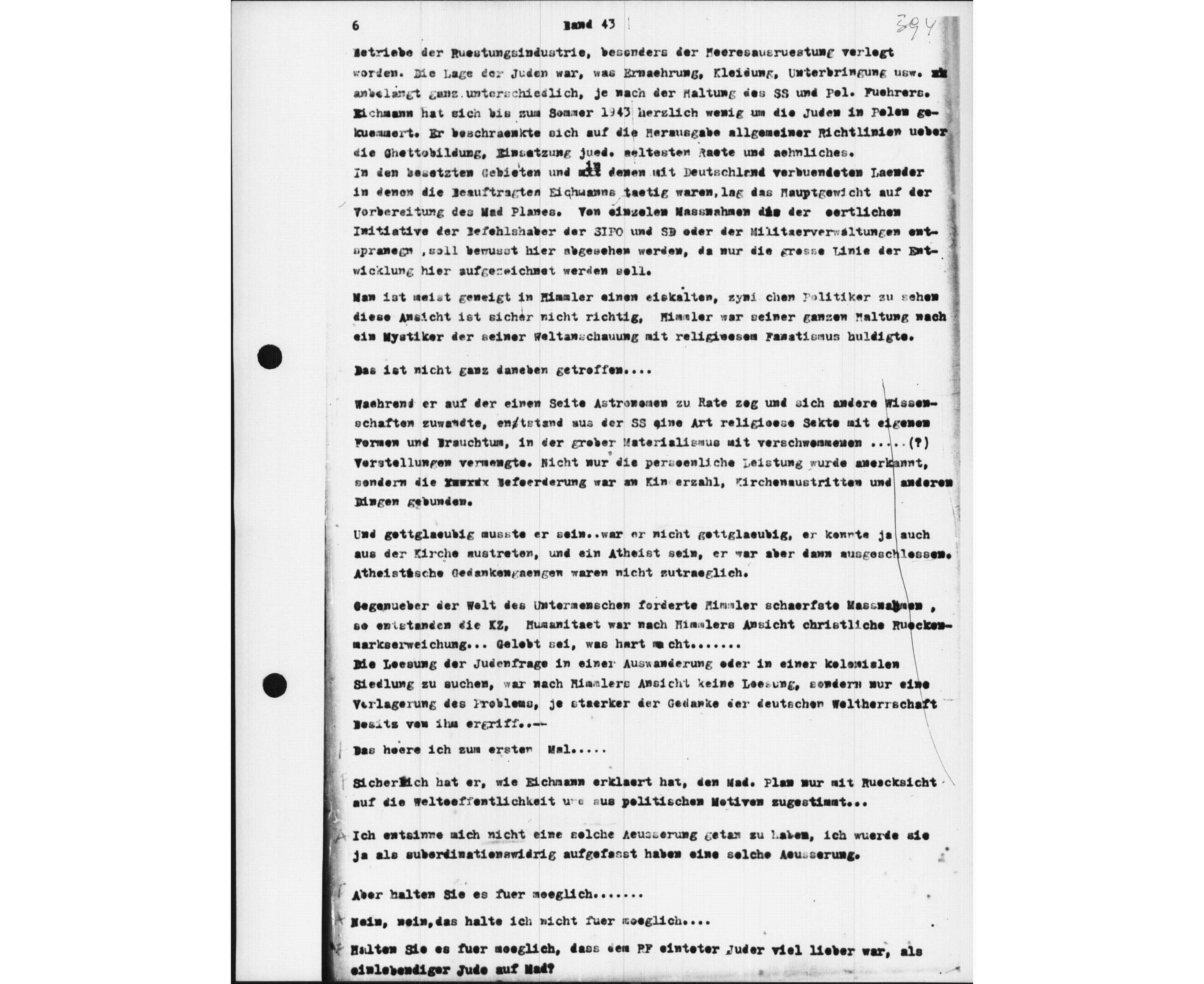
Unreviewed notes

These notes haven't been reviewed. A note can identify a speaker where the reviewed English doesn't. If they disagree, use the reviewed English.

Transcription note

Header "Band 49" centered at top; typed page number "13" upper-left; handwritten "477" (folio stamp) upper-right in ink. Two black hole-punch marks in left margin (non-text). The typewriter has several dropped/faint characters typical of a carbon copy: "d nn" for "dann" (line 2), broken glyphs in words like "Gedaechtnis," "Fuehrer," "selbstverstaendl." — transcribed as visibly rendered. "VWHA" appears throughout (typed as such, not corrected to WVHA). "siesie" and "od" retained as typed. Em-dash/hyphen run lengths approximated (---, --, ....).

Translation notes

- "VWHA" is retained verbatim as in the source; the intended office is almost certainly the SS-WVHA (SS-Wirtschafts-Verwaltungshauptamt), but the source spells it VWHA and this is preserved rather than corrected. - "Glo" is an abbreviation left incomplete in the source; expanded editorially to Glo[bocnik] as the most likely referent given the General Government context, but the source gives only "Glo". - "Gen. Gov." expanded to Gen[eral] Gov[ernment] (Generalgouvernement); the source uses the abbreviation. - "Dienststellenleiter" rendered as "office/department heads" — could be "heads of offices/agencies" or "section heads"; exact institutional rank is not fixed by the source. - "Abteilungsleiter des Amtes IV" rendered "department head of Office IV" — Abteilung vs. Amt distinction is somewhat blurred in the original phrasing. - "in Schutz nehmen" rendered literally "take into protection" (i.e., to defend/shield); kept literal per instructions. Page header: "Band 49", page number "13", with a handwritten "[HW: 477]" in the top right (preserved). The page is almost entirely a first-person monologue by Eichmann rebutting testimony/claims attributed to Wilhelm Höttel about the number of murdered Jews and Eichmann's supposed authoritative overview of that figure. No explicit speaker labels appear anywhere on the page — attribution rests on internal content. Eichmann quotes Höttel's statements (naming "Eichmann" in the third person) and rebuts them in the first person. One passage (paragraph beginning \"As justification he says that you had the best overview\") addresses the subject in the SECOND person (\"Sie\"/you), which breaks the self-referential monologue voice: it either signals a different participant addressing Eichmann or is Höttel's text being read aloud; because the page carries no label and the second-person shift is genuinely ambiguous, that turn is marked UNCERTAIN rather than assigned to Eichmann. OCR/transcription artifacts preserved verbatim: \"d nn\" (=denn), \"bisdahin\", \"selbstverstaendl.\", \"siesie\", \"od\", \"zusprechen\", \"ungefaehr\" spacing, doubled/typo punctuation, \"VWHA\". No [illegible] markers or deletions present other than the ellipses and dashes carried in the source.
Band 49, page 14

I had nothing to do with it. It was a special order. When I say that I was twice sent off on a journey as a postman, then that is, well, when it is said that the General Government is free of Jews, that is a small sum compared with the others. People were simply quick with the phrase. Free of Jews. Done, finished.

Of the occupied eastern territories I also had no idea. I could not even have completed a report, because I did not have the figures. I reckon the individual Einsatzgruppen chiefs had no figures either, because the individual group chiefs, when they were called on for such a report, probably guessed freely and put figures in. I do not reckon they counted the business. They guessed, and then always well upward with it.

Speaker not established

At the Nuremberg trial Ohlendorf did speak of over 90,000.

And I read in an opposing author that this figure seems very high to him.

The figure given by Ohlendorf, of the Jews destroyed by the Einsatzkommandos? No.

In the same book where the figure from Hoess is also given as too high, by the same author.

Questioner

Then Hoettel goes on to say that Eichmann was in such a state of mind because of the events that he had no intention at all of telling me anything untrue.

Eichmann

In that period I was not in any depressed state of mind. I had been a pessimist all those years.

Questioner

So this conversation, did it take place at all?

Eichmann

I have already said, I cannot remember that I am supposed to have been in Hoettel's flat in Hungary, and I can just as little remember that Romania's withdrawal from the war made any particular impression on me.

Questioner

One moment, when the declaration of war by Turkey, which after all lay further off, already made such an impression on you.

Eichmann

An impression. Well, I had been in Berlin and stood with Guenther in front of the world map, when I said to him, do you still not believe that we have lost the war?

Questioner

But can you remember nothing about having spoken with Hoettel

Open sheet image, German, and notes
Scan 00119 of the Sassen transcript, O.65 file 87.
This is scan 00119 of the Sassen transcript, O.65 file 87. The image is 3504 by 3008 pixels. Yad Vashem Archives, Jacob Robinson Collection O.65, file 87.

German transcription

14 Band 49 [HW: 478] Ich habe damit nichts zu tun gehabt, es war ein Sonderbefehl gewesen. Wenn ich sage, dass ich zweimal als Brieftraeger auf die Reise geschickt worden, so ist das ja.... wenn es heisst das G n Gov, ist judenfrei, so ist das ja eine kleine Summe im Vergleich mit den anderen,----man ist eben schnell bei d r Hand gewesen--j denfrei---Schluss aus. Von den besetzten Ostgebieten hatte ich auch keine Ahnung gehabt, ich haette nicht einmal einen Bericht fertig stellen koennen, weil ich die Zahlen nicht hatte. Ich schaetze die einzelen Insatzgruppenchefs, die hatten auch keine Zahlen gehabt, weil wohl die einzelen Gruppenchefs wenn sie zu solch einem Bericht aufgerufen wurden, frei ueber den Daumen peilten und Zahlen einsetzten Ich schaetze nicht, dass die die Angelegenheit gezaehlt haben. Sie haben ueber den Daumen gepeilt und dann immer recht hoch rauf damit...... Im Nuernberg.Prozess hat ja Ohlendorfueber 90 000 gesprochen.... Und ich habe von einem gegenerischen Autor gelesen, dass ihm diese Zahl sehr hoch vorkommt .... Die von Ohlendorf angegebene Zahl, die von den Einsatzkommandos vernichteten Juden?, nein In demselben Buch wo auch die Zahl von Hoess als zu hoch angegeben wird von demselben Autor --- Dann sagt Hoettel also weiter; das Eichmann durch die Ereignisse in einer solchen seelischen Verfassung war, dass er gar nicht die Absicht hatte, mir etwas unwahres zu sagen In dieser Zeit war ich in keiner dreprimierten, seelischen Verfassung--- Pessimist war ich die ganzen Jahre ueber gewesen. Also dieses Gespraech, hat das ueberhaupt statt gefunden? Ich sagte ja schon, ich kann mich nicht erinnern, dass ich in der Wohnung von Hoettel in Ungarn gewesen sein soll, ich kann mich auch genau so wenig daran erinnern, dass mich der Rum. Kriegsaustritt sonderlich beeindruckt haette Moment, wenn Sie die Kriegserkaerung der Tuerkei, die doch immerhin weiter lag, Sie schon so beeindruckt hat.... Beeindruckt........gut ich war in Berlin gewesen und stand mit Guenter vor der Weltkarte---wie ich ihm sagte ; glaubt ihr es noch immer nicht, dass wir den Krieg verloren haben? Aber koennen Sie sich an nichts erinnern,dass Sie mit Hoettel gesprochen haben

English translation

I had nothing to do with it, it had been a special order. When I say that I was twice sent on the journey as a letter-carrier, then that is indeed.... when it says the G[eneral] Gov[ernment] is free of Jews, then that is indeed a small sum compared with the others,----one was simply quick at hand about it--free of Jews---finished, done. Of the occupied eastern territories I also had had no idea, I could not even have completed a report, because I did not have the figures. I reckon the individual Einsatzgruppen chiefs, they too had no figures, because probably the individual group chiefs, when they were called upon for such a report, guessed freely off the cuff and inserted figures. I do not reckon that they counted the matter. They estimated off the cuff and then always [set it] quite high with it...... In the Nuremberg trial Ohlendorf indeed spoke of over 90,000.... And I have read from an opposing author that this figure seems very high to him.... The figure given by Ohlendorf, of the Jews destroyed by the Einsatzkommandos?, no In the same book where the figure from Hoess is also given as too high by the same author--- Then Hoettel further says; that Eichmann, through the events, was in such a mental/emotional state that he had no intention at all of telling me anything untrue In this period I was not in any depressed, mental/emotional state--- A pessimist I had been all those years through. So this conversation, did it take place at all? I already said, I cannot remember that I am supposed to have been in Hoettel's apartment in Hungary, I can just as little remember that the Rom[anian] withdrawal from the war particularly impressed me One moment, if the declaration of war by Turkey, which after all lay further away, already impressed you so much.... Impressed........well I had been in Berlin and stood with Guenter before the world map---as I said to him; do you [pl.] still not believe it, that we have lost the war? But can you remember nothing, that you spoke with Hoettel
Unreviewed notes

These notes haven't been reviewed. A note can identify a speaker where the reviewed English doesn't. If they disagree, use the reviewed English.

Transcription note

Typewritten transcript page. Page number "14" top-left, "Band 49" centered header, handwritten "478" (or possibly 478) top-right in ink. Text has degraded/faint characters in places due to uneven typewriter inking and scan quality; readings preserved as visibly typed including typos (e.g. "einzelen", "Insatzgruppenchefs", "gegenerischen", "dreprimierten", "Kriegserkaerung", "Ohlendorfueber", "G n Gov", "j denfrei", "d r Hand"). Two black hole-punch marks in left margin and one ink blot near lower-right of "Verfassung" line. No struck-through text or later insertions detected.

Translation notes

- 'als Brieftraeger auf die Reise geschickt' rendered 'sent on the journey as a letter-carrier' — 'Brieftraeger' literally = postman/letter-carrier, likely metaphorical (courier of orders/messages); kept literal. - 'G n Gov' expanded as G[eneral] Gov[ernment] (Generalgouvernement, occupied Poland); the OCR shows fragmentary 'G n Gov' so the expansion is interpretive, not certain from the glyphs. - 'eine kleine Summe im Vergleich mit den anderen' — 'Summe' (sum/total) here likely means a small number/total of Jews relative to other regions; translated literally as 'a small sum'. - 'schnell bei der Hand gewesen' idiomatically 'was quick to act / quick off the mark'; rendered literally as 'quick at hand'. - 'ueber den Daumen peilten/gepeilt' idiom = 'to make a rough guess / estimate roughly'; kept as 'guessed off the cuff' / 'estimated off the cuff'. - 'dann immer recht hoch rauf damit' is elliptical/broken; rendered '[set it] quite high with it' with the verb supplied in brackets. - 'dreprimierten' is an OCR error for 'deprimierten' (depressed); translated as 'depressed'. - 'seelischen Verfassung' = mental/emotional/spiritual state; both senses given. - 'Rum. Kriegsaustritt' expanded as Rom[anian] withdrawal from the war (Romania's exit from the Axis, Aug 1944); 'Rum.' abbreviation interpreted as Romanian. - 'glaubt ihr es noch immer nicht' uses plural 'ihr' ('you [pl.]'), marked as [pl.]. The page is header-marked "14 / Band 49 / [HW: 478]" (a stamped/handwritten page number). The German carries NO explicit speaker labels or initials anywhere on the page — attribution is by content only. The passage is a Q&A exchange centered on Höttel's (Wilhelm Höttl's) claims about a wartime conversation with Eichmann and on Ohlendorf's/Höss's Nuremberg figures. Turns where a participant refers to 'Eichmann' in the third person and quotes Höttel are attributed to Sassen (interviewer); first-person denials/narratives are attributed to Eichmann. The block of four lines discussing the Nuremberg figures (Ohlendorf 90,000, the 'opposing author', Höss too high) is left UNCERTAIN because it is impossible to tell from this page alone whether Eichmann is continuing to speak or Sassen is interjecting the citations; several of those lines read as fragmentary and could be either voice. 'Guenter' = Rolf Günther, Eichmann's deputy in IVB4. OCR artifacts preserved: 'G n Gov', 'Insatzgruppenchefs' (for Einsatzgruppenchefs), 'einzelen' (einzelnen), 'Kriegserkaerung' (Kriegserklärung), 'dreprimierten', 'Hoettel'/'Hoess'/'Hoettel' spellings, and trailing dot-ellipses left as in source. No [illegible] markers, deletions, or insertions were present in the supplied text.
Band 49, page 25

I really cannot recall it. I do not want to deny it, and I would gladly admit it if I could recall it. That I spoke with Hoettel very often is correct, and probably about the destruction of the Jews as well. What else would one have talked about.

Reconstructed some figures? That is also correct up to a point. People always confuse one thing, and whether those people, Hoettel and the rest, even said it that way at all. In all these stories about figures, when they throw a number around, three or four million, they always forget to say one thing, that this whole number, which the statistician after all fathered, is made up of a manifold addition of the separate columns. Emigration, natural decrease, departure to the camps, all of it was taken in here. But you cannot say that all these Jews were killed. I argued against that from the very beginning, because it is not true. It is just as untrue that I am supposed to have said I will leap joyfully into the grave because I have killed five million Jews. I would have looked to my own people like a megalomaniac fool.

Questioner

At what time did you have to set up a room for this statistician in your office? Was it in Berlin?

Eichmann

Yes, in Berlin, in the Kurfuerstenstrasse. This report was given at the end of the year, and at the end of 1944 I was in Budapest. On the other hand it cannot have been the end of 1943. It is possible that I am wrong and that he perhaps began at the end of 44 and the business was finished at the beginning of 45. I have read somewhere that this man testified and also named the exact date. It cannot have been 43. It must have been the end of 44 or the beginning of 45.

Questioner

To accept this man's statement about the date just like that is not really necessary at all.

Eichmann

I cannot recall it. The other way round, it cannot have been the end of 44 at all, because in the course of the year Hoettel met me in Hungary, as he says here. So it must [blotted] have been earlier, and it cannot have been in the period from March to the alleged meeting with Hoettel either, which however I would neither deny nor admit, because I can no longer recall it. If I had perhaps a second matter, as so

Open sheet image, German, and notes
Scan 00120 of the Sassen transcript, O.65 file 87.
This is scan 00120 of the Sassen transcript, O.65 file 87. The image is 3504 by 3008 pixels. Yad Vashem Archives, Jacob Robinson Collection O.65, file 87.

German transcription

25 Band 49 [HW: 479] Ich kann mich dessen in der Tat nicht entsinnen, ich will es nicht abstreiten, ich wuerde es gerne zugeben, wenn ich mich hierdrauf entsinnen koennte Dass ich mit Hoettel sehr oft gesprochen habe, dass stimmt, und wohl auch ueber die Judenvernichtungen, was wird man sonst schon gesprochen haben. Irgendwelche Zahlen rekonstruiert? Das stimmt ja auch einigermassen..... Die Leute verwechseln immer eins--ob die Leute da ueberhaupt so gesagt haben, Hoettel usw......sie vergessen immer eins zu sagen bei den ganzen Zhalenge- schichten wenn sie schon mit einer Zahl herumwerfen, 3 od 4 Mill, dass diese ganze Zahl. die ja der [DEL: illegible] Statisker geboren hat, dass diese Zahlsich ja zusammensetzt mit einer vielfachen Addierung der einzelen Sparten, --sei es Auswanderung, natuerlich Verminderung, Abfahrt in die KZ, alles wurde hier hereingenommen, man kann aber nicht sagen, dass alle diese Juden getoetet worde sind, da stimmte ich schon von allem Anfang dagegen an, weil es nizht wahr ist--- es ist genau o nicht whr, dass ich gesagt haben soll ich springe freudi in die Grube weil ich 5 Mill Juden getoetet habe--- ich [DEL: illegible] [TS INS: waere] ja bei meinen Leuten als einen groessenwahnsinnigen Barr erschienen Zu welcher Zeit haben Sie diesem Statistiker ein Zimmer einrichten muessen in Ihrer Dienst telle, war es in Berlin? Ja, in Berlin, in der Kurfuerstenstrasse-- dieser Bericht wurde zum Jahres ende gegeben und Jahresende 1944 war ich in Budapest--- Auf der anderen Seite kann es Ende 1943 nicht gewesen sein,, moeglich dass ich mich irre und er vielleicht nde 44 angefangen hat,und Anfang 45 die Sache fert geowrden ist----ich habe es ja irgendwo gelesen, dass dieser Mann ausgesagt hat und auch das genaue Datum genannt hat--43 kann es nicht gewesen sein, es muss Ende 44 Anfang 45 gewesen sein. Die Aussage dieses Mannes bzgl des Datums so ohne weiteres anzunehmen, das ist gar nicht so notwendig...... Ich kann mich nicht entsinnen-------umgekehrt kann es ja gar nicht Ende 44 gewesen sein, dann im Laufe des Jahres traf mich ja Hoettel in Ungarn wie er hier sagte....es muss also [DEL: illegible]xexex vorher gewesen sein, kann auch gar nicht in der Zeit vom Maerz bis zum angeblichen Treffen mit Hoettel gewesen sein, was ich aber weder in Abrede stellen moechte noch zugeben moechte, weil ich mich nicht mehr darauf entsinnen kann. Haette ich vielleicht noch eine zweite Sache, wie das so

English translation

Band 49 [HW: 479] I really cannot recall it, I do not want to deny it, I would gladly admit it if I could recall this. That I spoke with Hoettel very often, that is correct, and probably also about the Jewish exterminations, what else would one have spoken about. Reconstructed some figures? That is also correct to some extent..... People always confuse one thing—whether the people there even said it that way, Hoettel etc......they always forget to say one thing with all these figure-stories when they already throw a figure around, 3 or 4 mill, that this whole figure, which the [DEL: illegible] statistician gave birth to, that this figure is indeed composed of a manifold addition of the individual categories, --be it emigration, of course reduction, departure to the concentration camps, everything was taken in here, but one cannot say that all these Jews were killed, I already opposed all of that from the very beginning, because it is not true--- it is exactly [thus] not true that I am supposed to have said I leap joyfully into the pit because I have killed 5 mill Jews--- I [DEL: illegible] [TS INS: would] then have appeared to my people as a megalomaniac fool At what time did you have to set up a room for this statistician in your office, was it in Berlin? Yes, in Berlin, in the Kurfuerstenstrasse-- this report was given at year's end and year's end 1944 I was in Budapest--- On the other hand it cannot have been at the end of 1943,, possible that I am mistaken and he perhaps began [at the] end of 44, and beginning of 45 the matter was finished----I did read it somewhere, that this man testified and also named the exact date--43 it cannot have been, it must have been end of 44 beginning of 45. To accept the statement of this man regarding the date just like that, that is not so necessary at all...... I cannot recall-------conversely it cannot have been end of 44 at all, then in the course of the year Hoettel met me in Hungary as he said here....so it must [DEL: illegible]xexex have been before, also cannot have been at all in the time from March to the alleged meeting with Hoettel, which however I would neither wish to deny nor wish to admit, because I can no longer recall it. Were I to have perhaps yet a second matter, how that so
Unreviewed notes

These notes haven't been reviewed. A note can identify a speaker where the reviewed English doesn't. If they disagree, use the reviewed English.

Transcription note

Top-left typed page number reads "25" (the leading digit is faint). Center header "Band 49". Top-right "479" is a handwritten folio number in ink. Two large black ink/hole-punch blots sit in the left margin (not text-bearing). Line 15: a short overstruck word is cancelled and "waere" appears typed just above it as a replacement, rendered as [DEL: illegible] [TS INS: waere]. Line 9: a short word before "Statisker" is overstruck (typed x's) — rendered [DEL: illegible]. Line 30: a long run of overtyped x-characters cancels a phrase after "es muss also", with a residual readable "xexex" tail. Several original typos preserved verbatim (Zhalenge-, Statisker, Zahlsich, einzelen, nizht, whr, freudi, fert, geowrden, Barr, Dienst telle).

Translation notes

- 'groessenwahnsinnigen Barr' rendered as 'megalomaniac fool' — 'Barr' is almost certainly an OCR corruption of 'Narr' (fool/jester); the sense is 'megalomaniac fool/madman', but the exact noun is not certain from the corrupted German. - 'es ist genau o nicht whr' (OCR-degraded 'es ist genau so nicht wahr') rendered 'it is exactly [thus] not true'; the 'o' is read as 'so'. - 'die ja der [DEL: illegible] Statisker geboren hat' — 'geboren hat' rendered literally as 'gave birth to'; idiomatically 'produced/generated', but the literal 'gave birth to' is preserved. A word before 'Statisker' is deleted/illegible. - 'Verminderung' rendered 'reduction' — in context likely 'attrition/decrease' of population counts; kept literal. - 'nde 44' / 'nde 45' (OCR-truncated 'Ende') read as 'end of'. - 'fert geowrden' (OCR-scrambled 'fertig geworden') rendered 'was finished'. - The trailing 'xexex' after '[DEL: illegible]' is retained as an OCR/typing artifact and not translated. - 'Haette ich vielleicht noch eine zweite Sache' rendered literally 'Were I to have perhaps yet a second matter' — the sentence is cut off, so its intended sense is unresolved. This page is a continuous first-person monologue by the respondent, twice interrupted by short interrogative questions from the interviewer. The speaker recounting his relationship with Hoettel (Wilhelm Höttl, whose affidavit attributed the "5–6 million" figure to Eichmann), his objection to being credited with the "5 million Jews / leap joyfully into the pit" statement, and the placement of a statistician (Richard Korherr) in his office at Kurfürstenstraße — these are first-person recollections of RSHA/IV B4 duties and the Höttl affidavit context, unambiguously Eichmann's voice. Two second-person questions ("At what time did you have to set up a room…", framed to the respondent about his office) are the interviewer's. No explicit speaker labels or initials appear in the source; attribution rests on turn content. "Barr" (in "megalomaniac Barr") is read as "Narr" (fool); OCR "Barr" is retained in interpretation but flagged. Höttl's name is spelled "Hoettel" throughout the source. The page ends mid-sentence.
Band 49, page 16

…had happened often enough, then perhaps I could connect it with that. So it cannot have been 1944 at all, but it was at the end of the year. That I do remember again, because I had to dictate the tome over so often, and the date kept coming up on it again and again. So it must then have been the end of '43.

Questioner

When did you move out of your office on the Kurfuerstenstrasse?

Eichmann

It will have been in March 1945, when I had built all the roadblocks. That was when I got the order to burn my whole junk shop and then hand my entire junk shop over to the Stapo headquarters in Berlin. And on the very day the Stapo headquarters in Berlin was unloading a whole set of trucks of iron rations into my deep cellars, on that day I got the order to report to the Reichsfuehrer. That was the business with the prominent Jews and so on. So on that day I handed over my [blotted] office. Guenter stayed on in it, and I met him afterwards in Salzburg on the way back from Tirol.

So it cannot have been the end of '44. All the evidence speaks against it, and even though I would rather believe nobody, not even myself, I still have to say that when everything speaks against it, when Hoettel says it that way, and when you check the statistician, and when I say that it practically cannot have been 1944, then I do have to say that it can only have been a partial account, because then the whole year 1944 would drop out, along with Hungary, with a figure of say half a million given by the opposing side.

Questioner

So what else was there in 1944?

Eichmann

Well, if you want to cobble it together like that, it comes to three quarters of a million as well, and [blotted]. How much is stated here?

Questioner

4 million, and 2 million [blotted] by other means.

Eichmann

So 6 million? And that would have been at the end of '43? 4 million killed and 2 million done away with in some other manner?

Questioner

Now, Hoettel does not say that it stood in the report of the statistician, but rather that you had told him on the basis of your information and [not typed]

Eichmann

If somebody tells me that in 40 years, I will probably just giggle in a falsetto and confirm the thing, because by then I will have gone so soft in the head that I believe anything. But today I am still mentally sound enough to know very well what is possible and what is not possible, even though I cannot recall ever having spoken with Hoettel about this matter. And I say, so that no doubt or confusion arises, that it would be possible, but I do not know. In any case it is impossible that I gave Hoettel these figures, because

Open sheet image, German, and notes
Scan 00121 of the Sassen transcript, O.65 file 87.
This is scan 00121 of the Sassen transcript, O.65 file 87. The image is 3504 by 3008 pixels. Yad Vashem Archives, Jacob Robinson Collection O.65, file 87.

German transcription

16 Band 49 [HW: 480] oftmals vorgekommen ist, dann koennte ich es vielleicht damit in Zusammenhang bringen. Es kann also gar nicht 1944 gewesen sein, es war aber Ende des Jahres gewesen, dessen entsinne ich mich wieder, weil ich ja die Schwarte sooft habe wieder umdikti ren muessen und immer wieder kam das Datum drauf. Es muss also dann Ende 43 gewesen sein. [HW: ✓] Wann sind Sie aus ihrer Dienststelle aus der Kurfuerstenstrasse ausgezogen? Es wird wohl im Maerz 1945 gewesen sein, als ich die Strassensperren alle ge- baut hatte.........da hatte ich dann den Befehl bekommen, meinen ganzen Saft laden zu verbrennen und dann meinen gesamten Saftladen der Stapo Leit Berlin zu uebergeben. Und gerade an dem Tag, an dem die Stapo Leit Berlin mit ein r ganzen Anzahl von Lastwagen eiseren Verpflegung ablud in meine Tiefkeller, an dem Tag bekam ich Befehl zum RF---da war die Sache mit den prominenten Juden etc ......An dem Tag also habe ich meine [DEL: [illegible]] Diensttstelle uebergeben, drin blieb noch Guenter und den traf ich dann in Salzburg auf dem Rueckweg von Tirol Es kann also Ende 44 nicht gewesen sein, alle Indixien sprechen dagegen und wenn ich auch niemanden glauben moechte, auch mir nicht, so musss ich doch sagen, wenn alles dagegen spricht, wenn es Hoettel so sagt, und wenn man die Statisker nachsieht und wenn ich sage, dass es praktisch gar nicht gewesen sein kann 1944, dann muss ich allerdings sagen, dann kann es nur eine Teilge- schichte gewesen sein, denn dann fiel ja das ganze Jahr 1944 flach, mit Ungarn, mit einer Zahl zB von der gegnerischen Seite gesagt, 1/2 Mill.-- Was war denn noch 1944 gewesen, ? ----- Gut wenn man es so zusammenleppern will, kommt auch auf 3/4 Mill und [DEL: [illegible]] wieviel wird hier gesagt? 4 Mill und 2 Mill [DEL: [illegible]] aufsonstige Art und Weise. Also 6 Mill? und das waere dann Ende 43 gewesen?? 4 Mill Getoetet und 2 Mill so auf andere Art und Weise umgebracht? Nun Hoettel sagt nicht, dass das in dem Bericht des [DEL: [illegible]] [HW: Statiker] gestanden haette, sondern dass haetten Sie ihm auf Grund Ihrer Information und ..... Wenn man mir das in 40 Jahran erzaehlt werde ich wohl dann nur noch mit einer Fistelstimme kichern und die Sache bestaetigen, weil ich dann schon so gehirn- schwach geworden bin und dann alles glaube. Aber heute ich gei tig doch noch so zurechnungsfaehig,dass ich sehr wohl weiss, was moeglich ist und was nicht moeglich ist obgleich ich mich nicht entsinnen kann mit Hoettel je ueber diese Sache gesprochen zu haben und ich sage spgar damit doch kein Zweifel aufkommt oder Unklarheiten, es waere moeglich, aber ich weiss es nicht. Unmoeglich jedenfalls ist es dass ich Hoettel diese Zahlen genannt habe, weil

English translation

16 Volume 49 [HW: 480] has often occurred, then perhaps I could bring it into connection with that. So it cannot have been 1944 at all, but it was at the end of the year, of that I recall again, because I did after all so often have to re-dictate the tome and again and again the date came onto it. So it must then have been the end of '43. [HW: ✓] When did you move out of your office at the Kurfuerstenstrasse? It will probably have been in March 1945, when I had built all the street barriers.........then I had received the order to burn my whole junk-shop [Saftladen] and then to hand over my entire junk-shop to the Stapo Leit Berlin. And precisely on the day on which the Stapo Leit Berlin unloaded a whole quantity of iron[?] provisions into my deep cellars with a number of trucks, on that day I received an order to the RF---that was the matter with the prominent Jews etc ......So on that day I handed over my [DEL: [illegible]] office, in it there still remained Guenter and him I then met in Salzburg on the way back from Tyrol So it cannot have been the end of '44, all the indications speak against it and even if I would like to believe no one, not even myself, so I must nonetheless say, if everything speaks against it, if Hoettel says it so, and if one looks up the statistics [Statistiker] and if I say that it practically cannot have been at all in 1944, then I must indeed say, then it can only have been a partial-story, for then the whole year 1944 fell away, with Hungary, with a figure e.g. said by the opposing side, 1/2 million.-- What was there still in 1944, then? ----- Fine, if one wants to cobble it together like that, one also comes to 3/4 million and [DEL: [illegible]] how much is said here? 4 million and 2 million [DEL: [illegible]] by other kinds of means. So 6 million? and that would then have been the end of '43?? 4 million killed and 2 million done away with in another manner? Now Hoettel does not say that this had stood in the report of the [DEL: [illegible]] [HW: statistician/Statiker], but rather that you had [said/told] it to him on the basis of your information and ..... When one tells me that in 40 years I will probably then only giggle with a falsetto voice and confirm the matter, because I will then have become so brain-weak and then believe everything. But today I am mentally still so of sound mind/accountable, that I know very well what is possible and what is not possible although I cannot recall ever having spoken with Hoettel about this matter and I say even so that no doubt indeed arises or ambiguities, it would be possible, but I do not know it. Impossible in any case is it that I named these figures to Hoettel, because
Unreviewed notes

These notes haven't been reviewed. A note can identify a speaker where the reviewed English doesn't. If they disagree, use the reviewed English.

Transcription note

Typewritten interview transcript page, single column. Header: printed page number "16" upper left, centered heading "Band 49" (first digit slightly ambiguous, read as 49), and handwritten archival number "480" upper right in ink. Two large ink/punch blots in the left margin (not text-bearing). Editorial marks: - Line "also dann Ende 43 gewesen sein.": a small handwritten check/tick mark follows, rendered [HW: ✓]. - "meine [DEL: [illegible]] Diensttstelle": a short overstruck (x-cancelled) cluster precedes "Diensttstelle"; underlying text not recoverable. - "kommt auch auf 3/4 Mill und [DEL: [illegible]]": line-end overstruck x-cluster. - "2 Mill [DEL: [illegible]] aufsonstige": overstruck x-cluster (contains an embedded capital, possibly a G) — not legibly recoverable. - "Bericht des [DEL: [illegible]] [HW: Statiker] gestanden": a typewritten word is x-struck and the handwritten word "Statiker" is written above the line as its replacement; placed adjacent per replacement protocol. Preserved verbatim typewriter idiosyncrasies (not corrected): "umdikti ren", "mit ein r", "eiseren", "musss", "Indixien", "Statisker", "zusammenleppern", "aufsonstige", "Jahran", "gei tig" (for geistig), "spgar". Repeated periods after "hatte" and "etc" and the ellipses/dashes kept at approximate visible count.

Translation notes

- 'Saftladen' (literally 'juice-shop') is German slang for a disorganized/worthless outfit — rendered 'junk-shop'; it is a derisive term for his own office/operation and has no clean English equivalent. - 'eiseren Verpflegung' — 'eiseren' appears to be a misspelling of 'eiserne' (iron); 'eiserne Verpflegung' likely means 'iron rations' (emergency provisions). Rendered 'iron[?] provisions'; the intended sense may be 'iron rations'. - 'RF' expanded to 'Reichsfuehrer' (i.e. Himmler) in the basis note but left as 'RF' in the literal text, since the source abbreviates it; the referent is inferred, not written out. - 'Statistiker'/'Statiker' — the source has 'Statisker' once (typo for Statistiker = statistician) and the [HW: Statiker] insertion, where 'Statiker' would literally mean 'structural engineer'; the intended word is almost certainly 'Statistiker' (statistician). Preserved the ambiguity. - 'zurechnungsfaehig' rendered 'of sound mind / accountable' — the German is a legal-psychiatric term for criminal responsibility/mental competence; both senses are carried. - 'gehirnschwach' rendered 'brain-weak' literally (feeble-minded / mentally weak). - 'zusammenleppern' (colloquial/dialectal, likely for 'zusammenlappern/zusammenklauben') rendered 'cobble together'. - 'Teilgeschichte' rendered 'partial-story' literally; sense is 'only part of the story'. - 'Getoetet' = killed; 'auf andere Art und Weise umgebracht' = 'killed/done away with in another manner' — 'umbringen' is more explicitly 'to kill/murder' than the neutralized phrasing might suggest. This page (Volume 49, page 16, [HW: 480]) is a continuous interview passage that begins and ends mid-sentence. It is dense dialogue but the frozen transcription carries NO explicit speaker labels or initials anywhere on the page — turns are set off only by line breaks and question/answer content. Several read as interviewer prompts and use second-person address, but the page carries no label and I will not attribute an admission or a challenge to a specific man from alternation alone. The '4 million and 2 million' figures turn in particular could be spoken by either party, so leaving it UNCERTAIN avoids mis-assigning a numeric admission.\n\nThe Hoettel referent is Wilhelm Hoettel, whose affidavit put the six-million figure into circulation; the page shows Eichmann disputing that he ever gave Hoettel those numbers. This is evidentiarily sensitive, which is precisely why the ambiguous figure-turns are held at UNCERTAIN rather than forced into a clean S/E alternation.\n\nMarkers preserved: [HW: 480], [HW: ✓], [HW: Statiker], [DEL: [illegible]] deletions, the em-dash/ellipsis run-ons, the trailing 'because' (sentence continues onto the next page), and OCR typos left visible in the uncertainties list rather than silently corrected.
Band 49, page 17

…that was not yet up for debate at all, and I also did not know later how many Jews had been killed. I still do not know it today, and I did not know it then either, when I had to give my talk in the Prussian House and Mueller told me, in answer to my question whether I should name figures, that it is better to say nothing at all if you do not know everything exactly and beyond challenge.

Questioner

Can you explain to me what a desk officer and a deputy group leader in an office of the RSHA can be?

Eichmann

Office IV was run by an office chief. When he was away he had a deputy, but he had no permanent deputy. Office IV then broke down into two groups. One group was run by [unclear] and the other group stood under [unclear], who later died in Linz from an aerial mine. So those were two group leaders, but they had no authority to give the desk officer instructions on the substance of the work. Is that clear? It was only a loose grouping together. Only when the chief of Office IV was away did a matter have to be countersigned by the group leader as well, through the official channel.

Open sheet image, German, and notes
Scan 00122 of the Sassen transcript, O.65 file 87.
This is scan 00122 of the Sassen transcript, O.65 file 87. The image is 3504 by 3008 pixels. Yad Vashem Archives, Jacob Robinson Collection O.65, file 87.

German transcription

17 Band 49 [HW: 481] das noch gar nicht zur Debatte stand und ich auch spaeter nicht gewusst habe, wieviel Juden getoetet worden sind. Ich weiss es heute noch nicht und ich habe es auch damals nicht gewusst als ich meinen Vortrag im Preussen haus halten musste und mir Mueller sagte, auf meine Frage hin, ob ich Zahlen nennen soll-- er mir sagte, besser man sagt ueberhaupt nichts wenn man nicht alles exakt und stichfest weiss. Koennen Sie mir erklaren, was ein Referent und ein stellvertr. Gruppenleiter in einem Amt des RSHA sein kann? Das Amt IV leitete ein Amtschef, wenn dieser weg war, hatte er einen Vertreter er hatte aber keinen sta ndigen Vertreter, ---das Amt IV zerfiel dann in 2 Gruppen, die eine Gruppe leitete Hubenkoden (?) die andere Gruppe [DEL: im] stand unter Philrarer (?) der dann spaeter in Linz durch eine Luftmine umgekommen ist, ---das waren also zwei Gruppenleiter gewesen, die hatten aber dem Referenten keine sachlichen Weisungen zu erteilen--ist das klar? Das ist lediglich ein lockeres Zusammenfassen gewesen. Nur wenn der Amtschef IV weg war, dann musste eine Sache auf dem Dienstwege, auch vom Gruppenleiter mit abgezeichnet werden.

English translation

that this was not yet even up for debate and I also did not know later on how many Jews had been killed. I still do not know it today and I also did not know it at the time when I had to hold my lecture in the Prussia House and Mueller told me, in response to my question whether I should name figures—he told me it is better one says nothing at all if one does not know everything exactly and rock-solid. Can you explain to me what a desk officer [Referent] and a deputy group leader [stellvertr. Gruppenleiter] in an office/department [Amt] of the RSHA can be? Office IV [Amt IV] was directed by an office chief [Amtschef]; when he was away, he had a deputy, but he had no permanent deputy,---Office IV then split into 2 groups; the one group was directed by Hubenkoden (?), the other group [DEL: in the] stood under Philrarer (?), who then later perished in Linz through an aerial mine,---so those had been two group leaders, but they had no authority to issue substantive instructions to the desk officer [Referent]--is that clear? That was merely a loose grouping-together. Only when the office chief IV was away, then a matter, via official channels, had to be co-signed also by the group leader.
Unreviewed notes

These notes haven't been reviewed. A note can identify a speaker where the reviewed English doesn't. If they disagree, use the reviewed English.

Transcription note

Page number "17" typed top-left; "Band 49" centered header; handwritten "481" top-right (folio, in ink). Main text is single typewritten block. On the line beginning "2 Gruppen...", "die andere Gruppe" is followed by "im" which appears struck/overtyped before "stand" — transcribed as [DEL: im]. Two proper names typed with "(?)" already in the original typescript: "Hubenkoden (?)" and "Philrarer (?)" — these question marks are part of the typewritten text, not my uncertainty markers. Intra-word space preserved in "sta ndigen" and "Preussen haus" line break. Lower two-thirds of page blank; two punch-holes at left margin; visible scan smudging/staining in lower half but no additional text.

Translation notes

- 'stichfest' rendered as 'rock-solid' — idiomatic for 'watertight'/'incontrovertible'; the literal sense of firm/unassailable is preserved. - 'Referent' rendered as 'desk officer'; it can also be 'specialist officer'/'rapporteur'. 'Amt' rendered as 'office/department'. These are RSHA-specific administrative terms with no exact English equivalent. - 'Vortrag' rendered as 'lecture'; in this bureaucratic context it may mean a formal briefing/report/presentation rather than an academic lecture. - 'Preussenhaus' rendered literally as 'Prussia House' (the Prussian House of Lords building in Berlin, which housed the RSHA); left literal, not resolved to the institution. - 'Luftmine' rendered as 'aerial mine' (an air-dropped parachute/blast mine); the exact munition sense is preserved literally. - 'lockeres Zusammenfassen' rendered as 'loose grouping-together'; could also be 'loose consolidation/summarizing'. Page header: "17 Band 49 [HW: 481]" (Volume 49; handwritten page 481). The page opens mid-sentence, indicating continuation from the preceding page, so the first turn's speaker is not independently establishable from this page alone and is marked UNCERTAIN despite content that fits Eichmann. "Hubenkoden (?)" "Philrarer (?)" Editorial markers preserved: [DEL: im] (deletion of 'im'), the '---' dashes, and the two '(?)' uncertainty markers. No explicit speaker labels or initials appear anywhere on the page; attributions in speaker_turns rest on question/answer content only, per the attribution rules.
Band 50, page 1

That is also why he had come to me, on account of Romania's withdrawal from the [not typed], to find out about the military situation, which I got daily from the Hungarian ministry of war and from the commanders of the Waffen SS.

At the start I got the situation report hardly at all, later every so often, and after that daily. Winkelmann had a very large, roomy house on a hill at his disposal, and in one of the rooms a police captain had enormous maps lying on tables. They were the situation maps. But when you have been out of the troops that long, you do not really understand much of it. So it was from this man that I got the military situation daily. I cannot recall that I would have got the military situation anywhere else. To find out exactly about the distances in kilometres I went to my friend Zehender at his divisional command post.

Of course I only got his own picture from him, though he knew about the neighbouring divisions through discussions with his army chief, and Zehender naturally knew a good deal. But he did not show it to me on the map, he described it to me. So I had no need at all to get the military situation anywhere else, because I got it there as exactly as anywhere. But when I was together with Hoertel, I will no doubt have spoken with him about the military situation too. I would not deny that. But that I got the military situation from Hoertel, that I certainly did not.

Questioner

Now you will understand that it is very difficult on the one hand to square your relationship of trust with Hoertel against these statements of Hoertel's on the other. So this statement of Hoertel's must have a particular intention behind it. But it did not come about under pressure. Now the question is how one is to reduce this account to absurdity, in spite of that relationship of trust.

Eichmann

There I have to refer you to Dr. Langer, because he has declared himself willing to tell you various things about Hoertel. He calls him a crooked dog. Hoertel does not want to go for me at all, he is not spiteful either. I had a cordial relationship with Hoertel. But Hoertel must have had some reasons after the collapse for making himself the favourite with the Americans, because Hoertel had been in Alt-Aussee. And how could you make yourself the favourite in 1945?

You had to put yourself on the other side from the very start, so that as far as possible you kept your freedom, by working with the CIC officers. There really were specialists among them, with experience. So here specialist met specialist. Naturally the CIC had an interest in giving its superiors a report that was as sensational and as striking as possible, because that sort of thing advances the office and the post. So if Hoertel

Open sheet image, German, and notes
Scan 00123 of the Sassen transcript, O.65 file 87.
This is scan 00123 of the Sassen transcript, O.65 file 87. The image is 3504 by 3008 pixels. Yad Vashem Archives, Jacob Robinson Collection O.65, file 87.

German transcription

1 Band 50 [HW: 482] Mysterioese Gespraech mit Hoertel in Ungarn; Deswegen war er auch zu mir gekommen, wegen des Kriegsaus....... Rumaeniens um sich ueber die militaerische Lage zu informieren, die ich taeglich von dem ungarischen H. Kriegsministerium und den Befehlshabern der Waffen SS bekam. August 1944--- Die Lage habe ich mir im Anfang ueberhaupt, spaeter dann alle Daumenlang mal, weiterhin taeglich eingeholt, aber auf einem Huegel hatte der Winkelmann ein sehr grosses geraeumiges Haus zur Verfuegung und in einem von diesem Zimmer hatte ein Polizeihauptmann riesenhafte Karten auf Tischen liegen, es waren die Lagekarten, aber wenn man solange aus der Truppe heraus ist, hat man an sich wenig Ahnung davon---bei diesem Mann nun holte ich mir taeglich die milit. Lage ein, Ich kann mich nicht entsinnen, dass ich die milit. Lage anderwaertig ein- geholt haben sollte-- um mich mal ganz genau ueber eventl. Kilometerlage zu er- kundigen habe ich mich zu meinem Freund Zehender begeben auf seinen Divisions gefechtsstand. Freilich habe ich von ihm nursein Bild bekommen, allerdings wusste er ueber die angrenzenden Divisionen bescheid [TS INS: durch Besprechungen] mit seinem Armeechef, und da wusste Zehender natuerlich allerhand, aber er gab es mir nicht auf der Karte bekannt, er beschrieb es mir. Ich hatte es also gar nicht noetig mir die milit. Lage irgendwo anders zu holen, denn ich habe sie da so exakt bekommen, wie wohl nirgends anders. Wenn ich aber mit Hoertel zusammen war, werde ich auch zweifel- los mit ihm ueber die milit. Lage gesprochen haben, das moechte ich nicht verneinen, aber die milit. Lage bei Hoertel eingeholt, das habe ich ganz bestimmt nicht.-- Nun werden Sie verstehen, dass es einerseits sehr schwierig ist, Ihr Vertrauens- verhaeltnis zu Hoertel zu kombinieren mit anderseits diesen Aussagen Hoertels, es muss also diese Aussage Hoertels eine bestimmte Intension haben.....aber sie ist nicht unter Druck zustande gekommen--- Nun ist die Frage, wie soll man diese Erklaerung, trotz dieses Vertrauensverh. ad absurdum fuehren? Da muss ich Sie an Dr. Langer empfehlen, denn er hat sich ja bereit erklaert Ihnen ueber Hoertel verschiedenes zu sagen----er bezeichnet ihn als schraegen Hund. Hoertel will mir ja garnicht ans Zeug fahren, er ist ja auch nicht gehaessig, mit Hoertel hatte ich ein herzliches Verhaeltnis gehabt--aber irgendwelche Gruende muss Hoertel nach dem Zusammenbruch gehabt haben um sich bei den Amerikanern lieb Kind zu machen----denn Hoertel war ja in Alt-Aussee gewesen, wie konnte man sich aber 1945 lieb Kind machen?--- Man musste sich also von Anbeginn auf die andere Seite stellen, damit einem nach Tunlichkeit die Freiheit blieb, in dem man mit den CIC Beamte, es waren ja auch wirklich Fachleute darunter mit Erfahrung.... hier traf sich also Fachmann mit Fachmann natuerlich hatte der CIC ein Interesse daran einen moeglichst aufregenden und durchschlagenden Bericht an seine Vorgesetze zu geben, denn sowas foerdert ja seine Dienststelle, seine Dienststellung-----Wenn Hoertel also ueber ein

English translation

Band 50 [HW: 482] Mysterious conversation with Hoettl in Hungary; That is why he had also come to me, on account of the war-exit....... of Romania, in order to inform himself about the military situation, which I received daily from the Hungarian H. War Ministry and the commanders of the Waffen SS. August 1944--- At the beginning I obtained the situation at all, later then every thumb's-length once, further on daily, but on a hill Winkelmann had a very large, spacious house at his disposal, and in one of these rooms a police captain had gigantic maps lying on tables, they were the situation maps, but when one has been out of the troops for so long, one has in itself little idea of it---from this man now I obtained daily the military situation, I cannot recall that I should have obtained the military situation elsewhere-- in order to inquire once quite exactly about the possible kilometer-position I betook myself to my friend Zehender at his division command post. Admittedly I got from him only his picture, however he knew the score about the adjoining divisions [TS INS: through discussions] with his army chief, and there Zehender naturally knew all sorts of things, but he did not make it known to me on the map, he described it to me. So I had no need at all to get the military situation from anywhere else, for I got it there so exactly as probably nowhere else. But when I was together with Hoettl, I will also doubtless have spoken with him about the military situation, that I would not want to deny, but to have obtained the military situation from Hoettl, that I quite certainly did not.-- Now you will understand that on the one hand it is very difficult to combine your relationship of trust with Hoettl with on the other hand these statements of Hoettl's, this statement of Hoettl's must therefore have a certain intention.....but it did not come about under pressure--- Now the question is, how is one to lead this declaration, despite this relationship of trust, ad absurdum? There I must refer you to Dr. Langer, for he has indeed declared himself ready to tell you various things about Hoettl----he describes him as a crooked dog. Hoettl really does not want to attack me at all, he is also not spiteful, with Hoettl I had had a cordial relationship--but Hoettl must have had some reasons after the collapse to make himself a dear child with the Americans----for Hoettl had after all been in Alt-Aussee, but how could one make oneself a dear child in 1945?--- One had therefore to put oneself on the other side from the very beginning, so that as far as possible one's freedom remained, in that one with the CIC officials, there were indeed really experts among them with experience.... here therefore expert met expert, naturally the CIC had an interest in giving as exciting and striking a report as possible to its superiors, for such a thing promotes after all its office, its official position-----If Hoettl therefore over a
Unreviewed notes

These notes haven't been reviewed. A note can identify a speaker where the reviewed English doesn't. If they disagree, use the reviewed English.

Transcription note

Heavily degraded carbon typescript; the typewriter/scan systematically renders "n" as an "m"-like form (e.g. gekommen, informieren, Rumaeniens), read here per the reader-interpretation standard. Top-left "1" = page number; center "Band 50"; top-right handwritten folio reads "482" (cursive, plausibly a stamped/inked archival number). Interlinear "durch Besprechungen" appears in the same typeface above the line "...Divisionen bescheid mit seinem Armeechef" and is treated as a typewritten insertion [TS INS]; a small caret stroke sits near "Armeechef". Preserved: elliptical dot runs (Kriegsaus.......; Intension haben.....aber), multiple-hyphen dashes, run-together "nursein", "milit." abbreviation, ae/ue for umlauts. "Verhaeltnis" in the "mit Hoertel hatte ich ein herzliches Verhaeltnis" line shows the leading V only faintly (apostrophe-like mark). No struck-through cancellations present. Left margin has ink/tape blots that do not obscure text.

Translation notes

- 'Kriegsaus.......' is an incomplete word with an ellipsis of dots; rendered as 'war-exit.......' preserving the truncation — most likely 'Kriegsaustritt' (Romania's exit from the war / defection, August 1944), but the German does not complete it, so it is left incomplete. - 'ungarischen H. Kriegsministerium' — the 'H.' is an unexpanded abbreviation/initial preserved as-is; its meaning is not determinable from the page. - 'alle Daumenlang' translated literally as 'every thumb's-length' (an idiom meaning 'every so often / repeatedly'); left literal to avoid smoothing. - 'lieb Kind zu machen' / 'sich lieb Kind machen' is the idiom 'to ingratiate oneself / curry favor'; rendered literally as 'to make oneself a dear child' to preserve the source phrasing. - 'schraegen Hund' rendered literally as 'crooked dog'; the idiom denotes a shady/dishonest character. - 'nursein' appears as a run-together of 'nur sein' ('only his'); translated as 'only his picture'. - 'Intension' in the German is likely a spelling of 'Intention' (intention); translated as 'intention'. - 'H. Kriegsministerium' and 'CIC' left as source abbreviations (CIC = US Army Counter Intelligence Corps, not expanded in the German). The page is a continuous transcript with no explicit speaker labels or initials anywhere. Although the content contains strong internal markers — long first-person testimony about wartime intelligence duties in Hungary (consistent with Eichmann) alternating with second-person probing/analytical remarks addressed to that speaker (consistent with Sassen) — the attribution rules require an explicit label or content that fixes the speaker unambiguously on this page alone. Because no label is present and the turns could in principle belong to either participant (and the preceding page's context is not available), every turn is marked UNCERTAIN rather than guessed from alternation or narrative fit. The final sentence 'If Hoettl therefore over a' is cut off at the page bottom (continues on the next page); preserved as-is. One typed insertion '[TS INS: durch Besprechungen]' is preserved and translated in place. Multiple ellipses of dots ('.....', '.......', '----', '---') in the original are dash/dot markers of trailing-off or emphasis and are preserved."
Band 50, page 2

…wanted a name for himself as an entrée to the enemy intelligence service, then he also had to deliver material. So if he had wanted to come up with meagre figures he would have got nowhere, but once he could throw millions around, then people took notice, then Hoertel became the important person. And on the strength of that he could then get away with all his other ambitions. That is my explanation about Hoertel. But ask Dr. Langer about it, because he knows Hoertel from the service. He also knows certain particular matters that could throw a better light on the affair. I myself would rather avoid attacking Hoertel damagingly in any form. I do not do it, not even if he had attacked me damagingly himself. I could then only regret it, as I regret it in the case of Wi [not typed], where all the same I will never repay like with like.

Questioner

Now we come to a report by a certain Kurt Gerstein, Obersturmfuehrer. A man who on 27 September 1936 was removed from the higher German mining service for activity hostile to the state. Who was further pursued by the Gestapo in 1933 for activity against the Nazi state. Who on 2 October 1936 was expelled from the NSDAP for religious activity hostile to the state on behalf of the Confessing Church. Who on 30 [blotted] 1935 was publicly beaten up and injured for disrupting a party celebration at the municipal theatre in Hagen. Who on 14 July 1938 is arrested for the second time and is committed to the Welsheim concentration camp for activity hostile to the state. How can a man like that end up at Office VI?

Eichmann

A man like that can only end up at Office VI, because no other office could have had any use for him.

Questioner

That is right enough, but it is not quite like that, with 2 references from the Gestapo officials who handled the various matters. One of the two was Criminal Secretary Zerrer in Stuttgart, who somehow in his subconscious agreed with this man on religious grounds. So he managed to get into the SS without difficulty. On 10 March 1941 he joined the SS. He got his basic training in Hamburg Langenau, in Holland, in Oranienburg. Because of his double course of study he was soon taken into the technical medical service and assigned to the SS Leadership Main Office, Office Group D, medical services of the Waffen SS, and the hygiene department.

He soon became a lieutenant and a first lieutenant. At Christmas 1941 the court that had ordered my expulsion from the NSDAP learned of my entry into the SS at a senior level. There was a great counter-effort, but because of his successes in his work he was protected and kept on by his office. In January 1942 he became head of the health [unclear] department and at the same time was taken on in a double post for the same sector by the Reich physician of the SS and police.

Open sheet image, German, and notes
Scan 00124 of the Sassen transcript, O.65 file 87.
This is scan 00124 of the Sassen transcript, O.65 file 87. The image is 3504 by 3016 pixels. Yad Vashem Archives, Jacob Robinson Collection O.65, file 87.

German transcription

2 Band 50 [HW: 483] namhaftes Entre verfuegen wollte beim gegneri chem Nachrichtendienst, dann musste er aber auch Material liefern---wenn er also mit kuemmerlichen Zahlen aufwarten wollte, dann haette er gar nicht erreicht, num er aber mit Mill. herum schmeissen koennte----da wurde man aufmerksam, da wurde Hoertel die wichtige Person.... und ueber diese Sache konnte er dann alle seine sonstige n Ambitionen vertragen---dass ist meine Erklaerung ueber Hoertel, aber fragen Sie diesbzgl.[HW: Dr] Langer, denn er kennt Hoertel ja dienstlich. Er weiss ja auch bestimmte Spezialsachen die dann ein besseres Licht in die Angelegnheit bringen koennte -ich selber moechte mich auch davor hueten Hoertel in irgendeiner Form schaedlich an zugreifen-- ich tue es nicht, auch dann nicht wenn er mich selbst schaedlich angegriffen haette, ich konnte es dann nur bedauern, so wie ich es bei Wi es bedauere, wo ich trotzdem doch nie gleiches mit gleichem vergelten werde. Jetzt kommen wir zu einem Bericht von einem gewissen Kurt Gerstein. Ostf. Ein Mann der am 27 Sept. 1936 wegen staatsfeindlicher Betaetigung aus dem hoeheren deutschen Bergdienst entfernt wurde - der weiter 1933 von der Gestapo verfolgt wurde wegen Betaetigung gegen den Nazistaat-- der am 2. Okt 1936 Ausschluss aus der NSDAP wegen staatsfeindlicher reli ioeser Betaetigung fuer die Bekenntniskirche-- der am 30 Mai 1935 wegen Stoerung/einer Parteifeier- [HW: Jan] lichkeit im Stadttheater Hagen oeffentlich verpruegelt und verletzt wurde--- der am 14 Juli 1938 zum zweiten Mal verhaftet wird und in das KZ Welsheim wegen staatsfeindlicher Betaetigung eingeliefert wird--- wie kann so ein Mann beim Amt VI landen?????? So einer kann nur am Amt VI landen, denn kein anderes Amt haette diesen Mann ja brauchen koennen-- Das stimmt schon, aber es ist nicht ganz so, mit 2 Referenzen der Gestapo Beamten, die die verschiedenen Sachen bearbeiteten--einer der beiden war der Kriminalsekr. Zerrer in Stuttgart,der irgendwie religioes im Unterbewusstsein mit diesem Mann einverstanden gewesen waere ---so gelang es ihm unschwer in die SS einzutreten.-- Am 10 Maerz 1941, trat er in die SS ein.-- Er erhielt die Grundausbildung in Hamburg Langenau-in Holland-Oranienburg---wegen dem doppelt Studium wurde er bald in den techn. aerztlichen Dienst uebernommen und dem SS Fuehrungshauptamt Amtsgruppe D, Sanitaetswesen der Waffen SS und Abteilung Hygiene zugeteilt.--Er wurde bald Lt. und Oberlt, Weihnachten 1941 erhielt das Gericht das meinen Ausschluss aus der NSDAP verfuegt hatte, Kenntnis von meinem Eintritt in die SS an fuehrende Stelle. E sfolgte ein grosses Gegentreiben aber wegen seinen Erfogen in seiner Taetigkeit wurde er von seiner Dienststelle geschuetzt und gehalten. Im Jan. 1942 wurde er Abteilungsleiter der Abteilung Gesundheits (?) und gleichzeitig in Doppel- stellung fuer den gleichen Sektor vom Reichsarzt SS und Polizei uebernommen.

English translation

[HW: 483] ...wanted to have a considerable entrée with the enemy intelligence service, but then he also had to deliver material---if he thus wanted to come up with paltry numbers, then he would not have achieved anything, but if he could throw millions around----then one became attentive, then Hoertel became the important person.... and over this matter he could then bear all his other ambitions---that is my explanation about Hoertel, but ask [HW: Dr] Langer in this regard, since he knows Hoertel professionally. He also knows certain special matters which could then bring a better light into the affair -I myself would also like to guard against attacking Hoertel harmfully in any form-- I do not do it, not even then when he had attacked me himself harmfully, I could then only regret it, just as I regret it with Wi, where I nevertheless will still never repay like with like. Now we come to a report by a certain Kurt Gerstein. Ostf. [Obersturmführer] A man who on 27 Sept. 1936 was removed from the higher German mining service on account of activity hostile to the state - who further in 1933 was persecuted by the Gestapo on account of activity against the Nazi state-- who on 2 Oct 1936 [was subject to] exclusion from the NSDAP on account of activity hostile to the state, religious, for the Confessing Church-- who on 30 May 1935 on account of disturbance/of a party festivity [HW: Jan] in the Hagen city theater was publicly beaten up and injured--- who on 14 July 1938 is arrested for the second time and is delivered into the KZ [concentration camp] Welsheim on account of activity hostile to the state--- how can such a man land at Amt VI [Office VI]?????? Such a one can only land at Amt VI, for no other office could indeed have had a use for this man-- That is indeed correct, but it is not quite so, with 2 references from the Gestapo officials who handled the various matters--one of the two was the Criminal Secretary Zerrer in Stuttgart, who somehow religiously in the subconscious would have been in agreement with this man ---thus he succeeded without difficulty in entering the SS.-- On 10 March 1941, he entered the SS.-- He received the basic training in Hamburg Langenau-in Holland-Oranienburg---on account of the double study he was soon taken over into the technical medical service and assigned to the SS Führungshauptamt [SS Leadership Main Office] Amtsgruppe D [Office Group D], Sanitätswesen [Medical/Sanitary Affairs] of the Waffen SS and the Hygiene Department.--He soon became Lt. [Leutnant] and Oberlt [Oberleutnant], Christmas 1941 the court that had ordered my exclusion from the NSDAP received knowledge of my entry into the SS at a leading position. There followed a great counter-drive but on account of his successes in his activity he was protected and held by his office. In Jan. 1942 he became department head of the Health (?) Department and simultaneously in a double position was taken over for the same sector by the Reichsarzt SS und Polizei [Reich Physician SS and Police].
Unreviewed notes

These notes haven't been reviewed. A note can identify a speaker where the reviewed English doesn't. If they disagree, use the reviewed English.

Transcription note

Scan: Part3_10623184/00124.jpg. Header line: typed page number "2" at upper left, "Band 50" centered, "483" handwritten at upper right (folio). Two round hole-punch marks in left margin (no text lost). Text is a faint, degraded typescript (Sassen-Eichmann interview, discussion of Hoertel and the Kurt Gerstein biography). Uncertain / degraded readings: - Line 1: first word read as "namhaftes" though glyphs are faint; "Entre" is as-typed; "gegneri chem" (intra-word gap and blur; intended "gegnerischen") transcribed as visible. - Line 3: "num" as typed (intended "nun"). - Line 19: typed month reads "Mai" (could be "Mrz"); the handwritten "[HW: Jan]" sits below/between lines 19–20 as a correction to the month. No clear strikethrough over the typed month, so no [DEL] applied; the HW correction is anchored at the month. - Line 7: "[HW: Dr]" is a handwritten superscript insertion before "Langer" (title added by hand). - "reli ioeser" (line 18), "sonstige n" (line 5), "E sfolgte" (line 36), "Erfogen" (line 37), "an zugreifen" (line 10), "doppelt Studium" (line 32) transcribed with the visible typing errors/spaces preserved. - "Angelegnheit" (line 9), "Welsheim" (line 21) as typed. - Line 39: "(?)" is a typewritten parenthetical question mark in the base text, not an editorial marker. - Repeated hyphen runs (---, ----, --) and the "??????" run preserved at approximate visible count. - The Read tool could not crop/zoom (offset/limit ignored for images), so the two HW insertions were read at full-page resolution; both readings ("Dr", "Jan") are legible but small.

Translation notes

- 'namhaftes Entre' — 'Entre' is likely 'Entrée' (entrée / access / standing); rendered as 'considerable entrée' but the intended word is uncertain. - 'ueber diese Sache konnte er dann alle seine sonstigen Ambitionen vertragen' — 'vertragen' is odd here; possibly 'ertragen' (endure/bear) or an idiom meaning to reconcile/accommodate his ambitions. Rendered literally as 'bear', meaning uncertain. - 'bei Wi es bedauere' — 'Wi' appears to be an abbreviation or truncated name (a person); left as 'Wi'. - 'staatsfeindlicher reli ioeser Betaetigung' — 'reli ioeser' = 'religioeser' (religious) with an OCR gap; agreement/word order is broken in the German and preserved as broken. - 'Bergdienst' translated as 'mining service' (Berg = mountain/mining); could conceivably be another 'Berg-' compound. - 'KZ Welsheim' — likely the Welzheim concentration camp; the German spells 'Welsheim' and this is preserved. - 'Health (?) Department' — the German 'Abteilung Gesundheits (?)' carries an explicit (?) uncertainty marker for the department name; preserved. - 'zwei Referenzen' rendered 'references' — could mean references/recommendations/testimonials; kept literal. - 'Grundausbildung in Hamburg Langenau-in Holland-Oranienburg' — string of place names with dashes; relationship between them is unclear in the source and left as-is. This is page 2 of Band 50 (handwritten page number 483). The page continues a Sassen-circle discussion moving from a figure named 'Hoertel' to a report/dossier on Kurt Gerstein. The surrounding turns are left UNCERTAIN per the attribution rules: the opening Hoertel monologue is first-person opinion that could be either principal; the short 'such a one can only land at Amt VI' answer does not self-identify; and the final long paragraph contains an unresolved contradiction — it narrates Gerstein in the third person yet twice slips into first person ('my exclusion from the NSDAP', 'my entry into the SS'), material that is biographically Gerstein's, not clearly the respondent's. This may be an OCR/transcription conflation of two speakers or a dictation artifact; I did not silently resolve it and did not attribute the first-person SS-entry admission to Eichmann. Preserved as-is: broken grammar, dash runs (---, ----), the six question marks, the (?) marker, [HW: ...] insertions, and the truncated 'Wi'. Numbers, dates, ranks, and office names (Amt VI, SS Führungshauptamt, Amtsgruppe D, Reichsarzt SS und Polizei) are carried verbatim.
Band 50, page 3
Questioner

In that capacity he took over the whole technical disinfection service, including disinfection with highly poisonous gases.

So despite all the back and forth and the arrests, joining the SS was still possible?

Yes, why not. He had three people here who could build bridges for him. It would even have been possible, if he had especially good connections to the [not typed], that his past was settled with Section VI without any harm to him. That sounds like Section VI, though I ask you not to take that as a sarcastic remark, because people who worked in the intelligence field never have to ask about a man's past, only about his results. That is clear, and it is why there were so many narrow-minded people in Section IV who then blamed Section VI for everything bad. But anyone who could survey the thing even halfway, who could form a global picture of it, had to tell himself that they had to work with death and the devil. They worked with Jews too.

Questioner

It goes on to say that in this capacity as head of department and so on, on June 8, 1942 he was visited by an SS [blotted] Guenter, of the Reich Security Main Office in Berlin, Kurfuerstenstrasse, whom he had not known until then.

Eichmann

I know nothing about that, but there was no such thing as an SS Stf. That existed in the SA. So it can only have been an Ustf., Obstf. or Hstf. In 1942 it is possible that my permanent deputy was still a Hstf.

Questioner

Guenter came in civilian clothes.

Eichmann

That is possible, because we could go about as we liked.

Questioner

He gave him the order to procure 100 kilos of prussic acid at once for a secret assignment, and to drive with it by car to an unknown place known only to the driver of the vehicle. We then drove some weeks later to Prague. Professor Pfannenstiel, SS Ostf., professor of hygiene at the University of Marburg, happened to travel with us. We then drove on to Lublin, where SS Grf. Glo was waiting for us. Glo said this matter is one of the most secret things there is at present.

Anyone who talks about it [off the sheet] shot on the spot. Yesterday two blabbermouths were shot. [off the sheet] he explained to us: At this moment, August 17, 1942, we have three installations in operation, namely Belschek, on the Lublin to Bemberg railway line, D. line, maximum capacity per day 15,000 persons; Treblinka, east of Warsaw, maximum capacity 25,000 persons; Soviber, also in Poland, 20,000 persons maximum capacity. Meidaneck near Lublin is now in preparation. The first three

Open sheet image, German, and notes
Scan 00125 of the Sassen transcript, O.65 file 87.
This is scan 00125 of the Sassen transcript, O.65 file 87. The image is 3504 by 3008 pixels. Yad Vashem Archives, Jacob Robinson Collection O.65, file 87.

German transcription

3 Band 50 [HW: 484] Er uebernahm in dieser Eigenschaft den ganzen techn, Desinfektionsdienst einschliesslich der Desinfektion mit hochgiftigen Gasen ---- Also trotzdem vielen Hin und Her und Verhaftungen ist ein Eintritt in die SS moeglich? Ja, warum nicht,--- er hatte ja hier 3 Leute die ihm hier Bruecken bauen konnten--- es waere sogar moeglich gewesen, wenn er ueber besonders gute Beziehungen zum ..(?)...... verfuegt haette,dass er ohne Schaden ueber sein Vorleben vom Amt VI vereinbart worden waere. dass sieht dem Amt VI aehnlich, wobei ich das aber nicht als sarkastische Bemerkung aufzufassen bitte--- weil Leute die auf dem Nachrichtengebiet arbeiteten, nie noch dem Vorleben zu fragen haben, sondern nur nach dem Erfolg. Das ist klar, deswegen hat es auch viel engstirnige Leute im Amt IV gegeben, die nun alles Schlechte dem Amt VI nachsagten--wer aber hier so einigermassen die Sache ueberschauen konnte, sich global eine Vorstellung machen konnte----der musste sich schon sagen, sie mussten mit Tod und Teufel zusammen arbeiten, sie arbeiteten ja auch mit Juden zusammen....... Nun heisst es weiter, dass er nun in dieser Eigenschaft als Abteilungsleiter usw...erhielt er am 8. Juni 1942 den Besuch vom dem ihm bis dahin unbekannten SS Stf. Guenter von dem Reichssicherheits HA Berlin. Kurguerstenstrasse. Davon weiss ich nichts, aber einen SS Stf. gab es gar nicht, den gab es bei der SA--es kann sich also nur um einen Ustf. Obstf oder Hstf. gehandelt haben 1942 ist es moeglich dass mein staendiger Vertreter noch Hstf, war. Guenter kam in Zivil... Das ist moeglich, denn wir konnten ja gehen wie wir wollten-- E r gab den Auftrag sofort fuer einen geheimen Auftrag 100 Kilo Blausaeure zu beschaffen und mit dieser mit einem Auto zu einem unbekannten Ort zu fahren der nur dem Fahrer des Wagens bekannt sei. Wir fuhren alsdann einige Wochen nach Prag.-- Mit uns fuhr noch zufaellig der Professor Pfannenstiel, SS Ostf. Ord. fuer Hygiene an der Uni Marburg, Wir fuhren alsdann nach Lublin, [DEL: xkm] wo uns der SS Grf. Glo uns erwartete ---Glo sagte diese Angelgenheit ist eine der geheimsten Sachen die es ueberhaupt zur Zeit gibt.--wer damuaber spricht wird auf der Stelle erschossen----gestern sind 2 Schwaetzer schossen worden. Dann erklaerte er uns; Im Augenblick , 17 Aug. 1942, haben wir drei Anstalten in Betrieb, naemlich Belschek, Bahnstrecke Lublin Bemberg,- D. Linie, Hoechst- leistung pro Tag; 15 000 Personen-- Treblinka, oestlich von Warschau, Hoechts- leistung 25 000 Personen, -- Soviber, auch in Polen 20 000 Personen Hoechts- leistung.---- jetzt ist in Vorbereitung Meidaneck bei Lublin.-- Die drei erst

English translation

3 Volume 50 [HW: 484] In this capacity he took over the entire technical disinfection service including the disinfection with highly toxic gases ---- So despite much back and forth and arrests, an entry into the SS is possible? Yes, why not,--- he had after all 3 people here who could build bridges for him here--- it would even have been possible, if he had had especially good connections to the ..(?)......, that he would have been arranged/agreed by Office VI without harm regarding his past. that is typical of Office VI, whereby I ask that this not be taken as a sarcastic remark--- because people who worked in the intelligence field never have to ask about the past, but only about the success. That is clear, that is why there were also many narrow-minded people in Office IV, who now attributed everything bad to Office VI--but whoever here could survey the matter to some extent, could form a global picture of it----he had to tell himself, they had to work together with death and the devil, they after all also worked together with Jews....... Now it says further, that he now in this capacity as department head etc...received on 8 June 1942 the visit from the until then unknown to him SS Stf. Guenter from the Reich Security Main Office Berlin. Kurfuerstenstrasse. Of that I know nothing, but an SS Stf. did not exist at all, that existed in the SA--so it can only have been a matter of a Ustf. Obstf or Hstf. 1942 it is possible that my permanent deputy was still Hstf. Guenter came in civilian clothes... That is possible, for we could indeed go about as we wanted-- He gave the order to procure immediately for a secret assignment 100 kilos of prussic acid and to drive with it in a car to an unknown place which was known only to the driver of the vehicle. We then drove a few weeks later to Prague.-- With us there also drove by chance Professor Pfannenstiel, SS Ostf. Ord. for Hygiene at the University of Marburg, We then drove to Lublin, [DEL: xkm] where the SS Grf. Glo awaited us ---Glo said this matter is one of the most secret things that exist at all at the present time.--whoever speaks about it, however, will be shot on the spot----yesterday 2 blabbermouths were shot. Then he explained to us; At the moment, 17 Aug. 1942, we have three installations in operation, namely Belschek, railway line Lublin Bemberg,- D. line, maximum capacity per day; 15,000 persons-- Treblinka, east of Warsaw, maximum capacity 25,000 persons, -- Soviber, also in Poland 20,000 persons maximum capacity.---- now in preparation is Meidaneck near Lublin.-- The three first
Unreviewed notes

These notes haven't been reviewed. A note can identify a speaker where the reviewed English doesn't. If they disagree, use the reviewed English.

Transcription note

Header line: typed "3" (top left), "Band 50" (center), handwritten "484" (top right). Left margin has two hole-punch marks (binder holes), not text. Some words obscured by ink smudging/toner bleed at left edge of lines near bottom (e.g. "Dann", "in Betrieb", "wird") — read as best supported by strokes. "xkm" struck by overtype before "wo" is a cancelled typed span. Diagonal scan streaks present but do not obscure readings.

Translation notes

- 'vereinbart worden waere' rendered as 'would have been arranged/agreed' — ambiguous; could mean his SS entry would have been arranged/cleared by Office VI despite his past, but the exact sense is unclear in the broken German. - '..(?)......' is an OCR uncertainty marker in the source for an unread word (an institution/office name); left unresolved. - 'Ord. fuer Hygiene' — 'Ord.' likely abbreviates 'Ordinarius' (full/chair professor); rendered literally as 'Ord.' without expansion. - 'Grf.' rendered as 'Grf.' — likely 'Gruppenführer' (SS-Gruppenführer), left abbreviated as in source. 'Glo' is a truncated name (Globocnik), left as written. - Camp/place names are as spelled in the source and are garbled: 'Belschek' (Belzec), 'Bemberg' (Lemberg/Lviv), 'Soviber' (Sobibor), 'Meidaneck' (Majdanek). Preserved verbatim; corrections noted here only. - 'D. Linie' / 'D. line' — unclear abbreviation, possibly a rail-line designation; left literal. - 'Stf.' — the source itself argues this rank abbreviation is anomalous; kept verbatim (Stf., Ustf., Obstf., Hstf., Ostf.) without expansion. The page is a transcript in which participants read from / discuss a document (the Kurt Gerstein Report on Belzec) and the SS respondent comments on it. There are no explicit speaker labels or initials anywhere on this page. Turns alternate between (a) an interviewer reading document passages and asking questions and (b) a first-person respondent commenting. Historically, the material read here is the Gerstein Report; the death-camp capacity figures and the Globocnik quotation are Gerstein's, not the respondent's own testimony — a critical distinction for evidentiary use, since it must not be read as Eichmann narrating personal presence at Belzec. Header: '3 / Band 50 / [HW: 484]'. '[DEL: xkm]' preserved as a deletion; '[HW: 484]' preserved as handwritten marginal. OCR spelling errors in camp names and ranks preserved verbatim in english_literal.
Band 50, page 4
Questioner

named I inspected personally with the heads of these installations, together with Police Captain Wirth. The other, even more important task is the conversion of the gas chambers, which now work with diesel exhaust gases, to something better and faster. I am thinking above all of prussic acid. The day before yesterday the Fuehrer and Himmler were here, and on their instruction I had to take them there personally. I am to issue written entry passes to no one.

Then Pfannenstil asked: What did the Fuehrer say then, Glo? Faster, carry the whole operation through faster. His companion, Dr. Herbert Lindner, (Dr. Linden), then asked: Glo, do you think it right to bury all the corpses instead of burning them? After us a generation might come that does not understand the whole thing.

Glo: My gentlemen, if a generation should ever come after us that is so slack and so soft-boned that it does not understand our great task, then indeed the whole of National Socialism will have been for nothing. I am of the opposite opinion, that one should sink bronze tablets recording that we had the courage to carry out the great and so necessary work. The answer: Good, Glo, that is my view too.

Ha, ha, ha, ha.

Sometimes I think, IMA, because there is no point in kicking against it. When the dogs dish up such fairy tales, such atrocity stories, then I only say let them go ahead, it serves no purpose.

Questioner

The hair was kept in potato sacks. That is for some special purpose for the U-boat weapons.

Driven into the gas chambers with leather whips. Seven to eight hundred people into these gas chambers, on 25 square meters.

Eichmann

That is completely impossible.

Questioner

From the other side of the gas chambers, men of the work detail open the wooden doors. They were promised their freedom and a certain percentage of all the valuables found, for their dreadful service. The dead stand upright next to one another in the chambers like pillars of salt. Dentists open the mouths with hooks and look for gold. Other dentists break out the gold teeth and crowns with hammers. Among them all Capt. Wirths springs about. He is in his element.

Eichmann

That is terrific. So that is how Max and Moritz picture the Fuehrer of the Great

Open sheet image, German, and notes
Scan 00126 of the Sassen transcript, O.65 file 87.
This is scan 00126 of the Sassen transcript, O.65 file 87. The image is 3504 by 3016 pixels. Yad Vashem Archives, Jacob Robinson Collection O.65, file 87.

German transcription

4 Band 50 [HW: 485] genannten habe ich persoenlich mit den Leitern dieser Anstalten mit dem Polizeihauptmann Wirth besichtigt.-- Die andere noch weitwichtigere Aufgabe ist die Umstellung der Gaskammern die jetzt mit Dieselauspuffgasen arbeiten auf eine bessere und schnellere Sache, ich denke da vor allem an Blausaeure. Vorgestern waren der Fuehrer und Himmler hier, auf ihre Anweisung musste ich sie persoenlich dort hinbringen--- ich soll niemand schriftliche Einlass- karten ausstellen.---- Daraufhin fragte Pfannenstil; Was hat den der Fuehrer gesagt, Glo....? Schneller, die ganze Aktion schneller durchfuehren......" Sein Begleiter, der Dr. Herbert Lindner,(Dr. Linden) hat darin gefragt; Glo, halten Sie es fuer richtig die ganzen Leichen zu vergraben, anstatt sie zu verbrennen? Nach uns koennte eine Generation kommen, die das Ganze nicht versteht.??? Glo:" Meine Herrn wenn je nach uns eine Generation kommen soll die so schlapp und so knochenweich ist, die unsre grosse Aufgabe nicht versteht, dann aller- dings ist der ganze NS umsonst gewesen. Ich bin im Gegenteil der Ansicht dass man die Bronzetafeln versenken soll,an denen festgehalten worden ist, dass wir den Mut gehabt haben, das grosse und so notwendige Werk durchzufuehren." Die Antwort; Gut, Glo, das ist auch meine Ansicht....... Ha, ha, ha, ha,----- Manchmal denke ich, IMA, denn es hat doch keinen Sinn dagegen anzustinken, denn wenn die Hunde solche Maerchen auftischen, solche Greuelgeschichten, dann sage ich nur, sie sollen es ruhig machen, es hat doch keinen Zweck.--- ---- Die Haare wurden in Kartoffelsaecke [?verfaehrt?], dass ist fuer irgendwelche Spezialzwecke fuer die U-Bootwaffen........ Mit Lederpeitschen in die Gaskammern getrieben--- 700 -800 Menschen in diese Gaskammern auf 25 qtrm.---. Das ist voellig unmoeglich..... -- Von der anderen Seite der Gaskammern oeffnen Maenner vom Arbeitskommando die Holztuer--man hat ihnen die Freiheit versprochen und einen [?gewissen?] pro-mill satz von allen gefundenen Werten fuer ihren schrecklichen Dienst--- wie Salz- saeulen stehen die Toten aufrecht in den Kammern nebeneinander-- [TS INS: 2 Dz.] Zahnaerzte oeffnen mit Hacken den Mund und sehen nach Gold--andere Zahnaerzte brechen mit Haemmern die Goldzaehne und Kronen, unter allen springt der Hptm. Wirths herum, er ist in seinem Element.--- Das ist toll------- so stellt sich Max und Moritz den Fuehrer des Gross

English translation

4 Volume 50 [HW: 485] named I inspected personally with the heads of these installations, together with Police Captain Wirth.-- The other, still far more important task is the conversion of the gas chambers, which now operate with diesel exhaust gases, to something better and faster; I am thinking above all of prussic acid. The day before yesterday the Fuehrer and Himmler were here; on their instruction I had to take them there personally--- I am to issue written entry passes to no one.---- Then Pfannenstil asked; What did the Fuehrer say then, Glo....? Faster, carry the whole operation through faster......" His companion, Dr. Herbert Lindner,(Dr. Linden) asked about it; Glo, do you think it right to bury all the corpses instead of burning them? After us a generation could come that does not understand the whole thing.??? Glo:" My gentlemen, if a generation should ever come after us that is so slack and so soft-boned that it does not understand our great task, then indeed the whole of National Socialism will have been for nothing. I am, on the contrary, of the view that one should sink bronze tablets on which it is set down that we had the courage to carry out the great and so necessary work." The answer; Good, Glo, that is my view too....... Ha, ha, ha, ha,----- Sometimes I think, IMA, for there is no point in kicking against it, for when the dogs dish up such fairy tales, such atrocity stories, then I only say they should go ahead; there is no point.--- ---- The hair was [?transported?] in potato sacks; that is for some special purposes for U-boat weapons........ Driven into the gas chambers with leather whips--- 700 -800 people into these gas chambers on 25 square meters.---. That is completely impossible..... -- From the other side of the gas chambers, men of the work detail open the wooden door--they were promised their freedom and a [?certain?] per-mille rate of all the valuables found for their dreadful service--- like pillars of salt the dead stand upright beside one another in the chambers-- [TS INS: 2 Dz.] Dentists open the mouth with hooks and look for gold--other dentists break out the gold teeth and crowns with hammers; among them all Capt. Wirths springs about; he is in his element.--- That is terrific------- that is how Max and Moritz picture the Fuehrer of the Great
Unreviewed notes

These notes haven't been reviewed. A note can identify a speaker where the reviewed English doesn't. If they disagree, use the reviewed English.

Transcription note

The Opus run has no page file for this scan. This supplement was transcribed directly from the pinned scan on August 26, 2026 and independently proofread against the same scan. The opening and closing lines continue across page edges. The first letters of 'gewissen' are over-inked, so the reading remains marked uncertain. The typed form 'verfaehrt' is grammatically anomalous and remains marked uncertain. '2 Dz.' is a small typed insertion above the line. Source spelling, punctuation, spacing, line-end hyphens, and apparent typing errors are preserved.

Translation notes

- The first letters of 'gewissen' are over-inked. The German layer marks the reading uncertain, and the English carries the same uncertainty. - The typed form 'verfaehrt' is grammatically anomalous. The English marks 'transported' uncertain rather than silently repairing the source. - '2 Dz.' is a small typed insertion above the line. Its meaning is not expanded. - The opening and closing fragments continue on the neighboring scans and remain incomplete here. Translated from the scan-checked and independently proofread German supplement. The source is a participant reading from the Gerstein report; its first-person passages are not Eichmann's account of personal presence at the camps. Speaker turns remain in reader_edits.json and are applied separately by the generator.
Band 50, page 486

German Reich. So the Fuehrer is supposed to have been there too.

Questioner

Do you think it possible that Guenter was given the order to procure the prussic acid?

Eichmann

That I really do not know.

Questioner

Does that lie in the nature of the thing at all?

Eichmann

Not really, because we are not a shop for supplies of any kind. We could then also have procured stearin candles for [not typed] women. It is all the same what. Here one can only answer such a filthy business with the greatest filth.

Questioner

He then adds that the same Guenter demanded large quantities of prussic acid from him again at the beginning of 1944. He showed him a large shed in the Kurfuerstenstrasse where he intended to store the prussic acid. It was a matter of several freight cars of prussic acid, to kill many people with.

Eichmann

But then I would have had to know about that. However, at the beginning of 1944 I was not there. I was east of Berlin, setting up that alternative office for the Gestapa, and then I was in Hungary. But if there had been a few freight cars of prussic acid there

Questioner

Yes, but it was then opposed on security grounds. Guenter said himself that he did not know when the poison was to be used or in what way, but that it had to be kept permanently available.

Eichmann

That is now finally a figure that impresses me. One really has to look at that with a certain [blotted] sarcasm.

Questioner

Gerstein moreover avoided appearing in the camps too often, because it was sometimes usual to hang people in honor of the visitors, or to have them taken to executions.

Eichmann

That is an a… with ears. Guenter was such a taciturn nature, so taciturn that over the years I more than once got annoyed

Open sheet image, German, and notes
Scan 00127 of the Sassen transcript, O.65 file 87.
This is scan 00127 of the Sassen transcript, O.65 file 87. The image is 3504 by 3008 pixels. Yad Vashem Archives, Jacob Robinson Collection O.65, file 87.

German transcription

Band 50 [HW: 486] Deutschen Reiches, der Fuehrer soll also auch dort gewesen sein... Halten Sie es fuer moeglich, dass Guenter den Auftrag bekommen hat, die Blausaeure zu besorgen? Das weiss ich wirklich nicht. Liegt das irgendwie in der Art der Sache? Eigentlich nicht, denn wir sind ja nicht ein Laden fuer irgadwelche Be- darfsgueter, wir haetten ja dann auch Sterinkerzen fuer .......Weiber be- sorgen koenne, das ist ja ganz egele was.... hier kann man nur mit den greessten Schweinereien antworten auf eine solche Sauerei.-- Er fuegt dann noch hinzu, dass der selbe Guenter anfang 44 nochmals grosse Mengen Blausaeure von ihm verlangte. E r zeigte ihm in der Kurfuersten- strasse einen grossen Schuppen, wo er die Blausaeure zu lagern gedachte. Es handelte sich um mehrere Waggons Blausaeure um viele Manschen damit um zubringen.- Das haette ich aber dann wissen muessen, alerdings war ich Anfang 44 nicht dort, da war ich ostwaerts von Berlin gewesen, zur Errichtung dieser Aus- weichstelle fuer das Gestapa, und dann war ich in Ungarn, aber wenn da ein paar Waggons Blausaeure gewesen waere..... Ja, aber man hat sich dem dann widersetzt aus Sicherheitsgruenden.. Guenter sagte selbst, er wisse nicht wann das Gift gebraucht wurde und auf welche Weise, es muesse aber staendig verfuegbar gehalten werden. Weiteres Vorlesen dieses Berichtes, aber zu schnell und in den "Bart" gemurmelt.) Stichworte; Man wollte einen Grossteil des deutschen Volkes toeten--- Lesesaale, Klubraeume-----Fragen der techn. Durchfuehrung die Gunter an Gerstein richtete.--Fremdarbeiter oder Kriegsgefange[DEL: [illegible]] [HW: ne] solltn vielleicht umgebracht worden???? Aber Gerstein richtete es dann so ein dass die Blausaeure direkt nach der Ankunft in den KZ Auschwitz und Oraenien burg fuer irgendwelche Desinfektionszwecke verschanden. E r war sicher dass Guenter das Gift beschaffen wollte, um Mill von Menschen damit umzu bringen. Mengenmaessig ware es ausreichend gewesen ungefaehr fuer 16 Mill. Das ist nun endlich mal eine Zahl die mir imponiert..... d as muss man nun schon mit einem gewissen [DEL: [illegible]] Sarkasmus betrachten. Gerstein hat es im uebrigen vermieden all zu oft in den KZ zu erscheinen denn es war manchmal ueblich zu Ehren der Besucher Leute aufzuhaengen oder sie Exekutionen zuzufuehren. Das ist ein A.... mit Ohren. Guenter war eine so wortkarge Natur, so wortkarg dass ich mich in den Jahren mehr als einmal mich geaergert habe,

English translation

Band 50 [HW: 486] German Reich, the Führer is supposed to have been there too... Do you consider it possible that Günter received the order to procure the prussic acid? That I really do not know. Does that somehow lie in the nature of the matter? Actually not, for we are not a shop for whatever sort of supply goods, we could then also have procured tallow candles for ....... women, that is completely irrelevant what.... here one can only answer with the greatest filthy business [obscenities] to such a piggishness/mess.-- He then adds further that the same Günter demanded of him again large quantities of prussic acid at the beginning of '44. He showed him in the Kurfürsten- strasse a large shed where he intended to store the prussic acid. It was a matter of several wagons of prussic acid in order to kill many people with it.- But then I would have had to know that, however I was not there at the beginning of '44, at that time I had been eastward of Berlin, for the establishment of this evacuation-station [Ausweichstelle] for the Gestapa, and then I was in Hungary, but if there had been a few wagons of prussic acid there..... Yes, but one then opposed that on security grounds.. Günter himself said, he did not know when the poison was used and in what way, but it must be kept constantly available. Further reading-aloud of this report, but too fast and mumbled into the "beard".) Catchwords: One wanted to kill a large part of the German people--- reading-rooms, club-rooms-----Questions of the technical execution which Günter directed to Gerstein.--Foreign workers or prisoners of war[DEL: [illegible]] [HW: ne] were perhaps [to be] killed???? But Gerstein then arranged it so that the prussic acid disappeared directly after arrival at the concentration camp Auschwitz and Oranien- burg for some sort of disinfection purposes. He was certain that Günter wanted to procure the poison in order to kill millions of people with it. In quantity it would have been sufficient for approximately 16 million. That is now finally a figure that impresses me..... that one must now already regard with a certain [DEL: [illegible]] sarcasm. Gerstein moreover avoided appearing all too often in the concentration camps for it was sometimes customary in honor of the visitors to hang people up or to lead them to executions. That is an a.... with ears. Günter was such a taciturn nature, so taciturn that over the years I got annoyed more than once,
Unreviewed notes

These notes haven't been reviewed. A note can identify a speaker where the reviewed English doesn't. If they disagree, use the reviewed English.

Transcription note

Scan: Part3/00127. Typed transcript page, "Band 50" printed at top center; "486" in handwritten pencil top right (folio). A faint mark/smudge sits at the top left of the header (indeterminate, not transcribed). Page shows interview Q&A about Guenter/Gerstein and Blausaeure (prussic acid). Two overtyped/struck clusters treated as [DEL: [illegible]]: (1) line "Gunter an Gerstein richtete...Fremdarbeiter oder Kriegsgefange___ solltn" where letters after "Kriegsgefange" are overstruck with x's; a handwritten "ne" appears above this point and is rendered [HW: ne] adjacent to the deletion. (2) "mit einem gewissen ___ Sarkasmus" where a word is overtyped with x's. Typos/nonstandard forms preserved verbatim: "irgadwelche", "egele", "greessten", "Manschen", "alerdings", "nicht"/"ich" partly light, "solltn", "Oraenien-burg", "verschanden", "ware", "Sterinkerzen". Repeated period/hyphen runs approximated. Two ink-blot artifacts (left margin) are non-textual and not transcribed.

Translation notes

- 'Schweinereien' / 'Sauerei' — rendered 'filthy business/obscenities' and 'piggishness/mess'; both are coarse German invective and the exact register (vulgar remarks vs. disgusting deeds) is context-dependent. The elided word before 'Weiber' (....... women) is censored/omitted in the source, so the intended noun is unrecoverable. - 'in den "Bart" gemurmelt' — literally 'mumbled into the beard', idiomatic for muttering/mumbling under one's breath; kept literal. - 'Das ist ein A.... mit Ohren' — 'That is an a.... with ears' — a partially censored insult (likely 'Arsch(loch)', i.e. 'an arsehole with ears'); the omission is in the source and the target is not spelled out. - 'Ausweichstelle' — rendered 'evacuation-station'; can mean a relocation/alternate/fallback facility, exact institutional sense uncertain. - 'Stichworte' rendered 'catchwords/keywords' — signals a digest of points, not verbatim quotation, so the passage that follows is paraphrase. - '16 Mill.' expanded to '16 million' assuming Mill.=Millionen (consistent with 'Mill von Menschen' earlier); the abbreviation is as in source. - 'verschanden' read as 'verschwanden' (disappeared); OCR-corrupted, so the verb is inferred. This is a page of a 1957 Sassen interview transcript (Band 50, HW pagination 486). It has a distinctive mixed structure: some lines are direct dialogue (question/answer exchanges), but several passages are the transcriptionist/interviewer summarizing or reading aloud from a written report (the Gerstein report / an account of Kurt Günther and prussic acid). One passage is explicitly meta-textual: "(Further reading-aloud of this report, but too fast and mumbled into the beard.) Catchwords:..." — this is a stage-direction/annotation, not a spoken turn, and its "catchwords" are a paraphrased digest, not verbatim speech. Because the page interleaves narrated report-content ("Er fügt dann noch hinzu..." = "He then adds further...") with what appear to be Eichmann's reactions, turn boundaries are inferable in places but explicit labels are absent throughout. "Blausäure" = prussic acid (hydrogen cyanide), the active agent in Zyklon B. "Günter/Gunter" refers to Kurt Günther, a subordinate in Eichmann's department. "Gestapa" = Geheimes Staatspolizeiamt. "Ausweichstelle" = evacuation/alternate relocation station. OCR damage preserved: "irgadwelche"→irgendwelche, "Sterinkerzen"→Stearinkerzen, "Manschen"→Menschen, "alerdings"→allerdings, "solltn"→sollten, "verschanden"→verschwanden, "Mill"→Millionen, "Oraenienburg"→Oranienburg, "geaergert"→geärgert.
Band 50

that nothing at all could be got out of the fellow. I do not even know about the family histories, about the parents, of these two Guenters, with whom I worked from 38 to 45. I know only one single thing, that the Prague Guenter is a North American national, and that by birth. Both Guenters were marked by an exaggerated silence. Only one thing strikes me, that this Gerstein named everyone, from Guenter up to the Fuehrer, and only me he apparently forgot completely.

Questioner

But this fellow is also strongly doubted in part by the other side. Do you know whether there was an SS office at Leipzigerstrasse 31/32?

Eichmann

I cannot recall that.

Questioner

The first is a letter from Reichsmarschall G. to the Chief of the Security Police in Berlin: In completion of the task already assigned to you by the decree of January 24, 1939, of bringing the Jewish question to a solution as favorable as possible under the conditions of the time, in the form of emigration or evacuation, I hereby charge you to make all the necessary preparations, in organizational, practical and material respects, for a total solution of the Jewish question in the German sphere of influence in Europe. Insofar as the competences of other central authorities are affected, they are to be brought in. I further charge you [not typed] end indistinct.

Did you dictate the report? Your file reference is not on it.

Eichmann

No.

But I did dictate the letter. They are my words.

Questioner

But it is a letter from Goering to Heydrich?

Eichmann

And that is right. The letter was drafted by us and was only signed by Goering. It was put before him ready for signature.

Questioner

Taking part in the conference of January 20, 1942 on the final solution of the Jews, in Berlin at the Grosser Wannsee, were

Eichmann

A year before Stalingrad.

Questioner

So taking part were: Gauleiter Dr. Meier, and Reichsamtleiter Dr. Meibrandt, Reich Ministry for the Occupied Eastern Territories?

Eichmann

No, I do not know.

Questioner

State Secretary Dr. Stukkrt, Reich Ministry of the Interior.

Eichmann

Yes.

Questioner

State Secretary Neumann, Commissioner for the Four Year Plan?

Eichmann

Yes.

Open sheet image, German, and notes
Scan 00128 of the Sassen transcript, O.65 file 87.
This is scan 00128 of the Sassen transcript, O.65 file 87. The image is 3504 by 3016 pixels. Yad Vashem Archives, Jacob Robinson Collection O.65, file 87.

German transcription

Band 50 [HW: 487] dass aus dem Kerl so gar nichts heraus zu kriegen war, ich weiss noch nicht einmal ueber die Familiengeschichten, ueber die Eltern Bescheid,von diesen beiden Guenter, mit denen ich von 38 bis 45 zusammen gearbeitet habe. Ich weiss nur eine einzige Sache, dass der Prager Guenter nordamerikanischer Staatsangeh. ist, und zwar von Geburt aus. Beide Guneter zeichnete eine uebertriebene Schweigsamkeit aus.---Mir faellt nur eines auf, dass dieser Gerstein alles genannt hat, vom Guenter bis zum Fuehrer, nur mich hat er offenbar ganz vergessen.-- Aber dieser Heini wrd ja auch teilweise vom Feind sehr stark angezweifelt. Wissen Sie ob es in der Leipzigerstrasse 31/32 eine Dienststelle der SS gab? Darauf kann ich mich nicht entsinnen.- Wannseeprotokoll; Das erste ist ein Brief vom Reichsmarschall G. an den Chef der SIPO in Berlin; "In Ergaenzung der Ihnen bereits mit Erlass vom 24 Jan 39, uebertragenen Auf- gabe die Judenfrage in Form der Auswanderung oder Evakuierung einer der Zeit- frage entsprechenden moeglichst guenstigen Loesung zuzufuehren, beauftrage ich Sie hiermit alle vorliegenden Vorbereitungen in organi. sachlicher und materieller Hinsicht zu treffen fuer eine gesamt Loesung der Judenfrage den [HW: in] deutschen Einflussgebieten in Europa. Sofern jeweile Zustaendigkeiten andere Zentralsinstanzen beruehrt werden, sind diese zu beteiligen. Ich beauftrage Sie weiter...........Schluss undeutlich....... Den Bericht habe ich abdiktiert....steht nicht mein Aktenzeichen dabei Nein Den Brief habe ich aber abdiktiert, es sind meine Worte. Aber es ist ein Brief von Goering an Heydrich? Und das stimmt, der Brief ist bei uns entworfen worden und wurde nur unter= schrieben von Goering, er wurde unterschriftsfertig vorgelegt. An der Besprechung am 20 Jan. 1942 zur Endloesung der Juden in Berlin am gros sen Wannsee nahmen teil; Ein Jahr vor Stalingrad Nahmen also teil; Gauleiter Dr. Meier, und Reichsamtleiter Dr. Meibrandt, Reichsministerium fuer die besetzten Ostgebiete? Nein, weiss ich nicht Staatssekr. Dr. Stukkrt. Reichsministerium des Innern Ja Staatssekr. Neumann, Beauftragter fuer den 4 Jahresplan? Ja

English translation

Band 50 [HW: 487] that nothing at all could be got out of the fellow, I do not even know about the family histories, about the parents, of these two Günters, with whom I worked together from 38 to 45. I know only a single thing, that the Prague Günter is a North American citizen, and indeed by birth. Both Günters were marked by an exaggerated taciturnity.---Only one thing strikes me, that this Gerstein named everyone, from Günter up to the Führer, only me he has apparently entirely forgotten.-- But this Heini was also in part very strongly doubted by the enemy. Do you know whether at Leipzigerstrasse 31/32 there was an office of the SS? Of that I cannot recall.- Wannsee protocol; The first is a letter from Reichsmarschall G. to the Chief of the SIPO in Berlin; "In supplement to the task already assigned to you by decree of 24 Jan 39, to bring the Jewish question in the form of emigration or evacuation to a solution as favourable as possible corresponding to the circumstances of the time, I herewith charge you to make all necessary preparations in organizational, practical and material respect for a total solution of the Jewish question in the [HW: in] German sphere of influence in Europe. Insofar as the competences of other central authorities are thereby touched, these are to be involved. I charge you further...........End indistinct....... The report I dictated off....my file reference is not on it No But the letter I did dictate off, they are my words. But it is a letter from Goering to Heydrich? And that is correct, the letter was drafted at our office and was only signed by Goering, it was submitted ready for signature. At the meeting on 20 Jan. 1942 for the final solution of the Jews in Berlin at the great Wannsee there took part; One year before Stalingrad There took part then; Gauleiter Dr. Meier, and Reichsamtleiter Dr. Meibrandt, Reich Ministry for the Occupied Eastern Territories? No, that I do not know State Secretary Dr. Stuckart. Reich Ministry of the Interior Yes State Secretary Neumann, Commissioner for the Four-Year Plan? Yes
Unreviewed notes

These notes haven't been reviewed. A note can identify a speaker where the reviewed English doesn't. If they disagree, use the reviewed English.

Transcription note

Header "Band 50" centered top. Handwritten "487" upper right corner (folio number). Two hole-punch marks visible at left margin. Faint handwritten "in" appears interlineated above the line ending "...der Judenfrage den" — placed as [HW: in]. Line ending "unter=" shows a typewritten hyphenation/equals mark at line break. "Dr. Stukkrt" reads as typed (likely intended Stuckart). "Meier"/"Meibrandt" and "wrd" (for wird) transcribed as visibly typed.

Translation notes

- 'aus dem Kerl so gar nichts heraus zu kriegen war' — rendered 'nothing at all could be got out of the fellow'; 'Kerl' is colloquial ('fellow/guy'), tone approximate. - 'nordamerikanischer Staatsangeh.' is abbreviated in the source ('Staatsangeh.' = Staatsangehöriger); rendered 'North American citizen'. - 'Heini' — rendered as the name 'Heini' (likely a personal name/nickname); it could conceivably be a diminutive, but treated here as a proper name given context. Original 'wrd' appears to be a truncation of 'wurde'. - 'in organi. sachlicher' — 'organi.' is abbreviated/truncated in the source (evidently 'organisatorischer'); rendered 'organizational'. - 'den [HW: in] deutschen Einflussgebieten' — the printed 'den' with a handwritten '[HW: in]' insertion produces a grammatically inconsistent reading; the sense 'in the German sphere of influence' is given but the article/preposition conflict is preserved as an anomaly. - 'Reichsamtleiter Dr. Meibrandt' — name spelling as in source ('Meibrandt'); 'Meier' likewise as spelled. These are OCR/transcription forms and not corrected. - 'abdiktiert' — rendered 'dictated off'; the prefix 'ab-' here means dictated out/away (i.e. dictated the text), rendered literally. - 'Schluss undeutlich' and 'Ende indistinct' style markers ('Schluss undeutlich') are transcriber's notes indicating the end of the quotation is unclear; preserved as 'End indistinct'. - 'Stukkrt' in source corrected to the known name form 'Stuckart' only in rendering the historical figure; the source spelling 'Stukkrt' is anomalous and is a transcription form. This is a dialogue page from a 1957 Buenos Aires interview transcript, but the source carries NO explicit speaker labels, initials, or dashes marking turn boundaries. The text presents an unmarked exchange: some turns read aloud documents (the Göring→Heydrich authorization letter, the Wannsee participant list) and pose questions, while other turns give first-person answers ('I dictated', 'the letter was drafted at our office', 'I cannot recall', 'No', 'Yes'). It is historically tempting to assign the document-reading questions to Sassen and the first-person authorship admissions ('the letter was drafted at our office', 'they are my words', 'I dictated off') to Eichmann — and that assignment is plausible — but the page provides no explicit label and the content, while consistent, does not conclusively exclude the alternative, so all turns are left UNCERTAIN per rule 3. Turn boundaries themselves are inferred from line breaks and the question/answer pattern of the content, since the source supplies no explicit delimiters. I have NOT smoothed the letter's broken grammar (e.g. the 'den [HW: in]' insertion) or resolved the abbreviations. The handwritten '[HW: 487]' at top is a page number; '[HW: in]' is an inline handwritten insertion into the quoted letter.
Band 50, page 7
Questioner

State Secretary Dr. Freissler, Reich Ministry of Justice.

Yes.

Questioner

State Secretary Dr. Buehler, Office of the General Government.

Eichmann

I don't know.

Questioner

Under State Secretary Lutter, Foreign Office.

Eichmann

Yes.

Questioner

SS Unterfuehrer Klopfer, Party Chancellery.

Eichmann

I can't recall.

Questioner

Ministerial Director Kritzinger, Reich Chancellery.

Eichmann

I can't recall any more.

Questioner

SS Gruppenfuehrer Hoffmann, Race and [not typed] Main Office.

Eichmann

I can't recall.

Questioner

SS Gruppenfuehrer Mueller, Reich Security Main Office.

Eichmann

Yes. I drafted and typed out the invitation letters myself. I brought Heydrich a whole signature folder back then and he signed them all. I sat in front of his desk and just waited until he had painted his Heydrich underneath. I dictated all of these letters, these invitation letters, I know that quite exactly, they all carry the section reference IV B 4.

Questioner

SS Obersturmbannfuehrer Eichmann. Were you already an Obersturmfuehrer then?

Eichmann

Yes, I already said that I was probably an Obersturmfuehrer for five years.

Questioner

SS Oberfuehrer Dr. Schoengard, Commander of the Security Police and the SD in the General Gov [off the sheet]

Eichmann

No.

Questioner

SS Sturmbannfuehrer Dr. Langer, Commander of the Security Police and SD for the General District of Latvia, Commander of the Security Police and SD in the Reich [not typed] Ostland.

Eichmann

I don't know.

Questioner

This meeting was convened to create fundamental clarity. Responsibility for handling the final solution of the Jewish question would lie centrally with the Reichsfuehrer, without regard to geographical borders. The Chief of the Security Police then gave a short survey of the measures carried out so far in the struggle against the opponent. The most essential elements are: A) the pushing back of the Jews out of the food-supply areas of the German people, and B) the pushing back of the Jews out of the living space. In carrying out [blotted] efforts, the acceleration of the emigration of the Jews out of the

Open sheet image, German, and notes
Scan 00129 of the Sassen transcript, O.65 file 87.
This is scan 00129 of the Sassen transcript, O.65 file 87. The image is 3504 by 3008 pixels. Yad Vashem Archives, Jacob Robinson Collection O.65, file 87.

German transcription

7 Band 50 [HW: 488] Staatssekr. Dr. Freissler, Reichsjustizministerium Ja Staatssekr.Dr. Buehler, Amt des Generalgovernements Weiss ich nicht Unterstaatssekr. Lutter, Ausw. Amt. Ja SS Unterfuehrer Klopfer, Parteikanzlei Kann ich mich nicht entsinnen Ministerialdir. Kritzinger, Reichskanzlei Kann ich mich nicht mehr entsinnen SS Grpf. Hoffmann, Rassen und...... HA Kann ich mich nicht entsinnen SS Grpf. Mueller, Reichssicherheits HA Ja------- Die Einladungsschreiben habe ich selbst entworfen und abgeschrieben eine ganze Unterschriftsmappe habe damals Heydrich zugebracht und er hat sie alle unterschrieben, ich habe vor seinem Schreibtisch gesessen und habe nur gewartet bis er sein Heydrich darunter gemalt hatte.Diese Briefe habe ich alle abdiktiert, diese Einladungschreiben, das weiss ich ganz genau, alle tragen sie das Referatszeichen IV B 4 -- SS Ostbf. Eichmann, waren Sie da schon Ostf.? Ja, ich sagte es ja schon, dass ich wohl 5 Jahre Ostf. war SS Oberfuehrer Dr. Schoengard, Befehlshaber der SIPO und des SD im Generalgov Nein SS Stbf. Dr. Langer, Kommandeur der SIPO und SD fuer Generalbezirk Lettland, Befehlshaber fuer SIPO und SD im Reichs.......... Ostland Weiss ich nicht Durch Husten ist das weitere Vorlesen unverstaendlich---------zu dieser Be- sprechung wurde geladen um grundsaetzliche Klarheit zu schaffen. Die Feder- fuehrung bei der Bearbeitung fuer die Endloesung der Judenfrage laege ohne Ruecksicht auf.geograph.. Grenzen zentral beim RF. Der Chef der SIPO gab dann einen kurzen Ueberlick auf die bisher durchgefuehrten Massnahmen bei dem Kampf gegen den Gegener. Die wesentlichsten Momente bilden; A) die Zurueckdraengung der Juden aus den Ernaehrungsgebieten des deutschen Volkes und die B) die Zurueckdraengung der Juden aus dem Lebensraum. Im Vollzug der[DEL: xkinxxrigxx] Bestrebungen wurde als einzige, vorlaeufige Loesung moeglichlichkeit die Beschleunigung der Auswanderung der Juden aus dem

English translation

7 Volume 50 [HW: 488] State Secretary Dr. Freissler, Reich Ministry of Justice Yes State Secretary Dr. Buehler, Office of the General Government I don't know Under State Secretary Lutter, Foreign Office. Yes SS Unterfuehrer Klopfer, Party Chancellery I cannot recall Ministerial Director Kritzinger, Reich Chancellery I can no longer recall SS Grpf. [Gruppenfuehrer] Hoffmann, Race and...... HA [Head Office] I cannot recall SS Grpf. [Gruppenfuehrer] Mueller, Reich Security HA [Head Office] Yes------- I myself drafted and copied out the invitation letters a whole signature folder I brought to Heydrich at that time and he signed them all, I sat in front of his desk and only waited until he had painted his Heydrich under it. These letters I all dictated, these invitation letters, that I know quite exactly, all of them bear the section reference IV B 4 -- SS Ostbf. [Obersturmbannfuehrer] Eichmann, were you already an Ostf. [Obersturmfuehrer] then? Yes, I already said it, that I was probably an Ostf. for 5 years SS Oberfuehrer Dr. Schoengard, Commander of the SIPO and of the SD in the General Government No SS Stbf. [Sturmbannfuehrer] Dr. Langer, Commander of the SIPO and SD for the General District of Latvia, Commander for SIPO and SD in the Reich.......... Ostland I don't know Through coughing the further reading aloud is unintelligible---------to this meeting [people] were invited in order to create fundamental clarity. The lead responsibility in the handling for the Final Solution of the Jewish Question lay, without regard to geograph[ical].. boundaries, centrally with the RF [Reichsfuehrer]. The Chief of the SIPO then gave a short overview of the measures carried out so far in the struggle against the adversary. The most essential moments constitute; A) the pushing back of the Jews out of the food-supply areas of the German people and the B) the pushing back of the Jews out of the living space. In the execution of the[DEL: xkinxxrigxx] endeavors, as the sole, provisional solution possibility the acceleration of the emigration of the Jews out of the
Unreviewed notes

These notes haven't been reviewed. A note can identify a speaker where the reviewed English doesn't. If they disagree, use the reviewed English.

Transcription note

Typed page number "7" top left, "Band 50" centered header, handwritten "488" top right (folio). This is the Wannsee-Konferenz attendee list passage. "Generalgov" and "Reichs.......... Ostland" run to the page edge as typed. The struck-through word before "Bestrebungen" (line "Im Vollzug der...") is overtyped with x-characters and not legibly recoverable; rendered as [DEL: xkinxxrigxx] to approximate the visible x-strikeover. Repeated periods and dashes counts are approximate. Last line runs off; "der Juden aus dem" trails to page bottom edge.

Translation notes

- 'Federfuehrung' rendered as 'lead responsibility / lead in the handling'; it denotes the leading/coordinating authority over a matter, no single clean English equivalent. - 'Zurueckdraengung' rendered as 'pushing back'; could also be 'driving back' / 'repression/forcing back' of the Jews. - 'Ernaehrungsgebieten' rendered literally as 'food-supply areas'; could be 'nutritional/subsistence areas' of the German people. - 'Lebensraum' rendered literally as 'living space'; the loaded Nazi political sense is intended but left literal. - 'er hat sein Heydrich darunter gemalt' rendered literally as 'he had painted his Heydrich under it', i.e. signed his name 'Heydrich' beneath — deliberately kept literal ('painted'). - 'Moment(e)' in 'Die wesentlichsten Momente' rendered as 'moments' (factors/aspects); German 'Moment' here means salient points/factors, not points in time. - 'RF' expanded as Reichsfuehrer (Reichsfuehrer-SS) — abbreviation only in source, expansion inferred. - The DEL block 'xkinxxrigxx' is garbled/struck-through OCR and left verbatim inside the [DEL: ...] marker; the underlying deleted German word cannot be recovered. This page (Band 50, HW 488) reproduces, in Eichmann's voice, his responses as attendee names from a meeting invitation list (the Wannsee Conference attendee roster) are read out to him, followed by his recollection ('Yes' / 'I don't know' / 'I cannot recall'). The single explicit direct-address label on the page is the question naming 'SS Ostbf. All other short replies are attributed to Eichmann on the strength of their first-person recollection form and the IV B 4 / Heydrich signature-folder admission that unambiguously identifies him; there are no explicit S/E initials in the source for those. The alternation here is name-read (by an unstated reader) then answer (Eichmann), not a two-party dialogue, so the read-out attendee names themselves are NOT emitted as speaker turns — only the recollection answers are. The bottom paragraph (coughing / meeting summary about the Final Solution) is descriptive minutes-style narration being read aloud, not attributable as a turn, so it is excluded from speaker_turns. Names appear as spelled in the OCR (Freissler, Buehler, Schoengard, Langer, Kritzinger, Hoffmann, Mueller, Lutter, Klopfer) without correction to their conventional historical spellings.
Band 50, page 8
Questioner

Reich territory was taken in hand in a strengthened and systematic way. By order of the Reich Marshal, a Reich Central Office for Jewish Emigration was set up in January 1939, and the Chief of the Security Police and SD was entrusted with its direction.

Yes.

Questioner

Its task was to take all measures for the emigration of the Jews, to steer the emigration stream, to carry it out and to speed it up in the individual case. The aim of the task was to cleanse the German living space of the Jews by legal means. Everyone was clear about the disadvantages that such a demand brings with it. Despite these difficulties, from the seizure of power up to the cut-off date of 31 October 1941, around 537,000 Jews in all were brought to emigration. Of these, from the Old Reich from 31 January 1933, around 63,000. From 15 March 1938 from the Ostmark, around 147,000. From 15 March 1939 from the Protectorate of Bohemia and Moravia, around 30,000.

Eichmann

No, that isn't right, that is miswritten, 30,000 can never be.

Questioner

From the Ostmark also not more than 147,000?

From the Reich not more than 360,000.

Eichmann

From the Reich I can't tell you. From the Ostmark, that actually can't be right either. I didn't listen so exactly during the reading out, they are my words after all, so I have to tell you the figure in the protocol is in no case right. There I pricked up my ears just now. And the figure for the Ostmark, I did name you a figure of 204/205,000. The Jewish community in Vienna recorded that itself and painted it onto my dummy. And with the Old Reich, well, I don't know the figure, but on the ground of this matter I would like to reject the figure.

Questioner

Through foreign Jews, by way of donation, around 9 1/2 million dollars in all was made available up to October 1941.

Eichmann

Yes, I got these figures from the Jewish central bodies.

Questioner

Meanwhile the Reichsfuehrer has forbidden the emigration of the Jews, in view of the danger of an emigration in wartime and in view of the danger from the East. In place of emigration, and after approval by the Fuehrer, the evacuation of the Jews to the East has now come in as a further possible solution. These actions are to be addressed only as fallback possibilities, yet practical experience is being gathered here which is significant in view of the coming solution of the Jewish question. In the course of this final solution of the European Jewish question, around 11 million come into consideration. They are distributed over the individual countries as follows:

Open sheet image, German, and notes
Scan 00130 of the Sassen transcript, O.65 file 87.
This is scan 00130 of the Sassen transcript, O.65 file 87. The image is 3504 by 3024 pixels. Yad Vashem Archives, Jacob Robinson Collection O.65, file 87.

German transcription

8 Band 50 [HW: 489] Reichsgebiet verstaerkt und planmaessig in Angriff genommen. Auf Anordnung des Reichsmarsch. wurde im Jan 39 eine Reichszentral fuer jued. Auswanderung eingerichtet, mit deren Leitung der Chef,der SIPO und SD betraut wurde. Ja,--- Sie hatte die Aufgabe alle Massnahmen zur Auswanderung der Juden zu treffen. den Auswanderungsstrom zu leneken, durchzufuehren und im Einzelfall zu be- schleunigen. Aufgabeziel war, auf legalem Weg, den deutschen Lebensraum von den Juden zu saeubern.. Ueber die Nachteile die eine soolhe Forderung mit sich bringt, waren sich alle im Klaren.....(Vorlesen der einzelen) Tretz dieser Schwierigkeiten wurden von der Machtuebernahme bis zum Stich- tag, 31. Okt. 1941. insgesamt rund 537 000 Juden zur Auswanderung gebracht. Davon aus dem Altreich vom 31. Jan 33, rund 63 000 15 Maerz 38 aus Ostmark rund 147 000 15 Maerz 1939 aus Prot. B.u. M. rund30 000 Nein, das stimmt nicht, das ist verschrieben, 30 000 kann nie sein. Aus der Ostmark auch nicht mehr wie 147 000 ? Aus dem Reich nicht mehr wie 360 000 Aus dem Reich kann ich Ihnen nicht sagen-- aus der Ostmark, das kann eigent- lich auch nicht stimmen---- ich habe beim Vorlesen nicht so genau hingehoert, es sind ja meine Worte, deswegen muss ich Ihnen sagen, die Zahl im Prot. stimmt keinesfalls, da wurde ich jetzt hellhoerig, und die Zahl der Ostmark, da habe ich Ihnen doch einer Zahl genannt von 204/205 000---das hat die Kul- tusgemeinde in Wien selbst aufgezeichnet und auf meinen Tuerken hingemalt. Und mit dem Altreich, nun ja die Zahl weiss ich nicht, aber die Zahl moechte ich auf Grund dieser Sache ablehnen. Durch auslaendische Juden auf dem Schenkungswege wurde bis zum Okt. 41 insgesamt rund 91/2 Mill Dollar zur Verfuegung gestellt. Ja, diese Zahlen habe ich von den jued. Zentralinstanzen bekommen. Inzwischen hat der RF im Hinblick auf die Gefahr einer Auswanderung im Kriege und im Hinblick auf die Gefahr des Ostens die Auswanderung der Juden ver- beten.III An Stelle der Auswanderung ist nun als weitere Loesungsmoeglich lkeit nach Genehmigung vom Fuehrer die Evakuierung der Juden nach dem Osten getreten. Diese Aktionen sind aber lediglich als Ausweichsmoeglichkeiten an zusprechen, doch werden hier praktische Erfahrungen gesammelt, die im Hin- blick auf die kommende Loesung der Judenfrage bedeutend sind.Im Zuge dieser Endloesung der wuropaeischen Judenfrage kommen rund 11 Mill in Betracht. Die sich wie folgt auf die einzelen Laender verteilt;

English translation

8 Volume 50 [HW: 489] Reich territory reinforced and systematically taken in hand. By order of the Reich Marshal, in Jan[uary] 39 a Reich Central [Office] for Jewish Emigration was set up, with whose direction the Chief of the SIPO and SD was entrusted. Yes,--- It had the task of taking all measures for the emigration of the Jews, to direct the emigration stream, to carry it out and in the individual case to expedite [it]. The aim of the task was, by legal means, to cleanse the German living space of the Jews.. About the disadvantages that such a demand brings with it, everyone was clear.....(Reading out of the individual [ones]) Despite these difficulties, from the seizure of power up to the cut-off date, 31 Oct[ober] 1941, altogether around 537,000 Jews were brought to emigration. Of these, from the Old Reich from 31 Jan[uary] 33, around 63,000 15 March 38 from the Ostmark around 147,000 15 March 1939 from Prot[ectorate] B[ohemia] and M[oravia] around 30,000 No, that is not correct, that is miswritten, 30,000 can never be. From the Ostmark also not more than 147,000? From the Reich not more than 360,000 From the Reich I cannot tell you-- from the Ostmark, that actually cannot be correct either---- I did not listen so exactly during the reading out, they are indeed my words, therefore I must tell you, the figure in the Prot[ocol] is by no means correct, there I now pricked up my ears, and the figure of the Ostmark, there I did indeed name you a figure of 204/205,000---that the Kultusgemeinde [Jewish community] in Vienna itself recorded and painted onto my Turk [dummy/front]. And with the Old Reich, well yes the figure I do not know, but the figure I would like to reject on the basis of this matter. Through foreign Jews by way of donation, up to Oct[ober] 41 altogether around 9½ mill[ion] dollars was made available. Yes, these figures I received from the Jewish central authorities. Meanwhile the RF [Reichsführer], in view of the danger of an emigration in wartime and in view of the danger of the East, has forbidden the emigration of the Jews.III In place of emigration, now, after approval from the Führer, the evacuation of the Jews to the East has come as a further possibility of solution. These actions, however, are only to be addressed as fallback possibilities, yet here practical experiences are being gathered which are significant in view of the coming solution of the Jewish question. In the course of this Final Solution of the European Jewish question, around 11 mill[ion] come into consideration. Which distribute themselves as follows over the individual countries;
Unreviewed notes

These notes haven't been reviewed. A note can identify a speaker where the reviewed English doesn't. If they disagree, use the reviewed English.

Transcription note

Typewritten transcript page. Printed page number "8" top-left, centered header "Band 50", handwritten folio number "489" top-right in ink. No strike-throughs or later insertions detected; original typos (leneken, Tretz, soolhe, wuropaeischen, einzelen) preserved verbatim. "91/2" and "11 Mill" retained as typed.

Translation notes

- "auf meinen Tuerken hingemalt" — literally "painted onto my Turk." "Türke" here is a period colloquial term meaning a fake/dummy/staged front (Potemkin-style deception, from "einen Türken bauen" = to fake something). Rendered literally as "my Turk [dummy/front]"; the exact intended sense (a faked figure? a staged office/showpiece?) is uncertain from the page. - "Reichsmarsch." translated as "Reich Marshal" (Reichsmarschall, i.e. Göring); the abbreviation is expanded but the referent is inferred from historical context, not stated on the page. - "RF" translated as "Reichsführer" (i.e. Himmler); the expansion is an abbreviation resolution, not spelled out in the source. - "Prot. B.u. M." expanded to "Protectorate Bohemia and Moravia"; the abbreviation is standard but the expansion is inferred. - "204/205 000" and "91/2 Mill" — the slash forms are preserved as in the source; "91/2" is read as 9½ (nine and a half) million, but the OCR renders it as "91/2" which is ambiguous. - "hellhoerig" rendered as "pricked up my ears" (became alert/attentive); idiomatic, the literal sense is "keen of hearing." - "lediglich als Ausweichsmoeglichkeiten anzusprechen" — "anzusprechen" here in the bureaucratic sense "to be addressed/designated as"; translated as "to be addressed as," but could read "to be regarded as." This page reproduces a document being read aloud to Eichmann (the wording closely mirrors the Wannsee Conference protocol: the Reich Central Office for Jewish Emigration under the Chief of SIPO/SD, ~537,000 emigrated by 31 Oct 1941, the Old Reich/Ostmark/Protectorate breakdown, Himmler's ban on wartime emigration, evacuation East, ~11 million for the Final Solution). Interleaved with that read text are Eichmann's real-time reactions and corrections. I have therefore modeled the page as alternating between read-out document blocks (OTHER = the reader) and interview interjections. The OCR does not carry explicit speaker labels or initials on any line, so all attributions rest on content: first-person \"my words / I received / I named you a figure\" lines are Eichmann; the read protocol statistics are the reader; the one bare question testing the figure is plausibly the interviewer (S). The identity of the reader (whether Sassen himself is reading, or a third party) cannot be determined from this page, so the read blocks are marked OTHER rather than S. One bare figure line (\"From the Reich not more than 360,000\") is left UNCERTAIN because the page cannot disambiguate whether it is read text or a spoken query. The source contains an unresolved internal contradiction Eichmann himself flags: the Protectorate figure \"30,000\" he calls miswritten, and he disputes the protocol's Ostmark/Old Reich numbers against his own recalled \"204/205,000\" — this contradiction is preserved, not resolved. Broken forms preserved: \"leneken\" (for lenken), \"soolhe\" (for solche), \"Tretz\" (for Trotz), \"wuropaeischen\" (for europäischen), \"Loesungsmoeglichlkeit\" line-break artifact, \"einzelen\" (for einzelnen), \"verbeten.III\" with the stray \"III\" retained. The em-dash/ellipsis density and mid-sentence trailing at the page end (\"...over the individual countries;\") are preserved."}
Band 50, page 9
Questioner

Still 11 million, excluding those who emigrated. Old Reich, 131,800. Ostmark, 43,700. That is, in the whole Ostmark there were only 190,000 Jews present?

Eastern territories, 24,000. General Government, 2 million 284,000.

[blotted] What does Eastern territories mean?

Bialystok, 400,000.

Bialystok I would have named separately, impossible, I can't name any city.

Questioner

Protectorate of Bohemia and Moravia, 74,200. Estonia, free of Jews. Latvia, 3,500. Lithuania, 34,000. Belgium, 43,000. Denmark, 5,600. France, occupied area 165,000, unoccupied area 700,000. Greece, 69,600. Netherlands, 160,800. Norway, 1,300. B) The countries that do not stand under German influence. Bulgaria, 48,000. England, 330,000. Finland, 2,300. Ireland, 4,000. Italy, 58,000. Albania, 200. Croatia, 40,000. Portugal, 3,000. Romania including Bessarabia, 342,000. Sweden, 8,000. Switzerland, 1800 [off the sheet] Serbia.

Eichmann

No, no, no, this compilation has been swindled in.

Questioner

Slovakia, 88,000. Spain, 6,000. Turkey [not typed] 57,500. Hungary, 752,800. Soviet Union, 5 million. Ukraine, 2,994,684. White Russia excluding Bialystok, 446,484. Together over 11 million.

Now the intention is quite clear. If so many were there and there are now only so many there, then the others have been killed.

Eichmann

That has been swindled in, as truly as I stand here.

Questioner

In the Jewish figures given for the various foreign countries, however, only Jews by religion are involved, since the definitions of a Jew by racial principles are in part still lacking. The handling of the problem in the individual countries will meet with certain difficulties, in view of the general attitude and outlook, especially in Hungary and Romania. So in Romania even today the Jew can, for money, obtain documents that officially certify a foreign citizenship for him.

Eichmann

Heydrich told all of this in his fundamental matter? Then he would have been an old washerwoman and I would have been an a.. hole. The [blotted] Heydrich would have chased me to the devil, thrown me out, if I had dared to lay such a lecture before him, where he had asked the high leading personalities here to a fundamental discussion.

Questioner

So this paragraph has been smuggled in?

Eichmann

Yes, but of course.

Open sheet image, German, and notes
Scan 00131 of the Sassen transcript, O.65 file 87.
This is scan 00131 of the Sassen transcript, O.65 file 87. The image is 3504 by 3008 pixels. Yad Vashem Archives, Jacob Robinson Collection O.65, file 87.

German transcription

9 Band 50 [HW: 490] Noch 11 Mill ausschliessl. der Ausgewanderten; Altreich; 131 800 -- Ostmark;43 700 --d.h. also in der ganzen Ostmark waren nur anwesend 190 000 Juden? Ostgebiete 24 000 -- Generalgovern.2 Mill, 284 000 [DEL: Mxixdx] Was heisst Ostgebiete? Bialistek 400 000---- Bialistok haette ich extra genannt, unmoeglich, ich kann keine Stadt nennen. Prot. B.u. M. 74 200----- Esthland judenfrei----- Lettland 3 500 --- Litauen 34 000 -- Belgien 43 000 -- Daenemark 5 600 --- Frankreich, besetztes Gebiet 165 000 --unbesetztes Gebiet 700 000----Griechenland 69 600------ Niederlande 160 800----Norwegen 1 300------ B) (die Laender die nicht unter deutschen Einfluss stehen; ) Bulgarien 48000----England 330 000 ------- Finnland 2 300 - Irland 4 000---- Italien 58 000 -- Albanien 200 -- Kroatien 40 000 ----Portugal 3 000 -- Rumaenien einschliessl. Bessarabien 342 000 ----Schweden 8 000 - Schweiz 18000 Serbien Nein, nein, nein, diese Aufstellung ist hineingeschwindelt worden. Slowakei 88 000 -- Spanien 6000 -- Tuerkei........ 57 500Ø ------Ungarn 752800----Sowjet Union 5 Mill------Ukraine 2 994 684----Weissrussland aus- schliesslich Bialistok 446 484--------- zusammen ueber 11 Mill. ----- Nun die Absicht ist ganz klar, wenn soviel da waren und es sind jetzt nur noch soviel da, dann sind die anderen getoetet worden. Das ist hineingeschwindelt worden, so wahr wie ich hier stehe.... Bei den angegebenen Judenzahlen der verschied. auslaendischen Zahlen handelt es sich jedoch nur um Glaubensjuden, da die Begriffsbestimmungen der Juden nach rassischen Grundsaetzen teilweise ja doch noch fehlen. Die Behandlung des Problems in den einzelen Laendern wird im Hinblick auf die allgemeine Haltung und Auffassung auf gewisse Schwierigkeiten stossen besonders in Ungarn und Rumaenien, so kann sich heute noch in Rum der Jude gegen Geld entsprechende Dokumente die ihm eine fremde Staatsanggh. amtlich bescheinigen Das alles hat Heydrich in seiner grundsaetzlichen Sache erzaehlt ---dann waere er ein Waschweib gewesen und ich waere ein A..loch gewesen, mich haette der [DEL: Rxxx] der Heyrdich zum Teufel gejagt, mich rausgeschmissen, wenn ich es gewagt haette ihm einen solchen Vortrag vorzulegen, wo er hier die hohen leitenden Persoenlichkeiten zu einer grundsaetzlichen Besprechung gebeten hatte Also dieser Absatz ist reingeschmuggelt? Ja, aber selbstverstaendlich..

English translation

9 Volume 50 [HW: 490] Still 11 mill. excluding those who emigrated; Altreich [Old Reich]; 131,800 -- Ostmark [Austria]; 43,700 -- i.e. so in the whole Ostmark there were only present 190,000 Jews? Eastern territories 24,000 -- Generalgovern[ment] 2 mill., 284,000 [DEL: Mxixdx] What does Eastern territories mean? Bialystok 400,000---- Bialystok I would have named separately, impossible, I cannot name any city. Prot[ectorate] B[ohemia] a[nd] M[oravia] 74,200----- Estonia free of Jews----- Latvia 3,500 --- Lithuania 34,000 -- Belgium 43,000 -- Denmark 5,600 --- France, occupied territory 165,000 -- unoccupied territory 700,000----Greece 69,600------ Netherlands 160,800----Norway 1,300------ B) (the countries that are not under German influence;) Bulgaria 48,000----England 330,000 ------- Finland 2,300 - Ireland 4,000---- Italy 58,000 -- Albania 200 -- Croatia 40,000 ----Portugal 3,000 -- Romania including Bessarabia 342,000 ----Sweden 8,000 - Switzerland 18,000 Serbia No, no, no, this compilation has been fraudulently inserted [lit.: "swindled into it"]. Slovakia 88,000 -- Spain 6,000 -- Turkey........ 57,500Ø ------Hungary 752,800----Soviet Union 5 mill------Ukraine 2,994,684----White Russia [Belarus] ex- cluding Bialystok 446,484--------- together over 11 mill. ----- Now the intention is quite clear, if so many were there and there are now only so many there, then the others have been killed. That has been fraudulently inserted, as truly as I stand here.... With the given Jewish figures of the various foreign figures, it however concerns only Jews by faith, since the definitions of the Jews according to racial principles are indeed in part still lacking. The treatment of the problem in the individual countries will, in view of the general attitude and conception, meet with certain difficulties especially in Hungary and Romania, thus today in Rom[ania] the Jew can still, against money, obtain corresponding documents that officially certify to him a foreign citizenship [Staatsangeh(örigkeit)] All this Heydrich told in his fundamental matter --- then he would have been an old wash-woman [gossip] and I would have been an a..hole, the [DEL: Rxxx] the Heydrich would have chased me to the devil, thrown me out, if I had dared to submit such a lecture to him, where he here had invited the high leading personalities to a fundamental discussion So this paragraph has been smuggled in? Yes, but of course..
Unreviewed notes

These notes haven't been reviewed. A note can identify a speaker where the reviewed English doesn't. If they disagree, use the reviewed English.

Transcription note

Page number "9" typed top-left; "Band 50" typed/stamped center top; "490" in handwriting top-right. Two-hole punch on left margin. Text is a country-by-country Jewish population list (Wannsee-style) followed by dialogue. Several typed strikeovers: line 5 begins with a cancelled overstruck word before "Was heisst Ostgebiete?" (read as garbled "Mxixdx"); a short cancelled overstruck word before "der Heyrdich" (read as "Rxxx"). "Heyrdich"/"Heydrich" spelled inconsistently as in original. "500Ø" retains a slashed/zero digit as typed. A faint handwritten check/tick mark appears in the right margin near the "Bei den angegebenen Judenzahlen" line. Some right-edge text runs to page margin ("besetztes", "Schweiz 18000") and is transcribed as visible.

Translation notes

- 'hineingeschwindelt' / 'reingeschmuggelt' / 'reingeschmuggelt': rendered as 'fraudulently inserted' / 'smuggled in'. The literal sense is 'swindled into it' / 'smuggled in' — accusing the compiler of having falsified the document by inserting material. Translation choice, not OCR uncertainty. - 'Waschweib' rendered 'old wash-woman' — idiomatically a gossip / someone who prattles indiscreetly; the derogatory idiomatic force is approximate. - 'A..loch' is a self-censored obscenity in the source ('Arschloch' = 'a..hole'); the elision is preserved as in the German. - 'in seiner grundsaetzlichen Sache' rendered literally 'in his fundamental matter'; the exact intended sense (a matter of principle / at his fundamental briefing) is uncertain in context. - 'fremde Staatsanggh.' expanded as 'Staatsangeh(örigkeit)' = 'foreign citizenship/nationality'; the source abbreviates and this expansion is inferred. - 'Rum' expanded to 'Rom[ania]' (Rumänien) from context; the abbreviation is as in source. This page (Band 50, HW 490) is a transcript in which one participant reads out a statistical table of Jewish population figures by country/region (the structure of the Wannsee-Protocol-style enumeration: Altreich, Ostmark, Ostgebiete, Generalgouvernement, Protectorate, and the list of countries under and not under German influence, totalling over 11 million), interrupted by another participant who repeatedly and emphatically denies the document's authenticity, claiming figures/paragraphs were 'swindled'/'smuggled' in. No explicit speaker labels or initials appear anywhere on the page; all attributions are inferential and are flagged as such in each basis. The interviewer (S) is assigned the reading-of-the-document and the probing/clarifying/summarizing questions; the respondent (E) is assigned the first-person denials and the personal recollection of Heydrich and RSHA-level meetings. Because there is no explicit label, several assignments could reasonably be UNCERTAIN; the two clearest are the Heydrich recollection (first-person account of the speaker's own official standing, consistent with Eichmann) and the reading + questions. Preserved as-is: OCR uncertainty markers [DEL: Mxixdx], [DEL: Rxxx], [HW: 490]; the self-censored 'A..loch'; the abbreviations (Prot. B.u.M., Staatsanggh., Rum); the 'Ø' / struck-through digit marker after 57,500; the broken/incomplete sentence 'so kann sich heute noch in Rum der Jude gegen Geld ... die ihm eine fremde Staatsanggh. amtlich bescheinigen' (verb 'verschaffen'/'besorgen' omitted in the German — not supplied). 'Serbien' stands alone with no figure — preserved. The dashes and their counts are approximated from the source. Note the historical content: the respondent's insistence that the statistics were falsified is a denial of the documentary basis for the death toll — recorded verbatim without resolution, per instructions."
Band 50, page 10
Questioner

The influence of the Jews in all areas in the Soviet Union is well known. About 5 million live in the European area, barely half a million Jews in the Asiatic area. The occupational breakdown of the Jews resident in the Soviet Union was roughly as follows. In agriculture 9.1 percent, workers 14 percent, in trade 20 percent, in state employment 23 percent, private professions and theater 32 percent.

That doesn't seem familiar to me.

Questioner

Under appropriate direction the Jews are to be brought to labor deployment in the East in a suitable manner in the course of the final solution.

Eichmann

That could be right.

Questioner

In large columns, separated by sex, the Jews fit for work were brought to road building, whereby without doubt a large part will fall away through diminution. The eventual final remainder will have to be treated accordingly, since these are without doubt the most resistant part, because they represent a natural selection and are to be regarded as the germ cell of a new Jewish reconstruction. See the experience of history.

Eichmann

Possible, yes.

Questioner

In the course of the practical final solution, Europe will be combed through from West to East. The Reich territory, including the Protectorate of Bohemia and Moravia, will be dealt with first, if only for reasons of the housing question and other social and political necessities. The evacuated Jews were brought step by step into the transit ghettos, to be transported on from there to the East. An important precondition for carrying out the evacuation at all is the exact fixing of the circle of persons who come into consideration.

It is intended not to evacuate those of 65 years of age, but rather to transfer them to an old-age ghetto, and Theresienstadt is provided for this. Besides these age groups, of whom on 31 October 4 [off the sheet] around 280,000 Jews [blotted] were in the Old Reich and the Ostmark, around 30 percent are over 65 years old. Further, war-disabled and Jews with war decorations find admission in these old-age ghettos. With these [blotted] solutions the many interventions will cease at one stroke.

Eichmann

Yes, those are my words.

Questioner

In Slovakia and in Croatia the matter is not all too difficult, since the most essential core questions have already been brought to a solution there. In Romania a Jewish adviser has also been installed in the meantime. To settle the question in Hungary it is necessary within a short time to have an adviser

Open sheet image, German, and notes
Scan 00132 of the Sassen transcript, O.65 file 87.
This is scan 00132 of the Sassen transcript, O.65 file 87. The image is 3504 by 3016 pixels. Yad Vashem Archives, Jacob Robinson Collection O.65, file 87.

German transcription

Der Einfluss der Juden auf allen Gebieten in der Sowjet Union ist be- kannt, im europaeischen Gebiet leben etwa 5 Mill, im asiatischen Raum [TS INS: europ] knapp eine halbe Mill Juden. Die berufsstaendige Aufgliederung der in [TS INS: Gebieten] der Sowjet Union ansaessigen Juden war etwa folgende; In der Landwirtschaft 9,1%--Arbeiter 14% --im Handel 20% - im Staatarbeit Angestellte 23%--private Berufe, Theater....... 32% Das kommt mir nicht bekannt vor Unter entsprechender Leitung sollen im Zuge der Endloesung die Juden in ge- eigneter Weise im Osten zum Arbeitseinsatz kommen. Das koennte stimmen In grossen Kolonnen, unter Trennung der Geschlechter, wurden die arbeits- faehigen Juden Strassenbauten zugefuehrt, wobei zweifellos ein Grossteil durch Verminderung ausfallen wird. Der allfaellige endgueltige Restbe- stand wird, da es sich bei diesen zweifellos um den widerstandfaehigsten Teil handelt, entsprechend behandelt werden muessen, weil diese eine natuer- Auslese darstellen und als Keimzelle eines neuen jued. Aufbaus anzusprechen ist. (Siehe die Erfahrung der Geschichte) Moeglich, ja.. Im Zuge der praktischen Endloesung wird Europa vom Westen nach Osten durch- gekaemmt, das Reichsgebiet, einschliessl. Prot. B.u.M. wird allein schon aus Gruenden der Wohnungsfragen und sonstigen sozialen poli. Notwendig keiten von vorneherein weggenommen werden. Die evakuierten Juden wurden [TS INS: Durchgangs-] Zug um Zug in die Ghettos verbracht um von dort aus weiter nach dem Osten transportiert zu werden.--Wichtige Vorau setzungen fuer die Durchfuehrung des Evakuierung ueberhaupt ist die genaue Festlegung der in Betracht kommenden Personenkreis.. Es wird beabsichtigt die im Alter von65 Jahren nicht zu evakuieren, sondern die einem Altersghetto, vorgesehen ist There- sienstadt zu ueberstellen. Neben diesen Alterskaassen, von denen am 31 Okt 4 sich im Altreich und in der Ostmark befindlichen [DEL: [illegible]] etwa 280 000 Juden sind etwa 30% ueber 65 Jahre alt.-weiterhin finden in diesen Altersghettos, kriegsbeschaedigte und Juden mit Kriegsauszeichnungen Aufnahme. Mit diesem [DEL: [illegible]] Loesungen werden die vielen Intervention mit einem Schlag aufhoeren. Ja, das sind meine Worte... In der Slowakei und in Kroatien ist die Angelegenheit nicht allzu schwer da die wesentlichsten Kernfragen dort bereits einer Loesung zugefuehrt wurden In Rumaenien hat man auch inzwischen einen Judenberater eingesetzt. Zur Regelung der Frage in Ungarn ist in Zeitkuerze erforderlich einen Berater

English translation

The influence of the Jews in all areas in the Soviet Union is well-known, in the European area about 5 mill. live, in the Asiatic space [TS INS: europ] barely half a mill. Jews. The occupational breakdown of the [TS INS: territories] Jews resident in the Soviet Union was approximately as follows; In agriculture 9.1%--workers 14% --in commerce 20% - in state work employees 23%--private professions, theater....... 32% That does not seem known to me Under appropriate direction the Jews shall, in the course of the final solution, be brought to labor deployment in the East in a suitable manner. That could be correct In large columns, with separation of the sexes, the able-bodied Jews were led to road-building works, whereby without doubt a large part will drop out through diminution. The eventual final remnant will, since these without doubt are the most resistant part, have to be treated accordingly, because these represent a natural selection and are to be regarded as the germ-cell of a new Jewish reconstruction. (See the experience of history) Possible, yes.. In the course of the practical final solution Europe will be combed through from West to East, the Reich territory, including Prot. B.u.M. [Bohemia and Moravia], will from the outset be taken away first, already for reasons of the housing questions and other social poli[tical] necessities. The evacuated Jews were [TS INS: transit-] brought step by step into the ghettos in order from there to be transported further to the East.--Important prerequisites for the carrying out of the evacuation at all is the exact fixing of the circle of persons coming into consideration.. It is intended not to evacuate those of the age of 65 years, but rather to transfer them to an old-age ghetto, provided is Theresienstadt. Besides these age-classes, of whom on 31 Oct 4[?] about 280,000 Jews located in the Old Reich and in the Ostmark [DEL: [illegible]], about 30% are over 65 years old.-furthermore in these old-age ghettos, war-disabled and Jews with war decorations find admission. With this [DEL: [illegible]] solutions the many interventions will cease at one stroke. Yes, those are my words... In Slovakia and in Croatia the matter is not all too difficult since the most essential core questions there have already been brought to a solution. In Romania one has also in the meantime appointed a Jewish adviser. For the regulation of the question in Hungary it is in a short time necessary [to appoint] an adviser
Unreviewed notes

These notes haven't been reviewed. A note can identify a speaker where the reviewed English doesn't. If they disagree, use the reviewed English.

Transcription note

Header line reads "10 Band 50" with handwritten folio "491" in ink at top right corner. Body text is a near-verbatim rendering of the Wannsee-protocol final-solution passage, apparently read aloud/quoted, interspersed with short interlocutor remarks ("Das kommt mir nicht bekannt vor", "Das koennte stimmen", "Moeglich, ja..", "Ja, das sind meine Worte..."). Three squeezed same-typeface insertions above/below the base lines were marked [TS INS: ...]: "europ" (over line 2), "Gebieten" (under line 3) — together forming "der in europ. Gebieten der Sowjet Union" — and "Durchgangs-" (over the "Zug um Zug" line, forming "Durchgangs-Zug um Zug"). They are struck/squeezed additions in the machine's own type, hence TS INS rather than HW. Two typewriter x-overstrike cancellations occur: one before "etwa 280 000 Juden" (line "...befindlichen xxxxx etwa...") and one before "Loesungen" ("Mit diesem izxxxx Loesungen"). The underlying words are obliterated by the overtyped x's and not recoverable, so each is rendered [DEL: [illegible]] rather than reproducing a placeholder string. Uncertain literal readings preserved as-is without correction: "Staatarbeit" (for Staatsarbeit), "von65"/"gon65" (no space; typed "von65"), "Alterskaassen" (for Altersklassen, an inserted stroke visible), "des Evakuierung" (grammatically der but reads des), "Vorau setzungen" (intra-word space), "poli." abbreviation. The year at line "am 31 Okt 4" is cut off at the right margin after "4" (likely 41); only "4" is legible on the scan. Right margin of several lines is trimmed/faded but words are complete enough to read.

Translation notes

- 'Verminderung' rendered literally as 'diminution/reduction'; in this context it euphemistically denotes attrition/death, but the German is not explicit, so the literal reading is preserved. - 'entsprechend behandelt werden muessen' rendered 'have to be treated accordingly' — a Wannsee-Protocol euphemism; the literal translation is retained without resolving the intended meaning. - 'Keimzelle eines neuen jued. Aufbaus' = 'germ-cell of a new Jewish reconstruction/build-up'; 'Aufbau' could be 'reconstruction', 'build-up', or 'development'. - 'am 31 Okt 4' — the year is truncated in the source (likely 1941 per the Wannsee Protocol figures, but the German shows only '4'); left as '31 Oct 4[?]' without completing. - 'sozialen poli. Notwendig keiten' — 'poli.' is an abbreviation, rendered '[political]'; line break splits 'Notwendigkeiten'. - The final sentence is grammatically incomplete in the German ('ist ... erforderlich einen Berater' with no governing verb like 'einzusetzen'); '[to appoint]' is bracketed as a supplied gloss and the incompleteness is preserved. - 'im Staatarbeit / Angestellte 23%' — 'Staatarbeit' (state work) is a likely OCR/typing garbling of 'Staatsdienst als Beamte und Angestellte'; kept literal. - 'private Berufe, Theater' — reflects the Protocol's 'freie Berufe, Mediziner, Presse, Theater usw.'; source only shows 'Theater', kept as is. This page is a near-verbatim recitation of the Wannsee Protocol (20 Jan 1942), read aloud during the 1957 Sassen interview, with short first-person interjections between passages ('That does not seem known to me', 'That could be correct', 'Possible, yes..', 'Yes, those are my words...'). The document-text passages and the reaction interjections alternate, but the page carries NO explicit speaker labels or initials. Per the attribution rules, no turn can be fixed to a named speaker from this page alone: the read passages could be voiced by Sassen or Eichmann, and the reactions — including 'Yes, those are my words' — are not conclusively self-identifying on this page (that phrase strongly suggests the document's author is present and assenting, which historically fits Eichmann, but attribution must not rest on external/narrative inference). All turns therefore returned UNCERTAIN. TS INS = typescript insertion; DEL = deletion; these markers preserved. Structural/OCR uncertainties (truncated year '4', garbled 'Staatarbeit', abbreviations 'poli.', 'Prot. B.u.M.') carried through without silent resolution."
Band 50, page 49
Questioner

for Jewish affairs to be imposed on the Hungarian government.

That is possible, those are my words too.

Questioner

With regard to taking up the preparations for settling the problem in Italy, Heydrich considers a link with the police chief in these matters appropriate.

Eichmann

Nothing to object to on the substance, it is only stylistically not quite in order. The official German is missing. There is a difference. It can also be down to the man taking the minutes, that he had just dozed off. That has to be considered as well.

Questioner

SS Gruppenfuehrer Hoffmann intends to send along a case officer of the Race and Settlement Office to Hungary for general orientation. However, even if the matter is taken in hand there by the Chief of the Sipo. For the carrying out of the Final Solution plan the Nuremberg Laws are to form the basis, whereby a precondition for clearing up the problem is also the solution of the mixed-marriage and Mischling questions.

1. Treatment of Mischlinge of the first degree. Mischlinge of the first degree are, with a view to the Final Solution of the Jewish question, placed on the same footing as Jews. Exempted from this treatment are a) Mischlinge of the first degree married to persons of German blood, where children, Mischlinge of the second degree, have issued from the marriage. Mischlinge of the second degree are essentially placed on the same footing as Germans. Mischlinge of the first degree [not typed]

SS Gruppenfuehrer Hoffmann takes the view that the widest possible use must be made of sterilization, especially since the Mischling, if placed before the choice of whether he is to be evacuated or sterilized, would rather undergo the sterilization. But in order to take account of the biological side as well, State Secretary Stuckart proposed proceeding to compulsory sterilization.

Eichmann

That is interesting.

Questioner

Do you remember that?

Eichmann

Yes, if they are my words, then I am reminded of it, but if they are not my words, then I do not know, that is asking too much, it was 1942 after all, that is a long time ago. Going by the text it can be right, of course.

Questioner

State Secretary Dr. Buehler stated that the General Government would welcome it if the Final Solution of this question in the General Government

Open sheet image, German, and notes
Scan 00133 of the Sassen transcript, O.65 file 87.
This is scan 00133 of the Sassen transcript, O.65 file 87. The image is 3504 by 3016 pixels. Yad Vashem Archives, Jacob Robinson Collection O.65, file 87.

German transcription

[HW: Band 50] fuer Judenfragen der ung. Regierung aufzuoktexieren. [HW: 49] Das ist moeglich, das sind auch meine Worte Hinsichtlich zur Aufnahme der Vorbereitungen zur Regelung des Problems in Italien haelt Heydrich eine Verbindung mit Polizeichef in diesen Belangen fuer angebracht Sachlich nicht zu beanstanden, es ist nur stilistisch nicht ganz in Ordnung Es fehlt das Beamtendeutsch......es ist ein Unterschied...es kann auch an dem Protokollaufnehmer liegen, dass er gerade mal geschlafen hat, auch das massp man ueberlegen. SS Grpf. Hoffmann beabsichtigt einen Sachbearbeiter des Rassen und Siedl. Amtes zur allgemeinen Orientierung dann nach Ungarn mitsenden zu wollen. Jedoch wenn auch vom Chef der SIPO dort die Angelegenheit in Angriff ge- nommen wird. Zum Zuge des Endloesungsvorhaben sollen die Nuernbergesetze die Grundlage bilden, wobei Voraussetzung zur Bereinigung des Problems auch die Loesung der Mischehen und Mischlingsfragen ist.-- (Undeutlich schnell);; 1. Behandlung der Mischlinge 1. Grades--Mischlinge 1. Grades sind im Hin- blick auf die Endloesung der Judenfrage, den Juden gleichgestellt, von diese Behandlung werd n ausgeommen a) Mischlinge 1. Grades verheiratd mit deutsch- bluetigen, wenn aus der Ehe Kinder, Mischlinge des 2. Grades hervorge- gangen sind, die Mischlinge des 2. Grades sind im wesentlichen den Deutschen gleichgestellt. Mischlinge 1. Grades........ .(voellig undeutlich und sehr schnell.........) SS Grpf. Hoffmann steht auf dem Standpunkt, dass von der Sterilisierung weitgehendst Gebrauch gemacht werden muss, zumal der Mischling, wenn er vor die Wahl gestellt, ob er evakuiert oder sterilisiert werden soll, sich lieber der Sterilisation unterziehen wuerde. Um aber auch dem biologischen Teil Rechnung zu tragen, schlug Staatssekr. Stukart vor, zur Zwangssterili- sierung zu schreiten Das ist interessant Erinnern Sie sich an das? Ja, wenn es meine Worte sind, dann werde ich daran erinnert, aber wenn es nicht meine Worte sind, dann weiss ich es nicht, das ist zuviel ver- langt, es war doch 1942, das ist eine lange Zeit her...Dem Text nach kann es stimmen, natuerlich. Staatssekr. Dr. Buehler stellte fest, dass das Generalgovern. es be- gruessen wuerde, wenn mit der Endloesung dieser Frage im Generalgovern.

English translation

[HW: Volume 50] to force upon the Hungarian government for Jewish questions. [HW: 49] That is possible, those are also my words Regarding the taking-up of the preparations for the regulation of the problem in Italy, Heydrich considers a connection with the police chief in these matters as appropriate Factually not to be objected to, it is only stylistically not entirely in order The bureaucratic German is missing......it is a difference...it can also be due to the protocol-taker, that he had just been sleeping, that too one must consider. SS Grpf. Hoffmann intends to want to then send along to Hungary a case-worker of the Race and Settlement Office for general orientation. However, even if the matter is taken in hand there by the chief of the SIPO as well. For the carrying-out of the final-solution project the Nuremberg laws are to form the basis, whereby a precondition for the clearing-up of the problem is also the solution of the mixed-marriages and half-breed questions.-- (Indistinct fast);; 1. Treatment of the half-breeds of the 1st degree--Half-breeds of the 1st degree are, with regard to the final solution of the Jewish question, placed equal to the Jews, from this treatment are excepted a) Half-breeds of the 1st degree married with German- blooded persons, when from the marriage children, half-breeds of the 2nd degree, have come forth, the half-breeds of the 2nd degree are essentially placed equal to the Germans. Half-breeds of the 1st degree........ .(completely indistinct and very fast.........) SS Grpf. Hoffmann takes the standpoint that use of sterilization must be made to the greatest extent, especially since the half-breed, when he is placed before the choice whether he shall be evacuated or sterilized, would rather undergo the sterilization. But in order also to take the biological part into account, State Secretary Stukart proposed to proceed to compulsory sterilization That is interesting Do you remember that? Yes, if they are my words, then I am reminded of it, but if it is not my words, then I do not know it, that is asking too much, it was after all 1942, that is a long time ago...According to the text it can be correct, of course. State Secretary Dr. Buehler determined that the General Government would welcome it, if with the final solution of this question in the General Government
Unreviewed notes

These notes haven't been reviewed. A note can identify a speaker where the reviewed English doesn't. If they disagree, use the reviewed English.

Transcription note

Top-of-page header "Band 50" is faint/typed-or-handwritten and only partially legible; marked [HW] tentatively. Handwritten "49" (with a small mark/flourish after it) at top right is the page number. Base text is a carbon typescript with faded and overstruck characters; several typos preserved verbatim (e.g. "aufzuoktexieren", "massp", "verheiratd", "werd n ausgeommen", "Stukart", "natuerlich"). No struck-through spans or handwritten insertions in the body were identified. Line "(voellig undeutlich und sehr schnell.........)" and "(Undeutlich schnell);;" are original typed transcriber annotations. Rows of periods reproduced approximately.

Translation notes

- 'aufzuoktexieren' is not a standard German word; it appears to be a corruption of 'aufzuoktroyieren' (to impose/force upon). Translated as 'to force upon' but the verb is uncertain. - The opening line 'fuer Judenfragen der ung. Regierung aufzuoktexieren' is a mid-sentence fragment (the page begins in the middle of a sentence); 'ung.' = 'ungarischen' (Hungarian). The grammatical subject/object relationship is incomplete. - 'Stukart' — the source spelling; the historical figure is Wilhelm Stuckart. Rendered 'Stukart' to preserve the source. Translation of his title 'Staatssekr.' = State Secretary is confident. - 'Mischlinge' translated literally as 'half-breeds' (the term used in the Nuremberg racial legislation); 'Mischlinge 1./2. Grades' = half-breeds of the 1st/2nd degree. This is the standard historical rendering of the Nazi legal category (Mischling ersten/zweiten Grades). - 'Endloesung' rendered 'final solution'; 'Endloesungsvorhaben' rendered 'final-solution project/undertaking'. - 'Generalgovern.' abbreviates 'Generalgouvernement' — the German-occupied zone of Poland; translated 'General Government'. - 'Beamtendeutsch' rendered 'bureaucratic German' (lit. 'officials' German' / civil-service German). - The final sentence is cut off mid-clause at the page break ('if with the final solution of this question in the General Government...'); the completion is not on this page and was not supplied. - 'geschlafen hat' — 'had been sleeping' / 'had just been asleep', i.e. inattentive; kept literal. - 'massp' is a clear OCR corruption of 'muss' (must); translated as 'must' with the corruption noted. This page is a fragment of what is clearly a discussion of the Wannsee Conference protocol (20 Jan 1942): the text reproduces well-known passages from the protocol (Hoffmann/Race and Settlement Office, half-breeds of the 1st/2nd degree, sterilization, State Secretary Stuckart's proposal for compulsory sterilization, Dr. Bühler and the General Government), interleaved with a live 1957 interview in which someone reads the protocol aloud and someone else comments on it. Two distinct textual registers alternate on the page: (1) blocks of formal bureaucratic prose that are quotation/paraphrase of the 1942 protocol, and (2) short colloquial comments reacting to that prose. The [HW: Band 50] and [HW: 49] are handwritten pagination/tape-band annotations, not speech. "Stukart" "Stuckart" "aufzuoktexieren" "aufzuoktroyieren" "to force upon" "massp" "muss" Several OCR corruptions preserved and flagged rather than silently corrected.
Band 50, page 12
Questioner

were begun.

Yes, I can recall that, now I can recall Buehler.

Questioner

that it is precisely the Jew who has to be removed from the General Government, because as a carrier of disease he means an eminent danger and because through constant black-marketeering he throws the economy of the country into disorder. Of the 2 1/2 million Jews who come into question, half of them are moreover unfit for work.

Eichmann

That is of course exaggerated. In the General Government the opposite is the case. It was precisely the General Government that supplied the mass of small craftsmen.

Questioner

In closing, the various kinds of possible solutions were discussed, whereby both Gauleiter Dr. Meier and State Secretary Dr. Buehler took the view that certain preparatory work in the course of the Final Solution should be carried out at once in the territories concerned, though any alarming of the population had to be avoided.

What is that supposed to mean?

Eichmann

Perhaps liquidation, but they had been doing that since 41 anyway in the occupied eastern territories. But that sentence has to be marked, I cannot accept it, although all in all a great part of it is my words.

So in summary one has to say that as far as the textual part of this report goes, it is absolutely authentic, that only where it comes to the essential part, namely the figures and the hints about some sort of violent solutions of the problem, that there it is wide of the mark, or rather

that it has been smuggled in. When you said "Wannsee protocol" to me at the start, I said that I recalled next to nothing. But then when I heard my own words, I knew where I was. Now the thing was as follows. After his appointment by the Reich Marshal, Heydrich gave me the order to invite this man and that man and the other one here, to a meeting where the matters would be examined on a general basis and where he now wanted to force his fist through. I got the order to draft the letters of invitation, he gave me the key points, which I then wrote down, and the order to work out a speech for him. I did that, but as always with such things a speech has to be polished two or three times

Open sheet image, German, and notes
Scan 00134 of the Sassen transcript, O.65 file 87.
This is scan 00134 of the Sassen transcript, O.65 file 87. The image is 3504 by 3008 pixels. Yad Vashem Archives, Jacob Robinson Collection O.65, file 87.

German transcription

12 Band 50 [HW: 493] begonnen werden wuerde........ Zwischengerede, undeutlich Ja, daran kann ich mich entsinnen, jetzt kann ich mich an Buehler ent- sinnen das gerade der Jude aus dem Generalgovern entfernt werden muesse, weil er als Seuchentraeger eine eminente Gefahr bedeute und dass er durch dauernden Schleichhandel die Wirtschaft des Landes in Unordnung bringe. Von denen von den 21/2 Mill Juden in Frage kommenden, sei uebrigens die Haelfte davon arbeitsunfaehig Das ist natuerlich uebertrieben--gerade im Generalgovern. ist das Gegenteil der Fall-gerade das Generalgovern. hat die Fuelle des kleinen Handwerkers gestellt. Abschliessend wurden die verschied. Arten der Loesungsmoeglichkeiten be- sprochen---Wobei sowohl seitens des Gauleiters Dr. Meier, also auch seitens des Staatssekr. Dr. Buehler der Standpunkt vertreten wurde, gewisse vorbe- reitente Arbeiten im Zuge der Endloesung gleich in den betr. Gebieten durch- zufuehren, wobei aber eine Beunruhigung der Bevoelkerung vermieden werden muesse. Was soll das heissen? Vielleicht Liquidierung, aber das haben sie doch schon seit 41 gemacht in den besetzten Ostgebieten---aber diesen Satz muss man anstreichen, den kann ich nicht akzeptieren, obwohl es alles in allem ein Grossteil meiner Worte sind Also zusammenfassend muss man sagen, dass was den textlichen Teil dieses Berichtes betrifft, dass der absolut authentisch ist, dass er nur dort wo es um den wesentlichen Teil geht, naemlich um die Zahlen und die Andeutungen ueber irgendwelche gewaltmaessige Loesungen des Problems, dass er dort daneben haut, bzw. das es hineingeschmuggelt worden ist..... Als Sie mir am Anfang sagten, "Wannseeprotokoll" sagte ich, dass ich mich so gut wie an nichts entsinne- aber als ich dann meine Worte hoerte, da wusste ich Bescheid. Nun war die Sache folgende; Nach seiner Bestallung durch den Reichsmarschall hat Heydrich mir den Befehl gegeben, hier die und die und die einzuladen, zu einer Besprechung wo die Dinge von einer generellen Basis beleuchtet werden und wo er nun hier seine Faust durchsetzen will. Ich bekam den Be- fehl Einladungsschreiben zu verfassen, er gab mir Stichworte an, die ich dann aufschrieb, und den Befehl ihm eine Rede auszuarbeiten, das habe ich getan, aber wie immer bei solchen Sachen muss eine Rede zwei-dreimal ge-

English translation

12 Volume 50 [HW: 493] would be begun........ Cross-talk, indistinct Yes, I can recall that, now I can recall Buehler that precisely the Jew must be removed from the General Government, because he, as a carrier of epidemics, constitutes an eminent danger and that through continual black-marketeering he brings the economy of the country into disorder. Of those of the 2 1/2 million Jews coming into question, moreover, half of them are incapable of work That is of course exaggerated--precisely in the General Government the opposite is the case-precisely the General Government has furnished the abundance of the small artisan. In conclusion the various types of possible solutions were dis- cussed---Whereby both on the part of Gauleiter Dr. Meier, as well as on the part of the State Secretary Dr. Buehler the standpoint was maintained, to carry out certain prepara- tory works in the course of the Final Solution right away in the relevant territories, whereby however a disquieting of the population must be avoided. What is that supposed to mean? Perhaps liquidation, but they had after all already been doing that since 41 in the occupied Eastern territories---but this sentence one must underline, that I cannot accept, although all in all it is a large part of my words So summarizing one must say, that as far as the textual part of this report is concerned, that it is absolutely authentic, that it only there where it concerns the essential part, namely the numbers and the intimations about any kind of violent solutions of the problem, that it there strikes wide of the mark, or rather that it has been smuggled in..... When you told me at the beginning, "Wannsee Protocol" I said, that I recall as good as nothing- but when I then heard my words, then I knew what was what. Now the matter was as follows; After his appointment by the Reich Marshal Heydrich gave me the order, here to invite this one and that one and the other one to a conference where the things are illuminated from a general basis and where he now wants to push through his fist here. I received the or- der to compose invitation letters, he gave me catchwords, which I then wrote down, and the order to work out a speech for him, that I have done, but as always with such matters a speech must be two-three times
Unreviewed notes

These notes haven't been reviewed. A note can identify a speaker where the reviewed English doesn't. If they disagree, use the reviewed English.

Transcription note

Page 12 of Band 50; handwritten "493" in upper right corner (folio number). Typewriter uppercase-header note "Zwischengerede, undeutlich" at top right of first line. No struck-through text or later insertions detected; only the handwritten folio number is a non-typewritten addition. Text is somewhat faded/greyed but legible throughout.

Translation notes

- 'jetzt kann ich mich an Buehler entsinnen' — rendered 'now I can recall Buehler'; the line breaks mid-thought ('entsinnen' hangs at line end) and the following paragraph may be a continuation ('recall Buehler [saying] that...') rather than a fresh sentence. - 'Von denen / von den 2 1/2 Mill Juden in Frage kommenden' — the doubled 'von denen / von den' is awkward/broken in the German; rendered 'Of those of the 2 1/2 million Jews coming into question' preserving the redundancy. - '2 1/2 Mill' written as '21/2 Mill' in source — read as two and a half million; the digit run could be OCR-ambiguous. - 'Meier' — the Gauleiter named at Wannsee is historically Dr. Alfred Meyer; the transcription reads 'Meier'. Preserved as given ('Meier'), not corrected. - 'er nun hier seine Faust durchsetzen will' — literally 'he now wants to push through his fist here'; idiomatically 'assert/impose his will', but kept literal to preserve the vivid phrasing. - 'daneben haut' — colloquial 'misses the mark / is wrong'; rendered 'strikes wide of the mark'. - 'da wusste ich Bescheid' — 'then I knew what was what / then I understood'; rendered literally. - 'Endloesung' rendered 'Final Solution' — standard historical term; the German is legible and unambiguous. - 'vorbereitente' in source is a misspelling of 'vorbereitende' (preparatory); translated as 'preparatory' without flagging in text per instruction not to smooth, but noting the source spelling error here. This page (Band 50, HW 493) is mid-conversation. The content is Eichmann reviewing a report/protocol of the Wannsee Conference against his own memory, distinguishing what he accepts (the 'textual part') from the numbers and 'violent solutions' passages he claims were 'smuggled in.' Speaker attribution is difficult because the source carries NO explicit speaker labels or initials on this page — attribution rests entirely on content. Several paragraphs (the Buehler/epidemic-carrier position, the 2.5-million/half-unfit figures, the 'in conclusion...various solutions' summary) read as recited protocol content. Per the attribution rules, I did not guess from alternation or narrative sense. The 'That is of course exaggerated...' interjection is a live counter-comment but the speaker is not identifiable from this page; left UNCERTAIN. Nothing was completed, expanded, or resolved beyond the German present. The final sentence is truncated ('a speech must be two-three times') and left incomplete as in the source.
Band 50, page 13

and then he finally had his speech together. And for the letters of invitation I took the same text for all of them, I got the official titles for my own information and I had to get the form of address as well, it was either official or cordial. Then I swept in to him with a signature folder, where he now scribbled his Heydrich underneath one after another, and then the things were sent off. Some people declined too and sent their deputy, for official reasons of one kind or another. And then the thing was under way, and now I still remember that after this Wannsee conference Heydrich, Mueller and my humble self sat comfortably by a fireplace, that I saw Heydrich smoke there for the first time, a cigar or a cigarette, and I thought to myself, today Heydrich is smoking.

And what I never saw, he drank cognac, since for years I had not seen Heydrich drink any alcoholic drink at all. After that I saw Heydrich drinking only once more, at some comradeship celebration of the SD Head Office, where Heydrich, already in high spirits, showed us the Pappenheimer, which I had not known until then. You sang a song and drank one, you climbed on the chair and drank one, then on the table and so on and down again, a joke that was unknown to me, it was a north German custom. And after this Wannsee conference we sat together peacefully, not to talk shop, but to give ourselves over to some rest after the long strenuous hours. I cannot say more about it than that.

Open sheet image, German, and notes
Scan 00135 of the Sassen transcript, O.65 file 87.
This is scan 00135 of the Sassen transcript, O.65 file 87. The image is 3504 by 3024 pixels. Yad Vashem Archives, Jacob Robinson Collection O.65, file 87.

German transcription

13 Band 50 [HW: 494] feilt werden und dann hatte er endlich seine Rede zusammen. Und die Ein- ladungsschreiben habe ich allen denselben Text genommen, die Dienstkoepfe holte ich mir informatorisch ein und auch die Anrede musste ich mir be- sorgen, die war entweder dienstlich oder herzlich. Ich rauschte dann mit einer Unterschriftsmappe zu ihm, wo er nun Zug um Zug sein Heydrich darunter kritzelte, dann wurden die Sachen zum Versandt gebracht--einige Leute haben auch abgelehnt und ihren Vetreter geschickt, aus irgendwelchen dienstl. Gruenden oder dgl. Und dann lief also die Sache und nun weiss ich noch, dass im Anschluss an diese Wannseekonferenz, dass Heydrich, Mueller und meine Wenigkeit an einem Kamin gemuetlich sassen, dass ich Heydrich da auch zum ersten Mal habe rauchen sehen, Zigarre oder Zigarette (??) und ich dachte noch heute raucht ja Heydrich.... und was ich nie sah, er trank Cognac, da ich es jahrelang nicht gesehen habe, dass Heydrich mal irgendwin alkoholisches Getraenk trank. Ich sah dann Heydrich nur noch einmal trinkend auf irgend- einem Kameradschaftsfest des SDHA, wo Heydrich bereits in animierter Stimmung den mir bisher unbekannten Pappenheimer uns vormachte, man sang ein Lied und trank einen, man stieg auf den Stuhl und trank einen, dann auf den Tisch... usw. und wieder runter, also ein Scherz der mir unbekannt war, es war ein nordeutscher Brauch... Und nach dieser Wannseekonferenz sassen wir also friedlich zusammen, nicht um zu fachsimpeln, sondern uns nach den langen an- strengenden Stunden der Ruhe hinzugeben. Mehr kann ich darueber nicht sagen. -----------

English translation

13 Volume 50 [HW: 494] be filed and then he finally had his speech together. And the invita- tion letters, I took the same text for all of them, the official titles I obtained for my information and the form of address I also had to ob- tain, it was either official or cordial. I then swept in with a signature folder to him, where he now, one by one, scribbled his Heydrich under- neath, then the things were sent off--some people also declined and sent their deputy, for some sort of official reasons or the like. And then the thing was underway and now I still know, that following upon this Wannsee Conference, that Heydrich, Mueller and my humble self sat cozily by a fireplace, that I there also for the first time saw Heydrich smoke, cigar or cigarette (??) and I still thought today Heydrich is smoking.... and what I never saw, he drank cognac, since I had for years not seen that Heydrich ever drank any alcoholic beverage. I then saw Heydrich drinking only one more time at some comradeship celebration of the SDHA, where Heydrich already in an animated mood demonstrated to us the Pappenheimer hitherto unknown to me, one sang a song and drank one, one climbed up on the chair and drank one, then onto the table... etc. and back down again, so a jest that was unknown to me, it was a north German custom... And after this Wannsee Conference we sat thus peacefully together, not to talk shop, but to give ourselves over to rest after the long strenu- ous hours. More than that I cannot say about it. -----------
Unreviewed notes

These notes haven't been reviewed. A note can identify a speaker where the reviewed English doesn't. If they disagree, use the reviewed English.

Transcription note

Typewritten transcript page, single continuous paragraph. Header: "13" top-left (page number in band), "Band 50" centered, handwritten "494" top-right corner (folio number). Dashed rule "-----------" near center below the text marks paragraph/section end. Faint show-through and smudging present but text fully legible. "irgendwin" and "Vetreter" and "nordeutscher" transcribed as visibly typed (original typos preserved).

Translation notes

- 'Dienstkoepfe' (rendered 'official titles'): the exact sense is uncertain; literally 'service/duty heads', here plausibly the official designations/letterheads or the responsible office-holders for the invitations. Translated non-committally. - '(??)' after 'cigar or cigarette' is a transcription uncertainty marker preserved from the source; it flags doubt about which word (Zigarre or Zigarette) or about the reading, not a translation choice. - 'SDHA': an organizational abbreviation preserved verbatim; likely a variant/OCR form of a Sicherheitsdienst/RSHA-related Hauptamt (e.g. SD-Hauptamt), but not expanded because the exact referent is not certain from the page. - 'den mir bisher unbekannten Pappenheimer uns vormachte' (rendered 'demonstrated to us the Pappenheimer hitherto unknown to me'): 'Pappenheimer' here appears to name the drinking game/custom being demonstrated; the sense is idiomatic and the rendering is tentative. - 'rauschte ... zu ihm' rendered 'swept in ... to him'; 'rauschen' conveys a sweeping/rustling entrance, an approximate rendering. The page is a continuous first-person monologue about the Wannsee Conference aftermath, with no speaker label, initial, or turn boundary. Per the attribution rules, a single-speaker page with no explicit label and no self-identification naming the speaker returns UNCERTAIN rather than an inferred attribution. The narrator handled invitation-letter logistics and carried a signature folder to Heydrich (who signs 'Heydrich'), and sat with Heydrich and Mueller afterward — content consistent with a subordinate, but the page does not name that subordinate. In the broader 1957 Sassen transcripts this is the kind of account Eichmann gives, but that context is external to this page and the instructions forbid attributing from narrative sense; therefore UNCERTAIN. Header line '13 / Band 50 / [HW: 494]' preserved. Broken/run-on grammar, the '(??)' uncertainty marker, ellipses, and the '--' dash and closing rule line are preserved. 'Vetreter' (for 'Vertreter'/deputy) and 'irgendwin' (for 'irgendwie/irgendein') appear to be source typos, translated by intended sense without silently correcting the record."
Band 50, page 495
Speaker not established

So what it will come down to is drawing up a report in which these sentences are partly taken over from the hostile Wannsee report, and the things that were plainly smuggled in, for instance the figures, are partly refuted directly in the text, without however formally mentioning the hostile Wannsee reporting. So we will take over individual sentence constructions that match Eichmann, and then take a position on them, for instance in the form that one of those present asks about the figure for the Jews present in Switzerland, and he then points out that these figures are not available, and mentions along with that that the Jews present in the German sphere of influence come to this or that number, which then stands in a silent contradiction to the numbers given in the enemy report, without mentioning the hostile version even in the slightest.

Open sheet image, German, and notes
Scan 00136 of the Sassen transcript, O.65 file 87.
This is scan 00136 of the Sassen transcript, O.65 file 87. The image is 3504 by 3024 pixels. Yad Vashem Archives, Jacob Robinson Collection O.65, file 87.

German transcription

Band 50 495 E X T R A B L A T T Es wird also darauf ankommen, einen Bericht zu erfassen, worin teil- weise diese Saetze uebernommen werden aus dem feindlichen Wannseeber[?icht?] und teilweise die als klar hereingeschmuggelten Sachen, zB. die Ziffern die direkt in dem Text zu widerlegen, ohne jedoch die feindliche Wannssee- berichterstattung foermlich zu erwaehnen. Wir werden also einzele dem Eichmann entsprechende Satzkonstruktion uebernhhmen, dazu dann Stellung nehmen, zB. in der Form, dass einer der Anwesenden fragt ueber die Ziffer der in der Schweiz vorhandenen Juden und er dann darauf hinweist, dass diese Ziffern nicht zur Verfuegung stehen, auch dazu erwaehnen, dass die im deutschen Einflussbereich anwesenden Juden diese oder jene Zahl aus- machen die dann in einem stillschweigenden Gegensatz zu denen im Feind- bericht angegebenen Zahlen stehen, ohne auch nur die feindliche Version im geringsten zu erwaehnen.--

English translation

Band 50 495 E X T R A E D I T I O N It will therefore be a matter of drafting a report in which partly these sentences are taken over from the enemy Wannsee repor[?t?] and partly the things smuggled in as if clear, e.g. the figures, [are] to be refuted directly within the text, without however formally mentioning the enemy Wannsee reporting. We will therefore take over individual sentence constructions corresponding to Eichmann, then take a position on them, e.g. in the form that one of those present asks about the figure of the Jews present in Switzerland and he then points out that these figures are not available, also mentioning in that connection that the Jews present in the German sphere of influence make up this or that number, which then stand in a tacit contrast to the numbers given in the enemy report, without even mentioning the enemy version in the slightest.--
Unreviewed notes

These notes haven't been reviewed. A note can identify a speaker where the reviewed English doesn't. If they disagree, use the reviewed English.

Transcription note

Typewritten Extrablatt page, Band 50, with handwritten folio number "495" top right. Line 2 ends in "Wannseeber-" with a heavily overtyped/struck cluster; the intended word is Wannseebericht but the visible glyphs are a dark overstruck blob, rendered [?icht?]. Faint pencil marks at upper left margin are indistinct scribbles, not legible text. Two hole-punch marks at left margin. "uebernhhmen" and "Wannssee-" reflect visible typos in the base text (not corrected). Lower two-thirds of page is blank.

Translation notes

- 'Wannseeber[?icht?]' — the OCR marks the word ending as uncertain; rendered 'Wannsee repor[?t?]' preserving that the completion of 'Bericht' (report) is not certain. - 'Satzkonstruktion uebernhhmen' — the German verb is misspelled ('uebernhhmen' for 'uebernehmen', to take over/adopt); translated as 'take over ... sentence constructions' but the OCR corruption is noted. - 'die als klar hereingeschmuggelten Sachen' — literally 'the things smuggled in as [if] clear'; the intended sense (matters smuggled in as though they were clearly established/established facts) is somewhat ambiguous in the German. - 'die direkt in dem Text zu widerlegen' — the sentence's grammar is broken/incomplete; 'die' (relative pronoun/article) hangs without a clean main clause, so the syntactic relation of 'to refute directly in the text' to the rest is not fully determinable. - 'einzele' — non-standard spelling of 'einzelne' (individual/single); translated as 'individual'. This page is an editorial/planning note (headed "EXTRABLATT" — extra edition/special sheet) describing how a report is to be constructed to rebut the "enemy Wannsee report," including the tactic of having "one of those present" (einer der Anwesenden) pose a question about figures. It is a single continuous piece of expository/planning text in the first-person plural ("Wir werden..." — "We will..."), not a dialogue exchange. There is no explicit speaker label, no initial, no question-and-answer turn boundary, and no content that unambiguously identifies the writer/speaker as Sassen, Eichmann, or a third participant on this page alone. The text refers to Eichmann in the third person ("die dem Eichmann entsprechende Satzkonstruktion" — the sentence construction corresponding to Eichmann), which indicates the passage is *about* Eichmann rather than spoken by him, but this does not by itself fix the speaker's identity. Per the attribution rules, no speaker turn can be reliably assigned, so speaker_turns is returned empty. The German grammar is broken in places (e.g. the dangling relative clause 'die direkt in dem Text zu widerlegen') and these breaks have been preserved rather than smoothed. OCR uncertainty markers ('[?icht?]') and misspellings ('uebernhhmen', 'einzele', 'Wannssee'/'Wannsee') have been preserved and flagged rather than silently corrected.
Band 51, page 1
Questioner

Was Mueller only admitted to the NSDAP in 19[too faint], and then only on the delaying insistence of the RF?

No, I am hearing that for the first time. I was convinced of the opposite, that he had come together with the Party early on. I never put that question to myself, though. I had no reason at all to take an interest in it or to throw any light on the fact. I could not imagine anything other than that Mueller was an old Party comrade, and that is how he always presented himself.

Questioner

Do you know whether he had a plan to bring about a central party in which every German would be led?

Eichmann

No, I am hearing that for the first time as well.

Questioner

Do you know the circumstances, or the connections, of Nebe with the 20th of July?

Eichmann

[too faint] have I not already described that? Yes, that Muell[too faint] wanted to hunt him down personally, when Nebe faked the suicide at [too faint]see. [too faint] at that time in Hungary, and I heard it when I came back to Berlin sometime after the [too faint]. Of that I still remember the following today. Mueller was especially struck that his long-standing friend, the [blotted]criminal director Nebe, and there were only two, the other was Mueller, that this Nebe here became in a certain sense a traitor along with them.

Anyone who knows Mueller can roughly picture that [blotted] chief now took the very greatest trouble personally as well, to hunt this man down somehow. That is humanly understandable too. Nebe's briefcase and other things were found on the shore at some spot on the Wannsee, and for a normal [blotted] everything must have pointed to suicide. Mueller had found some catch in the matter, or rather he probably knew that a suicide had been faked here, because two top specialists were at odds here, where neither could fool the other. Where and how Mueller then hunted him down, I no longer know today. In any case he was seized alive and he was put on trial.

Questioner

Do you not know something about Nebe getting into it by chance? He was probably in contact with a few people of the 20th of July, and for purely opportunistic reasons at that. And when the suspicion arose that the Berlin police president was somehow mixed up in the conspiracy, Kaltenbrunner asked Nebe, whom he knew to be friendly with the police president, to summon the man for a talk. Nebe concluded from that that Kaltenbrunner had seen through him, and he fled head over heels.

Open sheet image, German, and notes
Scan 00137 of the Sassen transcript, O.65 file 87.
This is scan 00137 of the Sassen transcript, O.65 file 87. The image is 3504 by 2920 pixels. Yad Vashem Archives, Jacob Robinson Collection O.65, file 87.

German transcription

1 Band 51 [HW: Lg 990] Ist Mueller erst 1939 in die NSDAP aufgenommen worden und zwar nur auf hinhaltende Insistenz des RF? Nein, das hoere ich zum ersten Mal--ich war vom Gegenteil ueberzeugt, dass er schon fruch mit der Partei zusammen gekommen ist....Ich habe mir allerdings diese Frage nie gestellt, ich hatte gar keine Veranlassung dazu mich dafuer zu interessieren und dieses Faktum irgendwie zu beleuchten-- ich konnte mir gar nichts anderes vorstellen, als dass Mueller ein alter Parteigenosse ist und so gab er sich auch stets. Wissen Sie, ob er den Plan hatte eine Zentralpartei zustande zubringen in der jeder Deutsche gefuehrt werden sollte? Nein, auch das hoere ich zum ersten Mal Kennen Sie die Umstaende, bzw. Zusammenhaenge Nebes mit dem 20 Juli? ..habe ich das nicht schon geschildert?--Ja, das Mue[illegible] ihn persoenlich strecke bringen wollte...als Nebe den Selbstmord am [?Wannsee?] vortaeuschte. ..in dieser Zeit in Ungarn und hoerte das als ich irgendwann nach dem [illegible]en nach Berlin zurueckkam ,davon ist mir heute noch Folgendes in Erinnerung; Mueller be onders beeindruckt, dass sein langjaehriger Freund, der [HW: Reichs] [HW: pol] [DEL: [illegible]]kriminal Dir. Nebe, es gab nur zwei, der andere war Mueller, dass dieser Nebe hier gewissermassen mit zum Verraeter wurde. Wer nun Mueller kennt, kann sich ungefaehr ausmalen,dass sich [?mein?] Chef nun mehr auch persoenlich die aller groesste Muehe gab, um diesen Mann nun irgendwie zur Strecke zu bringen, das ist auch menschlich verstaendlich---Festgestellt wurden Aktenmappe und sonstige Sachen von Nebe am Strand an irgendeiner Stelle am Wannsee und fuer einen Normalen [DEL: [?Kriminalisten?]] musste alles auf Selbstmord hindeuten. --Mueller hatte irgendeinen Hacken an der Sache gefunden, resp. wusste er es wohl, dass hier ein Selbstmord vorgetaeuscht war, denn hier hatten sich ja 2 Spitzen- fachleute in der Wolle, wo keiner dem anderen etwas vormachen konnte,. Wo ihn und wie ihn Mueller dann zur Strecke brachte, dass weiss ich heute nicht mehr, er wurde jedenfalls lebend ergriffen und es wurde ihm der Prozess ge- macht Wissen Sie nicht irgendetwas, dass Nebe zufaelligerweise darein geriet, denn er stand wohl mit ein paar Leuten des 20 Juli in Verbindung und zwar aus [TS INS: opportunistischen] rein [DEL: [illegible]] Gruenden und als der Verdacht aufkam, dass der Berliner Polizeipraes. irgendwie in die Verschwoerung verwickelt sei, bat Kaltenbrunner Nebe, von dem er wusste, dass er mit dem Polizeipraes. befreundet war, diesen zu einer Unterredung zu bestellen und Nebe entnahm daraus, dass K. ihn durch schaut habe und ergriff Hals ueber Kopf die Flucht.

English translation

Band 51 [HW: Lg 990] Was Mueller only admitted into the NSDAP in 1939, and indeed only upon the delaying insistence of the RF? No, I hear that for the first time--I was convinced of the opposite, that he already came together with the Party early on....I never however posed this question to myself, I had no occasion at all to interest myself in it and to somehow illuminate this fact-- I could imagine nothing else than that Mueller is an old Party comrade and that is how he always presented himself too. Do you know whether he had the plan to bring about a central party in which every German was to be led? No, that too I hear for the first time Do you know the circumstances, or rather the connections, of Nebe with the 20 July? ..have I not already described that?--Yes, that Mue[illegible] wanted to bring him personally to bay...when Nebe faked the suicide at the [?Wannsee?]. ..at that time in Hungary and heard that when I sometime after the [illegible] returned to Berlin, of it the following is still in my memory today; Mueller especially impressed that his long-time friend, the [HW: Reichs] [HW: pol] [DEL: [illegible]]criminal Dir. Nebe, there were only two, the other was Mueller, that this Nebe here to a certain extent became a traitor too. Whoever now knows Mueller can approximately imagine that [?my?] chief now moreover also personally took the very greatest pains to somehow bring this man to bay, that too is humanly understandable---Found were briefcase and other things of Nebe on the beach at some spot at the Wannsee and for a normal [DEL: [?criminalist?]] everything had to point to suicide. --Mueller had found some hitch in the matter, or rather he probably knew, that here a suicide was faked, for here 2 top experts were at loggerheads, where neither could put anything over on the other. Where him and how Mueller then brought him to bay, that I do not know today anymore, he was in any case seized alive and he was put on trial Do you not know anything, that Nebe got into it by chance, for he was probably in contact with a couple of people of the 20 July and indeed out of purely [TS INS: opportunistic] [DEL: [illegible]] reasons and when the suspicion arose, that the Berlin police president was somehow entangled in the conspiracy, Kaltenbrunner asked Nebe, of whom he knew, that he was friends with the police president, to summon the latter for a conversation and Nebe inferred from this, that K. had seen through him and took flight head over heels.
Unreviewed notes

These notes haven't been reviewed. A note can identify a speaker where the reviewed English doesn't. If they disagree, use the reviewed English.

Transcription note

Faint, high-contrast carbon-copy typescript with heavy show-through and mottling; several words at reduced legibility, especially line-initial words in the indented central block. Header: page number "1" upper-left, "Band 51" centered, cursive handwritten folio (read as "Lg 990", uncertain) upper-right. Two punch holes in the left margin. Handwritten corrections in the "kriminal Dir. Nebe" line: "Reichs" written above-left and "pol" written above, over/before a struck typewritten prefix — anchored as [HW:] near the base word; exact intended compound (e.g. Reichskriminalpol.-Dir.) not fully determinable from strokes. In the penultimate paragraph "opportunistischen" is typed above the line as an insertion replacing a struck-over word before "Gruenden" (rendered [DEL: [illegible]] [TS INS: opportunistischen]). "einen Normalen [struck word] musste" contains a struck/overtyped word tentatively read as Kriminalisten. Intra-word space preserved in "be onders" (besonders). Original spelling/typos preserved verbatim (fruch, Hacken, zubringen, menschlich as menschlich, etc.).

Translation notes

- 'zur Strecke bringen' rendered as 'bring to bay' — the idiom means to hunt down / do away with / eliminate; the exact intended sense (kill vs. capture) is left literal. - 'ein alter Parteigenosse' rendered 'an old Party comrade' (Alter Kämpfer connotation of long-standing NSDAP member). - 'RF' left untranslated; most plausibly 'Reichsführer' (Himmler) but the transcription gives only the abbreviation. - 'einen Hacken an der Sache gefunden' (spelled 'Hacken', normally 'Haken') rendered 'found some hitch in the matter' — idiom for noticing something wrong/suspicious. - '2 Spitzenfachleute in der Wolle' rendered '2 top experts were at loggerheads' — 'sich in der Wolle haben' is an idiom for being in conflict. - 'Where him and how Mueller then brought him to bay' preserves the broken German syntax ('Wo ihn und wie ihn Mueller...'). - 'zur Strecke bringen' appears three times; kept consistently as 'bring to bay'. Single continuous Q&A page with NO explicit speaker labels or initials in the source. Attribution is by content only. The questions are the interviewer's (Sassen) — each is a direct interrogative or an information-supplying prompt seeking confirmation. The answers are first-person recollections by a respondent who (a) was 'at that time in Hungary,' (b) refers to Mueller as '[my?] chief,' and (c) knew Kaltenbrunner and RSHA internals — all consistent with Eichmann, the respondent named in the task framing. Per attribution rule 2, these content markers make Eichmann unambiguous for the narrative answer; the shorter answers ('No, I hear that for the first time') are attributed to E because they directly answer the interviewer's questions in the same first-person voice. The final long paragraph is a question/prompt ('Do you not know anything, that...') and is attributed to S; no answer to it appears on this page. OCR uncertainty markers ([illegible], [?...?], [HW:], [DEL:], [TS INS:]) preserved. Note the [HW: Reichs] [HW: pol] handwritten insertions attaching to 'kriminal Dir. Nebe' — the handwritten additions build up the title 'Reichskriminaldirektor' (with a deleted illegible token before it). Nebe was 'Reichskriminaldirektor'; here transcribed as split fragments.
Band 51, page 2

I know no more than what I already said. Perhaps Mueller started there, because the two of them were friends after all. Naturally this whole business was a topic with us afterwards, and it was also known that Nebe was not directly involved in this stuff. In fact I believe he had not even known anything definite, but he knew about the whole conspiracy and he knew about all these circles. So his duty would have been to report the whole thing. The same reproach that rightly falls on Rommel, for example, therefore falls on him in an even heavier degree. But I know no more about this affair than I already told you. Had I been in Berlin at the time, I would certainly know more.

Questioner

Is it true that Mueller had a phenomenal memory?

Eichmann

Yes, he had a wonderful memory.

Questioner

Did you ever know Mueller's trusted friend Scholz?

Eichmann

Scholz?

Questioner

The one who disappeared from the Reich Chancellery with him after Hitler's death? He is supposed to have been a man who ran the radio games with Russia on Mueller's orders.

Eichmann

No, I never heard anything of it.

Questioner

Do you think it possible that Mueller was already in contact with the Soviets at the end of 1944?

Eichmann

You see, I so often spoke with my people about the fact that we in the SS did occupy different positions. I, for instance, stood on the far left wing, out of my deepest inner conviction, that is to say what we so often said among ourselves at the time, namely that communism and nationalism are first cousins.

Questioner

Yes, but that is a false presentation.

Eichmann

That may be false for someone who does not hold the position. I do not want to defend the position now, or go into it any further. I only want to answer the question. I spoke about it with Mueller too, and he agreed with me.

Questioner

Yes, I know the name Scholz somehow. Did he not also have the T.U.?

Eichmann

Yes.

Questioner

That is how I know him, then. A younger man. Yes, he had the T.U., the brown sheets. We called them brown sheets, it was brown paper

Open sheet image, German, and notes
Scan 00138 of the Sassen transcript, O.65 file 87.
This is scan 00138 of the Sassen transcript, O.65 file 87. The image is 3504 by 2928 pixels. Yad Vashem Archives, Jacob Robinson Collection O.65, file 87.

German transcription

2 Band 51 [HW: 497] Weiteres Vorlesen bzgl. Nebe; Mehr weiss ich nicht, als ich schon sagte, vielleicht hat Mueller dort ange- setzt, denn beide waren ja befreundet. Natu rlich war nachher bei uns diese gan ze Sache ein Thema gewesen und es war auch bekannt, dass Nebe nicht direkt andiesem Kram beteiligt war, ja, ich glaube noch nicht einmal etwas defini- tives gewusst hatte, aber er wusste von der ganzen Verschwoerung und er wusste von diesen ganzen Kreisen--seine Aufgabe waere es also gewesen, diese ganze Sache zu melden. Also trifft ihn noch im erschwerteren Masse der- selbe Vorwurf, denn zB. Rommel zu Recht trifft.... Aber ich weiss nicht mehr ueber diese Angelegenheit wie ich Ihnen schon sagte--waere ich damals in Berlin gewesen, wuesste ich bestimmt mehr Stimmt es das Mueller ein phaenomenales Gedaechtnis hatte? Ja, ein wunderbares Gedaechtnis hatte er Haben Sie bei Mueller je gekannt seinen vertrauten Freund Scholz? Scholz? Mit dem er nach dem Tode von Hitler aus der Reichskanzlei verschwunden ist? Es soll ein Mann gewesen sein, der im Auftrag von Mueller die Funk spiele mit Russland leitete? Nein, ich habe nie etwasdavon gehoert-- Halten Sie es fuer moeglich dass Mueller bereits Ende 44 in Verbindung mit den Sowjets gestanden hat?? Sehen Sie, ich sprach seoft auch mit meinen Leuten darueber, dass wir in der SS doch verschied. Stellungen einnahmen--- ich zB. stand am azusserssten linken Fluegel, aus meiner tiefsten innerer Ueber zeugung heraus, d.h. naemlich das, was wir damals seoft unter einander sagten, naemlich das der Kommunismus und der Nationalismus sind Geschwisterkinder.--- Ja, aber das ist eine falsche Darstellung.... Das mag sein falsch fuer den der nicht auf dem Standpunkt steht -- ich will nun nicht den Standpunkt verteidigen oder naeher darauf eingehen, ich will nur die Frage beantworten, ich sprach darueber auch mit Mueller und er gab mir Recht.-- Ja, den Namen Scholz kenne ich irgendwie, hat er nicht auch die T.U. gehabt? Ja-- Daher also kenne ich ihn. Ein juengerer Mann.-- Ja, er hatte die T.U. gehabt, die BraunBogen, wir nannten sie braun Bogen, es war braunes Papier gewesen

English translation

2 Volume 51 [HW: 497] Further reading-aloud concerning Nebe; I don't know more than what I already said, perhaps Mueller made contact there, for the two were indeed friends. Of course afterwards this whole matter had been a topic among us and it was also known that Nebe was not directly involved in this stuff, yes, I believe he had not even known anything definite, but he knew about the whole conspiracy and he knew about all these circles--his task would therefore have been to report this whole matter. Thus the same reproach applies to him in an even more aggravated degree than, for example, rightly applies to Rommel.... But I don't know any more about this affair than I already told you--had I been in Berlin at that time, I would certainly know more Is it true that Mueller had a phenomenal memory? Yes, he had a wonderful memory Did you ever know at Mueller's his intimate friend Scholz? Scholz? With whom he disappeared from the Reich Chancellery after the death of Hitler? He is supposed to have been a man who directed the radio-games (Funkspiele) with Russia on Mueller's orders? No, I have never heard anything of that-- Do you consider it possible that Mueller was already in contact with the Soviets at the end of '44?? You see, I so often spoke with my people about the fact that we in the SS did indeed take up different positions--- I for example stood on the outermost left wing, out of my deepest inner conviction, that is namely, that which we so often said among one another at that time, namely that communism and nationalism are sibling-children (cousins).--- Yes, but that is a false presentation.... That may be false for the one who does not stand on the standpoint -- I do not now want to defend the standpoint or go into it more closely, I only want to answer the question, I spoke about this also with Mueller and he agreed with me.-- Yes, the name Scholz I somehow know, didn't he also have the T.U.? Yes-- So that is how I know him. A younger man.-- Yes, he had had the T.U., the BrownArcs (BraunBogen), we called them brown sheets, it had been brown paper
Unreviewed notes

These notes haven't been reviewed. A note can identify a speaker where the reviewed English doesn't. If they disagree, use the reviewed English.

Transcription note

Faded, low-contrast typewritten carbon page from Band 51, page numbered "2" at top left, "Band 51" centered header, handwritten "497" (archival folio) top right. Left margin shows two black binder-hole/punch marks (not text). Body is a Q&A interview transcript; no speaker labels are typed. Numerous typewriter irregularities preserved verbatim: split words ("Natu rlich", "gan ze", "Ueber zeugung"), missing spaces ("andiesem", "etwasdavon"), and apparent typos ("seoft", "azusserssten"). Repeated period/hyphen runs approximated. No struck-through text, typewritten insertions, or marginal handwriting other than the folio number were detected.

Translation notes

- 'Funkspiele' rendered literally as 'radio-games'; this is the established intelligence term for deception operations conducted over captured/turned radio links, but the literal compound is preserved rather than glossed as 'radio deception operations'. - 'Geschwisterkinder' translated 'sibling-children'; the ordinary German meaning is 'first cousins', given in parentheses. The literal reading is retained because the metaphor ('communism and nationalism are Geschwisterkinder') may be intended as rhetorical closeness rather than the precise kinship term. - 'auf dem Standpunkt steht' / 'den Standpunkt' rendered literally 'stands on the standpoint' / 'the standpoint'; German 'Standpunkt' = 'point of view/position', so the sense is 'anyone who does not hold that position'. Literal form kept per instruction. - 'BraunBogen' / 'braun Bogen' / 'braunes Papier': 'Bogen' means a sheet (of paper); rendered 'BrownArcs'/'brown sheets'. The capitalization 'BraunBogen' vs 'braun Bogen' in the source is inconsistent and its exact referent (a named document type vs. literally brown-paper sheets) is unclear. - 'T.U.' left untranslated (an abbreviation, possibly Technische Universität or a unit/office designation); its referent is not determinable from the page. - 'diesem Kram' rendered 'this stuff' (colloquial/dismissive); acceptable range 'this junk/business'. - 'Vorwurf... trifft ihn' rendered 'the reproach applies to him'; 'Vorwurf' could also be 'accusation/charge'. Page 2 of Band 51, HW page number 497. This is clearly dialogue: a rapid Q&A about Nebe, Heinrich Mueller (Gestapo chief), a supposed Scholz, and Mueller's alleged Soviet contacts, embedded in the Sassen interview.\n\nAttribution basis and caveats:\n- No explicit speaker labels or initials appear in the transcription (no 'S:'/'E:' prefixes, no dashes-as-turn-markers that carry names). Turn boundaries are inferred from line breaks and question/answer content.\n- The opening line 'Weiteres Vorlesen bzgl. Nebe' is a procedural annotation (further material being read aloud), left UNCERTAIN/editorial, not a speaker turn proper.\n- The long first-person passages that reflect on SS insider knowledge, the 20-July conspiracy (Nebe/Rommel), being absent in Berlin, personal conversations with Mueller, and 'we in the SS / my people' are attributed to E (Eichmann as respondent) on content grounds — these are the respondent's own account.\n- The short probing questions ('Is it true that Mueller had a phenomenal memory?', 'Did you ever know... Scholz?', 'Do you consider it possible...') are attributed to S (Sassen as interviewer) as direct interrogatives that set up the respondent's replies.\n- Two turns are left UNCERTAIN because the page alone does not fix them: (1) 'Yes, but that is a false presentation' is an objection whose author is not identifiable — it may be Sassen or a third participant. (2) 'So that is how I know him. A younger man... brown paper' claims first-person acquaintance with Scholz and prior knowledge of the 'brown sheets'; because a speaker two turns earlier ('the name Scholz I somehow know, didn't he also have the T.U.?') already claims to know Scholz, this closing passage may belong to that same speaker rather than to the respondent who had just denied hearing of Scholz. This internal tension is preserved rather than resolved.\n- The mid-page contradiction is significant: the respondent (E) says 'No, I have never heard anything of that' about Scholz, yet later on the page a speaker claims familiarity with Scholz and the brown sheets. Whether this is the same person contradicting himself or a different participant cannot be determined from this page and is deliberately left UNCERTAIN.\n\nHistorical figures referenced: Arthur Nebe (RSHA Amt V / Kripo chief, implicated in the 20 July 1944 plot), Heinrich Mueller ('Gestapo Mueller', head of RSHA Amt IV), Erwin Rommel, and an unidentified 'Scholz'."
Band 51, page 3
Questioner

in blue lettering, in DIN format. At the top, in red script, was "Geheime Reichssache", and then the explanation why [not typed] and at the same time the penalty to be expected if it were misused.

These T.U. sheets were collected and put together and then circulated in a white folder. They circulated within the desk officers of Amt IV, and the business office of Amt IV then had to mark the desk designations in the margin against the individual matters that were up for discussion. And at the front of the white folder all the desks that were recorded on the brown sheets were then listed one after another, and these brown sheets went only to the desk officers, or to the permanent deputy, or to both. Then it was signed off and my office was struck off on the white folder, and it went on for signature to the next section by the official route, through the secret registry. If the section then believed it had to do something here, it was left to the section whether to handle the matter officially or not.

Questioner

Why had that been so secret?

Eichmann

It had been secret for two reasons, although every child knew about it. First, the fact that telephone conversations were monitored at all had to be kept secret, because it meant an intrusion into the concerns of a private person. Second, if it had not been kept secret, many a source would probably have dried up along the way.

Questioner

And how did that work? The listening in?

Eichmann

That I do not know. I was never present where these things were done.

Questioner

Could they be listened to centrally?

Eichmann

[too faint] that was the Forschungsamt. So and so many officials sat there, not from the Gestapo. It was exactly like the letter checking offices.

Questioner

And there conversations were taken down by particular people, whether important or not important?

Eichmann

Yes, by particular people. Particular numbers were then monitored and everything was taken down.

Questioner

But could the other person hear that?

Eichmann

Yes, they say by a click, but I once had a specialist tell me that this is not true. With the letter checking offices it is like this. There is a quite ordinary means of knowing whether a letter

Open sheet image, German, and notes
Scan 00139 of the Sassen transcript, O.65 file 87.
This is scan 00139 of the Sassen transcript, O.65 file 87. The image is 3504 by 2928 pixels. Yad Vashem Archives, Jacob Robinson Collection O.65, file 87.

German transcription

3 Band 51 [HW: 498] in blauen Lettern, in Din-Form at, oben war in Rotschrift "Geheime Reichssache" und dann die Erklaerung warum.......und gleichzeitig das zu erwartete Strafausmass, falls hiermit Missbrauch getrieben werden wuerde. (nochmalige Schilderung der Circulacion der T.U. Bogen) Diese TU Bogen wurden gesammelt und zusammen gestellt und circulierten dann in einer Weisemappe, circulierten innerhalb der Referenten des Amtes IV, und die Ge scha eftstelle des Amtes IV hatte nun am Rande zu den einzelen Sachen die da zur Debatte standen, die Referatsbezeichnungen ausgezeichnet. Und vorne auf der Wei semappe waren dann alle die Referyate hintereinander rfasst, die auf den Braunbogen aufgezeichnet waren und diese Braunbogen be- kamen nur die Referenten oder der staendige Vertreter, oder an beide,und dann wurde das abgezeichnet und auf der Weisemappe mein Amt abgestrichen, und ging dann weiter zur Abzeichnung an das naechste Dezernat auf dem Ge- schaeftswege ab, ueber die Geheimregistratur. Falls das Dezernat nun glaubte hier etwas zu unternehmen muessen,so war das dem Dezernat anheim gestellt die Sache dienstlich zu bearbeiten oder nicht...... Warum war das so geheim gewesen? Es war aus 2 Gruenden geheim gewesen, obwohl es jedes Kind wusste. 1. die Tatsache, dass Telefongespraeche ueberhaupt ueberwacht wurden, es musste schon geheim gehalten werden, weil es ein Eingriff in die Belange eines Privatmenschen bedeutete--- 2. waere es nicht gheim gehalten gewesen, so waere wohl manche Fundgrube auf diesem Weg zum versiegen gekommen Und wie ging das vor sich ? Das Abhoeren? Das weiss ich nicht, ich war nie dabei wo diese Sachen gemacht werden sind Konnten die zentral abgehoert werden? [illegible] das war das Forschungsamt, da sassen soundseviele Beamte, nicht von der Geh. Stapo, es war genau wie die Briefueberpruefungsstellen. Und da wurden von bestimmten Leuten Gespraeche ob wichtig oder nicht wichtig mitge schrieben? Ja, von bestimmten, da wurden denn bestimmte Nummern ueberwacht und alles wurde mitgeschrieben. Konnte der andere das aber hoeren?... Ja, man sagt durch einen Knax, aber ich habe es mir mal von einem Fachmann sagen lassen--das stimmt nicht---- bei den Briefueberpruefungsstellen ist es so, es gibt ein ganz gewoehnliches Mittel, ob zu wissen, ob ein Brief

English translation

3 Volume 51 [HW: 498] in blue letters, in DIN format, at the top in red script was "Secret Reich Matter" and then the declaration why....... and at the same time the punishment to be expected, if misuse were to be made hereof. (repeated description of the circulation of the T.U. sheets) These TU sheets were collected and compiled and then circulated in a white folder, circulated within the desk officers of Office IV, and the business office of Office IV now had, in the margin next to the individual matters that stood there for debate, marked the section designations. And on the front of the white folder then all the sections were recorded one after the other, which were noted down on the brown sheets, and these brown sheets re- ceived only the desk officers or the permanent deputy, or both, and then it was signed off and on the white folder my office was crossed off, and then it went further for signing to the next section on the official channel, via the secret registry. If the section now believed it had to undertake something here, then it was left to the section to process the matter officially or not...... Why had that been so secret? It had been secret for 2 reasons, although every child knew it. 1. the fact that telephone conversations were monitored at all, it had to be kept secret, because it meant an intrusion into the concerns of a private person--- 2. had it not been kept secret, then indeed many a treasure-trove would have come to dry up on this path And how did that proceed? The eavesdropping? That I do not know, I was never present where these things were done Could they be eavesdropped centrally? [illegible] that was the Research Office, there sat so-and-so-many officials, not from the Secret State Police, it was exactly like the letter-inspection offices. And there conversations, whether important or not important, were written down by certain people? Yes, by certain [ones], there then certain numbers were monitored and everything was written down. But could the other [person] hear that?... Yes, one says by a click, but I once had it told to me by an expert --that is not correct---- with the letter-inspection offices it is so, there is a quite ordinary means, of knowing, whether a letter
Unreviewed notes

These notes haven't been reviewed. A note can identify a speaker where the reviewed English doesn't. If they disagree, use the reviewed English.

Transcription note

Typewritten interview transcript page, faded/low-contrast carbon-copy typescript. Header: page number "3" (left), "Band 51" (center), handwritten "498" in ink at top right. Two punch holes at left margin. First line ("in blauen Lettern,") is indented, continuing from the previous page. Uncertain/anomalous typewritten spellings preserved verbatim: "Din-Form at", "Rotschrift", "Circulacion", "Ge scha eftstelle", "einzelen", "Wei semappe", "Referyate", leading " rfasst" (missing initial e), "gheim", "soundseviele", "mitge schrieben". The line beginning "das war das Forschungsamt" opens with one or two illegible faded characters (marked [illegible]); the following word "Geh." (in "Geh. Stapo") is faint but legible. No handwritten additions other than the folio number; no strike-throughs or insertions detected.

Translation notes

- 'Weisemappe' rendered 'white folder' (Weiße Mappe); OCR spells it 'Wei semappe'/'Weisemappe'. Plausibly a fixed procedural term ('white folder' vs. brown sheets), but the exact institutional meaning is not certain. - 'T.U. Bogen' / 'TU Bogen' left as 'T.U. sheets' / 'TU sheets'; the abbreviation T.U. is not expanded in the source and its meaning is uncertain. - 'Referenten' translated 'desk officers' and 'Referate'/'Dezernat' as 'sections'; these RSHA organizational terms have no exact English equivalent and the distinction between Referat and Dezernat is flattened. - 'Fundgrube ... zum versiegen gekommen' rendered 'treasure-trove would have come to dry up'; idiomatic, literal rendering of a mixed metaphor (a source drying up). - 'durch einen Knax' rendered 'by a click'; Knax (a crack/snapping sound) refers to an audible click on the line, meaning inferred. - 'Briefueberpruefungsstellen' rendered 'letter-inspection offices' (mail censorship/checking offices); institutional term approximated. - The final sentence is cut off at the bottom of the page ('whether a letter') and is incomplete. This page is a continuous interview Q&A on telephone and mail surveillance (Forschungsamt, Amt IV / Gestapo, letter-inspection offices). It has a clear alternating question/answer rhythm, but the source carries NO explicit speaker labels or initials anywhere on the page. Every turn is marked UNCERTAIN. The most tempting attributions — the first-person insider describing 'my office' within Amt IV (which fits Eichmann) as respondent, and the short interposed questions as Sassen — are noted in the basis fields but deliberately NOT asserted, because the interview roles (interviewer asks / Eichmann answers) cannot be verified from this page's own content without relying on the alternation heuristic the instructions forbid. Attributing the surveillance admissions to the wrong man would be a serious evidentiary error; UNCERTAIN is the safe and correct call here. OCR spacing artifacts are pervasive ('Din-Form at', 'Ge scha eftstelle', 'Wei semappe', 'Referyate', 'rfasst' for 'erfasst', 'gheim' for 'geheim', 'ueberpruefungsstellen'). The header reads volume/band 51, page marker 498. Paragraph structure and the dashed emphasis markers (--- , ----) are preserved. The final sentence breaks off mid-clause at the page bottom.
Band 51

has been checked or not. You have to write your name on the back across the whole triangle with an indelible pencil, and then when the letter comes over hot steam, or is opened with a hot steam needle, the indelible pencil does discolor somewhat, exactly where it is done, and by that you recognize it. And if that is missed, then the letter is opened normally and closed again with an official stamp of this checking office.

Questioner

Have you heard of an intimate friend of the Fuehrer's youth who was called Moris, who was a half Jew? Emil Moris.

Eichmann

No, I never heard of him.

Questioner

He also led the SS for a time?

Eichmann

Yes, Mauris, written in the French way. Yes, but only from the literature. He had also been the Fuehrer's secretary, yes, that I know, that was known. But that he was a half Jew, of that I never heard anything.

Questioner

Do you also know that Heydrich is supposed to have had a pile of secret files, including on the Fuehrer?

Eichmann

That I do not know, but I could imagine it, now that I know today that a respectable file was kept on Eva Braun, which I also worked on myself.

Questioner

That had been an idea of Heydrich's?

Eichmann

Certainly, because I do not believe that Mueller would have opened up such a matter on his own authority, since extensive discussions were needed and the matter nonetheless had to be handled so delicately. You can imagine, when the man here is in office, in this case AH, and I am now supposed to establish what descent relationship Eva Braun stands in, how delicately I did have to handle the matter.

Questioner

Heydrich was born in Halle an der Saale. His father was a music teacher, a half Jew. His mother, Sarah Heydrich, died in Leipzig. Heydrich brought a case in 1934 against a master baker from Halle an der Saale who had made these circumstances known. When an appeal was demanded, so that the church books and register office records in Halle would be looked up, it turned out that in an inexplicable way it was precisely March 1904, the month of Heydrich's birth, that was missing. In 1935 and 1936 as well, Heydrich had to bring cases against people who asserted his Jewish descent. In the first case a written retraction was made and a declaration of honor, and in the second case the defendant vanished.

Open sheet image, German, and notes
Scan 00140 of the Sassen transcript, O.65 file 87.
This is scan 00140 of the Sassen transcript, O.65 file 87. The image is 3504 by 2928 pixels. Yad Vashem Archives, Jacob Robinson Collection O.65, file 87.

German transcription

Band 51 [HW: 498] ueberprueft wird oder nicht, man muss auf der Rueckseite seinen Namen mit einem Tintenstift ueber das ganze Dreieck schreiben, und dann wenn der Brief ueber den Heissdampf kommt, oder mit einer Heissdampfnadel geoeffnet wird, sich doch der Tintenstift in etwa verfaerbt, gerade dort wo es gemacht wird und daran erkennen sie es. Und wenn das nun verpasst wird, dann wird der Brief normal geoeffnet und wieder geschloss n mit einem amtlichen Stempel dieser Ueberpruef ngsstelle. Haben Sie von einem intimen Jugendfreund des Fuehrers gehoert der Moris hiess? der ein Halbjude war? Emil Moris Nein, habe ich nie gehoert Der hat auch eine Zeitlang die SS gefuehrt? Ja, Mauris, auf franzoesi ch geschrieben--ja, aber nur aus der Literatur. Er war auch Sekr taer vom Fuehrer gewesen, ja, das weiss ich, dass ist bekannt gewesen. Aber dass er Halbjude war, davon habe ich nie etwas gehoert. Wissen Sie auch, dass Heydrich einen Stoss geheimer Akten auch ueber den Fuehrer gehabt haben soll? Das weiss ich nicht, aber ich koennte es mir denken, nachdem ich heute weiss, dass ueber Eva Braun eine respektable Akte angelegt war, die ich auch sT selbst arbeitet habe... Das war eine Idee von Heydrich gewesen? Sicherlich, denn ich glaube nicht dass Mueller aus eigener Zustaendigkeit eine solche Sache aufgerollt haett[?xe?] , weil doch umfangreiche Eroerterungen not- wendig waren und trotzdem musste die Sache so delikat behandelt werden-- es laesst sich denken, wenn hier der Mann [DEL: [illegible]] [HW: amtiert], i.d.F. AH und ich nun die Feststellung machen soll in welchem Abstammungsverhaeltnis Eva Braun steht, wie delikat ich doch die Sache anfassen musste.- Heydrich ist in Halle an der Saale geboren--sein Vater war Musiklehrer, ein Halbjude----[DEL: [illegible]] [HW: dessen] Mutter, Sarah Heydrich, ist in Leipzig gestorben.-- Heydrich hat im Jahre 1934 einen Prozess gefuehrt gegen einen Baeckermeister aus Halle a.d.S. der diese Verhaeltnisse bek[HW: a]nnt gegeben hat -als ein Revi- sionsverfahren gefordert wurde, dass die Kirchenbuecher und Standesregister in Halle nachgeschlagen werden wuerden, stellt sich heraus, dass auf unerklaer- liche Art und Weise gerade der Maerz 1904, der Geburtsmonat Heydrichs fehlte. Auch 35 und 36 musste Heydrich noch Prozesse gegen Leute anstrengen, die seine juedische Abstammung behaupten. Im ersten Fall wurde eine schriftl. [DEL: [illegible]] Widerruf gemacht und eine Ehrerklaerung, und im 2. Fall entschwand der Beklagte.

English translation

Band 51 [HW: 498] is being checked or not, one must write his name on the back with an ink pencil across the whole triangle, and then when the letter comes over the hot steam, or is opened with a hot-steam needle, the ink pencil does discolor somewhat, precisely there where it is done, and by that they recognize it. And if this is now missed, then the letter is opened normally and closed again with an official stamp of this checking office. Have you heard of an intimate boyhood friend of the Führer who was called Moris? who was a half-Jew? Emil Moris No, I have never heard [of it] He also led the SS for a while? Yes, Mauris, written in French--yes, but only from the literature. He had also been secretary to the Führer, yes, I know that, that was well known. But that he was a half-Jew, of that I have never heard anything. Do you also know that Heydrich is said to have had a bundle of secret files also about the Führer? That I do not know, but I could imagine it, since I know today that a respectable file was compiled about Eva Braun, which I also myself worked [on]... That had been an idea of Heydrich's? Certainly, for I do not believe that Mueller out of his own competence would have rolled up such a matter, because after all extensive discussions were necessary and nevertheless the matter had to be handled so delicately--one can imagine, if here the man [DEL: [illegible]] [HW: is in office], i.e. AH, and I now am to make the determination in what descent-relationship Eva Braun stands, how delicately I did have to handle the matter.- Heydrich was born in Halle an der Saale--his father was a music teacher, a half-Jew----[DEL: [illegible]] [HW: whose] mother, Sarah Heydrich, died in Leipzig.--Heydrich conducted a lawsuit in the year 1934 against a master baker from Halle a.d.S. who had made these circumstances known -when a revision proceeding was demanded, that the church registers and civil registry in Halle would be looked up, it turns out that in an inexplicable manner precisely March 1904, the birth month of Heydrich, was missing. In 35 and 36 too Heydrich still had to bring lawsuits against people who assert his Jewish descent. In the first case a written [DEL: [illegible]] retraction was made and a declaration of honor, and in the 2nd case the defendant vanished.
Unreviewed notes

These notes haven't been reviewed. A note can identify a speaker where the reviewed English doesn't. If they disagree, use the reviewed English.

Transcription note

Scan Part3/00140 (Part3_10623184/00140.jpg). Heading "Band 51" centered at top; handwritten folio number "498" in upper right corner (reading of final digit is somewhat uncertain). Typewriter interview transcript, question/answer exchanges given without speaker labels. "...wenn hier der Mann [struck word], i.d.F. AH" "amtiert" (2) In "ein Halbjude----[struck word] Mutter" a handwritten "dessen" is written above; the struck typewritten word is illegible, replacement rendered as [HW: dessen]. (3) A small handwritten "a" is inserted above the word "bekannt/bekannt gegeben" area of the line "der diese Verhaeltnisse bek nnt gegeben hat"; anchored as [HW: a] within "bek[HW: a]nnt" as best fit. (4) Line "aufgerollt haett?e" contains an apparent typewriter overstrike (an 'x' struck into "haette"); rendered "haett[?xe?]" since the exact struck character is uncertain. (5) Line beginning "[DEL: [illegible]] Widerruf" has a fully x'd-out typewritten word at the start of the line. Broken/mid-word typewriter spacing preserved as visible: "geschloss n", "Ueberpruef ngsstelle", "franzoesi ch", "Sekr taer". "sT" at end of the "respektable Akte" line preserved as visibly typed (uncertain capitalization). Faint/blurred base text throughout due to carbon-copy quality; readings of proper names (Moris/Mauris, Sarah Heydrich, Halle a.d.S.) transcribed as they appear including the inconsistent "Moris"/"Mauris" spellings in the source. Two hole-punch marks in left margin and a stray tick mark do not obscure text.

Translation notes

- "Heissdampf" / "Heissdampfnadel" rendered "hot steam" / "hot-steam needle" — this describes a mail-interception technique (steaming/lancing letters); the exact idiomatic English tool name is uncertain. - "Dreieck" rendered literally as "triangle" — likely the triangular flap/gusset on the back of an envelope, but rendered literally to avoid interpretation. - "eine respektable Akte angelegt war, die ich auch sT selbst arbeitet habe" — the German is grammatically broken (stray "sT", tense mismatch "arbeitet habe"). Rendered "which I also myself worked [on]" with the object of "worked" supplied in brackets; the intended meaning (worked on / compiled) is uncertain. - "wenn hier der Mann [DEL: [illegible]] [HW: amtiert], i.d.F. AH" — "amtiert" rendered "is in office"; "i.d.F." expanded as "i.e." (in dem Falle / in diesem Falle?) is uncertain; "AH" left as the initials (presumably Adolf Hitler) without expansion. - "Abstammungsverhaeltnis" rendered "descent-relationship" — a Nazi racial-bureaucratic term for ancestry/lineage status; literal rendering retained. - "Ehrerklaerung" rendered "declaration of honor" — a formal retraction/apology in a defamation suit; literal rendering retained. - "entschwand der Beklagte" rendered "the defendant vanished" — "entschwand" (vanished/absconded) could mean fled, disappeared, or died; ambiguous. - "Moris" vs "Mauris" vs the historical "Emil Maurice" — the source itself gives inconsistent spellings ("Moris", "Emil Moris", "Mauris"); preserved verbatim without normalizing to the historical name. Band 51, page [HW: 498]. The page opens mid-sentence ("ueberprueft wird oder nicht") continuing a monologue from the prior page, and closes with a continuous Heydrich-ancestry narrative — both boundary blocks are left UNCERTAIN because the source carries no explicit speaker labels or initials anywhere on this page. The interior Q&A is attributed on content grounds only: questions (direct interrogatives addressed to a respondent) to Sassen the interviewer, and replies (answers containing first-person accounts, including the admission of having "myself worked" on the Eva Braun file) to Eichmann the respondent. These interior attributions rest on the question/answer structure visible on this page, not on an explicit label; if a stricter standard is applied they could be downgraded to UNCERTAIN, but the interrogative-vs-first-person-reply contrast within each pair is unambiguous on this page. Preserved markers: [HW: 498], [HW: amtiert]→"is in office", [HW: dessen]→"whose", [HW: a] in "bek[HW:a]nnt", and two [DEL: [illegible]] deletions. Broken grammar ("sT selbst arbeitet habe", "geschloss n", "Sekr taer", "Ueberpruef ngsstelle", "bek[HW:a]nnt", "haett[?xe?]") preserved in meaning; OCR-fragmented German words were read where determinable and flagged where not. No text was added or completed beyond what is present.
Band 51, page 5

I know nothing about that.

Heydrich had a trusted SS Hauptscharfuehrer whom he had known since his Hamburg days, and he charged him with breaking into Halle to take possession of all the documents and registers from which his father's ancestry could be recognized, and to destroy them. In Leipzig there was also a gravestone of Sarah Heydrich, and later that one was removed too. It was his grandmother's gravestone. She was a full Jewess. He replaced the gravestone with a new one bearing only "S. Heydrich". The invoice for it was still at Heydrich's adjutant's office in Berlin until 1945.

Questioner

Until 45, but Heydrich died before that, didn't he?

Eichmann

At the former adjutant's office.

Yes, well, Gscheidler was with Heydrich too. That could be right. But Gscheidler would have to know more about that.

Questioner

Is he still alive?

Eichmann

Yes, he's still alive.

Questioner

It seems there was a quite hearty antipathy between Heydrich and Werner Best?

Eichmann

That isn't known to me, because as long as Heydrich was there, Best was in Amt I too. He was his deputy.

Questioner

It would have been easy enough for Heydrich to push him out.

Eichmann

He did that too. Later, when Heydrich came to Berlin.

Questioner

What was Heydrich's goal?

Eichmann

He didn't open up even to his most trusted colleagues. Only under the influence of alcohol did he come out of himself a little, and from that you could gather that he was striving for nothing other than to become the first man in the German Reich. He once developed the idea that the position of Reich Chancellor would have to be split off from that of the Fuehrer.

Questioner

I'm hearing all of this for the first time. Alcohol? I know that Heydrich was a very moderate drinker.

Eichmann

Heydrich handled his tasks with the greatest formal skill. It isn't correct to claim that he drew the hatred of the Czech population on himself through a bloody reign of terror. On the contrary. You could hear a great many appreciative words about him.

Questioner

Yes, that's exactly why he had to die, that was well known. What Czech nationalism needed at that time, to drive the resistance of the Czechs ever further forward, would have been a bloodhound. Once the opposite had happened, and there was a danger that the Czech people here would start thinking about the terror, about the pressure, then it was high time for

Open sheet image, German, and notes
Scan 00141 of the Sassen transcript, O.65 file 87.
This is scan 00141 of the Sassen transcript, O.65 file 87. The image is 3504 by 2920 pixels. Yad Vashem Archives, Jacob Robinson Collection O.65, file 87.

German transcription

Band 51 5 [HW: 50] Ist mir nichts davon bekannt. Heydrich hatte einen vertrauten SS Hschf. den er bereits ausseiner Hamburger Zeit kannte und damit beauftragt sich durch Einbruch in Halle in Besitz von saemtl. Dokumenten und Register zu setzen, aus denen die Abstammung seines Vaters zu erkennen war und zu vernichten.. In Leipzig war auch ein Grabstein der Sarah Heydrich, spaeter wurde auch dieser beseitigt. Es war der Grabstein seiner Grossmutter, sie war Volljuedin.- Er ersetzt den Grabstein durch einen Neuen, mit nur "S. Heydrich"-- die Rechnung fuer denselben existierte bis 1945 bei Adjutantur Heydrichs in Berlin.-- Bis 45, aber Heydrich starb doch vorher...? Bei der ehem. Adjutantur...... Ja, nun Gscheidler war auch bei Heydrich.......kann stimmen. Aber darueber muesste Gscheidler Genaueres wissen... Lebt er noch? Ja, er lebt noch. Es scheint dass eine recht herzliche Antipathie zwi schen Heydrich und Werner Best bestand? I t mir nicht bekannt, denn solange Heydrich da war, war Best auch in Amt I gewesen, --- er war sein Stellvertreter. Es waere doch auch leicht gewesen fuer Heydrich ihn abzuschieben. Das hat er auch gemacht---Spaeter als Heydrich nach Berlin kam.. Was war Heydrichs Ziel? Er eroeffnete sich auch nicht seinen vertrautesten Mitarbeiter--nur unter Alkoholeinfluss ging er ein bischen aus sich heraus und daraus konnte man entnehmen, dass er nach nichts anderen strebte als der erste Mann im deutschen Reich zu werden. Er entwickelte mal den Gedanken, dass man die Stellung des Reichskanzler von der des Fuehrers abzweigen muesse. Das hoere ich alles zum ersten Mal---Alkohol? ich wiss dass Heydrich ein sehr maessiger Geniesser von Alkohol gewesen ist Seine Aufgaben loeste Heydrich mit groessten formalen Geschick.. Es ist nicht richtig zu behaupten dass er durch ein blutiges Schreckensregiment sich den Hass d r tschechischen Bevoelkerung zugezogen hat, im Gegenteil.........usw. ......man konnte viele anerkannte Worte ueber ihn hoeren....... Ja, deswegen musste er ja sterben, das war ja bekannt. Was der tsch. Nationalis um jene Zeit gebraucht haette, um den Widerstand der Tschechen immer weiter vorwaerts zu treiben, waere ein Bluthund gewesen. Nachdem das Gegenteil einge- treten war und Gefahr im Verzuge war, dass sich das tschechische Volk hier Gedanken machte ueber den Terror ueber den Druck, da war es hoechste Zeit fuer

English translation

Volume 51 5 [HW: 50] Nothing of that is known to me. Heydrich had a trusted SS Hauptscharführer whom he already knew from his Hamburg days and charged him with getting possession, by breaking into Halle, of all documents and registers from which the ancestry of his father could be recognized, and to destroy them.. In Leipzig there was also a gravestone of Sarah Heydrich, later this too was removed. It was the gravestone of his grandmother, she was a full Jewess.- He replaces the gravestone with a new one, with only "S. Heydrich"-- the invoice for the same existed until 1945 at Heydrich's adjutant's office in Berlin.-- Until 45, but Heydrich died before that though...? At the former adjutant's office...... Yes, well Gscheidler was also with Heydrich.......could be right. But about that Gscheidler would have to know more precisely... Is he still alive? Yes, he is still alive. It seems that a quite hearty antipathy existed between Heydrich and Werner Best? That is not known to me, for as long as Heydrich was there, Best had also been in Amt I, --- he was his deputy. It would surely have been easy for Heydrich to push him off. That he also did---Later when Heydrich came to Berlin.. What was Heydrich's goal? He also did not open up even to his most trusted collaborators--only under the influence of alcohol did he come a little out of himself and from that one could gather that he strove for nothing other than to become the first man in the German Reich. He once developed the thought that one must split off the position of the Reich Chancellor from that of the Führer. I am hearing all this for the first time---Alcohol? I know that Heydrich was a very moderate enjoyer of alcohol His tasks Heydrich solved with the greatest formal skill.. It is not correct to claim that he drew upon himself the hatred of the Czech population through a bloody reign of terror, on the contrary.........etc. ......one could hear many acknowledging words about him....... Yes, that is why he had to die, that was after all known. What Czech nationalism at that time would have needed, in order to drive the resistance of the Czechs ever further forward, would have been a bloodhound. After the opposite had occurred and there was danger imminent that the Czech people here made thoughts about the terror about the pressure, then it was high time for
Unreviewed notes

These notes haven't been reviewed. A note can identify a speaker where the reviewed English doesn't. If they disagree, use the reviewed English.

Transcription note

Header "Band 51" typed at top center; typed page number "5" at top left; handwritten folio "50" (partly obscured, possibly "500") at top right. Handwriting reading uncertain. Page consists entirely of a typewritten interview dialogue (unattributed alternating speakers). Two hole-punch marks in left margin. Text is faint/degraded in places; several intra-word gaps preserved as visible (e.g. "I t mir", "d r tschechischen", "zwi schen"). No struck-through or replaced text observed. "wiss" appears as typed (likely for "weiss").

Translation notes

- 'ein bischen aus sich heraus ging' rendered literally as 'came a little out of himself' (i.e. opened up / became less guarded); idiomatic. - 'Gedanken machte ueber den Terror ueber den Druck' rendered literally as 'made thoughts about the terror about the pressure' — German is itself broken/telegraphic (likely 'started to reflect on the terror, on the pressure'); literal form preserved. - 'ich wiss' (garbled for 'ich weiss') translated as 'I know'; OCR-corrupted verb. - 'I t mir nicht bekannt' (garbled 'Ist mir nicht bekannt') translated as 'That is not known to me'. - 'Gscheidler' — proper name, spelling as transcribed, not verified. - 'Volljuedin' rendered 'full Jewess' — literal period-diplomatic term, not an editorial characterization. - Trailing final sentence 'da war es hoechste Zeit fuer' is incomplete on the page; 'for' left dangling to preserve the break. 1957 Buenos Aires (Sassen circle) interview transcript, "Band 51," page marked 5 with [HW: 50]. The German is a frozen diplomatic transcription of a dialogue with NO explicit speaker labels or initials — turns are separated only by paragraph breaks. The subject matter is Reinhard Heydrich (his alleged Jewish ancestry, his Hamburg-era SS agent, the Halle break-in, the Sarah/S. Heydrich gravestone, Werner Best, the Czech protectorate, and his 1942 assassination). This is background/historical discussion, not RSHA/IVB4 operational testimony, so the usual content signature that identifies Eichmann (first-person account of deportation duties) is absent here. The text alternates between short interviewer-style prompts/questions ("Is he still alive?", "It seems that a quite hearty antipathy existed...?", "What was Heydrich's goal?", "Until 45, but Heydrich died before that though...?") and longer informational/narrative replies. Under the attribution rules, alternation and narrative fit are NOT sufficient grounds. "I, in IVB4..." Preserved: broken/OCR-garbled forms are reflected — "I t mir nicht bekannt" (garbled "Ist"), "Nationalis um" (line-broken "Nationalismus" split as "Nationalis / um"), "d r tschechischen" / "Hass d r" (garbled "der"), "ich wiss dass" (garbled "weiss"), "aus seiner" run-together, tense shift to present ("Er ersetzt den Grabstein"), and the trailing incomplete final sentence ("then it was high time for" — sentence breaks off at page bottom). Ellipses, double dashes, and spacing irregularities kept.
Questioner

to bar the way to Czech nationalism here, and they could do it no other way than to silence the man who was directing things so skilfully here, simply by killing him.

Do you know whether his wife, a schoolteacher's daughter from the Baltic islands, was driven by a pathological ambition?

That I can't say. She was a strikingly blonde woman, a Frisian type.

Questioner

It says further on here that Heydrich was very vindictive.

Eichmann

Yes, that he was.

Questioner

And that he had Best on his list as well, and that Best was really only saved from him by his death.

Kaltenbrunner had no police training at all?

Eichmann

Except if you count his administrative career and the law, which he may have brushed up against somewhere at the edges. He was a jurist.

Kaltenbrunner was overestimated by the Allies in what he did for the Third Reich. He had to pay along for Heydrich's crimes. You could say that he died as a substitute for Himmler.

Mueller and Nebe could practically do what they wanted under him, but they always had themselves given the necessary cover by Kaltenbrunner.

Questioner

Yes, that's right. Kaltenbrunner had a good-natured character, but they simply had the cover given to them, so nothing more can be proved.

Eichmann

Kaltenbrunner's interest lay far less in the details of the political apparatus than in the fact that he quite rightly saw the chance of intervening in high politics with the help of the domestic and the foreign intelligence service.

Questioner

Hence also the preference for Amt VI.

On top of that came Schellenberg's worry that Kaltenbrunner might displace him, so he attached himself more to Himmler and thereby created a tension between Kaltenbrunner and Himmler, or rather sharpened the one that was there.

Eichmann

That was never there at all. Otherwise Himmler would never have proposed him as Chief of the Sipo.

Questioner

Why did Kaltenbrunner hesitate to lend his vigorous support to the German peace [blotted] until it was finally too late?

Eichmann

Although he was already inclined in that direction, the reason lies without doubt in [blotted] his tie to AH.

Questioner

Certainly.

Speaker not established

but he did not have that man's personal stature either

Open sheet image, German, and notes
Scan 00142 of the Sassen transcript, O.65 file 87.
This is scan 00142 of the Sassen transcript, O.65 file 87. The image is 3504 by 2864 pixels. Yad Vashem Archives, Jacob Robinson Collection O.65, file 87.

German transcription

den tschechischen Nationalismus hier einen Riegel vorzuschieben und das konnte sie nicht anders machen, als den Mann, der hier geschickt die Dinge leitete, hier mundtot machte, indem man ihn einfach toetete.-- Wissen Sie ob seine Frau, eine Lehrerstochter von den Ostseeinseln von einem pathalogischen Ehrgeiz getrieben wurde? [HW: (wohl Frau [illegible] (?[illegible]eine?))] Das kann ich nicht sagen, es war eine auffallend blonde Frau, ein Friesentyp. Es heisst hier weiter, dass Heydrich sehr nachtraeglich war.. Ja, das war er Und das er eben auch Best auf seinem Programm stehen hatte und dass Best eigentlich nur durch seinen Tod vor ihm gerettet war.-- Kaltenbrunner hatte ueberhaupt keine polizeiliche Vorbildung? ------ Ausser wenn man seine Verwaltungslaufbahn und mit der Juristerei wo er doch irgendwie am Rande zusammen gestossen sein mag....er war Jurist.(Antwort war ----- das) Kaltenbrunner wurde von den Allii in seiner Taetigkeit fuer das dritte Reich weberschaetzt, er hat fuer die Verbrechen von Heydrich mitbuessen muessen, man kann sagen, dass er als einen Ersatzmann fuer Himmler gestroben ist. (heisst das hier nicht Heydrich???????????) Mueller und Nebe konnten praktisch unterihm machen was sie wollten, liessen sich aber immer die noetige Deckung von Kaltenbrunner geben. Ja, das stimmt, Kaltenbrunner hatte einen gutmuetigen Charakter, aber sie liessen sich eben die Deckungen gebe, also kann man nichts mehr beweisen. Kaltebrunners Interesse galt auch viel wniger den Einzelheiten des pol. [TS INS: die Moeglichkeit] Apparates, als dass er ganz richtig erkannte, mit Hilfe des Innlands und des [TS INS: Nachrichtendienstes] Auslands in die grosse Politik einzugreifen . Daher auch die Bevorzugung des Amtes VI--- Dazu kommt noch die Sorge Schellenbergs, Kaltenbrunner keenne ihn ver- draengen und sich deshalb mehr an Himmler anschloss und damit eine Spannung zwische. Kaltenbrunner und Himmler erzeugte, bzw. die noch verschaerfte.. Die war doch nie da.... Sonst haette Himmler ihn doch nie zum Chef der Sipo vorgeschlagen deutschen aktionen Warum zoegerte Kaltenbrunner den Friedens[DEL: [illegible]] [TS INS: deutschen aktionen] seine heftige Unterstuetz zuverleihen, solange als es dann endgueltig zu spaet war? Obwohl er in der Richtung schon geneigt war, der Grund liegt zweifelles an [DEL: [illegible]] seiner Bindung zu AH. Sicher ja...... (Leises Vorlesen) ...er hatte aber [DEL: [illegible]]auch nicht dessen persoenl. Format

English translation

to bar the way here to Czech nationalism and they could not do it any other way than to silence the man who skilfully directed things here, here silence [him], by simply killing him.-- Do you know whether his wife, a schoolteacher's daughter from the Baltic islands, was driven by a pathological ambition? [HW: (probably Frau [illegible] (?[illegible]a?))] That I cannot say, she was a strikingly blonde woman, a Frisian type. It says further here that Heydrich was very vindictive/spiteful.. Yes, that he was And that he also had Best on his program and that Best was really only saved from him by his [Heydrich's] death.-- Kaltenbrunner had no police training/background at all? ------ Except when [one considers] his administrative career and with the law where he may somehow have brushed up against it at the edge....he was a jurist.(the answer was ----- that) Kaltenbrunner was overestimated by the Allies in his activity for the Third Reich, he had to atone/pay along for the crimes of Heydrich, one can say that he died as a substitute man for Himmler. (does this here not mean Heydrich???????????) Mueller and Nebe could practically do under him what they wanted, but always let themselves be given the necessary cover by Kaltenbrunner. Yes, that is correct, Kaltenbrunner had a good-natured character, but they just let themselves be given the covers, so nothing more can be proven. Kaltenbrunner's interest was also much less in the details of the pol.[itical] [TS INS: the possibility] apparatus, than that he quite rightly recognized, with the help of the domestic and of the [TS INS: intelligence service] foreign [service] to intervene in the great politics. Hence also the preference for Amt VI [Office VI]--- Added to this is Schellenberg's worry that Kaltenbrunner could dis- place him and therefore attached himself more to Himmler and thereby generated a tension between Kaltenbrunner and Himmler, or rather [that] further sharpened it.. That [tension] was never there at all.... Otherwise Himmler would never have proposed him as Chief of the Sipo German actions Why did Kaltenbrunner hesitate to lend his vehement support to the peace[DEL: [illegible]] [TS INS: German actions], as long as it was then finally too late? Although he was already inclined in that direction, the reason lies without doubt in [DEL: [illegible]] his tie/bond to AH [Adolf Hitler]. Certainly yes...... (Quiet reading aloud) ...but he had [DEL: [illegible]]also not that man's personal format/stature
Unreviewed notes

These notes haven't been reviewed. A note can identify a speaker where the reviewed English doesn't. If they disagree, use the reviewed English.

Transcription note

Top-right handwritten folio number read as "501" (could be 5o1/601). Top edge has a black horizontal bar (tape/redaction) partly cutting the first line above the transcribed text; no legible text recoverable there. Two-punch holes at left margin. Marginal handwriting beside line 5 (pathalogischen Ehrgeiz) is cursive and largely illegible; tentative reading "(wohl Frau ...)". Interlinear typewritten insertions "die Moeglichkeit", "Nachrichtendienstes", and "deutschen aktionen" appear above their respective base lines and are marked [TS INS]. Line 36 base text after "Friedens" is a struck overtype cluster ([DEL: [illegible]]) with the typed insertion above it. Line 39 opening word and line 41 word before "auch" are overtyped/struck illegible clusters. Preserved visible typos: weberschaetzt, gestroben, unterihm, gebe, wniger, Kaltebrunners, keenne, zwische, zoegerte, zuverleihen, zweifelles, persoenl. "Allii" as written.

Translation notes

- 'nachtraeglich' (spelled thus) most likely stands for 'nachtragend' (vindictive/spiteful/holds grudges); rendered as such but the literal form 'nachtraeglich' would mean 'belated/subsequent'. The intended sense is ambiguous. - 'mitbuessen muessen' rendered 'had to atone/pay along for'; 'buessen' can mean atone, pay, or suffer for. - 'Format' in the final line rendered 'format/stature'; in German it idiomatically means personal stature/caliber, not physical size. - 'Riegel vorzuschieben' rendered as the idiom 'to bar the way'; literally 'to push a bolt in front of'. - The clause 'Ausser wenn man seine Verwaltungslaufbahn und mit der Juristerei...' is grammatically broken in the source (missing verb after 'Verwaltungslaufbahn'); the English preserves the incompleteness with a bracketed '[one considers]'. - 'die noch verschaerfte' rendered 'or rather [that] further sharpened it'; the subject/antecedent is grammatically loose in the German. This page is a Q&A discussion of Heydrich, Kaltenbrunner, Himmler, Schellenberg, Mueller and Nebe. It carries NO explicit speaker labels or initials anywhere. The text is heavily annotated by a later editor/transcriber: handwritten marginalia [HW], typescript insertions [TS INS], deletions [DEL], and parenthetical editorial queries such as '(Antwort war das)' ('the answer was that'), '(heisst das hier nicht Heydrich???????????)' ('does this not mean Heydrich???'), and '(Leises Vorlesen)' ('Quiet reading aloud'). These parentheticals are the transcriber's own notes, not spoken content, and I have kept them in-line but flagged them. The '(Leises Vorlesen)' marker specifically indicates the final line is text read aloud, further complicating any question/answer attribution. Accordingly all turns are marked UNCERTAIN. The '(Antwort war das)' note is notable: it may indicate the transcriber themselves was unsure which line was the answer.
Band 51, page 7
Questioner

At what time did you work more closely with Heydrich, when were you in constant contact with Heydrich?

I saw H. very often right at the beginning of my SD work, in the evenings, when he gave the tours in the museum. He had no further knowledge of me, only by sight. I never had to report to him, I was far too low a rank for that. I was summoned to Heydrich for the first time when Six was my superior. So Six brokered the acquaintance, so to speak, between Heydrich and me. Six's confidant Hagen saw in me only a diligently working case officer, which I probably was, and that view of Hagen's carried over to Six.

Questioner

That was Walter Hagen. Were you on familiar terms with him? Did you have closer contact with him?

Eichmann

Yes, yes, he was my superior for a while.

Questioner

Afterwards as well?

Eichmann

Yes, we made the trip to Palestine together, and later we were glad when we saw each other, when we met somewhere.

Questioner

And afterwards Walter Hagen stayed under Schellenberg?

Eichmann

Yes, he went to Amt VI afterwards, I think. No, no, Hagen stayed with Six.

Questioner

I've been meaning to ask for an explanation of how Six worked together with Schellenberg on the information side.

Eichmann

Further to the question above. So under Six I was summoned to Heydrich more often, because in Bernau, at the SD school there, I had to give my lectures, and through that I was lifted out of the work of a case officer for the first time, slowly but surely. I was an Oberscharfuehrer. I was collected by car, I was driven. So you had the privileges that only went to a Fuehrer, so you were no longer classed by rank but more by the post you held.

And so it came about that I had dealings with Heydrich constantly. He had me summoned to him at every turn, so that his adjutant's office, who usually fended everything off and dealt with it themselves, they had to wait for days, all of that could wait. When I came to Heydrich, then Dr. Neumann, who came after Gscheidler, knew, and Gscheidler too, then they knew, the old man needs him. I also never had to wait long in Heydrich's anteroom. Although it was very interesting, because you met all sorts of people there, and whoever had once been in Heydrich's anteroom, and you were waiting to receive orders, then one knew of the other, whatever his rank, that this is a man of importance.

Open sheet image, German, and notes
Scan 00143 of the Sassen transcript, O.65 file 87.
This is scan 00143 of the Sassen transcript, O.65 file 87. The image is 3504 by 2864 pixels. Yad Vashem Archives, Jacob Robinson Collection O.65, file 87.

German transcription

7 Band 51 H Zu welcher Zeit haben Sie enger mit [DEL: [illegible]] [HW: H] zusammeng earbeitet, wann H waren Sie in staendigem Kontakt mit [DEL: [illegible]] [HW: H] H e y d r i c h H. sah ich ganz zu Angang meiner SD Taetigkeit sehr haeufig abends, wenn er die Fuehrungen machte im Museeum. Er hatte von mir weiter keine Kenntnis, nur eben so erscheinungamaessig, ich hatte mich ja nie bei ihm zu melden, das war ich ein viel zu kleiner Dienstgrad.-- Ich wurde erstmalig zu Heydrich befohlen, als Six mein Vorgesetzter war. Six hat also sozusagen die „Bekannt schaft von Heydrich und mir vermittelt.. Six Vertrauter Hagen, sah in mir ja nur einen emsig arbeitenten Sachbearbeiter, der ich ja wohl auch gewesen bin, und diese Erkenntnis Hagens schlug auf Six ueber Das war Walter Hagen..... Duzten Sie sich mit ihm?.. Haben Sie mit dem engerer Kontakt gehabt? Ja.....ja..... er war mein Vorgesetzter eine Zeitlang Auch nachher? Ja, wir machten die Reise zusammen nach P lastina. und spaeter freuten wir uns wenn wir uns sahen, wenn wir uns irgendwo trafen. Und Walter Hagen blieb nachher unter Schellenberg? Ja, der ging nachher zum Amt VI, glaube ich ----))) Nein, nein, Hagen blieb bei Six.......... Ich bat schon immer mal um eine Erlaerung, wie Six informatorisch mit Schellenberg zusammen arbeitete? Weiter zur Frage oben; Also unter Six wurde ich dann oefters zu Heydrich befohlen, denn in Bernau, in der SD Schule dort musste ich meine Vortraege halten und dadurch wurde ich dann zum ersten Mal aus der Arbeit eines Sachbe a beiters , so langsam aber sicher rausgehoben, ich war Oberscharfuehrer, ich wurde mit dem Wagen abgeholt, ich wurde geb acht,....man hatte also sehen so seine V rguenstigungen die nur [HW: [?nur?]] einem Fuehrer [HW: [?dienstgrad?]] zustanden, man wurde also nicht mehr nach Dienstgrad, sondern mehr nach Dienststellung eingeteiht, und nach keennen. Und so kam es dass ich dauernd mit Heydrich zu tun hatte, Alle Schlag liess er mich zu sich befohlen, sodass seine Adjutantur, die gewoehnl alles von ihm abwimmelten und erledigten, die mussten tagelang warten, das alles hatte Zeit. Wenn ich zu Heydrich kam, dann wusste Dr, Neumann der nach Gscheidler kam, und Gscheidler auch, dann wussten die, der Alte braucht ihn, ich musste auch nie lange warten im Vorzimmer von Heydrich. Obwohl es sehr interessant gewesen war, denn man traf dort allel moeglichen Leute und wer einmal im Vorzimmer Heydrichs war, und man auf einen Befehlsempfang wartete, dann wusste der eine von dem anderen, egal welcher Rang, das ist ein [?Mann?] von Wichtigkeit.

English translation

7 Volume 51 H At what time did you work more closely with [DEL: [illegible]] [HW: H], when H were you in constant contact with [DEL: [illegible]] [HW: H] H e y d r i c h H. I saw very frequently in the very beginning of my SD activity, in the evenings, when he gave the tours in the museum. He had no further knowledge of me, only just by appearance, I never had to report to him, for that I was much too low a rank.-- I was for the first time summoned to Heydrich when Six was my superior. Six thus, so to speak, brokered the "acquaintance" of Heydrich and me.. Six's confidant Hagen saw in me only a diligently working case-officer, which I probably indeed was, and this insight of Hagen's carried over to Six That was Walter Hagen..... Were you on familiar (du) terms with him?.. Did you have closer contact with him? Yes.....yes..... he was my superior for a while Also afterward? Yes, we made the journey together to Palestine. and later we were glad when we saw each other, when we met each other somewhere. And Walter Hagen stayed afterward under Schellenberg? Yes, he went afterward to Office VI, I believe ----))) No, no, Hagen stayed with Six.......... I always asked at some point for an explanation, how Six worked together informatively with Schellenberg? Further to the question above; So under Six I was then more often summoned to Heydrich, for in Bernau, in the SD school there, I had to give my lectures and thereby I was then for the first time out of the work of a case- officer, slowly but surely lifted out, I was Oberscharführer, I was picked up with the car, I was brought,....so one had thus rather so one's privileges which only [HW: [?only?]] belonged to a leader [HW: [?rank?]], one was thus no longer assigned according to rank, but rather more according to duty-position, and by knowing. And so it came about that I constantly had to do with Heydrich, At every turn he had me summoned to him, so that his adjutant's office, who usually fended off and dispatched everything from him, they had to wait for days, that all had time. When I came to Heydrich, then Dr. Neumann, who came after Gscheidler, knew, and Gscheidler too, then they knew, the Old Man needs him, I also never had to wait long in Heydrich's anteroom. Although it was very interesting, for one met there all possible people and whoever was once in Heydrich's anteroom, and one was waiting for a receipt of orders, then the one knew of the other, no matter what rank, that is a [?man?] of importance.
Unreviewed notes

These notes haven't been reviewed. A note can identify a speaker where the reviewed English doesn't. If they disagree, use the reviewed English.

Transcription note

Image: Part3/00143 (file 00143.jpg in Part3_10623184). Typed carbon transcript page, header "Band 51", typed page number "7" top-left, handwritten folio "502" top-right corner. Lines 1-2: after "enger mit" and "Kontakt mit" there is an overtyped/xxx'd-out name (heavily struck, no defensible reading — marked [DEL: [illegible]]); a small handwritten "H" sits above each, apparently correcting toward "Heydrich" — anchored as [HW: H] after the cancelled span per replacement protocol. Near foot: line "so seine V rguenstigungen die nur einem Fuehrer zustanden" carries two cursive interlinear insertions that are difficult to read; the first (above "die/einem") tentatively "nur", the second (above "Fuehrer/zustanden") tentatively "dienstgrad" (context: "einem Fuehrerdienstgrad zustanden"). Both flagged uncertain. "eingeteiht, und nach" — the words "und nach" at line end appear to carry a faint horizontal stroke that may be a strikethrough, but it is too faint for a defensible cancellation call, so transcribed plainly. Left margin beside "keennen." bears faint handwritten editorial marks (resembling "2"/"7" or check marks); too indistinct to transcribe. Preserved visible typos/spellings verbatim: "zusammeng earbeitet", "Angang", "Museeum", "erscheinungamaessig", "arbeitenten", "Erlaerung", "P lastina" (Palästina, with intra-word space), "Sachbe / a beiters" (word split across lines), "geb acht", "eingeteiht", "keennen", "gewoehnl" (cut off), "allel", "Dr," (comma for period). Last line "ein [?Mann?] von Wichtigkeit" — the word is faded, reading uncertain.

Translation notes

- "P lastina" is an OCR-broken form; rendered as "Palestine" (Palästina). The broken spelling could in principle denote a place name, but the Palestine trip with an SD superior fits the known Eichmann/Hagen 1937 journey — the reading is inferred, not certain from the letters alone. - "nach keennen" / "und nach keennen" — the trailing "nach keennen" is grammatically incomplete/garbled; rendered literally as "and by knowing" but the intended sense is uncertain. - "informatorisch" rendered as "informatively"; the exact intended meaning (in an informational/liaison sense) is uncertain. - "Duzten Sie sich mit ihm?" rendered as "Were you on familiar (du) terms with him?" — the du/Sie distinction has no direct English equivalent; parenthetical added to preserve it, not to editorialize. - "Alle Schlag" rendered "At every turn" (idiomatic for alle naslang / constantly); the exact phrase is non-standard and the reading is interpretive. - "der Alte" rendered "the Old Man" — a colloquial reference presumably to Heydrich, but the referent is not stated explicitly. This page is a continuous interview Q&A between an unlabeled interviewer and an unlabeled respondent. There are NO explicit speaker labels or initials in the source. Attribution is therefore made under rule 2 (content makes the speaker unambiguous): every question ("Sie"-form, probing the respondent's career/contacts) is the interviewer = Sassen; every first-person answer describing SD service, low rank, case-officer duties, the Bernau SD school lectures, and being summoned by Heydrich is the respondent = Eichmann. The floating "H" at the top of the page and the [HW: H] insertions are marginal shorthand (evidently for "Heydrich"), NOT speaker labels — the [DEL: [illegible]] [HW: H] sequences are inline within the interviewer's Heydrich question. The line "Weiter zur Frage oben" ("Further to the question above") is a transcription/editorial note showing the answer resumes the earlier Heydrich thread; it is kept inside the respondent's turn as it appears, not treated as a separate speaker. \"Museeum\", \"zusammeng earbeitet\", \"Angang\", \"erscheinungamaessig\", \"Erlaerung\", \"eingeteiht\", \"Sachbe a beiters\", \"geb acht\", \"gewoehnl\", \"allel\" and similar are OCR corruptions preserved in sense with the intended word translated. Note the header reads \"Band 51\" while the handoff/run context concerns the Sassen corpus; page number \"7\" is the leaf's own number.
Band 51
Questioner

In what year was it that you were practically always brought in to Heydrich?

That was until his death. From 1937 on I had dealings with him constantly.

Questioner

How many times would you say, roughly? A hundred times?

Eichmann

No, I would say perhaps 50 times.

Questioner

Yes, but that wouldn't even be once a month.

Eichmann

Well, that may be about right.

Questioner

Was there no period when you were with him more regularly?

Eichmann

Yes, there was certainly a period when I came to him three times in a fortnight, when there were preparations for something or other, for example the Wannsee Conference. Then I was with him very often, then there was something at every moment, if only the report I had to work out for him. When he was Reich Protector, with Theresienstadt, it was more frequent then too. Then again there came a time when there was nothing, depending.

Questioner

Now the matter with Hagen.

Eichmann

In the beginning, when people didn't yet really know why the man is an opponent, he's probably a Communist, or a Freemason, or a Jew, around that time was the boom period of Amt VII, that is, the scientific research into opponents. Here they traced things back into the most distant past. What was it with the opponent, how did it come about that he became an opponent, what aims did he pursue and what aims does he pursue today, how does he camouflage himself, and all these things, that was worked up and chewed over there. If some office now needed information, then that office turned to Amt VII.

But beyond that the predecessor of Amt VII, Amt I, had already tried on its own account, with guidance booklets that were issued, to supply all the other offices in the SD with equipment of a scientific kind. Now if some V-man who had been posted somewhere in France, for something or other, came across an institution of the Jewish sort that he could make nothing of, or if his threads ran there, then of course he passed that on to Amt VII. Schellenberg, or the people there, didn't know how the matter stood either, so they too asked back for information from Amt VII, and then Amt VII gave a ready-made explanation and the people knew where they stood. Those were the points of contact between Amt VI and Amt VII.

Questioner

Do you know whether Hagen moved over from Amt VII to Amt VI?

Eichmann

That I can't say. It isn't entirely unfamiliar to me, but on the other hand

Open sheet image, German, and notes
Scan 00144 of the Sassen transcript, O.65 file 87.
This is scan 00144 of the Sassen transcript, O.65 file 87. The image is 3504 by 2856 pixels. Yad Vashem Archives, Jacob Robinson Collection O.65, file 87.

German transcription

Band 51 [HW: 503] In welchen Jahr war das so dass Sie praktisch imm ergleich ran kamen bei Heydrich Das war bis zu seinem Tode. Ab 1937 hatte ich staendig mit ihm zu tun. Wieviel mal wuerden Sie schaetzungsweise sagen? 100 Mal ? Nein, ich wuerde sagn vielleicht 50 mal. Ja aber das waere ja noch nicht einmal im Monat?.. Nun ja, das mag hinkommen Gab es keine Zeit wo Sie staendiger mit ihm?... Ja, es gab wohl eine Zeit wo ich in 14 Tagen dreimal [HW: vielleicht] zu ihm kam, wenn es Vor- bereitungen gab zu irgendwelchen Sachen, zB Wannseekonferenz, da war ich sehr oft bei ihm gewesen., da war alle Augenblicke etwas, schon allein der Vortrag den ich ihm auszuarbeiten hatte...... Als er Reichsprot. war, mit Theresienstadt, da war es auch oefters gewesen, dann kam mal wieder eine Zeit wo es nichts gab, je nach dem..... Jetzt die Sache mit Hagen; Im Anfang, wie man noch nicht so recht wusste, warum ist der Mann ein Gegner, er ist wohl Kommunist, oder Freimaurer oder Jude....um diese Zeit war die Hochkonjunktur des Amtes VII gewesen, naemlich die wissenschaftliche [DEL: Er-] [DEL: [?forschung der Gegnerbekaempfung?]] Gegenererforschung. Hier wurde bis in die fernsten Zeiten zurueck verfolgt, was war mit dem Gegner, wie kam es dazu, dass er Gegner wurde....welche Ziele verfolgte er und welche Ziele ver- folgt er heute, wie tarnt er [DEL: [?sich?]] sich und alle diese ganzen Sache, das wurde dort verarbeitet und verkaut. Wenn nun irgend ein Amt eine Auskunft brauchte, dann wandte sich dieses Amt, an das Amt VII. Aber darueber hinaus hat der Vorlaeufer des Amtes VII, das Amt I von sich aus schon versucht, mit Leit- heften, die herausgegeben wurden, alle diese [TS INS: uebrigen] Dienststellen im SD mit dem Ruettzeug wissenschaftlicher Natur zu versorgen. Wenn nun irgendein V-Mann der irgendwo in Frankreich angesetzt war, fuer irgendetwas und dem kam eine Institution ueber den Weg gelaufen, jued. Art, mit der er nichts an zu fangen wusste, oder seine Faeden liefen dort hin, hat er das natuerlich weiter ge- geben an das Amt VII, Schellenberg, [DEL: [illegible]] [TS INS: oder] die Leute dort, wussten nun auch nicht wie die Sache war, dann haben sie auch zurueckgefragt um Auskunft an das Amt VII -- und dann hat das Amt VII eine fix-fertige Erklaerung abgegeben und die Leute wussten Bescheid.- Das sind so die Beruehrungspunkte zwischen Amt VI und Amt VII gewesen. Ist Ihnen nun bekannt ob Hagen vom Amt VII nach Amt VI uebersiedelte? Das kann ich nicht sagen, ganz so fremd ist es mir nicht--aber andererseits

English translation

Volume 51 [HW: 503] In which year was it that you practically always came into contact with Heydrich That was until his death. From 1937 on I had constantly to do with him. How many times would you say approximately? 100 times? No, I would say perhaps 50 times. Yes but that would not even be once a month?.. Well yes, that may about fit Was there no time when you [were] more constantly with him?... Yes, there was indeed a time when in 14 days I came to him three times [HW: perhaps], when there were preparations for some matters, e.g. Wannsee Conference, then I had been with him very often., then there was something at every moment, already the report alone which I had to work out for him...... When he was Reich Protector, with Theresienstadt, then it was also more often, then again there came a time when there was nothing, according to circumstances..... Now the matter with Hagen; In the beginning, when one did not yet rightly know, why is the man an opponent, he is probably a Communist, or Freemason or Jew....around this time was the boom period of Office VII, namely the scientific [DEL: re-] [DEL: [?search of the combating of opponents?]] opponent-research. Here it was traced back into the most distant times, what was [the case] with the opponent, how did it come about that he became an opponent....which aims did he pursue and which aims does he pursue today, how does he camouflage [DEL: [?himself?]] himself and all these whole matters, that was processed and sold there. When now some office needed information, then this office turned to Office VII. But beyond that the predecessor of Office VII, Office I, had already on its own tried, with guidance-booklets which were issued, to supply all these [TS INS: remaining] agencies in the SD with the equipment of a scientific nature. When now some V-man [informant] who was posted somewhere in France, for something, and to him an institution came running across the path, of Jewish kind, with which he knew nothing to do, or his threads ran there, he of course passed that on to Office VII, Schellenberg, [DEL: [illegible]] [TS INS: or] the people there, now also did not know how the matter was, then they too asked back for information to Office VII -- and then Office VII gave a ready-made explanation and the people knew the score.- Those were more or less the points of contact between Office VI and Office VII. Is it known to you now whether Hagen moved over from Office VII to Office VI? That I cannot say, it is not entirely so foreign to me--but on the other hand
Unreviewed notes

These notes haven't been reviewed. A note can identify a speaker where the reviewed English doesn't. If they disagree, use the reviewed English.

Transcription note

Typed header reads "Band 51" (center top); band number partly faint but reads 51. Handwritten "503" in top-right corner (folio/page number). Handwritten cursive "vielleicht" inserted above the typed line at "dreimal". Small typewritten insertion "uebrigen" above the line before "Dienststellen". Small typewritten insertion "oder" (appears as "od r") above a struck-out typed word before "die Leute dort"; the cancelled base word could not be read with confidence, marked [illegible]. A two-line struck-out span at "wissenschaftliche Er-/forschung der Gegnerbekaempfung" was cancelled (overtyped with x's) and replaced by "Gegenererforschung"; the cancelled reading is uncertain and marked [?...?]. A short struck word before "sich" ("wie tarnt er ...") is overtyped; tentatively read [?sich?]. Several leading letters are faint from ink dropout (e.g. "staendig", "Ruettzeug", "Reichsprot.") and were read as the determinable words. Some evident typos preserved verbatim: "sagn", "imm ergleich", "verkaut". Left margin has two punch holes and a scan tear/shadow, not affecting the text.

Translation notes

- 'im ergleich ran kamen' (German OCR reads 'praktisch imm ergleich ran kamen', apparently a garbled 'immer gleich rankamen' = 'always came right up to / came into direct contact'); rendered as 'practically always came into contact', but the exact idiom is uncertain. - 'Ruettzeug' is almost certainly a spelling of 'Rüstzeug' (equipment/wherewithal/mental tools); translated as 'equipment' but 'wherewithal/tools' is equally valid. - 'verkaut' — rendered 'sold' (assuming 'verkauft'); could alternatively be a garbling of 'verkaufte' or another verb. The literal 'processed and sold' is uncertain. - 'wussten Bescheid' rendered idiomatically as 'knew the score'; more literally 'knew what was what / were informed'. - 'da war alle Augenblicke etwas' rendered 'there was something at every moment'; the phrase is colloquial and slightly elliptical. This page (Band 51, HW pagination 503) is a Q&A interview segment with clear alternation between short interviewer questions and longer respondent answers. No explicit speaker labels or initials appear in the source. Attribution here rests on rule 2 (content): the questions are second-person interrogatives probing the respondent, and the answers are first-person accounts of personal dealings with Heydrich and detailed insider knowledge of RSHA office structure (Offices I/VI/VII, SD, Wannsee Conference report, Theresienstadt, Schellenberg) — consistent with Eichmann as respondent and Sassen as interviewer. The topic 'Hagen' likely refers to Herbert Hagen (SD/Office VI). Markers preserved: [HW: 503], [HW: vielleicht], [DEL: ...] deletions including two illegible/uncertain struck passages, [TS INS: ...] typescript insertions ('uebrigen', 'oder'), and [illegible]. The final answer breaks off mid-sentence at the bottom of the page ('but on the other hand'); no completion was invented. The two [DEL: [?...?]] passages contain OCR-uncertain struck text and were rendered with the question-mark uncertainty markers preserved.
Band 51, page 9

was a close colleague of Hagen's under Six, and I cannot imagine that Six would simply have wanted to get rid of Hagen, unless there was a staff reduction in Amt VII, because in the later war years the office was losing importance. But I cannot say exactly whether Hagen then went over to Amt VI.

Questioner reads from the Hoess affidavit

Now the report from Hoess. I, Rudolf Franz Ferdinand Hoesse, having first been duly sworn, state and declare as follows. I am 46 years old and a member of the NSDAP since 1922, a member of the SS since 1934, in the service of the Waffen SS since 1939. I was a member from 1 December 34 of the SS guard formation, the so-called Death's Head formation. Since 1934 I dealt without interruption with the administration of concentration camps, and served at Dachau until 1938. Then as adjutant in Sachsenhausen from 38 until 1 May 1940, at which time I was appointed commandant at Auschwitz. I commanded Auschwitz until 1 December 1943. I estimate that 2 1/2 million were exterminated there by execution and gassing.

Eichmann

2 1/2 million. Well, if the commandant of the Auschwitz concentration camp says that, then it is presumptuous of me to allow myself to kick against it, because I could be reproached with having been at Auschwitz only 3 times, at most 4 times, for a few hours on a visit.

Questioner

But you also stayed overnight there, and had breakfast with Hoess the next morning?

Eichmann

Possibly. I would not deny it. Perhaps I arrived late in the evening. But that plays no part at all, and even if it had been 20 times, it is still presumptuous to go against this statement by a concentration camp commandant. 2 1/2 million. Where did he get them from?

Questioner

But we are used to dealing with big numbers now. 2 1/2 million? They must all have been Jews, I suppose?

Eichmann reads from the Hoess affidavit

No, 20,000 Russian prisoners of war were among them. The greatest number were probably Jews. About 100,000 German Jews, and a large part of the inhabitants, mostly Jews from Holland, Belgium, [blotted], Greece, France, Poland, Czechoslovakia, Hungary and other countries.

Questioner

Good, shall we stay with the Jews? How many were actually taken to Auschwitz?

Eichmann

One thing I can say straight off, it was not 2 1/2 million.

Questioner

How many transport trains alone would that have had to be?

Now work out the transport train at 2,500 men.

Open sheet image, German, and notes
Scan 00145 of the Sassen transcript, O.65 file 87.
This is scan 00145 of the Sassen transcript, O.65 file 87. The image is 3504 by 2864 pixels. Yad Vashem Archives, Jacob Robinson Collection O.65, file 87.

German transcription

Band 51 9 war Hagen von Six ein enger Mitarbeiter, und ich kann mir nicht denken, dass Six Hagen so ohne weiteres hat los werden wollen, -- es sei denn dass im Amt VII eine Personaleinschraenkung tattfand, denn in den vorgeschrittenen Kriegsjahren verlor ja das Amt an Bedeutung--- aber ganz g nau kann ich es nicht sagen ob Hagen dann zum Amt VI gekommen ist..... Nun Bericht von Hoess; Ich, Rudolf Franz, Ferdinand Hoesse, sage nach vorhergehender, rechtmaessiger Vereidigung aus und erklaere wi folgt; Ich bin 46 Jahre alt und Mitglied der NSDAP seit 1922, Mitglied der SS seit 1934, im Dienst der Waffen SS seit 1939, ich war Mitglied seit ab 1. Dez. 34 des SS Wachverbandes, des sogen. Totenkopfverbandes. Seit 1934 hatte ich un- ausgesetzt mit der V rwaltung von KZ zu tun und tat Dienst in Dashau bis 1938 Dann als Adjutant in Sachsenhausen von 38 bis 1. Mai 1940, zu welcher Zeit ich dann als Kommandant in Auschwitz benannt wurde. Ich befehligte Auschwitz bis zum 1. Dez 1943, ich schaetze dass 21/2 Mill durch Hinrichtung und V rgasung dort ausgerottet worden sind, 21/2 Mill---- also wenn dass der Kommandant des KZ Auschwitz sagt, dann ist es vermessen, wenn ich mir erlaube, dagegen anzustinken, weil man mir vor- werfen koennte, dass ich nur 3 mal hoechstens 4 mal ein paar Stunden besuchs- hlab r in Auschwitz gewesen bin.--- Aber Sie haben dort auch uebernachtet, und am naechsten Morgen mit Hoess gefruehstueckt?... Moeglich, ich moechte das nicht in Abrede stellen, vielleicht bin ich abends spaet angekommen. ---Aber das spielt ja gar keine Rolle, und wenn es 20 mal gewesen waere--es ist trotzdem vermessen, gegen diese Aussage eines KZ Kommandanten anzugehen---21/2 Mill---wo hat er die herbekommen???? Aber wir sind es ja gewoehnt mit grossen Zahlen jetzt umzugehen---21/2 Mill? Es muessen wohl alles Juden gewesen sein? Nein, 20 000 russ Kriegsgefangene waren mit dabei--- die Groesstzahl waren wohl Juden.--etwa 100 000 deutsche Juden--- und einen Grossteil von Einwohner meistens Juden aus Holland, Belgien [DEL: Daenemark], Griechenland, Frankreich, Polen, Czechoslowakei,Ungarn und anderen Laendern,-- Gut, wollen wir mal bei den Juden bleiben? Wieviel sind denn ueberhaupt nach Auschwitz gefahren worden---eines kann ich nur auf Anhieb sagen, dass sind keine 21/2 Mill gewesen. Allein wieviel Transportzuege muessten das gewesen sein?? Rechnen Sie nun mal den Transportzug mit 21/2 000 mann.

English translation

Band 51 9 Hagen was a close collaborator of Six, and I cannot imagine that Six would have wanted to get rid of Hagen just like that, -- unless a personnel reduction took place in Amt VII, because in the advanced war years the Amt indeed lost in importance --- but quite exactly I cannot say whether Hagen then came to Amt VI..... Now report of Hoess; I, Rudolf Franz, Ferdinand Hoesse, testify after prior, lawful swearing-in and declare as follows; I am 46 years old and a member of the NSDAP since 1922, member of the SS since 1934, in the service of the Waffen SS since 1939, I was a member since from 1 Dec. 34 of the SS Guard-formation, the so-called Death's-Head-formation. Since 1934 I had continuously to do with the administration of concentration camps and did service in Dashau until 1938. Then as adjutant in Sachsenhausen from 38 to 1 May 1940, at which time I was then named as commandant in Auschwitz. I commanded Auschwitz until 1 Dec 1943, I estimate that 2 1/2 million have been exterminated there through execution and gassing, 2 1/2 mill---- so if that is what the commandant of the Auschwitz concentration camp says, then it is presumptuous if I permit myself to rail against it, because one could reproach me that I was only 3 times at most 4 times a few hours a visitor in Auschwitz.--- But you also stayed overnight there, and the next morning had breakfast with Hoess?... Possible, I would not want to deny that, perhaps I arrived late in the evening. ---But that plays no role at all, and even if it had been 20 times--it is nevertheless presumptuous to go against this statement of a concentration camp commandant---2 1/2 mill---where did he get them from???? But we are indeed accustomed now to dealing with big numbers---2 1/2 mill? They must probably have all been Jews? No, 20,000 Russian prisoners of war were among them--- the largest number were probably Jews.--about 100,000 German Jews--- and a large part of inhabitants mostly Jews from Holland, Belgium [DEL: Denmark], Greece, France, Poland, Czechoslovakia, Hungary and other countries,-- Good, shall we for now stay with the Jews? How many were actually driven to Auschwitz at all---one thing I can only say offhand, that were no 2 1/2 mill. Alone, how many transport trains would that have had to be?? Now just reckon the transport train with 2 1/2 thousand men.
Unreviewed notes

These notes haven't been reviewed. A note can identify a speaker where the reviewed English doesn't. If they disagree, use the reviewed English.

Transcription note

Header "Band 51" centered; "9" typed page number top-left; handwritten "504" top-right corner (folio). The word after "Belgien" appears struck over (overtyped x's) — read as a cancelled place name, transcribed as [DEL: Daenemark] though the strike-mass makes the underlying reading uncertain. Several faint dots/marks in right margin are ink/dirt, not text. Numerous OCR-faithful typos preserved (tattfand, Dashau, besuchshlab r, V rwaltung, V rgasung, g nau, wi folgt).

Translation notes

- 'anzustinken' rendered as 'to rail against / to grumble against'; it is a colloquial German idiom (literally 'to stink against') meaning to object/protest futilely — the literal English does not capture the vulgar tone. - 'besuchshalber' (OCR: 'besuchs- hlab r' broken across a line) rendered as 'as a visitor / for the purpose of a visit'; the OCR mangling was reconstructed. - 'Groesstzahl' rendered 'the largest number'; the surrounding grammar ('waren wohl Juden') is broken in the German and preserved as such. - 'Rechnen Sie nun mal den Transportzug mit 21/2 000 mann' — '21/2 000' is ambiguous in the OCR; read as '2 1/2 thousand' (2,500) per the parallel '21/2 Mill' pattern, but could conceivably be a different figure. - 'einen Grossteil von Einwohner' rendered 'a large part of inhabitants'; the German is grammatically broken (missing case/number agreement) and left literal. This is page 9 of Band 51 of the 1957 Sassen interviews. The page has no explicit speaker labels in the OCR — attribution is by content only. The core exchange concerns Rudolf Höss's affidavit (quoted verbatim, introduced as 'Bericht von Hoess') estimating 2.5 million killed at Auschwitz, and Eichmann's dispute of that figure. Turns where the content clearly marks the respondent (first-person defense of his limited Auschwitz visits, first-person breakdown of deportee nationalities) are attributed to E; the direct second-person challenge about breakfast with Höss is attributed to S. Several short questions and the arithmetic prompt are left UNCERTAIN because the page alone does not fix whether interviewer or respondent speaks them — notably the 'Good, shall we stay with the Jews?...that were no 2 1/2 mill' turn, which grammatically appears to merge an interviewer question with a respondent assertion (possibly an OCR/transcription run-together of two turns). OCR artifacts preserved: 'Dashau' (for Dachau), 'Hoesse'/'Hoess' spelling variants, 'V rgasung'/'V rwaltung'/'g nau' (dropped letters), the [DEL: Daenemark] deletion of Denmark from the country list, and the broken 'besuchs-hlab r'. No [HW:] or [illegible] markers present in the source.

That would be 1,000 transport trains. That does not add up. I never got or requested 1,000 transport trains from the Reich Transport Ministry, never. But it must also be visible from the records of the Reich Transport Ministry how many transport trains it placed at my disposal. Those records must still exist. They had to keep their correspondence for years and they had their archives.

Questioner

Unfortunately all the records for that are missing.

Eichmann

Then they stole them, and that alone would be a proof of it. There is of course another line of proof as well, but I cannot do that, because I simply do not have the documents for it. That would be a painstaking compilation of all the evacuees, from all countries, that Referat VI B 4 had anything at all to do with. Not from the General Government, of course, because nothing was taken from there to Auschwitz anyway.

Questioner

Poland is listed too.

Eichmann

But then Glo cannot have had that many either. Auschwitz was not the General Government, it was Reich territory.

Questioner

So the refutation is best found in the number of trains. Do you have any idea how many trains you ran there, or how many trains you ran altogether?

Eichmann

I do not know that, I cannot say. But let me give a rough figure. Say 500 trains. I maintain that even that number is grossly exaggerated by me. But of course it is very hard today, when you put people under pressure you can get anything out of them if you then promise them death and the devil. Yet records had to be filled in for the timetable preparations, and I can only accept a figure as correct if the records are put in front of me.

Questioner

These 500 trains, what do they refer to?

Eichmann

Everywhere. Everywhere.

Questioner

How high would you put the proportion of those trains that went straight to Auschwitz?

Eichmann

The greatest part of the trains, because I hardly ran any trains to Lublin, and the VWHA always demanded Auschwitz from me as the destination station.

Questioner

Bergen Belsen?

Eichmann

Few, very few. In terms of numbers they play no part at all. Buchenwald and Dachau no either. To Dachau never, at most that a few trains went out of Bavaria to Dachau, perhaps. I do not know. Single trains too. The prominent people also came to Dachau. But all these places carry no weight at all, they can

Open sheet image, German, and notes
Scan 00146 of the Sassen transcript, O.65 file 87.
This is scan 00146 of the Sassen transcript, O.65 file 87. The image is 3504 by 2856 pixels. Yad Vashem Archives, Jacob Robinson Collection O.65, file 87.

German transcription

Das waeren also 1000 Tranportzuege ---das kommt nicht hin-- ich habe nie 1000 Transportzuege vom Reichsverkehrsminist. bekommen oder angefordert niemals.--- Aber es muss auch aus den Unterlagen des Reichsverkehr sminist ersichtlich sein, wieviel Transportzuege es mir zur Verfuegung gestellt hat, diese Unterlagen muessen noch da sein, sie musstenja ihre Korrespondenz jahrelang aufheben und hatten ihre Archive.... Leider fehlen dafuer saemtliche Unterlagen Dann haben sie sie gestohlen, dass waere naemlich ein einziger Beweis dafuer. Es gibt natuerlich auch noch eine andere Beweisfuehrung, aber dass kann ich nicht machen, w il ich gar nicht die Unterlagen dazu habe, das waere eine aus allen Laendern, penible Zusammentragung, alle Evakuierten, die das Referat VI B 4 nur an- gegend mit angelaufen haben,-- Natu lich nicht aus dem Gen. Gov, denn von da wurde sowieso nichts nach Auschwitz gefahren. Polen ist auch mit aufgefuehrt Aber dann kann wi der der Glo nicht soviel gehabt haben----- Auschwitz ist nicht Gen Gov, ist Reichsgebiet gewesen, Also die Widerlegung ist am besten zu finden in der Anzahl der Zuege Haben Sie irgendeine Ahnung wieviel Zuege Sie dorthin gefahr n haben, oder wieviel Zuege Sie ueberhaupt gefahren haben? Das weiss ich nicht, kann ich nicht sagen--- aber ich will mal eine Haus- nummer sagen--mal 500 Zuege, so behaupte ich, die Zahl ist emenz ueber- trieben von mir---- Aber natuerlich ist es heute sehr schwer, wenn man die Leute unter Druck setzt, man kann alles von ihnen haben wenn man dann Tod und Teufel dafu r verspricht, aber es mussten ja bei den Fahrplanvorbe- reitungen Protokolle ausgefuellt werden und ich kann nur dann eine Zahl fuer richtig halten, wenn man mir die Protokolle vorlegt. Von diesen 500 Zuegen, worauf beziehen die sich? Ueberall hin--- ueberall Woeh hoch wuerden Sie den Prozentsatz einsetzen von diesen Zuegen, die nun direkt nach Auschwitz gefahren sind? Der Groessteil der Zuege, denn nach Lublin habe ich ja kaum Zuege gefahren und das VWHA hat von mir immer doch als Zielbahnhof Auschwitz verlangt Bergen Belsen? Wenig, wenig---die spielen gar keine Rolle zahlenmaessig Buchenwald und Dachau auch nicht, nach Dachau nie, hoechstens dass aus Bayern heraus einige Zuege nach Dachau gefahr n sind, vielleicht. Ich weiss es nicht---Ein zelzuege auch--die Prominenz ist auch nach Dachau gekommen Aber alle diese Stellen fallen gar nicht in 's Gewicht, die kann man

English translation

That would then be 1000 transport trains ---that doesn't add up-- I never got or requested 1000 transport trains from the Reich Transport Ministry never.--- But it must also be evident from the records of the Reich Transport Ministry, how many transport trains it placed at my disposal, these records must still be there, they surely had to keep their correspondence for years and had their archives.... Unfortunately all records for that are missing Then they stole them, that would namely be a single proof of it. There is of course also another line of proof, but that I cannot do, because I do not have the records for it at all, that would be a from all countries, meticulous compilation, all the evacuees that Referat VI B 4 only re- motely was involved with,-- Naturally not from the Gen[eral] Gov[ernment], for from there nothing was driven to Auschwitz anyway. Poland is also listed But then again the Glo[bocnik?] cannot have had so much----- Auschwitz is not Gen[eral] Gov[ernment], was Reich territory, So the refutation is best to be found in the number of trains Do you have any idea how many trains you drove there, or how many trains you drove altogether? That I do not know, I cannot say--- but let me name a ball- park figure--say 500 trains, so I claim, the number is immensely exagger- ated by me---- But of course it is very difficult today, when one puts people under pressure, one can get anything from them if one then promises death and the devil for it, but during the timetable prep- arations protocols had to be filled out and I can only then hold a number to be correct, when one presents the protocols to me. Of these 500 trains, what do they refer to? To everywhere--- everywhere How high would you set the percentage of these trains that now went directly to Auschwitz? The greatest part of the trains, for to Lublin I hardly drove trains and the VWHA always did demand Auschwitz from me as destination station Bergen Belsen? Little, little---they play no role at all in numerical terms Buchenwald and Dachau also not, to Dachau never, at most that out of Bavaria some trains were driven to Dachau, perhaps. I do not know it---Individual trains too--the prominent ones also came to Dachau But all these places do not carry any weight at all, one can them
Unreviewed notes

These notes haven't been reviewed. A note can identify a speaker where the reviewed English doesn't. If they disagree, use the reviewed English.

Transcription note

Handwritten folio number "505" in top right corner. The typed insertion "aus allen Laendern," appears above the line beginning "penible Zusammentragung" and is transcribed at its interlinear position. Two hole-punch marks along the left margin. Page is a carbon/photocopy with uneven ink; several letters faint (e.g. "schwer", "Natu lich" missing letters preserved as visible). No struck-through text or handwritten additions other than the folio number.

Translation notes

- 'Hausnummer' rendered as 'ballpark figure' — literally 'house number', a German idiom for a rough/arbitrary estimate; the literal sense is preserved in intent but the idiom has no exact English equivalent. - 'der Glo' (spelled 'Glo' in the source) most likely abbreviates 'Globocnik' (Odilo Globocnik, SS in the General Government), but the source gives only the truncated form; the expansion is inferential and marked with '[?]'. - 'VWHA' as transcribed is almost certainly a typo/OCR for 'WVHA' (SS Wirtschafts-Verwaltungshauptamt); translated as given ('VWHA') without silently correcting. - 'VI B 4' / 'Referat VI B 4' as transcribed — Eichmann's bureau was IV B 4 (Roman four), not VI (Roman six); the source reads 'VI B 4' and this is preserved verbatim rather than corrected. - 'emenz' translated as 'immensely' — reading it as a misspelling/OCR of 'immens'; the source spelling is non-standard. - 'nur angegend mit angelaufen haben' is garbled German; 'angegend' is not a standard word (possibly for 'annähernd' or 'entgegen'); rendered loosely as 'only remotely was involved with' — meaning uncertain. - Final sentence 'die kann man' is cut off at the page boundary ('one can them...') and left incomplete. The page is a continuous Q&A dialogue with no explicit speaker labels or initials in the source text. Attribution therefore rests on content only. The long first-person substantive answers — denials about requisitioning trains, references to 'Referat VI B 4' (his own bureau), destination stations demanded 'from me', and per-camp train volumes — are attributed to E (Eichmann) as the deportation organiser giving his own account. The short interrogatives directed at 'you' (how many trains, what percentage to Auschwitz, camp-name prompts) are questions to the respondent and are most plausibly Sassen the interviewer, but because the source carries no labels and the transcript is known to include occasional third participants who also ask questions, these are marked UNCERTAIN rather than attributed to S — per the instruction not to infer from alternation or narrative sense. A few brief interjections ('Unfortunately all records are missing', 'Poland is also listed') cannot be pinned to any speaker from this page alone and are left UNCERTAIN. Note the transcription's own errors preserved verbatim: 'VI B 4' (should be IV B 4), 'VWHA' (should be WVHA), truncated 'Glo' for Globocnik. Formatting note: the line 'from all countries,' appears as an inserted/floating clause above 'meticulous compilation' in the source and is preserved in position.

quietly be filed away. Of course a few trains also went into the General Government. But if I am now to name a figure here, without records, out of my own feeling, a figure out of the 500 trains, then let me reckon high and say that for the other destination stations given by the VW HA it was 40 to 50 trains, and let it even be 80.

Questioner

You ran them altogether from when?

Eichmann

Let me say, to be safe, the beginning of 1941, after careful consideration of my earlier duties, although it should be noted that the State Police headquarters also delivered Jews into the local concentration camps.

Questioner

That gives for 4 years 125 trains a year, that is, that you ran 10 to 12 trains a month? Is that possible, is that too low or too high?

Eichmann

Yes, that is possible, that is how it was. Often there was a month when nothing at all was run.

Questioner

Did you ever have a month with 50 trains? Or with 30?

Eichmann

50 trains, no. In Hungary I evacuated around 300,000 in a period of

Questioner

2 1/2 months.

Eichmann

No, the period is considerably longer.

Questioner

And you did not run 300,000 either, there were still 200,000 Ghetto

Eichmann

Now in Hungary there had been around 400,000 to 500,000 Jews, so let us take 500,000, and 200,000 stayed behind, so I did run 300,000 after all?

Questioner

But by August you had finished everything.

Eichmann

Yes, today people are staggered by it. We were staggered at the time that such a thing was possible at all. It really was a peak performance, one that was never recorded before or after.

Questioner

That would be 125 trains for 4 months, per month [blotted], then 30 trains, so practically one train every day.

Eichmann

Yes, that may well be right for Hungary. But it was done by calling up every available resource. It was a one-off forcing of the evacuation, so that the world got worked up about it too. All within March to December 44, so 9 months, and the trains have to be spread over that time. So this figure of 2 1/2 million is presumptuous, and I have to say presumptuous, because I feel myself accused by it. But to prove it exactly one would have to have the original records of the Reich Transport Ministry. One would have to demand them. How else can it be proved?

Questioner

The man who would know that would be Novak?

Open sheet image, German, and notes
Scan 00147 of the Sassen transcript, O.65 file 87.
This is scan 00147 of the Sassen transcript, O.65 file 87. The image is 3504 by 2864 pixels. Yad Vashem Archives, Jacob Robinson Collection O.65, file 87.

German transcription

II [HW: [illegible]] [HW: 506] ruhig at acta legen. Natuerlich gingen auch ein paar Zuege in das Gen Gov. Aber wenn ich nun hier eine Zahl nennen soll, ohne Unterlagen, aus meinem eigenen Gefuehl heraus, eine Zahl von den 500 Zuegen, dann will ich mal hoch rechnen und mal sagen es waren die vom VW HA angegebenen anderen Ziebahnhoefen, 40-50 Zuege und lassen Sie es auch 80 sein......... Sie haben im Ganzen gefahren, seit wann? Ich will mal sagen, sicherheitshalber, Anfang 1941, nach reiflicher Ueber- legung meiner vorherigen Taetigkeiten,--obwohl bemerkt sei, dass die Stape Leit Stellen die Juden auch in die oertlichen KZ einlieferten. Das ergibt also fuer 4 Jahre, im Jahr 125 Zuege, d.h. dass Sie im Monat 10 -12 Zuege gefahren haben? Ist das moeglich, ist das nach unten oder oben. Ja, das ist moeglich, es ist schon so, oft gab es auch einen Monat wo ueberhaupt nichts gefahren wurde. Haben Sie mal einen Monat mit 50 Zuegen gehabt? oder mit 30.--- 50 Zuege, nein----- In Ungarn habe ich rund 300 000 evakuiert in einem Zeit- raum von ---- 21/2 Monaten... Nein, der Zeitabschnitt ist bedeutend groesser... [TS INS: im] Sie haben ja auch keine 300 000 gefahren, es waren ja noch 200 000 Ghetto Nun in Ungarn waren rund 400-500 000 Juden gewesen,, also nehmen wir 500 000 und 200 000 sind drin geblieben, al o habe ich doch 300 000 gefahren? Aber bis August hatten Sie alles abgeschlossen.-- Ja, heute steht man Kopf darueber, wir haben damals Kopf gestanden, dass so etwas ueberhaupt moeglich was, ....es war tatsaechlich eine Hoechstleistung die nie vorher oder nachher zu verzeichnen war. [TS INS: 300 000 Menschen] Das waere also fuer 4 Mon. 125 Zuege/pro Monat-,[?und?]/ dann 30 Zuege, also praktisch jeden Tag einen Zug. Ja, das kann schon stimmen fuer Ungarn--dass geschah aber unter Aufbietung [HW: [illegible]] aller verfuegbaren Kraefte--- [DEL: es war eine einmalige Forcierung der Evaku-] ierung, so dass sich auch die Welt darueber aufregte--- Alles innerhalb von Maerz bis Dez 44, also 9 Monate und man muss also die Zuege aufteilen in diese Zeit Also diese Zahl von 21/2 Mill ist vermessen und ich muss sagen vermessen, weil ich mich selbst betroffen fuehle, man muesste aber um das nun genau beweisen zu koennen die Original Unterlagen vom Reichsverkehrminist. haben, man muesste sie verlangen, wie anders kann man es sonst beweisen. Der Mann, der das wuesste, waere wohl Novak?

English translation

II [HW: [illegible]] [HW: 506] quietly file it ad acta. Of course a few trains also went into the Gen[eral] Gov[ernment]. But if I am now supposed to name a figure here, without documents, out of my own feeling, a figure of the 500 trains, then I will estimate high and say it was the other unloading-stations given by the VW HA, 40-50 trains, and let it even be 80......... You ran in total, since when? Let me say, to be safe, beginning of 1941, after mature deliber- ation of my earlier activities,--although it should be noted that the Stapo Leit Stellen [State Police Head Offices] also delivered the Jews into the local KZ [concentration camps]. That gives then for 4 years, 125 trains per year, i.e. that you ran per month 10-12 trains? Is that possible, is that too low or too high. Yes, that is possible, it is indeed so, often there was also a month where nothing at all was run. Did you ever have a month with 50 trains? or with 30.--- 50 trains, no----- In Hungary I evacuated around 300,000 in a time- frame of ---- 2 1/2 months... No, the time-span is considerably larger... [TS INS: in] You did not run 300,000 either, there were still 200,000 Ghetto Now in Hungary there had been around 400-500,000 Jews,, so let us take 500,000 and 200,000 remained inside, so I did after all run 300,000? But by August you had concluded everything.-- Yes, today one is astounded [lit. one stands on one's head] about it, we stood on our heads back then, that such a thing was even possible at all, ....it was in fact a peak achievement that was never recorded before or after. [TS INS: 300,000 people] That would then be for 4 mon[ths] 125 trains/per month-,[?and?]/ then 30 trains, so practically one train every day. Yes, that can well be correct for Hungary--but that happened under the mobilization [HW: [illegible]] of all available forces--- [DEL: it was a one-time forcing of the evacu-] ation, such that even the world got worked up about it--- All within March to Dec 44, so 9 months and one must therefore divide the trains across this period So this figure of 2 1/2 mill[ion] is presumptuous and I must say presumptuous, because I feel affected myself, but to be able to prove that now exactly one would have to have the original documents from the Reich Transport Minist[ry], one would have to demand them, how else can one otherwise prove it. The man who would know that would probably be Novak?
Unreviewed notes

These notes haven't been reviewed. A note can identify a speaker where the reviewed English doesn't. If they disagree, use the reviewed English.

Transcription note

Scan Part3/00147 of the Sassen-Eichmann transcript. Typewritten page in Q&A form. Top-left typed sheet marker "II". Top-right corner bears an illegible handwritten scribble and a handwritten page number read as "506". Two apparent later typewritten insertions above the base line: "im" (upper right, above the "200 000 Ghetto" line) and "300 000 Menschen" (centered, above the "Das waere also fuer 4 Mon." line) — both rendered [TS INS: ...]. In the lower third, the typewritten span "es war eine einmalige Forcierung der Evaku-" is struck through ([DEL: ...]) and a cursive handwritten replacement/annotation runs above the "aller verfuegbaren Kraefte" line; that handwriting is genuinely illegible ([HW: [illegible]]). "aller verfuegbaren Kraefte---" is underlined in ink (emphasis, not cancellation). In the "125 Zuege/pro Monat" line a short obscured/overwritten cluster is read tentatively as [?und?]. Numerals (500, 40-50, 80, 1941, 125, 10-12, 50, 30, 300 000, 21/2, 200 000, 400-500 000, 500 000, 4, 9, 44) transcribed as visible; typewriter idiosyncrasies (e.g. "Ziebahnhoefen", "obwohl"→"obwbhl"-like strike, "al o", "was" for "war", "Reichsverkehrminist.") preserved. Approximate counts of trailing periods/hyphens preserved.

Translation notes

- 'ruhig at acta legen' — the page opens mid-sentence; 'at acta' is a garbled Latinism for 'ad acta' (to file away/shelve). Rendered 'quietly file it ad acta.' - 'VW HA' — an abbreviation, almost certainly WVHA (SS-Wirtschafts-Verwaltungshauptamt, the SS Economic-Administrative Main Office) with the letters transposed in the source; left as literal 'VW HA' rather than silently normalized. - 'Ziebahnhoefen' — non-standard; read as 'Zielbahnhöfen' (destination/unloading stations). Translated 'unloading-stations' but the exact word is uncertain. - 'Stape Leit Stellen' / 'Stapo Leit Stellen' — Stapo(leit)stellen, State Police (Head) Offices; the source spells it inconsistently ('Stape' then 'Stapo'). - 'Kopf stehen / heute steht man Kopf' — idiomatic; 'steht man Kopf darueber' rendered 'one is astounded about it' and 'wir haben ... Kopf gestanden' kept literal as 'we stood on our heads'. The German pun (astonishment vs. the physical image) cannot be fully preserved. - '[?and?]' in '125 Zuege/pro Monat-,[?and?]/ then 30 Zuege' — the bracketed uncertain word is preserved; the arithmetic in this line (4 months × ~125 = 500; then 30/month) is internally muddled in the source and not smoothed. - 'vermessen' translated 'presumptuous/audacious'; could also carry the sense of 'mismeasured/miscalculated' given the numerical context, but 'presumptuous' fits 'ich fuehle mich selbst betroffen'. - 'betroffen fuehle' rendered 'feel affected'; in context likely 'feel personally implicated/concerned', but kept literal. - 'einmalige Forcierung der Evakuierung' (inside the deletion) — 'one-time forcing/pushing-through of the evacuation'; the passage is marked [DEL:] and preserved as such. The page is a continuation ('II' header with handwritten '506' and an illegible HW mark). It is a rapid Q&A exchange about deportation train counts, with an interviewer performing arithmetic checks and challenges and a respondent giving first-person operational testimony (Hungary evacuation of ~300,000, the WVHA/'VW HA' stations, Stapo Leit Stellen, the 2.5 million figure, and the Reich Transport Ministry documents). The source carries NO explicit speaker labels or initials anywhere on the page — attribution here rests entirely on content: second-person checking/challenging questions ('You ran... since when?', 'Is that possible', 'By August you had concluded everything') are assigned to Sassen (S); first-person accounts of running the trains and organising the Hungary deportation are assigned to Eichmann (E). This alternation is content-driven and internally consistent, not inferred from position alone. Two turns are less certain: the short '2 1/2 months...' interjection is read as the interviewer supplying a timeframe (it is immediately corrected by 'No, the time-span is considerably larger'), and the final 'The man who would know that would probably be Novak?' is left UNCERTAIN because it could be either Sassen asking or Eichmann deflecting, with no label to decide. Typescript insertions [TS INS: im], [TS INS: 300 000 Menschen] and the [DEL:] deletion are preserved in english_literal. Numbers preserved verbatim including the muddled arithmetic. Novak = Franz Novak, Eichmann's transport/deportation officer (Referat IVB4), consistent with the deportation-logistics subject matter but not used to force the final attribution.
Band 51, page 12

Reichsbahnrat Stange and Hauptsturmführer Novak. Though I would add that they are only human beings too. Even if they were idealists then and stood by the cause, it may well be that in the course of 10 years idealists have turned into opportunists. I have no idea whom he has to provide for today, where he is forced to go along with those above him, and where he simply cannot do otherwise without harming himself. On this question one would have to go by the trains alone, nothing more, because that is the palabra mayor, the main argument, if one can say that under Eichmann

Questioner

Guenter could say that quite exactly as well.

Eichmann

So altogether 350 trains were run. Then we would already have the proof that it is impossible that 6 million Jews were killed. And of all those I ran, not all were killed at all. There too one would have to ask the VWHA. Let me guess by feel, a proportion of about 50 per cent will probably come out, if I am not pitching it too low.

Questioner

Now further from Hoess. From 1 May 1940 to 1 December 1943 he estimates that [blotted] 2,500,000 people were exterminated by gassing and execution.

Eichmann

1940? He probably means that for the whole period. But 2 1/2 million, that is 1 1/4 million a year. Let someone show me how that works technically. That is 40,000 a day. I can only clutch my head. I cannot say any more than that.

Questioner

Worked out exactly, 35,000 a day.

Eichmann

Nobody can believe that, it is not possible.

Questioner

What capacity did Auschwitz have?

Eichmann

At the outside I would say a quarter of a million, judging by the whole site.

Questioner

Then he would have had to renew his population 10 times over. Do you think it possible that that happened?

Eichmann

No, at least not from my side. Then I would have had a tenth of 4 years, so 5 months, then every 5 months I would have

Open sheet image, German, and notes
Scan 00148 of the Sassen transcript, O.65 file 87.
This is scan 00148 of the Sassen transcript, O.65 file 87. The image is 3504 by 2856 pixels. Yad Vashem Archives, Jacob Robinson Collection O.65, file 87.

German transcription

12 Band 51 [HW: 507] Der Reichsbahnrat Stange und der Hstf, Novak. Wobei ich aber unterstellen moechte--- es sind ja auch nur Menschen--- wenn sie auch damals Idealisten waren und mit ur Stange hielten, so kann es doch sein, dass im Laufe von 10 Jahren aus Idealisten, Opportunisten geworden sind--ich weiss ja gar nicht fuer wen er heute zu sorgen hat, wo er gezwungen ist,nach oben zu gehen und wo er gar nicht and rs kann, um sich nicht zu schaedigen Man muesste sich in dieser Frage eben nur auf die Zuege beziehen, mehr nicht denn das ist nun mal das palabra mayor, xm das Hautpargument, wenn man naemlich sagen kann, es sind unter Eichmann...... Guenter koennte das auch ganz genau sagen.... Es sind also im Ganzen 350 Zuege gefahren, dann haetten wir damit schon den Beweis, dass es unmoeglich ist, dass 6 Mill Juden umgebracht worden sind. Und von all denen die ich gefahren habe, sind ja gar nicht alle getoetet worden..... man muesste auch da e nmal das VWHA fragen--- ich moechte mal mit Fingerspitzengefuehl annehmen,--es wird wohl ein Prozentsatz von 50 % her- aus kommen, wenn ich nicht zu tief greife,--- Nun weiter Hoess; Vom 1. Mai 1940 bis zum 1 Dez 1943 schaetzt er dass ø 2 500 000 Menschen durch Vergasung und Einrichtung ausgrottet worden sind--- 1940? er meint das wohl in der ganzen Zeit, aber 21/2 Mill, d.h. 11/4 Mill pro Jahr, dass soll mir mal einer techn. vormachen.....das sind 40 000 taegl? da kann ich mir nur an den Kopf greifen mehr kann ich dazu nicht sagen. Genau ausgerechnet 35 000 taeglich. Das kann keiner glauben, das geht nicht---- Wieviel Kapazitaet hatte Auschwitz? Wenn es hoch kommt, moechte ich mal sagen --1/4 Mill.--nach dem gesamten Araial zu beurteilen... Dann haette er seine Bevoelkerung 10 mal erneuern muessen, halten Sie das fuer moeglich, dass das geschehen ist?-- Nein, von mir aus wenigstens nicht, dann haete ich den zehnten Teil von 4 Jahren--also 5 Monate, dann haette ich alle 5 Monate.......

English translation

12 Volume 51 [HW: 507] The Reichsbahnrat Stange and the Hstf. [Hauptsturmführer] Novak. Whereby I would however like to assume--- they are after all only human beings--- even if they were idealists back then and stood by ur Stange, it can still be that in the course of 10 years, idealists have become opportunists--I don't even know at all for whom he has to provide today, where he is forced to go upwards and where he simply cannot do otherwise, so as not to harm himself One would in this question simply have to refer only to the trains, nothing more, for that is after all the palabra mayor, xm the main argument, when namely one can say, there are under Eichmann...... Günter could also say that quite exactly.... So altogether 350 trains were run, then we would thereby already have the proof that it is impossible that 6 million Jews were killed. And of all those that I ran, not all were killed at all..... one would also there have to ask the VWHA [WVHA?] for once--- I would like for once with fingertip-feel [intuition] to assume,--it will probably come out a percentage of 50 %, if I do not reach too deep,--- Now further Höss; From 1 May 1940 to 1 Dec 1943 he estimates that ø 2,500,000 people were exterminated by gassing and installation--- 1940? he probably means that over the whole period, but 2½ million, i.e. 1¼ million per year, that someone should demonstrate to me technically.....that is 40,000 daily? there I can only clutch my head, more I cannot say to that. Exactly calculated 35,000 daily. That no one can believe, that is not possible---- How much capacity did Auschwitz have? At the most, I would like for once to say --¼ million.--judging by the whole area [Areal]... Then he would have had to renew his population 10 times, do you consider that possible, that that happened?-- No, at least not as far as I am concerned, then I would have had the tenth part of 4 years--that is 5 months, then I would have had every 5 months.......
Unreviewed notes

These notes haven't been reviewed. A note can identify a speaker where the reviewed English doesn't. If they disagree, use the reviewed English.

Transcription note

Typewritten transcript page, Band 51, typed page number "12" top-left, handwritten "507" top-right corner. Faded/uneven typewriter ink throughout; several characters degraded (e.g. "and rs", "e nmal", "mit ur"). Two hole-punch marks at left margin. Dark scanner artifact strip across top edge. "ø" symbol before "2 500 000" transcribed as visible. "xm" before "das Hautpargument" appears to be a typed false start left uncancelled. No handwritten additions to the body text, no strike-throughs, no stamps.

Translation notes

- "mit ur Stange hielten" — "ur" is an incomplete/garbled word (possibly a fragment of a name or "dem"); rendered literally as "ur Stange" and read as "stood by [ur] Stange"; the intended sense is uncertain. - "palabra mayor" and "das Hautpargument" — Spanish "palabra mayor" (roughly "the big word / the decisive term") appears verbatim in the German; "Hautpargument" is a misspelling of "Hauptargument" (main argument). "xm" appears to be a stray OCR/typing artifact. - "VWHA" — almost certainly a transposition of WVHA (SS-Wirtschafts-Verwaltungshauptamt / Economic-Administrative Main Office); left as the literal "VWHA" of the source with the likely intended office flagged. - "Vergasung und Einrichtung" — "Einrichtung" literally means "installation/facility/arrangement"; the intended sense (e.g. "other means" or a specific installation) is unclear, so rendered literally as "installation." - "Fingerspitzengefuehl annehmen" — "annehmen mit Fingerspitzengefühl" rendered literally as "assume with fingertip-feel [intuition]"; the idiom means to estimate by intuition/instinct. - "ø 2 500 000" — the ø symbol is taken as an average/approximation marker ("on average / approximately"); rendered as "ø" then the figure. - "Araial" — misspelling of "Areal" (area/grounds); translated as "whole area." - The final sentence trails off with an ellipsis ("every 5 months.......") — the thought is incomplete in the source and left incomplete. This is p.12 of Band 51 (handwritten \"507\"). The page is a near-continuous stretch of argument disputing Holocaust death-tolls (Höss's Auschwitz figures, the \"6 million\" total, train counts). Speaker boundaries are NOT marked in the source — there are no initials, dashes-as-labels, or names introducing turns. I have segmented at the most plausible turn shifts (a direct question, a \"No...\" reply) but attributed every segment UNCERTAIN because none can be fixed to Sassen, Eichmann, or a named third party from this page's own content per the attribution rules. "under Eichmann\" "Günter\" The first-person \"of all those that I ran [trains]\" is suggestive of the transport organizer but is not label-confirmed here.
Band 51, page 2

The opposing literature would have to be checked closely for when they give the stops in the deportation measures, which periods these deportation stops extend over, and which countries they refer to. This stop is then to be worked into the arithmetic afterwards, in the assessment or in the probability calculation of the number of trains put into service, so that for the period of the deportations, which we have calculated at 4 years, we then have to state it with these stops deducted, with the exception of the Gen Gov, the killed figure given by the enemy, and the train transport space needed for it, and then divide the one by the other, and arrive in this way at a pro-medium of trains made available monthly.

Open sheet image, German, and notes
Scan 00149 of the Sassen transcript, O.65 file 87.
This is scan 00149 of the Sassen transcript, O.65 file 87. The image is 3504 by 2856 pixels. Yad Vashem Archives, Jacob Robinson Collection O.65, file 87.

German transcription

2 Band 51 [HW: 508] [HW: 587] E X T R A B L A T T Es muesste in der gegnerischen Literatur genau nach gesehen werden, wann ie Stops in den Deportationsmassnahmen angeben--auf welche Seiten sich diese Deportationsstop ausstrecken und auf welche Laender sie sich be- ziehen. Dieser Stop ist dann nachher rechnerisch einzuschalten bei der Beurteilung oder bei der Wahrscheinlichkeitsberechnung ueber die Anzahl der eingesetzten Zuege sodass wir in der Zeit der Deportationen die wir auf 4 Jahre berechnet haben, unter Abzug dieser Stops dann anfuehren muessen mit Ausnahme vom Gen Gov, die vom Feind ange[DEL: [illegible]] [TS INS: gebene] getoetete Zahl und der dafuer benoetigte Zugtransportraum und dann das eine auf das andere auf teilen und dann auf diese Art und Weise zu einem Pro-Medium kommen von zur Verfuegung gestellten Zuegen monatlich.

English translation

2 Volume 51 [HW: 508] [HW: 587] E X T R A S H E E T It would have to be checked precisely in the enemy literature, when the stops in the deportation measures are given--to which pages these deportation-stops extend and to which countries they re- late. This stop is then afterwards to be factored in arithmetically in the assessment or in the probability-calculation regarding the number of deployed trains, so that in the period of the deportations which we have calculated at 4 years, minus these stops, we must then cite, with the exception of the Gen[eral] Gov[ernment], the number given [DEL: [illegible]] [TS INS: given] by the enemy as killed and the transport-space required for it and then apportion the one against the other and then in this manner arrive at a pro-medium of trains made available monthly.
Unreviewed notes

These notes haven't been reviewed. A note can identify a speaker where the reviewed English doesn't. If they disagree, use the reviewed English.

Transcription note

Single page, Band 51, typed page number "2" upper-left, "Band 51" centered header. Two handwritten numerals stacked in the upper-right corner (read as 508 over 587, both cursive and somewhat uncertain). Heading "EXTRABLATT" spaced-out. Sheet has two large punched/inked holes at the left margin and a stray ink mark near the center-lower area (not text). Correction of interest on line 8 of the body: base text "ange" followed by a heavily overtyped/struck letter cluster (rendered [DEL: [illegible]]) with the typewritten word "gebene" inserted immediately above the line, functioning as a replacement (i.e. intended "angegebene"); placed adjacent per protocol. "ie Stops" begins the second body line with a missing/omitted initial "S" (visible as "ie"). Double hyphen retained in "angeben--auf". A short stray dash-like mark follows "Zahl". Bottom of page shows a hand-drawn/creased horizontal line above the lower edge.

Translation notes

- 'auf welche Seiten sich diese Deportationsstop ausstrecken' — 'Seiten' rendered literally as 'pages'; in context it may mean 'aspects/sides' rather than 'pages', but the German is ambiguous and not resolved here. - 'Pro-Medium' — translated literally as 'pro-medium'; the intended sense is an average/mean per month, but the exact term is idiosyncratic and left as written. - 'die vom Feind angegebene getoetete Zahl' rendered 'the number given by the enemy as killed'; grammar in the German is compressed/broken and the referent of 'die' is not fully clear. - 'Gen Gov' expanded as 'Gen[eral] Gov[ernment]' (Generalgouvernement); abbreviation is inferred from context but written abbreviated in the source. This is page 2 of Band 51, headed 'EXTRABLATT' (extra/supplementary sheet), with handwritten marginal numbers [HW: 508] and [HW: 587]. The body is a single continuous methodological passage on how to estimate the number of trains used for deportations by cross-referencing enemy-literature deportation-stop data, subtracting stop periods, and dividing killed-figures against required transport space to derive a monthly average. It carries no explicit speaker label, no question, and no turn boundary — it is a continuous analytical monologue/working note. Per the attribution rules, the speaker cannot be determined from this page's own content alone (a first-person plural 'we/our calculation' appears but does not identify Sassen vs. Eichmann vs. another participant), so speaker_turns is returned empty rather than attributing the passage. The frozen transcription's markup is preserved: [DEL: [illegible]] deletion and [TS INS: gebene] typescript insertion within the phrase for the enemy-given killed figure. Broken/compressed grammar ('Seiten' ambiguity, 'Pro-Medium') has been preserved rather than smoothed.
Band 52, page 1

Then I would have had to move 250,000 people to Auschwitz every month. Is that an impossibility? How many transport trains alone would I have needed if I count the transport train at 2,500 people? Then I would have needed, month after month, straight through 4 years, 100 transport trains. Every 5 months, 100 transport trains, comes to 1,000 transport trains in total. Never, never. That is about as untrue as anything can be. On top of that comes the consideration that they would then have had to be gassed and burned in the camps, root and branch. But after Pohl, or rather the RF, gave the order that those fit for work were to be brought into the labor process, and half, indeed more, had been fit for labor deployment. Let us take a high figure, let us say 50:50, then in truth I would have had to move double, namely half a million, every 5 months.

So we estimate the capacity of the camp at 250,000. Those were the standing population; now the new transports arrived, and those fit for work were sorted out of them, or else the standing population was reduced or the capacity enlarged, so as to have room for the new arrivals. Surely you are not going to pull out a man who had been trained in on a lathe, a Jew, and gas him in order to have room for a new arrival at that same lathe.

That has to be taken into account too. They were not all killed. But be that as it may, I would have had to send 250,000 people to Auschwitz every 5 months. Where was I supposed to have got these people from?

When on the one hand you read in the opposing literature what difficulties had to be bridged just to get hold of the people at all, everything that was done to obstruct these deportation demands from Germany. You see further how often pauses of months set in, how it then crumbled away again and then suddenly was stopped again.

Open sheet image, German, and notes
Scan 00150 of the Sassen transcript, O.65 file 87.
This is scan 00150 of the Sassen transcript, O.65 file 87. The image is 3504 by 2856 pixels. Yad Vashem Archives, Jacob Robinson Collection O.65, file 87.

German transcription

1 Band 52 [HW: 510] Dann haette ich alle Monate 250 000 Menschen nach Auschwitz fahren muessen 1. Ist das ein Ding der Unmoeglichkeit, wieviel Transportzuege allein haette ich gebraucht, wenn ich den Transportzug mit 21/2 000 Menschen rechne Dann haette ich alle Monate, stur weg, durch 4 Jahre hindurch 100 Transport- zuege benoetigt.-- Alle 5 Maante, 100 Transportzuege, ergibt insgesamt 1000 Transportzuege, nie und nimmer------ Das ist so etwas unwahres, wie es gar nichts anderes geben kann. Dazu kommt noch die U berlegung, dass die ja dann noch in den KZ mit Stumpf und Stil haetten vergast und verbrannt werden muessen. Nachdem aber Pohl, resp. der RF den Befehl gab, die Arbeits- faehigen sind dem Arbeitsprozess einzugliedern----und die Haelfte, ja mehr waren arbeitseinsatzfaehig gewesen. Rechnen wir mal eine hohe Zahl, nehmen wir 50:50, dann haette ich ja in Wahrheit das Doppelte fahren muessen, naem- lich eine halbe Mill., alle 5 Monate. Wir schaetzen also die Kapazitaet des Lagers auf 250 000, also die waren mal die Stammbevoelkerung, jetzt kamen die neuen Transporte, davon wurden die Arbeitsfaehigen ausgesondert, bzw. wurde dann der Stamm verringert oder doe Kapazitaet vergroessert, um also fuer die Neuen Platz su haben. Man wird doch nicht einen Mann der eingearbeitet war an einer Drehbank, ein Jude, nun raus holen und vergasen um Platz zu haben fuer einen Neuankoemmling an dieser Dreh bank Man muss das natuerlich auch mit in Betracht ziehen--sie sind nicht alle getoetet worden. Aber wie dem auch sei, ich haette alle 5 Monate 250 000 Menschen nach Auschwitz schicken muessen--Wo haette ich diese Menschen her- bekommen sollen? Wenn Sie auf der einen Seite in der gegnerischen Literatur lesen welche Schwierigkeiten zu ueberbruecken waren, die Leute ueberhaupt zu bekommen was alles gemacht wurde um diese Deportationswuensche von Deutschland zu hintertreiben. Sie sehen weiter, wie oft monatelange Pausen eintraten, wie es dann mal wieder anbroeckelte und dann doch wieder ploetzlich gestoppt wurde.

English translation

Band 52 [HW: 510] Then I would have had to transport 250,000 people to Auschwitz every month 1. Is that a thing of impossibility, how many transport trains alone would I have needed, if I reckon the transport train at 2 1/2 thousand people. Then I would have needed, straight off, through 4 years, 100 transport trains every month.-- Every 5 months, 100 transport trains, gives altogether 1000 transport trains, never and by no means------ That is something as untrue as there can be nothing else. To this comes in addition the consideration, that they then would still have had to be gassed and burned in the concentration camps root and branch. But after Pohl, resp. the RF gave the order, the fit-for-work ones are to be incorporated into the labor process----and the half, indeed more, had been fit for labor deployment. Let us reckon once a high number, let us take 50:50, then I would in truth have had to transport double, name- ly half a million, every 5 months. So we estimate the capacity of the camp at 250,000, so those were once the core population, now the new transports came, of these the fit-for-work ones were sorted out, or rather the core was then reduced or the capacity enlarged, so as to have space for the new ones. One will surely not pull out a man who had been trained in at a lathe, a Jew, now and gas him to have space for a new arrival at this lathe One must naturally also take that into consideration--they were not all killed. But be that as it may, I would have had to send 250,000 people to Auschwitz every 5 months--Where should I have gotten these people from? When on the one hand you read in the oppositional literature what difficulties had to be bridged, to get the people at all, what all was done to thwart these deportation wishes of Germany. You see further, how often pauses of months set in, how it then crumbled away again and then yet again suddenly was stopped.
Unreviewed notes

These notes haven't been reviewed. A note can identify a speaker where the reviewed English doesn't. If they disagree, use the reviewed English.

Transcription note

Header line reads: "1 Band 52" with a handwritten folio number "510" in the top-right corner (rendered [HW: 510]; a small circular flourish follows the digits). The word "Pohl" in the line "Nachdem aber Pohl, resp. der RF den Befehl gab" appears darkened/overstruck (typewriter overtype making the first letters heavy) but remains legibly "Pohl"; it is not cancelled, so no [DEL:] marker applied. A small handwritten caret (^) sits just below "aber Pohl" in the base line; it marks an insertion point but no legible inserted word accompanies it. "21/2 000" is typed as shown (a "2 1/2 000" figure with intra-figure spacing collapsed); preserved verbatim. Several typos preserved as typed and NOT corrected: "Maante" (for Monate), "U berlegung" (space in Ueberlegung), "Stil" (for Stiel), "doe" (for die), "su" (for zu). Repeated hyphen runs preserved approximately ("------", "----", ".--"). Two round black punch-hole marks appear in the left margin (over the text block) and stray ink specks/marks in the lower and right margins; these are not text-bearing and were not transcribed. Faint smudges and a torn/lifted lower-left corner are visible but bear no legible text. The top-left "1" is the page-in-band number; "Band 52" is the volume header.

Translation notes

- 'stur weg' rendered 'straight off' — an idiomatic 'doggedly/mechanically/without deviation'; the exact force is hard to fix in literal English. - 'mit Stumpf und Stil' (idiom, standard form 'mit Stumpf und Stiel') rendered 'root and branch' = utterly/entirely; the German shows 'Stil' (style) for 'Stiel' (stalk), likely an OCR/spelling slip in the source, preserved in effect via the idiom. - 'gegnerische Literatur' rendered 'oppositional literature'; could also be 'the adversary's/enemy's literature' — the referent (postwar historiography) is not made explicit on the page. - 'RF' left as 'RF' (Reichsführer[-SS], i.e. Himmler) — an abbreviation, not expanded in the source. - 'eingearbeitet' rendered 'trained in' (broken in / made proficient at a workstation). Header line 'Band 52' with marginal '[HW: 510]' is bibliographic apparatus (volume/tape number plus a handwritten page/reference number), not speech; excluded from speaker_turns. OCR anomalies preserved without silent correction: 'Maante' for 'Monate' (months), 'su' for 'zu', 'doe' for 'die', 'U berlegung' (broken 'Überlegung'), the stray 'nun raus holen' word-break, and 'mit Stumpf und Stil' for the idiom 'mit Stumpf und Stiel'. The isolated '1.' mid-paragraph is preserved verbatim; it does not function as a speaker/turn marker here. The passage is one continuous monologue — no internal turn boundary is visible, so it is represented as a single turn. This transcript is Eichmann's self-exculpatory register and the first-person framing points strongly to Eichmann, but per the stated attribution rules (no on-page label; do not attribute an admission from narrative fit alone) it is left UNCERTAIN.
Band 51, page 3

As witnesses to the impossibility of such a rapid transport movement I name: A) Purely on traffic technique. Reichsbahnrat Stange, from the Reich Transport Ministry, head of the timetable department. SS Hstf. Novak, desk officer for drawing up the timetables. Permanent deputy, SS Stbf. Guenter. B) Living, still, command personnel of the Auschwitz concentration camp.

If one now hears these statements independently of one another, then one will come to the correctness of my assertion by oneself, since it is already proved in itself. The proof only needs to be hardened. As a further means of checking I name the figures of those who were shipped out from the various European corners and ends, wherever the desk IV B 4 had its fingers in the business in any form. Then we will arrive at the right figure. In my view the figure, said straight off, purely by feel, but the feel that comes out of knowing the subject, is to be reduced by 50 percent, and then on top of that I claim that these 50 percent are exaggerated.

Questioner

[not typed] a further half million died of hunger and sickness, which makes up a total figure of about 3 million dead. This figure represents about 70 or 80 percent of all persons who were sent to Auschwitz as prisoners, and the remainder, that is 20 or 30 percent, were selected and used as slave laborers in the industries of the concentration camps.

Eichmann

So, 20 to 30 percent of 3 million is 600,000 to 900,000. Auschwitz never took those in, not together with its mines that sat all around it. From that of course has to be deducted what went through natural reduction.

I read somewhere recently that there is an association of former Auschwitz prisoners in almost every country. I gathered from that that it is a considerable number, and that there are also those who do not want to register at all, who do not want to declare themselves at all.

But where are these 600,000 to 900,000 supposed to have gone? That is a whole city. Auschwitz capacity 350,000, in terms of its area, together with the mine that was nearby, Heinkel aircraft works. But Auschwitz is a village, it is not a city.

Questioner

You never heard anything about the 20,000 prisoners of war?

Open sheet image, German, and notes
Scan 00151 of the Sassen transcript, O.65 file 87.
This is scan 00151 of the Sassen transcript, O.65 file 87. The image is 3504 by 2856 pixels. Yad Vashem Archives, Jacob Robinson Collection O.65, file 87.

German transcription

3 Band 51 [HW: 511] Ich gebe als Zeugen [DEL: xix] fuer die Unmoeglichkeit einer solchen rasanten Transportbewegung an; A) Rein verkehrstechn. ; Reichsbahnrat Stange, vom Reichs Verkehrs. Minist. Chef der Fahrplanabteilung. SS Hstf. Novak, Sachbearbeiter fuer die Fahrplan- erstellung Staendiger Vertreter, SS Stbf. Guenter B) Lebendes, noch, Komandopersonal des KL Auschwitz. [HW: C) + von VWHA] Wenn man nun diese Aussagen unabhaengig von einander hoert, dann wird man auf die Richtigkeit von meiner Behauptung, die in sich ja schon bewiesen, es braucht ja nur der Beweis Verhaertet werden, von selbst darauf kommen. Als [DEL: fxxuxx] weitere Ueberpruefungsmoeglichkeit nenne ich die Zahlen die dar ausden verschied. europ. Ecken und Enden, wo das Dezernat IV B 4 in ir- gendeiner Form seine Finger mit im Spiel hatte, abgefahren wurden. Dann werden wir auf die richtige Zahl kommen. Die Zahl ist m.E. auf Anhieb gesagt, rein gefuehlsmaessig, aber das Gefuehl das aus der Sachkenntnis heraus kommt um 50 % zu reduzieren und dann behaupte ich obendrein noch, dass diese 50 % uebertrieben sind. ........ eine weitere 1/2 Mill starben durch Hunger und Krankheit, was eine Gesamtzahl von ungefaehr 3 Mill Toten aumacht.-- Diese Zahl stellt ungefaehr 70 od 80 % aller Personen dar, die als Gefangene nach Auschwitz geschickt wurden und die uebrigen, also 20 od 30 % wurden aus- gesucht und als Sklavenarbeiter in den Industrien der KZ Lager verwendet. Also, 20 bis 30 % von 3 Mill sind also 600 - 900 000.---- Die hat Auschwitz nie aufgenommen, samt seinen Bergwerken die ringsherum sassen nicht.----- Davon muss natuerlich abgezogen werden was durch natuerliche Verminderung. Ich las neulich einmal, dass es fast in allen Laendern einen Verein gibt, der ehem. Auschwitzhaeftlinge.--ich entnahm daraus dass es eine ganze Anzahl ist, dass es auch solche gibt, die sich gar nicht einschreiben wollen, sich gar nicht deklarieren wollen. Wo sollen aber diese 600 -900 000 geblieben sein, das ist ja eine Gross-Stadt Auschwitz Kapazitaet 350 000, ar[?eal?] maessig, Samt dem Bergwerk , das in der Naehe war Heinkelflugzeugwerke.----- Aber Auschwitz ist ja ein Dor?, ist ja keine Stadt Von den 20 000 Kriegsgefangenen haben Sie nie etwas davon gehoert?

English translation

3 Volume 51 [HW: 511] I cite as witnesses [DEL: xix] for the impossibility of such a rapid transport movement; A) Purely traffic-technical.; Reichsbahnrat Stange, from the Reich Transport Ministry. Head of the Timetable Department. SS Hstf. Novak, desk officer for the timetable preparation Permanent deputy, SS Stbf. Guenter B) Living, still, command personnel of the KL Auschwitz. [HW: C) + from VWHA] If one now hears these statements independently of one another, then one will arrive by oneself at the correctness of my assertion, which in itself is already proven, it only needs the proof to be hardened. As [DEL: fxxuxx] a further possibility of verification I name the figures that were transported away from the various European corners and ends, where the department IV B 4 had its fingers in the game in some form. Then we will arrive at the correct figure. The figure is in my opinion, said off the cuff, purely by feeling, but the feeling that comes out of the expert knowledge, to be reduced by 50 %, and then I assert on top of that, that these 50 % are exaggerated. ........ a further 1/2 million died through hunger and illness, which makes up a total figure of approximately 3 million dead.-- This figure represents approximately 70 or 80 % of all persons who were sent as prisoners to Auschwitz, and the remaining, that is 20 or 30 %, were selected and used as slave laborers in the industries of the KZ camps. So, 20 to 30 % of 3 million is thus 600 - 900,000.---- Auschwitz never took those in, together with its mines that sat all around, it did not.----- From that of course must be subtracted what through natural decrease. I read recently once that there is in almost all countries an association, of former Auschwitz prisoners.--I inferred from that that it is a whole number, that there are also such who do not want to register themselves at all, do not want to declare themselves at all. But where are these 600 - 900,000 supposed to have gone, that is indeed a large city, Auschwitz capacity 350,000, area[?]-wise, together with the mine that was nearby Heinkel aircraft works.----- But Auschwitz is indeed a villag[?e], is indeed not a city Of the 20,000 prisoners of war you have never heard anything about that?
Unreviewed notes

These notes haven't been reviewed. A note can identify a speaker where the reviewed English doesn't. If they disagree, use the reviewed English.

Transcription note

The line "C) + von VWHA" is entirely handwritten and difficult to read; the final acronym is written as VWHA (likely intended WVHA/Wirtschafts-Verwaltungshauptamt) but transcribed as visibly written. The top-right "511" and the "C)" line are handwritten additions. "xix" after "Zeugen" is struck-through typewritten text; "fxxuxx" after "Als" is overtyped/struck typewritten text. "Dor?" ends with an ambiguous mark that may be a period or comma. "ar[?eal?] maessig" reflects an obscured word likely "areal".

Translation notes

- "es braucht ja nur der Beweis Verhaertet werden": 'Verhaertet' (normally 'verhärtet' = hardened/consolidated) rendered literally as 'hardened'; the intended sense is likely 'the proof only needs to be consolidated/firmed up'. - "Rein verkehrstechn." abbreviates 'Rein verkehrstechnisch' — rendered 'Purely traffic-technical'; the sense is 'from a purely transport/traffic-engineering standpoint'. - "ar[?eal?] maessig" reconstructed as 'arealmässig' = 'area-wise'; the German itself is marked uncertain in the source. - "Dor?" reconstructed as 'Dorf' (village); the final letter is uncertain in the source. - "VWHA" (in the [HW:] insertion) likely a transcription of 'WVHA' (SS-Wirtschafts-Verwaltungshauptamt); left as written, not corrected. - "KL" and "KZ" both appear for concentration camp (Konzentrationslager); preserved as in the source rather than unified. - "aumacht" is a typo/OCR form for 'ausmacht' (makes up/amounts to); translated per intended sense. This page is a running argument (headed \"Volume 51\", page 3) disputing the number of Auschwitz deaths by attacking the feasibility of transport figures and citing named witnesses (Reichsbahnrat Stange, SS-Hstf. Novak, SS-Stbf. Günther). The text carries NO explicit speaker labels or initials anywhere on the page. Per the attribution rules, both turns are marked UNCERTAIN: although the long monologue's first-person claims about \"department IV B 4\" strongly suggest Eichmann and the closing direct question (\"you have never heard...\") suggests the interviewer Sassen, neither is confirmed by a visible label, and the rules forbid attributing from narrative plausibility or alternation alone. The final question is set off by a blank line and clearly begins a new turn addressed to a second party. Structural markers preserved: [DEL:] deletions (xix, fxxuxx), [HW:] handwritten insertions (511; \"C) + von VWHA\"), OCR uncertainty markers (ar[?eal?], Dor?), and the source's dashes/ellipses. Broken grammar preserved: \"was durch natuerliche Verminderung\" is an incomplete clause (\"what through natural decrease\") with no verb, rendered literally."}
Band 51, page 4

No, I never heard anything about it.

Questioner

That these prisoners were selected out of the prisoner of war camps by the Gestapo?

Eichmann

I know nothing about that.

Questioner

About 400,000 Hungarian Jews were executed by us in the summer of 1944.

Eichmann

No, that is not right, I never shipped out more than about 300,000.

Questioner

And how many of them are still alive today?

Eichmann

It is impossible. I mean to say, 30,000 were moved at one time, but just imagine it, 30,000 every day. Then what would I have needed in Ord. Po.? 25 to 30 men were the regulation. That is, now 30,000 men daily for loading. But let us reckon only 3,000 per train, so 10 trains daily. They needed 2 days from Hungary to Auschwitz. That is, 20 trains were on the way, and if it takes 2 days to get there then presumably 2 days back as well, so that is another 4 trains, and every train has 25 to 30 men of the Ord. Pol. That is, on the way out there are 500 men on the move and 500 men back again, making 1,000 men. I believe the commander of the Ord. Pol. in Hungary would have been happy if he had had 1,000 men available for a thing like that. Utter madness.

I had roughly 250 men available, but I also name my desk officers as witnesses. Gromeid himself must know it much better, [handwriting] he had the detail work. So according to that I would have had 1,000 men of the Ord. Pol. for my directive, if everything had been as claimed. I would also have had to have a reserve of trains, because while the trains are rolling another 10 trains are being loaded again. So I would have had to have 1,500 of the Ord. Pol. I never had that. And even if you reckon half of that in escort personnel, it would still have been around 800 men of the Ord. Pol.

Questioner reads from the Hoess affidavit

Mass executions by gassing began in the course of the summer of 1941 and lasted until the autumn of 1944.

Eichmann

Let us hold on to that date for our calculations. So we have to change our reckoning of 4 years again.

Questioner

So we arrive at a daily execution figure, pro-medium, of 42,000.

Eichmann

Impossible.

Questioner reads from the Hoess affidavit

I personally supervised the executions up to 1 Dec 43 and know, on the basis of my service and supervision of the camp of the VWHA, that these mass executions proceeded as stated above. All mass executions by gassing took place under the direct order [blotted] under the supervision

Open sheet image, German, and notes
Scan 00152 of the Sassen transcript, O.65 file 87.
This is scan 00152 of the Sassen transcript, O.65 file 87. The image is 3504 by 2856 pixels. Yad Vashem Archives, Jacob Robinson Collection O.65, file 87.

German transcription

4 Band 51 [HW: 512] Nein, habe ich nie etwas davon gehoert. Dass diese Gefangenen von der Gestapo aus den Kriegsgefangenenlagern ausg- sondert wurden? Davon weiss ich nichts , Ungefaehr 400 000 ungarishhe Juden wurden im Sommer 1944 von uns hingerichtet Nein, das stimmt nicht, ich habe ja nie mehr abgefahren wie rund 300 000 und wieviel leben davon heute noch??? Es ist unmoeglich---Ich will man sagen, es sind mal 30 000 gefahren, aber stellen Sie sich einmal vor, jeden Tag 30 000------dann haette ich an Ord. Po. gebraucht? ; 25 bis 30 Mann waren Vorschrift gewesen--d.h. also nun taeglich 30 000 Mann zum verladen, rechnen wir aber nur mal 3 000 rpo Zug, also 10 Zuege taeglich--die brauchten von Ungarn bi Auschwitz 2 Tage d.h. also. da sind 20 Zuege unterwegs gewesen und wenn er 2 Tage hinbraucht, dann wohl auch 2 Tage zurueck,das sind also wieder 4 Zuege und jeder Zug hat 25 bis 30 Mann Ord. Pol. d.h. also hin, sind 500 Mann unterwegs und wied. zurueck 500 Mann, gibt 1000 Mann. Ich glaube der Befehlshaber der Ord. Pol. in Ungarn waere gluecklich gewesen wenn er 1000 Mann zur Verfuegung gehabt haette fuer eine solche Sache ------hellster Wahnsinn.-------- Ich hatte ungefaehr rund 250 Mann zur Verfuegung, aber auch nenne ich meine Sachbearbeiter als Zeugen. Gromeid selber muss es doch noch viel besser wissen, [HW: [?also viel?]] er hatte ja die Detailarbeit. Also haette ich dem nach fuer meine Direktive 1000 Mann Ord. Pol. gehabt, wenn alles so gwesen waere....... Ich haette ja auch Reserve an Zuegen haben muessen, denn waehrend die Zuege rollen werden ja wieder weitere 10 Zuege verladen ----ich hatte ja denn 1500 an Ord. Pol, haben muessen ----Nie, habe ich da s gehabt. Und selbst wenn sie die Haelfte rechnen an Begleitpersonal dann waeren es immer noch an die 800 Mann Ord. Pol. gewesen. Massenhinrichtungen durch Vergasung begannen im Laufe des Sommers 1941 und dauerte bis 1944 Herbst Dieses Datum wollen wir doch festhalten fuer unsere Rechnungen. Wir muessen also unsre Rechnung von 4 Jahr wieder aendern...... Wir kommen also auf eine taegliche Hinrichtung pro-medium auf 42 000 Unmoeglich...... Ich beaufsichtigte persoenlich die Hinrichtungen bis zum 1 Dez 43 und weiss auf Grund meines Dienstes und Ueberwachung des Lagers des VWHA dass diese Massenhinrichtungen wie vorerwaehnt sich abwickelten. Alle Massenhinrichtungen durch Vergasung fanden unter den direkten Befehl xxunter der Aufsicht

English translation

4 Volume 51 [HW: 512] No, I never heard anything about that. That these prisoners were selected out of the prisoner-of-war camps by the Gestapo? Of that I know nothing , Approximately 400,000 Hungarian Jews were executed by us in the summer of 1944 No, that is not correct, I never transported away more than around 300,000 and how many of them are still alive today??? It is impossible---I mean to say, let's say 30,000 were transported once, but just imagine, every day 30,000------then I would have needed at Ord. Po.? ; 25 to 30 men had been the regulation--that is, then daily 30,000 men for loading, but let us reckon only 3,000 rpo [per] train, so 10 trains daily--they needed from Hungary to[?] Auschwitz 2 days that is. so there were 20 trains underway and if it takes him 2 days there, then probably also 2 days back, so that is again 4 trains and each train has 25 to 30 men Ord. Pol. that is, so [going] there, are 500 men underway and again back 500 men, gives 1000 men. I believe the Commander of the Ord. Pol. in Hungary would have been happy if he had had 1000 men available for such a thing ------sheer/brightest madness.-------- I had approximately around 250 men available, but I also name my case officers as witnesses. Gromeid himself must surely know it much better still, [HW: [?that is much?]] he had the detail work. So I would accordingly have had 1000 men Ord. Pol. for my directive, if everything had been so....... I would also have had to have a reserve of trains, for while the trains roll, a further 10 trains will again be loaded ----I would then have had to have 1500 at Ord. Pol. ----Never, did I have that. And even if you reckon half as escort personnel, then it would still have been close to 800 men Ord. Pol. Mass executions by gassing began in the course of the summer of 1941 and lasted until 1944 autumn This date we do want to hold onto for our calculations. We must therefore change our calculation of 4 years again...... We arrive therefore at a daily execution per-medium [on average] of 42,000 Impossible...... I personally supervised the executions until 1 Dec 43 and know on the basis of my service and surveillance of the camp of the VWHA that these mass executions proceeded as previously mentioned. All mass executions by gassing took place under the direct order xxunder the supervision
Unreviewed notes

These notes haven't been reviewed. A note can identify a speaker where the reviewed English doesn't. If they disagree, use the reviewed English.

Transcription note

Typewritten transcript page, Band 51, printed page number "4" top-left, "Band 51" centered header. Top-right handwritten folio number reads "512" (the "5" and "12" written separately). Two black hole-punch marks along the left edge. Handwritten insertion in left margin/above the line at "wissen,": a cursive word reading approximately "also viel" is uncertain — marked [HW: [?also viel?]]; it is anchored after "wissen," where it physically sits. A pen underline runs under "noch viel besser" and under "wissen" (emphasis marks, not cancellation, so not marked as DEL). A handwritten "1" and a stroke appear in the left margin beside the "Direktive" line. In the last line "unter der Aufsicht" is preceded by "xx" (typed cancellation of what appears to be the start of "unter"); rendered as "xxunter". Several faint/broken characters from uneven typewriter inking preserved as visible (e.g. "ungarishhe", "gwesen", "unsre", "da s"). No text visibly struck through requiring [DEL:].

Translation notes

- 'rpo' in '3 000 rpo Zug' is an OCR corruption; translated as '[per] train' assuming 'pro Zug' (per train), but the literal token 'rpo' is preserved and the reading is inferred. - 'hellster Wahnsinn' rendered 'sheer/brightest madness' — 'hellster' literally = 'brightest/lightest'; the idiomatic sense is 'utter/sheer madness'. Both given. - 'pro-medium' (in 'taegliche Hinrichtung pro-medium auf 42 000') is non-standard; read as 'on average' (pro medio / im Mittel), but the literal Latinate token is retained. - 'Gromeid' is a proper name as transcribed and may be an OCR misrendering of another name; not corrected. - 'VWHA' translated as-is; almost certainly the WVHA (SS-Wirtschafts-Verwaltungshauptamt), but the transcribed order of letters 'VWHA' is preserved rather than silently corrected. - 'Ord. Po.' / 'Ord. Pol.' = Ordnungspolizei (Order Police); expanded only as the abbreviation, not spelled out, to preserve the source. - 'ungarishhe' (doubled/typo) and 'ausg-sondert' (broken word) are OCR artifacts; rendered as 'Hungarian' and 'selected out' with the breaks noted. - 'bi Auschwitz' — 'bi' is a truncated 'bis' (to/until); rendered 'to[?]'. - The HW insertion '[?also viel?]' is itself marked uncertain in the source; rendered '[?that is much?]' preserving the uncertainty. This is a continuous mid-conversation page from Band 51 (HW: 512) with NO explicit speaker labels or initials anywhere. Turn boundaries are inferred only from content. The page is dominated by one long first-person logistics monologue (train/manpower arithmetic on the Hungarian deportations, naming the speaker's own case officers and 'Gromeid') that is safely Eichmann's — it matches his IVB4 transport remit and uses direct first-person operational knowledge. That block, and the immediately preceding '300,000' rebuttal, are attributed to E on content alone.\n\nThe short interrogative/accusatory lines ('That these prisoners...', 'how many still alive', 'Approximately 400,000...', the 'our calculations' arithmetic) read like an interviewer (Sassen) or read-aloud charges, but nothing on THIS page carries a label fixing them, so they are left UNCERTAIN per the attribution rules rather than assigned to S by alternation.\n\nImportant evidentiary caution: the final block ('I personally supervised the executions until 1 Dec 43 ... surveillance of the camp of the VWHA ...') is first-person but describes a CAMP-supervision role under the WVHA that does NOT fit Eichmann. It strongly resembles a quoted affidavit (e.g. Rudolf Höss's Nuremberg testimony) being read into the discussion — several lines on this page ('Mass executions by gassing began ... summer of 1941 and lasted until 1944 autumn') mirror known document wording. Assigning this admission to Eichmann would be a serious misattribution, so it is UNCERTAIN. Do not read the first-person 'I' here as Eichmann's own confession without corroboration from surrounding pages.\n\n'xxunter der Aufsicht' — the 'xx' marks a struck-over / cancelled 'unter dem direkten Befehl' being replaced by 'unter der Aufsicht' (under the supervision); the deletion+insertion is preserved. The page ends mid-sentence.
Band 51, page 5
Questioner reads from the Hoess affidavit

and responsibility of the RSHA. I received all orders for these mass executions directly from the RSHA.

Questioner

From whom?

It doesn't say.

How could the RSHA give orders at all to a subordinate of another main office? That doesn't exist, Pohl as head of a main office would have forbidden it in the strongest terms.

Questioner

But couldn't the RSHA apply for special treatment?

Eichmann

Of course, that was done, I've said so already, that went through the WVHA in individual cases. Here Hoess doesn't mention the Reichsfuehrer's order, and he evidently wants to cover for the Reichsfuehrer here.

Eichmann reads from the Hoess affidavit

On 1 December 1943 he became head of Amt I in Amtsgruppe D in the WVHA, and in that office he was responsible for pulling together everything that came up between the RSHA and the concentration camps. He held that post until the end of the war.

Eichmann

That's where the hare lies in the pepper. So he was transferred into an office where the cooperation between the RSHA and the WVHA was handled, so to speak. Cooperation that ran to a timetable and was carried out as a matter of intake capacity, as I've already told you. Obergruppenfuehrer Pohl presided, his section heads or department heads sat at the table so far as they were involved, exactly as I sat at the table with my timetable man, perhaps with a Regierungsrat as well, and there I told him what I could deliver, how many I was being given by the Hungarian government and within what period. He knew how many he had to take in, and he named the destination stations to me. As a rule that was Auschwitz.

Questioner

Was there any talk of what percentage of them were to be exterminated?

Eichmann

No, never, that was left to the WVHA in its exclusive competence, certainly through an order of the Reichsfuehrer. The labor-capable material is to be put to work. But none of this interested the RSHA in the slightest. I once read in enemy literature that there were doctors there who sorted out the labor-capable personnel. The doctors were SS officers from the WVHA. They did that on the instructions of the commandant of the day, who perhaps said, I need so and so many, today we need more, today fewer, don't be so fussy. One knows how these things went.

Questioner

You were responsible up to the handover to the concentration camp?

Open sheet image, German, and notes
Scan 00153 of the Sassen transcript, O.65 file 87.
This is scan 00153 of the Sassen transcript, O.65 file 87. The image is 3504 by 2856 pixels. Yad Vashem Archives, Jacob Robinson Collection O.65, file 87.

German transcription

und Verantwortlichkeit des RSHA statt. Ich erhielt unmittelbar vom RSHA alle Befehle zu diesen Massenhinrichtungen [HW: 1. [illegible] (RFSS)] Von wem? [HW: 2. [illegible] K.L.] Steht nicht dabei.... [HW: 3. [illegible] RSHA weisungs- / [illegible]] Wie kann ueberhaupt das RSHA einem Nachgeordneten eines anderen HA Befehle geben----das gibt es gar nicht, das haette sich Pohl als HA Chef schwerstens verbeten Kann aber nicht das RSHA Sonderbehandlung beantragen--- Selbstverst, das wurde ja auch gemacht, das habe ich ja auch gesagt, das ging ueber das VW HA in Einzelfaellen ----- Hier erwaehnt Hoess den RF Be- fehl nicht und er will hier offenbar den RF abdecken... Er wurde am 1 Dez 43 Chef . vom Amt I in Amtgruppe D im W VHA und in diesem Amt war er verantwortlich fuer die Zusammenstellung aller Angelegenheiten die sich zwischen dem RSHA und den KZ's ergaben. Er hatte diese Stelle bis zum Ende des Kriegs inne. Dort liegt der Has im Pfeffer. Er wurde also in ein Amt versetzt wo gewisser- massen die Zusammenarbeit des RSHA mit dem WVHA bearbeitet worden ist. Eine Zusammenatbeit die fahrplanmaessig, aufnahmetechn durchgefuehrt wurde, wie ich Ihnen schon sagte--Ogrf. Pohl praesendierte, seine Dezernete oder Abteilunsleiter, soweit sie beteiligt waren sassen am Tisch, geanu so wie ich am Tisch sass mit meinem Fahrplanonkel , vielleicht noch mit einem Reg Rat, und hier habe ich ihm meine Potenz gesagt wieviel ich von der ung. Reg. zur Verfuegung gestellt bekommen, innerhalb welchen Zeitraumes--- er hat gewusst wieviel er aufzunehmen hat und er hat mir die Zielbahnhoefe genannt Das war in der Regel Auschwitz gewesen. War da die Rede davon, wieviel Prozentsaetze davon zu vernichten seien? Nein, niemals, das ist dem WVHA in ausschliessl. Zustaendigkeit ueberlassen worden, sicherlich durch einen RF Befehl---das arbeitsfaehige Material ist der Arbeit zuzufuehren....... aber dies alles hat das RSHA in keinster Weise interessiert.. --Ich las ja mal in einer gegenerischen Literatur, dass da Aerzte waren die das arbeitsfaehige Personal aussortierte...... die Aerzte waren SS Fuehrer vom VWHA-- sie haben das gemacht nach ihren Weisungen von dem jeweiligen Kommandanten---der vielleicht gesagt hat, ich brauche soundso viel....heute brauchen wir mehr, heute weniger, sind sie nicht so pinselig. Man weiss ja wie das so gegangen ist.-- [HW: sein mag.] Sie waren Verantwortlich bis zur Uebergabe an das KZ?

English translation

and responsibility of the RSHA. I received directly from the RSHA all orders for these mass executions [HW: 1. [illegible] (RFSS)] From whom? [HW: 2. [illegible] K.L.] Is not stated alongside.... [HW: 3. [illegible] RSHA directive- / [illegible]] How can the RSHA give orders at all to a subordinate of another HA [Hauptamt]----that does not exist at all, Pohl as HA chief would have most severely forbidden that But cannot the RSHA request special treatment [Sonderbehandlung]--- Of course, that was indeed also done, that I have also said, that went through the VW HA [WVHA] in individual cases ----- Here Höss does not mention the RF [Reichsführer] order and he here evidently wants to cover for the RF... He became on 1 Dec 43 chief of Amt I in Amtsgruppe D in the W VHA [WVHA] and in this office he was responsible for the compilation of all matters that arose between the RSHA and the KZ's [concentration camps]. He held this position until the end of the war. There lies the hare in the pepper [i.e. there's the crux of the matter]. He was thus transferred into an office where in a certain manner the cooperation of the RSHA with the WVHA was handled. A cooperation which was carried out on a scheduled basis, in receiving-technical terms [aufnahmetechnisch], as I already told you--Ogrf. [Obergruppenführer] Pohl presided, his desk officers or department heads, insofar as they were involved, sat at the table, exactly as I sat at the table with my timetable-uncle [Fahrplanonkel], perhaps also with a Reg[ierungs]Rat [government councillor], and here I told him my capacity [Potenz] how many I got put at my disposal by the Hung. [Hungarian] Gov[ernment], within what time period--- he knew how many he had to take in and he named to me the destination stations That was as a rule Auschwitz. Was there any talk of how many percentages of them were to be exterminated? No, never, that was left to the WVHA in exclusive competence, certainly through an RF order---the labor-capable material is to be directed to labor....... but all this in no way interested the RSHA.. --I once read in an opposing literature, that there were doctors who sorted out the labor-capable personnel...... the doctors were SS officers from the VWHA [WVHA]-- they did that according to their directives from the respective commandant---who perhaps said, I need such-and-such many....today we need more, today less, don't be so fussy [pinselig]. One indeed knows how it went like that.-- [HW: may be.] You were responsible until the handover to the KZ [concentration camp]?
Unreviewed notes

These notes haven't been reviewed. A note can identify a speaker where the reviewed English doesn't. If they disagree, use the reviewed English.

Transcription note

Typewritten interview transcript page, header "Band 51" centered, typed page number "5" top left, handwritten folio number "513" top right. The top-right margin carries a handwritten numbered list (1.–3.) in German cursive that is largely illegible; discernible fragments include a parenthetical "(RFSS)" after item 1, "K.L." after item 2, and what appears to be "RSHA weisungs-" in item 3, but no defensible full reading is possible from the pixels. A short handwritten insertion "sein mag." follows the final dashes of the "Man weiss ja..." line. Faint underlines appear under "Einzelfaellen", "abdecken" and "43 Chef" area but are typewriter/pen marks not text. Numerous typewriter irregularities (light first characters, mis-strikes) preserved as visible, e.g. "Selbstverst", "geanu", "Zusammenatbeit", "gegenerischen", "Per sonal", "Auschwitz" rendered with a light 's'.

Translation notes

- "Der Has im Pfeffer" (OCR: "Has" for "Hase") is the German idiom "da liegt der Hase im Pfeffer" — rendered literally as "there lies the hare in the pepper"; idiomatic meaning is "that is the crux/heart of the matter." - "Fahrplanonkel" translated literally as "timetable-uncle"; a colloquial/idiosyncratic term (likely a nickname for the Reichsbahn/transport-timetable liaison officer). Exact intended referent uncertain. - "Potenz" rendered as "capacity"; here apparently means the numerical quota/potency of transports he could offer, but the precise sense is uncertain. - "aufnahmetechnisch" rendered as "in receiving-technical terms" — the sense is technical/logistical handling of intake/reception; smoothed translation avoided. - "pinselig" rendered literally as "fussy/finicky" (colloquial); confident on sense but it is slang. - "VW HA" / "VWHA" / "W VHA" appear as OCR variants of WVHA (SS-Wirtschafts-Verwaltungshauptamt); preserved as written with bracket note. - "HA" left as HA (Hauptamt, main office) per source abbreviation. - "gegenerischen Literatur" (OCR; likely "gegnerischen Literatur") rendered "opposing literature" (i.e. enemy/adversary literature). This page mixes at least three registers: (1) apparent quotation from Höss's written account (first-person \"I received directly from the RSHA all orders for these mass executions\"), (2) editorial/analytical commentary about that Höss text (\"Here Höss does not mention the RF order and he here evidently wants to cover for the RF\"; \"Is not stated alongside\"; the biographical summary of the 1 Dec 43 appointment), and (3) live interview dialogue between an interviewer and a first-person respondent describing his own deportation-scheduling role. The handwritten margin notes [HW: 1./2./3.] appear to be numbered queries or annotations against the quoted Höss passage and are preserved in english_literal at their apparent positions. There are NO explicit speaker labels/initials anywhere on this page; all attributions are content-based. The first-person deportation-logistics turns (Hungarian government quota, sitting at Pohl's table, Auschwitz as destination, RSHA's non-involvement in selection) are attributed to Eichmann (E) because their content — organizing transports from the Hungarian government to destination camps and deflecting selection responsibility to the WVHA — is a first-person account of IVB4/RSHA deportation duties. The short questions preceding those answers are attributed to Sassen (S) as the interviewer because each is a question answered by the following first-person turn. The Höss-quotation and editorial-commentary segments are left UNCERTAIN because they are neither clearly Sassen nor Eichmann speaking (they analyze a document); attributing them would risk misassigning an admission. The final line \"You were responsible until the handover to the KZ?\" is a question addressed to the respondent and marked S.
Band 51

Yes, up to the handover to the concentration camp, and I've said that repeatedly. I was given the destination station by Pohl. The escort officer, mostly a lieutenant, sometimes a sergeant of the Ordnungspolizei. There were also some Waffen-SS detachments that were war-disabled and could no longer do their duty properly, there were few of those. In a handover procedure they reported to the receiving party, so and so many, from such and such a place, taken over and signed, and the handover record was then delivered and [too faint] kept it.

Eichmann reads from the Hoess affidavit

The report goes on. Pohl and Kaltenbrunner often conferred personally about the concentration camps. [not typed]

On 15 October 1944 I gave Kaltenbrunner a detailed report on the Mauthausen concentration camp. Kaltenbrunner asked me for a short oral summary and said he would reserve every decision until he had the chance to examine it in all its details. This report dealt with the assignment from Mauthausen of several hundred prisoners who had been sentenced to death, so-called nameless prisoners.

The final solution of the Jewish question meant the complete extermination of all Jews in Europe. In June 1942 I had the order to create facilities to make the extermination easier. At that time three further extermination camps already existed in the General Government, Bel [not typed]

These camps were under the Einsatzkommando of the Sipo and the SD. I visited Treblinka to establish how the exterminations were carried out. The camp commandant of Treblinka told me

Eichmann

We can see quite precisely here that Hoess describes the matter only approximately, because we know, from the enemy literature as well, that in the General Government in particular this work was not carried out by the Sipo and the SD. Rather that here, that here the Higher SS and Police Leader alone was charged with it, and that for it he deployed Ordnungspolizei and Waffen-SS, and admittedly Sipo as well, whereas in the Russian occupied territories everything was brought in, including the Wehrmacht.

Eichmann reads from the Hoess affidavit

He says the camp was under the Einsatzkommando of the Sipo and SD. The camp commandant told me that he had liquidated 80,000 in half a year, he had mainly to do with the liquidation of all the Jews from the Warsaw ghetto, he used [not typed] gas, and in his view this method was very reliable.

When I built the extermination building in Auschwitz I used Zyklon B, a crystallized prussic acid, which we threw into the death chambers through a small opening.

Open sheet image, German, and notes
Scan 00154 of the Sassen transcript, O.65 file 87.
This is scan 00154 of the Sassen transcript, O.65 file 87. The image is 3504 by 2856 pixels. Yad Vashem Archives, Jacob Robinson Collection O.65, file 87.

German transcription

Band 51 [HW: 514] Jawohl bis zur Uebergabe an das KL, und das habe ich wiederholt schon gesagt. Ich habe von Pohl den Zielbahnhof genannt bekommen. Da hat der Begleioff. meistens ein Leutnant, auch mal ein Wachtmeister, der Ord. Pol. ----es waren auch einige Kommandos der Waffen SS gewesen, die kriegsversehrt waren und ihren Dienst nicht mehr so versehen konnten,, e s waren wenige gewesen, die haben g dann in einer Uebergabeverhandlugg dem Uebernhemenden gemeldet, soundsoviel, von da und da.... uebernommen und unterschrieben und das Uebergabe protokoll ist dann abgeliefert worden und da hat dann Gromeid bei sich aufbewahrt. --Bericht weiter; Pohl und Kaltenbrunner berieten sich betr. der KL oft persoenlich (unverstaendlich) Am 15 Okt. 44 erstattete ich Kaltenbrunner einen ausfuehrlichen Bericht, betr. das KL Mauthausen--Klatenbrunner bat mich um einen kurzen muendlichen Auszug und sagte er wuerde sich jede Entscheidung vorbehalten bis er Gelegen- heit habe, ihn in allen Einzelheiten zu pruefen. Dieser Bericht behandelte [TS INS: Zuweisung von] [TS INS: er] die Arbeit von Mauthausen/von mehreren 100 Gefangene ,die zum Tode verurteilt aren, sogen. namenlose Gefangene. Die Endloesung der Judenfrage bedeute die vollstaendige Ausrottung aller Juden in Europa. Ich hatte den Befehl Ausrottungserleichterungen im Juni 42 zu schaffen. [TS INS: en] Zu jener Zeit bestand schon drei weiter Vernichtunglager im Gen Gov. Bel...(?) [HW: Darm ist mir nichts bekannt, [?ich dachte des SS bald, mit dem?]] Diese Lager befand n sich unter dem Einsatzkommands der Sipo und des SD. Ich besuchte Treblinka, um festzustellen wie die Vernichtungen ausgefuehrt werden, der Lagerkommandant von Treblinka sagte mir... Wir sehen hier ganz genau, dass Hoess die Sache nur von ungefaehr beschreibt, denn wir wissen, auch von der gegnerischen Literatur, dass gerade im Gen Gov. diese Arbeiten nicht vom Sipo und SD ausgefuehrt worden sind. Sondern das hier, dass hier der Hoeh. SS und Pol. Fuehrer allo damit beauftragt war und dass er dafuer Ord. Pol. Waffen SS, freilich auch Sipo ansetze, waehrend in den russ besetzten Gebieten ja alles ran gewesen ist, einschliesslich der Wehrmacht Er sagt, das Lager befand sich unter dem Einsatzkommando des Sipo und SD .........der Lagerkommandant sagte mir, dass er 80 000 in einem halben Jahr liquidiert haette, er hatte hauptsaechlich mit der Liquidierung aller Juden aus dem Warschauer Ghetto zu tun, er wandte..........(?) gas an und nach seiner Ansicht, war diese Methode sehr sicher. Als ich das Vernichtungsgebaeude in Auschwitz errichtete, gebrauchte ich das Zyklom B (?) eine kristallisierte Blausaeure, die wir in die Todeskammern durch eine kleine Oeffnung einwarfen. [HW, right margin, vertical: geprüft [?Kai Wolff?] .SS ..... juni Major 9. [?Wolff?] 44 [illegible]]

English translation

Band 51 [HW: 514] Yes indeed, up to the handover to the KL [concentration camp], and I have already said that repeatedly. I got the destination station named to me by Pohl. There the escort off[icer], mostly a lieutenant, sometimes also a sergeant, of the Ord. Pol. [Order Police] ----there had also been some commandos of the Waffen SS who were war-disabled and could no longer perform their duty so [well], there had been few, they then in a handover proceeding reported to the taker-over, such-and-such-many, from here and there.... taken over and signed and the handover protocol was then delivered and there then Gromeid [?] kept it with himself. --Report continues; Pohl and Kaltenbrunner often conferred personally concerning the KL (unintelligible) On 15 Oct. 44 I rendered Kaltenbrunner a detailed report, concerning the KL Mauthausen--Kaltenbrunner asked me for a short verbal excerpt and said he would reserve every decision to himself until he had opportunity to examine it in all details. This report dealt with [TS INS: assignment of] [TS INS: he] the work of Mauthausen/of several 100 prisoners, who were condemned to death, so-called nameless prisoners. The Final Solution of the Jewish question meant the complete extermination of all Jews in Europe. I had the order to create extermination facilitations in June 42. [TS INS: en] At that time there already existed three further extermination camps in the Gen Gov. [General Government] Bel...(?) [HW: Of that nothing is known to me, [?I thought the SS soon, with the?]] These camps were located under the Einsatzkommando of the Sipo and the SD. I visited Treblinka, in order to establish how the exterminations are carried out, the camp commandant of Treblinka told me... We see here quite exactly that Hoess describes the matter only approximately, for we know, also from the opposing literature, that precisely in the Gen Gov. these works were not carried out by the Sipo and SD. But rather that here, that here the Höh. SS und Pol. Führer [Higher SS and Police Leader] was ent[rust]ed with all this and that he for it deployed Ord. Pol. [and] Waffen SS, admittedly also Sipo, while in the Russian-occupied territories indeed everything was brought in, including the Wehrmacht. He says, the camp was located under the Einsatzkommando of the Sipo and SD .........the camp commandant told me that he had liquidated 80,000 in half a year, he had mainly to do with the liquidation of all Jews from the Warsaw Ghetto, he applied..........(?) gas and in his opinion, this method was very reliable. When I erected the extermination building in Auschwitz, I used the Zyklon B (?) a crystallized prussic acid, which we threw into the death chambers through a small opening. [HW, right margin, vertical: checked [?Kai Wolff?] .SS ..... june Major 9. [?Wolff?] 44 [illegible]]
Unreviewed notes

These notes haven't been reviewed. A note can identify a speaker where the reviewed English doesn't. If they disagree, use the reviewed English.

Transcription note

Typewritten base transcribed in line order. Header "Band 51" centered top; handwritten "514" top right (folio). Several typewritten interlinear insertions marked [TS INS: ...]: "Zuweisung von" and "er" above the "die Arbeit von Mauthausen" line, and "en" above "zu schaffen". A faint cursive handwritten insertion sits in the interline above "Diese Lager befand n sich..."; reading is uncertain (rendered "Darm ist mir nichts bekannt, ich dachte des SS bald, mit dem" with [?...?]). The right margin carries a vertical cursive note that is largely illegible; only fragments (a date/"Major"/"44"/a name resembling "Wolff") are tentatively legible, so it is marked with [?...?] / [illegible]. Numerous typewriter irregularities preserved verbatim (e.g. "Uebergabeverhandlugg", "Klatenbrunner", "allo", "Zyklom", stray "g", "aren" for "waren", doubled/spaced characters). Page has two hole-punch marks in the left margin. Dotted spans ("....", ".........", "----") reproduced approximately.

Translation notes

- 'Ausrottungserleichterungen' rendered literally as 'extermination facilitations'; the compound is unusual and its intended sense (facilities/means to ease/carry out extermination) is not certain from the word alone. - 'Gromeid' — the name is OCR-uncertain and rendered as-is; it may be a corruption of another name (possibly a document-custody officer). - 'allo damit beauftragt' translated as 'entrusted with all this'; 'allo' appears to be a broken/OCR-garbled form of 'allein' (alone/solely) or 'allo[m]' — the intended word is uncertain. - 'ran gewesen ist' rendered as 'was brought in'/'was involved'; the colloquial 'ran' is idiomatic and its exact force ('everything was brought to bear' / 'everyone was involved') is uncertain. - The '(?)' after 'Bel...' likely marks 'Belzec' but the German breaks off; not resolved. - 'wandte..........(?) gas an' — the elided/uncertain word before 'gas' (possibly 'Gas' as noun vs. a modifier) is preserved as uncertain. This page is analytically ambiguous as to speaker. The material reads as a mixture of (a) a first-person concentration-camp account and (b) editorial/analytical commentary. Textual signals: '--Bericht weiter;' ('Report continues') and the later sentence 'We see here quite exactly that Hoess describes the matter only approximately, for we know, also from the opposing literature...' strongly indicate that the first-person passages (Treblinka visit, '80,000 in half a year', Auschwitz Zyklon B) are QUOTATIONS FROM A HÖSS DOCUMENT/AFFIDAVIT being read aloud and critiqued — NOT direct admissions by Eichmann in the interview. The Auschwitz Zyklon B statement in particular closely matches Rudolf Höss's well-known testimony, and the 'Lagerkommandant of Auschwitz' first person is Höss's, not Eichmann's. The analytical voice ('We see here... Hoess describes...') is that of the group critically reading the Höss material — plausibly Sassen or a commentator, but not fixable from this page alone. Because I cannot determine from THIS PAGE which sentences are Eichmann speaking versus quoted Höss text versus an interjecting analyst, and because misattributing the Auschwitz/Treblinka extermination admissions to Eichmann would be a serious evidentiary error, I have collapsed the page into a single UNCERTAIN turn rather than invent turn boundaries. No explicit speaker labels or initials appear anywhere on the page. '[TS INS: ...]' marks typescript insertions, preserved. The vertical right-margin handwriting appears to be a wartime verification/routing stamp ('geprüft' = checked, a Major, June 44) and is not dialogue."}
Band 51, page 7
Eichmann reads from the Hoess affidavit

It took 3 to 15 minutes, depending on the weather conditions, to kill the people in the death chamber. We knew when the people were dead when their screaming stopped. We usually waited half an hour before we opened the doors and found the bodies. We built gas chambers that could hold 2,000 people.

The peak figures for Auschwitz must have been, as we said, 40,000 a day. With 2,000 in half an hour only one gas chamber needs to work. Then take ten half hours and you already have 20,000. No, here you have to work with the Reich Transport Ministry. Every day, for three years running, there would have to be 20 trains a day, which is 600 trains a month, to Auschwitz alone. No, no.

The way we selected our victims was as follows. Two doctors were on duty in Auschwitz, SS doctors, to examine the incoming transport trains. The arrivals had to walk past the doctors, who made their decisions by a sign. Those they needed for work were sent into the camp, the others were sent immediately to the extermination camps. Children of tender age were exterminated without distinction because on account of their youth they were unfit to work. In Auschwitz we took pains to fool the victims into believing they had to go through a delousing.

Naturally they sometimes recognized our true intentions, and that sometimes brought us revolt and difficulties. Very often the women wanted to hide their children under their clothes, but when we found them they were of course sent to be exterminated. We were to carry out the exterminations in secret, but the foul and nauseating stench that came from the burning bodies pervaded the whole area, and the people who lived in the surrounding communities knew that exterminations were being carried out in Auschwitz.

Yes, I said that before too, depending on which way the wind was blowing you could smell it.

Eichmann reads from the Hoess affidavit

From time to time special prisoners arrived from the local Gestapo office. The SS doctors killed such prisoners by injections of benzine. From time to time we carried out medical experiments on female inmates [not typed]

These people had already been sentenced to death by the Gestapo. Mildner was, roughly in the period from March 1941 to September 1943, head of the Gestapo in Kattowitz and as such head of the political department in Auschwitz, and directed the third-degree interrogations.

Questioner

What is third degree? I've never heard of it.

Open sheet image, German, and notes
Scan 00155 of the Sassen transcript, O.65 file 87.
This is scan 00155 of the Sassen transcript, O.65 file 87. The image is 3504 by 2848 pixels. Yad Vashem Archives, Jacob Robinson Collection O.65, file 87.

German transcription

7 Band 51 [HW: 515] Es dauerte 3-15 Minuten, je nach den klimatischen Verhaeltnissen, die Menschen in der Todeskammer zu toeten, wir wussten wann die Menschen tot waren wenn ihr Kreischen aufhoerten, wir warteten gewoehnlich eine halbe Stunde bis wir die Tueren oeffnaten und die Leichen fanden. Wir bauten Gaskammern die 2000 Menschen fassen konnten--- Die Hoechstleistungen muessen gewesen sein, von Auschwitz, wie wir gesagt haben 40 000 taeglich. Mit 2000 in einer halben Stunde, braucht nur eine Gaskammer zu arbeiten ---dann nehmen Sie 10 halbe Stunden, dann haben Sie schon 20 000. Nein, hier muss man mit dem Reichsverkehrminist. arbeiten..... Da muessten jeden Tag, durch 3 Jahre hindurch, jeden Tag 20 Zuege--d.s. gleich 600 Zuege im Monat, allein nach Auschwitz....... nein, nein... Die Art und Weise wie wir unsere Opfer auswaehlten war folgende; 2 Aerzte waren in Auschwitz taetig, SS Aerzte, um die einlaufenden Transportzuege zu untersuchen. Die Einlaufenden mussten an den Aerzten vorbeigehen, die durch Zeichen ihre Entscheidungen trafen, die die sie zur Arbeit brauchten, wurden in das Lager geschickt, die anderen wurden sofort in die Vernichtungs lager geschickt. Kinder im zarten Alter wurden unterschiedslos vernichtet da sie auf Grund ihrer Jugend unfaehig waren, zu arbeiten. In Auschwitz bemuehten wir uns die Opfer zum Narren zu halten, indem sie glaubten, sie haetten eine Entlausung durchzumachen, natuerlich erkannten sie auch manchmal unsere wahren Absichten, wir hatten dadurch manchmal Aufruhr und Schwierigkei- ten. Sehr haeufig wollten die Frauen ihre Kinder unter den Kleidern verbergen aber wenn wir sie fanden wurden sie selbstverst zur Vernichtung entsandt. Wir sollten die Vernichtungen im geheimen durchfuehren, aber der faule und Uebelkeit erregnde Gestank der von den verbrennenden Koerper ausging, durch- drang die ganze Gegend und die Leute die in den umliegenden Gemeinden lebten, wussten, dass in Auschwitz Vernichtungen durchgefuehrt wurden. Ja, ich sagte das aj auch schon, je nach dem wie der Wind ging, roch man es. Von Zeit zu Zeit kamen Sondergefangene an aus dem oertlichen Gestapobuero. Die SS Aerzte toeteten solche Gefangene durch Benzineinspritzungen. Von Zeit zu Zeit fuehrten wir medizinische Experimente an weiblichen Insassen aus ......(unverstaendlich).. Diese Menschen waren schon von der Gestapo zum Tode verurteilt worden Mildner war ungefaehr in der Zeit vom Maerz 1941 bis zum Sept. 43, Chef von der Gestapo in Kattowitz und als solcher Leiter der politischen Abteilung in Auschwitz und die Verhoerung dritten Grades leitete.- Was ist denn dritter Grad---habe nie etwas davon gehoert??

English translation

Band 51 [HW: 515] It took 3-15 minutes, depending on the climatic conditions, to kill the people in the death chamber; we knew when the people were dead when their shrieking stopped; we usually waited half an hour before we opened the doors and found the corpses. We built gas chambers that could hold 2000 people--- The maximum outputs must have been, from Auschwitz, as we have said, 40,000 daily. With 2000 in half an hour, only one gas chamber needs to work---then you take 10 half-hours, then you already have 20,000. No, here one must work with the Reich Transport Minist[er]..... There would have to be, every day, throughout 3 years, every day 20 trains--that is, equal to 600 trains per month, to Auschwitz alone....... no, no... The manner and way in which we selected our victims was the following: 2 doctors were active in Auschwitz, SS doctors, to examine the incoming transport trains. The incoming ones had to walk past the doctors, who made their decisions by signs; those whom they needed for work were sent into the camp, the others were sent immediately into the extermination camp. Children of tender age were exterminated without distinction since they were, on account of their youth, incapable of working. In Auschwitz we made efforts to make fools of the victims, by having them believe they had to undergo a delousing; naturally they sometimes also recognized our true intentions, thereby we sometimes had uproar and difficulties. Very frequently the women wanted to hide their children under their clothes, but when we found them they were of course sent for extermination. We were supposed to carry out the exterminations in secret, but the foul and nausea-inducing stench that emanated from the burning bodies penetrated the whole area, and the people who lived in the surrounding communities knew that exterminations were being carried out in Auschwitz. Yes, I said this already too, depending on how the wind went, one smelled it. From time to time special prisoners arrived from the local Gestapo office. The SS doctors killed such prisoners by benzine injections. From time to time we carried out medical experiments on female inmates ......(unintelligible).. These people had already been sentenced to death by the Gestapo. Mildner was approximately in the time from March 1941 until Sept. 43, chief of the Gestapo in Kattowitz and as such head of the political department in Auschwitz and directed the interrogation of the third degree.- What is third degree then---never heard anything about it??
Unreviewed notes

These notes haven't been reviewed. A note can identify a speaker where the reviewed English doesn't. If they disagree, use the reviewed English.

Transcription note

Header: typed page number "7" at left, "Band 51" centered; handwritten "515" in upper right corner. Two black hole-punch marks in left margin (not text). Text is a carbon typescript with faded/weak strikes at right margin but readable. "oeffnaten", "erregnde", "selbstverst", "das aj auch schon" transcribed as visibly typed (apparent typos/abbreviations preserved). Right-margin letters occasionally faint but determinable (e.g. "waren", "haben", "Gaskammer"). No struck-through text or other handwritten additions besides the folio number.

Translation notes

- "Hoechstleistungen" rendered as "maximum outputs" / peak-performance figures; in this context it means the peak daily killing throughput. - "Reichsverkehrminist." is an abbreviation; expanded to "Reich Transport Minist[er]" — the abbreviated ending is preserved as [er] to mark that the German is truncated. - "Verhoerung dritten Grades" translated as "interrogation of the third degree"; "dritter Grad" here plainly refers to intensive/coercive interrogation ("third degree"). - "selbstverst" is a truncation of "selbstverständlich"; rendered "of course" and the truncation noted. - "aj" in "ich sagte das aj auch schon" appears to be an OCR/typo for "ja"; translated as "already" reading the sentence as "Yes, I said this already too" — the stray "aj" is uncertain. - "oeffnaten" is a typo for "oeffneten" (opened); translated as "opened". - "erregnde" is a typo for "erregende" (inducing); translated accordingly. This page is a continuous run of first-person-plural testimony about Auschwitz gassing operations, interspersed with what appear to be spoken interjections and a challenge to the numbers, ending with a question about "third degree." The transcription carries NO explicit speaker labels or initials anywhere on the page. Per the attribution rules, no turn can be safely assigned to Sassen (S) or Eichmann (E) from the page's own content alone: although the content is thematically consistent with Eichmann's testimony and a Sassen-style challenge to figures, attributing any specific admission to a named man here would be a guess from narrative sense, which the rules forbid. The material also has the character of a document/testimony being read aloud within the interview session, further blocking confident speaker assignment. All turns are therefore marked UNCERTAIN. The header line \"Band 51 [HW: 515]\" and the leading page number \"7\" are metadata (volume/band label with a handwritten annotation) and are not dialogue; the [HW: 515] handwritten marker is preserved in english_literal. \"(unverstaendlich)\" is preserved as \"(unintelligible)\". Ellipses and dashes in the source are retained to preserve the broken, halting structure. No text was added or completed beyond what appears in the German.
Band 61
Eichmann reads from the Hoess affidavit

In this capacity he frequently sent prisoners to Auschwitz for imprisonment or execution. He visited Auschwitz on various occasions [not typed] and he was very interested, since he had to send Jews from his area to Auschwitz for execution. I understand English as it is written above. The statements above are true. I gave these declarations voluntarily and without coercion.

I know nothing about Hoess being able to speak English, that is quite new to me.

Questioner

Page 131. Do you know this picture, the main entrance gate to Auschwitz?

Eichmann

No, never seen it. That is not the main entrance gate. There was no such hut-like stuff there, it was a smooth, exact National Socialist new style, that was Auschwitz. Perhaps it is a side entrance, 20 kilometers further away, I don't know.

Questioner

Page 132. This picture, Auschwitz 2, the entry to Birkenau?

Eichmann

No, never seen it.

Questioner

Page 134. This picture.

Eichmann

No, never seen it. It's possible that they had barbed wire. I once saw, at [blotted], in front of the commandant's building, where I mostly stayed, there was a women's staff there, with a company of women, they had headscarves tied over their hair, which they probably no longer had, and there was one who had a dog with her. I can still remember that. But such a huge barbed-wire fencing, although I [not typed], it was a concentration camp after all, I might have done it that way myself. In any case I did not see it.

Questioner

Then in the questioning in court Hoess states the following. After the victims arrived they had to hand over everything they had, lay down their clothes, hand over their valuables. Is that right?

Eichmann

That was WVHA practice, they will have had their regulations.

Questioner

And then they went straight to their deaths, Hoess? Yes indeed.

I ask you, from your experience, whether these people knew what lay ahead of them, Hoess?

Eichmann reads from the Hoess court testimony

For the most part not, because precautions had been taken that left them in doubt about it and could not arouse the suspicion that they were to go to their deaths.

Open sheet image, German, and notes
Scan 00156 of the Sassen transcript, O.65 file 87.
This is scan 00156 of the Sassen transcript, O.65 file 87. The image is 3504 by 2856 pixels. Yad Vashem Archives, Jacob Robinson Collection O.65, file 87.

German transcription

Band 61 In dieser Eigenschaft sandte er haeufig Gefangene nach Auschwitz zur Ein- kerkerung oder Hinrichtung. Er besuchte Auschwitz bei verschied. Gelegenheiten (Vorlesen zu schnell und undeutlich............... .....und er war sehr interessiert, da er Juden aus seinem Gebiet zur Hin- richtung nach Auschwitz senden musste.----- Ich verstehe englisch wie es vorstehend geschrieben steht---- Die oeberen Angaben sind wahr. Diese Erklaerungen gab ich freiwillig und ohne Zwang ab. Ich weiss nichts davon, dass Hoess englisch sprechen konnte, das ist mir ganz neu........ Seite 131; Er kennen Sie dieses Bild - Haupteingangstor zu Auschwitz.... Nein, nie gesehen........ das ist nicht das Haupteingangstor (Skizze) So ein Huettenzeug gab es da nicht, das war ein glatter, akkurater nationals. neuer Stil, das war Auschwitz ---vielleicht ist es ein Nebeneingang, 20km weiter weg, ich weiss es nicht. Seite 132; Dieses Bild-- Auschwitz 2--Einfahrt nach Birkensau? Nein, nie gesehen...... Seite 134; Dieses Bild.... Nein, nie gesehen -----moeglich ist es dass sie Stacheldraht hatten...... Ich habe eihmal gesehen in Bachau, [HW: [?Auschütz?]] vor dem Kommandanturgebaeude, da hielt ich mich ja meistens auf, da ist ein weibliches Personalwesen gewesen, mit einer Companie Frauen,sie hatten Kopftuecher umgebunden gehabt, ueber ihre Haare, die sie wohl nicht mehr hatten, und da war eine, die hatte einen Hund bei sich----darauf kann ich mich noch entsinnen. Aber an so gewaltige Stacheldrahtumzaeumung, obwohl ich sie..... [HW: [illegible]] es war ja KL gewesen, ich haette es vielleicht auch gemacht, jedenfalls gesehen habe ich sie nicht. Dann bei der Unterfragung bei Gericht sagt Hoess folgendes aus; Nach Ankunft der Opfer mussten sie alles was sie hatten abgeben, die Kleider niederlegen, ihre Wertsachen abgeben.... Ist das richtig????? Das ist [DEL: die] Praxis des VWHA gewesen, die werden ihre Vorschriften gehabt haben Und gingen dann sofort in den Tod, Hoess?? Jawohl.. Ich frage Sie bei Ihrer Erfahrung, ob diese Menschen wussten, was ihnen be- vorstand , Hoess? Zum groessten Teil nicht, denn es waren Vorkehrungen getroffen, die sie da- rueber im Zweifel liessen und die nicht den Verdacht erregen konnten, dass sie in den Tod gehen sollten.

English translation

Band 61 In this capacity he frequently sent prisoners to Auschwitz for imprisonment or execution. He visited Auschwitz on various occasions (reading aloud too fast and indistinct............... .....and he was very interested, since he had to send Jews from his area for execution to Auschwitz.----- I understand English as it is written above---- The above statements are true. These declarations I gave voluntarily and without coercion. I know nothing of Hoess being able to speak English, that is entirely new to me........ Page 131; Do you know this picture - main entrance gate to Auschwitz.... No, never seen........ that is not the main entrance gate (sketch) There was no such hut-material [shack-like stuff] there, that was a smooth, accurate national[-socialist], new style, that was Auschwitz ---perhaps it is a side entrance, 20km further away, I don't know. Page 132; This picture-- Auschwitz 2--entry into Birkenau? No, never seen...... Page 134; This picture.... No, never seen -----it is possible that they had barbed wire...... I once saw in Bachau, [HW: [?Auschütz?]] in front of the Kommandantur building, where I mostly stayed, there was a female personnel department [staff group], with a company of women, they had headscarves tied on, over their hair, which they probably no longer had, and there was one, she had a dog with her----that I can still recall. But such a massive barbed-wire fencing, although I ..... [HW: [illegible]] it had been a KL after all, I would perhaps also have done it, in any case I did not see it. Then during the questioning at court Hoess states the following; After arrival of the victims they had to hand over everything they had, lay down their clothes, hand over their valuables.... Is that correct????? That was [DEL: the] practice of the VWHA [WVHA], they will have had their regulations And then went immediately to their death, Hoess?? Yes indeed.. I ask you, from your experience, whether these people knew what awaited them, Hoess? For the most part not, for precautions had been taken which left them in doubt about it and which could not arouse the suspicion that they were to go to their death.
Unreviewed notes

These notes haven't been reviewed. A note can identify a speaker where the reviewed English doesn't. If they disagree, use the reviewed English.

Transcription note

Single scan Part3/00156. Header centered "Band 61" (final digit slightly indistinct). Top-right handwritten folio number reads "514". Body is typewritten dialogue (Hoess/Auschwitz interrogation material). Two handwritten cursive interventions: (1) a short word above the typed "Bachau" — most plausibly a place-name correction, tentatively "Auschütz", genuinely uncertain; anchored after "Bachau,". (2) a two-line cursive insertion over the line "...obwohl ich sie..... es war ja KL gewesen" — not confidently readable, marked [illegible]. In the WVHA line "die" appears overstruck/cancelled before "Praxis", marked [DEL: die]. Typed "VWHA" preserved as written (not normalized to WVHA). Repeated period/hyphen runs approximated. Faint typed characters (e.g. "besuchte", "Erklaerungen") read from context of visible strokes.

Translation notes

- 'Huettenzeug' rendered as 'hut-material / shack-like stuff' — the noun is colloquial/coined; the intended sense (makeshift shack construction) is inferred from context, not certain. - 'nationals.' is truncated in the source; expanded to 'national[-socialist]' as the most likely intent, but the completion is not certain. - 'weibliches Personalwesen' translated as 'female personnel department / staff group'; 'Personalwesen' literally means 'personnel affairs/administration', an odd term for a group of women — the intended meaning (a female staff detachment) is inferred. - 'VWHA' is almost certainly a transcription error for 'WVHA' (SS-Wirtschafts-Verwaltungshauptamt); left as written with the corrected form bracketed. - 'Bachau' vs the handwritten [HW: [?Auschütz?]] annotation — the base text says 'Bachau' (possibly Dachau) while a handwritten interlinear query offers 'Auschütz'; both are preserved without resolution. - The addressee tag 'Hoess' appended to several question lines is ambiguous: it may mark that the line quotes/addresses Hoess's testimony rather than name the speaker — this affects who is answering. This page (labeled Band 61) is a mid-interview passage. It opens with what appears to be a read-aloud English-language sworn affidavit (with a parenthetical note that the reading was too fast/indistinct), then moves into a photo-identification exchange (pages 131, 132, 134 of some album shown to the respondent), and finally into an examination of Hermann Hoess's [Höss] court testimony. The photo Q&A is confidently segmentable: the interviewer (Sassen) presents images and the respondent (Eichmann) denies recognizing them, offering first-person recollections of a camp. The final block is genuinely ambiguous. The lines interleave (a) the interviewer reading Hoess's testimony, (b) direct questions tagged 'Hoess?', and (c) answers. Because 'Hoess' functions as an addressee/source tag rather than a clear speaker label, and because the page reads Hoess's testimony aloud alongside live questioning, I left the answer lines UNCERTAIN rather than attribute an admission about the death process to either E or S. Per instructions, a wrong attribution of such an admission would be a serious evidentiary error; the page's own content does not disambiguate. No explicit speaker initials (S:/E:) are present anywhere in the supplied German.
Band 51, page 9
Eichmann reads from the Hoess court testimony

So everywhere on the doors a sign was put up saying that this was a delousing or a bathing examination. This was announced to the prisoners in several languages, by prisoners who belonged to earlier transports and who were brought in as auxiliary crews for all these operations.

Questioner

Did you see such notices, did Hoess not point them out?

Eichmann reads from the Hoess court testimony

No.

Questioner

And death then came about through gassing within 3 to 15 minutes, that is what they told me [blotted] Is that right?

Eichmann reads from the Hoess court testimony

Yes indeed.

Questioner

You said further that even before final death set in, the victims were already rendered unconscious?

Eichmann reads from the Hoess court testimony

Yes indeed. From what I learned from the various doctors, depending on the number of people in the rooms and the temperature, the onset of unconsciousness or of death was very different. The unconsciousness came within a few seconds or minutes.

Questioner

So there is nothing further to say about that?

No. What interests me about this whole business of Hoess is the numerical side, which is so outrageous that it can actually be refuted without difficulty.

Questioner

In our discussions about the Jewish measures in France we got as far as July 42. It says here that Eichmann established that [not typed] was making difficulties to an increasing degree. It would now be interesting to establish what role Laval took in the whole of the Jewish measures. Do you have any recollections?

Eichmann

I have no further recollections, except that on one occasion, when the difficulties evidently became too great, I was sent to Vi [not typed].

Questioner

Should I bring more details?

Eichmann

Perhaps that is better. But as I said, I was sent once to Vi [not typed], because the RSHA or the Reichsfuehrer-SS had some man sitting there, or perhaps also someone from the Foreign Office. In any case it was some man on the German side whom I had to seek out, whom I had to look over closely, whose backbone I had to strengthen, so that he could apply stronger pressure here on the Vichy government.

Questioner

It says here that in a conversation you had with the Foreign Office, you complained that Vi [not typed] was causing you difficulties to an increasing degree.

Eichmann

That I do remember.

Open sheet image, German, and notes
Scan 00157 of the Sassen transcript, O.65 file 87.
This is scan 00157 of the Sassen transcript, O.65 file 87. The image is 3504 by 2856 pixels. Yad Vashem Archives, Jacob Robinson Collection O.65, file 87.

German transcription

9 Band 51 [HW: 51] So war ueberall an den Tueren eine Beschriftung angebracht, dass das eine Entlausungs, bzw. Badevernehmung sei., diese wurde in mehreren Sprachen, den Haeftlingen, durch Haeftlinge die frueheren Transporten angehoerten und zu diesen ganzen Aktionen als Hilfsmanschaften gebracht wurden vrkuendet. Haben Sie solche Anschlagungen gesehen, hat Hoess nicht darauf hingewiesen? Nein Und der Tod trat denn durch Vergasung innerhalb von 3-15 Minuten ein, so sagten sie mir ? Ist das richtig ? Jawohl Sie sagten weiter, dass schon vor Eintreten des endgueltigen Todes eine Be- taeubung der Opfer eingetreten waere? -- Jawohl---- So wie ich es durch die jeweiligen Aerzte erfahren habe, waren je nach Zahl und Temperatur in den Raeumen vorhandenen Personen der Eintritt der Betaeubung bzw. des Todes sehr verschieden...Die betaeubung fand in wenigen Sekunden, bzw, Minuten statt. Dazu ist also weiter nicht zu sagen? Nein...... Was mich an der ganzen Sache von Hoess interessiert ist da Zahlenmaessige, das so himmelschreiend, dass es eigentlich unschwer wider- legt werden kann.... -------------------- Bei unseren Besprechungen ueber die Judenmassnahmen in Frankreich kamen wir bis zum Juli 42; Es heisst hier, dass Eichmann feststellte, dass [HW: Vichy].. im zunehmenden Masse Schwierigkeiten machte----es waere nun interessant fest- zustellen welche Rolle Lavalle in den gesamten Judenmassnahmen eingenommen hat. Haben Sie irgendwelche Erinnerungen? Ich habe weiter keine Erinnerungen, als das einmal die Schwierigkeiten offen- bar zu gross wurden ich nach Vi...... geschickt wurde..... Soll ich besser Details bringen? Vielleicht ist es besser----aber wie gesagt, ich wurde ei mal nach Vi.... ge- schickt, denn dort hatte das RSHA oder der RFSS irgendeinen Mann sitzen oder vielleicht auch vom ausw Amt, jedenfalls war es irgendein Mann von deut- scher Seite,den ich aufzusuchen hatte, den ich unter die Lupe zu nehmen hatte, dem ich das Rueckrat zu staerken hatte, damit er hier bei der V-Reg staerkeren Druck ausueben kann. Es heisst hier, dass Sie bei einer Unterredung die Sie mit dem ausw. Amt, dass Sie sich beschwerten, da Vi... Ihnen in zunehmenden Masse Schwierigkeiten be- reitet wuerde. Das ist mir in Erinnerung.....

English translation

9 Volume 51 [HW: 51] Thus everywhere on the doors an inscription was affixed that this was a delousing, or rather a bath interrogation [Badevernehmung — sic; likely for Badebehandlung/"bath treatment"], this was announced in several languages to the prisoners, by prisoners who belonged to earlier transports and were brought in as auxiliary crews [Hilfsmannschaften] for these whole actions. Did you see such postings, did Hoess not point them out? No And death then occurred through gassing within 3–15 minutes, so they told me? Is that correct? Yes indeed You further said that already before the final death occurred an anaesthetization [Betäubung — stupefaction/rendering unconscious] of the victims would have set in? -- Yes indeed---- As I learned it through the respective doctors, depending on the number and temperature of the persons present in the rooms, the onset of the anaesthetization or rather of death was very different...The anaesthetization took place within a few seconds, or rather, minutes. So there is nothing further to say about that? No...... What interests me about the whole matter of Hoess is the numerical [aspect], which [is] so crying-to-heaven [outrageous] that it can actually easily be refuted.... -------------------- In our discussions about the Jewish measures in France we got up to July '42; It says here that Eichmann established that [HW: Vichy].. made difficulties to an increasing degree----it would now be interesting to establish what role Lavalle [Laval] took on in the entire Jewish measures. Do you have any recollections? I have no further recollections, than that once when the difficulties evidently became too great I was sent to Vi...... [Vichy]..... Should I better bring [give] details? Perhaps it is better----but as I said, I was sent once to Vi...., for there the RSHA or the RFSS had some man sitting, or perhaps also from the Foreign Office, in any case it was some man from the German side, whom I had to seek out, whom I had to take under scrutiny [under the magnifying glass], whose backbone I had to strengthen, so that he could here exert stronger pressure on the V[ichy] Government. It says here that in a discussion which you [had] with the Foreign Office, that you complained that Vi... was causing you difficulties to an increasing degree. That is in my memory.....
Unreviewed notes

These notes haven't been reviewed. A note can identify a speaker where the reviewed English doesn't. If they disagree, use the reviewed English.

Transcription note

Typewritten interview transcript page, "Band 51", printed page number "9" at top left. Handwritten "51" in ink at top right corner (folio number). One handwritten insertion: the word "Vichy" written in cursive above the typed line after "dass" in the France paragraph (typed line has a gap there). The typescript uses recurring abbreviated forms "Vi......" / "Vi...." / "Vi..." for Vichy. Text is faded/smudged in places (e.g. "ueberall", "Anschlagungen", "hingewiesen", "Erinnerungen" have dropped/light initial letters); readings completed from clearly discernible strokes. Two hole-punch marks in left margin. A dashed separator line ("--------------------") divides the Hoess section from the France section. No struck-through text present.

Translation notes

- 'Badevernehmung' translated as 'bath interrogation' but is almost certainly an OCR/typing error for 'Badebehandlung' (bath treatment) or similar; 'Vernehmung' (interrogation) makes little sense in context. The German as frozen is preserved and translated literally. - 'Betäubung' rendered as 'anaesthetization'; it can mean stupefaction, numbing, loss of consciousness, or being rendered insensible — the exact intended clinical sense is uncertain. - 'himmelschreiend' rendered literally as 'crying-to-heaven'; idiomatically 'outrageous/monstrous/egregious'. The literal rendering is retained to avoid smoothing. - 'unschwer widerlegt werden kann' — 'can easily be refuted': ambiguous in reference (whether the numbers are so large they discredit themselves, or so exaggerated they can be disproven). Preserved literally. - 'Soll ich besser Details bringen?' — 'bringen' rendered literally as 'bring'; idiomatically 'give/provide'. - 'unter die Lupe zu nehmen' rendered literally as 'take under the magnifying glass' = to scrutinize/examine closely. - 'V-Reg' / 'V-Government' expanded as 'Vichy Government' on the assumption V = Vichy, consistent with the [HW: Vichy] insertion and 'Vi....' abbreviations; the expansion is inferred, not spelled out in the source. The page is headed '9 / Band 51' with a handwritten '51'. It is a two-part interview transcript separated by a dashed rule. No explicit speaker labels/initials appear anywhere on the page; all attributions rest on turn content (direct questions, document-reading with third/second-person reference to Eichmann, versus first-person accounts of RSHA/IVB4-type duties). 'Hoess' = Rudolf Höss, Auschwitz commandant. 'Lavalle' is the OCR form of Pierre Laval. 'RFSS' = Reichsführer-SS; 'RSHA' = Reich Security Main Office; 'ausw. Amt' = Auswärtiges Amt (Foreign Office). Repeated 'Vi...' / 'Vichy' abbreviations are preserved as truncated in the source. NOTE ON DUPLICATE TURN: I initially emitted the 'No... What interests me about... Hoess... refuted' turn twice — once tentatively as E and once as UNCERTAIN. The correct treatment is UNCERTAIN: it opens with a 'No' that answers the interviewer's closing question, but the ensuing first-person opinion about the ease of refuting Hoess's figures cannot be pinned to either man from this page alone (it could be Sassen editorializing or Eichmann continuing). Treat the UNCERTAIN entry as authoritative and disregard the tentative E duplicate. The turn beginning 'In our discussions about the Jewish measures in France' opens a fresh topic below the dashed rule; the '3-15 minutes' and 'Betäubung' figures are the respondent relaying what Höss and the camp doctors told him, not first-hand claims.
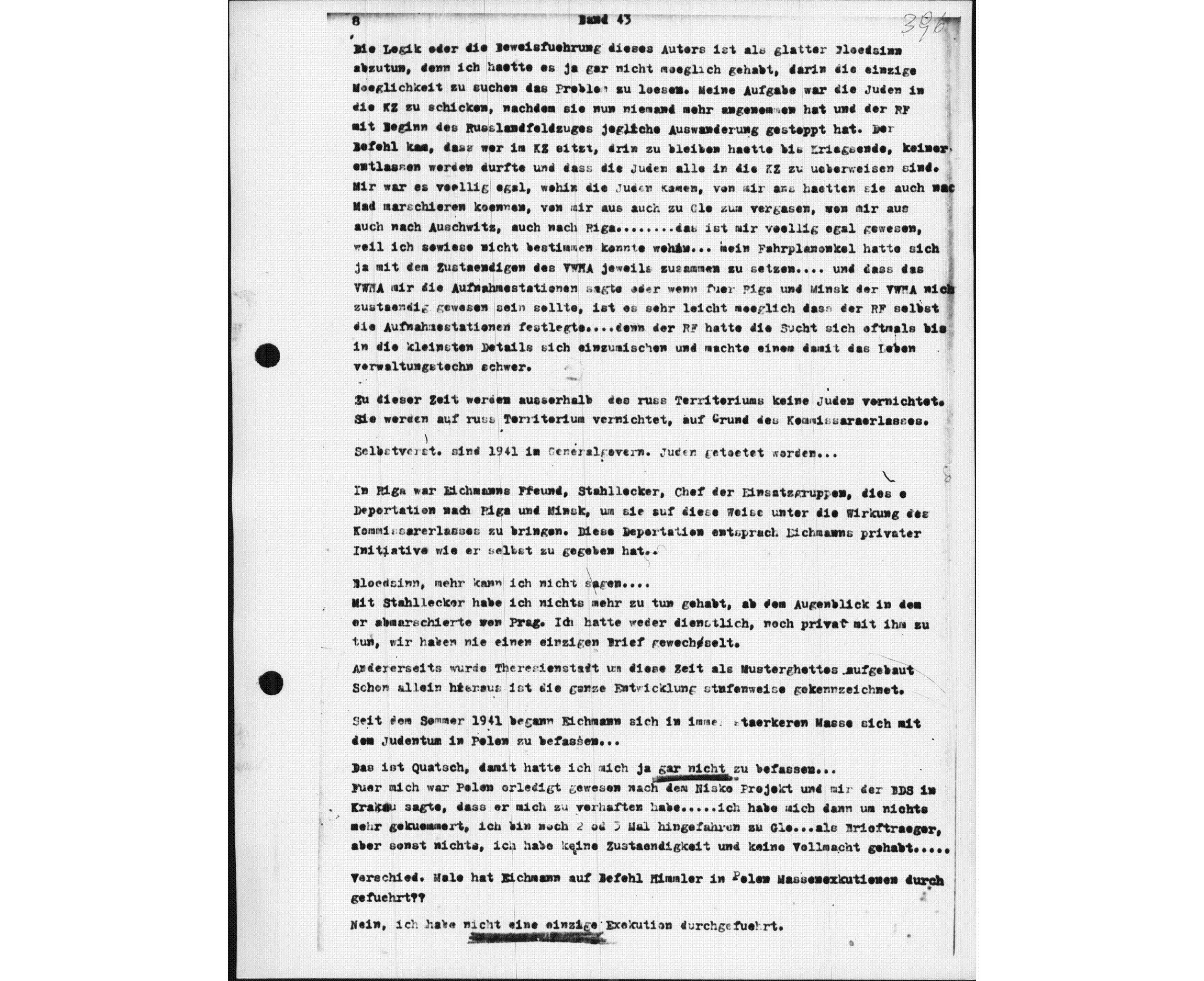
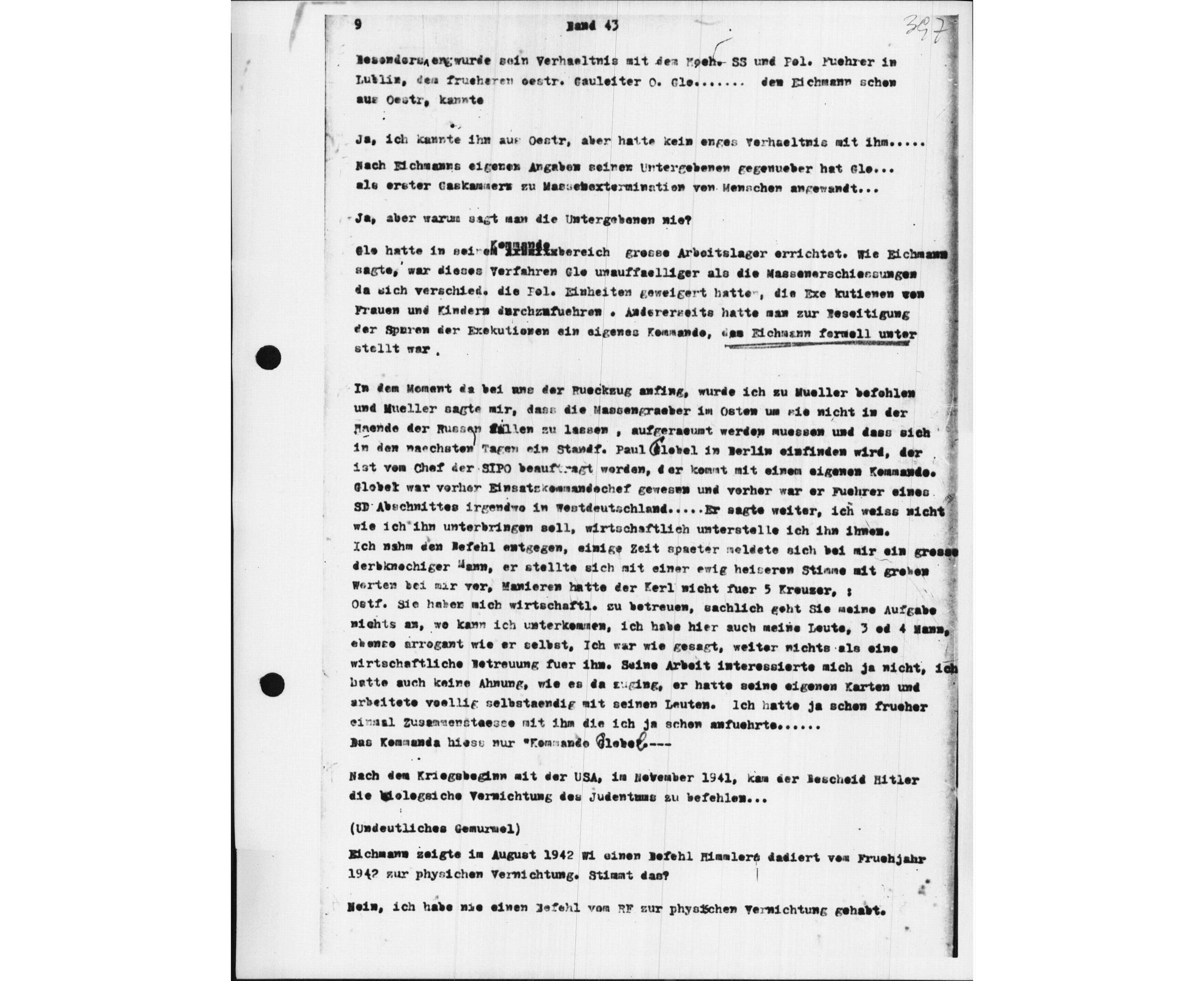
Band 51, page 10
Questioner

Now it is claimed that in reality Laval was still quite accommodating at that time, in 1942, perhaps precisely because A [not typed] had sent along the then Legation Councillor Rahn (later Rahn was ambassador to Mussolini, and he was in Tunis for a time), who [not typed], in order to soften Oberg's somewhat excessive severity. And here Laval agreed that he would consent to deportations of foreign and stateless Jews, and besides that he promised to review the naturalizations of Jews since 1919 and to revoke them where appropriate.

Knochen told me that. Now I know it. When I, it was on one day, he was busy, that is, he had someone with him just then, in a small salon, in a French villa on the Champs de l'E.

Questioner

Could that be on the 1st of July? We will come back to this conversation.

Eichmann

Good.

Questioner

Regarding the person of Rahn, it is mentioned that he was German plenipotentiary in Tunis, and that he prevented the deportation of the Jews from Tunis there.

Eichmann

I know nothing of that. How could I have got hold of Jews from Tunis at all?

Questioner

Tunis was known through the Einsatzkommandos of the Sipo and SD.

Eichmann

But not in Jewish questions. How was I supposed to transport them? That is completely new to me. I am hearing it for the first time.

Questioner

Now Rahn's role is set against this, in France, where he negotiated about the surrender of Jews. It is a matter he himself kept quiet about in his book, while he then stresses that in Tunis he prevented the deportation of the Jews.

Eichmann

That is completely unknown to me. Ridiculous. Everyone today takes up whatever in the Jewish sector he can gain privilege from today.

Questioner

Besides that, Laval was ready to let children under 16 be deported from the unoccupied zone, in the negotiations of that time. He declared that Jewish children in the occupied zone were of no interest to him. Here it appears, so it is said, that Laval used the manner of speech of the Gestapo with a definite intention. Now a particular note. One may assume that Laval deliberately offered the Germans stateless children in order to save the French Jews, and that the whole protection of the French Jews, which Laval invoked in court, was limited to that.

Eichmann

In my opinion the matter is not so simple. In favor of the

Open sheet image, German, and notes
Scan 00158 of the Sassen transcript, O.65 file 87.
This is scan 00158 of the Sassen transcript, O.65 file 87. The image is 3504 by 2848 pixels. Yad Vashem Archives, Jacob Robinson Collection O.65, file 87.

German transcription

10 Band 51 [HW: 518] Nun wird aber behauptet, dass in Wirklichkeit Lavalle damals noch, 1942, recht entgegenkommend war, vielleicht gerade deshalb als A.. . den damaligen Legi. Rat Rahn,( spa ter war Rahn Botschafter bei Musolini, er war in Tunis, einige Zeit) der ... mitgeschickt hatte, um die etwas zu grosse Schaerfe Obergs abzuschwaechen.-- Und hier stimmte Lavalle zu, [DEL: xxxxxxxx] [TS INS: dass er] Deportierungen von ausl. und staatenloser Juden zu- stimme, und ausserdem versprach er die Einbuergerung von Juden seit 1919 zu ueberpruefen und gegebenenfalls zu widerrufen. Das sagte mir Knochen... jetzt weiss ich es.... als ich, es war an einem Tag gewesen, [DEL: sixx] er war beschaeftigt, d.h. er [DEL: xxx] hatte gerade jemanden bei sich, in einem kleinen Salon, in einer franz. Villa auf der Champs del'E. Kann das am 1. Juli..... auf diese Unterredung kommen wir noch.... Gut..... B gl. der Person Rahn wird erwaehnt, dass er deutscher Beauftragter in Tunis war--dass er dort die Deportierung der Juden aus Tunis verhindert habe... Davon ist mir nichts bekannt, wie haette ich Juden aus Tunis ueberhaupt bekommen koennen Tunis war bekannt durch die Einsatzkommandos der Sipo und SD Aber nicht in Judenfragen, wie haette ich die denn transportieren sollen? Das ist mir voellig neu.... hoere ich zum ersten Mal. Nun hier wird die Rolle Rahn gegenueber gestellt-- in Frankreich wo er wegender Auslieferung von Juden verhandelte--eine Angelegenheit, die er selbst in seinem Buch verschwiegen hat, waehrend r dann betont, dass er in Tunis die Deportierung der Juden verhindert habe.... Ist mir voellig unbekannt... laecherlich... Ein jeder nimmt heute das auf dem Judensektor, wo er heute mit previlieren kann. Ausserdem war Lavalle bereit, Kinder unter 16 Jahren aus der unbesetzten Zone zu deportieren zu lassen-- bei den damaligen Verhandlungen. Er erklaerte Judenkinder in der besetzten Zone interessieren ihn nicht. Hier rscheint es, so heisst,es, dass sich Lavalle mit einer bestimmten Absicht der Redeweise der Gestapo bediente. Nun eine besondere Note;;; Man kann annehmen, dass Lavalle bewusst den Deutschen [DEL: xxxxxxxxxx] staatenlose Kinder angeboten hatte,, um die frans. Juden zu retten und dass sich darauf der ganze Schutz fuer die franz. Juden, auf die sich Lavalle bei Gericht berufen hat, beschraenkt hat. Meiner Meinung nach ist die Angelegenheit nicht so einfach, zu Gunsten der
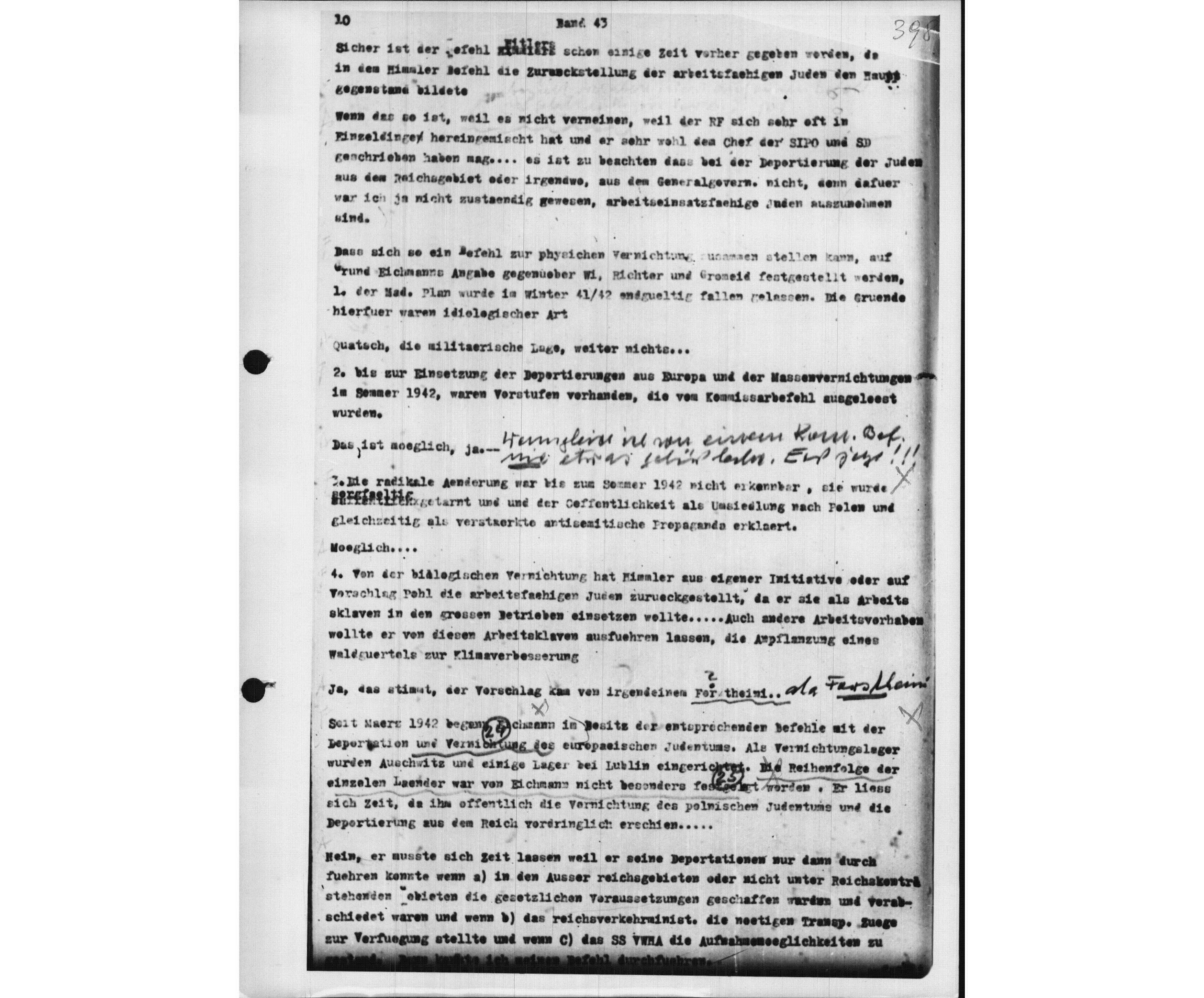
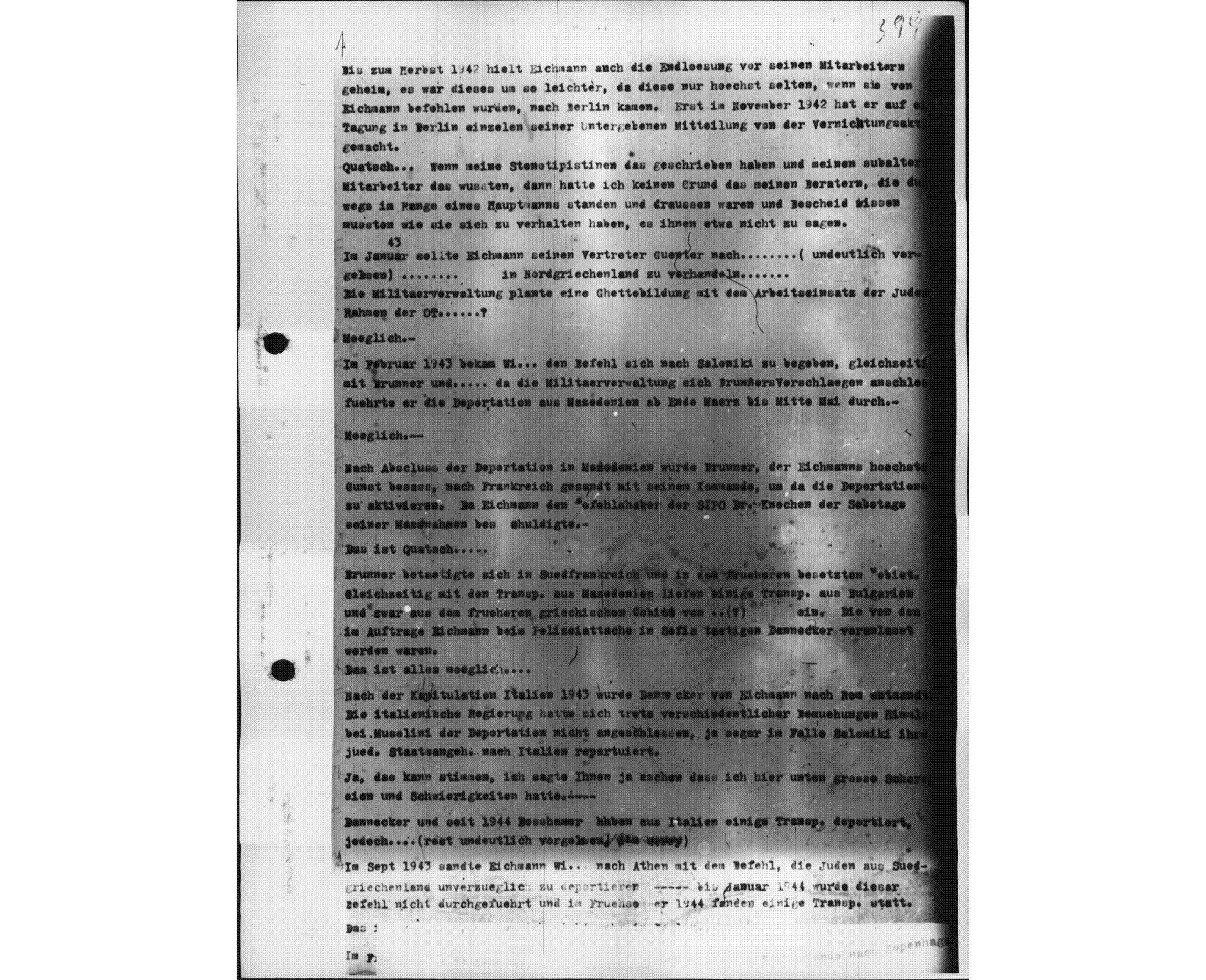
English translation

10 Band 51 [HW: 518] But now it is claimed that in reality Lavalle was actually still, in 1942, quite accommodating, perhaps precisely for that reason as A... . the then Legation Councillor Rahn, (later Rahn was ambassador to Mussolini, he was in Tunis, for some time) whom the ... had sent along, in order to soften Oberg's somewhat too great harshness.-- And here Lavalle agreed, [DEL: xxxxxxxx] [TS INS: that he] agree to deportations of foreign and stateless Jews, and moreover he promised to review the naturalization of Jews since 1919 and if applicable to revoke it. That is what Knochen told me... now I know it.... when I, it had been on a day, [DEL: sixx] he was busy, i.e. he [DEL: xxx] had just had someone with him, in a little salon, in a French villa on the Champs de l'E. Can that on 1 July..... we will still come to this discussion.... Good..... Regarding the person of Rahn it is mentioned that he was German commissioner/plenipotentiary in Tunis--that he prevented the deportation of the Jews from Tunis there... Of that nothing is known to me, how could I have gotten Jews out of Tunis at all Tunis was known through the Einsatzkommandos of the Sipo and SD But not in Jewish questions, how then was I supposed to transport them? That is completely new to me.... I am hearing it for the first time. Now here the role of Rahn is contrasted-- in France where he negotiated concerning the extradition/handing over of Jews--a matter which he himself concealed in his book, while then he stresses that in Tunis he prevented the deportation of the Jews.... Is completely unknown to me... ridiculous... Everyone today takes up, in the Jewish sector, wherever he can privilege himself today. Moreover Lavalle was prepared to let children under 16 years be deported from the unoccupied zone-- at the negotiations at that time. He declared Jewish children in the occupied zone do not interest him. Here it appears, so it is said, that Lavalle made use of the Gestapo's manner of speech with a particular intention. Now a particular note;;; One may assume that Lavalle had consciously offered the Germans [DEL: xxxxxxxxxx] stateless children, in order to save the French Jews and that upon this the whole protection for the French Jews, which Lavalle invoked in court, was limited. In my opinion the matter is not so simple, in favor of the
Unreviewed notes

These notes haven't been reviewed. A note can identify a speaker where the reviewed English doesn't. If they disagree, use the reviewed English.

Transcription note

Typewritten carbon transcript page; two round hole-punch marks in left margin (not text). Header: "10" (page number, left), "Band 51" (centered), "518" (handwritten, top right corner). Editorial layers: - Line "Lavalle zu, ...": a typed x-overstrike cancellation ([DEL: xxxxxxxx]) with a lighter typewritten insertion "dass er" positioned above it; rendered as replacement per protocol ([DEL: ...] followed immediately by [TS INS: dass er]). - "Tag gewesen, [DEL: sixx]": short typed x-overstrike; the underlying/struck letters are ambiguous — reading of the cancelled span is uncertain. - "er [DEL: xxx] hatte": short typed x-overstrike cancellation. - "Deutschen [DEL: xxxxxxxxxx] staatenlose": longer typed x-overstrike cancellation of roughly ten characters. Preserved as visibly typed (not corrected): "recht" (for "recht"/gerecht?), "spa ter", "Musolini", "wegender", "previlieren", "rscheint", "frans." (later "franz."), doubled comma "hatte,,", "waehrend r" (missing "e"), "B gl." (faint z, likely "Bzgl."). Ellipsis/period runs reproduced at approximate length. A faint handwritten/ink diagonal stroke crosses the right end of the "Champs del'E." line and the right margin shows scattered stray marks; no additional legible text discernible there.

Translation notes

- "Champs del'E." is abbreviated/truncated in the source; rendered literally as "Champs de l'E." without completing to any full street name (e.g. Champs-Élysées) — the German does not spell it out. - "Legi. Rat" expanded to "Legation Councillor" (Legationsrat) on the basis of the standard abbreviation, but the source is abbreviated. - "deutscher Beauftragter" translated as "commissioner/plenipotentiary"; the exact office is not specified. - "Auslieferung" rendered "extradition/handing over"; in context it may mean the surrender/delivery of Jews rather than formal legal extradition. - "das aufnehmen... mit previlieren kann" is grammatically broken in the German ("previlieren" appears to be a misspelling of privilegieren, to privilege/advantage oneself); the translation "takes up... wherever he can privilege himself" preserves the broken sense but the intended meaning is uncertain. - "Lavalle" is the source's spelling (the historical figure is Pierre Laval); preserved verbatim rather than corrected. - "Can that am 1. Juli" ("Kann das am 1. Juli") is an incomplete/broken clause; rendered literally as "Can that on 1 July" without resolving it. This is a mid-conversation interview page (Band 51, HW 518) with no explicit speaker labels or initials anywhere in the source. Attribution therefore rests entirely on content. Two clear structural patterns are visible: (1) turns that present and contrast external documentary material ("it is claimed", "it is mentioned", "it is said", references to Rahn's book, Lavalle's court testimony) — these are the interviewer posing material, attributed to Sassen (S); and (2) first-person denials from the position of someone who would have had to organize Jewish transports ("how could I have gotten Jews out of Tunis", "how was I supposed to transport them") — these are self-identifying as the deportation organizer, attributed to Eichmann (E). Where content does not clearly fix the speaker (the Knochen recollection, the "Good....." interjection, the truncated final line, and the "Tunis was known through the Einsatzkommandos" line whose S-attribution is only inferred from conversational function), I have left UNCERTAIN or flagged the weaker basis rather than force alternation. The "Tunis was known through the Einsatzkommandos of the Sipo and SD" line is genuinely ambiguous — it could be Sassen supplying context or the respondent — and its S-attribution should be treated as low confidence. The page ends mid-sentence.
Band 51, page 11
Questioner

children in the occupied zone Laval could do nothing at all. Besides, Laval's proposal to go beyond the wishes of the Gestapo and to have children deported from the unoccupied zone appears only in a second-hand report from Dannecker to Eichmann. Laval has proposed, writes Dannecker to Eichmann. In fact the round-ups in the unoccupied zone were put off for 2 months and then carried out as unsystematically as possible. Children were not taken in. The Gestapo was in any case in no doubt that Laval had deceived them.

I cannot remember that. Dannecker never reported anything to me about children.

Questioner

We will come back to that later. Now your visit to Paris. The Gestapo was still of the opinion that the French police would arrest French people for them. French Jews. On the 1st of July Eichmann came to Paris and instructed Knochen and Dannecker to insist that the applicable and necessary laws and foundations be created that make it possible for the Jews transferred to the destination stations to be regarded as stateless on entering Reich territory. In the event of a failure in this field, the greatest unpleasantness of a foreign-policy kind was to be expected, and the carrying out of the Reichsfuehrer's order must be avoided in any case. That was a little unclear to me.

Eichmann

Yes, those sentences may well have sprung from my brain.

Questioner

This sentence in the communication, which A [not typed] as well as Stuelpnagel and Dannecker received from Eichmann, certainly comes from Eichmann personally. It shows the cautious bureaucrat whom Wi [not typed] described so aptly in Nuremberg. Do you remember?

Eichmann

I do not remember this matter as a matter, but the words I have just heard could still spring from my mouth even now. I must classify them and recognize them as belonging to my own stock of language. And I must say further that I dimly recall that we once somehow had difficulties, or believed we had them, when we had Jews of French nationality. Perhaps the thing came up with me too, precisely because I had the immense difficulties with France, with unoccupied France, when I had to get the 6 trains somehow across for a Gauleiter who was pressing me.

So I do not want to deny that.

Open sheet image, German, and notes
Scan 00159 of the Sassen transcript, O.65 file 87.
This is scan 00159 of the Sassen transcript, O.65 file 87. The image is 3504 by 2848 pixels. Yad Vashem Archives, Jacob Robinson Collection O.65, file 87.

German transcription

11 Band 51 [HW: 519] Kinder in der besetzten Zone konnte Lavalle auf keinen Fall etwas tun. Ausserdem erscheint Lavalles Vorschlag ueber die Wuensche der Gestapo heraus zu gehen und Kinder aus der unbesetzten Zone deportieren zu lassen, nur aus einem , aus zweiter Hand stammenden Bericht Danneckers an Eichmann;; Lavalle hat vorgeschlagen, schreibt Dannecker an Eichmann.-- Tatsaechlich wurden die Razzien in der unbesetzten Zone fuer 2 Monate hinaus- geschoben und dann so unsystematisch wie moeglich vorgenommen. Kinder wurden nicht eingezogen--die Gestapo war jedenfalls nicht im Zweifel darueber, dass Lavalle sie getaeuscht hatte. Daran kann ich mich nicht erinnern. Ueber Kinder hat mir Dannecker nie etwas berichtet Darauf kommen wir spaeter....... Nun Ihr Besuch in Paris.; Die Ge stapo war immer noch der Meinung die franz Pol wuerde Franzosen fuer sie festnehmen. Franz. Juden. Am 1. Juli kam Eichmann nach Paris und beauftragte Knochen und Dannecker darauf zu bestehen, dass die allfaelligen und notwendigen Gesetze und [HW: [?ändern?]] Untermauerungen geschaffen wuerden,, die es moeglich machen, dass die dem Zielstationen ueber- stellten Juden mit dem Betreten des Reichsgebietes als staatenlos anzusehen sind.- Bei einem Versagen auf diesem Gebiet waeren groesste Unannehmlich- keiten aussenpolitischer Art zu erwarten, die Durchfuehrung des RF Befehls auf jeden Fall vermieden werden muesse. (Es war mir ein bischen unklar?) Ja, die koennen meinem Hirn entsprungen sein, diese Saetze..... Dieser Satz in der Mitteilung, der sowohl A....t [HW: 2] als auch Stuelpnagel und Dannecker von Eichmann erhielten, stammt sicherlich von Eichmann persoenlich. Es zeigt den vorsichtigen Buerokraten, den Wi... in Nuernberg so treffend beschrieben hat.... Erinnern Sie sich??? Ich erinnere mich an diese Angelegenheit als Sache nicht, aber die Worte die ich eben hoere, die koennten auch jetzt noch aus meinem Munde entsprungen sein Ich muss sie als zu meinem Sprachschatz gehoerend eingliedern und erkennen. Und ich muss weiter sagen, dass ich mich dunkel entsinne, dass wir mal irgendwie Schwierigkeiten hatten oder glaubten zu haben, wenn wir Juden franz Staatsangeh. hatten. Vielleicht ist die Sache auch bei mir aufgetaucht, gerade weil ich die emensen Schwierigkeiten hatte mit Frankreich mit dem unbesetzten Frankreich, als ich die 6 Zuege von einem Gauleiter, der mich bedraengte, irgendwie hinueberschaffen musste..... Also ich will das nicht ableugnen.

English translation

11 Band 51 [HW: 519] In the occupied zone Lavalle could in no case do anything for children. Moreover Lavalle's proposal to go beyond the wishes of the Gestapo and to have children deported from the unoccupied zone appears only from a second-hand report of Dannecker to Eichmann;; Lavalle has proposed, Dannecker writes to Eichmann.-- In fact the raids in the unoccupied zone were postponed for 2 months and then carried out as unsystematically as possible. Children were not taken in--the Gestapo was at any rate in no doubt that Lavalle had deceived it. That I cannot remember. About children Dannecker never reported anything to me. We will come to that later....... Now your visit in Paris.; The Gestapo was still of the opinion the French police would arrest Frenchmen for it. French Jews. On 1 July Eichmann came to Paris and instructed Knochen and Dannecker to insist that the possible/eventual and necessary laws and [HW: [?to change?]] underpinnings be created, which make it possible that the Jews transferred to the destination stations are to be regarded as stateless upon entering Reich territory.- In case of a failure in this area the greatest unpleasantnesses of a foreign-policy nature were to be expected, [that] the execution of the RF order must in any case be avoided. (It was a bit unclear to me?) Yes, those can have sprung from my brain, these sentences..... This sentence in the communication, which both A....t [HW: 2] as well as Stülpnagel and Dannecker received from Eichmann, certainly originates from Eichmann personally. It shows the cautious bureaucrat, whom Wi... in Nuremberg described so aptly.... Do you remember??? I do not remember this matter as a matter, but the words that I just hear, they could even now still have sprung from my mouth. I must classify and recognize them as belonging to my vocabulary. And I must further say that I dimly recall that we once somehow had difficulties or believed we had, when we had Jews of French nationality. Perhaps the matter also came up with me, precisely because I had the immense difficulties with France with unoccupied France, when I somehow had to get the 6 trains across from a Gauleiter who pressed me..... So I do not want to deny this.
Unreviewed notes

These notes haven't been reviewed. A note can identify a speaker where the reviewed English doesn't. If they disagree, use the reviewed English.

Transcription note

Typewritten transcript page from Band 51, printed page number "11" top-left, "Band 51" centered header, handwritten "519" (folio) in ink top-right corner. Two hole-punch marks in left margin. Body is a single continuous typewritten column with alternating interviewer/interviewee turns, no explicit speaker labels. Handwriting: (1) A cursive insertion sits above the line between "Gesetze und" and "Untermauerungen"; genuinely hard to read — best guess "ändern"/"andere", transcribed as [HW: [?ändern?]] anchored at that point. (2) A handwritten "2" appears above the line over "sowohl A....t"; rendered [HW: 2]. Underlining (not markable under the given tag set, noted here): the phrases "vorsichtigen Buerokraten," and "treffend" are underlined by hand/type; there is also a short underline/strike under part of that line. No text is fully struck through, so no [DEL:] spans were used. Rows of typed periods ("......." / ".....") preserved at approximate length. Sequences like "A....t" and "Wi..." are abbreviated names left incomplete in the original (dots typed by author), reproduced verbatim. "Ge stapo" and other intra-word spaces preserved as they appear (worn/misaligned typebars). Faint/broken letters (e.g. leading "L"/"E"/"F" of some words where the typebar struck lightly) transcribed to the intended visible character where the reading is defensible from the strokes. Original misspellings/typos retained verbatim (e.g. "Lavalle" for Laval, "emensen", "dem Zielstationen", "bischen", "wuerden,,").

Translation notes

- 'allfaelligen' rendered 'possible/eventual' — the word can mean 'any that may arise' / 'occasional' / (Swiss/Austrian usage) 'eventual'; exact intended sense uncertain. - The clause 'die Durchfuehrung des RF Befehls auf jeden Fall vermieden werden muesse' is grammatically detached; I supplied '[that]' to link it but the German syntax is broken. 'RF' likely = Reichsführer(-SS), left as 'RF'. - '(Es war mir ein bischen unklar?)' — parenthetical with question mark in the source; rendered literally 'It was a bit unclear to me?' Its speaker/status (aside, editorial note, or spoken) is unclear. - 'ueber die Wuensche der Gestapo heraus zu gehen' rendered 'to go beyond the wishes of the Gestapo'; idiom slightly uncertain. - 'Zielstationen ueberstellten' rendered 'transferred to the destination stations'; 'Zielstationen' could mean destination stations/terminals in a transport sense. The page carries no explicit speaker labels or initials; attribution rests entirely on internal content (third-person references to Eichmann + direct questions = Sassen/interviewer; first-person accounts of vocabulary, memory, and deportation duties = Eichmann/respondent). The header '11 Band 51 [HW: 519]' is a page/volume marker, left in english_literal but not treated as a speaker turn. Several proper names are truncated/uncertain in the source: 'A....t [HW: 2]' (possibly Abetz), 'Stuelpnagel' (Stülpnagel), 'Wi...' (unidentified; possibly Wisliceny), 'Knochen', 'Dannecker', 'Lavalle' preserved as written. Broken grammar and trailing ellipses preserved.
Band 51, page 12
Questioner

Now it says further, regarding the discussions you had in Paris, that extraordinarily far-reaching plans were drawn up for deportation trains from Bordeaux [not typed]. A train from Marseille was also envisaged, which was to carry the Jews brought over from Algiers.

That I do not know. One thing I can say for certain, that during my presence in Paris matters of detail really were not discussed. For I was not responsible for the detailed matters. The commander of the Sipo and SD in France was responsible for that.

Questioner

But in my view your presence would have been just the occasion to speak about these questions of detail?

Eichmann

No, I do not think so, because in Paris I had [handwriting] to do with the registration, nor with other matters of detail. What interested me was the fundamental thing, namely that France was offering us the Jews. That is said in one sentence, but it is such an immense mass of difficulties, and the legal foundation is to be understood as part of it. Achieving these things was what mattered to me. From where and how then, for that there were Dannecker and Knochen, and also a Higher SS and Police Leader who if need be could have pushed a matter through, although that would not have been his task either. He had to concern himself with the fundamental things, namely Oberg together with the German envoy at the responsible French offices, so in this case Laval.

Questioner

Now the French reaction was such that Petain and Laval proposed deporting the stateless Jews from the unoccupied zones. Whereas [not typed], the new French official in charge, declared that a new registration of the Jews was necessary. Dannecker would not be satisfied with that, and declared that for the big round-up fixed for the 13th of July, for which 10,000 Jews were needed, one could take them without further ado from the internment camps of the unoccupied zone, so as not to get involved in the difficulties of a new government. Now Dannecker tried to be allowed to inspect the camps in the unoccupied zones, in order to establish what reservoir of Jews was available. He then made his report. The journey was not satisfactory, for he gave only 6,000 Jews.

The taking over of the so-called Aktion Buerkel

Speaker not established

Saarpfalz?

Open sheet image, German, and notes
Scan 00160 of the Sassen transcript, O.65 file 87.
This is scan 00160 of the Sassen transcript, O.65 file 87. The image is 3504 by 2856 pixels. Yad Vashem Archives, Jacob Robinson Collection O.65, file 87.

German transcription

12 Band 51 [HW: 520] Nun heisst e s weiter, bzgl. der Besprechungen, die Sie in Paris hatten, dass ausserordentlich weitreichende Plaene fuer Deportationszuge aus Bordeaux ... , entworfen wurden. So war auch ein Zug aus Marseille vorgesehen, der die aus Algier heruebergeschafften Juden befoerdern sollte Das weiss ich nicht----Eines kann ich sicher sagen, dass bei meiner Anwesen- heit in Paris Detailgeschichten wirklich nicht besprochen worden sind. Denn fuer die Detailsachen war ich ja nicht zustaendig gewesen, dafuer war ja der Befehlshaber der Sipo und SD in Frankreich zustaendig. Aber meiner An icht nach, waere gerade Ihre Anwesenheit gelegen gewesen, um ueber diese Detailfragen zu sprechen? Nein, das glaube ich nicht, denn ich habe in Paris [HW: [?weiter?]] mit der Erfassung zu tun gehabt, noch mit anderen Detailgeschichten, mich interessierte das Grundsaetzl. naemlich das, dass Frankreich uns die Juden anbot... Das ist in einem Satz gesagt, aber es ist eine so emense Fuelle von Schwierigkeiten und darunter ist auch die gesetzl. Untermauerung zu verstehen,--diese Sachen zu erreichen, darauf kam es mir an, ---woher und wie dann,----dazu war Dannecker, Knochen da, auch ein Hoeh. SS und Pol. F. der noch notfalls haette eine Sache durch druecken koennen, Obwohl es auch nicht seine Aufgabe gewesen waere... E r hatte sich um die grundsaetzl. Dinge zu kuemmern, und zwar Oberg mit dem deutschen Gesandten zusammen bei den zustaendig. franz. Dienststellen, also in dem Fall Lavalle. Nun war die franz. Reaktion ja so, dass Petain und Lavalle vorgeschlagen haetten die staatenlosen Juden aus den nicht besetzten Zonen zu deportieren. Waehrend ........ der neue franz Zustaendige erklaerte, es sei eine neue Registrierung der Juden notwendig. Dannecker wollte sich damit nicht [TS INS: und erklaerte] zufrieden geben, dass fuer die grosse, auf den 13 Juli, festgesetzte Razzie fuer die 10 000 Juden benoetigt waren, dass man die ohne weiteres aus den Internierungslager der unbesetzten Zone entnehmen koenne, um sich nicht auf die Schwierigkeiten einer neuen Regierung einzulassen. Nun versuchte Dannecker, die Lager in den unbesetzten Zonen anzusehen zu duerfen, um festzustellen welches Reservoir an Juden vorhanden ist. Er erstatte dann Bericht----die Reise war nicht zufriedenstellend, denn er gab nur 6000 Juden an------ Die Uebernehmung der sogen. Aktion Buerkel... .. (Durcheinander) Saarpfalz??

English translation

12 Volume 51 [HW: 520] Now it says further, regarding the discussions that you had in Paris, that extraordinarily far-reaching plans for deportation trains from Bordeaux ... , were drawn up. Thus a train from Marseille was also envisaged, which was to transport the Jews brought over from Algiers [was to] That I do not know----One thing I can say for certain, that during my presence in Paris detail matters were really not discussed. For for the detail matters I was in fact not responsible, for that the Commander of the Sipo and SD in France was responsible. But in my view, precisely your presence would have been opportune, in order to speak about these detail questions? No, I do not believe that, for in Paris I had [HW: [?further?]] to do with the registration [nor] with other detail matters, what interested me was the fundamental, namely this, that France offered us the Jews... That is said in one sentence, but it is such an immense abundance of difficulties and among that is also to be understood the legal underpinning,--to achieve these things, that is what mattered to me, ---whence and how then,----for that Dannecker, Knochen were there, also a Higher SS and Pol. F. who could in case of need still have pushed a matter through, although it would also not have been his task... He had to concern himself with the fundamental things, and namely Oberg together with the German envoy at the responsible French offices, that is in this case Lavalle. Now the French reaction was indeed such, that Petain and Lavalle would have proposed to deport the stateless Jews from the unoccupied zones. While ........ the new French responsible official declared, a new registration of the Jews was necessary. Dannecker did not want to [TS INS: and declared] be content with this, that for the large raid set for the 13th of July, for the 10,000 Jews were needed, that one could without further ado take them from the internment camp of the unoccupied zone, in order not to get involved in the difficulties of a new government. Now Dannecker tried to be permitted to view the camps in the unoccupied zones, in order to determine what reservoir of Jews is present. He then made a report----the trip was not satisfactory, for he gave only 6000 Jews------ The taking over of the so-called Aktion Buerkel... .. (Confusion/cross-talk) Saarpfalz??
Unreviewed notes

These notes haven't been reviewed. A note can identify a speaker where the reviewed English doesn't. If they disagree, use the reviewed English.

Transcription note

Typescript page, Band 51, printed page number 12 top-left, handwritten folio "520" top-right. Handwritten insertion above the line at "Paris ... mit der Erfassung" reads uncertainly, transcribed as [?weiter?]. A smaller typewritten insertion "und erklaerte" appears above the line beginning "zufrieden geben"; represented as [TS INS: ...]. Rows of spaced periods/ellipses in the base text (after "Bordeaux", and "Waehrend ........") preserved approximately. Text contains many typewriter idiosyncrasies (e.g., "su"/"zu", "emense", "Anwesen-heit") preserved as visible.

Translation notes

- 'Lavalle' in the German almost certainly refers to Pierre Laval; the transcription doubles the 'l', which is preserved here rather than corrected. - 'Aktion Buerkel' refers to the deportation operation associated with Gauleiter Josef Bürckel; 'Buerkel' preserves the ue-for-ü rendering of the source. - 'Higher SS and Pol. F.' renders 'Hoeh. SS und Pol. F.', abbreviation for Höherer SS- und Polizeiführer (Higher SS and Police Leader); expanded only in the note, kept abbreviated in the literal text. - 'Sipo and SD' = Sicherheitspolizei und Sicherheitsdienst; left untranslated as in source. - 'the 13th of July' renders 'den 13 Juli'; the source omits the ordinal period and the year. - 'immense' renders the source spelling 'emense' (for 'immense'); an apparent typo in the German, translated by sense. - 'nor with other detail matters' — the German 'noch mit anderen Detailgeschichten' following 'mit der Erfassung zu tun gehabt' is grammatically incomplete/broken (an expected 'weder' is absent); 'nor' is supplied by sense but the construction is defective in the source. - The [HW: [?further?]] handwritten insertion ('weiter') is itself marked uncertain in the source; its placement and reading are unresolved. This is a page of running interview dialogue (Volume 51, page 12; handwritten '520'). The first four turns alternate between an interviewer putting source-based propositions and second-person questions (attributed S) and a first-person respondent describing his own remit and relations to named French/SS officials (attributed E), consistent with the Sassen–Eichmann setup. The final long paragraph is a third-person historical narrative with no first-person marker or question, so it is left UNCERTAIN rather than assigned to either man — it could be the interviewer reading a summary or the respondent narrating. The closing '(Durcheinander)' / 'Saarpfalz??' is explicitly cross-talk and left UNCERTAIN. No explicit speaker labels or initials appear anywhere on the page; all S/E attributions rest on second-person/question form vs. first-person account, per rule 2. Several OCR/typographic artifacts preserved: 'emense', 'Lavalle', doubled connectives, the [TS INS: und erklaerte] typed insertion, and the truncation dashes/ellipses. Historical figures referenced: Theodor Dannecker, Helmut Knochen, Carl Oberg (Höherer SS- und Polizeiführer France), Pétain, Laval, and the Bürckel deportation action — all consistent with 1942 France deportation planning, matching the interview's subject matter but not by themselves fixing which man is speaking the narrative paragraph.
Band 51, page 13
Questioner

The population barely noticed the operation as it went on, Eichmann told Lutter, full of pride.

Yes, but I hardly ever spoke with Lutter,

Questioner

So Dannecker found only 6,000, and among those 6,000 there were still [blotted] survivors of the Bürckel operation.

Better said, the ones who had fled.

He also established that the casino at Monte Carlo was full of Jews and so on. When he returned to Paris after his absence, he found Heinz Röttke there, a Berlin lawyer who had been appointed head of the Jewish office.

Eichmann

Yes, that is right.

Questioner

Why was Dannecker removed?

Eichmann

Removed is not the word I would use. At the time I gave Röttke to Dannecker as reinforcement, with the aim that Röttke would take the thing over himself. Because Dannecker was a thick-skulled Swabian and also a bit awkward, and in [blotted] France we needed someone more agile, someone who fought his way through more elegantly, and not one who went at it with sledgehammer methods.

Questioner

So Dannecker was called back to Berlin because of the night clubs he was running.

Eichmann

No, that is not right.

Questioner

In the January that followed he was given a post by Eichmann in Bulgaria.

Eichmann

Could be.

Questioner

In October 43 he was transferred to Verona and in the summer of 1944 to Hungary.

Eichmann

That is all correct.

Questioner

He seems to have stayed in Eichmann's command until the last moment, but it is not known whether he surfaced with the others at Alt Aussee in May 45.

Eichmann

No.

Questioner

Nothing is known about what became of him after that.

Now the French police informed the Sipo that, on the basis of their own findings, there had to be 28,000 stateless Jews in Paris. Which means that there was after all a corresponding reservoir of Jews for the big raid.

Open sheet image, German, and notes
Scan 00161 of the Sassen transcript, O.65 file 87.
This is scan 00161 of the Sassen transcript, O.65 file 87. The image is 3504 by 2856 pixels. Yad Vashem Archives, Jacob Robinson Collection O.65, file 87.

German transcription

13 Band 51 (Schnelles Vorlesen---- unklar) Der Vorgang der Aktion wurde von der Bevoelkerung kaum wahrgenommen, erklaer- te Eichmann Lutter voll Stolz?... [HW: [?Kann es scheinbar?] [?nicht gesagt?]!] Ja, aber ich sprach ja mit Lutter kaum,------ Also Dannecker traf nur 6000 an----und in [DEL: xxxxxx] diesen 6000 waren noch [?z?] Ueberlebende aus der Aktion Buerkel. Besser ge sagt, die Getuermten----- Ausserd m stellte er fest dass das Kasino von MonteCarlo voller Juden sei usw.... als er nach seiner Abwesenheit nach Paris zurueckkehrt, traf er Heinz Roettke, einen Berliner Rechtsanwalt an, der zum Chef des Judenamtes ernannt war.-- Ja, das stimmt Warum wurde Dannecker abgesetzt? Abgesetzt moechte ich nicht sagen ,ich habe damals Roettke Dannecker zur Verstaerkung zugegeben, mit dem Ziel, dass Roettke diese Sache an sich reisst. Denn Dannecker war ein dickschaediliger Schwabe und auch ein bis [HW: chen] unbeholfem, und i[DEL: n] Frankreich brauchten wir einen der vendiger war, der sich eleganter durchfechtete, [HW: forsch] und nicht einen der mit Holzhammermethoden ran ging. Dannecker wurde also nach Berlin zurueck gerufen, wegen den von Ihm betriebenen Nachtlokalen Nein.....das stimmt nicht. Im Januar darauf bekam er ein Amt von Eichmann in Bulgarien-- Kann sein, Im Okt. 43 wurde er nach Verona versetzt und im Sommer 1944 nach Ungarn Das stimmt alles.... [HW: Das Datum [?auch?] [?wahrscheinlich?] [illegible]] Er scheintbis zum letzten Augenblick in Eichmanns Kommando verblieben zu sein, aber es ist nicht bekannt ob er mit den uebrigen im Mai 45 in Alt Aussee auf- tauchte. Nein... [HW: ich glaube nicht; weiss es aber nicht genau!] Ueber sein weiteres Schicksal weiss man nichts..... Nun verstaendigte die franz. Pol die Sipo, dass auf Grund ihrer Feststellungen es in Paris 28000 staatenlose Juden geben muesse. D.h. also. dass fuer die grosse Razzie doch ein entsprechendes Reservoir von Juden sei.</german_diplomatic> </invoke>

English translation

13 Volume 51 (Rapid reading-aloud---- unclear) The course of the operation was hardly noticed by the population, declared Eichmann to Lutter full of pride?... [HW: [?Can apparently?] [?not said?]!] Yes, but I hardly spoke with Lutter at all,------ So Dannecker found only 6000----and among [DEL: xxxxxx] these 6000 there were still [?z?] survivors from the Bürckel operation. Better said, the ones who had escaped----- Furthermore he determined that the casino of MonteCarlo was full of Jews etc.... when he returns to Paris after his absence, he encountered Heinz Röttke, a Berlin lawyer, who had been appointed to chief of the Jewish office.-- Yes, that is correct Why was Dannecker removed? Removed I would not want to say, at the time I added Röttke to Dannecker as reinforcement, with the aim that Röttke would seize this matter to himself. For Dannecker was a thick-headed Swabian and also a bit [HW: bit] clumsy, and in [DEL: n] France we needed one who was more agile, who fought his way through more elegantly, [HW: brisk] and not one who went at it with sledgehammer methods. Dannecker was therefore recalled to Berlin, on account of the nightclubs run by him No.....that is not correct. In the following January he received an office from Eichmann in Bulgaria-- Could be, In Oct. 43 he was transferred to Verona and in the summer 1944 to Hungary That is all correct.... [HW: The date [?also?] [?probably?] [illegible]] He appears to have remained in Eichmann's command until the last moment, but it is not known whether he surfaced with the rest in May 45 in Alt Aussee. No... [HW: I don't think so; but don't know it exactly!] About his further fate nothing is known..... Now the French police informed the Sipo that, on the basis of their findings, there must be 28000 stateless Jews in Paris. That means, therefore, that for the big raid there was indeed a corresponding reservoir of Jews.
Unreviewed notes

These notes haven't been reviewed. A note can identify a speaker where the reviewed English doesn't. If they disagree, use the reviewed English.

Transcription note

Page number "13" top-left; "Band 51" header. Handwritten folio "521" (partly ambiguous, possibly "52\") in top-right corner. Several cursive marginal/interlinear annotations are only partially legible and marked with uncertainty. Top-right annotation beside "voll Stolz?..." is a two-line cursive note, largely illegible. A wavy handwritten underline runs beneath "te Eichmann Lutter voll Stolz?...". Two black hole-punch/spot marks on the left margin. "xxxxxx" after "und in" is a typed struck-over word (rendered [DEL:]). "und i[DEL: n]" is a struck/overtyped character before "Frankreich". "1944" appears underlined. Interlinear "chen" completes "bis-schen"; "forsch" written above "durchfechtete". Final-line cursive reading is plausible but partly uncertain and hand-underlined.

Translation notes

- 'Der Vorgang der Aktion' rendered as 'The course of the operation'; 'Vorgang' could also be 'process' or 'proceeding'. 'Aktion' left as 'operation' (SS operational term); could be 'action/round-up'. - 'die Getuermten' translated as 'the ones who had escaped'; the word is non-standard German. It may be a mistyping of 'die Getürmten' (from 'türmen' = to flee/bolt, colloquial), hence 'the ones who bolted/fled'. The reading is uncertain. - 'dickschaediliger Schwabe' rendered 'thick-headed Swabian'; 'dickschädelig' = stubborn/thick-skulled/pig-headed. The extra 'i' ('dickschaediliger') is likely an OCR/typing artifact. - 'vendiger' rendered 'more agile'; the intended word is uncertain — likely a corruption of 'wendiger' (more agile/adroit/nimble). - 'durchfechtete' rendered 'fought his way through'; from 'durchfechten' (to fight through/battle through). - '[HW: forsch]' translated 'brisk'; 'forsch' = brisk/bold/vigorous/dashing. - 'Razzie' rendered 'raid'; standard German is 'Razzia' (police raid/round-up). - 'Sipo' left untranslated (Sicherheitspolizei, Security Police); 'franz. Pol' expanded to 'French police'. This is a running interview transcript with NO explicit speaker labels or initials in the source. Attribution therefore rests entirely on rule 2 (content that makes the speaker unambiguous on this page). The narrative blocks cannot be Eichmann (they name him in the third person) and match the interviewer role, so are attributed to S (Sassen). The opening line references 'Eichmann to Lutter' in the third person, confirming the narrator is not Eichmann. NOTE OF CAUTION: while the content-based attribution is well-supported by the third-person-vs-first-person distinction, the page carries no explicit labels; if a third participant were present some 'S' turns could be another interlocutor. The '?' after 'full of pride' and several [HW: …] and [?…?] uncertainty markers are preserved. 'Band 51' is an archival volume/reel header. The DEL markers (struck text) and the interrupted-word HW insertions ('[HW: chen]' completing 'bis[HW: chen]' = 'bißchen/a bit') are preserved in the literal translation."
Band 51, page 14
Questioner

Now Dannecker, in the firm conviction that he could count on 22,000 Jews, chose the [not typed] sports stadium, which he considered big enough for the needs of an assembly camp.

I once knew another camp near Paris, whose name I can't recall now, but this one is completely unknown to me.

Questioner

In this raid the main work was really done by the French police, because the German police would in no way have been enough to round up these masses. That is said to have been the last time at all that the French police worked with the greatest energy alongside the German police in Jewish matters. Because from 1943 on the attitude hardened a great deal.

You have nothing more detailed in your memory about the big raid?

Eichmann

No, I have nothing more in my memory.

Questioner

Perhaps if I remind you of a few things? The raid was planned for July 13, but since July 14 was the national holiday, Röttke, who by then already had rather more say than Dannecker, put the raid off to July 16. The number of prisoners was not 22,000, as Dannecker had calculated for himself, but only 12,800. Of those only 3,000 were men of working age, but 4,000 were children. Of them 6,000 were sent straight to Tran [not typed], while 6,800, among them all the children,

Eichmann

Trans [not typed], what is that?

Questioner

A camp.

Eichmann

Yes, that is what I mean, I saw it once.

Questioner

Drans [not typed], from there the transports went straight to Auschwitz.

Various things. Children were also caught up in it through the orphanages and so on, to make up the required number.

[blotted] [not typed] It took 5 days before the H [not typed] could be cleared, driving people together like cattle, without water, without provision for the most elementary necessities and often without a rag of clothing. That was what the German police had been doing for the last 4 weeks in Poland and in occupied Russia. The horrors of the ghetto were now repeating themselves in the most civilized city in the world.

But wasn't the French police responsible for that?

Eichmann

They took part, but Dannecker had the direction,

Open sheet image, German, and notes
Scan 00162 of the Sassen transcript, O.65 file 87.
This is scan 00162 of the Sassen transcript, O.65 file 87. The image is 3504 by 2848 pixels. Yad Vashem Archives, Jacob Robinson Collection O.65, file 87.

German transcription

14 Band 51 [HW: 52] Nun, waehlte Dannecker, in der festen Ueberzeugung, dass er mit 22 000 Juden rechnen koenne, das Sportstadium dass er fuer die Beduerfnisse eines Sammellagers fuer gross genug hielt. Ich kannte mal ein ande es Lager bei Paris, d ssen Namen ich mich jetzt nicht entsänne,aber dieses ist mir voellig unbekannt. Bei dieser Razzie hat eigentlich die Hauptarb it die franz Pol geleistet denn zur Auftreibung dieser Massen haette die deutsche Polizei in keiner W ise genuegt.---Das sei ueberhaupt das letzte Mal gewesen, so wird behauptet, dass die franz. Pol tatkra ftigst mit der deutschen Pol. in Judenangelegen- heiten zusammengearbeitet hat. Denn ab 1943 hat sich die Haltung sehr ver- schaerft. Ueber die grosse Razzie ist Ihnen nicht mehr naeheres in Erinnerung? Nein, e ist mir nichts mehr in Erinnerung. Vielleicht wenn ich Sie an einiges erinnere? Die Razzie war vorgesehen fuer den 13 Juli, aber da der 14 Juli Nationalfeiertag war, hat Roettke, der damals schon etwas mehr zu sagen hatte, wie Danneker, die Razzie auf den 16 Juli verschoben. Die Zahl der Gefangenen betrug nicht, wie Dannecker sich errechnet hat, 22000, sondern nur 12 800.- Von denen nur 3000 Maenner im arbeitsfaehigen Alter waren, aber 4000 Kinder Davon wurden 6000 direkt nach Tran... geschickt, waehrend 6 800, darunter alle Kinder.... Trans......was ist das? Ein)Lager Ja, das meine ich, das habe ich einmal gesehen. [HW: [illegible]] Drans...von dort gingen die Transporte direkt nach Auschwitz.... (Durcheinandergerede und Fragen--) Verschiedenes; Kinder wurden auch mit erfasst durch die Waisenhaeuser etc.... um die geforderte Zahl aufzufuellen..... XX ........5 Tage dauerte es bis das H............. geraeumt werden konnte, Menschen wie Vieh , ohne Wasser zusammen zu treiben, xxxxx ohne fuer die elementarsten Notwendigkeiten und oft ohne einen Fetzen Kleidung, das hatte die deutsche Pol. in den letzten 4 Wochen in Polen und im besetzten Russland betrieben, die Schrecken des Ghettos wiederholtesten sich jetzt in der zivilisiertesten Stadt der Welt War aber dafuer nicht die franz. Poli zei zustaendig Die haben mitgemacht, aber Dannecker hatte die Leitung,

English translation

14 Volume 51 [HW: 52] Now, Dannecker chose, in the firm conviction that he could count on 22,000 Jews, the Sports Stadium which he considered large enough for the needs of a collection camp. I once knew another camp near Paris, whose name I cannot recall now, but this one is completely unknown to me. At this raid the main work was actually done by the French police, for to round up these masses the German police would in no way have sufficed.---That was said to have been the last time altogether, so it is claimed, that the French police worked most vigorously together with the German police in Jewish matters. For from 1943 on the attitude hardened very much. About the big raid nothing more detailed is in your memory? No, nothing more is in my memory. Perhaps if I remind you of a few things? The raid was planned for the 13th of July, but since the 14th of July was the national holiday, Roettke, who by then already had somewhat more to say than Dannecker, postponed the raid to the 16th of July. The number of prisoners was not, as Dannecker had calculated for himself, 22,000, but only 12,800.- Of whom only 3,000 were men of working age, but 4,000 children. Of these 6,000 were sent directly to Tran... , while 6,800, among them all the children.... Trans......what is that? A) camp Yes, that is what I mean, that I have seen once. [HW: [illegible]] Drans...from there the transports went directly to Auschwitz.... (Cross-talk and questions--) Various things; children were also caught up in this through the orphanages etc.... in order to fill up the demanded number..... XX ........5 days it took until the H............. could be cleared, to drive people together like cattle, without water, xxxxx without [providing] for the most elementary necessities and often without a shred of clothing, that is what the German police had carried out in the last 4 weeks in Poland and in occupied Russia, the horrors of the ghetto were now being repeated in the most civilized city of the world But was the French police not responsible for that They took part, but Dannecker had the leadership,
Unreviewed notes

These notes haven't been reviewed. A note can identify a speaker where the reviewed English doesn't. If they disagree, use the reviewed English.

Transcription note

Typewritten transcript page, Band 51, page 14. Top-right handwritten folio "52". A short handwritten cursive note sits above the line beginning "Drans..." — it is genuinely illegible from the pixels (appears to read something like "Scheidewase??") and is marked [HW: [illegible]]. The word "Sportstadium" is set off to the right of its line with a large gap in the typescript, transcribed in position. Two hole-punch marks in left margin. The "xxxxx" and "XX" strings are literal struck/overtyped typewriter characters in the base text, preserved as typed. Several words show intra-word spaces and typos (e.g. "Hauptarb it", "tatkra ftigst", "d ssen", "entsänne", "voellig") preserved verbatim.

Translation notes

- 'waehlte Dannecker ... das Sportstadium dass er fuer die Beduerfnisse ... gross genug hielt' — the second 'dass' is likely an OCR error for the relative pronoun 'das' ('which'); translated as 'which' to preserve sense, but the German as written is ungrammatical. - 'Tran...', 'Trans......', 'Drans...' — truncated/broken word, apparently the German trying to render an abbreviation or place; the sense from the dialogue is a camp/transit point ('Drancy' is a plausible referent given the Paris context but is NOT written on the page, so left untranslated as the fragment appears). - 'die Schrecken des Ghettos wiederholtesten sich' — 'wiederholtesten' is a nonstandard/ungrammatical form; rendered as 'were being repeated' to convey the evident meaning, but the German form is anomalous. - 'H.............' — dotted-out word after '5 days it took until the'; the elided noun is undeterminable (possibly a location or facility to be 'cleared'), left as 'H.............'. - 'Roettke' vs 'Roettke, der damals schon etwas mehr zu sagen hatte, wie Danneker' — 'wie' here is colloquial/nonstandard for 'als' ('than'); translated 'than' to preserve comparative sense. - 'Waisenhaeuser' translated as 'orphanages'; standard. - Speaker-turn boundaries are inferred from line breaks and content shifts only; the page contains no explicit speaker labels, so all turn segmentation is provisional. This page carries NO explicit speaker labels or initials anywhere — only line breaks, an editorial header ('14 Band 51 [HW: 52]'), parenthetical stage directions ('(Durcheinandergerede und Fragen--)' = 'Cross-talk and questions'), and marginal handwriting ('[HW: 52]', '[HW: [illegible]]'). Per the attribution rules, no turn can be labeled S or E from this page's own content. The material is consistent with an interview about the July 1942 Paris/Vél d'Hiv roundup (a Q-and-A rhythm is visible: questions like 'nothing more is in your memory?' and detailed corrective figures alternate with first-person recollections and short answers), and it would be tempting to assign the interviewer questions to Sassen and the recollections to Eichmann — but nothing on the page makes that unambiguous, and the noted cross-talk shows more than two voices may be active. Attributing the transport/deportation figures or the 'German police carried out' commentary to Eichmann specifically would be an evidentiary error not supported by this page, so all turns are marked UNCERTAIN. The figures (22,000 expected vs 12,800 actual; 3,000 working-age men; 4,000 children; 6,000 + 6,800 splits; dates 13/14/16 July) and names (Dannecker, Roettke) were preserved exactly as written. Broken words ('Tran...'/'Trans...'/'Drans...'), the dotted-out 'H.............', deletion marks ('xxxxx'), and both [HW: …] / [illegible] markers were carried through without resolution.
Band 51, page 15
Questioner

It was Dannecker too who found the sports stadium, apparently without making the slightest preparations for such numbers. When he then inspected the camp, he made a few improvements.

I can't recall anything. If I could recall it, I would say so.

Questioner

Among all the terrible things the Second World War brought, the story of the 4,051 children in the H [not typed] is one of the worst. Knochen and Röttke negotiated with Pétain about the children, on the 2nd day of the raid. [not typed] the Jewish commissioner wanted to send them to orphanages, but the Gestapo demanded that they accompany their parents to the deportation camps until a decision came from the RSHA in Berlin. On the 4th day after [not typed] Eichmann, the model of a German bureaucrat and the father of three little girls, telephoned Röttke to say that at the end of August enough trains would be available to bring the children to the General Government. Thereupon the children were taken from their parents and moved to Drans [not typed].

Eichmann

By telephone? Not one single case is known to me. With us nothing at all was settled by telephone, if only because under the slogan "the enemy is listening" a thing like that is never done by telephone. Never would I have settled a matter, and this one certainly ran as a secret Reich matter, never would I have settled such a thing by telephone. If it was done at all, it would have gone by teleprinter. I have to reject that.

Questioner

It is expressly asserted.

Eichmann

But something like this, with 4,000 children, I would surely have to be able to recall. And I take from this whole complex, almost as proof in my own favor, that I never handled such matters by telephone at all.

Questioner

Couldn't it have happened after all because of the great urgency? The children are now sitting in this H [not typed], they get no water, the sanitary installations are missing, no doctors and so on. Now it is arranged that the French police are to take them to orphanages, the German Sipo sets itself against this and declares that it wants to send the children to the deportation camps, and so on.

Open sheet image, German, and notes
Scan 00163 of the Sassen transcript, O.65 file 87.
This is scan 00163 of the Sassen transcript, O.65 file 87. The image is 3504 by 2856 pixels. Yad Vashem Archives, Jacob Robinson Collection O.65, file 87.

German transcription

15 Band 51 [HW: 52o] Dannecker war es ja auch der das Sportstadium ausfindig machte, ohne schein- bar die geringsten Vorbereitungen zu treffen fuer solche Mengen. Als er das Lager dann besichtigte. hat er einige Verbesserungen geschaffen. Weiteres Vorlesen eines Berichtes bzgl den Zustae[?nden?]in diesem Lager (Schnell und undeutlich vorgelesen) Ich kann mich an nichts entsinnen --- Wenn ich mich ent innen koennte, wuerde ich es sagen Unter all den fuerchterlichen Dingen, die der 2. Weltkrieg gebracht hat, ist die Geschichte der 4 051 Kinder in dem H.. .. einer der aergsten. Knochen und Roettke verhandelten mit Petain ueber die Kinder, am 2. Tag der Razzie. --- der Judenkommissar wollte sie in Waisenanstalten schickten, aber die Gestapo verlangten, dass sie ihre Eltern in die Deportationslager begleiten sollten, bis eine Entscheidung aus dem RSHA Berlin kaeme. Am 4. Tag nach .... telefonierte Eichmann, das Vorbild eines deutschen Buerokraten und der Vater von drei kleinen Maedchen, an Roettke, dass Ende August genug Zuege ver- fuegbar seien, um die Kinder nach dem Gen. Gov. zu bringen. Daraufhin wurden die Kinder ihren Eltern abgenommen und nach Drans........ geschafft. Telefonisch?? Mir ist nicht ein einziger Fall bekannt--telefonisch wurde bei uns ueberhaupt nichts ausgemacht, schon deswegen, weil unter der Parole "Feind hoert mit" nie sowas telefonisch gemacht wird. Nie haette ich eine Sache, und die lief bestimmt unter geheimer Reichssache, nie haette ich so etwas telefonisch ausgemacht. Das waere ueberhaupt, wenn schon, doch durch Fernschreiber gemacht worden. Das muss ich von mir weisen. Es wird ausdruecklich behauptet... Aber an so etwas wie mit 4000 Kinder muesste ich mich doch entsinnen koennen aber ich nehme aus diesem ganzen Komplex, quasi als Beweisfuehrung zu meinen Gunsten, dass ich telefonisch,solche Sachen ueberhaupt nie behandelt habe. Kann es nicht auf Grund der grossen Dringlichkeit doch gewesen sein---die Kinder sitzen nun in diesem H...... bekommen kein Wasser, es fehlen die sanitaeren Anlagen,, keine Aerzte usw, usw.... Nun wird ausgemacht die franz. Pol. soll sie in Waisenhaeuser bringen, die deutsche Sipe stemmt sich da- gegen und erklaert dass sie die Kinder in die Deportation lager schicken will, Usw usw. (Nochmaliges Vorlesen d r ganzen Geschichte oben)

English translation

15 Volume 51 [HW: 52o] Dannecker was indeed also the one who located the sports stadium, without apparently making the slightest preparations for such masses. When he then inspected the camp, he made some improvements. Further reading aloud of a report regarding the conditions in this camp (Read aloud quickly and indistinctly) I cannot recall anything --- If I could recall, I would say so. Among all the terrible things that the 2nd World War brought, the story of the 4,051 children in the H.. .. is one of the worst. Knochen and Roettke negotiated with Petain about the children, on the 2nd day of the raid. --- the Jewish commissar wanted to send them to orphanages, but the Gestapo demanded that they should accompany their parents to the deportation camps, until a decision came from the RSHA Berlin. On the 4th day after .... Eichmann, the model of a German bureaucrat and the father of three little girls, telephoned Roettke that at the end of August enough trains would be available to bring the children to the Gen. Gov. Thereupon the children were taken from their parents and transported to Drans........ By telephone?? Not a single case is known to me -- with us nothing at all was arranged by telephone, if only because under the watchword "The enemy is listening" something like that is never done by telephone. Never would I have arranged a matter, and it certainly ran under secret Reich matter, never would I have arranged such a thing by telephone. That would in any case, if at all, have been done by teleprinter. This I must reject. It is expressly asserted... But something like that with 4000 children I ought to be able to recall, but I take from this whole complex, quasi as evidence in my favor, that I never dealt with such matters by telephone at all. Could it not, on the basis of the great urgency, still have been so --- the children are now sitting in this H...... receiving no water, the sanitary facilities are lacking, no doctors etc, etc.... Now it is arranged that the French Police is to bring them to orphanages, the German Sipo opposes this and declares that it wants to send the children to the deportation camps, etc etc. (Repeated reading aloud of the whole story above)
Unreviewed notes

These notes haven't been reviewed. A note can identify a speaker where the reviewed English doesn't. If they disagree, use the reviewed English.

Transcription note

Typewritten transcript page. Header: page number "15" at left, "Band 51" centered, handwritten folio "52o" (reading uncertain, could be "520") at top right. Two hole-punch marks in left margin. Dark scan/photocopy artifacts across top and bottom edges. Line 4 "Zustae[?nden?]in" shows an overtyped/struck cluster where "Zustaenden in" was intended; only a plausible-but-uncertain reading is given. Several words show faded/dropped letters (e.g. "ent innen" for "entsinnen", "Eichmann" with faint leading letter, "Sipe"). Numbers as typed: "4 051", "4000", "2." (Tag/Weltkrieg), "4." (Tag). Rows of typed periods preserved approximately ("H.. ..", "Drans........", "H......"). No handwritten additions to the base text other than the header folio; no struck-through spans requiring [DEL:] markers were clearly identifiable.

Translation notes

- "Zustae[?nden?]" — the German itself is OCR-uncertain (bracketed [?nden?]); translated as "conditions" (Zustände) but the reading is not certain. - "H.. .." / "H......" — an abbreviated/elided place name (likely a camp, e.g. the Vélodrome d'Hiver / a holding site), left elided as in the source; not translated to a named location. - "Drans........" — an elided place name, almost certainly Drancy, but left elided per the source; not resolved. - "Knochen und Roettke" / "Roettke" — proper names carried over as in the German (Röthke is the likely intended figure; spelling left as transcribed). - "Razzia" translated as "raid" (round-up); the term specifically denotes a police round-up. - "Gen. Gov." rendered as "Gen. Gov." (General Government / Generalgouvernement), abbreviation preserved rather than expanded. - "Sipe" translated as "Sipo" (Sicherheitspolizei) — the German "Sipe" appears to be an OCR/typo for "Sipo"; the reading is inferred. - "geheime Reichssache" rendered "secret Reich matter" — a formal classification term; the fixed phrase "Geheime Reichssache" is a top-secret classification. - "das Vorbild eines deutschen Buerokraten" rendered "the model of a German bureaucrat" — part of the quoted source's characterization, not the speaker's own words. This page is an interrogation/interview exchange in which a published third-party account (of the Vel' d'Hiv round-up and the deportation of children, naming Dannecker, Knochen, Röthke, Pétain, and \"Eichmann\" in the third person) is read aloud to the interviewee, who rebuts it. Speaker attribution is therefore layered: some turns are quoted read-aloud source material (marked in the German by stage directions like \"Weiteres Vorlesen eines Berichtes\" and \"Nochmaliges Vorlesen der ganzen Geschichte oben\"), and some are the interviewee's first-person response. No explicit speaker labels/initials appear anywhere on the page. "Eichmann telephoned Roettke,\" "with us\" The narrated/read-aloud passages are marked UNCERTAIN because the person doing the reading (Sassen or another participant) is not identified on this page; they cannot be Eichmann's own voice since they refer to \"Eichmann\" in the third person, but the reader is not fixable from the page alone. \"It is expressly asserted...\" and the final \"Could it not... still have been so\" challenge could be Sassen pressing the point, but lack any explicit marker, so they are left UNCERTAIN per the attribution rules. The header \"15 Band 51 [HW: 52o]\" is page/volume metadata (Band = volume/tape reel), with a handwritten \"52o\" (possibly a page number).
Band 51, page 16
Questioner

So practically speaking you are the author of the whole story.

To that I have only to say that I can't remember a transport with 4,000 children at all. Further, I can't recall ever having had a telephone conversation with Paris about such matters, and I can't recall having had a telephone conversation about such matters at all, because all these matters came under secret Reich matters and, observing "the enemy is listening", such conversations were never conducted by word of mouth over the line. And a much faster way was open to us, the teleprinter. But if the author wants to claim that I telephoned Röttke, then I have to reject that.

The following sources of proof:

Open sheet image, German, and notes
Scan 00164 of the Sassen transcript, O.65 file 87.
This is scan 00164 of the Sassen transcript, O.65 file 87. The image is 3504 by 2856 pixels. Yad Vashem Archives, Jacob Robinson Collection O.65, file 87.

German transcription

16 Band 51 [HW: 524] Akso praktisch sind Sie der Urheber zu der ganzen Geschichte. Da zu habe ich nur zusagen, dass ich mich an einen Transport mit 4000 Kinder ueberhaupt nicht erinnern kann. Weiter kann ich mich nicht entsinnen mit Paris je ein Telefongesp raech ueber solche Sachen gefuehrt zu haben und ich kann mich weiter nicht ent- sinnen ueberhaupt je ein Telefongespraech in solchen Sachen gefuehrt zu haben, weil ja alle diese Sachen unter Geheimer Reichssachen standen und man fermuendlich unter Beachtung "Feind hoert mit" nie solche Gespraeche ge- fuehrt hat --und es stand uns ein viel schnellerer W g zur Verfuegung, der des Fernschreibers. Wenn aber der Autor behaupten will, ich haette mit Roettke telefoniert, so muss ich das ablehnen. Folgende Beweisquellen; [HW: Ferner: die hier geschilderten Unmöglichkeiten in diesem Sammellager erinnere mir, [?überlen?] ich mich auch nicht Dinge gar nicht entsinnen kann bestimmt [?bestreiten?]. Wie dem aber auch immer sei, für örtliche Unzukömmlich- keiten war ja das RSHA, IV B 4, nicht zuständig. Es gab ja für alles Richtlinien, wenn nicht nach diesen Verfahren wurde, dann ist es Schuld der örtlichen Oberstellen. Und wie gesagt: an einen Kinder- transport kann ich mich nicht entsinnen. Man mag es mir glauben: ich habe in diesen Monaten mit nichts "hinter dem Berg" gehalten und] [HW: [?Genug, was ich weiß. Ich muß ohne Zaudern und? ] [illegible] [?zu geben, wenn ich mich verantworten kann, ? ] [illegible] [?, was es einmal werden?]]

English translation

16 Volume 51 [HW: 524] So practically you are the originator of the whole story. To that I have only to say that I cannot remember at all a transport with 4000 children. Further I cannot recall ever having conducted a telephone conversation with Paris about such matters and I furthermore cannot re-call ever having conducted a telephone conversation in such matters at all, because indeed all these matters were under Secret Reich Matters and one, mindful of "The enemy is listening in," never conducted such conversations orally --and there was available to us a much faster w[a]y, that of the teleprinter. But if the author wants to claim I had telephoned with Roettke, then I must reject that. The following sources of evidence; [HW: Furthermore: the impossibilities depicted here in this assembly camp I re- member, [?I also do not reflect?] things I cannot recall at all certainly [?dispute?]. But however that may be, for local improprie- ties the RSHA, IV B 4, was indeed not competent/responsible. There were indeed guidelines for everything; if not [proceeded] according to these procedures, then it is the fault of the local higher offices. And as said: a children's- transport I cannot recall. One may believe me: in these months I have with nothing "held back" [lit. "held behind the mountain"] and] [HW: [?Enough, what I know. I must without hesitation and?] [illegible] [?to give, if I can answer for myself,?] [illegible] [?, what it should one day become?]]
Unreviewed notes

These notes haven't been reviewed. A note can identify a speaker where the reviewed English doesn't. If they disagree, use the reviewed English.

Transcription note

Source file: Part3_10623184/00164.jpg (page number "16", printed header "Band 51", handwritten folio "524" top right). Typewritten base text is legible and transcribed verbatim including visible typos/artifacts ("Akso", "Da zu", "fermuendlich", "W g" for faded "Weg", intra-word space in "Telefongesp raech", double spaces before "je" and "ablehnen", double hyphen in "--und"). Two-hole punch at left margin. The large ink cursive block in the lower half is a later handwritten addition (Eichmann-style commentary) and is given a best-effort reading; several words are genuinely uncertain and marked [?...?] (e.g. line 3 "überlen", line 5 "bestreiten"). The rotated vertical handwriting running up the far-left margin is small and largely illegible; only fragmentary, highly uncertain readings could be recovered and portions are marked [illegible]. No visibly struck-through text was found on the page.

Translation notes

- 'W g' in the German ('ein viel schnellerer W g') is a spacing/OCR artifact for 'Weg' (way/route); translated as 'w[a]y'. - 'fermuendlich' appears to be an OCR corruption of 'mündlich' (orally) possibly prefixed; translated as 'orally' with the corruption noted. - 'Oberstellen' rendered as 'higher offices'; the standard term would be 'Oberstelle/übergeordnete Stelle' — meaning 'superior/local offices' is inferred. - The bracketed handwritten passages contain multiple [?...?] reader-uncertain readings and [illegible] spans; the English preserves these but the connective grammar between fragments (e.g. '[?I also do not reflect?] things I cannot recall at all certainly [?dispute?]') is genuinely broken in the German and the translation cannot render a coherent clause. - 'Unzukömmlichkeiten' translated as 'improprieties/irregularities' (local shortcomings/deficiencies); exact nuance uncertain. - The final handwritten block is highly fragmentary; the rendering of '[?Genug, was ich weiß?]' as 'Enough, what I know' and the trailing clauses is speculative and marked with [?...?]. Page 16, Band 51, HW pagination 524. The page opens mid-dialogue: one short accusatory line (the interviewer) followed by an extended first-person denial by the respondent, then a lengthy handwritten (HW) insertion that continues the respondent's first-person self-defense. The speaker attribution rests on content, not explicit labels — there are no printed initials or names marking turns. The interviewer's line is attributed to S because it is a second-person accusation answered by a first-person denial; the denial and the HW continuation are attributed to E because they are first-person accounts explicitly invoking 'RSHA, IV B 4' and denying specific acts (telephone call with Roettke, the 4000-children transport). 'Roettke' = Heinz Röthke, head of the Judenreferat at the SD in Paris — historically consistent with Eichmann as respondent.
Speaker not established

[too faint] now been, as though I could recall a child's soul. The more I thought about it, the more blurred my mental pictures became, so that it seems to me it was the beginning of a kind of autobiography.

( [blotted] It has already gone this way several times during our work. It is evidently really very hard, after such a long time, to work one's way back to the recollection of many things. One would have to bring that out in the book as well, so that one stays with the truth. Joel Brand, or rather his author, did something similar. )

Open sheet image, German, and notes
Scan 00165 of the Sassen transcript, O.65 file 87.
This is scan 00165 of the Sassen transcript, O.65 file 87. The image is 3504 by 2856 pixels. Yad Vashem Archives, Jacob Robinson Collection O.65, file 87.

German transcription

525 [?durchlebe?] [?jetzt?] er gewesen, als ob ich mich auf eine [?Kinderseele?] ent-[?sinnen?] könnte. Je mehr ich nachdenke, umso [?verschwommener?] werden meine Vorstellungen, so daß es mir scheint, als ob es der Anfang einer art [?Selbstbiographie?] gewesen ist. ( [DEL: Es] Es ist eine bereits einige- male von mir [?gezeigten?] während unserer Arbeit. Es ist offenbar wirklich sehr schwer die nach so langer Zeit in vielen Dingen die Zurückerinnerung zu erarbeiten. Man müßte dies auch, damit man bei der Wahrheit bleibt, in dem Buch zum Ausdruck bringen [?tatsächlich?] tat ja Joel Brand resp. sein Verfasser auch ).

English translation

[?live through?] [?now?] him been, as if I could re-[?member?] a [?child's soul?]. The more I reflect, the [?more blurred?] my conceptions become, so that it seems to me as though it was the beginning of a kind of [?self-biography?]. ( [DEL: It] It is a [?shown?] by me already several times during our work. It is evidently really very difficult, after such a long time, to work out the recollection in many things. One would have to do this too, so that one stays with the truth, express it in the book [?in fact?] indeed did Joel Brand resp. his author too ).
Unreviewed notes

These notes haven't been reviewed. A note can identify a speaker where the reviewed English doesn't. If they disagree, use the reviewed English.

Transcription note

Entirely handwritten page in German cursive (Latin/Kurrent hand), no typewritten base text present. Page is faded/low-contrast with paper show-through, making many words genuinely hard to resolve; uncertain readings are marked with [?...?]. Top-right corner bears the handwritten folio number "525". At the start of the parenthetical passage a short word (read as "Es") appears struck through and immediately re-written as "Es", captured as [DEL: Es] Es. "Joel Brand" is contextually plausible (a figure connected to the Eichmann/1944 Hungary negotiations) and the strokes support it. The first two words of line 1 are especially doubtful. No stamps, footers, or margin notes other than the folio number are visible.

Translation notes

- 'durchlebe jetzt er gewesen' is grammatically broken/incomplete in the source (marked uncertain in the German); the opening clause has no coherent subject-verb structure, so 'live through now him been' is a word-for-word rendering of a fragment, not a resolved sentence. - 'als ob ich mich auf eine Kinderseele entsinnen könnte' — 'entsinnen' takes genitive; rendered 'as if I could remember/recall a child's soul', but 'Kinderseele' is an OCR-uncertain reading. - 'Selbstbiographie' (OCR-uncertain) rendered 'self-biography'; the standard German would be 'Selbstbiografie/Autobiographie' — kept literal. - 'eine bereits einigemale von mir [?gezeigten?]' is grammatically incomplete (a dangling participial phrase with no head noun); 'gezeigten' ('shown') is OCR-uncertain and the case ending does not agree with 'eine', so the phrase cannot be resolved into a complete clause. - The final passage 'in dem Buch zum Ausdruck bringen [?tatsächlich?] tat ja Joel Brand resp. sein Verfasser auch' runs together two clauses without clear boundary; 'tat ja ... auch' ('did ... too') is rendered literally, leaving the broken syntax intact. - 'resp.' is the abbreviation for Latin 'respective' / German 'respektive' (= 'or rather' / 'respectively'); left as 'resp.' to preserve the source abbreviation. The page carries no explicit speaker label or initial anywhere. Its content is a continuous first-person reflection about the difficulty of recollection and about a book/self-biography, with a parenthetical aside. There is no question-and-answer boundary, no direct address, and nothing in the text itself that unambiguously identifies whether the speaker is Sassen, Eichmann, or a third party — the reference to Joel Brand and to writing a book fits the interview context but does not by itself fix the speaker on this page alone. Per the attribution rules (no explicit label; content not unambiguous on this page alone; do not guess from position or narrative sense), no turns are attributed and speaker_turns is left empty. The '[DEL: Es]' marks a deletion of the word 'Es' immediately followed by 'Es' again (a false start / re-write), preserved. The parenthesis '( ... )' encloses the entire second block in the source; both the opening '(' and closing ')' are preserved. Page number 525 is a folio marker, not translated content.
Where this comes from
Holding
Yad Vashem Archives, Jacob Robinson Collection O.65, files 85 to 88
Scan pages
714 across 4 archival files
Reviewed English
714 of 714 scans, with English and speaker assignments verified against the scan
Speaker turns in the word-for-word layer
5880 turns on 705 sheets; 8 sheets with words but no confirmed speaker; 1 sheet without a transcription
Flagged passages
313 on this file, grouped by knowledge, orders, office, intent, numbers, and denial. These groups can be wrong. They stay hidden until you turn them on.
Browse by topic 54 sections
The four files

Each file has a separate page with the scan, German transcription and English translation side by side: file 85, file 86, file 87, file 88.

People and words 145 entries

Hover, focus, or tap an underlined word in Reviewed English for a short explanation. The full glossary adds background, the way the speakers use each item, scan passages, related entries, and references.

Open the full glossary
  • Party, state, and military 11
  • SS and police 16
  • Offices and codes 11
  • Ranks and titles 21
  • People and initials 16
  • Places and occupied regions 13
  • Camps and ghettos 14
  • Laws, plans, and events 8
  • Persecution and deportation 17
  • Movements and foreign bodies 9
  • Money, equipment, and technical short forms 7
  • Unsettled readings 2